Author Archives: padresteve

padresteve's avatar

About padresteve

I'm a Navy Chaplain and Old Catholic Priest

It Fitted In: A Personal Reflection on Propaganda

IMG_1915.JPG

Friends of Padre Steve’s World,

A number of days ago I wrote an article about the dehumanization of people and genocide. Since I am a historian and much of my undergraduate and graduate work focused on German history, particularly that of Imperial Germany after the unification, the Weimar Republic, and the Nazi Reich, I draw a lot of lessons from the period. I also understand how people in this country can fall for the same kind of vitriolic propaganda that the Germans of that era did. I can understand because for years I fell for the lies and propaganda being put out by the politicians, pundits and preachers of the American political right.

One of those lessons is that in times of crisis, that people, no matter what their race, culture, religious belief system, educational, or economic background are still human. Humanity is the one constant in all of history, our prejudices are often ingrained in us during childhood and reinforced by the words of politicians, pundits, and preachers. In times of stress, crisis, and societal change or upheaval even good people, moral people, people of great intellectual, scientific abilities can fall prey to demagogues who preach hate and blame others, usually racial, ethnic, or religious minorities, as well as civil libertarians who champion the rights of those minorities for the problems of the nation.

Shrewd politicians, preachers, and pundits do this well. They demonize the target group or population and then let the hatred of their disaffected followers flow. The leaders need that disaffected and angry base in order to rise to power; such was how Hitler, Stalin, and so many other despots gained power. They took advantage of a climate of fear, and found others to blame. For Hitler it was the Jews; while for Stalin it was various groups like the Ukrainians, or the Poles who were the devil to be feared and destroyed. Timothy Snyder in his book Bloodlands: Europe Between Hitler and Stalin wrote:

“Dead human beings provided retrospective arguments for the rectitude of policy. Hitler and Stalin thus shared a certain politics of tyranny: they brought about catastrophes, blamed the enemy of their choice, and then used the death of millions to make the case that their policies were necessary or desirable. Each of them had a transformative utopia, a group to be blamed when its realization proved impossible, and then a policy of mass murder that could be proclaimed as a kind of ersatz victory.”

But that being said, there are a lot of people who from childhood believe the lies about others without question. In good times such people continue on with life as normal, but in crisis those hatreds and prejudices come to the fore. Rudolf Höss, the notorious sociopath who commanded Auschwitz told American Army psychologist Gustave Gilbert about his reaction when ordered to turn the camp into an extermination center. He said that the order “fitted in with all that had been preached to me for years,” and “at the time I didn’t think of it as propaganda, but as something one just had to believe.”

Eugene Davidson in his book on the Nuremberg Trials wrote:

“Every society has in it at all times negative, criminal, sadistic, asocial forces. What holds them in check more than law and police is the consensus of the society – a general belief that despite everything wrong and stupid and muddleheaded in politics, the state is a going concern that will somehow make its way into the future.” (Davidson, The Trial of the Germans p.581)

But when things do not go well, when people do not feel that things will be okay, that the future will be better, and that they have a purpose they look for answers. However, they tend to find their answers in the rantings of demagogues, race baiters, conspiracy theorists, and others who they would tend to dismiss out of hand in good times. In Germany it was the loss of the First World War, the humiliation of Versailles and the economic chaos and social change of the Weimar period which allowed Hitler to gain an audience, then a following, then political power. The demagogues played to what was already in the hearts and minds of the disaffected masses, without that fertile soil, the rantings of Hitler and his propagandists would have never succeeded. Albert Speer wrote:

“As I see it today, Hitler and Goebbels were in fact molded by the mob itself, guided by its yearnings and its daydreams. Of course, Goebbels and Hitler knew how to penetrate through to the instincts of their audiences; but in the deeper sense they derived their whole existence from these audiences. Certainly the masses roared to the beat set by Hitler’s and Goebbels’ baton; yet they were not the true conductors. The mob determined the theme. To compensate for misery, insecurity, unemployment, and hopelessness, this anonymous assemblage wallowed for hours at a time in obsessions, savagery and license. The personal unhappiness caused by the breakdown of the economy was replaced by a frenzy that demanded victims. By lashing out at their opponents and vilifying the Jews, they gave expression and direction to fierce primal passions.”

In a sense a similar thing has happened in the United States which has experienced a series of wars beginning with Vietnam, the shock of the 9-11-2001 attacks, the economic crash of 2007 and 2008 which devastated the savings, home ownership, and investments of many Americans while at the same time benefiting the banking and brokerage houses whose government assisted policies brought about the crash. Of course there are other issues, many religious conservatives hate the progress made by the Women’s and Gay Rights movements, and their leaders play to their fears in apocalyptic terms. I could go on, but I am sure that my readers can identify other issues which demagogues and others use to spread fear and hate to further their goals. The fact is that without the the fertile soil that lays in the hearts of their most fervent followers they would never have a following.

In Weimar Germany hate mongers like Julius Streicher and propagandist Josef Goebbels stuck a chord with disenchanted people who felt that they had lost their country. They were fearful, angry, and desired a leader who would “make Germany great again.” Hitler and his Nazi media sycophants played to that fear, and took advantage of their anger at the existing order. Davidson wrote such people “exist everywhere and in a sick society they can flourish.”

For decades the way has been prepared for true extremists to take advantage of the fears and doubts of people as modern American versions of Streicher and Goebbels have been at work for years. Rush Limbaugh was a modern pioneer of this in the United States, and he has been joined by so many who are even more extreme in their rantings that it is hard to name them all. Likewise, whole media corporations, websites, and political networks spread such fear every minute of the day, claiming that they, and they alone are real Americans. They actively support politicians who condemn, and sometimes even threaten people who oppose them, and all the while claim that “they will make America great again.”

When I was younger I devoured that propaganda, despite all of my learning I followed the rantings of men who I realize today are propagandists who promote the basest of lies, and hatred, often in the name of God. I was changed when I was at war, and when I returned home from Iraq in 2008 I realized through hard experience that I had been lied to, and that as a result that thousands of my brothers and sisters were dead, and tens of thousands shattered in body, mind, and spirit. Likewise I saw the massive destruction levied on Iraq and realized how terrible war really is. That was my epiphany, that is what it took to see how much I had been lied to, and it called me to question everything else that I had so willingly believed, things which had been fed to me by years of indoctrination in church, through the media, and by politicians who I believed were truly Christian. I can understand now how Martin Niemoller felt after the Nazi seizure of power when he said, “I hated the growing atheistic movement, which was fostered and promoted by the Social Democrats and the Communists. Their hostility toward the Church made me pin my hopes on Hitler for a while. I am paying for that mistake now; and not me alone, but thousands of other persons like me.”

There was a time that I hated people who espouse the views that I hold today, the views that I write about so often here on this site. I can remember how angry I would get as I listened to the propaganda being put out by Limbaugh, Hannity, the Fox News Channel and all of the others that I listened to every time that I had the chance. But when I changed after Iraq, I felt the sting of that hatred in very real ways. I remember the day I was called by my bishop in my former church, who told me that I had to leave because my views on women, gays, and Moslems were to use his words were now “too liberal.” After that, many men who I considered to be the best of friends turned their backs on me, some in the most bitter and vindictive of ways.

But I realize now that what they did was because I had in a sense left the cult, and had to be ostracized. I can understand that now, because when I was under the spell I too turned my back on people who had fallen out of favor, or people who had rejected the tenants of the church or the political movement, and those are things that I can never undo. But at the time it made sense, it fitted in with all I had been taught for decades, as Albert Speer wrote of Hitler, “One seldom recognizes the devil when he is putting his hand on your shoulder.”

Until tomorrow,

Peace

Padre Steve+

1 Comment

Filed under History, nazi germany, News and current events, Political Commentary

We Can do It: The Amazing Work of the Salvage Divers at Pearl Harbor

markV

Friends of Padre Steve’s World

One of the more interesting aspects of the Pearl Harbor attack were the efforts of the US Navy to salvage and return to duty the ships sunk or so heavily damaged that they were thought to be irreparable after the attack. 19 ships were sunk or damaged during the attack, or roughly 20% of the fleet present on December 7th 1941.

NH64486_Wallin_aboard_BB-44

WVA-Wallin-and-White-h64490

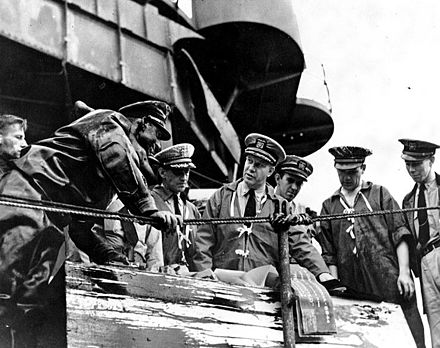
Captain Homer Wallin directing Salvage Operations

Many people know something about the attack, but one of the most remarkable aspects of it was the effort to salvage the fleet in the months following the attack. Under the leadership of Captain Homer N. Wallin teams of Navy and civilian divers from the Pacific Bridge Company worked day and night to salvage the sunken ships. The divers spend over 20,000 man hours under water in the highly hazardous waters; which were filled with unexploded ordinance, and contaminated by fuel and sadly decomposing human bodies. Wallin wrote, “The scene to the newcomer was foreboding indeed. There was a general feeling of depression throughout the Pearl Harbor area when it was seen and firmly believed that none of the ships sunk would ever fight again.”

h63921

The divers wore were rubberized coveralls with gloves. The divers were equipped with a lead-weighted belt which weighed 84 pounds and lead-weighted shoes, each of which weighed 36 pounds. Each diver wore a copper helmet attached to a breastplate. Air was supplied through a hose which was attached to the helmet and ran up to a compressor monitored by men on the surface. The work was extremely hazardous, the wrecked ships contained numerous hazards, any of which could cut his air hose and cause his death, and they also contained highly toxic gasses. They often worked in total darkness and had to communicate with the men on the surface via a telephone cable. The divers had to be exceptionally talented to and needed a great amount of coordination senses and balance to work with welding torches, suction hoses, and heavy equipment in the confines of the shattered ships. During the salvage operations a number of divers lost their lives. Before the ships could be raised ammunition, including the massive 14 and 16 inch shells weighing anywhere from 1300 to 2000 pounds each, Japanese bombs and torpedoes, fuel oil, gasoline, electrical equipment and batteries, weapons, and whenever possible the bodies of the entombed crews had to be removed, and then every hole had to be patched to make them buoyant. After the ships were raised cleanup crews had to go aboard and clear the ships of other hazardous waste as repair crews began their work to repair the basic systems needed to get the ships to West Coast shipyards for the major overhauls, The herculean effort was one of the greatest engineering feats in maritime history.

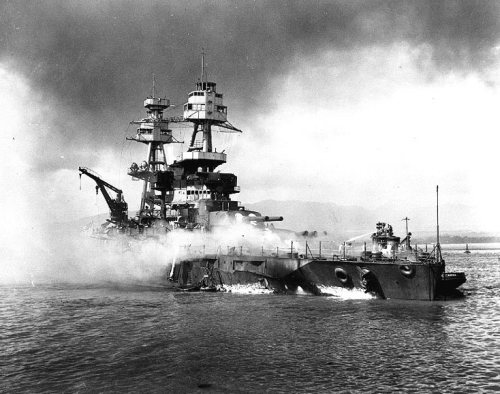
Of these were battleships, the USS Arizona sunk by a cataclysmic explosion, her broken hulk with her collapsed foremast the iconic symbol of the attack. USS Oklahoma was capsized on Battleship Row.  USS Nevada was grounded and sunk off Hospital Point after an abortive attempt to sortie during the attack. USS California and USS West Virginia lay upright on the bottom of Pearl Harbor, their superstructure, distinctive cage masts and gun turrets visible above the oily water.

BB-37_Oklahoma105c

The former battleship USS Utah lay capsized on the far side of Ford Island while the light cruiser USS Raleigh was fighting for her life barely afloat near Utah.  The ancient Minelayer USS Oglala was laying on her side next to the light cruiser USS Helena at the 1010 Dock. She was not hit by a bomb or torpedo but was said to have “died of fright” when Helena was hit by a torpedo, the blast which opened the seams of her hull. The destroyers USS Cassin and USS Downes were wrecks in the main dry dock. USS Shaw was minus her bow in the floating dry dock after exploding in what was one of the more iconic images of the attack. Other ships received varying amounts of damage.

h64474

As the engineers, damage control and salvage experts looked at the damage they realized that every ship would be needed for the long term fight. The building program of the US Navy was just beginning to pick up steam and it would be some time before new construction could not only make up for the losses but also be ready to fight a Two Ocean War. The decision was made to salvage and return to duty any ship deemed salvageable.

salvage09

Even the seemingly less important ships needed to be rapidly salvaged. Some which initially appeared to be unsalvageable needed at the minimum to be cleared from dry docks and docks needed by operational or less damaged ships. Likewise equipment, machinery and armaments from these ships needed to be salvaged for use in other ships.

h64496

Even by modern standards the efforts of the Navy divers and salvage experts and the civilians who worked alongside them were amazing. In the end only three of the 19 ships never returned to service. The work began quickly and on December 14th Commander James Steele began to direct the salvage operations on the sunken hulks. Captain Wallin relieved Steele on January 9th 1942. Wallin formed a salvage organization of Navy officers and civilian contractors. The civilian contractors were instrumental in the operation. Many of the civilians had experience in salvage operations, or underwater construction efforts, such as working on the Golden Gate Bridge which often exceeded the experience of the Navy divers.

h64493

The divers recovered bodies whenever possible, salvaged equipment, removed weapons and ammunition, made temporary repairs and help rig the ships for righting or re-floating. In each case the salvage experts, divers and engineers faced different challenges.

arizona-buring

Arizona was never raised. Her superstructure was cut down, main battery and some anti-aircraft guns removed. The main batter guns were delivered to the Army Coastal Artillery for use as shore batteries but none reached an operational status before the end of the war. The dives aboard were so dangerous that eventually the attempts to recover bodies ceased as several divers lost their lives in the wreck.  Over the years the National Parks Service has continued to dive on the wreck to assess it as a war grave and memorial.

Utah too was not raised. She was righted in 1942 but efforts to do more were halted because the elderly wreck had no remaining military value. Her wreck along with that of Arizona are war graves, many of their crew members, including over 1000 of Arizona’s men forever remain entombed in their ships. When I visited Pearl Harbor in 1978 as a Navy Junior ROTC Cadet and visited both memorials I was humbled at what I saw. They are haunting reminders of the cost paid by sailors during wartime.

Nevada was the first major ship salvaged. She was re-floated in February 1942 and after temporary repairs sailed to the West Coast on her own power. After repairs and a significant modernization of her anti-aircraft systems was complete she returned to action in 1943 in the invasion of Attu Alaska. She participated in many amphibious operations including Normandy, Southern France, Iwo Jim and Okinawa. She survived the Atomic Bomb tests in 1946 but wrecked and radioactive she was sunk as a target off Hawaii in 1948.

013717

BB-37_Oklahoma052org

oklahoma-salvage

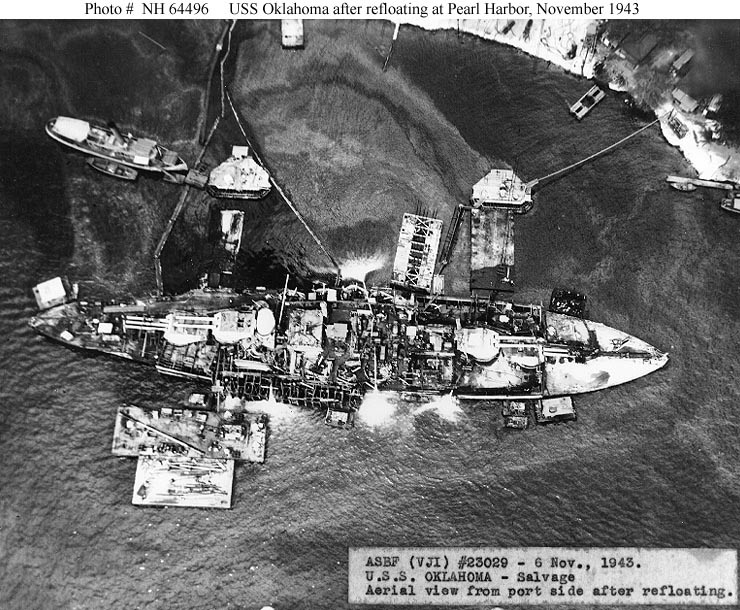
The salvage of the Oklahoma was one of the more challenging endeavors faced by Wallin’s men. Hit by at least five torpedoes during the attack the great ship capsized, her tripod masts digging deep into the mud of the harbor as she settled. Over 400 over her crew lay dead inside the ship. Since it was apparent that the ship was a total loss the salvage operations did not commence until the middle of 1942. The primary goal of the operation was to clear needed space for berthing large ships along Battleship Row. The operation involved making the ship as watertight as possible, solidifying the bottom of the harbor around her to enable her to roll and emplacing a massive system of righting frames, anchor chains and shore mounted winches and cables. The process involved cutting away wrecked superstructure, removing ammunition, weapons and the bodies of those entombed in their former home. She was completely righted in July 1943, and floated again in November. Moved to a dry dock in December she was made watertight and moored in another part of the harbor. Following the war she was being towed to a scrap yard but sank in a storm in May 1947.

California was raised in March and after temporary repairs sailed under her own power to the West Coast. Her repairs and modernization were a major undertaking. Fully reconditioned and modernized to standards of most modern battleships she returned to service in January 1944. She served in retaking Saipan, Guam, Tinian, as well as Leyte Gulf were she had a significant part in the Battle of Surigao Strait. Hit by a Kamikaze she was repaired and returned to action at Okinawa and support the occupation operations of the Japanese Home Islands. She was decommissioned in 1947 and sold for scrapping in 1959.

729px-Photograph_of_the_damage_done_to_the_USS_West_Virginia,_sunk_in_the_Japanese_raid_on_Pearl_Harbor_-_NARA_-_306536

west-virginia-damage

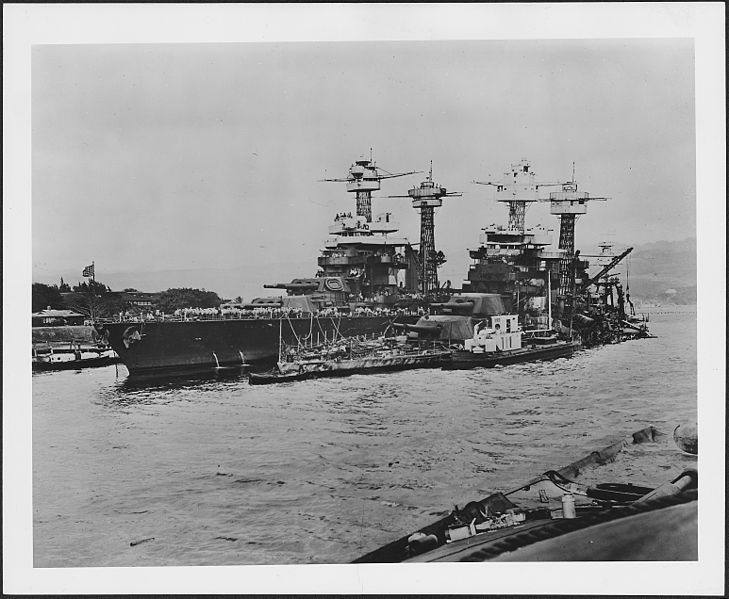
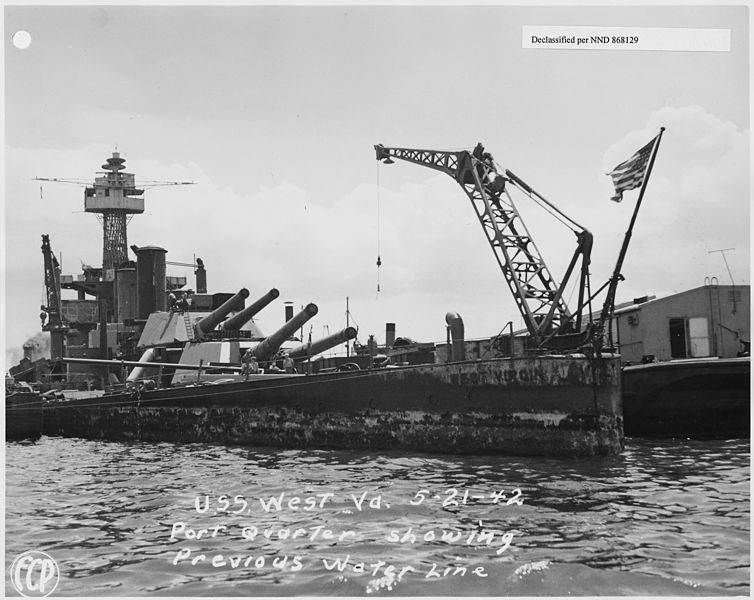
West Virginia suffered the most severe damage of the battleships returned to duty. She was raised in July 1942 and after repairs sailed to Puget Sound Naval Shipyard. Like California she was completely rebuilt and returned to action in October 1944 in time to take the lead role in destroying the Japanese Battleship Yamashiro. She served throughout the remainder of the war in the Pacific at Iwo Jima, Okinawa and the occupation of Japan.

h54564

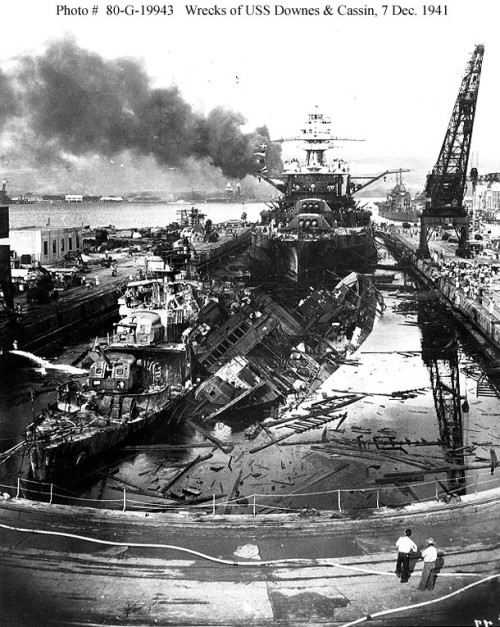
The Mahan Class destroyers Cassin and Downes were so badly damaged sitting in the Dry Dock Number One with Pennsylvania that initially they were believed beyond salvage. However after closer inspection it was determined that the hull fittings, main weapons systems and propulsion machinery on both ships were worth salvaging. These items were removed, shipped to Mare Island Naval Shipyard and installed on new hulls being constructed. The hulks of the old ships were scrapped at Pearl Harbor. Those ships were commissioned as the Cassin and Downes and served throughout the war.

h50005

Both were decommissioned in 1945 and scrapped in 1947. Their sister ship Shaw which had blown up in the floating dry dock was wrecked from her bridge forward. However the rest of the ship including her engineering spaces were intact. A temporary bow was fashioned and the ship sailed to Mare Island under her own power. Completely overhauled she was back in service by July 1942. She was decommissioned in 1945 and scrapped in 1946.

h64492

The ancient minelayer Oglala was raised in July and sent back to the West Coast where she was repaired and recommissioned as an internal combustion engine repair ship. She survived the war was decommissioned and transferred to Maritime Commission custody. She was a depot ship at the Suisun Bay Reserve Fleet until 1965 when she was sold for scrap.

The salvage feat to return these ships to duty was one of the most remarkable operations of its type ever conducted. Not only were most of the ships salvaged but most returned to duty. While none survive today many played key roles during the war. Artifacts of some of the ships are on display at various Naval Bases, Museums and State Capitals. They, their brave crews and the Navy Divers and civilian diving and salvage experts who conducted this task exhibited the finest traditions of the US Navy. The successors of the Navy divers at Mobile Diving Salvage Units One and Two still carry on that tradition today.

Peace

Padre Steve+

Leave a comment

Filed under History, Military, Navy Ships, world war two in the pacific

The Battleships at Pearl Harbor

arizon-main-battery2-2

Friends of Padre Steve’s World,

Today is the seventy-fourth anniversary of the Japanese attack on Pearl Harbor. It is hard to believe that the attack occurred so long ago. The survivors are aging, and even the youngest are close to ninety years old, the oldest survivor of the USS Arizona, Joe Langdell died in February of 2015. At the time of the attack he was a nearly commissioned Ensign. He and many like him served as the officers and men aboard the eight great battleships moored at Pearl Harbor on that terrible Sunday morning.

The next day President Franklin Roosevelt spoke these immortal words, “Yesterday, Dec. 7, 1941 – a date which will live in infamy – the United States of America was suddenly and deliberately attacked by naval and air forces of the Empire of Japan….

I remember reading Walter Lord’s classic and very readable book about Pearl Harbor “Day of Infamy” when I was a 7th grade student at Stockton Junior High School back in 1972.  At the time my dad was on his first deployment to Vietnam on the USS Hancock CVA-19.  As a Navy brat I was totally enthralled with all things Navy and there was little that could pull me out of the library.  In fact in my sophomore year of high school I cut over one half of the class meetings of the 4th quarter my geometry class to sit in the library and read history, especially naval and military history.

Over the years I have always found the pre-World War Two battleships to be among the most interesting ships in US Navy history.  No they are not the sleek behemoths like the USS Wisconsin which graces the Norfolk waterfront. They were not long and sleek, but rather squat yet exuded power. They were the backbone of the Navy from the First World War until Pearl Harbor. They were the US Navy answer to the great Dreadnaught race engaged in by the major navies of the world in the years prior to, during and after World War One.

Built over a period of 10 years each class incorporated the rapid advances in technology between the launching of the Dreadnaught and the end of the Great War.  While the United States Navy did not engage in battleship to battleship combat the ships built by the US Navy were equal to or superior to many of the British and German ships of the era.

Through the 1920s and 1930s they were the ambassadors of the nation, training and showing the flag. During those years the older ships underwent significant overhaul and modernization.

The Battle Force of the Pacific Fleet in 1941 included 9 battleships of which 8 were at Pearl Harbor on the morning of December 7th.  In the event of war the US War Plan, “Orange” called for the Pacific Fleet led by the Battle Force to cross the Pacific, fight a climactic Mahanian battle against the battleships of the Imperial Japanese Navy and after vanquishing the Japanese foe to relieve American Forces in the Philippines.  However this was not to be as by the end of December 7th all eight were out of action, with two, the Arizona and Oklahoma permanently lost to the Navy.

The ships at Pearl Harbor comprised 4 of the 6 classes of battleships in the US inventory at the outbreak of hostilities.  Each class was an improvement on the preceding class in speed, protection and firepower.  The last class of ships, the Maryland class comprised of the Maryland, Colorado and West Virginia, was the pinnacle of US Battleship design until the North Carolina class was commissioned in 1941.  Since the Washington Naval Treaty limited navies to specific tonnage limits as well as the displacement of new classes of ships the United States like Britain and Japan was limited to the ships in the current inventory at the time of the treaty’s ratification.

uss_oklahoma

USS Oklahoma (above) and USS Nevada

bb36_06

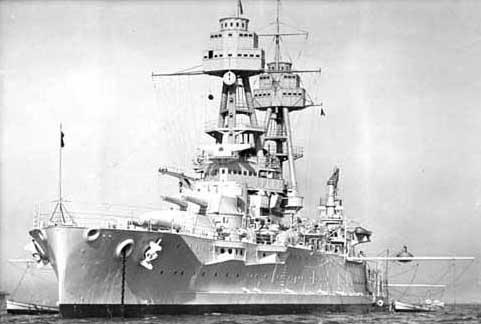
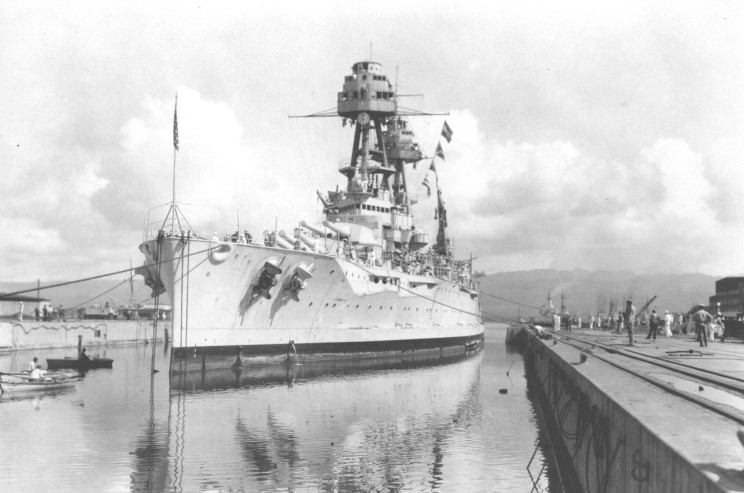
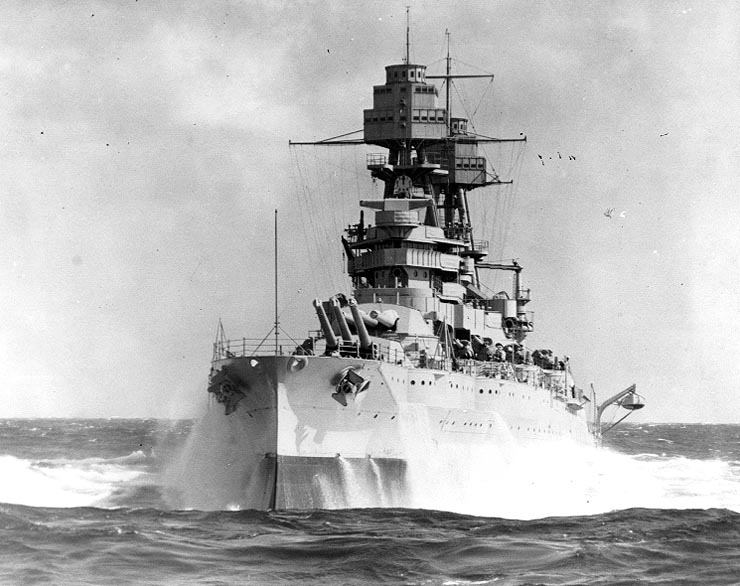
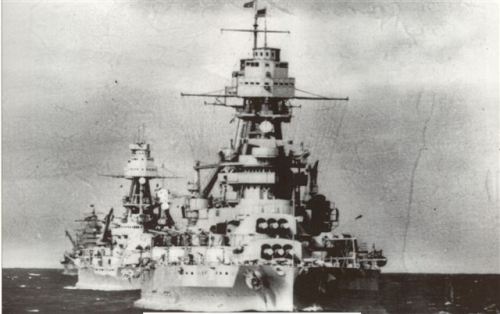
Those present at Pearl Harbor included the two ships of the Nevada class, the Nevada and Oklahoma they were the oldest battleships at Pearl Harbor and the first of what were referred to as the “standard design” battleships. The two ships of the Pennsylvania class, the Pennsylvania and her sister the Arizona served as the flagships of the Pacific Fleet and First Battleship Division respectively and were improved Nevada’s. The California class ships, California and Tennessee and two of the three Maryland’s the Maryland and West Virginia made up the rest of the Battle Force.

The Colorado was undergoing a yard period at Bremerton and the three ships of the New Mexico class, New Mexico, Mississippi and Idaho had been transferred to the Atlantic before Pearl Harbor due to the German threat.  The three oldest battleships in the fleet, those of the New York and Wyoming Classes, the New York, Arkansas and Texas also were in the Atlantic. Two former battleships, the Utah and Wyoming had been stripped of their main armaments and armor belts and served as gunnery training ships for the fleet. The Utah was at Pearl Harbor moored on the far side of Ford Island. The newest battleships in the Navy, the modern USS North Carolina and USS Washington were also serving in the Atlantic as a deterrent to the German battleships and battlecruisers which occasionally sortied into the Atlantic to attack convoys bound for Britain.

The great ships that lay at anchor at 0755 that peaceful Sunday morning on Battleship Row and in the dry dock represented the naval power of a bygone era, something that most did not realize until two hours later. The age of the battleship was passing away, but even the Japanese did not realize that the era had passed building the massive super-battleships Yamato and Musashi mounting nine 18” guns and displacing 72,000 tons, near twice that of the largest battleships in the U.S. inventory.

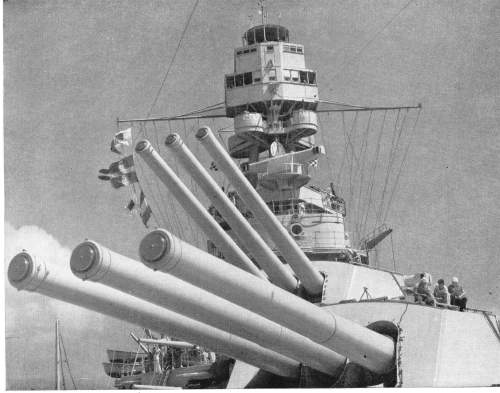
The Oklahoma and Nevada were the oldest ships in the Battle Force.  Launched in 1914 and commissioned in 1916 the Nevada and Oklahoma mounted ten 14” guns and displaced 27,500 tons and were capable of 20.5 knots. They served in World War One alongside the British Home Fleet and were modernized in the late 1920s. They were part of the US presence in both the Atlantic and Pacific in the inter-war years. Oklahoma took part in the evacuation of American citizens from Spain in 1936 during the Spanish Civil War.

During the Pearl Harbor attack Oklahoma was struck by 5 aerial torpedoes capsized and sank at her mooring with the loss of 415 officers and crew. Recent analysis indicates that she may have been hit by at least on torpedo from a Japanese midget submarine. Her hulk would be raised but she would never again see service and sank on the way to the breakers in 1946.

Nevada was the only battleship to get underway during the attack.  Moored alone at the north end of Battleship Row her Officer of the Deck had lit off a second boiler an hour before the attack.  She was hit by an aerial torpedo in the first minutes of the attack but was not seriously damaged. She got underway between the attack waves and as she attempted to escape the harbor she was heavily damaged. To prevent her from sinking in the main channel she was beached off Hospital Point.

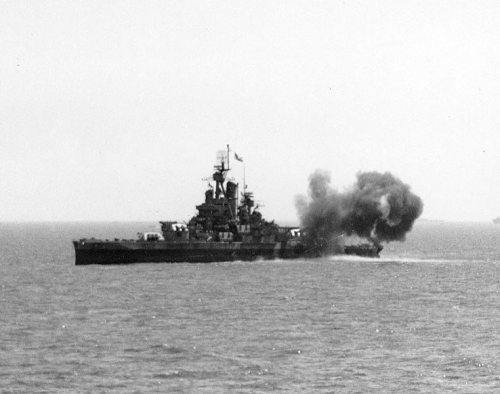
Nevada was raised and received a significant modernization before returning to service for the May 1943 assault on Attu.  Nevada returned to the Atlantic where she took part in the Normandy landings off Utah Beach and the invasion of southern France.  She returned to the Pacific and took part in the operations against Iwo Jima and Okinawa where she again provided naval gunfire support.  Following the war the great ship was assigned as a target at the Bikini atoll atomic bomb tests. The tough ship survived these tests and was sunk as a target on 31July 1948.

USS_Arizona_(BB-39)_-_1930s

Two views of USS Arizona

arizona-and-battleline

518px-O3U-3s_on_USS_Pennsylvania_(BB-38)_in_1935

Pennsylvania

pennsylvania-under-golden-gate

USS Pennsylvania sailing under the Golden Gate Bridge

774px-USS_Arizona_after_1931_modernization_NARA_19-LC-19B-1

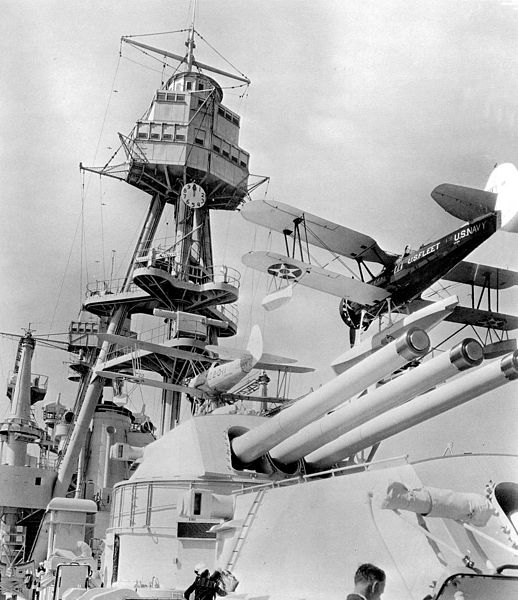
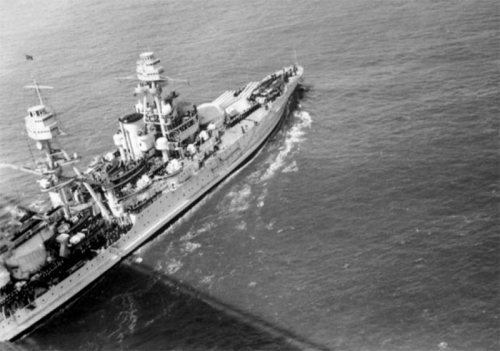
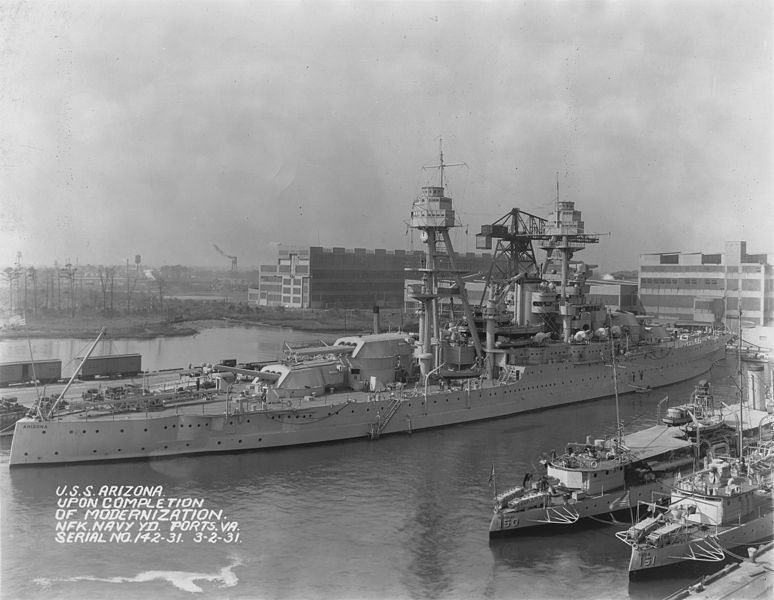
The two ships of the Pennsylvania Class were improved Oklahoma’s.  The Arizona and Pennsylvania mounted twelve 14” guns and displacing 31,400 tons and capable of 21 knots they were both commissioned in 1916. They participated in operations in the Atlantic in the First World War with the British Home Fleet. Both ships were rebuilt and modernized between 1929 and 1931. Though damaged in the attack, Pennsylvania was back in action by early 1942. She underwent minor refits and took part in many amphibious landings in the Pacific and was present at the Battle of Surigao Strait.  She was heavily damaged by an aerial torpedo at Okinawa Pennsylvania and was repaired. Following the war the elderly warrior was used as a target for the atomic bomb tests. She was sunk as a gunnery target in 1948.

Arizona was destroyed during the attack. As the flagship of Battleship Division One, she was moored next to the repair ship USS Vestal.  She was hit by 8 armor piercing bombs one of which penetrated her forward black powder magazine. The ship was consumed by a cataclysmic explosion which killed 1103 of her 1400 member crew including her Captain and Rear Admiral Isaac Kidd, commander of Battleship Division One.  She was never officially decommissioned and the colors are raised and lowered every day over the Memorial which sits astride her broken hull.

tennessee-1938

USS Tennessee & USS California

uss_california_bb44_03

california-1938

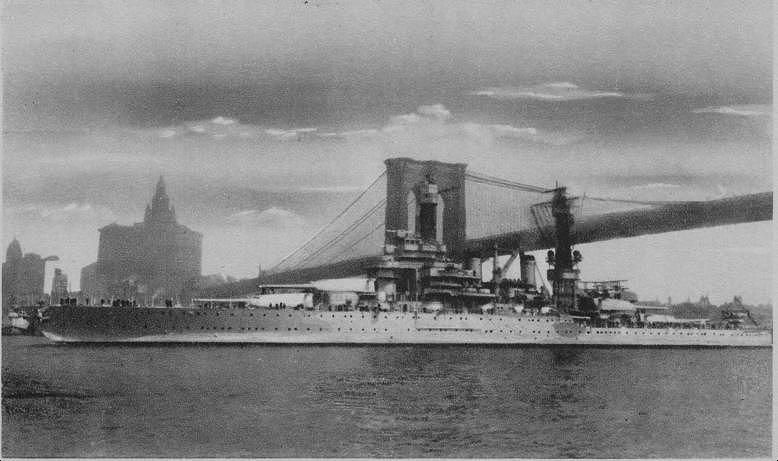
California sailing under the Brooklyn Bridge

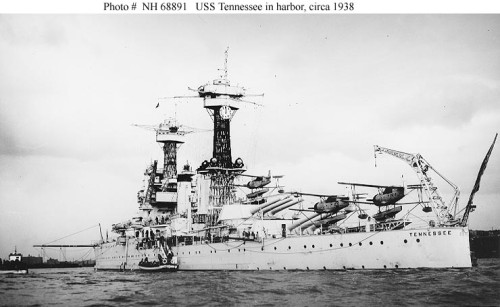
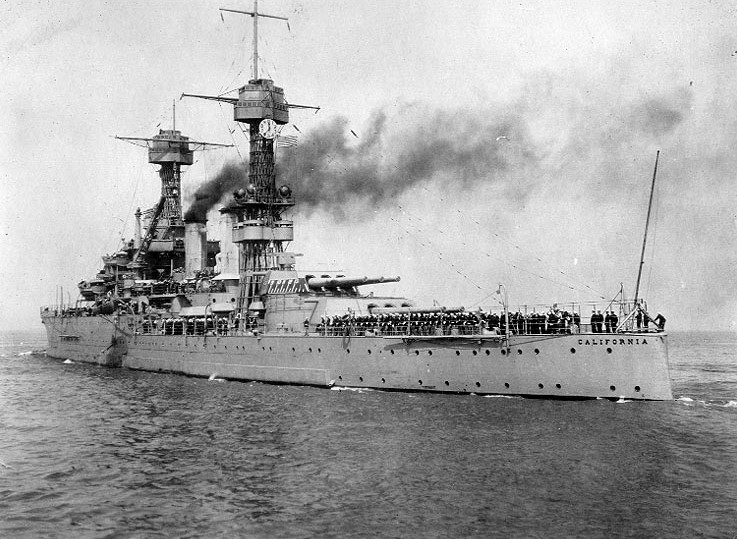
The Tennessee class ships the Tennessee and California were the class following the New Mexico class ships which were not present at Pearl Harbor. These ships were laid down in 1917 and commissioned in 1920. Their design incorporated lessons learned at the Battle Jutland. They mounted twelve 14” guns, displaced 32,300 tons and were capable of 21 knots. At Pearl Harbor Tennessee was moored inboard of West Virginia and protected from the aerial torpedoes which did so much damage to other battleships. She was damaged by two bombs.

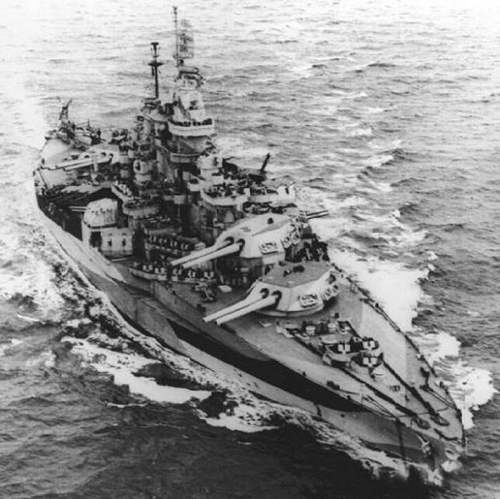
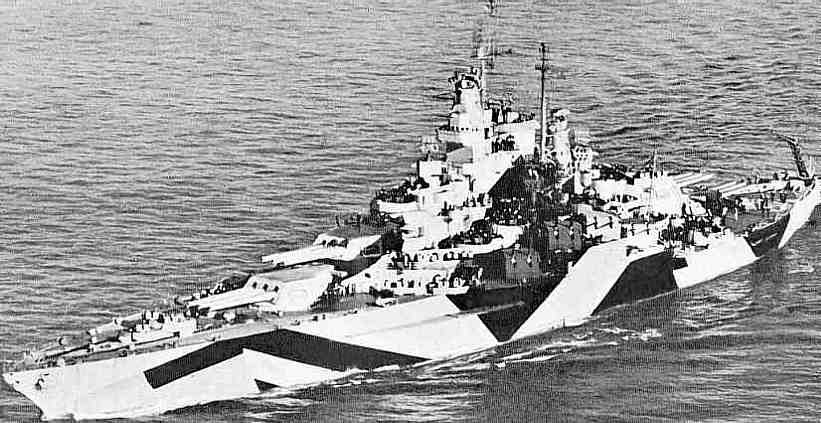
California was the Flagship of Battleship Division Two. She was moored at the southern end of Battleship Row. She was hit by two torpedoes in the initial attack, but she had the bad luck to have all of her major watertight hatches unhinged in preparation for an inspection. Despite the valiant efforts of her damage control teams she sank at her moorings. She was raised and rebuilt along with Tennessee were completely modernized with the latest in radar, fire control equipment and anti-aircraft armaments. They were widened with the addition of massive anti-torpedo bulges and their superstructure was razed and rebuilt along the lines of the South Dakota class. When the repairs and modernization work was completed the ships looked nothing like they did on December 7th. Both ships were active in the Pacific campaign and be engaged at Surigao Strait where they inflicted heavy damage on the attacking Japanese squadron. Both survived the war and were placed in reserve until 1959 when they were stricken from the Navy list and sold for scrap.

764px-USS_Maryland_broadside_1920s

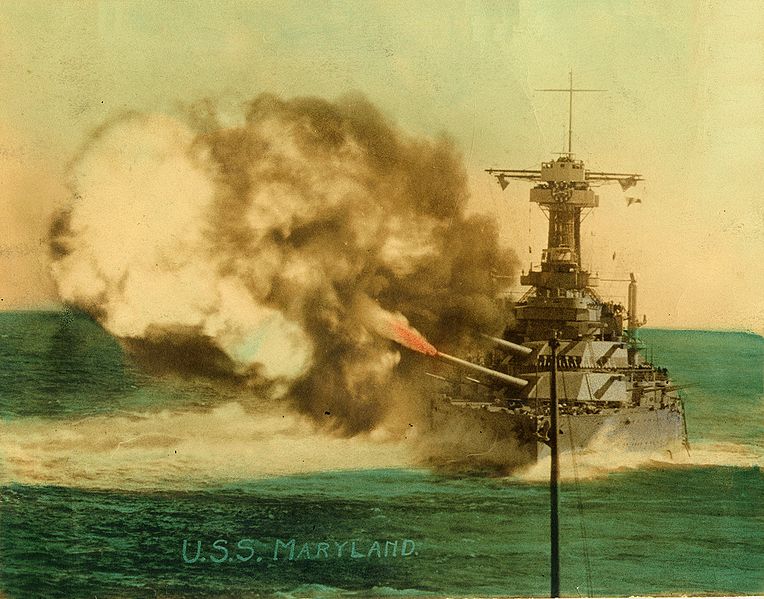
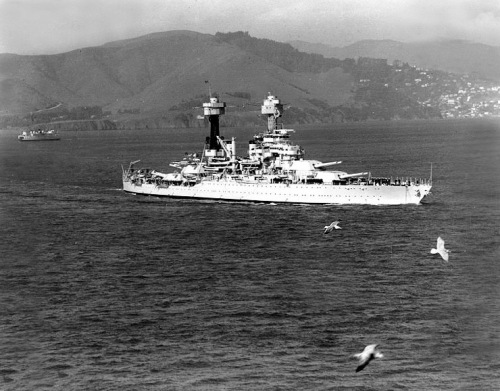
USS Maryland & USS West Virgina

west-virginia-1934

The Maryland and West Virginia were near sisters of the Tennessee class.  They were the last battleships built by the United States before the Washington Naval Treaty. and the first to mount 16” guns. With eight 16” guns they had the largest main battery of any US battleships until the North Carolina class. They displaced 32,600 tons and could steam at 21 knots. Laid down in 1917 and commissioned in 1921 they were modernized in the late 1920s. They were the most modern of the Super-Dreadnoughts built by the United States and included advances in protection and watertight integrity learned from both the British and German experience at Jutland.

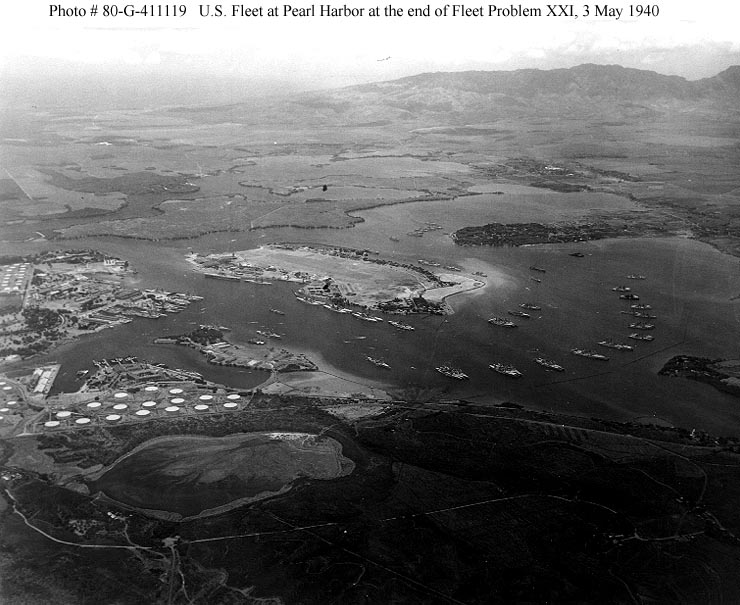
g411119

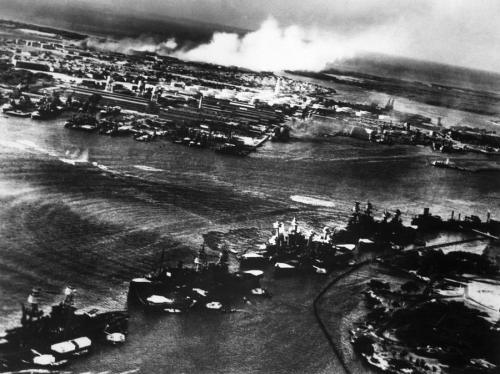
the-japanese-attack-on-pearl-harbor-everett-2

At Pearl Harbor Maryland was moored inboard of Oklahoma and was hit by 2 bombs and her crew helped rescue survivors of that unfortunate ship.  She was quickly repaired and returned to action.  She received minimal modernization during the war. She participated in operations throughout the entirety of the Pacific Campaign mainly conducting Naval Gunfire Support to numerous amphibious operations. She was present at Surigao Strait where despite not having the most modern fire control radars she unleashed six salvos at the Japanese Southern Force.

729px-Photograph_of_the_damage_done_to_the_USS_West_Virginia,_sunk_in_the_Japanese_raid_on_Pearl_Harbor_-_NARA_-_306536

Tennessee & West Virginia after the attack (above) Arizona (below)

arizona-buring

h64474

754px-USS_West_Virginia_5-21-42,_Port_quarter_showing_previous_water_line_(FCP)_-_NARA_-_296915

west-virginia-damage

pennsylania-drydock

Pennsylvania in Drydock Number One, Nevada beached at Hospital Point

nevada-1

013717

Oklahoma Capsized and after being righted

oklahoma-salvage

West Virginia suffered some of the worst damage in the attack. She was hit by at least 5 torpedoes and two bombs. One of the torpedoes may have come from one of the Japanese midget submarines that penetrated the harbor. She took a serious list and was threatening to capsize. However she was saved from Oklahoma’s fate by the quick action of her damage control officer who quickly ordered counter-flooding so she would sink on an even keel.  She was raised from the mud of Pearl Harbor and after temporary repairs and sailed to the West Coast for an extensive modernization on the order of the Tennessee and California.

west-virginia-final-config

USS California Late WWII

nevada-utah-beach

West Virginia was the last Pearl Harbor to re-enter service. However when she returned she made up for lost time.  She led the battle line at Surigao Strait and fired 16 full salvos at the Japanese squadron. Her highly accurate gunfire was instrumental in sinking the Japanese Battleship Yamashiro in the last battleship versus battleship action in history.  West Virginia, Maryland and their sister Colorado survived the war and were placed in reserve until they were stricken from the Naval List and sold for scrap in 1959.

The battleships of Pearl Harbor are gone, save for the wreck of the Arizona and various relics such as masts, and ships bells located at various state capitals and Naval Stations.  Unfortunately no one had the forethought to preserve one of the surviving ships to serve as a living memorial at Pearl Harbor with the Arizona. As I noted at the beginning of this article, the brave Sailors and Marines who manned these fine ships are also passing away.

Thus as this anniversary of the Pearl Harbor attack passes into history it is fitting to remember these men and the great ships that they manned.

Peace,

Padre Steve+

Leave a comment

Filed under History, Military, Navy Ships, US Navy, world war two in the pacific

Sub Sighted Sub Sunk: The USS Ward & the First Shot at Pearl Harbor

USS Ward Painting

Friends of Padre Steve’s World,

It is the day before the anniversary of the attack on Pearl Harbor, and as I always do this time of year I spend a significant amount of time writing about it, so that we never forget the brave men of the Greatest Generation who were there.

One of these men was Lieutenant Commander William Outerbridge, the commanding office of the USS Ward DD-139. Outerbridge and veteran of 14 years of service, and he had taken command of the elderly ship less than 24 hours before she began her weekend Anti-Submarine patrol of the entrance to Pearl Harbor. In the inter-war years promotion was slow and opportunities for advancement slim. Outerbridge had been commissioned following graduation from the Naval Academy in 1927. He was the only Regular Navy Officer on the ship.

USS Ward 1919

The Ward was old but had very few miles on her. She was a Wickes class destroyer displacing 1250 tons and was armed with four 4” 50 caliber and two 3” guns. She was launched and commissioned in 1918 and was decommissioned and placed in reserve in 1921. Recommissioned in January 1941 she was assigned to Destroyer Division 80 at Pearl Harbor. This squadron of elderly ships consisting of the Ward along with USS Schley, USS Chew and the even older USS Allen, was assigned to the Inshore Patrol Command.

As tensions between the United States and Japan increased the War Department and Department of the Navy issued a “War Warning” and Admiral Husband Kimmel, Commander in Chief Pacific Fleet ordered a “shoot on sight” against any ship or submarine operating in the security zone outside Pearl Harbor which effectively put the ships of DesDiv 80 on a war footing.

Outerbridge had taken command on Friday December 5th and taken the ship to sea 6th at 0628. He had no idea that in just over 24 hours the guns of his ship would be the first American warship to fire at an enemy combatant in the Pacific during the war.

As the Ward patrolled the area just a couple of miles off of the entrance to Pearl Harbor the minesweeper USS Condor (AMc-14) spotted a white wake near her at 0342.  The Officer of the Deck and Captain determined that it was the periscope of a submarine.  They signaled the Ward which was patrolling nearby: “Sighted submerged submarine on westerly course, speed nine knots” at 0348.

Outerbridge ordered the Ward to general quarters. After a futile search Outerbridge secured from General Quarters at 0443.  At 0458 Pearl Harbor’s anti-torpedo net gate was opened to allow passage of Condor and a number of other small ships including the Stores Ship USS Antares (AKS 14). Antares was towing a target back to base when at about 0635 a lookout on Ward noticed a wake following the auxiliary between her and her the raft.

Ward gun crew

Outerbridge returned to the bridge and sounded general quarters at 0640.  Outerbridge increased Ward’s speed to 25 knots and commended firing on the sub at 0645.  Ward’s number three gun scored a hit at the base of the sub’s conning tower and Ward charged the sub.  Coming close alongside the Ward dropped depth charges which sank the sub.

Outerbridge notified harbor control at 0651 sending the message “Depth bombed sub operating in defensive sea area.” Some of his own officers thought that it was possible that Ward had attacked an American submarine but Outerbridge was confident that the sub was hostile. To emphasize that this was different from false alarms that headquarters was accustomed sent another message at 0653 “Attacked, fired upon, depth bombed, and sunk submarine operating in defensive sea area.”  It was just over an hour before the first Japanese planes would begin their bombing runs.

Delays in seeking more conformation and reluctance to believe the report resulted in the message not being rapidly transmitted up the chain of command. It was a symptom of a parochial and divided command structure which did not respond quickly to the needs of war.

The rest is history. Within two hours the Battle line of the Pacific Fleet was sunk or crippled, all told 18 ships were sunk or damaged.  2402 Sailors, Marines and Soldiers were killed and another 1247 wounded.

But the war for Outerbridge and the Ward was not over. Outerbridge was promoted and transferred while the Ward was converted to a Fast Transport and redesigned APD-16 in 1943. She participated in actions in the Solomon Islands, New Guinea and the Philippines.

USS Ward burning

Ward burning after Kamikaze Attack

On December 7th 1944 while conducting operations at Ormoc Bay the veteran ship was hit by a Japanese “Betty” Twin engine bomber. The large aircraft acting as a Kamikaze crashed into Ward and started fires and flooding that could not be controlled. One of the ships that came to Ward’s assistance was the USS O’Brien (DD 725) commanded by her former commander, William Outerbridge, who had commanded Ward at Pearl Harbor. Three years to the day after sinking the Japanese submarine Outerbridge was ordered to sink his former ship after rescuing her crew.

Outerbridge retired as a Rear Admiral in 1957 and died in 1986.  Like others of his generation he served in war and peace.  As we remember the attack on Pearl Harbor let us not forget him as well as the fine crew of the USS Ward.  These men were alert that quiet Sunday morning 70 years ago and took action. They sunk a Japanese midget submarine intent on entering Pearl Harbor and reported their actions.  One wonders what might have happened if Outerbridge’s reports had been acted on, interceptors scrambled and anti-aircraft defenses on ships and ashore been ready when the Japanese attackers swept in to attack Pearl Harbor.  Of course we will never know.

Peace

Padre Steve+

1 Comment

Filed under History, leadership, Military, Navy Ships, US Navy

In Harm’s Way

 6565601_f496

Friends of Padre Steve’s World,

As we go into the anniversary of the attack on Pearl Harbor I am posting a number of older articles about the ships and men who endured that attack. During the attack eighteen ships were sunk or damaged, over 2000 Sailors and Marines aboard the ships along with Army personnel ashore were killed. Of the Sailors and Marines, over half lost their lives when the battleship USS Arizona blew up.

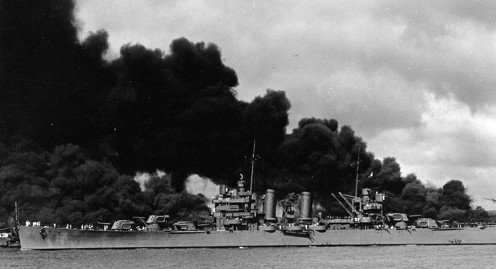
But amid the carnage and chaos a number of ship got underway. They were an odd collection; a battleship, two modern light cruisers, an elderly light cruiser and a collection of destroyers, destroyer minesweepers and destroyer minelayers. Yet in the midst of the din and bloody chaos of the Japanese attack on Pearl Harbor these ships, sometimes with only the most junior of officers in charge got underway and took to sea in order to seek out and engage the Japanese.

Their sortie is dramatized in the Otto Preminger film In Harm’s Way. 

http://www.tcm.com/mediaroom/video/477483/In-Harm-s-Way-Movie-Clip-Twelve-Bat-Blind-Ships.html

For the first forty minutes of the attack only two ships were underway. The USS Ward which had sunk the Japanese midget submarine outside the harbor entrance an hour before the attack began. The USS Helm was in the main channel as the attack began. They were joined over the next two hours by other ships.

g32445

The USS Nevada was the only battleship to get underway that morning and though she did not get out of the harbor, her example served to inspire those on the battered ships in the harbor and ashore. Nevada’s commanding officer and executive officer were ashore, along with many other senior officers. But that did not stop the officers still aboard from getting the great ship underway. Her Damage Control Officer, Lieutenant Commander Francis Thomas was a reservist, he took command and as the senior officer present on the ship got her underway. As the ship sailed past the blazing wrecks along Battleship Row the second wave of Japanese attackers set upon her. Heavily damaged Thomas realized that if the Japanese succeeded in sinking Nevada in the narrow main channel it would bottle up the fleet for months. Thomas skillfully grounded the now blazing ship off Hospital Point where she sunk into the mud.

The modern light cruiser USS St. Louis was moored outboard of her sister ship USS Honolulu at the Naval Station. Her sortie was enabled by members of her crew who chopped down the gangplank and cut water lines to the shore. Under command of Captain George Rood she got underway at 0931 and was the first cruiser to get underway.

0400808

The St. Louis was joined by her sister ship USS Phoenix and the elderly light cruiser USS Detroit which was moored on the far side of Ford Island. All three ships survived the war, and in a curious footnote to history, the Phoenix was sunk in the 1982 Falklands war as the Argentine ship General Belgrano.

h68450

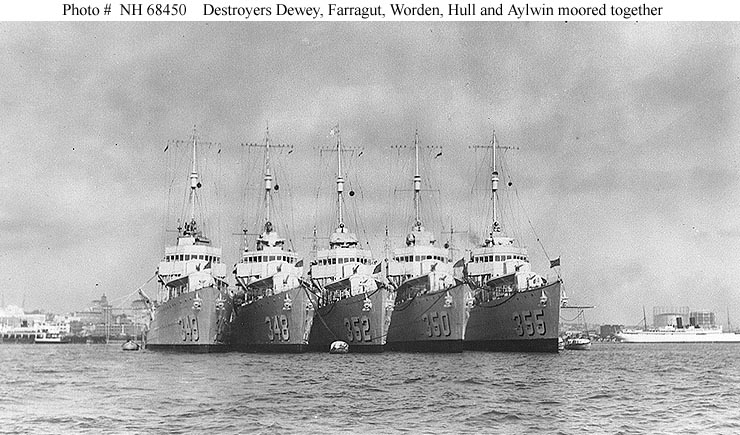
The cruisers were joined by a number of destroyers, often under the command of junior officers. The USS Blue got underway under the command of Ensign Nathan Asher, who had just three other ensigns with him as that ship got underway. She was joined by Monaghan, Dale, Henley, Phelps, Farragut, MacDonough, Worden, Patterson, Jarvis and Aylwin also under command of a junior officer, Ensign Stanley Caplan. Henley left without her commander under the command of Lieutenant Francis Fleck Jr.

h97789

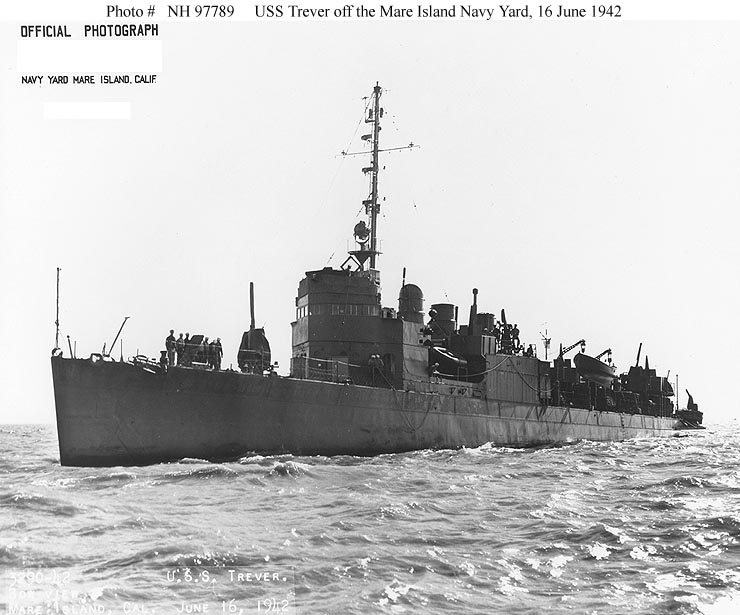
The cruisers and destroyers were joined by a number of elderly former destroyers which had been converted to Destroyer Minesweepers or Minelayers. The Ramsay, Breese, Trever and Perry all got underway, Trever also minus her commanding officer.

Some of the ships formed in a vain search for the Japanese strike force while others conducted defensive anti-submarine operations in the waters off Pearl Harbor.

The fact that all of these ships were able to get underway and navigate through the chaos of the attack, often under the command of junior officers and without key crew members was a testament to the courage and initiative of US Navy Officers and Sailors. It is a courage and initiative still in evidence today.

Peace,

Padre Steve+

1 Comment

Filed under History, leadership, Navy Ships, US Navy, world war two in the pacific

True Believers & Terrorism

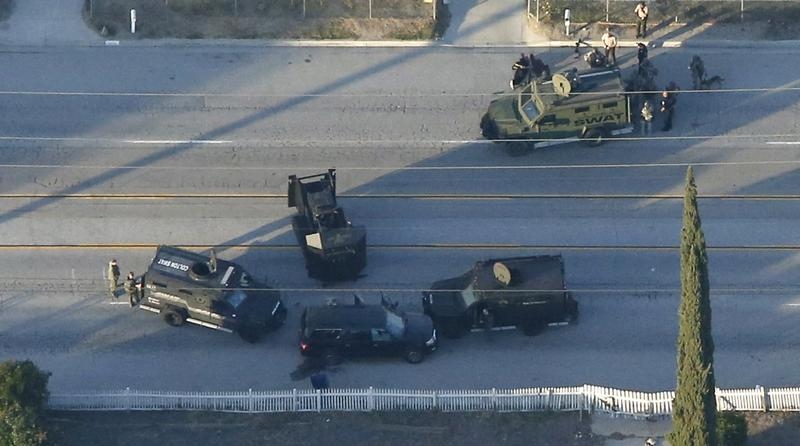
An SUV with its windows shot out that police suspect was the getaway vehicle from at the scene of a shooting in San Bernardino, California is shown in this aerial photo December 2, 2015.  Gunmen opened fire on a holiday party on Wednesday at a social services agency in San Bernardino, California, killing 14 people and wounding 17 others, then fled the scene, triggering an intense manhunt and a shootoutout with police, authorities said. REUTERS/Mario Anzuoni      TPX IMAGES OF THE DAY      - RTX1WX2P

Friends of Padre Steve’s World,

I have just a few words today. I am still attempting to comprehend the terror attacks in Paris as well as the terrorist attacks in Colorado Springs and San Bernardino.

All were committed by people devoted to killing in the name of their God. The attacks in Paris and San Bernardino by Moslems, Colorado Springs by a Christian. People of those religions can disown them and say that they do not represent their religion but that is what they claim to be. The fact is until religious leaders start owning these kinds of people as their own this terror will continue. 

The fact is that I have become sick of people who kill in the name of their God, but that seems to be a universal constant anymore, not that it ever wasn’t. Name the religion and do just a little research and you will find true believers who have killed and committed terrorist acts in the name of their God. In fact, I am getting sick of people who hide behind their religion and use it to bludgeon, kill, and terrorize those who are not the elect. I am tired of seeing people in this country, in the name of Jesus and the Christian religion using the government and the legislative process to disenfranchise and discriminate against others. I cannot imagine Jesus ever blessing such actions and I’m sure that if Jesus was to show up and start speaking in most churches that he would be throw out.

I am now convinced that many people who speak for God the loudest and probably the furthest away from God, if there is one. Having gone through the wilderness of doubt and unbelief have to admit that there are times that I doubt more than I believe. Today is one of those days.

American philosopher Eric Hoffer wrote, “The impression somehow prevails that the true believer, particularly the religious individual, is a humble person. The truth is the surrendering and humbling of the self bred pride and arrogance. The true believer is apt to see himself as one of the chosen, the salt of the earth, the light of the world, a prince disguised in meekness, who is destined to inherit the earth and the kingdom of heaven too. He who is not of his faith is evil; he who will not listen will perish.”

That my friends is the truth. That is what allows the terrorists to do such things and for people to shrug their shoulders and simply say “oh how terrible, I’ll pray for the victims” and go on their way, even as more terror acts are committed by these true believers. Where are the religious leaders who will do more than condemn attacks? Yes, I admit that there are some that do, but they seem few and far between. More often I have seen religious leaders speak out of both sides of their mouth when it comes to terrorists of their own faith. They use arguments of moral equivalency, saying “we do not condone the actions of the terrorists, but….” I saw this coming out of the lips of some Christian leaders and Christians who I know on social media after the assault on the Planned Parenthood clinic.

The more I see of this the more I am becoming convinced that God must not make very much difference in the lives of his most devout followers. But then maybe it is because they are more interested in building walls out of doctrine than they are of actually dealing with complexity and the contradictions of faith. Hoffer wrote, “A doctrine insulates the devout not only against the realities around them but also against their own selves. The fanatical believer is not conscious of his envy, malice, pettiness and dishonesty. There is a wall of words between his consciousness and his real self.”

I am appalled at the total absence of empathy, and the near sociopathic rantings of the true believers of almost every religion. They seem to have no capacity to feel for fellow human being, as Army Psychologist Gustave Gilbert said at Nuremberg, “In my work with the defendants I was searching for the nature of evil and I now think I have come close to defining it. A lack of empathy. It’s the one characteristic that connects all the defendants, a genuine incapacity to feel with their fellow men. Evil, I think, is the absence of empathy.” 

I see a lot of words, I hear a lot of religious mumbo jumbo, but I only sense a nearly complete absence empathy. If you wonder why I struggle so hard to believe, I think that is your answer.

Until tomorrow, pray for me a sinner,

Peace

Padre Steve+

9 Comments

Filed under crime, culture, faith, News and current events, Political Commentary, Religion, terrorism

Advent & the “War” on Christmas

677

Friends of Padre Steve’s World

I often talk about my struggles with doubt and faith, but in regard to faith, the season of Advent has become even more important to me than it ever was before. In fact, amid all the yearly histrionics and propaganda of the Christian Right and their Fox News Channel cheerleaders who scream about “the war on Christmas” I find Advent to be a powerful antidote.

Advent is the beginning of the liturgical year, in a sense the opening day of a new season of faith, as much as the Opening Day is to baseball. Advent is a season of new beginnings, of hope looking forward and looking back. It is a season of intense realism. It is a season where the people of God look forward to their deliverance even as they remember the time when God entered into humanity.  It was not simply entering the human condition as a divine and powerful being inflicting his will upon people but deciding to become subject to the same conditions know by humanity. As Paul the Apostle, wrote about him: “though he was in the form of God, did not regard equality with God as something to be exploited, but emptied himself, taking the form of a slave, being born in human likeness. And being found in human form, he humbled himself and became obedient to the point of death– even death on a cross.” (Philippians 2:5b-8) 

In the incarnation Jesus Christ shows his love and solidarity with people, humanity, the creation, reality. Dietrich Bonhoeffer wrote:

“God loves human beings. God loves the world. Not an ideal human, but human beings as they are; not an ideal world, but the real world. What we find repulsive in their opposition to God, what we shrink back from with pain and hostility, namely, real human beings, the real world, this is for God the ground of unfathomable love.” 

That simple fact is why Christ came. Christ did not come to found a government or even for that matter a religion. He did not come to exemplify “Christian” virtues or to condemn people that religious people condemned as sinners. He came simply to save and redeem the world and people like us from themselves.

The meaning of the incarnation, and the hope of the season of Advent is that God loves people. Yes, even the people that the supposed Christian culture warriors despise.

In the next few week there will be much written and said about Jesus. Much of it will not actually deal with Jesus or the people that he came to save but instead about the worldly power and influence of those who seek the profits of being “prophets.” Some of them will talk fervently about the “War on Christmas” as if somehow God and Christ are so small that they need government-sponsored displays in the public square in order to be real, relevant or for that matter important. What a small God they must have.

Somehow the message of Advent, the coming of Jesus is contradictory to the message of the for profit prophets. Certainly the early Christians had no government backing of any kind. These early Christians simply lived life and showed God’s love to their neighbors, often at the cost of their lives and paradoxically the message was not crushed, but spread and to be neutralized had to be coopted by Constantine. It was only when the leaders of the church became co-executors of government power that the message of reconciliation became a bludgeon to be used against those who did not agree with the theology of the clerics beholden to the Empire.

The Christ of the Season of Advent, the one who came and who promises to come again is not captive to the capricious message of the for profit prophets and their political and media allies. I would dare say that God is much bigger than them or those that they believe will somehow end the Christian faith as we know it. But then maybe the Christian faith “as we know it” is more a reflection of our culturally conditioned need for physical, economic and political power over others than it is of Jesus.

All I know is that the simplicity of the message that “God so loved the world that he gave his only begotten Son” is more powerful than any political-religious alliance.

The time of waiting in expectation during advent also helps us to focus on Jesus’ words to  “Love God with all your heart and love our neighbors as ourselves.” It also calls to mid the words of the Old Testament prophet Micah, who asked “what does the Lord require of thee? To love show justice, to love mercy and to walk humbly with thy God.”

Advent stands in stark contrast to the politically charged consumerism of the War on Christmas.  I think that the message that God loves the real world is worth repeating in such an environment. In fact I think that because the message of God’s great love for those deemed “repulsive” by so many supposedly “conservative Christians” is so amazing that it must be proclaimed. As distasteful as it is to the “for profit prophets” of our time, it is not only worth repeating, but actually believing and being acting upon.

It is a good reason for me to during this season of Advent to look forward to our celebration of the mystery of the Incarnation, the coming of the God who “emptied himself” and took “the form of a slave” in order to save his people.

Peace

Padre Steve+

3 Comments

Filed under christian life, faith, Religion

The Doomed Fleet: The Kido Butai & Pearl Harbor

Akagi_29

Friends of Padre Steve’s World

Early December is such an interesting time of year for a historian. There are a lot of events that occurred which still linger in our memories. One of those is the Japanese attack on Pearl Harbor on December 7th 1941. I find it interesting and not just from an American point of view. I can also as a career military officer also understand the thoughts of the Japanese officers who were ordered to undertake the attack.

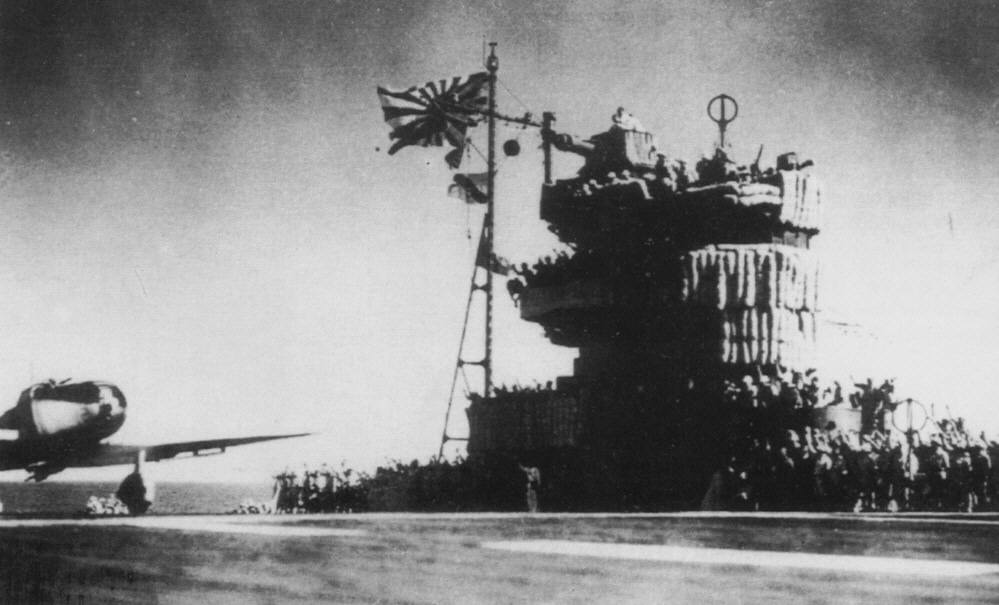
Early in the morning on November 26th 1941 the ships of the Japanese Carrier Strike Force, the Kido Butai under the command of Vice Admiral Chuichi Nagumo weighed anchor from Tankan Bay in the northern Kurile Islands of Japan. The plan was top secret and very few Japanese officers knew of the target. Many officers presumed that war was immanent but most assumed the target would be the Philippines or other targets in Southeast Asia.

PERSON JAP Nagumo1

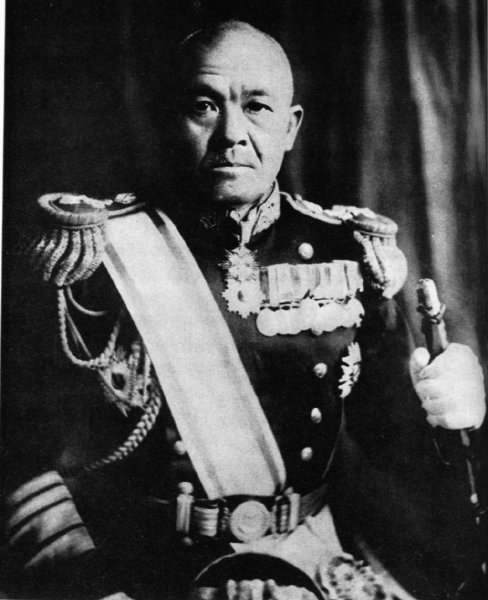
Nagumo

The next day Nagumo expressed his personal misgivings about the attack to his Chief of Staff Rear Admiral Ryunosuke Kusaka as the task force plunged through heavy seas. He blurted out, “Mr. Chief of Staff, what do you think? I feel that I’ve undertaken a heavy responsibility. If I had only been more firm and refused. Now we’ve left home waters and I’m beginning to wonder if this operation will work.” 

Admiral Kusaka came up with the right answer:  “Sir, there’s no need to worry. We’ll make out all right.” 

Nagumo smiled. “I envy you, Mr. Kusaka. You’re such an optimist.” 

The attack on Pearl Harbor was designed to be pre-emptive in nature. It was supposed to deliver such a crushing blow to the United States Navy that the Japanese could complete their Asian conquests before it could recover. It was a plan of great risk that doomed Japan to horror never before imagined when the United States dropped Atomic bombs on Hiroshima and Nagasaki less than four years later. By then the bulk of the Imperial Navy would be at the bottom of the Pacific and millions of people killed.

yamamoto-isoroku1

Yamamoto 

The Japanese, even Admiral Yamamoto, the man behind the plan understood that it entailed great risks. A simulation of the plan conducted in early September by the senior officers of the Combined Fleet and the Kido Butai calculated that two of Japan’s precious aircraft carriers could be lost in the operation. But despite the opposition and reservations of key officers, including the Kido Butai commander, Admiral Nagumo Yamamoto pressed forward.

kagaph

The Kido Butai was the most powerful carrier strike group assembled up to that time. In fact the United States Navy would not equal the power of the force until late 1943. Comprised of six aircraft carriers, the massive flagship Akagi, and the Kaga, the fast 18,000-ton Soryu and Hiryu and the most modern Shokaku and Zuikaku. The carrier embarked over 400 aircraft, of which over 350 were to be used in the two aerial assault waves. Most of the pilots and aircrew were experienced, many with combat experience in China. The carriers were escorted by the old but fast and modernized battleships Kirishima and Hiei, the new heavy cruisers Tone and Chikuma, the light cruiser Abukuma, the new Kagero Class destroyers, Urakaze, Isokaze, Tanikaze, Hamakaze, Kagero and Shiranuhi, the Asashio class destroyers Arare and Kasumi. Two additional destroyers the Fubuki class Sazanami and Ushio were assigned to neutralize the American base on Midway Island. The submarines I-19, I-21 and I-23 and 8 oilers were assigned to the force. Five additional submarines the I-16, I-18, I-20, I-22 and I-24 each embarked a Type-A midget submarine.

1280px-Hiryu_burning

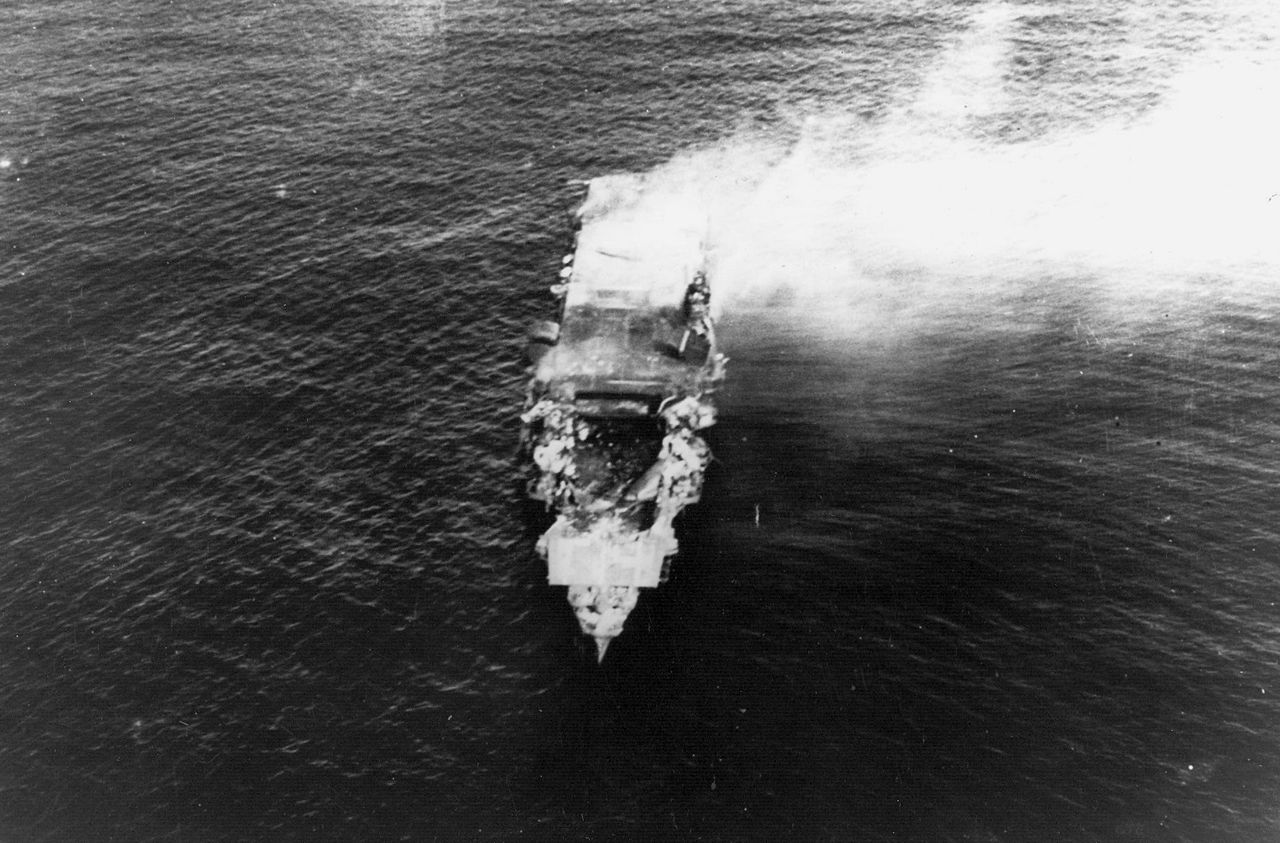
Hiryu prior to sinking at Midway

On December 7th the force delivered a devastating blow to the American Pacific Fleet at Pearl Harbor, however no American aircraft carriers were present. It would go on for the next several months on a rampage across the Pacific and Indian Oceans. However their success would be short lived. Within a year, the carriers that were not present at Pearl Harbor sank the Akagi, Kaga, Soryu and Hiryu at Midway. Hiei and Kirishima were lost at the Naval Battle of Guadalcanal in November 1942. Over the course of the war every ship of the attack force but one was lost.

zuikaku12_usn_h73070

The Last Banzai aboard Zuikaku as she sinks at the Battle of Cape Engano (Leyte Gulf) October 25th 1944

Shokaku was torpedoed and sunk at the Battle of the Philippine Sea and Zuikaku, Chikuma and Abukuma were lost at Leyte Gulf, most of the destroyers and submarines were lost in various engagements. However three destroyers, Isokaze, Hamakaze and Kasumi accompanied the great Battleship Yamato on her suicide mission at Okinawa and were sunk on April 7th 1945. The heavy cruiser Tone was sunk at her moorings at Kure during air strikes by the US 3rd Fleet on July 24th 1945.

9d006f3b373f8e5ed86a61bad7406d6f

Heavy Cruiser Tone sunk in Kure Japan 1945

All of the submarines were lost during the war, however I-19 sank the USS Wasp CV-7 and USS O’Brien DD-415 while damaging the USS North Carolina BB-55 on September 15th 1942 off Guadalcanal. Only the destroyer Ushio survived the war and was broken up for scrap in 1948.

MitsuoFuchida

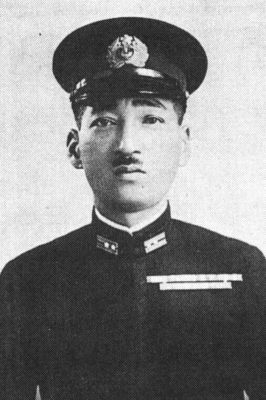
Fuchida (above) and Genda 

f624277ee1

Among the leaders of the Japanese strike force, Admiral Yamamoto was killed on April 18th 1943 when his aircraft was shot down at Buin.  Most of the sailors who took part in the attack would be dead by the end of the war. Nagumo who resisted the strike and was ordered to lead it realized his worst fears at Midway and during the battles around Guadalcanal and the Solomon Islands, died in the American invasion of Saipan in 1944. The two aviators who planned and executed the tactical details of the raid, Mitsuo Fuchida, and Minoru Genda, both survived the war. Genda became a general in the Japanese Air Self Defense Force and died at the age of 84 in 1989. Fuchida converted to Christianity after reading the story of Doolittle Raid survivor Jacob DeShazor. Fuchida became a Methodist pastor and evangelist and died in 1976 at the age of 73.

Few present at Tankan Bay on that fateful November morning could have expected the triumph and tragedy ahead. However Yamamoto was probably more of a realist than many in the Japanese government and military leadership when he told Prime Minister Fumimaro Konoe “In the first six to twelve months of a war with the United States and Great Britain I will run wild and win victory upon victory. But then, if the war continues after that, I have no expectation of success.” Yamamoto was eerily prophetic and those that counsel pre-emptive war need to never forget his words or the results of his decisions.

Peace

Padre Steve+

1 Comment

Filed under Loose thoughts and musings

Belief & Unbelief in Advent

2004weihnachtsbrief-2

Friends of Padre Steve’s World,

I mentioned on Sunday that I would be writing about faith and doubt during the season of Advent and Christmas.  Gospel according to Saint Mark records the story of a man that brought his son to Jesus the Christ to be cured of a deadly disease. In desperation the man cries out to Jesus, “Lord I believe, help me in my unbelief.”

I understand that impassioned cry.

That being said, for a lot of people, including me, the season of Advent and Christmas are incredibly difficult and times where faith, already difficult becomes nearly impossible.  For many the season is not a time of joy but depression, sadness and despair. I know feeling well, for it has been the reality that I have lived with since returning from Iraq.

Before Iraq, Advent and Christmas were times of wonder and mystery and I really found it difficult to understand how anyone could be depressed during the season, but that was before I came home from Iraq. After Iraq, the seasons of Advent and Christmas became almost unbearable as I struggled to believe in anything, including God.

I have faith again, but I still struggle to find the same wonder and mystery of the season that I once experienced. I think that the last time I was truly joyful at Christmas and during Advent was in Iraq, celebrating the message of hope among our advisors up and down the Iraqi-Syrian border. I think the most special moment was serving Eucharist to an Iraqi Christian interpreter who had not received the Eucharist in years that Christmas Eve of 2007 at COP South. Somehow in that God forsaken land God seemed closer than any place I have been since.

Since I returned from Iraq my life has been a series of ups and major downs. In dealing with PTSD, anxiety, depression and chronic insomnia as well as my dad’s painfully slow death from Alzheimer’s disease, I have struggled with faith.  Prayer became difficult at best and as I dealt with different things in life I knew that I didn’t have any easy answers.  Going to church was painful. Chaplain conferences even more so, except being with others who struggled like me.  About the only place that I could find solace was at a baseball park.  For some reason the lush green diamond is one of the few places that comfort me.

I find that the issue of doubt is not uncommon for a lot of people, including ministers of most Christian denominations. I am sure that this can be the case with non-Christian clerics as well, but I cannot say that with any deal of authority.

For some Christian ministers and priests the seasons of Advent and Christmas can be difficult. For those of us who are ordained and view ministry or Priesthood as a sacred vocation this can difficult to deal with.  Ministers and others who suffer a crisis in faith, depression or despair endure a special kind of hell this time of year because we are not supposed to suffer a crisis in faith, for any reason.

I believe that for many people, a religious leader who has doubts and struggles with faith is disconcerting.  I know many ministers who for a myriad of reasons experienced a crisis in faith. Sometimes this involved great personal losses such as the loss of a child, a failed marriage or being let go or fired by a church, or experiencing any number of other major traumatic events.  All of these men and women are good people. But when they experienced a crisis, instead of being enfolded by a caring community of faith they were treated as faithless failures, and and abandoned or excluded from their faith community as if they were criminals.

When I was younger I used to look askance at pastors who had given up, lost their faith, or abandoned the ministry for whatever reason.  As a young seminary student and later young chaplain I had a hard time with such situations. They made no sense to me and I was somewhat judgmental until I started to get to know a decent number of “broken” ministers from various faith traditions that a lot more went into their decision than simply not being tough enough to hang in there until things got better.

While I saw this happen to others I never thought it would happen to me. I thought I was “bulletproof” and when it occurred I was stunned. I didn’t expect what happened nor its effect on me.

When I came back from Iraq I came home to find that my office had been packed up and many mementos lost, it took months to find most and there are still important documents that have never been recovered. My wartime accomplishments went unrecognized by most of my peers in the Chaplain Corps on my return home and I found no place of comfort.

As I crashed no one asked about my faith until I met my first shrink. It was after the initial crash that my commanding officers, Captain, now Admiral, Frank Morneau and Tom Sitsch both asked me about my faith.  I told them that I was struggling and both were more understanding than the vast majority of chaplain, ministers, or Christian lay people that I knew. Commodore Sitsch asked me “Where does a Chaplain go for help?”  I could only say, “not to other chaplains.” Sadly I had no idea how much Commodore Sitsch was going through as he ended his life on January 6th 2014, suffering the effects of untreated PTSD and TBI.

On the professional side I felt tremendously isolated from much of the clergy of my former church, and many chaplains. This is something that I still feel to some extent today, although there are some chaplains who I can be completely honest with, sadly, like me, they have also experienced major faith crisis and have struggled with the same kind of abandonment and betrayal that I have felt. I was angry then because I felt that I deserved better, because I had done all that was asked of me for both my former church and chaplain corps.

In the midst of the crisis I appreciated simple questions like “How are you doing with the Big Guy?” or “Where does a Chaplain go to for help?” Those questions showed me that the people who asked them cared.

There were many times between 2008 and 2010 that I knew that I had no faith.  People would ask me to pray and it was all that I could do to do to pray and hoped that God would hear me.  Even the things that I found comforting, the Mass, the Liturgy and the Daily Office were painful, and while faith has returned, some of the of them still are.

That being said, I am still a Christian, or maybe as I noted last week a Follower of Jesus, since the Christian “brand” is so badly tarnished by the politically minded, hateful, power seeking, media whores that populate the airwaves and cyber-space. This makes Advent and Christmas difficult.

Why I remain a Christian is sometimes hard to figure.  I am certainly not a Christian because of the church, what is called Christendom, or the actions of supposed Christians who want to use the police power of government to subjugate others. At the same time like the German priest and theologian Hans Kung “I can feel fundamentally positive about a tradition that is significant for me; a tradition in which I live side by side with so many others, past and present.” Nor am I a Christian because I think that the Christian faith has all of the answers to all of lives issues. After coming home from Iraq I know that it is not so. I have to be painfully honest and say that neither the Church nor Christians have all the answers. That may sound like heresy to some, but I can live with it.

I don’t presume to know God’s will and I can’t be satisfied with pat answers like I see given in so many allegedly Christian publications, sermons and media outlets.  Praying doesn’t always make things better. I remain a Christian in spite of these things and in spite of my own doubts.  I still believe that God cares in spite of everything else, and in spite of my own doubts, fears and failures.

One of the verses of the Advent hymn O’ Come O’ Come Emmanuel is a prayer for me this year.

O come, Thou Day-Spring, come and cheer

Our spirits by Thine advent here

Disperse the gloomy clouds of night

And death’s dark shadows put to flight.

 So now, for those that like me struggle with faith, those who feel abandoned by God, or by family and friends, I pray that all of us will experience joy this season. So I do pray that the Day Spring will come and cheer, all of us with his advent here.

Peace,

Padre Steve+

2 Comments

Filed under christian life, faith, Pastoral Care, Tour in Iraq

Dehumanization & Genocide

sturmer-display

Friends of Padre Steve’s World,

One of the most terrible things about a national security crisis, real or imagined, is that xenophobic leaders, instill fear and terror about people who are different from the majority. It is shockingly easy to do, and is part and parcel of every human culture. In doing so they use language which enables people, often very good people, to view others as less than human, a process known as dehumanization. Right now we see the results of this. On one hand there are the fanatics of DAESH and other Moslems extremist groups that use propaganda to dehumanize anyone that does not adhere to their beliefs. On the other hand there is the response of some American and European politicians, preachers, pundits and media organizations which in responding to the extremists, dehumanize all Moslems and suggest the most severe measures to deal with what they call the problem of Islam.

David Livingstone Smith wrote, “Dehumanization isn’t a way of talking. It’s a way of thinking—a way of thinking that, sadly, comes all too easily to us. Dehumanization is a scourge, and has been so for millennia. It acts as a psychological lubricant, dissolving our inhibitions and inflaming our destructive passions. As such, it empowers us to perform acts that would, under other circumstances, be unthinkable.”

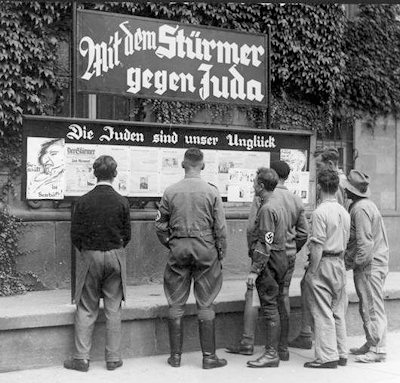
Once someone has succumbed to the idea that certain others are no longer fully human, or less than human the unthinkable becomes not only possible, but probable. Of course this process takes time, and usually comes from years of exposure to propaganda that first demonizes, and then dehumanizes those that the propagandists despise. At Nuremberg, Julius Streicher, the publisher of the Nazi tabloid Der Sturmer was asked by a prosecutor, “And do you think to call them “blood-suckers,” “a nation of blood-suckers and extortioners– do you think that’s preaching hatred?” Streicher replied, “No, it is not preaching hatred; it is just a statement of facts.”

In Hitler’s Third Reich it was the Jews and others who were viewed as sub-human. When one reads the testimony of the major war criminals at Nuremberg, every single defendant admitted to the role that decades of anti-Semitic propaganda had in shaping their worldview.

The sad truth is that Hitler is not alone. Such beliefs and actions are all too common. In 1830s to the 1850s in the United States it was Irish and German Catholics; in the ante-bellum and the Jim Crow South it was African Americans who were said to be an inferior race; in the 1860s to the early 1900s on the west coast it was the Chinese. After Pearl Harbor, the Japanese who we put in internment camps. Let us not forget the protracted campaign to exterminate the Native Americans, something that Rush Limbaugh mocked in 2009 saying, “Holocaust? Ninety million Indians? Only four million left? They all have casinos — what’s to complain about?” Those are just European and American examples. One can see the same language and action in Rwanda, the Sudan, the Middle East, the Japanese campaign in China, the Soviet starvation and massacres of Poles and Ukrainians during the 1930s; and the list can go on and on.

One of the ways that they make it easy for their followers to approve of draconian measures is to dehumanize their victims and euphemistically refer to the situation as a question, a question that must have an answer or a solution. In the Third Reich it was the Jewish question, and the answer became the apocalyptic Final Solution.

The Nazis referred to the Jews as sub-human, a bacilli, or cancer. Today leading politicians in the United States and Europe are referring the Syria refugees, as well as other Moslems in a similar manner. Some of the worst offenders are men who beat on their chest and claim to be Christians. Mike Huckabee referred to the Syria refugees as “spoiled milk,” Ben Carson called them “rabid dogs.” The mainstream British columnist, Katie Hopkins called them “rats and cockroaches.” Plenty of other less prominent politicians, pundits and preachers have voiced similar opinions, and you cannot visit Facebook without seeing scores of memes and comments echoing those thoughts.

But others, particularly the media and already elected officials use other language to dehumanize people. The language of natural disasters, or war is common. Politicians, preachers and the media couple refugees and migrants with words such as influx, occupation, invasion, flood or flow. All of these terms are used to stoke fear in the minds of their listeners or followers. Floods must be controlled, invasions, defeated, occupations, ended. Eventually people just take it for granted that such threats must be dealt with, such questions, answered.

This language encourages their followers to approve of draconian measures is to dehumanize their victims. Somewhat euphemistically they refer to the situation as a question, a question that must have an answer or a solution. In the Third Reich it was the Jewish question, and the answer became the apocalyptic Final Solution. The Nazis preached that there would have to be a showdown between their pure “Aryan” race, and the Jews. Rudolf Höss, the commandant of Auschwitz noted the Himmler stressed “that if Germany was to survive then World Jewry must be exterminated and we all accepted it as truth.”

Höss told American Army psychologist Gustave Gilbert about how he accepted the orders f0or the Final Solution based on his beliefs:

“That was the picture I had in my head, so when Himmler called me to him, I just accepted it as the realization of something that I already accepted – not only I, but everybody. I took it for granted that even though this order, which would move the strongest and coldest nature – and at that moment this crass order to exterminate thousands of people (I did not know how many) – even though it did frighten me momentarily – it fitted in with all that had been preached to me for years. The only problem itself, the extermination of Jewry, was not new – but only that I was the one to carry it out, frightened me at first. But after getting the clear direct order and even an explanation with it – there was nothing left to do but carry it out.”

Gilbert asked Höss, “So, that was the background for accepting a mass murder order?” Höss  replied, “Yes, when I think of it all, it is hard to figure out – but at the time I didn’t think of it as propaganda, but as something one just had to believe.”

But that is what millions of people are being asked to believe today in terms of all Moslems. It is not the fact that some Moslems are fanatical killers bent on war, and that we are at war with them; but that Islam itself, and thereby all Moslems are the enemy, and must be destroyed. The continual preaching of this will lead to, persecution, mass murder, and maybe even genocide, and it will be done by people like Höss, who are convinced that they are doing the right thing.

Until tomorrow,

Peace

Padre Steve+
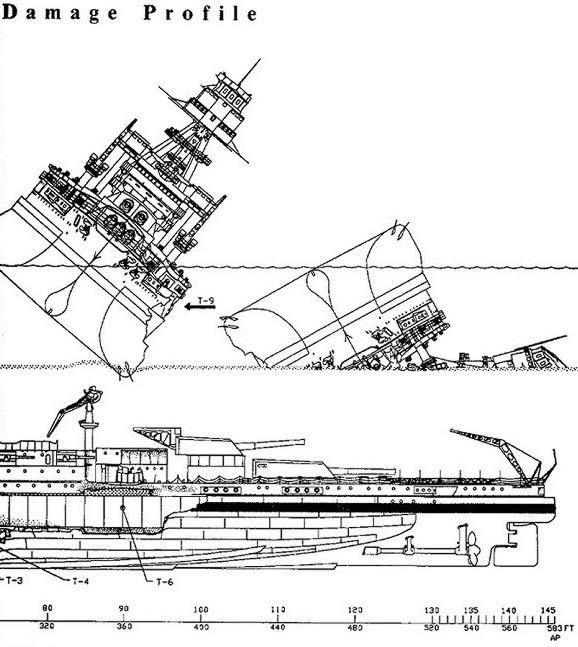
1 Comment

Filed under History, holocaust, national security, News and current events, Political Commentary, Religion, terrorism