Author Archives: padresteve

padresteve's avatar

About padresteve

I'm a Navy Chaplain and Old Catholic Priest

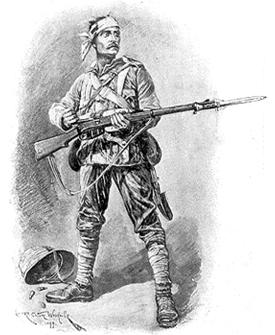
“Tommy Atkins” and “Just a Common Soldier” an Ode to Veterans Yesterday and Today

There has been much talk by our purloined and pampered politicians, pundits, preachers and their backs on Wall Street about the need for all of us to sacrifice. They seem to pushing harder and harder for the men and women that have served in thankless wars for the last 10 years and our families to again take a bullet for the country as they and their supporters refuse to sacrifice anything for the country.  You see the volunteers that have sacrificed to serve in time of war and on deployment after deployment have answered the call are expendable when push comes to shove.  We’re entitled you see, and our benefits much too generous.  They must be cut because no one else wants to sacrifice and they are so few that their votes really don’t matter.

Back inBritain’s colonial days the Soldiers, Sailors and Marines of the Royal Army, Royal Navy and Royal Marine Corps, and later the Royal Air Force served around the world but went without thanks at home. The American “Doughboys” took to the streets ofWashingtonDCin the midst of the depression seeking their bonus from the war because of they had lost their jobs in the Great Depression. They were driven from the streets and brutalized by troops under the command of General Douglas Macarthur who had commanded many of them in the Great War.
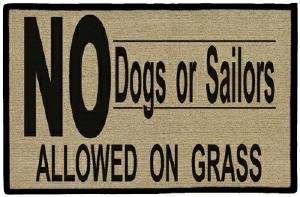
In many towns near bases in our fair land once stood signs in lawns that said “Dogs and Soldiers (or Sailors) keep off the grass.”  My late father told me of seeing these signs in Jacksonville Florida in the 1959s. The great poet Rudyard Kipling wrote the Poem “Tommy Atkins” which was dedicated to the soldiers that at the beginning of war were cheered and in peace jeered.  A. Lawrence “Larry” Vaincourt penned “Just a Common Soldier” in 1987.  Both speak volumes to the situation that exists in theUnited States as well as our alliesBritain,Australia, France andGermany as each government and their financial backers cast their veterans aside.

They say it better than I so I leave you tonight with these two great poems.  Something to think about the next time some Senator, Congressman, pundit, other political hack or Wall Street corporate raider says that veterans have it too good.

Peace,

Padre Steve+


TOMMY by Rudyard Kipling (1865-1936)


I went into a public-‘ouse to get a pint o’ beer,
The publican ‘e up an’ sez, “We serve no red-coats here.”
The girls be’ind the bar they laughed an’ giggled fit to die,
I outs into the street again an’ to myself sez I:

O it’s Tommy this, an’ Tommy that, an’ “Tommy, go away”;
But it’s “Thank you, Mister Atkins”, when the band begins to play,
The band begins to play, my boys, the band begins to play,
O it’s “Thank you, Mister Atkins”, when the band begins to play.

I went into a theatre as sober as could be,
They gave a drunk civilian room, but ‘adn’t none for me;
They sent me to the gallery or round the music-‘alls,
But when it comes to fightin’, Lord! they’ll shove me in the stalls!

For it’s Tommy this, an’ Tommy that, an’ “Tommy, wait outside”;
But it’s “Special train for Atkins” when the trooper’s on the tide,
The troopship’s on the tide, my boys, the troopship’s on the tide,
O it’s “Special train for Atkins” when the trooper’s on the tide.

Yes, makin’ mock o’ uniforms that guard you while you sleep
Is cheaper than them uniforms, an’ they’re starvation cheap;
An’ hustlin’ drunken soldiers when they’re goin’ large a bit
Is five times better business than paradin’ in full kit.

Then it’s Tommy this, an’ Tommy that, an’ “Tommy, ‘ow’s yer soul?”
But it’s “Thin red line of ‘eroes” when the drums begin to roll,
The drums begin to roll, my boys, the drums begin to roll,
O it’s “Thin red line of ‘eroes” when the drums begin to roll.

We aren’t no thin red ‘eroes, nor we aren’t no blackguards too,
But single men in barricks, most remarkable like you;
An’ if sometimes our conduck isn’t all your fancy paints,
Why, single men in barricks don’t grow into plaster saints;

While it’s Tommy this, an’ Tommy that, an’ “Tommy, fall be’ind”,
But it’s “Please to walk in front, sir”, when there’s trouble in the wind,
There’s trouble in the wind, my boys, there’s trouble in the wind,
O it’s “Please to walk in front, sir”, when there’s trouble in the wind.

You talk o’ better food for us, an’ schools, an’ fires, an’ all:
We’ll wait for extry rations if you treat us rational.
Don’t mess about the cook-room slops, but prove it to our face
The Widow’s Uniform is not the soldier-man’s disgrace.

For it’s Tommy this, an’ Tommy that, an’ “Chuck him out, the brute!”
But it’s “Saviour of ‘is country” when the guns begin to shoot;
An’ it’s Tommy this, an’ Tommy that, an’ anything you please;
An’ Tommy ain’t a bloomin’ fool — you bet that Tommy sees!

Just a Common Soldier by A. Lawrence Vaincourt (1987)
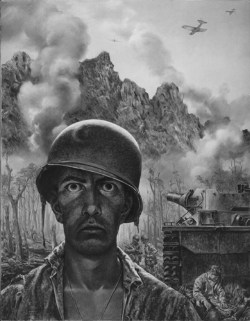
He was getting old and paunchy and his hair was falling fast, and he sat around the Legion, telling stories of the past. Of a war that he had fought in, and the deeds that he had done, in his exploits with his mates; they were heroes, every one. And tho’ sometimes, to his neighbours, his tales became a joke, all his Legion buddies listened, for they knew whereof he spoke. But we’ll hear his tales no longer for old Bill has passed away, and the world’s a little poorer, for a soldier died today.


He will not be mourned by many, just his children and his wife, for he lived an ordinary and quite uneventful life. Held a job and raised a family, quietly going his own way, and the world won’t note his passing, though a soldier died today. When politicians leave this earth, their bodies lie in state, while thousands note their passing and proclaim that they were great. Papers tell their whole life stories, from the time that they were young, but the passing of a soldier goes unnoticed and unsung.

Is the greatest contribution to the welfare of our land a man who breaks his promises and cons his fellow man? Or the ordinary fellow who, in times of war and strife, go`s off to serve his Country and offers up his life? A politician’s stipend and the style in which he lives are sometimes disproportionate to the service that he gives. While the ordinary soldier, who offered up his all, is paid off with a medal and perhaps, a pension small.


It’s so easy to forget them for it was so long ago, that the old Bills of our Country went to battle, but we know it was not the politicians, with their compromise and ploys, Who won for us the freedom that our Country now enjoys. Should you find yourself in danger, with your enemies at hand, would you want a politician with his ever-shifting stand?

Or would you prefer a soldier, who has sworn to defend his home, his kin and Country and would fight until the end?


He was just a common soldier and his ranks are growing thin, but his presence should remind us we may need his like again. For when countries are in conflict, then we find the soldier’s part is to clean up all the troubles that the politicians start.  If we cannot do him honour while he’s here to hear the praise, then at least let’s give him homage at the ending of his days. Perhaps just a simple headline in a paper that would say, Our Country is in mourning, for a soldier died today.
 

3 Comments

Filed under History, iraq,afghanistan, Military, Pastoral Care

Where has the Managerial Mojo Gone? LaRussa Manages the Worst Inning of his Career as Rangers go up 3 games to 2

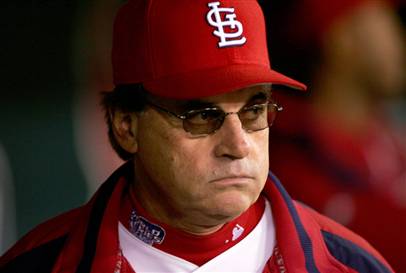
Tony LaRussa must have the Mad Cow. The future Hall of Fame manager who renowned for micromanaging games inning by inning seems to have lost his managerial mojo and isn’t admitting it.  Now the Texas Rangers who have played excellent baseball are one game from winning their first World Series.

The first thing that mystified me were the unexplainable steal attempts and mix ups on the base paths that killed the Cardinals chances of blowing open the game. One of the most puzzling plays was when in the 7th inning Pujols called a hit and run with Allen Craig on first and Alexi Ogando pitching him carefully. Pujols did not swing at a high pitch that was way out of the strike zone and Craig was caught stealing.  Ron Washington then had Ogando intentionally walk Pujols to get the Matt Holliday who has been in a World Series funk, hitting just .167.  Holliday singled and Lance Berkman was intentionally walked to load the bases but David Freese flew out to center to end the inning.   In the 9th with Neftali Feliz pitching and Pujols at bat with no outs Craig ran as Pujols struck out swinging and was thrown out at second to complete a double play.  The Cardinals left 12 men on base including 8 in scoring position and as the game progressed I knew that the Cardinals were going to find a way to lose the game. It didn’t matter how well Chris Carpenter pitched or how well their defense played as the game moved on I knew that the blown scoring attempts were going to doom the Redbirds Monday night.

But the real mystery was the 8th inning.   With the game tied and one out with Michael Young on second base LaRussa had ace set up man Octavio Dotel intentionally walk Nelson Cruz.  He then sent in left hander Marc Rzepczynski to face David Murphy.  I guess that the idea was to set up a double play but Murphy hit an infield single sending which loaded the bases with Mike Napoli coming to the plate.

Napoli has been hotter than exploding napalm during the post season and has been feasting on left handed pitching.  And this is where the game gets even weirder.  With Napoli coming to the plate one would expect to have LaRussa send a right handed pitcher to the mound, someone like Jason Motte.  But no right hander emerged in fact none were even warming up.  This forced Rzepczynski to have to face Napoli who hit a double into the gap in right center field scoring two runs and giving the Cardinals their first lead of the night. Rzepczynski stayed in the game and struck out Mitch Moreland to get the second out.  With the horses out of the barn a right hander came in but it was not Motte, it was Lance Lynn who was only supposed to pitch in an emergency situation.  LaRussa had Lynn intentionally walk Ian Kinsler to get Motte some warm up time.  Motte finally entered the game and struck out Elvis Andrus to end the inning.

LaRussa said after the game that he had wanted Rzepczynski and Motte up but Bullpen Coach Derek Lilliquist said that he did not understand LaRussa due to the crowd noise.  When LaRussa called to get Motte up Lilliquist claimed that he misunderstood and sent up Lynn who was not supposed to pitch.  To make matters worse, Dotel said that he was surprised that he was not allowed to pitch to Nelson Cruz.

With all that said and all the second guessing and the convoluted explanations aside the Cardinals did not put runners across the plate.  They should have won the game going away. The single off Rzepczynski in the 8th took an angle that he did not seem to anticipate and it could have been a double play ball and there would have been no “Bullpengate.”

Game 6 is scheduled for Wednesday night inSt Louis.  However rain is in the forecast and there is a possibility that it could be postponed. Colby Lewis will get the start for the Rangers and Jaime Garcia for the Cardinals. Both pitched well in game 2 and the Cardinals have the advantage of playing at home and by National League rules which means with no Designated Hitter that Texas will have one less big bat in the lineup.  This will be a game of bullpens and pinch hitters; I don’t expect either pitcher to go 7-8 innings as happened in games 4 and 5 in Texas.  However the Cardinals have to win both games and Texas has not lost two games in a row in a month and a half, but this is where the Cardinals play their best ball and of the 10 World Series titles the Cardinals have won in their illustrious history they were down 3 games to 2 in three of them.  I still think it goes 7 games but the Cardinals and LaRussa have to get their grove back on.  If not their miracle season will become a memorable footnote in MLB history.

Peace

Padre Steve+

2 Comments

Filed under Baseball

The Battle of Leyte Gulf: Sinking the Musashi

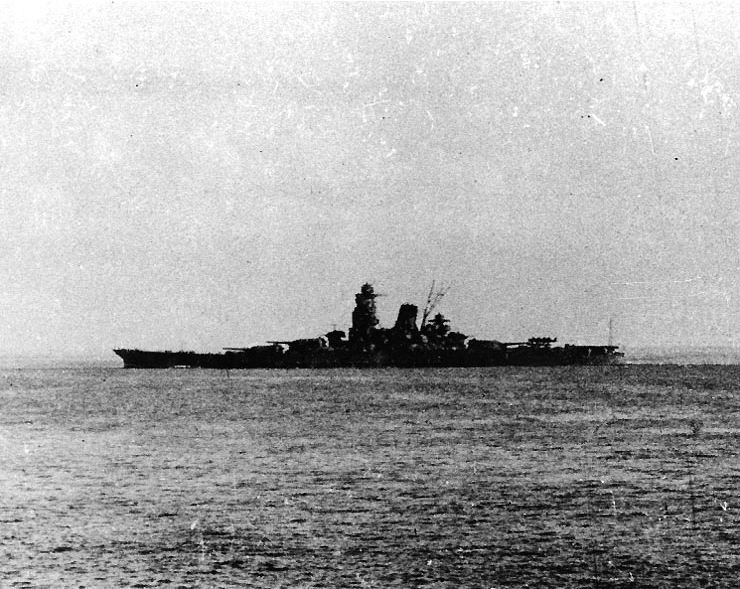
IJNS Musashi

This is the second in a series of articles about the Battle of Leyte Gulf.  The first article in the series is liked here and is entitled

The Battle of Leyte Gulf: Introduction and the Battle of Palawan Passage

Following the loss of Atago, Maya and Takao Vice Admiral Takeo Kurita’s Center Force had an uneventful rest of the day on the 23rd as his ships kept a watchful eye and ear for more US Navy submarines.  At about 0800 on 24 October the Center Force was spotted by 3 B-24 Liberator bombers which promptly reported them.

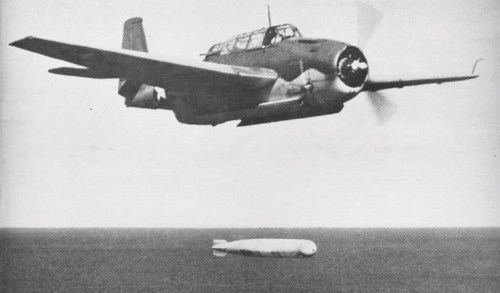
TBF Avenger dropping its “fish” 19 would hit Musashi
One of the ships in the Center Force was the IJNS Musashi, sister ship of the mighty Yamato which was also in the force. The two battlewagons were the largest battleships ever built.  With a full load displacement of 72,800 tons and an armament of nine 18.1 inch guns, the largest battery ever mounted on a warship the two behemoths also had massive anti-aircraft batteries and the Japanese were counting on them leading the Center Force to a miraculous victory during the battle.  Admiral Kurita addressed his commanders prior to the battle:

“I know that many of you are strongly opposed to this assignment.  But the war situation is far more critical than any of you can possibly know.  Would it not be shameful to have the fleet remain intact while our nation perishes?  I believe that the Imperial General Headquarters is giving us a glorious opportunity.  Because I realize how very serious the war situation actually is, I am willing to accept even this ultimate assignment to storm into Leyte Gulf.  You must all remember that there are such things as miracles.”

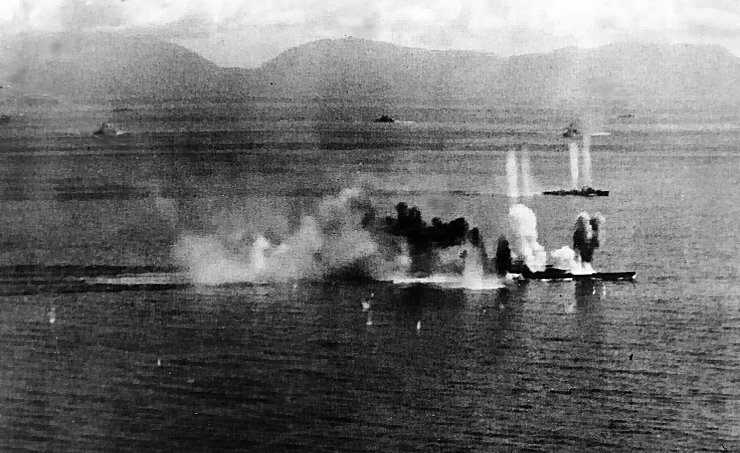
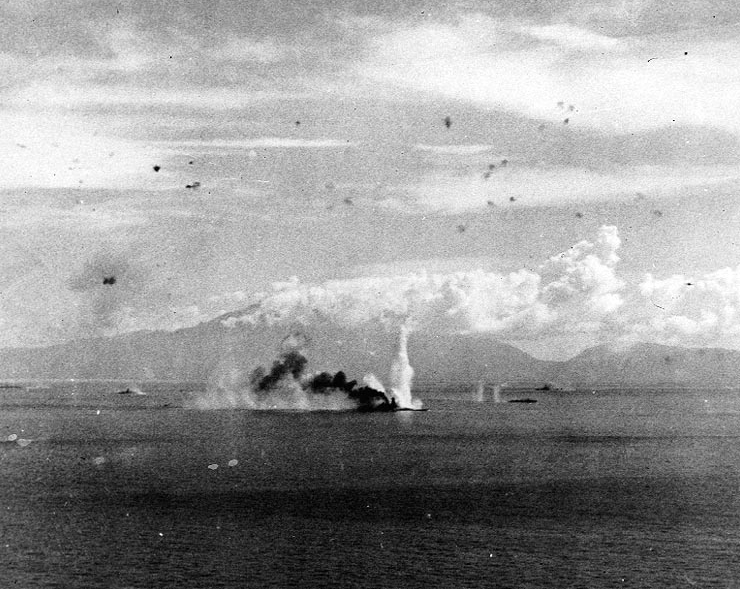
Musashi or Yamato under attack October 24th 1944

At 1000 the Musashi’s radar picked up approaching aircraft.  These were from the USS Intrepid and the USS Cabot which were assigned to Rear Admiral Gerard Bogan’s Task Group 38.4. The anti-aircraft crews and damage control teams prepared as the ship’s bugle sounded the alarm.  As the aircraft came closer the main guns of the Musashi fired but ceased fire as the aircraft drew closer.  Helldiver dive bombers plunged downward at the ships of the Center Force and F6F Hellcat fighters unopposed by enemy fighters conducted strafing runs as TBF Avenger torpedo bombers dropped their deadly loads at the Musashi.  The big ship avoided two of the “fish” but a third struck causing little damage and the first wave few away.  Musashi reported that she had sustained a hit and continued on.  The Japanese sailors knew that this would not be the last attack.  Though Musashi had weathered the first strike the American fliers hit the battleships Nagato, Yamato and severely damaged the heavy cruiser Myōkō.

Musashi hit

At 1140 the Musashi’s radar picked up the next wave of attackers and at 1203.  These were from the Intrepid, Essex and Lexington.  Hitting the Center Force in two waves a half hour apart these aircraft delivered punishing blows on Musashi. She was hit by 3 torpedoes and 2 bombs. The torpedoes caused damage that caused a 5 degree list and was down six feet by the bow. The torpedo damage was concentrated midships and one torpedo flooded her number 4 engine room. One of the bombs hit an engine room and disabled her port inline propeller shaft.  With her speed reduced she proceeded on.

Musashi

Thirty minutes following this attack at about 1330 Musashi was attacked again by Helldivers and Avengers. She is hit by 4 1000 pound bombs and 4 torpedoes.  She was now so badly damage that she could no longer keep up with the fleet and dropped behind to fend for herself.  At 1350 this attack ends with her speed reduced to 20 knots and with her down 13 feet by the bow and nearly all of her trim and void tanks full. There is now little room for any more damage forward.

Separated from the fleet Musashi was now attacked by aircraft from the Enterprise, Cabot, Franklin and Intrepid that score hits with 11 bombs including the deadly 1000 pounders and 8 torpedoes.  During the course of these attacks which ended after 1530 Musashi sustained 19 torpedo and 17 bomb hits and taken 18 near hits close aboard. At 1620 her skipper Rear Admiral Toshihira Inoguchi began desperate damage control measures to control the increasing list which had reached 10 degrees to port.  Dead in the water she continued to list further and when the list reached 12 degrees at 1915 Inoguchi ordered preparations to abandon ship.  The surviving crew assembled on the deck, the battle flag and the Emperor’s portrait were removed.  Admiral Inoguchi gave his personal notebook to his Executive officer Captain Kenkichi Kato and directed then him to abandon ship. Admiral Inoguchi retired to his cabin and was not seen again.  At 1930 with the list now 30 degrees Captain Kato gave the order to abandon ship and soon with the list increasing further men began to slide across the decks being crushed in the process.  Panic broke out among the crew which had been assembled by divisions and Captain Kato ordered “every man for himself.”  At 1936 the ship capsized and port and went down by the bow sinking in 4,430 feet of water in the Visayan Sea at 13-07N, 122-32E.

The destroyers Kiyoshimo, Isokaze and Hamakaze rescued 1,376 survivors including Captain Kato, but 1,023 of Musashi’s 2,399 man crew were lost including her skipper, Rear Admiral Inoguchi who was promoted Vice Admiral, posthumously.

The rest of the Center Force under Kurita turned around to get out of range of the aircraft, passing the crippled Musashi as his force retreated. Kurita’s retreat was temporary and Kurita waited until 17:15 before turning around again to head for the San Bernardino Strait hoping to find it empty of American ships.  His force was still battle worthy because the majority of the 259 sorties were directed on Musashi and the Heavy Cruiser Myōkō which retired heavily damaged. The Southern Force which had also been hit by American carrier air strikes also continued its push toward Surigao Strait.  The Battle of Surigao Strait, the revenge of the Pearl Harbor Battleships will be the next article in this series.

Peace

Padre Steve+

3 Comments

Filed under History, Military, Navy Ships, US Navy, world war two in the pacific

Shutdown! Derek Holland Silences Cardinals Rangers tie Series

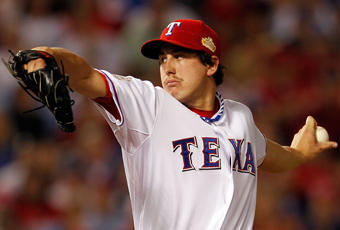
Derek Holland (Getty Images)

I said yesterday that in order to win game four a pitcher had to shut down the opposition.  Derek Holland who was solid in the regular season but struggled in the post season pitched a great game and was backed by strong defense.Hollandpitched 8.1 innings allowing just two hits while striking out 7 and walking 2 Cardinals as the Rangers evened their series defeating the Cardinals 4-0.

The game was close as Cardinals starter Edwin Jackson left the game in the top of the 6th inning with two runners aboard and the Rangers leading 1-0. Jackson had allowed three scattered hits but had given up 7 walks, the final two in the top of the 6th leading Tony LaRussa to pull him in favor of Mitchell Boggs who gave up a 3 run home run to Mike Napoli on his first pitch.  Holland on the other hand maintained his control, poise and kept the big right handed bats of the Cardinals silent by pitching aggressively on the inside portion of the plate. Albert Pujols who had set a World Series record on Saturday night went 0-4 and both Cardinals hits came from Lance Berkman who doubled and singled.  Neftali Feliz got the final two outs for the Rangers securing the win.

The Cardinals had no runs on 4 hits and committed no errors leaving four men on base. The Rangers had 4 runs on 6 hits with no errors and left 8 runners on base. Hollandgot the win andJacksonthe loss.

Tonight the Cardinals will send Chris Carpenter to the mound. Carpenter the victor in game one is probably the best pitcher in the series and I expect a strong outing from him especially if he mixes his devastating curve ball with his other pitches.  He will face Rangers ace C J Wilson who was 16-7 with a 2.93 ERA in the regular season but is 0-3 in four starts during the post season.  He has pitched 21.1 innings giving up 19 runs 17 of which were earned on 25 hits 6 of which were home runs and has walked 14 while striking out 21.  His post season ERA is 7.17.  In order to win the Rangers will have to get to Carpenter early and play thatWilsonhas a good start.  The Cardinals after having been shut down on Sunday night are certainly going to be out for blood with Wilson on the mound. If Wilson falters expect Ron Washington to pull him early.

One lineup change for the Cardinals is that Jon Jay will not start tonight and is being replaced in center field by Skip Schumaker who hit .283 in the regular season.

We’ll see what happens tonight.

Peace

Padre Steve+

3 Comments

Filed under Baseball

The Battle of Leyte Gulf: Introduction and the Battle of Palawan Passage

This is the first of a four article series on the Battle of Letye Gulf. The battle was the largest in history both in terms of the number of ships involved and the amount of area covered. The action was triggered by the American invasion of the Philippines causing the Japanese to initiate their Shō-Gō 1 (Victory Plan 1) to attempt to defeat the Americans.  The plan relied heavily on land based air power which most of unfortunately for the Japanese was destroyed during the American carrier air strikes on Formosa earlier in the month. 

The battle was necessitated by the absolute need for the Japanese to hold the Philippines and defeat the Americans at all costs. As Admiral Soemu Toyoda the Chief of the Combined Fleet explained under interrogation after the war

Should we lose in the Philippines operations, even though the fleet should be left, the shipping lane to the south would be completely cut off so that the fleet, if it should come back to Japanese waters, could not obtain its fuel supply. If it should remain in southern waters, it could not receive supplies of ammunition and arms. There would be no sense in saving the fleet at the expense of the loss of the Philippines.

The battle was comprised of 5 battles, the Battle of Palawan Passage, the Battle of the Sibuyan Sea, the Battle of Surigao Strait, the Battle of Cape Engaño and the Battle off Samar. All told about 70 Japanese warships and 210 American and Australian ships were engaged.  A further 300 Japanese aircraft, mostly land based and 1500 American carrier aircraft took part in the battle.  The Japanese order of battle included 1 Fleet and 3 Light Fleet Carriers with a minimal air group, 9 Battleships including the two largest ever built the Yamato and Musashi, 14 Heavy and 6 Light Cruisers and about 3 destroyers.  They were divided into four task forces, the Northern Force under the command of Vice-Admiral Jisaburō Ozawa which had all of the Carriers including the last surviving carrier of the Pearl Harbor attack the Fleet Carrier Zuikaku plus the converted hybrid Battleships Ise and Hyuga; the Southern Force which was two distinct and independent task forces under the command of Vice Admirals Shoji Nishimura and Kiyohide Shima and was built around the ancient battleships Fuso and Yamashiro and 3 Heavy Cruisers; and the Center Force under the command of Vice Admiral Takeo Kurita which had the Battleships Yamato, Musashi, Nagato, Kongo and Haruna, 10 Heavy and 2 Light Cruisers and 1 destroyers.  The Center force was to pass through the San Bernardino Strait and converge on the American landing forces off Samar with the Southern Force which as to come through the Surigo Strait.  The Japanese also planned for the first use of Kamikazes as part of the action. 

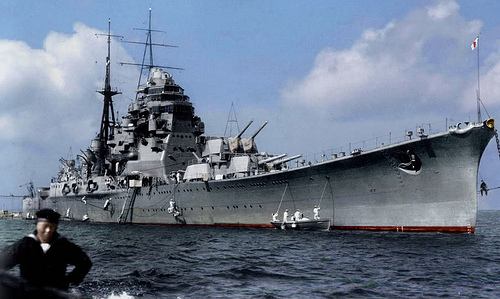
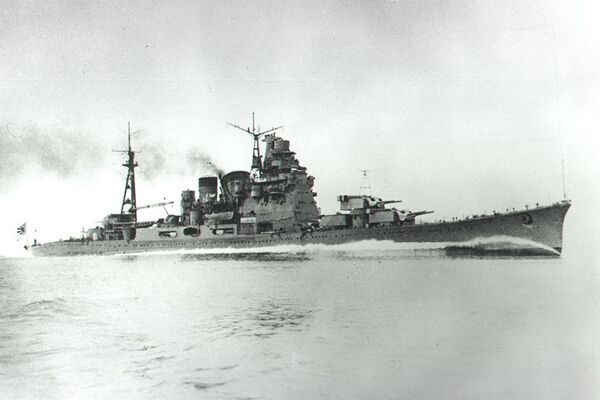
Takao Class Cruiser 1943

Atago

The American fleet was comprised of the 3rd Fleet under Admiral William Halsey which was built around the Fast Carrier Task Forces and Fast Battleships of Task Force 38 under the Command of Vice Admiral Marc Mitscher and the Battle Line Task Force 34 under the Command of Vice Admiral Willis Lee; and the 7th Fleet under Vice Admiral William Kinkaid which was the naval support for the landings.  It had under its control the old Battleships West Virginia, California, Tennessee, Maryland, Colorado and Pennsylvania and 18 Escort Carriers which provided the close air support for the Invasion.  All told the Americans had 8 Fleet and 8 Light Fleet Carriers, 18 Escort Carriers, 12 Battleships, 24 Cruisers and 141 Destroyers as well as submarines, PT Boats, Transports, Landing Ships and Auxiliaries.

Takao

This series will focus on a number of individual battles and decisions in the battle. Part one will focus on the action of the Submarines Darter and Dace against the Center force in the Palawan Passage. The next will be the sinking of the Musashi during the Battle of the Sibuyan Sea, it will be followed by the revenge of the Old Battleships at Surigo Strait. The next will be the great decision of Admiral Halsey to pursue the Northern Force and leave the San Bernardino Strait unguarded, followed by the Battle off Samar and last the death of the Japanese Naval Aviation at Cape Engaño.

Maya

The Battle of Palawan Passage

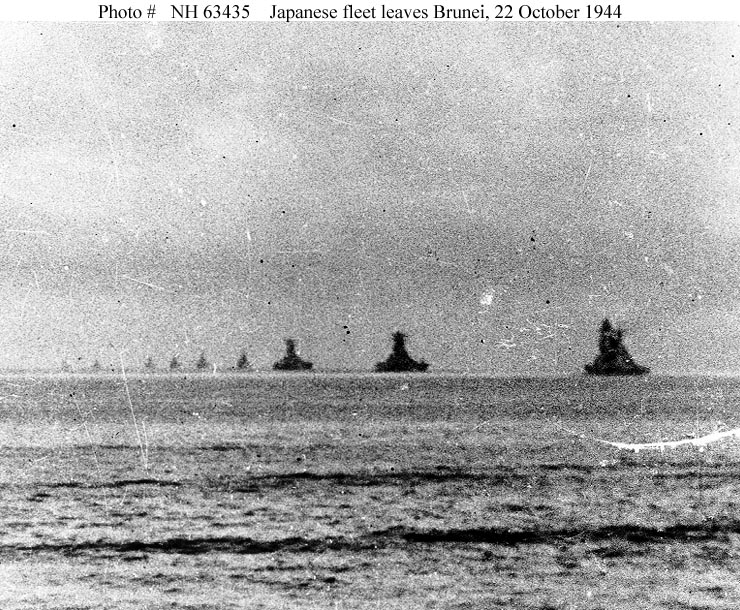
Admiral Takeo Kurita and the powerful Center Force departed their anchorage at Bruneion 20 October 1944.  The task force entered the Palawan Passage on the night of 22-23 October where they were sighted by the American Submarines Darter and Dace which had been posted at the strait for such a possibility.  Darter made radar contact at 30,000 yards at 0018 hours on the 23rd and sent out contact reports.   The two submarines shadowed the Center Force on the surface to gain an intercept position and submerged just before dawn.

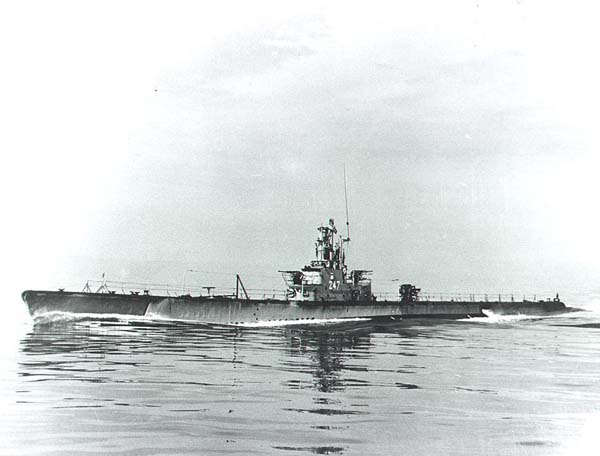
USS Darter

Darter struck first at 0524 firing a spread of 6 torpedoes scoring 4 hits on Admiral Kurita’s flagship the Heavy Cruiser Atago. She reloaded and stuck the Heavy Cruiser Takao with 2 torpedoes at 0634.  At 0554 Dace hit the Heavy Cruiser Maya with 4 torpedoes.

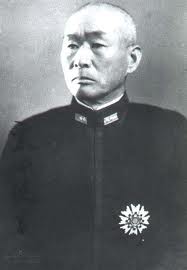
Vice Admiral Takeo Kurita

The blow was severe.  Atago was mortally wounded she capsized and sank at 0553 with the loss of 360 crew members. She sank so rapidly that Kurita had to swim and was rescued with his Chief of Staff by a destroyer, but many of his staff members were lost with the ship.  Though Kurita transferred his flag to Yamato he was now without the advice and counsel of officers that might have prevented later mistakes during the Battle off Samar.  Takao suffered heavy damage and though she did not sink she had to proceed crippled to Singapore under the guard of two destroyers. Though she survived the war she never saw action again.   Maya, struck at 0554 by 4 torpedoes suffered much damage and was wracked by powerful secondary explosions.  By 0600 she was dead in the water and sank five minutes later with the loss of 337 crew members.

USS Dace

The attack of the two submarines was significant; the Japanese lost 3 powerful Heavy Cruisers and had to send two of their destroyers away to guard Takao. Likewise the loss of Kurita’s experienced staff hindered his conduct of the battle on the 24th.  The cruisers were a big loss, at 13,000 tons and armed with ten 8”guns they could steam at 35 knots.

Darter and Dace conducted a pursuit of the crippled Takao which had to be broken off when Darter ran aground on Bombay Shoal. Despite the best efforts of her crew and that of the Dace to free her she was hopelessly stuck.  Her crew was unable to scuttle her and the Japanese were able to board her after she was abandoned and for the first time get a look at the details of a Gato class submarine.

Kurita’s force would continue on into theSibuyan Seawhere they would be attacked again.  But that is the subject of the next article.

5 Comments

Filed under Navy Ships, US Navy, world war two in the pacific

Beat Down in Texas: Pujols Sets Record as Cardinals down Rangers 16-7

“I’m sure the ball looked to him like a water balloon up there.” Ranger’s reliever Darren Oliver. Albert Pujols hits his historic 3rd Home Run with 2 outs in the top of the 9th against Darren Oliver

Game three of the World Series between the St Louis Cardinals and the Texas Rangers was one for the ages.  Cardinals First Baseman Albert Pujols set a record for a World Series game going 5-6 with 3 home runs and 6 runs batted in. He is the first player to hit three home runs in a World Series since “Mr. October” Reggie Jackson did it in game six of the 1977 World Series against the Los Angeles Dodgers and Babe Ruth how did it in the 1926 and 1927 World Series.  Pujols home runs were all massive going 43 feet, 406 feet and 397 feet respectively. One commentator referred to Pujols as “Mr. Octobert” to distinguish him from Jackson.

The game was a big change from games one and two where pitching and defense dominated. In those games the teams scored a combined 8 runs on 23 hits and only committed 2 errors.  In those two games the Texas pitching staff had a 2.11 ERA and St Louis a 2.00 ERA. However in game three on a warm and windy night in Arlington the pitching staffs of both teams broke down and both bullpens showed signs of overuse.  In game three the teams scored a combined 23 runs on 28 hits and the Rangers committed 3 costly errors plus one that should have been an error which resulted in a blown call at First Base and helped the Cardinals to a big 4th inning.  The series ERA for the Rangers ballooned to 6.66 and the Cardinals to 3.80.

Of particular concern for the Rangers is their g0-to man in the bullpen Alexi Ogando who was central to their success as a set up man for closer Neftali Feliz has been thunderstruck during the World Series.  He has three appearances and only gotten one out in each appearance.  He has  given up 5 hits, one being a home run and two walks and allowed 4 runs of which 3 were earned for a 27.00 ERA in the World Series. Ogando has to be on for the Rangers to win.

Conversely the batting averages of the teams which had been very low in games one and two Texas hitting a meager .186 andSt Louisa marginally better 2.03 went up.  At the end of game three the Cardinals average was .267 and the Rangers to .252. The Rangers series On Base Percentage (OBP) is .292 and a Slugging Percentage of .378. The Cardinals OBP is now 3.70 and a .455 SLG.

Lance Lynn got the win in relief for the Cardinals and Rangers starting pitcher Matt Harrison took the loss.  Tonight Edwin Jackson 12-9 3.79 will be on the hill for the Cardinals and Derek Holland 16-5 3.95 will pitch for the Rangers. Holland has not performed well in the playoffs giving up 8 earned runs and 18 hits including 5 home runs in 13.2 innings.  His playoff ERA is 5.27 and his opponent batting average is .305. Jackson too has struggled in the playoffs giving up 8 earned runs on 16 hits with 4 home runs in 12.1 innings.  He has a playoff ERA of 5.86 and opponents are hitting .302 off of him. Jackson in his career against the Rangers is 2-3 with a 4.02 ERA and opposing batting average of .244.

Pujols is now hitting .418 in the playoffs with a .492 OBP and .818 SLG.  In addition to Pujols mammoth feat David Freese continued his record playoff run hitting safely in 13 consecutive games with 21 hits including 7 doubles and 4 home runs. He has a .429 batting average, .481 OBP and .816 SLG.   Allen Craig who has been an amazing pinch hitter during the 2011 playoff made his first start in Left Field hit a hitting a solo home run in the first inning off Matt Harrison.

I expect more fireworks from both teams tonight and think that in order to win one team will have to get a clutch performance out of their pitching staff.  The Rangers are down but they are not out. They have the firepower

Peace

Padre Steve+

2 Comments

Filed under Baseball

Deep Thoughts and Musings on a Lazy Fall Saturday

I have been down with an ear and sinus infection most of the week which has added to my insomnia and made me pretty useless.  It is no fun to get up in the morning with vertigo.  When this happens I wonder where Verti went. Over the past few days with the vertigo, occasional fever, sinus headaches and some coughing and sneezing I have officially welcomed in the 2011-2012 cold and flu season.

The past few days have given me time to do a lot of thinking, some praying and a bunch of writing.  At least my PTSD-Mad Cow brain is functioning relatively well.  But not getting out much and only going to work to go to the doctor is a bit of a downer.  But it is now time to stop whining to you about this and simply be thankful for the blessings that I have.

I could have a job that had paid time off for sickness or that provided no medical coverage.  I could be wondering where the next meal or paycheck was coming from or where I will sleep.  One thing that I am thankful for is that we paid off a painful reminder of when where the next meal, tank of gas, medical care or pace to live was our reality.  I left the active duty Army in September 1988 to attend seminary and that as about the time of the big Texas oil bust and real estate collapse.  I was an Army Captain and couldn’t get a job because I was overqualified for most jobs or competing against people who could be paid less than me for others.  It was brutal.

Judy was sick and could not work and eventually despite eventually getting a job with a social service agency, things fell apart. We lost our home and even our cars.  It was the worst time of our lives.  We never declared bankruptcy and paid off everything that we owed and this week I paid off the balance of the home that we lost in 1989 to the Veterans Administration.  When the market crashed and the foreclosure came owed almost 40% of the selling price when the house sold at auction.

I am so grateful for what we have now and so being sick and laid up for a few days is really nothing to complain about.  There are far too many people in our country that even a couple of years ago had what they thought were stable well paying jobs with benefits that don’t have them now.  Many are veterans and their families.  It is most likely that things will get worse before they get better for most people as the effects of the sovereign debt and banking crisis in Europe hits our banks.

For me what people are going through is not abstract because we have been there. I really wonder when I see people in political and economic power doing nothing with one Presidential candidate blaming the unemployed if they didn’t have a job and were not rich.  I wonder what has happened to our country.  I wonder why so many churches side with the rich and powerful and seem to despise the poor.

It seems heartless to say the things that this Presidential candidate said with unemployment remaining over 9% for over a year and companies deciding when they do have a job opening to give preference to those that currently have jobs.  Even well qualified unemployed people are not even considered for job openings because they don’t have a job.  And this is happening when the supposed “job creators” on Wall Street who the taxpayers bailed out in 2008 and 2009 are giving themselves bonuses.  It just immoral and when I see many of my fellow Christians making the support of polices which are condemned by Jesus an article of faith in both theology and politics.

I have also had time to think about what is going on in the Middle East especially the Iraq withdraw and ongoing war in Afghanistan.  I am really concerned with Afghanistan because of the veiled threats that Pakistan is making about cutting our supply lines.  They have done this for short time periods before and there have been numerous attacks on supply convoys in that country by Pakistani Taliban.  To make matters even more uncertain Afghan President Hamid Karzai has said that if there were a conflict between the United States and Pakistan that Afghanistan would help them.

Sometimes I hate being a military historian because I understand what happens to armies with tenuous supply lines that are under the control of unreliable allies.  Stalingrad comes to mind. Likewise the lesser known but very significant The Second Jassy-Kishinev Offensive between August 20 and August 29 1944 in which the Romanian allies of the Germans switched sides during the battle.  This allowed the Red Army to destroy the German 6th Army and maul the 8th Army. The offensive probably shortened the war by six months.  At Stalingrad the Germans and their allies suffered 841,000 casualties and at Jassy-Kishinev they lost 100,000 killed and 115,000 captured.  Currently there are about 90,000 American and another 40,000 NATO or coalition troops in Afghanistan deployed in penny packets throughout the country fighting an insurgency.  They are very vulnerable to any supply disruption especially during the winter months and if there was a conflict that shut down the supply lines we would have to rely on the good graces of the Russians to resupply or withdraw our troops. When I think about this I think about my friends and comrades serving in Afghanistan and I pray to God that this does not happen.

When I think that the burden of these wars has fallen on under half a percent of the American population and that politicians and their allies in the business sector are looking at ways to make substantial cutbacks in medical care and other benefits to those that have been sacrificing in ways that no one else has been doing the past ten years.  Talks of cutting VA care for veterans is obscene when because of their preexisting conditions they wouldn’t be able to afford medical insurance even if they could get it.  And the word that these politicians and their allies use is that these are “entitlements.”  That is a really nasty word and it is used pejoratively because everybody knows that “entitlement programs” are bad and those that receive “entitlements” haven’t earned them and are leaching off of society.  In fact a letter from the “Super Committee” in charge of finding ways to slash the budget has proposed cuts to veterans benefits including pension, disability compensation and education payments.

This is why I would rather be at work, I think too much.

But I am still grateful for all that I have and honored to serve with the fine men and women of the US Military in this time of war.  I do pray that things get better in our nation, which those suffering from the terrible economy will have their needs for employment and other physical needs met. I pray that somehow the deep division that has rent our people asunder will be healed and that our political and economic leaders will do what is right for the country and our people rather than the quarterly bottom line of select corporations.  And I pray for the safety and success of my friends and comrades in both Iraq and Afghanistan and that our political and business leaders will not sacrifice us and then abandon us after beating us to dust the past 10 years.

But at least the World Series is on and nothing bad accrues from Baseball.  For that I am very grateful as Sharon Olds said “Baseball is reassuring.  It makes me feel as if the world is not going to blow up.”

Peace

Padre Steve+

1 Comment

Filed under economics and financial policy, History, iraq,afghanistan, Loose thoughts and musings, Military

Padre Steve’s Arab Spring Articles: Tahir Square to Sirte

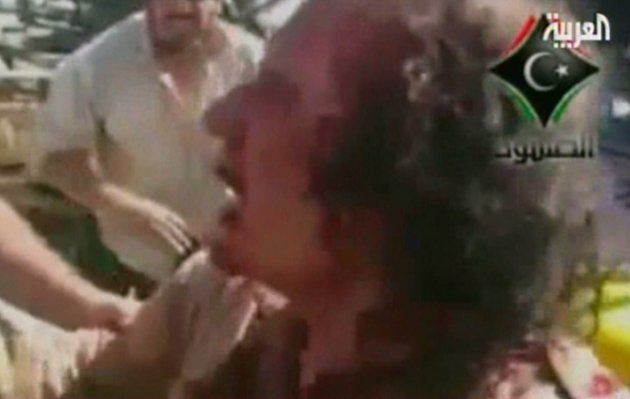
It is hard to believe that Moammar Gaddafi is dead and that the people of Libya have thrown off the shackles of his tyrannical dictatorship which caused them and the world so much grief.  These are links and brief descriptions of the articles of this series.  There have been revolts across the Middle East as oppressed people have risen up peacefully against their repressive governments only to be met with force. Egypt, Yemen, Bahrain, Libya and now Syria, each is rooted in history and each is different. Taken together they are inspiring others around the world.  I have not written much on Yemen or Syria but expect in the coming weeks and months there will be plenty of opportunities to look at the history, culture and unique aspects of these revolts and their potential impact in the region and around the world.  It is my belief that they are helping usher in a new age of revolution with results that will be as dramatic and important as the fall of Empires at the close of the First World War.  Looking at each article you can see how my thought process has evolved as the situation has developed.

Also a page update. I have updated the Middle East Page found in the top menu.

Peace

Padre Steve+

Walk Like an Egyptian: The Egyptian Revolution and the Radicalization of the Middle East Published31 January 2011. An analysis of the probability of the radicalization of the Middle East as revolution spreads.

The Beginning of Chaos in Egypt: Watching and Waiting as the Situation Deteriorates Published2 February 2011 as the situation began to deteriorate in Egypt as Mubarak loyalists attacked protesters in Tahir Squar.

Egypt: As Mysterious as the Sphinx and as Dangerous as a Cobra….What Next? Posted11 February 2011.  A continuation of my observations of  the revolution in Egypt prior to the fall of Hosni Mubarak.

Danger in the Arabian Gulf: The Fires of Protest Spread to Bahrain Posted18 February 2011. The article deals with the protests in Bahrain and my experiences and observations having traveled there many times.

Damned if you do…Damned if you Don’t: The Middle East Protests and U.S. Foreign Policy Posted 19 February 2011. An examination of the difficulties facing U.S. Foreign policy officials in light of the recent spread of revolution in the Arab World.

To the Shores of Tripoli: The Flames of Revolution Spread to Libya as Gaddafi Fights Back Posted February 21st as the protests in Libya provoked a response from dictator Moammar Gaddafi. Saif Al Islam Gaddafi said We will take up arms… we will fight to the last bullet… We will destroy seditious elements. If everybody is armed, it is civil war, we will kill each other.”

Göttdammerung in Libya: Shades of Hitler as Gaddafi Promises to Die as a Martyr Published 22 February 2011 Moammar Gaddafi promises “I am a fighter, a revolutionary from tents … I will die as a martyr at the end… I have not yet ordered the use of force, not yet ordered one bullet to be fired … when i do, everything will burn.”   Moammar Gaddafi accurately predicts his death.

The Guns of March Published 9 March 2011. “War is the unfolding of miscalculations” Barbara Tuchman Libya in the context of the broader Middle East and US Military capabilities.

Gaddafi Taunts the West and Kills his People: Our inaction speaks so loud he can’t hear a Word that we are Saying  Published 11 March 2011.  The cost of inaction and the risks of making threats that you do not back up with force.  When I wrote this I believed that if nothing was done that Gaddafi or terrorist organizations like Al Qaeda and others could turn this revolt into a regional war.

Strike on Libya: The Unknown outcome of Operation Odyssey Dawn Published20 March 2011. The beginning of the NATO air campaign in Libya.

Damned if you do and Damned if you Don’t: The Allied Intervention in Libya Published March 21st 2011.  War is the province of chance. In no other sphere of human activity must such a margin be left for this intruder. It increases the uncertainty of every circumstance and deranges the course of events.”- Karl von Clausewitz The opportunities and peril associated with the NATO intervention in Libya.

Gaddafi’s Götterdämmerung: The End in Tripoli Published 21 August 2011.  The fall of  Tripoli, the Libyan Rebels drive out Gaddafi.

The Promise and Peril of Revolutionary Times: A Warning From History  Published 18 October 2011. Putting revolutions around the world in context.

Gaddafi is Dead so what happens Now? Published 20 October 2011. The death of Moammar Gaddafi and questions of what comes next.

Why the Libyans were able to Overthrow Gaddafi and what We can learn from It: A Lesson from the work of T E Lawrence  Published 21 October 2011 What NATO and theUnited States did right inLibya and a look at Middle East History.

2 Comments

Filed under Foreign Policy, History, middle east, Military

Why the Libyans were able to Overthrow Gaddafi and what We can learn from It: A Lesson from the work of T E Lawrence

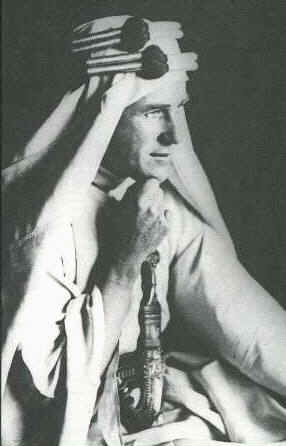
T E Lawrence

“Do not try to do too much with your own hands. Better the Arabs do it tolerably than that you do it perfectly. It is their war, and you are to help them, not to win it for them. Actually, also, under the very odd conditions of Arabia, your practical work will not be as good as, perhaps, you think it is.” T. E. Lawrence

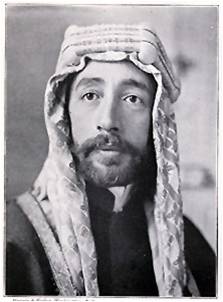
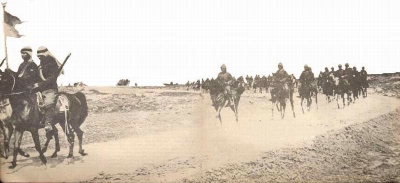
Lawrence with Arab fighters at Aqaba and Emir Faisal Hussein (below)

The Libyan revolution succeeded in overthrowing Moammar Gaddafi and his 42 year tyranny because the West did not turn it into an American or NATO war. By limiting involvement to airpower, coastal interdiction and tiny numbers of advisers the United States and NATO avoided the costly trap of putting large numbers of troops on the ground.  Such action would have been counterproductive in Libya and in the Arab world. While the action certainly would have ridded the world of Gaddafi and his regime much more quickly it would have emasculated the Libyans who had taken up arms against Gaddafi by turning it into our war, a war which would have been seen by many Libyans and Arabs as just more Western Imperialism.  Critics can always find fault in any military operation but for once in the Post Cold War era the United States and NATO knew their limitations and that the revolution had to be the work of the Libyans themselves.

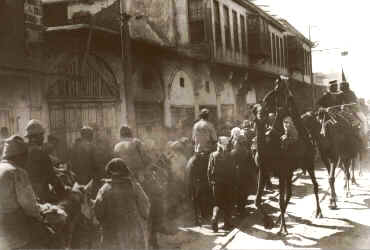
Lawrence and Hussein’s troops pass Ottoman prisoners at Damascus in 1918

T E Lawrence understood the Arab mind more than most westerners ever will.  Living with and helping lead the Arab tribes that revolted against the Ottoman Empireduring the First World War he learned the culture as well as came to understand the strengths and weaknesses of the Arab tribes.  One thing that can be said is that most Americans like many of Lawrence’s counterparts in the British political leadership, military and diplomatic services is that far too few have taken the time to either understand or respect the Arabs. When I was in Iraq the senior Iraqi Officers that I met were amazed and impressed that I knew their history and culture because so few people did. When I mentioned their victory at Al Kut Amara, or their capture of the Al Faw peninsula at the end of the Iran-Iraq war they beamed with pride.

Ottoman troops in Mesopotamia 

One of the things that Lawrence understood was the profound sense of personal pride and honor which imbued the Bedouin.  He understood that the various Bedouin tribes had no love for the Ottoman Turks who treated them with distain.  He also understood that they needed to be the ones that defeated the Turks.

The campaign waged by Lawrence and the Bedouin confounded the Turks. Working with Emir Faisal the son of Sherif  Hussein of Mecca he convinced his force of Arab irregulars not to make a direct assault on the city of Medina which was heavily garrisoned by the Turks.  Instead he expanded the battlefield by exploiting the natural weakness of the Turks, the need for constant supply via the Hejaz Railway.  In doing so he tied up large numbers of Ottoman troops that could have been used against the forces of General Allenby that were waging a conventional campaign and which was very successful in defeating the Ottomans.

While Lawrence was a part of a much larger effort his work in helping the Arab revolt was of great importance to the success of the British efforts against the Ottomans.  Unfortunately the good will that Lawrence and others like him built did not last. The British and French governments did not respect treaties that supported Arab independence and instead dividing the region between them under the terms of the 1916 Sykes-Picot Agreement. They left an isolated and abandoned Hashamite kingdom in the Hejaz which was conquered by the Saudis to whom the British had shifted their support.

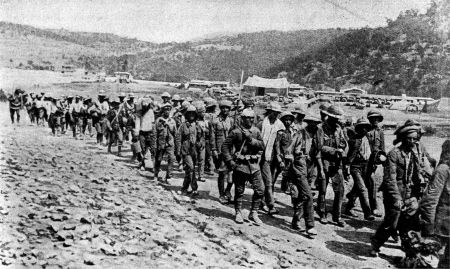
British prisoners at Kut al Amara

A few hundred miles away the British did not take advantage of indigenous Arab resentment of the Ottomans in Mesopotamia.  The British invaded Mesopotamiain 1914 expecting to defeat the Turks easily.  However the British did precious little to enlist the support or help the Iraqi Arabs.  The campaign was long and included the worst defeat of a British Army during the war at the Siege of Kut Al Amara in 1916 at the hands of a largely Iraqi Ottoman 6th Army.  Some 30,000 British and Indian soldiers were killed or died of disease and 13,000 captured many who did not survive captivity.  After the war Lawrence remarked “The people of England have been led in Mesopotamia into a trap from which it will be hard to escape with dignity and honor. They have been tricked into it by a steady withholding of information.”

Faisal would go on to be elected as the new Kingdom of Syria by the Syrian National Congress in March of 1920 but kicked out by the French who enforced the Mandate of Syria in July.  In 1922 after the British brutally suppressed an Iraqi independence movement they appointed Faisal as the King of Iraq. When the British “gave” the Iraqis their independence in 1932 Faisal was the head of state.  He died in 1933 and the British maintained a tight grip on the country and put down another Iraqi nationalist revolt led by the Army in 1941.  The British would remain in Iraq until 1958 when a military coup which is known as the “14 July Revolution” overthrew the government and killed king Faisal II.

Libya Rebels

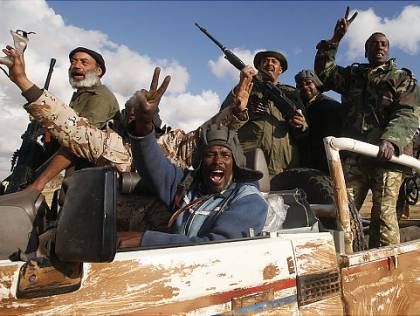
In Libya there was great temptation and political pressure for the United States to begin an early air campaign without significant support in the international community.  Some say that this caused more casualties and suffering for the Libyans, but it helped in the long run because Libyans saw it as their war to win even when NATO began its air campaign against Gaddafi.  The air campaign was a great help to the newly proclaimed National Transitional Council in Benghazi and probably saved them from being defeated but it was the courage of Libyans on the ground who sacrificed themselves against a better armed and trained force to retake the country.

The revolt restored the pride of an oppressed people, something that could not have taken place had the campaign been led by the United States and NATO with boots on the ground.  People forget that in 2003 the majority of Iraqis welcomed US forces as liberators.  This lasted until Paul Bremer unilaterally dissolved Iraqi military, police and civil servants that were actively helping us, turning them into enemies overnight.  The liberated Iraqis felt betrayed and dishonored by the United States just as they had been by the British following the First World War.  Bremer did this without ensuring that the Iraqi Army weapons depots were secure thereby providing Sunni and Shia insurgents with vast amounts of weapons.  These weapons were turned against American and coalition soldiers and even the UN and NGOs which were just beginning to helpIraqrebuild.  The result of Bremer’s was a protracted insurgency and civil which cost us nearly 4500 soldiers killed and over 32000 wounded and hundreds of thousands of Iraqis killed, wounded or displaced.  If one wants an answer as to why the Iraqis rose up against the United States occupation in late 2003 they need to look no farther than this. The Iraqis only want to be independent and saw the Bremer’s actions in the lens of their history with the British.

The author with Iraqi General Sabah Ramadi 2007

The decision of President Obama, French President Sarkozy and British Prime Minister Cameron to work through the UN and NATO was the correct one. It enabled the Libyans to overthrow Gaddafi and it kept our military involvement to a minimum.  While it cannot be a template for all future military operations in the Arab world as every Arab country is different it does have lessons for us. Libya was a perfect place to use this method. It had a population that wanted Gaddafi gone and were willing to die trying to overthrow him.  It had no huge urban population centers teaming with uneducated and poverty stricken people with little hope.  It has substantial oil wealth and an oil infrastructure which unlike Iraq was not destroyed during the war or in bad repair due to years of sanctions. It also enjoyed a key geographic location which made NATO air intervention much easier than almost anywhere in the Middle East because we did not need bases in Libya or its neighbors to run the operation. It was conducted from Europe and platforms at sea.   This is not possible in most other Arab countries. The task would be much more difficult if the target was Syria.

Now is the time to help the Libyans in rebuilding their country and letting them continue to regain their pride by letting them do as much as possible.  They won’t do it the way we would but that is okay. They will make mistakes but given time the people that shed their blood together to rid themselves of Gaddafi can work together to build a free country.  Those that go to Libya to assist the Libyans need to keep this in mind if they really want to see a strong, robust and successful Libyan democracy take hold.  Let’s also make sure that the good feelings that the Libyans have for us now remain by simply treating them as we would like to be treated.  Simply put we have to stop treating them as vassal states that we only value for their natural resources while we disrespect their people, history and culture.

As for the future it would be a wise investment to ensure that diplomatic, military and NGO personnel be trained and educated to understand and appreciate the Arabs and other cultures that are different than ours in the West.  The West has much to overcome in its relationship with the Arabs most of which is self inflicted. But we can try to start again.

Peace

Padre Steve+

3 Comments

Filed under Foreign Policy, History, middle east, Military

Comeback: Rangers Win Battle of the Bullpens

Elvis Andrus scores the winning run in the top of the 9th (Photo By REUTERS/Jeff Haynes/REUTERS)

The World Series is coming down to pitching and defense.  The Texas Rangers shut out for 8 innings made a 9th inning comeback againstSt Louis closer Jason Motte who has saved five games this post season.

Both starting pitchers had great performances. Texas starter Colby Lewis pitched 6.2 innings allowing 1 run on 4 hits with 4 strikeouts and 2 walks. St Louis starter Jaime Garcia went 7 innings allowing no runs and just 3 hits with 7 strikeouts.

Defense especially that of the Texas middle infield of Kinsler and Andrus who made an amazing 4th inning double play and equally impressive fielder’s choice to end the 6th inning.

The Cardinals scored first on a 2 out 7th inning rally.  Lewis gave up a single David Freese and a second to Nick Punto. LaRussa sent in Allen Craig to hit for Garcia. Ron Washington countered by bringing in Alexi Ogando to set up a rematch of game one.  The result was the same when Craig singled to score Punto to give the Cardinals a 1-0 lead.

Ian Kinsler hit a bloop single to leadoff the 9th against Motte and stole second with Elvis Andrus at the plate.  Andrus singled to right to send Kinsler to third and Andrus took advantage of a poor throw by Jon Jay which was touched but not cut off by Albert Pujols to take second.  At this point Tony LaRussa made what I think was his first mistake of the series. He took out Motte and brought in Arthur Rhodes to pitch to Josh Hamilton. Hamilton hit a sacrifice fly to right center which scored Kinsler. LaRussa then took out Rhodes and sent in Lance Lynn to pitch to Michael Young who also flied to right center to bring home Andrus to give the Rangers a 2-1 lead. For Motte who had pitched 9 post season innings giving up just 1 hit and no runs it was his first setback. Of course he was not helped by his defense because Andrus took second and took away the chance of a double play.

The Cardinals blew a number of chances to score more runs and left 9 men on base some of which were do to bad execution on the part of the team.

Neftali Feliz gave up a leadoff walk in the 9th but shut down the Cardinals to secure the win. The Rangers scored 2 runs on 5 hits and committed one error and the Cardinals 1 run on 6 hits with no errors. Texas reliever Mike Adams got the win and Feliz the save while Motte took the loss.

The Series goes to Arlington where the resurgent Rangers who were one inning from going down 2-0 will be able to take advantage of their ballpark where they score an average of 2 runs more than they do on the road.  The Cardinals will start Kyle Lohse who went 14-8 with a 3.39 ERA in the regular season against the Ranger’s Matt Harrison who went 14-9 with a 3.39 ERA.

So far this has been a battle of pitchers and great defense. Will the return to Texas change this dynamic or will the big bats come out?  We’ll see what happens Saturday.

Peace

Padre Steve+

2 Comments

Filed under Baseball