Author Archives: padresteve

padresteve's avatar

About padresteve

I'm a Navy Chaplain and Old Catholic Priest

Christian Radicalism?

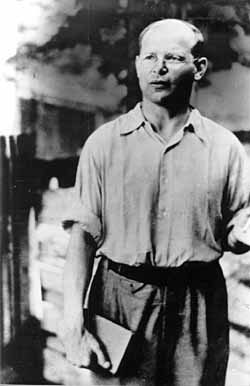
“God loves human beings. God loves the world. Not an ideal human, but human beings as they are; not an ideal world, but the real world. What we find repulsive in their opposition to God, what we shrink back from with pain and hostility, namely, real human beings, the real world, this is for God the ground of unfathomable love.” — Dietrich Bonhoeffer

Dietrich Bonhoeffer grew up in an era of world war, the collapse of Empires and social order, economic collapse, revolutions and the rise of the greatest evils that the world has ever seen. Bonhoeffer recognized evil in the world and the dangers of radicalism. He was a child when the First World War ended and the Kaiser abdicated and Germany went through a violent civil war, the humiliation of the Treaty of Versailles, economic calamity, Communist and Fascist coup attempts which finally led to the Nazi takeover by legal means. When the Nazis came to power Bonhoeffer was a young pastor.  He was one of the first to recognize the evil of the Nazi state and Nazism as well as its hold over Christians from all denominations.

We live in somewhat similar times. These are unsettled and great evil exists, evil which seeks to destroy the world in order to make it in its own image.  Some of these are godless, materialist and secular while others are rooted in the Great Religions as well as others in mysticism and individualistic spirituality all of which see the world and for that matter humanity, especially those that are not like them as the enemy. We are well acquainted with the extremism associated with Islamic terrorism as well as that of others with more politically based ideologies which have committed murder on a massive scale and wherever they rule oppress their own people, however Christians are not immune to radicalism usually radicalism in what they see as a godly response to the evils of their time. Bonhoeffer saw the danger of Christians who become radicalized in relationship to how such radicalization stands in antithesis to the Gospel which in restoring fallen humanity to relationship with Christ commands that those that have been reconciled to him has now “given us the ministry of reconciliation; that is, in Christ God was reconciling the world to himself, not counting their trespasses against them, and entrusting the message of reconciliation to us. So we are ambassadors for Christ, since God is making his appeal through us; we entreat you on behalf of Christ, be reconciled to God. For our sake he made him to be sin who knew no sin, so that in him we might become the righteousness of God.”  2nd Corinthians 5:18b-21

Bonhoeffer penned this from inside a Nazi prison awaiting his execution.

“Radicalism always springs from a conscious or unconscious hatred of what is established. Christian radicalism, no matter whether it consists in withdrawing from the world or in improving the world, arises from the hatred of creation. The radical cannot forgive God his creation. He has fallen out with the created world, the Ivan Karamazov, who at the same time makes the figure of the radical Jesus in the image of the Grand Inquisitor. When evil becomes powerful in the world, it infects the Christian, too, with the poison of radicalism. It is Christ’s gift to the Christian that he should be reconciled with the world as it is, but now this reconciliation is accounted to be a betrayal and denial of Christ. It is replaced by bitterness, suspicion and contempt for men and the world. In place of the love that believes all and hopes all, in the place of the love which loves the world in its very wickedness with the love of God (John 3:16), there is now the pharisaical denial of love to evil, and the restriction of love to the closed circle of the devout. Instead of the open Church of Jesus Christ which serves the world till the end, there is now some allegedly primitive Christian ideal of a Church, which in its turn confuses the ideal of the living Jesus Christ with the realization of a Christian ideal. Thus a world which is evil succeeds in making the Christians become evil too. It is the same germ that disintegrates the world and that makes the Christians become radical. In both cases it is hatred towards the world, no matter whether the haters are the ungodly or the godly. On both sides it is a refusal of faith in the creation. But devils are not cast out through Beelzebub.” (Letters and Papers from Prison p.386)

This Christian radicalism has become a very real part of the American religious-political landscape and it has managed to poison a generation through the Dominionism. The man who can be called the founder of this movement which has become one of the loudest voices in American Evangelicalism, the Charismatic and Pentecostal movement and other Christian groups spanning the denominational spectrum is R.J. Rushdoonny.  Rushdoony’s version of the Christian faith is an Old Testament militancy based upon Israel’s conquest of the Land of Promise. Some examples of Rushdoony’s theological argument which is echoed by many American Christian conservatives are found here:

Israel was attacked by Amalek. According to Deuteronomy 25:17, Amalek “feared not God.” Amalek’s attack on Israel, according to the “Midrashic lore,” was an obscene defiance of God and a contempt for God. Where men attack God’s people, there we often have a covert or overt attack on God. Unable to strike directly at God, they strike at God’s people. There is thus continual warfare between Amalek and Israel, between God’s people and God’s enemies. The outcome must be the blotting out of God’s enemies…. the covenant people must wage war against the enemies of God, because this war is unto death. The deliberate, refined, and obscene violence of the anti-God forces permits no quarter… this warfare must continue until the Amalekites of the world are blotted out, until God’s law-order prevails and His justice reigns.” R.J. Rushdoony, The Institutes of Biblical Law (Nutley, NJ: Craig Press, 1973), p. 318.

Rushdoony’s son in law Gary North is now the primary ideological and theological spokesman for the Dominionist movement. He is very popular and influential in many conservative and political circles and with the Tea Party movement. North makes the following comment in relation to the Christian’s relationship and attitude when dealing with the world.

“It occurs to me: Was Moses arrogant and unbiblical when he instructed the Israelites to kill every Canaanite in the land (Deut. 7:2; 20:16-17)? Was he an “elitist” or (horror of horrors) a racist? No; he was a God-fearing man who sought to obey God, who commanded them to kill them all. It sounds like a “superior attitude” to me. Of course, Christians have been given no comparable military command in New Testament times, but I am trying to deal with the attitude of superiority–a superiority based on our possession of the law of God. That attitude is something Christians must have when dealing with all pagans. God has given us the tools of dominion.” Gary North, The Sinai Strategy: Economics and the Ten Commandments (Tyler, TX: Institute for Christian Economics, 1986), p. 214n

This militancy has gained popular support since the 2008 elections and is reflective of the bitter and angry undercurrent which pervades many Christian political activists many of whom are very comfortable with using violence against those that they believe are their enemies. A similar tenor is found in some of their opponents on the Left who speak of bloodshed.

However such words and actions often mirror those of their proclaimed enemies the radicals of which use similar words of violence and justification of brute force to achieve their goals. Those who do not agree with such theology or ideology be that from those in the Dominionist movement or the more radical leftists are as much of an enemy as anyone else. Neither side will stop until they conquer and destroy every bastion of the other. The war between the “godless and the godly” to quote Bonhoeffer is actual a war against the creation and humanity that God through Christ seeks to redeem.

Bonhoeffer made a very poignant observation:

“There is a truth which is of Satan. Its essence is that under the semblance of truth it denies everything that is real. It lives upon the hatred of the real and the world which is created and loved by God. It pretends to be executing the judgment of God upon the fall of the real. God’s truth judges created things out of love. And Satan’s truth judges them out of envy and hatred. God’s truth has become flesh in the world and is alive in the real, but Satan’s truth is the death of all reality.” Bonhoeffer Ethics p. 366

As I look around and see the great conflict in our country with two sides determined to win at any cost and demonize any contrary opinion and fear for what will overtake us as the Satanic truth proclaimed from all sides of the political and religious spectrum consumes the land. In the midst of such discourse which is trending toward physical violence as the extremes battle for power the Church and Christians are commanded to demonstrate the love of God to all people no matter how vile their outbursts or prejudice. As Paul wrote to the Corinthians “God has entrusted the ministry of reconciliation to us.” It is this reconciliation of the real Incarnate Jesus Christ that must be made present in the midst of the current darkness. Christian radicalism is as poisonous as godless radicalism and it has no answers. It is time to cast it aside.

Peace

Padre Steve+


4 Comments

Filed under christian life, film, History, philosophy, Political Commentary, Religion

Harbingers of the Future: The German Type XXI Electroboote U-Boats

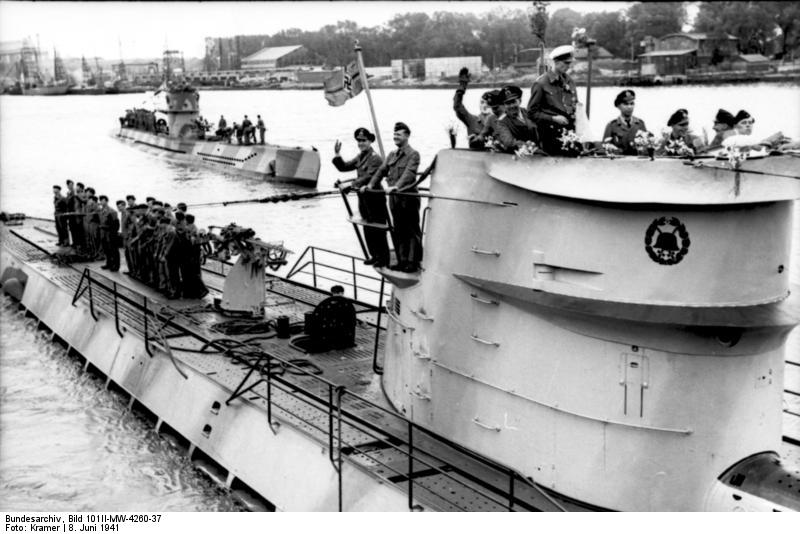
Throughout history there have been ships that have changed the course of Naval strategy and made previous types of ships obsolete overnight, the USS Monitor, the HMS Dreadnought and USS Nautilus are three, but add to the list the German Type XXI U-Boats which forever changed the way that submarines were built around the world.

The Type XXI was designed in 1943 in order to regain the initiative and thereby reassert German naval power in the Atlantic in order to turn the tide against the Allies.  By 1943 the Allies had turned the tide against the Germans as the Type VII and Type IX U-Boats took heavy losses against naval units and convoys which now had air support at every stage of their trek across the North Atlantic. These boats had to surface for prolonged periods in order to recharge their batteries and had limited range, speed and endurance when submerged. The advent of the Escort Carrier, long range patrol bombers and hunter killer groups of Destroyers and the new Destroyer Escorts took a great toll on the U-Boat Force.

U-3008 in U.S. Navy Service

In order to meet the challenge the Germans opted for new technology based on the high speed hydrogen powered Walter turbines for underwater operations.  Since these turbines which could produce a high underwater speed had a short endurance the designers modified the design to use conventional diesels but equip the boats with batteries that had three times the capacity of previous boats. The boats were a radical change from all previous submarine designs which were basically surface ships with the ability to operate underwater for limited periods of time. The Type XXIs were really the first true submarines. They could operate at underwater speeds that were faster than many of their opponents, had a streamlined design which facilitated higher submerged speed of 18 knots and silent running making them very difficult to track.  They could remain underwater for 11 days while only needing 5 hours to recharge their batteries when using the schnorkel device.

The Wilhelm Bauer the former U-2540 in 1960

The Type XXI had a full streamlined hull and conning tower and even equipment which were externally mounted such as the radio antennae, hydrophones, DF Ring and forward planes were fully retractable. They had no deck guns and their twin 20mm flak guns mounted in a streamlined housing on the conning tower. The German designers eliminated the traditional open bridge in favor of three small openings for the watch officer and 2 lookouts. They had a superior silent running ability and at 15 knots were quieter than the US Navy Balao Class doing 8 knots.  They had a 1 inch thick steel aluminum alloy pressure hull with a designed crush depth of 280 meters (919 feet), a greater designed crush depth than any previous submarine.

They incorporated other innovations which would be incorporated into the post-war submarines of the victorious Allied powers. Among these innovations were semi-automatic hydraulic torpedo reload system which allowed three 6 torpedo salvos to be fired in less than 20 minutes where prior U-Boats had manual reloads and took over 10 minutes to reload a single torpedo. To make the fullest use of this capability the German equipped the boats with an advanced passive and active sonar system called the called Gruppenhorchgerät and Unterwasser-Ortungsgerät NIBELUNG mounted in the bow. The improved passive system enabled the boats to close to where they could emit short active sonar bursts to fix the target location. They could fire from a depth of 160 feet. The torpedoes themselves were an advanced design called the LUT or Lageunabhängiger Torpedo. The LUT was a guided torpedo that could be fired from the U-Boat regardless of the target’s bearing as it was programmed to steer an interception course programmed by the torpedo computer.

Submarines influenced by the Type XXI

USS Gudgeon a Tang Class submarine

Polish Submarine ORP Orzel a WHISKEY Type Submarine

USS Nautilus on trials

The Type XXI boats were unique in production as they had no prototype and went directly in production. They were assembled from prefabricated sections built from factories around Germany and transported to the major shipbuilding yards. This was efficient but caused problems that slowed final assembly as many of the factories had no experience building U-Boats and quality suffered because the exacting specifications required by the Kriegsmarine.  Likewise Allied air strikes on German factories and rail networks hampered production. Yet even in spite of these difficulties 119 Boats were completed although only four were rated as combat ready and only two were fully operational at war’s end. Of these only one embarked on a war patrol.  Most were destroyed in air attacks while in port or scuttled by the Germans to prevent their capture.  Eight Type XXIs were taken over by Allied navies at the end of the war where they were used to evaluate technology for use in future submarines. The U.S. Navy Tang Class boats were heavily influenced by the Type XXI as were the GUPPY upgrades to Balao and Tench class boats.  The first nuclear submarines of the U.S. Navy, the Nautilus, Seawolf and the Skate Classes all incorporated design features of the Type XXIs. The Soviet Union developed its 613 and 614 project submarines which became the type known by NATO as the WHISKEY class from the Type XXIs that they received following Germany’s surrender. In 1957 the Federal Republic of Germany raised the scuttled U-2540 and commissioned her as the research submarine Wilhelm Bauer. That boat was operated by both the Bundesmarine and civilian crews until her decommissioning in 1982. She is now a museum ship open to the public in Bremerhaven.

The Type XXIs were the first true submarines and influenced every submarine constructed since. Though introduced too late in the war to make a difference they were truly a wonder-weapon.

Peace

Padre Steve+
 

1 Comment

Filed under History, Military, Navy Ships, world war two in europe

Göttdammerung in Libya: Shades of Hitler as Gaddafi Promises to Die as a Martyr

“Muammar Gaddafi is not the president, he is the leader of the revolution. He has nothing to lose. Revolution means sacrifice until the very end of your life”

“I am a fighter, a revolutionary from tents … I will die as a martyr at the end… I have not yet ordered the use of force, not yet ordered one bullet to be fired … when i do, everything will burn.”

Muammar Gaddafi on Libyan State TV 22 February 2011


Libya’s brutal dictator of over 40 years Muammar Gaddafi has cast the die in favor of destroying his country in order to save his regime. In a speech that conjures up visions of Hitler in 1945 a rambling madman blaming external enemies and equating him with the nation while demonizing his own people who have risen up in revolt against him.

Gaddafi Speech

http://english.aljazeera.net/news/africa/2011/02/201122216458913596.html

The speech was surreal as it was translated with Gaddafi standing in the remains of his home that was bombed by the United States in 1986.  Alone at a podium without the usual crowd of adoring sycophants delivered a rambling narcissistic speech that bordered on the absurd while at the same time making credible threats against the protestors and anyone who opposes him which were already being backed up by Mercenaries and pro-Gaddafi thugs using heavy weapons and helicopter gunships. So far at least 300 people have been killed with unconfirmed reports that many more have died in opposing Gaddafi.  With the eastern part of the country now in rebel hands with the support of military units it remains to be seen how Gaddafi sends his loyalists and mercenaries against the still fragile control of his opponents.

His speech appeared to be devoid of reality when he stated that “I haven’t even started giving the orders to use bullets” but then said that “any use of force against authority of state will be sentenced to death”

He has promised harsh retribution and made a very pointed reference to the Chinese suppression of the 1990 Tiananmen Square protests promising to “fight to the last drop of blood” stating:

“When Tiananmen Square happened, tanks were sent in to deal with them. It’s not a joke. Do whatever it takes to stay united… People in front of tanks were crushed. The unity of China is more important than those people in Tiananmen Square.”

His remarks about his opponents were even more macabre and almost seemed to be snatched out of the Bizzaro World of delusions and contradictions. Some of those comments are

“They are a group that are sick, taking hallucinatory drugs… They were given drugs, like in Tunisia, are just imitating… We won’t lose victory from these greasy rats and cats…. They should be given a lesson and stop taking drugs. They’re not good for you, for your heart. Don’t destroy the country… Shame on you, you gangsters. Surrender, give up all weapons, or they’ll have massacres, drugged kids with machine guns… tonight and tomorrow, youth, all of you, not those who are rats on drugs–form committees for security.”

Speaking of the protestors he claimed that “They are just imitating Egypt and Tunisia” and that they “want to turn Libya into an Islamic state” even going so far as the say “They are turning Libya into an (Islamic) emirate of Zawahri and Bin Laden, a new Afghanistan.”

His megalomania and narcissism was on display as he spoke of Libya’s newfound prominence in the news “Libya wants glory, Libya wants to be at the pinnacle, at the pinnacle of the world.”

Gaddafi cajoled his supporters into taking action against his opponents in a display of self adulation by speaking of himself in the third person:

If you love Muammar Gaddafi you will go out and secure Libya’s streets”

“You men and women who love Gaddafi …get out of your homes and fill the streets,” he said. “Leave your homes and attack them in their lairs … Starting tomorrow the cordons will be lifted, go out and fight them.”

“If weapons are not handed over… we will announce the holy march, I will call on millions from one desert to another to cleanse Libya house by house…”

Göttdammerung on the Streets of Tripoli (ABC News)

This is a tremendously dangerous situation for the Middle East as well as the world economy.  If this escalates into a full blown civil war between Gaddafi’s tribe and its dwindling number of allies and the other Libyan tribes that Gaddafi has previously been able to rely on to secure his power there could be great destruction in Libya.  It is believed that many of the larger tribes are now supporting Gaddafi’s overthrow even tribes that are historic rivals in tribal politics. Even more than the military, tribal support is of the utmost importance in the success of any revolt against him.

Libya at one time had WMD and it cannot be ruled out that Gaddafi has not clandestinely acquired some types of chemical agents which could be used against his own people. Additionally Libyan agents loyal to Gaddafi could undertake terrorist attacks on countries that he believes are against him as well as Libyan dissidents abroad. Other anti-Western regimes in the region and the world have much to fear as what happens in Libya could happen in them, the Syrians and Iranians have to be watching this with concern as well as their South American ally Hugo Chavez.

All of this impacts the world in many ways particularly in the oil and natural gas prices but also a direct financial impact in Africa where Libya has supplied funding that supports a number of critical African nations.  The east where the protestors have taken control is the home of much of its oil production which oil workers have promised to curtail if Gaddafi continues his attacks on the Libyan people. Robert Baer in Time Magazine http://www.time.com/time/world/article/0,8599,2052961,00.html reports that Gaddafi has stated that he knows that “he knows he cannot retake Libya with the forces he has. But what he can do is make the rebellious tribes and army officers regret their disloyalty, turning Libya into another Somalia.” He quotes a source that quotes Gaddafi as saying “I have the money and arms to fight for a long time.”  Of the measures Baer’s source reports is that “Gaddafi has ordered security services to start sabotaging oil facilities. They will start by blowing up several oil pipelines, cutting off flow to Mediterranean ports.”  One can only imagine the chaos that this would sow in the country, the region and in the oil markets.

As the flames of protest and revolution gain intensity throughout the region it is important to realize that things will not go back to what they were. We are facing one of the most dangerous situations with a myriad of possible outcomes many of which will bring about more instability, possible terrorism and maybe a regional war or series of wars. Russian Federation President Dmitry Medvedev commented on the situation saying that “this will mean fires for years and the spread of extremism in the future. We need to look this straight in the eyes.”

In the midst of Gaddafi’s macabre Göttdammerung the flames or protest, revolution and possibly even freedom continue to spread and no one knows what country that they will ignite next. Somehow I do not think that this will remain an isolated Middle Eastern phenomenon but will spread. I believe that many nations where peoples are repressed, poverty stricken or feel alienated from their governments will see such movements with very unpredictable consequences. This is beginning to shape up like the post World War One period of the breakup of empires, the post colonial chaos and the fall of the Iron Curtain coupled with a world-wide economic crisis that has the world teetering on the brink of a financial crisis on the order of the Great Depression all wrapped into one.

My we live in interesting times.

Peace

Padre Steve+
4 Comments

Filed under Foreign Policy, middle east, national security

To the Shores of Tripoli: The Flames of Revolution Spread to Libya as Gaddafi Fights Back

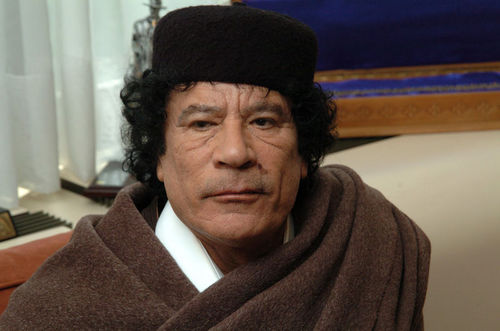
Muammar Gaddafi: A Fight to the Finish

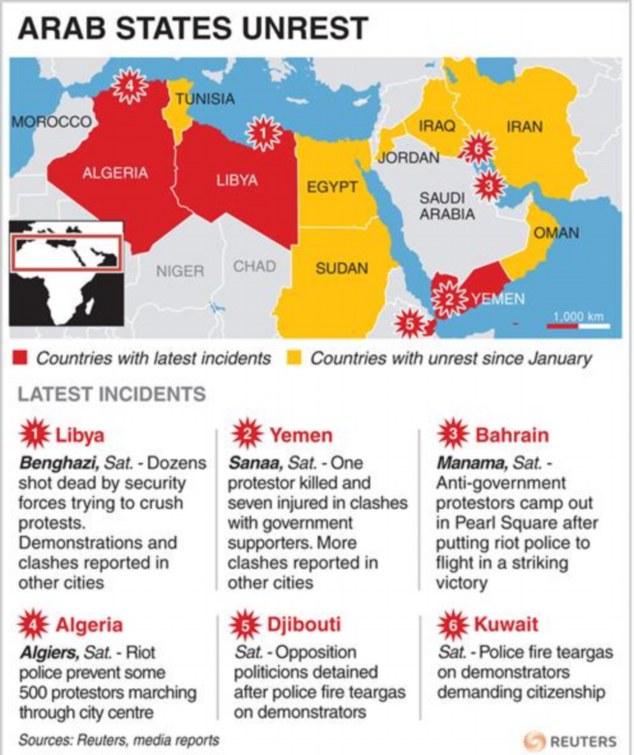
The regime of Colonel Muammar Gaddafi is now in a fight to the death against the Libyan people in the streets of the capitol Tripoli.  In the eastern part of the country it appears that the revolutionaries have gained control of major cities including Libya’s second largest city Benghazi.

Gaddafi has ruled his own country with brutal force and exported terrorism throughout the Middle East and Europe for decades. When I served in Germany during the Cold War it was Libyan agents that attacked American servicemen and women and blew up Pan Am Flight 103 over Lockerbie Scotland.

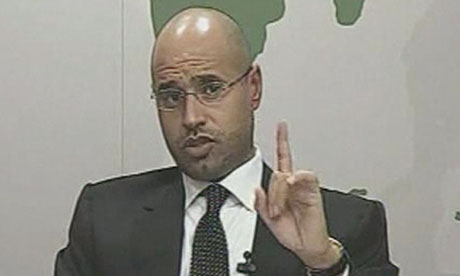
Saif El Islam Gaddafi: Civil War

The Gaddafi regime has turned to brutal force to attempt to curb demonstrations that began in the wake of the successful Tunisian and Egyptian revolts that overthrew Ben Ali in Tunisia and Hosni Mubarak in Egypt. Gaddafi is a ruthless animal when it comes to his readiness to violently crush any dissent against his regime and has not hesitated to use political assassination on Libyan dissidents abroad.  However he is survivor who knows how to use money and oil to get his way with governments. He has occasionally reached out to appear in a more moderate and reasonable persona such as when he gave up his Weapons of Mass Destruction to the Americans and British in 2004 and when he paid 271 million dollars to the victims of the Lockerbie attack.


Libya is different than Tunisia, Egypt and Bahrain. The rulers of those countries, Ben Ali in Tunisia and Mubarak in Egypt while dictators they were not psychopaths and ceded power peacefully. Likewise the Bahraini leaders have backed down to opt for negotiations over the heavy handed force that they employed last week. Gaddafi has long viewed himself as the leader of the Arab World and Africa although his stock has fallen in recent years. He will not go peacefully.  His son Saif El Islam a Western Educated Ph.D. went on state television last night and predicted thousands would be killed in a prolonged civil war and said that “Libya is at a crossroads. If we do not agree today on reforms, we will not be mourning 84 people, but thousands of deaths, and rivers of blood will run through Libya…” He further said “We will take up arms… we will fight to the last bullet… We will destroy seditious elements. If everybody is armed, it is civil war, we will kill each other.”

Saif’s threats are being taken seriously. Since the protests broke out Gaddafi’s security forces have launched vicious attacks on protests and even the funerals of those killed. Using heavy weapons, aircraft and helicopter gunships Gaddafi has turned dogs of war against his people, reportedly using mercenaries from other nations to do what native Libyan soldiers and airmen will not do.

Protesters are being joined in some places by Libyan soldiers and elsewhere two Libyan Air Force Colonels defected with their fully armed Mirage F-1 fighter aircraft to Malta stating that they refused to fire on their countrymen. Around the world Libyan diplomats are condemning the regime and even in the country the Justice Minister and many judges in Benghazi have joined the protests. Other reports suggest that Libyan Border Guards and Coastguard personnel have left their posts along the Egyptian frontier. Libya’s Deputy Ambassador to the United Nations Ibrahim Dabbashi, Libya’s told reporters on Monday that Libyan leader Moammar Gadhafi has “declared war on the Libyan people and is committing genocide.”

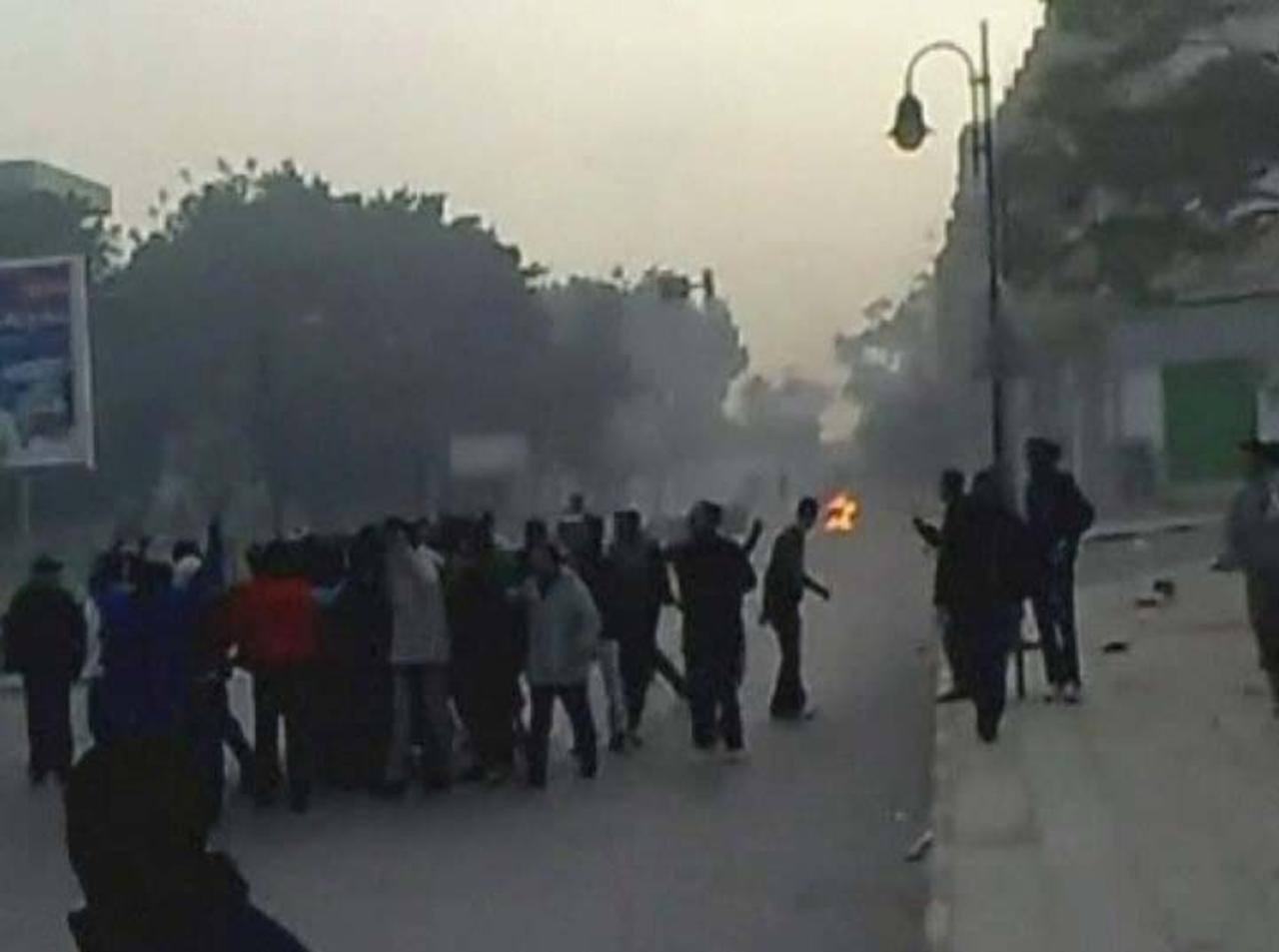
Protests in the city of Tobruk (Reuters Photo)

The situation is escalating. On Tuesday the United Nations Security Council will meet for the first time to discuss the issue. Some have suggested that the Security Council impose a no-fly zone over Libyan airspace to keep Gaddafi from flying in more foreign mercenaries or use his air force against the protesters.

What is certain is that blood will continue to flow and that if Gaddafi goes down he and his sycophants will kill as many of their own people as they can.  The most interesting thing about this whole situation is that if Gaddafi falls it will be the first time an anti-Western or American regime has fallen signifying that the flames of protest and revolution are much more about overthrowing despots and bringing the people some measure of freedom than anything else. The situation is dangerous, fraught with peril and fluid but it could be the start of a change in the Middle East that takes the wind out of the sails of Al Qaeda and other terrorists groups who draw their support from those repressed by dictators.

It shall be interesting to see how this continues to develop. Pray for the people of Libya.

Peace

Padre Steve+
7 Comments

Filed under Foreign Policy, History, middle east, Military, national security

The Iranian Navy in the Mediterranean: Looking for War in all the Right Places

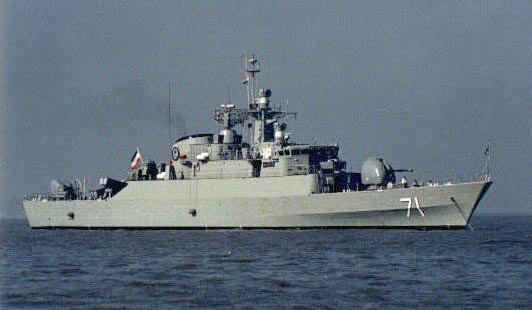
Iranian Frigate Alvand

For the first time since the Iranian Revolution Iranian warships have permission to transit the Suez Canal, an international waterway.  The Frigate Alvand and the supply ship Kharq passed inspection to ensure that no contraband or illegal weapons were aboard and should pass through the canal in the coming days. The Iranians clam that the ships will sail to Syria where they will operate from in the coming months.

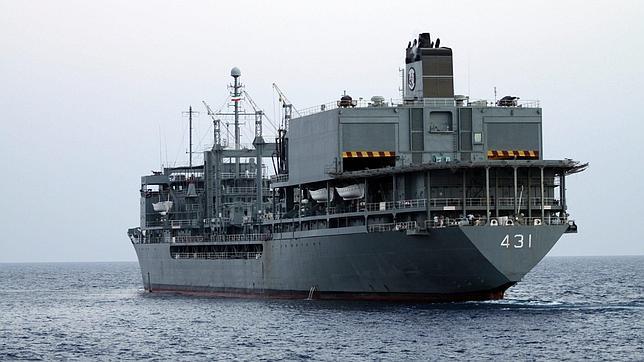
Iranian Supply Ship Kharq

To me the move by Iran appears to be an attempt to provoke Israel into a war. Israel views the move with suspicion and calls it provocative. In that they are right. It is suspicious that the Iranians would send ships to the Mediterranean and one wonders what they are up to. Based in Syria the ships can support pro-Iranian Hezbollah forces in Lebanon and show the Iranian flag in countries that are slipping into the throws of revolution.  As such the two ships are a provocative presence that Israel has a right to be concerned about. At the same time the ships themselves pose no threat to Israel in any way shape or form.

The Frigate Alvand is a Vosper Mark V Frigate commissioned in 1971. It is small (1,540 tons full load) and fast but old and not heavily armed. Alvand and its two sister ships are armed with 4 C-802 Anti-Ship cruise missiles and a 4.5” gun was well as various light anti-aircraft weapons and anti-submarine torpedoes. The electronics suite on Alvand class is not state of the art by any sense and they are of limited combat value despite Iranian claims otherwise.

The 40 year old  Alvand is accompanied by the Supply Ship Kharq which is a 1960s British design which the Iranians commissioned in 1980. It has a light armament and is of negligible combat value. The two ships paid a recent port call at Jeddah Saudi Arabia while conducting operations in the Red Sea.

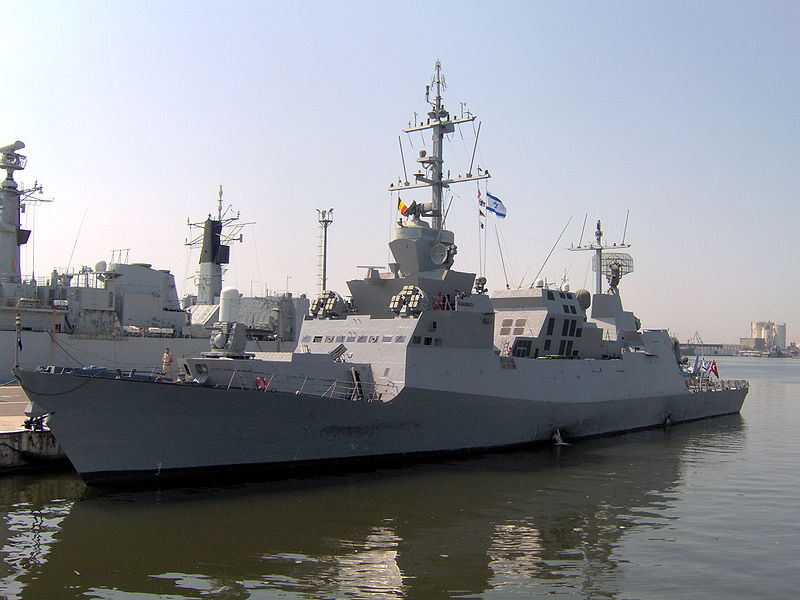
Israeli Navy Corvette Eilat a very modern and deadly SAAR V Class ship

Both the Alvand and the Kharq are totally outclassed by the Israeli Eilat Class (Saar V) Corvettes and have no defense to speak of against Israeli surface units, submarines or air forces.  They are of propaganda value only and if as some suggest they would attempt to escort convoys into Gaza they would probably be sunk by the Israelis before they could get off a shot. The danger of course is that the Iranians are purposely sending the ships to the Mediterranean to provoke an Israeli response and ignite a conflict between the two nations to further destabilize the region.

The Israeli Navy has a first strike capability against Iran itself in its three modern German built Dolphin Class submarines which are believed to be capable of launching nuclear capable cruise missiles and which have been deployed in waters near Iran.

Israel’s Defense Minister Ehud Barak said in an e-mail statement: “Israel is closely following the movements of the Iranian ships and has updated friendly states on the issue. Israel will continue to follow the ships movements.”

While the movement of the two ships through the Suez which is an international waterway is provocative and comes at a time of increasing tensions they pose little threat to Israel. However as part of a broader view taking into account the activities of Hezbollah in Lebanon, instability in Israel’s Arab allies Egypt and Jordan and Iran’s military buildup and nuclear program it is obvious that Iran has a purpose in deploying the two ships to the Mediterranean and that the purpose includes upping the pressure on Israel and perhaps provoking a military response. Whatever the actual purpose we can be sure that Iran’s intentions are not peaceful and the only purpose for the ships to be in the Mediterranean is to provoke a clash with the Israelis or to offer direct support to the actions of Hezbollah and Hamas against the Israelis or in the case of Hezbollah to ensure the complete hegemony of Iran, Syria and Hezbollah in Lebanon.

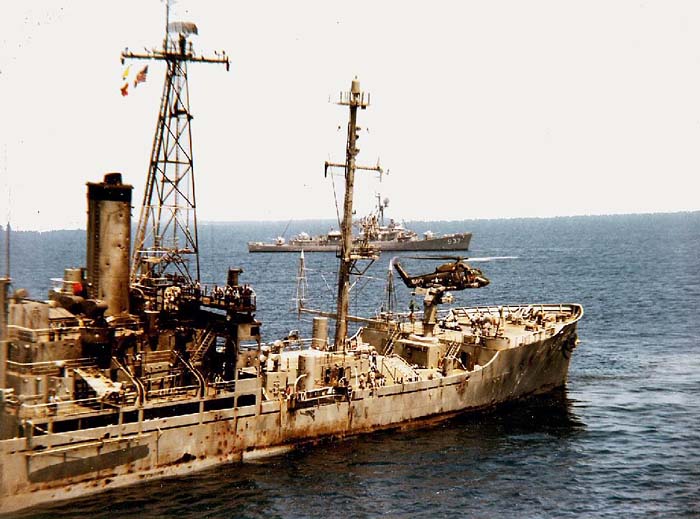
The USS Liberty AGTR-5 after being attacked by Israeli Air and Naval Units on 8 June 1967

Israel’s Navy while the smallest of the Israeli armed forces is quite capable and combat proven over the years. It has shown that it is not afraid to engage in combat with what Israel perceives to be threats, even the United States Navy as it did in the 1967 Six Day War where it launched a devastating prolonged attack on the USS Liberty AGTR-5 killing 34 and wounding 171 of its crew. The Israelis have long contended that the attack was a case of mistaken identity but the preponderance of evidence makes it look like the attack was deliberate.

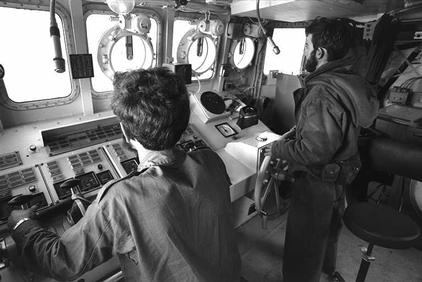
Israeli Sailors during the Battle of Latakia

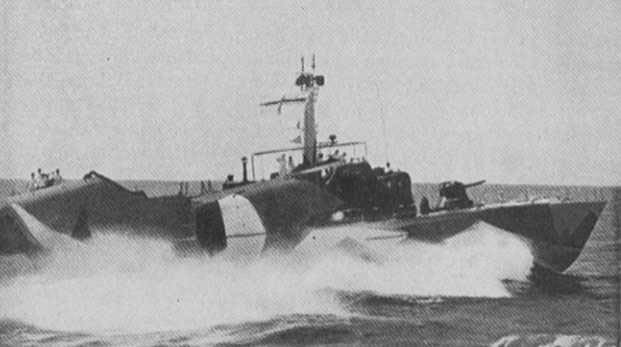
Egyptian Osa Class Missile Boat during 1973 War. The Israeli Navy sank 8 Egyptian and Syrian ships at the Battle of Latakia and Battle of Baltim with no losses to themselves in the first battles between guided missile ships

During the Yom Kippur War of 1973 the Israeli Navy destroyed 5 out of 5 Syrian Komar and Osa Class Missile Boats at the Battle of Latakia and 3 of 4 Egyptian Osa Class Missile Boats at the Battle of Baltim. Should the Iranian ships even look like they are threatening Israel the Israelis will have little patience and the ships will have an incredibly short combat life.  If that happens then expect a regional war to follow as Hezbollah, Iran and possibly Syria respond.

The clip below is from Iran’s English Language Press TV and is an Iranian assessment of their naval capabilities.

http://www.youtube.com/user/PressTVGlobalNews#p/u/13/doiWKWz4ZN8

Peace

Padre Steve+
10 Comments

Filed under Foreign Policy, History, middle east, Military, national security, Navy Ships

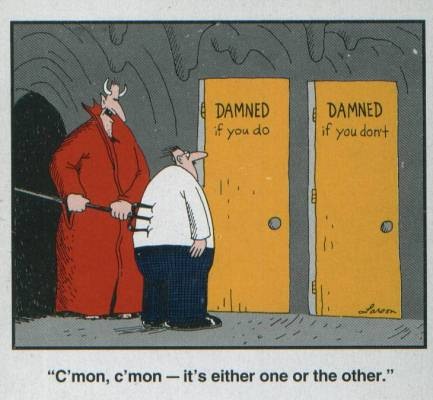
Damned if you do…Damned if you Don’t: The Middle East Protests and U.S. Foreign Policy

Stark Choices for U.S. Diplomacy in the Middle East

I have always loved the “Far Side” cartoon that serves as the theme for today’s short essay. I have been thinking about this ever since the fall of Ben Ali in Tunisia and comments from a couple of my regular readers regarding yesterday’s post about Bahrain brought the cartoon to mind.

In the Middle East the United States as well as most of the Western World is caught in the horns of a dilemma of our own making. Ever since the Iranian revolution we have chosen to ally ourselves with despots and dictators because they promoted stability in the region. To some extent this is good, stability and having allies that have an interest in ensuring that no more radical religious regimes such as Iran’s is in our interest. However this stability has come at a cost. We have betrayed the ideals that we have promoted in our Declaration of Independence, Constitution and even what we have partnered with other Nations in the U.N. Declaration of Human Rights.

We have backed rulers of countries that while they to some degree support our foreign policy aims have in many cases repressed the legitimate political, economic and social desires of their people.  Finally after many decades we are seeing the end of regimes that we have supported and face the uncertainty of what comes next.

In a sense we face a conundrum. If we continue to wholeheartedly support the leaders and governments that have been for the most part reliable allies in the region we will be seen by the majority of the people in the region as siding with oppressors. On the other hand if we elect to abandon them we will be seen as an untrustworthy ally by others that we have depended on in our attempt to contain the influence of Iran, contain the spread of militant revolutionary Islam, keep the fragile “Cold Peace” that Israel has enjoyed with Egypt and Jordan intact and in our war against Islamic Terrorism spearheaded by Al Qaeda.

On one hand we have our ideals on the other we have legitimate foreign policy, economic and security concerns. If we fall too far to either side we run significant risks. If we try to maintain a balance between these interests and ideals we run the risk of appearing to stand for nothing and be despised by those that we have allied ourselves for decades and those who desire the same freedoms that we have enshrined for ourselves and which we have held out as a beacon to the world.

There is also the reality that not all of the protestors are actually protesting for freedom and democracy but simply to overthrow regimes that they disagree with in order to establish radical anti-western and anti-Israeli regimes which support the overthrow of the West and the establishment of a new Caliphate.

While this is going on we are divided at home and have little in the way of a national consensus in our foreign policy and in fact are doing all that we can to destroy each other in the name of our own political and social agendas.  Meanwhile American and NATO troops are engaged in a bitter struggle against the Taliban in Afghanistan which is not going well.

I think that we are damned if we do and damned if we don’t. It is a classic “lose-lose” situation. I only hope that we are able to ensure that no matter what happens that our losses are kept to a minimum.

Peace

Padre Steve+
 

1 Comment

Filed under Foreign Policy, national security, Political Commentary

Danger in the Arabian Gulf: The Fires of Protest Spread to Bahrain

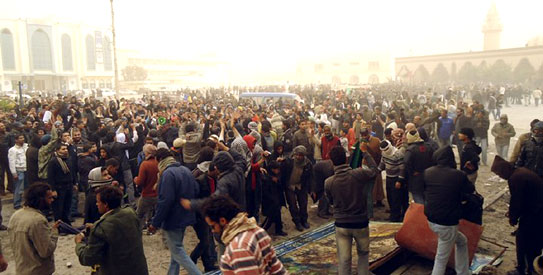
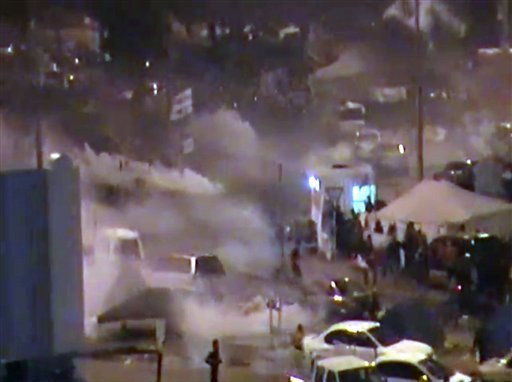
Protesters attacked in Bahrain (AP Photo)

It is weird when you see a place that you have been many times explode into massive protests, violence and potential revolution. That I have been to Bahrain many times and it is strange to see what is going on there. My first couple of times I was assigned to a ship, the cruiser USS HUE CITY on port calls while deployed in the Arabian Gulf. Later I would make frequent trips there as chaplain for the Marine Security Forces.

In the days following the downfall of Tunisia’s President Ben Ali and Egypt’s Hosni Mubarak the flames of revolution have spread across the Middle East. Protests have taken place in Yemen, Libya, Jordan and Bahrain and the situations have become violent as security forces attempted to put down the protests. Even Iran is beginning to boil over as protestors who feel cheated by the results of the contested 2009 elections rise up against the Iranian regime. However, the situation in Bahrain is the most troubling if one looks at the potential impact on US strategy in the Arabian Gulf and always tense situation with Iran.

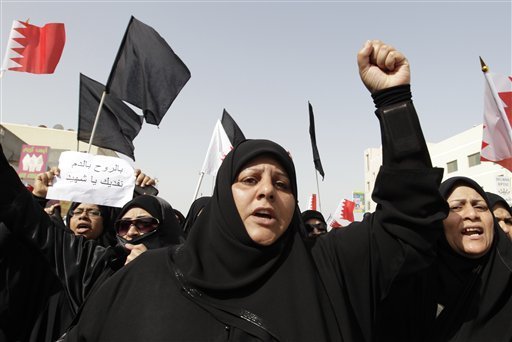
Bahraini Shia women with black flags. The Black flag is commonly flown in Shia neighborhoods and villages in Bahrain (AP Photo)

As I said before I have been to Bahrain many times. It is one of the most socially progressive countries in the Middle East and unlike most other Arab nation’s alcohol can be purchased in stores and not just upscale hotels that cater to foreigners, businessmen, military personnel and diplomats. It is a wealthy nation which though not prosperous as Qatar or the United Arab Emirates, Bahrain has managed to diversify its economy with a per capita income of $25,420.  It is a frequent vacation destination of many well off Saudis and has over 230,000 expats from other countries who call Bahrain home. According to a United Nations report Bahrain has 807,000 residents including the expats.

One thing that I remember about Bahrain is that the wealth is not very evenly divided. For the most part the Shia population is incredibly poor and their villages stand in stark contrast to the wealth of the Sunni. This is one of the biggest causes of the tensions which have brought about the protest movement which was ignited by the success of the revolts in Tunisia and Egypt.

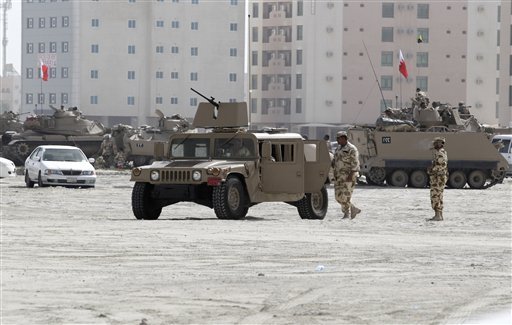
Bahrain Army units deployed in Manama (AP Photo)

The population of Bahrain is divided between the Sunni ruling class which comprises approximately 30% of the population and a less well off Shia population. The Khalifah family has ruled the country since driving out the Persians in 1783. It became a British protectorate in 1861 and the Kingdom attained its independence in 1971 and became a constitutional Monarchy in 2002 with some elected representatives.  The current King Sheikh Hamad bin Isa Al Khalifah is a graduate of Cambridge University and the U.S. Army Command and Staff College. He has reigned since March of 1999 when his father died.

Iran considers Bahrain a rebel province and is viewed as a threat by Bahrain has sought over the years to foment dissent in Shia community which believes that it is discriminated against by the Sunni rulers.

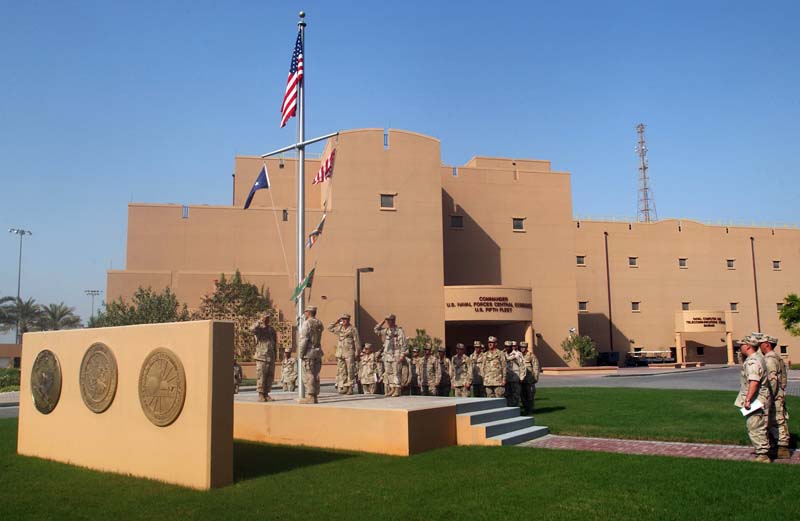
NAVCENT Headquarters in Bahrain (Navy Times Photo)

Bahrain is a vital part of the U.S. strategic presence in the region as a counter to the Iranian threat. It hosts the headquarters of the U.S. 5th Fleet, Naval Forces Central Command (NAVCENT) and Marine Forces Central Command (MARCENT). It is a frequent port of call for U.S. and Allied Navy ships that operate in the Arabian Gulf.  As such the current instability and violence is a matter of grave concern for the United States and its Allies in the Gulf.

As I said I have been to Bahrain numerous times in 2002, 2003, 2004, 2005 and 2006. I would stay in hotels with the best security which happened to be the 5 Star locations and dine at various Irish, British or Arab restaurants mostly with fellow Marine or Navy Officers or expats.  The difference between that world and the Shia villages and neighborhoods is amazing the contrast between the vast wealth of some and the absolute poverty of the other troubled me because I could see that it was a ticking time bomb. The Shia population also has limited political rights and is often targeted by the police.  They are certainly infiltrated by Iranian agents who I would guess are helping to stir things up.

The violence that has overtaken Bahrain does not surprise me. The Bahraini military is primarily composed of Sunnis from other Arab countries and has little love for the Shia. They are basically a mercenary force absolutely loyal to the government. There will be no Egyptian style coup in Bahrain. Since the population is small and the Army, police and other security forces wedded to the government I expect that the protests will be put down and that the regime will survive.  It will not be pretty and could well have an impact on U.S. Forces in Bahrain.

Back after 9/11 military dependents were sent home and force protection increased. A couple of years ago dependants were allowed back in but I think that we will see them extracted again. The security forces at the base are robust and work closely with the Bahraini security forces. I would expect that whatever Marine Expeditionary Unit is in theater will be on alert and that additional Fleet Anti-Terrorism Security Teams could be flown in to reinforce the base.

The broader ramifications of a continued violent crackdown on the protestors will be felt throughout the region. With the success of the Tunisian and Egyptian revolts people in many parts of the Arab World are now boiling over as protests and revolts against the old authoritarian regimes spread. As the situation continues to build I expect the probability of more regimes being overthrown with very unpredictable consequences. What may be true for Egypt may not be true anywhere else. What is for sure is that the Middle East that existed in December will look far different by the end of this year and that could be a good thing or a bad thing depending on just how it all shakes out and the possible impact on American and NATO operations in the region as well as impact on American overseas counter-terrorism operations especially in Yemen.

We can only wait and see and hopefully influence peaceful and democratic change in the area, but revolutions in countries that repress their populations tend not to be peaceful.  Egypt so far is an exception to that. If you believe in prayer I recommend that we pray hard my friends.

Peace

Padre Steve+
 

11 Comments

Filed under Foreign Policy, History, Military, national security

Predators of the High Seas: The Type IX U-Boats

U-123 returning from patrol

As the Kriegsmarine began its expansion in the mid-1930s the new U-Boat arm developed several types of submarines. The Type IX class was designed in 1935-36 as a long range attack boat and was larger had a greater range and were more heavily armed than the more numerous Type VII boats.  The Kreigsmarine designers envisioned a submarine capable of operating far from German bases for extended periods of time.  The design of these boats was derived from the two boat Type 1 class and incorporated lessons learned from that class.  283 boats of the type were constructed between 1937 and 1944 and the Kriegsmarine continuously sought to improve the type which resulted in five distinct models within the class.

Type IXA The first group referred to as the Type IXA or simply the Type IX was comprised of 8 boats built by AG Weser of Bremen.  Ordered in 1936 the group was part of the Kriegsmarine’s Plan Z rearmament plan which began when the Nazi Government announced that it would no longer abide by the Treaty of Versailles.  The initial 8 boats had a 1032 ton standard displacement were 251 feet long and were armed with six 21” torpedo tubes with 22 torpedoes.  They had a 105mm deck gun with 110 rounds as well as a 37mm and 20mm anti-aircraft gun.  They were the first German submarines equipped with a double hull which increased survivability and seaworthiness.  They were powered on the surface by two MAN M9V40/46 supercharged 9-cylinder diesel engines that produced 4,400 shp as well as two SSW GU345/34 double-acting electric motors for underwater operations. As in all diesel-electric boats the diesels were used to recharge the batteries for the electric motors while the boat was operating on the surface. They had a maximum speed of 18.2 knots on the surface and a range of 22,354 miles at 10 knots. Underwater they had a maximum speed of 7.7 knots and range of 166 miles at 4 knots.  The official maximum diving depth was 230 meters or 750 feet.  Of the 8 boats of this type 6 were sunk during combat operations and two scuttled at the end of the war by their crews to prevent their capture by the Allies. The most successful of the Type IXA boats was the U-37 was the most successful boat of the type sinking 53 merchant ships for a total of 200,124 tons as well as two warships, the Sloop HMS Penzance and French Submarine Q-182.

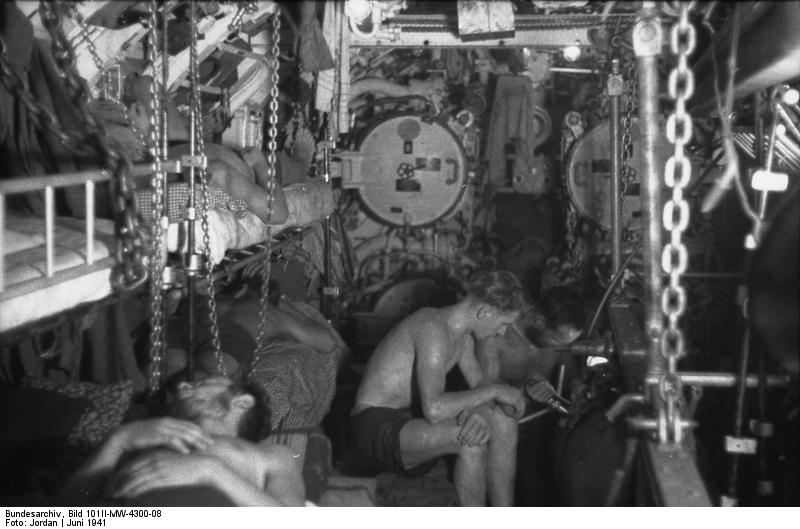
Crew members  of U-107 in Torpedo Room

Type IXB The next group was the IXB of which 14 boats were built by AG Weser Bremen. This was the most successful class of U-boats, or for that matter any class of submarines based on tonnage sunk per boat during the Second World War. Each of these ships sank over 100,000 tons of Allied shipping.  They were slightly larger than the IXA boats and had a significantly longer operational range of 24,600 miles on the surface at 10 knots. The U-107 of this class had the most successful war patrol of any U-Boat in the war sinking nearly 100,000 tons of Allied shipping off Freetown Sierra Leone while U-103 sank over 237,000 tons of Allied shipping during 11 war patrols over the course of 4 years. These boats were involved in Operation Drumbeat off the coast of the United States in early 1942.

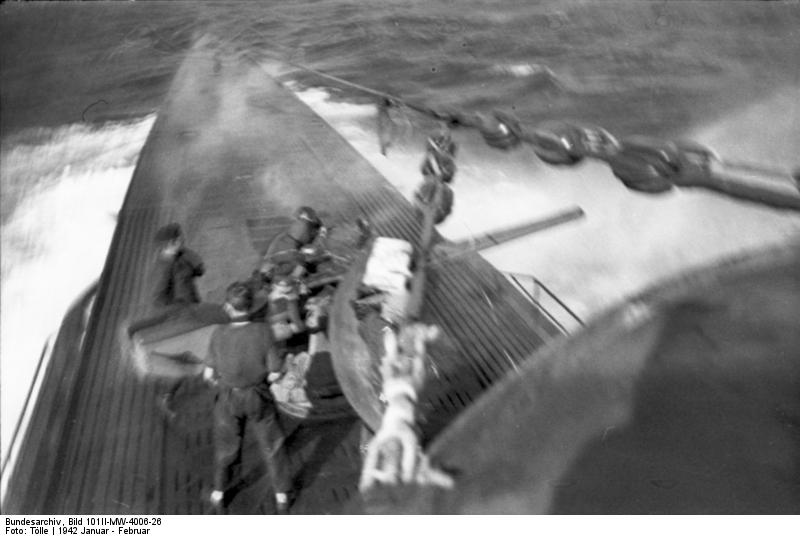
U-123 Gun Crew

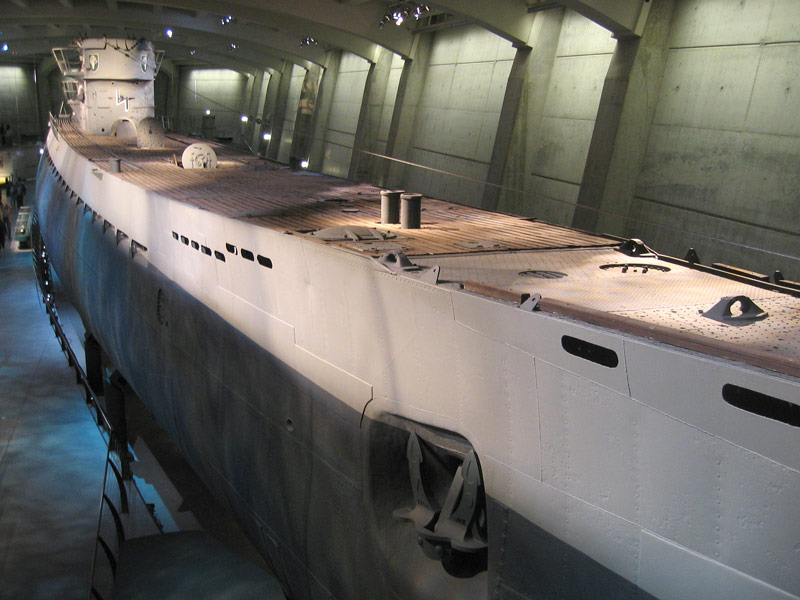
Type IXC The Type IXC was a further improvement of the type with additional fuel capacity and longer range. They displaced 1120 tons and 54 of the boats were commissioned of which 19 were equipped as minelayers with a capacity of 44 TMA or 66 TMB mines. The boats were built by AG Weser Bremen, Seebeckwerft Bremen and Deutsche Werft Hamburg.  The U-505 of this type is the only surviving Type IX and was captured by a boarding team from the Escort Carrier USS Guadalcanal on June 4th 1944. Her capture was kept secret from the Germans and her crew kept as POWs in a separate POW Camp. The story of the crew and their encounter with the game of baseball is recorded in Gary Moore’s book, Playing with the Enemy: A Baseball Prodigy, a World at War, and a Field of Broken Dreams. The book is being turned into a movie entitled Playing with the Enemy which is scheduled to be released in 2011. She is preserved at the Museum of Science and Industry in Chicago.

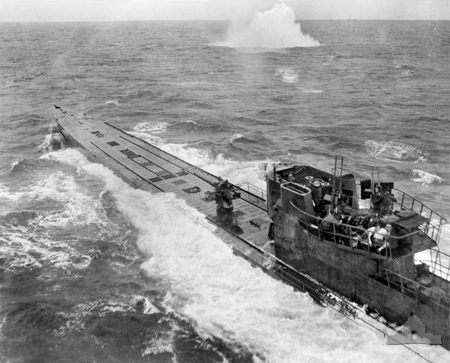
U-848 under attack by USN Aircraft

Type IXC/40 This was a further refinement of the IXC with slightly greater range and surface speed. It was the most numerous type of the class built with 87 being built by AG Weser Bremen, Seebeckwerft Bremen and Deutsche Werft Hamburg.  The remains of the U-534 of the class are displayed at Woodside Ferry Terminal in Birkenhead England after being raised from the North Sea in 1986.

Type IXD The final type in the Type IX Series was the Type IXD.  This was a significantly larger boat than the others in the class 287 feet long with a standard displacement of 1610 tons. They were unique in that they had two sets of diesel engines, one for cruising and the other for high speed runs and battery recharge. There were three variants within the type, the IXD1 which were all converted to transport use due to problems with their engines, the most numerous variant the IXD2 and the IXD42 which had greater horsepower.  Thirty Type IXs were commissioned with a further six Type IXD42s which were ordered with only one commissioned by the end of the war.

U-505 at the Museum of Science and Industry in 2005 (Jerry Atherton)

During the war surviving boats would receive increased anti-aircraft armament, the Schnorkel device which allowed them to operate on diesel power while submerged as well as better electronics and detection devices. Most of the boats which survived the war were scuttled by the Allies in Operation Deadlight.  The U-511 was sold to Japan in 1943 and U-862 taken over by the Japanese after the German Surrender in May 1945. Both survived the war and were scuttled by the Allies. U-1231 was taken over by the Soviet Navy and served as the B-26 after the war.

The sailors of these U-Boats like all submarine sailors endured many hardships and during the war approximately 75% of the 40,000 U-Boat sailors never returned from patrol, forever interred in the deep with their proud boats.

1 Comment

Filed under History, Military, Navy Ships, world war two in europe

A Lack of Wisdom in a Sea of Facts

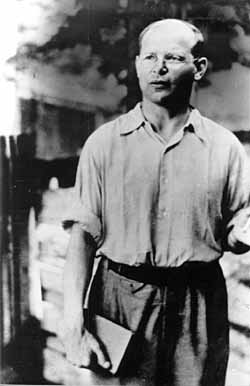
Dietrich Bonhoeffer

“To understand reality is not the same as to know about outward events. It is to perceive the essential nature of things. The best-informed man is not necessarily the wisest. Indeed there is a danger that precisely in the multiplicity of his knowledge he will lose sight of what is essential. But on the other hand, knowledge of an apparently trivial detail quite often makes it possible to see into the depths of things. And so the wise man will seek to acquire the best possible knowledge about events, but always without becoming dependent upon this knowledge. To recognize the significant in the factual is wisdom.” — Dietrich Bonhoeffer

Cyberspace and the airwaves in the United States are awash with “facts” about the current crisis that seems to have enveloped the world.  They are also awash in those that in an almost Gnostic manner act as if they or a group that they are part of have discovered the key to understanding the “facts” that surround the crisis. The pseudo-Gnostic “experts” be they pundits, preachers or politicians, the unholy Trinity of the information age come in all political, religious and philosophic persuasions and are entrenched in every aspect of life in a more pervasive and invasive manner than in any previous generation.

The sheer mass of information now at the fingertips of anyone who has a computer or smart phone has made everyone an expert in their own mind. However the simple knowledge of facts or even some level of understanding of them does not necessarily mean that such opinion, even that of the most popular of the unholy Trinity of pundits, preachers and politicians qualifies as wisdom.  In fact much of the so called analysis and presentation of the “facts” regardless of their political, social or religious orientation actually occurs in liberal or conservative echo chambers where the “facts” are crafted into sound bites designed to stir up and even enrage supporters in order to gain or maintain power. However the sound bites which are allegedly “factual” are beaten into us in some cases by men who ask us to give them “three hours a day every day” do not necessarily mean that those that spout them are wise, be they popular pundits, persuasive preachers or powerful politicians.

Now I know that this may offend those that bow at the altar of these personalities, but knowledge as important as it is does not equal wisdom even it comes from people with good ratings, great attendance or high poll numbers. The problem as Bonhoeffer put it so well is not that facts are not important but rather the significance of the facts to the time, place and situation.   We have become dependent men and women who make their living packaging the truth in such a way that it looks like they alone of the key to get past the Archons that ensnare us and keep us from understanding the truth.

The scary part is that much of the pervasive distrust and hatred that comes from all sides in the poisoned political pond of the American body politic is not due to an absence of information or lack of facts, but rather the intentional perversion of them for partisan gain by people that should know better.  As a Christian that which scares me most is when I see fellow Christians on the cutting edge of such actions even using the Christian faith and Scriptures to justify themselves. I think it is because that we have lost our way instead of being consumed by the love of God we have been consumed by the need to be in control, or be at the table of those in power.  We have allowed others to define our faith in such a way that it is hardly recognizable as anything Christian and that applies to all parties.

I have given up on having any answer to the madness that has overtaken the United States of America except to look back at history.  I think that Bonhoeffer had it right. He saw the evil of such unbridled passions in Germany in the 1930s and 1940s.  Germany was deeply divided and in political, social and economic crisis the same as we are in now.

I pray that we will not head down that path.

As Bonhoeffer said:

“Unless we have the courage to fight for a revival of wholesome reserve between man and man, we shall perish in an anarchy of human values… . Socially it means the renunciation of all place-hunting, a break with the cult of the “star,” an open eye both upwards and downwards, especially in the choice of one’s more intimate friends, and pleasure in private life as well as courage to enter public life. Culturally it means a return from the newspaper and the radio to the book, from feverish activity to unhurried leisure, from dispersion to concentration, from sensationalism to reflection, from virtuosity to art, from snobbery to modesty, from extravagance to moderation.”

I pray and hope against hope that we will find a way to step back from the Abyss.

Peace

Padre Steve+

5 Comments

Filed under christian life, philosophy, Political Commentary, Religion

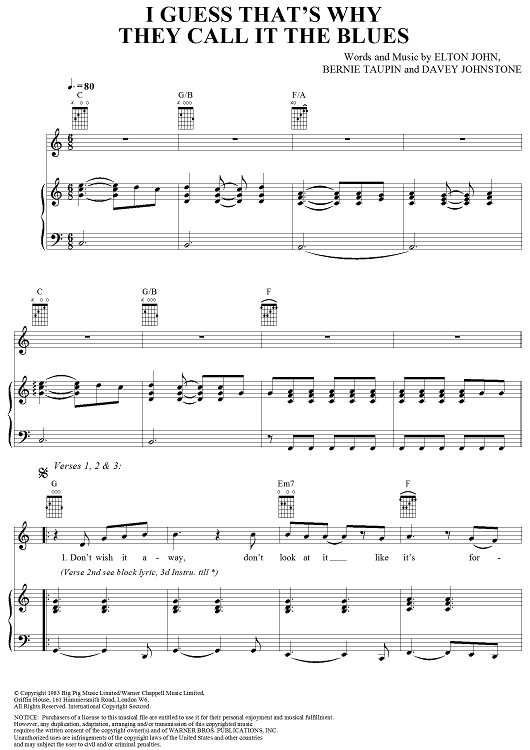
I Guess that’s Why they call it the Blues: Padre Steve’s Critique of Valentine’s Day

The Original Elton John Music Video of “I Guess that’s Why they Call it the Blues”

http://www.youtube.com/watch?v=h6KYAVn8ons

Valentine’s Day can be a difficult holiday for those that are alone. After all, Valentine’s Day is marketed as a day to celebrate romance, love and togetherness. However there are a lot of people alone, in my case it is my chosen vocation of the military that has necessitated numerous absences from my longsuffering wife over the past 29 plus years. I have lost track of just how many Valentine’s Day times with Judy that I have missed over the years and I know plenty of other military men and women that can all testify to this and say “Amen.” In fact I remember seeing the video of Elton John’s hit I Guess that’s Why they Call it the Blues on my first “Post marriage” military separation from Judy immediately after we were married in 1983. The song has always had a fond place in my otherwise crusty heart and reminds me that even I have a little romantic sentiment.

However as much as the military is part of my life it is a very small percentage of the population of the United States. That being said there are a lot of other lonely people on Valentine’s Day. There are a lot of single people, divorced people and others who for a myriad of reasons are alone this Valentine’s Day and for some the loneliness is almost unbearable.  For them it is a painful day that reminds them of just how alone they are or that they feel they are.

Let’s face it. The way Valentine’s Day is marketed the single, the divorced or those who struggle in painful or even abusive relationships are really left out. It is almost as if they are second class citizens or even non-entities. It’s like there is almost a stigma about being single or alone on Valentine’s Day. The hard thing for many people in this situation is that they are often smart, attractive and successful but still alone. Then there are those that are socially awkward or incredibly shy for whom the fear of relationships keeps them from entering into romance. For all of these people the day is difficult and something that they would prefer to just get past. Some will find ways to hang out with others in their situation but when they go home it will be to an empty bed, unless they have a dog.

As I have thought about this beginning the day after Christmas when the first Valentine’s Day candy and cards went on the shelves. Ever since I have been bombarded by commercials on television, radio and the internet and e-mails from online flower distributers, candy makers and specialty marketers advertising what I need to do to make this a holiday special for the one that I love. Now I couldn’t be with my bride this year but I ignored all the hype and surprised her with something that she asked for which cost very little and it made her happy. It is very seldom that I get Valentine’s Day, birthdays or anniversaries right. I am about as romantic as the German Pocket Battleship Graf Spee or a Panzer IV Tank, so when I in spite of myself actually do something that makes Judy’s day a bit brighter I am pleased because I cannot count the number of such occasions that I have messed up.

We’re apart this year but I will get some leave in conjunction with the upcoming President’s Day holiday and I think that will be good just to spend time with her.  Tonight I will go have dinner and a beer or two with another Chaplain, a Catholic Priest who I served with in Iraq.  It is good for us to get together in our line of work, when you are like my friend celibate or like me a geographic celibate there are not a lot of other people that you can hang out with.  Most of our colleagues are married and with their wives if they are not deployed and since a good number don’t drink you can’t exactly show up on their doorstep with a six-pack of Sam Adams (Patriot Brewer and Friend) a bucket of Buffalo wings and some action flick or guy kind of comedy DVD, aka no Chick Flicks or Christian romance movies.

So I am looking forward to tonight with my friend as we share a meal together at a local watering hole and an extended weekend with my bride, the love of my life.

So to all, those together, those apart and those alone I wish you the best.


1 Comment

Filed under marriage and relationships