Category Archives: civil war

Gettysburg and the Meaning of Democracy: Can the Republic Survive?

Gettysburg Address

Friends of Padre Steve’s World,

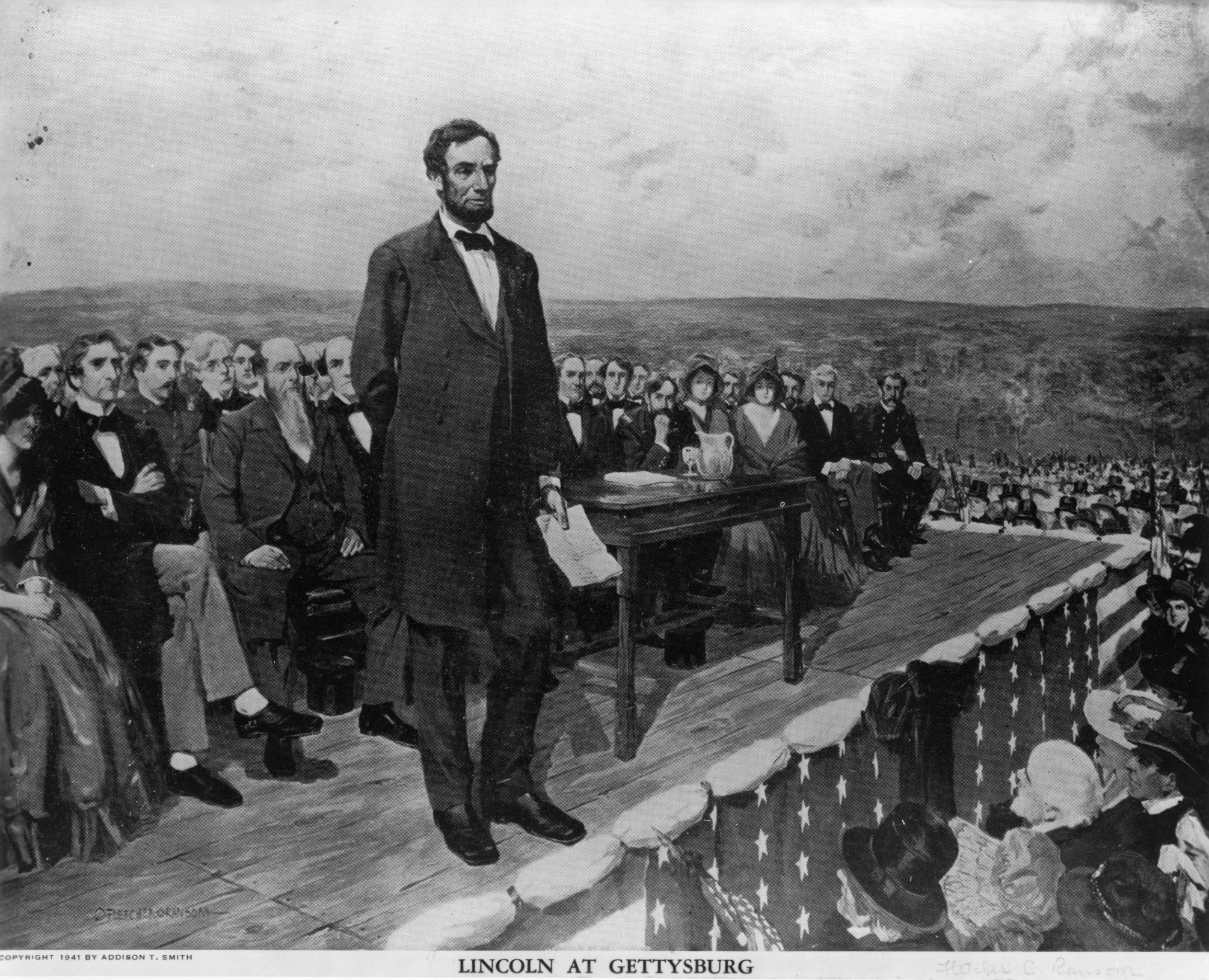
I am at Gettysburg with my students this weekend and today we finish our Staff Ride concluding at the Soldier’s Cemetery where Abraham Lincoln gave the Gettysburg Address. I usual close the staff ride by reading his address. I always get a bit choked up because I realize just how important what he said was then, and still is today. 

I expect with our democracy under assault from Donald Trump and his supporters that I will choke up, for I know not what I will wake up to on November 9th. If Trump wins, and his supporters on the Alt-Right have their way, our system of government will be destroyed, the civil liberties that the men who died here to establish will be curtailed or even rolled back. I fear that possibility and honestly if Trump were to win I cannot imagine what this country will devolve into.

In November of 1863 Abraham Lincoln was sick when when he traveled by train from Washington DC to Gettysburg. When Lincoln delivered the address having what was mostly likely a mild form of Smallpox. Thus the tenor, simplicity and philosophical depth of the address are even more remarkable. It is a speech given in the manner of Winston Churchill’s “Blood sweat toil and tears” address to Parliament upon being appoint Prime Minister in 1940. Likewise it echoes the Transcendentalist understanding of the Declaration of Independence as a “test for all other things.”

Many in the United States and Europe did not agree and argued that no nation found on such principles could long survive. The more reactionary European subscribers of Romanticism ridiculed the “idea that a nation could be founded on a proposition….and they were not reluctant to point to the Civil War as proof that attempting to build a government around something as bloodless and logical as a proposition was futile.” [1]

But Lincoln disagreed. He believed that the “sacrifices of Gettysburg, Shiloh, Murfreesboro, Chancellorsville, and a hundred other places demonstrated otherwise, that men would die rather than to lose hold of that proposition. Reflecting on that dedication, the living should themselves experience a new birth of freedom, a determination- and he drove his point home with a deliberate evocation of the great Whig orator Daniel Webster- “that government of the people, by the people, for the people, shall not perish from the earth.” [2]

The Unitarian pastor and leading Transcendentalist Theodore Parker wrote:

“Our national ideal out-travels our experience, and all experience. We began our national career by setting all history at defiance – for that said, “A republic on a large scale cannot exist.” Our progress since that has shown that we were right in refusing to be limited by the past. The practical ideas of the nation are transcendent, not empirical. Human history could not justify the Declaration of Independence and its large statements of the new idea: the nation went beyond human history and appealed to human nature.” [3]

Likewise Lincoln’s address echoes the thought of George Bancroft who wrote of the Declaration:

“The bill of rights which it promulgates is of rights that are older than human institutions, and spring from the eternal justice…. The heart of Jefferson in writing the Declaration, and of Congress in adopting it, beat for all humanity; the assertion of right was made for the entire world of mankind and all coming generations, without any exceptions whatsoever.” [4]

Theodore Parker’s words also prefigured an idea that Lincoln used in his address, that being: “the American Revolution, with American history since, is an attempt to prove by experience this transcendental proposition, to organize the transcendental idea of politics. The ideal demands for its organization a democracy- a government of all, for all, and by all…” [5]

Lincoln delivered these immortal words on that November afternoon:

Four score and seven years ago our fathers brought forth on this continent, a new nation, conceived in Liberty, and dedicated to the proposition that all men are created equal.

Now we are engaged in a great civil war, testing whether that nation, or any nation so conceived and so dedicated, can long endure. We are met on a great battle-field of that war. We have come to dedicate a portion of that field, as a final resting place for those who here gave their lives that that nation might live. It is altogether fitting and proper that we should do this.

But, in a larger sense, we cannot dedicate — we can not consecrate — we can not hallow — this ground. The brave men, living and dead, who struggled here, have consecrated it, far above our poor power to add or detract. The world will little note, nor long remember what we say here, but it can never forget what they did here. It is for us the living, rather, to be dedicated here to the unfinished work which they who fought here have thus far so nobly advanced. It is rather for us to be here dedicated to the great task remaining before us — that from these honored dead we take increased devotion to that cause for which they gave the last full measure of devotion — that we here highly resolve that these dead shall not have died in vain — that this nation, under God, shall have a new birth of freedom — and that government of the people, by the people, for the people, shall not perish from the earth.[6]

In a time where many are wearied by the foibles and follies of our politicians, especially a man as singularity ill-equipped and ill-tempered as Donald Trump and his supporters, many of whom are White Nationalists and authoritarian types unseen since secession could possibly take power; one has to wonder if our very form of government can survive, or if  Lincoln’s words still matter. 

But they do. Dr. Allen Guelzo, Professor of Civil War Studies at Gettysburg College wrote in the New York Times:

“The genius of the address thus lay not in its language or in its brevity (virtues though these were), but in the new birth it gave to those who had become discouraged and wearied by democracy’s follies, and in the reminder that democracy’s survival rested ultimately in the hands of citizens who saw something in democracy worth dying for. We could use that reminder again today.” [7]

Dr. Guelzo is quite correct. Many people in this country and around the world are having grave doubts about our democracy. I wonder myself, but I am an optimist. I do believe that we will eventually recover because for the life of me I see no nation anywhere else with our resiliency and ability to overcome the stupidity of politicians, pundits and preachers and the hate filled message of Donald Trump and his White Supremacist supporters, especially supposedly “conservative ” Christians. 

The amazing thing during the Civil War was that in spite of everything the Union survived. Lincoln was a big part of that but it was the men who left lives of comfort and security like Joshua Chamberlain and so many others who brought about that victory. Throughout the war, even to the end Southern political leaders failed to understand that Union men would fight and die for an ideal, something greater than themselves, the preservation of the Union and the freedom of an enslaved race. For those men that volunteered to serve, the war was not about personal gain, loot or land, it was about something greater. It was about freedom, and when we realize this fact “then we can contemplate the real meaning of “that cause for which they gave the last full measure of devotion.” [8]

Now I for one do not think that we are currently living up to the ideals enunciated by Lincoln that day at Gettysburg. I can understand the cynicism disillusionment of Americans as well as those around the world who have for over 200 years looked to us and our system as a “city set on a hill.” That being said, when I read these words and walk that hallowed ground I am again a believer. I believe that we can realize the ideal, even in our lifetime should we desire. That being said I cannot imagine what will happen to our country if Donald Trump is elected to the presidency. 

Have a great day and please stop to think about how important Lincoln’s words remain as we wait to see who will be our next President. 

Peace

Padre Steve+

Notes

[1] Ibid. Guelzo. Fateful Lightening p.409

[2] Ibid. Guelzo. Fateful Lightening p.408

[3] Ibid. Wills. Lincoln at Gettysburg p.110

[4] Ibid. Wills. Lincoln at Gettysburg p.105

[5] Ibid. Wills. Lincoln at Gettysburg p.105

[6] Lincoln, Abraham The Gettysburg Address the Bliss Copy retrieved from http://www.abrahamlincolnonline.org/lincoln/speeches/gettysburg.htm

[7] Guelzo, Allen C. Lincoln’s Sound Bite: Have Faith in Democracy New York Time Opinionator, November 17th 2013 retrieved from http://opinionator.blogs.nytimes.com/2013/11/17/lincolns-sound-bite-have-faith-in-democracy/?_php=true&_type=blogs&_r=0 July 18th 2014

[8] Ibid. McPherson This Hallowed Ground p.138

6 Comments

Filed under civil war, Gettysburg, History, Political Commentary

The Ghosts of Gettysburg Gather Around Me

img_0578

Friends of Padre Steve’s World,

I am at Gettysburg this weekend so I am just posting just a short meditation and some words written by Walt Whitman. 

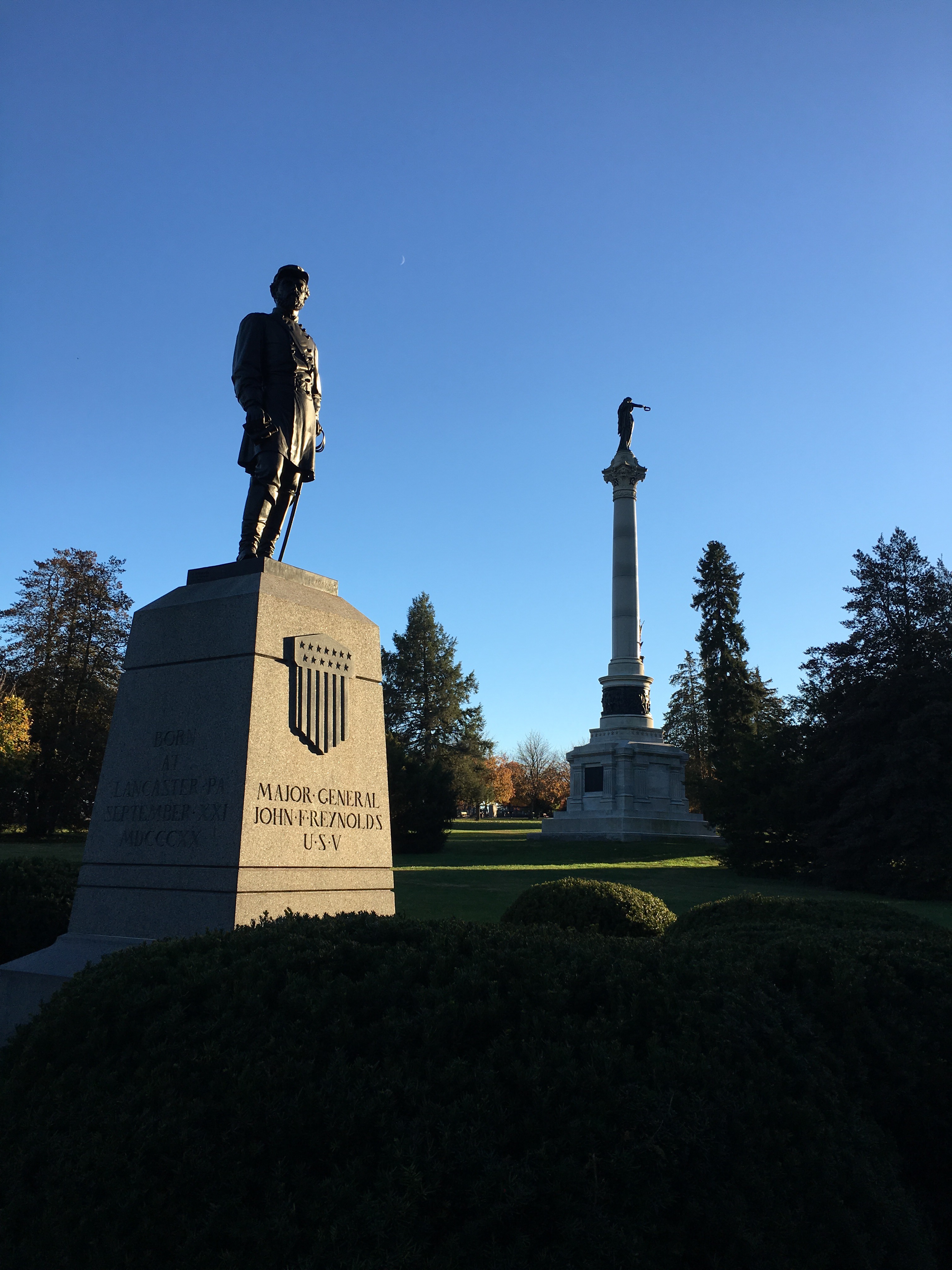
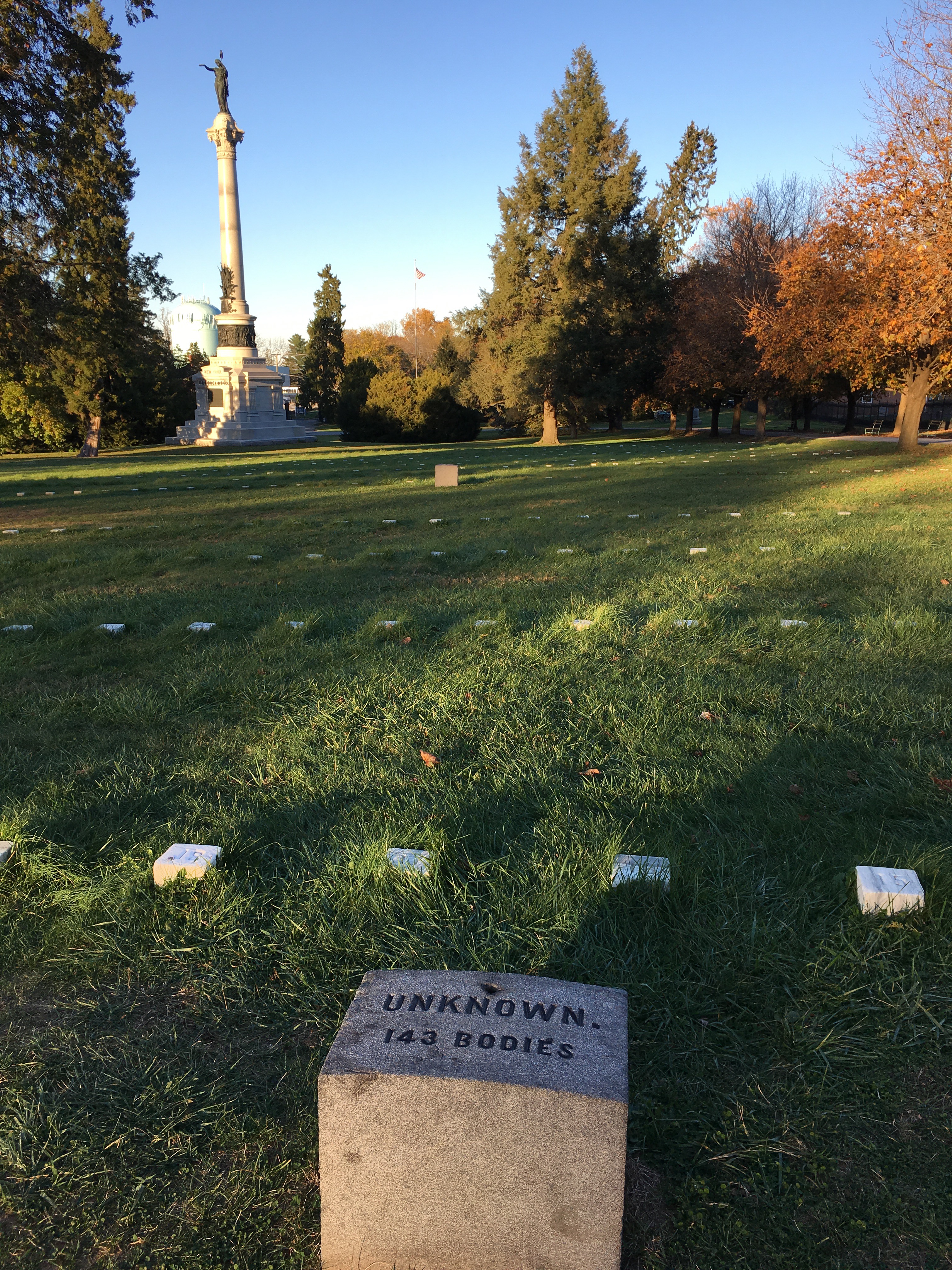
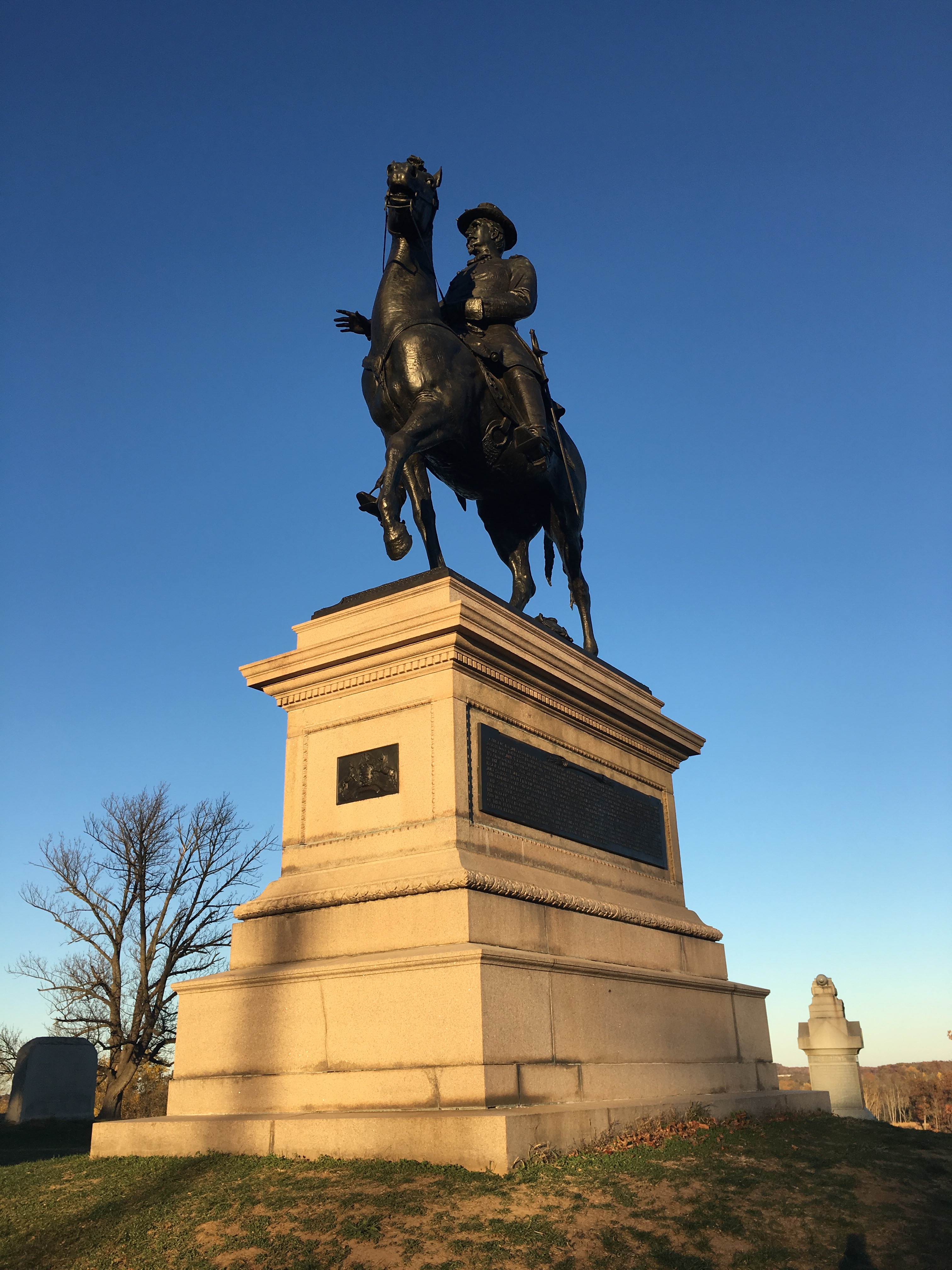
Yesterday afternoon I wandered around the Soldier’s Cemetery as well as East Cemetery Hill. It was a beautiful evening with the fall foliage in full display under a a blue sky with the sun setting in the west. As I walked about the graves of the 3577 Union Soldiers buried here, over half who are unknowns, I felt such powerful presence and was reminded of the importance of what they did here. There are sections where of the cemetery where unknown soldiers are buried, rank upon rank, with only a small marble marker with a number to identify them.

Each was a son, maybe a husband, father, or brother, or a friend, and most certainly, a comrade in arms. Each has a name, even if we don’t know it; and all of them, and many more gave the last full measure of devotion to duty to preserve this country against an enemy. But unlike other enemies, the soldiers that these men battled were from of an enemy that has raised itself up from within the country; men, no matter how good they might have been, took up arms against the United States. These included men who took up arms and fought against friends who they had served alongside in peace and war.

While men of my family fought for the Confederacy I cannot succumb to the lie that their cause was just. Thus when I stand among the ranks of these fallen Union men I honor their memory in ways I cannot fully do for their opponents in Confederate gray. Do not get me wrong, I weep for those who fought and died on both sides of the American Civil War, and each soldier needs to be remembered, even those who fought for a cause that was evil, the cause of slavery. As a military man myself I cannot walk these battlefields and not have a sense of compassion and even empathy for the Southerners who died here, even while rightly condemning the government and the cause that sent them to their deaths.

Walt Whitman wrote the poem Ashes of Dead Soldeirs after the war was over. Whitman knew the terrible cost borne by soldiers as he volunteered to help the wounded in Federal hospitals during the war. His words speak to me. 

When I come here I can sense their presence, the great and the small, John Reynolds, Lewis Armistead, Paddy O’Rorke, Dick Garnett, Alonzo Cushing, and Stong Vincent. The men of the Iron Brigade and the Irish Brigade, Dan Sickles’s Excelsior Brigade, Augustus Van Horne Ellis’s 124th New York “Orange Blossoms,”the men of George Pickett’s doomed division, the 1st Minnesota, the 20th Maine, and so many more. 

Whitman penned these words:

 “Ashes of soldiers South or North,
As I muse retrospective murmuring a chant in thought,
The war resumes, again to my sense your shapes,
And again the advance of the armies.
Noiseless as mists and vapors,
From their graves in the trenches ascending,
From cemeteries all through Virginia and Tennessee,
From every point of the compass out of the countless graves,
In wafted clouds, in myriads large, or squads of twos or threes or
single ones they come,
And silently gather round me…”

From Walt Whitman- Ashes of Dead Soldiers

Peace,

Padre Steve+ 

Leave a comment

Filed under civil war, Gettysburg, History

A Trip to Gettysburg at the End of a Polarizing Election

tearing1-500x353

Friends of Padre Steve’s World,

I am taking a group of my students to Gettysburg this weekend and the timing is good for me as it will take me to a place that helps me put things in perspective, especially as this election goes into its last few days.

Even so I have a sense, a sense of dread that our country is soon to head into an abyss of violence no-matter who wins the election. The solid and reasonable center seems to have disappeared, moderates of all types are derided. Trump and his supporters have repeatedly called the election rigged and say that they may not accept the results, unless they win. Throughout the campaign Trump and his surrogates have hinted at violence, they have whipped up their supporter’s emotions into a virtual tempest of rage that is threatening to explode into real violence. In 1860 it was the Southern political and religious leadership which said that they would not abide the results of the election of Abraham Lincoln, ignoring Democrat Stephen Douglas who said:

“It is apprehended that the policy of Mr. Lincoln and the principles of his party endanger the peace of the slaveholding states. Is that apprehension founded? No, it is not. Mr. Lincoln and his party lack the power, even if they had the disposition, to disturb or impair the rights and institutions of the South. They certainly cannot harm the South under existing laws. Will they have the power to repeal or change these laws, or to enact others? It is well known that they will be a minority in both houses of Congress, with the Supreme Court against them. Hence no bill can pass either house of Congress impairing or disturbing these rights or institutions of the southern people in any manner whatever, unless a portion of southern senators and representatives absent themselves so as to give an abolition majority in consequence of their actions.

In short, the President will be utterly powerless to do evil…. Four years shall soon pass, when the ballot box will furnish a peaceful, legal, and constitutional remedy for the evils and grievances with which the country might be afflicted.”

Georgia Senator and future Confederate Vice President Alexander Stephens had the greatest faith in the checks and balances provided in the Constitution and he pleaded with his fellow Georgians at the state capital of Milledgeville noting that the checks and balances “would render Lincoln “powerless to do any great mischief,” and he warned that “the dissolution of the Union would endanger this “Eden of the world,” that “instead of becoming gods, we shall become demons, and no distant day commence cutting one another’s throats…”

Louisiana Senator and future Confederate Secretary of the Treasury Judah Benjamin noted: “The prudent and conservative men South… were not able to stem the wild torrent of passion which is carrying everything before it…. It is a revolution…of the most intense character…and it can no more be checked by human effort, for the time, than a prairie fire by a gardener’s watering pot.”

Today reasonable people, including many Conservatives and Republicans are making similar observations about the dangers of Trump and how little people have to fear a Clinton presidency. But it will be for naught if the new fire-breathers that Trump has awakened respond as Southern did in 1860, responding not through reason but through blind fear and ideological hatred. Sadly, that kind of visceral response has not changed since Alexander Stephens and Judah Benjamin caved into the demands of the fire-eaters for secession and war, despite knowing that it would be a disaster. This is exactly how most supposedly responsible and moderate conservative Republicans are acting today. They too will be held responsible by history for not having the moral courage of Stephen Douglas to put the country and the constitution ahead of sectional interests. 

Northern abolitionist newspaper editor William Lloyd Garrison correctly judged the mood of the South when he wrote:

“Never had the truth of the ancient proverb “Whom the gods intend to destroy, they first make mad” been more signally illustrated than in the condition of southern slaveholders following Lincoln’s election. They were insane from their fears, their guilty forebodings, their lust for power and rule, hatred of free institutions, their merited consciousness of merited judgments; so that they may be properly classed as the inmates of a lunatic asylum. Their dread of Mr. Lincoln, of his Administration, of the Republican Party, demonstrated their insanity. In vain did Mr. Lincoln tell them, “I do not stand pledged to the abolition of slavery where it already exists.” They raved just as fiercely as though he were another John Brown, armed for southern invasion and universal emancipation! In vain did the Republican party present one point of antagonism to slavery – to wit, no more territorial expansion. In vain did that party exhibit the utmost caution not to give offense to any other direction – and make itself hoarse in uttering professions of loyalty to the Constitution and the Union. The South protested that its designs were infernal, and for them was “sleep no more!” Were these not the signs of a demented people?”

I feel that madness is true today of many of Trump’s supporters, his enablers in the GOP and media, and maybe of the man himself.

God help us all,

Peace

Padre Steve+

Leave a comment

Filed under civil rights, civil war, History, News and current events, Political Commentary

When Political Parties Implode: “Whom the gods intend to destroy, they first make mad” Secession

disunion_carolina-blog427

Friends of Padre Steve’s World,

This is the last section that I am posting regarding the breakup of the Whig and Democratic Parties in the years leading up to the Civil War. I think this one is very relevant today as Donald Trump and his supporters are calling the validity of  the election into question and threatening violence, coups, and revolution should Hillary Clinton be elected. There is no wisdom found in their actions. Driven by over 30 years of propaganda and over 50 years of measures that gave persecuted minorities such as African Americans, Hispanics, Women, and Gays the same basic rights as the white majority, the anger has reached a fever pitch and much of the Republican Party and what is so wrongly called the Conservative movement has gone mad. The title of this article includes the comment of William Lloyd Garrison in describing the mood of the South as Southern States began to secede. I wonder who will be the Republican Stephen Douglas who will attempt to pull the party out of the abyss that it is throwing itself headlong into. The irony is, that it is now the Republican Party that is doing what the Democrats did in 1860, but then the Republicans beginning in the 1960s became the old Democratic Party when they brought in the Dixiecrats and adopted the Southern Strategy.

I hope you enjoy,

Peace

Padre Steve+

secession-movement

After the election Lincoln tried to reassure the South that he would remain true to his campaign promise not to interfere with slavery where it already existed, but he also refused to give in to threats of secession. Despite his belief that anything that he said would be twisted into the exact opposite by Southerners, Lincoln released a statement through Senator Lyman Trumbull in Springfield saying:

“The states will be left in complete control of their affairs and property within their respective limits as they have under any administration. I regard it as extremely fortunate for the peace of the whole country, that this point, upon which the Republicans have been for so long, as so presently misrepresented, is now brought to a practical test, and placed beyond the possibility of doubt. Disunionists per se, are now in hot haste to get out of the Union, precisely because they perceive they cannot, much longer, maintain apprehension among the southern people that in their homes, and firesides, and lives, are to be endangered by the action of the Federal Government.” [1]

On his way to Washington D.C. the President Elect stopped in New York and gave a speech  “promising that he would “never of his own volition “consent to the destruction of this Union,” he qualified this promise with “unless it were that to be that thing for which the Union itself was made.” [2]  Two days later Lincoln speaking Independence Hall in Philadelphia Lincoln further detailed what he meant in New York, going back to the premise of the Declaration of Independence in which “he asserted that he “never had a feeling politically that did not spring from the sentiments embodied in the Declaration…. I was not the mere matter of separation of the colonies from the mother land; but rather something in that Declaration” that provided “hope for the world for all future time. It was that which gave promise that in due time the weights should be lifted from the shoulders of all men, and that all should have an equal chance.” [3] It was a thought that he would continue to refine in the Emancipation Proclamation Gettysburg Address, the Thirteenth Amendment and in his Second Inaugural Address.

Stephen A. Douglas tried to reassure the Southern leaders as well even as argued against secession. He reminded Southerners how he had fought against Lincoln and the platform of the Republican Party and stated “that the mere election of any man to the Presidency does not furnish just cause for dissolving the Union.” [4] Addressing Southern concerns in a pragmatic way, the Little Giant tried to diffuse Southern fears by reminding them that the answer to their fears lay in the checks and balances laid out in the Constitution and in the ballot box. Douglas’s next words redound to the present day:

“It is apprehended that the policy of Mr. Lincoln and the principles of his party endanger the peace of the slaveholding states. Is that apprehension founded? No, it is not. Mr. Lincoln and his party lack the power, even if they had the disposition, to disturb or impair the rights and institutions of the South. They certainly cannot harm the South under existing laws. Will they have the power to repeal or change these laws, or to enact others? It is well known that they will be a minority in both houses of Congress, with the Supreme Court against them. Hence no bill can pass either house of Congress impairing or disturbing these rights or institutions of the southern people in any manner whatever, unless a portion of southern senators and representatives absent themselves so as to give an abolition majority in consequence of their actions.

In short, the President will be utterly powerless to do evil…. Four years shall soon pass, when the ballot box will furnish a peaceful, legal, and constitutional remedy for the evils and grievances with which the country might be afflicted.” [5]

An attempt in Congress led by President James Buchanan and Senator John J. Crittenden of Kentucky to bring about a constitutional compromise to mollify both sides was considered. A committee of thirteen senators was convened to entertain various compromise propositions, however, most of the suggested compromises were heavily weighted toward Southern interests, though it promised to restore the prohibition of slavery north of the line drawn in the Missouri Compromise.

A frustrated Lincoln wrote, “I’ll tell you now what bothered me: the compromises measures introduced in Congress required the Republicans to make all the concessions.” [6] Lincoln warned Crittenden that such proposals would not be acceptable: “Entertain no proposition for a compromise in regard to the extension of slavery…. The instant you do they have us under again…. The tug has to come & better now than later.” [7]

Lincoln had seen how for four decades Southerners had pushed for compromises that only benefited them and the extension of slavery, even at the expense of Northern states rights and he was not about to let it happen again. The President Elect wrote:

“The Crittenden plan, I feared, would put the country back on the high road to a slave empire. Whether it was the revival of the Missouri Compromise line or a popular sovereignty, it was all the same. “Let neither be done,” I warned Republicans in Washington, “and immediately filibustering and extending slavery recommences. Within a year, we shall have to take Cuba as a condition on which the South will stay in the Union. Next it will be Mexico, then Central American. On the territorial question, I am inflexible. On that point hold firm as a chain of steel…” [8]

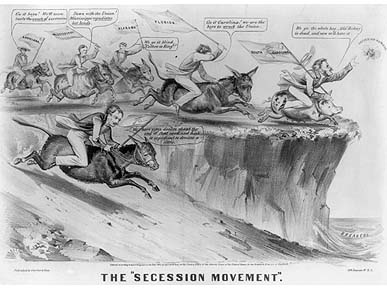
In the South the efforts of staunch Southern Unionists like Alexander Stephens to discourage secession were dismissed as the movement toward secession became a passion filled revolutionary movement, which acted as a cathartic movement for many Southerners. Like Douglas, Stephens had the greatest faith in the checks and balances provided in the Constitution and he pleaded with his fellow Georgians at the state capital of Milledgeville noting that the checks and balances “would render Lincoln “powerless to do any great mischief,” and he warned that “the dissolution of the Union would endanger this “Eden of the world,” that “instead of becoming gods, we shall become demons, and no distant day commence cutting one another’s throats…” [9] While his speech received favorable coverage in the North and even in London, it was met with little enthusiasm at home.

Influential Southern preachers joined in the push for secession and warned of what they saw as the dire consequences of Lincoln’s election. The Baptist clergyman James Furman expressed the outrage and paranoia of many in the South by warning after Lincoln’s election “If you are tame enough to submit, Abolition preachers will be at hand to consummate the marriage of your daughters to black husbands.” [10] Likewise entire southern denominations began to endorse secession, southern Methodists raised “alarms about a Union dominated by abolitionists as they called on the Lord for deliverance from the northern “Egypt.” The division of Israel and Judah (not to mention the nation’s already fractured churches became typologies for the American crisis. Just as southern Methodists had once “seceded from a corrupt church,” a Mississippi politician declared, “We must secede from a corrupt nation.” To drive the point home, Georgia Methodists ministers endorsed disunion by an overwhelming 87-9 vote.” [11]

Despite Lincoln and Douglas’s efforts during and after the election to strike a conciliatory tone, it did not take long before Southern states began to secede from the Union. In light of the profoundly sectional nature of Lincoln’s victory “emboldened many Southern politicians and journalists to insist that they would not be bound by the result.” [12] In his final speech before the Senate, Senator Robert Toombs of Georgia lambasted the “black Republicans” and abolitionists, “We want no negro equality, no negro citizenship, we want no negro race to degrade our own; and as one man [we] would meet you upon the border with the sword in one hand and the torch in the other.” [13] Other Senators, many who would become prominent leaders of the Confederacy made their speeches, some, like that of Jefferson Davis tinged with regret while others like Senator Stephen Mallory, and the future Secretary of the Navy for the Confederacy delivered a fiery broadside against his Northern colleagues, “You cannot conquer us. Imbue your hands in our blood and the rains of a century will not wipe away from them stain, while the coming generation will weep for your wickedness and folly.” [14] As these men finished the left the chambers of Congress where many had served for years many left with tears, while some marked their exit with angry words.

Alexander Stephens

Stephens, still a Unionist at heart lamented the election even as he prepared to leave the Senate before becoming the vice president of the Confederacy, warned that “revolutions are much easier started than controlled, and the men who begin them [often] …themselves become the victims.” [15] Even so the senator noted “If the policy of Mr. Lincoln and his Republican associates be carried out…no man in Georgia will be more willing or ready than myself to defend our rights, interest, and honor at every hazard and to the last extremity.” [16] But as he resigned his office Stephens replied to a friend’s question, “why must we have civil war?”

“Because there are not virtue and patriotism and sense enough left in the country to avoid it. Mark me, when I repeat that in less than twelve months we shall be in the midst of a bloody war. What will become of us then God only knows.” [17]

But Stephens’ warning fell on deaf ears as passionate secessionist commissioners went throughout the South spreading their message of fear. “Thus fanned, mob spirit ran close enough to the surface to intimidate many moderates – the very temperament that inclines men toward moderation is apt to respond timidly when threatened or abused – and to push others closer to the extremist position.” [18] Such was the case with Southern moderates and Unionists as men like Stephens were swept up in the tumult as their states seceded from the Union. Senator Judah P. Benjamin of Louisiana wrote, “The prudent and conservative men South… were not able to stem the wild torrent of passion which is carrying everything before it…. It is a revolution…of the most intense character…and it can no more be checked by human effort, for the time, than a prairie fire by a gardener’s watering pot.” [19]

The Palmetto State of South Carolina was the first state to secede. Its senior senator, James Chesnut launched a fusillade against the North in a speech before the state legislature in which he argued that the South could not wait for another election: He thundered:

“Because of the Yankee puritans’ invasive mentality, incendiary documents would flood our region, Southern Republicans would fill our offices. Enemies would control our mails. The resulting upheaval would make “Lincoln’s election…a decree for emancipation. Slavery cannot survive the four years of an administration whose overwhelming influences” will be “brought to bear against it.” To submit now is to guarantee that before 1865, we must “slay the Negro, or ourselves be slain.”  [20]

William Tecumseh Sherman was serving as the President the Louisiana State Seminary of Learning and Military Academy, what is now Louisiana State University. Like many men in the ante-bellum era, Sherman had thought little about the slavery issue, though he was very concerned with the preservation of the Union. He thought secession made no sense, especially for the people of the South. When Sherman read the news of South Carolina’s secession it “cut to the depths of his nationalistic soul.” The future general wept, and told his friend David Boyd “Boyd, you people of the South don’t know what you are doing! You think you can tear to pieces this great union without war…. “The North can make a steam-engine, locomotive, or railway car; hardly a yard of cloth or shoes can you make. You are rushing into war with one of the most powerful, ingeniously mechanical and determined people on earth…. You are bound to fail. Only in spirit and determination are you prepared for war.” [21] Sherman, the man who later proclaimed that “War is Hell” proved to be a remarkably accurate seer regarding the fate of the Confederacy.

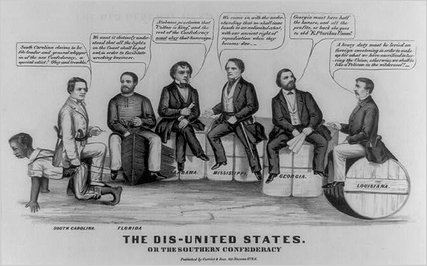
South Carolina was followed by Mississippi, Florida, Alabama, Georgia, Louisiana and Texas. “A belt of seven states from South Carolina to Texas, embracing nearly one-sixth of the country’s population and nearly one-fifth of the national domain, had proclaimed independence and severed its ties with the Union.” [22] Many of the declarations of causes for secession made it quite clear and explicit that slavery, and fear that the institution was threatened by Northern abolitionists was the root cause. The declaration of South Carolina is typical of these and is instructive of the basic root cause of the war:

“all the States north of that line have united in the election of a man to the high office of President of the United States, whose opinions and purposes are hostile to slavery. He is to be entrusted with the administration of the common Government, because he has declared that that “Government cannot endure permanently half slave, half free,” and that the public mind must rest in the belief that slavery is in the course of ultimate extinction.” [23]

Throughout the war slavery loomed large, even though in the beginning of the abolition controversies of the 1830s many northerners “were content to tolerate slavery’s indefinite survival in the South so long as it did not impinge on their own rights and aspirations at home.” [24] Such attitudes were still common in the North during the late 1850s, especially among Democrats.

But it was the continued actions and multiple transgressions of slavery supporters that energized northerners as never before. Their use of the courts to advance their rights and the cause of slavery, by the compromises that had extended slavery to the territories; their use of the courts especially the Dred Scott to allow slaveholders to recover their human property, even in Free States provoked no end of indignation throughout the North, even for those sympathetic to Southern concerns. Those actions demonstrated to Northerners:

“just how fundamental and intractable the differences with Southern political leaders were. Thus educated, most northern voters had decided by 1860 that only an explicitly anti-slavery party could protect their interests.” [25]

The fiery abolitionist and profoundly religious editor of The Liberator, William Lloyd Garrison, used biblical imagery in a rather astute analysis of the behavior of Southern leaders after the election of 1860. He wrote of the Southern response to Lincoln’s election:

“Never had the truth of the ancient proverb “Whom the gods intend to destroy, they first make mad” been more signally illustrated than in the condition of southern slaveholders following Lincoln’s election. They were insane from their fears, their guilty forebodings, their lust for power and rule, hatred of free institutions, their merited consciousness of merited judgments; so that they may be properly classed as the inmates of a lunatic asylum. Their dread of Mr. Lincoln, of his Administration, of the Republican Party, demonstrated their insanity. In vain did Mr. Lincoln tell them, “I do not stand pledged to the abolition of slavery where it already exists.” They raved just as fiercely as though he were another John Brown, armed for southern invasion and universal emancipation! In vain did the Republican party present one point of antagonism to slavery – to wit, no more territorial expansion. In vain did that party exhibit the utmost caution not to give offense to any other direction – and make itself hoarse in uttering professions of loyalty to the Constitution and the Union. The South protested that its designs were infernal, and for them was “sleep no more!” Were these not the signs of a demented people?” [26]

But both sides were blind to their actions and with few exceptions, most leaders, especially in the South badly miscalculated the effects of the election of 1860. The leaders in the North did not realize that the election of Lincoln would mean the secession of one or more Southern states, and Southerners “were not able to see that secession would finally mean war” [27] despite the warnings of Alexander Stephens to the contrary. In fact throughout the South it was believed that there would be no war because “they believed that the Yankees were cowards and would not fight”… “Senator James Chesnut of South Carolina offered to drink all the blood shed as a consequence of secession. It became a common saying in the South during the secession winter that “a lady’s thimble will hold all the blood that will be shed.” [28]

Following their secession the five slave states of the lower South: “appointed commissioners to the other slave states, and instructed them to spread the secessionist message across the entire region. These commissioners often explained in detail why their states were exiting the Union, and they did everything in their power to persuade laggard slave states to join the secessionist cause. From December 1860 to April 1861 they carried the gospel of disunion to the far corners of the South.” [29]

The editors of the Philadelphia Press accused the Southern secessionists of being enemies of democracy and wrote:

“should the Cotton States go out in a body, we shall witness the beginning of an experiment to establish, on this continent, a great slaveholding monarchy. With few exceptions, the leaders of the Disunion cabal are men of the most aristocratic pretensions – men who…easily adopt the habits and titles of the European nobility. South Carolina, which is the head of Secession, is almost a monarchy herself. Her representatives in both branches of Congress, for years past, have acted upon the idea that the people of the free states are servile, and Mr. Hammond, the most candid and straightforward of the set, denounced the laboring white masses of the free States as the mudsills of society …” [30]

The mood of the South in the fall of 1860 was “fearful, uncertain, impatient and volatile, eager to adopt the course that best offered hope of deliverance – which was ideally suited for the immediacy and urgency of the radical secessionists.” [31] Using the political machinery of the Democratic Party in the South which they now possessed, the proponents of secession were far better organized than Southern Unionists who had a difficult time putting up a united front in the face of the radicals.

Slavery and the superiority of the white race over blacks were at the heart of the message brought by these commissioners to the legislatures of the yet undecided states. Former Congressman John McQueen of South Carolina wrote to secessionists in Virginia “We, of South Carolina, hope to greet you in a Southern Confederacy, where white men shall rule our destinies, and from which we may transmit our posterity the rights, privileges and honor left us by our ancestors.” [32] In Texas McQueen told the Texas Convention: “Lincoln was elected by a sectional vote, whose platform was that of the Black Republican part and whose policy was to be the abolition of slavery upon this continent and the elevation of our own slaves to an equality with ourselves and our children.” [33] These Southern secessionists were realists, they knew that the election of 1860 was a watershed in terms of the history of slavery in the United States, emancipation was coming, it might take a decade, it might take twenty-five or even fifty years, but they knew that it was coming, and for them secession was the only logical action left that was “consistent with their ideology.” [34] Many of these men now viewed it as an issue of now or never.

In his First Inaugural Address Lincoln cut to the heart of the division in the country: “One section of our country believes slavery is right and ought to be extended, while the other believes it is wrong and ought not to be extended. This is the only substantial dispute.” [35] Of course he was right, and his Southern opponents agreed. Jefferson Davis wrote: “The great northern party, thus organized, succeeded in electing to the office of the Presidency a man who openly proclaimed his hatred of slavery, who declared that the government could not endure “half slave and half free.” [36]

As the war began, white Southerners of all types and classes rallied to the call of war against the hated Yankee. The common people, the poor yeomen farmers were often the most stalwart defenders of the South. With the Orwellian slogan “Freedom is not possible without slavery” ringing in their ears, they went to war against the Yankees alongside their slave-owning neighbors to “perpetuate and diffuse the very liberty for which Washington bled, and which the heroes of the Revolution achieved.” [37]

Alexander Stephens, the longtime friend of Lincoln who had been a devout Unionist, who had supported Stephen Douglas until the bitter end, and who had strenuously opposed secession in the months leading to the election of 1860 was now the Vice President of the Confederacy. He had been elected Vice President the same day as Jefferson Davis was elected President by the new Confederate Congress and now went through the South speaking about the nature of the new government.  Stephens explained the foundations of the Southern state in his Cornerstone Speech of March 21st 1861, the speech echoed what many Southerners had believed for years regarding slavery and the status of Blacks, namely that Blacks were a lesser order of humanity:

Our new government is founded upon exactly the opposite idea; its foundations are laid, its corner- stone rests upon the great truth, that the negro is not equal to the white man; that slavery — subordination to the superior race — is his natural and normal condition. [Applause.] This, our new government, is the first, in the history of the world, based upon this great physical, philosophical, and moral truth.” [38]

Jefferson Davis had issued instructions to cabinet members to downplay slavery as an issue and was infuriated. The new President of the Confederacy wrote: “That speech infuriated me, Oh, what Stephens had said was true, perfectly true, but could anything hurt us more abroad than such impolitic remarks? It was the beginning of a fatal falling out between me and that rebellious and vindictive dwarf, who was hell-bent on forming his own policies and disputing mine with niggardly deviousness.” [39]

The Orwellian definition of slavery as being necessary to liberty and the Confederate leader’s proclamations that they were comparable to the founding fathers was condemned throughout the North. The editors of the New York Evening Post wrote:

“The founders fought to “establish the rights of man… an principles of universal liberty.” The South was rebelling “not in the interest of general humanity, but of a domestic despotism…. Their motto is not liberty, but slavery.” Thomas Jefferson’s Declaration of Independence spoke for “Natural Rights against Established Institutions,” added the New York Tribune, while “Mr. Jeff. Davis’s caricature thereof is made in the interest of an unjust, outgrown, decaying institution against the apprehended encroachments of human rights.” It was, in short, not a revolution for liberty but a counterrevolution “reversing the wheels of progress…. to hurl everything backward into deepest darkness… despotism and oppression.” [40]

Secession commissioners from the first seven Confederate States fanned out to the undecided Slave states to spread the message of secession. One of these men was Henry Benning of Georgia. Benning spoke to the secession convention of Virginia, a state that the new Confederacy deemed all-important to its cause and which it had to have on its side in the coming confrontation with the Union. There the Georgia Supreme Court Justice used the time-honored method of racial fear mongering to sway the men of the Virginia House of Delegates, he thundered:

“If things are allowed to go on as they are, it is certain that slavery is be abolished except in Georgia and the other cotton States, and…ultimately in these States also,” Benning insisted. “By the time the North shall have attained the power, the black race will be a large majority, and we will have black governors, black legislatures, black juries, black everything.” [41] 

Not letting up the fiery Georgian told the Virginians that the North would invade the South to end slavery and of the outcome of such an invasion:

“We will be overpowered and our men compelled to wander like vagabonds all over the earth,” he told his audience, “and for our women, the horrors of their state cannot contemplate in imagination.” This then, was “the fate that Abolition will bring upon the white race….We will be exterminated.” [42]

Virginia’s Governor, John Letcher was “a longtime foe of secession and had wanted to bring slavery to an end in Virginia, but once elected to the governorship he adroitly put all that behind him, and rather like [Robert E.] Lee, he went to work with considerable efficiency for two causes in which he did not believe.” [43] One Unionist delegate to the convention wrote of the proceedings, “The scenes witnessed within the wall of that room…have no parallel in the annals of ancient or modern times. On the morning of the 17th, Mr. Wise rose from his seat and drawing a large Virginia horse-pistol from his bosom laid it before him and proceeded to harangue the body in the most violent and denunciatory manner. He concluded by taking his watch from his pocket and, with glaring eyes and bated breath, declared that events were now transpiring which caused a hush to come over his soul.” [44] Those events were a planned seizure of Federal facilities including the arsenal at Harpers Ferry and the Naval Yard at Norfolk. But not all in Virginia were convinced. The strongly Unionist western counties of the state, where few people owned slaves and those who did held very few, voted heavily against secession. The counties withstood the initial shock of secession and would “in a wholly extra-legal way, abetted by Washington – perform its own act of secession, breaking away from Virginia and clinging to the Union as a bob-tailed but finally acceptable new state.” [45]

Former President John Tyler added his voice to the secession cause in Virginia and “personally drafted a document placing the state’s military force under Jefferson Davis’s direct command.” Shortly thereafter he was “elected to the Confederate Congress – becoming the only former President to win office in a foreign country.” [46] However, before he could take office, the former President, now an intractable enemy of the country that he once led, died in Richmond. Shortly thereafter his portrait was removed from its place of honor in the capital.

Tennessee was another state where secession was problematic. Eastern Tennessee was strongly Unionist and the counties “held a convention, denounced the governor and legislature for making the alliance with the Confederacy, and sent a memorial asking that the eastern counties be allowed to form a new state.” [47] The legislature and governor refused this but the area would prove a problem for Jefferson Davis as well as Lincoln who would have liked to help the Tennessee Unionists, but had no military way to do so.

The highly divided border states of Kentucky and Missouri remained in the Union, but became highly partisan battlegrounds between secessionists and Unionists in which insurgents used terrorist methods against their fellow citizens throughout the war. Kentucky’s pro-secession Governor, Beriah Magoffin called the legislature into convention to decide secession “but the legislature, by a vote of 54 to 36 in the lower house, refused to call one and adjourned on February 11 without taking any decisive action.” [48] Losing that vote, he issued a declaration of neutrality which caused both Lincoln and Jefferson Davis to move with caution in the state. Lincoln understood the strategic importance of Kentucky and said “I think to lose Kentucky is nearly the same as to lose the whole game….Kentucky gone, we cannot hold Missouri, nor, as I think, Maryland. These all against us, and the job on our hands is too large for us. We may as well consent to separation at once, including the surrender of this capital.” [49] Lincoln’s use of caution, diplomacy, and when needed the force of the law, courts, and the military paid strategic military and economic dividends for the North as the Ohio River remained under Union control.

Maryland too remained in the Union as Governor Thomas H. Hicks, with the help of federal troops resisted a call in the legislature for a secession vote, even so as Union volunteers marched to Washington in response to Lincoln’s calls for troops some regiments were attacked in Baltimore. The 6th Massachusetts Volunteer Infantry was set upon as a “crowd of southern sympathizers threw bricks and stones and fired into their ranks as they changed trains. They returned the fire, killing twelve citizens and wounding many more, then packed their four dead on ice for shipment north, and came on to Washington, bearing their seventeen wounded on stretchers.” [50]

To Lincoln, the issue of secession as well as territory was “never just about politics. To him it spoke about the nation, even if primarily as a symbol. In his mind the nation must be about freedom, never slavery.” [51] For him the Union was sacred and could not be dissolved for any reason, especially the cause of slavery. In contrast to the secessionists who proclaimed that the states had formed the Federal Government and had the right to dissolve the Union, Lincoln, using the reasoning and arguments of Daniel Webster asserted in his inaugural address that the Union actually predated the Constitution:

“Descending from these general principles, we find the propositions that, in legal contemplation, the Union is perpetual, confirmed by the history of the Union itself. The Union is much older than the Constitution. It was formed, in fact, by the Articles of Association in 1774. It was matured and continued by the Declaration of Independence in 1776. It was further matured, and the faith of all the then thirteen States expressly plighted and engaged that it should be perpetual, by the Articles of Confederation in 1778. And final, in 1787, one of the declared objects for ordaining and establishing the Constitution, was “to form a more perfect Union.” [52]

In early April 1861, a few days before the first shot was fired at Fort Sumter, a New York Times editorial made a proposition that unveiled the reality of the situation now confronting the divided nation, and which so many had for so long refused to face: “If two sections can no longer live together, they can no longer live apart in quiet until it is determined which is master. No two civilizations ever did, or can, come into contact as the North and South threaten to do, without a trial of strength, in which the weaker goes to the wall…. We must remain master of the occasion and the dominant power on this continent.” [53]

Thus, the American ideological war was born; it had taken decades to reach the point of no return. It had taken years of frustration, and attempts at compromise by politicians who attempted to dodge the moral issues inherent in slavery. Time could not heal the wounds caused by slavery as long as “one section of the country regarded it as a blessing, the other as a curse.” [54] Frederick Douglass observed: “Whatever was done or attempted with a view to the support and secularity of slavery on served to fuel the fire, and heated the furnace of [anti-slavery] agitation to a higher degree than had any before attained.” [55]

Notes

[1] Ibid. Oates The Approaching Fury pp.355-356

[2] Ibid. Goodwin Team of Rivals p. 310

[3] Ibid. Goodwin Team of Rivals p. 310

[4] Ibid. Oates The Approaching Fury p.338

[5] Ibid. Oates The Approaching Fury pp.338-339

[6] Ibid. Oates The Approaching Fury p.355

[7] Ibid. Guelzo Fateful Lightning p.134

[8] Ibid. Oates The Approaching Fury pp.354-355

[9] Ibid. Goldfield America Aflame p.184

[10] Ibid. McPherson Drawn With Sword p.50 These words are little different than the words of many conservative Evangelical Christian pastors, pundits and politicians today in relation to the legalization of Gay marriage.

[11] Ibid. Rable God’s Almost Chosen Peoples pp.38-39

[12] Ibid. Holzer Lincoln and the Power of the Press p.256

[13] Ibid. Goodheart 1861 p.77

[14] Ibid. Goodheart 1861 p.77

[15] Ibid. McPherson The Battle Cry of Freedom p.238

[16] Cooper, William J. We Have the War Upon Us: The Onset of the Civil War November 1860-April 1861 Alfred a Knopf, New York 2012 p.75

[17] Ibid. Catton The Coming Fury pp.46-47

[18] Ibid. Catton Two Roads to Sumter pp.250-251

[19] Ibid. McPherson The Battle Cry of Freedom p.237

[20] Ibid. Freehling The Road to Disunion Volume II p.398

[21] O’Connell Robert L. Fierce Patriot: The Tangled Lives of William Tecumseh Sherman Random House, New York 2013 p65

[22] Ibid. Catton Two Roads to Sumter p.248

[23] __________ Declaration of the Immediate Causes Which Induce and Justify the Secession of South Carolina from the Federal Union. Retrieved from The Avalon Project, Yale School of Law http://avalon.law.yale.edu/19th_century/csa_scarsec.asp 24 March 2014

[24] Ibid. Levine Half Slave and Half Free p.251

[25] Ibid. Levine Half Slave and Half Free p.253

[26] Ibid. Oates The Approaching Fury p.342

[27] Ibid. Catton The Coming Fury p.122

[28] Ibid. McPherson The Battle Cry of Freedom p.238

[29] Ibid. Dew Apostles of Disunion p.18

[30] Ibid. Stampp The Causes of the Civil War p.189

[31] Ibid. Catton Two Roads to Sumter p.250

[32] Ibid. Dew Apostles of Disunion p.48

[33] Ibid. Dew Apostles of Disunion p.48

[34] Ibid. Foner Free Soil, Free Labor, Free Men p.145

[35] Lincoln, Abraham First Inaugural Address March 4th 1861 retrieved from www.bartleby.com/124/pres31.html 24 March 2014

[36] Ibid. Oates The Approaching Fury p.429

[37] Ibid. McPherson Drawn With Sword pp.50-51

[38] Cleveland, Henry Alexander H. Stevens, in Public and Private: With Letters and Speeches, before, during and since the War, Philadelphia 1886 pp.717-729 retrieved from http://civilwarcauses.org/corner.htm 24 March 2014

[39] Ibid. Oates The Approaching Fury p.382

[40] Ibid. McPherson The Battle Cry of Freedom p.244

[41] Ibid. Dew Apostles of Disunion p.66

[42] Ibid. Dew Apostles of Disunion p.67

[43] Ibid. Korda Clouds of Glory p.232

[44] Osborne, Charles C. Jubal: The Life and Times of General Jubal A. Earl, CSA Algonquin Books of Chapel Hill, Chapel Hill NC 1992 p.49

[45] Ibid. Catton The Coming Fury p.365

[46] Goodheart, Adam The Ashen Ruin in  The New York Times: Disunion, 106 Articles from the New York Times Opinionator: Modern Historians Revisit and Reconsider the Civil War from Lincoln’s Election to the Emancipation Proclamation Edited by Ted Widmer, Black Dog and Leventhal Publishers, New York 2013 p.71

[47] Ibid. Catton The Coming Fury p.365

[48] Ibid. Potter The Impending Crisis p.510

[49] Ibid. Foote The Civil War, A Narrative. Volume One: Fort Sumter to Perryville p.53

[50] Ibid. Foote The Civil War, A Narrative. Volume One p.53

[51] Ibid. Cooper We Have the War Upon Us p.80

[52] Ibid. Wills  Lincoln at Gettysburg p.130-131

[53] Ibid. Foote The Civil War, A Narrative. Volume One p.43

[54] Ibid. Catton Two Roads to Sumter p.143

[55] Ibid. Levine Half Slave and Half Free p.253

2 Comments

Filed under civil war, History, Political Commentary

When Political Parties Implode: “I refused to unite with a bunch of traitors and disunionists…” The 1860 Election

election-results-1860-map

Friends of Padre Steve’s World,

Instead of making direct comments regarding the developments in the current 2016 Presidential campaign, especially the repeated charges by Donald Trump that the election is rigged and continuing threats of violence coming from many of his supporters I have decided to push on with the series that I began last Friday which is excerpted from my draft book “Mine Eyes Have Seen the Glory” Race, Religion, Ideology, and Politics in the Civil War Era. The past three articles dealt with the breakup of the Whig and Democratic Parties and this one deals with the final break in the Democrats during the election of 1860. I took the title from what Stephen Douglas, the leader of the Northern Democrats and one of the two Democrat Presidential nominees said when Southern Democrats asked him to drop out of the race. I hope that you enjoy.

Peace

Padre Steve+

The crisis continued to fester and when Lincoln was elected to the Presidency in November 1860, with no southern states voting Republican, the long festering volcano erupted. The various crises of the 1850s had brought the political emotions nation to a fever pitch and 1860 election season saw a dramatic rise in the overtly racial invective of the pro-slavery Democrats, including many in the North. It was also the election that “marked the crystallization of two fully sectionalized parties,” [1] neither of which could find a place of compromise in order to save the Union. A Mississippian observed that “the minds of the people are aroused to a pitch of excitement probably unparalleled in the history of our country.” [2]

Like the present time where the rise of the internet, social media and other platforms allows people, including radical ideologues of various stripes an unparalleled opportunity to spew hate, the changing nature of technology made the campaign one of the most merciless in American history. “Cheap printing and the telegraph made it easier and easier for the shrillest of ideologues to find audiences, even national ones.” [3] As such the campaign prefigured those of the present time. The newspapers and the ideologues may not have changed many the minds of many voters, most of whom were by now hardened in their position, but “they likely helped spur a gigantic voter turnout – some 80 percent of eligible white males nationwide – which was deemed crucial to Republican success in swing states like Indiana and Pennsylvania.” [4]

Lincoln had run a masterful campaign, rising from a comparatively unknown to a national figure due to his debates with Stephen Douglas during the 1858 Illinois Senate campaign. The Republican Party that he represented was a “coalition of old Democrats, former Whigs, and members of the nativist American Party.” [5] Lincoln defeated the odds on favorite to win the Republican nomination, Senator William Seward, as well as Senator Salmon Chase and Missouri’s elder statesman Edward Bates. Lincoln took the nomination on the third ballot and then went on to defeat a fractured opposition which was composed of three different tickets, those of the Northern Democrat Stephen Douglas, the Southern Democrat John C. Breckenridge, and the third, a fusion Constitutional Union Party ticket of John C. Bell and Edward Everett.

The split in the Democrat ticket won the election for Lincoln and was in part the idea of fire-eaters in the South, especially those in South Carolina who could not abide the candidacy of Douglas. These Southern Democrats envisioned “the destruction of the national Democratic Party – and its powerful contingent of moderates in the state – as a visible vehicle for protecting slavery in the Union.” [6]   These men hated Douglas, a man that they once cheered, for his opposition to the Lecompton Constitution and the admission of Kansas as a Slave state.  When the Democratic national convention met to nominate a presidential candidate the delegates especially the leaders of the Gulf state delegations “redoubled their sworn efforts to keep the nomination away from Douglas.” Douglas and his team of advisors attempted to work out a deal to secure the nomination with them, but they met with a stubborn refusal to cede the nomination to Douglas. The result was “an open party rupture” [7] which destroyed any chance of defeating Lincoln and the Republicans. The ever pragmatic Unionist Alexander Stephens “who stood with Douglas to the last, despaired, not only for his party but for his country: “There is a tendency everywhere, not only in the North, but the South, to strife, dissention, disorder, and anarchy.” [8]

Opponents of Lincoln turned the election to a referendum on race. The New York Herald, which was a strongly Democrat paper and had the largest circulation of any paper in the nation was typical of papers that used race to attack the Republicans. The Herald served up “a patented blend of sarcasm and sensationalism. The Herald’s editorial page cracked wise almost every day about “the Eternal nigger,” the “Almighty nigger,” the “Irrepressible nigger” and the “nigger-loving black republicans.” [9] In both the North and South opponents of Lincoln and the Republicans conjured up the fear of a future black president in order to further stoke the flames of racial hatred and division.

During the campaign Lincoln was careful to not to go beyond the printed words of his published speeches and he refused to issue any statements to mollify the conspiracy theory hysteria that was enveloping the South. “What is it I should say to quiet alarm?” he asked in October. “Is it that no interference by the government, with slaves or slavery within the states, is intended? I have said this so often already, that a repetition of it is but mockery, bearing an appearance of weakness.” [10] To be frank, Lincoln and other Republicans misread the true feelings of the South and “considered the movement South as sort of a political game of bluff, gotten up by politicians, and meant solely to frighten the North. He believed that when the leaders saw their efforts in that direction unavailing, the tumult would subside.” [11] William Seward equated the Southern threats to cries of “wolf” which had little meaning and told a gathering in New York, “For ten, aye twenty years, these threats have been renewed in the same language and in the same form, about the first day of November every four years. I do not doubt that these Southern statesmen and politicians think that they are going to dissolve the Union, but I think that they are going to do no such thing.” [12]  The editor of a Tennessee paper admitted “the cry of disunion had been raised so often that few had taken it seriously in the campaign. Evidently, the ‘Northern sectionalists’ had believed it to be ‘all talk’… while most intelligent Southerners had assumed that it was ‘an idle menace, made to sway Northern sentiment.’” [13]

The Republican Party itself was a coalition of individuals who often held opposing views, and Lincoln understood that the election, as nearly every election tends to be, was not going to be about one issue alone and even the Republican doctrine of Free Soil was seen by them more as “an economic policy than an anti-slave policy.” [14] As important as abolition was to the founding of the Republican Party, other interests had to be taken into account. These included protective tariffs, infrastructure and railroads, and homestead legislation. Thus he could not go too far in any direction that might deviate from the party platform without risking a fracture in his own party He noted: “It would be both impudent, and contrary to the reasonable expectation of friends for me to write, or speak anything upon doctrinal points right now. Besides this my published speeches contain nearly all I could willingly say.” [15]

The Presidential campaign of 1860 was unique since it had four different tickets vying for the office and it unfolded into “three distinct campaigns: Douglas against Lincoln in the North; Breckinridge versus Bell in the South; and Douglas contesting Bell in the border states, with Lincoln and Breckinridge hoping for some support there as well.” [16] As purely sectional candidates Breckinridge had no hope of winning in the North and Lincoln no chance of winning in the South.

In the South politicians, preachers and newspaper editors sounded the alarm at the possibility of a Lincoln presidency which bordered on outright paranoid hysteria. Conspiracy theories and outright falsehoods about Negro atrocities were flouted as truth in the South, whipping up passions and stoking rampant fear, “R.S. Holt, a wealthy Mississippi planter and brother of the U.S. postmaster general, reported that “we have constantly a foretaste of what Northern-brotherhood means, in almost daily conflagrations & in discovery of poison, knives & pistols distributed among our slaves by the emissaries sent out for that purpose…. There cannot be found in all the planting States a territory ten miles square in which the footprints of these miscreants have not been discovered.” [17]

One of the most consistent defenders of slavery and long term proponents of secession, Virginia Edmund Ruffin wrote to Yancey that “a Republican victory was obviously coming and that it would be “a clear and unmistakable indication of future & fixed domination of the Northern section & its abolition party over the Southern states & their institutions, & the speedy progress to the extermination of Negro slavery & and the consequent ruin of the South.” [18] A newspaper editorial in Georgia warned “Let the consequences be what they may – whether the Potomac is crimsoned in human gore, and Pennsylvania Avenue is paved ten fathoms deep with mangled bodies…the South will never submit to such humiliation and degradation as the inauguration of Abraham Lincoln.” [19]

Prominent Southern ministers, though more cautious than the newspapermen and politicians sounded the alarm. Evangelical “proslavery had popularized the South’s unique approach to the Bible and the founding of the nation. The bible supported slaveholding; God supported the South. The formula was clear. Right made might. The South had to triumph.” [20] A Presbyterian editor counseled prayer to deal with the crisis but added: “An agitation that perpetually sends dread and disturbance in to every hamlet, and to every home and fireside in the land is intolerable. No people can abide it long. They will prefer the hazard of any convulsion, the perils of any terrible adventure, to a life of anxiety and disquiet. The instincts of nature will drive them to seek relief by any, even the most dangerous means.” [21]  A prominent Southern journal remarked “In religious sentiment the South stands as a unit. Its pure doctrines are linked insuperably, though not by legal constraint, with the laws of the land. No isms and schism rankle our hearts. Christ is acknowledged as the common bond of union.” [22] Prominent church leaders like Leonidas Polk Episcopal Bishop of Louisiana made outright demands for secession if the Lincoln won. As it had so many times in the past two decades, religious sentiment helped fuel the Southern fire.

The only hope for the Democrats was for a “fusion” of the three opposition in key northern states to deny Lincoln their electoral votes and throw the election into the House.” [23] But this was not to be as there was far too much bad blood between the Buchanan faction headed by Breckinridge and Douglas, as well as distrust of the Bell ticket due to its connections with the earlier Know Nothing Party and movement. Jefferson Davis, long a proponent of secession went to Douglas to try to sway him from dropping out of the race in favor of a fusion ticket that could unite the Southern vote. Douglas recalled the conversation “If the Democrats run two candidates,” he said, “the Black Republicans will win the election. In that event the slave states will secede…” [24] Davis tried to convince Douglas to drop out saying that Breckinridge and Bell had agreed to if he would, and Douglas, who had a long standing enmity with the Mississippian wrote:

“This was strange talk from Davis, and I was damned suspicious that it might be a trap. It was all I could do to control my hatred for the Goddamned bastard. “The plan is impractical I said coldly. “If I withdraw, my friends in the North will go over to Lincoln. I’m in the hands of my friends and they won’t accept this proposition.

“Then I’ve done all that I can,” he said, rose and walked out.

Why the Goddamned hell should I withdraw? I asked my aides. I was a matter of honor with me. I had won my nomination fairly, on the basis of the party’s time honored principles. I refused to unite with a bunch of traitors and disunionists…

Others pressed me to unite with the “vandals,” as we called the Breckinridge party, but I answered with a thundering no. “I’m utterly opposed to fusing with any man or party who’ll not enforce the laws, maintain the Constitution, and preserve the Union in all contingencies,” I said. I wish to God Old Hickory was still alive, so that he could hang northern and southern traitors from the same gallows.” [25]

The split in the Democratic Party was irrevocable. While all factions of the party had some measure of responsibility for the party’s implosion in 1860, it was the old Southern leaders whose actions doomed the party. Bruce Catton wrote:

“Primary responsibility for the Democratic split in 1860 – the act that ensured a Republican triumph and left the South no cohesive national institution through which it could hope to share or regain power – belongs to those respected Southern leaders whose threats of party rupture and secession as political tactics, in the vain hope that a majority in the party and nation would fall in behind them before the tactic got out of hand. Because they would not adjust to circumstances they were engulfed by them – all without understanding that they were the leading architects of their disaster.”  [26]

Despite the cleavage in the Democratic Party, the election of 1860 enthralled the nation as candidates and their surrogates made the cases for each.  “Americans everywhere – North and South, men and women, slave and free – took an active part in the four-way campaign of 1860. Issues, platforms, speeches, and candidates were reviewed and debated in corn fields and cotton fields, workshops and markets, family gatherings, churches, picnics, races, sewing circles, family gathering, schoolhouses, slave quarters, taverns and beer gardens.” [27]

Unlike now when all states vote the same day for President, the elections of 1860 consisted of votes over a two month period of time in the different states. When Lincoln began to win early contests in the Northern states Douglas took his campaign south where he did not mince words and defied secessionists in his stated desire to preserve the Union. He told his secretary “That does it…Lincoln is the next President. We must try to preserve the Union. I’ll go to the Deep South where the secession spirit is strongest.” [28] In the South the Little Giant was met with scorn.

When all was said and done “some 4,700,000 Americans – well over two thirds of the electorate – marched to the polls and cast their ballots. By the early hours of November 7th it was clear that Lincoln had won, and when the final results were tallied it was clear that he had won rather decisively,” [29] at least in the Electoral College. Douglas received twenty-nine percent of the national vote, Breckinridge eighteen percent, and Bell thirteen. “Lincoln carried seventeen free states and no slave states; Breckinridge, eleven slave states and no free states, Bell three slave states and no free states.” [30] Douglas only won the embattled state of Missouri despite having more of the national popular vote than either Bell or Breckinridge. Lincoln captured forty percent but took 180 electoral votes, far more than the minimum of 152 needed to elect. Lincoln’s gains among former Whigs who were attracted to him by economic versus anti-slavery policies allowed Lincoln to sweep the Northern states and secure the electoral majority. When Douglas heard the final results he was in Mobile Alabama. He told his friend John Forsyth, “Well, John, I am beaten, I said hoarsely. “Lincoln will win by a big margin in the Electoral College. Even if Breckinridge, Bell, and I had withdrawn and united behind a single Democratic candidate, Lincoln would still have won a majority of electoral votes.” [31]

For decades “Southerners had shown how minorities dominate majoritarian processes. The overwhelmingly anti-Slave Power North had now shown how an awakened majority routs a minority.” [32] Even so by November the new President elect realized that the South was not bluffing in terms of secession. “The election had clarified nothing. It simply meant that a nation which had spent a long generation arguing about slavery had grown tired of talk and wanted something done – without specifying what that something might be.” [33] The process “of sectional polarization was almost complete, and it remained to see what the response would come from the section that was at the losing end of the axis.” [34] The answer was not long in coming, in the South those who had talked threatened secession for years now put their words into action as the leaders of states of the Lower South met to plan their exit from the Union.

Notes

[1] Ibid. Potter The Impending Crisis p.447

[2] Ibid. McPherson The Battle Cry of Freedom p.229

[3] Ibid. Goodheart 1861 p.45

[4] Holzer, Harold Lincoln and the Power of the Press: The War For Public Opinion Simon and Schuster, New York 2014 p.255

[5] Ibid. Goodwin Team of Rivals p. 267

[6] Ibid. McCurry Confederate Reckoning p.44

[7] Ibid. Catton Two Roads to Sumter p.202

[8] Ibid. Goldfield America Aflame p.168

[9] Ibid. Goodheart 1861 p.45

[10] Ibid. McPherson The Battle Cry of Freedom p.231

[11] Ibid. Potter The Impending Crisis p.432

[12] Ibid. Catton The Coming Fury p.95

[13] Ibid. Goodwin Team of Rivals pp.274-275

[14] Ibid. Egnal Clash of Extremes p.255

[15] Ibid. Goodwin Team of Rivals p. 266

[16] Ibid. Goldfield America Aflame p.168

[17] Ibid. McPherson The Battle Cry of Freedom p.229

[18] Ibid. Catton The Coming Fury p.97

[19] Ibid. McPherson The Battle Cry of Freedom p.230

[20] Ibid. Daly When Slavery Was Called Freedom p.135

[21] Ibid. Rable God’s Almost Chosen Peoples pp.34-35

[22] Ibid. Daly When Slavery Was Called Freedom p.135

[23] Ibid. McPherson The Battle Cry of Freedom p.232

[24] Ibid. Oates The Approaching Fury p.329

[25] Ibid. Oates The Approaching Fury pp.329-330

[26] Ibid. Catton Two Roads to Sumter p.211

[27] Ibid. Levine Half Slave and Half Free p.223

[28] Ibid. Oates The Approaching Fury p.331

[29] Ibid. Catton Two Roads to Sumter p.243

[30] Ibid. Potter The Impending Crisis p.447

[31] Ibid. Oates The Approaching Fury p.337

[32] Ibid. Freehling The Road to Disunion Volume II pp.338-339

[33] Ibid. Catton The Coming Fury p.119

[34] Ibid. Potter The Impending Crisis p.447

Leave a comment

Filed under civil war, History, News and current events, Political Commentary

When Political Parties Implode: “The Party is Split Forever…”

Friends of Padre Steve’s World,

I have been writing for some time about the coming demise of the Republican Party and the past few days I have been republishing sections of my draft text “Mine Eyes have Seen the Glory” Race, Religion, Ideology and Politics in the Civil War Era to show how the Whig and Democratic Parties imploded between 1850 and 1860.

Have a great day,

Peace,

padre Steve+

democrat condenders

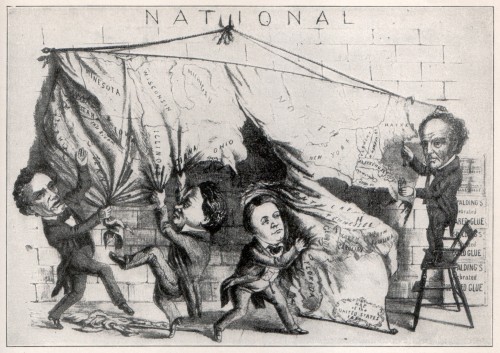
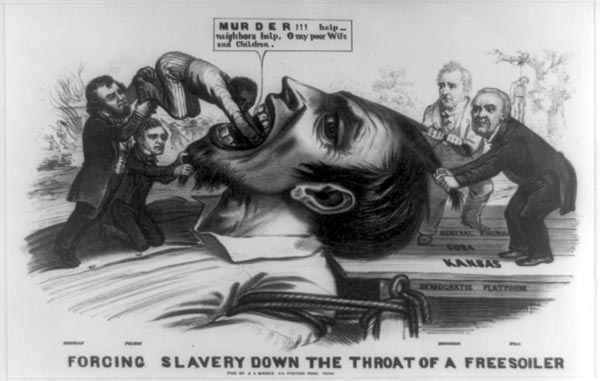
The fight over Lecompton was a watershed in American politics that those who wrote the Constitution of the United States could not have imagined. The deeply partisan fight served to illuminate how easily “minuscule minorities’ initial concerns ballooned into unmanageable majoritarian crises. The tiny fraction of Missouri slaveholders who lived near the Kansas border, comprising a tinier fraction of the South and a still tinier fraction of the Union, had demanded their chance to protect the southern hinterlands.” [1] The crisis that Kansas Democrats provoked drew in the majority of Southern Democrats who came to their aid in Congress and President Buchanan. This provoked Northerner, including Democrats to condemn the Southern minority, which they believed was disenfranchising the majority of people in the territory in order to expand slavery there and to other territories in the west.

The issue of Lecompton crisis galvanized the political parties of the North and demolished any sense of national unity among the Democrats. The split in the Democratic Party mirrored the national divide and the party split into hostile Northern and Southern factions, which doomed it as a national party for the foreseeable future.

Following Lecompton the intra-party Democrat divide widened as “Pro-Douglas and pro-Buchanan Democrats openly warred on one another for the next two years; an unacknowledged but real split had taken place.” [2]

tearing1-500x353

The battle over the Lecompton Constitution also marked the first time that a coalition Northern Democrats sided with anti-slavery forces to defeat pro-slavery legislation in congress. Though the measure to admit Kansas as a slave state was defeated it was a narrow victory; the “Republicans and anti-Lecompton Douglas Democrats, Congress had barely turned back a gigantic Slave Power Conspiracy to bend white men’s majoritarianism to slavemaster’s dictatorial needs, first in Kansas, then in Congress.”  [3]

The political impact of the Lecompton crisis on the Democratic Party was an unmitigated disaster. The party suffered a major election defeat in the 1858 mid-term elections and lost its majority in the House of Representatives even though it barely maintained a slim majority in the Senate. While the victorious Republicans had won the election, they made little legislative headway since the Democrats still controlled the Senate and James Buchanan remained President. In a sense “there were two Democratic parties: one northern, on southern (but with patronage allies in the north); one having its center of power in the northern electorate and in the quadrennial party convention… the other with its center of power in Congress; one intent on broadening the basis of support to attract moderate Republicans, the other more concerned to preserve a doctrinal defense of slavery even if it meant driving heretics out of the party.” [4] Democratic Party divide fulfilled what Lincoln had said about the country, as the Democratic Party had “became increasingly a house divided against itself.” [5]

Douglas’s courageous opposition to the fraud of Lecompton would be the chief reason for the 1860 split in the Democratic Party as Southern Democrats turned with a vengeance on the man who had been their standard bearer during the 1856 Democratic primary. “Most southern Democrats went to Charleston with one overriding goal: to destroy Douglas.” [6] The party decided to meet in the Charleston to decide on their platform and the man who would be their standard bearer in the election of 1860. When the convention met in April 1860 it rapidly descended into a nightmare for the Democrats as “Southern delegates were much more intent on making a point than on nominating a presidential candidate.” [7] The “Southern delegates demanded a promise of federal protection of slavery in all the territories and a de facto veto in the selection of the party’s presidential candidate” [8] in order to block the nomination of Douglas. Southern radicals “led by William Lowndes Yancey of Alabama stood for seven days agitating for a pro-slavery platform.” [9]

democratic convnetion

Ohio Democrat George A. Pugh responded to the Southern fire-eaters and said that “Northern Democrats had worn themselves out defending Southern interests – and he declared that the Northern Democrats like himself were now being ordered to hide their faces and eat dirt.” [10] Georgia Senator Alexander Stephens who had moderated his position and was supporting Douglas wrote that the radicals “strategy was to “rule or ruin.” [11] When their attempts to place the pro-slavery measures into the party platform were defeated by Northern delegates, it prompted “a walkout by delegates from Alabama, South Carolina, Georgia, Florida, Mississippi, Louisiana, and Texas.” [12] This deprived Douglass of the necessary two thirds majority needed for the nomination and “the shattered convention adjourned, to reconvene in Baltimore on June 18,”  [13] the “incendiary rhetoric left the Democratic Party in ashes.” [14] A friend of Alexander Stephens suggested that the party might patch things up in Baltimore, but Stephens dismissed the suggestion and told his friend, “The party is split forever. The only hope was in Charleston.” [15]

Old line former Whigs who feared the disintegration of the country led by Kentucky Senator John J. Crittenden formed their own convention, the Constitutional Union Party and declared a pox on both the Buchanan and Douglas factions of the Democratic Party. They nominated a rather cold and uninspiring moderate slave owner, the sixty-four year old John Bell of Tennessee as their candidate for Constitutional Union Party President and “then chose a man who overshadowed him, Edward Everett of Massachusetts, aged sixty-seven, as the vice-presidential nominee.” [16] But this ticket had no chance of success, Bell “stood for moderation and the middle road in a country that just now was not listening to moderates, and the professional operators were not with him.” [17]

When the Democratic Party convention reconvened the results were as Stephens predicted. Another walk out by Southern delegates resulted in another and this time a final split. “Rival delegations from the Lower South States arrived in Baltimore, one side pledged to Douglas and the other to obstruction. When the convention voted for the Douglas delegations, the spurned delegates walked out, this time joined by colleagues from the Upper South.” [18] Though Douglas did not have the two-thirds majority, the convention “adopted a resolution declaring Douglas unanimously nominated.” [19]  A day later the radicalized Southern delegates nominated their own candidate, the current Vice President, John C. Breckinridge of Kentucky as their candidate “for president on a slave-code platform.” [20] 

There were now four presidential tickets, three composed of Democrats and former Whigs, “each supported by men who felt that they were following the only possible path to salvation. A Republican victory was almost certain, and the Democrats, who had the most to lose from such a victory, were blindly and with a fated stubbornness doing everything they could to bring that victory to pass.” [21]

The Democratic Party had imploded and doomed the candidacies of Douglas and Breckinridge. The Augusta Daily Chronic and Sentinel editorialized, “It is an utterly futile and hopeless task to re-organize, re-unite and harmonize the disintegrated Democratic party unless this is to be done by a total abandonment of principle… No, sensible people might as well make up their minds to the fact that the Democratic party is dissolved forever, that new organizations must take its place.”  [22]    

Notes

[1] Ibid. Freehling, The Road to Disunion Volume II: Secessionists Triumphant 1854-1861 p.140

[2] Ibid. Levine Half Slave and Half Free p.213

[3] Ibid. Freehling, The Road to Disunion Volume II: Secessionists Triumphant 1854-1861 p.142

[4] Ibid. Potter The Impending Crisis p.394

[5] Fehrenbacher, Don E. Kansas, Republicanism, and the Crisis of the Union in The Civil War and Reconstruction Documents and Essays Third Edition edited by Michael Perman and Amy Murrell Taylor Wadsworth Cengage Learning Boston MA 2011 p.94

[6] Ibid. McPherson The Battle Cry of Freedom p.213

[7] Ibid. Goldfield America Aflame p.167

[8] Ibid. Levine Half Slave and Half Free p.216

[9] Ibid. Guelzo Fateful Lightning p.121

[10] Ibid. Catton The Coming Fury p.32

[11] Ibid. McPherson The Battle Cry of Freedom p.215

[12] Ibid. Goldfield America Aflame p.167

[13] Ibid. Guelzo Fateful Lightning p.121

[14] Ibid. Goldfield America Aflame p.167

[15] Ibid. Catton The Coming Fury p.46

[16] Ibid. Potter The Impending Crisis p.417

[17] Ibid. Catton The Coming Fury p.46

[18] Ibid. Goldfield America Aflame p.168

[19] Ibid. Potter The Impending Crisis p.413

[20] Ibid. McPherson The Battle Cry of Freedom p.216

[21] Ibid. Catton The Coming Fury p.69

[22] Ibid. Guelzo Fateful Lightning p.121

Leave a comment

Filed under civil war, History, Political Commentary

When Political Parties Implode: “Mr. President I Wish to Remind You that General Jackson is Dead”

lecompton-2

Friends of Padre Steve’s World,

I have been writing about the coming collapse of the Republican Party and have decided to republish some of my writings dealing with what happened to the Whig and Democratic Parties between 1854 and 1860. Today an article about the epic battle between President James Buchanan and Senator Stephen A. Douglas from draft text “Mine Eyes have seen the Glory” Race, Religion, Ideology and Politics in the Civil War Era.

Peace

Padre Steve+

Kansas was politically divided between two competing legislatures, each which claimed to be the voice of the people. The population of Kansas was heavily anti-slavery, in fact slaveholders and their supporters were a minuscule minority in the territory, but they were both load, and often used violence and intimidation to achieve power. As such many citizens felt disenfranchised by the official legislature, which was “a pro-slavery body elected by fraud in 1855.” [1] This body met in the city of Lecompton. In 1857 the Lecompton legislature sensed the opportunity to have Kansas admitted to the Union as a Slave State. To ease the way for this to happen over the will of the majority this legislature elected slavery supporters to be members of a constitutional convention, the goal of which was to draft a constitution which would be submitted to Congress for the admission of the Kansas Territory to the Union as a Slave State.

Free State partisans in Kansas feared that that if they participated in the election that they would be “gerrymandered, and simply counted out by stuffed ballots,” and most decided to sit out of the election. As a result it was “a quiet election, with many proslavery candidates unopposed and only 2,200 out of 9,000 registered voters going to the polls, a large majority of extreme proslavery men won election as delegates to the constitutional convention in September.” [2] But the result of the election was untenable, for “Two thousand voters in a territory with 24,000 eligible for the franchise had elected a body of delegates whom no one seriously regarded as representative of the majority opinion in Kansas.” [3]

The Lecompton legislature passed the proslavery constitution, but it was vetoed by the outgoing governor, John W. Geary. Geary accused “the pro-slavery legislature of attempting to stampede a rush to statehood on pro-slavery terms,” but his veto was overridden. The constitution had several provisions that most of the population found unacceptable. It protected owners of “the 200 slaves in Kansas, banned free blacks from the state, and prohibited any amendments to the constitution for seven years.” [4] In response the pro-Free State legislature in Topeka issued a referendum in which people voted “10,226 votes to 162 votes” [5] against the pro-slavery measures contained in the Lecompton Constitution. The newly appointed governor of the territory, Robert J. Walker opposed the measure and denounced it “as a vile fraud, a bare counterfeit.” [6] Walker demanded a new, fair, referendum, which the newly elected president James Buchanan, also backed. In response many Southerners in Congress “threatened to secede unless the administration fired Walker and backed down on the referendum issue.” [7] The threat of secession by Southerners in support of the radical minority in Lecompton led to chaos in the Democratic Party which controlled the House, the Senate and held the Presidency.

james-buchanan

James Buchanan

James Buchanan was a pro-slavery Pennsylvania Democrat who had rode into office on the votes of the South. He was now pressured by Southern legislators to change his position on the Lecompton Constitution. Buchanan’s cabinet, which was heavily Southern, and pro-slavery expansion also used its influence to pressure the president into supporting the plan to admit Kansas as a Slave State. In response to the pressure, Buchanan reversed his previous stance in regard to Kansas and endorsed the bill, and he “called on Congress admit Kansas as a slave state with a constitution (drafted by the proslavery territorial government at Lecompton) that was never approved by Kansas voters and obviously opposed by a majority of them.” [8] The decision by Buchanan tossed aside the doctrine of popular sovereignty which had been key to engineering earlier compromises and in response some Northern Democrats opposed Buchanan.

Buchanan’s patently obvious move to placate the slave states and overturn the restrictions on the expansion of slavery contained in the Missouri Compromise, the Compromise of 1850, and the Kansas-Nebraska Act, provoked a new outcry, this time from Northern members of the Democratic Party. Many Northern Democrats were outraged by Buchanan’s flip-flop and the threats of secession emanating from the South if the measure was not approved. Most of the Northern Democrats were willing to accept and even defend slavery where it existed, but they were opposed to the expansion of slavery. His announcement to the House of Representatives “touched off a twelve-hour donnybrook in February 1858” and “about 50 congressmen in various states of inebriation tangled with each other on the House floor… The rumble subsided only when Mississippi congressman William Barksdale tackled an unidentified assailant as the latter snatched his toupee and waved it about like a captured flag. Barksdale finally retrieved his scalp and plopped it on his head wrong side out, the absurdity of the scene giving the combatant’s pause.” [9] Many Northern Democrats felt betrayed by their president’s actions and rose in opposition to the bill that would admit Kansas as a Slave State. Even so Buchanan was a “skilled political infighter swung a remarkable percentage of Northern Democratic members of the House of Representatives, fully 60 percent, behind the Lecompton Constitution,” [10] but he did not contend with the charismatic power of Stephen Douglas in the Senate.

These Democrats were led by the formidable Senator Stephen A. Douglas. Known as the Little Giant Douglas had skillfully crafted the Compromise of 1850 using the principle of popular sovereignty, led these Democrats in their fight against Buchanan’s acceptance and endorsement of Lecompton. Douglas’s previous actions to support the rights of Slave States had made him a hero in much of the South and his stature in both the North and the South made him the frontrunner to win the Democratic nomination for the presidency in 1860.

But Douglas, who had worked so hard to build compromises that would hold the Union together could not countenance the actions and tactics of the Southern members of his party. Douglas was a political realist and not an ideologue. He was very sympathetic to slave holders and was certainly no supporter of emancipation, in fact the Little Giant was an avowed racist. He was completely convinced “of the inferiority of the Negro, and he had a habit of stating it with brutal bluntness, “I do not believe that the Negro is any kin of mine at all…. I believe that this government of ours was founded, and wisely founded upon white basis. It was made by white men, for the benefit of white men and their posterity, to be executed and managed by white men.” [11] But despite his own racist beliefs Douglas understood the danger that the pro-slavery extremists supporting Lecompton were to the Democratic Party and the nation. Douglas understood that if the bill to admit Kansas as a slave state was passed that it would destroy the unity of the Democratic Party and quite possibly the Union itself.

Stephen-Douglas-in-1858

Stephen Douglas

The Illinois Senator found out about the President Buchanan’s new support of the measure when he read the newspaper. He was outraged when he saw the news in the Washington Union that Buchanan had decided to support Lecompton. He was infuriated and the fury showed when he wrote with characteristic honesty:

“This left no doubt were the old bastard stood. “Can you believe his Goddamned arrogance?” I told a friend. “I run the Committee on Territories. He should have consulted me before approving the Lecompton fraud. He’ll pay for that. By God, sir, I made Mr. James Buchanan, and by God, sir, I’ll unmake him.” [12]

As such, the Little Giant threw caution to the wind and stormed to the White House “to confront Buchanan on the “trickery and juggling of the Lecompton constitution.” He warned the president of that his actions in support of the Lecompton party would “destroy the Democratic party in the North,” and we warned that “if Buchanan insisted on going through with it, Douglas swore to oppose him in Congress.” [13]

It was an epic confrontation. Douglas recalled, “The Lecompton constitution, I told Buchannan bluntly, was a blatant fraud on the people of Kansas and the process of democracy, I warned him not to recommend acceptance of it. With his head titled forward in that bizarre habit of his, he said that he intended to endorse the constitution and send it to Congress. “If you do,” I thundered, “I’ll denounce it the moment that it is read.” His face turned red with anger. “I’ll make Lecompton a party test,” he said. “I expect every democratic Senator to support it.” I will not, sir![14]

Angry and offended by the confrontation of Douglas, Buchanan cut the senator off and issued his own threat to Douglas and his political career saying, “I desire you to remember that no Democrat ever yet differed from an administration of his own choice without being crushed….Beware of the fate of Tallmadge and Rives,” two senators who had gone into political oblivion after crossing Andrew Jackson.” The redoubtable Senator from Illinois was undeterred by the President’s threat and fought back, “Douglas riposted: “Mr. President, I wish to remind you that General Jackson is dead, sir.” [15] It was an unprecedented action by a sitting Senator, to confront a President of one’s own party and threaten to oppose him in Congress was simply not done, but now Douglas was doing it, but doing so to his President’s face, and the consequences for him, his party, and the country would be immense.

Following his confrontation with Buchanan, Douglas was even more determined to defeat the Lecompton party and their brazen attempt to admit Kansas as a slave state over the will of the non-slave majority. In a display of righteous anger Douglas did what few politicians would consider doing in our day and age and “took his political life into his own hands and assailed the Lecompton Constitution on the floor of the Senate as a mockery of the popular sovereignty principle.” [16] President Buchanan and his allies in Congress fought back viciously, so much so that the two sides sometimes came into physical confrontation with each other in the chambers of Congress.

When Buchanan’s supporters pushed for Lecompton’s approval and the admission of Kansas as a Slave State, Douglas fired back, warning “You do,” I said, “and it will lead directly to civil war!” I warned the anti-Lecompton Democrats of the North that the President intended to put the knife to the throat of every man who dared to think for himself on this question and carry out principles in good faith. “God forbid,” I said “that I ever surrender my right to differ from a President of the United States for my own choice. I am not a tool of any President!” [17]

Under Douglas the Northern Democrats joined with Republicans for the first time to defeat the admission of Kansas as a Slave State. Douglas recalled the battle:

“After the Christmas recess, the Administration unleashed its heavy horsemen: Davis, Slidell, Hunter, Toombs, and Hammond, all southerners. They damned me as a traitor and demanded that I be stripped of my chairmanship of the Committee on Territories and read out of the Democratic party. Let the fucking bastards threaten, proscribe, and do their worst, I told my followers; it would not cause any honest man to falter. If my course divided the Democratic party, it would not be my fault. We were engaged in a great struggle for principle, I said, and we would defy the Administration to the bitter end.” [18]

Southern Democrats in Congress fought back furiously. As the battle continued their acrimony towards Douglas grew into apocalyptic proportions and their rhetoric against the Little Giant became more heated. According to his opponents Douglas was “at the head of the Black column…stained with the dishonor of treachery without parallel…patent double dealing…detestable heresies…filth of his defiant recreancy…a Dead Cock in the Pit…away with him to the tomb which he is digging for his political corpse.” [19]

But Douglas was undeterred by the threats to his career made by Buchanan, his congressional opponents and the press. He believed that he was in the right, and though he was in agreement with the philosophy of his opponents regarding slavery as an institution to be protected in the South, he realized that appeasing the South was not an option in regard to Lecompton, since that measure undermined the entire concept of popular sovereignty. He wrote:

“My forces in the House fought a brilliant delaying action while I worked to win over wavering Democrats. When we introduced a substitute bill, Buchannan called a dozen congressmen to the White House and exhorted them not to forsake the administration. He was cursing and in tears. He had reason to be: on April first, a coalition of ninety-two Republicans, twenty-two anti-Lecompton Democrats, and six Know-Nothings sent Lecompton down to defeat by passing the substitute bill. This bill provided for a popular vote on the Lecompton constitution and for a new convention if the people rejected that document, as they surely would.” [20]

The substitute bill was passed by the Senate as well and sent back to Kansas for a popular vote. When the Lecompton Constitution was resubmitted to the people of Kansas for a vote, the results of the referendum were devastating to the pro-slave faction, and  “to the hideous embarrassment of Buchanan, the voters of Kansas turned on August 30th and rejected Lecompton by a vote of 11,812 to 1,926.” [21] The ever colorful and blunt Little Giant wroteThe agony is over,” cried one of my aides, “and thank God that the right has triumphed. Poor old Buck! Poor old Buck had just had his face rubbed in shit. By our “indomitable courage, “ as another aide put it, we’d whipped this “powerful and proscriptive” Administration and forced the Black Republicans to support a substitute measure which fully embodied the great principles of the Kansas-Nebraska Act.” [22] The victory of Douglas and his faction over the Buchanan faction in the Lecompton fight “ended a political battle which had convulsed the country and virtually destroyed two administrations, but the full consequences of the prolonged struggle had yet to become evident.” [23]

Pro-slavery Southerners were outraged and Buchanan used every measure that he could to crush the anti-Lecompton Democrats, but he had lost “one of the most vicious struggles in the history of Congress, Southern Democrats had seriously damaged the patience of their Northern counterparts, and Buchanan loyalists in the North were unseated wholesale by upstart Republicans in the 1858 congressional elections.” [24] Buchanan’s Presidency was discredited, his party divided, its majority in congress lost, and the South moving closer to secession. Southerners considered Douglas a traitor and accused him of betraying them. “A South Carolinian lamented that “this defection of Douglas has done more than all else to shake my confidence in Northern men on the slavery issue, for I have long regarded him as one of our safest and most reliable friends.” [25]

Notes

[1] Ibid. Guelzo Fateful Lightning p.81

[2] Ibid. Potter The Impending Crisis p.300

[3] Ibid. Potter The Impending Crisis p.314

[4] Ibid. Guelzo Fateful Lightning p.115

[5] Ibid. Freehling, The Road to Disunion Volume II: Secessionists Triumphant 1854-1861 p.138

[6] Ibid. McPherson The Battle Cry of Freedom p.165

[7] Ibid. McPherson The Battle Cry of Freedom p.164

[8] Ibid. Levine Half Slave and Half Free p.211

[9] Ibid. Goldfield  America Aflame p.144

[10] Ibid. Freehling, The Road to Disunion Volume II: Secessionists Triumphant 1854-1861 p.138

[11] Ibid. Potter The Impending Crisis p.340

[12] Ibid, Oates The Approaching Fury p.208

[13] Ibid. McPherson The Battle Cry of Freedom p.166

[14] Ibid, Oates The Approaching Fury p.208

[15] Ibid. McPherson The Battle Cry of Freedom p.166

[16] Ibid. Guelzo Fateful Lightning p.115

[17] Ibid, Oates The Approaching Fury p.210

[18] Ibid, Oates The Approaching Fury pp.212-213

[19] Ibid. McPherson The Battle Cry of Freedom p.168

[20] Ibid, Oates The Approaching Fury pp.215-216

[21] Ibid. Guelzo Fateful Lightening p.116

[22] Ibid, Oates The Approaching Fury p.216

[23] Ibid. Potter The Impending Crisis p.325

[24] Ibid. Guelzo Fateful Lightening p.116

[25] Ibid. McPherson The Battle Cry of Freedom p.167

1 Comment

Filed under civil war, History, laws and legislation, Political Commentary

When Political Parties Implode: “A Gross Violation of a Sacred Pledge”

whig-split

Friends of Padre Steve’s World,

I have been writing about the coming collapse of the Republican Party and have decided to republish some of my writings dealing with what happened to the Whig and Democratic Parties between 1854 and 1860. Today an article about how that process started from my draft text “Mine Eyes have seen the Glory” Race, Religion, Ideology and Politics in the Civil War Era.

Peace

Padre Steve+

The Compromise of 1850 was followed by another congressional act dealing with the status of the Kansas, Nebraska Territory. Both territories lay north of the line barring slavery set by the Missouri Compromise. While that act had been gutted and for all practical sense made meaningless by the Compromise of 1850, it still remained on the books and applied to the establishment of new territories.

The new legislation was sparked by those who in the interest of Manifest Destiny were committed to organizing the territories of the nation to the Pacific, and in some cases to Central America and Cuba. The man at the heart of this legislation was Democratic Senator Stephen Douglas of Illinois. Douglas saw the need for the organization of the territories and recognized that he needed Southern support for its passage. In response to pressure from Democrat Senators James Mason and Robert M. T. Hunter of Virginia, Andrew Butler of South Carolina and David Atchison of Missouri, Douglas crafted the measure and included an “explicit repeal of the ban on slavery north of 36° 30’.” [1]

The explicit use of this measure in the legislation to organize these territories created a storm in both in Washington D.C. and throughout the country. Northern opponents, including Salmon Chase condemned the bill as being “an atrocious plot” of slave power to “convert free territory” into a “dreary region of despotism, inhabited by masters and slaves.” [2] Chase and his allies published the “Appeal of the Independent Democrats” who “condemned this “gross violation of a sacred pledge” and promised to “call the people to come to the rescue of the country from the domination of slavery.” [3] Chase closed the appeal by warning that “the dearest interests of freedom and the Union are in imminent peril” and called for religious and political organization to defeat the bill.” [4]

Horace Greeley, the publisher of the New York Tribune, transformed his paper into an instrument that he used to fight against the act. In an editorial Greeley charged that the Southern slave owners and politicians were:

“not content within its own proper limits,…it now proposed to invade and overrun the soil of freedom, and to unroll the pall of its darkness over virgin territory whereon slave has never stood. Freedom is to be elbowed out of its own home to make room for the leprous intruder. The free laborer is to be expelled that the slave may be brought in.” [5]

After months of wrangling the bill was passed. Historian William Freehling described it as “the latest and most notorious pro-southern law.” [6] The last hope of those who opposed the bill was a veto by Democrat President Franklin Pierce, However, Pierce buckled to the pressure put on him by the supporters of the bill, including many Northern Democrats who supported businesses, banks, and industries that benefited from slavery. The bill for the approval of the measure by the Southern delegations of both parties was nearly unanimous. However, the bill only passed the House of Representatives only due to the support of forty-two Northern Democrats who decided to support their Southern colleagues and antagonize their own constituents and did not get the majority support of any Northern delegation other than Douglas’s own state of Illinois.

To further humiliate their Northern colleague’s Southern senators blocked a measure passed in the House that would have provided 160 acres of land from public property to new settles in the territories. The Southerners opposed that measure because they believed that the passage of such a law “would prove a most efficient ally for Abolition by encouraging and stimulating the settlement of free farms with Yankees and foreigners pre-committed to resist the participancy of slave owners in the public domain.” [7] In other words, they wanted every incentive for slaveholders to move to the new territories while making it more difficult for people who might oppose slavery to do so.

Frederick Douglass condemned the legislation and understood that the “shame of slavery was not just the South’s, that the whole nation was complicit in it.” [8]  In his 1852 Independence Day address the powerful voice of Freemen and abolitionists everywhere spoke of the hypocrisy that the new laws for bolstering the support and spread of slavery. To do so he condemned them from the words of the Declaration of Independence itself:

“Fellow citizens: Pardon me, and allow me to ask, why I am called upon to speak here today? What have I or those I represent to do with your national independence? Are the great principles of political freedom and natural justice, embodied in that Declaration of Independence, extended to us? And am I, therefore, called upon to bring our humble offering to the national altar, and to confess the benefits, and express devout gratitude for the blessing resulting from independence to us?…

What to the American slave is your Fourth of July? I answer, a day that reveals him to be more than all the days of the year, the gross injustice and cruelty to which he is the constant victim. To him your celebration is a sham; your boasted liberty an unholy license; your national greatness, swelling vanity; your sounds of rejoicing are empty and heartless; your denunciation of tyrants, brass-fronted impudence; your shouts of liberty and equality, hollow mockery; your prayers and hymns, your sermons and thanksgivings, with all your religious parade and solemnity, are to him mere bombast, fraud, deception, impiety, and hypocrisy – a thin veil to cover up the crimes which would disgrace a nation of savages. There is not a nation on earth guilty of practices more shocking and bloody than the people of these United States at this very hour.

Go where you may, search out where you will, roam through all the monarchies and despotisms of the Old World, travel through South America, search out every abuse and when you have found the last, lay your facts by the side of everyday practices of this nation, and you will say with me that, for revolting barbarity and shameless hypocrisy, America reigns without a rival…” [9]

As the pressure mounted, the established political parties began to fray at the as those most committed to perpetuating slavery became more extreme in their views. Thus, the war was preceded by the fracturing of political parties and alliances that had worked for compromise in the previous decades to preserve the Union even at the cost of maintaining slavery. The outrage in the North over the Kansas-Nebraska Act combined with the previous Compromise of 1850 provoked a political and social firestorm.

The result of this increased tension shattered the Whig and the Democratic parties along sectional lines. The Whigs in the south collapsed into insignificance and in the North had disintegrated by 1856. The election of 1854 had shattered the Whigs precarious unity, and the bitter division destroyed the party as a national party. Senator Truman Smith resigned from the Senate in disgust and noted “The Whig party has been killed off by that miserable Nebraska business.” [10]  As a result many Northern Whigs gravitated to new political parties, including the nascent Republican Party, which gained Abraham Lincoln, who like many others left the Whigs.

The Democrats now were split between Northern and Southern factions but managed to keep their outward unity for a few more years. While the Democrats were still nominally a national party the losses in 64 of 88 Northern districts in the 1854 election ensured that the party was now for most part a regional party, a party dominated by its pro-slavery Southern wing. The 1854 election had cost the Democrats seventy-four of one hundred and fifty seven seats in the House. In New England only one of thirteen Democrats retained their seats, and in many other areas of the North. Many Northern Democrats too would find homes in the new Republican Party, including William Seward, Salmon Chase, Thaddeus Stevens and Schuyler Colfax. [11]

The national Whig and Democratic Parties that had dominated American life for decades were collapsing and as they did so, the fabric of the Union itself began to fray. The Whigs and the Democrats were national parties, and as such they were an important part of the bonds that held the country together, in them leaders of the North and the South mingled, became friends and worked together, but slavery destroyed that bond. When they splinted into sectional parties, with the Whigs collapsing and the Democrats splitting into hostile Northern and Southern factions it boded ill for the country at large.

Notes

[1] Ibid. McPherson The Battle Cry of Freedom p.123

[2] Ibid. McPherson The Battle Cry of Freedom p.124

[3] Ibid. Egnal  Clash of Extremes p.208

[4] Ibid. Foner Free Soil, Free Labor, Free Men p.94

[5] Ibid. Goldfield America Aflame p.99

[6] Ibid. Freehling The Road to Disunion Volume One p.559

[7] Ibid. McPherson The Battle Cry of Freedom p.126

[8] Zinn, Howard The Other Civil War: Slavery and Struggle in Civil War America Harper Perennial, Harper and Row, New York 2011 p.20

[9] Ibid. Zinn The Other Civil War pp.20-21

[10] Ibid. McPherson The Battle Cry of Freedom p.125

[11] Ibid. Egnal Clash of Extremes p.215

1 Comment

Filed under civil war, History, Political Commentary

Tragic Heroes: Gouverneur Warren Part Five

Friends of Padre Steve’s World

The last installment of my work on Gouverneur Warren.

Peace

Padre Steve+

warren5-5

A Martyr to no Cause at All: Disgrace and Restoration

Among the people that Warren made enemies with during the campaign was his mentor and friend George Gordon Meade. The issue with Meade was particularly serious as Meade seriously considered relieving Warren due to his insubordinate attitude. Meade wrote a letter which he never sent to Grant’s chief of staff Colonel John Rawlins where he acknowledged Warren’s fine traits but also his problems. Meade wrote:

“No officer in the army exceeds Genl Warren in personal gallantry, in activity, in zeal and in sleepless nights, or in devotion to his duties,” Meade wrote- he suffered from a serious “defect” in which he often questioned orders rather than obey them. Such a serious defect Meade wrote, “strikes at the root of all Military subordination, and is entirely out of question that I can command this Army, if each Corps Commander is to exercise a similar independence of action.” [1]

Another enemy made by Warren was Phillip Sheridan, the new commander of the army’s cavalry. The two men were seemingly destined to clash; they had already clashed at Spotsylvania where Warren complained about Sheridan’s performance.  Sheridan never forgave or ever forgot Warren’s justified criticism of him during that battle, and

But the issue really came down to personality and leadership style. Joshua Chamberlain who testified at his board of inquiry testified at it that “Warren gave the impression of a slow, quiet contemplative sort who could not be rushed into decision making. Whether on the march or in battle, he moved at a deliberate pace, refusing to commit himself or his troops until he had time to analyze the situation.” [2]

Chamberlain observed that to someone who did not know Warren, as Sheridan did not that “General Warren’s temperament is such that he, instead of showing excitement, generally shows an intense concentration in what I call important movements…and those who do not know him might take it for apathy when it is deep, concentrated thought and purpose” [3] much of which was rooted in Warren’s strong desire not to sacrifice his men needlessly taking care “to ensure that they were not thrown in to suicidal situations” and he “looked out for their welfare.” [4]

Warren and Sheridan were different types of people and commanders. Warren was an exceptionally intelligent man, one of the brightest in the army and highly regarded in many ways. He was excellent leader of men and he was beloved by his troops, but that being said the traits that were his strengths hindered him in command. He did command from the front, but “his real interest was in the science of command. Warren believed that leading a corps gave him discretion and leeway in carrying out his duties – which often he performed with the smugness of the righteous. It developed that not everyone would be tolerant of either his manner or his philosophy of command – particularly not U.S. Grant.” [5] Nor did Warren have the kind of single minded vision and killer instinct that made Grant, Sherman and Sheridan such brutally effective battlefield commanders. He was “handicapped by the breadth of his vision,” [6] the trait that made him such an effective staff officer which at Little Round Top served the army so well.

After the war Grant praised Warren’s intelligence, earnestness and perceptiveness, but he found in Warren, what he called a “defect which was beyond his control, that which was very prejudicial to his usefulness…” What was the defect? Grant wrote: “could see every danger at a glance before he encountered it. He would not only make preparations to meet the danger which might occur, but he would inform his commanding officer what others should do while he was executing his move.” [7]

Grant had been apprised of the battlefield by a false report of Warren and his troop’s actual location, news that was hours old “told Sheridan to relieve Warren if he judged the Fifth Corps would “do better” under another commander.” Staff officers of Fifth Corps were shocked, and one wrote “General Grant knew that General Sheridan was not a person to be intrusted with such a weapon and not use it.” [8]

sheridan

Major General Phillip Sheridan

Sheridan did use the power Grant had given. Sheridan was still smarting from a setback incurred the previous day where one of Warren’s infantry divisions had to “extricate Little Phil from difficulties with George Pickett’s Confederates at Dinwiddie Court House on March 31”  [9]  relieved Warren while the latter was in the midst of actual combat. However, neither Sheridan nor Grant wanted to admit was that “Warren did about as well as anyone could have that night getting three divisions of the Fifth Corps to Sheridan’s position.” [10]

Sheridan relieved Warren of command of V Corps following the Battle of Five Forks where Sheridan believed that Warren’s Corps had moved too slowly in the attack. Sheridan’s actions to relieve Warren at the moment of a great victory “would reverberate for the better part of two decades.” [11] Sheridan’s staff had given Warren wrong information about the positions of the Confederate troops and Warren’s own orders to his division commanders were conflicting. Warren had been working to get Crawford’s division into the fight as it had strayed too far north before turning westward and hit the wrong Confederate units and Warren went to rectify the situation and to get Crawford’s troops into the fight.

Since Sheridan did not see Warren at the front he ordered him relieved of command, even though Warren had personally taken over the direction of one of the brigades, led it into action “and under the setting sun, he snatched up his corps flag, shouted to his men – “Now, boys, follow me, this will be the last fight of the war!” – and rode straight toward the rebel line. His horse was shot and killed, and Colonel Hollon Richardson of the Seventh Wisconsin was wounded as he tried to shield his corps commander when he toppled to the ground….”  [12] Not long after this “official orders relieved Warren of his command.” [13] Sadly, had Warren died that day he might have been eulogized as a hero; instead he suffered terribly at the hands of the leaders of the army that he had served so well.

The relief was brutal, Sheridan wrote that “General Warren did not exert himself to get up his corps as rapidly as he might have done, and his manner gave me the impression that he wished the sun to go down before dispositions for the attack could be completed.” [14] This ruined Warren’s career and even hinted at a possible lack of courage on the part of Warren. This Sheridan refused to reconsider, something that “Chamberlain and the officers and men of the Fifth Corps ever forgave him for what they considered an unjust act made cruel by his refusal to reconsider it.” [15] Many, including men who had little love for Warren and who were often critical of him were appalled at the relief. Colonel Charles Wainwright, the commander of Warren’s corps artillery who once wrote to his wife that Warren was “a very loathsome, profane ungentlemanly & disgusting puppy in power” [16] felt that Warren’s “removal at this time, and after the victory had been won, appears to be wrong and cruel.” [17] Porter Alexander wrote after the war of Warren that “no Federal corps commander had a higher personal reputation for courage, enterprise and good judgment.” [18]

Warren was a professional soldier, but he was not perfect. He “possessed all the attributes of a capable, if not excellent corps commander- intelligence, executive ability, training, and personal bravery. But he was a difficult subordinate, whose arrogance and bouts with depression fueled his temper.” [19] Warren took the relief hard. Unfortunately as a topographic engineer he was an outsider to many in the army and not fully appreciated by Grant or Sheridan, who in their haste at Five Forks not only destroyed his career but did nothing to rectify their decision even after others protested. Despite the problems in their relationship Meade “on two occasions suggested to Grant that he reinstate Warren as commander of the V Corps, Grant did not respond.” [20]

William Henry Powell wrote in his history of Fifth Corps:

“With the flush of victory on his brow, with the end of the struggle so near, with the faint Rays of the dawn of peace already gleaming in the sanguinary sky, this noble warrior was brushed aside like a fly from a map and sent into what was an undeniable, if not apparently dishonorable, seclusion.” [21]

After the war Warren resigned his commission as a Major General of Volunteers and returned to his permanent rank as a Major of Engineers. He served another 17 years doing engineering duty and was promoted to Lieutenant Colonel in 1879, but his past always haunted him, even his sleep. The previously noted letter to his wife Emily where Warren stated that “I wish I did not dream so much…” and described symptoms that we might now attribute to some sort of combat stress injury was written during that assignment.

Warren sought a Court of Inquiry to exonerate himself but this was refused until President Grant left office. The Court eventually exonerated him but Warren died three months before the results were published. He reportedly told his wife Emily as he lay dying “Convey me to my grave without pageant or show…I die a disgraced soldier.” [22] His last words reportedly were “The Flag! The Flag!” [23] Embittered by the treatment he had received by the army that he had served so well, Warren was buried “as he directed in his will, in civilian clothes and without military ceremony.” [24] In 1888, veterans of the 5th New York, Duryee Zouaves; Warren’s first command placed a bronze statue of Warren standing on the boulder on Little Round Top, where Warren reportedly stood during the battle.

Warren’s funeral was attended by his friends Winfield Scott Hancock and Samuel Crawford, his oldest army friend and mentor Andrew Humphreys was called away before the service due to the sudden illness of his son. [25] The Washington Post noted that Warren “had gone “where neither the malevolence nor the justice of this world can reach him. He had enough of the former; and denial of the latter not only embittered his closing months of his life, but undoubtedly hastened his end.”  [26]

Despite the later events which ended up in his relief by Sheridan, Warren’s actions on that hot and muggy July 2nd 1863 exemplified the leadership qualities that we as an institution strive to achieve. From a leadership perspective Warren’s actions at Little Round Top demonstrate how the Chairman’s Desired Leader Attributes and the principles of Mission Command: “the ability to operate on intent through trust, empowerment and understanding” should work in a relationship between seniors and subordinates.

However with that being said, during the 1864 campaign in Virginia, Warren was often disconnected from his senior commanders.  During the campaign acted in a manner that did not always contribute to successful mission command, even when events proved him to be correct. During the campaign there were times that his temper, angry outbursts and depression severely hampered his ability to operate on intent, through trust, empowerment and understanding.

In a way the harsh actions of Grant and Sheridan at Five Forks to send a message to the senior leaders of the Army of the Potomac was correct. Unfortunately they directed that action at the wrong man at the wrong time. What Grant and Sheridan did to Warren was without doubt as grave injustice as ever done to any American commander during the prosecution of any war. However, though they were wrong in what they did to Warren “had the same fate been visited upon one or two of the Army of the Potomac’s less-than-stellar corps commanders back in 1862 or 1863, to serve as an indelible lesson to that army’s high command…” [27] much good might have been accomplished and the war in the East brought to an end sooner.  But through their unjust actions General Gouverneur K. Warren “became a martyr to no cause at all.” [28]

Warren’s life also serves to remind us of the ethics of our profession, that it is possible for good officers, even excellent officers and leaders to do things that hinder or even hurt the ability to maintain the sense of trust required by their command or staff position. The conflicting personalities of Warren and Sheridan demonstrate this lack of trust which culminated in Warren’s relief.

Warren was a tragic hero, brilliant, courageous and caring. He was also was likely suffering from psychological wounds of war. It was probably these unseen wounds that caused him to be misunderstood in the moment of perceived crisis by men that neither knew him nor appreciated him. Loomis Langdon, who served as the official recorder for the board of inquiry which exonerated Warren after his death wrote:

“I had never met General Warren till he came before his Court of Inquiry…I learned to value his good opinion – and while I admired him for his great patience, his wonderful energy, habit of concentration, his vast learning and untiring application, I loved him for his tenderness, gentleness and charity, even to those whom he believed had combined to do him a cruel wrong; and I admired him for his nobleness of character and his courage and unselfish patriotism.” [29]

It is easy for military professionals to become totally focused in our profession, especially the details of planning and process to forget the humanity of those that we serve alongside. Warren is one of those complex figures who are not easy to categorize.  His biographer Jordan wrote that:

“Warren was a man with fine intellect, widely read, and of keen sensibilities. He was also an excellent engineer, mapmaker, and scientist. He was a soldier who cared much for the safety and welfare of the men under him, and he was sickened by the appalling carnage of the war in which he took such a prominent part. He was arrogant and proud, and he hesitated hardly at all in putting down those of his colleagues he regarded as inferiors. His mind’s eye took in much beyond what was his immediate concern, but this gift worked against him in the hierarchical realm of military life. Warren was prone to long sieges of depression, and he himself agreed that others found him morose and unsmiling…” [30]

In reading military history is far too easy to isolate and analyze a commander’s actions in battle and ignore the rest of their lives. In the case of Warren where there is so much controversy, this is particularly important. We have to honestly evaluate his strengths and weaknesses and not fall into the trap that many do by isolating a particular event or personality trait, be it good or bad, and using and then using it to turn the person into an icon, or to destroy the subject of our work.

Those that commit this error render a great disservice to the men themselves. In time of war nearly everyone who serves in combat, gives up something of themselves and sometimes the effects last long after the war is over. Sadly there are times when the lives and reputations of heroes like Gouverneur Warren can be destroyed, not only by their personality failings or weaknesses; by the affliction of Combat Stress injuries as well as the actions of people in the institutions that they serve.

This is the challenge for current military leaders, for within the ranks of our military, including those of the officer corps there are men and women who are very much like the troubled hero of Little Round Top, Brigadier General Gouverneur Kemble Warren.

Notes

[1] ibid. Huntington Searching for George Gordon Meade p.305

[2] Ibid. Longacre Joshua Chamberlain: The Soldier and the Man p176

[3] Sears, Stephen W. Controversies and Commanders Mariner Books, Houghton Mifflin Company, Boston and New York 1999 pp.278

[4] Ibid. Jordan Happiness is Not My Companion: The Life of G.K. Warren p.316

[5] Ibid. Sears Controversies and Commanders p.257

[6] Ibid. Jordan Happiness is Not My Companion: The Life of G.K. Warren p.317

[7] Ibid. Sears Controversies and Commanders p.262

[8] Ibid. Sears Controversies and Commanders pp.275-276

[9] Inid. Huntington Searching for George Gordon Meade p.328

[10] Ibid. Sears Controversies and Commanders p.272

[11] Ibid. Sears Controversies and Commanders p.255

[12] Ibid. Jordan Happiness is Not My Companion: The Life of G.K. Warren p.232

[13] Nesbitt, Mark Through Blood and Fire: Selected Civil War Paper of Major General Joshua Chamberlain Stackpole Books, Mechanicsburg PA 1996 Amazon Kindle edition location 2113 of 2800

[14] Ibid. Sears Controversies and Commanders p.278

[15] Ibid. Wallace The Soul of the Lion p.175

[16] Wert, Jeffry D. The Sword of Lincoln: The Army of the Potomac Simon and Schuster, New York 2005 p.374

[17] Ibid. Jordan Happiness is Not My Companion: The Life of G.K. Warren p.236

[18] Alexander, Edward Porter. Fighting for the Confederacy: The Personal Recollections of General Edward Porter Alexander edited by Gary Gallagher University of North Carolina Press, Chapel Hill 1989 p.514

[19] Ibid. Wert The Sword of Lincoln p.402

[20] Ibid. Huntington Searching for George Gordon Meade p.330

[21] Ibid. Huntington Searching for George Gordon Meade p.330

[22] Ibid. Jordan Happiness is Not My Companion: The Life of G.K. Warren p.307

[23] Ibid. LaFantasie Twilight at Little Round Top p.244

[24] Foote Shelby The Civil War, a Narrative, Volume Three: Red River to Appomattox Random House, New York 1974 p.874  

[25] Ibid. Jordan Happiness is Not My Companion: The Life of G.K. Warren p.309

[26] Ibid. Jordan Happiness is Not My Companion: The Life of G.K. Warren p.308

[27] Ibid. Sears Controversies and Commanders p.284

[28] Ibid. Sears Controversies and Commanders p.284

[29] Ibid. Jordan Happiness is Not My Companion: The Life of G.K. Warren p.309

[30] Ibid. Jordan Happiness is Not My Companion: The Life of G.K. Warren preface pp.x-xi

7 Comments

Filed under civil war, ethics, History, leadership, Military

Tragic Heroes: Gouverneur Warren Part Four

Friends of Padre Steve’s World,

Going back to the leadership series and the fourth installment of my work dealing with Union Major General Gouverneur Warren.

Peace,

Padre Steve+

warren-and-staff

Warren With his Staff

Corps Command in Virginia and the Evidence of Combat Stress

Warren was promoted to be the acting commander of II Corps after Gettysburg as Hancock had been wounded and then was appointed to command V Corps.  He served well as a Corps commander, although his often “quick and sulphurous temper which he displayed in the Virginia campaign of 1864 worked against Warren by making him unnecessary enemies and dismaying his friends.” [1] Warren was so short tempered during the campaign, probably, due to the result of the strain of it that Colonel Charles Wainwright complained that Warren “had a screw loose and is not quite accountable for all his freaks.”  [2] In high command Warren’s “fellow officers respected his ability as an engineer, but disliked his arrogance and insolence. Warren’s temper was legendary, and when his anger boiled over he sputtered out profanities that, said one colleague, “made my hair stand on end.” [3] To be fair to Warren that last outburst followed the disaster inflicted by Grant on the army at Cold Harbor, when Grant threw it up against strongly entrenched Confederate troops with great loss. Warren who could not abide meaningless slaughter found it reprehensible.

The interesting thing about all the accounts of Warren’s temper being so violent is that they do not begin until after he is in Corps command, and he gives no hint of such anger and rage in his letters until after his experiences on the Peninsula, Second Manassas, Antietam, Fredericksburg and finally Gettysburg. During the Army of the Potomac’s inaction during the fall of 1863 it became clear that the war was taking a toll on Warren. Alcohol became a problem, so much that once after drinking a whisky punch with his staff he was “falling down drunk” and had to be told of his actions the following night by one of his staff members. [4]

His letters to Emily display a sense of depression and sometimes even despair. He wrote Emily:

“I repine a great deal. I begin to feel myself giving out in spirit. I need so to rest where I could be contented. So long now my life has been one continued worry or excitement that I am losing my elasticity and I am getting almost afraid for I am apprehensive that I cannot uphold my position…. Every day shows me more and more how this war is severing my old affiliations and making me lonely…here I sit all alone in this great camp (for so I feel) and the memory of my dear friends comes over me and I am morbidly depressed. Indeed I feel I am a very small man that I can endure no more, for I am well and not a prisoner…and have been honored more than I deserve. I have not the heart of a good soldier.” [5]

Since so many people that knew Warren after Gettysburg describe the fearsome and nearly volcanic nature of his temper we can accept that as a fact. Likewise his arrogant, insolent and even haughty attitude towards those that he believed himself to be intellectually superior is evident even during his early career as are his recurrent struggles with depression which only grew worse throughout the war and in following years.

Dr. Judith Herman, an associate Professor of Psychiatry at Harvard Medical School wrote:

“Traumatic events call into question basic human relationships. They breach the basic attachments of family, friendship, love and community. They shatter the construction of the self that is formed and sustained in relation to others. They undermine the belief systems that give meaning to human experience. They violate the victim’s faith in a natural or divine order and cast the victim into a state of existential crisis.” [6]

But it is only after the continued trauma that Warren experienced at Malvern Hill, Second Manassas, Antietam and Fredericksburg that we see the evidence of Warren’s anger, bitterness and rage becoming a major factor in his life and relationships. If we are to take into account the findings of modern science, medicine and psychiatry in relationship to the descriptions provided by Warren and those that knew him, we have to at least give serious consideration to the real possibility that Warren’s issues were caused by his experience of war and some type of resultant combat stress injury. This could include PTSD, Moral Injury, or possibly even changes brought about by a traumatic brain or concussive injury.

Jonathan Shay, a psychologist with many years of experience in dealing with veterans afflicted with PTSD wrote that “The social conditions that cause complex PTSD – persistent betrayal and rupture of community in mortal stakes situations of captivity – destroy thumos, destroy normal narcissism and undo character.” [7]

Dave Grossman writes about how such events can become what we now call “Character disorders”:

Character disorders include obsessional traits in which the soldier becomes fixated on certain actions or things; paranoid trends accompanied by irascibility, depression, anxiety, often taking on the tone of threats to his safety; schizoid trends leading to hypersensitivity and isolation; epileptoid character reactions accompanied by periodic rages…..What has happened to the soldier is an altering of his fundamental personality.” [8]

Shay writes about what happens to character when it is damaged by war, and the spectrum of clinical manifestations of an injury to character seen in many combat veterans. Among the manifestation that Shay describes, a good number which are present in what we know about Warren. These include: Demoralization, self-loathing, a sense of worthlessness, pervasive “raw” vulnerability and feeling conspicuous, social withdraw irritability, rage at small slights, disappointments and lapses, coercive attempts to establish power dominance. [9]

Warren’s repeated writings about his isolation; depression and despair to Emily are powerful. He writes Emily in words that he shares with no one else. In those letters he conveys the depth of his injury, an injury that has shaken his faith in himself, his leaders and brought about an existential crisis. It is an injury that with a man like Ulysses S. Grant in command that he could not voice to anyone in the army for fear of what we would now call the stigma of PTSD that is experienced by so many combat veterans. Instead it comes out in a drive to ensure that his soldiers are not sacrificed in senseless battles, a sense of his own unworthiness, and a sense that he has been shunted aside, even betrayed by those commanding the army, including his former friend Meade as well as Grant. His letter to Emily that he wrote in 1866 describes the effects of PTSD and Moral Injury almost perfectly:

“I wish I did not dream that much. They make me sometimes dread to go to sleep. Scenes from the war, are so constantly recalled, with bitter feelings I wish to never experience again. Lies, vanity, treachery, and carnage.” [10]

Notes

[1] Ibid. Jordan Happiness is Not My Companion: The Life of G.K. Warren p.315

[2] Huntington, Tom Searching for George Gordon Meade: the Forgotten Victor of Gettysburg Stackpole Books Mechanicsburg PA 2013 p.305

[3] Ibid. LaFantasie Twilight at Little Round Top p.73

[4] Ibid. Jordan Happiness is Not My Companion: The Life of G.K. Warren p.104

[5] Ibid. Jordan Happiness is Not My Companion: The Life of G.K. Warren p.106

[6] Herman, Judith Trauma and Recovery: The Aftermath of Violence – From Domestic Abuse to Political Terror Basic Books, a member of Perseus Books Group. New York 1992 and 1997 p.51

[7] Shay, Jonathan Odysseus in America: Combat Trauma and the Trials of Homecoming Scribner, New York and London 2002 p.160

[8] Grossman, Dave On Killing Back Bay Books Little, Brown and Company New York, Boston and London 1995 and 1996 p.48 An epileptoid personality pattern is one that includes irritability, selfishness, aggressiveness and being uncooperative. All of these are demonstrated in the changes that Warren exhibits between 1862 and 1865

[9] Ibid. Shay Odysseus in America pp.160-161

[10] Ibid. Jordan Happiness is Not My Companion: the Life of G.K Warren p.249

Leave a comment

Filed under civil war, History, leadership, mental health, Military, PTSD