Category Archives: crime

The Appalling Silence of Good People

img_0071

Friends of Padre Steve’s World,

I have been asked by some people why I as a chaplain, priest, and military officer, not to mention the fact that I am heterosexual, so strongly support my Gay and Lesbian friends, as well as the LGBTQ community. My answer has to echo the words of Albert Einstein who said “If I were to remain silent, I’d be guilty of complicity.”

Many times the question is crouched in theological terms, and those that ask presume that I am supporting sin, and aiding as some say the “enemies of God.” The problem is, that if being Gay is a sin, then why are not all those concerned about them doing something other than condemning them unto their last breath? Likewise why are the sin hunters who hate LGBTQ people with unmatched passion; who use local, state and when possible attempt to use the Federate government to legislate against equality for LGBTQ people, and who remain dreadfully silent when Gays are attacked and killed, never condemn those that practice what are called the Seven Deadly Sins? If you don’t know them here they are; pride, envy, gluttony, lust, anger, greed, and sloth. They infect our society root and branch, and dare I say our hallowed religious institutions, from which so much of the anti-Gay venom spews forth.

I wish I knew the answer to that, but for some reason it seems that religions in general tend to condemn, persecute, and even sanction the killing of Gays, especially Gay men, more than any other institutions. Christians, Muslims, Hindus, Jews, there are elements in all these religions who are not content with simply preaching against homosexuality, but wherever they have control of government to persecute and kill LGBTQ people.

Early Sunday morning a man whose personal hatred toward Gay men, and radical Islamic religious based terrorist ideology formed a nexus of evil that allowed him to kill about fifty men and women, while wounding over fifty more. This was certainly a terrorist act, in the words of the man who committed the massacre an act done in the name of his understanding of Islam, and in accordance with the overall goals of the Islamic State.

We will find out if there is a deeper connection between the killer and the Islamic State, but that is not the biggest question here. Why did he strike a Gay nightclub versus any other soft target? There are hundreds if not thousands of soft targets in South Florida, including some which would have just as easy, and symbolic as symbols of America or even Christianity. Why not a sporting event, a non-gay nightclub, a park, a school, or even a church? Well, because here is what many Americans don’t want to admit, he hated Gays, and specifically targeted them on Pride weekend. Those two factors my friends are the key. He could have attacked anything, but he chose to kill mass numbers of Gays and others gathered at the Pulse nightclub.

Sadly he is not alone and has found significant support from anti-Gay Christian leaders like Pastor Steven Anderson and Walid Shoebat who both would prefer Gays to be killed, in fact Anderson’s only issue was the fact that it should have been the government that killed them, not the terrorist. Shoebat said that the only people mourning over the victims of the massacre are “liberals, idiots, and Gay lovers.”  I will not repeat rest of their hate filled venom here because it boggles the mind. How such people can even call themselves Christians is beyond me.

Mercifully others who are often at the front in condemning Gays have been relatively silent and mentioned that they will be “praying for the victims and their families.” But such prayers are cheap, unless you actually care about the people you are praying for, and unless you can empathize with them. Sadly, many of these religious leaders and their political allies have no intent of backing down on their work to curtail, limit, or roll back the rights of LGBTQ people, even to the point of criminalizing homosexuality.

But then there are others who are genuinely good people, who have friendships with Gays and even have Gay family members but still refuse to take the necessary step to support the basic human and legal rights of their friends and family members, and who for whatever reason, fear of being ostracized by their church or any number of a myriad of other reasons remain silent when horrible, inhuman crimes take place. But then Dr. Martin Luther King Jr. noted, “Not only will we have to repent for the sins of bad people; but we also will have to repent for the appalling silence of good people.”

All I know is that I will continue to speak out for LGBTQ people, and I will not be silent. I am sure that will lose me some friends, but I cannot stand by and remain silent, it would make me complicit with the man that killed and wounded all of those innocent people, and with the religious leaders that harbor the same views.

That is all for now. Have a good day, and please, even if you do not agree with me on anything else, and please take the time to try to feel a measure of empathy for those killed, those wounded, and those who grieve for them, and if you can take the next step to speak up for them. I promise that you will not regret that decision.

Peace

Padre Steve+

5 Comments

Filed under civil rights, crime, ethics, faith, LGBT issues, Political Commentary, Religion

What too Many in Their Hearts Desire: A Massacre and Those Who Will Not Condemn it


Friends of Padre Steve’s World,

When I got up yesterday morning to head over to my chapel at the staff college, despite the fact that with classes out of session that I would have no-one to worship with, I saw the news of the massacre at the Pulse nightclub in Orlando. I was stunned, and of course I prayed for the victims. As the morning continued I read with horror the dramatic increase in the number of people killed and wounded. I have Gay friends in Orlando and thankfully they had checked in safe on Facebook, which relieved some of my concern, but not my shock and anger over what had happened. 

Then came news of the murderer. His name, Omar Mateen. He was a Muslim, born in the United States to Afghan parents. As the day went on we learned more about him. He had been on the FBI radar for comments sympathetic to terrorists, including the Boston Marathon bombers. He was employed by one of the largest private security firms in the world. He had recently completed an associate of arts in Criminal Justice and a college in Florida. His first wife said that he was unstable and frequently beat her. His father claimed that he was enraged when he saw two men kissing in public a few weeks ago. In the past two weeks, despite having been on the Federal radar, he was able to legally purchase an assault rifle and a Glock semi-automatic pistol in Florida. During the massacre he called 911 and swore his allegiance to the leader of the Islamic State, or ISIL. He rented a car and travelled 120 miles from his home to attack this specific target. 

Was he a terrorist? Yes. Was he motivated by a deep hatred of homosexuals? Yes. Did he have religious reasons to do this? Also yes, fundamentalist Islam has no problem with killing homosexuals, and the more militant types seem to take a perverse pleasure in killing homosexuals, especially Gay men. This happens all the time, and not just in areas controlled by the Islamic State or the Taliban. Was Mateen an actual member of the Islamic State? It depends on what your definition of membership is, as the FBI sorts through his cyber trail we will find out more about his connections with militant Islam. Evidently his father is a supporter of the Taliban and has spoken on American Afgani television programs about that support, though he may be delusional as well, since he has also claimed to be the President of Afganistan. 

Sadly, the fact that is was a hate crime committed against LGBTQ people in Orlando will be obscured by the Islamic connection. Donald Trump has been doing this all day, for him the victims don’t matter, all that matters is his campaign and his determination to make all Muslims pay for the actions of some. Expect to see more of this, especially from the supposedly “Christian” political leaders, pundits, and preachers who make their living demonizing the LGBTQ community in the United States; who ramrod legislation to deny Gays to same rights enjoyed by others across this nation; and who promote “kill the gays” laws in other countries, especially in Equatorial Africa, where numerous American evangelists have gone to help try to pass such laws. Texas Lieutenant Governor Dan Patrick tweeted this shortly after the shooting:


Frankly, at least from my point of view it seems that there is little difference between anti-gay preachers and bigots of any religion who cry for the death, punishment, and persecution of Gays. All find some reason in their scriptures to justify their hatred and violent attitudes, not just towards Gays, but toward anyone that disagrees with them. All in my view are culpable of the murder of these men and women. In the classic film Judgement at Nuremberg, Spencer Tracy’s character, Judge Dan Haywood said these all too pertinent words:

“The principal of criminal law in every civilized society has this in common. Any person who sways another to commit murder, any person who furnishes the lethal weapon for the purpose of the crime, any person who is an accessory to the crime, is guilty.” 

One cannot expect to have a society where Gay people are demonized and discriminated against, where anti-gay vitriol runs rampant, especially in religious circles, and then to pretend that ties shooting is an isolated incident committed by an Islamic terrorist who was motivated by terrorism versus hating the people he killed because they were Gay. That is a convenient excuse. When I mentioned this on Facebook yesterday morning I waited to see reactions of friends. Interestingly enough of all the people that commented, or expressed any feelings of toward the victims, none were conservative Christians. None. When I mentioned this later a few came on line to agree how terrible this was. I looked at other friends timelines, and thankfully there were some who condemned what happened, but overall, very few said anything either to condemn the attack or to offer any sympathy or support to the victims. One of my friends, another Navy Chaplain immediately commented on that and said, “The gunman did what too many in their hearts desire, unfortunately. They are silent because they know that truth…” 

Sadly, he is all too correct. Whatever happened to the words of Jesus who said to love our neighbors as we do ourselves? Whatever happened to the words of Jesus about the Good Samaritan, the man who was despised by the religious elite who alone had mercy on a man who had been attacked and badly injured who religious leaders passed by on the road. (See Luke 10:25-37) 

With that in mind have a good day. 

Until tomorrow,

Peace

Padre Steve+

2 Comments

Filed under crime, LGBT issues, national security, News and current events, terrorism

Acts of War: Terror in Brussels

belgium attack

Victims

Friends of Padre Steve’s World,

Yesterday another act of terrorism and war was conducted by the self-described Islamic State. Islamic State suicide bomber terrorists set off three bombs in the Belgium. They attacked the international airport in Brussels as well as the Maalbeek metro station. It is still early and casualty figures are still going up, but at least 34 people have been killed and over 200 wounded. Frech President Hollande called it an “act of war.” He is absolutely correct. As I looked at the images of this latest attack, especially the victims, I was moved to tears, and I know that it will happen again and again 

  The Belgian Flag at Half-Mast at NATO in Norfolk Virginia


The Islamic State has issued a statement claiming responsibility in which they claim the attack was in response to Belgium “participating in the international collation against the Islamic State.” My friends if you haven’t been following the activities of the terrorist thugs of ISIL, or the name that they really hate, DAESH, in the Middle East. Africa, and Europe you need to. They are also operating here in the United States but so far have not succeeded in launching any significant terror operations on American soil, and there are reasons for this. The biggest reason is that the vast majority of American Muslims are relatively well integrated into this country, most see themselves as Americans. Admittedly there are some that do not and they are the most at risk to fall for the hatred promoted by DAESH. In Europe it is different, large numbers of Muslims, crowded into ethnic-religious enclaves are not integrated into society. They are outsiders, and are a breeding ground for terrorism. This has not been helped by the Syrian refugee crisis that DAESH has helped make worse, in which God knows how many DAESH operatives crossed into Europe among their victims, legitimate refugees. Sadly, the real refugees never get a break, whether they are victims of DARSH, Bashir Assad, or Al Qaeda’s Nursa Front in Syria. 

Having lived with terrorism as a daily part of my life in Europe in the 1980s when the Red Army Faction was bombing and killing in Germany, I am all too aware of what will come next. There will be more attacks in Europe, Africa, the Middle East and Asia, and they will happen in the United States. The remorseless savages, and I do say savages, for these people who burn captives alive in cages, who behead hostages on video, who kidnap, rape and brutalize women, who commit acts of mass murder of innocent civilians in airports, train stations, cafes, schools, theaters, and shopping centers are savages, they are men and women who have given up any semblance of humanity, and they must be stopped. This is war, and this war will last generations.

Reza Aslan, the noted Islamic scholar understands the type of individuals fighting for DAESH batter than most people. His words are on target, and the attacks in Paris and Beirut, and the bombing of an airliner in the Sinai last year, not to mention the hundreds of lesser publicized attacks on innocents in Africa, Asia and the Middle East last year, and Brussels today, his words need to be heard. He told CNN last year, “Number one, you do have to respond militarily to ISIS soldiers and fighters. These guys are fighting a war of the imagination, a war that they think is happening between the forces of good and evil. There is no negotiation. There’s no diplomacy. There’s nothing to talk about with these guys. They have to be destroyed.”

Yes, we must do all in our power to spare innocent people suffering, yes we must also do our level best to ensure civil liberties in our own countries, we cannot label ever person of Arabic origin, or Muslims of any ethnic origin as the enemy. That plays into the hands of DAESH, they want that. But, that being said, Reza Aslan is absolutely correct, the fighters and terrorists of DAESH must be hunted down and destroyed and international law and conventions which were written long before anything like DAESH was imagined, must be revised. The DAESH terrorists are not your father’s “freedom fighters” nor are they patriotic insurgents trying to free their country from foreign occupiers, they come straight from Hell, and they need to be sent back. Don’t forget what Osama Bin Laden said in his 1998 Fatwah against the enemies of his version of Islam, “The ruling to kill the Americans and their allies — civilians and military — is an individual duty for every Muslim who can do it in any country in which it is possible to do it…” DAESH is now motivating their people to kill with much more impunity than Bin Laden ever did.

This is war, and as William Tecumseh Sherman said, “War is Hell.”

That being said there is a warning that we must heed. With the war against DAESH now entering an even more troubling and dangerous phase we should remind ourselves of the words of Winston Churchill, “Never, never, never believe any war will be smooth and easy, or that anyone who embarks on the strange voyage can measure the tides and hurricanes he will encounter. The statesman who yields to war fever must realize that once the signal is given, he is no longer the master of policy but the slave of unforeseeable and uncontrollable events…. Always remember, however sure you are that you could easily win, that there would not be a war if the other man did not think he also had a chance.”

Ironically, after all I have said and witnessed I end today’s post in my usual manner, because honestly, I only want people to be able to live in peace.

Peace,

Padre Steve+

Leave a comment

Filed under crime, News and current events, Political Commentary, terrorism

The Pariah: Dan Sickles Pt.4

dan-sickle-teresa-key

Friends of Padre Steve’s World

I am a historian as well as a chaplain and priest. I do a lot of work with the Battle of Gettysburg and much of my work involves biography as I believe that the one constant in history is people. Technology and many other things may change, but people and human nature are constant, for good and for bad, and frankly I find people fascinating.

One of the most fascinating people of the Battle of Gettysburg is Union Major General Daniel E. Sickles, a man who was one of the most fascinating, salacious, scandalous, and incredible figures ever to grace and disgrace American history.

This is the fourth of a multi-part series taken from my Gettysburg and Civil War text. I hope that you enjoy.

Peace,

Padre Steve+

After a brief absence, Sickles returned to Congress and to Teresa, who was now even a worse social pariah than her husband. After the murder and for the duration of the trial, Teresa remained at one of the family homes in the New York countryside under the care of her parents. She followed the trial and occasionally wrote to Dan in jail, and over time he began to write back. Teresa was thrilled with the verdict and she honestly believed that the marriage and her reputation could be rehabilitated, and that she could be restored to a normal wife. The normal family values system of the time would have now involved Sickles divorcing his tarnished wife. That would have been “the predictable and conservative course.” [1] But despite his own continuing excursions into infidelity and his rage over hers, Sickles still loved her, and could not fathom divorcing her. His father George and Teresa’s father Antonio “were stricken with the same delusion as Teresa – that reconciliation would be tolerated by society.” [2]

Had the recently celebrated Congressman done divorced Teresa, his political career, while crippled, might have resumed its previous upward trajectory. But the ever unpredictable Dan Sickles “shocked everyone by forgiving Teresa and resuming their former relationship.” [3]

It was a characteristic of the time, and in some place even today in that maintained the belief that an adulterous wife knew no forgiveness, and Sickles “put himself beyond the pale by the simple act of forgiving his wife and restoring her to his bosom.” [4] Murder could be forgiven, a man’s indiscretions as well, but forgiving an adulterous women, especially a wife and mother was unforgivable. All the better people had already assigned the appropriate scarlet letter to the fallen woman, and they were shocked into paroxysms of moral outrage when Sickles apparently forgave her transgression.” [5] Sickles action was totally “out of kilter with an age that neatly divided women into “saintly mothers,” “pure virgins,” and “fallen women.” [6] Frankly the action was shocking to New York and Washington society, and both Dan and Teresa paid the price, but the price paid by Teresa would be greater, and ultimately contribute to her death, a death that occurred far too early.

Sickles was flailed in the papers, the New York Dispatch noted “His warmest personal and political friends bitterly denounce his course.” While the Sunday Courier wrote, “His political aspirations, his career in life, once so full of encouraging brightness, and his business prospects, have all been blasted by this act.” [7]

The Sunday Mercury put their condemnation published a biting bit of poetry lampooning both Dan and Teresa:

Hail matchless pair! United once again, In newborn bliss forget your bygone pain…

What the world may say, “with hands all red Yon bridegroom steals to a dishonored bed”

And friends, estranged, exclaim on every side: “Behold! Adultery couched with Homicide! [8]

Even long time friends were like James Topham Brady who had defended him at his trial were livid. Interestingly enough it was Sickles old foe Horace Greeley who “flew in the face of convention by commending Sickles for his forgiveness.” [9] But Greeley was an exception, and in the face of the critics sent a letter to the New York Herald in which he fired a broadside:

“Referring to the forgiveness which my sense of duty and my feelings impelled me to extend to an earring and repentant wife… I am prepared to defend what I have done before the only tribunal I recognize as having the slightest claim to jurisdiction over the subject – my own conscience and the bar of Heaven. I am not aware of any statute or code of morals which makes it infamous to forgive a woman… And I cannot allow even all the world combined to dictate to me the repudiation of my wife, when I think it right to forgive her and restore her to my confidence and protection. If I have ever failed to comprehend the utterly desolate position of an offending though penitent woman – the hopeless future, with its dark possibilities of danger, to which she is proscribed as an outcast – I can now see plainly in the in the almost universal howl of denunciation with which she is followed to my threshold…” [10]

Dan Sickles the sinner had struck back at his Pharisaical accusers with the aplomb of Christ himself, who had forgiven the adulteress woman, but it did little to change public perception. Teresa would always be the adulteress, abandoned by friends and scorned by society at large. Dan, who even with the scandal of the Key murder behind him and who would have been forgiven had he denounced and divorced his wife, was now a pariah, even among his peers and colleagues. Mary Boykin Chesnut, wife of a renowned senator, and prolific diarist from South Carolina “sat in the House gallery one day and saw Sickles deliberately, and totally ostracized. He was sitting all alone, like Catiline, every other member careful not to come near him – “left to himself as if he had the smallpox.” [11] When Chesnut asked a friend why he was shunned, the friend noted that the murder of Key “was all right… It was because he condoned his wife’s profligacy and took her back… Unsavory subject.” [12]

But for Teresa it was worse. She was “socially exiled, shunned even by humble neighbors, compelled to keep the house by day or face the sneers and hoots of such street trash as recognized her, cut off from her cherished riding and walking, coped up with a loving but over emotional mother, a penurious, egocentric father, Teresa, torn between grief for the dead, contrition for the living, began to fail…” [13] Despite his defense of her and officially taking her back, he spent little time with her and she never again accompanied him in any of his assignments, in the military, or after the war. But his policy of leaving her behind was not due to cruelty or neglect, as Dan and Teresa were “merely accepting an accomplished social fact, knowing Teresa would forever be an outcast and forever be an outcast and would be exposed to endless snubs and torment were she be so rash as to essay a new entrance into society.” [14] In his own way Dan loved her, but neither could change the attitude of a society where Puritanical morality still reigned, and the granddaughter of Giacomo Casanova’s friend could never be forgiven, and whose relationship with her husband would always be haunted by the ghost of Barton Key. Nothing could change that, and soon Teresa lost the will to live though she was not even twenty-five years old. “Sleepless, she took refuge in opiates….She sank slowly from frailty to invalidism.” [15] She contracted tuberculosis, and though she attempted to maintain her household she suffered from severe depression, and again took up her family’s Catholic faith. Catholic rosaries, missals, holy cards, and other items filled her bedroom. Eventually, she died unexpectedly in January of 1867, with most people thinking that she would yet recover. She was only thirty-one years old. Dan, now serving as military governor in South Carolina was stunned. Her pallbearers include James Topham Brady, and four U.S. Army generals including Sickles former comrade Alfred Pleasanton and his Gettysburg aide Henry Tremain. In death she finally found a measure of public sympathy, the funeral Mass was attended by many mourners, and as Sickles and his now teenage daughter Laura followed Teresa’s casket out of the church, “His feelings now broke forth and he wept, and the large congregation rushed tumultuously from the building after him, testifying to the hold he held on their hearts, and the extent to which they shared his affliction.” [16] In light of the prevailing morality of the day can wonder if most of the mourners had more sympathy for Sickles than his now dead wife. Unlike the adulteress of the Gospels, Teresa Sickles had no one to 

Notes

[1] Ibid. Sears Controversies and Commanders p.200

[2] Ibid. Keneally American Scoundrel p.202

[3] Ibid. Wilson and Clair They Also Served p.100

[4] Ibid. Catton Glory Road p.152

[5] Ibid. Sears Controversies and Commanders p.200

[6] Ibid. Pinchon Dan Sickles p.136

[7] Ibid. Swanberg Sickles the Incredible p.72

[8] Ibid. Keneally American Scoundrel p.203

[9] Ibid. Swanberg Sickles the Incredible p.73

[10] Ibid. Swanberg Sickles the Incredible p.74

[11] Ibid. Catton Glory Road p. 152 Catiline was a counsel of Ancient Rome is best known for two attempts to overthrow the Roman Republic in 62 BC. His plot was exposed before the Senate by Cicero and he is famously depicted in Cesare Macari’s painting sitting alone in with his head down as Cicero denounces him before the Senate.

[12] Ibid. Hessler Sickles at Gettysburg p.20

[13] Ibid. Pinchon Dan Sickles p.136

[14] Ibid. Swanberg Sickles the Incredible p.282

[15] Ibid. Pinchon Dan Sickles p.137

[16] Ibid. Keneally American Scoundrel p.329

3 Comments

Filed under civil war, crime, History

Trial of the Century: Dan Sickles Pt.3

HD_TrialofDanielSickles1859.preview

The Sickles Trial

Friends of Padre Steve’s World

I am a historian as well as a chaplain and priest. I do a lot of work with the Battle of Gettysburg and much of my work involves biography as I believe that the one constant in history is people. Technology and many other things may change, but people and human nature are constant, for good and for bad, and frankly I find people fascinating.

One of the most fascinating people of the Battle of Gettysburg is Union Major General Daniel E. Sickles, a man who was one of the most fascinating, salacious, scandalous, and incredible figures ever to grace and disgrace American history.

This is the second of a multi-part series taken from my Gettysburg and Civil War text. It deals with one of the most memorable trials in American History. I hope that you enjoy.

Peace

Padre Steve+

The stage was now set for the one of the most unbelievable and storied trials in American history, a trial that would have been much more suited to the era of 24/7 cable news coverage and the Internet than the era of the telegraph and newspaper, but even so it was sensational by any standard and it riveted the attention of the public in every part of the nation, from the largest cities to the smallest towns.

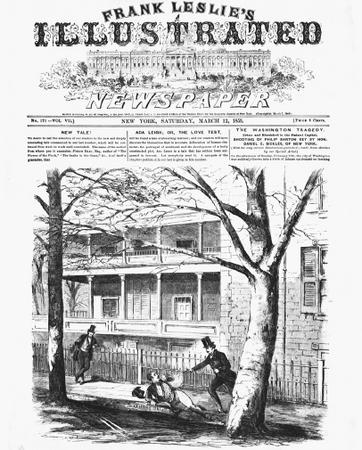
Almost immediately swarms of journalists were camped outside the prison and Sickles’ house where distraught Teresa sought a way to gain Dan’s forgiveness having received his broken wedding band which he sent to her from the jail. Witnesses to her dalliances with Key at the 15th Street house and other venues were brought to the Stockton Mansion to identify her. “She was the meat in the market, the ogre at the carnival. A little way across the square, souvenir hunters were cutting fragments of wood out of the tree by which Key had fallen, and artists from the illustrated papers set up their easels and began sketching every aspect of the area – the railings, the Stockton Mansion, the Clubhouse.” [1] A Presbyterian pastor who knew the couple found her obsessed by the shame that she had brought upon herself and her daughter, and he “found her in such mental agony that he feared for her sanity and even felt that she might try to take her life.” [2]

It was a credit to her own emotional strength that Teresa survived the ordeal that she had helped to bring about, and which she found herself blamed for, even by her father, who felt that she had dishonored the Bagioli family name. Antonio Bagioli wrote to Dan in prison, “You have heaped on my child affection, kindness, devotion, generosity. You have been a good son, a true friend, and a devoted, kind, loving husband and father.” [3] Of all the commentators, it was the eminent historian and diplomat George Bancroft who seemed to have any “sense of Teresa’s pain: “Poor child, what a cruel thing to deprive her of her sole stay and support. Key was the only man she could look to for sympathy and protection.” [4]

After Barton Key’s lifeless body was borne off in a mahogany casket to the Presbyterian cemetery in Baltimore and buried in the grave of his dead wife, and his children placed in the care of his family, his effects, what they amounted to, including his resplendent Montgomery Guards uniform were “sold off to a morbid, bargain-hunting, souvenir-hounding crowd.” [5] It was an ignoble end to the scandalous story of the son of Francis Scott Key, a story that soon with all of its salacious detail would be revealed to the public.

Meanwhile, inside the jail her husband, alternating between fits of rage and calm was visited by Washington’s Mayor James Barret, Sam Butterworth, Attorney General Black, Vice President John C. Breckinridge, and Speaker of the House, James Orr. He was comforted by the many expressions of support and sympathy found in scores of letters from people around the country, one of the first “a kindly note from the President,” [6] and others from total strangers. He was also joined by friends and allies from New York and Washington. “James Topham Brady, John Graham, and Thomas Francis Meagher, able lawyers all, arrived post haste to defend their rash ally” [7] as well as his father who before offering encouragement to his son offered a sharp chastisement, “You hot-headed fool! That’s no way to settle things! No woman’s worth it! No matter how you come out of this, you’ve killed your career – White House and everything else.” [8] Undeterred and calm Dan told his father that he understood and that if he had to he would do it again, after which, his father began to discuss the organization of his son’s defense with this legal team.

rerl_02_img0122

The case was front page news in all the major newspapers, which provided “extensive coverage of the “Sickles Tragedy.” Sickles’ murder of his friend Key in broad daylight in view of the White House had all of the scandalous elements that have thrilled Americans then and even today: “adultery, politics, celebrity, and a handsome corpse,” [9] not to mention a beautiful young woman who even more than her husband who had killed a man, stood accused in the eye of the public.

Despite the notoriety of the case, many people found sympathy with Sickles and believed that no jury would convict him of murder or manslaughter, after all, Teresa was the one who committed adultery with Key. The New York Herald “doubted that a grand jury would indict him. Even if he were indicted, Harper’s Weekly presumed that no jury would convict him of manslaughter if the adultery charge were proven, which it considered a foregone conclusion.” [10] The New York Times noted well before the trial opened, “there appears to be no second opinion as to the certainty of Mr. Sickles acquittal” but “national interest” arose from “the general desire to see the whole case fairly put, and the million scandals of mystery laid to rest by the plain facts.” [11] Newspapers like the New York Evening Post, his political arch-enemy found the murder an excellent opportunity to attack Sickles, “That wretched man, Daniel E. Sickles, has in his career reached the stage of assassination, and dipped his hands in human blood… It is certain that a man… who in his own practice, regards adultery as a joke and the matrimonial bond as no barrier against the utmost caprice of licentiousness – has little right to complain when the mischief which he carriers without scruple into other families enters his own.” [12] But such commentary was the exception, and it came from the organ of a political enemy. It is an interesting comment on the era, that a woman’s adultery, even when committed by the wife of an adulterous male who had killed her lover, was consider more of a social stigma and crime than murder.

Within days Sickles had assembled one of the most formidable defense teams ever to dominate an American court. Brady, who was considered to be the ablest criminal defense lawyer of his day became the lead attorney for the defense team, and was joined by Sickles’ New York friends, Graham and Meagher. Brady was an excellent choice, he “was admired and even loved by society in general, but on top of that, though his legal repertoire was wide, he had been involved successfully in more than fifty murder cases.” And he “had also made a special study of pleas of insanity,” [13] something that would figure greatly in the trial.

Additionally, President Buchanan helped recruit one of the finest attorneys in the country, the future Secretary of War, Edwin Stanton to the team. They were joined by four lesser known, yet high-powered attorneys; Samuel Chilton a Virginian who later represented John Brown, and his partner Allen Magruder, Daniel Ratcliffe, and Philip Phillips, a former Alabama Congressman and member of Washington’s Jewish community. Additionally, Reverdy Johnson, one of the most respected attorneys of the day served as an occasional advisor. “The Washington Evening Star observed that Sickles was collecting a lot of lawyers for a man whose defenders did not expect to leave their box before acquitting him.” [14]

Sickles’ defense team was a nineteenth century legal Dream Team against which the government deployed but one attorney, Key’s former assistant District Attorney Robert Ould. Ould, described by one of Sickles’ biographers as “a dull bull of a man, at one time a Baptist parson,” [15] had been named acting District Attorney by President Buchanan when Key was killed. It was an odd place for Ould, as he was serving to prosecute his former boss’s killer, at the behest of the President, who happened to be one of the defendant’s best friends. Ould, the former parson “was placed by inference in the unhappy position of defending adultery – something that he indignantly denied, insisting that he was merely prosecuting a killer….” [16] but to many people, the murderer of an adulterer by an aggrieved husband was complete justified. Ould was totally outclassed by the defense team, and Key’s family paid to have John Carlisle a respected Washington attorney to aid Ould in the case, but the trial would prove them appear incompetent and not up to the task of convicting Sickles.

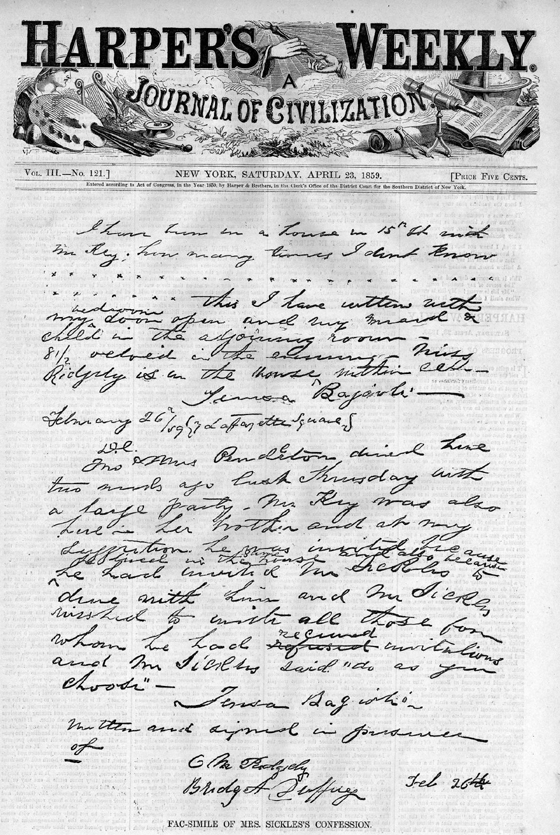
HarpersMagazineTeresaConfession

Teresa Sickles Confession on the Front Page of Harper’s Weekly

The defense pushed for a speedy trial and decided, as many lawyers do today, to try the case in the newspapers, which in light of the lurid nature of the story hung on every word coming out of Washington. The defense team pursued the strategy of “entirely reversing the roles of Sickles and Key by putting the dead man on trial for having made a victim of the defendant, and the New York Press prepared the public for just such an emotional appeal.” [17] The news stories printed by papers that supported Sickles as well as those of his detractors helped inflame the public as the newspapers across the country “wherever wires ran, were front-paging the story under screaming headlines and, in larger cities, rushing out extras every hour or two, as fresh details came to hand.” [18] The private affairs of Dan and Teresa Sickles became known around the nation, and even though the judge in the case refused to admit the confessions Sickles had forced from Teresa into evidence they found their way into the papers, some like Harper’s not only ran the text but reproduced the confession in enlarged facsimile form. The question in many people’s mind “was Dan Sickles justified in slaying the man who had betrayed his confidence and seduced his wife?… As a consequence the whole country turned jury.” [19]

The trial began on April 4th, just over a month after the killing and barely a week after the indictment was handed down. The first three days involved jury selection, a task that the defense turned over to Philip Phillips, who sparred with the prosecutor Ould over the twelve men who would eventually sit in judgment of Dan Sickles. Ould attempted to gain a favorable jury by introducing the property qualifications of jurors, he “ruled out jurors who did not meet the requirement of owning property valued at $800. Since this $800 property limit had not been imposed in similar cases, Ould’s insistence on it would attract much scorn from Dan’s lawyers…” [20] Sickles’ team fought back embarrassing Ould in the process, but not getting the judge to change his narrow application of the law to help the defense. Over two hundred potential jurors were examined before twelve unbiased jurors could be found, and a “great majority of those dismissed confess strong prejudice in favor of the prisoner.” [21] When the jury was seated it was composed of twelve men, two farmers, four grocers, a merchant, a tinner, a coach maker, a men’s clothing salesman, a shoemaker, and a cabinetmaker, “but not a single “gentleman” in the occupational sense.” [22]

Ould opened his case, “ponderously, powerfully, in the blackest of terms,” [23] he drew a picture of the killing. He delivered an “emotionally charged argument that Sickles, “a walking magazine,” had taken deliberate care in arming himself against Key, who only had “a poor and feeble opera-glass.” [24] Ould argued “that homicide with a deadly weapon, perpetrated by a party who has all the advantage on his side and with all the deliberate cruelty and vindictiveness, is murder, no matter what the antecedent provocation in the case.” [25] He then called twenty-eight witnesses, the majority of whom had actually witnessed the shooting, but he did not call upon Butterworth, Teresa, or the young White House page boy who had told President Buchanan and been sent away. Likewise he had not established intent, a key factor in any murder trial, nor had he introduced evidence that he had obtained regarding Sickles’ own affairs with women in Philadelphia, Baltimore, and elsewhere. The presentation of the physical evidence of Barton Key’s clothing and the bullet that supposedly killed Key was botched, the bullet that the prosecution claimed to have killed key did not fit either the Derringer, or the Colt revolver. Thus Ould left open for the defense the chance to explore all the salacious details of the case to put Key on trial, and to establish exculpatory reasons why Sickles had killed Key. Ould’s presentation of his case was brief, and so futile “that it seemed that Key was on trial for seduction, not that Sickles was on trial for murder.” [26]

sickles in the box

Sickles in the Prisoner’s Dock

The defense team made mincemeat of the prosecution. John Graham’s opening statement was a work of oratory genius that “would massively outshine Robert Ould’s more cumbersome opening.” [27]Weaving allusions from Shakespeare and other literary greats into his statement, he painted Sickles as the victim of a adulterous rogue who had on a Sunday, a day when he should have “sent his aspirations heavenward,” had instead besieged “that castle where for security and repose the law had placed the wife and children of his neighbor.” [28] Casting Sickles as the aggrieved and temporarily insane victim he also asked if it was a “crime for a husband to defend his family altar.” From there he proceeded to use quotes from Shakespeare’s Othello he inveighs against the adulterer as the supreme criminal, piling up quotation upon quotation from the Old Testament and Roman law to show that in wiser days the punishment invariably was death’” [29] to paint the picture of Sickles’ agony as he saw the man who had defiled his wife prowling outside of his home. Graham then went to provocation and argued that due the circumstance of the crime, a friend and confidant attempting to defile Sickles’ wife on a Sunday that the prosecution “needed to prove Dan’s sanity at the time of the act. And they could not do that, because there was not enough in the case “to melt the heart that is not cut from the unwedgeable gnarled oak.” [30] It was a masterful performance.

Over the next two weeks, Brady, Stanton, and Graham would continue to hammer the prosecution case. The defense proved that Key’s family had tampered with evidence, including testimony from a locksmith who had changed the locks at the 15th Street house at the direction of Key’s family. Witness after witness was introduced to undermine the prosecution and support the defense’s claim that Sickles’ was indeed in a state of uncontrollable madness, and the defense deftly parried the prosecutor’s rebuttal witnesses. When Ould attempted to keep African American witnesses from testifying Stanton, thundered and “accused the prosecution of a “monstrous” attempt to suppress evidence in its zeal of the defendant’s blood,” [31] and argued from North Carolina precedent that the prosecution was not willing to grant Sickles the same right as a slave. As his lawyers argued his case and witnesses gave testimony Sickles maintained his composure except for a number of times when he broke down and had to be excused from the proceedings. “Whether the courtroom histrionics were real or an award-winning performance, the jury witnessed firsthand a husband who was mentally unable to bear his wife with another man.” [32] On the Friday the 22nd of April Judge Crawford declared the testimony closed and the next day began the closing arguments.

Saturday April 23rd dawned with a violent gale, but that did not prevent crowds of people from trying to gain admittance to the courtroom. Edwin Stanton began the defense closing arguments in a manner that was calm and precise. He brought up that justifiable homicide included that which was “committed in defense of family chastity, the sanctity of the marriage bed, the matron’s honor, the virgin’s purity.” [33] Since the prosecution had never brought into evidence Sickles’ own violation of these covenants his attacks on Key and the prosecution case hit home. As he continued his voice rose to a roar, sounding like a prophet of ancient Israel “Who seeing this thin, would not exclaim to the unhappy husband, “Hasten, hasten, to save the mother of your child! And may the Lord who watches over the home and family guide the bullets and direct the stroke!” [34] When Stanton finished the court erupted in a frenzy as spectators as well as supporters of Sickles applauded his closing.

Next up was Brady who went on for three hours, captivating the audience which hung on every word. “When Daniel Sickles realized how he had been betrayed, all the emotions of his nature changed into a single impulse; every throb of his heart brought before him the sense of his great injuries; every drop of his blood was burdened with a sense of shame; he was crushed by inexorable agony in the loss of his wife, in the dishonor that he had come upon his child, in the knowledge that the future – which had opened to him so full of brilliancy – had now been enshrouded in eternal gloom by one who, contrawise, should have invoked form the eternal God his greatest effulgence on the path of his friend….” [35]

The closing had been masterful, emotional, and dramatic. In response Ould attempted to recover, but his arguments were weak, he agreed with the defense about the crime of adultery, and attempted to redirect the jury’s attention that it was Sickles who was on trial for murder and not Key for adultery, but he had already lost that argument. He called the defense of temporary insanity a ploy and “mentioned how easily, and readily a man on trial for his life might pretend to be deranged if he were on trial for his life.” But it was too little, too late. Since there was no psychiatric profession to weigh in on the matter, the argument of temporary insanity fell back on the “tradition of male marital dominance” and “that argument played well among men who rarely wore collars on their shirts…” [36] the very kind of men seated in the jury booth. When the jury recessed to deliberate Sickles’ fate on the 26th it took them less than an hour to return their verdict, and few were surprised when it came back “not guilty.” Stanton “was so excited that he did a jig in the courtroom, the hoarsely called for three cheers.” [37] As he did “Pandemonium and cheers broke out in the courtroom.” [38] People crowded around to congratulate Sickles and the crush was so great that Sickles had to be escorted for the courtroom. President Buchanan on hearing the verdict was delighted, later in the evening, though he sought rest, Sickles was taken by Brady to a gala in his honor attended by nearly 1500 supporters and well-wishers. The trial was over but the trials of Dan Sickles were not.

Notes

[1] Ibid. Keneally American Scoundrel p.142

[2] Ibid. Swanberg Sickles the Incredible p.63

[3] Ibid. Keneally American Scoundrel p.146

[4] Ibid. Keneally American Scoundrel p.147

[5] Ibid. Pinchon Dan Sickles p.117

[6] Ibid. Pinchon Dan Sickles p.117

[7] Ibid. Swanberg Sickles the Incredible pp.62-63

[8] Ibid. Pinchon Dan Sickles p.116

[9] Ibid. Hessler Sickles at Gettysburg p.12

[10] Marvel, William Lincoln’s Autocrat: The Life of Edwin Stanton University of North Carolina Press, Chapel Hill 2015 p.103

[11] Ibid. Hessler Sickles at Gettysburg pp.12-13

[12] Ibid. Swanberg Sickles the Incredible p.63

[13] Ibid. Keneally American Scoundrel p.151

[14] Ibid. Marvel Lincoln’s Autocrat p.103

[15] Ibid. Pinchon Dan Sickles p.121

[16] Ibid. Swanberg Sickles the Incredible p.64

[17] Ibid. Marvel Lincoln’s Autocrat p.104

[18] Ibid. Pinchon Dan Sickles p.118

[19] Ibid. Pinchon Dan Sickles pp.118-119

[20] Ibid. Keneally American Scoundrel p.162

[21] Ibid. Pinchon Dan Sickles p.120

[22] Ibid. Marvel Lincoln’s Autocrat p.105

[23] Ibid. Pinchon Dan Sickles p.122

[24] Ibid. Hessler Sickles at Gettysburg p.14

[25] Ibid. Pinchon Dan Sickles p.122

[26] Ibid. Swanberg Sickles the Incredible p.65

[27] Ibid. Keneally American Scoundrel p.173

[28] Ibid. Keneally American Scoundrel p.173

[29] Ibid. Pinchon Dan Sickles p.124

[30] Ibid. Keneally American Scoundrel p.175

[31] Ibid. Marvel Lincoln’s Autocrat p.107

[32] Ibid. Hessler Sickles at Gettysburg p.15

[33] Ibid. Pinchon Dan Sickles p.127

[34] Ibid. Pinchon Dan Sickles p.128

[35] Ibid. Pinchon Dan Sickles p.129

[36] Ibid. Marvel Lincoln’s Autocrat p.110

[37] Ibid. Swanberg Sickles the Incredible p.66

[38] Ibid. Hessler Sickles at Gettysburg p.17

3 Comments

Filed under civil war, crime, ethics, History, Religion

Incredible Scoundrel Pt.2: A Murder in Washington

philip-barton-key-granger

Friends of Padre Steve’s World

I am a historian as well as a chaplain and priest. I do a lot of work with the Battle of Gettysburg and much of my work involves biography as I believe that the one constant in history is people. Technology and many other things may change, but people and human nature are constant, for good and for bad, and frankly I find people fascinating.

One of the most fascinating people of the Battle of Gettysburg is Union Major General Daniel E. Sickles, a man who was one of the most fascinating, salacious, scandalous, and incredible figures ever to grace and disgrace American history.

This is the second of a three part series taken from my Gettysburg and Civil War text. I hope that you enjoy.

Peace,

Padre Steve+

Within a year of his assignment Sickles returned to the United States to help prepare the Democratic nomination for his friend Buchanan who had long desired the office, and return to his lucrative post in New York. In the spring of 1856 Sickles began to work on Buchanan’s nomination for the Presidency and while doing so began his own campaign for New York’s Third District’s Congressional seat. Buchanan won the election of 1856 against an opposition divided between the Know Nothing candidacy of former President Millard Fillmore and the candidate of the new Republican Party, John C. Fremont.

In the election of 1856, Sickles carried the district easily. For Sickles it was a triumph, he was “riding a flood tide of political fortune that might carry him far,” [1] and like any wife Teresa too was delighted with the result. Even so, Teresa must have wondered if her husband would mend his ways now that he was on the national spotlight, or if he would continue his extramarital romps around the nation’s capital. Following the election Dan and Teresa moved to Washington D.C. where they took up a fashionable residence, the Stockton Mansion, on Lafayette Square, not far from the White House and Sickles friend, James Buchanan.

Once he was established in Washington Sickles was in his element, politics at its grandest. It was a different style than of politics than Tammany, where brass knuckled force often ruled, but it suited Sickles, who was “a fixer who knew all the tricks of Tammany at its crookedest but who seems not to have taken graft himself. He had his sights fixed on the presidency, and he was making about as much progress in that direction as a Tammany man can,” [2]   until a strange combination of unrequited love, infidelity, the personal betrayal of a friend, and a murder intervened.

HarpersMagazineMrs.Sickles

Teresa Sickles

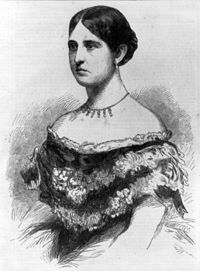
While her husband politicked along the Potomac, the new congressman’s wife was adapting to her life in Washington D.C. The wives were expected to entertain and host parties on a regular basis at their residences, but they also knew their share of loneliness and neglect. Since legislators routinely were “busy with night sessions, committee meetings, and plain nocturnal politicking over whiskey punch, that their wives either accepted other escorts or spent lonely evenings at home with fancywork or a book.” thus it was not surprising that Teresa, “should seek the gayety of the capital in her first year there.” [3] In the absence of their husbands it “was not uncommon for available bachelors to act as escorts for married women when their husbands were unavailable.” [4] Since Dan Sickles was frequently unavailable and since Teresa probably still suspected that Dan was still engaged in extramarital affairs, it is not surprising that the young Mediterranean beauty found comfort in another man.

The years of 1857 and 1858 would be a tumultuous time for the nation as well as the Sickles. Buchanan had been elected because of his stability and moderation in an age of pro and anti-slavery radicalism. However, over the next year his presidency, and his would be overwhelmed by events and Buchanan’s decisions supporting the expansion of slavery. While Sickles was neither a slave owner, nor himself fond of the institution, it was part of life, and many of his friends in Washington D.C. and in Congress were slave holders. Buchanan had schemed before his inauguration with Chief Justice of the Supreme Court Roger Taney in the Dred Scott decision, which was handed down in the days following Buchanan’s inauguration, followed by the fiasco over the Lecompton constitution and the attempted admission of Kansas as a Slave State, an event which split the Democratic party in the 1860 election, ensuring Abraham Lincoln’s defeat of Buchanan’s Lecompton foe in the Senate, Senator Stephen A. Douglas who would have been the prohibitive favorite in the election had the split not occurred.

Likewise, Sickles and his beautiful young wife would become part of one of the most sensational trials of American history, rivaling the Lindbergh kidnapping trial, the trial of O.J. Simpson, the Scopes Monkey Trial, and the Impeachment of President Bill Clinton in its captivation of America. As in London, Teresa became popular and she and Dan were much sought after and their home “became the scene of a gradual number of and entertainments,” [5] and even as Sickles continued his robust politicking and philandering Teresa became the object of another’s affection, the District of Attorney for the District of Columbia, Philip Barton Key, the son Francis Scott key, the writer of the Star Spangled Banner. Interestingly enough it was Sickles who had helped Key the troubled man to be reappointed to his office in early 1857 after Key had helped Sickles overcome legal and financial difficulties to secure Sickles in the Stockton Mansion and the two men developed a warm friendship.

Philip Key was extraordinarily handsome, especially when outfitted in his green and gold militia uniform of the Montgomery Guards, and was considered one of the most desirable men in Washington. An accomplished horsemen he rode about town on his “horse Lucifer – a nobly bred, dapple gray hunter.” [6] When he gained Sickles’ friendship many of his well to do political and society friends became frequent visitors to the Sickles household. After Sickles had helped Key to be reappointed to his office, Key was instrumental in helping make the arrangements for Sickles to rent the Stockton Mansion.

During his first term in office Key was not known for being a particularly good District Attorney and spent much time away from the office complaining about his allegedly poor health. But his health did not keep him away from Washington’s party scene and “One hostess called him “the handsomest man in all Washington… he was a prominent figure at all the principle functions; a graceful dancer, her was a favorite of every hostess of the day.” [7] When he met Teresa, the dashing bachelor took an intense interest in the wife of the man who had helped him retain his job. The two were soon attending many functions together that Sickles, due to his work schedule could seldom attend.

Within weeks Key became a frequent guest at the Sickles home and few were surprised at this, as most observers knew that Sickles was responsible for Key’s reappointment. With Sickles now fully engaged in the dramatic political battles of late 1857, Teresa and Key began to spend much more time together. The two were seen together at the “theater, at teas, at hops. But most of all they went riding together.” [8] The frequency of these visits was noted and became the source of much gossip but Sickles was unaware of it and entertained no suspicions that his new friend was becoming deeply involved with his wife, and that Key had rented a room where the two could intimate.

That was until a young man equally smitten by Teresa had a few drinks with a colleague and the colleague shared the information with a loyal Sickles ally who then told Sickles. Sickles was shocked and called for a meeting with Key, however, after a brief conversation, Key convinced Sickles that there was nothing to the rumors, and Sickles was satisfied.

Though Sickles had been satisfied by the explanation, “despite his own well-publicized moral lapses, Daniel Sickles was a man of intense personal pride who would not countenance the breath of scandal attaching to his wife.” [9] He took the time to warn her to make sure that she was not involved in any other indiscretions, and left the subject. However, Key and Teresa continued to see each other, and “she and Barton thought that they were taking more care, and being less observed by people than they were.” [10] Yet as they pursued one another their affair became increasingly public, and seen by too many people not to go unnoticed. The two were seen together in at the Congressional Cemetery, and frequently at a house at “385 15th Street where he would enter the by the front door – and she the back.” [11] When a mutual friend expressed his concerns, Key shrugged off the warning, and “with the bravado of a proud weakling, he still held his course. And Teresa, ductile, enamored, blindly followed his lead.” [12] Another friend of Key suggested to him that he could be in danger, but Key “bridled and patted the breast of his coat. “I am prepared for any emergency,” he snapped. Key was a crack pistol shot and his friend believed that Key was preparing for a possible confrontation. [13]

Like so many people young spouses who find their needs unfulfilled at home, and who suspect their spouse of infidelity, , “Teresa did not see this love affair as tragic and dangerous. She lived within it as a secret fantasy, as in a virtual and time-consuming experience that lacked any power to inflict damage on other areas of her life.” [14] She became less discreet, Key would signal to her from across the street to confirm their dalliances and despite their insipidly inept attempt to hide the affair it became clear to Sickles’ coachman and household maids that the two were engaged in sexual encounters in the Sickles carriage and in the Stockton Mansion itself.

The situation finally came to a head in February 1859 following Sickles reelection and return to Washington. “Made more reckless than ever by their recent separation, Barton and Teresa now again were seen everywhere together.” [15] The couple were now making clandestine liaisons on a nearly daily basis, and eventually, one of the observers decided to tell Sickles. The anonymous source, using the initials of R.P.G. sent Sickles a letter detailing the affair. Sickles received the letter from a butler on the night of Thursday February 24th as he was leaving the usual dinner party at his house for the traditional hop that followed at the Willard Hotel.

Sickles did not read the letter until after the couple returned home and Teresa had gone to bed. Sickles was stunned and at first did not believe the contents as he placed little stock in anonymous messages. So he had George Wooldridge, a longtime friend and congressional clerk investigate, and on Saturday February 26th Wooldridge confirmed Sickles worst fears. That evening at their home Sickles confronted Teresa about the letter and as he stormed about angrily in their bedroom she confessed, after which Sickles had her write out her confession detailing everything. He may have been desolate and angry, but he was a lawyer, and he got his written proof.

But scandal was the last thing that Sickles wanted, as he had higher aspirations in politics, so he immediately called his friends for counsel and by Sunday morning several, including Wooldridge and Samuel Butterworth were at the Stockton Mansion with Sickles. As always, Sickles’ “first thoughts were for himself, and he melodramatically”[16] exclaimed to Butterworth, “I am a dishonored and ruined man…I cannot look you in the face.” [17]

4P8V9475

Murder

His friends “were profoundly touched by the depth of his feeling, and were convinced that he needed to be saved from a severe derangement of his senses; from lunacy, that is.” [18] his friends attempts to calm him, Sickles was beside himself with anger, and his anger now swirled around his marriage and what he believed was the scandal that would cost hi his career. That afternoon, Key again tempted fate, this time, for the last time. He had been tipped off by an anonymous letter that the affair was public, but he was determined to see Teresa. He made several passes by the house, each time signaling with a handkerchief, until Sickles observed him. Sickles called out to Butterworth “That villain has just passed my house! My God, this is horrible!” [19]

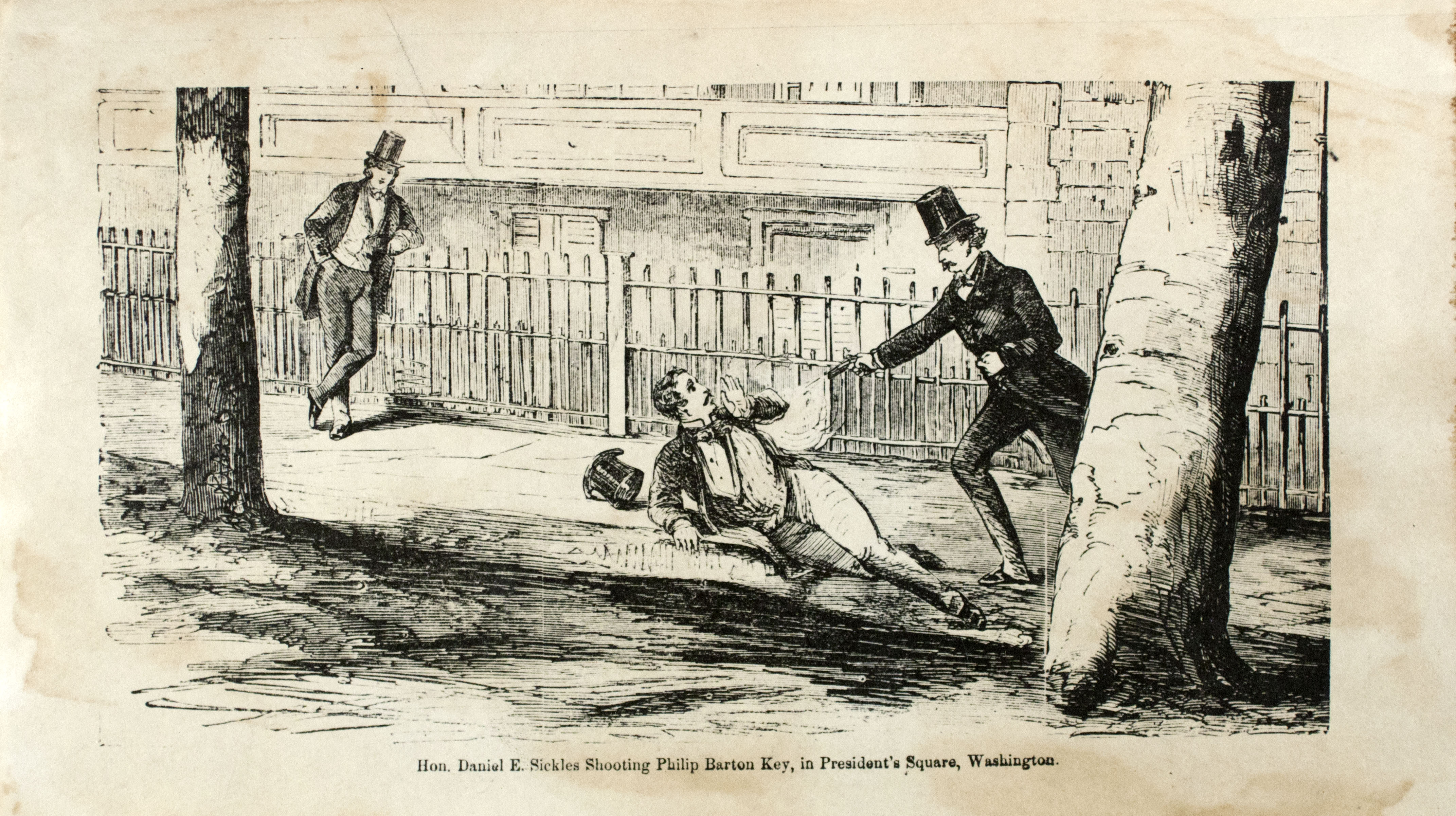
Butterworth left the house first and met Key at the southeast corner of Lafayette Square across from the White House. Allegedly not knowing Sickles intended any harm, Butterworth walked with Key to for a few minutes and then left. The exchange delayed Key and gave Sickles, who had armed himself with a single shot large caliber Derringer, and a muzzle-loading Colt revolver, enough time to catch up with Key near the Club House on Madison on the east side of the square. Sickles was raving but Dan’s fury transcended reality,” [20] as at least a dozen witnesses were nearby as he screamed, “Key, you scoundrel, … you have dishonored my bed – and you must die!” [21] Sickles pulled out the revolver, the first shot from which grazed Key, and the second which misfired. A brief scuffle ensued as Key lunged at his assailant, but Sickles flung him to the ground, and drew the Derringer as Key threw the opera glasses that he viewed Teresa at Dan. A third shot hit Key in the groin and he slumped to the ground screaming “Murder! Murder!… Don’t shoot!” [22]

If there was a chance for Sickles to prove that he acted in self-defense it was now, but he could not control himself. He fired the revolver yet again and it misfired. He placed the weapon in his pocket and drew the Derringer, and fired a shot which hit Key in the Liver. As Key writhed on the ground Sickles tossed the Derringer to the ground and he again drew the Colt. As the stunned witnesses to the attack looked on, Sickles advanced toward the fallen Key and placed the gun at his head and pulled the trigger, but again the weapon misfired. As Sickles attempted to place another cap in the pistol, a number of witnesses began to intervene. One man, “a member of the club, running up, stopped him. Mr. sickles – for God’s sake!” And Butterworth, coming forward, took Dan by the arm. Without a word, they walked away together.” [23] Witnesses took the mortally wounded Key away to the Club, where he expired.

President Buchanan was almost immediately told of the murder by a White House page boy, was aware of the implications of the scandal, Sickles was a friend and political ally with much promise. Buchanan told the boy leave town and gave him a sum of money to facilitate his departure. Soon after Sickles and Butterworth went by carriage “to the home of Attorney General Black, where the Congressman formally surrenders himself to the silver-haired Cabinet member who had regarded him as a protégé.” [24] He declined bail in favor of a speedy trial, was allowed to go home where he told Teresa that he had killed her lover, retrieved some personal items and then went to the District jail, “a foul hole, swarming with vermin, destitute of sewage, bath, water, ventilation, and so inadequate to its purpose that often a dozen or more prisoners were herded into a single narrow cell.” [25] When he arrived he reportedly asked the jailer if they were the best accommodations available, to which the jailer responded “this is the best place you members of Congress have afforded us.” [26] Dejected, but undeterred Sickles sent a message to the public, “In doing what I had to do I have broken the law. Therefore I place myself behind bars. It is for you to set me free.” [27] The stage was now set for the one of the most unbelievable and storied trials in American history.

Notes

[1] Ibid. Swanberg Sickles the Incredible p.4

[2] Ibid. Catton The Army of the Potomac: Glory Road p.151

[3] Ibid. Swanberg Sickles the Incredible p.15

[4] Ibid. Hessler Sickles at Gettysburg p.8

[5] Ibid. Swanberg Sickles the Incredible p.16

[6] Ibid. Pinchon Dan Sickles p.74

[7] Ibid. Hessler Sickles at Gettysburg p.9

[8] ibid. Swanberg Sickles the Incredible p.20

[9] Ibid. Swanberg Sickles the Incredible p.25

[10] Ibid. Keneally American Scoundrel p.92

[11] Ibid. Wilson and Clair They Also Served p.99

[12] Ibid. Pinchon Dan Sickles p.94

[13] Ibid. Swanberg Sickles the Incredible p.44

[14] Ibid. Keneally American Scoundrel p.92

[15] Ibid. Pinchon Dan Sickles p.93

[16] Ibid. Hessler Sickles at Gettysburg p.10

[17] Ibid. Swanberg Sickles the Incredible p.53

[18] Ibid Keneally American Scoundrel p.121

[19] Ibid. Hessler Sickles at Gettysburg p.10

[20] Ibid. Keneally American Scoundrel p.127

[21] Ibid. Swanberg Sickles the Incredible p.54

[22] Ibid. Hessler Sickles at Gettysburg p.11

[23] Ibid. Pinchon Dan Sickles p.112

[24] Ibid. Swanberg Sickles the Incredible p.55

[25] Ibid. Pinchon Dan Sickles p.114

[26] Ibid. Keneally American Scoundrel p.135

[27] Ibid. Swanberg Sickles the Incredible p.114

3 Comments

Filed under civil war, crime, Gettysburg, History, laws and legislation, Political Commentary

True Believers & Terrorism

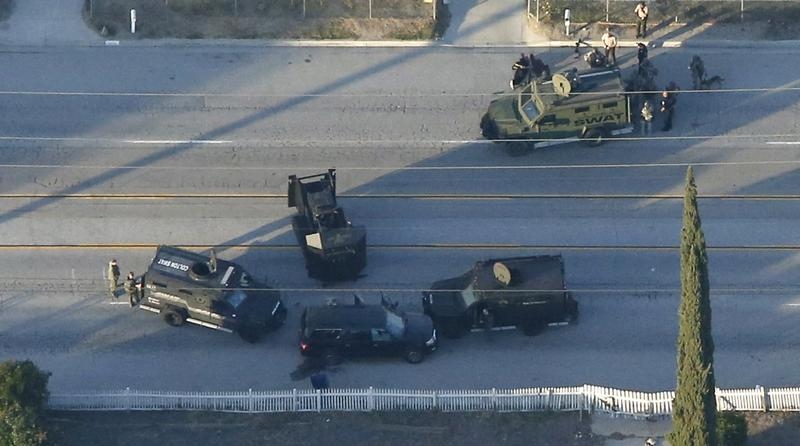
An SUV with its windows shot out that police suspect was the getaway vehicle from at the scene of a shooting in San Bernardino, California is shown in this aerial photo December 2, 2015.  Gunmen opened fire on a holiday party on Wednesday at a social services agency in San Bernardino, California, killing 14 people and wounding 17 others, then fled the scene, triggering an intense manhunt and a shootoutout with police, authorities said. REUTERS/Mario Anzuoni      TPX IMAGES OF THE DAY      - RTX1WX2P

Friends of Padre Steve’s World,

I have just a few words today. I am still attempting to comprehend the terror attacks in Paris as well as the terrorist attacks in Colorado Springs and San Bernardino.

All were committed by people devoted to killing in the name of their God. The attacks in Paris and San Bernardino by Moslems, Colorado Springs by a Christian. People of those religions can disown them and say that they do not represent their religion but that is what they claim to be. The fact is until religious leaders start owning these kinds of people as their own this terror will continue. 

The fact is that I have become sick of people who kill in the name of their God, but that seems to be a universal constant anymore, not that it ever wasn’t. Name the religion and do just a little research and you will find true believers who have killed and committed terrorist acts in the name of their God. In fact, I am getting sick of people who hide behind their religion and use it to bludgeon, kill, and terrorize those who are not the elect. I am tired of seeing people in this country, in the name of Jesus and the Christian religion using the government and the legislative process to disenfranchise and discriminate against others. I cannot imagine Jesus ever blessing such actions and I’m sure that if Jesus was to show up and start speaking in most churches that he would be throw out.

I am now convinced that many people who speak for God the loudest and probably the furthest away from God, if there is one. Having gone through the wilderness of doubt and unbelief have to admit that there are times that I doubt more than I believe. Today is one of those days.

American philosopher Eric Hoffer wrote, “The impression somehow prevails that the true believer, particularly the religious individual, is a humble person. The truth is the surrendering and humbling of the self bred pride and arrogance. The true believer is apt to see himself as one of the chosen, the salt of the earth, the light of the world, a prince disguised in meekness, who is destined to inherit the earth and the kingdom of heaven too. He who is not of his faith is evil; he who will not listen will perish.”

That my friends is the truth. That is what allows the terrorists to do such things and for people to shrug their shoulders and simply say “oh how terrible, I’ll pray for the victims” and go on their way, even as more terror acts are committed by these true believers. Where are the religious leaders who will do more than condemn attacks? Yes, I admit that there are some that do, but they seem few and far between. More often I have seen religious leaders speak out of both sides of their mouth when it comes to terrorists of their own faith. They use arguments of moral equivalency, saying “we do not condone the actions of the terrorists, but….” I saw this coming out of the lips of some Christian leaders and Christians who I know on social media after the assault on the Planned Parenthood clinic.

The more I see of this the more I am becoming convinced that God must not make very much difference in the lives of his most devout followers. But then maybe it is because they are more interested in building walls out of doctrine than they are of actually dealing with complexity and the contradictions of faith. Hoffer wrote, “A doctrine insulates the devout not only against the realities around them but also against their own selves. The fanatical believer is not conscious of his envy, malice, pettiness and dishonesty. There is a wall of words between his consciousness and his real self.”

I am appalled at the total absence of empathy, and the near sociopathic rantings of the true believers of almost every religion. They seem to have no capacity to feel for fellow human being, as Army Psychologist Gustave Gilbert said at Nuremberg, “In my work with the defendants I was searching for the nature of evil and I now think I have come close to defining it. A lack of empathy. It’s the one characteristic that connects all the defendants, a genuine incapacity to feel with their fellow men. Evil, I think, is the absence of empathy.” 

I see a lot of words, I hear a lot of religious mumbo jumbo, but I only sense a nearly complete absence empathy. If you wonder why I struggle so hard to believe, I think that is your answer.

Until tomorrow, pray for me a sinner,

Peace

Padre Steve+

9 Comments

Filed under crime, culture, faith, News and current events, Political Commentary, Religion, terrorism

Never Forget: The Undeniable Evidence

1483285_10152114931522059_1612934841_n

Friends of Padre Steve’s World

I have been writing about the Holocaust and genocide for most of the last week. This is in large part due to teaching my ethics elective at the Staff College during which time we examined the Holocaust and the Rwandan genocide. 

 In doing so I decided to re-watchthe movie Nuremberg which is about the trial of the major Nazi War Criminals. That trial exposed to the world the evil of the Nazi regime. Massive amounts of documentary evidence were introduced, much from the precise records kept by the Nazis themselves. It may be hard to believe, but those who ordered and directed these crimes were proud of what they did, believing that they were doing the world a favor, but it was not something that they felt that they could speak too openly about. Heinrich Himmler, the head of the SS and the German police told SS leaders that the Jews were a bacillus that had to be eradicated. At Posen on October 4th 1943 Himmler reminded the senior leaders of the SS of their “duty” in this regard. That speech, with its English and German transcripts can be found here:

The audio of Himmler’s remarks is chilling, as are the written and photographic evidence compiled by the Nazis themselves. The meticulous nature of the Nazis in documenting what they did would be used against their surviving leaders. The Allied troops who marched into Germany and the countries that the Nazis occupied were stunned at what they found the massive amounts of documents, photos, and films, the meticulous records and the human evidence that the Nazis could not hide; the victims of Nazi inhumanity in the liberated concentration camps. Nazi Armaments Minister, Albert Speer wrote of the evidence presented during the trial:

“For many months the documents and testimonies accumulated…. It was horrible, and only could have been borne because our nerves became more blunted from session to session. To this day photographs, documents, and orders keep coming back to me. They were so monstrous that they seemed unbelievable, and yet none of the defendants doubted their genuineness.” (Speer, Inside the Third Reich p.513)

85124

Among the most devastating evidence shown at Nuremberg was a film shot by Allied film crews as they liberated the camps. If a picture speaks a thousand words, the film speaks millions. The scene was described by John and Ann Tusa in their book The Nuremberg Trial:

“There was to be an even stronger reaction that afternoon when the prosecution showed a film to the court of the concentration camps as they had been found by the advancing Allies…. No one who ever saw it in court ever forgot it. A view recorded: ‘The impression we get is an endless river of white bodies flowing across the screen, bodies with ribs sticking through their chests, with pipe-stem legs and battered skulls and eyeless faces and grotesque thin arms reaching for the sky… On the screen there is no end to the bodies, tumbling bodies and bodies in mounds and single bodies with holes between the eyes and bodies being shoved over cliffs into common graves and bodies pushed like dirt by giant bulldozers, and bodies that are not bodies that are not bodies at all but charred bits of bone and flesh lying upon a crematory grate made of bits of steel rail laid upon blackened wood ties.” (Tusa, The Nuremberg Trial location 2563 of 8828 Amazon Kindle edition)

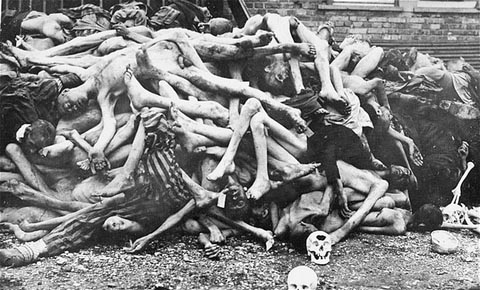
1401214_10152110188252059_1811667116_o

Bergen Belsen

The film left those in the courtroom in stunned silence, the judges left and the chief judge, Sir Geoffrey Lawrence “had not even managed to speak the usual formal words of adjournment.” Even some of the Nazi leaders who were on trial were shocked by what they saw, but few took any responsibility. Many denied knowing anything about the camps of the crimes, some were shocked, and even cried, but most shifted blame to others. Herman Goering told Gustave Gilbert “Everyone was laughing with me and then they showed that awful film and it just spoiled everything.” But one defendant, Hans Frank, the Governor General of occupied Poland told Gilbert, “Don’t let everyone tell you that they had no idea. Everyone sensed that there was something terribly wrong… even if we did not the details. They just didn’t want to know all the details.” (Tusa, The Nuremberg Trial, location 2576) When the trial was concluded and the defendants made their closing statements, most condemned the killings, but only Speer admitted having some share of responsibility for them, the others all denied their own share of responsibility.

I think that it is important for people to watch the film. It is not easy to do, but if we are to ensure that such things never happen again, we have to show it, and we have to educate those who have no contact with, or no direct knowledge of these crimes. There are few survivors left to tell the tale, it is for us the living to ensure that these crimes never happen again.

Peace,

Padre Steve+

Leave a comment

Filed under crime, History, nazi germany, world war two in europe

Civilization Is Tissue Thin: Holocaust & Genocide as Warning

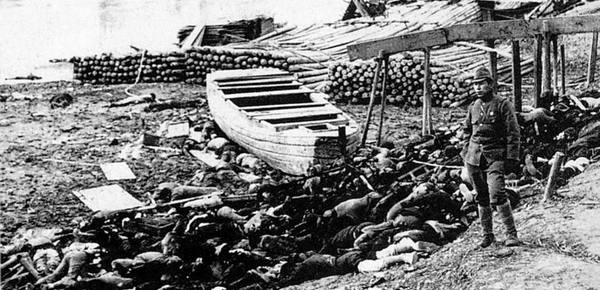
nanking_massacre_1

The Rape of Nanking

Friends of Padre Steve’s World,

Fyodor Dostoyevsky wrote, “Nothing is easier than to denounce the evildoer; nothing is more difficult than to understand him.”

I think one of our problems is that we want to believe that evil is simply done be evil people. That is why when we see a Hitler, Stalin, Pol Pot, or the monsters of the so-called Islamic State, we are often strangely comforted. This is often  because we can point to a single person with a wicked ideology and say “they are evil,” all the while forgetting that they are, or were, like us, also human. Aleksandr Solzhenitsyn reminds us of the folly of that type of thinking, “If only it were all so simple! If only there were evil people somewhere insidiously committing evil deeds, and it were necessary only to separate them from the rest of us and destroy them. But the line dividing good and evil cuts through the heart of every human being. And who is willing to destroy a piece of his own heart?”

Last week I took a break from my Gettysburg text and dusted off an old academic paper dealing with the one of the more uncomfortable aspects of the Nazi Holocaust against the Jews. I did that because I felt that I needed to reexamine the nature of evil in the modern world. 

When I ponder the evil committed by supposedly civilized men and women of Germany, I realize that they are little different than others who share the culture of the West. These people were the products of a culture of learning, and of science. They were part of a culture formed by the Christian tradition, the Renaissance, the Reformation, and the Enlightenment, the age of Reason. As I pondered this I came to remember something said by the late Iris Chang, “civilization is tissue thin.”

Omaha_courthouse_lynching

Lynching in the American South

That series of articles about the Eunsatzgruppen dealt with the ordinary men, and the bureaucratic systems that implemented an ideology so twisted and evil that it is unimaginable to most people. While most people in the United States know a little about the Holocaust, most do not fully comprehend how devilish and insidious the crimes of the Nazis were. More frightening is the fact that 46% of people worldwide have never heard of the Holocaust, and of the 54% who are aware some 32% think it is a myth or has been greatly exaggerated. The numbers wills only get worse as younger people are far more likely to believe that the Holocaust is a myth or or exaggerated. 

We typically know about the extermination camps like Auschwitz, but the lesser known dark side of the Holocaust, perhaps the scariest part, is the story of the men of the Einsatzgruppen. The Einsatzgruppen and affiliated units, including those of the Wehrmacht, the Waffen SS, the mobilized battalions of the Order Police, and locally recruited units, rounded up massive numbers of people and killed them up close and personal. In all these units murdered over two million people, about 1.3 million of whom were Jews.

My study of the Holocaust began in college as an undergraduate. My primary professor at California State University at Northridge, Dr. Helmut Haeussler had been an interpreter and interrogator at the Nuremberg trials. I was able to take a number of lecture classes from him a large amount of research and independent study courses in a year of graduate work while finishing my Army ROTC program at UCLA. It was an immersion in the history, sociology, and the psychology of evil, during which I was able to meet and talk with Jewish survivors of the Holocaust.

mass killing einsatzgruppen

Einsatzgruppen

Since then I have continued to read and study. I lived in Germany for over four years, and made many other visits, during which I went to a number of Concentration Camp sites. I visited the rebuilt synagogue in Worms which had been destroyed during the infamous Kristallnacht, and other museums and Holocaust memorial sites in Germany. I visited the Zeppelin field, the site of Hitler’s massive Nazi Party rallies in Nuremburg, as well as the graveyards which contain the victims of other Nazi crimes, including the Nacht und Nebel or night and fog actions, where people simply disappeared and were murdered by the Gestapo. 

For me, those visits were sobering, maybe even more so because I understood exactly what happened in those sites. These are uncomfortable places to visit, and I can understand why many people would not want to visit them, or even study them. 

The darkness that they remind us of  is a part of our human condition. Traces of the evil on display in those places is present in every human being. Frankly, most people cannot bear looking into that abyss, for fear that they might be swallowed by it.

nankino-masakra-1

Nanking

I can understand that and I have to admit that it is hard to do so. I am a historian as well as a clinician with much experience dealing with death and trauma. With my training I do a pretty good job of keeping my emotional distance to maintain objectivity when confronted with evil. However, it is hard for me not to have some emotional reaction when visiting these places, or reading about the events and people, and in writing about them. 

Likewise, I am very troubled by the growing lack or awareness or denial of the Holocaust. It is very hard for me not to have a virulent reaction when I see books and websites dedicated to Holocaust denial, or that minimize other well documented genocides, and crimes against humanity.

tzd8ftsn-1390907543

Soviet Genocide in Ukraine

My sensitivity to human suffering and the terrible indifference of people in this country to it was greatly increased by my experience of war, and my post-war struggles with PTSD, depression, anxiety, which at points left me very close to committing suicide. A non-chaplain friend, a now retired Navy Command Master Chief Petty Officer that I served with at my last duty station recently remarked that I am a tremendously empathic person, and that I have a large capacity to feel the pain and suffering of others. This capacity for empathy and the ability to feel the suffering of others is part of who I am. It is a good thing, but it makes my work studying and writing about the Holocaust, other genocides, crimes against humanity, and subjects like American slavery, racism, and Jim Crow a sometimes difficult and often very emotionally consuming task. This sometimes leaves me even more sleepless and anxious than normal; especially when I see the indifference of so many people to the suffering of others today.

CambodiaExhibitMassgrave-x1

The Killing Fields

It is that indifference which motivates me to write; because if these events are not recalled and retold, they, like any part of history will be ignored and then forgotten. The statistics bear this out. There are people today, who say that we should stop talking about these events, that they are old news, and they cannot happen again; but history tells us different, and not just the Holocaust, but indeed every genocide. Then there are those who shamelessly use the Holocaust imagery to spread fear among their followers even as they openly demonize minority groups and religions as the Nazis did to the Jews.

I have to agree with Elie Wiesel who said, “Indifference to me, is the epitome of all evil.”

The late Iris Chang, who wrote The Rape of Nanking: The Forgotten Holocaust of World War II wrote something that is pertinent to almost every modern episode of genocide, or other crime against humanity. It is the ability of leaders, be they political, military, or religious to convince people to rationalize actions that they normally would find repulsive.

“After reading several file cabinets’ worth of documents on Japanese war crimes as well as accounts of ancient atrocities from the pantheon of world history, I would have to conclude that Japan’s behavior during World War II was less a product of dangerous people than of a dangerous government, in a vulnerable culture, in dangerous times, able to sell dangerous rationalizations to those whose human instincts told them otherwise.”

isis3-840x550

The Islamic State

What we call civilization, to use the words of Iris Chang, is tissue thin. That is why we must never forget these terrible events of history, and that part of human nature, and in a sense part of every one of us, that makes them so easy to repeat. That is why we must periodically take the time to remember and reflect on the Holocaust, other genocides and crimes against humanity.

Yes, these are terribly uncomfortable subjects, but we cannot allow this generation to allow them to be forgotten, lest they be repeated. That is why that I must continue to write about them.

Peace

Padre Steve+

5 Comments

Filed under crime, History, Political Commentary

The Unspeakable Taboo: Evil, Genocide & Human Nature

Friends of Padre Steve’s World,

This is the final section of the article that I have been posting over the last six days.

The material in this article that I have spread over the past six days is often troubling. At least it is to me because while I earnestly want to believe that humanity is essentially good, I cannot get around the fact that people in every clime and place throughout history often choose to either participate in, or to ignore evil committed against when it is in their own self-interest.  I can see into the darkness and I can understand it.

Joyce Carol Oates wrote, “And this is the forbidden truth, the unspeakable taboo – that evil is not always repellent but frequently attractive; that it has the power to make of us not simply victims, as nature and accident do, but active accomplices.” That is one of the things that makes the Holocaust, but even more so, the actions of those murdered millions of people up close and personal as members of the Einsatzgruppen, the Police battalions, the Romanian Army, or the locally recruited Eastern European militias.

While this of itself is troubling, the fact that many high ranking military and civilian officials in Germany, and some of their allied countries knew about it, and even if they disapproved did nothing to try to stop it. But even more damning is the fact that many other nations, including the United States knew what was happening and before the war would not accept Jewish immigrants who were being forced to leave Germany and Austria, and then during the war did little or nothing to attempt to stop the mass killings in the extermination camps. The fact is that people are people and most of the actors in this ghastly drama were much like us. That is what makes the period so troubling.

Peace

Padre Steve+
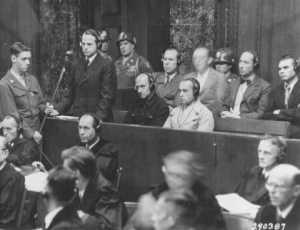
einsatzgruppen trial

Otto Ohlendorf at the Einsatzgruppen Trial

The German war against Poland and the Soviet Union was heavily dependent on the racist ideology of Adolf Hitler. He was the true spirit behind the atrocities committed by his nation as one Nazi leader noted in Russia, “Here too the Führer is the moving spirit of a radical solution in both word and deed.” 187Hitler saw the war in the East as “the chance to stamp out everything that stands against us.” 188Belief in Germany’s right to Lebensraum, was predicated on increasing the standard of living for Germans even if it meant destroying others to do it. The need for food security was one of Hitler’s biggest concerns, and he believed that need would be provided by the conquest of the Soviet Union and the exploitation of the breadbasket of the Ukraine. Hitler’s quest for unlimited natural resources to sustain his Thousand Year Reich and his belief in the racial superiority of the German Volk were combined with his belief in the necessity to settle the Jewish problem. These ideological and economic beliefs provided a fertile ground for Hitler’s followers.

But it was German military doctrine, especially its anti-partisan doctrine and plans for total warfare which allowed Hitler to realize so many of his goals. Without the Army’s support and compliance Hitler could never have succeeded. The post-war and early Cold War myth that the German military had no knowledge of and were not involved in the Holocaust committed against the Jews and others has been shattered as more and more records, correspondence, and testimony emerge.

It is now quite clear that many officers in the Wehrmacht were in agreement with Hitler’s ideology of racial war, including men who have been idolized by military historians and history buffs who marvel at their planning skills and operational precision, but ignore the uncomfortable truth that many either participated in or meekly acquiesced to Hitler’s agenda.
7010_1017630386

Alfred Jodl

These men, like so many in Germany were products of their culture. They were immersed in cultural prejudices against Jews and Slavs. When we examine the long traditions of racist ideology, coupled with military doctrine, the “Prussian and in later German military must be regarded as a significant part of the ideological background of the Second World War.189 General Walther Von Reichenau’s orders to his troops at the beginning of Operation Barbarossa are revealing in this regard, “The most important goal of the campaign against Jewish-Bolshevism is the complete destruction of its grip on power and the elimination of the Asian influence from our European cultural sphere.” 190 Reichenau’s superior, Field Marshal Gerd Von Rundstedt appeared to agree with von Reichenau’s orders, but wanted to keep the hands of the Army clean of the actual dirty work of the mass killings. Rundstedt had no problem with the “use the partisan threat as excuse for persecuting Jews, so long as the dirty work was largely left to SS Einsatzgruppen.” 191

On the whole the Army command…on the whole acquiesced in the extermination of the Jews, or at least closed its eyes to what was happening.” 192 This is absolutely true, but that being said, and as guilty as many of the Generals were, there are factors involved that if are honest might have influenced us to make the same choices as them if we stood in their shoes. This is not an excuse, it is reality and it is borne out by history. The sad truth is that most people act in accordance with their self-interest, especially their economic well-being and social status. We accommodate evil when it serves our needs, especially if we do not actually have to do the dirty work. Their actions show the truth of Primo Levi’s comment “Monsters exist, but they are too few in number to be truly dangerous. More dangerous are the common men, the functionaries ready to believe and to act without asking questions.”
Die feierliche Vereidigung der Reichswehr auf den neuen Reichspräsidenten Adolf Hitler auf dem Kasernenhof der Wachtruppe in Berlin 1934 Offiziere und Mannschaften leisten den feierlichen Eid durcherheben der rechten Hand. Die Reichswehr trägt Trauerflor für den verstorbenen Reichspräsidenten.

Officers and men of the Reichswehr take the Oath to Hitler in 1934 following the death of President Hindenburg

Had the Generals had been more forceful in their opposition, they would have most likely been opposed by the highly Nazified youth that made up the bulk of their Army, especially many of the junior officers, NCOs and enlisted men. Likewise there was the matter of their oath and this is something that many Americans do not understand. During the Kaiser Reich German officers swore an oath to the Kaiser, during Weimar that was changed to the Constitution, when Hitler took power and assumed both the Presidency and Chancellorship following the death of President von Hindenburg, the officer corps swore a new oath, that to Hitler as President and Chancellor. While many saw the danger, almost all officers took the oath, in a sense it was a throwback to the old way of doing things in the Kaiser Reich, and most officers hated the Republic. To them the oath embodied their honor, to break it was to dishonor themselves and their family. When war came it became more than that, to break the oath was considered treason. General Alfred Jodl told American Army psychologist Gustave Gilbert at Nuremberg that “In war the moral pressure of obedience and the stigma of high treason are pretty hard to get around.” 193

Jodl’s superior Keitel stated his helplessness before Hitler saying to Gilbert “What could I do? There were only 3 possibilities: (a) refusal to follow orders, which naturally meant death; (b) resign my post, or (c) commit suicide. I was on the point of resigning my post 3 times, but Hitler made it clear that he considered my resignation in time of war the same as desertion. What could I do?” 194 This was obviously an after the fact excuse by Keitel who had been present in Hitler’s headquarters since the beginning and had witnessed the explosive General Heinz Guderian explode in rage against Hitler in 1945. Following that violent outburst in which Guderian and Hitler engaged in a lengthy heated argument in which those present thought would come to blows and the enraged dictator and general shouted at each other and were held back from contact by others in the conference room. Instead of arrest or imprisonment Hitler ordered Guderian to take extended sick leave and never accosted him afterwards.

heydrich

Reinhard Heydrich

Himmler, Heydrich, Eichmann and other SS leaders fanatically executed Hitler’s policies and were aided by the civil administration, including the leaders of the Reichsbank, and the proponents of long term economic plans. Genocide was to bring the Reich “long term economic gains and trading advantages” and was seen as a way of “financing the war debt without burdening the German taxpayer.” 195

The willing participation of Army commanders is hard to get around. Otto Ohlendorf, commander of Einsatzgruppe D testified at the Einsatzgruppe Trial that Einsatzgruppen reported all of their tasks to the army commanders, and that together, they and the army agreed on the time, place, and possible support of the troops for any particular “liquidation action[s].” 196

Some individuals did attempt to resist the most brutal aspects of the Nazi campaign against the Jews, but few had the fortitude to make more than half-hearted attempts. Wilhelm Kube, the Reichskommissar for White Russia, himself a fanatical Nazi and a virulent anti-Semite was shocked at the mass murders of the Jews taking place in his region. He called them “unworthy of the German cause and damaging to the German reputation.” During his administration Kube would later attempt to spare Jews by employing skilled Jews in war industries, however, Kube’s efforts were “defeated by Himmler’s zealots.” 197

Army officers who objected to the killing of Jews, like Blaskowitz and Külcher in Poland were relieved of command or were reassigned. Others like Field Marshal Ritter von Leeb took their protests to Hitler. Such protests were readily dismissed and those who made them usually took no further action. Leeb was told by Hitler to “in so many words told to mind his own business.” Leeb later stated, “the only thing to do is to hold oneself at a distance.” 198 Field Marshall Erwin Rommel, who had burned the notorious Commando Order in front of his staff in North Africa could not bring himself to believe that Hitler was to blame. While commanding Army Group B in France Rommel heard of the crimes being committed against the Jews and others through information provided by Blaskowitz, and members of his own staff who had served in Russia. But Rommel, who became part of the plot of overthrow Hitler, was then still in the thrall of the Fuhrer and blamed the crimes “on Hitler’s subordinates, not Hitler himself.” 199

Of the men mentioned in this article who survived the war, only four, Wilhelm Keitel, Alfred Jodl, Otto Ohlendorf and Adolf Eichmann paid for their crimes with their lives Keitel and Jodl were found guilty in the major War Crimes Trials at Nuremberg. Ohlendorf at the Einsatzgruppen trial, while Eichmann was caught by the Israelis, tried, convicted and put to death in 1962. Blaskowitz committed suicide while being tried with thirteen other generals during the final Nuremberg trial, that of the generals. Of those eleven were convicted and none served out their full sentence.

keitel-jodl-hitler

Hitler with Jodl

Hitler’s ideology permeated German military campaigns and administration of the areas conquered by his armies. No branch of the German military, police or civil administration in occupied Poland or Russia was exempt guiltless in the crimes committed by the Nazi regime. It is a chilling warning of the consequences awaiting any nation that allows it to become caught up in hate-filled political, racial or even religious ideologies which dehumanizes opponents and of the tragedy that awaits them and the world. In Germany the internal and external checks that govern the moral behavior of the nation and individuals failed. Caught up in the Nazi system, the Germans, especially the police and military abandoned the norms of international law, morality and decency, banally committing crimes which still reverberate today and which were seen in the ethnic cleansing actions in the former Yugoslavia, and now throughout much of the Middle East.

In light of the fact that there is a growing food shortage in the world which will only get worse due to a factors including the global rise in population, the shrinking of the amount land which can be farmed due to climate change.  There are many other factors as well which could such a situation could bring about another Holocaust.  In such a case leaders will decide that the lands and resources of less developed people are theirs for the taking in order to maintain the standards of living of their people, and that the indigenous people who they will victimize are less than human and thus have no rights. The terminology used by them will be very neutral and full of euphemisms which will allow many people to maintain the illusion that any evil carried out is for the good. Politicians, pundits and preachers will talk of problems, and of solutions, and in trying to find a resolution yearn for a conclusive solution, a final solution.

arbiet macht frei

I return to the quote from the movie Judgment at Nuremberg which I included in the first section of this article because it is worth repeating and all too true:

“Janning, to be sure, is a tragic figure. We believe he loathed the evil he did. But compassion for the present torture of his soul must not beget forgetfulness of the torture and the death of millions by the Government of which he was a part. Janning’s record and his fate illuminate the most shattering truth that has emerged from this trial: If he and all of the other defendants had been degraded perverts, if all of the leaders of the Third Reich had been sadistic monsters and maniacs, then these events would have no more moral significance than an earthquake, or any other natural catastrophe. But this trial has shown that under a national crisis, ordinary – even able and extraordinary – men can delude themselves into the commission of crimes so vast and heinous that they beggar the imagination….”

That quote might be applied to many of the people who participated in this genocide. Sadly, the fact is that in truth we are not really all that much different than the victims, the perpetrators and the bystanders who lived and died in the Holocaust, and similarly every other act of genocide.

History serves as a guide and a warning. We must always be alert and we must always when the truly difficult times come, in the midst of crisis, not to take the easy path and denude ourselves into the commission of such crimes.

Notes

187 Ibid. Bracher. The German Dictatorship p.430

188 Ibid. Megargee War of Annihilation p.65

189 Ibid. Wette. The Wehrmacht p.293

190 Ibid. Wette. The Wehrmacht p.97

191 Messenger, Charles. The Last Prussian A Biography of Field Marshal Gerd Von Rundstedt 1875-1953 Brassey’s London, 1991 p148

192 Ibid. Bracher The German Dictatorship pp.430-431

193 Gilbert, Gustave Nuremberg Diary DaCapo Press 1995 copyright G.M. Gilbert 1947 p.290

194 Ibid. Gilbert p.26

195 Ibid. Aly and Heim Architects of Annihilation p.242

196 Ibid. Hebert p.92

197 Ibid. Padfield Himmler pp.341-342

198 Ibid. Megargee War of Annihilation p.97

199 Fraser, David. Knight’s Cross: A Life of Field Marshal Erwin Rommel Harper Perennial, New York 1995, first published by Harper Collins in Britain, 1993. p.536

Bibliography for the series

Aly, Gotz and Heim, Susanne. Architects of Annihilation: Auschwitz and the Logic of Destruction Phoenix Paperbacks, London, 2003, originally published as Vordenker der Vernichtung, Hoffman und Campe, Germany 1991, English translation by Allan Blunden. First published in Great Britain Weidenfeld & Nicholson, London, 2002

Arendt, Hannah, Eichmann in Jerusalem: A Report on the Banality of Evil. Revised and Enlarged Edition. Penguin Books, Harmondsworth, England and New York, NY 1965. Originally published by Viking Press, New York, NY 1963

Blood, Philip. Hitler’s Bandit Hunters: The SS and the Occupation of Europe. Potomoac Books Inc. Washington, DC 2008

Bracher, Karl Dietrich. The German Dictatorship: The Origins, Structure, and Effects of National Socialism. Translated by Jean Steinberg, Holt Rinehart and Winston, New York, NY 1979. Originally Published under the title Die Deutsche Diktatur: Entstehung, Struktur,Folgen des Nationalsocialismus. Verlag Kiepenheuer & Witsch. Koln and Berlin, 1969

Browning, Christopher R. Ordinary Men: Reserve Police Battalion 101 and the Final Solution in Poland. Harper Perennial Books, New York, New York 1993 reissued 1996.

Burleigh, Michael and Wippermann, Wolfgang. The Racial State: Germany 1933-1945 Cambridge University Press, New York NY and Cambridge UK 1991

Condell, Bruce and Zabecki, David T. Editors. On the German Art of War: Truppenführung , Lynn Rienner Publishers, Boulder CO and London 2001

Craig, Gordon A. The Politics of the Prussian Army 1640-1945. Oxford University Press, London and New York, 1955

Davidowicz, Lucy S. The War Against the Jews 1933-1945 Bantam Books, New York, NY 1986.

Di Nardo, Richard L. Germany and the Axis Powers: From Coalition to Collapse. University Press of Kansas, Lawrence, KS. 2005

Erickson, John. The Road to Berlin. Cassel Military Paperbacks, London, 2003. First Published by Weidenfeld and Nicholson, 1983

Evans, Richard J. The Coming of the Third Reich Penguin Books, New York 2004. First published by Allen Lane 2003

Evans, Richard J. The Third Reich in Power 1933-1939. Penguin Press, New York, NY 2005

Ferguson, Niall. The War of the Worlds: Twentieth Century Conflict and the Descent of the West.

The Penguin Press, New York, 2006

Fest, Joachim, Hitler. Translated by Richard and Clara Winston. Harcourt Brace Jovanovich Publishers, San Diego, New York, London, 1974. German Edition by Verlag Ullstein 1973

Fraser, David. Knight’s Cross: A Life of Field Marshal Erwin Rommel Harper Perennial, New York 1995, first published by Harper Collins in Britain, 1993

Friedlander, Saul Nazi Germany and the Jews 1939-1945: The Years of Extermination. Harper Perennial, New York, NY 2007

Fritz, Stephen G. Frontsoldaten: The German Soldier in World War II. The University Press of Kentucky, Lexington, KY 1995

Geyer, Michael. German Strategy 1914-1945 in Makers of Modern Strategy from Machiavelli to the Nuclear Age. Peter Paret, editor. Princeton University Press, Princeton NJ. 198

Gilbert, Gustave Nuremberg Diary DaCapo Press 1995 copyright G.M. Gilbert 1947

Giziowski, Richard. The Enigma of General Blaskowitz. Hppocrene Books, New York 1997

Glantz, David M. and House, Jonathan. When Titans Clashed: How the Red Army Stopped Hitler. University Press of Kansas, Lawrence, KS. 1995

Goerlitz, Walter. History of the German General Staff.” Translated by Brian Battershaw, Westview Press, Boulder and London, 1985. Originally published as Die Deutsche Generalstab Verlag der Frankfurter Hefte, Frankfurt am Main, 1953

Goerlitz, Walter. The Memiors of Field Marshal Wilhelm Keitel: Chief of the German High Command 1938-1945. Translated by David Irving. Cooper Square Press 2000, First English Edition 1966 William Kimber and Company Ltd. German edition published by Musterschmnidt- Verlad, Gottigen 1961.

Hebert, Valerie Genevieve, Hitler’s Generals on Trial: The Last War Crimes Tribunal at Nuremberg University of Kansas Press, Lawrence Kansas 2010

Hitler, Adolf Mein Kampf translated by Ralph Manheim. Mariner Books, Houghton Mifflin Company, New York, NY 1999. Houghton Mifflin Company 1943, copyright renewed 1971. Originally published in Germany by Verlag Frz. Eher Nachf. GmbH 1925

Höhne, Heinze. Canaris: Hitler’s Master Spy. Traslated by J. Maxwell Brownjohn. Cooper Square Press, New York 1999. Originally published by C. Bertelsmann Verlag Gmbh, Munich 1976, first English edition by Doubleday and Company 1979

Höhne, Heinze. The Order of the Death’s Head: The Story of Hitler’s SS. Translated by Richard Barry. Penguin Books, New York and London, 2000. First English edition published by Martin Secker and Warburg Ltd. London 1969. Originally published as Der Orden unter dem Totenkopf, Verlag Der Spiegel, Hamburg 1966.

Hughes, Daniel J. editor. Moltke on the Art of War: Selected Writings, translated by Harry Bell and Daniel J Hughes. Presidio Press, Novato CA 1993

Liddell-Hart, B.H. The German Generals Talk. Quill Publishing, New York, NY. 1979. Copyright 1948 by B.H. Liddell-Hart

Lieber, Franz Instructions for the Government of Armies of the United States in the Field, prepared by Francis Lieber, LL.D., Originally Issued as General Orders No. 100, Adjutant General’s Office, 1863, Washington 1898: Government Printing Office. Retrieved from http://avalon.law.yale.edu/19th_century/lieber.asp 6 May 2014

Lindqvist, Sven Exterminate All the Brutes: One Man’s Oddessy into the Heart of Darkness and the Origins of European Genocide Translated from the Swedish by Joan Tate, The New Press , New York and London 1992

Macksey, Kenneth. Why the Germans Lose at War: The Myth of German Military Superiority. Barnes and Noble Books, New York 2006, originally published by Greenhill Books, 1996

Manstein, Erich von. Forward by B.H. Liddle Hart, Introduction by Martin Blumenson. Lost victories: The War Memoirs of Hitler’s Most Brilliant General. Zenith Press, St Paul MN 2004. First Published 1955 as Verlorene Siege, English Translation 1958 by Methuen Company

Shirer, William L. The Rise and Fall of the Third Reich. A Touchstone Book published by Simon and Schuster, 1981, Copyright 1959 and 1960

Megargee, Geoffrey P. War of Annihilation: Combat and Genocide on the Eastern Front 1941.Bowman and Littlefield Publishers Inc. Lanham, Boulder, New York. 2007

Messinger, Charles, The Last Prussian: A Biography of Field Marshal Gerd Von Rundstedt 1875-1953 Brassey’s (UK) London England 1991

Newton, Steven H. Hitler’s Commander: Field Marshal Walter Model-Hitler’s Favorite General

DaCapo Press a division of Perseus Books Group, Cambridge MA 2005 Novatny, Alfred. The Good Soldier. The Aberjona Press, Bedford, PA 2003 Padfield, Peter. Himmler. MJF Books, New York. 1990

Reitlinger, Gerald. The SS: Alibi of a Nation. The Viking Press, New York, 1957. Republished by Da Capo Press, New York, NY.

Rhodes, Richard. Masters of Death: The SS Einsatzgruppen and the Invention of the Holocaust.

Vintage Books a division of Random House, New York, NY 2002

Shepherd, Ben. War in the Wild East: The German Army and Soviet Partisans. Harvard University Press, Cambridge, MA 2004

Sofsky, Wolfgang. The Order of Terror: The Concentration Camp. Translated by William Templer. Princeton University Press. Princeton, NJ 1997. Originally published as Die Ordnung des Terrors: Das Konzentrationslager. S. Fischer Verlag, GmbH, Frankfurt am Main, 1993

Speer, Albert. Inside the Third Reich. Collier Books, a Division of MacMillan Publishers, Inc. New York, NY 1970.

Strachan, Hew. European Armies and the Conduct of War. George, Allen and Unwin, London, UK 1983

Stein, George H. The Waffen SS 1939-1945: Hitler’s Elite Guard at War. Cornell University Press, Ithaca and London, 1966

Stern, Fritz. Gold and Iron: Bismarck, Bleichroder and Building of the German Empire. Vintage Books a division of Random House, New York 1979 First published by Alfred a Knopf 1977

Sydnor, Charles W. Soldiers of Destruction: The SS Death’s Head Division, 1933-1945. Princeton University Press, Princeton, NY 1977

Taylor, Fred, Editor and Translator. The Goebbels Diaries 1939-1941, Penguin Books Ltd, Harmondsworth UK and New York NY 1984.

Tooze, Adam. The Wages of Destruction Penguin Books, New York, NY, 2008. First Published by Allen Lane Books, Penguin Group, London UK, 2006

Trevor-Roper, H.R. Hitler’s Table Talk 1941-1944 with an introduction by Gerhard L Weinberg, Translated by Norman Cameron and R.H. Stevens, Enigma Books, New York, NY 2000. Originally published in Great Britain by Weidenfeld & Nicholoson, London 1953.

Warlimont, Walter. Inside Hitler’s Headquarters 1939-45. Translated by R.H. Berry, Presido Press, Novato CA, 1964.

Weinberg, Gerhard L. Germany Hitler and World War II . Cambridge University Press, New York, NY 1995

Weinberg, Gerhard L. Ed. Hitler’s Second Book: The Unpublished Sequel to Mein Kampf by Adolph Hitler. Translated by Krista Smith, Enigma Books, New York, NY 2006. Originally published as Hitlers zweites Buch, Gerhard Weinberg editor, 1961.

Weinberg, Gerhard L. Visions of Victory: The Hopes of Eight World War II Leasers. Cambridge University Press, New York, NY 2005

Westermann, Edward B. Hitler’s Police Battalions: Enforcing Racial War in the East.

University Press of Kansas, Lawrence, KS. 2005

Wette, Wolfram. The Wehrmacht: History, Myth, Reality. Translated by Deborah Lucas Schneider. Harvard University Press, Cambridge, MA 2006. Originally published as Die Wehrmacht: Feindbilder, Vernichtungskreig, Legenden. S. Fischer Verlag, GmbH, Frankfurt am Main, 2002

Wheeler-Bennett, John. The Nemesis of Power: The German Army in Politics 1918-1945. St. Martin’s Press Inc. New York, NY 1954


1 Comment

Filed under crime, History, laws and legislation, leadership, Military, Political Commentary, world war two in europe