Category Archives: faith

Post Thanksgiving Thanksgiving:

IMG_1915

Dear Friends of Padre Steve’s World,

Just a note tonight wish all of your a Happy Black Friday, or as it really is the day after Thanksgiving.

Yesterday we had a nice Thanksgiving dinner at home with one of our friends over as a guest. I am thankful for so much for I have been blessed. I am especially thankful for my wife Judy who despite the many opportunities I have given her to kill or divorce me has not. She has endured over 10 of the last 18 years of marriage separated from me due to my military assignments and deployments beginning in June of 1996 when as an Army Reserve Major was mobilized to support the Bosnia operation.

Since then most of our lives have been spent apart. I realized a couple of months ago that if I should be selected for Captain in the Navy Chaplain Corps that the odds would be pretty good of having to endure yet another separation. I know that no no matter how strong that she has been that our marriage could not survive another separation of two to three years. Likewise I realized that I am tired and want to go home and that if all I wanted to due was to increase my retirement pay by getting promoted and hanging for another two to three years was the price that to do so would be to jeopardize my marriage to basically hold a position from another chaplain who still wants to push themselves as hard as the office requires. I finally came to realize that I could no longer keep up the charade. I had to chose, and I now, for probably the first time in our marriage with Judy decided with her to get ready to retire from the Navy, give up the idea of trying to make Captain and to get ourselves ready to retire from the Navy and go home.

Home is important to us. I think that I can speak for many, when I say that those  who elect to spend their lives  to serving their country in the military, away from home and family; that no matter how many friends and relationships that you develop away from home, that home is home and everywhere else, as wonderful as it may be is not. Going to my induction at into the Edison High School Hall of Fame made me realize just how much I realize that Stockton is home, like it is for Judy.

My regular readers know the struggles that we have endured since I started this site a year after I returned from Iraq dealing with a complete, psychological, physical and spiritual meltdown due to the shattering experience of combat trauma and PTSD.  Likewise regular readers know just a bit of what Judy and I have been through ealing with separations necessitated by deployments and assignments. The time involved is astounding, since I was mobilized as an Army Reserve Major to support the Bosnia operation in 1996  it is about 10 of the last 18 years that we have spent apart. 

We have talked about it and are both at peace to announce that I am going to be putting in my retirement papers so I can retire from my present duty assignment at the Joint Forces Staff College in the spring of 2017 and move back to Stockton. Moving back to Stockton will reunite us with family and friends, I am looking forward to being near my brother Jeff and his family and so many friends, some of who I have know since 6th grade at Cleveland Elementary School Stockton Junior High and Edison.

There is a cost to this. By putting in retirement papers I will not be considered for promotion to Navy Captain, or for those unfamiliar with Navy ranks, the same rank as an Army, Marine or Air force Colonel. Financially it is a decent amount of money, not just for retirement but for time on active duty. But I have to live with myself. If I decided to roll the dice and actually be selected for promotion I would only be doing it for money. My heart wouldn’t be in it and in doing so if I was selected and either turned it down, or accepted the promotion just to retire in the minimum time required I would be penalizing a man or woman who if not selected because of me might lose the chance to be promoted. I have had friends do just that, and I told them when they did so that that they had hurt the Navy, and especially hurt the men and women that were not selected. Thus I cannot allow that to by the case for me. I am happy, I don’t need another promotion to prove anything.


Now I still have a lot to accomplish before we retire and move home. I enjoy my current assignment as a Chaplain and instructor at the Staff College and the opportunity that it has given me to move back to the academic world. As such I will begin to pursue and Educational Doctorate with  a concentration in Organizational Leadership; continue to write about leadership, military history and PTSD and continue to do what I can to advocate for veterans and active duty personnel dealing with PTSD. I also hope to get my text on Gettysburg published and continue to write after it is done.

Likewise, I am so thankful for all of the people who I call friends, people who care for me and have been there through so much. I am a very fortunate man.

As I think about Thanksgiving I remember the one that I spent in Iraq the most, serving dinner to the troops in the mess line at Ta’Qaddum Air Base after spending half of a mission to the Syrian border marooned with my assistant and body guard Nelson Lebron due to lack of air support and having to cut the mission short to get back to prepare for the next mission.

I left much of my heart and soul in Iraq and brought much of it back with me. I want to see in my lifetime a time when Iraq is a land of peace, and a place that I can return to, if nothing else to see at least some of the Iraqis that I got to know when I was the unlikely “American Imam” who cared about Iraqis as well as Americans and tried to build bridges between our peoples. I hope that I can spend time with men that I served alongside in 2007 and 2008, as well as the Iraqi merchant Marine skipper who I became a friend of in 2002, when he and his ship were detained under the United Nations oil embargo. That man told me that one day that he hoped that “when this war was over, that like the American, British and German veterans of the Second World War, that one day we could meet at a tavern and have a drink as friends.” 

That is something that I long to see in my lifetime.

Since returning from Iraq in 2008 things have not been great. But despite all that I have endured since then dealing with chronic PTSD and so many other issues I am more than thankful. I am blessed beyond belief. Today was the “holy day” known as Black Friday. I didn’t take any part in it. I was too tired.

That being said I thank all of you you for being a part of my life and I wish you all a Happy day after Thanksgiving!

Stay tuned I will be putting some new material out this weekend.

Peace

Padre Steve+

Leave a comment

Filed under ethics, faith, Military, PTSD

UPDATE: It Depends on What Your Definition of “Christian” Is…

10570298_10152872503382059_5058681841617456899_n

This article was updated Sunday 23 November to clear up some grammar issues, and in doing so I have provided some updates to let you know what is currently happening, and to better enhance my arguments.

My friends, last week I had something occur that was so troublesome that I had to report it to certain Federal law enforcement authorities as well as a nationally known advocate for religious liberty issues.

Since the Feds are still doing their investigation I have to wait to post the article. I spoke with and I am in contact with the head of that group. Like me he is waiting to see what the investigators report. As things stand right now I expect that it may be sometime in December before I can publish in any detail what happened.

Conceivably this could end up getting some media attention because it involves a military member, civilian or contractor working for a military command that deals with IT issues. It is an organization which has been accused of hacking people and organizations across the political spectrum. Stupidly the individual did not think that I could look up his IP address and in this case track it down to the exact base, command and building where it originated.

The individual used the government network to post demeaning and harassing posts about my religious beliefs on this site under a pseudonym. What they said,their pseudonym and e-mail moniker left no doubt that they are some kind of politically minded and motivated right wing Christian intent on shouting down their opposition.

I cannot go into any more detail but it is troubling. If the comments had come from a civilian network I would blow it off as the work of a crackpot. The person may be a crackpot, but I figure that based on where this message originated it was someone working for the military who has a Top Secret security clearance. Why such a person would be attacking me, a senior Navy Chaplain and combat vet about my religious beliefs from a military network is beyond me.

But then maybe It all depends on what your definition of being a “Christian” is, and based on the religious-political hyperbole of the Christian Right, I don’t think I am a Christian anymore. But then being a “Christian” really does depend on what your definition of being a Christian “is” to use the words of former President Bill Clinton.

I am not a Christian if it means…

Elevating your interpretation of the Bible over Jesus…

Using your interpretation of scripture to damn other people to Hell or anywhere else, including Mississippi, even if there are equally valid interpretations from other Christian sources…

Elevating partisan political issues above the commands of Jesus…

Being more concerned with maintaining your political power than caring about people…

Demonizing anyone that disagrees with whatever pet doctrine that you hold dear, even if that doctrine was condemned by other Christians throughout history to be heretical…

Accuse others of the most horrible, unbelievable and false conspiracies and then claim that God told you to do it…

Claim a right or privilege for yourself based on your Christian Faith, and the use the police power of the state to enforce it, all the while denying the same rights to others…

When you are criticized by the very people that you condemn to Hell, or use economic boycotts against, or use the power of the state to condemn claim that you are now the victim of persecution…

The funny thing this is not new.

Such behavior by Christians goes back over a millennium.

In 1054 the Roman Catholics and Eastern Orthodox split over one word in the Nicene Creed that described the precedence of the Holy Spirit.

The Protestant Reformers elevated their interpretation of scripture over the Roman Catholic instance on scripture being interpreted through Church Tradition and the theology of Thomas Aquinas.

The Radical Reformers insisted on believer’s  or adult baptism over infant baptism…

Early Pentecostals, as well as some today, insisted that unless one had been baptized in the Holy Spirit with the evidence of “speaking in tongues” that you were not a Christian…

Sadly, the trend continues as every new Christian sect insists on its own version of “the truth” being absolute truth. History shows that nearly every time such religious absolutists gain control of a civil government that they either by legislation or fiat make their religious law the law of the land.

Among these various denominations and sects these doctrinal issues are still officially in place, even if many church members don’t understand. The only difference is now that many of these people, who I would say are sincere in their beliefs have come together under a political banner, condemning secularists, atheists, and other non-believers to ensure that the Christian franchise remains on top.

This was the whole intention of the Manhattan Declaration of a few years back. Throw aside centuries or actual theological and doctrinal differences in order to keep political power, yes that is the Christian way.

After the Emperor Constantine made Christianity the state religion of the empire a theological dispute between Trinitarian and Arian Christians became political. Whenever an Arian Emperor was in charge Trinitarians were persecuted, and when Trinitarian emperors were in power the payback was hell.

The Cathars in France were exterminated in military crusades by the Roman Catholics.

The early reformation led by John Huss in Czecheslovkia was not only condemned theologically but led to a series of wars as the Catholic Church and the Holy Roman Empire sought to suppress it.

Martin Luther united with the “anti-Christ” Roman Catholic Church to exterminate the “enthusiasts” and Anabaptists during the Peasant’s Revolt.

Ulrich Zwingli executed his former students who had become Anabaptist and been re-baptized to demonstrate their new faith by “re-baptizing” them until they drowned in the Rhine River.

John Calvin ran a religious theocracy in Geneva where any dissent was punishable as heresy. and his government routinely executed “heretics” who did not hold his truth.

The Roman Catholic Church ran the Inquisition in conjunction with with the Spanish crown, as well as other Catholic monarchies, condemning anyone who strayed from the Catholic faith to persecution, imprisonment and often death.

Of course there was the Thirty Years War in which nations with state religions, Protest or Catholic launched wars of brutal extermination against each other, wars which devastated Germany and which the ruins of castles along the Rhine testify to even today.

The Anglican Church in conjunction with the British crown made Catholicism an act punishable by death, and persecuted other dissenters from the state church including early English Baptists, and the Calvinist dissenters who eventually came to the new colonies as the Pilgrims and Puritans….

The Puritans in the Massachusetts Bay Colony had the exclusive rights to the franchise, and persecuted early Baptists and Quakers often executing them, and in the case of female dissenters accusing them of witchcraft…

Sadly many in the Christian Right under the sway of a Neo-Calvinist political theology called “Seven Mountains” or Christian Dominionism are working at the local, state and federal level in this country to institute a theocracy in this country, with them, like their Puritan and Genevan ancestors having the franchise….

I could go on as there are plenty of other examples that I will not cite here. However, forgetting doctrine and even forgetting Jesus to keep power is nothing new for Christians.

Be assured that if all the groups that the now supposedly politically unified Christians now oppose were wiped out and no longer existed, that these same people would start fighting each other again to gain the exclusive franchise of a state religion. That is the unalterable nature of humanity. That is the unalterable nature of religion, that is the unalterable nature of life.

If you are a “true believer” in any of these Christian traditions you may disagree with me. But in your heart you know that I am right because you know that you are right, and if you are right then no one else is. Thus your power and status must be maintained regardless of the cost. That my friends is the nature of the political Christianity which is more grounded in politics and power than it is in Jesus. Eric Hoffer wrote about people that he called the “True Believers”:

“A doctrine insulates the devout not only against the realities around them but also against their own selves. The fanatical believer is not conscious of his envy, malice, pettiness and dishonesty. There is a wall of words between his consciousness and his real self.”

Disagree with with me if you want, but since I paid a lot more attention to church history, systematic theology and philosophy in seminary than most people do I can whip this stuff out without even looking at my notes.

The fact is that once an external enemy is defeated, those within the politically motivated Christian churches turn on themselves. Christians of different denominations or are different must also be defeated, humiliated and destroyed.

That my friends is the truth of history. That is the ever present witness of supposed Christians who value their political power, their economic position, and their place and status above all others. Alliances between various Christian sects are almost always temporary, never once have Christian sects who have united to face down what they think is an existential threat to themselves  have maintained their unity after the threat is eliminated.

And so it is… For such people it is not about a truth, nor is it about really about faith, nor is it about love. Those are ruses used to justify the naked brutal power and domination that they strive to achieve. Power and domination that is only satisfied when the ones seeking it have eliminated all opposition, even that of former allies.

That is why I say that it is all about “what your definition of Christian is.” 

So if my belief and trust in Jesus is not enough for the true believers… I am okay with that.

If the fact that I am baptized, confirmed and even ordained is not enough for the true believers… I am okay with that.

If the fact that I have had a “born again” experience where faith in Christ became real is not enough… I am okay with that.

If my belief which is grounded in scripture, tradition and reason is not enough for the true believers is not enough… I am okay with that.

If I do not use the name of Jesus to bludgeon non-believers and  if I do not ally myself to the Christian true believers who seek their political power and are willing to make temporary alliances with  those that they despise in the process…. I am okay with that.

If all of that means that I am not a Christian…

Then I am not… and I am okay with that.

I guess that if valuing the rights of Christians above all others and forcing others to follow whatever version of the Christianity is allowed by the state means to some to be a Christian then I am not a Christian… and I am okay with that.

If being a hateful, self righteous person who despise all that do not believe like them,mor do not meet their slitmus test of what it is to be a Christian then I am not a Christian… and I am okay with that too.

If those are the things that are now what are the marks of being a Christian, then I do not want to be one… I am okay with that.  I would rather follow Jesus than be labeled that kind of Christian.

After all, in the end it is about what God thinks, and not what your definition , or my definition of what being a Christian is.

I guess that Bill Clinton was really on target when he said that it all “depends on what your definition of is is” especially for politically minded Christians. People who have sold their souls to maintain political power but who don’t give a wit Jesus. Who don’t care about what their churches actually teach until they eliminate external opposition; and who then can concentrate on eliminating  the “heretical” Christians who were at one time their allies.

That is the ugly truth of “Christian” history.

Condemn me if you want. But before you do please take a look at history, especially the history of other Christians who once they eliminated external threats persecuted other Christians that did not believe just like them.

As far as me, I am now no longer on the defensive. I am taking the offensive against people who value their privilege, power and place in society more than they do the simple command of Jesus. That command of Jesus, to love God with all your heart and love your neighbor as yourself matters more than political power.

As far as me, I will fight and protect the rights of the same people that condemn me to Hell. I do this  because as an American who believes deeply in the ethos of our Declaration of Independence says that “all men are created equal” and because of my office and oath to the Constitution that am demands that I defend them.

I am obligated to give them the protections and freedom that they refuse to give others. That being said, when they decide to mock me, attack me or threaten me using government equipment on taxpayer time, I will not play the victim. I will use every legal and moral option available to me to expose those that do for what they are.

So I cannot say anymore about what is happening regarding what I mentioned up front, but I will update you when I can.

You cannot believe how much that I want to expose those that attack me using the freedom that I by my service and oath strive to protect. But at some point I will.

Peace

Padre Steve+


6 Comments

Filed under christian life, faith, History, philosophy, Political Commentary, Religion

The First Duty is to Truth: Midweek Musings

IMG_1915
“The truth is rarely pure and never simple.” Oscar Wilde 

Friends of Padre Steve’s World, I have been busily working this past week oThe n a major revision to a chapter of my Gettysburg text about Colonel Strong Vincent and Joshua Lawrence Chamberlain. Part of that appeared here last week. However, as I continued to do more research I realized that what I wrote was not nearly enough, not in terms of words, but in terms of truth. There is much more to the story, especially concerning the relationship of Joshua Chamberlain and his wife Fannie.

There are times when one seeks truth that the timeless truths of the subject matter have to be taken to heart. Truth does matter to me, even when it is uncomfortable, not just for others but for me as well. As I have written before, that in this I am reminded of a quote from Star Trek the Next Generation. It is from an episode called “The First Duty.” In it the seasoned Captain Jean Luc Picard confronts his young protege Wesley Crusher after a disastrous accident that leaves a Star Fleet Academy cadet dead. Picard tells the young Crusher that “the first duty of every Starfleet officer is to the truth, whether it’s scientific truth, historical truth or personnel truth…

Truth is difficult, especially when one builds their belief on myths, be they of their own or others making. For me the study of the Battle of Gettysburg for my work has become a quest for truth. Not so much about the truth of specific incidents on the battlefield but of the great truths that go beyond the battlefield, the enduring truths about human nature, about relationships and about war and peace. In a sense the story of the battle of Gettysburg and those men who fought on it, has become a palette from which I am drawing truths about the human condition as well as my own terribly flawed condition, and in the process busting myths, my own included.

Barbara Tuchman once wrote: “The reality of a question is inevitably more complicated than we would like to suppose.” That is truth, it is truth with battles, politics, and in fact all of life, but many would rather rest content in myth. Thus as Rene Descartes wrote: “If you would be a real seeker after truth, it is necessary that at least once in your life you doubt, as far as possible, all things.”

I doubt a lot. I question a lot more and sometimes that leads to facing things that are uncomfortable. Thus, I will be putting up the redone version of that last article in the next day or two, as well as others where my study is leading me to deeper truths.

My big task now is editing and reorganizing the nearly 450 pages of text that I have written into the past year into a form that I can market to a publisher. I do have a couple of final chapters to write from scratch but hopefully by early spring I will ready to have it complete enough to submit for publication.

In the mean time I will continue to write about other subjects, including some military, some political, some social and some about current events, music, and life in general. There are couple of articles I want to write about some naval battles that have fascinated me for decades as well as more on the inhumanity of the Holocaust, the past and current struggles for civil rights in America and many other subjects.

That being said, you as my readers will get my new insights on Gettysburg, both new and revised articles which reflect that search for truth. I do hope that you find them as something more than simply accounts of the battle, but on the deeper truths of the nature and character of humanity, the nature and character of the conflict that we call war, with all its attendant maladies, but more importantly as a mirror for ourselves. My study of Joshua Chamberlain has resulted in having to face uncomfortable but strangely liberating truths about me and the way I live my life.

This is part of my journey, a journey into truth that goes beyond the mere reporting of facts, facts which often are as subject to interpretation, disputation and change as more “facts” are discovered. The truth is that we have to be able to accept new discoveries once they are determined to be true, or at least at the point that they can be posited as reasonable and worthy of acceptance, no matter how badly they challenge our deep held beliefs, even those about ourselves.  Sadly the lies we believe and persist in telling, and the myths that we believe without question, are much more dangerous than  any new truth that offends us.

I have to agree with Marcus Aurelius who wrote:

“If someone is able to show me that what I think or do is not right, I will happily change, for I seek the truth, by which no one was ever truly harmed. It is the person who continues in his self-deception and ignorance who is harmed.”

Those truths can be scientific, they can be historical or literary, and quite often the truth can also be quite personal.

As John F Kennedy said at Yale in 1962: “The great enemy of truth is very often not the lie–deliberate, contrived and dishonest–but the myth–persistent, persuasive and unrealistic. Too often we hold fast to the cliches of our forebears. We subject all facts to a prefabricated set of interpretations. We enjoy the comfort of opinion without the discomfort of thought.” 

So until tomorrow,

Peace

Padre Steve+


Leave a comment

Filed under faith, History, Loose thoughts and musings, philosophy

The Anger of Moral Injury

IMG_0230

“I think, when one has been angry for a very long time, one gets used to it. And it becomes comfortable like…like old leather. And finally… it becomes so familiar that one can’t remember feeling any other way.” Jean Luc Picard, Star Trek the Next Generation, The Wounded

When I returned from Iraq in 2008 I was angry, Angry at at the trinity of evil, the politicians, pundits and preachers of the political right who I had believed, followed and trusted during the previous decades. That anger diffused itself so it was  not an all the time kind of thing but it remained, while I tried to believe that I was different then them, even though I no longer agreed with them I was just as angry as the most foul talk radio host, pundit or politician.

Jesus told us to “be angry and sin not.” Truthfully I haven’t figured out how to do that, the anger I have has become a part of me, and I really don’t like it.

My anger I believe is valid because those people betrayed not just me, but so many others in the drive to an unjust, illegal and immoral war against Saddam Hussein’s Iraq. A war that cost the lives of far too many Americans, not to mention our allies and the Iraqis, a war that hurt this country economically, strategically, militarily and helped build up the radicalized Islamists who had attacked us on 9-11-2001. The war was one of the most bungled, inept and disastrous moves ever launched by a political administration, despite the brave sacrifice and even battlefield successes of our troops. When I came home I found that some of the people who I had trusted in the Chaplain Corps, really didn’t care about me, just what I could do for them now, past service, sacrifice or experience be damned. I felt betrayed, that betrayal is is something that is part of what is called “moral injury.”

I was able to convince myself that even if I disagreed with them and occasionally got angry that it was not that much a part of me. But the anger remained, compounded by the very real symptoms of PTSD I always notice the comments, the lies, the and the invective spewed by these apostles of hate. I would hear them, watch them, and read what they said and the anger continued to build, and at times in absolute frustration, pain and just wanting to strike out in any way I could I occasionally launched into very angry blogs and social media posts, posts that when I read them later, or had someone point them out were embarrassing to read.

Those posts might have been justified based on how I felt, but they were not good. I am sure that I lost some friends because of them, but in some cases I still don’t feel too bad, because some of those “friends” only liked me if I agreed with them. Since I have many real friends that span the political, economic and religious spectrum, men and women that often hold radically different views than me I know that my ideology does not consume me.

What consumes me is anger at those that don’t care. those who would use me and others for their own ends and then be the first to throw us under the bus.

A couple of days ago one of those idiot, pompous and hate filled men that populate the right wing radio airwaves. a man named Michael Savage called Veterans with PTSD weak crybabies and that with such soldiers that it was no wonder ISIS was beating us. If you want to read his remarks the link is here. Coming from a man who has made his money off of those in the military, the wounded that he so savagely mocks, who has never served in uniform or put himself in harm’s way for the country does anger me.

http://mediamatters.org/blog/2014/10/21/michael-savages-disgusting-rant-ptsd-and-depres/201248

When I saw it, all of the anger, all of the pain, and yes, even the hatred burst forth. On a social media network I commented that I Savage deserved to be taken out and shot and made some other unseemly remarks. Was my anger okay? Yes. Was I factual about things that he was saying and doing in what I wrote? Yes. But did my outburst made me look like as much of a hateful ass as Savage. 

A friend, a fellow combat vet and senior NCO sent me a note about it. One thing that he said cut me to the bone because he was absolutely right. He was not defending Savage at all, but he said that he didn’t like to see me, a friend that he respected “spewing hate.”  When I thought about it overnight I realized that he was right and thanked him.

Now do I care that some people think I’m an ass or disagree with my positions on various issues? Not at all, in fact there are times that admittedly I try to provoke a response just to thin out the ranks of the haters. But this went beyond that. I was wishing someone dead, but as much as I may disagree with a person, as much as I may hate everything that they stand for, as much as I think my anger is justified, saying that the man “should be taken out and shot” is inexcusable. It is no different than the very things that Savage and others like him say all the time, three hours a day five days a week.

My anger at such people and their continued lies, deceit, self justification and hatred has become comfortable as comfortable as “old leather” as Jean Luc Picard so eloquently stated. The episode of Star Trek the Next Generation episode where he said it is one that always makes me think. During the episode, the transporter Chief, Chief O’Brien tells a Cardassian officer, a representative of a still distrusted recent enemy something that was reminded of when my friend mentioned me “spewing hate” at Savage.

O’Brien told the Cardassian “It’s not you I hate, Cardassian. I hate what I became because of you.” 

So I still have to work through this, but once again I think that the writers of Star Trek the Next Generation have helped enlighten me about what is going on in my life. After loyally trusting and following the politicians, pundits and preachers of the right I realize that I hate what I have become because of them.

So I’ll get ready to sign off. I only had a couple of hours of sleep last night and I have been up a long time as I flew to California today.

Until tomorrow,

Peace

Padre Steve+

2 Comments

Filed under faith, News and current events, Political Commentary, PTSD

AIDS, Death, Cold Religion and Simple Christian Love

IMG_1915

Friends of Padre Steve’s World

I have to admit I never know what will get me going and what will trigger memories of different events in the past. The situation with the Ebola outbreak flooded me with memories, memories of my experiences as a hospital chaplain and as a medical personnel officer dealing with those afflicted with HIV/AIDS. I have shared those over the last two nights. So tonight I will finish that story line with two very different experiences with dying AIDS patients from my Clinical residency at Parkland Memorial Hospital in Dallas. Tomorrow I will be posting a newly written except from a chapter of my Gettysburg text dealing with emancipation and the contributions of African American soldiers in the Civil War.

Peace

Padre Steve+

For me it is still hard to comprehend, a young chaplain; two relatively young men dying of AIDS, two partners, two families and two radically different experiences of humanity, faith, religion and authentic loving relationships.

I was still a relatively inexperienced minister and chaplain back when I was doing my Pastoral Care residency at Parkland Memorial Hospital in Dallas Texas back in 1993 and 1994. Yes I had graduated from seminary. Yes I had a bit of chaplain experience as an Army National Guard chaplain and as a counselor at a major evangelical Christian ministry, and yes I had experience in dealing with AIDS as a Medical Service Corps officer in the Army.

Despite that, I was so ill prepared to deal with the massively different treatment of people dying from AIDS from their families. Families that in some cases shared the same Christian faith as me. I think that is one of the things that young ministers struggle with when they enter the nether world between life and death, mortality and immortality, faith and unbelief in the real world. When I was in seminary the senior pastor of the mega-church that I attended told a story about being approached by a family member of someone who was very sick and in hospital. The person wanted him to visit them while they were a patient. He had been their pastor for years. When they ask him if he would come, he refused. He recounted that the “parishioner asked just how sick he would have to be to get a hospital visit?” The pastor told us his response. He laughed and said “you don’t want to be that sick.” The congregation laughed and I was devastated.

The pastor was a leader in the New Apostolic Reformation, a friend of John Wimber, Rick Joyner and others who helped to pave the way to the heartless, unfeeling, political “Christianity” and “Dominion theology” that is in vogue with the Tea Party and Religious Right today. When I questioned him about his comments later he told me that thought that pastoral care of those in his congregation, especially in regard to hospital visits was “below his office as an apostle, that others had that responsibility.” The thing that disturbed me the most was that he had ordained me as an Evangelical minister in that church to be a chaplain barely two years before this. I had respected him and now I felt a tremendous sense of emptiness when I left his office.

So when I began my pastoral care residency at Parkland I found that I had a lot to learn about the real world of religious faith, religious hypocrisy and religious hatred and intolerance.

Early in my residency I dealt with a number of AIDS cases. I wrote about one of those cases last night, although that was not really early in my residency, it was closer to the end of it. There were two cases besides that one that made such deep impressions on me that I can never forget them. Both involved young, white, homosexual men dying of the complications from full blown AIDS. Both came from very “Evangelical Christian” families (both were Southern Baptist) and both were being grieved by what we called then, their “significant others” as well as their biological families. But that was where the similarities ended.

The first case was in the second month of my residency, when I was the chaplain for the Medical ICU, before the Pastoral Care Director wisely moved me to the Trauma and Surgery department. A patient came to us, a man, about my age, a successful architect with many friends who was experiencing pneumonia brought about by his immunodeficiency brought about by HIV.

When he arrived he was still able to communicate and he had many of his friends as well as his significant other visiting him. They loved him and he loved them. There was a sense of community and if I dare say real family as they visited. In those first few days I got to know him and these people, most of who were homosexual but not all. There were a number of women there, who I am sure had the patient, who was a remarkably handsome man, been a heterosexual, would have loved to have been his wife.

My encounter with him, before his condition worsened to the point that he had to go on a ventilator and was sedated was transforming. He grew up in the church, knew that he was homosexual, attempted to live with it and finally came out as gay, and was disowned by his family. Despite this he became a highly successful architect, had many friends, was active in charitable works, and still maintained his faith in Jesus. I came to appreciate him, the man who for was for all purposes his spouse and his friends.

However, when his condition deteriorated his estranged family, the people who had disowned him, rushed to his “rescue.” In good Christian form they brought their pastor who though their son was unconscious proceeded to preach at him regarding his need to “repent” and “to come back to Jesus.” The family also took advantage of the law. They were his biological family and next of kin. They banned the man’s partner and friends from his room as he lay dying.

The family’s  pastor preached at the dying man and glared at the people closest to him while he was present.  I was appalled by his, and their behavior. While they isolated their son from those closest to him and allowed their pastor to condemn him as he died, I remained with his partner and friends. I prayed with them, I cried with them, I embraced them. When the family left I went with them to be with this young man’s mortal body. We prayed and after the nurses prepared his body and the doctors completed their final notes, I walked with them as we took his body on that long trip from the ninth floor to basement, where the morgue awaited. I still cry when I think of this encounter, of how supposedly Christian people would not only keep their son, who they had rejected and condemned from those who loved him the most as he lay dying.

A couple of months later I was in my element as the Trauma and Surgery Department Chaplain, but I still had on call duty where I was responsible for crisis situations anywhere in the house. One of those wild nights I got a call from the nursing staff of Nine South, the Medical Step Down unit where the lady that I wrote about last night had passed away, but that was still in the future.

This time there was another young white man, another partner, another family. This young man was not in the ICU fighting for his life, he was passing away in the quiet solitude of his room with his mother and father, his partner and his friends at his side. Like the other young man he was a man of faith. He loved Jesus, he loved his family and he loved his partner.

He was from the area west of Dallas, the area between Fort Worth and Abilene. His mom and dad were ranchers, dad was wearing his cowboy hat, a plaid shirt, classic western Levi’s jeans and cowboy boots. His mom was wearing a simple dress. Both were thing, tanned and their faces lined by the sun and weather and from being out on the range with their cattle. The young man who was with them, the dying man’s partner was casually dressed but though he was from the same area was not a rancher.

I spent time with all of them. The contrast between the “Christian” parents and pastor of the first young ma could have not been more profound. Like the architect’s parents, they were Christians. In fact they were Southern Baptists who attended a small country church in the town that they lived. By any sense of the word they could be described as “Fundamentalist” Christians, but unlike so many fundamentalists they focused on loving God and loving people, even people that so many Christians reject out of hand.

I arrived as the patient was breathing his last. I remained with him, his parents, partner and friends as he passed away, and when his parents asked I offered a prayer commending his soul to God. As I did this his partner was in a state of near collapse, exclaiming “I have no one now, I am alone!” His grief was overwhelming, he had no legal status, in the eyes of the law he meant nothing, though the man that he loved had just died. My heart was rent, and I held on to him.

As I did, the patient’s father came alongside of us. The father said to the young man “You are not alone, you are our son now, we love you.” When this dear man said this we all were in tears, as I am right now. I stayed with all of these dear people as the nursing staff prepared the young man’s body to go to the morgue. At some point the parents escorted their son’s now widowed partner out of the hospital. Mom and dad walked on either side of him as they left the ward. If there was anyone couple on this either who were true Christians, it was this dear couple. As we parted I could not hold back the tears, and the father of the deceased gave me a hug and thanked me for being with them and honoring his son.

I remained with the nursing staff and the internal medicine resident as they complete their duties and took the young man’s body to the morgue. After that I went back to the emergency room where some of the nursing staff, including a RN who at one time had been an Assemblies of God pastor, but was now an avowed atheist who loved to torment chaplains, except me, comforted me in my grief. It is funny that an atheist would be comforting the chaplain after such an event, but then if I do believe in God, why can’t I believe that anyone cannot share in the grief of others and of comfort and care.

It was a story that I could only share with my pastoral care residency supervisor, in our residency group and with my wife Judy, as I knew if I shared my experience at church that at best I would only be humored, and most probably be ostracized.

But, in a way it was a step to freedom because I realized that what I had been taught for so long was so horribly at odds with the message of Jesus.

Two deaths, two men, two partners, two families, two experiences of God’s grace, two experiences of a common humanity and the experience of one very flawed, but no longer confused chaplain…

Peace

Padre Steve+

Leave a comment

Filed under christian life, faith, healthcare, Pastoral Care

The Enduring Mystery of an Encounter with an AIDS Patient

lent

Last night I wrote about my early experience dealing with AIDS while serving as an Army Medical Service Corps personnel officer in 1987. In the 1990s that experience changed as I began to deal with men and women who were dying of the effects of full blown AIDS while serving as a hospital chaplain. The experiences of being with those men and women, and in some cases with their families, or loved ones was another chapter in my acceptance of Gays as well as other people marginalized and abandoned by my fellow Christians.

This is an account of one of those encounters at Parkland Hospital in Dallas where I was doing my Clinical Pastoral Education residency, it is not about the politics of AIDS, instead it is about humanity, connection, faith, mystery and things that I cannot explain. Those who know me or have followed my writings on this site know my struggles with faith and God, belief and unbelief.

Even today thinking about this encounter brings tears to my eyes and makes me wonder about faith, life, reason and mystery. Frankly, it is something that I cannot explain, nor do I care to. I am content to live with the mystery of something that I cannot explain, but then at the same time, I am not.

As Anais Nin wrote: “The possession of knowledge does not kill the sense of wonder and mystery. There is always more mystery.”

Peace

Padre Steve+

Sometimes death comes unannounced but other times it sounds a warning.  Most of the time we think of such warnings as what our body is saying to us, maybe someone is having chest pains or that we know of a terminal condition which is getting worse and the doctors say that there is nothing else that they can do.  Other times it appears that some people almost have a sixth sense about their impending death and leave notes or say “goodbye” to loved ones in a different way than they would normally do.

When I see or hear about the sixth sense kind of incident I find that I am intrigued.  As a student of history I have read countless accounts where soldiers know that they will not survive a particular battle and leave things or messages for their friends to give to loved ones.

There have been times when I have had a sixth sense about what was going to happen to someone and the feeling is like you are watching something unfold in slow motion but can do nothing to stop it.

This story is a bit different and took place during an overnight as the “on call” chaplain at Parkland Memorial Hospital in Dallas during my Clinical Pastoral Education Residency. Parkland is a rather large, at the time of my residency a 940 bed county hospital and Level One Trauma center.  The “on call” chaplain after normal hours was the only chaplain in the hospital to cover all emergencies in the house.  Usually I stationed myself in the ER area as that was the “hottest” place for ministry at any given time.  I would always take a spin around our 9 ICUs sometime in the evening to make sure that nothing was brewing; but unless something was going bad on one of them would always end up back in the ER.

One night I had just finished with a situation involving a violent death in the ER when about Nine PM I got a page from “9 South” our General Medicine Step-Down ward. This was a ward that not much usually happened on, in fact as a critical care and trauma type I considered it and other wards like it as a bit boring as nothing much usually happened there.

The nurse that I talked to when I returned the page told me that I needed to come up right away. She said that she had a patient who was convinced that she was going to die that night.  Intrigued, I told the nurse, that I would be right up and made my way up to the ward.

I got to the ward about 9:15 PM and met the nurse who further explained the situation to me while I reviewed the chart.  The nurse was an RN who had come to the United States from India and she was obviously unnerved by what was going on. She told me about the patient, I reviewed the chart as is my normal procedure and then went in to visit the lady. There was nothing in the chart to indicate any problems, in fact she was listed as improving enough to go home the next day, discharge orders were already in the chart.

The lady was in her mid-30s and she was HIV positive. She was married, and her husband who was also HIV positive and in a more advanced stage of the disease had been discharged from the hospital the day before. She had come in for a few day stay as she had been spiking a fever but that was under control, and she had no other medical issues. She was not at the point of having any of the major opportunistic infections or diseases associated with full blown AIDS, her T-Cell count was good.  Clinically she was stable and expected to do well for a number of years to come.

But despite all the good numbers, stable condition and good prognosis the woman was convinced that she was going to die, this very evening.

Just after the evening shift change the patient had told the nurse that “the Lord was going to take her home tonight.”  This troubled the nurse as it would any normal rational person, so she called the duty Internal Medicine resident physician to come and speak with the lady. The resident could not convince here that she was going to be okay and that she told both of them that she was going to die that evening and “go home and be with Jesus.”

Now for those who have never lived in the south “going home” is not like leaving the office at the end of the day.  Elvis “went home” wherever that was (see “Men in Black”) and if you are talking with someone raised in the South and they start talking about “going home” you better stop and clarify to make sure that they are going home to watch the Braves on television and drink a beer, or if they are planning on dying.

I had a grandmother who told me from the time that I was 5 years old that she was either “going home” or “wasn’t going to be around much longer.” Of course she was convinced that she was going to die, and once I stirred up a hornet’s nest when after she told me that “she wast going to be around much longer  So I asked her “where are you moving to?” Granny was not impressed and gave me an earful. Granny lived to be almost 90 years old when she finally “went home”  when I was 40 after giving me 35 years worth of warning, but I digress…

Now patently I am of the mind that if the numbers say that you will live I believe the numbers.  I’m a baseball guy, God speaks to me through baseball and I play the percentages. It is the rational thing to do, which means that while I believe that God can intervene in situations I don’t bet on that happening. I read the chart. I talk to the nursing staff, and I talk with the physicians.

After talking with the resident and nurse I was convinced that this lady would walk out of the hospital in the morning and probably outlive her husband. Then I met the lady.

I walked into her room. She was sitting up in bed with her Bible open beside her on her mattress. She appeared to be very calm and there was a peaceful sense about her.  She was from Jamaica and very polite and when I introduced myself to her she greeted me warmly with the accent characteristic of that island nation.

“So you are the pastor?” she asked.

I replied that I was the Chaplain and that the nurse and doctor had asked me to spend some time with her.

She then said “Ah yes, they do not believe me because I told them that Jesus told me that he will take me home tonight.”

So I asked her what she believed was going on with her. She then described to me what had occurred that evening to make her think that she was going to die. “You see pastor, the doctors say that I will go to my house tomorrow but I will not.”

She paused and even more curious I nodded for her to go on and said “really? Tell me more.”

She continued “Pastor you see this evening Jesus came to me, he visit me and tell me that I will go and be with him tonight.”

Now I have to admit that I was skeptical. However, she was not acting emotional or even bothered about what she just said. Normally I might ask for a psychiatric consult, but she seemed to be completely rational, and her chart made no mention of any mental illness or psychological issues.

I was fascinated and asked her to tell me more. She then went on a fairly long recitation of her faith journey from the time that she was a young girl. She told me how she frequently would sense God’s presence and hear his voice at different points in her life. She told me how she had gotten HIV from her husband, who had been a drug abuser and how much it meant for her to be right with others and God.

So I asked her about the specifics of “why she thought that she would die tonight?”

Calmly she explained. “The doctors tell me that I will be well and go home tomorrow. They tell me that I am in good condition and that I will live a long time, but that does not matter to me because Jesus told me today that he will take me home to be with him….tonight.” 

The word tonight was said with a confidence that stunned me. She talked as if this was a regular every day occurrence and her face was radiant.  She continued “I love Jesus and know that he will not lie to me so I know that I will be with him tonight.”

Her faith was touching and powerful in its simplicity and the amount of trust that she showed even to a message that she believed to be from Jesus that was completely different than the news of the doctors. After our conversation, which lasted about 30 minutes involved me probing her faith, asking what she understood about her condition and talking about her family. It seemed to me that our visit was a time for her to tie up the loose ends of her life and that I was the person that she was taking the time to share them with.

As we closed she asked me if I would pray with her and give her a blessing which I did.  She thanked me, reached out and asked for a hug. She embraced me weakly and then let go, and she thanked me again.  I was moved by this, still not convinced that Jesus would take her home. I didn’t she was going to die but there was a certain finality in her words and actions that gave me a bit of doubt about the facts and numbers that I trusted in.

When I left her room, I charted my visit, wrapped things up with the resident and the nurse and went back down to ER where more carnage was waiting, shootings, motor vehicle accidents and drug overdoses.

About 2:30 AM my pager went off. It was the nurse’s station on Nine South. I returned the call and the nurse that I had talked with earlier was on the line.

She was nearly frantic and said: “Chaplain, please come quick, I went in to check her vitals and she is dead!”  I put on my best calm voice and said “Who is dead?” 

The nurse nearly in a panic said “The lady that said that God was going to take her home, she died!”  I looked up from the Trauma ER nurses’ station and realized that there was nothing immediate and told the nurse  “Okay I’ll be right up” and went up to the ward as quickly as I could.

When I got to the ward to find the nurse pacing anxiously outside the door of the patient’s room.  I asked if the nurse if she was okay, meaning her and not the now deceased patient. The poor nurse replied that she was upset by the death because the lady should not be dead. She was frightened and that she didn’t understand how the patient could calmly know that she was going to die.  Now the nurse was not a southerner unless it was the south part of the Indian subcontinent.  She was relatively new to Texas and the American South she was not as attuned to some of the religious and cultural aspects of either the South or some of the Caribbean islands, where the lady had come.

After helping the nurse calm down I met the resident who was in the room looking perplexed, when I walked in he said “This women shouldn’t be dead.” 

I couldn’t think of much else to say so I just said to him “sometimes it’s just someone’s time even if the numbers don’t say so.” 

He said: “Yeah, I know, but this was really freaky because she told me that she was going to die tonight and she did.”

I did concur with this young doctor that what had happened was a bit on the unusual side but that we couldn’t discount what she believed especially since she had been correct. As the resident went to finish up paperwork I looked at the woman. It looked like she had simply fallen asleep. Her Bible was on her lap and opened to the book of Revelation, the 21st chapter. Although I cannot be sure exactly what she was reading can only imagine that it was this verse “See, the home of God is among mortals. He will dwell with them as their God; they will be his peoples, and God himself will be with them; he will wipe every tear from their eyes. Death will be no more; mourning and crying and pain will be no more, for the first things have passed away.” (Revelation 21:3b-5 NRSV)

This dear woman had passed away, gone home looking forward to a place where whatever tears or sorrows she had experienced would be wiped away. I closed her Bible, gently placed her hands together over it and prayed a prayer of commendation before pulling the bed sheet over her face and body.

On leaving the room I spent a bit more time with the nurse who was beginning to gather herself after this unusual death.  A couple of hours later I would escort the body of this woman to our morgue accompanied by the nurse and a LVN.

If you have never made the walk to a morgue it is always the longest walk you will ever make. At Parkland it seemed that no matter where you were coming from the walk took forever as it is a massive facility, and in the wee hours of the morning while most of the world sleeps, that walk is an eternity.

As we rode the elevator down to the basement where the morgue was located we continued to talk a bit more. When we got to the basement and commenced the walk down the long and empty corridor to the morgue we did so in silence. I unlocked the door and then the door to the walk in refrigerator, which could hold up to eight adult bodies on cold stainless steel gurneys at any given time. Dimly lit and damp the morgue has a truly macabre ambiance which is magnified by the sight of bodies of the deceased wrapped in body bags and covered by white sheets.

Once I had admitted the body and locked the door to the morgue the two nurses left to head back to the 9th floor. I took the chart and other paperwork up to our office where our decedent affairs clerk would complete the death certificate. The daytime duty chaplain would have the responsibility of discharging the woman’s body after an autopsy was conducted and a funeral home came to take her body to her final resting place.

I thought how unusual this case was as I sat for a while in the office. I had heard of similar things but had never seen something like this before where the person in question made such a claim and was right defying the numbers that said she would walk out of the hospital. After a the rest of the evening, or rather the early morning was relatively uneventful and my shift came to an end as the rest of the staff came in for the day. I briefed the chaplain who was taking the pager, did my debriefing with my fellow Pastoral Care residents and went home, wondering what had happened.

Physicist Max Planck who originated Quantum Theory said: “Science cannot solve the ultimate mystery of nature. And that is because, in the last analysis, we ourselves are a part of the mystery that we are trying to solve.”

It is a mystery, so I guess I should leave it there…

Peace

Padre Steve+

Leave a comment

Filed under christian life, faith, healthcare, ministry, Pastoral Care, philosophy, Religion

The Confederate Religious War and How it Helps Us Understand other Religious Wars

Too often we in the United States and Western Europe puzzle at the religious fanaticism of groups such as the Islamic State, Al Qaeda, Boko Haram or the Taliban. We in the west do not understand just how powerful the motivation religion and fanatical fundamentalist religious faith can be to a people, nation or culture. But if we only take a look at our own “Christian” history we can find example after example. As long term readers know I am both a theologian, chaplain and historian and that I have served for 33 years in the Army and Navy. My current duties have me teaching ethics and leading the Gettysburg Staff Ride at a senior military staff college. As such I am immersed in the academic world that I love, and because of that I am always researching and writing, as well as making historic connections between past and present events, not trying at all to superimpose current thought or knowledge on those who lived before, but rather drawing on them to help understand the basic, common, eternal, human nature and character; the beliefs, passions and prejudices that motivate people to not just go to war, but to justify war in the name of God. If we hope to understand our current enemies, we also have to understand ourselves, our history, and in doing so not shy away from uncomfortable subjects that cast a bad light on our own culture, religion or people.

This is an excerpt of a chapter of my Gettysburg text which I continue to revise seemingly without end. But then, the search and quest for truth cannot end.

Peace

Padre Steve+

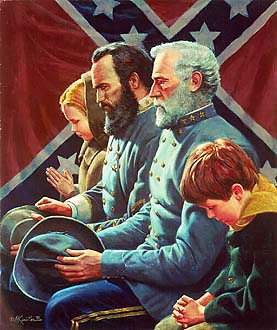
 lee-jackson-in-prayer

Perhaps more than anything the denominational splits of the 1840s and in 1860-61 helped prepare the Southern people as well as clergy for secession and war. They set precedent by which educated Southerners left established national organizations. When secession came, “the majority of young Protestant preachers were already primed by their respective church traditions to regard the possibilities of political separation from the United States without undue anxiety.” [1]

Religion and the churches “supplied the overarching framework for southern nationalism. As Confederates cast themselves as God’s chosen people” [2] and the defense of slavery was a major part of this mission of the chosen people. A group of 154 clergymen “The Clergy of the South” “warned the world’s Christians that the North was perpetuating a plot of “interference with the plans of Divine Providence.” [3] A Tennessee pastor bluntly stated in 1861 that “In all contests between nations God espouses the cause of the Righteous and makes it his own….The institution of slavery according to the Bible is right. Therefore in the contest between the North and the South, He will espouse the cause of the South and make it his own.” [4]

The effect of such discourse on leaders as well as individuals was to unify the struggle as something that linked the nation to God, and God’s purposes to the nation identifying both as being the instruments of God’s will and Divine Providence. It also motivated men like Stonewall Jackson of the battlefield, who’s brutal, Old Testament understanding of the war caused him to murmur: “No quarter to the violators of our homes and firesides,” and when someone deplored the necessity of destroying so many brave men, he exclaimed: “No, shoot them all, I do not wish them to be brave.” [5]

In effect: “Slavery became in secular and religious discourse, the central component of the mission God had designed for the South….The Confederates were fighting a just war not only because they were, in the traditional framework of just war theory, defending themselves against invasion, they were struggling to carry out God’s designs for a heathen race.” [6]

From “the beginning of the war southern churches of all sorts with few exceptions promoted the cause militant” [7] and supported war efforts, the early military victories of Robert E. Lee’s Army of Northern Virginia and the victories of Stonewall Jackson in the Shenandoah Valley were celebrated as “providential validations of the cause that could not fail…” Texas Mehtodist minister William Seat wrote: “Never surely since the Wars of God’s ancient people has there been such a remarkable and uniform success against tremendous odds. The explanation is found in the fact that the Lord goes forth to fight against the coercion by foes of his particular people. Thus it has been and thus it will be to the end of the War.” [8]

This brought about a intertwining of church and state authority, a veritable understanding of theocracy as “The need for the southern people to acknowledge God’s authority was bound up with a legitimation of the authority of clerical and civil rulers. Christian humility became identified with social and political deference to both God and Jefferson Davis.” [9]

Jefferson Davis and other leaders helped bolster this belief:

“In his repeated calls for God’s aid and in his declaration of national days of fasting, humiliation, and prayer on nine occasions throughout the war, Jefferson Davis similarly acknowledged the need for a larger scope of legitimization. Nationhood had to be tied to higher ends. The South, it seemed, could not just be politically independent; it wanted to believe it was divinely chosen.” [10]

Davis’s actions likewise bolster his support and the support for the war among the clergy. A clergyman urged his congregation that the people of the South needed to relearn “the virtue of reverence- and the lesson of respecting, obeying, and honoring authority, for authority’s sake.” [11]

Confederate clergymen not only were spokesmen and supporters of slavery, secession and independence, but many also shed their clerical robes and put on Confederate Gray as soldiers, officers and even generals fighting for the Confederacy. Bishop Leonidas Polk, the Episcopal Bishop of Louisiana, who had been a classmate of Jefferson Davis at West Point was commissioned as a Major General and appointed to command the troops in the Mississippi Valley. Polk did not resign his ecclesiastical office, and “Northerners expressed horror at such sacrilege, but Southerners were delighted with this transfer from the Army of the Lord.” [12] Lee’s chief of Artillery Brigadier General Nelson Pendleton was also an academy graduate and an Episcopal Priest. By its donations of “everything from pew cushions to brass bells, Southern churches gave direct material aid to the cause. Among all the institutions in Southern life, perhaps the church most faithfully served the Confederate Army and nation.” [13] Southern ministers “not only proclaimed the glory of their role in creating the war but also but also went off to battle with the military in an attempt to add to their glory.” [14]

Sadly, the denominational rifts persisted until well into the twentieth century. The Presbyterians and Methodists both eventually reunited but the Baptists did not, and eventually “regional isolation, war bitterness, and differing emphasis in theology created chasms by the end of the century which leaders of an earlier generation could not have contemplated.” [15] The Southern Baptist Convention is now the largest Protestant denomination in the United States and many of its preachers are active in often divisive conservative social and political causes. The denomination that it split from, the American Baptist Convention, though much smaller remains a diverse collection of conservative and progressive local churches. Some of these are still in the forefront of the modern civil rights movement, including voting rights, women’s rights and LGBT issues, all of which find some degree of opposition in the Southern Baptist Convention.

Confederate_Seal

But the religious dimensions were far bigger than denominational disagreements about slavery; religion became one of the bedrocks of Confederate nationalism. The Great Seal of the Confederacy had as its motto the Latin words Deo Vindice which can be translated “With God as our Champion” or “Under God [Our] Vindicator.” The issue was bigger than independence itself, it was intensely theological and secession “became an act of purification, a separation from the pollutions of decaying northern society, that “monstrous mass of moral disease,” as the Mobile Evening News so vividly described it.” [16]

The arguments found their way into the textbooks used in schools throughout the Confederacy. “The First Reader, For Southern Schools assured its young pupils that “God wills that some men should be slaves, and some masters.” For older children, Mrs. Miranda Moore’s best-selling Geographic Reader included a detailed proslavery history of the United States that explained how northerners had gone “mad” on the subject of abolitionism.” [17] The seeds of future ideological battles were being planted in the hearts of white southern children by radically religious ideologues, just as they are today in the Madrassas of the Middle East.

Notes

[1] Brinsfield, John W. et. al. Editor, Faith in the Fight: Civil War Chaplains Stackpole Books, Mechanicsburg PA 2003 p.67

[2] Gallagher, Gary W. The Confederate War: How Popular Will, Nationalism and Military Strategy Could not Stave Off Defeat Harvard University Press, Cambridge MA and London 1999

[3] Daly, John Patrick When Slavery Was Called Freedom: Evangelicalism, Proslavery, and the Causes of the Civil War The University Press of Kentucky, Lexington 2002 p.145

[4] Ibid. Daly When Slavery Was Called Freedom p.138

[5] Fuller, J.F.C. Grant and Lee: A Study in Personality and Generalship, Indiana University Press, Bloomington IN 1957

[6] Faust, Drew Gilpin The Creation of Confederate Nationalism: Ideology and Identity in the Civil War South Louisiana State University Press, Baton Rouge and London p.60

[7] Thomas, Emory The Confederate Nation 1861-1865 Harper Perennial, New York and London 1979 pp.245-246

[8] Ibid. Daly When Slavery Was Called Freedom pp.145 and 147

[9] Ibid. Faust The Creation of Confederate Nationalism p.26

[10] Ibid. Faust The Creation of Confederate Nationalism p.33

[11] Ibid. Faust The Creation of Confederate Nationalism p.32

[12] Foote, Shelby, The Civil War, A Narrative. Volume One: Fort Sumter to Perryville Random House, New York 1963 1958 p.87

[13] Ibid. Thomas The Confederate Nation p.246

[14] Ibid. Daly When Slavery Was Called Freedom p.142

[15] Ibid. McBeth The Baptist Heritage pp.392-393

[16] Ibid. Faust The Creation of Confederate Nationalism p.30

[17] Ibid. Faust The Creation of Confederate Nationalism p.62

Leave a comment

Filed under civil rights, civil war, faith, History, philosophy, Political Commentary, Religion

The Wounded: How War Changes People but Unites Them

n671902058_1153829_4642-2

A couple of days ago I wrote about an encounter that I had with another officer who I had an encounter with last week. I noted that the officer in question had said that he wanted to talk with me and my own prejudices and suspicions regarding his words.

That officer came to me today, and while I cannot entirely subscribe to his theological framing of his position; I have to say that our time together was a blessing and most likely a chance for healing for both of us. The man was not sone sort of ideological or religious extremist by any sense of the imagination. His version of orthodoxy was different than mine, but like me, was a man who idealized the faith that he had in his service and superiors, and had been betrayed by them.  In his case he was betrayed by men who most people could never imagine to be unworthy of that trust.  If I had I not known the men that had betrayed him, I would not have understood what he said to me last Friday.

His comments about not being at our school to learn what we were teaching, I understood when I listened to him and what he had experienced. His faith in God, as unlearned and simple as it was to me was instrumental in saving his life. Even if I disagree with his underlying theology, I cannot abandon a man who in his life, faith and service done all that he can to honor God, his fellow human beings and his country.

Our encounter last week was one where I assumed that he was a religious ideologue, which was not the case. Yes he is a man of faith who could be considered religious even a fundamentalist, but not  a man driven by religious or political ideology. Instead, like me, he is a man wounded during his service and trying to make sense of the betrayal by people that he assumed were his brothers, men that he idealized who in the end betrayed him.

Maybe that is the most difficult issue faced by those who have returned from war but struggle with where they fit in life, their profession and in their relationships.

Pray for all of us,

Peace

Padre Steve+


2 Comments

Filed under faith, iraq,afghanistan, Military, PTSD

Religious Monsters

IMG_0230.JPG

Yesterday I wrote about an experience with a Christian who decided hat his purpose as a military officer was not to learn the craft of his trade but rather to “do the Father’s will” which in his case was to tell me that my faith and experience as a Christian suffering from PTSD was, in one word “garbage.”

To say the least I am offended, but not by God, or Jesus, or the words of Scripture, but rather a religious monster created by an aberrant and heretical brand of the Christian faith that is being sold as absolute truth by Christian Fundamentalist extremists in our country.

The problem is those that become “religious monsters” rarely realize that they are such. Instead they are the salt of the earth, simply proclaiming “the truth” and heaven help you if you don’t agree with them. Holocaust survivor and Italian philosopher Primo Levi wrote:

“Monsters exist, but they are too few in numbers to be truly dangerous. More dangerous are…the functionaries ready to believe and act without asking questions.”

Levi was right, but at the same time he was wrong. Sometimes these monsters are the same people that end up being the functionaries who are ready to believe and act without asking questions.

Sadly, there are many leaders of the political-religious movement loosely defined as the “Religious Right” in the United States who preach a “gospel” of hate and intolerance that demonizes anyone that dares to interfere with their message. Sadly this doesn’t just extend to their politics, but also to the basics of the Christian life of which many of these leaders seem ignorant.

Personally I believe that the virtue of living a good Christian life might be equated with living a good life regardless of one’s religious or secular beliefs. The call to “love God and to love your neighbor” is universal.  It has been my experience that even people that chose not to believe in God, subscribe to the principle of loving or at least respecting one’s neighbor.

I grew up from High School to adulthood in the Christian Right. I know the politics, I know the language and I know the hypocrisy and intolerance. What happened last week, something that I did not plan but was forced on me by one of these fanatical and ignorant “true believers”
has hardened my resolve as a Christian to oppose these American “Christian” versions of the Taliban, Al Qaeda or the Islamic State at every turn.

I have to, because most people, including many moderate and progressive Christians look the other way and do not confront these monsters. People don’t want to believe that good religious people can harbor thoughts of evil, demean, or actually harm others.

But all too often that is the case and we have to call them what they are; not saints, but monsters who use their “faith” to demean, dehumanize and destroy anyone that does not agree with them, even if they are ignorant and unlearned about what they are criticizing in others.

The terrible thing is that most of these “monsters” are actually decent people who really do not understand the implications of what they are doing or the “faith” they are championing. They are basically good neighbors who want to do right and believe that they are doing so. Their leaders on the other hand often manipulate such people into believing that in thinking and even promoting evil, they are doing right.

Thus otherwise good people become unquestioning servants of the real monsters, religious and political leaders that distort the Christian faith and use it to bludgeon those that they hate in the political and judicial process.

The leaders of the Religious Right are a malignancy that will kill any authentic expression of the Christian faith if they have the chance. Their goal is no different than to what the leaders of the Islamic State aspire, but they wear better clothes and appear to be more socially respectable, if only because they are not yet allowed under American law to chop the heads off the people that they oppose. Knowing the history of Christians who controlled the state in past generations, I know that these people only await the chance to do this. It has happened all too often for any of us not to believe that it couldn’t happen again.

That my friends may sound harsh, but it is all too true. Hannah Arendt spoke of the banality of evil by which she meant the people who just went along with evil without really thinking about or understanding the consequences of their actions which they in their hearts believe are right because their religion or ideology says so. But all too often, the people who absorb and adopt these views, who become “the willing executioners” of the policies of those that promote them are just as guilty, and just as responsible for their actions as if they had thought of them on their own.

In the movie Judgement at Nuremberg Spencer Tracy playing the presiding judge made a most interesting and provocative comment. He said:

But this trial has shown that under a national crisis, ordinary – even able and extraordinary – men can delude themselves into the commission of crimes so vast and heinous that they beggar the imagination. No one who has sat through the trial can ever forget them: men sterilized because of political belief; a mockery made of friendship and faith; the murder of children. How easily it can happen. There are those in our own country too who today speak of the “protection of country” – of ‘survival’. A decision must be made in the life of every nation at the very moment when the grasp of the enemy is at its throat. Then, it seems that the only way to survive is to use the means of the enemy, to rest survival upon what is expedient – to look the other way. Well, the answer to that is ‘survival as what’? A country isn’t a rock. It’s not an extension of one’s self. It’s what it stands for. It’s what it stands for when standing for something is the most difficult! Before the people of the world, let it now be noted that here, in our decision, this is what we stand for: justice, truth, and the value of a single human being.”

I choose to stand for Justice, truth and the value of a single human being over the doctrine of those that will use faith to depreciate, devalue and dehumanize those that they feel have departed from the truth.

With that, I go back to my beer and on the game two of the National League Championship Series where I hope that my San Francisco Giants will win.

Peace

Padre Steve+

1 Comment

Filed under christian life, faith, History, Loose thoughts and musings, PTSD, Religion

Is it Really God or do I Make You Uncomfortable? PTSD, Mental Illness and Christians

IMG_1915

Christians can be among the most clueless people regarding how their language and theological prejudices negatively impact others and harm their own witness regarding their professed devotion and love of Jesus the Christ. Sadly much of what they spout is neither scriptural or has any roots in reason or church tradition. Instead it is a product of their own prejudice and uncomfortableness with those who express doubt that they have learned from very popular, yet extremely ignorant and often hateful political ideologues who masquerade as preachers in mega-churches, on television, radio or the internet.

There are many Christians, particularly conservative Evangelicals and Charismatics who are fine people, men and women of integrity who I can honestly say love God and try serve God and also to care for his people. That being said many of these same people in their attempts to help others; especially those dealing with PTSD, depression, anxiety, suicidal thoughts, substance abuse and faith crisis’s do more far damage and harm than good. This is because they are unaware of their prejudices that they learn in church and how wrong their preachers are about such subjects, but still presume that what they have learned trumps other people’s experience. Yes this is a generalization, but there is much truth in it.

Those who read this site regularly and know something about me know that I am a Navy Chaplain, a Priest in an Old Catholic denomination and have been in the military over 30 years including a tour in Iraq and one at sea for Operation Enduring Freedom. You also know that I am very transparent about my struggle with PTSD as well as faith following my return from Iraq in 2008. According to many I am now a “liberal” which for some is even worse than being an “unbeliever.”

Being transparent about this difficult because it involves risk and as a person who is extremely introverted to begin with I am a very private person and eschew risk. I can understand why people who struggle with different parts of themselves that are unpopular or stigmatized by people in “normal” society feel, especially in the church. However in 2009 in consultation with my first therapist I decided to in a sense “come out of the closet” in regards to PTSD, moral injury, depression, anxiety, suicidal thoughts and mental illness in general; as well as my struggle to dealing with faith and God. All of those things are fraught with danger in a military society where the stigma regarding all of these things is all too real and all to prevalent in the military. But I digress…

Stigma is difficult and I deal with it all the time. What I represent by being so transparent, especially to Christians who have an absolute need for certitude in their lives is a topic that they don’t want to face. PTSD and other mental illness is a subject that scares many people. For some religious people, not just Christians, it forces them to retreat into the certitude of a Fundamentalist theology that blames the victim rather than to face reality of the issue, and the uncomfortable truth that it could happen to them.

Of course when your theology is that of “Job’s comforters” the only way to deal with such subjects is to retreat to that certitude. Admitting the truth would be something that would shred their faith and maybe even destroy their belief structure, thus to keep that certitude the experiences and faith of others which are different must be dismissed, confronted or shown to be wrong so the offending individual can repent and turn back to God.

Last week I had an officer come up to me after a ceremony and begin to tell me that “God sent him to our school” and he was there “not to learn what we teach” regarding what he as a relatively senior and up and coming officer is there to learn, but “to do the Father’s business.” For those that don’t understand this him that business meant that he had to tell me that God didn’t send him here to learn what he was sent to learn but to bring me back to the right way of thinking and belief.

I have no doubt of the man’s sincerity, but sometimes sincere people scare the hell out of me. I understand why Eric Hoffer wrote these words about “true believers”:

“The impression somehow prevails that the true believer, particularly the religious individual, is a humble person. The truth is the surrendering and humbling of the self breed pride and arrogance. The true believer is apt to see himself as one of the chosen, the salt of the earth, the light of the world, a prince disguised in meekness, who is destined to inherit the earth and the kingdom of heaven too. He who is not of his faith is evil; he who will not listen will perish.”

It has been my experience that such people are more inclined to want to tell you what to do rather than listening. This man began to tell me about his “testimony” that though he “didn’t have PTSD that he had a right to have it” and that “God wanted to take my “garbage” from me…but I kept taking it back.”

It took me the night to sleep on it before I realized the full implications of this man’s words.

Though I have heard this kind of talk for decades growing up in evangelical and charismatic Christian circles what this man said to me stunned me. I don’t expect educated professionals to make those kind of comments. However, religious fundamentalism, be it Christian, Jewish, Moslem or whatever can make educated professionals as fanatical and even as bloodthirsty as unlearned oafs. Please note that many of the top leaders of the Islamic State are educated professionals with highly technical backgrounds. Being educated does not mean that you cannot allow your religion to turn you into a sociopathic killer.

Let me just share my thoughts on his words. First there was the comment that he “was not at our Staff College to learn what we taught” but rather “to do his Father’s will.” I am sorry, I cannot accept such logic from either a Christian or a military professional perspective. First from the Christian perspective we have multiple responsibilities in our lives, faith should inform us. At the same time if a person is a Christian but also an officer, he or she is also an agent of the state who has sworn an oath to the Constitution.

The more that I thought about this man’s words, that he wasn’t at our college to learn, but to “do his Father’s will” I got more angry. He said that he wants to talk to me about my stuff next week but I think that I will have to tell him that if he is not here to learn that he should resign his commission. If he is not learning and does not care to learn then it is a waste of the taxpayer money and an abuse of his office and I am going to tell him that, and I may even inform the senior officer of his service on our faculty of his comments. Of course I cannot divulge his name or anything about him, but maybe the senior officer of that service can fire “warning shot” across the bow of all of the students from his service. But that comment angered me, it was arrogant and if I have any Christian concept of our responsibilities to God as well as our responsibilities to the citizens of our country who employ us.

The second thing that bothered me was that he insinuated that “though he did not have PTSD that he had a right to have it.” First, if he does not have it he is lucky and should be thanking God and not judging others. Second, if he does not have it he doesn’t have any right to have it. That statement is arrogant and presumptive and it totally devalues and dehumanizes the suffering of the person who would rather not be dealing with it. It would like someone telling a person with cancer that “though they don’t have cancer that they have a right to it.” I’m sorry, that would be reprehensible, just as this man’s words were to me. No one who does not have a disease or illness does not have a right to it.

But that’s the difference for the fanatic. Mental illness is not the same as physical illness. I cannot imagine this man telling me what he said if I had an illness like cancer, but I could be wrong because I have heard Christians, especially charismatics and Pentecostals say similar things to those with cancer or other terminal illnesses. The attitude is hateful, arrogant and so against what Jesus would do in a similar situation based on the words of scripture.

The last thing was that the man told me that “I kept taking my garbage back from God.” That devalued my experience, my suffering and my struggle to still believe even when I couldn’t believe. The fact is that I have heard this metaphor so many times that it is not even funny. What the illustration says in so many words is that if we suffer and God does not grant relief or healing that it is our fault, and we are guilty of keeping our garbage, even though God wants it.

Sorry that is bullshit of the worst degree. That metaphor is not even in scripture and I cannot even recall any of the Church Fathers who made such a statement. If we believe in God at all, and have faith to believe that in spite of trails, tribulations and suffering that God still loves and cares for us, that God has not abandoned us even when we feel that he has abandoned us that to say what this man said is outright blaspheme.

As you can understand from what I have said here, I am angry about this on a number of levels. I hope that this officer comes to see me this week because while I will be pastoral to him and care for him, I will not mince words. Unless he cares about his commission and duties as an officer then he better be at the Staff College to learn If he is not he should resign his commission and become a missionary. He is wasting taxpayer money and pissing on his oath of office and I am going to tell him that.

Second, I am going to tell him that if he doesn’t have PTSD that he doesn’t know what the hell he is talking about and he has no “rights to it.” I am going to tell him that if he says those words to the people who serve under him who do have it that he is misusing his office. I know far too many soldiers, sailors, marines and airmen who suffer the very real effects of PTSD, who suffer the discrimination and stigma that comes with it to have some “Christian” senior officer tell them that their suffering is “their problem” because they “took their garbage back from God.”

The whole thing was offensive, and last night I had a terrible time sleeping and this morning woke up suffering a lot of anxiety. On the way home from a visit to the local Navy Exchange I told Judy that I felt anxious and couldn’t put my finger on the reason why. Now I know, I was really bothered by what this officer said and it was much more disturbing than I had initially thought, because it is more than about me.

Now here is the bigger issue for me. It is a societal and policy issue. Chaplains are in the military to facilitate the free exercise of religion for all those in the military. We are not to proselytize and are to either perform or provide for the religious rights of all assigned to the units that we serve. I do that, and have done it for over 22 years as a chaplain in the Army and the Navy, honoring and caring for the religious needs of people across the spectrum.

But here’s the deal, thanks to the Christian right there are a host of fanatical Christians, mostly lay people who serve as officers and NCOs who have no concern for the rights of others, even the Chaplains who are there to make sure that they get what they need. Instead they are there not to serve the country but on their own religious mission paid for by tax payers and this is being promoted by many leaders of the American Religious Right, including James Dobson, Franklin Graham, Mike Huckabee, Pat Robertson, Phyllis Schafly, the leaders of American Family Association and Family Research Council including Jerry Boykin, Tony Perkins and Bryan Fischer, not to mention the corporate leaders of the big and politically mega-churches.

Can you imagine if Moslems in the military were to say that they in the military to serve “Allah” first what the same Christians who say that they are in the military to “do the Father’s will” would say? They would be apoplectic and protest how Moslems were trying to use the military to take over the government. But isn’t that what they are trying to do? As retired Army Lieutenant General and religious right activist Jerry Boykin said: “The military is the most respected institution in America. So if you want to change the rest of society, you have to target the military.”

As the late Dr. D. James Kennedy said before his death: “As the vice-regents of God, we are to bring His truth and His will to bear on every sphere of our world and our society. We are to exercise godly dominion and influence over our neighborhoods, our schools, our government… our entertainment media, our news media, our scientific endeavors—in short, over every aspect and institution of human society.”

Personally I cannot see how this is different from the the statements and actions of those of militant Islamic leaders of Al Qaida and the Islamic State. But then my presence and my transparency must be a threat. I’m pretty sure that this officer when he comes to share his “testimony” will further attempt to devalue my faith and experience. In fact I believe that this man is not so much driven by God but rather by his own doubts, fears and uncertainty about his own faith which is threatened by my words. Truthfully I have seen this far too often. People who must have absolute certitude in their own life who are threatened by those that express doubts. I felt that almost immediately when this man told me these things.

The stage is set, but I don’t plan on becoming a notch in his Bible and I am going to tell him straight up I believe that his theology is flawed and that I believe him telling things like this to me, or anyone else suffering PTSD is an abuse of his office. I also will ask him if he is sure that this is God, or if it is not his own fears hat he is expressing; and finally I will tell him that if his purpose at this highly selective level of military education is not to learn what we are teaching in order to serve as an officer, that he should immediately submit his resignation and retire from the military.

Why will I do this? Because simply I care about my country and my faith more than I do my career. I’ve been in the military a long time, well over half of my life, and frankly encounters like this are getting old.

Pray for me a sinner, because I will need it.

Peace

Padre Steve+

5 Comments

Filed under christian life, faith, leadership, mental health, Military, PTSD