Category Archives: faith

The Path Less Travelled: Being a “Liberal Moderate” in a Polarized Society

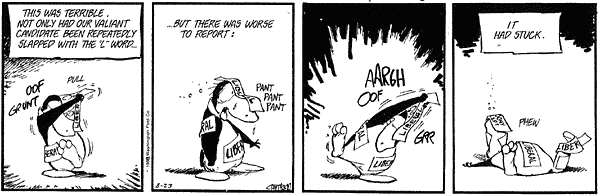
bloom-county-the-label-stuck

Somewhere along the path from conservatism to moderation I got labeled.

I got labeled with the “L” Word. No, not the “Lesbian” “L” Word which is actually kind of cool, but the other less socially acceptable one, the “Liberal” label.

I remember back in 1981 when I saw my first Lesbian couple walking together at California State University Northridge. I was sitting on the lawn outside of the office that I worked and they walked by. As a typical male I was enthralled by what I saw, but that enthrallment was short lived as when I walked back into the office I heard that my hero, President Ronald Reagan had been shot and that retired Army General, former Nixon aide and now Secretary of State Al Haig was now in charge of the country.

To tell the truth I don’t know how the transformation from Conservative to Moderate (read Liberal) happened. When I was in college I cheered the demise of Jimmy Carter. After college the same was true about Walter Mondale, Mike Dukakis. Al Gore and even John Kerry. I listened to Rush Limbaugh, Sean Hannity and Neil Boortz as much as I could. Not even 7 years ago I was defending “W” against what I thought were unfair assaults from the left. I enjoyed liberal bashing. It was fun and as the people that knew me back then could tell you I was quite good at it and to this day I regret it.

You see a funny thing happened between 2004 and now. I think it was a place called Iraq, where I began to question the unquestionable questions of conservative orthodoxy in a number of forums including both politics and religion. I became a moderate and a passionate one at that. Since “moderate” is a very misunderstood term let me explain. If you are a conservative it means that I am a liberal. Some liberals assume that I am a conservative but on the whole the word moderate is now associated as being liberal and I am okay with that because I believe in freedom, equity and fraternity for everyone, not just people that are like me or believe like me, especially religious types.

I actually think being a moderate is really a tricky thing. Back when I was in seminary during the pre-Fundamentalist takeover of Southwestern Baptist Seminary I remember hearing a big name Fundamentalist preacher say that “middle of the road moderates were only good to be run over.” One of my professors who would be a casualty of the takeover of the seminary said that for many in the Southern Baptist Convention of the time that “Liberal means anyone to the left of me.”

Now I do have to confess, unlike a lot of people when they get older and become more conservative I have become more “liberal” in that I am more accepting of people different than me. I was talking with a dear friend a while back who is proud of his Tea Party affiliation and he mentioned that when he was young that he was a liberal but now older that he was a conservative. I have no problem with that, it is a free county. My friend, who is still a friend despite political differences, maintains his beliefs, but gives me room to differ, something that I return to him. Both of us feel that friendship is more important, and I can count numerous other friends that I have the same kind of relationship with.

BuFor me it is a bit of a conundrum. I have friends who are way to the Left or to the Right of me who I respect and who I care for, we agree to disagree. The fact is that in reality I am a very pragmatic person and I would rather see people work towards compromise and cooperation so that the vast majority of people can prosper in freedom. So I choose to be friends with people far different from one another and who disagree with me. But we are still friends, my issue is not with people of good will, but with people who seek to stand as judge, jury and executioner of those that disagree with them, even former friends.

As far as what I believe…I am a Christian who believes in tolerance, acceptance and equity. I reject the militant triumphalist political version of the Christian faith that is the creed of the religious right, which by the way has nothing to do with any of the historic Creeds of the Christian Church. To put it in a Christian theological perspective I believe in the grace, love and mercy of the the Crucified God and reject the politically charged triumphalism of those who use my faith to oppress others who do not believe the way that they do. That being said I also reject the idea that religion and faith should be excluded from public discourse, only that there is an open exchange of ideas and not the imposition of any faith or lack thereof, on others using the police power of the state. If I want that I will move to Saudi Arabia or Afghanistan or any other country that uses its laws to enforce the majority religion, and suppress the rights of religious minorities or unbelievers or Communist China if I want to live under the tank treads of official state controlled atheism.

After I returned from Iraq I was for all intents and purposes an agnostic, a pretty difficult position to be a priest, but my sense of call and vocation kept me going even when I didn’t know if God still existed or even cared. When faith returned it was different, I believe but at the same time I doubt. This transformation in faith has made me more willing to question as well as accept things that I would not have before Iraq including the role of the church in politics, the treatment and rights of the LGBT community to equity, the rights of Moslems and other religious minorities and probably the cardinal sin of believing that women should be ordained to the priesthood and episcopate. Voicing those things back in 2010 got me thrown out of a church, so I know just how tolerant some of my Christian brothers and sisters can be. In fact there is a recent Pew survey which spelled out just how personal and vindictive the religious, political and cultural divide has become, having been turned on by people I thought to be friends, I know that well. I don’t like it but it is part of life now days in the new cultural-religious “ante-bellum” United States. I could go into other social issues that have a religious component but won’t right now, but I will say that I believe in a theology of liberation for all people. Again if that makes this “moderate” a “liberal” in the eyes of some so be it.

It was funny a couple of months ago I had a retired Navy Chaplain blast me here on this site for calling myself a “moderate.” He labeled me as a liberal. Obviously he had the same definition of moderation as the fundamentalists that said that a moderate was only good to be run over. But I won’t be run over and if that means that some people label me a liberal, so be it. I think there is honor in that, and I would rather be honorable to what I believe than sell out and become a modern Christian Pharisee intent on controlling the lives of others that do not believe like me.

However there are times that I feel that I am pissing into the wind when I watch those that we all have elected to office in Washington DC and our various State Houses behave, especially those of the more radical “conservative” bent, though I know some liberals who are have an equally invective edge. I am probably not alone in this feeling and do hope that the hard liners on both sides of the political spectrum can get their collective crap together before the plunge us into the abyss like the politicians of Weimar Germany did in the late 1920s and early 1930s. We all know how well that turned out.

1622612_10152232336042059_727365308_n

All that being said I am still a moderate, but in today’s social and political climate I am a distinctly liberal one, and for that I will not apologize. If that makes some angry or uncomfortable than I have done my job, as Finley Peter Dunne first remarked, it is my duty “to comfort the afflicted and afflict the comfortable.”

So until tomorrow.

Peace

Padre Steve+

6 Comments

Filed under christian life, civil rights, ethics, faith, philosophy, Political Commentary

Frightened by Christians

10151918_10152444030142059_7871957421917905974_n

“I like your Christ, I do not like your Christians. Your Christians are so unlike your Christ.” Mahatma Gandhi

I expect that this article might make some people uncomfortable but it is something that I need to write.

I am a Christian. I am a Priest and I am a Navy Chaplain. But for the most part I am afraid of Christians. There are many reasons for this. Some are more general in the way I see Christians treat others; their own wounded as well as non-believers, the political machinations of pastors and “Christian” special interest groups masquerading as ministries.

But most of why I am afraid is because what I have experienced at the hand of many Christians, some of whom I had counted as friends many of whom are pastors, priests or chaplains. To experience rejection or being shamed by people that you thought were friends is very hard, especially when that at one time you trusted them implicitly to care for you. However to be rejected by those that you trusted “in the name of God, ” or rather because you violated supposedly “correct” doctrinal beliefs about God is frightening.

It seems to me that with many Christians and churches that the “unconditional” love of God that they proclaim not really unconditional. It is totally conditional on believing what they believe or behaving in the way they think that you should.

For those that do not know me or my story I am a career military officer with over 30 years of service between the Army and Navy. I have been a chaplain since 1992 and served in the National Guard, Army Reserve, Active Duty Army and the Navy. I am a trained hospital chaplain; I have a great academic background. I went to Iraq in 2007 and came home with a terrible case of severe chronic PTSD. I still suffer from some anxiety, depression and plenty of insomnia. I find mental health care hard to get in my new assignment and I realize how woefully unprepared that our medical system, military, VA and civilian is to care for that vast numbers of veterans like me.

After Iraq I suffered a collapse of my faith and for close to two years was a practical agnostic. Only my deep sense of call and vocation kept me going and there were times that I wondered if I would be better off dead.

When faith returned through what I call my Christmas miracle it was different. I totally relate to author Anne Rice who said:

“My faith in Christ is central to my life. My conversion from a pessimistic atheist lost in a world I didn’t understand, to an optimistic believer in a universe created and sustained by a loving God is crucial to me. But following Christ does not mean following His followers. Christ is infinitely more important than Christianity and always will be, no matter what Christianity is, has been, or might become.”

I have always questioned a lot but after my crisis of faith I began to see through the bullshit. I began to not only question things my former church taught, but openly stated my convictions about how we treat others as Christians, the equality of people in general and tolerance for those different than us including gays and Moslems who for some Christians are rather low on the scale of those that God might love.

After Iraq I was sickened by the crass politicization of conservative American Christianity and many of its leaders. Men and women who advocate war without end, be it real wars against “enemies” of American, or promote a culture war even against other Christians that they do not like or agree with. Of course this is all done in “Jesus name.”

Likewise I question the opulence and materialism of the church. I question the nearly cult like focus and near worship accorded to the Pastor-CEOs of the megachurches and the television preachers and teachers. I wonder in amazement about how many of these leaders live like royalty and have devoted followers who despite repeated scandals treat them as the voice of God.

Along with the that I question the preference of many American Christian leaders for the rich and their disdain for the poor, the alien and the outcasts among us. I don’t know where where they get it.

All of that got me thrown out of a church that I had served 14 years a priest and chaplain back in 2010. I thought I had a lot of friends in that church. I still have some that keep in contact with me but after my dismissal most abandoned me. That hurts worse than anything.

In fact when I came home from Iraq in crisis and falling apart the first person who asked about how I was doing with God was not clergy. It was my first shrink. I was asked by a commanding officer after Iraq “where does a chaplain go for help?” I told him “not to other chaplains.”  The sad thing is that man who did care about me suffered untreated terrible PTSD and Traumatic Brain Injury and committed suicide earlier this year.

I have had a few experiences this week that have opened that wound again and reminded me of why I am afraid of many that call themselves Christians. I had a friend comment on some coarse language I used in a rant on a social media site, the friend noted a certain word that I used was used to silence others.

I replied that he was wrong, that the ultimate way to silence others was to invoke God and shame them. That is the ultimate trump card because no one is bigger than God.

The good thing is that when he realized why I had said the word and realized what he said had further wounded me and understood a bit of what I was going through he was quite gracious, sympathetic and apologetic. He is still a friend and he means a lot to me. Thankfully there was not another broken relationship.

But my friend’s initial comment made me realize how many of us as Christians, even well meaning people, focus on outward behaviors, words or actions of others without understanding what they are going through. Like Dietrich Bonhoeffer said:

“Many people are looking for an ear that will listen. They do not find it among Christians, because these Christians are talking where they should be listening.”

I am thankful that I have a number of friends including a good number of Christians from various backgrounds who have stood by me even if they disagree with my theology, politics or favorite baseball team.

That being said with the exception of such
people who have been with me through thick and thin I am almost terrified of being around Christians. Church in most cases is a frightening place for me, and the sad fact is that if I were not already a Christian there is little in American Christianity that would ever cause me to be interested in Jesus.  I can totally understand why churches are hemorrhaging members, especially young people and why the fastest growing religious preference in our society is “none” for I too am in some sense an outcast.

As Pedro Cerrano (Dennis Haysbert) said in the movie Major League: “I Like Jesus very much, but he no help with curveball.”

Pray for me a sinner,

Peace

Padre Steve+

13 Comments

Filed under christian life, faith, Military, ministry, Pastoral Care, Political Commentary, PTSD

Church, Faith, Tolerance and Reconcilliation

1622612_10152232336042059_727365308_n

“Sometimes I think it is my mission to bring faith to the faithless, and doubt to the faithful.” Paul Tillich

My friends, I write this because of something that happened to me a couple of days ago. It was an incident that upset me greatly because it ended up in the fracturing of a relationship by a friend who evidently could not tolerate where I was in my life as a priest and Christian. I discovered again the reality of what Dietrich Bonhoeffer wrote:

“Many people are looking for an ear that will listen. They do not find it among Christians, because these Christians are talking where they should be listening. But he who can no longer listen to his brother will soon be no longer listening to God, either; he will be doing nothing but prattle in the presence of God, too. This is the beginning of the death of the spiritual life, and in the end there will be nothing left but spiritual chatter and clerical condescension arrayed in pious words… never really speaking to others.”

My experience of the Church is profoundly influenced by my life in the nether world of the military culture. My world view is shaped by a blending of various Christian traditions, mutual support and collaboration among believers of often radically different points of view. Because of the love, care and mentoring of people from a blend of different traditions I came to know God and survived a tumultuous childhood with many moves.

As a historian I have been blessed to study church history from the early Church Fathers to the present. As I look to church history I find inspiration in many parts of the Christian tradition. In fact rather being threatened by them I have become appreciative of their distinctiveness. I think that there is a beauty in liturgy and stability in the councils and creeds of the Church. At the same time the prophetic voice of evangelical preaching shapes me, especially the message of freedom and tolerance embodied in the lives and sacrifice of men like John Leland, the American Baptist who helped pioneer the concept of Freedom of Religion established in the Constitution of the United States, of William Wilberforce who labored to end slavery in England and, Martin Luther King Jr. who led the Civil Rights movement.

Likewise that prophetic message of the faith is demonstrated in the ministry, writing and martyrdom of Dietrich Bonhoeffer and his contemporaries Martin Niemoller and Jesuit priest Father Rupert Meyer. All three resisted and preached against the evils of Nazism. In a more contemporary setting I am inspired by Bishop Desmond Tutu who helped topple apartheid in South Africa.

Women like Teresa of Avila and St Catherine show me that women have a legitimate place of ministry and leadership in the Church. I am convinced through my study of Church history, theology and a deep belief in the power of the Holy Spirit that women can and should serve as Priests and Bishops in the church.

My theology has shaped by the writings of Hans Kung, Yves Congar, Jurgen Moltmann, Andrew Greeley, and Henry Nouwen. I’ve been challenged by St Francis of Assissi, John Wesley and Martin Luther. I am especially inspired by Pope John XXIII whose vision brought about the Second Vatican Council and I am inspired by Pope Francis.

I pray that Christians can live in peace with one another and those who do not share our faith. I pray that we can find ways to overcome the often very legitimate hurts, grievances and divisions of our 2000 year history. At the same time I pray that we can repent from our own wrongs and work to heal the many wounds created by Christians who abused power, privilege and even those who oppressed others, waged war and killed in the name of Jesus.

I do not believe that neither triumphalism nor authoritarianism has a place in in a healthy understanding of the church and how we live. I am suspicious of any clergy who seek power in a church or political setting. I profoundly reject any argument that requires the subjection of one Church with its tradition to any other Church. In fact I think that the arrogance and intolerance of Christians to others is a large part of why people are leaving the church in droves and that the fastest growing “religious group” is the “nones” or those with no religious preference. Andrew Greeley said something that we should take to heart:

“People came into the Church in the Roman Empire because the Church was so good — Catholics were so good to one another, and they were so good to pagans, too. High-pressure evangelization strikes me as an attempt to deprive people of their freedom of choice.”

I grew up in and have lived my life in a very open and ecumenical environment. I have lost any trace denominational parochialism and competition that I might have had if I had become a pastor of a civilian parish instead of a chaplain. It is interesting that the pastor that first ordained me in the evangelical tradition and the bishop that ordained me as a priest both did so with the intent that I serve as a chaplain. Whether it was the recognition of a gifting for the work or the fact that they didn’t want me messing up their civilian operations by asking hard questions I will never know.

I believe that my environment and the men and women who have helped shape my life have been a stronger influence in the way I think about ecumenical relations and ministry than my actual theology or ecclesiology. Whether they were Catholics, Anglicans, Lutherans, Methodists, Presbyterians, Evangelicals or even those considered by many to be outside the faith including Jews, Moslems, Buddhists, Mormons and even complete non-believers all have contributed to my life and faith.

I have grown weary of refighting theological debates that have divided the church for a thousand years. Since what we know of theology including our Scriptures and Creeds are based on faith and not science I see no reason to continue to battle.

That doesn’t mean that I think we should put our brains in neutral but rather we must wrestle with how to integrate our faith with science, philosophy and reason, otherwise we will become irrelevant. In that sense I identify with Saint Anslem of Canterbury who wrote about a faith seeking understanding and Erasmus of Rotterdam who very well understood the importance of both faith and reason. In that sense I am very much at home with the Anglian triad of Scripture, Reason and Tradition when it comes to approaching faith.

I struggle with faith and belief. After Iraq I spent two years as a practical agnostic. As Andrew Greeley wrote: “Most priests, if they have any sense or any imagination, wonder if they truly believe all the things they preach. Like Jean-Claude they both believe and not believe at the same time.” Andrew Greeley “The Bishop and the Beggar Girl of St Germain”

I am an Old Catholic and believe that inter-communion does not require from either communion the acceptance of all doctrinal opinion, sacramental devotion, or liturgical practice characteristic of the other, but implies that each believes the other to hold all the essentials of the Christian faith. I like to think that I embody what the early Anglicans referred to as the via media and that somehow my life and ministry has been about building bridges at the intersections of faith with a wide diversity of people.

When I have tried to embrace traditionalism or choose to fight theological battles I have ended up tired, bitter and at enmity with other Christians. In a sense when I tried those paths I found that they didn’t work for me. I discovered that I was not being true to who God had created and guided my life, education and experience. I feel like T. E. Lawrence who wrote:

“The rare man who attains wisdom is, by the very clearness of his sight, a better guide in solving practical problems than those, more commonly the leaders of men, whose eyes are misted and minds warped by ambition for success….”

My favorite theological debates have been with other chaplains over pints of good beer in German Gasthausen or Irish pubs. Those were good times, we argued but we also laughed and always left as friends and brothers. I believe since we are human that none of us will ever fully comprehend all of God or his or her truth. I believe that the Holy Spirit, God’s gracious gift to her people will guide us into all Truth. For me my faith has become more about relationships and reconciliation than in being right.

As far as those who disagree with me that is their right, or your right if you disagree. I don’t expect agreement and I am okay with differences and even if I disagree with an individual or how another religious denominations polity, theology, beliefs or practices those are their rights. In fact I am sure that those that believe things that I don’t are at least as sincere as me and that those beliefs are important to them. I just ask that people don’t try to use them to force their faith or belief on others, be it in churches or by attempting to use the power of government to coerce others into their belief systems.

To my friend who broke contact with me when I refused to debate his argument that I should submit myself to his Church and tradition, the door is open for reconciliation.

Peace

Padre Steve+

2 Comments

Filed under christian life, faith, Religion

Long Days, Lost Wallets and a Long Layover…Ministry Included

10151918_10152444030142059_7871957421917905974_nWell my friends it is after Nine PM Eastern Time and I am still enroute to Houston after leaving my home at Six AM. This means that I have been traveling for over 15 hours and since I still have about three hours before I get to Houston and maybe more before I lay my head down on my pillow that this qualifies as a long day.

Things went well enough at first until I got to what I thought was my one layover at Baltimore Washington International Airport and discovered that I did not have my wallet. Long story short after about an hour of searching, phone calls and consternation it looked like my travel to an important conference with my church and fellow denomination clergy and chaplains was not going to happen. I went to the Southwest Airlines gate agent who put my information in the computer and found that my missing wallet had been turned in to the gate agent in Norfolk. Armed with that information I called the Staff College and the industrious young man got me back to Norfolk to my wallet and connected me with flights to get me to Houston late tonight.  While in Baltimore some nice lady who overheard my near panicked conversation with people at the Staff College gave me $20 to eat. Since beer is technically bread since it is made from grain that was lunch.

To let you know I do not do airports or aircraft well. Today, even with all the craziness I am still in one peace. I attribute this to prayer and pilsner, though technically I was drinking lagers at almost every stop. I figure when it come to dealing with airports I can deal with panic mode because of the crowds by going crazy, not a good option, drugging myself with anti-anxiety meds which don’t taste good or drink beer which does taste good. Once I had my wallet back I also got food, comfort food instead of healthy food, which I will go back to tomorrow. Of course with over three hours to go before I get to Houston I have switched to lots of water since I tend not to do sodas very often.

While at the Johnny Rivers Grill and Market in Orlando Airport I had some pulled pork BBQ, it was okay, as well as a couple of beers and while there had a young man in a delay situation for another flight sit next to me at the bar. He was a Staff Sergeant in the National Guard who was being called home early from vacation to drill. He was leaving his family in Orlando. He has spent several deployments to Iraq and Afghanistan and was telling me that he still has not been able to re-set after his last deployment because in addition to his civilian commitments his Guard unit continues to push him and all of its personnel hard, without much thanks and with no support to soldiers or families. It was a similar conversation that I had with a senior Marine Corps Officer recently. The important thing for this soldier who has served his country for 15 years as a citizen soldier was that I cared to listen to him and understood.

I didn’t do much talking, mentioned that I had been to Iraq, had PTSD and had been an agnostic for a couple of years and he was grateful just for someone to listen. The sad thing is there are far to few people, especially leaders who will take the time to do that. The fact is we have to stand by our guys, they have put themselves on the line time and time again, we as leaders owe them. But the truth is as my Marine friend noted is that since 2001 the attitude is that you owe the military.

When I was training to be a Chaplain in the Texas Army National Guard, Colonel John Price, an Episcopal Priest told me that his best ministry happened in officer’s clubs and bars, being available to people who would never darken the door of a church, come to a chapel service or would be too proud to come to the office.  Father Price was right. Jesus didn’t cloister himself, he was out with people. Most religious people didn’t care much for it but he drew people to him because he was where they were.

We as Chaplains as well as leaders must change our culture or we will destroy the men and women entrusted to us by the nation and in the process destroy our armed forces. Without the people the machines don’t matter that much.

So anyway, not much longer until I will board this flight. So until tomorrow,

Peace

Padre Steve+


Leave a comment

Filed under christian life, faith, Military, ministry, PTSD

Thoughts on the 2014 National Day of Prayer and a Big Reason to be Thankful

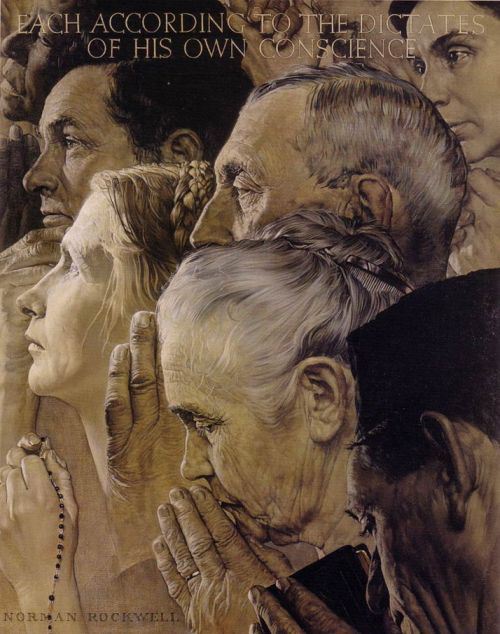
norman-rockwell-freedom-of-worship-2

Friends, I am traveling today and it is indeed the National Day of Prayer and the sinner that I am, I am always in need of prayer. Just to let you know that I do pray contrary to what some may think, I had good reason to pray today. Somehow on the trip I dropped my wallet and when I got to my mid way stop in Baltimore I didn’t have it. Near panic ensued as I looked everywhere I had been in the BWI terminal as well as called back to Norfolk where I departed.I saw my entire life flashing in front of my eyes and wondered if an identity thief was going to take me for everything I have before I could cancel all of my credit cards, not to mention the pain of getting new military ID and drivers license. I felt so incredibly stupid.

Finally after contacting the Staff College it looked like I was going to be heading home and missing the conference that I really needed to attend. A lady sitting near me took pity on me and gave me $20 so I could at least eat. I was grateful. After talking with our travel people I went to the desk agent at the Southwest gate where my Houston flight was to depart from and asked them what to do since I had no identification. They put my name in their computer and found that their gate agents in Norfolk had found the wallet. The young man at the gate worked with everything to not only get me back to Norfolk but, to arrange to get me my wallet and on another flight to get me to Houston late tonight. It was positively amazing. 

But what was really cool was that people who I didn’t know, who I don’t know if they are Christians, or any other religion or in fact if they had any faith at all stepped in to help me. I do not know or care what their political affilation, religion, Alma Mater is, or even if they are Los Angeles Dodgers fans. Someone turned in my wallet in Norfolk rather than making off with it. The airline personnel of Southwest Airlines went  above and beyond the call of duty to help me and to calm me, and yes I did need calming.

Other people, security and TSA at BWI and Norfolk tried to help. Then there was the kind lady who gave me $20. Since I routinely give to panhandlers because I have been poor before her act of kindness was quite touching. What is cool about this experience was that a bunch of good people cared about me. Like I said I don’t know any of them but they were wonderful and I am thankful, not just to God, but to the decent human beings who whatever their motivation were wonderful.

It will be a lot longer travel day than I had planned but my misadventure has shown me that we still have a lot of good and kind people in this country and that is something to celebrate.

Since I needed calming I was able to get me a big beer and now with that in hand waiting for my flight I give you my thoughts on the National Day of Prayer. I actually wrote this article last year, but since most people seem to think that the day is for the right wing political hacks at the “National Day of Prayer Task Force” founded in by Shirley Dobson in 1982, here is the real story. As the late Paul Harvey would have said “the rest of the story.”

“The notion of a Christian commonwealth should be exploded forever…Government should protect every man in thinking and speaking freely, and see that one does not abuse another.  The liberty I contend for is more than toleration.  The very idea of toleration is despicable; it supposes that some have a pre-eminence above the rest to grant indulgence, whereas all should be equally free, Jews, Turks, Pagans and Christians.” John Leland

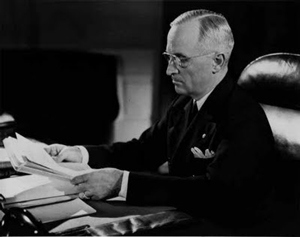
Today was the National Day of Prayer. The event was established by President Harry S Truman in 1952 was designed to mark the common freedom that we have as American citizens.

I am a big fan of religious liberty and critic of those that desire to establish any religion as the official religion of the country and in doing so suppress the rights of others. An attempt was made in the North Carolina State Legislature early this year to establish the right of the state to establish a religion in complete disregard of the Constitution of the United States and the Constitution of the State of North Carolina. Part of the text of that bill, which was killed in committee stated:

“The North Carolina General Assembly does not recognize federal court rulings which prohibit and otherwise regulate the State of North Carolina, its public schools, or any political subdivisions of the State from making laws respecting an establishment of religion.

I do feel that there are those that want to use such occasions as today’s observance of the National Day of Prayer as a means to establish their religion, as the law of the land. However, if we actually look at our history such is not the case and was never the intent of our founders or those that established the National Day of Prayer.
harry-truman1

President Truman’s proclamation stated:

“Now, Therefore, I, Harry S. Truman, President of the United States of America, do hereby proclaim Friday, July 4, 1952, as a National Day of Prayer, on which all of us, in our churches, in our homes, and in our hearts, may beseech God to grant us wisdom to know the course which we should follow, and strength and patience to pursue that course steadfastly. May we also give thanks to Him for His constant watchfulness over us in every hour of national prosperity and national peril.”

Ronald Reagan eloquently stated the purpose and significance of the National Day of Prayer in his 1983 proclamation which in part read:

It took the tragedy of the Civil War to restore a National Day of Prayer. As Abraham Lincoln said, “Intoxicated with unbroken success, we have become too self-sufficient to feel the necessity of redeeming and preserving grace, too proud to pray to the God that made us.”

Revived as an annual observance by Congress in 1952, the National Day of Prayer has become a great unifying force for our citizens who come from all the great religions of the world. Prayer unites people. This common expression of reverence heals and brings us together as a Nation and we pray it may one day bring renewed respect for God to all the peoples of the world.

From General Washington’s struggle at Valley Forge to the present, this Nation has fervently sought and received divine guidance as it pursued the course of history. This occasion provides our Nation with an opportunity to further recognize the source of our blessings, and to seek His help for the challenges we face today and in the future.

Now, Therefore, I, Ronald Reagan, President of the United States of America, do hereby proclaim Thursday, May 5, 1983, National Day of Prayer. I call upon every citizen of this great Nation to gather together on that day in homes and places of worship to pray, each after his or her own manner, for unity of the hearts of all mankind.

President Reagan’s 1983 and subsequent proclamations stood firmly in the American tradition of Civil Religion and was decidedly non-sectarian.  It acknowledged that our citizens “come from all the great religions of the world” and called on Americans to gather on the day “in homes and places of worship to pray, each after his or her own manner, for unity of the hearts of all mankind.”

While the American religious tradition is highly Christian and even more so from the Reformed tradition this has always existed in tension with a decidedly secularist philosophy embodied by many of the Founding Fathers who were very careful to recognize the importance of religion but at the same time both sought to protect religious liberty by NOT enacting laws to establish a particular religion nor to entangle the government in the affairs of religion which could in their view be detrimental to true religious liberty.

In fact both Thomas Jefferson and James Madison were very careful about proclamations and ensuring that government was not favoring any particular religious body. Jefferson wrote to Reverend Samuel Miller in 1808 that:

Fasting and prayer are religious exercises; the enjoining them an act of discipline. Every religious society has a right to determine for itself the time for these exercises, and the objects proper for them, according to their own particular tenets; and right can never be safer than in their hands, where the Constitution has deposited it. …civil powers alone have been given to the President of the United States and no authority to direct the religious exercises of his constituents.”

Madison who was the author of the Bill of Rights and included religious liberty in the First Amendment in support of Virginia Baptists who were under pressure from those who were determined to make and keep the Episcopal Church as the state religion of the commonwealth. Madison wrote to Edward Livingston in 1822 that:

“There has been another deviation from the strict principle in the Executive Proclamations of fasts & festivals, so far, at least, as they have spoken the language of injunction, or have lost sight of the equality of all religious sects in the eye of the Constitution. Whilst I was honored with the Executive Trust I found it necessary on more than one occasion to follow the example of predecessors. But I was always careful to make the Proclamations absolutely indiscriminate, and merely recommendatory; or rather mere designations of a day, on which all who thought proper might unite in consecrating it to religious purposes, according to their own faith & forms. In this sense, I presume you reserve to the Govt. a right to appoint particular days for religious worship throughout the State, without any penal sanction enforcing the worship.”

President Obama’s 2013 Proclamation for the National Day of Prayer stands in line with the founders as well as that of Presidents Truman and Reagan. It calls Americans to join with him to:

Americans have long turned to prayer both in times of joy and times of sorrow. On their voyage to the New World, the earliest settlers prayed that they would “rejoice together, mourn together, labor, and suffer together, always having before our eyes our commission and community in the work.” From that day forward, Americans have prayed as a means of uniting, guiding, and healing. In times of hardship and tragedy, and in periods of peace and prosperity, prayer has provided reassurance, sustenance, and affirmation of common purpose.

Prayer brings communities together and can be a wellspring of strength and support. In the aftermath of senseless acts of violence, the prayers of countless Americans signal to grieving families and a suffering community that they are not alone. Their pain is a shared pain, and their hope a shared hope. Regardless of religion or creed, Americans reflect on the sacredness of life and express their sympathy for the wounded, offering comfort and holding up a light in an hour of darkness.

All of us have the freedom to pray and exercise our faiths openly. Our laws protect these God-given liberties, and rightly so. Today and every day, prayers will be offered in houses of worship, at community gatherings, in our homes, and in neighborhoods all across our country. Let us give thanks for the freedom to practice our faith as we see fit, whether individually or in fellowship.

On this day, let us remember in our thoughts and prayers all those affected by recent events, such as the Boston Marathon bombings, the Newtown, Connecticut shootings, and the explosion in West, Texas. Let us pray for the police officers, firefighters, and other first responders who put themselves in harm’s way to protect their fellow Americans. Let us also pray for the safety of our brave men and women in uniform and their families who serve and sacrifice for our country. Let us come together to pray for peace and goodwill today and in the days ahead as we work to meet the great challenges of our time.

The Congress, by Public Law 100-307, as amended, has called on the President to issue each year a proclamation designating the first Thursday in May as a “National Day of Prayer.”

NOW, THEREFORE, I, BARACK OBAMA, President of the United States of America, by virtue of the authority vested in me by the Constitution and the laws of the United States, do hereby proclaim May 2, 2013, as a National Day of Prayer. I join the citizens of our Nation in giving thanks, in accordance with our own faiths and consciences, for our many freedoms and blessings, and in asking for God’s continued guidance, mercy, and protection.

However, no matter how similar President Obama’s proclamation is to those of President Reagan or Truman or for that matter any other President with the exception of President George W Bush, he is attacked by people on the extremely partisan political right World Net Daily columnist Bob Unruh and others for supposedly “cleansing the day of prayer of Christianity.”

The fact that Unruh and others like him routinely engage in this behavior makes me tired. The real fact of the matter is that most of the men who helped establish the freedom of religious faith and practice in this country were decidedly not very Christian and determined not to repeat the tragic mistakes of European nations which had both established state religions or churches and had on numerous occasions entered into bloody warfare to ensure that their religion came out on top.

But for them that is par for the course. Unruh and so many others are such strong advocates for a Christian Theocracy, something that it is perfectly obvious to me that they have no understanding of history, our Constitution or the ideals of our founders. It is a common theme that runs through all that they do. I have written about them many times before so I won’t go into gory detail today. I’d like to but I won’t, if you want to find my articles just search under the term “religious liberty” or look on my Civil Rights or Faith and Life pages.
treatyoftripoli1

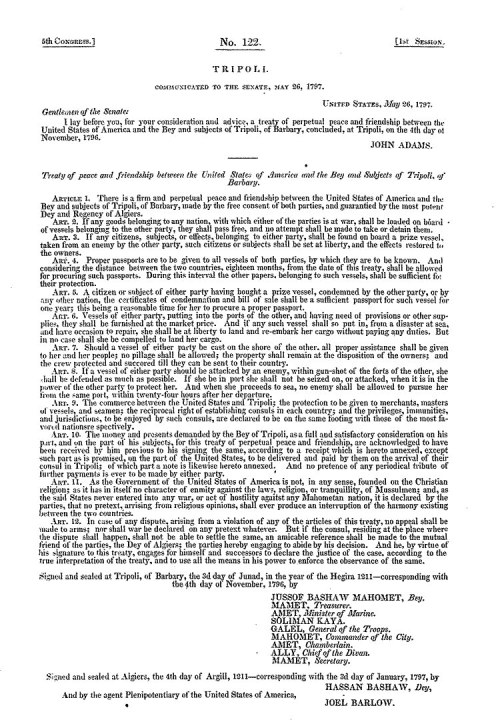
Our founders were so opposed to the idea of a State Religion that in one of the first treaties entered into with another nation, the Treaty of Tripoli of 1796 drafted by the future President John Adams noted in Article 11:

As the government of the United States of America is not in any sense founded on the Christian Religion, — as it has in itself no character of enmity against the laws, religion or tranquility of Musselmen, — and as the said States never have entered into any war or act of hostility against any Mehomitan nation, it is declared by the parties that no pretext arising from religious opinions shall ever produce an interruption of the harmony existing between the two countries.”
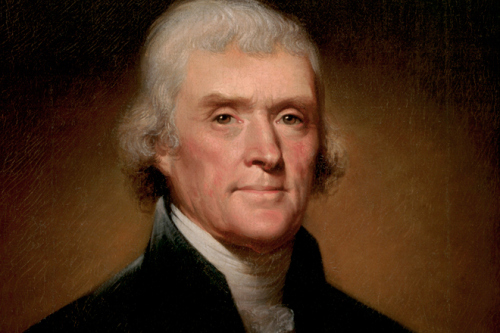
thomas_jefferson_rect1

Jefferson wrote in the Virginia Act for the Establishment of Religious Freedom:

Be it therefore enacted by the General Assembly, That no man shall be compelled to frequent or support any religious worship, place, or ministry whatsoever, nor shall be enforced, restrained, molested, or burdened in his body or goods, nor shall otherwise suffer on account of his religious opinions or belief; but that all men shall be free to profess, and by argument to maintain, their opinions in matters of religion, and that the same shall in nowise diminish, enlarge, or affect their civil capacities. 

Madison wrote:

“Who does not see that the same authority which can establish Christianity, in exclusion of all other religions, may establish with the same ease any particular sect of Christians, in exclusion of all other sects?”

John Leland, leader of the Virginia Baptists who were being persecuted by Episcopalians intent on re-establishing themselves as the official State Religion of Virginia became involved in the fight for religious liberty in the newly independent colonies wrote:

“The notion of a Christian commonwealth should be exploded forever…Government should protect every man in thinking and speaking freely, and see that one does not abuse another.  The liberty I contend for is more than toleration.  The very idea of toleration is despicable; it supposes that some have a pre-eminence above the rest to grant indulgence, whereas all should be equally free, Jews, Turks, Pagans and Christians.”

Leland heavily influenced both Madison and Jefferson in crafting the Virginia statement on religious liberty and the First Amendment. Toward the end of his life Madison wrote:

“The settled opinion here is, that religion is essentially distinct from civil Government, and exempt from its cognizance; that a connection between them is injurious to both; that there are causes in the human breast which ensure the perpetuity of religion without the aid of the law; that rival sects, with equal rights, exercise mutual censorships in favor of good morals; that if new sects arise with absurd opinions or over-heated imaginations, the proper remedies lie in time, forbearance, and example; that a legal establishment of religion without a toleration could not be thought of, and with a toleration, is no security for and animosity; and, finally, that these opinions are supported by experience, which has shewn that every relaxation of the alliance between law and religion, from the partial example of Holland to the consummation in Pennsylvania, Delaware, New Jersey, &c., has been found as safe in practice as it is sound in theory. Prior to the Revolution, the Episcopal Church was established by law in this State. On the Declaration of Independence it was left, with all other sects, to a self-support. And no doubt exists that there is much more of religion among us now than there ever was before the change, and particularly in the sect which enjoyed the legal patronage. This proves rather more than that the law is not necessary to the support of religion” (Letter to Edward Everett, Montpelier, March 18, 1823).

I am all in on religious liberty including the rights of people that are not Christians to practice whatever faith or non-faith that they please. This is the freedom that our founders fought to bring forth in this land.

Today we celebrated the National Day of Prayer and I had the privilege of leading our prayer at our facility. I have included that prayer here:

Loving God, we thank you for the privilege of living in this country where our founders were wise enough to neither establish nor forbid any religious practice. We thank you that as the beneficiaries of the wisdom handed down by these men that we have the liberty to believe and practice our faith in the manner that we see fit and that whether Christian or Jew, Moslem or Wiccan, Buddhist or any other faith represented in our land that we have this freedom. We thank also thank you for the freedoms granted to all, the freedom to believe, practice and even not believe as our conscience dictates and that Congress can enact no law to either establish a state religion nor prevent the free exercise of the beliefs of any citizen. 

For the wisdom and the foresight of these fallible men whose actions redound to us we give you thanks.  We pray this in your Holy Name. Amen. 

So as the time draws near to go to bed and I offer my night prayers for all, I do wish you the peace and freedom that so many Americans have fought and died to maintain.

Peace

Padre Steve+


2 Comments

Filed under christian life, civil rights, faith, laws and legislation, News and current events, Religion

War Crimes are Us: I Want No Part of Sarah Palin’s Torture Loving Christianity

-nrarallypalin

Well, Sarah Palin is at it again and I do have to say something. The former Alaska Governor, losing V.P. Candidate and failed reality television celebrity who can’t even hold a down a steady job with Fox News committed an act so brazenly anti-Christian and anti-American that as a Christian I have to condemn it. I wrote about this subject before in my article Baptism and Water Boarding: When Professed Christians Defile Their Own Faith to Make Cheap Political Points which I wrote almost a year ago in response to people making the same comment.

Palin said at the National Rifle Association convention Sunday April 27th that “waterboarding is how we baptize terrorists” and the crowd, many certainly God fearing Christians went wild. You see Palin and many like her believe with all their hearts that waterboarding and other techniques of “enhanced interrogation” should not only be used, but be national policy when it comes to dealing with enemies of the state. Their view is not that torture is inherently evil but might be justified in a supreme emergency to save lives, but that it should be institutionalized as a matter of judicial and military policy and publicized. Torture is considered by all civilized nations to be a war crime and crime against humanity. We set the standard for that in what we did at Nuremberg.

Justice Robert Jackson, the chief prosecutor of the Nuremberg Trials wrote:

“If certain acts of violation of treaties are crimes, they are crimes whether the United States does them or whether Germany does them, and we are not prepared to lay down a rule of criminal conduct against others which we would not be willing to have invoked against us.”

First I object to Palin’s use of the “baptism” to bless torture, to bless actions that our country sentenced the soldiers of Germany and Japan to death for doing after World War II. Yes, at Nuremberg, Tokyo and Manila American justices sentenced leaders both civilian and military to death for institutionalized policies of torture. People like Palin who advocate the routine use of torture as an act of national policy put our military, intelligence and diplomatic personnel as well as other citizens at greater risk should they be held captive by a state or non-state actor.

Some are speculating that she is doing this to slam John McCain, the only serving member of the Senate or Congress to have been a Prisoner of War and subjected to waterboarding as a means of torture. If so it shows that she has no grace or ability to be thankful, for without John McCain she would not be on the national political stage and the vast majority of us would have been blessed never to know who she is.

Of course for people like Palin and her cheering media supporters who have no skin in this game it doesn’t matter. They don’t serve in the military, nor intelligence or diplomatic corps, nor do they don’t volunteer in humanitarian relieve operations. In fact to them those who lose their lives because of such stupid statements, actions and policies are simply part of the cost of war.

Baptism is a sacrament of the Christian church, or in some cases considered an “ordinance.” There is a difference. Christians who view baptism as a sacrament see it as something that is the entrance into new life, it is a vehicle of God’s grace where the Holy Spirit acts in a special way to cleanse the person being baptized from sin, incorporate them into the family of faith and a chance for the Christian community to join with the Baptized in recommitting ourselves to the faith and pledging to help the new Christian in theirs. In churches where it is an ordinance; or something we do because it was commanded by Jesus it is still important. It is an outward demonstration and witness of faith that has already been received. Christians have been persecuted and even gone to their death as martyrs for what they believed about baptism in all of its forms. Thus what Sarah Palin did is not only cheap and tawdry political speech by a narcissistic self-aggrandizing diva of extremely limited intellect and zero spiritual acumen, but sacrilege that every Christian who values their faith and baptism should condemn in the strongest terms.

The sad thing is that many Christians will not condemn her nor call her into account simply because they have bought into the evil of systematized torture as an instrument of public policy. Likewise many want Palin to run again for either the Presidency or for the Senate because she embodies what they believe.

But here is the real rub. Once you make torture a part of your public policy where does it stop? Every society that has practiced it has used it not only on their military foes, but on their own people.

What Palin supports and endorses is nothing more than the evil perpetuated by every totalitarian regime that has ever existed.

For those that support her, be warned; like the non-Nazi German conservatives who initially supported Hitler but later had second thoughts you too could considered a terrorist using the methods that Palin advocates against others today. You get what you vote for…

As Martin Niemoller said after the fall of the Third Reich:

First they came for the communists, and I did not speak out—because I was not a communist;
Then they came for the socialists, and I did not speak out—because I was not a socialist;
Then they came for the trade unionists, and I did not speak out—because I was not a trade unionist;
Then they came for the Jews, and I did not speak out—because I was not a Jew;
Then they came for me—and there was no one left to speak out for me.

Peace

Padre Steve+

4 Comments

Filed under christian life, faith, History, laws and legislation, national security, News and current events, Political Commentary

Easter Sunday, Baseball and Interviews

meharborpark“I believe in the Church of Baseball…the only church that truly feeds the soul, day in, day out, is the Church of Baseball.” Annie Savoy Bull Durham

For those that didn’t notice today was Easter Sunday. It is the Sunday where Christians remember and celebrate the Resurrection of Jesus and others go into diabetic comas because of the amount of candy they ingested even if they don’t believe.

For me it was a simple celebration of Eucharist at my Staff College Chapel with some of our students and their families. Following that a nice breakfast with Judy and then a trip to the ballpark to see the Norfolk Tides play the Durham Bulls.

It has been a busy and eventful week. First it was Holy Week and it was the first week of teaching my Ethics Elective for our current class, finalizing my Gettysburg Staff Ride “Tome” for this class and taking care of the ever bothersome military health and physical fitness requirements. In addition to everything else I made  four trips to medical and dental to get routine exams and paperwork accomplished so I can do my physical fitness test this week. As for a frame of reference even about 10 years ago guys my age didn’t need to do this. However the physical requirements I have to meet at age 54 in the Navy are little different from the ones I had to meet at age 22 in the Army. Of course I still had to do my taxes and other things around the house as contractors were back in on Friday doing the painting in the house. Hopefully by the end of this week most if not all of that is done, but I digress…

The Easter celebration of the Eucharist was really nice, several of our students and family members attending, which for my chapel is like “mega-church” numbers.

Following breakfast, or maybe it was really brunch I went over to Harbor Park where I met a photographer from the Washington Times. A reporter from that newspaper asked a former student of mine who serves as a Public Affairs Officer at the Pentagon if he knew anyone who knew something about PTSD and he referred her to me. The article will run tomorrow from what I am told. They liked the interview and wanted to get some photos of me in my natural environment, Harbor Park in Norfolk, a place which is a refuge to me and has been since I returned from Iraq. There is something healing to me about going to the ballpark. To me baseball is more than a game, it is an important part of my spirituality and my mental health.

The photographer stayed with me about 6 innings before having to return to Washington. It was a nice day. After the game, which the Tides won by a score of 6-3 with Kevin Gausman pitching well against a strong Durham team. The photographer and I had some nice conversations as she shot the story and followed me around the ballpark. What was nice is that I know the people there well enough after so many years of going there that I could just be me, I didn’t have to alter much, just have someone follow me around. Since I do a lot of baseball photography we were able to compare notes and I was able to talk to her about better equipment than I have for sports photography. That being said she did like some of the pictures I showed from past events. Who knows maybe I can do this after I retire from the Navy whenever that is?

Anyway. Tonight has been spent watching the movies Bull Durhamand Kelly’s Heroes. I go back to work tomorrow, yet have one more medical appointment Tuesday and then my Physical Readiness Test on Wednesday. The last won’t be hard.

In the coming couple of weeks you can look forward to more articles about Gettysburg as well as some other topics that I am doing some reading, reflection and research on.

Again, Happy Easter,

Peace

Padre Steve+


1 Comment

Filed under Baseball, christian life, faith, PTSD

The Morning After an Unsettling Crucifixion

roman-soldiers-guard-james-tissot-1

This is another installment of my series on Longinus the Centurion looking at Holy Week through the eyes of a Roman soldier in occupied Judea. It was originally written in 2011 but I have reworked it to fit in better with the articles that I wrote in the prequel.

The horrible day was passed and a new morning greeted Longinus as he arose. The sun rising over the escarpment in the east that overlooked the Jordan River cast a warm red and yellow glow as its rays infiltrated the window overlooking the courtyard of Fortress Antonia. It seemed an eternity since he watched the sun rise as Pilate debated what to do with that Jesus fellow.

Longinus and his fellow officers Flavius and Decius had spent much of the previous evening in the tavern following the executions. It was not a typical night for them. There was little frivolity, few jokes and none talked much about the events of the day, which had begun for Longinus not long after midnight. Flavius, whose servant had been healed by Jesus in Capernaum had briefly discussed the meaning of Longinus’s comments as the Galilean preacher died upon the cross. Longinus pondered the words again. “Surely this man is the son of God” or something to that effect. He didn’t remember his exact words and he couldn’t even remember why he had said them, but then the day was long and the events struck a nerve. He had seen or taken part in many executions as well as difficult battles. He disliked executions in general but until now he had managed to keep his soul protected from from what he felt on Golgotha by the wall that he had built around his heart.

Longinus looked out the window and then at his desk. He would need to call his officers together soon. He was sure that even though it was the sabbath that those that plotted against Roman rule, as well as the various factions at work in Jerusalem were still plotting, scheming and at work. He wondered how in such a climate anyone could call the day “holy.”

He did not like what had happened the previous day. When Pilate gave in to the Jewish leaders in regard to killing the Galilean he very uneasy. Pilate should have damned the whole politics of the situation and let the man go. The events still bothered him. The man was innocent. Pilate knew it, Longinus knew, hell they all knew and yet all of them had aided and abetted those that wanted the man named Jesus dead. Longinus felt a shame that in all of his years of soldiering he had never before felt. Pilate was able to wash his hands of responsibility. Longinus wished he could do so for himself, but the blood of the innocent man which still stained the tip of the lance that Longinus had plunged into his side would not let him. He shook his head in disgust.

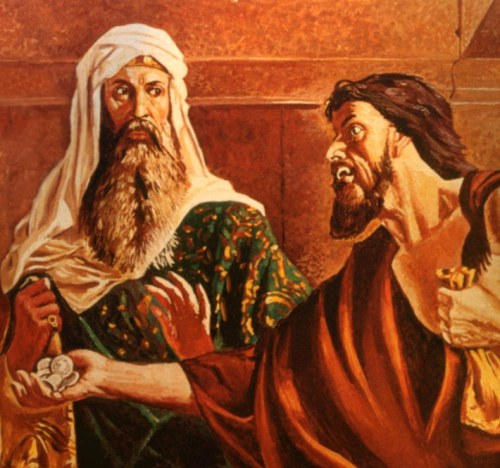
Just then Decius knocked and entered with the news that Pilate had ordered a guard set at the tomb of Jesus. Supposedly the Jesus fellow had said that he would rise from the dead and the Jews wanted to make sure that no one tried to make off with the body of Jesus.

Longinus was not surprised, somehow as strange as the week had been it make perfect sense. Set a guard over the tomb of a man who was betrayed by one one his own, denied by others and abandoned by all but one? It was ridiculous, people don’t rise from the dead. Dead is dead. Longinus thought rather cynically that it was a waste of his troops time and effort. If the Jews were so concerned why didn’t they send their Temple Police to guard the tomb. But then he realized that such duties were beneath the Temple establishment. Get the infidel Romans to do the dirty work, that way if something went wrong they could take the blame. It figured.

He ordered Decius to set the guard. As he did this he received a report that two of his Samaritan soldiers had been brought in by a patrol dead drunk late in the evening. He would have to discipline them later, that was the lot of a commanding officer. How he wished that he was commanding a unit of Italians in a home province or on a campaign rather than these Samaritan and Syrian cast offs in this God forsaken backwater of the Empire. At least he had a number of good officers under his command, perhaps if he remained in Palestine he could organize a transfer of he and his officers to the Italian Cohort stationed in Caesarea where his friend commanded one of the units. Though he too was based in Caesarea it was much better to be assigned to that Italian unit rather than the locally recruited units.

Flavius joined them as they set down to eat breakfast. Outside Quentin and other sergeants mustered the men, and proceeded to carry out the order of the day. Patrols were dispatched to remind any Zealots or sicarii that even if they had gotten Pilate to do their bidding regarding the Galilean that Rome was still in charge of their capital.

The officers discussed details of the planned movement that would take them back to Caesarea in the next couple of days, whenever Pilate decided that the situation in Jerusalem was calm enough to leave. That would be a day or two at least as the multitudes who had come to observe Passover from the diaspora returned to their homes about the Empire and beyond.

The sun now shown brightly through the window. Pilate looked at the still menacing hill known as Golgotha, now devoid of crosses. He thought about that final scene yesterday amid the gloom as the tree men including the Galilean hung suspended between the heavens and earth. It was a sight that he would not soon forget.

Flavius and Longinus hoped for an uneventful couple of days in order to prepare for the always dangerous trip through Judea. The Zealots, sicarii and other insurgents lying in wait to kill a Roman. Tonight, the Gods willing they would meet over a cup of ale in the tavern and maybe things would begin to return normal, whatever that meant in this place.

Peace

Padre Steve+
Leave a comment

Filed under faith, History, Military, Religion

A Centurion’s Long Good Friday

img_0643-726257

This is a re-do of my original “Long Good Friday of Longinus the Centurion.” Since I first wrote that piece three years ago I have wrote a prequel which I published last year and with minor changes again this year. Like George Lucas I felt the need to change and improve the original. Unlike Lucas who simply tweeked Star Wars I have chosen to spend my time completely re-writing the original in light of the prequel series dealing with the events leading up to Good Friday that I did this week. I don’t know about you but I like to imagine events as they might have actually happened. As an Iraq veteran who served with our advisors to the Iraqis I do understand the plight of soldiers from an occupying power serving far away from home where their presence is barely tolerated, much less welcomed. I have always felt a special affinity for the soldiers that have interactions with Jesus, who are treated very sympathetically by the writers of the Gospels as well as Luke in the Book of Acts.

Longinus had finally decided to try to get a bit of rest. After his rather morose meeting with Flavius and Decius he and Decius went back to check on the preparations for the executions scheduled for the next day. Quentin his Tesserarius had been working with the squad chosen to to conduct the actual crucifixions of the prisoners, Bar-Abbas the insurgent as well as the common criminals and murderers Dismas and Gestas who he had met in the hell hole of a jail in the dungeon of Fortress Antonia after Pilate had assigned him the task of conducting the executions.

Longinus was certain of his unit’s ability to carry out the mission, though he would have rather had a unit from Italy than his unit of Syrian and Samaritan troops. There was one positive aspect, his Samaritans and Syrians had no love for the Jews and would have no qualms whatsoever in disposing of the criminals.

He thought for a moment about the prisoners. That Bar-Abbas fellow, he would be glad that he or any other Roman would have to deal with him again once the crucifixion was over. As for the common criminals he felt that everyone would be better off with Gestus dead although he hoped that Pilate might take pity on the repentant thief named Dismas. However, despite his feelings he also knew that the law was the law and repentant or not that Dismas was guilty of the crimes and the sentence was just. As he had realized earlier in the day while talking with Flavius it was important not to become emotionally involved with the locals, especially prisoners. Maintaining an emotional distance ensured that he would not flinch in times when ice rather than blood needed to flow through one’s veins. He was proud that he could do this but envied the humanity that his comrade and friend Flavius still maintained in spite of everything.

He was just about to prepare for bed when a messenger from Pilate knocked on his door. It was late, too late and Longinus wondered just what was going on.
“Come.” He said, the weariness in his voice obvious in the way he answered.

The messenger, a relatively young Italian soldier assigned to Pilate’s bodyguard entered, came to attention and saluted.

Longinus looked at the young man, like him far from home and asked “what am I needed for now?”

“Centurion, the Governor has requested your presence” the soldier replied.

“May I ask what for?” A now increasingly irritated Longinus asked.

“Sir, I do not have the details but it is a pressing matter regarding the Jews and that Galilean preacher.” The young man was obviously uncomfortable in having to request a career officer like Longinus, a veteran of real battles and campaigns appear before Pilate for what was not much more than a religious dispute among an occupied people.

“Pressing matter?” Asked Longinus.

“Yes Centurion. I was told that it was urgent that you come to Governor Pilate now and alert your unit as at least some of your men may be needed if things get out of hand.”
“Can you please tell me just what is going on?” Longinus asked as he pulled his armored breastplate over his shoulders.

“I’m sorry Centurion, I have no more information. You are to report to the Governor within the half hour. The Governor wants your unit ready within the hour.” When he finished he came to attention, saluted and exited the room.

Longinus hated how leaders sent young men to be their messengers and would not give them all of the relevant information.

He then sat back down in his chair where he had been sitting and discussing the situation with Flavius and Decius. He wondered to himself what could be so pressing that Pilate needed him now.

After briefing Decius and Quentin, instructing them to wake the men and be ready for action Longinus took a squad and went to Pilate’s headquarters. When he arrived Pilate greeted him.

“Centurion, I hate to have bothered you at this hour in light of how busy you and your men will be in the morning but a situation has arisen.” Longinus looked around the room and then heard some commotion on the area called “the Pavement.”

“What is happening my Lord?”

“Longinus, these Jews have brought that Jesus fellow here and are accusing him of fomenting a rebellion against the Emperor.”

“A rebellion sir?”

“That is what they say Centurion. They claim that one of his closest associates had turned him in and after a trial of their own that they found him guilty of claiming to be a king and God that will overthrow the Emperor.” Pilate could not hide his discomfort.

“Do you actually believe them sir? After all we had heard this morning that this Judas Iscariot fellow had betrayed him for 30 pieces of silver.”

“I know Centurion, I know.” Pilate looked at Longinus then back out at the crowd gathered outside in the dark. He was afraid and Longinus could sense that fear, fear that if he made the wrong move that a real rebellion could break out and that Pilate as the Governor would take the blame and bear the punishment and wrath of Caesar.

“Centurion, I tried to placate these people be questioning this Jesus fellow myself.” Pilate paused. “I must say that he is a rather unusual man and truthfully I could not find anything that under Roman law that I could find him guilty of doing. Not a thing Centurion, nothing but their leaders kept pressing me.” Pilate’s gaze seemed to be almost pleading with Longinus to help him escape this decision. Longinus knew at that moment that his day was about to get worse. Pilate continued “It seems to be a religious squabble of some kind so in order to deal with it and to try to keep us out of it I sent Jesus to Herod since Herod is the ruler of Galilee.”

“So Herod will certainly deal with the situation, will he not Governor?”

“Centurion, I thought that that corpulent bastard Herod would deal with it but I just got word that Herod too could find no crime. The Jewish leaders and of their Temple Police are supposedly bringing him back to me to render judgment. They are leaving it to me.”

“Judgment for what?”

“Sedition, treason, blasphemy, proclaiming himself a king.” Pilate paused, his face flushed. “My God I’m surprised that they haven’t accused the man of fathering the High Priest’s daughter.” The sarcasm and bitterness was evident in his voice.

“So what do you intend to do.”

“I intend to try to get us out of this with as little trouble or guilt as possible. When they return him to me I will ask a few more questions and set him free as is my prerogative, certainly they wouldn’t want to release a real murderer like Bar-Abbas back into society, I do give them more credit than to stoop that low.”

“I do hope that you are right governor, but from what I understand it seems that they are intent on ridding themselves of the fellow once and for all. I think that their leaders see the Galilean as more of a threat than a man like Bar-Abbas.”

Pilate said nothing and during the silence Longinus’s troops under the direction of Decius entered the perimeter of the court adding an additional security cordon as the crowd grew and got more boisterous. As they took up position the Temple Police and members of the High Priest’s entourage approached the court with the Galilean in custody. Quentin with four soldiers met them and took custody of the obviously tired and already abused man. They delivered Jesus to Pilate and stood back. Longinus watched as it happened. As he did so Flavius entered the room with his servant. The servant appeared unsteady and full of emotion when he saw the man who had healed him two years before. Flavius stood by his face not betraying any feelings except deep seated rage that was boiling as he saw this travesty of justice take place.

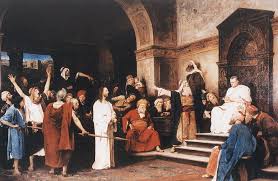
jesus before pilate

Pilate attempted every trick in the book to garner a way to save the life of the man standing before him. He asked him questions and Jesus clothed in a purple robe that Herod had mockingly placed upon him said nothing. Finally in desperation Pilate asked Jesus if he was a king. The answer both fascinated and terrified Pilate and caused him to wish that he had never come to the city. As he deliberated earlier and debated the members of the Sanhedrin his wife again urged him to “have nothing to do with that innocent man.”

But the answer of Jesus to the question of his kingship troubled Pilate. Had he thought the man insane he would have scourged him, declared him mad and been done with the affair.

“My kingdom is not of this world, if it were my followers would be fighting to ensue that you did not hand me over to the Jewish leaders.” Jesus looked into Pilate’s eyes, the look sent a chill through Pilate’s soul and so he restated the question “so you are a king?”

Jesus replied solemnly “You say I am a king. I was born for this and it is why I came to this world, to testify to the truth. Everyone who belongs to the truth listens to me.”

Pilate appeared stunned and both Longinus and Flavius knew that he was beaten. They listened as Pilate asked “what is truth?” The question was one of a man who had long ago sold his soul to gain the world, it was the question of a deeply cynical man who had long determined that truth was only in the eye of the beholder and to be used as needed to acquire power. At the same time they could see a touch of genuineness in the question as Pilate, desperate for an answer that would enable him to please everyone and spare the life of the man before him wrestled with the question of truth for the first time in years.

Scourging-at-the-pilar-pros

They watched as Pilate attempted to bargain for the life of Jesus only to be shouted down by the increasingly riotous crowd who demanded that Bar-Abbas be released. Again attempting to assuage the mob he had Jesus scourged with a barbed whip. The soldier who did that brutal work was a Syrian, big and burley without a trace of feeling in his eyes or face. The servant of Flavius begged him to intervene but Flavius now knew that the things happening to Jesus could no longer be influenced by sentimentality and stories of the goodness of Jesus. He had seen this type of Justice before, and though he despised it, he earnestly hoped that it would be enough to deliver Jesus.

After the scourging, soldiers assigned to Longinus jammed a crown of thorns down on the blood covered Jesus and placed the purple cloak over him. Jesus’s body trembled. Pilate again approached the mob and tried to decline the odious responsibility thrust into his hands. The mob led by the Chief Priests and joined by man of their rivals, the Pharisees cried out for Jesus to be crucified.

They heard Pilate plead with Jesus, again noting that he had power over the life and death of Jesus to which Jesus replied that Pilate “had no power over him that had not been given by God.” Finally he pleaded with the Jews one more time to take Bar-Abbas for execution and to spare the Galilean. The leaders shouted him down again and cried out that Pilate would be “a traitor to Caesar” if he let a man who claimed to be a king live.

William_Hole_Pilate_Washes_His_Hands_400

Defeated By the mob and by his own weakness of character Pilate asked for a ceremonial washing basin full of water. When it came in the hands of a court member he placed his hands in it and proclaimed “I am innocent of this man’s blood.” He then ordered the soldiers to take Jesus to be crucified even as the prisoners Dismas and Gestus were led from the dungeon for execution and a profoundly perplexed Bar-Abbas was released by the jailer.

Longinus looked at Flavius and whispered to him “wash my hands of his blood? My God, he knows that he is as guilty at them.” Flavius looked on and simply said “I know my friend, we all are.”

The detail of soldiers assigned to the crucifixion detail was commanded by Quentin, a man who had fought many battles and like Longinus and Flavius felt that these executions of helpless prisoners were unworthy of soldiers like himself. The soldiers of Flavius’s unit had responsibility for helping to clear a way down the narrow street called by the Romans Via Delarosa. The street of suffering. It was the street that all the condemned travelled to the hill of execution so fittingly called the place of the Skull. Longinus had seen others walk this path but in the past he had been able to shield his person from their suffering, but today was different.

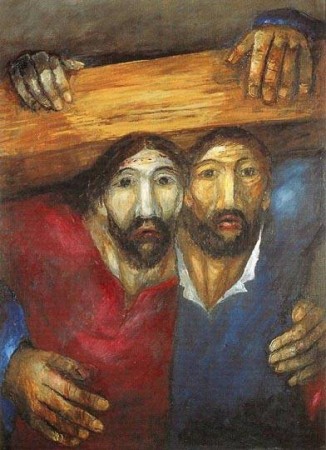
Anon, contemporary, 8

Longinus’s own execution squad led by Quentin led Jesus and the others along, forcing them to carry their crosses. About halfway down the street Jesus collapsed under the weight if his cross and grabbed a bystander, a man from Cyrene to carry the cross while the soldiers prodded the bloody body of Jesus down the street and out of the city to the place of execution. People jeered at the condemned as they did at very execution as for most this was no different than any other crucifixion and most of those present knew little about any of the condemned men and even those that were familiar with Jesus probably did not recognize the bloody man stumbling down the street. Of course there were others present who did know Jesus and watched in horror as their friend, teacher and for one woman her son struggled to the execution site. Longinus wondered about his own elderly mother and thought of her as he saw the mother of Jesus. He quickly tried to chase her image from his mind, he needed to be strong and hard if he was to keep his objectivity and conduct the mission as distasteful as he found it.

When the macabre parade arrived at the hill, the prisoners were stripped, placed on the crosses and nailed to them. Their screams as Quentin hammered the large iron nails home through their already abused flesh echoed for all to hear. Thankfully Quentin knew what he was doing and this part of the execution process happened quickly. Then the crosses were raised, but just before this a messenger from Pilate arrived with the placards that denoted the charges. He handed them to Longinus who noted what was written on the one for Jesus. It said “The King of the Jews.”

The placards were placed and with a thud the crosses were placed in the holes on the hill. The suffering of the prisoners was great, the crowds jeered and mocked them while those that loved them stood at a distance. Soldiers stood guard to ensure that no one interfered with them in any way. There was a bit of banter between the real criminals one of whom, the unpleasant one named Gestus joined in the mocking of Jesus only to be put in his place by the other one named Dismas.

jesus-christ-crucifixion-375

Longinus, Flavius, Decius and a few other officers watched as their soldiers from the crucifixion detail divided the paltry worldly possession of the men between themselves. The men argued over a one piece tunic worn by Jesus, Not wanting to destroy it they cast lots for it. A trooper from Tyre won the tunic. Longinus and Flavius looked at each other and realized how little most of their men earned and neither begrudged the men the few items that they gathered from the men being executed.

The skies which had began the day with bright sunshine now became dark and foreboding. Lightening appeared in the distance and occasionally Jesus would address his mother or one man, Flavius believed him to be a disciple who stood by the cross. Jesus even promised the Dismas character that “he would be with him in paradise” and told others, Longinus thought the soldiers but he wasn’t sure “forgive them they know not what they do.” As it approached the ninth hour Jesus cried out in Aramaic “my God, my God, why have you forsaken me!”

A cold rain began to fall.

Quentin approached him with a sponge on a pole which was soaked in a sour wine. It touched Jesus’s lips and Jesus said “Father into your hands I commit my spirit” and then “it is finished.”

With that last dying remark the head of Jesus fell to his chest and his body, bloody and mangled hung limp. As the men looked on the ground began to tremble and as the ground shook and the officers looked about amid the gloom and confusion as the onlookers took flight Longinus exclaimed “surely this man was the son of God.” Flavius looked at his fellow Centurion in astonishment. Longinus, the man who had closed his heart in a fortress was echoing what he had believed since Jesus had healed his servant, the young man who was more than a servant to him.

As the crowds dispersed Longinus received the message that the executions had to be concluded before the Jews began their Passover. With that he sent Quentin to break the legs of the prisoners to hasten their deaths. When Quentin reached Jesus he called for Longinus.

“Centurion, I believe that this man is already dead. Do you still want me to break his legs?”

old-master-drawing-DELACROIX_Eugene_Christ_on_the_Cross_sketch_2

Longinus looked up at the bloody corpse and then at his subordinate and said “no I must do this myself.” He had a soldier bring him his lance, a ceremonial lance that denoted his seniority as the senior Centurion in the Legion. He looked at the lance and plunged it into the side of Jesus into his heart. Jesus did not move but from the wound blood mixed with what looked like water poured out of the wound and down his side.

“Quentin, he is dead, you may take him down.” Other soldiers pulled down the dead bodies of the thieves. As they did this a man approached Longinus and Flavius.

“Gentlemen. I am Joseph, I am a member of the Sanhedrin. I have come to take responsibility for the body of Jesus of Nazareth.”

Longinus replied in a businesslike manner “by whose authority?” He had a hard time believing that a member of the Sanhedrin would claim this body.

With that Joseph produced a letter from Pilate. Longinus looked the letter over and handed it back to Joseph without comment. Joseph then motioned to several men with him to take the body as Longinus, Flavius and the others looked on. Longinus thought to himself that it was good that a man of some means and influence would at least take the time to give this innocent man a decent burial.

TVC-statn13

As Quentin took charge of the cleanup Longinus instructed Decius to prepare the troops to return to Fortress Antonia. Flavius instructed his optimo to do the same. The last thing that any of them wanted to be was on the streets when the Jews began their Passover, as always they decided that it was unwise to stir up any more animosity than was needed. Today was a near run thing with e demonstration outside Pilate’s headquarters and none of them wanted any more excitement this evening.

When the clean up was completed and the bodies removed Longinus and Flavius ordered their soldiers back to Fortress Antonia. When they arrived the Centurions went to Pilate to inform him that the mission was complete. Pilate was glad the ordeal was over but was obviously still disturbed by the events of the day. Longinus, now exhausted was glad to leave Pilate’s presence. He still loathed politicians and wondered if had Pilate been a soldier if he would have had the courage to tell the leaders of the Sanhedrin to “pound sand” and keep Jesus alive. But then he knew that had Pilate done something that only a diplomat could do, he kept the peace. Had he been in charge the man named Jesus might have lived but hundreds maybe even thousands of others might have died.

After he dismissed his soldiers he went to his room, doffed his gear and went to the tavern in the fortress. Flavius joined him about 15 minutes later. They sat at the table as the barkeeper brought them each an ale. They looked at each other and Flavius asked “What did you mean by surely this man was the son of God?”
Longinus shook his head. “My friend I do not really know.” He paused and took a drink from his cup. “Until today I simply figured that he was a good man, but after today, after what I witnessed I just don’t know.”

“If you ask me my friend I think that he must be a God, if not somehow connected to the greatest of Gods, the God of the Jews.”

“Perhaps Flavius you are right. All I know is that I can no longer see the world, the Empire or my life in the same light as I did just a week ago.”
Flavius nodded his understanding as Decius entered the tavern. The younger officer reported to his seniors. They acknowledged his entrance and Longinus asked the younger officer to sit with them.

“What do you know Decius?”

The younger officer spoke. “Sir, I do not know if you heard the latest about the man that betrayed Jesus.”

Longinus asked sarcastically “did they elect him High Priest?”

The younger man caught the sarcasm and replied “if only that we’re the case. He was found dead, hanging from a tree in the Potter’s Field.”

Flavius answered “So the traitor couldn’t handle his own act of duplicity?”

Longinus replied, “evidently not, serves the bastard right.” He took a drink from his cup and motioned for the barkeep to get Decius a cup of ale too. The three men continued to drink silently and wondered what else could happen…

Peace

Padre Steve+

1 Comment

Filed under faith, History, Religion

Duplicity, Politics and Betrayal: A Centurion’s Thursday Evening in Jerusalem

HA_Roman_Soldiers_by_HistoriaAntiqua

This is the final part of my Holy Week prequel for my series on Longinus the Centurion. I should have published it last night but forgot.

Longinus continued to think about the various intrigues that he saw in Jerusalem but he could not imagine what he was soon to learn about. The morning had started normally until the corpulent and corrupt Herod Antipas, the appointed “Jewish” ruler of Galilee and son of Herod the Great arrived in Jerusalem with his entourage.

Longinus knew that there was no love lost between Pilate and Herod, nor between the Pharisees and Herod. Herod chafed knowing that he only ruled a portion of the land his father had ruled especially that he did not rule in Jerusalem. His father had rebuilt and restored the Temple after it was desecrated by the Seleucids, something that the Pharisees and the Priestly class in the city seemed to not give his father enough credit for doing. The fact that Herod was coming to observe the Passover in the city could only add to the tensions that were simmering.

Pilate called Longinus and the other senior officers, including the Centurion Flavius to his headquarters to be part of his official greeting party. Pilate may have despised Herod, but he was the representative of the Empire and Herod, like any proxy ruler needed Pilate’s support.

friedrich-overbeck-pilate-and-herod-resolve-their-differences-and-pilate-hands-jesus-over-to-herod-s-jurisdiction

The meeting at the court referred to as “the Pavement” was filled with ceremonial pleasantries as Pilate, Herod and their staff members and court followers conducted the business of the day. Nothing of much importance was discussed, Pilate decided not to bring up anything about the Galilean preacher despite the uproar of Sunday that accompanied his arrival. Pilate thought it amusing that a poor preach from Herod’s own province would be greeted as a king while the population hardly acknowledged Herod, apart from the rathe sullen looks that greeted his arrival.

After Herod departed Longinus, Flavius and the other officers were dismissed, yet another morning that they would never get back. But again that was part of life as an officer in a Godforsaken backwater like Judea. Such meetings of course were a necessary evil for them to attend and sometimes one could find out information that could be useful. Though nothing important was shared in the meeting Longinus noted that no Jewish religious leaders were in attendance. He thought that odd until he arrived back in his quarters where he was doffing his more ceremonial dress uniform items for the more practical daily kit.

After Herod departed Longinus, Flavius and the other officers were dismissed, yet another morning that they would never get back. But again that was part of life as an officer in a Godforsaken backwater like Judea. Such meetings of course were a necessary evil for them to attend and sometimes one could find out information that could be useful. Though nothing important was shared in the meeting Longinus noted that no Jewish religious leaders were in attendance. He thought that odd until he arrived back in his quarters where he was doffing his more ceremonial dress uniform items for the more practical daily kit.

As he changed his second in command, Decius knocked on the door.

“Come.” Longinus said and his subordinate entered. Decius came to attention and saluted.

“Be at ease my friend, what news do you bring?”

“Centurion I have some rather interesting news from our Jewish spy regarding this Jesus fellow.”

“Is that so?” Longinus inquired.

“Yes sir. He said that one of Jesus’s own men, one of his 12 closest followers went to the ruling elders this morning and offered to betray him.” The words coming from his subordinate were stunning.

“Tell me more.” Longinus said, his voice now full of curiosity.

“Sir, our man said that a man named Judas Iscariot, who is trusted by Jesus enough that he carries the money bag and pays whatever expenses that Jesus and his men incur.” Decius paused while Longinus pondered this unexpected turn of events.

After a few moments of silence Longinus asked his Tesserarius, Quentin to fetch Flavius and asked Decius to sit at his desk. Flavius arrived within a couple of minutes and joined Longinus and Decius at the desk.”

Longinus began the discussion.

“Flavius, we have news about your friend the Galilean preacher, it seems that one of his merry band is a traitor.”

If Longinus’s reaction to the news was surprise and maybe even amusement with the duplicity of these Jews the reaction of Flavius was one of stunned disbelief and horror.

“You can’t be serious?” He stammered.

“Well that is what Decius says my Jewish insider at the Sanhedrin has reported just a little while ago.” He looked at Flavius as Flavius asked “do you know which one of his men has done this.”

judas-30-pieces-of-silver

“A certain Judas Iscariot. That is the correct name isn’t it Decius.”

“Yes Centurion, Judas Iscariot.”

Flavius looked at Decius and Longinus and said “Iscariot.”

“You know of him.” Inquired Longinus.

“Yes I do know of him. Before he joined with Jesus he was reported to be linked to a group of assassins called the sicarii.”

“The sicarii?” Longinus asked , hardly believing what Flavius said. The sicarii were a particularly violent group, known to kill Romans and people that they suspected of being collaborators. They armed themselves with a particularly nasty dagger that they carried beneath their tunics. If this was true it could be a particularly disturbing turn of events.

“Yes my friend. You see many people followed this Jesus not because of his goodness or any thought of benevolence, but because they believed that he would overthrow the Jewish regime and drive us out of this land.”

“I had no idea. I thought they were all a bunch of do gooders. In fact until Jesus took a whip to all the merchants in the Temple the other day I didn’t think that he had a violent bone in his body.”

He looked at Decius and asked “What does our spy say about this Judas fellows motive?”

The younger officer replied “our man said that He overheard Judas talking before he went into the chambers of the Sanhedrin with some Priests sympathetic with the Zealot party of the Jews.”

“Continue.”

“What he said is that evidently Judas told these men that he was disappointed by the fact that Jesus did not appear to be seeking to overthrow us.”

“That would not be surprising for a member of the sicarii.” Added Flavius, his expression changing from disbelief to anger and after a moment’s reflection he slammed his fist down on the table and added “I could kill that miserable bugger myself…the man Jesus has done nothing wrong.” As Flavius spoke his voice rose in intensity. Longinus knew his friend was upset.

“Flavius, I can understand, this seems a vile thing but there are even larger issues than your friendship with this man and what he did for your servant.” Longinus hoped that his outward calm and acknowledgment of his friend’s feelings would help calm the anger.

“Longinus my friend, I know how you feel about these people and I hoped for better, I wanted to believe that they were a cut above us with their One God, but I see that even a people as devout as the Jews are as capable of evil as the worst Greek, Egyptian, Cretin or Arab.” He paused. “Do you have wine? I could use a drink about now.”

“Of course, my friend. Decius, please pour each of us each a cup of wine.”

As the younger officer got the wine Longinus looked at his angry and downcast friend. He felt a certain amount of sympathy for Flavius, but he had long ago learned not to let the sufferings of occupied people touch him deeply. He had built a fortress at impregnable as Fortress Antonia around his own heart years ago. It was the only way to survive. The being said he recognized a certain amount of humanity in his friend that was absent from so many of his comrades. In a way he envied Flavius. As he thought these things he realized that he needed to move the subject from Flavius’s emotional response to this situation to the practical consequences of this development. About that time Decius brought the wine and placing three cups on the table poured the wine.

“Thank you my friend.” Flavius said as he lifted the cup to his lips.

Both men raised their cups and took a drink. As he set his cup down Longinus continued. “I know that you hoped for better from these people, but you know I have found that some of the most religious people are also the most violent and intolerant.”

Flavius looked at his friend who continued “it seems to me that when someone, you know true believers, know that they have any deity at their disposal they are inclined to be less tolerant of others.” He paused and took a sip of wine. “I think that it is a testament to the Empire that we have so many religions and that in the name of law and order that violent ones are suppressed. That is why throughout most of the Empire we have peace.”

Flavius interrupted his friend. “But we enforce the religion of Caesar, a man, who we claim as God on our citizens.”

“True, but none of us really believe he is a real God anyway, it is a way to keep order. The state makes a religion of itself, it keeps the really dangerous types at bay. So long as people put Caesar first, even if it means burning a bit of incense to a man that they do not believe is God it serves a purpose doesn’t it?”

Flavius looked at his friend and quietly replied “I guess until I met this Jesus fellow I would have agreed completely, but now I don’t know.”

Longinus listened to his friend and could see the sincerity in his face. He continued saying softly “I really believe my friend that the second that any religion that proclaims something different arises and gains control of the Empire you can be assured that the peace that we know will be gone.”

“But that is no substitute for belief in a real God.” Answered Flavius.

“That may be so my friend but it helps keep the peace and is why we don’t have problems throughout the Empire like those that beset us here.”
A curious silence descended in the room as the two friends pondered the situation. Finally Flavius broke the silence. “I just hope that what this man has done stays a Jewish problem for their leaders. I would hate for us Romans to have to become involved in it.”

“As do I my friend, I can drink to that.”

The three men sat silently continuing to drink their wine as they pondered the position that they found themselves…. It was nearly sunset.

Peace

Padre Steve+

Leave a comment

Filed under faith, History, Religion