Category Archives: History

Unregulated Hubris: Remembering the Titanic

10-titanic-facts-titanic-go-down

Friends of Padre Steve’s World,

Something a bit different today, but something that I think is still important to remember. Today marks the 114th anniversary of the sinking of the R.M.S. Titanic, a story that has been told many times, and one which should be a cautionary tale for those who in the name of profit and glory seek to dismantle safety and environmental standards.I remember reading Walter Lord’s classic treatment of the story, A Night to Remember back in 7th Grade. It made a tremendous impact on me, and every so often I will go back and read it again.

Captain Edward Smith, her Captain was blinded by his faith in shipbuilding technology and had said about the Adriatic which he commanded previously, “I cannot imagine any condition which would cause a ship to founder. I cannot conceive of any vital disaster happening to this vessel. Modern ship building has gone beyond that.”

It is as hard to believe now as it was then. Walter Lord, historian and author talked of the “if onlys” that haunted him about the sinking of Titanic. If only, so many if onlys. If only she had enough lifeboats. If only the watertight compartments had been higher. If only she had paid attention to the ice that night. If only the Californian did come…” 

J._Bruce_Ismay

Bruce Ismay

The word “if” probably the biggest two letter word that plagues human history, looms large in the tragedy of Titanic. The great ship, which was the largest ship and one of the fastest ocean liners of her time was the victim of her owner and operators hubris as much as she was that of the iceberg which sank her. The ship was heralded by Bruce Ismay, the Chairman and Managing Director of the White Star Line as unsinkable, a claim that was echoed in the press.

Her builders had no such illusions and protested the claims. Thomas Andrews the Managing Director of Harland and Wolff Shipyards where she was built commented “The press is calling these ships unsinkable and Ismay’s leadin’ the chorus. It’s just not true.” 

Titanic was designed with the latest shipbuilding innovations, watertight compartments, a double bottom and equipped with wireless. She was billed as “unsinkable” by her owners but those innovations as advanced as they were for her day were insufficient to save her when her Captain and owners chose to charge through a known ice field at full speed.  Her watertight compartments did not extent far enough up the hull to prevent water from going over them.  Likewise it was never imagined that so many watertight compartments could be compromised.

Thomas_Andrews_ül

Thomas Andrews

As far as lifeboats, the great ship carried far too few. Thomas Andrews, her builder wanted 64 had his arm twisted to bring the number to 32 and Titanic sailed with only 20 of which 4 were collapsible boats smaller than smaller lifeboats. Justifying himself under antiquated regulations (which were written for ships of 10,000 tons) which allowed just 16 boats J. Bruce Ismay the Director of White Star Line told Andrews:

“Control your Irish passions, Thomas. Your uncle here tells me you proposed 64 lifeboats and he had to pull your arm to get you down to 32. Now, I will remind you just as I reminded him these are my ships. And, according to our contract, I have final say on the design. I’ll not have so many little boats, as you call them, cluttering up my decks and putting fear into my passengers.” 

If only the Californian had come. Californian was the nearest vessel to Titanic and in easy wireless range. However her wireless was unmanned, she did not have enough operators to man it 24 hours a day.  Her lookouts saw Titanic but despite flares being fired from Titanic she never assumed Titanic to be in extremis. The next nearest ship, Carpathia heard the call and made a valiant attempt to reach Titanic but was too late.

maxresdefault

If only…so many “if onlys” and so many traceable to one man, the Director of White Star Line J. Bruce Ismay.  Thomas Andrews would go down with the ship but Ismay ensured his own survival. Ismay is symbolic of men who allow their own hubris, vanity and power to destroy the lives of many.  He is so much like those that helped bring about the various economic crises that have wracked the United States and Western Europe and so many other tragedies.

Ismay and Titanic are symbols of men guided only by their quest for riches and glory who revel in their power and scorn wise counsel or regulation, government or otherwise. They often believe that rules don’t apply to them. It is a cautionary tale for us today as corporations, lobbyists, and politicians seek to dismantle sensible and reasonable safety and environmental regulations for the sake of their unmitigated profit.

Peace

Padre Steve+

1 Comment

Filed under History, Navy Ships

The Assassination of Abraham Lincoln

lincoln shot

Friends of Padre Steve’s World,

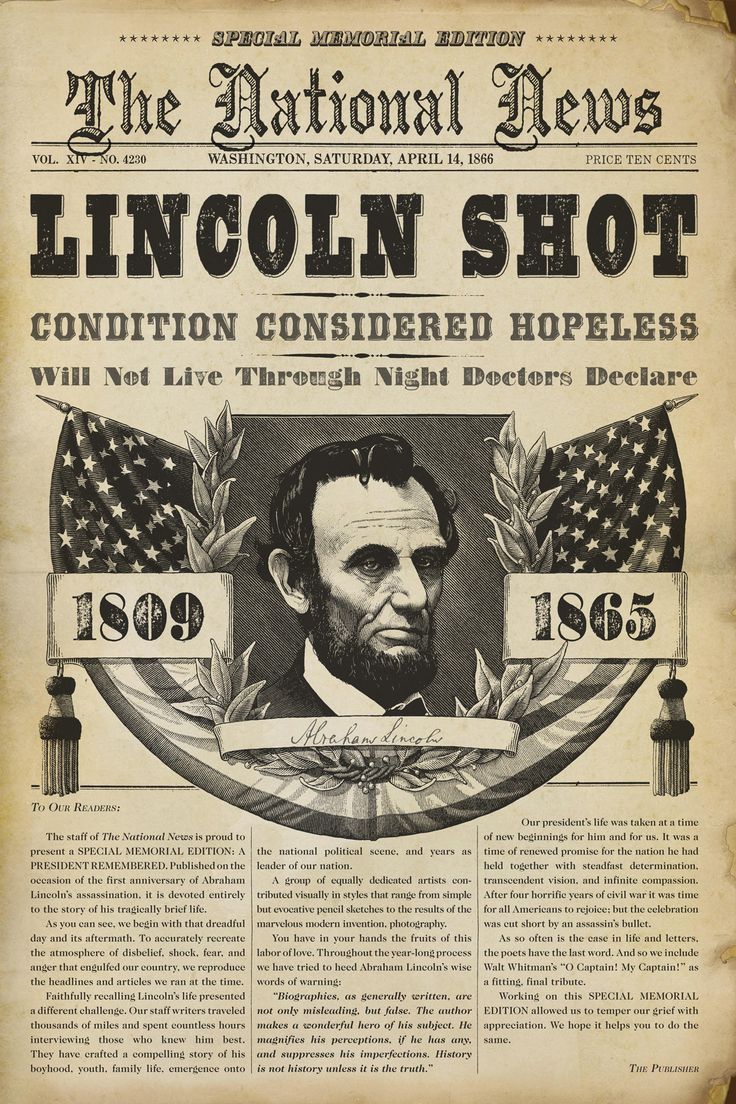
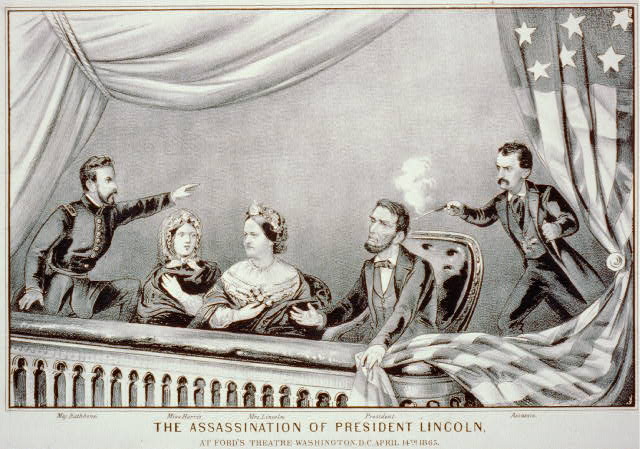
Easter came early this year, and with it Good Friday too. Good Friday is somber day, and I think that there was none more somber than Good Friday 1865. Shortly after 10 P.M. at Ford’s theater a handsome and well known actor walked into the booth occupied by President Lincoln at Washington’s Ford’s Theater. The President was there with his wife Mary Todd Lincoln and another couple after a very full day of business to watch the play Our American Cousin a farcical look at the visit of an American visiting his English relatives when going to settle the family estate.

Lincoln was looking forward to the play. Though the war continued the surrender of Robert E. Lee’s Army of Northern Virginia to Ulysses S. Grant on April 9th for all intents and purposes had placed the final nail in the Confederacy’s malevolent coffin, and it was if a burden have been removed from Lincoln’s shoulders. His task now what the reintegration of the rebellious states back into the Union, a task that he believed needed to be accomplished without malice while still seeking justice. He made this clear in his Second Inaugural Address just over a month before:

“With malice toward none, with charity for all, with firmness in the right as God gives us to see the right, let us strive on to finish the work we are in, to bind up the nation’s wounds, to care for him who shall have borne the battle and for his widow and his orphan, to do all which may achieve and cherish a just and lasting peace among ourselves and with all nations.”

Just three days before Lincoln had given his last public speech at the White House. It was a practical speech dealing with the nuts and bolts reuniting the country including announcing his support for Negro Suffrage. He said:

“By these recent successes the re-inauguration of the national authority — reconstruction — which has had a large share of thought from the first, is pressed much more closely upon our attention. It is fraught with great difficulty. Unlike a case of a war between independent nations, there is no authorized organ for us to treat with. No one man has authority to give up the rebellion for any other man. We simply must begin with, and mould from, disorganized and discordant elements. Nor is it a small additional embarrassment that we, the loyal people, differ among ourselves as to the mode, manner, and means of reconstruction.”

In the speech Lincoln discussed the issues related to the new government of Louisiana and its dealings with African Americans, which did not go far enough for Lincoln, who was intent on extending the franchise to vote for all blacks, even if it took time to make it so. John Wilkes Booth was in attendance that day and as he listened he became ever angrier and he vowed to a fellow conspirator Lewis Powell, “That is the last speech he will make” and Booth was going to ensure this himself.

Lincoln had been troubled for some time by terrible insomnia and dreams, both bizarre and ghoulish. A few days before he had told Mary and others sharing dinner with them of a troubling dream which he described in detail, Mary and those at the table so accustomed to Lincoln’s customary wit and humor were stunned as Lincoln spoke. He closed the description with these words:

“Determined to find the cause of a state of things so mysterious and shocking, I kept on until I entered the East Room, which I entered. There I was met with a sickening surprise. Before me was a catafalque, on which rested a corpse wrapped in funeral vestments. Around it were stationed soldiers who were acting as guards; and a throng of people, some gazing mournfully at the corpse, whose face was covered, others weeping pitifully: ‘Who is dead in the White House?’ I demanded of one of the soldiers. ‘The President’ was the answer; ‘he was killed by an assassin!’ “Then came a loud burst of grief from the crowd…” [1]

Mary and the others were so upset, particularly with the large number of death threats Lincoln had received throughout the war. However, Lincoln told them all not to worry as “it was only a dream.”

On that Good Friday Lincoln was determined not to mourn, instead of attending Good Friday services or contemplating the war, or reconstruction, he simply wanted to laugh and chose to attend the play, wanting General Grant and his wife to attend. However Grant needed to travel to New Jersey and declined the offer.

lincoln assassination

Despite this Lincoln was in a cheerful mood, looking forward to the future and discussing all the things that he wanted to see and do after his term in office. Mary was startled by his cheerfulness and Lincoln told her “I have never felt better in my life.” [2] Lincoln and his party arrived late to the cheers of the cast and took their seats in the box about 8:30 to the strains of Hail to the Chief. As the play resumed Lincoln’s bodyguard slipped away to get a drink and about twelve minutes after ten Booth slipped into the box where Lincoln sat watching the play. As the crowd roared its delight at a particularly funny scene a shot rings out and Lincoln’s arm jerks up and he slumps over. Booth then jumped to the stage from the box, injuring his leg and shouting “Sic semper tyrannis” or thus always to tyrants. It was the beginning of a series of attempted assassinations designed to decapitate the Federal government, Secretary of State Seward was badly wounded by Lewis Payne, a third assassin backed out at the last minute and failed to attack Vice President Johnson.

assassination_deathbed

Though physicians sought to save the President the wound was mortal, the bullet having ender the back of his head, and dug deep into his brain, lodging behind his left eye. At 7:22 A.M. Abraham Lincoln was dead. It was a disaster for the nation as the new President, Andrew Johnson was a political enemy of Lincoln and not in line with Lincoln’s understanding of reconstruction and reconciliation. A poor Southerner from Tennessee, Johnson hated the Southern plantation aristocracy and would act as a punisher, while radical reconstructionist members of the cabinet and Congress would act in such a way that reconstruction would never achieve all that Lincoln believed that it could.

While radical Confederates rejoiced in Lincoln’s death others were more circumspect. Jefferson Davis who was fleeing and hoping to continue the war realized that the South would not fare as well under Johnson as Lincoln. In fact Johnson’s lack of understanding of the nuances of northern politics as well as his loathing of blacks, his “beliefs, prejudices, personality traits were a recipe for disaster at a time when an unprecedented national crisis put a premium on the capacity to think in new and creative ways.” [3]

The Army of the Potomac learned of Lincoln’s assassination on Easter Sunday. Joshua Chamberlain told a woman whose mansion was at the center of his division’s camp when she asked what disturbed him “It is bad news for the South.” When the woman asked if it was Lee or Davis Chamberlain told her that it was Lincoln and said “The South has lost its best friend, Madam.” [4]

Chamberlain ordered chaplain to conduct a field memorial for the fallen President. The division chaplain a Catholic Priest, Father Egan spoke and roused the men, and Egan ended his service “Better so, Better to die glorious, than live infamous. Better to be buried beneath a nation’s tears, than to walk the earth guilty of the nation’s blood.” [5]

During the war Lincoln had endeared himself to his soldiers and they responded with great emotion. One burst into tears and sobbed “He was our best friend. God bless him,” another wrote home “What a hold Old Abe had on the hearts of the soldiers of the army could only be told by the way they showed their mourning for him.” Admiral David Dixon Porter wrote “The United States has lost the greatest man she ever produced.” [6]

The bullet fired by John Wilkes Booth was a disaster for the country. Sadly, there are some today, in particular the White Supremacist group The League of the South are choosing to celebrate the assassination of the man that they so hate, and honor the assassin as a hero. However, I have to agree with Admiral Porter, there has never been a President before or after who was anything like this man, and I dedicate myself to the quest for equality of all people and for a reconciliation like the leaders of the League of the South and their forbearers will never embrace, for they hate this nation as much as they hate Lincoln. I also fear what such people would do to President Obama should they ever get the opportunity.

Peace

Padre Steve+

Notes

[1] Winik, Jay April 1865: The Month that Saved America Harper Collins, New York 2001 p.205

[2] Ibid. Winik April 1865 p.220

[3] Foner, Eric Forever Free: The Story of Emancipation and Reconstruction Vintage Books, New York 2005 p.109

[4] Wallace, Willard. The Soul of the Lion: A Biography of Joshua L. Chamberlain Stan Clark Military Books, Gettysburg PA 1960 p.193

[5] Ibid. Wallace The Soul of the Lion p.194.

[6] Flood, Charles Bracelen Grant and Sherman: The Friendship that Won the War Harper Perennial, New York 2005 pp.329-330

2 Comments

Filed under civil war, History

The Colfax Massacre

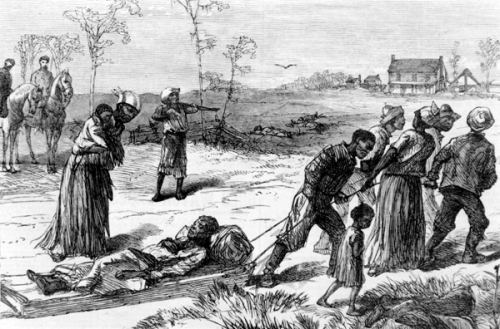
blacks at colfax

Friends of Padre Steve’s World,

Yesterday I posted an article about the surrender at Appomattox and the words, actions and attitudes of four unique Americans in attempting to end a war and reunite a country. Sadly, within months of that action there were men trying to reestablish an old order of tyranny based on White Supremacy. Their actions became bolder and bloodier in the years that followed. One of the most despicable acts of violence was occurred in Colfax Louisiana on the night of April 13th 1873.

This is the story of that massacre which I cover as part of my Civil War and Gettysburg text.

Peace

Padre Steve+

The violence against Southern blacks escalated in the wake of the passage of the Fourteenth and Fifteenth Amendments and with the increasing number of blacks being elected to office in some Southern states during the elections of 1872. In Louisiana a Federal court ruled in favor of Republican Reconstruction candidates following a Democrat campaign to interfere with the vote which included attacks on polling sites and the theft of ballot boxes. As a result the Louisiana Democrats “established a shadow government and organized paramilitary unit known as the White League to intimidate and attack black and white Republicans.” [1]

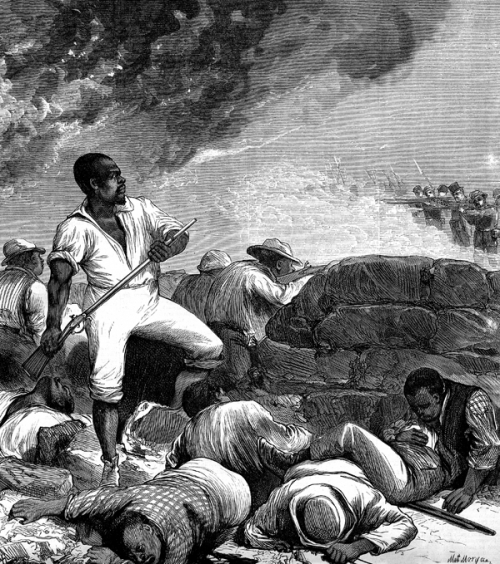
The White League in Louisiana was particularly brutal in its use of violence. he worst massacre committed by the White League occurred Easter Sunday 1873 when it massacred blacks in Colfax, Louisiana. Colfax was an isolated nondescript hamlet about three hundred fifty miles northwest of New Orleans, it sat on the grounds of a former plantation whose owner, William Calhoun worked with the former slaves who were now freedmen. The town itself “composed of only a few hundred white and black votes” [2] was located in the newly established Grant Parish. The “parish totaled about 4,500, of whom about 2,400 were Negroes living on the lowlands along the east bank of the Red.” [3] Between 1869 and 1873 the town and the parish were the scene of numerous violent incidents and following the 1872 elections, the whites of the parish were out for blood.

White leaders in Grant Parish “retaliated by unleashing a reign of terror in rural districts, forcing blacks to flee to Colfax for protection.” [4] The blacks of parish fled to the court house seeking protection from a violent white mob following the brutal murder of a black farmer and his family on the outskirts of town. The people, protected by just a few armed black militiamen and citizens deputized by the sheriff took shelter in the courthouse knowing an attack was coming. As the White League force assembled one of its leaders told his men what the day was about. He said, “Boys, this is a struggle for white supremacy….There are one hundred-sixty-five of us to go into Colfax this morning. God only knows who will come out. Those who do will probably be prosecuted for treason, and the punishment for treason is death.” [5] The attack by over 150 heavily armed men of the White League, most of whom were former Confederate soldiers, killed at least seventy-one and possibly as many as three-hundred blacks. Most of the victims were killed as they tried to surrender. The people, protected by just a few armed men were butchered or burned alive by the armed terrorist marauders. It was “the bloodiest peacetime massacre in nineteenth-century America.” [6]

The instigators of the attack claimed that they acted in self-defense. They claimed that “armed Negroes, stirred up by white Radical Republicans, seized the courthouse, throwing out the rightful officeholders: the white judge and sheriff” and they claimed that the blacks had openly proclaimed “their intention to kill all the white men, they boasted they would use white women to breed a new race.” [7] The claims were completely fabricated, after sending veteran former army officers who were serving in the Secret Service to investigate, the U.S. Attorney for Louisiana, J.R. Beckwith sent an urgent telegram to the Attorney General:

“The Democrats (White) of Grant Parish attempted to oust the incumbent parish officers by force and failed, the sheriff protecting the officers with a colored posse. Several days afterward recruits from other parishes, to the number of 300, came to the assistance of the assailants, when they demanded the surrender of the colored people. This was refused. An attack was made and the Negroes were driven into the courthouse. The courthouse was fired and the Negroes slaughtered as they left the burning building, after resistance ceased. Sixty-five Negroes terribly mutilated were found dead near the ruins of the courthouse. Thirty, known to have been taken prisoners, are said to have been shot after the surrender, and thrown into the river. Two of the assailants were wounded. The slaughter is greater than the riot of 1866 in this city. Will send report by mail.” [8]

Nine white men were arrested by Federal authorities in the wake of the massacre and three were “convicted of violating the Enforcement Act of 1871.” [9] white Democrats appealed the convictions and using the best lawyers they could get with nearly unlimited financial backing the appeal reached the Supreme Court.

colfax-the-louisiana-murders--1288

Colfax Blacks recovering their Dead and wounded

The attack, and the court cases which followed, notably United States v. Cruickshank which dealt with the men responsible for the Colfax Massacre led to a “narrowing of Federal law enforcement authority” and were “milestones on the road to a “solid” Democratic South.” [10] The decision of the court in United States v. Cruikshank was particularly perverse in its interpretation of constitutional rights and protections. The court ruled in favor of the terrorists and declared that “the right of the black victims at Colfax to assemble hand not been guaranteed because they were neither petitioning Congress nor protesting a federal law. Assembling for any other cause was not protected.” [11] The Cruikshank decision amounted to a Supreme Court endorsement of violence against blacks, and made it “impossible for the federal government to prosecute crimes against blacks unless they were perpetrated by a state and unless it could prove a racial motive unequivocally.” [12]

Other massacres followed across the South, aimed at both blacks and their white Republican allies. Another White League detachment southwest of Shreveport “forced six white Republicans to resign their office on pain of death – and then brutally murdered them after they had resigned.” [13] The violence, now protected by the courts ensured that neither would last long in the post-Reconstruction South and that the freedom of African Americans in those states would amount to a cruel illusion.

Notes

[1] Ibid. Foner Forever Free p.151

[2] Ibid. Langguth After Lincoln p.312

[3] Ibid. Lane The Day Freedom Died p.42

[4] Ibid. Goldfield America Aflame p.493

[5] Ibid. Lane The Day Freedom Died p.91

[6] Ibid. Goldfield America Aflame p.493

[7] Ibid. Lane The Day Freedom Died p.11

[8] Ibid. Lane The Day Freedom Died p.22

[9] Ibid. Goldfield America Aflame p.494

[10] Ibid. Lane The Day Freedom Died p.251

[11] Ibid. Langguth After Lincoln p.314

[12] Ibid. Goldfield American Aflame p.494

[13] Ibid. McPherson The War that Forged a Nation p. 185

2 Comments

Filed under civil rights, civil war, History, Political Commentary

We Are All Americans: Appomattox at 151

chamberlian gordon appomattox

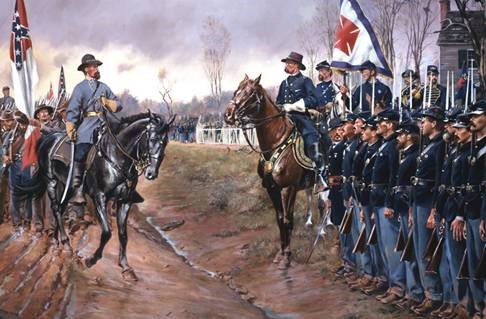
Joshua Chamberlain Receives the Surrender of John Gordon at Appomattox

Friends of Padre Steve’s World,

I am back from my recent trip and I am posting an article that I recently revised and had intended to post over the weekend, but did not get around to it. I guess that is a good thing. I hope that you enjoy it, and glean from it the lessons that the events that it is based on have helped to teach me.

Peace

Padre Steve+

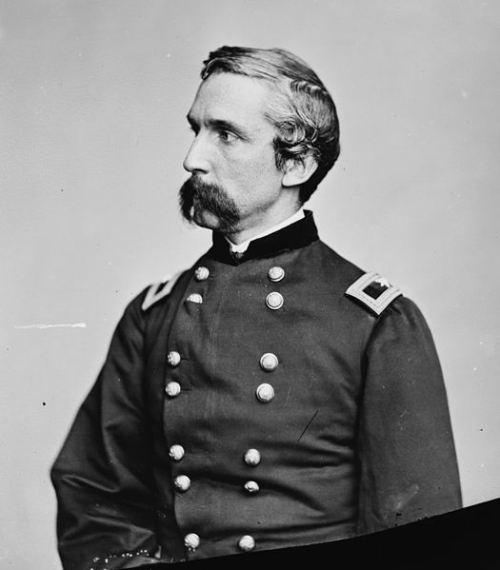
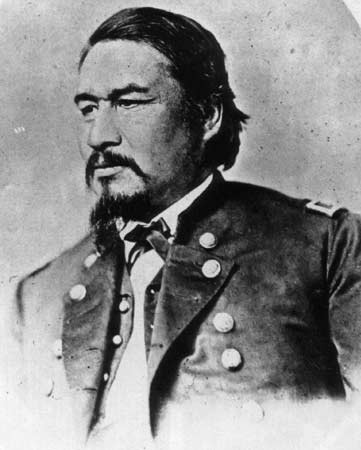
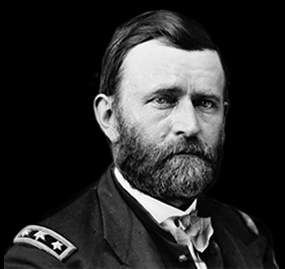
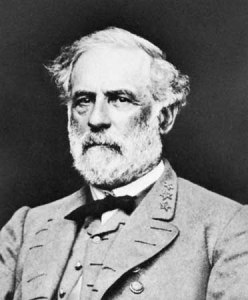
One hundred and fifty years ago on the 9th and 10th of April 1865, four men, Ulysses S Grant, Robert E. Lee, Joshua Lawrence Chamberlain and Ely Parker, taught succeeding generations of Americans the value of mutual respect and reconciliation. The four men, each very different, would do so after a bitter and bloody war that had cost the lives of over 600,000 Americans which had left hundreds of thousands others maimed, shattered or without a place to live, and seen vast swaths of the country ravaged by war and its attendant plagues.

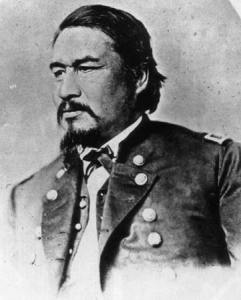
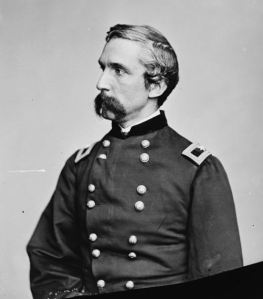
The differences in the men, their upbringing, and their views about life seemed to be insurmountable. The Confederate commander, General Robert E. Lee was the epitome of a Southern aristocrat and career army officer. Lieutenant General Ulysses S. Grant, like Lee was a West Point graduate and veteran of the War with Mexico, but there the similarities ended. Grant was an officer of humble means who had struggled with alcoholism and failed in his civilian life after he left the army, before returning to it as a volunteer when war began. Major General Joshua Lawrence Chamberlain had been a professor of rhetoric and natural and revealed religion from Bowdoin College until 1862 when he volunteered to serve. He was a hero of Little Round Top at the Battle of Gettysburg, who helped exemplify the importance of citizen soldiers in peace and war. Finally there was Colonel Ely Parker, a full-blooded Seneca Indian; a professional engineer by trade, a man who was barred from being an attorney because as a Native American he was never considered a citizen. Although he had been rejected from serving in the army for the same reason, his friend Grant had obtained him a commission and kept him on his staff.
grant 1

Ulysses S. Grant

A few days bef0ore the Confederate line around the fortress of Petersburg was shattered at the battle of Five Forks, and to save the last vestiges of his army Lee attempted to withdraw to the west. Within a few days the once magnificent Army of Northern Virginia was trapped near the town of Appomattox. On the morning of April 9th 1865 Lee replied to an entreaty of Lieutenant General Ulysses S. Grant requesting that he and his Army of Northern Virginia be allowed to surrender. Lee wrote to Grant:

HEADQUARTERS ARMY OF NORTHERN VIRGINIA, APRIL 9, 1865

Lieut. Gen. U.S. GRANT:

I received your note of this morning on the picket-line, whither I had come to meet you and ascertain definitely what terms were embraced in your proposal of yesterday with reference to the surrender of this army. I now ask an interview in accordance with the offer contained in your letter of yesterday for that purpose.

R.E. LEE, General.

The once mighty Army of Northern Virginia, which had won so many victories, and which at its peak numbered nearly 80,000 men, was now a haggard and emaciated, but still proud force of about 15,000 soldiers. For Lee to continue the war now would mean that they would have to face hopeless odds against a vastly superior enemy. Grant recognized this and wrote Lee:

I am equally anxious for peace with yourself, and the whole North entertains the same feeling. The terms upon which peace can be had are well understood. By the South laying down their arms they will hasten that most desirable event, save thousands of human lives, and hundreds of millions of property not yet destroyed. Seriously hoping that all our difficulties may be set-tied without the loss of another life, I subscribe myself, &c.,

Since the high water mark at Gettysburg, Lee’s army had been on the defensive. Lee’s ill-fated offensive into Pennsylvania was one of the two climactic events that sealed the doom of the Confederacy. The other was Grant’s victory at Vicksburg which fell to him a day after Pickett’s Charge, and which cut the Confederacy in half.
ileerob001p1

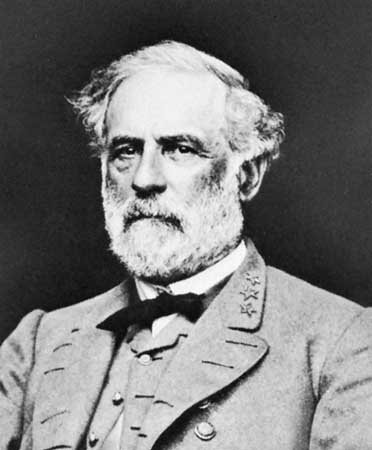
Robert E. Lee

The bloody defensive struggle lasted through 1864 as Grant bled the Confederates dry during the Overland Campaign, leading to the long siege of Petersburg. Likewise the armies of William Tecumseh Sherman had cut a swath through the Deep South and were moving toward Virginia from the Carolinas.

With each battle following Gettysburg the Army of Northern Virginia became weaker and finally after the nine month long siege of Petersburg ended with a Union victory there was little else to do. On the morning of April 9th a final attempt to break through the Union lines by John Gordon’s division was turned back by vastly superior Union forces.

On April 7th Grant wrote a letter to Lee, which began the process of ending the war in Virginia. He wrote:

General R. E. LEE:

The result of the last week must convince you of the hopelessness of further resistance on the part of the Army of Northern Virginia in this struggle. I feel that it is so, and regard it as my duty to shift from myself the responsibility of any further effusion of blood, by asking of you the surrender of that portion of the C. S. Army known as the Army of Northern Virginia.

U.S. GRANT, Lieutenant-General

Lee was hesitant to surrender knowing Grant’s reputation for insisting on unconditional surrender, terms that Lee could not accept. He replied to Grant:

HEADQUARTERS ARMY OF NORTHERN VIRGINIA, APRIL 7, 1865 Lieut. Gen. U.S. GRANT:

I have received your note of this date. Though not entertaining the opinion you express on the hopelessness of further resistance on the part of the Army of Northern Virginia, I reciprocate your desire to avoid useless effusion of blood, and therefore, before considering your proposition, ask the terms you will offer on condition of its surrender.

R.E. LEE, General.

The correspondence continued over the next day even as the Confederates hoped to fight their way out of the trap that they were in. But now Robert E. Lee, who had through his efforts extended the war for at least six months, knew that he could no longer continue. Even so some of his younger subordinates wanted to continue the fight. When his artillery chief Porter Alexander recommended that the Army be released, “take to the woods and report to their state governors” Lee replied:

“We have simply now to face the fact that the Confederacy has failed. And as Christian men, Gen. Alexander, you & I have no right to think for one moment of our personal feelings or affairs. We must consider only the effect which our action will have upon the country at large.”

Lee continued:

“Already [the country] is demoralized by the four years of war. If I took your advice, the men would be without rations and under no control of their officers. They would be compelled to rob and steal in order to live…. We would bring on a state of affairs it would take the country years to recover from… You young fellows might go bushwhacking, but the only dignified course for me would be to go to General Grant and surrender myself and take the consequences of my acts.”

Alexander was so humbled at Lee’s reply he later wrote “I was so ashamed of having proposed such a foolish and wild cat scheme that I felt like begging him to forget he had ever heard it.” When Alexander saw the gracious terms of the surrender he was particularly impressed with how non-vindictive the terms were, especially in terms of parole and amnesty for the surrendered soldiers.

Abraham Lincoln had already set the tone for the surrender in his Second Inaugural Address given just over a month before the surrender of Lee’s army. Lincoln closed that speech with these words of reconciliation:

“With malice toward none, with charity for all, with firmness in the right as God gives us to see the right, let us strive on to finish the work we are in, to bind up the nation’s wounds, to care for him who shall have borne the battle and for his widow and his orphan, to do all which may achieve and cherish a just and lasting peace among ourselves and with all nations.”
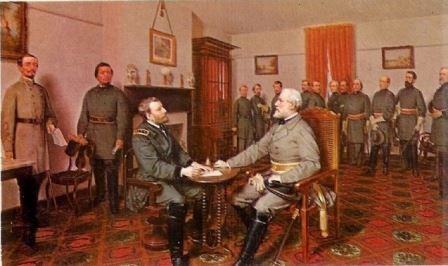
appomattox surrender

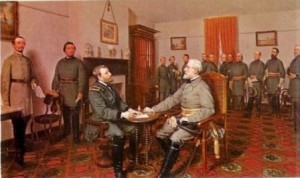
Lee met Grant at the house of Wilmer McLean, who had moved to Appomattox in 1861 after his home near Manassas had been used as a Confederate headquarters and was damaged by artillery fire. Lee was dressed in his finest uniform complete with sash, while Grant was dressed in a mud splattered uniform and overcoat only distinguished from his soldiers by the three stars on his should boards. Grant’s dress uniforms were far to the rear in the baggage trains and Grant was afraid that his slovenly appearance would insult Lee, but it did not. It was a friendly meeting, before getting down to business the two reminisced about the Mexican War.

Grant provided his vanquished foe very generous surrender terms:

“In accordance with the substance of my letter to you of the 8th inst., I propose to receive the surrender of the Army of N. Va. on the following terms, to wit: Rolls of all the officers and men to be made in duplicate. One copy to be given to an officer designated by me, the other to be retained by such officer or officers as you may designate. The officers to give their individual paroles not to take up arms against the Government of the United States until properly exchanged, and each company or regimental commander sign a like parole for the men of their commands. The arms, artillery and public property to be parked and stacked, and turned over to the officer appointed by me to receive them. This will not embrace the side-arms of the officers, nor their private horses or baggage. This done, each officer and man will be allowed to return to their homes, not to be disturbed by United States authority so long as they observe their paroles and the laws in force where they may reside.”

When Lee left the building Federal troops began cheering but Grant ordered them to stop. Grant felt a sense of melancholy and wrote “I felt…sad and depressed, at the downfall of a foe who had fought so long and valiantly, and had suffered so much for a cause, though that cause was, I believe, one of the worst for which a people has fought.” He later noted: “The Confederates were now our countrymen, and we did not want to exult over their downfall.”

In the hours before and after the signing of the surrender documents old friends and classmates, separated by four long years of war gathered on the porch or around the house. Grant and others were gracious to their now defeated friends and the bitterness of war began to melt away. Some Union officers offered money to help their Confederate friends get through the coming months. It was an emotional reunion, especially for the former West Point classmates gathered there:

“It had never been in their hearts to hate the classmates they were fighting. Their lives and affections for one another had been indelibly framed and inextricably intertwined in their academy days. No adversity, war, killing, or political estrangement could undo that. Now, meeting together when the guns were quiet, they yearned to know that they would never hear their thunder or be ordered to take up arms against one another again.”

Grant also sent 25,000 rations to the starving Confederate army waiting to surrender. The gesture meant much to the defeated Confederate soldiers who had had little to eat ever since the retreat began.

The surrender itself was accomplished with a recognition that soldiers who have given the full measure of devotion can know when confronting a defeated enemy. Major General Joshua Lawrence Chamberlain, the heroic victor of Little Round Top was directed by Grant to receive the final surrender of the defeated Confederate infantry on the morning of April 12th.

It was a rainy and gloomy morning as the beaten Confederates marched to the surrender grounds. As the initial units under the command of John Gordon passed him, Chamberlain was moved with emotion he ordered his soldiers to salute the defeated enemy for whose cause he had no sympathy, Chamberlain honored the defeated Rebel army by bringing his division to present arms.

John Gordon, who was “riding with heavy spirit and downcast face,” looked up, surveyed the scene, wheeled about on his horse, and “with profound salutation returned the gesture by lowering his saber to the toe of his boot. The Georgian then ordered each following brigade to carry arms as they passed third brigade, “honor answering honor.”
joshua_chamberlain_-_brady-handy

Joshua Lawrence Chamberlain

Chamberlain was not just a soldier, but before the war had been Professor of Natural and Revealed Religions at Bowdoin College, and a student of theology before the war. He could not help to see the significance of the occasion. He understood that some people would criticize him for saluting the surrendered enemy. However, Chamberlain, unlike others, understood the value of reconciliation. Chamberlain was a staunch abolitionist and Unionist who had nearly died on more than one occasion fighting the defeated Confederate Army, and he understood that no true peace could transpire unless the enemies became reconciled to one another.

He noted that his chief reason for doing so:

“The momentous meaning of this occasion impressed me deeply. I resolved to mark it by some token of recognition, which could be no other than a salute of arms. Well aware of the responsibility assumed, and of the criticisms that would follow, as the sequel proved, nothing of that kind could move me in the least. The act could be defended, if needful, by the suggestion that such a salute was not to the cause for which the flag of the Confederacy stood, but to its going down before the flag of the Union. My main reason, however, was one for which I sought no authority nor asked forgiveness. Before us in proud humiliation stood the embodiment of manhood: men whom neither toils and sufferings, nor the fact of death, nor disaster, nor hopelessness could bend from their resolve; standing before us now, thin, worn, and famished, but erect, and with eyes looking level into ours, waking memories that bound us together as no other bond;—was not such manhood to be welcomed back into a Union so tested and assured? Instructions had been given; and when the head of each division column comes opposite our group, our bugle sounds the signal and instantly our whole line from right to left, regiment by regiment in succession, gives the soldier’s salutation, from the “order arms” to the old “carry”—the marching salute. Gordon at the head of the column, riding with heavy spirit and downcast face, catches the sound of shifting arms, looks up, and, taking the meaning, wheels superbly, making with himself and his horse one uplifted figure, with profound salutation as he drops the point of his sword to the boot toe; then facing to his own command, gives word for his successive brigades to pass us with the same position of the manual,—honor answering honor. On our part not a sound of trumpet more, nor roll of drum; not a cheer, nor word nor whisper of vain-glorying, nor motion of man standing again at the order, but an awed stillness rather, and breath-holding, as if it were the passing of the dead!”

The next day Robert E Lee addressed his soldiers for the last time. Lee’s final order to his loyal troops was published the day after the surrender. It was a gracious letter of thanks to men that had served their beloved commander well in the course of the three years since he assumed command of them outside Richmond in 1862.

General Order
No. 9


After four years of arduous service marked by unsurpassed courage and fortitude, the Army of Northern Virginia has been compelled to yield to overwhelming numbers and resources.

I need not tell the survivors of so many hard fought battles, who have remained steadfast to the last, that I have consented to the result from no distrust of them.

But feeling that valour and devotion could accomplish nothing that could compensate for the loss that must have attended the continuance of the contest, I have determined to avoid the useless sacrifice of those whose past services have endeared them to their countrymen.

By the terms of the agreement, officers and men can return to their homes and remain until exchanged. You will take with you the satisfaction that proceeds from the consciousness of duty faithfully performed, and I earnestly pray that a merciful God will extend to you his blessing and protection.

With an unceasing admiration of your constancy and devotion to your Country, and a grateful remembrance of your kind and generous consideration for myself, I bid you an affectionate farewell. — R. E. Lee, General

The surrender was the beginning of the end. Other Confederate forces continued to resist for several weeks, but with the surrender of the Army of Northern Virginia led by the man that nearly all Southerners saw as the embodiment of their nation the war was effectively over.

Lee had fought hard and after the war was still under the charge of treason, but he understood the significance of defeat and the necessity of moving forward as one nation. In August 1865 Lee wrote to the trustees of Washington College of which he was now President:

“I think it is the duty of every citizen, in the present condition of the Country, to do all in his power to aid the restoration of peace and harmony… It is particularly incumbent upon those charged with the instruction of the young to set them an example of submission to authority.

eparker05-966-g

Brigadier General Ely Parker

It is a lesson that all of us in our terribly divided land need to learn regardless of or political affiliation or ideology. After he had signed the surrender document, Lee learned that Grant’s Aide-de-Camp Colonel Ely Parker, was a full-blooded Seneca Indian. He stared at Parker’s dark features and said: “It is good to have one real American here.”

Parker, a man whose people had known the brutality of the white man, a man who was not considered a citizen and would never gain the right to vote, replied, “Sir, we are all Americans.” That afternoon Parker would receive a commission as a Brevet Brigadier General of Volunteers, making him the first Native American to hold that rank in the United States Army. He would later be made a Brigadier General in the Regular Army.

I don’t know what Lee thought of that. His reaction is not recorded and he never wrote about it after the war, but it might have been in some way led to Lee’s letter to the trustees of Washington College. I think with our land so divided, ands that is time again that we learn the lessons so evidenced in the actions and words of Ely Parker, Ulysses Grant, Robert E. Lee and Joshua Chamberlain, for we are all Americans.

Sadly, I think that there is a portion of the American population who will not heed these words and will continue to agitate for policies and laws similar to those that led to the Civil War, and which those the could not reconcile defeat instituted again during the Post-Reconstruction and Jim Crow eras. For me such behavior and attitudes are incompressible, but they are all too real, and all too present in our divided nation.

But I still maintain hope that in spite of everything that divides us, in spite of the intolerance and hatred of some, that we can overcome. I think that the magnanimity of Grant in victory, the humility of Lee in defeat, the graciousness of Chamberlain in honoring the defeated foe, and the stark bluntness of Parker, the Native American, in reminding Lee, that “we are all Americans,” is something that is worth remembering, and yes, even emulating.

Peace

Padre Steve+

Leave a comment

Filed under civil rights, civil war, History, Political Commentary

Protesting Failure

  
Campaign Scene in the 1930 German Election

Friends of Padre Steve’s World,

I am returning home today after a refreshing denominational chaplain conference in Houston. During the time I received some spiritual care, spent time with friends and colleagues, and participated in a number of very informative training sessions. It was a good time, and for the most part with a few forays to check on friends on Facebook, look at a few news headlines, and read my favorite comics, I pretty much disconnected from social media and the Internet. Instead I spent time with others and did a lot of reading. 

The latest book that I am reading is The Coming of the Third Reich by British historian Richard J. Evans. I read the book when it came out years ago but amid all the political chaos going on in the Unites States, I decided to pick it up again. 

One thing that Evans noted about the Nazi Party in the 1930 elections, was how it took advantage of people’s frustration and discontent as the Great Depression overwhelmed the Weimar Republic. In those elections the Nazis went from being a fringe party to being a major player in German politics at the local, state, and national levels, and Adolf Hitler becoming a truly national political player. Evans wrote:

“Voters were not really looking for anything very concrete from the Nazi Party in 1930. They were, instead, protesting against the failure of the Weimar Republic. Many of them, too, particularly in rural areas, small towns, small workshops, culturally conservative families, older age groups, or the middle-class nationalist political milieu, may have been registering their alienation from the cultural and political modernity for which the Republic stood, despite the modern image which the Nazis projected in many respects. The vagueness of the Nazi programme, its symbolic mixture of old and new, its eclectic, often inconsistent character, to a large extent allowed people to read into it what they wanted to and edit out anything they might have found disturbing.” 

I think that is a very similar phenomena to what we are seeing today in the United States, whether it be from the frustrated supporters of Donald Trump or Bernie Sanders, as well as the members of the Christian Right that are supporting Ted Cruz.  In many cases they are frustrated and angry at what they see as the failure of both parties, and refuse to see the inherent dangers in people who promise much but at the same time show little in the way of developed programs and means to achieve what they are promising. In the case of Trump it often shown in xenophobic fearmongering, for Cruz an honest belief that he his God’s anointed one to lead the a United States in the “Last Days,” protect what he calls “Christian values,” even if that means depriving non-believers of their rights; and Sanders, who really gives honest commentary, (with which I happen to agree on on many points) regarding many of the enconomic and social ills afflicting the nation, but has no demonstrated program of how he will get Congress to fulfill his agenda, or the second, third, and fourth order effects of some of his economic ideas. And all of these men, in a sense are outsiders, even in the parties that they are trying to become the presidential standard bearers. They all appeal to the anger and frustration of different constituencies at the failed policies and broken promises of the establishments of both parties. In such an environment outsiders play well, while establishment candidates die on the vine, just ask President Jeb Bush.

Such was the case at the end of the Weimar Republic, and such could be here if we are not careful.

Evans noted, ”What the Nazis did not offer, however, were concrete solutions to Germany’s problems, least of all in the area where they were most needed, in economy and society. More strikingly still, the public disorder which loomed so large in the minds of the respectable middle classes in 1930, and which the Nazis promised to end through the creation of a tough, authoritarian state, was to a considerable extent of their own making. Many people evidently failed to realize this, blaming the Communists instead…” 

All this is said not to demean any of the candidates, to imply that any are Nazis, or to deny any of their supporters often legitimate complaints about the system and the often moribund party apperatuses of both parties. It is only to serve as a warning of what can happen when the system breaks down and the most cherished ideals and institutions of democracy are cast aside out of political expediency and perceived, or manufactured, national crisis which is intensified by the frenetic campaigning, simple slogans and vivid images offered by the media savvy campaigns of the different candidates; all of whom in one way or another play to the real,or imagined fears of their supporters, often with no regard for truth. 

Admittedly what I say here can be decidedly uncomfortable, but what I say is something that we still have time to think about and keep from happening here. Our system may be terribly flawed, and maybe even broken, but we can still make it work. Too many people have given their lives in war and peace; sometimes as soldiers, sometimes as advocates and activists, sometimes as legislaters or jurists, or simply hard working people who pulled together in the most difficult times to make things work, to throw it away. Likewise, it is what billions of people in hundreds of nations have looked to for inspiration and guidance; that sacred proposition “that all men are created equal.” 

But the task before us is not to destroy what we have, but as the Constitution notes “to form a more perfect Union” and as Abraham Lincoln stated in his Gettysburg Address, “to dedicate ourselves to the unfinished work…that we here highly resolve that these dead shall not have died in vain – that this nation, under God, shall have a new birth of freedom – and that government of the people, by the people, for the people, shall not perish from the face of the earth.” 

Forgive me for sounding a note of hope and belief in the face of raging anger and cynicism, but this is important for all of us, and it does not matter if you are liberal or conservative, Republican or Democrat, or who you support in the current political campaign. The problem is right now, is that there are many people on both sides of the political chasm who are so frustrated and angry that they cannot see the contradictions in their candidate’s positions and edit out the positions of their candidates that they find disturbing. 

So anyway, have a great day. 

Peace,

Padre Steve+


Leave a comment

Filed under History, nazi germany, News and current events, Political Commentary

The Past is a Foreign Country

gettysburgpickettscharge

Friends of Padre Steve’s World,

British novelist L.P. Hartley wrote, “The past is a foreign country: they do things differently there…”

That is true. When we look at or study history it is often hard for us in our time to comprehend how others committed or allowed acts that we find reprehensibly criminal and evil. Since my primary areas of expertise include the American Civil War, including the ante-bellum period and Reconstruction, as Germany from about 1848 through 1945, including Weimar and the Nazi era, I find that I am confronted with these questions almost daily.

One of the hard things for any of us, even historians who want to present a relatively objective view of events, is to try to avoid the assumption that the people who made those decisions operated under our world-view; to assume that they should have known what we know now. But that is not the case.

The historian Richard Evans wrote in his book The Coming of the Third Reich, “People make their own history, as Karl Marx once memorably observed, but not under conditions of their own choosing. These conditions included not only the historical context in which they lived, but also the way in which they thought, the assumptions they acted upon, and the principles and beliefs that informed their behavior.”

Such is also our contemporary problem, and future historians and lay-people alike will ask the same questions about us, just as we ask them about those who went before us. That is what makes the past so different, and why when I read, study, and write that I try to understand the world-view of those that I study, and what made them who they were; to see the good and the bad, and attempt to be as fair as possible.

Since I am still at my training conference and will be on the road home tomorrow I will wish you a good day.

Peace

Padre Steve+

1 Comment

Filed under History, Political Commentary

The Voice of God?

inherit-the-wind

Friends of Padre Steve’s World

As I was ruminating last week I watched the classic film Inherit the Wind, a film that I think should be required viewing for anyone seeking to impose their religious views on others through force of the law.

In the movie there is a climatic exchange between Spencer Tracy playing the fictionalized version of Clarence Darrow (Henry Drummond) and Frederick March who played the fictionalized version of William Jennings Bryan (Matthew Harrison Brady), the opponents at the famous Scopes Monkey Trial.

Drummond: How do you know that God didn’t spake to Charles Darwin
Brady: I know, because God tells me to oppose the evil teachings of that man.
Drummond: Oh, God speaks to you
Brady: Yes!
Drummond: He tells you what is right and wrong,
Brady: Yes
Drummond: And you act accordingly?
Brady: Yes.
Drummond: So you, Matthew Harrison Brady, through oratory or legislature or whatever, you pass on god’s orders to the rest of the world! Well, meet the prophet from Nebraska! Is that the way of things? is that the way of things, God tells Brady what is good, to be against Brady is to be against God.?
Brady: No! Each man is a free agent!
Drummond: Then what is Bertram Cates doing in a Hillsboro jail, supposing Mr. Cates had the influence and the lung power to railroad through the state legislature a law saying that only Darwin could be taught in the schools
Brady: Ridiculous! Ridiculous! There is only one great truth in the world. The gospel…
Drummond: The gospel according to Brady. God speaks to Brady, and Brady tells the world!
Brady, Brady, Brady almighty!
Brady: The lord… the lord is my strength!
Drummond: Suppose that a lesser human being… suppose a Cates or a Darwin had the audacity to think that God might whisper to him, that an un-Brady thought might still be holy? Must a man go to prison because he differs with the self-appointed prophet? Extend the testaments. Let us have a book of Brady. We shall hex the Pentateuch and slip you in neatly between Numbers and Deuteronomy!”

The film reminds us of how easily faith can take on an evil character, and how even well-meaning people who honestly believe that they are doing God’s will often presume, and sometimes can act as if they were the voice of God.

So when I hear Ted Cruz, or any of the hundreds of men and women running for office at every level of government proclaiming that they are speaking for God I get worried. I really do, especially when other well-meaning people, followers of the politicians, pundits, and preachers that claim to be speaking for God, take action to punish their enemies, believing that those enemies are also the enemies of God.

Such is a recipe for tyranny, a tyranny that the founders of the United States sought to avoid.

Peace

Padre Steve+

4 Comments

Filed under History, Political Commentary

Two Truths

roosevelt2

Friends of Padre Steve’s World,

I am still out at my Chaplain training symposium and since I don’t have much free time I am posting this thought from Franklin Delano Roosevelt. He wrote to Congress these words:

“Unhappy events abroad have retaught us two simple truths about the liberty of a democratic people.

The first truth is that the liberty of a democracy is not safe if the people tolerate the growth of private power to a point where it becomes stronger than their democratic state itself. That, in its essence, is Fascism—ownership of Government by an individual, by a group, or by any other controlling private power.

The second truth is that the liberty of a democracy is not safe if its business system does not provide employment and produce and distribute goods in such a way as to sustain an acceptable standard of living.

Both lessons hit home.

Among us today a concentration of private power without equal in history is growing…”

Sound familiar?

Have a great day,

Peace

Padre Steve+

Leave a comment

Filed under History, Political Commentary

Glory: The 54th Massachusetts

negro-regiment-54th-ma

Friends of Padre Steve’s World,

“Any negro taken in arms against the Confederacy will immediately be returned to a state of slavery. Any negro taken in Federal uniform will be summarily put to death. Any white officer taken in command of negro troops shall be deemed as inciting servile insurrection and shall likewise be put to death.” Proclamation of the Confederate Congress

A couple of days ago I took the time to watch again, the film Glory about the 54th Massachusetts Volunteer Infantry Regiment, one of the first African American Regiments raised for service in the Civil War. I have seen the movie a number of times, and it never fails to bring tears to my eyes. Of course I have written a number of articles about the 54th and other African American units in the Civil War, the later “Buffalo Soldiers” and African American military pioneers, but I cannot forget the 54th. These were men who volunteered and remained in service knowing that the Confederate Congress had condemned them to death should they ever be captured. They also endured the mocking of some White Union soldiers as well as pay inequity with whites, for doing the same dangerous job as infantrymen.

Over half of the regiment was including their commander, the twenty-six year-old Colonel Robert Gould Shaw were killed in an abortive assault on Battery Wagner outside of Charleston South Carolina on July 18th, 1863. Following the assault, “Sergeant William H Carney staggered back from the fort with wounds in his chest and right arm, but with the regiment’s Stars and Stripes securely in his grasp. “The old flag never touched the ground, boys,” Carney gasped as he collapsed at the first field hospital he could find.” He would be awarded the Medal of Honor for his actions.

Think that it was an insult the Confederates threw Colonel Shaw’s body in a mass grave with his African American soldiers. When Union commanders asked for the return of his body were told “We have buried him with his niggers,” Shaw’s father quelled a northern effort to recover his son’s body with these words: We hold that a soldier’s most appropriate burial-place is on the field where he has fallen.”

When Shaw first went to war he wrote to his mother words that should be in all of our hearts when we fight for the rights of others, especially those who are despised due to their race, color, religion, gender, or sexual orientation: “We fight for men and women whose poetry is not yet written but which will presently be as enviable and as renowned as any.” We also must remember that as we do so, that there will be those who oppose us, and who, if they ever had the chance who condemn us to death for doing so.

Peace

Padre Steve+

Leave a comment

Filed under civil rights, civil war, History

Men Who know too Little

heres-what-donald-trump-supporters-really-believe

Friends of Padre Steve’s World

I am on the way to Houston for my annual denomination Chaplain training symposium and as you have gathered from what I wrote last week I spend a good amount of time doing some reading and reflection.

One thing that I seem to be noticing in the current presidential race is the nearly blind certitude of most of the candidates, especially Donald Trump and Ted Cruz, and this reminds me of something that I read. Barbara Tuchman wrote, “No one is so sure of his premises as the man who knows too little.” When I look at Cruz and Trump, I am struck by how this resonates. Now to be sure they are not alone, but they stand out because of the way that they talk about foreign and domestic policy, demonize all that oppose them, and act as if they, and they alone are the political messiah who can save the world, and to borrow Trump’s campaign slogan which is on every Chinese made baseball hat, “Make America Great Again.”

This particularly concerns me in matters of foreign policy and national security. Trump seems to be ready to destroy alliances that do benefit us a nation and to demean the leaders of allied nations even as he brags on totalitarian leaders like Russia’s President Putin. Cruz on the other hand, according to his speeches is willing to “carpet bomb our enemies” seems to be ready to begin a policy of total war to achieve his goals. Honestly, I would be more scared of Cruz than Trump, simply because Cruz masks his ignorance and blind hatred in a belief, that he is anointed by God to lead the United States.

Tuchman wrote, “Strong prejudices in an ill-formed mind are hazardous to government.”

I think that is at the root of many of our political maladies, and not just on the political right, where they their proponents, who show not an ounce of empathy; are stoked by hatred of the other, encouraged by religious intolerance, and bolstered by the power of myth masquerading as fact are incredibly dangerous and proto-fascist.

But to be fair, when I read what many supposed progressives write, they seem more like angry revolutionaries willing to destroy systems at any cost, without replacement systems ready, and without thinking of second, third and fourth order effects on society as a whole. Some seem to be as intolerant of debate and compromise as are their opponents on the political right.

I am a progressive; my beliefs about the banking systems, economic inequalities, universal health care, civil rights, gay rights, women’s rights, and the use of national power in foreign relations, are all progressive. But I am also a pragmatist, you have to think before you act and you have to do things one thing at a time and sometimes, in a democracy that takes time and true political wisdom is to sense the time.

As my real progressive hero Franklin Delano Roosevelt noted in words that seem as pertinent today as when he spoke them during the Great Depression, “From the end of the World War twenty-one years ago, this country, like many others, went through a phase of having large groups of people carried away by some emotion–some alluring, attractive, even speciously inspiring, public presentation of a nostrum, a cure-all….There always exists in a democratic society a large group which, quite naturally, champs at the bit over the slowness of democracy; and that is why it is right for us who believe in democracy to keep the democratic processes progressive–in other words, moving forward with the advances in civilization. That is why it is dangerous for democracy to stop moving forward because any period of stagnation increases the numbers of those who demand action and action now.”

Until tomorrow,

Peace

Padre Steve+

Leave a comment

Filed under History, leadership, News and current events, Political Commentary