Category Archives: History

Padre Steve’s Highs and Lows of 28 Years Service

Ooops, this should have posted the 25th…all references in the post though it posted today are for the 25th.  The meltdown was the 24th, not my duty night.

Note: I think that I have pretty much recovered from last night’s mini-meltdown, though tired have has a good day working some stuff that is pretty cool that could be a positive thing for Navy and VA Chaplains.  I think success does help mitigate some of the effects of a meltdown.  If today had been crappy and I hadn’t had a good talk with Elmer the Shrink it might have continued.  Now with some sleep I could be cooking with gas even though my house is all electric.

On to the Post:

Soldier Once and YoungEnlisted in National Guard 1982

“So we’re all dogfaces, we’re all very, very different, but there is one thing that we all have in common: we were all stupid enough to enlist in the Army. We’re mutants. There’s something wrong with us, something very, very wrong with us. Something seriously wrong with us – we’re soldiers. But we’re American soldiers! We’ve been kicking ass for 200 years!” Bill Murray as John Winger in “Stripes” 1981

Well sports fans I am at the hospital tonight celebrating 28 years of service in the military. It really doesn’t seem like any more than 27 ½ but who’s counting right? And when I look back at the Army I joined I am reminded of Stripes.

I think that I have pretty much recovered from last night’s mini-meltdown, though tired have has a good day working some stuff that is pretty cool that could be a positive thing for Navy and VA Chaplains.  I think success does help mitigate some of the effects of a meltdown.  If today had been crappy and I hadn’t had a good talk with Elmer the Shrink it might have continued.  Now with some sleep I could be cooking with gas even though my house is all electric.

So 28 years ago today I went down and signed my name on the dotted line.  It was August 25th 1981 two months after the release of the movie Stripes and two months before I saw it with Judy at the $1 movie theater.  On that end of summer day I went down and signed my contract with the Army ROTC program at UCLA with the Chief Lord of Discipline himself, the Captain Bruce Lawson swearing me in.  He had just finished PT and though still in his PT clothes administered the Oath of Enlistment.  It was not much on ceremony but it was a start.  In fact most of my promotions in either the Army of the Navy have not come with much fanfare and I’m actually pretty okay with that so long as I get paid and get to do what I love doing which is being a Priest and getting to serve now as a Navy Chaplain.  So I followed with a trip down to the National Guard Armory on Victory Blvd in Van Nuys to enlist in the National Guard. Since I was not a scholarship student I was allowed to simultaneously enter the Guard.  So the 25th was kind of like a double header for me, I did the oath for the Guard later in the afternoon. It’s like Tommy Lasorda once said: “I love doubleheaders. That way I get to keep my uniform on longer.”

So I went in to Headquarters and Headquarters Battery and met the Company Commander, Captain J.J. Kramer, now a retired Colonel I believe and Major Charles Armagost, the Full Time Unit Administrator and Adjutant.  Wearing his green fatigues the good Major administered the Oath for the California National Guard, which differed from the Federal Oath in that it also included words about obeying the Governor of the State and the Laws of California etc…Following that I was walked down to the supply room where a rather rotund Sergeant began issuing me uniforms and field gear.  I got my first gift of US Military designer clothing and was told to report the Thursday after Labor Day for a “Battery Dark Night.”  So began my rather auspicious career.

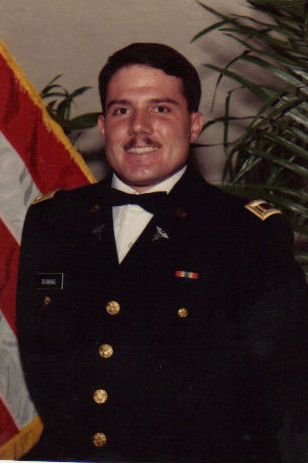
I remember being in uniform in those early days without a single ribbon or medal to my name.  I’d look around and see all the guys who had served in Vietnam and some in Korea as well with all kinds of ribbons, medals, unit citations and qualification badges.  I would look at them and once I remarked to Judy that I wish that I would have a lot someday.  She accused me of whining, something that I feel is a mischaracterization of my attitude about not having anything and something that now with a full chest of ribbons, medals and qualification pins that she is not hesitant to remind me of and tell others about.

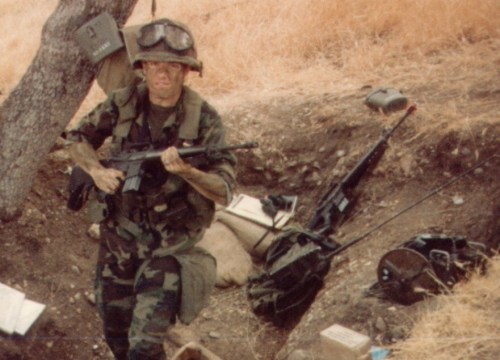
2LT Dundas 1983Look Mom One Ribbon

So what has transpired in 28 years?  Here are some of the highlights and a few lowlights of the of this adventure.

In 1981 it all began and things happened fast, within two weeks of enlisting I was driving an M-151A1 Jeep to Ft Irwin CA as part of battalion advance party and then spending the weekend learning to call in artillery fire. After going through hell and being destroyed and rebuilt by SFC Harry Ball, Drill Sergeant US Army like Richard Gere was in An Officer and a Gentleman I somehow got commissioned in part due to the forbearance of Major Lawson, the former Captain Lawson who has sworn me in.  Judy asks if I had my own “Puget Sound Deb” when she sees the movie with me that winter. However just prior to getting commissioned during my last annual training period at Camp Roberts I led team of Ersatz East German Kommando’s on raids against battalion rear area as the opposing forces.  I was almost run over in may M-151A1 by an M-548 Ammo Carrier during a strafing run coming down hills firing blanks from machine guns like the Rat Patrol and dropping Smoke and CS grenades in the vehicle’s path.  Later we captured the battery Operations Center during a firing mission. None of this made them happy but the Forward Observers and I had a blast.

After I got commissioned I attended the Medical Department Officer Basic Course at Ft Sam Houston TX and suffered for Jesus for 9 weeks in the Riverwalk Marriott hotel in downtown San Antonio. After this I spent 11 glorious weeks at Ft Knox Kentucky which by the way is in a “dry county” or at least it was back then  going through a 6 week course after being bumped by Saudi Arabian exchange officers.

557th comany command 1985Company Commander

From January 1984 through late December 1986 we were stationed with the 557th Medical Company Neubrucke and later Wiesbaden. Was a platoon leader and became company XO when our XO checked into a psych ward before Winter REFORGER. While in the field was promoted but o one realized that fact until we came out of the field in mid- February. In a late night hastily arranged ceremony which I had to drag Judy in from bed to see I was promoted and got my first real medal. In September I became a “relief pitcher” Company Commander when my new CO got fired. I was told “Lieutenant; clean up that Company.” After 7 months, and having to adjudicate close to 50 Article 15’s, and kicking a bunch of drug users out of the Army I was relieved by a Captain and I had my first and last Change of Command ceremony. Became a personnel officer at our group, pissed off the boss and had a miserable last couple months in Germany. However I completed my first row of ribbons made some really good lifelong German friends and learned to drive really fast and really good and developed a fine appreciation of good beer.

In 1987 I attended the Military Personnel Officer Course at Ft Benjamin Harrison which is in Indianapolis and continued on to Fort Sam Houston where I was assigned as the Adjutant for the Academy Brigade, Academy of Health Sciences.  I got promoted right after I got there and since Judy had not arrived I had the world’s best platoon sergeant, SFC Cynthia Carter help pin on my new Captain bars. Judy was quite happy that Cindy got to do this as she really liked her.  My Brigade Commander wondered what was up with that, but it was an honor to have her do the pinning. While there I worked on AIDS/HIV personnel policy and became “CINC AIDS” at the Academy. While there I collected my second Army Achievement Medal and an Army Commendation Medal.

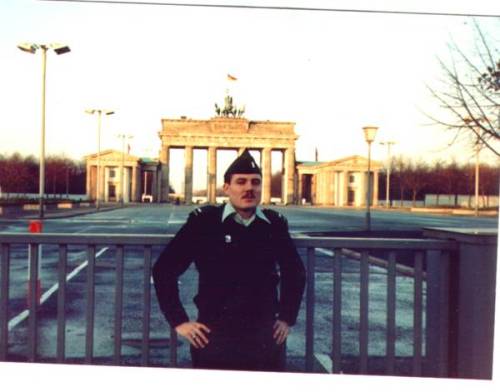
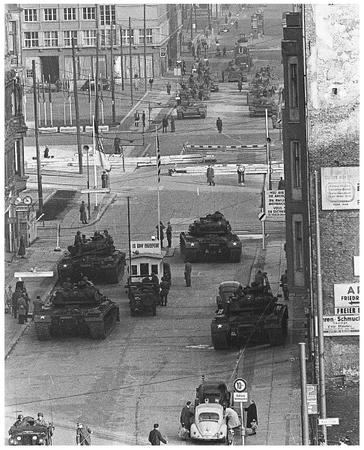
Berlin WallBerlin Wall 1986

In 1988 I left Active Army to attend Seminary and was appointed as an Armor officer in Texas Army National Guard.  I was told by my boss LTC Jim Wigger that I was moving from the “frying pan into the fire as the chaplains were a cutthroat bunch” and that the “Medical Department was not even in the same league as the Chaplains.” When the Division Chaplain found out that a seminarian was getting ready to drive tanks he pitched a fit and had me enter the Chaplain Candidate program.  In seminary I attended  the Chaplain Officer Basic Course at Fort Monmouth NJ. As Deputy Course leader and Company “First Sergeant” pissed off lots of chaplains and seminarians. Thankfully I was backed up by LTC Rich Whaley who saved my ass for the first time and not the last time.  I met my friend Fr Jim Bowman who kept me from doing anything really stupid. In 1992 I graduated from seminary was ordained and become a chaplain and assigned to 111th Engineer Battalion in Abilene. That year I got thrown out of the Chaplain Officer Advanced Course when school changed a policy on Chaplain Candidates awaiting final approval to be chaplains to enter course. After Billy Martin style tantrum Rich Whaley saves my ass a second time.

In 1993 I went back to Chaplain Officer Advanced Course, made amends and did the appropriate penance.  Meet up with Fr Jim Bowman again. In the fall of 1994 finished the final phase of the Chaplain Officer Advance Course.  Happiness is Ft Monmouth in your rear view mirror. In the summer of 1984 I viewed the O.J. Chase live on miniature TV in M-577 Command Track with Lakers playoff game in split screen while at Fort Hood.

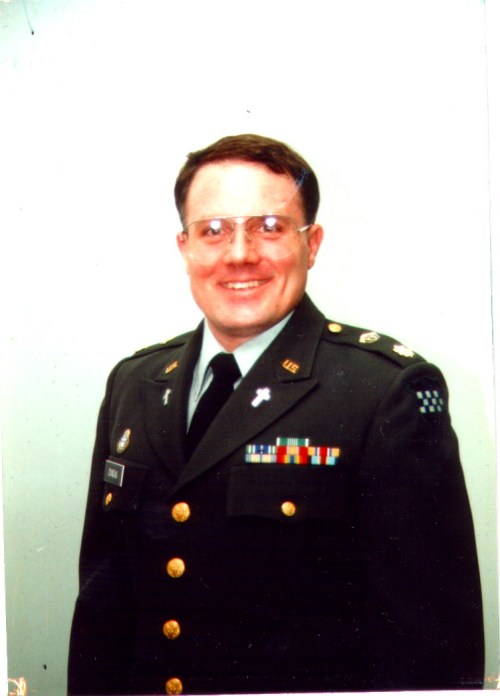
In January 1995 I moved to Huntington WV to take a job as a contract ER Chaplain.  I transferred from one former Confederate Unit to another going from the Texas to the Virginia Army National Guard.  In December I was promoted to Major and transferred to the Army Reserve and got rid of the 410 mile one way trip for a drill.

New MajorNew Major December 1995

In July of 1996 I got mobilized and sent to Germany to support Bosnia mission, lose job. While in Germany get to do a lot of cool stuff, got a bunch of medals and though the Chaplains there wanted me to be brought on regular active duty get told I am too senior to transfer to Regular Army. I actually think that the guy who made the decision remembered me from Chaplain School and did not want someone like me in “his” Chaplain Corps. Upon my return from Bosnia support the Reserves assigned to Ft Indiantown Gap PA as Installation Command Chaplain where in September 1998 I got to close down help close down the Federal side of things and transfer chapel and congregation to National Guard care. In October I returned to the reserves like a journeyman ball-player being sent back to AAA from the Majors. In December the Navy offered me a deal to play “in the show” on active duty and I took it, went from being an Army Reserve Major to Navy Lieutenant. My friend Father Fred Elkin was my first detailer and offered me a choice of East Coast or West Coast Marines when I asked for a ship.  We now serve together and get a good laugh about that now. It did turn out to be a good thing for me. One of the cool things about my time in the Navy has been since I have blown myself up enough in the Army and seen others do likewise that I know where the career “land mines” are and how not to step on them. This has been a great benefit to me.  It was like changing from one league to another in the middle of a baseball season.  The old stats don’t count for or against you when you start playing in the new league.

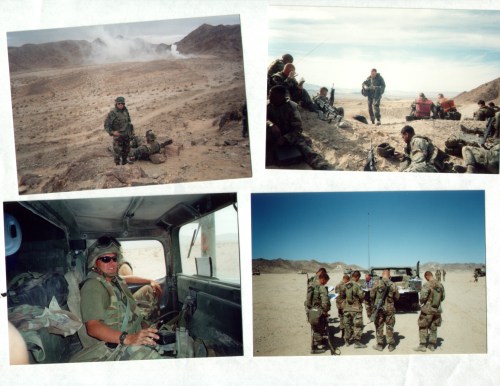
After Navy Chaplain School I was assigned to the 2nd Marine Division at Camp LeJuene NC. From then on my life has been going non-stop.  I was chaplain for 4 different battalions in the Division where Father John Kaul used me as a “relief pitcher” in situations where chaplains had either been fired for doing illegal or immoral things or replacing people who had to move on short notice orders. Did CAX at 29 Palms on multiple occasions and did a deployment to the Far East, Okinawa, Japan and Korea.  Collected more medals got my “old” version Fleet Marine Force Qualification. I was assigned to HQ BN 2nd MARDIV. 9-11 -01 attack happened. A couple of months later I reported to USS HUE CITY CG-66 in Mayport.

Dundas of the DesertDundas of the Desert 29 Palms 2000-2001

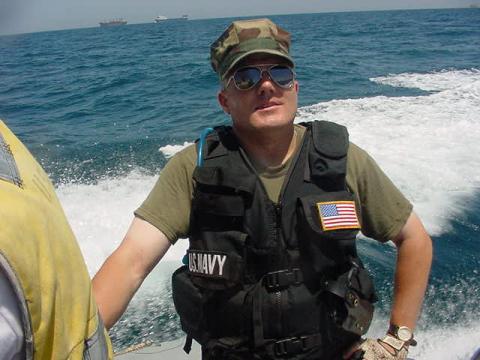
Not long after reporting went on the final work up exercises prior to deployment, deployed to the Horn of Africa, Northern Arabian Gulf, Gulf of Oman and Mediterranean.  Was an advisor for a boarding team in Northern Arabian Gulf and made 75 boardings of detained smugglers.  We almost got to see the Indians and Pakistanis get in a nuclear war, that was a bit sporty and we supported air operations in Afghanistan. After a period in the yards during following deployment as well as work with the great Marines who served in the Battle of Hue City I checked off the ship in October 2003, again collecting more medals and ribbons.

Boarding partyBoarding Party 2002

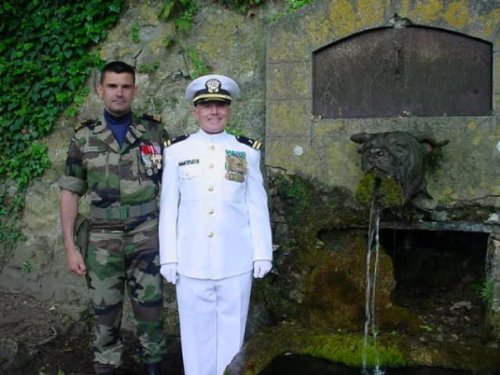
I went to Norfolk where I was assigned to the Marine Corps Security Force Battalion and my Commanding Officers, Colonel Mike Paulovich and Colonel Donald Rogers sent me about the world to care for our Marines.  Over that time I probably averaged 2 trips a month out of the area, many overseas to Japan, Hawaii, Spain, France, the United Kingdom and Bahrain, others to places far and wide in the Continental United States.  Colonel Paulovich and I probably worked more closely together than any commander that I have ever worked with and we went through many difficult times in that assignment. We are still friends to this day.  One of the cool things is the people that we work with. I was promoted to Lieutenant Commander in April 2006.  This meant that I had spent almost 16 years of my career wearing Captain or Lieutenant bars.  I again collected more ribbons and medals for the time with the Marines and was one of the first Navy Officers to get the Fleet Marine Force Officer Qualification pin while completing Marine Command and Staff College.

Belleau woodBelleau Wood France 2004

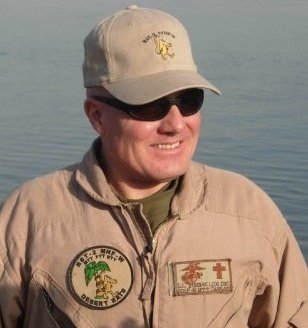
I then went to Navy EOD Group Two in Little Creek where I was the first chaplain assigned to EOD.  While there I got to go to Jordan to the Jordanian Army/UN Peace Operations Training Center and to Sicily.  I was snatched up to go to Iraq in July 2007 and served the most meaningful operational deployment of my career serving our Marine, Army, Navy, Air Force and Department of Justice and Homeland Security advisors to the Iraqi Army, Police and Border Forces in Al Anbar Province.  I came back from Iraq with a great case of PTSD, a gift that keeps on giving.  I checked out of EOD in September 2007 again with more medals and ribbons to my current assignment at Naval Medical Center Portsmouth where I get to do what I am passionate about as a Priest and Navy Chaplain serving in a teaching hospital.

My Tom Clancy lookIraq 2008

Looking back it has been a long and strange trip and it is still an ongoing journey.  People ask me how I keep going even with the PTSD and it’s like Tommy Lasorda says “Guys ask me, don’t I get burned out? How can you get burned out doing something you love? I ask you, have you ever got tired of kissing a pretty girl?” Speaking of which now that I am on the way home after 31 or so hours at work I probably need to do with Judy when I see her.

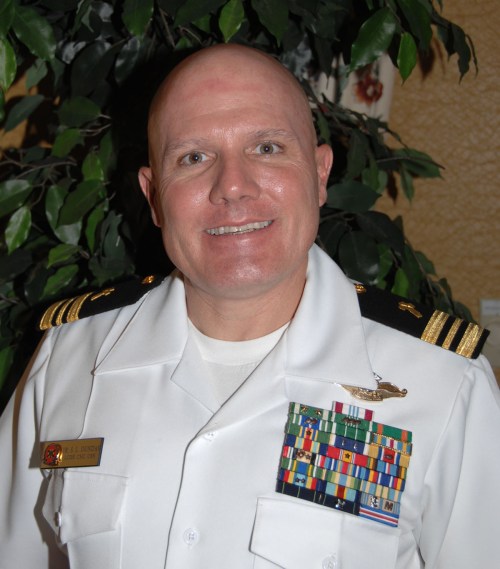
Steve Summer Whites 2008July 2008, Grand Admiral of the Ottoman Navy?

Peace,  Steve+

1 Comment

Filed under Baseball, History, iraq,afghanistan, Loose thoughts and musings, Military, PTSD

Going to War: It was Just a Rocket and a Night Flight to Fallujah

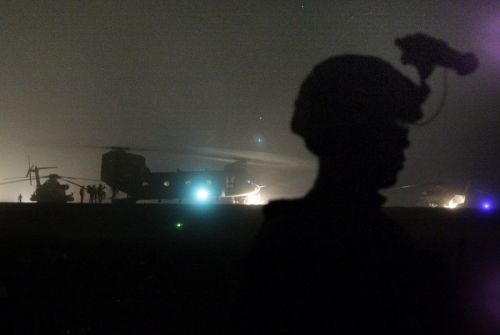
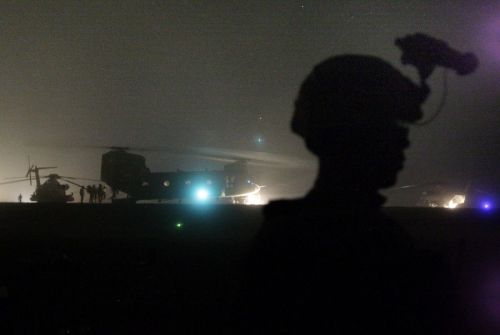
helos at nightTypical LZ at Night

That evening Nelson and I said farewell to our new friends at Iraq Assistance Group, went and got chow at the large Camp Victory chow hall.  What is interesting on some of the larger bases is just how well fed the troops are.  Of course there are those who are better fed than others who could use the “wide load” convoy signs hanging off of their asses.  The main chow hall at Victory has a number of serving lines and drink, salad and dessert islands.  It has the main serving line, a fast food short order line, a Mongolian BBQ line as well as variations of Giros, Indian food, pizza bar and of course soft serve as well as Baskin and Robbins Ice Cream.  Breakfast is another “feeder” with almost everything imaginable to eat.  I am not a big breakfast eater by and large so for me black coffee, hot or cold cereal and fruit was a normal breakfast.  After dinner we went and finished our packing and waited for our ride to take us to the Camp Liberty airfield.  Had I been stationed at Camp Victory I would have probably outgrown my uniforms as I look at food wrong and can add a pound.

We had a very late flight, about 0200.  Since you normally need to manifest for a flight two hours prior it means that you back up at least a hour before the manifest time.  This particular evening there was not much cooling going on and there was little illumination which meant in most places it was very dark. Especially in troop the billeting areas.  We dragged our gear to the entrance to the billeting area.  Nelson went back to his tent and I plopped my ass down on my bags.  About 2300 I heard and felt a rush over my head.  It was a rocket, probably a 107 mm rocket which is one of the most popular indirect fire weapon used by the insurgents or possibly a 122 mm rocket.  Both are former Soviet systems and not very accurate but still the fact that a rocket has buzzed me was disconcerting.  A few seconds later I heard an explosion.  I later heard the rocket had continued on and hit an uninhabited area of the camp.  Soon after it went over my head a very young looking soldier came running up to me in his PT gear with an M-16 at the ready.  He shouted “Sir, what was that?”  The young man appeared to be a bit scared to I simply quipped “Only a rocket son didn’t hit us.”  He seemed to relax just a bit and I said “You okay son?” the good thing about being as old as I am that you can get away with calling the young guys “son” because in most cases they I’m old enough to be their father.  I stay in game too much longer and the new kids could be grandchildren.  This young soldier said, “Well sir I’m on the quick reaction force and that sounded close.” In the background to the east machine gun and small arms fire could be heard.  A pair of gunships buzzed us going the general direction of the gunfire. Baghdad was definitely not a violence free school zone.  I replied to the young soldier. “Son, if I were you I’d report to where you need to go, better grab your helmet and flak.”  The young man looked at me in the dark, assuming I was a Marine officer since I was in my Marine Desert digital cammies, saluted and said “Yes sir” to which I replied “be safe soldier and God bless, keep up the good work.”  Once again he thanked me and hurried off into the night.

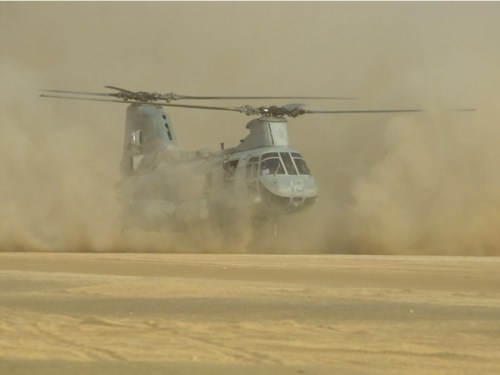
AIR_CH-46_Brownout_Landing_lgCH-46 Landing

A few minutes later, Nelson who has been in some pretty sporty situations in Afghanistan including once where he took out a knife wielding assailant at a checkpoint in Kabul with his fists, came up to me.  “Hey Chaps, did you hear that rocket? Sounded like a 107.”  I said to him, “Shit brother, it felt like it went right over my head. “  He responded quickly “Boss I think we’re in a war here.”  And I said “sounds like it partner, definitely sounds like it.”  Then he said “Chaps, you wouldn’t believe what I just saw.”  I said “Really, what?”  And he told me the story. “I was over looking for our boy when I needed to go to the head, so I opened one of the port-a johns and when I opened it saw this guy and girl having sex in it, like they didn’t have the door closed and you know how nasty those things are.”  I said “Partner you’ve got to be kidding me” and Nelson said “Chaps I wouldn’t do that to you, those people looked at me like I was stupid when I opened the door and I just said excuse me and closed the door. That place stank sir; I don’t know how they were doing it in there.”  I replied “Partner, I guess after a year of more here some folks will take whatever they can get.” “But, you’d think that they would find some dark spot rather that a port-a-john,” replied a thoroughly disgusted Nelson.  As I laughed at the misfortune of my little buddy, bodyguard and protector I simply said “There’s no accounting for taste my friend, no accounting for taste.”

We sat on our gear and waited, and waited.  The time when we should have been picked up went by and after about 15 minutes of chatter about not being picked up on time, Nelson said. “Boss you want e to go find our ride?”  I responded that I wanted him to as it was so dark that he might not know where to find us. A few vehicles had come and gone but none were our assigned wheels.  Finally after about 45 minutes our ride showed up, Nelson had found him on the other side of the compound in his truck listening to AFN radio.  He had come to the wrong side of the billeting area and was chastising me for not being there.  I said, “Sergeant, I said to meet us over here and I’ll be damned f we have to lug our gear a couple hundred yards to make you happy.”  I paused as he started to interrupt and then cut him off “Sergeant, don’t go there, you’re talking to a field grade officer who wasn’t always a chaplain, you went to the wrong place and you didn’t take the initiative to try to find us. We had to find you so don’t push your luck.”  He replied, almost dejectedly, “Yes sir” and I said, “consider this matter ended, get us to the airfield, we have a flight to catch.”  Nelson and I piled our gear into the back of the truck, got in and rode the airfield.

The Camp Liberty airfield, which deals exclusively in rotor wing aircraft, is one of the busiest heliports in the world.  Hundreds of flights go through it every day.  They are primarily Army, but a fair amount of Marine aircraft pass through as well.  We were flying Marine air tonight.  When we got to the heliport our chauffer had a difficult time finding a place to park.  Eventually we sort of double parked and Nelson and I and Nelson and I unloaded our gear with a bit of help from our chastened chauffer got up to the manifest desk where we were greeted by a civilian. He took our names and our mission number and then took out a marking pen and wrote it on the back of our hands.  I found that that at each place this was the primary way to identify who was getting off where or if you should even be on the aircraft. I found a seat and then because I couldn’t get comfortable walked outside for a while.  Nelson on the other hand, ground his gear, threw himself upon it pulled his cover over his eyes and took a power nap. He can sleep almost anywhere.

With about 10 minutes to go I woke up Nelson, and I find it amazing how he can wake back up the way he does.  When I take a nap I am useless for about 30 minutes after I wake up as my body tries to figure out what time it is. We both took turns guarding our gear as the other hit the head, once again a darkened port-a-john that stank to low hell.  When done we staged our gear near the lineup point.  Our mission was called and we lined up with about 30 others, a mixture of Marines, Sailors, contractors and a few soldiers.  We geared up, securing helmets, flaks, our packs as well as our massive EOD issue sea-bags.  Nelson helped me with mine as we got ready to walk, once was over my back and the second strapped across my chest, actually going from my chin to just above my knees.  Many of our fellow passengers had very little gear, and one fairly large contractor offered to help me with my gear.  I took him up on it about half of the 100 yards to where our bird had landed.

Watching our aircraft come in, a flight of 2 Marine CH-46s which date back to Vietnam service I was amazed at how surreal they looked coming in out of the night, their haze gray fuselages almost having a ghostly appearance as they set down.  Of course we had the bird that was farthest from the line up point and I was really glad for the help of this generous contractor.  As we loaded our bags onto the aircraft, stacking it in the center of the deck with everyone else’s gear, we each took one of the jump seats along the side and strapped ourselves in.  Sweat was pouring off of me and I felt totally winded, no amount of running, pull ups, pushups and crunches had prepared me to lug our heavy and ungainly gear around.  The dimly lit troop compartment was hot and I looked around the aircraft.  I noted the machine gunners in the front doors and the crewman in the back who took a seat with a 240 series machine gun mounted on a swivel.  It reminded me of the films I saw of the inside of World War Two B-17s, except that the flight suits were different.  The crew gave the let the pilots know that we were ready, and I wondered what we were heading into.  Nelson got my attention and gave me a “thumbs up” and I returned it as the lights went out that our flight lifted off.

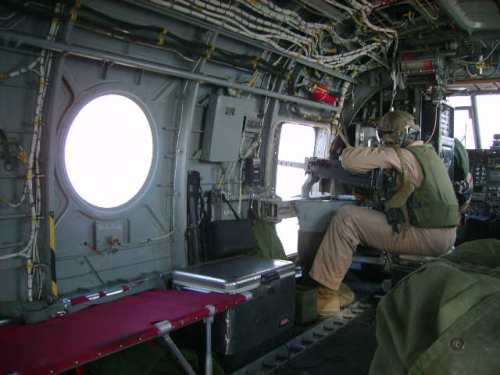
1002CH-46 Door Gunner

Banking around to the left the 46 gained altitude and flew back across the camp as it did so I got my first view of Iraq after dark.  As we flew into the city of Baghdad there were lights and sometimes lit streets. In a few places I could see the flashing lights of emergency vehicles.  We soon began to descend into the city surrounded by tall buildings, mainly hotels and government buildings and I knew that we were in the “Green Zone.” We sat down on a small landing pad, the dim lights came back on and a couple of passengers got out of our bird which a couple of more boarded the flight. The scene from Camp Liberty was repeated and gear was off and on loaded, passengers boarded and debarked from the flight and the lights went off and the bird lifted off.  Gunners took their positions and chatted on their headsets obviously scanning for threats and assessing what was going on, or they could have been talking about the new video game one of them had bought at the exchange.

Banking left we gained altitude heading east, with Baghdad fading into the night the lights of the communities along the Euphrates came into view as we flew on toward Fallujah.  For me it was a fascinating experience, surreal and a bit of anxiety making but interesting as I thought of the history of the ancient civilizations who had settled here, the Assyrians, Babylonians and Persians and the fact that the faith of the Christian Church through Abraham and later the people of Israel began here with Abraham’s obedience to the Lord.

The flight only took about 16-18 minutes and we flew into Fallujah.  The bird sat down on a large tarmac and the crew motioned us to get up grab our gear and get off of the aircraft.  I was praying desperately that it would not be a long walk to the terminal from the helicopter pad.  As we hauled our gear off the 46 to get to the terminal I was about tapped out.  The 46 had landed about 100 yards from the terminal where our ride waited.  It might as well have been 100 miles.  I loaded one bag on my back and commenced to drag the other.  Nelson was ahead of me and realized that his old Padre was not doing well.  I was about halfway to the terminal when Nelson showed up with a Marine on a John Deere Gator. My gear was loaded aboard the Gator; I gave a hearty thank you to Nelson, the Marine and to the Deity Herself as I dragged my sorry ass to the terminal.

The Fallujah terminal like most terminals at heliports in Iraq was a plywood building constructed by the Seabees.  It was well lit inside, had air conditioning which I sucked up and a large refrigerator with bottled water stashed in it.  Once inside I took off my helmet as we checked in at the desk.  By now it was about 0245, I had been up since 0530 the previous day, done PT a Camp Victory, had a rocket fly directly above me and dragged 200 pounds of gear more places than I wanted to in 100 degree heat and I was a spent round.  War is a young man’s game and even though I am in good shape for someone my age, the key is that I am in good shape for someone my age, not a young guy.  Sweating profusely I found a liter bottle of water and downed it.  About that time a large African American 1st Class Petty Officer came in the door.  RP1 Donnie Roland was the LPO of the II MEF Forward Chaplain’s office and worked for Mike Langston.   Donnie, who is now a Chief is a guy that you definitely want on your side.  He hooked us up.  Normally personnel in a transient status in Fallujah are housed in tents with cots in varying degrees of disrepair.  Donnie got us rooms in the VIP quarters, nicknamed by the Marines the “Ramadan Inn.”  The place had once been the haunt of Uday and Qusay Hussein, Saddaam’s sons.  It had a pond in the center of the court yard and was reputedly a place where they would entertain senior members of the Ba’ath Party amid scenes of debauchery.  We were given a small room that had a desk and two small Iraqi beds, both of which had thin concave mattresses which had little support but were a definite step up from a cot.  Sheets, pillows and a blanket were included.  Our gear took up the majority of the room but it didn’t matter.  After a shower I crashed hard.  The bed might have been from a 5 star hotel, all that mattered at 0330 was that I could get to sleep.  RP1 Roland told us that Chaplain Langston said that we should get some sleep and come in when we could.  With outgoing artillery fire going off in the background I laid my worn out body down on the waiting mattress, I thought about the day and it came to me that the rocket that had went over my head could have killed me and a chill went down my tired spine.  Another salvo of artillery lashed out at the enemy, and my mind drifted back to the present.  I was now in Fallujah.  One more stop on the way to my war, Nelson was already asleep, I am amazed at his ability to go from 0-60 and 60-0 so fast.  More artillery fire boomed and as a former forward observer I found outgoing artillery fire to be comforting, amid it’s lullaby I went to sleep.

Leave a comment

Filed under History, iraq,afghanistan, Military, Tour in Iraq

Operation “Dachs” My First Foray into the Genre “Alternative History”

For a change of pace I have pulled up something that one of my professors allowed me to do in my Military History Masters Program.  This was my first foray into historical fiction, or as it is known sometimes as “Alternate History.”  This is actually a growing genre among military writers and others who have vivid imaginations as to what might have happened if….

I hope you enjoy.  Peace, Steve+

This is an alternative history of how the Germans might have avoided the disaster at Kursk. It looks at what might have happened if an actual assassination attempt on Hitler had succeeded in March 1943 and how Manstein might have been able to execute the “backhand” strategy that he favored using a mobile defense.  This is predicated by Hitler’s death, based on Hitler’s actions and control of operational decisions Manstein would never have been allowed the freedom to conduct operations in this manner.  In eliminating Hitler I have also included personnel changes and the overall strategy for the German High Command, and the probable response of Stalin to Hitler’s death had it occurred in the spring of 1943. I have tried to be faithful to known historical opinions and actions of the participants and likely reactions to such a situation although one cannot predict precisely what people would have done.  Thus I have documented the article with footnotes as if it were an actual history. It would have been interesting to be able to lengthen this and included sections on tactical actions based on memoirs of German and Russian soldiers.

hitlers fw-200Hitler’s FW-200 Prior to his Ill-fated vist to Army Group Center

Background: The Strategic Situation Spring 1943

In April 1943 the German High Command faced a decision on which the fate of Nazi Germany would hinge, but for the first time in the war it was not under the thumb of Adolf Hitler. Following Manstein’s counter-stroke following the Stalingrad disaster there was considerable pressure to follow up with that success with a continued offensive. Manstein himself had proposed this but Field Marshal Von Kluge refused to agree to an immediate offensive because he felt his troops needed rest and refitting. On March 13th Hitler flew out to meet with Von Kluge at Army Group Center HQ at Smolensk.  On the flight back Hitler’s FW-200 was racked by an explosion crash landing near Minsk, taken down by a bomb planted on the plane by Colonel Henning Von Trescow of Kluge’s staff.[i] While Hitler survived, he remained in critical condition, barely alive at a SS hospital until his death on 20 April 1943, his 54th birthday. The crash landing was reported by the escorting ME-109s of JG-53, and a Alarm Company from a Security Division at Minsk rescued Hitler but were driven off the crash site by a large force of Soviet Partisans who destroyed the aircraft and any evidence to the cause which the escorting fighters attributed to mechanical problems.  There were no other survivors. Von Kluge, expecting to be implicated the Fuhrer’s death committed suicide after visiting troops on the front line, and was succeeded at Army Group Center by Field Marshal Model the commander of 9th Army. The other conspirators were frozen into inaction when Hitler survived the crash and made no attempt to take over the government, realizing that “our plans for seizing power in Berlin and other large cities were still not adequate to the task.”[ii] In the absence of Hitler Reichsmarschall Goering, Hitler’s designated successor, took action to secure his power and using contacts in the GESTAPO accused Himmler of treason for making contact with Neutral intermediaries in Sweden[iii] and replaced him with SS General Kurt Wolfe, and reappointed Rudolf Diels, the former head of the GESTAPO when it was still under his control[iv], to head it again.  Himmler attempted to flee and was caught near Luneburg when he committed suicide with a cyanide capsule before he could be interrogated. Other potential rivals were eliminated; Martin Bormann, who Goering hated, was arrested on charges of exceeding his authority, embezzlement, and harming the war effort and was executed.[v] Joseph Goebbels swore his loyalty to Goering even before Hitler’s death.  He and Albert Speer were directed to arrange the state funeral for the late Fuhrer. Berlin Radio announced the Fuhrer’s death on the 21 April, Hitler’s body was prepared and lay in state at the Chancellery.   A period of mourning was declared 21 April to 1 May on which the State Funeral took place. On 2 May Goering announced that Field Marshal Von Rundstedt was the new Chief of OKW and would coordinate strategy on all fronts. The next day Goering called together a meeting of the heads of OKH, OKW, the Inspector General of Panzer Troops, and the commanders of the Eastern Front Army Groups, Western Europe and Africa as well as Reichsfuhrer Karl Wolff, Admiral Donitz and Field Marshal Von Richthofen[vi] representing the Luftwaffe to decide on a course of action for the summer. It was the first time that all had been called together to discuss the overall situation since Barbarossa began in 1941, and the first true attempt to formulate a grand strategy during the war.

Options and Decision: The Zossen Conference 3 May 1943[vii]
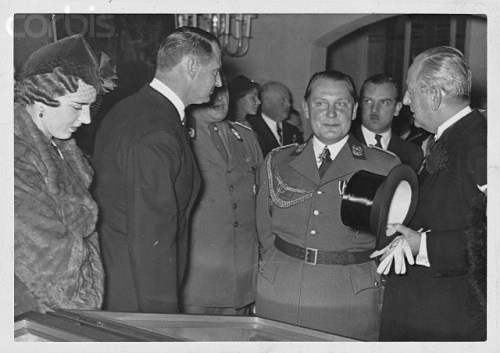
HU010919Goering meeting Diplomats following Hitler’s State Funeral

Herman Goering looked up from the maps spread out on the conference table.  He looked surprisingly fit, somehow between the crash of Hitler’s aircraft and his death he had pulled himself together and out of his drug induced malaise.  It was as if he again had a purpose. Field Marshal Von Rundstedt now Chief of OKW following Goering’s relief of Field Marshal Keitel, and General Jodl had just finished briefing the situation in western and southern Europe, following briefings by Colonel General Zeitzler of OKH, the Inspector General of Armored Troops, General Guderian and Field Marshal Von Manstein of Army Group South.  Albert Speer briefed tank and aircraft production numbers while the Chief of the Army personnel office noted the requirement for 800,000 replacements “but even the most ruthless call-up was able to produce only 400,000.”[viii] Looking from the table he spoke: “Gentlemen, the situation is critical and I have to admit that I have thought so for a number of months but have been unable to speak out.   Our political situation is perilous, the Italians are ready to abandon our cause. Our forces in North Africa will soon be unable to hold out as our Italian friends have let us down again.[ix] I expect that if Jodl and Kesselring are right about Allied intentions that we will have our hands full in the west shortly.  Kesselring and Arnim, you need to evacuate as many German soldiers from Africa as possible,[x] use all air and naval forces that you can, I know it will be difficult, especially with the heavy losses we have taken in transport aircraft and the pathetic Italian Navy.”  Goering paused, his gaze passing around the room.  “In the west we need to assume that the Allies will invade and the ‘very real danger that the enemy may turn against Brittany and Normandy,’ Field Marshal Rommel will take command of OB West to build up the Atlantic Wall in these sectors.”[xi] “Zeitzler, Manstein, we need to shore up the eastern front.”

“Herr Reichsmarschall, the Fuhrer had approved the plan called ZITADELLE, to attack the Russians here in the Kursk salient.” responded Zeitzler.[xii] “We should be ready to begin the offensive this month.”  Goering raised his hand stopping Zeitzler.  “I know, but I have considered that plan and I cannot support it. Richthofen briefed me on it prior to the Fuhrer’s death and general, we must have another plan, and an attack on Kursk is so obvious the Russians will be ready to meet it.  I have considered what the General Guderian and Minister Speer said regarding tank production and the state of the Panzer arm.  I cannot approve Zitadelle, but we must find a way to deal the Russians a defeat without squandering our strength attacking such an obvious target. Model too is dubious of the prospects; he believes that the Russians know our intentions and has requested a delay to strengthen his forces.”[xiii] “Reichsmarshall.” chimed in Jodl. “You are correct, the premature commitment of central reserves in such an offensive will not help our cause, in fact only local success is what can be expected from Zitadelle.”[xiv]

“But Reichsmarshall, we must recapture the initiative in the east, we must take the offensive!” retorted Zeitzler. “Our new units of Panthers and Tigers will give us a decisive technical advantage.”[xv] Guderian now joined in. “But the Panthers still have many technical problems, it would be better to wait until they are worked out before we commit them to a major offensive, and besides, how many people do you think even know where Kursk is?”[xvi]

“Zeitzler, I appreciate your zeal.” Interrupted Goering, “But Jodl and Guderian are correct, even a successful attack at Kursk will not alter the strategic situation. We must work to stave off defeat.  Manstein has a plan that may help, there is some risk, but I see no other way. An offensive at Kursk would require tanks and aircraft that must be used to combat the Allied bombing of the Reich and to safeguard withdraw of our units from Africa, it would force us to commit everything with little gain.” Goering paused and said to Manstein, “Go ahead Manstein.”

“Reichsmarshall, Gentlemen.  Our situation in the east is not hopeless, in March I felt that an immediate offensive would succeed in pinching off the Kursk bulge, but I think now that the moment of opportunity has passed for such an attack.  Instead we should fight a defensive battle of maneuver as called for by Truppenführung that we have developed from the days of the Reichswehr.  We should build up our forces; give ground where we can, and when we have the chance strike the enemy on the backhand, as we did at Kharkov.”[xvii]

Zeitzler jumped in. “But how can we do that? If we don’t strike now while we have the opportunity the Russians will grow stronger, and how can we know where they will strike?”[xviii]

“General Zeitzler, the Russians are already building up heavy armored forces in the area of Kursk, and diverting forces from other sectors of the front to that area.  The south offers them the best opportunity to finish what they started in the winter.  They will come and it will be in the south, they will want Kharkov and they will again attempt to envelop our forces in the south. If they succeed they will follow up and rapidly move into the Balkans, Romania and Hungary will turn on us and it will be a disaster, we cannot afford that.”  Manstein looked up, Jodl nodded and Model said “Once that is done they will push to Kiev and Poland.” Goering interjected “Thank you Model, you are right, Field Marshal Manstein; please go on with your plan.”
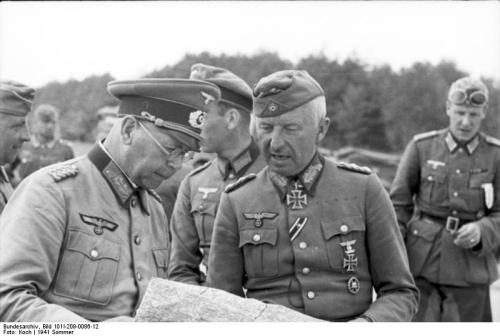
Bild 101I-209-0086-12Erich Von Manstein at the Front

Motioning to the map Manstein continued. “We will concentrate the majority of our Panzer forces here, just west of Kharkov and another group here west of Orel.  We will also build fall back positions for our infantry forces here along the Dnieper.  We should be ready to withdraw from the Crimea should the need arise, we cannot afford another encirclement.  When the Russians attack we will give ground, even Kharkov if needed. Our infantry divisions will fight a delaying action supported by Jagdpanzer and Sturmgeschutzen, the Luftwaffe will need to give us good close air support from Stukas and as the Russians outrun their supply depots and their offensive loses momentum we will attack, like a badger defending itself.  Our Panzers will cut off their spearheads west of Kharkov while we bleed them dry in the north; we will then roll them up, stabilize the line and prepare for the winter.”  Manstein sounded confident; those in the room began to sense that his plan could work.  Rundstedt spoke up: “That will give us the chance to transfer forces to other fronts and, maybe, since Hitler is dead there might be a chance for Reichsmarschall to negotiate a settlement,[xix] otherwise gentlemen the Allies will destroy our cities from the air and grind our armies down until we have no recourse but surrender.”

“Right” added Goering, making eye contact with each man in the room. “We must have success in the defense, we must buy time and we must work to end this war before Germany is destroyed. ‘We will have reason to be glad if Germany can keep the boundaries of 1933 after the war.”[xx] He paused and said “General Zeitzler, you are relieved of your duties at OKH, General Guderian, you are now the Chief of OKH.[xxi] Manstein, you will command the East, General Hoth will take your Army Group. You will work with Guderian and Model to flesh out this plan.  We must get the Panther, Tiger and Ferdinand units operational as soon as possible.  I believe that the Russians will attack by June. Richthofen, I need you to look to the Luftwaffe. We have not had a good year and we have to succeed in defending the Reich from Allied bombers and provide support to the ground forces. Of course flak needs to be built up. The Luftwaffe Field Divisions with the exception of the Fallschirmjaeger and Herman Goering Panzer Division need to be transferred to Army control.”  He looked at Speer: “Herr Speer, the Fuhrer entrusted you with our war production program, you must increase production of tanks and aircraft. Speed the production of the ME-262 and cancel all programs that take away from the panzers, fighters and ground support aircraft that we need now.” He put his hands on his hips and took a deep breathe. He looked at Wolfe, Himmler’s successor.  Wolff, the Reich needs the Waffen SS, the Panzer troops are exceptional, but I want all Waffen SS Formations, with including the Panzers turned over to Army control, we cannot keep dividing our resources. With the personnel from the Luftwaffe Field Divisions we should be able to provide the Army with excellent troops to rebuild experienced formations.”  Goering looked around the room; “Are there any questions Gentlemen?” Putting his arm across Manstein’s soldier and said: “I think that Badger is a fitting name for your plan. Our little Dachs will tear them to pieces.”   Later, Goering met with Foreign Ministry officials emphasizing the need to strengthen German Allies and seek peace with the west. He “admitted that he was worried about the future. ‘It’s not quite clear to me how we are going to end this war.’”[xxii] Those present could not believe how Goering had conducted himself, and all left the meeting thinking that it might be possible to stave off defeat.  It was an incredible performance. After Hitler’s crash he had secretly undergone a “systematic withdraw cure which had ended his drug addiction.”[xxiii] The change was marked.

STAVKA Headquarters Moscow: 7 May 1943

Josef Stalin was ecstatic.  His agents reported that Hitler was dead even before the announcement from Berlin.  Partisans had confirmed that it was Hitler’s aircraft that they found and recovered some of Hitler’s personal belongings, including his cap, which they presented to Stalin.  Intelligence reported that Goering had taken power, and Stalin was sure that his position was weak and many believed that Goering, was not up to the task, and that a renewed offensive could bring down the Nazi regime.  Now was the time to bring the Nazi terror to an end and Stalin called his key leaders together.  While Stalin wanted an immediate offensive his generals wanted to wait just in case the Germans attacked Kursk.  “Zhukov, Vasilevsky, and various General Staff officers urged caution and recommended that the Red Army remain on the defensive until the Germans expended their offensive strength.”[xxiv] Stalin supported by commanders, like Vatutin, “argued for a resumption of offensive action in early summer to preempt German action and regain the momentum lost in March 1943.”[xxv] In the end a compromise was reached and despite the temporary defensive stand “Russian strategic planning in the summer of 1943 was inherently offensive in nature.”[xxvi] The new offensive would be launched on 15 June if the Germans had not attacked before.  It would be named Operation Kutuzov[xxvii] and be aimed at the Orel salient and Kharkov.  The northern prong under Rokossovsky’s Central Front would destroy the Germans around Orel and drive west while Vatutin’s Voronezh and Konev’s Steppe Front would take Kharkov and drive toward the Dnieper.[xxviii] The Southwest Front and South Fronts would attack and destroy the German forces along the Mius, the goal: “collapse of the German defenses and an advance to the line of the Dnieper River from Smolensk in the north southward to the Black Sea.”[xxix]

German Preparations
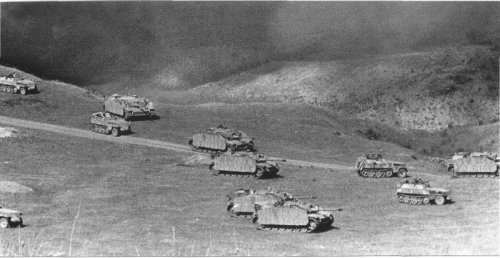
sturmgeschutzSturmgechuten and SdKfw 251 APCs moving into position

Manstein met with Model, Hoth and Guderian to develop DACHS. They had  to play for time and deceive the Russians as to their true intent so they could build up their forces.  Deception operations were mounted on both sides of the Kursk bulge to give the impression of attack preparations.  1st Panzer Army and Army Detachment Kempf  were to launch a diversion called Operations HABICHT and PANTHER southeast of Kursk  “designed to push the Soviets back from the industrial area of the Donets River.”[xxx] The defensive plan called for the infantry supported by tank destroyers, assault guns the heavy Ferdinands as well as mobile Pioneer units to conduct a withdraw to delay and disrupt the Russian attack.  Bridges were prepared for demolition, defensive positions constructed at choke points which would be defended and then abandoned when no longer defensible, and minefields laid to slow the Russian advance.  This was critical for 9th Army now commanded by General Henrici in the Orel salient north of Kursk.  Henrici, a defensive master constructed a series of defensive belts to allow his army to withdraw from the bulge without being cut off and inflict heavy casualties on the Russians through skillful deployment of anti-tank weapons, especially self propelled guns.[xxxi] In the south 4th Panzer Army, now commanded by SS General Paul Hausser[xxxii] and Army detachment Kempf made preparations to allow the Russians to advance past Kharkov using the same defend and delay tactics and then counterattack. As the armies prepared, Speer and Guderian’s efforts to rebuild the Panzer force were bearing fruit.  By 15 May the first brigade of Panther tanks was activated and began training west of Kharkov.[xxxiii] Two battalions of Ferdinands, one for 9th Army and one for 4th Panzer Army were activated.[xxxiv] Sturmgeschutz battalions were assigned to each infantry corps. Panzer divisions built up so that all had an average of 130 tanks, with the SS Divisions and Gross Deutschland receiving more.  Tiger battalions were assigned to each Panzer Corps.

The Summer Campaign

On 1 June Operations PANTHER and HABICHT hit the unfortunate Soviet 6th Army, which had been victimized by Manstein’s counter-stroke in March.  III Panzer Corps of Army Detachment Kempf supported by Corps Raus (IX Corps) linked up with 1st Panzer Army at Kupiansk on 3 June.  The Russian counterattacked with 8th Guards Army and the 2nd and 23rd Tank Corps. The battle of Kupiansk resulted in the destruction of 6th Army and the 23rd Tank Corps which was surprised by the 503rd Panzer Detachment’s Tigers. 2nd Tank Corps received a similar mauling at the hands of the 6th Panzer Division.  On 9 June the Germans returned to their start positions.
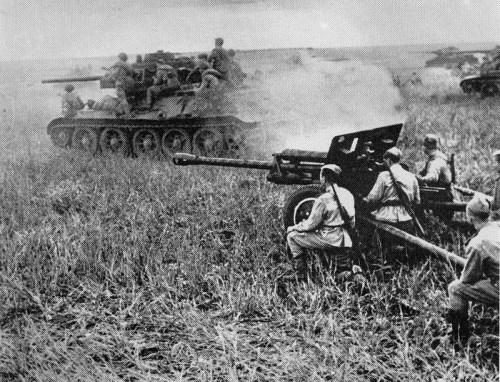
Kursk_T34_and_Fieldgun-px800Soviet Tanks and AT Guns at Kupiansk

The attack at Kupiansk surprised STAVKA which had been deceived by the build up of Panzers around the Kursk salient.  Stalin continued to hound his generals to begin Kutuzov on time, but the generals were “chastened” by the defeat at Kupiansk and “earlier experiences”[xxxv] and wanted to delay. Stalin forced them to begin Kutuzov on 22 June, the 2nd Anniversary of Barbarossa.  Manstein and his Eastern Front commanders held their breath.  Teams of Brandenburger commandos operating in the Soviet rear and Luftwaffe reconnaissance aircraft reported Russian units moving to advanced positions to the north and south of Kursk.  Vatutin commanding the Voronezh Front was ambushed and killed by a Brandenburger detachment supporting Ukrainian irregulars[xxxvi] as he returned from visiting 69th Army near Prokhorovka station on 19 June and was replaced by Lieutenant General Katukov of 1st Tank Army.  Katukov “was one of the Red Army’s most accomplished and experienced armor officers.”[xxxvii]
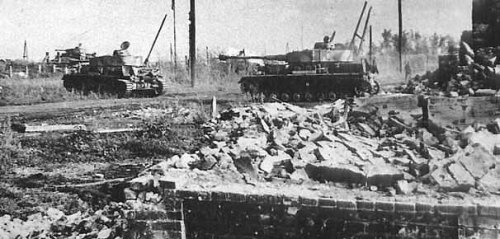
kursk_tanksMk IV Panzers

In the north Rokossovsky’s Central Front and Popov’s Bryansk Front supported by 11th Guards Army[xxxviii] began concentric attacks on the German 9th and 2nd Panzer Armies and ran into Henrici’s labyrinth on 22 June.  They hit the first line they found it empty, the Germans having repaired to secondary positions,[xxxix] German 88’s and self propelled guns took a heavy toll on the tanks of 2nd Tank Army.  The 3rd Tank Army under General Rybalko’s army committed after the initial assault “attempted a fresh penetration instead of exploiting the earlier efforts of the 3rd and 63rd Armies… Rybalko’s force included 698 serviceable tanks…but lacked the artillery and engineers for such a deliberate assault.”[xl] Popov telephoned Stalin at noon on 25 June “to report that Rybalko was practically stalled and suffering heavy losses in tanks.”[xli] The Germans committed the 5th and 8th Panzer divisions[xlii] against 3rd Tank Army. The fresh Panzers inflicted painful losses on Rybalko.  On 27 June Stalin called to complain about the handling of the army, demanding a direct assault.[xliii] The battle turned into a “grinding battle of armored attrition.”[xliv] After “a few bloody days bereft of any success, Rybalko’s tank formations had to be pulled out of the line into reserve.”[xlv] The “battle for the Orel salient ended three weeks later with a German defensive victory, as Army Group Center extricated its two armies from the box prepared for them while inflicting heavy casualties on three Soviet Fronts.”[xlvi] The Soviets lost over 629,000 men and 3,500 tanks.[xlvii] In comparison German losses were light and by falling back they shortened their line freeing units for other operations.  Stalin had Orel but failed to destroy the Germans and lost heavily in the attempt.

In the south Konev’s Steppe and Katukov’s Voronezh Fronts prepared their assault on Kharkov.  They attempted to deceive the Germans by simulating the massing of a “notional tank and combined-arms army” in the western side of the Kursk bulge.[xlviii] The deception was unsuccessful as reconnaissance by Luftwaffe aircraft and Brandenburgers failed to uncover any troop concentrations and Russian deserters, talked of a strike at Kharkov. The offensive “Rumiantsev” was opened by the 5th and 6th Guards armies supported by 53rd and 69th Armies on 21 June; a day later 7th Guards Army jumped off, two additional armies supported the west flank of the offensive.[xlix] The Russians in the two fronts began the operation with 980,000 men and 2,500 tanks.[l] Opposing them were 4th Panzer Army and Army Detachment Kempf’s 350,000 men and 1,750 tanks and assault guns including 100 Tigers and 192 Panthers.[li]
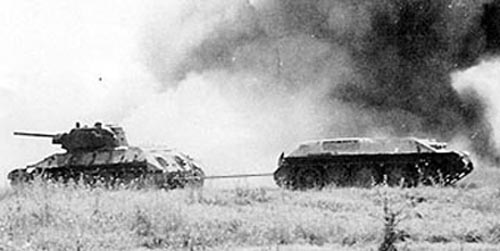
Sovietic_T34_battle_of_kurskT-34 towing disabled T-34 near Orel

STAVKA “chose to strike the strongest portion of Hoth’s defense head-on, to engage and defeat the German force and avoid the problems of flank threats.”[lii] Unfortunately they complicated the attack by focusing it at “precisely the boundary between the Voronezh and Steppe Fronts, causing increased coordination problems from the start of the operation.”[liii] The Germans used Ferdinands, Jagdpanzers and Sturmgeschutz in a mobile defensive role, as infantry fought delaying actions as they withdrew to successive defensive lines, inflicting brutal losses on the Russians.  Aided by massive artillery preparation the Russians broke through the weakened Army Detachment Kempf near Belgorad[liv] taking the city on 24 June.  Corps Raus’ 167th Infantry Division was taken on its exposed left flank forcing Raus to “fight a delaying action…until the withdraw reached Kharkov.” [lv] The Germans reacted to the threat by committing the “veteran 5th SS Panzer Grenadier Division Wiking” to reinforce Army Detachment Kempf.[lvi] Despite the success “the German defenses proved so tenacious that the leading brigades of the two tank armies had to enter the fray.”[lvii]

As the Russians advanced the German fell back.  Hoth directed Hausser to wait before counterattacking with XLVIII Panzer Corps and II SS Panzer Corps.  Katukov pushed the 1st and 5th Tank Armies into the hole in the German lines and moved toward Kharkov which was liberated by the 89th and 183rd Guards Divisions[lviii] on 2 July.  The liberation of Kharkov and Belgorad while exhilarating had cost Katukov over 250,000 casualties.  Skillful employment of mobile defense and local counterattacks by mixed Panzer battlegroups, such as one by Grossdeutschland on the flank of 5th Tank Army caused panic and some units withdrew “leaving behind masses of equipment of every description.”[lix] The tank armies had lost upwards of 50 percent of their tanks, infantry divisions were now down to half strength, some down to 3000 men.[lx] Yet the Soviets attempted to drive south to trap the Germans.  They were hit by XLVIII Panzer Corps and II SS Panzer Corps, both of which had seen little action thanks to Hoth’s conservation of strength. XLVIII Panzer Corps hit the 1st Tank Army at the “key road junction of Bogodukhov, 30 kilometers northwest” of Kharkov “severely mauling the leading three brigades”[lxi] forcing 1st Tank Army to withdraw towards Kursk. 5th Tank army moved to support but was taken in the flank by II SS Panzer Corps.  The SS Corps encircled the remainder of 5th Tank Army. Hunted by the SS on the open steppe the survivors slipped through gaps in the encirclement but both armies were ravaged.  By 15 June 1st Tank Army was down to 120 tanks and 5th Tank Army had “50 of its original 503 tanks and self-propelled guns serviceable.”[lxii] XLVII Panzer Corps took Kharkov on 18 July.

Totenkopf-Kursk-01SS Panzer Troops and Tigers prepping for battle

The victory paid dividends for the Germans. The Front held and the Russians had taken nearly a million casualties and lost almost 6000 tanks and self-propelled guns.  Three Tank Armies had been smashed, 5th Tank Army would not be fit for field duty for two months.[lxiii] 3rd Tank Army earned a Guards designation but was withdrawn from combat.[lxiv] 6th Army, victimized by PANTHER was destroyed while the 5th, 6th and 7th Guards Armies were shattered. Additionally, the Germans decimated two independent tank corps.  Stalin reacted by halting operations, cancelling follow on offensives and rebuilding the Red Army’s tank armies and mechanized forces.  He realized that his Generals had been right in not wanting to undertake offensive operations until the Germans had been weakened, but the German insistence on not going on the offensive caused him to ignore their arguments. He decided to wait until winter to launch his next offensive, but that offensive would never be launched as by the time he was ready the war was over.

Bild 101III-Zschaeckel-206-34German Tank Commader as Panzers mop up

The elimination of the Russian threat enabled Italy to be reinforced as well as the reinforcement of the Atlantic Wall.  The Salerno landings were a disaster, the Allies driven into the sea by Panzer Divisions released from the Eastern Front.  The disasters at Salerno and the Russian debacle brought overwhelming domestic political pressure on Roosevelt and Churchill to end the war. Clandestine talks began in Switzerland between Avery Dulles and Karl Wolff[lxv] while Walter Schellenberg met with Count Bernadotte.[lxvi] Despite the previous demand for unconditional surrender the Allies decided to negotiate with the new German leadership might end the war in Europe.  Goering surrendered power to General Beck and gave himself and other accused war criminals up to the Allies. Beck took power, withdrew to 1939 borders, dismantled the death camps and disbanded the Nazi Party, and its police apparatus.[lxvii] Peace came to Europe on 9 November 1943, 25 years after Kaiser Wilhelm’s abdicated his throne.
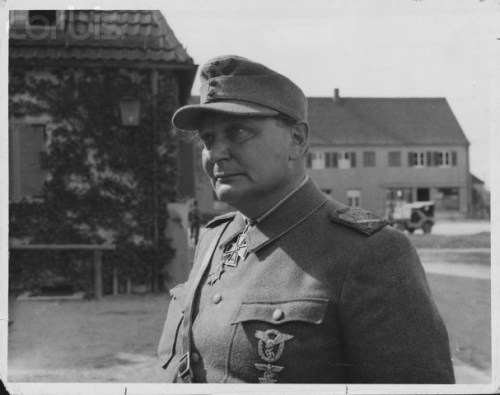
HU048801Goering Surrenders himself


[i] Clark, Alan. Barbarossa: The Russian German Conflict, 1941-45. Harper Collins Publishers, New York, NY 1965. Pp.307-311. There was an attempt on Hitler’s life on his return from Kluge’s headquarters.  Only the bomb did not go off, all components had worked but the detonator did not fire.  Clark notes that “the Devil’s hand had protected Hitler.” (p.311)

[ii] Galante, Pierre. Operation Valkyrie: The German Generals’ Plot Against Hitler. Translated by Mark Howson and Cary Ryan. Harper and Row Publishers, New York, NY 1981. Originally published as Hitler est il Mort? Librairie Plon-Paris-Match, France. 1981. p.167 

[iii] Padfield, Peter. Himmler. MJF Books, New York. 1990. p.474.  Himmler had a number of contacts and intermediaries who he used to attempt contact with the Allies as early as 1943.

[iv] Höhne, Heinze. The Order of the Death’s Head: The Story of Hitler’s SS. Translated by Richard Barry. Penguin Books, New York and London, 2000. First English edition published by Martin Secker and Warburg Ltd. London 1969. Originally published as Der Orden unter dem Totenkopf, Verlag Der Spiegel, Hamburg 1966.  Diels remained an ally of Goering even marrying his sister in 1943.

[v] Von Lang, Jochen. The Secretary: Martin Bormann: The Man Who Manipulated Hitler. Translated by Christa Armstrong and Peter White. Random House Inc. 1979. Originally published as Der Secretär. Deutsche-Verlags-Anstalt, Stuttgart. 1977 p.9.  At his trial Goering remarked to other defendants. “If Hitler had died sooner, I as his successor would not have had to worry about Bormann. He would have been killed by his own staff even before I could have given the order to bump him off.”

[vi] Irving, David. Göring: A Biography. William Morrow and Company, New York, NY 1989. Richthofen had succeeded Jeschonnek in March when Goering relieved him. Goering believed that Jeschonnek “was too pliable at the Wolf’s Lair.” Goering had actually considered this a number of times but postponed it several times. p.388

[vii] Guderian, Heinz. Panzer Leader. (abridged) Translated from the German by Constantine Fitzgibbon, Ballantine Books, New York 1957. pp.244  Hitler conducted a similar conference involving many of the same people in Munich.

[viii] Carell, Paul. Scorched Earth: The Russian German War 1943-1944. Translated by Ewald Osers, Ballantine Books, New York, NY 1971, published in arrangement with Little-Brown and Company. p. 336

[ix] Ibid. Irving. pp. 377-379.

[x] Ibid. Guderian. p.243

[xi] Ibid. Irving. p.378

[xii] Glantz, David M and House, Jonathan. The Battle of Kursk.  University Press of Kansas, Lawrence, KS. 1999. pp.21-25.  Operations order 5 had been approved by Hitler on and issued by OKH on 13 March. It was followed by Operations Order 6 on 15 April.

[xiii] Ibid. Clark. p.324.

[xiv] Warlimont, Walter. Inside Hitler’s Headquarters 1939-45. Translated by R.H. Berry, Presido Press, Novato CA, 1964. p.334 These objections of Jodl were from June, but indicate the feeling of Jodl for the Zitadelle as planned and when would have likely been his response in such a situation.

[xv]Glantz, David M. and House, Jonathan. When Titans Clashed: How the Red Army Stopped Hitler. University Press of Kansas, Lawrence, KS. 1995. p.157 Zeitzler had been a consistent advocate for Zitadelle since he heard Manstein’s initial proposal in March.

[xvi]Macksey, Kenneth. Guderian: Creator of the Blitzkrieg. Stein and Day Publishing, New York, NY 1975 p.206

[xvii] Ibid. Clark. p.322

[xviii] Ibid. Clark. p.323.  Zeitzler made this argument with Jodl during a briefing in April 1943.

[xix] Shirer, William L. The Rise and Fall of the Third Reich. A Touchstone Book published by Simon and Schuster, 1981, Copyright 1959 and 1960. p.1115.  Hitler had told Keitel and Jodl that “When it comes to negotiating [for peace]…Goering can do much better than I. Goering is much better at those things.”

[xx] Speer, Albert. Inside the Third Reich. Collier Books, a Division of MacMillan Publishers, Inc. New York, NY 1970. p.245.  From a conversation with Speer in late 1942.

[xxi] Ibid. Glantz and House. Clash of Titans. pp. 216-217. Hitler would replace Zeitzler with Guderian in June 1944.

[xxii] Ibid. Irving. p.379 From a conversation with State Secretary Ernst von Weizäcker 11 February 1943.

[xxiii] Ibid. Speer.  p.512. The ending of the addiction took place at Nurnberg and Goering surprised many of his co-defendants with his “remarkable energy.”

[xxiv] Ibid. Glantz and House. Kursk. p.28

[xxv] Ibid. Glantz and House. Kursk. p.28.

[xxvi] Ibid. Glantz and House. Kursk. p.264

[xxvii] Overy, Richard. Russia’s War: A History of the Soviet War Effort: 1941-1945. Penguin Books, New York NY and London, 1997. pp.211

[xxviii] Erickson, John. The Road to Berlin. Cassel Military Paperbacks, London, 2003. First Published by Weidenfeld and Nicholson, 1983. p.76

[xxix] Ibid. Glantz and House. Kursk. p.265

[xxx] Ibid. Glantz and House. Kursk. p.23.

[xxxi] Liddell-Hart, B.H. The German Generals Talk. Quill Publishing, New York, NY. 1979. Copyright 1948 by B.H. Liddell-Hart. p.215  Henrici describes the methods that he used in 1944 as Commander of 1st Panzer Army and as Commander of Army Group Vistula during the defense of Berlin.

[xxxii] Hausser would actually command 7th Army in Normandy in 1944.

[xxxiii] Ibid. Glantz and House Kursk. p.53 This was the 10th Panzer Brigade assigned to XLVIII Panzer Corps.  Additionally Clark notes production figures for Panthers from Speer that indicate that 324 Panthers would be available by 31 May. (Clark. p.325)

[xxxiv] Ibid. Glantz and House. Kursk. p.52.  At Kursk the two Ferdinand detachments were both assigned to 9th Army.

[xxxv] Ibid. Glantz and House. Kursk. p.28.

[xxxvi] Ibid. Carell. p.510.  Vatutin was killed by Ukrainian irregulars in April 1944.

[xxxvii] Ibid. Glantz and House. Kursk. p.62

[xxxviii] Newton, Steven H. Hitler’s Commander: Field Marshal Walter Model, Hitler’s Favorite General. DeCapo Press, Cambridge MA 2005. p. 256

[xxxix] Ibid. Liddell-Hart. p.215.

[xl] Ibid. Glantz and House. Kursk. p.236

[xli] Ibid. Erickson. p.113. At Kursk the call took place on 20 July when Rybalko was in this situation.

[xlii] Ibid. Newton. p.256

[xliii] Ibid. Erickson. p.114

[xliv] Ibid. Glantz and House. Kursk. p.236

[xlv] Ibid. Erickson. p.114

[xlvi] Ibid. Newton. p.256

[xlvii] Ibid. Glantz and House. p.345. The actual losses were 429,000 men and 2,500 tanks against a German force significantly weakened by Zitadelle.  Had the Russians attacked the Germans rather than receiving the German attack first their losses in men and machines would have been far higher.  I have reflected that in the alternative numbers.

[xlviii] Ibid. Glantz and House. When Titans Clashed. p.168  The Soviets did try this in their counter offensive following Zitadelle.

[xlix] Ibid. Glantz and House. When Titans Clashed. p.169

[l] Ibid. Glantz and House. Kursk. p.344. Actual figures for beginning of offensive.

[li] Ibid. Glantz and House. Kursk. p.338.  Figures from beginning of Zitadelle.

[lii] Ibid. Glantz and House. Kursk. p.244 The actual text reads “Manstein’s defense” not Hoth’s.

[liii] Ibid. Glantz and House. Kursk. p.244

[liv] Von Mellenthin, F.W. Panzer Battles: A Study of the Employment of Armor in the Second World War. Translated by H. Betzler, Ballantine Books, New York, NY, 1971. Originally Published University of Oklahoma Press, 1956. p.286

[lv] Raus, Erhard. Panzer Operations: The Eastern Front Memoir of General Raus, 1941-1945. Compiled and Translated by Steven H Newton. Da Capo Press a member of the Perseus Book Group, Cambridge, MA 2003. p.214

[lvi] Ibid. Glantz and House. Kursk. p.247

[lvii] Ibid. Glantz and House. When Titans Clashed. p.169

[lviii] Ibid. Erickson. p.121  These were the actual divisions that liberated Kharkov.

[lix] Ibid.  Von Mellenthin . p.287

[lx] Ibid. Glantz and House. p.252

[lxi] Ibid. Glantz and House. When Titans Clashed. p.170

[lxii] Ibid. Glantz and House. Kursk. p.252

[lxiii] Ibid. Glantz and House. Kursk. p.252

[lxiv] Ibid. Glantz and House. Kursk. p.237

[lxv] Ibid. Hohne. p.572

[lxvi] Ibid.  Hohne. p.570

[lxvii] Ibid. Galante. pp 69 and 207

Bibliography

Carell, Paul. Scorched Earth: The Russian German War 1943-1944. Translated by Ewald Osers, Ballantine Books, New York, NY 1971, published in arrangement with Little-Brown and Company

Clark, Alan. Barbarossa: The Russian German Conflict, 1941-45. Harper Collins Publishers, New York, NY 1965

Erickson, John. The Road to Berlin. Cassel Military Paperbacks, London, 2003. First Published by Weidenfeld and Nicholson, 1983

Galante, Pierre. Operation Valkyrie: The German Generals’ Plot Against Hitler. Translated by Mark Howson and Cary Ryan. Harper and Row Publishers, New York, NY 1981. Originally published as Hitler est il Mort? Librairie Plon-Paris-Match, France. 1981.

Glantz, David M and House, Jonathan. The Battle of Kursk.  University Press of Kansas, Lawrence, KS. 1999.

Glantz, David M. and House, Jonathan. When Titans Clashed: How the Red Army Stopped Hitler. University Press of Kansas, Lawrence, KS. 1995

Guderian, Heinz. Panzer Leader. (abridged) Translated from the German by Constantine Fitzgibbon, Ballantine Books, New York 1957

Höhne, Heinze. The Order of the Death’s Head: The Story of Hitler’s SS. Translated by Richard Barry. Penguin Books, New York and London, 2000. First English edition published by Martin Secker and Warburg Ltd. London 1969. Originally published as Der Orden unter dem Totenkopf, Verlag Der Spiegel, Hamburg 1966.

Irving, David. Göring: A Biography. William Morrow and Company, New York, NY 1989

Liddell-Hart, B.H. The German Generals Talk. Quill Publishing, New York, NY. 1979. Copyright 1948 by B.H. Liddell-Hart

Macksey, Kenneth. Guderian: Creator of the Blitzkrieg. Stein and Day Publishing, New York, NY

Newton, Steven H. Hitler’s Commander: Field Marshal Walter Model, Hitler’s Favorite General. DeCapo Press, Cambridge MA 2005

Overy, Richard. Russia’s War: A History of the Soviet War Effort: 1941-1945. Penguin Books, New York NY and London, 1997

Padfield, Peter. Himmler. MJF Books, New York. 1990

Raus, Erhard. Panzer Operations: The Eastern Front Memoir of General Raus, 1941-1945. Compiled and Translated by Steven H Newton. Da Capo Press a member of the Perseus Book Group, Cambridge, MA 2003

Shirer, William L. The Rise and Fall of the Third Reich. A Touchstone Book published by Simon and Schuster, 1981, Copyright 1959 and 1960.

Speer, Albert. Inside the Third Reich. Collier Books, a Division of MacMillan Publishers, Inc. New York, NY 1970.

Von Lang, Jochen. The Secretary: Martin Bormann: The Man Who Manipulated Hitler. Translated by Christa Armstrong and Peter White. Random House Inc. 1979. Originally published as Der Secretär. Deutsche-Verlags-Anstalt, Stuttgart. 1977

Von Mellenthin, F.W. Panzer Battles: A Study of the Employment of Armor in the Second World War. Translated by H. Betzler, Ballantine Books, New York, NY, 1971. Originally Published University of Oklahoma Press, 1956.

Warlimont, Walter. Inside Hitler’s Headquarters 1939-45. Translated by R.H. Berry, Presido Press, Novato CA, 1964.

2 Comments

Filed under alternative history, History, Military, world war two in europe

Oh Lord Stuck in Lodi Again….Gordon Klingenschmitt does Lodi

gjkGordon Klingenschmitt after his Court-Martial Conviction (Virgina Pilot Photo)
Just about a year ago, I set out on the road,
Seekin’ my fame and fortune, lookin’ for a pot of gold.
Things got bad, and things got worse, I guess you will know the tune.
Oh ! Lord, Stuck in Lodi again.

“O Lord Stuck in Lodi Again” Credence Clearwater Revival, words and music by John Fogarty

Failed Navy Chaplain defrocked Evangelical Episcopal Priest, Convicted Criminal, Right Wing D-Lister and narcissistic professional protester Gordon James “Chaps” Klingenschmitt pops up in the most unlikely of places.   If it was not pathetic it would be really funny.

The reason that I write this today is irony of  Gordon getting stuck in Lodi and the my relationship to Lodi.  You see Gordon showed up at yet another protest in a small town to battle a city council about people praying “in Jesus Name” as part of official city events such as city council meetings.  The city is Lodi California, just up the road from where I went to junior and senior high school, where I got my one high school football tackle in a real game and where my dad is finishing his days in a nursing home going through the ravages of end-stage Alzheimer’s disease.  Lodi is a small town, with historic German and Italian communities which is famous for wines and sits in the heart of the San Joaquin valley.  It is the home of the very popular Lodi Grape Festival. It was a pretty conservative town; well let’s say it used to be a town that had strong ties to the John Birch Society and other ultra-conservative organizations.  It was not very welcoming to outsiders and minorities.  Well times are changing in Lodi.  It mow has significant Hispanic and Asian populations as well as other minorities including Moslems.  Lately tension has been building and once again a battle is going on about faith in the public square.

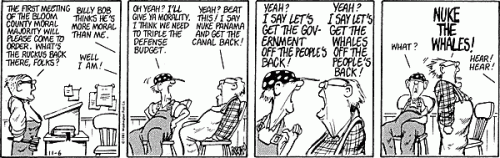
nuke the whales

Now I’m an easy guy.  I really don’t get offended by anyone praying in whatever name they choose to do so as long as they are respectful of others and don’t try to use the government to promote or enforce their particular religious views on others.  Unfortunately this happens all of the time and people who do it world-wide to be on the more evangelical and fundamental wings of their religion.  Personally  I wish the climate were such that anyone of any faith could pray in whatever name that they chose to do without everyone  getting their BVD’s in a wad.

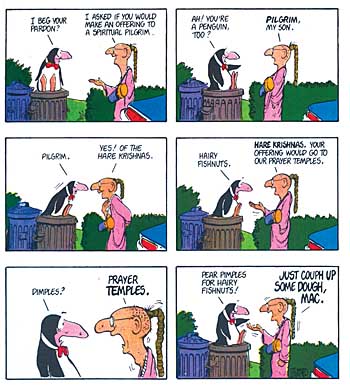
opus & krishna

Until the advent of the Moral Majority and other conservative Christian political-social activist groups there was an understanding in the United States of getting along in the public square.  Protestant-Catholic-Jew we were all Americans.  Only groups such as the Ku Klux Klan had problems with this.  Our tolerance extended to others who came to this country as immigrants resulting in what was called the “Melting Pot.”  We were an amazing society and our ability to have people of widely differing religious and political beliefs living together in peace was the envy of the rest of the world.

Our societal demographics have changed.  Minority populations have increased and with them a corresponding increase of religions which were not part of the historical “Protestant-Catholic-Jew” paradigm of American religious and cultural life.  This has brought about a clash between the more conservative and fundamental Christians who see this as a threat to the United States being a “Christian Nation” and undercutting its historical and cultural foundation.  My purpose here is not to argue that at all.  I can see the positive benefits of and want to maintain the underlying western cultural foundation of our country. At the same time I want others to enjoy the right to practice their own religion freely and not have individuals of any religion use the government to enforce their religious or non-religious beliefs on others.  I think what made us such a great country was our ability work through these things peacefully.  The greatest example in my mind of religious people working together were the “Four Chaplains” of the troopship Dorchester when it was torpedoed by a German U-Boat in 1943. There were two Protestants, a Catholic Priest and a Jewish Rabbi on the ship.  At the time most Protestants either did not believe Catholics to be Christians and saw them as an Alien and possibly hostile religion. Catholics had not yet admitted that Protestants were “separated brethren” and Jews where just kind of tolerated.   When the ship was torpedoed and began to sink there were not enough life jackets.  So the chaplains gave theirs to soldiers in need and were last seen praying with arms linked as the ship went down.  Such actions as this are what made our country great.  We need men and women like the Four Chaplains and not Gordon “Chaps” Klingenschmitt.  On a side note to this you can call me a heretic but I doubt that God is sending any one of these men to hell because they did not fit somebody’s theology of how someone is saved when they died doing what Jesus said: “Greater love has no one than this, that he lay down his life for his friends.” (John 15:13 NIV)  I think anyone who has served in combat understands this better than people who enjoy the fruit of liberty without ever having paid more than taxes for it.

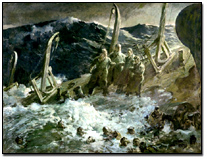
four chaplainsThe Four Chaplains

I have served in an ecumenical setting with a wide variety of ministers for almost twenty years.  In the setting that I work mutual respect of each other as clergy, respect and toleration of differing views are essential to ensuring that those who serve together in war are not trying to kill each other in peace.  For the most part we do this pretty well and it is a joy to serve with clergy from different faiths and care for God’s people regardless of their faith.  I heard the story of a man who is a bishop in his church who when he was in Navy basic training received a phone call from his mother at the administrative office.  While talking to her she died.  He credits a Jewish Chaplain with caring for him and helping him through that difficult time.  When my dad was deployed to Vietnam and I had a Sunday school teacher tell me that he was a “baby killer” it was a Roman Catholic Navy Chaplain that cared for me and my family and helped me not give up my faith and a Latter Day Saint (Mormon) Chaplain who ensured that I didn’t get thrown out of the Army in Chaplain School due to my big mouth and temper.  In none of these cases did the clergyman attempt to use the opportunity of crisis to convert us or to denigrate our faith.  Unfortunately this is what Gordon did in his Navy career and other like him do in whatever environment the live and serve.

What I see happening today is that the extremes, be they religious fundamentalists or all varieties, strident secularists or aggressive atheists all want the government to enforce their beliefs on everyone else. Such is a recipe for disaster.  One only has to look to Nazi Germany, Theocratic Iran, Saudi Arabia, the former Yugoslavia and the ex-Soviet Union and post invasion Iraq to see what happens when one group or another chooses to use the government or violence to enforce or propagate their religious, political, social or racial beliefs on others.  Having been to the Balkans and Iraq I have seen the results of this.  If you go to the Rhine River Valley in Germany you can still see the ruins of castles destroyed during the 30 years war, a war based on governments using religion or region using government to enforce their will on others.  We are now seeing a rise in private militia groups and others who are arming themselves for conflict.  Likewise there are those stoking the fire by urging secession or even revolt and these include people who call themselves Christians.  A current of discontent kind of like the toxic sludge under New York in Ghostbusters II is bubbling under our feet and is now beginning to burst to the surface as people from the left and right clash at their Congressional representative’s town hall meetings.  The fact that these are turning violent means that we are crossing a line that we may not be able to turn back from.  Voices of moderation and those seeking compromise, accommodation and tolerance are being drowned out, just as they were in Wiemar Germany when Nazis and Communists battled in the streets and attempted to take over the power of government.

Now I do see how people can feel threatened when there is rapid sociological and demographic change in a country.  So in some ways I can understand why people are protesting in Lodi.  My problem is that the leaders of this “movement” are fringe players using fear to fan the flames of their cause.  This is the case with Klingenschmitt who has routinely obfuscated, distorted and spun things to promote a fiction that he has been persecuted for his beliefs when in fact he was constantly using his public office to promote himself, his personal (not even his church’s) beliefs and denigrate those of others while giving lip service to toleration.  Since being convicted by court-martial, not for “praying in Jesus Name” but for disobeying a lawful order not to speak at a partisan political event, Klingenschmitt has constantly painted himself as a victim of persecution and spokesman for a movement. In doing so he has engaged in character assassination of former commanding officers and command chaplains and launched a campaign of “imprecatory prayer” (prayers of harm and judgment) upon his opponents.  I am sure that he has significant financial benefactors who make these possible; benefactors who share his goals of a Christian theocracy among them the Ultra-conservative “News” site World Net Daily.

The irony and sadness of Gordon’s trip to Lodi is that like the character in the song Oh Lord, Stuck in Lodi Again he is stuck and will unfortunately pursue this until he destroys himself, his families and others.  Unfortunately, Gordon and those like him as well as his opposites on the extreme left are leading us to destruction as a society unless the moderate majority that wants to live in peace begins to stand up before it is too late. God help us all and bless our Great Country.

Peace, Steve+

Leave a comment

Filed under History, Lies of World Net Daily, Loose thoughts and musings, philosophy, Religion

The Forgotten Cold Warriors

CheckpointCheckpoint Charlie in the Berlin Crisis

Note: As a follow up to this Article I posted “20 Years: The Fall of the Berlin Wall and the End of the Cold War” to this site.  The link to that article is here:

https://padresteve.wordpress.com/2009/11/08/20-years-the-fall-of-the-berlin-wall-and-the-end-of-the-cold-war/

From the Berlin Blockade and until the collapse of the Soviet Union in 1991 American, British, NATO and Asian Allies waged a Cold War against their Soviet and Warsaw Pact Countries, North Korea and at times China and Vietnam.  The war was a world war, fought by the major powers, their alliances and proxies throughout the world.  It was a world of gray areas where soldiers, sailors, airmen as well as Special Forces and intelligence agencies from both sides attempted to gain dominance over the world through political, military, economic, diplomatic and intelligence means and through use of surrogates.  Sometimes the war turned hot as in Korea, Vietnam and for the Soviet Union Afghanistan.

The conflict found its way to almost every corner of the earth and the world lived on edge wondering if the superpowers and their allies would end up in a hot war.  US and NATO Navies played a cat and mouse game with the Red Navy both under the sea and upon the waters.  Sometimes this war turned deadly as US and Red Navy Submarines disappeared and were never heard from again amid circumstances like those of the USS Scorpion that are still debated.  On the high seas US and NATO ships shadowed each other and occasionally played a game of chicken where ships collided attempting to gain advantage as they undertook surveillance missions or shadowed task forces.  Spy ships from both sides plied the seas collecting any type of information on their opponent’s operations.  In the air spy aircraft maintained a ready vigil with US SR-71s and U-2s flying missions over the Soviet Union.  Soviet Bear and Backfire Bombers probed the airspace of the United States and Canada and NATO forces at sea who responded by sending up interceptors.   In the closed confines of the Mediterranean the Navies sparred while a in the Middle East and North Africa both sides sought dominance through treaties with the surrounding nations who moved from Western to Soviet and Soviet to Western orbit as they deemed fit. Ideology and behavior of these client regimes was less important than having them in your camp, creating a surreal world of moral ambiguity in the shadow realm of alliances.

In divided Germany NATO and Warsaw Pact Forces faced off in a tense standoff along the inter-German Border and where millions of troops planned and trained for a hot war on the Fulda Gap and Northern German Plain which would include the use of Nuclear, Biological and Chemical weapons.  West Berlin was an island surrounded by the Olive uniformed Red Army and Field Gray of the German Democratic Republic.  A similar watch was maintained on the Korean DMZ.  In Africa, Asia, South and Central America, the Indian Subcontinent and the Middle East forces of the major powers worked with allies and surrogates to gain advantage.   The Soviets blockaded West Berlin while in response to the placement of Soviet missiles in Cuba the US imposed a naval blockade.  The CIA sponsored a failed attempt by Cuban expatriates to land at the Bay of Pigs.  The Soviets toppled governments and put down revolts in Hungary and Czechoslovakia while maintaining a system of Gulags at home.  Even international sporting events became occasions where each side used propaganda to show itself off to the world as the ideal society.  All of this occurring while the world lived under the constant threat of intentional or unintentional nuclear war.   In  missile silos and aboard Nuclear Ballistic Missile Submarines and manned bombers men stood by to push buttons and turn keys that could have ended the world as we know it.

763px-USS_Yorktown_collisionSoviet Krivak Class Frigate Intentionally Colliding with USS Yorktown CG-48 in the Black Sea 1988

Casualties were taken, even in places where the war was not “hot.”  Soldiers, Sailors, Marines, Airmen and Intelligence Service personnel undertook missions that are still classified the details of which they cannot reveal to this day.  Some suffer from PTSD from their involvement in and guilt over missions that they cannot reveal.  Men from both sides know that the weapons systems that they were involved with killed men on the other side in operations that will never be known.  American Veterans of the Cold War have been ignored by the country.  Russian Veterans have been forgotten as the Soviet Union crashed down on itself.  Countries spanning the globe bear the scars of the “hot” Cold War waged on their soil.  The results of the Cold War are still with us.  The West celbrated the collapse of the Soviet Empire but failed to make the new Russia a full member of the new world causing resentment which still boils today influencing Russian policy toward the West.

I met a man recently in hospital who was one of these veterans.  Tormented by the demons of operations he cannot reveal he suffers from physical and emotional wounds.  He is not alone.  There are many like him.  I do not suffer from my Cold War Service.  I served as a platoon leader, company executive officer and company commander in Germany in the mid-1980s.  If a war had broken out along the Fulda Gap my Chrysler Corporation bailout Dodge M-886 Ambulances with no communications systems adorned with bright red “mobile registration points’ were to be involved with reconstituting units which were expected to take 90% casualties.  We trained for chemical and biological warfare.  The maps used in my NBC defense officer course showed the housing area in which I lived.  We lived in a world of alerts where within two hours we had to be ready to head to war.  A world where Soviet spies operated and recruited Americans and where the German Red Brigade Terrorists bombed housing areas, clubs and even the Main Frankfurt PX, where we were on our way to when Judy felt sick and we had to return home.  Occasionally American Servicemen were murdered by Soviet Agents or Red Brigade Terrorists.  This was life for those stationed in Germany as well as South Korea.

I have been in East Berlin and was surprised as hell to see the Berlin Wall come down.  I have been to the Korean DMZ and the Northeast Gate of Guantanamo Bay Cuba.  I call it the “Commie trifecta.”  Without the Berlin Wall there are only two places where the US faces a Communist state directly.   Yet my time in a “hot” war has been in Iraq, I remember the days of the Cold War from childhood through my early Army career.

Cold War Veterans are the last forgotten Veterans group in the United States or even Russia.  Their sacrifices are not recognized.  The US belatedly issued a Cold war Service certificate for its veterans, but vets have to deal with a system that makes it difficult to even obtain a piece of paper that says “thank you” which gives them no other benefit.  The certificate is available to any person who worked for the Federal Government, including temporary holiday employees of the US Postal Service and does not mention military service. A Cold Service Medal was constantly fought by DOD during the last administration as too costly to support at this time.  The Cold War Service Medal last appeared in the FY 2008 DOD spending bills but was cut.   With the present demands on the military in the current wars and the fact that the cost of any award would come out of DOD’s budget it is unrealistic to expect this any time soon as it would cut into the funds needed to fight this war. At the same time these Veterans have no memorial and no status.  While their war was not “hot” it was world wide, lasted 40 years with many casualties.  Yes I agree it was not a hot war and that many who served in it were not in combat.  At the same time the Cold War veterans helped give the world a chance at a new beginning in 1991, unfortunately that has been squandered by governments around the world including the US government, but that is not the fault of those who stood the watch.  Someday they should be recognized.

Berlin WallMe on the East German Side of the Berlin Wall, November 1986
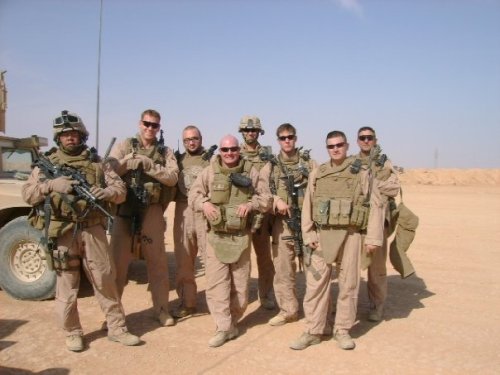
I have my medals from Iraq, the War on Terror and Korean Defense service.  I do believe that those men who stood the watch and many times paid with their lives or health should be recognized.  Other countries have done so.  I wonder why a few dollars per medal cannot be spent on men and women who served on the front line of freedom for 40 years. At the same time I understand that the costs of any such Medal would be born by DOD which is strapped to fight the ongoing wars.  I don’t think it realistic to have the money spent now, but maybe when the dust finally clears and these conflicts subside someone will take the time to remember these men and women.

The gentleman I saw recently never got a thank-you, never got a parade, and never was able to talk about the things that haunted him.  I wonder just how many more are waiting for the chance to come in from the cold.  If you know one of them, thank them for thier service and if they are one of those suffering from their service take care of them.

Peace, Steve+

Leave a comment

Filed under History, Loose thoughts and musings, Military, national security

Brothers to the End…the Bond between those Who Serve Together in Unpopular Wars

This story shall the good man teach his son;
And Crispin Crispian shall ne’er go by,
From this day to the ending of the world,
But we in it shall be remembered-
We few, we happy few, we band of brothers;
For he to-day that sheds his blood with me
Shall be my brother; be he ne’er so vile,
This day shall gentle his condition;
And gentlemen in England now-a-bed
Shall think themselves accurs’d they were not here,
And hold their manhoods cheap whiles any speaks
That fought with us upon Saint Crispin’s day.

From the Speech of King Henry V at Agincourt in Shakespeare’s “Henry V” 1599

We have a new Greatest Generation whose accomplishments will likely go unheralded by history and unlike the “Greatest Generation” of World War Two not receive the full honors and accolades due them.  The brothers, and for that matter sisters as well who have served in the current War on Terror, Iraq and Afghanistan campaigns have now been serving in a war that is now twice as long as the American involvement in World War Two.  Many, like me have been in this since the beginning and many have made multiple deployments to the combat zones.  And many of us, if not most of us would go again; I know that I would because part of me is still in Iraq; for me this war is still un-won and un-finished.

With MTT near SyriaAdvisers out on the Badlands of Al Anbar
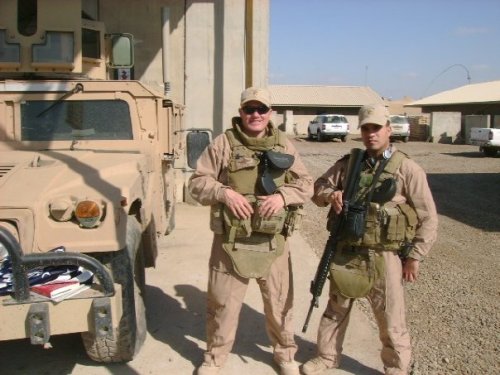
With no disrespect to the Greatest Generation of World War Two, all of the current Soldiers, Sailors, Marines, Airmen and Coast Guardsmen are volunteers, as are the members of the Reserves and National Guard.  Likewise this generation has for the most part fought the war alone as the vast bulk of the country has lived in peace untouched by any inconvenience to daily life such as gas and food rationing, requirements to work in war industries and the draft as were citizens in World War Two.  In the Second World War there was a sharing of the burden which in large part has not occurred in this war.  While many have pitched in to help and volunteered to help veterans and their families the vast majority of people in this country are untouched by the war, not that there is anything wrong with that.  This is simply a comparison of the situation that those who served in World War Two and the present conflicts faced.  So I have to say that our “Greatest Generation” is only a small part of the generation, as the line in Henry V “we few, we happy few who fought together….”

Dynamic DuoBrothers

These Soldiers, Sailors, Marines and Airmen from the United States as well as our Allies who serve alongside of us are my brothers and sisters.  I am friends with military personnel from the UK, Canada and Germany who have served in the various combat zones or at sea and met quite a few others from France, the Netherlands and Australia. Of course my Iraqi friends who I served with while with our advisers in Al Anbar province who are not only trying to bring peace and stability back to their country but have to worry about their families being targeted by terrorists.

There are a number of things that unite us in this relatively small brotherhood.  However, I think that this brotherhood could also be extended to our brothers who fought in Vietnam, French, Vietnamese, Australian, South Korean and American, the French who served in Algeria and the Americans and others that served in Korea.  All of these wars were unpopular, had little support on the home front and often left returning veterans found themselves isolated and their sacrifices either ignored or disrespected.  For those Americans who serve in the current wars I can say that at least to this point the public has been much more supportive than they were to our Vietnam brothers, many of who were even disrespected by World War Two vets who had fought in “a real war.”  I cannot count the Gulf War in this list as it was hugely successful and the returning vets were hailed as conquering heroes with ticker tape parades.

advisers convoy prepGetting Ready for A Mission

Our shared brotherhood includes our scars, physical, psychological, neurological and spiritual.  Those who served on the ground in Iraq and Afghanistan as well as those who served in Vietnam, French Indo-China and Algeria have the common shared experience of fighting people who don’t necessarily like foreigners no matter how noble our intentions and who have a long history of outlasting people that they believe to be invaders or occupiers.  We have had to fight wars with no front lines, no major units arrayed against us, but rather asymmetrical threats propagated by creatively devious foes who use low tech easily available technology and a willingness to sacrifice themselves and others to force attempt to kill us.  Thus we have cleverly designed and often quite powerful IEDs or Improvised Explosive Devices which can obliterate a HUMMV.

374Prayer Before a Mission

These threats create a situation where there is no front line and thus where every excursion outside of a FOB (Forward Operating Base) or COP (Coalition Outpost) is automatically a trip into a potential danger zone.  Enemies can infiltrate bases posing as local nationals in either military uniform or as workers, rockets and mortars can be lobbed onto even the largest and most secure bases at any time and any vehicle driving by you on the road could be loaded with explosives and just waiting to blow you up while insurgents with automatic weapons and Anti-Tank Rocket Propelled Grenades (RPGs) have taken down helicopters.  When you have taken fire on the road, in the air and had rockets whiz by you this becomes a reality that you never forget.

helos at nightA Familiar Sight to Me, Flying at Night AP Photo/David Guttenfelder

As a result we do not only have men and women with physical wounds, but wounds that have damaged the psyche or the soul.  PTSD is very common either from a direct encounter or the continual wear and tear of being in a danger zone wondering if you were to get hit that day every day of a tour.  I have lost count now of people that I know who have mild to severe symptoms of PTSD.  Traumatic Brain injury is another condition men and women attacked by IEDs, mortars and rockets experience. Likewise there are the injuries that shatter the soul.  These are the images of ruined buildings, burned out vehicles, wounded bodies, injured children, refugees and wars desolation that can leave a person’s faith in God, or ideals that he or she believes in weakened or even destroyed.  There are many idealistic and patriotic military personnel who because of what they have seen question God, their National Leadership and even themselves.  I cannot get the image of a refugee camp on the Iraqi Syrian border full of Palestinian refugees who have nowhere to go; they had been invited to Iraq under Sadaam and have been sitting on the border trying to get home for years now.  The Palestinian authority wants nothing to do with them.

237Iraqi Kids in War Torn Village on the Euphrates

These men and women are my brothers and sisters.   I have seen quite a few of my ICU staff deployed this year with more getting ready to go.  These are my friends and I do get concerned for them and pray earnestly for their safe return.  I wish that I could go with them because I know them and have already walked with them through the dark valley of the shadow of death in our ICU.  We already have a bond that will not be broken.

It is now two years since I was in the process of leaving for Iraq and a year since my PTSD crash.  However, I still would do it again in a heartbeat.  There is something about doing the job that you were both trained to do and called to do that makes it so.  Likewise the bonds of friendship and brotherhood with those who you serve are greater than almost any known in the human experience.  Shared danger, suffering and trauma bind soldiers together, even soldiers of different countries and sometimes with enemies.  I remember the conversation that I had with an Iraqi Merchant Marine Captain on a ship that we had apprehended for smuggling oil violating the United Nations sanctions.  The man was a bit older than me, in his early 60s.  He had been educated in Britain and traveled to the US in the 1960s and 1970s. He had the same concerns as any husband and father for his family and had lost his livelihood after Sadaam invaded Kuwait in 1990.   He was a gentleman who provided for his crew and went out of his way to cooperate with us.  In our last meeting he said to me: “Someday I hope that like the Americans, British and the German soldiers at the end of the Second World War can meet after the war is over, share a meal and a drink in a bar and be friends.”  That is my hope as well.

In the final episode of the series Band of Brothers there is a scene where one of the American soldiers, Joseph Liebgott who came from a German Jewish family interprets the words of a German General to his men in the prisoner compound.  The words sum up what the Americans had felt about themselves and likewise the bond that all soldiers who serve together in war have in common, if you have seen the episode you know how powerful it is, I ended up crying when I heard it the first time and cannot help but do so now that I have been to the badlands of Al Anbar Province.

“Men, it’s been a long war, it’s been a tough war. You’ve fought bravely, proudly for your country. You’re a special group. You’ve found in one another a bond that exists only in combat, among brothers. You’ve shared foxholes, held each other in dire moments. You’ve seen death and suffered together. I’m proud to have served with each and every one of you. You all deserve long and happy lives in peace.”

136A Chance Meeting with our EOD Mobile Uniit 2 Brothers
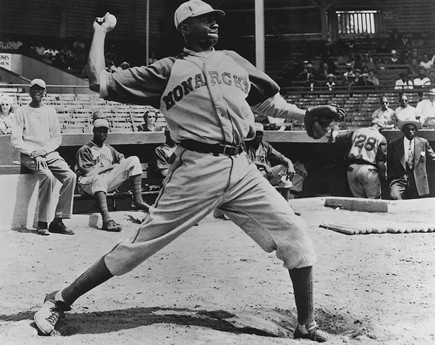
May God bless all of especially my brothers who served in with me in Iraq or have served or are serving in Afghanistan; as well as my brothers who fought in Vietnam, Indochina and Algeria.  We may never get a victory parade, but we have each other.

Peace, Steve+

5 Comments

Filed under History, iraq,afghanistan, Military, PTSD, vietnam

Where were You When…? The Death of an Icon and Its Impact in Our Lives

Note: This post is one where I invite readers to share any memories they have of Michael Jackson’s death or other events that involved the deaths of cultural icons as well as significant events that either affected you or made a deep impact on your life or that of people that you know.  I will approve all comments except those identified as spam by WordPress.

The death of Michael Jackson yesterday was one of those events in life that when they occur leave a lasting impression on people. Even people who were not fans of Michael will remember because Michael Jackson was a cultural icon.  When icons die, or tragedies occur they tend to leave a lasting mark.  You can be talking to anyone and if they were alive when one of these events happened and quite a few or most people will be able to tell you exactly where they were and what they were doing at the time of the event.

I am 49 years old, though patently I don’t really look my age, nor do I act it.  Being that I am nearly half a century old it means that I have seen a fair amount of life.  Since I am passionate about life and a keen observer of life, society and culture being a historian as well as member of the Church of Baseball, Harbor Park parish I remember a lot.  I’m told by some that I have one of those phonographic memories.  You know the kind where you get a thought in your head and it keeps going and going round and round at 33 1/3 RPMs.  I will remember this because we had just arrived at the Capital Hilton and were preparing to go out for dinner with Judy’s cousin Becki at Murphy’s of DC to celebrate our anniversary.  I had just checked the news when I heard that Michael had been found down and was in cardiac arrest.  Since I have seen a lot of these cases roll into ERs that I have worked in I knew that Jackson had very little chance of coming out of this alive.  Most news sites were reported that he was getting CPR and had been taken to UCLA Medical Center.  Then I checked the website of Matt Drudge, the Drudge Report following a look at CNN.  I opened the page and Drudge’s trademark old fashioned police siren light was flashing and below it in red was “WEBSITE: JACKSON DEAD!” and had a link to the celebrity gossip site TMZ.  TMZ actually reported the death over an hour prior to most of the networks.  It also turned out that TMZ’s report was pretty accurate.  Later other sites began to announce the news pretty much confirming TMZ’s initial report. I saw the report on CNN as we walked to get a cab to the restaurant with Becki.  It was kind of surreal as Michael Jackson, despite his eccentric actions and nearly continuous controversy surrounding his life, was a larger than life figure.

So events like this get etched on people’s memories like images of the Virgin Mary on grilled cheese sandwiches or pizzas.  These have been reported by the faithful and offered for sale on E-bay so they must be authentic right? They are something that you reallymust  remember. Talking with Judy and Becki at dinner we began to recount where we were at different moments events over the past 30 years or so.   For me the events are often linked to other seemingly inconsequential events going on in my own life. As I have said before we have lived a life  much like the characters in the show Seinfeld so some of these things may not be as funny to you as they are for me.

Some of the things that I remember which stand out include the following events.  If you remember where you were at these events please feel free to comment or add your own in the comments section.  This is one of those rare times when almost everyone has a memory that surfaces because a current event triggers the memory of that particular event.

For me I’m going to first each back to is the assassination of the Reverend Martin Luther King on April 4th 1968.  That was strange because we lived in the little town of Oak Harbor Washington where my dad was stationed.  The town was small and isolated by being on an island.  We saw the news reports that night this time I believe we were watching NBC’s Huntley and Brinkley give the news. This was way before Cable news and so it took a while to get the story out.  As a little kid I was astounded that anyone could kill a minister and I knew that Dr. King was a leader in trying get blacks the same rights that whites enjoyed.  The next day our teacher at Oak Harbor Elementary School, Mrs. Jackson talked about it with us.  This was follow just two months later by the assassination of Robert F. Kennedy following his California Primary election victory.  I remember the news reports the next day and how upset that my parents were about his death.

The next event was Apollo 11 Moon landing, the “One small step for man, one giant step for mankind” moment on July 20th 1969 where Astronauts Neil Armstrong and Buzz Aldrin landed the Lunar Module on the “Sea of Tranquility.”  I was a kid and on summer vacation still living in Oak Harbor.  We were at home watching Walter Cronkite report the event live when it happened.  That was an amazing event.

The next really big thing for me was the Marshall University Football team plane crash in Huntington West Virginia where at 7:35 Pm EST a Southern Airways DC-9 crashed into a hillside just short of the runway killing the team as well as numerous boosters, alumni and Huntington notables.  This was kind of person for us.  I had seen that team practice at the old Fairfield Stadium across the street from my grandparent’s house the previous spring before we returned to California to rejoin my dad after he had found us decent housing.  We were watching the evening news in Long Beach California when the local announcer interrupted the story he was working on and announced the crash.  My mom knew a number of people on the aircraft and was devastated.

I’m going to jump forward a bit, to the fall of Saigon on April 30th 1975.  This was a bitter day for me.  My dad had fought in Vietnam and I knew kids who had lost their fathers in the war.  I had experienced a Sunday School teach telling me that my dad was a “baby killer” for being in Vietnam in 1972 and I felt that we had let the South Vietnamese down and that it was the fault of those in the media, on the street and in Congress that had ensured that our men died in vain.  I think that was the point that I decided that I was going to enter the military.  I still cannot look at Jane Fonda and some of her fellow travelers without feeling a sense of anger.

Jumping again a few years I remember the fall of the Shah of Iran and the takeover of the US Embassy in Tehran by so called “students” on November 4th 1979.  The takeover which lasted 444 days began in my sophomore year of college.  The humiliation of the country and the poor response of President Jimmy Carter confirmed that I would enter the military after college.  I won’t forget the nightly updates on ABC hosted by Ted Koppel which became the long running show Nightline. I would stay up every night to get the updates.  When the hostages were released this was cause for celebration, but the damage was done.  Of course we saw the pro and anti-Ayatollah  protesters on our university, Northride a big business school responded to a pro-Ayatollah by driving the protestors off campus.  So much for riled up MBA students and Science geeks huh?

When Elvis died on August 16th 1977 I was a getting ready to enter my senior year of high school.  In fact only a week before I had won a copy of a blue vinyl copy of his last album Moody Blue in a local pop radio station give away.  I was on a church high school trip when the news came over the radio.  The man driving the car a real estate agent who was a deacon in the church started to cry, I mean like really cry almost like Middle Eastern mourning kind of crying.  As someone who is less expressive of such emotions being a Romulan at heart I was mildly taken aback, after all it wasn’t like they had dated or anything.  I had seldom seen men cry before and this was some pretty emotional stuff.  My mom had the same kind of reaction I discovered on my way home.  I guess it was the generation thing.  He was the icon of his generation and changed both the style and the performance of music.  It was Elvis that I immediately thought of when I first saw the news of Michael Jackson’s death.  I guess the fact that both were known as the “king”, that both died young and unexpectedly and that Michael was briefly married to Lisa Marie Presley makes their connection a bit stronger than otherwise expected.  I wonder if there will be stories that Michael is really dead or if it was staged to get him some privacy.  I’m sure that conspiracy theorists will be looking into this as both a death and a disappearance.  On a side note I visited Graceland in 1983 on my way to Fort Knox Kentucky and sat in the “pink Jeep.”  Judy had a Tonka pink Jeep when she was a kid.

The attempted assassination of President Ronald Reagan on March 20th 1981 stands out.  I was a junior at cal State Northridge and was taking my lunch on the lawn outside of the office where I worked as a peer counselor.  I was getting ready to go to class as I watched to really good looking girls go walking by me talking.  I didn’t notice anything unusual until the past me and continuing to watch I noticed that each had their hand down the back side of the pants of the other one.  I had never seen this before.  Of course having grown up in California I knew homosexual men and I had heard of lesbians but this was the first time that I ever noticed women of that persuasion like doing some affection or foreplay in public.  Since then of course I have had many friendships with both male homosexuals and lesbians but this was one of those moments that sticks out in my mind.  Anyway, as I walked back into the office to grab my books for class the office TV was on announcing the attempted assassination and what I will never forget is watching retired General Alexander Haig as Secretary of State have a news conference where he stated “I’m in control.”  Of course he wasn’t the next in line and though he thought that he was he was not in control, even of himself that that point.  I don’t think that then Vice President George H.W. Bush was very impressed nor were the actuals in the line of succession.  So the shooting of President Reagan is intermixed with my first view of lesbian touching and seeing a General go out of control to be in control.  As Mr. Spock might say to Captain Kirk, “Captain I find this fascinating.”

In January 1985 I was a young company commander in Wiesbaden Germany.  The Space Shuttle Challenger with 7 Astronauts aboard blew up shortly after launch.  It was already the close of the business day in Germany when this happened.  I had the First Sergeant release the soldiers a bit early and set the duty, the Charge of Quarters, the Assistant and the Duty Driver.  I was staying late as always to take care of maintenance management and personnel reports when Specialist Lisa Dailey rushed into my office.  Lisa was the Charge of Quarters or CQ that day.  She knocked on my door and said “Sir the space shuttle just blew up.”  She had been watching it live on the new AFN broadcast of live stateside TV news broadcasts.  If I recall this was the time slot of the Today Show, and yes it was when there was only one AFN broadcast channel.  I looked up from my mountain of reports and said to her, “Specialist Dailey, space shuttles don’t blow up.”  And she said, no sir it just did, I was watching it and it is on TV right now.”  So I got up from my desk and walked at a brisk pace down the hall with my spun up specialist and looked on in horror as I saw a replay of the launch.   I was stunned as like I had told Lisa “space shuttles don’t blow up.”  However this one did and it was sobering.  I should have believed Lisa, she was a great soldier and the last time that I heard from her is doing well working as an RN in Southern California.  I had an eerie reprise of this when the Space Shuttle Columbia blew up on re-entry.  At the time I was waiting for the arrival of General Peter Pace who was to be our guest speaker at the Battle of Hue City Memorial Weekend in Jacksonville FL. He was delayed a couple of hours by an emergency meeting of the Joint Chiefs.

Fast forward a few years to the bombing by Libyan agents of Pam Am flight 103, the Clipper Maid of the Seas over Lockerbie Scotland, on December 21st 1988.  I had left active duty for seminary a couple of months previously and was engaged in a nearly futile job search in oil and real estate busted Texas.  I had completed the share of my morning futility mailing our more resumes, making more calls and picking up more job applications.  As always I would take a football out and punt it as far as I could to relieve the stress.  I had already found out that breaking things that you actually need when being accosted by bill collectors is not good a good way to deal with stress.  In today’s current economy I suggest anyone is such straits pick up a football and punt the crap out of it rather than taking anything out on home appliances, electronics or loved ones.  Eventually things will work out as sucky as they may seem now; the Deity Herself has assured me of this.  Anyway, back to the plane crash.  This really was weird for us because barely two years prior we had flown the same aircraft back from Germany when we were reassigned to the states.  We remembered this because then they showed the photo of the nose and cockpit area we saw the name of the aircraft.  I looked at Judy and said, does the name of that airplane look familiar?  If I recall correctly she said something like “Oh my God” and I said: “Remember back in Frankfurt when I saw the name of the aircraft prior to boarding?” and how “l liked the way Pan Am gave pretty names to its aircraft.”  It was funny because we both vividly recalled waiting for our flight and what we said about the aircraft.  That was totally weird and surreal almost like an X-Files thing as I thought back to details inside of the aircraft and the trip home from Germany.

We were in Fort Worth for the first bombing of the World Trade Center and the destruction of the Branch Davidian Compound outside Waco.  Both times I was at work and watched the events unfold on the televisions of our ministry’s television production department.  The Branch Davidian stand-off and attempted seizure of by Federal Agents used M-751 Combat Engineer Vehicles from my National Guard unit.  The vehicles were not manned by Guardsmen but Federal agents.  Later that summer I saw a couple of the vehicles which still had white paint scratches on them from the Branch Davidian building.   In 1995 I was home getting ready to go to work in Huntington West Virginia when the Murrow Federal Building was destroyed by Timothy McVeigh.

There are quite a few others that I could mention but will finish with the destruction of the World Trade Center twin towers on September 11th 2001.  I had finished a couple of counseling cases and put out some other brush fires as the Chaplain for Headquarters Battalion 2nd Marine Division.  Leaving my office for a belated PT session at the French Creek gym I was closing out my internet explorer.  On the Yahoo home page there was a small news line that said “Aircraft crashes into World Trade Center.” I shrugged and figured that some idiot private pilot had flown his aircraft into is by mistake and when out to my car.  I got in my 2001 Honda CR-V and some guy on the radio was blathering about it being an airliner and then I heard a chilling line that I will never forget. “Oh my God another aircraft has hit the second building.”  I went over to the gym and stood staring in disbelief at one of the TVs with a bunch of Marines and Sailors.  I shook my head, ran back to the office and changed over to my cammies and when to the Battalion Headquarters where we were informed of what the command knew and then set to work taking anti-terror precautions as no one knew what might happen next.  Camp LeJeune became a fortress.  There were checkpoints at key locations throughout the base.  Patrols were set up and we remained in lock-down for almost 4 days.  That is a day that I can never forget, over 3000 Americans and others killed by Islamic extremist terrorists out to ignite a world war.

So those are some of mine.  What about yours?  Feel free to add your posts here and get a discussion of these and other notable events including the death of Michael Jackson going.  It will be interesting to see and I will approve all posts to this article, excepting of course spam posts.

Peace, Steve+

3 Comments

Filed under Baseball, beer, celebrities, dachshunds, ER's and Trauma, Foreign Policy, golf, healthcare, History, iraq,afghanistan, Lies of World Net Daily, Loose thoughts and musings, marriage and relationships, Military, Navy Ships, philosophy, Political Commentary, pro-life anti-abortion, PTSD, Religion, star trek, state government agencies, things I don't get, travel, Uncategorized, vietnam, world war two in europe

Love Poverty and War…Suffering and Death… Christian Theology meets Reality in the Intersections of Life

“An antique saying has it that a man’s life is incomplete unless or until he has tasted love, poverty, and war.”  Christopher Hitchens

“You have not done Christian Theology until you have dealt with suffering and death” Yandall Woodfin

I deal with life in the intersection where theology has to deal with uncomfortable and often troubling questions.  When I first heard my Philosophy of Religion Professor at Southwestern Baptist make the statement that “you have not done Christian Theology until you have dealt with suffering and death” I was somewhat offended.  This was back in 1989 when I was still somewhat idealistic and believed what really popular preachers on radio and mega-churches said.  Now I can never say that I was completely in agreement with the “name it claim it, grab it stab it, God owes me and will bless me because I did…” pop-theology of the theological lightweights masquerading as teachers, preachers and prophets.  While I did not espouse it the view was prevalent in the churches that I was part of, in fact I choose Southwestern Baptist as a school because it did not tow that party line.  I just never expected my professors across the board in the School of Theology to be as nuanced and balanced as Dr. Woodfin and the others who helped give me my theological formation.

In seminary I developed a very good theological understanding and life hermeneutic that was far closer to Anglicanism or the reformers of the Second Vatican Council.  In fact it was theologians like Hans Kung, Yves Congar and Alistair McGrath as well as Jurgen Moltmann and Wolfhart Pannenberg who helped me in that.  Additionally the writings of Dietrich Bonheoffer, Emil Brunner and Henri Nouwen were influential as I developed my theological and spiritual life.  I was also thrust into the world of the Ante-Nicene Fathers of the Church, spending a semester of Systematic Theology studying and writing about Polycarp of Smyrna.  It was studying these contemporary theologians as well as the Church Fathers that I discovered Christian Theology at the intersection and it was Dr. Woodfin’s remark that caused me to really question the modern “theologians of glory.”  It is plainly obvious that this was in the day before the Baptist Taliban under Mullah Paige Patterson took the place over.  That was the time when it was a world class seminary and not just a pretty good Bible school.

It was the fact that even though I was in seminary life was really sucky.  Nothing went right.  Instead of the obvious “blessing of God” it seemed that we were cursed.  We had lost our home, cars, and were destitute.  I was working two and three jobs while Judy was sick and unable to work.  We lived in a hell hole on the east side of Fort Worth Texas, frequently featured on the TV show COPS.   One night in desperation I called the Terrible Blonde Network (TBN) for prayer.  For my trouble I was told that it was obvious that God was not calling me to ministry otherwise he would be blessing us.  That was a watershed experience and I rejected that idea on the spot.  It made me mad as hell that a well meaning but ignorant volunteer prayer partner would judge me in such a way.  When I went to work later at a TV ministry doing counseling, especially to broken pastors I never forgot that experience.  I realized that what the lady said and what many people that I knew espoused was God-babble bullshit.  The pastors that I talked to every week were suffering, often at the hands of the alleged people of God and even other ministers.  It was obscene.

So anyway, back to the subject of this article…yes I chased a rabbit there and it was intentional.  I had a New Testament Professor whose “rabbits” were often pastoral and theological gems.  That may not be a gem but it was a rabbit worth chasing.

Hitchens, a pretty strident atheist has some pretty good observations about how some religious people including modern Christian icons have been pretty poor examples.  Now he can be biased but his bias is balanced by the Orthodoxy espoused by his brother Peter.  Hitchens’ comment based on the writings of antiquity is quite true.  Until a man or for that matter a woman has experience love, poverty and war their life experience is incomplete.  As a personal testimony, I can say “AMEN!” I know this to be true.  I am married to the love of my life and our marriage has endured suffering, sickness, death, poverty and war.  We have in baseball terminology “hit for the cycle.”  While I have understood this I had never seen it in writing until I saw Hitchens’ book.  The theme of love, poverty and war is rich in ancient writings including the Bible.  It is also thematic in many cultural rituals around the world.  The warrior who loves his family endures poverty; usually famine or plague induced and then goes out to fight invaders.  If they win they come home to their loved ones victors who have protected home and hearth.  It is much like the movie Braveheart where William Wallace leads a campaign against the English who have invaded Scotland.  If they lose, there is the strong possibility that they will be slaughtered and their families enslaved.  The annals of the Punic Wars are rich in this theme as is the life of King David who knows love, poverty based on being a fugitive on more than one occasion and his life as a warrior.

I think this is true in the modern era as well.  Western culture based on consumerism and material wealth has been insulated from the depths of abject poverty, one only need place a poverty and famine stricken resident of almost any third world country who is deposited in a poor American city or town and ask him if he sees poverty.  If he does it will not be material poverty but one where love and community are missing.  If he goes up the street to the well off part of town he may be dazzled by the opulence but appalled by the loneliness of many people.  Western nations following the end of the Second World War and the recovery from it have not known the depths of poverty.  This may be changing now unless we can pull our economy out of the abyss that it seems perched upon, but even still at least so far the last couple of generations in the west have not known poverty as a whole.

Likewise the question of the experience of war for the modern person is one that is not experiential.  War in the west is now fought largely by military professionals while most of the nation’s population lives in the shadow and protection of their military prowess.  At one time with the draft war was experienced by all parts of the population in the west.  Today it is not and with that lack of experience there is a void, men and women have not discovered either how to live for something or die for something bigger than themselves.  One of the things that chafes my hide is when I hear ministers who have never served a day in uniform don a set of BDUs or Dessert Camouflage and preach a sermon on spiritual warfare. Sorry, that is a sham and the big TV guys who have done this should apologize to men and women who have been in combat and in harm’s way.  I once had a bishop in my church, who is no longer in his communion do an article about spiritual warfare trying to apply “principles” of Carl Von Clausewitz about war without ever really reading or understanding Clausewitz.  The treasure of Clausewitz is in his “principles” but in his understanding of the human condition brought about by his Lutheran faith, the Enlightenment and his experience of Prussia’s defeat and occupation by Napoleon followed by her recovery.  I was appalled by what my ex-bishop wrote and embarrassed for the church should any real soldier or military leader pick it up and read it.  Things like these show how little many religious leaders, or for that matter political leaders understand the human condition, life, love and war.

Dr. Woodfin was more right right than about anyone I have ever heard when he that we have not done Christian Theology until we have dealt with suffering and death. When you see innocents killed, children suffering from famine, war and disease.  When you have seen the bodies of young men and women who have died senseless deaths and when you have looked at a mother who has lost a child you begin to understand.  You begin to see the Cross.  An innocent man executed, a guilty man go free.  When you see friends and companions abandon their teacher and friend, a governor who knows a man is innocent be put to a brutal and agonizing death,  and a mother looking up at a cross where her son hangs and cries “My God my God, why have you forsaken me?” When you see these things you have to deal with the reality of where the Christian faith intersects the cold reality of our world.  It is as Alistair McGrath calls it, “life under the cross.”

I dare any of our modern digital era “theologians of glory” to enter this world, but most will not.  In fact they will continue to sell the sad sack of theological excrement that they call the Gospel to adoring crowds who will eventually discover that they have been sold a lie.  Many leave the faith while others take their place looking for “their” promised miracle, “their” blessing and their health, wealth and fortune.  Like the Catholic indulgence sellers of Martin Luther’s era, such “ministers” are blight on the Christian faith and for all of their “success” power and popularity have done more harm to the faith than benefit.  John Tetzel, Luther’s protagonist would tell people when collecting indulgences “A penny in the coffer rings, a soul from Purgatory springs.”  Today’s modern peddlers of pious poop promise “your prosperity grows when into our ministry you sow” or a “vow you make today God is bound to repay.”

Having seen this in real life when people buy the lie and end up devastated when “God” doesn’t come through for them, or when a well meaning but ignorant person tells them some horse shit about how God is not blessing them because….I want to scream.  I once had a pastor in a large evangelical and charismatic church which believed in “signs and wonders” tell the congregation about a conversation that he had with a parishioner who had been in the hospital and not been visited by him or the staff.  The parishioner, who gave a sizable amount of money to the church asked” “How sick do I have to be to get a hospital visit from you?”  The pastor, a nice guy laughed as he recounted his response.  “You don’t want to be that sick.”  The congregation laughed and I about cried as I was immersed in daily tragedy and trauma and Parkland Memorial Hospital in Dallas.  I knew too many people be abandoned by their pastors in a city consumed with powerful pastors as churches to believe that they were a priority for those suffering.

The truth is that many pastors and for that matter many people want to avoid dealing with suffering and death at any cost. Whole industries are built around the worship of youth and beauty and a culture, including the churches lift their heads to the sky for God’s blessing while avoiding the suffering around them.  There are pastors and parishioners who by the boatload have been thrown from the “Barque of the Church” because they either failed or did not have enough “faith”

Such is not the Gospel nor is it Christian in any way shape or form.  It is no wonder that so many have abandoned the faith when all they see on TV are the modern digital theologians of glory who bask in fame and fortune while adding to the rejection, alienation and despair of those who believed them to actually be telling the truth.

Love, poverty and war, suffering and death, where the Christian faith meets these in the intersection is where new life can begin for it is only through the agony of the Cross that we know the resurrection.

Peace, Steve+

4 Comments

Filed under alzheimer's disease, History, Loose thoughts and musings, philosophy, Religion

A Weird Day, a Great Team and Some Fractured History

Today was one of those weird days for me, very busy, pretty good work and good intellectual stimulation n an ethics committee meeting.  I’m also still pretty tired from the past few weeks, not feeling bad but I know that I need to pace myself while we are short staffed in our department this summer.  It is a good thing that I have the boss that I have as he is making sure that I am okay on a pretty regular basis.  He knows that I will push myself hard until I hit the wall, which I did about a week and a half ago.  The thing is it is not just me that is feeling the strain. All of us on our staff have been pushed hard caring for folks during the recent deaths of two military staff members, regular work on our wards, administrative tasks as well as the extra load imposed by being short staffed.  But this is what we do as chaplains.  The good thing is that we are doing our best not just to look after our flock, but to look after each other.  We have a great team which I am proud to be a part.

Thus today my mind was a raging torrent, flooded with rivulets of thought cascading into a waterfall of creative alternatives.  In fact it was awash in so much that I should have written them down.  The mind is like a sieve sometimes.  Since it is late I am going to stick with a few observations from this day in history which seems to still have significance today June 17th.

On this day in 1579 Sir Francis Drake sailed his ship the Golden Hind into San Francisco Bay.  Immediately he was picketed by anti-imperialist and environmentalist protesters who had come down from Haight Ashbury in their Birkenstocks.  Ignoring them Drake’s crew hit on women and some men in Golden Gate Park, had lunch at Fisherman’s Wharf and took in a Giants game.  At least that’s what they wanted to do, but they were 400 years or so too early.  Instead they sat around wondering why it was so cold in the middle of summer as they repaired their ships, had the chaplain celebrate Eucharist and then claimed everything in sight for England calling it New Albion.  The Spanish realtors in the area took umbrage to this and never recognized the claim.

On this day in 1775 was fought the battle of Bunker Hill or more appropriately Breed’s Hill.  The American soldiers defending the hill gave a good account of themselves against the British who were trying to drive them off of the hill.  An American commander on the front line uttered the cry which did not become in military history “Don’t fire until you can smell the Redcoat bastards.”  The insensitivity of the comment regarding the Colonial’s British Cousins body odor, which wafted over the battlefield, offended some of in the snior commanders who had a hard time smelling the gunpowder over their own body odor.  When the Pentagon heard about it the offending officer was sent to Ft Polk Louisiana and the utterance was officially changed to “Don’t fire until you see the whites of their eyes.”  After the clash the surviving unwounded opponents gathered at Sam Adams pub where they consumed vast amounts of his original Boston Lager beer as they played darts and argued the merits of English versus American Football.  Some went to the Yankees Red Sox game at Fenway later in the evening.

On this day in 1815 Commodore Stephen Decatur commanding a Task force from the 6th Feet conquered the Algerian frigate Mashouda in an action that finally helped bring an end to the Barbary Wars and drove the Barbary Pirates from the Mediterranean.  Within 48 hours of defeating the Mashouda he was in Algiers harbor exacting peace on the Dey of Algiers.  This ended the period of where  Barabry Pirates excercised domain over the Mediterranean. Getting with British sailors on liberty in town with which they had recently been at war, the Americans and Brits spent the evenings at Murphy’s Irish pub drinking Guinness and Kilkenney with Irish and other expats while watching Arsenal play Bayern München on pay per view.

On this day in 1856 Republican Party opened its 1st national convention in Philadelphia.  Immediately Randall Terry demanded equal time to speakers demanding the end of slavery while Ron Paul was ignored.  Others lobbied for the Flat Tax until they discovered that there was not yet an income tax.  Up and coming Illinois legislator Abraham Lincoln gave the keynote address recommending a bigger Federal role in solving disputes between states while Newt Gingrich presented a “Contract with the Union” to deal with the various tensions.  Fox News covered the event

On this day in 1916 US troops under General John Pershing marched into Mexico to bring Pancho Villa and others into custody.  The expedition was not successful as many troops were inflicted with Montazuma’s revenge while KBR failed to get the porta-poties in place in a timely manner.  The Easern European sub-contractor walked out and KBR replaced them with men from the Indian Subcontinent area who had each paid $4000 to an agent for the job and recived $300 a month working 16 hour days 6 days a week.  However the campaign  did give US troops experience operating in harsh climates which would serve them well when stationed in Texas over the next century.  General Phil Sheridan had once said of Texas that “If I owned Hell and Texas I would live in Hell and rent out Texas.”

On this day in 1938 after conducting military operations against the Chinese for over 5 years the Japanese declared war on China.  Chinese leaders Chaing Kai Shek and Mao Tse Tung issued a joint statement agreeing to work together and declaring “It’s about damned time they admitted that they are at war with us.”

On this day in 1940 the French after having their asses handed to them by the Germans yet again asked for surrender terms.  General Charles DeGaulle immediately departed for England to continue the war against both the Germans and his fellow Frenchmen.   Upon his arrival DeGaulle immediately complained about the bad food, plain women and miserable weather.  He was embraced by Winston Churchill who got him drunk, left him passed out in a brothel and blamed the Vichy government for it. Churchill wrote afterward, “that man is a pain in the ass.”  DeGaulle always doubted Churchill’s version of events every time he looked at the tatoo of a German tank on his ass.

On this day in 1944 Iceland declared independence from Denmark.  No one noticed until 1953.

Most importantly on this day in 1960 Ted Williams hit his 500th home run. and today the Nationals beat the Yankees and the Orioles beat the Mets.

Peace, Steve+

Leave a comment

Filed under Baseball, beer, History, Loose thoughts and musings

You Win a Few, You Lose a Few. Some Get Rained Out. But You Got to Dress for All of Them

“Ain’t no man can avoid being born average, but there ain’t no man got to be common.” Satchel Paige

Paige_Satchel1942Satchel Paige on the Kansas City Monarchs
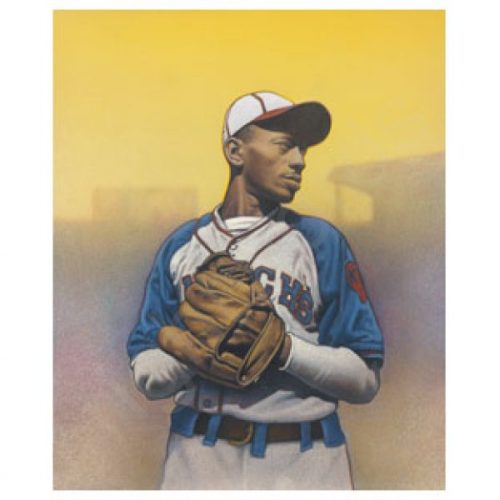

Negro League and Cleveland Indian’s Hall of Fame legend Satchel Paige was one of the most remarkable men who ever played the game of baseball.  He came along after Jackie Robinson and others had broken the color barrier having played 22 years in the Negro Leagues as well as in Mexico, the Dominican Republic and the Puerto Rican League, where in the winter of 1939 he went 19-3 with a 1.93 ERA. While with the Kansas City Monarchs Paige helped lead the team to four consecutive Negro League World Series titles from 1939-1942 and again in 1946.  During his time in the Negro Leagues played in numerous exhibition games against major league stars and future stars including Bob Feller and Joe DiMaggio who went 1-4 against Paige. During this time he would pitch in the summer with the Negro League team and winters in the various Winter Leagues.  It could be said that Satchel Paige not only played baseball but lived it.  In the Negro Leagues Paige often pitched twice a day, sometimes in two different cities.  Record keeping in these leagues was almost universally lax so the feats of men like Paige, Jackie Robinson, Cool Papa Bell and Buck O’Neil will never be fully appreciated by modern statistically absorbed fans.

When he was signed by Bill Veeck, the owner of the Cleveland Indians he was either 42 or 44 years old depending on what documents you use…talk about a birth certificate controversy.  Paige pitched 5 seasons in the Majors with Cleveland and the St. Louis Browns mainly in a relief role and pitched in the 1948 World Series and the 1953 All-Star Game after having been chosen for the 1952 game but not getting the chance play.  He was signed by the Kansas City Athletics for a one game contract in 1965.  He pitched his last game at the age of 59 or 61 on August 25th 1965 throwing three shutout innings against the Boston Red Sox, the only hit coming from Hall of Famer Carl Yastrzemski who doubled.  Paige set the next 7 batters down in order.  In between his years in the majors Paige continued to pitch in the minors.  He played his last game of organized baseball in 1966 for the Peninsula Pilots of the Carolina League in Hampton Virginia. The Pilots, now of the Independent Coastal Plain League, still play in Hampton’s War Memorial Stadium in which the legendary great pitched his last game.

Paige was recognized by many as perhaps the best pitcher to ever play the game.  Bob Feller called him “the best pitcher I ever saw.”  Ted Williams said “Satch (Paige) was the greatest pitcher in baseball.” Joe DiMaggio called him “The best and fastest pitcher I’ve ever faced” while Bill Veeck who brought Paige to the majors said he was “The best right hander baseball has ever known.”

The biggest thing in my mind about Paige was his love for the game and his determination to play as long as he could.  In the Negro Leagues he pretty much played year round for 22 years.  After his major league career was over he continued to play the game that he loved.  He did all of this in a segregated and “Jim Crow” America.  It was due primarily to Paige and others like him that black players got the chance to come to the Major Leagues.  Most expected that Paige would be the first black player called up but this honor went to Jackie Robinson.  In 1971 in his Hall of Fame acceptance speech he said “The only change is that baseball has turned Paige from a second class citizen to a second class immortal.”

I like Paige a lot.  I remember reading Bob Feller’s book in grade school and his comments about Paige, especially the time he switched a bar of soap for the ice cream in a an ice cream sandwich.  When Paige took a bit his false teeth came out with the sandwich.  Now that I am 49 years old I like him even more.  He took 22 years to get in the big leagues and didn’t quit and even after his major league career continued to play.  He endured Spartan living conditions on low pay in a segregated and often hostile America did not deter him.  Neither did his age, many men in their 40s would have quit before realizing their dream.  That is the lesson of Satchel Paige for me.  He was the oldest “rookie” ever to play Major League ball.  I kind of understand what Paige went through.  I started my Navy career after nearly a full Army career.  In fact I was within 2 ½ years of Reserve retirement when I got the chance to serve in the Navy in February 1989.

Satchel Paige was an example to me that if you have the heart and talent you can achieve your dream even if it takes a long time. My advice for people who still dream dreams is to be persistent and don’t give up.  Sometimes, not always, but sometimes by hanging in there, making the sacrifices to achieve the dream it comes true.  After a very difficult 5 years following leaving the Army to go to seminary which included long term sickness to Judy, losing almost everything that we owned, and having to work menial jobs for unappreciative people to get through seminary, Additionally there were times when I was sure that it was over, that my best efforts had failed, something would break my way and I would be able to continue.  It was remarkable.  While I give appropriate credit to God I do not fail to give credit to all the people that believed in me and wouldn’t let me fail.  The way that I figure is if you don’t try or you quit too soon you will always wonder if you could have made it.  There will always be doubt and often regret.  My Clinical Pastoral Education Supervisor, Dr. Steve Ivy at Parkland Memorial Hospital told me once, “Steve, you make your own future, stop living in the pain of the past.”  That was an “Wow I could have had a V-8 moment” for me.  It hasn’t always been easy, but it has been great.  His advice was on target.

Satchel once said: “Work like you don’t need the money. Love like you’ve never been hurt. Dance like nobody’s watching.”  The comment is way too true, but for me even more important is this: “You win a few, you lose a few. Some get rained out. But you got to dress for all of them.”

I think the Deity Herself would agree with both statements and I’m sure that Satchel is still pitching for the New Jerusalem Saints of the Pearly Gates League.

Peace, Steve+

satchel paige

2 Comments

Filed under Baseball, History, Loose thoughts and musings, philosophy, Religion