Category Archives: imperial japan

Swift and Deadly, the Japanese Fubuki Class “Special Type” Destroyers


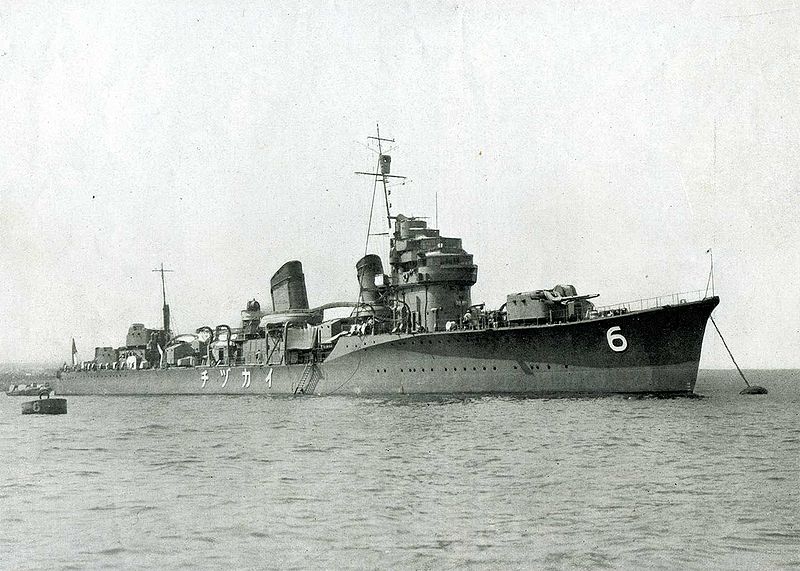
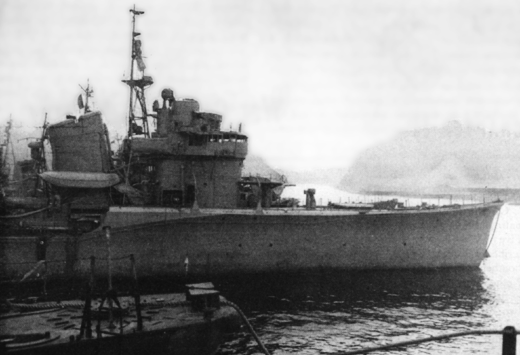
IJNS Fubuki

Friends of Padre Steve’s World,

Tonight something different, once again going back to write about important classes of Navy ships. I will continue doing this whenever I need a break from mass deaths, politics, and trying to inject reason into the vacuous minds of so many Americans about COVID 19.

The Imperial Japanese Navy set the standard for new destroyer construction in the 1920. While the United States Navy and British Royal Navy were fully stocked with their First World War design destroyers the Imperial Navy’s General Staff issued a requirement for a class of large destroyers which would complement the new classes of modern cruisers being built for the navy. There was nothing wrong with their existing destroyers of the Minekaze, Wakatake, Kamikaze, and Mutsuki classes, many of which continued to serve in secondary roles in the Second World War as escorts for convoys and invasion groups.  They were the equals of contemporary British and American destroyers, but the Imperial Navy’s long range plan required larger, faster, more powerful and longer range destroyers.

The Navy requirement called for a 2000 ton ship capable of 39 knots with a 4000 mile range at 14 knots, that could carry a large number of torpedoes and a heavy gun armament. The program was designed to give the numerically inferior Imperial Navy a qualitative superiority against any opponent. The ships displaced 1750 tons, but even then their displacement limited  their top speed to 35 knots, not the specified 39 knots.


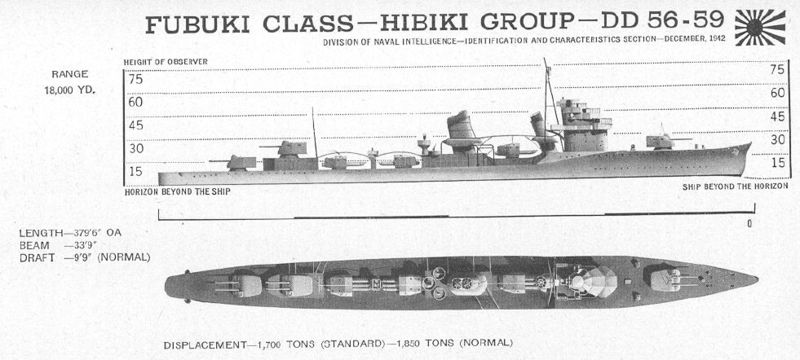
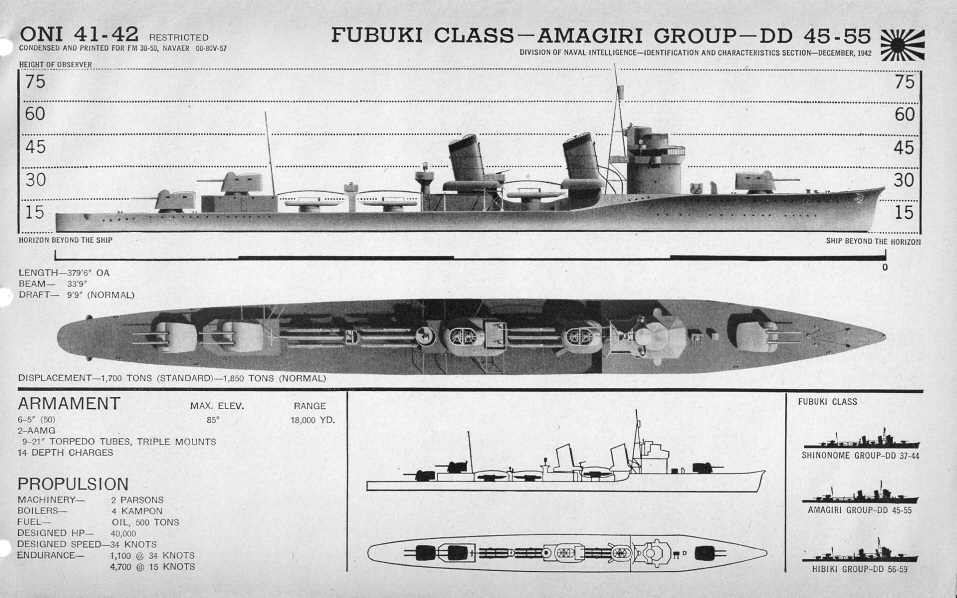
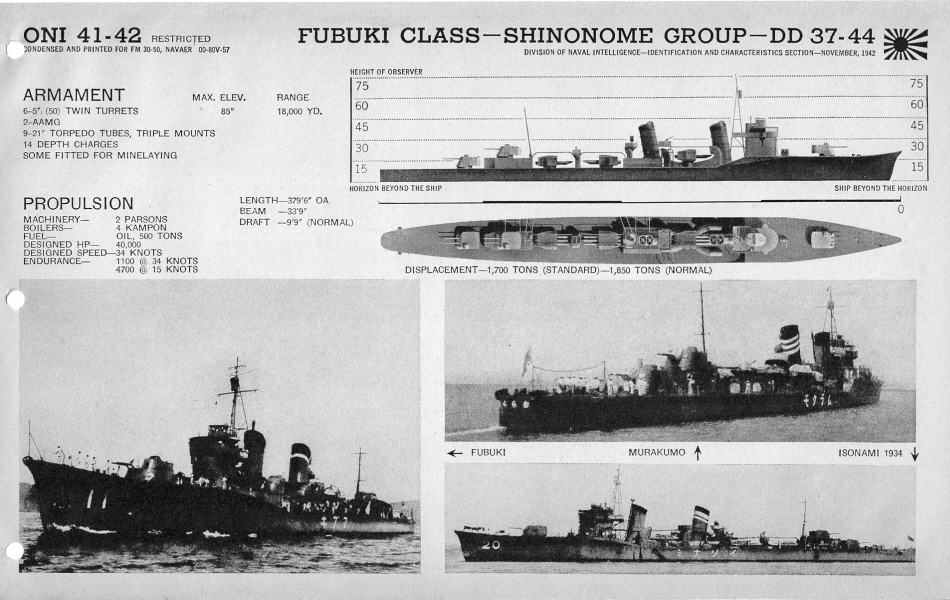
WWII Office of Naval Intelligence images for Fubuki Class variants

The 24 ship Fubuki Class was such a quantum leap over other contemporary destroyers that the Imperial Navy referred to them as the Special Type. Their large size, heavy armament and high speed made them equal to many light cruisers of the era.

The basic design was modified to carry more guns and torpedoes on an increased displacement and the result was a 388 foot long 1750 ton ship armed with six 5” 50 caliber guns in weather proof and splinter proof mounts.  On the initial 10 ships of the class the guns could only be elevated 40 degrees which made them less than effective in an anti-aircraft role. However, in the succeeding two groups of the class, the 5” mounts were an improved type which allowed them to elevate each gun separately up to 75 degrees.  The ammunition magazines were below the gun mounts and ammunition was passed to the guns by hoists.  This gave them a decided edge in rate of fire over other destroyers which had open or partially shield mounts dependant on ammunition passers carrying ammunition to them from central magazines.


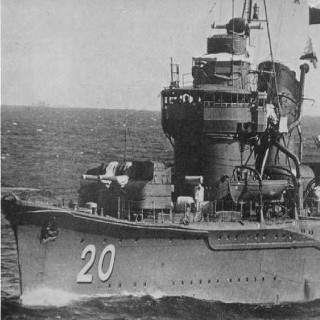
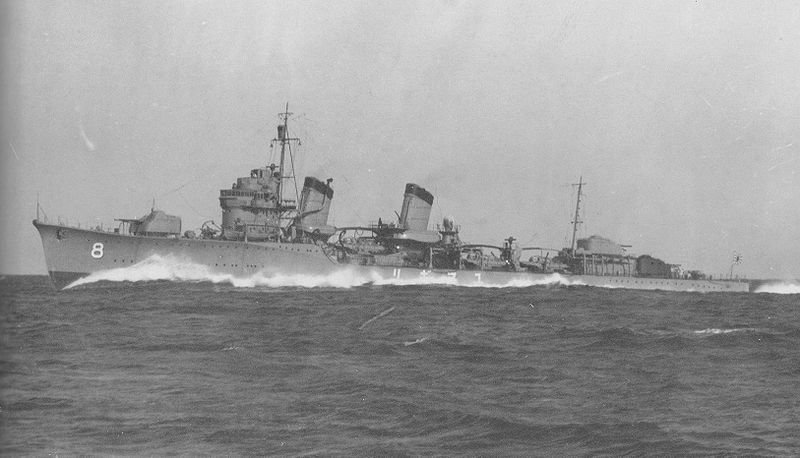
Close up of IJNS Sagiri

As built the light anti-aircraft armament composed of two Type 93 13mm machine guns. In the years before the war, and during the war their anti-aircraft was increased in some cases up to twenty-two 25mm anti-aircraft guns and 10 of the Type 93 machine guns. In 1944 surviving ships of the class had their X- 5” gun mount removed to facilitate more 25mm guns, radar and an additional depth charge capacity.


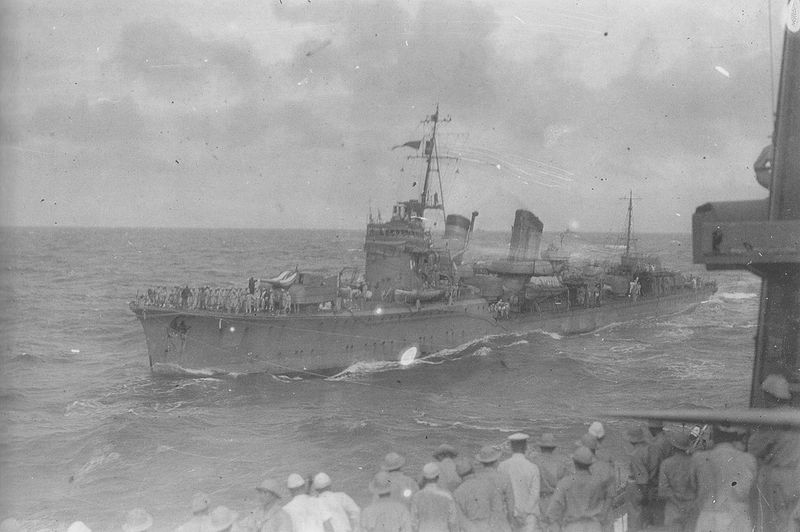
IJNS Ikazuchi

The nine 24” torpedo tubes in triple mounts were able to be reloaded while in battle a capability not shared by other destroyers.  The ships carried a total of 18 torpedoes which initially were of the Type 8 torpedos carried on earlier destroyers. However, these were replaced by the oxygen powered Type 93 “Long Lance” torpedoes before the war. These torpedoes had a higher speed, longer range and heavier warhead than torpedoes produced by other navies.  The deadly Long Lance torpedoes would become the scourge of Allied navies during the war, especially during the brutal surface engagements of 1942.


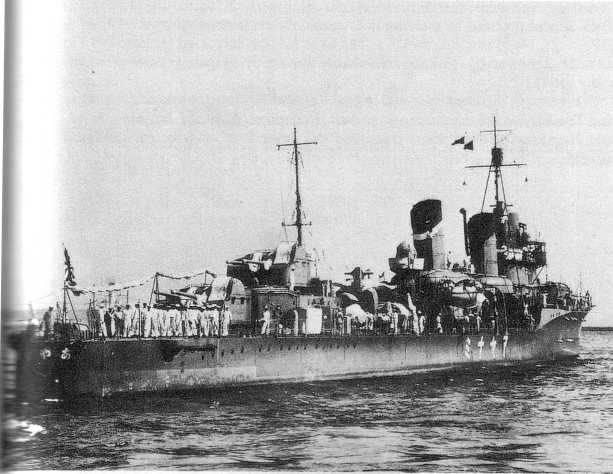
IJNS Yugiri

Due to the added weight their increased armament made to the design unstable in heavy seas, and a longitudinal hull weakness that necessitated in the class being rebuilt between 1935 and 1937. The rebuild increased their displacement to 2050 tons standard and to over 2400 tons full load. The increase in displacement resulted in a slight reduction of speed.


IJNS Hibiki

The class was built in three groups, and each is sometimes referred to as a separate class as each incorporated improvements over the preceding group. The first 10 ships of the class which are sometimes referred to as the Fubuki Class were of less complex design than subsequent ships. Their overall length was 388 feet, with a beam of 34 feet, and draft 10.5 feet. They had a smaller bridge and exposed gunfire control room than the next two groups.

The second group of 10 ships are commonly referred to as the Ayanami Class. The group had an enlarged bridge structure which enclosed previous exposed positions to include the gunfire control room, and  range finders. They were also provided a range finder tower.  They were the first ships to receive the improved Type B gun mounts.  The final subtype of the class, the Akatsuki Class comprised just 4 ships and was distinguished by a smaller forward funnel, larger boilers and a unique splinter proof torpedo tube mount housing.


IJNS Ayanami

The ships of the class participated in every major campaign of Japan’s war in the Pacific as well as operations against China in the 1930s.One ship the Miyuki was lost in a collision with another destroyer in August 1934.

All remaining ships of the class  served with distinction throughout the war, especially during the Battle of the Java Sea and operations around Guadalcanal and the Solomon Islands and the Aleutians  from 1941-1943. The participated in the sinking of the heavy cruisers, USS Houston, HMS Exeter, and the light Cruiser HMAS Perth, a number of destroyers, submarines, patrol ships and auxiliaries, while providing escort to carrier task forces, surface groups, and convoys. The Ikazuchi and Inazuma were noted for their rescue and humanitarian treatment of allied sailors, including those of the USS Pope during the Battle of the Java Sea. No ship or crew of the class was ever accused of committing war crimes or mistreating prisoners of war or other survivors of Allied ships.

All of the ships of the class except the Hibiki and Ushio were lost in action during the war. Four the Fubuki, Ayanami, Yuguri and Ataksuki were sunk in surface actions. Eight ships the Usogumo, Shirakumo, Isonami, Shikinami, Sagiri, Sazanami, Inazuma, and Ikazuchi were lost to Allied submarines.  Seven ships the Shirayuki, Hatsuyuki, Murakumo, Uranami, Asagiri, Oboro and Akebono were sunk by aircraft and two the Shinonome and Amagiri fell victim to mines.

The demilitarized IJNS Ushio after the war

Hibiki was given to the Soviet Union following the war and served in that Navy until either 1953 or 1963 depending on the source. She was used as a target and sunk in the 1970s near Vladivostok and her wreck is now a tourist site for divers. Ushio surrendered to the Allies was demilitarized, assisted in the evacuation of Japanese forces from conquered areas, and then scrapped in 1948.

As a sidebar, the  Amagiri played a role in the life of future President John F Kennedy when she rammed and sank his PT-109 in the Blackett Strait on August 2nd 1943. Her commanding officer at the time Lieutenant Commander Kohei Hanami attended Kennedy’s inauguration in 1961. Even before Kennedy ran for the Senate Hanami wrote to Kennedy expressing his admiration. Kennedy’s daughter Caroline met Hanami’s widow in 2015 and invited her to the christening of the USS John F. Kennedy CVN 79. 

The Fubuki Class destroyers set a standard in destroyer construction that other navies around the world sought to emulate. Fast and powerful they and their crews fought gallantly in the Second World War and though in a losing cause deserve to be remembered.

Peace,

Padre Steve+

Leave a comment

Filed under History, imperial japan, Loose thoughts and musings, Military, Navy Ships, US Navy, US Presidents, World War II at Sea, world war two in the pacific

The Hubris of Empire: The Japanese Battleships Yamato and Musashi

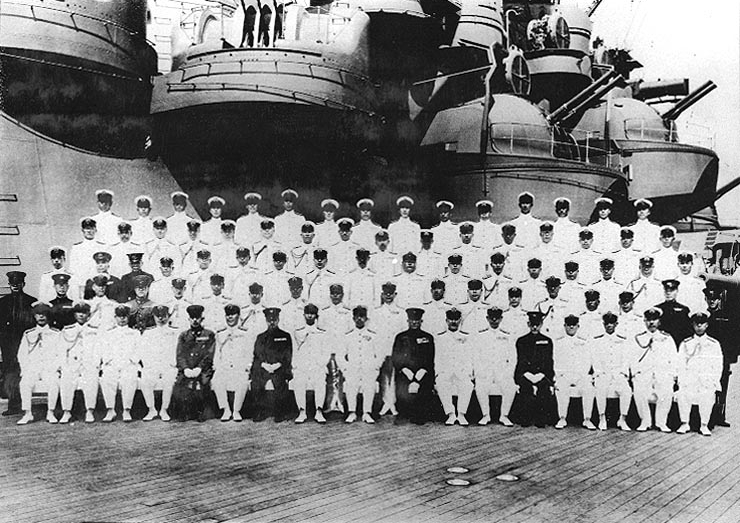
Emperor Hirohito on Musashi in 1943

Friends of Padre Steve’s World

This is an old post of my series on Battleships. Previous post on different battleship classes were about the Battleships constructed under conditions of the London Naval Conference.  These have dealt with the British King George V Class, French Dunkerque and Richelieu Classes, ItalianVittorio Vento Class and the American North Carolina and South Dakota ClassesI then wrote an introduction to the Post Treaty Super-Battleships. This article is the first in that series which will include articles on the German Bismarck and Tirpitz, British Vanguard and American Iowa Class. I do hope to take my mind off present events by writing about other battleship types and classes as well as other types of ships. That being said I expect to be doing a new installment of by COVID 19 articles, which I have pretty much avoided for sanity’s sake the past week.

Until tomorrow,

Peace,

Padre Steve+

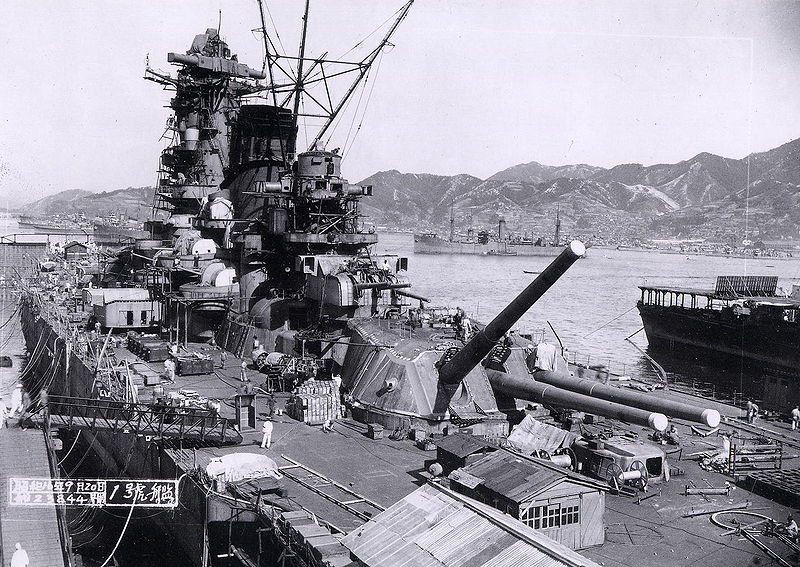
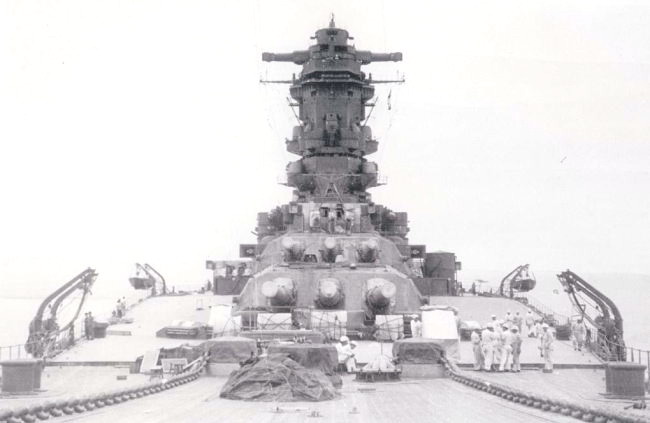
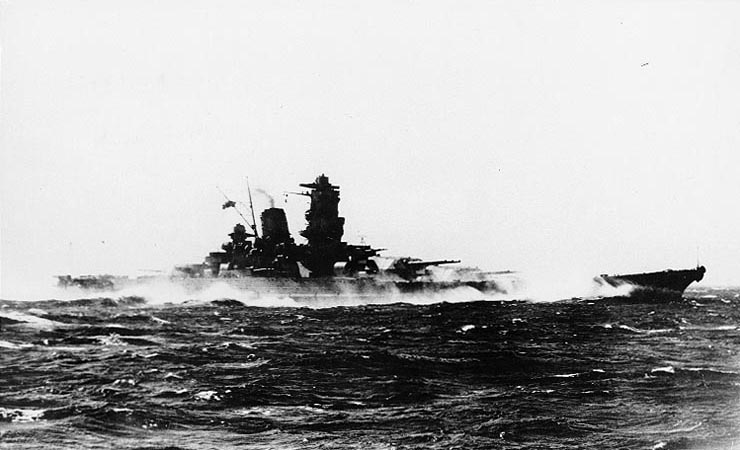
They were the largest and most heavily armed battleships ever built. Shrouded in secrecy by the Imperial Japanese Navy and Government the ships were designed to offset projected American numerical superiority. Their names were symbolic of Japan’s history. Yamato was named after Yamato Province, the ancestral home of the Yamato People, the dominant native ethnic group in Japan. Musashi was named after Musashi Province in which lays Tokyo Prefecture.  A third ship of the class, Shinano, was named after Shinano Province in central Japan which was the home of the prestigious Taketa Shingen family during the Senguku period.

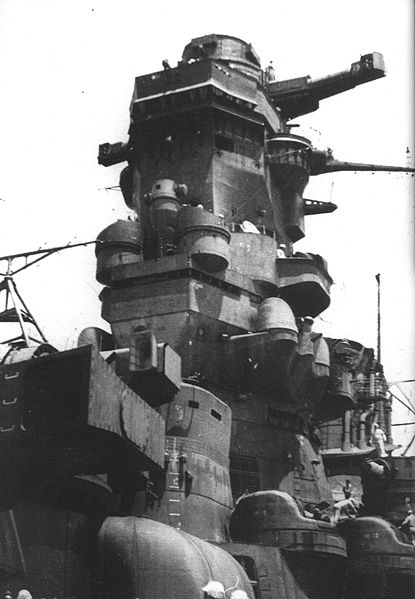
The Conning Tower and Bridge of Musashi

The secrecy surrounding their design and construction was unprecedented. Those charged with their deign and construction were thoroughly checked out by Japan’s secret police and sworn to an oath of secrecy. The oath sworn by builders of Musashi at the Mitsubishi Heavy Industries  Nagasaki Shipyard were sworn to the oath shown below:

I am aware that all work work involving the construction of the No. 2 Battleship is vital to national security. I will make utmost effort to maintain the  secrecy of the project, and swear that I will leak no information relating to the said battleship, even to relatives and close friends. In the event I violate this oath,  I will submit to the punishment determined by the company and the Navy.  

Yamato during Consrtuction

Security measures around the shipyards where Yamato and Musashi were constructed  were immense. At Nagasaki where there was a large foreign business and missionary population where the shipyard was visible from most of the city at hemp screen of 75,000 square meters was constructed to shield the ship from prying eyes and spies.

Musashi under Construction

When actual preparations for construction were taken in 1937 secret police swept the areas of foreign, especially Chinese workers. Security was increased inside and outside the shipyard, all blueprints accounted for and placed under strict guard while all shipyard workers were photographed with any having knowledge of the plans or supervising the construction sworn to the secrecy oath.

When a top secret blueprint went missing in 1938 at Nagasaki an intense investigation that included the torture of numerous suspects and the jailing of a blueprinter who accidentally swept the document into the trash was sentenced to 3 years in prison.

Armor and Protection of Yamato Class

Few pictures exist of the ships and Japanese Naval Officers destroyed many of the records of the ships design and construction just prior to the end of the Second World War. Throughout their existence they were a mystery to the American Navy. During the war the U.S. Navy estimated them to carry nine 16” guns and displace between 40,000-57,000 tons. Even the highly regarded Jane’s Fighting ships listed them at just 45,000 tons.

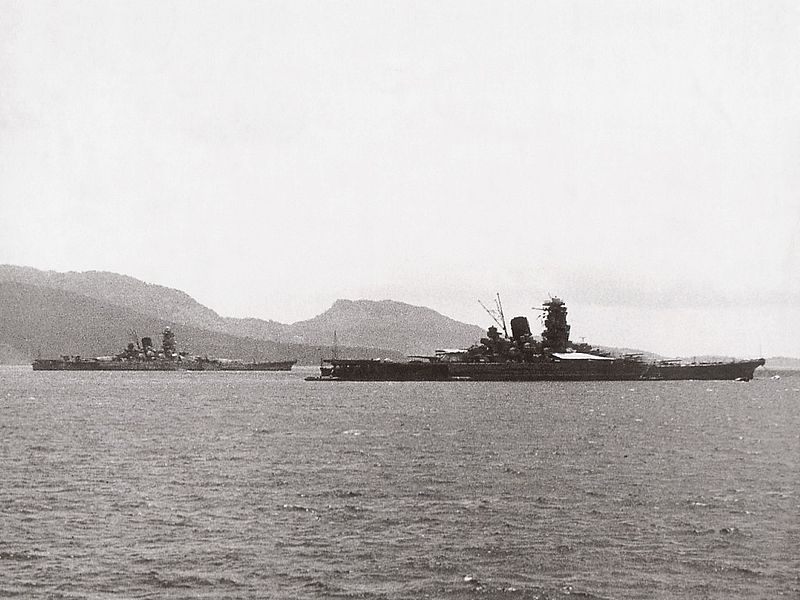
Yamato and Musashi together in 1943

Preliminary design work began in 1934 and progressed rapidly following Japan’s withdraw from the League of Nations and renunciation of the Washington and London Naval Treaties and withdraw from the 1936 naval talks in London. The early designs varied in the caliber of guns, size and armor, propulsion systems and endurance. Gun calibers ranged from 16” to 18.1” and a combined diesel-turbine system was considered but rejected in favor of traditional steam turbines.

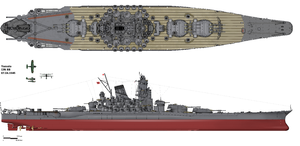
The final design was for a class of five ships. Each would displace 64,000 tons standard displacement and 72,000 tons at full load. They were 862 feet long with a beam of 127 feet.  They were so large that the docks they were built needed to be expanded and special extra large launch platforms had to be built.  At Nagasaki the dock at to be expanded by cutting into the hill adjacent to it.

They were armed with nine 18.1 inch guns in triple turrets which could fire a projectile weighing over a ton. The secondary armament consisted of 12 6.1 inch guns mounted in triple turrets formerly mounted on the Mogami Class cruisers when those ships were equipped with 8” guns. Anti-aircraft defense included twelve 5” guns and twenty-four 25mm anti-aircraft guns. During the war two of the 6.1 inch turrets were removed and replaced with twelve more 5” guns and the 25mm battery was raised to 162 guns. Fire control systems were designed in such a way that the ships could engage multiple surface targets at the same time.

The ships were protected by a massive armored belt ranging from 16 inches to 8 inches with 26 inch armor on the face plates of the main gun turrets. The armor was advanced with excellent sloping but had a flaw where the upper and lower belts connected just below the waterline which exposed them to damage from torpedoes.

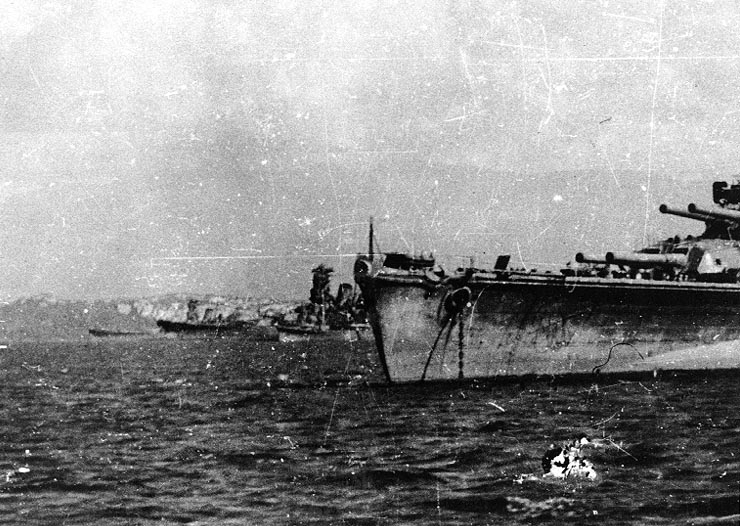
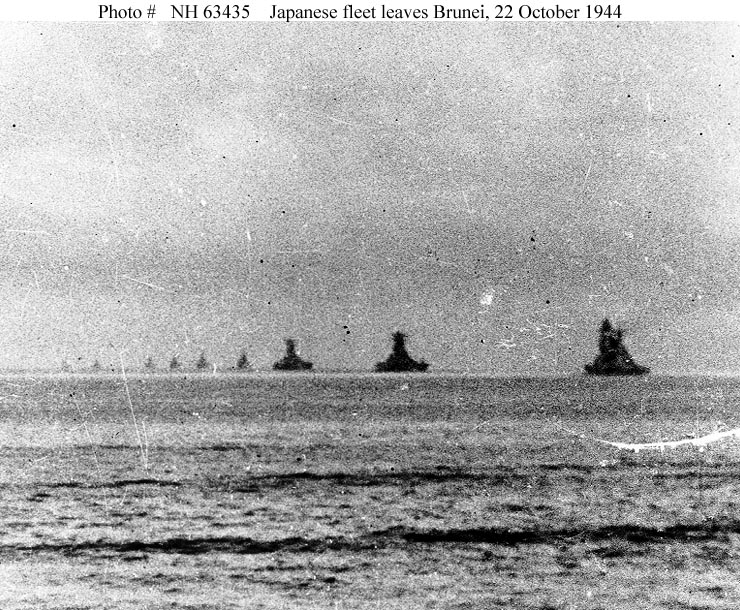
Yamato and Musashi viewed beside Battleship Nagato (foreground) just before the Battle of Leyte Gulf

They were powered by 12 Kampon boilers which powered 4 steam turbines and four three bladed propellers. These developed 150,000 shp and could drive the ship at a top speed of 27 knots.

Yamato

Construction of Yamato began on November 4th 1937 at Kure Naval Shipyard. Musashi on March 28th 1938. Traditionally such events were large public ceremonies but these were limited to just a few Naval Staff and Shipyard executives.  Yamato was Launched on August 8th 1940 and commissioned on December 16th 1941, just 9 days after Pearl Harbor. Musashi was launched on November 8th 1940 and commissioned on August 5th 1942 just two days before the U.S. Marines invaded Guadalcanal and two months after the disaster at the Battle of Midway.

Yamato served as Admiral Yamamoto’s flagship at Midway where she saw no action. The next two years she was and Musashi alternated as fleet flagship and conducted operations with Battleship Division One in operations between Mainland Japan and the major Japanese base at Truk. On December 25th 1943 while escorting a convoy she was torpedoed by the submarine USS Skate and suffered heavy damage which flooded a magazine.  On March 29th while underway Musashi was struck near the bow by a torpedo from the USS Tunny.

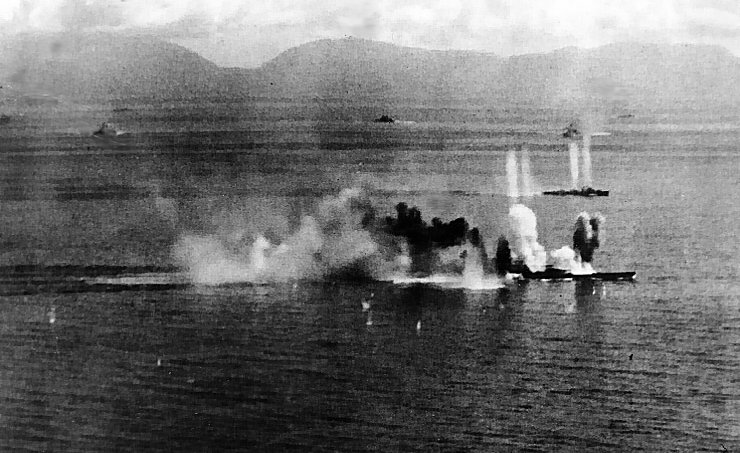
Musashi Under Attack at the Battle of Sibuyan Sea

Both ships participated in the Battle of the Philippine Sea and were part of Vice Admiral Takeo Kurita’s Central Force in the Battle of Leyte Gulf. Musashi was sunk by U.S. Navy Carrier aircraft from the Third Fleet on October 24th 1944 during the Battle of the Sibuyan Sea. Hit by 17 bombs and 19 torpedoes she sank with the loss of nearly 1100 of her crew of almost 2400 men. The survivors were rescued by destroyers and disembarked at Corregidor. Some were sent by troop transport to Japan but one of the ships was torpedoed and sunk leaving her survivors adrift for 19 hours before rescue. Those who reached Japan were isolated from the population while about half of the survivors remained in the Philippines where 117 of 146 of those assigned to the defense of Manila were killed in action.

Yamato or Musashi under air Attack

Yamato saw action in the surface engagement on October 25th against the Escort Carriers and Destroyers of Taffy-3 during the Battle off Samar. Her guns helped sink the Escort Carrier USS Gambier Bay but was forced away from the action by torpedo attacks from the valiant destroyers of Taffy-3.

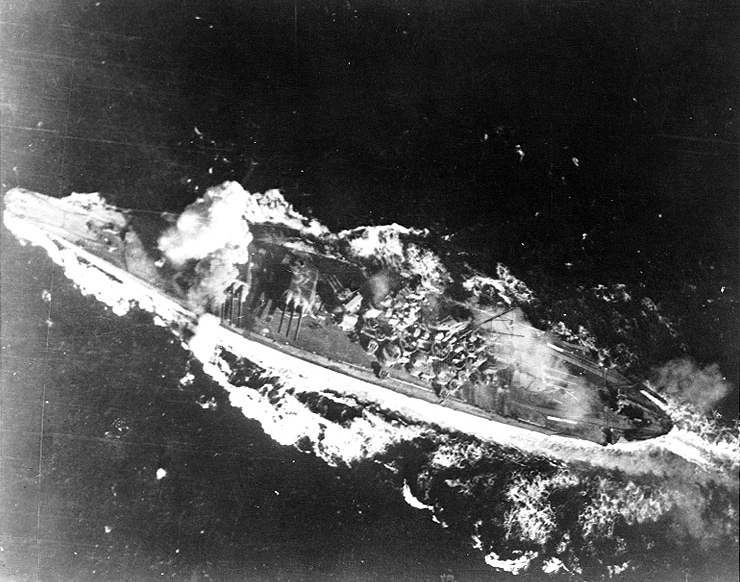
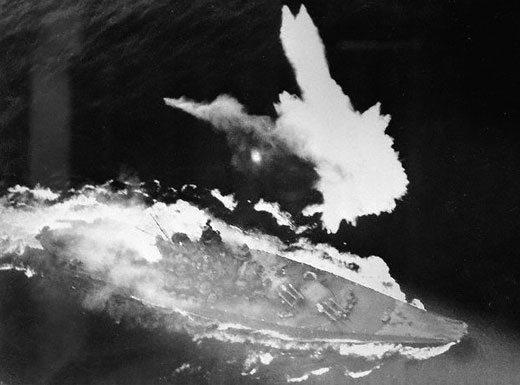
Yamato under Attack April 7th 1945

By April 1945 Japan’s Navy was decimated and holed up in Japanese controlled ports without fuel to conduct all but minor operations. U.S. Naval Forces were raiding Mainland Japan, inflicting heavy casualties among remaining naval, merchant marine, and air units, as well as bases and industrial facilities.

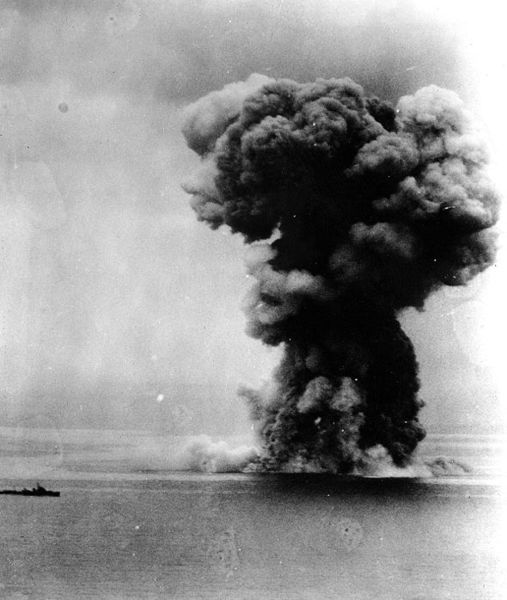
When the United States landed on Okinawa the Japanese Navy and air force launched wave after wave of Kamikaze attacks on the ships in the waters around the island. Yamato, along with Light Cruiser Yahagi and eight destroyers were designated the Surface Special Attack Force and loaded with a full load of ammunition but only enough fuel for a one way trip. They got underway on April 6th. The mission was for Yamato to reach Okinawa, beach herself and serve as an “unsinkable” gun battery until she was destroyed. The force was spotted by U.S. Navy flying boats hours after their departure and on April 7th over 400 aircraft launched from Task Groups 58.1 and 58.3 found the Yamato strike group. Devoid of fighter cover the force was doomed. The first wave of attacking aircraft began its attack at 1230. More followed, and by 1400 Yamato was mortally wounded. She had been hit by at least 8 torpedoes and 11 bombs in an hour and a half. Now she was dead in the water and began to capsize at 1405. At 1420 she turned turtle, and at 1423 she exploded when her forward blew up sending up a mushroom cloud nearly 20,000 feet.  Under 300 of her crew of nearly 2400 were rescued.

The End: Yamato Explodes

The Yamato and Musashi  were the largest battleships ever built. But they were  designed when naval experts who planned for a war where the battleship would rule and aircraft carriers played a supporting role. But the Japanese attack on Pearl Harbor made the Aircraft Carrier the new Queen of the seas. Neither ship ever  faced enemy battleships in combat and both were destroyed by the weapon that the battleship admirals had discounted, carrier based aircraft.

Thus, is somewhat fitting that each ship was commissioned shortly after the triumphs of Japanese and American Naval air power at Pearl Harbor and Midway. However, they have attained an almost mythic status in naval lore. Likewise they are both are symbols to many Japanese of the sacrifice and futility of the war. Their legend lives on in Japanese science fiction. However, both of the cities where the ships were constructed were destroyed by Atomic bombs. They are tragic reminders of the cost of war in human lives, suffering, economic cost and destruction.

In a sense their poetic names and the myths ascribed to them are a tragic requiem to the Japanese Empire and the cost of war. They and their brave sailors were sacrificed when the war was already for all intents and purposes lost. They, especially the Yamato were sacrificed for no military purpose save a convoluted sense of honor, and a nation that waged unjust and criminal wars in China before before it ever dreamed of attacking Pearl Harbor. Many Japanese Navy units, including surface ships, submarines, and Special Naval Units (Marines) engaged in war crimes at sea and ashore.

Of course the vast majority of the crew members of these ships never took part in these crimes because they seldom engaged in combat action until each was destroyed. Both spent most of the war flagships as part of a fleet in readiness. Unlike the German High Seas Fleet of the First World War, or the German Battleship Bismarck, the battleships of the Italian Regina Marina, or the battleships of Vichy France, none ever faced an enemy battleship in combat.

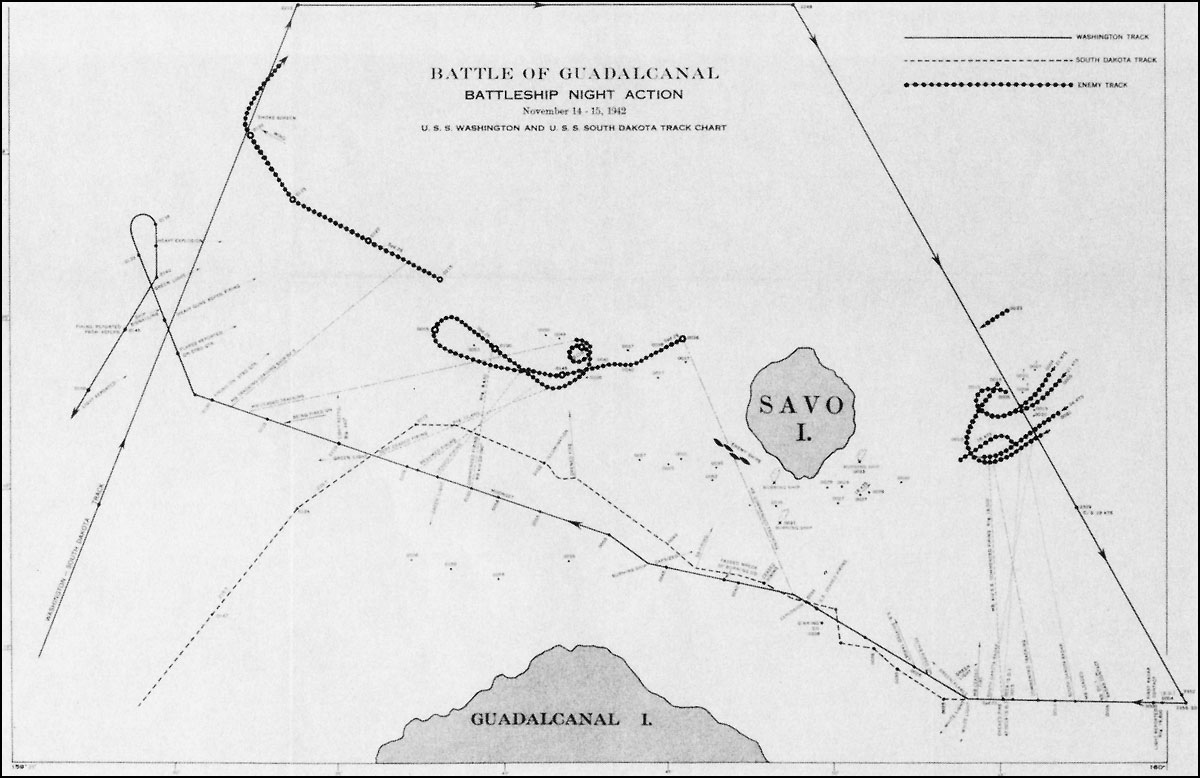
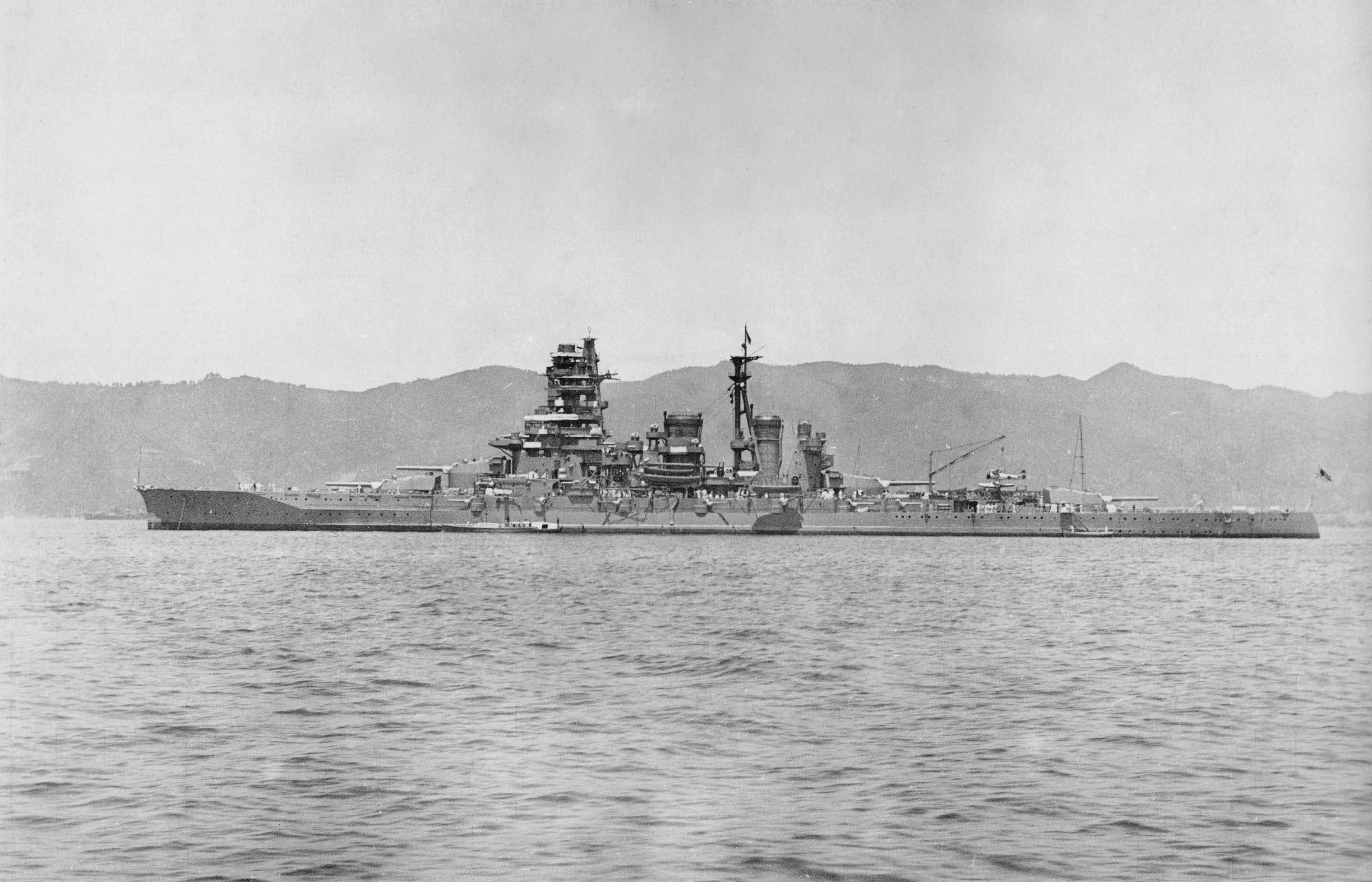
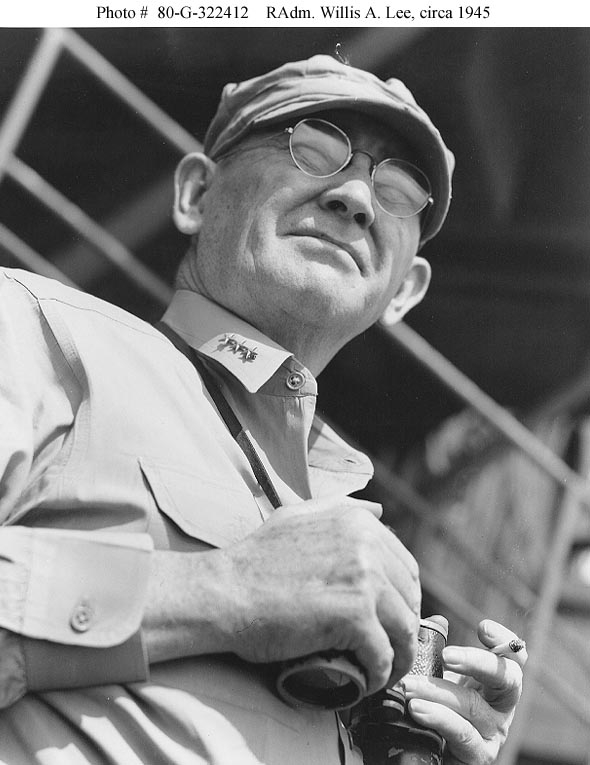
The only Japanese battleships to engage American battleships were the elderly fast battleship Kirishima which was destroyed by the gunfire of USS Washington during the Naval Battle of Guadalcanal, and the even more elderly and obsolete Fuso and Yamishiro which were destroyed by the combined firepower of the survivors of Pearl Harbor, the USS West Virginia, USS California, USS Tennessee, USS Maryland, USS Pennsylvania, and the USS Mississippi which was not at Pearl Harbor, as well as many cruisers, destroyers, and PT Boats at the Battle of Surigao Strait during the Battle of Leyte Gulf. Kirishima was lost on the verge of victory to USS Washington and Rear Admiral Willis Lee who used their advantage in radar to singlehandedly destroy Kirishima and her supporting ships even as her destroyer screen was decimated, and the battleship USS South Dakota lost electric power and was heavily damaged.

Yamato  and Musashi were a waste of industrial capacity, manpower, and resources for Japan. Their sister, Shinano, which had been converted to an aircraft carrier, was lost on her maiden voyage to a spread of torpedoes fired from the submarine USS Archerfish, with a huge life of life simply because she was rushed into commission without vital watertight compartments being ready. They were expensive failures in every sense of the word, showing that bigger isn’t always better, and that investment in such expensive ships must take into account the technology that could defeat them. For the moment most nations including the United States, China, Great Britain, France, Russia, and India seem to be placing their bets on the aircraft carrier retaining its dominance, but that could easily be the same mistake of the powers of the Second World War who built battleships, even when it was clear that their dominance was at an end.

Let us pray that it never happens again. I can only imagine the shock if an American Nuclear Carrier was sunk by a submarine, a saturation cruise missile attack, or one of the maneuverable Chinese nuclear ballistic missiles. Such a loss would shock the nation and send the Navy into a panic as it scrambled to find a way to recover from such a sinking without losing more carriers. Such an event would be as transformational to naval warfare as were the introduction of the Dreadnaught, and the perfection of the submarine as a tactical and strategic weapon.

Until tomorrow,

Peace

Padre Steve+

12 Comments

Filed under History, imperial japan, Military, Navy Ships, Political Commentary, US Navy, war crimes, World War II at Sea, world war two in the pacific

2020: Time For Reading, Reflecting, Writing, and Action to Help our Neighbors

Friends of Padre Steve’s World,

Welcome to 2019. I know, we’re all still a bit hung over from last night, but welcome to the New Year. Admittedly it doesn’t yet feel a lot different than 2018, but I really expect that 2019 will mark an epochal change in our history. Since I wrote about that yesterday I won’t go back for more.

That being said there is one resolution that I think that all people, the great and the small, should do, and that is not to cry boo who, but read like our lives depended on it, which in a sense they do. By reading, I don’t mean just the news, commentary, or opinion sections of print or online news services, but get real books, especially works of history, biography, philosophy, and the classics.

Barbara Tuchman wrote:

“Books are the carriers of civilization. Without books, history is silent, literature dumb, science crippled, thought and speculation at a standstill. Without books, the development of civilization would have been impossible. They are engines of change (as the poet said), windows on the world and lighthouses erected in the sea of time. They are companions, teachers, magicians, bankers of the treasures of the mind. Books are humanity in print.”

Likewise, the French philosopher Voltaire hit the nail on the head when he said:

“Despite the enormous quantity of books, how few people read! And if one reads profitably, one would realize how much stupid stuff the vulgar herd is content to swallow every day.”

That my friends is fact. If you want to be able to better distinguish fact from fake, read.

Last year I committed to read more, even as I stayed current on the news, analysis of it, and commentary, even as I continued to write. My office at work is crammed with books, as is much of our home. I think that we follow well the advice of Dr. Seuss who wrote:

“Fill your house with stacks of books, in all the crannies and all the nooks.”

So I read, and I read, until my eyes they turned red. I read with those eyes that had turned red, in bed and even in the head.

I read as I eat, and eat as I read, because somewhere in my soul I have this great need, which I ever did cede I would be a great deal poorer indeed.

The pages they turned and as my eyes burned I knew I could never be through so long as my fingers don’t turn blue. I read and read with voices sounding through my head I, but I will not stress even though I digress…

I continually read and I try to update my readers on the latest series of books that I have read and every few months try to let my readers know what I have been up to in my Reading Rainbow.

Since I have tried to keep my readers up with throughout the year I will concentrate on my most recent reads of the past few months. As usual many deal with human behavior in war, particularly in regard to to war crimes; perpetrators, victims, and bystanders. Most of my study of this field have focused on the Nazi Regime, its crimes, and the justice handed out to it, as well as American Slavery and racism. I have also read about crimes that Europeans enacted in their colonies, the Americans in the American West, Mexico, has Vietnam, Iraq, and Afghanistan, the Balkan wars of the 1990s, the Armenian genocide, and the Rwandan genocide.

But one of my readers challenged me to look at the war crimes of the Japanese War Crimes in Asia. I have written about the Rape of Nanking, writing about it specifically and also in more generic articles about human nature, conduct, and genocide. But, other than that at some cursory reads about how the Japanese treated POWs, conquered people’s, and units such as Unit 731; but those were all wave top looks, I never took the deep dive until after we got back from Germany in October.

Since then I have made the deep dive. It has opened my eyes to myths that I believed about Emperor Hirohito and the actions of of his government, and those of the supposedly honorable Imperial Japanese Navy, whose war crimes at sea and ashore rate their own article. In fact one of the books I read was Slaughter at Sea: The Story of Japan’s Naval War Crimes by Mark Felton.

Likewise, I learned of the American complicity at the highest levels in rigging the Tokyo trials to ensure that the Emperor, the bankers, business leaders, most politicians, civil servants, police officials and organizations, the members of Unit 731, which was involved in biological warfare and human experimentation similar to that of the Nazis. This is well documented in Robert P. Bix’s Pulitzer Prize winning biography Hirohito and the Making of Modern Japan and The Other Nuremberg: the Untold Story of the Tokyo War Crimes Trials by Arnold Brackman.

Both books, in excoriating detail not only deal with the Japanese War Crimes and criminals, but deal with the inclusion of the actions of President Truman and General MacArthur to protect certain war criminals, including the Emperor, and deflect responsibility to others such as General and Prime Minister Tojo. The Tokyo Trials took more than twice the time of the Nuremberg Trials, and allowed most of the highest order of war criminals to go free, while unlike Nuremberg exempting lower order war criminals and functionaries off the hook, because of the Cold War. That too, is another article.

I also read Lord Russell of Liverpool’s classic The Knights of Bushido: a Short (Over 300 pages) History of Japanese War Crimes and Showa: Chronicles of a Fallen God by Paul-Yanic Lequerre, another biography of Hirohito. I also re-read War Without Mercy: Race and Power in the Pacific War by John Dower, as well as John Toland’s Rising Sun: the Decline and Fall of the Japanese Empire 1936-1945; Infamy: Pearl Harbor and its Aftermath; and But Not In Shame: The Six Months After Pearl Harbor, as well as Max Hastings Retribution: The Battle for Japan 1944-1945. Then I re-read Iris Chang’s The Rape of Nanking and The Nanking Massacre: History Of China, Japan, and the Events Surrounding the Nanking Massacre by Mukuro Mori. Finally, For the first time I read Japan’s Infamous Unit 731: Firsthand Accounts of Japan’s Wartime Human Experimentation Program by Hal Gold.

All of these first or second time reads added a dimension to the Japanese atrocities that I had managed to cover with Cold War ideology and the myth that Emperor Hirohito was simply a figurehead leader with no responsibility for the war. He knew of the plans of his Army, he studied them, and criticized his military, but he always, even when military and civilian advisers urged him to seek peace, and that went on even after the atomic bombs were dropped. I’ll deal with that in another article.

I also re-read some of my Nazi War Crime books, but I won’t list them here and now. Likewise I have a good number of books to read in the coming weeks and months. As far as my writing I plan on blogging about the aspects of the Japanese War crimes and American complicity to cover them up after the war, as well as the book I started working on last year Lest We Forget: Walk, Remember, Bear Witness; Bearing Witness as the Last Witnesses to the Holocaust Pass Away.

So, I think that is enough for the day. However, our New Year’s Eve was nice. We went to our favorite German Restaurant for dinner, then went home, spent time with our dogs and binged watched episodes of Star Trek Deep Space Nine until about a half an hour before the new year, then we switched to CNN and Anderson Cooper counting down to 2020 in New York. We toasted with a German Rose Sekt (Champagne), stayed up a while longer then went to bed. We got up late, Judy and the dogs watched the Rose Parade, while between doing laundry and taking naps I spent the day until we went out to dinner at our favorite Mexican restaurant came home, and then help our next door neighbor who had collapsed on her porch from low blood sugar. Thanks to the prompt work of the EMS and our neighbor Larry she was able to treated in the ambulance. Judy and I helped with her dogs, and Judy helped her when the EMS released her and didn’t take her to the hospital once they got her blood sugar to a normal range. She stayed with her until she got her insulin and we will make sure she will be okay today. We care about our neighbors.

So, until tomorrow.

Peace

Padre Steve+


2 Comments

Filed under civil rights, crime, Foreign Policy, History, imperial japan, laws and legislation, leadership, Military, Political Commentary, star trek, war crimes, War on Terrorism, world war two in the pacific

“Defenseless under the night Our world in stupor lies…” The Day Before Pearl Harbor and Today

h97398

Friends of Padre Steve’s World,

The late historian Walter Lord wrote in his book Day of Infamy: “A nation brought up on peace was going to war and didn’t know how.”

For most Americans and Western Europeans this is time of peace. Well, at least the illusion of peace. It doesn’t matter that the Soviets by another name have been conducting acts of war against the institutions of western democratic states, and waged a war against Ukraine to capture Crimea. It doesn’t that Tens thousands of American, NATO and European Union troops operating in a number of mandates are in harm’s way. In some places like Afghanistan they are at war, in others attempting to keep the peace. Around the world regional conflicts, civil wars, insurgencies  and revolutions threaten not only regional peace but the world peace and economy. Traditional national rivalries and ethnic and religious tensions especially in Asia and the broader Middle East have great potential to escalate into wars that should they actually break will involve the US, NATO and the EU, if not militarily economically and diplomatically. Add to all of this, tat the American President seems intent on helping authoritarian regimes around the world and working to establish one in the United States. But for most Americans, so long as their economic needs appear to be safe, or the President backs their revanchist social and religions policies and inflicts them on other Americans, all is well. To those who believe that everything is okay I say Bullshit, as a historian and a theologian.

But, since we live in a dream world an illusory world of peace, the words of  W.H. Auden come to mind. In his  poem September 1st 1939 he wrote:

Defenseless under the night
Our world in stupor lies…

On December 6th 1941 the world was already at war and the United States was edging into the war. The blood of Americans has already been shed but for the vast majority of Americans the events in Europe and Asia were far away and not our problem.  Even in 1941 isolationists and American Fascists, such as the German Bund, the KKK, and the Silvershirts tried to tip the American Public into supporting the totalitarian regimes of Germany, Japan, and Italy.

Though President Roosevelt had began the expansion of the military there were those in Congress seeking to demobilize troops and fought all attempts at to intervene against the Nazis, the Italian Fascists, and the Japanese warmongers.

maltese-falcon-by-content-artofmanlinessdotcomw499h371

Most people went about their business on December 6th, that last furtive day of peace without a second thought. People went about doing their Christmas shopping, going to movies like The Maltese Falcon staring Humphrey Bogart or the new short Tom and Jerry cartoon, The Night Before Christmas.

Tom And Jerry

Others went to football games. UCLA and USC had played their annual rivalry game to a 7-7 tie, Texas crushed Oregon in Austin by a score of 71-7 while Texas A&M defeated Washington State in the Evergreen Bowl in Tacoma by a score of 7-0.

0-3

In Europe a Soviet counter-offensive was hammering a freezing and exhausted German Wehrmacht at the gates of Moscow. U-Boats were taking a distressing toll of ships bound for Britain including neutral US merchant ships and warships, including the USS Reuben James, and USS Kearney. American Airmen were flying as the volunteer Flying Tigers for the Nationalist Chinese against the Japanese invaders. Other Americans volunteers to fight alongside the British Royal Air Force as volunteers in the 71st, 131st, and 133rd Eagle Squadrons against the German Luftwaffe. After war was declared these squadrons became part of the U.S. Army Air Corps. 

decwarp1

War was everywhere but Most Americans lived under the illusion of peace. When the messages came out of Pearl Harbor the next morning it was already early afternoon on the East Coast. The Japanese Ambassador was intentionally delayed by his government in delivering the Japanese declaration of war. When the attack occurred many people across the country going about their Sunday business, going to church, relaxing or listening to the radio. Thus when war came, despite all the precursors and warnings, most Americans were taken by surprise. A sailor at Pearl Harbor was heard to remark I didn’t even know they were mad at us.” 

When the attack happened it took the nation by surprise. Walter Lord wrote in his classic account of the Pearl Harbor attack Day of Infamy: “A nation brought up on peace was going to war and didn’t know how.”

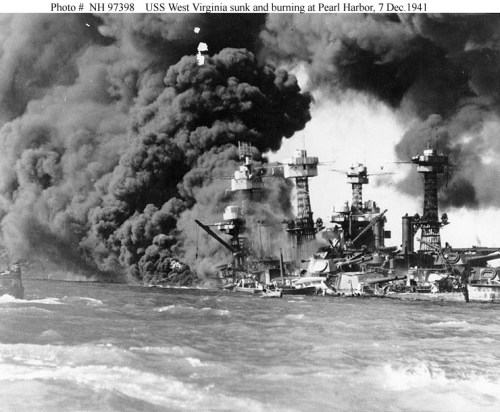
By the end of the day over 2400 Americans were dead and over 1200 more wounded. The battleships of the Pacific Fleet were shattered. 4 sunk, one grounded and 3 more damaged. 10 other ships were sunk or damaged in the attack. 188 aircraft were destroyed and 159 damaged.

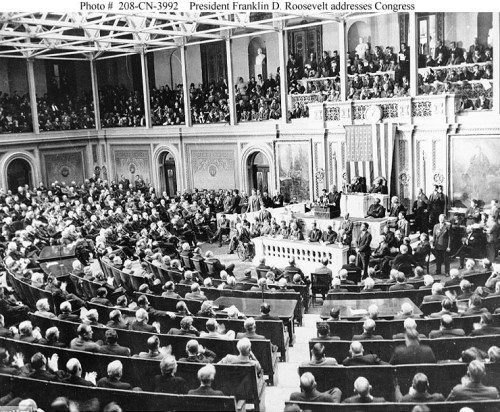
cn3992

The next day President Franklin D. Roosevelt called the nation to action requesting that Congress declare war on Japan. It was a speech that galvanized the American public. http://www.youtube.com/watch?v=ufoUtoQLGQY

Mr. Vice President, and Mr. Speaker, and Members of the Senate and House of Representatives:

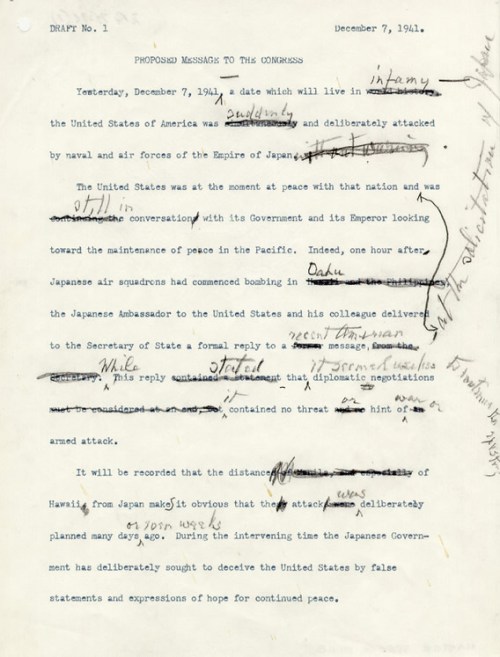
Yesterday, December 7, 1941 — a date which will live in infamy — the United States of America was suddenly and deliberately attacked by naval and air forces of the Empire of Japan.

The United States was at peace with that Nation and, at the solicitation of Japan, was still in conversation with its Government and its Emperor looking toward the maintenance of peace in the Pacific. Indeed, one hour after Japanese air squadrons had commenced bombing in the American Island of Oahu, the Japanese Ambassador to the United States and his colleague delivered to our Secretary of State a formal reply to a recent American message. And while this reply stated that it seemed useless to continue the existing diplomatic negotiations, it contained no threat or hint of war or of armed attack.

It will be recorded that the distance of Hawaii from Japan makes it obvious that the attack was deliberately planned many days or even weeks ago. During the intervening time the Japanese Government has deliberately sought to deceive the United States by false statements and expressions of hope for continued peace.

The attack yesterday on the Hawaiian Islands has caused severe damage to American naval and military forces. I regret to tell you that very many American lives have been lost. In addition American ships have been reported torpedoed on the high seas between San Francisco and Honolulu.

Yesterday the Japanese Government also launched an attack against Malaya.
Last night Japanese forces attacked Hong Kong.
Last night Japanese forces attacked Guam.
Last night Japanese forces attacked the Philippine Islands.
Last night the Japanese attacked Wake Island. And this morning the Japanese attacked Midway Island.

Japan has, therefore, undertaken a surprise offensive extending throughout the Pacific area. The facts of yesterday and today speak for themselves. The people of the United States have already formed their opinions and well understand the implications to the very life and safety of our Nation.

As Commander in Chief of the Army and Navy I have directed that all measures be taken for our defense.

But always will our whole Nation remember the character of the onslaught against us.

No matter how long it may take us to overcome this premeditated invasion, the American people in their righteous might will win through to absolute victory. I believe that I interpret the will of the Congress and of the people when I assert that we will not only defend ourselves to the uttermost but will make it very certain that this form of treachery shall never again endanger us.

Hostilities exist. There is no blinking at the fact that our people, our territory, and our interests are in grave danger.

With confidence in our armed forces- with the unbounding determination of our people- we will gain the inevitable triumph- so help us God.

I ask that the Congress declare that since the unprovoked and dastardly attack by Japan on Sunday, December 7, 1941, a state of war has existed between the United States and the Japanese Empire.

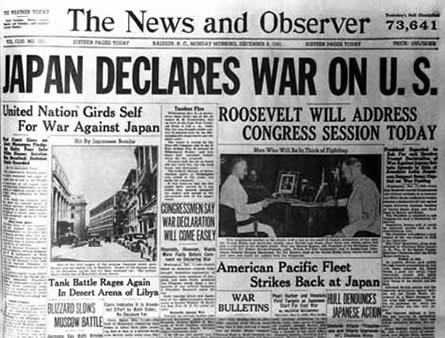
171-0417042317-pearlharbor_paper

The day after the attack, Japanese Ambassador Oshima visited German Foreign Minister Von Ribbentrop to pressure Germany into joining the war. But Von Ribbentrop attempted to keep Germany out of the war fearing that adding the United States to The List of Germany’s opponents would doom them to defeat. He was overruled by Hitler, whose personal loathing of Roosevelt, disrespect for the American military, overestimation of Japan’s military and industrial power, and belief that Japan would quickly defeat Britain and the United States in the Pacific.

On December 11th, Germany and Italy declared war against the United States, while Germany’s erstwhile ally Japan, refused to declare war on the Soviet Union to relieve the pressure on Germany. Japan and the Soviets maintained their non-aggression pact until after the Americans dropped the Atomic Bomb on Hiroshima. Then and only then did the Soviets join the war against Japan.

Today tens of thousands of US and NATO troops are deployed in Afghanistan. Some of them are dying that people that most of us do not care about in the least might have a chance at peace and a better life. Eleanor Roosevelt reflected:

“Lest I keep my complacent way I must remember somewhere out there a person died for me today. As long as there must be war, I ask and I must answer was I worth dying for?”

Wars, revolutions and other tensions in other parts of the world threaten on every side, but most Americans and Europeans live in the illusion of peace.  A very few professi0onals are given the task of preparing for and fighting wars that our politicians, business leaders, Armageddon seeking preachers and the talking heads of the media sow the seeds. As such many have no idea of the human, material and spiritual cost of war and when it comes again in all of its awful splendor few will be prepared.

We do not know what tomorrow will bring and unfortunately for the vast bulk of Americans and Western Europeans the comments of W. H. Auden are as applicable today as they were on December 7th 1941: Defenseless under the night, Our world in stupor lies…

Personally, I cannot imagine Donald Trump, the current American President tak the stand that Franklin Delano Roosevelt did. against Germany, Japan, and Italy, nor could I imagine his supporters abandon him even if it meant the loss of every American ideal, law, and institution. that is difficult for a member of the Trump cult to stomach, but not so difficult if one believes the ideals of the Declaration of Independence, the Constitution, or the Gettysburg Address.

So until tomorrow,

Peace,

Padre Steve+

3 Comments

Filed under Foreign Policy, History, imperial japan, leadership, Military, national security, Navy Ships, News and current events, Political Commentary, US Army Air Corps, US Navy, World War II at Sea, world war two in europe, world war two in the pacific

Pearl Harbor and the Advent of the Aircraft Carrier, But Can the Carrier Remain Supreme?

h50931

Friends of Padre Steve’s World,

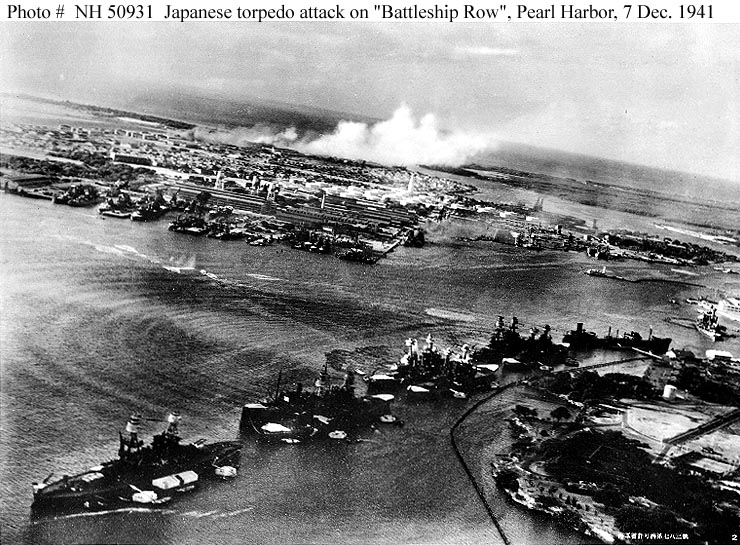
On the morning of December 7th 1941 8 of the 9 Battleships assigned to the US Pacific Fleet were in Pearl Harbor. Seven, the USS California, USS Maryland, USS Oklahoma, USS Tennessee, USS West Virginia, USS Arizona and USS Nevada were moored on Battleship Row. The USS Pennsylvania was in the massive dry dock which she shared with the destroyers USS Cassin and USS Downes. The USS Colorado, a sister ship of Maryland and West Virginia was at the Puget Sound Naval Yard being overhauled.

pearlharbor_wide-6febcbc3473e02a65f9b7b9e151905b7300c328f-s6-c30

USS West Virginia sinking at left and USS Tennessee burning at Pearl Harbor

At the time both the United States Navy and the Japanese Imperial Navy still viewed the Battleships as the heart of the fleet and the essence of naval power. Aircraft Carriers were still viewed as an adjunct and support to the traditional battle line.

Japanese-carriersJapanese Aircraft preparing to launch at Pearl Harbor

Thus as the Japanese Carrier Strike Group, the Kido Butai under the command of Vice Admiral Chūichi Nagumo approached Pearl Harbor and intelligence reports came in indicating that the carriers were not present the Japanese were not overly concerned. The lack of concern was in a sense ironic because the force they assigned to destroy the Battleships of the Pacific Fleet was the carrier strike group, not their battle line. The Kido Butai was the largest carrier strike group assembled until late 1943 when the U.S. Pacific Fleet fielded a larger carrier strike group, something no other country has done since.

Kido-Butai-in-the-North-Pacific

The Kido Butai enroute to Pearl Harbor

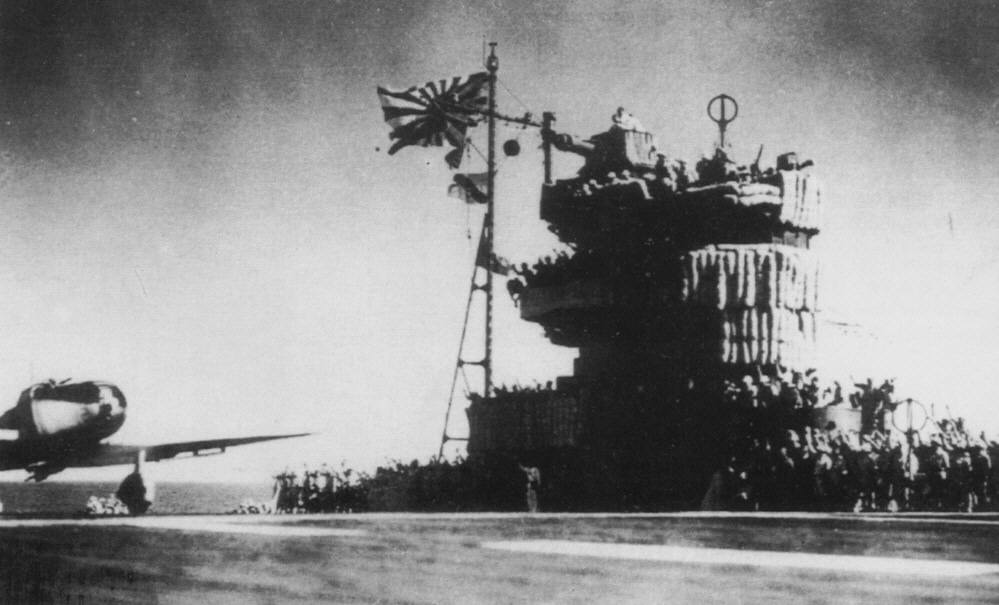
Comprised of six carriers, the Akagi, Kaga, Hiryu, Soryu, Shokaku and Zuikaku the force embarked over 300 first line aircraft. The aviators of the air groups aboard the carriers had been training for months to attack Pearl Harbor. Their aircraft had been specially outfitted with Type 91 Model 2 aerial torpedoes designed to run in the shallow waters of Pearl Harbor and Type 99 Model 5 armor piecing bombs modified from battleship shells. These weapons would be employed with a devastating effect on the morning of December 7th 1941.

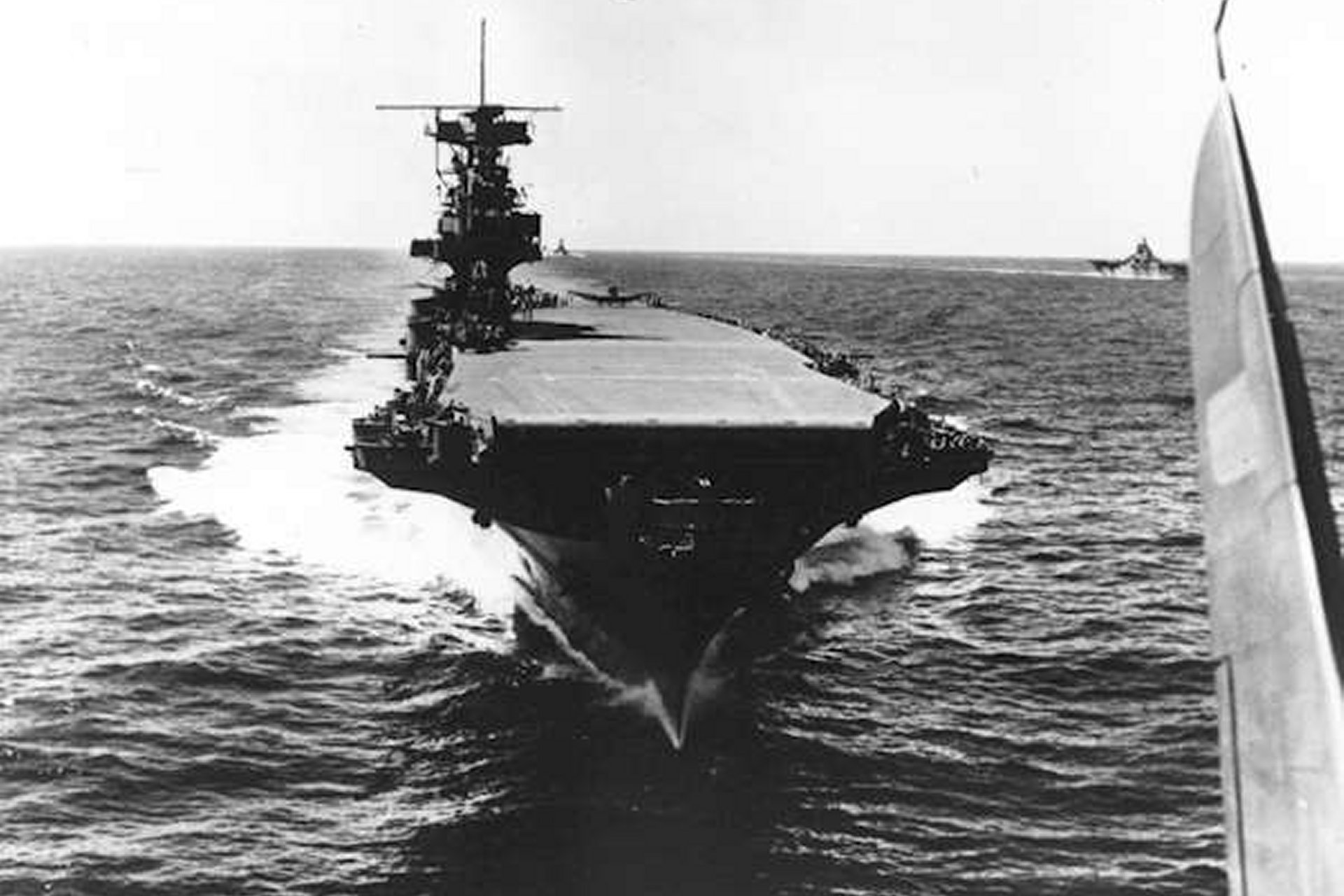
The three carriers assigned to the Pacific Fleet, the USS Saratoga, USS Lexington and USS Enterprise had been dispatched on missions that took them away from Pearl Harbor that fateful Sunday.

USS_Lexington

USS Lexington

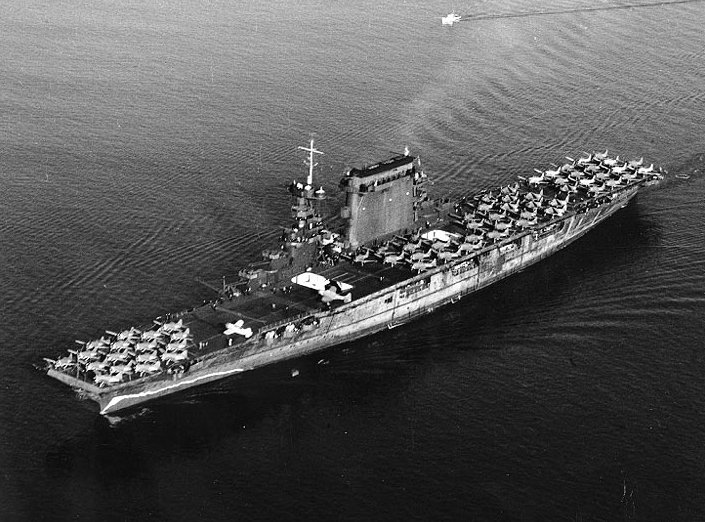
The Lexington and Task Force 12 had departed Pearl Harbor on December 5th to ferry 18 SB2U Vindicator Dive Bombers of VSMB-231 to Midway Island. These aircraft would ultimately take part in the Battle of Midway and the sinking of the Japanese Cruiser Mikuma. Saratoga was entering San Diego to embark her air group, and Enterprise which had left Pearl Harbor on November 28th to deliver VMF-211 to Wake Island was due to return to Pearl Harbor on the 7th of December. As such none of these ships were in Pearl Harbor at the time of the attack. Their absence helped save the United States and Allied cause in the Pacific.

USS_Saratoga_CV-3_underway_1942

USS Saratoga

The United States had other carriers but all were assigned to the Atlantic Fleet due to the belief that Nazi Germany was a greater threat than Japan. The USS Yorktown was at Norfolk in between deployments in support of the Neutrality Patrol. USS Ranger was returning to Norfolk from a Neutrality patrol, USS Wasp was at Grassy Bay Bermuda and the newly commissioned USS Hornet was training out of Norfolk. The USS Long Island, the first Escort carrier was undergoing operational tests and training out of Norfolk.

cv-6-01USS Enterprise at Midway

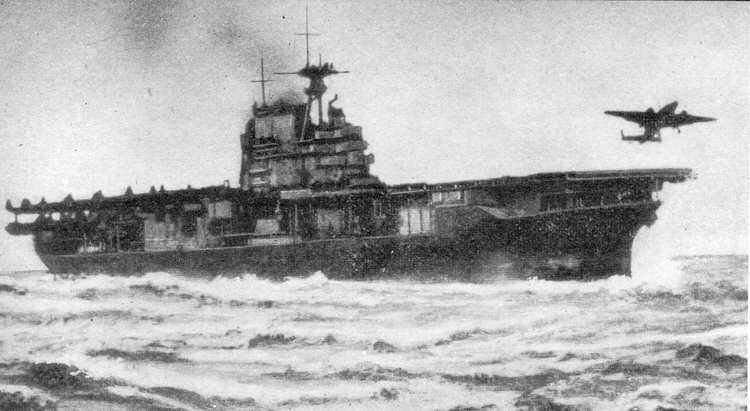
Had any of the three carriers assigned to the Pacific Fleet been in Pearl Harbor on the morning of the Japanese attack the results would have been even more disastrous for the United States. Instead these carriers began operations against the Japanese almost immediately. Carriers based on the East Coast including Hornet, Yorktown and Wasp were transferred to the Pacific. In the perilous months following the Pearl Harbor attack the US carriers took the fight to the Japanese conducting raids against Japanese held islands. In April 1942 the Enterprise and Hornet, the latter with 16 B-25 Mitchell bombers under the command of Colonel Jimmy Doolittle struck Tokyo.

gallery_30225_28868_12824874244ae0d6734af3b

USS Hornet launching the Doolittle Raiders

The result of that attack resulted in a severe embarrassment and loss of face to the Imperial Navy. the strategic and psychological implications were such that Admiral Isoruku Yamamoto decided to attack Midway Island to force the US fleet and its carriers into a decisive battle. Although the Japanese had lost a good number of aircrew from Shokaku and Zuikaku at the Battle of Coral Sea, while sinking Lexington Yamamoto remained committed to the decisive battle.

That battle was decisive, but not in the way Yamamoto had planned. Akagi, Kaga, Hiryu and Soryu were sunk by aircraft operating from Enterprise, Yorktown and Hornet. Yorktown was lost in the battle bat it was a decisive defeat for the Japanese. From that point, though they still were superior to the U.S. Navy in numbers of Carriers and surface warships, and still maintained a massive number of islands which they had fortified and built airbases on in defiance of treaties they agreed to at the end of the First World War,

Attack_of_the_Akagi

Sinking the Akagi at Midway

In the succeeding months in the vicious battles around the Solomon Islands the remaining US carriers proved decisive. Although Wasp and Hornet were sunk in those battles and both Saratoga and Enterprise were often heavily damaged, they held the line. The carriers that the Japanese missed proved decisive in turning the tide and winning the war.

22_bb48

Raised from the mud of Pearl Harbor the USS West Virginia in Tokyo Bay

Though Yamamoto did not realize it, the attack on Pearl Harbor signaled the end of the supremacy of the Battleship and the ascendency of the Aircraft Carrier. By 1943 Battleships were regulated to escorting the fast carrier task forces or conducting shore bombardments. The ultimate irony was that the last battleship engagement in history was won by the survivors of the attack on Pearl Harbor. Raised from the mud the West Virginia, Tennessee, California, Maryland and Pennsylvania joined by the USS Mississippi rained destruction on two Japanese task forces attempting to penetrate Leyte Gulf and destroy the US invasion force transports at the Battle of Surigao Strait.

It was a fascinating turn of events. The Japanese dispatched the cream of their carrier air forces to destroy the U.S. Pacific Fleet at Pearl. Harbor, and though they crippled the battleships they failed to destroy the American aircraft carriers, at Pearl Harbor, Coral Sea, Midway, or the Guadalcanal campaign. In the following years the Enterprise and Saratoga, bolstered by the carriers of the Essex Class, and the Light Fleet Carriers of the Independence Class, and helped by the addition of dozens of Escort Carriers, which relieved them of the mundane tasks of convoy escort and amphibious landing support, wreaked havoc on the Imperial Japanese Navy from late 1943 on. The Battles of the Philippine Sea, Leyte Gulf, the raid on Formosa, and the strikes on the Japanese homeland proved the superiority of the carrier force the Japanese missed at Pearl Harbor and failed to destroy in subsequent engagements.

Today, nearly eight decades later there is a question of the relevance of aircraft carriers, even though the United States, Great Britain, China, Russia, India, and other nations continue their development. I have to admit, that with the development of other weapons platforms and technologies, that I do not know the ultimate fate of the aircraft carrier. However, like the Ships of the Line that dominated late 17th, 18th, and early 19th centuries., the Ironclads that dominated the late 19th Century, and the Dreadnaughts that dominated until Pearl Harbor.

Pearl Harbor was 78 years ago. Since then carrier and submarine eclipsed the power of the the battleship. We cannot assume that the era of the aircraft carrier will continue without end. The Japanese discounted the power of the aircraft carrier and submarine, assuming that battleships supported by carriers and submarines would maintain control of the Oceans. They were wrong. Regardless of what weapons system we presume will dominate the future, we also must admit the very real possibility that we could be wrong. Technologies that we have not ever began to imagine, except possibly in the realm of science fiction may change everything we believed possible.

i am neither the prophet nor the son of the prophet, thus my opinion is only that: I believe that the carrier will remain the centerpiece of Naval power and strategy for the next decade, and possibly another, but as a military and Naval historian I cannot predict that they remain so longer than that. Thus the United States Navy, and for that matter all navies begin looking toward and planning for technologies that are either in their infancy or not yet imagined. To ignore that fact would be to ignore history. We do that to our detriment.

Until tomorrow,

Peace,

Padre Steve+

5 Comments

Filed under History, imperial japan, Military, national security, Navy Ships, News and current events, US Navy, World War II at Sea, world war two in the pacific

The Doomed Fleet: The Ships and Men of the Japanese Kido Butai Which Attacked Pearl Harbor

Akagi_29

Friends of Padre Steve’s World

Early December is such an interesting time of year for a historian. There are a lot of events that occurred which still linger in our memories. One of those is the Japanese attack on Pearl Harbor on December 7th 1941. I find it interesting and compelling because of its significance in world history, not just American. Japan’s surprise attack on the U.S. Pacific Fleet at Pearl Harbor, followed by its belated declaration of war and those of Germany and Italy ushered in a new world with ramifications that extend to our day. Tonight, I will not be addressing the issue of Japanese War crimes, and those committed by the Imperial Navy, although the crew of Heavy Cruiser Tone massacred many of the survivors of the S.S. Behar  in the Indian Ocean in early 1944.

Early in the morning on November 26th 1941 the ships of the Japanese Carrier Strike Force, the Kido Butai under the command of Vice Admiral Chuichi Nagumo weighed anchor from Tankan Bay in the northern Kurile Islands of Japan. The plan was top secret and very few Japanese officers knew of the target. Many officers presumed that war was immanent but most assumed the target would be the Philippines or other targets in Southeast Asia.

PERSON JAP Nagumo1

Nagumo

The next day Nagumo expressed his personal misgivings about the attack to his Chief of Staff Rear Admiral Ryunosuke Kusaka as the task force plunged through heavy seas. He blurted out, “Mr. Chief of Staff, what do you think? I feel that I’ve undertaken a heavy responsibility. If I had only been more firm and refused. Now we’ve left home waters and I’m beginning to wonder if this operation will work.” 

Admiral Kusaka came up with the right answer:  “Sir, there’s no need to worry. We’ll make out all right.” 

Nagumo smiled. “I envy you, Mr. Kusaka. You’re such an optimist.” 

The attack on Pearl Harbor was designed to be pre-emptive in nature. It was supposed to deliver such a crushing blow to the United States Navy that the Japanese could complete their Asian conquests before it could recover. It was a plan of great risk that doomed Japan to horror never before imagined when the United States dropped Atomic bombs on Hiroshima and Nagasaki less than four years later. By then the bulk of the Imperial Navy would be at the bottom of the Pacific and millions of people killed.

yamamoto-isoroku1

Yamamoto 

The Japanese, even Admiral Yamamoto, the man behind the plan understood that it entailed great risks. Yamamoto had opposed the Japanese war against China, the alliance with Germany and Italy, and war with the United States, which he believed could not be won. Radicals in the Japanese Army wanted him dead before the war, and his appointment as commander of the Combined Fleet was in large part based on the Navy’s desire to prevent his assassination. Retired Japanese Admiral Yoji Koda says “Yamamoto faced a commander’s worst nightmare: Lead his men into a war he knew they could not win and should not fight; or step aside and let them face defeat alone.” (Legacy Still Not Settled for Reluctant Architect of Attack on Pearl Harbor http://nation.time.com/2013/04/22/legacy-still-unsettled-for-reluctant-architect-of-pearl-harbor/

A simulation of the plan conducted in early September by the senior officers of the Combined Fleet and the Kido Butai calculated that two of Japan’s precious aircraft carriers could be lost in the operation. But despite the opposition and reservations of key officers, including the Kido Butai commander, Admiral Nagumo Yamamoto pressed forward.

kagaph

The Kido Butai was the most powerful carrier strike group assembled up to that time. In fact the United States Navy would not equal the power of the force until late 1943. Comprised of six aircraft carriers, the massive flagship Akagi, and the Kaga, the fast 18,000-ton Soryu and Hiryu and the most modern Shokaku and Zuikaku. The carrier embarked over 400 aircraft, of which over 350 were to be used in the two aerial assault waves. Most of the pilots and aircrew were experienced, many with combat experience in China. The carriers were escorted by the old but fast and modernized battleships Kirishima and Hiei, the new heavy cruisers Tone and Chikuma, the light cruiser Abukuma, the new Kagero Class destroyers, Urakaze, Isokaze, Tanikaze, Hamakaze, Kagero and Shiranuhi, the Asashio class destroyers Arare and Kasumi. Two additional destroyers the Fubuki class Sazanami and Ushio were assigned to neutralize the American base on Midway Island. The submarines I-19, I-21 and I-23 and 8 oilers were assigned to the force. Five additional submarines the I-16, I-18, I-20, I-22 and I-24 each embarked a Type-A midget submarine.

1280px-Hiryu_burning

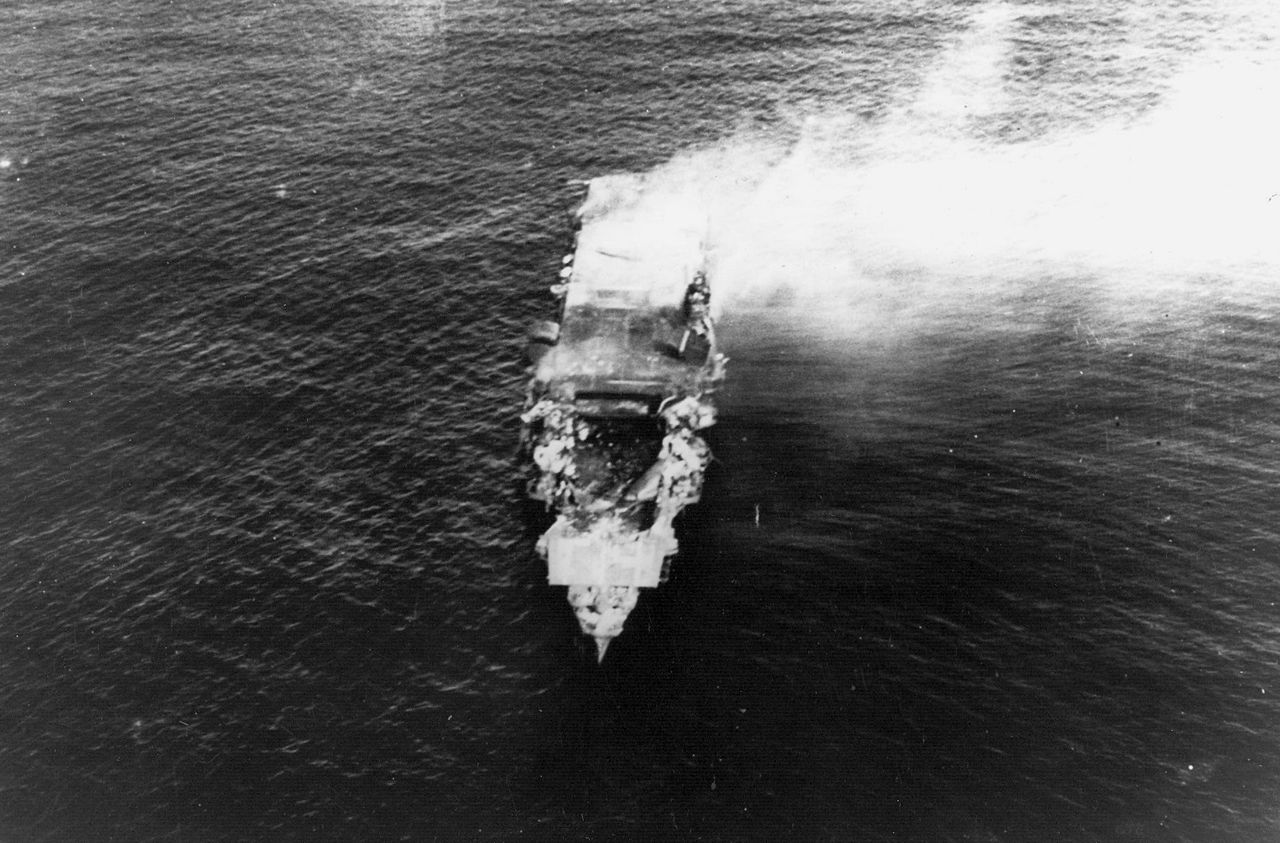
Hiryu prior to sinking at Midway

On December 7th the force delivered a devastating blow to the American Pacific Fleet at Pearl Harbor, however no American aircraft carriers were present. It would go on for the next several months on a rampage across the Pacific and Indian Oceans. However their success would be short lived. Within a year, the carriers that were not present at Pearl Harbor sank the Akagi, Kaga, Soryu and Hiryu at Midway. Hiei and Kirishima were lost at the Naval Battle of Guadalcanal in November 1942. Over the course of the war every ship of the attack force but one was lost.

zuikaku12_usn_h73070

The Last Banzai aboard Zuikaku as she sinks at the Battle of Cape Engano (Leyte Gulf) October 25th 1944

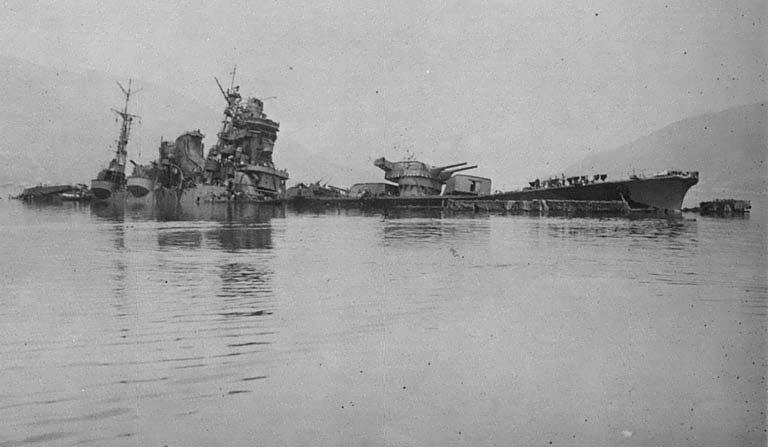
Shokaku was torpedoed and sunk at the Battle of the Philippine Sea and Zuikaku, Chikuma and Abukuma were lost at Leyte Gulf, most of the destroyers and submarines were lost in various engagements. However three destroyers, Isokaze, Hamakaze and Kasumi accompanied the great Battleship Yamato on her suicide mission at Okinawa and were sunk on April 7th 1945. The heavy cruiser Tone was sunk at her moorings at Kure during air strikes by the US 3rd Fleet on July 24th 1945.

Heavy Cruiser Tone sunk in Kure Japan 1945

All of the submarines were lost during the war, however I-19 sank the USS Wasp and the destroyer USS O’Brien while damaging the USS North Carolina on September 15th 1942 off Guadalcanal. Only the destroyer Ushio survived the war and was broken up for scrap in 1948.

MitsuoFuchida

Fuchida (above) and Genda 

f624277ee1

Among the leaders of the Japanese strike force, Admiral Yamamoto was killed on April 18th 1943 when his aircraft was shot down at Buin. His body was recovered and cremated with the ashes interred at two different locations, however, no military or government leaders attended his funeral, no honor guard was furnished, and no wreathes were laid. He is little mentioned in Japanese history books, resurgent Japanese Nationalists have little regard for him, and unlike the main Japanese War Memorial, the Yushukan museum at the controversial Yasukuni Shrine in Tokyo, the small museum in Nagaoka to Yamamoto does not offer revisionist history of Japan’s innocence and victim status. Likewise, no Japanese military bases or ships bear his name.

Most of the sailors who took part in the attack would be dead by the end of the war. Nagumo who resisted the strike and was ordered to lead it realized his worst fears at Midway and during the battles around Guadalcanal and the Solomon Islands, died in the American invasion of Saipan in 1944. The two aviators who planned and executed the tactical details of the raid, Mitsuo Fuchida, and Minoru Genda, both survived the war. Genda became a general in the Japanese Air Self Defense Force and died at the age of 84 in 1989. Fuchida converted to Christianity after reading the story of Doolittle Raid survivor Jacob DeShazor. Fuchida became a Methodist pastor and evangelist and died in 1976 at the age of 73.

Few present at Tankan Bay on that fateful November morning could have expected the triumph and tragedy ahead. However Yamamoto was probably more of a realist than almost anyone in the Japanese government and military leadership when he told Prime Minister Fumimaro Konoe “In the first six to twelve months of a war with the United States and Great Britain I will run wild and win victory upon victory. But then, if the war continues after that, I have no expectation of success.” Yamamoto was eerily prophetic and those that counsel pre-emptive war need to never forget his words or the results of his decisions.

Peace

Padre Steve+

Leave a comment

Filed under Foreign Policy, History, imperial japan, leadership, Military, national security, US Navy, World War II at Sea, world war two in the pacific

Civilization Is Tissue Thin Because of the Evil Directed and Committed by Sociopaths, People Without Empathy: Genocide, Crimes Against Humanity, and War Crimes, then and Now, How Do You Choose to Burn?


nanking_massacre_1

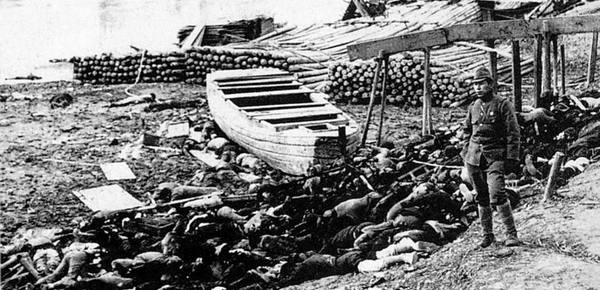
The Rape of Nanking

Friends of Padre Steve’s World,

Fyodor Dostoyevsky wrote, “Nothing is easier than to denounce the evildoer; nothing is more difficult than to understand him.”

This week I finished a series of articles on American Associate Supreme Court Justice Robert Jackson’s opening and closing arguments at Nuremberg, followed by one last night asking the question “Who Were the Victims? Does Anyone Care? The Holocaust and War Crimes Today.” For me the article was difficult to write because I have served in wars that under the rules of the International War Crimes Tribunal at Nuremberg and the subsequent U.S. trials in the same courtroom could be rule as wars of aggression, and in which American servicemen and women committed crimes that can easily be classified as war crimes, and even crimes against humanity. Likewise I have taught military ethics at Major American military Staff College.

I think one of our problems is that we want to believe that evil is simply done be evil people. That is why when we see a Hitler, Stalin, Pol Pot, or the monsters of the so-called Islamic State, we are often strangely comforted. This is often  because we can point to a single person with a wicked ideology and say “they are evil,” all the while forgetting that they are, or were, like us, also human. Aleksandr Solzhenitsyn reminds us of the folly of that type of thinking, “If only it were all so simple! If only there were evil people somewhere insidiously committing evil deeds, and it were necessary only to separate them from the rest of us and destroy them. But the line dividing good and evil cuts through the heart of every human being. And who is willing to destroy a piece of his own heart?”

A few years ago I took a break from my Gettysburg text and dusted off an old academic paper dealing with the one of the more uncomfortable aspects of the Nazi Holocaust against the Jews. I did that because I felt that I needed to reexamine the nature of evil in the modern world. Doing that brought me to do much more study of war crimes and the Holocaust. Since then I have visited Nazi Concentration Camps, Euthanasia Centers, the Wannsee House, where the coordination of the Final Solution was conducted, as well as memorials to the German resistance at the Bendlerstraße headquarters from which the attempt to kill Hitler on July 20th 1944 was launched; the Sophie Scholl and White Rose Resistance Memorial and Museum in Munich, and the National Socialist Documentation Center, also in Munich.

As I wrote my articles I have been binge reading books about the Japanese War Crimes from the “China Incident” to the end of the Second World War. I started those at the behest of a reader of this blog. While I knew the wave tops of those crimes and was vaguely familiar with the Tokyo Trial I was not as well informed about the complexity of those crimes and the participation of Japanese officials at every level of government in them.

That leads me to today, not long after the American President pardoned convicted war criminals and the fired his own Secretary of the Navy to keep one of those men from losing his SEAL Trident at a peer review conducted by other SEALS.

When I ponder the evil committed by supposedly civilized men and women of Germany and Japan in the Second World War, as well as other war crimes, crimes against humanity, and acts of genocide committed by other nations and people’s, I realize that they are little different than others who share the culture of the West. These people were the products of a culture of learning, and of science. They were part of a culture formed by the Christian tradition, the Renaissance, the Reformation, and the Enlightenment, the age of Reason. As I pondered this I came to remember something said by the late Iris Chang, “civilization is tissue thin.”

Omaha_courthouse_lynching

Lynching in the American South

My original series of articles several years ago which dealt with the Nazi Eunsatzgruppen dealt with the ordinary men, and the bureaucratic systems that implemented an ideology so twisted and evil that it is unimaginable to most people. While most people in the United States know a little about the Holocaust, most do not fully comprehend how devilish and insidious the crimes of the Nazis were. More frightening is the fact that 46% of people worldwide have never heard of the Holocaust, and of the 54% who are aware some 32% think it is a myth or has been greatly exaggerated. That was about five years ago. I will have to take a look at the current numbers, but I believe that the numbers wills only get worse as younger people are far more likely to believe that the Holocaust is a myth or or exaggerated.

We typically know about the extermination camps like Auschwitz, but the lesser known dark side of the Holocaust, perhaps the scariest part, is the story of the men of the Einsatzgruppen. The Einsatzgruppen and affiliated units, including those of the Wehrmacht, the Waffen SS, the mobilized battalions of the Order Police, and locally recruited units, rounded up massive numbers of people and killed them up close and personal. In all these units murdered over two million people, about 1.3 million of whom were Jews.

My study of the Holocaust began in college as an undergraduate. My primary professor at California State University at Northridge, Dr. Helmut Haeussler had been an interpreter and interrogator at the Nuremberg trials. I was able to take a number of lecture classes from him a large amount of research and independent study courses in a year of graduate work while finishing my Army ROTC program at UCLA. It was an immersion in the history, sociology, and the psychology of evil, during which I was able to meet and talk with Jewish survivors of the Holocaust.

mass killing einsatzgruppen

Einsatzgruppen

Since then I have continued to read and study. I lived in Germany for over four years, and made many other visits, during which I went to a number of Concentration Camp sites. I visited the rebuilt synagogue in Worms which had been destroyed during the infamous Kristallnacht, and other museums and Holocaust memorial sites in Germany. I visited the Zeppelin field, the site of Hitler’s massive Nazi Party rallies in Nuremburg, as well as the graveyards which contain the victims of other Nazi crimes, including the Nacht und Nebel or night and fog actions, where people simply disappeared and were murdered by the Gestapo. When I think about the men and women who were the perpetrators of those crimes as well as those who were bystanders, who knew about those crimes and did nothing to stop them I am reminded of Captain Gustave Gilbert, an American Psychologist who interviewed and got to know the major German War Criminals at Nuremberg. Gilbert wrote:

“In my work with the defendants (at the Nuremberg Trails 1945-1949) I was searching for the nature of evil and I now think I have come close to defining it. A lack of empathy. It’s the one characteristic that connects all the defendants, a genuine incapacity to feel with their fellow men. Evil, I think, is the absence of empathy.”

For me, those visits were sobering, maybe even more so because I understood exactly what happened in those sites. These are uncomfortable places to visit, and I can understand why many people would not want to visit them, or even study them.

The darkness that they remind us of  is a part of our human condition. Traces of the evil on display in those places is present in every human being. Frankly, most people cannot bear looking into that abyss, for fear that they might be swallowed by it.

nankino-masakra-1

Nanking

I can understand that and I have to admit that it is hard to do so. I am a historian as well as a clinician with much experience dealing with death and trauma. With my training I do a pretty good job of keeping my emotional distance to maintain objectivity when confronted with evil. However, it is hard for me not to have some emotional reaction when visiting these places, or reading about the events and people, and in writing about them.

Likewise, I am very troubled by the growing lack or awareness or denial of the Holocaust. It is very hard for me not to have a virulent reaction when I see books and websites dedicated to Holocaust denial, or that minimize other well documented genocides, and crimes against humanity.

tzd8ftsn-1390907543

Soviet Genocide in Ukraine

My sensitivity to human suffering and the terrible indifference of people in this country to it was greatly increased by my experience of war, and my post-war struggles with PTSD, depression, anxiety, which at points left me very close to committing suicide. A non-chaplain friend, a now retired Navy Command Master Chief Petty Officer that I served with at EOD Group Two remarked that I am a tremendously empathic person, and that I have a large capacity to feel the pain and suffering of others. This capacity for empathy and the ability to feel the suffering of others is part of who I am. It is a good thing, but it makes my work studying and writing about the Holocaust, other genocides, crimes against humanity, and subjects like American slavery, racism, and Jim Crow a sometimes difficult and often very emotionally consuming task. This sometimes leaves me even more sleepless and anxious than normal; especially when I see the indifference of so many people to the suffering of others today.

CambodiaExhibitMassgrave-x1

The Killing Fields

It is that indifference which motivates me to write; because if these events are not recalled and retold, they, like any part of history will be ignored and then forgotten. The statistics bear this out. There are people today, who say that we should stop talking about these events, that they are old news, and they cannot happen again; but history tells us different, and not just the Holocaust, but indeed every genocide. Then there are those who shamelessly use the Holocaust imagery to spread fear among their followers even as they openly demonize minority groups and religions as the Nazis did to the Jews.

I have to agree with Elie Wiesel who said, “Indifference to me, is the epitome of all evil.”

The late Iris Chang, who wrote The Rape of Nanking: The Forgotten Holocaust of World War II wrote something that is pertinent to almost every modern episode of genocide, or other crime against humanity. It is the ability of leaders, be they political, military, or religious to convince people to rationalize actions that they normally would find repulsive.

“After reading several file cabinets’ worth of documents on Japanese war crimes as well as accounts of ancient atrocities from the pantheon of world history, I would have to conclude that Japan’s behavior during World War II was less a product of dangerous people than of a dangerous government, in a vulnerable culture, in dangerous times, able to sell dangerous rationalizations to those whose human instincts told them otherwise.”

isis3-840x550

The Islamic State

What we call civilization, to use the words of Iris Chang, is tissue thin. That is why we must never forget these terrible events of history, and that part of human nature, and in a sense part of every one of us, that makes them so easy to repeat. That is why we must periodically take the time to remember and reflect on the Holocaust, other genocides and crimes against humanity. Historian Timothy Snyder in his book On Tyranny wrote:

“The European history of the twentieth century shows us that societies can break, democracies can fall, ethics can collapse, and ordinary men can find themselves standing over death pits with guns in their hands. It would serve us well today to understand why.”


Sophie Scholl, the 22 year old leader of the White Rose resistance movement in Nazi Germany I think gives those who still retain a sense of empathy, ethics, and self-decency a plumb-line of what the real issues are.

Sophie wrote:

“The real damage is done by those millions who want to ‘survive.’ The honest men who just want to be left in peace. Those who don’t want their little lives disturbed by anything bigger than themselves. Those with no sides and no causes. Those who won’t take measure of their own strength, for fear of antagonizing their own weakness. Those who don’t like to make waves—or enemies. Those for whom freedom, honour, truth, and principles are only literature. Those who live small, mate small, die small. It’s the reductionist approach to life: if you keep it small, you’ll keep it under control. If you don’t make any noise, the bogeyman won’t find you. But it’s all an illusion, because they die too, those people who roll up their spirits into tiny little balls so as to be safe. Safe?! From what? Life is always on the edge of death; narrow streets lead to the same place as wide avenues, and a little candle burns itself out just like a flaming torch does. I choose my own way to burn.”

Yes, these are terribly uncomfortable subjects, but we cannot allow this generation to allow them to be forgotten, lest they be repeated. That is why that I must continue to write about them.

Peace

Padre Steve+

Leave a comment

Filed under ethics, germany, History, holocaust, imperial japan, middle east, Military, national security, nazi germany, News and current events, Political Commentary, terrorism, Tour in Iraq, us army, war crimes, world war two in europe, world war two in the pacific

Who Were the Victims? Does Anybody Care? The Holocaust and War Crimes Today

Friends of Padre Steve’s World,

Tonight I write about the victims of the Holocaust, and other Nazi Crimes Against Humanity. At the heart of the Nazi crimes was the genocide committed against the Jews, but the Nazi crimes extended far beyond them; the systemic extermination of the handicapped, mentally ill, chronically sick, and others deemed to be Life Unworthy of Life. Likewise there was the killing of possible political political opponents in the Reich and conquered territories; the intentional starvation of Poles and Russians, the use of slave labor, and the indiscriminate killing of civilians.

In the film Judgement at Nuremberg the American Prosecutor at the Judges Trial played by Richard Widmark asked a question when showing a film of the victims of the Nazis when the Concentration Camps were liberated by American and British troops in the spring of 1945. His question in the face of films of massed piles of bodies being bulldozed into mass graves at Bergen-Belsen, of the cremated remains, shrunken skulls, and lampshades made of human skin at Buchenwald, gas chambers, medical experiments, the emaciated bodies of still living victims; little more than skin and bones, elbows, hips, and knees bulging over the shrunken remains of their bodies, eyes sunken in to the skulls.

Who were they?

The Nazis specifically targeted the Jews for extermination. According to Hitler, his hnchemen, and other German nationalists, the Jews were less than human, they worked hand in hand with the Bolsheviks, and thus deserved their fate. Likewise, there were those crippled in body or mind who were euthanized, political opponents, religious and racial minorities, populations of conquered nations, who died at the hands of the German military, or who were gunned down in mass graves by the Einsatzgruppen, intentionally starved to death, or who were worked to death as Slave laborers in the Nazi work camps.

To the average German of the time they were subhuman, and even those not fully in agreement with the Nazis seldom cared, and simply turned their backs. There were the perpetrators and the bystanders, who seldom if ever thought about their victims. In a way very much like most of us don’t even blink when we are confronted with war crimes committed by our own soldiers, and their victims, or innocent women and children killed during air or drone strikes where perhaps one or two at best terrorists or insurgents were reportedly located.

we have a lot to learn from the past.

The victims of the Nazis, like so many others who have committed crimes against humanity, including us, were men and women, wives and husbands, sons and daughters. They spanned the spectrum from infants to the aged. Too many times multiple generations of families went to death together. Examples of the Nazi crimes are so numerous that they must never be forgotten. That is why I write tonight, that we never forget, so we do not repeat them ourselves. Human nature is human nature, and as much as we think we have progressed, the darkness still resides in us, and we must fight to do right.

However, some witnesses to the Nazi crimes were appalled and when the Nazi regime finally was crushed testified to those crimes.

One of them was Hermann Graebe, a civilian employed to help build roads for the Wehrmacht came across one of the many massacres committed up close and personal by SS Men on October 5th 1943 at Dubno, Ukraine. At Nuremberg he testified:

Moennikes and I went direct to the pits. Nobody bothered us. Now I heard rifle shots in quick succession, from behind one of the earth mounds. The people who had got off the trucks—men, women and children of all ages—had to undress upon the orders of an SS-man, who carried a riding or dog whip.

They had to put down their clothes in fixed places, sorted according to shoes, top clothing and underclothing. I saw a heap of shoes of about 800 to 1,000 pairs, great piles of underlinen and clothing. Without screaming or weeping these people undressed, stood around in family groups, kissed each other, said farewells and waited for a sign from another SS-man, who stood near the pit, also with a whip in his hand.

During the 15 minutes that I stood near the pit I heard no complaint or plea for mercy. I watched a family of about 8 persons, a man and woman, both about 50 with their children of about 1, 8 and 10, and two grown up daughters of about 20 to 24. An old woman with snow-white hair was holding the one year old child in her arms and singing to it, and tickling it. The child was cooing with delight. The couple were looking on with tears in their eyes. The father was holding the hand of a boy about 10 years old and speaking to him softly; the boy was fighting his tears. The father pointed toward the sky, stroked his head, and seemed to explain something to him. At that moment the SS-man at the pit shouted something to his comrade.

I looked into the pit and saw that the bodies were twitching or the heads lying already motionless on top of the bodies that lay before them. Blood was running from their necks.

I was surprised that I was not ordered away, but I saw that there were two or three postmen in uniform nearby. The next batch was approaching already.

These victims were not just numbers and statistics. They were living breathing human beings whose lives were snuffed out by the Nazis and their allies. They had been abandoned by most of the world. Anything of value that they possessed was appropriated by the men who exterminated them; their businesses, homes, farms, clothes, shoes, currency, jewelry, wedding rings, artwork, furniture, and even their gold fillings, and yes, their hair, and even their skin.

Whole towns were exterminated, millions of people killed and millions of other people displaced, never to return to their homes. At Babi Yar outside of Kiev 33,771 Jews were exterminated by the members of Sonderkommando 4b of Einsatzgruppen C as well as Police battalions. About 10,000 others, mainly Communist Officials and Gypsies were rounded up and killed in the same operation. The victims were stripped of all of their belongings taken to a ravine and shot. The German Army provided logistic support as well as security for the murder squads.

Fritz Hoefer, a SS man serving as a truck driver with the Sonderkommando said these words at the Einsatzgruppen Trial:

One day I was ordered to drive my truck out of town. I had a Ukrainian with me. It was about 10 a.m. On our way, we passed Jews marching in columns in the same direction, we were going. They were carrying their belongings. There were whole families. The farther we drove away from the town, the more people we saw in the columns. There were piles of clothes in a wide open field. My job was to fetch them.   

I stopped the engine nearby, and the Ukrainians standing around started loading the car with this stuff. From where I was, I saw other Ukrainians meeting the Jews who arrived, men, women and children, and directing them to the place where, one after another, they were supposed to remove their belongings, coats, shoes, outer garments and even their underwear.

They were supposed to put all their belongings together in a pile. Everything happened very quickly, the Ukrainians hurried those who hesitated by kicking and pushing them. I think it took less than a minute from the moment a person took off his coat before he was standing completely naked.

No distinction was made between men, women and children. The Jews who were arriving could have turned back when they saw those who had come earlier taking off their clothes. Even today I cannot understand why they didn’t run.


Columns of Jews march past a corpse in Kiev

Naked Jews were led to a ravine about 150 metres long, 30 metres wide and 15 metres deep. The Jews went down into the ravine through two or three narrow paths. When they got closer to the edge of the ravine, members of the Schutzpolizei (Germans) grabbed them and made them lie down over the corpses of the Jews who had already been shot.

It took no time. The corpses were carefully laid down in rows. As soon as a Jew lay down, a Schutzpolizist came along with a sub-machine gun and shot him in the back of the head.The Jews who descended into the ravine were so frightened by this terrible scene that they completely lost their will. You could even see some of them lying down in the row on their own and waiting for the shot to come.

Only two members of the Schutzpolizei did the shooting. One of them was working at one of the ravine, the other started at the other end. I saw them standing on the bodies and shooting one person after another.

Walking over the corpses toward a new victim who had already laid down, the machine gunner shot him on the spot. It was an extermination machine that made no distinction between men, women and children.Children were kept with their mothers and shot with them. I did not watch for long. When I approached the edge, I was so frightened of what I that I could not look at it for a long time.


German Einsatzgruppen & Police force groups of Jews to hand over their possessions and undress before being shot in the ravine at Babi Yar

I saw dead bodies at the bottom laid across in three rows, each of which was approximately 60 metres long. I could not see how many layers were there. It was beyond my comprehension to see bodies twitching in convulsions and covered with blood, so I could not make sense of the details.Apart from the two machine gunners, there were two other members of the Schutzpolizei standing near each passage into the ravine.

They made each victim lie down on the corpses, so that the machine gunner could shoot while he walked by. When victims descended into the ravine and saw this terrible scene at the last moment, they let out a cry of terror. But they were grabbed by the waiting Schutzpolizei right away and hurled down onto the others.

Those who followed them could not see the terrible scene because it was obstructed by the edge of the ravine. While some people were getting undressed and most of the others were waiting their turn, there was a lot of noise. The Ukrainians paid no attention to the noise and just kept forcing people through the passages into the ravine.

You could not see the ravine from the site where people were taking off their clothes, because it was situated about 150 metres away from the first pile of clothes. Besides, a strong wind was blowing and it was very cold. You couldn’t hear the shooting in the ravine.

Jews at Babi Yar waiting to be murdered

So I concluded that the Jews had no idea what was actually happening. Even today I wonder why the Jews did nothing to challenge what was going on. Masses of people were coming from town and they did not seem to suspect anything.

They thought they were just being relocated.              

The men who were the leaders of the mobile Einsatzgruppen which conducted these up close and personal killings of nearly a million and a half Jews and others were not common thugs. Most were very educated and accomplished men.

General Telford Taylor, an American lawyer who served as a prosecutor at the Einsatzgruppen Trial explained:

“These defendants are not German peasants or artisans drafted into the Wehrmacht. They are not uneducated juveniles. They are lawyers, teachers, artists, and a former clergyman. They are, in short, men of education, who were in full possession of their faculties and who fully understood the grave and sinister significance of the program they embarked upon. They were part of the hard core of the SS. They did not give mere lip service to Himmler’s atrocious racial doctrines; they were chosen for this terrible assignment because they were thought to be men of sufficient ruthlessness to carry them out. They are hand-picked fanatics; every one of them was an officer of the SS … They are not unhappy victims, unwillingly pushed into crime by the tyranny of the Third Reich; these men, above all others, themselves, spread the Nazi doctrine with fire and sword.”

The men who ran the death camps might not have been from the same “elite” stock as the commanders of the Einsatzgruppen but they carried out their duties in calculating and businesslike manner. Rudolf Hoess who commanded Auschwitz gave this statement to the International Military Tribunal:

On 1 December 1943 1 became Chief of Amt 1 in Amt Group D of the WVHA, and in that office was responsible for co-ordinating all matters arising between RSHA and concentration camps under the administration of WVHA. I held this position until the end of the war. Pohl, as Chief of WVHA, and Kaltenbrunner, as Chief of RSHA, often conferred personally and frequently communicated orally and in writing concerning concentration camps. . . .

The ‘final solution’ of the Jewish question meant the complete extermination of all Jews in Europe. I was ordered to establish extermination facilities at Auschwitz in June 1941. At that time, there were already in the General Government three other extermination camps: Belzek, Treblinka, and Wolzek. These camps were under the Einsatzkommando of the Security Police and SD. I visited Treblinka to find out how they carried out their exterminations. The camp commandant at Treblinka told me that he had liquidated 80,000 in the course of one-half year. He was principally concerned with liquidating all the Jews from the Warsaw Ghetto. He used monoxide gas, and I did not think that his methods were very efficient. So when I set up the extermination building at Auschwitz, I used Cyklon B, which was a crystallized prussic acid which we dropped into the death chamber from a small opening. It took from 3 to 15 minutes to kill the people in the death chamber, depending upon climatic conditions. We knew when the people were dead because their screaming stopped. We usually waited about one-half hour before we opened the doors and removed the bodies. After the bodies were removed our special Kommandos took off the rings and extracted the gold from the teeth of the corpses.

When he was asked specifics, Hoess stated: This gold was melted down and brought to the Chief Medical Office of the SS at Berlin.

He continued with some pride during cross examination:

Another improvement we made over Treblinka was that we built our gas chamber to accommodate 2,000 people at one time whereas at Treblinka their 10 gas chambers only accommodated 200 people each. The way we selected our victims was as follows: We had two SS doctors on duty at Auschwitz to examine the incoming transports of prisoners. The prisoners would be marched by one of the doctors who would make spot decisions as they walked by. Those who were fit for work were sent into the camp. Others were sent immediately to the extermination plants. Children of tender years were invariably exterminated since by reason of their youth they were unable to work. Still another improvement we made over Treblinka was that at Treblinka the victims almost always knew that they were to be exterminated and at Auschwitz we endeavored to fool the victims into thinking that they were to go through a delousing process. Of course, frequently they realized our true intentions and we sometimes had riots and difficulties due to that fact. Very frequently women would hide their children under the clothes, but of course when we found them we would send the children in to be exterminated. We were required to carry out these exterminations in secrecy but of course the foul and nauseating stench from the continuous burning of bodies permeated the entire area and all of the people living in the surrounding communities knew that exterminations were going on at Auschwitz.

But the bodies…

Jews and Gentiles from every nation in Europe as well as the Americas, Africa, and Asia ended up dying at the hands of the Nazis, either in their Death Camps, Concentration/ Labor Camps, or up close and personal at the hands of the Einsatzgruppen, the Waffen SS, or the Wehrmacht.

Every one of those bodies, the cold statistics of the Nazi machine were people like you and me. In April of 2018 I visited the United States Holocaust Museum while visiting friends in Washington D. C.

I think that the one that hit me the hardest was the pictorial Tower of Faces from the Polish shtetl of Ejszyszki. That town was home to some 4,000 Jews and the pictures had been taken over the preceding decade by local photographers. They were pictures of everyday family and community life; men, women, children at work, at play, at rest. Worshipping, working, studying, the old and the young, the well off and the poor, the religious and those not as religious at all phase of life captured in photos for eternity. For 3500 of them their lives ended on September 21st 1941 when the Nazis rounded up the Jews at their Synagogues on the eve of Yom Kippur and executed them by firing squad in mass graves at the town’s Christian and Jewish cemeteries. Only 29 of those who survived that day lived through the war. That Jewish community had existed for 900 years and was exterminated in a matter of hours.

          The Tower of Faces at the United States Holocaust Museum 

I looked at those pictures and I could not get over all of those innocent lives cut short. Each face was the picture of an individual or individuals, families, friends, schoolmates. They were not abstract numbers or statistics but real flesh and blood people like you and me. They had hopes and dreams, but because they were Jews they were exterminated, like nearly six million other Jews who also were real people with hopes and dreams that would be destroyed by the Nazi racial war. Of course the Nazis targeted others, but none with the relentless anti-Semitic racial hatred propagated by Nazi ideology. Thus they condoned and executed by people who would have ordinarily have been considered upstanding and moral citizens. The late Christopher Hitchens wrote:

“We should not at all allow ourselves to forget the millions of non-Jewish citizens of Belarus, Russia, Ukraine, and other Slav territories who were also massacred. But for me the salient fact remains that anti-Semitism was the regnant, essential, organizing principle of all the other National Socialist race theories. It is thus not to be thought of as just one prejudice among many.” 

The Jewish-Italian Philosopher and Auschwitz survivor Primo Levi wrote:

Then for the first time we became aware that our language lacks words to express this offence, the demolition of a man. In a moment, with almost prophetic intuition, the reality was revealed to us: we had reached the bottom. It is not possible to sink lower than this; no human condition is more miserable than this, nor could it conceivably be so. Nothing belongs to us any more; they have taken away our clothes, our shoes, even our hair; if we speak, they will not listen to us, and if they listen, they will not understand. They will even take away our name: and if we want to keep it, we ill have to find ourselves the strength to do so, to manage somehow so that behind the name something of us, of us as we were, still remains.

               Wehrmacht Troops Pose With Jews that They Hanged 

I write because the remaining witnesses to the Nazi Crimes are dying off and deniers are becoming ever more numerous. In researching this article I came across a man, an American of all people, who is denying the mass murder at Babi Yar. I have to shake my head, but the fact is that such people have become emboldened by the Presidency of Donald Trump, a man who has pardoned and praised convicted American War Criminals. They see in him a kindred spirit. Such does not bode well for the future, and the lives who will stand behind the faces and names of the future crimes against humanity.

Until tomorrow,

Peace,

Padre Steve+

2 Comments

Filed under crime, ethics, film, Foreign Policy, germany, History, holocaust, imperial japan, laws and legislation, leadership, middle east, Military, national security, nazi germany, News and current events, Political Commentary, racism, war crimes, War on Terrorism, world war two in europe

Bloody Betio, The God of Death Has Come: The Battle of Tarawa

Friends of Padre Steve’s World,

Tonight an interlude before I resume my narrative on the Nuremberg Trials. This article is about the Battle of Tarawa, one of the sharpest, bloodiest battles of the Pacific War, all for one square mile of barren land which within the next half century will probably be under water due to sea rise and climate change.

That leads me to tonight’s article. There are some things that should not be forgotten, unfortunately many of them are lost to history. One of these events was the American assault against the Japanese fortress on Tarawa Atoll in November 1943. The battle was one of the deadliest encounters of the Second World War, and was waged for the control of a tiny coral atoll that only occupied one square mile of the earth’s s surface. Dug in on that atoll were about 4,000 Japanese defenders.

The only Japanese officer to survive, Warrant Officer Kiyoshi Ota recalled, “We could see the American landing craft coming towards us like dozens of spiders over the surface of the water.  One of my men exclaimed, ‘The God of Death has come!’”

I hope that this small attempt to detail that battle helps you understand the sacrifice of the men who fought there.

Peace

Padre Steve+

The American Decision: Operation Galvanic
The Target: Betio Island, Tarawa Atoll

Following the Guadalcanal campaign and the shift of significant naval forces away from the Solomons, the focus of the U. S. Navy and Marine Corps shifted to operations in the Central Pacific. Unlike the Solomons campaign, which was initially a Navy and Marine Corps Operation, but shifted to Army control under General Douglas MacArthur as the campaign shifted to Borneo; the operations in the Central Pacific would be an almost total Navy and Marine Corps operation.

Operation Galvanic was the first offensive operation in the Central Pacific. It came about as a result of the Joint U.S. Strategic Committee decision in April 1943 to favor an advance in the Central Pacific while continuing to maintain McArthur’s offensive in the South Pacific.[i]
Betio Island after the Battle

The driving force behind this strategy was Admiral Ernest King. King fought for the plan and “insisted that any campaign should focus on the destruction of Japan’s overseas resources, which meant an offensive directed only toward the Western Pacific sea lanes.”[ii] The Joint Chiefs believed that a simultaneous attack by the forces of Admiral Chester Nimitz in the Central Pacific, and MacArthur in the South Pacific would “keep the Japanese guessing” in regard to which direction the Americans would strike. [iii] The decision of The Joint Chiefs was presented to the British at the TRIDENT meetings in May 1943 and while the British resisted the American plans, a compromise was reached which allowed the Americans to “simultaneously…maintain and extend unremitting pressure against Japan….”[iv]
Japanese Troops Emplacing 8″ Vickers Gun

The decision to begin operations in the Central Pacific meant that the priority that MacArthur’s had been given in logistics and personnel would be reduced in order to launch the Central Pacific operation.  MacArthur protested to no avail, and the Joint Chief’s stood firm in their decision that the Central Pacific operation “would make it easier to isolate Japan from her domain in the south.”[v]

MacArthur was allowed to continue OPERATION CARTWHEEL in order to neutralize the key Japanese base at Rabaul while Nimitz’s forces attacked the Marshall and Caroline islands.[vi] Nimitz’s staff began their preparations and decided on a conservative course to capture the Gilberts first before taking the more heavily defended Marshalls.[vii] This was in part due to the “need to minimize the risks to his untried amphibious forces against such heavily fortified enemy bases out of reach of air cover.”[viii]
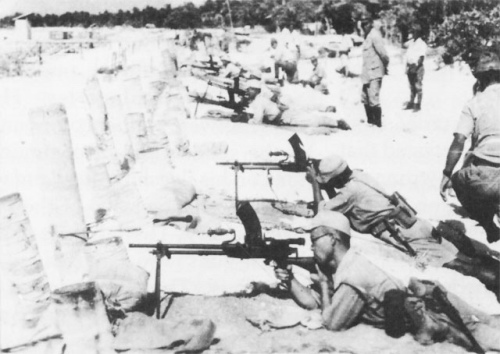
Japanese Naval Infantry conducting Live Fire with Type 99 Machine Guns

Several factors were considered by Nimitz and his planners considerations in this choice.  Nimitz did not have enough troops to capture all of the vital heavily defended locations in the Marshalls without dividing his forces.[ix] Additionally the Gilbert operation could be supported by land based bombers.[x] A final consideration was the Joint Chief’s decision to allow MacArthur to retain control of 1st Marine Division, which Nimitz had hoped to employ in his operations in the Central Pacific.[xi] The Staff of CINCPAC did a thorough photo reconnaissance of the Gilbert’s, and convinced the Joint Chiefs that Tarawa and Makin needed to be taken to provide air bases for the assault on the Marshalls.  Finally, the order for Galvanic was issued on 20 July 1943 with its execution planned for November 1943.[xii]

Japanese Preparations
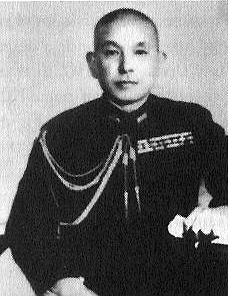
Rear Admiral Keiji Shibasaki

“It will take a million men a thousand years to take Betio”

The Japanese had done little to prepare against potential American offensive operations against the Gilbert’s until Makin Island was raided by elements of the 2nd Raider Battalion in August 1942.  The Makin raid shook the Japanese and they reinforced Makin and occupied Betio.[xiii]

The Japanese deployed the Yokosuka 6th Special Landing Force, essentially Naval Infantry or Marines[xiv] and the 111th Construction Battalion to Betio on 15 September 1942, over nine months after they attacked Pearl Harbor.[xv] What many people do not know is that these Special Naval Landing Forces were some of the most murderous and criminal elements of the Japanese military during the Second World War. They fully embraced the twisted version of Bushido and Emperor worship to justify their brutal conduct of war. While the Japanese on Betio were not accused of war crimes, it was only because they had no prisoners, military or civilian to torture and kill as other Special Naval Landing Forces had in the Pacific.

The forces on Betio were commanded by Admiral Tomanari Sachiro, who at once began to fortify Betio. Tomanari was a skilled officer who appreciated the value of strong fortifications on exposed islands like Betio. Likewise, recognizing that his forces were inadequate to the mission, Tomanari asked Tokyo for reinforcements. The reinforcements came in the form of Commander Sugai’s 7th Sasebo Special Naval Landing Force, which landed on 14 March.[xvi]Commander Sugai’s troops were the famed Rikusentai, the best of the Japanese Navy’s land forces and considered to be better disciplined, trained, and effective than Imperial Army Units of the same size.
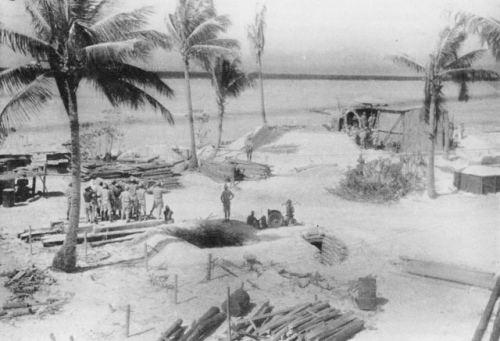
Japanese Gunnery Exercises before the Invasion

The fortification of Betio proceeded slowly until Rear Admiral Shibasaki relieved Tomanari, who returned to Japan. [xvii] Shibasaki was a tough veteran of service at sea and ashore including 19 months as a Rikusentai[xviii] officer in China. Shibasaki was chosen by Admiral Mineichi Koga, Admiral Isoruku Yamamoto’s to instill a better fighting spirit on the island.

The Imperial General Headquarters, issued a “New Operations Plan,” which ordered the outer defensive islands, such as Tarawa, to “hold up any American advance while an inner line of fortresses was constructed….”[xix]

Shibasaki drove the garrison hard, inspiring them to “extraordinary heights of labor that resulted in Betio’s superb defenses.”[xx]Betio mounted four 8” Naval guns[xxi], four 14 cm guns, four dual mount 5.5” dual purpose guns[xxii] six 80 mm anti-boat guns, eight 75 mm dual purpose guns, ten 75 mm mountain guns, six 70 mm guns and nine 37 mm anti-tank guns, numerous machine guns. The defenders were also equipped with light AA guns and 14 Type 95 Ha-Gō light tanks.[xxiii]

These weapons were mounted in well camouflaged, armored, or reinforced pillboxes, connected by trenches. [xxiv] In accordance with the directives of the high command, Shibasaki ordered his troops “to defend to the last man all vital areas and destroy the enemy at the waters’ edge.”[xxv]

The Japanese records note that Shibasaki “immediately began to strengthen morale and carried out advanced training, and as a result…the garrison remarkably enhanced its fighting capability and they were full of confidence.”[xxvi] Even the service troops were thoroughly trained to fight from their superb defensive positions.[xxvii] Shibasaki reportedly told his men that it would take a million men a thousand years to take Betio.

American Preparations for Galvanic
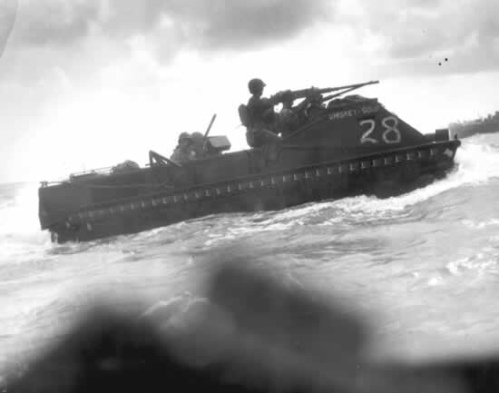
LVT Amphibious Tractor

Nimitz organized his forces into three major commands, the 5th Fleet, commanded by Admiral Raymond Spruance, the 5th Amphibious Force under Admiral Richmond “Kelly” Turner, and the V Amphibious Corps under Major General Holland “Howlin’ Mad” Smith, USMC.[xxviii] The 2nd Marine Division, which was assigned to assault Tarawa, was commanded by Major General Julian Smith.

The force that sustained this operation, and the subsequent amphibious operations was the Service Force Pacific Fleet.[xxix] This was a collection of ships whose mission it was to sustain the fleet in mobile operations. [xxx] This force, greatly “increased the range and power of the Navy in amphibious operations.”[xxxi] The plans for Galvanic called for the Army’s 27th Division take Makin Island, and the 2nd Marine Division which had been blooded at Guadalcanal, to take Tarawa, supported by the carriers and battleships of Admiral Raymond Spruance’s 5th Fleet.

Galvanic was the first application of new amphibious tactics developed for the Pacific war.[xxxii] Air and sea bombardment would precede the actual assault. The Marines would be transported ashore in a new vehicle called an LVT (Landing Vehicle Tracked) and other amphibious ships and craft including the LSD (Landing Ship Dock), LCM (Landing Craft Mechanized) and LCVP (Landing Craft Vehicle Personnel).

The LVTs were absolutely vital at Tarawa because of the distance that the reef extended from the beaches. The LVT’s, nicknamed “Amtracks” or “Amphtracks” were essentially a tracked amphibious personnel carrier. They were developed from a commercial vehicle used by U.S. Forrest Service Rangers in the Florida Everglades and were capable of crossing coral reefs that other craft could not cross.

The early LVTs had retrofitted armor and mounted a .50 cal. machine gun.  At Tarawa the Marines deployed 75 LVT-1s[xxxiii] and 50 LVT-2s. A total of 93 LVTs were part of the first wave of the Marine assault.[xxxiv] The LVTs were transported to Tarawa aboard LSTs (Landing Ship Tanks.)

Other innovations in this new form of amphibious warfare included the assignment of Naval Gunfire Support teams to the Marine Regiments, and down to some battalions. [xxxv] The attack at Tarawa was the first time that the Marines used the M4 Sherman tank in combat. [xxxvi]

Tarawa, ended up being a real combat proving ground for the tactics and equipment which would be improved on and used in every subsequent amphibious operation in the Pacific.  Tarawa also marked the last major use of rubber landing craft by the Marine Corps in an opposed landing.[xxxvii]

There were limitations to American preparations. First the size of the force meant that it could not be assembled in one place for rehearsals or to train as a team.[xxxviii] A second problem for the Americans was the assumption that high and low tides would be sufficient to get their landing craft across the reef in spite of warnings to the contrary.[xxxix] Likewise, the Americans failed to completely anticipate the scope to which the Japanese had fortified the island.

The latter was a failure of commanders to appreciate good intelligence that had been provided to them. In particular, aerial photos taken by the Air Force, and ULTRA intercepts provided good information on the strength and composition of the Japanese units on the island, as well as the layout of the defenses.[xl]

Likewise, some important equipment shortages were not remedied. The Marine Bazooka’s did not arrive, and neither the 6th or 8th Marines had ever made an actual amphibious assault.  At Guadalcanal the these regiments made an administrative landing, and few field-grade officers remained from the 2nd Marine Regiment who had landed at Tulagi.[xli] Despite their combat experience, they were far from the “amphibious experts” that they would become.[xlii]

However, they made up for their lack of practical amphibious experience by their cohesiveness, high morale and esprit. Likewise, they were well armed and equipped, in top physical condition and knew the basic tools of their trade: “weapons proficiency and field firing, close combat techniques, fire and maneuver, tactical leadership, fire discipline.”[xliii]
Japanese Vickers 8″ Gun Emplacement

The most critical aspect of the operation was to get across the reef onto the island.  There were few good landing sites and it was decided to make the landings from inside the atoll’s lagoon onto the Betio’s north shore.  This decision meant that transports embarking the Marines would have to unload outside of the lagoon and that the landing craft would have to make a 10 mile trip to get to the beaches.[xliv]

Another problem was that there was only one entrance into the lagoon, and it was not deep enough for heavy ships to enter.[xlv] This meant that ships such as battleships and cruisers would not be able provide direct, close range fire on the Japanese positions which were best situated to disrupt the Marines.

The execution of the plan involved land based bomber strikes beginning on D minus 7. Carrier aircraft would begin their operations on D minus 2.  Cruisers and destroyers joined the cacophony of destruction on D minus 1 and the battleships on D-Day itself.[xlvi]

On D-Day the Navy planned to bombard the island with 3,000 tons of shells in 2 ½ hours.[xlvii] The Navy was confident in its bombardment plans. Rear Admiral H. F. Kingman, who commanded the fire support group declared “We will not neutralize; we will not destroy; we will obliterate the defenses on Betio!”[xlviii]

Four battalions of Marines would land in the first wave, the three battalions of the 2nd Marines Regiment, and 2nd Battalion 8th Marines, all commanded by Colonel David Shoup.

Colonel Shoup would win the Medal of Honor on Betio and later became the Commandant of the Marine Corps. However, he assumed command of the 2nd Marines when the Regimental commander fell ill on the journey to Efate.[xlix] The division reserve were the remaining two battalions of the 8th Marine Regiment. The Division’s 6th Marine Regiment served as the corps reserve.[l]The assault units would be reinforced by tanks, and the 1st and 2nd Battalions 18th Marine Regiment, the division’s combat engineers.

The Invasion: Day One
Marines Going Ashore on Day One

The final naval gunfire bombardment commenced at 0542 hours on 20 November, and the assault waves began their trek to the beaches.  The transports were out of range of Japanese guns, but since they were so far out, the small amphibious craft boats have to make a 10 mile trip to get to the beaches. [li]At this point things began to go seriously wrong for the Marines.
LCT (Landing Craft Tank) Sinking after Being Hit

Unfortunately, Admiral Kingman and the Navy had “badly miscalculated the amount of softening-up that could be done in two and a half daylight hours bombardment.” Although the bi Vickers guns were silenced, not enough damage was done to the Japanese defenses.[lii] The Japanese unwittingly helped the Marines by firing their larger guns at the warships instead of holding fire, thus identifying their positions to Navy gunners.[liii]

The bombardment was lifted to allow an attack by carrier based aircraft. However, the aircraft were late to arrive and the ships did not resume fire, allowing the Japanese to emerge and re-train their weapons on the approaching landing craft.[liv] Likewise the destroyers USS Ringgold and USS Dashiell, the only ships operating inside the lagoon and providing close Naval Gunfire Support, were ordered to cease fire, knowing the Japanese gunners along the shore were still active.[lv] Some believe that an extra half hour of direct fire from the destroyers would have saved many lives.[lvi]

The LVTs in the first three waves were delayed by a heavy chop outside the lagoon and did not make landfall until 0913, which threw off the landing schedule.[lvii] The expected and planned for rise in tides did not materialize, and tides remained unpredictably low for the first 48 hours. As a result, no landing craft other than the LVTs could cross the reef, and the Marines were forced to wade ashore from distances of 600 to 1000 yards.[lviii]
Marines Wading Across the Lagoon

Shoup’s Marines landed on three beaches.  Red One and Red Two lay to the west of a 500 yard long pier, while Red Three lay to the east.  Third Battalion Second Marines (3/2) landed on Red-1, while 2/2 on Red-2. Second Battalion Eighth Marines (2/8) landed on Red-3, while elements of 1/18 and the scout snipers landed at the pier, with First Battalion Second Marines (1/2) remained at sea in reserve to land behind the battalion making the best progress.[lix]

As soon as the Amtracks hit the reef the Japanese began firing.  Every “working weapon along the north and west shorelines….blazed forth in fierce, interlocking fields of fire.”[lx] As they watched the Amtracks craw over the reef that Japanese knew they were in for a tough fight, one of Warrant Officer Ota’s men exclaimed “Heavens! The God of Death has come!”[lxi]

The Marines of 3/2 on Red-1 received enfilade fire from Japanese guns emplaced in a U around the beach. Even before the Marines landed they began to take causalities, Amtracks were hit in the lagoon and most that were not sunk or destroyed were unfit for further use.[lxii] The 2000 Marines who landed on the beaches in the first hour of the assault were badly disorganized, and the commanding officer’s of 2/2 and the Amtracks were killed. 3/2’s commander was isolated on the reef and only 2/8’s commander was with his troops. 2/8 was the only battalion being to reach the shore relatively intact.[lxiii] 3/2 was down to 65% of its strength and Kilo Company, 3/2 had taken over 50% casualties.[lxiv]

The Marines in the fourth to sixth waves were struggling to wade ashore from the reef. Landing craft “ran aground or milled about helplessly outside the reef, which was swept by crossfire from behind the beaches and from a grounded hulk northwest of the pier.”[lxv] Most of the tanks were put out of action either through accurate fire by Japanese guns or by sinking in deep areas of the lagoon, the Tank battalion commander was blown out of his Amtrack, wounded and survived 24 hours by clinging to a pile of dead bodies to keep from drowning.[lxvi]
Colonel Shoup Directing Operations

Colonel Shoup landed at Red-2 and began directing operations on the beach.  He knew that he had to get more troops ashore to exploit the minimal gains his Marines had made.  The news from Red One and Two was bad; he decided to bring 1/2 in at Red-2 thought that 3/8 should go in at Red-3.[lxvii] At 1018 General Julian Smith ordered the 8th Marines to dispatch 3/8 to Red-3.[lxviii] The Marines of 3/8 had to make their way across 700 yards through the water to get to the beach. They were slaughtered, and only 30 percent of the first wave got ashore, while the second and the third “were practically wiped out.”[lxix]
Close Combat

As Shoup’s Marines struggled to reach the beaches, those who had gotten ashore engaged the Japanese at point blank range. First Lieutenant William Hawkins of the 2nd Marine Scout and Sniper platoon and five of his men engaged the Japanese on the pier in vicious hand to hand fighting. [lxx] Staff Sergeant Bordelon of the Engineers on Red-2 though grievously wounded knocked out four gun positions, some by lobbing dynamite charges into them and galvanizing survivors into action, finally being killed while taking on a Japanese position alone.  Both Marines would be awarded the Medal of Honor.[lxxi]
Wounded Being Evacuated by Rubber Raft

By afternoon Julian Smith realized that he needed more troops, his last battalion, 1/8 waited to go ashore.[lxxii] Smith asked for the 6th Marines. He had Rear Admiral Wilbur Hill, Commander of Amphibious Group Two, send a message to Admiral Richmond K. Turner stating “Issue in doubt. I concur.” This message sent a chill through the listening Naval Staff.[lxxiii]

Ashore, Colonel Shoup brought in howitzers from 1st Battalion 10th Marines on his surviving Amtracks to the eastern edge of Red Two near the pier. [lxxiv] The howitzers landed in the early evening.[lxxv] Shoup sent Lieutenant Colonel Carlson to make a personal report to General Smith that he would hold onto his beachhead no matter what happened.

Shoup ordered his Catholic Chaplain to lay out a cemetery and begin burying the dead who were already decomposing in the tropical heat.[lxxvi] As this transpired, 2/8 got two of its 37mm anti-tank guns into position to drive off Japanese tanks approaching the beachhead.[lxxvii]

Members of the Second Marine Division Band assisted Navy Hospital Corpsman in bringing back wounded Marines.[lxxviii] For the rest of the day the Marines continued to eke out a beachhead. Shoup’s Marines on Red-2 and Red-3 managed to advance about halfway across the island, while 3/2 and elements 1/2 and 2/2 were isolated. Major Ryan of Lima Company 3/2 pulled them back to meet an expected Japanese counter-attack.[lxxix]

By nightfall the Marines had taken over 1500 casualties of 5000 men landed the first day.[lxxx] There is no evidence that Shoup considered withdraw that night.[lxxxi] No counterattack occurred due to Japanese command and control problems. The primary cause was that Admiral Shibasaki and his staff were killed while shifting the position of their headquarters during the afternoon,[lxxxii] and the Japanese communications were in shambles. A well organized counterattack would have been disastrous for the Marines,[lxxxiii] but it did not happen, even though the Japanese assembled over 1000 men to oppose the Marines on day two.[lxxxiv] Had Shibasaki lived and the Japanese communications survived, a counterattack might have had ramifications far beyond Tarawa.[lxxxv]

Day Two
Advancing Under Fire

The second day began with the First Battalion EighthMarines landing on Red Two, while the 6th Marines began to land on Green Beach at the far western tip of Betio.  Like the Marines who landed on the first day, 1/8’s landing turned into a bloodbath, the tide fell even lower than the previous day. As they hit the reef and waded ashore they drifted into some of the heaviest Japanese defenses. Japanese guns, including the dual 5.5” guns took direct aim at the boats, while Marines ashore watched helplessly. War correspondent Robert Sherrod noted: “This is worse, far worse than it was yesterday.”[lxxxvi] Only half of 1/8 reached the beach with none of their heavy weapons or equipment.  Shoup ordered the remnants of the battalion into line on his western flank in preparation for an advance inland.[lxxxvii] During five hours of landings on day two, the “Marine casualties reached a higher rate than that sustained on the first morning.”[lxxxviii]

Meanwhile, Shoup ordered Ryan’s “orphans” to make an attack down the right flank of the Japanese positions on Green Beach. Shoup’s decision and Ryan’s leadership made the attack a success. The “American victory at Betio evolved from the attack during one intense hour the second morning.”[lxxxix]

Taking every available Marine, two surviving Sherman tanks, and some mortars, Ryan gathered his force and coordinated Naval Gunfire support. The area contained a number of heavy guns including two of the remaining 8” mounts.  A destroyer blanketed the Japanese positions with 5” shells and fire from her light AA guns.[xc] Attacking behind the beach, Ryan’s Marines isolated and destroyed everyone and everything that looked hostile.[xci] Against minimal opposition Ryan’s Marines quickly seized the gun positions and the western end of the airfield.  Within an hour his Marines occupied the entire western side of Betio up to a 200 yard depth. At 1200 he radioed Shoup to let him know the good news, and that he now intended to advance east against the airfield.[xcii] The attack allowed the Marines to land intact battalions with supporting arms for the first time battle.[xciii]

To the east behind Red Two and Red- Three, the 8th Marines and survivors of 1/2 and 2/2 attacked against fierce Japanese opposition near Shibasaki’s former command bunker and two other large bunkers which were mutually supporting.  The attack by the 2nd Marine survivors eventually succeeded in getting completely across the south side of the island.[xciv] During the attack Lt. Hawkins of the Scout Snipers, who had distinguished himself at the pier the previous day was mortally wounded.

The attack cut the island in two, but the Japanese launched a viscous counterattack on the Marine positions which was beaten back.[xcv] The 8th Marines faced a more difficult task going against what was now the heart of the Japanese defense as the defenders had been reinforced by Lt. Minami and his third company of the 7th Special Naval Landing Force.

Vicious fighting ensued and by nightfall “the Marines had little to show for their heavy losses,[xcvi] but they did make significant inroads against the Japanese to warrant optimism for D+2.[xcvii] By evening the Marines on Red-1 and Red-2 had consolidated their beachhead so that reinforcements were finally able to land, including jeeps, artillery and heavy equipment.

By mid-day the Marines noted that Japanese defenders were beginning to commit suicide, and they began to feel that Japanese morale had broken.  By late afternoon Shoup transmitted the message: “Casualties many. Percentage of dead unknown. Combat efficiency-We are winning.”[xcviii] By late afternoon Major Jones’s First Battalion Sixth Marines landed on Green beach in their rubber boats, reinforcing Ryan’s orphans. It was the first of the 7 battalions on the island to get ashore intact.

Ryan and Jones coordinated their units for a night defense and an early attack the next morning.[xcix] Meanwhile, Second Battalion Sixth Marines cleared the nearby island of Bairiki, allowing the artillery of Second Battalion Tenth Marines to land its howitzers on the island.  This in cut off any line of retreat for the defenders of Betio.[c] Colonel Merritt Edson came ashore during the evening to relieve Shoup[ci], who remained to help coordinate the next day’s attack. Once again there were no coordinated Japanese counterattacks. The senior officer, Commander Takes Sugai, was isolated in the pocket between the Red and Green beaches, and no senior officer could coordinate any attacks.[cii]

Mopping Up: Day Three and Four
Wrecked LVT’s and Dead Marines Litter the Beach

Day three began with attacks against Japanese strong points and the arrival of more reinforcements, including 3/6 which landed on Green Beach, and three light tank platoons which landed on Red-2.[ciii] The Marines attacked from Green Beach, sweeping east to join the 2nd Marines who had cut the island in two the day before.  The 8th Marines continued to attack the heavily fortified bunker complex, and eventually captured the heavily fortified and defended positions.

During the assault First Lieutenant Sandy Bonnyman of 1/18 won the Medal of Honor for leading the assault on these positions, including destroying a major bunker defended by 150 Japanese, he was killed during the fight.[civ] Fighting remained fierce throughout the day and General Smith arrived to take command on shore.  The Marines continued to attack supported by tanks, artillery and naval gunfire.  By the evening they were established at the east end of the airfield.

The now desperate Japanese defenders launched a series of Banzai charges which beginning about 1930 hours and ending about 0400 when the Marines annihilated the last attack with the assistance of artillery.[cv] The attack, which could have succeeded the first or early the second day, now aided the Marines by killing troops that might have been used to exact a higher price in Marine lives for the tail of the island.[cvi]

The next morning the Marines pushed forward and eliminated the last Japanese defenders, and by 1200 Betio was secured.  Of about 5000 defenders only 17 Japanese and some Korean laborers were taken prisoner.[cvii] The Marines lost over 1000 killed and 2300 wounded.[cviii]
One of the Japanese Survivors being Interrogated

Epilogue

The Marines paid a heavy price for Betio, but it was not to be a useless sacrifice. However, it was a source of great controversy especially among politicians.[cix] Historian Ronald Spector wonders if waiting for better tides or a full moon would have saved lives.[cx] Holland Smith later argued that Tarawa should have been bypassed, but Nimitz’s biographer, E. B. Potter notes “if the lessons of the amphibious assault had not been learned at Tarawa, they would have to be learned elsewhere, probably at greater cost.”[cxi]

The lessons learned aided all future amphibious operations in the Central Pacific and elsewhere.  Timing and coordination of naval gunfire support, air strikes and combat loading of transports were all refined in future operations. Large numbers of armored and up-gunned Amtracks would be part of every future operation.[cxii] Intelligence was emphasized and replicas of the Japanese fortifications were built and tested to determine the best way of destroying them.[cxiii] Likewis, the Marines shocked the public by releasing photos and films of the carnage on Tarawa to awaken them to the challenges ahead.[cxiv]

Today the battle is remembered annually by the 2nd Marine Division at Camp LeJeune, North Carolina. Each year, an ever shrinking number of veterans of the battle attend the ceremonies.  Samuel Eliot Morison put it best: “All honor, then, to the fighting heart of the United States Marine. Let the battle for that small stretch of coral sand called Betio of Tarawa be remembered as terrible indeed, but glorious, and the seedbed for victory in 1945.”[cxv]

Appendix: The Commanders
Lieutenant General Holland Smith and Major General Julian Smith

General Holland M. “Howling Mad” Smith USMC: (1882-1967) Lieutenant General Holland M. Smith commanded V Amphibious Corps during the Gilberts operation.  Prior to the war he had worked extensively on amphibious warfare doctrine for both the Marine Corps and Navy. Unlike many senior officers Smith was not a Naval Academy graduate having matriculated from the Alabama Polytechnic Institute (now Auburn University) in 1903 and law school in 1903.  Smith served as Adjutant of the 4th Marine Brigade in the First World War and served in Panama and the Dominican Republic in addition to other Marine tours afloat and ashore.  He served well and had many key assignments between the wars culminating in as the Assistant Commandant of the Marine Corps.  Subsequent to the Gilbert campaign he served as Commanding General of the Fleet Marine Force, Pacific and later commanded the Marines at Iwo Jima.  He retired in 1946.

Major General Julian Smith USMC: (1885-1975) Major General Julian Smith served as Commanding General 2nd Marine Division at Tarawa.  He graduated from the University of Delaware and was commissioned as a Second Lieutenant in 1909.  He served in Haiti, Santo Domingo and the Vera Cruz expedition. During the First World War he served as an instructor in the Marine Officer training camps at Quantico. After the war he served in Cuba, Nicaragua and various command and staff posts including the Army Command and General Staff College.  He commanded 5th Marines in 1938 and in 1942 was promoted the Major General serving as director of Fleet Marine Force Schools, New River, NC.  He took command of 2nd Marine Division in May 1943 and served there until April 1944 when he became Commanding General, Expeditionary Troops, Third Fleet and in December 1944 took command of the Military Department of the Pacific.  He retired in 1946.
Colonel David Shoup

Colonel David Shoup USMC: (1904-1983) Colonel David Shoup commanded the 2nd Marines at Tarawa, being appointed as commander when its commander fell ill.  Shoup won the Congressional Medal of Honor for his actions on Tarawa.  A 1926 graduate of DePauw University, Shoup was commissioned a Second Lieutenant through the ROTC program that year.  He served in various assignments to include service in China, at sea on the battleship Maryland and Marine Barracks Puget Sound Navy Yard. He joined the staff of 6th Marines in October 1940 and assumed command of 2/6 in February 1942.  He was assigned as the Assistant Operations Officer for 2nd Marine Division in July 1942 and promoted the Lieutenant Colonel.   He went with the Division to New Zealand where he became the G-3 and from which he was fleeted up to command 2ndMarines at Tarawa.  After Tarawa he served as the Division Chief of Staff at Saipan and Tinian.  After the war Shoup continued to be assigned in key billets at the Pentagon and as commanding General, 1st Marine Division and then the Third Marine Division.  He became Chief of Staff, Headquarters Marine Corps in 1958 and was appointed as the 22nd Commandant of the Marine Corps by President Eisenhower, a post that he retained until his retirement in 1963.

Rear Admiral Tomanari Sachiro

Admiral Tomanari Sachiro IJN: (1887-?) Commander of Tarawa garrison until relieved by Rear Admiral Shibasaki.   Graduate Naval Academy 1910, initially a communications officer he held various commands including three destroyers, an Oiler, the Light Cruiser Yuma, Heavy Cruisers, Furutake and, Haguro and the Battleship Kirishima. Assigned to Tarawa in February 1943, he helped design and supervised the initial construction of the defenses until he was relieved by Admiral Shibasaki on 20 July1943.  He returned to Japan and served the remainder of the war on Navy Division of Imperial General Headquarters.  Tomonari survived the war though nothing is mentioned as to his postwar fate.

Rear Admiral Shibasaki Keiji

Rear Admiral Shibasaki Keiji IJN: (1894-1943) Commanded Tarawa Garrison until his death during the battle.  He graduated from the Naval Academy in 1915 and he was a skilled navigator and instructor.  Prior to the war he had served afloat and ashore and ashore and had commanded a ship and naval station and served as a naval attaché to Prince Kuni Asaakira, a member of the Imperial Family.  Among his assignments was 19 month combat tour with the special Naval Landing Forces in China, where he served as Chief of Staff of Shanghai Special Naval Landing Force.  Shibasaki’s leadership helped the garrison improve their defensive capabilities and combat skills as he inspired them to great heights and executed an intense training program. He was killed in the battle.

A Personal Note

I have not been to Tarawa but feel that I know it well.  I served in Second Marine Division from April 1999 through December 2001.  Due to my prior service experience I was used to fill gaps where chaplains were needed and ended up serving in four different battalions.  I served in 2nd Combat Engineer Battalion, the descendant of 1/18, the combat engineers.  We had a WWII Bulldozer outside our command post named after Sergeant Bordelon, the Medal of Honor Citations for Bordelon and Boonyman were prominently displayed.  I also served in 1/8 and 3/8.  I knew the accounts of the slaughter of these Marines as they attempted to land but as I re-read the accounts I was moved by their courage under fire.  The CPs of these battalions are also adorned with citations of their heroes lost at Tarawa.  Veterans would visit our units during Tarawa Days at Camp LeJeune, worn by the battle and the years they always made a great impression on me.

There is almost a mystical connection between the Second Marine Division and the Marines of Tarawa; it was a crucible that defined the division, whose motto is the same as the Army Infantry School. “Follow Me!”

Semper Fidelis,

Padre Steve+

Notes

[i] Spector, Ronald H. Eagle Against the Sun: The American War with Japan.  The Free Press, New York, NY 1985. p.253

[ii] Murray, Williamson and Millett, Allan R. A War to Be Won: Fighting the Second World War, The Belknap Press of Harvard University Press, Cambridge, MA 2000. p.338

[iii] Ibid. Spector. p.253

[iv] Ibid. p.255 The conference also set a date for the invasion of France.

[v] Toland, John. The Rising Sun: The Decline and Fall of the Japanese Empire, 1936-1945. Random House, Inc. New York, NY 1970. p.468

[vi] Ibid. Spector. p.255

[vii] Costello, John. The Pacific War 1941-1945. Quill Publishing, New York, NY 1982. p.430

[viii] Ibid.

[ix] Potter, E.B. Nimitz. Naval Institute Press, Annapolis, MD, 1976, Third Printing with Revisions 1979. p.243. Nimitz’s forces would have had to seize 5 major Japanese bases and his staff was not sure that the Pacific carrier force would be strong or experienced enough to provide the necessary air cover for the operation.

[x] Ibid.

[xi] Ibid. pp.243-245

[xii] Morison, Samuel Elliott. The Two Ocean War: A Short History of the United States Navy in the Second World War. Little Brown and Company, Boston and Toronto, 1963. p.296.

[xiii] Hammell, Eric and Lane, John E. Bloody Tarawa: The 2nd Marine Division, November 20-23, 1943. The Zenith Press, St. Paul MN 2006.  Text copyright 1998 Eric Hammell and John E. Lane. p.4

[xiv] See Alexander, Joseph H. Utmost Savagery: The Three Days of Tarawa.Ivy Books, published by Ballantine Books, New York, NY. 1995. pp. 39-40.  This unit became the Third Special Base Unit on its deployment and was joined by the 111th Construction Battalion.

[xv] Ibid. Hammell. p.4

[xvi] See Alexander pp.39-40. This unit was basically a reinforced infantry battalion with 3 rifle companies, a weapons battery, anti-aircraft battery, a light tank company and support units numbering about1600 men.

[xvii] Ibid. Alexander. p.43

[xviii] Alexander p.27 The Rikusentai was the Japanese equivalent of Marines, who numbered about 50,000 men.  The officers attended Army schools and qualified enlisted men attended additional Army specialist training.

[xix] Ibid. Costello. p.431

[xx] Ibid. Hammell. p.22

[xxi] See Alexander p.77. While most writers say that these guns were brought from Singapore, Alexander notes that British writer William H Bartsch submitted proof (serial numbers) that the guns were sold by Vickers to Japan in 1905 as a legitimate business transaction.

[xxii] These are the same guns (127mm) mounted as the secondary armament of Nachi and Takao Class Heavy Cruisers and later mounted on light cruisers to replace the main battery with a more effective anti-aircraft armament.

[xxiii] Ibid. Hammell. p.22

[xxiv] Hammell notes that many of these bunkers and pillboxes were so well concealed that they could not be seen.

[xxv] Ibid. Toland. p.469.

[xxvi] Ibid. Alexander. p.43.

[xxvii] Ibid. Hammell. p.28

[xxviii] Ibid. Morison. p.297

[xxix] Ibid. Costello. p.429

[xxx] At this point the force could provide everything except major permanent repairs to warships.

[xxxi] Liddell-Hart, B.H.  History of the Second World War. G.P. Putnam’s Sons, New York, NY 1970. p.511

[xxxii] Ibid. Costello. p.431

[xxxiii] The older LVT-1s had boiler plate armor added as a field modification and were given a heavy machine gun. Prior to this they were unarmored and had two light machine guns.

[xxxiv] Ibid. Morison. p.303

[xxxv] Hammell includes a by name list of these officers in Appendix B.  Of note for today, each MEUSOC (Marine Expeditionary Unit, Special Operations Capable) has an assigned Naval Gunfire Support Team.

[xxxvi] Ibid. Alexander. pp. 61-62.  The Shermans had to be transported aboard pre-loaded LCM-3s carried in the well decks of the LSDs.

[xxxvii] Ibid. Alexander. pp.58-59

[xxxviii] Ibid. Morison. p.297.  As a sidebar discussion it should be noted that Galvanic helped provide the model for the organization of all further Marine Corps amphibious doctrine now known by the acronym PERMA; Planning, Embarkation, Rehearsal, Movement and Assault, which describes the 5 phases of a amphibious assault.

[xxxix] Ibid. Hammell details the intricacies of the particular tides seen at Tarawa and the knowledge that the Marines had from the former Resident Commissioner of the Island, Major Frank Holland who warned the division staff that he knew that there would not be enough water over the reef to get landing craft across it. (pp.18-20)

[xl] Ibid. Alexander. pp.75-77

[xli] Ibid. Alexander. pp.67-68.

[xlii] Ibid. p.70

[xliii] Ibid. p.71

[xliv] Ibid. Morison. p.302

[xlv] Ibid. Hammell. p.16

[xlvi] Johnston, Richard W. Follow Me! The Story of the Second Marine Division in world War II.  Copyright 1948 by the Second Marine Division History Board and published by Random House Publishers, New York, NY 1948. p.106

[xlvii] Ibid. Liddell-Hart. p.511  Johnson says 2,700 tons. (p.106)

[xlviii] Ibid. Johnston. p.106

[xlix] Ibid. Hammell. p.17

[l] Ibid.

[li] Ibid.. Hammell. 46-47

[lii] Ibid. Morison. p.303

[liii] Ibid. Alexander. p.113.  Alexander notes that the Japanese would have been better served by using these guns on the stalled out landing craft.

[liv] Ibid. Hammell. p.47.

[lv] Ibid. Hammell. p.58

[lvi] Ibid.

[lvii] Ibid. Morison. p.303

[lviii] Ibid. Alexander. p.79

[lix] Ibid. Hammell. p.17

[lx] Ibid. Alexander. p.121

[lxi] Wukovits, John. One Square Mile of Hell: The Battle for Tarawa. NAL Caliber, published by New American Library, a division of Penguin Group USA, New York NY, 2006. p.112

[lxii] Ibid. Johnston. p.116

[lxiii] Ibid.

[lxiv] Ibid. Wukovits. P.119  Other companies suffered as grievously, K/3/2 was not alone in its suffering.

[lxv] Ibid. Spector. pp.263-264

[lxvi] Ibid. Alexander. pp.136-138

[lxvii] Ibid. Hammell. p.90

[lxviii] Ibid. p.95

[lxix] Ibid. Spector. p.264

[lxx] Ibid. Wukovits. p.114

[lxxi] Ibid. Alexander. pp.139-140

[lxxii] 1/8 did not arrive on the beach due to botched communications until D plus 1.

[lxxiii] Ibid. p.150  The last time this signal had been sent it was by Major Devereaux at Wake Isalnd

[lxxiv] Ibid. p.151

[lxxv] Ibid. Johnston. p.132

[lxxvi] Ibid. Hammell. p.112

[lxxvii] Ibid. p.130

[lxxviii] Ibid. Johnston. p.122

[lxxix] Ibid. Johnston. p.122

[lxxx] Ibid. Costello. p.436

[lxxxi] Ibid. Alexander. p.163

[lxxxii] Ibid. Alexander. pp.157-158  Hammell notes that Shibasaski was most likely killed by fire from Ringgold or Dashiell.

[lxxxiii] Ibid. Hammell.pp.139-140

[lxxxiv] Ibid. Alexander. p.162

[lxxxv] Ibid.  Wukovits. p.176. Wukovits notes how this could have affected the planning for the Normandy invasion.

[lxxxvi] Ibid. Alexander. p.173

[lxxxvii] Ibid. Hammell. p.160

[lxxxviii] Ibid. Costello. p.437

[lxxxix] Ibid. Alexander. p.170

[xc] Ibid. Hammell. p.163

[xci] Ibid. Hammell. p.166

[xcii] Ibid. Wukovits. p.178

[xciii] Ibid. Alexander. p.170 Ryan would be awarded the Navy Cross for his efforts.

[xciv] Ibid. Hammell. p.172

[xcv] Ibid. Alexander. p.179

[xcvi] Ibid. Alexander. p.181

[xcvii] Ibid. Hammell. p.178

[xcviii] Ibid.. Wukovits. p.194

[xcix] Ibid. Hammell. p.202

[c] Ibid. Hammell. p.212

[ci] Shoup would be awarded the Medal of Honor and eventually go on to be the Commandant of the Marine Corps.

[cii] Ibid. Alexander. pp.191-192

[ciii] Ibid. Johnston. p.134  2 platoons landed on Red-2 and one on Green Beach.

[civ] Ibid. Alexander. pp.202-205

[cv] Ibid. Johnston. pp.145-146

[cvi] Ibid. Johnston. p.147

[cvii] Ibid. Toland. p.470

[cviii] Ibid. Murray and Millett. p.345

[cix] Ibid. Liddell-Hart. p.511

[cx] Ibid. Spector. p.266

[cxi] Ibid. Potter. P.264

[cxii] Ibid. Murray and Millett. p.347  The Amtrack in improved forms has been part of the Marines ever since. The current model serves in a traditional amphibious role as well as a Armored Personnel Carrier for Marines involved in ground combat operations ashore.

[cxiii] Ibid. Costello. p.439. The method found to work best was long range plunging fire by heavy guns found on battleships and heavy cruisers.

[cxiv] Ibid. Murray and Millett. p.346

[cxv] Ibid. Morison. p.306

Bibliography

Alexander, Joseph H. Utmost Savagery: The Three Days of Tarawa. Ivy Books, published by Ballantine Books, New York, NY. 1995.

Costello, John. The Pacific War 1941-1945. Quill Publishing, New York, NY 1982

Morison, Samuel Elliott. The Two Ocean War: A Short History of the United States Navy in the Second World War. Little Brown and Company, Boston and Toronto, 1963

Hammell, Eric and Lane, John E. Bloody Tarawa: The 2nd Marine Division, November 20-23, 1943. The Zenith Press, St. Paul MN 2006.

Johnston, Richard W. Follow Me! The Story of the Second Marine Division in world War II.  Copyright 1948 by the Second Marine Division History Board and published by Random House Publishers, New York, NY 1948

Murray, Williamson and Millett, Allan R. A War to Be Won: Fighting the Second World War, The Belknap Press of Harvard University Press, Cambridge, MA 2000

Potter, E.B. Nimitz. Naval Institute Press, Annapolis, MD, 1976, Third Printing with Revisions 1979

Spector, Ronald H. Eagle Against the Sun: The American War with Japan.  The Free Press, New York, NY 1985 Toland, John. The Rising Sun: The Decline and Fall of the Japanese Empire, 1936-1945. Random House, Inc. New York, NY 1970

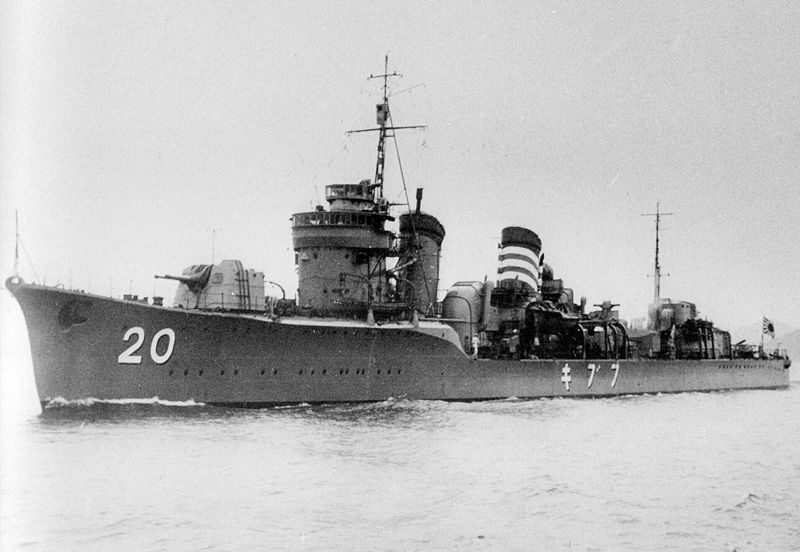
Leave a comment

Filed under History, imperial japan, Military, US Marine Corps, US Navy, World War II at Sea, world war two in the pacific
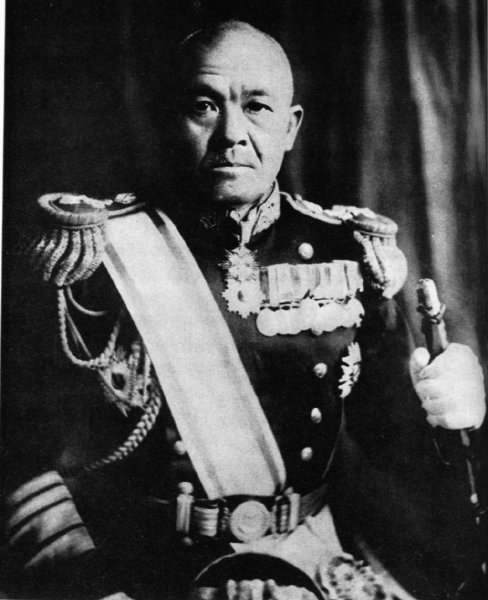
Against Insurmountable Odds: The Naval Battle of Guadalcanal, part Two


Friends of Padre Steve’s World,

Last night I wrote about the opening engagement of the Naval Battle of Guadalcanal. Despite the heroic battle to protect the Marines on Guadalcanal I the early morning hours of November 13th, the situation in the White House was akin to the setbacks at Omaha Beach a year and a half later. The temptation to withdraw the Marines who had already won a foothold on the island and who had withstood several major Japanese assaults was strong, but time played a role that superseded American political realities.

                                                        IJN Kinugusa 
On the morning of the 13th, following the defeat of Rear Admiral Hiraoki Abe’s Force, Vice Admiral Nobutake Kondo pressed home the attack. On the 13th, his transport force, carrying the Imperial Army 38th Division, protected by the destroyers of Rear Admiral Gunichi Mikawa ran the gauntlet of  Marine Corps, Navy, and Army Air Force aircraft stationed at Henderson Field which according to the Japanese plan should have been rendered inoperative on the night of the 12th and 13th. Mikawa pressed ahead despite heavy losses and though losing seven of the eleven transports landed a sizable number of troops on Guadalcanal despite losing most of their supplies and equipment.

As the sun set on the night of the 13th another bombardment Force under Rear Admiral Shoji Nishimura came in under the cover of darkness to fire 500 eight inch shells at the airfield. Damage was moderate, some aircraft were destroyed, but Henderson Field Remained in action, its aircraft continuing to inflict heavy casualties of the Japanese landing forces, and their escorts, including the heavy cruisers Kinugusa, Maya, Chokai, and Suzuya, light cruisers Isuzu and Tenryu, and six destroyers. Mikawa sent Maya and Suzuya to shell Henderson Field while his other ships attempted to screen the transports. In the following action seven of the eleven transports were sunk, with many of their troops transferred to destroyers which delivered them to Guadalcanal without most of their supplies and equipment. During his withdraw, most of Mikawa’s ships were damaged by aircraft from Henderson Field, including Kinugusa which was mortally wounded by Marine and Navy aircraft from Henderson Field and USS Enterprise. 

                                             IJN Battleship Kirishima 

Despite the losses and under pressure from Tokyo to retake the Guadalcanal, Admiral Yamamoto ordered Admiral Kondo, with a reconstructed bombardment Force to attack Henderson Field. That task force was centered on the battleship Kirishima, though Kondo’s flagship was the heavy cruiser Atago. This force was more powerful than Abe’s, with one battleship, 2 heavy and 2 light cruisers as well as nine destroyers.


By now the Americans were rushing to get every available ship to Guadalcanal, despite the doubts that it could hold. Against the advice of many officers, Vice Admiral William “Bull” Halsey directed the battleships USS Washington and South Dakota, along with the destroyers USS Preston, Walke, Benham, and Gwin none of which had operated together before until that night. The battleships were selected because nothing else was available, the spdestroyers, each because they had more fuel. They were under the command of Rear Admiral Willis Lee aboard Washington.


Early in the morning of the 15th the task forces of Kondo and Lee joined battle. The US destroyers, operating in the van succeeded in their task of screening the battleships at heavy loss to themselves. Preston, Walke, and Benham were sunk or mortally wounded. The South Dakota was put out of the action by a mistake by her Chief Engineer coupled with accurate Japanese gunfire. Now operating alone and undetected, Washington opened fire on Kirishima hitting her with between 9 and 20 16” shells. Mortally wounded Kirishima became the second battleship lost by the Imperial Navy in the war. Kondo retreated, and the following morning the four surviving transports beaches themselves under air attack from Henderson Field.

  •                       Washington Firing and Broadside at Kirishima 

    From that point on Japanese missions were limited to resupply of forced on Guadalcanal or their evacuation. Many other bloody battles remained to be fought, it after November 15th 1942, the issue of who should control Guadalcanal was not no longer in doubt.

Peace,

Padre Steve+


Leave a comment

Filed under History, imperial japan, leadership, Navy Ships, US Army Air Corps, US Marine Corps, US Navy, World War II at Sea, world war two in the pacific