Category Archives: Loose thoughts and musings

Trump in Tidewater: A Nuremberg Rally in Minature 


Friends of Padre Steve’s World,

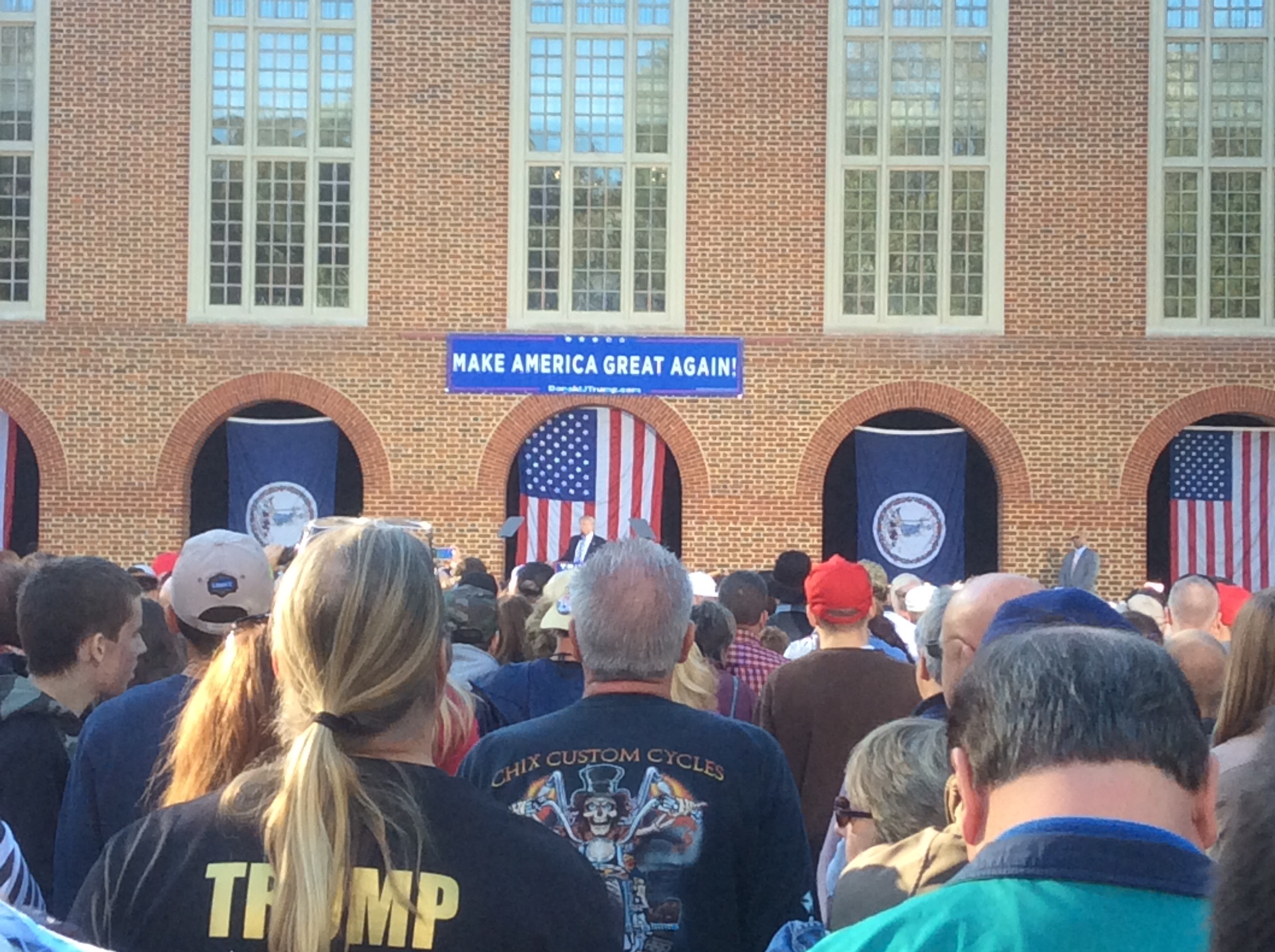
Yesterday was an interesting day as I infiltrated the Donald Trump rally here in Virginia Beach. I had thought about wearing a Hillary button but in light of how some Trump supporters have treated anyone thought to be protesting I decided not to create a scene. Instead I tried to blend in, watch, and observe the crowd that I estimate to have been around 3000, maybe 3500 people, about the same number that might attend an early season weekday game at our local minor league affiliate. Since I have been to quite a few of those games I’m pretty good at estimating crowd size. The Trump Campaign claim that attendance was around 10,000 which seems to be their standard answer, as they routinely over inflate attendance numbers, but I digress. 

Since I wanted to fit in without wearing any Trumpware I decided to wear my World Baseball Classic Team USA hat and my flight jacket which has a good number of my military unit patches on it. It was a great disguise because no one suspected that a that a aging white veteran dressed like this could possibly not be a Trump supporter. In fact while I was walking around taking pictures and blogging a fashionably dressed female Trump volunteer thanked me for my service and invited me to a Veterans for Trump meeting, and several other people also thanked me for my service. The fact that is that I am a career military officer and a combat who happens to oppose the totalitarian state that Trump and his supporters remained hidden. I politely thank each person and continued on with my task. 

My visit to the rally provided me a surreal view of the bizzaro world in which Trump and many of his supporters live; a world full of conspiracy theories, lies, and propaganda that they believe to be true. 

The rally was held at Pat Robertson’s Regent University and I arrived as the national anthem was being sung. Because Trump was running late I got to listen to several warm up speakers including Ralph Reed of the Faith and Freedom Coalition and Rudy Giuliani ratchet up the anger of the crowd of Trump loyalists who bedecked in all sorts of Trump campaign gear and who ate up every word as if it was the gospel. 
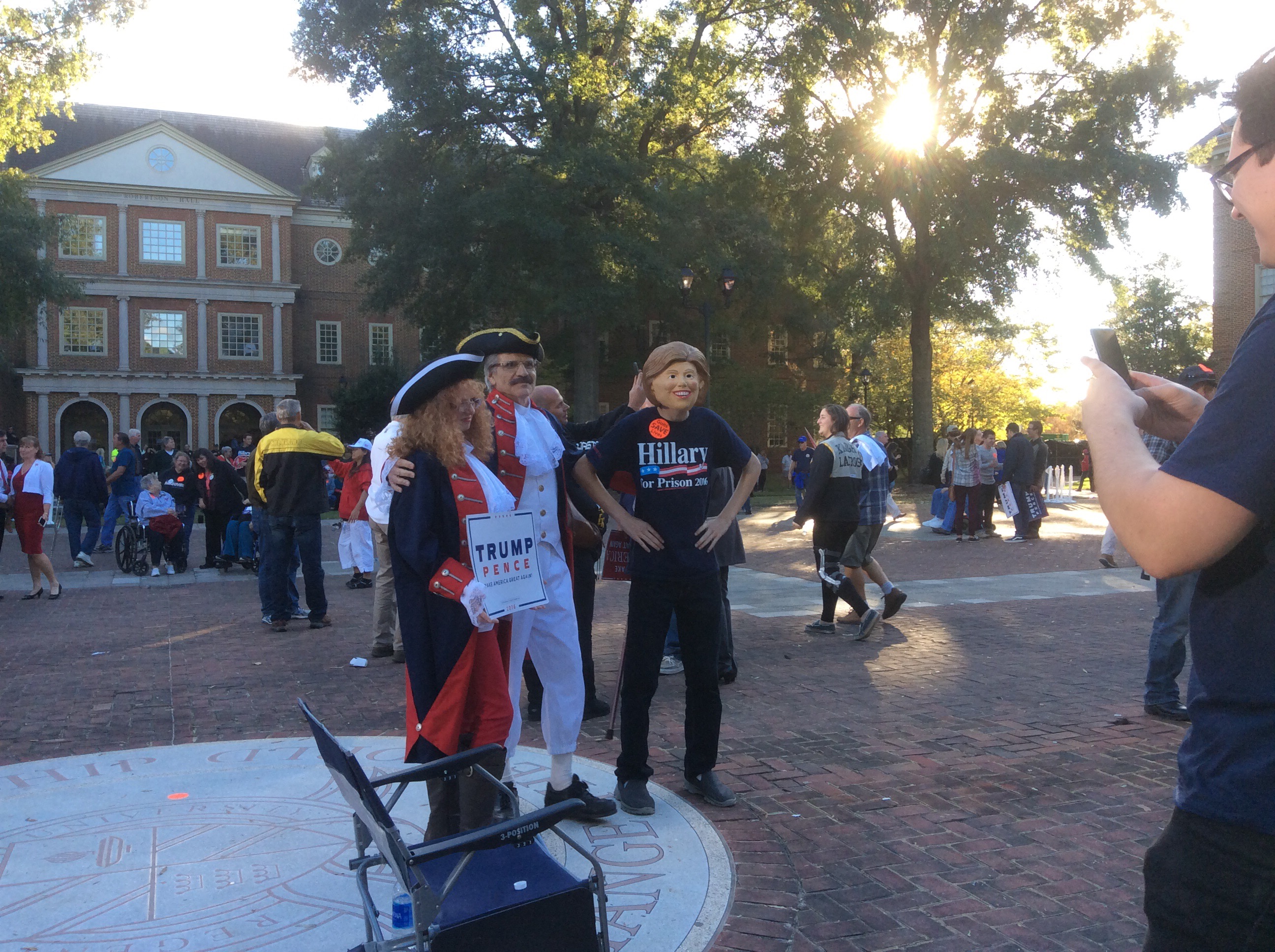
It was a strange feeling to be at a university less than ten miles from my home listening to these speakers spew hate, and seeing the overwhelmingly white crowd respond with aplomb. To each charge the crowd chanted Make America Great Again, or Lock Her Up, and booed any mention of Hillary Clinton, Barack Obama, or Tim Kaine. The language used by the speakers was that of war. They described the election as a war and in apocalyptic terms. The most appalling use of the war analogy was by State Senate candidate Frank Wagner who  used the model of Robert E. Lee rallying his troops during the Battle of the Wilderness as a call to Trump followers to fight. I cannot imagine using the example of a rebel leader whose troops killed more American soldiers than any enemy in any other war, a man who backed  secession, a man who violated his oath and took up arms against his country. 


The organizers trotted out fundamentalist pastors including a Mexican American and Bishop E.W. Jackson to speak and pray, mixing their faith with their politics in a manner that excluded anyone of any other faith present. Likewise a leader of a group which opposes immigrants, accusing them of all being criminals and rapists and repeating myths and lies spread by Ann Coulter. It is amazing to watch, as people booed as he said people that don’t belong here and screamed build the wall! It was a display of hate filled nativism that I could not have imagined. 


The speakers consistently returned to the theme of working up his supporters as deplorables and repeating conspiracy theories, lies, and myths. It was amazing to watch people wearing their made in China Make America Great Again baseball hats, Infowars Hillary for Prison t-shirts, and other paraphernalia such as Trump that Bitch t-shirts gathered in the square of one of America’s supposedly premier Christian universities. To add to the irony of this being a supposedly Christian university was the fact that vendors were hawking these wares and worse on campus. 


Trump was running late so after a delay and finally Rudy Guilani took the stage talking about a change of direction, talking about trickle down economics, and radical Islamic terrorism, while praising Vladimir Putin, and starting yet another series of Lock her up, and Bill Clinton is a Rapist. He promoted the lies of the rigged election and attacks on the press. 


As I blogged amid the crowd and took pictures a fashionably dressed female Trump volunteer thanked me for my service and invited me to other Veterans for Trump events. I was surreal because here I was in the midst of the rally writing this on my iPad mini. 

After Guliani finished recorded music played and ironically one of the songs was You Can’t Always Get What You Want by The Rolling Stones. I guess that could well be the case if Trump loses on November 8th. The music kept going and going as the crowd waited for Trump, some talking among themselves, and others, particularly the elderly becoming tired and trying to find places to sit or lean. 
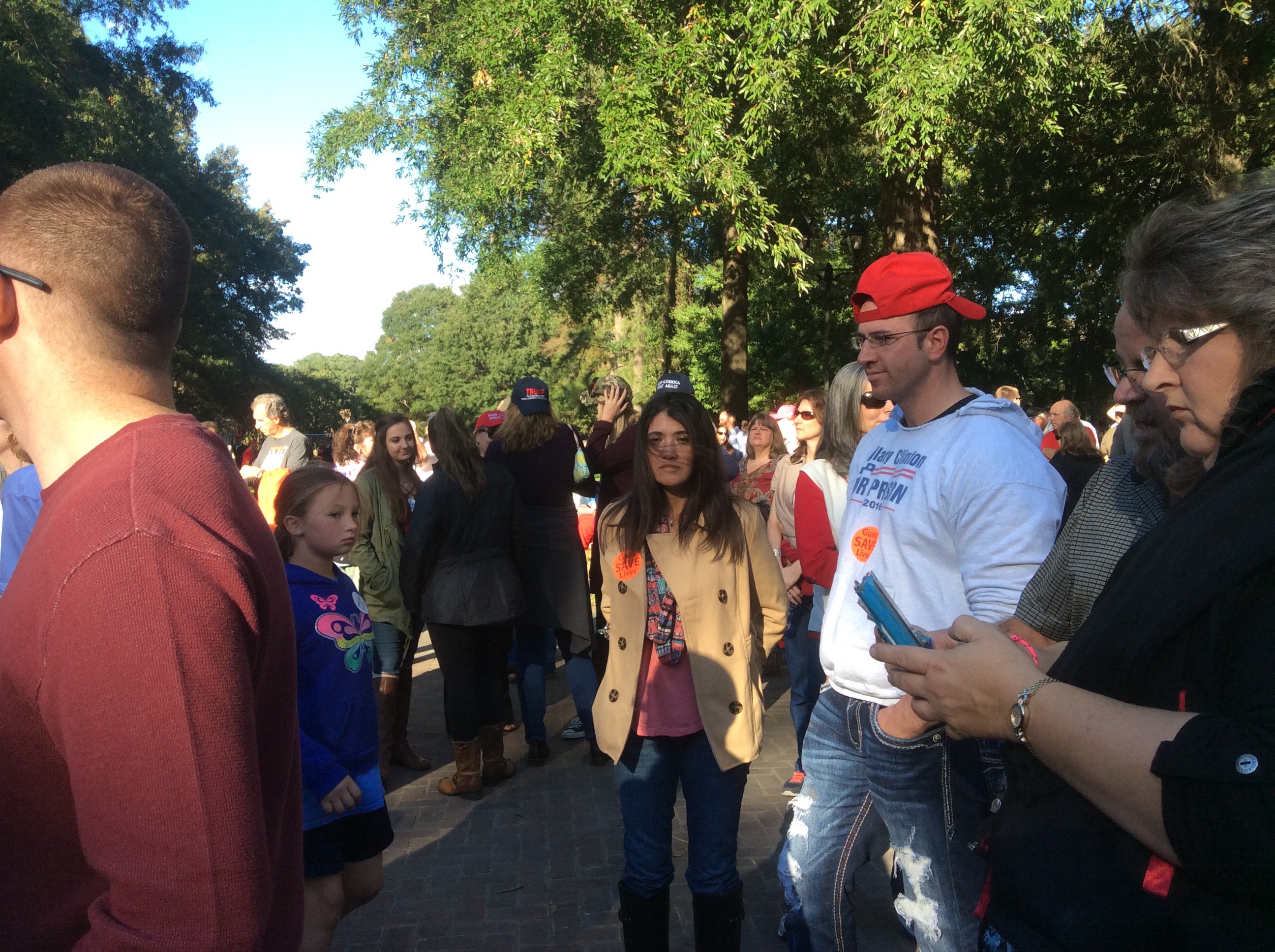

Finally at 4:18 PM to the sounds of Lee Greenwood’s God Bless the USA Trump took the stage. After his obligatory remarks praising Evangelical Christians. He then when Ito his stump speech, taking about draining the swamp in Washington, cutting taxes bigly, removing immigrants, refusing refugees, removing restrictions on churches from speaking politically without losing their tax exemption. He talked about lowering taxes while dramatically rebuilding the military and talking about peace through strength. He said that he would add 25 million jobs in ten years. In the mean time he presented a dystopian picture of the country in which he alone could fix the problems. He promised a massive military buildup that without new taxes would bankrupt the county and which would be unsustainable in the long term. It was the same picture and promise made to Germans by Hitler. 

Trump went into his usual diatribe against Hillary, crooked Hillary as he calls her, threatened her with jail. He continued with the rest of his standard stump speech and then claimed that three major national polls supposedly released today show him to be leading. As a consistent poll watcher I can say that the polls he is citing are outliers which heavily weight people over 55 years old and in which his lead was so small that it was within the poll margin of error. I expect that when the polls taken after the last debate are released that the Clinton margin will continue to expand. 


Chants of Trump! Trump! Trump! And Lock Her Up, and Build That Wall! echoed around the square as Trump repeated his charges about Mrs Clinton while praising Wikileaks and other hackers even as he accused the FBI and Department of Justice of criminal cover ups. Images of violence toward Mrs Clinton were widespread. One person strutted around with a Hillary head no top on a pole while another waved paper shooting range target with Mrs Clinton’s face in the center. 

Trunp’s speech was designed to play to his faithful and certainly not intended to convince those outside Trumpland. Most if not all of what he said has been discredited and marked by lies which have been called lies by fact checking organization. He said if he loses that we will lose the country as we know it and the crowd ate it up as facts don’t matter in Trumpland. 

He concluded by talking about defeating Crooked Hillary Clinton, and said if he won America would be One People, under One God, saluting the American Flag. He said that the rally would be something that the people at the rally would remember the rest of their lives and he warned about the Virginia race in which he is far behind Clinton, we gotta win it, this is going to be our last chance. I hate to tell you. 

After Trump left a good number of boisterous supporters in a near frenzy mugged for the reporters that they so despise, chanting Trump slogans and Make America Great Again. One lady screamed at the reporters why are you here if you’re not going to tell the truth! 

The rally was surreal and was amazing to watch. 

I didn’t see any protesters but I can only imagine what would have happened if I had not been silent or had worn a Hillary button or t-shirt. 
2 Comments

Filed under Loose thoughts and musings

Trials and Tribulations 

14448994_10154568832002059_5648134442567253903_n

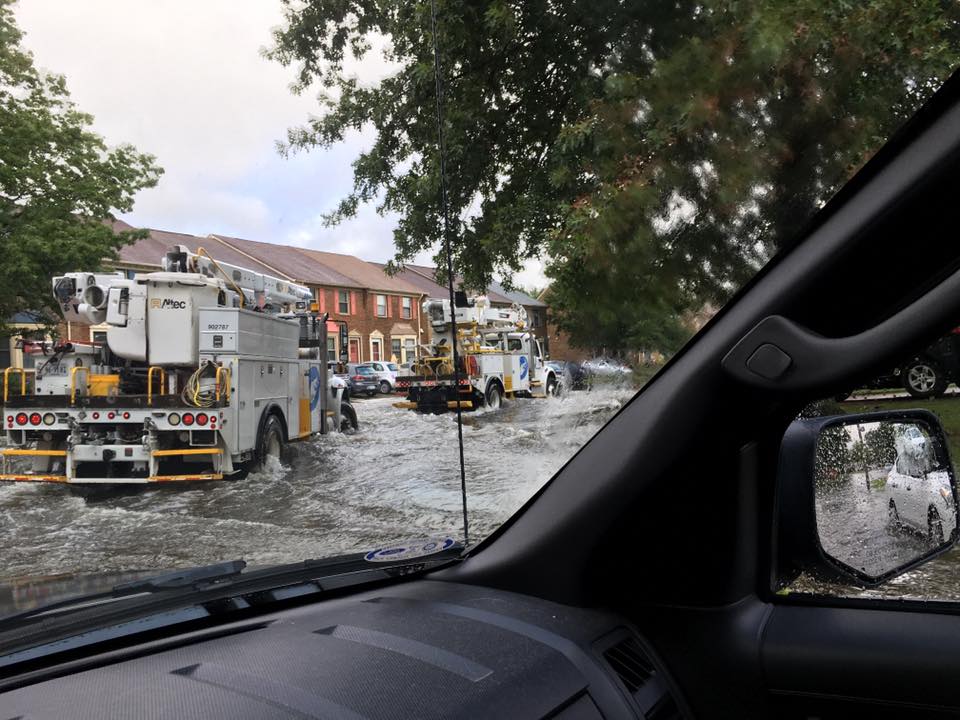
Our Neighborhood during the last Storm 

Friends of Padre Steve’s World,

It has been an exhausting day. When we came back from Germany we found that our Ford Escape was so sodden from the last storm that while we were gone that the inside of the vehicle was still soaked and the seat and carpets were growing mold. Evidently we are not alone both our insurance company and the dealership where we bought the vehicle said that since the last storm which dumped 16 inches of rain in under three days has done the same to a lot of people’s vehicles. Our insurance company sent out an adjuster who totaled the vehicle. So the rest of the day was spent taking care of insurance, picking out a new vehicle and getting the financing all through my USAA app. The miracles of modern technology still astound me. I remember the first car I bought right after we got married in 1983 and how painful the process was, first the dealer, then the bank, oh my God, dealing with the scowling loan officer at the bank. I think that she enjoyed making us sweat, but I digress….

We also went out to look at the vehicle that we are purchasing, picked up our rental car, and I picked up a bunch of tools so I can start working on leveling ground and keep water out of the house during the next big storm which right now looks like it will stay away from us but unfortunately will impact a lot of friends in Florida. Georgia, and the Carolinas. Oh the perils of home ownership… but again I digress, it really sucks to be them right now and I do pray that Hurricane Michael weakens, turns away and just leaves them alone. I have been through enough hurricanes just to want it to go away.

Anyway. I think there was a Vice Presidential debate last night but I was too busy watching my Orioles die in the bottom of the 11th against Toronto in the American League Wild Card game, but there is always next year. I just hope that the Giants beat the Mets tonight but I am already too exhausted to watch.

So anyway, have a great night and stay safe. If you are in the Southeast and in the path of Michael my thoughts and prayers are with you as many of you will probably be dealing with what I have today and worse and I wouldn’t wish that on my worst enemy.

Until tomorrow,

Peace

Padre Steve+

1 Comment

Filed under Loose thoughts and musings

At the Dock of Justice: Nuremberg at 70

img_0333

Friends of Padre Steve’s World,

On October 1st 1946, twenty-one Nazi leaders waited in the dock in Saal 6oo (Courtroom 600) at the Palace of Justice in Nuremberg to hear the pronouncement of the verdict and their sentences on the charges of war crimes.

Just a week ago during our most recent trip to Germany I stood next to that same defendant’s dock where Hermann Goering and twenty other men sat, and then rose to hear the verdicts of the Tribunal. Goering and ten compatriots, Governor General of Poland, Dr. Hans Frank, Minister of the Interior and Reich Protector of Bohemia-Moravia Dr.Wilhelm Frick, General Alfred Jodl, SS General and head Reichs Main Sucurity Office Ernst Kaltenbrunner, Field Marshal Wilhelm Keitel, Chief of the Oberkommando der Wehrmacht, Foreign Minister Joachim von Ribbentrop, Regional Leader of Thuringia, and head of Slave Labor programs, Fritz Sauckel,  Dr. Arthur Seyess-Inquart, Reichskommissar of occupied Netherlands, and Julius Streicher, Gauleiter of Franconia and publisher of the Nazi propaganda paper, Der Sturmer. Party Secretary Martin Bormann was sentenced to death in abstentia as the Allies believed that he may had escaped Berlin after Hitler’s death. It has since been discovered that he died in the attempt.

Others were sentenced to varying prison terms. Grand Admiral Karl Donitz, 10 years, Minister of Economics, Dr. Walter Funk, life in prison, Deputy Fuhrer Rudolf Hess, life in prison, Foreign Minister, Baron Konstantin von Neurath, 15 years, Grand Admiral Erich Raeder, life in prison, Head of the Hitler Youth, and Gauleiter of Vienna, Baldur von Schirach, 20 years, Armaments Minister, Albert Speer, 20 years in prison.

Three men were acquitted: Hans Fritzsche of the Propaganda Ministry, Dr. Hjalmar Schlacht pre-war head of the Reichsbank, and Economics Minister, Franz von Papen, and Vice Chancellor, Ambassador to Austria and later Turkey.

Robert Ley, head of the Reich Labor Front was not tried as he committed suicide in his cell the day following his indictment. Neither was Gustave Krupp, C.E.O. of the Krupp industrial firm and armaments manufacturer who was too sick to go to trial.

Following the trials of the major war criminals, eleven more trials were held, including the Doctor’s Trial, a General’s Trial, also known as the Hostage Trial, and the Einsatzgruppen Trial.

To stand in that room where such evidence was presented and powerful testimony given was humbling. To see where learned men, powerful, and even respected men, who had so willingly sacrificed any trace of personal honor and morality, men who aided and abetted a regime which committed the most heinous crimes committed by a civilized “Christian” nation in history left me silent. I have studied these trials since I was in college over 35 years ago. My primary professor, Dr. Helmut Haeussler was an interpreter at the trials.

Since that time I have continued to study them and today as I see the rise of Right Wing movements in Europe, as well as the United States, movements which have at their core many of the same beliefs and principles held by Hitler, the Nazi Party, and the men who stood trial at Nuremberg I find myself frightened.

This is especially so in the United States where Donald Trump has made repeated policy statements limiting civil rights and freedom of speech, limiting the role of the courts, curtailing freedom of the press, favoring one religion above others, curtailing the legal and civil rights of whole groups of people, expelling millions of people, banning whole groups of other people entry into the country, promising to rid the government of his opponents, to fire military leaders who disagree with him in mass, to commit the military to use methods that are condemned as war crimes, war crimes such as were prosecuted by the United States and her Allies at Nuremberg.

To make matters more frightening, many of Trump’s supporters see no problem with this and are often shown on video threatening opponents, advocating even more extreme and violent measures than Trump himself. They justify their proposed polices by saying that these measures are to “protect the country,” and to Make America Great Again.”

But at what price?

In Judgement at Nuremberg, the film version of the Judges’ Trial, Spencer Tracy played Judge Dan Heywood. In the scene at which the verdicts were read, he gave this speech, some of which echoed the words of Justice Robert Jackson’s final statement at the major war crimes trial:

“Janning, to be sure, is a tragic figure. We believe he loathed the evil he did. But compassion for the present torture of his soul must not beget forgetfulness of the torture and the death of millions by the Government of which he was a part. Janning’s record and his fate illuminate the most shattering truth that has emerged from this trial: If he and all of the other defendants had been degraded perverts, if all of the leaders of the Third Reich had been sadistic monsters and maniacs, then these events would have no more moral significance than an earthquake, or any other natural catastrophe.

But this trial has shown that under a national crisis, ordinary – even able and extraordinary – men can delude themselves into the commission of crimes so vast and heinous that they beggar the imagination. No one who has sat through the trial can ever forget them: men sterilized because of political belief; a mockery made of friendship and faith; the murder of children. How easily it can happen. There are those in our own country too who today speak of the “protection of country” – of ‘survival’. A decision must be made in the life of every nation at the very moment when the grasp of the enemy is at its throat. Then, it seems that the only way to survive is to use the means of the enemy, to rest survival upon what is expedient – to look the other way. Well, the answer to that is ‘survival as what’? A country isn’t a rock. It’s not an extension of one’s self. It’s what it stands for. It’s what it stands for when standing for something is the most difficult! Before the people of the world, let it now be noted that here, in our decision, this is what we stand for: justice, truth, and the value of a single human being.”

A nation is what it stands for. The ideals that have marked the American experiment have never been perfectly practiced by the United States, but they are still the hallmark of the last and greatest hope of civilization. They are the ideals which lead people around the world to want to become Americans, they are the ideals which sustain us. But what Trump and his followers say is that they are not important, and in fact should be limited or abrogated entirely. But this is the way of expediency, and the end of the American experiment.

Standing beside the dock at Nuremberg I was humbled by the fact that I was where such history had been made, and at the same time I was frightened for my country and the world.

I will be spending some time this week to write about the trials, as well as the visit to Dachau that I made on this trip.

Until tomorrow,

Peace

Padre Steve+

Leave a comment

Filed under Loose thoughts and musings

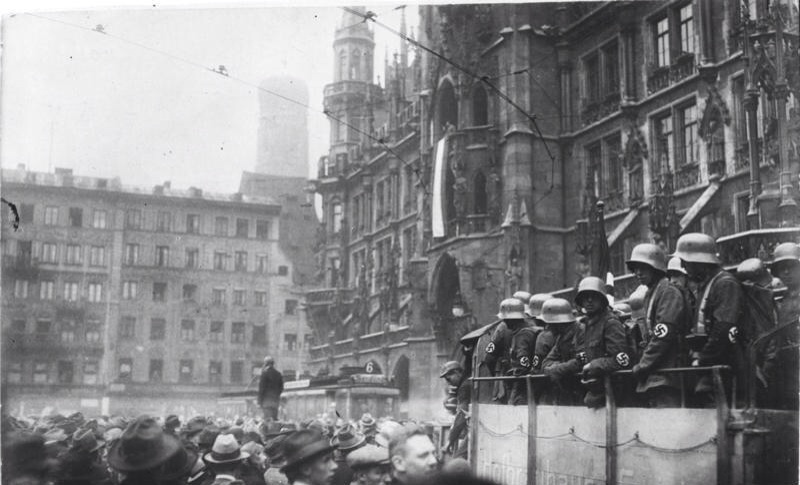
Munich, the Bier Hall Putsch and American Parallels

IMG_2051

This is another one of my pre-posted articles for while we are traveling in Munich.

I have spent a total of about four years of my life in Germany. I enjoy the country and the people and I love traveling here because for me it is relaxing. When I have a car I enjoy driving on the Autobahn, and I find the mass transportation more than effective and convenient but a great way to travel.

I am a historian who for many years specialized in the study of the latter years of the Kaiser Reich, the German revolution and civil war, the Weimar Republic and the Nazi period. I always find visiting Munich intellectually stimulating. Munich is a very interesting and sometimes contradictory city, rich in culture, music, art, literature and scientific-technological achievements. Likewise it has always been a more cosmopolitan center of a very conservative state, especially religiously conservative as Bavaria is the heart of Catholic Germany. Thus there has always been a tension in the city, between the local more religious conservatives and business leaders and the more secular and progressive inhabitants, and the immigrants from Eastern Europe, especially more traditional and conservative Orthodox Jews.

This tension continues today with the large numbers of foreigners that live and work in the city. Many are Turkish guest workers and their descendants that have been in Germany almost half a century. But many are new immigrants from the Middle East and Africa, some who have embraced German life in a secular state, but many who have not and stand out in the crowd. In particular I think of the number of Moslems who retain their traditional dress and ways, which in many ways is reminiscent of the Eastern European Orthodox Jews, who likewise stood out as they attempted to maintain their cultural and religious identity.

Hitler-Putsch, M¸nchen, Marienplatz

Munich is the capital city of Bavaria, or as it is known here, Bayern. It was ruled for centuries by the Wittelsbach dynasty, which included “Mad King Louis” who built the amazing Neuschwanstein and Linderhof castles. That dynasty, with the rest of the German royalty was overthrown at the end of the  First World War. It was replaced for about three months by what was known as the Bavarian Soviet led by Kurt Eisner, an “independent socialist.” Eisner could not hold power and resigned in February 1919 and on the way to his resignation he was assassinated by a right wing extremist who held the views of the racist Thule Society. Eisner was replaced by a Majority Socialist leader who could not form a government and then by an Independent Socialist and Communist government. This government was both inept and brutal, it took hostages from the elite of the city as well as conservative reactionaries and had them executed. This brought a response from Berlin which sent a force of 30,000 Weimar Government employed Freikorps troops, including many Bavarians from rural areas, under the command of Ritter Von Epp to crush the Munich Soviet. After hard fighting against the Communist troops Epp’s men crushed the opposition and executed hundreds of the Communists and Independent Socialist fighter and leaders.

stosstruppe

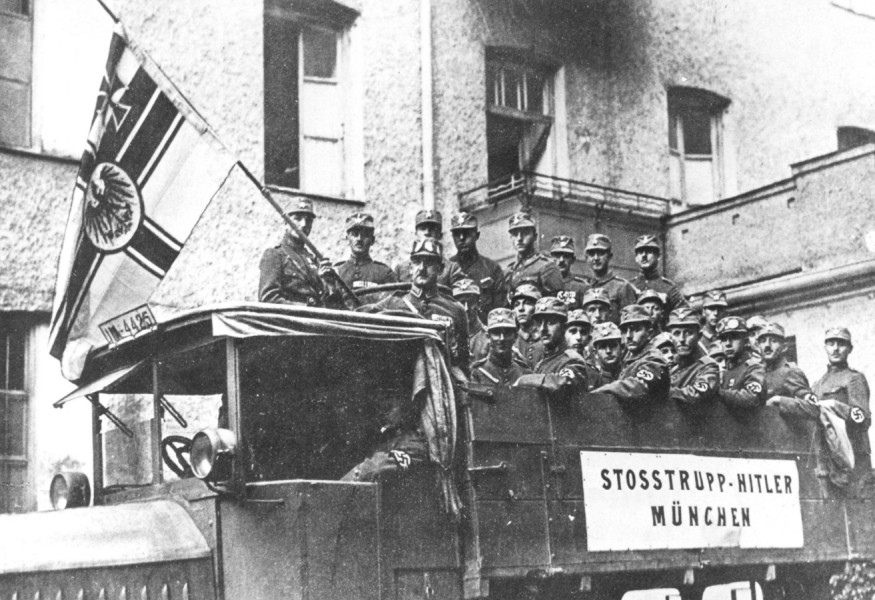
The city was still rife with revolutionary and reactionary elements and in 1919 a new political party was established. This party became the National Socialist Workers Party of Germany, or the NSDAP. Adolf Hitler joined the party and quickly became its head. He along with General Erich Ludendorff led a coup, or “putsch” against the government on the 8th and 9th of November 1923. The putsch originated at the NDSAP headquarters and Hitler led about 2000 armed members of the party to the Burgerbrau Keller beer hall where the Gustav Von Kahr, who had been appointed with dictatorial powers due to the unrest, was making a speech.

himmler-bier-hall

Hitler took Kahr and other members of the government hostage and declared a revolution and enjoined those present to “join in this grave eleventh hour for our German Fatherland.” While many present were turned by his speech, the revolt did not gain momentum and in desperation Hitler ordered a march to overthrow the government. At Odeonsplatz at the bridge over the Isar River near the Feldherrenhalle his group of nearly 2000 followers including future Nazi Leaders Hermann Goering and Rudolf Hess were confronted by about 100 Bavarian police, and defeated. Hitler was arrested and tried, spent nine months in prison during which he wrote Mein Kampf. The Burgerbraukeller and the Feldherrenhalle became Nazi shrines which after Hitler’s takeover became places where Hitler would return yearly to mark his failed putsch.

All of these events took place in a small area of the Munich city center. Sadly most people who come to Munich are aware of the events that occurred here, and many fail to realize how easily a city know for so many cultural and scientific achievements can become the locus of evil for a man like Adolf Hitler.

While I love Munich my love is tempered by how many events which still affect us today occurred here just eight to ninety years ago. To use a German expression, that amount of in the sense of history is merely an “augenblick” or “blink of an eye”. It is hard to believe that so much has happen here, and just how few people understand just how easily such events can happen again.

neo_nazis_in_north_dakota-si_

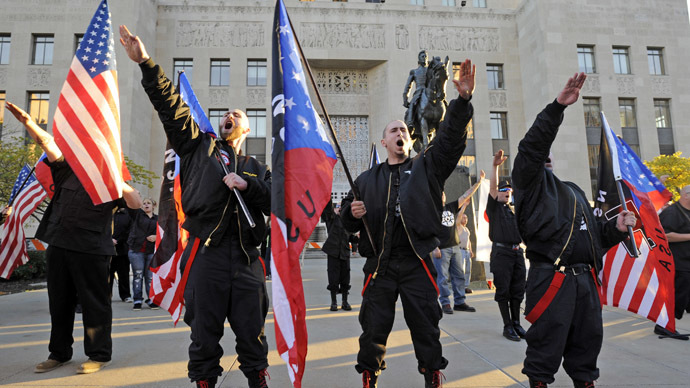
When I look at my own country I see parallels between some of the more deplorable of Donald Trump’s supporters, the White Supremacists, Neo-Nazis, Racists, and members of the so-called “Alt-Right” which is nothing more than a cover for its member’s Nazi ideology with the people that followed Hitler to the Burgerbraukeller. The hatred that they express towards liberals, racial minorities, immigrants and Moslems is so similar to the words of those precursors to the Nazi party rule in Germany that it is frightening. Comforting myths are substituted for history. Race, ideology and xenophobic nationalism, often clothed in the language of tradition “Christian” beliefs are used to demonize those who are different. Sadly too I see some of my fellow progressives inflamed with such a hatred of conservatives that they cannot see the dangers inherent in such polarization. As a historian, I find the parallels disturbing.

But despite that we are here to have fun, and that I am. After all, I choose to believe in the power of acceptance, tolerance and inclusiveness. Those are found in the words that are imprinted on the modern German Army belt buckles and in the German National anthem “eingekeit, recht  und freiheit” or “unity, Justice and freedom.” Those words are also implicit in our own Declaration of Independence which states that “all men are created equal.” Thus for me, not believe that good can overcome evil is central to who I am.

And from Munich, I am your friend,

Peace

Padre Steve

1 Comment

Filed under Loose thoughts and musings

Gemütlichkeit: The Importance of Community

oktoberfest-2015

Oktoberfest 2015

Friends of Padre Steve’s World,

This is another of my pre-posted articles for while we are away. We are halfway through our trip Munich Germany this week for the Oktoberfest and while here we are making number of other trips to historic places and exhibits. But I wanted to post something that I think is important that the Germans do but we often miss in the United States, the concept of community.

What we have always liked about our times in Germany is that it is pretty easy to talk and spend time with people, even perfect strangers. In Munich during the Fest you can do this sitting in one of the Bier Gardens of the Hofbrauhaus tent at the Theriesienwiese grounds, the Hofbrauhaus itself, other restaurants, sidewalk cafes or the hotel bar. I have to say that the ease with which you can mix with and get to know people; the ability to talk about life, culture, and even current events without someone looking for an angle to exploit is in stark contrast to so much of what we see in the States. Since I have lived in Germany for about four years as well as having been back numerous times I can say that whether you are in a big city or small town it is pretty easy to mix.

One of the interesting things is how the Germans, even those who live in big cities understand the concept of community. The Germans take life and work seriously, but unlike many, if not most of us, they know when business stops and fun, family and community begin. When people leave work they leave work, and even the business culture, in which stores are not open 24 hours or on Sundays provide Germans the opportunity to spend good amounts of time with family, their neighbors and friends as they meet for dinner or drinks at the local Gasthaus or inn on a regular basis. Likewise communities sponsor sports teams, and a wide array of other clubs that draw them together, everything from Rotary, to veterans associations, bands and choirs, hunting and shooting clubs and many more. Many of these groups sponsor events in which the entire community can partake.

The concept in all of this is that of Gemütlichkeit, a German word that basically describes a situation of where a cheerful mood, peace of mind and social acceptance are joined with the connotation of being unhurried in a cozy atmosphere. It also is understood in relationship to holidays where public festivities in the form of music, food, and drink help promote a sense of community. In this there is a sense that someone is part of something bigger than himself or herself where they are connected with being accepted by others while enriching the community.

Unfortunately for many Americans this is not the case. Unless one belongs to an organization such a various types of lodges, local sports fan clubs, or a local pub or bar where “everyone knows you name” there are precious few places one can experience this type of community. Churches like to claim that they are places of fellowship, but in my adult experience I have to say that most churches neither foster community nor are they places where one can go to be accepted. They are often the most cliquish, unfriendly, uninviting, and judgmental places around, and this is across the board. This cliquish and uninviting spirit covered in a veneer of spirituality and forced friendliness knows no denominational or theological boundaries, but I digress….

Judy and are lucky, we have a sense of community with friends who span the breadth of society; most of those who we know from the place where everyone knows our name, the Gordon Biersch Brewery Restaurant bar in Virginia Beach.

The Germans for all of their serious nature and sometimes-brusque manner of getting around do know how to draw the line between work, and play and in the process build community. Their cities and towns are designed to keep a community connection, including many parks; excellent public transportation systems, sidewalk cafes, local corner grocery stores and bakeries, as well as family run businesses that have not been destroyed by the huge box-stores like Wal-Mart. They are places that you get to know people, where life is lived, and community experienced.

Part of this is the difference in culture and how over the years our American culture has become detached from this sort of community. In many ways we have become increasing individualistic through the proliferation of suburbia, massive box-stores, and all that goes with it, including the abandonment of cities, and small poor rural communities. Even our churches, across the denominational spectrum have embraced the community destroying box-store religion of the mega-churches. The fact is we don’t know our neighbors and that leads to a culture that devalues people, destroys community, and actually brings on social problems including crime.

Without community we fall back into our basest survival instincts; we see people in regard to what they can do for us. People simply become nothing more than commodities that we discard when they are no longer useful. We adopt the modern American business model as our model for relationships; and when we do this, we devalue friendship; we become paranoid, distrustful, isolated and ultimately come to despise our neighbors.

To make matters worse our lack of real community has so poisoned our political system that I doubt we will ever come back together as Americans. I would like to see our divisions healed but I just don’t see it happening, and that to me is heartbreaking.

Anyway, speaking of this Judy and I will be seeing some of our friends and doing some sightseeing today and just enjoying that gift of friendship.

Wishing you all today that sense of Gemütlichkeit,

Peace

Padre Steve+

3 Comments

Filed under Loose thoughts and musings

The Importance of Now

munich-2015

Friends of Padre Steve’s World

Just a short thought while I am traveling in Germany. We live in very unsettled times and when that happens people are often filled with anxiety usually concerning things that they cannot control. I understand that completely, yet there is a time to live in the moment and savor friends, family, the love of a spouse, the warmth of a dog that adores you, a drink with friends, and the exploration of new places.

In our world people ask questions. As James Spader’s character in Boston Legal rightly observed:

“Some people see things as they are and ask why? Others see things as they never were and claim mad cow.” 

I am not an economist, I am a historian and I while I do understand some things about economic theory and history, and I am certainly no expert on markets. Like many I do get concerned when I see the stock markets around the world crashing, not so much for the rich people who are losing inflated stock value, for the rich almost without exception seem to do well in times of such turmoil, in fact they often do better because governments value their business expertise and depend on them to get countries out of the mess. But I worry more for the possible effects that this could have on small business owners, the middle class and the poor. I do get concerned for the middle class who have money invested in the markets through their 401k’s and retirement programs, as well as the poor who could lose their jobs if the companies that they work for tank.

There are so many variables; interest rates, oil prices, housing prices, and employment rates just to name a few. There are also the factors of what is happening in China and other big yet developing markets which can have ripple effects, or even tsunami-like affects across the globe depending how bad things get. There are so many other things going on in the world economy dealing with Greece the EU and the Euro, Russian rumblings in Eastern Europe and the Ukraine, the rise of ISIL and the potential threats to oil producing countries in the Middle East, things going on with vast refugee migrations as well as economic, political, and potential viral epidemics in African countries which frankly most Americans, Europeans and Asians until they reach our shores, and then my God there’s Donald Trump.

All of these things are so troubling on so many levels, and why shouldn’t they be. Not only are we looking at potential economic chaos, but there is climate change and its effects on endangered wildlife like the Virgin Island Screech Owl and the Fresno Kangaroo. Who knows what could be next?

So in light of this worldwide uncertainty I can recommend a number of things. Look at your investments, take a look at history because it always has lessons, or follow the immortal advice of John “Bluto” Blutarsky: “My advice to you is to start drinking heavily.”

But that being said, no matter how bad things are and how much worse they could get it is far more important to live in the moment with those that you love and care about in the now, not the future that we have so little influence over. As Danny Crane (William Shatner) told Alan Shore (James Spader) in Boston Legal:

“Let me tell you something. When you got polar ice caps melting and breaking off into big chunks and you got Osama still hiding in a cave, planning his next attack, when you got other rogue nations with nuclear arsenals, and not to mention some wack-job, home-grown that can cancel you at any second and when you got…mad cow, now gets high priority. And when you’re still on the balcony on a clear night, sipping scotch with your best friend, now is everything.”

Peace

Padre Steve+

2 Comments

Filed under Loose thoughts and musings

A Reflection on the Importance of Citizen Soldiers

Friends of Padre Steve’s World

I am pre-posting my blogs for the coming week as I will be in Germany for the Oktoberfest as well as to visit Nuremberg and the site of the War Crimes Trials, and the Concentration Camp at Dachau. This is a section of my Gettysburg text that deals with the importance of citizen soldiers.

This will be posted about the time I get to my hotel and after the trip to Dachau. If I get a chance to post something new during the week I will.

Have a great day,

Peace

Padre Steve+

“As soldier and citizen, today’s armed forces officer is a champion of both the nation’s defense and the principles upon which the nation was founded. Taking an oath to support and defend the Constitution means swearing to uphold the core values that define the essence of American citizenship; the armed forces officer is first and foremost a citizen who has embraced the ideals of the nation—only then can he or she defend those principles with true conviction.” [1]

The human dimension of war is the most important, regardless of the technological changes inherent in it. The British military theorist Colin S. Gray wrote: “Notwithstanding the vast and really untraceable complexity of the workings of war, peace, and strategy, by far the most, important among them is the human. This has always been the case. It is true today, and no grand design for the transformation of military power or no radical change predicted in the character of war can alter the eternal merit in this dictum.” [2] In this chapter we look at the tradition of the citizen soldier and military.

Carl Von Clausewitz, a veteran of the Napoleonic wars and product of Classical German Liberal thought noted in his masterpiece of military thought On War, that “Any complex activity, if it is to be carried on with any degree of virtuosity, calls for appropriate gifts calls for appropriate gifts of intellect and temperament. If they are outstanding, and reveal themselves in exceptional achievements, their possessor is called a “genius.” [3]

Within the U.S. Army the example of Joshua Chamberlain at the Battle of Little Round Top has occupied a prominent place in Army leadership manuals including FM 22-100 and its successor FM 6-22.  However, that being said even those that learn about Chamberlain from this seldom delve deeper into his character, development as a leader and significance, at Little Round Top, Appomattox and after the war. Likewise the examples of both Warren and Vincent which are key to Chamberlain and his regiment even being on the hill are ignored in that publication.

It is important to discuss Vincent and Chamberlain for more than their direct contributions to the battle. Those are widely known and in a sense have become part of the myth that is our understanding of Gettysburg. While discussing those actions it is also necessary to put them into context with the character of both men, the cause that they fought. Likewise it is important to address in this age of the professional all volunteer force the importance of Citizen Soldiers in any kind of democracy or representative republic, a sociological question that military professionals as well as our elected officials and citizenry would do well to revisit.

This is particularly important now as various elected leaders, think tanks, defense contractors and lobbyists are all questioning the economic “liabilities” of the All-Volunteer force as well as the disconnect between the broader military and society at large. This means that there will be efforts to determine how the military will be manned, trained and employed, and if military leaders are ignorant of our history, the vital connection between the military and the citizenry and the contributions of Citizen Soldiers then we will be caught flat footed and unprepared in the coming debates. If that happens those decisions could be made by “bean counters” with little appreciation for what military professionalism and readiness entails, as well as think tanks and lobbyists for the defense industry who have their own motivations for what they do, often more related to their profits, power and influence than national security.

The armies that fought the Civil War for the most part were composed of volunteers who of a myriad of reasons went off to fight that war. Gouverneur Warren is a character whose life and career before and after the Civil War was much more like currently serving regular officers and to some extent the much more professional and hardened by war officer corps of the Reserve Components of each of our Armed Services, in particular the much active and deployed Army National Guard and Army Reserve.

The reserve components still do reflect much of the citizen soldier tradition but that being said between deployments, other activations and required schooling, those assets are much more on par with their active counterparts than they ever have been in our history. The reserves now, contrary to General Creighton Abrams desire to use them “to shield the regular army from misuse by feckless policy makers” were depended on for essential support functions, which in Abrams view would “preclude Washington from waging large scale war without first making the politically difficult decision to mobilize,” [4] are an integral part of how the nation conducts war without mobilizing the people, that key element of Clausewitz’s “paradoxical Trinity.” 

“American defense policy has traditionally been built upon pluralistic military institutions, most notably a mix force of professionals and citizen soldiers.” [5] Gouverneur Warren and many like him at Gettysburg, including men like John Buford, Lewis Armistead, Winfield Scott Hancock, George Meade and Robert E. Lee represented what until the beginning of the Cold War was the smaller pillar of our pluralistic military institution; that of the long term professional. Many others at Gettysburg represent what Strong Vincent, Joshua Chamberlain, John Gordon represented the volunteer citizen soldier who enlisted to meet the crisis.

Until World War II and the advent of the Cold War these dual pillars existed side by side. Following the Second World War along with the small-wars that went along as part of it the world changed, and the wars that occurred, such as Korea and Vietnam “occurred on a scale too small to elicit a sustained, full-fledged national commitment, yet too large for a prewar-style regular army to handle.” [6] Because of this “military requirements thus became a fundamental ingredient of foreign policy, and military men and institutions acquired authority and influence far surpassing that ever previously possessed by military professionals on the American scene.” [7] General Anthony Zinni noted that the foreign policy results of this transformation have resulted in the United States becoming “an empire” [8] something that no American living in 1863 could have ever contemplated.

This was part of a revolution in military affairs far more important than the application of technology which brought it about, the Atomic Bomb; it was a revolution in national strategy which fundamentally changed American thinking regarding the use of the military instrument in relationship to diplomacy, and the relationship of the military to society at large. Russell Weigley noted: “To shift the American definition of strategy from the use of combats for the object of wars to the use of military force for the deterrence of war, albeit while still serving the national interests in an active manner, amounted to a revolution in the history of American military policy….” [9]

The policy worked reasonably well until Vietnam and the inequities of the system showed its liabilities and brought about a change from politicians. Lieutenant General Hal Moore wrote of the Vietnam era: “The class of 1965 came out of the old America, a nation that disappeared forever in the smoke that billowed off the jungle battlegrounds where we fought and bled. The country that sent us off to war was not there to welcome us home. It no longer existed.” [10]

The debacle of Vietnam and the societal tidal wave that followed brought about the end of the selective service system, by which the large army needed to fight wars was connected to the society at large and the creation of the All-Volunteer force by President Nixon in 1974. The ethos that every citizen was a soldier was destroyed by Vietnam and even men like General William Westmoreland who warned that “absent “the continuous movement of citizens in and out of the service,…the army could “become a danger to our society-a danger that our forefathers so carefully tried to preclude.” [11]

This cultural shift is something that none of the professional officers of the small ante-bellum army like Warren would have ever imagined much less men like Vincent or Chamberlain who were true citizen-soldiers. Thus for currently serving officers it is important to recognize this key change as it applies to American military strategy as well as the place the military occupies in our society.

This makes it important to our study as we examine the actions of Vincent and Chamberlain outside of myth and legend.  We must see the implications that they can have not only on the battlefield but in our relationship to the American citizenry and society. It is to put in in classic terms a return to understanding the relationship between the military and the people so powerfully enunciated in Clausewitz’s concept of war being a “paradoxical Trinity” of “primordial violence, hatred and enmity,… the element of chance and probability within which the creative spirit is free to roam; and of its element of subordination, as an instrument of policy….” [12] In Clausewitz’s understanding these are the people, the commander and his army and the government.

While Warren represents the professional officer; Strong Vincent, Joshua Chamberlain and thousands more like them, just men who served in the Civil War represented an important part of our military tradition that no longer exists in such a form. An exception to this might be in example of young men and women that volunteer to serve in the reserve components and leave after they complete their service obligation. Honestly, we no longer have a system that allows, nor do we actively encourage men like Vincent and Chamberlain to leave lucrative civilian employment or academia to serve alongside the professionals in positions of responsibility leading regiments or brigades or serving as senior staff officers unless they are already part of the military in our reserve components.

The examples of Vincent, Chamberlain and so many other citizen soldiers demonstrate the profound of this important legacy, which was for so long one of the twin pillars of our national defense. While this is still to some extent carried on by the reserve components of the United States military service, we no longer provide the opportunity for outsiders such as Vincent and Chamberlain to serve in that manner. While it is true that a great number of citizen soldiers did not perform to the level of Vincent or Chamberlain during the war, the same can be said of some of many of the Regular officers who served alongside of them and often failed miserably, examples of who can be found throughout the Battle of Gettysburg.

That being said, in the coming years military professionals will have to engage lawmakers and the bureaucracy of the Pentagon as the shape of the future military, especially the land components is debated and decided upon by politicians. Thus, it is of the utmost importance of revisiting the tradition of the citizen soldier and how it can be renewed in the coming years. In fact General Stanley McChrystal said in 2012 “I think we ought to have a draft” because a “professional military necessarily becomes “unrepresentative of the population” and “cannot properly represent the country as a whole.” [13] That will be a question for policy makers to debate and for military professionals to consider.

While warfare may have grown more complex, at its heart it remains a primordial art, where true leaders learn the trade and excel in battle or in staff work. The American naval warfare theorist Alfred Thayer Mahan, son of Dennis Hart Mahan who was so instrumental in the education of so many of the professional officers who served at Gettysburg wrote something that while directed toward naval leaders is applicable to our discussion here: “Historically, good men with poor ships are better than poor men with good ships; over and over the French Revolution taught this lesson, which in our own age, with its rage for the last new thing in material improvement, has largely dropped out of our memory.” [14]

The question that military professionals, politicians and those who determine policy must ask regarding the future military is whether we will re-enliven this tradition outside of the established reserve components and provide opportunity for men like Vincent, Chamberlain and so many others who throughout our history have demonstrated the aptitude necessary to become models of leadership and military competence without having grown up in the military system. It is a question that is certainly worth debating as we go forward in an era of military cuts and potential changes in how we man, pay and train our forces for the challenges that will most certainly arise.

Chamberlain’s words about the men that he served alongside like his commanding officer, Strong Vincent are a fitting way to close.

“It is something great and greatening to cherish an ideal; to act in the light of truth that is far-away and far above; to set aside the near advantage, the momentary pleasure; the snatching of seeming good to self; and to act for remoter ends, for higher good, and for interests other than our own.” [15]

Notes

[1] _______. The Armed forces Officer U.S. Department of Defense Publication, Washington DC. January 2006 p.2

[2] Gray, Colin S. Fighting Talk: Forty Maxims on War, Peace, and Strategy Potomac Book, Dulles VA 2009 p.93

[3] Clausewitz, Carl von. On War Indexed edition, edited and translated by Michael Howard and Peter Paret, Princeton University Press, Princeton NJ 1976 p.100

[4] Bacevich, Andrew J. Breach of Trust: How Americans Failed their Soldiers and Their Country Metropolitan Books, Henry Holt and Company, New York 2013 Amazon Kindle Edition p.105

[5] Millet, Allan R. and Maslowski, Peter, For the Common Defense: A Military History of the United States The Free Press a Division of Macmillan Inc. New York, 1984 p.xii

[6] Ibid. Bacevich, Breach of Trust: How Americans Failed their Soldiers and Their p.50

[7] Huntington, Samuel P. The Soldier and the State: The Theory and Politics of Civil-Military Relations, The Belknap Press of Harvard University Press, Cambridge MA and London 1957 p.345

[8] Zinni, Tony. The Battle for Peace: A Frontline Vision of America’s Power and Purpose Palgrave McMillian, New York 2006 p.4

[9] Weigley, Russell F. The American Way of War: A History of United States Military History and Policy University of Indiana Press, Bloomington IN, 1973 pp.367-368

[10] Moore, Harold G. and Galloway Joseph L We Were Soldiers Once…And Young Harper Perennial Books New York 1992 pp. xix-xx

[11] Ibid. Bacevich Breach of Trust p.58

[12] Ibid. Clausewitz On War p.89

[13] Ibid. Bacevich Breach of Trust p.121

[14] Mahan, Alfred T. The Influence of Sea Power upon the French Revolution and Empire 1793-1812 Little Brown and Company, Boston 1892 p.102

[15] Chamberlain, Joshua Lawrence. Chamberlain’s Address at the dedication of the Maine Monuments at Gettysburg, October 3rd 1888 retrieved from http://www.joshualawrencechamberlain.com/maineatgettysburg.php 4 June 2014

Leave a comment

Filed under Loose thoughts and musings

What’s Coming this Week: Massacres and Malevolent Meetings


Friends of Padre Steve’s World,

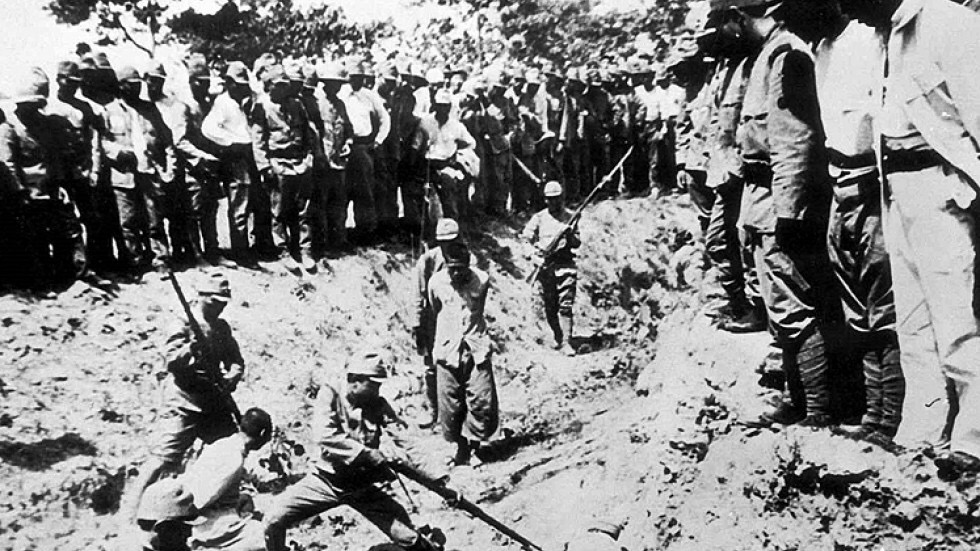
Just a few housekeeping notes today. I have been busy at work with my ethics class and doing more writing on my various Gettysburg and Civil War texts. Likewise I have been paying attention to things going on in the United States and the world. I will be writing some about the most current events, but I will also be doing some writing about the Rape of Nanking as my article on it has been attracting some attention, especially from Japanese deniers of a well documented war crime and crime against humanity. Truthfully the Japanese deniers are no better than the deniers of the Holocaust, or the defenders of slavery in the American South, or the genocide committed against Native Americans by European colonists and our own American ancestors. 

Likewise I plan on posting some of my newest material from A Great War in an Age of Revolutionary Change as well as re-posting some articles from deep within the vault. I am going to be speaking Saturday at the Morehead Pride celebration and I will post something about that over the weekend too. 


Today was the last day for my current group of students in my ethics elective at the Staff College. As always, after the teaching and student presentations are done I show the film Conspiracy which is a dramatization of the Wansee Conference which set into motion the plan for Hitler’s Final Solution against the Jews. I always find the film chilling and use it to show that even well meaning and basically moral people can come to support, even reluctantly, evil plans. As I always tell my students, the one constant in history are people, and human nature never changes. 

So anyway, until tomorrow. 

Peace,

Padre Steve+ 

Leave a comment

Filed under film, History, holocaust, Loose thoughts and musings, world war two in the pacific

Running and Writing My Way through the Dog Days of Summer 


Friends of Padre Steve’s World,

Not much to write about today, well actually there is but I needed to take a break for the night. We are in what some people refer to the Dog Days of Summer, the month of August. For a lot of people August seems to drag, the late summer heat seems to take something out of a lot of people. I’m a little bit tired today, but part of that is that I have started running again after about two years trying to play around at the gym, which did nothing for me. I have always liked running, but after I broke my leg back in 2012 foolishly tried other ways to keep in shape, and curtailed my running. Mind you the injury had nothing to do with running, so I am back hitting the pavement. Friday I ran for the first time in about a year or more, 3.2 miles at a slow 10 minute mile pace, and today 3.6 miles at the same pace. The first half of today’s run was painful, my legs felt like lead, but as I kept going it got easier and I felt good when it was all over. But that is normal for me, even when I was young, the first mile to mile and a half has always been harder than what follows. So I will continue to run. I may not get back up to half-marathon level, but I’ll throw in a 10K once in a while. 

As always I am continuing to write on my vast Civil War project, and right now I am focusing on what will be the second book, Mine Eyes Have Seen the Glory: Race, Religion, Ideology, and Politics in the Civil War Era. It is a challenging subject because there is just so much there to dig into as religion butressed racial attitudes, economic theory, domestic politics, and even foreign policy from the 1830s onward; and truthfully we haven’t completely left it behind, which makes the study of it so pertinent today. 

But anyway, I didn’t feel like writing about politics today, frankly I needed to take a break from it today, so when I got home I just watched the Olympics with our younger Papillon, Izzy snuggled against my leg as a drank a beer.

So until tomorrow, have a great night. 

Peace

Padre Steve+ 

1 Comment

Filed under Loose thoughts and musings

Gettysburg and Ghosts


Friends of Padre Steve’s World,

I am back up at Gettysburg with another class. After a night of eating, teaching, and drinking some fine craft beer, I am back in my room at the 1863 Inn of Gettysburg. 

The hotel sits at the base of East Cemetery Hill where the right wing of Harry Hay’s brigade, the Louisiana Tigers, made their attack on the night of July 2nd 1863. The attack ended in failure and the Federal Troops held their ground and drove the Louisiana troops back. 

Since the hotel opened in the 1960s there have been many reports of paranormal activity. Usually the people are awakened by what appear to be Confederate soldiers near their beds.

So when I booked the rooms for the class I asked the manager to put me in one of the rooms where such activity has been reported. Now, after my night out with our students I am ensconced in my room and hoping that tonight or tomorrow that I might encounter one of these reported spirits. If I only had the gear of the various ghost hunters it would be really cool, but I don’t, so oh well. I guess if I do see one I will be okay, so long as I don’t go throwing myself out of bed and break another bone in my face.

Until tomorrow,

Peace

Padre Steve+

Leave a comment

Filed under Gettysburg, Loose thoughts and musings