Category Archives: mental health

Things that Go Bump in the Night Terrors of PTSD

IMG_0230

Bram Stoker wrote in Hamlet these immortal words in his novel Dracula:

“How blessed are some people, whose lives have no fears, no dreads; to whom sleep is a blessing that comes nightly, and brings nothing but sweet dreams.” 

I am getting ready to go to bed, hopefully a bit early tonight and hopefully without the terror of so many nights, but I dread to sleep. I can understand why the savior of Little Round Top, General Gouverneur Warren wrote his wife after the Civil War:

“I wish I did not dream that much. They make me sometimes dread to go to sleep. Scenes from the war, are so constantly recalled, with bitter feelings I wish to never experience again. Lies, vanity, treachery, and carnage.” 

Last night was difficult, the nightmares and night terrors were quite terrifying. Thus I almost dread bedtime tonight. Since the summer my dreams and nightmares have become much more vivid and often so terrifying that I either wake up or am woken up by Judy when she sees me becoming too physically active in them. I have when up several times either screaming or hitting the floor when I fall out of bed trying to attack something in my dream which is threatening me or Judy, or when I am fleeing a threat, usually as I hit the floor or the bookcase that doubled as my nightstand. Judy has woken me up a number of times, once when it appeared that I was shooting at someone. It must be thrilling for her. Of course Minnie our youngest Papillon decided that hanging on to mommy during such times is a good idea, while my unflappable Molly, my Papillon-Dachshund mix who helped get me through many nights after coming home from Iraq now simply looks up and goes back to sleep. Evidently she is used to me now, it is good that someone in our little household is able to not be too bothered by nightmares.

Last night I in a place where Judy and I had been trapped by enemy soldiers of some kind. I was unarmed and to allow Judy to escape up a hill I shut a gate to keep the enemy soldiers from pursuing us. As I struggled to lock the gate, I turned and saw that Judy had reached safety. I turned to join her but found that I could not get up the hill, I struggled and as I did the soldiers broke through the gate and began to shoot at me, I dove to avoid their bullets and was rudely awakened by my chin hitting the edge of the previously mentioned bookcase.

I slammed into it hard, so hard that my teeth cut my upper lip, and that my chin and jaw were swollen and in pain. I got up, walked into our master bathroom where my mouth was full of blood and my chin already swollen from the impact. Because of the hour I did not want to have Judy take me to the emergency room so I rinsed out my mouth, packed it with tissue to soak up the blood and lay back down until my normal time to wake up.

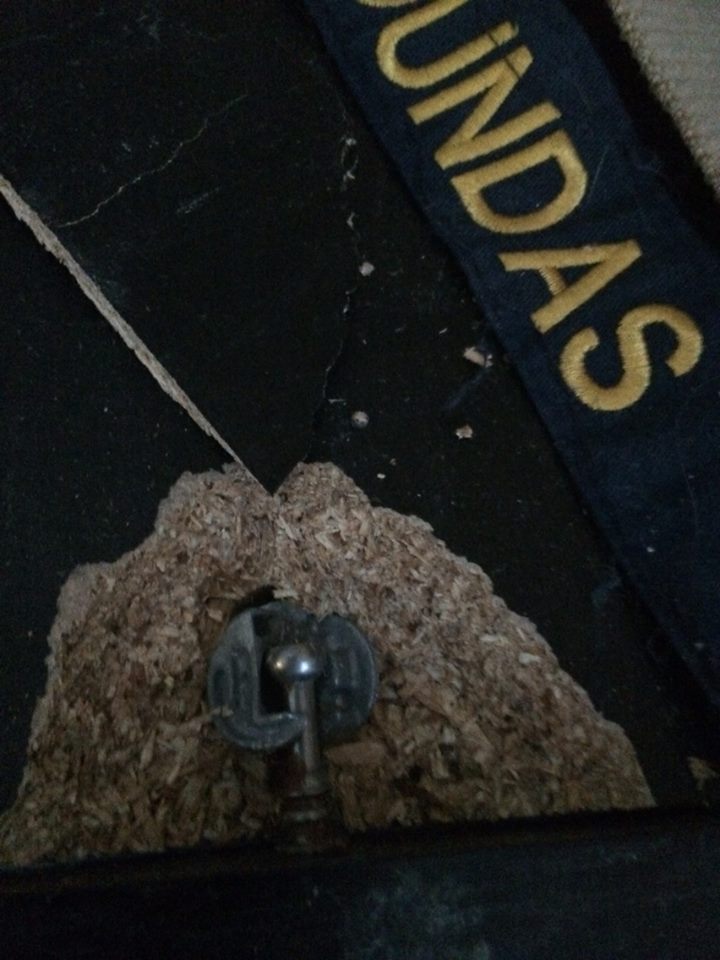
When boring came I got up, unpacked the very bloody tissue from my mouth and lips, showered and got ready for work. As I did so I noticed the damage to the bookcase, my jaw had shattered the pressed wood. I was shocked, evidently I have as hard of head as my dad accused me of as a child. I was surpassed, took a picture of he damage and went to work, where I reported what happened to my dean and went to our branch medical clinic. I spent most of the morning getting my head examined.

Though I hurt from the neck up, and was in a lot of pain nothing was broken so the doctor sent me home. The doctor said that though nothing was broken that I would be in pain for some time, and I am. He compared the impact to being in an auto accident. My neck is sore, the chin, jaw and mouth sore and I do have a pretty good headache.

When I see my new primary care doctor I will get scheduled for a sleep study.

Judy mentioned something that I didn’t think about either last night when this happened or while I was at the doctor. The fact is that had I not crushed the bookcase with my jaw I could have suffered a very severe injury, perhaps even a fractured skull.

I think that most of my current nightmares are triggered by reading about or seeing news reports about what is currently happening in Iraq where I left so much of my heart. But my dreams and nightmares are such surreal mixtures of fact, history, reality and imagination that it is sometime hard to tell where the dream ends and reality begins, or for that matter if there is much difference between the dream and reality, as Edward Allan Poe wrote:

I stand amid the roar
Of a surf-tormented shore,
And I hold within my hand
Grains of the golden sand-
How few! yet how they creep
Through my fingers to the deep,
While I weep- while I weep!
O God! can I not grasp
Them with a tighter clasp?
O God! can I not save
One from the pitiless wave?
Is all that we see or seem
But a dream within a dream?”

I make no pretense of saying that I can understand or interpret them. Last night may have been triggered by the F-18s from the USS George H.W. Bush flying in to the Naval Air Station following their return from deployment not far from where I work during the day. The noise of their jet engines took me back to Iraq.  When I was in Iraq, any time that I was going west or east and waiting on flights at Al Asad Air Base in Al Anbar, the Marine and Navy F-18s based there would keep me up all hours of the day and night as I tried to sleep in the tents that transients like me stayed. Of course those tents were only a couple hundred yards from the flight line, so sleep was rare and the noise got into my head.

I honestly do hope that my new therapist and medication manager can find the right combination of therapy and medications to manage this. It would be nice to be able to sleep without waking up in terror with dreams of war and of enemies, both real and imagined trying to kill me.

I have posted the photo of the broken bookcase here just to give you an idea of how hard I hit it with my chin. It shocked the hell out of me when I saw it. Yes that is the damaged that I caused, it is about three inches in size.

10423681_10152904072437059_4037095074761467544_n

So anyway, I am going to try to get some sleep. But as Guy Sajer, the author of the classic account of brutal combat wrote: “Only happy people have nightmares, from overeating. For those who live a nightmare reality, sleep is a black hole, lost in time, like death.” Since returning from Iraq, my nights have been nightmarish. I wish that I never had to sleep, for sleep is far worse than being awake, even awake in a combat zone. Like Gouverneur Warren, my dreams sometimes, in  fact most of the time cause me to dread going to sleep.

All that being said I do not want to lose my dreams, the good, the bad or even the terrifying. The somehow are a part of me, though I certainly would wish that they would not be so vivid that I end up physically bruised and sitting in an acute care clinic. That being said, I have to agree with Joseph Heller who wrote: “I want to keep my dreams, even bad ones, because without them, I might have nothing all night long.”

With that, I wish all of us peace and pleasant dreams, even in the midst of real life nightmares.

Padre Steve+

1 Comment

Filed under mental health, Military, PTSD, Tour in Iraq

Volunteers for Freedom: Strong Vincent and Joshua Chamberlain at Gettysburg

dont give an inch

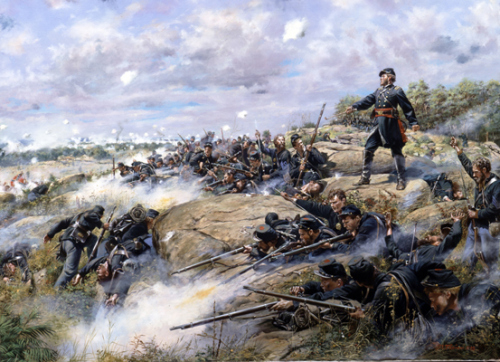
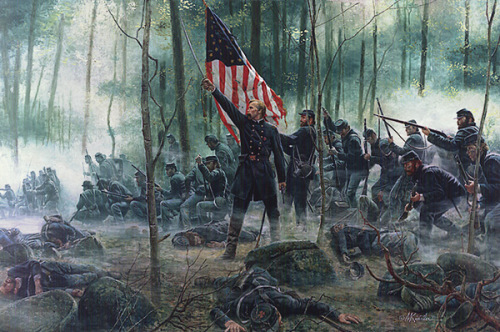
Colonel Strong Vincent directing the Defense of Little Round Top

Friends of Padre Steve’s World,

This is an excerpt from one of the chapters of my Gettysburg text. It deals with two men, volunteer “Citizen Soldiers” whose actions that day were instrumental in the Union victory at Gettysburg. But their story, despite being one of great courage and exceptional leadership is a story of tragedy and sacrifice, which in the case of Chamberlain went long after the battle. Their struggles also affected their families, leaving one wife a widow, and the other marriage one that was tumultuous and very similar to those of many combat veterans who return from war forever changed.

Peace

Padre Steve+

July 2nd 1863 was to be a pivotal day in the history of the United States, a day of valor, courage and carnage. A day where nearly 20,000 Americans were killed, wounded or missing. It was a day where the fate of the Union and the Confederacy were in the balance. On the afternoon of that day, two volunteers rose to the challenge.

Yes, there were many more heroes on Little Round Top that day, but these two men, along with Gouverneur Warren were instrumental in securing the Union victory. They were unlikely heroes, neither was a professional soldier, but both took to soldiering and leading soldiers as if it were second nature. They were men who along with others “who stepped out of themselves for a moment and turned a corner at some inexpressibly right instant.” 1

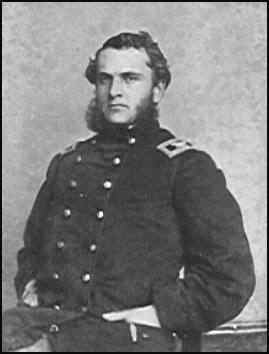
Colonel Strong Vincent was a 26 year old Harvard graduate and lawyer from Erie Pennsylvania. He was born in Waterford and attended school in Erie. Growing up he worked in his father’s iron foundry, where the work helped make him a man of great physical strength. He studied at Trinity College in Hartford Connecticut and transferred to Harvard from which he graduated in 1859. However, he was not an outstanding student and “earned admonishments on his record for missing chapel and smoking in Harvard Yard.” 2

When war came and the call went out for volunteers, Vincent enlisted in a 30 Day regiment, the Wayne Guards as a private and then was appointed as a 1st Lieutenant and Adjutant of the regiment because of his academic and administrative acumen. He married his wife Elizabeth the same day. Vincent like many young northerners believed in the cause of the Union undivided, and he wrote his wife shortly after after the regiment went to war on the Peninsula:

“Surely the right will prevail. If I live we will rejoice in our country’s success. If I fall, remember you have given your husband to the most righteous cause that ever widowed a woman.” 3

vincent


Colonel Strong Vincent

When the Wayne Guards were disbanded at the end of their enlistment, Vincent helped to raise the 83rd Pennsylvania and was commissioned as a Lieutenant Colonel in it on September 14th 1861. The young officer learned his trade well and was considered a “strict disciplinarian and master of drill.” 4 That being said one enlisted man remarked that “no officer in the army was more thoughtful and considerate of the health and comfort of his men.” 5 He assumed command of the regiment when the commander was killed during the Seven Days in June of 1862 where he learned lessons that he would help impart to his fellow officers as well as subordinates, including Chamberlain. At Fredericksburg any doubters about the young officer’s courage and leadership ability were converted where they observed his poise “with sword in hand” he “stood erect in full view of the enemy’s artillery, and though the shot fell fast on all sides, he never wavered or once changed his position.” 6

By the time of the Battle of Gettysburg, the 26 year old Vincent was the youngest brigade commander in the army. He was noted for his intelligence, leadership, military acumen and maturity. One friend wrote “As a general thing his companions were older than himself;….Among his associates were men of the highest rank. He could adapt himself to all,- could talk with the politician on questions of history, with a general officer on military evolutions, or with a sporting man on the relative merits of horses,-and all respected his opinion.” 7

His promotion was well earned, following a bout with a combination of Malaria and Typhoid, the “Chickahominy Fever” which almost killed him, Vincent took command of the regiment after its commander was killed at Gaines Mill. He commanded the regiment at Fredericksburg and was promoted to command the 3rd Brigade after the Battle of Chancellorsville following the resignation of its commander, Colonel T.W.B. Stockton on May 18th 1863.

Vincent was offered the chance to serve as the Judge Advocate General of the Army of the Potomac by Joseph Hooker in the spring of 1863 after spending three months on court-martial duty. But Vincent refused the offer in so that he might remain in the fight commanding troops. 8  He told his friends “I enlisted to fight.” 9

Vincent, like Chamberlain who admired him greatly had “become a kind of model of the citizen soldier.” 10 As a result of his experience in battle and the tenacity of the Confederate army he became an advocate of the tactics that William Tecumseh Sherman would later employ during his march to the sea in 1864. He wrote his wife before Chancellorsville:

“We must fight them more vindictively, or we shall be foiled at every step.  We must desolate the country as we pass through it, and not leave a trace of a doubtful friend or foe behind us; make them believe that we are in earnest, terribly in earnest; that to break this band in twain is monstrous and impossible; that the life of every man, yea, of every weak woman or child in the entire South, is of no value whatever compared with the integrity of the Union.” 11

Unlike most other brigade commanders, Vincent was still a Colonel, and he, like many others would in his place hoping for a General’s star. He remarked that his move to save Sickles’ command “will either bring me my stars, or finish my career as a soldier.” 12 On July first, Vincent, a native Pennsylvanian came to Hanover and learning that battle had been joined, ordered “the pipes and drums of the 83rd Pennsylvania to play his brigade through the town and ordered the regiments to uncover their flags again….” 13 As the brigade marched through the town Vincent “reverently bared his head” and announced to his adjutant, “What death more glorious can any man desire than to die on the soil of old Pennsylvania fighting for that flag?” 14

Vincent was known for his personal courage and a soldier of the 83rd Pennsylvania observed “Vincent had a particular penchant for being in the lead….Whenever or wherever his brigade might be in a position to get ahead…, he was sure to be ahead.” 15 That courage and acumen to be in the right place at the right time was in evidence when he led his brigade into battle on July second.

On July 2nd Barnes’ division of V Corps, which Vincent’s brigade was a part was being deployed to the threat posed by the Confederate attack of McLaws’ division on the Peach Orchard and the Wheat Field to reinforce Sickles’ III Corps. While that division marched toward the Peach Orchard, Vincent’s 3rd Brigade was the trail unit. When Gouverneur Warren’s aide, Lieutenant Randall Mackenzie 16 came toward the unit in search of Barnes he came across Vincent and his brigade near the George Weikert house on Cemetery Ridge awaiting further orders. 17

Vincent intercepted him and demanded what his orders were. Upon being told that Sykes’ orders to Barnes were to “send one of his brigades to occupy that hill yonder,” 18 Vincent, defied normal protocol assuming that Barnes was drunk 19 and told Mackenzie “I will take responsibility of taking my brigade there.” 20 Vincent immediately went into action and ordered Colonel James Rice of the 44th New York “to bring the brigade to the hill as quickly as possible,” and then turned on his horse and galloped off toward Little Round Top.” 21

It was a fortunate thing for the Union that he did. His quick action to get his brigade, clear orders to his subordinate commanders and skilled analysis of the ground were a decisive factor in the Union forces holding Little Round Top. After ordering Colonel Rice to lead the brigade up to the hill, he and his aide went forward to scout positions accompanied by the brigade standards. Rice brought the brigade forward at the double quick “across the field to the road leading up the north shoulder of the hill” with Chamberlain’s 20th Maine in the lead. 22

Vincent and his orderly made a reconnaissance of the south and east slope of the hill which adjoined a small valley and a rocky outcrop called Devil’s Den, which was occupied by the 124th New York and which was the end of Sickles’ line. Near the summit of the southern aspect of the hill, they came under Confederate artillery fire and told his aid “They are firing at the flag, go behind the rocks with it.” 23

Vincent dismounted, leaving is sword secured on his horse, carrying only his riding crop. He continued and “with the skill and precision of a professional had reconnoitered and decided how to best place his slim brigade of 1350 muskets.” 24 He chose a position along a spur of the hill, which now bears his name, running from the northwest to the southeast to place his regiments where they could intercept the Confederate troops of Hood’s division which he could see advancing toward the hill.

What Vincent saw when he arrived was a scene of disaster. Confederate troops had overwhelmed the 124th New York and were moving on Little Round Top, “Devil’s Den was a smoking crater,” and the ravine which separated Devil’s Den from Little Round Top “was a whirling maelstrom.” 25 Seeing the threat Vincent began to deploy his brigade but also sent at messenger back to Barnes telling him “Go tell General Barnes to send reinforcements at once, the enemy are coming against us with an overwhelming force” 26

The 16th Michigan, the smallest regiment with barely 150 soldiers in line 27 was placed on the right of the brigade. As it moved forward, its adjutant, Rufus W. Jacklin’s horse was hit by a canon ball which decapitated that unfortunate animal and left it “a mass of quivering flesh.” 28 The Confederate artillery fell among the advancing Union troops and splintered trees, causing some concern among the soldiers. The 20th Maine’s Chaplain, Luther French, saw the “beheading of Jacklin’s horse and and ran to Captain Atherton W. Clark, commanding the 20th’s Company E, babbling about what he had seen. Clark interrupted French abruptly and shouted: “For Christ sake Chaplain, if you have any business attend to it.” 29

That section of the line was located on massive boulders that placed it high above the valley below, making it nearly impregnable to frontal attack. On the summit Vincent deployed the 83rd Pennsylvania and 44th New York to their left at the request of Rice who told him “In every battle that we have engaged the Eighty-third and Forty-fourth have fought side by side. I wish that it might be so today.” 30 The story is probably apocryphal but the regiments remained side by side with the 16th Michigan on the right and the 20th Maine on the left. The two  regiments  were deployed below the crest among the large number of boulders; the 83rd was about two-thirds of the way down the way down the slope where it joined the right of the 44th, whose line angled back up the slope to the southeast. A historian of the 83rd Pennsylvania noted that “Each rock”… “was a fortress behind which the soldier[s] instantly took shelter.” 31 The soldiers were determined to do their duty as they now were fighting on home ground.

Vincent deployed the 20th Maine on his extreme left of his line, and in fact the extreme end of the Union line. Vincent knew that if this flank was turned and Chamberlain overrun that it would imperil the entire Union position. Vincent came up to Chamberlain who remembered that Vincent said “in an awed, faraway voice. “I place you here….This is the left of the Union line. You understand. You are to hold this ground at all costs.” 32 Chamberlain acknowledged his understanding of the order and since the regiment lacked field grade officers, Chamberlain “assigned Captain Atherton Clark of company E to command the right wing, and acting Major Ellis Spear the left.” 33

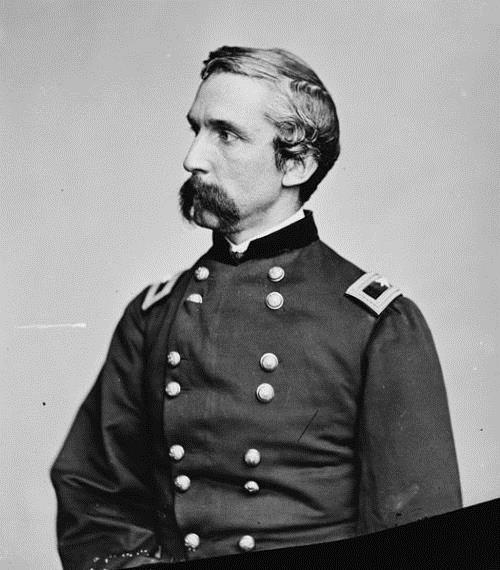
While Colonel Joshua Chamberlain’s story is much more well known than his brigade commander, Strong Vincent, he was another one of the citizen soldiers whose performance and leadership on Little Round Top saved the Union line that hot July evening. Chamberlain was a graduate of Bowdoin College and Bangor Theological Seminary. Fluent in nine languages other than English he remained at Bowdoin as Professor of Rhetoric before seeking an appointment in a newly raised Maine Regiment without consulting either the college or his wife Fannie. He actually deceived the college by requesting a “scholarly sabbatical when in fact he had applied to the governor of Maine in the new 20th Maine Infantry in the late summer of 1862.” 34

The letter that Chamberlain wrote to Governor Israel Washburn details Chamberlain’s desire to serve:

“For seven years past I have been Professor in Bowdoin College. I have always been interested in military matters, and what I do not know in that line I know how to learn.

Having been lately elected to a new department here, I am expecting to have leave, at the approaching Commencement, to spend a year or more in Europe, in the service of the College. I am entirely unwilling, however, to accept this offer, if my Country needs my service or example here.

Your Excellency presides over the Educational as well as the military affairs of our State, and, I am well aware, appreciates the importance of sustaining our Institutions of Learning. You will therefore be able to decide where my influence is most needed.

But, I fear, this war, so costly of blood and treasure, will not cease until the men of the North are willing to leave good positions, and sacrifice the dearest personal interests, to rescue our Country from Desolation, and defend the National Existence against treachery at home and jeopardy abroad. This war must be ended, with a swift and strong hand; and every man ought to come forward and ask to be placed at his proper post.

Nearly a hundred of those who have been my pupils, are now officers in our army; but there are many more all over our State, who, I believe, would respond with enthusiasm, if summoned by me, and who would bring forward men enough to fill up a Regiment at once. I can not free myself from my obligations here until the first week in August, but I do not want to be the last in the field, if it can possibly be helped.” 35

Chamberlain’s pre-war experiences gave no indication that he would emerge as a military hero. His father had named him after Captain James Lawrence, the commanding officer of the frigate  USS Chesapeake in the War of 1812 who uttered the famous words “Don’t give up the ship” as he lay mortally wounded. His mother added the name Joshua as his first name in the town’s books. His father hoped that the young Chamberlain who pursue a military career, his mother wished that he pursue the ministry. He did become a minister but had no desire to become a pastor, and instead took up his academic career at Bowdoin and his tumultuous marriage to his wife Fannie, a musician and the child of a minister. “During most of his life, Chamberlain struggled with bouts of deep depression and melancholy. But not during the war years. It was as if the war and soldiering had made a new man out of him.” 36

Chamberlain was offered command of the 20th Maine but asked the governor that be appointed as a Lieutenant Colonel, which he was in August 1862. He fought with the regiment at Fredericksburg and was named commander of the when Colonel Adelbert Ames, his commander was promoted to brigade command in Oliver Howard’s XI Corps following the debacle at Chancellorsville.

chamberlain


Colonel Joshua Lawrence Chamberlain (while serving as a Brigadier General)

Like Vincent, Chamberlain was also a quick student and rapidly adapted to being a soldier, officer and commander of troops in combat. On the march up to Gettysburg Chamberlain was ordered to take a number of veterans of the 2nd Maine, who had signed three year, rather than two year enlistment contracts and were angry at remaining in the army when the regiment was mustered out. The soldiers were bitter but Chamberlain treated them graciously and “almost all of them agreed to take up their muskets again the the service of the 20th Maine.” 37

On receiving his orders Chamberlain deployed his small regiment halfway down the southern slope facing the small valley between Little Round Top and Big Round Top. By the time he arrived at Gettysburg had become “a great infantry officer, and among his valuable qualities was where an attack would come….” 38

chamberlain lrt

Since Chamberlain’s account is so important I will forgo a discussion of his tactics and instead quote the sections of his after action report that explains his actions. Chamberlain wrote:

“On reaching the field at about 4 p.m. July 2d, Col. Vincent commanding the Brigade, placing me on the left of the Brigade and consequently on the extreme left of our entire line of battle, instructed me that the enemy were expected shortly to make a desperate attempt to turn our left flank, and that the position assigned to me must be held at every hazard.

I established my line on the crest of a small spur of a rocky and wooded hill, and sent out at once a company of skirmishers on my left to guard against surprise on that unprotected flank.

These dispositions were scarcely made when the attack commenced, and the right of the Regt. found itself at once hotly engaged. Almost at the same moment, from a high rock which gave me a full view of the enemy, I perceived a heavy force in rear of their principal line, moving rapidly but stealthily toward our left, with the intention, as I judged, of gaining our rear unperceived. Without betraying our peril to any but one or two officers, I had the right wing move by the left flank, taking intervals of a pace or two, according to the shelter afforded by rocks or trees, extending so as to cover the whole front then engaged; and at the same time moved the left wing to the left and rear, making a large angle at the color, which was now brought to the front where our left had first rested.

This hazardous maneuvre was so admirably executed by my men that our fire was not materially slackened in front, and the enemy gained no advantage there, while the left wing in the meantime had formed a solid and steady line in a direction to meet the expected assault. We were not a moment too soon; for the enemy having gained their desired point of attack came to a front, and rushed forward with an impetuosity which showed their sanguine expectations.

Their astonishment however was evident, when emerging from their cover, they met instead of an unsuspecting flank, a firm and ready front. A strong fire opened at once from both sides, and with great effect, the enemy still advancing until they came within ten pacesof our line, where our steady and telling volleys brought them to a stand. From that moment began a struggle fierce and bloody beyond any that I have witnessed, and which lasted in all its fury, a full hour. The two lines met, and broke and mingled in the shock. At times I saw around me more of the enemy than of my own men. The edge of conflict swayed to and fro -now one and now the other party holding the contested ground. Three times our line was forced back, but only to rally and repulse the enemy. As often as the enemy’s line was broken and routed, a new line was unmasked, which advanced with fresh vigor. Our “sixty rounds” were rapidly reduced; I sent several messengers to the rear for ammunition, and also for reinforcements. In the mean time we seized the opportunity of a momentary lull to gather ammunition and more serviceable arms, from the dead and dying on the field. With these we met the enemy’s last and fiercest assault. Their own rifles and their own bullets were turned against them. In the midst of this struggle, our ammunition utterly failed. The enemy were close upon us with a fresh line, pouring on us a terrible fire. Half the left wing already lay on the field. Although I had brought two companies from the right to its support, it was now scarcely more than a skirmish line. The heroic energy of my officers could avail no more. Our gallant line withered and shrunk before the fire it could not repel. It was too evident that we could maintain the defensive no longer. As a last desperate resort, I ordered a charge. The word “fix bayonets” flew from man to man. The click of the steel seemed to give new zeal to all. The men dashed forward with a shout. The two wings came into one line again, and extending to the left, and at the same time wheeling to the right, the whole Regiment described nearly a half circle, the left passing over the space of half a mile, while the right kept within the support of the 83d Penna. thus leaving no chance of escape to the enemy except to climb the steep side of the mountain or to pass by the whole front of the 83d Penna. The enemy’s first line scarcely tried to run-they stood amazed, threw down their loaded arms and surrendered in whole companies. Those in their rear had more time and gave us more trouble. My skirmishing company threw itself upon the enemy’s flank behind a stone wall, and their effective fire added to the enemy’s confusion. In this charge we captured three hundred and sixty eight prisoners, many of them officers, and took three hundred stand of arms. The prisoners were from four different regiments, and admitted that they had attacked with a Brigade.” 39

Colonel William Oates of the 15th Alabama gave Chamberlain and his regiment the credit for stopping his attack. Oates wrote: “There have never been harder fighters than the Twentieth Maine and their gallant Colonel. His skill and persistency and the great bravery of his men saved Little Round Top and the Army of the Potomac from defeat.” 40

As with any firsthand account, aspects of Chamberlain’s accounts are contested by others at the scene. Oates notes that he ordered the retreat and that there were not as many prisoners taken, one of Chamberlain’s company commanders disputes the account of the order of the bayonet charge however the fact is that Chamberlain who was outnumbered nearly two to one by the, 4th 15th and 47th Alabama regiments “offset this superiority with strength of position, iron determination and better tactics.” 41 Also a factor was the fatigue of the Confederates, these regiments and their parent unit, Law’s brigade of Hood’s division had conducted a grueling 28 mile march to get to the battlefield and were exhausted and dehydrated by the time that they arrived, something that their commander, Colonel Oates believed “contributed largely to our failure at Little Round Top.” 42

Vincent was mortally wounded while leading the defense of the hill. As the men of Robertson’s Texas brigade rushed the hill and threatened to crack “the stout 16th Michigan defense….” 43 Vincent rushed to bolster the defenders. He was standing on a large boulder with a riding crop as the men of the 16th Michigan were beginning to waiver. Fully exposed to enemy fire he attempted to drive the retreating men back into the fight. Brandishing the riding which he cried out “Don’t yield an inch now men or all is lost,” 44 and moments later was struck by a “minie ball which passed through his left groin and lodged in his left thigh. He fell to the ground and as he was being carried from the field, “This is the fourth or fifth time they have shot at me…and they have hit me at last.” 45 He was taken to a field hospital where he suffered for five days and died on July 7th. Meade recommended Vincent for posthumous promotion to Brigadier General, but the request was lost. Ten weeks after his death his wife gave birth to a baby girl. The baby would not live a year and was buried next to him.

Colonel Rice who led the 44th New York up the hill and took command of the brigade on Vincent’s death memorialized his fallen commander in his general order to the brigade on July 12th:

“The colonel commanding hereby announces to the brigade the death of Brig. Gen. Strong Vincent. He died near Gettysburg, Pa., July 7, 1863, from the effects of a wound received on the 2d instant, and within sight of that field which his bravery had so greatly assisted to win. A day hallowed with all the glory of success is thus sombered by the sorrow of our loss. Wreaths of victory give way to chaplets of mourning, hearts exultant to feelings of grief. A soldier, a scholar, a friend, has fallen. For his country, struggling for its life, he willingly gave his own. Grateful for his services, the State which proudly claims him as her own will give him an honored grave and a costly monument, but he ever will remain buried in our hearts, and our love for his memory will outlast the stone which shall bear the inscription of his bravery, his virtues, and his patriotism.

While we deplore his death, and remember with sorrow our loss, let us emulate the example of his fidelity and patriotism, feeling that e lives but in vain who lives not for his God and his country.

After the battle, as the army looked to replace the casualties in the ranks of senior leadership and “when Colonel Rice, in charge of 3rd Brigade after Vincent fell, was promoted to brigadier general and given another command” the new division commander Major General Charles Griffin, “insisted on having Chamberlain, for the 3rd Brigade.” 46 Chamberlain survived the war to great acclaim being wounded three times, being promoted to Major General and awarded the Medal of Honor. He received the surrender of the Army of Northern Virginia at Appomattox on April 9th 1865 and ordered his men to present arms in honor of their defeated foe as those haggard soldiers passed his division. After the war like most citizen soldiers, he returned to civilian life, serving as a four term Governor of Maine and President of Bowdoin College. He became a champion of national reconciliation admired by friend and former foe alike.

Chamberlain’s accolades were certainly earned but others on that hill have been all too often overlooked by most people. This list includes Gouverneur Warren who was humiliated by Phillip Sheridan at Five Forks, Strong Vincent who died on the Hill and Paddy O’Rorke, the commander of the 140th New York of Weed’s Brigade on Vincent’s right who was mortally wounded that day. Despite this, after the end war, Joshua Chamberlain, the hero of Little Round Top who was well acquainted with the carnage of war suffered immensely. His wounds never fully healed and he was forced to wear what would be considered an early form of a catheter and bag. Chamberlain struggled to climb out of “an emotional abyss” in the years after the war. Part was caused by his wounds which included wounds to his sexual organs, shattering his sexuality and caused his marriage to deteriorate.

fannychamberlain1


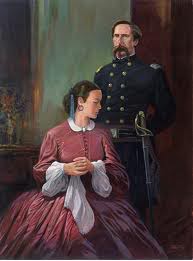
Joshua and Fannie Chamberlain (Dale Gallon Painting) 

He wrote to Fannie in 1867 about the “widening gulf between them, one created at least in part by his physical limitations: “There is not much left in me to love. I feel that all too well.” 47 Chamberlain’s inability to readjust to civilian life following the war and Fanny’s inability to understand what he had gone through during it, caused great troubles in their marriage. By 1868 the issues were so deep that Fannie was accusing Joshua of domestic abuse a charge which he contested even offering her a divorce which were very similar to what many combat veterans and their families experience today. After he received news of the allegations Chamberlain wrote to her:

“If it is true (as Mr. Johnson seems to think there is a chance of its being) that you are preparing for an action against me, you need not give yourself all this trouble. I should think we had skill enough to adjust the terms of a separation without the wretchedness to all our family which these low people to whom it would seem that you confide your grievances + plans will certainly bring about.

You never take my advice, I am aware.

But if you do not stop this at once it will end in hell.” 48

The marriage endured a separation which lasted until 1871 when they reconciled, and it did survive, for nearly forty more years. Fannie died in 1905 and Chamberlain , who despite all of their conflicts loved her, wrote after her death:

“You in my soul I see, faithful watcher, by my cot-side long days and nights together, through the delirium of mortal anguish – steadfast, calm, and sweet as eternal love. We pass now quickly from each other’s sight, but I know full well that where beyond these passing scenes you shall be, there will be heaven!”

Chamberlain died on February 24th 1914 of complications from complications of the ghastly wound that he received at Petersburg in 1864. Sadly, their marriage is typical of many relationships where a spouse returns home from war, something that we need to remember when we encounter those changed by war and the struggles of their families.

Notes

1 Guelzo, Allen C. Gettysburg: The Last Invasion Vintage Books a Division of Random House, New York 2013 p.462

2 LaFantasie, Glenn W. Twilight at Little Round Top: July 2, 1863 The Tide Turns at Gettysburg Vintage Books, a Division of Random House, New York 2005 p.105

3 ________. Erie County Historical Society http://www.eriecountyhistory.org/wp-content/uploads/2008/10/strongvincent.pdf retrieved 9 June 2014

4 Golay, Michael. To Gettysburg and Beyond: The Parallel Lives of Joshua Lawrence Chamberlain and Edward Porter Alexander Crown Publishers Inc. New York 1994 p.129

5 Nevins, James H. and Styple, William B. What death More Glorious: A Biography of General Strong Vincent Belle Grove Publishing Company, Kearney NJ 1997 p.29

6 Ibid Guelzo, Gettysburg: The Last Invasion p.262

7 Ibid. Nevins, James H. and Styple, William B. What death More Glorious p.548 Leonardi, Ron Strong Vincent at Gettysburg Barringer-Erie Times News retrieved June 9th 2014 from http://history.goerie.com/2013/06/30/strong-vincent-at-gettysburg/

9 Ibid. Nevins, James H. and Styple, William B. What death More Glorious p.55

10 Wallace, Willard. The Soul of the Lion: A Biography of Joshua L. Chamberlain Stan Clark Military Books, Gettysburg PA 1960 p.91

11 Ibid. Nevins, James H. and Styple, William B. What death More Glorious p.57

12 Ibid. Guelzo, Gettysburg: The Last Invasion p.264

13 Pfanz, Harry F. Gettysburg: The Second Day. University of North Carolina Press, Chapel Hill 1987 p.51

14 Ibid. Guelzo Gettysburg: The Last Invasion Vintage p.159

15 Tredeau, Noah Andre. Gettysburg: A Testing of Courage, Harper Collins Publishers, New York 2002 p.305

16 Some such as Guelzo believe this may have been Captain William Jay of Sykes staff.

17 Ibid. Tredeau, Gettysburg: A Testing of Courage p.327

18 Ibid. Guelzo Gettysburg: The Last Invasion Vintage p.262 19 Ibid. Guelzo Gettysburg: The Last Invasion Vintage p.262

20 Ibid. Tredeau, Gettysburg: A Testing of Courage p.32721 Ibid. LeFantasie Twilight at Little Round Top p.108

22 Coddington, Edwin B. The Gettysburg Campaign: A Study in Command, A Touchstone Book, Simon and Schuster New York, 1968 p.389

23 Ibid. LaFantasie Twilight at Little Round Top p.109

24 Ibid. Coddington The Gettysburg Campaign p.390

25 Ibid. Guelzo Gettysburg: The Last Invasion Vintage p.270

26 Ibid. Nevins, James H. and Styple, William B. What death More Glorious p.75

27 Sears, Stephen W. Gettysburg. Houghton Mifflin Co. Boston and New York 2003 p.292

28 Ibid. LaFantasie Twilight at Little Round Top p.109

29 Ibid. LaFantasie Twilight at Little Round Top p.109

30 Ibid. Pfanz, Gettysburg: The Second Day. p.213

31 Ibid. LaFantasie Twilight at Little Round Top p.111

32 Ibid. Golay To Gettysburg and Beyond p.157

33 Ibid. LaFantasie Twilight at Little Round Top p.111

34 Ibid. LaFantasie Twilight at Little Round Top pp.44-45

35 Chamberlain, Joshua Lawrence Letter From Joshua L. Chamberlain to Governor [Israel] Washburn, Brunswick, July 14, 1862 retrieved from Bowdoin College, Joshua Lawrence Chamberlain Documents http://learn.bowdoin.edu/joshua-lawrence-chamberlain/documents/1862-07-14.html 8 November 2014

36 Ibid. LaFantasie Twilight at Little Round Top p.45

37 Ibid. LaFantasie Twilight at Little Round Top p.45

38 Ibid. Wallace The Soul of the Lion p.94

39 Chamberlain, Joshua Lawrence. Official Narrative of Joshua Chamberlain of July 6th 1863, Maine Military Historical Society, Inc., Augusta, Maine, copyright 1989 U.S. Army Combat Studies Institute Reprint, retrieved from http://usacac.army.mil/cac2/cgsc/carl/download/csipubs/chamberlain.pdf June 15th 2014

40 Oates, Willam C. and Haskell, Frank A. Gettysburg Bantam Books edition, New York 1992, originally published in 1905 p.98

41 Ibid. Coddington The Gettysburg Campaign: A Study in Command p.393

42 Ibid. Oates and Haskell Gettysburg p.87

43 Ibid. Wallace The Soul of the Lion p.95

44 Ibid. Guelzo Gettysburg: The Last Invasion Vintage p.272

45 Ibid. Tredeau, Gettysburg: A Testing of Courage p.361

46 Ibid. Wallace The Soul of the Lion p.115

47 Longacre, Edward Joshua Chamberlain: The Soldier and the Man Combined Publishing Conshohocken PA 1999 p.259

48 Chamberlain, Joshua L. Letter Joshua L. Chamberlain to “Dear Fanny” [Fanny Chamberlain], Augusta, November 20, 1868 retrieved from Bowdoin College, Joshua Lawrence Chamberlain Documents http://learn.bowdoin.edu/joshua-lawrence-chamberlain/documents/1868-11-20.html 8 November 2014


2 Comments

Filed under civil war, History, leadership, Loose thoughts and musings, marriage and relationships, mental health, Military

Is it Really God or do I Make You Uncomfortable? PTSD, Mental Illness and Christians

IMG_1915

Christians can be among the most clueless people regarding how their language and theological prejudices negatively impact others and harm their own witness regarding their professed devotion and love of Jesus the Christ. Sadly much of what they spout is neither scriptural or has any roots in reason or church tradition. Instead it is a product of their own prejudice and uncomfortableness with those who express doubt that they have learned from very popular, yet extremely ignorant and often hateful political ideologues who masquerade as preachers in mega-churches, on television, radio or the internet.

There are many Christians, particularly conservative Evangelicals and Charismatics who are fine people, men and women of integrity who I can honestly say love God and try serve God and also to care for his people. That being said many of these same people in their attempts to help others; especially those dealing with PTSD, depression, anxiety, suicidal thoughts, substance abuse and faith crisis’s do more far damage and harm than good. This is because they are unaware of their prejudices that they learn in church and how wrong their preachers are about such subjects, but still presume that what they have learned trumps other people’s experience. Yes this is a generalization, but there is much truth in it.

Those who read this site regularly and know something about me know that I am a Navy Chaplain, a Priest in an Old Catholic denomination and have been in the military over 30 years including a tour in Iraq and one at sea for Operation Enduring Freedom. You also know that I am very transparent about my struggle with PTSD as well as faith following my return from Iraq in 2008. According to many I am now a “liberal” which for some is even worse than being an “unbeliever.”

Being transparent about this difficult because it involves risk and as a person who is extremely introverted to begin with I am a very private person and eschew risk. I can understand why people who struggle with different parts of themselves that are unpopular or stigmatized by people in “normal” society feel, especially in the church. However in 2009 in consultation with my first therapist I decided to in a sense “come out of the closet” in regards to PTSD, moral injury, depression, anxiety, suicidal thoughts and mental illness in general; as well as my struggle to dealing with faith and God. All of those things are fraught with danger in a military society where the stigma regarding all of these things is all too real and all to prevalent in the military. But I digress…

Stigma is difficult and I deal with it all the time. What I represent by being so transparent, especially to Christians who have an absolute need for certitude in their lives is a topic that they don’t want to face. PTSD and other mental illness is a subject that scares many people. For some religious people, not just Christians, it forces them to retreat into the certitude of a Fundamentalist theology that blames the victim rather than to face reality of the issue, and the uncomfortable truth that it could happen to them.

Of course when your theology is that of “Job’s comforters” the only way to deal with such subjects is to retreat to that certitude. Admitting the truth would be something that would shred their faith and maybe even destroy their belief structure, thus to keep that certitude the experiences and faith of others which are different must be dismissed, confronted or shown to be wrong so the offending individual can repent and turn back to God.

Last week I had an officer come up to me after a ceremony and begin to tell me that “God sent him to our school” and he was there “not to learn what we teach” regarding what he as a relatively senior and up and coming officer is there to learn, but “to do the Father’s business.” For those that don’t understand this him that business meant that he had to tell me that God didn’t send him here to learn what he was sent to learn but to bring me back to the right way of thinking and belief.

I have no doubt of the man’s sincerity, but sometimes sincere people scare the hell out of me. I understand why Eric Hoffer wrote these words about “true believers”:

“The impression somehow prevails that the true believer, particularly the religious individual, is a humble person. The truth is the surrendering and humbling of the self breed pride and arrogance. The true believer is apt to see himself as one of the chosen, the salt of the earth, the light of the world, a prince disguised in meekness, who is destined to inherit the earth and the kingdom of heaven too. He who is not of his faith is evil; he who will not listen will perish.”

It has been my experience that such people are more inclined to want to tell you what to do rather than listening. This man began to tell me about his “testimony” that though he “didn’t have PTSD that he had a right to have it” and that “God wanted to take my “garbage” from me…but I kept taking it back.”

It took me the night to sleep on it before I realized the full implications of this man’s words.

Though I have heard this kind of talk for decades growing up in evangelical and charismatic Christian circles what this man said to me stunned me. I don’t expect educated professionals to make those kind of comments. However, religious fundamentalism, be it Christian, Jewish, Moslem or whatever can make educated professionals as fanatical and even as bloodthirsty as unlearned oafs. Please note that many of the top leaders of the Islamic State are educated professionals with highly technical backgrounds. Being educated does not mean that you cannot allow your religion to turn you into a sociopathic killer.

Let me just share my thoughts on his words. First there was the comment that he “was not at our Staff College to learn what we taught” but rather “to do his Father’s will.” I am sorry, I cannot accept such logic from either a Christian or a military professional perspective. First from the Christian perspective we have multiple responsibilities in our lives, faith should inform us. At the same time if a person is a Christian but also an officer, he or she is also an agent of the state who has sworn an oath to the Constitution.

The more that I thought about this man’s words, that he wasn’t at our college to learn, but to “do his Father’s will” I got more angry. He said that he wants to talk to me about my stuff next week but I think that I will have to tell him that if he is not here to learn that he should resign his commission. If he is not learning and does not care to learn then it is a waste of the taxpayer money and an abuse of his office and I am going to tell him that, and I may even inform the senior officer of his service on our faculty of his comments. Of course I cannot divulge his name or anything about him, but maybe the senior officer of that service can fire “warning shot” across the bow of all of the students from his service. But that comment angered me, it was arrogant and if I have any Christian concept of our responsibilities to God as well as our responsibilities to the citizens of our country who employ us.

The second thing that bothered me was that he insinuated that “though he did not have PTSD that he had a right to have it.” First, if he does not have it he is lucky and should be thanking God and not judging others. Second, if he does not have it he doesn’t have any right to have it. That statement is arrogant and presumptive and it totally devalues and dehumanizes the suffering of the person who would rather not be dealing with it. It would like someone telling a person with cancer that “though they don’t have cancer that they have a right to it.” I’m sorry, that would be reprehensible, just as this man’s words were to me. No one who does not have a disease or illness does not have a right to it.

But that’s the difference for the fanatic. Mental illness is not the same as physical illness. I cannot imagine this man telling me what he said if I had an illness like cancer, but I could be wrong because I have heard Christians, especially charismatics and Pentecostals say similar things to those with cancer or other terminal illnesses. The attitude is hateful, arrogant and so against what Jesus would do in a similar situation based on the words of scripture.

The last thing was that the man told me that “I kept taking my garbage back from God.” That devalued my experience, my suffering and my struggle to still believe even when I couldn’t believe. The fact is that I have heard this metaphor so many times that it is not even funny. What the illustration says in so many words is that if we suffer and God does not grant relief or healing that it is our fault, and we are guilty of keeping our garbage, even though God wants it.

Sorry that is bullshit of the worst degree. That metaphor is not even in scripture and I cannot even recall any of the Church Fathers who made such a statement. If we believe in God at all, and have faith to believe that in spite of trails, tribulations and suffering that God still loves and cares for us, that God has not abandoned us even when we feel that he has abandoned us that to say what this man said is outright blaspheme.

As you can understand from what I have said here, I am angry about this on a number of levels. I hope that this officer comes to see me this week because while I will be pastoral to him and care for him, I will not mince words. Unless he cares about his commission and duties as an officer then he better be at the Staff College to learn If he is not he should resign his commission and become a missionary. He is wasting taxpayer money and pissing on his oath of office and I am going to tell him that.

Second, I am going to tell him that if he doesn’t have PTSD that he doesn’t know what the hell he is talking about and he has no “rights to it.” I am going to tell him that if he says those words to the people who serve under him who do have it that he is misusing his office. I know far too many soldiers, sailors, marines and airmen who suffer the very real effects of PTSD, who suffer the discrimination and stigma that comes with it to have some “Christian” senior officer tell them that their suffering is “their problem” because they “took their garbage back from God.”

The whole thing was offensive, and last night I had a terrible time sleeping and this morning woke up suffering a lot of anxiety. On the way home from a visit to the local Navy Exchange I told Judy that I felt anxious and couldn’t put my finger on the reason why. Now I know, I was really bothered by what this officer said and it was much more disturbing than I had initially thought, because it is more than about me.

Now here is the bigger issue for me. It is a societal and policy issue. Chaplains are in the military to facilitate the free exercise of religion for all those in the military. We are not to proselytize and are to either perform or provide for the religious rights of all assigned to the units that we serve. I do that, and have done it for over 22 years as a chaplain in the Army and the Navy, honoring and caring for the religious needs of people across the spectrum.

But here’s the deal, thanks to the Christian right there are a host of fanatical Christians, mostly lay people who serve as officers and NCOs who have no concern for the rights of others, even the Chaplains who are there to make sure that they get what they need. Instead they are there not to serve the country but on their own religious mission paid for by tax payers and this is being promoted by many leaders of the American Religious Right, including James Dobson, Franklin Graham, Mike Huckabee, Pat Robertson, Phyllis Schafly, the leaders of American Family Association and Family Research Council including Jerry Boykin, Tony Perkins and Bryan Fischer, not to mention the corporate leaders of the big and politically mega-churches.

Can you imagine if Moslems in the military were to say that they in the military to serve “Allah” first what the same Christians who say that they are in the military to “do the Father’s will” would say? They would be apoplectic and protest how Moslems were trying to use the military to take over the government. But isn’t that what they are trying to do? As retired Army Lieutenant General and religious right activist Jerry Boykin said: “The military is the most respected institution in America. So if you want to change the rest of society, you have to target the military.”

As the late Dr. D. James Kennedy said before his death: “As the vice-regents of God, we are to bring His truth and His will to bear on every sphere of our world and our society. We are to exercise godly dominion and influence over our neighborhoods, our schools, our government… our entertainment media, our news media, our scientific endeavors—in short, over every aspect and institution of human society.”

Personally I cannot see how this is different from the the statements and actions of those of militant Islamic leaders of Al Qaida and the Islamic State. But then my presence and my transparency must be a threat. I’m pretty sure that this officer when he comes to share his “testimony” will further attempt to devalue my faith and experience. In fact I believe that this man is not so much driven by God but rather by his own doubts, fears and uncertainty about his own faith which is threatened by my words. Truthfully I have seen this far too often. People who must have absolute certitude in their own life who are threatened by those that express doubts. I felt that almost immediately when this man told me these things.

The stage is set, but I don’t plan on becoming a notch in his Bible and I am going to tell him straight up I believe that his theology is flawed and that I believe him telling things like this to me, or anyone else suffering PTSD is an abuse of his office. I also will ask him if he is sure that this is God, or if it is not his own fears hat he is expressing; and finally I will tell him that if his purpose at this highly selective level of military education is not to learn what we are teaching in order to serve as an officer, that he should immediately submit his resignation and retire from the military.

Why will I do this? Because simply I care about my country and my faith more than I do my career. I’ve been in the military a long time, well over half of my life, and frankly encounters like this are getting old.

Pray for me a sinner, because I will need it.

Peace

Padre Steve+

5 Comments

Filed under christian life, faith, leadership, mental health, Military, PTSD

The Opportunity to Act Upon a Dream

400236_10151328400862059_541742014_n

“All men dream: but not equally. Those who dream by night in the dusty recesses of their minds wake up in the day to find it was vanity, but the dreamers of the day are dangerous men, for they may act their dreams with open eyes, to make it possible.” T E Lawrence

This week I will be part of a panel discussion entitled “Paths for Achieving Readiness Tomorrow” at the Military Officer’s Association of America “Warrior Family Symposium” in Washington DC. The opportunity came about through the Department of Defense’s Real Warriors campaign which I have been working with since 2011 when they did a video feature on my struggle with PTSD. The panel will be moderated by WUSA Channel 9’s news anchor Derek McGinty and will include a number of mental health care providers or program directors; I will be the only chaplain speaking at the symposium. The panel will discuss available and developing programs designed to provide insight, skills and assistance for veterans, service members, their children and families – to aid them through handling reintegration, combat/operational stress, and mental health concerns; and provide them and the community, the understanding of the art of being present.

I am a bit nervous about presenting despite having been very open and transparent about my struggles with PTSD since beginning this website back in 2009. That is not so much because I don’t know my material, or what to say, but rather because I am an introvert and find writing to be less stressful than talking about my experiences in front of a big group of people. Part of this is also related by my need for safety as I am often very anxious in big groups of people that I don’t know, and because I have so much emotional investment in the subject of getting those who deal with the trauma of war and their families the help that they need.

After some of my experiences in attempting to get help myself in the military mental health care system, some of which have been more damaging than helpful, especially recently I know how scary attempting to get help can be. Likewise, I fully understand the profound stigma that many military members, especially those of more senior ranks who have invested their lives in military service, feel when they admit to dealing with these issues.

While the military has attempted to get rid of the stigma of seeking mental health treatment, even for PTSD the fact of the matter is that the stigma still exists. A very senior enlisted leader in an elite community told me following the suicide of a true naval hero who suffered from untreated PTSD and probably TBI as well who we both served with: “it’s hard when they say if you have issues and they are known that you can still have a successful career, but you will never be promoted or selected to a critical position, again.” The ironic thing was that the leader that committed suicide asked me when he took command of the unit I was in “where does a chaplain go to get help?” He obviously knew the reality of the stigma, even for chaplains. Sadly, I have to confess that as a Chaplain, Priest and clergyman there is a huge stigma to being a broken or flawed clergyperson, especially in the institutions of the church and chaplaincy. We clergy tend to take better care of our other parishioners than we do of each other and most clergy, be they in parish work, denominational structures or institutional ministry report a sense of isolation and lack of care from men and women who should be their colleagues.

I did not expect this invitation and I do hope and pray that what I say will be of help to the attendees and to those that struggle with PTSD, TBI, Moral Injury and other combat trauma or stress related issues. I dream that when I retire from the Navy, whenever that happens to be that I will be able to be an advocate and spokesman for those who suffer from these injuries. Maybe this opportunity will provide me a network of sorts to prepare for that dream.

As T.E. Lawrence said that dreamers that dream with their eyes open are dangerous, because they may act with open eyes to make those dreams possible, and I am one who does that. I have ideas and experiences that I think can be of help to others walking this path and their families. Likewise, I have a passion for trying to get people the help they need and even more importantly provide a safe place where they know that they can be honest. Admiral James Stavridis said: “overall, I think that’s an obligation to share your ideas.”

My experience is a bit more diverse than your average clergyman, mental health provider or military member. I combine my theological, philosophical, ethical and pastoral care insights, with being a caregiver to those that suffer, while struggling with the effects of PTSD, sometimes more effectively than other times. All of this is tempered by the realism that comes from 33 year military career and my academic training as a historian; both of which enable me to place these things in a broader context.

So anyway I will follow up with something tomorrow night and hopefully report out on my experience at the symposium on Thursday, as I expect to be on the road late Wednesday night returning from D.C.

I do appreciate your thoughts and prayers.

Peace

Padre Steve+

4 Comments

Filed under mental health, Military, PTSD

The Dead and Those Forever Changed: Gettysburg and the Human Cost of War

gburg dead2

“Ashes of soldiers South or North, As I muse retrospective murmuring a chant in thought, The war resumes, again to my sense your shapes, And again the advance of the armies. Noiseless as mists and vapors, From their graves in the trenches ascending, From cemeteries all through Virginia and Tennessee, From every point of the compass out of the countless graves, In wafted clouds, in myriads large, or squads of twos or threes or single ones they come, And silently gather round me…”

From Walt Whitman- Ashes of Dead Soldiers

Too often we look at distant battles and campaigns in terms of strategy, operations, tactics, leadership and the weaponry employed. Likewise we might become more analytical and look at the impact of the battle or campaign in the context of the war it was fought, or in the manner in which the tactics or weapons used revolutionized warfare. Sometimes in our more reflective moments we might look at individual bravery or sacrifice, often missing in our analysis is the cost in flesh and blood.

Admittedly the subject is somewhat macabre. But with the reality being that very few people in the United States, Canada or Western Europe have experienced the terrible brutality of war it is something that we should carefully consider any time the nation commits itself to war. By we, I mean all citizens, including the many soldiers, sailors and airmen who never see people they kill, at least in person, or walk among the devastation caused by the highly advanced, precision weapons that they employ from a great distance, sometimes thousands of miles. In some parts of our military we have men and women who have the mission of targeting and killing enemies and then walking home to their families, to have a nice dinner and read their children a bedtime story. But in the Civil War the acts of killing and being killed in combat  “remained essentially intimate; soldiers were able to see each other’s faces and to know whom they had killed.” [1]

While the words of William Tecumseh Sherman that “War is Hell” are as true as when he spoke them. The tragic fact is that for most people war is an abstract concept, antiseptic and unreal; except for the occasional beheading of a hostage by Islamic militants or the videos shot by the perpetrators of crimes against humanity on the internet. Thus the real, brutal and devastating cost of war and its attendant cost in lives, treasure and to the environment are not real to most people in the West.

We use words to describe the business of war which dehumanize the enemy, and we describe their deaths in words more palatable to us, to shield our souls from the evil in which we partake. Military ethicists and philosophers from time immemorial describe even the most just wars as having some sense of evil to them.  Dave Grossman, the army infantry officer who has spent his post military life writing about the psychology of war and killing wrote:

“Even the language of men at war is the full denial of the enormity of what they have done. Most solders do not “kill,” instead the enemy was knocked over, wasted, greased, taken out, and mopped up. The enemy is hosed, zapped, probed, and fired on. The enemy’s humanity is denied, and he becomes a strange beast called a Jap, Reb, Yank, dink, slant, or slope. Even the weapons of war receive benign names- Puff the Magic Dragon, Walleye, TOW, Fat Boy, Thin Man- and the killing weapon of the individual soldier becomes a piece or a hog, and a bullet becomes a round.” [2]

We can now add the terms “Haji” and “Raghead” and “Camel Driver” to Grossman’s list of dehumanizing terms that we label our opponents from our most recent wars in Iraq and Afghanistan.

The very insightful words of Guy Sager in his classic work The Forgotten Soldier about World War Two on the Eastern front are lost on many that study war:

“Too many people learn about war with no inconvenience to themselves. They read about Verdun or Stalingrad without comprehension, sitting in a comfortable armchair, with their feet beside the fire, preparing to go about their business the next day, as usual…One should read about war standing up, late at night, when one is tired, as I am writing about it now, at dawn, while my asthma attack wears off. And even now, in my sleepless exhaustion, how gentle and easy peace seems!” [3]

In an age where so few have served in the military and even few have seen combat in some way shape or form many who study war are comfortable experts who learn about war with no inconvenience to themselves. When I hear men and women, the pundits, politicians and preachers; that Trinity of Evil who constantly exhort governments and peoples to go to war for causes, places or conflicts that they have little understanding of from the comfort of their living rooms or television studios I grow weary. I fully comprehend the words of Otto Von Bismarck who said: “Anyone who has ever looked into the glazed eyes of a soldier dying on the battlefield will think hard before starting a war.” [4]

As a historian who also is a military chaplain who has seen war I struggle with what Sager said. Thus when I read military history, study and write about particular battles or engagements, or conduct staff rides as like the Gettysburg trip that we are embarking on, the human cost is always present in my mind. The fact that I still suffer the effects of PTSD including night terrors and chronic insomnia keeps what I do in good focus, and prevents me from being a comfortable expert.

Thus, it is my view, to conduct a staff ride, to walk the battlefield; especially in somewhat uncomfortable weather is a good thing. It connects us more in at least a small way to the men that fought there, died there, or brought home wounds that changed them forever.

To walk a battlefield where tens of thousands of men were killed and wounded is for me a visit to hallowed ground. I have felt that at Waterloo, Verdun, Arnhem, Normandy, the Bulge, the West Wall, the Shuri Line on Okinawa, Antietam, Chancellorsville, Stone’s River, and of course the battlefield which I have visited more than any in my life, Gettysburg. There are times when I walk these fields that I am overcome with emotion. This I think is a good thing, for as an American who has family ties to the Civil War, Gettysburg in particular is hallowed ground.
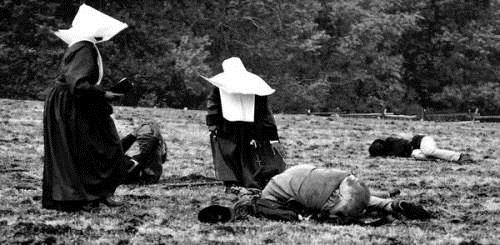
 sisters of charity

Sisters of Charity on the Battlefield

In doing this I try to be dispassionate in how I teach and while dealing with big issues that my students will face as Joint Staff Officers. Some of them will become Flag or General Officers, with the responsibility of advising our nation’s leaders as well planning and conducting the military operations on which the lives of thousands or maybe hundreds of thousands of people depend. Thus I do feel a certain responsibility to teach not only the strategy and other important military aspects of this campaign, but also the cost in human lives and ethical considerations. I take this work seriously because it forces us to remember what war is about and its nature, which Clausewitz wrote is “a paradoxical trinity-composed of primordial violence, hatred and enmity…” [5] which William Tecumseh Sherman so rightly understood without the euphemisms that we so frequently use to describe it: “War is cruelty, and you cannot refine it….”

As the sun set on the evening of July 3rd 1863 the battered Army of Northern Virginia and the battered but victorious Army of the Potomac tended their wounds, buried their dead and prepared for what might happen next. On that afternoon it was as if “the doors of Hell had shut” and the next day, the Glorious 4th of July “The heavens opened, and a thunderstorm of biblical proportions drenched the battlefield, soaking dead, wounded and able-bodied men equally.” [6]

Following the disastrous attack aimed at the Union center, Lee and his surviving commanders prepared for an expected Union counter attack. However, George Meade, the commander of the Army of the Potomac who had correctly anticipated Lee’s assault decided not to gamble on a counter attack, though it was tempting. He knew too well the tenacity and skill of the Confederate commanders and soldiers on the defense and did not want to risk a setback that might give Lee another chance, thus “the two sides stared at each other, each waiting for the other to resume the fighting, neither did.” [7]

 nurses

Federal Field Hospital

As the Confederate army retreated and Meade’s army pursued another army remained at Gettysburg, “an army of the wounded, some 20,350 in number, a third of them Confederate….” Just 106 surgeons were spared from the Army of the Potomac and “the comparatively few overburdened surgeons and attendants now on duty still labored every day to the point of exhaustion.” [8] These overworked men were aided by local volunteers as well as members of the U.S. Sanitary Commission, the Christian Commission and the Sisters of Charity. These men and women “brought organization to the hospitals, relief to the medical staffs and the local volunteers, and immense comfort to the wounded, whether blue or butternut.” [9]

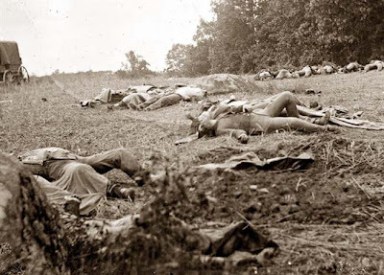
The dead and wounded littered the battlefield and the sights and smells were ghastly:

“Wherever men gazed, they saw dead bodies. A New Yorker thought they “lay as thick as the stones that is on father’s farm.” A stench smothered the field, moving John Geary to tell his wife, “My very clothes smell of death.” A Regular Army veteran exclaimed, “I have seen many a big battle, most of the big ones of the war, and I never saw the like.” [10] A resident of Gettysburg walked up to Little Round top and wrote of what she observed from the peak of that rocky hill:

“surrounded by the wrecks of battle, we gazed upon the valley of death beneath. The view there spread out before us was terrible to contemplate! It was an awful spectacle! Dead soldiers, bloated horses, shattered cannon and caissons, thousands of small arms. In fact everything belonging to army equipments was there in one confused and indescribable mass.” [11]

At Joseph Sherfy’s farm, scene of some of the heaviest fighting on the second day, his barn “which had been used as a field hospital, was left a burnt ruin, with “crisped and blackened limbs, heads and other portions of bodies” clearly visible.” [12] When the rains came, the wounded suffered terribly. Many of the field aid stations were set up next to the creeks that crisscrossed the battlefield, and those streams quickly flooded as torrents of rain water caused them to overflow their banks. “A New Jersey soldier watched in horror as the flood waters washed over and carried away badly wounded men unable to move to safety….” [13]

Major General Oliver Howard of the Union XI Corps took his escort to do a reconnaissance of the town on July 4th, and one of the cavalry troopers of his escort described the scene:

“The battle field was the Awfulest sight I ever saw…The woods in front of our men the trees were riddled with Cannon ball and bullets evry limb shot off 20 feet high. Some say the Rebel dead lay six deep in the grave yard where we lay. Nearly evry grave stone was shattered by shots and everything was torn to pieces. I went through the town on the 4th of July with the General. The streets were covered with dead. Evry frame house were riddled with balls the brick ones dented thick where shot had hit.” [14]

Field hospitals were often little more than butcher shops where arms and legs were amputated by overworked surgeons and attendants while those with abdominal wounds that could not be easily repaired were made as comfortable as possible. Triage was simple. If a casualty was thought to have a reasonable chance at survival he was treated, if not they were set aside in little groups and allowed to die as peacefully as possible. Churches were requisition for use of the surgeons. A volunteer nurse noted: “Every pew was full; some sitting, some lying, some leaning on others. They cut off the legs and arms and threw them out the windows. Every morning the dead were laid on the platform in a sheet or blanket and carried away.” [15]

Chaplains were usually found with the doctors, caring for the physical as well as the spiritual needs of the wounded. Protestant chaplains might ensure that their soldiers “knew Jesus,” while Catholics administered the Last Rites, often working together across denominational lines to care for their soldiers.

A Union chaplain described the ministry in the field hospitals and aid stations:

“Some of the surgeons were posted well up toward the front to give first aid. More of them were in the large field hospitals of division in more secure places at the rear. The chaplain might be at either place or at both by turns. Some made a point of watching for any wounded man who might be straggling back, who perhaps could be helped up into the saddle and ride back to the hospital. When the demand for help became urgent the chaplains were nurses. As the rows of wounded men grew longer, chaplains went from man to man to see what could be done to relieve their pain, perhaps to take a message or letter. All day into the night this work would continue. A drink of water, a loosened bandage on a swollen limb, a question answered, a surgeon summoned, a whispered word of comfort marked their course. Each night at sundown the men who died during the day were buried, with a short prayer, side by side in a common grave, each in his uniform with canvas wrapped around his face and a strip of paper giving his name and regiment in a bottle buttoned under his blouse.” [16]

The war would challenge the theology of the clergy who served as chaplains on both sides, as “individuals found themselves in a new and different moral universe, one in which unimaginable destruction had become a daily experience. Where could God belong in such a world? How could a benevolent deity countenance such cruelty and suffering? Doubt threatened to overpower faith….” [17] That sense of bewilderment is not lacking today among those of faith who return from war.

Some men, clergy and laity alike would attempt to find a theological meaning to the suffering. Many would do so in the theology of John Calvin which emphasized the Providence and foreknowledge of God. That theological frame of reference, of the results of battles and the death or wounding of men in war and the attendant suffering was found in the will, or providence of God was quite common among men of both sides who grew up during the Second Great Awakening, and it can still be found today; and for some, like Stonewall Jackson, it was carried to fatalistic extremes. However, others like Colonel William Oates of the 15th Alabama, who considered himself a believing Christian, saw things differently, he wrote that he believed God:

“endowed men with the power of acting for themselves and with responsibility for their acts. When we went to war it was a matter of business, of difference of opinion among men about their temporal affairs. God had nothing to do with it. He never diverted a bullet from one man, or caused it to hit another, nor directed who should fall or who should escape, nor how the battle should terminate. If I believed in such intervention of Providence I would be a fatalist….” [18]

The carnage around the battlefield was horrifying to most observers. Corporal Horatio Chapman of the 20th Connecticut Volunteers wrote about the sight on Cemetery Ridge on the night of July 3rd following the repulse of Pickett’s Charge:

But in front of our breastworks, where the confederates were massed in large numbers, the sight was truly awful and appalling. The shells from our batteries had told with fearful and terrible effect upon them and the dead in some places were piled upon each other, and the groans and moans of the wounded were truly saddening to hear. Some were just alive and gasping, but unconscious. Others were mortally wounded and were conscious of the fact that they could not live long; and there were others wounded, how bad they could not tell, whether mortal or otherwise, and so it was they would linger on some longer and some for a shorter time-without the sight or consolation of wife, mother, sister or friend. I saw a letter sticking out of the breast pocket of one of the confederate dead, a young man apparently about twenty-four. Curiosity prompted me to read it. It was from his young wife away down in the state of Louisiana. She was hoping and longing that this cruel war would end and he could come home, and she says, “Our little boy gets into my lap and says, `Now, Mama, I will give you a kiss for Papa.’ But oh how I wish you could come home and kiss me for yourself.” But this is only one in a thousand. But such is war and we are getting used to it and can look on scenes of war, carnage and suffering with but very little feeling and without a shudder.” [19]

Colonel William Oates of the 15th Alabama whose brave troopers assaulted Little Round Top on July 2nd wrote:

“My dead and wounded were nearly as great in number as those still on duty. They literally covered the ground. The blood stood in puddles in some places on the rocks; the ground was soaked with the blood of as brave men as ever fell on the red field of battle.” [20]

Another Confederate soldier described the scene west of the town on July 4th:

“The sights and smells that assailed us were simply indescribable-corpses swollen to twice their size, asunder with the pressure of gases and vapors…The odors were nauseating, and so deadly that in a short time we all sickened and were lying with our mouths close to the ground, most of us vomiting profusely.” [21]

The burial of the dead was too much for the soldier’s alone to accomplish. “Civilians joined the burial of the dead out of both sympathy and necessity. Fifty Confederates lay on George Rose’s fields; seventy-nine North Carolinians had fallen on a perfect line on John Forney’s farm.” [22]

Those tending the wounded recalled how many of the wounded soldeirs selflessly asked medical personnel to tend others more badly wounded than themselves; a volunteer nurse wrote her sister: “More Christian fortitude was never witnessed than they exhibit, always say-‘Help my neighbor first, he is worse.’” [23] The Confederate wounded were the lowest priority for the badly overwhelmed Union surgeons and Lee had not done much to help, leaving just a few surgeons and attendants to care for the Confederates left on the battlefield. The Confederate wounded housed in the classrooms of Pennsylvania College were left in dire straits:

“All the rooms, halls and hallways were occupied with the poor deluded sons of the South,” and “the moans prayers, and shrieks of the wounded and dying were everywhere.” Between 500 and 700 wounded Confederates were jammed in with “five of our surgeons” and “no nurses, no medicines no kinds of food proper for men in our condition….” [24]

Across the battlefield the wounded were being treated in a variety of makeshift aid stations and field hospitals:

“Sergeant Major David E. Johnson of the Seventh Virginia was taken to the Myers house after the bombardment, suffering from a shrapnel wound to his left side and arm. “The shed in which I was placed,” he recalled, “was filled with the wounded and dying….I spoke to no one, and no one to me, never closed my eyes to sleep; the surgeons close by being engaged in removing the limbs of those nearby to be amputated….I heard nothing but the cries of the wounded and the groans of the dying, the agonies of General Kemper, who lay nearby, frequently being heard.” [25]

The suffering was not confined to the hospitals; John Imboden commanding the cavalry brigade protecting the Confederate wounded being transported home and supply trains described the horror of that movement:

“Scarcely one in a hundred had received adequate surgical aid, owning to the demands on the hard working surgeons from still far worse cases tat had to be left behind. Many of the wounded in the wagons had been without food for thirty-six hours. Their torn and bloody clothing, matted and hardened, was rasping the tender, inflamed, and still oozing wounds….From nearly every wagon as the teams trotted on, urged by whip and shout came such cries and shrieks as these:

“My God! Why can’t I die?” “My God! Will no one have mercy and kill me?” “Stop! Oh! For God’s sake stop for just one minute; take me out and leave me to die on the roadside.” “I am dying! I am dying! My poor wife, my dear children, what will become of you?” [26]

Eventually, by July 22nd with most of the wounded evacuated a proper general hospital was set up east of the town and the remaining wounded taken there. That hospital, named Camp Letterman grew into “a hundred –acre village of cots and tents, with its own morgue and cemetery, and served more than 3,000 wounded before it was finally closed in November.” [27]

As for the families of the dead, many never found out the details of their loved one’s deaths, which caused their losses to be “in some sense unreal and thus “unrealized,” as the bereaved described them, recognizing the inhibition of mourning that such uncertainty imposed.” [28] Much was because of how overwhelmed the field hospital staffs were, and how inadequate their records of treatment and the dispositions of bodies were sketchy at best. “Reports from field hospitals were riddled with errors and omissions, often lacked dates, and were frequently illegible, “written with the faintest lead pencil.” [29]

Among the killed and wounded were the great and the small. John Reynolds who died on day one, Winfield Scott Hancock, the valiant commander of the Union II Corps was severely wounded during Pickett’s Charge. Dan Sickles, the commander of Third Corps who had nearly brought disaster on the Federal lines by advancing to the Peach Orchard on July 2nd had his leg amputated after being grazed by a cannon ball at the Trostle Farm. Sickles, who survived the wound and the war, would visit the leg, which had carefully ordered his surgeons to preserve. The leg is now displayed at the National Museum of Health and Medicine in Washington D.C.

The Army of the Potomac lost a large number of brigade and regimental commanders including Strong Vincent, the young and gallant brigade commander who helped save Little Round Top; George Willard who brought redemption to his Harper’s Ferry brigade on Cemetery Ridge stopping Barksdale’s charge on July 2nd; Colonel Augustus Van Horne Ellis who before being killed at Devil’s Den told his staff “the men must see us today;” and the young Elon Farnsworth, who had been promoted from Captain to Brigadier General just days before his death in a senseless ordered by his division commander Judson “Kill Cavalry” Kilpatrick, against Hood and McLaw’s dug in divisions as the battle ended.

The Confederates suffered grievous losses. Divisional commanders like Dorsey Pender and Johnston Pettigrew were mortally wounded, John Bell Hood was severely wounded, Isaac Trimble, wounded and captured while Harry Heth was wounded. Casualties were even higher for commanders and the brigade and regiment level, the list included excellent commanders such as Paul Semmes and William Barksdale, while Wade Hampton, Stuart’s best brigade commander was seriously wounded and would be out of action for months. The toll of brigade and regimental commanders who were killed or wounded was fearful. “At the regimental level approximately 150 colonels, lieutenant colonels and majors had been killed, wounded or captured. Of that number nineteen colonels had been slain, the most in any single battle in which the army had been engaged. Captains now led regiments.” [30]

In Picket’s division alone all three brigade commanders, Kemper, Armistead and Garnett were killed or wounded while twenty-six of forty Field Grade officers were casualties. Forty-six percent (78 of 171) of the regiments of the Army of Northern Virginia suffered casualties at the command level. The Confederate casualties, especially among the best leaders were irreplaceable and Lee’s Army never recovered from the loss of seasoned leaders who were already in short supply.
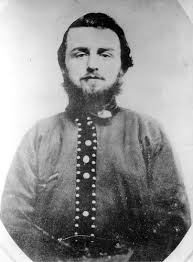
 culp

Private Wesley Culp CSA

For some like Private Wesley Culp of the 2nd Virginia it was a final trip home. Culp had grown up in Gettysburg and had taken a job in Virginia prior to the war. In 1861 he enlisted to serve among his friends and neighbors. He was killed on the morning of July 3rd on Culp’s Hill on the very property owned by his uncle where he grew up and had learned to hunt.

One witness, Frank Haskell looked in at a field hospital in the Union II Corps area and wrote:

“The Surgeons with coats off and sleeves rolled up…are about their work,… “and their faces and clothes are spattered with blood; and though they look weary and tired, their work goes systematically and steadily on- how much and how long they have worked, the piles of legs, arms, feet, hands, fingers…partially tell.” [31]

All told between 46,000 and 51,000 Americans were killed or wounded during the three days of Gettysburg. Busey and Martin’s Regimental Strengths and Losses at Gettysburg list the following casualty figures, other accounts list higher numbers, some as many as 53,000. One also has to remember that many of the missing soldiers were killed in action, but their bodies were simply never found.

                          Killed               wounded         missing         total

Union                    3,155                14,531             5,369           23,055

Confederate         4,708                12,693             5,830            23,231

Total                     7,863               27,224            11,199          46,286

To provide a reference point we need to remember that in 8 years of war in Iraq the United States suffered fewer casualties than during the three days of Gettysburg. It was the bloodiest single battle in American history, and it was a battle between brothers not against foreign enemies. Robert E Lee testified to Congress following the war “the war… was an unnecessary condition of affairs, and might have been avoided if forbearance and wisdom had been practiced on both sides.” [32]  Lee’s “Old Warhorse” James Longstreet asked “Why do men fight who were born to be brothers?” [33]

The carnage and death witnessed by survivors of Gettysburg and the other battles of the war changed Civil War soldiers as much as war has before or after. James Garfield, who served as a general in the Union army and went on to become President of the United States noted: “at the sight of these dead men whom other men killed, something went out of him, the habit of a lifetime, that never came back again: the sense of the sacredness of life and the impossibility of destroying it.” [34]
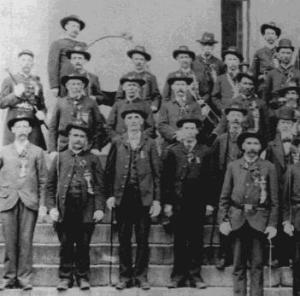
GARpost

Grand Army of the Republic Veterans

Others, like veterans of today had trouble adjusting to life after the war. “Civil War veterans had trouble finding employment and were accused of being drug addicts. Our word “hobo” supposedly comes from homeless Civil War veterans- called “hoe boys” – who roamed the lanes of rural America with hoes on their shoulders, looking for work.” [35] Following the war, during the turmoil of Reconstruction and the massive social change brought about by the industrialization of society and rise of “industrial feudalism” numerous veterans organizations were founded, for those that belonged to them they were “one of the principle refuges for old soldiers who had fought for a very different world than the one they found around them.” The Grand Army of the Republic was the most prominent of these organizations. “In more than 7,000 GAR posts across the United States, former soldiers could immerse themselves in a bath of sentimental memory; there, they established a ritualized camp geography, rekindled devotion to emancipation and preached the glories of manly independence.” [36]

At the end of the war, Joshua Chamberlain, the hero of Little Round Top who was well acquainted with the carnage of war suffered immensely. His wounds never healed fully, and he struggled to climb out of “an emotional abyss” in the years after the war. Part was caused by his wounds which included wounds to his sexual organs, shattering his sexuality and caused his marriage to deteriorate. He wrote his wife about the “widening gulf between them, one created at least in part by his physical limitations: “There is not much left in me to love. I feel that all too well.” [37]

Gouverneur Warren, who had helped save the Union at Little Round Top wrote to his wife while on Engineering duty after the war: He wrote in 1866 “Indeed the past year…was one of great despondency for me…I somehow don’t wonder that persons often remark how seldom I laugh, but it is really seldom that I do.” He wrote again in 1867 “I wish I did not dream that much. They make me sometimes dread to go to sleep. Scenes from the war, are so constantly recalled, with bitter feelings I wish to never experience again. Lies, vanity, treachery, and carnage.” [38]

The killing at Gettysburg and so many other battles “produced transformations that were not readily reversible; the living into the dead, most obviously, but the survivors into different men as well, men required to deny, to numb basic human feelings at costs they may have paid for decades after the war ended, as we know twentieth and twenty-first-century soldiers from Vietnam to Iraq continue to do; men who like James Garfield, were never quite the same again after seeing fields of slaughtered bodies destroyed by me just like themselves.” [39]

Joshua Chamberlain asked the most difficult questions when viewing the devastation around Petersburg in the final days of the war:

“…men made in the image of God, marred by the hand of man, and must we say in the name of God? And where is the reckoning for such things? And who is answerable? One might almost shrink from the sound of his own voice, which had launched into the palpitating air words of order–do we call it?–fraught with such ruin. Was it God’s command that we heard, or His forgiveness that we must forever implore?” [40]

Chamberlain’s questions should always be in our minds as we send young men and women to war.

Peace

Padre Steve+

Notes

[1] Faust, Drew Gilpin, This Republic of Suffering: Death and the American Civil War Vintage Books, a division of Random House, New York 2008 p.41

[2] Grossman, Dave On Killing: The Psychological Costs of Learning to Kill in War and Society. Back Bay Books, Little, Brown and Company New York 1995, 1996 p.92

[3] Sager, Guy The Forgotten Soldier originally published as Le Soldat Oublie Editions Robert Laffont 1967, Translation Harper and Row Inc 1971, Brasey’s Washington D.C 2000 p.223

[4] Bismarck, Otto von Speech, August 1867

[5] Clausewitz, Carl von. On War Indexed edition, edited and translated by Michael Howard and Peter Paret, Princeton University Press, Princeton NJ 1976 p.89

[6] Wittenberg, Eric J, Petruzzi, David and Nugent, Michael F. One Continuous Fight: The Retreat from Gettysburg and the Pursuit of Lee’s Army of Northern Virginia July 4-14 1863 Savas Beatie LLC New York NY and El Dorado Hills CA 2008,2001 p.27

[7] Ibid. Wittenberg One Continuous Fight p.28

[8] Sears, Stephen W Gettysburg Houghton Mifflin Co. Boston and New York 2003 p.508

[9] Ibid. Sears Gettysburg p.510

[10] Wert, Jeffry D. The Sword of Lincoln: The Army of the Potomac Simon and Schuster, New York and London 2005 p.303

[11] Schultz, Duane The Most Glorious Fourth: Vicksburg and Gettysburg July 4th 1863. W.W. Norton and Company New York and London, 2002 p.357

[12] Faust This Republic of Suffering p.81

[13] Ibid. Wittenberg One Continuous Fight p.30

[14] Ibid. Wittenberg One Continuous Fight pp.32-33

[15] Ibid. Sears Gettysburg. p.508

[16] Brinsfield, John W. et. al. Editor, Faith in the Fight: Civil War Chaplains Stackpole Books, Mechanicsburg PA 2003 pp.121-122

[17] Ibid. Faust. This Republic of Suffering p.267

[18] Oates, Willam C. and Haskell, Frank A. Gettysburg: The Confederate and Union Views of the Most Decisive Battle of the War in One Volume Bantam Books edition, New York 1992, originally published in 1905 p.138

[19] Chapman, Horatio Civil War Diary of a Forty-niner pp.22-24 Retrieved from http://www.dbappdev.com/vpp/ct20/hdc/HDC630703.htm 8 April 2014

[20] Oates, William C. Southern Historical Papers, April 6th, 1878 retrieved from http://www.brotherswar.com/Civil_War_Quotes_4h.htm 18 July 2014

[21] _________ What Happened to Gettysburg’s Confederate Dead? The Blog of Gettysburg National Military Park, retrieved from http://npsgnmp.wordpress.com/2012/07/26/what-happened-to-gettysburgs-confederate-dead/ 18 July 2014

[22] Ibid. Faust. This Republic of Suffering p.81

[23] Catton, Bruce The Army of the Potomac: Glory Road Doubleday and Company, Garden City New York, 1952 p.333

[24] Guelzo, Allen C. Gettysburg: The Last Invasion Vintage Books a Division of Random House, New York 2013 p.469

[25] Brown, Kent Masterson Retreat from Gettysburg: Lee, Logistics and the Gettysburg Campaign University of North Carolina Press, Chapel Hill and London, 2005 p.56

[26] Imboden, John D. The Confederate Retreat from Gettysburg in Battles and Leaders of the Civil War Volume III, The Tide Shifts. Edited by Robert Underwood Johnson and Clarence Clough Buel Castle, Secaucus NJ p.424

[27] Ibid. Guelzo Gettysburg: The Last Invasion pp.469-470

[28] Ibid. Faust. This Republic of Suffering p.267

[29] Ibid. Faust. This Republic of Suffering p.113

[30] Wert, Jeffry D. A Glorious Army: Robert E. Lee’s Triumph 1862-1863 Simon and Schuster, New York and London 2011

[31] Sears, Stephen W. Gettysburg Mariner Books, Houghton Mifflin Company Boston, New York 2004 p.466

[32] Flood, Charles Bracelen, Lee: The Last Years Houghton Books, New York 1981 p.124

[33] Longstreet, James in New York Times, July 24, 1885, retrieved from the Longstreet Society http://www.longstreetsociety.org/Longstreet_Quotes.html 18 July 2014

[34] Ibid. Faust. This Republic of Suffering p.55

[35] Shay, Jonathan Odysseus in America: Combat Trauma and the Trials of Homecoming Scribner, New York and London 2002 p.155

[36] Guelzo Allen C. Fateful Lightening: A New History of the Civil War Era and Reconstruction Oxford University Press, Oxford and New York 2012 p.523

[37] Longacre, Edward Joshua Chamberlain: The Soldier and the Man Combined Publishing Conshohocken PA 1999 p.259

[38] Jordan, David M. Happiness is Not My Companion: The Life of G.K. Warren Indiana University Press, Bloomington Indiana 2001 pp.248-249

[39] Ibid. Faust. This Republic of Suffering p.60

[40] Chamberlain, Joshua Lawrence, The Passing of the Armies: An Account of the Final Campaign of the Army of the Potomac, Based on the Personal Reminisces of the Fifth Corps G.P Putnam’s Son’s 1915, Bantam Books, New York 1993 Amazon Kindle Edition p.41

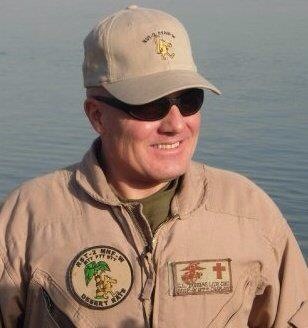
1 Comment

Filed under civil war, faith, History, mental health, Military, philosophy

A Good Day to Speak Truth to Power and to be Listened to

IMG_1915

I have been writing about my recent experiences in trying to get help for my own issues dealing with PTSD as well as my frustration with a military mental health system that is, at least in my view, floundering.

That effort over the past month or so has been quite painful, at times humiliating and dehumanizing, and frankly driven me into a depressed and nearly suicidal fog, from which I am slowly emerging.

Today was a good day. Not just for me but maybe for all of those seeking help at our local Naval Medical Center. Instead of being blown off and shunted aside by providers as well as mid and high level administrators I was able to have a long, nearly forty-five minute phone conversation with the Admiral who commands that facility as well as every Naval Medical facility on the East Coast and Europe, with the exception of the Bethesda-Walter Reed complex in Washington DC. Bottom line up front; it was a very good and positive experience for me that I believe will help others get better care.

I have to say up front that I was terrified about asking to talk to him. One of the people on his staff told me that “it would not be a good thing for me to talk to him.” When I heard that comment my heart sank. I didn’t know what to do, I was perplexed because most commanders of Medical facilities in the Navy that I have worked for actually did want to hear about negative experiences of the people that are their customers, most because they care, but if nothing else because they want to make sure that they pass the Joint Commission accreditation that their facilities get every few years. So I wondered if the Admiral actually knew what was going on, at least in regard to the Mental Health Department and the experiences of people like me.

My last Command Master Chief, who read some of my very angry posts on a social media site suggested that I call my former Commanding Officer, a man who helped me a lot, cared about me and who is soon to become an admiral. I finally worked up the courage to call him, not out of fear, but because I felt like I might be bothering him, and would not be worth his time. I left his command a year ago and frankly I thought why should someone moving up in an organization be bothered by the problems of a former subordinate.

However, he was both concerned and helpful. He did not just listen but he took action by contacting the Admiral here. He told him that he knew me and that he knew that it was my desire to make sure that people get the help and care that they need, that I wasn’t just complaining or seeking special treatment.

Yesterday the admiral called me, of course my phone went directly to voice mail so I missed the call, but his message, and the tone of his voice conveyed a sense of care and concern. I called back and got his voice mail. So this morning I called again and was able to share my heart, in a very respectful way with him. He listened and seemed to be attempting to formulate some kind of positive response that would actually help people. He wants to get answers and he told me that he wanted those that come to that facility to be treated as he would want his grandparents treated.

As I said we talked for forty-five minutes and he listened. I have no doubt, within the very real fiscal constraints faced with current budget cuts and the still looming threat of sequester that he will do his best to improve and change the system that is within his control. He also did something that I have never experienced before from a superior officer, he called me “sir” a number of times. I am not used to that and I don’t think that I have ever in all of my reading of military history recall an Admiral or General calling a subordinate “sir.” I was blown away.

That system appears to be undermanned, under-budgeted and overwhelmed. It is struggling and as it struggles, as it reacts to criticism from the media, politicians and advocacy groups, it resorts to protecting itself as any bureaucracy does in such a situation. The Admiral realized this and he encouraged me to call him again on his office number if I see things that he can help. That was very encouraging. I don’t think that I will have to ask him to intervene on my part, but I have an open door to use this relationship to help others.

All that being said, most people do not have the connections that I have in the system, nor are they willing to take the risks to rock the boat. The stigma is great and personal risk can be or at least seem too great to make the effort, so most people just give up. After all the bureaucracy can be unbending and even vindictive in the way that it rebuffs those that try to raise issues. They resist change and try to keep bad news from enquiring superiors. Bureaucracies and those who faithfully serve them do just that. It is part of who and what they are; be they military, other government, business or ecclesiastical organizations. Admiral Alfred Thayer Mahan wrote:

“It [the bureaucracy] tends to overvalue the orderly routine and observance of the system by which it receives information, transmits orders, checks expenditures, files returns, keeps the Service the touch of paper; in short, the organization has been created for facilitating its own labors.”

However, when I first collapsed after Iraq, I decided that I could not be silent and have “sky-lined” myself which probably will not help me get promoted, not that care anymore. I am sure that being so public about my struggles with PTSD, Moral Injury and even my crisis of faith, which left me an agnostic for a couple of years, while serving as a Chaplain in adult and pediatric Intensive Care Units has marginalized me in the Chaplain Corps. I don’t know that for a fact and would hope that it is not the case, but it is the feeling that I get when I deal with most Chaplains.

All of that said, the past few weeks have been some of the most difficult since my return from Iraq. I personally find no pleasure in being anxious, depressed or feeling suicidal and getting even less sleep than my chronic insomnia normally allows.

At least I was listened to, and I really did get the sense that the Admiral that I was able to have such an honest conversation with today, does really care and wants to help improve the system and change the culture.

But that is the thing. This is a systemic and cultural problem, not just in the military or the Veterans Administration, but in society as a whole. In our desire for efficiency, supposed effectiveness  measured by profits and the bottom line; we have forgotten to care about people. Sadly that is statistically verified in poll after poll by people from all parts of the political spectrum. People don’t trust the government, they don’t trust big business, they don’t trust health care systems, they don’t trust the police, they don’t trust the banking and insurance industries and they certainly don’t trust the church or religion in general. Can I get an amen?

Thank you…

But our culture has to change, we have become so materialistic and embrace the most crass forms of predatory Capitalism and Social Darwinism, even in church, that people don’t matter, especially the poor and those with no voice or power, especially those who volunteer to serve the nation and come back broken in body, mind and spirit.

Joshua Chamberlain the hero of Little Round Top at Gettysburg spoke years after the Civil War something that should be a warning to us about how we treat people. Of course Chamberlain was talking about the horror of war, but it can apply to anyone, anywhere:

“But we had with us, to keep and care for, more than five hundred bruised bodies of men–men made in the image of God, marred by the hand of man, and must we say in the name of God? And where is the reckoning for such things? And who is answerable? One might almost shrink from the sound of his own voice, which had launched into the palpitating air words of order–do we call it?–fraught with such ruin. Was it God’s command that we heard, or His forgiveness that we must forever implore?”

His question is as operable today as it was then. There has to be a reckoning somewhere for destroying peoples lives, and further traumatizing them when they seek help, otherwise there is no justice nor anything that resembles a loving God.

We have to start valuing people, regardless of their social status, their race, religion, sexual preference, disability or even their alma mater. If we don’t start caring for people as human beings, then why bother with anything else? It is either about humanity or its not. Those who are comfortable cannot turn a  blind eye thinking that these issues don’t affect them, because they will.

So in spite of being unpopular in some circles I take the personal risk to speak the truth the best and most honest way I can to anyone that will listen. I have to do it, for those that feel that they have no voice, as well as those who I have known who have lost their lives after giving up on the system. I owe it to them. It is now my mission in life and I do that I can both inside the system and outside of it to speak out for those who need it.  I guess I have become something of a liberal social activist, not that there is anything wrong with that.

I can be as persistent and irritating as Mustard Gas; I am doggedly determined to speak out for those that do not feel that they matter or have a voice; and I will stay in the fight until I can’t fight anymore. As Paul Tillich said “It is my mission to comfort the afflicted and to afflict the comfortable.”

I admit that sometimes it is like tilting at windmills, but this week, two men who have the position to influence the system took the time to listen and just maybe at least at some level things will begin to change. I am grateful tonight, maybe I will sleep well…

Peace

Padre Steve+

Leave a comment

Filed under faith, healthcare, mental health, Military, PTSD, suicide, US Navy

Moral Injury: Betrayal, Isolation, Suicidality, & Meaninglessness; the War after the War

IMG_1915.JPG

“Great Odysseus woke from sleep on native ground at last- he’d been away for years- but failed to know the land.” Homer, The Odyssey 

War changes the men and women that fight them. This is a truth that dates to antiquity. It does not matter the age or era, where the war was fought or what weapons were used, the pathology is similar, the scars of war, physical, The trauma of war, as Jonathan Shay notes in his book Odysseus in America, “shows ugly deformities of character that trauma can cause, but these deformities are fully human such as might happen to ourselves….” The fact is that the does happen is normal, but how we deal with it is not.

One of the most difficult things that many returning combat veterans face is being re traumatized upon returning home. As the Odyssey shows, for many returning combat veterans it is as if they are returning to an alien planet, which looks familiar, but feels like an alternate universe. It looks the same, but it is profoundly different. Erich Maria Remarque in his classic All Quite on the Western Front wrote:

“I imagined leave would be different from this. Indeed, it was different a year ago. It is I of course that have changed in the interval. There lies a gulf between that time and today. At that time I still knew nothing about the war, we had been only in quiet sectors. But now I see that I have been crushed without knowing it. I find I do not belong here any more, it is a foreign world.”

Shortly before his death in a motorcycle crash T.E. Lawrence, the great Lawrence of Arabia wrote a friend. Lawrence certainly suffered from PTSD and other afflictions that lingered long after the war. The words are haunting and they so describe how many veterans feel, even long after they left the combat zone. For Lawrence and so many others the war after the war never ended.

Lawrence wrote:

“You wonder what I am doing? Well, so do I, in truth. Days seem to dawn, suns to shine, evenings to follow, and then I sleep. What I have done, what I am doing, what I am going to do, puzzle and bewilder me. Have you ever been a leaf and fallen from your tree in autumn and been really puzzled about it? That’s the feeling.”

This has been a facet of life for American military personnel ever since the Vietnam War. Much of the trauma comes from the unnatural and ahistorical manner of how we send men and women to war and bring them home. Now generally we prepare people for war fairly well. However, we send many to war as individual augments, away from their units and people they know, place them in units or organizations where they are relatively isolated and sometimes face great danger, then we bring them back alone, with barely any time to decompress, tell their story and face the consequences of war with those that they know.

Guy Sager, writer of the classic The Forgotten Soldier wrote of his return from war:

“In the train, rolling through the sunny French countryside, my head knocked against the wooden back of the seat. Other people, who seemed to belong to a different world, were laughing. I couldn’t laugh and couldn’t forget.”

The result is that most don’t get the help that they need to make the adjustment. The fact is that the best help is usually found among our comrades who have shared our experience. Before trans-ocean air travel, soldiers came home on troopships, with those that they served and the voyage home lasted anywhere from two weeks to a month. That gave these soldiers the opportunity to process what they had been through, and while they might not have had much in the way of “professional” mental health care, they did have each other. Likewise, they returned to a country where many if not most of the citizenry had shared at least some of the sacrifice of war, and many of whom had family members who had served at war, or who had lost people they knew.

A survivor of World War I’s “Lost Battalion” wrote after the war:

“We just do not have the control we should have. I went through without a visible wound, but have spent many months in hospitals and dollars for medical treatment as a result of those terrible experiences.”

Today soldiers are sent from the United States or United States military bases in Europe or Asia into harms way, and when their tour of duty is done, are sent home in a process that seldom takes more than a week, usually less. Apart from a few airport greeters and their family, if they have a family, their return goes almost unnoticed. They return to a world where there has been no shared experience and people go about their business untouched by war. The return is often overwhelming, and many times disorienting and frightening to the combat veteran who no longer feels connected to the country or people that sent him or her to war. The normal issues faced by redeploying soldiers, especially with their families are often even more pronounced, they and their families struggle.

The general feeling of social isolation is often made worse when they return to their home bases, stations or units and discover that instead of being welcomed home, that they are treated as if they made the life of those who did not deploy harder. “Welcome back, now you can get back to real work, now you can be back on the duty roster.” Within weeks they are submerged in routine, often mind numbing tasks among people who have not shared their experience. Alone they try to cope, quite often not very successfully. For those suffering from combat trauma, especially the unseen injuries of PTSD and Traumatic Brain Injury the experience is magnified. There is a sense of isolation and meaninglessness as they attempt to put their lives back together. For those that seek help, on the active duty side of the house there is a stigma to getting mental health care, which is so pronounced that many either avoid treatment or stop shortly after starting, instead self-medicating with alcohol or drugs. The same is often true for those who seek help in the Veterans Administration system, except they, having finished their active service do not have to endure the shame of being called or considered “broken” by their superiors or their peers. For those that have not served, to be labeled as “broken” is one of the worst things that can happen to you in the military, it is to say that you have no intrinsic value, no matter what you have accomplished to that point or what you have suffered in the line of duty.

Those that do decide to take the risk in going to get mental health care are often then traumatized by the very system that supposedly is there to help them. While there are many gifted, caring and skillful psychiatrists, psychologists and therapists working for the military and the VA, the process of getting care can be brutal and dehumanizing. The intake process is often impersonal and quite often the ordeal dissolutions those going through it. As a personal note, when I transferred back to the area that I previously had been treated it was like I had never been in the system. It was starting from scratch, and while I had gone back to the system seeking basic follow up care, the process broke me and made me worse. Due to the intervention of so very caring people including a former commanding officer who is being promoted to Admiral, I am getting some help and may even be able to contribute to a solution. But it should not be so hard, the system in overwhelmed, undermanned, underfunded and broken, despite the best efforts of some in leadership. The result is that combat veterans are further traumatized and marginalized.

The combination of new trauma, that of no longer feeling a part of society, that of being disconnected from friends and family; that of being isolated at work and treated as a number by those in the medical and mental health system. All of those things add further injury and contributes to the sense of betrayal, the sense of betrayal that goes to the heart of Moral Injury.

Moral Injury involves the breaking of trust, confidence and core beliefs. That can encompass everything from what a person believes about God, the idealism about one’s country, the military that one serves and even the society and family. Moral Injury is an abiding sense of loss of faith and confidence in the things, the beliefs and ideals that one held dear. It is a layer of trauma that adds to what one has experienced in combat, it is another layer of trauma on top of PTSD, TBI and other Combat Stress related issues. It increases the severity of other psychological conditions including depression, anxiety and the risk of suicidal, or other risk taking behaviors.

But it doesn’t seem to me that anyone gets this, and those that do are not in a position to influence policy. Neither are they in a position to ensure that mental health providers are trained to recognize, care for and not increase the chance of further traumatizing those in their care. Instead those coming home from war seem to be condemned to a sort of hell where they do not feel they matter, are treated as numbers or even worse, feel that they no longer can contribute, because they are “broken.”

My experience is that it takes far too much effort to get the basic care that one requires, and most people after being beaten down simply give up. A person should not be reduced to tears and seriously consider suicide to get attention. A person should not have to know a doctor who is going to be an Admiral to get someone to listen to them. Honestly most people will neither endure the ignominy or pain of seeking help in such an environment, much less skyline themselves but writing and speaking about I like I do. For most any of that is far too dangerous or risky.

Some, including people that I know and love and respect have lost their families, careers and lives simply because they did not want to have the stigma of being considered “broken” or deal with the impersonal and machine like bureaucracy that is our mental health system. The sad thing is that this encompasses not only the military and VA systems, but the civilian system as well. I have known far too many people who have ended their lives after being further traumatized by the system. These people include senior officers and even chaplains, most who risked their lives in combat multiple times only to return home broken. I know too many of them, men who were real heroes, who died at their own hand, or others who lost their families and careers.

I know PTSD, I live with that reality daily, the depression, anxiety, hyper vigilance, paranoia, nightmares, night terrors, insomnia and fear of of crowds, traffic, and normal relationships. That is life and I do my best to deal with it, sometimes more successfully than others. My marriage has suffered because of my madness, and I have experienced the rejection of many of my peers in the Chaplain Corps. Likewise my former church and bishop, after two knowing that for two years I was for all practical purposes an agnostic and knowing my life was a wreck, kicked me out when my faith, though very fragile and mixed with doubt, returned. I asked hard questions, and when I asked them publicly I was tossed for being “too liberal.” That rejection, the rejection of a faith community also contributes to Moral Injury. Sadly I know too many others who have returned from war to be rejected by faith communities that advertise how the “love, pray for and support the troops.”

In spite of that I continued to seek help, and at Camp LeJeune my commanders and others ensured that I got what I needed. It helped and when I returned to Hampton Roads a year ago I really thought that I was doing better. That changed last month. I went back, seeking follow-up care, which I assumed was just to download my issues with once in a while and manage my medication. Instead that attempt to re-enter the military mental health care system did me considerable harm, hell I considered suicide just last week after this. I no longer think that what I need is simple occasional follow up care, instead my experience shattered me. I had no idea just how fragile that I was, it was as if the floor had been kicked out from under me.

That my friends is what Moral Injury does to someone. Those are the kind of experiences that break a person’s faith and trust in the things, ideals, institutions and people that they grew up trusting and believing in. That loss of faith and trust, combined with the other layers of Combat Stress Injury can be devastating, and it doesn’t seem to matter because most people are neither aware, nor do they care. Not because they are bad people, but because there is such a gulf between the military and society at large that such issues are distant and incomprehensible to most people not in the military.

Yes, my trust in the system and my country is broken and I don’t know if I will ever regain the faith that I have lost. I honestly want to, I want to believe. God I want to believe. Now it does look like I will be getting help, and maybe even a chance to help being a part of the solution, and that will be a good thing.  Today I got a call from the Admiral at the Medical Center, unfortunately it went directly to voice mail, but he did sound like he cared and wanted to listen. For that I am grateful.

Pray for me as I get a chance to speak with leaders who have some influence to make things better, not just for me, but for all of us.

Peace

Padre Steve+

6 Comments

Filed under mental health, PTSD, suicide

No Shutting Up Until it is Fixed: Veteran and Military Mental Health Care

tom-clancy-look-2

“If a policy is wrongheaded feckless and corrupt I take it personally and consider it a moral obligation to sound off and not shut up until it’s fixed.” Col David Hackworth

Over the past couple of weeks I discovered just how mentally and emotionally fragile I still am. As those that follow my writings here know I wrote a couple of articles recently about the treatment that I was receiving at the local Naval Medical Center, and my perceptions of that command. Those, as well as the e-mails to my provider, which were then shared by the person in charge of fixing the problem with the Medical Center Executive Officer without my permission, (I think there is another violation of my HIPPA rights there as well)  were very difficult to write.

They were extremely painful because of the emotions that were unleashed, especially because I thought of doing something that scared me to death. I considered, very briefly in my pain, anger and my sense that the system had betrayed me and for that matter all of us seeking help; the possibility of committing suicide, in a very public and dramatic way. It scared the hell out of me that I developed a perfectly executable plan to do it, a plan that for a moment would have drawn attention to the issue, but at the same time would have traumatized many others.

Of course I do not think I would ever do it. The death of Robin Williams by suicide yesterday shattered me, and no matter how bad things are I wouldn’t want my death to cause distress to anyone. Frankly, I love life too much, and God knows that one more dead body won’t change how the military or the Veteran Administration medical systems treat people in crisis.

However a living person, especially a pain in the ass like me, that won’t stop speaking out just might make a difference. That might take a while to do, but I will do it until war, and the indifference of soulless bureaucracies are  no more. That may be unreasonable, unrealistic and unattainable but it is a windmill worth tilting at.

But I fully understand that people in a moment of madness and despair, would make the choice to end their life, and see as it as a perfectly logical and rational act. I have known senior chaplain colleagues and former commanders who have chosen suicide, and I am sure that none of them thought that they would ever make that choice, until they actually did it. Please don’t worry about me. I am not going to kill myself, the thought scares me too much. Honestly I would rather live to a ripe old age and be a thorn in the side of the system to get veterans the care that they deserve, and the care that this country owes them than to be yet another statistic whose death is swept under the rug as quickly as the system can do it. Unfortunately, that is the reality; any bureaucratic system, military, government or the private sector will go on with as little inconvenience and reflection as is required once the body is disposed of properly.

Just a few months ago I was talking about simple teaching history, religion and ethics at local junior colleges and for profit universities “for the beer money” as I joked with friends. I told people that my desire when I retire was to be like LT Weinberg in the classic movie A Few Good Men and “have absolutely no responsibility here.” The fact is that I am tired and I don’t want to be in charge of anything when I retire, either in the military, civilian or church world. What T.E. Lawrence wrote to a friend shortly before his death in 1935 resonates with me:

“You wonder what I am doing? Well, so do I, in truth. Days seem to dawn, suns to shine, evenings to follow, and then I sleep. What I have done, what I am doing, what I am going to do, puzzle and bewilder me. Have you ever been a leaf and fallen from your tree in autumn and been really puzzled about it? That’s the feeling.”

That being said, I want whatever amount of time left on this earth, and hopefully it is a very, very long time, is to make a difference in the lives of the men and women who have served in the military and who come home broken, in mind, body and spirit. I can think of no other option or higher calling at this point. To that end I have been referred to a therapist in the system, but not at the Naval Medical Center. The therapist was highly recommended by a chaplain friend who has also went through some very difficult times, even in trying to get help for himself. Thankfully, the person who I talked to a week ago agreed to the referral. So I will get help for me, something that I need and go into with a positive attitude based on my friend’s recommendation.

Now those who have never walked the dark path of long lasting, abiding clinical depression or other mental illness may not understand what I am talking about, but those that have walked this terrible path know it all too well. The feeling that no one cares and that you are alone is a major factor in the despair that overwhelms people, and acts as a trigger to suicide.  Unfortunately far too many military personnel and veterans reach that point. The numbers are staggering. No wonder that Major General Smedley Butler wrote about the cost of war, or the “bill” as he calls it: “This bill renders a horrible accounting. Newly placed gravestones. Mangled bodies. Shattered minds. Broken hearts and homes. Economic instability. Depression and all its attendant miseries. Back-breaking taxation for generations and generations…”

There are a number of ways that I could do this. I could go to work for the VA as a Chaplain, or I could go get a degree in counseling and do therapy or any number of other venues. But I think I would be limited by having to serve in ossified bureaucracies if I was to do any of those things.

Thus I am probably going to venture into the world of social activism, working with veterans organizations, political leaders and the media to draw attention to what is happening to veterans that seek care. Veterans like me who perceive that the system doesn’t really care about them, many individual providers may care deeply and deliver wonderful care, but the system itself is soulless and seems often to be clueless. Likewise I will work to expose the war profiteers who seek to cut back medical and mental health care for veterans even more and actively lobby the military, and Congress to enact those cuts. Personally I feel that is immoral and unjust and that it needs to be confronted and exposed.

I wish I could say that things were any better in the civilian mental health system, but they are not. My wife has battled and suffered from severe depression almost all of her life, and over the past 20 years what is paid for by insurance companies for people in crisis has shrunk to a pathetic “system” whereby a person that is hospitalized remains in hospital 2-5 days until they assure they providers that they will not kill themselves. There is no continuity of care, there is little or no therapy or medication management, it is simply warehousing. I’d like to take that on too, but I have to start somewhere, so I’ll start with where I am.

quioxte

I am a dreamer, and I don’t mind tilting at windmills. Lawrence wrote: “All men dream: but not equally. Those who dream by night in the dusty recesses of their minds wake up in the day to find it was vanity, but the dreamers of the day are dangerous men, for they may act their dreams with open eyes, to make it possible.”

I am a dangerous dreamer because as Lawrence noted I will act on my dreams with open eyes. I may not be able to do a lot while I am still on active duty, but when I retire I will be very dangerous because I know far too much and I won’t be afraid to speak out. My heroes include men like Major General Smedley Butler and Colonel David Hackworth and I have no inhibitions at following in their footsteps. I am very determined, persistent and I can be a total ass. When I determine to do something I don’t quit.

As Colonel Hackworth, who I had the honor of corresponding with in the years before he died said: “If a policy is wrongheaded feckless and corrupt I take it personally and consider it a moral obligation to sound off and not shut up until it’s fixed.” The way we are treating our veterans is just that and I won’t shut my mouth until the day that I die, which Lord willing won’t be anytime soon.

Pray for me, I do need it.

Peace

Padre Steve+


3 Comments

Filed under healthcare, leadership, mental health, Military

Depression Kills: RIP Robin Williams

williams

Robin Williams during his 2007 USO Tour to Iraq and Afghanistan 

Tonight I found out about the unexpected death of the great Robin Williams. It was shocking and upsetting to hear that it was believed that Williams had recently suffered from severe depression and that he was believed to had committed suicide.

I guess I can say that I almost met Williams when I was in Iraq, in between missions at Ta’Qaddum airbase west of Fallujah in 2007. Williams was with a number of celebrities and the former chairman of the Joint Chiefs of Staff, Admiral Mike Mullen touring Iraq and Afghanistan. I had just come in from a mission and could not see his show, but the following morning I walked by Williams as he was walking back from the dinning facility. I recognized him, but I am loathe to interrupt a person’s time alone. I simp gave him a “good morning” which he returned and both of us went on our ways. I could have stooped him and detained him, but in good conscience could not do it. My friend Fr Jose Bautista, a Navy Chaplain had Williams and Lance Armstrong sign a baseball cap for me. I treasure it.

Robin Williams was brilliant, talented and brought much you to many people. Unfortunately. like so many brilliant and caring people he was afflicted with his own personal “demons.” He struggled with depression ands substance abuse.

I understand. Since returning from Iraq in 2008 I have dealt with the effects of PTSD, including depression, anxiety, hyper-vigilance, insomnia, nightmares and night terrors. I know why people commit suicide, and at times considered it myself. Most recently less than two weeks ago when dealing with the inhuman machine that is the Navy mental health system, something that is common to the rest of the military and VA systems.

The fact is that depression is a killer and it disproportionally afflicts the most talented, brilliant, artistic and insightful people.  Van Gogh, Hemingway, Williams and so many others, including men and women that distinguished themselves in combat, some of whom I knew, have taken their lives.

The death of Robin Williams has shaken me. I pray for his wife and children and all those who loved him, or who were touched by him.

Please, if you are suffering from anything that makes you think that suicide is the only option, please seek help. If you have no one else, contact me. I may not be able to do much but I will listen. You are not alone.

Rest in Peace Robin Williams. You brought much joy to my life and to so many others.

Peace

Padre Steve+


4 Comments

Filed under celebrities, mental health, suicide