Category Archives: Military

The German Revolution 1919-1922: A Warning from History

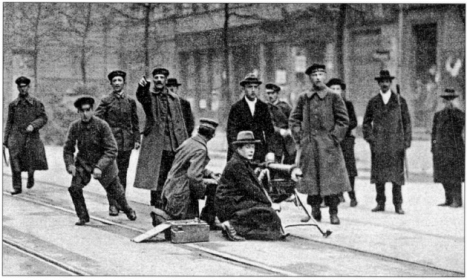
The Spartacus League brought armed mobs onto the streets of the new and fragile Weimar Republic 

In light of the increasing revolutionary rhetoric from both the political right and left, the ongoing demonstrations in many American cities that are part of the Occupy Wall Street Campaign I felt that it was important to remind people of what can happen when a society enters a revolutionary period. When a nation is in turmoil and is besought by political division and ineffective and out of touch government, a massive economic problems, wars that are believed to be lost and veterans that feel abandoned by their government and isolated from their fellow citizens and what some see as massive economic inequities, or lack of respect for their political, social or religious views then it is facing real danger. It is my belief that we need as individuals and as a nation take a step back from the brink. 

Peace, Padre Steve+

The German Revolution of 1919 and civil war is important for those who study highly developed states when they enter a period of social and political upheaval. Often such upheavals occur following military defeats or economic crisis that cause the society to question or even overthrow the established order.  The end of Imperial Germany and the establishment of the WeimarRepublicon November 9th 1918 is a prime example.  Following the declaration of the Republic the Majority Socialists who had assumed power had no military force of any caliber to support it. The Army had melted away following the end of the war and the units which remained were unreliable and heavily infiltrated by Soviet style “workers and soldiers councils.”

Chaos ruled the streets, Communists and Independent Socialists of The situation being chaotic the Majority Socialists under the leadership of Friedrich Ebert joined forces with German General Staff to create a military force capable of bringing order the Germany.  To do this they allowed for the formation of Freikorps to quell revolutionary chaos and avert the establishment of a Soviet State.

The study begins with the establishment of the Republic and concludes with the Kapp Putsch.  This is an era that is seldom referenced by political or military leaders in western states and historians themselves are often divided in their interpretation of the subject.  The study of this period is vital to those who study politically polarized societies which are either war weary or have suffered the shock of military defeat coupled with a government which is blamed for the events.  Thus, it is important to study the relationship of the military to the government and in particular the military’s relationship to politicians who have little connection to or affinity for the military, its traditions and culture and the often adversarial relationship of these politicians to military leadership which often sees them as adversaries.  The period also shows how actions of those who in their antipathy to the military create a climate where the military loathes the civilian leadership and the government.  The results of such conditions can endanger the society as a whole and ultimately usher in periods of great tragedy.  This occurred inWeimarGermanywith the result that the military in the later years of the Republic neither the military nor the Majority Socialists could not work together against the Nazi takeover of the state.  However, the first years of the relationship set the tone and foredoomed the Republic.
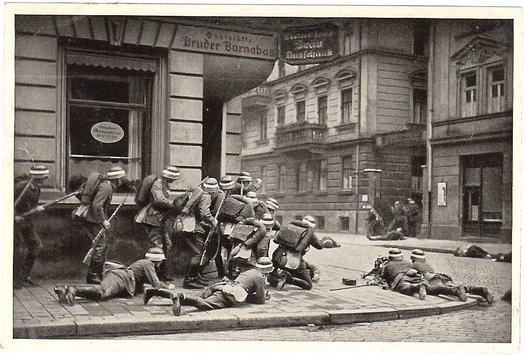
Freikorps troops battle Leftists in the streets

The history of Weimar, particularly that of the military and Freikorps in their relationship to the Republic is complex.  Not only is the relationship between the military and government complex, but the Freikorps themselves, their organization, leadership and political affiliation were not monolithic as is sometimes maintained,[i] nor were the Freikorps the direct ancestors of the Nazi SS/SA organizations despite often similar ideology,[ii] nor can they dismissed by saying that they were composed of “former soldiers and officers ill-disposed to return to civilian life.”[iii] The Freikorps’ association with the Army and Republic is more complex than some historians assert.  Despite the right wing leanings of many of units and fighters and future association of some to the Nazis, the blanket claim that the Freikorps were forerunners of the Nazi movement is not supportable.[iv] It is true that without Freikorps support in Munich, along with support of the Thule Society, business leaders and others “that the transition of the DAP into the Hitler party could not have taken place.”[v] It is also true that elements of the Freikorps branded too revolutionary and unruly for service in the Army continued as secret societies and affiliated themselves with various right-wing political groups.[vi] Likewise a case can be made that the fierceness of many Freikorps veterans, younger leaders of the Army laid the foundation for the brutality of both the Army and Waffen SS as they prosecuted the Second World War.[vii]

Yet simply because certain aspects of a subject are true does not make for a broader “truth.”  Heinz Höhne argues the reverse of what some have written in regard to the relationship of the Freikorps and Reichswehr to the Nazis, that in fact the Nazis did not issue from the Freikorps, but rather that many former members of the Freikorps, Imperial Army or the Reichswehr were attracted to the Nazis, particularly to the SS by its “philosophy of “hardness” and its attitude of bellicosity per se, basically unconnected with ideology.”[viii] Others historians state similar views especially those that study the relationship of the Reichswehr leadership to the Freikorps.  Thus the thesis of this paper is that the historiography like the period itself is complex; that the composition, leadership and motivations of the Freikorps were not monolithic, nor were they beloved by the Reichswehr, nor were they the “trailblazers” for the Nazi movement.  The focus of this article is on the relationship of the Reichswehr and the Freikorps to the Republic to the Kapp Putsch and the dangers of a relationship built on necessity without mutual trust.  Such a relationship is dangerous and can lead to unintended consequences.   This paper will explore the first years of theWeimarRepublic and specifically look at several key events that were pivotal in the relationship between the Army and Freikorps and the Majority Socialists.
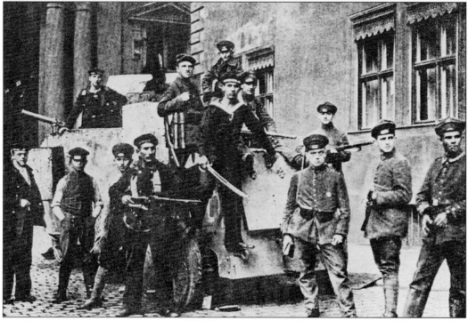
The Leftist “Volksmarine” Division which terrorized Berlin in late 1918 and early 1919 

The literature covering this period ranges from well written and researched academic histories and poorly researched and badly done works which attempt to present particular views of the Freikorps which often border on myth. Additionally there are biographical works which shed some light on the subject. The Reichswehr and the German Republic 1919-1926 by Harold Gordon Jr. is perhaps the best study of the Freikorps and their relationship to the state and the army.  Gordon’s work is exceptional in documenting the numbers, types, political affiliation, action and ultimate disposition of the Freikorps.  Other works which provide exceptional treatment of the relationship between the military and the Republic include The History of the German General Staff by Walter Goerlitz; The Nemesis of Power: The German Army in Politics 1918-1945 by John Wheeler-Bennett, The Reichswehr and Politics 1918-1933 by F.L. Carsten and The Politics of the Prussian Army: 1640-1945 by Gordon A. Craig.

The best of the general histories of the period, which focus on the National Socialist state are The German Dictatorship by Karl Dietrich Bracher, and Richard Evans’ The Coming of the Third Reich. Richard Watt’s The Kings Depart is one of the best for telling the story of the fall of the Empire and the revolution in Germany.  Watt’s account is well written and documented work and touches on other factors affecting the new republic including Versailles and Allied political actions. The final chapter of Holger Herwig’s The First World War: Germany and Austria-Hungary 1914-1918 gives a good account of the Army’s role in the end of the Empire and beginning of the Republic.  Andreas Dorpalen’s Hindenburg and the Weimar Republic adds an interesting dimension of Hindenburg’s role in the republic’s formation and negotiations between Groener, Noske and Ebert while Steven Ozments’ history of Germany A Mighty Fortress is superficial in its treatment of the period.  Nigel Jones’ Birth of the Nazis: How the Freikorps Blazed a Trail for Hitler is an interesting and somewhat entertaining but poorly documented work. Jones tends to “broad brush” the Freikorps in sometime as “sensationalist” manner. His book has none of the detail or nuance of Gordon, Craig, or Carsten on the Freikorps. Nor does Jones have the depth of Goerlitz or Wheeler-Bennett on the Republic’s relationship with the Army, or the attitude of the Reichswehr leadership to the Freikorps.  William Shirer’s The Rise and Fall of the Third Reich, Gerald Reitlinger’s The SS: Alibi of a Nation 1922-1945 and Heinz Höhne’s The Order of the Death’s Head.  All of these works add some information which details Nazi involvement in the early part of theWeimarRepublic but are limited in their coverage of the subject.

Of other works, Kenneth Macksey’s Why the Germans Lose at War has an insightful but short chapter dealing with this period and Wolfram Wette’s The Wehrmacht: History, Myth, Reality offers an interesting and at times provocative look at anti-Semitism in the German military in the years following the First World War.  Carlos Caballero Jurado’s The German Freikorps 1918-1923 is a short but very detailed study of Freikorps organizations and actions.  B.H. Liddell-Hart has a small chapter on General Von Seeckt in The German Generals Talk which hasinteresting commentary on later actions of former Reichswehr officers who served the Nazi state.
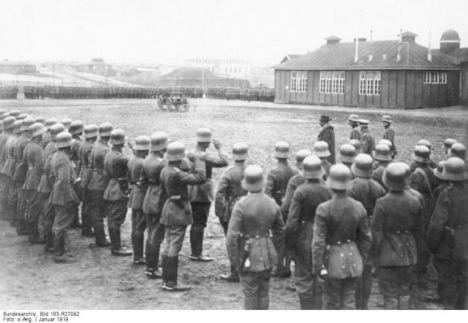
Freikorps Von Hulsen being sworn into the Provisional Reichswehr

A number of biographies touch on actions of German Officers who played key roles in World War Two.[ix] Most auto-biographies gloss over the Weimar period; however Admiral Reader’s memoir Grand Admiral offers the insight of a naval officer with some direct observation of the revolution and the Kapp Putsch.  Guderian in Panzer Leader omits his service in the Baltic “Iron Division.”

The relationship of the Republic to the Army was born in the moment of crisis of the abdication of Kaiser Wilhelm II and the armistice discussions with the Allies.  Beset by revolts in key naval bases and mutinies aboard ships of the High Seas Fleet and unrelenting Allied pressure on the German armies in the west the situation continued to deteriorate as the “red flag was flying in all the principle cities, soldiers behind the front were electing soldiers councils Russian fashion.”[x] Revolutionary and defeatist propaganda spread by the radical left wing of the Independent Socialists and Spartacus League spread through the country and even affected combat units,[xi] while the “Majority Socialists had found out that the militant factions of the Independents had secretly armed themselves out of funds supplied by the Soviet ambassador and adopted the slogan “all or nothing.””[xii] The situation had deteriorated so badly that Karl Liebknecht, leader of the Spartacus League “was announcing the establishment of a Soviet regime from the steps of the Imperial Palace.”[xiii]

Under these dire conditions, General Wilhelm Groener who had succeeded General Ludendorff as Quartermaster General called an emergency meeting of fifty “of his most senior army commanders.”[xiv] In response to his question of whether the troops would follow the Kaiser and oppose the revolts only one answered in the affirmative, and eight responded that “there was no hope of using regular Army units to quell unrest at home.”[xv] On November 9th Groener went to the Kaiser on behalf of the Supreme Command and in response to a suggestion that the Kaiser lead the Army back and suppress the revolts boldly stated “The Army will march home in peace and under its leaders and commanding generals, but not under the command of Your Majesty, for it stands no longer behind Your Majesty.”[xvi] The Emperor abdicated fleeing to Holland and Friedrich Ebert leader of the Majority Socialists was named Chancellor on November 9th.  Upon hearing the news Philipp Scheidemann a leader in the Social Democrats announced that Ebert was Chancellor proclaimed “Long live the great German Republic!”[xvii] It was an ill conceived act as Scheidemann had not consulted Ebert and his act prevented Ebert from working toward an orderly transition of power.

The mobs in the street were not placated by the announcement and the far left organizations aligned with the Independents “had no intention of letting the revolution stop there.”[xviii] In the streets of Berlin soldiers sold their weapons and vehicles officers were attacked by crowds on the streets and whenever “crowds found an Army officer, they tore off his epaulettes and medals.”[xix] Everywhere mutual recrimination was in the air, soldiers “blamed revolutionaries for the betrayal and stab-in-the back while revolutionaries blamed officers for all the costs and losses of the war.”[xx]

Groener called Ebert promising the Army’s support of the new government in return for the government’s assistance to the Army in the maintenance of discipline and supply.[xxi] He also drafted a letter signed by Hindenburg pledging the Army’s loyalty and telling him that “the destiny of the German people is in your hands….”[xxii]One source notes: “Thus, in half a dozen sentences over a telephone line a pact was concluded between a defeated army and a tottering semi-revolutionary regime; a pact destined to save both parties from the extreme elements of revolution but, as a result of which the Weimar Republic was doomed at birth.”[xxiii]

The High Command was able to bring the Army home in good order following the armistice but upon arriving most units “melted away like snow under a summer sun,”[xxiv] those which remained were often shells of their former selves beset by soldier’s councils and leftist revolutionaries.  To support the government the High Command issued a directive stating that it “put itself as the disposal of the present government led by Ebert without any reservation.”[xxv]Yet in December delegates of the National Assembly continued to sow resentment in the military by military discipline be placed in the hands of soldiers’ councils, that all badges of rank be removed with all decorations of insignia and honor.[xxvi] Reaction was heated,[xxvii] but despite this Groener, Colonel Walter Reinhardt, the Prussian Minister of War and the Republic’s Defense Minister, Gustav Noske endeavored to find forces to combat the growing revolution and rebellious military units.  The choice was not hard, the Army was of no use, so called “democratic forces” were in most cases both unreliable and ineffective, while only the Freikorps “provided suitable material for the immediate creation of an efficient, combat-ready army.”[xxviii] Thus the Freikorps became the instrument of necessity to ensure that the government was not swept away by a Soviet style revolution.

Gustav Noske, of the Majority Socialist party “saw himself as a patriot, a man of action…who had no time for theories…and was one of the few Socialists that the Supreme Command trusted.”[xxix] He had already distinguished himself by helping to bring under control the sailors revolts in Kiel by forming a loyal “Naval Brigade”[xxx] and he  “realized that the government must have a dependable military force behind it if it was to survive and rule Germany” and the “old Officer Corps must be the backbone of any such force.”[xxxi] The Army had melted away and units of the workers and soldiers councils were poorly trained, organized and led “”fought against the government as often as for it” and “were of little practical value to either the government or the rebels.”[xxxii] In the chaos of a Spartacus, now called the German Communist Party uprising and vacuum of political leadership of January 1st 1919 agreed to become defense minister stating “Someone must be the bloodhound, I won’t shirk the responsibility!”[xxxiii]

Noske helped by the High Command helped organize volunteer units led by officers and NCOs composed of reliable veterans.  Freikorps varied in size from divisions to companies and were led by Generals down to Sergeants and even a Private First Class.  Their greatest success was in early 1919 when the Republic was beset by “Red” revolutions in many major cities.  Without the use of the Freikorps by the government it is unlikely that the Republic would have survived.[xxxiv] On January 4th Ebert and Noske reviewed the troops of General Maercker’s Freiwillege Landesjaegerkorps and Maercker informed them that every volunteer had pledged loyalty to the government, seeing the discipline and order Noske told Ebert “Don’t worry. Everything is going to turn out all right now.”[xxxv]

On January 5th 1919 the leftist mobs attacked the Chancellery and the officers of the Socialist Vörwarts newspaper. Noske led the Freikorps back into Berlin [xxxvi] to regain control of the city for the government [xxxvii] and crushed the revolt.  Among the casualties were Spartacus leaders Karl Liebknecht and Rosa Luxemburg who were lynched by the officers of the Guards Cavalry Rifle Division.[xxxviii]

In March 1919 after a period of uneasy calm the Freikorps, now reinforced by the 2nd Naval Brigade, or Ehrhardt Brigade[xxxix] were called upon to put down the revolt of the leftist “People’s Naval Division.”[xl] Making liberal use of heavy weapons including tanks the Freikorps inflicted heavy losses on the leftists who lost over 1500 dead and 12,000 wounded in the uprising.[xli] Other revolts were crushed and the Freikorps reached their zenith in Württemberg where Freikorps led by Lieutenant Hahn, a Social Democrat put down leftist revolts[xlii] and in Bavaria where Independents and Communists had taken the city with their “Bavarian Red Army” which numbered nearly 25,000 men[xliii] on April 7th.

After failed attempts by the Socialist led Bavarian government to retake Munich, they asked for Berlin’s help.  Violence and massacres of citizens by the various leftist groups inflamed the Freikorps, including the Ehrhardt Brigade and the revolt was crushed by May 2nd.[xliv] Dorpalen called the Freikorps ruthlessness “completely unwarranted in view of the weakness of the opposing forces” and noted though they broke the leftist powers they deepened the nations’ cleavages”[xlv] while Macksey wrote that “where Freikorps’ brutality stained the pages of history there was invariably a forgoing or simultaneous record of excess by their sworn opponents.”[xlvi]

There was a tension between many in the Reichswehr and those on the German left and this came out in many ways as officers were caught in between various political camps while attempting to conduct their duties. Field Marshal Albert Kesselring recounted with great bitterness his experience:

“My cup of bitterness was full when I saw my devoted work rewarded by a warrant for my arrest for an alleged putsch against the socialist-influenced command of my III Bavarian Army Corps. Notwithstanding the degrading episodes during my imprisonment after 1945, I do not hesitate to describe this as the most humiliating moment of my life.”[xlvii]

The end of the Freikorps era began when the Provisional Reichswehr was established on March 6th 1919. The High Command assembled from Freikorps, remaining Army units and Republican defense forces. There was a great distrust between many in the Army, the remaining Freikorps and the Socialists. When the German delegation to Treaty of Versailles signed the treaty under threat of invasion it provoked a crisis. Noske and others threatened resignation over the war guilt clauses, but Groener warned that if the treaty was rejected the Army could not win against the Allies if hostilities were renewed.[xlviii] The treaty imposed harsh limitations on the German Army which many bitterly resented, however, Seeckt, the Chief of Staff of the Army felt that it was “more important to keep the Army in being and preserve the possibility of a military resurrection.”[xlix] Yet by signing the treaty the government lost the support of many officers who looked to General Walther von Lüttwitz, the Reichswehr’s senior commander, and commander of troops in the Berlin area for leadership.[l]

Revolution from the Right: The Kapp Putsch

Lüttwitz, leaders of certain Freikorps, right-wing groups and individuals made plans to overthrow the government.  They favored revolt against the government, but “their political aims were hazy.”[li] Army leadership recognized the threat posed by disaffected Freikorps and their leaders. Seeckt and Reinhardt felt it necessary to demobilize Freikorps who’s ill-discipline and political radicalism was a “danger to the consolidation desired by the army command.”[lii] The plotters sensed a threat to their plans for a putsch and Lüttwitz found a willing co-conspirator in Wolfgang Kapp, a failed politician.  Lüttwitz took action when the High Command ordered the 2nd and 3rd Naval Brigades be demobilized in compliance with Versailles treaty limitations and their radical views.[liii] Over the opposition of his chief of staff Von Lüttwitz began planning a coup, in his mind, to save Germany.[liv] The key unit in Lüttwitz plan was the 2nd Naval Brigade Commander by Korvettenkapitän (Lieutenant Commander) Ehrhardt.

Lüttwitz and his fellow conspirators showed “little regard for coordination of effort” and demonstrated “a quite amazing ability to work at cross purposes.”[lv] On March 12th without consulting Kapp, Lüttwitz and Ehrhardt launched the Putsch and Ehrhardt’s brigade in full battle dress entered Berlin. At this point the Reichswehr command froze; officers refused to condone the putsch but at the same time refused to support Noske and Reinhardt who demanded armed opposition to the coup,[lvi] while most Navy officers openly supported it.[lvii] Seeckt who did not want to see the army set against itself refused to deploy troops to counter Ehrhardt’s men.  He declared that “Troops do not fire upon troops!” and “When at occurs, then the true catastrophe, which was avoided with so much difficulty on November 9, 1918 will really occur.”[lviii] Despite the lack of support by the army the coup died amid massive strikes by workers and lack of popular support. However the damage done to the Reichswehr’s relationship to the government, especially the more moderate Majority Socialist was severe.

In the wake of the putsch Noske resigned, many officers in were discredited[lix]and dismissed including Lüttwitz and Admiral Von Trotha, head of the Navy, who openly supported the coup.[lx] Admiral Erich Raeder in his memoirs says that Von Trotha and the Navy staff only” thought of anything of complete loyalty to the government.” [lxi]

However the actions of the Navy leadership showed otherwise. The uncomfortable relationship which had endured the dire days of the Republic was ended.  The Reichswehr would emerge a lean and highly trained organization and remain a power broker in the Republic.  However the animosity between the Army and the Socialists was now so great that they could not stand together against the Nazis despite their mutual interest in doing so.[lxii]

Conclusion

The period was a critical and complex and should be studied by anyone living in a state with a powerful military tradition and institutions in crisis.  Unlike popular notions, the Freikorps were diverse and not the seed-bed of the Nazi movement and though many former members would become Nazis.  Several, including Ehrhardt narrowly escaped death at Nazi hands.[lxiii] Freikorps were viewed by Army leadership as an expedient force that could not remain in the service once the Army was functional.

Key lessons include that the military cannot become a “state within a state,” and that both military and civilian leaders must seek to bridge any gulf that separates them in times of crisis.  In Weimarboth the military and the Socialists thoroughly distrusted one another with the result that they eventually, despite early success [lxiv] worked against each other in later years.  Actions by both Socialists and the military ultimately subverted the Republic and ensured its demise and Seeckt’s policy of separation from politics “tended toward a renunciation of the soldier’s potential restraining influence on adventurous statesmen.”[lxv] Such is the fateful lesson for today for those who suggest a military coup to overturn a government that they oppose in much the same manner as those who supported Lüttwitz, Kapp and Ehrhardt.  Such actions only undermine democratic institutions, especially if they are weak and the nation is in crisis.  Often such actions bring about regimes far more dangerous than what they seek to overthrow and compromise the integrity of the military.


[i] Jones, Nigel. The Birth of the Nazis: How the Freikorps Blazed a Trail for Hitler. Constable and Robinson Ltd.London,U.K. 1987 and 2004.  This is Jones assertion and he attempts to make the tie using careers of some individuals who served both in Freikorps and either in the Nazi Party or Military and attitudes common in many Freikorps with similar attitudes found in the Nazi movement.  The 2004 edition of his work includes an introduction by Michael Burleigh echoing his sentiments.

[ii] Evans, Richard J. The Coming of the Third Reich. Penguin Group.London,U.K. andNew York,NY. 2003. pp.227-229.  Evans discusses the fact that the Nazis did have a number of Freikorps veterans but at no point makes the connection that the Freikorps are a direct ancestor.

[iii] Ozment, Steven. A Mighty Fortress: A New History of the German People.Harper-Collins Publishers,New York,NY 2004 p.246

[iv] Gordon, Harold J. Jr. The Reichswehr and the German Republic 1919-1926.Princeton University Press,PrincetonNJ 1957.  Gordon’s work is perhaps the most detailed study involving the Freikorps and the Reichswehr. He is exceptional in discussing the relationship of both with the various political parties including the Nazis.  He refutes this assertion throughout the book.

[v] Bracher, Karl Dietrich. The German Dictatorship. Translated by Jean Steinberg. Praeger Publications, New York, NY 1970. Originally published asDie Deutsche Diktatur: Enstehung, Struktur, Folgen des Nationalsozialismus.Verlag Kiepenheuer & Witsch,Koln undBerlin. 1969. p.101

[vi] Wheeler-Bennett, John W. The Nemesis of Power: The German Army in Politics 1918-1945. St. Martin’s Press,New York,NY 1954 pp. 91-92

[vii] Shepherd, Ben. War in the Wild East: The German Army and Soviet Partisans.HarvardUniversity Press,Cambridge,MA andLondon,U.K. 2004. p.28

[viii] Höhne, Heinz. The Order of the Death’s Head: The Story of Hitler’s SS. The Penguin Group, London U.K. and New York, NY 1969. Translated by Richard Barry. Originally Published as Der Ordnung unter dem Totenkopf.Verlag der Spiegel,Hamburg, 1966. p.54.

[ix] These include Macksey’s biographies of Kesselring and Guderian , Richard Giziowski’s The Enigma of General Blaskowitz. Peter Padfield’s Dönitz: the Last Führer, David Fraser’s biography of Field Marshal Rommel Knight’s Cross, Messenger’s work on Von Rundsedt, The Last Prussian, and Höhne’s Canaris: Hitler’s Master Spy all provide brief but interesting views of the actions and attitudes of these officers during the revolution and during the Weimar period.

[x] Goerlitz, Walter. History of the German General Staff 1657-1945.Translated by Brian Battershaw. Westview Press. Boulder CO and London. 1985 Originally published as Der Deutsche Generalstab, Verlag der Fankfurter Hefte, Frankfurt am Main.  FirstU.S. publication in 1953 by Preager Publishers. p.200

[xi] Gordon, Harold Jr. The Reichswehr and the German Republic 1919-1926.Princeton University Press, Princeton, NJ 1957 pp.4-5 Gordon recounts the story of an entire replacement train revolting when it reached the front which had to be disarmed by a shock battalion.

[xii] Watt, Richard M.  The Kings Depart: The Tragedy of Germany: Versailles and the German Revolution. Simon andSchuster,New York, NY 1968. p.186

[xiii] Wheeler-Bennett, John W. The Nemesis of Power: The German Army in Politics 1918-1945. St. Martin’s Press,New York,NY 1954. p.18

[xiv] Herwig, Holger H. The First World War: Germany and Austria Hungary 1914-1918. Arnold Press a member of the Hodder-Headline Group,London,UK andNew YorkNY 1997 p.445

[xv] Ibid. Herwig. p.445

[xvi] Carsten, F.L. The Reichswehr and Politics 1918-1933. Oxford University Press,Oxford,UK 1966 p.6.  It is noted by a number of author’s that Groener did this, to maintain the unity ofGermany and prevent its division.

[xvii] Ibid. Watt. p.196  Watt notes Ebert’s reaction as being enraged as the proclamation of the Republic technically “invalidated the existing constitution;Germany was now technically without a government.” (p.197)

[xviii] Ibid. Watt. p.197

[xix] Ibid. Watt. p.197

[xx]Giziowski, Richard. The Enigma of General Blaskowitz Hippocrene Books Inc.New YorkNY, 1997. p.65

[xxi] Craig, Gordon A. The Politics of the Prussian Army 1640-1945. Oxford University Press,Oxford,UK 1955 pp.347-348.  Craig gives an interesting account noting the Groener’s call to Ebert shows recognition of the legitimacy of the new government and notes that the offer was somewhat conditional.

[xxii] Dorpalen, Andreas. Hindenburg and the Weimar RepublicPrincetonUniversity Press,Princeton,NJ. 1964 p.26

[xxiii] Ibid. Wheeler-Bennett. p.21

[xxiv] Ibid. Gordon. p.15

[xxv] Ibid. Carsten. p.11. This was of critical importance as Carsten later notes that the Army realized that the government could not survive without its support.  Groener was perhaps the officer who most recognized the situation and endeavored to ensure that “the best and the strongest element of the oldPrussia, was saved for the newGermany, in spite of the revolution.” (p.12)

[xxvi] Ibid. Carsten. p.18 Carsten produces the bulk of the English translation of these points and notes that the anti-military feeling had become widespread.

[xxvii] Ibid. Giziowski. p.66  Giziowski recounts the speech of Hermann Goering in response to the announcement. This shows how such treatment can breed anger and resentment in a military that feels it has been betrayed after serving its country in a long and difficult war: For four long years we officers did our duty and risked all for the Fatherland. Now we have come home, and how do they treat us? The spit on us and deprive us of what we gloried in wearing. I will tell you that the people are not to blame for such conduct. The people were are comrades…for four long years.  No, the ones who have stirred up the people, who have stabbed this glorious army in the back…. I ask everyone here tonight to cherish a hatred, a deep and abiding hatred, for these swine who have outraged the German people and our traditions.  The day is coming when we will drive them out of ourGermany.”

[xxviii] Ibid. Gordon. p.15

[xxix] Ibid. Watt. p.168

[xxx] Ibid. Gordon. pp. 19 and 24.  This was the 1st Marine Brigade, or Brigade Von Roden of which elements would later serve in under the command of other Freikorps such as the Guards Calvary Rifle Division.

[xxxi] Ibid. Gordon. p.14

[xxxii] Ibid. Gordon. p.18

[xxxiii] Ibid. Watt. p.239

[xxxiv] Ibid. Gordon. p.426

[xxxv] Ibid. Watt. p.247

[xxxvi] Thee forces included the Landesjaegerkorps and Guards Cavalry Rifle division.

[xxxvii] Ibid. Gordon. p.30

[xxxviii] Ibid. Wheeler-Bennett. p.36

[xxxix] This was one of two additional Naval Brigades formed by Noske after the success of Naval Brigade Von Roden.  It was one of the most combat effective but unfortunately violent and radical of the Freikorps, it would as we will see be a key unit in the Kapp Putsch but would not be absorbed into the Reichswehr.

[xl] This unit was not a Navy unit at all but was composed of many who were criminals and other rabble. See Gordon, Carsten and Watt.

[xli] Jurado, Carlos Caballero. The German Freikorps 1918-23. Illustrated by Ramiro Bujeiro. Osprey Publishing,Oxford,UK 2001 p.12

[xlii] Ibid. Gordon. p.42  His units were known as Security Companies.

[xliii] Ibid. Jurado. p.13

[xliv] Ibid. Gordon. pp.47-49. An estimated 550 people including 200 innocent bystanders were killed in the fighting.

[xlv] Ibid. Dorpalen. p.29

[xlvi] Macksey, Kenneth. Guderian: Creator of the Blitzkrieg. Stein and Day Publishing,New York,NY 1975 p.45

[xlvii] Kesselring, Albrecht. The Memoirs of Field Marshal Kesselring with a new introduction by Kenneth Macksey. Greenhill Books, London UK. 1997. Translated from the German by William Kimber Ltd. Originally published as Soldat bis zum letzen Tag. Athenaum,Bonn,Germany 1953 pp.18-19

[xlviii] Ibid. Wheeler-Bennett. pp.57-59

[xlix] Ibid. Goerlitz. p.216

[l] Ibid. Wheeler-Bennett. p.61

[li] Ibid. Carsten. p.74

[lii] Ibid. Carsten. pp.74-75

[liii] Ibid. Carsten. p.76  Another consideration is that Noske, Reinhardt and Seeckt all were seeking to retire Lüttwitz.

[liv] Ibid. Gordon. p.97

[lv] Ibid. Craig. p.376

[lvi] Ibid. Carsten. pp.78-79

[lvii] Höhne, Heinz. Canaris: Hitler’s Master Spy. Cooper SquarePress,New York,NY 1979 and 1999. Translated from the German by J. Maxwell Brownjohn, Originally published inGermany by C. Bertelsmann Verlag Gmbh, München. 1976. p. 78.  Canaris also had been suspected of complicity in the murders of Rosa Luxemburg and Karl Liebknecht but was acquitted. (pp.56-71)

[lviii] Ibid. Gordon. pp.114-115

[lix] Among them Maercker who had been such a strong supporter of the Republic in the early days.

[lx] Ibid. Carsten. p.98

[lxi] Raeder, Erich. Grand Admiral. Translated from the German by Henry W. Drexell.United States Naval Institute,AnnapolisMD, 1960. Da Capo Press edition published 2001. p.111. This is interesting as almost all histories implicate the Navy High Command of either some complicity or at least agreement with the Putsch participants.

[lxii] The final part in the drama would come when General Kurt Von Schleicher became the last Chancellor before Hitler.  Schleicher had assisted Groener and Noske in the early days of the Republic and often attempted to use the Army’s influence in politics. He was fatally short sighted and was a victim of the SS “night of Long Knives” which was directed against the SA.

[lxiii] Ibid. Jones. p.266  Others such as Gerhard Rossbach had similar experiences.  Korvettenkapitän Löwenfeld of the 3rd Naval Brigade became an Admiral, Wilhelm Canaris , who was implicated in the Kapp Putsch but kept his career would later head the Abwehr and die in a concentration camp.

[lxiv] Ibid. Gordon. p.426  Gordon has a good discussion of this topic in his conclusion.

65 Liddell-Hart, B.H. The German Generals Talk. Published 1948 B.H. Liddell-Hart, Quill Publications,New York,NY. 1979. p.18 Liddell-Hart’s analysis of the results of the Reichswehr’s disconnection from the larger society and political process is remarkable due to current trends in the American military which like the Reichswehr has become somewhat more conservative and disconnected from society, exceptionally technically proficient but not adept in politics or grand-strategy.

Works Cited

Bracher, Karl Dietrich. The German Dictatorship: The Origins, Structure and Effects of National SocialismTranslated from the German by Jean Steinberg with an introduction by Peter Gay.  Praeger Publishers, New York, NY. 1970 Originally published in Germany as Die deutsche Diktator: Entstehung, Struktur, Folgen den Nationalsozialismus by Verlag Kiepenheuer und Witsch.Koln undBerlin.

Carsten, F.L. The Reichswehr and Politics 1918-1933OxfordUniversity Press,Oxford,UK 1966

Craig, Gordon A. The Politics of the Prussian Army 1640-1945. OxfordUniversity Press,Oxford,UK 1955

Dorpalen, AndreasHindenburg and the Weimar RepublicPrincetonUniversity Press,Princeton,NJ. 1964

Evans, Richard JThe Coming of the Third Reich. Penguin Books,New York,NY andLondon,UK. 2003

Giziowski, RichardThe Enigma of General Blaskowitz. Hippocrene Books Inc.New YorkNY, 1997

Goerlitz, WalterHistory of the German General Staff 1657-1945. Translated by Brian Battershaw. Westview Press. Boulder CO and London. 1985 Originally published as Der Deutsche Generalstab, Verlag der Fankfurter Hefte, Frankfurt am Main.  FirstU.S. publication in 1953 by Preager Publishers

Gordon, Harold Jr. The Reichswehr and the German Republic 1919-1926. PrincetonUniversity Press,Princeton,NJ 1957

Guderian, Heinz. Panzer Leader. (abridged) Translated from the German by Constantine Fitzgibbon, Ballantine Books,New York 1957

Herwig, Holger HThe First World War: Germany and Austria Hungary 1914-1918. Arnold Press a member of the Hodder-Headline Group,London,UK andNew YorkNY 1997

Höhne, HeinzCanaris: Hitler’s Master Spy. Cooper SquarePress,New York,NY 1979 and 1999. Translated from the German by J. Maxwell Brownjohn, Originally published inGermany by C. Bertelsmann Verlag Gmbh, München. 1976.

Höhne, Heinz. The Order of the Death’s Head: The Story of Hitler’s SS. The Penguin Group, London U.K. and New York, NY 1969. Translated by Richard Barry. Originally Published as Der Ordnung unter dem Totenkopf. Verlagder Spiegel,Hamburg, 1966.

Jones, Nigel. The Birth of the Nazis: How the Freikorps Blazed the Way for Hitler. Constable and Robinson Ltd.London,UK 1987

Jurado, Carlos CaballeroThe German Freikorps 1918-23. Illustrated by Ramiro Bujeiro. Osprey Publishing,Oxford,UK 2001

Kesselring, AlbrechtThe Memoirs of Field Marshal Kesselring with a new introduction by Kenneth Macksey. Greenhill Books, London UK. 1997. Translated from the German by William Kimber Ltd. Originally published asSoldat bis zum letzen Tag. Athenaum,Bonn,Germany 1953.

Liddell-Hart, B.H. The German Generals Talk. Published 1948 B.H. Liddell-Hart, Quill Publications,New York,NY. 1979

Macksey, KennethGuderian: Creator of the Blitzkrieg. Stein and Day Publishing,New York,NY 1975

Macksey, KennethKesselring: The German Master Strategist of the Second World War. Greenhill Books,London,UK 2000.

Ozment, Steven. A Mighty Fortress: A New History of the German People.Harper-Collins Publishers,New York,NY 2004

Shepherd, BenWar in the Wild East: The German Army and Soviet Partisans.HarvardUniversity Press,Cambridge,MA andLondon,U.K. 2004

Wheeler-Bennett, John W. The Nemesis of Power: The German Army in Politics 1918-1945. St. Martin’s Press,New York,NY 1954

Watt, Richard M.  The Kings Depart: The Tragedy of Germany: Versailles and the German Revolution. Simon andSchuster,New York, NY 1968

Wette, Wolfram. The Wehrmacht: History, Myth, Reality. Harvard University Press, Cambridge, MA and London, UK  2006. Translated from the German by Deborah Lucas Schneider. Originally published as Die Wehrmacht: Feindbilder, Vernichtungskrieg, Legenden. S. Fischer Verlag Gmbh,Frankfurt am Main,Germany 2002

5 Comments

Filed under History, leadership, Military, national security

1812: The Year of the Frigates

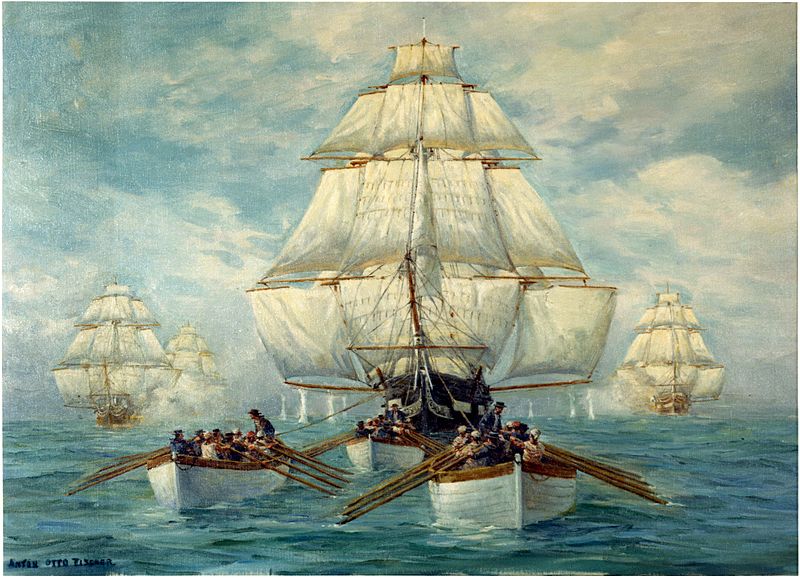
USS Constitution

This is the second of a series of articles I will write commemorating the 236th anniversary of the founding of the United States Navy. This article discusses the actions of the USS Constitution and USS United States at the outbreak of hostilities in which they defeated three British Frigates in battles that are legend in the annals of Naval History. I grew up reading the stories of naval actions during the War of 1812 with rapt fascination.  I could describe the battles, the ships and the brave Captains in detail even at a young age.  I can close my eyes and see the paintings, drawings and the diagrams of the ships, their sailors and the battles that they fought. I guess that I was destined to end up in the Navy. But then how could I not? My birthday falls on March 27th, the anniversary of the founding of the current United States Navy.  

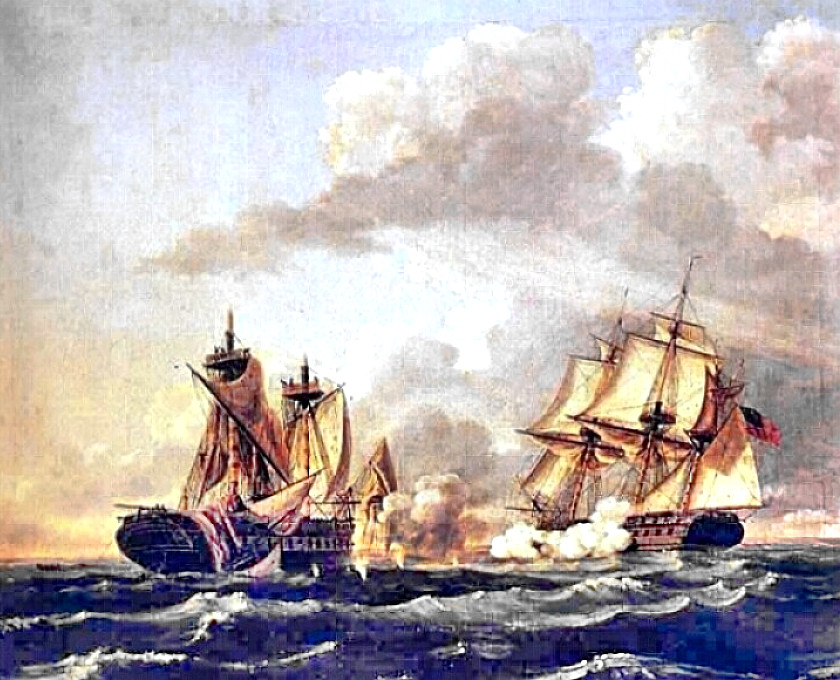
On March 27th 1794 the Congress of the United States appropriated funds to establish a Navy built around six powerful Frigates, the 44 Gun USS Constitution, USS President and USS United States and the 38 Gun USS Congress, USS Constellation and USS Chesapeake.  The 44 gun ships were larger and had a heavier armament than the majority of their British, French or Spanish counterparts.  Although rated as 44 Guns they mounted 56 guns, 30 of which were the heavy 24 pound cannons and 22 were the short range but powerful 32 pound carronades. They were built of oaken timbers that were of the size used to build Ships of the Line in other navies.  In comparison the standard Royal Navy Frigate of the day was the 38 gun ship mounting 18 pound cannons.  The ships would serve during the Quasi-War withFrance from 1798-1800 and the First Barbary War from 1801-1805.

Chase of the Constitution

When the United Stateswent to war with Britainin 1812 neither side was well prepared. The British were deeply engaged in the Napoleonic Wars and the bulk of the Royal Navy was engaged in blockade operations against Franceand its allies on Europe’s Atlanticand Mediterranean coasts.  Deployed the Western Atlantic was a 64 Gun Ship of the Line HMS Africa 9 Frigates and assorted and about 75 smaller vessels.  The United States Navy was minuscule even compared with the forces deployed by the Royal Navy to the Western Atlantic.

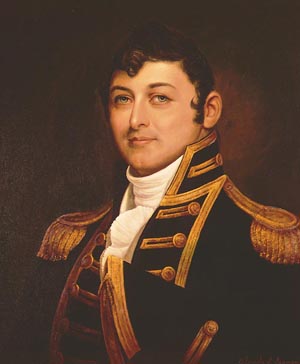
Captain Isaac Hull

When the Federalist administration of John Adams left office the Navy was on the ascendant.  Built around a nucleus of 13 Frigates with six 74 gun Ships of the Line under construction the Navy was reduced to just 8 Frigates, most of which were laid up in dry dock at any given time.  There was an anti-Navy sentiment in the Republican administrations of  Thomas Jefferson and James Madison.  The building program was ended and replaced with a program of gunboat construction.  About 174 of these were built between 1805 and 1812 but only 62 were in service at the time of the war.   They were particularly unsuited to engaging any substantial British ship as they were too lightly built and were poor sea boats with a light armament and it would take 40 gunboats to match the firepower of a single British Frigate.  Likewise instead of being cheap to build and maintain the cost per gunboat came out to $10,000 each instead of the budgeted cost of $5000 and their cost to maintain one gunboat per year was more than that of a Frigate.

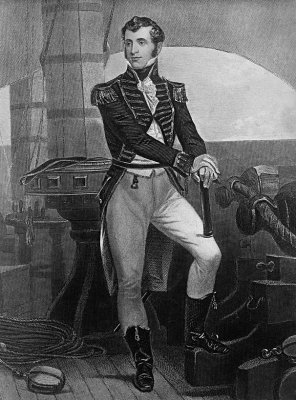
Captain Stephen Decatur

The reduction of the “blue water” Navy was a move of political ideology. Despite the obvious need to protect commerce as was displayed during the Quasi-War and the First Barbary War the Jefferson administrations was intent on a coastal defense strategy to which the gunboats were key.  However it was poor naval policy because there was no way to determine where any actual British strike would take place and the dispersion of the gunboats meant that there would never be enough at any port to repel the Royal Navy.

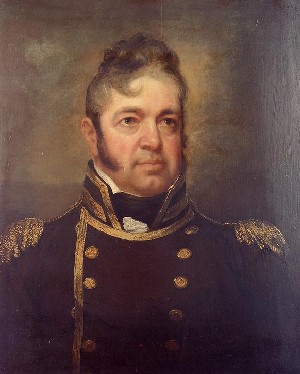
Captain William Bainbridge

When war was declared the United States Navy comprised of just 8 Frigates and 14 smaller Sloops and Brigs and the worthless gunboats.  Since the build program was stopped the Navy had no Ships of the Line.   The Secretary of the Navy was an incompetent named Paul Hamilton and the Jeffersonian strategy of coastal defense was embraced by Albert Gallatin who recommended that all the Navy’s large ships be turned into floating batteries for harbor defense.

USS Constitution vs. HMS Guerrière

The Navy was fortunate to have bold officers with the combat experience of the Quasi-War and the Barbary War under their belt.  The ships had fine crews of well trained professional sailors who excelled at seamanship and gunnery.  Taking advantage of the thinly stretched Royal Navy a squadron under Commodore John Rodgers was already at sea when the administration decided on the coastal defense strategy and forced the Royal Navy to divert many ships that could have decimated the merchant marine of the time allowing many American flagged ships to safely reach port with their cargo.

The USS Constitution under the command of Captain Isaac Hull sailed from Boston at the outbreak of hostilities and nearly met disaster when it ran into a Royal Navy squadron comprised of the HMS Africa and 5 Frigates.  Becalmed Hull and his crew used every device known to escape in an epic 57 hour close quarter chase.  He returned to Boston, replenished his stores and set sail again.  On August 19th some 600 miles out of Boston Constitution came across the 38 Gun Frigate HMS Guerrière. The Captain of Guerrière was James Dacres who had a low opinion of the United States Navy. Hull directed the fire of his powerful 24 pounders into Guerrière shredding her rigging and smashing her hull. Two hours after the fight began Dacres struck Guerrière’s colors.  Guerrière was so badly damaged that she was burned and sunk with her crew taken back to Boston as prisoners.  During the action a sailor aboard Constitution noted that Guerrière’s shot was bouncing harmlessly off of the thick oaken sides of the ship. He is quoted as shouting “Huzza, her sides are made of iron,” which provided the ship her nickname Old Ironsides. Constitution lost 7 men killed and 7 wounded in the battle while Guerrière lost 15 killed and 78 wounded of her 272 member crew.

USS United States vs. HMS Macedonian

The USS United States under the command of Captain Stephen Decatur found the 38 Gun HMS Macedonian under the command of Captain John S. Carden 600 miles west of the Canary Islands.  The battle commenced at 0920 and firing from long range Decatur’s gunners partially dismasted Macedonian leaving her hard to maneuver. Decatur then positioned United States on the quarter of Macedonian and pounded the helpless British ship into submission.  Macedonian surrendered about 1200.  Damage to the United States was light and 7 sailors were killed and 5 wounded.  Macedonian lost over one-third of her 301 man crew killed or wounded.  The Americans took over the British vessel and after temporary repairs at sea the United States and the newly christened USS Macedonian sailed for New York arriving on December 4th 1812.  The ship would serve in the U.S. Navy until 1828 when she was broken up at Norfolk.

USS Constitution vs HMS Java

In late October 1812 the Constitution now under the command of Captain William Bainbridge sailed from Boston.  This time she encountered the 38 Gun Frigate HMS Java under the command of Captain Richard Lambert off the coast of Brazil on December 29th 1812.  Java was a fine ship with a well drilled crew and brave Captain and she was faster than Constitution.  Though she was rated as 38 Guns she had 49 mounted making her a far tougher opponent than Guerrière or Macedonian. In addition to her own crew she had on board 100 additional sailors to reinforce ships inIndia. She was carrying Lieutenant General Thomas Hislop who was to command British forces inIndia, officers from his staff and several other high ranking Royal Navy officers enroot to commands inIndia.

The action commenced about 1410 and Lambert was able to maneuver across Constitution’s stern 3 times shooting away her helm at 1430 and wounding Bainbridge. Constitution was able to close with Java and the ships became fouled which took away the advantage Java had temporarily acquired.  Java had her bowsprit and jib boom shot away at 1500 and in the next 55 minutes Constitution dismasted Java with the exception of part of her mainmast which went over the side at 1620.  The gallant Captain Lambert was mortally wounded at 1530 and command was assumed by Lieutenant Henry D. Chads.  At 1725 Constitution took up a raking position and Lieutenant Chads after consulting with his surviving officers struck the colors.  The battered Java was not salvageable and was burned and sunk the next day but not before Java’s helm was salvaged and installed on Constitution.  In an ironic twist Commodore Henry Chads in command of a British squadron at Singapore in 1845 provided medical assistance to Constitution when her crew suffered an outbreak of Dysentery and fevers during her around the world cruise.

Within the space of four months the Royal Navy lost three Frigates and forbade their Frigate Captains not to engage the American “Super-Frigates” one on one.  Only Ships of the Line or squadrons would be allowed to engage the American ships.

Over the next two years the British tightened their blockade of American ports bottling up most of the Navy.  The Navy lost two of the Super-Frigates to the British during the war, the 36 gun USS Chesapeake which was captured by HMS Shannon on June 1st 1813 and the USS President on January 15th 1815.

Neither was a fair fight, Chesapeake’s Captain James Lawrence was new to the ship which had a new and poorly trained crew and Shannon was one of the most combat effective ships in the Royal Navy whose Captain was Philip Broke had been her skipper for 7 years and trained the crew into a well drilled machine.  Lawrencewas mortally wounded but uttered the cry which immortalized him “Don’t give up the ship, fight her until she sinks.” Lawrence’s friend Commodore Oliver Hazard Perry would name his flagship on Lake Erie the USS Lawrence and fly a flag that read “Don’t give up the Ship.”  The USS President under the command of Stephen Decatur was lost after she was badly damaged in a winter gale and snowstorm when pilots navigated her onto a sand bar.  Although Decatur was able to move the ship off the bar she was badly damaged and caught by a superior British squadron and captured.

The exploits of the small force of Frigates and smaller ships on the high seas and Perry’s squadron onLake Erie proved to be the only real military successes of the war.  But even more it was the three engagements in the closing months of 1812 that defined the spirit of the United States Navy for generations.

Peace

Padre Steve+

8 Comments

Filed under History, Military, Navy Ships, US Navy

The United States Navy: 236 Years of a Global Force for Good

The Grand Union Flag being raised on the Frigate Alfred  

This is the first in a series of articles that I will post this month on significant events and personalities that make up the history of the Unite States Navy which celebrates its 236th anniversary on October 13th 2011. I have had the distinct honor of having grown up in a Navy family and after almost a full career in the U.S. Army to be able to serve in the Navy to the present day.  

First Blood: The Battle of Nassau

“It follows than as certain as that night succeeds the day, that without a decisive naval force we can do nothing definitive, and with it, everything honorable and glorious.” George Washington 15 November 1781 to the Marquis de Lafayette

On October 13th 1775 the Continental Congress passed legislation to establish a Navy for a country that did not yet exist.  It was the first was the first in a long line of legislative actions taken by it and subsequent Congresses that helped define the future of American sea power.

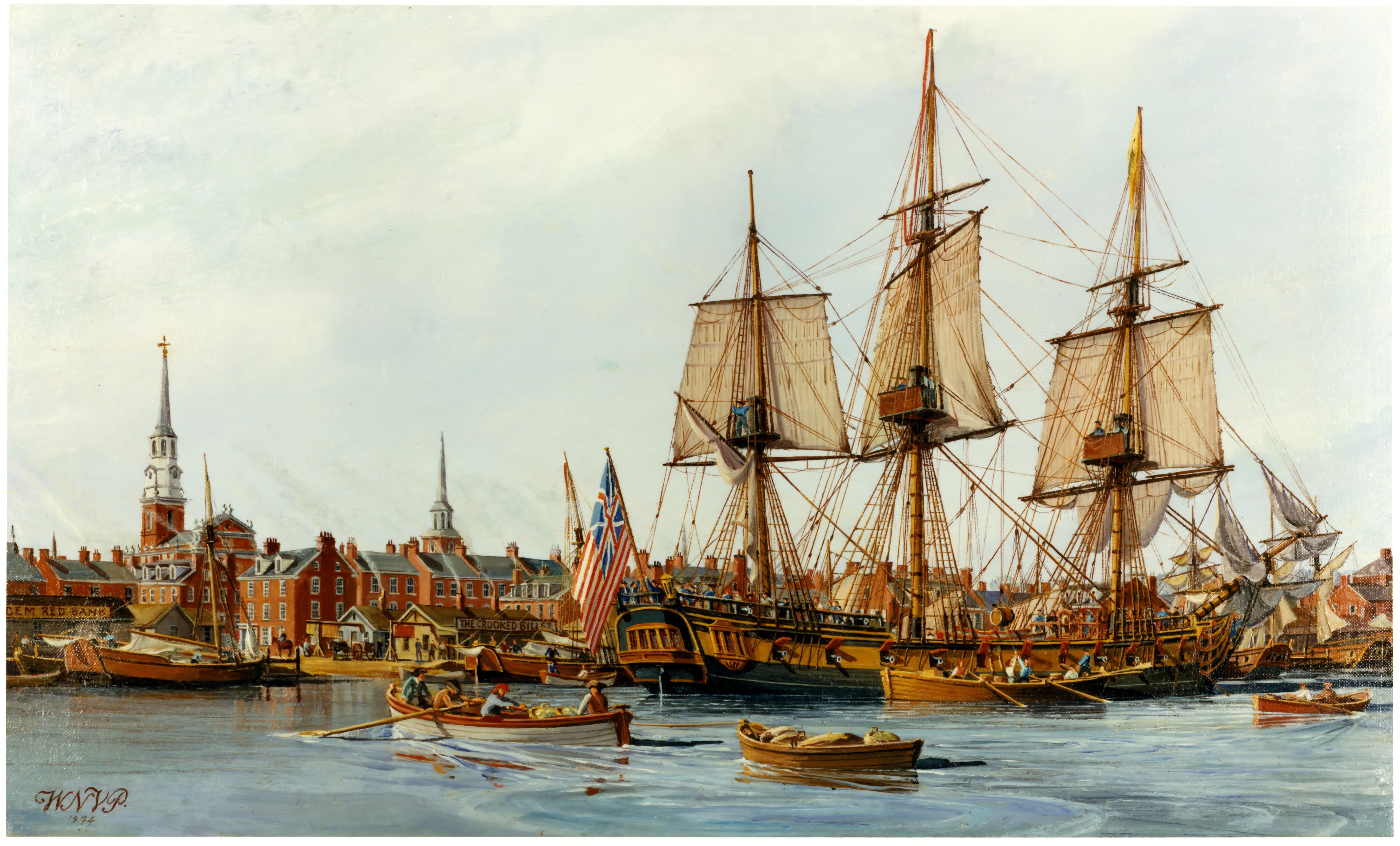
The legislation was the beginning of a proud service that the intrepid founders of our nation could have ever imagined.  Less than two months after it was signed on December 3rd1775 Lieutenant John Paul Jones raised the Grand Union Flag over the new fleet flagship the Alfred. The fleet set sail and raided the British colony at Nassau in the Bahamas capturing valuable cannon and other military stores.  It was the first amphibious operation ever conducted by the Navy and Marines.

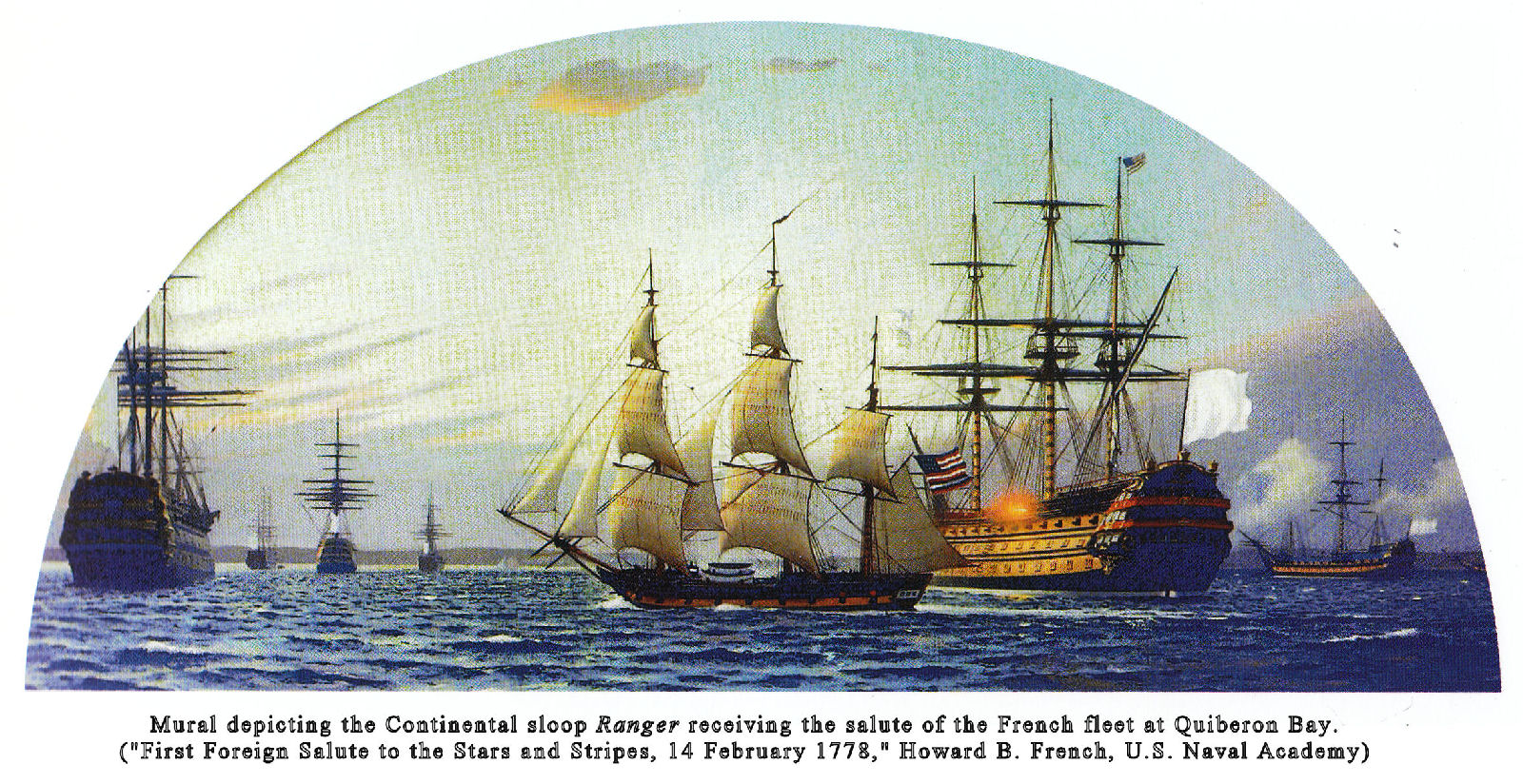
Jones received the first recognition of the American flag shortly afterFrancerecognized the newUnited States.  In command of the Sloop of War Ranger his ship received a nine-gun salute from the French flagship at Quiberon Bay.

“I have not ye begun to fight!” The Battle of Flamborough Head 

When the war ended very few of these ships remained most having been destroyed or captured during the war. But these few ships and the brave Sailors and Marines who manned them blazed a trail which generations of future sailors would build on.  The Navy has served the nation and the world as a “Global Force for Good” for 236 years.

Tonight as you go to bed and sleep soundly after eating well and spending time with family, friends or enjoying some form of entertainment remember those of our Navy who serve at sea, in the mountains and deserts of Afghanistan, the cities of Iraq, the desolation of the Horn of Africa and around the world defending our interests, caring for our military personnel and their families and deploying to serve in harm’s way and in areas of devastation.  They are America’s “Global Force for Good.”  They are my shipmates.  They are the United States Navy.

Peace

Padre Steve+

2 Comments

Filed under History, Military, US Navy

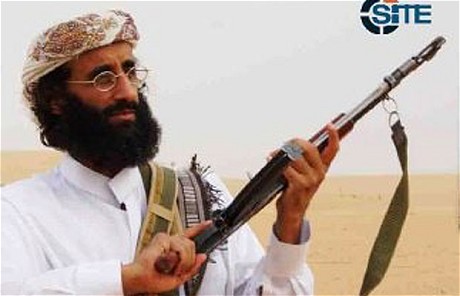
Fighting a World Wide Insurgency Part Two: The changing nature of War and the Justified Killing of Anwar al-Awlaki

This is a belated follow up to my article Fighting a World Wide Insurgency: The Problem Fighting Revolutionary Terrorists and Insurgents- Part One . It deals with the killing of American born Al Qaeda cleric and propagandists Anwar al-Awlaki and Samir Khan by U.S. Forces in Yemen.  There is controversy in the American media, body politic and among U.S. based civil rights groups such as the ACLU.  My premise is that the killing of Awlaki and Khan was justified because of their actions and because the nature of warfare itself has changed radically since the current “Law of War” contained in the Geneva and Hague conventions the U.N. Charter and other international law standards were laid down.  The were all written with the nation state in mind, not apocalyptic terrorists that recognize no borders do not differentiate between civilians and military targets and have not regard for citizenship either their own or that of others.  Alan Dershowitz the noted jurist, legal scholar and civil libertarian wrote “The great American justice Oliver Wendell Holmes Jr once remarked that “it is revolting to have no better reason for a rule of law than that it was laid down in the time of Henry IV. It is still more revolting if the grounds upon which it was laid down have vanished long since, and the rule simply persists from blind imitation of the past.”

Awlaki and Khan were not mere criminals they were enemy combatants and the fact that they were not on a recognizable battlefield when targeted is irrelevant.  They played games with their citizenship, never officially renouncing it even as they did everything that they could from a propaganda point of view to wage war against their country and incite others including members of the U.S. Military to kill Americans. Yes, they were combatants waging war and not “victims” of an “assassination” ordered by the President.  They knew they were at war and said so quite openly.  The provided aid and encouragement to those that killed American soldiers at FortHoodand attempted to bring down a Delta Air Lines jet on Christmas Day 2009.  Derschowitz commented on the kind of strike used to kill Awlaki and contrasted it with terrorism saying “A targeted assassination is exactly the opposite of terrorism. Terrorism is untargeted assassination — you just throw a bomb in a cafeteria and you get everybody. Targeted assassination is designed to be very precise and very specific.”

Awlaki, Khan and their fellow Al Qaeda travelers fight a different kind of war than we in the West are comfortable waging. They fight a war where they make no distinction between soldiers and civilians and do not recognize the borders of sovereign nations.  Al Qaeda has defined the battlefield and it is not confined to Iraq or Afghanistan.  Using secure bases of operations in nations that are officially our “allies,” they have been able to place themselves safely out of harm’s way until the past year while planning, training and propagandizing new recruits into their terrorist cause.

Awlaki stated his opinion succinctly about the kind of war he was waging in an interview in early 2010:

“Yes. With regard to the issue of ‘civilians,’ this term has become prevalent these days, but I prefer to use the terms employed by our jurisprudents. They classify people as either combatants or non-combatants. A combatant is someone who bears arms – even if this is a woman. Non-combatants are people who do not take part in the war. The American people in its entirety takes part in the war, because they elected this administration, and they finance this war. In the recent elections, and in the previous ones, the American people had other options, and could have elected people who did not want war. Nevertheless, these candidates got nothing but a handful of votes. We should examine this issue from the perspective of Islamic law, and this settles the issue – is it permitted or forbidden? If the heroic mujahid brother Umar Farouk could have targeted hundreds of soldiers, that would have been wonderful. But we are talking about the realities of war.” Anwar a-Awlaki comments in interview supporting attempted downing of Delta Air Lines flight on Christmas Day 2009 http://www.memri.org/report/en/0/0/0/0/0/0/4202.htm

The United States killed two men who though technically a “citizens” were declared enemies of theUnited States. By his own words and actions Awlaki declared war against the land of his birth and the land that blessed him with an education that he used for years to encourage other Muslims, especially American Muslims to kill Americans wherever they are found.

The method of his killing appears to be by a targeted drone strike on his hide out in Yemen.  His killing has been condemned and it’s legality questioned by a good number of people including Republican Presidential candidate Ron Paul.  On the surface I can see their concerns.  Any reader of this site knows that I am on the whole with very few exceptions very much a civil libertarian and some will call me a hypocrite but I am okay with that.  The fact is that I do not want our government to be engaged in activities that violate the constitutional rights of Americans anywhere in the world.  Nor do I want to see Awlaki’s killing used as precedent in killing American citizens not engaged in acts of war against the United States. Critics have contended that Awlaki had not broken the law and that his killing in a country that we are not at war with made the act an illegal assassination under the 5th Amendment while ignoring his goal of mobilizing Muslims worldwide, but especially American Muslims to kill Americans at home and abroad. However even criminal courts in the United States recognize that a person that encourages murder can be charged as an accomplice or even co-conspirator as Awlaki was to the mass murderer of Fort Hood Major Nidal Hussein.

However those that decry Awlaki’s killing ignore his words that “we have to establish an important principle: Jihad is global. It is not a local phenomenon. Jihad is not stopped by borders or barriers; they cannot stand in the way of Jihad. Jihad does not recognize the colonial borders that were made in the countries in the past that were drawn by a ruler on the map; Jihad doesn’t recognize those superficial borders.” (Chapter 3: Constants on the Path of Jihad)  The critics of Awlaki’s killing as well as that of Osama Bin Laden and other men that describe themselves as combatants in a war against the United States all encourage the killing of every American because “all Americans are guilty.”   Awlaki’s fellow “American” terrorist companion Samir Khan who was killed with him in the attack wrote “I am a traitor to America because my religion requires me to be. We pledge to wage jihad for the rest of our lives until either we implant Islam all over the world or meet our Lord as bearers of Islam.”

Dershowitz noted that weapons of mass destruction in the hands of suicide terrorists with no fear of death and no home address have rendered useless the deterrent threat of massive retaliation. This threat has been the staple of military policy since the days of the Bible. Because suicide terrorists cannot be deterred, they must be pre-empted and prevented from carrying out their threats against civilians before they occur. This change in tactics requires significant changes in the laws of war – laws that have long been premised on the deterrent model.”

Yes by law Awlaki was still an American citizen at the time of his death. Despite his many calls for the destruction of this country and the killing of its citizens he never went to an Embassy or Consulate to officially renounce his citizenship and thus was still a citizen.  The fact that Awlaki was a leader and propagandist for Al Qaeda on the order of what Josef Goebbels was to the Nazis is lost in the debate.  The uncomfortable truth is that an “American” citizen Awlaki had for all recognizable purposes renounced his citizenship, and under most historical and legal precedents in the United Statesand Europe Awlaki forfeited his rights as such.

This country has revoked the citizenship of citizens for taking up arms against this country to include all officers who left the U.S. military and former government officials that took up prominent positions in the Confederate armed services and government.  They lost their citizenship rights and all had to reaffirm their allegiance to the Union to receive pardons.  Some did not and some such as the commandant of the Andersonville prisoner of war camp were executed for their crimes against other U.S. citizens.

The fact that he hid among his family’s tribal homeland inYemenis also held out as a reason that Awliki’s killing was illegal.  However Awlaki did not recognize the borders that some say should offer him protection and in my view it is unreasonable for theUnited Statesto be bound by conditions that our adversaries do not acknowledge.

The fact is that Al Qaeda and other terror groups have redefined warfare and that many of our long held notions about the nature of war are obsolete.  Al Qaeda and other militant groups understand the concept of revolutionary warfare in ways that are distinctly uncomfortable for us in the West. We talk about counterinsurgency in Afghanistanand Iraq without realizing that the actual insurgency is worldwide and not bound by our constraints.  One of the key components of revolutionary warfare is propaganda which is exactly what Awlaki and Khan were doing.  They betrayed their country, inspired who knows how many radicals to kill Americans around the world including the infamous Major Nidal Hasan who Awlaki described as a hero. He is a man of conscience who could not bear living the contradiction of being a Muslim and serving in an army that is fighting against his own people…My support to the operation was because the operation brother Nidal carried out was a courageous one.”

Roger Trinquier a French officer who served in both Indo-China and Algeria recognized this method of operation in his book Modern Warfare: http://www.cgsc.edu/carl/resources/csi/trinquier/trinquier.asp:

“Warfare is now an interlocking system of actions political, economic, psychological; military that aims at the overthrow of the established authority in a country and its replacement by another regime.  To achieve this end, the aggressor tries to exploit the internal tensions of the country attacked ideological, social, religious, economic, any conflict liable to have a profound influence on the population to be conquered.”

Unfortunately many in political and media elite as well as some civil libertarians like the ACLU are still acting if it was 1944 and there are clear lines that divide nations as well as military personal from civilians.  But for the terrorist this is not the case, Trinquier states the matter very well:

“But the case of the terrorist is quite otherwise. Not only does he carry on warfare without uniform, but he attacks, far from a field of battle, only unarmed civilians who are incapable of defending themselves and who are normally protected under the rules of warfare. Surrounded by a vast organization, which prepares his task and assists him in its execution, which assures his withdrawal and his protection, he runs practically no risks-neither that of retaliation by his victims nor that of having to appear before a court of justice. When it has been decided to kill someone sometime somewhere, with the sole purpose of terrorizing the populace and strewing a certain number of bodies along the streets of a city or on country roads, it is quite easy under existing laws to escape the police.”

Likewise the critics seem to assume that the people plotting and waging war against the United Statesand the West are poor conscripts that do not have a choice in what they are doing but they are not. Most of the leaders including Awlaki, Khan and Osama Bin Laden were the educated children of privilege as is Adam Yahiye Gadahn an American convert to Islam who like Awlaki and Khan has devoted himself to jihad against his native land. Gadahn who has been indicted on the charge of treason makes no bones about his hatred for the United Statesin a 2004 video saying “Fighting and defeating America is our first priority….” In 2009 he praised Nidal Hassan as “a pioneer, a trailblazer and a role-model who has opened a door, lit a path and shown the way forward for every Muslim who finds himself among the unbelievers.”

Yes this is an ugly conflict and it is far different than any war we have every faced. It will mean having to come to terms with methods and tactics that are effective in carrying the war to the enemy, even enemies that we have allowed to retain their citizenship even as they wage war against us.  Critics that think this war will be won or lost on the battlefields of Iraqor Afghanistanand those who condemn the killing of Awalki and Khan misunderstand the shape of warfare in the 21st century.

Trinquier and others understood this and we have to adapt if we are to defeat this world wide insurgency.  On so vast a field of action, traditional armed forces no longer enjoy their accustomed decisive role. Victory no longer depends on one battle over a given terrain. Military operations, as combat actions carried out against opposing armed forces, are of only limited importance and are never the total conflict.”

Awlaki and Khan understood what they were doing and were prepared to die to achieve their goals which they did.  I suppose that we could have risked the lives of more American troops on the ground to track them down and attempt to capture or kill them deep inside hostile territory as we did with Bin Laden.  However, such operations are so risky that they cannot be allowed to become commonplace.

Likewise even as we step up the use of drones and special operations forces and scale back in the manpower intensive theaters of Iraq and Afghanistan we must embrace the role of the media propagandizing the truth. We must define the message and not allow future Awlaki’s and Khan’s to set the narrative of the war. We must use all available media and communications technology to our advantage and not surrender that realm of operations to whomever Al Qaeda appoints to replace Alwaki and Kahn in their propaganda minister role.

It is clear that  Geneva and Hague conventions, the U.N. Charter and aspects of the U.S. Code including citizenship provisions need to be revised in light of the changing nature of war.  If they are not we will always be constrained by those rules even as terrorists use those protections as part of their overall strategy.  To counter such actions we cannot be bound by common law written at the time of Henry IV or laws that never envisioned the kind of war being waged by our enemies.  Dershowitz wrote:

“Laws must change with the times. They must adapt to new challenges. That has been the genius of the common law. Ironically, it is generally the left that seeks change in the laws, while the right is satisfied with Henry IV. Today it is many on the left who resist any changes in the law of war or human rights. They deny the reality that the war against terrorism is any way different from conventional wars of the past, or that the old laws must be adapted to the new threats. The result is often an unreasonable debate of extremes: the hard left insists that the old laws should not be tampered with in the least; the hard right insists that the old laws are entirely inapplicable to the new threats, and that democratic governments should be entirely free to do whatever it takes to combat terrorism, without regard to anachronistic laws. Both extremes are dangerous. What is needed is a new set of laws, based on the principles of the old laws of war and human rights – the protection of civilians – but adapted to the new threats against civilian victims of terrorism.” Article in “The Independent” 3 May 2006

From a more military standpoint Trinquier noted:

“In seeking a solution, it is essential to realize that in modern warfare we are not up against just a few armed bands spread across a given territory, but rather against an armed clandestine organization whose essential role is to impose its will upon the population. Victory will be obtained only through the complete destruction of that organization.

That complete destruction of such an organization begins with its leaders including its propagandists, even those that are American citizens.  Some will disagree with me on this but this war has been going on over 10 years and will not end when we withdraw from Iraq and Afghanistan. The killing of Osama Bin Laden and the intelligence garnered in the raid on his Pakistani compound was a watershed moment and has shifted momentum to the United States and its allies.  Al Qaeda’s senior leaders are being killed in ever increasing numbers with substantially fewer civilian casualties.  But we can lose it all if we fail recognize that the very nature of war has changed and that if we remain tied to law and policy written when the world in no way resembled what it is today.

Padre Steve+

P.S.  For those wondering what a Priest knows about this I hold a Masters degree in Military History and a graduate of the U.S. Marine Corps Command and Staff College. I have also studied revolutionary war and insurgency extensively since 2001.  I served with our advisers to the Iraqi Army, Police and Border and Port of Entry Police in 2007-2008. 

2 Comments

Filed under laws and legislation, middle east, Military, national security

I Don’t Like Bullies: The Troubling Trend in Conservative Politics

I don’t like bullies. I didn’t like them as a child and I certainly don’t like them any better now.  Unfortunately the bullying that I address is not the simple schoolyard type, but a kind that has infected our politics and religion to such an extent that I fear the worst for our country.

Last night there was a most troubling moment during the Republican debate.  Fox news anchor Megan Kelly aired a video from a soldier inIraqasking what candidates would do regarding the recent repeal of the Don’t Ask Don’t Tell (DADT) policy.   What followed was shocking. First a number of people in the audience booed the soldier. Second, former Senator Rick Santorum answered Kelly’s question about DADT saying that he would reinstate the policy which he called “social experimentation” which was “detrimental” to gays and lesbians.

Sanorum also mischaracterized the repeal saying that that “I would say any type of sexual activity has absolutely no place in the military. The fact they are making a point to include it as a provision within the military that we are going to recognize a group of people and give them a special privilege to, and removing don’t ask don’t tell. I think tries to inject social policy into the military. And the military’s job is to do one thing: to defend our country….”  The repeal didn’t give gays a special privilege but merely allows them to serve as others in the military do without fear of being thrown out if someone discovered that they were gay.

Santorum also showed his ignorance by ending his comments with this “sex is not an issue. It should not be an issue. Leave it alone. Keep it to yourself whether you are heterosexual or homosexual.” Well that is the policy that was enacted, except we don’t throw people out because they are homosexual.  The military is built on discipline and professionalism, if heterosexual military personnel cannot do something the same applies to homosexuals. The policy actually makes the case that sexuality is not an issue. It was under DADT and it put honorable men and women that wanted to serve their country under a rule that no-one else in the military had to live with. That policy emphasized that they were different and made their sexual orientation the issue so that they could be prosecuted at any time should a person turn them in or they make any statement that they were gay.

The repeal was voted by congress and DADT has been found unconstitutional by a number of Federal Courts.  It was going to go away one way or another and the way it was done the military had a chance to get ready for it.  Because of this nothing changed on September 20th. The military still continues to do its job without any disruption, Soldiers, Marines, Sailors and Airmen are being professional and perhaps the one shock will have is when they find out that men and women that they admire and that they have served in close quarters or in combat with are gay. They will adjust and realize that all the hyperbole put out by people like Santorum was politically and sometimes religiously motivated bigotry.  The same happened in 1948 when President Truman integrated the military. Military personnel adjusted over time and now compared to most of society the military stands as a beacon to the rest of the nation.

When Santorum finished his answer he was greeted with thunderous applause and not one candidate stopped during the debate to call out the people that launched the chorus of boos.  A few notably John Huntsman and a spokesman for Rick Perry commented after the debate about how “unfortunate” the incident was, later on Friday candidate Gary Johnson condemned the action. Unfortunately most of the other candidates by their silence showed that they either agreed with the hecklers or that they are too afraid of political retribution to speak out against such behavior.

I was told by a Christian friend whose opinion I value that he thought that I was over-reacting to the actions of a few people.  God how I wish it was just a few knuckleheads doing this.  However I have seen many bloggers and quite a few allegedly “conservative alternative media” sites and “Christian” ministries blasting the same message ever since Secretary Gates and Admiral Mullen announced that the military was moving toward the repeal.

The fact that others in the crowd did not challenge the boo-birds and Santorum didn’t censure them was scary. Later Santorum said that he didn’t hear the people that booed but they were loud and I have a hard time believing him. In light of his many other statements on this subject.

Part of the problem is that I am a historian and my focus was on Weimar Germany and the Nazi era. I have studied that period since I was an undergraduate as well as in seminary and for my second Masters in Military History. I talk about this with my German friends and they see parallels to their history. It unnerves them to see it happening here.

The tactics being employed by these “few” are eerily reminiscent of what the Brownshirts did to their opponents. If I “over react” as my friend said it was because acts like this do breed discrimination and violence.  Those that take power after having used or tolerated such behavior from their followers tend to become tyrants and oppressors in their own right, especially religious people.  Simply look at history to see how badly these events turn out.

But this is bigger than the repeal of DADT and gays.  Last week in another debate, the same type of crowd people shouted “let them die” in relation to a debate question about an uninsured man.  The week at another Republican debate people cheered the use of the death penalty even in cases where reasonable doubt was obvious. And then Pat Robertson told a caller that divorcing a spouse with Alzheimer’s disease was justified. It is about the lack of outcry from Christians or even the willing participation of Christians in brutal behavior. These are scary things and it is the totally of them that brings my reaction.  This has happened in other countries and I fear that we are going down the same path.

We have a great number of very angry people including many Evangelical Christians that feel that the left has marginalized and persecuted them.  To some extent there has been some of that.  But the answer cannot be found in vengeance.  From what I read on many “conservative” or “Christian” websites the issue is revenge.   The revenge is in that they intend to take over by the ballot and if need be by the bullet to “take dominion” over every arena of public life and rid us of those that do not agree with them or strip them of any influence in society.

The people in the “Dominionist” movement and those that preach the “7 Mountains Theology”  have said that they are intent on establishing a theocracy in this country and others. In their new society people that disagree with them are the enemy, not only of them but of God, even other Christians. Rick Joyner, one of the leaders of this movement and one of the players in Rick Perry’s “The Response” said: “On February 23rd of this year I was shown for the third time that the church was headed for a spiritual civil war … the definition of a complete victory in this war would be the complete overthrow of the accuser of the brethens’ strongholds in the church … this will in fact be one of the most cruel battles the church has ever faced. Like every civil war brother will turn against brother like we have never witnessed in the church before … this battle must be fought. It is an opportunity to drive the accuser out of the church and for the church then to come into unity that would otherwise be impossible … what is coming will be dark. At times Christians almost universally will be loath to even call themselves Christians. Believers and unbelievers alike will think it is the end of Christianity as we know it and it will be through this the very definition of Christianity will be changed for the better.”

Others of this theological bent advocate chilling police state type methods in dealing with opponents and those that dissent and justify themselves by say that they are “doing God’s work” or “ushering in the Kingdom.

So this is not just about the gays, it is about protecting the weak and those that dare to dissent from a party line. It is about the use of  Brownshirt type tactics to intimidate and silence opposition.  The combination of radial politics and radical religion never produces anything good.

Dietrich Bonhoeffer wrote from a Nazi Prison:

“Radicalism always springs from a conscious or unconscious hatred of what is established. Christian radicalism, no matter whether it consists in withdrawing from the world or in improving the world, arises from the hatred of creation. The radical cannot forgive God his creation. He has fallen out with the created world, the Ivan Karamazov, who at the same time makes the figure of the radical Jesus in the image of the Grand Inquisitor. When evil becomes powerful in the world, it infects the Christian, too, with the poison of radicalism. It is Christ’s gift to the Christian that he should be reconciled with the world as it is, but now this reconciliation is accounted to be a betrayal and denial of Christ. It is replaced by bitterness, suspicion and contempt for men and the world. In place of the love that believes all and hopes all, in the place of the love which loves the world in its very wickedness with the love of God (John 3:16), there is now the pharisaical denial of love to evil, and the restriction of love to the closed circle of the devout. Instead of the open Church of Jesus Christ which serves the world till the end, there is now some allegedly primitive Christian ideal of a Church, which in its turn confuses the ideal of the living Jesus Christ with the realization of a Christian ideal. Thus a world which is evil succeeds in making the Christians become evil too. It is the same germ that disintegrates the world and that makes the Christians become radical. In both cases it is hatred towards the world, no matter whether the haters are the ungodly or the godly. On both sides it is a refusal of faith in the creation. But devils are not cast out through Beelzebub.” (Letters and Papers from Prison p.386)

It is time that we recognize this before it is too late because the train has left the station.

Peace

Padre Steve+

3 Comments

Filed under faith, History, laws and legislation, leadership, Military, Political Commentary, Religion

The 9-11 Generation: The Few

“We few, we happy few, we band of brothers….”

Winston Churchill referred to the Royal Air Force’s heroism in the Battle of Britain.  He remarked “Never in the field of human conflict was so much owed by so many to so few.”  By comparison with that tiny force the American military is massive. However in comparison with the missions that it has been given since September 11th 2001 and its size relative to the population of the United States it is a small force; a force that much more has been asked than anyone could have imagined on that terrible day.

Since the attacks of September 11th 2001 over 2.8 million young Americans have volunteered to serve in the nations military.  Since that fateful day some 5.5 million Americans have served in all branches of the military both active and reserve, many like me were on active duty that fateful morning. Today about 2.2 million serve in the various components of the military, just 1.4 million on active duty out of a total estimated population of 120 million men and women aged 18-49 fit to serve.

That makes the accomplishments of those that have served so much greater.  Never before has our country asked so much for such a long period of time from such a miniscule segment of the population.  Every single Soldier, Sailor, Marine, Airman and Coastguardsman that currently serve volunteered in a time of war to either join or extend their service in the military. Over 2.3 million have served in Iraq or Afghanistan with many more that have served in the Middle East and other regions supporting those wars as well as other anti-terrorist operations around the world.  While we have been committed to wars that may not be “winnable” we have accomplished so much and exacted revenge upon Osama Bin Laden and many of those who planned and perpetrated the attacks of 9-11-2001.

Many were children some as young as 8 years old when the attacks took place who have grown up in the years following the attack.  Others pressed the upper age limits to enlist many seeking age waivers to do so.  The vast majority of the men and women who enlisted because they felt it was their duty, not for money, not for glory.  They came from every State, District and Territory where Old Glory flies as a symbol of freedom.  The represent every race, creed and political party, and come from what the media like to call the “Red States and the Blue States” only for them it is not a question of “Red or Blue” but “Red White and Blue.”  Others have come to the United Statesfrom other nations because they felt that there was something great and noble about this nation and our ideals.

Some would wrongly call this military and those that serve in it a mercenary force, but no it is not and they are professionals that serve our country in time of war.  Mercenaries simply sign on for the money and fight for any regime that will employ them.  We are not mercenaries.

Over the course of this war some of those ideals have faded and of those that go back time and time again do it often because they do not want to abandon their friends or see their sacrifices wasted.  The war has taken and continues to take a toll on this small segment of America.  Over 6200 have died in action and over 45200 wounded, 77 wounded just today September 11th 2011 in Afghanistan.  The numbers do not count the large numbers suffering from PTSD or other combat stress related injuries nor does it count those that have died by suicide following deployment.

Among the many speeches today I was most taken with that of Vice President Joe Biden. The Vice President talked about this generation in a speech today at the Pentagon. The speech was one of the most moving that I have heard about our military in a long time.  It made me even more proud of all that I serve alongside.  I have excepted this passage:

“Many of them were just kids on that bright September morning. But like their grandparents after December 7, 1941, they courageously bore the burden that history placed on their shoulders. And as they came of age, they showed up to fight for their country – 2,800,000 Americans of the 9/11 Generation were moved to join our military since the 9/11 attacks, to finish the war that began on 9/11. They joined knowing full well that they were likely to be deployed in harm’s way – and in many cases deployed multiple times in Afghanistan, Iraq and in other parts of the world….

Over a decade at war, they pioneered new tactics, mastered new languages, developed and employed advanced new technologies. They took on responsibilities once reserved only for those with years of seniority- responsibilities that extended far beyond the base or the battlefield to politics, economics, and development tasks….And one more thing about this generation of warriors-never before in our history has America asked so much, over such a sustained period, of an all-volunteer fighting force. So I say without doubt or exaggeration that the 9/11 generation ranks among the greatest our nation has ever produced.” (See the video or read the speech at http://foxnewsinsider.com/2011/09/11/video-and-text-vice-president-biden-speaks-at-the-pentagon-reflects-on-the-courage-of-the-911-victims-and-their-families/

I have long contended that this generation of patriots who serve in our military as well as in our Federal police and intelligence services are a “new greatest generation.”  All of us have served to defend this country many making multiple deployments to combat zones.  I have made just two combat deployments and feel that I have not done enough, especially compared to those that have done far more of these deployments.  However I would guess that I will get at least one more in before my long career is done.

All Americans and millions of people around the world owe so much to these men and women as well as those from other nations that stand together with us.  For us it is not just remembering that terrible day that changed the world, but to give ourselves to serve and hopefully keep this from happening again.

Always remember9-11-2001, never forget that day or those that died at the hallowed grounds of the World Trade Center, the Pentagon and that lonely field outside Shanksville Pennsylvania.   But please never forget those that continue to give the last full measure of devotion, the 9-11 Generation.

Peace

Padre Steve+

2 Comments

Filed under History, Military, traumatic national events

An Uneventful Monday on the Eve of War: September 10th 2001

It is hard to imagine that 10 years ago the furthest thing from my mind and probably anyone else’s mind was that a brazen attack would be launched on the United States. We never imagined that by10 AM the following morning that nearly 3000 Americans would be dead, the World Trade Center Twin  Towers would be in ruins, the Pentagon ablaze and a final airliner down in rural Pennsylvania.  It was unimaginable but it happened.

As far as potential threats to national security I had my eyes on China and North Korea having just returned from a deployment to Okinawa, Mainland Japan and Korea.  During that deployment a Chinese fighter plane forced a Navy P-3C Orion down on Hainan Island and my battalion was alerted for a potential rescue mission.  Thank God that never happened.  If there was any concern about the Middle Eastit was the continual run-ins that we were having with Iraq and terrorism against American forces in the Middle East such as the suicide bombing of the USS Cole.  Despite the atrocities committed by the Taliban and presence of Al Qaeda Afghanistan seemed too remote to be of any real threat to the continental United States.

On September 10th I was the Chaplain for the Headquarters Battalion Second Marine Division at Camp LeJeune North Carolina. I spent that Monday taking care of routine business.   I had the usual counseling appointments for Marines dealing with marriage and financial problems and administrative work punctuated by a meeting or two and a nice run.  I also spent time working with a couple of underperforming chaplains who had been fired from their battalion chaplain jobs and who assigned to me in the hopes that their careers might be salvaged.

The weather that day was wonderful temperature was 86 degrees at Marine Corps Air Station New River just across the water from LeJeune.  That evening Judy and I grabbed a quick bite to eat and hung out with our dogs, our 13 year old fat red Dachshund Greta and our wild child 9 month old Papillion-Dachshund mix Molly. I figure that we spent the evening watching television and or reading and each taking a little time to check e-mail.  I was involved with a couple of theological discussion boards and I was in trouble with my old church for an article I had published in a conservative Catholic theological journal.  It was amazing how spun up people got on that forum re-fighting theological battles between Anglicanism, Roman Catholicism and Orthodoxy.

That night we went to bed not expecting anything of importance to occur.  War seemed far off and a terrorist strike on the centers ofUnited Statesfinancial and military power was unimaginable to us.  The thought that the next day would begin a war that would still be going on today was equally unthinkable.

Who knows what tomorrow will bring. I don’t venture to guess except that I pray that no new attackers will succeed in creating any more havoc in our nation or kill anymore of our countrymen.  But I have my doubts. To quote Field Marshal Gerd Von Rundstedt when he received the reports of the German disaster in France in September 1944…. “I am not optimistic.”

Peace

Padre Steve+

1 Comment

Filed under History, Military, traumatic national events

I Just Want to Thank Everyone that made this Night Necessary

I think that Yogi Berra said it the best when thanking people inSt. Louis when the city decided to honor him when the Yankees came into town in 1947.  He meant to say “I just want to thank everyone that made this night possible” but it came out “I just want to thank everyone that made this night necessary.”

Last night I was promoted to the rank of Commander in the United States Navy.  I’ve been in the military 30 years and this is the first rank that I have not held twice since March 1987.  Since March 1st 1987 I served as an Army Captain and Major and then took a reduction in rank to enter the Navy serve as a Navy Lieutenant and Lieutenant Commander.

Swearing the Oath of Office

It was a special night. The management of the Norfolk Tides was happy to indulge my desire to do the oath behind home plate and throw out the first pitch.  Dave Rosenfield the General Manager approved it early in the season and his staff led by the Director of Community Relations, Heather McKeating made it happen and Linda Waisanen the Box Office Manager helped get the tickets for my guests in the same section.  It was good to see and talk with some of my friends from the Tides that I haven’t seen for a while, pitchers Chris Tillman and Chris George and catcher Adam Donachie.   Of course there were also my friends Elliott, Chip and Audrey the Ushers, concessionaires and members of the Tide Watchers Booster club.

RP1 Nelson Lebron, me and Judy

I had the honor of having my old commanding officer from Marine Security Force Battalion, Colonel Mike Paulovich USMC (Retired) come down from Washington DC to administer the Oath of Office.  Likewise I had my wife Judy, who has seen me through my entire career and endured many separations due to deployments, field exercises and schools at my side.  For those that have not served in the military the stress that our spouses go through is tremendous and many marriages do not survive.  There is a reason that around many military bases you will see bumper stickers that say “Navy wife, the toughest job in the military” or Marine or Army wife.  I was also honored to have my former assistant from EOD Group Two RP1 Nelson Lebron there. Nelson and I went to Iraq together and he is an amazing Sailor and I count him as a close friend.  He was my trusted body guard and I would go to war with him again any day of the week.  Judy and Nelson switched out my shoulder boards before I took the oath.

I also had some very special friends in attendance at the game, people that I really wanted to be there; LCDR Greg Ostrander USN (Retired), Randy and Sandy Smith, Jerry Channell, Denise Denise Özdemir and Karen Johnson and their significant others.  There were some people that because of military duty or other commitments that could not make it, however I know they were there in spirit due to the notes, messages and phone calls.

With Advisers in Iraq

One problem of living on the opposite coast from your family is that it is difficult to have them with you on occasions like this.  My mom, my brother and his family in California could not be here but hopefully if I make Captain in a few years or when I retire they will be able to come.  My dad passed away the day after the selection list was announced in June of 2010 but I know that he was here in spirit.

Me and RP1 Nelson Lebron in Iraq, there is no better body guard

There are people that were there for me at many points in my career that helped “make this day necessary.”  The late Master Sergeant Harry Zilkan from the UCLA ROTC detachment and Sergeant First Class Harry Ball who broke me down and built me up during my ROTC pre-commissioning “Advanced Camp at Fort Lewis in 1982 were early influences.  SFC Ball a crusty Special Forces type with a lot of Vietnam tours had me blubbering “I got nowhere else to go” like Lewis Gossett Jr. did to Richard Gere in the movie An Officer and a Gentleman. Lieutenant Colonel Bruce Lawson my ROTC advisor at UCLA was also helpful during those two formative years.  First Sergeant Jim Koenig at 557th Medical Company taught me a lot about enlisted leadership and helped mentor me as a young Lieutenant while Colonel Donald A. Johnson the commander of the 68th Medical Group showed me how to get the most out of people and the importance of knowing the details of an operation without getting in the way of people doing the mission.  Master Sergeant (Retired) Cynthia Carter was my Platoon Sergeant at 557th and went through a lot of deep waters with me there.  She was at my promotion to Captain at Fort Sam Houston in 1987.  I am still in contact with a good number of my soldiers from the 557th and each of them was helpful in my career.

LTC Ike Adams and me 1987

When I started down the road to becoming a chaplain back in 1987, Lieutenant Colonel Ike Adams, my Executive Officer at the Academy Brigade, Academy of Health Sciences was very important in helping me down that road. He is now a professor at Asbury College in Wilmore Kentucky.  Chaplain, Major Wayne Lura (USA Retired) gave me advice that has kept me out of trouble talking to me about the pitfalls of ministry and chaplaincy even before I even went to seminary.  Chaplain, Lieutenant Colonel Rich Whaley saved my ass a number of times at the Army Chaplain school during the Basic and Advanced courses.  I have stayed in contact with Rich, who I believe is one of the finest chaplains that I have ever met and he now is the Endorsing Agent for the Church of Jesus Christ of Latter Day Saints working with LDS Chaplains in both the Military and other Federal Chaplain programs.  Chaplain, Colonel John Price was an Episcopal Priest and the State Chaplain for the Texas Army National Guard and taught me a lot about how to be there for people, especially leaders going through difficult times.  Chaplain, Colonel Paul Howe who I served with in Germany during the Bosnia Operation helped me as a young mobilized Army Reserve Major learn to be a good supervisory Chaplain and look out for the junior chaplains and assistants under my care. He also taught me something important about caring for the sacramental needs of a diverse Christian community.

Army Chaplain School 1990 with Chaplain Bill Blackie (L) and Rich Whaley (Center)

There also was my congregation at Fort Indiantown Gap Pennsylvania, where I served from 1997-1998.  My Commanding Officer, Colonel Tom Allmon, his family and my Parish Council including the late Major General Frank Smoker USAF/PAAirNG, Colonel Ray Hawthorne, USA Retired, the late Major Scotty Jenkes (USAF Retired), CWO4 Herman Bolt, (USA Retired), and Sergeant Bill Ward, and my assistant SSG, now Army Chaplain, Major Steve Cantrell were all instrumental in my success there while General Smoker, Colonel Hawthorne and Colonel Allmon wrote letters to help get me into the Navy.

When I came into the Navy I was helped by Captain John Kaul CHC USN, who served as my Division and MEF Chaplain at Camp LeJeune. He became a model for my Chaplain ministry and has been a great encouragement over the years.  Captain Fred Elkin CHC USN, was my first detailer and set me up for success by sending me to the Second Marine Division figuring that my Army background would help me there.  Fred and I later served at Naval Medical Center Portsmouth. Captain, Chaplain Deborah McGuire, CHC USN, was great to work with at the Navy Expeditionary Combat Command.  Captain Mike Langston the II MEF Forward Chaplain who I served with in Iraq set me up for success there and Captain Jesse Tate CHC USN was really good in helping me get through the toughest time of my life after I returned to Iraq and was assigned to Portsmouth.  My fellow Chaplains there, Commander Jeff Seiler, Commander Derek Ross, Commander Kevin Anderson, Lieutenant Albert Cross, Fr. Fred Elkin and Chaplain, Captain Jerry Shields USN (Retired) were amazing in helping me get through that painful time.  Then there is my current staff, Lieutenant Shauna Sanders, Captain, Chaplain Vince Arnold, USN (Retired) and Chaplain, Lieutenant Commander Duke Quarles USN (Retired).  I have had a number of great assistants and Religious Program specialists during my time as a chaplain.  Of course there have been others who have along the way been there for me to give advice, encouragement and assistance that are too numerous to name.

USS HUE CITY Boarding Party

My commanding officers that I have served with in Marine Corps and Navy units have been awesome including Marine Lieutenant Colonel T. D. Anderson, Colonel Louis Rachel,Major General Richard Lake, Colonel Mike Paulovich and Colonel Dan Rogers.  Sergeant Major Kim Davis USMC was an outstanding Sergeant Major to work with, the grandson of Brigadier General Benjamin O. Davis, the first African American General in the U.S. Army, he taught me much in caring for Marines and gave me really helpful advice a number of times.  Captain Rick Hoffman my first skipper on the USS HUE CITY and his Command Master Chief, CMDCM Mark Dubiel were awesome to work for with as are my current Commanding Officer at Naval Hospital Camp LeJeune Captain Dan Zinder, MC USN and my current Command Master Chief CMDCM Terry Prince.  Command Master Chief Gerry Pierce, (USN Retired) has been like family since we served together on HUE CITY.

Soul Vikes

Then there are my fellow officers in the Navy, Army and Marine Corps, my shipmates from the HUE CITY and the Sailors, Soldiers and Marines too numerous to mention that have been part of my life for the last 30 years.  Likewise my teachers and professors, LCDR Jim Breedlove and Senior Chief John Ness from the Edison High Navy Junior ROTC program, Gloria Nomura, Coach Duke Pasquini, Dr. Delmar McComb at San Joaquin Delta College, Dr Helmut Heussler at California State University Northridge, Dr. Doyle Young and Doug Dickens at Southwestern Baptist Theological Seminary and Dr. Steve Ivy at Parkland Memorial Hospital. All of these men and women were amazing in my education and formation as an academic and Priest.

Last but certainly not least are those friends that have been there for me for years going back to my “Soul Vikes” from Edison High School and Stockton Junior High. Those that I went to Army ROTC at UCLA, and those that I have served with over the years in the Army, Navy and Marine Corps as well as seminary classmates, and my colleagues in the clergy from my old church and the Apostolic Catholic Orthodox Church where I serve today.  Thank you Bishop Diana Dale, and my old friends Fr Greg Schluter from the Navy and the Charismatic Episcopal Church, Major Marty Grossman who I have known since my first day on active duty, Dr. Rick Herrera, Gary Vassar and Becky Munoz-Smith who were with me at UCLA and so many more friends, shipmates and comrades that I cannot name them all.

Finally there are my readers on this site that have encouraged me with their comments since I started this site in February 2009.

If as Hillary Clinton said it takes a village, I have good sized town that has stood by my side over the years and I am blessed.

Again I just want to thank everyone that made this night necessary.

Peace

Padre Steve+

3 Comments

Filed under Military, shipmates and veterans

The Oath: Reflections on the Oath of Office and 30 Years of Service

It was a hot and smoggy summer day in Van Nuys California when drove into the parking lot of the old Armory on Van Nuys Boulevard in my 1975 yellow Chevy Monza with a black vinyl top.  It was August 25th 1981.  That night the San Francisco Giants defeated the St. Louis Cardinals by a score of 4-2 and the Baltimore Orioles defeated the Seattle Mariners 6-5 in 12 innings.  In less important news the Voyager II space craft reached its lowest orbit around Saturn.

Getting out of the car I walked into the offices of the Headquarters, 3rd Battalion 144th Field Artillery of the California Army National Guard.  I had in my sweaty hands the paperwork from the Army ROTC detachment at UCLA the “Bruin Battalion” accepting me into the program and allowing me to enlist simultaneously in the National Guard.

I was met by the Headquarters Battery Commander, Captain Jeff Kramer who after my commissioning would allow me to borrow his sword and sword belt to wear at my wedding with my Dress Blue Uniform.  Jeff finished his career as a full Colonel.  He took me to Major Charles Armagost the battalion S-1 who rapidly had a clerk type up my enlistment papers and administered the oath of enlistment below:

I, Padre Steve (I wasn’t one then but it sounds good) do solemnly swear (I don’t affirm because it’s namby pamby) that I will support and defend the Constitution of the United States and the State of California against all enemies, foreign and domestic; that I will bear true faith and allegiance to the same; and that I will obey the orders of the President of the United States (Ronald Reagan) and the Governor of California (Jerry Brown)  and the orders of the officers appointed over me, according to law and regulations. So help me God.

That was the beginning.  I was taken to the supply sergeant who ordered my uniforms which came as a surprise since I had been issued a set by the ROTC detachment.  Of course the ROTC ones were the green permanent press fatigues which I loved and the Guard ordered the then new BDUs which some Navy units still wear. The Army, Marine Corps, Air Force and parts of the Navy having replaced them over the past decade.  My first drill was when the Battalion went to Fort Irwin for a long weekend in early September; I was on the advanced party and was assigned to drive a M151A1 “Jeep” in the convoy from Van Nuys to Fort Irwin.

Renewing the Oath on my Promotion to Lieutenant Commander 2006

In June of 1983 I was commissioned as a Second Lieutenant and I took a different oath, an oath of office versus enlistment, I would repeat it again in February 1999 when I was commissioned in the Navy and renew it in 2006 upon my promotion to Lieutenant Commander.

I, Padre Steve, do solemnly swear (again I don’t affirm, namby pamby) that I will support and defend the Constitution of the United States against all enemies, foreign and domestic; that I will bear true faith and allegiance to the same; that I take this obligation freely, without any mental reservation or purpose of evasion; and that I will well and faithfully discharge the duties of the office on which I am about to enter. So help me God.

Since I swore the oath the first time I have served in the Army and Navy, in the Army National Guard of California, Texas and Virginia and the Army Reserves. I have spent about six years assigned to the Marines in my capacity as a Navy Chaplain.  I have served in Europe, Asia and the Middle East, at sea and ashore in war and peace.  I have served as a Company Commander and a Staff Officer before becoming a Chaplain and there is no greater honor than to serve this country.

Iraq 2007

It is hard to believe that it has been 30 years.  I do take the oath of office quite seriously especially the part about defending the Constitution against all enemies foreign and domestic.  Since I have served 30 years I have served five Presidents and seen Congress make some fairy wild changes of direction.  That is the thing about our republic our officers do not make their oath to the President or even the majority party in the House of Representatives or the Senate. National Guard Officers also swear an oath to the Constitution of the State in which they serve but their commissions are cognizant on their Federal recognition and thus they like all other officers are sworn to support and defend the Constitution of the United States above all.

This is a good thing as I have not completely agreed with the actions or policies of each President and Congress that I have served. While I have deeply held political views they have never kept me from serving under administrations that I have disagreed with on major policies.  Officers may have strong political views but those must always be subordinated to our oath to support and defend the Constitution.  General Winfield Scott Hancock said “We are serving one country and not one man.” Hancock was a states rights Democrat who remained in the Union because he did not believe that secession was legal.  He had no political friends in Washington and he served valiantly during and after the war.  When asked about his opinion on what to do when their home state of Virginia seceded from the Union by his friends and fellow officers George Pickett, Lo Armistead and Dick Garnett before the war in California he said “I shall not fight upon the principle of state-rights, but for the Union, whole and undivided.”

This is not the case in much of the world. Many militaries swear allegiance to the ruler, the state, ruling political party or the majority religion.  The officers in many Moslem nations combine their oath with the Bya’ah which includes a personal oath to the King or Sheik and the Islamic statement of faith.

The British military swears an oath to the Queen and her successors:

“I ( name), swear by Almighty God that I will be faithful and bear true allegiance to Her Majesty Queen Elizabeth II, her heirs and successors and that I will as in duty bound honestly and faithfully defend Her Majesty, her heirs and successors in person, crown and dignity against all enemies and will observe and obey all orders of Her Majesty, her heirs and successors and of the generals and officers set over me.”

The Red Army of the Soviet Union swore an oath to “to protect with all his strength the property of the Army and the People and to cherish unto death his People, the Soviet homeland and the government of Workers and Peasants, also to respond at the first call from the government of Workers and Peasants to defend the homeland, the USSR.”

Germany has had a rather perilous history with oaths sworn by the military.  The Imperial Army swore an oath to the Kaiser but when the Kaiser abdicated and the Weimar Constitution was ratified German Officers and Soldiers took this oath: “I swear loyalty to the Reich’s constitution and pledge, that I as a courageous soldier always want to protect the German Nation and its legal institutions, (and) be obedient to the Reichspräsident and to my superiors.”  The history of the Republic shows that many officers and soldiers, especially those that had served under the Kaiser resented this oath.  In 1933 Hitler changed the oath to this  “I swear by God this sacred oath, that I will render unconditional obedience to Adolf Hitler, the Fuehrer of the German Reich and people, Supreme Commander of the Armed Forces, and will be ready as a brave soldier to risk my life at any time for this oath.” The current German military oath states: “I swear to serve loyally the Federal Republic of Germany and to defend bravely the right and the freedom of the German people. So help me God.”

All oaths hold potential dangers but those of theUnited States military officer corps is perhaps the best thought out oath in the world.  The oath is to the Constitution, not a person, political party or religion.  The efficacy of the oath is based on the honor of those that swear to uphold it.  In times of national turmoil it is important for officers and enlisted personnel to ensure that remember that fact.

When a nation is as badly divided as we are at this point in our history there will be divergent views regarding political beliefs in the officer corps.  This has happened before but only one time did it fracture the military and that was during the Civil War.  Many Southern officers in Federal service resigned their commissions and entered the service of their home states as did a number from the North who had family or marriage connections to Southerners.  Those that did so believed that they had a higher allegiance to their states and viewed the Federal government as an oppressor.

My family came from Cabell County Virginia in the far west of the state.  It was one of six Virginia counties to vote to remain in the Union. My family opposed this and sided with the Confederacy.  They owned slaves and sided with their self interests over their neighbors.  I find the talk of secession by some politicians today repulsive and hateful and those that even suggest it should be shunned by every American.

But there were Southern Officers that remained loyal to the Union; the most prominent of which was General George Thomas. Thomas was a highly successful commander who remained in the Army despite having his friends and superiors in the Second U.S. Cavalry Regiment including Albert Sidney Johnston and Robert E. Lee.  He struggled with his decision but kept his oath.  His family was outraged by this and turned his picture against the wall, destroyed his letters, and never spoke to him again.  They also refused his financial help after the war.  He was pro-emancipation and commanded some of the first Black Regiments in battle during the Western campaigns.  Thomas is emblematic of the cost that one can endure in remaining true to his oath.

Politicians, pundits and preachers from both parties will always attempt to peel military personnel, especially officers away from their oath to the Constitution in order to appear strong on defense, more patriotic or ingratiate themselves to them during a time of war.  This is nothing new, George Thomas noticed it after the Civil War and said “I am also afraid that the military arm is becoming more or less infected with politics; let us by all means keep that branch of the public service free from the taint of intrigue and party strife.”

Yes we have problems I this nation, but they are not insurmountable.  A strong and able military that keeps its oath to support and defend the Constitution of the United Statesis necessary to that end; it cannot allow itself to be drawn away from that no matter what our individual political beliefs.  General Winfield Scott Hancock said “The time under our System of Government, when an army becomes political in its character … is about the end of its career.”

I’m proud that I will have a chance to renew that Oath of Office when I am promoted to Commander in the Navy on Thursday.  Technically there is no legal requirement to do this as an officer in continuous service as the promotion is only cognizant on me accepting it and signing the letter of acceptance.  However I do think it important that I renew it publicly to remind me that I serve the people of this country in a time of war and not any political party.

A dear friend, Retired Marine Corps Colonel and former commanding officer will do the honors for me behind home plate at Harbor Park in Norfolk before the Norfolk Tides play the Gwinnett Braves.  We went through many difficult times together and I cannot imagine having anyone else stand with me in reaffirming this sacred oath.

As for the place of the Oath, I could have chosen from several but the Tides and baseball mean a lot to me, after Iraq Harbor Park was one of the few places that I found peace.  When the season ended the team management allowed me to visit and walk the concourse in the off season.  I can’t think of a more fitting place to renew the Oath.

I pray that I will be faithful to the oath and the people that I serve in the coming years.  It is an honor to still remain in the service of this country.  I have served five Presidents and quite possibly will serve under another before I finally end my service. That is a testament to our political system, there have been no purges of the military like in many other nations and the military is not a king maker.  We can be immensely thankful for that.

Those serving in the military come from every walk of life as well as political and religious beliefs.  What sets us apart is that we serve in harm’s way and look out for each other regardless of those beliefs even when they conflict.  I think the rest of the country could learn a lesson from us.

So long as we remain people of good will and commit ourselves to placing the interests of the nation above our own we shall do well.  That is the essence of the Officer’s Oath of Office.

Peace

Padre Steve+

3 Comments

Filed under History, leadership, Military, philosophy, Political Commentary

Follow the Money: The Real Motives behind those Seeking to Radically Change the Military Retirement System

The Military Times put it on the Front Page last Week: Wednesday Secretary of Defense Leon Panetta announced at the National Defense University that no changes were coming soon. Despite that Military personnel should be on guard as the Defense Business Board continues to push for retirement changes that are bad for the service member, bad for keeping the best people in the military but that are great for Wall Street and Defense Contractors

There is much talk amid the current debate on the National Debt and the budget crisis of changing the military retirement system.  Of course the argument now being used by the most fervent advocates of change is that military retirement is a “rich entitlement program” which is draining the Defense Budget and keeping us from buying weapons, to quote Defense Business Board member Richard Spencer “What are you going to trade off — a rich entitlements program, or boots and bullets for the troops?”

Now on the surface that seems logical but in truth it is simply a way for American business and financial corporations to gain control of military retirement for their own gain.  The way they propose is to eliminate the current program and institute a 401K based system as used in many businesses.  However they fail to mention that military service in time of war, which if anyone hasn’t noticed we have been at for 10 years is quite different than working in the civilian world, the little things like long deployments, family separation and need I say getting shot at by bad guys and watching your friends and comrades be killed our maimed do tend to make military service more arduous than 99% of those that work in the civilian world.

The ideas put out by the Defense Business Board gut the military retirement system.  These plans are not in any sense of the word an “overhaul” of the system but a complete scrapping of a system that has worked.  The members of the board seem to believe that the problem with the military budget is that military personnel make too much money and that their retirement if they get to 20 years is breaking the budget.  The members of the board blame cutbacks in weapons systems on the personnel budget ignoring that most of the weapons systems cancelled or cut back were due to the massive cost overruns charged by defense contractors and the failure of those contractors to deliver the systems that they promised on time on budget or for that matter operational.

That list includes the grounded F-22 Raptor of the Air Force, the mechanically challenged LPD-17 San Antonio class amphibious ships, the under armed, undermanned and corrosion prone Littoral Combat ships which are actually two distinctly different classes of ship increasing the cost of the project.  Then there is the FA-35 Joint Strike Fighter which is way over budget and far behind schedule and despite all efforts none are in operational units yet and those in test units were grounded last week.  The Marine Corps lost the much touted but never produced Expeditionary Fighting Vehicle, the planned replacement for its Assault Amphibian Vehicle when the troubled and expensive program was cancelled by former Secretary of Defense Robert Gates.  The Army had to cancel their Future Combat Systems Manned Vehicle project in 2009.  The list can go on and on and on all the while the contractors that were involved made a mint off of the military.  Much was due to the fact that all of these systems were over budget, behind schedule and often under performing what they were designed to do.

Something else that the Defense Business Board ignores is the massive cost of the wars in Iraq and Afghanistan and the money being paid to civilian defense contractors such as Halliburton, Kellogg Brown and Root, the former Blackwater and hundreds of other players in the dash for Defense Department cash. They also fail to mention that the financial industry which a number of heavy hitters on the board represent ran our and the world economy onto the rocks back in 2008.

The Defense Business Board was established by former Defense Secretary Donald Rumsfeld in 2001.  All of the members are appointed by the Secretary of Defense and all of the current board members were appointed by Rumsfeld or Robert Gates.

So who are the members of this board and who do they work for?

John B. Goodman, Chairman: Serves as managing director of the U.S. Defense portfolio for Accenture, a global management consulting, technology services and outsourcing company.

Mark H. Ronald, Vice Chairman: As senior advisor to Veritas Capital Management is a private equity fund that invests in a broad range of middle market companies through buyouts, growth capital investments, and leveraged recapitalizations. Veritas Capital invests in companies that provide outsourced services to the government – primarily in the areas of defense and aerospace, security, and infrastructure. It has also earned a reputation as a niche defense investor and for turning around troubled defense contractors.

Fernando Amandi: The former Chief Operating Officer for Citibank Consumer Bank International inLatin America, President of Motorola International Network Ventures based in London, England and Senior Vice President and General Manager of the American Express Consumer Financial Services Division in Latin America.  At present, he is the President of Fanta Real Estate Investments, LLC.  He served for 6 years as an enlisted member of the Florida Army National Guard.

Owsley Brown II: Retired chairman and CEO of Brown-Forman Corporation. He served from 1966 to 1968 as an Army intelligence officer at the Pentagon.

Pierre A. Chao: Managing Partner and co-founder of Renaissance Strategic Advisors. The company website gives this description “Renaissance Strategic Advisors is focused on the global defense, space, government services, homeland security and commercial aerospace market. Our clients are typically senior decision makers at the Board of Directors, CEO, CFO, sector president or investment partner level. We work with firms up and down the value chain, from component manufacturers to prime contractors to private equity/venture capital firms. Our clients span the full life cycle from early stage startup firms to industry leaders.”

Patrick W. Gross: Chairman of  the Lovell Group, a private investment and advisory firm, where he works with a portfolio of venture capital backed private technology and internet commerce companies. He is currently a director of four public companies: Capital One Financial Corporation, Career Education Corporation, Liquidity Services, Inc., and Mobius Management Systems, Inc. In the 1960’s he worked in the Pentagon as one of “McNamara’s Whiz Kids.”

Lon Levin: President of Sky Seven Ventures, which works with, helps manage, and invests in new technology companies, particularly space-based businesses, including Sentinel Satellite (CEO), Transformational Space (Chief Strategic Officer), Slacker Radio (Senior Advisor to CEO and Board), Integral Systems, Terrestar Networks, and Near Earth LLC.

Bonnie Cohen: A consultant specializing in management and financial issues.  Ms. Cohen serves on the Board of Cohen & Steers Mutual Funds, a $20 billion dollar family of mutual funds. Ms. Cohen is a member of the Cosmos Club and on the Endowment Investment Committee.

Mel M. Immergut: Chairman of Milbank, Tweed, Hadley & McCloy LLP “a global law firm, with approximately 550 lawyers who provide a full range of financial and business legal services to many of the world’s leading financial, industrial and commercial enterprises, as well as governments, institutions and individuals.”

Edward A. Powell Jr.: President and CEO of the USO World Headquarters.

David H. Langstaff: President & Chief Executive Officer TASC, Inc. A technology and intelligence services a subsidiary of Northrop Grumman and Litton industries, both major Defense contractors.

Phil Odeen: Non-executive Chairman of AES, an international energy company and Convergys, a leading outsourcing company.  Convergys is one of the leading firms that help companies in the United States and  Western Europe outsource jobs overseas.

Arnold Punaro: Chief executive officer of the Punaro Group, LLC, a Washington-based firm offering government relations, strategic planning, federal budget and market analysis, communications, crisis and emergency management, business development and sensitive operations consulting.  Punaro retired from the Marine Corps Reserve as a Major General and unlike the rest of the board served in combat as a Rifle Company Platoon Commander where he was awarded the Bronze Star for Valor and the Purple Heart Medal.  He was mobilized for the Gulf War, the Bosnia operations and again at the beginning of Operation Enduring Freedom.  Since his retirement he has been a consistent critic of the military retirement system.

Richard Spencer: Managing Director of Fall Creek Management LLC a privately held management consulting company. He was the former Vice Chairman and Chief Financial Officer of Intercontinental Exchange, Inc. (NYSE-ICE) which according to its website “operates leading regulated exchanges, trading platforms and clearing houses serving global markets for agricultural, credit, currency, emissions, energy and equity index markets. ICE operates three futures exchanges including London-based ICE Futures Europe, which hosts trading in half of the world’s crude and refined oil futures contracts traded each day. ICE Futures U.S. and ICE Futures Canada list agricultural, currency and Russell Index futures and options markets. ICE also provides trade execution, processing and clearing services for the over-the-counter (OTC) energy and credit derivatives markets.”  Spencer served as a Marine Corps Aviator from 1976-1981.

Bobby Stein: President of the Regency Group, a family holding company located in Jacksonville,Florida. The Regency Group has invested in many businesses including the water, sewer and waste, real estate, mortgage service, and fast food industries.

Robert I. Toll: is Chairman and Chief Executive Officer of Toll Brothers, Inc., the leading builder of luxury homes

Atul Vashistha: Founder & Chairman, neoIT Founder & Chairman, NEOGROUP. According to the Defense Business Board website he is “a leading proponent and practitioner of globalization and futurizing enterprises. He is recognized globally as one of the leading advisors on globalization and outsourcing. He founded Neo Group (Formerly neoIT) in 1999 with the mission of helping enterprises grow their business and improve operations by leveraging outsourcing and globalization. Neo also advises government and trade bodies on how to be better destinations for outsourcing. Neo also help enterprises manage and monitor supply relationships, risks and governance.”

Kevin Walker: Chief Operating Officer of Iberdrola USA a public utility company and subsidiary company of the Spanish Electric Company Iberdrola. Walker is a 1985 graduate of theUnited States Military Academy and served as a Field Artillery Officer from 1985-1991 including a tour during Operation Desert Shield and Desert Storm.

Joe Wright: Senior Advisor to the Chart Group, L.P. which is a merchant banking firm investing in both venture and growth capital companies that also provides senior level advice and capital access to corporate clients. According to the company website it “is a merchant banking firm organized in 1994 to sponsor alternative investments and provide discreet, senior level advice and capital access to corporate clients.”

Jack Zoeller: Chairman and CEO of Bank of Virginia, a subsidiary of  which he co-founded in 2009 to bring new capital and management to troubled community banks in the Eastern U.S. He has also served as CEO of Cordia Bancorp, Capital Risk Management Corporation, ComFed Bancorp Incorporated, North American Company Health and Life Insurance Company, and AtlantiCare Risk Management Corporation.  Zoeller is a Military Academy graduate and former Infantry Officer who served with the 82nd Airborne Division.

John Hamre Chairman of the Defense Advisory Board and Chairman of the Defense Science Board serve in an ex-officio status.

Senior Fellows:

Neil F. Albert: President and CEO of MCR, LLC, a company specializing in management consulting, business analysis and forecasting, and information systems.

Barbara Barrett: Former Ambassador to Finland until 2009.  She is an international business and aviation attorney. CEO of Triple Creek Guest Ranch, a Montana Hideaway resort.

Denis Bovin: Co-Chairman and Co-CEO of Stone Key Partners LLC, a strategic and financial advisory investment bank which “offers mergers and acquisitions advisory services.” Prior to forming Stone Key Partners, Mr. Bovin was Vice Chairman –Investment Banking, Senior Managing Director and Chairman of the Global Technology, Media and Telecom Group at Bear Stearns & Co. He was a member of the team that directed Bear Stearns’ Investment Banking activities and had direct responsibility for a wide variety of the Firm’s key domestic and international investment banking clients.

Frederic W. Cook: Founding Director of Frederic W. Cook & Co., an independent consulting firm providing advice to corporate boards and compensation committees on executive compensation matters.  The company website says that they provide “consulting assistance to corporations in order to develop compensation programs for senior executives, key employees, and board of directors.” Prior to forming the firm in 1973, Fred was a principal in Towers, Perrin, Forster & Crosby, a firm which he joined in 1966 following four years of service as an infantry officer in the U.S. Marine Corps.

Madelyn Jennings: A Founder of the Cabot Advisory Group, President of the McGregor Links Foundation, and Co-Chair of the Executive Committee of the Freedom Forum. She is the retired Senior Vice President of Personnel at the Gannett Co., the largest newspaper company in the U.S., publisher of USA TODAY. Previously she was Vice President of Human Resources at Standard Brands Inc.

Jim Kimsey: Created America Online, Inc. He currently serves as Chairman Emeritus. He attended theUnited StatesMilitaryAcademy atWest Point.  He served three combat tours as an airborne ranger, two in Vietnam, earning various awards for service and valor.


William R. Phillips: Principal in Charge of KPMG’s Federal Advisory unit, located inMcLean,Virginia. In this role he is responsible for the development and execution of the unit’s business strategy, client services and business operations. His team supports clients across the Federal Government, representing most all agencies, including the Departments of Treasury, Energy, Defense, and Homeland Security, in addition to the intelligence community. Services include financial management improvement, strategy, IT security and internal controls, and supply chain management. Prior to joining KPMG, Mr. Phillips was a Vice President at IBM responsible for their services to the global defense community.  While Mr. Phillips was not involved his company KPMG has been the focus of several major criminal and civil investigations. In early 2005, theUnited States member firm, KPMG LLP, was accused by the United States Department of Justice of fraud in marketing abusive tax shelters. KPMG LLP admitted criminal wrongdoing in creating fraudulent tax shelters to help wealthy clients avoid $2.5 billion in taxes and agreed to pay $456 million in penalties in exchange for a deferred prosecution agreement. KPMG LLP would not face criminal prosecution if it complied with the terms of its agreement with the government. On January 3, 2007, the criminal conspiracy charges against KPMG were dropped.

Dov S. Zakheim: Senior Adviser at the Center for Strategic and International Studies at the CNA Corporation a non-profit research organization that operates the Center for Naval Analyses and the Institute for Public Research. Previously he was Senior Vice President of Booz Allen Hamilton, where he was a leader in the Firm’s global defense practice. During the 2000 presidential campaign, he served as a senior foreign policy advisor to then-Governor Bush. From 2001 to April 2004 he was Under Secretary of Defense (Comptroller) and Chief Financial Officer for the Department of Defense.  He chairs the National Intelligence Council’s International Business Practices Advisory Panel, and is a member of the Commission on Wartime Contracting in Iraq and Afghanistan; the Defense Business Board, which he helped establish.

Consultants:

John M. B. O’Connor: Chairman of J.H. Whitney Investment Management, LLC, which according to its website “pursues high absolute risk adjusted returns in a limited number of highly specialized investment strategies in the public markets. Our specific areas of excellence are Asian markets, Global Commodity and Macro markets, the US Equity Volatility complex and US Small Capitalization deep value equities.”

Leigh Warner: Senior Advisor to business leaders and government officials.  Her biography on the DBB website is very vague as to what corporations that she worked for or managed except that she did at one time serve as Director for Marketing of Kraft Foods.

Admiral Vernon Clark USN Retired: Former Chief of Naval Operations sacrificed 30,000 Navy personnel and decommissioned dozens of ships early in order to “recapitalize” the fleet, something that never occurred. Current CEO of SRI International  “an independent, nonprofit research institute conducting client-sponsored research and development for government agencies, commercial businesses, foundations, and other organizations. SRI also brings its innovations to the marketplace by licensing its intellectual property and creating new ventures.” On Board of Directors of Raytheon Company, Rolls Royce North America, Horizon Lines, and the World Board of Governors of the USO. He is a Distinguished Professor atRegentUniversity and serves as a Trustee at RegentUniversity,Vanguard University and Air University. He is a senior advisor with Booz Allen Hamilton, and is on advisory boards with the Defense Policy Board, Fleishman-Hillard, Northrop Grumman, Robertson Fuel Systems LLC, Cubic Defense Applications, Inc., and the Executive Committee of Military Ministry.

General Michael Carns USAF Retired: Served as Vice Chief of Staff of the Air Force from 1991-1994. In 1995 he withdrew his nomination to become director of the CIA when it was revealed that he had failed to properly compensate a young Filipino who legally accompanied his family to the United States, an act he said that was an “innocent mistake.” He currently serves as the Vice Chairman of Priva Source, Inc., a small software firm specializing in the security and de-identification of large, sensitive databases, in Weston, Massachusetts and serves on the Board of Directors for Virtual Agility, Inc.

Putting it all Together

Everyone knows that our country needs to put its financial house in order.  However let us put a few things in perspective.

The 50% of Pay Retirement Myth: The 50% myth is widely circulated and most people wrongly assume that a military member that retires at 20 years gets 50% of their pay when they retire.  First the 50% is actually the average of their highest three years of base pay, usually amounting to about 47% rather than 50%.  A lot of people talk about the 38 year old retiree getting 50% of his or her pay for life.  First only a fraction of enlisted members can retire that early and most of those are in the pay grades of E6 and E7.  Many more especially officers, warrant officers and those that reach the E8 to E9 level stay longer meaning that they enter civilian life at a point where their age becomes a factor against them.  Additionally all lose special pays and things like the Basic Allowance for Housing, combat pay and other benefits. This means that the average service member is only receiving about 35% of their active duty pay and allowances when they retire.  Add to this the fact that many have incurred injuries including combat related injuries that follow them well past retirement.  The board is also recommending cutting medical benefits with General Punaro calling them a “GM type benefit” that cannot be sustained.

Reserve Retirement: Reservists that qualify for retirement receive that pay at the age of 60 and only receive a fraction of what they would if they had 20 active years. Reserve retirement is calculated on actual days of active duty, points for inactive duty training (drills) and points for being in a drilling status.  To have a “good year” for retirement a reservist has to accumulate 50 retirement points which can be any of the above plus points for correspondence or online courses offered by the military.  Most reservists spend many more hours and days in unpaid status in order to maintain their qualifications and ensure that their units are able to do their mission.

Many Military job specialties do not have a civilian equivalent: Here is another fact that the Board and other civilian critics of the military compensation like to ignore.  The way they market their proposal is to basically say that military retirement puts one on easy street and that veterans walk right into great jobs when they leave the military.  The unemployment rate for veterans is far higher than the national average as are medical and psychological problems related to their service.

What would replace the current system? A mandated program similar to a 401K which invests the service member’s contributions estimated at about 16% a year into mutual funds and the stock market.  The Board’s plan reduces retired pay 5% for each year before age 57 (17 years x 5% = 85% reduction), yielding only $3,600 a year at age 40 for an E7 at current pay rates.  At age 60, the retiree would begin drawing money from the 401(K)-type plan. Using their assumptions that project a 7% return on the investment, the retiree would draw $13,600 more per year until age 85. If the member wanted to withdraw money after age 85, the annual withdrawal amount would be reduced.  Now the plan would provide a limited benefit to those that leave the service before the 20 year mark and that is a plus for those service members.

Retaining Qualified People: The retirement system is a huge part of our military’s success.  It encourages well qualified people who could be making more money in the civilian world to stay in the military.  Back in the 1980s Congress passed a retirement reform plan that reduced the 20 year retirement benefit to 40% of the high three years. Secretary of Defense Weinberger said that it would make it hard to retain qualified people. Congress passed it and during the Clinton administration had to return to the 50% high-three plan because we were losing too many of our best people.  To use a rather quaint term “you get what you pay for.”

Follow the Money:

The crux of the Defense Business Board’s proposal is to make military retirement like civilian retirement.  The only problem is that civilian firms generally don’t have a “retirement plan” anymore.  Instead they make minimal investments in 401K programs which leave their “retirees” at the mercy of the economy and the markets.  I know many people in their 60s and 70s that have seen their nest eggs blow away in the latest market turmoil.  This is not exactly a secure investment especially when these same retirees will certainly face the reduction or elimination of their Social Security benefits that they like all people (except the miniscule number that can opt-out of it) contribute.

So it really isn’t the service member that benefits from this plan. Likewise if you admit that like in the 1980s and 1990s we will lose a lot of our best people if the retirement benefit is removed or substantially reduced with the resultant loss in experience and expertise and the effect on combat power.

So who benefits? Follow the Money: The reason that I put all the board member names and who they work for and what their connections are is so you can follow the money.  I have not seen any other articles or blogs that really trace this to the source.  Almost every single member, fellow or advisor has significant ties and relationships with major defense contractors or Wall Street forms that deal in mutual fund management, investment and businesses that focus on outsourcing. All were appointed by either Secretary of Defense Rumsfeld or Gates and represent institutions that are closely allied with the business interests of the Republican Party. Those that say that “Obama is threatening to cut military retirement” either are ignorant or lying.

Since none of the Board members are employees of the government and only are reimbursed for their per diem they are not fair arbiters.  They represent the very firms on Wall Street and the Defense Industry that will gain the most from this plan.  Almost all are so deeply enmeshed in what Dwight D. Eisenhower called the Military Industrial Complex that their ultimate loyalty is to those that they work for, those very firms that have swindled and cheated the government by their mismanagement and inefficiency in building weapons systems that are over budget, behind schedule and often cannot be fielded, have to be cancelled or truncated or are failures that cannot perform the mission that they were designed to do.  Likewise they represent the major financial interests that were hat in hand responsible for the financial meltdown of 2008, our record unemployment and possible double dip recession.  The firms that these men and women represent would receive a cash infusion of major proportions coming from the forced contributions by a million and a half active and reserve military members.

To his credit the new Secretary of Defense Leon Panetta said on Wednesday that there would be no changes coming soon and any changes will have to be passed by Congress.

Conclusion: We have been at war for 10 years and in various states of war or peace making operations for 20 years.  During that time only about one half of one percent of the American population served in the military at any given time.  To insinuate that the military personnel who have borne the brunt of these wars are greedy, overpaid or self serving is obscene and to imply that they veteran’s organizations that go to bat for the serviceman or women are working against our national security by fighting for military personnel is unconscionable. For the members of this board to suggest that somehow what military personnel receive in compensation is too much and the benefits too generous should look in the mirror.  The retired military members of the Board have not given up their retirement and are all connected with the major defense contractors and financial institutions that would benefit the most from this plan.  Many of the corporate members have been living off of other people’s money and government contracts almost all of their professional lives.  They are the people that pay lobbyists to ensure that they get tax breaks even as they collect every government contract and service that they can take.

I do not know any of the people on the board and many are philanthropists and some donate time and money to organizations that honor the military.  I am not saying that these are bad people. I simply am saying that they represent their interests and those of the corporations that they run or that employ them.  It is what is called “crony capitalism.”

Follow the money my friends follow the money.

Peace

Padre Steve+

Note: All information in this article regarding the members of the committee comes from the Defense Business Board website, the corporate websites of the various organizations that employ them and various business periodicals and publications on the web.  

6 Comments

Filed under Military, national security, Political Commentary