Category Archives: Military

Save the USS Olympia!

I am a historian and for that matter to be more specific a military historian.  I have had a very busy week in “real life” but I saw a couple of articles last week about the cruiser USS Olympia.  It seems that this warship, a symbol of American industry and power at the end of the 19th and turn of the 20th Century is in danger of being scrapped or disposed of as an artificial reef of Cape May New Jersey if a benefactor is not found to help pay the more than 5 million dollars needed to keep this national and international maritime treasure afloat.  The 5 million is just the immediate cost, it is estimated that it may take up to 19.5 million dollars to dry-dock her and make the extensive repairs to her hull.  Olympia is not the first historic US Navy ship to be threatened by the ravages of time, the Frigate USS Constitution,

http://sundaygazettemail.com/Life/Travel/201005270677

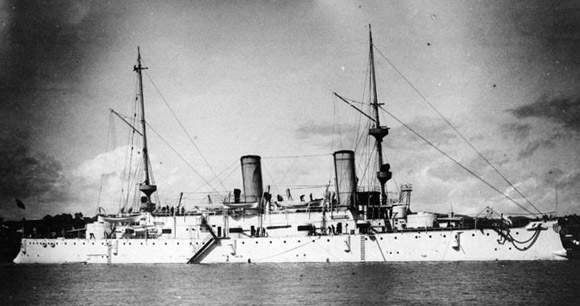
The Olympia was one of the first steel and steam warships of the United States Navy and is the oldest steel warship in the United States Navy still afloat.  She was a transitional ship as the Navy entered the modern age and her design was revolutionary for her time.  Displacing 5870 tons and with a length of 344 feet she was She was powered by reciprocating steam engines and capable of 20 knots. She had twin revolving turrets which housed her main battery of four 8 inch guns and mounted a secondary battery of ten 5 inch guns which protruded from her superstructure on the main deck.  She also retained sails as part of her design and was the first US Navy ship with a refrigeration plant and ice making machines.

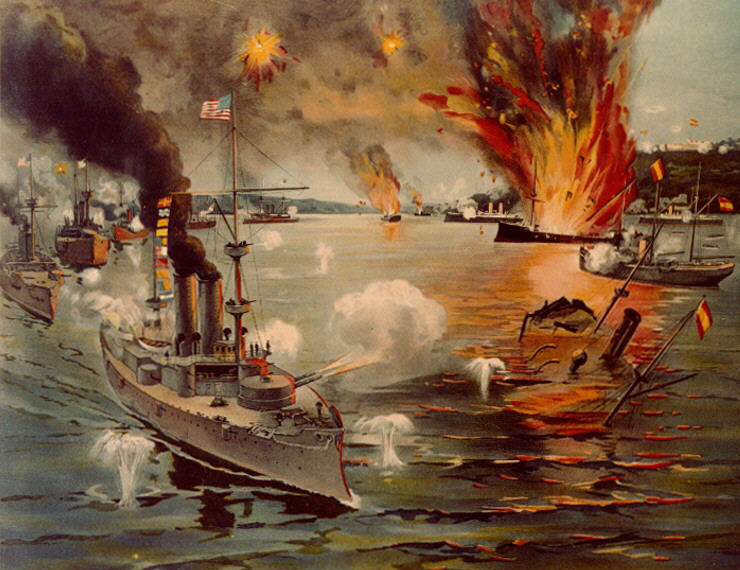
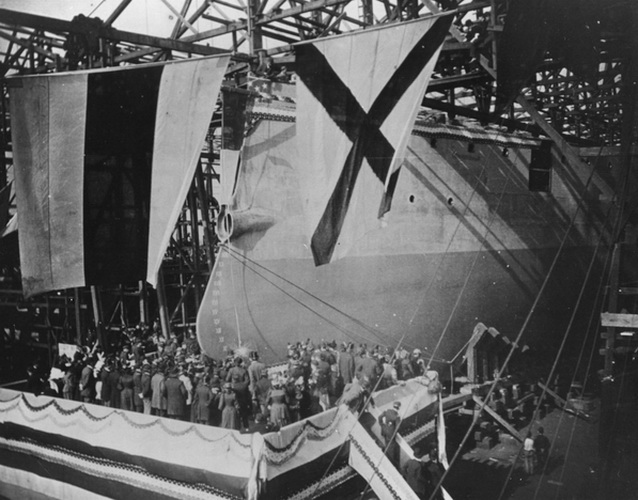
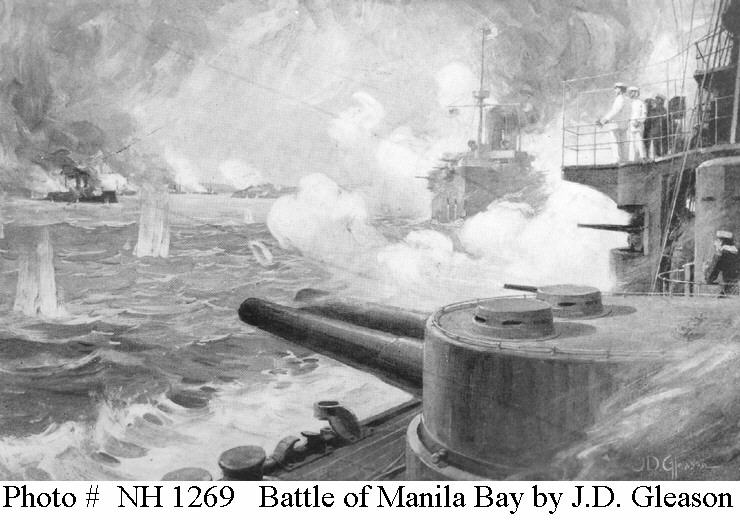
She was the Flagship of Admiral Dewey at the Battle of Manila Bay during the Spanish American War and her last mission was to bring the body of the “Unknown Soldier” back from France following the First World War.  The launched on November 5th 1892 and commissioned on 5 February 1895 Olympia was decommissioned for the final time in on December 9th 1922.  She would continue her US Navy career in an inactive status after being reclassified as a miscellaneous auxiliary.  She remained as a Navy asset until she was acquired by the Cruiser Olympia Association on 11 SEP 1957 and was classified as a National Historic Landmark on 29 January 1964 and transferred to the Independence Seaport Museum in January 1995.

The ex-Olympia is a national and maritime history treasure. There are but a handful of ships for that era that still remain.  The Imperial Japanese Battleship Mikasa, Admiral Togo’s flagship at the Battle of Tsushima in 1905 is outside the Naval Base of Yokosuka Japan http://www.japan-i.jp/explorejapan/kanto/kanagawa/miurapeninsula/d8jk7l000002rn1h.html. The Russian Cruiser Aurora is moored in Petersburg http://www.aurora.org.ru/eng/ and the Greek Armored Cruiser Georgios Averof http://www.hnsa.org/ships/averof.htm are the only ships of that era remaining.

Olympia is in dire need of dry-docking and major repairs to her hull. Despite Federal Government regulations and sound maritime practices which stipulate that museum ships should be dry-docked and repaired at the minimum of every 20 years the Olympia has not been dry-docked or repaired since 1957.  She has numerous patches and her caretakers keep constant watch on her to ensure that no leak develops that could sink her. Additionally water now leaks through her decks into her hull causing further problems with rust and hull deterioration.

The Olympia is a National Historic Landmark listed on the National Register of Historic Places (1964), a National Historic Engineering Landmark (1977), and National Historic Maritime Landmark (1988) and was awarded “Official Project” status of Save America’s Treasures program (1999).

She will be closed as an attraction on the Philadelphia waterfront on November 22nd as the caretakers and the Navy determines her fate. Ultimately the Navy will have the final say in Olympia’s fate; even so efforts need to be made to enlist private and corporate sponsors to help save this treasure. As of the present time these efforts have been unsuccessful.

Naval Historian and author of a book on Olympia Lawrence Burr commented: “It’s an absolute national disgrace. It’s an appalling situation. She is a national symbol, and she marks critical points in time both in America’s development as a country and the Navy’s emergence as a global power.”

The “Friends of the Cruiser Olympia” http://www.cruiserolympia.org/ as well as former Secretary of the Navy John Lehman and former US Representative Curt Weldon  are leading the charge to see Olympia restored and reopened.

Olympia is not the first US Navy historic ship to be in such dire need. The first was the USS Constitution which was going to be broken up in 1830 until the public inspired by Oliver Wendell Homes’ poem elicited the money needed to repair that ship which was again threatened in the 1920s and was saved by a private-public endeavor urged by the Secretary of the Navy Curtis D. Wilbur which included a drive where children contributed thousands of dollars of pennies to the restoration effort and where prints of “Old Ironsides” were sold for .50 each.  Certainly it will take a creative effort to save Olympia and preserve her for history and those Americans that come after us.

I go to Baltimore to see an Orioles game on October 1st and may take a short trip to Philadelphia to visit the Olympia and if I do I will do an update with my own photos.

Peace,

Padre Steve+

6 Comments

Filed under History, Military, Navy Ships, US Navy

Workhorses: The Brooklyn Class Light Cruisers

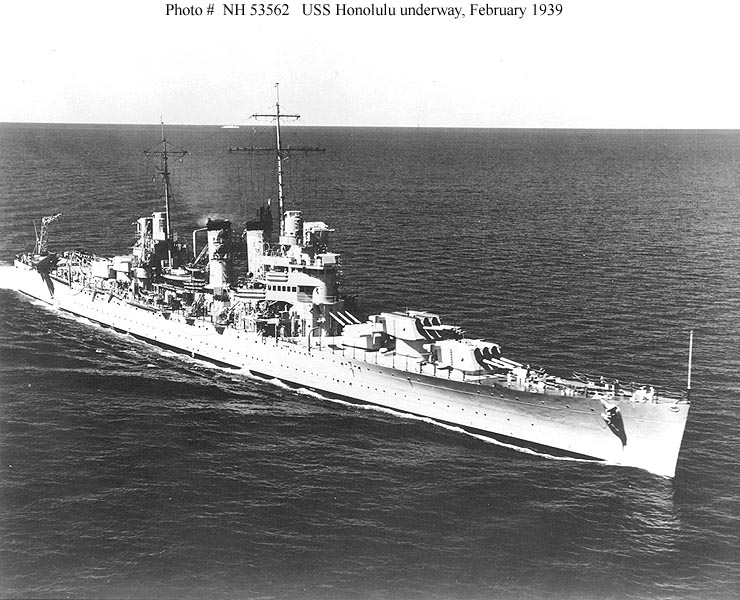
The Brooklyn Class Light Cruisers were the most modern cruisers in the US inventory when war broke out in on December 7th 1941.  The ships were built under the provisions of the Washington Naval Treaty of 1922.  Displacing 9700 tons to remain within treaty limitations they mounted a powerful armament of fifteen 6” guns mounted in 5 turrets, three forward and two aft.  Their design, especially their armament was designed in response to the large Mogami Class light cruisers of the Imperial Japanese Navy which initially mounted the same main battery before being converted to Heavy Cruisers.  The layout of the main battery in both classes of cruisers was identical.

Pre-war shot of Honolulu, typical of Brooklyn Class

Authorized in by Congress in 1933 the ships were designed with a large transom which housed the aircraft hangar with twin catapults and crane. This was a departure from previous US cruisers which housed the aircraft and their volatile fuels midships which would prove a liability in combat against the Japanese in the Solomons campaign.  The new hangar design was carried forth on all new cruisers and battleships built by the US subsequent to the Brooklyn Class.

There were 9 ships in the class, one of which the Wichita was completed as a Heavy Cruiser mounting nine 8” guns in triple turrets and is considered a separate one ship class.  In addition to their main battery they mounted eight 5” 25 caliber dual purpose guns and a light AA battery which was continuously increased throughout the war. Their steam turbines produced 100,000 shaft horsepower to give the ships an official speed of 32.5 knots which was exceeded by some of the ships.

The ships Brooklyn CL-40, Philadelphia CL-41, Savannah CL-42, Nashville CL-43, Phoenix CL-46, Boise CL-47, Honolulu CL-48, St. Louis CL-49 and Helena CL-50 were involved in some of the most intense combat of the war serving in both the Atlantic and the Pacific.  Of the ships one, the Helena was lost in surface combat and several others taking severe damage without sinking.  Half of the surviving ships of the class would serve in foreign navies for many years following the war a testament to their toughness and utility.

The lead ship of the class the Brooklyn served exclusively in the Atlantic and Mediterranean where she engaged Vichy warships during the invasion of North Africa and took part in the landings at Sicily, Salerno, Anzio and Southern France where she provided naval gunfire support to troops ashore. Following the war she was decommissioned in January 1947 and transferred to the Chilean Navy in 1951 under the Mutual Defense Assistance Program. She was renamed O’Higgins and served until decommissioned in January 1992 and sold for scrap. She sank while being towed to India for scrapping in November 1992.

Philadelphia had a similar career to Brooklyn. Launched in 1936 and commissioned in 1937 she too served in the Atlantic and Mediterranean supporting the invasions of North Africa, Sicily, Salerno, Anzio and Southern France.  She was decommissioned in February 1947 and transferred to Brazil in 1951. Renamed Barroso she served until 1973 and sold for scrap.

Late war view of St Louis

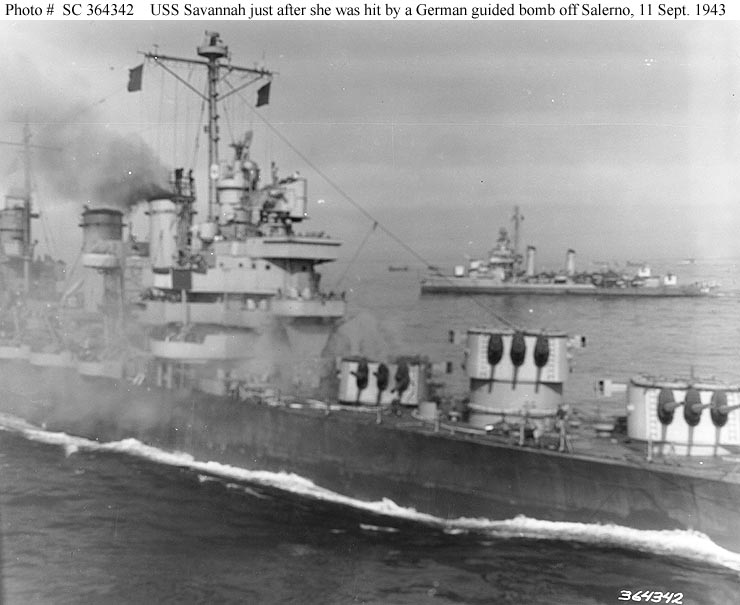
Savannah was launched in May 1937 and commissioned in March 1938 and like Brooklyn and Philadelphia served exclusively in the Atlantic and Mediterranean supporting amphibious landings, searching for German commerce raiders and blockade runners and supporting various escort missions. At Salerno she was struck and severely damaged by a German FX-1400 radio guided bomb which struck her number 3 gun turret penetrating to the lower handling room where it exploded tearing a large hole in the ship’s bottom and opening a seam in the ship’s side.  Her crew performed heroically to control the damage and get the ship to Malta but she lost 197 sailors in the attack. Following temporary repairs she returned to the United States for repairs and modernization which were complete in September 1944. She served in a number of capacities in the Atlantic and was decommissioned in February 1947, stricken from the Navy List in March 1959 and sold for scrapping in January 1966.

Nashville was launched in October 1937 and commissioned in June 1938 initially serving in the Atlantic until her transfer to the Pacific Fleet in February 1942.  While in the Atlantic she took part in the Neutrality Patrols and following the commencement of hostilities continued convoy escort duties.  Her first mission in the Pacific was to escort the Carrier Hornet CV-8 on her mission to launch Colonel Jimmy Doolittle’s Army Air Force B-25s on the Tokyo raid.  Nashville sank a scout vessel which had discovered the task force.  On return from the mission she was assigned to the defense of the Aleutians until November 1942.  She then was transferred to the South Pacific where she participated in raids and bombardments of Japanese shore installations until while shelling Vila Airfield on Kolombangara on the night of 12 May 1943, she had an explosion of powder charges in one of her forward turrets, killing 18 and injuring 17.  The damage required her to be sent to Bremerton for repair and modernization and she would return to duty in August to join carrier task forces in raids in the Central Pacific before again moving to the South Pacific where she participated in the New Guinea campaign and as well as other missions until May of 1944.  She took part in the invasion of Leyte and the Battle of Leyte Gulf guarding beachheads and transports and fending off Kamikazes while providing naval gunfire support to troops ashore. While conducting similar operations off Negros Island she was struck by a Kamikaze with two bombs aboard. Nashville was struck on one of her port 5” mounts the bombs exploding above her deck. The blazing aviation fuel and explosions killed 139 crew members and wounded 190.  Following repairs at Bremerton she went back to the Southwest Pacific lending her battery to landings at Brunei Bay, Borneo, and protecting carriers in the Makassar Straits.  She was decommissioned in June of 1946 and sold to Chile in January 1951 where she was renamed Captain Prat where she served until she was decommissioned in May 1982 and sold for scrap in April 1983.

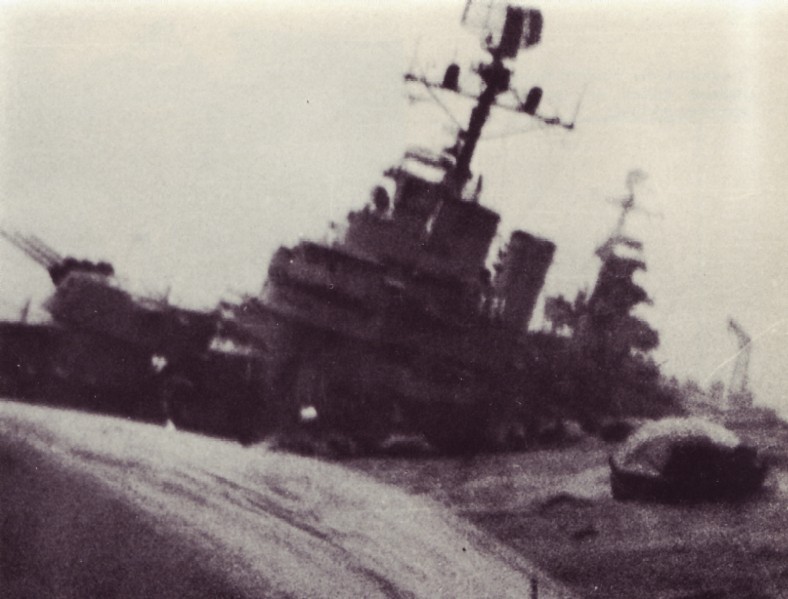
Phoenix was launched in March of 1938 and commissioned in October of the same year. She became part of the growing Pacific Fleet and was the first modern light cruiser assigned in the Pacific. She was at Pearl Harbor on December 7th 1941 and would serve throughout the war in the Indian Ocean and the South Pacific and was engaged in heavy operations around New Guinea and other islands in the area frequently involved in shore bombardment, amphibious assaults and raids and having to engage attacking Japanese aircraft.  In September 1944 she was assigned to the covering force of old battleships assigned to 7th Fleet for the invasion of the Philippines.  As part of this force under Rear Admiral Jesse Oldendorf she took part in the destruction of the Japanese Southern Force at the Battle of Surigo Strait where her gunners aided in the sinking of the Japanese battleship Fuso. Phoenix continued operations with 7th Fleet in the Southwest Pacific supporting shore operations and fighting off swarms of Kamikazes without damage to herself. Following the war she was decommissioned in July 1946 and transferred to the Argentinean Navy in April 1951 where she was renamed 17 de Octubre and later General Belgrano. She received a number of modifications while in Argentine service including ASW helicopters and the Sea Cat Air Defense missile system.  Still in active service at the time of the Argentinean invasion of the Falkland Islands in 1982 she was sent to sea with two destroyers.  She was discovered by the British attack submarine HMS Conqueror torpedoed and sunk on May 3rd 1982 with the loss of 323 men, ending a 44 year career of service to the United States and Argentinean Navies.

Boise was launched in December 1936 and commissioned in August 1938. Following her shakedown cruise she was assigned to the Pacific Fleet. On December 7th 1941 she was in the Philippines after having completed a convoy escort mission.  She was sent south to join the rest of the Asiatic Squadron and our Australian, British and Dutch Allies to for the ABDA (American, British, Dutch, and Australia) task force opposing the southern advance of the Japanese aimed at Java and the Dutch East Indies.  She struck an uncharted shoal on January 29th while conducting operations in the Sape Strait forcing her to return to the United States for repairs. This probably prevented Boise from sharing the fate of most of the rest of the squadron including the HMS Exeter, USS Houston, HMAS Perth and Dutch light cruisers DeRuyter and Java, most of which were sunk in the Battle of the Java Sea in February. After repairs she returned to the South Pacific where she took part in a number of actions including the Battle of Cape Esperance where she helped sink the Japanese Heavy Cruiser Furutaka and destroyer Fubiki. She was damaged in this action and returned to Philadelphia for repairs.  Following her repairs she was dispatched to support the landings on Sicily before returning to the Pacific where she served from January 1944 to June of 1945 conducting almost non-stop operations around New Guinea, Borneo and the Philippines. She returned to San Pedro for overhaul and was there when the war ended. She decommissioned in July 1946 and sold to Argentina in January 1951 and commissioned as Nuevo de Julio in 1952.  She served until 1978 when she was decommissioned and was sold for scrap in August 1981.

Honolulu had one of the most active careers while engaged in operations against Japanese Naval units with far less time devoted to gunfire support missions.  She was at Pearl Harbor on December 7th 1941 and following that took part in convoy escort missions until she went north to screen Alaska from Japanese attack in May 1942 a task that she engaged in until November.  She then reported to the South Pacific and was part of operations against the Japanese Fleet in the Solomons. She took part in the Battle of Tassafaronga, the Battle of Kula Gulf where she helped sink a destroyer and the Battle of Kolombangara where she was instrumental in sinking the Sendai class light cruiser Jintsu and a destroyer. She then supported amphibious operations in the Central Pacific including Saipan and Guam and the Leyte Gulf landings in the Philippines.  While operating off Manus Island she was stuck by an aerial torpedo receiving heavy damage which required her withdraw to the United States for major repairs which were still being completed when the war ended. She decommissioned in February 1947, stricken from the Naval Register in November 1959 and sold for scrap.

St. Louis was launched in April 1938 and commissioned in May 1939. After time conducting neutrality patrols at the onset of the war in the Atlantic she was transferred to the Pacific Fleet in November 1940. She was at Pearl Harbor on December 7th 1941 and was one of the few major fleet units to get underway and out to sea during the attack.  She supported carrier operations and convoy escort missions until she was sent north to that Aleutians where she operated until October when she returned to the States for a brief overhaul before being assigned to operations in the Solomons. Operating on a nearly nonstop basis against the Tokyo Express she took part in the Battle of Kula Gulf and the Battle of Kolombangara where she received partial credit for the sinking of the Japanese light cruiser Jinstu. During the battle she was torpedoed in the bow and after temporary repairs returned to the Mare Island. Following repairs St. Louis returned to the Solomons in November 1943. She was struck by a bomb which killed 20 crew members on January 14th requiring her to return to Purvis Bay for repairs. The repairs complete she returned to the Solomons until June when she took part in the invasion of the Marshalls at Guam and Saipan. She damaged her number three propeller and had to return to the States for repair following the Guam bombardment.  Upon her return she served at Leyte Gulf until she was hit by two Kamikazes in a short span receiving heavy damage and resulted in the loss of 15 sailors killed, 1 missing and 43 wounded.  She again sailed for repairs and returned to action against the Japanese home islands and Okinawa. Following this she supported operations against Japanese installations on the Asian mainland.  Following the war she took part in the Yangtze River patrol force and then returned to the United States in January 1946.  She was decommissioned in June 1946 and transferred to Brazil in January 1951 being commissioned as Tamandare. She was decommissioned in June 1976 and sold for scrapping in 1980. While being towed to Taiwan for scrapping she sank on August 24th 1980.

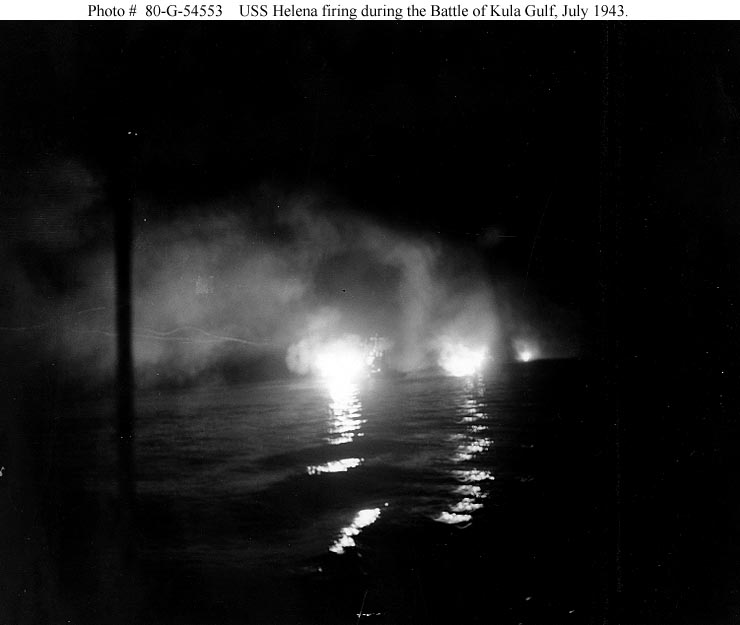
Helena firing at Kula Gulf just before being torpedoed and sunk

The Final ship in the class, Helena was launched in August 1939 and commissioned in the following month.  She was at Pearl Harbor and mooed at the 1010 Dock where she was hit by a torpedo and damaged. After repairs she reported to the South Pacific and the Guadalcanal campaign.  She escorted carriers. Helena had the most modern surface search radars and at Battle of Cape Esperance in Iron Bottom Sound, Helena had sunk cruiser Furutaka and destroyer Fubiki.  She then took part in the Naval Battle of Guadalcanal in which a weaker American force turned back a Japanese force with heavy losses on both sides including the Japanese Battleship Hiei and the American cruisers Atlanta, Juneau and 4 destroyers. Helena continued operations in the Solomons and at the Battle of Kula Gulf was sank by Japanese torpedoes fired by destroyers on July 5th 1943.  168 of her sailors were lost in the action. Helena was the first US Navy ship to be awarded the Naval Unit Commendation.

The General Belgrano ex-USS Phoenix sinking after being torpedoed by HMS Conqueror at the Battle of Falkland Islands

The class found its niche in the war primarily in shore bombardment and Naval Gunfire Support as well as in the sharp surface actions in the South Pacific. Only one, Helena was lost.  Six were transferred to South American Navies making and served for many years in those navies. None survive today but the ships were instrumental in the success of many operations.

3 Comments

Filed under History, Military, Navy Ships, US Navy, world war two in europe, world war two in the pacific

Going to War: The First Mission Flying West in a C-130

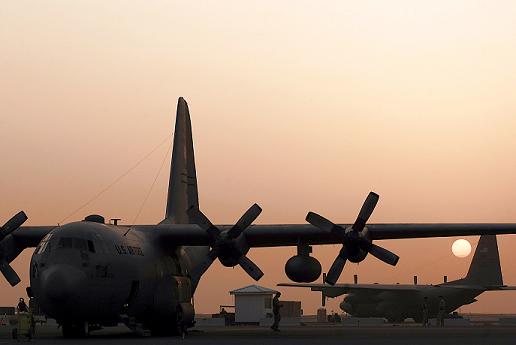
Workhorses: C-130s at an US Base in Iraq

This is another installment of my “Going to War” Series that I began last year.  In the Fall I had to take a break from posting anything more due to issues that I was having dealing with the effects of PTSD. I started this article in the spring but again put it on hold.  I have reached the point that I can again write about this. I will post follow up articles about our operations and experiences supporting our Marine Corps, Army and Joint Service advisor teams in Al Anbar province. The previous posts as well as others dealing with Iraq are filed in the “Tour in Iraq” link on the home page. The direct link to these articles is here: https://padresteve.wordpress.com/category/tour-in-iraq/

Nelson and I continued to prepare in the days leading up to our first mission to the Border Port of Entry at Waleed on the Syrian border with a planned follow on to the teams of the 3rd Brigade, 7th Iraqi Division at Al Qaim about a hundred miles to the north .  Waleed is about 350 miles west of TQ and 70 miles from the nearest FOB with any substantial American presence known as Korean Village or simply KV. We were in constant communication with the team that we to visit via VOIP and SVOIP telephone and secure and non-secure e-mail. The commander of the Border teams, which included Border and Port of Entry adviser teams was Lieutenant Colonel Bien.  Our mission in getting out to the furthest point west was to meet up with an incoming and an outgoing Port of Entry team and see what we could do to get out to other posts along the border.

Nothing in Iraq is easy.  The get out to Waleed we had to make a two day trip from TQ, through Al Asad out to Waleed.  Our flight out was a day flight on an Air Force C-130 to Al Asad.  Our contacts in the G3-Air at 2nd MLG were good in helping me figure out the Air Force flight request which was different than the normal Marine Air Support Request.  For this mission I had to submit two Air Force and three Marine Air Support requests.    Simply submitting a request does not guarantee a flight. Flights are based on precedence dictated by the overall mission.  Religious support was pretty high on the list but there was no telling that your flight would go until you had your approval message and even then things could change.  The actual missions were not known until about midnight the night prior to the flight. So if you were a frequent flyer it meant no sleep the night before a mission as you waited to see if you were approved.  This was my first time actually having to do this for real so I sat at my secure laptop in my office in the back of the TQ plywood Cathedral waiting for the flight list to be posted on the MLG G3 Air Secure Website.  Finally about 0100 the list popped and our first flight was on in.  It was a mid day flight which meant that we needed to be at the passenger terminal about 0930.  This entailed getting our ride from the Chapel to the terminal by 0900.

I told Nelson who was checking his e-mail on a computer in the RP office that it was a go and then headed off to my can to prepare.  Since most of my gear for the 10 day trip was already packed I tried to actually get ready to sleep.  I quickly found that simply being tired because I was up late was not enough to help me go to sleep.  I was really tired but the adrenaline was coursing through my body making it impossible to sleep.  I prayed the office of Compline and then played computer Ma-Jong until at least 0300 before I could finally pass out.  I was up early to shower and get breakfast before lugging my gear over to the chapel.  The weather as usual was about 100 degrees by the time I got back from the chow hall; I gathered my gear and went to the chapel.  I took my back pack, my laptop and a flight bag. I would learn on this mission that I would need to pack lighter the next time around, but live and learn.

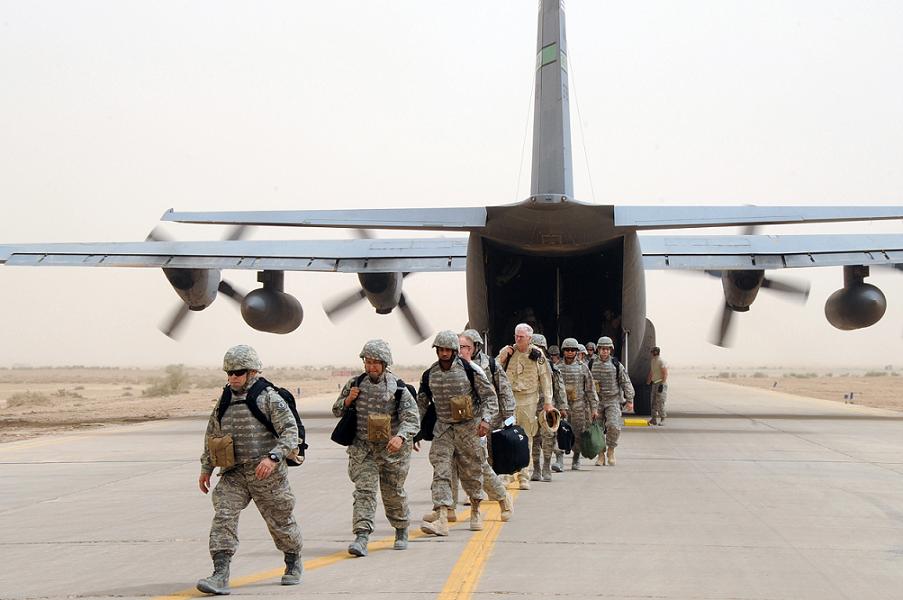
The first leg of our trip was on an Air Force C-130 from TQ to Al Asad which we shared with a large number of previously unknown friends from every branch of service in the US military as well as various civilians and contractors.  All of us had our personal protective equipment as well as our bags. The bags that we did not want to lug were placed on pallets and transported with a large fork lift to the aircraft.  When you make one of these trips you are accounted for a good number of times before ever getting on the aircraft.  This first mission was still in the heat of the Iraqi summer and thus the temperature inside and outside of the aircraft was stifling.  We staged off the tarmac in the sun for a final role call and then in two lines who guided out to our aircraft which had just landed.  As we were trudging out to the aircraft two lines of assorted passengers primarily Soldiers and Marines passed us mid way to the aircraft.  As we neared the aircraft the propeller blast blew the hot air into our faces and I thanked God for the high speed Wiley-X ballistic sunglasses that I had been issued by EOD.  Entering into the aircraft we had to step up onto the cargo ramp and then took our seat in the narrow canvas mesh jump seats that lined both the side of the aircraft and the center.  The rear of the aircraft including the cargo ramp was used for several pallets of cargo including the bags that we elected not to carry.  Sitting in the aircraft and waiting for the pallets to be loaded I thought back to my early career as an Army Officer where I became an air-load planner and embarked my soldiers on six C-130s during Winter REFORGER 1985.  Back then instead of the 130 degree heat of Iraq we faced the coldest winter in 40 years in Europe in which the Rhine froze over.  Although the use of computers has become routine in load plans the principles are the same as they were 25 years ago and everything on the aircraft needs to be properly balanced to ensure the stability and safety of the aircraft and that weight limits are not exceeded.  As the sweat poured off of me I took off my helmet and downed part of the one liter bottle of water that I carried onto the aircraft and threw some on my face, though warm it was refreshing and I reattached my helmet as the aircrew came through the cabin giving a final safety brief.

As the last of the cargo pallets were loaded about the aircraft the cargo ramp was raised, the entire time that the aircraft was on the ground was under 15 minutes, it is amazing what the Marine and Air Force ground crews and cargo handlers can accomplish.  With the ramp raised the aircraft’s air conditioning began to take effect and though not the coolest air conditioning it was better than what we had up to that point. The aircraft began to roll and move down the taxiway and when it reached the end of the taxiway it made a fast turn and began its take off.  Since there was a real and present danger of possible missile or gun attacks on low flying aircraft the C-130 made a steep lift off and banked right over Lake Habbinyah and continued its ascent until it reached its cruise altitude.  The C-130, like any cargo aircraft is extremely loud and because of this hearing protection is worn by passengers and crew and conversation is nearly impossible.

The flight from TQ to Al Asad is only about 30 to 45 minutes depending on the route taken so most of the passengers took the opportunity to grab a bit of sleep or read.  Nelson and I sat together on the starboard side of the aircraft not far from the palletized cargo.  Nelson who can sleep almost anywhere on a moment’s notice was out quickly; and although I was tired I could do little more than close my eyes and try to clear my mind.  When we neared Al Asad the aircraft banking nearly perpendicular to the ground made a steep and fast approach.  As we landed I could see other aircraft on the ground including F-18’s, various transports and rotor wing aircraft.  The C-130 taxied to a spot on the tarmac where the ramp was dropped and we were instructed to exit the aircraft and led to the rear of the aircraft about 50 yards and then led between it and another aircraft to a group of tiny Japanese made Nissan and Mitsubishi buses in which we were loaded until every seat was full including the in aisle jump seats.  Packed into the bus like sardines and smelling almost as bad we sucked in the stench, which was somewhat like a European elevator in the 1980s.

Passengers disembark from a C-130 at Al Asad

After a short ride to the terminal we picked up our gear which had been delivered on the pallets by forklifts.  Another muster was taken and after all personnel were accounted for those of us waiting on follow on flights checked in at the terminal.  After being accounted for we got our temporary billeting in large tents about a hundred yards from the terminal.  The tents were large and poorly lit with plywood floors and several air conditioners built into the sides of the tent.  The bunks were in very poor condition, many broken and even more with dirty worn out mattresses sagging in the middle.  Nelson and I looked at each other and Nelson made some comments about the accommodations and we each found a bunk grounded our gear and settled in for a bit in order to clean up before trying to go get some chow.

Next: Air Travel In Al Anbar: the California Line.

Leave a comment

Filed under iraq,afghanistan, Military, Tour in Iraq

29 Years in the Military and still Going Strong

“It’s a mere moment in a man’s life between the All-Star Game and an old timer’s game.” Vin Scully

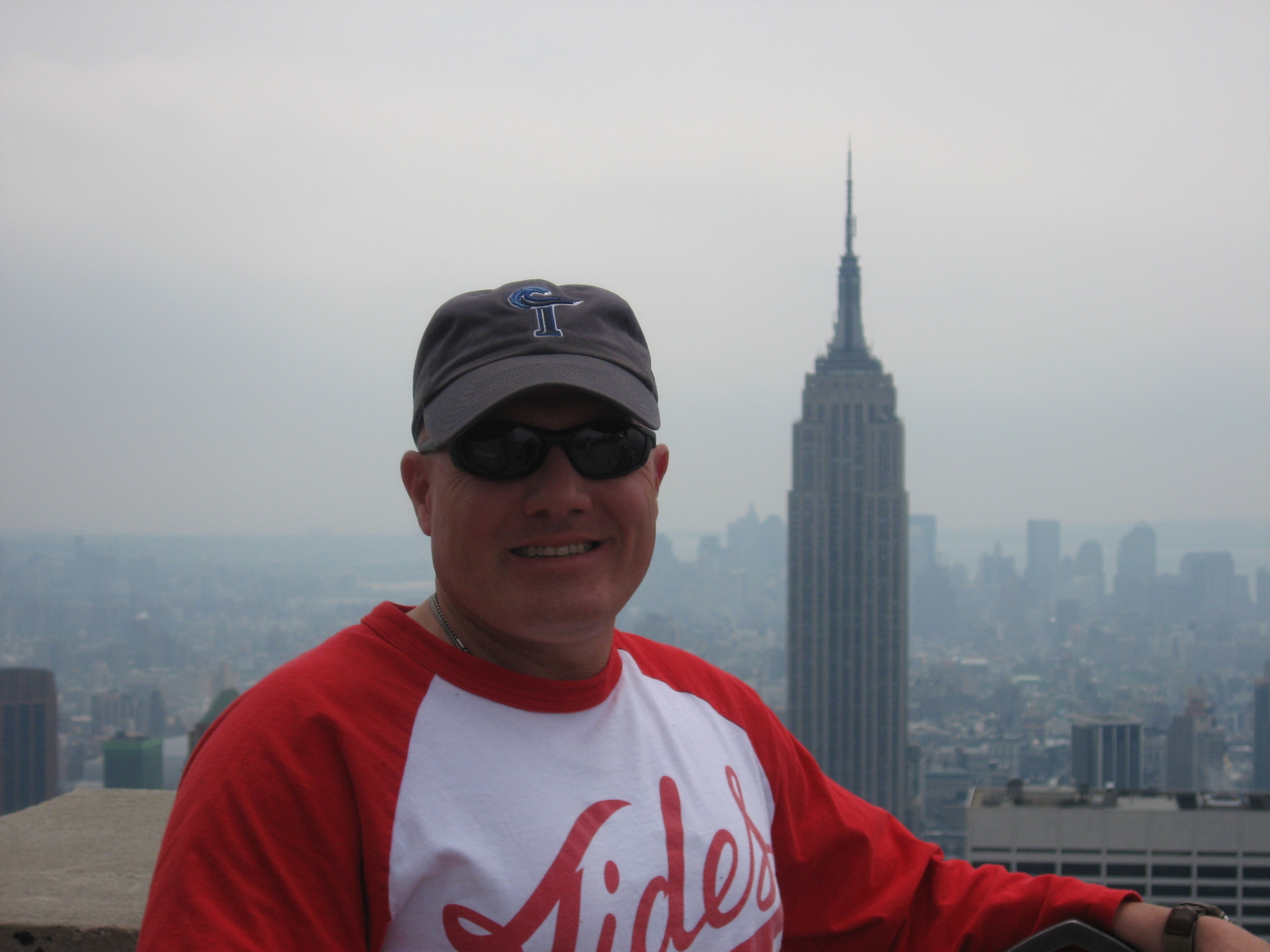
Padre Steve in 1982

They say that “time flies when you’re having fun” and I cannot believe that I have been in the military now for 29 years. On August 25th 1981 a 21 year old college kid with long Southern California “surfer” hair walked into the California Army National Guard Armory on Van Nuys Boulevard to enlist in the National Guard after having just sworn into the Army ROTC program at UCLA.   Back then I enlisted in what was or is called the Simultaneous Membership Program or SMP program.  My initial military training came through the ROTC program as well as on the job training in the National Guard as a Field Artillery Forward Observer and Intelligence Specialist.

Like Cal Ripken Jr commenting about his career “So many good things have happened to me in the game of baseball. When I do allow myself a chance to think about it, it’s almost like a storybook career. You feel so blessed to have been able to compete this long.” I can say the same thing just substituting the words “military career” for “the game of baseball.”

On the day that I enlisted I met with Major Charles Armagost the S-1 of 3rd Battalion 144th Field Artillery and full time advisor for the battalion filled out my enlistment papers and raised my right hand. I still remember the day when I enlisted. It was a hot smoggy Los Angeles day where you could see the air.  I walked down the hall after I swore in to see the supply Sergeant who outfitted me with four sets of Olive Green fatigues and ordered me two sets of the brand new BDUs.  I was issued my TA-50 gear and taken to the motor pool where I was given cursory training on the M151A1 “Jeep” and issued a military drivers license.  The three weeks later I was driving one of those venerable machines to Fort Irwin on a Friday through Sunday drill with the advanced party. It was the beginning of a 29 year career spanning two services, the active and reserve components and now multiple trips to combat zones.

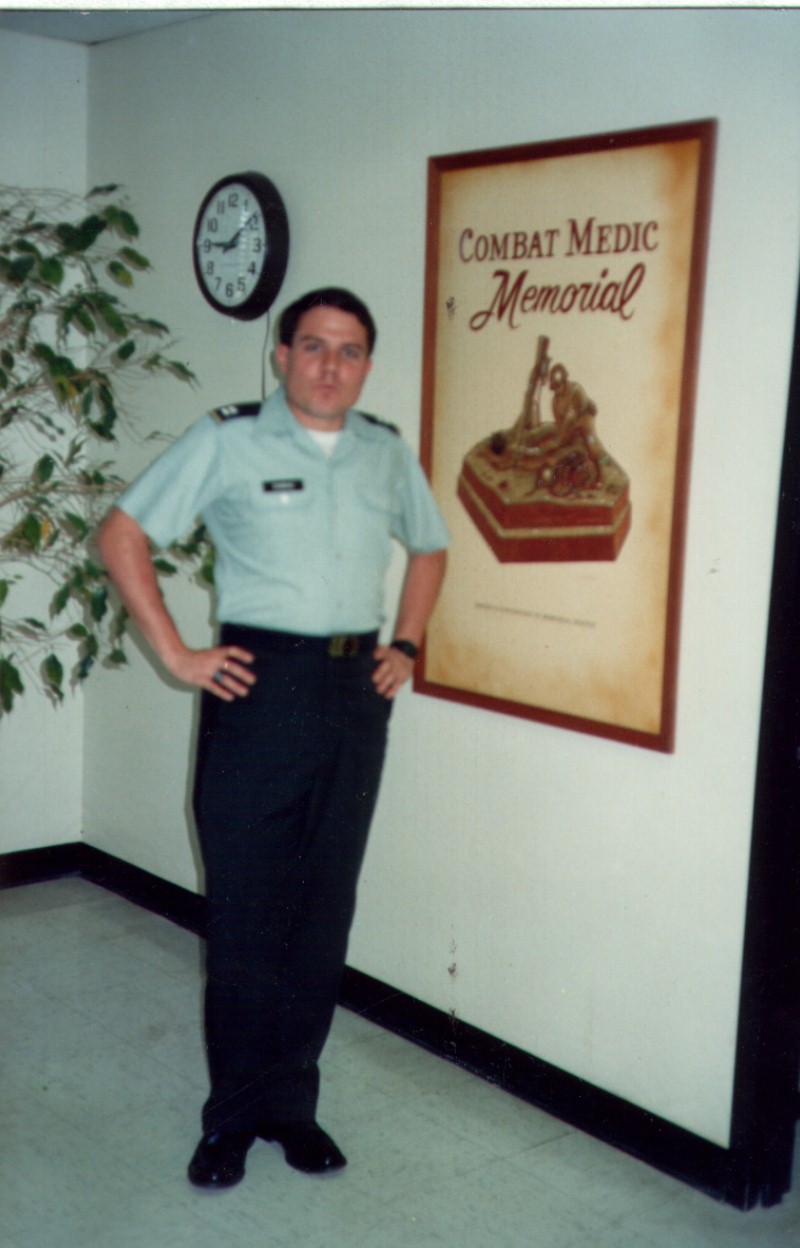
Army Captain 1987

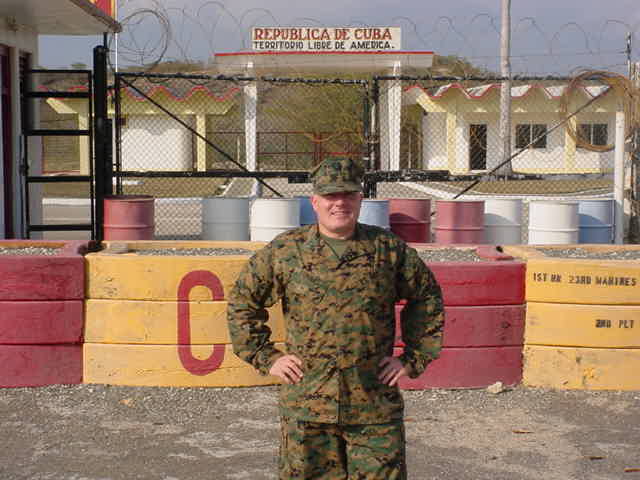
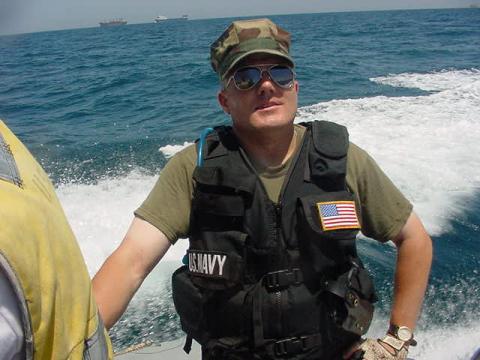
It has to quote Jerry Garcia of the Grateful Dead “a long strange trip” spanning the Army and the Navy, active and reserve components as well as two tours with the Marine Corps while serving in the Navy and the beat goes on with my selection for promotion to Commander and my Senate nomination to that grade on August 21st.  I have served on the Fulda Gap in the Cold War, been to what was then East Berlin driving the Helmstedt-Berlin corridor sharing the road with Soviet armored columns.  I supported the Bosnia Operation in 1996-97 and the Korean DMZ with the Marines in 2001. I served in Operation Enduring Freedom and Southern Watch in 2002 where I was on a boarding team, boarding 75 Iraqi and other country smuggling ships while serving aboard the USS Hue City.  That was followed by multiple trips in and out of theater with the Marine Security Forces from 2003-2006 as well as time on the Cuban fence line at Guantanamo Bay before serving in Iraq with our Marine and Army advisors and their Iraqi Army and Security forces.  I’ve served with Infantry, Armor, Combat Engineer, Artillery, Medical and Ordnance units, Security forces, support elements, bases and training centers, hospitals and ships.

Berlin Wall November 1986

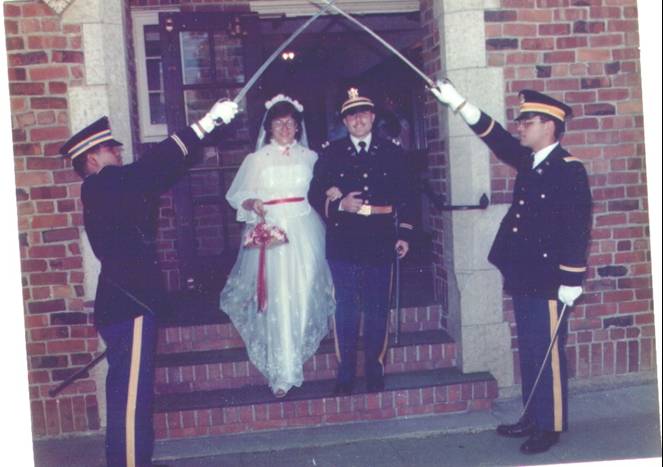
When I enlisted I thought that once I was commissioned that I would serve my entire career in the Army and retire as a Lieutenant Colonel. I did not anticipate becoming a Chaplain nor leaving the Army for the Navy. When I am officially promoted to Commander it will be the first rank since I was an Army First Lieutenant that I have not held twice.  When I first enlisted and had no ribbons I used to look at wonderment at the Korea and Vietnam veterans who had tons of ribbons and tell Judy that I wish I had what they had. Now that I am working on 9 rows of the things I cringe every time I have to remount ribbons and ribbons and my wallet screams in agony.  Judy is quick to remind me of my whininess back then and tell me that I asked for it.

She didn’t know what she was getting into

As an Army and Navy Officer I have served or done some kind of military duty in Germany, France, Great Britain, Greece, Italy, Croatia and Turkey, Spain, Malta, Korea, Japan, Jordan, Bahrain, Kuwait and Iraq.  I’ve done what I call the “Commie Trifecta” the Berlin Wall, Korean DMZ and the Cuban Fence Line. At the same time I have spent 16 of 27 wedding anniversaries away from home and lost count of birthdays and other important occasions that I missed while serving the country.

Guantanamo Bay Cuba 2004

I have served 5 different Presidents. In that time I have seen changes in the political, social and economic conditions of the country and the world that I could not have imagined at the time of my enlistment.  The Soviet Union had just invaded Afghanistan and the Iranian hostage crisis had just ended but within the Soviet Union had been defeated the Berlin Wall taken down and collapse of the Soviet Union.  Twenty years after I enlisted the people that defeated the Soviets were attacking us on our own soil.

Boarding Party Arabian Gulf May 2002

I lived in Europe and went through the Chernobyl radiation cloud which is obviously the cause of my glowing personality.  While in Europe I ate enough beef to be labeled by the Red Cross as a potential carrier of Mad Cow disease. I worked on military personnel policies at the beginning of the AIDS epidemic and saw the beginning of Don’t Ask Don’t Tell policy.  I saw the Reagan build up and the post Cold War drawdown.  When I was a Company XO and Company Commander we had landlines and typewriters with carbon paper and did not get internet in my office until 1997.  It is hard to believe the changes even in the quantum leaps in computer and communication technology in the past few years where I can check e-mail on my Blackberry and work from almost anywhere with my laptop.

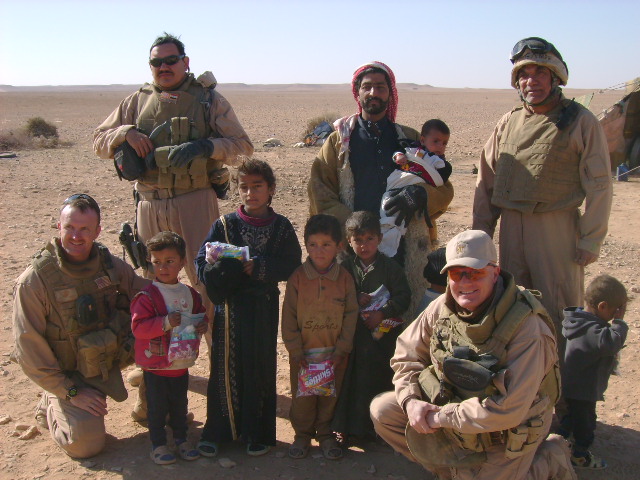
With Advisors and Bedouin on Iraqi-Syrian Border December 2007

Looking back here are some of the things that I have seen since I entered the military:

October 23rd 1983: Beirut Bombing: BLT 1/8 barracks and French 1st Parachute Regiment destroyed by suicide bombers 241 Americans and 58 French Paras killed.  I was at the Junior Officer Maintenance Course at Fort Knox watching CNN late at night when they broke the news.

December 12th 1985:  Arrow Air Charter Boeing 707 crashed in Gander Newfoundland killing 248 American Soldiers returning from Peacekeeping duty in Sinai Peninsula. Among the dead was Sergeant Charles Broncato who had been one of my Squad Leaders in 2nd Platoon 557th Medical Company Ambulance. I was then serving as the Company Commander.

January 28th 1986: The Space Shuttle Challenger blows up 73 seconds into flight killing 7 Astronauts.  I was in my office at the close of the day getting ready to adjudicate an Article 15 when my Charge-of Quarters SPC Lisa Dailey ran into my office and said “Lieutenant Dundas, the Space Shuttle just blew up!” My response was “Come on, Space Shuttles don’t blow up.”

February 15th 1988: The Soviet Union withdraws from Afghanistan. I was a National Guard Officer in Texas attending Seminary and thought this was a good thing.  Now I wish that they had done better and at least killed Osama Bin Laden, then a relatively minor commander.

December 21st 1988: Pan Am 103 downed by Libyan operatives over Lockerbie Scotland killing all 270 passengers and crew. The aircraft a Boeing 747 named the Maid of the Seas was the same aircraft that we had flown home from Germany on December 28th 1986.

October 17th 1989: the Loma Prieta Earthquake causes massive damage in San Francisco and Oakland. I was watching pregame activities of game 3 of the World Series between the A’s and Giants on television when it happened.

November 9th 1989: The Berlin Wall Fell. In November of 1986 we had been to East Berlin and like most Americans never thought that we would see this day.

August 2nd 1990: Iraq Invades Kuwait: At time few people believe it well end in war. I was deputy course leader for Army Chaplain Officer Basic Course, tell my classmates to get ready to go to war.

December 31st 1991: The Soviet Union is dissolved.

April 19th 1993: FBI and other Federal Law Enforcement personnel using Combat Engineering Vehicles from the 111th Engineer Battalion, the unit that I serve as a Chaplain assault the Branch Davidian compound outside Waco Texas. Davidian leader David Koresh and dozens of followers die in fire and shoot out.

June 17th 1994:  Police arrest O. J. Simpson after nationally televised low speed chase charging him with murder in the death of his wife Nicole and Ronald Goldman. NBC splits screen between NBA championship series game between Houston Rockets and New York Knicks and the chase. I watch in back of M577 Command Vehicle on 9 inch television in the field at Fort Hood.

August 12th 1994: Baseball strike cancels season, playoffs and Worlds Series.

April 19th 1995: Timothy McVeigh and Terry Nichols blow up Alfred P. Murrah Federal Building

January 26th 1998: Bill Clinton states that “I want you to listen to me. I’m going to say this again: I did not have sexual relations with that woman, Miss Lewinsky.”

December 31st 1999: The world awaits the end of life as we know it due to the Y2K flaw sthat supposedly causes computers to malfunction and bring calamity to the earth.

January 1st 2000:  People including me wake up from hangovers to find that computers still work.

September 11th 2001: Al Qaeda terrorists hijack four commercial airliners crashing two into the World Trade Center Towers in New York collapsing them and one into the Pentagon. A fourth is brought down by passengers before it can reach Washington DC and its target, the US Capital killing 2976 people and injuring another 6000+. I am at Camp LeJeune North Carolina and remained locked down on base the next 4 days.

March 19th 2003: US and Allies launch attack on Iraq known as Operation Iraqi Freedom to remove Saddam Hussein from power and disarm his stocks of weapons of mass destruction. I am assigned to USS Hue City and the ship is in dry dock. The rest is history.

I also saw a lot of baseball mostly from afar, Pete Rose’s epic hit, Cal Ripken’s consecutive games record, Nolan Ryan’s 5000th strike out and 7th no-hitter as well as all of the now steroid tainted home run records including Barry Bond’s 756th home run which I saw live in a chow hall in Baghdad.

Somehow it is all worth it. Judy has not divorced me although I have probably given her reason on more than one occasion to do so and I love what I do and the people that I get to serve. It really is amazing to look back and think about all the events that I have either witnessed or been a part of in the military as well as all of the great people that I have been associated with. Those friendships and relationships mean more than about anything to me and I am grateful to God and to Judy, my family and all of my friends who have helped me, sometimes in very dark times to go as far and as long as I have in both the Army and Navy.

I was selected for promotion to Commander in June and confirmed by the Senate on August 23rd. I now am about to enter a new phase of life, military service and ministry as the supervisory Chaplain at Naval Hospital Camp LeJeune North Carolina.  Lord knows what the future hold, but whatever happens I feel that things will be fine.

I hope that whatever you do that you will experience good things and be able to look back in life and say “wow that was something else.” So here is to all of us and the long strange trips that we embark upon in life.  In the words of Lou Gehrig, “I am the luckiest man alive.”

Peace,

Padre Steve+

Leave a comment

Filed under Baseball, History, Military, Tour in Iraq, US Navy

Thoughts on the Occasion of getting ready to Transfer

Two years ago I was preparing to leave EOD Group Two and getting ready to move over to Naval Medical Center Portsmouth.  At that point in my life I was falling apart. The ravages of PTSD, depression and chronic pain from shoulder, knee and ankle injuries sustained in Iraq had taken their toll. Chronic anxiety, flashbacks, night terrors, vivid and disturbing dreams of Iraq, nearly uncontrollable emotions that ranged from intense sadness complete with that girl thing of crying to intense anger and rage, especially in traffic were a daily staple of life. Fear of large crowds, noise and light sensitivity panic in airports and fear of new places brought me more isolation and pain.  I went to the new assignment with trepidation but with a desire to make an impact.

When I got to Portsmouth I did my best to cover up the affects of PTSD and everything else that I mentioned in my life for the sake of work. I threw myself into the job; especially the patient and staff care aspect of it.  I worked painfully long hours usually due to my own need to know that I was still of some use despite all that was wrong with me and I ended up getting worse and not better.  I was in therapy and most of my colleagues and my boss tried to take care of me although I’m sure that they probably wondered if I was salvageable at times. I am thankful for their support as it was needed and vital to getting me through but I still sunk down deeper into the abyss.  Nothing was getting better and I even doubted if God was even around, or if he was around if he even gave a damn about me. I was experiencing what I am now not afraid to call, not just PTSD but let me call it what it is, mental illness.  In addition I was in a full-fledged crisis of faith. During the year I had experienced the loss of a number of friends and colleagues and each one deeply affected me plunging me deeper into depression. Christmas of 2008 was the worst that I had ever experienced from a spiritual point of view. I left the Christmas Eve Mass at my wife’s church before the Mass began into the night for an hour before I got home. I looked up at the sky and cried much of the time wondering if God was there and if he was wondered if he had abandoned me.  As I got worse I stopped doing the things that I needed to do to take care of myself, good nutrition and exercise was out the door and I gained 25 pounds in 6 months and ended up on the fat boy program.  By late August I was in worse shape than I had been the previous September and it was in mind, body and spirit.

For someone like me this was almost more than I could handle and my boss, recognizing that I was not doing well pulled me kicking and screaming out of the ICU and PICU and pushed me to take care of myself and get help.  I began to do this but if you have been as down as I was you understand that recovery doesn’t happen in a day, or even a week.  It is a continuous and often painful process mixed with times where you begin to see occasional fleeting glimpses of hope.  I struggled for the next three months until a couple of weeks before Christmas I was called to the ER and in a moment of grace in the midst of my own despair I was called upon to perform Last Rites for a retired physician that was Episcopalian. As I performed the Sacrament he breathed his last, his wife and son said it was like he was waiting to receive that before he died.  Something happened that night and things began to turn around, unfortunately the young Intern physician that called me to the scene and with whom I took remedial PT tests and nutrition classes died a little over a month later.

However, Christmas of 2009 was different, for the first time since I was in Iraq I felt joy, and slowly things began to turn around.  The first part was spiritual, the next physical and psychological.  Each month I got a bit better and it was if a thick blanket of California Central Valley Thule fog was dissipating with the sun beginning to peek through.  In February I was felled by a kidney stone for a month, my physical recover was slowed but didn’t stop. Spiritually things were getting better, on the psychological side of the house my PTSD symptoms were evening out, panic attacks were going away and for the first time since before Iraq I was beginning to sleep.

In June I had three events that converged to change my life.  I was selected for promotion for Commander on June 22nd, or at least that was when the message was released.  The next day my dad who had been suffering from Alzheimer’s disease for nearly 7 years passed away and two days after his memorial service I found that I was being transferred to be the Command Chaplain of the Naval Hospital at Camp LeJeune North Carolina.

As far as promotion I am grateful to my boss because I showed up damaged and was not fully functional he chose to grade me on my potential for service on my fitness reports and made sure that what went to the promotion board was something that would help my selection.  I would guess based on my knowledge of the system that not many senior chaplains or for that matter senior officers would do the same thing.  I would have been dealt with like I was a broken piece of equipment and allowed to serve out my career but never rising to anything more than that.  This leads me into the transfer which will allow me to get my feet wet as the Command Chaplain of a decent sized hospital on a very busy base which is fully engaged in the war.  It will be challenging and I will supervise three chaplains and three enlisted religious program specialists.  Much of what I have learned recently will help me in that job and I hope to do well in it to serve the patients and staff in that hospital.  I want to be a good boss to the men and women that work in the department and hopefully am able to do some things that will knit pastoral care even more tightly into the interdisciplinary team for better care of patients, their families and hospital staff.

I have mixed feeling about leaving. I will really miss the people that I have worked with the past two years. I will not miss the perpetual staff shortages and having to be the go to guy so often, maybe even get to take some leave that is actually the kind for refreshment versus taking care of family emergencies.

My friends at Portsmouth will be that and I will miss them and keep up with as many as I can through e-mail and Facebook.  Some have been, are being or will be stationed in LeJuene and it will be great to be with them in North Carolina.

Today was a frustrating day that kept me going all day and with the exception of my PT test which I crushed with 100 sit ups, 70 pushups and just under 12 minutes for the 1.5 mile run, which I did on a stationary bike so the calorie count was converted to the run time. Not too bad for a 50 year old. I would have done the run as my ankle and knees are fully healed but I couldn’t do it until noon when the temperature was too hot.  When I get to LeJeune I will do the run. My interval training and PT program coupled with my diet is paying great dividends.  I have lost 4.5 inches around my belly since late November 2009, lost 16 pounds and 10% body fat, going from 32% body fat to 22%. I am not done as I want to lose 3 more inches around the belly and 10-12 more pounds of weight.  I’d like my body fat to be under 20% and keep it there, getting lower of I can.

I’ll have some more reflections over the next couple of weeks. My friends in the ICU are planning something for me and I am really blessed to have such great friends and colleagues. I am told that the pastoral care staff will have a good-bye as well, but that is kind of expected, the real joy for me comes from the people that I have gone through difficult times within the ICU in the high stress environment of live and death situations, ethical consults and pastoral care administering prayers, counsel and sacraments to our patients, their families and our staff, my friends.  That means more than almost anything to me as they have walked with me through the darkness.

Peace,

Padre Steve+

Leave a comment

Filed under faith, healthcare, Military, Pastoral Care, PTSD, Tour in Iraq, US Navy

Goodbyes and Prayers: Sending Friends off to War

My little war within the war, Christmas with the Bedouin

Yesterday I was honored to be at a pre-deployment ceremony for a number of my shipmates from Portsmouth Naval Medical Center about half of I know fairly well.  There were physicians, nurses and hospital corpsmen in the group, some going to Afghanistan with the Marines, NATO or the Army while others were going to Guantanamo Bay or Djibouti, the country rejected by both Eritrea and Ethiopia. I already have seen a good number of friends and colleagues from our Medical Center deploy and in some cases return and I know of one corpsman that came back wounded while serving with the Marines in Afghanistan.

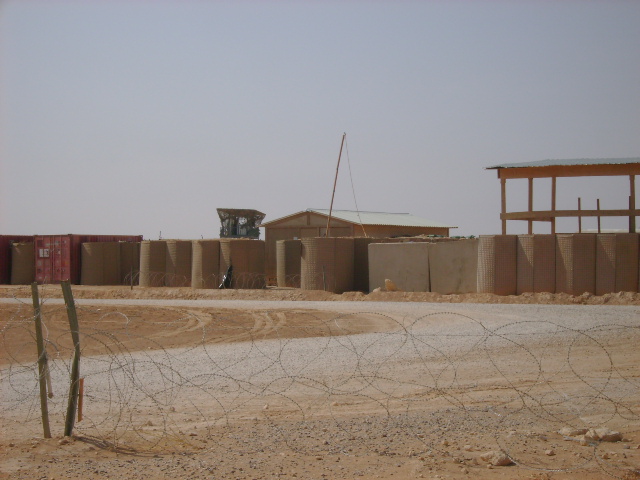
COP South

I have done many of these send offs since coming to Portsmouth but I think that today I knew a higher percentage of the personnel deploying than normally is the case.  At these ceremonies it is customary for the chaplain to pray for our shipmates as well as their family members.  This deployment comes in the midst of monthly casualties reaching their highest point in the war and shortly after two US Navy sailors being killed when for whatever reason they left their base in Kabul in an up armored Toyota Land Cruiser and proceeded to drive alone to one of the most dangerous areas of the country.  With that in mind the safety of our shipmates is something that I and those that serve are ever mindful of when we send our people to deploy.  Yesterday I spent more time with the deploying sailors before and following the ceremony because so many were friends or close colleagues. The goodbyes from me this time were different as I will not be at Portsmouth when my friends return. My assignment as the Command Chaplain at Naval Hospital Camp LeJuene means that I won’t be there but I will continue to keep them in my prayers and stay in contact with as many as I can through e-mail or Facebook.  At LeJuene I will meet old friends from Portsmouth as well as from my Marine tours.  I will also get to deal with a lot more Marines and Sailors dealing with physical as well as psychological injuries resulting from their time in harm’s way in either Iraq or Afghanistan or in many cases both countries.

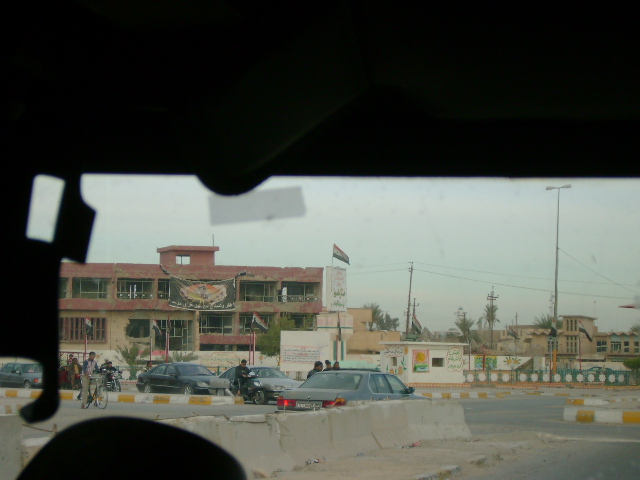
Pause for possible IED

It has been three years since I deployed to Iraq, in fact three years to the day yesterday that I arrived in Kuwait to complete final training before going into country.  When I was over in Iraq I was blessed my many expressions of support of many people, churches, schools and veterans groups.  At the same time I did not sense the overwhelming support of the people for our troops and that included many members of the political establishment that seemed more interested in using the war to advance their political objectives and unfortunately that was truly a bi-partisan endeavor.  Since we are an all volunteer force it seems to me that the only people really paying attention are people with sons, daughters, mothers or fathers or other family members or friends in harm’s way.  For others supporting the troops is little more than a bumper sticker affirmation, which I appreciate as at least most people aren’t damning us as so many did in Vietnam, a war that my dad served in and which as a Navy dependant experienced in the way that military families were treated by the protest set.

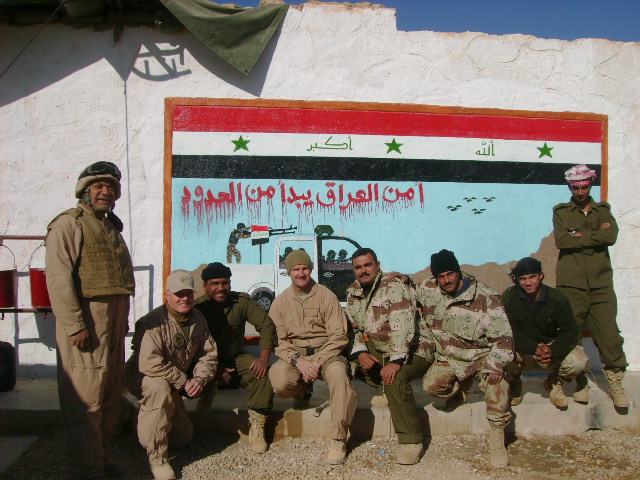
On Syrian Border with Iraqi Border Troops

Today I saw an article about an Army Lieutenant one Christopher Babcock http://gen-reading.blogspot.com/ at a tiny base in Afghanistan.  I often felt this way when in Iraq, especially those times that I came back into the large base that I operated from and saw various news channels on AFN including Fox News, CNN, and MSNBC.  Much of what I saw coming out of the mouths of reporters or politicians, showed me just how out of touch and how little our leaders on both sides of the political divide, the media and the American public understood this war.

Convoy in Ramadi shortly before we took fire

My war experience was different. The places I went were the places most people never heard of or will ever hear about.  My assistant and I travelled thousands of miles in fixed and rotor wing aircraft as well as in many tiny poorly armed convoys in the badlands of Al Anbar Province to the small Iraqi bases where our advisors to the Iraqi Army and security forces worked.  In the assignment I got to know a decent number of Iraqi officers and even spoke to the first class of female Iraqi Police officers in training at Ramadi.  I believed then and now that Iraq will do well in the long run.  Back in 2007 very few people believed that, but having gotten to know many fine Iraqis I know that they will repair their country and move on with life. They have been at war in some way shape or form since 1980 and are war weary and most want to move on to live in peace and raise their children.

Guests of Major General Sabah of 7th Iraqi Division

I do not believe this to be the case in Afghanistan. History tells me that we will have no better outcome than the Soviets.  We lost our opportunity when we let up on the pressure in Afghanistan to concentrate on Iraq. The Taliban were able to rebuild and regain control of much of the country between the Iraq invasion and 2010.  I honestly don’t know if we as a nation have the wherewithal to win this war or the resources to do so.  Many outstanding Soldiers, Sailors, Marines and Airmen as well as personnel from the CIA perform heroic work on a daily basis but they do not have the numbers or resources to fight a successful counter-insurgency campaign when the Afghan people by and large hate the Karzai regime and cast their lot with the Taliban despite their miserable life under that brutal, medieval fundamentalist Islamic regime.

But we go on with each service sacrificing needed equipment and personnel to fund the war. Even now the Navy is going to be cut maybe up to 25,000 sailors without any mission decrease. Likewise there will be no let up of the use of Navy personnel as Individual Augments to Marine, Army or NATO forces in the Middle East and in other locations.  As it is the force seems to be stretched beyond belief with many sailors not only deploying in traditional at seas, Fleet Marine Force, Seabee or Special Operations billets but when they are supposedly on the downhill side in a shore billet are pulled to serve as an Individual Augment.   The Army and the Marines are worn down by constant deployments with no end in sight.  There are no new drafts of personnel, end strength is limited and the same people go back time and time again.  If I was told I needed to head to Afghanistan I would because that is where many of my friends are and as a Priest and Chaplain I could do no other, but I would go with no illusions about the mission, the risk or the likely outcome of the war. It would be the place to care for God’s people serving in harm’s way.

Brotherhood of War

While this is going on there is the ever present threat of war on the Korean Peninsula or with Iran. A war in either location would open yet another front in a worldwide conflict, when we are already stretched to the breaking point elsewhere.  Any conflict in those areas could generate more casualties in a short period of time than all the personnel that we have lost in Iraq or Afghanistan.

Goodbyes and prayers… I am sure that there will be more of both in my future.  I just ask my readers to keep their head in the game when it comes to the wars that we are in.  Don’t leave the troops on a bumper sticker but keep them in your hearts and prayers and serve them through your actions.

Peace

Padre Steve+

Leave a comment

Filed under counterinsurency in afghanistan, iraq,afghanistan, Military, shipmates and veterans, US Navy

North Korea Tensions: One Misstep could mean War what the US can deploy to the Theater

The USS George Washington

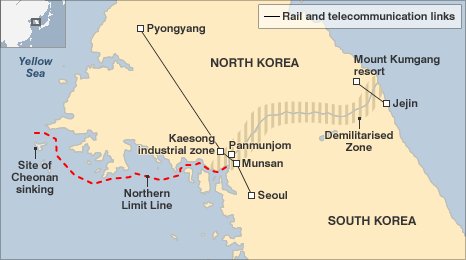
The tensions on the Korean Peninsula following the North Korean sinking of the South Korean Corvette Cheonan on March 26th and the North’s continued bellicose actions are now the highest in years.  Since the United States and South Korea announced naval exercises in the Yellow Sea and the Sea of Japan the North has gone on a propaganda offensive condemn the exercises as a threat to peace and “nothing but outright provocations aimed to stifle the Democratic People’s Republic of Korea [North Korea] by force of arms.” North Korean spokesman Ri Tong Il claimed that the exercise “is a grave threat to the Korean peninsula and also to the region of Asia as a whole,” and “another example of a hostile policy” toward North Korea.

One of a number of Naval Clashes between South and North Korean Navy vessels

The North Koreans announced also that “The army and people of the DPRK will start a retaliatory sacred war of their own style based on nuclear deterrent any time necessary in order to counter the US imperialists and the South Korean puppet forces deliberately pushing the situation to the brink of a war,” and while threats of war are common from the DPRK the situation is now so tense that any miscue from either side could spark a war.

The US State Department dismissed the North Korean threats spokesman P J Crowley stated “North Korea has a habit of trying to deflect, you know, responsibility onto others.”  He noted that some U.S. officials were concerned that North Korea might use the heightened tensions and exercises to make further provocations against the South and US Forces.  Some speculate that such measures might include missile tests or nuclear tests or other military measures.  In response to questions that North Korea might take aggressive steps Crowley noted:  “Are they capable of these kinds of steps? Tragically, the answer is yes….And the very kind of actions that we’ve announced in recent days, including military exercises that will be conducted in the near future, are expressly to demonstrate that we will be prepared to act in response to future North Korea provocations. We hope it won’t come to that.”

South Korean Navy LHD Dokdo

Secretary of State Hillary Clinton remarked at a conference regarding the South China Sea in Vietnam that “an isolated and belligerent North Korea has embarked on a campaign of provocative, dangerous behavior…”

The US Forces Korea Commander General Walter Sharp stated:  “These defensive, combined training exercises are designed to send a clear message to North Korea that its aggressive behavior must stop, and that the ROK and U.S. are committed to enhancing our combined defensive capabilities.”

The Exercise “Invincible Spirit” will include the USS George Washington carrier battle group including the Guided Missile Destroyers USS McCampbell, USS John S. McCain and USS Lassen, as well as South Korean Navy assets including the largest ship in the South Korean Navy the Landing Ship Dokdo. A total of 20 ships 200 aircraft and 8,000 sailors will take part in the exercise which according to the South Korean newspaper Chosun Ilbo “will consist of an electronic warfare simulation with members of the US Cyber Command, an aerial refueling and bombing exercise by the Air Force, command control training by the Marines, and a navy anti-submarine exercise.”  It is also likely that the converted former Trident Missile submarines USS Ohio, USS Michigan and possibly the USS Florida are in the area each armed with up to 154 Tomahawk cruise missiles.  The 4th of these submarines USS Georgia is also deployed and its whereabouts are not known. It is the first time that all 4 subs have been deployed at the same time.   The US Air Force has deployed the F-22 Raptor for the first time to Korea and elements of the 7th Air Force will take part in the exercise.  Invincible Spirit is the first in a series of scheduled summer exercises between the US and South Korea. Admiral Robert F Willard commander of the 7th Fleet said that at the end of the exercise, there will be a counter special-forces exercise. He added “These occur with some frequency in both the East and West Seas, conducted by the [South Korea] and U.S. Navy.” North Korea has a large special-forces establishment and capability.

North Korean YJ-62 Anti-Ship Missile on mobile launcher

The US Navy has additional assets that could be deployed in the event of a major crisis on the peninsula as the USS Ronald Reagan is involved with the RIMPAC 2010 exercises in the Pacific and the carriers USS Carl Vinson and USS Abraham Lincoln are underway off the west coast involved in exercises or deployment work ups.  At this time 123 (43%) of the navy’s 289 ships are deployed and a total of 184 (64%) are underway away from their homeport. Of the submarine force 23 (43%) are deployed and 30 (55%) are underway.  This is a sizable amount of the fleet and represents a significant surge potential should a conflict break out.  In the midst of the current wars in Iraq and Afghanistan many forget that a significant amount of our national military power can be deployed quickly from the sea to danger spots like Korea where their assets based on history can have a decisive affect.

The USS Ohio and her sisters USS Michigan and USS Florida could play a deterrent role

Ground forces are more spares, the major component of land based forces are those of South Korea, the US now has just a Brigade Combat Team stationed in South Korea although other assets not engaged in Operation Iraqi Freedom or Operation Enduring Freedom could be deployed from the 25th Division in Hawaii and Alaska and the 2nd Division based at Ft Lewis Washington.  As of now 1 brigade the 4th BCT of 25th Infantry Division is deployed to Afghanistan as well as the 5th BCT of 2nd Division which also has its 4th BCT deployed to Iraq. The 2nd BCT of 25th Division is schedule for deployment and may already be deployed this summer. The 3rd BCT of the 25th Division is now in a post-deployment cycle after having just returned from Iraq. The deployment of uncommitted assets would take time and the only immediate reinforcements could be a limited number of Marine units from the 3rd Marine Division and III MEF in Okinawa and Kaneohe Bay Hawaii that are not currently engaged in Operation Enduring Freedom.

The North Korean threat of a “retaliatory sacred war” may be the usual propaganda hyperbole used by the North or it may be their “line in the sand.”  It also could be more bellicose than usual because of internal tensions in the North regarding potential successors to the ailing Kim Jong Il. US and South Korea operational planning has contingencies should there be unrest in the North following Kim’s death but a conflict brought on by one of the rival factions the North could plunge Northeast Asia into a regional war. We don’t know what it is but the week ahead could become rather sporty.   China has warned that the exercise could make matters worse on the peninsula and the US apparently in response to China will keep the George Washington in the Sea of Japan.  There are also good tactical measures for doing so to protect the carrier by keeping it out of constricted waters in the vicinity of a good number of North Korean assets should fighting actually break out and the fact that the USS John S. McCain already is equipped with the Aegis Ballistic Missile Defense System.

The Japanese Naval Self Defense Force (Navy) is sending 4 observers to the exercise a tacit measure of support for them and the Japanese have several ships fitted for the Aegis Ballistic Defense System.

With all of this said we now have to wait and see what happens. Will the North do something to instigate a conflict or will it back down?  We don’t know as it is a very unpredictable country with a penchant for raising the ante in the high stakes world of geopolitical dominance in Northeast Asia. The Obama administration seems to be walking a narrow line between war and appeasement, not that we would consider what we do appeasement but what the North would certainly take it to be. The stakes are high and only God knows what will happen in the next several days. An actual conflict could kill hundreds of thousands or even millions of people; especially should the North successfully deploy and use a nuclear weapon. Thousands of American lives are at stake should a conflict break out and besides our Soldiers, Sailors Marines and Airmen standing in harm’s way many of them are non-military citizens that live and work in South Korea and Japan.

That is all for now, pray for peas.

Peace

Padre Steve+

3 Comments

Filed under Foreign Policy, Military, national security, Navy Ships, US Navy

Selected for Promotion

I received great news today.  I got the call from work that I had been selected for promotion to the rank of Commander in the Navy Chaplain Corps.  I will be posting something about this tomorrow sometime and will also be catching up on my Tides and Orioles news, of which there has been a bunch of.  I had a long and demanding overnight on Monday dealing with number of different issues that kept me up late into the night.  I thank everyone that has been praying for me, encouraging me and caring for me over the years. To my friends that were selected as well I offer my congratulations and to those that did not get selected I offer my support and prayers.  I know many over the years that  have been outstanding officers that were not selected, many for reasons that I cannot fathom to this day and know the pain, isolation and stigma of those that did not get selected is difficult even for the most optimistic.  While I rejoice with those that rejoice I cannot forget those that have served faithfully and honorably that were not selected.

Anyway, tomorrow I shall start catching up. These is much work to be done at work before I take some leave beginning the end of the week. Tonight Judy and I went to Harbor Park where the Tides beat the Lehigh Valley Iron Pigs 9-2.  I have a lot of great pictures from this that will show up on this site when I get around to them.

Blessings my friends and peace<

Padre Steve+

4 Comments

Filed under Military, US Navy

D-Day and After: Battling Through the Bocage

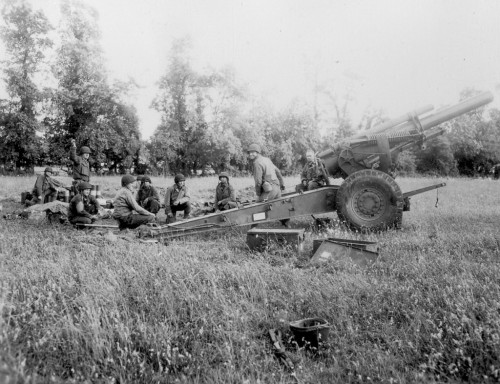
US 155mm Howitzer in Normandy. The American artillery was considered the best branch of the American combat arms by the German commanders

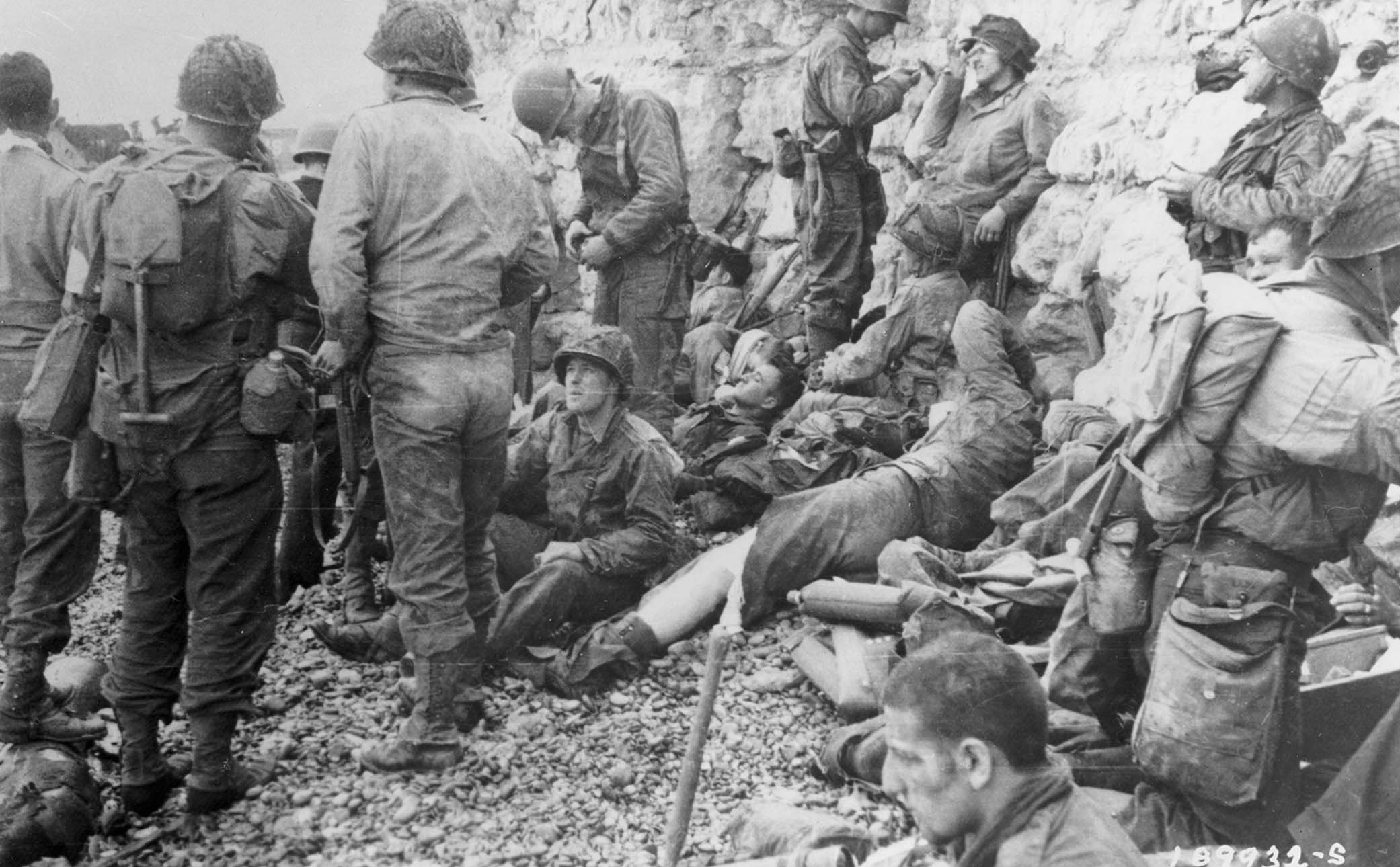
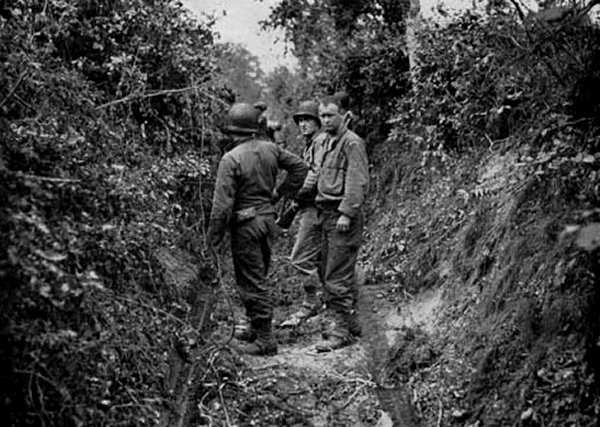
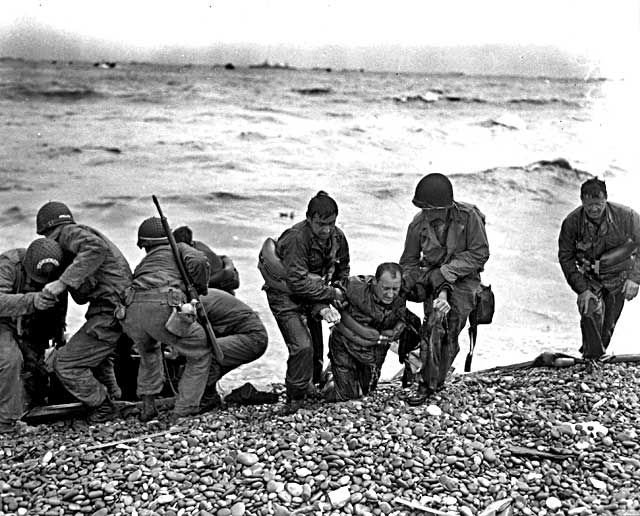
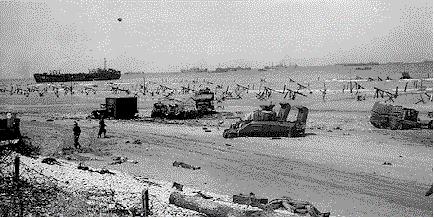
It took nearly a week for the American V and VII Corps on Omaha Beach and Utah Beach to link up with each other and secure their beachheads against fierce German resistance.    Elements of the 29th Division and the 90th Division pushed inland from OMAHA to expand the beachhead toward UTAH. Opposed by the 352nd Division, elements of the 91st Airlanding Division and other non-divisional units the American divisions took heavy casualties.  The fighting revealed the inexperience of the American infantry formations and the uneven quality of their leadership as they tackled the Germans in the labyrinth of the Bocage country. However by June13th the link up was solid enabling the Americans to conduct the follow up operations needed to expand the beachhead, secure Cherbourg and clear the Cotentin.
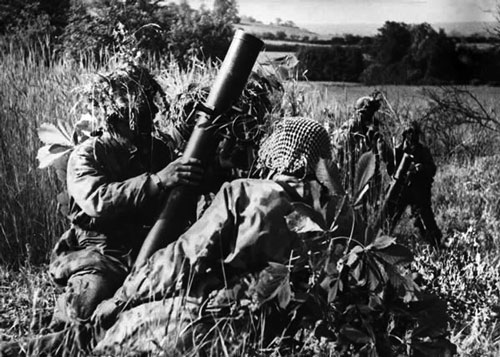
German Falschirmjaeger with 81mm mortar. This simple weapon was one of the most lethal in the German arsenal and accounted for a large number of Allied infantry casualties

The lack of success of the 90th Division, led the VII Corps commander General “Lightening Joe” Collins to relieve the division commander and two of his regimental commanders.   This was a portent of things to come with other American units as they took heavy casualties despite having a vast superiority in firepower over the Germans.[i] As the two corps pushed into the “Bocage” they were followed by a massive build up of troops and equipment delivered to the beaches and to the artificial “Mulberry” harbors.  Despite their numeric superiority, air supremacy and available Naval gunfire support and facing few units of high quality save the 352nd, 91st and the 6th Parachute Regiment, the Americans made painfully slow progress as they expanded the beachhead.[ii]
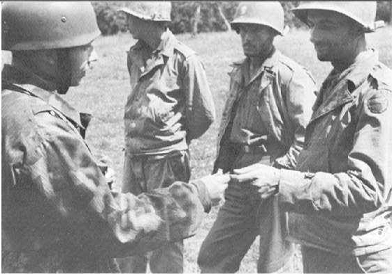
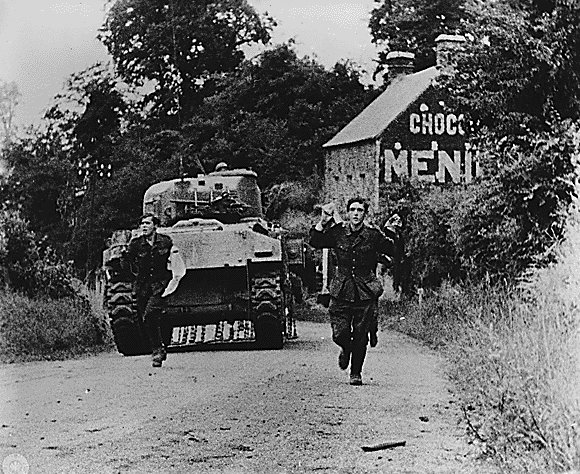
Poor training and leadership caused many US infantry casualties and many GIs to be captured. Here a Falschirmjaeger accepts a cigarette from a GI of the 29th Infantry Division

Once the beachheads had been consolidated the Americans turned their attention toward Cherbourg. This was the major Naval Port at the far northwest tip of the Cotentin and considered vital to the resupply of the Allied forces as they pushed into the heart of France.  D-Day planners counted on the swift capture of Cherbourg and rehabilitation to serve as a supply port for the Allied forces to lessen the dependency on the artificial Mulberry harbors. The first task was to isolate Cherbourg and to do this the 9th Division drove south from the beaches to the coast near Barneville.  The corps captured Barnville on the 18th of June cutting off the German forces covering the approaches to Cherbourg.[iii] This put the Germans in a bind as the 7th Army “had to split its forces in the peninsula in order to hold the fortress a little longer and thus to gain time for the establishment of the southern front on the Cotentin peninsula.[iv]
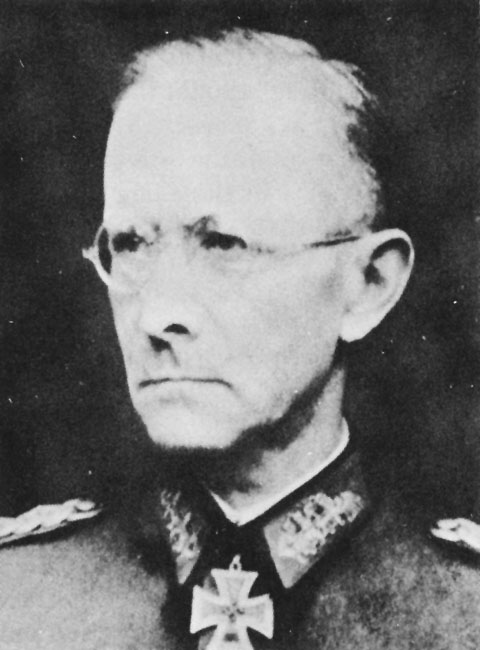
General Erich Marcks a one legged veteran of the Eastern Front led a spirited defense until he was killed in action

The German forces arrayed before Cherbourg waged a desperate defense centered on the 243rd Infantry Division and other assorted battle groups of LXXXIV Corps. During the fighting the LXXXIV Corps commander General Marcks was killed in action on 12 June.[v] This was a tough loss for the Germans as Marcks was a resourceful planner and resolute leader and considered one of the best German commanders in Normandy.

Once Cherbourg was cut off from German support Collins and the U.S. VII Corps composed of the 9th, 4th and 79th Divisions pushed up the peninsula capturing Cherbourg on June 29th.  Bradley pushed hard for the capture of the port as the Mulberries had been ravaged by a severe Channel storm greatly diminishing the over the beach logistics support. Cherbourg’s port was thoroughly demolished by German engineers and would not be fully operational for months. The loss of the Mulberries and delay in Cherbourg’s availability meant that few supplies were landed on the beaches.  This would “hinder the escape from the constricting land of the hedgerows into which the Americans had come in search of a port” [vi] and was a setback to allied planning.
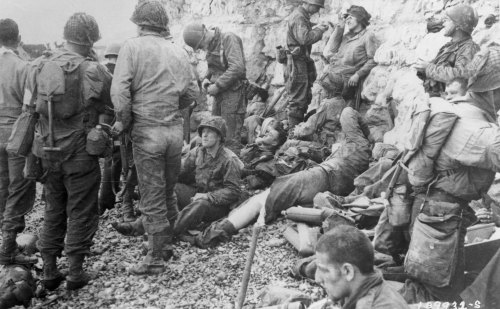
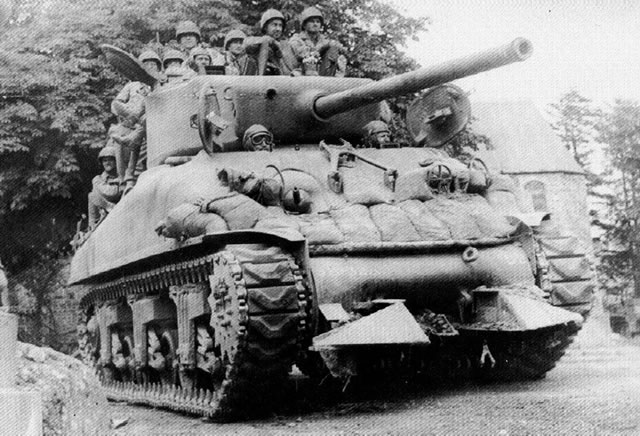
US 1st Infantry Division soldiers pause during operations in Normandy

To the east of VII Corps the V Corps under Major General Leonard Gerow made a cautious advance by phase lines toward Caumont, St Lo and Carentan.  The deliberate advance by the Corps toward a line weakly held by the Reconnaissance battalion of the 17th SS Panzer Grenadier Division was directed by Bradley who did not want to divert attention from the effort against Cherbourg.  A more aggressive commander might have tried to push further to expand the beachhead but caution was a hallmark of the American campaign in Normandy up to Operation COBRA.  After capturing Caumont V Corps halted and continued aggressive patrolling to deceive the Germans while digging in.[vii] Bradley’s decision to err on the side of caution had an effect on the broader campaign in Normandy.   Had Bradley directed a strong push against the weak German line it could have led to an opportunity to envelope the German line west of Caen. The opportunity lost through caution helped lead to the bloody and controversial campaign to capture Caen.[viii] Throughout the campaign in the Bocage American units were badly handled by their commanders, especially at lower levels and the experience and initiative shown by German battle groups and small unit leaders constantly stymied to American advance.
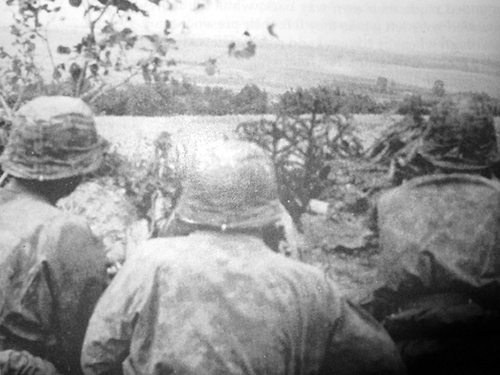
German Panzergrenadiers on Hill 112 awaiting a British attack beyond Caen

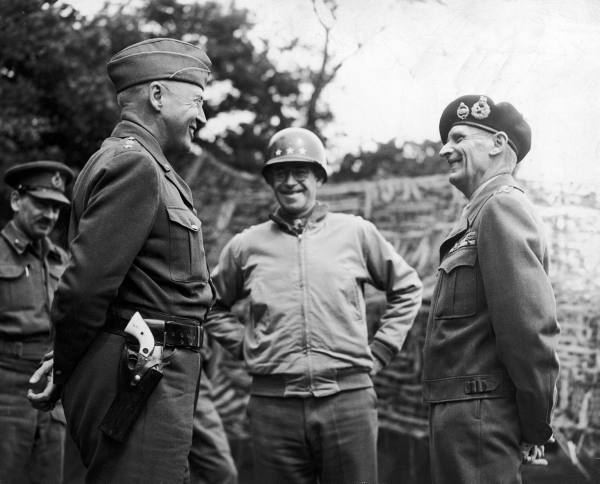
The Americans were not alone in their struggle against the Germans. Field Marshal Bernard Law Montgomery had ambitious plans to break out of Normandy by capturing Caen on D-Day and driving toward Falaise and Argentan.  The British failed to capture Caen and their plans were frustrated by the rapid reinforcement of the sector by the Germans.   The 21st Panzer, Panzer Lehr, and the 12th SS Panzer Divisions skillfully defended the area taking a fearful toll on the British and Canadians arrayed against Caen.
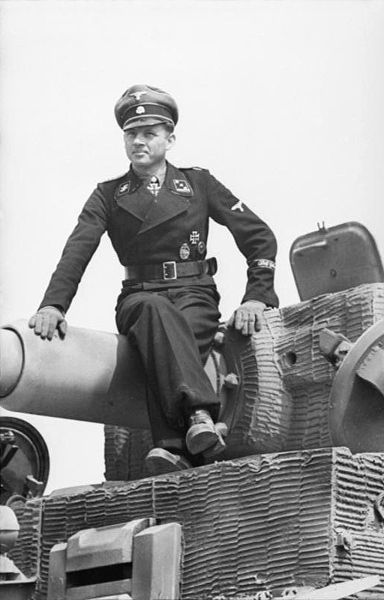
Captain Michael Wittmann of the 101st SchwererPanzer Battalion (Heavy Tank Battalion) in Normandy

A flanking maneuver at Villers-Bocage was frustrated by a few Tiger tanks of SS Heavy Tank Battalion under the command of Captain Michael Wittmann that destroyed 14 tanks and 15 personnel carriers of the British 7th Armoured Divsion along with 2 anti-tank guns within the space of 15 minutes. [ix]
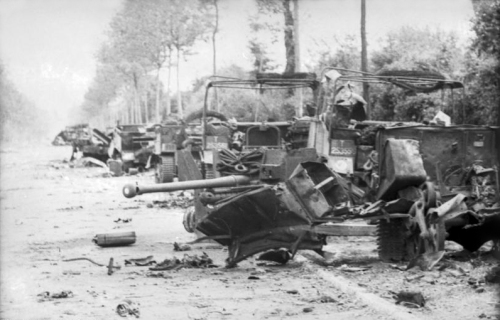
Vehicles Destroyed by Wittmann’s detachment at Villers-Bocage

Likewise a series of disastrous attacks toward Caen (EPSOM, CHARNWOOD and GOODWOOD) which were strongly supported by air strikes and naval gunfire were mauled by German forces and only finally succeeded in taking the unfortunate city of Caen on July 18th.
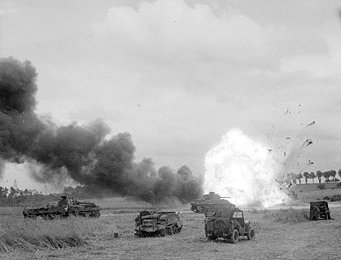
British Ammo Carrier goes up in flames after being hit by German fire during Operation Epsom

However the British failed to take the heights beyond the town[x] which led to more attacks against crack well dug in German forces.  In the campaign to take Caen and the hills beyond it the British took heavy casualties in tanks and infantry which seriously strained their ability to conduct high intensity combat operations in the future.[xi] The one benefit, which Montgomery would claim after the war as his original plan was that German forces were fixed before Caen and ground down so they could not be used against Bradley’s breakout in the west at St Lo.[xii]
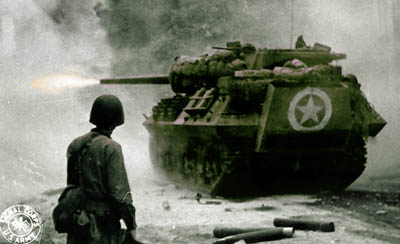
US M-10 Tank Destroyer firing at German positions in Normandy

The Caumont gap no longer “yawned invitingly in front of V Corps;”[xiii] as the Germans had reinforced the sector while the Americans dug in, yet now Bradley wished to push forward rapidly to achieve a breakthrough in the American sector.[xiv] Facing the most difficult terrain in France amid the Bocage and swamps that limited avenues of approach to the American divisions committed to the offensive.  The Americans now faced their old foe the 352nd division as well various elements of elite II Parachute Corps, the 17th SS Panzer Grenadier and Panzer Lehr Divisions.
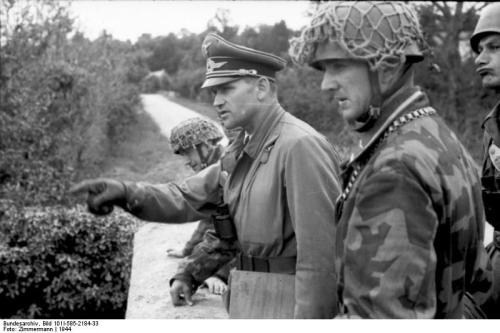
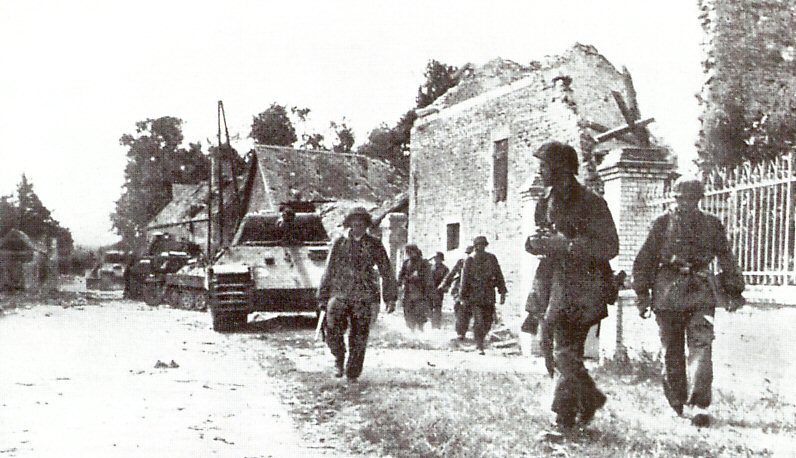
German Falschirmjaeger in Normandy

American tanks and infantry made slow progress and incurred high losses as they fought the Germans yard by yard in the Bocage.  The Americans incurred high numbers of casualties and in the VIII Corps sector alone the attack “consumed twelve days and 10,000 casualties to cross eleven kilometers of the Bocage…the achievements of the VII and XIX Corps were no better than comparable.[xv] Such losses incurred so early during the campaign would have far reaching effects when the Americans reached the Alsace-Lorraine and the German border.
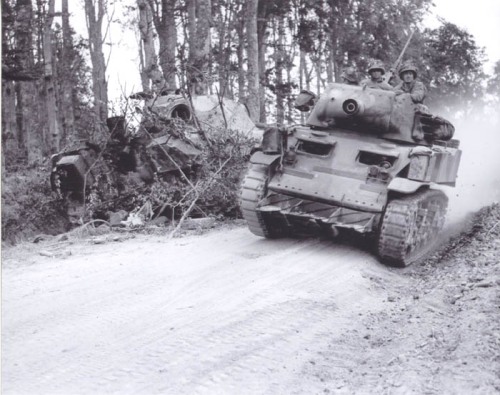
M-8 Gun carrier of a reconnaissance battalion advancing in Normandy

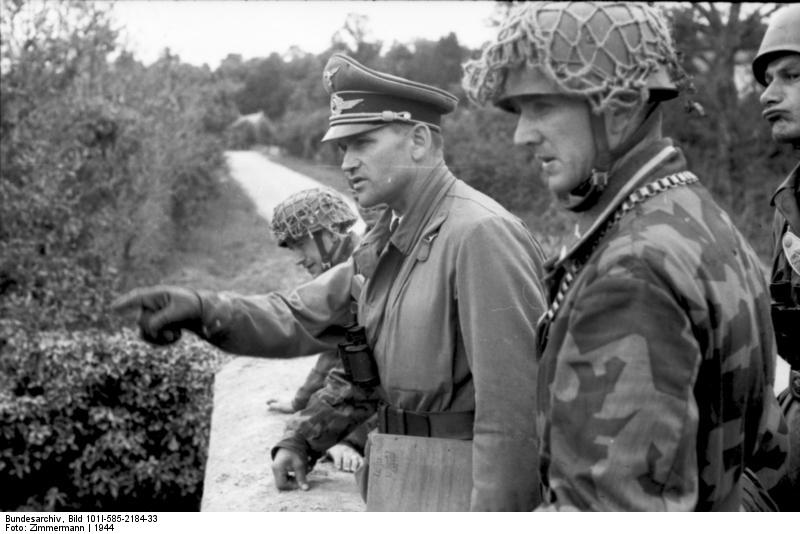
In order to break out of the Bocage the town of St Lo had to be captured.  It lay at a vital road juncture and its capture would help open the way into the French interior, thus St. Lo was key to Bradley’s breakout efforts.  His First Army had to capture it and the roads leading of it to launch Operation COBRA along the coast.  The task of capturing St. Lo was assigned to Gerow’s V Corps and Charles “Cowboy Pete” Corlett’s XIX Corps.  They faced opposition from the tough paratroops of the German 3rd Falschirmjaeger (Parachute) Division of II Parachute Corps commanded by General Eugen Meindl a tough veteran paratrooper and resourceful commander who had been shot through the chest at Crete.
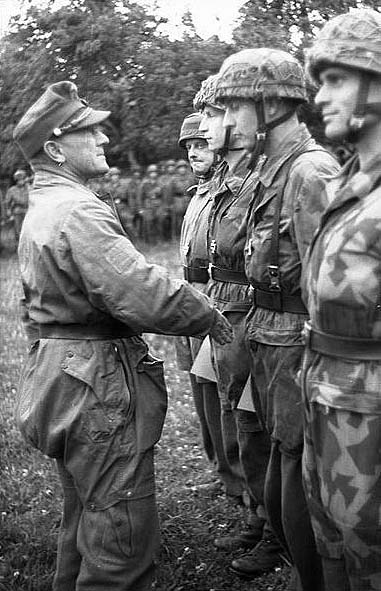
General Eugen Meindl of II Falschirmjaeger Corps decorating troops. In contrast to many Allied commanders many senior German officers like Meindl led following the doctrine of “Auftragstaktik” from the front sharing the hardships and dangers of their soldiers

The 2nd, 29th, 30th and 83rd Divisions of XIX Corps fought a tough battle advancing eleven kilometers against the German defenders again taking high numbers of casualties especially among the infantry.  However they were successful and secured St. Lo on 18 July.[xvi]
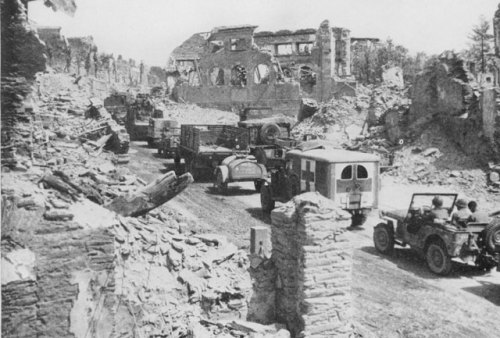
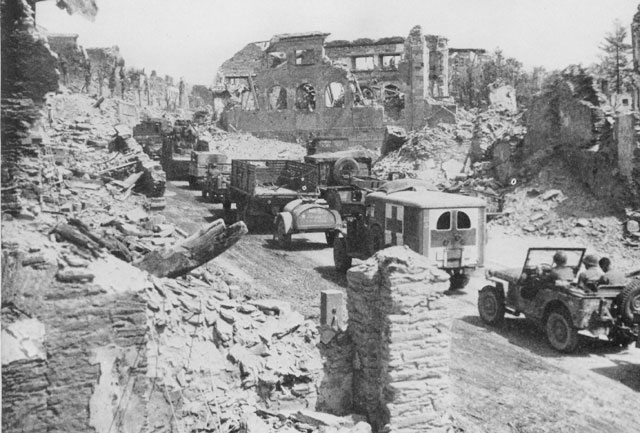
US Vehicles advancing through the shattered city of St Lo

With St Lo in their possession the Americans had finally cleared the hedgerows of the Bocage and now looked at the open country of the French interior.  St Lo epitomized the struggle that the American Army had to overcome in the Bocage.
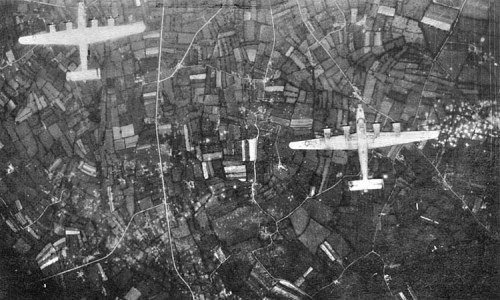
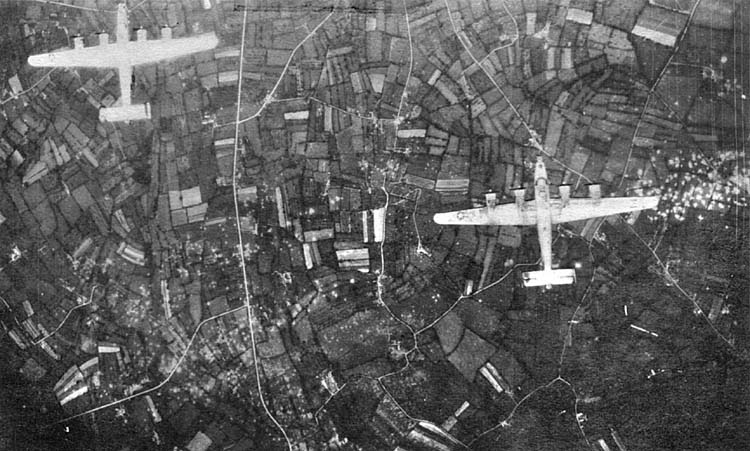
B-24’s Bombing St Lo on July 25th an attack that went awry killing many US soldiers near the front

Americans faced hard fighting against heavily outnumbered but superiorly led German troops that occupied excellent defensive country that inflicted heavy casualties on the Americans for every yard of ground given up. The Germans for all of their disadvantages exacted a terrible price in American blood between D-Day and the capture of St Lo despite the Allied control of the skies and the numerical superiority of the American Army.[xvii]
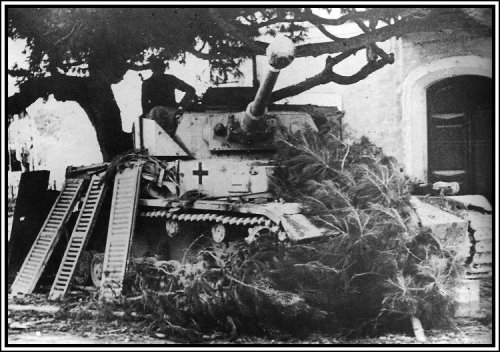
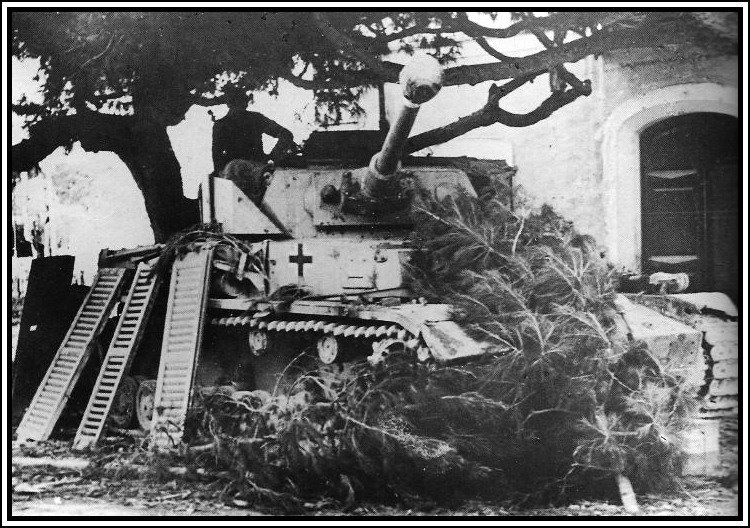
A Panzer IV camouflaged in a Normandy town

With the Bocage behind him Bradley desired to push the Germans hard and moved from a cautious to bold strategy to break the German line.  COBRA was his plan to break out of Normandy.  Bradley ably assisted by Collins realized that the better terrain, road networks past St Lo favored a decisive breakout.  American preparations for the attack included a technical advance that allowed tanks to plow through hedgerows, the “Rhino” device fashioned by American troops which was installed on three of every five First Army Tanks participating in the operation.[xviii] The Rhino device allowed the American Tanks to cut through the thick earthen hedgerows instead of being forced to climb them and expose their unprotected bellies to German anti-tank weapons or limit their movement to the constricted road net.
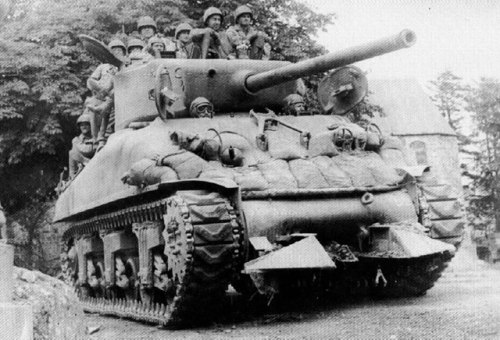
Sherman Tank equipped with the Rhinoceros device

As the Americans prepared the Germans continued to conduct a spirited active defense but were hampered by a lack of reinforcements.  As it happened they did not receive reinforcements in anywhere close to the numbers needed as the German Replacement Army was hoarding vast numbers of troops in Germany in anticipation of the plot to assassinate Hitler of which several high ranking members of the Replacement Army were leading conspirators. The Germans at the front were being starved of replacement divisions even as the Allies continued to build up their own forces in Normandy.
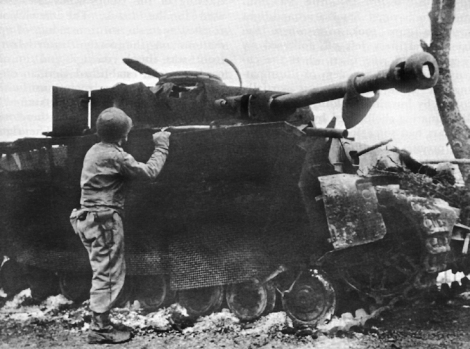
GI inspecting a knocked out Panzer IV

VII Corps was designated to lead the attack which was to begin on July 24th. American planning, reflecting more experience against the Germans was more advanced than in past operations.  Collins and Bradley planned for exploitation operations once the breakthrough had been made as part of the overall operational plan.  The aircraft of the 8th and 9th Air Forces were designated to conduct a massive air bombardment that would precede the attack. Division, Corps and additional artillery battalions were allotted to pulverize German positions to assist in the breakthrough.   A mistake by the heavy bombers in the 24th resulted in the heavy casualties to forward units which led to a postponement of the attack until the 25th of July.[xix]
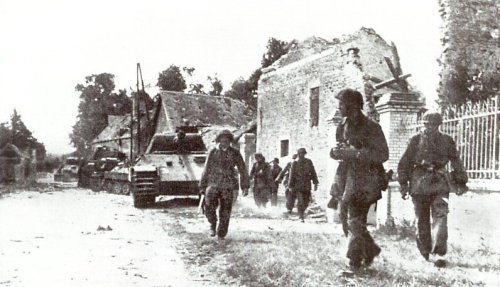
German Panzers and Panzer Grenadiers advancing in Normandy

The attack commenced on the 25th and yet another mistake by the bombers led to more American casualties[xx] and the dead included Lieutenant General Leslie McNair.  McNair was the Commander of Army Ground Forces, a position from which he directed the organization and training of American ground forces.
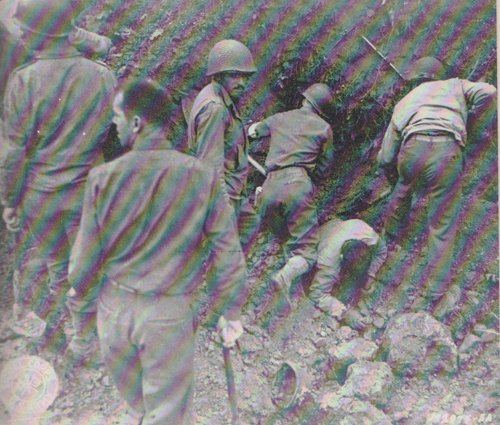
Men of Co D 117th Infantry being dug out after being bomber by “friendly” US Bombers at St Lo

Many of McNair’s decisions were responsible for the lack of adequate training received by American soldiers as individuals and units which had a direct correlation to the less than stellar performance of many American divisions in the European campaign. However the effect of the bombardment on the German forces was profound as men, equipment and fortifications were blasted by a barrage that the Germans had not yet encountered on the western front.  VII Corps units pressed forward against the determined resistance of Panzer Lehr survivors and the remnants of units that had fought the Americans since the invasion began.  Although it was a “slow go” on the 25th Bradley and his commanders were already planning for and beginning to execute the breakout before the Germans could move up reinforcements.  The 26th of June brought renewed attacks accompanied by massive air strikes.
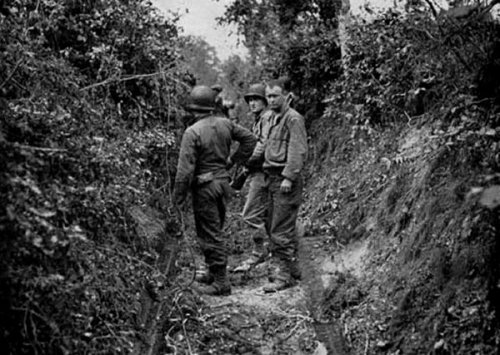
Infantry of the 30th Infantry Division

While not much progress was made on the 26th, the Americans discovered on the 27th that the German forces were retreating.  The capture of Marigny allowed VIII Corps to begin exploitation operations down the coastal highway to Coutances and for the first time since the invasion the campaign entered a phase of maneuver warfare where the mechanization and motorization of US Army forces gave them an advantage that they did not have in the Bocage.
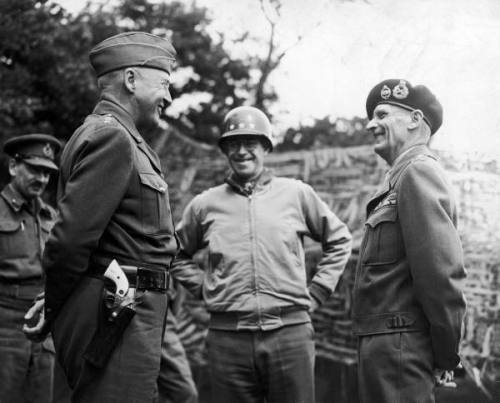
General George S Patton, Omar Bradley and Field Marshal Bernard Law Montgomery in Normandy, in Patton the Allies found a senior officer that understood the importance of strategic maneuver

On the 27th General George S Patton was authorized to take immediate command of VIII Corps a precursor to the activation of his 3rd Army.  COBRA ripped a hole in the German line and inflicted such heavy casualties on the already depleted German 7th Army that it could do little to stop the American push despite heroic performances by many units which were operating at 50% or below of their authorized strength.[xxi] As the American forces pushed forward they reinforced their left flank absorbing the local German counterattacks which were hampered by the Allied close air support.  As the breakthrough was exploited the command of the forces leading it shifted to Patton and the 3rd Army.
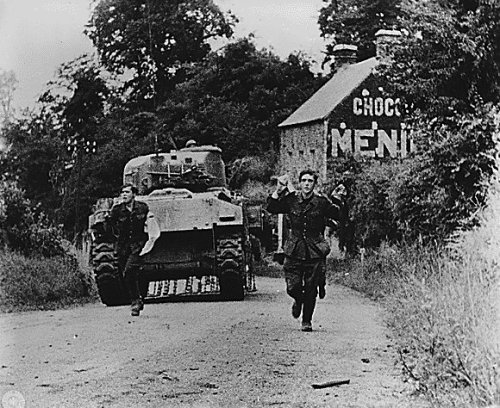
German prisoners being escorted to the rear past a Sherman

By the 28th VIII Corps led by the 4th and 6th Armored Divisions had reached Avranches and established bridgeheads over the See River with additional bridges being captured intact on the 30th.[xxii] The capture of Avranches allowed the Americans to begin exploitation operations into Brittany and east toward the Seine. Weigley notes that for the first time in the campaign that in Patton the Americans finally had a commander who understood strategic maneuver and would use it to great effect.[xxiii]

The American campaign in Normandy cost the U.S. Army a great deal. It revealed weaknesses in the infantry, the inferiority of the M4 Sherman tank to most German types, problems in tank-infantry cooperation and also deficiencies in leadership at senior, mid-grade and junior levels.  Numerous officers were relieved including Division and Regimental commanders.  Nonetheless during the campaign the Americans grew in their ability to coordinate air and ground forces and adapt to the conditions imposed on them by their placement in the Cotentin.  The deficiencies in training and leadership would continue to show up in later battles but the American Army learned its trade even impressing some of the German commanders on the ground in Normandy.[xxiv]


[i] Ibid. p.99 Both Weigley and Hastings make note of the failure of both the Americans and British to train their troops to fight in the bocage once they had left the beaches.

[ii] Ibid. Hastings. pp.152-153

[iii] Ibid. Weigley p.101

[iv] Isby, David C., Ed. “Fighting in Normandy: The German Army from D-Day to Villers-Bocage.” Greenhill Books, London,  2001.  p.143

[v] Ibid. Hastings p.173 Allied fighter bombers exacted a fearful toll among German commanders. The Commanders of the 243rd and 77th Divisions fighting in the Cotentin were also killed by air attacks on the 17th and 18th.   Further east facing the British the commander of the 12th SS Panzer Division, Fritz Witt on the 17th.

[vi] Ibid. Weigley. p.108

[vii] Ibid. p.111-112.

[viii] Ibid.

[ix] The efforts of the 51st Highland Division and 7th Armored Division were turned aside by the Germans in the area and were dramatized by the destruction of  a British armored battalion by SS Captain Michael Wittman and his platoon of Tiger tanks.  See Hastings pp.131-135.

[x] The British 8th Corps under General O’Connor lost 270 tanks and 1,500 men on 18 July attempting to crack the German gun line on the ridge beyond Caen. Weigley, pp.145-146.

[xi] Hastings comments about the critical British manpower shortage and the pressures on Montgomery to not take heavy casualties that could not be replaced. Overlord. pp.241-242.

[xii] Ibid. Weigley pp.116-120

[xiii] Ibid. p.122

[xiv] Ibid. p121 Bradley told Eisenhower “when we hit the enemy this time we will hit him with such power that we can keep going and cause a major disaster.”

[xv] Ibid. 134

[xvi] Ibid. Weigley. pp. 138-143.  Weigley notes of 40,000 U.S. casualties in Normandy up to the capture of St. Lo that 90% were concentrated among the infantry.

[xvii] Weigley quotes the 329th Regiment, 83rd Division historian “We won the battle of Normandy, [but] considering the high price in American lives we lost. P.143. This is actually a provocative statement that reflects America’s aversion to massive casualties in any war.

[xviii] Ibid. p.149

[xix] Ibid. p. 152

[xx] Ibid. pp. 152-153.  Among the casualties were the command group of the 9th Division’s 3rd Battalion 47th Infantry and General Leslie McNair who had come to observe the assault.

[xxi] Ibid. pp.161-169. Weigley notes the advances in U.S. tactical air support, the employment of massive numbers of U.S. divisions against the depleted German LXXXIV Corps, and the advantage that the “Rhino” device gave to American tanks by giving them the ability to maneuver off the roads for the first time.

[xxii] Ibid. pp.172-173.

[xxiii] Ibid. p.172

[xxiv] Ibid. Isby, David C. “Fighting in Normandy,” p.184, an officer of the 352nd Division referred to the American soldier “was to prove himself a in this terrain an agile and superior fighter.”

Bibliography

Carell, Paul. “Invasion: They’re Coming!” Translated from the German by E. Osers, Bantam, New York 1964.

Hastings, Max. Overlord: D-Day and the Battle for Normandy Vintage Books, New York, 1984

Isby, David C. Ed. “The German Army at D-Day: Fighting the Invasion.” Greenhill Books, London 2004

Isby, David C., Ed. “Fighting in Normandy: The German Army from D-Day to Villers-Bocage.” Greenhill Books, London, 2001.

Ryan, Cornelius, “The Longest Day” Popular Library Edition, New York 1959

Tsouras, Peter. “Disaster at D-Day: The Germans Defeat the Allies, June 1944,” Greenhill Books, London 1994.

Von Luck, Hans.  “Panzer Commander“ Dell Publishing, New York, 1989

Warlimont, Walter. “Inside Hitler’s Headquarters: 1939-1945.” Translated from theGerman by R.H. Barry. Presidio Press, Novao CA, English Edition Copyright 1964 Wiedenfeld and Nicholson Ltd. Warlimont, Walter. “Inside Hitler’s Headquarters: 1939-1945.” Translated from theGerman by R.H. Barry. Presidio Press, Novao CA, English Edition Copyright 1964 Wiedenfeld and Nicholson Ltd.

Weigley, Russell F. Eisenhower’s Lieutenants: The Campaign of France and Germany, 1944-1945, Indiana University Press, Bloomington IN, 1981

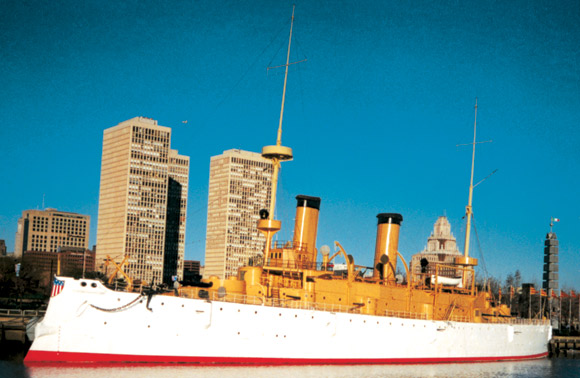
3 Comments

Filed under History, Military, world war two in europe

D-Day: Omaha Beach

LCVP’s pass USS Augusta

Like the rest of the Allied invasion forces the 1st and 29th Divisions set sail from their embarkation ports with the intent of landing on June 5th.  General Bradley, commanding the First Army until the American Army Group would be activated accompanied the invasion force.  The OMAHA landing was placed under General Gerow and his V Corps while VII Corps landed the 4th Infantry Division landed at Utah supported by airdrops of the 82nd and 101st Airborne Divisions inland.  American command and control was exercised from sea although General Officers went ashore with each of the American divisions.  A severe channel storm disrupted the plan to land on the 5th and Eisenhower delayed the invasion one day catching a break in the weather and electing to go on the 6th.[i] This delay while uncomfortable for the embarked troops caused the Germans to believe that no invasion would take place until the next favorable tide and moon cycle later in the month[ii] a break which caused a number of senior German leaders, including Rommel to be absent from the invasion front when the Allies landed.[iii]

US Soldier struggling in surf at Omaha Beach

The landing beaches at OMAHA stretched about 6500 meters from Colleville-Sur-Mer to Vierville-Sur-Mere in the west.  A further objective to the west of Vierville; Pont du Hoc, was believed to house a 150mm battery sighted where it could enfilade OMAHA and was assigned to the 2nd Ranger Battalion.  Companies from this battalion made a heroic landing and scaled the cliffs to capture the strongpoint only to discover that the guns had not been emplaced and held their isolated beachhead until relieved by the 29th Division on the morning of June 8th.[iv]

H-Hour for OMAHA was 0630.  Unfortunately the assault troops were transferred to their LCVPs 16-20 kilometers from the beach resulting in a long and dangerous ride in the small craft for the infantry.  Most of the infantry were completely soaked in sea spay and seasick before going ashore carrying loads far above what they normally would carry into battle.[v] One battalion of DD tanks, the 741st Armored Battalion, supporting the 16th Infantry of 1st Infantry Division was launched too far out and nearly all of its tanks were swamped and lost before firing a shot in anger.[vi] Weigley notes that at OMAHA “at least 10 of the LCVPs sank” as did “the craft carrying almost all of the 105mm howitzers that were to be the first artillery ashore after the tanks.”[vii] The losses would cripple the assault on OMAHA and nearly cause its abandonment.

As the soldiers of the American divisions on OMAHA came ashore they faced German defenders of the 352nd, 716th and a regiment of the 709th Infantry Division, the latter under the tactical command of the 352nd.   Without the bulk of their tanks artillery and lacking close air support the Americans struggled across the beaches and were cut down in large numbers before being pinned down behind the sea wall.[viii] As the Americans pinned down on the beach failed to advance the time tables for the reinforcing waves became snarled amid the German beach obstacles which had not been cleared due to 40% casualties among the Combat Engineers and the loss of all but five bulldozers.[ix] Naval officers were frustrated in their attempts to provide support by the lack of identifiable targets on the beaches but strongpoints were “knocked out by either by superbly directed vigorous gunfire from destroyers steaming as close as 800 yards offshore, or by determined action from Rangers or infantry.[x]

Grenadiers of 352nd Infantry Division move to counter-attack

Soldiers ashore discovered the truth that they were not facing the static 716th Division but the 352nd Division as well.[xi] But for the leadership of Brigadier General Norman Cota, assistant division commander of 29th Infantry Division and Colonel Charles Canham of the 116th Infantry who were able to rally their troops and just enough leaders and small units from the 116th which had its linage back to the “Stonewall Brigade” as well as units of the 1st Divisions’ 16th and 18th Regiments  who kept their heads and began to lead survivors through the dunes and up the bluffs to attack German defenders of the roads leading up from the beach from the flank and rear as well as a mid-day break in the weather which allowed some close tactical air support General Bradley may have ordered the evacuation of OMAHA.

Omaha Beach rescue of wounded from surf

At sea events were as confused as Bradley and his staff attempted to make sense of what was going on.  Even later in the evening there was discussion of diverting all further reinforcements from OMAHA to the British beaches.[xii]At 1330 hours “Gerow signaled Bradley: “Troops formerly pinned down on beaches…advancing up heights behind beaches.”[xiii] By the end of the day Bradley’s aid Major Hansen noted Bradley’s comments to Collins: “They are digging in on Omaha beach with their fingernails. I hope they can push in and get some stuff ashore.”  And Montgomery: “Someday I’ll tell Gen[eral] Eisenhower just how close it was for a few hours.”[xiv]

Omaha Beach Wreckage

The landings at OMAHA did succeed at a cost of over 2000 casualties, critical to their success were the German inability to reinforce their defending troops on the beach and the weakness of the units available to mount the standard counterattack that was critical to German defensive plans on D-Day itself. The 352nd Division fought superbly under the full weight of V Corps and the British XXX Corps on its right suffering heavy casualties as they contested every inch of ground.  The 716th Division units melted under the onslaught.  Allied air supremacy played a key role as sorties by the 8th and 9th Air Forces helped keep German reinforcements from arriving and interdicted counter attacks inland.  Weigley credits the Allied air superiority with the success of the landings and with limiting the cost of allied lives.[xv] Von Rundstedt and other German commanders in France were limited by the delay and refusal of Hitler and OKW to release Panzer reserves when needed most early on June 6th.  By the close of D-Day allied forces had secured the five invasion beaches but not achieved their objectives of taking Caen and Bayuex and forces had not linked up leaving the beaches extremely vulnerable had the Germans been able to mount a rapid counterattack by Panzers and strong infantry formations.

The author lecturing at Pont du Hoc Omaha Beach 2004


[i] Ibid. p.74-75

[ii] Von Luck, Hans.  “Panzer Commander“ Dell Publishing, New York, 1989 pp. 169-170.  Von Luck a regiment commander in 21st Panzer noted that General Marcks of 84th Corps had predicted a 5 June invasion at a conference May 30th.

[iii] Almost every D-Day historian talks about the weather factor and its effect on the German high command’s reaction to the invasion.  Rommel was visiting his wife for her birthday and planned to make a call on Hitler. Others including commanders of key divisions such as the 91st Airlanding Division were off to a war game in Rennes and the 21st Panzer Division to Paris.

[iv] Ibid. Weigley p. 96

[v] See Cornelius Ryan, “The Longest Day” Popular Library Edition, New York 1959. pp. 189-193 for a vivid description of the challenges faced by soldiers going from ship to landing craft and their ride in to the beaches.

[vi] Ibid. Weigley. p.78 Weigley talks about the order for the tanks to be carried ashore on their LCTs that did not get transmitted to the 741st.

[vii] Ibid.

[viii] Ibid. Weigley  p. 87 The weather prevented the aerial bombardment from being effective. Because the bombers could not see their targets they dropped their bomb loads further inland, depriving the infantry of support that they were expecting.  Naval gunfire support had some effect but had to be lifted as the troops hit the beach leaving much of that support to come from Destroyers and specially equipped landing craft which mounted rockets and guns.

[ix] Ibid. Hastings. pp. 90-91.

[x] Ibid. p.99

[xi] Ibid. Weigley p.80

[xii] Ibid. p.101  Also see Weigley p.80
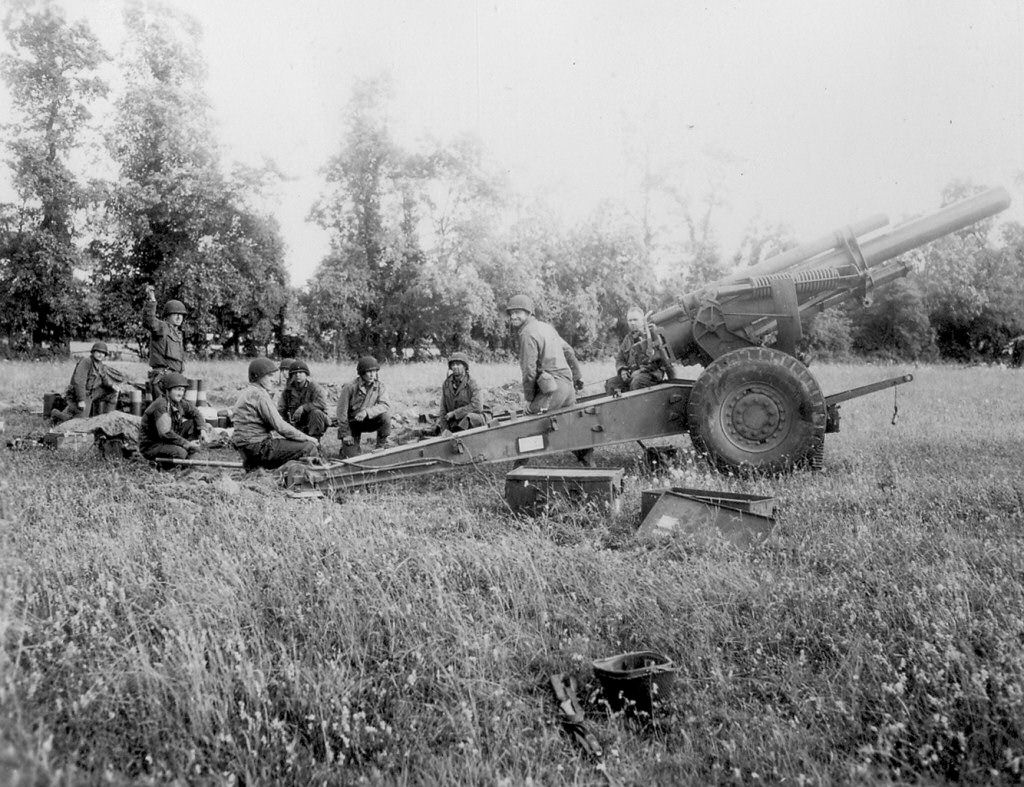
[xiii] Ibid. p.99

[xiv] Ibid. Weigley. p.95

[xv] Ibid. p.94

2 Comments

Filed under History, Military, world war two in europe