Category Archives: Military

What Does it take to Become a War Criminal? 


Friends of Padre Steve’s World,

Over the past few days I have been writing about the German invasion of the Soviet Union and the fact that senior leaders of the Wehrmacht actively cooperated with the crimes of the Nazi regime against the Jews, Soviet prisoners of war, and Soviet citizens. I have pointed out that Hitler’s ideology of the racial superiority of his Aryan Master Race and the corresponding view that the Jews and Slavs were untermenschen or subhuman justified the most extreme measures that the Nazis used to kill millions of innocent people through extermination, ethnic cleansing, and extermination. 

There was a common myth after the Second World War that the regular German Army, the Wehrmacht, fought an honorable and clean war while the criminal actions of war crimes and genocide were the fault of Hitler, the Nazi Party, and the SS. It was a comforting myth because it allowed a great number of men who agreed with Hitler’s policies, and often assisted in them to maintain a fiction of honor and respectability. While for the most part the German Army in the West fought according to international norms of conduct, it was a different matter on the Easter Front, where following Hitler’s lead the Wehrmacht from its senior officers in down was often at the tip of the spear in enforcing Hitler’s racial and ideological war. 


                                                                                       Field Marshal Wilhelm Keitel 

This came form the top. In addition to the Commissar order, also known as the Criminal Order, Field Marshal Keitel offered this directive to units fighting on the Easter Front:

“In view of the vast size of the conquered territories in the East, the forces available for establishing security in these areas will be sufficient only if instead of punishing resistance by sentencing the guilty in a court of law, the occupying forces spread such terror as is likely, by its mere existence, to crush every will to resist amongst the population.

The commanders concerned, together with all available troops, should be made responsible for maintaining peace within their areas. The commanders must find the means of keeping order within their areas, not by demanding more security forces, but by applying suitable drastic measures.”

                                                                                  Field Marshal Walter Von Reichenau 

Field Marshal Walter Reichenau issued what is something’s known as the Severity Order to his 6th Army which was part of Field Marshal Gerd Von Rundstedt’s Army Group South. Von Rundstedt, who was not a Nazi and who maintained his reputation after the war expressed his “complete agreement” with it and urged other subordinates to issue similar orders. 

“The most important objective of this campaign against the Jewish-Bolshevik system is the complete destruction of its sources of power and the extermination of the Asiatic influence in European civilization. … In this eastern theatre, the soldier is not only a man fighting in accordance with the rules of the art of war, but also the ruthless standard bearer of a national conception. … For this reason the soldier must learn fully to appreciate the necessity for the severe but just retribution that must be meted out to the subhuman species of Jewry…” 

An order was issued by General Erich Von Manstein’s Eleventh Army in November 1941 which stated in part:

“Jewry constitutes the middleman between the enemy in the rear and the remainder of the Red Armed Forces which is still fighting, and the Red leadership. More strongly than in Europe it holds all the key positions in the political leadership and administration, controls commerce and trades, and further forms the nucleus for all unrest and possible uprisings.

The Jewish-Bolshevist system must be exterminated once and for all. Never again must it encroach upon our European living space.

The German soldier has therefore not only the task of crushing the military potential of this system. He comes also as the bearer of a racial concept and as the avenger of all the cruelties’ which have been perpetrated on him and on the German people…

The food situation at home makes it essential that the troops should as far as possible be fed off the land and that furthermore the largest possible stocks should be placed at the disposal of the homeland. Particularly in enemy cities a large part of the population will have to go hungry. Nevertheless nothing which the homeland has sacrificed itself to contribute may, out of a misguided sense of humanity, be given to prisoners or to the population unless they are in the service of the German Wehrmacht.

The soldier must appreciate the necessity for the harsh punishment of Jewry, the spiritual bearer of the Bolshevist terror. This is also necessary in order to nip in the bud all uprisings which are mostly plotted by Jews…

Manstein claimed that he did not remember the order at his trial and that he sought to ensure that his troops did not engage in conduct not fitting of the honor of soldiers. He included the following in the order: “Severest action to be taken: against despotism and self-seeking; against lawlessness and lack of discipline; against every transgression of the honor of a soldier.”

In his defense at Nuremberg Manstien attempted to mitigate the damning words of the order. He explained that “I do want to point out to you that if it says here that the system must be exterminated, then that is extermination of the Bolshevik system, but not the extermination of human beings.” Despite Manstein’s clarification of what he meant in the order it would be hard for soldiers and commanders receiving the order as written could hardly have been expect not to interpret it literally. Likewise his order mentions the intentional starvation of Soviet citizens and harsh invectives against the Jews. 

Like Von Rundstedt, Manstein too would be rehabilitated and for the most part his complicity in Hitler’s racial and ideological war forgotten. 


There are many other examples of German Army commanders at various levels issuing orders similar to Von Reichenau and Von Manstein as well as accounts of Wehrmacht units cooperating with the Einsatzgruppen in various mass extermination actions against the Jews, including the action at Babi Yar. In many cases the cooperation was quite close as evidenced by the report of the commander of Einsatzgruppe C to Berlin on November 3rd 1941:

In a great number of cases, it happened that the support of the Einsatzkommandos was requested by the fighting troops. Advance detachments of the Einsatzgruppe also participated in every large military action. They entered newly captured localities side by side with the fighting troops. Thus, in all cases, the utmost support was given. For example, in this connection, it is worth mentioning the participation in the capture of Zhitomir, where the first tanks entering the city were immediately followed by three cars of Einsatzkommando 4a.

As a result of the successful work of the Einsatzgruppe, the Security Police is also held in high regard, in particular by the HQ of the German Army. The liaison officers stationed in Army HQ are loyally briefed of all military operations, and, besides, they receive the utmost cooperation. The Commander of the 6th Army, Generalfeldmarschall von Richenau, has repeatedly praised the work of the Einsatzkommandos and, accordingly, supported the interests of the SD with his staff.

It is true that in some cases individual Wehrmacht officers refused to cooperate with the Einsatzgruppen in their operational areas, but without the cooperation of the Wehrmacht the extermination campaigns against the Jews and other Soviet citizens could not have been successful. 

                                                                                                 The Rape of Nanking 

One has to ask what it takes for otherwise ordinary and law abiding people to carry out crimes of such magnitude. I do believe that the answer is found in the racial ideology that posits certain races as being less than human. The examples of such belief in action litter human history and are not limited to the Germans of the Nazi era. The disturbing thing as that the men who perpetrated the Nazi crimes against humanity and genocide were not unique. The actions of the Japanese army in China, Korea, and Southeast Asia to include the Rape of Nanking and their Unit 731; the American genocide committed against the Native American tribes and the enslavement of Blacks; the extermination of the Herero in German Southwest Africa, the Rwandan genocide, the mass killings of Bosnians by Bosnian Serbs,  the Armenian genocide committed by the Turks, and far too many more examples show this to be the case. 

I think one of our problems is that we want to believe that evil is simply done be evil people. That is why when we see a Hitler, Stalin, Pol Pot, or the monsters of the so-called Islamic State, we are often strangely comforted. This is often because we can point to a single person with a wicked ideology and say “they are evil,” all the while forgetting that they are, or were, like us, also human. 


There is a scene in the movie Nuremberg in which an American psychologist named Gustave Gilbert questions the commandant of Auschwitz. When he asks the commandant if he felt guilty for the extermination of the Jews in his camp the commandant said “does a rat catcher feel guilty for killing rats.” Thereafter Gilbert confronts Herman Goering pointedly asking the number two Nazi “A rat catcher catching rats”. Is that the kind of thinking it takes to carry out state sanctioned mass murder? Not just blind obedience but also a belief that your victims are not human?” 

Goering replies: Let me ask you this. What was Hiroshima? Was it not your medical experiment? Would Americans have dropped bombs as easily on Germany as it did upon Japan killing as many civilians as possible? I think not. To an American sensibility, a Caucasian child is considerably more human than a Japanese child…. 

What about the negro officers in your own army? Are they not allowed to command troops in combat? Can they sit on the same buses as the whites? The segregation laws in your country and the anti Semitic laws in mine, are they not a difference of degree? 

The tragic thing is that while Gilbert was certainly correct in his question to Goering, Goering was also right. For all that is good about America there is a persistent strain of this kind of thinking which deems other people, especially non-white people as inferior racially, culturally, and intellectually. Over the decades we like to think that we have become better but the underlying attitudes are still present today, sometimes in plain view, but often just under our veneer of civility and good manners, but what maintains that civility is quite fragile. In his history of Auschwitz British historian Laurence Rees wrote:

“human behavior is fragile and unpredictable and often at the mercy of the situation. Every individual still, of course, has a choice as to how to behave, it’s just that for many people the situation is the key determinate in that choice.” The German military officers who took part in the campaign in the East were terrifyingly normal. They were raised in an advanced society, highly cultured, well educated, and raised in the cradle of Protestantism. Yet many of them became willing participants in crimes of their nation that are unimaginable. But the fact is that the character of nations can be as fragile as that if individuals. As Americans we like to think that we are different but our history often belies this, even our military history and this is part of our conundrum. 

Aleksandr Solzhenitsyn wrote of the struggle:

 “If only it were all so simple! If only there were evil people somewhere insidiously committing evil deeds, and it were necessary only to separate them from the rest of us and destroy them. But the line dividing good and evil cuts through the heart of every human being. And who is willing to destroy a piece of his own heart?”

When I taught ethics at the Joint Forces Staff College I challenged my students to deal with these kinds of questions. They are not easy and they require that we look into the darkest reaches of our hearts to see what we will do when we are confronted with choices to obey orders that go against the values of the institution but may reflect the more troubling aspects of our culture. Some of these men and women I am sure understood and will not break under pressure, but I am not so sure about others, and I worry about them in the crisis. The fact is we are only as good as we are in the crisis. Historian Timothy Snyder wrote something that we should not discount when asking the question about how ordinary men become war criminals:

“The European history of the twentieth century shows us that societies can break, democracies can fall, ethics can collapse, and ordinary men can find themselves standing over death pits with guns in their hands. It would serve us well today to understand why.”

This is something that we most ponder because it would not take much in our present day where the old ethnic race hatreds, religious hatreds, and resurgent nationalism are again raising their head not only in our own country, but around the world. I will address this in the recent American context next week. So until tomorrow, when I publish something more personal and unrelated to this subject.

Peace

Padre Steve+

1 Comment

Filed under ethics, History, holocaust, Military, movies, world war two in europe

The Devil’s Details: Hitler’s Criminal Orders and his Obedient Generals


Friends of Padre Steve’s World,

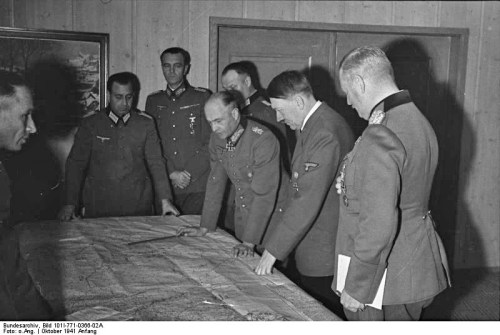
Yesterday I posted a short article, well by my standards, dealing with the criminal nature of Nazi Germany’s invasion of the Soviet Union. The words of Hitler are damning, but even worse are the words and actions of the Generals who should have known better.

Hitler’s war against the Soviet Union was something that he had dreamed of long before he took power. I wrote about it in Mein Kampf and spoke about it many times. He wrote: “The fight against Jewish world Bolshevism requires a clear attitude toward Soviet Russia. You cannot drive out the Devil with Beelzebub.” He intended that those who served him would carry out his orders implicitly without regard to traditional morality, ethics, or law. His war against the Soviet Union was unlike any in history.

Richard Evans notes that Mein Kampf clearly enunciated that “Hitler considered racial conflict…the essence of history, and the Jews to be the sworn enemy of the German race ….” And that the “Jews were now linked indissolubly in Hitler’s mind with “Bolshevism” and “Marxism.” When Hitler became the dictator of Germany “his ideology and strategy became the ends and means of German foreign policy.” His aims were clear, Hitler remarked to Czech Foreign Minister Chvalkovsky on 21 January 1939: “We are going to destroy the Jews.” It was clear that Hitler understood his own role in this effort noting to General Gotthard Heinrici that “he was the first man since Charlemagne to hold unlimited power in his own hand. He did not hold this power in vain, he said, but would know how to use it in the struggle for Germany…”


Hitler’s “ideological and grandiose objectives, expressed in racial and semi-mystical terms, made the war absolute.” Field Marshal Keitel noted a speech in March 1941 where Hitler talked about the inevitability of conflict between “diametrically opposed ideologies” and that the “war was a fight for survival and that they dispense with their outdated and traditional ideas about chivalry and the generally accepted rules of warfare.” General Franz Halder, Chief of the OKH wrote in his War Dairy for that meeting: “Annihilating verdict on Bolshevism…the leaders must demand of themselves the sacrifice of understanding their scruples.”

Based on the concepts of Lebensraum (living space) and race, the German approach to war would combine “racism and political ideology” for the purpose of the “conquest of new living space in the east and its ruthless Germanization.” Hitler explained that the “struggle for the hegemony of the world will be decided in favor of Europe by the possession of the Russian space.” Territories conquered in the East by the Wehrmacht would be “Reich protectorates…and that these areas were to be deprived of anything in the nature of a Slav intelligentsia.”

This goal was manifest in the “Criminal Order” issued by OKW which stated that the war was “more than mere armed conflict; it is a collision between two different ideologies…The Bolshevist-Jewish intelligentsia must be eliminated….” The Slavic inhabitants of the conquered eastern lands would be killed or allowed to starve. This was directly tied in to the economic considerations of the Reich, which gave Germans priority in distribution of food, even that from the conquered lands. The Slavs, being untermenschen or sub-human in Nazi parlance, were simply excess mouths to feed and thus expendable. Starvation was a population control measure that supplemented other forms of annihilation, and it was cheaper than bullets. As Fest notes in Russia Hitler was “seeking nothing but “final solutions.” Despite the numerous post-war justifications and evasions of responsibility by various Wehrmacht generals; many of who found employment working for the Americans and British in the years following the war, the “Wehrmacht and army fell into line with Hitler because there was “a substantial measure of agreement of “ideological questions.”

Ideology was key to Hitler’s worldview and fundamental to understanding his actions in the war. However twisted Hitler’s ideological formulations were, he found men who willingly carried them out beyond the true believers of the Nazi faithful. They were embraced by much of the Army and Police, who would execute the campaigns in Poland and Russia in conjunction with the Einsatzgrüppen and Nazi party organizations.  In these organizations he found allies with pre-existing cultural, political and doctrinal understandings which allowed them to be willing participants in Hitler’s grand scheme of eastern conquest.


The lesson for today is that no tyrant bent on conquest or terror at home can do so without compliant members of the police, the military, the civil service, and the judiciary. As Timothy Snyder wrote: “If lawyers had followed the norm of no execution without trial, if doctors had accepted the rule of no surgery without consent, if businessmen had endorsed the prohibition of slavery, if bureaucrats had refused to handle paperwork involving murder, then the Nazi regime would have been much harder pressed to carry out the atrocities by which we remember it.” The German Generals also had their chances to stop the Hitler, but they became the men who made his conquests and genocide possible by carrying out his orders.

Until tomorrow,

Peace

Padre Steve+

3 Comments

Filed under ethics, History, leadership, Military, Political Commentary, world war two in europe

Directions for a Criminal War of Annihilation

Hv1MLdJ

Friends of Padre Steve’s World,

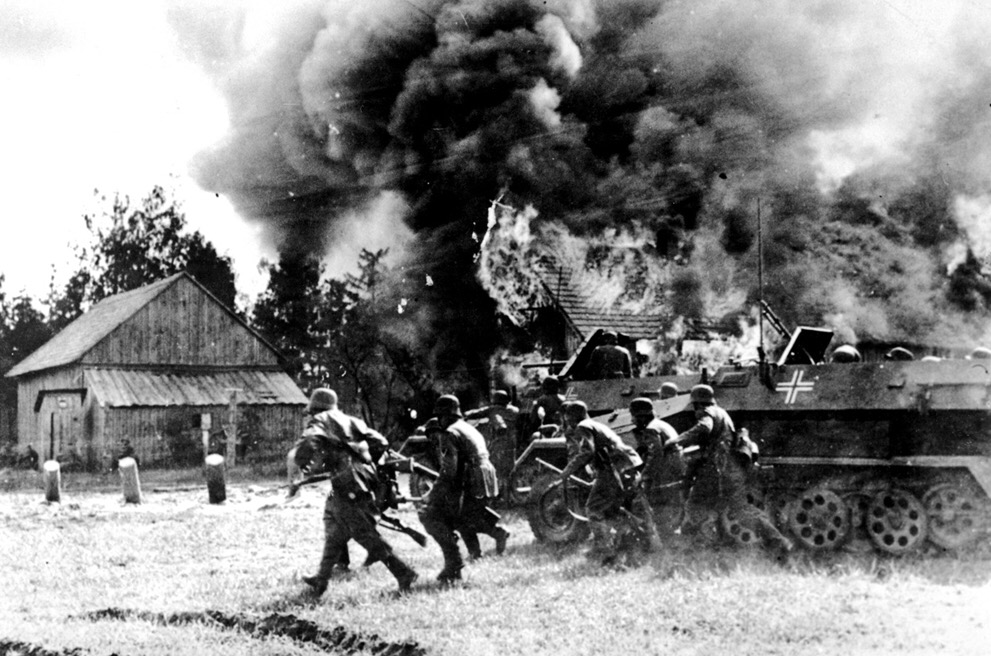
Today marks the 76th anniversary of the German invasion of the Soviet Union in 1941. The German war was unlike any in modern military history. It was not just a war to defeat the Soviets militarily or to overthrow Stalin’s regime of terror. It was a war conceived to conquer as well as to exterminate and enslave. The Nazis believed the Slavic peoples of the Soviet Union to what the referred to as untermenschen or sub-human and the plan was designed to provide the German master race with the necessary Lebensraum, or living space. The plan called for ethnic cleansing, the deliberate starvation of 30 million people in the Soviet Union, the destruction of the Jews of the Soviet Union, and the elimination of anyone associated with the Soviet government or Communist Party. It was an ideological war without mercy in which civilized norms that governed the conduct of war were defied and trampled.

The German war in the east would differ from any previous war.  Its underlying basis was ideological. Economic and geopolitical considerations were given importance in relationship to the understanding of the German “Master Race.”  Race and Lebensraum was the goal of the State that “concentrates all of its strength on marking out a way of life for our people through the allocation of Lebensraum for the next one hundred years…the goal corresponds equally to the highest national and ethnic requirements.”

Hitler set the stage on March 3rd 1941 when he told confidants: “the forthcoming campaign is more than a mere armed conflict; it is a collision between two different ideologies…this war will not be ended merely by the defeat of the enemy armed forces” and that “the Jewish-Bolshevist intelligentsia must be eliminated….”

On March 30th 1941 Hitler addressed 250 Generals about the nature of the war to come:

Shortly before the order was issued, Hitler previewed it to the generals saying that the war in Russia “cannot be conducted in a knightly fashion” and that it would have to be waged with “unprecedented, unmerciful and unrelenting harshness. Hitler told the Generals that they would have to “dispense with all of their outdated and traditional ideas about chivalry and the generally accepted rules of warfare: the Bolsheviks had long since dispensed with them.” He explained that his orders were beyond their comprehension, he told them “I cannot and will not change my orders and I insist that that they be carried out with unquestioning and unconditional obedience.” Few questioned the order and few protested, those that did were told by the Army Commander, Field Marshal Von Brauchtisch “the he would express their opinion to OKW and Hitler respectively.”

But Von Brauchitsch refused to protest to Hitler and instead issued an order on his own authority “threatening dire penalties for excesses against civilians and prisoners of war” which he maintained at Nurmeberg “was sufficient to nullify the Commissar Order.” Yet Von Brauchitsch’s hands were not unsoiled and he later told his commanders to “proceed with the necessary hardness.” He knew what that meant as he was present.

General Franz Halder, Chief of the OKH, or the Army High Command took notes on Hitler’s speech. They are chilling to read as none present could have understood them in any other way than Hitler meant:

“Clash of two ideologies. Crushing denunciation of Bolshevism, identified with asocial criminality….We must forget the comradeship between soldiers. A Communist is no comrade before nor after the battle. This is a war of extermination….We do not wage war to preserve the enemy….War against Russia: Extermination of the Bolshevist Commissars and of the Communist intelligentsia….this is no job for military courts. The individual troop commanders must know the issues at stake. They must be leaders in the fight….This war will be very different from war in the West. In the East harshness today means leniency in the future. Commanders must make the sacrifice of overcoming their personal scruples.”

General Erich Hoepner, commander of Panzer Group Four who would be executed following the attempt to assassinate Hitler in 1944, told his commanders that the invasion was “an essential part of the German people’s struggle for existence” and stated, “the struggle must aim at the annihilation of today’s Russia and must therefore be waged with unparalleled harshness”.  Hoepner told his officers that they were fighting for “the defense of European culture against Moscovite–Asiatic inundation, and the repulse of Jewish Bolshevism … No adherents of the present Russian-Bolshevik system are to be spared.”

The German Army as well as the SS Einsatzgruppen and the German Order Police launched their attack in the early hours of June 22nd and did not lack the hardness required to commit war crimes and atrocities that are unimaginable, and which can never be allowed to happen again.

I could go on but I will end for now.

Peace

Padre Steve+

1 Comment

Filed under History, Military, world war two in europe

Living the Dream and Dreaming to Live: Dreams and 34 Years of Commissioned Service


Friends of Padre Steve’s World,

As I mentioned yesterday in my short article about my dad that I would watch the movie Field of Dreams. I did that last night. As always I found the message of the film compelling and relevant for me today. 

Thirty-four years ago today I was commissioned as a Second Lieutenant in the United States Army. In the decades since that time I have to say that I am the beneficiary of following dreams that have come true. I always wanted to serve in the military no now after almost thirty-six years of service, including the time before I was commissioned I am still living my dream, and dreaming to live. 

When I was commissioned back during the Cold War  I figured that I would do 20 years or possibly a few years more and retire as a Lieutenant Colonel, or maybe even a Colonel. Back then I even harbored thoughts of becoming a General. That didn’t happen and through a fairly unusual set of circumstances I ended up leaving the Army Reserve before being considered for promotion to Lieutenant Colonel, reducing in rank and entering the Navy in February 1999. I wanted t get back on active duty and my window had passed in the Army, if I remained there I would have remained a reservist, not that there is anything wrong with that but it wasn’t my dream.  

So now after a total of nearly 36 years in the military, and almost 18 1/2 in the Navy I still dream. Now my dreams don’t include promotion to Navy Captain or far less Admiral. My dreams are simple; living life, speaking truth, and not sacrificing my integrity just to try to get ahead in a system whose ideals are so much like mine but reality, at least in the Chaplain Corps falls far short of, so I have simply decided to follow my dreams which include teaching, writing, and maybe speaking out regarding causes that I think are important. 

Unlike Dr. Archibald “Moonlight” Graham in the film, I got to bat in my version of the major leagues and my military dreams did come true. I don’t need any more than that. There are men and women who would have loved to had my career in the military and as I celebrate the anniversary of being commissioned as a Second Lieutenant in the U.S. Army some 34 years ago and being a Commander in the U.S. navy today. The dreams I have now are different and I will like Ray Kinsella and Terrance Mann in the movie will listen to that mysterious voice and follow it, because to paraphrase Doc Graham, it would be a tragedy if I didn’t.

Until tomorrow,

Peace

Padre Steve+

1 Comment

Filed under Baseball, Loose thoughts and musings, Military

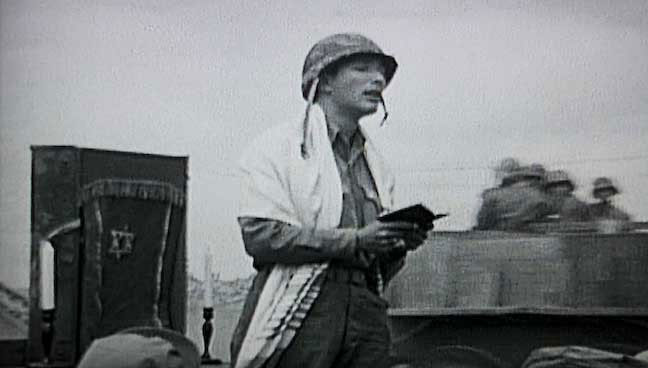
“Theirs is the Highest and Purest Democracy…” The Sermon of Rabbi Roland Gittelsohn at Iwo Jima

39GittelsonIwoJima2

Friends of Padre Steve’s World,

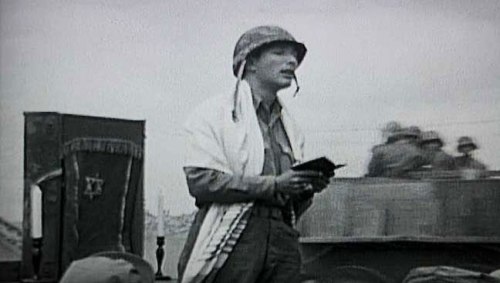
I have been serving in the military for almost 36 years between the Army and the Navy, and I have been a chaplain for almost 25 of those years. Over six of those years as a Navy Chaplain were spent serving with the Marine Corps. Rabbi Roland Gittelson volunteered to serve as a Navy Chaplain in the Second World War and like many Navy Chaplains he was assigned to serve with the Marines. He was the first Rabbi to serve with the Marines.

He went ashore with the 5th Marine Division at Iwo Jima. The battle was one of the most brutal ever fought by the Marines. In the month long battle for the 8.1 square mile island the Marines and Navy suffered nearly 7,000 men killed and 19,000 wounded. Over 18,000 of the island’s Japanese defenders died. On March 21st 1945 the Rabbi was one of the Chaplains to dedicate the cemetery for the fallen. The prejudice was such that many of his Christian colleagues wanted nothing to do with him and nothing to do with any service that he conducted. Though the division Chaplain had wanted him to conduct the main service to commemorate all of the fallen: Protestant, Catholic, Jewish, White, Black, and Mexican because no one else would conduct an ecumenical service, but both realized that the push back would be too much, so Gittelsohn conducted the Jewish service, expecting little to come of it except for the spiritual impact that it might have on his Jewish Marines, but unbeknownst to him a few Protestant Chaplains watched the service and then distributed it throughout the division and back to home.

Rabbi Gittelsohn’s message is one of the most remarkable that I have heard or read by any Chaplain and is very similar to the message of Abraham Lincoln’s Gettysburg Address. It is a message that needs to be heard today. That is why I am posting it here.

Have a great weekend,

Peace

Padre Steve+

This is perhaps the grimmest and surely the holiest task we have faced since D-day. Here before us lie the bodies of comrades and friends. Men who until yesterday or last week laughed with us, joked with us, trained with us. Men who were on the same ships with us and went over the sides with us, as we prepared to hit the beaches of this island. Men who fought with us and feared with us. Somewhere in this plot of ground there may lie the man who could have discovered the cure for cancer. Under one of these Christian crosses, or beneath a Jewish Star of David, there may rest now a man who was destined to be a great prophet—to find the way, perhaps, for all to live in plenty, with poverty and hardship for none. Now they lie here silently in this sacred soil, and we gather to consecrate this earth in their memory.

It is not easy to do so. Some of us have buried our closest friends here. We saw these men killed before our very eyes. Any one of us might have died in their places. Indeed, some of us are alive and breathing at this very moment only because men who lie here beneath us had the courage and strength to give their lives for ours. To speak in memory of such men as these is not easy. Of them, too, can it be said with utter truth: “The world will little note nor long remember what we say here. It can never forget what they did here.”

No, our poor power of speech can add nothing to what these men and the other dead of our division who are not here have already done. All that we can even hope to do is follow their example. To show the same selfless courage in peace that they did in war. To swear that, by the grace of God and the stubborn strength and power of human will, their sons and ours shall never suffer these pains again. These men have done their job well. They have paid the ghastly price of freedom. If that freedom be once again lost, as it was after the last war, the unforgivable blame will be ours, not theirs. So it is the living who are here to be dedicated and consecrated.

We dedicate ourselves, first, to live together in peace the way they fought and are buried in war. Here lie men who loved America because their ancestors, generations ago, helped in her founding, and other men who loved her with equal passion because they themselves or their own fathers escaped from oppression to her blessed shores. Here lie officers and men, Negroes and whites, rich men and poor—together. Here are Protestants, Catholics, and Jews—together. Here no man prefers another because of his faith or despises him because of his color. Here there are no quotas of how many from each group are admitted or allowed. Among these men there is no discrimination. No prejudice. No hatred. Theirs is the highest and purest democracy.

Any man among us the living who fails to understand that will thereby betray those who lie here dead. Whoever of us lifts his hand in hate against a brother, or thinks himself superior to those who happen to be in the minority, makes of this ceremony and of the bloody sacrifice it commemorates, an empty, hollow mockery. To this, them, as our solemn, sacred duty, do we the living now dedicate ourselves: to the right of Protestants, Catholics and Jews, of white men and Negroes alike, to enjoy the democracy for which all of them have here paid the price.

To one thing more do we consecrate ourselves in memory of those who sleep beneath these crosses and stars. We shall not foolishly suppose, as did the last generation of America’s fighting men, that victory on the battlefield will automatically guarantee the triumph of democracy at home. This war, with all its frightful heartache and suffering, is but the beginning of our generation’s struggle for democracy. When the last battle has been won, there will be those at home, as there were last time, who will want us to turn our backs in selfish isolation on the rest of organized humanity, and thus to sabotage the very peace for which we fight. We promise you who lie here; we will not do that! We will join hands with Britain, China, Russia—in peace, even as we have in war, to build the kind of world for which you died.

When the last shot has been fired, there will still be those whose eyes are turned backward not forward, who will be satisfied with those wide extremes of poverty and wealth in which the seeds of another war can breed. We promise you, our departed comrades: this, too, we will not permit. This war has been fought by the common man; its fruits of peace must be enjoyed by the common man! We promise, by all that is sacred and holy, that your sons, the sons of miners and millers, the sons of farmers and workers, will inherit from your death the right to a living that is decent and secure.

When the final cross has been placed in the last cemetery, once again there will be those to whom profit is more important than peace, who will insist with the voice of sweet reasonableness and appeasement that it is better to trade with the enemies of mankind than, by crushing them, to lose their profit. To you who sleep here silently, we give our promise: we will not listen! We will not forget that some of you were burnt with oil that came from American wells, that many of you were killed by shells fashioned from American steel. We promise that when once again men seek profit at your expense, we shall remember how you looked when we placed you reverently, lovingly, in the ground.

This do we memorialize those who, having ceased living with us, now live within us. Thus do we consecrate ourselves, the living, to carry on the struggle they began. Too much blood has gone into this soil for us to let it lie barren. Too much pain and heartache have fertilized the earth on which we stand. We here solemnly swear: this shall not be in vain! Out of this, and from the suffering and sorrow of those who mourn this, will come—we promise—the birth of a new freedom for the sons of men everywhere.

Amen.

4 Comments

Filed under faith, History, Loose thoughts and musings, Military, world war two in the pacific

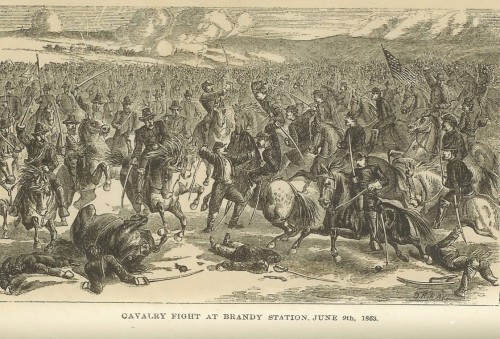
The Battle of Brandy Station

Cav Fight at Brandy Station

Friends of Padre Steve’s World,

Today I take a look back at the battle of Brandy Station, the largest cavalry battle every fought on the North American continent. This is a section of my draft Gettysburg campaign text.

Have a great day,

Peace

Padre Steve+

Movement to attain operational reach and maneuver are two critical factors in joint operations. In the time since the American Civil War the distances that forces move to engage the enemy, or maneuver to employ fires to destroy his forces have greatly increased. Movement may be part of an existing Campaign Plan or Contingency Plan developed at Phase 0; it also may be part of a crisis action plan developed in the midst of a campaign. Lee’s movement to get to Gettysburg serves as an example of the former, however, since his forces were already in contact with the Army of the Potomac along the Rappahannock and he was reacting to what he felt was a strategic situation that could not be changed but by going on the offensive that it has the feel of a Crisis Action Plan. Within either context other factors come into play: clarity of communications and orders, security, intelligence, logistics and even more importantly the connection between operational movement and maneuver; the Center of Gravity of the enemy, and national strategy. Since we have already discussed how Lee and the national command authority of the Confederacy got to this point we will now discuss the how that decision played in the operational and tactical decisions of Lee and his commanders as the Army of Northern Virginia began the summer campaign and the corresponding actions of Joseph Hooker and the his superiors in Washington.

“One of the fine arts of the military craft is disengaging one’s army from a guarding army without striking sparks and igniting battle.” [1] On June 3rd 1863 Robert E. Lee began to move his units west, away from Fredericksburg to begin his campaign to take the war to the North. He began his exfiltration moving Second Corps under Richard Ewell and First Corps under James Longstreet west “up the south bank of the Rappahannock to Culpepper, near which Hood and Pickett had been halted on their return from Suffolk.” [2] Rodes’ division of Second Corps followed on June 4th with Anderson and Early on June 5th. Lee left the three divisions of A.P. Hill’s Third Corps at Fredericksburg to guard against any sudden advance by Hooker’s Army of the Potomac toward Richmond. Lee instructed Hill to “do everything possible “to deceive the enemy, and keep him in ignorance of any change in the disposition of the army.” [3]

The army was tremendously confident as it marched away from the war ravaged, dreary and desolate battlefields along the Rappahannock “A Captain in the 1st Virginia averred, “Never before has the army been in such a fine condition, so well disciplined and under such complete control.” [4] Porter Alexander wrote that he felt “pride and confidence…in my splendid battalion, as it filed out of the field into the road, with every chest & and ammunition wagon filled, & and every horse in fair order, & every detail fit for a campaign.” [5] Another officer wrote to his father, “I believe there is a general feeling of gratification in the army at the prospect of active operations.” [6]

Lee’s plan was to “shift two-thirds of his army to the northwest and past Hooker’s flank, while A.P. Hill’s Third Corps remained entrenched at Fredericksburg to observe Hooker and perhaps fix him in place long enough for the army to gain several marches on the Federals.” [7] In an organizational and operational sense that Lee’s army after as major of battle as Chancellorsville “was able to embark on such an ambitious flanking march to the west and north around the right of the army of the Potomac….” [8]

However, Lee’s movement did not go unnoticed; Hooker’s aerial observers in their hot air balloons “were up and apparently spotted the movement.” [9] But Hooker was unsure what it meant. He initially suspected that “Lee intended to turn the right flank of the Union army as he had done in the Second Bull Run Campaign, either by interposing his army between Washington and the Federals or by crossing the Potomac River.” [10] Lee halted at Culpepper from which he “could either march westward over the Blue Ridge or, if Hooker moved, recontract at the Rappahannock River.” [11]

Hooker telegraphed Lincoln and Halleck on June 5th and requested permission to advance cross the river and told Lincoln that “I am of opinion that it is my duty to pitch into his rear” [12] possibly threatening Richmond. Lincoln ordered Hooker to put the matter to Halleck, with whom Hooker was on the worst possible terms. Hooker “pressed Halleck to allow him to cross the Rappahannock in force, overwhelming whatever rebel force had been left at Fredericksburg, and then lunging down the line of the Virginia Central toward an almost undefended Richmond.” [13] On the morning of June 6th Hooker ordered pontoon bridges thrown across the river and sent a division of Sedgwick’s VI Corps to conduct a reconnaissance in force against Hill.

Lincoln and Halleck immediately rejected Hooker’s request. Lincoln “saw the flaw in Hooker’s plan at once” [14] and replied in a very blunt manner: “In one word,” he wrote “I would not take any risk of being entangled upon the river, like an ox jumped half over a fence and liable to be torn by dogs front and rear, without a fair chance to gore one way or kick another.” [15] Halleck replied to Hooker shortly after Lincoln that it would “seem perilous to permit Lee’s main force to move upon the Potomac [River] while your army is attacking an intrenched position on the other side of the Rappahannock.” [16] Lincoln, demonstrating a keen regard for the actual center of gravity of the campaign, told Hooker plainly that “I think Lee’s army and not Richmond, is your objective point.” [17]

The fears of Lincoln and Halleck were well founded. In stopping at Culpepper Lee retained the option of continuing his march to the Shenandoah and the Potomac, or he could rapidly “recall his advanced columns, hammer at Hooker’s right flank, and very possibly administer another defeat even more demoralizing than the one he suffered at Chancellorsville.” [18] Hooker heeded the order and while Hooker maintained his bridgehead over the Rappahannock he made no further move against Hill’s well dug in divisions.

Meanwhile, J.E.B. Stuart and his Cavalry Corps had been at Brandy Station near Culpepper for two weeks. Culpepper in June was a paradise for the cavalry, and with nearly 10,000 troopers gathered Stuart ordered a celebration, many dignitaries were invited and on June 4th Stuart hosted a grand ball in the county courthouse. On the 5th Stuart staged a grand review of five of his brigades. Bands played as each regiment passed in review and one soldier wrote that it was “One grand magnificent pageant, inspiring enough to make even an old woman feel fightish.” [19] The review ended with a mock charge by the cavalry against the guns of the horse artillery which were firing blank rounds. According to witnesses it was a spectacular event, so realistic and grand that during the final charge that “several ladies fainted, or pretended to faint, in the grandstand which Jeb Stuart had had set up for them along one side of the field.” [20] That was followed by an outdoor ball “lit by soft moonlight and bright bonfires.” [21] Stuart gave an encore performance when Lee arrived on June 8th, minus the grand finale and afterward Lee wrote to his wife that “Stuart was in all his glory.” [22]

Hooker received word from the always vigilant John Buford, of the First Cavalry Division on the night of June 6th that “Lee’s “movable column” was located near Culpepper Court House and that it consisted of Stuart’s three brigades heavily reinforced by Robertson’s, “Grumble” Jones’s, and Jenkins’ brigades.” [23] Hooker digested the information and believed that Stuart’s intent was to raid his own rear areas to disrupt the Army of the Potomac’s logistics and communications. The next day Hooker ordered his newly appointed Cavalry Corps Commander, Major General Alfred Pleasanton to attack Stuart.

After Chancellorsville, Hooker had reorganized the Union cavalry under Pleasanton into three divisions and under three aggressive division commanders, all West Pointers, Brigadier General John Buford, Brigadier General David Gregg and Brigadier General Judson Kilpatrick. While Stuart conducted his second grand review for Lee Pleasanton quietly massed his cavalry “opposite Beverly Ford and Kelly’s Ford so as to cross the river in the early morning hours of June 9th and carry out Hooker’s crisp orders “to disperse and destroy” the rebel cavalry reported to be “assembled in the vicinity of Culpepper….” [24] Pleasanton’s cavalry was joined by two mixed brigades of infantry “who had the reputation of being among the best marchers and fighters in the army.” [25] One brigade, commanded by Brigadier General Adelbert Ames consisted of five regiments drawn from XI Corps, XII Corps, and III Corps was attached to Buford’s division. The other brigade, under the command of Brigadier General David Russell was composed of seven regiments drawn from I Corps, II Corps and VI Corps. [26]

Stuart’s orders for June 9th were to “lead his cavalry division across the Rappahannock to screen the northward march of the infantry.” [27] The last thing that Stuart expected was to be surprised by the Federal cavalry which he had grown to treat with distain. Stuart who was at his headquarters “woke to the sound of fighting” [28] as Pleasanton’s divisions crossed the river and moved against the unsuspecting Confederate cavalry brigades.

The resultant action was the largest cavalry engagement of the war. Over 20,000 troopers engaged in an inconclusive see-saw battle that lasted most of the day. Though a draw “the rebels might have been swept from the field had Colonel Alfred N. Duffie, at the head of the Second Division acted aggressively and moved to the sounds of battle.” [29] The “Yankees came with a newfound grit and gave as good as they took.” [30] Porter Alexander wrote that Pleasanton’s troopers “but for bad luck in the killing of Col. Davis, leading the advance, would have probably surprised and captured most of Stuart’s artillery.” [31] Stuart had lost “over 500 men, including two colonels dead,” [32] and a brigade commander, Fitzhugh “Rooney” Lee, General Lee’s son, badly wounded. While recuperating at his wife’s home a few weeks later Lee “was captured by the enemy.” [33] Stuart claimed victory as he lost fewer troops and had taken close to 500 prisoners and maintained control of the battlefield.

But even Confederate officers were critical. Lafayette McLaws of First Corps wrote “our cavalry were surprised yesterday by the enemy and had to do some desperate fighting to retrieve the day… As you will perceive from General Lee’s dispatch that the enemy were driven across the river again. All this is not true because the enemy retired at their leisure, having accomplished what I suppose what they intended.” [34] Captain Charles Blackford of Longtreet’s staff wrote: “The fight at Brandy Station can hardly be called a victory. Stuart was certainly surprised, but for the supreme gallantry of his subordinate officers and men… it would have been a day of disaster and disgrace….” The Chief of the Bureau of War in Richmond, Robert H.G. Kean wrote “Stuart is so conceited that he got careless- his officers were having a frolic…” [35] Brigadier General Wade Hampton had the never to criticize his chief in his after action report and after the war recalled “Stuart managed badly that day, but I would not say so publicly.” [36]

The Confederate press was even more damning in its criticism of Stuart papers called it “a disastrous fight,” a “needless slaughter,” [37]and the Richmond Examiner scolded Stuart in words that cut deeply into Stuart’s pride and vanity:

The more the circumstances of the late affair at Brandy Station are considered, the less pleasant do they appear. If this was an isolated case, it might be excused under the convenient head of accident or chance. But the puffed up cavalry of the Army of Northern Virginia has twice, if not three times, surprised since the battles of December, and such repeated accidents can be regarded as nothing but the necessary consequences of negligence and bad management. If the war was a tournament, invented and supported for the pleasure of a few vain and weak-headed officers, these disasters might be dismissed with compassion, But the country pays dearly for the blunders which encourage the enemy to overrun and devastate the land, with a cavalry which is daily learning to despise the mounted troops of the Confederacy…” [38]

But the battle was more significant than the number of casualties inflicted or who controlled the battlefield at the end of the day. Stuart had been surprised by an aggressively led Union Cavalry force. The Union troopers fought a stubborn and fierce battle and retired in good order. Stuart did not appreciate it but the battle was a watershed, it ended the previous dominance of the Confederate Cavalry arm. It was something that in less than a years’ time would cost him his life.

Notes

[1] Sears, Stephen W. Gettysburg, Mariner Books, Houghton Mifflin Company, Boston and New York, 2003 p.59

[2] Foote, Shelby, The Civil War, A Narrative. Volume Two Fredericksburg to Meridian Random House, New York 1963 p.436

[3] Trudeau, Noah Andre. Gettysburg: A Testing of Courage, Harper Collins Publishers, New York 2002 p.25

[4] Wert, Jeffry D. A Glorious Army: Robert E. Lee’s Triumph 1862-1863 Simon and Schuster, New York and London 2011 p.218

[5] Alexander, Edward Porter. Fighting for the Confederacy: The Personal Recollections of General Edward Porter Alexander edited by Gary Gallagher University of North Carolina Press, Chapel Hill 1989 p.221

[6] Ibid. Wert A Glorious Army p.219

[7] Ibid. Sears Gettysburg p.60

[8] Korda, Michael. Clouds of Glory: The Life and Legend of Robert E. Lee Harper Collins Publishers, New York 2014 p.530

[9] Ibid. Foote The Civil War, A Narrative. Volume Two p.436

[10] Wert, Jeffry D. The Sword of Lincoln: The Army of the Potomac Simon and Schuster, New York and London 2005 p.260

[11] Dowdy, Clifford. Lee and His Men at Gettysburg: The Death of a Nation Skyhorse Publishing, New York 1986, originally published as Death of a Nation Knopf, New York 1958 p.37

[12] Ibid. Sears Gettysburg p.61

[13] Guelzo, Allen C. Gettysburg: The Last Invasion Vintage Books a Division of Random House, New York 2013 p.50

[14] Ibid. Wert The Sword of Lincoln p.260

[15] Fuller, J.F.C. Decisive Battles of the U.S.A. 1776-1918 University of Nebraska Press, Lincoln 2007 copyright 1942 The Royal Society for the Prevention of Cruelty to Animals p.223

[16] Ibid Trudeau Gettysburg a Testing of Courage p.26

[17] Ibid. Guelzo Gettysburg: The Last Invasion p.50

[18] Coddington, Edwin B. The Gettysburg Campaign: A Study in Command, A Touchstone Book, Simon and Schuster New York, 1968 p.53

[19] Davis, Burke J.E.B. Stuart: The Last Cavalier Random House, New York 1957 p.304

[20] Ibid. Foote The Civil War, A Narrative. Volume Two p.437

[21] Ibid. Sears Gettysburg p.63

[22] Ibid. Wert A Glorious Army p.221

[23] Ibid. Coddington The Gettysburg Campaign p.54

[24] Ibid. Sears Gettysburg p.64

[25] Ibid. Coddington The Gettysburg Campaign p.54

[26] Petruzzi, J. David and Stanley, Steven The Gettysburg Campaign in Numbers and Losses: Synopses, Orders of Battle, Strengths, Casualties and Maps, June 9 – July 1, 1863 Savas Beatie LLC, El Dorado Hills CA 2012 p.7

[27] Ibid. Sears Gettysburg p.64

[28] Ibid. Davis JEB Stuart p.306

[29] Ibid. Wert The Sword of Lincoln p.261

[30] Wert, Jeffry D. General James Longstreet The Confederacy’s Most Controversial Soldier, A Touchstone Book, Simon and Schuster, New York and London 1993 p. 251

[31] Ibid. Alexander Fighting for the Confederacy p.223

[32] Ibid. Davis JEB Stuart p.310

[33] Ibid. Wert A Glorious Army p.221

[34] Ibid. Coddington The Gettysburg Campaign p.59

[35] Ibid. Davis JEB Stuart p.310

[36] Ibid. Coddington The Gettysburg Campaign p.60

[37] Ibid. Guelzo Gettysburg: The Last Invasion p.57

[38] Ibid. Davis JEB Stuart p.311-312

Leave a comment

Filed under civil war, Gettysburg, History, leadership, Military

What Can You Do for Your Country? Thoughts on the Passing of the Greatest Generation and an Unending War

tumblr_lahyzakLSB1qbjz0go1_500

Marine Colonel Francis I. Fenton, kneeling prays at the foot of his son’s grave on Okinawa 1945

Friends of Padre Steve’s World,

Tom Brokaw wrote:

“At the end of the twentieth century the contributions of this generation would be in bold print in any review of this turbulent and earth-altering time. It may be historically premature to judge the greatness of a whole generation, but indisputably, there are common traits that cannot be denied. It is a generation that, by and large, made no demands of homage from those who followed and prospered economically, politically, and culturally because of its sacrifices. It is a generation of towering achievement and modest demeanor, a legacy of their formative years when they were participants in and witness to sacrifices of the highest order. They know how many of the best of their generation didn’t make it to their early twenties, how many brilliant scientists, teachers, spiritual and business leaders, politicians and artists were lost in the ravages of the greatest war the world has seen.”

I was born in 1960 and thankfully for whatever reason I developed a love of history and heritage. I began reading history books as early as second and third grade. The American Heritage Publishing Company had a Junior Library series that I could not get enough of awhile another publisher (it may have also been American Heritage) had a series of biographies which drew me into the lives of many famous people. From 3rd grade on I spent every spare moment at school in the library, even frequently cutting geometry class in 10th grade to explore the history reference books that I could not check out and take home.

I think that anyone that knew me then could probably associate me with a big stack of books that I lugged to and from class and back and forth from home to school. The ironic thing is that as I pack for work or to come home every day my back pack from my tour in Iraq is filled with the books that I am reading or using for research. Maybe it is not ironic, maybe it is the fact that some things never change. For me the quest for knowledge and historical, philosophical, or scientific truth is something that I cannot get enough of, nor be content to think that I know everything on any given subject.

This little introduction takes me into today’s subject. For those that don’t know we are coming up on the anniversaries of two of the most amazing historical events of the past 100 years next week. They are the battles of Midway, June 4th through June 6th 1942 and the invasion of France, or D-Day, June 6th 1944.

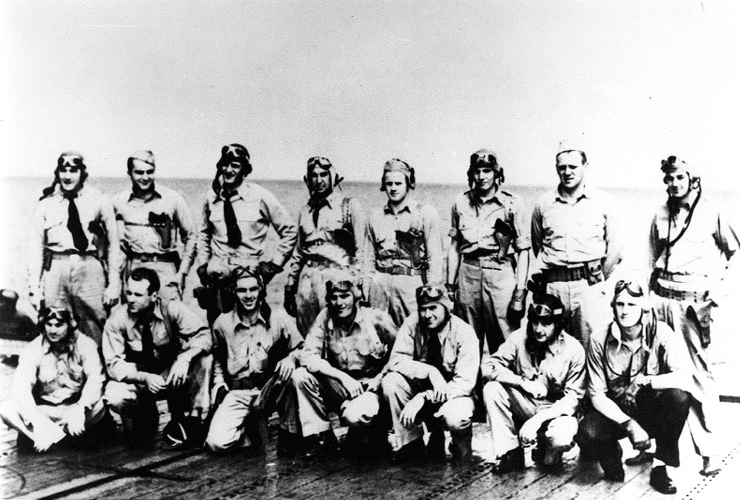
The Pilots of Torpedo Eight, only one Survived

I have always been amazed by the men who faced the Japanese at Midway, a battle that by any reasonable means should have resulted in a Japanese victory as well as them men that stormed the beaches at Normandy just two years later. When I first started reading about these battles many of the veterans were still alive, many not much older than I am today. However today not many are left, and the few that remain generally served as junior officers or enlisted personnel, none in high command.

Both battles are remarkable because an American or Allied loss could have changed the course of history. If the United States Navy been defeated at Midway it could have brought about a Japanese victory, or more likely made the ultimate American victory much more costly and taken far longer to achieve. If the Allies had been repulsed at Normandy it could have split the allied coalition or given the Germans the chance to renew their fight against the Soviet Union and possibly change history.

Thus when I look at these two events, battles that for most are now ancient history I am in awe of the men who fought them. They are not academic exercises for me, but as someone who has served at sea and on land in war I feel camaraderie with these men.

I remember reading Cornelius Ryan’s classic book “The Longest Day” and seeing the movie of the same name in grade school, and reading Walter Lord’s classic on Midway “Incredible Victory” when I was in 7th grade. Both are excellent books which have stood the test of time and though I have read and done much more research and writing on both battles I still keep a copy of each book and probably re-read each every few years and consult them for any new projects. Likewise have been fortunate enough to meet some of the men who served in both of these battles, and even in my time as an Army chaplain be with them in their declining years. Men like Frank Smoker and Henry Boyd, both Normandy vets who have since passed away mean much to me.

The 442nd Regimental Combat Team

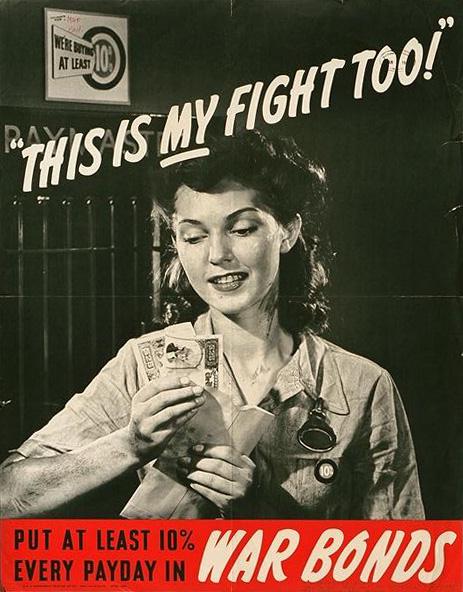
Today when I see a World War Two veteran, no matter where I encounter them, I make sure that I thank them for their service. They are part of an amazing generation of Americans who bequeathed those of us who live today so much, both during the war and after the war. Many millions served in the military, while many more served in war industries. All contributed to war bond drives, victory gardens and yes even increased taxes and decreased civil liberties to win the war.

The fact that Japanese Americans served in the most highly decorated Army units of the war despite their families being incarcerated in American versions of concentration camps is a testimony to sacrifice.

Likewise the efforts of African Americans who went to war despite being second class citizens and discriminated against under the Jim Crow Laws, which even Nazis like Hermann Goering recognized were only different from the Nazi anti-Semitic laws and persecution in manner of degree.

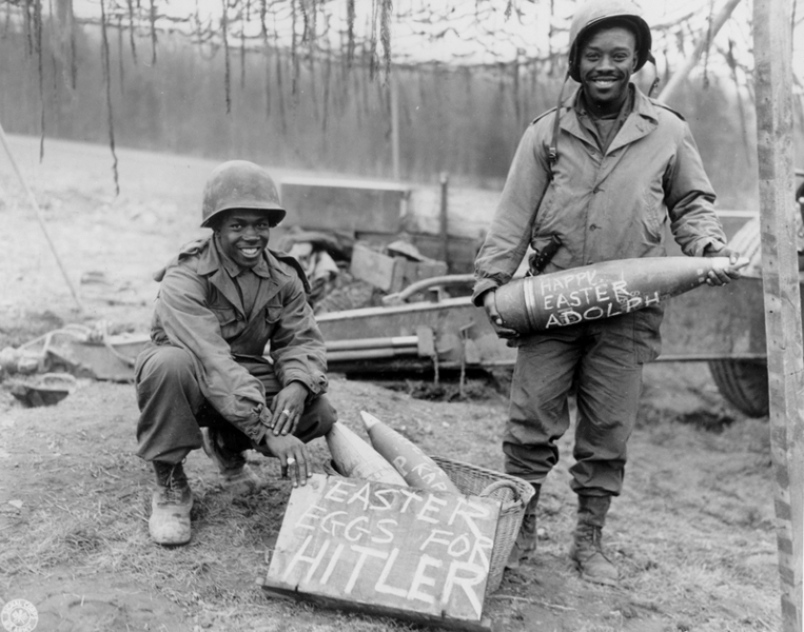
African American Artillerymen in France 1944

That was an amazing and unique generation of Citizen Soldiers. With few exceptions they were not the professional career soldiers, sailors, marines and airmen who serve today. Most would not have considered themselves “warriors.” They were there to do a job, win a war and go home. It was part of who they were as Americans.

How many today would do any of those things? Today we have well under one percent of the population who have served in the wars of the past 16 years, fewer who have served in combat or in a combat zone. Likewise the population in general and in particular the bankers, businesses, lobbyists and defense contractors are not asked to sacrifice anything, instead when the country was attacked the President and others decried the fact that war might prevent people from doing business, shopping or living a normal life. For God’s sake, were at war and that attitude would have been incomprehensible to those of the Greatest Generation who for the most part either went to war, or supported the war effort with their work and other contributions. For them patriotism was not a bumper sticker.

Rachel Maddow said it well in her book Drift: The Unmooring of American Military Power:

“When civilians are not asked to pay any price, it’s easy to be at war – not just to intervene in a foreign land in the first place, but to keep on fighting there. The justifications for staying at war don’t have to be particularly rational or cogently argued when so few Americans are making the sacrifice that it takes to stay.”

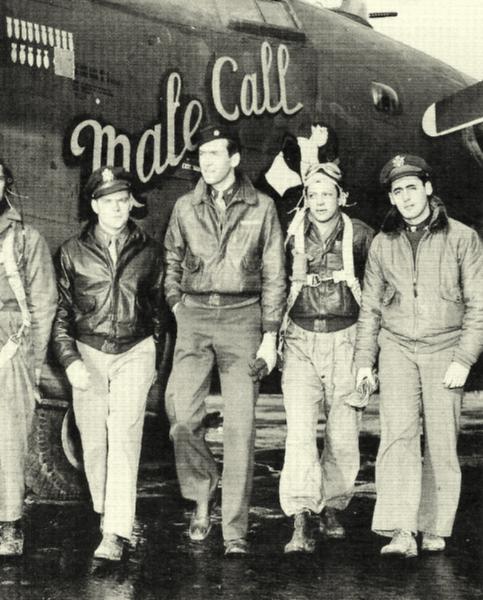
Jimmy Stewart and his Bomber Crew

Because of the sacrifice of people of the Greatest Generation I am grateful for them. I believe that we can learn so much from them. Even A-List Hollywood stars and professional sport heroes left their careers to serve their country. Clarke Gable, Audie Murphy, Glenn Miller, Jimmy Stewart, Bob Feller, Ted Williams, and Joe DiMaggio; just to name a few sacrificed major portions of their careers to serve. With the exception of Pat Tillman who died in a friendly fire incident in Afghanistan which was covered up by the Army and Bush administration, how many of the 1%, the A-List, or professional athletes can you name that have sacrificed their fortunes to serve in the front lines? I can’t name any others, but in the Second World War even the 1% had skin in the game so to speak, the Kennedy’s, Roosevelt’s and the Bush’s to name just a few.

I think that is why I am in awe of those of the Greatest Generation and why as the anniversaries of Midway and D-Day approach I am extra thoughtful, quite reflective and very thankful for those who through their sacrifice made so much of what we have today possible. What bothers me today is how few, especially of those who either advocate for war, lobby for it or profit from it no matter what their political, economic or religious persuasion is, offers to serve or pay for the cost of war.

Today those costs are borne by a tiny minority of Americans, military professionals of the all-volunteer military, both active duty and reserve who have endured deployment after deployment as the bulk of the nation stood by, mostly cheering them on. Of course as one who had his father serve in Vietnam and entered the military not long after had to endure the jeers of Americans, cheers are nice. They are much better than being called a “Nazi” for wearing your uniform to class. However, sometimes I think that many that cheer us on are able to do so because vicarious patriotism is easy. Vicarious patriotism anything, someone else serves, and someone else dies while they “support the troops” without actually doing anything.

Now please don’t get me wrong. There are a lot of good people who have never served in the military and who do care. There are men and women who take action to support the troops, both those serving and the veterans, including those disabled in some way by war. For them I am grateful, they donate time, money and personal effort to care, and I do not care if they are conservatives or liberals, Republicans, Democrats or Independents, religious or atheist. They are Americans who are doing something. Likewise I do not disparage those who take the time to learn the issues that the nation faces and the domestic policies that impact the country and in a healthy body politic it doesn’t mean that we have to completely agree with each other to be patriots. Such an understanding would have been unthinkable to our founders much less most of the Greatest Generation. Veteran’s issues are important but national security also involves so much more, everything from the infrastructure that the Greatest Generation had the vision and wherewithal to build to the environment.

I have been to Normandy as well as other World War II battlefields in Europe and the Pacific. I can only agree with Tom Brokaw who wrote: “there on the beaches of Normandy I began to reflect on the wonders of these ordinary people whose lives were laced with the markings of greatness.”

So, when you read anything I write or re-publish during the next couple of weeks, be it about D-Day, Midway or even Gettysburg, please read what I write though those lenses. It is not that I am bitter. I have chosen my life in the military, but I wonder why so few of us bear the burden. It is a question that every citizen must ask themselves and their political representatives.

Rabbi Roland Gittlesohn, a Navy Chaplain serving with the Marines, recalled Lincoln’s Gettysburg Address when gave a eulogy at the dedication of a cemetery on Iwo Jima that puts it all in perspective.

“Here lie men who loved America because their ancestors generations ago helped in her founding, and other men who loved her with equal passion because they themselves or their own fathers escaped from oppression to her blessed shores.

Here lie officers and men, Negroes and whites, rich men and poor . . .together. Here are Protestants, Catholics and Jews together. Here no man prefers another because of his faith or despises him because of his color. Here there are no quotas of how many men of each group are admitted or allowed. Among these men there is no discrimination. No prejudices. No hatred. Theirs is the highest and purest democracy.

Whosoever of us lifts his hand in hate against a brother, or who thinks himself superior to those who happen to be in the minority, makes of this ceremony and the bloody sacrifice it commemorates, an empty, hollow mockery. To this, then, as our solemn duty, sacred duty do we the living now dedicate ourselves: to the right of Protestants, Catholics and Jews, of white men and Negroes alike, to enjoy the democracy for which all of them have here paid the price.

We here solemnly swear that this shall not be in vain. Out of this and from the suffering and sorrow of those who mourn this will come, we promise, the birth of a new freedom for the sons of men everywhere.”

Since the last members of the Greatest Generation are passing away at an ever increasing rate and few will remain among us; I will ask you to ask yourself the question posed by the World War II veteran and hero John F Kennedy: “Ask not what your country can do for you; ask what you can do for your country.”

Peace

Padre Steve+

4 Comments

Filed under History, iraq,afghanistan, Military, national security, Political Commentary, World War II at Sea, world war two in europe, world war two in the pacific

People Cannot Live in Freedom Unless Free People are Prepared to Die for It: D-Day at 73

img_0061

Friends of Padre Steve’s World,

I find the days around Memorial Day and the anniversaries of the Battle of Midway and the D-Day landings to be a time when I become quite reflective about what it means to be a career American military officer, combat veteran, and the son of a Navy Chief who was also a combat veteran. I am also an uncle to a young man who likely will be enlisting in the Army in the coming weeks.

When he spoke on Omaha Beach during the ceremony marking the 70th Anniversary of the D-Day landings President Barak Obama said:

“We are on this Earth for only a moment in time.  And fewer of us have parents and grandparents to tell us about what the veterans of D-Day did here 70 years ago.  As I was landing on Marine One, I told my staff, I don’t think there’s a time where I miss my grandfather more, where I’d be more happy to have him here, than this day.  So we have to tell their stories for them.  We have to do our best to uphold in our own lives the values that they were prepared to die for.  We have to honor those who carry forward that legacy, recognizing that people cannot live in freedom unless free people are prepared to die for it.”

All of my adult life I have striven to uphold those values that those men were prepared to die for, and for almost 36 years of Army and Navy service that I have been prepared to do so at a moment’s notice.

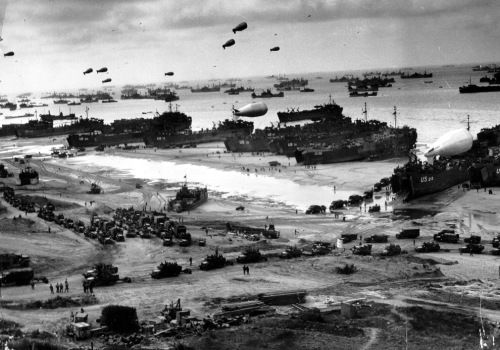
Seventy-three years ago the liberation of France began on the beaches of Normandy.  Soldiers from 6 Allied Infantry and 3 Airborne Divisions supported by an Armada of over 5000 ships and landing craft and several thousand aircraft braved weather, heavy seas and in places fierce German resistance to gain the foothold on beaches named Omaha, Utah, Gold, Sword and Juno.  Over the next seven weeks the Allied soldiers advanced yard by yard through the hedgerows and villages of Normandy against ferocious German resistance before they were able to break out of the lodgment area and begin the drive across France. In his D-Day message to his troops General Dwight Eisenhower reminded them that their mission was the elimination of Nazi tyranny over oppressed peoples of Europe, and security for ourselves in a free world.” There are still those in the world who subject their people to tyranny and attempt to destabilize and overthrow the governments of liberty loving peoples, likewise Eisenhower knew that security for ourselves meant close alliances with those who have our values and not isolating ourselves from the world.

The fighting was bloody, most American, British and Canadian infantry battalions and regiments suffered nearly 100% casualty rates in Normandy.  Replacements were fed in at a cyclic rate to make up the losses even as fresh divisions flowed ashore, but the losses were terrible.  By the time the landings took place, the British having been at war for nearly five years were bled out.  They had little left to replace their losses.  From Normandy on the British were losing combat power at a rate that they could not make up.

For the Americans there was another problem.  The US High command decided to limit the Army to 90 Divisions.  Many of these were committed to the Pacific and Mediterranean theaters.   Likewise, American Infantry units were generally made up of the lowest caliber of recruits, led often by the poorest officers; the best went to either the Air Corps or technical branches of the Army.

Now this is not to criticize veterans, but it is a factor in the campaign.  Most US Infantry Divisions with the exceptions of those previously blooded in North Africa and Sicily often performed badly in action.  Some, after being manhandled by the Germans had their leadership replaced and became excellent combat units.  However, every new division that arrived in France after D-Day always got the worst of their initial engagement against German forces.

While performance suffered there was another problem for the Americans.  With the limitation in number of divisions, they stopped building infantry divisions, upon whom the bulk of the campaign depended. Thus they had little in the way of trained infantry replacements to make up heavy losses in Normandy.  By late 1944 during the Battle of the Bulge the American infantry crisis was so bad that 30,000 Air Corps candidates were trained as infantry and soldiers support units such as Ant-Aircraft battalions were used to bolster infantry units.

Had the Germans been able to hold out and had they not been bled white by the Red Army on the Easter Front, had they not lost the nearly their entire Army Group Center in the Red Army offensive of 1944 it is conceivable that the British and American offensive in the West would have ground to a halt for lank of infantry in 1945.  In spite of this there was no lack of individual courage among the troops engaged; the courage and sacrifice of all who fought there should not be forgotten.

The human toll among the combatants both Allied and German, as well as the local populace was especially traumatic.  While the American, Canadian and British people are keen to remember the sacrifices made by our soldiers we often forget the toll among the French civilian population of Normandy as well as the German soldiers, mostly conscripts, sacrificed by the Nazi regime.  Normandy suffered more than any part of France during the liberation.  In the months leading up to D-Day Allied Air Forces unleashed hell on Normandy to attempt to lessen potential German resistance.  The Allied Naval bombardment added to the carnage ashore and once the campaign began the combined fires of both Allied and German forces devastated the region.  Whole cites such as Caen were destroyed by Allied Air forces and an estimated 30,000 French civilians were killed during the Normandy campaign, 3000 on D-Day alone.  I think it can be said that the blood of the civilians of Normandy was shed for the freedom of all of France.

The campaign in Normandy was one of the most viciously contested in western military history.  German forces, especially Paratroops of the 2nd, 3rd, 5th and 6th Fallschirmjager Divisions, German Army Panzer Divisions such as the 2nd, 21st, 116th and Panzer Lehr and those of the Waffen-SS, especially the 1st, 2nd and 12th SS Panzer Divisions held the line against ever increasing Allied forces.  As they sacrificed themselves Hitler refused to commit more forces to Normandy and insisted that his Army contest every meter of ground.  He forbade his commanders to withdraw to more defensible positions along the Seine.

Hitler’s decisions actually shortened the campaign.  Whatever the crimes of the Hitler Regime and Nazism, which were among the most heinous in history, one can never question the valor, courage and sacrifice of ordinary German soldiers.  For those Americans who lump all Germans who fought in World War II with the evil of the Nazi regime, please do not forget this fact:  There are those today, even in this country that make the same charge against Americans who have fought in Iraq and those at home and abroad who have labeled the US as an aggressor nation. As President Trump continues to go his own way to make the United States a pariah nation we have to be very aware of the costs of it and also remember that the Americans who went ashore on D-Day did so to help defeat a pariah nation that had flaunted every standard of justice in attempting to make Germany Great Again. When you judge others, know that the same standard will be applied to you someday and it is possible that our day may come sooner than we think. It is as Justice Robert Jackson who served as the Chief Prosecutor at the Nuremberg War Crimes Tribunal wrote:

“If certain acts of violation of treaties are crimes, they are crimes whether the United States does them or whether Germany does them, and we are not prepared to lay down a rule of criminal conduct against others which we would not be willing to have invoked against us.”

Normandy was a near run thing for the Allies.  First the weather almost delayed it by 2 to 4 weeks.  Had that happened the Germans might have been even better prepared to meet the invasion.  Likewise, the Red Army’s devastating offensive which annihilated Army Group Center in June kept the Germans from transferring additional forces from the Russian Front to Normandy.  On D-Day itself there were a number of times where Lady Luck, or maybe the Deity Herself, saved the Allies from disaster.

Any person who has seen Saving Private Ryan, The Longest Day or Band of Brothers knows a little bit about how close Overlord came to failure.  Allied Airborne units were dispersed throughout the region after they drooped.  Many units were not fully operational for more than a day as they sought to organize themselves and gather their troops.  At Omaha Beach the Americans had not counted on the presence of the first rate German 352nd Infantry Division.  This division, despite being pounded by naval and air forces almost cause General Bradley to withdraw from Omaha.  At Utah the soldiers of the 4th Infantry division escaped a similar mauling by landing on the wrong beach.  Had they landed at the planned beaches they would have ran into the same kind of resistance from well dug in German forces.  At Gold Juno and Sword British forces benefited from confusion in the German command which kept the 21st Panzer Division from descending on the British forces and quite possibly splitting the British zones.

The Allies benefited from the absence of Field Marshall Erwin Rommel, Commander of Army Group B who because of the ad weather assumed no invasion was possible and traveled to German to celebrate his wife’s birthday.  Finally, and perhaps most important they benefited by Hitler’s refusal to immediately commit forces, including his Panzer reserve to defeat the invasion at the beachhead.

For those who fought in Normandy and those civilians who lived through it the memories are still vivid. Many suffer the effects of PTSD, grief and other wounds, physical, emotional and spiritual.  When one is exposed to the danger and destruction of war, the smell of death, the sight of burned out cities, vehicles and the suffering of the wounded and dying, it makes for a lifetime of often painful memories.

For some of the German, British and American veterans, the struggle in Normandy has given way to long lasting friendships.  Many of those who fought against the Allied onslaught became fast friends after the war. Those who fought against each other were soon allies as part of NATO and soldiers of nations which were once bitter enemies serve together in harm’s way in Afghanistan.  The generation that fought at Normandy is rapidly passing away, their numbers ever dwindling they remain a witness to courage, sacrifice and reconciliation.

In the end it is reconciliation and healing that matters. Some scars of war never pass away; some memories are far too painful to release.  Yet we who serve often strive to reconcile.  In 2002 while deployed at sea for Operation Enduring Freedom I was an advisor to a boarding team from my ship.  It was our job to make sure that impounded ships which were breaking the UN embargo on Iraq were not in danger of sinking, and that their crews had food, water and medical care.  Since many of these ships remained at anchor for 2-4 weeks in the heat of the Arabian Gulf, this was important.

The delays imposed by UN rules sometimes meant that the sailors of these ships grew resentful.  It was my job to spend time with the Masters of these ships to keep things calm and work out any issues that arose.  On one of these ships I met an Iraqi merchant skipper.  The man was well traveled, educated in the U.K. in the 1960s and in his career a frequent visitor to the US. In 1990 he was the senior captain of the Kuwaiti shipping line.  Then Saddam Hussein invaded Kuwait.  As a result of this when Kuwait was liberated he lost his job.  His nation was an international pariah.  Since his life was the sea he took up the only job possible to support his family, what he knew best, captaining ships.  He was most apologetic for the trouble that he and others like him caused us.  We shared much during those visits.   One of his daughters was in medical school and other children in university.  He longed for the day when Iraq would be free.  On our last talk before his ship was released he remarked to me “I hope one day we will meet again.  Maybe someday like the American, British and German soldiers after the war, we can meet in a pub, share a drink and be friends.” 

I too pray for that, especially after my tour in Al Anbar five years after I encountered that Iraqi Merchant Captain.  Maybe someday we will. I thought of him almost every day that I was in Iraq. I only hope that he and his family have survived the war, the continuing violence in Iraq and are doing well. There is hardly a day that goes by that I do not think of this man or the Iraqis that I had the honor of serving alongside in Al Anbar in 2007 and 2008.

President Obama remarked in Normandy last week about the veterans of the 9-11 Generation of service members, of which I and so many others like me are part:

“And this generation — this 9/11 Generation of service members — they, too, felt something.  They answered some call; they said “I will go.”  They, too, chose to serve a cause that’s greater than self — many even after they knew they’d be sent into harm’s way.  And for more than a decade, they have endured tour after tour.”

The survivors of the D-Day landings and those on the other side of the hill are continuing to pass from the bonds of this earth and into eternity. We owe it to them and to the world to make what they sacrificed themselves to do into reality, battling tyranny and striving for peace and security.

Peace,

Padre Steve+

Leave a comment

Filed under History, Military, world war two in europe

The Battle of Midway at 75

img_0063

Friends of Padre Steve’s World,

Today marks the 75th anniversary of the Battle of Midway, the epic “David versus Goliath” battle that ended Japan’s chance to win World War Two in the Pacific. It was a battle where skill, luck, good fortune and courage combined to allow the United States Navy to deliver a crushing defeat the previously undefeated Kido Butai, the Japanese First Carrier Striking Force which had run rampant across the Pacific and Indian Oceans in the six months after the attack on Pearl Harbor.

Today, the youngest survivors of the battle are over ninety years old. Their generation, like the rest of what we remember as the Greatest Generation will soon pass from the bonds of this earth into eternity. As you read this remember their sacrifice and too remember the tragedy of the Japanese sailors and airmen that were lost at Midway due to their government’s aggression against their neighbors throughout Asia that led to their attack on the American Pacific Fleet at Pearl Harbor.

Peace

Padre Steve+

Prelude to Battle

The Imperial Japanese Navy under the command of Admiral Isoruku Yamamoto had been humiliated. On April 18th 1942 16 B-25 bombers under the command of Colonel Jimmy Doolittle were launched from the deck of the USS Hornet and bombed Tokyo.  Though the physical damage was insignificant the psychological impact was massive on the Japanese military establishment. In response to the threat, Yamamoto was directed to bring the aircraft carriers of the U.S. Navy to battle and to destroy them.

Prior to the Doolittle Raid, Yamamoto and his deputy Rear Admiral Matome Ugaki had explored the possibility of attacking Midway. However, the Japanese armed forces were competing with each other to determine an overall strategy for the war effort. The Army was insistent on a China strategy while the Navy preferred expansion in the Western, South and Central Pacific.  Yamamoto’s idea envisioned seizing Midway and using it as a forward base from which an invasion of Hawaii could be mounted as well as the bait to draw the carrier task forces of the U.S. Navy into battle and destroy them. Until the Doolittle Raid shocked the Japanese leadership he was unable to do this.

“I Shall Run Wild for the First Six Months”
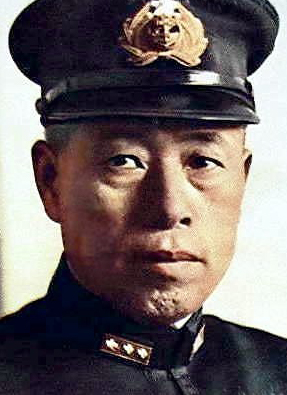
Yamamoto-Isoroku

Admiral Isoruku Yamamoto

Yamamoto was one of the few Japanese military or political leaders who opposed war with the United States. He had lived in the United States, gotten to know Americans and recognized the how the massive economic and industrial power of the United States would lead to the defeat of Japan. He told Premier Konoye in 1941 “I shall run wild for the first six months or a year, but I have utterly no confidence for the second or third years of the fighting.”

It is hard to imagine now, but in June of 1942 it seemed a good possibility that the Americans and British could be on the losing side of the Second World War.

True to Yamamoto’s words in 1942 the Japanese onslaught in the Pacific appeared nearly unstoppable. The Imperial Navy stormed across the Pacific and Indian Oceans in the months after Pearl Harbor decimating Allied Naval forces that stood in their way.  The British Battleships HMS Prince of Wales and HMS Repulse were sunk by land based aircraft off of Singapore. A force of Royal Navy cruisers and the Aircraft Carrier HMS Hermes were sunk by the same carriers that struck Pearl Harbor in the Indian Ocean.  Darwin Australia was struck with a devastating blow on February 19th and on February 27th the Japanese annihilated the bulk of the American, British, Dutch and Australian naval forces opposing them at the Battle of the Java Sea. American forces in the Philippines surrendered on May 8th 1942 while the British in Singapore surrendered on February 15th.

In only one place had a Japanese Naval task force been prevented from its goal and that was at the Battle of the Coral Sea.  Between 4-8 May the US Navy’s Task Force 11 and Task Force 17 centered on the Carriers USS Lexington and USS Yorktown prevented a Japanese invasion force from taking Port Moresby. Their aircraft sank the light carrier Shoho, damaged the modern carrier Shokaku and decimated the air groups of the Japanese task force. But it was the unexpected raid by US Army Air Corps B-25 Bombers launched from the USS Hornet under command of Colonel Jimmy Doolittle on April 18th 1942 which embarrassed Yamamoto so badly that he ordered the attack to take Midway and destroy the remaining US Naval power in the Pacific.

Cracking the Code

Chester-W.-Nimitz-militarymuseum.org_

Admiral Chester Nimitz

United States Navy codebreakers had broken the Japanese diplomatic and naval codes in 1941, and in May the Navy code breakers under the command of Commander Joseph Rochefort at Pearl Harbor discovered Yamamoto’s plan to have the Imperial Navy attack Midway Island and the Aleutian Islands.  Knowing the Japanese were coming, and that the occupation of Midway by Japanese forces would give them an operational base less than 1000 miles from Pearl Harbor, Admiral Chester Nimitz, commander of the U.S. Pacific Fleet committed the bulk of his naval power, the carriers USS Enterprise CV-6, USS Yorktown CV-5 and USS Hornet CV-8 and their 8 escorting cruisers and 15 destroyers to defend Midway.  This force of 26 ships with 233 aircraft embarked to defend Midway while a force of smaller force 5 cruisers and 4 destroyers was dispatched to cover the Aleutians.  The forces on the ground at Midway had a mixed Marine, Navy and Army air group of 115 aircraft which included many obsolete aircraft, 32 PBY Catalina Flying Boats and 83 fighters, dive bombers, torpedo planes and Army Air Force bombers piloted by a host of inexperienced but resolute airmen with which to defend it. It also had a ground force of U.S. Marines, should the Japanese actually land on the island.

With the foreknowledge provided by the code breakers the US forces hurried to an intercept position northeast of Midway. They eluded the Japanese submarine scout line which the Japanese Commander Admiral Yamamoto presumed would find them when they sailed to respond to the Japanese attack on Midway.  Task Force 16 with the Enterprise and Hornet sailed first under the command of Rear Admiral Raymond A Spruance in place of the ailing William “Bull” Halsey. Task Force 17 under Rear Admiral Frank “Jack” Fletcher was built around the Yorktown which had been miraculously brought into fighting condition after suffering heavy damage at Coral Sea. Fletcher assumed overall command by virtue of seniority and Admiral Nimitz instructed his commanders to apply the principle of “calculated risk” when engaging the Japanese as the loss of the US carriers would place the entire Pacific at the mercy of the Japanese Navy.

On June 3rd a PBY Catalina from Midway discovered the Japanese invasion force transport group.  US long-range B-17 bombers launched attacks against these ships but inflicted no damage.

“Our hearts burn with the conviction of sure victory.”

On the night of June 3rd 1942 Nagumo’s First Carrier Strike Force sailed east toward the tiny Midway Atoll. Nagumo had seen many of the risks involved in the plan and considered it an “impossible and pointless operation” before the Doolittle Raid on Tokyo, but even the reluctant Nagumo fell in line as Yamamoto relentlessly lobbied for the operation.

As the First Carrier strike force closed within 300 miles of Midway on the night of June 3rd 1942 Nagumo and his staff prepared for the battle that they and many others believed would be the decisive battle. Aircraft received their final preparations, bombs were loaded and as night faded into early morning air crew arose, ate their breakfast and went to their aircraft. The ships had been observing radio silence since they departed their bases and anchorages in Japan the previous week. Honed to a fine edge the crews of the ships and the veteran aircrews anticipated victory.

The crews of the ships of the task force and the air groups embarked on the great aircraft carriers Akagi, Kaga, Soryu and Hiryu as well as their escorts were confident. They had since the war began known nothing but victory. They had devastated the Pacific Fleet at Pearl Harbor and roamed far and wide raiding allied targets and sinking allied shipping across the Pacific and deep into the Indian Ocean. Commander Magotaro Koga of the destroyer Nowaki wrote in his diary “Our hearts burn with the conviction of sure victory.

Chuichi_Nagumo

Vice Admiral Chuichi Nagumo

However, Nagumo and his sailors had no idea that most of what they knew about their American opponents was wrong. Nagumo and Yamamoto were confident that the Americans could field no more than two operational carriers to defend Midway. They had no idea that the Yorktown, which they believed had been sunk at Coral Sea was operational and her air group reinforced by the aircraft of the damaged Saratoga which was being repaired on the West Coast. Unknown to the Japanese the Yorktown and her escorts had joined Enterprise and Hornet northeast of Midway.

The Japanese were going into battle blind. They had planned to get aerial surveillance of US Fleet dispositions at Pearl Harbor, but that had been cancelled because the atoll at French Frigate Shoals that the Japanese flying boats would operate from had been occupied by a small US force. Likewise a line of Japanese submarines arrived on station a day too late, after the US carrier task forces had passed by them. Those aboard the First Carrier Strike Force, including Nagumo or his senior commanders and staff had no idea that the Americans not only knew of their approach but were already deployed in anticipation of their strike.

Within a day all of the Japanese carriers would be sunk or sinking. Thousands of Japanese sailors would be dead and the vaunted air groups which had wreaked havoc on the Allies would be decimated, every aircraft lost and the majority of pilots and aircrew dead. It would be a most unexpected and devastating defeat stolen out of the hands of what appeared to be certain victory.

There is a lesson to be learned from the Japanese who sailed into the night on June 3rd 1942 and saw the sunrise of June 4th. There is no battle, campaign or war that goes according to plan. Thousands of Japanese sailors and airmen went to bed on the night of the 3rd expecting that the following night, or within the next few days they would be celebrating a decisive victory. Thousands of those sailors would be dead by the night of the 4th of June 1942, and as their ships slid beneath the waves, the ambitions of Imperial of Japan to defeat the United States Navy and end the war were dealt a decisive defeat from which they never recovered.
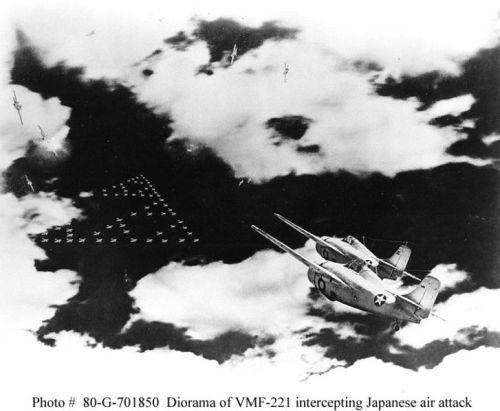
VMF-221_Buffalos_intercepting_Japanese_formation

Hawks at Angles Twelve

One of the more overlooked aspects of the Battle of Midway is the sacrifice of Marine Fighter Squadron 221 on the morning of June 4th 1942.   The Marine aviators flying a mix of 21 obsolescent Brewster F2A-3 Buffalos and 7 Grumman F4F-3 Wildcats engaged a vastly superior force of Japanese Navy aircraft as they vectored toward the atoll to begin softening it up for the planned invasion.

Led by Major Floyd Parks the squadron had arrived at Midway on Christmas day 1941 being delivered by the USS Saratoga after the aborted attempt to relieve Wake Island.  The squadron along with Marine Scout Bombing Squadron 241 (VMSB 241) formed Marine Air Group 22.  They fighter pilots of VMF-221 scored their first victory shooting down a Japanese Kawanishi H8K2 “Emily” flying boat. The squadron which initially was composed of just 14 aircraft, all F2A-3’s was augmented by 7 more F2A-3s and 7 of the more advanced F4F-3s before the battle.

When the Japanese First Carrier Striking Group was spotted in the wee hours of June 4th the Marines and other aircrew aboard Midway scrambled to meet them.  The 18 SBD-2 Dauntless’ and 12 Vought SB2-U3 Vindicator dive bombers of VMSB-241, the 6 TBF Avengers of the Navy Torpedo Eight detachment, 4 Army Air Corps B-26 Marauders and 15 B-17 Flying Fortresses flew out to attack the Japanese carriers while the fighters rose to intercept the 108 aircraft heading toward Midway. The 72 strike aircraft, 36 Aichi 99 Val Dive Bombers and 36 Nakajima B5N Torpedo/ High Level Bombers were protected by 36 AM6-2 Zeros which thoroughly outclassed the Marine opponents in speed, maneuverability and in the combat experience of their pilots.

F2A-3+Buffalo

The Marine fighters audaciously attacked the far superior Japanese force, throwing themselves against the Japanese phalanx with unmatched courage.  Despite their courage the Marine fighters were decimated by the Japanese Zeros.  The Marines shot down 4 Val dive bombers and at least three Zeros but lost 13 Buffalos and 3 Wildcats during the battle.  Of the surviving aircraft only three Buffalos and three Wildcats were in commission at the end of the day. Among the casualties killed was Major Parks.  Of the surviving pilots of VMF-221, two became “Aces” during the war. Lieutenant Charles M. Kunz would later fly in VMF-224, adding six victories to end the war with 8 victories. Capt. Marion E. Carl would later fly in VMF-223 raising his score to 18.5 Japanese aircraft shot down.  Other pilots like 2nd Lieutenant Clayton M. Canfield shot down two additional aircraft while flying with VMF-223. 2nd Lieutenant Walter W. Swansberger won the Medal of Honor at Guadalcanal.

The last remaining Marine fighter pilot of VMF-221 from the battle of Midway, Williams Brooks died in January 2010 and was buried with full military honors, in Bellview, Nebraska. Brooks in his after action report described his part in the battle:

I was pilot of F2A-3, Bureau number 01523, Our division under Capt. Armistead was on standby duty at he end of the runway on the morning of June 4, 1942, from 0415 until 0615. At about 0600, the alarm sounded and we took off. My division climbed rapidly, and I was having a hard time keeping up. I discovered afterwards that although my wheels indicator and hydraulic pressure indicator both registered “wheels up”, they were in reality about 1/3 of the way down. We sighted the enemy at about 14,000 feet, I would say that there were 40 to 50 planes. At this time Lt. Sandoval was also dropping back. My radio was at this time putting out no volume, so I could not get the message from Zed. At 17,000 feet, Capt. Armistead led the attack followed closely by Capt. Humberd. They went down the left of the Vee , leaving two planes burning. Lt. Sandoval went down the right side of the formation and I followed. One of us got a plane from the right side of the Vee. At this time, I had completely lost sight of my division. As I started to pull up for another run on the bombers, I was attacked by two fighters. Because my wheels being jammed 1/3 way down, I could not out dive these planes, but managed to dodge them and fire a burst or so into them as they went past me and as I headed for the water. As I circled the island, the anti-aircraft fire drove them away. My tabs, instruments and cockpit were shot up to quite an extent at this time and I was intending to come in for a landing. 

It was at this time that I noticed that a important feature in their fighting. I saw two planes dog-fighting over in the east, and decided to go help my friend if at all possible. My plane was working very poorly, and my climb was slow. As I neared the fight both planes turned on me. It was then that I realized I had been tricked in a sham battle put on by two Japs and I failed to recognize this because of the sun in my eyes. Then I say I was out-numbered, I turned and made a fast retreat for the island, collecting a goodly number of bullets on the way. After one of these planes had been shaken, I managed to get a good burst into another as we passed head-on when I turned into him. I don’t believe this ship could have gotten back to his carrier, because he immediately turned away and started north and down. I again decided to land, but as I circled the island I saw two Japs on a Brewster. Three of my guns were jammed, but I cut across the island, firing as I went with one gun. But I could not get there in time to help the American flier and as soon as the Brewster had gone into the water I came in for a landing at approximately 0715 (estimated). 

As for VMF-221 it was re-equipped with the F4F-4 and later with the F4U Corsair during the course of two more deployments overseas.  VMF-221 finished the war with a score of 155 victories, 21 damaged and 16 probable kills, the second highest total of any Marine Corps Squadron during the war.

Their bomber counterparts of VMSB 241 attacked the Japanese task force on the morning of June 4th and scored no hits while losing 8 aircraft. The survivors were again in action later in the day as well as the following day where they helped sink the Japanese Heavy Cruiser Mikuma with their squadron leader Major Henderson diving his mortally wounded aircraft into the cruiser’s number 4 8” gun turret. While the Marines’ actions are not as well known or as successful as those of their Navy counterparts they were brave.  Fighter pilots had to engage some of the most experienced pilots flying superior machines while the bomber crews had little to no experience before being thrown into combat.

Into the Valley of Death: The Last Ride of the Torpedo Bombers

800px-tbd_attacking_at_midway_painting-1

Alfred, Lord Tennyson wrote in the Charge of the Light Brigade something that echoes to this day when we talk or write about men who charge the gates of death against superior enemies.

Half a league half a league,

Half a league onward,

All in the valley of Death

Rode the six hundred:

‘Forward, the Light Brigade!

Charge for the guns’ he said:

Into the valley of Death

Rode the six hundred.

They were not six hundred and they were not mounted on horses, but the Naval Aviators of Torpedo Squadrons 3, 6 and 8 and their aerial steeds 42 Douglas TBD Devastators and 6 TBF Avengers wrote a chapter of courage and sacrifice seldom equaled in the history of Naval Aviation. Commanded by veteran Naval Aviators, LCDR Lance “Lem” Massey, LCDR Eugene Lindsey and LCDR John Waldron the squadrons embarked aboard the carriers flew the obsolete TBD Devastators. The young pilots of the Midway based Torpedo 8 detachment under the command of LT Langdon Fieberling flew in the new TBF Avengers.

The TBD which first flew in 1935 entered service in 1937 and was possibly the most modern naval aircraft in the world when it entered service.  It was a revolutionary aircraft. It was the first monoplane widely used on carriers and was first all-metal naval aircraft.  It was the first naval aircraft with a totally enclosed cockpit, the first with hydraulic powered folding wings.  The TBD had crew of three and had a maximum speed of 206 miles an hour and carried a torpedo or up to 1500 pounds of bombs (3 x 500) or a 1000 pound bomb.  129 were built and served in all pre-war torpedo bombing squadrons based aboard the Lexington, Saratoga, Ranger, Yorktown, Enterprise and Hornet with a limited number embarked aboard Wasp. 
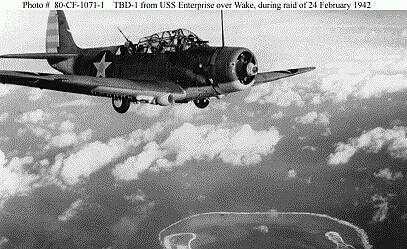
tbd devastator

The Devastator saw extensive service prior to the war which pushed many airframes to the end of their useful service life and by 1940 only about 100 were operational by the beginning of the war.  They were still in service in 1942 as their replacement the TBF Avenger was not available for service in large enough numbers to replace them before Midway.  The TBDs performed adequately against minor opposition at Coral Sea and in strikes against the Marshalls but the squadrons embarked on Yorktown (VT3), Enterprise (VT-6) and Hornet (VT-8) were annihilated at Midway with only 6 of 41 aircraft surviving their uncoordinated attacks against the Japanese Carrier Strike Force.  They were too slow, had poor maneuverability, insufficient armor and defensive armament.

The Torpedo squadrons attacked independently of each other between 0920 and 1030 on June 4th 1942. The Japanese Combat Air Patrol ripped into the slow, cumbersome and under armed TBD Devastators as they came in low to launch their torpedoes.  Torpedo Eight from Hornet under the command of LCDR John C Waldron pressed the attack hard but all 15 of the Devastators were shot down.  Only Ensign George Gay’s aircraft was able to launch its torpedo before being shot down and Gay would be the sole survivor of the squadron to be picked up later by a PBY Catalina patrol plane.

Torpedo Six from the Enterprise under the command of LCDR Eugene Lindsey suffered heavy casualties losing 10 of 14 aircraft with Lindsey being one of the casualties.  The last group of Devastators to attack was Torpedo Three from the Yorktown under the command of LCDR Lem Massey losing 11 of 13 aircraft with Massey a casualty last being seen standing on the wing of his burning aircraft as it went down.  These aircraft were also decimated and Massey killed but they had drawn the Japanese Combat Air Patrol down to the deck leaving the task force exposed to the Dive Bombers of the Enterprise and Yorktown.  The six aircraft of the Torpedo Eight detachment from Midway under the command of LT Fieberling lost 5 of their 6 aircraft while pressing their attacks.  Only Ensign Bert Earnest and his aircraft survived the battle landing in a badly damaged state on Midway.  Four U.S. Army B-26 Marauder Medium Bombers were pressed into service as torpedo bombers of which 2 were lost.  No torpedo bomber scored a hit on the Japanese Task force even those torpedoes launched at close range failed to score and it is believe that this was in large part due to the poor performance of the Mark 13 aircraft torpedoes.

Despite the enormous losses of the torpedo squadrons their sacrifice was not in vain. Their attacks served to confuse the Japanese command and delay the rearmament of aircraft following the Japanese strikes on Midway. They also took the Japanese Combat Air Patrol down to sea level and opened the way for American Dive Bombers to strike the Japanese with impunity fatally damaging the Akagi, Kaga and Soryu in the space of 5 minutes.

After Midway the remaining TBDs were withdrawn from active service and no example survives today. The TBF became the most effective torpedo bomber of the war and some remained in service in a civilian capacity to fight forest fires until 2012.

The Provence of Chance: Five Minutes that Changed the War
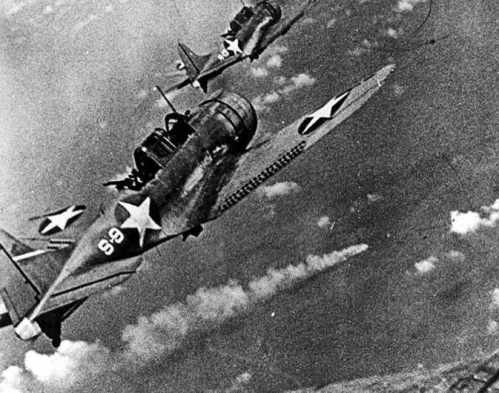
sbd dauntless midway

The land based aircraft from Midway attacked the Japanese carrier force taking heavy casualties and failed to damage the Japanese task force. When the results of the first strike of the Japanese bombers that hit Midway was analyzed Nagumo readied his second wave.

As this was happening the American carriers launched their strike groups at the Japanese fleet leaving enough aircraft behind as for Combat Air Patrol and Anti-submarine patrol missions.  As the Americans winged toward the Japanese fleet the Japanese were in a state of confusion. The confusion was caused when a scout plane from the Heavy Cruiser Tone that had been delayed at launch discovered US ships but did not identify a carrier among them until later into the patrol. The carrier was the Yorktown and TF 17, but for Nagumo who first expected no American naval forces, then received a report of surface ships without a carrier followed by the report of a carrier the reports were unsettling.

Aboard the Japanese ships, orders and counter-orders were issued as the Japanese attempted to recover their strike aircraft and prepare for a second strike on the island, but when the Yorktown task force was discovered, orders were changed and air crews unloaded ground attack ordnance in favor of aerial torpedoes and armor piercing bombs. In their haste to get their aircraft ready to strike the Americans, the hard working Japanese aircrews did not have time to stow the ordnance removed from the aircraft. But due to their hard work at 1020 they had the Japanese strike group ready to launch against the US carriers. Aircraft and their crews awaited the order to launch, their aircraft fully armed and fully fueled.

There had been confusion among the Americans as to the exact location of the Japanese Carriers. Bombing 8 and Scouting 8 from Hornet made a wrong turn and not find the Japanese carriers. The squadrons had to return due to a lack of fuel and a number of bombers and their fighter escort had to ditch in the ocean and wait for rescue. The Enterprise group composed of Bombing-6 and Scouting 6 under CDR Wade McClusky was perilously low on fuel when they spotted the wake of a Japanese destroyer steaming at high speed to catch up with the Japanese carriers.  Taking a chance, McClusky followed it straight to the Japanese Task Force arriving about 1020. The Yorktown’s group under LCDR Max Leslie arrived about the same time.

When the American dive bombers arrived over the Japanese Carrier Strike Force they found the skies empty of Japanese aircraft. Below, aboard the Japanese ships there was a sense of exhilaration as each succeeding group of attackers was brought down and with their own aircraft ready to launch and deal a fatal blow to the American carrier wondered how big their victory would be. The war would soon be decided.

At 1020 the first Zero of the Japanese attack group began rolling down the flight deck of the flagship Akagi, aboard Kaga aircraft were warming up as they were on the Soryu.  The unsuspecting Japanese were finally alerted to the threat of the American dive bombers when lookouts screamed “helldivers.” The Japanese fighters assigned to the combat air patrol were flying too low as the mopped up the last of the doomed torpedo bombers and were not in a position to intercept the Americans.
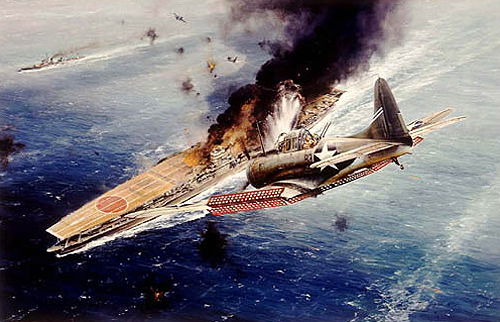
IJN_Akagi_World_War_II_Aircraft_Carrier_hit_by_Douglas_SBD_Dauntless_Dive_Bomber_at_Midway-1

Wade McClusky’s aircraft lined up over the Akagi and Kaga pushing into their dives at 1022. There was a bit of confusion when the bulk of Scouting 6 joined the attack of Bombing 6 on the Kaga. That unprepared ship was struck by four 1000 pound bombs which exploded on her flight deck and hangar deck igniting the fully fueled and armed aircraft of her strike group and the ordnance littered about the hangar deck.  Massive fires and explosions wracked the ship and in minutes the proud ship was reduced to an infernal hell with fires burning uncontrollably. She was abandoned and would sink at 1925 taking 800 of her crew with her.

LT Dick Best of Scouting 6 peeled off from the attack on Kaga and shifted to the Japanese flagship Akagi. On board Akagi were two of Japan’s legendary pilots CDR Mitsuo Fuchida leader of and CDR Minoru Genda the architect of the Pearl Harbor attack and subsequent string of Japanese victories. Both officers were on the sick list and had come up from sick bay to watch as the fleet was attacked. Seeing Kaga burst into flames they stood mesmerized until Akagi’s lookouts screamed out the warning “helldivers” at 1026.
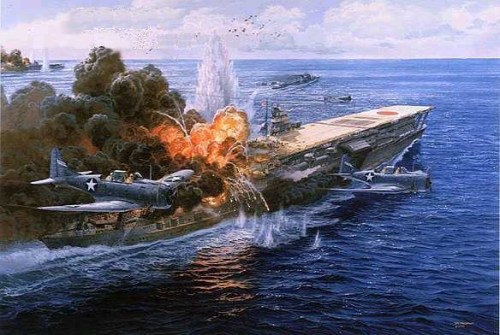
SBDstoastjapcarrier

Best’s few aircraft hit with deadly precision landing two of their bombs on Akagi’s flight deck creating havoc among the loaded aircraft and starting fires and igniting secondary explosions which turned the ship into a witch’s cauldron.  By 1046 Admiral Nagumo and his staff were forced to transfer the flag to the cruiser Nagara as Akagi’s crew tried to bring the flames under control. They would do so into the night until nothing more could be done and abandoned ship at 2000.  Admiral Yamamoto ordered her scuttled and at 0500 on June 5th the pride of the Japanese carrier force was scuttled.

VB-3 under LCDR Max Leslie from the Yorktown stuck the Soryu with 17 aircraft, however only 13 of the aircraft had bombs due to an electronic arming device malfunction on 4 of the aircraft, including that of Commander Leslie.  Despite this Leslie led the squadron as it dove on the Soryu at 1025 hitting that ship with 3 and maybe as many as 5 bombs. Soryu like her companions burst into flames as the ready aircraft and ordnance exploded about her deck. She was ordered abandoned at 1055 and would sink at 1915 taking 718 of her crew with her.

The only Japanese carrier to survive the initial assault, Hiryu continued the fight.  Hiryu’s dive bombers found Yorktown and while they suffered heavy losses to the F4F Wildcats of Yorktown’s CAP, three Val’s from Hiryu scored hits which started fires and disabled Yorktown, causing her to lose power and go dead in the water.  Yorktown’s damage control teams miraculously got the fires under control, patched her damaged flight deck while her engineers restored power and Yorktown was back in action steaming at a reduced speed of 20 knots but able to conduct air operations again, but the plucky Hiryu and her depleted air group were not done.
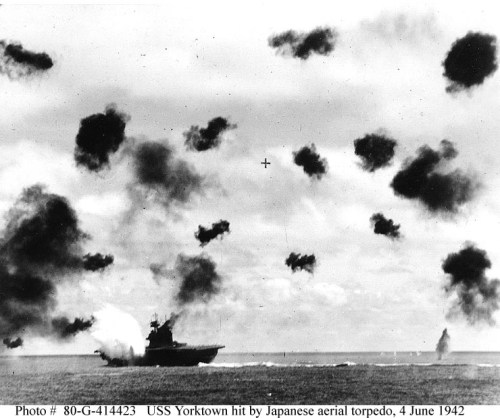
yorktown under attack

Hiryu’s second strike composed of Kate Torpedo Bombers discovered Yorktown, and since she appeared undamaged the squadron leader assumed that she was another carrier. Yorktown’s reduced CAP was unable to stop the Kates and the Japanese scored 2 torpedo hits causing another loss of power and a severe list.  Thinking that she might capsize, her captain ordered that she be abandoned.
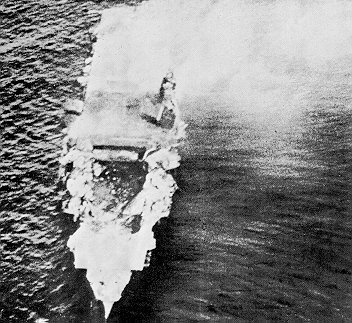
hiryu_via_hosho_ac

The Damaged Hiryu

As this was occurring a mixed attack group from the Enterprise and now “homeless” Yorktown aircraft attacked Hiryu. Like her sisters she was caught with her flight deck full of fueled and armed aircraft preparing for another strike against the Americans. The damage to the brave ship was mortal. Her crew abandoned ship and she sank the following day.

Yorktown would be sunk by a Japanese submarine, along with the destroyer Hamman a few days later as her crew attempted to get her to Pearl Harbor. In five pivotal minutes the course of the war in the Pacific was changed.

A Final Ignominy
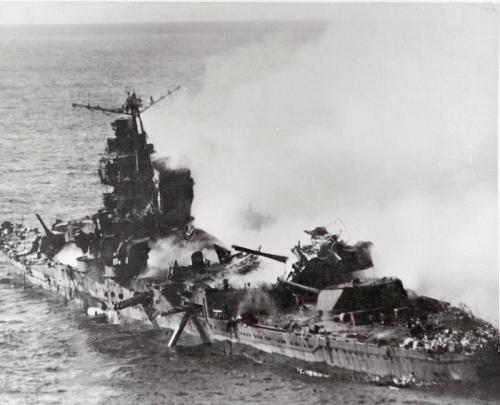
mikuma

Admiral Yamamoto was still attempting to digest the calamity that had befallen Admiral Nagumo’s carrier task force. In the shocked atmosphere of the mighty Super Battleship Yamato’s command center the Staff of the Combined Fleet was hastily attempting to arrive at a solution which might reverse the disaster and bring victory.  Admiral Ugaki, Yamamoto’s Chief of Staff, despite strong personal doubts, ordered Vice Admiral Nobutake Kondo to prepare for a night surface engagement with the US Fleet and dispatched a strong surface force to bombard Midway in order to prevent the Americans from reinforcing it and to prevent its further use against his forces should the invasion move forward.  Kondo then organized his fleet to attempt to find the American carriers and bring them to battle before dawn.

Kondo detached Vice Admiral Takeo Kurita’s Close Support Group composed of Cruiser Seven, the fastest and most modern cruisers in the Imperial Navy proceed at full speed to attack Midway.  Kurita’s cruisers, the Kumano, Suzuya, Mikuma and Mogami were each armed with 10 8” guns and were escorted by the two destroyers.

Kurita’s force was 80 miles from Midway when Yamamoto realizing that his plan was unrealistic ordered Kondo’s forces to retreat and rendezvous with his main force shortly after midnight. The order was met with a measure of relief by most officers in the force and the force turned northwest and steamed at 28 knots to meet the Main Body.  At 0215 lookouts on Kumano sighted a submarine on the surface which turned out to be the USS Tambor which had been shadowing the group, and made a signal for the force to make a emergency 45 degree turn to port.

During the process Mogami’s Navigator took over from the watch to oversee the tricky maneuver. In doing so he thought that there was too much distance between him and the ship ahead, the Mikuma. So he adjusted his course to starboard and then realized his mistake. The ship he thought was Mikuma was actually Suzuya and Mikuma was directly ahead. As soon as he recognized his mistake Mogami’s Navigator ordered a hard turn to port and reversed the engines but it was too late. Mogami’s bow crashed into Mikuma’s port quarter. The impact caused minimal damage to Mikuma but Mogami was heavily damaged. She lost 40 feet of her bow and everything else was bent back to port at right angles to her number one turret.

Mogami’s damage control teams isolated the damage and worked the ship up to 12 knots. This was not fast enough for Kurita to make his rendezvous so he left Mikuma and the destroyers to escort Mogami while he steamed ahead with Kumano and Suzuya.

Tambor’s skipper LCDR John W Murphy sent a contact report at 0300 reporting “many unidentified ships.” He followed this with more detailed information and the Americans on Midway began to launch its remaining serviceable aircraft to attack the threat. A flight of B-17 Bombers launched at 0430 could not find the Japanese ships but at 0630 a PBY Catalina found the Japanese and radioed Midway “two Japanese battleships streaming oil.”  The remaining 12 aircraft of VSMB-241 under command of Captain Marshall Tyler a mix of SBD Dauntless and SB2U Vindicators took off at 0700. His force attacked at 0808 scoring no hits. However, Marine Captain Richard Fleming, his Vindicator on fire dropped his bomb and then crashed his aircraft into Mikuma’s after turret. Sailors aboard Mogami were impressed, the American had sacrificed himself in a suicide attack worthy of the Samurai. The fire was sucked down air intakes into the starboard engine room with disastrous results. The Mikuma’s engineers were suffocated by the smoke and fumes and Mikuma was greatly reduced in speed.

The two ships limped northwest at 12 knots escorted by the destroyers and were unmolested through much of the day with the exception of an ineffective attack by the B-17s at 0830. The following morning the Dive Bombers of Enterprise and Hornet were at work and found the crippled Japanese ships. Waves over US Dive Bombers attacked the cruisers throughout the morning and into the afternoon. Mikuma was hit at least 5 times and secondary explosions of ammunition and torpedoes doomed the ship. Mogami was also heavily damaged but remained afloat while both destroyers received bomb damage.  At sunset the tough cruiser rolled over to port and sank into the Pacific. Mogami whose damage control teams had performed miracles to keep their ship afloat helped the destroyers rescue survivors from Mikuma.  Only 240 were rescued with 650 officers and sailors going down with the ship.

The action against the cruisers ended the combat operations at Midway. The Japanese ships were doomed by Yamamoto’s decision to try to salvage victory from defeat and the error of Mogami’s Navigator during the emergency turn when Kumano sighted Tambor. The only thing that kept the result from being total was the efficacy of Mogami’s damage control teams.  Mogami was out of the war for 10 months following repairs and conversion to an Aircraft Cruiser in which her aft turrets were removed to increase the number of float plane scouts that the ship could carry. She rejoined the fleet in April 1943 and was sunk following the Battle of the Surigao Strait on 25 October 1944.

The Mogami and Mikuma proved to be tough ships to sink. Unprotected by friendly aircraft they fought hard against the unopposed American Dive Bombers. They suffered massive damage from 500 and 1000 pound bombs, both direct hits and near misses. Mogami was saved by the skill of her damage control teams and the foresight of her Damage Control Officer to jettison her torpedoes so that they did not explode and compound the damage wrought by the American bombs.

Epilogue

At Midway a distinctly smaller force defeated a vastly superior fleet in terms of experience, training and equipment. At the very moment that it appeared to the Japanese that they would advance to victory their vision disappeared. In a span of less than 5 minutes what looked like the certain defeat of the US Navy became one of the most incredible and even miraculous victories in the history of Naval warfare. In those 5 minutes history was changed in a breathtaking way. While the war would drag on and the Japanese still inflict painful losses and defeats on the US Navy in the waters around Guadalcanal the tide had turned and the Japanese lost the initiative in the Pacific never to regain it.

The Japanese government hid the defeat from the Japanese people instead proclaiming a great victory. The American government could not fully publicize the victory for fear of revealing the intelligence that led to the ability of the US Navy to be at the right place at the right time and defeat the Imperial Navy.

The American victory at Midway changed the course of the war in the Pacific. The Battle of Midway established the aircraft carrier and the fast carrier task force as the dominant force in naval warfare which some would argue it still remains. Finally those five minutes ushered in an era of US Navy dominance of the high seas which at least as of yet has not ended as the successors to the Enterprise, Hornet and Yorktown ply the oceans of the world and the descendants of those valiant carrier air groups ensure air superiority over battlefields around the world today.

1 Comment

Filed under History, Military, Navy Ships, US Navy, World War II at Sea, world war two in the pacific

“We Can Accomplish Anything Provided No One Cares Who Gets the Credit.” Remembering Captain Joseph Rochefort and the Battle of Midway

rochefort

Friends of Padre Steve’s World,

This week many people, especially those in the Navy, will be remembering the Battle of Midway on its 75th anniversary. The victory at Midway would not have happened without the exceptional intelligence gathering and code breaking by the cryptologists of Combat Intelligence Unit – Station Hypo – at Pearl Harbor under the command of Commander Joseph Rochefort. He and his small yet skillful team cracked the Japanese Naval code in time for Admiral Chester Nimitz to make the correct decision as to where to send his tiny carrier task forces to oppose the massive Japanese Combined Fleet under the Command of Isoroku Yamamoto.

Rochefort’s efforts were opposed by the key officers in the Office of Naval Intelligence who refused to believe that Midway was the target of the Japanese force. In spite of this opposition Nimitz was highly confident of Rochefort’s analysis and when all was said and done the U.S. Navy had defeated the Japanese, sinking four of the carriers that had attacked Pearl Harbor as well as a heavy cruiser, ripping the heart out of Japan’s premier naval striking force.

Historian Walter Lord wrote:

“Against overwhelming odds, with the most meager resources, and often at fearful self-sacrifice, a few determined men reversed the course of the war in the Pacific. Japan would never again take the offensive. Yet the margin was thin—so narrow that almost any man there could say with pride that he personally helped turn the tide at Midway. It was indeed, as General Marshall said in Washington, “the closest squeak and the greatest victory.”

One of those men was Joseph Rochefort. Admiral Nimitz credited Rochefort for breaking the codes and setting the stage for the victory, and recommended him for the Distinguished Service Medal, however, Rochefort’s rivals in Washington D.C. ensured that the award was turned down in order to claim the success for them. Shortly after Midway, Rochefort was reassigned to command a floating dry dock in San Francisco by the Department of the Navy as a way to punish him, and effectively ending his career. Rochefort retired as a Captain after the war, his contribution to the victory at Midway unrecognized by the Navy. Admiral Nimitz again recommended him for the award of the Distinguished Service Medal in 1958 and again it was turned down, but his supports continued to work to right the injustice.

In 1983 Rear Admiral Donald Showers who had worked for Rochefort in 1942 again recommended the award to Secretary of the Navy John Lehman who approved it. Unfortunately Rochefort was no longer alive to receive it, he had died in 1976. Today his service to the Navy and nation is remembered with the annual Captain Joseph Rochefort Information Warfare (IW) Officer Distinguished Leadership Award which is awarded to annually recognize the superior career achievement of one IW officer for leadership, teamwork, operational contributions and adherence to the principle by which he served, “We can accomplish anything provided no one cares who gets the credit.”

Have a great day and please don’t forget men and women who embody the spirit of Joseph Rochefort, it is a rare commodity.

Peace

Padre Steve+

1 Comment

Filed under History, Military, Navy Ships, World War II at Sea, world war two in the pacific