Category Archives: national security

Hate vs. Hate: A Clash in Garland

ss1-copy

“We think we’ve come so far. Torture of heretics, burning of witches it’s all ancient history. Then – before you can blink an eye – suddenly it threatens to start all over again.” Jean Luc Picard Star Trek the Next Generation – the Drumhead

Well the direct confrontation and collision between radical Moslems and their most radical opponents has finally happened. American Moslem Jihadists attack a gathering where those who hate Moslems are doing their best to incite Moslems to violence in Garland. Hate met hate and sadly, I fear this is just the beginning.

elton-simpson-1_thumb

Elton Simpson

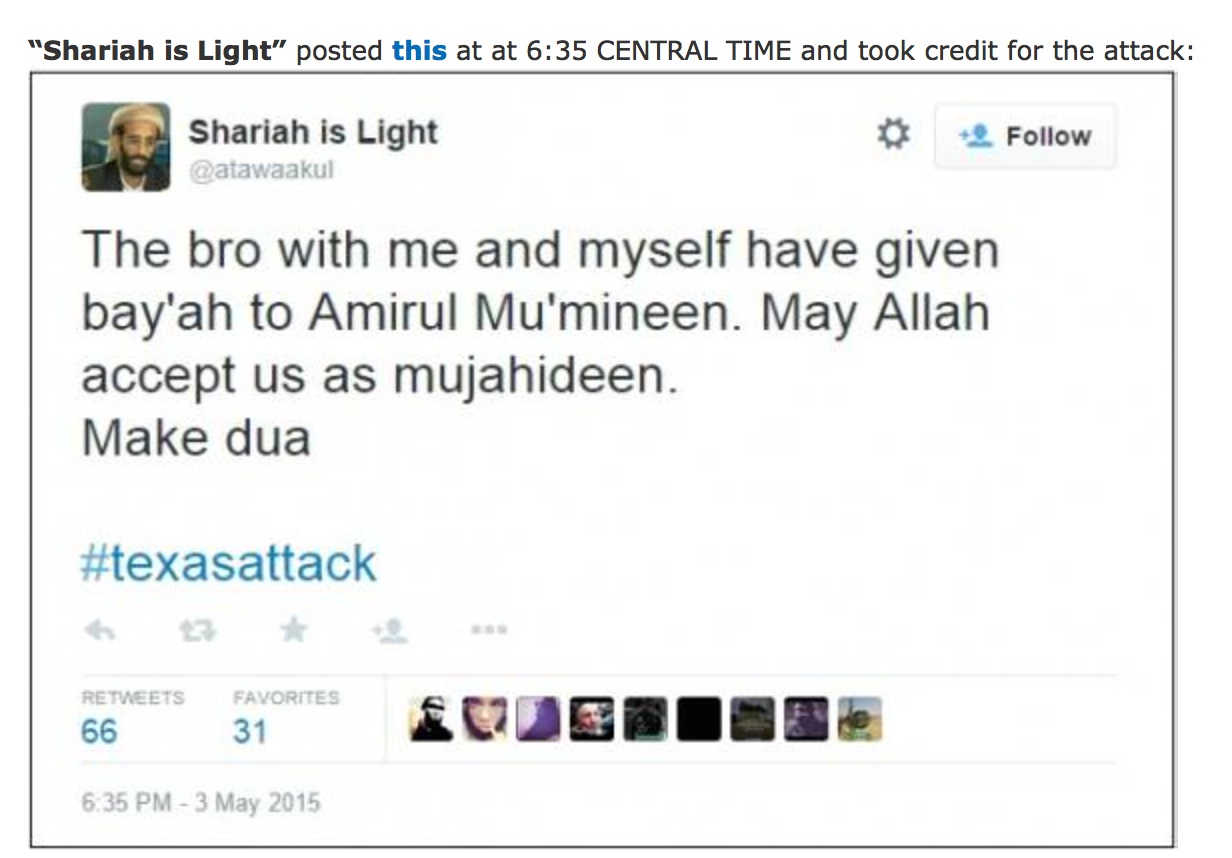
The attackers, one named Elton Simpson from Phoenix who had previously been convicted about lying about his involvement with terror groups and a second who was likely his room-mate were killed when they opened fire outside the event wounding a security guard in the ankle. Just prior to the attack Simpson sent out a twitter message with the hashtag #texasattack stating “May Allah accept us as mujahideen.”

albritani

AbuHussainAlBritani

Over the past few week various members of the Islamic State (ISIS or ISIL) have encouraged attacks on this particular gathering. The attacks were cheered by AbuHussainAlBritani (@_AbuHu55ain) on Twitter who may also have helped direct them. Four hours before the attack he tweeted: The knives have been sharpened, soon we will come to your streets with death and slaughter! #QaribanQariba . During and after the attack he continued to tweet:

My friends, if you ask me those are fighting words that need to be taken deadly serious.

The event Simpson and his accomplice attacked was sponsored by the American Freedom Defense Initiative headed by well-known racist and Moslem baiter Pamela Geller who has determined that all Moslems are the enemy. Like the Southern Poverty Law Center I believe that it is a hate group, but that being said even hate groups have free speech rights and should not be violently attacked.

The event supposedly promoted standing with “free speech” rights and was dedicated to standing in solidarity with the staff of the Charlie Hebdo magazine which was slaughtered by Islamic terrorists in January. Critics said it was an anti-Moslem gathering and there is some truth in that statement and I am inclined to classify it as such because I know what Geller stands for. It included a speech given by Dutch right-wing, anti-Moslem and some would say Fascist politician Geert Wilders. However, the highlight of the event was the completion to draw a cartoon image of the Prophet Mohammed, which is considered blasphemous by Moslems. The prize was $10,000 for the best rendition of the Prophet. Of course by “best” I would assume this would be the most hateful, inflammatory and derogatory defection, without the often brilliant satire of the murdered staff of Charlie Hebdo. There is a difference between hate and racism versus satire and I’m sure that knowing Geller and those devoted to her cause that this was not satire, and was probably more like Julius Streicher’s depiction of Jews in Der Sturmer. The irony that Geller, a Jewish woman would employ the hatred and racist pornography of the Nazi Streicher in her attacks on Moselms is not lost on me. 

Now as much as I despise Geller and her ignorant and hate filled screeds against all Moslems I stand with her in regard to free speech, even that with which I disagree. I also know that for Geller that free speech is a one way street. Likewise I question the wisdom of conducting the event, knowing that it might provoke a violent response, but I do not think for a moment that such speech should be banned, and no civilized person or group would ever violently attack such a gathering. Sadly Geller’s actions play right into the hands of the Moslem extremists. 


1348081765_074872_1348081855_noticia_normal

Stéphane Charbonnier of Charlie Hebdo- Murdered in Cold Blood

Over the past couple of years and especially over the past few months we have seen an increase in such attacks by radicalized Moslems on those who they believe have blasphemed the Prophet. Charlie Hebdo in Paris, an attack on a coffee shop in Australia, and an attack on a free speech event in Copenhagen Denmark. After the Charlie Hebdo attack the Al Qaeda Arabian Peninsula (AQAP) group claimed credit for the attack. One of its leaders, Sheikh Usama (RA) said in his message to the West: “If there is no check on the freedom of your words, then let your hearts be open to the freedom of our actions.” 

Of course such words are a declaration of war against free speech.

breivik

Anders Behring Breivik killed 69 and wounded 110 mostly children

Likewise there have been attacks by right-wing and often allegedly “Christian” people against Moslems, or people who just happened to look like Moslems. Anders Behring Breivik, a Norwegian went into action to kill the enemies of Western Civilization and Christian culture on July 22nd 2008.  In an assault that included a car bomb which killed 8 people and wounded 209 and an attack on a youth camp which killed 69 and wounded another 110, almost all of them children.

wade-michael-page-nazi-flag

Wade Page

Wade Page, a neo-Nazi and White Supremacist attacked a Sikh Temple, confusing it with a Moslem gathering killed 6 people and wounded many more who had simply come to worship before he was killed by police.

hicks

In February three America students at University of North Carolina were gunned down execution style in their home by Craig Stephen Hicks. According to those who know Hicks hated all religion and was quite angry at the Christians and Jews who participated together with Moslems and others in the ecumenical memorial services after the attacks of September 11th 2001.

The key ingredient in all of these attacks no matter who is conducting them is a hatred of the other, a passionate hatred that Eric Hoffer noted “can give meaning and purpose to an empty life. These people haunted by the purposelessness of their lives try to find a new content not only by dedicating themselves to a holy cause but also by nursing a fanatical grievance.”   

The sad thing is that I believe that this is just the beginning. The whole purpose of those radicalized to hate other with such passion to bring about an ideological-religious war between Islam and the West. The cycle of violence will increase until it boils over as it is incited by extremists of all types, Moslem, Christian, Jewish, Atheist, you name them. Real honest debate and dialogue has been replaced by the most base and vitriolic attacks and violence and that my friends is why this is just the beginning.

I am a realist and I fear for what happens when eventually people connected to the Islamic State conduct a strike on an America city or event with a nuke, dirty-bomb, chemical agent or biological agent which causes mass causalities and destruction. Mark my words it will happen no matter how hard we try to prevent it. When it happens the Geller’s of the world will use it to justify all means of attacks and persecution of Moslems in this country, the vast majority of whom are innocent, law abiding and loyal Americans. It will be worse that what we did to American citizens of Japanese descent after Pearl Harbor, and I would not be surprised Moslems rounded up and their property vandalized or seized.

I for one am glad that the terrorists did not succeed and were killed but there will be more and they will undoubtedly will be more competent and deadly than Simpson and his accomplice ever dreamed of being.

Peace

Padre Steve+

2 Comments

Filed under civil rights, faith, national security, Political Commentary, terrorism

A Question for Tom Cotton and Other War Mongers

cotton

I have been at my denominational Chaplain and Pastoral Counselor conference and we were talking about the concept of Moral Injury.  Sadly the concept while real is so misunderstood. Many in the Christian psychotherapy and pastoral counseling world have reduced the concept to what the soldier did on a battlefield that causes him problems and which he must confess to God to be forgiven. But the bigger issue in moral injury is not that, it is the betrayal of trust by the nation of those that they send to war for the most spurious and often illegal and immoral reasons.

Most people who join the military are idealistic and have a trust of their government, their leaders, their military services and even their churches and God that is a major part of their life. Sadly, that trust is betrayed when the nation sends them into wars which are illegal, immoral and place them in situations where they do or see things that break that trust often forever. This happened to many of our Vietnam vets and is happening again to those of us who served in Iraq or Afghanistan.

Sadly, most Americans, about 99% have no skin in this game. The young men and women who go to war represent far less than one percent of the American population. Many ethnic minorities and come from either the middle class or the poor. Likewise, a growing percentage are men and women who grew up as military brats. I’m one of those, but I see a lot more now. In World War II even the political and economic elites sent their sons to war, but this is not the case today. In fact it is hard to name the children of any national political or corporate leaders who have served in Iraq or Afghanistan. The only one that comes to mind to me is Vice President Joe Biden’s son Beau, who served in Iraq.

But even as we still struggle to deal with the results of the Iraq blunder, there are those who foolishly desire to involve this nation in another war. A war which can have no good outcome and which when push comes to shove few will oppose, because other than the incredibly small minority that serve in the military, no one has any skin in the game.

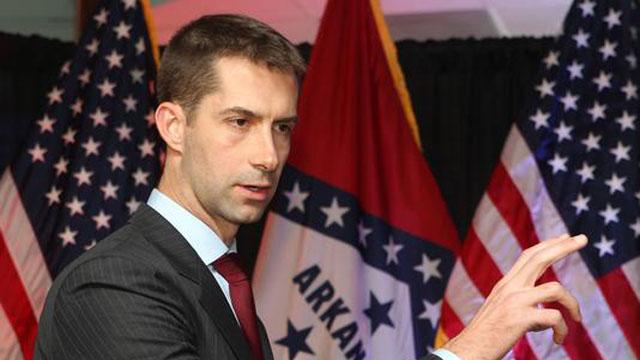
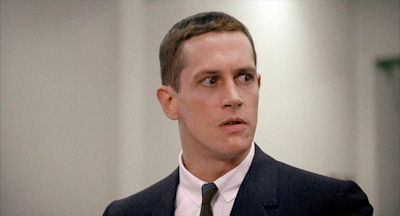
Senator Tom Cotton, a former Army Lieutenant and Iraq veteran, with about as much sense as Doug Neidermeyer from Animal House is beating the drums of war with Iran saying that any military action against Iran would be short and easy. Senator Cotton-Neidermeyer say that it would require just a few days of bombing to complete the mission of crippling Iran’s nuclear program.

Of course he is not alone there is a rising chorus of war mongers who want yet to wage another preemptive war. This would be a war that baring a direct attack of Iran on the United States or an ally that we are bound by treaty to defend would be illegal under every international convention. It would be comparable to the actions of Nazi Germany in its wars of aggression that we sent Nazi leaders to the gallows at Nuremberg.

U.S. Supreme Court Associate Justice Robert Jackson who served as the American prosecutor and worked with our allies to set up the Nuremberg proceedings made this comment which always should be for most in the mind of any American leader when considering going to war: “If certain acts of violation of treaties are crimes, they are crimes whether the United States does them or whether Germany does them, and we are not prepared to lay down a rule of criminal conduct against others which we would not be willing to have invoked against us.” Justice Robert Jackson International Conference on Military Trials, London, 1945, Dept. of State Pub.No. 3080 (1949), p.330.

neidermeyer

If Senator Cotton-Neidermeyer gets his war, baring an Iranian attack on us or one of our allies it be illegal an tantamount to what we put the leaders of the Third Reich on trial for.  Likewise, it would be like the one waged against Iraq one waged under false pretenses which cost so many lives, bled the nation’s treasury dry and reduced our trust and standing in the world.  

We sowed the wind in Iraq, and with climatic struggle between the Islamic State and the Iraqi Shia, supported by Iranian Revolutionary Guards, are reaping the whirlwind. 

Senator Cotton seems not to get the fact that in any war the enemy gets a vote, and the Iranians, even if we manage to cripple their nuclear program will certainly exact a price in blood and treasure that Lieutenant Cotton-Neidermeyer does not seem to understand or appreciate. U.S. ships in the Persian Gulf will have to right off salvos of anti-ship missiles, swarm attacks by Iranian missile and torpedo boats as well as air attacks and submarines. No matter how well we do in defending against these attacks it is undoubtable that ships will be damaged or even sunk and many, maybe even hundreds or thousands of sailors killed, something not seen since World War Two. Likewise the U.S. installations in Bahrain and Qatar will be bombarded with hundreds of short and medium ranged missiles many which will get through our missile defense systems.

When the bodies of our dead military personnel come back, will Senator Cotton be there to meet them? I doubt it because for him, they are just the cost of war. Will he and his allies increase support for the bereaved families, or the wounded? I doubt it, because all of them are bent of cutting the benefits to the wounded, the broken and those shattered by war, because such expenditures get in the way of lining the pockets of their benefactors.

Yes, they will beat their chests and talk about “our heroes” and castigate as traitors those who opposed the war that they brought about in order to cover their guilt.

While we would eventually prevail in such an exchange it would be disastrous and further weaken our military as well as our standing in the world. But then there is the moral question, especially for those who like Senator Cotton and so many of the others who advocate an illegal, immoral preemptive war of aggression who claim to be Christians need to ask.

That question was asked by the iconic hero of the American Civil War Joshua Chamberlain on the front lines at Petersburg in the closing days of that war: “…men made in the image of God, marred by the hand of man, and must we say in the name of God? And where is the reckoning for such things? And who is answerable? One might almost shrink from the sound of his own voice, which had launched into the palpitating air words of order–do we call it?–fraught with such ruin. Was it God’s command that we heard, or His forgiveness that we must forever implore?” 

That my friends is what Senator Cotton and others of those who advocate yet another war of aggression need to answer.

Peace

Padre Steve+

5 Comments

Filed under afghanistan, ethics, faith, Foreign Policy, History, iraq, leadership, Military, national security, PTSD

War is Cruelty

481801_10151367001287059_1003164983_n-1.jpg

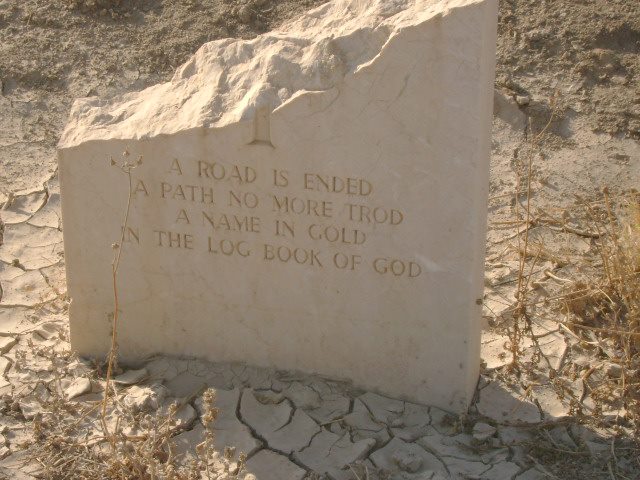
Destroyed Tombstone at the British Cemetery: Habbinyah Iraq  

I am a career military officer, an Iraq veteran and an anti-war liberal, but I am also a realist in terms of the world. I have no illusions about the world. I do not believe that the United States always acts with honor and I know in my heart of hearts that much of the chaos that we are seeing in the world, particularly the Middle East comes from years of American intrigue and intervention. But I also know that once you have let the genie of war and chaos out of the bottle that it seldom returns to it without creating more chaos, death and destruction. Since I am a realist, I understand that whether I want it or not, and regardless of who is President that this war will remain part of our lives, maybe for a generation or more. Thus we have to understand that this war is not a movie, it is not a video game, and it has the potential to change all of our lives, and not for the better.

I fully agree with two time Medal of Honor Winner and Marine Corps Major General, Smedley Butler who wrote in his book War is a Racket:

“What is the cost of war? what is the bill?…This bill renders a horrible accounting. Newly placed gravestones. Mangled bodies. Shattered minds. Broken hearts and homes. Economic instability. Depression and all of its attendant miseries. Back -breaking taxation for generations and generations. For a great many years as a soldier I had a suspicion that war was a racket; not only until I retired to civilian life did I fully realize it….”

Today I am taking some time to write about the nature of war. It is something that the vast majority of Americans have only vicariously experienced in news accounts, movies, television shows and video games which desensitize people to the horror of war as they kill virtual enemies in often the most violent ways. Abraham Lincoln noted “There’s no honorable way to kill, no gentle way to destroy. There is nothing good in war. Except its ending.”

This is amazing since we have been at war for over thirteen years now. This war has been extended indefinitely by the actions of the Islamic State and the announced intentions of President Obama to fight. Sadly, it will become much worse than people want to believe regardless of whether it is a long or a short war and believe me it will not be a short war. The Islamic State seems to up the ante every day with new atrocities against the peoples of the areas that they control, desecration of religious shrines and the destruction of irreparable historical sites and artifacts.

Americans have grown up for the past twenty years with hi-tech wars that with a few exceptions of terrorism inflicted on American civilians have been waged by a comparatively small professional military; a military that at any given time over the last 20 years has comprised less than one percent of the American population. As such war is a spectator sport for most Americans, we watch it on television, or on You Tube videos on the internet, but it is a distant thing, happening to others that doesn’t touch us too deeply because most of us think that we have no skin in the game. In fact people that bet on baseball have more skin in the game than most Americans do in the current war, but that will probably change.

Since I have written much about that military at its sacrifices in the war that began on September 11th 2001 I am not going to belabor that today. Instead I am going to go back to the nature of war, even wars that may be fought in self-defense and with just cause. It was General William Tecumseh Sherman who wrote:

“You cannot qualify war in harsher terms than I will. War is cruelty, and you cannot refine it; and those who brought war into our country deserve all the curses and maledictions a people can pour out…

Chris Hedges wrote: “Violence is a disease, a disease that corrupts all who use it regardless of the cause,” and as Clausewitz noted of war’s nature, that it is: “a paradoxical trinity-composed of primordial violence, hatred and enmity…”

We try to use language to soften war; to make it more palatable, but to do so is an Orwellian charade that is deceptive and destructive to the soul. Dave Grossman, the army infantry officer who has spent his post military life writing about the psychology of war and killing wrote:

“Even the language of men at war is the full denial of the enormity of what they have done. Most solders do not “kill,” instead the enemy was knocked over, wasted, greased, taken out, and mopped up. The enemy is hosed, zapped, probed, and fired on. The enemy’s humanity is denied, and he becomes a strange beast called a Jap, Reb, Yank, dink, slant, or slope. Even the weapons of war receive benign names- Puff the Magic Dragon, Walleye, TOW, Fat Boy, Thin Man- and the killing weapon of the individual soldier becomes a piece or a hog, and a bullet becomes a round.”

Likewise Thucydides wrote:

“Words had to change their ordinary meaning and to take that which was now given them. Reckless audacity came to be considered the courage of a loyal supporter; prudent hesitation, specious cowardice; moderation was held to be a cloak for unmanliness; ability to see all sides of a question incapacity to act on any….”

Such language gives those who have never been to war but cannot live without it to bring it on, but as Sherman noted: “It is only those who have neither fired a shot nor heard the shrieks and groans of the wounded who cry aloud for blood, more vengeance, more desolation. War is hell.”

President Obama in his address to the nation, and the world on the eve of September 11th talked of a war against the Islamic State, using far more diplomatic, restrained and less warlike language than did Vice President Biden who said:

“As a nation we are united and when people harm Americans we don’t retreat, we don’t forget. We take care of those who are grieving and when that’s finished, they should know we will follow them to the gates of hell until they are brought to justice because hell is where they will reside. Hell is where they will reside.”

I commend the President for his humanity and desire to fight the Islamic State with a matter of restraint. That restraint will last so long as the Islamic State is unable or unwilling to strike at American civilians in the American homeland, or in a country that is not in the war zone, or an American ship or military installation at home or abroad. But once that happens, and it will the pretense of restraint will drop and what the Vice President said will become our goal, even if we do not officially say it. But once those restraints are passed, the war will get really messy. Michael Walzer wrote in his book Just and Unjust Wars:

“We don’t call war hell because it is fought without restraint. It is more nearly right to say that, when certain restraints are passed, the hellishness of war drives us to break with every remaining restraint in order to win. Here is the ultimate tyranny: those who resist aggression are forced to imitate, and perhaps even to exceed, the brutality of the aggressor.”

The problem with this war is that it has lasted so long already, and such long wars are detrimental to the nations and peoples that fight them, as Sun Tzu wrote: “There is no instance of a nation benefitting from prolonged warfare,” as such the longer we drag this war against the Islamic State and other similar groups out, the longer the war continues, the crueler it will become and the more damage it will do to our civil liberties, our economy and even more importantly to the spirit of our nation. One can only look at the Patriot Act and related measures undertaken in the name of national security after 9-11-2001 and recall the words of President John F Kennedy who said in respect to the epidemic of loyalty oaths and restrictions on civil liberties enacted in the 1950s:

“We have also seen a sharpening and refinement of abusive power. The legislative investigation, designed and often exercised for the achievement of high ends, has too frequently been used by the Nation and the States as a means for effecting the disgrace and degradation of private persons. Unscrupulous demagogues have used the power to investigate as tyrants of an earlier day used the bill of attainder.

The architects of fear have converted a wholesome law against conspiracy into an instrument for making association a crime. Pretending to fear government they have asked government to outlaw private protest. They glorify “togetherness” when it is theirs, and call it conspiracy when it is that of others.”

Thus the place that we now find ourselves is not good. On one hand by using restraint the war goes on and on, war without end, and if we embrace Sherman’s realism and admit that “War is cruelty. There’s no use trying to reform it. The crueler it is, the sooner it will be over” is that we will imitate or exceed the brutality of the Islamic State. Either way, we lose something of ourselves.

My hope is that somehow, when this is war is done, maybe in our time or in another generation or two, that we will be able to establish peace by making our enemies our friends.

Peace

Padre Steve+

3 Comments

Filed under Foreign Policy, History, iraq,afghanistan, middle east, Military, national security, News and current events

Warmongers, Chicken Hawks & War Porn Addicts

Iraq-unrest

Make no bones about it, the Islamic State, or ISIL needs to be defeated. It is evil, it is ruthless and it is a danger to the people that it controls and those in its path. Likewise it sates that it has larger goals. Because of this many Americans, over 60 percent in the most recent poll favor sending in ground troops to fight the Islamic State. Politicians talk about sending, 5,000, 10,000 or other nice round numbers of troops which they seem to pull from thin air as fast as they can. Others not only want to take on ISIL, but that the same time seem to want to go after Iran as well. Benjamin Netanyahu got a great round of applause for that boner strategy.

But the real fact of the matter is that American boots on the ground are not the answer. Now can American troops help, most certainly, but despite our great technological ability to kill our enemies and overrun territory, we are not the people to win this war.  The Iraqi Sunni and Shia to get their shit together to beat these guys. T.E. Lawrence so wisely wrote:

“Do not try to do too much with your own hands. Better the Arabs do it tolerably than that you do it perfectly. It is their war, and you are to help them, not to win it for them. Actually, also, under the very odd conditions of Arabia, your practical work will not be as good as, perhaps, you think it is.”

Sadly we ignored that and like the British efforts, our efforts to invade, conquer and re-make Iraq in our image have failed miserably. Our failure is as poetic and terrible as Lawrence’s description of British efforts:

“We had been hopelessly labouring to plough waste lands; to make nationality grow in a place full of the certainty of God… Among the tribes our creed could be only like the desert grass – a beautiful swift seeming of spring; which, after a day’s heat, fell dusty.”  

But to the warmongers, the Chicken Hawks and the War Porn addicts who have no skin in the game this counsel doesn’t matter. Despite the fact that American soldiers, sailors, marines and airmen have been continuously in combat or supporting combat operations for the last thirteen and a half years, this country is not a country at war.  That was something that was shattering for me to realize when I stepped off the plane coming home from Iraq. Believe me, there is a big difference between saying “I support the troops” and having skin in the game.

The fact is that all of those who beat the drums of war but are unwilling to pay the cost, be they the Politicians, Pundits and Preachers, the Trinity of Evil as I call them, or their war addicted followers don’t care about the troops.  In my book the war-mongering preachers are the worst of the lot, but then some of those guys like Mike Huckabee are not only preachers, but politicians and pundits, I guess that must be a new twist on the biblical “prophet, priest and king” thing.  But even as these people counsel war, they refuse to raise taxes to support it, or even pay for the equipment needed by the troops. Likewise, they refuse to make national service, including the military draft a part of national policy. Why don’t we do this? The fact is that then we as a nation would actually have to have skin in the game, give up some of our luxuries and lace up the boots and go to war.

But we will die before we raise taxes or institute the draft. Politicians that suggest such things are driven out of office. Instead we will rely on that under one percent of our population who have shouldered the burden of war for over a decade, even while our political and business leaders scheme to find ways to cut military pay and benefits, especially those medical benefits incurred while serving.

It’s funny, well, no, it’s not funny, that the people leading this charge to war are the same assholes who brought about the Iraq debacle in the first place. But be assured, just as last time their sons and daughters will no serve, and they will not only not be held accountable, but they will profit from the war, just as they have since the days of Smedley Butler.

The fact is that those who brought about this debacle from the Bush administration should be tried as war criminals. But now we have potential Republican presidential candidates, and I might add Evangelical Christians say that there should be no war crimes, that war crimes are not bad, I guess as they are not being committed against us, but I digress.

Supreme Court Justice Robert Jackson, who led the prosecution of the major Nazi War Criminals at Nuremburg wrote something that men like Ben Carson, Mike Huckabee and others cannot seem to fathom:

“If certain acts of violation of treaties are crimes, they are crimes whether the United States does them or whether Germany does them, and we are not prepared to lay down a rule of criminal conduct against others which we would not be willing to have invoked against us.”

I say that there is a special place in hell for the warmongers, Chicken Hawks and War Porn addicts who are so willing to throw other people’s kids into wars that are unwinnable, if those who we are there to defend do not step up and do their part.

So with that my friends I wish you a happy and fun Friday.

Peace

Padre Steve+

2 Comments

Filed under Foreign Policy, History, iraq,afghanistan, middle east, Military, national security, Political Commentary

“They Won’t Get in Our Way…” to Armageddon

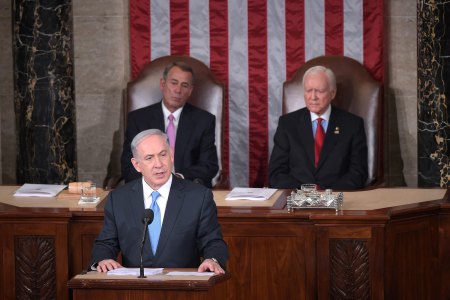
US-ISRAEL-CONGRESS-NETANYAHU

“I know what America is. , move it in the right direction. They won’t get in our way…” Prime Minister Benjamin Netanyahu 2001

Yesterday I watched the address of Israeli Prime Minister Benjamin Netanyahu as it occurred live. I watched as the majority of our elected Senators and Congressmen, seem to hang on every word and rise to give thunderous applause to Netanyahu’s blatant attempt to not just hijack but to commandeer U.S. foreign policy to serve Israel. If any other foreign leader had been invited by any other party to do the same at any point in our history there would be an outcry.

 Now please do not get me wrong. Iran is an enemy, they continually work against us in attempting to destabilize the Middle East and advance their Shia’ Moslem version of the Apocalypse. However, they are very pragmatic and with the major demographic shifts there could easily come a point when the young people of Iran, tired of the repression of the Mullah’s overthrow them. Likewise I do believe that the Iranian nuclear program must be monitored and if it looks as if they are about to produce a bomb that can be delivered by air or missile that could harm us or any ally that they will have to be stopped. I have written about this before so I will not go into that here. Likewise, before calling me anti-Semetic please look at the body of my writings which not only are supportive of Israel but those of a realist who understands that anything which involves the United States in yet another pre-emptive war is not in the interest of the United States or Israel. 

 At the same time the speech was insulting because the United States has given Israel everything that it ever has needed since its founding in 1948. American Presidents from Truman to Obama have bent over backwards to support Israel. In 1967 the Israeli Navy and Air Force launched a sustained coordinated attack on the USS Liberty during the Six Day War which killed 34 and wounded 171 United States Navy Sailors. The Israelis, despite evidence to the contrary, including the testimony of the crew of the Liberty claimed that they had mistaken the ship for an Egyptian destroyer. The Johnson administration accepted the Israeli version and quickly buried the incident.

In October 1973, if it had not been for the actions of Richard Nixon Israel very likely would have ceased to exist, Nixon rushed emergency supplies of tanks, aircraft and weapons aboard U.S. ships and cargo aircraft, and confronted the Soviets who were threatening to intervene. 

Since then we have provide Israel advanced weapons and weapons technology in abundance, we share intelligence with Israel that we share with no-one else, and we have always supported Israel in the United States every time there is an attempt to rebuke, condemn or sanction Israel. Even President Obama and his administration has done this with abandon. 

 And what credit do we get? We get a few meaningless platitudes from Netanyahu before he attempts to commandeer U.S. foreign policy with the active aid and support of John Speaker of the House Boehner, support that is in clear violation of one of the oldest laws dealing with foreign policy enacted by this country’s founders in 1799. 

 The speech and the reception of the Representatives and Senators who invited Netanyahu to give it and their wild adulation was not only insulting but flies in the face of what our every one founders believed reference foreign policy and relations and actually a clear violation of the Logan Act of 1799 that prohibits unauthorized citizens from negotiating with a foreign government.

The Logan Act reads:

“Any citizen of the United States, wherever he may be, who, without authority of the United States, directly or indirectly commences or carries on any correspondence or intercourse with any foreign government or any officer or agent thereof, with intent to influence the measures or conduct of any foreign government or of any officer or agent thereof, in relation to any disputes or controversies with the United States, or to defeat the measures of the United States, shall be fined under this title or imprisoned not more than three years, or both.” 

 And this my friends was exactly what happened here. While negotiating with members of the Israeli government as Speaker of the House, Boehner kept his efforts secret for over three weeks. Boehner only told the White House when he had secured a deal for the Israeli Prime Minister to address a Joint Session of Congress, which is in itself a highly unusual event. If fact Winston Churchill was the only foreign leader to receive such an invitation. I do not want to be cheeky, but Netanyahu is not a reincarnated Winston Churchill. Unlike Britain in late 1940 Israel has the capability of destroying every one of its enemies with its large stock of fully operational and deplorable nuclear weapons and delivery systems, most of the latter supplied by the United States and other Western Allies. 

Not only this, but the invitation coincided with the closing weeks of Mr. Netanyahu’s reelection campaign, and is a blatant attempt to sway Israel voters to vote for him.

What the Speaker did was unethical, illegal and against every founding principle of American foreign policy dating back to George Washington and John Adams.

The nearly orgasmic applause of the Republicans to every thing that Netanyahu said was sickening. Especially when Netanyahu demanded that  the United States walk away from the negotiation table, and especially when Netanyahu threatened to attack alone if necessary. Of course, knowing his audience, he said, he knows that would not happen. It was like watching them cheer on Armageddon. 

 Mr. Netanyahu knows that he can use fear to get Americans to do his bidding, as well as the beliefs of the militant Conservative Christians who pray for such a war in order for Jesus to return.

Netanyahu presented a very black and white image of the Middle East. It was as insulting as it was fear based, conflating Iran and the Islamic State competing “for the crown of militant Islam.” He said, “In this deadly game of thrones, there is no place for America or Israel…” and urged no middle ground short of destroying Iran. Netanyahu’s option was to walk away and offer Iran a deal that no nation with any self-respect would agree to, in fact walking away will usher in the war that Netanyahu says that the tactic will avoid. 

 The speech was eerily reminiscent of Netanyahu’s words to a Congressional committee in 2002 in the lead up to the Iraq War, which of course was such a success. Netanyahu has been using the same tactics to get the United States to do Israel’s bidding for two decades, capitalizing on America fears, and the underlying apocalyptic strain of American Evangelical Christianity which has found its way into the political mainstream. Back in 2002 Mr. Netanyahu said:

“There’s no question that [Saddam] has not given upon on his nuclear program, not [sic] whatsoever. There is also no question that he was not satisfied with the arsenal of chemical and biological weapons that he had and was trying to perfect them constantly…So I think, frankly, it is not serious to assume that this man, who 20 years ago was very close to producing an atomic bomb, spent the last 20 years sitting on his hands. He has not. And every indication we have is that he is pursuing, pursuing with abandon, pursuing with every ounce of effort, the establishment of weapons of mass destruction, including nuclear weapons. If anyone makes an opposite assumption or cannot draw the lines connecting the dots, that is simply not an objective assessment of what has happened. Saddam is hell-bent on achieving atomic bombs, atomic capabilities, as soon as he can.”

“Today the United States must destroy the same regime because a nuclear-armed Saddam will place the security of our entire world at risk. And make no mistake about it — if and once Saddam has nuclear weapons, the terror networks will have nuclear weapons.” 

 
“If you take out Saddam’s regime, I guarantee you that it will have enormous positive reverberations on the region… The task and the great opportunity and challenge is not merely to effect the ouster of the regime, but also to transform the region.” 

 The scary thing is that when you look at the Americans who most strongly “support” Israel, they are men like fundamentalist Christian zealots like John Hagee, and Tim LaHaye, who have spent the better part of fifty years preaching a version of Bible prophecy which for Jesus to return and institute his “millennial kingdom” Israel must be devastated by a war that claims two-thirds of Israelis before the “remnant” accept Jesus as their Messiah. By the way this point of view is also held by top contenders for the GOP nomination in 2016 for the GOP nomination in 2016 and many House and Senate GOP leaders. But, my friends, if you disagree with them, some of their “Christian” pundits will call you a traitor who should “be hanged” in from of the Capital Building. 

 Now, be assured, Netanyahu doesn’t believe that for a second, he is a cunning politician, and he has no problem using the political power of the people who believe this to get his way with America. I believe that this will in the long run be bad thing both for the United States and Israel. I think that it is unbelievably unwise and may create an actual rift between our countries and fracture what has been throughout our history a bi-partisan support for Israel, and for what reason, short term political gain, both in Israel and the United States by those that brought it on. 

 My objection to what happened yesterday was not that Iran should not be opposed, nor the security of Israel be compromised. My objection is that what happened yesterday was against everything that our founders believed in and violated the law. Of our land. 

As an American my loyalty is to this country and our Constitution, not to an errant and heretic view of scripture that surrenders American rights to the whim of a particular warmongering Israeli politician. Netanyahu is a politician who has more than once stated his disdain for this country and sees us as a means to achieve his end, even if that means committing the United States to a war from which no good can come.

 Mr. Netanyahu and his American allies pushed us into a war in Iraq which was disastrous, not only for the human lives lost and devastated, the reputation and image of this country, and the economic burdens incurred, but also because it has unleashed turmoil in the region far greater than anyone imagined.

I am an American and my allegiance is not to Israel, it is to this country and our Constitution. I will be damned if allow myself to be silent while religious zealots, be they American, Iranian, the Islamic State, or Jewish try to bring about their version of Armageddon.

 Peace

Padre Steve+

5 Comments

Filed under Foreign Policy, History, laws and legislation, national security, Political Commentary

Living in the National Security State

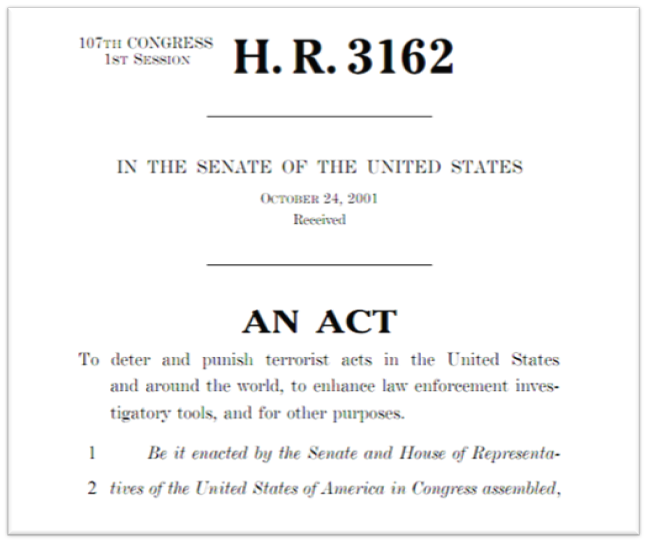
Patriot-Act-HR-3162

Inter Arma Enim Silent Leges, in time of war the law stands silent…

James Madison wrote that “A popular government, without popular information, or the means of acquiring it, is but a prologue to a farce or a tragedy; or, perhaps both.”

After September 11th 2001 the National Security State went into overdrive with the passage of the so called Patriot Act. That act opened the floodgates for an ever expanding national security state.

I have a lot of apprehension when I read the reports about the activities of the National Security Agency, other intelligence and police agencies at all levels of government and the pervasive erosion of civil rights.  The national security state and the seeming all pervasive security and surveillance apparatus which demolishes any sense of privacy, especially the protections enunciated in the Fourth Amendment and to some extent the First Amendment. Of course the use of similar methods by the private sector, often in conduction with government agencies is another concern, but that needs to wait for another day.

I also understand from history and empirical evidence that many others, many from unfriendly countries do not share those apprehensions. Many of these competitors are willing to use whatever openness that we have as a society against us, using similar technology and methods used by our intelligence, police, governmental and private sector. It makes for an ethical, legal and even constitutional conundrum. I know that I am not comfortable with this, and perhaps maybe none of us should be.

It is very easy on one hand in light of history, our Constitution and democratic process to condemn the NSA, the FISA courts and other lawfully constituted agencies and those that drafted the laws over the decades that allow the activities which they now conduct. The same can be said of foreign intelligence agencies which all engage in similar activities including the British GCHQ, the German Bundesnachrichtendienst and so many others including the Chinese and Russians.

Likewise it is equally easy in light of history, current events and national security concerns for people to jump to the other side of the fence and not only defend the activities of the NSA and agencies like it, and to demonize those that protest or expose such activities.

When I see the talking heads on cable news shows defending or condemning such activities and not agonizing over the complexity and issues involved I get worried. Because there are legitimate concerns voiced by critics as well as defenders. But since we live in an era of soundbites, gotcha and half-truths being portrayed as all truth I find it helpful to use either historical examples, literature or fiction, and even science fiction to wrestle with the fundamental truths. So I find looking at such issues through the prism of Star Trek sometimes more interesting and provocative than simply doing the whole moralizing pundit thing.

enimsilentleges_210

There was an episode of  Star Trek Deep Space Nine that aired well before the events of 9-11-2001, and the subsequent Global War on Terror, that I find fascinating. The episode deals with a secretive agency in Starfleet operating in the gray areas between the laws and ideals of the Federation and the threats that the Federation faces. Even when the Federation is a peace, Section 31, as it is called is engaged in activities against historic or potential enemies. In a way it is somewhat like the NSA or the Defense Intelligence Agency.

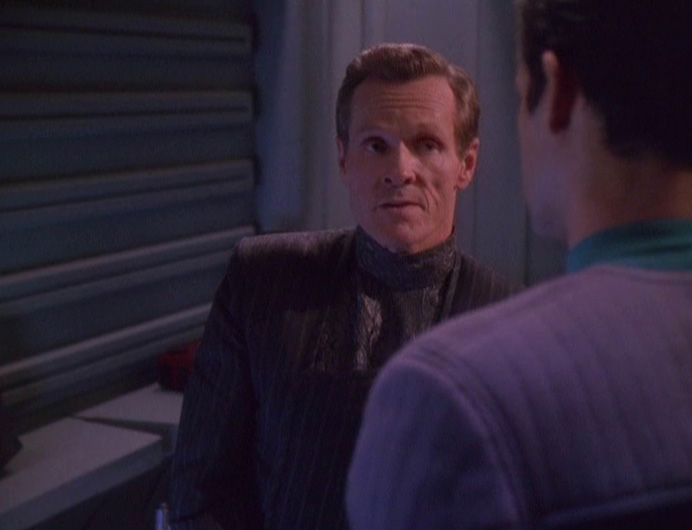
At the beginning of the Deep Space Nine Episode Inter Arma Enim Silent Leges the head of Section 31, a man only known as Sloan comes back Doctor Julia Bashir to involve him in an clandestine operation. An operation to on the Romulans who at this point are a Federation ally against the Dominion.

Sloan makes his approach and Bashir, who expresses his reservations:

BASHIR: You want me to spy on an ally.

SLOAN: To evaluate an ally. And a temporary ally at that. I say that because when the war is over, the following will happen in short order. The Dominion will be forced back to the Gamma Quadrant, the Cardassian Empire will be occupied, the Klingon Empire will spend the next ten years recovering from the war and won’t pose a serious threat to anyone. That leaves two powers to vie for control of the quadrant, the Federation and the Romulans.

BASHIR: This war isn’t over and you’re already planning for the next.

SLOAN: Well put. I hope your report is equally succinct.

BASHIR: How many times do I have to tell you, Sloan? I don’t work for you.

SLOAN: You will. It’s in your nature. You are a man who loves secrets. Medical, personal, fictional. I am a man of secrets. You want to know what I know, and the only way to do that is to accept the assignment.

I find the exchange both illuminating and riveting. The fact is that in the situation we face today the arguments of both sides should make us very uncomfortable.

Whether we like it or not or not, the incredibly rapid technical and communication advances of the past couple of decades have primed us for our present conundrum of liberty and privacy or security. That technology, as wonderful as it is  has enabled a generation to grow up in a virtual world in many ways detached from the moral and ethical balances between individual rights and liberties as well responsibility to community.

All the wonderful gadgets that we employ in everyday life, make it easy for enemies and “friends” to do things that were unimaginable to people other than science fiction writers even twenty to thirty years ago. Likewise they were certainly beyond the wildest imaginations of any of the founders who drafted Constitution.

The reality is, the things that make are lives so easy are also the things that have the potential to remove the very liberties that we treasure, either by our enemies using them, or those that defend us.

The truth is, that throughout history, even our own there have been operatives within the government in charge of secrets, as well as spies. In the Inter Arma Enim Silent Leges episode we see an operation that is full of duplicity and moral ambiguity all committed in the name of security. I won’t go into the details because it is too full of twists, and turns, you can read the plot of the episode at Memory Alpha.org http://en.memory-alpha.org/wiki/Inter_Arma_Enim_Silent_Leges_%28episode%29

There is an exchange between Dr. Bashir and Admiral Ross of Starfleet command which is very enlightening because it practically mirrors how many on both the civil liberties and the national security side of the current controversy feel about the War on Terror.

BASHIR: You don’t see anything wrong with what happened, do you.

ROSS: I don’t like it. But I’ve spent the last year and a half of my life ordering young men and young women to die. I like that even less.

BASHIR: That’s a glib answer and a cheap way to avoid the fact that you’ve trampled on the very thing that those men and women are out there dying to protect! Does that not mean anything to you?

ROSS: Inter arma enim silent leges.

BASHIR: In time of war, the law falls silent. Cicero. So is that what we have become? A twenty fourth century Rome driven by nothing more than the certainty that Caesar can do no wrong!

ROSS: This conversation never happened.

In light of the controversy of today regarding the NSA, FISA Courts, government secrecy and intelligence gathering information on its own citizens, as well as allies, friends and and enemies we face a growing tide of reporters and others seeking to reveal those secrets. Back in 1989 ethicist Sissela Bok wrote something very important in her book Secrets: Moral Choice in Public and Private Life:

“…as government secrecy expands, more public officials become privy to classified information and are faced with the choice of whether or not to leak … growing secrecy likewise causes reporters to press harder from the outside to uncover what is hidden. And then in a vicious circle, the increased revelations give government leaders further reasons to press for still more secrecy.”

As we wade through the continuing controversy surrounding these issues we will see people do exactly what Bok said. These are the exact arguments are being made by the people and officials directly involved in such activities, as well as former elected and appointed officials, and members of the press.

nsa-operations-center

The interesting thing to me is that very few of the people or agencies, past and present, Republican and Democrat involved have clean hands. It is amazing to see former champions of civil liberties defend the NSA actions and those that empowered the NSA in the Patriot Act now condemn it. I find it both fascinating and frightening.

At the end of the Inter Arma Enim Silent Leges episode the mysterious Sloan pops back in on Doctor Bashir who is in his quarters, asleep and depressed by what he experienced during the operation on Romulus and with Admiral Ross.

SLOAN: Good evening.

BASHIR: Are you expecting applause? Have you come to take a bow?

SLOAN: I just wanted to say thank you.

BASHIR: For what? Allowing you to manipulate me so completely?

SLOAN: For being a decent human being. That’s why we selected you in the first place, Doctor. We needed somebody who wanted to play the game, but who would only go so far. When the time came, you stood your ground. You did the right thing. You reached out to an enemy, you told her the truth, you tried to stop a murder. The Federation needs men like you, Doctor. Men of conscience, men of principle, men who can sleep at night. You’re also the reason Section Thirty one exists. Someone has to protect men like you from a universe that doesn’t share your sense of right and wrong.

BASHIR: Should I feel sorry for you? Should I be weeping over the burden you’re forced to carry in order to protect the rest of us?

SLOAN: It is an honor to know you, Doctor. Goodnight.

We live in this kind of world and maybe it is good to sometimes step back and look at issues using a different prism. I really don’t have the answers. I am a civil libertarian who places a high value on the openness of a government to its people. I also know that there are those that have no regard for such openness or, to quote Sloan don’t “share your sense of right and wrong.”

Maybe that is not a good answer. I really don’t know. All I know is that as uncomfortable as this all is that those on both sides of the issue have valid points and concerns. It is a debate that needs to happen if we are able to balance that a society needs to balance individual rights and responsibility to the community; openness and secrecy; civil liberties and national security.

But that being said. it is a debate that needs to happen, even if it makes us uncomfortable. I for one think that it is better that we be uncomfortable when looking at such an important debate than to be prisoners of our certitude.

Peace

Padre Steve+

2 Comments

Filed under History, laws and legislation, national security, Political Commentary, star trek

Barak Obama and the Beginning of the End of the Castro Regime

negate

In 1961 the Kennedy administration imposed a diplomatic and economic embargo on the nascent Castro regime in Cuba. At the time with the Cold War going full steam ahead the decision seemed logical and appropriate. Never mid the fact that decades of American policy which favored the Bautista dictatorship, the economic interests of American corporations and did nothing to help Cuba’s poor had helped bring about Castro’s rule. Likewise never mind the fact that Americans using Cuban mercenaries only pushed Castro further into Soviet orbit with the Bay of Pigs invasion.

But following the Cuba missile crisis the embargo and diplomatic isolation remained in place. However, in 1972 President Richard Nixon brokered a deal of detente with the Soviet Union, a superpower that was an existential threat to the United States, as well as Mao Tse Tung’s Communist China, a power that we had fought to a standstill in Korea, and which had just a few years before embarked on its “cultural revolution” one of the bloodiest and ruthless events of the twentieth century.

Nixon was a diplomatic genius who was not so wedded to his own extremely anti-Communist ideology not to recognize when a moment to change history was in the offing. Otto Von Bismarck noted that “The statesman’s task is to hear God’s footsteps marching through history and then to try to catch onto his coattails as He marches past.”

Bismarck was right and both Nixon and Obama heard the footsteps of God in terms of diplomacy and foreign relations. Sadly very few ideologues, like Senator Marco Rubio ever get this nuance and would rather maintain a failed policy that neither benefits the United States or the Cuban people, but which is one of the few things that have kept the Castro brothers in business long after most Communist regimes ended up on the ash-heap of history.

The amazing thing is that the polices of Richard Nixon regarding the Soviet Union and China had dramatic and positive effects that his successors, be they Republican or Democrat really did not grasp. Instead, when the Iron curtain came down we in the west did all that we could to humiliate the former USSR and brought about the bellicose dictator by another name Vladimir Putin. Likewise we failed to understand the pragmatic and nationalistic nature of the Chinese Communist regime that was brought about by Mao’s successor Deng Xiaoping. In both cases our failure to grasp the reality of our former opponents created new adversaries.

But such was not the case with Cuba. Cuba was different, especially after the Cold War ended. Despite our differences Cuba and the United States should have been able to overcome the effects of Castro’s seizure of power and brokered an understanding. Yes Castro was and is a Communist, but that, even during the Cold War did not prevent effective diplomacy with other Communist states such as Tito’s Yugoslavia, a country that had there been a conflict between the Soviet Union and NATO that might have well sided with the west. But with Cuba there was no nuance. Castro was the enemy.

The irony was that in the 1970s, 1980s and 1990s it was Cuban soldiers that protected U.S. based oil company refineries, installations and American personnel in Angola against CIA sponsored insurgents.

The American economic embargo has been a failure for decades. This was even more the case after after the fall of the Soviet Union when our allies in South and Central America and Europe realized that Cuba was no longer a threat and refused to support our embargo, rendering it impotent, except in the domestic politics of South Florida. Only fools believe that continuing it will change Cuba. The economic and diplomatic isolation has been going on for 53 years, 23 of them after the fall of the Iron curtain, and it has failed. Fools like Marco Rubio who even before President Obama made his announcement was at a microphone condemning the decision. But then Marco Rubio is both an ideologue who basks in his status of being a victim of the dying Castro regime.

The arguments of Rubio and the other partisan flacks in the American domestic political scene for maintaining the economic embargo and diplomatic isolation are not only short sighted and play to their own local political constituency, but they work against the United States in trying to achieve a responsible and workable solution to the impasse that has poisoned Cuban-American relations for six decades.

The fact is, despite the protestation of Rubio and others we deal with a lot more unsavory characters than the Castros. Yes, they are thugs. Yes they run a police state with few freedoms and where religious liberty is not protected, but they didn’t support Al Qaida like some of our closest allies in the Middle East did, they never near sank a U.S. Navy ship like Israel did in the six day war, and they didn’t kill or wound tens of thousands of U.S. military personnel like the Chinese did when they intervened in the Korea War. From a terrorist or real military threat to U.S. National Security interests the Cubans are minor leaguers and their leaders know that.

President Obama has brought about a political and diplomatic coup in Cuban-America relations, and for now on there will be no going back. Maybe now the United States and Cuba will be able to fulfill our common destinies to work together for the betterment of our hemisphere and world.

Of course for taking this long overdue action, something that either President Bush or President Clinton should have done years ago is now being called a traitor and worse by his domestic political opponents. However, like Pope John Paul II, Pope Benedict and now Pope Francis realized, the time has come for change in our relationship.

This is a historic day and a decision that was long overdue. It is a watershed, and even if the Congress refuses to lift the economic aspects, things in Cuba will change. Freedom will come and soon Cubans and Americans will finally have the chance to build a constructive and positive relationship that helps both peoples.

I have stood at the Northeast Gate of Guantanamo Bay, I have looked over the fence line at Cuba, and I pray that one day I will see the rest of that country.

This is a good night… And as a side note it will be great for baseball. Just imagine the course of history had Fidel Castro been drafted by the Yankees in the early 1950s. Hell he might be the President of the America League by now and he might not have agreed with the designated hitter rule.

But that being sad, Barak Obama should be getting the accolades given to  Nixon, and later Ronald Reagan when he dealt with Gorbachev in 1986 and 1987. This is a watershed and it will change Cuban-American relations for the better, and help the Cuban people. This is a win for the good guys, and even more importantly it will be a win for baseball.

Peace

Padre Steve+

1 Comment

Filed under Foreign Policy, leadership, national security, Political Commentary

Dick Cheney: Justice, Truth and the Value of a Single Human Being

Dick Cheney

Yesterday while he was in the process of throwing his boss, former President Bush and former head of the National Security Council and Secretary of State Condi Rice under the bus regarding the issue of torture and war crimes, former Vice President Cheney defended the death of an innocent man and the imprisonment of hundreds of others deemed to be innocent.

The words were damning and absolutely frightening for anyone that believes in the rule of law and human rights.

Cheney told Chuck Todd when questioned about the fact that over 25% of those held during the Bush Administration were innocent and should not have been detained or imprisoned on Meet the Press:

“I have no problem as long as we achieve our objective. And our objective is to get the guys who did 9/11 and it is to avoid another attack against the United States.”

The sad thing is, that Cheney in his office of Vice President of the United States had such a low regard for the rule of law and human rights that over a decade after his policies were proved to be wrong, illegal and immoral under any standards of human rights and international law that he not only continues to defend them, but is willing to throw his superior, the President, and other cabinet officials under the bus to justify his position.

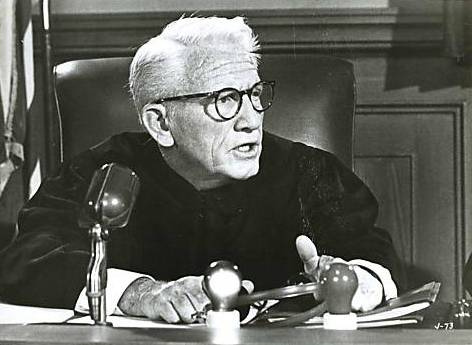
As I read his remarks I was reminded of the testimony of Herman Goering and other Nazis at Nuremberg. Likewise I was reminded of the film classic Judgement at Nuremberg where Spencer Tracy plays judge Dan Haywood who is the head of he tribunal that ties Nazi judges in the fictionalized version of the Nuremberg Judges Trials…

julga-tracy

In the fictionalized version of the Nazi Judge’s trail at Nuremberg, in the film Judgement at Nuremberg Spencer Tracy, playing judge Dan Heywood noted:

“But this trial has shown that under a national crisis, ordinary – even able and extraordinary – men can delude themselves into the commission of crimes so vast and heinous that they beggar the imagination. No one who has sat through the trial can ever forget them: men sterilized because of political belief; a mockery made of friendship and faith; the murder of children. How easily it can happen. There are those in our own country too who today speak of the “protection of country” – of ‘survival’. A decision must be made in the life of every nation at the very moment when the grasp of the enemy is at its throat. Then, it seems that the only way to survive is to use the means of the enemy, to rest survival upon what is expedient – to look the other way. Well, the answer to that is ‘survival as what’? A country isn’t a rock. It’s not an extension of one’s self. It’s what it stands for. It’s what it stands for when standing for something is the most difficult! Before the people of the world, let it now be noted that here, in our decision, this is what we stand for: justice, truth, and the value of a single human being.”

Dick Cheney exemplifies exactly what judge Haywood testified to in the film. Sadly, unlike the primary defendant in that film, Ernst Janning who was played by Burt Lancaster, Cheney has no redeeming features or ethical tragedy. Cheney is simply an unrepentant war criminal who is not only unapologetic for his own actions but perfectly willing to condemn those that he served under or alongside as war criminals while attempting to maintain the fiction of his innocence. The man has no honor, and for people who consider themselves to be “principled conservatives” or even worse “conservative Christians” to defend Cheney’s defense of war crimes to the death, is simply apprehensible.

There are times when one can look at a war criminal and feel a certain measure of tragedy. However, Dick Cheney is neither a dumb man, nor a victim. As vice President to a President with no foreign policy experience or skills, a man who was out of his league intellectually to serve as President, Cheney not only gave bad advice, he was willing to for practical purposes indict George Bush in the commission of the very war crimes that he was the ideological wellspring.

Sadly, Dick Cheney is nothing more than a sociopath and war criminal who should, provided that the executive branch has any balls should be remanded to the International Criminal Court in the Hague for prosecution of war crimes. But then, President Obama, like others before hi will not, much to his own dishonor will not do this.

If if the same crimes that we tried and executed Nazi and Japanese War Criminals for committing is not enough to send Dick Cheney to the gallows, I do not know what is. But then, even the International Criminal Court, unlike Texas and Florida, has renounced the death penalty.

So what do we as Americans stand for?

Do we adapt to and defend our the very methods of our enemies?

Do we simply forget the standards that our grandfathers and great-grandfathers sent Nazi and Japanese war criminals to the gallows?

Do we excuse the actions of those in supreme positions of power that should have known better?

I think not… unless we decide that expediency trumps the Constitution, unless we decide that war crimes are only such if they don’t apply to us…unless we decide as a people that we as a nation are above the very laws that we enacted to prevent the repetition of the crimes of the Nazis…

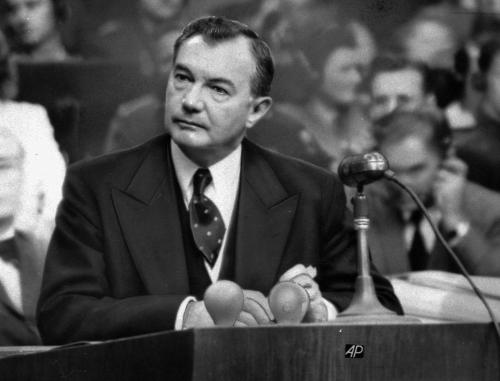
ROBERT H. JACKSON

Justice Robert Jackson noted in the Major War Crimes trails at Nuremberg:

“If certain acts of violation of treaties are crimes, they are crimes whether the United States does them or whether Germany does them, and we are not prepared to lay down a rule of criminal conduct against others which we would not be willing to have invoked against us.”

Sadly, Dick Cheney,Fox News and all of the defenders of torture and other war crimes do not seem to get that, and in doing so they lower us to the level of all the Nazis that we tried and convicted of war crimes.

But human nature does not change…and it should it be, if we fail to correct it and turn over those suspected of war crimes to the appropriate authorities, than we should share in the collective and divine judgement upon them.

If that is an uncomfortable proposition, than I guess I have done my job tonight.

Peace

Padre Steve+


2 Comments

Filed under Foreign Policy, History, national security, News and current events, War on Terrorism

December 6th 2014: Remembering the Illusion of Peace

Aerial_View_of_Attack_From_South_Dec_1941_-_1200x900

“A nation brought up on peace was going to war and didn’t know how.” Walter Lord 

December 6th 2014. For most Americans and Western Europeans this is time of peace. Well, at least the illusion of peace.

Tens of thousands of American, NATO and European Union troops operating in a number of mandates are in harm’s way. In some places like Afghanistan they are at war, in others attempting to keep the peace. Around the world regional conflicts, civil wars, insurgencies  and revolutions threaten not only regional peace but the world peace and economy.

Traditional national rivalries and ethnic and religious tensions especially in Asia and the broader Middle East have great potential to escalate into wars that should they actually break will involve the US, NATO and the EU, if not militarily economically and diplomatically.

Even the outright Russian aggression in Crimea and the Ukraine and the shoot down of Malaysian Airlines flight MH-17, or the stunning advance of the Islamic State in Iraq and Syria has not awoken the vast majority of Americans or Europeans to the dangers lurking in this world.

Like our ancestors on December 6th 1941 we live in a dream world an illusory world of peace. as W.H. Auden said in his poem September 1st 1939:

Defenseless under the night
Our world in stupor lies…

On December 6th 1941 the world was already at war and the United States was edging into the war. The blood of Americans has already been shed but for the vast majority of Americans the events in Europe and Asia were far away and not our problem. Though President Roosevelt had began the expansion of the military there were those in Congress seeking to demobilize troops and who fought all attempts at to intervene.

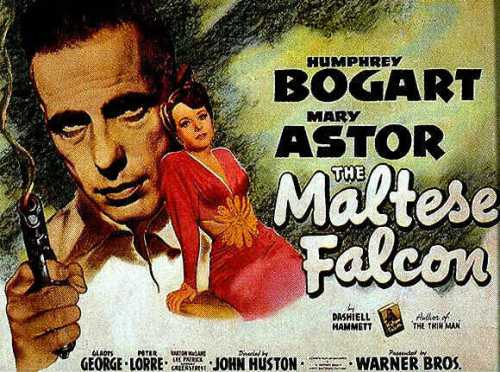
maltese-falcon

Most people went about their business that last furtive day of peace. People went about doing their Christmas shopping, going to movies like The Maltese Falcon staring Humphrey Bogart or the new short Tom and Jerry cartoon, The Night Before Christmas.

tom-and-jerry1

Others went to football games. UCLA and USC had played their annual rivalry game to a 7-7 tie, Texas crushed Oregon in Austin by a score of 71-7 while Texas A&M defeated Washington State in the Evergreen Bowl in Tacoma by a score of 7-0.

0-3a

But war was raging….

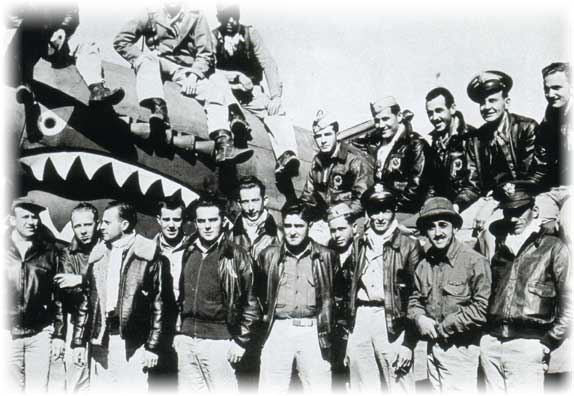
In Europe a Soviet counter-offensive was hammering a freezing and exhausted German Wehrmacht at the gates of Moscow. U-Boats were taking a distressing toll of ships bound for Britain including neutral US merchant ships and warships as well as the destroyer USS Reuben James. Volunteer American airmen were already in action against Japan, these men whose air group was known as the  Flying Tigers stood with the Nationalist Chinese against the Japanese invaders.

Flying_Tigers_personnel

War was everywhere but Americans lived in the dream world of the illusion of peace.

When the messages came out of Pearl Harbor the next morning it was already early afternoon on the East Coast. The Japanese Ambassador had been delayed in delivering the declaration of war, people across the country going about their Sunday business, going to church, relaxing or listening to the radio. Thus when war came, despite all the precursors and warnings war came. When it happened it took the nation by surprise. Walter Lord wrote in his classic account of the Pearl Harbor attack Day of Infamy: “A nation brought up on peace was going to war and didn’t know how.”

pearlharbor_paper

By the end of the day over 2400 Americans were dead and over 1200 more wounded. The battleships of the Pacific Fleet were shattered. 4 sunk, one grounded and 3 more damaged. 10 other ships were sunk or damaged in the attack. 188 aircraft were destroyed and 159 damaged.

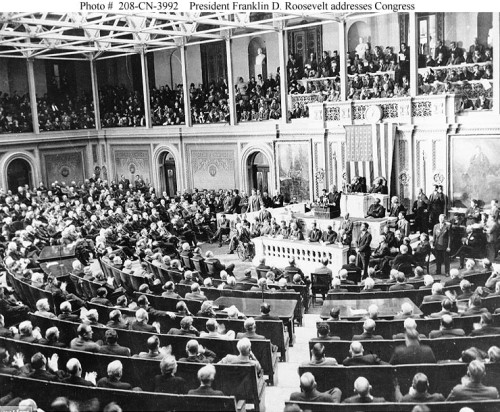
cn3992a

The next day President Franklin D. Roosevelt called the nation to action requesting that Congress declare war on Japan. http://www.youtube.com/watch?v=ufoUtoQLGQY

Mr. Vice President, and Mr. Speaker, and Members of the Senate and House of Representatives:

Yesterday, December 7, 1941 — a date which will live in infamy — the United States of America was suddenly and deliberately attacked by naval and air forces of the Empire of Japan.

The United States was at peace with that Nation and, at the solicitation of Japan, was still in conversation with its Government and its Emperor looking toward the maintenance of peace in the Pacific. Indeed, one hour after Japanese air squadrons had commenced bombing in the American Island of Oahu, the Japanese Ambassador to the United States and his colleague delivered to our Secretary of State a formal reply to a recent American message. And while this reply stated that it seemed useless to continue the existing diplomatic negotiations, it contained no threat or hint of war or of armed attack.

It will be recorded that the distance of Hawaii from Japan makes it obvious that the attack was deliberately planned many days or even weeks ago. During the intervening time the Japanese Government has deliberately sought to deceive the United States by false statements and expressions of hope for continued peace.

The attack yesterday on the Hawaiian Islands has caused severe damage to American naval and military forces. I regret to tell you that very many American lives have been lost. In addition American ships have been reported torpedoed on the high seas between San Francisco and Honolulu.

Yesterday the Japanese Government also launched an attack against Malaya.
Last night Japanese forces attacked Hong Kong.
Last night Japanese forces attacked Guam.
Last night Japanese forces attacked the Philippine Islands.
Last night the Japanese attacked Wake Island. And this morning the Japanese attacked Midway Island.

Japan has, therefore, undertaken a surprise offensive extending throughout the Pacific area. The facts of yesterday and today speak for themselves. The people of the United States have already formed their opinions and well understand the implications to the very life and safety of our Nation.

As Commander in Chief of the Army and Navy I have directed that all measures be taken for our defense.

But always will our whole Nation remember the character of the onslaught against us.

No matter how long it may take us to overcome this premeditated invasion, the American people in their righteous might will win through to absolute victory. I believe that I interpret the will of the Congress and of the people when I assert that we will not only defend ourselves to the uttermost but will make it very certain that this form of treachery shall never again endanger us.

Hostilities exist. There is no blinking at the fact that our people, our territory, and our interests are in grave danger.

With confidence in our armed forces- with the unbounding determination of our people- we will gain the inevitable triumph- so help us God.

I ask that the Congress declare that since the unprovoked and dastardly attack by Japan on Sunday, December 7, 1941, a state of war has existed between the United States and the Japanese Empire.

Today there are men and women from the United States and our NATO, European Union and who stand in harm’s way and some of them are dying.  Eleanor Roosevelt reflected:

“Lest I keep my complacent way I must remember somewhere out there a person died for me today. As long as there must be war, I ask and I must answer was I worth dying for?”

Wars, revolutions and other tensions in other parts of the world threaten on every side, but most Americans and Europeans live in the illusion of peace.

A very few professionals are given the task of preparing for and fighting wars that are fomented by often brought about by the willful malfeasance or stunningly ignorant policies of the Politicians, Pundits and Preachers, the Trinity of Evil.  As such many have no idea of the human, material and spiritual cost of war and when it comes again in all of its awful splendor few will be prepared.

We do not know what tomorrow will bring and unfortunately for the vast bulk of Americans and Western Europeans the comments of W.H. Auden are as applicable today as they were when he penned them.

Peace

Padre Steve+

Leave a comment

Filed under Foreign Policy, History, national security, Political Commentary, world war two in the pacific

The Character, Nature and Context of The Civil War and Why it Still Matters Part. 1

IMG_0426

Friends of Padre Steve’s World,

Since I am now working my way back to Gettysburg his is a significant revision of an article that I published here earlier in the year and that is a part of my Gettysburg Staff Ride text. The actual full title of the chapter is The Foundations of the First Modern War: The Character, Nature and Context of the Civil War and its Importance to Us Today but that is rather long to put as the title here. This is pretty detailed and specialized so many may not want to read it, however, for those with in interest in how United States policy in regard to how we use our military today and the myriad of tensions that we wrestle with that have been with us for about 150 years it should prove enlightening.

Since it is pretty long I am dividing it up between two posts. Have a great day!

Peace

Padre Steve+

20140308-231743.jpg

The First Modern War

The American Civil War was the first modern war. It was a watershed time which introduced changes in tactics, logistics, and communications, while showed the world exactly what the concept of total war entailed. Though it did not change the essential nature of war, which Clausewitz says is “is an act of violence to compel our opponent to fulfil our will” [1] it expanded the parameters of it and re-introduced the concept of “total war” to the world and “because its aim was all embracing, the war was to be absolute in character.”[2] In a sense it was a true revolution in military affairs.

Thus it is important to study the Gettysburg campaign in the context of the Civil War, as well as in relationship to the broader understanding of the nature and character of war. To do this one must examine the connection between them and policies made by political leaders; to include the relationship of political to military leaders, diplomats, the leaders of business and industry and not to be forgotten the press and the people. Likewise we must understand the various contexts of war, how they impacted Civil War leaders and why they must be understood by civilian policy makers and military leaders today.

While the essential nature of war remains constant, wars and the manner in which they are fought have changed in their character throughout history, and this distinction matters not only for military professionals, but also policy makers. The changing character of war was something that military leaders as well as policy makers struggled with during the American Civil War much as today’s military leaders and policy makers seek to understand the character of warfare today. British military theorist Colin Gray writes “Since the character of every war is unique in the details of its contexts (political, social-cultural, economic, technological, military strategic, geographical, and historical), the policymaker most probably will struggle of the warfare that is unleashed.” [3] That was not just an issue for Abraham Lincoln and Jefferson Davis, both of whom struggled with the nature of the war which had been unleashed, but it is one for our present political leaders, who as civilian politicians are “likely to be challenged by a deficient grasp of both the nature of war as well as its contemporary context-specific character.” [4]

In addition to being the first modern war, or maybe I should say, the first war of the Industrial Age, the Civil War became a “total war.” It was the product of both the massive number of technological advances which both preceded and occurred during it, in which the philosophical nature of the Industrial Revolution came to the fore. Likewise, the enmity of the two sides for one another which had been fostered by a half century of relentless and violent propaganda which ushered from the mouths of politicians, the press and even from the pulpit, even to the point of outright armed conflict and murder in “Bleeding Kansas” during the 1850s.

As a total war it became a war that was as close to Clausewitz’s understanding of absolute war in its in character waged on the American continent, and it prefigured the great ideological wars of the twentieth century, as J.F.C. Fuller noted “for the first time in modern history the aim of war became not only the destruction of the enemy’s armed forces, but also of their foundations- his entire political, social and economic order.” [5] It was the first war where at least some of the commanders, especially Ulysses S. Grant and William Tecumseh Sherman were men of the Industrial Age, in their thought and in the way that they waged war, in strategy, tactics even more importantly, psychologically. Fuller wrote:

“Spiritually and morally they belonged to the age of the Industrial Revolution. Their guiding principle was that of the machine which was fashioning them, namely, efficiency. And as efficiency is governed by a single end- that every means is justified- no moral or spiritual conceptions of traditional behavior must stand in its way.” [6]

Both men realized in early 1864 that “the South was indeed a nation in arms and that the common European practice of having standing armies engaged each other in set-piece battles to determine the outcome of a war was not enough to win this struggle.” [7] Though neither man was a student of Clausewitz, their method of waging war was in agreement with the Prussian who wrote that “the fighting forces must be destroyed; that is, they must be put in such a position that they can no longer carry on the fight” but also that “the animosity and the reciprocal effects of hostile elements, cannot be considered to have ended so long as the enemy’s will has not been broken.” [8] Sherman told the mayor of Atlanta after ordering the civilian population expelled that “we are not only fighting hostile armies, but a hostile people, and must make the old and young, the rich and poor, feel the hard hand of war.” [9] Sherman not only “carried on war against the enemy’s resources more extensively and systematically than anyone else had done, but he developed also a deliberate strategy of terror directed against the enemy’s minds.” [10]

Abraham Lincoln came to embrace eternal nature of war as well as the change in the character of the war over time. Lincoln had gone to war for the preservation of the Union, something that for him was almost spiritual in nature, as is evidenced by the language he used in both of his inaugural addresses and the Gettysburg Address. Instead of a war to re-unite the Union with the Emancipation Proclamation the war became a war for the liberation of enslaved African Americans, After January 1st 1863 when the Emancipation Proclamation went into effect, Lincoln “told an official of the Interior Department, “the character of the war will be changed. It will be one of subjugation…The [old] South is to be destroyed and replaced by new propositions and ideas.” [11]

Of course, the revolution in military affairs took time and it was the political and military leaders of the North who better adapted themselves and their nation to the kind of war that was being fought. “Lincoln’s remarkable abilities gave him a wide edge over Davis as a war leader, while in Grant and Sherman the North acquired commanders with a concept of total war and the determination to make it succeed.” [12]

At the beginning of the war the leaders and populace of both sides still held a romantic idea of war. The belief that the war would be over in a few months and that would be settled by a few decisive battles was held by most, including many military officers on both sides, there were some naysayers like the venerable General Winfield Scott, but they were mocked by both politicians and the press.

The Civil War became an archetype of the wars of the twentieth century, and the twenty-first century. It became a war where a clash between peoples and ideologies which extended beyond the province of purely military action as “it was preceded by years of violent propaganda, which long before the war had obliterated all sense of moderation, and awakened in the contending parties the primitive spirit of tribal fanaticism.” [13]

The conduct of the American Civil War added new dimensions to war, increased its lethality and for the first time since the 30 Years’ War saw opponents intentionally target the property, homes and businesses of civilian populations as part of their military campaign. The Civil War was a precursor to the wars that followed, especially the First World War which it prefigured in so many ways. [14]

However, like all wars many of its lessons were forgotten by military professionals in the United States as well as in Europe. Thus 50 years later during World War One, British, French, German, Austrian and Russian wasted vast amounts of manpower and destroyed the flower of a generation because they did not heed the lessons of the Civil War. Fuller noted:

“Had the nations of Europe studied the lessons of the Civil War and taken them to heart they could not in 1914-1918 have perpetuated the enormous tactical blunders of which that war bears record.” [15]

The lessons of the war are still relevant today. Despite vast advances in weaponry, technology and the distances with which force can be applied by opponents, war remains an act of violence to compel an enemy to fulfill our will. War according to Clausewitz is “more than a chameleon that slightly adapts its characteristics to the given case.” [16] but it is always characterized by the violence of its elements, the province of chance and its subordination to the political objective and as such forces political and military leaders as well as policy makers to wrestle with “the practical challenge of somehow mastering the challenge of strategy in an actual historical context.” [17]

Colin Gray makes a case for seven essential contexts that must be understood by policy makers and military leaders regarding war, which if ignored or misunderstood “can have strong negative consequences.” [18] The contexts which Gray enunciates: a political context, a social-cultural context, an economic context; a military-strategic context, a geographic context and a historical context and as Gray notes they “define all the essential characteristics of a particular armed conflict.” [19]

The study of the Civil War can be helpful to the joint planner and commander because it so wonderfully shows the interplay of Clausewitz’s “paradoxical trinity- composed of primordial violence, hatred, and enmity, which are to be regarded as a blind natural force; of the play of chance and the element of subordination, as an instrument of policy, which makes it subject to reason alone.” [20] during an era of great technological and philosophical change. The importance of this cannot be underestimated, for in this era of change, like in every era, some leaders and commanders were either resistant to, or failed to understand the changes being forced upon them in their conduct of war by the industrialization of war and its attendant technology; while others, like Sherman, Grant and Sheridan not only understood them, but embraced them and applied them with skill and vigor in ways that stunned the people of the South.

15lincoln_cabinet

The Whole of Government and National Power

Over time the Union developed what we would now refer to as a “whole of government approach” to the war. This included not only the military instrument but the use of every imaginable means of national power, from the diplomatic, the economic and the informational aspects of the Union in the effort to subdue the Confederacy. The understanding and use of the “whole of government approach” to war and conflict is still a cornerstone of United States military policy in “unified action, to achieve leverage across different domains that will ensure conditions favorable to the U.S. and its allies will endure.” [21] The working staff of the War Department headed by Edwin Stanton and Major General Montgomery Meigs developed rapidly. It effectively coordinated with railroads, weapons manufactures and suppliers of clothing, food and other necessities to supply the army and navy so well that “Union forces never seriously lacked the materials necessary to win the war.” [22] Stanton and Meigs were “aided by the entrepreneurial talent of northern businessmen” which allowed “the Union developed a superior managerial talent to mobilize and organize the North’s greater resources for victory in the modern industrialized conflict that the Civil War became.” [23]

The understanding of this eternal nature and ever changing character of war to leaders of nations as well as military commanders and planners has been very important throughout history. It can be seen in the ways that Jefferson Davis and Abraham Lincoln conducted their relationships with their military commanders, including during the Gettysburg campaign and we are reminded by Colin Gray notes that political leaders and policy makers who are in charge of policy often ignorant of the nature and character of war, and this fact “directs attention to the difficulties of translating political judgment into effective warmaking.” [24] Military leaders should be the people to advise and instruct policy makers in aligning their policy to what is actually feasible based on the ends ways and means, as well as the strengths and limitations of the military to carry out policy decisions and history reminds us “that policymakers committed strongly to their political desires are not easily deflected by military advice of a kind that they do not want to hear.” [25]

While there was much support for the Confederacy in the aristocracies of Europe, the effectiveness of the Union military in winning the key battles that allowed Lincoln to make his Emancipation Proclamation ensured that Europe would not recognize the Confederacy, . Charles F. Adams, the United States minister to Britain successfully defused the crisis of the Trent affair, which could have led to British recognition of the Confederacy and intervention in the war. Adams’ efforts were so successful that they “left Anglo-American relations in better shape than before the crisis.” [26]

(c) Southampton City Art Gallery; Supplied by The Public Catalogue Foundation

The Trent Affair

The Importance of Diplomacy

Related to this understanding of warfare one has to also look at the importance of diplomacy, especially in picking the right diplomat for a critical post is a part of a whole of government approach to war and warfare. This was very important in the early stages of the Civil War as there was much support for the Confederacy in the aristocracies of Europe. The effectiveness of the diplomacy was increased by the Union military efforts. The Union suffered many failures at the outset of the war by the time of the Gettysburg campaign they did enough to prevent English or French intervention on the side of the Confederacy, which was also aided by tensions in Europe regarding the Schleswig-Holstein problem between Prussia and Austria as well as unrest in Poland, and the British in particular were loath to risk intervening in a conflict that might be “a disturbance in the precarious balance of power which might be the signal for a general conflagration, they recalled Voltaire’s comment that a torch lighted in 1756 in the forests of the new world had promptly wrapped the old world in flames.” [27] Thus, European leaders and diplomats were very hesitant to allow Southern legations to convince them to intervene.

Though the Confederates won many early battles in 1861 and 1862 it was the success of the Union military that altered the diplomatic landscape and helped doom the Confederacy. The joint operations conducted by Ulysses Grant and Flag Officer Foote at Island Number Ten, Fort Henry, Fort Donaldson and Shiloh opened the door to the western Confederacy making it vulnerable to Union invasion. Likewise, the joint operations conducted by the Union Navy and Army against the Confederacy through the blockade and capture of key ports such as New Orleans by 1862; combined with the bloody repulses of Confederate armies at Perryville and Antietam allowed Lincoln to make his Emancipation Proclamation, an act which reverberated across the Atlantic.

These military successes enabled Lord Palmerston to reject a French proposal for France, England and Russia to propose to the warring parties, a “North-South armistice, accompanied by a six month lifting of the blockade. The result, if they had agreed- as they had been in no uncertain terms warned by Seward in private conversations with British representatives overseas- would have been a complete diplomatic rupture, if not an outright declaration of war.” [28]

The issuance of that proclamation ensured that Europe would not recognize the Confederacy because even pro-Southern English political leaders could not appear to even give the appearance of supporting slavery, especially as both England and France had abolished slavery decades before, while Russia had only recently emancipated its serfs and “was pro-Union from the start….” [29] Popular sentiment in those countries, outside of the ruling class and business elites, was heavily in favor of emancipation, especially among the working classes. The leaders of the workingmen of Manchester England, a major textile producer, who which had been among the “hardest hit by the cotton famine, sent him [Lincoln] an address approved at a meeting on New Year’s Eve, announcing their support of the North in its efforts to “strike off the fetters of the slave.” [30]

There were issues related to the blockade but Charles F. Adams, the United States minister to Britain successfully defused the crisis of the Trent affair, which could have led to British recognition of the Confederacy and intervention in the war in a manner that “left Anglo-American relations in better shape than before the crisis.” [31]

The Union blockade was a key factor in the diplomatic efforts. As I have noted there were many in both Britain and France who sympathized with the South and hoped for Southern victory that were not impressed by Southern moves to subject them to an embargo of Southern cotton until they received recognition. While many Englishmen were offended by Seward’s bluster, many “resented even more the Confederacy’s attempt at economic blackmail.” [32]

The British especially were keen on not going to war for the sake of the South, there was far too much at stake for them. This was something that the Southern leaders and representatives did not fully comprehend. Prime Minister Viscount Palmerston and Foreign Minister Lord Russell were concerned about the economic impact of the loss of Southern cotton but also “recognized that any action against the blockade could lead to a conflict with the United States more harmful to England’s interests than the temporary loss of Southern cotton.” [33] Palmerston well remembered the war of 1812 when he served as Minister of War, and the disastrous results for the British Merchant Marine, and he realized that “England could not only afford the risk of a loss in a sideline war; she could not even afford to win one.” [34]
Mahan_teaser

Dennis Hart Mahan the First American Military Theorist

The Development of American Military Culture and Theory

As we examine the Civil War as the first modern war we have to see it as a time of great transition and change for military and political leaders. As such we have to look at the education, culture and experience of the men who fought the war, as well as the various advances in technology and how that technology changed tactics which in turn influenced the operational and strategic choices that defined the characteristics of the Civil War and wars to come.

The leaders who organized the vast armies that fought during the war were influenced more than military factors. Social, political, economic, scientific and even religious factors influenced their conduct of the war. The officers that commanded the armies on both sides grew up during the Jacksonian opposition to professional militaries, and for that matter even somewhat trained militias. The Jacksonian period impacted how officers were appointed and advanced. Samuel Huntington wrote:

“West Point was the principle target of Jacksonian hostility, the criticism centering not on the curriculum and methods of the Academy but rather upon the manner of how cadets were appointed and the extent to which Academy graduates preempted junior officer positions in the Army. In Jacksonian eyes, not only was specialized skill unnecessary for a military officer, but every man had the right to pursue the vocation of his choice….Jackson himself had an undisguised antipathy for the Academy which symbolized such a different conception of officership from that which he himself embodied. During his administration disciple faltered at West Point, and eventually Sylvanus Thayer, the superintendent and molder of the West Point educational methods, resigned in disgust at the intrusion of the spoils system.” [35]

This is particularly important because of how many officers who served in the Civil War were products of the Jacksonian system and what followed over the next two decades. Under the Jackson administration many more officers were appointed directly from civilian sources than from West Point, often based on political connections. “In 1836 when four additional regiments of dragoons were formed, thirty officers were appointed from civilian life and four from West Point graduates.” [36]

While this in itself was a problem it was made worse by a promotion system based on seniority, not merit. There was no retirement system so officers who did not return to the civilian world hung on to their careers until they quite literally died with their boots on. This held up the advancement outstanding junior officers who merited promotion and created a system where “able officers spent decades in the lower ranks, and all officers who had normal or supernormal longevity were assured of reaching higher the higher ranks.” [37]

Robert E. Lee was typical of many officers who stayed in the Army. Despite his success he was haunted by his lack of advancement. While still serving in Mexico having gained great laurels including a brevet promotion to Lieutenant Colonel, but “the “intrigues, pettiness and politics…provoked Lee to question his career.” He wrote “I wish I was out of the Army myself.” [38] In 1860 on the brink of the war Lee was “a fifty-three year-old man and felt he had little to show for it, and small hope for promotion.” [39] Lee’s discouragement was not unwarranted, despite his exemplary service there was little hope for promotion and to add to it Lee knew that “of the Army’s thirty-seven generals from 1802 to 1861, not one was a West Pointer.” [40] Other exemplary officers including Winfield Scott Hancock languished with long waits for promotion between the Mexican War and the Civil War. The long waits for promotion and duty in often desolate duty stations separated from family caused many officers to leave the Army; a good number of whom in 1861 became prominent in both the Union and Confederate armies. Among these officers were such notables as Thomas “Stonewall” Jackson, Ulysses S. Grant, William Tecumseh Sherman, Henry Halleck, George McClellan and Jubal Early.

The military education of these officers at West Point was based on the Napoleonic tactics and methods espoused by Henri Jomini as Clausewitz’s works had yet to make their way to America. Most were taught by Dennis Hart Mahan. Mahan, who graduated at the top of the West Point class of 1824 and spent four years in France as a student and observer at the “School of Engineering and Artillery at Metz” [41] before returning to the academy where “he was appointed professor of military and civil engineering and of the science of war.” [42]

In France Mahan studied the prevailing orthodoxy of Henri Jomini who along with Clausewitz was the foremost interpreter of Napoleon and the former Chief of Staff of Marshal Ney. Jomini’s influence cannot be underestimated, some have noted, a correctly so that “Napoleon was the god of war and Jomini was his prophet.” [43]

The basic elements of Jominian orthodoxy were that: “Strategy is the key to warfare; That all strategy is controlled by invariable scientific principles; and That these principles prescribe offensive action to mass forces against weaker enemy forces at some defensive point if strategy is to lead to victory.” [44] Jomini interpreted “the Napoleonic era as the beginning of a new method of all out wars between nations, he recognized that future wars would be total wars in every sense of the word.” [45] Jomini laid out a number of principles of war including elements that we know well today, operations on interior and exterior lines, bases of operations, and lines of operation. He understood the importance of logistics in war, envisioned the future of amphibious operations and his thought would be taken to a new level by Alfred Thayer Mahan, the son of Dennis Hart Mahan in his book The Influence of Sea Power on History.

Jomini also foresaw the horrific nature of the coming wars and expressed his revulsion for them and desire to return to the limited wars of the eighteenth century:

“I acknowledge that my prejudices are in favor of the good old times when the French and English guards courteously invited each other to fire first as at Fontenoy, preferring them to the frightful epoch when priests, women. And children throughout Spain plotted the murder of individual soldiers.” [46]

Jomini’s influence was great throughout Europe and was brought back to the United States by Mahan who principally “transmitted French interpretations of Napoleonic war” [47]including that of Jomini. However, Mahan returned from France somewhat dissatisfied knowing that much of what he learned was impractical in the United States where a tiny professional army and the vast expenses of territory were nothing like European conditions. Mahan thought prevailing doctrine “was acceptable for a professional army on the European model, organized and fighting under European conditions. But for the United States, which in case of war would have to depend upon a civilian army held together by a small professional nucleus, the French tactical system was unrealistic.” [48]

Mahan set about rectifying this immediately upon his return and though “steeped in French thought, but acutely sensitive to American conditions that in his lectures and later writings he modified the current orthodoxy by rejecting one of its central tenants-primary reliance on offensive assault tactics.” [49] Mahan believed that “ If the offensive is attempted against a strongly positioned enemy, Mahan cautioned, it should be an offensive not of direct assault but of the indirect approach, of maneuver and deception. Victories should not be purchased by the sacrifice of one’s own army….To do the greatest damage to our enemy with the least exposure of ourselves,” said Mahan, “is a military axiom lost sight of only by ignorance to the true ends of victory.” [50] However, “so strong was the attraction of Napoleon to nineteenth-century soldiers that American military experience, including the generalship of Washington, was almost ignored in military studies here.” [51]

Thus there was a tension in American military thought between the followers of Jomini and Mahan. Conservative Jominian thinking predominated much of the Army, and within the army “Mahan’s decrees failed to win universal applause.” [52] This may have been due in part to the large number of officers accessed directly from civilian life during the Jacksonian period. Despite this it was Mahan who more than any other “taught the professional soldiers who became the generals of the Civil War most of what they knew through the systematic study of war.” [53]

Mahan’s influence on the future leaders of the Union and Confederate armies went beyond the formal classroom setting. Mahan established the “Napoleon Club,” a military round table at West Point.[54] Mahan dominated the academy in many ways, and for the most part he ran the academic board, which ran the academy, and “no one was more influential than Mahan in the transition of officership from a craft into a profession.” [55] Mahan was a unique presence at West Point who all students had to face in their final year. Mahan was:

“aloof and relentlessly demanding, he detested sloppy thinking, sloppy posture, and a sloppy attitude toward duty…Mahan would demand that they not only learn engineering and tactics, but that every manner and habit that characterizes an officer- gentlemanly deportment, strict integrity, devotion to duty, chivalric honor, and genuine loyalty- be pounded into them. His aim was to “rear soldiers worthy of the Republic.” [56]

Mahan’s greatest contributions in for American military doctrine were his development of the active defense and emphasis on victory through maneuver. Mahan stressed “swiftness of movement, maneuver, and use of interior lines of operation. He emphasized the capture of strategic points instead of the destruction of enemy armies,” [57] while he emphasized the use of “maneuver to occupy the enemy’s territory or strategic points.” [58]

That being said Mahan’s “greatest contribution to American military professionalism was, in all probability, his stress upon the lessons to be learned from history. Without “historical knowledge of the rise and progress” of the military art, he argued, it is impossible to get “even tolerably clear elementary notions” beyond “the furnished by mere technical language…It is in military history that we are able to look for the source of all military science.” [59] Mahan emphasized that “study and experience alone produce the successful general” noting “Let no man be so rash as to suppose that, in donning a general’s uniform, he is forthwith competent to perform a general’s function; as reasonably he might assume that in putting on robes of a judge he was ready to decide any point of the law.” [60] Such advice is timeless.

Mahan certainly admired Napoleon and was schooled in Jomini, but he believed that officers needed to think for themselves on the battlefield. And “no two things in his military credo were more important than the speed of movement- celerity, that secret of success- or the use of reason. Mahan preached these twin virtues so vehemently and so often through his chronic nasal infection that the cadets called him “Old Cobbon Sense.” [61] Like Jomini, Mahan was among the first to differentiate between strategy, which involved “fundamental, invariable principles, embodied what was permanent in military science, while tactics concerned what was temporary….and “the line which distinguishes one from another is “that which separates the science from the art.” [62]

Henry_Halleck_by_Scholten,_c1865

Henry Wager Halleck

Mahan’s teaching was both amplified and modified by the work of his star pupil Henry Wager Halleck wrote the first American textbook on military theory Elements of Military Art and Science which was published in 1846 and though it was not a standard text at West Point “it was probably the most read book among contemporary officers.” [63] The text was based on a series of twelve lectures Halleck had given the Lowell Institute in 1845, as Halleck was considered one of America’s premier scholars.

Like Mahan, Halleck was heavily influenced by the writings of Jomini, and the Halleck admitted that his book “was essentially a compilation of other author’s writings,” [64] including those of Jomini and Mahan; and he “changed none of Mahan’s and Jomini’s dogmas.” [65] In addition to his own book, Halleck also “translated Jomini’s Life of Napoleon” from the French. [66] Halleck, like his mentor Mahan “recognized that the defense was outpacing the attack” [67] in regard to how technology was beginning to change war and “five of the fifteen chapters in Halleck’s Elements are devoted to fortification; a sixth chapter is given over to the history and importance of military engineers.” [68] Halleck’s Elements became one of the most influential texts on American military thought during the nineteenth century, and “had a major influence on American military thought” [69] being read by many before, during and after the war, including Abraham Lincoln.

Halleck, as a part of Mahan’s enlightenment too fought against the Jacksonian wave, eloquently speaking out for a more professional military against the Jacksonian critics. Halleck plead “for a body of men who shall devote themselves to the cultivation of military science” and the substitution of Prussian methods of education and advancement for the twin evils of politics and seniority.” [70]

As we look the Gettysburg campaign it is important to note how much of Mahan’s teaching either shows up in the actions of various commanders, such as Meade’s outstanding use of interior lines on the defense; or how in some cases his advice, particularly on attacking strongly held positions was ignored by Lee. In fairness to Lee he “was the only principle general of the war who had attended West Point too early to study the military art under Dennis Mahan.” [71] Likewise, during his tenure as the Superintendent of West Point Lee had little time to immerse himself in new studies due to the changes being wrought at the Academy in terms of discipline and curriculum. If anything can be said about Lee was that he was much more affected by what he read about Napoleon’s battles and campaigns; in which he took a lifelong interest in while a cadet, reading the French editions of the “three volumes of General Montholon’s memoirs of Napoleon dealing with the early campaigns, and the first volume of General Segur’s Expedition de Russie dealing with Napoleon’s advance to Moscow in 1812” [72] than he was with Jomini’s theories, though he certainly would have had some familiarity with them. Lee continued his study of Napoleon’s campaigns during his time as superintendent of West Point, in which “of fifteen books on military subjects that he borrowed from the academy library during his superintendency, no more than seven concerned Napoleon.” [73] Lee’s studies of the emperor’s campaigns allowed him to draw “more aggressive strategic concepts that previous American generals” [74] concepts that he would execute with alacrity during his campaigns of 1862 and 1863.

While West Point was the locus of American military thought and professionalism there was in the South a particular interest in military thought and this “was manifest in the creation of local military schools. Virginia Military Institute was established in 1839, the Citadel and the Arsenal set up in South Carolina in 1842, Kentucky Military Institute in 1845. By 1860 every Southern state, except Texas and Florida, had its own state supported military academy patterned on the models of West Point and VMI.” [75] There was no such development in the North, making these schools a unique part of the American military heritage, only some of which remain.

As the American theorists began their period of enlightenment, there was no real corresponding development in tactical doctrine, in part because “in Europe almost all the tactical experience of the major armies seemed to bear Jomini out.” [76] The American Army lacked “an integrated tactical system for infantry, artillery and cavalry doctrine” [77] which showed up frequently during the Civil War as commanders struggled to adapt tactics to advances in weaponry. The events in Europe, “all seemed to testify that it was the army on offense that won European battles, and at lightning speed.” [78] As such there existed an “ambivalence of thinking on the merits of the offense versus the defense in infantry tactics….while American artillery doctrine firmly subordinated the artillery to the infantry” [79] as many American officers were convinced that this was the face of war and all the major infantry tactics handbooks “borrowed heavily from Napoleonic sources and stressed the virtue of quick, aggressive movements on the battlefield.” [80] The often disjointed developments in infantry, artillery and cavalry tactics of the ante-bellum Army demonstrated that “Military thinking, and even more strategic organization, remained essentially within the Napoleonic tradition filtered through an eighteenth-century world view….” [81] It would take the bloody experience of war to change them. As Fuller noted that “the tactics of this war were not discovered through reflection, but through trial and error.” [82]

To be continued….

Notes

[1] Clausewitz, Carl von. On War Indexed edition, edited and translated by Michael Howard and Peter Paret, Princeton University Press, Princeton NJ 1976 p.75

[2] Fuller, J.F.C. The Conduct of War 1789-1961 Da Capo Press, New York 1992. Originally published by Rutgers University Press, New Brunswick N.J p.99

[3] Gray, Colin S. Fighting Talk: Forty Maxims on War, Peace, and Strategy Potomac Book, Dulles VA 2009 p.36

[4] Ibid. Gray Fighting Talk p.36

[5] Fuller, J.F.C. A Military History of the Modern World, Volume Three: From the Seven Days Battle, 1862, to the Battle of Leyte Gulf, 1944 Minerva Press 1956 p.88

[6] Ibid. Fuller A Military History of the Modern World, Volume Three p.88

[7] Flood, Charles Bracelen, Grant and Sherman: The Friendship that Won the War, Harper Perennial, New York 2005 p.238

[8] Ibid. Clausewitz p.90

[9] McPherson, James. The Battle Cry of Freedom: The Civil War Era Oxford University Press, Oxford and New York 1988 p.809

[10] Weigley, Russell F. The American Way of War: A History of United States Military History and Policy University of Indiana Press, Bloomington IN, 1973 p.149

[11] Ibid. McPherson The Battle Cry of Freedom p.558

[12] Ibid. McPherson The Battle Cry of Freedom p.857

[13] Ibid. Fuller The Conduct of War 1789-1961 p.99

[14] Fuller has an excellent synopsis of this in his book A Military History of the Modern World, Volume Three (p.89). He wrote: The war fought by Grant and Lee, Sherman and Johnston, and others closely resembled the First of the World Wars. No other war, not even the Russo-Japanese War of 1904-1905, offers so exact a parallel. It was a war of rifle bullets and trenches, of slashings, abattis, and even of wire entanglements- an obstacle the Confederates called “a devilish contrivance which none but a Yankee could devise” because at Drewry’s Bluff they had been trapped in them and slaughtered like partridges.” It was a war of astonishing in its modernity, with wooden wire-bound mortars hand and winged grenades, rockets, and many forms of booby traps. Magazine rifles and Requa’s machine guns were introduced and balloons were used by both sides although the confederates did not think much of them. Explosive bullets are mentioned and also a flame projector, and in June, 1864, General Pendleton asked the chief ordnance officer at Richmond whether he could supply him with “stink-shells” which would give off “offensive gases” and cause “suffocating effect.” The answer he got was “stink-shells, none on hand; don’t keep them; will make them if ordered.” Nor did modernity end there; armoured ships, armoured trains, land mines and torpedoes were used. A submarine was built by Horace H. Hundley at Mobile….”

[15] Ibid. Fuller A Military History of the Modern World, Volume Three p.89

[16] Ibid. Clausewitz On War p.89

[17] Ibid. Gray Fighting Talk p.38

[18] Ibid. Gray Fighting Talk p.5

[19] Ibid. Gray Fighting Talk p.3

[20] Ibid. Clausewitz On War p.89

[21] ________ JCWS Student Text 1 3rd Edition, 14 June 2013 p.2-4

[22] Guelzo Allen C. Fateful Lightening: A New History of the Civil War Era and Reconstruction Oxford University Press, Oxford and New York 2012

[23] Ibid. McPherson. The Battle Cry of Freedom p.857

[24] Ibid. Gray Fighting Talk p.38

[25] Ibid. Gray Fighting Talk p.38

[26] Ibid. McPherson. The Battle Cry of Freedom p.391

[27] Foote, Shelby, The Civil War, A Narrative. Volume Two Fredericksburg to Meridian Random House, New York 1963 p.154

[28] Ibid. Foote , The Civil War, A Narrative. Volume Two p.153

[29] Ibid. Foote , The Civil War, A Narrative. Volume Two p.153

[30] Ibid. Foote , The Civil War, A Narrative. Volume Two p.155

[31] Ibid. McPherson. The Battle Cry of Freedom p.391

[32] Ibid. McPherson. The Battle Cry of Freedom p.384

[33] Ibid. McPherson. The Battle Cry of Freedom p.384

[34] Ibid. Foote , The Civil War, A Narrative. Volume Two p.154

[35] Huntington, Samuel P. The Soldier and the State: The Theory and Politics of Civil-Military Relations, The Belknap Press of Harvard University Press, Cambridge MA and London 1957 pp.204-205

[36] Ibid. Huntington The Soldier and the State p.206

[37] Ibid. Huntington The Soldier and the State p.207

[38] Thomas, Emory Robert E. Lee W.W. Norton and Company, New York and London 1995 p.139

[39] Korda, Michael. Clouds of Glory: The Life and Legend of Robert E. Lee Harper Collins Publishers, New York 2014 p.213

[40] Ibid. Huntington The Soldier and the State p.207

[41] Hagerman, Edward. The American Civil War and the Origins of Modern Warfare Midland Book Editions, Indiana University Press. Bloomington IN. 1992. p.7

[42] Ibid. Hagerman The American Civil War and the Origins of Modern Warfare p.7

[43] Hittle, J.D. editor Jomini and His Summary of the Art of War a condensed version in Roots of Strategy, Book 2 Stackpole Books, Harrisburg PA 1987 p. 429

[44] Shy, John Jomini in Makers of Modern Strategy, from Machiavelli to the Nuclear Age edited by Paret, Peter, Princeton University Press, Princeton New Jersey 1986 p.146

[45] Ibid. Hittle, Jomini and His Summary of the Art of War p. 428

[46] Ibid. Hittle Jomini p.429

[47] Ibid. Shy Jomini p.414

[48] bid. Hagerman The American Civil War and the Origins of Modern Warfare p.7

[49] Ibid. Hagerman The American Civil War and the Origins of Modern Warfare p.9

[50] Ibid. Weigley The American Way of War p.88

[51] Ibid. Shy Jomini p.414

[52] Ibid. Hagerman The American Civil War and the Origins of Modern Warfare p.13

[53] Ibid. Shy Jomini p.414

[54] Hagerman also notes the contributions of Henry Halleck and his Elements of Military Art and Science published in 1846 (p.14) and his influence on many American Officers.  Weigley in his essay in Peter Paret’s Makers of Modern Strategy would disagree with Hagerman who notes that in Halleck’s own words that his work was a “compendium of contemporary ideas, with no attempt at originality.” (p.14) Weigley taking exception gives credit to Halleck for “his efforts to deal in his own book with particularly American military issues.” Paret, Peter editor. Makers of Modern Strategy: For Machiavelli to the Nuclear Age Princeton University Press, Princeton NJ 1986 p.416.

[55] Millet, Allan R. and Maslowski, Peter, For the Common Defense: A Military History of the United States The Free Press a Division of Macmillan Inc. New York, 1984 p.126

[56] Waugh, John C. The Class of 1846: From West Point to Appomattox, Stonewall Jackson, George McClellan and their Brothers Ballantine Books, New York 1994 pp.63-64

[57] Wert, Jeffry D. General James Longstreet The Confederacy’s Most Controversial Soldier, A Touchstone Book, Simon and Schuster, New York and London 1993 p.30

[58] Ibid. Hagerman The American Civil War and the Origins of Modern Warfare p.14

[59] Ibid. Huntington The Soldier and the State p.220

[60] Ibid. Huntington The Soldier and the State pp.221

[61] Ibid. Waugh The Class of 1846 p.64

[62] Ibid. Huntington The Soldier and the State pp.220-221

[63] Ibid. Hagerman The American Civil War and the Origins of Modern Warfare p.14

[64] Marszalek, John F. Commander of All of Lincoln’s Armies: A Life of General Henry W. Halleck The Belknap Press of Harvard University Press, Cambridge MA and London 2004 p.42

[65] Ambrose, Stephen E. Halleck: Lincoln’s Chief of Staff Louisiana State University Press, Baton Rouge and London 1962 p.6

[66] Weigley, Russell F. American Strategy from Its Beginnings through the First World War. In Makers of Modern Strategy, from Machiavelli to the Nuclear Age edited by Paret, Peter, Princeton University Press, Princeton New Jersey 1986 p.416

[67] Ibid. Hagerman The American Civil War and the Origins of Modern Warfare p.14

[68] Ibid. Weigley, American Strategy from Its Beginnings through the First World War. In Makers of Modern Strategy, from Machiavelli to the Nuclear Age p.417

[69] Ibid. Ambrose Halleck p.7

[70] Ibid. Huntington The Soldier and the State p.221

[71] Ibid. Weigley, American Strategy from Its Beginnings through the First World War. In Makers of Modern Strategy, from Machiavelli to the Nuclear Age p.415

[72] Ibid. Korda, Clouds of Glory p.35

[73] Ibid. Weigley, American Strategy from Its Beginnings through the First World War. In Makers of Modern Strategy, from Machiavelli to the Nuclear Age p.424

[74] Ibid. Weigley, American Strategy from Its Beginnings through the First World War. In Makers of Modern Strategy, from Machiavelli to the Nuclear Age p.424

[75] Ibid. Huntington The Soldier and the State p.219

[76] Ibid. Guelzo Fateful Lighteningp.147

[77] Ibid. Hagerman The American Civil War and the Origins of Modern Warfare p.20

[78] Ibid. Guelzo Fateful Lighteningp.147

[79] Ibid. Hagerman The American Civil War and the Origins of Modern Warfare pp.20-21

[80] Ibid. Guelzo Fateful Lighteningp.147

[81] Ibid. Hagerman The American Civil War and the Origins of Modern Warfare p.27

[82] Ibid. Fuller. Grant and Lee p.269  A similar comment might be made of most wars including the war in Iraq current Afghanistan war.


Leave a comment

Filed under civil war, Foreign Policy, History, Military, national security