Category Archives: News and current events

Irrelevant Incidents and Un-winnable Wars: Thoughts on Returning from War 5 Years Later

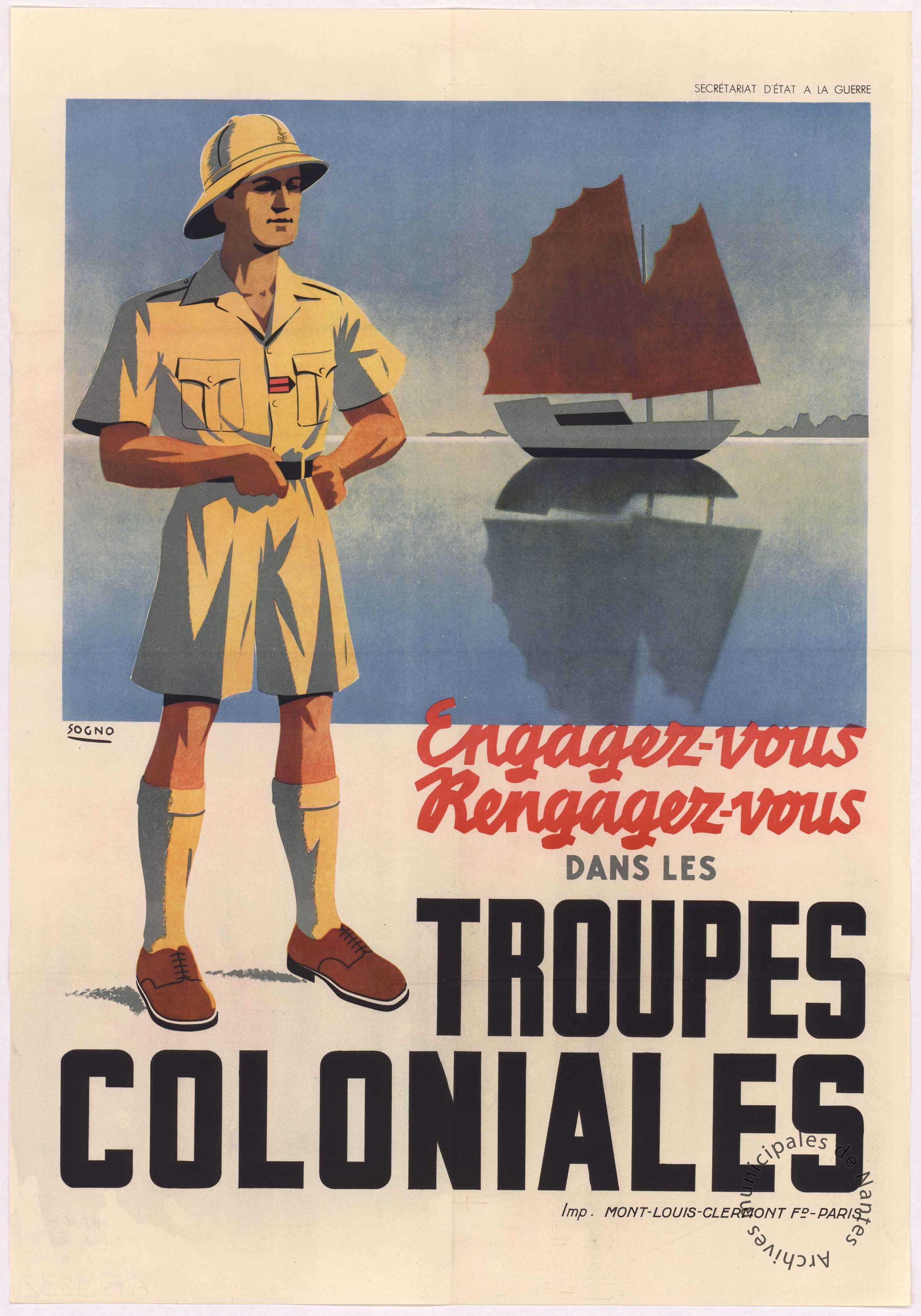
6Fi9832

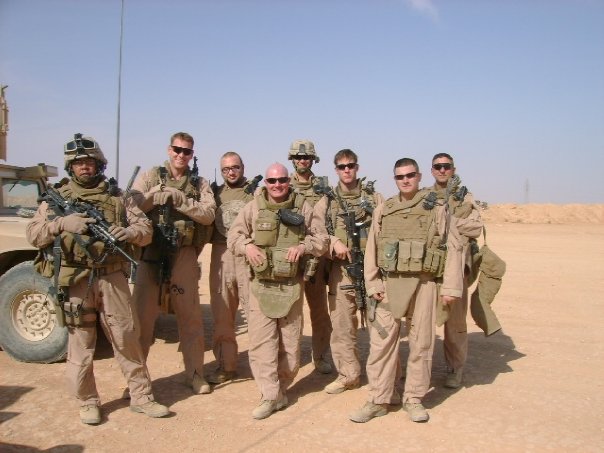
Just shy of five years ago in February 2008 I returned from Iraq after a tour with our advisors to the Iraqi Army and Security forces in the far reaches of Al Anbar Province. I flew back to the United States on a chartered flight with about 200 other men and women, individual augments from the US Navy who had served in Iraq and Afghanistan. We had a few days in Kuwait to “decompress” and then were on our way home. Those that conducted our training in that time had been in Kuwait, at large bases, separated from home but enjoying creature comforts that made it feel that we were in “Little America.”

Our aircraft stopped at Ramstein Air Base in Germany for a crew change and refueling. While there the aircraft was filled to its capacity with servicemen and their families returning from Germany to the United States. Crying babies and screaming kids greeted us as we boarded the aircraft. Most of us had not slept in the 24 hours before we left Kuwait and were exhausted. I was wearing my last serviceable uniform.

The remaining part of the flight from Germany to Philadelphia was difficult. The new arrivals were coming from a peacetime world and we were coming our of combat zones, often isolated even from other Americans. When we landed we went from our aircraft, got our civilian tickets, clad in our desert camouflage and dragging our gear we were made to removed our belts and boots by the TSA agents. It was obvious from we had come but instead of a welcome we we treated as potential hijackers. We each flew back to our respective bases on different flights into the arms of waiting families that loved us but did not understand us and units, who had not shared our experience simply sent us back to work without recognition while those that had not deployed griped about how hard things were.
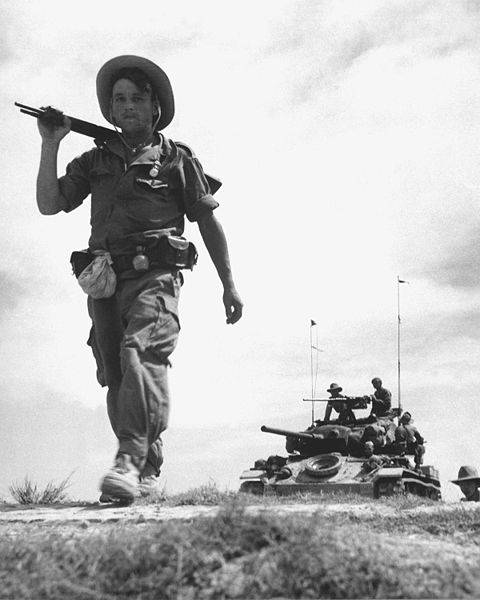
FrenchForeignLegionaireVtNamDOD

Today I was doing some counseling with a sailor and as we talked about life and the war a passage from Bernard Fall’s classic account of the French war in Indochina, Street Without Joy, came to mind. It reminded me of our experience returning from war, which could be seen as seemingly irrelevant incidents, but which pointed to a larger problem. It was so powerful that I decided to post much of it here.

In October 1953, Fall a journalist was covering the French war in Indochina. In between his stints with various French and allied units fighting the Viet Minh he made a travel stop over in Cambodia. He wrote of it:

“Sometimes, there occurs an almost irrelevant incident which, in the light of later developments, seems to have been a sign of the gods, a dreamlike warning which if heeded, could have changed fate- or so it seems.

One such incident occurred to me in October 1953 in Cambodia, at Siem-Reap, not far from the fabulous temples of Angkor-Wat…

A few French officers were still around, mainly as advisors to the newly-independent Cambodian Army….

When I went to the Transportation Office that afternoon at 1530, the Cambodian orderly told me apologetically that “le Lieutenant est alle au mess jouer au tennis avec le Capitaine” and that they might well stay there all afternoon. Since the convoy which I was expected to catch was supposed to leave at dawn, I decided to stroll over to the mess in order to get my travel documents signed there.

The Siem-Reap officers’ mess was a pleasant and well kept place; with its wide Cambodian-type verandahs, its parasol-shaded tables and the well-manicured lawns and beautifully red-sanded tennis court, it was an exact replica of all the other colonial officers’ messes from Port Said to Singapore, Saigon or even Manila, wherever the white man had set his foot in the course of building his ephemeral empires.

I found the two officers at the tennis court, in gleaming white French square-bottomed shorts…matching Lacoste tennis shirts and knee-long socks…

Since the men were in the midst of a set and I had little else to do, I set down at a neighboring table after a courteous bow to the ladies and watched the game, gladly enjoying the atmosphere of genteel civility and forgetting for a moment the war…

Then emerged from the verandah a soldier in French uniform. His small stature, brown skin and Western-type features showed him to be a Cambodian. He wore the blue field cap with the golden anchor of the Troupes Coloniales- the French “Marines”- and three golden chevrons of a master-sergeant. On his chest above the left breast of his suntan regulation shirt were three rows of multi-colored ribbons: croix de guerre with four citations, campaign ribbons with clasps of France’s every colonial campaign since the Moroccan pacification of 1926; the Italian campaign of 1943 and the drive to the Rhine of 1945. In his left hand, he carried several papers crossed diagonally with a tri-colored ribbon; travel orders, like mine, which also awaited the signature of one of the officers.

He maintained in the shadow of the verandah’s awnings until the officers interrupted their game and had joined the two women with their drinks, then strode over in a measured military step, came stiffly to attention in a military salute, and handed the orders for himself and his squad to the captain. The captain looked up in surprise, still with a half smile on his face from the remark made previously. His eyes opened suddenly as he understood that he was being interrupted. Obviously, he was annoyed but not really furious.

“Sergeant, you can see that I’m busy. Please wait until I have time to deal with your travel orders. Don’t worry. You will have them in time for the convoy.”

The sergeant stood stiffly at attention, some of his almost white hair glistening in the sun where it peeked from under the cap, his wizened face betraying no emotion whatsoever.

“A vous ordres, mon Capitaine.” A sharp salute, a snappy about face. The incident was closed, the officers had their drink and now resumed their game.

The sergeant resumed his watch near where the Cambodian messboys were following the game, but this time squatted down on his haunches, a favorite Cambodian position of repose which would leave most Europeans with partial paralysis for several hours afterwards. Almost without moving his head, he attentively followed the tennis game, his travel orders still tightly gripped in his left hand.

The sun began to set behind the trees of the garden and a slight cooling breeze rose from the nearby Lake Tonle-Sap, Cambodia’s inland sea. It was 1700.

All of a sudden, there rose from behind the trees, from the nearby French camp, the beautiful bell-clear sounds sounds of a bugle playing “lower the flag”- the signal, in which the French Army, marks the end of the working day as the colors are struck.

Nothing changed at the tennis court; the two officers continued to play their set, the women continued their chatter, and the messboys maintained their silent vigil.

Only the old sergeant moved. He was now standing stiffly at attention, his right hand raised to the cap in a flat-palmed salute of the French Army, facing in the direction from which the bugle tones came; saluting, as per regulations, France’s tricolor hidden behind the trees. The rays of the setting sun shone upon the immovable brown figure, catching the gold of the anchor and of the chevrons and one of the tiny metal stars of his ribbons.

Something very warm welled up in me. I felt like running over to the little Cambodian who had spent all of his life fighting for my country, and apologizing to him for my countrymen here who didn’t care about him, and for my countrymen in France who didn’t even care about their countrymen fighting in Indochina…

And in one single blinding flash, I knew that we were going to lose the war.”

Bernard Fall, Street Without Joy, Fourth edition, May 1967, Stackpole Books Harrisburg PA, pp. 291-294
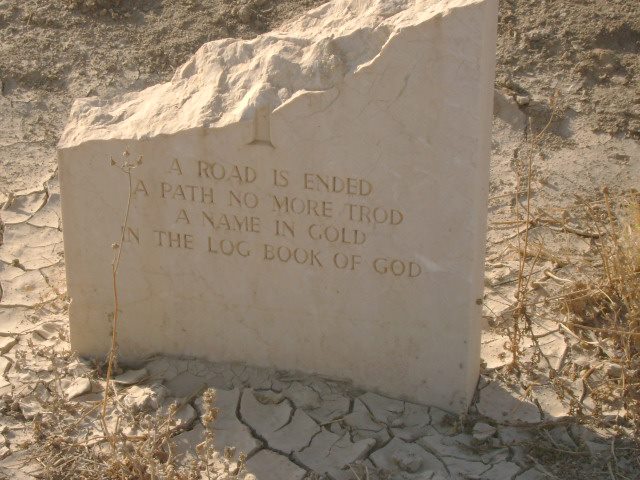
481801_10151367001287059_1003164983_n

I hadn’t thought about the passage in a long time, until it came to me today. When I read it I began to understand the feelings that I had in 2008 but could not comprehend. The fact is that a very few men and women, a small segment of the population, less than one half of one percent of Americans have been fighting the wars in Iraq, Afghanistan while the rest of the country, even parts of the military have been on the sidelines.

I realized when I came home that those that crammed the families from Germany onto our plane to save a few dollars, the TSA airport security agents and some of those in the units that we returned to didn’t understand. In fact it was as if they were not at war. I think I began to realize at that point that no matter how ardently that some of us served that our sacrifices would not produce the planned intent of those that sent us to war. I knew at that point, but couldn’t quite put my finger on it that we could not win this war. A war that only a portion of the military, was fighting while the bulk of the population lived in peace without any “skin in the game.”

We are so much like the French, the British and every other colonial or imperial power that it is frightening. We claim not to be an empire but we act like empires have throughout history. We place our footprint large of the globe, creating bastions of American culture in the midst of lands far different than us. Then we send a small percentage of our people to fight the wars that our nation’s leaders as well American and multinational businesses deem to be in our national interest, especially natural resources and commerce.
n671902058_1153793_4043

As the expeditionary forces fight the wars the bulk of the public is shielded from the horror of it. Many people are sympathetic to the war fighters but because they have not served are ignorant of what we face. Beguiled by the slick, high tech media presentations in the news and entertainment industry of war; they do not understand the cost. The representations in the media make war another spectator sport. At least the news no longer shows a nightly “body count” as was done in Vietnam.

Marine Major General Smedley Butler, a man awarded the Congressional Medal of Honor twice wrote shortly after his retirement in 1932:

“What is the cost of war? what is the bill? Major General Smedley Butler wrote: “This bill renders a horrible accounting. Newly placed gravestones. Mangled bodies. Shattered minds. Broken hearts and homes. Economic instability. Depression and all of its attendant miseries. Back -breaking taxation for generations and generations. For a great many years as a soldier I had a suspicion that war was a racket; not only until I retired to civilian life did I fully realize it….”

It is amazing what going to war will do to you. This is especially true when you can recognize what too few people see or even want to even think about. But then why should we expect anything different? There was no national call to arms after 9-11-2001 and our leaders told the people to do what they normally would do, and most importantly to “go shopping.”

Pray for Peace,

Padre Steve+
4 Comments

Filed under iraq,afghanistan, middle east, Military, national security, News and current events, Tour in Iraq

Challenger: 27 Years Later

space-shuttle-challengerjpg-ff9375e2f0d3b75c

“We risk great peril if we kill off this spirit of adventure, for we cannot predict how and in what seemingly unrelated fields it will manifest itself. A nation that loses its forward thrust is in danger, and one of the most effective ways to retain that thrust is to keep exploring possibilities. The sense of exploration is intimately bound up with human resolve, and for a nation to believe that it is still committed to a forward motion is to ensure its continuance.” James A. Michener 1979

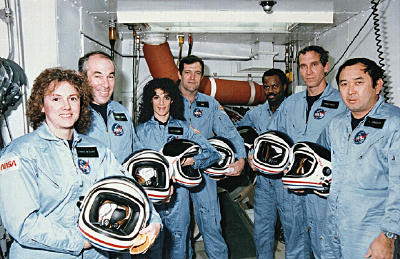
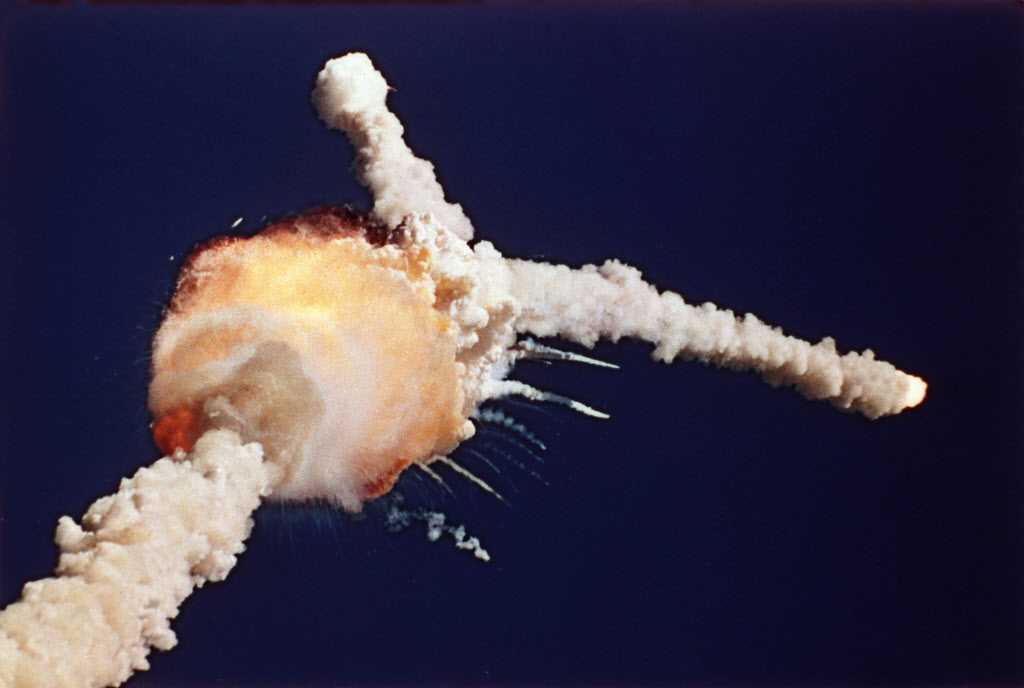
It is still hard to believe. But then Space Shuttles don’t blow up every day, but the Space Shuttle Challenger just beginning mission STS-51L on that cold and sunny Florida morning.

space-suit-challenger-crewa

Challenger’s crew

I guess that events like the explosion of Challenger remain with those that viewed them because they were unusual, historic and most of all, tragic. Yes we remember events of triumph as well, and they too make an imprint on our memories, but tragedies that impact a nation and the world touch us in a different and often more powerful way. I think this is because they expose to us our own mortality and vulnerability to things that we cannot control.

I know that I, like many others of my generation had grown up with the triumphs of the NASA manned space program. We had seen the incredible success of the Mercury, Gemini and Apollo programs.  Success and triumph were associated with the program. Even the tragic fire which consumed the command module of the Apollo I mission on January 27th 1967 during a launch pad test killing Astronauts Gus Grissom, Edward White and Roger Chaffee did little to quench our belief in the program.

In 1972 as the Apollo program wound down a new program was developed to be a more affordable means to continue space travel and scientific study. The program became the Space Shuttle program built around reusable orbiters of which Challenger was the third built for the program.

By the time Challenger was being prepared for STS-51-L we had become to Shuttle missions being routine. NASA was launching a mission every two to three months.  Challenger was the second of two missions in January 1986, her sister Columbia having returned from a 6 day mission just 10 days before her launch.

This familiarity with the routine of the Shuttle program and expectation of success made many of us forget that space travel is inherently dangerous and that complex vehicles like the Shuttle were not indestructible.

The STS-51-L mission was to be the 10th for the Challenger in under three years of service. The mission had been delayed due to weather on the 22nd and rescheduled several times due to weather or in one case due to problems with an exterior access hatch.

ksc-86pc-0081

Challenger takes off on January 28th 1986

The morning of the launch the weather was predicted to be at or below the 31 degree minimum safe launch threshold. Engineers from the builder of the Challenger’s Solid Rocket Boosters (SRBs) Morton Thiokol contacted NASA with their concerns that the O-Rings which sealed the joints on the SRBs which they believed might not seal properly.  NASA engineers argued that even if the primary O-Ring failed that the secondary O-Ring would be sufficient even though this was an unproven theory. Eventually Thiokol management overruled their engineers influenced by NASA management which demanded that Thiokol prove that it was not safe to launch rather than prove that it was safe to launch. Considering it was a “Criticality 1” component meaning that there was no backup in case of a failure of both joints. It was a clear violation of protocol but the later Rogers Commission would show that NASA managers frequently ignored or evaded safety regulations to meet their very ambitious mission schedule. This decision doomed Challenger and her crew of seven.

On the 28th of January 1986 I was a young commander of the 557th Medical Company (Ambulance) in Wiesbaden Germany. I had heard about the scheduled launch of the Shuttle but paid it little regard, despite the presence if Christa McAuliffe, the first “teacher in space.” That evening was hoping to close out the day by 7PM which was early for me as well as most officers in the 68th Medical Group and 3rd Support Command of what we commonly called the Imperial Army on the Rhine, the US Army Europe.

I had a stack of work in my inbox, NCO evaluations, criminal investigations, maintenance reports and upcoming missions, not to mention trying to get a head start on my Unit Status Report. Most of my soldiers except those on duty had finished for the day.

060125_challenger_3shot_hmed.grid-6x2

Challenger’s last moments

About 20 minutes to Six my senior duty person at the company, the Charge of Quarters or CQ in Army parlance came to my door which was at the far end of the hallway from where the CQ was stationed. Specialist Lisa Daley was a solid medic and outstanding soldier who had a great personality that caused her to be well liked in the company.  She came to my door and blurted out “Lieutenant Dundas! The Space Shuttle just blew up!”

I looked up from my desk and I remember my words to this day. “Specialist Daley, Space Shuttles don’t blow up.” She then said, “No sir they do, it’s on TV right now!”

I was stunned by her pronouncement. I got up and followed her as she told me what had happened. While I reached the CQ desk I saw the small television which she and her assistant CQ were watching. There was a live feed from CNN replaying the disaster, the twin plumes of smoke careening across the screen marking the spot where 73 seconds into the flight Challenger exploded. I stood there in shock, the images of the divergent plumes of smoke being etched into my mind.

atlantis-final-flight-landing-shuttle-launch-17-20110721

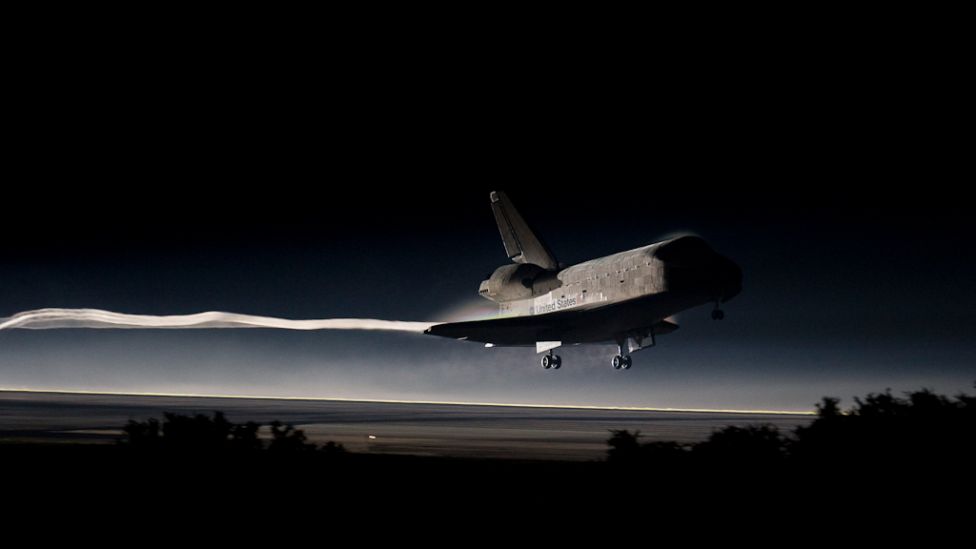
Atlantis landing on her final mission

It is hard to forget. 17 years later I was waiting for the arrival of General Peter Pace, then the Vice Chairman of the Joint Chiefs of Staff to arrive at Naval Station Mayport Florida for the Battle of Hue City Memorial weekend hosted by the USS HUE CITY. I got to the ship early and while drinking coffee in the Wardroom saw the news of the breakup of the Space Shuttle Columbia. It brought back the images of the Challenger disaster. General Pace was delayed as the Joint Chiefs and National Security Council held an emergency meeting and arrived several hours late and when he arrived he spoke of the Challenger disaster along with the Columbia.

800px-Orion_Service_Module

The Shuttle program ended with the final mission of the Shuttle Atlantis in July 2011. As one that still dreams of the stars and manned space exploration I do hope that NASA is able to return to manned space missions and go beyond what we have done before. I hope that future programs including the Orion program and maybe manned missions to Mars and beyond can fulfill that ever hopeful opening dialogue of Star Trek: “to explore strange new worlds, to seek out new life and new civilizations, to boldly go where no man has gone before.” 

Peace

Padre Steve+


Leave a comment

Filed under History, News and current events, star trek, traumatic national events

Remembering the Holocaust: The Ordinary Men of Wansee and Two Hours that Doomed a Race

20080713_1383757010_brama_birkenau

“Monsters exist, but they are too few in number to be truly dangerous. More dangerous are the common men, the functionaries ready to believe and to act without asking questions.”  Primo Levi

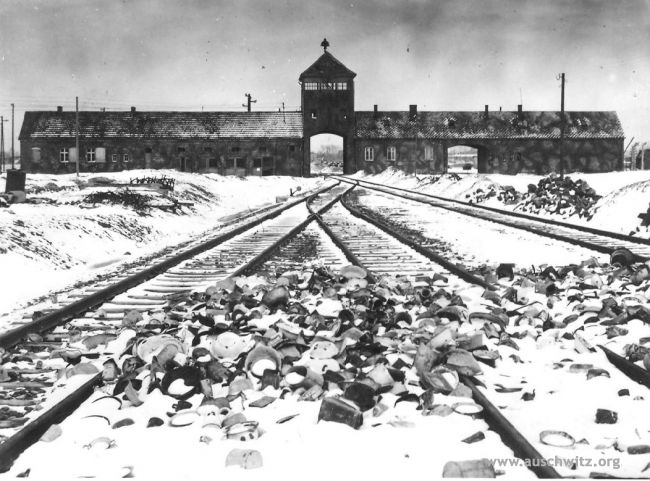
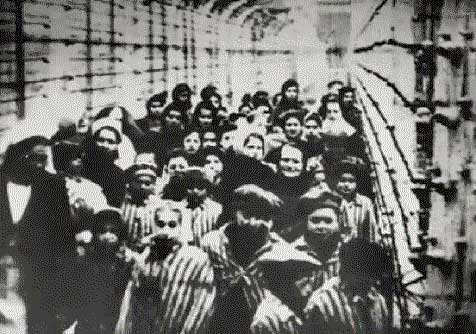
Today was the International Holocaust Remembrance Day. It was on January 27th 1945 that the Nazi death camp called Auschwitz, in Poland was liberated by the Red Army.

auschwitz

Auschwitz began as a work camp, notoriously harsh in its treatment of its prisoners but a work camp, picked because of its proximity to rail lines and isolation. By the summer of 1941 it was the largest camp in the Concentration Camp system. Within months the process of turning Auschwitz into a factory of mass murder began, quite accidentally when members of the camp staff discovered that a chemical used for the delousing of barracks known as Zyklon-B also worked on large animals, and therefore people.  It was tested on Russian and Polish POWs in September 1941.

As the Nazi desire for efficient extermination grew and early death factories showed their limitations and the “experiments” at Auschwitz resulted in it being selected as a death camp. The camp was expanded and its first gas chamber, the former camp morgue began its operations in February 1942. Other more massive chambers were built, chambers that could hold up to 2000 victims per cycle. By the time the operation was shut down in the weeks leading up to the camp’s liberation Rudolf Höss the Commandant of Auschwitz estimated that 2.5 million people, mostly Jews were exterminated in it. Höss boasted d that his camp could exterminate 10,000 people in a 24 hour period. Other estimates are lower, but still in the millions.

Höss, and other functionaries such Adolf Eichmann, who coordinated the massive effort to exterminate the Jews of Europe following the Wansee Conference of January 20th 1942 approached their jobs dispassionately. This was a common attitude among the civil service, military and police officials that oversaw the Holocaust. They simply did their jobs and followed the law.

Hannah Arendt wrote of Eichmann:

“The trouble with Eichmann was precisely that so many were like him, and that the many were neither perverted nor sadistic, that they were, and still are, terribly and terrifyingly normal. From the viewpoint of our legal institutions and of our moral standards of judgment, this normality was much more terrifying than all the atrocities put together.”

This was what made the Holocaust committed against the Jews of Europe by Nazi Germany a phenomenon different than other genocides. Many of the perpetrators were not driven by centuries old hate as in the Balkans, tribal blood lust as occurred in Rwanda, or the products of Soviet Communism or Communist Chines Maoist regimes.

It was the racial ideology of the Nazis which deemed the Jews and other non-Aryans to be sub-human. That ideology undergirded the German treatment of the Jews, and the conduct of the war, especially in the East. But the execution of the plan required the bureaucratic, administrative, technical and legal skills brought to the table by ordinary men. Men who sought promotion, advancement and economic security for their families. Individually many would have never killed, but in their positions they ran the rail network, the factories, the banking and finance industries and supported the war effort, most not thinking much about the evil that they abetted or if they did finding a way, be it social, scientific, religious, patriotic, legal or simply in the name of efficiency.

That is what makes the evil committed by them so terrifying. It is the product of “normal” people in an advanced Western nation. Make no bones about it, their actions were evil. They aided and abetted the genocide of the Jews, the disabled, other “sub-human” races, particularly Slavs, as well as those that they deemed less than suitable.

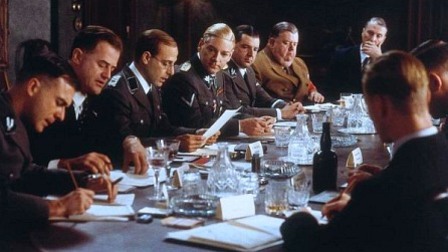
This evening I watched the movie Conspiracy which is about the two hour long Wansee Conference headed by Reinhard Heydrich and organized by Eichmann. That conference put the representatives of competing agencies, and in the case of the SS, agencies within agencies together and brought about their cooperation in the execution of the Final Solution.

conspiracy

The film is chilling in the ordinariness of the men involved. civil servants, party officials, they were the men that did the day to day administration of the necessary functions of the Reich. Some were horrified at the potentiality of the effects of what Heydrich referred as “evacuations” entailed. They understood that it meant the extermination of the Jews. Some were concerned about the military and logistical aspects, others in how such actions squared with the German law, especially the Nuremberg Laws, while still others were concerned with diplomatic relations with Germany’s allies or occupied countries and some unnerved by the fact that it would be murder. But when the conference was done, all agreed and worked together and it only took two hours.

It is important that we do not forget the Holocaust. It is also important to recognize that the instruments of that horror were on the whole “ordinary” men who as they saw it were simply doing their job. It is something that everyone needs to remember.

Peace

Padre Steve+
1 Comment

Filed under History, nazi germany, News and current events, world war two in europe

The Painful Lessons of Looking in the Mirror of Social Media

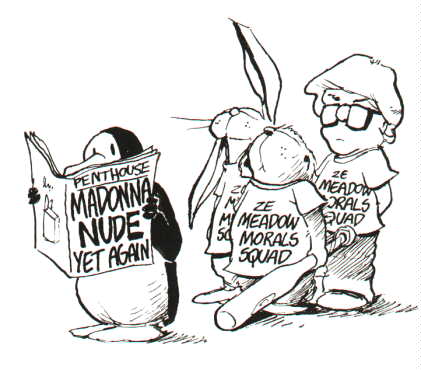
orange-BloomCounty-morals

I had an encounter this last weekend on a leading social media site. It was not pleasant and I waited for a couple of days to think, pray and meditate on what happen in the encounter before I decided to write about it.

It occurred on a page which is pretty popular and deals with military issues and the man that runs that page I enjoy very much. He frequently brings up very pertinent issues dealing with military issues, strategy and tactics, foreign policy and national security policy as well as social aspects of current military life.

I got involved in an debate, probably not the best thing to do because the debate had already degenerated into a pretty vicious cesspool of recriminations between pro and anti-gay rights supporters. The subject was the actions of the Officers Wives Club at Fort Bragg North Carolina to initially reject the entry of the lesbian wife of a female Army Lieutenant Colonel for membership, the subsequent court battle and the wives club’s grudging issuance of a “guest pass” to the woman.

What got me to comment was the absolutely venomous tenor of the gay rights opponents, their often obscene comments about the lesbian couple and how many self identified as Christians or supporting Christian values. It wasn’t a matter of agreeing or disagreeing about policy and interpretation of law or even the validity or sincerity of their beliefs, it was the shameful way that they demonized and dehumanized the people involved as well as those that pointed out an opposing viewpoint.

I hesitated at first but then having seen such how such clubs deal with those different from their majority of their members I wrote this comment:

“in my experience of 30 years commissioned I have found many Officers Wives Clubs to be a cesspool of gossip and self-righteousness covered with a veneer of respectableness covering up their own vanity. Most often they are the domain of white women, who do not work and historically have shunned male spouses of female officers, wives that are working professionals whose identity is not built around their husband’s achievements as well as minorities, the physically disabled or wives of officers who spent years as enlisted men. The treatment of the Lesbian wife is another chapter in officially sanctioned discrimination. Chaplain wives organizations are similar, except you can toss in the stigma of not being a Evangelical or Conservative Protestant. Wives of Chaplains that don’t fit that mould are marginalized, be they Mainline Protestants, Jews or Mormons and of course wives whose faith is different then their husband, such as a Protestant Chaplain with a Catholic wife. My view, if they want to be a private membership that excludes those that they don’t think fit in, then meet off base…”

I don’t think that my comments were off base. They actually seem to describe the history of these organizations fairly well. However, my post attracted the ire of a relatively recent Army retiree and stupidly I shot back with a flippant comment. He had already been heavily engaged in the debate and the fact that I was a Chaplain gave him all that he needed to begin tThat comment was ill advised. A Marine Corps Lieutenant Colonel friend of mine noted that I shouldn’t wrestle a pig. I ignored his advice as well of the advice Judy also tried to warn me off.

My flippant comment elucidated an attack from the man that went well beyond dealing with policy, law or even faith, it became a personal attack. To him my arguments did not matter, it was a matter of not only attempting to defeat what I said but to discredit and destroy me in the process. When I attempted to build bridges to dialogue and invite him to actually get to know me, he attacked more vehemently and personally making accusations about me, my character and my beliefs. Instead of debating any of my defenses of my position, theological or constitutional he dismissed them. His characterizations and comments that were so off base and wrong that anyone who either knows me personally or reads this site regularly would know that they were absolutely false.

But the attacks wounded me and left me incredibly angry. But that was not a bad thing. They caused me they think back to a time early in my ministry when I did similar things to those whose doctrine, beliefs or practices that I believed were wrong. I was very good at it. My Chaplain Assistant who is now a relatively senior Army Chaplain used to call me a “Catholic Rush Limbaugh,” even though I was not a Roman Catholic. A very conservative and reactionary Roman Catholic journal called The New Oxford Review published two of my articles back in 1998 and 1999, which ended up getting me banned from publishing for years by my the second ranking bishop of my former church. I was accused of being “too Catholic” and the irony was that he left that church well before I was forced to leave becoming Roman Catholic and writing similar articles to mine for a major Catholic apologetics online website.

So as I said I was good at this. With precise logic I could devastate others. The man that attacked me was much like me. I was seeing my old self in a mirror and it was not a sight that I enjoyed and it tempered my remarks to the man that I made in my defense.

It seems to me that those that argue most strenuously and personally are not necessarily bad people. They are consumed with zeal. Jesus had to deal with such people during his earthly ministry and every time he left them perplexed. I am not that good at this point in doing that. I simply gave up and told my attacker to “pound sand.” Jesus was much better at ending debates like this one than me.

I felt like George Costanza of Seinfeld trying to get the last word. Not very Jesus like, but revealing to me. Revealing to the point that I was reminded of Bonhoeffer’s words that “nothing that we despise in other men is inherently absent in ourselves.” It is a hard lesson to learn and it seems that I have to learn it more times than I like. In a sense it was like looking in the mirror but seeing me more than a decade ago.

Peace

Padre Steve+
8 Comments

Filed under christian life, faith, News and current events, Political Commentary, Religion

Thoughts on the Inauguration of President Obama and the Legacies of Abraham Lincoln and Dr Martin Luther King Jr.

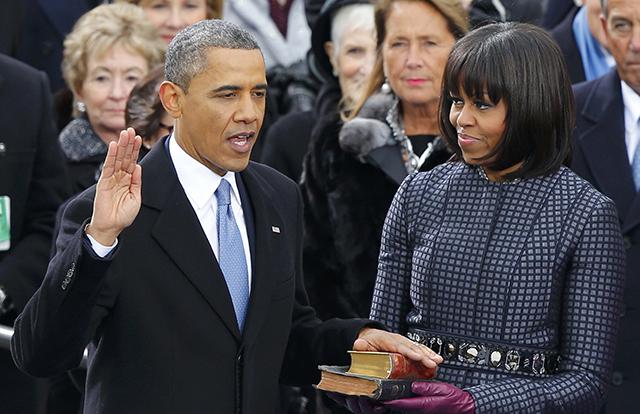
Obama2ndInaugurationOath640

“I have a dream that one day this nation will rise up and live out the true meaning of its creed: “We hold these truths to be self-evident: that all men are created equal.” Dr Martin Luther King Jr. 

No matter who the President is, what political party they were the candidate of and no matter if I supported them during their campaign I always try to partake of the inauguration. Today was like that, though this year I was on the road between Virginia and North Carolina and listened to the ceremony live on radio as I made my trip.

Radio is a wonderful way to take in a live event, be it something like today’s events as well as a baseball game. Radio forces you to actually listen to what is being said as well as use your imagination to envision the events themselves. If you are present at the actual ceremony you may not hear what is being said, or miss significant parts of it simply because of the way that sound travels, audio distortions and things happening nearby that distract you even as you take in the visual wonder of the event. Television is a wonderful thing that allows us to see an event live and can enhance our experience of it, but often it can be full of distractions.

Radio on the other hand forces us to imagine the spectacle of the event as well as the actual words spoken.

I watched President Obama’s first inauguration with a very sick and elderly African American woman in the ICU at Naval Medical Center Portsmouth. She held my hand as he took the Oath of Office and during his speech. She was in tears as she had lived through segregation, routine abuse by white people in the South, being treated as less of a human being on the basis of her race. She had lived the beginnings of the Civil Rights movement as a contemporary of Dr King. For her it was something that she never believed could happen in her lifetime coming true. It was at that moment I really began to appreciate the full impact of his election, what it meant to this dear woman, and what it meant to so many people. It was a watershed moment as she did not want me to pray for her medical condition, which was not good, but to pray with her for the new President.

The Second Inaugural Address was different as President Obama, now seasoned to the reality of the great political divide that has been part and parcel of our political climate went back to tradition to frame the current issues that are part of our daily life. He appealed to the Declaration of Independence, echoing it as Dr King had but continuing:

“We hold these truths to be self-evident, that all men are created equal; that they are endowed by their Creator with certain unalienable rights; that among these are life, liberty, and the pursuit of happiness.”

Today we continue a never-ending journey to bridge the meaning of those words with the realities of our time.  For history tells us that while these truths may be self-evident, they’ve never been self-executing; that while freedom is a gift from God, it must be secured by His people here on Earth.The patriots of 1776 did not fight to replace the tyranny of a king with the privileges of a few or the rule of a mob.  They gave to us a republic, a government of, and by, and for the people, entrusting each generation to keep safe our founding creed.”

The speech which touched on a number of potentially divisive issues echoed that of Abraham Lincoln’s Second Inaugural Address and the Gettysburg Address. It was an appeal to freedom, freedom for all and also the responsibility of each of us in the that endeavor.

“Through it all, we have never relinquished our skepticism of central authority, nor have we succumbed to the fiction that all society’s ills can be cured through government alone.  Our celebration of initiative and enterprise, our insistence on hard work and personal responsibility, these are constants in our character.”

His words near the end of the speech made that clear and he acknowledged the reality that American statesmen such as Washington, Lincoln, Theodore and Franklin Roosevelt and Ronald Reagan understood so clearly.

“That is our generation’s task — to make these words, these rights, these values of life and liberty and the pursuit of happiness real for every American.  Being true to our founding documents does not require us to agree on every contour of life. It does not mean we all define liberty in exactly the same way or follow the same precise path to happiness.  Progress does not compel us to settle centuries-long debates about the role of government for all time, but it does require us to act in our time.”

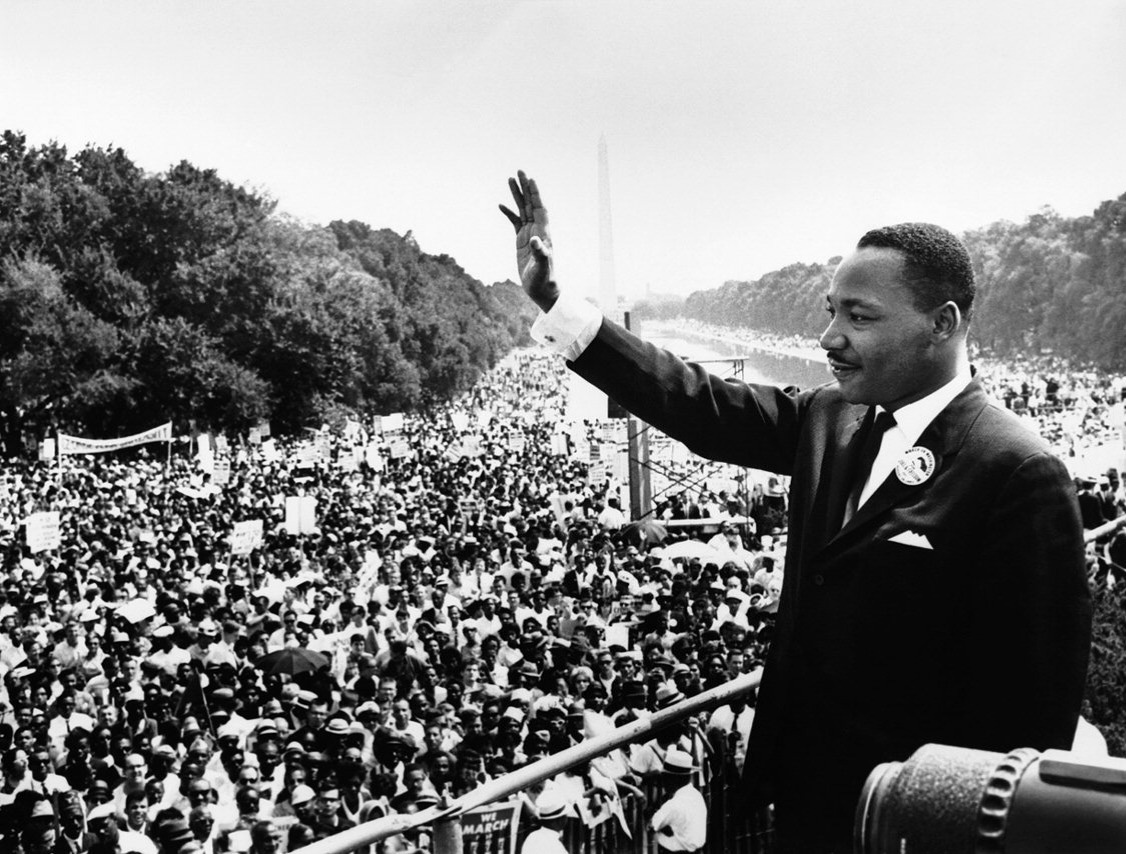
martin-luther-king-jr

Somehow it was fitting that the inauguration was held on the observed holiday of the Birthday of Dr Martin Luther King Junior and in the 50th year of his “I Have a Dream” speech on the Capital Mall. Having walked that Mall, and made numerous visits to our Nation’s capital I could picture these speeches, not just today’s speech by President Obama, but those of past Presidents, those that I have heard, seen or read as well as Doctor King’s speech.

I do not have to agree with every policy of a President to support them and pray for them as President. Today as I listened to both the President and Vice President Biden take their respective Oath of Office I was reminded of the Oath that I and those that serve in the Military take and then as I listened to his speech I heard the President refer to those similarities and the responsibility of all of that take it.

My fellow Americans, the oath I have sworn before you today, like the one recited by others who serve in this Capitol, was an oath to God and country, not party or faction.  And we must faithfully execute that pledge during the duration of our service.”

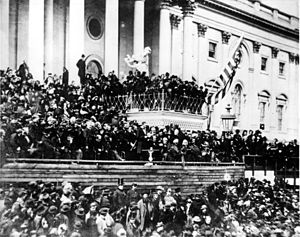
300px-Abraham_Lincoln_giving_his_second_Inaugural_Address_(4_March_1865)

After the ceremony was over I spent some time thinking about the closing words of Abraham Lincoln’s Second Inaugural Address and pray that we will be able to fulfill those words in our lifetimes.

“With malice toward none, with charity for all, with firmness in the right as God gives us to see the right, let us strive on to finish the work we are in, to bind up the nation’s wounds, to care for him who shall have borne the battle and for his widow and his orphan, to do all which may achieve and cherish a just and lasting peace among ourselves and with all nations.”

Peace

Padre Steve+

 

5 Comments

Filed under History, leadership, News and current events, Political Commentary

A Sad Day for Baseball: Baseball Legends Earl Weaver and Stan Musial Pass Away

tumblr_lj5h6f12vi1qhwcw3o1_500

“On my tombstone just write, ‘The sorest loser that ever lived.'” Earl Weaver

It isn’t every day that two baseball legends pass away. However today was one day that the baseball world mourns the losses of two legends Earl Weaver and Stan Musial.

In the morning I heard about the passing of Earl Weaver, the manager of the Baltimore Orioles who during the 1960s, 1970s and 1980s and help to establish what is now known as “the Oriole Way.” He was not much of a player, never getting out of the minor leagues, but it was his skills coaching and managing that like many other greats set him apart.

weaver

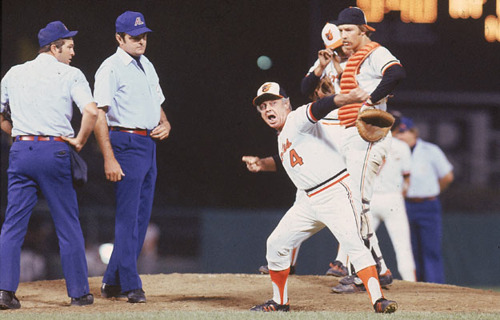
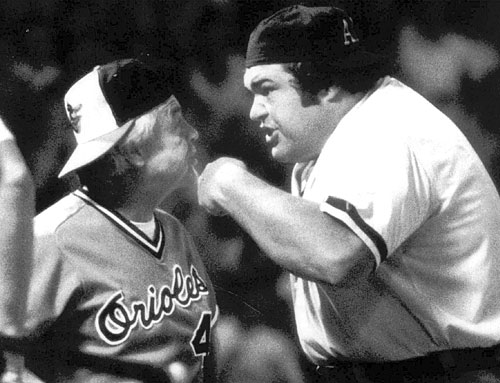
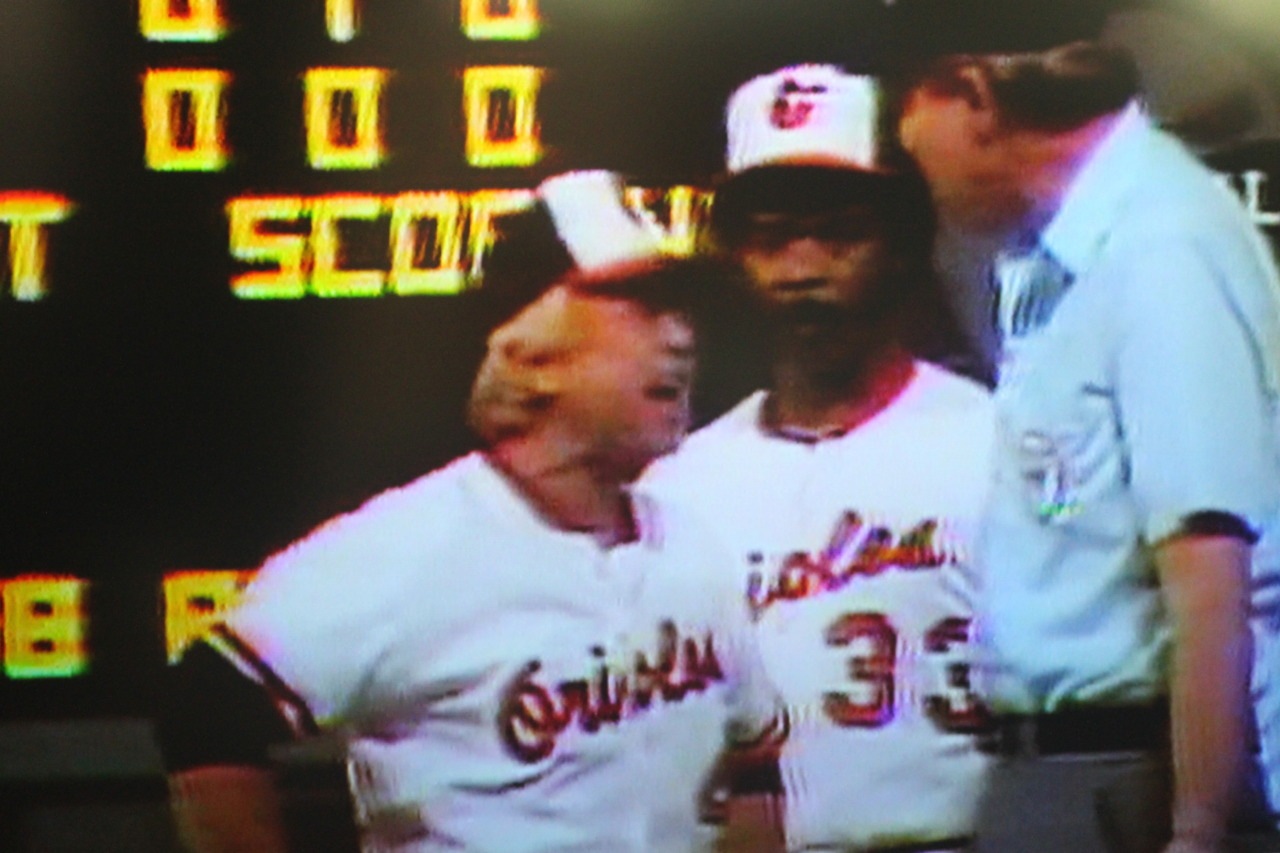
He battled umpires on a regular basis and his rivalry with Ron Luciano was particularly sharp and his battle with Bill Haller, caught on tape and film as Haller was wearing a microphone for a documentary.

tumblr_lpxl0ucFqd1qhfmruo1_1280

https://www.youtube.com/watch?feature=player_embedded&v=uLUuxVX4Z10

Weaver was thrown out of at least 91 games and received four multiple game suspensions. He said “The job of arguing with the umpire belongs to the manager, because it won’t hurt the team if he gets thrown out of the game.”

He was also a master of statistics and in a way was a pioneer of working to the best possible match up of pitchers versus hitters and used the platoon system to ensure the right match ups. He managed his teams to five 100 game plus seasons (1969, 1970, 1971, 1979 and 1980) four AL Pennants and one World Series title (1970).  He was inducted to the Baseball Hall of Fame by the Veterans Committee in 1996. After his managing career he spent much time active in the Orioles community hosting a radio program called Managers Corner. He and his wife were on an Orioles cruise when he died today at the age of 82.

He was a manager that I always loved watching and reading about later in life and his comment that “It’s what you learn after you know it all that counts” is a theme for my life.

140049-0-600

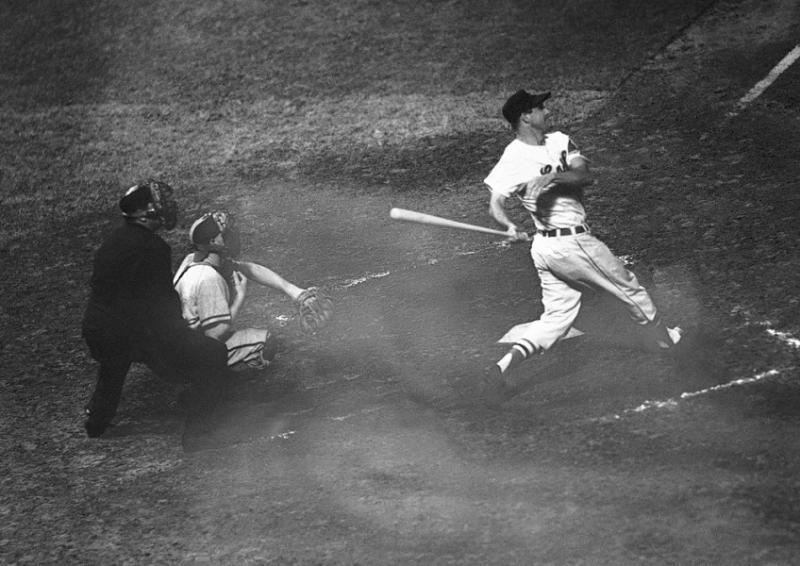
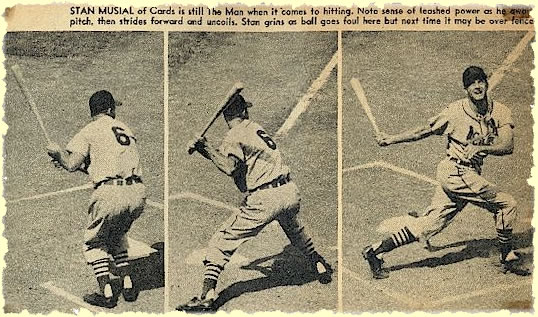
Stan Musial was a player’s player and one of the best hitters ever to grace the diamond.  An All Star 24 times, National League MVP 3 times, seven time NL Batting Champ and part of three World Series winning St Louis Cardinal Teams, Musial was a consummate professional known for his modesty and hard work.

musial_stan_legends2_b

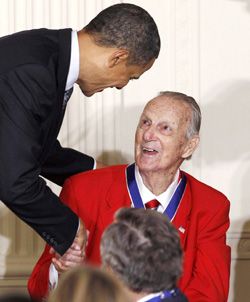
After his playing career of 24 years ended in 1963 he went on to be the club’s General Manager helping the team to another World Series title.  Musial was elected to the Baseball Hall of Fame in 1969 on the first ballot and was named to the All Century Team in 1999. He was awarded the Presidential Medal of Freedom by President Barak Obama on February 15th 2011.

Freedom

Musial was a hitter that analyzed every aspect of the craft of hitting. His comment about how he sized up pitchers sums up how detailed he was in how he played the game: “I consciously memorized the speed at which every pitcher in the league threw his fastball, curve, and slider; then, I’d pick up the speed of the ball in the first thirty feet of its flight and knew how it would move once it had crossed the plate.”

I saw Weaver manage in person a number of times and saw Musial play in an Old Timers game as a kid. Carl Yastrzemski said of Musial: “They can talk about Babe Ruth and Ty Cobb and Rogers Hornsby and Lou Gehrig and Joe DiMaggio and Stan Musial and all the rest, but I’m sure not one of them could hold cards and spades to (Ted) Williams in his sheer knowledge of hitting. He studied hitting the way a broker studies the stock market, and could spot at a glance mistakes that others couldn’t see in a week.”

There were few greater players than Stan Musial and Earl Weaver ranks high among the most colorful and successful managers of all time.

Baseball has lost two gems today.

46628_462714772058_671902058_6542652_7607640_n

Rest in Peace on that great Field of Dreams,

Peace

Padre Steve+

1 Comment

Filed under Baseball, Batlimore Orioles, News and current events, sports and life

Bicycle Pants on Fire: The Banal Confession of Lance Armstrong

159537835.jpg.CROP.rectangle3-large

“I didn’t invent the culture, but I didn’t try to stop the culture.” Lance Armstrong

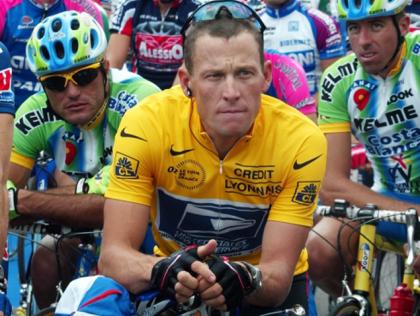
I watched the Lance Armstrong interview online today. I did not watch it last night as we were out with friends. I found the interview to be fascinating and at the same time chilling. Oprah Winfrey did it well and in the process laid Lance Armstrong and his lies bare.

Cheating blood doping, the use of EPO and Testosterone were commonplace in competitive cycling. The were the norm, not the exception. At the same time they were also illegal and banned in the sport. Lance Armstrong was part of that world, even before his battle with cancer.

The use of the blood doping and other means of cheating had become so commonplace  that that it was banal, which the Oxford dictionary of the English Language defines as “so lacking in originality as to be obvious and boring.”

The chilling part for me was that I didn’t sense any remorse from Armstrong. He acknowledged the use of Testosterone, EPO and blood transfusions but his reasoning for them then, and his apology or confession now felt to me like I was watching someone with no remorse and someone who felt that since everyone else was doing it that there was really nothing wrong with doing it. Armstrong’s cheating was the norm for his era, but his subsequent campaign to intimidate and destroy those that would tell the truth took his actions in cheating to a different level than his competitors.

The most chilling segment of the interview with Armstrong for me was when Oprah asked Armstrong if the things that he did, the blood doping, EPO and Testosterone use “felt wrong.”

Oprah: “Was it a big deal to you? Did it feel wrong?” 

Armstrong: “No, scary.”

Oprah: “Did you feel bad about it?”

Armstrong: “No, even scarier.”

Oprah: “Did you feel any way that you were cheating?”

Armstrong: “No, scariest.”

Oprah: Did you feel in any way that you were cheating? You did not feel you were cheating taking banned drugs?

Armstrong: “At the time, no. I kept hearing I’m a drug cheat, I’m a cheat, I’m a cheater. I went in and just looked up the definition of cheat and the definition of cheat is to gain an advantage on a rival or foe that they don’t have. I didn’t view it that way. I viewed it as a level playing field.”

Armstrong’s answer to this and to how he used lawsuits and threats to attack those that told the truth were chilling. I wondered what someone like Armstrong would do in life and death situations or to advance himself where the stakes were more than simply an athletic career and I could not fathom that level of banality, that level of selling ones soul for that type of personal gain and the destruction of the lives and reputations of others.

Armstrong commented on what he called his ruthless will to win: “My ruthless desire to win at all costs served me well on the bike but the level it went to, for whatever reason, is a flaw. That desire, that attitude, that arrogance.”

To simply refer to this as a flaw to me is to minimize the issue. I really don’t think that Armstrong gets how deep this is. I know that all of us have feet of clay and that Armstrong is not the first athlete to cheat to win or to attempt to cover up his cheating. However his cover ups, denials and attacks on those that attempted to tell the truth went beyond the norm for a sports cheater.  He went out of his way to destroy others to protect his legacy. Had he not suffered the loss of his Tour de France titles, the loss of control of his Livestrong Foundation and been banned for life from the sport I doubt that he would have ever even come this close to coming clean.

The years of cheating, the years of cover up and the years of destroying those in his way have probably changed Armstrong. He admitted that he cheated before his fight with cancer but he noted that he didn’t become “ruthless” in that until after it. He did it for the myth, the myth that his cheating helped him create and he rationalized it in the same way that others have rationalized evil before him. Robert J Lifton wrote of the Nazi Doctors “In doing so – or in order to do so – the men themselves changed; and in carrying out their actions, they themselves were no longer banal.” Armstrong took cheating to a higher level and in doing so victimized others.

I know that Armstrong’s story and foundation have doing many good things. The fact is that the evil committed by Nazi doctors also benefitted science, but it was still evil. The cheating was the least of the issues here. His sport was corrupt to the core. Cheating was the norm. The greater issue his what Armstrong did for years to maintain the lie at the expense of others. His was not a victimless crime, and call it what it was, it is a crime to threaten, intimidate and use the courts to attack and punish those simply trying to tell the truth.

As it is there are people familiar with the case that believe that his statements to Oprah about not having cheated after 2005 are also a lie. Unfortunately, given his history of deceit and manipulation of the narrative I tend to believe them.

Peace

Padre Steve+

1 Comment

Filed under News and current events, sports and life

“Lancing” the Boil: The Ethical Conundrum Presented by Lance Armstrong

image-3

“Listen, I’ve said it for seven years. I’ve said it for longer than seven years. I have never doped. I can say it again. But I’ve said it for seven years. It doesn’t help. But the fact of the matter is I haven’t. And if you consider my situation: A guy who comes back from arguably, you know, a death sentence, why would I then enter into a sport and dope myself up and risk my life again? That’s crazy. I would never do that. No. No way.” Lance Armstrong to Larry King and Bob Costas on Larry King Live August 25th 2005 

It appears that Lance Armstrong has confessed to cheating to win his historic 7 Tour de France cycling championships. Using a sophisticated means of blood doping he sometimes with the cooperation of his teams he, like the majority of the high level competition cyclists of his era used an illegal but often hard to detect means to bolster his ability to win.

Armstrong, like so many at the top level of his sport appears to have been a habitual cheater, liar and bully. The fact that he was a cancer survivor and had returned to the top of his sport made him a legend and gave him an almost mythic aura. Who could criticize such a heroic individual? Certainly his struggle to defeat cancer and return to the top of his sport was worth something and indeed it was. Armstrong became a legend and established a foundation that did and still is doing wonderful things for cancer victims.

If it was simply cheating and then getting caught the situation would be different. Armstrong was not different than many of his competitors and if it was like the cases of people in other sports who cheated and later either were caught or admitted their misdeeds it would be just another case of a sports cheater.

However in the Armstrong case the story is one that is not so simple. His also involves an aggressive cover up and willful destruction of the reputations of anyone who dared challenge him or accuse him of cheating. It involved attacks on the character of critics as well as threats made against them, even veiled physical threats. It involved legal actions to attempt to prevent the publication of articles or books that could damage him in multiple countries. It involved a campaign of lies that lasted over a decade. It also ensnared cancer victims as his charity foundation Livestrong was devoted to helping those battling the dread disease.

It is a case that will not simply interest sport writers, but one which will engage philosophers, ethicists and theologians for years to come. The reason is that it is so multifaceted and brings to the fore questions that most people care not to even think about, even though they fascinate us.

The questions are hard. Who would want to think that the cancer victims helped by Livestrong were not positive beneficiaries of Armstrong’s benevolence? It is certain that Armstrong’s foundation has done remarkable work. At the same time can Armstrong’s actions be justified simply because many people were benefited by them? What about the his victims? Those men and women who suffered professional, legal and financial reverses as well as had their reputations damaged for attempting to stand up to someone that looks by the actions committed against his critics and accusers to be a bully.

It is the classic question of whether the needs of the many outweigh the needs of the few combined with the actions of one person to advance himself at the expense of others. Some would like to be able to fame Armstrong’s cheating and subsequent support of Livestrong and its tremendous work in helping people in a positive manner.

That can be done, but at what cost? We wrestle with such ethical questions all the time but seldom do we see the drama play out out in such a personal manner. Usually we are able to keep it theoretical and distant. But Armstrong, he had become a legend, a hero to many and

I think that most of us, me included were enamored with the myth of Armstrong the cancer survivor rising to unheard of heights in his sport. I think that this was especially the case in the United States where the thought of an American winning at the top levels of a sport that has few American long dominated by Europeans was particularly pleasurable, especially since most Americans couldn’t care less about competitive cycling. However, Armstrong got us to care about it, even if it was only when we saw Tour de France highlights on ESPN Sports Center.

Caught up in the myth we surrendered to it. It was attractive and it appeals to the underdog in all of us. However, it was a myth and the creation and sustainment of the myth created victims just as it helped others in need of live saving treatment as well as cancer research.

As for Armstrong, his confession and apology that will be aired on Oprah Winfrey’s show the next two nights I am of mixed feelings. Some like Mike Lupica have stated that it is another attempt of Armstrong to control the situation and the narrative. He could well be right and there is part of me, the cynical and realistic part that believes this. At the same time I would hope that Armstrong has had a real epiphany as to the consequences of his actions in the lives of the people who were his fans, his beneficiaries as well as his victims.

As for the very harsh remarks of Pat McQuaid the President of the International Cycling Union that “Lance Armstrong has no place in cycling and he deserves to be forgotten in cycling….” I have a negative opinion. He and his championships, though tainted and no stripped from him are a part of the history of cycling. He helped popularize the sport in the United States. He and his tainted accomplishments cannot be erased as if he did not exist. No cycling bodies took any substantive actions against Armstrong during his competitive career. No sport was as inundated by a culture of cheating as professional cycling. Armstrong cannot be forgotten as McQuaid says he deserves to be. It is okay to say “never again” and work to build an authentic and honest competitive sport. But to erase and forget is to ensure that another Armstrong will come along. It is a cautionary tale.

As long as Armstrong brought attention and income to the sport his actions were tolerated and despite numerous accusations he was celebrated and because of his story as a cancer survivor many looked the other way. I have to say that I am part of that latter group that saw a cancer survivor winning as inspirational. I did not want to believe the accusations and I did not look to see or even pay attention to the things that he and his associates were doing to those attempting to bring the story to the light of public scrutiny.

As for Livestrong I do hope that it will survive and continue to help cancer victims. As for Armstrong I hope that his confession and admission of wrong doing are genuine and that he will make restitution to those that he bullied or ruined in maintaining the cover up. I am less concerned about his competitors in the Tour de France as so many of them were doping that it makes the steroids scandals in other sports pale in comparison.

I encountered Armstrong once in Iraq when he was on a tour with a number of celebrities. I had come back to my base of operations the day that he and his tour led by the now retired Chairman of the Joint Chief’s of Staff Admiral Mike Mullen came through. Since the number of people who could attend the show was limited and I wanted to make sure that junior personnel had a chance to see Armstrong, Robin Williams, Kid Rock and Lewis Black I did not attempt to go. The next morning I was walking to the dinning facility and passed Armstrong as he was walking back to is quarters. I said “good morning” and he returned the greeting and we both continued on our way. I figured that he didn’t need another person coming up to him to get an autograph and though he was a public figure on a USO morale tour I still attempt to honor some modicum of privacy. The tour left later that morning and my friend, Father Jose Bautista-Rojas a Catholic Chaplain who had escorted Mrs Mullen during the visit brought me a ball cap signed by both Armstrong and Robin Williams. I will keep it and remember the fact that Armstrong and those with him came to Iraq at the height of an unpopular war, but also to remind me that all of us have feet of clay.

I do hope that he is able to make his peace and reconcile with those that he has hurt or disappointed and that some good will come out of this for him, his family, those that benefit from Livestrong and the sport.

Peace

Padre Steve+

1 Comment

Filed under News and current events, philosophy, sports and life

Cheaters and the Baseball Hall of Fame: The Hypocrisy and Arrogance of the Baseball Writers of the BBWAA

HoF

“Cheating is baseball’s oldest profession. No other game is so rich in skullduggery, so suited to it or so proud of it.” Thomas Boswell

I love baseball. Everything about it. The good, the bad and the ugly. It is a game that to me represents the human condition better than any other game. I am amazed by the feats of ballplayers of today and yesterday. I am also a realist and know that like the rest of us, that baseball players are human. I believe that God speaks to me though baseball and there is no other place in the world that I feel more at peace than watching a ballgame in a ballpark. It is an elixir for my soul.

However baseball, despite its perfection as a game is a game played by, written about and watched by a very imperfect cast. Including me. I know a lot of ball players, men who have played in the Majors and Minors and I admire them. I admire their dedication and the sacrifices that they make to be the best. I admire the fact that many toil in the obscurity of the Minor Leagues for years before even getting a chance to play “in the show.” Not many actually get careers in the Majors, and a decided minority have the lifetime performance to even merit being honored in the Hall of Fame.

The Baseball Writers who decide on the election of baseball players into the Baseball Hall of Fame decided that this year, that no players should be inducted into the Hall of Fame. It was due in part to their interpretation of the rules that allow for the writers to consider issues of character can be considered in the voting process. It was the first time in four decades that no players were elected to the hall.

The vote was seen as the writers judgement on the players of the steroid era, an era that until it became unpopular was heralded by many of the same writers as a time of revival in the sport. The same writers that reveled in the domination of Roger Clemens and Curt Schilling on the pitchers mound, the great home run race between Mark McGuire and Sammy Sosa, the massive home runs of Barry Bonds or the stellar performances of so many other players of the era. The cheerleaders became the morality police. Not that the use of PEDs was right by any means but the moral indignation of the writers that chose to use their vote or lack of a vote as a means of punishment seems to me to ooze hypocrisy.

I am sure that is the case.

Not that I am in favor of cheating or cheaters. However that being said, the bar that these players are being held to is higher than that of baseball cheaters of previous generations, of which some are honored in the same Hall of Fame that the writers exclude those of the steroid era. It seems to me to me that the writers are being just a bit hypocritical and cynical concerning the history of the game and the Hall of Fame.

That is easy for them to do because we Americans, possibly more than any other people love to tear down our heroes and those that excel at what they do. We are one of the most moralistic peoples on the face of the earth, and nowhere more does that moralistic tenor show up than in baseball. Football and basketball, cheating is not so bad, but cheating in baseball that is somehow a greater sin than almost anything in our society. Tax cheats, adulterers, academic cheats and plagiarists as well murderers and other stellar members of society, including lawyers and politicians find it easy to damn baseball players for cheating.

However, the Hall of Fame membership includes many of the best in baseball as well as some pretty lousy human beings who just happened to be great baseball players. It is a place of history where the disgraced members of the 1919 Chicago White Sox have a place, though not as members. It is a place that has enshrined admitted cheaters of previous eras. It is a place that has enshrined racists, bullies, wife beaters drunks philanderers adulterers and even an accused murderer.

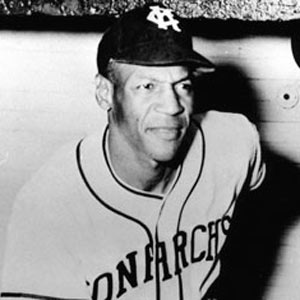
It is also an institution that for decades excluded some of the best ballplayers who ever played the game because they were black and had to play in the segregated Negro Leagues. It’s greatest snub was to the legendary Negro League, player manager and later Major League Coach and scout Buck O’Neil, who it never admitted.

buck-oneil-040209-lg1

Buck O’Neil Out, Ty Cobb in

ty_cobb

Ty Cobb was a violent man and as racist as they come. He once assaulted a fan, a fan with no arms for jeering him. He attacked a black groundskeeper for attempting to shake his hand and then attempted to strangle the man’s wife when she came to his aid. Babe Ruth would show up drunk for games and slept around with any attractive woman of the female persuasion. There are a host of unsavory characters in the Hall of Fame besides the admitted cheaters and suspected cheaters of bygone times. Hell, Hank Aaron and admitted to using amphetamines what were then known as “Greenies” and players testified under oath that Willie Stargell, another first ballot Hall of Famer not only took amphetamines but dispensed them to team mates. They used them to perform better and they were not alone. Thus to me the self-righteous indignation of the writers against the players of the Steroid Era and that of some fans is just that.

The cheaters didn’t just include drug users although the fact that players have been juiced for decades was known in early 1970s. The Mitchell Report on the use of performance enhancing drugs made this comment:

“In 1973, a Congressional subcommittee announced that its staff had completed an “in depth study into the use of illegal and dangerous drugs in sports” including professional baseball. The subcommittee concluded that “the degree of improper drug use – primarily amphetamines and anabolic steroids – can only be described as alarming.”

That was 1973. But cheating hasn’t been limited to performance enhancing drugs. The were men who threw illegal pitches or altered baseballs. Managers and organizations that specialized in stealing the signs of opposing teams, corking bats and many other tricks and sleights of hand designed to help them win games.

When Sammy Sosa was exposed for his use of a corked bat then Chicago Cubs General Manager Andy McPhail said: “There is a culture of deception in this game. It’s been in this game for 100 years. I do not look at this in terms of ethics. It’s the culture of the game.”

52744a_lg

Rogers Hornsby, the amazing Second Baseman of the St Louis Cardinals who batted over .400 three times in his career said “I’ve been in pro baseball since 1914 and I’ve cheated, or watched someone on my team cheat, in practically every game. You’ve got to cheat.”

GaylordPerry_display_image

Pitcher Gaylord Perry wrote in his autobiography before he was elected to the Hall of Fame “I’d always have it (grease) in at least two places, in case the umpires would ask me to wipe one off. I never wanted to be caught out there with anything though, it wouldn’t be professional.” Mind you that the “spitball or grease ball” had been illegal for decades when he made his admission.

Yankees great Whitey Ford admitted his cheating. “I didn’t begin cheating until late in my career, when I needed something to help me survive. I didn’t cheat when I won the twenty-five games in 1961. I don’t want anybody to get any ideas and take my Cy Young Award away. And I didn’t cheat in 1963 when I won twenty-four games. Well, maybe a little.”

Hank Greenberg, one of the premier power hitters of his day discussed how the stealing of signs helped him. “I loved that. I was the greatest hitter in the world when I knew what kind of pitch was coming up.”

Hall of Fame managers like Leo Durocher and Earl Weaver, have been quoted, even if they meant it in jest, advocating cheating. Durocher said “Win any way you can as long as you can get away with it.” and Weaver reported told a pitcher “If you know how to cheat, start now.”

To me election to the Hall of Fame should be a place of history where the greatest performers in the game should be enshrined. It should not be a place where writers, many of whom no longer actively cover the game sit as modern Pharisees pointing out the grain of sand in the eye of the accused players while ignoring the logs in their own eyes.

The use of the drugs probably has harmed the health of those that used them. The records set in the era will be debated. But there are so many other things that affect records. The 154 game versus the 162 game season, the Dead Ball Era, the segregated era, the war years where greats like Ted Williams missed their best years because they were serving in the military all affected the game and influenced who was inducted and who was not inducted into the Hall of Fame.

In baseball records are also kind of fuzzy because of changes in the game. Additionally characteristics as innocuous as the differences in baseball stadiums, their dimensions, geography, turf and weather conditions on hitting and pitching play a huge part in any players career.

Baseball fans and players will make their own judgements about the character of individual players as well as the historical significance of the Steroid Era. The era was not good for baseball despite the records set because it brought to light a culture that existed for at least a century. A culture that is not just a baseball culture but part of the American culture, a culture that honors liars and cheaters in politics, law, banking and a host of other professions including religion.

Well that is enough for tonight. Let him who is without sin throw out the first ball.

Peace

Padre Steve+

2 Comments

Filed under Baseball, News and current events, sports and life

Overmatched and Overwhelmed: Notre Dame Crushed by Alabama in BCS Championship 42-14

20130107_jla_sx1_189-c41d5cccff988e81aefb0ff2dd8521fa

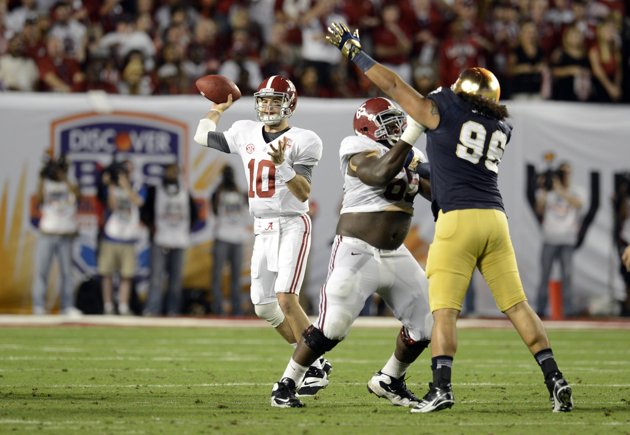
Alabama Quarterback A.J. McCarron throws in the 1st Quarter of their BCS Championship Win (Photo By John David Mercer-USA TODAY Sports)

“There’s nothing that cleanses your soul like getting the hell kicked out of you.“ Woody Hayes

It wasn’t much of a game and it looks like if the late Woody Hayes is right that there is an awful lot of soul cleansing going on in South Bend tonight. For the second straight year the Crimson Tide of the University of Alabama crushed its opponent in the BCS Championship Game. This year the victim was the Fighting Irish of Notre Dame. It was the third BCS Championship for the Crimson Tide in four years.

The fact that Notre Dame was in the Championship game surprised many people, including the “experts.” Ranked 22 in the nation in the final pre-season poll the Irish climbed the rankings and were aided to their number one ranking by Texas A&M who upset the Tide in Alabama.

Notre Dame went into the game ranked number one in the nation and no opponent had scored more that 26 points against them and gave up an average of 288 yards while allowing 9 touchdowns the entire season. The Tide had four offensive drives of over 80 yards tearing through the Irish defense like knife through a Shepherd’s Pie while their defense was nearly as tight as a cask of Irish Whiskey until the final quarter.

While Fighting Irish faithful were fired up the Crimson tide was favored by 9 or more points depending on the line. Alabama more than covered the points tonight making the Irish look bad in the process.

20130107_rvr_usa_070-e632177f4eec33ef667d2ded878611ac

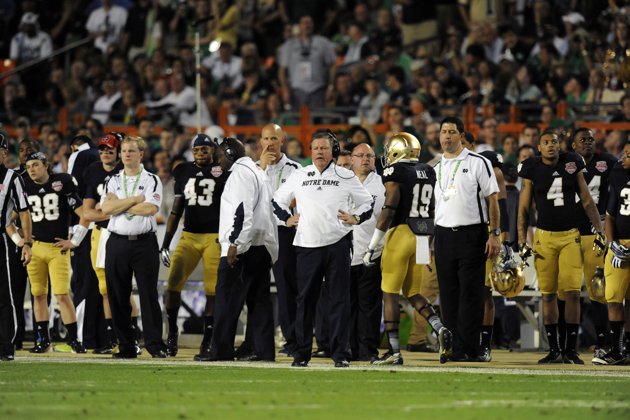
Notre Dame Coach Brian Kelly on the Sidelines (USA Today Photo Eileen Blass)

It is too bad that there could not have been a re-match between A&M and Alabama. Despite their lower ranking in the polls I think that they were possibly the best match up against Alabama.

So the college football season is over. One more hurdle cleared until baseball can return.

Peace

Padre Steve+

3 Comments

Filed under football, News and current events