I am amazed a how good life can be even in the one experiences events that in one’s professional life could be devastating. I mean really, in our culture, even in the supposedly “spiritual” realm of faith, church, and religion; success and prosperity are the golden calf that many people believe is the key to happiness. Hell, massive ministries like that of “Lakewood Joel” Osteen, make massive amounts of money off of the tithes and offerings of well meaning people who buy into their “prosperity gospel” message. In fact that message is little different than greedy pyramid marketing schemes, but I digress…
I cannot believe how good I am doing after not being selected for Captain in the Navy Chaplain Corps. I wrote about that yesterday, but I think that I need to follow that up after doing some reflecting on life; the kind words, memories, and well wishes of friends from around the world, and my experiences with people yesterday, including other friends who were passed over on this promotion board, or in past years.
Many of those thoughts came from people who I was their chaplain or happened to be there for them, and sometimes they remembered things that I had either forgotten, or that I had no knowledge of the impact that something that I said or did had on their life. That my friends is wonderful, and as I went through all of those kind words, thoughts and expressions of friendship I was both humbled and blessed. Apart from reading the comments of friends I pretty much disconnected myself from most of social media in order to clear my mind.
As a result I have spent much of the past couple of days recalling the past and the many people who have helped make me what I am today and who in some way contributed to the success I have had, while pondering the still unwritten future. All of that has reminded me of the words of William Shakespeare, who wrote, “What’s past is prologue.” Those words are true, at least for me. All of my past, all of that tapestry of often disconcordent threads, is but prologue to what remains ahead of me. Orson Scott Card wrote, “The future is a hundred thousand threads, but the past is a fabric that can never be removed.”
Frankly, that excites me, as a human being, as well as a Christian. I guess the fact that I was not selected for promotion has put that yet unwritten and unwoven future into proper perspective. I guess that experience has helped re-energize me and motivate me to move forward into that future.
W.P. Kinsella, who wrote the novel Shoeless Joe which became the classic film, Field of Dreams wrote, “Success is getting what you want, happiness is wanting what you get.”
Yesterday was an interesting day, a day about winning, losing and finding happiness even when the system says that you should be disappointed. I found out today on Facebook of all places that I was not selected for promotion to Captain in the Navy Chaplain Corps. I think about five years ago I would have been disappointed, maybe even crushed; but today I’m not. I’m actually thankful. I was afraid that promotion might mean more separation from Judy, as the last time I was promoted I was yanked out of my assignment and given what were basically no-notice, take them or leave them orders that entailed a family separation. That was difficult on both of us, the tour was good, but career progression wise it did nothing for me as a back-to-back tour in Navy Medicine. Followed by my current tour teaching at the Joint Forces Staff College, I knew that having no operational assignments in the past seven years that I would most likely not make Captain. So I began to re-prioritize my life. Family, friends, and stability matter more than another promotion.
I have been successful and I am happy. I have served over thirty-five years in the military evenly split between the Army and Navy. I left the Army Reserve as a Major in 1999 and went back on active duty in the Navy, taking a reduction in rank to do so. I have been blessed to serve all over the world, including tours in Europe, the Far East and combat the Middle East. When I retire at the end of my last tour I will have spent nearly thirty-nine years serving this country, and to me, finishing well matters and helping young men and women succeed is more important than getting promoted.
Judy is relieved, as this means stability for my last years in the Navy, and for that I am happy. Right now I get to teach, research and write. My last assignment will be managing a chapel program and hopefully being able to continue teaching. No matter what I will continue writing and doing research.
I can live with that as the rest of my life is not defined by making Captain. Sadly I have known quite a few people who end up bitter because they didn’t get promoted, some with good reason, and likewise I have known some people that when they reach high rank or high office are consumed by a lust for power and control. When it happens to ministers, as it does all too often, and not just in the military; it is tragic. They often not only destroy themselves, but those around them; their families, their subordinates, and those that depend on them for spiritual care.
I called to congratulate a good friend who was selected for promotion on this board after being passed over for promotion before. His attitude was much like mine, he knows that the promotion will also bring added burdens, as his wife is very sick, and has been chronically ill for years. I am happy for him as well as some others that I know who were selected. At the same time, as much as it would have been something to be proud of, I am glad that I was not promoted, it was a relief. Judy has gone through too much in supporting my career.
I received so many wonderful thoughts from friends last night, and that was a blessing. I have no cause for bitterness or to think that I was cheated, the fact it that not everyone gets promoted, and my career has been amazing and I still get to serve for a while longer. Not everybody gets that. As Lou Gerhig said; “today I consider myself the luckiest man on the face of the earth.”
I was going to write about the results of yesterday’s primararies, but what can I really say that a thousand other pundits haven’t all ready said, except maybe; know when to drop out.
The great American philosopher, Eric Hoffer once wrote, “Hatred is the most accessible and comprehensive of all the unifying agents. Mass movements can rise and spread without belief in a god, but never without a belief in a devil.”
Hatred is an amazing emotion. In the final scene of the movie Conspiracy which is about the Wansee Conference, at which fifteen officials of the Nazi government met to coordinate what became the Holocaust, the “Final Solution” of what the Nazis called, “the Jewish problem.” The movie is troubling because the men in the room were well-educated, high to mid-level officials from a variety of agencies who were called together to ensure that their respective agencies worked together.
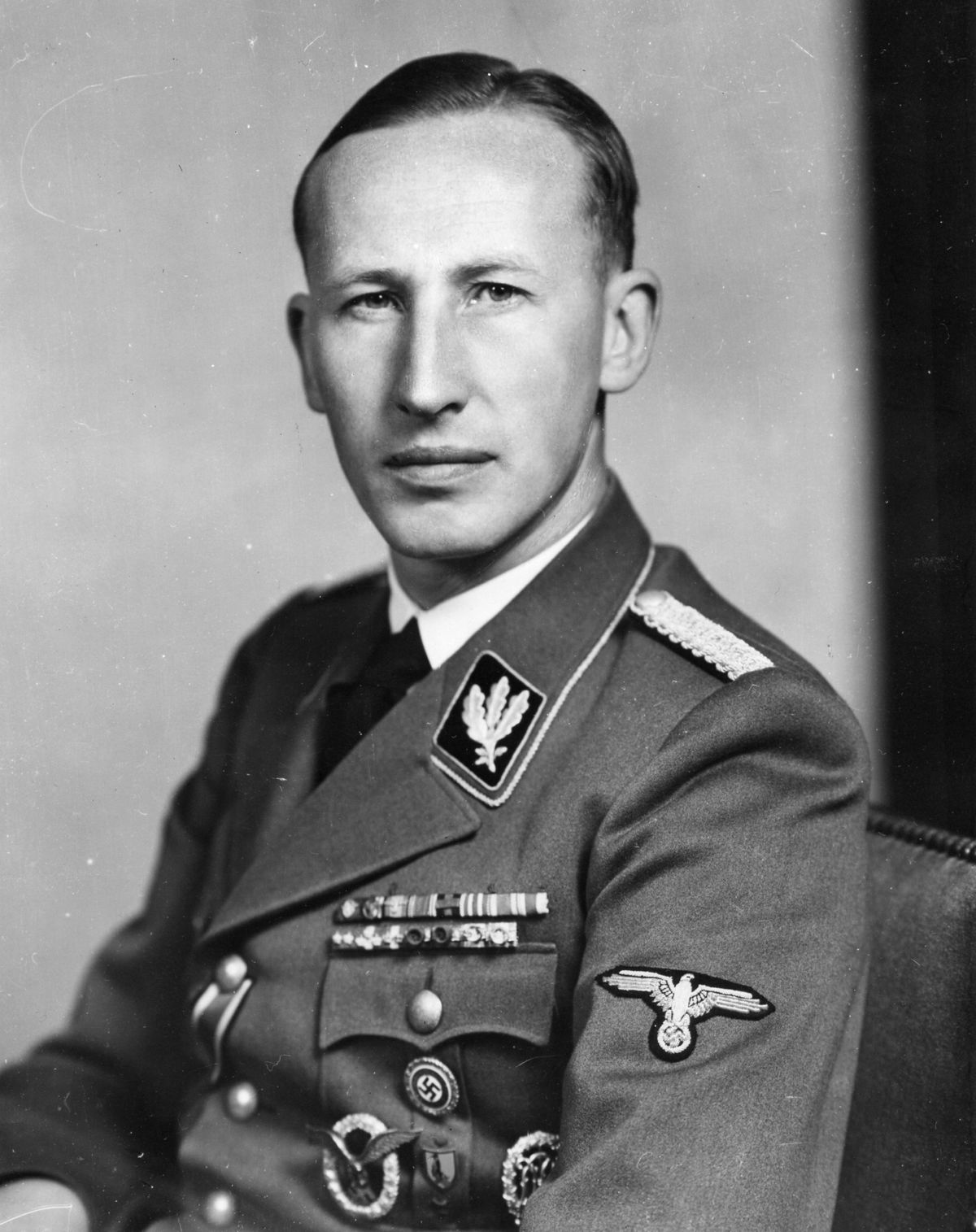
At beginning of the movie, Kenneth Branagh who plays SS Lieutenant General Reinhard Heydrich describes the “problem to be solved”
“To begin, we have a storage problem in Germany with these Jews…. The laws enacted at Nuremberg, and we should drink a toast to Dr. Stuckart for devising them….They established the fundamental legality for the creation of a Jew-free society, a Jew-free economy for the world to see. And we, indeed, have eliminated the Jew from our national life. Now, more than that, the Jew himself must be physically eradicated from our living space…
Then, in acquiring Poland, we acquired two and a half million more. By last July,
we were met with a new situation, we would, in very short order, be acquiring some five million Jews as we conquered Russia. The dimensions of this problem
have magnified astoundingly. Five million…
At that time, last July, confronting this new situation, Reichsmarshal Goering
prepared a directive, you have a copy. The operative words, if you’ll permit me to read:
“I hereby charge you with making all preparations.in regard to organizational
and financial matters for bringing about a complete solution of the Jewish question in the German sphere of influence in Europe.”
Now, for that, I read the cleansing of the entire continent of Europe.
…in the second paragraph: “Wherever other governmental agencies
are involved these are to cooperate with you.” I hope. So on, so on… “as necessary for the accomplishment of the desired solution of the Jewish question.” This is our mandate, all of us.
Donald Trump has talked about expelling and deporting over 11 million Mexicans and other South or Central Americans from this country. True, many are here illegally, but at the same time most are working and paying taxes, doing the things that many Americans consider themselves too good to do. He has mentioned similar things in regard to Muslims, as well as banning any Muslim from coming to the country. He has talked about going along with the desire of the Christian Right to roll back the hard earned rights of Homosexuals, and he has no regard for African Americans and their rights, with the possible exception of Ben Carson, but I digress…
At the close of the meeting the decision to exterminate the Jews was agreed to by the assembled officials who pledged to work with each other, once they had been told of how the logistics of the operation would take place. Not all were happy, some were shocked, but all rolled over and agreed to cooperate with Heydrich.
At the end of the movie Heydrich is asked to share an allegorical story that one of the less enthusiastic conference participants, Reich Chancellery State Secretary, Dr. Wilhelm Kritzinger, told him about hatred of the Jews. Heydrich recalled the story to SS Major General Heinrich Mueller and SS Lieutenant Colonel Adolf Eichmann:
“Yes, he told me a story about a man he’d known all his life, a boyhood friend. This man hated his father. Loved his mother fiercely.
The mother was devoted to him……but the father beat him, demeaned him, disinherited him.
Anyway, this boy grew to manhood and was still in his 30s when the mother died…this mother who had nurtured and protected him.
She died. The man stood as they lowered her casket and tried to cry…but no tears came.
The man’s father lived to old age, died when the son was in his 50s.
At the father’s funeral, much to his son’s surprise…he could not control his tears. He was wailing, sobbing. He was apparently inconsolable. Lost, even.
That was the story Kritzinger told me.
Eichmann said, “I don’t understand.”
Heydrich answered: “No? The man had been driven his whole life by hatred of his father.
When the mother died, that was a loss. When the father died…when the hate had lost its object…then the man’s life was empty. Over.
Eichmann replied: “Interesting. That was Kritzinger’s warning. What? That we should not hate the Israelites?”
To which Heydrich said, “No, that it should not so fill our lives…that when they are gone, we have nothing left to live for. So says the story. I will not miss them”
After the film was over one of the students brought up who pertinent the comments about hate were in our current political climate. Again I cannot go into details, but I can assure you that the conversation was subdued and sobering. I think that all of us left better for it.
The story is pertinent when one looks at what Donald Trump is doing right now. I really have to wonder how deep hatred such as his runs in this country, because unlike love, hatred is easy to conjure up. It is kind of like what you need to build a fire; fuel, oxygen and heat. To generate hatred on a massive scale all you need is a disaffected populace, a convenient target, and an agent to ignite the mixture.
Shrewd politicians, preachers, and pundits do this well. Donald Trump is showing himself to be a master of this. He, and others like him, and not just American politicians, pundits or preachers, mind you, demonize the target group or population and then let the hatred of their disaffected followers flow.
Leaders who are consumed with hate need a disaffected and angry base in order to rise to power; such was how Hitler, Stalin, and so many other despots gained power. They took advantage of a climate of fear, and found others to blame. For Hitler it was the Jews; while for Stalin it was various groups like the Ukrainians, or the Poles who were the devil to be feared and destroyed. For Trump it is Muslims, Mexicans, immigrants, liberals, and sometimes, even Jews.
Timothy Snyder in his book Bloodlands: Europe Between Hitler and Stalin wrote:
“Dead human beings provided retrospective arguments for the rectitude of policy. Hitler and Stalin thus shared a certain politics of tyranny: they brought about catastrophes, blamed the enemy of their choice, and then used the death of millions to make the case that their policies were necessary or desirable. Each of them had a transformative utopia, a group to be blamed when its realization proved impossible, and then a policy of mass murder that could be proclaimed as a kind of ersatz victory.”
Snyder is quite correct, demonizing a people and making them some kind of “other”, “they”, or “them”, is a wonderful way to blame a group of people for the ills of society. It is also a good way to deflect the blame for the corporate failures of societies and governments onto a convenient scapegoat; and to blame others for the personal failures and petty jealousies of the people doing the demonizing. It also allows people to abandon ethics and the simple notion of the Golden Rule an engage in genocide.
Mass movements and their leaders; of which Trump is such a leader, are masters of hatred and demonizing any opponents. The technique Trump is using is not at all new, it has been used from antiquity but has become much more dangerous in the modern era with the spread of instant communications technology. History shows us all too clearly how it has happened and how easily it can happen again. Witch hunts, slavery and Jim Crow, the extermination of the Native Americans which inspired Hitler in his campaign of genocide and the Holocaust; the Soviet gulags and ethnic cleansings, the Rape of Nanking, the Chinese Communist “Cultural Revolution” the Rwandan genocide, Srebrenica, the Turkish genocide of the Armenians, and the current crimes against humanity of the so called Islamic State. Sadly, the list can go on and on.
All of these events simply required the elements of a disaffected population, a devil or scapegoat to blame, and a leader or leaders to ignite the volatile mixture; fuel, oxygen and heat. Hoffer was quite correct that “Mass movements can rise and spread without belief in a god, but never without a belief in a devil.” The really successful leaders of such movements understand this. For Hitler it was the Jews and other untermenschen; for American Southerners after the Civil it was the Blacks and their white supporters. For the American “Know Nothings” of the 1840s and 1850s it was immigrants, especially Irish and Germans who were Catholic; for Stalin it was non-Russian ethnic minorities. For the leaders of the Islamic State, it is Jews, Shi’ite Moslems, less than “faithful” Sunnis, Christians and well for that matter anyone who does not line up one hundred percent with them on every issue. The examples are so plentiful to support this fact that it is almost overwhelming.
The problem is that when any society, or government begins to label or stigmatize a race, religion, ethnicity, sexual preference, or political ideology, and then in the process demonize those people to the point that they become less than human we have reached a tipping point. We reach the point where we are just one crisis away from all of those crimes against humanity that we believe that we are no longer capable of doing. But sadly, we human beings are not nearly as evolved as we think and I think that the tipping point in the United States may be far closer than we could ever imagine.
I really do not think that we are too far from some tipping point where the politicians, pundits and preachers; especially those of the political right and the media whores who are more concerned about market share than truth, decide that their “devils” must be exterminated. Of course when they will do they will claim a higher moral, religious, or racial, purpose; or perhaps use the language of Manifest Destiny, the Lost Cause, or the Stab in the Back or some other historical myth that suffices to justify their actions.
In response to Trump and those who stoke the same kind of fear and hatred, I wonder just how many men that there are like Heydrich, who would execute the orders of someone like Trump that there are in our country this very minute. I shudder to think of it, and when I do, I am reminded of the closing words of Spencer Tracy when he pronounces judgement on the Nazi judges in the film Judgment at Nuremberg:
But this trial has shown that under a national crisis, ordinary – even able and extraordinary – men can delude themselves into the commission of crimes so vast and heinous that they beggar the imagination. No one who has sat through the trial can ever forget them: men sterilized because of political belief; a mockery made of friendship and faith; the murder of children. How easily it can happen. There are those in our own country too who today speak of the “protection of country” – of ‘survival’. A decision must be made in the life of every nation at the very moment when the grasp of the enemy is at its throat. Then, it seems that the only way to survive is to use the means of the enemy, to rest survival upon what is expedient – to look the other way. Well, the answer to that is ‘survival as what’? A country isn’t a rock. It’s not an extension of one’s self. It’s what it stands for. It’s what it stands for when standing for something is the most difficult! Before the people of the world, let it now be noted that here, in our decision, this is what we stand for: justice, truth, and the value of a single human being.”
I do hope that we follow a saner and less horrifying path. But I ask this question: If Trump or someone like him is elected, in this election or in a future election; who will be his problem solvers? I dread to think about the answer to that question.
“Unreason and anti-intellectualism abominate thought. Thinking implies disagreement; and disagreement implies nonconformity; and nonconformity implies heresy; and heresy implies disloyalty. So, obviously, thinking must be stopped. But shouting is not a substitute for thinking and reason is not the subversion but the salvation of freedom.”
I have traveled to a lot of places, in this country and around the world where reason has been a scarce commodity and to me that has always been a frightening specter; a world where reason is all too often sacrificed on the altar of political, ideological or religious expediency.
But reason does matter, and those who ignore it do so at their own peril as Christopher Hitchens once said “That which can be asserted without evidence, can be dismissed without evidence.” History shows us in times like this, where reason is tossed as primordial urges rise, that people all too often fall back on old hatreds and myth rather than seeking answers; instead of trying to figure out what is really important; instead of studying the details of the great questions; that frustrated people become intellectually lazy and gravitate towards angry demagogues who play to their often legitimate anger and frustration.
But demagogues do not need to appeal to reason, they appeal to something more primal, they appeal to fear, anger, and the need of desperate people to find someone to blame.
Appealing to fear and loathing is so much easier than using reason. To call an opponent a Communist or Nazi, Fascist or imperialist, unbeliever, heretic or even a racist; and then connect them to the evil we want to demonize them is far easier than it is to actually engage them in a truthful debate and to see things in their historical context.
Too often we allow people of little learning but whose great charm and salesmanship ability, to sell us myth in place of fact and this happens across the political, social, economic and theological spectrum. That is a tragedy for all of us no matter what our political, ideological, or religious views.
Such salesmanship may comfort the true believer in whatever cause may be, and it may even make them feel superior to those that disagree with them. But it blinds them to reality and ensures that they never become aware of their own envy, malice, pettiness and dishonesty. The untruths they believe serve as protection against any thought, fact, presumption or doctrine that contradicts them. John F Kennedy said, “Too often we enjoy the comfort of opinion without the discomfort of thought.”
In times like ours, it is most important to take the time to learn from history, not just generalities that mix fact and myth but the little details that make up history and for that matter the sciences, philosophy, sociology, political thought and theology. As a society we have ceased to do this and until we take the time to return to such study, dialogue and put aside our blinders we will be doomed to remain as we are no matter what political party is in power or ideology dominates the airwaves and cyber space.
Reason, it is important, and the dangers that we face as a nation, society, and world demand that we return to it.
Character is a terrible thing to judge. Mostly because those doing the judging also suffer from flaws in their own character and truthfully I don’t think that any of us are exempt from doing this, at least sometimes. Dietrich Bonhoeffer noted: “Nothing that we despise in other men is inherently absent from ourselves.” I think is somewhat freeing to realize that, thus to grasp this is to be united with humanity, as well as loose ourselves from the shackles that would inhibit us from achieving what we are capable.
Yet somehow the temptation is for us to stand as judge, jury and character executioner on those that we find wanting. As a culture we like tearing down those that we at one time built up, in fact we have industries that exist in order to build up and then destroy people.
It is a rather perverse proclivity that we have as human beings, especially if we can find some kind of religious justification for it.
I think that is part of the complexity of the human condition. As a historian I find that the most exalted heroes, men and women of often-great courage both moral and physical, intellect, creativity, humanity and even compassion have feet of clay.
I find that I am attracted to those characters that find themselves off the beaten track; the visionaries often at odds with their superiors, institutions, and sometimes their faith and traditions. Men and women who discovered in themselves visions for what might be and pursued those visions, sometimes at the costs of their families, friends, and in quite a few cases their lives.
Throughout my studies I have been attracted to men as diverse as Peter the Apostle, Martin Luther, Thomas Aquinas, T.E. Lawrence, Dietrich Bonhoeffer, Erwin Rommel, Admiral Horatio Nelson, Abraham Lincoln, John F Kennedy, Dwight D Eisenhower, Franklin Roosevelt, Dr. Martin Luther King Jr., Jackie Robinson, Teresa of Avila, Golda Meir, Nelson Mandela, Vaclav Havel, and Emir Feisal Hussein of the Arab Revolt. All had flaws and the list could go on and on and on.
Some of these men and women, saints and sinners alike had fits of temper and violence, others sexual escapades, mistresses, affairs, greed, avarice, and a host of other unseemly characteristics. Some of them stretched law and morality in their quest to achieve their goals. But all are considered great men and women.
They all had feet of clay, and who among us doesn’t have them? But them I think that I would rather have feet of clay than a heart of stone, an unchallenged mind, or a lack of courage to do the right thing even when it does not directly benefit me.
I love the cinema classic Lawrence of Arabia. Peter O’Toole plays Lawrence in a most remarkable manner, showing his brilliance, courage, diplomatic ability and understanding of the Arabs with whom he served. In the film, Jack Hawkins who played General Allenby, perhaps the best British General of the war looked at Lawrence’s dossier and said “Undisciplined… unpunctual… untidy. Knowledge of music… knowledge of literature… knowledge of… knowledge of… you’re an interesting man there’s no doubt about it.”
There are many people, leaders and others that we encounter in life or that we study. Even the best of the best are flawed and there is no such thing as a Saint who never sinned. But we love destroying them and their memory when to our “surprise” when we find that their hagiographers built them into an idol.
I am a great believer in redemption and the weight of the whole of a person’s life. Thus I try to put the flaws, as they are called in perspective and their impact both positive and negative in history. Studying in this way gives me a greater perspective on what it is to be human and to place my own clay feet in appropriate perspective.
As Lawrence said, “Immorality, I know. Immortality, I cannot judge.”
English historian and military theorist Colin Gray noted that “people matter most”when we deal with history, policy, or politics, but especially in the matter of war.
I think one of the sad things about history is that many authors, especially in military history, but other areas as well, seem to treat the participants as bit players in a series of events, rather than a prism from which to understand and view history.
I cannot tell you how many times I have had students, and even colleagues tell me that history is dry, boring and uninteresting to them. I will not condemn them, for certainly if it is that is case, it is not their fault, but rather those who write and teach history. If all history is, is arbitrary dates, lists of disconnected events and names of people, without any context to their lives, why should they care about it?
When I first began to study history I was much more concerned about events than people. However, over the past couple of years I have began to develop what I call my philosophy of history. That has come about through my study of the events leading to the American Civil War and in particular my study of the Battle of Gettysburg, but also in other historical events such as the Arab Revolt of 1917, and the French adventures in Indochina and Algeria.
In doing all of my research I have read a large number of books, articles and primary sources on these subjects and my personal library appears to be growing at an exponential rate. I have noticed that much of what I have read deals very little with the people involved, unless I am reading a biography, and even some of the biographies seem to be event heavy, and person light and sometimes it seems that the subjects of the biography are often one dimensional, and almost caricatures of who they really were. Some of the alleged biographies that I read would be better described as hagiography, to make the subjects appear saintlike, the type of writing used by religious writers to make saints a lot less human. There are others who go to the opposite extreme and do all they can to demonize their subject. In either case the method is less than honest, but for many people, profit and propaganda value mean more than truth. Of course either type of writing appeals to the masses who do not care about nuance, or for that matter truth.
But such is not history. Neither are “histories” which are designed to support a particular ideology, be it political, religious, or economic. Such works are not history, but propaganda. When I see people, in this country forbidding the teaching of history because it is not patriotic enough I want to scream. It is like I am watching the propagandists of Stalin’s Soviet Union, Hitler’s Third Reich, or any of many other nations that used ideology or religion to supress history that didn’t meet their definition of “patriotic.” But then I digress…
My gut feeling says that such artificial divisions between history and biography do a disservice to the reader. I take a tremendous pleasure in writing, and I like to try to communicate and interpret facts, which is indeed the vocation of the historian, in a manner that makes them interesting. What I am finding is that when telling the stories of events we must also tell the stories of the people who make these events.
Without such a connection there is little to interest most readers. People tend to be interested in people because there is a connection. The human being is still the human being, no matter what age, country, culture, religion that they belong to. I learned a lot of this from reading the works of Barbara Tuchman who in her writings about events, never forgot importance of people, and refused to turn them in to one dimensional caricatures.
In my writing now I attempt to bring the prism of the biography into the events that I write about.
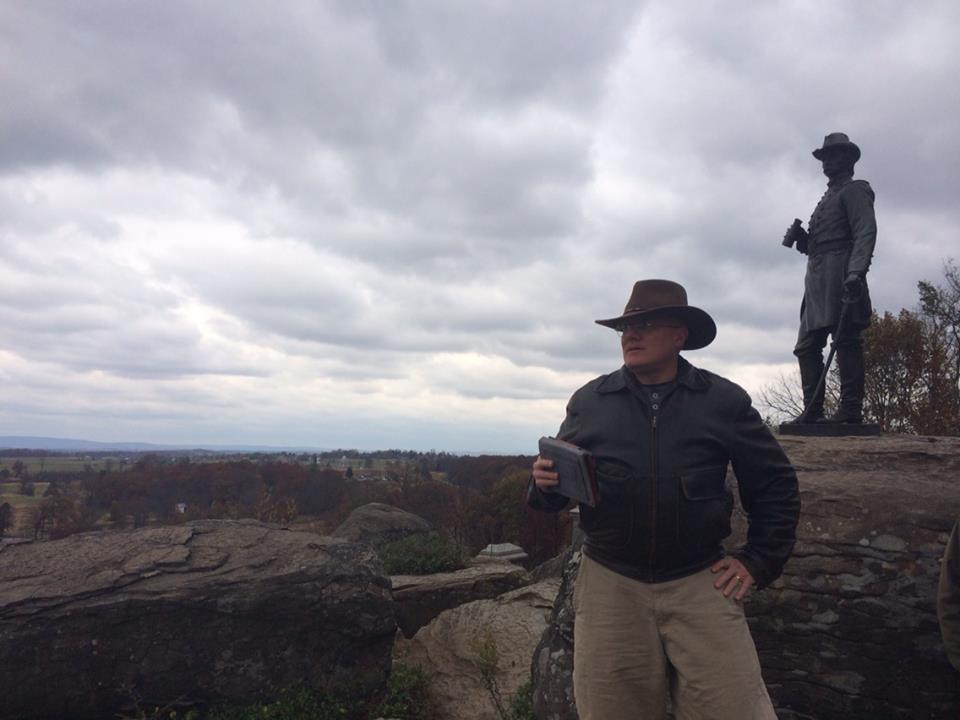
I had a fellow faculty member note that he liked what I wrote about Gettysburg because it was more than just the events, it was the personal connection he felt to the people.
People matter because they have so many layers. I guess one of the things that makes my writing approach a bit different is that while I am a historian, I am also trained in philosophy, pastoral care and psychology, all of which deal with existential matters.In the next few days you will be seeing some of my Gettysburg work, and hopefully as you read it you will notice that I attempt to find that nuance in the various men, on both sides of the conflict, who are part of the story.
Image found that the complexities and contradictions of the subjects of history, the people help me understand the events more than anything. I think my epiphanies came in reading about the lives, as well at writings of men like T.E. Lawrence and Gouvereur Warren whose triumphs, struggles, weaknesses and injuries mirror my own. In learning about these men as people, in the context of what they accomplished helps me to understand their history and the era that they lived far more than simply recounting how they influenced a battle.
I find that the lives, beliefs, motivations, relationships, and experiences of people to be paramount to understanding events. People are complex, multi-layers and often contradictory. All of my heroes all have feet of clay, which in a sense makes their stories even richer, and the events that they helped bring about more fascinating, because then I gain a holistic perspective and develop an empathy for them. Even good and honorable people who find themselves due to race, religion, or nationality fighting for an evil cause, or evil people fighting for a good cause. If you are trapped by ideological or religious certitude that may confuse or even offend you, but it is a part of the human condition. That my friends is history.
Barbara Tuchman noted “that if the historian needs to submit himself to his or her material instead of trying to impose himself on his material, then the material will ultimately speak to him and supply the answers.”
This is very important, because when we do this we discover the answers to the why questions, especially the why questions that are so very uncomfortable, are necessary if we want to discover truth.
I know that I can find connections in the strengths as well as their weaknesses of people that I admire. Thus when I see ordinary people taking part in events, for good or for evil,I can say that given the same set of circumstances that that could be me. Context matters, nuance matters, people matter. If we do not understand that, history becomes nothing more than a set of manipulated facts, devoid of context that can be used to buttress the most evil intentions.
I do plan on developing these thoughts over the coming weeks and months, but for now it will suffice to say that when I write about history, that people matter. That is why I write.
On January 6th 1941 President Franklin Delano Roosevelt delivered his State of the Union Message to Congress and the nation. I spent the time to both both read it and listen to it the other day. It is a profoundly moving speech, not without controversy of course, but one which we need to hear again. It is a speech that like the Declaration of Independence, Lincoln’s Gettysburg Address, and Dr. Martin Luther King Jr.’s I have a Dream speech calls us to higher ideals, ideals that we often come up short in living up to, but ideals worth living for.
When Roosevelt spoke the nation was in the midst of crisis. It was still recovering from the Great Depression, war threatened as Hitler’s Nazi German legions had overrun all of Western Europe, much of North Africa, and German U-Boats and surface ships were prowling the North Atlantic. Britain stood alone between Germany’s complete domination of Europe. Even the Soviet Union, a mortal enemy of Fascism had concluded a concordat with Hitler to divide Eastern Europe. Though no one yet knew it, Hitler was already planning to break his accord with Stalin and invade the Soviet Union.
In the speech, which was largely focus on the threat of Nazi Germany, support of Britain and the exiled governments of nations conquered by Hitler, and preparations to defend the United States, Roosevelt called on Congress to pass Lend Lease to help those fighting the dictators, as well as increased opportunity at home. In response to the emerging threats and the unwillingness of some, including big business to face up to them. He noted:
“As a nation we may take pride in the fact that we are soft-hearted; but we cannot afford to be soft-headed. We must always be wary of those who with sounding brass and a tinkling cymbal preach the “ism” of appeasement. We must especially beware of that small group of selfish men who would clip the wings of the American eagle in order to feather their own nests.”
On the domestic front Roosevelt reiterated the message of the New Deal, for even with war looming he did not want to see Americans lost in the exchange and he linked freedom abroad to the same at home. He noted:
“As men do not live by bread alone, they do not fight by armaments alone. Those who man our defenses and those behind them who build our defenses must have the stamina and the courage which come from unshakable belief in the manner of life which they are defending. The mighty action that we are calling for cannot be based on a disregard of all the things worth fighting for.”
He continued:
“Certainly this is no time for any of us to stop thinking about the social and economic problems which are the root cause of the social revolution which is today a supreme factor in the world. For there is nothing mysterious about the foundations of a healthy and strong democracy.
The basic things expected by our people of their political and economic systems are simple. They are:
Equality of opportunity for youth and for others.
Jobs for those who can work.
Security for those who need it.
The ending of special privilege for the few.
The preservation of civil liberties for all.
The enjoyment — The enjoyment of the fruits of scientific progress in a wider and constantly rising standard of living.
These are the simple, the basic things that must never be lost sight of in the turmoil and unbelievable complexity of our modern world. The inner and abiding strength of our economic and political systems is dependent upon the degree to which they fulfill these expectations.”
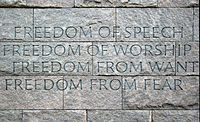
But the real heart of the message, applicable to all people everywhere Roosevelt enunciated a number of principles that are a beacon to all people. Firmly grounded in words of the Declaration of Independence and the Gettysburg Address they are called the Four Freedoms. Those freedoms are an ideal, in fact they certainly were not practiced well then by Americans, nor now, but they are worth working to: Roosevelt said:
“In the future days, which we seek to make secure, we look forward to a world founded upon four essential human freedoms.
The first is freedom of speech and expression—everywhere in the world.
The second is freedom of every person to worship God in his own way—everywhere in the world.
The third is freedom from want—which, translated into world terms, means economic understandings which will secure to every nation a healthy peacetime life for its inhabitants—everywhere in the world.
The fourth is freedom from fear—which, translated into world terms, means a world-wide reduction of armaments to such a point and in such a thorough fashion that no nation will be in a position to commit an act of physical aggression against any neighbor—anywhere in the world.
That is no vision of a distant millennium. It is a definite basis for a kind of world attainable in our own time and generation. That kind of world is the very antithesis of the so-called new order of tyranny which the dictators seek to create with the crash of a bomb.”
The speech was important, and now as it did then it calls Americans to higher purposes, to higher ideals, and it recognizes that we have never fully measured up to our own words. At the time it was spoken, Jim Crow was still the law of the land, Mexican Americans were often treated as poorly as blacks, Native Americans had few rights; and barely a year later Japanese Americans would be taken from the homes, lose their business and be sent to detention camps for the duration of the war after Pearl Harbor, simply because they were of Japanese descent. But those abiding principles are things that we should never lose sight of, and always strive to realize.
In an age of uncertainty, turbulence, division, inequity, and deeply ingrained cynicism like ours, it is time to reflect on them, to strive for a higher purpose, and not to lose hope or give in to fear.
Abraham Lincoln once said “The best thing about the future is that it comes one day at a time,” and that my friends is a good thing, for 2016 promises to be an eventful year. There are so many things happening that can totally upend the world and our way of life going on that if we just tried to think about them all at once they could be overwhelming. Lincoln himself lived in such a time, and I think that his perspective is good to remember. 2015 was a year of triumph and tragedy that filled the hearts of many with fear and unease. At the same time it is now in the past. It cannot be relieved or changed but we can take the time to learn from it and hopefully build a better future.
I am a historian. For me history is not just something dead in the past but a living reality that influences us in everything we do. As such I thing we need to learn lessons from history and apply that knowledge to what we do now. We do not live in a vacuum, if we did we would be very dusty and always spinning around, but I digress…
I think that we have to learn from the past in order to be ready for the future. But the future is unknown and often uncharted. Thus we should as George Patton said “Prepare for the unknown by studying how others in the past have coped with the unforeseeable and the unpredictable.” That really is the reason I study history, not so we have a laundry list of facts events and dates that I can use to prove my point but rather to see how people and nations dealt with things that they either could not or did not foresee. Human nature doesn’t change and while circumstances and technology may change the way people deal with unforeseeable events can help us navigate future difficulties. It is not a guarantee but it is helpful when we face uncertain times.
Dallas Maverick’s owner Mark Cuban wrote, “None of us are born into the world we live in.” That is so true because we are all born at a moment in time and the world is always changing and changing is ways that will always surprise us. Maybe not some of the events themselves, but the players that make things happen, the places that they happen and the speed of which they happen. Time stands still for no person. The world that I was born into in 1960 is far different than the one that I live in today, and the one that will most likely exist if I live into my eighties, though I want to live to be at least 105 in order to lead a staff ride at the bicentennial of the Battle of Gettysburg.
Though the future is yet to be written, some people want to go back to some point in time where their myth of history tells them that things were better, and they want to attempt to recreate such times. We see this with the Taliban, the self-proclaimed Islamic State, various Christian groups, and even in the various factions of American political life, especially the Tea Party. But such thinking, while often comforting, is pure fantasy and is quite delusional. Golda Meir was quite right when she observed, “One cannot and must not try to erase the past merely because it does not fit the present.”
Of course Mrs. Meir was correct, and in a similar manner attempts to recreate the past in the present as are the groups that I mentioned are trying to do are chimeras, for then we would be trying to erase the present because it does not fit in with a past that only exists in history, and the future is yet to be written. As a historian I believe that the past is amazingly helpful in helping to guide us in the present, but we cannot mythologize that past and attempt to impose it on the present, nor the future.
2016 will be an eventful year and maybe even a crucial year for the United States and the world, and we do not know how it will unfold. So it is left for us to stop living in the past, fully embrace the present and take the future as it comes. We certainly must look to the past to see how others dealt with the unforeseen, for as Gabe Paul said about baseball, “there’s a crisis everyday.,” Of that fact we can be certain, there will be a crisis of some kind every day this year and we will have to deal with them. How we do so will be what counts.
Marcus Aurelius wrote, “If someone is able to show me that what I think or do is not right, I will happily change, for I seek the truth, by which no one was ever truly harmed. It is the person who continues in his self-deception and ignorance who is harmed.”
Before I say anything else I just want to thank you for taking the time out of your schedule to read, comment and even share what I write. That matters to me and a good number of you have followed my writings for years. So I truly thank you from the bottom of my heart, and if you like what you see please comment and share with others.
As I get older I realize how valuable time is. There are few commodities that truly cannot be replaced or conserved, time is one that is always fleeting. As Dr. Suess said:
“How did it get so late so soon? It’s night before it’s afternoon. December is here before it’s June. My goodness how the time has flewn. How did it get so late so soon?”
That being said I am not a fan of New Year’s resolutions, in fact I generally don’t make any because frankly I think that most are a waste of time. However, I do not think that the pursuit of truth is a waste, and as Benjamin Disraeli noted so wisely; “Time is precious, but truth is more precious than time.”
To that end, as I did last year I am going to endeavor this year to commit myself to continue to seek truth and to speak truth, wherever that takes me. Truth matters to me. In my life I have seen so many lies, especially by political and religious leaders that I trusted that I now devote myself to the pursuit of truth. As Captain Jean Luc Picard told the young Cadet Wesley Crusher in Star Trek the Next Generation episode The First Duty: “the first duty of every Starfleet officer is to the truth, whether it’s scientific truth, historical truth or personnel truth…”
So, I will continue to write, especially about historical subjects that have an impact today: civil rights and social justice, faith, military issues, PTSD and military health issues, the Middle East conflicts and a number of other topics. Of course I will write about baseball, which is often my refuge when things are too much for me and music. I may do more regarding music as I was asked to do an article for a journal about liturgical music, stress and resiliency.
I will continue to be as transparent as I can about my own struggles with PTSD and faith in the hopes that my journey will help others who struggle like me. In fact this was a major reason that I started this site back in February of 2009.
Expect more writing about the Battle of Gettysburg and the Civil War. I have a feeling that that is going to become a life work, even after I retire from the Navy. The American Civil War is so pertinent to who and what we are as a nation and the more I study it, the people, the issues and the ideologies involved I see many parallels with today; some of which are positively frightening. So expect a lot more about these subjects. In fact the Civil War is one in which debunked myths still hold sway over many, especially among the defenders of the Lost Cause who predominate the Christian Right.
In addition to that I expect to be going back to some of my older research and writing about the social, religious, political, and ideological dynamics of Weimar and Nazi Germany and how similar that are to some things going on now in our own country.
While lies are dangerous the myths can be more so, and the proliferation of lies, half-truths and myth have shriveled the brain cells of those who enjoy the comfort of opinion without the benefit of thought. President John F. Kennedy spoke of this in 1962, and his words are timely, especially when hordes of preachers, pundits and politicians, the Trinity of Evil, do this with abandon:
“The great enemy of truth is very often not the lie–deliberate, contrived and dishonest–but the myth–persistent, persuasive and unrealistic. Too often we hold fast to the clichés of our forebears. We subject all facts to a prefabricated set of interpretations. We enjoy the comfort of opinion without the discomfort of thought.”
To do this I have to constantly challenge my own thoughts, beliefs, and opinions. So with that resolution I wish you a good day and a Happy New Year. Thank you for reading, sharing, commenting, and encouraging me. Until tomorrow.
I am wrapping up the year and reflecting on a number of things, thinking about how much history can teach us about our own time, should we just pay attention to it. I have been continuing to do research and work on my Gettysburg and Civil War text, and that continues to lead me to pure gold in the pursuit for truth, historical truth that is as relevant today as it was when it happened over a century and a half ago.
Sadly, the same issues that dominated America in the 1840s, 1850s, and 1860s and later following Reconstruction still dominate so much of our social, political and religious debate. Whether it is the voting franchise which many on the political right seek to restrict, the rights of women, blacks and other minorities, immigrants and the LGBT community, to any semblance of political, economic equality or social justice very little has changed. Not only that there are some political, media and religious leaders who argue for the unabashed imperialism of Manifest Destiny and American Exceptionalism.
As it was then, much of this can be laid squarely at the feet of Evangelical Protestant and other conservative Christian leaders. A century and a half ago men who claimed to be Christian leaders led the efforts to support slavery, discriminate against women, persecute gays and promote imperialistic policies that would have embarrassed the founders of the United States. After the defeat of the Confederacy most of the same people used the same theology to disenfranchise and discriminate against African Americans through Jim Crow laws, as well as discriminate against minorities, women and gays all the while claiming to be the victims of persecution.
Before the Civil War many Protestant ministers, intellectuals, and theologians, not only Southerners, but men like “Princeton’s venerable theologian Charles B. Hodge – supported the institution of slavery on biblical grounds, often dismissing abolitionists as liberal progressives who did not take the Bible seriously.” This leaves a troubling question over those who claim to oppose other issues on supposedly Biblical grounds. Conservative Anglican theologian Alistair McGrath asks, “Might not the same mistakes be made all over again, this time over another issue?”
The question is will we learn from history or make the same mistakes all over again? That is something to ask ourselves as we leave 2015 behind and begin 2016, a year that promises to be tumultuous and eventful, but which the history of is yet to be written. That my friends is important, and why all of us must be engaged.
I thank all of those who subscribe to this site, as well as those who follow my writings through Twitter or Facebook. The fact that so many people are doing this humbles me, and to repeat what Yogi Berra said, “it’s not the heat, it’s the humility.”
Friends of Padre Steve's World
I welcome comments, even those which disagree with my positions and articles. I have done this for years, but recently I have been worn out by some people.
I have just a couple of rules for comments. First, be respectful of me and other commentators. If you are polite and respectful' even if I disagree with you your comment will be posted and I will respond accordingly.
That being said I will not allow people to hijack the comment section to push their religious or ideological views. Unless the comment deals with the meat of the article, don't expect me to allow you to preach, especially if you are a racist, anti-Semetic, or are a homophobe.
Nor will I allow spam comments. Most of those are automatically blocked by Wordpress but some do get through, and deal with them accordingly.
Peace
Padre Steve+








 The Inglorius Padre Steve's World