Category Archives: Religion

Image versus Witness: Rick Warren Bans His Staff from Following Atheists on Twitter

Rick Warren “Thou Shalt not follow…”

“No one is to be called an enemy, all are your benefactors, and no one does you harm. You have no enemy except yourselves.” Saint Francis of Assisi 

I was surprised but then I wasn’t. Rick Warren, Pastor of the Saddleback Mega-Church, author of the best selling Purpose Driven Life, political activist sent an e-mail to his staff ordering them to drop “atheists, critics of saddleback, and mean-spirited or vulgar accounts” from those that they follow on Twitter.  He told his staff: “WHO YOU FOLLOW ON FACEBOOK OR TWITTER IS A WITNESS TO OTHERS.” (Warren’s Caps not mine). His edict to his staff was direct and unambiguous: “Go through your follow list. Unfollow any anti-Christian, anti-Saddleback or vulgar/sexual accounts that got automatically added.” 

Now I do understand why an employer would not want employees using their official work accounts to abide by the rules of that organization. Likewise I do think that employers have a right to insist that employees conduct themselves in a manner that befits their organization. Thus if Rick Warren’s employees were saying things and doing things on Facebook or Twitter on their work accounts that went against the beliefs of Saddleback Church that they are wrong.  At the same time a corporate or ministry image is not the same as Christian witness and ordering employees to cut ties with real or perceived “opponents” actually does a disservice to the proclamation of the Gospel and promotes a cult-like versus a Christ-like world view. A worldview that intentionally breaks relationships with opponents and critics is in the end one that destroys the christian witness.  A world view where church leaders are afraid to dialogue or debate with unbelievers and forbid their followers from doing so is a worldview that stems from fear and lack of confidence. It is a worldview antithetical to that practiced by Jesus.

What Warren and others like him imply is a theology of “guilt by association” that is foreign to the Gospel.

Jesus had a habit of hanging out, having dialogue and even praising those that stood outside the religious establishment of his time. His closest followers were from Galilee a place held in distain by people from Jerusalem or Judea. He had close relationships with women, Gentiles, Roman oppressors, tax-collectors, adulterers and prostitutes. He offended the religious establishment by healing and even picking grain to eat on the Sabbath. He told people to pay their hated taxes to Caesar but to give to God what was God’s.  Somehow I don’t believe that Jesus would be welcome at many churches today, he associated with so many people that are just so unseemly….

When Jesus’ disciples came to him to complain that other people were preaching in his name he simply commented “he who is not against me is for me.”

The worldview of separatism and fear of the other that is so pervasive in Christian circles now days is one reason that I believe that so many non-Christians have such a negative view of Christians and the Church.

I have a good number of friends, family members and co-workers who are atheists, agnostics and followers of religions that are not Christian. Some have grown up in the church, some were at one time fervent believers while others have simply been treated terribly by those who call themselves by the name “Christian.” I have one friend, a young Navy doctor who is an atheist who tells me that I am the only Chaplain or minister that he would want in the room if he was really sick. Somehow while that is personally gratifying it speaks volumes about how this young man views others who claim the name of Christ.

Likewise I follow people on Twitter and Facebook that I do not agree with on some things and who certainly if I were a staff member at Saddleback or some other churches that would get me in trouble. The fact that I was told to leave my former church when I wrote about issues that some in our hierarchy opposed somewhat colors my perspective on this but certainly does not put me on the opposite side of what Jesus taught.

My view is that if Christians and the Church are to be taken seriously and to be credible witnesses of Christ is that we must engage in and have relationships with those that do not believe what we believe. In the age of cyber technology and communications this means that some of that has to be done on social networks with people that we may never have met in person but whom we are quite possibly the only positive witness of Christ that they will ever have.  If Christian leaders forbid their followers from contact be it in person or on social media from those that they disapprove it shows a certain lack of grace towards unbelievers as well as a lack of faith and confidence in their own message.

Francis of Assisi said “Where there is charity and wisdom, there is neither fear nor ignorance.” Warren’s words display fear and ignorance and a true lack of charity. I expected better of him. Warren once said “You can use your time to build bridges or walls. The latter is not only unChristlike, it limits impact and creates loneliness.”

Warren’s edict to his staff and for that matter members of Saddleback Church is one that projects an attitude of fear and paranoia. It is a message that also tells church members and staff that they are being watched and their communications monitored by a church hierarchy more concerned with its image than reaching out to those that Jesus died to save.

Such actions by Warren and other major Christian leaders, especially those with large temporal empires and corporate images to defend are a large part of why many people are fleeing the Church. The fact that Christian leaders seem more interested in promoting themselves, their products and embracing political activism and power shows how badly the Church across all denominational borders is in need of reform, reform that is not possible by shutting itself off from the world.

Father Andrew Greeley, a Catholic Priest and Sociologist has been taken to task by many Catholic conservatives because of his rather liberal views on a number of social issues. However he understands something about the Gospel that Warren and others would be wise to learn, something that is firmly based on the Gospel and the history of the early Church: “The Church looks ridiculous to nonbelievers as its leaders offer pontifical advice to virtually every other human institution about the need for justice and freedom, but show precious little interest in reforming their own institution.”

Peace

Padre Steve+

Leave a comment

Filed under christian life, faith, Religion

Losing Christian America One Election Campaign at a Time: How Christian Leaders are Destroying the Church in Order to Maximize Political Power

“The one will triumph who first died for the victims then also for the executioners, and in so doing revealed a new righteousness which breaks through vicious circles of hate and vengeance and which from the lost victims and executioners creates a new mankind with a new humanity. Only where righteousness becomes creative and creates right both for the lawless and for those outside the law, only where creative love changes when is hateful and deserving of hate, only where the new man is born who is oppressed nor oppresses others, can one speak of the true revolution of righteousness and of the righteousness of God.” 
― Jürgen Moltmann, The Crucified God: The Cross of Christ as the Foundation and Criticism of Christian Theology

The statistics don’t lie. The United States cannot and should not be considered a Christian nation and any sense of the definition. While many people, even a majority describe themselves as Christians the fact is that what is now believed is not a Christianity that is in any sense Biblical, Catholic or Orthodox but rather a packaging of certain “Biblical values” that happen to be great political wedge issues for Christian leaders seeking political and economic power.  Nowhere is this shown more than the brazen flip-flopping of Christian leaders now support but who adamantly opposed the nomination of Mitt Romney on the basis of their understanding of Christianity and Mormonism so long as there was a chance that a non-Mormon had a chance at the Republican nomination. The theological gyrations made by the leaders of the Religious Right in this process have been fascinating to watch, much like a train wreck, but fascinating nonetheless.

A recent Barna survey noted that less than one half of one percent of people aged 18-23 hold what would be considered a “Biblical world view.” This is compared to about one of every nine other adults.  Other surveys bear this out.

This should not be surprising to anyone that has watched the growth of what passes as Evangelical Christianity in the Mega-Church age and the retreat of conservative Catholics into the Church culture and theology of the 1400s, the same ideology that brought about the Reformation.

What has to be said is that the Church cannot really be considered Evangelical or Catholic but rather an Imperial Church that must throw itself at those that hold power in order to maintain their own power.  While these leaders talk about and rail against things that they believe to be “sinful” such as homosexuality, abortion and birth control they willingly turn a blind eye to the treatment of the poor, advocate wars of aggression and bless cultural and economic norms that go entirely against the Christian tradition as they go about with a Bible in one hand and Ayn Rand’s Atlas Shrugged in the other.

One can have legitimate debates in the Church about what the Bible and Christian tradition define as sin and we should have those debates taking into consideration Scripture, Tradition as well as what we have learned from the Sciences and the Social Sciences. But the fact is that those in the Religious Right are terribly inconsistent in this, much like the religious leaders of Jesus’ day who he condemned for the same type of hypocrisy.

Think about it: The Barna Group in another survey of people 18-29 years old asked what phrases best described Christians: The top five answers “Anti-homosexual, judgmental, hypocritical and too involved in politics.” This view was held by 91% of non-Christians and a staggering 80% of young churchgoers.

The fact is that young people are leaving the church in unheard of numbers and it is very evident to me why they are doing so. The Church has embraced the culture wars over preaching the Gospel, which if I recall correctly is based on loving people, even ones enemies.  Jesus said it so well: “By this everyone will know that you are my disciples, if you have love for one another.” John 13:35 NRSV.

The leaders of the Christian Right may be able to bring out enough culture warriors to win this election for the Republican Party, but at what cost? One can debate the merits of the Obama administration, its decisions and policies but to be Christian we cannot simply become the religious appendage of a political movement whose leaders hold the Church and religious people in general in distain even as they mobilize them to support policies that are in the long term detrimental to those who claim the name of Jesus.

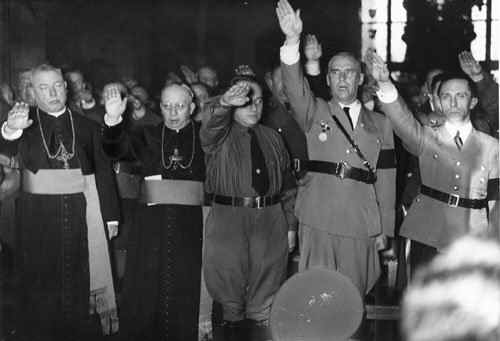
In the 1920s and 1930s the Churches of Germany and many parts of Europe did the same thing. They felt that their values were under attack by Communists, Socialists, Jews and yes, even Homosexuals. In order to maintain their influence and power they willingly allied themselves with the Nazis. When they spoke up against the Nazis it was seldom because they were defending anyone but their own ecclesiastical power and place in society.  When the war was over and young people began to question the actions of those that led the Church in Germany it began a process that has led to the de-Christianization of that country.

The constant hate filled attacks of Christian leaders on those that are not Christians will come back to bite them. This is not fantasy, it is reality. One only has to look at the history of the Church to see it played out time after time. But then, unless we decide to re-write history like David Barton does so well why bother reading it?

I will be writing more about this in the coming months in what will be a number of very well researched and documented articles.  But figured that I would kick open the door today. the actions of many Christian leaders are dangerous to the faith as a whole. The political opportunism is short sighted and ultimately will hasten the decline and fall of what we know as Christianity in America.

Perhaps our Christian leaders should be asking these questions: What does it profit a man to gain the whole world but lose his soul and what does it profit the Church to wield political power but lose its soul?

Peace

Padre Steve+

4 Comments

Filed under christian life, faith, philosophy, Political Commentary, Religion

On the Anniversary of my 16th Year of Ordination to the Diaconate

“So Jesus called them and said to them, “You know that among the Gentiles those whom they recognize as their rulers lord it over them, and their great ones are tyrants over them.  But it is not so among you; but whoever wishes to become great among you must be your servant, and whoever wishes to be first among you must be slave of all. For the Son of Man came not to be served but to serve, and to give his life a ransom for many.” Mark 10:42-45

“My brother, every Christian is called to follow Jesus Christ, serving God the Father, through the power of the Holy Spirit. God now calls you to a special ministry of servanthood directly under your bishop. In the name of Jesus Christ, you are to serve all people, particularly the poor, the weak, the sick, and the lonely…” From the Ordination of a Deacon, 1979 Book of Common Prayer

In the more liturgical churches, Catholic, Anglican and Orthodox the first major order of ordination is to the Diaconate, or to be a Deacon. In other denomination men and women are appointed as deacons but not ordained. In the non-Catholic/Orthodox/Anglican there is a wide variety of service done by deacons and deaconesses everything from being the ruling board of a local church to serving in various ministries of service within the church.

I was ordained as a Deacon 16 years ago tonight on hot, humid and stormy night in Maryland. I was one of six men ordained that night as Deacons, all of who were bound for the Priesthood. I was already an ordained minister in an Evangelical Protestant Church and was serving as a civilian hospital chaplain and as a Major in the Army Reserve Chaplain Corps. I had began a spiritual pilgrimage to an Anglo-Catholic way of life in seminary while attending Southwestern Baptist Theological Seminary in Fort Worth Texas.

The office of Deacon or Deaconess in the Orthodox, Anglican and Old Catholic traditions is different from the other major orders, the Presbyter (Priest) and Episcopate (Bishop). It is and always has been about the ministry to service, assisting the Bishop and Priests with the care of the poor, sick, weak and lonely as well as preaching the Gospel. It was established in the 6th Chapter of the Book of Acts when the Apostles, harried by the widows of non-Jewish members of the church who felt that they were being ignored. The Apostles laid hands on 7 men, Stephen, Philip, Prochorus, Nicanor, Timon, Paraemus and Nicholas. Paul in 1 Timothy 3 gives criteria for the kind of person to be ordained as deacons and Pliny the Younger in his Letter to Trajan specifically mentions women serving as deacon who he calls deaconesses.

In the west the office of deacon languished for nearly a millennia being used only as a stop on the way to a man being ordained as a Priest. It remained very active in the Christian East and some Orthodox Churches retained the office of Deaconess. The office experienced a revival in the West during the 20th Century with both the Roman Catholic and Anglican Churches revitalized the office and returned to early tradition in appointing men to be permanent as well as transitional Deacons. The Second Vatican Council noted that Deacons should be “Dedicated to works of charity and functions of administration deacons should recall the admonition of St. Polycarp: ‘Let them be merciful, and zealous, and let them walk according to the truth of the Lord, who became the servant of all'” Lumen gentium, n. 29 cf. Ad Phil., 5,2, ed. Funk, I, p. 300)

Deacons can preach, baptize assist at celebration of the Eucharist, give communion and in the Catholic and Anglican traditions celebrate a marriage. Deacons are allowed to marry, unless they are transitional Deacons in the Roman Catholic church who are being prepared for ordination to the Priesthood.

For those ordained as transitional Deacons, those who eventually are ordained as Priests, and in some cases those who later are consecrated as Bishops, they are not to lose that call to be servants of God’s people. This sadly is not always the case.  It is all too easy for a cleric to become more concerned with his or her position in the hierarchy and the place of the Church in society over serving those that come to the Church broken, wounded and needy, especially in need of care and love, those rejected by the affluent and abused by supposed Christians.

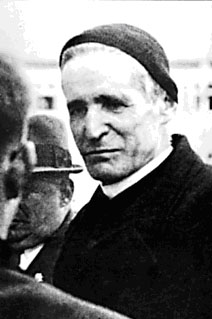
Fr Rupert Mayer SJ

For me the ordination to the Diaconate was important. It stressed to me that ordination was not simply about preaching or ruling in the Church. Of course I knew that but the fact that charge committed to Deacons is first service of the weak, the poor, the sick and the lonely. It has been a while since I re-read the Ordination Liturgy. It is a compelling reminder in a world where the poor, the sick, the weak and the lonely are continually abused and ignored by the rich, the entitled, the powerful and the criminal elements or even governments, that the Christian, particularly those men and women ordained to the Diaconate must be servants first, not rulers or worldly power brokers. Father Rupert Mayer SJ of Munich who was imprisoned for speaking out against the Nazis through much of the Hitlerite rule was a leading champion of Munich’s poor during the Weimar Hyper-Inflation and during the Great Depression. A former Army Chaplain in the First World War who was wounded at the front losing a leg he said: “If out of the ten who ask for alms there are nine who are not in need of them, and if through fear of that happening, I refuse my help to one really needy person, this would cause me immense suffering. I would rather give to all ten and thus avoid the danger of being lacking in charity.”

When I was in High School and College there was a song that was popular in contemporary Christian music. It was called Make Me a Servant by a lady named Kelly Willard who sang with Maranatha! Music.  The words are fitting for all Christians who are called by Jesus to be “servants of all” but especially for all who are ordained or have ever been ordained as Deacons.

Make me a servant, Humble and meek

Lord let me lift up those who are weak, And may the prayers of my heart always be

Make me a servant, Make me a servant, Make me a servant today…

I certainly don’t always live up to this high calling, but it is something that I try to do. It is simple, but so hard, but of all things what the followers of Jesus are called to do. Today has been a day of reflection even as I cared for some people going through terrible times. I do pray that my life will be more reflective of God’s grace in my dealings with all people.

Peace

Padre Steve+

1 Comment

Filed under christian life, faith, Pastoral Care, Religion

The Hijacking of the National Day of Prayer

The modern National Day of Prayer was enacted by President Truman and Congress in 1952 in the 36 U.S.C. § 119 : US Code – Section 119: National Day of Prayer and various Presidents at different times have called for days of fasting, prayer or thanksgiving.  The heart of President Truman’s proclamation is contained in this section:

Now, Therefore, I, Harry S. Truman, President of the United States of America, do hereby proclaim Friday, July 4, 1952, as a National Day of Prayer, on which all of us, in our churches, in our homes, and in our hearts, may beseech God to grant us wisdom to know the course which we should follow, and strength and patience to pursue that course steadfastly. May we also give thanks to Him for His constant watchfulness over us in every hour of national prosperity and national peril.

Ronald Reagan eloquently stated the purpose and significance of the National Day of Prayer in his 1983 proclamation which in part read:

It took the tragedy of the Civil War to restore a National Day of Prayer. As Abraham Lincoln said, “Intoxicated with unbroken success, we have become too self-sufficient to feel the necessity of redeeming and preserving grace, too proud to pray to the God that made us.”

Revived as an annual observance by Congress in 1952, the National Day of Prayer has become a great unifying force for our citizens who come from all the great religions of the world. Prayer unites people. This common expression of reverence heals and brings us together as a Nation and we pray it may one day bring renewed respect for God to all the peoples of the world.

From General Washington’s struggle at Valley Forge to the present, this Nation has fervently sought and received divine guidance as it pursued the course of history. This occasion provides our Nation with an opportunity to further recognize the source of our blessings, and to seek His help for the challenges we face today and in the future.

Now, Therefore, I, Ronald Reagan, President of the United States of America, do hereby proclaim Thursday, May 5, 1983, National Day of Prayer. I call upon every citizen of this great Nation to gather together on that day in homes and places of worship to pray, each after his or her own manner, for unity of the hearts of all mankind.

President Reagan’s 1983 and subsequent proclamations stood firmly in the American tradition of Civil Religion and was decidedly non-sectarian.  It acknowledged that our citizens “come from all the great religions of the world” and called on Americans to gather on the day “in homes and places of worship to pray, each after his or her own manner, for unity of the hearts of all mankind.”  In fact the spirit of the declaration is much like that of the hymn God of Our Fathers which is recognized as our National Hymn.  This hymn is not explicitly Christian and never mentions Christ or the Trinity yet it is widely sung in churches on days such as the Sunday nearest to Independence Day.  The lyrics to that hymn are here:

God of our fathers, Whose almighty hand, Leads forth in beauty all the starry band Of shining worlds in splendor through the skies, Our grateful songs before Thy throne arise.

Thy love divine hath led us in the past, In this free land by Thee our lot is cast, Be Thou our Ruler, Guardian, Guide and Stay, Thy Word our law, Thy paths our chosen way.

From war’s alarms, from deadly pestilence, Be Thy strong arm our ever sure defense; Thy true religion in our hearts increase, Thy bounteous goodness nourish us in peace.

Refresh Thy people on their toilsome way, Lead us from night to never ending day; Fill all our lives with love and grace divine, And glory, laud, and praise be ever Thine.

While the American religious tradition is highly Christian and even more so from the Reformed tradition this has always existed in tension with a decidedly secularist philosophy embodied by many of the Founding Fathers who were very careful to recognize the importance of religion but at the same time both sought to protect religious liberty by NOT enacting laws to establish a particular religion nor to entangle the government in the affairs of religion which could in their view be detrimental to true religious liberty.

In fact both Thomas Jefferson and James Madison were very careful about proclamations and ensuring that government was not favoring any particular religious body. Jefferson wrote to Reverend Samuel Miller in 1808 that:

Fasting and prayer are religious exercises; the enjoining them an act of discipline. Every religious society has a right to determine for itself the time for these exercises, and the objects proper for them, according to their own particular tenets; and right can never be safer than in their hands, where the Constitution has deposited it. …civil powers alone have been given to the President of the United States and no authority to direct the religious exercises of his constituents.”

Madison who was the author of the Bill of Rights and included religious liberty in the First Amendment in support of Virginia Baptists who were under pressure from those who were determined to make and keep the Episcopal Church as the state religion of the commonwealth. Madison wrote to Edward Livingston in 1822 that:

“There has been another deviation from the strict principle in the Executive Proclamations of fasts & festivals, so far, at least, as they have spoken the language of injunction, or have lost sight of the equality of all religious sects in the eye of the Constitution. Whilst I was honored with the Executive Trust I found it necessary on more than one occasion to follow the example of predecessors. But I was always careful to make the Proclamations absolutely indiscriminate, and merely recommendatory; or rather mere designations of a day, on which all who thought proper might unite in consecrating it to religious purposes, according to their own faith & forms. In this sense, I presume you reserve to the Govt. a right to appoint particular days for religious worship throughout the State, without any penal sanction enforcing the worship.”

President Obama’s 2012 Proclamation for the National Day of Prayer stands in line with the founders as well as that of Presidents Truman and Reagan. It calls Americans to join with him to

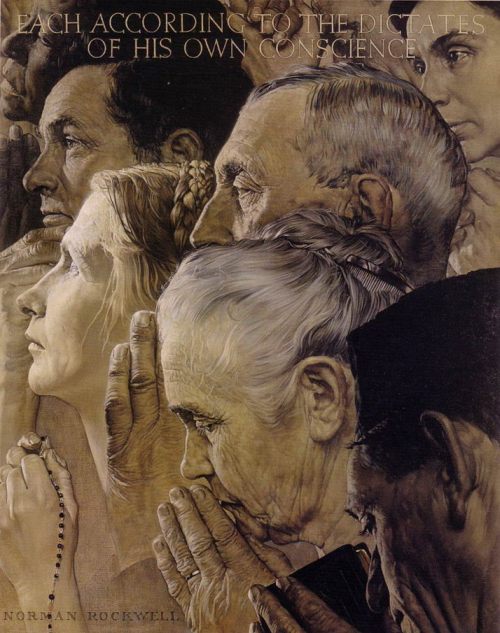
“On this National Day of Prayer, we give thanks for our democracy that respects the beliefs and protects the religious freedom of all people to pray, worship, or abstain according to the dictates of their conscience. Let us pray for all the citizens of our great Nation, particularly those who are sick, mourning, or without hope, and ask God for the sustenance to meet the challenges we face as a Nation. May we embrace the responsibility we have to each other, and rely on the better angels of our nature in service to one another. Let us be humble in our convictions, and courageous in our virtue. Let us pray for those who are suffering around the world, and let us be open to opportunities to ease that suffering.

Let us also pay tribute to the men and women of our Armed Forces who have answered our country’s call to serve with honor in the pursuit of peace. Our grateful Nation is humbled by the sacrifices made to protect and defend our security and freedom. Let us pray for the continued strength and safety of our service members and their families. While we pause to honor those who have made the ultimate sacrifice defending liberty, let us remember and lend our voices to the principles for which they fought — unity, human dignity, and the pursuit of justice.”

Even Republican Presidents such as Ronald Reagan and George H. W. Bush were careful to attempt to keep this in tension only holding one official event each during their presidencies.  It was not until George W. Bush that the President hosted events in every year of his presidency.  Remember the language of the law was that the President shall issue a proclamation for the people of the nation to pray.  Likewise the proclamations are a call for Americans, as Ronald Reagan and Harry Truman wrote to gather together on that day in homes and places of worship to pray, each after his or her own manner, for unity of the hearts of all mankind. The National Day of Prayer was not intended to entwine the government in exclusively religious observances by any particular religious tradition as many of the National Day of Prayer observances in many local, state and federal government agencies.

In 1982 a group of Evangelical Christians led by Shirley Dobson formed The National Day of Prayer Task Force. This organization is is not simply a Christian organization with an ecumenical purpose, but rather a decidedly Evangelic Christian organization.  It was formed to coordinate and implement a fixed annual day of prayer, the purpose of which was to organize evangelical Christian prayer events with local, state, and federal government entities.  Its ministry partners included the heavily politicized American Family Association, Alliance Defense Fund, American Center for Law and Justice, the Family Research Council and Focus on the Family. The Leadership is a veritable “Whose Who” of political preachers and ultra-conservative politicians including Congresswoman Michelle Bachmann. This organization has since grown in popularity and prominence often being the primary organizer of such events.
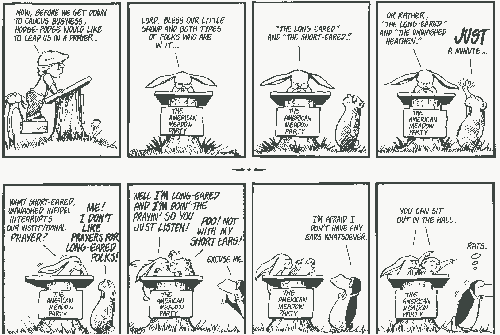
While I am not against the observance of the National Day of Prayer I am uncomfortable with an organization like the National Day of Prayer Committee, which is dominated not just by Evangelical Christians, but Evangelical Christian political activists sponsoring the vast majority of these observances. The group makes no pretense about not being ecumenical and being what they say is “Judeo-Christian.” However since it it has appropriated the name “The National Day of Prayer” as its moniker and has huge financial and political backing, many Christians and non-Christians alike assume that The National Day of Prayer Task Force is the official government sponsored and endorsed organizer for the event. The appearance is solidified by the fact that many of their events are held in government or military facilities. In my opinion the National Day of Prayer Task Force has hijacked the occasion to fulfill their political and religious agenda. As a Christian and member of a small Old Catholic denomination I find this frightening.

What I think has happened within the time of my military career is that many Evangelical groups have made the National Day of Prayer “their event” and use people within government agencies or the military to organize events which lean heavily toward Evangelical Christianity.  I have seen it myself at many locations. Not only has this occurred but many times the leadership of these religious groups promote the political agenda of a particular political party or philosophy and as such that political philosophy sometimes becomes part of the event.  It happens quite often and I actually think invites trouble and challenges that will eventually have a negative impact on all Christians.

In fact The National Day of prayer was ruled unconstitutional by U.S. District Judge Barbara Crabb who ruled in favor of a suit brought about by the Freedom from Religion Foundation against The National Day of Prayer Task Force, former President George Bush and others.  The suit was expanded to name President Barack Obama when he requested that Judge Crabb to dismiss the case in 2009 when the administration argued that the foundation had no legal standing to sue.  The President Obama and his administration appealed the ruling and went ahead with the proclamation and observance of the National Day of Prayer in 2010 and 2011. The Obama Administration’s appeal was successful and a Federal Appeals Court overturned Judge Crabb’s ruling in 2011. The reason the appeal was granted was because the Appeals Court ruled that the Freedom from Religion Foundation had no legal standing because it did suffer actual harm from the Presidential proclamation and call to prayer.

My contention is that when a very religiously exclusive and politically partisan group virtually takes over what was implicitly non-sectarian and non-partisan that the event becomes more of a sectarian event than national event. The National Day of Prayer Task Force seems to merge Evangelical Christianity with the Federal Government.  Somehow I don’t think that Jefferson, Madison or early Baptist leaders like Roger Williams and John Leland who all saw the separation of Church and State as essential to the preservation of the civil rights of all citizens, not just Christians.

I believe in and do pray for the United States of America, our people and our leaders. I even think that a designated day of prayer for the nation is a salient reminder of the necessity of citizens of faith to pray for this country and our leaders regardless of their faith, absence of faith or political party or ideology. It is what makes the American experiment in Religious Liberty so unique in the world and why we should resist all attempts to return to the hopelessly entwined and bankrupt systems embodied by the State Religions of Europe and the Middle East.

Peace

Padre Steve+

Leave a comment

Filed under christian life, faith, Political Commentary, Religion

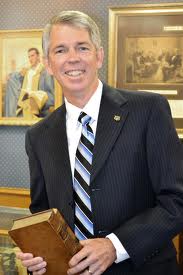
Faux Fact Factory: The Twisted World of Fake “Historian” and “Hero of the Faith” David Barton

I have been wanting to write a little piece about David Barton for some time now. Barton is the most prominent “historian” among Evangelical Christians now days and since his works are cited by many members of the more conservative media and prominent politicians it is high time to write about him. Since I actually have a Bachelors and Masters Degree in History in addition to my Master of Divinity and schooling from the Marine Corps Command and Staff College I figure that I have enough academic firepower to back up my words.  David Barton is not a historian. He is a fraud and huckster who plays on ignorance and fear while playing fast and loose with history.

The website for his Barton’s ministry Wallbuilders describes him in this manner:

“His exhaustive research has rendered him an expert in historical and constitutional issues and he serves as a consultant to state and federal legislators, has participated in several cases at the Supreme Court, was involved in the development of the History/Social Studies standards for states such as Texas and California, and has helped produce history textbooks now used in schools across the nation.

A national news organization has described him as “America’s historian,” and Time Magazine called him “a hero to millions – including some powerful politicians. In fact, Time Magazine named him as one of America’s 25 most influential evangelicals.” (See http://www.wallbuilders.com/abtbiodb.asp retrieved 21 April 2012.) 

Yes Barton is influential and he is considered by some with an obviously skewed idea of heroism to be a “hero.”  He is no hero unless you believe that making up things and calling them facts is honest. Heroes save lives, heroes take real risks in fighting injustice and for freedom. Barton is no hero.  But since Rick Scarborough the President of Vision America calls Barton a “Hero of the Faith” I guess that he must be right?

Likewise he is not a trained historian and he is constantly being proven to be a fraud. He has been proven to make up quotations from the founding fathers, he misrepresents people like the Deist Thomas Jefferson to be something akin to a modern Evangelical Christian.

J Brent Walker, a Southern Baptist and the head of the Baptist Joint Committee on Religious Liberty takes Barton to the woodshed in this 2005 article:

http://www.bjconline.org/index.php option=com_content&task=view&id=2377&Itemid=110

Since the Baptist Joint Committee is not exactly a den of liberals so what comes out of it concerning Barton should be taken seriously by honest Evangelicals and others concerned about historical truth.

Walker is not to be trifled with in his very accurate summation of Barton’s view of the United States being found as a “Christian Nation” saying: “Barton thus argues that since the majority of Americans are Christians, or at least religious people, they should be able to use the government to privilege their religious perspective. Those who disagree should, at best, be tolerated or, at worst, discriminated against.”

This is something that I have been saying for a while but the point is most accurate and I would even add fuel to the fire by saying that Barton and his disciples are little different in their religious perspective and view of non-Christians as others that persecuted people in Jesus name time and time again. This would include the Puritans who just loved hanging Quakers and other dissenters by the neck until dead.

The fact that real Christian historians that are also Evangelicals take issue with Barton’s mythological American “Christian” history seems to matter not to the pundits, preachers and politicians that take what Barton, as well as his older and equally historically challenged but less known comrade in lies Marshall Foster as the unadulterated and incorruptible truth.

Dr. Stephen Stookey a Professor of Church History and Director of the Master of Arts in Theological Studies at Dallas Baptist University at the 2011 meeting of the Baptist History and Heritage Society said:

“in reacting to perceived revisions of American history, Christian America advocates recast American history, creating a quasi-mythical American tale—a story with just enough truth to give the air of credibility but riddled with historical inaccuracies,” said Stookey.

Proponents of Christian America presuppose the United States “was, is and should continue to be a constitutionally established Christian nation,” he explained. Any evidence to the contrary is ignored or recast, he said.

“Supportive data is either exaggerated or manufactured,” Stookey said. “In short, this camp presumes an inerrant historical understanding of America, as well as the original intent of the Constitution.” (See http://www.baptiststandard.com/index.php?option=com_content&task=view&id=12554&Itemid=53 )

Barton’s work is so bad that he had to actually admit that he fabricated quotes, however that does not stop him. His recently published book “The Jefferson Lies: Exposing the Myths You’ve Always Believed About Thomas Jefferson”  is full of historical whoppers and his biggest supporter in the right wing media, Glenn Beck calls Barton “one of the best, if not the best historians in America. He is doing everything he can to turn history back and write it and put it back to where it was and tell history like it was….”

Beck’s support is not surprising as Beck also promotes the work of the late Dr. Cleon Skousen, a member of Beck’s LDS church who espoused many of the same ideas as Barton. The Christian Nation idea is a key element of LDS eschatology because according to Joseph Smith the United States is God’s elect nation and where the New Jerusalem will reside. Skousen’s book The Great Cleansing is cited and promoted by Beck asserts that America is on the verge of the great cleansing predicted in Smith’s eschatology. Stookey in discussing Barton and Skousen noted that “Skousen, like Barton, employs spurious historical material, skewed historical interpretation and Mormon-nuanced understandings of the past, present and future trajectory of the United States.”

However I am not surprised to see how many people lap up Barton’s falsehoods. He plays on the genuine historical ignorance and fear of his audience to sell his faux history. That is what makes Barton, the fraud and huckster a dangerous.  As J Brent Walker said so well the danger is the error that Christians should be a privileged class of citizens in this country and that others should be “at best, tolerated, at worst, discriminated against.”

Barton is incredibly influential in American politics and in Evangelical Christian circles. He is called a “historian” by leading politicians, pundits and conservative Christian leaders like Gary Bauer, James Dobson and the late Dr. D. James Kennedy. Barton’s website biography promotes this view, but he is not a historian.  His work is shoddy and more resembles the work of a unschooled preacher who uncritically “proof texts” the Bible to make his sermon points. He is charismatic and in his lectures and speeches bundles just enough truth with his fiction to mesmerize his largely historically ignorant and fearful audiences. But then what do you expect from a man whose highest earned academic degree is a Bachelor of Arts in Religious Education from Oral Roberts University? Of course the Unholy Trinity of Politicians, Pundits and Preachers love him so expect him to remain in demand.

Peace

Padre Steve+

4 Comments

Filed under faith, History, Religion

Bishop Jenky’s Obama and Hitler, Stalin, Bismarck and Clemenceau Comparison: Bad History, Bad Theology and Bad Politics

Bishop Daniel Jenky 

History, I believe, furnishes no example of a priest-ridden people maintaining a free civil government. This marks the lowest grade of ignorance of which their civil as well as religious leaders will always avail themselves for their own purposes.” Thomas Jefferson

I normally would not criticize a Roman Catholic Bishop for speaking out on he through were legitimate threats to the Catholic faith. However, when a fellow Christian cleric of any rank or denomination chooses to become a bad historian and use historical lies and distortions to demonize an opponent I as a clergyman and American must point it out. I have waited several days to publish this post and reworked it a number of times simply because I do, even if I disagree with them respect their office.

What sparked my ire was when Roman Catholic Bishop of the diocese of Peoria Illinois, Bishop Daniel Jenky wildly and stupidly overstepped his knowledge of history and American Religious Freedom. Bishop Jenky in his homily to a Catholic Men’s group during the Second Sunday of Easter Mass made this comment:

“In the late 19th century, Bismark (sic) waged his “Kulturkamf,” a culture war against the Roman Catholic Church, closing down every Catholic school and hospital, convent and monastery in Imperial Germany. Clemenceau, nicknamed “the priest eater,” tried the same thing in France in the first decade of the 20th Century. 

Hitler and Stalin, at their better moments, would just barely tolerate some churches remaining open, but would not tolerate any competition with the state in education, social services, and health care. 

In clear violation of our First Amendment rights, President Obama – with his radical, pro-abortion and extreme secularist agenda, now seems intent on following a similar path.

Now things have come to such a pass in our beloved country that this is a battle that we could lose, but before the awesome judgement seat of Almighty God this is not a war where any believing Catholic may remain neutral.”

I am a big defender of all religious freedom, even that of the prelates of the Roman Catholic Church to state the beliefs of their church clearly and without even the slightest fear of persecution. However I am not a fan of clerics using their pastoral role to become the partisan voice of any religious party. Bishop Jenky’s comments in his homily go well beyond voicing his disagreement with the Obama Administration, or for that matter with the policies of the Reagan and both Bush administrations who actually enunciated similar policies.  Likewise even more importantly he used the most vile of historical distortions to buttress his partisan opinion.

If President Obama was a Republican grousing for “pro-life” votes by giving lip-service to Evangelicals and Roman Catholics Jenky would never have said a word. However Obama’s problem is that he does not give the same deferential lip service to the anti-abortion groups in the Republican party that neither of the Bush’s or Reagan did. People forget that Ronald Reagan signed into law the most liberal abortion laws in the country prior to Roe v. Wade. George H.W. Bush was not only pro-choice but was a big backer of Planned Parenthood and despite some of his policies against abortion in the settings of military healthcare and in foreign aid programs did almost nothing other than to mouth empty platitudes in support of Pro-Life policies.

I find it fascinating to find the major Catholic figures in in conservative American politics, Paul Ryan and John Boehner are just as selective in their support of official Catholic teachings as are their Liberal counterparts that Bishop Jenky so roundly condemns.  It is what I call Conservative Cafeteria Catholicism. It was reported today that the American Council of Catholic Bishops wrote to express their concern about Congressman Paul Ryan’s budget plan. The believe that it contradicts church teaching regarding the responsibility of the Government to provide adequate services to the poor. Ryan claims that this budget based on his “Catholic Faith” but it stands in total opposition to Papal Encyclicals such as Renum Novarum (On Capital and Labor) issued by Pope Leo XIII in 1891 and the Second Vatican Council regarding the care for the poor. This was reiterated in 1991 on the 100th anniversary of Renum Novarum by Pope John Paul II. He called the church to advocate for the “preferential option for the poor.”  Today Speaker of the House John Boehner basically told the the Bishops to pound sand and that they, the Bishops “needed to see the big picture.” So I guess it really isn’t about defending the rights of the Church to such politicians just using selective parts of Church teaching to buttress their political support. But I don’t see Bishop Jenky calling either Boehner or Ryan “Judas.”

Bishop Jenky is a bad historian, but then that goes for the vast majority of clerics. He compares the Health Care Mandate in regard to contraception with the Kulturkampf  of Otto Von Bismarck.  In fact the the Kulturkampf was not just something that Bismarck and German philosophical and theological Liberals (Classic Liberalism) dreamed up simply because they opposed the theology of the Catholic Church.

What Jenky fails to mention is was the period of German Unification and Germany was opposed by Austria-Hungary which was a Catholic Empire hugely supported by the Vatican. The Catholic Church opposed the Protestant Kingdom of Prussia because it was weakening the power of Catholic Kingdoms throughout German speaking lands. It might be noted that at the same time the Vatican, which around the same time period was fighting the unification of Italy and the dissolution of the Vatican States.  It seems that throughout the 19th Century that the Popes, especially Pius IX and Pius X were constantly fighting the right of people to their own government and were willing to fund and support the Hapsburg Dynasty of Austria which was the direct descendant of the Holy Roman Empire.

Bishop Jenky’s comparison of President Obama with Hitler and Stalin is an act of demagoguery that other Bishops as well as politicians should condemn. They were dictators that launched wars of aggression on other nations as well as murdered millions of their own people. What Jenky condemns President Obama for is not in the same league.  The same is true about the comparisons to Clemenceau and Bismarck is also wrong headed and a selective and distorted use of history to demonize a political opponent. To compare President Obama to Hitler and Stalin is the tactic of the religious despots of Europe that our Founders so rightly rejected.

Our founders were quite right to push back hard against the church denominations of their day that strove to enhance their power and privilege by attempting to become state churches or become the privileged denominations.  Bishop Jenky seems to forget that the United States was not founded to be the vassal state of the Roman Catholic or for that matter any other Church denomination.  If we actually value religious liberty or for that matter the Gospel itself we need to remember little things like that no matter what men like Bishop Jenky say.

John Leland, the Baptist leader who fought for the separation of Church and State that both Jefferson and Madison enunciated said:

“The notion of a Christian commonwealth should be exploded forever. … Government should protect every man in thinking and speaking freely, and see that one does not abuse another. The liberty I contend for is more than toleration. The very idea of toleration is despicable; it supposes that some have a pre-eminence above the rest to grant indulgence, whereas all should be equally free, Jews, Turks, Pagans and Christians.”

Peace

Padre Steve+

9 Comments

Filed under christian life, faith, News and current events, Political Commentary, Religion

The Totality of Easter

“Easter is rightly understood only if the burden and strain of Good Friday are not forgotten.”  Hans Kung

The disciples of Jesus had abandoned him. It was a Roman Centurion that recognized at Jesus’ death It took a distant disciple, a man named Joseph of Arimathea to take responsibility for the body of Jesus as his close disciples fled the scene of his arrest, trial and crucifixion. It was women who first discovered his body missing and women who Jesus first revealed himself.

The disciples were traumatized. They had spent three years with Jesus and his death on Good Friday had to be shattering. They had lost their leader, teacher and friend. They were not exactly believing in the resurrection that first Easter and they met the initial reports with doubt. That is why Easter and the resurrection can only be rightly understood if we really appreciate the depths of despair felt by the disciples on that terrible Friday.

I think that is hard for most of us in the United States and Western Europe to comprehend. We are the product of 2000 years of Christendom.  We are the products of Imperial and triumphalist Christianity. Our understanding of persecution is minimal for the most part and we cannot comprehend the totality of the loss experienced by the disciples until we endure our own Good Friday experience of suffering, pain, loss and abandonment or as it is correctly understood as being Godforsaken.

Yet the disciples came to believe and proclaimed a message that put them at risk among their own people. That message would shake the world within a few generations. But the disciples really had no idea just how much things would change in such a short period of time. I’m sure that they could not imagine the Church being used as an instrument of partisan politics or for that matter dominating the politics of the Ancient Rome or the modern United States.  I’m sure that they could not imagine being political sycophants who gladly support those that oppress their brothers and sisters in less desirable nations or neighborhoods.

They understood the Gospel from the point of view of the downtrodden and powerless. The did not run multi-million dollar corporations or attempt to influence the affairs of the leaders of nations. That didn’t happen until after the persecution was over after Constantine.

The simplicity of the message of Jesus who so wonderfully summed up the Law into two commandments, love God and love your neighbor seems to be a quaint idea to our Western Imperial Church.  The message proclaimed by Jesus when he opened his public ministry (Luke 4:18-19) “The Spirit of the Lord is upon me, because he has anointed me to bring good news to the poor. He has sent me to proclaim release to the captives and recovery of sight to the blind, to let the oppressed go free, to proclaim the year of the Lord’s favor.”  seems hopelessly out of date for the Imperial Church, its pampered leaders and their rich and powerful benefactors.  It seems lost in the milieu of the cult of “Christian” celebrity, riches and political power which surrounds us.

German Pastor and Martyr Dietrich Bonhoeffer who saw the Church of his day fall into the cult of Hitler worship said:

“Christianity stands or falls with its revolutionary protest against violence, arbitrariness and pride of power and with its plea for the weak. Christians are doing too little to make these points clear rather than too much. Christendom adjusts itself far too easily to the worship of power. Christians should give more offense, shock the world far more, than they are doing now. Christian should take a stronger stand in favor of the weak rather than considering first the possible right of the strong.”

You see the message of Easter is not understood without Good Friday or the hopelessness experienced by the disciples that day, nor is it understood apart from the words and teaching of Jesus himself.

The Lord is Risen…

Peace

Padre Steve+

Leave a comment

Filed under christian life, faith, Religion

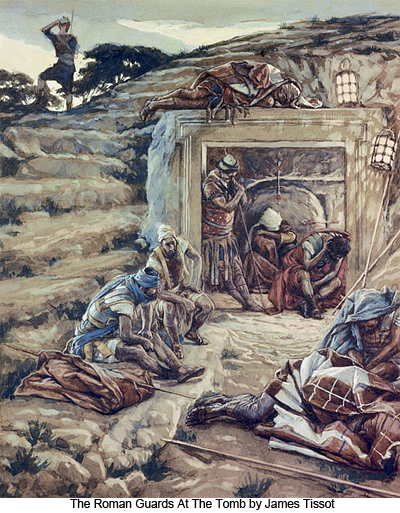
Easter Special: Trouble in River City the Centurion’s Easter: An Empty Tomb, Duplicitous Politicians and a Lingering Question

The pounding on his door awakened Longinus before he expected on this day after the Jewish Passover. He was hoping perhaps beyond hope that the worst was over and that in a few days he could take his soldiers back to the confines of Caesarea and away from the troubled city of Jerusalem. He was tired of this duty and longed for service with a real Legion with real Roman soldiers. He wiped the sleep from his eyes and went to the door of his quarters in Fortress Antonia.  He opened the door to find his Adjutant Marcus with a look of near panic on his face.

He asked the young officer to come into his quarters and take a seat at his table. He took a wineskin and poured the contents into two cups. He asked Marcus what was so urgent and frightening that he had to be at his quarters well before the duty day began. The young man took off his helmet to reveal a crop of blondish brown hair common to the Tyrol in the northern part of Italy and told an almost unbelievable story. He explained that there was trouble at the tomb of the itinerant preacher named Jesus. The two guards from their unit who had relieved the previous watch at the tomb had evidently fallen asleep and there had been a break in.  They claimed that they had been overcome when some kind of angelic being who had descended in front of them and some of the women who had been at the execution site previously.  The story seemed preposterous but Longinus could not believe that they had fallen asleep on duty either as such could be punished by a death sentence.  Adding to the confusion was a report that two of the preacher’s “disciples” had reportedly entered the tomb and claimed that the body was gone as had some of the women that had been there at the crucifixion.  It was unbelievable but yet in light of the strangeness of the man and his execution.  Longinus had the Adjutant bring the two soldiers to him along with the Sergeant of the Guard to explain what had happened.

The two soldiers, one a Samaritan and the other a Greek had good reputations in the unit. Neither had given him cause for concern and the terrified expression on their faces as they explained what happened gave Longinus reason to believe them. Yes it was possible that they were lying but Longinus believed their story. I found that not to believe them and their story that they heard the angel or whatever it was tell the women that the preacher had been raised from the dead. Longinus was not much of a believer in miracles angels or any sort of magic hocus pocus purveyed by seers, magicians or fortune tellers but here he was believing this outlandish story because to disbelieve would mean that there was a serious breakdown of discipline by two outstanding soldiers. He had some soldiers that he wouldn’t believe for an Athenian minute if they told him such a tale but he believed these men and he again thought of his words as the preacher hung dying on the cross on that evil hill.

Longinus went to Pilate’s headquarters when he and the other Centurions were participants in a meeting with the High Priest and his representatives and two of Herod’s people.  The meeting reminded him of a meeting of criminals.  The High Priest and his representatives were livid and Herod’s henchmen voiced their displeasure regarding the lapse of the Roman soldiers that allowed this to happen. Longinus spoke for his men and said that as improbable as it was that he believed their story. That only made the non-Romans angrier; he almost thought that they were engaging Pilate in some histrionic episode in order to force Pilate to do their bidding. They insisted that Longinus’ soldiers had to have fallen asleep and or that they had conspired with the preacher’s followers to remove the body from the tomb. This angered Longinus to the point that he interrupted their ranting to defend his men’s honor. Pilate finally ordered Longinus and the High Priest to be silent.  He asked the non-Romans to step outside while he conferred with Longinus and the other Centurions.

Pilate explained his dilemma. He was afraid that if he sent the High Priest away by supporting his soldiers that there would be a revolt in the streets. He had seen the tumult on the streets by the supporters of the High Priest when he tried to release the “King of the Jews” and felt that this would be worse for security. He advised the Centurions that while he had no reason to doubt them or their men that he had to placate the High Priest and Herod in order to avoid chaos, chaos that could lose him his job if he wasn’t careful. Likewise he did not feel that he had the manpower in the city to handle a full-fledged revolt and that he would have to call for reinforcements from the Legions based in Syria, something that he was loathe to do as this would get back to the Emperor.

Longinus thought back to the day of the execution.  Pilate had agreed to place a guard at the tomb at the urging of the High Council. Longinus had argued against placing any soldiers at the tomb as he felt that since the “King of the Jews” them man that he had called the “son of God” was dead that Rome’s obligation was over. The whole thing reeked of politics, Longinus was overruled by Pilate who explained that Roman soldiers needed to guard the tomb because the High Priest who Longinus detested as much as Pilate insisted that Jesus’ followers would attempt to steal the body and claim that he had been raised from the dead to lead a revolt against the Council and eventually Rome itself.  Added to the Judean witches’ cauldron was Herod, the corpulent and corrupt “King” of Judea.  If Longinus detested Pilate and Caiaphas he hated Herod and all that he stood for, it made him wonder why Roman lives and treasure were spent to solve the problems of this God-forsaken land which he believed would still be trouble two millennia from now if the world lasted that long. Longinus believed that as long as Rome allowed the High Council and Herod to rule the region by proxy that the troubles would never end. He believed that it was only a matter of time before these people, led by the Zealots would revolt as they had against the Seleucids nearly 200 years before. He knew if that happened that Rome would crush the revolt and not leave as much as a house standing.  He hated this occupation and all that it stood for, especially when he saw a good man, an innocent man killed for no good reason other than the politics of it all. It sickened him.

When he was done explaining his decision to Longinus and the other Centurions he called the now quite irate non-Romans back into the proceedings.  He told the High Priest and Herod’s men that he would disciple the soldiers involved and he would assist them in finding just what parties removed the body from the tomb.  In the mean time he would suppress any stories coming from the soldiers about this supposed “resurrection.”  The High Priest and Herod’s men agreed that this would suffice and thanked Pilate for his time and effort. Longinus and the other Centurions quietly seethed as this took place. When the non-Roman parties had left Pilate ensured the officers that no action would be taken against the men and that he would not actively assist the Jews in trying to find the perpetrators of the event. He then let the officer know that they would remain in Jerusalem for another week to allow the multitude of pilgrims to leave the city and then they would return to Caesarea.

Longinus left with the others and met his Adjutant and stepped into the court of the fortress. He was very unhappy with the deal that Pilate made with the High Priest and Herod.  He felt that he had dishonored his soldiers and the unit for the sake of political expediency. He felt ashamed of the Empire for what Pilate had done in cooperating with these people from beginning to end during this affair. He would not forget.

That night he felt compelled to walk to the empty tomb.  In the darkness he looked into the sepulcher aided by a lantern. He saw the grave cloths where they remained; the large stone was rolled away and the seal that had been placed on it was broken.  He looked for any evidence to suggest that his soldiers had fallen asleep but could not find any.  Nor did he see how anyone could have stolen the body and gotten very far without being seen by anyone. Convinced by what he saw he set down in the tomb and thought about this man.  He looked at ground where the body had been placed.  In the dim light he noticed what appeared to be some thorns.  He reached down He would have to find out more about him if he truly was the son of God.

He walked back to the fortress when he went to the Officer’s Mess and had the steward pour him some wine. He drank quite a few before the evening was out and then went to his quarters where he lay down exhausted and perplexed by the events of the past few days.

Peace

Padre Steve+

5 Comments

Filed under faith, Religion

Holy Saturday Special: A Centurion Reflects on a Days Work

This is the second of a series of three Good Friday, Holy Saturday and Easter Sunday stories that I wrote last year and am doing again this year. It is what I image that the commander of the Roman Soldiers in charge of the crucifixion of Jesus must have been going through during that time. The Centurion according to Church tradition was named Longinus who later converted to the Christian faith and by some accounts died as a martyr. Much is legend but still the story of Longinus the Centurion appeals to me as someone who has served in the military for many years and been a company commander in the Army. I will post the final installment on Easter Sunday.  

The horrible day was over and the night had passed. The sun rose over the escarpment overlooking the Jordan River casting a red glow in the east as the city awoke to the Sabbath morning.  Longinus rose as always when his adjutant arrived at his quarters in Fortress Antonia with his breakfast.  He preferred a private breakfast and this was typical for the area, a cup of the local tea, a plate of figs a loaf of bread with honey and since they were in a major city a portion of mutton procured from a local butcher who was more interested in earning a living than completely avoiding contact with the gentile Roman legionnaires.  Longinus invited the young officer to sit on a small chair beside the table which served both as his dining table and office desk.

They discussed the impending return to Caesarea and the needs of the soldiers as well as the case of a soldier caught drunk and disorderly stumbling around the outer court of the Temple. The Temple Police apprehended the man and returned him to the watch officer of the fortress. It was embarrassing but not atypical of the locally recruited Samaritans.  Sometimes Longinus wished that he was back with an Italian Cohort or even with the elite Imperial Guard, but even in those units individual soldiers would still do stupid things.  After discussing the matters he dismissed the officer and rose from his chair.  Longinus took the cup of tea and a piece of the bread and walked to the small window which looked out across the city and he could see the rocky crag called Golgotha now devoid of crucifixes where he supervised the executions of the two criminals and the man called by Pilate “the King of the Jews.”

It was the last that bothered him; while Longinus had seen or supervised numerous crucifixions he never enjoyed them as did some of his brother officers.   Occupation duty anywhere but especially here was difficult on soldiers.  The troops were not the elite of the Empire, many of the officers were cast offs from the Legions and the duty itself drained officers and men alike. They knew that the Jews hated them their Caesar and their taxes.  Violence against soldiers posted to remote outposts was not uncommon; the Jews of the Zealot party had no compunction about killing Roman infidels and felt that dying to free their land was an honorable thing to do. They could be brutal both to the Romans as well as other Jews that they suspected of collaborating with the hated occupiers.  Longinus hated them and treated them as terrorists whenever he encountered them, they were not soldiers and they had no honor He hated them and their land, he longed for the culture and peace of the home provinces of the Empire.

There was something unusual about the man that Pilate called “the King of the Jews.” Longinus took a sip of his tea and took another bite from the honey covered bread and shook his head. He had no idea why a man who did not seem to be violent whose followers melted away the moment this “King” was arrested by the Temple Police.  He gazed upon the sunrise as the sky began to lighten. He thought about the women and the young man who stood nearby the cross the day before. He thought about the blood and the water and his remark to his men as the man died “truly this man was the son of God.”  He hadn’t thought about it much until now. He knew that he would have to think some more on this subject but he had too much to accomplish today. There was still the possibility of violence in the city and one never knew what the Zealots were up to.  Yes he would be busy. He took another sip from his tea and dressed for his meeting with Pilate and the other Centurions.

Peace,

Padre Steve+

4 Comments

Filed under faith, Religion

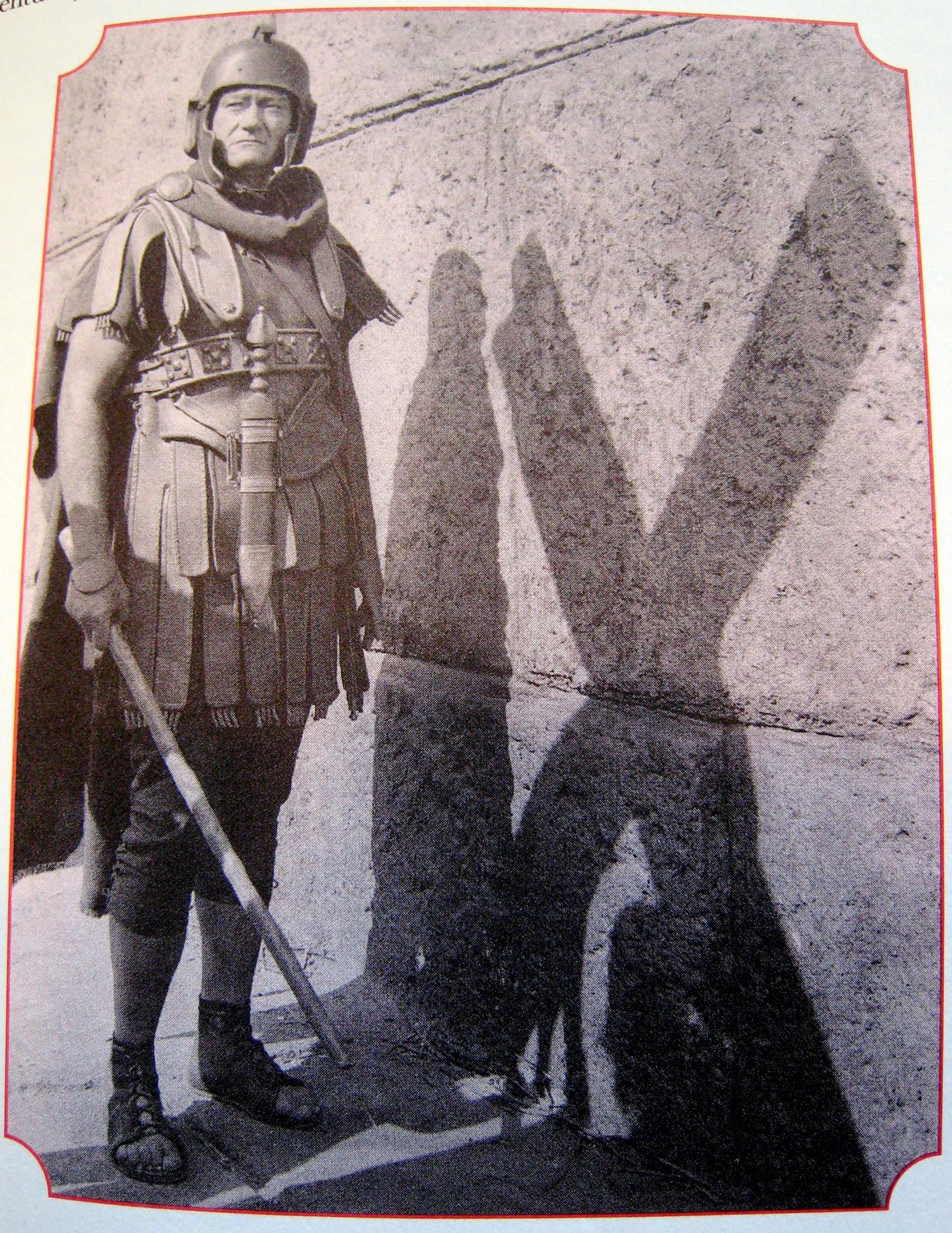
Good Friday Special: The Long Good Friday of Longinus the Centurion

Russian Orthodox Icon of Longinus the Cenurion

This is the first of a series of three Good Friday, Holy Saturday and Easter Sunday stories that I wrote last year and am doing again this year. It is what I image that the commander of the Roman Soldiers in charge of the crucifixion of Jesus must have been going through during that time. The Centurion according to Church tradition was named Longinus who later converted to the Christian faith and by some accounts died as a martyr. Much is legend but still the story of Longinus the Centurion appeals to me as someone who has served in the military for many years and been a company commander in the Army. I will post the other two installments on Saturday and Sunday.  

It was another ignominious day in the life of Longinus the Centurion. Posted to the troubled outpost of Judea he commanded a unit composed of locally recruited troops mostly Samaritans and some Syrians. How he wished that he commanded elite troops of the Italian Cohort or any of the European Legions stationed in nearby Syria.  Normally he and his men were posted to the Roman capital of Judea Caesarea on the Mediterranean coast of Judea, though his troops were not elite the location was not bad so far as amenities, especially for Judea.

However, today’s mission was another distasteful assignment away from Caesarea back to the always troublesome city of Jerusalem.  Since the Jewish Passover was coming and with it thousands of Jewish pilgrims from around the world were in the city and in there was always the potential for trouble. Longinus had heard around the headquarters that tensions in Jerusalem were increasing due to the presence of some itinerant preacher from up in Galilee which according to the agents and spies in the city allegedly had healed the sick, raised the dead and restored sight to the blind. Evidently he had even stirred things up on a previous visit by chasing money changers out of the Temple. Longinus had to admire that, this Jesus was pretty ballsy. Since the worldly and seasoned Longinus didn’t think much of religious zealots, Jewish or otherwise he could only chuckle when thinking of some bumpkin raising hell in the Temple and pissing off the religious elite.

He led his unit as part of the mixed Cohort which provided security for the Imperial Legate, Pontius Pilate. He remembered a previous mission where Pilate had posted the Imperial Standards with the Image of Caesar as God outside the Fortress Antonia very close to the Jewish Temple caused a riot and Pilate had the Standards returned to Caesarea under heavy escort the next day.  This time there was a rebel named Barabbas who had been causing no end of trouble and Pilate had sentenced him to death.  But then the Jewish High Council brought Pilate another case, the case of this itinerant preacher, Jesus of Nazareth. It seemed to Longinus and the other Centurions present that the case was a simple religious disagreement that the Romans should not get involved in. However Pilate took the case fearful of the threat to his job if he allowed another “king” to live.  Yet Pilate had found this Jesus innocent but caved to the pressure of the mob, even ignoring the pleas of his wife Claudia to spare the preacher.  Pilate was a typical politician and cut a deal which allowed King Herod, the Sanhedrin and himself to meet the demands of their various constituencies or in the case of Pilate his boss to end this Jesus of Nazareth problem once and for all.

On the day before the Passover one of the preacher’s own men turned him in to the Council for the paltry sum of 30 pieces of silver. That alone proved to Longinus that this Jesus was no threat to anyone. The Temple Police brought Jesus to the Sanhedrin which condemned him to death, but since they were not authorized by the Roman administration to carry out the death sentence they took the case to Pilate. Longinus saw Pilate use every trick that he could to make the decision the responsibility of someone else and if Longinus had been Pilate he would have told those religious types to pound sand and get the hell out of his headquarters, but he was a soldier not a politician with greater aspirations like the legate.

Instead Pilate complicated his life and those of his fellow Roman officers in charge of their local troops. One Centurion had the duty of supervision the torture of this Jesus. The troops were brutal, Samaritans and Syrians they hated the Jews and torturing a Jew for any offense was just too much fun, but for the Roman officers it was unseemly and lacked the honor of a true battle against other soldiers. After the brutal scourging with a barbed whip those soldiers placed a rough hewn “crown” of thorns on the unfortunate man’s head and robed him in purple to mock his claims to be a “king.” Longinus felt that the whole exercise was a cruel joke but the order had been given and by Roman law had to be carried out. After the scouring Pilate tried one last time to get out of killing this man offering to spare him for the life of Barabbas, a man who was a legitimate terrorist threat to the Empire’s interests in Judea. Instead the weak willed Pilate caved and spared the life of the terrorist for a man who couldn’t even control his own people. It was sad what was done in the name of the Emperor.

When final sentence was pronounced Longinus was assigned to the crucifixion detail.  Normally with such inflamed passions he would have assigned much of his unit to the task of the execution and related security measures. However it seemed that the usually surly population had little interest in stopping this execution of one of their own. With that in mind Longinus took just four soldiers with him to conduct the execution, security did not seem to be a problem. After a rather tumultuous parade through Jerusalem where the condemned man was heckled and abused they arrived at a hill just outside of the city called Golgotha, the place of the Skull. Longinus felt that the place was grotesque but it did work for the execution. Any visitor to the city would see the condemned man as well as two common thieves who were being executed at the same time.

His men performed the execution in the prescribed manner and he allowed the men to divide the condemned man’s clothing among them. For three hours the men along with a number of observers those that were obviously mourning the scene including a woman that appeared to be the itinerant preacher’s mother and a young man who he might be one of his followers. They were balanced out by a group of hecklers who mocked the condemned men, especially the preacher. Even one of the common thieves joined in the heckling. Yet in spite of this the preacher responded with grace and love to those who mocked him in his dying hours offering forgiveness to his men and promising eternal life to one of the condemned men who hung on either side of him.  The only real trouble came when some of the Council members noticed that the placard above the preacher said “The King of the Jews.” They immediately send men to Pilate to change the wording but Pilate finally told them to pack sand saying “I have written what I have written.” Longinus kept his silence when he heard this he and the other Centurions arrived back in Caesarea and had a chance to share drinks and a meal in a local pub.

It was an unusual day, the skies grew black as noon approached and the preacher made a number of chilling statements from his place on the cross the most poignant being where he cried out “my God my God why have you forsaken me?” That struck Longinus, this man was not really guilty of anything in Roman Law but was being killed and Longinus was part of the process.  A tear came to his eye when the preacher cried out “it is finished” and died.  Without thinking he called out to his men and to those remaining at the site “truly this man was the Son of God” drawing the ire of those cheering the execution and the bewilderment of those that appeared to be there to support this man. So when a runner came from Pilate came to order the deaths be speeded up to accommodate the religious traditions of the Jews he was relieved. His men broke the legs of the men on either side of the preacher but when they came to the limp body of the preacher they found that he was dead. Just to ensure that this was the case he had a soldier drive a spear into the side of the man. Blood and water flowed from the wound. The man was dead and the job was complete. Another Centurion came with a detail of soldiers to remove the bodies and to ensure the security of the preacher’s tomb, yet another concession to the religious people.

Longinus was glad that the day was done. He cast a glance at a number of women and one young man that remained. They obviously were his friends and the older women might have even been the preacher’s mother. He shook his head marched his troops back into the city and reported that the mission was complete when he reached Fortress Antonia.  He felt hollow inside and hoped beyond hope that time could be altered to allow him to save the many before it ever got to this point.

Arriving at Antonia he joined a number of fellow officers and as they chatted about the day he felt his anger and frustration rise. That preacher didn’t deserve to die and it was too bad that he could not be restored to life. But the Centurion in change of the Tomb Guard detail reported that the body had disappeared from the tomb. Longinus was tired. He hoped that it might be true. He asked the bartender for another drink and wondered just what was going on in this hellhole called Judea and he thought again “truly this man was the Son of God.”

Peace

Padre Steve+

Note: Longinus is the name attributed to the Centurion at the Cross during the crucifixion by early church tradition. Likewise this is true of Claudia the wife of Pilate. This story is simply my versions of what might have happened that fateful Friday when a Centurion named Longinus became an actor in a play that he could not imagine.

7 Comments

Filed under christian life, faith, Religion