Category Archives: US Navy

The Battle of Cape Engano

RptsI-P60

“TURKEY TROTS TO WATER GG FROM CINCPAC ACTION COM THIRD FLEET INFO COMINCH CTF SEVENTY-SEVEN X WHERE IS RPT WHERE IS TASK FORCE THIRTY FOUR RR THE WORLD WONDERS.” Admiral Nimitz to Admiral Halsey

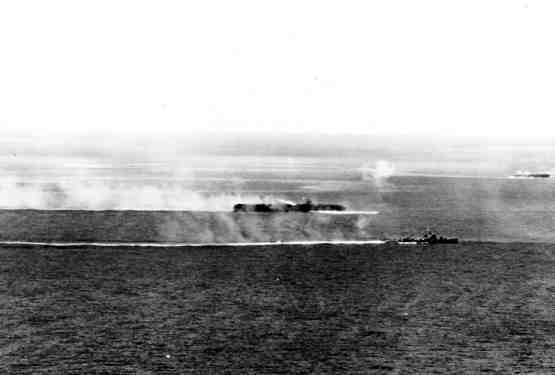
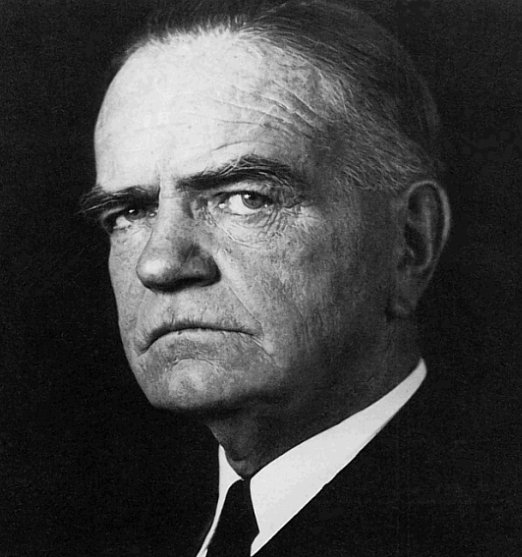
After Admiral William “Bull” Halsey felt that he had heavily damaged the Japanese Center Force during the Battle of the Sibuyan Sea he withdrew the Fast Battleships of Task Force 34 from the San Bernardino Strait in order to use them in a surface engagement against Admiral Jisaburo Ozawa’s Northern Force. Halsey assumed that Ozawa’s carriers were the main threat to the American invasion forces. However he did not know that Ozawa’s carriers had very few aircraft embarked and that the Northern force was in fact a decoy, designed to draw him away from Vice Admiral Takeo Kurita’s Center and the two task forces of the Southern force.

b55

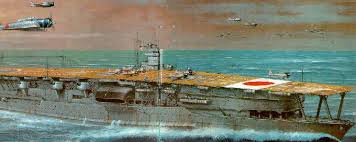
The Zuikaku uder attack at Cape Engano

When Halsey’s aircraft reported the Center force withdrawing he believed that the threat had been removed. He wrote in his memoirs “I believed that the Center Force had been so heavily damaged in the Sibuyan Sea that it could no longer be considered a serious menace to Seventh Fleet.” Thus he moved with haste to intercept, engage and destroy the Northern force and its carriers and battleships.  Halsey believed that his engagement against the Northern force would culminate when his fast battleships destroyed whatever Japanese surface forces remained.

It was not a bad assumption. Ever since the early days of the Pacific war the truly decisive engagements had been decided by carriers. Unfortunately for the American sailors of Taffy-3, the group of Escort Carriers, destroyers and destroyer escorts which encountered Kurita’s Center force which had doubled back overnight and passed through the San Bernardino Strait surprising Rear Admiral Thomas Kinkaid’s task group of “Jeep” Carriers.

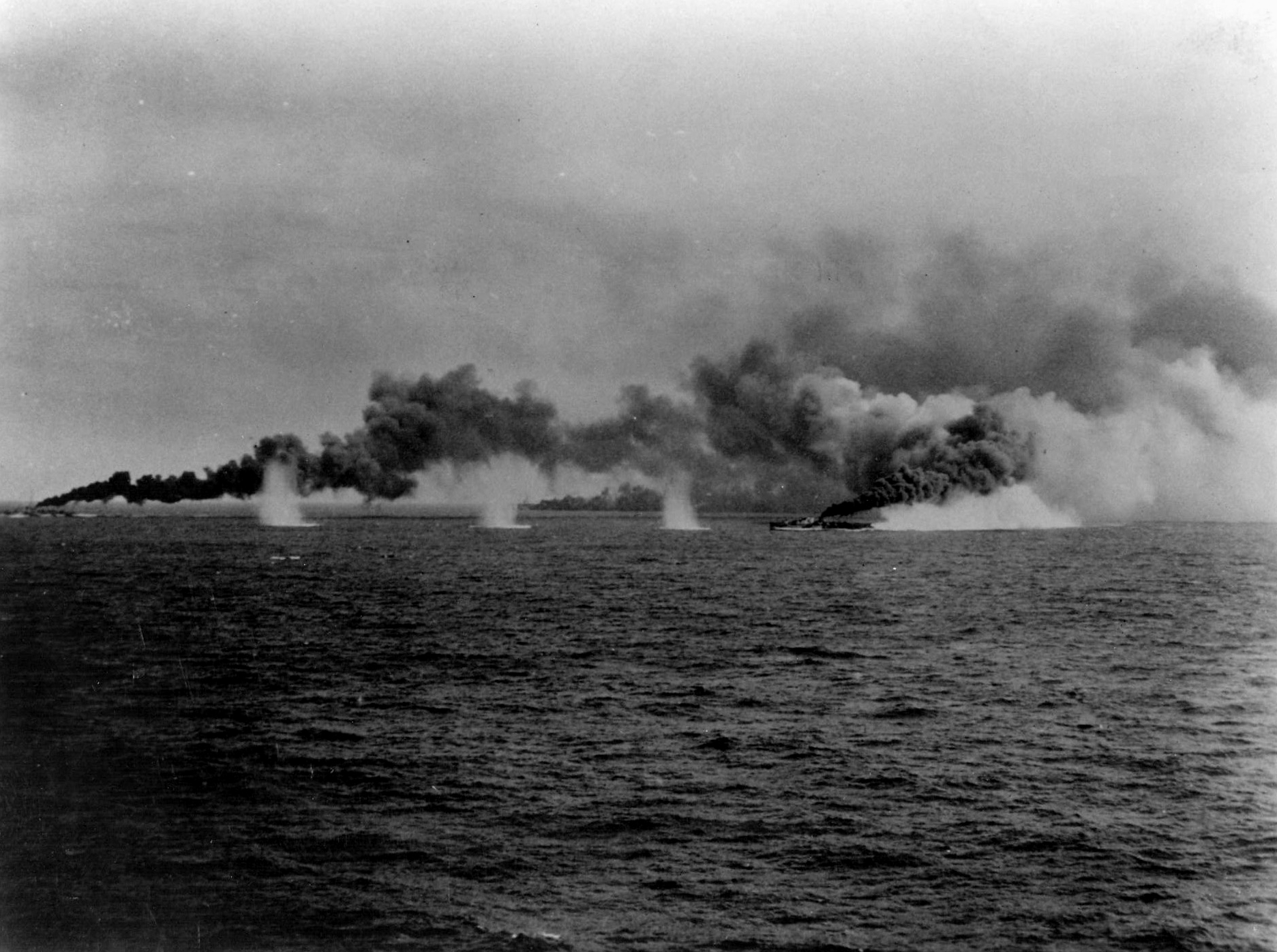
Destroyers_laying_smoke_screen_during_Battle_of_Samar_1944

The Battle off Samar

The unequal battle that ensued off Samar was a near run thing for the Americans. Had Kurita not been confused about what forces he was facing and pressed his attacks he may have inflicted painful damage on the actual invasion forces. However after a morning of battle, in which Taffy-3’s destroyers, destroyer escorts, aircraft and even the Jeep carriers themselves inflicted heavy damage on the Japanese force Kurita withdrew.

Halsey

Admiral William “Bull” Halsey

However as Taffy-3 battled for its life against Kurita’s battleships, cruisers and destroyers Halsey’s carrier air groups were pounding Ozawa’s hapless carriers and their escorts. About 0800 on the 25th Kinkaid’s desperate messages began to reach Nimitz and Halsey. However since Halsey did not believe just how serious the situation was he continued to pursue Ozawa’s force. When he received Nimitz’s message he was incensed. The message “TURKEY TROTS TO WATER GG FROM CINCPAC ACTION COM THIRD FLEET INFO COMINCH CTF SEVENTY-SEVEN X WHERE IS RPT WHERE IS TASK FORCE THIRTY FOUR RR THE WORLD WONDERS was composed of three parts. The preface “Turkey trots to water” was padding, as was the last part “the world wonders.”

ship_zuiho2

Light Carrier Zuiho under attack

However the communications officer on Halsey’s flagship only removed the first section leaving “Where is Third Fleet, the world wonders.” Halsey was flabbergasted and though the battleships of Task Force 34 were almost in range of the Japanese force he sent them south to relieve Kinkaid’s beleaguered force. However by the time Vice Admiral Willis Lee’s battle line arrived Kurita had withdrawn, losing 3 heavy cruisers sunk, three heavy cruisers and one destroyer heavily damaged.

gsxN4rT

Zuikaku being abandoned

All the Japanese carriers were sunk along with a light cruiser and a number of destroyers, but Kurita’s heavy forces escaped. Among the Japanese losses was the carrier Zuikaku the last surviving carrier of the Pearl Harbor attack. Naval historian Samuel Elliott Morrison wrote:

“If TF 34 had been detached a few hours earlier, after Kinkaid’s first urgent request for help, and had left the destroyers behind, since their fueling caused a delay of over two and a half hours, a powerful battle line of six modern battleships under the command of Admiral Lee, the most experienced battle squadron commander in the Navy, would have arrived off the San Bernardino Strait in time to have clashed with Kurita’s Center Force… Apart from the accidents common in naval warfare, there is every reason to suppose that Lee would have “crossed the T” and completed the destruction of Center Force.” 

The Battle of Cape Engano closed the epic extended battle of Leyte Gulf. The victory of the US Navy was decisive even without the final destruction of Kurita’s forces. The remnants of the Japanese forces would never mount a serious offensive threat again. The survivors would be hunted down over the next 9 months, some sunk by submarines, other in surface engagements, still more to air attacks at Okinawa and in Japanese ports.

USS Mobile 10

Halsey received much criticism for his decision to withdraw TF 34 from San Bernardino Strait. However in his defense the action exposed one of the key problems in any kind of warfare, the problem of seams. Kinkaid’s escort carriers belonged to 7th Fleet which came under the operational control of Douglas MacArthur’s Southwest Pacific Region while Halsey commanded 3rd Fleet fell under Admiral Nimitz’s Central Pacific region. This created a situation where two fleets belonging to two regions under two separate commanders were attempting to fight a single battle. The principle of unity of command and unity of effort was violated with nearly disastrous results.

Peace

Padre Steve+

1 Comment

Filed under History, Military, Navy Ships, US Navy, world war two in the pacific

Leyte Gulf: The Greatest Naval Battle in the History of the World

gb_at_samar

USS Gambier Bay being attacked by Japanese Surface Forces battle 

I will break into Leyte Gulf and fight to the last man…would it not be shameful to have the fleet remaining intact while our nation perishes?” Vice-Admiral Takeo Kurita – 1944

”In case opportunity for destruction of a major portion of the enemy fleet is offered, or can be created, such destruction becomes the primary task.”

Admiral Chester Nimitz – In his order to Halsey, prior to the Battle of Leyte Gulf – October 1944

battle-line-leyte-gulf_life1

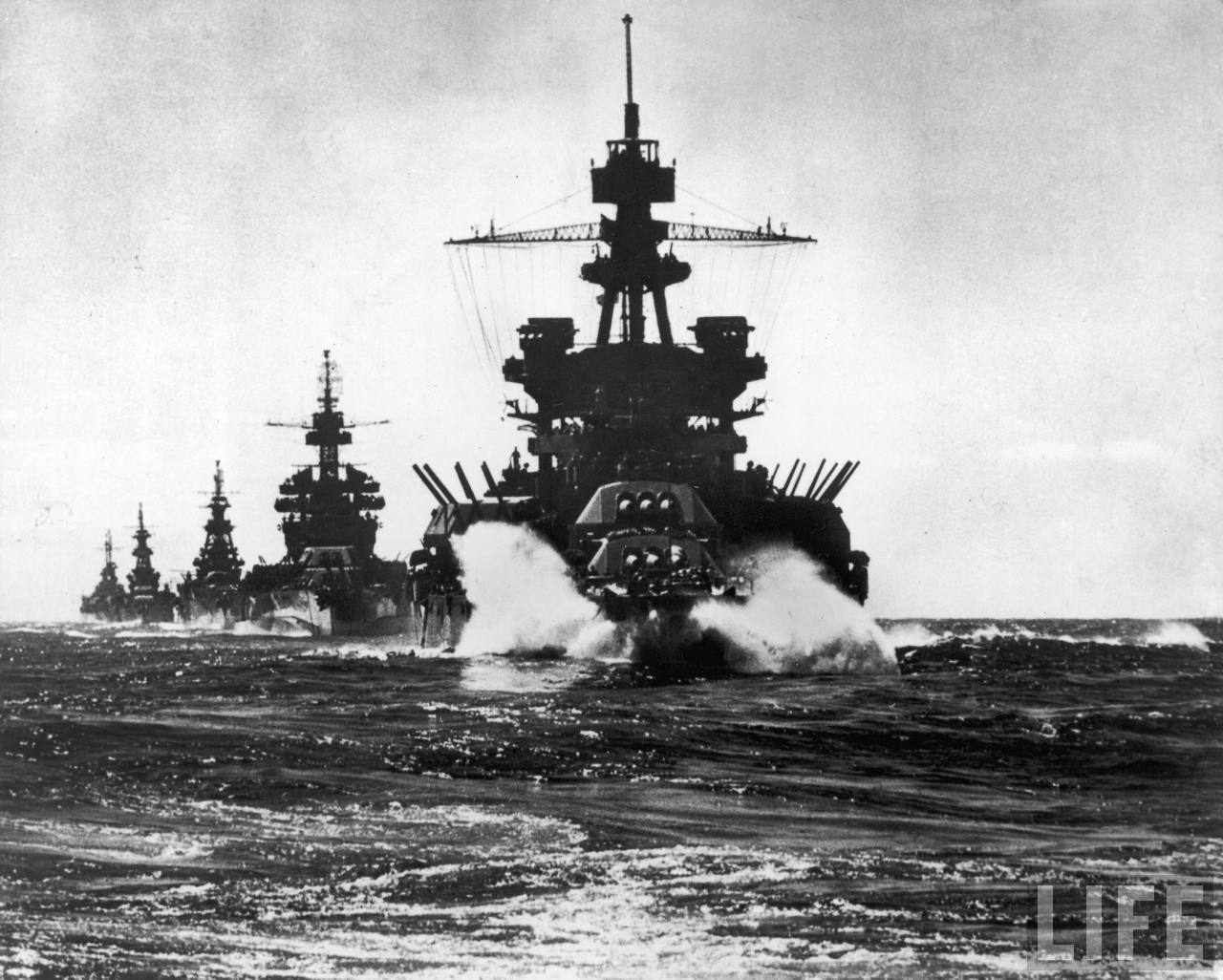
The Old Battleships of the 7th Fleet

Sixty-nine years ago the largest and most geographically expansive naval battle ever fought began. A few days before the forces of General Douglas MacArthur’s Southwest Pacific command and Admiral Chester Nimitz’s Central Pacific command joined to invade and liberate the Philippines from the Japanese. It was less than three years since Japan had attacked Pearl Harbor and two and a half years after MacArthur had left the Philippines vowing “I shall return.” 

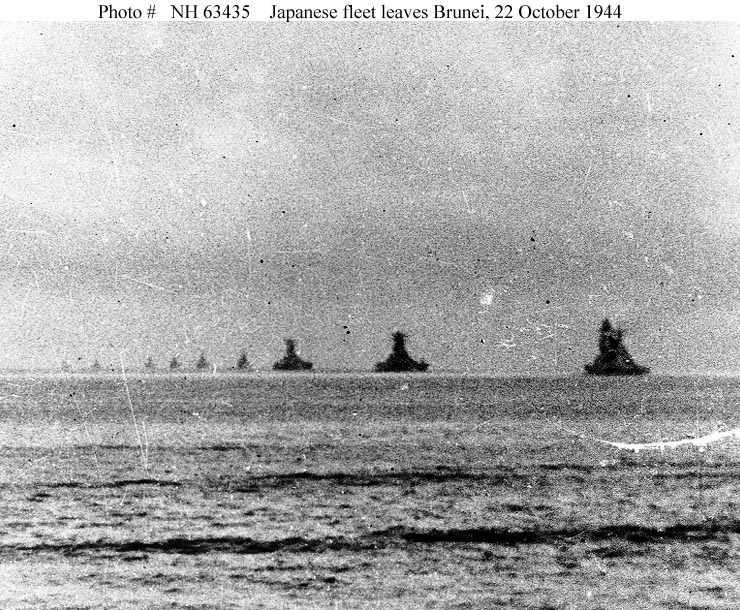
h63435-1

The Japanese knew that the battle for the Philippines was a must win. An American victory would ensure that Japan would be cut off from the vital natural resources of Indo-China, the Dutch East Indies and Borneo, particularly oil, without which it could not remain in the war.

The Imperial Navy was tasked to work with land based air forces to thwart the invasion by drawing off the American Fast Carrier task forces and allowing heavy surface forces to seek out and destroy potentially vulnerable troop transports and supply ships in Leyte Gulf.

It was a complicated plan, but one which had a chance of disrupting the American invasion, and came perilously close to doing so.

Admiral Jisaburo Ozawa’s Northern force of four aircraft carriers without viable air groups was a decoy. Vice Admiral Shoji Nishimura and Vice Admiral Kiyohide Shima commanded separate task forces both committed to breaking into Leyte Gulf through Surigo Strait. Vice Admiral Takeo Kurita who commanded the main effort, the powerful Center Force which was to break into Leyte Gulf through San Bernardino Strait. Vice Admiral Takijirō Ōnishi commanded the Philippines based 1st Air Fleet which turned to the use of Kamikazes as a means to destroy American warships.

Princeton1

Kamikaze attack

The US forces included the American Third Fleet commanded by Admiral William “Bull” Halsey was the primary naval force composed of the Fast Carrier Task Forces and fast battleships. Adusmiral Thomas Kinkaid commanded the 7th Fleet which was the invasion force and its escorts, including a number of carrier task forces built around the Escort Carriers and the old battleships of Jesse Oldendorf’s Task Group. The latter included a number of the survivors of the Pearl Harbor attack including the USS West Virginia, USS California, USS Tennessee, USS Maryland and USS Pennsylvania. Oldendorf’s flagship, the USS Mississippi was not at Pearl Harbor but likewise one of the “old ladies” of the fleet.

g378525

The battle was unique because of how long it went and how many separate engagements were included.  Not counting patrol craft, submarines and auxiliaries close to 300 warships and nearly 2000 aircraft were engaged in 5 separate engagements waged by surface ships, naval air forces and submarines.

886896

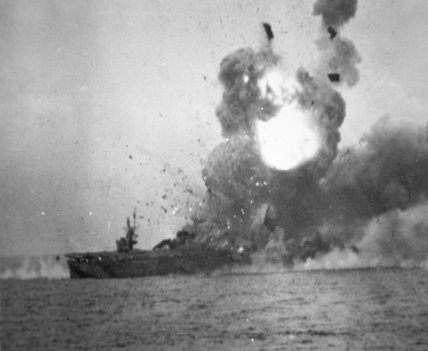
USS St Lo blows up after being hit by Kamikaze 

The battles included an engagement in which American Submarines took on the Center Force, naval aircraft engaged the Center and Southern Forces, the old battleships fought the last battleship against battleship engagement in history, heavy surface forces engaged and were repulsed by light forces and a decoy force which would suffer terribly would keep the bulk of the best American forces out of the main battle. It would also see the first coordinated use of Kamikaze suicide attack aircraft by Japan.

014849

USS West Virginia 

Tonight I am linking a number of articles that I have written previously about this amazing battle. In the next few days I will add a couple new articles to the collection.

The Battle of Leyte Gulf: Introduction and the Battle of Palawan Passage

The Battle of Leyte Gulf: Sinking the Musashi 

Slaughter at Surigao: The Old Ladies get their Revenge

For those unfamiliar with the battle that would like a deeper treatment than I provide in these links I recommend The Battle of Leyte Gulf 23-26 October 1944 by Thomas C Cutler, The Last Stand of the Tin Can Sailors: The Extraordinary World War II Story of the U.S. Navy’s Finest Hour by James Hornfisher, Battle Of Leyte Gulf by Edwin P Hoyt, Leyte: June 1944-January 1945 (History of United States Naval Operations in World War II) by Samuel Elliott Morrison and Battle of Surigao Strait by Anthony P Tully. Hoyt and Morrison’s books were the first that I ever read on the subject back when I was in Junior High School but for an overview I think Cutler’s work is better. The other two works present interesting and informative views of two of the decisive engagements of the battle.

uss roberts 101944

As I said in the next few days I plan on adding more articles on this fascinating battle. If things work out I should have something on the Battle off Samar, the Battle of Cape Engano and the Kamikaze debut.

Have a nice night and never forget the sacrifice of all of the brave sailors.

Peace

Padre Steve+

1 Comment

Filed under History, Military, Navy Ships, US Navy, world war two in the pacific

A Global Force for Good: Happy 238th Birthday to the US Navy

Navy Heritage WWII Recruitment Poster

http://www.navy.mil/viewVideo.asp?id=17676

“A good Navy is not a provocation to war. It is the surest guaranty of peace.” Theodore Roosevelt 

For me anything to do with the United States Navy is historical as well as decidedly personal. Sunday is the 238th anniversary of the founding of the United States Navy, actually the founding of the Continental Navy but let’s not get too technical.

The fact is that back in 1775 most people and political leaders in the revolting colonies felt that founding a Navy was quite foolish. After all, who in their right mind would ever dare to challenge the might of the British Royal Navy? Even revolting colonies. But like when King George III was told that “the Colonies are revolting” he reportedly said “tell me something I don’t know.” But I digress…

In fact had General George Washington not sent a letter to the Continental Congress say that he had taken some vessels in hand to disrupt the supplies of the the British Army a Navy might not have ever been established. Timing is everything and in this case it was pretty good timing.

Since that fortuitous day in 1775 the United States Navy went from being a piss ant annoyance to the Royal Navy to the premier naval power in the world. Men like John Paul Jones, Edward Preble Stephen Decatur, Thomas Truxtun, William Bainbridge, Oliver Hazard Perry, David Farragut, David Dixon Porter, George Dewey and many more blazed a path of glory which others, great and small would continue to build on the legacy of the iron men who sailed wooden ships into harm’s way. Men like Arleigh Burke, Howard Gilmore, John C. Waldron, Maxwell Leslie, Bull Halsey, Richard O’Kane, Daniel Callahan, Raymond Spruance, Ernest Evans built upon that legacy in the Second World War. Others would do so in the Cold War, Vietnam and the Global War on Terrorism.

Great ships like the USS Constitution, USS Monitor, USS Kerasarge, USS Olympia, USS Enterprise, USS Hornet, USS Yorktown, USS Growler, USS Tang, USS Hoel, USS Johnston, USS Samuel B Roberts, USS Laffey, USS San Francisco, USS Houston and USS Arizona, USS Nevada, USS West Virginia and USS California helped build a legacy of valiant sacrifice and service often at great cost in the defense of freedom.

But over those 238 years it all it came down to the men and now the men and women who served in every clime and place, many times outnumbered and facing certain defeat who through their courage, honor and commitment helped secure the liberty of their countrymen and others around the world. Most of these men and women served in obscurity in war and peace but all had the distinction of serving in the United States Navy.

As President John F Kennedy said: “I can imagine no more rewarding a career. And any man who may be asked in this century what he did to make his life worthwhile, I think can respond with a good deal of pride and satisfaction: ‘I served in the United States Navy.'”

295_26911932058_5614_n-1

Like my father before me I can say that I am proud to have served and continue to serve in the United States Navy, because we are no matter what some may say or think,  a global force for good.

Peace

Padre Steve+

1 Comment

Filed under History, Navy Ships, US Navy

Letter to a New Military Chaplain: Part Two The Minefields of the Heart

295_27076892058_2637_n-1

This is second part of a response to a question I had from a new Navy Chaplain. I have decided to post it here without any identification of the chaplain because I know that many men and women who are new to the military chaplaincy or who are exploring the possibilities of becoming a chaplain have the same questions. I was fortunate to have had a number of chaplains who at various points in my decision process and formation as a minister, Priest and Chaplain in both the Army and the Navy help me with many of these questions. Likewise I learned far too much the hard way and blew myself up on some of the “land mines” that almost all who serve as chaplains experience in their careers. This is the second of several parts to the letter and is my attempt to systematically explain my understanding of what it is to be a Chaplain serving in the military and in particularly the Navy. The first part is linked here:

Letter to a New Military Chaplain: Part One

“There is a twilight zone in our hearts that we ourselves cannot see. Even when we know quite a lot about ourselves-our gifts and weaknesses, our ambitions and aspirations, our motives and our drives-large parts of ourselves remain in the shadow of consciousness. This is a very good thing. We will always remain partially hidden to ourselves. Other people, especially those who love us, can often see our twilight zones better than we ourselves can. The way we are seen and understood by others is different from the way we see and understand ourselves. We will never fully know the significance of our presence in the lives of our friends. That’s a grace, a grace that calls us not only to humility, but to a deep trust in those who love us. It is the twilight zones of our hearts where true friendships are born.”Henri J. M. Nouwen

Dear Chaplain

The next section of our discussion is about the “minefields” that we so often encounter as Chaplains and to some degree as Ministers, Priests or Rabbis or other religious leaders. As I noted in the first section I am dividing these “minefields” into three major areas; the personal, the behavioral and the professional.

This section is about the “personal” minefields which I call the “Minefields of the Heart.” I call it this because it seems from the Christian and Jewish Scriptures the heart is the figurative locus of what we are, good and bad alike as human beings.

Of course there is always some spillage between the areas personal, behavior and professional areas and our behaviors and professional relationships are certainly influenced by the things that we hide deep in our hearts. As human beings we may try to compartmentalize our life to keep things apart such as keeping our personal life separate from our professional life, or hide behaviors from our friends, families, peers or co-workers; but the cold hard fact is whether we are aware of it or not each area impacts the other. If we are not aware of this fact, if we have little self awareness, if we have self awareness but try to live our lives with the illusion that we can separate our lives into neat little boxes we will most undoubtedly hurt ourselves, and as spiritual leaders harm those that come to us.
q_who

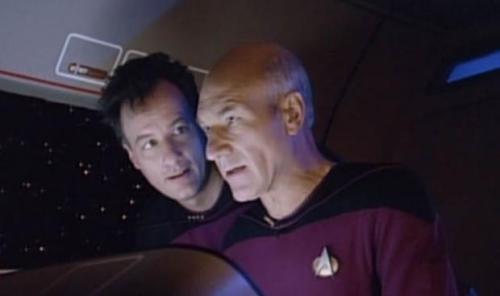
There is a scene of the last episode of Star Trek the Next Generation entitled “All Good Things” that comes to mind.  In it the being known simply as “Q” helps Captain Picard discover how his actions influence human history.

Q: You just don’t get it, do you, Jean-Luc? The trial never ends. We wanted to see if you had the ability to expand your mind and your horizons. And for one brief moment, you did.

Capt. Picard: When I realized the paradox.

Q: Exactly. For that one fraction of a second, you were open to options you had never considered. That is the exploration that awaits you. Not mapping stars and studying nebulae, but charting the unknown possibilities of existence.

You may wonder where I am going with this but it has to do with the personal minefields, those that exist inside of us, those that lurk beneath the surface which if we are unaware wreak havoc on everything else that we do. In the episode of Star Trek that I am referring to Captain Picard is allowed by Q to see the effects of his actions and to see how limited his thinking was.  The challenge for us is chaplains are to be aware of what Nouwen calls “the twilight zone in our hearts” and how what is at the depth of our heart impacts everything else that we do.

Too often though, mostly because of our own personal limitations and serious lack of real theological and pastoral formation involving self reflection and exploration we fail to see them. Like an uncharted minefield we are unaware of them until we either discover their existence through accident and “blow ourselves and others up” or until we listen to those that can see those twilight zones, those minefields better than we ourselves. Of course the latter, especially when it comes from those who love us, care for us and have our best at heart is the preferable method to learn about these things.
943043_10151694525692059_632653331_n

However, that being said part of this can be done through reading. A lot of us simply read “how to” type books when it comes to ministry. We seek direct easy answers in how to run our programs be it in the church, in a para-church ministry or in the chaplaincy. Believe me there are plenty of those kinds of books out there, not only that but a plethora of “self help” books that tell us the “three things we must know” the “five whatever’s to success” or the Seven Habits of Highly Defective People.” The sad thing is, even when these books contain nuggets of truth, they serve it like fast food and reduce it to the lowest common denominator. In a sense, even the most well intentioned of these “how to” or “self help” books promote a reductionist view of faith, spirituality, psychology and in some cases ethics and doctrine.

Reading is important, especially the hard stuff, philosophy, history, moral theology, but also things that you might not expect science fiction for example. In addition classic literature from antiquity and from non-western traditions also sheds light on those personal minefields. Heck we can even find truth in television and film, note my continued references to Star Trek. I find that God can speak to us in many ways.

As Christians we may also find lessons, insights and inspiration from the Bible that can be quite helpful. Unfortunately most of us have so many theological filters in place that we often miss the very things that would be most helpful to us. They can serve as blinders that keep us from sensing what the Spirit of God is trying to teach us. Our church, denominational or theological traditions as well as our hermeneutical methods often cloud our minds to what God is trying so hard to say. It was a problem that the religious establishment of his time had with Jesus, and often with the various prophets that preceded him whose stories we read about in the Old Testament.
1905_50393137058_7454_n

I am sure that others who are not Christians can say similar things about their faith, traditions and holy books. I remember an Iraqi General who I met who took the time to show me his well worn and read Arabic-English Bible. He was a Moslem, but he said that he learned so much from it because it was different than what was in the Koran and he meant no disrespect of his own faith by saying that. He had opened his mind to truth that others turn a blind eye to.

Some of the personal issues that prove to be deadly include what we don’t know about ourselves, usually dating back to childhood, how were raised, how we see God, if we perceive ourselves to be worthy of God’s love or worthy of the love and respect of others.  Those attitudes, especially those created as a result of negative relationships or even physical, emotional or sexual abuse, abandonment and rejection are powerful. Many of us like to pretend that we have gotten past those things but few of us actually do. Unfortunately there is a tendency for those issues to raise their heads in often very ugly ways as we minister as Chaplains.

For example: Let us say that we are distrustful of authority because of having an abuse parent, that we fear that no matter how well we do that there is always someone waiting to take us down. Let us say that we had previous experiences in the church, at work or maybe in prior military service where we were mistreated by those in authority.

I have found that if that condition is not dealt with that in a hierarchical organization such as the Chaplain Corps and the military that it is almost always fatal to the ability of the chaplain to minister in the organization. That is because the military is based on trust, our lives and mission depend on it. We have to trust the chain of command, we have to trust those that serve alongside of us and we have to trust our subordinates. There may be times when the chain of command fails and things don’t go right. There are toxic leaders and there are also toxic chaplains, one has to be aware that they are out there, know how to deal with them or survive under their command but one cannot presume that everyone is like that, trust is essential.

father

I find it interesting that Jesus commended the faith of the Roman Centurion when instead of asking Jesus to come to his house and heal his servant simply said “But just say the word, and my servant will be healed. For I myself am a man under authority, with soldiers under me. I tell this one, ‘Go,’ and he goes; and that one, ‘Come,’ and he comes. I say to my servant, ‘Do this,’ and he does it.”Matthew 8: 8b-9 Jesus told the people around that “he had not seen such faith in all of Israel.” Jesus saw the virtue of the Centurion, a virtue that many of his own people were lacking.

That is just one of a myriad of personal issues that can trip up a Chaplain in the military. The fact is that issues of the heart those things that we don’t like to admit are true about us, things that we are unaware about or in outright denial about in our lives are the things that go to the “heart” of who we are.

As fa as the minefields of my heart, they too are many. However the one that gets me time and time again is my passion for justice and my visceral reaction to those that I believe are bullies. That comes from my childhood. As a Navy brat I was always the new kid in town, and being that I was kind of the short, shy and introverted kid I was also kind of a nerd, or geek. I was not gifted with speed or great athletic abilities and it took me a while to find my academic prowess. That meant that I often didn’t fit in and though I was generally well liked that I would on occasion be bullied and I learned to defend myself, not very well at times but well enough to as the Klingons say “to die an honorable death.”

Jeremiah the prophet, who admittedly was most certainly clinically depressed if you look at his writings did note that “The heart is deceitful above all things and beyond cure. Who can understand it?” Jeremiah 17:9 Depressed or not Jeremiah did seem to understand that what he and many writers of scripture call “the heart” is hard to understand, especially when it is our own.

Thus I go back to Nouwen’s comment about the “twilight zone of the heart” that we cannot see. That it is why as Chaplains we have to develop relationships with people who can help us see what is in the twilight zone of our hearts and lovingly come alongside of us, not just as colleagues but as friends.

Those people may be clergy or other chaplains, but then they may not be. Perhaps they are senior enlisted personnel, long time friends, teachers, spiritual directors, counselors or our God forbid our spouses, I jest about the latter because my wife can see things about things about me that I cannot see, she is incredibly wise.

The minefields that exist in our hearts are so varied, so diverse and so treacherous. They have the potential to affect so many other parts of our lives. Thus for us as chaplains if we are not careful they can be destructive not only to us, but to those that we serve as well as those that we presume to love.

295_26912097058_4309_n

When I look back at my career and I am honest about it, I can say without a doubt that most of the things that hurt me were a direct reflection of the minefields that were already present in my heart. When things that happened that I felt were unjust or threatening I reacted and quite often my reactions caused problems greater than what I was reacting to. All they needed was something to set them off. What I have come to understand is even though I have had a very successful and that I am now a Senior Officer that what lies in my heart can still blow me up and that I need to always be careful of those minefields that exist in the twilight zone of my heart.

Lao Tzu said: “Watch your thoughts; they become words. Watch your words; they become actions. Watch your actions; they become habit. Watch your habits; they become character. Watch your character; it becomes your destiny.”

That is the key, those things that emanate from the deepest recesses of our hearts are full of minefields and we need to guard our hearts and minds in this ministry that we are privileged to have as military chaplains.

Peace

Padre Steve+


4 Comments

Filed under christian life, faith, Military, ministry, Pastoral Care, philosophy, Tour in Iraq, US Navy

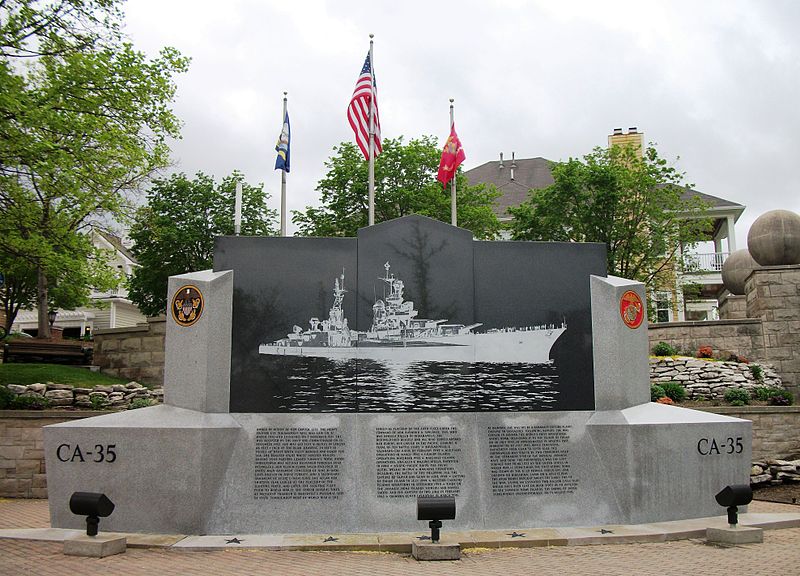
Remembering USS Indianapolis CA-35: Disaster, Dishonor and Redemption

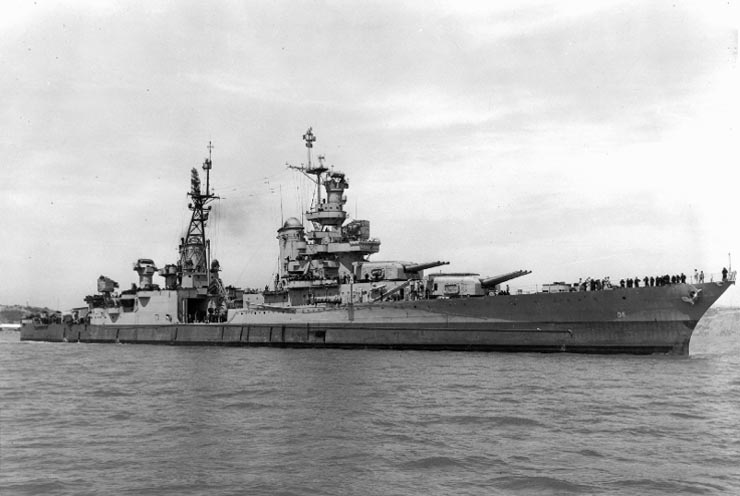
USS_Indianapolis_at_Mare_Island

“Our peoples have forgiven each other for that terrible war and its consequences. Perhaps it is time your peoples forgave Captain McVay for the humiliation of his unjust conviction.” Mochitsura Hashimoto, Captain of the I-58 to Senator John Warner

On July 30th 1945 the USS Indianapolis CA-35 was speeding from the island of Guam where she had made some personnel transfers to Leyte to join other American forces for the final campaign against Japan.

Indianapolis under the command of Captain Charles B McVay III had completed one of the most important secret missions of the war. She had delivered the component parts and enriched Uranium for the the first Atomic Bomb, Little Boy which in less than a week would be detonated over the Japanese City of Hiroshima on August 6th 1945.

Indianapolis was the second ship of the Portland Class heavy cruisers built under the terms of the Washington Naval Conference. Displacing 9800 tons and mounting a main battery of 9 8” guns she typical of the American cruisers of the era. During the 1930s she hosted President Franklin D. Roosevelt three times. When Pearl Harbor was attacked she was on gunnery exercises and from that point played an active role in combat operations in the South Pacific, the Aleutians later served as flagship to Admiral Raymond Spruance, Commander 5th Fleet. After being damaged a Kamikaze off Okinawa on March 31st 1945. She then returned to Mare Island for repairs and a rendezvous with destiny.

With the components for Little Boy aboard Indianapolis sailed unescorted to Pearl Harbor in complete secrecy and then to Tinian where she delivered her deadly cargo. After her brief port call in Guam she made haste to join Vice Admiral Jesse Oldendorf’s Task Force 95 at off Leyte. Her Captain used discretion in his use of a zig-zag course and was not employing it on the night of July 30th.

ce006i58

What Captain McVay and his crew did not know was that the Japanese Imperial Navy submarine I-58 under the command of Lieutenant Commander Mochitsura Hashimoto was stalking Indianapolis. At 2300 on the 29th while surfaced the Japanese noted a ship approaching and submerged. At 0014 after he gained firing position Hashimoto launched a spread of 6 Type 95 torpedoes, one of the most powerful type of torpedoes used during the war. Two stuck Indianapolis on her starboard side. The powerful charges caused catastrophic damage and 12 minutes later the cruiser rolled over and sank taking about 300 of her nearly 1200 man crew down with her.

She sank so quickly that few lifeboats or rafts were launched and no distress call issued. It took the Navy nearly three days to even know that she was missing. Finally on August 2d the survivors, now decimated by exposure, dehydration and shark attacks were spotted by a patrol plane. The aircraft sent a message out and other aircraft and the USS Cecil J. Doyle DE-368 as well as a number of other ships which responded to the call. Only 321 crewmen out of the estimated 880 survivors of the sinking lived.

USS_Indianapolis-survivors_on_Guam

The tale of the sinking and the stories of the survivors would be recorded in Fatal Voyage by Daniel Kurzman and All the Drowned Sailors by Raymond Lech. It was also mentioned in the movie Jaws by Robert Shaw’s character, the fishing boat Captain “Quint” who was supposed to be an Indianapolis survivor. The made for television film Mission of the Shark: The Saga of the U.S.S. Indianapolis staring Stacy Keach as Captain McVay brought a renewed interest in the sinking and the story of the survivors.

indy4

Captain McVay would be tried at court-martial and convicted of “hazarding his ship by failing to zig-zag.” The sentence was controversial as McVay was the only commander of a U.S. Navy ship lost during the war to be tried by court-martial. The true fact of the matter was that McVay was a scapegoat for the failure of several systems of reporting and communication that he did not control.

Admiral Nimitz commuted the sentence and restored McVay to active duty. He retired in 1949 after being promote to Rear Admiral. Despite the fact that many of the crew felt that he was innocent many families of those lost at sea took their revenge on McVay. He received much hate mail and was frequently threatened in writing and by phone. On November 6th 1968 McVay, despondent over the death of his wife and the continued harassment committed suicide using his Navy issued revolver in his back yard. In one hand he grasped a toy sailor doll given to him by his father when he was a child.

In the years following many survivors banded together with Captain McVay’s family and others including the commander of I-58, Mochitsura Hashimoto to clear his name. The president of the USS Indianapolis Survivor’s Association testified “Capt. McVay’s court-martial was simply to divert attention from the terrible loss of life caused by procedural mistakes which never alerted anyone that we were missing.” 

220px-Mochitsura_Hashimoto

Hashimoto, who spent much of his time after the war as a Shinto priest sought the forgiveness of survivors. He returned to a survivor reunion in 1991 and said: “I came here to pray with you for your shipmates whose deaths I caused.”   

Hashimoto wrote Senator John Warner on behalf of the late Captain McVay in 1999 when he learned of the efforts being made to clear McVay’s name. The letter is touching in its honesty and speaks of the deep respect that warriors who once fought against each other can maintain for one another. It also speaks to the deep sense of honor of Hashimoto:

“I hear that your legislature is considering resolutions which would clear the name of the late Charles Butler McVay III, captain of the USS Indianapolis which was sunk on July 30, 1945, by torpedoes fired from the submarine which was under my command.

“I do not understand why Captain McVay was court-martialed. I do not understand why he was convicted on the charge of hazarding his ship by failing to zigzag because I would have been able to launch a successful torpedo attack against his ship whether it had been zigzagging or not.

“I have met may of your brave men who survived the sinking of the Indianapolis. I would like to join them in urging that your national legislature clear their captain’s name.

“Our peoples have forgiven each other for that terrible war and its consequences. Perhaps it is time your peoples forgave Captain McVay for the humiliation of his unjust conviction.”

Finally in October 2000 Congress passed a resolution stating of Captain McVay that “he is exonerated for the loss of the USS Indianapolis.” President Clinton signed the resolution and in July 2001 Secretary of the Navy Gordon England order Captain McVay’s record cleared of wrong doing. Hashimoto would die on 25th 2000 at the age of 91.

This year, on the 68th anniversary of the sinking 17 survivors gathered to mark the occasion and pay tribute to their shipmates. The Facebook page of the association has this memorial:

Goodnight and sleep well, crew of the USS Indianapolis. On this night, sixty-eight years ago, you had no way of knowing that a Japanese torpedo would hit your ship in just a few short hours. Your floating home away from home would sink within twelve minutes. Unable to get topside in time, three hundred of you would go to the bottom of the ocean with your ship. Nine hundred of you would find yourselves in the water, about to experience a terrifying existence amid sharks, dehydration, hallucinations, and the elements. 

You were so young, Indy sailors. 

Tonight, like that night, let your minds be free from nightmares and flashbacks. Tonight, like that night, know that your families and friends miss and love you. Tonight, like that night, just be “The Crew of the USS Indianapolis” instead of “Survivors” or “Lost at Sea.”

800px-USS_Indianapolis_(CA-25)_Memorial

I cannot say more.

Peace

Padre Steve+
Leave a comment

Filed under History, Navy Ships, US Navy, world war two in the pacific

To Iraq and Back: A Bus Ride to Carolina

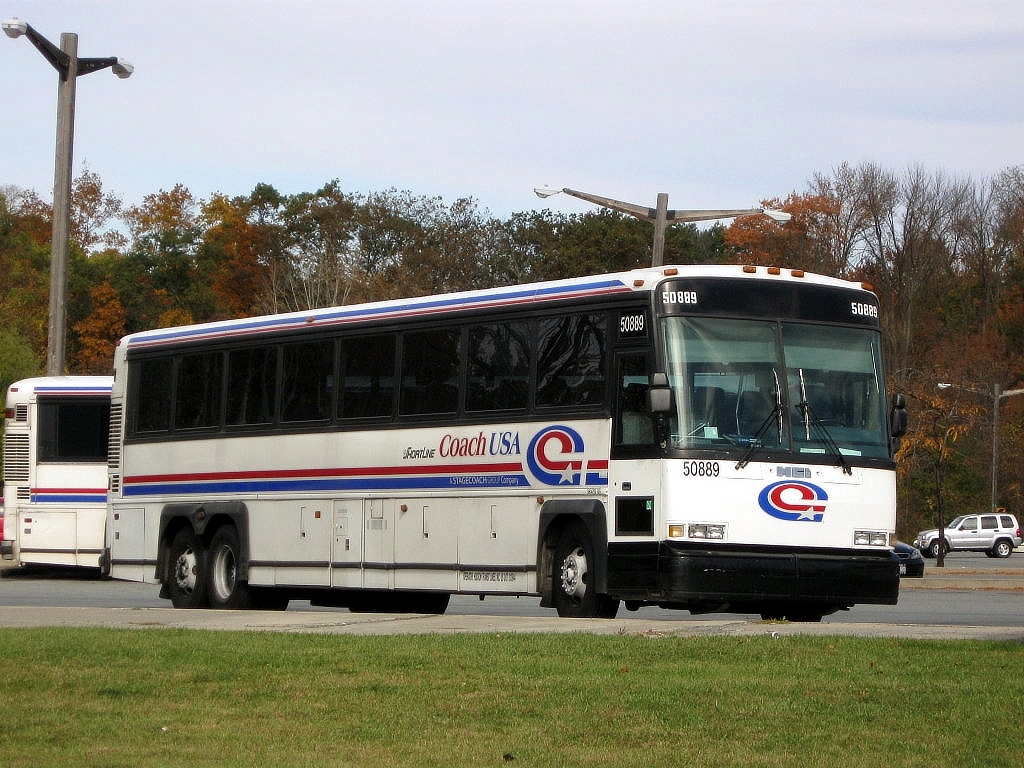
Coach_USA_ShortLine_50889

This is another installment of my To Iraq and Back series.

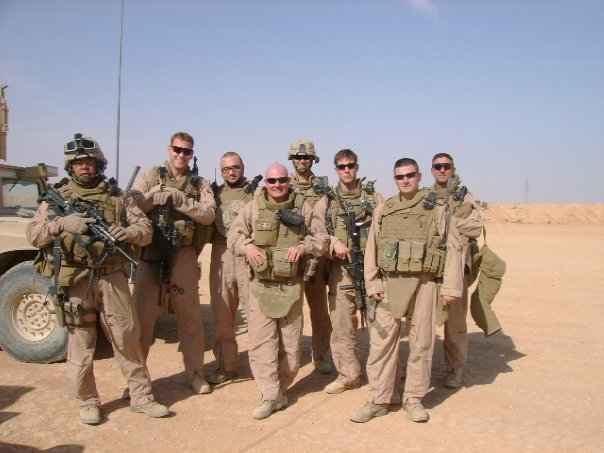
My CRV with Judy in it pulled away and Nelson and I went about our business. We staged our gear as we waited for the buses to arrive to take us to Fort Jackson South Carolina where we were to receive our training for the deployment.  As we talked other sailors arrived and soon the gear of over 100 sailors was stacked in rows of sea bags just off of the sidewalk.

Nelson’s parents, brother and sister had come to see him off.  His brother is a Navy First Class Petty Officer. His dad a former Vietnam era Marine Recon NCO who made several deployments “in the shit” as many Vietnam vets call tours in that combat zone.  They were really nice folks. Over the years I had heard much about them. They are close to each other and all are supportive of Nelson.

Nelson is a career amateur boxer; kick boxer, martial artist and more recently MMA fighter. He is active in children’s martial arts instruction and has been on Team USA and fought internationally.  During his previous deployment to Afghanistan he helped coach the fledgling Afghan National Boxing Team. A couple of months before this deployment he won the Arnold Schwarzenegger Classic.

So we waited while the other sailors gathered, some individually and some with family.  Some stood alone as couples while others mingled with each other.  For most this was a new way to see their sailor deploy.  No pier side goodbyes, no banners, no manning the rails by the crew as the ship was nudged away from the pier by tugs.

When you have a “normal” deployment of a ship or something like a Marine battalion it is a big deal. Many times media is there, sometimes there are speeches, but most of all there is the understanding that we are all in this together. We are going in as a unit.

In such times families say goodbye to their Sailors, Marines or Soldiers who are going to war together.  When you deploy as a unit there is familiar support system for the families we leave behind. This is not so when you deploy individually.  Those leaving on this day were very much strangers. We would train together, but few would stay together on the deployment.

If you are a ship or unit chaplain and deploy with your people there is a relationship. Generally you know each other, in this case we were strangers.  I was going to war with Nelson but we would not remain with any sailors we were with today when we got to Iraq. This was also the case for others who would serve in isolated posts, mostly working with the Army in support roles. Some would serve in specialized roles such as the Electronic Warfare Officers detailed to work on defeating IEDs and roadside bombs.

As others said their goodbyes and hugged each other I thought of Judy and knew that she was going to be down for some time but I felt that for once that she had an adequate support network. I was right about her being down for a while but this deployment would be harder on her than others and the support network proved woefully inadequate. So much for assumptions.

I looked at our gear as opposed to the others. Our gear was in large and rectangular bags of coyote or sand color. Most everyone else had traditional green sea bags, or what are known in the Army as “duffle bags.”  We already had our personal protective equipment of the EOD/Special Warfare type while others would receive Army issue at Fort Jackson. There are pros and cons to such a arrangement.  The pro is that we had great gear certainly some of the best in theater. The con was that we had to lug the great gear everywhere we went going to and coming back from war.  This would get old, but the benefits do outweigh the advantages when you are actually in a combat zone.

Finally an officer came out and began calling role and giving us our signed “official” orders.  After this we loaded our gear on the buses that would take us to Fort Jackson. These were the first of many buses we would ride and the first of many roll calls and gear load outs in the coming months.

Nelson and I got on the same bus which was not full and took seats near the front.  I got a seat alone because I was the senior officer on the bus and a chaplain to boot. This was not because I asked for it or hogged the seat.  It is actually fairly typical in such a setting where young enlisted guys don’t want to sit next to an officer they don’t know and some are afraid of chaplains because of experiences that they have had in civilian churches.

Many of the sailors had ever darkened the door of a church and many of those that have been in church have been burned in relationships with pastors or religious people.  I have found that many times, even those with a vibrant faith are hesitant to approach a chaplain that they do not know. Some are afraid that the chaplain might try to convert them be judgmental about of the manner in which they live their lives. So as a chaplain I try to be cognizant of this and be friendly and caring without scaring them away.  Of course I did build relationships with a quite a number of these sailors during the next few weeks but on this bus ride I was still an unknown quantity to them.

Sitting alone however was good for me since I general despise bus travel regardless of the company I keep.  For some reason my height works against me, I can never get my feet comfortably on the ground on these new tour buses and I have a terrible time getting comfortable.  Since bus travel takes forever to get anywhere the discomfort is palpable. Now I did a three month tour on buses in 1979 while touring as a spotlight tech for the Continental Singers and Orchestra across the US and in Europe.  Somehow the old Greyhound buses were more comfortable than the new tour buses.  Maybe I’m just nostalgic but they somehow fit people like me better than the fancy new buses.

When you travel by bus with a bunch of sailors, the majority of whom are at least 20 years younger than you, the experience can be entertaining. Part of course is a generational thing. I grew up and came of age the 60’s 70’s and 80’s. The majority of these sailors from the 90’s and 2000’s.

The trip was a chance for me to observe a lot about these sailors just by watching.  Some had their portable i-pods and MP-3 players going, others spent time talking on cell phones, a few read or talked among themselves, but the sailors near me gravitated to the DVD movie which was 300 the comic book style account of the Spartan’s defense of Thermopylae against the Persians.  As the Spartans made their stand I could see the young sailors who were going to war take inspiration from King Leonditis of Sparta.   Since we were going into a place where 50-100 Americans a month were being killed and hundreds more wounded I could understand the need for inspiration along with entertainment.

The bus ride itself was a lot like what I imagine that Minor League teams take in the Carolina League. Our journey reminded me of the bus rides in the movie Bull Durham.  The older guys staying pretty quiet and to themselves and the young guys having fun, playing games and joking around with each other,  We made a couple of stops, one at some little Interstate town with a fair amount of gas stations and a few fast food places.  About half the sailors went to the McDonalds while the rest ran down the street to the Burger King and Taco Bell. Once everyone had their fill the buses pulled back out onto the interstate.

When we finally got near Columbia the buses got of the Interstate highway and onto some small two lane state highway.  We drove down this road about twenty to thirty minutes and pulled into what appeared to be a tiny out of the way base. I wondered where the hell we were. Fort Jackson is a fairly large training base where thousands of recruits are trained every year.  Where we were certainly was not the Fort Jackson that I had imagined.

Instead of the main post we were at the South Carolina National Guard training facility called Camp McCready.  It is here that the Naval Expeditionary Combat Command has a training center set up with the Army to train sailors in basic combat tasks.

Our welcome that first night was simple.  We formed up, checked in, got our linens for our standard issue military beds and were marched to dinner at the chow hall or in the Army vernacular the DFAC by our newest and bestest buddies, our Army Drill Sergeants.  We were met at the DFAC by a civilian.  I can’t remember his name but this guy was most congenial and he put the RED in “Redneck.” He joked with everyone that came through the line, asked where people were from and what they did.  When he found out that I was a chaplain he began to ask me for a joke every meal thereafter. As such nearly every meal would be entertaining.

As Nelson and I sat down for chow with a couple of other sailors we looked at each other.  He said: “Boss I don’t think some of these guys know what is coming.”  I said “I think that your right partner, hopefully they adjust and do well.”  The other sailors, both more senior petty officers nodded in agreement.

Going back to the barracks I met some of the other officers enjoying their first night at Camp McCready.  More sailors from NMPS San Diego were due in later. I introduced myself to a number of the officers near me and engaged in some rather surface pleasantries. When lights out was called lay down on the same type of Army bunk bed that I had first encountered some twenty five years before at Camp Roberts California and Fort Lewis Washington.  I swear the sheets, blankets and pillowcases were of the same vintage.

Much was still on my mind when I laid down and my mind was still thinking about the trip to base with Judy and the final kiss goodbye. I was troubled by it and how I had handed things. Despite that I fell asleep fairly quickly. It had been a long day and coupled with the lack of sleep and stress of the previous couple of days I was tired.

Peace

Padre Steve+
Leave a comment

Filed under iraq,afghanistan, Military, ministry, Pastoral Care, to iraq and back, Tour in Iraq, US Navy

To Iraq and Back: Days at the Deployment Processing Center

295_27076832058_495_n

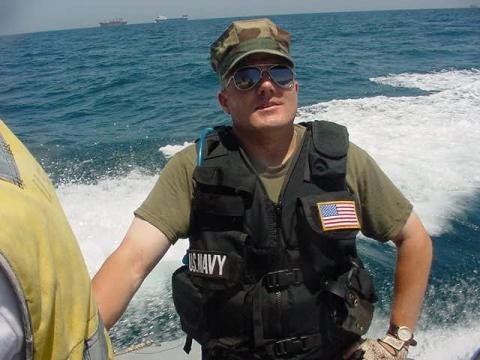
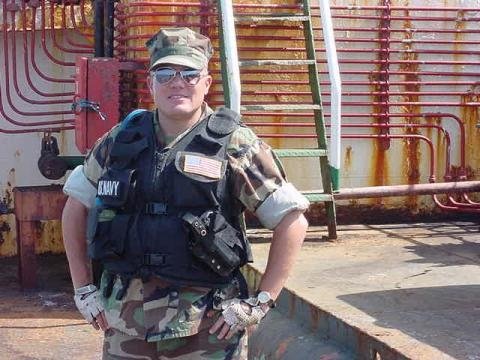
Me Aboard an Iraqi Oil Smuggler in 2002

This is another installment of my account of my account of mine and RP1 Nelson Lebron’s deployment to Iraq in 2007.

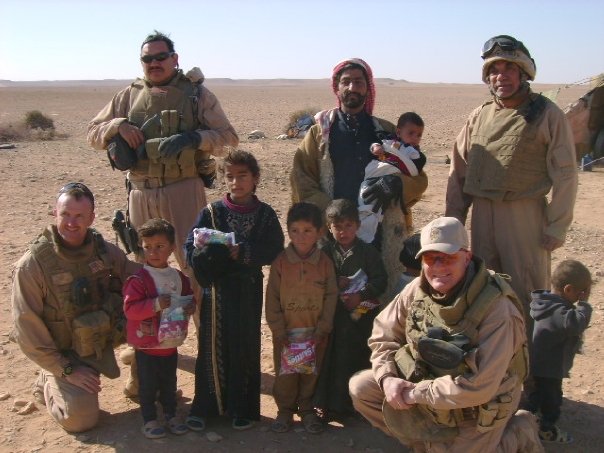
By the time the first day had ended there were nearly 120 of us being processed to serve in individual augment positions in Iraq, Afghanistan, Kuwait and Djibouti. Most of us were going to Iraq at this time since the “surge” was at its peak.

NMPS was just the first stop on the way to Iraq, for us it was the initial administrative processing that we would receive on the to Iraq. Most of our compatriots, save a few Seabees or Medical types who had served with the Marines had neither been on a deployment like this, been trained for land warfare of had served in a combat zone except aboard ship. After Norfolk we would receive more specific training and equipment at Fort Jackson South Carolina and then Kuwait.

603036_10200446098660478_1730640134_n

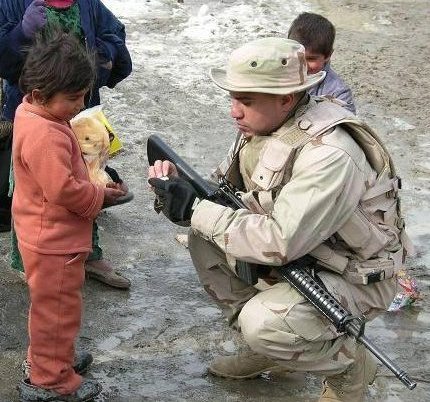
Nelson with an Afghani child in 2005

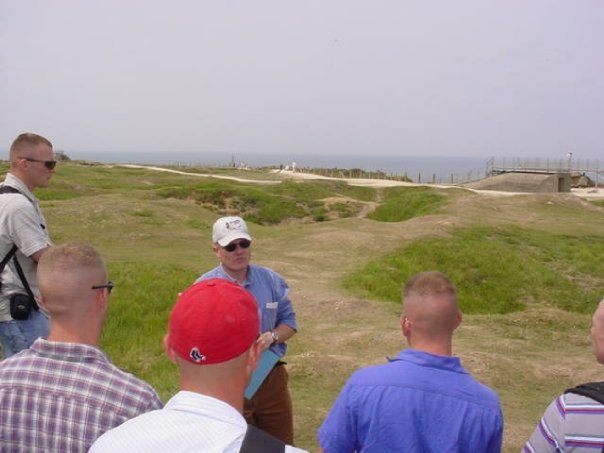
When compared to many of our fellow sailors Nelson and I had a lot of experience. I had served in the Army and both of us had served in infantry units of the Fleet Marine Force. Additionally Nelson had served with Naval Special Warfare Group Two, and the Marine 3rd Recon Battalion. He had previously served in Iraq, Afghanistan and Lebanon. I had much field experience with the Army and Marines and had been a part of a boarding team from the USS HUE CITY which conducted boarding operations supporting the UN Oil Embargo on Iraq in 2002. Likewise, Nelson is an accomplished martial artist, boxer, kick boxer and MMA fighter who has competed at many levels, while I am a military historian and theoretician  with much advanced education in both on top of my theological and pastoral care training and experience.

Our mobilization processing proceeded the next couple of days as we received our immunizations, were issued DCUs and other clothing needed for the deployment.  Nelson and I of course were already well outfitted by our unit, EOD Group Two, much more so than our counterparts reporting from other fleet units or the reserves.

In spite of this we drew additional DCU uniforms, brown t-shirts, socks and a host of miscellaneous gear. Thankfully as I have mentioned, EOD had outfitted us well including boots of our choosing, not the standard uncomfortable Army issue desert boots being provided to the rest of the sailors. I had a pair of Blackhawks and a pair of Magnum 5.11’s, both much more comfortable than those being issued. As far as other gear we already had much of it, and because it was EOD issue it was superior quality to  much of what was being issued.

Wills and powers of attorneys were drawn up by JAG officers. We updated our “page 2s” the record of who we wanted notified in the event of our demise were verified. Additionally new dog tags ordered and a myriad of forms were filled out, in typical military fashion often for the second or third time.

Of course even before we reported to NMPS we had we had completed numerous online pre-deployment courses on Navy Knowledge Online or NKO to orient us to operations, health and safety issues and for Nelson classes on the M-16A2 and M9 Pistol. Some were good but many were of dubious value especially in the online format.I could have taught many of them. Obviously some contractor got rich selling them to the Navy, but such is war and the activities of war profiteers who make their living inferior products to the military.

Both of us had the additional advantage of living in the Norfolk area so we could spend times with friends or family.

At the end of each day we were able to go home while our companions who had come from other locations were staying in transient quarters on base.

Since we had the 4th of July off we would both take advantage of it.

Peace

Padre Steve+
4 Comments

Filed under iraq,afghanistan, middle east, Military, to iraq and back, Tour in Iraq, US Navy

To Iraq and Back: Reporting for Duty

183241_1857288917425_1495714_n

In July 2007 my assistant at EOD Group Two, RP1 Nelson Lebron and I began our Iraq adventure.  This is one of a series of posts which will be published periodically to tell our story.  While they will not be daily posts, they will be sprinkled in on this site on a regular basis.  Hopefully they will be something that will help those who have not been in the remote parts of either Iraq or Afghanistan what it is for Navy personnel to go to war, not as ship’s company, not with their own unit, but as individual augments to other commands.  This is a different way to go to war…this is our story.

July 2nd 2007: I rolled into the parking lot for the Naval Mobilization Processing Site (NMPS) Norfolk.  As usual parking on Norfolk Naval Station was a bitch to find.  It had been a number of months since I had to make this commute.  I transferred from the Marine Security Force Battalion where I had served from 2003 to October 2006 and had not made the trip since. Thankfully I remembered to leave early because traffic was as gooned up as ever going down I-264, I-64 and I-564 to head into the base.

As I looked for a parking space I really missed my designated parking spot back at Security Forces. I drove around for a while and finally found a spot, then after wandering around a found the NMPS offices.

I walked upstairs to the classroom in which we were to meet was located and found it empty, save for a couple of NMPS staff members.  I reported there in my DCU’s, or Dessert Camouflage Uniform issued to me by EOD Group Two. They are an older type uniform similar to the old BDUs and unlike the Marine Pattern Digital Camouflage are not wash and wear. I still have a few sets in my deployment bag but figure that if I every get deployed to such a situation again that I will be wearing whatever Army or Marine Corps uniform the Navy sailors are wearing unless serving with the Seabees, Naval Special Warfare or an actual Navy command.

295_26911967058_7489_n-1

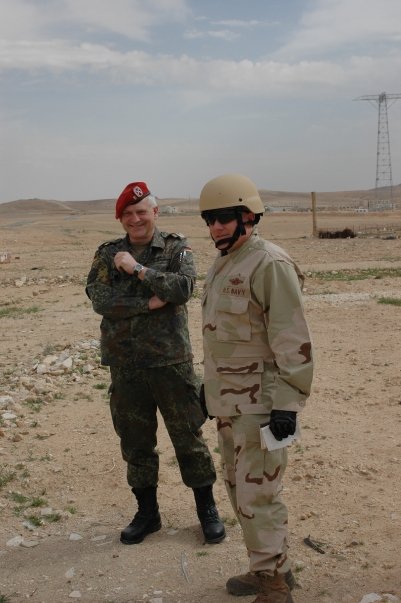
Camp Zarqa Jordan March 2007

I had worn them in March when I went to Jordan for the Jordanian Army/ UN Peace Operations Training Center course on Iraqi Culture, Religion, Politics and Language. Until the Marines came out with their digital uniforms they were common to all of the services. Now in 2013 I think there are 10 different camouflage uniforms in use among the armed forces and Congress is about to force us in the military to find a common uniform again. Not a bad idea if you ask me.

I looked around the empty classroom with every table stacked with folders filled with a huge amount of paperwork.  I found a seat which is not hard to do with so many to empty seats choose from and sat down. I took an aisle seat about three rows back and plunked my EOD issue Blackhawk backpack down, grabbed my Book of Common Prayer and did the morning office before anyone else arrived while drinking the large cup of black coffee I had gotten across the street.

Shortly thereafter other people began to arrive in twos and threes, most enlisted dressed in utilities (the successor to dungarees) while most of the Chiefs and officers were dressed in khakis. A few Seabees had woodland BDUs on and a couple of folks wore DCUs which were obviously from previous deployments to the sandbox.  RP1 Lebron, then an RP2 then showed up and we waited for the orientation and administrative stuff to start moving.  We surveyed the situation and looking upon our fellow sailors realized that this would be a different deployment.

What we noticed as we talked the varying ranks and uniforms really jumped out at both of us.  Most of our fellow sailors had never been deployed even in peacetime in such a manner.  Most of those who had deployed had done so on ship with the exception of the Seabees and a Corpsman or two.

The sailors spanned the spectrum of age, rank and rating. There were the officers, mainly Lieutenants, Lieutenant Commanders and Commanders, Surface Warfare, Aviators, Supply Corps, Civil Engineering Corps and Medical Officers.  The highest ranking officer was a Navy Captain. I was the only Chaplain.

The enlisted sailors also spanned the spectrum of the Navy. Fire Control Technicians, Operations Specialists, Gunners Mates, Boatswains, Yeomen and Storekeepers, Intelligence Specialists, Corpsmen, and even Culinary Specialists.  They had qualifications as Submariners, Enlisted Surface Warfare, Aviation Warfare among others.  Some like me and Nelson had volunteered, others were voluntold. The one that brought us all together was that we were US Navy Sailors and going to war and not with the Navy or our shipmates. We were strangers to each other and would be strangers to Soldiers, Airmen, Marines and Sailors that we would serve with overseas.

Nelson and I have deployed a lot. We had served together in Okinawa and at EOD where I did a “drug deal” with his chaplain and the RP detailer to get him to EOD.  The guy is a hero. I think he has deployed about 10 times in his 20 year career from which he will retire this fall.

The year and a half prior to our deployment Nelson had been deployed to Afghanistan where he as an E-5 was awarded the Defense Meritorious Service Medal.  On his way back from Afghanistan he was pulled off of his flight to the states and sent back to his old ship, the USS Trenton to assist in the evacuation of Americans and others from Beirut.

I think to some extent his frequent deployments actually hurt his career since the biggest part of making rank as a Navy enlisted man is to do well on the advancement exam. Unfortunately there were many times when he was forbidden to test because he was deployed, and when eventually allowed to test during a deployment was not provided the appropriate materials to study. That would happen again during the coming deployment and lead to a pretty funny incident on one of our trips in Iraq, but that story will be told later.

Nelson is a NY Rican and both a New York Golden Gloves boxing champ, a high school valedictorian, a full contact  kick boxer, martial artist, MMA fighter and has fought on Team USA and won the 2005 Arnold Schwarzenegger Classic.   He is the real deal.  Proficient in many weapons systems from his service with the 3rd Recon Battalion, 4th Marine Regiment and Naval Special Warfare he is the ideal body guard for any Chaplain going to do the job we had been given to do, to work with Marine and Army advisers supporting two Iraqi Divisions.  Our mission would evolve and expand once we got there, but we didn’t know that yet.

As people filed in a Chief Petty Officer brought us to attention and the processing site Commanding Officer came. He spoke with us a few minutes and then led us in the Sailors Creed. With that we set down and began to get our orientation to how our mobilization, training and movement would unfold as we got ready to go to Iraq.

Peace

Padre Steve+
Leave a comment

Filed under iraq,afghanistan, Military, to iraq and back, Tour in Iraq, US Navy

The Province of Chance: The Battle of Midway, 5 Minutes that Changed the Course of a War

Battle%20of%20Midway%20flat_080817160843

“War is the province of chance. In no other sphere of human activity must such a margin be left for this intruder. It increases the uncertainty of every circumstance and deranges the course of events.” Carl Von Clausewitz 

“Even against the greatest of odds, there is something in the human spirit – a magic blend of skill, faith, and valor – that can lift men from certain defeat to incredible victory.”  Walter Lord

Six months after Pearl Harbor the United States Navy met the Imperial Japanese Navy in battle on the seas and in the airspace around Midway Island. It was a battle between a fleet that had known nothing but victory in the months after Pearl Harbor and one with the exception of a few minor tactical successes was reeling.

images-41

The Japanese had swept across the Pacific and the Indian Oceans and decimated every Allied Naval forces that stood in their way. After Pearl Harbor they had sunk the HMS Prince of Wales and HMS Repulse off of Singapore.  Next in a series of engagements destroyed the bulk of the US Asiatic Fleet in the waters around the Philippines and the Dutch East Indies culminating in the Battle of the Java Sea where the bulk of the American, British, Dutch and Australian (ABDA) naval forces engaged were annihilated attempting to fight superior Japanese forces.

Hermes_sinking

HMS Hermes sinking after Japanese Carrier air attack

In the Indian Ocean Admiral Nagumo’s carriers dispatched a force of Royal Navy cruisers and the Aircraft Carrier HMS Hermes. In only one place had a Japanese Naval task force been prevented from achieving its goal. At the Battle of the Coral Sea where Task Force 11 and Task Force 17 centered on the Carriers USS Lexington and USS Yorktown prevented a Japanese invasion force from taking Port Moresby sinking the light carrier Shoho, damaging the modern carrier Shokaku and decimating the air groups of the Japanese task force.

Hornet_launches

In May US Navy code breakers under the direction of Commander Joe Rochefort at Pearl Harbor discovered the next move of the Imperial Navy an attack on Midway Island and the Aleutian islands. Since the occupation of Midway by Japanese forces would give them an operational base less than 1000 miles from Pearl Harbor Admiral Chester Nimitz committed the bulk of his naval power, the carriers USS Enterprise CV-6, USS Yorktown CV-5 and USS Hornet CV-8 and their 8 escorting cruisers and 15 destroyers, a total of 26 ships with 233 aircraft embarked to defend Midway. Nimitz also sent a force of 5 cruisers and 4 destroyers to cover the Aleutians.

images-42

images-43

Land based air assets on Midway were composed of a mixed Marine, Navy and Army air group of 115 aircraft, many of which were obsolete. Aboard Midway there were 32 US Navy PBY Catalina Flying Boats, 83 fighters, dive bombers, torpedo planes and Army Air Force bombers piloted by a host of inexperienced pilots.

Nimitz’s instructions to his Task Force Commanders was simple “You will be governed by the principle of calculated risk, which you shall interpret to mean the avoidance of exposure of your force to attack by superior enemy forces without good prospect of inflicting … greater damage on the enemy.”

893594c746

Admiral Isoroku Yamamoto commanded the Combined Fleet. The victor of Pearl Harbor and the triumph’s in the first six months of the Pacific War was determined to end the war with a decisive battle at Midway. His plans were opposed by many in the Imperial General Staff, especially those in the Army but when the US raid on Tokyo, the Doolittle Raid, all opposition to the attack was dropped.

10-japanese-carriers-coral-sea-midway

The Japanese sent a force of 7 battleships and 7 carriers against Midway. These included the elite First Carrier Striking Group composed of the Pearl Harbor attackers Akagi, Kaga, Soryu and Hiryu and their highly trained and combat experienced air groups. Among the surface ships was Yamamoto’s flagship, the mighty Battleship Yamato, at 72,000 tons and armed with 9 18” guns, the most powerful and largest battleship ever to see combat.

The strike force included 273 aircraft and was escorted by 14 cruisers and 39 destroyers. They were to take Midway and then destroy the US Navy when it came out to fight. Yamamoto sent a force force of 4 battleships, 12 destroyers assigned screen to the Aleutian invasion force which was accompanied by 2 carriers 6 cruisers and 10 destroyers. The other carriers embarked a further 114 aircraft.

Despite this great preponderance in numbers Yamamoto’s plan was complex and his forces too far apart from each other to offer support should and get into trouble. The powerful Japanese Task forces were scattered over thousands of square miles of the Northern Pacific Ocean where they could not rapidly come to the assistance of any other group.

images-44

With the foreknowledge provided by the code breakers the US forces hurried to an intercept position northeast of Midway eluding the Japanese submarine scout line which the Japanese Commander Admiral Yamamoto presumed would find them when they sailed to respond to the Japanese attack on Midway.  Task Force 16 with the Enterprise and Hornet sailed first under the command of Rear Admiral Raymond A Spruance and Task Force 17 under Rear Admiral Frank “Jack” Fletcher with the Yorktown which had been miraculously brought into fighting condition after suffering heavy damage at Coral Sea. Fletcher assumed overall command by virtue of seniority and Admiral Nimitz instructed his commanders to apply the principle of calculated risk when engaging the Japanese as the loss of the US carriers would place the entire Pacific at the mercy of the Japanese Navy.

On June 3rd a PBY Catalina discovered the Japanese invasion force and US long range bombers launched attacks against it causing no damage. The morning of the 4th the Americans adjusted their search patterns in and the Japanese came into range of Midway and commenced their first strike against the island.

g17056

In response land based aircraft from Midway attacked the Japanese carrier force taking heavy casualties and failing to damage the Japanese task force. The American Carrier task forces launched their strike groups at the Japanese fleet leaving enough aircraft behind of the Combat Air Patrol and Anti-submarine patrol.  As the Americans winged toward the Japanese fleet the Japanese were in a state of confusion. The confusion was caused when a scout plane from the Heavy Cruiser Tone that had been delayed at launch discovered US ships but did not identify a carrier among them until later into the patrol. The carrier  was the Yorktown and TF 17, but for Nagumo who first expected no American naval forces, then received a report of surface ships without a carrier followed by the report of a carrier the reports were unsettling.

a5f7ab19-17c6-4928-90a4-5bb913d156eb

Orders and counter-orders were issued as the Japanese attempted to recover their strike aircraft and prepare for a second strike on the island and then on discovery of the Yorktown task force, orders changed and air crews unloaded ground attack ordnance in favor of aerial torpedoes and armor piercing bombs. The hard working Japanese aircrew did not have time to stow the ordnance removed from the aircraft but by 1020 they had the Japanese strike group ready to launch against the US carriers.

g701850

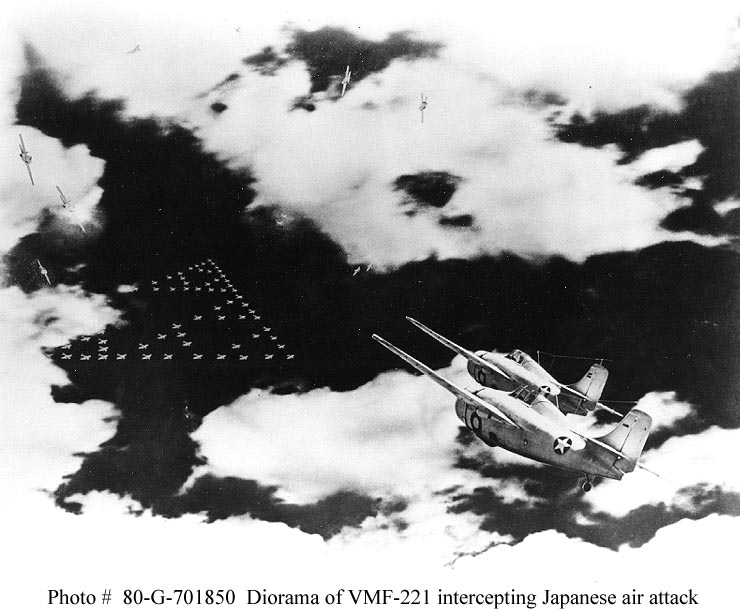
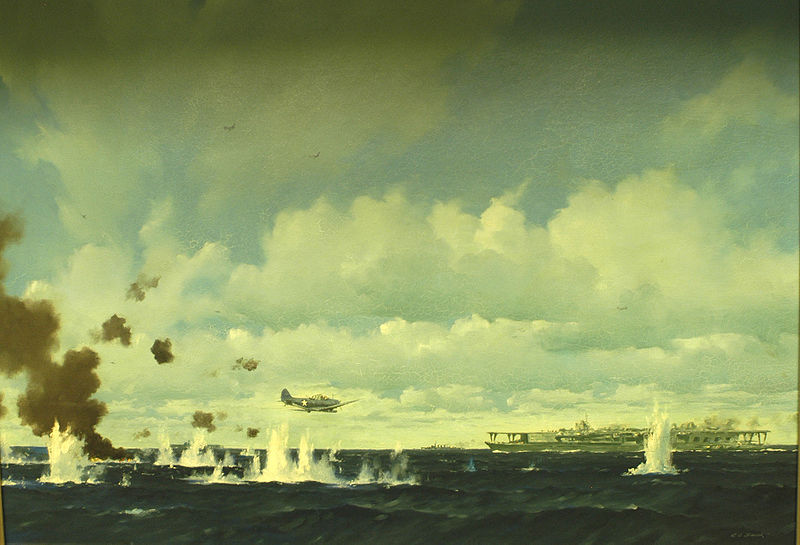
As the Japanese crews worked the Japanese carriers were engaged in fending off attacks by the US torpedo bomber squadrons, VT-6 from Enterprise, VT-8 from Hornet and VT-3 from Yorktown. The Japanese Combat Air Patrol ripped into the slow, cumbersome and under armed TBD Devastators as they came in low to launch their torpedoes.  Torpedo Eight from Hornet under the command of LCDR John C Waldron pressed the attack hard but all 15 of the Devastators were shot down. Only Ensign George Gay’s aircraft was able to launch its torpedo before being shot down and Gay would be the sole survivor of the squadron.

g66074


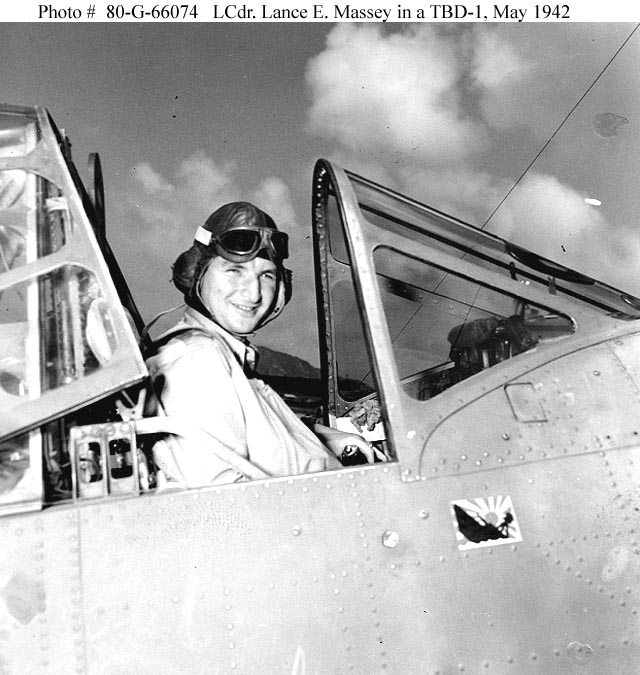
LCDR Lance Massey CO of VT-3

Page500_163_6

LCDR John Waldron CO of VT-8

220px-Eugene_Lindsey;h84903

LCDR Eugene Lindsey CO of VT-6

Torpedo 6 from Enterprise under the command of LCDR Eugene Lindsey suffered heavy casualties losing 10 of 14 aircraft with Lindsey being one of the casualties.  The last group of Devastators to attack was Torpedo 3 from Yorktown under the command of LCDR Lem Massey from the Yorktown. These aircraft were also decimated and Massey killed but they had drawn the Japanese Combat Air Patrol down to the deck leaving the task force exposed to the Dive Bombers of the Enterprise and Yorktown.

800px-tbd_attacking_at_midway_painting-1

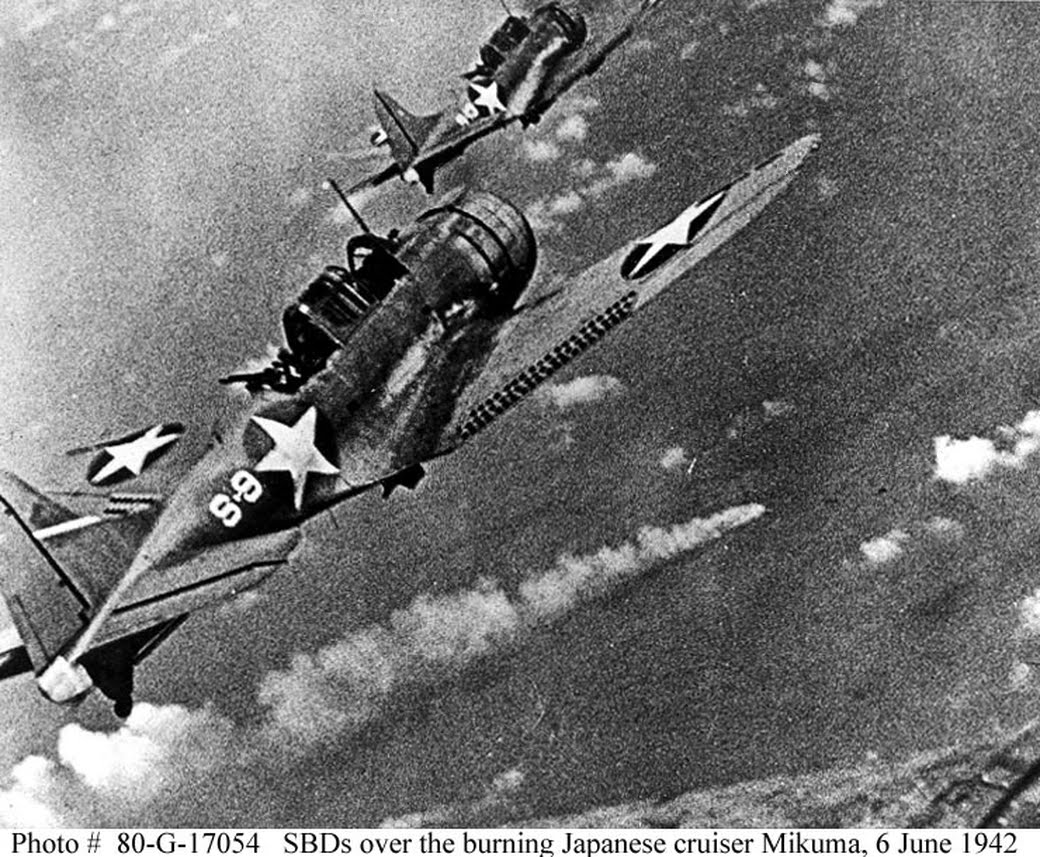
There had been confusion among the Americans as to the exact location of the Japanese Carriers. Bombing 8 and Scouting 8 from Hornet did not find the carriers and had to return for lack of fuel while losing a number of bombers and their fighter escort having to ditch inn the ocean and wait for rescue. The Enterprise group composed of Bombing-6 and Scouting 6 under CDR Wade McClusky was perilously low on fuel when the wake of a Japanese destroyer was spotted.  McClusky followed it to the Japanese Task Force. The Yorktown’s group under LCDR Max Leslie arrived about the same time.

Dauntless_dive_bombers

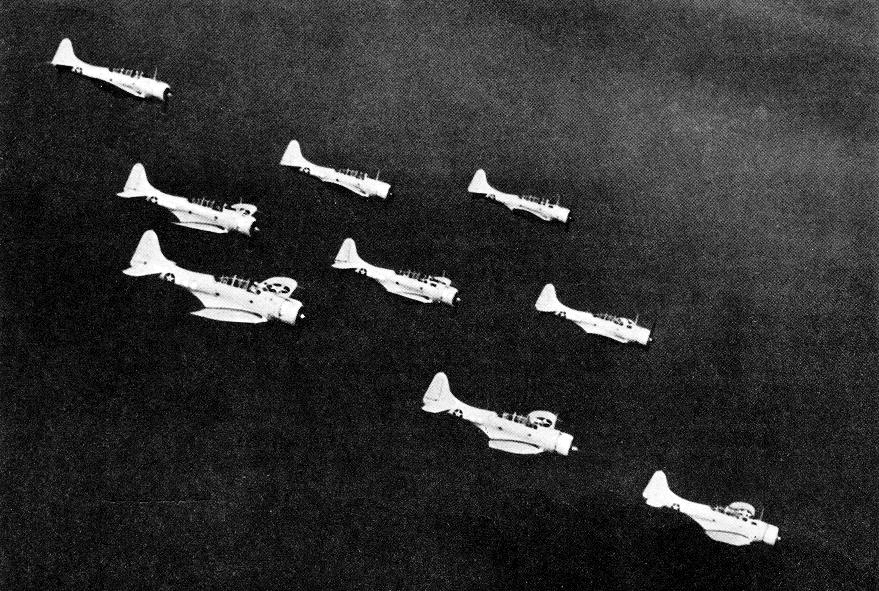
When the American dive bombers arrived over the Japanese Carrier Strike Force they found the skies empty of Japanese aircraft. Below, aboard the Japanese ships there was a sense of exhilaration as each succeeding group of attackers was brought down and with their own aircraft ready to launch and deal a fatal blow to the American carrier wondered how big their victory would be. The war would soon be decided.

midway4

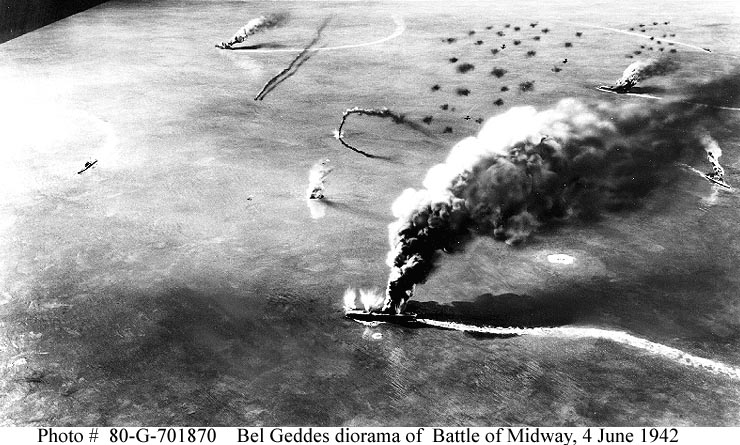
At 1020 the first Zero of the Japanese attack group began rolling down the flight deck of the flagship Akagi, aboard Kaga aircraft were warming up as they were on the Soryu.  The unsuspecting Japanese were finally alerted when lookouts screamed “helldivers.” Wade McClusky’s aircraft lined up over the Akagi and Kaga pushing into their dives at 1022. There was a bit of confusion when the bulk of Scouting 6 joined the attack of Bombing 6 on the Kaga. That unprepared ship was struck by four 1000 pound bombs which exploded on her flight deck and hangar deck igniting the fully fueled and armed aircraft of her strike group and the ordnance littered about the hangar deck.  Massive fires and explosions wracked the ship and in minutes the proud ship was reduced to an infernal hell with fires burning uncontrollably. She was abandoned and would sink at 1925 taking 800 of her crew with her.

douglas-sbd5-dauntless-dive-bomber-battle-of-midway-01

LT Dick Best of Scouting 6 peeled off from the attack on Kaga and shifted to the Japanese flagship Akagi. On board Akagi were two of Japan’s legendary pilots CDR Mitsuo Fuchida leader of and CDR Minoru Genda the architect of the Pearl Harbor attack and subsequent string of Japanese victories. Both officers were on the sick list and had come up from sick bay to watch as the fleet was attacked. Seeing Kaga burst into flames they stood mesmerized until Akagi’s lookouts screamed out the warning “helldivers” at 1026.  Best’s few aircraft hit with deadly precision landing two of their bombs on Akagi’s flight deck creating havoc among the loaded aircraft and starting fires and igniting secondary explosions which turned the ship into a witch’s cauldron.  By 1046 Admiral Nagumo and his staff were forced to transfer the flag to the cruiser Nagara as Akagi’s crew tried to bring the flames under control. They would do so into the night until nothing more could be done and abandoned ship at 2000.  Admiral Yamamoto ordered her scuttled and at 0500 on June 5th the pride of the Japanese carrier force was scuttled.

g701870

VB-3 under LCDR Max Leslie from the Yorktown stuck the Soryu with 17 aircraft, however only 13 of the aircraft had bombs due to an electronic arming device malfunction on 4 of the aircraft, including that of Commander Leslie.  Despite this Leslie led the squadron as it dove on the Soryu at 1025 hitting that ship with 3 and maybe as many as 5 bombs. Soryu like her companions burst into flames as the ready aircraft and ordnance exploded about her deck. She was ordered abandoned at 1055 and would sink at 1915 taking 718 of her crew with her.

h73065

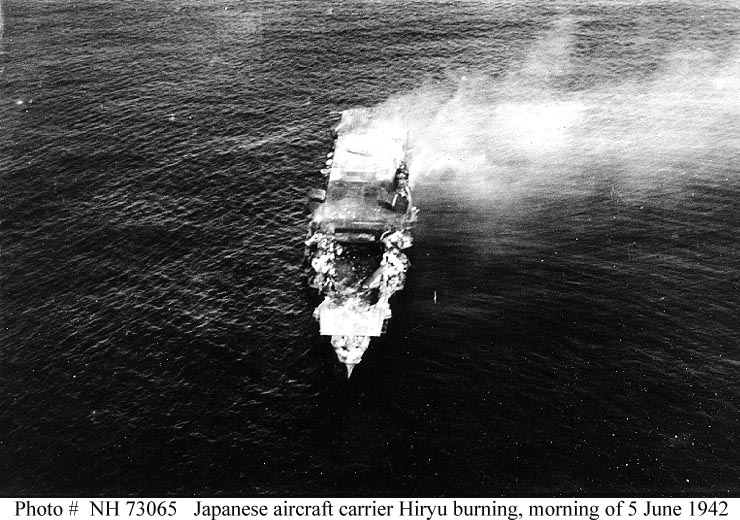
The remaining Japanese flattop the Hiryu attained the same fate later in the day after engaging in an epic duel with the Yorktown which her aircraft heavily damaged. Yorktown would be sunk by the Japanese submarine I-168 while being towed to safety.

71380-004-B4724C34

USS Yorktown under attack from Kate Torpedo Bombers from Hiryu on June 4th 1942

In five pivotal minutes the course of the war in the Pacific was changed. Authors have entitled books about Midway Incredible Victory by Walter Lord and Miracle at Midway by Gordon Prange and those titles reflect the essence of the battle.

At Midway a distinctly smaller force defeated a vastly superior fleet in terms of experience, training and equipment. At the very moment that it appeared to the Japanese that they would advance to victory their vision disappeared. In a span of less than 5 minutes what looked like the certain defeat of the US Navy became one of the most incredible and even miraculous victories in the history of Naval warfare. In those 5 minutes history was changed in a breathtaking way. While the war would drag on and the Japanese still inflict painful losses and defeats on the US Navy in the waters around Guadalcanal the tide had turned and the Japanese lost the initiative in the Pacific never to regain it.

The Japanese government hid the defeat from the Japanese people instead proclaiming a great victory. The American government could not fully publicize the victory for fear of revealing the intelligence that led to the ability of the US Navy to be at the right place at the right time and defeat the Imperial Navy.

uss-enterprise-cv-6-1

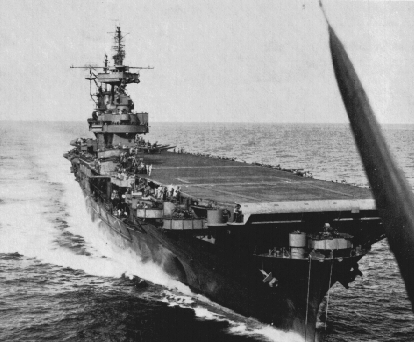
The American victory at Midway changed the course of the war in the Pacific. The Battle of Midway established the aircraft carrier and the fast carrier task force as the dominant force in naval warfare which some would argue it still remains. Finally those five minutes ushered in an era of US Navy dominance of the high seas which at least as of yet has not ended as the successors to the Enterprise, Hornet and Yorktown ply the oceans of the world and the descendants of those valiant carrier air groups ensure air superiority over battlefields around the world.

Peace

Padre Steve+
1 Comment

Filed under History, Military, Navy Ships, US Navy, world war two in the pacific

Happy 105th Birthday to the United States Navy Nurse Corps

navy_nurse-1


Last week was National Nurses Week. Today was the 105th Anniversary of the Navy Nurse Corps. Nurses are the lynchpin of medicine. Physicians are incredibly important and as a society we usually ascribe more value to them. However in many case, if not most it is a nurse who is the person that does the heavy lifting in the care of the sick. Before the modern era of nursing was often done by Nuns or by women that volunteered to assist military physicians.

Navy_nurse_corps_1908

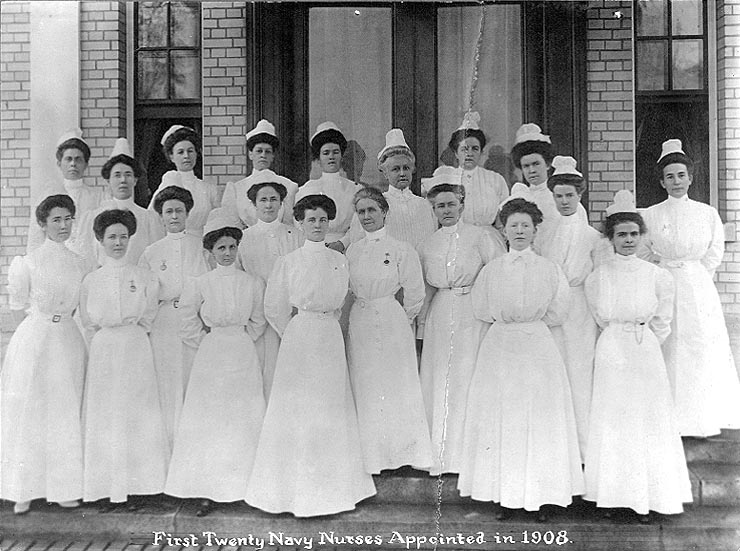
The First 20 Navy Nurses “the Sacred 20” 1908

It was in the quagmire of the Crimean War that Florence Nightingale brought about the modern era of nursing, even though physicians and hospitals often saw the women who served as nurses as inexpensive help to care for the sick. Despite this nursing became more and more professional and technical over the years without ever losing that particular calling of ministering to the afflicted that is the essence of their history. In the later 1800s the first nursing schools were established and in 1901 New Zealand was the first country to have Registered Nurses. In 1903 North Carolina became the first US State to require the licensure of nurses.

485px-Lenah_Higbee

Chief Nurse Lena Higbee, Second Superintendent of the Nurse Corps, and first woman awarded the Navy Cross (above) and the ship named after her the USS Higbee DD 806 (below)

USS_Higbee_(DDR-806)_being_refueled_in_1960

The US Navy Nurse Corps was established n 1908 with nurses being commissioned as officers and assigned to Naval Hospitals. However it was the needs of war that brought nursing into the modern age where it is formally recognized as a key component of Health Care. In the World Wars nursing came into its own as a profession. Nurses were among the US personnel that endured the initial onslaught of the war in the Pacific. The Army and Navy Nurses that served and cared for the wounded, starving and emaciated Soldiers, Marines and Sailors on Bataan and Corregidor were heroes in their own right.

Chief_Nurse_Laura_Cobb_and_Dorothy_Still_Danner_among_other_Navy_Nurse_POWs_after_their_release

Navy Nurses released from Japanese Captivity (above) and a Nurse aboard USS Benevolence with a POW released from Japanese Captivity in 1945

733px-Navy_nurse_and_released_POW_on_USS_benevolence,_August_1945_highres

The profession of nursing continues to grow and the women and men who serve as nurses at various levels, from the most highly trained Clinical Nurse Specialists and Nurse Practitioners, or other highly specialized Registered Nurses many of whom have advanced degrees including doctorates down to the most humble Licensed Vocational (or Practical) Nurse and even Certified Nursing Aides. These women and men are the backbone of medicine and despite the long hours, the years of training and certification required of them, many people don’t fully appreciate them until they become sick and are cared for by these wonderful people.

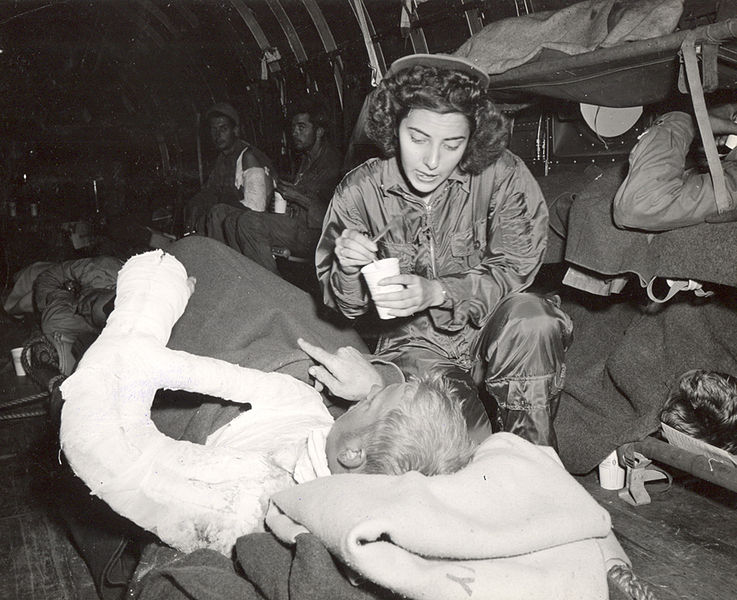
737px-Jane_Kendeigh_USN_Flight_Nurse_1945_a

Ensign Jane “Candy” Kendeigh, the First flight nurse to serve in Iwo Jima and Okinawa Campaigns

Today US Navy Nurses serve in every place one can find a Sailor or Marine. They serve in Hospitals, Medical Centers and other Medical Facilities in the United States and overseas. They serve aboard surface ships, combatants as well as Hospital Ships, with the Fleet Marine Force, in Joint and Multi-National Medical activities deployed in combat zones and in humanitarian operations.

DSCN0066

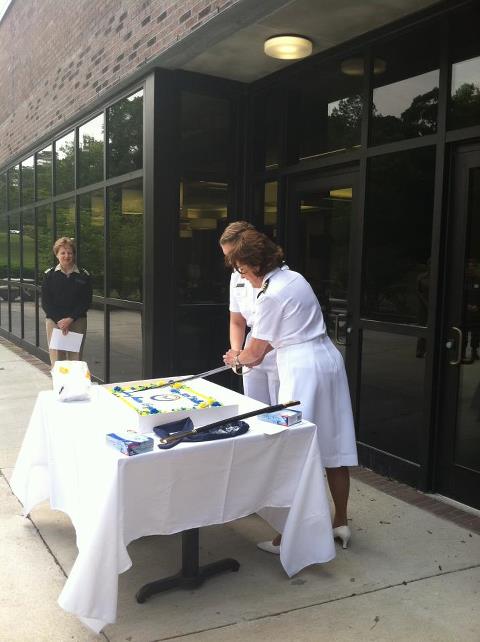
I have been blessed to have known and worked with many amazing nurses in the course of my career as a Medical Service Corps Officer in the Army and as a Chaplain in the military and civilian settings. Today I was present and offered a prayer at the cutting of the Navy Nurse Corps Birthday Cake at Naval Hospital Camp LeJeune. It was my 5th year serving in Navy Medicine and offering this prayer and blessing was an honor that I will always remember. Since I will be transferring out of Navy Medicine in the August-September time frame to assume new duties at the Joint Forces Staff College this will be the last one of these events that I get to officiate at for a few years.

media_db2f5cf3581e4c93b84fbe221904111a_t607


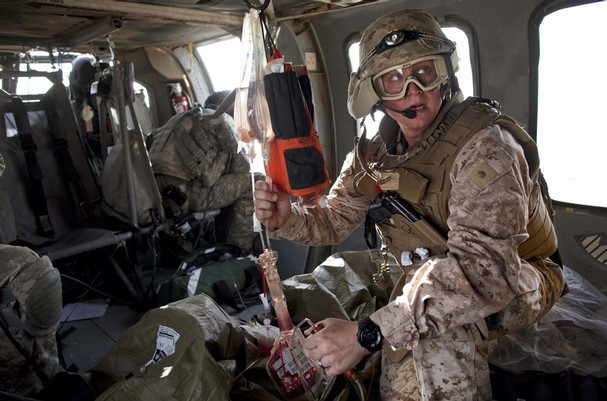
LCDR Eric Gryn in Afghanistan tending a wounded Afghan Soldier on a Medivac flight in 2011, he serves at Naval Hospital Camp LeJeune

5989_10151677233582059_485026871_nCaptain Nancy Pearson cuts the Birthday Cake at Naval Hospital Camp LeJeune

As such I just want to thank all of my friends that serve as Navy Nurses with whom I have shared joys and sorrows the past several years. Blessings on all of you!

God Bless all Nurses tonight, especially those tending the sick, ill and injured and those in harm’s way.

Peace,

Padre Steve+
3 Comments

Filed under healthcare, History, iraq,afghanistan, Military, shipmates and veterans, US Navy