Category Archives: world war two in the pacific

“Now, I am become Death, the destroyer of worlds” Hiroshima at 73 Years


Friends of Padre Steve’s World,

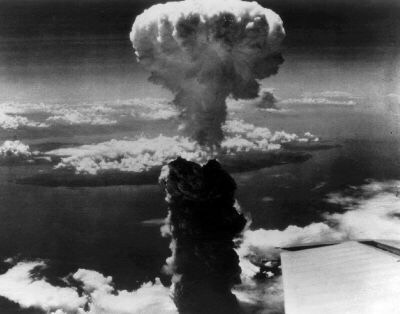
Seventy-three years ago the world changed. A remarkably destructive weapon was introduced in combat, a single bomb that annihilated the city of Hiroshima Japan. The effects were immediate, 70,000 to 80,000 people were killed, tens of thousands of others wounded, many of whom would suffer from the effects of radiation and radiation burns the rest of their lives. Within days a second bomb was dropped on Nagasaki with similar results, and Japan sued for peace. The Second World War was over and a new world was born, a world under the shadow of nuclear weapons.

The anniversary of that event today is something that all of us should ponder with great trepidation as the world seems to lurch towards a day when such a weapon will be used again. The question should not be one of mere military or tactical expediency, but must consider the moral dimension of the use of these weapons as well as the whole concept of total war.

In his book Hiroshima, John Hershey wrote:

“The crux of the matter is whether total war in its present form is justifiable, even when it serves a just purpose. Does it not have material and spiritual evil as its consequences which far exceed whatever good might result? When will our moralists give us an answer to this question?” 

His question is worth considering. It is no wonder that Robert Oppenheimer one of the members of the team that developed the bomb quoted a verse from the Bhagavad-Gita after he witnessed the test explosion “Trinity” on July 16th 1945: “Now, I am become Death, the destroyer of worlds.” 

Up until April of last year I spend the last three and a half years teaching the ethics of war to senior military officers at a major U.S. Military Staff College. One of the things that we do in the class is to have the officers do presentations on different historical, or potential ethical problems faced by national policy makers, military commanders and planners. The goal is to have these men and women dig deep and examine the issues, and think about the implications of what they will do when they go back out to serve as commanders, staff officers, advisors to civilian leaders and planners.

In each class that I taught, at least one student dealt with the use of the Atomic bombs.  Most were Air Force or Navy officers who have served with nuclear forces. Unlike the depiction in the classic movie Dr. Strangelove or other depictions that show officers in these forces as madmen, the fact is that I was always impressed with the thoughtfulness and introspective nature of these men and women. They sincerely wrestle with the implications of the use of these weapons, and many are critical of the use of them at Hiroshima and Nagasaki. It is comforting to me to know that at least in the U.S. military that there are many who can reflect and do try to look at things not just from a purely military standpoint. Of course since I know humanity I figure that there are others in our ranks who are not so reflective or sensitive to the moral implications of the use of these weapons, among whom is our current President. The fact that the President acts on impulse and seems to have no moral compass, strategic sense, or anything apart than what benefits him causes me to shudder, especially when he has to actually confront North Korea on their ICBM and nuclear programs, not to mention the use of weapons of mass destruction by a terrorist group. As Barbara Tuchman wrote: “Strong prejudices and an ill-informed mind are hazardous to government, and when combined with a position of power even more so.”

I am no stranger to what these weapons, as well as chemical and biological weapons can do. Thirty years ago when I was a young Army Medical Service Corps lieutenant I was trained as a Nuclear, Chemical and Biological Defense Officer. I learned the physical effects of exposure to these weapons, how many Rads of radiation a person could receive before they became sick and died. I learned what radiation exposure does to people at each stage. We trained with maps to chart fallout patterns, and the maps had the cities and towns that we lived in, this was Cold War Germany and yes both NATO and the Warsaw Pact expected that tactical nuclear weapons and chemical weapons would be used and we had to be able to operate in contaminated environments. We operated under the idea of Mutual Assured Destruction or MAD as a deterrent to war. It was chilling and made me realize that the use of these weapons today would be suicidal. When Chernobyl melted down we were in the fallout zone and were given instructions on what we could and could not do in order to minimize any possible exposure to radiation poisoning.

So when it comes to the first use of the Atomic bomb I am quite reflective. As a historian, military officer, chaplain and priest who has been trained on what these weapons can do I have a fairly unique perspective. Honestly, as a historian I can understand the reasons that President Truman ordered its use, and I can understand the objections of some of the bomb’s designers on why it should not be used. I’ve done the math and the estimates of casualties had there been an invasion of the Japanese home islands is in the millions, most of which would have been Japanese civilians.
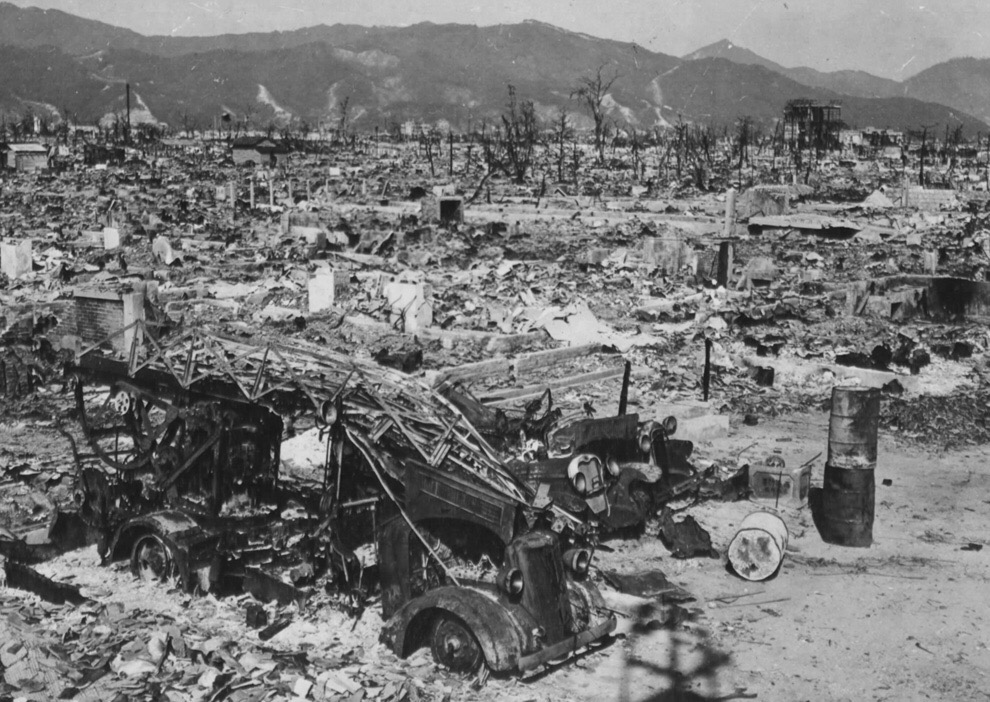

My inner lawyer can argue either point well, that being said the manner in which it was used at Hiroshima and Nagasaki troubles me. Hiroshima did have military targets, but a big part of the choice was its location, surrounded by hills, which created a bowl that would focus the explosion and maximized its effect. Many of the larger military and industrial targets lay outside the kill zone. The designers and officers on the committee wanted to show the Japanese, as well as the world the destructive power of the weapon. Those who opposed its use hoped that it would convince the leaders of nations that war itself needed to be prevented. These men wrestled with the issue even as they prepared the first bombs for deployment against Japan. The recommendations of the committee can be found here:

http://www.atomicarchive.com/Docs/ManhattanProject/Interim.shtml
Of the 150 scientists who were part of the bomb’s design team only 15% recommended the military use without a demonstration to show the Japanese the destructive power of the bomb and a chance to end the war. The poll of the scientists can be found here:

http://www.atomicarchive.com/Docs/ManhattanProject/Poll.shtml
Leo Szilard wrote a letter to Edward Teller seeking his support in sending a petition to President Truman regarding his opposition to the use of the weapon based on purely moral considerations. Szilard wrote:

“However small the chance might be that our petition may influence the course of events, I personally feel that it would be a matter of importance if a large number of scientists who have worked in this field want clearly and unmistakably on record as to their opposition on moral grounds to the use of these bombs in the present phase of the war.

Many of us are inclined to say that individual Germans share the guilt for the acts which Germany committed during this war because they did not raise their voices in protest against those acts, Their defense that their protest would have been of no avail hardly seems acceptable even though these Germans could not have protested without running risks to life and liberty. We are in a position to raise our voices without incurring any such risks even though we might incur the displeasure of some of those who are at present in charge of controlling the work on “atomic power.”

The entire text of Szilard’s letter can be found here:

http://www.atomicarchive.com/Docs/ManhattanProject/SzilardTeller1.shtml
The two petitions of the scientists to the President are here, the second letter concludes with this recommendation:

“If after the war a situation is allowed to develop in the world which permits rival powers to be in uncontrolled possession of these new means of destruction, the cities of the United States as well as the cities of other nations will be continuous danger of sudden annihilation. All the resources of the United States, moral and material, may have to be mobilized to prevent the advent of such a world situation. Its prevention is at present the solemn responsibility of the United States–singled out by virtue of her lead in the field of atomic power.

The added material strength which this lead gives to the United States brings with it the obligation of restraint and if we were to violate this obligation our moral position would be weakened in the eyes of the world and in our own eyes. It would then be more difficult for us to live up to our responsibility of bringing the unloosened forces of destruction under control.

In view of the foregoing, we, the undersigned, respectfully petition: first, that you exercise your power as Commander-in-Chief to rule that the United States shall not resort to the use of atomic bombs in this war unless the terms which will be imposed upon Japan have been made public in detail and Japan knowing these terms has refused to surrender; second, that in such an event the question whether or not to use atomic bombs be decided by you in the light of the consideration presented in this petition as well as all the other moral responsibilities which are involved.”

http://www.atomicarchive.com/Docs/ManhattanProject/SzilardPetition.shtml

http://www.atomicarchive.com/Docs/ManhattanProject/Petition.shtml

Ralph Bard, Undersecretary of the Navy wrote to Secretary of War Stimson his opinion on July 17th 1945:

“Ever since I have been in touch with this program I have had a feeling that before the bomb is actually used against Japan that Japan should have some preliminary warning for say two or three days in advance of use. The position of the United States as a great humanitarian nation and the fair play attitude of our people generally is responsible in the main for this feeling.”

I think that those who debate the history of this need to look at the entire picture and read the letters, the documents and take into account everything. My hope is that leaders, policy makers, legislators and we the people continue to work to eliminate nuclear weapons. It is true that the nuclear stockpiles of the United States and Russia are significantly smaller than when the Cold War ended, but even so what remain are more than enough to extinguish human life on the planet. Add to these the Chinese, French, British, Indian, Pakistani and the hundreds of undeclared weapons of Israel the fact is that there remains the possibility that they could be used. Likewise there are nuclear programs in other nations, especially North Korea, which given enough time or believing them necessary could produce weapons. But the North Koreans are not alone, they could easily be joined by others including Iran and Saudi Arabia. Add to this the possibility of a terrorist group producing or acquiring a weapon the world is still a very dangerous place.

That is the world that we live in and the world in which policy makers, legislators and educated people who care about the world must attempt to make safe. If you asked me I would say outlaw them, but that will never happen. Edward Teller wrote Leon Szilard:

“First of all let me say that I have no hope of clearing my conscience. The things we are working on are so terrible that no amount of protesting or fiddling with politics will save our souls…. Our only hope is in getting the facts of our results before the people. This might help to convince everybody that the next war would be fatal. For this purpose actual combat use might even be the best thing…. But I feel that I should do the wrong thing if I tried to say how to tie the little toe of the ghost to the bottle from which we just helped it to escape…”

The ghost is out of the bottle, and nothing can ever get it back in. We can only hope and pray that reasonable people prevent any of these weapons from ever being used and that war itself would end.

Until tomorrow,

Peace

Padre Steve+

3 Comments

Filed under Foreign Policy, History, leadership, Military, national security, Political Commentary, war crimes, world war two in the pacific

War Without Mercy: Race and Power in the Pacific War

Friends of Padre Steve’s World,

It has been another long day of work in the house and dealing with contractors but we are making progress. We stopped work about 8;15 this evening. Tomorrow the contractor crew arrives between seven and seven-thirty in the morning. As they work we too will be working to set conditions so I can start, painting, and then ripping out old laminate and re-flooring our guest room and hallway.

Specifically that mean sorting through all of the stuff that we moved into the guest room. I have to find what was damaged during the flooding from our air conditioning condenser pan, things that we will be keeping and taking to the attic or storage space, and things that we will either throw out or give to Goodwill.

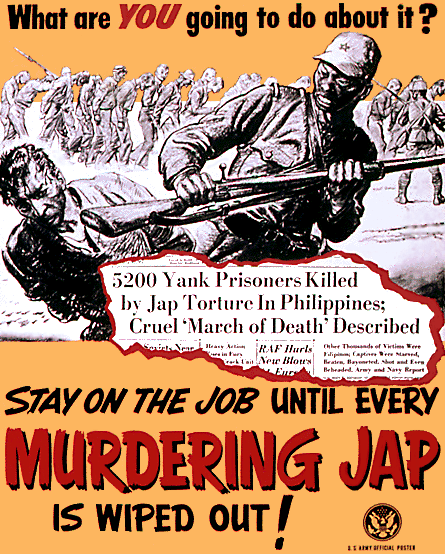
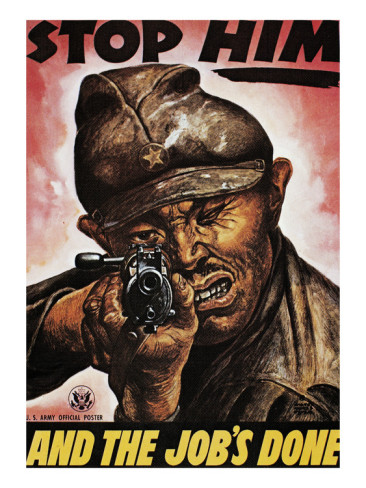
So anyway, I am re-posting an older article, a review and reflection on John Dower’s classic book War without Mercy: Race and Power in the Pacific War. 

Until tomorrow,

Peace,

Padre Steve+

1NoRoosevelt

The study of war cannot simply be confined to the study of battles, weapons and leaders. While all of these are important one must as Clausewitz understood examine the human element of policy, ideology and the motivations of nations as they wage war. Clausewitz understood that war could not be reduced to formulas and templates but involved what he called the “remarkable trinity” which he described in on war as (1) primordial violence, hatred, and enmity; (2) the play of chance and probability; and (3) war’s element of subordination to rational policy. Clausewitz connects this with the people being connected to the primordial forces of war, the military with the non-rational elements of friction, chance and probability and the government.

Anti-Japan2

The Clausewitzian understanding of war is rooted in the Enlightenment and classic German Liberalism, born out of his experience in the Napoleonic Wars, which forever changed the face of warfare.  From the defeat of Prussia and its liberation from Napoleonic rule under Scharnhorst and Gneisenau Clausewitz developed the understanding that war was more than simply tactics and weapons.  Thus when we examine war today we deprive ourselves of properly understanding the dynamic of war if we fail to appreciate the human factor which is frequently not rational.  Such is especially the case when one fights an enemy who wages war on religious, racial or ideological grounds as is the case in the current war against Al Qaida and other extremist Moslem groups. Such groups would like to turn this war into such a conflict as do certain figures in the American political milieu who repeatedly label all of Islam as the enemy.  In such a climate it is imperative to look at history to show us the results of such primal passions.

14129979717_6f281b6876_b

It is in such conflict as we are engaged in today it is good to look at previous wars from the human experiential component and not simply military operations.  If one wants to look at how inflamed passion driven by racial prejudice and hatred took war to a level of barbarity and totality that defy our comprehension we only need to look back to the Pacific war between Japan and the United States.  In another post I dealt with the how racial ideology influenced Nazi Germany’s conduct of the war against Poland and the Soviet Union.  https://padresteve.wordpress.com/2009/09/14/the-ideological-war-how-hitlers-racial-theories-influenced-german-operations-in-poland-and-russia/

To do this I will look at John Dower’s “War Without Mercy.” In this book Dower examines World War Two in the Pacific from the cultural and ideological viewpoints of the opposing sides.  He looks at the war as a race war, which he says “remains one of the great neglected subjects of World War Two.”[i] Dower examines race hated and its influence on both the Japanese and the Allies, particularly in the way that each side viewed one another and conducted the war.  He examines the nature of racial prejudice and hate in each society, including its religious, psychological, ideological, scientific and mythological components.  He also examines the use of media and propaganda, and how racial attitudes not only influenced national and individual attitudes, but also the military and intelligence operations of both sides.  This book is not about military campaigns, thus it is much more like “In the Name of War” by Jill Lepore [ii] than any history of the Pacific war.

5767884_orig

Dower uses sources such as songs, movies, cartoons and various writings of the times to demonstrate the totality of the war.  Dower admits many of these are difficult to handle and “not respectable sources in some academic sources.”[iii]Despite this he puts together a work that is sometimes chilling, especially when one looks at the current war that our country is engaged in. He also endeavors to explain how after a war where “extraordinarily fierce and Manichean”[iv] race hate predominated, it could “have dissipated so easily”[v] after the war was over.

Dower divides his work into three major sections.  The first which examines how the aspect of race effected the fighting of the war, the second, the war through Western eyes and the third the war through Japanese eyes.  The first section begins with how racial attitudes in Western and Japanese societies helped fuel the war and compares similar attitudes and concepts in Western and Japanese thought, including how “prejudice and racial stereotypes frequently distorted both Japanese and Allied evaluations of the enemy’s intentions and capabilities.”[vi] He looks at the language of the conflict; at how war words and race words came together “in a manner which did not reflect the savagery of the war, but truly contributed to it….”[vii] the result being “an obsession with extermination on both sides.”[viii] He comes back to this theme throughout the book comparing the two sides and occasionally contrasting these attitudes with corresponding attitudes of the Allies to their German and Italian foes in Europe.[ix]

In the first chapter Dower examines the role played by the propaganda used by both sides.  In particular he expalins how the “Know Your Enemy: Japan”movies commissioned by the War Department and directed by Frank Capra, and the Japanese works “Read this and the War is Won” and “The Way of the Subject” helped shape the view of each side. Propaganda developed the idea of the war in terms of good versus evil and the mortal threat posed to their respective cultures by the enemy.

From this he looks at the visceral emotions that the war engendered and how those emotions spilled over into the conduct of the war especially in regard to its ferocity and the war crimes that were spawned by the unbridled hatred of both sides.  He notes the targeted terror bombings of civilians by both sides and how those actions were portrayed as “barbaric” by the other side when they were the victim.[x] He notes the viciousness of the war and how for the Americans the war brought forth “emotions forgotten since our most savage Indian wars.”[xi]He contrasts this with European war in particular how the Japanese and their actions were portrayed in Western media, and how similar actions by the Germans, such as the Holocaust, were ignored by Western media until the war was over.[xii] He traces some of this to the understanding of the psychological effects of the defeats and humiliations of the Allies at the hands of the Japanese, and the corresponding brutality toward Allied prisoners by the Japanese as compared to that of the Germans.[xiii] He uses this section to also examine the prevailing attitudes of the Japanese toward the Allies as being weak and “psychologically incapable of recovery” from blows such as the Pearl Harbor attack, and the Allied view of the Japanese as “treacherous.”[xiv]

Dower’s second major section describes the attitudes and actions of the Americans and British toward their Japanese enemy.  He looks at the view that the Japanese were less than human and often portrayed as apes or other primates such as monkeys.  To do this he examines cartoons and illustrations in popular magazines and military publications, and includes those cartoons in the book.   The sheer vulgarity of these cartoons is easily contrasted with those promoted and published by Nazis such as Julius Streicher in Der Stürmer, something often overlooked or ignored in other histories.[xv] The early Western views of Japan as sub-human continued throughout the war, while at the same time, especially after the rapid series of Allied defeats and Japanese victories they were viewed as almost “super-human.”  Paradoxically some allied leaders turned the Japanese from “the one time “little man” into a Goliath.”[xvi] They were now “tough, disciplined and well equipped.”[xvii] Ambassador Joseph Grew, reported on his return from Japan, that the Japanese were; “”sturdy,” “Spartan,” “clever and dangerous,” and that “his will to conquer was “utterly ruthless, utterly cruel and utterly blind to the values that make up our civilization….””[xviii] The juxtaposition of such conflicting attitudes is curious, although understandable, especially in light of other Western wars against Asians or Arabs.[xix]

Dower then examines how some Americans and British explained the Japanese “National Character,” their approach to war, and actions during the war from Freudian psychiatry as well as Anthropology and other social and behavioral sciences.   Beginning with the widespread Allied understanding that the Japanese were “dressed-up primitives-or “savages” in modern garb…”[xx] he notes that these interpretations of the Japanese national character stemmed from “child-rearing practices and early childhood experiences,”[xxi] including toilet training and Freudian interpretations that saw an arrested psychic development at the “infantile (anal or genital) stage of development.”[xxii]Dower deduces that it was not hard to see how “Japanese overseas aggression became explicable in terms of penis envy or a castration complex….”[xxiii] The views were widespread and emphasized  that the “Japanese were collectively unstable.”[xxiv] Dower notes that the “very notion of “national character”-was the application to whole nations and cultures of an analytical language that had been developed through personal case studies…”[xxv] which he is rightly critical in suggesting that this premise “was itself questionable.”[xxvi] In addition to this was the understanding of Margaret Mead and others of the Japanese as “adolescents” and “bullies,”[xxvii] and notes that from “the diagnosis of the Japanese as problem children and juvenile delinquents, it was but a small step to see them as emotionally maladjusted adolescents and, finally as a deranged race in general.”[xxviii] Dower cites numerous other “experts” of the time and their interpretations of the Japanese national character, but the overwhelming message is that the application of these theories, regardless of their validity had a major impact on the Allied war against Japan.

He follows this chapter with one with much importance in explaining the similarities in how Americans and Westerners in general viewed the Japanese in relationship to other races that they had dealt with including Blacks, Chinese, Filipinos, and American Indians.  Common themes include the views of each as primitives, children and madmen and the view of the Japanese as part of the “Yellow Peril.”  Of particular note is his analysis of the work of Homer Lea’s 1909 book The Valor of Ignorance and the vision of Japanese supermen which enjoyed a revival after Pearl Harbor.[xxix] Dower examines depictions of Asians in general in the Fu Manchu and Charlie Chan series of films and other racial aspects hearkening back to the “specter of Genghis Khan and the prospect that the white races “may be liquidated.”[xxx] He notes how Japanese propagandists attempted to use Allied prejudice to influence the Chinese and other Asians against the Allies[xxxi] and American blacks against whites,[xxxii] while attempting to maintain their own racial superiority which is the subject of the next section.

The chapters dealing with the Japanese view of themselves and their opponents tie together neatly.  These deal with the Japanese view of themselves as the leading race in Asia and the world.  Dower talks about symbols and the understanding of racial purity that motivated the Japanese from the 1800s to the rejection of Japan’s request for a declaration of “racial equity” at the League of Nations.[xxxiii] He notes the “propagation of an elaborate mythohistory in Japan and the time spent “wrestling with the question of what it really meant to be “Japanese” and how the “Yamato race” was unique among races….”[xxxiv] He notes the relationship of Shinto with whiteness and purity and connotations of how the Japanese indulged in “Caucasianization” of themselves vis-à-vis other Asians during World War Two,”[xxxv] and their emphasis on a Japanese racial worldview.[xxxvi] He also tackles the way in which the Japanese wrestled with evolution and its relationship to other racial theories contrasting books such as A History of Changing Theories about the Japanese Race and Evolution of Life with Cardinal Principles of the National Polity published by the Thought Bureau of the Ministry of Education in1937.  These declared that the Japanese were “intrinsically different from the so-called citizens of Occidental countries.”[xxxvii] He also deals with the Kyoto school and the Taiwa concept.[xxxviii] In Chapter Nine Dower looks at how the Japanese viewed themselves and outsiders, in particular the characterization of Westerners as nanbanjin or  barbarians and how this eventually train of thought carried through the war led to the “Anglo-American foe emerged full blown as the demonic other.”[xxxix]Dowers final chapter deals with how quickly the race hatred dissipated and genuine goodwill that developed between the Japanese and Americans after the war.[xl]

This book holds a unique place in the literature of the Pacific war.  It is not a comfortable book, it is challenging. No other deals with these matters in any systemic way.  If there is a weakness in Dower is that he does not, like Lepore in “In the Name of War” deal with the attitudes of soldiers and those who actually fought the war.  His examples are good and go a long way in explaining the savagery with which the war was conducted, but could have been enhanced with reflections and accounts of those who fought the war and survived as well as the writings of those who did not, and the way those attitudes were reflected in different services, times and theaters during the war, including adjustments that commanders made during the war.[xli] His description of how Japanese “reluctance to surrender had meshed horrifically with Allied disinterest …in contemplating anything short of Japan’s “thoroughgoing defeat.”[xlii]

The lessons of the book are also contemporary in light of the cultural and religious differences between the West and its Moslem opponents in the current war. Possibly even more so than the war between the United States and Japan which was fought by nation states that still were signatories to international conventions, not nation states against terrorists unbound by any Western code or law or indigenous forces engaged in revolutionary war against the west such as the Taliban.[xliii] The temptation is for both sides to demonize one’s opponent while exalting one’s own way of life through official propaganda and popular media, with a result of increased viciousness and inhumanity in pursuit of ultimate victory.   In today’s world with the exponential rise in the radicalization of whole people groups and the availability of weapons of mass destruction, it is possibility that the war could develop into one that is a racial as well as religious and ideological war that would make the War in the Pacific look like a schoolyard brawl.

Bibliography

Alexander, Joseph H. Utmost Savagery: The Three Days of Tarawa. Ivy Books, Published by Ballantine Books, New York, NY 1995

Dower, John W. War without Mercy: Race and Power in the Pacific War.”Pantheon Books, A Division  of Random House, New York, NY 1986.

Leckie, Robert. Okinawa. Penguin Books USA, New York NY, 1996

Lepore, Jill  The Name of War Vintage Books a Division of Random House, New York, NY 1998

Tregaskis, Richard Guadalcanal Diary Random House, New York NY 1943, Modern Library Edition, 2000.


[i] Dower, John W. War without Mercy: Race and Power in the Pacific War.”Pantheon Books, A Division  of Random House, New York, NY 1986. p.4

[ii] Lepore, Jill  The Name of War Vintage Books a Division of Random House, New York, NY 1998.  Lepore’s book deals with King Phillip’s War and how that war shaped the future of American war and how it shaped the views of Indians and the English Colonists and their later American descendants both in the language used to describe it, the histories written of it and the viciousness of the war.

[iii] Ibid. p.x

[iv] Ibid. p.ix

[v] Ibid. p.x

[vi] Ibid. p.11

[vii] Ibid.

[viii] Ibid.   Also see Alexander, Joseph H. Utmost Savagery: The Three Days of Tarawa. Ivy Books, Published by Ballantine Books, New York, NY 1995 Alexander notes an incident that shows a practical application of the Japanese views and the ruthlessness inflicted on their enemies, in this case prisoners in response to an American bombing raid. In 1942 the commander of the Japanese Garrison of Makin Island ordered 22 prisoners beheaded after one cheered following a bombing raid. (p.32)

[ix] An interesting point which Dower does not mention but is interesting for this study is how the Germans referred to the British and Americans as “Die gegener” (opponents) and the Soviets as “Die Feinde” (the enemy), the implication being that one die gegener was a common foe, much like an opposing team in a sport, and the other a mortal enemy, the implication of Feinde being evil, or demonic.

[x] In particular he makes note of the Japanese actions during the “Rape of Nanking,” and the 1945 sack of Manila, as well as the fire bombing of Japanese cities by the US Army Air Corps in 1945.

[xi] Ibid. Dower. p.33

[xii] Ibid. p.35

[xiii] Ibid.  This is important in the fact that the Allies tended not to make much of German brutality to the Jews, Russians and other Eastern Europeans.

[xiv] Ibid. p.36.

[xv] Dower does not make this implicit comparison, but having seen both and studied the Nazi propaganda directed toward the Jews, Russians and other Slavic peoples considered to be Untermenschen (sub-humans) by the Nazis the similarities are striking.

[xvi] Ibid. pp.112-113.

[xvii] Ibid. p.113

[xviii] Ibid.

[xix] In the 2006 Israeli invasion of Lebanon, Israeli soldiers who previously showed no respect to any Arab fighter described their Hezbollah opponents as “soldiers and warriors.”  Similar attitudes were voiced by American soldiers in Vietnam when they fought NVA regulars.

[xx] Ibid. p.123

[xxi] Ibid.

[xxii] Ibid.

[xxiii] Ibid.

[xxiv] Ibid. p.124

[xxv] Ibid.

[xxvi] Ibid.

[xxvii] Ibid. p.129

[xxviii] Ibid. p.143

[xxix] Ibid. P.157.  Lea is interesting because he predicts a decline in the stature of the British Empire and softness of both the Americans and British as peoples.  Also see John Costello in The Pacific War 1941-1945 Quill Books, New York, NY 1982 pp.31-32 notes Lea’s concerns and how they drove the American Pacific strategy until the outbreak of World War Two.

[xxx] Ibid. p.161

[xxxi] Ibid. p.169

[xxxii] Ibid. pp.174-180.  This is an interesting section.  One of the most interesting topics being the reaction of the NAACP’s Walter White’s book A Rising Wind published which “suggested a sense of kinship with other colored-and also oppressed-peoples of the world….he senses that the struggle of the Negro in the United States is part and parcel of the struggle against imperialism and exploitation in India, China, Burma….” (p.177-178)

[xxxiii] Ibid. p.204

[xxxiv] Ibid. p.205

[xxxv] Ibid. p.209  This is interesting when one compares the Japanese emphasis on “Pan-Asianism” and the inherent contradiction between the two.

[xxxvi] Ibid. p.211  Dower notes that the article Establishing a Japanese Racial Worldview in the monthly Bungei Shunju “clarified the Japanese character, whose basic traits were brightness, strength and uprightness.  These qualities made the Japanese “the most superior race in the world.”

[xxxvii] Ibid. p.221

[xxxviii] Ibid. p.227 This was the theory of Zen Buddhism’s Suzuki Daisetsu (D.T. Suzuki) in his teaching of the struggle for the Great Harmony “Taiwa” which attempted to identify “an intuitive sense of harmony and oneness that he declared to be characteristic of Oriental thought.”

[xxxix] Ibid. p.247.  Descriptions of the Allies as Barbarians, Gangsters and Demons permeated Japanese propaganda.

[xl] Ibid. Dower makes a number of observations relating to how the Japanese were able to use their own self concept to adapt to their defeat.  He also notes that the Japanese were able to transfer their self concept to a peaceful orientation.

[xli] See Leckie, Robert. Okinawa. Penguin Books USA, New York NY, 1996 p.35.  Leckie quotes General Ushijima “You cannot regard the enemy as on par with you,” he told his men. “You must realize that material power usually overcomes spiritual power in the present war. The enemy is clearly our superior in machines. Do not depend on your spirits overcoming this enemy. Devise combat method [sic] based on mathematical precision-then think about displaying your spiritual power.”  Leckie comments: “Ushijima’s order was perhaps the most honest issued by a Japanese commander during the war. It was Bushido revised, turned upside down and inside out-but the revision had been made too late.”

[xlii] Ibid. Dower. p.37

[xliii] See Tregaskis, Richard Guadalcanal Diary Random House, New York NY 1943, Modern Library Edition, 2000. p.95.  Tregaskis notes when commenting on Japanese POWs on Guadalcanal “We stared at them and they stared back at us. There was no doubt what we or they would have liked to do at that moment-if we had not remembered our code of civilization or if they had not been unarmed.”


Leave a comment

Filed under History, Military, Political Commentary, world war two in the pacific

The Great Marianas Turkey Shoot

Friends of Padre Steve’s World,

It has been another long day or work in the house, dealing with contractor complications and delays, and running back and forth to Lowe’s and going in to work to take care of business despite being on leave. Tomorrow promises to be similar. So for now part two of my article dealing with my favorite resistors will have to wait.

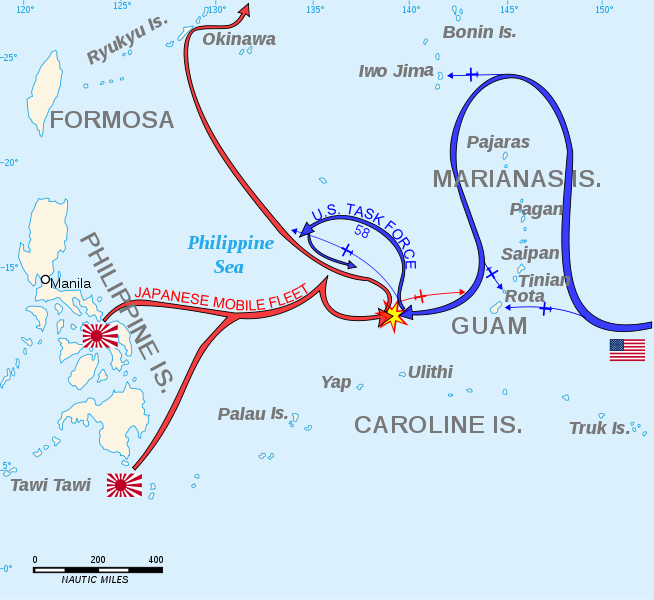
Because of that I am reposting an older article on the Battle of the Philippine Sea, also known as the Great Marianas Turkey Shoot which was fought on the 19th and 20th of June 1944.

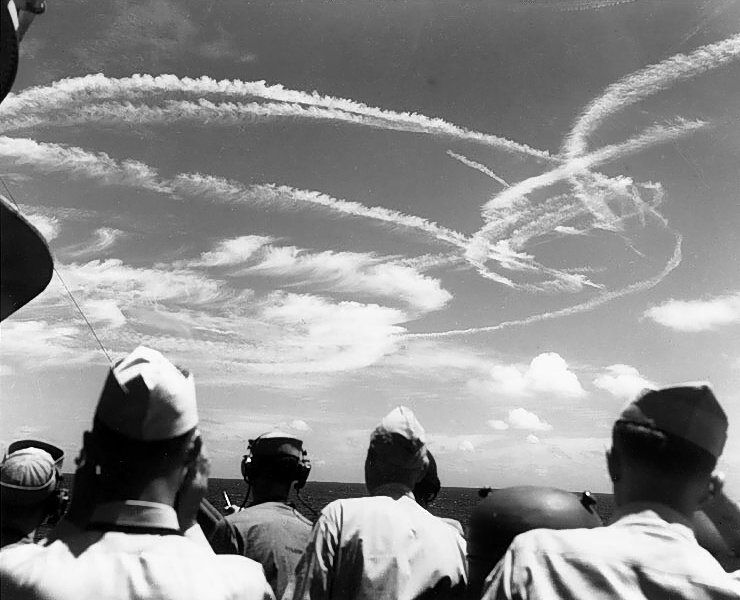
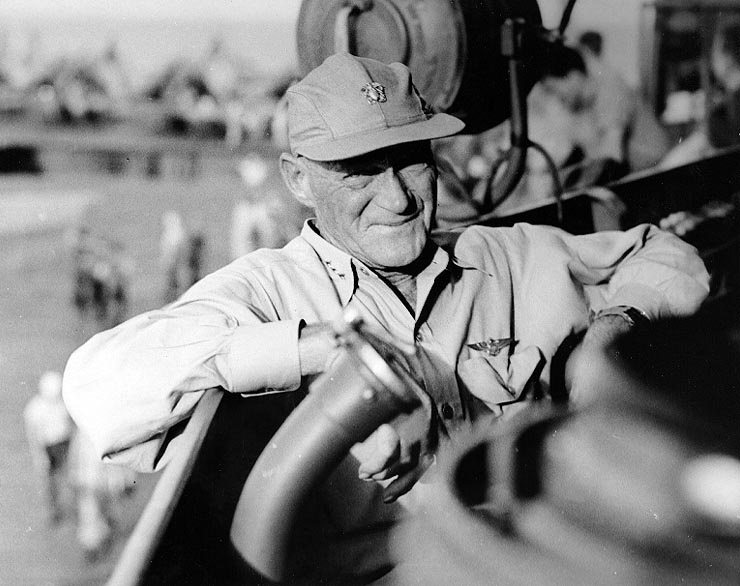
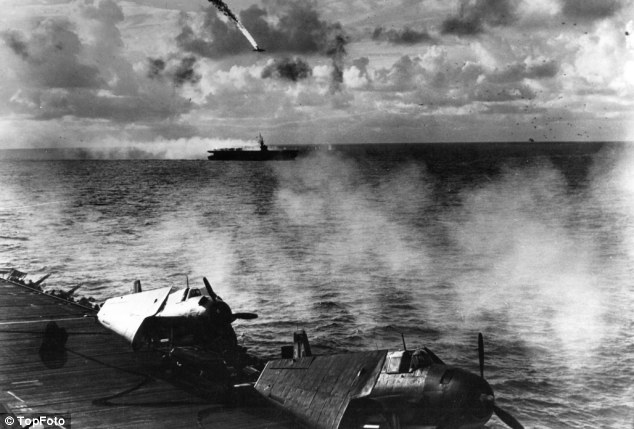
U.S. Navy personnel observe the Air Battle from a Carrier

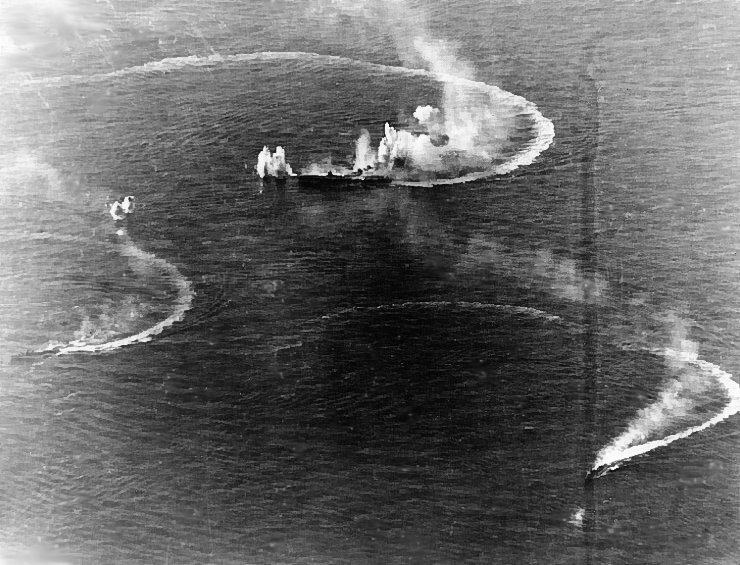
This battle was the largest battle between aircraft carrier fleets in history.  Twenty four aircraft carriers, 15 American and 9 Japanese embarking over 1400 aircraft dueled in the Central Pacific in a battle that so decimated Japanese Naval Aviation that it never recovered. The battle and the subsequent fall of Saipan brought down the government of General Tojo and was the beginning of the collapse of the Japanese Empire and the “Greater Asia Co-Prosperity Sphere.”

http://dsc.discovery.com/videos/destroyed-in-seconds-marianas-turkey-shoot.html

In late 1943 the Japanese realized that they needed to recover the initiative in the Pacific.  Between the Battle of the Coral Sea and the Battle of Santa Cruz Japanese Naval aviation suffered crippling losses especially among the elite pilots and aircrews with who they had begun the war.  These losses were compounded when the Navy attempted to support the operations of the Army to defend the Solomons and New Guinea.  Squadrons sent to battle the United States Navy, Marine Corps and Army Air Corps suffered at the hands of the every more skilled and well equipped American fighter squadrons the victims of which included Admiral Isoruku Yamamoto the Commander of the Combined Fleet when the Betty bomber that he was traveling on was ambushed by U.S. Army Air Corps P-38 Lightening fighters.

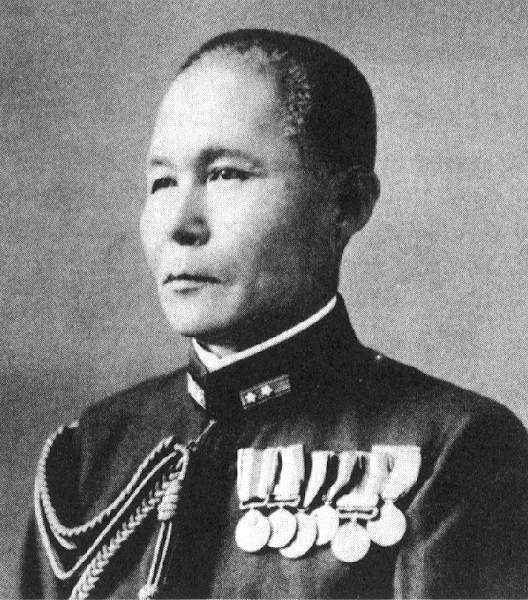
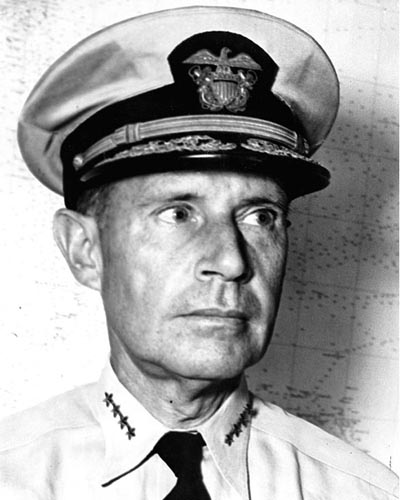
Vice Admiral Jisaburō Ozawa

By late 1943 the Japanese were attempting to train new pilots and aircrews to man the carriers of the Combined Fleet’s Carrier Striking Forces.  Admiral Soemu Toyoda, the new commander of the Combined Fleet and its third commander in less than a year developed “Plan A-Go” as a means to mass carrier and land based aviation assets to defeat the Fast Carrier Task Forces of the United States Navy.  The rebuilt Carrier Striking Groups built around 9 carriers embarking 473 aircraft was commanded by Vice Admiral Jisaburō Ozawa who had taken over from Vice Admiral Chuichi Nagumo.

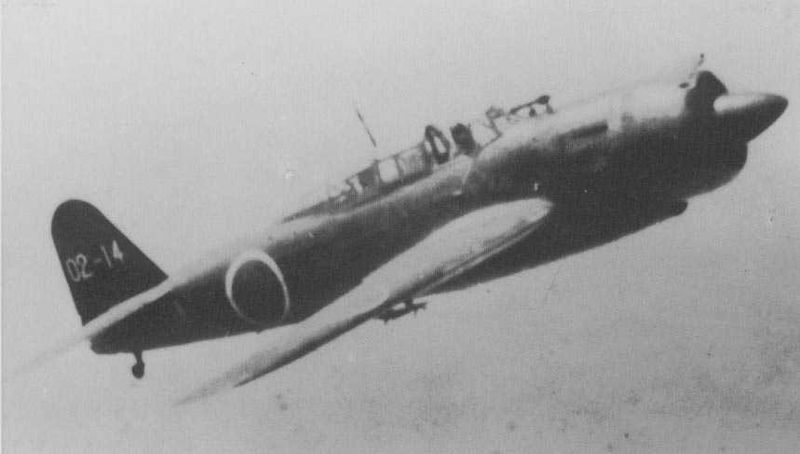
D4Y3 “Judy” Dive Bomber

The Japanese discerned the intentions of the Americans when American Carrier aircraft struck Saipan and Guam. The Japanese had expected the Americans to strike further south and the Marianas had few land-based aircraft in the area. Toyoda made the decision to engage the Americans and ordered the fleet to attack. American submarines discovered the gathering Japanese forces. The Japanese forces were assembled by the 17th and by the 18th the 5th Fleet under the command of Admiral Raymond Spruance spearheaded by Task Force 58 Commanded by Vice Admiral Marc Mitscher had assembled west of Saipan to meet the Japanese.  The Americans fielded 15 carriers including 9 Fleet Carriers of which 6 were the new Essex Class Fleet Carriers which embarked 956 aircraft.

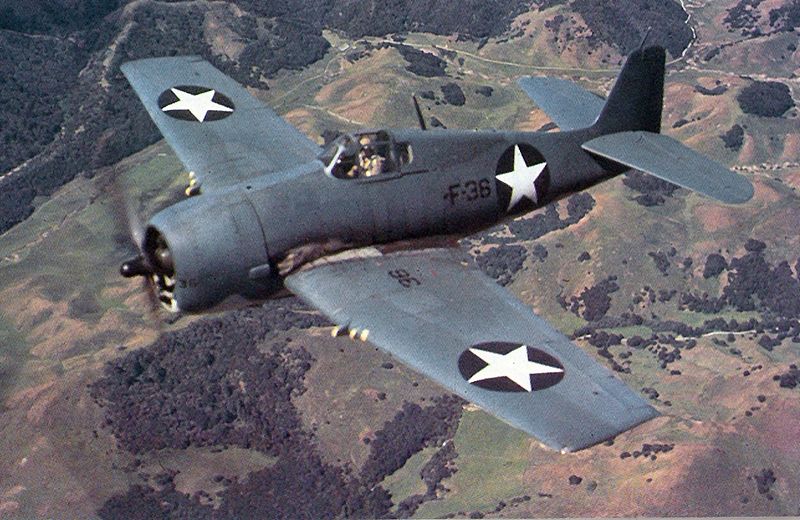
The F6F Hellcat cemented its place as the premier fighter plane of the Pacific war during the “Turkey Shoot”

The Americans held both a quantitative and qualitative advantage against the Japanese. The American fighter squadrons were equipped with the F6F Hellcat which was far superior to the now obsolescent Japanese Zero fighters and their pilots and aircrews were now more experienced and proficient than the newly minted Japanese aviators who by and large had little combat experience and were flying inferior aircraft.  The Japanese had not planned for a long war and had done little to systemically address the heavy losses that their force experienced during 1942 and 1943 at Coral Sea, Midway, Eastern Solomons, Santa Cruz and in the Solomons campaign.

Vice Admiral Marc Mitscher aboard the USS Lexington

Mitscher desired to move aggressively against the Japanese. However he was overruled by Spruance who acting on the advice of his Battle Line Commander Vice Admiral Willis Lee decided that a possible night surface action with the Japanese was not desirable. Spruance instead directed Mitscher to be ready to defend against Japanese air strikes knowing that his carriers and carrier based air groups was more than a match for the Japanese air groups.   Spruance has been criticized for his decision but the words of Willis Lee, a veteran of the Naval Battle of Guadalcanal where he defeated a Japanese force sinking the Battleship Kirishima.  He prevailed in his flagship the USS Washington but losing three of four escorting destroyers and seeing his second battle wagon the USS South Dakota heavily damaged. A night surface engagement was not worth the risk as in Lee’s eyes it evened the playing field for the Japanese and took away the American air power advantages.

A Japanese aircraft goes down in flames

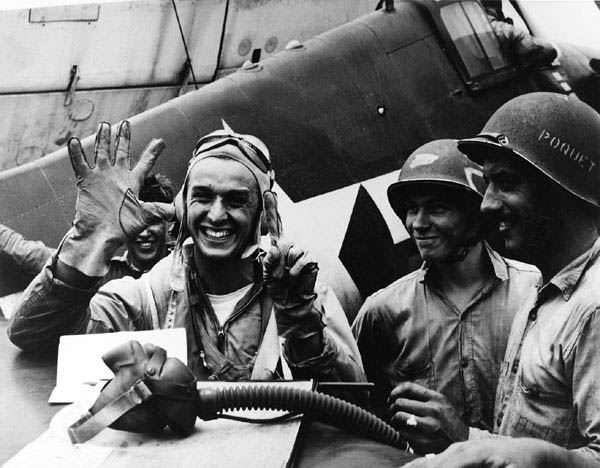
The Japanese began the action on the 19th sending successive attack waves against Task Force 58. They were met by massed formations of Hellcats vectored in by air controllers in the Combat Information Centers of the American carriers using their superior air search radar systems.  In less than two hours well over 200 Japanese aircraft were downed by the Hellcats.  Lieutenant Alexander Vraicu shot down 6 “Judy” dive bombers in minutes before low on fuel he returned to the USS Lexington.

Lieutenant Alexander Vraicu holds up six fingers on board the USS Lexington

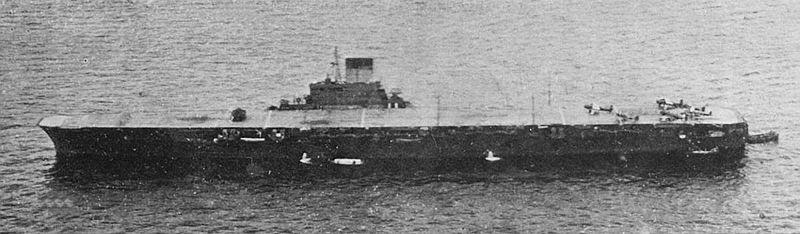
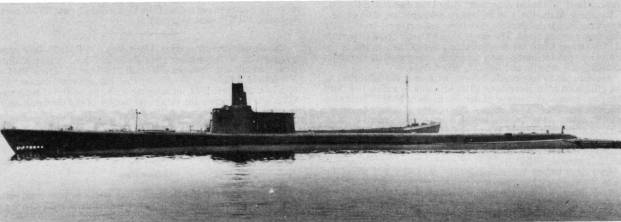
While the Hellcats were chewing up the Japanese squadrons the American submarines USS Albacore and USS Cavalla each sank a Japanese Fleet Aircraft Carrier.  The Albacore hit the Ozawa’s flagship, the new Tiaho with a torpedo which caused minimal damage, but ruptured fuel lines. The Japanese damage control officer opened vents in the ship which allowed the fumes to spread throughout the carrier. They were ignited by a generator causing massive explosions and forcing Ozawa to abandon his flagship. Tiaho would sink by late afternoon after being ripped apart by a series of massive explosions taking with her 1650 of 1750 officers and crew. Cavalla hit the Pearl Harbor veteran Shokaku with a spread of three torpedoes causing that ship to burst into flames with aircraft and ordnance adding to the conflagration. A massive explosion ripped through the ship causing her to sink with a loss of over 1200 officers and crew.

The Japanese flagship Tiaho (above) and her killer the USS Albacore

Toyoda desired that Ozawa retire from the battle before he suffered more losses but Ozawa wanted to stay around and hit the Americans with everything that he had left. The Americans sailed west during the night to seek out the Japanese Fleet. It took the majority of the day to find the Japanese. With only 75 minutes of daylight remaining Mitscher launched a strike despite the risk to his aircrew the majority whom were not trained in night landings.  The American strike sank the carrier Hiyo and two tankers and damaged the carriers Zuikaku, Chitoyda and Junyo as well as the battleship Haruna.  By the end of the day Ozawa had 35 aircraft in flyable condition. About 435 of the aircraft operated from the Japanese carriers were lost with the vast majority of their pilots and aircrew.

The Japanese Fleet under attack, carrier Zuikaku and two destroyers on June 20th

The final part of the drama was the return of the American strike group to the carriers. Knowing that if he maintained darken ship he would lose many aircraft and the men that flew them Mitscher ordered that the fleet turn on its lights. This act was incredibly risky but helped bring the majority of the returning aircraft to land or ditch near the task force.  The Americans lost less than 100 aircraft during the battle, most due to the night landings and unlike the Japanese who lost the majority of their aircrews, most of the American pilots and aircrew were rescued. In addition to their carrier based losses the Japanese lost nearly 200 land based aircraft.

Admiral Raymond Spruance

The battle was the death-kneel of Japanese Naval Aviation. Later in the year the carriers again under Ozawa sailed against the Americans only this time they were a decoy force at the Battle of Leyte Gulf, a role that they succeeded in admirably. The American carriers now had free run of the Pacific only opposed by land based aircraft many used in a Kamikaze role until the end of the war. These would cause fearful losses among the American ships heavily damaging a number of carriers.

The battle is often forgotten by due to its proximity to the Normandy landings but was a significant step in the fight against Japan. The islands captured by the Americans, Saipan, Tinian and Guam would provide major sea and air staging areas for the final assault against Japan. Tinian would become the base of many Army Air Corps B-29 “Superfortress” bombers including those that dropped the Atomic bombs less than 14 months later. It was a turning point both militarily and politically. With the fall of the Tojo government the Japanese leaders began to slowly tell the truth about wartime setbacks and losses to a people that it had lied to since their invasion of China and occupation of Mongolia.  It was a setback that even Tojo and the highest leadership of Japan knew that they could not recover.

Until tomorrow,

Peace,

Padre Steve+

1 Comment

Filed under aircraft, History, Military, Navy Ships, US Navy, world war two in the pacific

Devastators Into the Valley of Death: The Sacrifice of the Torpedo Bombers at Midway

tbd-devastator1

Friends of Padre Steve’s World,

Alfred, Lord Tennyson wrote:

Half a league half a league,
Half a league onward,
All in the valley of Death
Rode the six hundred:
‘Forward, the Light Brigade!
Charge for the guns’ he said:
Into the valley of Death
Rode the six hundred.

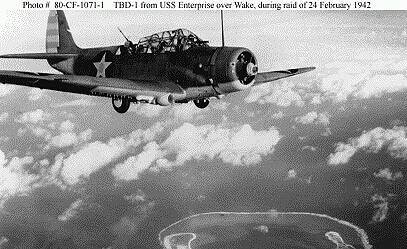
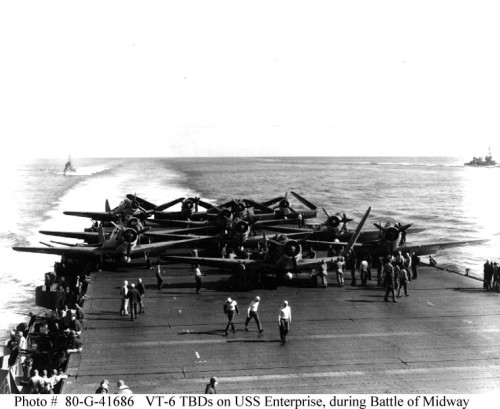
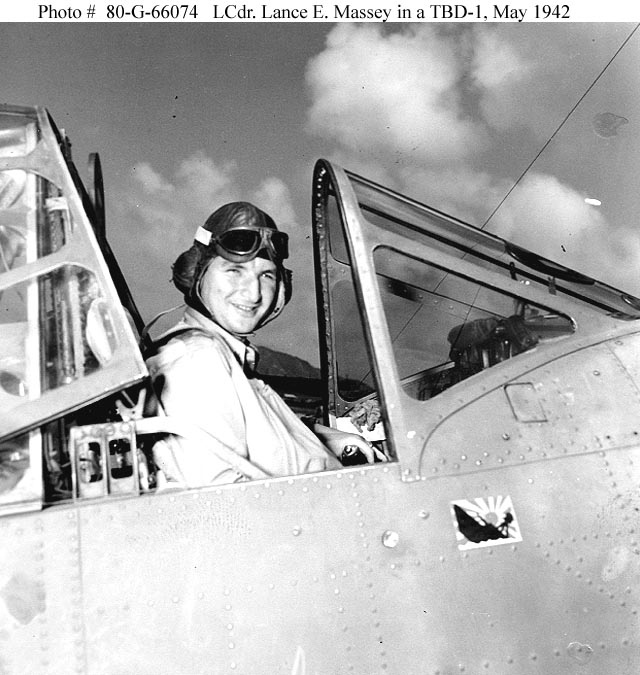
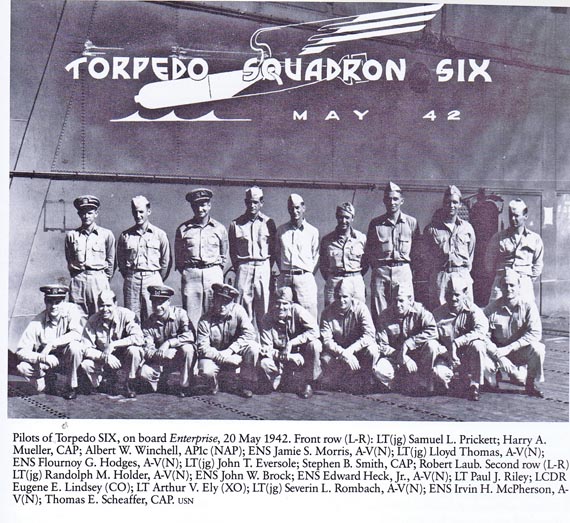
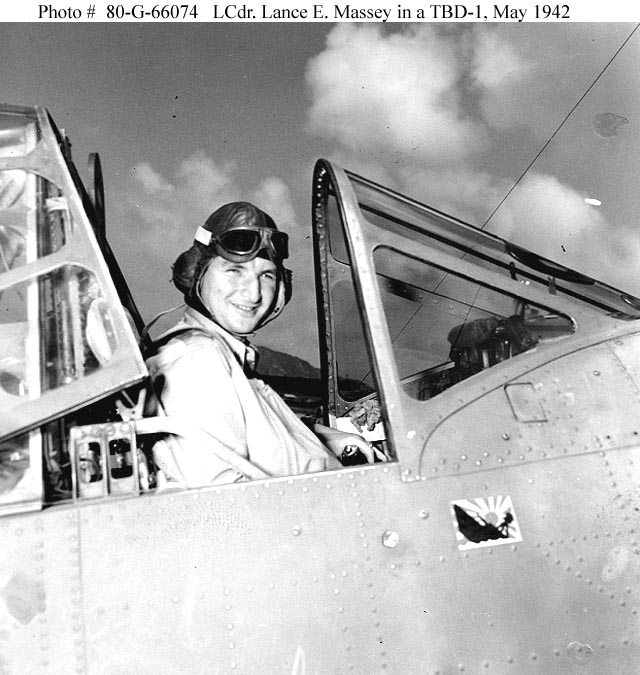
They were not six hundred and they were not mounted on horses but the Naval Aviators of Torpedo Squadrons Three, Six and Eight and their aerial steeds 42 Douglas TBD Devastators and 6 TBF Avengers wrote a chapter of courage and sacrifice seldom equaled in the history of Naval Aviation. Commanded by veteran Naval Aviators, LCDR Lance “Lem” Massey, LCDR Eugene Lindsey and LCDR John Waldron the squadrons embarked aboard the carriers flew the obsolete TBD Devastators and the young pilots of the Midway based Torpedo 8 detachment under the command of LT Langdon Fieberling flew in the new TBF Avengers.eneterprise-vt-6-midway1

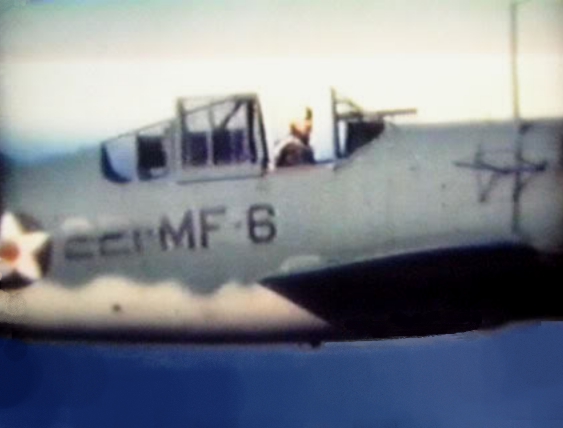
When it entered service in 1937 the TBD was the most modern naval aircraft in the world when   It was a revolutionary aircraft. It was the first monoplane widely used on carriers and was first all-metal naval aircraft.  It was the first naval aircraft with a totally enclosed cockpit, the first with hydraulic powered folding wings.  The TBD had crew of three and had a maximum speed of 206 miles an hour and carried a torpedo or up to 1500 pounds of bombs (3 x 500) or a 1000 pound bomb.

g66074

LCDR Lem Massey Commanding Officer of Torpedo 3

A total of 129 Devastators were built and served in all pre-war torpedo bombing squadrons based aboard the Lexington, Saratoga, Ranger, Yorktown, Enterprise and Hornet, while a limited number embarked aboard Wasp.  The Devastator saw extensive service prior to the war which pushed many airframes to the end of their useful service life.  When war began only about 100 remained operational. By then the TBDs were for all purposes obsolete.They were too slow, had poor maneuverability, insufficient armor and defensive armament.

They were still in service in 1942 as their replacement the TBF Avenger was not available for service in large enough numbers to replace them before Midway.  The TBDs of Torpedo Two and Torpedo Five based on the Lexington and Yorktown performed adequately against minor opposition in strikes against the Marshall Islands, and contributed to the sinking of the Japanese Light Carrier Shoho at the Battle of Coral Sea..

However in the Battle of Midway the squadrons embarked on Yorktown, Torpedo Three which had previously been assigned to Saratoga which was undergoing repair, Torpedo Six of Enterprise, and Torpedo Eight of Hornet were annihilated with only 6 of 41 aircraft surviving their uncoordinated attacks against the Japanese Carrier Strike Force.

enterprise-tbd-landing1

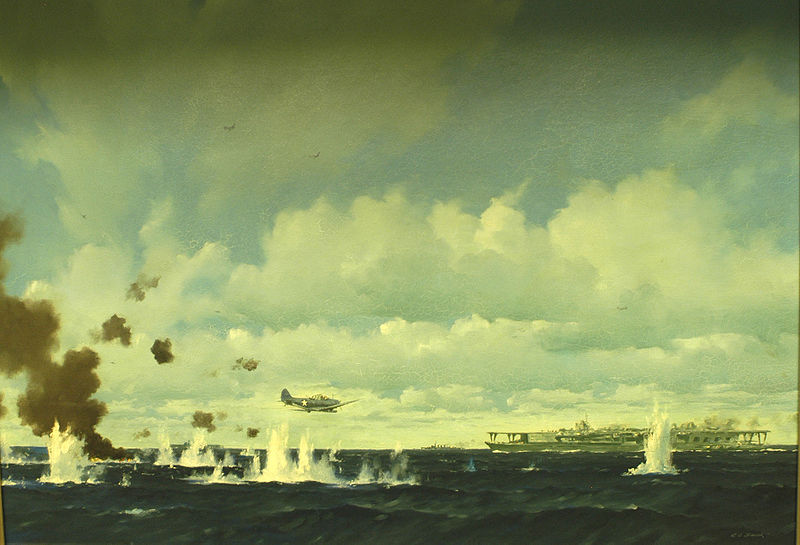
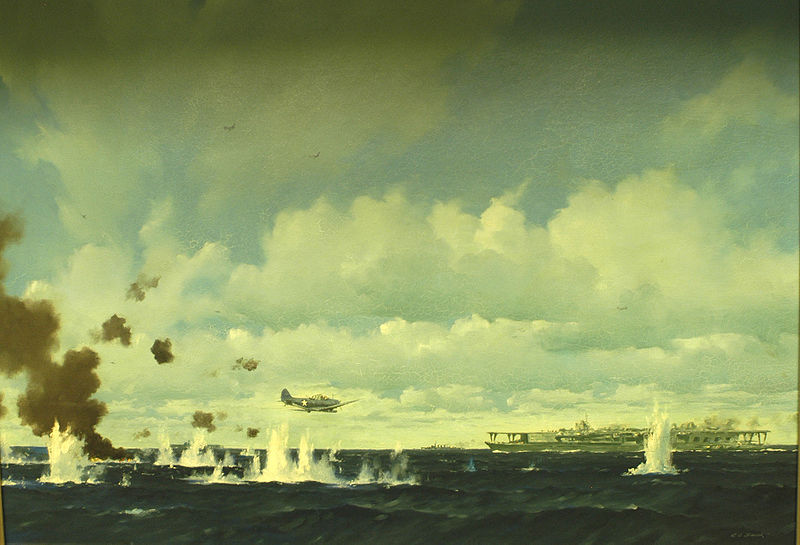
When the Japanese were discovered the American carriers launched a massive strike agains the Japanese carriers. Unfortunately the attacking squadrons became separated from each other and the torpedo bombers arrived before the dive bombers and without fighter escort. Over the course of an hour and ten minutes the three squadrons attacked independently of each other.  Lacking coordination and with inadequate escort, the lumbering aircraft were easy prey for the modern Japanese A6M Zeroes.

The Zeroes of Japanese Combat Air Patrol ripped into the slow, cumbersome and under armed Devastators as they came in low and slow to launch their torpedoes.  Torpedo Eight from Hornet under the command of LCDR John C Waldron pressed the attack hard but all 15 of aircraft were shot down.  Only Ensign George Gay’s aircraft was able to launch its torpedo before being shot down and Gay would be the sole survivor of the squadron. From his observation point hiding under floating wreckage Gay would see the dive bombers get revenge and would be rescued later by a PBY Catalina patrol plane.

Page500_163_6

LCDR John Waldron Commanding Officer of Torpedo Eight

Torpedo Six from the Enterprise under the command of LCDR Eugene Lindsey suffered heavy casualties too. It lost 10 of 14 aircraft with Lindsey being one of the casualties.  The last group of Devastators to attack was Torpedo Three from the Yorktown under the command of LCDR Lem Massey losing 11 of 13 aircraft with Massey a casualty last being seen standing on the wing of his burning aircraft as it went down.

VT-6

These aircraft were also decimated and Massey killed but they had drawn the Japanese Combat Air Patrol down to the deck leaving the task force exposed to the Dive Bombers of the Enterprise and Yorktown.  The six aircraft of the Torpedo Eight detachment from Midway under the command of LT Fieberling lost 5 of their 6 aircraft while pressing their attacks.  Only Ensign Bert Earnest and his aircraft survived the battle landing in a badly damaged state on Midway.  Four U.S. Army B-26 Marauder Medium Bombers were pressed into service as torpedo bombers of which 2 were lost.  No torpedo bomber scored a hit on the Japanese Task force even those torpedoes launched at close range failed to score and it is believe that this was in large part due to the poor performance of the Mark 13 aircraft torpedoes.

yorktown-devastators1


Despite the enormous losses of the torpedo squadrons their sacrifice was not in vain. Their attacks served to confuse the Japanese command and delay the rearmament of aircraft following the Japanese strikes on Midway. They also took the Japanese Combat Air Patrol down to sea level and opened the way for American Dive Bombers to strike the Japanese with impunity fatally damaging the Akagi, Kaga and Soryu in the space of 5 minutes.

After Midway the remaining TBDs were withdrawn from active service and no example survives today. The TBF became the most effective torpedo bomber of the war.

800px-tbd_attacking_at_midway_painting-1

As we remember the brave men that fought at Midway it is imperative that we remember the brave aircrews of the torpedo squadrons that like the Light Brigade rode into the Valley of the Shadow of Death against the First Carrier Strike Force and Midway.

Peace

Padre Steve+

3 Comments

Filed under aircraft, History, leadership, Navy Ships, US Navy, World War II at Sea, world war two in the pacific

Marine Aviators at Guadalcanal: The Sacrifice of VMF-221 and VMSB-241


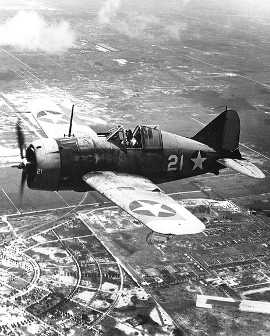
A Brewster Buffalo of VMF-221 

Friends of Padre Steve’s World,

Today on June 5th I am posting several articles on the Battle of Midway which was fought between June 4th and June 6th 1942. It was the turning point of the World War Two in the Pacific.

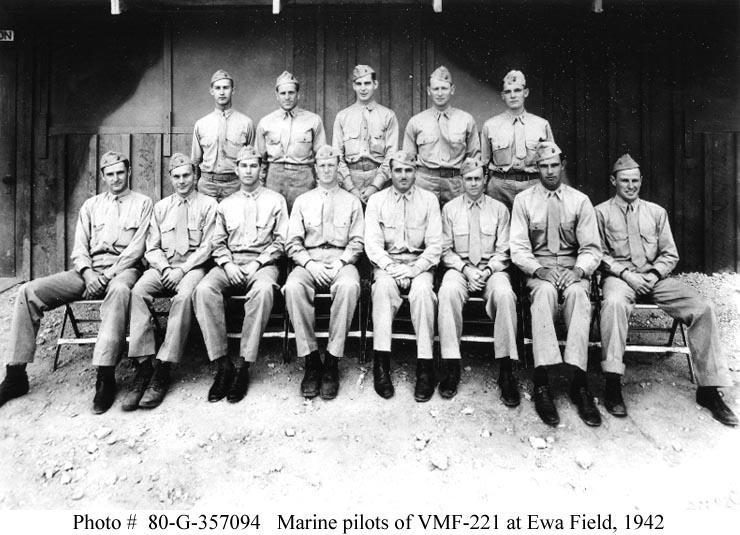
One of the more overlooked aspects of the Battle of Midway are the sacrifices of Marine Fighter Squadron VMF-221 on the morning of June 4th 1942 and Marine Bombing Squadron VMSB-241 that morning and on June 5th.

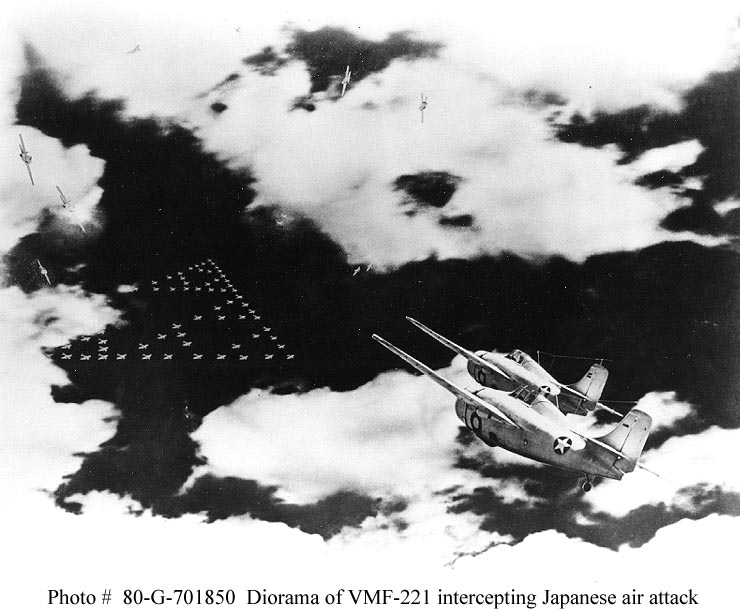
The Marine aviators of VMF-221 flew a mixture of 21 obsolescent Brewster F2A-3 Buffalos and 7 newer Grumman F4F-3 Wildcats. On the morning of June 4th they engaged a vastly superior force of Japanese Navy aircraft as the Japanese squadrons vectored toward Midway and its air station to begin softening it up for the planned invasion.

Led by Major Floyd Parks the squadron had arrived at Midway on Christmas day 1941 being delivered by the USS Saratoga after the aborted attempt to relieve Wake Island.  The squadron along with Marine Scout Bombing Squadron 241 (VMSB 241) formed Marine Air Group 22. The squadron that Parks brought with him was comprised of just 14 aircraft, all F2A-3’s. The squadron was augmented by 7 more F2A-3s and 7 of the more advanced F4F-3 Wildcats before the battle. The fighter pilots of VMF-221 scored their first victory of the war shooting down a Japanese Kawanishi H8K2 “Emily” flying boat.

F2F-3 Brewster Buffalo 

When the Japanese First Carrier Striking Group was spotted in the wee hours of June 4th the Marines and other Navy and Army Air Force aircrews aboard Midway scrambled to meet them.  The 18 SBD-2 Dauntless’ and 12 Vought SB2-U3 Vindicator dive bombers of VMSB-241 along with the 6 new TBF Avengers belonging to Torpedo Squadron Eight, 4 Army Air Corps B-26 Marauders and 15 B-17 Flying Fortresses flew out to attack the Japanese carriers.  Meanwhile the fighters of VMF-221 rose to intercept the 108 Japanese aircraft heading toward Midway. The 72 strike aircraft, 36 Aichi 99 Val Dive Bombers and 36 Nakajima B5N Torpedo/ High Level Bombers were protected by 36 AM6-2 Zeros. The Japanese Zeros thoroughly outclassed their Marine opponents in speed, maneuverability and in the combat experience of their pilots.

The Marines audaciously attacked the far superior Japanese force, throwing themselves against the Japanese phalanx with unmatched courage.  Despite their courage the Marine fighters were decimated by the Japanese Zeros.  The Marines shot down 4 Val dive bombers and at least three Zeros but lost 13 Buffalos and 3 Wildcats during the battle.  Of the surviving aircraft only three Buffalos and three Wildcats were in commission at the end of the day. Among the casualties killed was Major Parks.  Of the surviving pilots of VMF-221, two became “Aces” during the war. Lieutenant Charles M. Kunz would later fly in VMF-224, adding six victories to end the war with 8 victories. Capt. Marion E. Carl would later fly in VMF-223 and was credited with 18.5 Japanese aircraft shot down.  Other pilots like Second Lieutenant Clayton M. Canfield shot down two additional aircraft while flying with VMF-223, while Second Lieutenant Walter W. Swansberger won the Medal of Honor at Guadalcanal.

The last remaining Marine fighter pilot of VMF-221 from the battle of Midway, Williams Brooks died in January 2010 and was buried with full military honors in Bellview , Nebraska.  Brooks in his after action report described his part in the battle:

I was pilot of F2A-3, Bureau number 01523, Our division under Capt. Armistead was on standby duty at he end of the runway on the morning of June 4, 1942, from 0415 until 0615. At about 0600, the alarm sounded and we took off. My division climbed rapidly, and I was having a hard time keeping up. I discovered afterwards that although my wheels indicator and hydraulic pressure indicator both registered “wheels up”, they were in reality about 1/3 of the way down. We sighted the enemy at about 14,000 feet, I would say that there were 40 to 50 planes. At this time Lt. Sandoval was also dropping back. My radio was at this time putting out no volume, so I could not get the message from Zed. At 17,000 feet, Capt. Armistead led the attack followed closely by Capt. Humberd. They went down the left of the Vee , leaving two planes burning. Lt. Sandoval went down the right side of the formation and I followed. One of us got a plane from the right side of the Vee. At this time, I had completely lost sight of my division. As I started to pull up for another run on the bombers, I was attacked by two fighters. Because my wheels being jammed 1/3 way down, I could not out dive these planes, but managed to dodge them and fire a burst or so into them as they went past me and as I headed for the water. As I circled the island, the anti-aircraft fire drove them away. My tabs, instruments and cockpit were shot up to quite an extent at this time and I was intending to come in for a landing. 

It was at this time that I noticed that a important feature in their fighting. I saw two planes dog-fighting over in the east, and decided to go help my friend if at all possible. My plane was working very poorly, and my climb was slow. As I neared the fight both planes turned on me. It was then that I realized I had been tricked in a sham battle put on by two Japs and I failed to recognize this because of the sun in my eyes. Then I say I was out-numbered, I turned and made a fast retreat for the island, collecting a goodly number of bullets on the way. After one of these planes had been shaken, I managed to get a good burst into another as we passed head-on when I turned into him. I don’t believe this ship could have gotten back to his carrier, because he immediately turned away and started north and down. I again decided to land, but as I circled the island I saw two Japs on a Brewster. Three of my guns were jammed, but I cut across the island, firing as I went with one gun. But I could not get there in time to help the American flier and as soon as the Brewster had gone into the water I came in for a landing at approximately 0715 (estimated). 

VMF-221 was composed of the following aircraft and pilots.

FIRST DIVISION (F2A-3)

Plane # Bu.No.  Pilot                                                               Status

MF-1     01518    Maj. Floyd B. Parks USMC                          MIA

MF-2     01548    2nd Lt. Eugene P. Madole USMCR            MIA

MF-3     01525    Capt. John R. Alvord USMC                        MIA

MF-4     01537    2nd Lt. John M. Butler USMCR                   MIA

MF-5     01569    2nd Lt. David W. Pinkerton Jr. USMCR      MIA

MF-6     01552    2nd Lt. Charles S. Hughes USMCR, Did not engage, turned back due to Engine problems


SECOND DIVISION (F2A-3)

Plane # Bu.No.  Pilot                                                                 Status

MF-7     01552    Capt. Daniel J. Hennessey USMC              MIA

MF-8     01541    2nd Lt. Ellwood Q. Lindsay USMCR                 MIA

MF-9     01524    Capt. Herbert T. Merrill USMC                   Bailed out WIA

MF-10   01528    Capt. Herbert T. Merrill USMC            MIA

MF-11   01568    Capt. Phillip R. White USMC                       Survived

MF-12   01542    2nd Lt. John D. Lucas USMCR                      MIA


THIRD DIVISION (F2A-3)

Plane#  Bu.No.  Pilot                                                               Status

MF-13   01562    Capt. Kirk Armistead USMC                      Survived

MF-14   01563    2nd Lt. William B. Sandoval USMCR         MIA

MF-15   01553    Capt. William C. Humberd USMC            Survived

MF-16   01523    2nd Lt. Williams V. Brooks USMCR           WIA

MF-17   01521    2nd Lt. Charles M .Kunz USMCR               WIA

MF-18   01559    2nd Lt. Martin E. Mahannah USMC           KIA (his body washed up later)

23 (F4F-3) 3989  2nd Lt. Walter W. Swansberger USMCR   Survived


FOURTH DIVISION (F2A-3)

Plane # Bu.No.  Pilot                                                                Status

MF-19   01520    Capt. Robert E. Curtin USMC                     MIA

MF-20   01550    2nd Lt. Darrell D. Irwin USMCR                       Survived


FIFTH DIVISION (F4F-3)


Plane # Bu.No.  Pilot                                                                Status

22           4008       Capt. John F. Carey USMC                          WIA

24           4000       Capt. Marion E. Carl USMC                         Survived

25           3997       2Lt. Clayton M. Canfield USMCR                Survived

26           4006       Capt. Francis P. McCarthy USMC               MIA

27           2532       2nd Lt. Roy A. Corry USMC                              Survived

28           1864       2nd Lt.Hyde Phillips USMCR                            Did not engage, mechanical problems

As for VMF-221 it was re-equipped with the F4F-4 and later with the F4U Corsair during the course of two more deployments overseas.  VMF-221 finished the war with a score of 155 victories, 21 damaged and 16 probable kills, the second highest total of any Marine Corps Squadron during the war.

SB2-U2 Vindicator of VMSB 241 at Midway

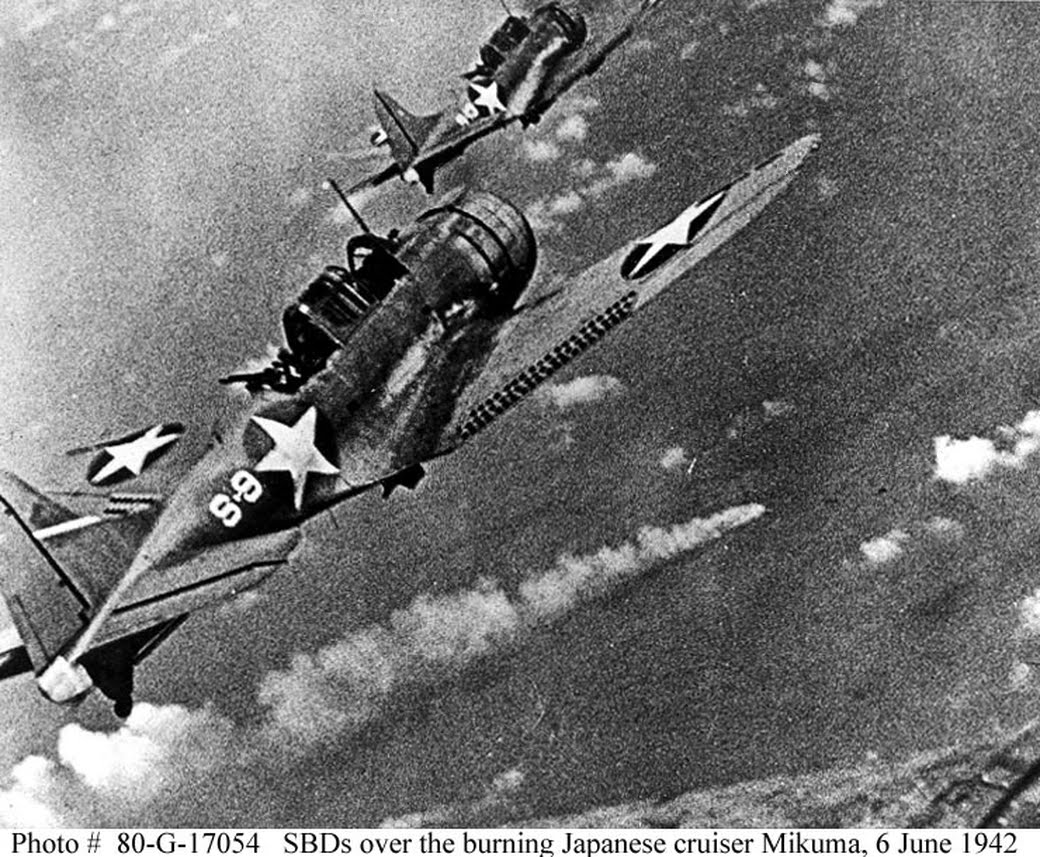
Their bomber counterparts of VMSB 241 attacked the Japanese task force on the morning of June 4th and scored no hits while losing 8 aircraft. The survivors were again in action later in the day as well as the following day where they helped sink the Japanese Heavy Cruiser Mikuma with with Captain Richard Fleming diving his mortally wounded Vindicator into the cruiser’s number four 8” gun turret.

The Mikuma Sinking after being bombed by Marine and Navy Dive Bombers – the wreck of Major Henderson’s Vindicator is atop the number four turret 

While the Marines’ actions are not as well known or as successful as those of their Navy counterparts they were brave.  The inexperienced Marine fighter pilots had to engage some of the most experienced pilots flying superior machines. The bomber crews had little to no experience before being thrown into combat. As we remember the sacrifices made by the men of Midway let us not forget the gallant men of VMF-221 and VSMB-241.

Peace

Padre Steve+

Leave a comment

Filed under History, leadership, US Army Air Corps, US Marine Corps, World War II at Sea, world war two in the pacific

Station Hypo: Joe Rocheford and the Codebreakers of Midway

rochefort

Friends of Padre Steve’s World,

This week many people, especially those in the Navy, will be remembering the Battle of Midway on its 76th anniversary. This is as minor rewrite of a prior post about the unseen heroes whose hard work gave the United States a key advantage that helped pave the way to victory.

The victory at Midway would not have happened without the exceptional intelligence gathering and code breaking by the cryptologists of Combat Intelligence Unit – Station Hypo – at Pearl Harbor under the command of Commander Joseph Rochefort. He and his small yet skillful team cracked the Japanese Naval code in time for Admiral Chester Nimitz to make the correct decision as to where to send his tiny carrier task forces to oppose the massive Japanese Combined Fleet under the Command of Isoroku Yamamoto.

Rochefort’s efforts were opposed by the key officers in the Office of Naval Intelligence who refused to believe that Midway was the target of the Japanese force. In spite of this opposition Nimitz was highly confident of Rochefort’s analysis and when all was said and done the U.S. Navy had defeated the Japanese, sinking four of the carriers that had attacked Pearl Harbor as well as a heavy cruiser, ripping the heart out of Japan’s premier naval striking force.

Historian Walter Lord wrote:

“Against overwhelming odds, with the most meager resources, and often at fearful self-sacrifice, a few determined men reversed the course of the war in the Pacific. Japan would never again take the offensive. Yet the margin was thin—so narrow that almost any man there could say with pride that he personally helped turn the tide at Midway. It was indeed, as General Marshall said in Washington, “the closest squeak and the greatest victory.”

One of those men was Joseph Rochefort. Admiral Nimitz credited Rochefort for breaking the codes and setting the stage for the victory, and recommended him for the Distinguished Service Medal, however, Rochefort’s rivals in Washington D.C. ensured that the award was turned down in order to claim the success for them. Shortly after Midway, Rochefort was reassigned to command a floating dry dock in San Francisco by the Department of the Navy as a way to punish him, and effectively ending his career. Rochefort retired as a Captain after the war, his contribution to the victory at Midway unrecognized by the Navy. Admiral Nimitz again recommended him for the award of the Distinguished Service Medal in 1958 and again it was turned down, but his supports continued to work to right the injustice.

In 1983 Rear Admiral Donald Showers who had worked for Rochefort in 1942 again recommended the award to Secretary of the Navy John Lehman who approved it. Unfortunately Rochefort was no longer alive to receive it, he had died in 1976. Today his service to the Navy and nation is remembered with the annual Captain Joseph Rochefort Information Warfare (IW) Officer Distinguished Leadership Award which is awarded to annually recognize the superior career achievement of one IW officer for leadership, teamwork, operational contributions and adherence to the principle by which he served, “We can accomplish anything provided no one cares who gets the credit.”

Have a great day and please don’t forget men and women who embody the spirit of Joseph Rochefort, it is a rare commodity.

Peace

Padre Steve+

3 Comments

Filed under History, leadership, US Navy, World War II at Sea, world war two in the pacific

“A Magic Blend of Skill, Faith, and Valor” The Battle of Midway

Battle%20of%20Midway%20flat_080817160843

Friends of Padre Steve’s World,

Today we remember the Battle of Midway, the turning point of World War Two in the Pacific. By all empirical means the vastly superior Japanese fleet should have defeated the Americans, but success in war is not based on material alone. There are things unaccounted for, things that happen in the confusion of battle that The Prussian military theorist Carl von Clausewitz wrote.

“War is the province of chance. In no other sphere of human activity must such a margin be left for this intruder. It increases the uncertainty of every circumstance and deranges the course of events.” 

Six months after Pearl Harbor the United States Navy met the Imperial Japanese Navy in battle on the seas and in the airspace around Midway Island. It was a battle between a fleet that had known nothing but victory in the months after Pearl Harbor and one with the exception of a few minor tactical successes was reeling.

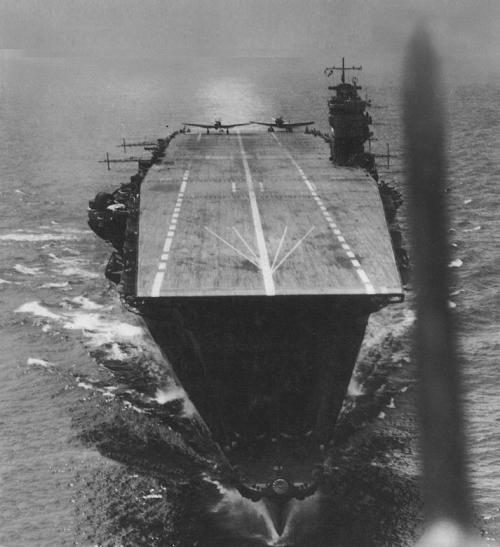
AkagiDeckApril42

Akagi April 1942

The Japanese had swept across the Pacific and the Indian Oceans and decimated every Allied Naval forces that stood in their way. After Pearl Harbor they had sunk the HMS Prince of Wales and HMS Repulse off of Singapore.  Next in a series of engagements destroyed the bulk of the US Asiatic Fleet in the waters around the Philippines and the Dutch East Indies culminating in the Battle of the Java Sea where the bulk of the American, British, Dutch and Australian (ABDA) naval forces engaged were annihilated attempting to fight superior Japanese forces.

Hermes_sinking

HMS Hermes sinking after Japanese Carrier air attack in the Indian Ocean

In the Indian Ocean Admiral Nagumo’s carriers dispatched a force of Royal Navy cruisers and the Aircraft Carrier HMS Hermes. In only one place had a Japanese Naval task force been prevented from achieving its goal. At the Battle of the Coral Sea where Task Force 11 and Task Force 17 centered on the Carriers USS Lexington and USS Yorktown prevented a Japanese invasion force from taking Port Moresby sinking the light carrier Shoho, damaging the modern carrier Shokaku and decimating the air groups of the Japanese task force.

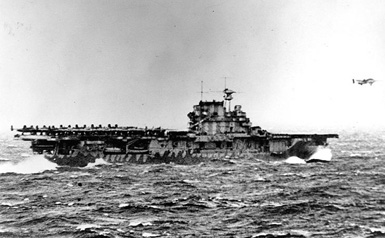
Hornet_launches

USS Hornet launching B-25 Bombers during the Doolittle Raid

In May US Navy code breakers under the direction of Commander Joe Rochefort at Pearl Harbor discovered the next move of the Imperial Navy an attack on Midway Island and the Aleutian islands. Since the occupation of Midway by Japanese forces would give them an operational base less than 1000 miles from Pearl Harbor Admiral Chester Nimitz committed the bulk of his naval power, the carriers USS Enterprise CV-6USS Yorktown CV-5 and USS Hornet CV-8 and their 8 escorting cruisers and 15 destroyers, a total of 26 ships with 233 aircraft embarked to defend Midway. Nimitz also sent a force of 5 cruisers and 4 destroyers to cover the Aleutians.

images-42

SBU-2 Vindicator Dive Bomber landing on Midway (above) PBY Catalina (below)images-43

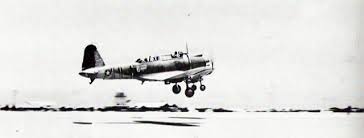
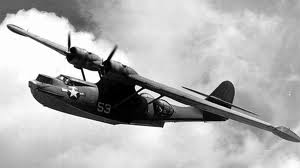
Land based air assets on Midway were composed of a mixed Marine, Navy and Army air group of 115 aircraft, many of which were obsolete. Aboard Midway there were 32 US Navy PBY Catalina Flying Boats, 83 fighters, dive bombers, torpedo planes and Army Air Force bombers piloted by a host of inexperienced pilots.

Nimitz’s instructions to his Task Force Commanders was simple “You will be governed by the principle of calculated risk, which you shall interpret to mean the avoidance of exposure of your force to attack by superior enemy forces without good prospect of inflicting … greater damage on the enemy.”

893594c746

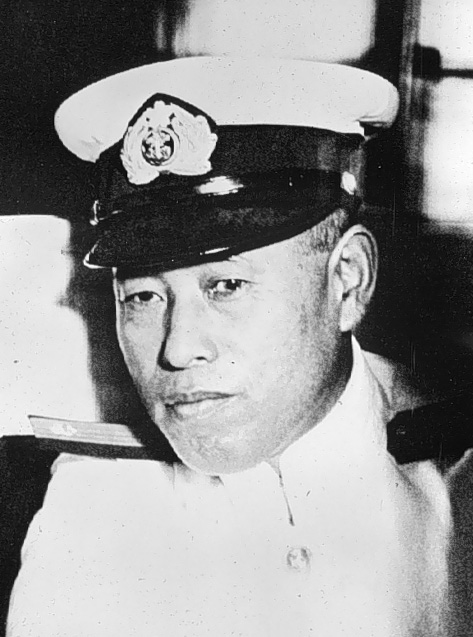
Admiral Isoroku Yamamoto commanded the Combined Fleet. The victor of Pearl Harbor and the triumph’s in the first six months of the Pacific War was determined to end the war with a decisive battle at Midway. His plans were opposed by many in the Imperial General Staff, especially those in the Army but when the US raid on Tokyo, the Doolittle Raid, all opposition to the attack was dropped.

10-japanese-carriers-coral-sea-midway

The Japanese sent a force of 7 battleships and 7 carriers against Midway. These included the elite First Carrier Striking Group composed of the Pearl Harbor attackers Akagi, Kaga, Soryu and Hiryu and their highly trained and combat experienced air groups. Among the surface ships was Yamamoto’s flagship, the mighty Battleship Yamato, at 72,000 tons and armed with 9 18” guns, the most powerful and largest battleship ever to see combat.

The strike force included 273 aircraft and was escorted by 14 cruisers and 39 destroyers. They were to take Midway and then destroy the US Navy when it came out to fight. Yamamoto sent a force force of 4 battleships, 12 destroyers assigned screen to the Aleutian invasion force which was accompanied by 2 carriers 6 cruisers and 10 destroyers. The other carriers embarked a further 114 aircraft.

Despite this great preponderance in numbers Yamamoto’s plan was complex and his forces too far apart from each other to offer support should and get into trouble. The powerful Japanese Task forces were scattered over thousands of square miles of the Northern Pacific Ocean where they could not rapidly come to the assistance of any other group.

images-44

With the foreknowledge provided by the code breakers the US forces hurried to an intercept position northeast of Midway eluding the Japanese submarine scout line which the Japanese Commander Admiral Yamamoto presumed would find them when they sailed to respond to the Japanese attack on Midway.  Task Force 16 with the Enterprise and Hornet sailed first under the command of Rear Admiral Raymond A Spruance and Task Force 17 under Rear Admiral Frank “Jack” Fletcher with the Yorktown which had been miraculously brought into fighting condition after suffering heavy damage at Coral Sea. Fletcher assumed overall command by virtue of seniority and Admiral Nimitz instructed his commanders to apply the principle of calculated risk when engaging the Japanese as the loss of the US carriers would place the entire Pacific at the mercy of the Japanese Navy.

On June 3rd a PBY Catalina discovered the Japanese invasion force and US long range bombers launched attacks against it causing no damage. The morning of the 4th the Americans adjusted their search patterns in and the Japanese came into range of Midway and commenced their first strike against the island.

g17056

In response land based aircraft from Midway attacked the Japanese carrier force taking heavy casualties and failing to damage the Japanese task force. The American Carrier task forces launched their strike groups at the Japanese fleet leaving enough aircraft behind of the Combat Air Patrol and Anti-submarine patrol.  As the Americans winged toward the Japanese fleet the Japanese were in a state of confusion. The confusion was caused when a scout plane from the Heavy Cruiser Tone that had been delayed at launch discovered US ships but did not identify a carrier among them until later into the patrol. The carrier  was the Yorktown and TF 17, but for Nagumo who first expected no American naval forces, then received a report of surface ships without a carrier followed by the report of a carrier the reports were unsettling.

a5f7ab19-17c6-4928-90a4-5bb913d156eb

Aichi D3-A “Val” Dive Bomber 

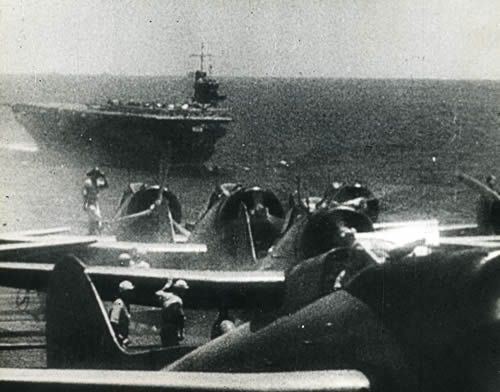
Orders and counter-orders were issued as the Japanese attempted to recover their strike aircraft and prepare for a second strike on the island and then on discovery of the Yorktown task force, orders changed and air crews unloaded ground attack ordnance in favor of aerial torpedoes and armor piercing bombs. The hard working Japanese aircrew did not have time to stow the ordnance removed from the aircraft but by 1020 they had the Japanese strike group ready to launch against the US carriers.

g701850

As the Japanese crews worked the Japanese carriers were engaged in fending off attacks by the US torpedo bomber squadrons, VT-6 from Enterprise, VT-8 from Hornet and VT-3 from Yorktown. The Japanese Combat Air Patrol ripped into the slow, cumbersome and under armed TBD Devastators as they came in low to launch their torpedoes.  Torpedo Eight from Hornet under the command of LCDR John C Waldron pressed the attack hard but all 15 of the Devastators were shot down. Only Ensign George Gay’s aircraft was able to launch its torpedo before being shot down and Gay would be the sole survivor of the squadron.

g66074

LCDR Lance Massey CO of VT-3

Page500_163_6

LCDR John Waldron CO of VT-8

220px-Eugene_Lindsey;h84903

LCDR Eugene Lindsey CO of VT-6

Torpedo 6 from Enterprise under the command of LCDR Eugene Lindsey suffered heavy casualties losing 10 of 14 aircraft with Lindsey being one of the casualties.  The last group of Devastators to attack was Torpedo 3 from Yorktown under the command of LCDR Lem Massey from the Yorktown. These aircraft were also decimated and Massey killed but they had drawn the Japanese Combat Air Patrol down to the deck leaving the task force exposed to the Dive Bombers of the Enterprise and Yorktown.

800px-tbd_attacking_at_midway_painting-1

There had been confusion among the Americans as to the exact location of the Japanese Carriers. Bombing 8 and Scouting 8 from Hornet did not find the carriers and had to return for lack of fuel while losing a number of bombers and their fighter escort having to ditch inn the ocean and wait for rescue. The Enterprise group composed of Bombing-6 and Scouting 6 under CDR Wade McClusky was perilously low on fuel when the wake of a Japanese destroyer was spotted.  McClusky followed it to the Japanese Task Force. The Yorktown’sgroup under LCDR Max Leslie arrived about the same time.

Dauntless_dive_bombers

When the American dive bombers arrived over the Japanese Carrier Strike Force they found the skies empty of Japanese aircraft. Below, aboard the Japanese ships there was a sense of exhilaration as each succeeding group of attackers was brought down and with their own aircraft ready to launch and deal a fatal blow to the American carrier wondered how big their victory would be. The war would soon be decided.

midway4

Akagi dodging bombs at Midway

At 1020 the first Zero of the Japanese attack group began rolling down the flight deck of the flagship Akagi, aboard Kaga aircraft were warming up as they were on the Soryu.  The unsuspecting Japanese were finally alerted when lookouts screamed “helldivers.” Wade McClusky’s aircraft lined up over the Akagi and Kaga pushing into their dives at 1022. There was a bit of confusion when the bulk of Scouting 6 joined the attack of Bombing 6 on the Kaga. That unprepared ship was struck by four 1000 pound bombs which exploded on her flight deck and hangar deck igniting the fully fueled and armed aircraft of her strike group and the ordnance littered about the hangar deck.  Massive fires and explosions wracked the ship and in minutes the proud ship was reduced to an infernal hell with fires burning uncontrollably. She was abandoned and would sink at 1925 taking 800 of her crew with her.

douglas-sbd5-dauntless-dive-bomber-battle-of-midway-01

LT Dick Best of Scouting 6 peeled off from the attack on Kaga and shifted to the Japanese flagship Akagi. On board Akagi were two of Japan’s legendary pilots CDR Mitsuo Fuchida leader of and CDR Minoru Genda the architect of the Pearl Harbor attack and subsequent string of Japanese victories. Both officers were on the sick list and had come up from sick bay to watch as the fleet was attacked. Seeing Kaga burst into flames they stood mesmerized until Akagi’slookouts screamed out the warning “helldivers” at 1026.  Best’s few aircraft hit with deadly precision landing two of their bombs on Akagi’s flight deck creating havoc among the loaded aircraft and starting fires and igniting secondary explosions which turned the ship into a witch’s cauldron.  By 1046 Admiral Nagumo and his staff were forced to transfer the flag to the cruiser Nagara as Akagi’s crew tried to bring the flames under control. They would do so into the night until nothing more could be done and abandoned ship at 2000.  Admiral Yamamoto ordered her scuttled and at 0500 on June 5th the pride of the Japanese carrier force was scuttled.

g701870

VB-3 under LCDR Max Leslie from the Yorktown stuck the Soryu with 17 aircraft, however only 13 of the aircraft had bombs due to an electronic arming device malfunction on 4 of the aircraft, including that of Commander Leslie.  Despite this Leslie led the squadron as it dove on the Soryu at 1025 hitting that ship with 3 and maybe as many as 5 bombs. Soryu like her companions burst into flames as the ready aircraft and ordnance exploded about her deck. She was ordered abandoned at 1055 and would sink at 1915 taking 718 of her crew with her.

h73065

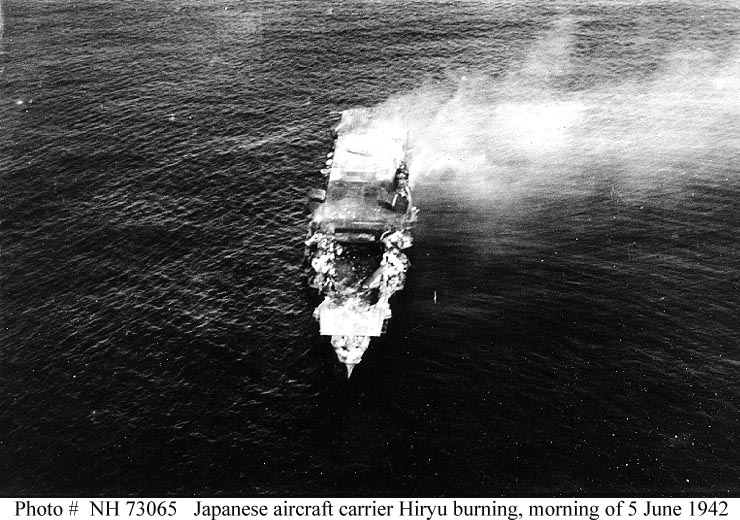
The remaining Japanese flattop the Hiryu attained the same fate later in the day after engaging in an epic duel with the Yorktown which her aircraft heavily damaged. Yorktown would be sunk by the Japanese submarine I-168 while being towed to safety.

71380-004-B4724C34

USS Yorktown under attack from Kate Torpedo Bombers from Hiryu on June 4th 1942

In five pivotal minutes the course of the war in the Pacific was changed. Authors have entitled books about Midway Incredible Victory by Walter Lord and Miracle at Midway by Gordon Prange and those titles reflect the essence of the battle.

At Midway a distinctly smaller force defeated a vastly superior fleet in terms of experience, training and equipment. At the very moment that it appeared to the Japanese that they would advance to victory their vision disappeared. In a span of less than 5 minutes what looked like the certain defeat of the US Navy became one of the most incredible and even miraculous victories in the history of Naval warfare. In those 5 minutes history was changed in a breathtaking way. While the war would drag on and the Japanese still inflict painful losses and defeats on the US Navy in the waters around Guadalcanal the tide had turned and the Japanese lost the initiative in the Pacific never to regain it.

The Japanese government hid the defeat from the Japanese people instead proclaiming a great victory. The American government could not fully publicize the victory for fear of revealing the intelligence that led to the ability of the US Navy to be at the right place at the right time and defeat the Imperial Navy.

uss-enterprise-cv-6-1

USS Enterprise

The American victory at Midway changed the course of the war in the Pacific. The Battle of Midway established the aircraft carrier and the fast carrier task force as the dominant force in naval warfare which some would argue it still remains. Finally those five minutes ushered in an era of US Navy dominance of the high seas which at least as of yet has not ended as the successors to the EnterpriseHornet and Yorktown ply the oceans of the world and the descendants of those valiant carrier air groups ensure air superiority over battlefields around the world.

Walter Lord, whose history of the battle is still the classic presentation of it wrote:

“Even against the greatest of odds, there is something in the human spirit – a magic blend of skill, faith, and valor – that can lift men from certain defeat to incredible victory.” 

Peace

Padre Steve+

1 Comment

Filed under History, leadership, Military, Navy Ships, US Navy, World War II at Sea, world war two in the pacific

“In High Spirits and Full of Confidence” The Eve of Disaster at Midway

Japanese_aircraft_carrier_Akagi_01

The Flagship IJN Akagi

Friends of Padre Steve’s World,

On the night of June 3rd 1942 the Japanese First Carrier Strike Force under the command of Vice Admiral Chuichi Nagumo sailed east toward the tiny Midway Atoll. Midway was the target of an operation designed by Admiral Isoroku Yamamoto to draw out the remnants of the United States Pacific Fleet, destroy them and set the conditions for Japanese victory and the subsequent dominance of the Pacific by the Empire of Japan. It was to be the battle that ended the war. Yamamoto believed that the Japanese had no chance if the war dragged on and that the only chance of victory, it had to be quick and decisive, it had to destroy the aircraft carriers that were the remnant of American seapower in the Pacific, and it had to happen before the industrial might of the United States was fully mobilized. Yet Yamamoto was so confident of victory now that he believed that “the American fleet was a beaten, demoralized outfit that would need to be coaxed to its annihilation.” 

For six months the Japanese Navy and Army had experienced nothing but victory. Nagumo’s carriers had crushed the U.S. Pacific Fleet at Pearl Harbor. Land based Japanese bombers sank the British battleships HMS Prince of Wales and Repulse near Singapore, while another Japanese fleet destroyed a combined American, British, Dutch, and Australia fleet in the Java Sea. Nagumo’s carriers raided British bases and sank British ships in the Indian Ocean, and devastated shipping in the Australian port of Darwin. Other Japanese land, air, and naval forces conquered Hong Kong, Singapore, the Dutch East Indies, Guam, Wake Island, and the Philippines. Yet victory would not be assured until the U.S. Pacific Fleet had been destroyed.

To do that Yamamoto and his staff began to plan a massive operation against the American base on Midway Atoll, just 1100 miles from Pearl Harbor. His plan was to force the remaining American naval forces into a decisive battle in which they would be destroyed by overwhelming Japanese naval and air assets. However his plan was in conflict with plans of the Army and the Naval General Staff. Some wanted to attack westward against India with the goal of linking up with Rommel’s Afrika Korps in the Middle East. Others preferred land offensives against China, or trying to cut maritime supply line from the United States to Australia by striking Samoa and the Fiji Islands.

In the end no agreement was reached and in April 1942 the Japanese were surprised and embarrassed by bombing of Tokyo by Colonel Jimmy Doolittle’s B-25 bombers which had taken off from the USS Hornet. The raid had caused very little damage but Yamamoto was humiliated and pushed for the operation which despite opposition was approved by Japanese leaders.

There were problems in the plan the chief of which was that the Japanese Fleet was divided and deployed in such a way that should there be trouble the main force under Yamamoto could not support the carrier strike force under Nagumo. Evidence and intelligence reports were ignored, the logistics of the operation minimized, recommendations that the carrier force be refitted and new air crews brought fully up to the high standards of December 1941 were disregarded. Further evidence that suggested that aircrews were not tactically proficient based on observed bombing and torpedo exercises similarly ignored. A war game conducted by the Combined Fleet Staff predicted the loss of two carriers but Yamamoto’s Chief of Staff, Admiral Ugaki revered the call of the umpire and  refloated one from the dead carriers by erasing the hits scored by those playing the American side. It was symptomatic of the “victory disease” that would cloud and distort all that the Japanese did between April and June.

Even so the operation continued forward and doubters put aside those doubts mostly due to a profound disrespect of the United States Navy. Admiral Nagumo had seen many of the risks involved in the plan and in the beginning considered it an “impossible and pointless operation.” But that was before the Doolittle Raid on Tokyo, and Nagumo fell in line as Yamamoto successfully lobbied for the operation. Other leaders of the strike on Pearl Harbor including Commander Mitsuo Fuchida could not see the value in attacking Midway.

Chuichi_Nagumo

Vice Admiral Chuichi Nagumo

As the First Carrier strike force closed within 300 miles of Midway on the night of June 3rd 1942 Nagumo and his staff prepared for the battle that they and many others believed would be the decisive battle. Aircraft received their final preparations, bombs were loaded and as night faded into early morning air crew arose, ate their breakfast and went to their aircraft.

The ships had been observing radio silence since they departed their bases and anchorages in Japan the previous week. Honed to a fine edge the crews of the ships and the veteran aircrews anticipated victory.

The crews of the ships of the task force and the air groups embarked on the great aircraft carriers Akagi, Kaga, Soryu and Hiryu as well as their escorts were confident. They had since the war began known nothing but victory. They had devastated the Pacific Fleet at Pearl Harbor and roamed far and wide raiding allied targets and sinking allied shipping across the Pacific and deep into the Indian Ocean. Commander Magotaro Koga of the destroyer Nowaki wrote in his diary “Our hearts burn with the conviction of sure victory.”

However, Nagumo and his sailors had no idea that most of what they knew about their American opponents was wrong, just as Yamamoto had no idea that American code breakers had broken the Japanese Naval codes and determined that the Japanese were going to attack Midway.

893594c746

Admiral Isoroku Yamamoto 

The Japanese were confident that the Americans could field no more than two operational carriers. However, the Yorktown, which the Japanese believed had been sunk at Coral Sea had been repaired, She was fully operational the air group from the damaged USS Saratoga replaced her air group and Yorktown with Task Force 17 rushed to join the EnterpriseHornet and Task Force 16 northeast of Midway.

An operation designed to get aerial surveillance of US Fleet dispositions at Pearl Harbor had been cancelled because the atoll at French Frigate Shoals that the Japanese flying boats would operate from was occupied by a small US force. Likewise the line of Japanese submarines arrived on station a day late, after the US carrier task forces had passed by. Those aboard the First Carrier Strike Force, including Nagumo or his senior commanders and staff had no idea that the Americans not only knew of their approach but were already deployed in anticipation of their strike.

Within a day all of the Japanese carriers would be sunk or sinking. Thousands of Japanese sailors would be dead and the vaunted air groups which had wreaked havoc on the Allies would be decimated, every aircraft lost and the majority of pilots and aircrew dead. It would be a most unexpected and devastating defeat stolen out of the hands of what appeared to be certain victory.

In the next couple of days I will write some articles on Midway and republish older articles on this site. The fact of the matter is that like Yamamoto and the Japanese that many military leaders, including those of the United States make assumptions about campaigns and battles that turn out to be wrong. Wars are often expected to be short, decisive and glorious but many times end up long, indecisive and agonizing. History has shown that to be the case for the United States in every fight it has been engaged since the Second World War, even when we win every pitched battle.

I think that there is a lesson to be learned from the Japanese who sailed into the night on June 3rd 1942 and saw the sunrise of June 4th. There is no battle, campaign or war that goes according to plan. Thousands of Japanese sailors and airmen went to bed on the night of the 3rd expecting that the following night, or within the next few days they would be celebrating a decisive victory. Thousands of them would be dead by the night of the 4th of June and the ambitions of the Empire of Japan to defeat the United States Navy and end the war would be dealt a decisive defeat from which they would never recover.

IJN_Akagi_World_War_II_Aircraft_Carrier_hit_by_Douglas_SBD_Dauntless_Dive_Bomber_at_Midway-1

The Japanese had known nothing but victory and on the night of June 3rd 1942 they expected nothing more than a glorious victory. However the wisdom of the Romans was proved right yet again,“Sic transit Gloria mundi,” (“Thus passes the glory of the world”,) or as it is more commonly paraphrased “all glory is fleeting.”

Peace

Padre Steve+

3 Comments

Filed under History, leadership, Military, World War II at Sea, world war two in the pacific

Anniversaries of Watershed Events: Midway, D-Day, and the Assassination of Robert F Kennedy


D-Day, June 6th 1944

Friends of Padre Steve’s World,

I am posting a small thought to begin the weekend. For those that do not know, the next several days are full of the anniversaries many events

On June 3rd 1940, the British finished the evacuation of the British Expeditionary Force and some French forces from Europe at Dunkirk, though defeated, the British action preserved the British Army and kept Britain in the war.


Midway 

From June 4th through June 6th 1942 a small American fleet defeated a much larger, more experienced and better equipped fleet at the Battle of Midway. The battle did not end the war, but it ensured that Japan never could win the war against the United States in the Pacific. It was a turning point. It has rightly been called an “Incredible Victory” as all the elements that make war what it is, the element of chance, the element of friction, and the  element of surprise all broke the American way. The Japanese leaders, and for that matter many if not the vast majority of their soldiers and sailors were full of hubris, believing themselves invincible they were decisively defeated.

Two Years later on June 6th 1944, Allied forces landed on the Normandy Peninsula of France to begin their long awaited attack on Nazi occupied Europe. The invasion, code named Operation Overlord did not end the war, but coupled with the Soviet offensive against the German Army Group Center which began just two weeks later, Operation Bagration, it was the beginning of the end for Hitler’s Germany.

Twenty-six years earlier U.S. Marines and Army soldiers turned back the Germans at the Battle of Belleau Wood near Chateau-Thierry France. The effort blocked a German drive on Paris, giving the Allies the time to begin a counter-offensive that would end the war.


Senator Robert F. Kennedy lays Mortally Wounded after being shot by Sirhan Sirhan 

But in addition to the battles other important events shook the world, in 1919 the Congress passed the 19th Amendment, which when ratified gave women the right to vote. In 1968, Senator Robert F. Kennedy was gunned down by the assassin Sirhan Sirhan in Los Angeles after winning the Democratic Party primary. He would have been the odds on favorite to defeat Republican Richard Nixon in the general election. On June 8th 1789 James Madison introduced twelve amendments to the U. S. Constitution, of which ten were ratified by the states to become known as the Bill of Rights. On June 8th 1967, the USS Liberty, a surveillance ship, was attacked by Israeli ships and aircraft during the Six Day Warthe attack resulted in the death of 34 American sailors and the wounding of 171 more.

Of course there are numerous other events that took place at different times on these days, some which were very important, and others which are interesting but less important in terms of their historical impact. I’ll be writing about some of these events in the coming days.

Have a great day,

Peace

Padre Steve+
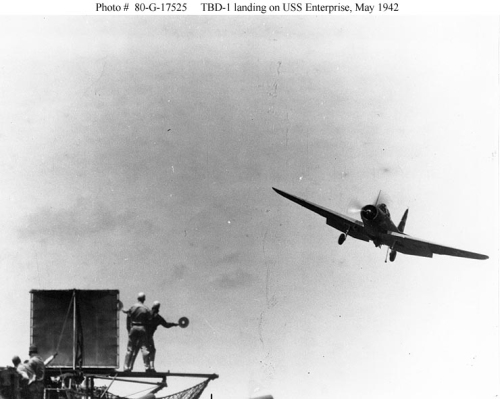
1 Comment

Filed under History, Military, World War II at Sea, world war two in europe, world war two in the pacific

Requiem for Yamato…

Friends of Padre Steve’s World,

Those who have read my site since the beginning know that I have written much in terms of Naval History. One of the things that I am drawn to are the great ships that were sacrificed with the crews in futile attempts of salvage victory from defeat, or which were sacrificed in order to save others. Regardless of the circumstance I have a soft spot in my heart for sailors of any nation who pay with their lives when their ships are sunk. This is the story of the IJN Yamato, who along with her sister ship, the Musashi were the largest battleship ever constructed.

As dawn broke on April 7th 1945 the great Super-Battleship Yamato, the pride of the Japanese Imperial Navy and nine escorts steamed toward Okinawa on a suicide mission. It was literally the end of empire and the end of a navy. What had begun on December 7th 1941 was now winding down as the Imperial Navy launched its last offensive operation against the United States Navy.

The Imperial Navy was already at the end of its tether. Following the disasters at the Battle of the Philippine Sea which decimated the carrier air arm of the Imperial Navy; the subsequent losses in the defense of Formosa which used up the majority of any remaining carrier aircraft and crews; and the Battle of Leyte Gulf which decimated the surface forces of the navy what remained was a pitiful remnant of a once dominant fleet.

The great battleship Yamato and her sister ship Musashi were the largest warships ever built until the advent of the USS Enterprise CVN-65. Displacing over 72,000 tons 863 feet long and 127 feet in beam these ships mounted the heaviest artillery battery ever placed on a warship. Their nine 18.1” guns mounted in three triple turrets each weighing over 2500 tons weighed as much or more than the largest destroyers of the time. They could fire their massive shells 26 miles and even had the capability of firing a special anti-aircraft shell known as the Sanshiki or beehive round.

Musashi was sunk during the Battle of the Sibuyan Sea at Leyte Gulf on October 24th 1944 after being hit by 19 aerial torpedoes and 17 bombs. Yamato engaged the American Escort Carriers and destroyers of Taffy-3 at the Battle off Samar the following day but was prevented by the audacity of the inferior American destroyers and timidity of the Japanese commander Vice Admiral Takeo Kurita from achieving any notable success.

The remains of the Imperial Navy were hampered by a lack of fuel, air power and training time. When the United States attacked Iwo Jima in February 1945, barely 700 miles from the home islands of Japan not a single Japanese surface ship sortied to challenge the American Navy.

However when the American attacked Okinawa on April 1st the Navy launched Operation Ten-Go. In spite of overwhelming American superiority in both naval air and surface forces the tiny task force was to fight its way to Okinawa, beach their ships and once the ships were destroyed the crews were to join Japanese Army forces on the island.

The doomed sortie was in part due to the insistence of the Imperial Army which derided the Imperial Navy for its failures at Philippine Sea and Leyte Gulf and pressure from Emperor Hirohito who asked “But what about the Navy? What are they doing to assist in defending Okinawa? Have we no more ships?” In response the Naval High command devised what amounted to a suicide mission for Yamato and her escorts. The plan was opposed by many in the Navy and leaders of the task force who saw it as a futile mission. Only the insistence of Admiral Kusaka who told the reticent commanders that the Emperor expected the Navy to make its best effort to defend Okinawa persuaded the Captains of the doomed force to accept the mission.

At about 1600 on April 6th the ships of the task force weighed anchor and departed their anchorage at Tokuyama hoping to take advantage of approaching darkness to mask their departure. They were detected and shadowed by American submarines which provided real time information on the course and speed of the Japanese ships to the American leadership.

The next morning the task force was spotted by patrol planes and its position relayed to the American fleet commander, Admiral Raymond Spruance, the victor of Midway. Spruance ordered the six fast battleships, accompanied by two battlecruisers, seven cruisers and 21 destroyers engaged in shore bombardment to intercept the Japanese force. However, Admiral Marc Mitscher of Task Force 58, the fast carriers launched a massive air strike of over 400 aircraft against the Japanese.

At 1232 the first wave of American aircraft began their attacks on the doomed Japanese force. As the succeeding waves of American aircraft attacked Yamato was hit by 15 bombs and at least 8 torpedoes, almost all of which struck her port side created an imminent risk of capsizing. The damage control teams’ counter flooded the starboard engine and boiler rooms which kept the ship from turning turtle, but which also further reduced her speed.

By 1405 the great ship was dead in the water and just minutes before her commander had ordered the crew to abandon ship. At 1420 she capsized and began to sink and at 1423 she blew apart in a massive explosion that was reportedly heard and seen 120 miles away and created a mushroom cloud that reached 20,000 feet.

Captain Tameichi Hara of the light cruiser Yahagi which had already sank described the demise of the great ship in his book Japanese Destroyer Captain:

“We looked and saw Yamato, still moving. What a beautiful sight. Suddenly smoke belched from her waterline. We both groaned as white smoke billowed out until it covered the great battleship, giving her the appearance of a snow-capped Mount Fuji. Next came black smoke mingled with the white, forming to a huge cloud which climbed to 2000 meters. As it drifted away we looked to the surface of the sea again and there was nothing. Yamato had vanished. Tremendous detonations at 1423 of that seventh day of April signaled the end of this “unsinkable” symbol of the Imperial Navy.”

Only 280 men of the estimated 3000 crew members were rescued by the surviving escorts. Of her escorts, the Yahagi and four destroyers were also sunk. The Americans lost a total of ten aircraft and 12 men. Never again would the surface forces of the Imperial Navy threaten U.S. forces or take any meaningful part in the war.

The sacrifice of Yamato and her escorts was a futile was of lives and though many in Japan revere their sacrifice as noble it served no purpose. The loss of Yamato, named after the ancient Yamato province in a sense was symbolic of the demise of the Japanese Empire.

I cannot help but think of gallantry of the doomed crews of these ships, sacrificed for the “honor” of leaders that did not really value their sacrifice.

It is a commentary that is timeless.

Peace

Padre Steve+
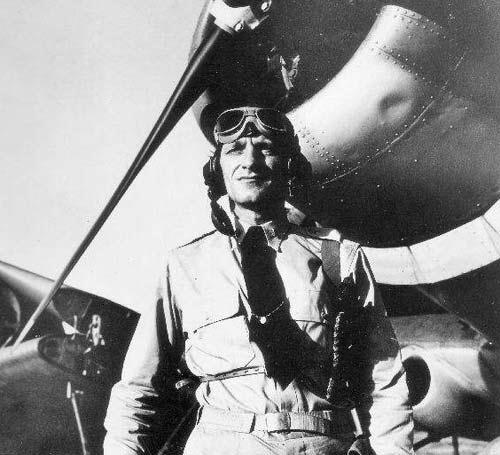
3 Comments

Filed under History, Military, Navy Ships, US Navy, World War II at Sea, world war two in the pacific