Tag Archives: army of northern virginia

Gettysburg: June 28th the Day of Surprises

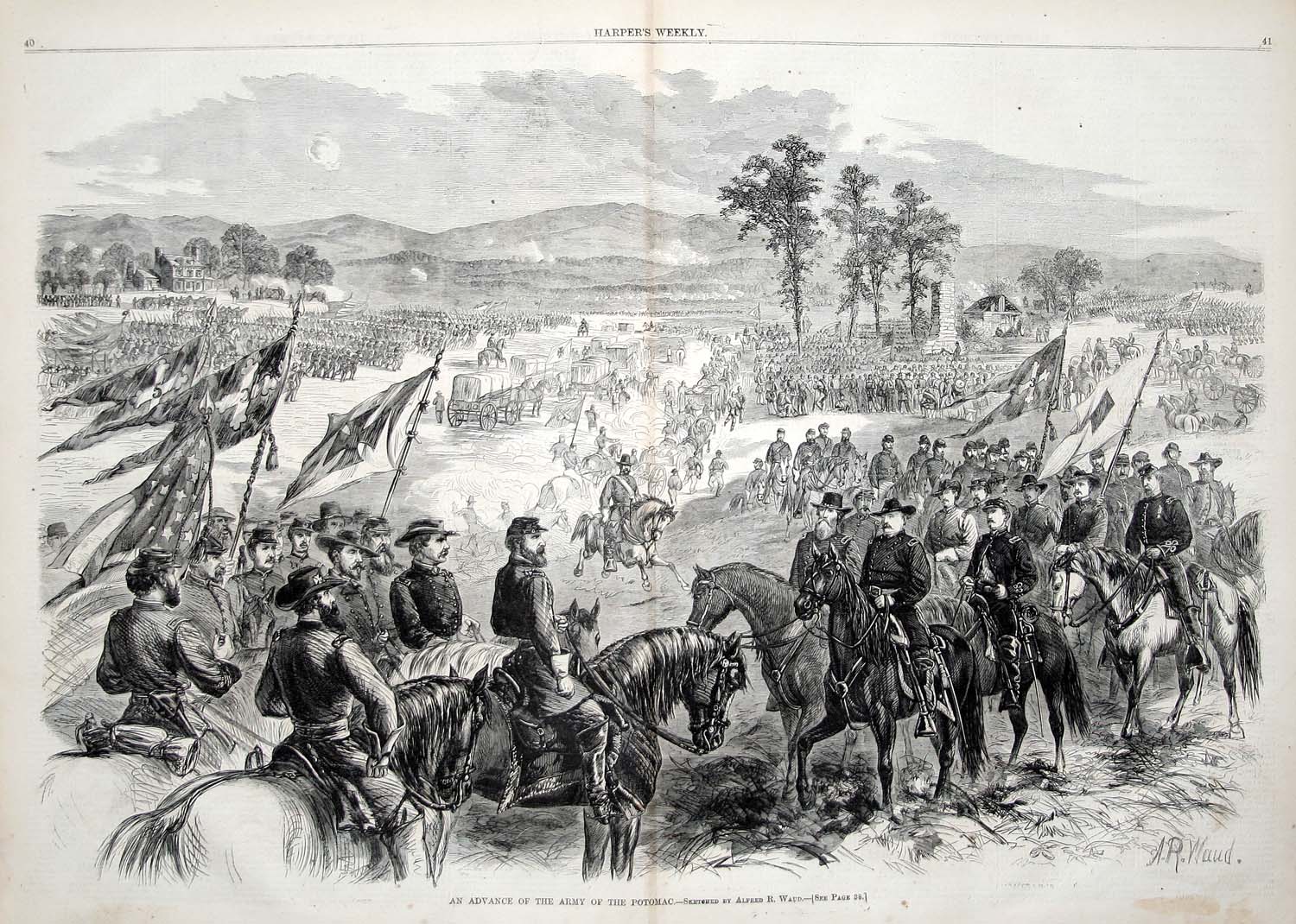
army-potomac-1500Army of the Potomac on the March


If you were an ordinary soldier in either the Army of the Potomac or Army of Northern Virginia June 28th 1863 would not have been much different than any of the previous days. Both armies had been on the march, both were moving north and with the exception of a few minor cavalry engagements no troops had yet engaged in battle.

However it is almost never good when a commander gets surprised. On June 28th 1863, three men, General Robert E Lee, Lieutenant General J.E.B. Stuart and Major General George G Meade all were surprised by unexpected, and in the case of Lee and Stuart truly disturbing news. The manner in which each responded was critical to how the Battle of Gettysburg unfolded and indicative of each mans’ ability as a commander.
Harrison-1-

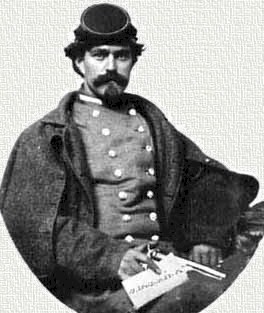
Harrison

On the morning of June 28th Lieutenant General James Longstreet was alerted to the presence of a man claiming to have information on the movement and location of the Army of the Potomac. The man’s name was Harrison and that he was an actor. Harrison is one of those mysterious figures that occasionally show up in the context of a historical event and make it even more interesting. He reported the location of Federal Cavalry as well as the location of five of the Army of the Potomac’s seven army corps, all too close for comfort. Questioned about the location and activities of Stuart, Harrison could give no information.
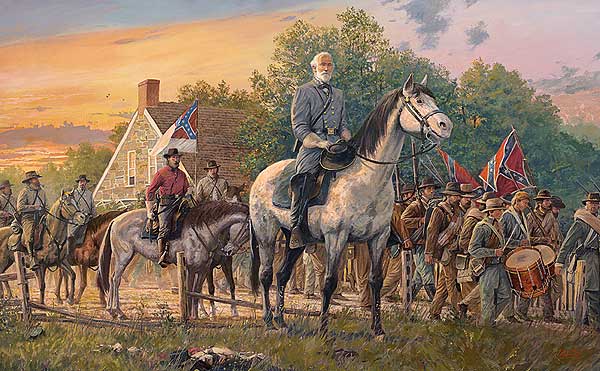
gettysburg-general-lee

Any commander that embarks on a high risk offensive operation in enemy territory must do so with great care, especially in regard to command and control of his forces. This is especially true regarding reconnaissance. Lee had been operating blind for well over a week and this was his fault. Because Lee had issued such vague orders Stuart was well to the east conducting his ride around the Federal army and completely useless to Lee.
longstreet

Longstreet

Though Lee still had three brigades of Stuart’s Cavalry Division available, none were in a position to assist his reconnaissance needs. Again blame for this has to be laid at the feet of Lee. Robertson’s and Jones’ brigades were still deep in Virginia guarding Snicker’s and Ashby’s Gap. Iboden’s Brigade was to the west at Hancock Maryland. Jenkins’ brigade, which was not a part of Stuart’s division, was far to the front with Ewell’s Corps.

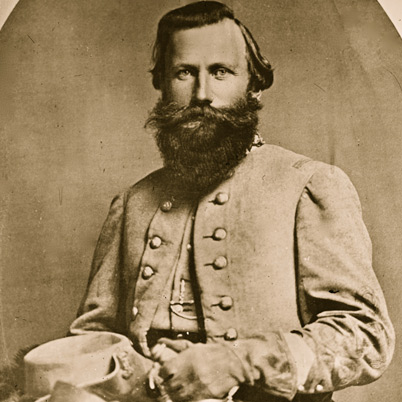
In the case of the selection of Jones’ and Robertson’s brigades for the mission of screening Lee, Stuart made a critical mistake. Jones and Robertson both had serious deficiencies as leaders and proved that they had Lee’s “confidence or understood his expectations…and Stuart badly misread the amount of personal connection his superior required.”[i] Longstreet had recommended that Stuart assign the excellent Wade Hampton and his brigade to the mission of screening the Army, but Stuart ignored his counsel.
CWP015

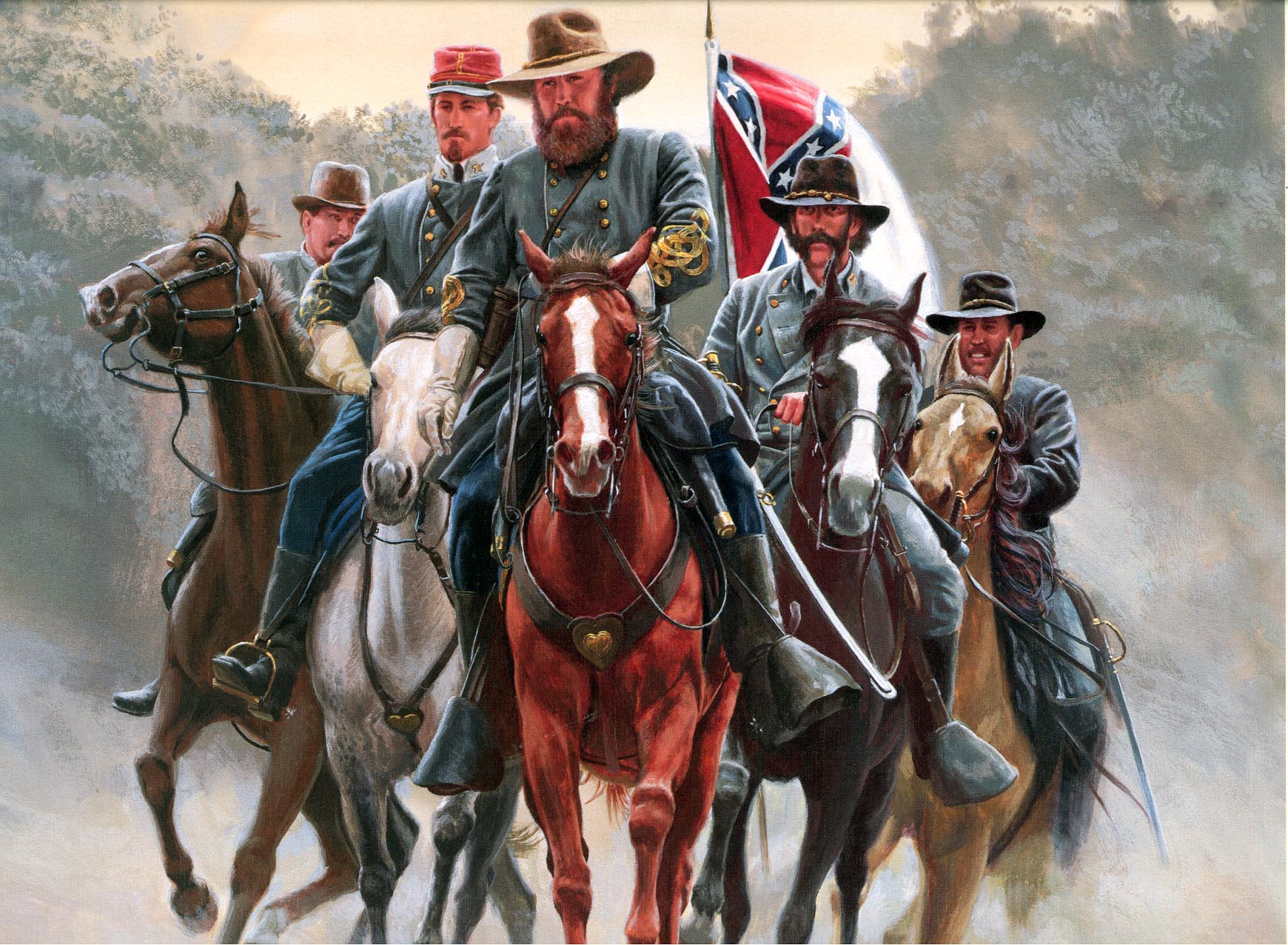
Stuart

While Lee’s orders to Stuart allowed Stuart to go off on his mission Lee had plenty of cavalry available but employed it in a woeful manner and did not take the steps necessary to ensure that the commanders assigned understood his expectations. This was another critical mistake made by Lee and as Alan.T. Nolan wrote: “There seems to be no excuse for Lee’s finding himself at Chambersburg on the 28th without a single regiment of cavalry”[ii] The tragic thing for the Confederacy was that Lee would make this same mistake in failing to communicate his intent with other subordinates throughout the campaign.

Lee assumed quite wrongly that the reason he had not heard from Stuart was that Hooker’s army had not moved. This was a bad miscalculation on Lee’s part and Longstreet trusted Harrison and promptly reported the information to Lee. Lee refused to see Harrison as he had little appreciation for or confidence in the words of “spies.” That being said Lee reacted with alacrity and issued orders to concentrate his army near Cashtown.

The surprise of the Union Army being concentrated so near him took away Lee’s ability to retain the initiative of a campaign of maneuver. Likewise, because his army was so scattered he was now in danger of being hit and defeated in detail by the Federal army. It was a dangerous position for him to be in and he knew it. In a sense he was fortunate that on the 28th the Army of the Potomac was changing command and unable to strike while he was so vulnerable.

Seventy miles away J.E.B. Stuart was at Rockville Maryland where despite learning that the Army of the Potomac was moving did not hasten to re-join the main army. Instead, he and his troopers became distracted and captured a large Federal wagon train, 125 brand new wagons carrying supplies north. Instead of burning them and leaving his prisoners he decided to advance into Pennsylvania with his treasure. The effect was to radically slow down his march and keep him out of the battle when Lee most needed his presence.

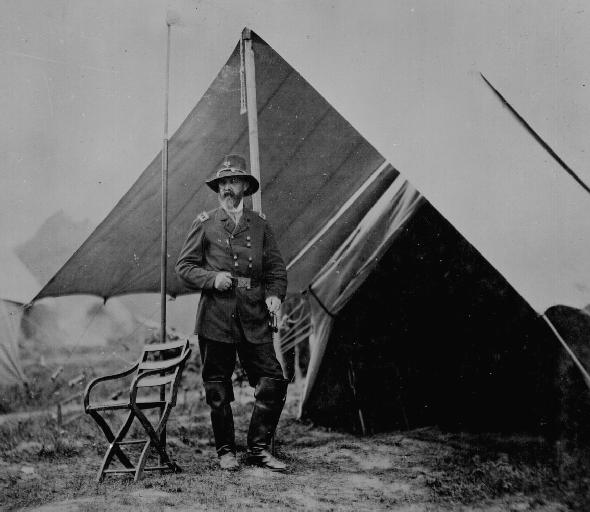
While Lee and Stuart reacted to surprises that were largely of their own making another officer received a surprise of his own. On the night of June 27th George Meade was simply one of seven Corps Commanders in the Army of the Potomac. That changed suddenly when he was awoken at 3 Am on the 28th by Halleck’s messenger and Deputy Adjutant General Colonel James Hardie. In his hand Hardie had a letter of instruction from Halleck which began: “You will receive with this the order of the President placing you in command of the Army of the Potomac.” [iii]
meade2

Meade

Meade, though he desired the appointment as commander of the Army did not expect it.  He believed that if Hooker was relieved of command that John Reynolds of First Corps or another would receive it. He was outranked by two Corps commanders including Reynolds. Meade wrote to his wife the reasons he would not get command a few days before: “because I have no friends, political or others, who press or advance my claims or pretentions.”[iv] The latter was not because of he did not have friends, but because unlike Hooker, Sickles and so many others he stayed out of the various political cabals in the army and their constant intrigues.

The order gave Meade command of the troops at Harper’s Ferry which had been denied to Hooker just days before. It also gave him freedom of command. It read: “You will not be hampered by any minute instructions from these headquarters” and “you are free to act as you deem proper under the circumstances as they arise.”[v] Likewise he was authorized to command General Couch’s forces along the Susquehanna. A further power given to Meade which had not been given to previous commanders of the Army of the Potomac was the authority to relieve from command and dismiss officers from the army, or appoint to command officers regardless of seniority as he saw fit. It was a power that during the tumult of battle that he would use well.

The appointment of Meade was met with relief by most of his fellow Corps commanders. He was respected, despite having a temper which would occasionally erupt and send him into busts of rage. He was viewed as a truthful, honest and caring commander who after a blow up would do what he could to reconcile. He was passionate about the lives of his troops and whenever possible avoided battles that he believed their sacrifice would be in vain. He knew his trade, paid close attention to detail and knew and understood his troops and commanders. He had earned respect throughout his career and during the battles on the Peninsula, Antietam, Fredericksburg and Chancellorsville proved that he was an excellent leader and commander of troops.

Meade had an immense task to accomplish. When he went to bed on the night of the 27th he was unaware of the locations of the bulk of the Federal Army and knew that Lee was already deep in Pennsylvania. Meade was determined to bring Lee to battle was cautious as he did not want to take a chance of his forces being split up and defeated in detail. He knew that if he was to defeat Lee he had to concentrate his combat power. He wired Halleck that he would “move toward the Susquehanna keeping Baltimore and Washington well covered, and if the enemy is checked in his attempt to cross the Susquehanna or if he turns toward Baltimore, to give him battle.”[vi] He prepared a fallback position along Pipe Creek and gave his Corps commanders permission to withdraw back to the Pipe Creek line outside Taneytown Maryland if they felt threatened by a larger Confederate force.

He kept General Daniel Butterfield as his Chief of Staff despite Butterfield’s close association with Hooker and his political cabal and appointed Major General George Sykes to command his old V Corps. He also wired Halleck with an “unheard of request: to promote in one jump three brilliant young officers from the rank of captain to that of brigadier general. They were Elon J. Farnsworth of the 8th Illinois Cavalry, George A Custer of the 5th United States Cavalry and Wesley Merritt of the 2nd United States Cavalry.”[vii] Each was appointed to command brigades in Pleasanton’s Cavalry Corps which was being reorganized that day.
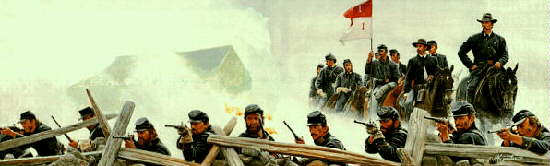
buford-on-mcphersons-ridge

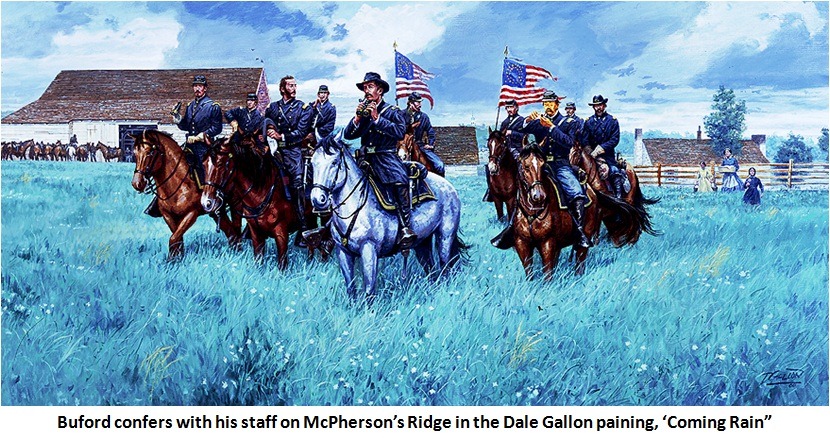
Meade recognized the importance of Gettysburg and began to move his forces toward the town even as Lee gathered his army. By the evening of the 30th Meade’s 1st Cavalry Division under the command of Brigadier General John Buford detected Confederate infantry to the west of the town. Buford with a keen eye for terrain instantly recognized that it was favorable ground. He knew that the battle was to be there and sent word back to John Reynolds, commander of I Corps:

“Have Occupied Gettysburg. Contacted large force of Reb infantry. I think they are coming this way. Expect they will be here in force in the morning.”[viii]

Until tomorrow,

Peace

Padre Steve+


[i] Trudeau, Noah Andre. Gettysburg, A Testing of Courage Harper Collins, New York, 2003. p.69

[ii] Nolan, Alan T. R.E. Lee and July 1 at Gettysburgin The First Day at Gettysburg, Gallagher, Gary W. Editor, Kent State University Press, Kent Ohio 1992 p. 20

[iii] Foote, Shelby, The Civil War, A Narrative. Volume Two Fredericksburg to Meridian Random House, New York 1963 p.451

[iv] Ibid.

[v] Ibid.

[vi] Coddinton, Edwin B. The Gettysburg Campaign, A Study in Command A Touchstone Book, Simon and Shuster New York 1968 pp. 219-220

[vii] Ibid. p.220

[viii] Shaara, Michael. The Killer Angels. Ballantine Books, New York. 1974 p.40
 

Leave a comment

Filed under civil war, History, leadership, Military

The Gettysburg Campaign: Lee Decides to Go on the Offensive

993scr_3a12918e0189d2e

I am preparing to lead a Staff Ride of our students to Gettysburg in early March. As part of my preparation I am doing a lot of study to refresh myself on both the campaign and the battle, not only as an operational study, but at the strategic level. This short essay deals with Lee’s decision to invade the North following his victory at Chancellorsville. I will follow it up with other articles the next talking about the Northern strategy at both the strategic and operational levels.

In early May 1863 General Robert E. Lee, commanding the Army of Northern Virginia realized that the Confederacy was in desperate straits. Despite numerous victories against heavy odds, Lee knew that time was running out. Though he had beaten the Army of the Potomac under General Joseph Hooker at Chancellorsville, he had not destroyed it and that Army, along with a smaller force commanded by General Dix in Hampton Roads still threatened Richmond.

The strategic situation was bad, even if many Confederate politicians realized it or cared in the post Chancellorsville euphoria. In the west the strategic river city of Vicksburg Mississippi was threatened by the Army of Union General Ulysses S Grant, and Naval forces under the command of Admiral David Farragut. If Vicksburg fell the Union would control the entire Mississippi and cut the Confederacy in two. Union forces also maintained a strong presence in the areas of the Virginia Tidewater and the coastal areas of the Carolinas, while in Tennessee a Union Army was stalemated, but still threatening Chattanooga, the gateway to the Deep South. The blockade of the United States Navy had crippled the already tenuous economy of the Confederacy.

Some Confederate leaders realized the danger presented by Grant in the West. Secretary of War James Seddon recognized the danger in the Winter of 1862-1863 both suggested to Lee that he detach significant units to relieve the pressure in the west and blunt Grant’s advance. Lee would have nothing of it, he argued that the war would be won in the East. It was his view that if Virginia was lost, so was the Confederacy, and was concerned that whatever units left behind should he dispatch troops from his Army west, would be unable to defend Richmond.

On May 14th Lee travelled by train to Richmond to meet with President Jefferson Davis and War Secretary James Seddon. At the meeting Lee argued for an offensive campaign in the east, to take the war to Pennsylvania. Lee had two goals three major goals, two which were directly related to the immediate military situation and one which went to the broader strategic situation. Unfortunately no notes from that conference are known to survive.

Lee had long believed that an offensive into the North was necessary, even before Chancellorsville. Lee did not believe that reinforcing the Confederate Armies in the West would provide any real relief, instead he believed that his Army, flush with victory needed to be reinforced and allowed to advance into Pennsylvania. Lee’s Chief of Staff Colonel Charles Marshall crafted a series of courses of action designed to present the invasion option as the only feasible alternative. Although both Seddon and Davis had reservations about the plan they agreed to it, unfortunately for all of them they never really settled the important goals of the campaign.

Lee believed that his offensive would relieve Grant’s pressure on Pemberton’s Army at Vicksburg. Likewise Lee believed that if he was successful in battle and defeated the Army of the Potomac in Pennsylvania that it could give the peace party in the North to bring pressure on the Lincoln Administration to end the war.  He also believed that if he could spend a summer campaign season in the North, living off of Union foodstuffs and shipping booty back to the Confederacy that it would give farmers in Northern Virginia a season to harvest crops unimpeded by major military operations.

However, the meeting evidently did not have all the results that Lee desired. Davis refused Lee reinforcements from the coastal Carolinas, and insisted on units being left to cover Richmond in case General Dix advanced on Richmond from Hampton Roads. Much of this was due to political pressure as well as the personal animus that existed between General D. H. Hill in the Carolinas towards Lee.

Likewise Lee’s decision revealed an unresolved issue in Confederate Grand Strategy. Many in the Confederacy realized that the only hope for success was to fight a defensive campaign that made Union victory so expensive that eventually Lincoln’s government would fall or be forced to negotiate.

However, Lee was convinced that ultimate victory could only be achieved by decisively defeating and destroying Federal military might. His letters are full of references to crush, defeat or destroy Union forces opposing him. His strategy of the offensive was demonstrated on numerous occasions in 1862 and early 1863, however it was unfeasible and counterproductive to Southern strategy. His offensive operations cost his Army dearly in the one commodity that the South could not replace, nor keep pace with its Northern adversary, his men.

When Lee fought defensive actions on ground of his choosing, like a Fredericksburg he was not only successful but husbanded his strength. However, when he went on the offensive in almost every case he lost between 15 and 22 percent of his strength, and the percentage of soldiers that he lost was always more than his Federal counterparts, even when his army inflicted greater aggregate casualties on his opponents. Lee recognized this as was evident in his correspondence but it did not deter his strategy of the offensive until after his defeat at Gettysburg.

The course of action was decided upon, but one has to ask if Lee’s decision was wise decision at a strategic point level, not simply the operational or tactical level where many Civil War students are comfortable. General Longstreet’s artillery commander, Colonel Porter Alexander described the appropriate strategy of the South well, he wrote:

“When the South entered upon war with a power so immensely her superior in men & money, & all the wealth of modern resources in machinery and the transportation appliances by land & sea, she could entertain but one single hope of final success. That was, that the desperation of her resistance would finally exact from her adversary such a price in blood & treasure as to exhaust the enthusiasm of its population for the objects of the war. We could not hope to conquer her. Our one chance was to wear her out.”  (Edward Porter Alexander, Fighting for the Confederacy: The Personal Recollections of General Edward Porter Alexander, ed. Gary W. Gallagher, University of North Carolina Press, Chapel Hill NC, 1989 p.415 

What Alexander describes is the same type of strategy successfully employed by Washington and his more able officers during the American Revolution, Wellington’s campaign on the Iberian Peninsula against Napoleon’s armies, and that of General Giap against the French and Americans in Vietnam. It was not a strategy that completely avoided offensive actions, but saved them for the right moment when victory could be obtained.

It is my belief that Lee erred in invading the North for the simple fact that the risks far outweighed the possible benefits. It was a long shot and Lee was a gambler, audacious possibly to a fault. His decision to go North also exhibited a certain amount of hubris as he did not believe that his army could be beaten, even when it was outnumbered.  Likewise he took the offensive in spite of the fact that many of his commanders were untested at the levels of command that they exercised. He had lost his right arm, General Stonewall Jackson, who died following being wounded at Gettysburg.

He knew from his previous battles the heavy casualties that even a victory over the Army of the Potomac would entail deep in Northern territory and the effect that a costly victory would have on his operations, but he still took the risk. That was short sighted and diametrically opposed to the strategy that the South needed to pursue in order to gain its independence. Of course some will disagree, but I am comfortable in my assertion that it was a mistake that greatly affected the Confederacy’s only real means of securing its independence, the breaking of the will of the Union by making victory so costly that it would not be worth the cost.

Peace

Padre Steve+

Leave a comment

Filed under civil war, History, leadership, Military

Gettysburg at 150 Day One: “For God’s Sake Forward!” John Reynolds at Herr’s or McPherson’s Ridge July 1st 1863

z_maritato_ironbrigadeforward

Iron Brigade Forward! Battle of Gettysburg, PA – July 1, 1863 by Mark Maritato

“…by his promptitude and gallantry he had determined the decisive field of the war, and he opened brilliantly a battle which required three days of hard fighting to close with a victory.” Major General Harry Hunt, Chief of Artillery, Army of the Potomac on the actions of Major General John F Reynolds at Gettysburg

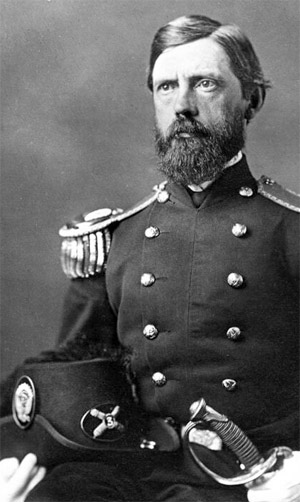
Major General John Reynolds was on his home soil. A native of Lancaster Pennsylvania  Reynolds was the senior Corps commander in the Army of the Potomac. Considered by his peers and superiors to be the best commander in the Army he had been given command of a wing of the Army, his own I Corps, Oliver Howard’s XI Corps and John Sedgewick’s III Corps. He also had John Buford’s 1st Cavalry Division under his command.

Early in June Abraham Lincoln had offered command of the Army of the Potomac to Reynolds, however Reynolds’ set a condition which Lincoln in the political climate of the time could not grant, that he would be free from the political interference which had beset previous Army commanders. Both Reynolds’ request and Lincoln’s response are understandable. Lincoln respected Reynolds and when Major General Joseph Hooker was relieved of command of the Army by Lincoln Major General George Meade, commander of V Corps another Pennsylvanian took his place with Reynolds keeping his position.

As the Army of the Potomac reacted to the advance of Robert E  Lee’s Confederate Army of Northern Virginia Hooker pursued and Meade continued the pursuit into Pennsylvania once he took command.

Reynolds’ wing of three Infantry corps and Buford’s Cavalry division acted as the advance elements of the Army. Late in the afternoon of June 30th Buford’s troops observed Johnston Pettigrew’s brigade of Harry Heth’s division near Gettysburg. Pettigrew on detecting Buford’s cavalry refused to engage and Buford made the choice to take the good high ground west of Gettysburg and hold it in order to give Reynolds followed by the rest of the Army time to arrive.

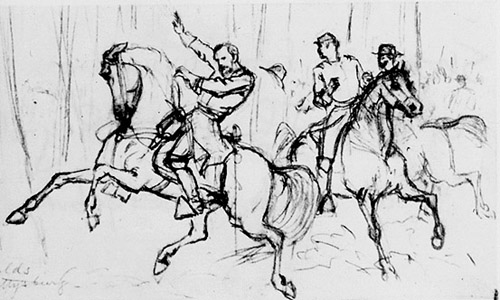
WaudSketch

The Death of Reynolds (Waud)

Reynolds sent messages late in the evening to both Reynolds and the Union Calvary Corps commander, Major General Alfred Pleasanton describing the situation. Reynolds’ units were south of Emmitsburg moving north and on the morning of the 1st of July he brought his troops up as Buford and his cavalry troopers engaged Heth’s division in a delaying action in order to give Reynolds’ units time to get to the good high ground around Gettysburg.

Reynolds rode ahead and briefly met Buford at the Lutheran Seminary where Buford ensured Reynolds that his troopers could hold. With that Reynolds ordered his leading corps, the lead division under the command of Abner Doubleday to advance to the action at the double-quick. He then sent a message to Meade through a staff officer stating “Tell the General that we will hold the heights to the south of the town, and that I will barricade the streets of the town if necessary.”

As his units arrived into an already raging battle Reynolds directed them to key areas of the battlefield. As he directed the “Iron Brigade” into position in Herr’s (McPherson’s) Woods Reynolds exhorted the men forward.“Forward! men, forward! for God’s sake, and drive those fellows out of the woods!” As he said these words he was struck by a bullet in the head and died instantly.

In the immediate confusion following Reynolds’ death the I and XI Corps confusion reigned. It seemed that the Union corps now fighting two Confederate Corps, Hill’s 3rd Corps which they had been fighting since the morning and Ewell’s 2nd Corps which arrived in a flanking position to their north during the afternoon might be routed. The Federal troops, I Corps now under the command of Doubleday and XI under Major General Oliver Howard withdrew through Gettysburg to Cemetery Hill where they were rallied by Reynolds’ old friend Major General Winfield Scott Hancock of II Corps.

Hill’s troops entered the town but did not attempt to take the hill while Ewell passed on an opportunity to take nearby Culp’s Hill which would have dislodged the Federal right flank.

The first day ended with the Army of the Potomac holding the high ground in an easily defensible position on interior lines. Lee’s Army was spread out and the defense mounted by Buford and Reynolds had disrupted Hill’s Corps, causing significant casualties.

Buford is to be given much of the credit for choosing the ground of the battle and fighting a stellar delaying action against superior forces. But had Reynolds not brought his units up in the expeditious manner in which he did and then all of Buford’s efforts might have been in vain. The two men, bound by their professionalism and commitment to duty and their oath helped save the Union on that first day of July 1863.

reynolds

Charles Veil who served as a staff officer under Reynolds wrote the following epitaph stating that Reynolds “was a man who knew not fear or danger was, in a word (he was) one of our very best Generals. Wherever the fight raged the fiercest, there the General was sure to be found, his undaunted courage always inspired men with energy & courage.” 

Peace

Padre Steve+

Leave a comment

Filed under civil war, History, leadership, Military

Gettysburg Day One Accident and Intent: How the Actions of Harry Heth and John Buford Helped Decide the Battle

On June 30th 1863 the Confederate Army of Northern Virginia under the Command of General Robert E Lee was deep in enemy territory. His mission was to draw the Federal Army of the Potomac now under the command of Major General George Gordon Meade into battle and destroy it.  His Army composed of three Corps, the First Corps under Lieutenant General James Longstreet, the Second under Lieutenant General Richard Ewell and the Third Corps under the command of Lieutenant General A.P. Hill.  Lieutenant General J.E.B. Stuart commanded his cavalry but was operating independently of Lee conducting a movement around the Army of the Potomac and unable to provide Lee information on the deployment or movement of the Union forces.

Lee’s army was spread out. Early’s Second Corps was spread out near the Susquehanna River near Harrisburg while his other two corps were concentrated in the area around Cashtown about 8 miles west of Gettysburg. On the 30th a brigade of Major General Harry Heth’s division of Hill’s Corps made a reconnaissance in the direction of Gettysburg. The brigade commander Brigadier General James Pettigrew observed Federal cavalry entering the town and chose not to engage reporting the matter to General Heth.

Major General Henry (Harry) Heth

Heth was a graduate of West Point who had served as an Infantry Officer in the United States Army until he resigned to enter the Confederate Army. He had commanded a company in battle against the Lakota Sioux in 1855 and wrote the first marksmanship manual for use in the U.S. Army. Unlike many of his fellow officers he had not taken part in the Mexican-American War.

Heth spent the early part of the war as Lee’s Quartermaster where he became one of Lee’s favorite officers and began a relationship where Lee looked after his career.  He then served as regimental commander in the actions in the Kanawha Valley of Western Virginia being assigned to Kirby Smith’s Department of Tennessee where he commanded a division but took part no no major actions. Lee brought him back to the Army of Northern Virginia in 1863 to command a brigade in Hill’s Division. He took commanded that brigade at Chancellorsville in which he made an ill advised unsupported attack against Union forces with heavy casualties. He was promted to command of the Division when Hill assumed command of Third Corps when it was created following the death of Lieutenant General Thomas “Stonewall” Jackson.

Lee had given his commanders orders not to provoke a major engagement until the Army was fully concentrated to meet Meade’s troops which had crossed the Potomac and was moving north. However neither Heth nor Hill believed that the troops that Pettigrew observed were a threat, believing them to be nothing more than local militia. Heth ordered half of his division to make a reconnaissance in force on the morning of July 1st. It was not what Lee wanted and Heth’s conduct of it and the resultant action led to the largest battle of the Civil War, the costliest battle.

Lee’s intent was clear. He desired to have a tired and weary Union force under a new commander under political pressure attack him on ground of his choosing. He hoped to defeat the Union forces piecemeal as they came into the battle. By initiating the action Heth caused Lee to have to improvise an attack contrary to his initial plan.  It was an accidental encounter which was compounded by Heth’s action to commit his entire division into battle in spite of his orders.

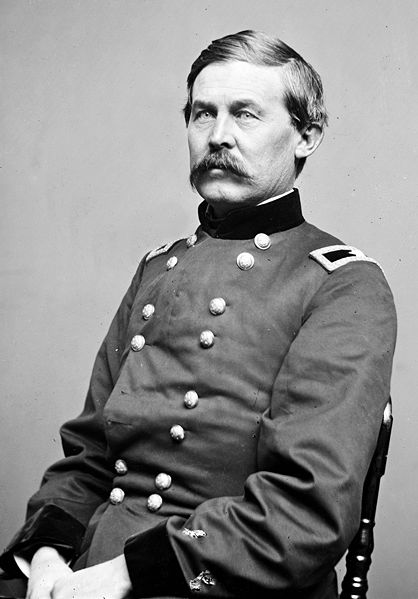
Brigadier General John Buford

The Federal Cavalry was the First Cavalry Division under the Command of Brigadier General John Buford. Buford’s division arrived in Gettysburg ahead of the Army of the Potomac on the 30th. Buford and his brigade commanders immediately recognized the importance of the ground when they saw Pettigrew’s troops. Buford order his troops to deploy on the ridges west of Gettysburg, Herr Ridge, McPherson Ridge and Seminary Ridge. It was the perfect place for a delaying action against superior forces.

Buford was also a graduate of West Point and served as a Cavalry officer in the Army before the war. He was from Kentucky and though his father was a Democrat who had opposed Abraham Lincoln and had family that chose to fight for the Confederacy he remained loyal to his oath and remained in the Army. He served against the Sioux and on peacekeeping duty in the bitterly divided State if Kansas before serving in the Utah War in 1858. He was a modern soldier who recognized that the tactics of the Army had to change due to improvements in weapons and technology.  He was promoted to Brigadier General in 1862 and served in numerous engagements as a Cavalry Brigade commander before being given command of the 1st Cavalry Division after Chancellorsville.

The Delaying Action, July 1st 1863 Map by Hal Jespersen, http://www.posix.com/CW

Buford was a keen student of war and a commander who was able to control his forces. When Heth engaged his division he fought a masterful action which allowed the Infantry Corps of the Army of the Potomac to arrive on the field of battle. His action to select the ground upon which the battle was fought led to the Union victory because even though Federal forces were pushed back on the first day they were able to maintain control of the high ground east of the city with interior lines of communication which they fortified.

Lee decided that he had to force the battle and continue the attack despite the objections of General Longstreet and the fact that he did not fully know the numbers and disposition of the troops arrayed against him. It would be a fateful decision born of a ill conceived action of Heth and correspondingly excellent command decisions of Buford. I am sure that part of the reason for this was Heth’s lack of experience in the East against the Army of the Potomac and limited battle experience as a senior commander. Buford had spent the war in action against Lee’s Army. He knew the capabilities of his enemies and what had to be done to give his side a chance to win.

Like many battles success is often due to such factors.  Had Heth held up and had Lee followed Longstreet’s advice the battle and war might have turned out quite differently. Had Buford not seen the importance of the ground that he selected and deployed himself accordingly the rest of the Army may not have gotten to Gettysburg before Lee had gained the critical ground east and south of the town.

On such decisions battles are decided and wars won.  Heth’s relative inexperience and inability to control his command was a decisive factor in the battle while Buford’s experience and poise under pressure probably saved the Army of the Potomac from a decisive defeat.

Peace

Padre Steve+

3 Comments

Filed under civil war, History, leadership, Military