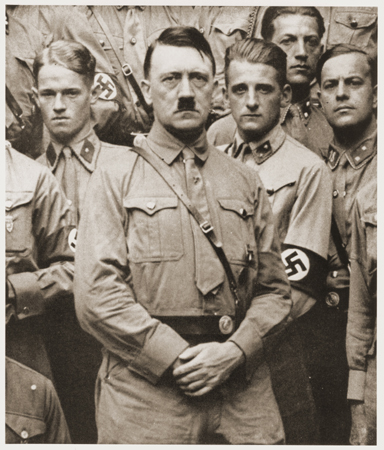
Tag Archives: B.H. Liddell-Hart

When Despots Gain Power


Friends of Padre Steve’s World,

I have returned home from my vacation in time to spend some time relaxing over the Labor Day weekend while hopefully dodging the worst of what will be Tropical Storm Hermine. I am going to be writing a number of articles as well as pictures from our time in Huntington, West Virginia this weekend, articles that will deal with history, art and culture, as well as social and political commentary. 

Yesterday I posted a short article about how despots come to power referencing the words of British military historian B.H. Liddell-Hart in his book Why Don’t We Learn from History?  Since I gave a brief introduction to that work yesterday I will not repeat the introduction. Instead I will go to the second part of how he described despots, or what we commonly call dictators today. 

Yesterday I briefly discussed Liddell-Hart’s understanding of the important differences between democracy and dictatorship and why despite all the inefficiency of the former that it is infinitely preferable to the latter or for that matter any other form of government. 

Since I left off and let you my friends and readers meditate on how despots come to power, I will now finish with what Liddell-Hart said about what happens after a despot takes power. He is right of course. Since the French Revolution we can look to Napoleon, Stalin, Hitler, three generations of North Korean Kims, Mussolini, Ceausescu, Pol Pot, the Castros, Pinocet, Mugabe, not to mention the multitude of other despots of the Middle East, Africa, Asia, the Americas, and Europe, but I digress. 

Liddell-Hart wrote:

We learn from history that time does little to alter the psychology of dictatorship. The effect of power on the mind of the man who possesses it, especially when he has gained it by successful aggression, tends to be remarkably similar in every age and in every country.

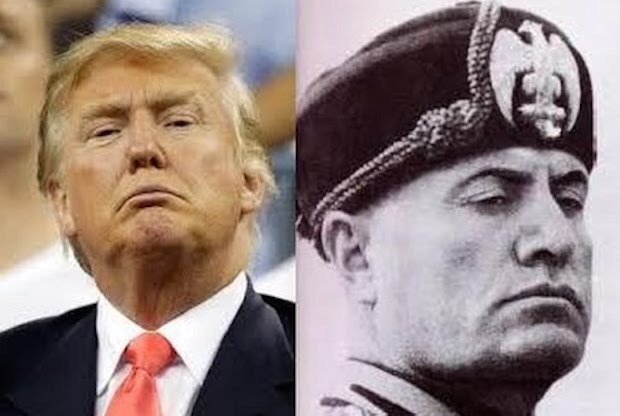
Yesterday I asked you my readers to compare what Liddell-Hart said about how despots come to power and think about how what he said is evidenced in the campaign of Donald Trump. So that being said, Liddell-Hart noted that once a despot achieves power that their reign is marked by the following types of events:

On gaining power: 

They soon begin to rid themselves of their chief helpers, “discovering” that those who brought about the new order have suddenly become traitors to it. 

They suppress criticism on one pretext or another and punish anyone who mentions facts which, however true, are unfavourable to their policy. They enlist religion on their side, if possible, or, if its leaders are not compliant, foster a new kind of religion subservient to their ends. 

They spend public money lavishly on material works of a striking kind, in compensation for the freedom of spirit and thought of which they have robbed the public. 

They manipulate the currency to make the economic position of the state appear better than it is in reality. 

They ultimately make war on some other state as a means of diverting attention from internal conditions and allowing discontent to explode outward. 

They use the rallying cry of patriotism as a means of riveting the chains of their personal authority more firmly on the people. 

They expand the superstructure of the state while undermining its foundations by breeding sycophants at the expense of self-respecting collaborators, by appealing to the popular taste for the grandiose and sensational instead of true values, and by fostering a romantic instead of a realistic view, thus ensuring the ultimate collapse, under their successors if not themselves, of what they have created. 

This political confidence trick, itself a familiar string of tricks, has been repeated all down the ages. Yet it rarely fails to take in a fresh generation.

Now pause for a moment. Donald Trump has not been elected to anything, but compare his business career and current political campaign rhetoric to Liddell-Hart’s words about despots in power. And since I am tired I will leave you to contemplate Liddell-Hart’s words from a half-century ago and imagine a Trump presidency. 

Peace

Padre Steve+

1 Comment

Filed under History, Political Commentary

How Despots Gain Power


Friends of Padre Steve’s World,

Today I am traveling back home after a wonderful visit with friends and family in Huntington, West Virginia. The visit was nice, I got a chance to do some serious reflection, especially as I walked about the city and along the Ohio River waterfront, visited the Museum of Art, and walked the entirety of its wonderful Ritter Park. 

I did some writing but spent more time in reading and reflection than anything. I kept up on some of the headlines but didn’t let myself get beaten down by the negativity and cynicism of our time.

Last night I read the short but poignant little but by the British military historian B.H. Liddell-Hart entitled Why Don’t We Learn from History. The book was written in not long before his death in 1970 and it is good quite good. It deals with a number of issues, including the conflict between history and propaganda, or when faith, especially religious faith as treated as historic or scientific fact; especially when propaganda or faith is preached as if it were history, if it were truth. But he also contrasted democracy and totalitarianism. 

Liddell-Hart was a realist, especially about democracy and totalitarianism. While he admitted the inefficiencies of democracy, he realized that it was far less dangerous than the “stupidity” of totalitarianism. In fact it was important for him to note just how this inefficient system was for freedom. He wrote:

What is of value in “England” and “America” and worth defending is its tradition of freedom, the guarantee of its vitality. Our civilization, like the Greek, has, for all its blundering way, taught the value of freedom, of criticism of authority, and of harmonising this with order. Anyone who urges a different system, for efficiency’s sake, is betraying the vital tradition.

There was was much to ponder in his book and I will probably write some more of my thoughts on it, but since I am going to be traveling I will quote what he said about self-made despotic rulers and how they come to power. When I read it I was struck by just how much Liddell-Hart in his description of a despot describes Republican Presidential nominee Donald Trump through the his campaign and especially his remarks on immigration hours after returning from a brief meeting with Mexican President Pena Nieto. 

We learn from history that self-made despotic rulers follow a standard pattern. In gaining power: They exploit, consciously or unconsciously, a state of popular dissatisfaction with the existing regime or of hostility between different sections of the people. They attack the existing regime violently and combine their appeal to discontent with unlimited promises (which, if successful, they fulfil only to a limited extent). They claim that they want absolute power for only a short time (but “find” subsequently that the time to relinquish it never comes). They excite popular sympathy by presenting the picture of a conspiracy against them and use this as a lever to gain a firmer hold at some crucial stage.

He wrote about how they behave in power as well, but for now I will close and let you my readers ponder his statement before I follow up with Liddell-Hart’s observations from history on how despots act once they achieve power. 

Peace,

Padre Steve+

Leave a comment

Filed under History, philosophy, Political Commentary

A Realist in Wonderland 


Friends of Padre Steve’s World,

It looks like that the primary season is finally about over with Donald Trump and Hillary Clinton as the presumptive nominees of the Republican and the Democratic parties. It is what it is, but in listening to some of Trump’s and Bernie Sanders supporters I feel as if I am in some sort of logic free zone. The German philosopher Arthur Schopenauer called it Wolkenenkuckkuckscheim or “cloud cuckoo land.” It was a term to describe people who think that things completely impossible might happen, rather than understanding how things really are. 


In early 1861, William Tecumseh Sherman was serving as the first superintendent of the Louisiana State Seminary of Learning  and Military Academy, the present LSU. As Southern States began to secede from the Union, Sherman, who was well liked in Louisiana never hesitated to state his belief in the Union. He tried to warn his Southern friends of the folly of secession and war. Though he loved his position and the people he worked with in Louisiana, Sherman resigned and went North. There he found that the politicians and people were completely unprepared for war, and just as unrealistic of what the war would cost as their now estranged Southern brothers. 

Sherman was a realist. He was one of the few people in his day to actually understand the link between military strategy, political policy, economic necessity, and geographic reality. But his counsel was completely ignored in the South as well as in the North. It was only in late 1862 that Sherman and his superior, Ulysses S. Grant began to be listened to by Union leaders. His biographer, the British military theorist, B.H. Liddell-Hart referred to Sherman in 1861 as “a realist in Wonderland.” 

I always seek to be a realist. Yes I have strong views, and I subscribe to a more liberal or progressive ideology, but at the same time that is tempered by my experience as a military officer and education as a historian. I am not an ideologue or revolutionary. Nor am I someone who ignores history, especially history of countries going through great times of national stress, such as the United States in the late 1850s and Weimar Germany. 

When I listen to some of Sanders’s most devoted and self-identified “revolutionary” followers, I am reminded of the leaders of the Communist Party of Germany between 1928 and January 1933, men who worked with the young Nazi Party to tear down the Majority Socialists to destroy the Weimar Republic. The Communists called the Majority Socialists traitors, and Facists equating them with the German Right wing hoping that they would collapse the Socialists and the Republic. 

When I listen to some of Trump’s supporters in the leadership of the Republican Party, I am reminded of the mainline old German conservatives who latched on to Hitler to destroy the Republic thinking that they could control him or that he would moderate in time. Both the German Communists and German conservatives badly misplayed their hand. Both the Communists and the German conservatives hated the Republic, albeit for different reasons, but they underestimated the forces seething in Germany, as well as the psychological and political brilliance of Adolf Hitler during that critical time frame. They remind me of the Sanders supporters 

I am also reminded of the Southern fire breathers of 1860 and 1861 who brought about secession and civil war, who continued the war holding onto slavery until the bitter end in 1865.  Likewise there were Northerners who thought more conciliation and compromise would bring the seceding states back into the Union early in the war, while many of them came to their senses, one group, the Union Copperheads were in favor of a negotiated settlement as late as 1864 and 1865 that would have dissolved the Union, and allowed for the continuance of slavery. All of these groups and their leaders lived in their own make believe wonderland where reality need not bother to knock. 

The fact is that no matter how you spin the results that Sanders lost the a democratic primaries by over 3.7 million votes, close to 400 pledged delegates and over 900 total delegates.  Yet there are still some people, including to some reports, even Sanders himself, who refuse to believe that the campaign is over. Somehow, they believe that trying to get some 400 plus Super delegates to switch from Clinton to him; thereby undercutting the results of the vote is a good idea. Of course if they continue down this path the result will be as it is, Clinton will still win. Worse for them, the if Sanders and his supporters continue down this path, they will end up marginalizing themselves and preventing the Democratic Party from embracing a more progressive platform.  If they don’t recognize this reality and deal with it they will not be in a position to help bring the Democratic Party to more progressive positions on issues that they so deeply care about. That would be a tragedy. Personally I think that had Sanders and his supporters backed off of their fratricidal war on the Democratic Party a few weeks ago, even if Sanders remained active in the race, that they would be better off today. They would not have forfeited the good will of their real political allies. I think that fighting things out to the bitter end in order to eke out a few more delegates was counterproductive to them and their movement. 

Likewise, after months of underestimating Donald Trump and having their asses handed to them, some Republicans are finally beginning to realize that Trump is indeed really is th narcissistic, racist, unstable bully that he is, and now they are stuck with him. Too late some are suggesting that the GOP party leadership try to find a way to dump Trump before the GOP convention, or even try to change the convention rules to keep Trump from becoming the nominee. Of course neither Trump nor his passionate supporters will allow that to happen without blowing up the GOP in the process. As far as the GOP leadership goes, I am sorry to say that they created the environment that allowed the Trump Frankenstein to emerge, and now,they have to deal with it. If they keep him they will lose and maybe destroy the party in the process,  if they try to keep him from getting the nomination they will certainly destroy the GOP. 

I hate to say this because I have dear friends, friends who will remain my friends no matter what, who are passionate supporters of Trump or Sanders. But there are times when I feel very much like William Tecumseh Sherman in 1861, who was scorned in the North and South because he indeed was a realist in wonderland. It was only in 1864 and 1865 that people in the a north and the South understood just how correct that Sherman was. I can only hope that my friends on all sides of this debate will try to be realists and not live in the cloud cuckoo land that will harm all of us. 

But, nobody likes a realist. Oh well, such is life.

Peace

Padre Steve+ 

Update: it appears after his meeting with President Obama that Bernie is going to unite with Hillary to defeat Trump. I know that will upset some of his supporters who seem to hate her as much as the GOP, but this is where change starts. Good on him for stating this now. 

6 Comments

Filed under History, News and current events, Political Commentary

Military & Legal Foundations of Genocide

Friends of Padre Steve’s World

The next installment of my article on war crimes, genocide and the role of ordinary people in them. This focuses on the legal, ideological, and military doctrine foundations of the German race war in Poland and Russia. Without these foundations it would have been difficult, maybe even impossible for the Germans to implement genocide on such a vast scale.

Peace

Padre Steve+

???????????????

Wilhelm Keitel: “war was a fight for survival….dispense with outdated and traditional ideas about chivalry and the generally accepted rules of warfare…” Bundesarchiv Bild

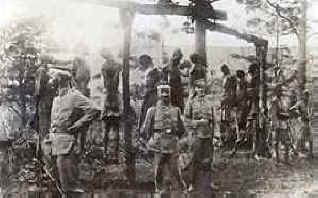
This study will focus on the German policy of ideological-racial war in Poland and Russia. The German war against the Soviet Union and to a certain extent Poland was waged with an unforgiving ferocity against Hitler’s enemy, the Jewish-Bolshevik state and the Slavic Untermenschen.

The campaigns in Poland and the Soviet Union were characterized by the rise of a “political- ideological strategy.” 25 Operation “Barbarossa showed the fusion of technocracy and ideology in the context of competitive military planning.” 26 Hitler’s “ideological and grandiose objectives, expressed in racial and semi-mystical terms, made the war absolute.” 27

Field Marshal Keitel noted a speech in March 1941 where Hitler talked about the inevitability of conflict between “diametrically opposed ideologies” and that the “war was a fight for survival and that they dispense with their outdated and traditional ideas about chivalry and the generally accepted rules of warfare.” 28 General Halder, Chief of the OKH in his War Dairy for that meeting noted “Annihilating verdict on Bolshevism…the leaders must demand of themselves the sacrifice of understanding their scruples.” 29

Based on Lebensraum and race, the German approach to war would combine “racism and political ideology” for the purpose of the “conquest of new living space in the east and its ruthless Germanization.” 30 Hitler explained that the “struggle for the hegemony of the world will be decided in favor of Europe by the possession of the Russian space.” 31 Conquered territories would be “Reich protectorates…and that these areas were to be deprived of anything in the nature of a Slav intelligentsia.” 32

This goal was manifest in the “Criminal Order” issued by OKW which stated that the war was “more than mere armed conflict; it is a collision between two different ideologies…The Bolshevist-Jewish intelligentsia must be eliminated….” 33 Other displaced inhabitants of the conquered eastern lands would be killed or allowed to starve. 34 Part of this was due to economic considerations in the Reich, which gave Germans priority in distribution of food, even that from the conquered lands. Starvation was a population control measure that supplemented other forms of annihilation. 35 As Fest notes in Russia Hitler was “seeking nothing but “final solutions.”” 36Despite numerous post-war justifications by various Wehrmacht generals, the “Wehrmacht and army fell into line with Hitler because there was “a substantial measure of agreement of “ideological questions.”” 37

Hitler’s racial ideology was central to his worldview and fundamental to understanding his actions in the war. 38 However twisted Hitler’s ideological formulations were his ideas found acceptance beyond the Nazi faithful to the Army and Police, who would execute the campaigns in Poland and Russia in conjunction with the Einsatzgrüppen and Nazi party organizations. In these organizations he found allies with pre-existing cultural, political and doctrinal understandings which allowed them to be willing participants in Hitler’s grand scheme of eastern conquest.

ss recruiting poster

Military Doctrine and Ideology

While Hitler’s racial ideology was more extreme than many in the German military and police, these organizations had cultural beliefs and prejudices as well as doctrinal and ideological foundations which helped them become willing accomplices to Hitler. These factors were often, consciously or unconsciously, excluded from early histories of World War II. The Allies relied on German officers to write these histories at the beginning of the Cold War, developing the “dual myth of German military brilliance and moral correctness.” 39 British historian and military theorist B.H. Liddell-Hart makes the astounding statement that “one of the surprising features of the Second World War was that German Army in the field on the whole observed the rules of war than it did in 1914-1918-at any rate in fighting its western opponents….” 40

While Liddell-Hart might be excused by lack of knowledge of some German army atrocities he could not have been ignorant. It was not just the SS who he blamed the atrocities but many of the men who he interviewed. In doing this Liddell-Hart and others presented a myth as truth. 41 The myths were helped by the trials of Manstein and Kesselring where “historical truth had to be sacrificed…to the demands of the Cold War.” 42 British military historian Kenneth Macksey confronted the myth that only the “Waffen SS committed barbaric and criminal acts” noting: “Not even the Knights of the Teutonic Order and their followers in the Middle Ages sank to the depths of the anti-Bolshevik Wehrmacht of 1941.” 43

Germany had a long running history of anti-Semitism before Hitler. German anti-Semitism often exhibited a “paranoid fear of the power of the Jews,” 44 and included a “fashionable or acceptable anti-Semitism” 45 which became more pronounced as the conditions of the Jews became better and Jews who had fled to Eastern Europe returned to Germany. 46 Sometimes this was tied to religious attitudes, but more often focused on the belief that the Jews “controlled certain aspects of life” and presented in “pseudo-scientific garb” the “myth of a secret Jewish plot for world domination which was simultaneously part of the internationalism of Freemasonry.” 47

Admiral Wilhelm Canaris provides an example as he “had grown up in the atmosphere of “moderate” anti-Semitism prevailing in the Ruhr middle class and in the Navy believed in the existence of a “Jewish problem”” and would “suggest during 1935-1936 that German Jews should be identified by a Star of David as special category citizens….” 48 Wehrmacht soldiers were “subject to daily doses of propaganda since the 1930s” and that with the “start of the Russian campaign propaganda concerning Jews became more and more aggressive.” 49 Some officers objected to Nazi actions against Jews. Von Manstein protested the “Aryan paragraph” in the Reichswehr on general principal.” 50 Yet some of the men who planned and executed the most heinous crimes like, Adolf Eichmann had “no fanatical anti-Semitism or indoctrination of any kind.” 51

The military “looked to the regime to reshape society in every respect: political, ideological, economic and military…Propaganda would hammer home absolute nature of the struggle…” 52 Ideological training began in the Hitler Youth and Reichsarbeitsdienst and produced a soldier in which “Anti-Semitism, anti-communism, Lebensraum – these central tenants of Nazism were all inextricably linked with the Landser’s conception of duty, with his place and role in the vast machinery of war.” 53

Following the dismissal of General Fritsch in 1938, General Brauchitsch promised Hitler that “he would make every effort to bring the Army closer to the State and the State’s ideology.” 54

Alfred Novotny, a Austrian soldier in the Gross Deutschland division noted how training depicted the Russians as Untermenschen and how they were “subjected to official rantings about how the supposedly insidious, endless influence of the Jews in practically every aspect of the enemy’s endeavors…Jews were portrayed as rats, which were overrunning the world….” 55

anti-jewish poster

This ideological component added to the already “harsh military discipline” which had a long tradition in Germany conditioning soldiers to violence and brutalization of their enemy. Similar programs existed in the Order Police which would play a large part in the eastern campaign, the “image of “treasonous” leftists and Jews helped shape the personal and political beliefs of many policemen throughout the interwar period.” 56 Even ordinary police training before the war in German speaking Europe “was brutalizing.” 57 These troops were recipients of an ideological formation which “aimed at shaping the worldview of the police leading to the internalization of belief along National Socialist lines.” 58 Waffen SS soldiers, especially those of the Totenkopf division were subjected to even more systematic political indoctrination on the enemies of National Socialism, the Jews, freemasonry, Bolshevism and the churches. 59

Along with cultural anti-Semitism and the Nazification of German thought in the 1930s, there were aspects of military doctrine which helped prepare the way for the eastern campaign. The most important were the Army’s anti-partisan and rear area security doctrine. The history of security anti-partisan operations dated back to the Prussian Army’s Ettapen, which began in 1813 with the Landwehr’s role in security against looters and others. 60 These units supported and supplied offensive operations from the rear to the combat zone with a secondary mission of countering partisans and preventing disruptions in the rear area. The Ettapen would be reformed and regulated in 1872 following the Franco-Prussian War. 61

The German experience fighting guerrillas and partisans, the francs-tireurs in the Franco- Prussian War, “scarred the Army’s institutional mentality.” 62 Field Marshal Von Moltke the elder was “shattered,” and wrote his brother that “war was now taking on an ever more hate-inspired character.” 63 He was “appalled by improvised armies, irregular elements, and appeals to popular passion, which he described as a “return to barbarism.” 64 He wrote:  “Their gruesome work had to be answered by bloody coercion. Because of this our conduct of the war finally achieved a harshness that we deplored, but which we could not avoid.” 65

The brutal German response to the franc-tireurs found its legal justification in Franz Lieber’s principles for classification of belligerents and non-belligerents, which determined that guerrillas were outlaws or bandits. 66 Leiber’s principles were written for the Federal Army of the United States during the U.S. Civil War. Propagated as General Order 100 and signed by Abraham Lincoln the sections dealing with irregular forces and partisans dealt with this in section IV of that code:

Article 82 stated: “Men, or squads of men, who commit hostilities, whether by fighting, or inroads for destruction or plunder, or by raids of any kind, without commission, without being part and portion of the organized hostile army, and without sharing continuously in the war, but who do so with intermitting returns to their homes and avocations, or with the occasional assumption of the semblance of peaceful pursuits, divesting themselves of the character or appearance of soldiers – such men, or squads of men, are not public enemies, and, therefore, if captured, are not entitled to the privileges of prisoners of war, but shall be treated summarily as highway robbers or pirates.”

Article 84 stated: “Armed prowlers, by whatever names they may be called, or persons of the enemy’s territory, who steal within the lines of the hostile army for the purpose of robbing, killing, or of destroying bridges, roads or canals, or of robbing or destroying the mail, or of cutting the telegraph wires, are not entitled to the privileges of the prisoner of war.”

Article 85 stated: “War-rebels are persons within an occupied territory who rise in arms against the occupying or conquering army, or against the authorities established by the same. If captured, they may suffer death, whether they rise singly, in small or large bands, and whether called upon to do so by their own, but expelled, government or not. They are not prisoners of war; nor are they if discovered and secured before their conspiracy has matured to an actual rising or armed violence.” 67

The German Army adapted that code and incorporated it in its doctrine for dealing with partisans. In response to their experience in France during the Franco-Prussian War the Germans systematically reorganized the Ettapen to include railroad and security troops, special military courts, military police, intelligence and non-military police, including the Landespolizei and the Grenzschutzpolizei. 68

The doctrinal response to partisans, or as they would become known in German writings as “bandits,” was that bandits should be encircled and destroyed. This was employed in the Southwest Africa German colonies. The Germans, influenced by the experience in France, “displayed a ferocity surpassing even that of the racially brutalized campaigns of its imperialist peers.” 69
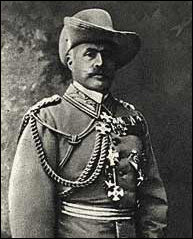
von trotha

Lothar Von Trotha

The campaign against the Herero tribes which resisted the occupation of Namibia from 1904- 1912 utilized encirclement operations, racial cleansing and what would become known as Bandenkämpfung operations. 70 In 1904 the Herero were banished from their lands which were handed over to German settlers. When the Herero resisted Von Trotha ordered that they be exterminated. “Every Herero found within German borders with or without weapons, was to be shot. But most of them died without violence. The Germans simply drove them out into the desert and sealed off the border.” 71
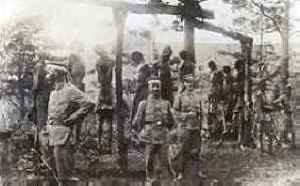
20030228_Herero

Of about 80,000 Herero some 60,000 died in the desert, a few thousand survived to be “sentenced to hard labor in German concentration camps.” 72 Despite praise from some in the General Staff the brutality shocked many Germans and General Alfred Von Schielffen who had to defend himself from the “accusations that he had harmed the good name of the army” ensured that “Trotha never served in the field again.” 73 Despite this the application of such Bandenkämpfung operations found their way into German military doctrine.

This was further developed in the First World War, especially in the east where General Fritz Gempp described the security problem as a “ruthless struggle” in which German pacification policy “was in reality the application of terror to galvanize the population into accepting German rule.” 74Anti-partisan doctrine was codified in the Truppenführung of 1933 which stated that “area defense against partisan warfare is the mission of all units” and that the preferred method of combating partisan bands was that they be surrounded and destroyed. 75 General Erhard Rauss later described active and passive measures used to deal with partisans, focusing on the tactic of encirclement to destroy the enemy. 76

The accounts of the German General Staff praised Von Trotha’s operation. “The month long sealing of desert areas, carried out with iron severity, completed the work of annihilation…the sentence had been carried out” and “the Hereros had ceased to exist as an independent people.” 77

Anti-partisan doctrine focused on the destruction of the partisans, was coupled a total war philosophy and provided fit well with Hitler’s radical ideology. The “propensity for brutality in anti-guerrilla warfare was complimented by officers’ growing preoccupation, both during and after World War I, with the mastery and application of violence.” 78 Michael Geyer notes: “ideological mobilization for the creation of a new national and international order increasingly defined the parameters of technocratic planning.” 79 The acceptance of long used brutal tactics to destroy the enemy combined with Hitler’s radical racial animus against the Jews could only be expected to create a maelstrom in which all international legal and moral standards would be breached.

To be continued…

Notes

25 Geyer, Michael. German Strategy 1914-1945 in Makers of Modern Strategy from Machiavelli to the Nuclear Age.

Peter Paret, editor. Princeton University Press, Princeton NJ. 1986. p.582

26 Ibid. Geyer. German Strategy p.587

27 Strachan, Hew. European Armies and the Conduct of War. George, Allen and Unwin, London, UK 1983 p.174

28 Goerlitz, Walter. The Memoirs of Field Marshal Wilhelm Keitel: Chief of the German High Command 1938- 1945. Translated by David Irving. Cooper Square Press 2000, First English Edition 1966 William Kimber and Company Ltd. German edition published by Musterschmnidt-Verlad, Gottigen 1961 p. 135

29 Ibid. Fest, Hitler. p. 649

30 Ibid. Megargee, War of Annihilation p.7

31 Trevor-Roper, H.R. Hitler’s Table Talk 1941-1944 with an introduction by Gerhard L Weinberg, Translated by Norman Cameron and R.H. Stevens, Enigma Books, New York, NY 2000. Originally published in Great Britain by

Weidenfeld & Nicholoson, London 1953 p. 27 Goebbels notes a similar theme in his recollection of Hitler’s reasons for destroying Russia a power . See Taylor, Fred, Editor and Translator. The Goebbels Diaries 1939-1941, Penguin Books Ltd, Harmondsworth UK and New York NY 1984 pp. 413-415.

32 Goerlitz, Walter. History of the German General Staff.” Translated by Brian Battershaw, Westview Press, Boulder

and London, 1985. Originally published as Die Deutsche Generalstab Verlag der Frankfurter Hefte, Frankfur am Main, 1953 p.390

33 Warlimont, Walter. Inside Hitler’s Headquarters 1939-45. Translated by R.H. Berry, Presido Press, Novato CA,

1964 p. 150

34 Weinberg, Gerhard L. Visions of Victory: The Hopes of Eight World War II Leasers. Cambridge University Press, New York, NY 2005. p. 24

35 Aly, Gotz and Heim, Susanne. Architects of Annihilation :Auschwitz and the Logic of Destruction Phoenix

Paperbacks, London, 2003, Originally published as Vordenker der Vernichtung, Hoffman und Campe, Germany 1991, English translation by Allan Blunden. First published in Great Britain Weidenfeld & Nicholson, London, 2002 pp. 245-246

36 Ibid. Fest. Hitler p.649

37 Wette, Wolfram. The Wehrmacht: History, Myth, Reality. Translated by Deborah Lucas Schneider. Harvard University Press, Cambridge, MA 2006. Originally published as Die Wehrmacht: Feindbilder, Vernichtungskreig, Legenden. S. Fischer Verlag, GmbH, Frankfurt am Main, 2002 p.93

38 This understanding is different than many historians who as Friedlander notes advocate something like this: “The persecution and extermination of the Jews of Europe was but a secondary consequence of major German policies pursued toward entirely different goals.” See Friedlander p.xvi

39 Ibid. Megargee. War of Annihilation p.xii

40 Liddell-Hart, B.H. The German Generals Talk. Quill Publishing, New York, NY. 1979. Copyright 1948 by B.H. Liddell-Hart p.22

41 It has to be noted that Liddell-Hart published this work in 1948 and was limited in the materials available, his

primary sources being German officers who he viewed with sympathy because he saw them as exponents of his theory of the indirect approach. The time was also around the beginning of the Cold War and the Berlin Blockade when many American and British leaders were trying to end the war crimes trials and bring the West Germans into the new anti-Communist alliance.

42 Ibid. Wette. The Wehrmacht p.224

43 Macksey, Kenneth. Why the Germans Lose at War: The Myth of German Military Superiority. Barnes and Noble Books, New York 2006, originally published by Greenhill Books, 1996. p.139

44 Stern, Fritz. Gold and Iron: Bismarck, Bleichroder and Building of the German Empire. Vintage Books a division of Random House, New York 1979 First published by Alfred a Knopf 1977. p.495

45 Ibid. Stern. Gold and Iron p.494

46 Ibid. Bracher. The German Dictatorship p.34

47 Ibid. Bracher The German Dictatorship pp.34-35

48 Höhne, Heinze. Canaris: Hitler’s Master Spy. Translated by J. Maxwell, Brownjohn. Cooper Square Press,New York 1999. Originally published by C. Bertelsmann Verlag Gmbh, Munich 1976, first English edition by Doubledayand Company 1979 p. 216. Canaris would later protest the Kristalnacht to Keitel (p.334) and become convinced of the crime of the Nazis against the Jews.

49 Ibid. Witte. The Wehrmacht p.98

50 Ibid Witte The Wehrmacht, p.73

51 Arendt, Hannah, Eichmann in Jerusalem: A Report on the Banality of Evil. Revised and Enlarged Edition. Penguin Books, Harmondsworth, England and New York, NY 1965. Originally published by Viking Press, New York, NY 1963 p.26

52 Ibid. Megargee. War of Annihilation p.6

53 Fritz, Stephen G. Frontsoldaten: The German Soldier in World War II. The University Press of Kentucky, Lexington, KY 1995 p.195

54 Craig, Gordon A. The Politics of the Prussian Army 1640-1945. Oxford University Press, London and New York, 1955 p.495

55 Novatny, Alfred. The Good Soldier. The Aberjona Press, Bedford, PA 2003 p.40

56 Westermann, Edward B. Hitler’s Police Battalions: Enforcing Racial War in the East. University Press of Kansas, Lawrence, KS. 2005 p.64 Westermann also notes the preponderance of SA men who entered the Order Police in the 1930s, a factor which helped further the politicization of that organization.

57 Ibid. Rhodes Masters of Death p.23

58 Ibid. Westermann Hitler’s Police Battalions p.103

59 Sydnor, Charles W. Soldiers of Destruction: The SS Death’s Head Division, 1933-1945. Princeton University Press, Princeton, NY 1977 p. 28

60 Shepherd, Ben. War in the Wild East: The German Army and Soviet Partisans. Harvard University Press, Cambridge, MA 2004 p.41

61 Blood, Philip. Hitler’s Bandit Hunters: The SS and the Occupation of Europe. Potomac Books Inc. Washington, DC 2008 p.11

62 Ibid. Shepherd. War in the Wild East p.42

63 Ibid. Goerlitz. History of the German General Staff p.93

64 Rothenburg, Gunther. Moltke, Schieffen, and the Doctrine of Strategic Envelopment in Makers of ModernStrategy from Machiavelli to the Nuclear Age. Peter Paret, editor. Princeton University Press, Princeton NJ. 1986 p.305

65 Hughes, Daniel J. editor. Moltke on the Art of War: Selected Writings, translated by Harry Bell and Daniel J Hughes. Presidio Press, Novato CA 1993. p.32

66 Ibid. Blood Hitler’s Bandit Hunters p.6 Lieber was a Prussian emigrant to the US who taught law at Columbia University.

67 Instructions for the Government of Armies of the United States in the Field, prepared by Francis Lieber, LL.D., Originally Issued as General Orders No. 100, Adjutant General’s Office, 1863, Washington 1898: Government Printing Office. Retrieved from http://avalon.law.yale.edu/19th_century/lieber.asp 6 May 2014

68 Ibid. Blood Hitler’s Bandit Hunters pp.12-13

69 Ibid. Shepherd Wild War in the East p.42

70 Ibid. Blood. Hitler’s Bandit Hunters pp.16-19 71 Ibid. Lindqvist Exterminate the Brutes p.149 72 Ibid. Lindqvist Exterminate the Brutes p.149 73 Ibid. Blood. Hitler’s Bandit Hunters p.19

74 Ibid. Blood. Hitler’s Bandit Hunters p.22

75 Condell, Bruce and Zabecki, David T. Editors. On the German Art of War: Truppenführung, Lynn Rienner Publishers, Boulder CO and London 2001. p.172

76 Tsouras, Peter G. Editor, Fighting in Hell: The German Ordeal on the Eastern Front The Ballantine Publishing

Group, New York, 1998. First published 1995 by Greenhill Books pp. 142-146. It is interesting to note that Rauss does not describe any actual anti-partisan operation

77 Ibid. Lindqvist. P.149

78 Ibid. Shepherd. War in the Wild East p.45

79 Ibid. Geyer. German Strategy p.584


2 Comments

Filed under History, laws and legislation, Military, Political Commentary, world war two in europe

The Obligation of Ideas

410w-1

Friends of Padre Steve’s World

T.E. Lawrence wrote, “All men dream: but not equally. Those who dream by night in the dusty recesses of their minds wake up in the day to find it was vanity, but the dreamers of the day are dangerous men, for they may act their dreams with open eyes, to make it possible.”

I am an out of the box thinker and when I am allowed to pursue my ideas I do my best. When I feel constrained or force myself to “stay between” the lines in order to fit in I get frustrated. When I was younger this lead to instances where I got in trouble for too aggressively pushing my ideas.

However as I have matured I have become more patient. When my ideas are shunned or pushed aside I will stay within the lines of the system but work through back channels, finding people who will listen and hope that they will take up the ideas, even if I do not get credit. This is often frustrating in its own right but it allows me to continue to develop the ideas and to propagate them among people who will listen and possibly will in their own way help see those dreams to fruition.

Many times I have been order to stand down and stay in my lane and been taken to task on more than one occasion for pushing too hard. This has actually happened a number of times in my military career dating back to my time as an Army Lieutenant serving in Germany, even to the point of having that noted as a point of criticism in an Officer Evaluation Report.
So over the years I have learned that the direct approach to trying to propagate ideas that are considered out of the mainstream, or even dare I say radical when compared with conventional doctrines is not always the best case. The truth is that many people consider dreamers and outside the box thinkers to be arrogant and dangerous. It took me many years to discover this fact.

Thus I have taken to being more patient and using indirect approaches to get ideas across. Part of this is in taking the time to get to know myself. Lao Tzu said “He who knows others is wise; he who knows himself is enlightened.” When I was younger I often acted on impulse thinking that my ideas needed to be implemented and fought for right then and there. Now I am willing to take more time, allow them to germinate and take form and if necessary allow other people to take credit as long as the ideas find a home.

I am a dreamer, one who dreams with my eyes open. Admiral James Stavridis said: “overall, I think that’s an obligation to share your ideas. It’s how we move forward with innovation.”

I think both Lawrence and Admiral Stavridis are right. Innovation and dreams are the key to the future. Those trapped in outdated orthodoxies be they military, scientific, philosophical or religious will find that they will be left behind in history. One once said that the seven last words of the church were “We’ve never done it that way before.” That being said, those words are the last words of any organization or culture that refuses to dream or think outside the box. Eric Hoffer wrote “In a time of drastic change it is the learners who inherit the future. The learned usually find themselves equipped to live in a world that no longer exists.”

In an age of decreasing resources, rapid social and technological change and ever increasing challenges we must heed the words of Admiral Stavridis who said: “Because we’re in an era of declining resources, and I think we need to be unafraid of and embrace change. That means listening to more junior people, who often have the best ideas, trying new things…”

It also means listening to people from different disciplines or even cultures than our own, military from civilian, civilian from military, science from religion, religion from science and so on. It may be necessary to look to times than our own, delving into history to find answers to current challenges. Likewise it may prove wise to look to the dreamers who write science fiction for answers. It is important for the dreamers as well allow themselves and ideas to be questioned or challenged and to keep an open mind. Ideas developed in the vacuum of self seldom hold up over the course of time and stubbornness and intolerance of contradiction of one’s ideas and dreams come from a type of ego that is often as destructive to the self as it is to others.

Military historian and theorist B. H. Liddell-Hart wrote about using the indirect approach in the realm of though and ideas and not just military strategy or tactics:

“Opposition to the truth is inevitable, especially if it takes the form of a new idea, but the degree of resistance can be diminished- by giving thought not only to the aim but to the method of approach. Avoid a frontal attack on a long established position; instead, seek to turn it by flank movement, so that a more penetrable side is exposed to the thrust of truth. But, in any such indirect approach, take care not to diverge from the truth- for nothing is more fatal to its real advancement than to lapse into untruth.”

But like Lawrence said, the dreamers must be the ones who dream with their eyes open in order to make those dreams possible. However, the dreamers need to know that their ideas may not be welcome and that patience the use of the indirect approach and willingness to let others receive credit in order to see those dreams fulfilled is essential. Truth matters over individual success or recognition and in a sense it alone is eternal while our lives on this earth are fleeting.

Peace

Padre Steve+

1 Comment

Filed under philosophy

The Current American Crisis and Drawing Comparisons from the End of the Imperial Germany

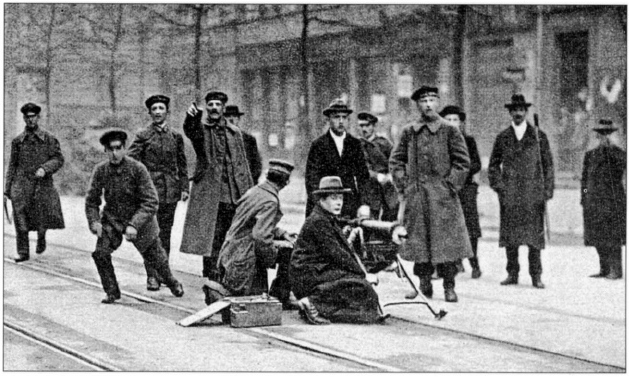
Revolution: Members of the Spartacists Bund in Berlin

Introduction

There are times when great nations face catastrophe. It is something that has befallen every world power at one time or another. Therefore it should not be a surprise if the United States despite the claims of those supporting American Exceptionalism succumbs to some great crisis which fundamentally changes it.  While I do not proclaim the end of the United States it does appear that we are experiencing events which have the potential of reducing our status as a great power and plunge the nation into political and economic chaos.  Some including California Governor Jerry Brown have compared the current state of the country to the division of the country in the American Civil War.

Likewise since there are some leaders of the loud and influential Tea Party movement who openly talk about revolution it is important to know what can happen if there is a political or economic collapse that leads to revolution at home while troops are still in combat. All of this happened in Germany in 1918.  In our current time such a possibility is higher than at any time in American History. Thus I feel we are in a potentially perilous time where long standing institutions are in crisis even while wars rage around the world.

However I do not, for all the vitriol spent believe that our current crisis is comparable to the Civil War except the absolute contempt that the opposing sides hold each other. The Civil War was a war which pitted region against region and our divisions know few geographic boundaries and even the “Red State versus Blue State” divide is deceiving.  It is my belief that what we are experiencing is much more similar to the crisis faced by Imperial Germany at the end of the First World War.  Then Germany was about to concede the loss of the war despite having known enormous battlefield success that lasted until the summer of 1918 when the tide of the war turned irreversibly against them as Allies collapsed and pulled out of the war was coupled with battlefield defeats, economic ruin and massive political and social unrest. The result of the collapse of Imperial Germany was a civil war and the foundation of the ill-fated Weimar Republic which eventually succumbed to the extremism and dictatorship of Adolf Hitler and his National Socialist Party of Germany, the Nazis.

The German Revolution of 1919 and civil war is important for those who study highly developed states when they enter a period of social and political upheaval usually following military defeat that causes the society to question or even overthrow the established order.  The end of Imperial Germany and the establishment of the Weimar Republic on November 9th 1918 is a prime example.   This paper concerns the first years of the Republic, and the dependency of the Majority Socialist leadership to the General Staff and their use of Freikorps to quell revolutionary chaos and avert the establishment of a Soviet State.

Members of the Leftist “People’s Naval Division” occupied the government quarter and terrorized Berlin

This study begins with the establishment of the Republic and concludes with the Kapp Putsch.  This is an era that is seldom referenced by political or military leaders in western states and historians themselves are often divided in their interpretation of the subject.  The study of this period is vital to those who study politically polarized societies which are either war weary or have suffered the shock of military defeat coupled with a government which is blamed for the events.  Thus, it is important to study the relationship of the military to the government and in particular the military’s relationship to politicians who have little connection to or affinity for the military, its traditions and culture and the often adversarial relationship of these politicians to military leadership which often sees them as adversaries.  The period also shows how actions of those who in their antipathy to the military create a climate where the military loathes the civilian leadership and the government.  The results of such conditions can endanger the society as a whole and ultimately usher in periods of great tragedy.  This occurred in Weimar Germany with the result that the military in the later years of the Republic neither the military nor the Majority Socialists could not work together against the Nazi takeover of the state.  However, the first years of the relationship set the tone and foredoomed the Republic.

The Complexity of the Situation

General Wilhelm Groener convinced Kaiser Wilhelm II to abdicate and helped forge an alliance between the Majority Socialists and the Army to head off a Soviet style Revolution

The history of Weimar, particularly that of the military and Freikorps in their relationship to the Republic is complex.  Not only is the relationship between the military and government complex, but the Freikorps themselves, their organization, leadership and political affiliation were not monolithic as is sometimes maintained,[i] nor were the Freikorps the direct ancestors of the Nazi SS/SA organizations despite often similar ideology,[ii] nor can they dismissed by saying that they were composed of “former soldiers and officers ill-disposed to return to civilian life.”[iii] The Freikorps’ association with the Army and Republic is more complex than some historians assert.  Despite the right wing leanings of many of units and fighters and future association of some to the Nazis, the blanket claim that the Freikorps were forerunners of the Nazi movement is not supportable.[iv]

It is true that without Freikorps support in Munich, along with support of the Thule Society, business leaders and others “that the transition of the DAP into the Hitler party could not have taken place.”[v] It is also true that elements of the Freikorps branded too revolutionary and unruly for service in the Army continued as secret societies and affiliated themselves with various right-wing political groups.[vi] Likewise a case can be made that the fierceness of many Freikorps veterans, younger leaders of the Army helped lay the foundation for the brutality of both the Army and Waffen SS as they prosecuted the Second World War.[vii] Yet simply because certain aspects of a subject are true does not make for a broader “truth.”  Heinz Höhne argues the reverse of what some have written in regard to the relationship of the Freikorps and Reichswehr to the Nazis, that in fact the Nazis did not issue from the Freikorps, but rather that many former members of the Freikorps, Imperial Army or the Reichswehr were attracted to the Nazis, particularly to the SS by its “philosophy of “hardness” and its attitude of bellicosity per se, basically unconnected with ideology.”[viii] Others historians state similar views especially those that study the relationship of the Reichswehr leadership to the Freikorps.  Thus the thesis of this paper is that the historiography like the period itself is complex; that the composition, leadership and motivations of the Freikorps were not monolithic, nor were they beloved by the Reichswehr, nor were they the “trailblazers” for the Nazi movement.  The focus of this paper is on the relationship of the Reichswehr and the Freikorps to the Republic to the Kapp Putsch and the dangers of a relationship built on necessity without mutual trust.  Such a relationship is dangerous and can lead to unintended consequences.   This paper will explore the first years of the Weimar Republic and specifically look at several key events that were pivotal in the relationship between the Army and Freikorps and the Majority Socialists.

The Supporting Literature

The literature covering this period includes both well written academic histories and popular works which attempt to present a particular view. Additionally there are biographical works which shed some light on the subject. The Reichswehr and the German Republic 1919-1926 by Harold Gordon Jr. is perhaps the best study of the Freikorps and their relationship to the state and the army.  Gordon’s work is exceptional in documenting the numbers, types, political affiliation, action and ultimate disposition of the Freikorps.  The History of the German General Staff by Walter Goerlitz; The Nemesis of Power: The German Army in Politics 1918-1945 by John Wheeler-Bennett, The Reichswehr and Politics 1918-1933 by F.L. Carsten and The Politics of the Prussian Army: 1640-1945 by Gordon A. Craig are all extremely valuable in exploring the relationship between the military and the Republic.  The best of the general histories of the period, which focus on the National Socialist state are The German Dictatorship by Karl Dietrich Bracher, and Richard Evans’ The Coming of the Third Reich. Richard Watt’s The Kings Depart is one of the best for telling the story of the fall of the Empire and the revolution in Germany.  Watt’s account is well written and documented work and touches on other factors affecting the new republic including Versailles and Allied political actions. The final chapter of Holger Herwig’s The First World War: Germany and Austria-Hungary 1914-1918 gives a good account of the Army’s role in the end of the Empire and beginning of the Republic.  Andreas Dorpalen’s Hindenburg and the Weimar Republic adds an interesting dimension of Hindenburg’s role in the republic’s formation and negotiations between Groener, Noske and Ebert. Steven Ozments’ A Mighty Fortress is superficial in its treatment of the period.  Nigel Jones’ Birth of the Nazis: How the Freikorps Blazed a Trail for Hitler is an interesting and somewhat entertaining but not very well documented tending to “broad brush” in a sensational way the Freikorps having none of the detail or nuance of Gordon, Craig, or Carsten on the Freikorps, nor the depth of Goerlitz or Wheeler-Bennett on the Republic’s relationship with the Army, or the attitude of the Reichswehr leadership to the Freikorps.  William Shirer’s The Rise and Fall of the Third Reich, Gerald Reitlinger’s The SS: Alibi of a Nation 1922-1945 and Heinz Höhne’s The Order of the Death’s Head all add some information which details early Nazi involvement in the period, but are less useful to this early period most of their work focuses on later events.  Of other works, Kenneth Macksey’s Why the Germans Lose at War has an insightful but short chapter dealing with this period and Wolfram Wette’s The Wehrmacht: History, Myth, Reality offers an interesting and at times provocative look at anti-Semitism in the German military in the years following the First World War.  Carlos Caballero Jurado’s The German Freikorps 1918-1923 is a short but very detailed study of those organizations and their actions.  B.H. Liddell-Hart who has a small chapter on General Hans Von Seeckt in The German Generals Talk which though it does not deal with the events in this paper make for interesting commentary on later actions of former Reichswehr officers who served the Nazi state.

A number of biographies touch on actions of German Officers who played key roles in World War Two.[ix] Most auto-biographies gloss over the Weimar period; however Admiral Erich Reader’s memoir Grand Admiral offers the insight of a naval officer with some direct observation of the revolution and the Kapp Putsch.  General Heinz Guderian in Panzer Leader omits his service in the Baltic “Iron Division.”  Field Marshal Albert Kesselring’s memoirs has a brief section covering the period, but one comment is typical attitude toward of many officers throughout its existence:

“My cup of bitterness was full when I saw my devoted work rewarded by a warrant for my arrest for an alleged putsch against the socialist-influenced command of my III Bavarian Army Corps. Notwithstanding the degrading episodes during my imprisonment after 1945, I do not hesitate to describe this as the most humiliating moment of my life.”[x]

One thing that has to be noted about all the memoirs is that each of the writers was writing after the German Defeat and their imprisonment. Many times their words mask other actions and attitudes that are  not mentioned, thus while an important source one also has to have some suspicions when using them even the unintentional errors that come from time as well as the human tendency to have a somewhat selective memory.

Analysis

President Friedrich Ebert and his military commanders including General Hans Von Seeckt (2nd from right)

This paper will first examine the formation of the Freikorps by the Army and the Ebert government in response to uprisings by armed groups of leftists and the effectiveness of the Freikorps in putting down the various uprisings.   We will then address the relationship of the Army with the Majority Socialists and then move on to the crisis engendered by the Kapp Putsch.

The relationship of the Republic to the Army was born in the moment of crisis of the abdication of Kaiser Wilhelm II and the armistice discussions with the Allies.  Beset by revolts in key naval bases and mutinies aboard ships of the High Seas Fleet and unrelenting Allied pressure on the German armies in the west the situation continued to deteriorate as the “red flag was flying in all the principle cities, soldiers behind the front were electing soldiers councils Russian fashion.”[xi] Revolutionary and defeatist propaganda spread by the radical left wing of the Independent Socialists and Spartacus League spread through the country and even affected combat units,[xii] while the “Majority Socialists had found out that the militant factions of the Independents had secretly armed themselves out of funds supplied by the Soviet ambassador and adopted the slogan “all or nothing.””[xiii] The situation had deteriorated so badly that Karl Liebknecht, leader of the Spartacus League “was announcing the establishment of a Soviet regime from the steps of the Imperial Palace.”[xiv]

Under these dire conditions, General Wilhelm Groener who had succeeded General Ludendorff as Quartermaster General called an emergency meeting of fifty “of his most senior army commanders.”[xv] In response to his question of whether the troops would follow the Kaiser and oppose the revolts only one answered in the affirmative, and eight responded that “there was no hope of using regular Army units to quell unrest at home.”[xvi] On November 9th Groener went to the Kaiser on behalf of the Supreme Command and in response to a suggestion that the Kaiser lead the Army back and suppress the revolts boldly stated “The Army will march home in peace and under its leaders and commanding generals, but not under the command of Your Majesty, for it stands no longer behind Your Majesty.”[xvii] The Emperor abdicated fleeing to Holland and Friedrich Ebert leader of the Majority Socialists was named Chancellor on November 9th and upon hearing the news, Philipp Scheidemann, without consulting Ebert announced that Ebert was Chancellor and “Long live the great German Republic!”[xviii] The mobs were not placated by the announcement and far left organizations with the Independents “had no intention of letting the revolution stop there.”[xix] In the streets of Berlin soldiers sold their weapons and vehicles officers were attacked by crowds on the streets and whenever “crowds found an Army officer; they tore off his epaulettes and medals.”[xx] Everywhere mutual recrimination was in the air, soldiers “blamed revolutionaries for the betrayal and stab-in-the back while revolutionaries blamed officers for all the costs and losses of the war.”[xxi]

Groener called Ebert promising the Army’s support of the new government in return for the government’s assistance to the Army in the maintenance of discipline and supply.[xxii] He also drafted a letter signed by Hindenburg pledging the Army’s loyalty and telling him that “the destiny of the German people is in your hands….”[xxiii]One source notes: “Thus, in half a dozen sentences over a telephone line a pact was concluded between a defeated army and a tottering semi-revolutionary regime; a pact destined to save both parties from the extreme elements of revolution but, as a result of which the Weimar Republic was doomed at birth.”[xxiv]

The High Command was able to bring the Army home in good order following the armistice but upon arriving most units “melted away like snow under a summer sun,”[xxv] those which remained were often shells of their former selves beset by soldier’s councils and leftist revolutionaries.  To support the government the High Command issued a directive stating that it “put itself as the disposal of the present government led by Ebert without any reservation.”[xxvi] Yet in December delegates of the National Assembly continued to sow resentment in the military by military discipline be placed in the hands of soldiers’ councils, that all badges of rank be removed with all decorations of insignia and honor.[xxvii] Reaction was heated,[xxviii] but despite this Groener, Colonel Walter Reinhardt, the Prussian Minister of War and the Republic’s Defense Minister, Gustav Noske endeavored to find forces to combat the growing revolution and rebellious military units.  The choice was not hard, the Army was of no use, so called “democratic forces” were in most cases both unreliable and ineffective, while only the Freikorps “provided suitable material for the immediate creation of an efficient, combat-ready army.”[xxix] Thus the Freikorps became the instrument of necessity to ensure that the government was not swept away by a Soviet style revolution.

Gustav Noske and General Von Luttwitz. Luttwitz would lead the Reichswehr and Freikorps units that participated in the Kapp Putsch

Gustav Noske, of the Majority Socialist party “saw himself as a patriot, a man of action…who had no time for theories…and was one of the few Socialists that the Supreme Command trusted.”[xxx] He had already distinguished himself by helping to bring under control the sailors revolts in Kiel by forming a loyal “Naval Brigade”[xxxi] and he  “realized that the government must have a dependable military force behind it if it was to survive and rule Germany” and the “old Officer Corps must be the backbone of any such force.”[xxxii] The Army had melted away and units of the workers and soldiers councils were poorly trained, organized and led “”fought against the government as often as for it” and “were of little practical value to either the government or the rebels.”[xxxiii] In the chaos of a Spartacus, now called the German Communist Party uprising and vacuum of political leadership of January 1st 1919 agreed to become defense minister stating “Someone must be the bloodhound, I won’t shirk the responsibility!”[xxxiv]

Noske reviewing Freikorps Hulsen. Many of the Freikorps were composed of professional soldiers and brought into the Reichswehr

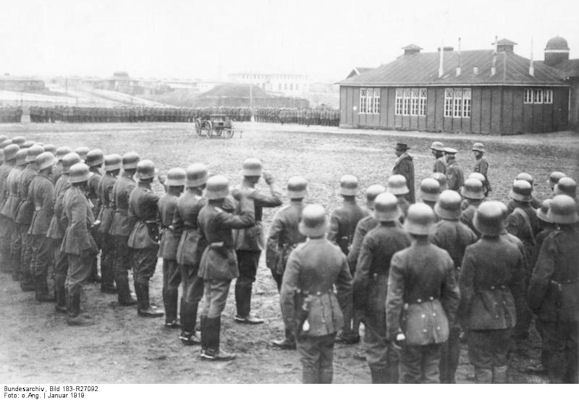
Noske helped by the High Command helped organize volunteer units led by officers and NCOs composed of reliable veterans.  Freikorps varied in size from divisions to companies and were led by Generals down to Sergeants and even a Private First Class.  Their greatest success was in early 1919 when the Republic was beset by “Red” revolutions in many major cities.  Without the use of the Freikorps by the government it is unlikely that the Republic would have survived.[xxxv] On January 4th Ebert and Noske reviewed the troops of General Maercker’s Freiwillege Landesjaegerkorps and Maercker informed them that every volunteer had pledged loyalty to the government, seeing the discipline and order Noske told Ebert “Don’t worry. Everything going to turn out all right now.”[xxxvi] On January 5th 1919 mobs attacked the Chancellery and the officers of the Socialist Vörwarts newspaper and Noske led the Freikorps[xxxvii] to regain control of the city[xxxviii] and crush the revolt during which “Karl Liebknecht and Rosa Luxemburg were lynched by the officers of the Guards Cavalry Rifle Division.”[xxxix] In March after a period of uneasy calm the Freikorps, now reinforced by the 2nd Naval Brigade, or Ehrhardt Brigade[xl] were called upon to put down the revolt of the “People’s Naval Division.”[xli] Making liberal use of heavy weapons including tanks the Freikorps inflicted heavy losses on the leftists with over 1500 dead and 12,000 wounded in the uprising.[xlii] Other revolts were crushed and the Freikorps reached their zenith in Württemberg where Freikorps led by Lieutenant Hahn, a Social Democrat put down leftist revolts[xliii] and in Bavaria where Independents and Communists had taken the city with their “Bavarian Red Army which numbered nearly 25,000 men[xliv] on April 7th. After failed attempts by the Socialist government to retake Munich, they asked for Berlin’s help.  Violence and massacres of citizens by the various leftist groups inflamed the Freikorps, including the Ehrhardt Brigade and the revolt was crushed by May 2nd.[xlv] Dorpalen calls the Freikorps ruthlessness “completely unwarranted in view of the weakness of the opposing forces” and noted though they broke the leftist powers they deepened the nations’ cleavages”[xlvi] while Macksey writes that “where Freikorps’ brutality stained the pages of history there was invariably a forgoing or simultaneous record of excess by their sworn opponents.”[xlvii]

The Erhardt Brigade in Berlin during the Kapp Putsch

The Provisional Reichswehr was established on March 6th 1919 and the High Command began to assemble it from the Freikorps, remaining Army units and Republican defense forces.  Some Freikorps were brought into the new Army in total, but the tumult had not yet ceased.  There was a great distrust between many in the Army, the remaining Freikorps and the Socialists.  The crisis was precipitated by the signing of the Treaty of Versailles, Noske and others threatened resignation over the war guilt clauses, but Groener warned that if the treaty was rejected the Army could not win against the Allies if hostilities were renewed.[xlviii] The treaty imposed harsh limitations on the German Army which many bitterly resented, however, Seeckt, the Chief of Staff of the Army felt that it was “more important to keep the Army in being and preserve the possibility of a military resurrection.”[xlix] Yet the government had lost the support of the Officer Corps and many looked to General Walther von Lüttwitz, the Reichswehr’s senior commander for leadership.[l]

Korvettenkapitan (Lieutenant Commander) Erhardt commander of the 2nd Naval Brigade whose announced demobilization triggered the Kapp Putsch. Erhardt would have to flee after the Nazi takeover. Even revolutionaries become victims as revolutions end

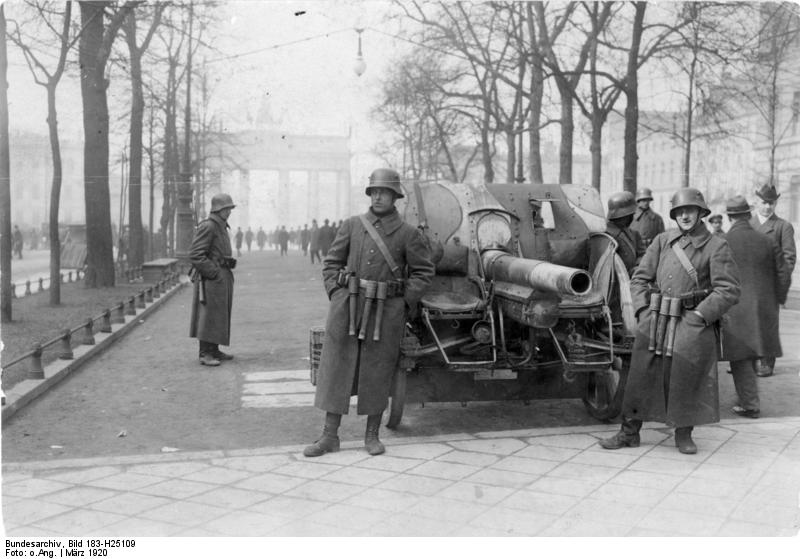
Other right-wing groups and individuals made plans to overthrow the government.  They favored revolt against the government, but “their political aims were hazy.”[li] Seeckt and Reinhardt felt it necessary to demobilize Freikorps who’s ill-discipline and political radicalism was a “danger to the consolidation desired by the army command.”[lii] This movement climaxed with the alliance of Lüttwitz to Wolfgang Kapp and was triggered by the orders disbanding the 2nd and 3rd Naval Brigades in compliance with Versailles and due to their radical views.[liii] In spite of the opposition of his chief of staff Von Lüttwitz began planning a coup to save Germany.[liv] The conspirators showed “little regard for coordination of effort and a quite amazing ability to work at cross purposes.”[lv] On March 12th without consulting Kapp, Lüttwitz and Ehrhardt launched the Putsch and Ehrhardt’s brigade in full battle dress entered Berlin. At this point the Reichswehr command froze; officers refused to condone the putsch but at the same time refused to support Noske and Reinhardt who demanded armed opposition,[lvi] while Navy officers openly supported it.[lvii] Seeckt declared that “Troops do not fire upon troops!” and “When at occurs, then the true catastrophe, which was avoided with so much difficulty on November 9, 1918 will really occur.”[lviii] The coup died amid massive strike by workers and lack of popular support but the damage was done.  Noske resigned, many officers in were discredited[lix] and dismissed including Lüttwitz and Admiral Von Trotha, who openly supported the coup,[lx] though Raeder says that Von Trotha and the Navy staff only” thought of anything of complete loyalty to the government.”[lxi] The relationship which had endured the dire days of the Republic was ended.  The Reichswehr would emerge a lean and highly trained organization and remain a power broker in the Republic but the animosity between the Army and the Socialists that they could not stand together against the Nazis despite a mutual interest in doing so.[lxii]

Conclusion

The end of Weimar and the beginning of a nightmare

The period was a critical and complex and should be studied by anyone living in a state with a powerful military tradition and institutions in crisis.  Unlike popular notions, the Freikorps were diverse and not the seed-bed of the Nazi movement and though many former members would become Nazis.  Several, including Ehrhardt narrowly escaped death at Nazi hands.[lxiii] Freikorps were viewed by Army leadership as an expedient force that could not remain in the service once the Army was functional.

Key lessons include that the military cannot become a “state within a state,” and that both military and civilian leaders must seek to bridge any gulf that separates them in times of crisis.  In Weimar both the military and the Socialists thoroughly distrusted one another with the result that they eventually, despite early success[lxiv] worked against each other in later years.  Actions by both Socialists and the military ultimately subverted the Republic and ensured its demise and Seeckt’s policy of separation from politics “tended toward a renunciation of the soldier’s potential restraining influence on adventurous statesmen.”[lxv] Such is the fateful lesson for today.


[i] Jones, Nigel. The Birth of the Nazis: How the Freikorps Blazed a Trail for Hitler. Constable and Robinson Ltd. London, U.K. 1987 and 2004.  This is Jones assertion and he attempts to make the tie using careers of some individuals who served both in Freikorps and either in the Nazi Party or Military and attitudes common in many Freikorps with similar attitudes found in the Nazi movement.  The 2004 edition of his work includes an introduction by Michael Burleigh echoing his sentiments.

[ii] Evans, Richard J. The Coming of the Third Reich. Penguin Group. London, U.K. and New York, NY. 2003. pp.227-229.  Evans discusses the fact that the Nazis did have a number of Freikorps veterans but at no point makes the connection that the Freikorps are a direct ancestor.

[iii] Ozment, Steven. A Mighty Fortress: A New History of the German People. Harper-Collins Publishers, New York, NY 2004 p.246

[iv] Gordon, Harold J. Jr. The Reichswehr and the German Republic 1919-1926. Princeton University Press, Princeton NJ 1957.  Gordon’s work is perhaps the most detailed study involving the Freikorps and the Reichswehr. He is exceptional in discussing the relationship of both with the various political parties including the Nazis.  He refutes this assertion throughout the book.

[v] Bracher, Karl Dietrich. The German Dictatorship. Translated by Jean Steinberg. Praeger Publications, New York, NY 1970. Originally published as Die Deutsche Diktatur: Enstehung, Struktur, Folgen des Nationalsozialismus. Verlag Kiepenheuer & Witsch, Koln und Berlin. 1969. p.101

[vi] Wheeler-Bennett, John W. The Nemesis of Power: The German Army in Politics 1918-1945. St. Martin’s Press, New York, NY 1954 pp. 91-92

[vii] Shepherd, Ben. War in the Wild East: The German Army and Soviet Partisans. Harvard University Press, Cambridge, MA and London, U.K. 2004. p.28

[viii] Höhne, Heinz. The Order of the Death’s Head: The Story of Hitler’s SS. The Penguin Group, London U.K. and New York, NY 1969. Translated by Richard Barry. Originally Published as Der Ordnung unter dem Totenkopf. Verlag der Spiegel, Hamburg, 1966. p.54.

[ix] These include Macksey’s biographies of Kesselring and Guderian , Richard Giziowski’s The Enigma of General Blaskowitz. Peter Padfield’s Dönitz: the Last Führer, David Fraser’s biography of Field Marshal Rommel Knight’s Cross, Messenger’s work on Von Rundsedt, The Last Prussian, and Höhne’s Canaris: Hitler’s Master Spy all provide brief but interesting views of the actions and attitudes of these officers during the revolution and during the  Weimar period.

[x] Kesselring, Albrecht. The Memoirs of Field Marshal Kesselring with a new introduction by Kenneth Macksey. Greenhill Books, London UK. 1997. Translated from the German by William Kimber Ltd. Originally published as Soldat bis zum letzen Tag. Athenaum, Bonn, Germany 1953 pp.18-19

[xi] Goerlitz, Walter. History of the German General Staff 1657-1945. Translated by Brian Battershaw. Westview Press. Boulder CO and London. 1985 Originally published as Der Deutsche Generalstab, Verlag der Fankfurter Hefte, Frankfurt am Main.  First U.S. publication in 1953 by Preager Publishers. p.200

[xii] Gordon, Harold Jr. The Reichswehr and the German Republic 1919-1926. Princeton University Press, Princeton, NJ 1957 pp.4-5 Gordon recounts the story of an entire replacement train revolting when it reached the front which had to be disarmed by a shock battalion.

[xiii] Watt, Richard M.  The Kings Depart: The Tragedy of Germany: Versailles and the German Revolution. Simon and Schuster, New York, NY 1968. p.186

[xiv] Wheeler-Bennett, John W. The Nemesis of Power: The German Army in Politics 1918-1945. St. Martin’s Press, New York, NY 1954. p.18

[xv] Herwig, Holger H. The First World War: Germany and Austria Hungary 1914-1918. Arnold Press a member of the Hodder-Headline Group, London, UK and New York NY 1997 p.445

[xvi] Ibid. Herwig. p.445

[xvii] Carsten, F.L. The Reichswehr and Politics 1918-1933. Oxford University Press, Oxford, UK 1966 p.6.  It is noted by a number of author’s that Groener did this, to maintain the unity of Germany and prevent its division.

[xviii] Ibid. Watt. p.196  Watt notes Ebert’s reaction as being enraged as the proclamation of the Republic technically “invalidated the existing constitution; Germany was now technically without a government.” (p.197)

[xix] Ibid. Watt. p.197

[xx] Ibid. Watt. p.197

[xxi]Giziowski, Richard. The Enigma of General Blaskowitz Hippocrene Books Inc. New York NY, 1997. p.65

[xxii] Craig, Gordon A. The Politics of the Prussian Army 1640-1945. Oxford University Press, Oxford, UK 1955 pp.347-348.  Craig gives an interesting account noting the Groener’s call to Ebert shows recognition of the legitimacy of the new government and notes that the offer was somewhat conditional.

[xxiii] Dorpalen, Andreas. Hindenburg and the Weimar Republic. Princeton University Press, Princeton, NJ. 1964 p.26

[xxiv] Ibid. Wheeler-Bennett. p.21

[xxv] Ibid. Gordon. p.15

[xxvi] Ibid. Carsten. p.11. This was of critical importance as Carsten later notes that the Army realized that the government could not survive without its support.  Groener was perhaps the officer who most recognized the situation and endeavored to ensure that “the best and the strongest element of the old Prussia, was saved for the new Germany, in spite of the revolution.” (p.12)

[xxvii] Ibid. Carsten. p.18 Carsten produces the bulk of the English translation of these points and notes that the anti-military feeling had become widespread.

[xxviii] Ibid. Giziowski. p.66  Giziowski recounts the speech of Hermann Goering in response to the announcement. This shows how such treatment can breed anger and resentment in a military that feels it has been betrayed after serving its country in a long and difficult war: For four long years we officers did our duty and risked all for the Fatherland. Now we have come home, and how do they treat us? The spit on us and deprive us of what we gloried in wearing. I will tell you that the people are not to blame for such conduct. The people were are comrades…for four long years.  No, the ones who have stirred up the people, who have stabbed this glorious army in the back…. I ask everyone here tonight to cherish a hatred, a deep and abiding hatred, for these swine who have outraged the German people and our traditions.  The day is coming when we will drive them out of our Germany.”

[xxix] Ibid. Gordon. p.15

[xxx] Ibid. Watt. p.168

[xxxi] Ibid. Gordon. pp. 19 and 24.  This was the 1st Marine Brigade, or Brigade Von Roden of which elements would later serve in under the command of other Freikorps such as the Guards Calvary Rifle Division.

[xxxii] Ibid. Gordon. p.14

[xxxiii] Ibid. Gordon. p.18

[xxxiv] Ibid. Watt. p.239

[xxxv] Ibid. Gordon. p.426

[xxxvi] Ibid. Watt. p.247

[xxxvii] Thee forces included the Landesjaegerkorps and Guards Cavalry Rifle division.

[xxxviii] Ibid. Gordon. p.30

[xxxix] Ibid. Wheeler-Bennett. p.36

[xl] This was one of two additional Naval Brigades formed by Noske after the success of Naval Brigade Von Roden.  It was one of the most combat effective but unfortunately violent and radical of the Freikorps, it would as we will see be a key unit in the Kapp Putsch but would not be absorbed into the Reichswehr.

[xli] This unit was not a Navy unit at all but was composed of many who were criminals and other rabble. See Gordon, Carsten and Watt.

[xlii] Jurado, Carlos Caballero. The German Freikorps 1918-23. Illustrated by Ramiro Bujeiro. Osprey Publishing, Oxford, UK 2001 p.12

[xliii] Ibid. Gordon. p.42  His units were known as Security Companies.

[xliv] Ibid. Jurado. p.13

[xlv] Ibid. Gordon. pp.47-49. An estimated 550 people including 200 innocent bystanders were killed in the fighting.

[xlvi] Ibid. Dorpalen. p.29

[xlvii] Macksey, Kenneth. Guderian: Creator of the Blitzkrieg. Stein and Day Publishing, New York, NY 1975 p.45

[xlviii] Ibid. Wheeler-Bennett. pp.57-59

[xlix] Ibid. Goerlitz. p.216

[l] Ibid. Wheeler-Bennett. p.61

[li] Ibid. Carsten. p.74

[lii] Ibid. Carsten. pp.74-75

[liii] Ibid. Carsten. p.76  Another consideration is that Noske, Reinhardt and Seeckt all were seeking to retire Lüttwitz.

[liv] Ibid. Gordon. p.97

[lv] Ibid. Craig. p.376

[lvi] Ibid. Carsten. pp.78-79

[lvii] Höhne, Heinz. Canaris: Hitler’s Master Spy. Cooper Square Press, New York, NY 1979 and 1999. Translated from the German by J. Maxwell Brownjohn, Originally published in Germany by C. Bertelsmann Verlag Gmbh, München. 1976. p. 78.  Canaris also had been suspected of complicity in the murders of Rosa Luxemburg and Karl Liebknecht but was acquitted. (pp.56-71)

[lviii] Ibid. Gordon. pp.114-115

[lix] Among them Maercker who had been such a strong supporter of the Republic in the early days.

[lx] Ibid. Carsten. p.98

[lxi] Raeder, Erich. Grand Admiral. Translated from the German by Henry W. Drexell. United States Naval Institute, Annapolis MD, 1960. Da Capo Press edition published 2001. p.111. This is interesting as almost all histories implicate the Navy High Command of either some complicity or at least agreement with the Putsch participants.

[lxii] The final part in the drama would come when General Kurt Von Schleicher became the last Chancellor before Hitler.  Schleicher had assisted Groener and Noske in the early days of the Republic and often attempted to use the Army’s influence in politics. He was fatally short sighted and was a victim of the SS “night of Long Knives” which was directed against the SA.

[lxiii] Ibid. Jones. p.266  Others such as Gerhard Rossbach had similar experiences.  Korvettenkapitän Löwenfeld of the 3rd Naval Brigade became an Admiral, Wilhelm Canaris , who was implicated in the Kapp Putsch but kept his career would later head the Abwehr and die in a concentration camp.

[lxiv] Ibid. Gordon. p.426  Gordon has a good discussion of this topic in his conclusion.

65 Liddell-Hart, B.H. The German Generals Talk. Published 1948 B.H. Liddell-Hart, Quill Publications, New York, NY. 1979. p.18 Liddell-Hart’s analysis of the results of the Reichswehr’s disconnection from the larger society and political process is remarkable due to current trends in the American military which like the Reichswehr has become somewhat more conservative and disconnected from society, exceptionally technically proficient but not adept in politics or grand-strategy.


Works Cited


Bracher, Karl Dietrich. The German Dictatorship: The Origins, Structure and Effects of National Socialism. Translated from the German by Jean Steinberg with an introduction by Peter Gay.  Praeger Publishers, New York, NY. 1970 Originally published in Germany as Die deutsche Diktator: Entstehung, Struktur, Folgen den Nationalsozialismus by Verlag Kiepenheuer und Witsch. Koln und Berlin.


Carsten, F.L. The Reichswehr and Politics 1918-1933. Oxford University Press, Oxford, UK 1966


Craig, Gordon A. The Politics of the Prussian Army 1640-1945. Oxford University Press, Oxford, UK 1955


Dorpalen, Andreas. Hindenburg and the Weimar Republic. Princeton University Press, Princeton, NJ. 1964


Evans, Richard J. The Coming of the Third Reich. Penguin Books, New York, NY and London, UK. 2003


Giziowski, Richard. The Enigma of General Blaskowitz Hippocrene Books Inc. New York NY, 1997


Goerlitz, Walter. History of the German General Staff 1657-1945. Translated by Brian Battershaw. Westview Press. Boulder CO and London. 1985 Originally published as Der Deutsche Generalstab, Verlag der Fankfurter Hefte, Frankfurt am Main.  First U.S. publication in 1953 by Preager Publishers


Gordon, Harold Jr. The Reichswehr and the German Republic 1919-1926. Princeton University Press, Princeton, NJ 1957


Guderian, Heinz. Panzer Leader. (abridged) Translated from the German by Constantine Fitzgibbon, Ballantine Books, New York 1957


Herwig, Holger H. The First World War: Germany and Austria Hungary 1914-1918. Arnold Press a member of the Hodder-Headline Group, London, UK and New York NY 1997


Höhne, Heinz. Canaris: Hitler’s Master Spy. Cooper Square Press, New York, NY 1979 and 1999. Translated from the German by J. Maxwell Brownjohn, Originally published in Germany by C. Bertelsmann Verlag Gmbh, München. 1976.


Höhne, Heinz. The Order of the Death’s Head: The Story of Hitler’s SS. The Penguin Group, London U.K. and New York, NY 1969. Translated by Richard Barry. Originally Published as Der Ordnung unter dem Totenkopf. Verlag der Spiegel, Hamburg, 1966.


Jones, Nigel. The Birth of the Nazis: How the Freikorps Blazed the Way for Hitler. Constable and Robinson Ltd. London, UK 1987


Jurado, Carlos Caballero. The German Freikorps 1918-23. Illustrated by Ramiro Bujeiro. Osprey Publishing, Oxford, UK 2001


Kesselring, Albrecht. The Memoirs of Field Marshal Kesselring with a new introduction by Kenneth Macksey. Greenhill Books, London UK. 1997. Translated from the German by William Kimber Ltd. Originally published as Soldat bis zum letzen Tag. Athenaum, Bonn, Germany 1953.


Liddell-Hart, B.H. The German Generals Talk. Published 1948 B.H. Liddell-Hart, Quill Publications, New York, NY. 1979


Macksey, Kenneth. Guderian: Creator of the Blitzkrieg. Stein and Day Publishing, New York, NY 1975


Macksey, Kenneth. Kesselring: The German Master Strategist of the Second World War. Greenhill Books, London, UK 2000.


Ozment, Steven. A Mighty Fortress: A New History of the German People. Harper-Collins Publishers, New York, NY 2004


Shepherd, Ben. War in the Wild East: The German Army and Soviet Partisans. Harvard University Press, Cambridge, MA and London, U.K. 2004


Wheeler-Bennett, John W. The Nemesis of Power: The German Army in Politics 1918-1945. St. Martin’s Press, New York, NY 1954


Watt, Richard M.  The Kings Depart: The Tragedy of Germany: Versailles and the German Revolution. Simon and Schuster, New York, NY 1968


Wette, Wolfram. The Wehrmacht: History, Myth, Reality. Harvard University Press, Cambridge, MA and London, UK  2006. Translated from the German by Deborah Lucas Schneider. Originally published as Die Wehrmacht: Feindbilder, Vernichtungskrieg, Legenden. S. Fischer Verlag Gmbh, Frankfurt am Main, Germany 2002


1 Comment

Filed under History, Military, national security, Political Commentary