Tag Archives: carl von clausewitz

August 1914: The Beginning of a Century of Disasters

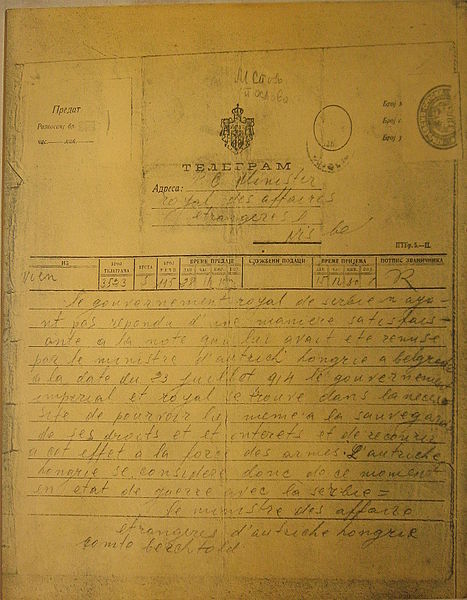
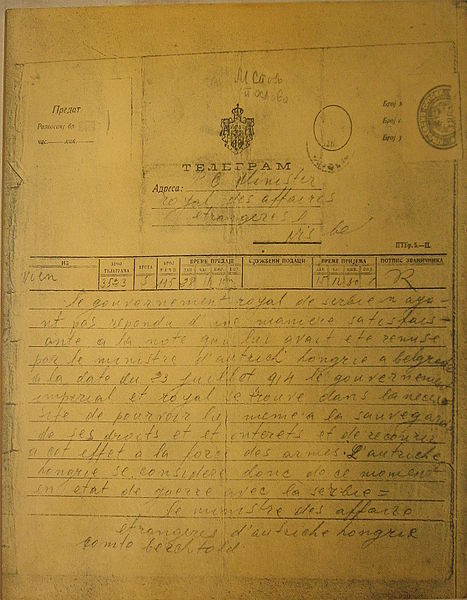
467px-TelegramWW1

The Austrian Declaration of War against Serbia

“No one starts a war–or rather, no one in his senses ought to do so–without first being clear in his mind what he intends to achieve by that war and how he intends to conduct it.” Carl Von Clausewitz

It was a war that should never have happened. It was a war for which the belligerent powers could boast many causes but for which few had any real objectives. Ninety-nine years ago this week the nations of Europe were hell bent on waging a war that all thought would be short, decisive and end in victory for their side. They were wrong and nearly a century later the world still pays the price for their misplaced beliefs and hubris of those men.

It was a war in large part brought on by the declining Austro-Hungarian Empire’s fears. Fear of neighbors, ethnic minorities and its place among regional and world powers led the leaders of the Austro-Hungarian Empire to decide for war when the very unpopular heir to the throne Archduke Franz Ferdinand was assassinated in Sarajevo, the capital of the recently annexed province of Bosnia-Herzegovina on June 28th 1914.

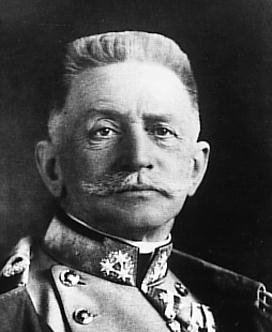
Baron Conrad von Hotzendorf

Conrad von Hötzendorf: War was the only means of politics

 It was a series of decisions by those in the government of the Empire that brought Europe and the world to war, a war which we still feel the effects of today. In particular it was the decisions of the Austrian Chief of the General Staff Conrad von Hötzendorf, the Foreign Minister Leopold Berchtold and the aging Emperor, Franz Joseph which plunged the world into a world war which spawned revolutions, regional wars, a second world war, a cold war and countless other wars. The decisions were based on the belief, still common today that war is the only means of politics.

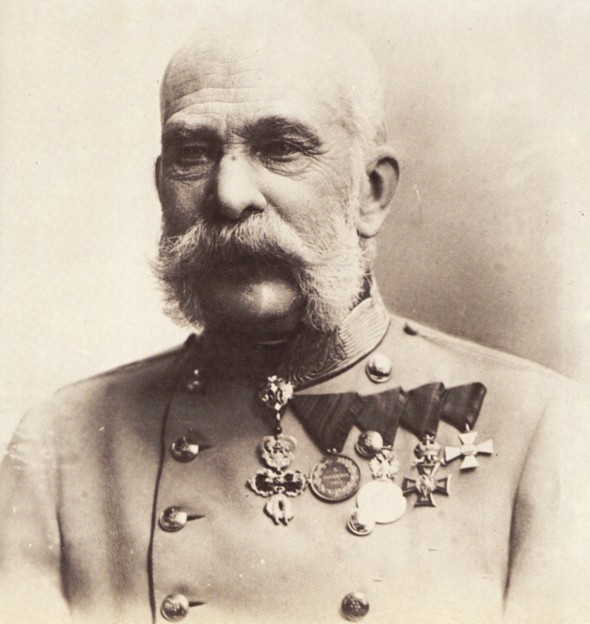
WIK_Franz-Joseph_ca-1910[1]

Emperor Franz Joseph: “If we must go under, we better go under decently”

 Hötzendorf had been a continual advocate of war in every situation. He lobbied for war in 1907 against Italy and Serbia, in 1908 against Serbia, Russia and Italy, in 1909 against Serbia and Montenegro, in 1910 against Italy and the list increased in the years leading up to the war. He fervently believed that “the use of armed force alone could retard the centrifugal forces of nationalism in the ‘multinational empire’; war was the only means of politics.” The Emperor, Franz Joseph was of the same mindset by 1914 and in the days following the assassination of Franz Ferdinand he gave his approval to the actions of Hotzendorf and the diplomacy of Berchtold which doomed the Austro-Hungarian Empire and would destroy and remake Europe within a span of four years.
b305084a

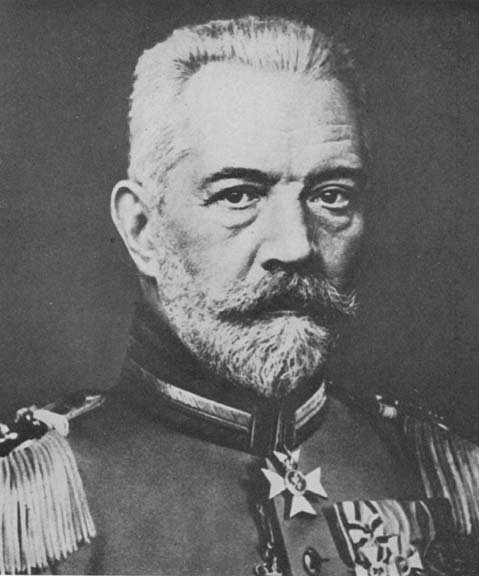
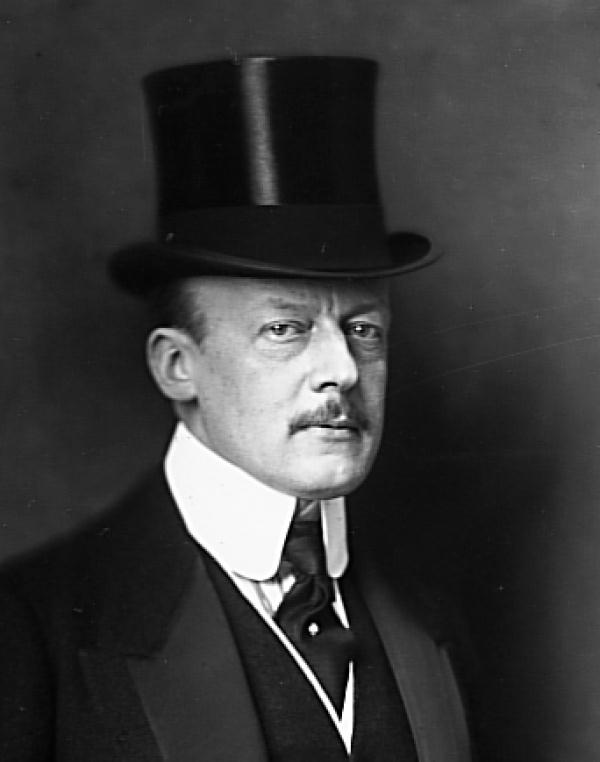
Theobald von Bethmann-Hollweg: The Blank Checque

 The leadership of the Empire had decided on war within days of the assassination. Berchtold dispatched an emissary to Kaiser Wilhelm who decided in counsel with his Imperial Chancellor Theobald von Bethmann-Hollweg gave the Austrians a “blank cheque” of unconditional support for war against Serbia. Berlin was confident that “the Balkan crisis could be localized” and “advised Vienna to “proceed with all means at its disposal” and that Germany would support Austria-Hungary “come what may.” In doing so they willingly ignored the wise counsel of Otto Von Bismarck who considered the Balkans “not worth the life of a single Pomeranian Grenadier.

After they received German support the Austrians did everything that they could to ensure that war would occur. Their demands of Serbia were intentionally designed to be unacceptable to that country and they held key information from their German allies in the three weeks after they received the unconditional German support.
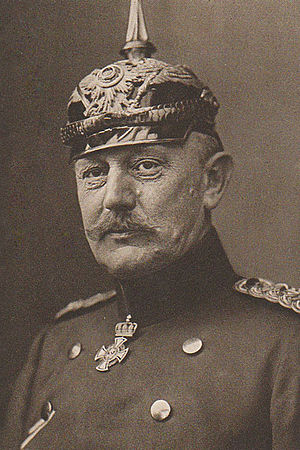
300px-Vonmoltke

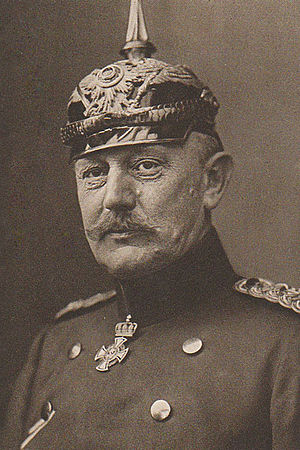
Helmuth Von Molkte: “no alternative but to fight a preventive war…” 

 German militarists, particularly the Chief of the General Staff Helmuth Von Molkte the younger saw the coming conflict in racial and cultural terms. Von Molkte said that the coming war   would come “sooner or later” and be a war “primarily a struggle between Germans and Slavs” and compared Serbia to an “abscess.”  As the war cloud built Von Molkte told the Foreign Secretary von Jagrow that there was “no alternative but to fight a preventive war so as to beat the enemy while we could still emerge fairly well from the struggle” ignoring the advice of the Iron Chancellor Otto Von Bismarck who counseled “Preventive war is like committing suicide out of fear of death.”
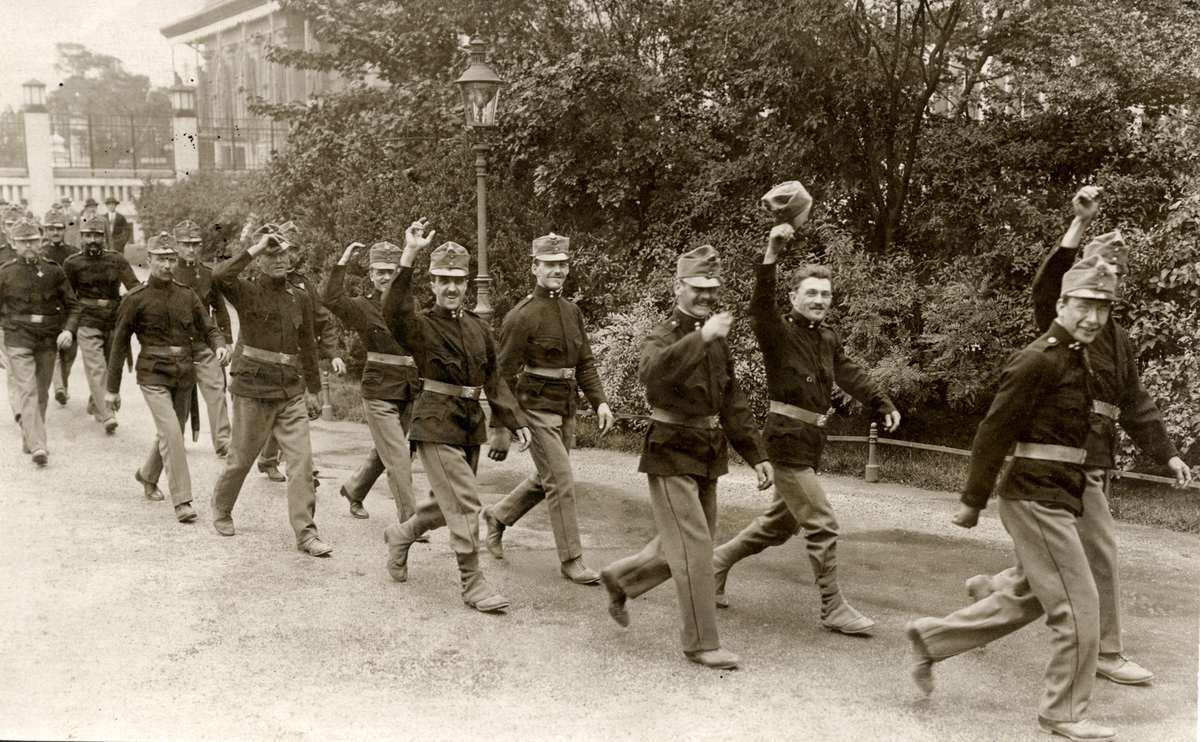
d345009d3a48

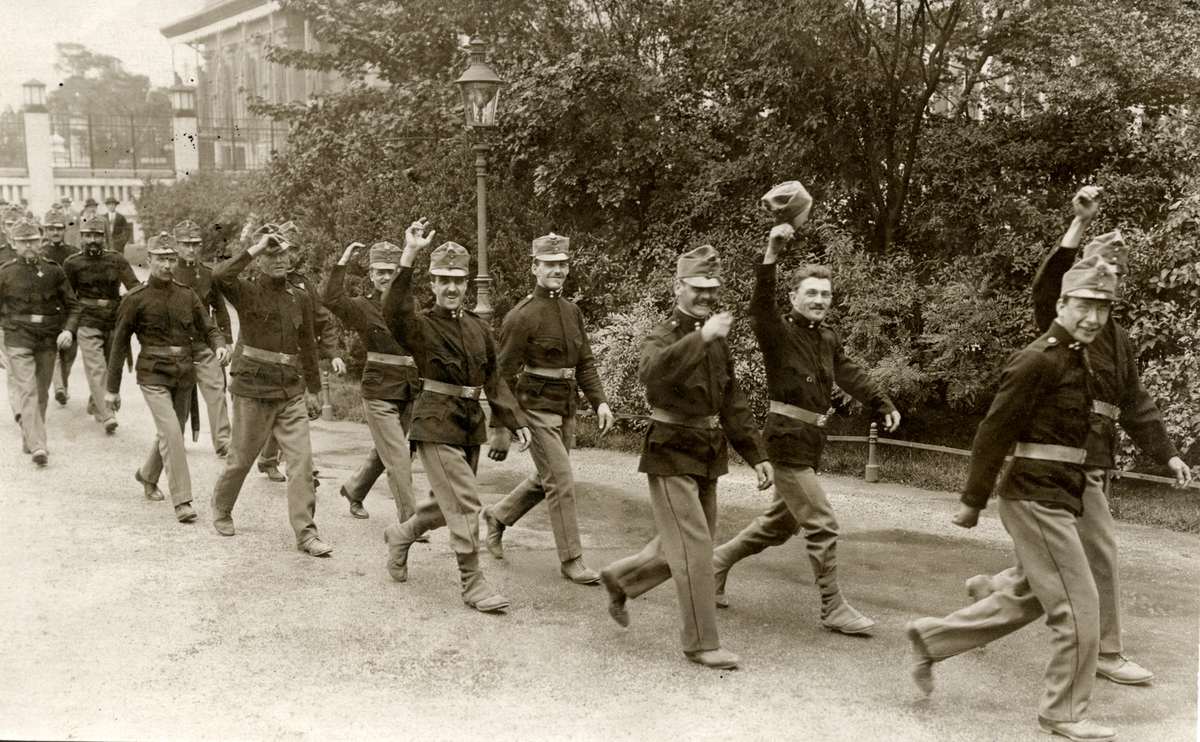
Austrian Reservists going to war

 The Austrians felt that the threat from Serbia combined with internal political factors related to the Hungarian and other Slavic regions of the Empire, and the increasing influence of Russia and Germany in the Balkans was an existential threat. At the same time they were poorly prepared for war. Their military was large but poorly trained and equipped.  Their national infrastructure, industry and railroads were ill-prepared for the demands of war. Their German allies had not planned for war either and were critically short of the required stocks of ammunition needed for a general war in Europe.
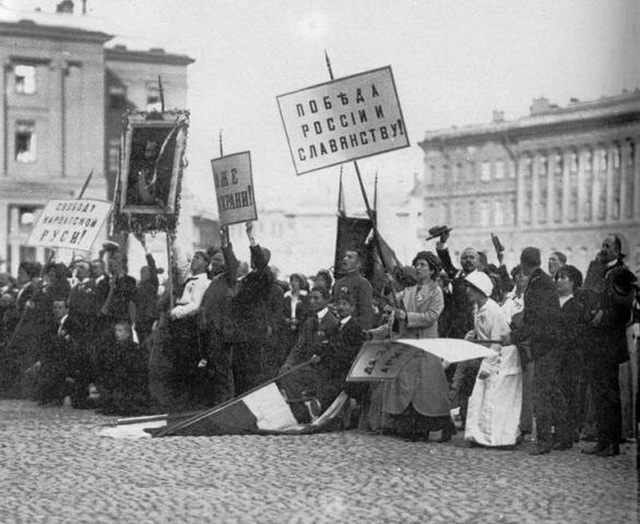
d8c27e8a26d2

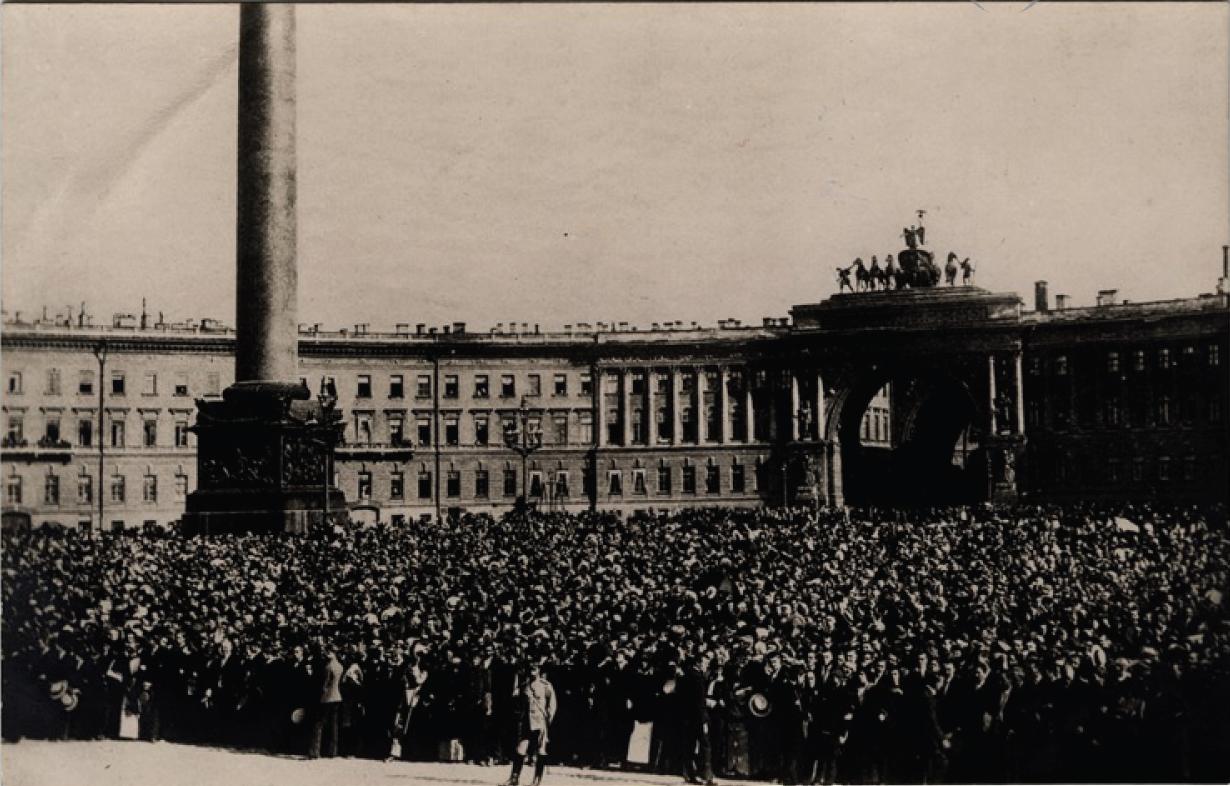
Cheering crowds in Petersburg

 The Russians were heavily invested in the Balkans linked to other Slavic people by culture, language and religion. The French were bent on revenge against the Germans for the debacle of 1870 and had no stake in what happened in the Balkans. The British a few years prior to the war had told the Belgians not to expect support if they were invaded by Germany, but declared war to “protect Belgian neutrality.”
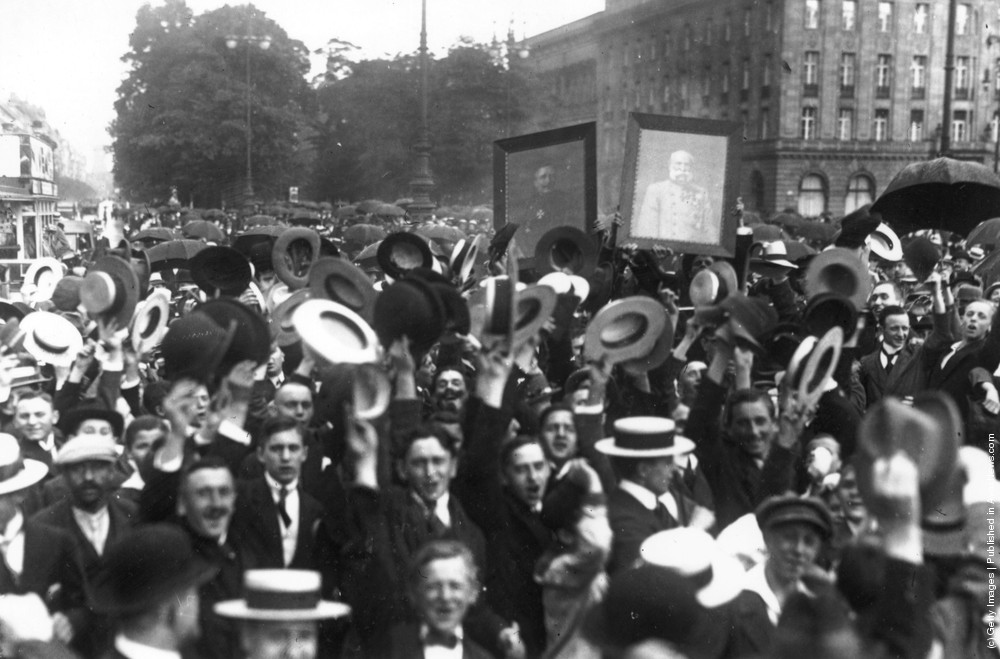
f0268cf28513

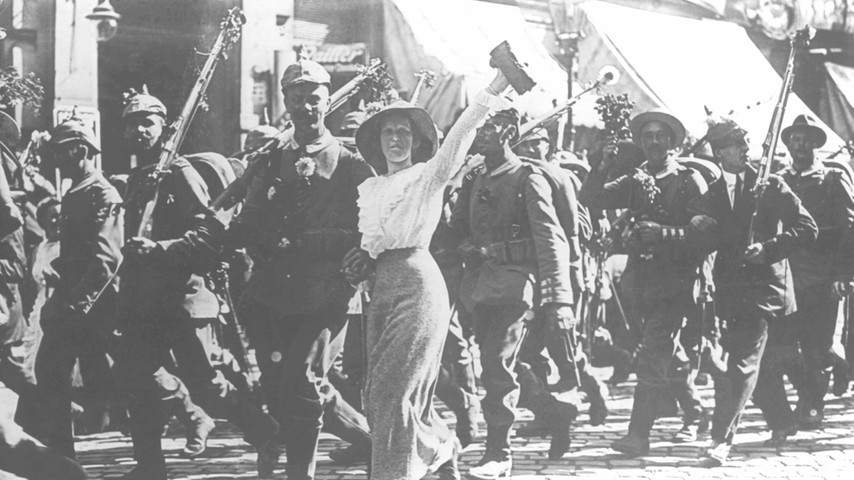
German wives and girlfriends walking alongside the Landser…

 The Austrians thought that with German support that even if Russia intervened that the war could be limited to Serbia. They were wrong. Just as the Germans had given the Austrians a “blank cheque” the French, both officially and unofficially were giving the Russians their own blank cheque. French Ambassador Maurice Paleologue assured Russian Foreign Minister S.D. Sazonov of the “complete readiness of France to fulfill her obligations as an ally in case of necessity.
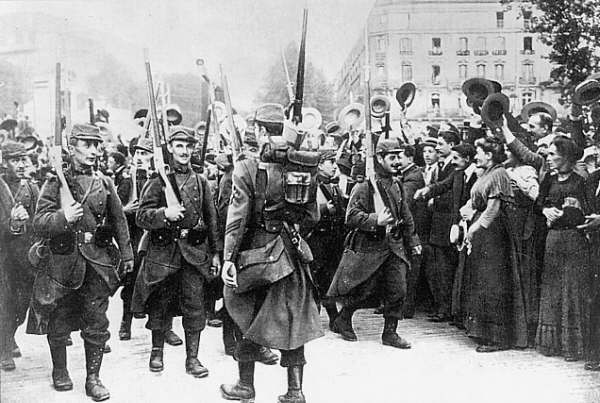
93bb04dba7d3

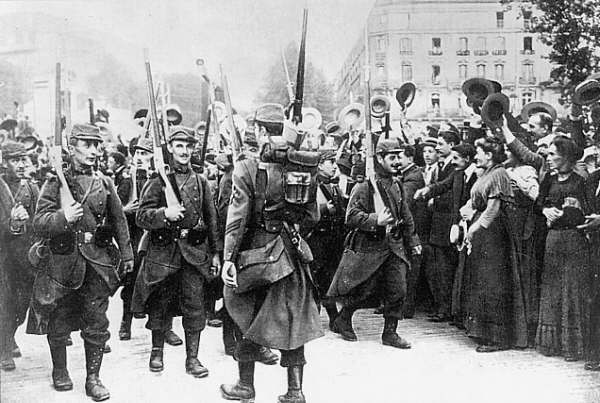
French Soldiers being cheered

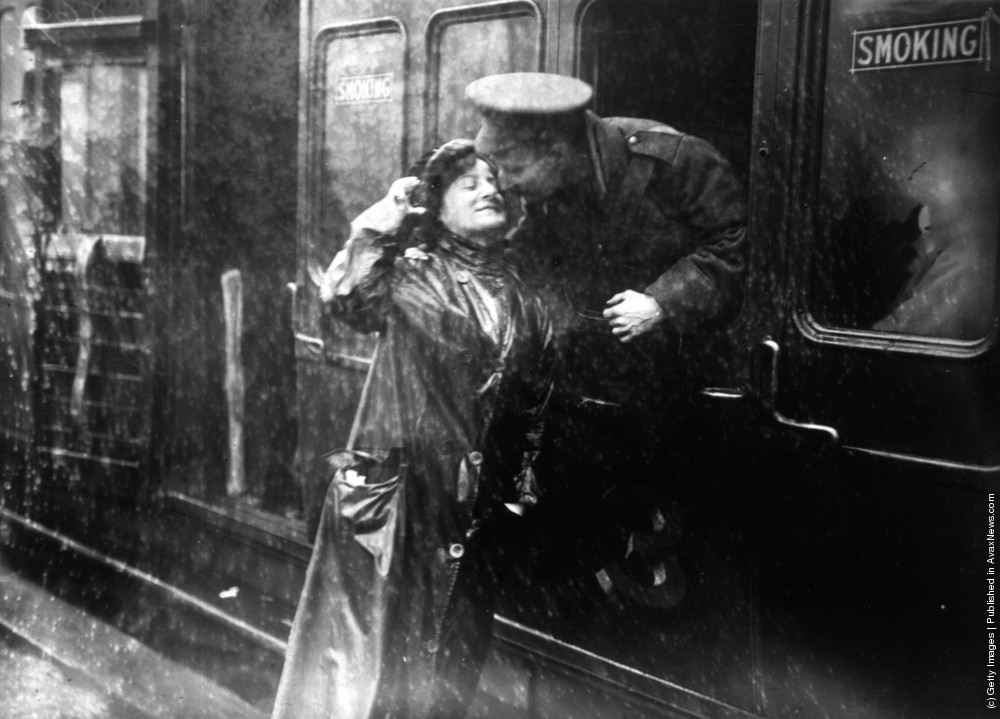
 Austria declared war on July 28th, Russia followed by a partial mobilization to support Serbia on the 29th. Kaiser Wilhelm attempted to avert war at the last minute but Czar Nicholas II wrote “An ignoble war has been declared on a weak country. The indignation of Russia, fully shared by me, is enormous. I foresee that very soon I shall be overwhelmed by pressure to which I am exposed and compelled to take measures which will lead to war.”  This was met with German mobilization on the 30th and the French on August 1st. Declarations of war were exchanged and on August 4th in response to Germany’s refusal to respect the neutrality of Belgium Great Britain declared war against Germany.
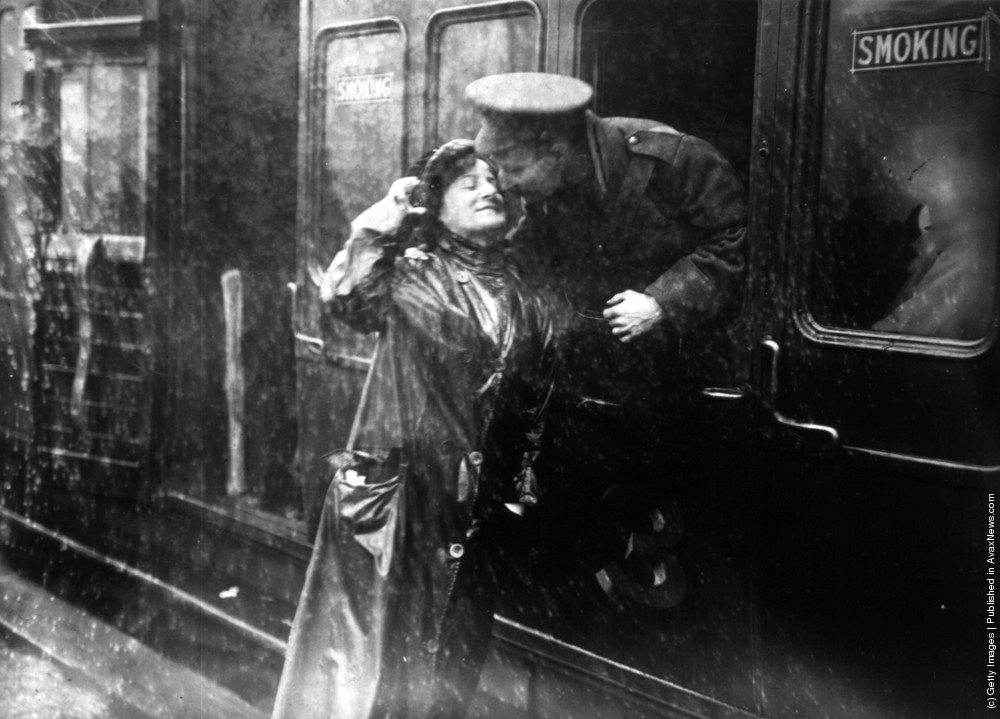
d1d14e05247c

A final kiss from a British Soldier at Victoria Station

They were fateful days. Only the Austrians entered the war with any positive objectives, military or political goals. Every other power lurched into the war without clear objectives or end states. One writer noted that the war had “causes but no objectives.”

The world again finds itself perched at the edge of the abyss of war. There are people, smart and otherwise reasonable people who believe that they can wage “preventive wars” and rely on brute military force to solve nearly any problem. There are others that suggest that we should not criticize “allies” even when their decisions could be disastrous to them and the world, much as the Germans gave their Austrian brothers a “blank cheque.”  I wish that they would just look at the consequences before they commit nations and the world to more war that can only result in calamity and great suffering without benefit for anyone or any nation involved.

Those that counsel “preventive wars” need to remember the words of Otto Von Bismarck that “Preventive war is like committing suicide out of fear of death.”

Peace

Padre Steve+

3 Comments

Filed under History, Military, national security, Political Commentary

Relearning Ministry Again For the First Time

198177_10151361204842059_1890411795_n

“Ministry means the ongoing attempt to put one’s own search for God, with all the moments of pain and joy, despair and hope, at the disposal of those who want to join this search but do not know how.” Henri Nouwen 

It was over 20 years ago that I graduated from seminary. I was a very good student and took every opportunity to learn, even when what I learned challenged my assumptions. Thus in a Southern Baptist seminary I basically came out as an Anglo-Catholic or progressive Vatican II type Catholic. But even so I was was still quite limited in my understanding of ministry.

My time in a Clinical Pastoral Education Residency a year after I graduated from seminary was filled with more discovery, much of it very painful as I confronted many of my own demons, But even what I learned there was just a chip off the top of the iceberg. While it was valuable it was something that took many more years to begin to fully grasp.

In each of these places and times of learning I discovered much, but like any novice my actual understanding of what I learned with limited by my own strengths as an analytical thinker and intuitive personality type. I was quite convinced of my competencies, skills and abilities, particularly in history and theology. I could wear people out picking apart arguments that I thought were flawed. Likewise on the occasions people came to me for advice I often would fall back on my strengths in analyzing their situation and giving them an answer. I was so obnoxious about it Judy would sometimes call me “the Great White One Who Knows it All.”

At various points in my life, seminary, preparation for the ordination to the Priesthood, during Clinical Pastoral Education and in the various military Chaplain school course that I have attended had to write and sometimes present a philosophy or theology of ministry. As I think about them most did talk about being present, but much more focus was on  programs and methods of teaching or even counseling from a cognitive behavioral theory method, but little to do with just being present and listening, presence was more about showing my face and being known that it was actually being with people. The changes in my “philosophy or theology of ministry” were honed in the crucibles of critical care ministry in hospital Trauma Departments and ICUs, and at war, deployed on ship or in Iraq. In those places I learned that between life and death that sometimes what matters most is just being there and not avoiding the pain by giving advice, offering a prayer, no matter how sincere and getting out of Dodge before the hard questions got asked.

I have found that young ministers or those new to ministry regardless of their age are often quite zealous and even when quite sincere often run roughshod over others. I think that is not so much a human failing but rather a result of our theological and ministerial training process. We focus on everything but being with real people, and among the professions we often are those among the least likely to truly listen to people before we diagnose a situation and give an answer. If we come from or are influenced by a tradition where what we believe that we are accurately discerning what the Holy Spirit is saying, or that we have the authoritative interpretation of Holy Scripture or that our theological premise is more correct than the others out there.

Please know this is not an attack on any particular denomination or theological school of thought. It just happens to be very common across the board in the way we do ministry as American Christians regardless of our denominational affiliation or whether we are liberal or conservative. It was bad enough when we all pretty much attended seminary in residence with other people and had to physically interact with other students or professors, some of whom challenged our views.

I believe that in the present reality of theological education in America, where online seminary programs are flourishing that an overall lack of contact and isolation is making the overall quality of ministry worse.  Simply put this is because we spend our time in a theological cocoon of our own making, deviod of relationships with people who really know us.  The result is that we become less attentive to others and more convinced of our own correctness and often suffer from a dangerous amount of narciscistic behaviors which are quite often displayed for the world to see.

 I wonder at times if the Jesuit formation process than anything that we do here.  While the 12 years long process done by the Jesuits is difficult and maybe even unworkable for some, I wonder if it is actually a better model for ministry.  I also wonder wonder if possibly we can learn from Buddhism. From what I see there appear many practices in it that are not antithetical to the Christian faith and may actually help us to be better spiritual directors, guides and care givers. I read a book by Wolfhart Pannenberg years ago about commonalities and where Christians and Buddhists could learn from each other. I still have it and when I return home I will have to take the time to re-read it. Part of my curiousity lies in the fact that I am also a military historian and theoritician and much as I see much complementary thought in the military theories of Sun Tzu and Carl Von Clausewitz, one who was Eastern in thought and the other a product of Classic Western Liberal thought and philosphy. Both understood the human dimension of life, war and statesmanship and as such their military theories are timeless. Could it be that Christians could learn from Buddhists. I know that some do and I wonder if because our God is bigger than our conception that his grace allows people outside the Christian tradition to understand his will better than us sometimes. I think of the encounters of Jesus with Roman officials who he complimented saying “I have not seen such faith in all of Israel.”

I know this because I lived my ministerial life in this manner for many years. In a sense I remained a novice so long as I thought that I knew everything. The late and great Hall of Fame Manager of the Baltimore Orioles, Earl Weaver said “It’s what you learn after you know it all that counts.” 

For me it took falling apart and feeling abandoned by peers, colleagues, the church institution and even God that took me to a new place ministry. Of course that came through the pain of loss, madness and abandonment that basically left me questioning everything, even the existence of God, I was for all practical purposes an agnostic. Coming back from war changed and suffering from PTSD and its effects makes more of an impact on faith than you can imagine. Since I have written about this part of my experience many times before so I won’t go into detail here.

295_27076762058_7573_n

Needless to say five years ago I began a journey that challenged my beliefs and changed me quite a bit as a Priest and Navy Chaplain. I won’t bore you with those changes either because I have written about them at length.

What I have learned and over the past five years is that Henri Nouwen who I quoted at the beginning of this article was correct. We as ministers frequently fail in this, instead we feel the need to say something, when often saying little or nothing but simply being with people and fully engaged in hearing them and whether through their words, expressions, tears or silence stay with them. Our words, suggestions and advice, even when theologically correct and in accordance with good counseling theory often are not heard by the suffering person because we are not listening and instead offering a diagnosis. Dietrich Bonhoeffer stated this Christian conundrum well:

“Christians, especially ministers, so often think they must always contribute something when they are in the company of others, that this is the one service they have to render. They forget that listening can be a greater service than speaking.”

I cannot tell you how many times that I have met people who have been hurt by well meaning ministers who simply cannot shut up and need to give advice. Let’s face it, the temptation is by virtue of our calling, our ordination or commissioning that we believe that words are essential. St. Francis of Assisi said “preach the Gospel at all times, use words when necessary.” Actions do speak louder than words and one of those actions is listening and maintaining a holy silence as we allow the Spirit of God to work in a life even as we remain present. Henri Nouwen wrote:

“Somewhere we know that without silence words lose their meaning, that without listening speaking no longer heals, that without distance closeness cannot cure.” 

n671902058_1153804_6925

For me though I have continued to evolve in ministry I do often feel like a novice. I have to fight the temptation to simply diagnose and give advice every day. That being said I am much more comfortable with listening and being present even more than I was a year ago. A lot of this credit goes to my Command Master Chief Ed Moreno, who I spend many hours a week with. He is a very spiritual person, a good listener and patient man who in a sense is a companion and fellow traveller on this spiritual journey.

For me it is almost as if I am relearning everything about ministry for the first time.

Well, that is enough for tonight. It is time that I shut up.

Blessings and Peace,

Padre Steve+

Leave a comment

Filed under christian life, faith, Pastoral Care, philosophy, PTSD, Religion

The Province of Chance: The Battle of Midway, 5 Minutes that Changed the Course of a War

Battle%20of%20Midway%20flat_080817160843

“War is the province of chance. In no other sphere of human activity must such a margin be left for this intruder. It increases the uncertainty of every circumstance and deranges the course of events.” Carl Von Clausewitz 

“Even against the greatest of odds, there is something in the human spirit – a magic blend of skill, faith, and valor – that can lift men from certain defeat to incredible victory.”  Walter Lord

Six months after Pearl Harbor the United States Navy met the Imperial Japanese Navy in battle on the seas and in the airspace around Midway Island. It was a battle between a fleet that had known nothing but victory in the months after Pearl Harbor and one with the exception of a few minor tactical successes was reeling.

images-41

The Japanese had swept across the Pacific and the Indian Oceans and decimated every Allied Naval forces that stood in their way. After Pearl Harbor they had sunk the HMS Prince of Wales and HMS Repulse off of Singapore.  Next in a series of engagements destroyed the bulk of the US Asiatic Fleet in the waters around the Philippines and the Dutch East Indies culminating in the Battle of the Java Sea where the bulk of the American, British, Dutch and Australian (ABDA) naval forces engaged were annihilated attempting to fight superior Japanese forces.

Hermes_sinking

HMS Hermes sinking after Japanese Carrier air attack

In the Indian Ocean Admiral Nagumo’s carriers dispatched a force of Royal Navy cruisers and the Aircraft Carrier HMS Hermes. In only one place had a Japanese Naval task force been prevented from achieving its goal. At the Battle of the Coral Sea where Task Force 11 and Task Force 17 centered on the Carriers USS Lexington and USS Yorktown prevented a Japanese invasion force from taking Port Moresby sinking the light carrier Shoho, damaging the modern carrier Shokaku and decimating the air groups of the Japanese task force.

Hornet_launches

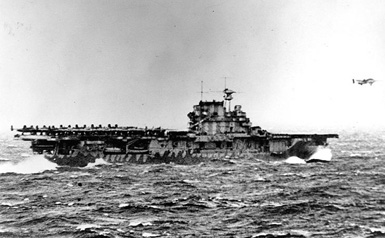
In May US Navy code breakers under the direction of Commander Joe Rochefort at Pearl Harbor discovered the next move of the Imperial Navy an attack on Midway Island and the Aleutian islands. Since the occupation of Midway by Japanese forces would give them an operational base less than 1000 miles from Pearl Harbor Admiral Chester Nimitz committed the bulk of his naval power, the carriers USS Enterprise CV-6, USS Yorktown CV-5 and USS Hornet CV-8 and their 8 escorting cruisers and 15 destroyers, a total of 26 ships with 233 aircraft embarked to defend Midway. Nimitz also sent a force of 5 cruisers and 4 destroyers to cover the Aleutians.

images-42

images-43

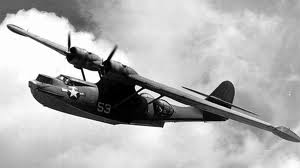
Land based air assets on Midway were composed of a mixed Marine, Navy and Army air group of 115 aircraft, many of which were obsolete. Aboard Midway there were 32 US Navy PBY Catalina Flying Boats, 83 fighters, dive bombers, torpedo planes and Army Air Force bombers piloted by a host of inexperienced pilots.

Nimitz’s instructions to his Task Force Commanders was simple “You will be governed by the principle of calculated risk, which you shall interpret to mean the avoidance of exposure of your force to attack by superior enemy forces without good prospect of inflicting … greater damage on the enemy.”

893594c746

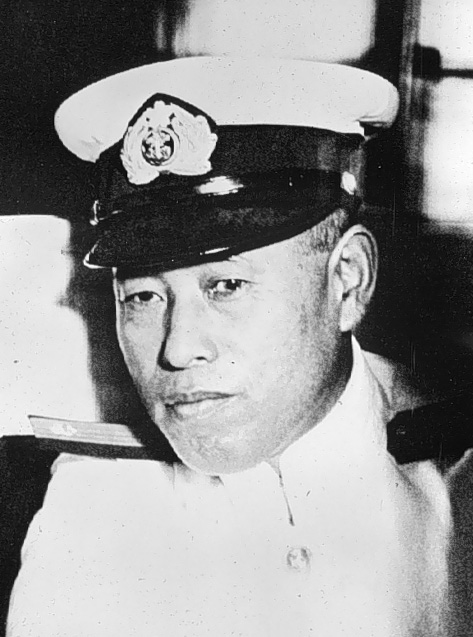
Admiral Isoroku Yamamoto commanded the Combined Fleet. The victor of Pearl Harbor and the triumph’s in the first six months of the Pacific War was determined to end the war with a decisive battle at Midway. His plans were opposed by many in the Imperial General Staff, especially those in the Army but when the US raid on Tokyo, the Doolittle Raid, all opposition to the attack was dropped.

10-japanese-carriers-coral-sea-midway

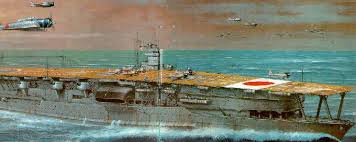
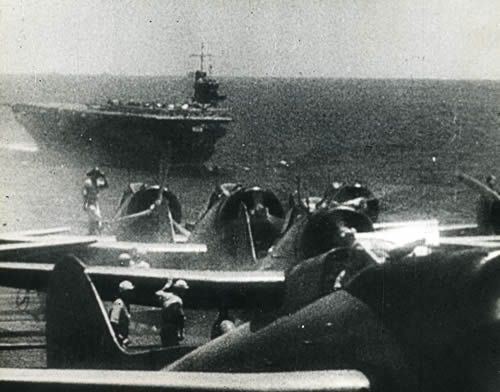
The Japanese sent a force of 7 battleships and 7 carriers against Midway. These included the elite First Carrier Striking Group composed of the Pearl Harbor attackers Akagi, Kaga, Soryu and Hiryu and their highly trained and combat experienced air groups. Among the surface ships was Yamamoto’s flagship, the mighty Battleship Yamato, at 72,000 tons and armed with 9 18” guns, the most powerful and largest battleship ever to see combat.

The strike force included 273 aircraft and was escorted by 14 cruisers and 39 destroyers. They were to take Midway and then destroy the US Navy when it came out to fight. Yamamoto sent a force force of 4 battleships, 12 destroyers assigned screen to the Aleutian invasion force which was accompanied by 2 carriers 6 cruisers and 10 destroyers. The other carriers embarked a further 114 aircraft.

Despite this great preponderance in numbers Yamamoto’s plan was complex and his forces too far apart from each other to offer support should and get into trouble. The powerful Japanese Task forces were scattered over thousands of square miles of the Northern Pacific Ocean where they could not rapidly come to the assistance of any other group.

images-44

With the foreknowledge provided by the code breakers the US forces hurried to an intercept position northeast of Midway eluding the Japanese submarine scout line which the Japanese Commander Admiral Yamamoto presumed would find them when they sailed to respond to the Japanese attack on Midway.  Task Force 16 with the Enterprise and Hornet sailed first under the command of Rear Admiral Raymond A Spruance and Task Force 17 under Rear Admiral Frank “Jack” Fletcher with the Yorktown which had been miraculously brought into fighting condition after suffering heavy damage at Coral Sea. Fletcher assumed overall command by virtue of seniority and Admiral Nimitz instructed his commanders to apply the principle of calculated risk when engaging the Japanese as the loss of the US carriers would place the entire Pacific at the mercy of the Japanese Navy.

On June 3rd a PBY Catalina discovered the Japanese invasion force and US long range bombers launched attacks against it causing no damage. The morning of the 4th the Americans adjusted their search patterns in and the Japanese came into range of Midway and commenced their first strike against the island.

g17056

In response land based aircraft from Midway attacked the Japanese carrier force taking heavy casualties and failing to damage the Japanese task force. The American Carrier task forces launched their strike groups at the Japanese fleet leaving enough aircraft behind of the Combat Air Patrol and Anti-submarine patrol.  As the Americans winged toward the Japanese fleet the Japanese were in a state of confusion. The confusion was caused when a scout plane from the Heavy Cruiser Tone that had been delayed at launch discovered US ships but did not identify a carrier among them until later into the patrol. The carrier  was the Yorktown and TF 17, but for Nagumo who first expected no American naval forces, then received a report of surface ships without a carrier followed by the report of a carrier the reports were unsettling.

a5f7ab19-17c6-4928-90a4-5bb913d156eb

Orders and counter-orders were issued as the Japanese attempted to recover their strike aircraft and prepare for a second strike on the island and then on discovery of the Yorktown task force, orders changed and air crews unloaded ground attack ordnance in favor of aerial torpedoes and armor piercing bombs. The hard working Japanese aircrew did not have time to stow the ordnance removed from the aircraft but by 1020 they had the Japanese strike group ready to launch against the US carriers.

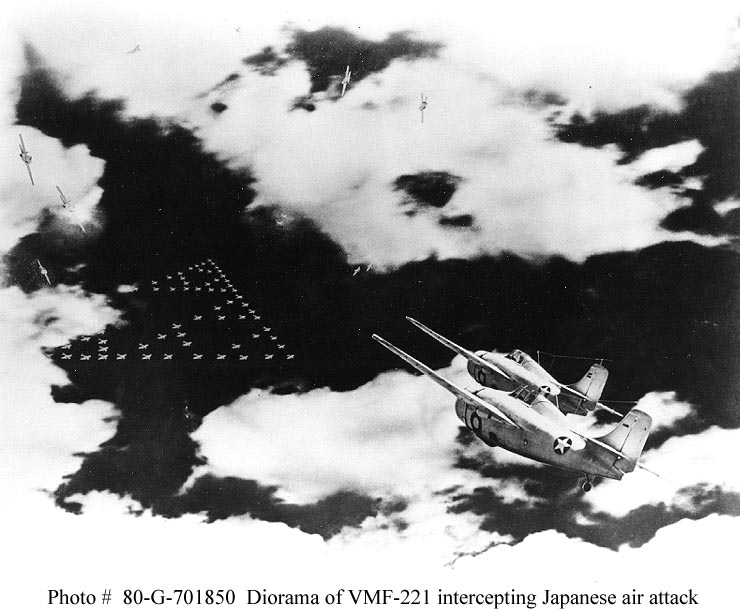
g701850

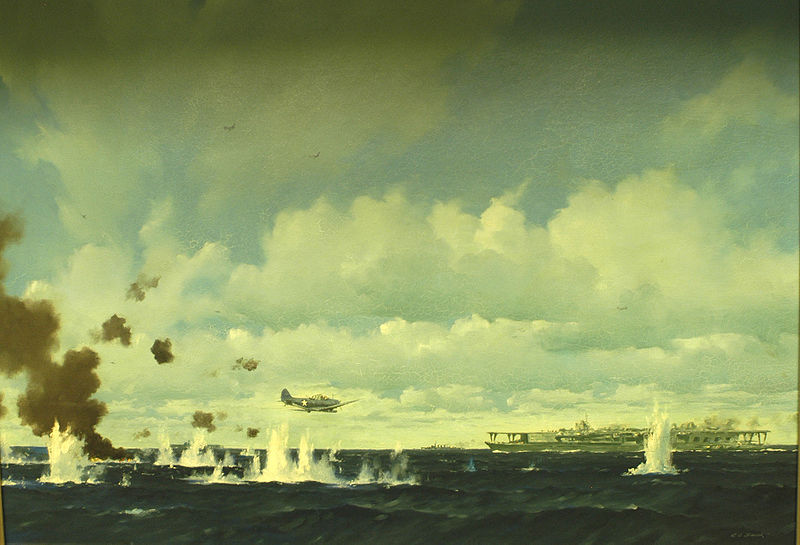
As the Japanese crews worked the Japanese carriers were engaged in fending off attacks by the US torpedo bomber squadrons, VT-6 from Enterprise, VT-8 from Hornet and VT-3 from Yorktown. The Japanese Combat Air Patrol ripped into the slow, cumbersome and under armed TBD Devastators as they came in low to launch their torpedoes.  Torpedo Eight from Hornet under the command of LCDR John C Waldron pressed the attack hard but all 15 of the Devastators were shot down. Only Ensign George Gay’s aircraft was able to launch its torpedo before being shot down and Gay would be the sole survivor of the squadron.

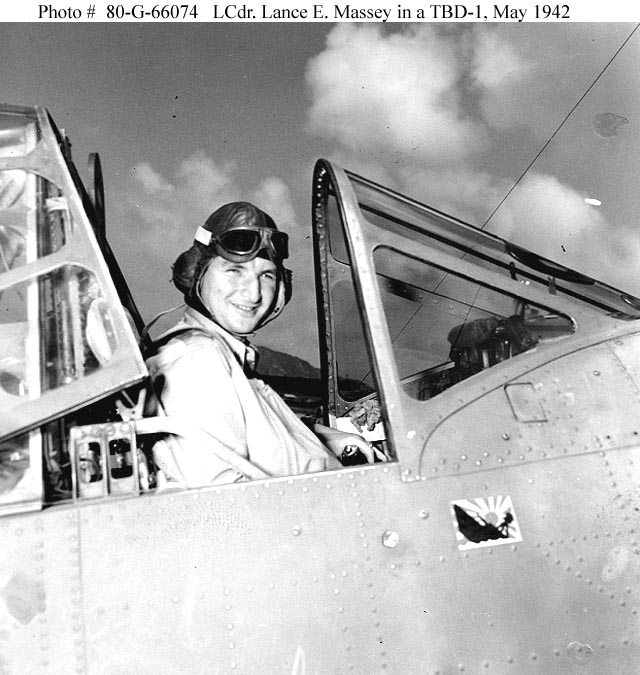
g66074


LCDR Lance Massey CO of VT-3

Page500_163_6

LCDR John Waldron CO of VT-8

220px-Eugene_Lindsey;h84903

LCDR Eugene Lindsey CO of VT-6

Torpedo 6 from Enterprise under the command of LCDR Eugene Lindsey suffered heavy casualties losing 10 of 14 aircraft with Lindsey being one of the casualties.  The last group of Devastators to attack was Torpedo 3 from Yorktown under the command of LCDR Lem Massey from the Yorktown. These aircraft were also decimated and Massey killed but they had drawn the Japanese Combat Air Patrol down to the deck leaving the task force exposed to the Dive Bombers of the Enterprise and Yorktown.

800px-tbd_attacking_at_midway_painting-1

There had been confusion among the Americans as to the exact location of the Japanese Carriers. Bombing 8 and Scouting 8 from Hornet did not find the carriers and had to return for lack of fuel while losing a number of bombers and their fighter escort having to ditch inn the ocean and wait for rescue. The Enterprise group composed of Bombing-6 and Scouting 6 under CDR Wade McClusky was perilously low on fuel when the wake of a Japanese destroyer was spotted.  McClusky followed it to the Japanese Task Force. The Yorktown’s group under LCDR Max Leslie arrived about the same time.

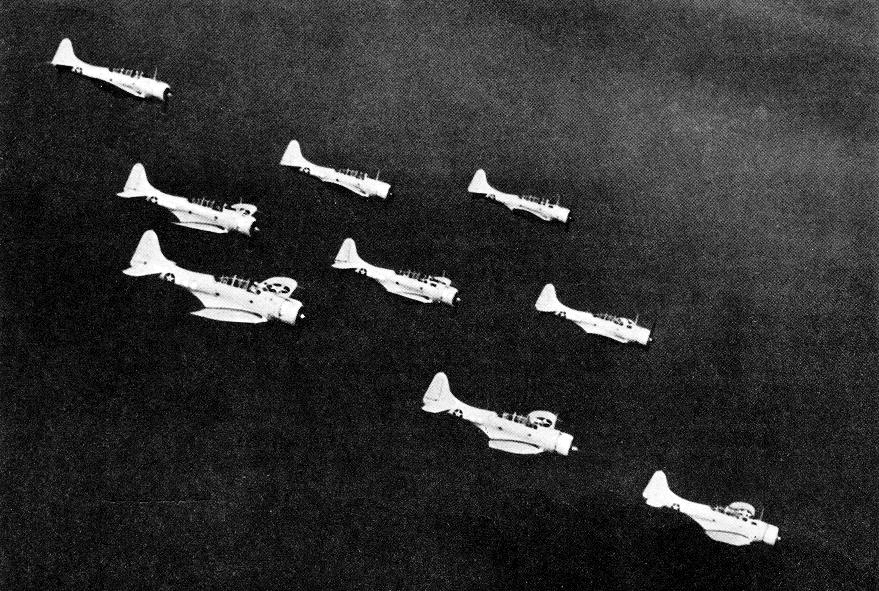
Dauntless_dive_bombers

When the American dive bombers arrived over the Japanese Carrier Strike Force they found the skies empty of Japanese aircraft. Below, aboard the Japanese ships there was a sense of exhilaration as each succeeding group of attackers was brought down and with their own aircraft ready to launch and deal a fatal blow to the American carrier wondered how big their victory would be. The war would soon be decided.

midway4

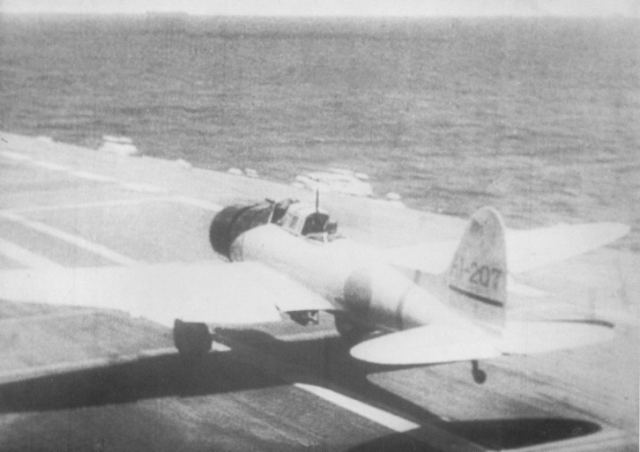
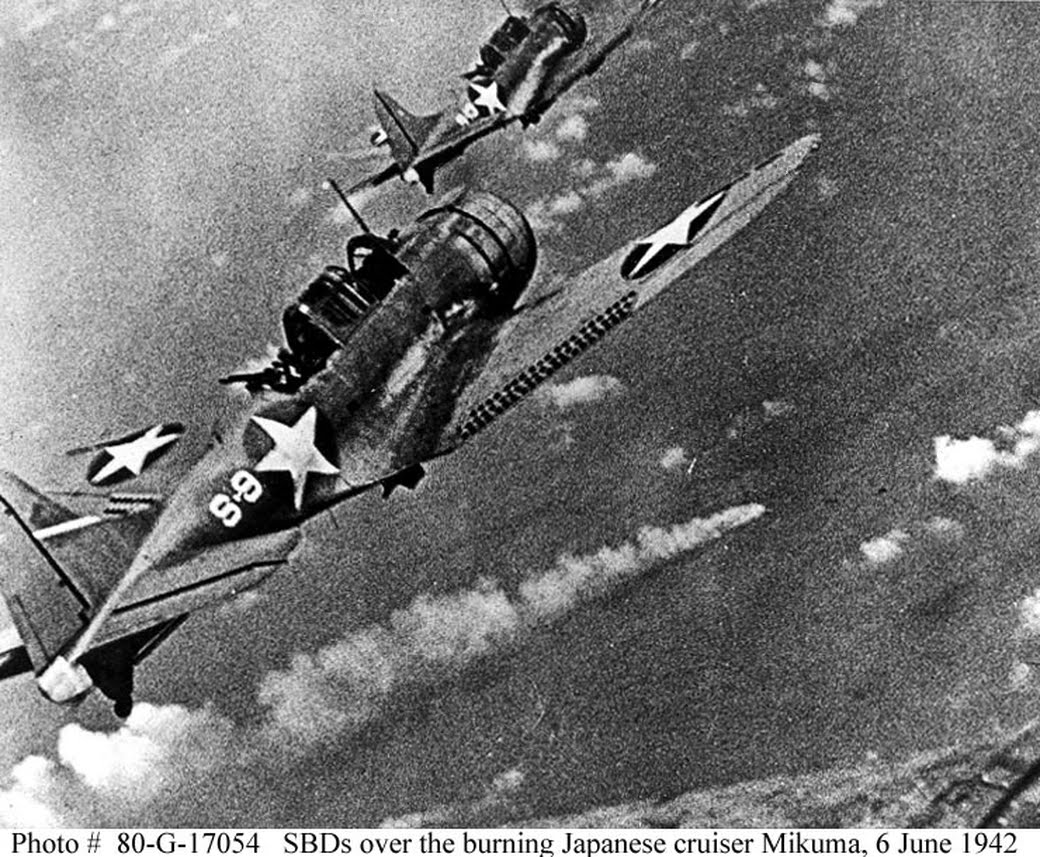
At 1020 the first Zero of the Japanese attack group began rolling down the flight deck of the flagship Akagi, aboard Kaga aircraft were warming up as they were on the Soryu.  The unsuspecting Japanese were finally alerted when lookouts screamed “helldivers.” Wade McClusky’s aircraft lined up over the Akagi and Kaga pushing into their dives at 1022. There was a bit of confusion when the bulk of Scouting 6 joined the attack of Bombing 6 on the Kaga. That unprepared ship was struck by four 1000 pound bombs which exploded on her flight deck and hangar deck igniting the fully fueled and armed aircraft of her strike group and the ordnance littered about the hangar deck.  Massive fires and explosions wracked the ship and in minutes the proud ship was reduced to an infernal hell with fires burning uncontrollably. She was abandoned and would sink at 1925 taking 800 of her crew with her.

douglas-sbd5-dauntless-dive-bomber-battle-of-midway-01

LT Dick Best of Scouting 6 peeled off from the attack on Kaga and shifted to the Japanese flagship Akagi. On board Akagi were two of Japan’s legendary pilots CDR Mitsuo Fuchida leader of and CDR Minoru Genda the architect of the Pearl Harbor attack and subsequent string of Japanese victories. Both officers were on the sick list and had come up from sick bay to watch as the fleet was attacked. Seeing Kaga burst into flames they stood mesmerized until Akagi’s lookouts screamed out the warning “helldivers” at 1026.  Best’s few aircraft hit with deadly precision landing two of their bombs on Akagi’s flight deck creating havoc among the loaded aircraft and starting fires and igniting secondary explosions which turned the ship into a witch’s cauldron.  By 1046 Admiral Nagumo and his staff were forced to transfer the flag to the cruiser Nagara as Akagi’s crew tried to bring the flames under control. They would do so into the night until nothing more could be done and abandoned ship at 2000.  Admiral Yamamoto ordered her scuttled and at 0500 on June 5th the pride of the Japanese carrier force was scuttled.

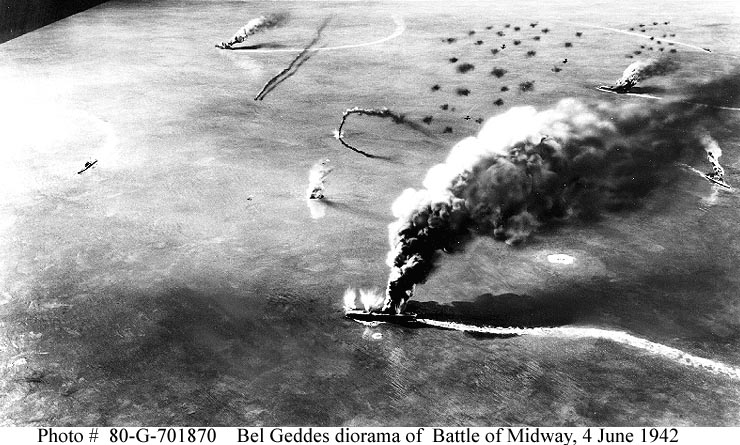
g701870

VB-3 under LCDR Max Leslie from the Yorktown stuck the Soryu with 17 aircraft, however only 13 of the aircraft had bombs due to an electronic arming device malfunction on 4 of the aircraft, including that of Commander Leslie.  Despite this Leslie led the squadron as it dove on the Soryu at 1025 hitting that ship with 3 and maybe as many as 5 bombs. Soryu like her companions burst into flames as the ready aircraft and ordnance exploded about her deck. She was ordered abandoned at 1055 and would sink at 1915 taking 718 of her crew with her.

h73065

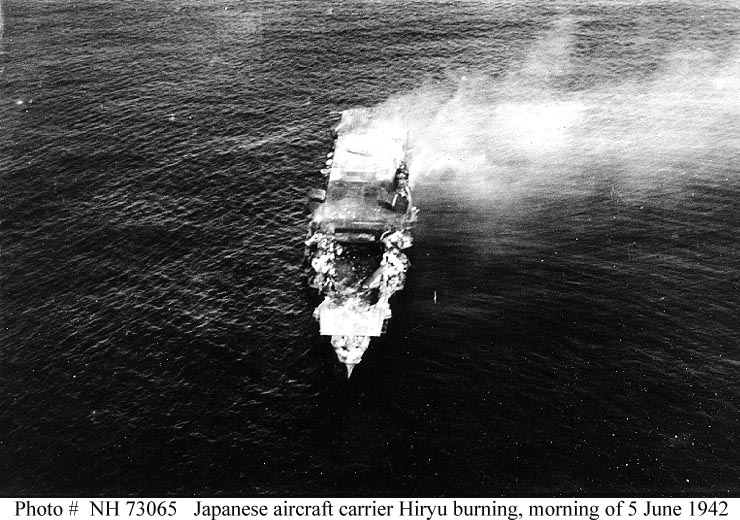
The remaining Japanese flattop the Hiryu attained the same fate later in the day after engaging in an epic duel with the Yorktown which her aircraft heavily damaged. Yorktown would be sunk by the Japanese submarine I-168 while being towed to safety.

71380-004-B4724C34

USS Yorktown under attack from Kate Torpedo Bombers from Hiryu on June 4th 1942

In five pivotal minutes the course of the war in the Pacific was changed. Authors have entitled books about Midway Incredible Victory by Walter Lord and Miracle at Midway by Gordon Prange and those titles reflect the essence of the battle.

At Midway a distinctly smaller force defeated a vastly superior fleet in terms of experience, training and equipment. At the very moment that it appeared to the Japanese that they would advance to victory their vision disappeared. In a span of less than 5 minutes what looked like the certain defeat of the US Navy became one of the most incredible and even miraculous victories in the history of Naval warfare. In those 5 minutes history was changed in a breathtaking way. While the war would drag on and the Japanese still inflict painful losses and defeats on the US Navy in the waters around Guadalcanal the tide had turned and the Japanese lost the initiative in the Pacific never to regain it.

The Japanese government hid the defeat from the Japanese people instead proclaiming a great victory. The American government could not fully publicize the victory for fear of revealing the intelligence that led to the ability of the US Navy to be at the right place at the right time and defeat the Imperial Navy.

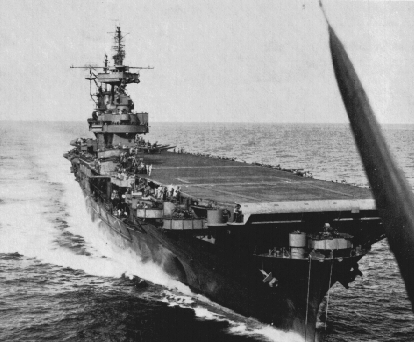
uss-enterprise-cv-6-1

The American victory at Midway changed the course of the war in the Pacific. The Battle of Midway established the aircraft carrier and the fast carrier task force as the dominant force in naval warfare which some would argue it still remains. Finally those five minutes ushered in an era of US Navy dominance of the high seas which at least as of yet has not ended as the successors to the Enterprise, Hornet and Yorktown ply the oceans of the world and the descendants of those valiant carrier air groups ensure air superiority over battlefields around the world.

Peace

Padre Steve+

1 Comment

Filed under History, Military, Navy Ships, US Navy, world war two in the pacific

The Paths Taken and Not: The Tapestry of Life, Authenticity and Wisdom Passed Down

n671902058_2044112_2975

Nearly 32 years ago I was getting ready to embark on a military career. It was  the fall of 1980 and I was a junior at California State University Northridge. Within the year I was beginning my first furtive steps in my career by enlisting in the California National Guard and enrolling in the Army ROTC program at UCLA.

It was an interesting time. My imagination of the military back in the days of the Cold War was quite orthodox and founded on what a “normal” Army career should look like. I would get commissioned, serve as a platoon leader, company executive officer, battalion staff officer and company commander. I would attend the appropriate military schools, the officer basic course, the advanced course, specialized courses and Command and General Staff College and then hopefully be promoted to the field grade ranks and after serving 20-30 years would retire as a Major, Lieutenant Colonel or maybe even a Colonel.

If that had been the case I would have had a very different life than I have today. Certainly a good life, but not what I have today. I would be me, but a different me. I would have probably played everything safe and been the perfect servant of the institution while ensuring my own success.

Instead the tapestry of my life and choices have produced something different than I could have ever imagined 32 years ago. Those choices have resulted in successes and failures, blessings and great difficulties as well as trials that honestly I would never want to go through again. However all of those things have helped make me what and who I am today.

I look back at the people in my life who have influenced me at different points, as well as critical junctures where I made decisions I see a tapestry that I could never have thought possible, a tapestry much richer and diverse than I could have thought of back then. It has not been without pain but it has been worth it.

One of the things that I discovered early was that as hard as I tried to fit the mould of the Army, I was a non-comformistby nature.  I thought outside of the box and that in attempting to fit in I was not happy. I had one rater  in his evaluation of me offer the criticism that thought too much of my abilities that “lent me to criticism.” That may have been true to some extent, and my rather blunt and outspoken opinions to criticize higher ranking officers and to take liberties with orders got me in trouble at times.

However I did survive some of my more stupid escapades such as telling my Medical Group Commander that he had embarrassed our command as a very junior Army 1st Lieutenant and in another case banned the two local CID investigators from running amok on a fishing expedition in my barracks without probable cause or a warrant for their investigation. They never returned with probable cause or a warrant. Another time I told the the senior personnel officer in the command I was stationed as a Captain that he could take his spies out of my command, as well as getting thrown out of the Army Chaplain Officer Advanced Course in 1992. It would take too long to explain the details of these incidents here but assuredly they were the fault of a young, opinionated and outside the box thinking officer who dared to voice his opinion to men who were institutional careerists, they were not bad people, just people conformed to and servants of institutional norms. That being said my troubles were troubles brought on me by my own actions because I did not understand what the institution, any institution can do to otherwise well meaning and honorable people.

Despite some black eyes I did make Major in the Army Reserve and finally to get back on active duty reduced in rank to enter the Navy back in 1999. The good thing was that I learned from my experiences and have been able to use them to learn, survive and succeed in my Navy-Marine Corps career.

In the process there were men and women who at various times in my life and career passed along wisdom, not just advice, not just knowledge, but wisdom. It is to them that I owe my successes. Without their sage advice, authentic leadership and honesty I would have certainly crashed and burned a long time ago, a prisoner of my own limited insight and unlimited ambition.

400236_10151328400862059_541742014_n

But more than succeeding in my career I have learned that it is okay to be me, to be authentic and to be honest about who I am and what I do. My goal now as a relatively senior chaplain is to care for, mentor and allow those men and women who work directly for me to succeed, even as well as those that I serve.  It is no longer about my career. I am on the backside of my career regardless of my next assignment or even if I get promoted to Captain in the Navy several years from now when I am eligible. But promotion is not an end to itself, if I have learned anything it is that many times promotion to a higher office can be a prison that some men never escape.

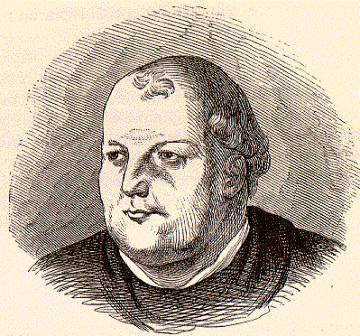
The fact is that I have far fewer years left to serve than I have served to this point. Thus it is far more important to do right for the people that I serve and help them take lessons that I have learned into their futures and if they remain in the military pass them along to others as they become authentic leaders. Johann_von_Staupitz

Johann Von Staupitz

My study of history and more practically in my case military history and to some extent church history and theory shows me quite those who don’t achieve the highest levels of command or institutional power often have a greater influence in the long term than those who do. Without Johann von Stauptiz it is doubtful if the young Martin Luther would have began to study the Bible and hence bring about the Protestant Reformation.

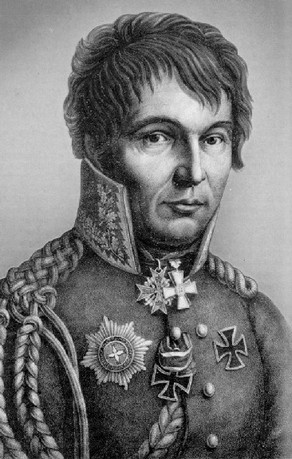
clausewitz2

Carl Von Clausewitz

As the foremost interpreter of Napoleon, a relatively unknown Prussian General Staff Officer, Carl von Clausewitz had a greater impact on warfare and military theory than did Napoleon himself. There are many other examples of such individuals in history, men and women, many times of far lesser estate than Clausewitz or Staupitz who have by their wisdom helped those that eventually held power or influence in thinking outside the bounds of tradition to accomplish things that were not possible to their teachers.

Wisdom comes slowly to most of us, especially people like me. The problematic thing is that is, for the most part wisdom is a commodity that is not highly treasured in a society built upon expediency and crass materialism. It is certainly not something the most men and women that seek power are gifted with, despite their intellectual gifts and often well earned knowledge. But learned knowledge and raw intelligence are different than wisdom. Knowledge and intelligence are quite wonderful but ungoverned by wisdom the ambition that they breed is often the undoing of those that rely on them as well as their physical, economic or even military power.

The key thing is that wisdom, experience and learning was passed along to men and women who, God willing, will be serving long after I retire from the Navy. Today I was approached by one of our wounded warriors stationed at our hospital because of his injuries. He engaged me in a conversation and he said that he would like to spend some time with me, to listen to some of my stories about my life in the military and experience. Evidently a couple of his young friends have told him a bit about me. That meant a lot to me, just as the times that young people have come to me not because of my position, or rank, but because they see me as a real person, approachable and available.  The nice thing for me is that there are many times that I learn from them, for many times it is young people that can see the greatest problems and offer ideas and solutions that elude older and more experienced people in every walk of life.

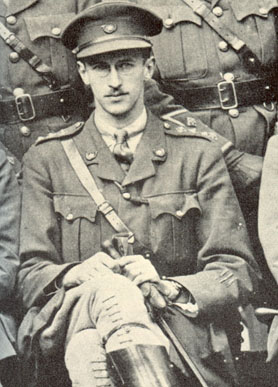
liddellhart

B. H. Liddell-Hart

I recently read B.H. Liddell-Hart’s biography of T.E. Lawrence, perhaps one of the most gifted military commanders, philosophers and men of the 20th Century. Lawrence and to some extent Liddell-Hart understood something about wisdom that most of their contemporaries and even students miss. Liddell-Hart himself, though a medically retired as a Captain due to wounds suffered in World War One was one of the more influential thinkers of his day. His works had a profound impact on the most successful commanders of the Second World War. He understood that the key to wisdom is self understanding and a recognition of their own knowledge as well as limitations. Liddell-Hart wrote of Lawrence, wisdom and humanity in 1937:

“A study of history, past and in the making, seems to suggest that most of mankind’s troubles are man-made, and arise from the compound effect of decisions taken without knowledge, ambitions uncontrolled by wisdom and judgements that lack understanding.  Their ceaseless repetition is the grimmest jest that destiny plays on the human race. Men are helped to authority by their knowledge continually make decisions on questions beyond their knowledge. Ambition to maintain their authority forbids them from admitting the limits of their knowledge and calling upon the knowledge that is available in other men. Ambition to extend the bounds of their authority leads them to a frustration of others opportunity and interference with others’ liberty that, with monotonous persistency, injures themselves or their successors on the rebound.  

The fate of mankind in all ages has ben the plaything of petty personal ambitions. The blend of wisdom with knowledge would restrain men from contributing to this endless cycle of folly, but understanding can guide them toward progress.” B.H. Liddell-Hart “Lawrence of Arabia” DeCapo Press, Reprint, originally published as “The Man Behind the Legend” Halcyon House 1937 

410w

T. E. Lawrence

It is my hope that no matter what my next assignment is and no matter how long I have left in the military as well as in life that I will be able to be one of those wise old sages who helps the next generations do things that were impossible for my generation, to succeed where we failed and who like Staupitz, Clausewitz, Liddell-Hart and Lawrence inspired others to greatness far beyond their own.

I am coming up for orders soon, order that will take me to my next assignment. I have spent the past two years as a geographic bachelor, apart from my wife, by the time I leave this assignment it will be close to three years. I have been assured that my next assignment will be in the area where our home is, however I do not know what it will be. I know what I want to do but do not know if it is possible based on the needs of the Navy. However, that being said I do know enough that no matter where I am assigned the mission is the same, as well as the pay. That mission is to care for, guide and assist those that work for me as well as those that I have the honor of serving, or possibly simply be the wise old sage.

I think I like that idea.

Peace

Padre Steve+
1 Comment

Filed under faith, History, philosophy, Religion

Days of Disastrous Decision Making: July 28th – August 4th 1914

The Austrian Declaration of War against Serbia

“No one starts a war–or rather, no one in his senses ought to do so–without first being clear in his mind what he intends to achieve by that war and how he intends to conduct it.” Carl Von Clausewitz 

It was a war that should never have happened. It was a war for which the belligerent powers could boast many causes but for which few had any real objectives.

It was a war in large part brought on by a declining empire’s fears. Fear of neighbors, ethnic minorities and its place among regional and world powers led the leaders of the Austro-Hungarian Empire to decide for war when the very unpopular heir to the throne Archduke Franz Ferdinand was assassinated in Sarajevo, the capital of the recently annexed province of Bosnia-Herzegovina on June 28th 1914.

Conrad von Hötzendorf: War was the only means of politics

It was a series of decisions by those in the government of the Empire that brought Europe and the world to war, a war which we still feel the effects of today. In particular the Chief of the General Staff Conrad von Hötzendorf, the Foreign Minister Leopold Berchtold and the aging Emperor, Franz Joseph.

Emperor Franz Joseph: “If we must go under, we better go under decently”

Hötzendorf had been a continual advocate of war in every situation. He lobbied for war in 1907 against Italy and Serbia, in 1908 against Serbia, Russia and Italy, in 1909 against Serbia and Montenegro, in 1910 against Italy and the list increased in the years leading up to the war. He fervently believed that “the use of armed force alone could retard the centrifugal forces of nationalism in the ‘multinational empire’; war was the only means of politics.” The Emperor, Franz Joseph was of the same mindset by 1914 and in the days following the assassination of Franz Ferdinand he gave his approval to the actions of Hotzendorf and the diplomacy of Berchtold which doomed the Austro-Hungarian Empire and would destroy and remake Europe within a span of four years.

Theobald von Bethmann-Hollweg: The Blank Checque

The leadership of the Empire had decided on war within days of the assassination. Berchtold dispatched an emissary to Kaiser Wilhelm who decided in counsel with his Imperial Chancellor Theobald von Bethmann-Hollweg gave the Austrians a “blank cheque” of unconditional support for war against Serbia. Berlin was confident that “the Balkan crisis could be localized” and “advised Vienna to “proceed with all means at its disposal” and that Germany would support Austria-Hungary “come what may.” In doing so they willingly ignored the wise counsel of Otto Von Bismarck who considered the Balkans “not worth the life of a single Pomeranian Grenadier.

After they received German support the Austrians did everything that they could to ensure that war would occur. Their demands of Serbia were intentionally designed to be unacceptable to that country and they held key information from their German allies in the three weeks after they received the unconditional German support.

Helmuth Von Molkte: “no alternative but to fight a preventive war…” 

German militarists, particularly the Chief of the General Staff Helmuth Von Molkte the younger saw the coming conflict in racial and cultural terms. Von Molkte said that the coming war   would come “sooner or later” and be a war “primarily a struggle between Germans and Slavs” and compared Serbia to an “abscess.”  As the war cloud built Von Molkte told the Foreign Secretary von Jagrow that there was “no alternative but to fight a preventive war so as to beat the enemy while we could still emerge fairly well from the struggle” ignoring the advice of the Iron Chancellor Otto Von Bismarck who counseled “Preventive war is like committing suicide out of fear of death.” 

Austrian Reservists going to war

The Austrians felt that the threat from Serbia combined with internal political factors related to the Hungarian and other Slavic regions of the Empire, and the increasing influence of Russia and Germany in the Balkans was an existential threat. At the same time they were poorly prepared for war. Their military was large but poorly trained and equipped.  Their national infrastructure, industry and railroads were ill-prepared for the demands of war. Their German allies had not planned for war either and were critically short of the required stocks of ammunition needed for a general war in Europe.

Cheering crowds in Petersburg

The Russians were heavily invested in the Balkans linked to other Slavic people by culture, language and religion. The French were bent on revenge against the Germans for the debacle of 1870 and had no stake in what happened in the Balkans. The British a few years prior to the war had told the Belgians not to expect support if they were invaded by Germany, but declared war to “protect Belgian neutrality.”

German wives and girlfriends walking alongside the Landser…

The Austrians thought that with German support that even if Russia intervened that the war could be limited to Serbia. They were wrong. Just as the Germans had given the Austrians a “blank cheque” the French, both officially and unofficially were giving the Russians their own blank cheque. French Ambassador Maurice Paleologue assured Russian Foreign Minister S.D. Sazonov of the “complete readiness of France to fulfill her obligations as an ally in case of necessity.

French Soldiers being cheered

Austria declared war on July 28th, Russia followed by a partial mobilization to support Serbia on the 29th. Kaiser Wilhelm attempted to avert war at the last minute but Czar Nicholas II wrote “An ignoble war has been declared on a weak country. The indignation of Russia, fully shared by me, is enormous. I foresee that very soon I shall be overwhelmed by pressure to which I am exposed and compelled to take measures which will lead to war.”  This was met with German mobilization on the 30th and the French on August 1st. Declarations of war were exchanged and on August 4th in response to Germany’s refusal to respect the neutrality of Belgium Great Britain declared war against Germany.

A final kiss from a British Soldier at Victoria Station

They were fateful days. Only the Austrians entered the war with any positive objectives, military or political goals. Every other power lurched into the war without clear objectives or end states. One writer noted that the war had “causes but no objectives.”

The world again finds itself perched at the edge of the abyss of war. There are people, smart and otherwise reasonable people who believe that they can wage “preventive wars” and rely on brute military force to solve nearly any problem. There are others that suggest that we should not criticize “allies” even when their decisions could be disastrous to them and the world, much as the Germans gave their Austrian brothers a “blank cheque.”  I wish that they would just look at the consequences before they commit nations and the world to more war that can only result in calamity and great suffering without benefit for anyone or any nation involved.

Peace

Padre Steve+
4 Comments

Filed under History, Military, national security, Political Commentary