Tag Archives: charles wainwright

U.S. Army Artillery Doctrine and Tactics from the Mexican War to the Wilderness

Friends of Padre Steve’s World,

It has been a very long day. My legs hurt, I broke the big toe on my right foot Thursday afternoon, and between real work and work at home I put on about 7.5 miles on my legs. Thankfully I used Mr. Cane, who came into my life when I broke my tib-fib near the knee back in 2011 was there to help me out. I showed up at command PT dressed out in my PT uniform with Mr. Cane, but it was not the “Cane Mutiny.” Yes, that is a very bad pun, but when your are as tired as I am and in as much pain you really don’t care, but I digress… 

I still am working on my article about the President’s terrible week which seems to get more fascinating by the hour. Maybe after a long day working in the house tomorrow, ripping out nasty old carpet. laying some flooring in closets, and doing a bunch of other stuff I might try to finish it tomorrow, which is actually today because I am still awake and it is after midnight. 

So what the hell, tonight I am reposting a section of my unpublished Civil War book A Great War in a Revolutionary Age of Change. This section continues one that I posted two or three weeks ago dealing with U.S. Army artillery. This particular section deals with the period between 1846 and the summer of 1864. It is as non-partisan as you can get, but I hate to admit that the thought of  M-1857 12 Pound smoothbore “Napoleons” firing at massed Confederate infantry in the open  as they did during Pickett’s Charge does warm my heart. Oh my God it almost gives me a woody, but that isn’t exactly very Christian of me, but as I readily admit I am no saint and pretty much a Mendoza Line Christian. At least I can admit it. 

So have a great day and please get some sleep. 

Peace,

Padre Steve+

fig20

American artillery doctrine subordinated the artillery to the infantry. Doctrine dictated that on the offensive “was for about one-third of the guns to occupy the enemy’s artillery and two-thirds to fire on the infantry and cavalry. Jomini liked the concentrated offensive cannonade where a breach of the line was to be attempted.” [1] But being such a small service, it was difficult for Americans to actually implement Napoleonic practices, or organization as the organization itself “was rooted in pre-Napoleonic practice, operating as uncoordinated batteries.” [2]

American artillerymen of the Mexican War could not match the massive firepower and concentration of Napoleon’s army. Instead it utilized mobile tactics, which gave it “the opportunity to maneuver in open country to support the infantry.” [3] During the war the actions of the highly mobile light batteries proved decisive, as did the spirit of their officers and soldiers. The Americans may not have had the organization of Napoleon, but “the audacious spirit was there.” [4] In a number of engagements American batteries employed the artillery rush, even gaining the admiration of Mahan, a noted exponent of the defensive. Among the leaders of the artillery at the Battle of Buena Vista were Captain Braxton Bragg, and Lieutenants John Reynolds and George Thomas, all of who would go on to fame in the Civil War. During a moment when Mexican forces threatened to overwhelm the American line, Bragg’s battery arrived:

“Without support, Bragg whirled his guns into battery only a few rods from the enemy…. The Mississippi Rifles and Lane’s Hoosiers also double-quicked from the rear of the plateau. From then on it was a storybook finish for the Americans, and artillery made the difference. Seventeen guns swept the Mexicans with grape and canister…. Reynolds, Thomas, and the others stood to the work with their captains until 5 o’clock. Santa Ana was through…” [5]

At Casa Mata outside of Mexico City, Americans found their flank threatened by Mexican cavalry. Captain James Hunter and Lieutenant Henry Hunt observed the situation and “Without awaiting orders they rushed their guns to the threatened sector…  With Duncan directing them, all stood their posts long enough to spray the front ranks of mounted Mexicans with canister, the shotgun effect of which shredded the half-formed attack columns, dissolving all alignment and sending the lancers scrambling rearward in chaos…” [6] As a result these and other similar instances the artillery came out of the war with a sterling reputation and recognition of their gallant spirit. John Gibbon reflected such a spirit when he wrote: “Batteries derive all their value from the courage and skill of the gunners; from their constancy and devotion on difficult marches; from the quickness and capacity of the officers; and especially from the good condition and vigor of the teams, without which nothing can be undertaken.” [7]

At the beginning of the war U.S. Army doctrine recommended placing batteries equally across the line and concentrating them as needed. The last manual on artillery tactics Instruction for Field Artillerypublished in 1859 retained much of its pre-Mexican War content and the doctrine in it provided that artillery was to “be organized at the regiment and brigade level with no reserve.” [8] Nonetheless some artillery officers discussed the possibilities of concentration, Grand Batteries, and the artillery reserve, no changes in organization occurred before the war. However, these discussions were all theoretical, as practical experience of these officers was limited to the small number of weapons employed in the Mexican War, and the “immediate problem was the organization of an unaccustomed mass of artillery.” [9] The Artillerist’s Manual, a highly technical treatise on gunnery was written by Captain John Gibbon in 1859 while he was serving at West Point and used by artillerymen of both sides during the war.  In  Gibbon described the principle object of the artillery was to, “sustain the troops in the attack and defense, to facilitate their movements and to oppose the enemy’s; to destroy his forces as well as the obstacles that protect them; and to keep up the combat until the opportunity for a decisive blow.”  [10]

Since the United States Army traditionally drawn their doctrine from the French this meant going back to the Napoleonic model the foundational unit of which was the battery. The field artillery batteries were classed as either foot artillery or horse artillery. The horse artillery accompanied the cavalry and all gun crews went into battle mounted as cavalrymen. The soldiers of the foot artillery either rode with the guns or walked. The battery was the basic unit for American artillery and at the “start of the war the artillery of both sides was split into self-contained batteries, and each battery allocated to a particular brigade, regiment or even battalion of infantry.” [11]

12 pound napoleon

At the battery level Union artillery was organized by type into six-gun batteries. Confederate artillery units were organized into four or six-gun batteries in which the guns were often of mixed type. This often led to supply problems for Confederate gunners and inconsistent rates of fire and or range. Confederate gunners also had to deal with poor quality power and explosive shells, a condition that only worsened as the war continued. The well-trained Union gunners had better quality ammunition and gunpowder as well as what seemed to the Confederates to have limitless ammunition.

Each gun was manned by a seven-man crew and transported by a team of horses that towed a limber, which transported the cannon and a caisson, which transported the ammunition. The caissons would normally be stocked with four chests of ammunition. For a Napoleon “a standard chest consisted of twelve shot, twelve spherical case, four shells, and four canister rounds for a total of 112 rounds of long range ammunition.” [12] In addition to the ammunition carried in the caissons of each gun, more ammunition was carried in the corps and division supply trains.

As the war progressed the both the Union and Confederate armies reorganized their field artillery. In the North this was a particular problem due to the lack of flexibility and politics in the Army which were prejudiced against large artillery formations, despite the great numbers of batteries and artillerymen now in the army. However the Federal army had good artillerymen. The Regular Army batteries were the foundation of the artillery service. Unlike the infantry units which were overwhelmingly composed of volunteer soldiers, the artillerymen were regulars, many who had served for years in the ante-bellum army.

Since there were few billets for senior artillerymen many artillery officers volunteered or were selected to serve in the infantry to get promoted or to take advantage of their experience and seniority. One of those chose was John Reynolds who promote to Lieutenant Colonel and given orders to form an infantry regiment. Before he could get started in that work he was made a Brigadier General of Volunteers. He wrote: “I would, of course, have preferred the Artillery arm of service, but could not refuse the promotion offered me under any circumstance, much less at this time, when the Government has a right to my services in any capacity.” [13] Other artillerymen who rose to prominence outside of the branch during the war included William Tecumseh Sherman, George Meade, John Gibbon, George Thomas, Ambrose Burnside, and Abner Doubleday, and Confederates Stonewall Jackson, Braxton Bragg, Jubal Early, and A.P. Hill.

However, General Winfield Scott took action to keep a core of experienced artillery officers with the artillery. At Scott’s behest, “the War Department limited the resignations of artillerymen to accept higher rank in infantry regiments, resulting in a core of capable and experienced officers.” [14]  This allowed George McClellan to select two exceptional artillery veterans, William Barry and Harry Hunt to “organize the branch and to oversee training.” [15] McClellan appointed Barry, who had been commissioned in 1836 as the head of his artillery. After the defeat at Bull Run, Barry “prepared as set of guidelines or principles for the artillery service. He prescribed a uniform caliber of guns in each battery, four to six cannon in each battery, and that four batteries – one Regular Army and three volunteer – be attached to each division.” [16]  In this organization, McClellan and Barry “called for the Regular Army battery commander to take charge of those batteries assigned to the division. This was in addition to his responsibilities to his own battery.” The practical effect of this was that “with the exception of the Artillery Reserve, the highest artillery command remained that of a Captain.” [17]

Hunt was responsible for the organization of the Artillery Reserve and the siege train. The Artillery Reserve was given eighteen batteries, about 100 guns or about one-third of the army’s artillery. It would be a source from which to replace and reinforce batteries on the line, but Hunt also understood its tactical employment. He explained:

‘In marches near the enemy it is often desirable to occupy positions with guns for special purposes: the command fords, to cover the throwing and taking up bridges, and for other purposes for which it would be inconvenient and unadvisable to withdraw their batteries from the troops. Hence the necessary reserve of artillery.” [18]

Hunt’s Artillery Reserve would be of great value in the early battles of maneuver. “The primary advantage of the army artillery reserve was the flexibility it gave the commander, making it unnecessary to go through the division or corps commanders. The reserve batteries could be used whenever or wherever needed.” [19] But this would not be in the offense role that Napoleon used his artillery to smash his opponents, for technology and terrain would seldom allow it; but rather in the defense; especially at the battles of Malvern Hill and Gettysburg. However, “Gettysburg was the last battle of the Civil War in which field artillery fire was paramount…” but “By the end of 1863, the tide of war had changed in the eastern theater, with both sides making more use of field fortifications to cover themselves from the murderous fire of the infantry rifle.” [20]

Even so, lack of promotion opportunity for artillerymen was a problem for both sides during the war, and artillerymen who showed great promise were sometimes promoted and sent to other branches of service. A prime example of such a policy was Captain Stephen Weed “who fought his guns brilliantly in the first two years of the war, and a Chancellorsville even commanded the artillery of a whole army corps.” Henry Hunt “singled him out as having a particular flair for handling large masses of cannon, and wanted to see him promoted.” [21] He was promoted to Brigadier General but in the infantry where he would lead a brigade and die helping to defend Little Round Top. In all “twenty-one field-grade artillery officers in the Regular Army became generals in the Volunteers, but only two remained with the artillery branch.” [22]

Both Barry and Hunt sought to rectify this issue. Barry insisted that a “battery of artillery was the equivalent of a battalion of infantry” [23] and pressed for a higher grade structure for the artillery. Colonel Charles Wainwright wrote of their efforts: “Many officers of the regular artillery have long been trying to get a recognition of their arm of the service, doing away with the regiments and making a corps of it, the same as the engineers and ordnance. McClellan and Hunt drew up a plan soon after Antietam, which by Stanton and Halleck, but nothing more has been hear of it.” [24]

However, Barry and Hunt were opposed by War Department insiders. General Lorenzo Thomas, the Adjutant General used law and regulation to prevent promotions in the artillery beyond Captain and as to General Officers as well. Thomas insisted that the battery was equivalent of an infantry company or cavalry troop. He noted “that laws long in force stipulated that only one general officer could be appointed per each for each forty infantry companies or cavalry troops.” [25] He applied this logic to the artillery as well, which meant in the case of the Army of the Potomac which had over sixty batteries that only one general could be appointed. The result could be seen in the organization of the Army of the Potomac at Gettysburg, the artillery component, “which included approximately 8,000 men with 372 pieces – almost the manpower (and certainly the firepower) of a complete army corps. It included only two general officers… then there were three colonels and no other high ranks at all. One army corps had its guns commanded by a lieutenant.” [26] Over time the situation would improve and the artillery given some autonomy within the Army, at Gettysburg Meade gave Hunt command authority to employ the artillery as he deemed necessary, even over the objections of the corps commanders.

General Henry Hunt was probably the most instrumental officer when it came to reorganizing Union artillery organizations in the Army of the Potomac. Following the Battle of Chancellorsville, Hunt prevailed upon the army commander, Joseph Hooker to create “artillery brigades assigned to each corps. This overcame a problem at Chancellorsville, where the batteries of uncommitted divisions had gone unused. The reorganization also made a practical adjustment to the situation where the attrition of divisions was making the corps the basic tactical unit.” [27] In the reorganization the infantry brigades retained their assigned batteries for direct support, but the guns of the divisions were organized into brigades at the corps level. The artillery brigades of the infantry corps had “from four to eight batteries, depending on the size of the corps.” [28] Despite being reflagged as brigades the command structure was not increased. This was often due to the fact “that for much of the war commanding officers persisted in regarding artillery as merely a subsidiary technical branch, an auxiliary which might add a little extra vitality to a firing line if conditions were favourable – but more typically would not.” [29] Dr. Vardell Nesmith noted:

“Resistance within the Army to formalizing tactical organizations for field artillery above the level of the battery was a complex phenomenon. Certainly there was some hesitance on the part of the Army establishment to create new organizations that would come between infantry and cavalry commanders and their fire support assets. Also one cannot discount the institutionalized tendency to keep everyone in their proper place – in other words, to keep a new power group from organizing.” [30]

Organized into brigades the Artillery Reserve became the instrument of the Army commander and served as what we would now call “general support”artillery where they were invaluable to Union army commanders to be available to augment other batteries and to replace batteries which had suffered casualties while on line. The organization of the artillery into brigades, even if they were field expedient organizations did much to increase the effectiveness of the arm. They supplanted “the battery in tactics and to considerable degree in administration. Supply and maintenance were improved, and more efficient employment and promptness and facility of movement resulted. In addition, the concentration of batteries was favorable for instruction, discipline, and firepower. Fewer guns were needed, and in 1864, the number of recommended field pieces per 1,000 men was reduced from 3 to 2.5.” [31]

henryhunt

General Henry Hunt

Hunt lobbied the War Department to provide a staff for each brigade, but since the new units were improvised formations no staffs were created and no promotions authorized for their commanders. Colonel Wainwright proposed a congressional bill to organizer volunteer artillery units into a corps of artillery, but lamented:

“Both Barry and General Hunt while commanding the artillery of this army have frequently complained in their reports of the great want of field officers. Were the light batteries of each state organized as a corps, and provided with field officers in the proportion proposed in the bill referred to above, this want would be provided for. The officers of light batteries also have a claim demanding some such change. No class of officers in our volunteer service stand as high as high as those of our light batteries. I say without hesitation that they are very far superior as a class in all respects to the officers of the infantry or cavalry. Yet for them there is not a chance at this time any chance of promotion above a simple captaincy, except in the few light regiments spoken of. I can point to several cases of captains of light batteries who, from this want of field officers, have for the past year exercised all the authority and borne all the responsibility of a brigadier-general.” [32]

But change did come, however slowly and with great resistance from the War Department bureaucracy, and the artillery service “did succeed in winning some measure of recognition for its independent status and tactics. After Gettysburg the army’s artillery commander was accept as having overriding authority in gunnery matters, with the infantry relegated to a merely consulting role, although in practice the change brought little improvement.” [33] The beginning of this came in August 1863 when George Meade promulgated an order that “defined Hunt’s authority in matters of control of the artillery in the Army of the Potomac. The order “definitely stated that Hunt was empowered to supervise and inspect every battery in the army, and in battle to employ them “under the supervision of the major-general commanding.” [34] The order was important but still did not go far enough to remedy the problem of a lack of field officers in the artillery, a problem that was not completely remedied during the war although Ulysses Grant did allow a limited number of promotions to provide more field grade officers in the artillery service of the Army of the Potomac and other armies under his command in the Eastern Theater. Likewise some additional billets were created in the brigades as brigade commanders “were authorized a staff consisting of an adjutant, quartermaster, commissary officer, ordnance officer (an artillery officer on ordnance duty), medical officer, and artillery inspector, with each staff officer having one or more assistants…” However the staff officers had to be detailed from the batteries, thereby reducing the number of officers present with those units”[35] However, in most cases the brigade commanders remained Captains or First Lieutenants.

In the Western theater there was a trend toward the centralization of the artillery in the various armies depending on the commander and the terrain and the size of the operation. As the war progressed in the west commanders began to group their artillery under brigades, divisions, and finally under the various army corps. At Shiloh Grant concentrated about 50 guns “in the notorious “Hornet’s Nest,” perhaps saving him from defeat.” [36] Artillery tactics shifted away from the offense to the defense and even during offensive operations western commanders were quick to entrench both their infantry and artillery. During the Atlanta campaign and march to the sea William Tecumseh Sherman successfully reduced his artillery complement first to 2 guns per 1,000 men then to 1 per 1,000. [37] This was in large part because he was conducting a campaign of maneuver and was far from his logistics base. Since supplies had to be carried with the army itself with a heavy reliance on forage, Sherman recognized that his army had to be trimmed down. Likewise, “the terrain and concept of operations must have been very important in his decision.” His “rapid, almost unopposed raid through Georgia gave no opportunities for the massing of large batteries in grand manner.” [38] During the campaign Sherman marched without a siege train and reinforced his cavalry division with light artillery batteries.

Notes 

[1] Ibid. Hagerman The American Civil War and the Origins of Modern Warfare p.21

[2] Ibid, Bailey Field Artillery and Firepower p.195

[3] Ibid, Bailey Field Artillery and Firepower p.194

[4] Ibid. Nesmith Stagnation and Change in Military Thought: The Evolution of American Field Artillery Doctrine, 1861-1905 – An Example p.6

[5] Nichols, Edward J. Toward Gettysburg: A Biography of General John Reynolds, The Pennsylvania State University Press 1958, reprinted by Old Soldier Book Gaithersburg MD 1987 p.43

[6] Ibid. Longacre The Man Behind the Guns: A Military Biography of General Henry J. Hunt, Chief of Artillery, Army of the Potomac pp.53-54.

[7] Gibbon, John. Artillerist’s Manual: Compiled from Various Sources and Adapted to the Service of the United States. 1859 retrieved from http://www.artilleryreserve.org/Artillerists%20Mannual.pdf 19 January 2017 pp.345-346

[8] Ibid. Hagerman The American Civil War and the Origins of Modern Warfare p.22

[9] Ibid. Nesmith Stagnation and Change in Military Thought: The Evolution of American Field Artillery Doctrine, 1861-1905 – An Example p.19

[10] Ibid. Gibbon  Artillerist’s Manual: Compiled from Various Sources and Adapted to the Service of the United States. p.343

[11] Ibid. Griffith, Battle Tactics of the Civil War p.165

[12] Gottfried, Bradley The Artillery of Gettysburg Cumberland House Publishing, Nashville TN 2008 p.15

[13] Ibid. Nichols Toward Gettysburg: A Biography of General John Reynoldsp.75

[14] Wert, Jeffry D. The Sword of Lincoln: The Army of the Potomac Simon and Schuster, New York and London 2005 p.39

[15] Ibid. Wert The Sword of Lincoln: The Army of the Potomac p.39

[16] Ibid. Wert The Sword of Lincoln: The Army of the Potomac p.40

[17] Ibid. Nesmith Stagnation and Change in Military Thought: The Evolution of American Field Artillery Doctrine, 1861-1905 – An Example pp.21-22

[18] Ibid. Longacre The Man Behind the Guns: A Military Biography of General Henry J. Hunt, Chief of Artillery, Army of the Potomac p.98

[19] Ibid. McKenny The Organizational History of Field Artillery 1775-2003 p.65

[20] Ibid. McKenny The Organizational History of Field Artillery 1775-2003 p.74

[21] Ibid. Griffith, Battle Tactics of the Civil War p.166

[22] Ibid. McKenny The Organizational History of Field Artillery 1775-2003 p.60

[23] Ibid. Nesmith Stagnation and Change in Military Thought: The Evolution of American Field Artillery Doctrine, 1861-1905 – An Example p.22

[24] Wainwright, Charles S. A Diary of Battle: The Personal Journal of Colonel Charles S. Wainwright 1861-1865 edited by Allan Nevins, Da Capo Press, New York 1998 p.336

[25] Ibid. Longacre The Man Behind the Guns: A Military Biography of General Henry J. Hunt, Chief of Artillery, Army of the Potomac p.100

[26] Ibid. Griffith, Battle Tactics of the Civil War p.166

[27] Ibid. Hagerman The American Civil War and the Origins of Modern Warfare p.94

[28] Ibid. Hagerman The American Civil War and the Origins of Modern Warfare p.94

[29] Ibid. Griffith, Battle Tactics of the Civil War p.166

[30] Ibid. Nesmith Stagnation and Change in Military Thought: The Evolution of American Field Artillery Doctrine, 1861-1905 – An Example pp.22-23

[31] Ibid. McKenny The Organizational History of Field Artillery 1775-2003 p.62

[32] Ibid. Wainwright. A Diary of Battle: The Personal Journal of Colonel Charles S. Wainwright 1861-1865 p.337

[33] Ibid. Griffith, Battle Tactics of the Civil War p.166

[34] Ibid. Longacre The Man Behind the Guns: A Military Biography of General Henry J. Hunt, Chief of Artillery, Army of the Potomac p.181

[35] Ibid. McKenny The Organizational History of Field Artillery 1775-2003 p.61

[36] Ibid, Bailey Field Artillery and Firepower p.198

[37] Ibid. Hagerman The American Civil War and the Origins of Modern Warfare p.284

[38] Ibid. Griffith, Battle Tactics of the Civil War p.178

Leave a comment

Filed under artillery, civil war, Gettysburg, History, leadership, Military, us army

American Artillery, Doctrine, and Tactics from the Mexican War to the Wilderness

Friends of Padre Steve’s World,

I continue to work on my Civil War books. Today an excerpt dealing with American artillery during the Civil War. This is the follow-on article to the one that I posted last week,

Have a great day,

Peace

Padre Steve+

fig20

American artillery doctrine subordinated the artillery to the infantry. Doctrine dictated that on the offensive “was for about one-third of the guns to occupy the enemy’s artillery and two-thirds to fire on the infantry and cavalry. Jomini liked the concentrated offensive cannonade where a breach of the line was to be attempted.” [1] But being such a small service, it was difficult for Americans to actually implement Napoleonic practices, or organization as the organization itself “was rooted in pre-Napoleonic practice, operating as uncoordinated batteries.” [2]

American artillerymen of the Mexican War could not match the massive firepower and concentration of Napoleon’s army. Instead it utilized mobile tactics, which gave it “the opportunity to maneuver in open country to support the infantry.” [3] During the war the actions of the highly mobile light batteries proved decisive, as did the spirit of their officers and soldiers. The Americans may not have had the organization of Napoleon, but “the audacious spirit was there.[4] In a number of engagements American batteries employed the artillery rush, even gaining the admiration of Mahan, a noted exponent of the defensive. Among the leaders of the artillery at the Battle of Buena Vista were Captain Braxton Bragg, and Lieutenants John Reynolds and George Thomas, all of who would go on to fame in the Civil War. During a moment when Mexican forces threatened to overwhelm the American line, Bragg’s battery arrived:

“Without support, Bragg whirled his guns into battery only a few rods from the enemy…. The Mississippi Rifles and Lane’s Hoosiers also double-quicked from the rear of the plateau. From then on it was a storybook finish for the Americans, and artillery made the difference. Seventeen guns swept the Mexicans with grape and canister…. Reynolds, Thomas, and the others stood to the work with their captains until 5 o’clock. Santa Ana was through…” [5]

At Casa Mata outside of Mexico City, Americans found their flank threatened by Mexican cavalry. Captain James Hunter and Lieutenant Henry Hunt observed the situation and “Without awaiting orders they rushed their guns to the threatened sector…  With Duncan directing them, all stood their posts long enough to spray the front ranks of mounted Mexicans with canister, the shotgun effect of which shredded the half-formed attack columns, dissolving all alignment and sending the lancers scrambling rearward in chaos…” [6] As a result these and other similar instances the artillery came out of the war with a sterling reputation and recognition of their gallant spirit. John Gibbon reflected such a spirit when he wrote: “Batteries derive all their value from the courage and skill of the gunners; from their constancy and devotion on difficult marches; from the quickness and capacity of the officers; and especially from the good condition and vigor of the teams, without which nothing can be undertaken.” [7]

At the beginning of the war U.S. Army doctrine recommended placing batteries equally across the line and concentrating them as needed. The last manual on artillery tactics Instruction for Field Artillery, published in 1859 retained much of its pre-Mexican War content and the doctrine in it provided that artillery was to “be organized at the regiment and brigade level with no reserve.” [8] Nonetheless some artillery officers discussed the possibilities of concentration, Grand Batteries, and the artillery reserve, no changes in organization occurred before the war. However, these discussions were all theoretical, as practical experience of these officers was limited to the small number of weapons employed in the Mexican War, and the “immediate problem was the organization of an unaccustomed mass of artillery.” [9] The Artillerist’s Manual, a highly technical treatise on gunnery was written by Captain John Gibbon in 1859 while he was serving at West Point and used by artillerymen of both sides during the war.  In  Gibbon described the principle object of the artillery was to, “sustain the troops in the attack and defense, to facilitate their movements and to oppose the enemy’s; to destroy his forces as well as the obstacles that protect them; and to keep up the combat until the opportunity for a decisive blow.”  [10]

Since the United States Army traditionally drawn their doctrine from the French this meant going back to the Napoleonic model the foundational unit of which was the battery. The field artillery batteries were classed as either foot artillery or horse artillery. The horse artillery accompanied the cavalry and all gun crews went into battle mounted as cavalrymen. The soldiers of the foot artillery either rode with the guns or walked. The battery was the basic unit for American artillery and at the “start of the war the artillery of both sides was split into self-contained batteries, and each battery allocated to a particular brigade, regiment or even battalion of infantry.” [11]

At the battery level Union artillery was organized by type into six-gun batteries. Confederate artillery units were organized into four or six-gun batteries in which the guns were often of mixed type. This often led to supply problems for Confederate gunners and inconsistent rates of fire and or range. Confederate gunners also had to deal with poor quality power and explosive shells, a condition that only worsened as the war continued. The well-trained Union gunners had better quality ammunition and gunpowder as well as what seemed to the Confederates to have limitless ammunition.

Each gun was manned by a seven-man crew and transported by a team of horses that towed a limber, which transported the cannon and a caisson, which transported the ammunition. The caissons would normally be stocked with four chests of ammunition. For a Napoleon “a standard chest consisted of twelve shot, twelve spherical case, four shells, and four canister rounds for a total of 112 rounds of long range ammunition.” [12] In addition to the ammunition carried in the caissons of each gun, more ammunition was carried in the corps and division supply trains.

As the war progressed the both the Union and Confederate armies reorganized their field artillery. In the North this was a particular problem due to the lack of flexibility and politics in the Army which were prejudiced against large artillery formations, despite the great numbers of batteries and artillerymen now in the army. However the Federal army had good artillerymen. The Regular Army batteries were the foundation of the artillery service. Unlike the infantry units which were overwhelmingly composed of volunteer soldiers, the artillerymen were regulars, many who had served for years in the ante-bellum army.

Since there were few billets for senior artillerymen many artillery officers volunteered or were selected to serve in the infantry to get promoted or to take advantage of their experience and seniority. One of those chose was John Reynolds who promote to Lieutenant Colonel and given orders to form an infantry regiment. Before he could get started in that work he was made a Brigadier General of Volunteers. He wrote: “I would, of course, have preferred the Artillery arm of service, but could not refuse the promotion offered me under any circumstance, much less at this time, when the Government has a right to my services in any capacity.” [13] Other artillerymen who rose to prominence outside of the branch during the war included William Tecumseh Sherman, George Meade, John Gibbon, George Thomas, Ambrose Burnside, and Abner Doubleday, and Confederates Stonewall Jackson, Braxton Bragg, Jubal Early, and A.P. Hill.

However, General Winfield Scott took action to keep a core of experienced artillery officers with the artillery. At Scott’s behest, “the War Department limited the resignations of artillerymen to accept higher rank in infantry regiments, resulting in a core of capable and experienced officers.” [14]  This allowed George McClellan to select two exceptional artillery veterans, William Barry and Harry Hunt to “organize the branch and to oversee training.” [15] McClellan appointed Barry, who had been commissioned in 1836 as the head of his artillery. After the defeat at Bull Run, Barry “prepared as set of guidelines or principles for the artillery service. He prescribed a uniform caliber of guns in each battery, four to six cannon in each battery, and that four batteries – one Regular Army and three volunteer – be attached to each division.” [16]  In this organization, McClellan and Barry “called for the Regular Army battery commander to take charge of those batteries assigned to the division. This was in addition to his responsibilities to his own battery.” The practical effect of this was that “with the exception of the Artillery Reserve, the highest artillery command remained that of a Captain.” [17]

Hunt was responsible for the organization of the Artillery Reserve and the siege train. The Artillery Reserve was given eighteen batteries, about 100 guns or about one-third of the army’s artillery. It would be a source from which to replace and reinforce batteries on the line, but Hunt also understood its tactical employment. He explained:

‘In marches near the enemy it is often desirable to occupy positions with guns for special purposes: the command fords, to cover the throwing and taking up bridges, and for other purposes for which it would be inconvenient and unadvisable to withdraw their batteries from the troops. Hence the necessary reserve of artillery.” [18]

Hunt’s Artillery Reserve would be of great value in the early battles of maneuver. “The primary advantage of the army artillery reserve was the flexibility it gave the commander, making it unnecessary to go through the division or corps commanders. The reserve batteries could be used whenever or wherever needed.” [19] But this would not be in the offense role that Napoleon used his artillery to smash his opponents, for technology and terrain would seldom allow it; but rather in the defense; especially at the battles of Malvern Hill and Gettysburg. However, “Gettysburg was the last battle of the Civil War in which field artillery fire was paramount…” but “By the end of 1863, the tide of war had changed in the eastern theater, with both sides making more use of field fortifications to cover themselves from the murderous fire of the infantry rifle.” [20]

Even so, lack of promotion opportunity for artillerymen was a problem for both sides during the war, and artillerymen who showed great promise were sometimes promoted and sent to other branches of service. A prime example of such a policy was Captain Stephen Weed “who fought his guns brilliantly in the first two years of the war, and a Chancellorsville even commanded the artillery of a whole army corps.” Henry Hunt “singled him out as having a particular flair for handling large masses of cannon, and wanted to see him promoted.” [21] He was promoted to Brigadier General but in the infantry where he would lead a brigade and die helping to defend Little Round Top. In all “twenty-one field-grade artillery officers in the Regular Army became generals in the Volunteers, but only two remained with the artillery branch.” [22]

Both Barry and Hunt sought to rectify this issue. Barry insisted that a “battery of artillery was the equivalent of a battalion of infantry” [23] and pressed for a higher grade structure for the artillery. Colonel Charles Wainwright wrote of their efforts: “Many officers of the regular artillery have long been trying to get a recognition of their arm of the service, doing away with the regiments and making a corps of it, the same as the engineers and ordnance. McClellan and Hunt drew up a plan soon after Antietam, which by Stanton and Halleck, but nothing more has been hear of it.” [24]

However, Barry and Hunt were opposed by War Department insiders. General Lorenzo Thomas, the Adjutant General used law and regulation to prevent promotions in the artillery beyond Captain and as to General Officers as well. Thomas insisted that the battery was equivalent of an infantry company or cavalry troop. He noted “that laws long in force stipulated that only one general officer could be appointed per each for each forty infantry companies or cavalry troops.” [25] He applied this logic to the artillery as well, which meant in the case of the Army of the Potomac which had over sixty batteries that only one general could be appointed. The result could be seen in the organization of the Army of the Potomac at Gettysburg, the artillery component, “which included approximately 8,000 men with 372 pieces – almost the manpower (and certainly the firepower) of a complete army corps. It included only two general officers… then there were three colonels and no other high ranks at all. One army corps had its guns commanded by a lieutenant.” [26] Over time the situation would improve and the artillery given some autonomy within the Army, at Gettysburg Meade gave Hunt command authority to employ the artillery as he deemed necessary, even over the objections of the corps commanders.

General Henry Hunt was probably the most instrumental officer when it came to reorganizing Union artillery organizations in the Army of the Potomac. Following the Battle of Chancellorsville, Hunt prevailed upon the army commander, Joseph Hooker to create “artillery brigades assigned to each corps. This overcame a problem at Chancellorsville, where the batteries of uncommitted divisions had gone unused. The reorganization also made a practical adjustment to the situation where the attrition of divisions was making the corps the basic tactical unit.” [27] In the reorganization the infantry brigades retained their assigned batteries for direct support, but the guns of the divisions were organized into brigades at the corps level. The artillery brigades of the infantry corps had “from four to eight batteries, depending on the size of the corps.” [28] Despite being reflagged as brigades the command structure was not increased. This was often due to the fact “that for much of the war commanding officers persisted in regarding artillery as merely a subsidiary technical branch, an auxiliary which might add a little extra vitality to a firing line if conditions were favourable – but more typically would not.” [29] Dr. Vardell Nesmith noted:

“Resistance within the Army to formalizing tactical organizations for field artillery above the level of the battery was a complex phenomenon. Certainly there was some hesitance on the part of the Army establishment to create new organizations that would come between infantry and cavalry commanders and their fire support assets. Also one cannot discount the institutionalized tendency to keep everyone in their proper place – in other words, to keep a new power group from organizing.” [30]

Organized into brigades the Artillery Reserve became the instrument of the Army commander and served as what we would now call “general support” artillery where they were invaluable to Union army commanders to be available to augment other batteries and to replace batteries which had suffered casualties while on line. The organization of the artillery into brigades, even if they were field expedient organizations did much to increase the effectiveness of the arm. They supplanted “the battery in tactics and to considerable degree in administration. Supply and maintenance were improved, and more efficient employment and promptness and facility of movement resulted. In addition, the concentration of batteries was favorable for instruction, discipline, and firepower. Fewer guns were needed, and in 1864, the number of recommended field pieces per 1,000 men was reduced from 3 to 2.5.” [31]
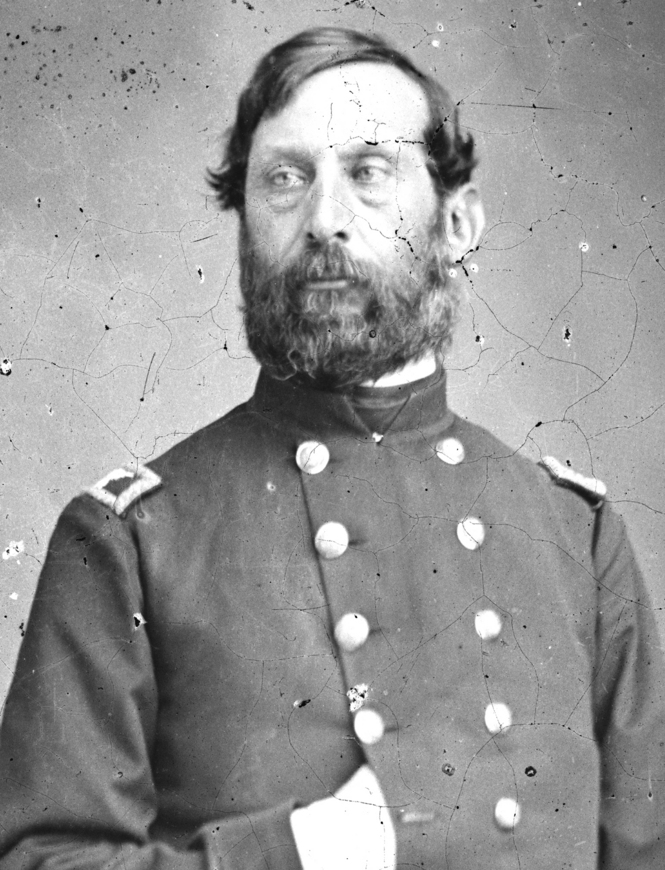
henryhunt

General Henry Hunt

Hunt lobbied the War Department to provide a staff for each brigade, but since the new units were improvised formations no staffs were created and no promotions authorized for their commanders. Colonel Wainwright proposed a congressional bill to organizer volunteer artillery units into a corps of artillery, but lamented:

“Both Barry and General Hunt while commanding the artillery of this army have frequently complained in their reports of the great want of field officers. Were the light batteries of each state organized as a corps, and provided with field officers in the proportion proposed in the bill referred to above, this want would be provided for. The officers of light batteries also have a claim demanding some such change. No class of officers in our volunteer service stand as high as high as those of our light batteries. I say without hesitation that they are very far superior as a class in all respects to the officers of the infantry or cavalry. Yet for them there is not a chance at this time any chance of promotion above a simple captaincy, except in the few light regiments spoken of. I can point to several cases of captains of light batteries who, from this want of field officers, have for the past year exercised all the authority and borne all the responsibility of a brigadier-general.” [32]

But change did come, however slowly and with great resistance from the War Department bureaucracy, and the artillery service “did succeed in winning some measure of recognition for its independent status and tactics. After Gettysburg the army’s artillery commander was accept as having overriding authority in gunnery matters, with the infantry relegated to a merely consulting role, although in practice the change brought little improvement.” [33] The beginning of this came in August 1863 when George Meade promulgated an order that “defined Hunt’s authority in matters of control of the artillery in the Army of the Potomac. The order “definitely stated that Hunt was empowered to supervise and inspect every battery in the army, and in battle to employ them “under the supervision of the major-general commanding.” [34] The order was important but still did not go far enough to remedy the problem of a lack of field officers in the artillery, a problem that was not completely remedied during the war although Ulysses Grant did allow a limited number of promotions to provide more field grade officers in the artillery service of the Army of the Potomac and other armies under his command in the Eastern Theater. Likewise some additional billets were created in the brigades as brigade commanders “were authorized a staff consisting of an adjutant, quartermaster, commissary officer, ordnance officer (an artillery officer on ordnance duty), medical officer, and artillery inspector, with each staff officer having one or more assistants…” However the staff officers had to be detailed from the batteries, thereby reducing the number of officers present with those units” [35] However, in most cases the brigade commanders remained Captains or First Lieutenants.

In the Western theater there was a trend toward the centralization of the artillery in the various armies depending on the commander and the terrain and the size of the operation. As the war progressed in the west commanders began to group their artillery under brigades, divisions, and finally under the various army corps. At Shiloh Grant concentrated about 50 guns “in the notorious “Hornet’s Nest,” perhaps saving him from defeat.” [36] Artillery tactics shifted away from the offense to the defense and even during offensive operations western commanders were quick to entrench both their infantry and artillery. During the Atlanta campaign and march to the sea William Tecumseh Sherman successfully reduced his artillery complement first to 2 guns per 1,000 men then to 1 per 1,000. [37] This was in large part because he was conducting a campaign of maneuver and was far from his logistics base. Since supplies had to be carried with the army itself with a heavy reliance on forage, Sherman recognized that his army had to be trimmed down. Likewise, “the terrain and concept of operations must have been very important in his decision.” His “rapid, almost unopposed raid through Georgia gave no opportunities for the massing of large batteries in grand manner.” [38] During the campaign Sherman marched without a siege train and reinforced his cavalry division with light artillery batteries.

Notes 

[1] Ibid. Hagerman The American Civil War and the Origins of Modern Warfare p.21

[2] Ibid, Bailey Field Artillery and Firepower p.195

[3] Ibid, Bailey Field Artillery and Firepower p.194

[4] Ibid. Nesmith Stagnation and Change in Military Thought: The Evolution of American Field Artillery Doctrine, 1861-1905 – An Example p.6

[5] Nichols, Edward J. Toward Gettysburg: A Biography of General John Reynolds, The Pennsylvania State University Press 1958, reprinted by Old Soldier Book Gaithersburg MD 1987 p.43

[6] Ibid. Longacre The Man Behind the Guns: A Military Biography of General Henry J. Hunt, Chief of Artillery, Army of the Potomac pp.53-54.

[7] Gibbon, John. Artillerist’s Manual: Compiled from Various Sources and Adapted to the Service of the United States. 1859 retrieved from http://www.artilleryreserve.org/Artillerists%20Mannual.pdf 19 January 2017 pp.345-346

[8] Ibid. Hagerman The American Civil War and the Origins of Modern Warfare p.22

[9] Ibid. Nesmith Stagnation and Change in Military Thought: The Evolution of American Field Artillery Doctrine, 1861-1905 – An Example p.19

[10] Ibid. Gibbon  Artillerist’s Manual: Compiled from Various Sources and Adapted to the Service of the United States. p.343

[11] Ibid. Griffith, Battle Tactics of the Civil War p.165

[12] Gottfried, Bradley The Artillery of Gettysburg Cumberland House Publishing, Nashville TN 2008 p.15

[13] Ibid. Nichols Toward Gettysburg: A Biography of General John Reynolds p.75

[14] Wert, Jeffry D. The Sword of Lincoln: The Army of the Potomac Simon and Schuster, New York and London 2005 p.39

[15] Ibid. Wert The Sword of Lincoln: The Army of the Potomac p.39

[16] Ibid. Wert The Sword of Lincoln: The Army of the Potomac p.40

[17] Ibid. Nesmith Stagnation and Change in Military Thought: The Evolution of American Field Artillery Doctrine, 1861-1905 – An Example pp.21-22

[18] Ibid. Longacre The Man Behind the Guns: A Military Biography of General Henry J. Hunt, Chief of Artillery, Army of the Potomac p.98

[19] Ibid. McKenny The Organizational History of Field Artillery 1775-2003 p.65

[20] Ibid. McKenny The Organizational History of Field Artillery 1775-2003 p.74

[21] Ibid. Griffith, Battle Tactics of the Civil War p.166

[22] Ibid. McKenny The Organizational History of Field Artillery 1775-2003 p.60

[23] Ibid. Nesmith Stagnation and Change in Military Thought: The Evolution of American Field Artillery Doctrine, 1861-1905 – An Example p.22

[24] Wainwright, Charles S. A Diary of Battle: The Personal Journal of Colonel Charles S. Wainwright 1861-1865 edited by Allan Nevins, Da Capo Press, New York 1998 p.336

[25] Ibid. Longacre The Man Behind the Guns: A Military Biography of General Henry J. Hunt, Chief of Artillery, Army of the Potomac p.100

[26] Ibid. Griffith, Battle Tactics of the Civil War p.166

[27] Ibid. Hagerman The American Civil War and the Origins of Modern Warfare p.94

[28] Ibid. Hagerman The American Civil War and the Origins of Modern Warfare p.94

[29] Ibid. Griffith, Battle Tactics of the Civil War p.166

[30] Ibid. Nesmith Stagnation and Change in Military Thought: The Evolution of American Field Artillery Doctrine, 1861-1905 – An Example pp.22-23

[31] Ibid. McKenny The Organizational History of Field Artillery 1775-2003 p.62

[32] Ibid. Wainwright. A Diary of Battle: The Personal Journal of Colonel Charles S. Wainwright 1861-1865 p.337

[33] Ibid. Griffith, Battle Tactics of the Civil War p.166

[34] Ibid. Longacre The Man Behind the Guns: A Military Biography of General Henry J. Hunt, Chief of Artillery, Army of the Potomac p.181

[35] Ibid. McKenny The Organizational History of Field Artillery 1775-2003 p.61

[36] Ibid, Bailey Field Artillery and Firepower p.198

[37] Ibid. Hagerman The American Civil War and the Origins of Modern Warfare p.284

[38] Ibid. Griffith, Battle Tactics of the Civil War p.178


2 Comments

Filed under civil war, History, Military

Cemetery & Culp’s Hill Pt 4

Friends of Padre Steve’s World

I have just gotten back from another trip with my students to Gettysburg, and happen to be posting my newest additions to my text, these dealing with the battles for Culp’s Hill and Cemetery Hill which occurred on the night of July 2nd and early morning of July 3rd 1863. I hope you enjoy.

Peace,

Padre Steve+

robert-rodes

Major General Robert Rodes, C.S.A.

It would not be until the evening of the 2nd that Ewell’s troops went into action against the now very well entrenched, but depleted, Federal Forces on Cemetery and Culp’s Hill. The assaults began on Cemetery Hill where Jubal Early’s division attacked forces along the north and east section of the hill. This attack was to have been supported by Robert Rodes’ division on the west.

However as with most of the Confederate offensive actions of the battle this too fell apart as Rodes division provided no support to Early’s attack. Edwin Coddington explained that Rodes “did not give himself enough time to get his big division into formation for the attack. By the time he had completed the complicated maneuver of wheeling his brigades forty-five degrees to the left and advancing them half a mile to a good place from which to charge up Cemetery Hill the battle was over.” [1] However, this explanation gives Rodes too much of a pass, although he indeed failed to properly prepare for the attack, he decided not to attack based on the discretion given to him in Ewell’s orders.

Rodes’s division had lost about forty percent of its strength in the disastrous attack on Oak Ridge on July 1st. “Perhaps still shaken from the near disaster the day before, Rodes displayed a lack of diligence and energy which was untypical of his career, civilian or as a soldier.” [2] Robert Rodes was under general instructions from Ewell to support the attacks, which gave him some latitude in decided when and where to do so. As a result he “had been very careful and cautious in marching his men out of Gettysburg and into line across from the northwest corner of Cemetery Hill.” [3] Likewise, he “seems to have greatly underestimated how long it would take to move his five brigades out of Gettysburg and deploy them to the west of the town for an assault.” [4] His two leading brigades, those of Stephen Ramseur and George Doles which had distinguished themselves the previous day, “had covered about half an mile toward the enemy’s line when, in dusk, the two young brigadiers got a good and very sobering look at the Federal position.” [5] Rodes had given tactical command of the advance, and the final say in deciding on the attack, to Ramseur, an aggressive officer “who nonetheless paled when he saw the strength of the enemy defenses.” [6] When his brigade “came within six hundred feet of the Union line, the moonlight was apparently strong enough for Ramseur to observe the great strength of the position: batteries ready to pour “direct, cross, and enfilade fires” upon his lines, and two supporting rows of infantry well protected by stone walls and breastworks.” [7] Alfred Iverson, who had contributed to the disaster the day before claimed “we were advancing to our destruction.” [8]

This was enough for Ramseur who consulted with George Doles and Iverson, and told Rodes of their findings. “When Doles concurred with Ramseur in this report, Rodes cancelled the attack,” [9] and “deferring the attack until daylight.” [10] As the time was past when he could support Early, whose brigades had now ceased their attack, Rodes decided “it would be useless sacrifice of life to go on.” [11]

Despite the failure of Latimer’s barrage, and Rodes’s decision not to attack, “Johnson and Early rushed their men into action as if relieved that the tension of the long wait was over,” [12] and both would meet with bloody failure.

Storm on Cemetery Hill: Early’s Attack

Like the rest of Second Corps, Jubal Early’s division had waited throughout the day for the word to advance. Early had placed the brigades of Colonel Isaac Avery, who was commanding Hoke’s brigade, and Brigadier General Harry Hay’s Louisiana brigade, “in a protected position north of the town, from which they could easily storm cemetery Hill.” [13] He also moved John Gordon’s brigade into a supporting position while leaving “Extra Billy” Smith’s brigade to cover the Confederate rear along the York Road.

350px-Gettysburg_Cemetery_Hill

Assault on Cemetery Hill

It was Early’s division which came the closest to breaking the Union line and seizing the all-important position on Cemetery Hill. His line, with Avery left and Hays on the right, “some 3,500 men in all, stretched east from the town across the fields to within a short distance from Rock Creek. As Johnson closed in on Culp’s Hill around eight o’clock. Early began to whip his men into motion.” [14] Early put Hays in tactical command of the two brigades Hays exhorted his men, including the famed Louisiana Tigers, with the challenge that Early had ordered “the Louisianans and …North Carolinians to take the guns on the hill.” [15] But some of his officers, including Lieutenant Warren Jackson, “who had been on the skirmish line most of the day was not assured; he felt as though his fate had been sealed.” [16]

But some Union troops along the line had become complacent, assuming that the defeat of Latimer’s artillery at Brenner’s Hill meant that the threat had passed. One Union soldier wrote, “We did not expect any assault,” and “could not have been more surprised if the moving column had raised up out of the ground amid the waving timothy grass of the meadow.” [17]

From their starting positions outside Gettysburg, Early’s forces had to make a giant wheel to their right to strike the Federal line on East Cemetery Hill. Hays’s Louisiana regiments “extended out from the pivot of the wheel. Isaac Avery’s three North Carolina regiments, on the outer edge of the wheel had longer to march.” [18] The two brigades began their advance and were immediately assailed by the massed Federal artillery batteries on Cemetery Hill. Charles Wainwright wrote that the Hays’s Confederates “marched straight out of the town, and then facing to their right rushed for the hill.” [19] A Federal artilleryman described the advance, “When they came into full view in Culp’s meadow our artillery…opened on them with all the guns that could be brought to bear. But on, still on, they came, moving steadily to the assault, soon the infantry opened fire, but they never faltered.” [20]

The Confederates faced a fusillade of artillery fire from the guns of First and Eleventh Corps. Captain Michael Wiedrich’s Battery I, 1st New York, “closest to the Louisianans, went to canister almost immediately. Before long all the batteries were firing canister, then double canister. When they ran out of canister they fired case shot without fuzes, the missiles exploding as they left the muzzles.” [21]  However, much of the fire had little effect as the guns could not be depressed enough and many rounds went over the heads of the Confederates, protecting them from an even greater slaughter. Avery’s North Carolina troops suffered worse as they had more open ground to cover and Avery himself was killed early in the advance.

The hill “was ascended through the wide ravine between Cemetery and Culp’s hills,” and “a line of infantry on the slopes was broken,” [22] and “Hays’s men moved straight up the hill, taking three successive positions.” [23] The Union troops in this section of the line were the survivors of Barlow’s division now commanded by Adelbert Ames who manned a thin line along a stone wall near the base of the hill. Numbering just over 1,000 men the division held a line along the base of the hill along the Brickyard lane. The thin line was quickly overwhelmed in many places after a brief fight, while many accused the Germans of fleeing at the first sight of the enemy, some units gave a good account, the 17th Connecticut and 75th Ohio on the right of Harris’s Brigade occupied a spot of high ground from which they were not moved by the Confederates. However, the 107th and 25th Ohio occupying a salient at the extreme north of the Union line were overwhelmed after a brief but fierce fight. Soon “Ames’s brigades were dissolving into an uncontrollable spray of fugitives or inconsequential knots of resistance in the lane, as the rebel tide flowed beyond them.” [24]

cemetery hill

Soon the Louisiana Tigers were among the Federal artillery batteries and fierce hand to fighting raged among the guns and the Union gunners refused to withdraw. The Germans of Wiedrich’s and Rickett’s batteries went toe to toe with the Louisianans and North Carolinians who had gain the summit, and “Wiedrich’s men defended their guns with courage.” [25] As one of “Hay’s Louisiana Tigers confidently threw himself onto the muzzle of a Napoleon, he shouted, I take command of this gun! A German gunner with the piece’s lanyard in his hand replied, Du sollst sie haben (it was a line from a German birthday song – you can have it) and blew the rebel to smoking bits.”  [26] The German gunners fought with such tenacity that Charles Wainwright, a frequent critic of the German units wrote, “the men of “I” Battery, also Germans, fought splendidly, sticking to their guns and finally driving the rebs out with their hand spikes and fence rails.” [27] So it went along the gun line as the Union gunners fought the Confederate infantry matching pikes, rammers, pistols and sabers against the Confederate riflemen, but soon the guns were silent and it appeared “for one incredible moment, as Hays reported, “every piece of artillery which had been firing on us was silenced,” and two Confederate brigades possessed the enemy stronghold.” [28] But the apparent triumph would not last long.

“In the crisis the performance of Howard and Schurz showed up well.” [29] Seeing the chaos on Cemetery Hill, Oliver Howard and Carl Schurz reacted to this with alacrity and ordered Colonel Wladimir Krzyzanowski to take the 119th and 58th New York regiments “at double quick the short distance across the Baltimore Pike to Wiedrich’s battery…. The 119th New York, less than 200 strong…made a “vigorous rush” against the Louisiana interlopers and swept them down the hill. When they reached the base, Krzyzanowski’s men flopped down and Wiedrich’s guns belched canister at the fleeing Confederates.” [30] Howard also had the foresight to ask “for supporting troops from the Second Corps,” a request “Hancock had anticipated by sending out Carroll with most of his brigade, but with “no precise orders” about where he was to go.” [31] Hancock had heard the sound of heavy firing Hancock reacted, he recalled “I heard the crack of musketry on Howard’s front…. Recognizing the importance to the whole army of holding the threatened positions, I directed General Gibbon to send a brigade instantly to Gen’l Howard’s assistance.” [32] The sense of both Generals to order this movement as a precaution proved to be a decision that ensured that Cemetery Hill would remain in Union hands.

220px-Samuel_S_Carroll

Colonel Samuel Carroll

The brigade was commanded by Colonel Samuel Carroll, it was a crack unit, known as the Gibraltar Brigade, aside from the Iron Brigade, the only “Western” brigade in the Army of the Potomac. Carroll was one of the best brigade commanders in the Army of the Potomac. Carroll graduated near the bottom of the West Point class of 1856 and spent four years on the frontier before being assigned as a quartermaster at West Point and took command of the 8th Ohio in the fall of 1861. He soon was a brigade commander but at Gettysburg was still a Colonel, despite this he was a man of action and rapidly moved the brigade exactly where with was needed the most. Carrol had a full head of brick-red hair, which garnered him the name Old Brick Top. His personality and leadership style was such that it “often reminded people of his manic-aggressive division commander, Alex Hays, and this occasion was no exception.” [33]

Coming over from the west side of Cemetery Ridge the brigade appeared in the moonlight to Hays as a shadowy indistinguishable mass. Since Hays expect that Rodes’s troops might be moving in from the west, or Longstreet’s from the south. He was unsure of who the advancing troops were, and how many were advancing towards him. He wrote in his after action report, “I reserved my fire, from the uncertainty of this being a force of the enemy or of our own men, as I had been cautioned to expect friends both in front, to the right and to the left.” [34]

With little direction form either Hancock or Howard, “Carroll trotted him men in column…. He skillfully positioned his men in the dark for the attack, facing obliquely to the left and uphill. The debris of early fighting made it difficult to advance on a wide front, so Carroll placed the 14th Indiana in the advance and stacked up the other two regiments (the 7th West Virginia and 4th Ohio) behind it.” [35] Carroll had a booming voice and he called out to his troops “in a voice that was heard all over East Cemetery Hill: “Halt! Front Face! Charge bayonets! Forward, double-quick! March! Give them Hell!” [36]

The brigade charged the Confederates and “struck Hoke’s brigade and pushed it back. At the same moment some men from Hays’s brigade opened a brisk fire on his left flank from behind a stone wall. Carroll quickly had the 7th West Virginia change from and drive the Louisianans away.” [37] Even so the fight was fierce, “there was a confused sound of pounding feet and colliding human bodies, grunts, yells and curses and a crackling of rifle fire – and the last of the Confederates were driven out.” [38]

Though Early achieved some success his division was repulsed and the threat to the Union gun-line on Cemetery Hill was ending. “Hays, already staggered by three unanswered volleys – the third was especially destructive, delivered at such close range – gave the order at last for his men to return the fire.” [39] His troops fought back but he realized that no help was coming either from Rodes, or Gordon, whose brigade was withheld by Early when he realized that Rodes was not attacking, believing that it “would been a useless sacrifice.” [40] Without support and threatened by more Federal troops, Hays gave the order to withdraw. As one author noted, “Courage and determination could not offset superior numbers and fresh troops. With no help coming and enemy units swarming around them, all those Rebels who were still under some command and control began to fall back.” [41]

img_0578

Early’s attack which had been so promising ended in failure and would be the subject of controversy after the battle and after the war. Rodes’s failure to support his attack on Cemetery Hill, “angered Jubal Early, and he did not mince words about it. In his report, Early complained: “No attack was made on the immediate right, and not meeting with support from that quarter, these brigades could not hold the position that they had attained.” [42]

Whether the Confederates could have taken the position had Rodes delivered his attack is another matter which can only be speculative in nature. Had Rodes and Gordon supported the attack, had Ewell better coordinated with A.P. Hill in order to have Pender’s division support the attack, it might have succeeded Like the earlier Confederate failures of the past two days the issue came down to command and control, coordination, and vague orders. “Ewell had no control over his corps. Three division commanders were coordinating without a central control – and one failed.” [43] Likewise, there is no question that “if Rodes had been able to mount an attack in conjunction with Early, which under the circumstances would have been a miracle of generalship, the defenders of Cemetery Hill would have had a hard time of it.” [44] But the failure of Ewell and his division commanders to coordinate the attack speaks volumes about “the uncoordinated command style that had become Robert E. Lee’s habit, and for the paralyzing evaporation of initiative that crept over the senior generals of the Army of Northern Virginia the longer and deeper they remained in the unfamiliar environment of Pennsylvania.” [45]

Notes

[1] Ibid. Coddington The Gettysburg Campaign: A Study in Command pp.429-430

[2] Ibid. Dowdy Lee and His Men at Gettysburg: The Death of a Nation p.237

[3] Ibid. Trudeau Gettysburg: A Testing of Courage p.407

[4] Ibid. Sears Gettysburg  p.341

[5] Ibid. Dowdy Lee and His Men at Gettysburg: The Death of a Nation p.238

[6] Ibid. Trudeau Gettysburg: A Testing of Courage p.407

[7] Ibid. Coddington The Gettysburg Campaign: A Study in Command p.439

[8] Ibid. Guelzo Gettysburg: The Last Invasion p.344

[9] Ibid. Sears Gettysburg  p.341

[10] Ibid. Coddington The Gettysburg Campaign: A Study in Command p.439

[11] Ibid. Dowdy Lee and His Men at Gettysburg: The Death of a Nation p.238

[12] Ibid. Dowdy Lee and His Men at Gettysburg: The Death of a Nation p.233

[13] Ibid. Coddington The Gettysburg Campaign: A Study in Command p.430

[14] Ibid. Coddington The Gettysburg Campaign: A Study in Command p.435

[15] Ibid. Guelzo Gettysburg: The Last Invasion p.339

[16] Ibid. Pfanz Gettysburg: Cemetery Hill and Culp’s Hill p.236

[17] Ibid. Guelzo Gettysburg: The Last Invasion p.339

[18] Ibid. Sears Gettysburg  p.334

[19] Ibid. Wainwright A Diary of Battle p.245

[20] Ibid. Gottfried  The Artillery of Gettysburg p.169

[21] Ibid. Sears Gettysburg  p.334

[22] Hunt, Henry. The Second Day at Gettysburg in Battles and Leaders of the Civil War Volume III, The Tide Shifts. Edited by Robert Underwood Johnson and Clarence Clough Buel Castle, Secaucus NJ p.312

[23] Ibid. Dowdy Lee and His Men at Gettysburg: The Death of a Nation p.235

[24] Ibid. Guelzo Gettysburg: The Last Invasion p.340

[25] Ibid. Pfanz Gettysburg: Cemetery Hill and Culp’s Hill p.269

[26] Ibid. Guelzo Gettysburg: The Last Invasion p.342

[27] Ibid. Wainwright A Diary of Battle pp.246-246

[28] Ibid. Dowdy Lee and His Men at Gettysburg: The Death of a Nation p.236

[29] Ibid. Coddington The Gettysburg Campaign: A Study in Command p.437

[30] Ibid. Pfanz Gettysburg: Cemetery Hill and Culp’s Hill p.272

[31] Ibid. Coddington The Gettysburg Campaign: A Study in Command p.437

[32] Ibid. Sears Gettysburg  p.339

[33] Ibid. Guelzo Gettysburg: The Last Invasion p.343

[34] Luvaas, Jay and Nelson Harold W. editors. The U.S. Army War College Guide to the Battle of Gettysburg South Mountain Press, Carlisle PA 1986 p.163

[35] Ibid. Tagg The Generals of Gettysburg p.56

[36] Ibid. Sears Gettysburg  p.339

[37] Ibid. Coddington The Gettysburg Campaign: A Study in Command p.437

[38] Catton, Bruce The Army of the Potomac: Glory Road Doubleday and Company, Garden City New York, 1952 p.303

[39] Ibid. Foote The Civil War, A Narrative. Volume Two Fredericksburg to Meridian p.519

[40] Ibid. Sears Gettysburg  p.340

[41] Ibid. Trudeau Gettysburg: A Testing of Courage p.409

[42] Ibid. Pfanz Gettysburg: Cemetery Hill and Culp’s Hill p.281

[43] Ibid. Dowdy Lee and His Men at Gettysburg: The Death of a Nation p.239

[44] Ibid. Coddington The Gettysburg Campaign: A Study in Command p.440

[45] Ibid. Guelzo Gettysburg: The Last Invasion p.344

Leave a comment

Filed under Loose thoughts and musings

Culp’s and Cemetery Hill Pt 2

Friends of Padre Steve’s World

I am traveling with my students to Gettysburg this weekend and happen to be posting my newest additions to my text, these dealing with the battles for Culp’s Hill and Cemetery Hill which occurred on the night of July 2nd and early morning of July 3rd 1863. I hope you enjoy.

Peace,

Padre Steve+

Richard-Ewell

Lieutenant General Richard Ewell, C.S.A

During the day of July second little happened on Ewell’s front, an officer in Maryland Steuart’s brigade wrote “Greatly did officers and men marvel as morning, noon, and afternoon passed in inaction – on our part, not the enemy’s, for, as we well knew, he was plying axe and pick and shovel….” [1] . Though he had persuaded General Lee to leave his troops in place in order to assist Longstreet’s attack if the situation permitted, Ewell remained mostly inactive on July second with the exception of some skirmishing and a battle between the Stonewall Brigade and Gregg’s division of Federal Cavalry on Brinkerhoff’s Ridge about two and a half miles east of the town.

Lee was becoming more frustrated at the inaction of his corps commanders, and wanted Ewell to be able to support Longstreet’s attack, desire it to “make a simultaneous demonstration upon the enemy’s right, to be converted into a real attack should opportunity offer.” [2] But Ewell and his division commanders who had opposed the attack the previous evening, still were against it. Despite his misgivings, Ewell had been stung by Lee’s criticism the night before, and “was eager to make a redemptive showing today.” [3] Accordingly after his meeting with Lee around nine a.m. he began to position his units for the diversion that he hoped would turn into an opportunity to attack. After his conversation with Lee, Ewell “suffered between fear of another failure and an inner goad to commit his troops to action. His unsettled state could not have been helped by the long wait for the sound of Longstreet’s guns, which frayed the nerves.” [4]

Second Corps was deployed in a rough semi-circle to the east, north, and west of Culp’s and Cemetery Hill. The four brigades of Allegheny Johnson’s division which had not been present on the first day of battle occupied the area to the east of Culp’s Hill north of the Hanover Road. From there its skirmishers occasionally clashed with Federal skirmishers, while otherwise spending an uneventful day.

Edward “Old Allegheny” Johnson was an old regular army officer. Johnson was born in Salisbury, Virginia in 1816. He was a graduate of the West Point class of 1838 along with P.T.G. Beauregard and Irvin McDowell. Johnson had a solid record of service in the old Army, he served in the Seminole Wars and received brevet promotions to Captain and Major during the Mexican War. Like many officers that remained in the army after Mexico he served on the frontier on the Great Plains.

Johnson resigned his commission when Virginia seceded from the Union and was appointed Colonel of the 12th Georgia Infantry. [5] He was promoted to Brigadier General in December 1861. Johnson commanded a brigade sized force with the grand name of “the Army of the Northwest” which fell under the command of Stonewall Jackson.[6] He held the crest of the Allegheny Mountains so well with his small force that he was given the “nom de guerre “Allegheny” Johnson.” [7] Johnson was wounded in the ankle at the Battle of McDowell on May 8th 1862, but the wound took nearly a year to heal, imperfectly at that. He was a rather “curious, somewhat uncouth, and strangely fascinating man” [8] who made the most of his convalescence in Richmond, making pass after pass, and occasional proposals to women about town. He was a favorite of Stonewall Jackson who insisted that he be promoted to Major General and be given command of a division.

The division that Johnson took over was the former division of Jackson, and “many of these regiments had fought in “Stonewall” Jackson’s original division, and the troops enjoyed an spirit as exalted as their combat record.” [9] When Ewell was promoted to command Second Corps after Jackson’s death following the Battle of Chancellorsville Johnson was named as commander. Despite his wealth of experience in the pre-war army and service with Jackson in the Valley, Johnson was an outsider to the division and he commanded men “who knew him by reputation only.”[10] Like so many other Confederate division commanders at Gettysburg he had never before commanded a division, so he came to the position “with no real experience above the brigade level.” Likewise he was “unfamiliar with the qualities and limitations of his four new brigadiers,” [11] having served with none of them prior to the Gettysburg campaign. Two, “Maryland” Steuart, and James Walker were experienced brigade commanders, J.M. Jones was a former regular who due to problems with alcohol had only served in staff positions before being promoted to command a brigade, and Colonel Jesse Williams, a regimental commander with little experience had taken a brigade as there was no one else qualified.

Despite this, Johnson became quite popular with his men. Because Johnson walked with a limp and used a long staff to help him walk, it was said that: “his boys sometimes call him “Old Club.” [12] As a division commander “Johnson developed a reputation that when he threw his troops into battle, then struck with the punch of a sledgehammer, exactly the way Lee wanted his commanders to fight.” [13] Johnson “does well in nearly all his fights, hits hard and wins the confidence of his men.” [14] Gettysburg was his first test as a division commander, but not one that gave Johnson a real opportunity to excel.

Jubal Early’s division lay to the north of both Culp’s Hill and Cemetery Hill, with the brigades of Hays and Hoke posted “east of Baltimore Street in the ravine of Winebrenner’s Run,” where it “spent a miserable day,” as the ravine was “deep enough to cut off cooling breezes, its slopes were bare of trees, and the July sun warmed the Confederates without mercy. It was a debilitating and dangerous place. General Ewell wanted to pull Hays’s brigade back when it became apparent that the attack would be delayed, but he could not do so without risk of great loss. But staying there was not much better because, as Lt. William Seymour observed, it was almost death for a man to stand upright. ” [15]

“Old Jube” Early was an unusual character. He was described similarly by many to Dick Ewell in his gruffness and eccentrics. However, unlike Ewell, who was modest and charitable, Early was “ambitious, critical, and outspoken to the point of insubordination. Under certain circumstances he could be devious and malevolent.” [16] James Longstreet’s aide Moxey Sorrel wrote of him: “Jubal Early….was one of the ablest soldiers in the army. Intellectually he was perhaps the peer of the best for strategic combinations, but he lacked the ability to handle troops effectively in the field….His irritable disposition and biting tongue made him anything but popular.” [17] Despite this, Early had proved himself as a brigade commander and acting division commander and Lee referred to him affectionately as “my bad old man.” [18]

Early was the son of a tobacco planter in Franklin County Virginia. He was born in 1816 who had served in the Virginia legislature and was a Colonel of militia. Growing up he had an aptitude for science and mathematics. He was accepted into West Point in 1833 at the age of seventeen. He was a good student, but had poor marks for conduct and graduated in the eighteenth of fifty cadets in the class of 1837. His fellow students included Joe Hooker, John Sedgwick, Braxton Bragg, and John Pemberton, later, the doomed defender of Vicksburg. Also in the class was Lewis Armistead, with whom the young Early had an altercation that led to Armistead breaking a plate over his head in the mess hall. For the offense Armistead was dismissed from the academy.

He was commissioned into the artillery on graduation in 1837. However, after experiencing life in the active duty army, including service in the in the Seminole War, Early left the army and became a highly successful lawyer and active Whig politician. He served in the Mexican war as a Major with Virginia volunteers. Unlike some of his classmates, and later contemporaries in the Civil War, Early, and his men did not see combat, instead, serving on occupation duty. In Mexico Zachary Taylor made Early the “military governor of Monterrey, a post that he relished and filled with distinction.” [19]

After his service in Mexico, Early returned to Virginia, where he returned to his legal practice, serving as a prosecuting attorney. He also entered local politics where he served as a Whig in the Virginia legislature.

During his time in Mexico, Early contracted rheumatic fever, which left him with painful rheumatoid arthritis for the rest of his life. Due to it he “stooped badly and seemed so much older than his years that his soldiers promptly dubbed him “Old Jube” or Old Jubilee.” [20]

Jubal Early was “notoriously a bachelor and at heart a lonely man.” Unlike many Confederate officers he had “no powerful family connections, and by a somewhat bitter tongue and rasping wit” isolated himself from his peers.[21]

Likewise, in an army dominated by those with deep religious convictions, Early was avowedly irreligious and profane, though he did understand the importance of “the value of religion in keeping his soldiers’ spirits up” and as commander of the Army of the Valley, issued orders for a stricter keeping of the Sabbath. [22] Lee’s adjutant Walter Taylor wrote of him “I feared our friend Early wd not accomplish much because he is such a Godless man. He is a man who utterly sets at defiance all moral laws & such a one heaven cannot favor.” [23] That being said Porter Alexander praised Early and noted that his “greatest quality perhaps was the fearlessness with which he fought against all odds & discouragements.” [24]

Jubal Early was a Whig, and a stalwart Unionist who opposed Virginia’s secession, voting against it because he found it “exceedingly difficult to surrender the attachment of a lifetime to that Union which…I have been accustomed to look upon (in the language of Washington) as the palladium of the political safety and prosperity of the country.” [25]  Nonetheless, like so many others he volunteered for service after Lincoln called for 75,000 volunteers to crush the rebellion.

Robert E. Lee “appreciated Early’s talents as a soldier and displayed personal fondness for his cantankerous and profane Lieutenant …who only Stonewall Jackson received more difficult assignments from Lee.” [26] Early was the most influential of Ewell’s division commanders, and his “record in battle prior to Gettysburg was unsurpassed.” [27]

On Ewell’s left, Robert Rodes’s division, which had taken such a brutal beating at Oak Hill on July 1st lay to the west and north of Cemetery Hill in the town itself. “Doles’s, Iverson’s, and Ramseur’s brigades of Rodes’s division occupied Middle Street west from Baltimore Street to the edge of the town. O’Neal’s brigade was along the railroad bed to the right and rear, and Daniel’s brigade occupied the ridge at the seminary.” [28]

Ewell also took the time to scout for artillery positions, the only two that offered any support were on Seminary Ridge to the west and on Brenner’s Hill to the north, and on Brenner’s Hill he deployed Major Joseph Latimer’s artillery battalion. Latimer was not yet twenty years old at Gettysburg. Latimer had been a seventeen year-old student at the Virginia Military Institute at the outbreak of the war and volunteered to help a newly formed artillery battery. He impressed other officers enough that he was given a commission as a First Lieutenant shortly after turning eighteen, and promoted to Captain and command of Virginia’s Courtney Artillery in March of 1862. “Sometimes called “the “Boy Major” and “Young Napoleon,” Latimer had won the respect of the entire army for his skill and bravery,[29] and he was often cheered by the infantry as he rode by. His battlefield performance was such that he was promoted to Major in March 1863, and given command acting command of the battalion of Lieutenant Colonel R. Snowden Andrews who had been wounded at Winchester.

The lack of good positions to place his guns meant that Ewell’s artillery Chief, Colonel J. Thompson Brown had to work hard to find suitable firing positions for all of his guns. Some he placed on Seminary Ridge, and others on Brenner’s Hill. Brown “could get only forty-eight of the eighty or so guns of the Second Corps placed for action. Of these only thirty-two became actively engaged on July 2nd.” [30]

Around four o’clock Latimer’s batteries commenced firing at the Federal positions on Cemetery Hill, provoking a storm of counter-battery fire from Colonel Wainwright’s First Corps guns. The confederate batteries were placed on Brenner’s Hill, which was devoid of cover and about fifty feet lower than the opposing Federal batteries on Cemetery Hill. The Confederates opened fire and Wainwright noted the effectiveness of the Confederate fire from Brenner’s Hill, considering it some “of the most accurate we had seen,” and that the weight of shell between the two sides was about equal, but Latimer’s gunners had no chance. Heavy fire from Wainwright’s batteries “immediately answered him and soon found the range. Within five minutes one of his caissons exploded. Twenty-five men went down in the Allegheny Roughs. Gunners in other batteries began dropping, and it became evident that the open hill was too hot a place to stay.” [31]

The Union fire was most effective and caused great damage to the Confederate batteries. Wainwright wrote, “Still we were able to shut them up, and actually drive them from the field in about two hours.” [32]  The highly accurate Federal fire “smothered the enemy gunners and forced them to pull back from the hill out of effective range.[33]A Confederate artilleryman from the Chesapeake Artillery described the position as “simply a hell infernal,” and wrote “we were directly opposed by some of the finest batteries in the regular service of the enemy, which batteries moreover, held a position to which ours was a molehill. Our shells ricocheted over them, whilst theirs plunged into the devoted battalion, carrying death and destruction everywhere.” [34] Latimer realized that he could not keep up the fight and told General Johnson “that he could no longer hold his posting on Brenner’s Hill. He was told to evacuate all but four guns, which would be used to support the infantry.” [35] While directing the fire of the remaining battery Latimer was mortally wounded by an artillery burst. He died a month later, depriving the Confederacy of one of its most promising young artillery officers. Ewell, who admired him greatly wrote, “Though not yet twenty-one when he fell, his soldierly qualities had impressed me as deeply as those of any officer in my command.” [36] It was “a high price to pay for confirming what should have been apparent before the one-sided contest ever began.” [37] The Confederate cannonade achieved nothing. “As a demonstration it quite failed to distract the Federals, with Meade continuing to reinforce against Longstreet’s offensive. It also quite failed to uncover any obvious “opportunity” for a “real attack” against the Federal right.” [38]

Despite the beating Latimer’s battalion had suffered Ewell was now determined to play his part in the day’s action. During the tense waiting period before the attack Ewell had advised his division commanders “that they should begin their demonstration when they heard Longstreet’s guns. He left to their discretion whether or not they should change the threat into a real assault.” [39] As such he failed to coordinate Ewell made a critical mistake by failing to ensure that Johnson, Early, and Rodes coordinated any offensive that they should undertake. As a result the effort of the Second Corps devolved into three separate actions none of which were coordinated, with fatal results.

As Latimer’s attack ended “quiet, quiet, along with the fading sun, descended on Slcoum’s front,” [40] Ewell and his troops prepared for battle, the impact of Longstreet’s assaults on the Federal left were beginning to be felt on Culp’s Hill.

Notes

[1] Ibid. Sears Gettysburg  p.325

[2] Pfanz, Donald. Richard S. Ewell: A Soldier’s Life University of North Carolina Press, Chapel Hill and London 1998 p.314

[3] Foote, Shelby, The Civil War, A Narrative. Volume Two Fredericksburg to Meridian Random House, New York 1963 p.514

[4] Dowdy, Clifford. Lee and His Men at Gettysburg: The Death of a Nation Skyhorse Publishing, New York 1986, originally published as Death of a Nation Knopf, New York 1958 p.231

[5] Ibid. Warner Generals in Gray p.159 Others sources state this is the 12th Virginia and I cannot find a consensus.

[6] Ibid. Pfanz. Gettysburg: Cemetery Hill and Culp’s Hill p.123

[7] Ibid. Freeman Lee’s Lieutenants p.170

[8] Ibid. Freeman Lee’s Lieutenants p.459

[9] Greene, A. Wilson “A Step All-Important and Essential Element of Victory” Henry Slocum and the Twelfth Corps on July-1-2 in The Second Day at Gettysburg: Essays on Confederate and Union Leadership edited by Gallagher, Gary W.  Kent State University Press, Kent, Ohio and London, 1993 p.111

[10] Ibid. Freeman Lee’s Lieutenants p.459

[11] Ibid. Tagg The Generals of Gettysburg pp.269-270

[12] Ibid. Freeman Lee’s Lieutenants p.47

[13] Ibid. Glatthaar General Lee’s Army from Victory to Collapse p.345

[14] Ibid. Freeman Lee’s Lieutenants p.47

[15] Ibid. Pfanz Gettysburg: Cemetery Hill and Culp’s Hill p.127

[16] Ibid. Pfanz Richard S. Ewell p.268

[17] Ibid. Girardi. The Civil War Generals p.206

[18] Ibid. Wert  A Glorious Army p.155

[19] Ibid. Osborne Jubal p.28

[20] Ibid. Freeman Lee’s Lieutenants p.83

[21] Ibid. Freeman Lee’s Lieutenants p.33

[22] Ibid. Osborne Jubal p.385

[23] Ibid. Girardi. The Civil War Generals p.207

[24] Alexander, Edward Porter. Fighting for the Confederacy: The Personal Recollections of General Edward Porter Alexander edited by Gary Gallagher University of North Carolina Press, Chapel Hill 1989 p.397

[25] Ibid. Osborne Jubal p.50

[26] Gallagher, Gary W. Jubal A. Early, the Lost Cause, and Civil War History: A Persistent Legacy; Frank L Klement Lecture, Alternate Views of the Sectional Conflict Marquette University Press Marquette WI 2003 p.11

[27] Ibid. Tagg The Generals of Gettysburg p.256

[28] Ibid. Pfanz Gettysburg: Cemetery Hill and Culp’s Hill p.128

[29] Gottfried, Bradley The Artillery of Gettysburg Cumberland House Publishing, Nashville TN 2008 p.159

[30] Ibid. Coddington The Gettysburg Campaign: A Study in Command p.429

[31] Ibid. Dowdy Lee and His Men at Gettysburg: The Death of a Nation p.232

[32] Wainwright, Charles S. A Diary of Battle: The Personal Journal of Colonel Charles S. Wainwright 1861-1865 edited by Allan Nevins, Da Capo Press, New York 1998 p.243

[33] Coddington, Edwin B. The Gettysburg Campaign: A Study in Command, A Touchstone Book, Simon and Schuster New York, 1968 p.428

[34] Ibid. Pfanz Ewell p.316

[35] Ibid. Sears Gettysburg  p.283

[36] Ibid. Pfanz Ewell p.316

[37] Ibid. Foote The Civil War, A Narrative. Volume Two Fredericksburg to Meridian p.515

[38] Ibid. Sears Gettysburg  p.283

[39] Ibid. Dowdy Lee and His Men at Gettysburg: The Death of a Nation pp.231-232

[40] Ibid. Greene “A Step All-Important and Essential Element of Victory” p.113

Leave a comment

Filed under civil war, Gettysburg, History, leadership, Military

Abner Doubleday’s Finest Day: July 1st at Gettysburg

Friends of Padre Steve’s World

I am getting ready to take another group of students from the Staff College up to Gettysburg this weekend, so for the next few days I will be putting out excepts of a chapter that I have been working on dealing with the fight conducted by Abner Doubleday and First Corps following the death of John Reynolds.

I hope you enjoy,

Peace

Padre Steve+

fw-baseball-doubleday

Major General Abner Doubleday

As the initial Confederate attacks were driven back by the actions of Reynolds, Doubleday and their subordinate commanders, Harry Heth’s battered brigades fell back and regrouped to prepare for another assault. As Heth reorganized his division he was bolstered by the arrival Major General Dorsey Pender’s Division powerful division.

With John Reynolds dead and Oliver Howard moving his Eleventh Corps into position on Cemetery Hill and to the north of Gettysburg, Major General Abner Doubleday had assumed command of First Corps on McPherson and Seminary Ridge and successfully parried Heth’s initial attacks, in the process shattering the brigades of James Archer and Joseph Davis.

Doubleday was an experienced soldier but did not enjoy a stellar reputation in the Army of the Potomac, despite the fact that he was the senior division commander in First Corps. Doubleday came from a prominent New York family; his grandfather had fought in the American Revolution and had fought at Bunker Hill. His father served four years in Congress. By the time he was admitted to West Point Doubleday had worked for two years as a civil engineer. Doubleday graduated 24th in a class of 52 in the West Point Class of 1842 along with future Gettysburg commanders “Longstreet, McLaws, Richard Anderson and John Newton.” [1] After his graduation he served a rather uneventful career as an artillery officer, including service in Mexico and on the frontier. Shortly before the war he was transferred to South Carolina where he was second in command at Fort Sumter when the Confederates opened fire on the fort and began the Civil War.

Doubleday was definitely an unusual character by the standards of the ante-bellum army officer corps. The “mustachioed, barrel-chested Doubleday considered himself a thoroughly modern man, unencumbered by the cheap affections of honor and chivalry with which so many officers bedecked themselves.” [2] He had few real friends in the army. He was a rather vocal abolitionist “which endeared him to few of the army’s socially conservative generals” [3] and he allowed his political opinions to infringe on his relationships with other officers. In the days before the war at Fort Sumter “he relished being hissed in the streets as a “Black Republican” when his official duties took him over the water to downtown Charleston.” [4]

Doubleday fired the first shot on the Union side at Fort Sumter, and with the expansion of the army to meet the rebellion he “expected that his anti-slavery credentials would guarantee a rise to the top of Lincoln’s army.” [5] However, he was to be disappointed. While promotion came to him it was not to the top of the army. Doubleday had the “reputation of being a cautious, deliberate plodder,” [6] and the artillery commander of First Corps, the somewhat curmudgeonly but honest, Colonel Charles Wainwright noted “Doubleday knows enough, but he is entirely impractical, and so slow at getting an idea through his head.” [7] Likewise, the new army commander George Meade had formed an unfavorable opinion of Doubleday’s leadership ability, when both served as division commanders in First Corps. Meade considered Doubleday “slow and pedantic.” [8]

Doubleday was somewhat portly and his physical appearance did little to inspire his soldiers or officers, and some of his troops nicknamed him “Old Forty-Eight Hours” for his deliberate, even slothful style.” [9] His promotion in the wartime army was rather typical for a career officer. He was “promoted to Brigadier General in February 1862 and commanded a brigade at Second Bull Run and a division at South Mountain and in later battles.” [10] As a brigade commander his best work was at Brawner’s Farm on the eve of Second Manassas, where Doubleday on his own initiative threw “two of his regiments into line to bolster Brig. Gen. John Gibbon’s brigade against a larger Confederate force…together the fought a superior force to a standstill.” [11] He was promoted to Major General in November 1862 and received command of the First Division Third Division of First Corps. At Antietam Doubleday led the division “into the carnage of the Cornfield and West Woods, and one colonel described him as a “gallant officer…remarkable cool and at the very front of battle.” [12] He led the division again at Fredericksburg, but the division saw little action. After the reorganization of the army following Fredericksburg he was given command of Third Division of First Corps at Chancellorsville, but again saw no action.

At Gettysburg Doubleday went into battle “stiff and pompous, still wearing his laurels as an “old Sumter hero” [13] and complaining about the Henry Slocum to command Twelfth Corps, even though he was senior to Slocum. That being said, Doubleday’s actions in the wake of Reynolds’s death demonstrated that he was capable of quick thinking and leadership from the front and in the next few hours Doubleday “had his best command hours of the war.” [14]

A Brief Lull

After the initial repulse of the Heth’s division, Doubleday continued to organize his defenses. He could see Heth’s division reforming its lines on Herr’s Ridge and Pender’s division as it arrived and deployed to Heth’s left. Doubleday had no directions from Reynolds as to that General’s defensive plan but be believed was that the ridges could be a redoubt and his instinct was “to hold on to the position until ordered to leave it,” an officer of the 149th Pennsylvania heard Doubleday say that “all he could do was fight until he got sufficient information to form his own plan.” [15] Doubleday wrote in his after action report, “to fall back without orders from the commanding general might have inflicted lasting disgrace upon the corps, and as general Reynolds, who was high in the confidence of General Meade, had formed his lines to resist the entrance of the enemy into Gettysburg, I naturally supposed that it was the intention to defend the place.” [16] Wadsworth’s division, bloodied but unbeaten remained in place in McPherson’s woods and across the Cashtown Road where Cutler’s brigade had fought the Confederates to a standstill at the Railroad Cut. During the lull these brigades had their ammunition replenished by his recently arrived ammunition trains.

To counter the Confederate move to his right he deployed his own small Third Division under the acting command of Brigadier General Thomas Rowley. He placed Rowley’s brigade to the left of the Iron Brigade to extend the line to the south and the brigade of Colonel Roy Stone to occupy the area around the McPherson House and Barn which had been left open when Cutler’s brigade advanced to the railroad cut.

When the Second Division under the command of Brigadier General John Cleveland Robinson arrived Doubleday placed it in reserve around the Lutheran Seminary where they and some of John Buford’s dismounted troopers began to set up a hasty “barricade of fence rails and fieldstone on the seminary’s west side.” [17] Doubleday and Wadsworth deployed every artillery piece of that the Corps had available to support their infantry, sometimes over the objections of the Corps artillery commander Colonel Charles Wainwright. Wainwright “had no confidence in Doubleday, and felt that he would be a weak reed to lean upon,[18] and on his own initiative deployed most of his batteries on Seminary Ridge where he believed that they could affect the battle but not be torn to pieces by Confederate artillery or shredded by close range musket fire. Despite the “pleas from infantry officers along the rise, Wainwright would send guns forward only under peremptory orders to do so.” [19] Wainwright was hesitant to risk his guns in exposed positions along McPherson’s Ridge and deployed most of his available artillery near the seminary in good defensive positions and stationed his limbers not far off so in the event of a retreat that he might have the opportunity to save his guns.

About Two o’clock Major General Oliver Howard, commander of the Eleventh Corps who was now the senior officer on the field made his way to seminary ridge where he met with Doubleday. Howard had already been working to support First Corps by ordering Schurz, who was now in acting command of Eleventh Corps to move north of the town to connect with Doubleday’s flank and securing Cemetery Hill as a natural redoubt and fallback position. While little is known what was said between the two commanders it is certain that Howard notified Doubleday of the locations of his corps headquarters and that of his divisions. Howard asked Doubleday “to continue his work of protecting the left of the Union position, while he would take care of the right…..Before leaving, Howard, repeated the instructions he had given Wadsworth, to hold the position as long as he could and then retire.” [20] Doubleday asked Howard for reinforcements, but there were none available, the best that either man could hope was that Henry Slocum’s Twelfth Corps, now about five miles distant could arrive soon. “If Slocum could make Gettysburg in the next hour and a half, Howard could post the 12th Corps on the right flank of his own corps and firm up the defensive arc that now stretched north and west of Gettysburg.” [21] However, despite the repeated requests of Howard, Slocum never came and did not advance toward Gettysburg until about three-thirty in the afternoon. Howard’s aid Captain Daniel Hall who delivered the messages and briefed Slocum on the situation at Gettysburg later stated that Slocum’s “conduct on that occasion was anything but honorable, soldierly, or patriotic.” [22]

With his troops under heavy artillery fire and Heth and Pender’s divisions advancing, a new threat emerged from the north. Messengers from Gamble’s cavalry scouts of Buford’s division to the north of town reported the arrival of Ewell’s Second Corps. To meet the threat Doubleday was obliged to send Robinson’s division north to occupy the extension of Seminary Ridge known as Oak Ridge. His lead brigade under the command of Brigadier General Henry Baxter advanced to the end of the ridge near the Mummasburg Road and were joined by Brigadier General Gabriel Paul’s brigade.

Unlike the relatively small brigades of Third Division whose command structures were disrupted by Reynold’s death and Doubleday’s acting command of the corps, these brigades were comparatively large and powerful units and very well led. Their commander, Robinson “an old regular whose flowing beard lent him the look of a biblical prophet, had seen considerable fighting but was yet to be tested as a division commander.” [23] During this battle he more than met the test of an effective division commander. As the advance regiments of the division moved into position on Oak Ridge and the Mummasburg road they were greeted by a few of Gamble’s cavalrymen who told them “You stand alone between the Rebel army and your homes. Fight like hell!” [24] Upon their arrival Robinson refused the line in order to connect to the advance elements of Eleventh Corps which were arriving to the north of Gettysburg.

Notes

[1] Pfanz Harry W. Gettysburg: The First Day University of North Carolina Press, Chapel Hill and London 2001 p.121

[2] Goodheart, Adam 1861: The Civil War Awakening Vintage Books a division of Random House, New York 2011 p.5

[3] Wert, Jeffry D. The Sword of Lincoln: The Army of the Potomac Simon and Schuster, New York and London 2005 p.276

[4] Ibid. Goodheart 1861 p.5

[5] Guelzo, Allen C. Gettysburg: The Last Invasion Vintage Books, a Division of Random House, New York 2013 p.30

[6] Sears, Stephen W. Gettysburg. Houghton Mifflin Co. Boston and New York 2003 p.181

[7] Wainwright, Charles S. A Diary of Battle: The Personal Journal of Colonel Charles S. Wainwright 1861-1865 edited by Allan Nevins, Da Capo Press, New York 1998 p.172

[8] Cleaves, Freeman Meade of Gettysburg University of Oklahoma Press, Norman and London 1960 p.143

[9] Tagg, Larry The Generals of Gettysburg: The Leaders of America’s Greatest Battle Da Capo Press Cambridge MA 1998 Amazon Kindle Edition p.25

[10] Ibid. Pfanz Harry Gettysburg: The First Day p.122

[11] Ibid. Tagg The Generals of Gettysburg p.26

[12] Ibid. Tagg The Generals of Gettysburg p.26

[13] Catton, Bruce The Army of the Potomac: Glory Road Doubleday and Company, Garden City New York, 1952 p.273

[14] Ibid. Sears Gettysburg p.181

[15] Ibid. Guelzo Gettysburg: The Last Invasion p.161

[16] Trudeau, Noah Andre. Gettysburg: A Testing of Courage, Harper Collins Publishers, New York 2002 p.206

[17] Ibid. Guelzo Gettysburg: The Last Invasion p.162

[18] Ibid. Wainwright A Diary of Battle p.233

[19] Ibid. Trudeau Gettysburg: A Testing of Courage p.200

[20] Coddington, Edwin B. The Gettysburg Campaign: A Study in Command, A Touchstone Book, Simon and Schuster New York, 1968 p.282

[21] Ibid. Guelzo Gettysburg: The Last Invasion p.162

[22] Melton, Brian C. Sherman’s Forgotten General: Henry W. Slocum University of Missouri Press, Columbia and London 2007 p.121

[23] Ibid. Sears Gettysburg p.34

[24] Ibid. Trudeau Gettysburg: A Testing of Courage p.206

Leave a comment

Filed under civil war, Gettysburg, History, leadership, Military

The Last Stand of the Iron Brigade

Friends of Padre Steve’s World

Tonight a section from one of my Gettysburg text chapters. This one is about the stand of the Iron Brigade on the ridges west of Gettysburg on the afternoon of July 1st 1863.

Have a great night,

Peace

Padre Steve+

IronBrigade12021001

Harry Heth launched his two uncommitted brigades, those of Pettigrew and Brockenbrough to wrest control of the Herbst Woods from the Iron Brigade. The battle around the seminary and in Herbst wood ahead of it was fierce and the casualties enormous. The Iron Brigade still held on to Herbst Woods and was attacked by Pettigrew’s brigade of Heth’s division and it’s commander Solomon Meredith ensured that his veterans would hold the woods as Doubleday had instructed, “at all costs.” “At the apex of the curved line of the Iron Brigade in the woods stood the 24th Michigan. Straight ahead, ascending the slope was the 26th North Carolina, a huge regiment of 850 officers and men. For the next twenty minutes, hell enveloped both regiments.” [1] In the maelstrom of musketry the Confederates suffered heavily, a North Carolina sergeant recalled “could not even begin to estimate the number of “deadly missiles [that] were sent into our ranks, which mowed us down like wheat before the sickle.” [2]

Despite their immense losses the Confederates finally drove the Iron Brigade back to the seminary but it was at great cost to both sides. The battle for the woods was a wholesale slaughter, the 26th North Carolina lost “549 out of the 843 men it had lined up that afternoon; its regimental flag went through thirteen sets of hands” [3] in a fight where “seven out of every ten men on both sides fell killed or wounded.” [4] The 26th North Carolina lost its commanding officer, the young Colonel Henry Burgwyn Jr., who had picked up the regimental colors when the color guard was shot down. “He called out to the regiment to “dress on the colors.” He turned to hand the colors to a private, only to be hit in the left side, puncturing both lungs; the impact twisted him around and entangled Burgwyn in the flag.” [5]

But by now the outnumbered soldiers of the Iron Brigade were being flanked by part of the 11th North Carolina, which had worked its way around the left. These North Carolina troops began raking the Union line with their musket fire, and a soldier of the 19th Indiana noted, “The slaughter in our flanks became frightful beyond description,” [6] Even so the 11th North Carolina lost heavily in the attack, its losses included its colonel and senior major, the Iron Brigade “inflicted such heavy losses on the Confederates that there were not enough men left even for a successful bayonet charge.” [7]

Harry Heth’s division had finally wrested the McPherson’s Ridge from the determined Yankees but it was now a spent force. Archer and Davis’s brigades had been shattered in the morning fighting and now Pettigrew and Brockenbrough’s were shattered and his men were out of ammunition. Heth claimed “his division had lost 2,300 men in thirty minutes. Pettigrew’s brigade, which had borne the brunt of the afternoon’s fight had lost over 1,000 men killed and wounded.” [8]

Solomon Meredith was among the wounded and the Iron Brigade, now under the command of Colonel Henry Morrow of the 24th Michigan were forced to withdraw back to the seminary. The westerners fought stubbornly and withdrew “step by step, contesting every foot of ground.” [9] They withdrew “by echelon of alternate battalions, turning and stopping six times to beat back the Confederate pressure.” [10] On Seminary Ridge the survivors joined with the remnants of Biddle’s and Stone’s brigades and Wainwright’s artillery. The gallant First Corps was now but a shadow of its former self formed near the seminary for a last stand against the advancing Confederates. “Ordered to hold onto the ridge as long as possible, “the shattered remnants of the Iron Brigade” – Doubleday’s description – moved in behind the barricade to face the onslaught to come.” [11]

Abner Doubleday had ordered his troops to hold their positions “at all hazards” and when the assaulting waves of the Confederates “neared Willoughby Run, the Union ranks exploded in a gale of musketry.” [12] These Confederates from Dorsey Pender’s division were fresh and ready to fight, having taken the lead as Heth’s battered formations were given time to reform. Pender chose the North Carolina brigade of Alfred Scales and the South Carolina brigade of Abner Perrin for the assault, but the Carolinians encountered the same stubborn resistance from the depleted Federals as Heth’s men had earlier in the day. Doubleday remained at the Seminary directing the action and contributed his own headquarters guard company to the defense and “lent a hand sighting the artillery.” [13]

The Iron Brigade and Stone’s brigade were in a good position and covered by a “stone wall and some rough fence-rail breastworks and opened a blistering fire on the advancing Carolinians.” [14] Wainwright had eighteen guns concentrated in this sector on a front of less than 200 yards, and they added to the carnage in the Confederate ranks, one battery was enfilading the Confederate left and Wainwright wrote, “round shot, together with the canister poured in from all the other guns, was cutting great gaps in the front line of the enemy. But still they came on, the gaps being closed by regiments from the second line, and this again filled up by a third column which was coming over the hill. Never have I seen such a charge. Not a man seemed to falter….” [15]

The recipients of this blast were the men of Scales brigade and to one of the Confederates the Federal redoubt seemed “a sheet of fire and smoke, sending its leaden missiles…in the faces of men who had often, but never so terribly, met it before.” [16] Colonel William Robinson of the 7th Wisconsin wrote that “the Confederate ranks went down like grass before the scythe” [17] The casualties suffered by Scales’ brigade in their assault on Seminary Ridge were devastating, “Scales was wounded by a shell fragment, and in his five regiments every field officer but one was killed or wounded. Scales had launched his attack that afternoon with 1,350 men. That evening barely 500 answered roll call.” [18]

With Scales and his brigade out of action it was left to Perrin and his South Carolinians to press the fight. These troops were also met with a terrible reception, but Perrin detected a slight gap between Biddle’s brigade and Gamble’s cavalrymen “and drove straight for it. Perrin himself led the charge. Filled with admiration for such courage as defied the whole fire of the enemy,” wrote J.F.J. Caldwell of the 1st South Carolina “…the brigade followed, with a shout that itself half a victory.” [19] Perrin’s troops broke through the Union line just south of the seminary, and once he penetrated the Union line Perrin exploited his advantage and “neatly fanned out his regiments to the left and to the right so as to attack his opponent on the flanks.” [20] By now the 1st and 14th South Carolina had pushed around the flank of the Seminary redoubt, “while the 12th and 13th South Carolina struck Biddle’s brigade through “a furious storm of musketry and shells,” forcing Biddle’s thinned-out regiments to fall back behind the seminary.” [21]

Retreat to Cemetery Hill

By now there was little that could be done by the battered remnants of First Corps to hold on to Seminary Ridge or Oak Ridge. Doubleday and Wadsworth gave the order to withdraw to Cemetery Hill, Wadsworth noted “Outflanked on both right and left, heavily pressed in front, and my ammunition nearly exhausted,… I ordered the command to retire.” [22] The survivors of the corps withdrew under heavy Confederate pressure as the 6th Wisconsin and Battery “B” 4th U.S. Artillery covered the retreat. Doubleday noted “from behind the feeble barricade of rails these brave men stemmed the fierce tide which pressed upon them incessantly, and held the rebel lines…at bay until the greater portion of the corps had retired.” [23] Gamble’s cavalrymen also contributed by so effectively resisted Lane’s brigade that it could not support Perrin in the assault, causing Perrin to complain that it “never came up until the Yankees were clear out of reach.” [24]

“The Iron Brigade and Stone’s Bucktails generally fell back toward Gettysburg under some semblance of control, but this was not as easily done in units with the enemy closing in right at their heels.” [25] These units took more causalities during and lost some men as prisoners while withdrawing, but they were able to work their way through the chaotic streets of Gettysburg, to Cemetery Hill where “the men were re-formed and were ready for service.” [26] The remnants of the Iron Brigade were then directed by Abner Doubleday to Culp’s Hill to support an artillery battery on that vital ground.

Some units did not get the word directly and only found out when supporting units withdrew, such was the case with Wainwright’s artillery. Wainwright was still under the impression that the ridge was to be held at all costs and only withdrew when he found that his infantry supports and already withdrawn, leaving his gunners alone against the advancing Confederates. However, they had already done such damage to the Confederates that the Southerners to their front advanced with caution. One federal artilleryman noted “I was astonished at the caution of the enemy at this time. He seemed utterly paralyzed at the punishment he had received from First Corps, and was literally ‘feeling every inch of the way’ in his advance on our front.” [27]

Wainwright and his gunners executed their guns withdraw from Seminary Ridge under heavy Confederate fire, though the Confederate infantry failed to follow up its success by rushing his guns. He directed his batteries to “move at a walk towards town” [28] as he believed that sending them through at a trot or gallop could panic the infantry. He lost one gun in the retreat, something that as an artilleryman he found upsetting, but he realized that “our getting out of that place as quite a feat, and I wish it could have been without the loss of a gun. The more I think of it, the more I wonder how we got off at all. Our front fire must have shaken the rebel lines badly or they would have been upon us.” [29]

To the north on Oak Ridge the survivors of John Robinson’s division were threatened with complete disaster. Hard pressed on three sides by Rodes’s division and threatened from the east by the collapse of Eleventh Corps and by of the rest of First Corps withdraw from Seminary Ridge. These troops had successfully repelled every Confederate attack and had suffered terribly as they did so. Brigadier General Gabriel Paul’s First Brigade had relieved Baxter’s brigade, which had been withdrawn to replenish ammunition after mauling Iverson and O’Neal’s brigades at the northern apex of Oak Ridge. After its arrival Paul’s excellent brigade beat back an attack by Ramseur’s brigade but in the process lost their commander. General Paul was “shot in the head and blinded” and his place was taken by Colonel Adrian R. Root. [30]

However now, under pressure from the brigades of Daniel, Ramseur and Doles Robinson had to act to save First Brigade. He ordered Colonel Charles Tilden and the 16th Maine to act as a rearguard. Forced to withdraw by overwhelming Confederate numbers “an effort was made to retire in good order, but the pressure was too great.” [31] Tilden’s Maine men were cornered in the Railroad cut they were caught in the crossfire of several Confederate regiments, and for most the only option was surrender or death. Of “the 275 men who entered the battle with the 16th Maine, only 39 reached the hill.” [32] The regiment’s adjutant recalled “They swarmed down upon us….they engulfed us, and swept away the last semblance of organization that marked us a separate command.” [33] To ensure that the regiment’s colors did not become a trophy for the Confederates Tilden ordered his color bears to tear the flags from their staffs and rip them into pieces too small to become souvenirs. Many of the Maine men kept these shreds of their precious colors for the rest of their lives. The gallant 6th Wisconsin which had been at the Railroad cut to turn back the initial assault of Davis’s brigade in the morning which covered the retreat fought its way through town and finally “its men saw “the colors of the Union, floating over well ordered line of men in blue, who were arrayed along the slope of Cemetery Hill.” [34]

Notes

[1] Ibid. Wert The Sword of Lincoln p.278

[2] Ibid. Trudeau Gettysburg: A Testing of Courage p.225

[3] Ibid. Guelzo Gettysburg: The Last Invasion p.196

[4] Ibid. Wert The Sword of Lincoln p.278

[5] Ibid. Guelzo Gettysburg: The Last Invasion p.196

[6] Ibid. Trudeau Gettysburg: A Testing of Courage p.228

[7] Ibid. Coddington The Gettysburg Campaign: A Study in Command, p.293

[8] Ibid. Pfanz The First Day at Gettysburg p.292

[9] Nolan, Alan T. The Iron Brigade: A Military History Indiana University Press, Bloomington IN, 1961 and 1994 p.245

[10] Ibid. Guelzo Gettysburg: The Last Invasion p.196

[11] Ibid. Nolan, The Iron Brigade p.247

[12] Ibid. Wert The Sword of Lincoln p.278

[13] Ibid. Guelzo Gettysburg: The Last Invasion p.200

[14] Ibid. Sears, Gettysburg pp.193-194 and Coddington p.218

[15] Ibid. Wainwright A Diary of Battle p.236

[16] Ibid. Nolan, The Iron Brigade p.247

[17] Ibid. Nolan, The Iron Brigade p.247 and Sears p.218

[18] Ibid. Sears, Gettysburg p.218

[19] Ibid. Sears, Gettysburg p.218

[20] Ibid. Coddington The Gettysburg Campaign: A Study in Command, p.294

[21] Ibid. Guelzo Gettysburg: The Last Invasion p.201

[22] Ibid. Nolan, The Iron Brigade p.248

[23] Ibid. Nolan, The Iron Brigade p.248

[24] Ibid. Pfanz The First Day at Gettysburg p.318

[25] Ibid. Sears, Gettysburg p.220

[26] Ibid. Nolan, The Iron Brigade p.252

[27] Ibid. Gottfried, The Artillery of Gettysburg p.53

[28] Ibid. Sears, Gettysburg p.220

[29] Ibid. Wainwright A Diary of Battle p.237

[30] Ibid. Trudeau Gettysburg: A Testing of Courage p.233

[31] Ibid. Trudeau Gettysburg: A Testing of Courage p.235

[32] Ibid. Pfanz The First Day at Gettysburg p.193

[33] Ibid. Trudeau Gettysburg: A Testing of Courage p.235

[34] Ibid. Pfanz The First Day at Gettysburg p.330

Leave a comment

Filed under Loose thoughts and musings