Tag Archives: dietrich bonhoeffer

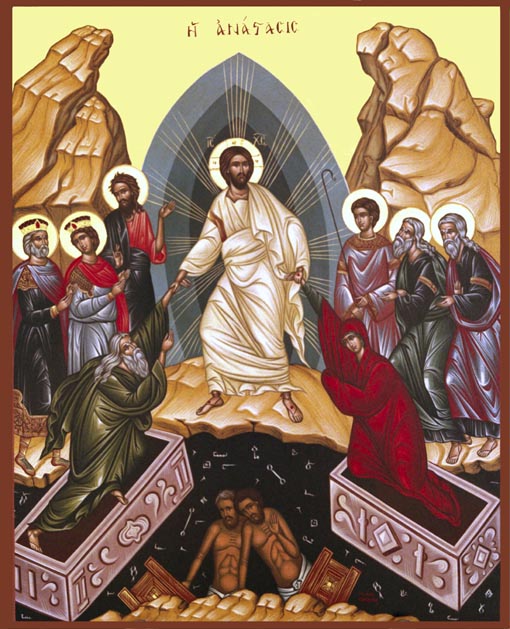
Alleluia Christ is Risen!

After the sabbath, as the first day of the week was dawning, Mary Magdalene and the other Mary went to see the tomb. And suddenly there was a great earthquake; for an angel of the Lord, descending from heaven, came and rolled back the stone and sat on it. His appearance was like lightning, and his clothing white as snow. For fear of him the guards shook and became like dead men. But the angel said to the women, “Do not be afraid; I know that you are looking for Jesus who was crucified. He is not here; for he has been raised, as he said. Come, see the place where he lay. Then go quickly and tell his disciples, `He has been raised from the dead, and indeed he is going ahead of you to Galilee; there you will see him.’ This is my message for you.” So they left the tomb quickly with fear and great joy, and ran to tell his disciples. Suddenly Jesus met them and said, “Greetings!” And they came to him, took hold of his feet, and worshiped him. Then Jesus said to them, “Do not be afraid; go and tell my brothers to go to Galilee; there they will see me.” Matthew 28:1-10

It is Easter at last and Christians around the world sing the triumphant message “alleluia Christ is risen, he is risen indeed!”  Just as the first disciples walked with Jesus we too have walked with Jesus through the penitential season of Lent beginning on Ash Wednesday where we remembered that “we are but dust and to dust we shall return.” With each thing that we abstained from or added to our spiritual discipline we in a small way were reminded that we are to “deny ourselves, take up our Cross and follow.”  In Holy week we experienced the nearly schizophrenic emotions of triumph and tragedy of Palm or Passion Sunday, the solemnity that comes on Holy or Maundy Thursday as we recall the institution of the Eucharist or the Lord’s Supper and the humility of Jesus as he takes on the mantle of a lowly servant and washes the feet of his disciples.  Leaving that we enter into the suffering of Jesus on Good Friday and see how even his friends betrayed or abandoned him with only a thief on an adjacent cross and the officer in charge of the crucifixion realizing just who was on that middle cross.  We wait overnight Friday and through Saturday in the uncomfortable middle between the crucifixion and resurrection that so often mirrors events in our own life where we sometimes experience what we feel to be forsaken by family, friends, church and sometimes even God.  Yet in the pre-dawn darkness of that first Easter morning we like the disciples awake to find that something has happened, that the stone is rolled away, the tomb is empty and Jesus is raised from the dead crushing sin death and hell.  We are greeted by Jesus who tells us not to be afraid but to go and tell others what has happened.  He greets us on the road to Emmaus and breaks bread with us even as we tell him about the tragedy of his death and then our eyes are opened.  Jesus is the victor and in his death burial and resurrection we have the forgiveness of sins.  The event is also eschatological in that it opens the door for him to return in glory and for him to be revealed in his people For the creation waits with eager longing for the revealing of the children of God;  “for the creation was subjected to futility, not of its own will but by the will of the one who subjected it, in hope that the creation itself will be set free from its bondage to decay and will obtain the freedom of the glory of the children of God.” Romans 8:20-21

Likewise it is in this series of inseparable events that Christ establishes our redemption by the forgiveness of sins “For while we were still weak, at the right time Christ died for the ungodly. Indeed, rarely will anyone die for a righteous person—though perhaps for a good person someone might actually dare to die. But God proves his love for us in that while we still were sinners Christ died for us.” Romans 5:6-8.

It is a universe changing event whereby Christ sets his people free and destroys the power of his enemies. Karl Barth wrote: “Look once again to Jesus Christ in his death upon the cross.  Look and try to understand that what he did and suffered he did and suffered for you, for me, for us all.  He carried our sin, our captivity and our suffering, and did not carry it in vain.  He carried it away.  He acted as the captain of us all.  He broke through the ranks of our enemies.  He has already won the battle, our battle.  All we have to do is to follow him, to be victorious with him.  Through him, in him we are saved.  Our sin no longer has any power over us.  Our prison door is open…when he, the Son of God, sets us free, we are truly free.” This is the redemption that the world awaits, not a redemption that is to be hoarded by believers but a redemption that extends beyond the present redemption for all people, especially those who believe and the people of God are to toil and struggle for this “For to this end we toil and struggle, because we have our hope set on the living God, who is the Savior of all people, especially of those who believe.” 1 Timothy 4:10

The Cross and Resurrection are to be a new and purifying wind in the world and the people of God are to be the vehicle for this wind empowered by the Holy Spirit of God.  It is not simply about mastering the art of dying as Socrates did but experiencing resurrection.  Christ did not merely die but he overcame the last enemy which is death itself. (1 Corinthians 15:26)  The power of this is not to be taken lightly in its possibilities for real change for as Dietrich Bonhoeffer wrote “If a few people really believed that and acted on it in their daily lives, a great deal would be changed. To live in the light of the Resurrection—that is what Easter means.”

While we live in the reality of the light of the Resurrection we simultaneously live under the shadow of the Cross of Christ as well as the cross that we are obliged by God to carry in our own lives. In the duality and unity of the Cross and Resurrection we have hope and in that hope we are not to be overwhelmed by events in the world that we cannot control.  Nor are we to be consumed by false “gospels” presented by various ideologues of the right and the left who may identify themselves as “Christian” but place their ideologies, social, political, national and economic over the Gospel itself.  Ideologues who quote scripture to buttress their arguments so that their ideology and the “Gospel” are one in the same much as Satan did during the temptation of Jesus to provide a veneer of Christianity to ideologies that are often opposed to the message of the Gospel. Such an idea is much like the message on German soldier’s belt buckles in the Second World War proclaimed “Gott Mit Uns” even as their nation made war on the world and executed an evil ideology of death upon the Jews and others unfortunate enough to be considered the enemies of the Nazi Party.

It is the ideologues who now endanger the Church and Gospel itself for many choose to remain inside the walls of the church and attempt to turn it into a tool of their ideology and in doing so these ideologues measure and evaluate “others only from the standpoint of whether they are supporters of this ideology, or whether they might become such, or whether they might at least be useful to it even without their consent, or whether they must be fought as its enemies. Its glory has already become for him the solution not only to the personal problem of his own life but to each and all of the problems of the world.” But the Cross and resurrection cry out “NO!” to such ideas even when they are drenched with so called “Biblical” support.

The Cross and the Resurrection bring us to life and promise that Christ who died and was raised will come again and in doing so will complete the redemption of the world for which he suffered and died. It is the real world for which God cares for enough to live suffer and die to save, as Dietrich Bonhoeffer so eloquently wrote “God loves human beings. God loves the world. Not an ideal human, but human beings as they are; not an ideal world, but the real world. What we find repulsive in their opposition to God, what we shrink back from with pain and hostility, namely, real human beings, the real world, this is for God the ground of unfathomable love.”

It is God’s unfathomable love that Easter proclaims as victorious and allows us will all people to cry out “Alleluia Christ is Risen! The Lord is Risen indeed!”

Peace and Happy Easter

Padre Steve+
1 Comment

Filed under christian life, faith, Religion

Holy Saturday….Living in the Uncomfortable Middle

“Man no longer lives in the beginning–he has lost the beginning. Now he finds he is in the middle, knowing neither the end nor the beginning, and yet knowing that he is in the middle, coming from the beginning and going towards the end. He sees that his life is determined by these two facets, of which he knows only that he does not know them” Dietrich Bonhoeffer

Holy Saturday reminds us of the fact that we live as Bonhoeffer so eloquently put it “in the middle, knowing neither the end nor the beginning. The Gospel accounts are silent as to what was happening during this interregnum between the crucifixion and the resurrection except that the women prepared the body of Jesus for burial and that the tomb was sealed and a Roman guard detachment detailed to ensure that the tomb remained secure.

One has to use their imagination as to what was occurring in the lives of the characters in this story. We know that on the day of the crucifixion that after Jesus’ death that Joseph of Arimathea provided a tomb where Jesus’ body was prepared and in which he was laid.  We know that the tomb was sealed and that Roman guards were at it as ordered by Pilate.  We know that the disciples with the exception of John had abandoned Jesus and that following the crucifixion that they had scattered and went underground with the exception of Judas who was last seen hanging around.  Most of Jerusalem was observing Passover between Friday evening and Saturday evening.  Life for many went on without a second thought as Jesus was now yesterday’s news.  The disciples wondered if they would be next, a mother mourned, members of the Sanhedrin likely were relaxing for the first time since Jesus entered Jerusalem as potential Messiah the previous Sunday while Roman soldiers far from home wondered just why they were guarding the tomb of a criminal.

We know from the reactions of the disciples the next day that they really believed that Jesus was not only dead but not coming back. There was a finality that they lived a grief that they bore. Their teacher the one that they had given up all to follow was dead executed as a criminal between common criminals and buried in a borrowed tomb.  One of their friends that they had shared the previous three years had betrayed Jesus.  Their world was upended; the one that they assumed to be the Messiah was mortal.  Their faith was crushed.

The life of faith that we live in the interregnum between life and death creation and consummation is often similar to that the disciples experienced.  We experience situations where faith is hard to come by and since we are in the uncomfortable middle nothing seems certain.  Much of this comes when like the disciples we expect something from God or expect God to do something only to find that our expectations were perhaps just a bit different from those of the Deity.  Disappointment with God I think one has called it and if we are honest it is a part of life because none of really know the will of God or even what will transpire tomorrow something that scripture is rather clear about.

We live in the middle every time we walk with Jesus and his followers through Holy Week just as we walk through life and Holy Saturday is in a sense a metaphor for life when we don’t understand it when we are in the middle wondering what transpired before and not knowing the future.  It is a time to again seek out our faith and with our friends who share this life to maintain hope that things will work out, that in fact resurrection will come.

Until tomorrow we leave the disciples in hiding, the city sleeping and the Roman soldiers cold and bored at a tomb which in reality they care less about.

Peace,

Padre Steve+

Leave a comment

Filed under christian life, faith, Religion

It is Finished

“28 After this, when Jesus knew that all was now finished, he said (in order to fulfill the scripture), “I am thirsty.” 29 A jar full of sour wine was standing there. So they put a sponge full of the wine on a branch of hyssop and held it to his mouth. 30 When Jesus had received the wine, he said, “It is finished.” Then he bowed his head and gave up his spirit.” John 19: 28-30 NRSV

 Good Friday, I wrote about it last night and published it very early this morning.  I just completed the Good Friday Liturgy at the hospital and am set to get an early start on the rest of the Easter Weekend.  I am not going to repeat last night’s article here, just something that struck me as I prepared for the service and read the Passion narrative from John’s Gospel.  The words It is finished” which come from the lips of Jesus as he dies convey a finality that sometimes we miss as we fast forward to Easter. Upon the Cross Jesus really did die and this can be very uncomfortable in fact a number of major religions reject the notion that God would condescend to become human and certain would never consent to death.  Such a stream of thought was even evidenced in Gnostic Christianity where God is “pure spirit” and the God of the Old Testament was corrupt being powerful enough o create humanity and wicked enough to do so as for the Gnostics the flesh was evil and the spirit good.  Likewise the Aryan Heresy invoked the notion of a Jesus who was not really God, more like a superman as God could not die.  The thought of the Aryans is still present in Islam as Mohammed the Prophet had exposure to Aryan Christianity and the image of Jesus in Islam is nearly identical to the Aryans.

 “It is finished.” They are haunting words and when one reads the words of Isaiah one gets the picture of something that if we passed by on the street that we would probably turn our heads away from to avoid the unpleasantness of the sight as “he had no form or majesty that we should look at him, nothing in his appearance that we should desire him. 3He was despised and rejected by others; a man of suffering and acquainted with infirmity; and as one from whom others hide their faces he was despised, and we held him of no account.”   

 The hymn When I Survey the Wondrous Cross is particularly vivid in painting the picture of the crucified Christ: “See, from his head, his hands, his feet, sorrow and love flow mingled down. Did e’er such love and sorrow meet, or thorns compose so rich a crown.”

 The fact that Jesus dies on the cross and dies rejected is a paramount truth of the Gospel and is necessary if we are to comprehend the Gospel, we do not get to the resurrection without the crucifixion and any attempt to do so especially by his people creates a false Gospel, a Gospel devoid of the forgiveness of sins and a Gospel where God knows not our sorrows.  It is the Gospel of Theism where God is not involved in the real world; untouched and unmoved by human suffering and even arbitrary and capricious in his dealings with humanity.   Dietrich Bonhoeffer wrote Jesus is a rejected Messiah. His rejection robs the passion of its halo of glory. It must be a passion without honor. Suffering and rejection sum up the whole cross of Jesus. To die on the cross means to die despised and rejected of men. Suffering and rejection are laid upon Jesus as a divine necessity, and every attempt to prevent it is the work of the devil, especially when it comes from his own disciples; for it is in fact an attempt to prevent Christ from being Christ.” 

 The fact that Jesus did not let the cup from him has implications for his disciples which again are not comfortable as they stand opposed to the “Gospel” of those who present the faith as one of respect, prosperity, earthy power and health.  It is not the “Gospel” of materialism where we remain in relationship with God only for the blessings but the Gospel of discipleship and suffering.  It is the cry My God, my God why have you forsaken me?” which Jesus utters as rejected by man and by God as Bonhoeffer said “It is not suffering per se but suffering-and-rejection, and not rejection for any cause of conviction of our own, but rejection for the sake of Christ. If our Christianity has ceased to be serious about discipleship, if we have watered down the gospel into emotional uplift which makes no costly demands and which fails to distinguish between natural and Christian existence, then we cannot help regarding the cross as an ordinary everyday calamity… We have then forgotten that the cross means rejection and shame as well as suffering.”

 Again, such a Gospel is not comfortable for the disciple the Gospel of the Cross whereby we come to know God is the Gospel which “bids a man to come and die.” This is not the kind of martyrdom sought by fanatics who seek to destroy their and presumably God’s enemies but a call that is unique to every disciple:

 “But each has a different share: some God deems worthy of the highest form of suffering, and given them the grace of martyrdom, while others He does not allow to be tempted above that they are able to bear…. The cross is laid on every Christian. The first Christ-suffering which every man must experience is the call to abandon the attachments of this world. … we surrender ourselves to Christ in union with His death—we give over our lives to death. … When Christ calls a man, He bids him come and die.…death in Jesus Christ, the death of the old man [or nature] at his call. Jesus’ summons to the rich young man was calling him to die, because only the man who is dead to his own will can follow Christ. In fact, every command of Jesus is a call to die, with all our affections and lusts. But we do not want to die…”

 There is a hymn that means much to me is “And Can it be” which personalizes the great mystery inherent in the Gospel.

And can it be that I should gain
an interest in the Savior’s blood!
Died he for me? who caused his pain!
For me? who him to death pursued?
Amazing love! How can it be
that thou, my God, shouldst die for me?
Amazing love! How can it be
that thou, my God, shouldst die for me?

’Tis mystery all: th’ Immortal dies!
Who can explore his strange design?
In vain the firstborn seraph tries
to sound the depths of love divine.
’Tis mercy all! Let earth adore;
let angel minds inquire no more.
’Tis mercy all! Let earth adore;
let angel minds inquire no more.

He left his Father’s throne above
(so free, so infinite his grace!),
emptied himself of all but love,
and bled for Adam’s helpless race.
’Tis mercy all, immense and free,
for O my God, it found out me!
’Tis mercy all, immense and free,
for O my God, it found out me!

 It is finished and with it we wait. Like the disciples we know not what tomorrow holds we live in a tension knowing Christ’s suffering and awaiting resurrection.  The Centurion Loginous at the Cross saw what no one else saw that day knew that “surely this was the Son of God” and like the disciples would lay down his duties to follow Christ.

 I pray that God will richly bless us this Good Friday with his peace which as he says passes all understanding.

 Peace

Padre Steve+

Leave a comment

Filed under christian life, faith, Religion

Good Friday…Ecce Homo! Behold the Man

“God is nowhere greater than in his humiliation. God is nowhere more glorious than in his impotence. God is nowhere more divine than when he becomes man” Jürgen Moltmann Trinity and Kingdom


“So they took Jesus; 17and carrying the cross by himself, he went out to what is called The Place of the Skull, which in Hebrew* is called Golgotha. 18There they crucified him, and with him two others, one on either side, with Jesus between them.” John 19: 16b-18

4Surely he has borne our infirmities
and carried our diseases;
yet we accounted him stricken,
struck down by God, and afflicted.
5But he was wounded for our transgressions,
crushed for our iniquities;
upon him was the punishment that made us whole,
and by his bruises we are healed.
6All we like sheep have gone astray;
we have all turned to our own way,
and the Lord has laid on him
the iniquity of us all. Isaiah 53:4-6

“My God my God why have you forsaken me?”

Today is Good Friday, the Altars are bare and we simply “Behold the Man.” The picture that we have today is paradoxical, it is the picture of a suffering man betrayed by a friend, abandoned by his closest followers and executed in a barbaric fashion under the orders of a man who washes his hands of his own responsibility.  It is a picture that is troubling because of its unpleasantness it is not the kind of picture of God that we want.  While we gladly acknowledge God’s grace and God forgiving our sins through Jesus we want to stay on this side of the resurrection. But like it or not we are confronted with questions about why do the innocent suffer and how could God do this to me or the one that I love.  Much of the problem is that we often buy in to a God untouched by human suffering a God who is arbitrary, unfeeling and cold no matter how much we try to convince ourselves that he cares.  A God incapable of suffering is a cold comfort when we or a loved one suffers. This is not the Christian God even if we try to baptize this “god” in our theology.  “In Christianity the cross is the test of everything that deserves to be called Christian” so writes Jürgen Moltmann in “The Crucified God.”

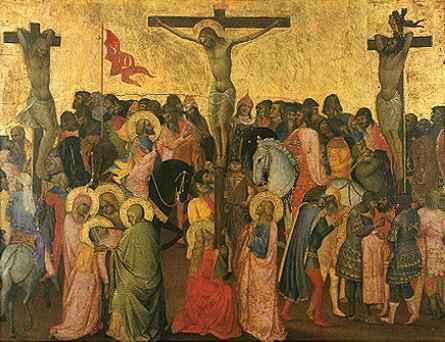
The Cross and the Passion of Christ is the center of how Christians come to understand God and if we attempt to regulate it to the background we do the message of the Gospel violence.  This is very apparent in the number of churches that do nothing to acknowledge the event on Good Friday even as they adorn their churches for the Easter celebration. It is as if the central event in God’s revelation to humanity and means by which he reconciles humanity to himself is a stepchild to the resurrection, but without the Cross there is no resurrection. It is also seen by some who find the symbol of the Crucifix offensive often derisively saying “Jesus isn’t on the Cross anymore, I worship the Risen Jesus.” While we worship the Risen Christ he also remains the Crucified God who in his human flesh bore the sins of the world. It is as Dietrich Bonhoeffer writes:

“The figure of the reconciler, of the God-man Jesus Christ, steps into the middle between God and the world, into the center of all that happens.  In this figure is disclosed the mystery of the world, just as the mystery of God is revealed in it.  No abyss of evil can remain hidden from him through whom the world is reconciled to God.  But the abyss of the love of God embraces even the most abysmal godlessness of the world.  In an incomprehensible reversal of all righteous and pious thought, God declares himself as guilty toward the world and thereby extinguishes the guilt of the world.  God treads the way of humble reconciliation and thereby sets the world free.  God wills to be guilty of our guilt; God takes on the punishment and suffering that guilt has brought on us.  God takes responsibility for godlessness, love for hate, the holy one for the sinner.  Now there is no more godlessness, hate, or sin that God has not taken upon himself, suffered, and atoned.  Now there is not longer any reality, any world, that is not reconciled with God and at peace.  God has done this in the beloved son, Jesus Christ.  Ecce homo!” –Dietrich Bonhoeffer, Ethics: Dietrich Bonhoeffer Works, Volume 6, edited by Clifford J. Green and translated by Reinhard Krauss, Charles C. West, and Douglas W. Scott (Minneapolis: Fortress, 2005), 83.

In addition to its salvific value the Cross of Christ is also relevant to all who suffer as “the deep meaning of the cross of Christ is that there is no suffering on earth that is not borne by God.” In the Cross God identifies himself with all of humanity especially those afflicted or persecuted.

Today we take the time to reflect and remember this event. Many people will have a day of fasting and accompany it with prayer or service.  My prayer is that in the midst of the various crises that we face in the country and the world that we will take the time as Christians to ponder the depth of God’s love and identification with his all people and the ramifications for how we treat others, even those that we view as our opponents or even enemies.  If God can condescend to love us while we were at enmity with him, just how can we fail to treat others with the same love? To again quote Bonhoeffer with whom I have walked this Lenten season:

“God loves human beings. God loves the world. Not an ideal human, but human beings as they are; not an ideal world, but the real world. What we find repulsive in their opposition to God, what we shrink back from with pain and hostility, namely, real human beings, the real world, this is for God the ground of unfathomable love.”

Ecce Homo! Behold the Man!

Peace

Padre Steve+

Leave a comment

Filed under christian life, faith, Religion

Palm or Passion Sunday…the Paradox of the Triumphant Entry and the Cross

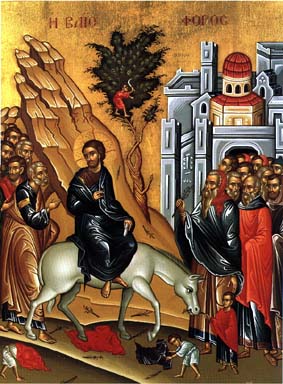
The Triumphant Entry

“Although we praise our common Lord for all kinds of reasons, we praise and glorify him above all for the cross. Paul passes over everything else that Christ did for our advantage and consolation and dwells incessantly on the cross. The proof of God’s love for us, he says, is that Christ died for us while we were yet sinners. Then in the following sentence he gives us the highest ground for hope: If, when we were alienated from God, we were reconciled to him by the death of his Son, how much more, now that we are reconciled, shall we be saved by his life!” John Chrysostom (AD 347-407)

God speaking to Luther: “Discipleship is not limited to what you can comprehend—it must transcend all comprehension. … Not to know where you are going is the true knowledge. My comprehension transcends yours. Thus Abraham went forth from His father… not knowing whither he went. … Behold, that is the way of the cross. You cannot find it yourself, so you must let me lead you as though you were a blind man. Wherefore it is not you, no man… but I myself, who instruct you by my Word and Spirit in the way you should go. Not the work which you choose, not the suffering you devise, but the road which is clean contrary to all you choose or contrive or desire—that is the road you must take. To that I call you and in that you must be my disciple.” Dietrich Bonhoeffer the Cost of Discipleship

Palm or Passion Sunday always is a day that invokes mixed emotions in me. It is the last Sunday of the Lenten Season and in modern times has become a juxtaposition of two events, the Triumphant Entry of Jesus into Jerusalem where he according to all four Gospels was greeted by crowds of people who lined the street with palms as Jesus riding on a donkey processed from Bethany and Bethphage where he had been staying with Lazarus into Jerusalem and the narrative of the Passion.  As such it is a roller coaster ride in our experience of walking with Jesus in the most difficult times.

This particular occasion is the Sunday where the disciples of Jesus are confronted with the reality that our earthy expectations of him do not meet the reality of his condensation to walk among us fully Divine yet fully Human but one too well acquainted with suffering, rejection and shame.  He shatters our expectations that he will bless any particular political or social ideology that we allow to take pre-eminence over him, even those that invoke his name. Thus our liturgy brings us to this strange day where in a sense we are confronted with celebrating the entrance of the King and in the next breath cursing him and betraying him to those who torture and crucify him.

In the Roman Catholic and Anglican liturgy the observance is divided between the Liturgy of the Palms which takes place outside the Church Nave either outside the church building or in the Narthex in cold or inclement weather.  After an opening collect and reading of the Gospel passage from one of the synoptic Gospels, which one depends on which of the three year liturgical readings that the church is in. Following the reading of the Gospel the congregation led by choir, acolytes and clergy process into the church reciting the words of Psalm 118: 18-29 or singing a hymn such as “All Glory Laud and Honor.”  Once the congregation is in the church the Liturgy of the Word continues and when the Passion Gospel is read and specific roles may be assigned to members of the congregation, while the congregation remains seated through the first part of the Passion the congregation stands at the verse where “Golgotha” is mentioned and remains standing.

The liturgy takes the congregation on an emotional and spiritual roller coaster.  As the congregation begins outside the following is read:

When Jesus had come near Bethphage and Bethany, at the place called the Mount of Olives, he sent two of the disciples, saying, “Go into the village ahead of you, and as you enter it you will find tied there a colt that has never been ridden. Untie it and bring it here. If anyone asks you, ‘Why are you untying it?’ just say this, ‘The Lord needs it.'” So those who were sent departed and found it as he had told them. As they were untying the colt, its owners asked them, “Why are you untying the colt?” They said, “The Lord needs it.” Then they brought it to Jesus; and after throwing their cloaks on the colt, they set Jesus on it. As he rode along, people kept spreading their cloaks on the road. As he was now approaching the path down from the Mount of Olives, the whole multitude of the disciples began to praise God joyfully with a loud voice for all the deeds of power that they had seen, saying,

“Blessed is the king who comes in the name of the Lord!

Peace in heaven, and glory in the highest heaven!”

Some of the Pharisees in the crowd said to him, “Teacher, order your disciples to stop.” He answered, “I tell you, if these were silent, the stones would shout out.” Luke 19:29-40

It is hard when you read this passage and be caught in the reenactment of this procession not to feel the excitement that must have accompanied that procession.  It has the feeling of a victory parade but this road ends in a manner that those present, those seeking an earthly king and Messiah who would drive our the Roman oppressor and restore the kingdom to Israel would not expect with some of them perhaps playing a role in the drama that would take place later in the week.  I particularly like the hymn “All Glory Laud and Honor.”

All glory, laud and honor,
To Thee, Redeemer, King,
To Whom the lips of children
Made sweet hosannas ring.

Thou art the King of Israel,
Thou David’s royal Son,
Who in the Lord’s Name comest,
The King and Blessèd One.
Refrain

The company of angels
Are praising Thee on High,
And mortal men and all things
Created make reply.
Refrain

The people of the Hebrews
With palms before Thee went;
Our prayer and praise and anthems
Before Thee we present.
Refrain

To Thee, before Thy passion,
They sang their hymns of praise;
To Thee, now high exalted,
Our melody we raise.
Refrain

Thou didst accept their praises;
Accept the prayers we bring,
Who in all good delightest,
Thou good and gracious King.

During the Liturgy of the Word one of the following is read, either Isaiah 45:21-25 or Isaiah 52:13-53:12, the second being the Song of the Suffering Servant.  The Psalm is Psalm 22 where the Psalmist foretells Jesus’ anguished cry from the Cross; “My God, my God, why have you forsaken me? and are so far from my cry and from the words of my distress?”And then we have the New Testament reading Philippians 2: 5-11, the hymn to Christ is read:

“Let the same mind be in you that was in Christ Jesus, who, though he was in the form of God, did not regard equality with God as something to be exploited, but emptied himself, taking the form of a slave, being born in human likeness. And being found in human form, he humbled himself and became obedient to the point of death– even death on a cross. Therefore God also highly exalted him and gave him the name that is above every name, so that at the name of Jesus every knee should bend, in heaven and on earth and under the earth, and every tongue should confess that Jesus Christ is Lord, to the glory of God the Father.”

Peter Denies Christ

This year the Passion Narrative is that of Luke (22:39-71) 23:1-49 (50-56).  The three parts that stand out in this narrative for me are Peter’s denial of Jesus:

“Then they seized him and led him away, bringing him into the high priest’s house. But Peter was following at a distance. When they had kindled a fire in the middle of the courtyard and sat down together, Peter sat among them. Then a servant-girl, seeing him in the firelight, stared at him and said, “This man also was with him.” But he denied it, saying, “Woman, I do not know him.” A little later someone else, on seeing him, said, “You also are one of them.” But Peter said, “Man, I am not!” Then about an hour later still another kept insisting, “Surely this man also was with him; for he is a Galilean.” But Peter said, “Man, I do not know what you are talking about!” At that moment, while he was still speaking, the cock crowed. The Lord turned and looked at Peter. Then Peter remembered the word of the Lord, how he had said to him, “Before the cock crows today, you will deny me three times.” And he went out and wept bitterly.”

Peter’s denial is in large part because he has had his illusions about Jesus shattered and the fact that he had not understood the message up to that point.  As Bonhoeffer says “Jesus is a rejected Messiah. His rejection robs the passion of its halo of glory. It must be a passion without honor. Suffering and rejection sum up the whole cross of Jesus. To die on the cross means to die despised and rejected of men. Suffering and rejection are laid upon Jesus as a divine necessity, and every attempt to prevent it is the work of the devil, especially when it comes from his own disciples; for it is in fact an attempt to prevent Christ from being Christ.”

Likewise Jesus interaction with the condemned thieves that were crucified with him:

“One of the criminals who were hanged there kept deriding him and saying, “Are you not the Messiah? Save yourself and us!” But the other rebuked him, saying, “Do you not fear God, since you are under the same sentence of condemnation? And we indeed have been condemned justly, for we are getting what we deserve for our deeds, but this man has done nothing wrong.” Then he said, “Jesus, remember me when you come into your kingdom.” He replied, “Truly I tell you, today you will be with me in Paradise.”

The Crucifixion

The final passage from this narrative that strikes me is the moment of Jesus’ death on the Cross:

“It was now about noon, and darkness came over the whole land until three in the afternoon, while the sun’s light failed; and the curtain of the temple was torn in two. Then Jesus, crying with a loud voice, said, “Father, into your hands I commend my spirit.” Having said this, he breathed his last. When the centurion saw what had taken place, he praised God and said, “Certainly this man was innocent.” And when all the crowds who had gathered there for this spectacle saw what had taken place, they returned home, beating their breasts. But all his acquaintances, including the women who had followed him from Galilee, stood at a distance, watching these things.”

The darkness of this is event is perplexing to those who want to find God in some place where he is untouched by human suffering to them the Cross is folly for what kind of God would submit himself to such ignominy but as Martin Luther wrote “He who does not know Christ does not know God hidden in suffering. Therefore, he prefers works to suffering, glory to the cross, strength to weakness, wisdom to folly. For they hate the cross and suffering and love works and the glory of works. Thus they call the good of the cross, evil and the evil of a deed, good. God can only be found in suffering and the cross.” It is in the contradiction of this week that we come to know God, not a God who seeks not the righteous or the powerful, those who seek the power of an earthy kingdom backed by an ideology of power which tramples the weak, but rather those who will simply walk in the footsteps of Jesus the Christ who rules by serving the least, the lost and the lonely.

The liturgy of this day takes us to the heart of the Gospel as we led by the writers through the triumph of the entrance into Jerusalem, to the betrayal of Jesus by Judas, the abandonment of him by the disciples and the denial of Peter.  As the writers lead us through his trial, conviction, scourging and trek to Golgotha we see the gamut of human emotions and reactions to Jesus and we know that we can be there as well in any of the characters simply because we are human and capable of compassion or betrayal.  As Jesus is on the Cross it is not the religious or upstanding that remain with him.  He is left with his mother, the other Mary and John the beloved.  He is shown compassion by a thief and recognized as the Son of God by the Roman Centurion, a gentile serving an empire oppressing the people of Israel and whose governor had pronounced the sentence of death upon him.  In this liturgy we have been taken from the heights of exhilaration in the triumphant entry to the depths of despair felt by his disciples that Friday afternoon. It is in this time that we realize how right Dietrich Bonhoeffer is when he writes “God loves human beings. God loves the world. Not an ideal human, but human beings as they are; not an ideal world, but the real world. What we find repulsive in their opposition to God, what we shrink back from with pain and hostility, namely, real human beings, the real world, this is for God the ground of unfathomable love.”

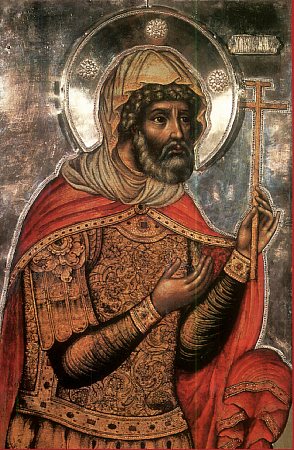
St Longinus, Centurion at the Cross and Martyr

It is the Centurion for which I have the greatest affinity in this story. He is a soldier and in the words of so many soldiers who have obey orders carried out the sentence upon Christ by crucifying him and then as the life ebbs out of Christ’s crucified body exclaims “surely this was a good man” or in other accounts “surely this was the Son of God.” That is the cry of a man who knows that he has executed an unjust sentence, the reaction of a true penitent, the reaction of a man who comes to realize even before many of Jesus’ closest followers understood.  According to tradition the Centurion was named Longinus who left the service of the Imperial Legion, was baptized by the Apostles and was martyred under the orders of Pontius Pilate by soldiers of the unit that he had once commanded.

It is important for the Church not to lose this identification.  The Church is not to become enmeshed and co-opted by those who attempt to use the Gospel to promote ideologies foreign to it as is the temptation in times of crisis.  As Jürgen Moltmann notes:

“In Christianity the cross is the test of everything which deserves to be called Christian… The Christian life of theologians, churches and human beings is faced more than ever today with a double crisis: the crisis of relevance and the crisis of identity. These two crises are complementary. The more theology and the church attempt to become relevant to the problems of the present day, the more deeply they are drawn into the crisis of their own Christian identity….

Christian identity can be understood only as an act of identification with the crucified Christ, to the extent to which one has accepted that in him God has identified himself with the godless and those abandoned by God, to whom one belongs oneself.” The Crucified God [pgs. 7, 19]

Nor is our task is not to attempt to invent “crosses” for ourselves in acts of pseudo-martyrdom but simply to be faithful in loving Jesus and our neighbor as Bonhoeffer noted “Must the Christian go around looking for a cross to bear, seeking to suffer? Opportunities for bearing crosses will occur along life’s way and all that is required is the willingness to act when the time comes. The needs of the neighbor, especially those of the weak and downtrodden, the victimized and the persecuted, the ill and the lonely, will become abundantly evident.” The mark of the Christian is not to blindly give his life for a cause or be consumed by the false “messiah’s” promoted by politicians, pundits and even preachers captivated by the lust for power and glory.

As we walk through the mystery of Holy Week together let us renew our faith in the Crucified One and not be conformed to those things that seek to turn us from the way of discipleship and the way of the Cross.

Peace

Padre Steve+

2 Comments

Filed under christian life, faith, philosophy, Religion

The Last Week of Lent: Mediation on Life, Love and Public Witness

Lent is drawing to a close and Sunday begins Holy week where the Church remembers the last week in the early life of Jesus the Christ.  While I will write about the various aspects of Holy week to include Passion or Palm Sunday, Holy or Maundy Thursday, Good Friday and Easter but tonight a short meditation on the final week of this Lenten season.

I have discussed how this Lent has been different than previous observances of Lent.  In the past I was constantly trying to observe certain spiritual disciplines to include fasting, abstinence and prayer in a formal and legalistic manner.  Last year as I was “melting down” in my spiritual, psychological and physical life facing an existential crisis where after my tour in Iraq, experience of forsakenness, disillusionment concerning the Church, political institutions and the media and doubt about the existence of God I attempted to change the way that I observed Lent.  For the most part that attempt was an abysmal failure, however out of it came an association with the Pastor and people of Saint James Episcopal Church in Portsmouth which has been a place where at least part of me began to experience community and healing again.

This Lenten season has been one filled with an experience of God’s grace and love as well as a connection to others that I have missed for a long time.  It has been a time of continued healing, self discovery in the light of God’s grace and change in the way that I do life.  Admittedly this has been a gradual process that began back during Advent but has become more a part of my life.  The rediscovery of God’s grace in Jesus and a life in community with others has been a key factor in this experience.  I certainly have not figured everything out, far be it, I am re-learning my faith and it has been a time of refreshment.  Part of this is the experience of Christ in Scripture and sacred Tradition, but also in reason.  As such it has been a time where I have been able to enunciate how my Christian faith addresses the trying times that we are living in often through the witness of men like Dietrich Bonhoeffer and Karl Barth.

One thing that Bonhoeffer said has a particular resonance in my life because it aptly describes how I feel.  In prison Bonhoeffer wrote: “I often ask myself why a ‘Christian instinct’ often draws me more to the religionless people than to the religious, by which I don’t in the least mean with any evangelizing intention, but, I might almost say, ‘in brotherhood’. While I’m often reluctant to mention God by name to religious people – because that name somehow seems to me here not to ring true, and I feel myself to be slightly dishonest (it’s particularly bad when others start to talk in religious jargon; I then dry up almost completely and feel awkward and uncomfortable) – to people with no religion I can on occasion mention him by name quite calmly and as a matter of course.” Dietrich Bonhoeffer – Letters and Papers from Prison

In fact I find it easier on many occasions to have free flowing, intellectual, spiritual discussions with people who have a faith far different than mine than I do with many people in my own denomination. I am making no judgment on them as I have been the one going through a fundamental change in the way that I do life, theology and relationships.

As this has occurred I have rediscovered just how much God loves and cares for real people, as Bonhoeffer wrote:

“God loves human beings. God loves the world. Not an ideal human, but human beings as they are; not an ideal world, but the real world. What we find repulsive in their opposition to God, what we shrink back from with pain and hostility, namely, real human beings, the real world, this is for God the ground of unfathomable love.”

As I interact more with those “outside” the church I often find deep faith and integrity which sometimes I find to be more “real” than some of the Christians that I know. I am not saying that somehow the non-Christian is superior to the Christian but that God has also made them in his image and as such they are not the enemies of God. As Paul the Apostle wrote “Therefore, if anyone is in Christ, he is a new creation; the old has passed away, behold, the new has come. All this is from God, who through Christ reconciled us to himself and gave us the ministry of reconciliation; that is, in Christ God was reconciling the world to himself, not counting their trespasses against them, and entrusting to us the message of reconciliation.  So we are ambassadors for Christ, God making his appeal through us. We beseech you on behalf of Christ, be reconciled to God.  For our sake he made him to be sin who knew no sin, so that in him we might become the righteousness of God.” 2nd Cor. 5:17-21 NRSV and “For to this end we toil and struggle, because we have our hope set on the living God, who is the Savior of all people, especially of those who believe.” 1 Tim. 4:10 NRSV

Likewise I also have found it harder to deal with people who spout religious jargon and throw out Bible verses without any sense of context, history and or concern for their hearers.  It seems to me that many parts of American Christianity have substituted cultural and political issues for the preaching of the Gospel of life.  I recently saw some posts by religious leaders on social networking sites, websites and media outlets that accused pro-life Democrats of “betraying their faith” by voting for the Health Care Bill.  Now I am not thrilled with the bill and have major concerns about it.  However, if I decide to accuse someone of “betraying their faith” I had better be sure that I am on solid ground and stick to what is in the Creed over a particular interpretation of any moral or social issue on which even Christians disagree. Saying this will win me no friends in certain parts of the Church but I wonder the utility of alienating people and in our condemnation of them ensure that they will turn off anything that we say about Jesus who despite what they (and we) do still loves humanity with an undying and passionate love that is demonstrated by his death on the Cross as Paul wrote “But God proves his love for us in that while we still were sinners Christ died for us.”   Romans 5:8 NRSV

In all of the turmoil that has embroiled the country I still find myself at peace because of what has happened to me over the past couple of years. Going to war and seeing the tragedy of a people engulfed in civil war has given me an appreciation of seeking peaceful dialogue with those that I have disagreement rather than attacking them at the center of their being.  I believe the Gospel lived authentically and not wrapped in the incestuous embrace of venomous and often hate filled political ideologies which seems to be increasingly the case in United States is far more powerful than that of a political movement of any kind.  The church surrenders its authority and legitimacy by allowing itself to be a party organ of any political party or ideology.  Unfortunately simply because political parties and movements pay lip service to certain “Christian” values many Christians and churches lose themselves and endorse power for power sake hoping that the party will implement their beliefs.  Unfortunately history proves that more often than not when their party returns to power it will again sell them short with no return for their support.  The unintended consequence is that people who need the Gospel identify it with the political ideology of the party that the church supported.  This was not the witness of the early church, the Apostles and those that followed them.

The mimicking of ideologues by Christians gives credence and support to violent people who under the cover of God have no problem with praying for the death of their opponents and in some cases taking the responsibility of that in their own hands.  Should bloodshed arise out of this latest partisan political struggle the religious leaders who urged violence and prayed for death will have blood on their hands.  Having been threatened with violence on this website by a supposedly “Christian” person I take a deeply personal interest in just how violent some Christians have become and with actions and violent threats against members of the House of Representatives I wonder what will happen when someone assassinates one of these men or women or a religious leader who dares to oppose them.

The alternative to this is to cry “NO!” to the calls for violence and judgment no matter from what side of the political or ideological spectrum that they emerge.  The alternative is to in thought word and deed demonstrate the truth of the Gospel in love even to those that we have strong disagreement on very important issues.

Anyway I must close for the night.

Peace

Padre Steve+

Leave a comment

Filed under christian life, History, philosophy, Political Commentary, Religion

Necessity and Reality…Lessons on Life

“One’s task is not to turn the world upside down, but to do what is necessary at the given place and with a due consideration of reality.” Dietrich Bonhoeffer

“A mans got to know his limitations” Harry Callahan

Tonight will be busy and fun for me as I get to go to our Medical Center Intern Class Dining Out.  The Dining out is a traditional Military occasion where the Officers of the Mess and their guests are together for a time of ceremony, camaraderie and good times.  Last year I attended this and if you want to know more you can go to the following article: The Dining Out

In light of that my post will be short. Coming back from surgery and being out of action for nearly a month I want to jump into everything.  However jumping into everything simply because I feel better and fitter than I have in probably two years does not mean that everything that I think that I can do be it vocational, spiritual or physical. Instead I am learning to work within my own limitations to be the best at what I do without over committing and end up having some kind of crash be it related to PTSD or physical issues.  It is something that I am learning to do and it is not always easy because I want to make a big impact.

However as both Bonhoeffer and Callahan (Clint Eastwood-Dirty Harry) remind us not everything is my job and that in order to be effective I and probably most of us need “to do what is necessary at the given place and with a due consideration of reality.” In other words be at the right place at the right time doing the mission that we are called to do with a sense of the reality of the situation, both our own as well as the situation in life that we find ourselves.

A lot of people now want to gain instant fame without the hard work that traditionally is required. Thus the massive number of “reality” shows where the only requirement is to act like an idiot and do things that you should be ashamed of doing, that profit nothing and while they give a person a brief amount of “fame” or notoriety which is seldom remembered by anyone unless it was incredibly stupid.

Workaholics like me want to do everything and fall into the temptation and trap of committing ourselves and sometimes our organizations to things that ultimately even if we can do them well are bad in the long term.  Such things can divert us from what we really need to be doing into ventures which may be exciting but divert us from what is truly necessary and possible.

This is frequently seen in the ranks of the over-achievers who want to “change the world.” This can take on all sorts of faces, political, educational, religious or scientific but the effect is often the same.  “World changers” sometimes become unrestrained zealots. In the quest to fulfill the agenda push so hard that they lose sight of the world around them and sometimes become willing like Chuck Colson when he worked for President Nixon “run over their own grandmother” to see the agenda fulfilled. This happens in business, politics, foreign affairs, science and even religion.  The desire to “change the world” often becomes a trap ready to ensnare even the most sincere person.  Trapped in the emotion of the “vision” those who lose sight of what is necessary and what is reality sometimes stop at nothing to see it fulfilled even if others are hurt in the process.

This is also seen in military history where the commander of an army or fleet makes a decision, usually rash and made in the passion of the moment to commit to something that while it looks to be beneficial leads to their defeat.  Military history is replete with examples.  Somehow the leader overestimates his own capabilities or underestimates those of his opponent with the end result of disaster.

Organizations including businesses and churches are frequently their own worst enemy when it comes to things like this.  Individuals who become obsessed can become like Don Quixote and run off  attacking windmills.  Christians often fall for this thinking that only they can win the salvation of the world or have a “new” message, teaching or “word” for the Church and world and end up broken, disillusioned and wondering if God let them down when they simply followed their own devices thinking that it was God.   Organizations can cause their own downfall as was seen in the banking crisis where business whose names were associated with thrift, trust and honesty destroyed themselves, injured their employees, stockholders and customers and cost the nation hundreds of billions of dollars. Custer charged into the Little Big Horn and Hitler attacked the Soviet Union.  Great success stories huh? Anyway, that being said I must close for the night.

Peace,

Padre Steve+

Leave a comment

Filed under leadership, philosophy

God Loves the Real World

“God loves human beings. God loves the world. Not an ideal human, but human beings as they are; not an ideal world, but the real world. What we find repulsive in their opposition to God, what we shrink back from with pain and hostility, namely, real human beings, the real world, this is for God the ground of unfathomable love.” — Dietrich Bonhoeffer

“For God so loved the world that he gave his only Son, so that everyone who believes in him may not perish but may have eternal life.” John 3:16 NRSV

“For to this end we toil and struggle, because we have our hope set on the living God, who is the Savior of all people, especially of those who believe.” 1 Timothy 4:10

I had an interesting encounter with another blogger this week after I posted my warning about the danger that Glenn Beck and people like pose to religious liberty.  I was not really surprised at the encounter I figured that I might get a bit of hate mail but this was interesting.  This blogger who evidently thinks that he has the absolute lock on God’s truth had this as one of his replies on the post:

“My Jesus is ANGRY at His children who promote false doctrines and pervert the Word of God. The reason I know this is because Yeshua IS the Word of God, these things recorded in holy scripture for all to see and read.” 777Denny

Now Denny is a bit off and seems to me a very angry person who has so conflated the Gospel of Jesus Christ with his own incredibly narrow and hateful theology and politics.  These  lie slightly to the right of the Taliban so that it is hard to understand where his faith ends and politics begin. Maybe that is why Bonhoeffer commented that “Politics are not the task of a Christian.”

Denny seems to think that about all Christians and for that matter people in general are pretty worthless.  Of course I have treated Denny pretty well. I have offered to and will pray for him because he is so trapped in his own legalism and hatred of his former Roman Catholic faith.  I want to keep a dialogue with him.  His anger, legalism and ideas about sex and the role of women cause me believe that he must be a physical or sexual assault victim.  While his tirades are pretty extreme, not very creative and full of nuttiness they do speak to a general contempt for the world that is the creation of God and the people that he has redeemed through Christ’s incarnation, life, death, burial, resurrection and ascension.

Now I know that Christians can be and often are intolerant…we can be somewhat surly at times and our history in many cases is rather ugly and not very reflective of Christ, unless it is Denny’s “Angry Jesus.” I cannot say that I have not had my moments of ugliness and more than I have been  pretty obnoxious and well, just a jerk regarding my faith.  However even so I can’t blame God for things that I get angry at. I have only my occasionally bad temperament to blame, maybe some genetics too.  As George and Frank Costanza say “serenity now!”  Denny represents as aberrant as his view of Jesus is, a segment of the Christian world that really does despise the world and the people that God created and has redeemed.  Denny is obviously a troubled soul and needs help but until he sees this he will hurt a lot of people and most of all himself.

Part of my Lenten journey has meant slowing down and taking stock of things in my life and faith.  This was actually enforced on me when Adolf the Kidney stone stopped me in my tracks for about three weeks.  Now I haven’t had any “new revelations” or in fact not much more than realizing that I need to focus on some aspects of my spiritual life that I have neglected and just take a bit more time to appreciate all that God has done as well as the people and world that I live in.

As I have mentioned in other posts the passage from 2nd Corinthians 5:17-21 has been on my mind a lot since my  “Christmas miracle.” So you don’t have to look it up I have posted it below highlighting verse 19 which has really speaks to me:

17So if anyone is in Christ, there is a new creation: everything old has passed away; see, everything has become new! 18All this is from God, who reconciled us to himself through Christ, and has given us the ministry of reconciliation; 19that is, in Christ God was reconciling the world to himself, not counting their trespasses against them, and entrusting the message of reconciliation to us. 20So we are ambassadors for Christ, since God is making his appeal through us; we entreat you on behalf of Christ, be reconciled to God. 21For our sake he made him to be sin who knew no sin, so that in him we might become the righteousness of God.  2nd Corinthians 5:17-21

This I think is one of the key passages in the New Testament in relation to God’s relationship to humanity, real humanity.  As I have mentioned my Lenten journey has taken me back to re-reading and pondering the life and work of Dietrich Bonhoeffer.  I think that living in the tumultuous times of the First World War, the collapse of the German monarchy, the German civil war, the Kapp Putsch and the Nazi rise to power and takeover and the Second World War has insights that are very applicable for the tumultuous times that we now live.

Bonhoeffer lived in some of the darkest times, where his own countrymen turned on one another and extremist politicians of the Left and Right stoked the fires of resentment, fear and desperation through the newspapers and periodicals that they owned. Fiery speakers instigated crowds to violence against their opponents and undermined the weak government at every opportunity even with actual force.  Bonhoeffer was someone who did not lose sight of the Gospel nor the people that Christ died to redeem during that time.  The passage that I cited at the beginning of this article is something that leapt out at me this week.

“God loves human beings. God loves the world. Not an ideal human, but human beings as they are; not an ideal world, but the real world. What we find repulsive in their opposition to God, what we shrink back from with pain and hostility, namely, real human beings, the real world, this is for God the ground of unfathomable love.”

It is so easy today immersed as we are in a 24/7 information barrage of television, talk radio and the internet where politicians, pundits, journalists to see why regular folks like Denny have been whipped into a frenzy against their neighbors and fellow citizens for matters completely disconnected to the Gospel.  This becomes even more of a problem when it takes faith which should be focused to reconciliation and redemption and turns it into just another way of despising the people and the world that God loves.  In essence the “Gospel” has been turned into a weapon against the very people and world that Christ died to save and made a prostitute to crass political ideology.  However as Christians we cannot allow ourselves to be trapped by the hatred espoused by so many who daily work in the modicum of “speaking the truth” must realize as Bonhoeffer said that “God’s truth judges created things out of love, and Satan’s truth judges them out of envy and hatred.” The pundits and politicians who prey on the people of faith and exploit their fears not for the sake of God, but for their profits as some of the most popular of these people readily admit on the air.

God loves real people; not only the ones that we choose to love or those that we prefer to hang out with. He loves people who are not perfect, the Church was not intended to be a social club where we get our “God fix.”  It is instead to be a community in relationship with one another and the world in which we live. The Gospel is not just a message that we offer to fill the pews and keep the bills paid.  The Gospel is all about the love, mercy and even justice of God, which is not to be confused with the “justice” that we desire.  The Gospel is about integrity as the people of God.  “God was in Christ reconciling the world to himself….” It is the message of reconciliation that allows us to have community with one another and the world and as we do so grow into the kind of humanity that is transformed by the Gospel so that we might be really human.  Bonhoeffer wrote: “While we exert ourselves to grow beyond our humanity, to leave the human behind us, God becomes human; and we must recognize that God wills that we be human, real human beings. While we distinguish between pious and godless, good and evil, noble and base, God loves real people without distinction. ”

The call is not to be immersed in the anger of the day but transformed by the love of Christ.  Certainly the hope of the world is not found in the unending media barrage but in the Gospel that reminds us that “we have our hope set on the living God, who is the Savior of all people, especially of those who believe.”

Peace

Padre Steve+

5 Comments

Filed under History, philosophy, Religion

Glenn Beck Attacks the Churches and Threatens Religious Liberty

Glenn Beck “Am I advising people to leave their church? Yes!”  (Fox News Photo)

Preface: This post comes in the midst of my Lenten journey in which I have become reacquainted with the works of those who confronted Nazi policies that placed their ideology over the Christian faith. During this time I was not expecting to begin to see certain commentators actually attempt to blatantly attack a key part of the witness of the Christian Church in telling Christians to place political ideology over faith and recommend that church members leave their church if it does not conform to those commentators’ political ideology.  As a historian as well as a Priest I can only draw parallels to the Nazis who placed their ideology above the Church and persecuted those who stood against them, even before they took power. Glenn Beck did just that this week, though not in power he has thrown down a gauntlet to the Church which does not agree with his ideology and strikingly urged church members to leave their churches if those churches had “social justice” as one of their belief’s equating it with Communism and Fascism. This is an attack on the church and as a Priest I cannot be silent. There would be some that will disagree saying that the Left is more of a threat and I do not disagree that ideologues on any part of the spectrum can threaten religious liberty, however I have never seen anyone as popular as Beck is with the Right, who on the Left propose what Beck has this past week.  That is why I must oppose Beck on this issue now. I do hope that my readers understand that this is not an attack on conservatives or conservative principles but rather against a man whose ideas if carried to their logical conclusion would be dangerous. Beck talks a lot about faith and religion on his show which attracts many listeners but he seems to believe that religious expression is one in the same with political ideology.

Peace,

Padre Steve+

“It is not God who divides us but human beings. The Almighty has blessed our work; therefore it cannot be destroyed. No power within or without the Reich will keep us from going our way into the future.” Adolf Hitler speaking in an address at Regensburg July 7th 1937 referring to the arrests of 11 Catholic Priests who condemned Nazi policies.

“We have been silent witnesses of evil deeds; we have been drenched by many storms; we have learnt the arts of equivocation and pretence; experience has made us suspicious of others and kept us from being truthful and open; intolerable conflicts have worn us down and even made us cynical. Are we still of any use?” Dietrich Bonhoeffer

“First they came for the Communists, but I was not a Communist so I did not speak out. Then they came for the Socialists and the Trade Unionists, but I was neither, so I did not speak out. Then they came for the Jews, but I was not a Jew so I did not speak out. And when they came for me, there was no one left to speak out for me.” Martin Niemöller

“Silence in the face of evil is itself evil: God will not hold us guiltless. Not to speak is to speak. Not to act is to act.” Dietrich Bonhoeffer

“Rather, speaking the truth in love, we are to grow up in every way into him who is the head, into Christ, from whom the whole body [is] joined and knit together.” (Eph. 4:15,16)

The Christian Church is the congregation of the brethren in which Jesus Christ acts presently as the Lord in Word and sacrament through the Holy Spirit. As the Church of pardoned sinners, it has to testify in the midst of a sinful world, with its faith as with its obedience, with its message as with its order, that it is solely his property, and that it lives and wants to live solely from his comfort and from his direction in the expectation of his appearance.

We reject the false doctrine, as though the Church were permitted to abandon the form of its message and order to its own pleasure or to changes in prevailing ideological and political convictions.” The Barmen Declaration Article Three.

I do not think that people learn anything from history.  This week Glenn Beck called his own church, the Church of Jesus Christ of Latter Day Saints “Communist or Fascist” its official statements of beliefs regarding social justice.  Now I may disagree with LDS theology but I hardly think them to be Communist or Fascist in fact I think for the most part they are to be commended for their love of this country as well as their ethic of doing good and taking care of needy LDS members.  Not only did Beck call his own church these rather pejorative names but he recommended that people not only leave the church but urged the same for any member of any church that espouses social justice in their official beliefs.  To quote Beck:

“I’m begging you, your right to religion and freedom to exercise religion and read all of the passages of the Bible as you want to read them and as your church wants to preach them . . . are going to come under the ropes in the next year. If it lasts that long it will be the next year. I beg you, look for the words ’social justice’ or ‘economic justice’ on your church Web site. If you find it, run as fast as you can. Social justice and economic justice, they are code words. Now, am I advising people to leave their church? Yes!”

Beck went on the attack this week against churches who teach social justice.  The reason according to Beck is that “Social justice was the rallying cry—economic justice and social justice—the rallying cry on both the communist front and the fascist front….” He went on and attacked his own church saying “Where I go to church, there are members that preach social justice as members–my faith doesn’t–but the members preach social justice all the time. It is a perversion of the gospel….” When called out had to try to reframe his very clear attack on his own church’s official doctrine as well as so many other churches and religions groups.  Speaking as a Christian I cannot answer for other religions but Beck has attacked the clear commands of Scripture and the Christian tradition of caring for the least and the lost in elevating his ideology above both his own church as well as the vast majority of Christian faith and belief that goes back 2000 years.  He has sought to divide people from their churches and from the faithful of their traditions for political expediency.  However Beck is not the first to do so.  Let us take a trip back to the end of the Weimar Republic and Nazi era….

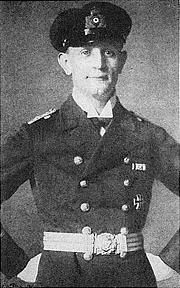
Niemöller in WWI Inperial Navy Uniform

Martin Niemöller was a war hero.  He had served on U-Boats during the First World War and commanded a U-Boat in 1918 sinking a number of ships.  After the war he resigned his commission in the Navy in opposition to the Weimar Republic and briefly was a commander in a local Freikorps unit. His book Vom U-Boot zur Kanzel (From U-boat to Pulpit) traced his journey from the Navy to the pastorate. He became a Pastor and as a Christian opposed what he believed to be the evils of Godless Communism and Socialism.  This placed him in the very conservative camp in the years of the Weimar Republic and he rose in the ranks of the United Evangelical Church of the Old Prussian Union.  Active in conservative politics, Niemöller initially support the appointment of Adolf Hitler as Chancellor.  However, he quickly soured on Hitler due to his insistence on the state taking precedence over the Church.  Niemöller was typical of many Germans of his era and harbored ant-Semitic sentiments that he only completely abandoned his anti-Semitic views until after he was imprisoned.  He would spend 8 years as a prisoner of the Nazis a period hat he said changed him including his views about Jews, Communists and Socialists.  Niemöller was one of the founding members of the Pfarrernotbund (Pastor’s Emergency Federation) and later the Confessing Church. He was tried and imprisoned in concentration camps due to his now outspoken criticism of the Hitler regime.

Herman Maas was another Evangelical Pastor.  Unlike Niemöller, Maas was a active participant in the ecumenical movement, built bridges to the Jewish community and defended the rights of Jews as German citizens.  He received a fair amount of criticism for his attendance of Reichspräsident Friedrich Ebert’s funeral.  Ebert was both a Socialist and avowed atheist.  Maas too was active in the Pfarrernotbund and the Confessing church, and unlike Niemöller maintained his opposition to anti-Semitism and the Nazi policies against the Jews. He would help draft the Barmen declaration.  He too would be imprisoned and survive the war.  Maas was the first non-Jewish German to be officially invited to the newly formed state of Israel in 1950. In July 1964 Yad Vashem recognized the Maas as one of the Righteous Among the Nations.

Bonhoeffer in Nazi Prison in 1944

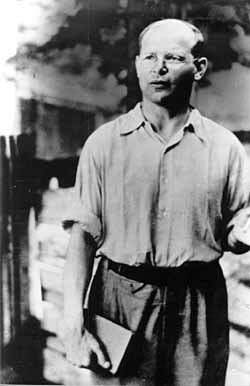
Dietrich Bonhoeffer a young Pastor and theologian would also step up to oppose the Nazis and offer support for the Jews.  He helped draft the Bethel Confession which among other things rejected “every attempt to establish a visible theocracy on earth by the church as a infraction in the order of secular authority. This makes the gospel into a law. The church cannot protect or sustain life on earth. This remains the office of secular authority.”  He also helped draft the Barmen declaration which opposed and condemned Nazi Christianity.  Bonhoeffer would eventually along with members of his family take an active role in the anti-Nazi resistance as a double agent for Admiral Canaris’ Abwehr.  For this he would be executed after his final sermon in the concentration camp at Flossenburg just a month prior to the end of the war.

Karl Barth convicted of “Seducing the German people” and exiled to his native Switzerland

Another opponent of the Nazis in the Confessing Church was Swiss-German theologian Karl Barth.  Barth angrily denounced Naziism when it attempted to create new “German Christian” churches in which National Socialist political theories were given the same sanctity as theological dogma.  Barth went into exile as a Swiss citizen after being removed from his professorship at the University of Bonn for refusing to take the mandatory oath to Adolf Hitler, alter his teaching to meet Nazi standards or begin class with the customary “Heil Hitler!” He would say that it would be in bad taste “to begin a commentary on the Sermon on the Mount with Heil Hitler.” For his efforts he was found guilty by a Nazi court of “seducing the minds” of German students.  For an excellent short article on Barth see “Witness to an Ancient Truth” Time Magazine April 20th 1962 online at http://www.time.com/time/magazine/article/0,9171,873557-1,00.html

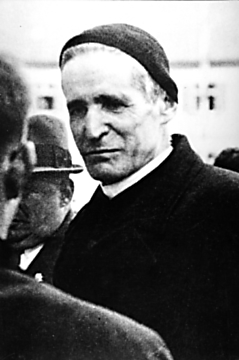
Fr Rupert Meyer the “Apostle of Munich” and steadfast opponent of Hitler

Bishop Galen of Münster and Father and others including Father Rupert Meyer in Munich who opposed Hitler in the early 1920s would also oppose the Nazi policies toward the Church, the Jews and Nazi policies on euthanasia.  They would also end up in concentrations camps with some dying at the hands of the Nazis, in fact over 2000 priests and Protestant ministers from Germany and occupied countries were housed at Dachau.

All these men took risks to defend the Jews who were religious minority group that had been traditionally discriminated against in Germany as well as other groups, political and religious.  They opposed the Nazi policies which were widely supported by much of the German populace making them unpopular in their own churches as well as among the traditionally conservative supporters of the Evangelical and Catholic Churches.  Since I have dealt with the Nazi persecution and atrocities against the Jews and others in other posts I will not elaborate further here.

General Wilhelm Groener, despised by the Nazis for saving the by working with Socialists to prevent a Communist takeover

Not only were Jews the enemy but so were any parties that disagreed with the Nazi policies including the church or rather the church that refused to surrender to them.  Likewise military officers who stood by the Republic against Nazi and other right-wing putsches during the 1920s, men who risked all to defend the rights of people on both sides of the political chasm that divided the country.

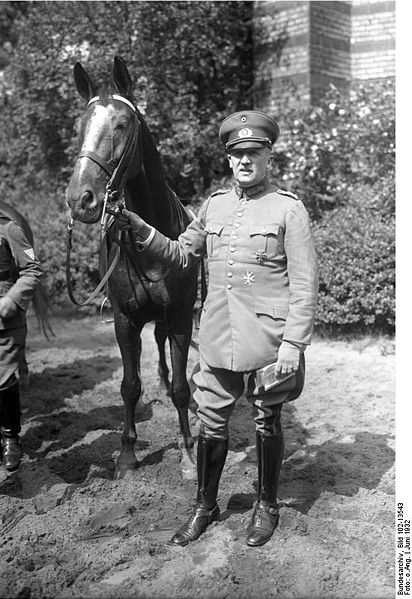
Deposed after the Nazi seizure of power General Kurt von Hammerstein-Equord was deposed as head of the German Army and in retirement worked against the Nazis including the Valkyrie plot until his death from Cancer in 1944

Leftist accused them of being reactionaries and Monarchists while the right did whatever they could to discredit men like General Wilhelm Groener, General Major Walther Reinhardt, General der Infantrie Georg Maerker, General der Infrantie Kurt von Hammerstein-Equord and General Kurt von Schleicher were either driven from office and ostracized, forced out of the military or in the case of von Schleicher killed by the SS during the “night of the long knives.”

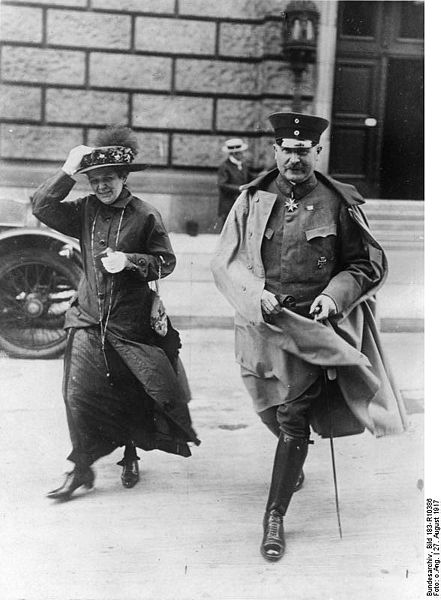
Confidant of President Hindenburg, opponent of the Nazis and briefly Chancellor of the Weimar Republic General Kurt von Schleicher would be assassinated by the Nazis during the Night of the Long Knives

Additionally other men who kept the German Republic from becoming a Communist state notably Gustave Noske of the Social Democratic Party who was the first Reichswehr Minister and who with his successor Otto Geßler of the German Democratic Party worked with the military leadership to keep both the extreme left in the form of the Spartacist League, the Independent Socialists and from the extreme Right who attempted to overthrow the government in the Kapp Putsch.  All were treated shamefully by the Nazis and even their successors did not fare well, to consolidate power Hitler had the General Leutnant Werner Freiherr von Fritsch falsely accused of homosexual acts and disgraced and evidence points to his murder on the Polish front in 1939 as the “honorary colonel” of his old Regiment.  Those who opposed Hitler and the Nazis later in the war, even those who were genuine heroes were put to death before Nazi “People’s Courts.”  They did the same with politicians who they viewed to be threats to their rule, even conservatives not just Socialists or Communists.  Religious leaders who resisted both Protestant and Catholic were sent to concentration camps where many did not return from.

Too frequently we here Beck and others call Americans with views different from their ideology “traitors” or “un American.” Before Iraq I listened to talk radio almost every day and when I came back I could no longer stomach the invective and malice that is so widespread among these commentators.  If they continue to dominate “conservative” politics then I fear that they will use the power of the government and media to silence those that oppose them and it will not matter if the opponent has served in the military as they routinely condemn former high ranking military officers who disagree with them such. These propagandists are not patriots and neither Beck nor any of the major conservative talk show hosts have served a day in the military yet they influence “conservative” opinion more than anyone else and dare to slander those in the military or those who have served honorably including Senator John McCain who dare to disagree with them. The Nazis did the same thing.

Today we face a similar movement by some “conservative” voices in the United States.  Many influential members of the “conservative” media, including Rush Limbaugh and most recently Glenn Beck who I have previously referred to own the airwaves, their words listened to often more than those of the Gospel.  They derive some of their popularity from voicing support for “Christian moral values” such as being against abortion.  This has endeared them to many conservative Christians who listen to them more than their faith or religious institutions.  Unfortunately many “conservative” Christians cannot differentiate between the vitriolic and un-Christian rage of these talkers against anyone identified as the enemy that they have forgotten the Gospel and become simply an appendage to Republican or “conservative” politicians.  It is not uncommon to see Christians on the web or on the call in talk radio programs agree lock stock and barrel Beck and others on the crass materialism and social Darwinism of “pure” Capitalism and the anti-Christian policy of pre-emptive war, even when they attacked Pope John Paul II when he refused to countenance the invasion of Iraq. Beck uses Scripture only to give his ideology, whatever it may be some semblance of decency.  What Karl Barth said of Nazi ideology can be said of Beck’s ideology: “This was a nationalist heresy…. confusion between God and the spirit of the German nation.” Pundits and politicians on the Left may also place ideology over religion however they seldom espouse the heresy of linking the Christian faith with the spirit and destiny of the United States.

That may seem harsh, but there is a group led by Andrew Schlafly the “Conservative Bible project” that seek to re-translate the Bible into their own political, social and economic policies even seeking to change or minimize any Scripture that might be equated with to the “Social Gospel.” I guess if Beck wants he can get a copy when it comes out.  If you don’t like what Scripture says change it…right?

I cannot sit by while Beck and others smear people including churches who disagree with their ideology which does not rest on Scripture or but merely uses it to inflame people into actions that turn them against the members of their own churches.  This unfortunately is evil masquerading as good.  Too many turned their eyes away from the Nazi menace thinking that Hitler could be reasoned with and that he really stood for their values.  Too few stood up early to sound a warning.  My issue with Beck and others like him be they pundits, talk show hosts, media personalities or politicians of any stripe regardless of whether they come from the right or the left do what Beck did this week I will call them on it.  People can play political games and fight all they want but when they attack the Church for political and ideological gain, seek to divide it against itself or co-opt churches to do their bidding then I have a problem.  I do not care if that threat comes from the Left as it sometimes does or the Right where a few years ago I would not think it was possible to come from. Unfortunately Beck’s message is main stream to many of his followers regardless of their faith and this is a threat to religious freedom for if those like Beck gained power then religious freedom would only be for those who agree not with Scripture or 2000 years of the Christian tradition but for those who agree with the ideology espoused by Beck and those like him.  It would be the “freedom” of the German Christians who gave themselves to the Nazi ideology to be “free.”  Ideas have consequences and when one advocates revolution and for people to leave their churches for any political ideology it is a grave threat to religious freedom.

Beck and those like him are enemies of freedom of religion. For Beck that cannot be blamed on being a Mormon. In fact he has attacked, perverted and misconstrued the doctrine of that church as well as the Roman Catholic Church and numerous Protestant denominations spanning the theological spectrum simply because he paints them “progressives” which is simply another word for Communist or Fascist. Beck is an enemy of religious liberty because he places his political ideology over that of the Gospel, not just that of his own church, but others.  That is why he should be opposed and confronted every time that he makes such statements. They reveal his true heart, ideology and intentions and no amount of backtracking, excuses or attempts to change the subject can alter that hard cold and brutal fact. His sleight of hand to go on the attack and criticize offenders on the left, notably Jeremiah Wright only clouds the issue and does not change the fundamental truth of Beck’s worldview. Likewise his attempt to separate the Church from the poor is destructive and if Christians want to follow Beck’s teaching then they chose evil over truth. As Father James Martin SJ said in America “Glenn Beck’s desire to detach social justice from the Gospel is a subtle move to detach care for the poor from the Gospel.  But a church without the poor, and a church without a desire for a just social world for all, is not the church.  At least not the church of Jesus Christ.” http://www.americamagazine.org/blog/entry.cfm?blog_id=2&id=21159420-3048-741E-7761300524585116

To again quote the Barmen Declaration”

“Lo, I am with you always, to the close of the age.” (Matt. 28:20.) “The word of God is not fettered.” (2 Tim. 2:9.)

The Church’s commission, upon which its freedom is founded, consists in delivering the message of th free grace of God to all people in Christ’s stead, and therefore in the ministry of his own Word and work through sermon and sacrament.

We reject the false doctrine, as though the Church in human arrogance could place the Word and work of the Lord in the service of any arbitrarily chosen desires, purposes, and plans.” The Barmen Declaration Article 6

I am afraid of the Glenn Beck’s of the world.  We appear to be at a precipice that we may or may not be able to pull back from. The Nazis used the same kind of language to attack the Christian faith and co-opt the vast majority of them. Men like Niemöeller, Bonhoeffer and many others were sent to the concentration camps, tried by kangaroo courts and some killed.  I was on another blog where the discussion of this has been heated. I don’t like getting called a communist by allegedly “Christian” people who have bought Beck’s vision hook, line and sinker. If this is Beck’s version of the faith he can keep it.  Unfortunately the rhetoric is so high, the division so deep and the anger so real that I am afraid that the fuse of violence may have been laid and that nothing will stop it especially with Beck  and others stoking the fire on a daily basis on television and radio. Beck seems to be predicting and almost hoping for some kind of violent revolution seizing upon the now boiling anger on the Right and to some extent on the Left, anger that has consumed and co-opted so many conservative Christians is so great that at sometimes I wonder if this can end well though I do not predict civil war or revolution like Beck.

While I criticize Beck I cannot exclude from criticism those on the Left who have used angry, inflamed and hateful language and actions which also raises ante in ideological clash because it does take more than one faction to stir the witches’ cauldron of hatred which threatens not just religious liberty, but all liberty in this nation.  I will pray for peace, respect and mutual understanding and I will not give up hope or resign myself to despair as my faith is in Christ crucified and resurrected.  I will maintain the faith and remember the words of Bonhoeffer which help to undergird me in times like these:

“The essence of optimism is that it takes no account of the present, but it is a source of inspiration, of vitality and hope where others have resigned; it enables a man to hold his head high, to claim the future for himself and not to abandon it to his enemy.” Dietrich Bonhoeffer

24 Comments

Filed under faith, History, philosophy, Religion

Difficult Days: A Lenten Meditation

“As lousy as things are now, tomorrow they will be somebody’s good old days.” Gerald Barzan

The Good Old Days to Some…the Bad Old Days to Otehrs

The past few weeks being laid up dealing with Adolf the Kidney stone and his remove this week have been unusual for me.  I have been in pain and even now am dealing with the aftereffects of the procedure to remove Adolf I find that it has given me a pause during Lent that I seldom get.  The pause to look at life, mortality and what is and is not important. Now a Kidney stone is not normally a life threatening condition and was not in my case, but the condition has slowed me down from my normal hyperactive manner of doing things, even slowed down the pace of my writing.  It has not been fun but I have gained some spiritual grace that I think that I needed.  Tonight I am not feeling as well as I was this morning and hopefully this too will pass so I can get back to getting well.

It is difficult at times to be hopeful when all around there is bad news. We seem to be living the ancient Chinese curse that says “May you live in interesting times.” The times are certainly interesting with lots going on of historic significance that may years from now be remembered as one of those tumultuous times where the world changed before our eyes.  History of course is replete with such times, the rise and fall of ancient empires, the age of exploration, the Reformation, the French and American Revolutions, the Napoleonic era, the American Civil War, the Industrial Revolution, the First and Second World War with the Great Depression sandwich, the 1960’s, the post Cold War era and the post-911 era just for a start.  I could go back further in history for other epochal periods, but I think that the reason that today’s crisis seem so much more dire is that we are both the beneficiaries and the victims of the instantaneous communication revolution in which common people have real time access to events that are impacting their lives.  This causes many a great deal of anxiety both real and imagined, anxiety which usually finds expression in a desire for the good old days as well as seeks solace and security from those who feverishly exploit that anxiety.  It does not matter if the security comes from religion, political ideology and matters neither if it comes from the left or the right so long as the call resonates with them they will follow it.  They will faithfully follow even as the purveyors of the message drive up their worry and anxiety that they no longer can actually enjoy life or be thankful because they are so consumed with how “lousy” things are or “evil” their opponents are.

Fun and Games in the Good Old Days…

It is in times like these that one has to take a deep breath, look around at all that they have to be thankful for and just really examine of the nostalgia that they feel for “better times” is that or an escape from an unpleasant present and fear of the future if the other side wins.  The fact is that we have seen such times before and somehow made it through.  I hear from friends and relatives who lived through the Great Depression and World War II that those were good times in spite of everything happening, much of which is present today but somehow things are worse now.  Even I fall into the trap about somehow thinking that the times that I grew up in were somehow better than the present, this may be true for music but overall things were not that good for a lot of people but somehow we made it through them.  Lent is a time to step back from the brink, take stock and renew our life with God and our neighbor.

When I returned from Iraq back in February 2008 I soon discovered that the bombardment of bad news and über-partisan political battles took its toll on me.  I was neither as resilient as I thought that I was nor as consumed by the need to continue to ratchet up rhetoric on one side or the other as the more extreme elements on the right or left were doing.  PTSD or not I realized that the purveyors of the 24/7 bad news cycle were driving people with legitimate ideological differences to extremes that I had never seen, but which I recognized from history have a lot of precedent and can lead to making things even worse.  One only has to look at Weimar Germany to realize how things can go so very wrong when extremes on both sides of the ideological spectrums squeeze out those in the middle or chance at mutually beneficial solutions and that was in the days before type of information overload that is the bedrock of the political and ideological landscape of today.

I am not attacking those who get caught up in this but I do question the politicians, pundits, “news-networks” and talk show hosts who continue to ratchet up rhetoric to the point that many feel that the only alternative is some kind of “revolution.”  Again those that call for “radical change” or revolt against those who are in favor of that kind of change are both calling for revolution when revolutionary talk reaches a point where one side or the other does not see a way to resolve things in a civil manner then the those alternatives slip away and the only recourse is violence.  It is not the fault of one side or the other as those that stoke this talk are found on both sides of the American as well as other nations political and ideological spectrum testify to daily.  In the United States we also have a long history of apocalyptic thought which presents the lousy state of current events in any generation as something that will certainly bring the end of life as we know it or the return of the Lord, the Great Tribulation or whatever you chalk it up to. There are those on both the religious and secular side of the spectrum who have apocalyptic visions related to their world view.  For some reason we Americans do the apocalyptic quite well whether we believe in God or not.

I am not a radical, my temperament is such that I may have strong beliefs but realize that there are many other opinions out there than mine and that even if I do not agree with one side or the other on every issue it does not mean that I cannot find common ground.  I think this is part of the reason for the diversity of friends that I have from across the religious, political and ideological spectrum, we can agree to disagree and in the process still value one another and our opinions and remain friends who care about one another.

Dietrich Bonhoeffer in the Courtyard of the Tegel Strasse Prison

The thing that has been most on my mind this Lent has been the idea of being reconciled both to God and to one another.  Lent is a season of self examination, repentance and forgiveness.  The call to “be reconciled to one another” is a never ending command and applies across the variety and spectrum of life.  Lent reminds us that that “we are dust and to dust we shall return” but that we are also all made in the image of the God who created us, redeems us and sanctifies us who calls us to himself and reminds us that mercy triumphs over judgment and “not be conformed to this world, but be transformed by the renewing of your minds, so that you may discern what is the will of God—what is good and acceptable and perfect.” I am afraid that in times like these even the best intentioned of people can find themselves pulled into the orbit of those that in less stressful or trying times that they would never be involved with.  The German martyr Dietrich Bonhoeffer once wrote: “Our enemies are those who harbor hostility against us, not those against whom we cherish hostility… As a Christian I am called to treat my enemy as a brother and to meet hostility with love. My behavior is thus determined not by the way others treat me, but by the treatment I receive from Jesus.”

I know for some this message is lost and not because they are rejecting the message of the Gospel but because that have become so deeply involved in whatever cause they or their champions espouse that they have lost the ability at least temporarily to see the good that may rest in their opponents and their ideas.  As Bonhoeffer also wrote “Judging others makes us blind, whereas love is illuminating. By judging others, we blind ourselves to our own evil and to the grace which others are just as entitled to as ourselves.”  Now of course Bonhoeffer knew the evil that was the Nazis and eventually gave his life by supporting the German resistance to Hitler.  Loving our enemies does not absolve us from public responsibility but in ensuring that we do not ensnare ourselves in ideology that restricts our ability to love them as Christ has commanded.

I think in the past few years that I have gained a new perspective on life that has changed the way that I look at the world.  I know that things are not good right now and that there are a lot of things to be legitimately concerned about, but I know too that somehow our country as well as much of humanity have weathered worse and like Barzan said that for some these will be the good old days someday and that helps me to live in the present knowing that the future is not yet written and known only to God who in his grace condescends to love us and desires that we better love him and one another and not be conformed to any ideology that would prevent that.  I do pray that we will both see better days as well as be reconciled to God and to one another that is my Lenten prayer.

Peace,

Padre Steve+

1 Comment

Filed under History, philosophy, Political Commentary, Religion