Tag Archives: emancipation

The Fight for Citizenship and Suffrage: The XIV and XV Amendments and Ulyesses Grant’s Fight Against the KKK

14-amendment

Friends of Padre Steve’s World,

This is another of my continued series of articles pulled from my various Civil War texts dealing with Emancipation and the early attempts to gain civil rights for African Americans. This section that I will cover for the next few days deals with the post-war period, a period marked by conflicting political and social desires for equality, justice, revenge, and the re-victimization of Blacks who had so recently been emancipated.

I hope that you find these helpful.

Peace

Padre Steve+

The Passage of the Fourteenth Amendment

The situation for newly emancipated blacks in the South continued to deteriorate as the governors appointed by President Johnson supervised elections, which elected new governors, and all-white legislatures composed chiefly of former Confederate leaders. Freedom may have been achieved, but the question as to what it meant was still to be decided, “What is freedom?” James A. Garfield later asked. “Is it the bare privilege of not being chained?… If this is all, then freedom is a bitter mockery, a cruel delusion.” [1] The attitude of the newly elected legislatures and the new governors toward emancipated blacks was shown by Mississippi’s new governor, Benjamin G. Humphreys, a former Confederate general who was pardoned by Andrew Johnson in order to take office. In his message to the legislature Humphreys declared:

“Under the pressure of federal bayonets, urged on by the misdirected sympathies of the world, the people of Mississippi have abolished the institution of slavery. The Negro is free, whether we like it or not; we must realize that fact now and forever. To be free does not make him a citizen, or entitle him to social or political equality with the white man.”  [2]

Johnson’s continued defiance of Congress alienated him from the Republican majority who passed legislation over Johnson’s veto to give black men the right to vote and hold office, and to overturn the white only elections which had propelled so many ex-Confederates into political power. Over Johnson’s opposition Congress took power over Reconstruction and “Constitutional amendments were passed, the laws for racial equality were passed, and the black man began to vote and to hold office.” [3] Congress passed measures in 1867 that mandated that the new constitutions written in the South provide for “universal suffrage and for the temporary political disqualification of many ex-Confederates.” [4]  As such many of the men elected to office in 1865 were removed from power, including Governor Humphreys who was deposed in 1868.

These measures helped elect bi-racial legislatures in the South, which for the first time enacted a series of progressive reforms including the creation of public schools. “The creation of tax-supported public school systems in every state of the South stood as one of Reconstruction’s most enduring accomplishments.” [5] By 1875 approximately half of all children in the South, white and black were in school. While the public schools were usually segregated and higher education in tradition White colleges was restricted, the thirst for education became a hallmark of free African Americans across the county. In response to discrimination black colleges and universities opened the doors of higher education to many blacks.  Sadly, the White Democrat majorities that came to power in Southern states after Reconstruction rapidly defunded the public primary school systems that were created during Reconstruction.  Within a few years spending for on public education for white as well black children dropped to abysmal levels, especially for African American children, an imbalance made even worse by the Supreme Court’s ruling in Plessy v. Ferguson which codified the separate but equal systems.

They also ratified the Thirteenth and the Fourteenth Amendments, but these governments, composed of Southern Unionists, Northern Republicans and newly freed blacks were “elicited scorn from the former Confederates and from the South’s political class in general.” [6] Seen as an alien presence by most Southerners the Republican governments in the South faced political as well as violent opposition from defiant Southerners.

The Fourteenth Amendment was of particular importance for it overturned the Dred Scott decision, which had denied citizenship to blacks. Johnson opposed the amendment and worked against its passage by campaigning for men who would oppose it in the 1866 elections. His efforts earned him the opposition of former supporters including the influential New York Herald declared that Johnson “forgets that we have passed through a fiery ordeal of a mighty revolution, and the pre-existing order of things is gone and can return no more.” [7]

Johnson signed the Amendment but never recanted his views on the inferiority of non-white races. In his final message to Congress he wrote that even “if a state constitution gave Negroes the right to vote, “it is well-known that a large portion of the electorate in all the States, if not a majority of them, do not believe in or accept the political equality of Indians, Mongolians, or Negroes with the race to which they belong.” [8]

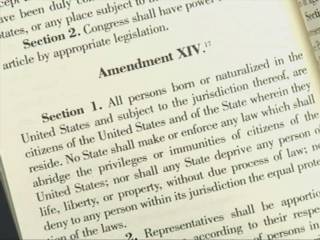
When passed by Congress the amendment was a watershed that would set Constitutional precedent for future laws. These would include giving both women and Native Americans women the right to vote. It would also be used by the Supreme Court in the 1954 Brown v. Board of Education decision that ended the use of “separate but equal” and overturned many other Jim Crow laws. It helped lead to the passage of the Voting Rights Act of 1964 and the Civil Rights Act of 1965, and most recently was the basis of the Supreme Court decision in Obergfell v. Hodges, which give homosexuals the right to marry. Section one of the amendment read:

“All persons born or naturalized in the United States, and subject to the jurisdiction thereof, are citizens of the United States and of the state wherein they reside. No state shall make or enforce any law which shall abridge the privileges or immunities of citizens of the United States; nor shall any state deprive any person of life, liberty, or property, without due process of law; nor deny to any person within its jurisdiction the equal protection of the laws.” [9]

Even so, for most white Southerners “freedom for African Americans was not the same as freedom for whites, as while whites might grant the black man freedom, they had no intention of allowing him the same legal rights as white men.” [10] As soon as planters returned to their lands they “sought to impose on blacks their definition of freedom. In contrast to African Americans’ understanding of freedom as a open ended ideal based on equality and autonomy, white southerners clung to the antebellum view that freedom meant mastery and hierarchy; it was a privilege, not a universal right, a judicial status, not a promise of equality.”  [11] In their systematic efforts to deny true freedom for African Americans these Southerners ensured that blacks would remain a lesser order of citizen, enduring poverty, discrimination, segregation and disenfranchisement for the next century.
ulysses-s-grant-book

Ulysses S. Grant and the Fight against the Insurrection, Terrorism and Insurgency of the Ku Klux Klan, White Leagues, White Liners and Red Shirts

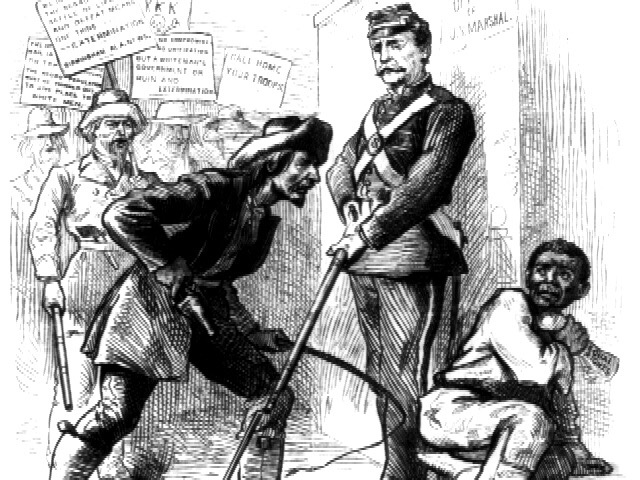
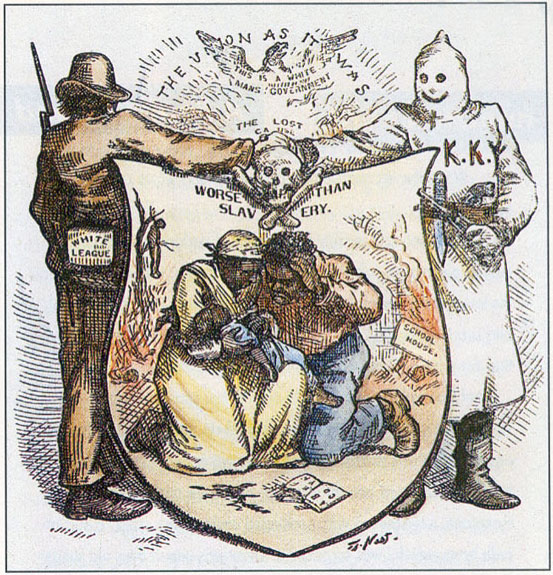
But these measures provoked even more violence from enraged Southerners who formed a variety of violent racist organizations which turned the violence from sporadic attacks to what amounted to a full-fledged insurgency against the new state governments and African Americans. Organizations like the Ku Klux Klan engaged in terroristic violence to heavily armed “social clubs” which operated under the aegis of the state Democratic Party leadership in most Southern states. Under the leadership of former Confederate general Nathan Bedford Forrest whose troops had conducted the Fort Pillow massacre, the Klan’s membership throughout the South “was estimated at five hundred thousand.” [12] The majority of these men were former Confederate soldiers, although they were also joined by those who had not fought in the war, or later those who had been too young to fight in the war but even belatedly wanted to get in on the fight against the hated Yankee and his African American allies. As the shadowy organization grew it became bolder and more violent in its attacks on African Americans, Republican members of the Reconstruction governments, and even Southern Jews. The Klan spread to every State in the South and when Congress investigated in 1870 and 1871 they submitted a thirteen volume report on Klan activities, volumes that “revealed to the country an almost incredible campaign of criminal violence by whites determined to punish black leaders, disrupt the Republican Party, reestablish control over the black labor force, and restore white supremacy in every phase of southern life.” [13]
KKK-Nast

Allegedly organized for self-defense against state militia units composed of freed blacks they named themselves “White Leagues (Louisiana), White Liners or Rifle Clubs (Mississippi), or Red Shirts (South Carolina). They were, in fact, paramilitary organizations that functioned as armed auxiliaries of the Democratic Party in southern states in their drive to “redeem” the South from “black and tan Negro-Carpetbag rule.” [14] These men, mostly Confederate veterans “rode roughshod over the South, terrorizing newly freed slaves, their carpetbagger allies, and anyone who dared to imagine a biracial democracy as the war’s change.” [15] The unrequited violence and hatred by these men set the stage for the continued persecution, murder and violence against blacks and those who supported their efforts to achieve equality in the South for the next century. In truth the activities of the Klan and other violent White Supremacist groups offer “the most extensive example of homegrown terrorism in American history.” [16]

Throughout his term in office Johnson appealed to arguments used throughout later American history by “critics of civil rights legislation and affirmative action. He appealed to fiscal conservatism, raised the specter of an immense federal bureaucracy trampling on citizens’ rights, and insisted that self-help, not government handouts, was the path to individual advancement.” [17]

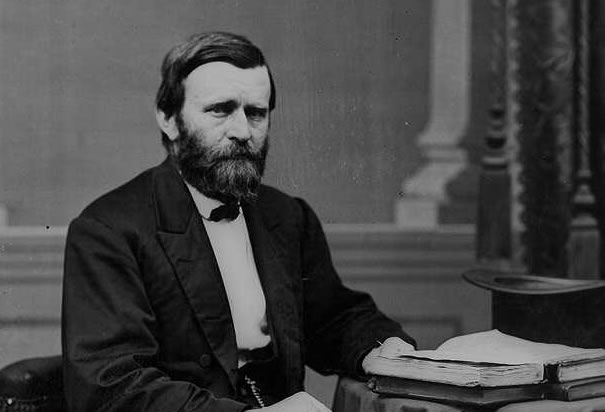
Ulysses S. Grant succeeded Johnson as President in 1869, and unlike his predecessor, he was a man who believed in freedom and equal rights, “For Grant, freedom and equal rights were matters of principle, not symbolism.” [18]Grant ordered his generals in the South to enforce the Reconstruction Act and when the Ku Klux Klan attempted to stop blacks from voting Grant got Congress to pass the “enforcement Act, which made racist terrorism a federal offense.” [19] He created the Justice Department to deal with crimes against Federal law and in 1871 pushed Congress to pass a law known as the Ku Klux Klan Act and sent in the army and federal agents from the Justice Department and the Secret Service to enforce the law.

Grant’s efforts using the military as well as agents of the Justice Department and the Secret Service against the Klan were hugely successful, thousands were arrested, hundreds of Klansmen were convicted and others were either driven underground or disbanded their groups. The 1872 election was the first and last in which blacks were nearly unencumbered as they voted until the passage of the 1964 Civil Rights Act and 1965 Voting Rights Act.

However, Grant’s actions triggered a political backlash that doomed Reconstruction. The seminal moment in this came 1873 when General Philip Sheridan working in Louisiana, asked Grant for “permission to arrest leaders of the White League and try them by courts-martial” [20] for their violent acts against blacks and their seizure of the New Orleans City Hall in a brazen coup attempt. The leak of Sheridan’s request sparked outrage and even northern papers condemned the president’s actions in the harshest of terms.

Apart from the effort to support voting rights for African Americans Grant’s efforts at Reconstruction were met mostly by failure. Part of this was due to weariness on the part of many Northerners to continue to invest any more effort into the effort. Slowly even proponents of Reconstruction began to retreat from it, some like Carl Schurz, were afraid that the use of the military against the Klan in the South could set precedent to use it elsewhere. Others, embraced an understanding of Social Darwinism which stood against all types of government interference what they called the “natural” workings of society, especially misguided efforts to uplift those at the bottom of the social order…and African Americans were consigned by nature to occupy the lowest rungs of the social ladder.” [21]

Southerners knew that they were winning the political battle and continued their pressure in Congress and in the media to demonize supporters of Reconstruction as well as African Americans. Southerners worked to rig the political and judicial process through the use of terror to demoralize and drive from power anyone, black or white, who supported Reconstruction. By 1870 every former Confederate state had been readmitted to the Union, in a sense fulfilling a part Lincoln’s war policy, but at the same time denying what the war was waged for a White led governments aided by the Supreme Court increasingly set about reestablishing the previous social and political order placing blacks in the position of living life under slavery by another name.

The Passage of the Fifteenth Amendment

Slavery had been abolished, and African Americans had become citizens, but in most places they did not have the right to vote. Grant used his political capital to fight for the passage of the Fifteenth Amendment, which gave black men the right to vote. It was one of the things that he remained most proud of in his life, he noted that the amendment was, “A measure which makes at once four million people voter who were heretofore declared by the highest tribunal in the land to be not citizens of the United States, nor eligible to become so…is indeed a measure of grander importance than any other act of the kind from the foundation of our free government to the present day.” [22]

To be continued…

Notes

[1] Ibid. Foner A Short History of Reconstruction p.30

[2] Ibid. Lord The Past that Would Not Die pp.11-12

[3] Ibid. Zinn The Other Civil War p.54

[4] Ibid. McPherson The War that Forged a Nation p. 178

[5] Ibid. Foner Forever Free p.162

[6] Perman, Michael Illegitimacy and Insurgency in the Reconstructed South in The Civil War and Reconstruction Documents and Essays Third Edition edited by Michael Perman and Amy Murrell Taylor Wadsworth Cengage Learning Boston MA 2011 p.451

[7] Ibid. Foner Forever Free p.121

[8] Ibid. Langguth After Lincoln p.232

[9] _____________ The 14th Amendment to the U.S. Constitution retrieved from https://www.law.cornell.edu/constitution/amendmentxiv 29 June 2015

[10] Ibid. Carpenter Sword and Olive Branch p.93

[11] Ibid. Foner Forever Free p.92

[12] Lane, Charles The Day Freedom Died: The Colfax Massacre, the Supreme Court, and the Betrayal of Reconstruction Henry Holt and Company, New York 2008  p.230

[13] Ibid. Foner Forever Free p.171

[14] Ibid. McPherson The War that Forged a Nation p. 178

[15] Ibid. Jordan Marching Home p.118

[16] Ibid. Foner Forever Free p.171

[17] Ibid. Foner Forever Free p.116

[18] Ibid. Lane The Day Freedom Died:  p.2

[19] Ibid. Lane The Day Freedom Died p.4

[20] Ibid. Langguth, A.J. After Lincoln p.314

[21] Ibid. Foner Forever Free pp.192-193

[22] Flood, Charles Bracelen, Grant’s Final Victory: Ulysses S. Grant’s Heroic Last Year DaCapo Press, Boston 2011 pp.78-79
Leave a comment

Filed under civil rights, civil war, ethics, laws and legislation, Military, Political Commentary

Slavery Under Another Name: The Black Codes

7100338_orig

Blacks Sentenced to Work Planatations Under the Black Codes

Friends of Padre Steve’s World,

This is another of my continued series of articles pulled from my various Civil War texts dealing with Emancipation and the early attempts to gain civil rights for African Americans. This section that I will cover for the next few days deals with the post-war period, a period marked by conflicting political and social desires for equality, justice, revenge, and the re-victimization of Blacks who had so recently been emancipated.

I hope that you find these helpful.

Peace

Padre Steve+

Southern Resistance to Reconstruction and the Black Codes

White Southerners including the newly pardoned Confederates enacted black codes that “codified explicit second-class citizenship for freedpeople.” [1] The legislature of Mississippi refused to ratify the Thirteenth Amendment, and did not do so until 1995. One Southerner noted that “Johnson “held up before us the hope of a ‘white man’s government,’ and this led us to set aside negro suffrage…. It was natural that we should yield to our old prejudices.” [2] Former Confederates, including Alexander Stephens the former Vice President of the Confederacy were elected to high office, Stephens to the United States Senate and the aggrieved Republicans in Congress in turn refused to admit the former Confederates. Many Union veterans were incensed by Johnson’s actions, one New York artilleryman noted “I would not pardon the rebels, especially the leaders, until they should kneel in the dust of humiliation and show their deeds that they sincerely repent.” [3] He was not alone, many Northern Veterans who formed the integrated Grand Army of the Republic veterans maintained a patent disregard, if not hatred of what the old South stood for and felt that their efforts in the war had been betrayed by the government.

sherman-full-length

General William Tecumseh Sherman provide for Freed Blacks to have land 

Johnson’s restoration of property to the former white owners drove tens of thousands of blacks off lands that they had been farming, or left them as laborers for their former slave masters. Johnson countermanded General William Tecumseh Sherman and Secretary of War Edwin Stanton’s Field Order 15 to “divide abandoned and confiscated lands on the Sea Islands and in a portion of the Low Country coast south of Charleston into forty-acre plots for each black family.” [4] As such many freed blacks were now at the mercy of their former white owners for any hope of economic sustenance.

Johnson worked stridently, and often successfully to frustrate the efforts of the Freedmen’s Bureau headed by Major General Oliver Howard to help freed blacks to become landowners and to protect their legal rights. In immediate post-war South states organized all white police forces and state militias composed primarily of Confederate veterans, many still wearing their gray or butternut uniforms. In such a climate blacks had few rights, and officers of the Freedmen’s Bureau lamented the situation. In Georgia one officer wrote that no jury would “convict a white man for killing a freedman,” or “fail to hang” a black man who killed a white in self-defense. Blacks commented another agent, “would be just as well off with no law at all or no Government,” as with the legal system established in the South under Andrew Johnson. “If you call this Freedom,” wrote one black veteran, “what do you call slavery?” [5]

The struggle between Johnson and Congress intensified when the President vetoed the Civil Rights Bill. Congress responded by overriding his veto. Eventually the battle between Johnson and Congress climaxed when Johnson was impeached when he tried to remove Secretary of War Stanton from office. Johnson barely survived the impeachment proceedings and was acquitted by one vote in the Senate in 1868.

The various black codes enacted throughout the South were draconian measures to codify and institutionalize racism and White Supremacy:

“passed labor laws that bound blacks to employers almost as tightly as slavery once bound them to their masters. Other codes established patterns of racial segregation that had been impossible under slavery, barred African Americans from serving on juries or offering testimony in court against whites, made “vagrancy,” “insulting gestures,” and “mischief” offenses by blacks punishable by fines or imprisonment, forbade black-white intermarriage, ad banned ownership by blacks of “fire-arms of any kind, or any ammunition, dirk or bowie-knife.” [6]

14-1_Page_43_Image_0001

African Americans leased out to build Railroad 

Mississippi’s Black Codes were the first of these and among the sections dealt with a change in vagrancy laws, specifically aimed at emancipated blacks and those whites who might associate with them:

“That all freedmen, free Negroes, and mulattoes in this state over the age of eighteen years found on the second Monday in January, 1866, or thereafter, with no lawful employment or business, or found unlawfully assembling themselves together in the day or night time, and all white persons so assembling with freedmen, free Negroes, or mulattoes on terms of equality, or living in adultery with a freedwoman, free Negro, or mulatto, shall be deemed vagrants; and on conviction thereof shall be fined…and imprisoned….”  [7]

The black codes were condoned and supported by President Johnson. While the black codes recognized the bare minimal elements of black freedom, their provisions confirmed the observations of one journalist who wrote “the whites seem wholly unable to comprehend that freedom for the negro means the same thing as freedom for them. They readily admit that the Government has made him free, but appear to believe that the have the right to exercise the old control.” [8] As state after state followed the lead of Mississippi, which was the first state to enact black codes Northern anger grew and some newspapers took the lead in condemn the black codes. “We tell the white men of Mississippi,” exploded the Chicago Tribune on December 1, “ that the men of the North will convert the state of Mississippi into a frog pond before they allow any such laws to disgrace one foot of soil in which the bones of our soldiers sleep and over which the flag of freedom waves.”  [9]

black_americans_attacked_in_memphis_riot_of_1866

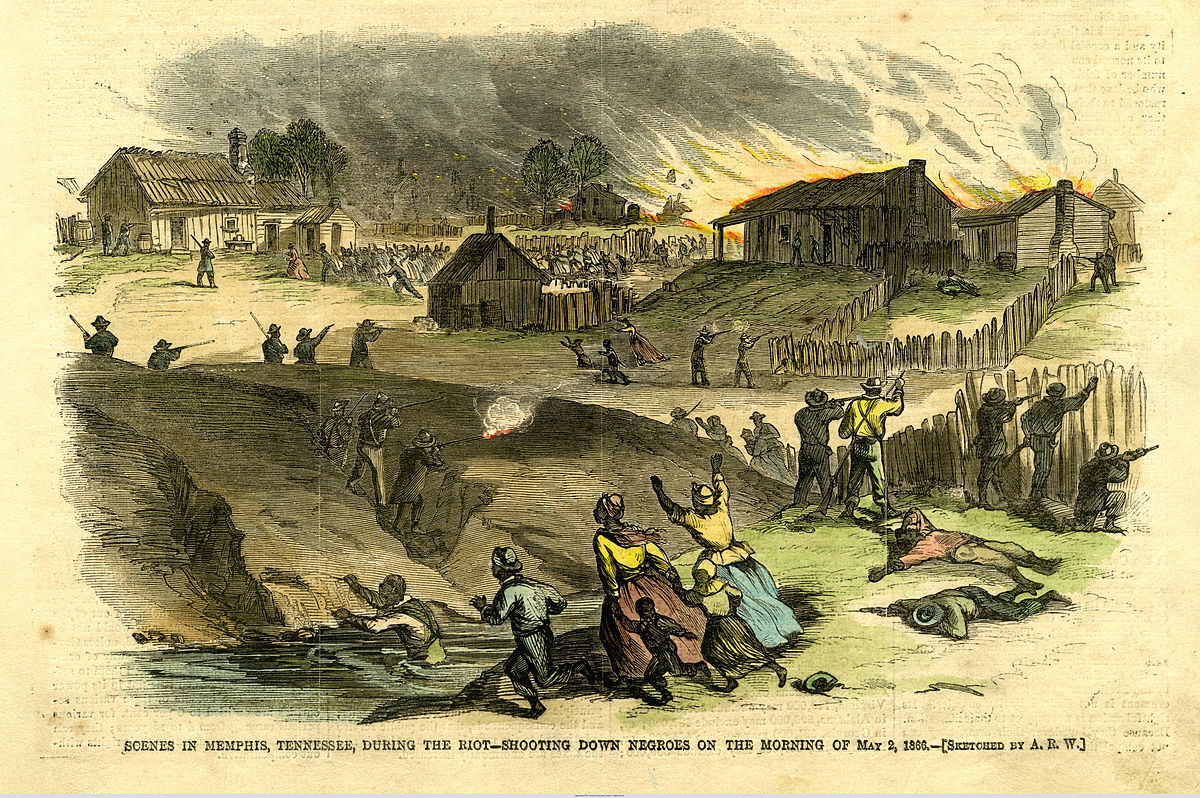
The Memphis Massacre

Within weeks of the end of the war, violence against blacks began to break out in different parts of the South and it continued to spread as Johnson and the new Congress battled each other in regard to Reconstruction policy:

“In Memphis, Tennessee, in May of 1866, whites on a rampage of murder killed forty-six Negroes, most of them veterans of the Union army, as well as two white sympathizers. Five Negro women were raped. Ninety homes, twelve schools and four churches were burned. In New Orleans in the summer of 1866, another riot against blacks killed thirty-five Negroes and three whites.” [10]

The hatred of blacks and the violence against them was not limited to adults, children joined in as well. In Natchez Mississippi an incident that showed how deep the antipathy towards blacks was when on a Sunday afternoon, “an elderly freedman protested to a small white boy raiding his turnip patch. The boy shot him dead, and that was that. In Vicksburg the Herald complained that the town’s children were hitting innocent bystanders when using their “nigger shooters.” [11]

Colonel Samuel Thomas, the director of the Freedmen’s Bureau in Mississippi noted the attitudes that he saw in many whites toward the newly emancipated African Americans. He wrote that white public sentiment had not progressed and that whites had not “come to the attitude in which it can conceive of the negro having any rights at all. Men, who are honorable in their dealings with their white neighbors, without feeling a single twinge of honor…. And however much they confess that the President’s proclamation broke up the relation of the individual slave to their owners, they still have the ingrained feeling that the black people at large belong to whites at large.” [12] Sadly, the attitude reported by Colonel Thomas not only remained but also grew more violent with each passing month.

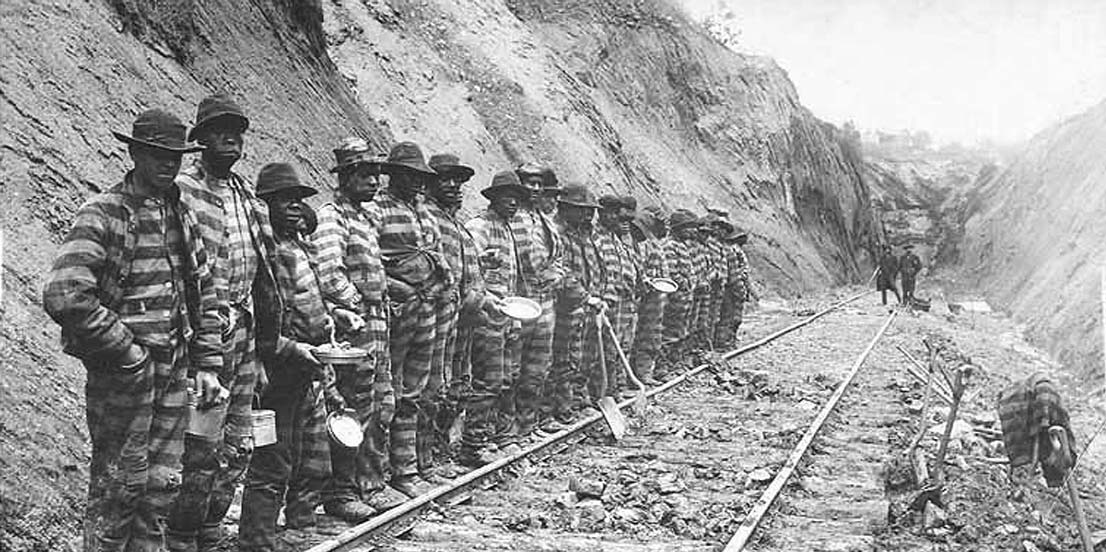
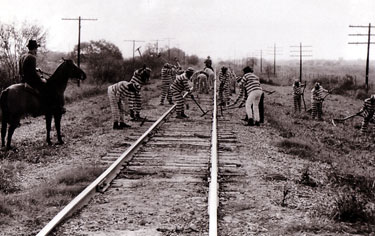
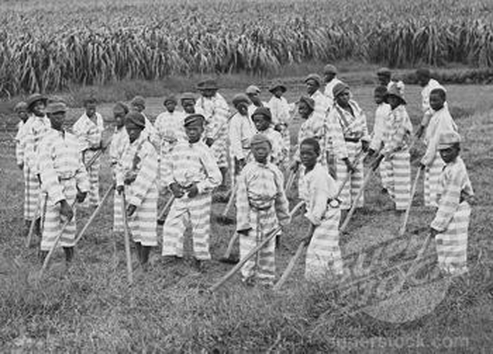
Another lesser-discussed aspect of the Black Codes was their use to return African Americans who had been convicted under the “vagrancy” statutes to a new type of slavery in all but name. The state governments then leased the prisoners to various corporations; railroads, mines and plantations, even former Confederate General and founder of the Ku Klux Klan Nathan Bedford Forrest received his share of prisoners to work his land.

parks_chain_gang

The practice became a lucrative source of revenue, for not only did the states collect the fees from the companies, but did not have to spend tax dollars to incarcerate, feed or otherwise care for the prisoners. Mortality rates were very high among the prisoners in private custody and the regulations, which stipulated that prisoners would be adequately fed, housed and treated, were not enforced.

By 1877 “every former Confederate state except Virginia had adopted the practice of leasing black prisoners into commercial hands. There were variations among the states, but all shared the same basic formula. Nearly all the penal functions of government were turned over to the companies purchasing convicts. In return for what they paid each state, the companies received absolute control of the prisoners… Company guards were empowered to chain prisoners, shoot those attempting to flee, torture any who wouldn’t submit, and whip the disobedient – naked or clothed – almost without limit. Over eight decades, almost never were there penalties to any acquirer of these slaves for their mistreatment or deeds.” [13]

The profitability of these ventures brought Northern investors, including the owners and shareholders of U.S. Steel into the scheme allowing financial houses and Northern corporations to grow their wealth, as they had during the pre-war days off the backs of slaves. However, the practice was also detrimental to poor Southern Whites who could not compete fairly in the labor market. In 1891 miners of the “Tennessee Coal Company were asked to sign an “iron-clad contract”: pledging no strikes, agreeing to get paid in scrip, and giving up the right to check the weight of the coal they mined (they were paid by weight). They refused to sign and were evicted from their houses. Convicts were brought in to replace them.” [14] The company’s response brought about an insurrection by the miners who took control of the mine and the area around it and freed 500 of the convict-slaves. The leaders were primarily Union Army veterans and members of the Grand Army of the Republic veteran’s organization. The company backed down, but others learned the lesson and began to employ heavily armed Pinkerton agents as well as the state militias to deal with the growing labor movement, not only in the South but also in the North.

Non-convict black laborers as well as poor white “sharecroppers” on the large plantations were forced back into servitude of another manner, where legislatures gave “precedence to a landlord’s claim to his share of the crop over that of the laborer for wages or a merchant for supplies, thus shifting the risk of farming from employer to employee.” Likewise, “a series of court decisions defined the sharecropper not as a partner in agriculture or a renter with a property right in the growing crop, but as a wage laborer possessing “only a right to go on the land to plant, work, and gather the crop.” [15]

The practice did not end until Franklin Delano Roosevelt ordered his Attorney General Francis Biddle to order Federal prosecutors who had for decades looked the other way begin prosecuting individuals and companies involved in this form of slavery. Biddle was the first U.S. Attorney General to admit the fact that “African Americans were not free and to assertively enforce the statutes written to protect them.” [16] Biddle, who later sat as a justice at the Nuremberg trials of major Nazi War Criminals commented during the war “One response of this country to the challenge to the ideals of democracy made by the new ideologies of Fascism and Communism has been a deepened realization of the values of a government based on a belief in the dignity and the rights of man.” [17] Biddle charged the newly formed Civil Rights Division of the Justice Department to shift its focus from organized crime to cases of discrimination and racial abuse. Biddle repudiated the rational that allowed for the practice and wrote that the “law is fixed and established to protect the weak-minded the poor, the miserable” and that the contracts of the states that allowed the practices were “null and void.” [18] It was the beginning of another twenty-year process in which African Americans and their allies in the Civil Rights Movement worked to bring about what Lincoln referred to as “a new birth of freedom.”

To be continued….

Notes 

[1] Ibid. McPherson The War that Forged a Nation p. 177

[2] Ibid. Guelzo Fateful Lightning p.491

[3] Jordan, Brian Matthew. Marching Home: Union Veterans and Their Unending Civil War Liveright Publishing Corporation a Division of W.W. Norton and Company Inc. New York and London 2014 p.119

[4] Ibid. Goldfield America Aflame p.411

[5] Ibid. Foner Forever Free p.96

[6] Ibid. Guelzo Fateful Lightening p.491

[7] ____________ Mississippi’s Black Code, November 24-29, 1865 in the Confederate and Neo-Confederate Reader: The “Great Truth” about the “Lost Cause” Loewen, James W. and Sebesta, Edward H. Editors, University Press of Mississippi, Jackson 2010 Amazon Kindle edition location 4505 of 8647

[8] Ibid. Foner Forever Free pp.93-94

[9] Lord, Walter The Past that Would Not Die Harper Collins Publishers, New York 1965 p.12

[10] Ibid. Zinn The Other Civil War p.55

[11] Ibid. Lord The Past that Would Not Die p.8

[12] Ibid. Foner Forever Free p.92

[13] Blackmon, Douglas A. Slavery By another Name: The Re-enslavement of Black Americans from the Civil War to World War II Anchor Books, a Division of Random House, New York 2008 p.56

[14] Ibid. Zinn A People’s History of the United States p.275

[15] Ibid. Foner A Short History of Reconstruction p.250

[16] Ibid. Blackmon Slavery By another Name pp.378-379

[17] Ibid. Blackmon Slavery By another Name p.378

[18] Ibid. Blackmon Slavery By another Name p.379

1 Comment

Filed under civil rights, civil war, laws and legislation, leadership, Political Commentary

Racism and the Failure of Reconstruction

IMG_1877

Friends of Padre Steve’s World,

This is another of my continued series of articles pulled from my various Civil War texts dealing with Emancipation and the early attempts to gain civil rights for African Americans. This section that I will cover for the next few days deals with the post-war period, a period marked by conflicting political and social desires for equality, justice, revenge, and the re-victimization of Blacks who had so recently been emancipated.

I hope that you find these helpful.

Peace

Padre Steve+

Failing to Win the Peace: Racism and the Failure of Reconstruction

Colin Gray wrote, “A successful exercise in peacemaking should persuade the defeated party to accept its defeat.” [1] This is a fact seen throughout history as the peoples of nations that have been defeated militarily rise up against their occupiers to regain some form of independence, often coupled by a desire for revenge. As Liddell-Hart wrote, “History should have taught the statesman that there is no practical halfway house between a peace of complete subjection and a peace of moderation.” [2]

When the Civil War ended the Confederacy was beaten and most people in the South would have agreed to anything that the North presented regarding peace and return to the Union. The primary political policy goal of Lincoln regarding the war was the reestablishment of the Union and one of the military measures adopted by Lincoln was the emancipation of the South’s slaves who were an important part of the Southern war economy. “During the last two years of the war the abolition of slavery evolved from a means of winning the war to a war aim – from national strategy to national policy.” [3] By Lincoln’s reelection in 1864 that policy included the unconditional surrender of the Confederacy as well as the passage of the Thirteenth Amendment, while Lincoln himself advocated moderation in achieving the political and social goals of his war policy, as well as in the restoration of the Southern States to the Union, his assassination served to destroy that goal as his successor, Andrew Johnson, and the Radical Republican majority in Congress warred against each other in implementing the policy of Reconstruction.

10467FS_DA_090409_worst-johnson

The Unreconstructed President Andrew Johnson

That change in policy, the complete abolition of slavery necessitated a remaking of the old South, a culture where economics, social standing and even religion was linked to the “peculiar institution.” In a sense Reconstruction was “what the war was about.” [4] Had Lincoln’s successor, President Andrew Johnson desired he could have gotten the South to accept almost any demands that he decided to place upon them. A Northern correspondent who traveled throughout the South in May of 1865 and surveyed the mood of the leaders and people “concluded that any conditions for reunion specified by the President, even black suffrage, would be “promptly accepted.” [5] But that was not the way of Andrew Johnson.

Johnson set about to work with Southerners to affect a rapid reunion and to reestablish white rule in the South. He adopted a “minimalist process that would establish a mechanism by which former Confederate states could return to the Union with little or no change except for the abolition of slavery.” [6] The procedures Johnson established for the re-admission of states only allowed people who were eligible to vote in 1861 to vote. In effect this ensured a white only electorate, and excluded any free blacks. Johnson then began working to pardon former Confederates as quickly as possible to allow them to return to their political offices. Johnson would often issue hundreds of pardons a day, between June and August 1865, “the president awarded more than five thousand pardons in three states alone – Virginia, North Carolina, and Alabama.” [7] These pardons ensured that the former Confederates would never again have to worry about being brought up on charges of treason or war crimes, and no “federal law permitted them from voting once their states had been readmitted to the Union” [8] which under Johnson’s plan ensured that they would have the voted before any newly freed black in the South.

Johnson countermanded the orders of Union Generals in the occupied Confederate States to protect the rights of freed blacks further strengthening and emboldening those committed to restoring white rule in the South and regulating freed blacks to a state all but in name like slavery. Relieved at Johnson’s mild terms for reunion Southerners language included “defiant talk of states’ rights and resistance to black suffrage. My midsummer, prominent whites realized that Johnson’s Reconstruction empowered them to shape the transition from slavery to freedom and to define black’s civil status.” [9] Johnson’s policy set the stage for racial strife that in some places still has fully not ended.

Just two months after Lee’s surrender of the Army of Northern Virginia at Appomattox, Richard Henry Dana, a Federal District Attorney in Boston, declared that “a war is over when its purpose is secured. It is a fatal mistake to hold that this war is over because the fighting has ceased. This war is not over…” [10] As Dana so succinctly noted, and Clausewitz so well understood, was that that war is a continuation of policy and politics by other means. The failure of President Johnson and so many others in the North to fully grasp this fact led to over a century of subjugation of emancipated African Americans by whites. The confusion and lack of determined purpose has fueled a continual racial divide in the United States that is still felt today. Defeated on the battlefield Southerners and emboldened by Johnson’s leniency, Southerners soon turned to political, psychological and even violent means to reverse their losses.

Frederick Douglass understood that simple emancipation was not enough, and that the “war and its outcome demanded racial equality.” [11] Despite the that efforts of many in the North this would not happen during Reconstruction and Douglass knew that the failure to accomplish this would be disastrous, “Whether the tremendous war so heroically fought…shall pass into history a miserable failure…or whether on the other hand, we shall, as the rightful reward of victory over treason have a solid nation, entirely delivered from all contradictions and social antagonisms, must be determined one way or another.” [12]

Other Northern leaders, political and military harbored deep seated illusions about the willingness of Southerners to change their way of life simply because they had lost the war, but with Johnson’s blessing seemed to be winning the peace. Major General Oliver O. Howard, a convinced and longtime abolitionist who believed that it was God’s will for the North to liberate African Americans who was appointed by Lincoln to head the new Freedman’s Bureau “believed that the Southern whites, or at least a sufficient number of them, through their humanitarian instincts and sense of fair play, or if not that, through enlightened self-interest, would deal fairly and justly with the freedmen, would aid in his education, and would give him the same civil and legal rights as the white man.” [13] Likewise, Major General Henry Slocum, who served with Howard at Gettysburg and in the West was appointed military commander of the District of Mississippi. Slocum, like many others entered his duties and “did not fathom the depth of anger and loathing many white Southerners harbored toward blacks, and to the new system in general.” [14]

There was a problem with implementing Reconstruction; when John Wilkes Booth assassinated Abraham Lincoln, the political leaders of the North could not agree on how to do this. The new President, Andrew Johnson was probably the worst possible leader to lead the country in the aftermath of war for all practical purposes Johnson was a Democrat who believed in white supremacy, he had been brought onto the ticket for his efforts to keep Kentucky in the Union and to support Unionist elements in Tennessee. While his selection helped Lincoln in parts of the North and the Border States it was a disaster for the post-war era.

Johnson’s approach to reconstruction was very simply to “impose minimal demands on the South. He required only minor concessions from the former Confederates before allowing them to resume their political rights and retain their land. As for freedmen, he seemed to think that the needed no further protection beyond the fact of their emancipation.”  [15] Johnson’s attitude regarding freedmen was quite common, even men like William Lloyd Garrison who had spent his life in the cause of abolitionism believed that emancipation and abolition and the passage of the Thirteenth Amendment was the end of his work. He urged the dissolution of the American Anti-Slavery Society in May of 1865 declaring, “My vocation, as an Abolitionist, thank God, is ended.” [16] His suggestion was rejected by the membership, but it was a harbinger of things to come.

Johnson was “a lonely stubborn man with few confidants, who seemed to develop his policies without consulting anyone, then stuck to them inflexibly in the face of any and all criticism. He lacked Lincoln’s ability to conciliate his foes and his capacity for growth, which was best illustrated by Lincoln’s evolving attitude to black suffrage during the Civil War.” [17] In the months after his unexpected accession to the presidency Johnson demonstrated that he had no understanding of Lincoln’s political goals for the South and the desires of the Republican dominated Congress.

By the summer of 1865 Johnson was already demonstrating “that his sympathies were with the Southern white population and that he believed that their interests should be cared for even at the expense of freedmen.” [18] Johnson’s approach to reconstruction was very simply to “impose minimal demands on the South. He required only minor concessions from the former Confederates before allowing them to resume their political rights and retain their land. As for freedmen, he seemed to think that the needed no further protection beyond the fact of their emancipation.”  [19] Johnson gave individual pardons to more than thirteen thousand “high-ranking Confederate civil and military officers and wealthy Southerners.” [20] While doing this he minimized political influence the Southern Unionists who had not supported the Confederacy and ensured that freed slaves were excluded from the political process.  He issued a number of orders “appointing interim provisional governors and urging the writing of new state constitutions based upon the voter qualifications in force at the time of secession in 1861 – which meant, in large but invisible letters, no blacks.” [21]

When Frederick Douglass led a delegation of blacks to meet with Johnson in February 1865 Johnson preached that it was impossible to give political freedom to blacks. When Douglass attempted to object Johnson became angry and told Douglass “I do not like to be arraigned by some who can get up handsomely-rounded periods and rhetoric, and talk about abstract ideas of liberty, who never periled life, liberty, or property.” [22] When Douglass took his objections to Johnson’s harangue to a Washington newspaper, Johnson railed against Douglass “I know that d—–d Douglass…he’s just like any other nigger & would sooner cut a white man’s throat than not.” [23]

Notes 

[1] Ibid. Gray Fighting Talk p.14

[2] Ibid. Liddell- Hart Why Don’t We Learn From History? p.86

[3] Ibid. McPherson The War that Forged a Nation p. 132

[4] Perman, Michael and Murrell Taylor, Amy editors The Civil War and Reconstruction Documents and Essays Third Edition Wadsworth Cengage Learning Boston MA 2011 p.323

[5] Foner, Eric A Short History of Reconstruction Harper and Row, New York 1990 p.89

[6] Ibid. McPherson The War that Forged a Nation p. 177

[7] Langguth, A.J. After Lincoln: How the North Won the Civil War and Lost the Peace Simon and Schuster, New York 2014 p.119

[8] Ibid. Langguth After Lincoln p.319

[9] Ibid. Foner A Short History of Reconstruction p.89

[10] Ibid. McPherson The War that Forged a Nation p. 175

[11] Ibid. Goldfield America Aflame p.407

[12] Ibid. Goldfield America Aflame p.407

[13] Carpenter, John A. Sword and Olive Branch: Oliver Otis Howard Fordham University Press, New York 1999 p.93

[14] Melton, Brian C. Sherman’s Forgotten General: Henry W. Slocum University of Missouri Press, Columbia and London 2007

[15] Ibid. Perman and Taylor The Civil War and Reconstruction Documents and Essays Third Edition p.323

[16] Ibid. Foner A Short History of Reconstruction p.30

[17] Ibid. Foner Forever Free p.108

[18] Ibid. Carpenter Sword and Olive Branch: Oliver Otis Howard  New York 1999 p.109

[19] Ibid. Perman and Taylor The Civil War and Reconstruction Documents and Essays Third Edition p.323

[20] Ibid. McPherson The War that Forged a Nation p. 177

[21] Ibid. Guelzo Fateful Lightening p.490

[22] Ibid. Guelzo Fateful Lightning p.494

[23] Ibid. Guelzo Fateful Lightning p.494

Leave a comment

Filed under civil rights, civil war, History, Military, Political Commentary

Realism & Racism: The Confederate Emancipation Debate


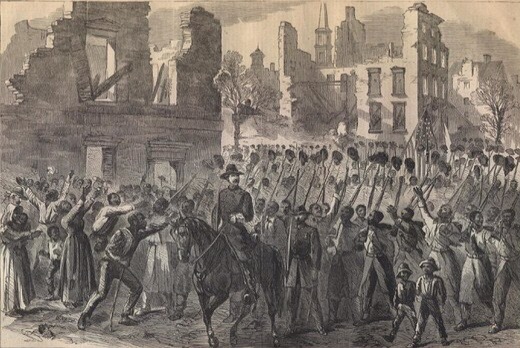
Union U.S.C.T. Troops march into Richmond 

Friends of Padre Steve’s World,

As I have been doing the past few days I am posting another heavily revised section of my Civil War and Gettysburg text. This one deals with the less than successful efforts of some in the Confederacy to deal with reality and recommend that the Confederacy emancipate African American slaves. It really is a fascinating study that I expect to do more work on, but I think that youn will find it quite informative. 

Until tomorrow,

Peace

Padre Steve+

In the South where before the war about forty percent of the population was composed of African American slaves there was no question regarding abolition or enlistment of African American soldiers. The Confederate States of America was a pro-slavery nation which hoped to “turn back the tide of abolition that had swept the hemisphere in the Age of Revolution…. Confederate founders proposed instead to perfect the slaveholder’s republic and offer it to the world as the political form best suited to the modern age.” [1]

The political and racial ideology of the South, which ranged from benevolent paternal views of Africans as less equal to whites, moderate prejudice and at tolerance of the need for slavery, and extreme slavery proponents who wanted to expand the institution beyond the borders of the Confederacy, as well as extreme prejudice and race race-hatred; was such that almost until the end of the war, Confederate politicians and many senior Confederate officers fought against any allowance for blacks to serve; for they knew if they allowed this, that slavery itself must be swept away. As such, it was not until 1864 when the Confederacy was beginning to face the reality that they could no longer win the war militarily, that any serious discussion of the subject commenced.

But after the fall of Vicksburg and the shattering defeat at Gettysburg, some Southern newspapers in Mississippi and Alabama began to broach the subject of employing slaves as soldiers, understanding the reality that doing so might lead to emancipation, something that they loathed but understood the military and political reality for both if the Confederacy was to gain its independence from the Union. The editor of the Jackson Mississippian wrote that, “such a step would revolutionize our whole industrial system” and perhaps lead to universal emancipation, “a dire calamity to both the negro and the white race.” But if we lose slavery anyway, for Yankee success is death to the institution… so that it is a question of necessity – a question of choice of evils. … We must… save ourselves from the rapacious north, WHATEVER THE COST.” [2]

The editor of the Montgomery Daily Mail “worried about the implications of arming slaves for “our historical position on the slavery question,” as he delicately put it. The argument which goes to the exclusion of negroes as soldiers is founded on the status of the negro.” Negroes, he asserted, are “racially inferior[s],” but “the proposition to make the soldiers… [would be but a] practical equalization of the races.” Nonetheless they had to do it. “The War has made great changes,” he insisted, and, “we must meet those changes for the sake of preserving our existence. They should use any means to defeat the enemy, and “one of those, and the only one which will checkmate him, is the employment of negroes in the military services of the Confederacy.” [3]  Other newspapermen noted “We are forced by the necessity of our condition,” they declared, “to take a step which is revolting to every sentiment of pride, and to every principle that governed our institutions before the war.” The enemy was “stealing our slaves and converting them into soldiers…. It is better for us to use the negroes for our defense than that the Yankees should use them against us.” [4] These were radical words, but neither Jefferson Davis, nor the Confederate Congress was willing to hear them, and the topic remained off the table as a matter of discussion.


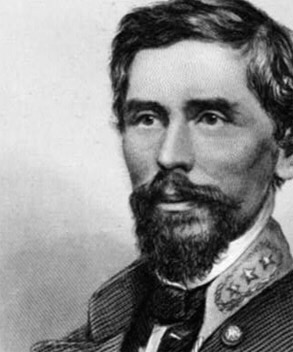
Major General Patrick Cleburne CSA

Despite this, there were a few Confederate military leaders who understood that the South could either fight for freedom and independence from the Union, but not for slavery at the same time, especially if the Confederacy refused to mobilize its whole arms-bearing population to defeat the Union. The reality that the “necessity of engaging slaves’ politics was starting to be faced where it mattered most: in the military.” [5] One of these men was General Patrick Cleburne, an Irish immigrant and a division commander in the Army of Tennessee who demonstrated the capacity for forward thinking in terms of race, and political objectives far in advance of the vast majority of Confederate leaders and citizens. Cleburne openly advocated that blacks should be allowed to serve as soldiers of the Confederacy, and that they should be emancipated.

Cleburne, who was known as “the Stonewall Jackson of the West” was a bold fighter who put together a comprehensive plan to reverse the course of the war by emancipating slaves and enlisting them to serve in the Confederate military. Cleburne was a lawyer, and his proposal was based on sound logic. Cleburne noted that the Confederacy was losing the war because it did not have enough soldiers, supplies, or resources to sustain the war effort. He stressed that the South had an inadequate number of soldiers, and that “our soldiers can see no end… except in our own exhaustion; hence, instead of rising to the occasion, they are sinking into a fatal apathy, growing weary of hardships and slaughters which promise no results.” [6]

Most significantly the Irishman argued that “slavery, from being one of our chief sources of strength at the beginning of the war, has now become in a military point of view, one of our chief sources of weakness,” [7] and that “All along the lines… slavery is comparatively valueless to us for labor, but of great and increasing worth to the enemy for information,” an “omnipresent spy system, pointing out our valuable men to the enemy, revealing our positions, purposes, and resources.” [8] He noted, that “Every soldier in our army already knows and feels our numerical inferiority to the enemy…. If this state continues much longer we shall surely be subjugated.” [9]

Cleburne was the ultimate realist in terms of what was going on in the Confederacy and the drain that slavery and the attempts to control the slave population were having on it. The Conscription Act of 1862 acknowledged that men had to be retained at home in order to guard against slave uprisings, and how exemptions diminished forces at the front without adding any corresponding economic value. Cleburne wrote of how African Americans in the South were becoming increasingly pro-Union, and were undermining Southern morale at home and in the ranks. He noted that they brought up “fear of insurrection in the rear” and filled Confederate soldiers with “anxieties for the fate of loved ones when our armies have moved forward.” And when Union forces entered plantation districts, they found “recruits waiting with open arms.” There was no point in denigrating their military record, either. After donning Union blue, black men had proved able “to face and fight bravely against their former masters.” [10]

Cleburne’s proposal was radical for he recommended that “we immediately commence training a large reserve of the most courageous of our slaves, and further that we guarantee freedom within a reasonable time to every slave in the South who shall remain to the confederacy in this war.” [11] Cleburne’s realism came through in his appeal to the high command:

“Ever since the agitation of the subject of slavery commenced the negro has been dreaming of freedom and his vivid imagination has surrounded the condition with so many gratifications that it has become the paradise of his hopes.” It was also shrewd politically: “The measure we propose,” he added, “will strike dead all John Brown fanaticism, and will compel the enemy to draw off altogether or in the eyes of the world to swallow the Declaration of Independence without the sauce and disguise of philanthropy.” [12]

The Irishman’s “logic was military, the goal more men in uniform, but the political vision was radical indeed.” [13] He was asking more from his fellow Southerners than most were willing to risk, and even more than Lincoln had asked of the North in his Emancipation Proclamation. Cleburne was “asking them to surrender the cornerstone of white racism to preserve their nation” [14] something that most seemed even unwilling to consider. He presented his arguments in stark terms that few Southern leaders, or citizens could stomach “As between the loss of independence and the loss of slavery, we can assume that every patriot will freely give up the latter- give up the Negro slave rather than be a slave himself.” [15] Cleburne’s words were those of a heretic, he noted “When we make soldiers of them we must make free men of them beyond all question…and thus enlist their sympathies also.” [16] But Cleburne’s appeal would be quashed in Richmond.

In January 1864 General W.H.T Walker obtained a copy of Cleburne’s proposal and sent it to Jefferson Davis. Walker opposed it and expressed his outrage over it. Cleburne’s proposal went from being a military matter to a political matter, and in Walker’s opinion, the political arguments were out of line for any military officer to state in public. Jefferson Davis intervened to quash the proposal, as he could only see negative results coming from it. Davis was “Convinced that the “propagation of such opinions” would cause “discouragements, distraction, and dissension” in the army,” and he “ordered the Generals to stop discussing the matter…The only consequence of Cleburne’s action seemed to be the denial of promotion to this ablest of the army’s division commanders, who was killed ten months later at the Battle of Franklin.” [17] In fact Cleburne was “passed over for command of an army corps and promotion to lieutenant general” three times in the next eight months, and in “each care less distinguished, less controversial men received the honors.” [18] All copies of Cleburne’s proposal were destroyed by the War Department on the order of Davis.

Cleburne was not the only military man to advocate the formation of Negro units or even emancipation. Richard Ewell suggested to Jefferson Davis the idea of arming the slaves and offering them emancipation as early as 1861, and Ewell went as far as “volunteering to “command a brigade of Negroes.” [19] During the war Robert E. Lee became one of the chief proponents of this. Lee said after the war that he had told Davis “often and early in the war that the slaves should be emancipated, that it was the only way to remove a weakness at home and to get sympathy abroad, and divide our enemies, but Davis would not hear of it.” [20]


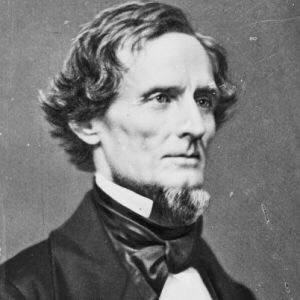
Jefferson Davis 

Ten months later Davis raised the issue of arming slaves, as he now, quite belatedly, believed that military necessity left him little choice. On November 7th 1864 he made his views known to the Confederate Congress, and they were a radical departure from the hitherto political orthodoxy of slavery. Davis had finally come to the realization the institution of slavery was now useless to the Confederate cause, as he had become a more ardent Confederate nationalist, and to Davis, “Preserving slavery had become secondary to preserving his new nation,” [21] and his words shocked the assembled Congress. The slave, he boldly declared that “the slave… can no longer be “viewed as mere property” but must be recognized instead in his other “relation to the state – that of a person.” As property, Davis explained, slaves were useless to the state, because without the “loyalty” of the men could be gained from their labor.” [22]

In light of the manpower needs of the South as well as the inability to achieve foreign recognition Davis asked their “consideration…of a radical modification in the theory of law” of slavery…” and he noted that the Confederacy “might have to hold out “his emancipation …as a reward for faithful service.” [23]

This drew the opposition of previously faithful supporters and in the press, especially that of North Carolina. Some newspapers in that state attacked Davis and his proposal, as “farcical” – “all this done for the preservation and perpetuation of slavery,” and if “sober men… are ready to enquire if the South is willing to abolish slavery as a condition of carrying on the war, why may it not be done as a condition of ending the war?” [24] Likewise, Davis now found himself opposed by some of his closest political allies including Robert Toombs and Howell Cobb.  Toombs roared, “The day that the army of Virginia allows a negro regiment to enter their lines as soldiers they will be degraded, ruined, and disgraced.” [25] Likewise, Cobb warned “The day that you make soldiers of them is the beginning of the end of the revolution. If slaves will make good soldiers our whole theory of slavery is wrong.” [26] Some in the military echoed his sentiments, Brigadier General Clement H. Stevens of South Carolina declared “I do not want independence if it is to be won by the help of the Negro.” [27] A North Carolina private wrote, “I did not volunteer to fight for a free negroes country…. I do not think I love my country well enough to fight with black soldiers.” [28]

Robert E. Lee, who had emancipated his slaves before the war, began to be a formidable voice in the political debate going on in the Confederacy regarding the issue of blacks serving as soldiers and emancipation. He wrote to a member of Virginia’s legislature: “we must decide whether slavery shall be extinguished by our enemies and the slaves used against us, or use them ourselves at the risk of the effects which may be produced on our social institutions…” and he pointed out that “any act for the enrolling of slaves as soldiers must contain a “well digested plan of gradual and general emancipation”: the slaves could not be expected to fight well if their service was not rewarded with freedom.” [29] He wrote another sponsor of a Negro soldier bill “The measure was “not only expedient but necessary…. The negroes, under proper circumstances will make effective soldiers. I think we could do as well with them as the enemy…. Those employed should be freed. It would be neither just nor wise… to require them to serve as slaves.” [30]


Howell Cobb

When Howell Cobb heard of Lee’s support for black soldiers and emancipation he fired of a letter to Secretary of War Seddon, “I think that the proposition to make soldiers of our slaves is the most pernicious idea that has ever been suggested since the war began. It is to me a source of deep mortification and regret to see the name of that good and great man and soldier, General R. E. Le, given as authority for such policy.” [31]

The debate which had begun in earnest in the fall of 1864 revealed a sharp divide in the Confederacy between those who supported the measure and those against it. Cabinet members such as Judah Benjamin and a few governors “generally supported arming the slaves.” [32] The Southern proponents of limited emancipation were opposed by the powerful governors of Georgia and North Carolina, Joe Brown and Zebulon Vance, and by the President pro-tem of the Confederate Senate R.M.T. Hunter, who forcibly opposed the measure. Senator Louis Wigfall who had been Davis’s ally in the conscription debates, now became his opponent, he declared that he “wanted to live in no country in which the man who blacked his boots and curried his horse was his equal.” [33]

Much of the Southern press added its voice to the opposition. Newspapers in North Carolina declared the proposal “farcical” – “all this was done for the preservation and the perpetuation of slavery,” and if “sober men…are willing to enquire if the South is willing to abolish slavery as a condition of carrying on the war, why may it not be done, as a condition of ending the war?” [34] The Charleston Mercury considered the proposal apostasy and proclaimed “Assert the right in the Confederate government to emancipate slaves, and it is stone dead…” [35] In Lynchburg an editor noted, “If such a terrible calamity is to befall us… we infinitely prefer that Lincoln shall be the instrument pf our disaster and degradation, that we ourselves strike the cowardly and suicidal blow.” [36]

Some states in the Confederacy began to realize that slaves were needed in the ranks, but did not support emancipation. Led by Governor “Extra Billy” Smith, Virginia’s General Assembly finally approved a law in 1865 “to permit the arming of slaves but included no provision for emancipation, either before or after military service.” [37]  Smith declared that without slavery the South “would no longer have a motive to fight.” [38]

Many Confederate soldiers displayed the attitude that would later propel them into the ranks of the Ku Klux Klan, the Red Shirts, the White League and the White Liners after the war. A North Carolina soldier wrote, “I did not volunteer to fight for a free negroes country… I do not think I love my country well enough to fight with black soldiers.” [39]

But many agreed with Lee, including Silas Chandler of Virginia, who stated, “Gen Lee is in favor of it I shall cast my vote for it I am in favor of giving him any thing he wants in the way of gaining our independence.” [40] Finally in March of 1865 the Confederate Congress passed by one vote a watered down measure of the bill to allow for the recruitment of slaves. It stipulated that “the recruits must all be volunteers” [41] and those who volunteered must also have “the approbation of his master by a written instrument conferring, as far as he may, the rights of a freed man.” [42] While this in itself was a radical proposition for a nation which had went to war to maintain slavery, the fact was that the slave’s service and freedom were granted not by the government, but by his owner, and even at this stage of the war, few owners were willing to part with their property. It was understood by many that giving freedom to a few was a means of saving the “particular institution.” The Richmond Sentinel noted during the November debate:  “If the emancipation of a part is the means of saving the rest, this partial emancipation is eminently a pro-slavery measure.” [43] Thus the law made “no mention of emancipation as a reward of military service” [44] and in deference to “state’s rights, the bill did not mandate freedom for slave soldiers.” [45]

But diehards opposed even the watered down measure. Robert Kean, who headed the Bureau of War and should have understood the stark reality of the Confederacy’s strategic situation, note in his diary, that the law:

“was passed by a panic in the Congress and the Virginia Legislature, under all the pressure the President indirectly, and General Lee directly, could bring to bear. My own judgment of the whole thing is that it is a colossal blunder, a dislocation of the foundations of society from which no practical results will be reaped by us.” [46]

It was Lee’s prestige alone that allowed the measure to pass, but even that caused some to question Lee’s patriotism. The Richmond Examiner dared to express a doubt whether Lee was “a ‘good Southerner’: that is, whether he is thoroughly satisfied of the justice and beneficence of negro slavery.”  [47] Robert Toombs of Georgia stated that “the worst calamity that could befall us would be to gain our independence by the valor of our slaves” [48] and a Mississippi congressman stated, “Victory itself would be robbed of its glory if shared with slaves.” [49]

But even if the final bill passed was inadequate, the debate had finally forced Southerners “to realign their understanding of what they were protecting and to recognize the contradictions in their carefully honed rationalization. Some would still staunchly defend it; others would adopt the ostrich’s honored posture. But many understood only too well what they had already surrendered.” [50]

On March 23rd 1865 the War Office issued General Order Number 14, which authorized the call up and recruitment of slaves to the Confederate cause. The order read in part: “In order to provide additional forces to repel invasion…the President be, and he is hereby authorized to ask for and to accept from the owners of slaves, the services of such able-bodied negro men as he may deem expedient, for and during the war, to perform military service  in whatever capacity he may direct…” While the order authorized that black soldiers “receive the same rations, clothing and compensation as are allowed to other troops in the same branch of service,” it did not provide for the emancipation of any of the black soldiers that might volunteer. Instead it ended “That nothing in this act shall be construed to authorize a change in the relation which the said slaves shall bear to their owners, except by the consent of the owners and of the States which they may reside….”  [51]

Twelve days after the approval of the act, on March 25th two companies of blacks were formed for drill in Richmond’s Capitol Square. As the mobilized slaves assembled to the sounds of fifes and drums they were met with derision and violence as even “Small boys jeered and threw rocks” [52] at them. None of those few volunteers would see action as within a week the Confederate government had fled Richmond, leaving them and the capital at the mercy of the victorious Union army. .

But some would see that history was moving, and attitudes were beginning to change. It took time, and the process is still ongoing. As imperfect as emancipation was and though discrimination and racism remained, African Americans had reached “levels that none had ever dreamed possible before the war.” [53] In April 1865 as Jefferson Davis and his government fled Richmond, with Davis proclaiming, “again and again we shall return, until the baffled and exhausted enemy shall abandon in despair his endless and impossible task of making slaves of a people resolved to be free.” [54]

The irony in Davis’s empty vow was stunning. Within a week Lee had surrendered and in a month Davis himself would be in a Federal prison. In the wake of his departure the Confederate Provost Marshall set fire to the arsenal and the magazines to keep them from falling into Union hands. However, the fires “roared out of hand and rioters and looters too to the streets until the last Federal soldiers, their bands savagely blaring “Dixie,” marched into the humiliated capital and raised the Stars and Stripes over the old Capitol building.” [55]

The Federal troops who led the army into Richmond came from General Godfrey Weitzel’s Twenty-fifth Corps, of Ord’s Army of the James. The Every black regiment in the Army of the James was consolidated in Weitzel’s Corps, along with Ferrero’s former division that had suffered so badly at the Battle of the Crater. “Two years earlier in New Orleans, Weitzel had protested that he did not believe in colored troops and did not want to command them, and now he sat at the gates of Richmond in command of many thousands of them, and when the citadel fell he would lead them in and share with them the glory of occupying the Rebel capital.” [56] Among Weitzel’s units were regiments of black “cavalrymen and infantrymen. Many were former slaves; their presence showed their resolve to be free.” [57]


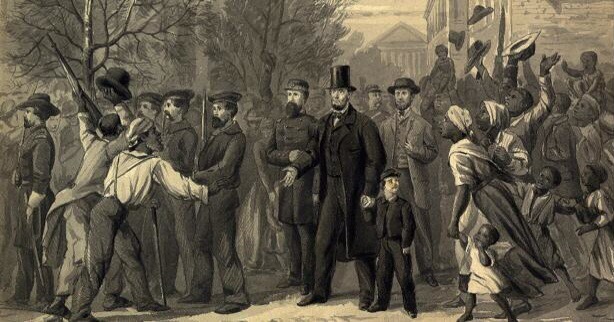
Lincoln in Richmond 

On April 4th 1865 Abraham Lincoln entered Richmond to the cheers of the now former slaves still in the city. A journalist described the scene,

“The gathered around the President, ran ahead, hovered upon the flanks of the little company, and hung like a dark cloud upon the rear. Men, women, and children joined the consistently increasing throng. They came from the by-streets, running in breathless haste, shouting and hallooing and dancing with delight. The men threw up their hats, the women their bonnets and handkerchiefs, clapped their hands, and sang, Glory to God! Glory! Glory! Glory!” [58]

One old man rushed to Lincoln and shouted “Bless the Lord, the great Messiah! I knowed him as soon as I seed him. He’s been in my heart four long years, and he’s come at last to free his children from their bondage. Glory, hallelujah!” He then threw himself at the embarrassed President’s feet and Lincoln said, “Don’t kneel to me. You must kneel to God only, and thank Him for the liberty you will enjoy hereafter.” [59]

Emancipation had finally arrived in Richmond, and in the van came the men of the U.S. Colored Troops who had rallied to the Union cause, followed by the man who had made the bold decision to emancipate them and then persevere until that was reality.

Notes

[1] Ibid. McCurry Confederate Reckoning p.310

[2] Ibid. McPherson. The Battle Cry of Freedom p.832

[3] Ibid. McCurry Confederate Reckoning p.324

[4] Ibid. McPherson. The Battle Cry of Freedom p.831

[5] Ibid. McCurry Confederate Reckoning p.325

[6] Ibid. Levine The Fall of the House of Dixie p.167

[7] Ibid. Thomas, The Confederate Nation p.262

[8] Ibid. Levine The Fall of the House of Dixie p.167

[9] Ibid. McCurry Confederate Reckoning p.326

[10] Ibid. Levine The Fall of the House of Dixie p.167

[11] Ibid. Thomas, The Confederate Nation p.262

[12] Winik, Jay April 1865: The Month that Saved America Perennial an Imprint of Harper Collins Publishers New York 2002 p.53

[13] Ibid. McCurry Confederate Reckoning p.327

[14] Ibid. Guelzo Fateful Lightening p. 370

[15] Ibid. Thomas, The Confederate Nation p.262

[16] Ibid. McCurry Confederate Reckoning p.327

[17] Ibid. McPherson. The Battle Cry of Freedom p.833

[18] Ibid. Thomas, The Confederate Nation p.262

[19] Ibid. Guelzo Fateful Lightening p. 370

[20] Ibid. Gallagher The Confederate War p.47

[21] Ibid. Davis, William C. Jefferson Davis p.598

[22] Ibid. McCurry Confederate Reckoning p.335

[23] Ibid. McCurry Confederate Reckoning p.335

[24] Ibid. Guelzo Fateful Lightening p. 370

[25] Ibid. McPherson. The Battle Cry of Freedom p.835

[26] Ibid. Guelzo Fateful Lightening p. 370

[27] Ibid. Foner Forever Free p.55

[28] Ibid. Guelzo Fateful Lightening p. 370

[29] Korda, Michael. Clouds of Glory: The Life and Legend of Robert E. Lee Harper Collins Publishers, New York 2014 p.643

[30] Ibid. McPherson. The Battle Cry of Freedom p.836

[31] Cobb, Howell Letter to James A. Seddon, Secretary of War, January 8, 1865 in the Confederate and Neo-Confederate Reader: The “Great Truth” about the “Lost Cause” Loewen, James W. and Sebesta, Edward H. Editors, University Press of Mississippi, Jackson 2010 Amazon Kindle edition location 4221 of 8647     

[32] Ibid. Thomas, The Confederate Nation p.293

[33] Ibid. McPherson. The Battle Cry of Freedom p.836

[34] Ibid. Guelzo Fateful Lightening p. 370

[35] Ibid. McCurry Confederate Reckoning p.337

[36] Ibid. McPherson. The Battle Cry of Freedom p.836

[37] Ibid. Foote. The Civil War, A Narrative Volume Three pp.754-755

[38] Ibid. Guelzo Fateful Lightening p. 370

[39] Ibid. Guelzo Fateful Lightening p. 370

[40] Ibid. Pryor Reading the Man p.396

[41] Ibid. Foote. The Civil War, A Narrative Volume Three p. 755

[42] Ibid. Thomas, The Confederate Nation p.296

[43] Ibid. McPherson. The Battle Cry of Freedom p.836

[44] Ibid. Foote. The Civil War, A Narrative Volume Three p.755

[45] Ibid. McPherson. The Battle Cry of Freedom p.837

[46] Ibid. Foote. The Civil War, A Narrative Volume Three p.860

[47] Ibid. McPherson. The Battle Cry of Freedom p.837

[48] Ibid. Foote. The Civil War, A Narrative Volume Three p.860

[49] Ibid. McPherson. The Battle Cry of Freedom p.835

[50] Ibid. Pryor Reading the Man p.397

[51] Confederate Congress General Orders, No. 14, An Act to Increase the Military Force of the Confederate States, Approved March 13, 1865 in the Confederate and Neo-Confederate Reader: The “Great Truth” about the “Lost Cause” Loewen, James W. and Sebesta, Edward H. Editors, University Press of Mississippi, Jackson 2010 Amazon Kindle edition location4348 of 8647

[52] Ibid. Foote. The Civil War, A Narrative Volume Three p.860

[53] Ibid. Guelzo Fateful Lightening p. 386

[54] Levine, Bruce Half Slave and Half Free: The Roots of the Civil War Revised Edition, Hill and Wang, a division of Farrar, Strauss and Giroux, New York 1992 and 1995 p.241

[55] Ibid. Guelzo Fateful Lightening p. 476

[56] Catton, Bruce Grant Takes Command Little, Brown and Company Boston, Toronto and London 1968 p.411

[57] Ibid. Levine Half Slave and Half Free pp.241-242

[58] Ibid. Levine The Fall of the House of Dixie p.275

[59] Ibid. Foote. The Civil War, A Narrative Volume Three p.897

3 Comments

Filed under civil rights, civil war, History

Equality: The Early Women’s Rights Movement

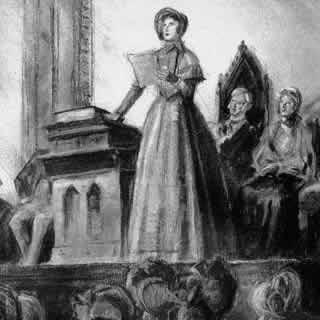
senecafalls-womanspeaking

The Seneca Convention

Friends of Padre Steve’s World,

The issue of Women’s Rights is still in the forefront of political debate in the United States. Women’s rights have been slow to progress despite the passage of the 19th Amendment which gave women the right to vote in 1920. The defeat of the Equal Rights Amendment in 1982 gave added ammunition to conservative opponents of Women’s rights to fight them.

Though women have long been in the workplace in many cases there is a large gap in pay for men and women doing the same jobs and having the same qualifications, likewise, the number of women in senior positions in the private sector and in government is still dwarfed by the numbers of men. The are numerous disparities in how men and women are treated in society, and in many cases and in many parts of conservative society, especially churches, women are still considered less than equal to men. In light of the fact that we will likely have a woman running as the Democratic Party nominee for President the issue is even more pronounced, and Hilary Clinton, whether one likes her or not, and regardless of her policies, or previous record as a Senator or Secretary of State, is held to a higher standard of scrutiny than men in those position.

But this is nothing new, and in light of this I have decided to re-post a sightly edited portion of the chapter in my Civil War and Gettysburg text that deals with the early Women’s Rights movement. I hope that you find it insightful.

Peace

Padre Steve+

Another development, which in large part is related to the abolition movement, was the campaign for women’s rights. The Civil War was also revolutionary because it was instrumental in propelling women into positions in American society that they had never before been allowed. The war Some of this was because many women decided to like those who campaigned for the end of slavery and the rights of African Americans to turn the world upside down. The war allowed the women who served, “in uniform or not, war permitted these women to experiment with a series of role reversals in gender,” [1] and in some cases gender and race. These experiments are the beginning of women’s’ equality and to women serving in the military.

In much of the country and in particular the South, women’s rights were the same as granted in English Common Law. Common law held to the more archaic understanding of the Christian Church that women were the property of their husbands, especially in cases of infidelity including during the trial of Dan Sickles for killing Barton Key.

Southern culture and law ensured that women had even few rights than the women in the North who were making some gains in the workplace and in various professions such as teaching and nursing. This was in large part due to the understanding that the “household was a spatial unit, defined by the property to which the owner not only held legal title over, but over which he exercised exclusive rights.” [2] As such Southern men had nearly unlimited rights and power over what occurred on his property, for “in societies in which landed property comprised the chief means of subsistence…legal title to the land had historically incorporated claims over the persons and labor of those who were dependents on it.” [3]

Thus for Southern men the stakes of ensuring slavery’s continuation and expansion were high, the culture of the South ante-bellum South was deeply patriarchal and “The possibility that the black man might be empowered like any other was such a threat to the southern social hierarchy that some white southerners were inclined to fear not only for their position as slaveowners but for the entire basis of their claim to patriarchal power. They feared for their power not only over their slaves but over their women as well.[4]

William Lloyd Garrison and the leaders of the abolitionist movement came into contact with two southern women who had converted to the abolitionist cause; South Carolina cotton heiresses, Sarah and Angelina Grimke. The two women were passionate as well as eloquent and became popular lecturers on the abolitionist speaking circuit. Angelina Grimke was a powerful speaker and linked abolition and women’s rights:

“We cannot push Abolitionism forward with all our might until we take up the stumbling block out of the road…. If we surrender the right to speak in public this year, we must surrender the right to petition next year, and the right to write the year after, and so on. What then can the woman do for the slave, when she herself is under the feet of man and shamed into silence?” [5]

The Grimke sisters and other women like them brought Garrison and others in the abolitionist movement into contact with the early leaders of the new women’s rights movement. The leaders of the movement, Elizabeth Cady Stanton, Abby Kelley, and Lydia Maria Child were outspoken in their belief that “a campaign to emancipate slaves could not avert its eyes from the need to emancipate American women from social conventions and legal restraints that prevented them, like the slave, from owning property and voting, and kept them altogether subservient to the interests of white males.” [6]

The principals involved in the abolitionist and the women’s movements, those of freedom, emancipation and equality eventually forged a bond between them, and have provided inspiration to others in their quest for political and social equality. For William Lloyd Garrison “the woman question clearly demonstrated how the logic of reform united all good causes and carried them to new ground. If in their endeavors to break the chains of slavery women discovered, as Abby Kelley put it, that “we were manacled ourselves,” the abolitionist principle required a defense of equal rights without regard to race or sex.” [7]

However, women found that their rights were not considered as important by the political leadership fighting for the rights of black men. Few in Congress “responded sympathetically to feminists’ demands. Reconstruction they insisted, was the “Negro’s hour.” [8] Though the economic situation of women began to improve, especially through women being admitted to the Civil Service. Likewise women began to have more educational opportunities in the post-war years. Women’s suffrage was not included in the Fifteenth Amendment, which caused a split between women’s groups and their long-time abolitionist allies who told them “If put on the same level and urged in the same connection, neither will soon be accomplished.” [9]  Even so in some territories women were granted the right to vote in territorial elections, “women were given the vote in Wyoming Territory in 1869. However, Wyoming’s admission as a state twenty years later came only after a heated debate on the women’s suffrage article in the state constitution.” [10]

Elizabeth Cady Stanton

In the 1800s women in the United States were bound by English common law. Women had no claim to property, wages, or even their children. Single women had few rights while married women had even fewer as:

“marriage very nearly meant the legal annihilation of a woman…once a woman was married all property and property rights were transferred to her husband, and she was permitted to own nothing in her own name. Married women could not make contracts, could not sue, could not buy or sell, except over their husband’s signatures.” [11]

A married woman’s position was as close to being a slave as could be, and only the plight of black female slaves was worse, for they were simply chattel. The few free black women mainly stayed unmarried “in order to maintain what few property rights they were entitled to.” [12] As they also did over blacks, white men ruled over women in all spheres of life. While the eventual emancipation of blacks provided more rights for black men, those did not help many black women as Sojourner Truth, a pioneering African-American abolitionist who spent forty-years as a slave said toward the end of her long life:

“There is a great stir about colored men getting their rights, but not one word about colored women; and if colored men get their rights, and not colored women theirs, you see colored men will be master over the women, and it will be just as bad as it was before. So I am for keeping the thing going while things are still stirring because if we wait till it is still, it will take a great while to get it going again….I suppose I am the only colored woman that goes on to speak for the rights of the colored women. I want to keep the thing stirring, now that the ice is cracked…” [13]

Elizabeth Cady Stanton was among the most vocal of women’s rights advocates. She believed that a woman’s place in the home was ultimately destructive and “reflected her subordinate position in society and confined her to domestic duties that served to “destroy her confidence in her own powers, lessen her self respect, and to make her willing to lead a dependent and abject life.” [14] Stanton noted how the condition of women of her day was “more fully identified with the slave than man possibly can be… For while the man is born to do whatever he can, for the woman and the negro the is no such privilege.” [15] It was a key observation and something even today, a state that some politicians, pundits and preachers would like to return women.

Since nearly all of the most “outspoken feminists had been schooled in abolitionist movement” they were “suspect in the South, where society was conservative, patriarchal, and insistence that ladies live in a kind of earthly limbo.” [16] Such women posed a threat to the pillars of Southern society. Since the South was now fighting tooth and nail against the abolitionist movement, anything closely connected with that movement, including the women who advocated abolition and women’s rights were shunned and their message rejected and inflammatory and revolutionary. It was not until the crisis caused by the Civil war that Southern women began to seize “the opportunity to lay claim to an increased reciprocity in gender relations.” [17]

But even with the abolition movement there was opposition the women’s rights, the 1839 meeting of the American Anti-Slavery Society witnessed a debate over including women in the membership. Conservative Evangelicals recoiled in disgust, and when the convention voted to allow women into the membership Lewis Tappan “got up a starchy “protest” which condemned the “repugnant” admission of women as an ‘expression of local and sectarian feelings…well suited to the unnecessary reproach and embarrassment to the cause of the enslaved as [it] is at variance with the general usage and sentiments of this and other nations.” [18] In May of 1840 the American Anti-Slavery Society split among religious lines when leading evangelicals led by the Tappan brothers withdrew from it.

But that neither stopped Garrison from working with women, nor kept Frederick Douglass from embracing them as part of the abolitionist movement. From this rather inauspicious beginning, the women’s rights movement began to infiltrate society, especially in the field of education. In 1848 at Seneca New York there was a convention that launched the modern women’s rights movement. Led by Stanton and Elizabeth Mott the delegates published a “Declaration of Sentiments, modeled on the Declaration of Independence, proclaimed “that all men and women are created equal” and deserved their “inalienable rights” include the right to elective franchise.” [19] The declaration was bold and its denunciation of the place of women in society to be considered revolutionary in character. Part read:

“He has never permitted her to exercise her inalienable right to elective franchise. He has compelled her to submit to laws, in the formation of which she had no voice. He has withheld from her rights which are given to the most ignorant and degraded men – both natives and foreigners… He has made her, if married, in the eye of the law, civilly dead. He has taken from her all right to property, even to the wages that she earns…. After depriving her of all her rights as a married woman, if single, and the owner of property, he has taxed her to support a government which recognizes her only when her property can be made profitable to it. He has monopolized nearly all the profitable employments, and from those she is permitted to follow she receives but a scanty remuneration. He closes against her all the avenues to wealth and distinction which he considers honorable to himself. As a teacher of theology, medicine of the law, she is not known… He has created a false public sentiment by giving the world a different code of morals for men and women, by which moral delinquencies which exclude women from society, are not only tolerated, but deemed of little account in man. He has usurped the prerogative of Jehovah alone, claiming his right to assign for her a sphere of action, when that belongs to her conscience and to her God. He has endeavored, in every way that he could, to destroy her confidence in her own powers, lessen her self-respect, and to make her willing to lead an abject and dependent life.” [20]

The declaration also stated, in words which inflamed many men that: “the history of mankind is a history of repeated injuries and usurpations on the part of man toward woman, having in direct object of an absolute tyranny over her.” [21] In the years following this meeting women took up an even more important place in the abolitionist movement, Abby Kelly Foster returned to head the work and recruited many talented women agents including Sallie Holley, Lucy Stone and Susan B. Anthony who “often made five or six appearances a week” in various abolitionist meetings and in 1850-1851 they were joined by the “black evangelist Sojourner Truth, whom Garrison had met and the Northampton colony in 1843 and for whom he had printed an autobiographical narrative.” [22] These women contributed greatly to the abolitionist cause and would in the years to come be among those who continued to fight not only for the rights of blacks, but the rights of women.

The new women’s rights groups continued to work hand in hand with the abolitionist groups but also began a campaign for the rights of women. In the mid-1850s primarily focused on “obtaining state laws guaranteeing women’s right to control their property and wages, to be legal guardians of their children, and to be paid salaries commensurate with their labors, while a few women advocated for more liberal divorce laws so that they could rid themselves of alcoholic, insane, criminal, or brutal husbands.” [23] These efforts secured some modest gains and by 1861 most states had granted women some type of property rights or had changed their laws to follow the community property principle.

While the movement made modest progress regarding property rights for women in some states, they made little progress in terms of elective franchise and better wages and working conditions. During the ante-bellum period, women who lobbied for such rights were met with open opposition and scorn. The press “frequently denounced and ridiculed the “strong-minded women…” [24] Despite such attitudes women did make some significant advancements, particularly in lay aspects of the church, such as Bible societies, moral reform organizations, as well as the abolition and temperance movements, which had gained prominence during the Second Great Awakening.

During the ante-bellum period women made great progress in education. By 1850 the United States was the only country where “girls went to elementary school and achieved literacy in virtually the same proportion as boys.” [25] Likewise a few women entered higher education, particularly at women’s seminaries, which were for all practical purposes boarding schools that produced teachers and writers, as well as the Oberlin College, which was founded by Christian abolitionists and welcomed students of both genders as well as of any racial minority. During the three decades prior to the war women made some specific gains, but more important “was the development to their talents for organization, cooperation, leadership, and self expression. It was a time of beginnings and not fulfillment, a time when most women realized and accepted the fact that they lived in a man’s world, a time when a few dedicated but belligerent visionaries were frustrated in their attempt to remake the social order “overnight.” [26]

However, the war would help bring about many more opportunities for women. In 1850 a follow on conference to the Seneca conference, the National Women’s Rights Convention denied the right of anyone to dictate what women could do with their lives:

“The right of any portion of the species to decide for another portion, of any individual to decide for another Individual what is not their “proper sphere”; that the proper sphere for all human beings is the largest and highest to which they are able to attain; what this is, can not be ascertained without complete Liberty of choice; women therefore, ought to choose for herself what sphere she will fill, what education she will seek, and what employment she will follow, and will not be bound to accept, in submission, the rights, the education, and the place which man thinks proper to allow her.” [27]

Notes

[1] Ibid. Guelzo Fateful Lightening p.395

[2] McCurry, Stephanie The Politics of Yeoman Households in South Carolina in Divided Houses: Gender and the Civil War Oxford University Press, Oxford and New York 1992 p.23

[3] Ibid. McCurry The Politics of Yeoman Households in South Carolina p.23

[4] Whites, Leeann The Civil War as a Crisis in Gender in Major Problems in the Civil War and Reconstruction, 3rd Edition Edited by Michael Perlman and Murrell Taylor Wadsworth Centage Learning, Boston 2011 p.16

[5] Ibid. Zinn The Other Civil War p.121

[6] Ibid. Guelzo Fateful Lightening pp.49-50

[7] Mayer, Henry All on Fire: William Lloyd Garrison and the Abolition of Slavery W.W. Norton and Company, New York and London 1998 p.265

[8] Ibid. Foner Forever Free p.124

[9] Ibid. Foner Forever Free p.125

[10] Massey, Mary Elizabeth, Women in the Civil War University of Nebraska Press, Lincoln NE 1966 p. 358

[11] Ibid. Guelzo Fateful Lightening p.391

[12] Ibid. Guelzo Fateful Lightening p.391

[13] Ibid. Zinn The Other Civil War pp.53-54

[14] Ibid. Goldfield America Aflame p.74

[15] Ibid. Guelzo Fateful Lightening p.50

[16] Ibid. Massey Women in the Civil War p. 19

[17] Ibid. Whites The Civil War as a Crisis in Gender p.21

[18] Ibid. Mayer All on Fire p.267

[19] Ibid. McPherson Battle Cry of Freedom p.36

[20] Blanton, DeAnne and Cook, Lauren M. They Fought Like Demons: Women Soldiers in the Civil War Vintage a books, a Division of Random House New York 2002 pp.3-4

[21] Ibid. Guelzo Fateful Lightening p.392

[22] Ibid. Mayer All on Fire p.424

[23] Ibid. Massey Women in the Civil War p.21

[24] Ibid. Massey Women in the Civil War pp.21-22

[25] Ibid. McPherson The Battle Cry of Freedom p.36

[26] Ibid. Massey Women in the Civil War p.23

[27] Ibid. Guelzo Fateful Lightening p.392.

1 Comment

Filed under civil rights, History, laws and legislation, leadership, News and current events, Political Commentary

Freedom’s Pilot: Robert Smalls Fight for Freedom


Friends of Padre Steve’s World,

There are some people and events that are important but get swept up in broader historic events. One such story is that of Robert Smalls, a slave in Charleston South Carolina. Smalls was hired out to work with the money going to his master. He worked in a number of jobs, but as a teenager fell in love with the sea. He went to work as a slave worker on the city’s waterfront where he started as a common dockworker, became a rigger, a sailmaker, and finally a wheelman, which basically was a ship’s pilot, since slaves were not permitted that title. Even so his abilities and knowledge of Charleston harbor well well known and respected by ship owners. 


When South Carolina seceded and the Confederacy went to war, Smalls was assigned as wheelman of the CSS Planter, a small and lightly armed transport. On the night of May 12th and 13th of 1862, Smalls took advantage of all three white officer’s absence ashore, by putting into effect an escape plan he had worked out with the other slave crew members of Planter. Smalls and seven other slaves got the ship underway, with Smalls donning the captain’s uniform and a straw hat similar to the captain’s. In the darkness the ruse was perfect, no Confederades ashore suspected anything as Planter stopped to pick up the escaped slaves family members at another wharf before Smalls sailed out past the range of the Confederate shore battery guns to surrender to the USS Onward. Smalls present the U.S. Navy with the ship, her cargo, which included four artillery pieces intended for a Confederate fort in the harbor, but more importantly a Confederate code book and charts showing the location of deadly undersea mines and torpedoes that had been laid in the harbor. 

Smalls quickly became a hero. Congress voted him and his crew the prize money for the ship, and he met with Secretary of War Stanton to argue the case that blacks should be allowed to serve. Smalls’ story helped convince Lincoln of allowing African Americans to serve in the United Staes forces. Smalls served as a civilian pilot working for the Navy and and the Army, serving in numerous battles. He was the pilot for the experimental ironclad USS Keokuk when that ship was heavily damaged by over 90 hits at Charleston. He was responsible for getting the ship safely out of range of the  Confederate batteries before she sank, thus saving many crew members. 

He then was reassigned to the USS Planter, now assigned to the Army. The ship got caught in a crossfire between the Union and Confederate forces and Planter’s captain ordered the ship to surrender. Smalls objected, knowing that any African American caught serving Union forces would not be treated as prisoners of war, but either returned to slavery or executed by order of the Confederate Congress. Smalls took command of the vessel and steered her out of harm’s way. He was appointed Captain of the ship and was present for the ceremonial raising of the American flag over Fort Sumter in April 1865. Smalls was the first African American to command a ship in the service of the U.S. Military.

After the war Smalls got an education and when the 14th Amendment was passed ran for office, serving in the South Carolina legislature and as a member of Congress. He fought against changes to the 1895 South Carolina Constituion that disenfhchised African Americans and codified the Jim Crow laws which had be upheld by the Supreme Court in Plessy v. Ferguson. 

In 1889 Smalls was appointed U.S. Collector of Customs in Beaufort and served in that office until 1911. He also was director of a black owner railroad, and helped publish the black owners Beaufort Standard newspaper. He died in 1915 at the age of 75. 

Small’s courage and his fight for freedom, as well as others who did so should not be forgotten. 

Peace,

Padre Steve+ 

Leave a comment

Filed under civil rights, civil war, History, leadership, Military

The Unreconstructed President: Andrew Johnson

Friends of Padre Steve’s World

I am going to be exploring the issue of the abolition of slavery and Reconstruction after the Civil War. Sadly, the effort to integrate society and to ensure that African Americans had the same rights, political, social, legal, economic and educational as whites failed due to a number of factors. The biggest factor was that former Confederates continued the war by other means until they wore down the will of the North and reestablished white supremacy in all areas of Southern life and in the process re-wrote history in the form of the myth of the Lost Cause, something that continues even today with the new Texas history textbooks which promote that myth, minimize slavery and not even talk about Jim Crow. 

Yesterday I received a comment from an officer of the Sons of Confederate Veterans and the Georgia Military Order of the Stars and Bars calling my work revisionism and spouting the lies of the sanitized history presented by such groups.  That has emboldened me to continue my work on this subject. Here is a part of my text dealing with the immediate aftermath of the Civil War and the work of President Andrew Johnson to subvert the efforts of Congress and those who worked to provide African Americans the basics to lift themselves out of the hole dug for them by their White masters before the war. 

So I continue today,

Peace

Padre Steve+

10467FS_DA_090409_worst-johnson

Andrew Johnson

Colin Gray writes that “A successful exercise in peacemaking should persuade the defeated party to accept its defeat.” [1] When the war ended the Confederacy was beaten and most people in the South would have agreed to anything that the North presented regarding peace and return to the Union. The primary political policy goal of Lincoln regarding the war was the reestablishment of the Union and one of the military measures adopted by Lincoln was the emancipation of the South’s slaves who were an important part of the Southern war economy. “During the last two years of the war the abolition of slavery evolved from a means of winning the war to a war aim – from national strategy to national policy.” [2] By Lincoln’s reelection in 1864 that policy included the unconditional surrender of the Confederacy as well as the passage of the Thirteenth Amendment.

That change in policy, the complete abolition of slavery necessitated a remaking of the old South, a culture where economics, social standing and even religion was linked to the “peculiar institution.” In a sense Reconstruction was “what the war was about.” [3] Just two months after Lee’s surrender at Appomattox, Richard Henry Dana, a Federal District Attorney in Boston, declared that “a war is over when its purpose is secured. It is a fatal mistake to hold that this war is over because the fighting has ceased. This war is not over…” [4] As Dana, and Clausewitz understood so well that war is a continuation of policy and politics by other means, and the failure of the President Johnson and others in the North to fully grasp this fact led to over a century of subjugation of emancipated African Americans. The confusion and lack of determined purpose has fueled a continual racial divide in the United States that is still felt today. Defeated on the battlefield Southerners soon turned to political, psychological and violent means to reverse their losses.

Douglass.JPG

Frederick Douglass

Frederick Douglass understood that simple emancipation was not enough, and that the “war and its outcome demanded racial equality.” [5] Despite the that efforts of many in the North this would not happen during Reconstruction and Douglass knew that the failure to accomplish this would be disastrous, “Whether the tremendous war so heroically fought…shall pass into history a miserable failure…or whether on the other hand, we shall, as the rightful reward of victory over treason have a solid nation, entirely delivered from all contradictions and social antagonisms, must be determined one way or another.” [6]

There was a problem with implementing Reconstruction; when John Wilkes Booth assassinated Abraham Lincoln, the political leaders of the North could not agree on how to do this. The new President, Andrew Johnson was probably the worst possible leader to lead the country in the aftermath of war for all practical purposes Johnson was a Democrat who believed in white supremacy, he had been brought onto the ticket for his efforts to keep Kentucky in the Union and to support Unionist elements in Tennessee. While his selection helped Lincoln in parts of the North and the Border States it was a disaster for the post-war era. Johnson’s approach to reconstruction was very simply to “impose minimal demands on the South. He required only minor concessions from the former Confederates before allowing them to resume their political rights and retain their land. As for freedmen, he seemed to think that the needed no further protection beyond the fact of their emancipation.” [7]

Johnson was “a lonely stubborn man with few confidants, who seemed to develop his policies without consulting anyone, then stuck to them inflexibly in the face of any and all criticism. He lacked Lincoln’s ability to conciliate his foes and his capacity for growth, which was best illustrated by Lincoln’s evolving attitude to black suffrage during the Civil War.” [8] In the months after his unexpected accession to the presidency Johnson demonstrated that he had no understanding of Lincoln’s political goals for the South and the desires of the Republican dominated Congress.

By the summer of 1865 Johnson was already demonstrating “that his sympathies were with the Southern white population and that he believed that their interests should be cared for even at the expense of freedmen.” [9] Johnson’s approach to reconstruction was very simply to “impose minimal demands on the South. He required only minor concessions from the former Confederates before allowing them to resume their political rights and retain their land. As for freedmen, he seemed to think that the needed no further protection beyond the fact of their emancipation.” [10] Johnson gave individual pardons to more than thirteen thousand “high-ranking Confederate civil and military officers and wealthy Southerners.” [11] While doing this he minimized political influence the Southern Unionists who had not supported the Confederacy and ensured that freed slaves were excluded from the political process. He issued a number of orders “appointing interim provisional governors and urging the writing of new state constitutions based upon the voter qualifications in force at the time of secession in 1861 – which meant, in large but invisible letters, no blacks.” [12]

When Frederick Douglass led a delegation of blacks to meet with Johnson in February 1866 Johnson preached that it was impossible to give political freedom to blacks. When Douglass attempted to object Johnson became angry and told Douglass “I do not like to be arraigned by some who can get up handsomely-rounded periods and rhetoric, and talk about abstract ideas of liberty, who never periled life, liberty, or property.” [13] When Douglass took his objections to Johnson’s harangue to a Washington newspaper, Johnson railed against Douglass “I know that d—–d Douglass…he’s just like any other nigger & would sooner cut a white man’s throat than not.” [14]

To be continued…

Notes

[1] Ibid. Gray Fighting Talk p.14

[2] Ibid. McPherson The War that Forged a Nation p. 132

[3] Perman, Michael and Murrell Taylor, Amy editors The Civil War and Reconstruction Documents and Essays Third Edition Wadsworth Cengage Learning Boston MA 2011 p.323

[4] Ibid. McPherson The War that Forged a Nation p. 175

[5] Ibid. Goldfield America Aflame p.407

[6] Ibid. Goldfield America Aflame p.407

[7] Ibid. Perman and Taylor The Civil War and Reconstruction Documents and Essays Third Edition p.323

[8] Foner, Eric Forever Free: The Story of Emancipation and Reconstruction Vintage Books a Division of Random House, New York 2005 p.108

[9] Carpenter, John A. Sword and Olive Branch: Oliver Otis Howard Fordham University Press, New York 1999 p.109


[10] Ibid. Perman and Taylor The Civil War and Reconstruction Documents and Essays Third Edition p.323

[11] Ibid. McPherson The War that Forged a Nation p. 177

[12] Ibid. Guelzo Fateful Lightening p.490

[13] Ibid. Guelzo Fateful Lightening p.494

[14] Ibid. Guelzo Fateful Lightening p.494

Leave a comment

Filed under civil rights, civil war, History, Political Commentary

A Great Day for Liberty for All

Mini-Stonewall

Friends of Padre Steve’s World

Today is a good day for freedom. It has been to long coming. The Supreme Court, citing the Fourteenth Amendment ruled in favor of Marriage Equality for Gays Lesbians and others in the LGBTQ community in the case of Obergfell v. Hodges. I am quite happy for my Gay and Lesbian friends  for this.

As historian and who has and continues to study the American Civil War, especially the fight for the abolition of slavery, the emancipation of African Americans and the extension of the the full benefits of citizenship and liberty.

As early as 1854 Lincoln posed the idea that the Declaration of Independence was the standard maxim of free society …constantly spreading and deepening its influence,” ultimately applicable “to peoples of all colors everywhere.” 

The understanding that the liberties enunciated in the Declaration extend to first to African-Americans was made part of the Constitution in the Thirteenth, Fourteenth and Fifteenth Amendments to the Constitution. The precedent of Fourteenth Amendment has been used to grant Suffrage to Women, to end Jim Crow laws, Black Codes and Separate but Equal laws. Today it was correctly used to ensure that all people have the freedom to marry.

The ruling was about liberty, it was about equality, it was about due process, and today the Court’s majority noted:

The history of marriage as a union between two persons of the opposite sex marks the beginning of these cases. To the respond- ents, it would demean a timeless institution if marriage were extend- ed to same-sex couples. But the petitioners, far from seeking to devalue marriage, seek it for themselves because of their respect—and need—for its privileges and responsibilities, as illustrated by the petitioners’ own experiences.

The history of marriage is one of both continuity and change.

Changes, such as the decline of arranged marriages and the abandonment of the law of coverture, have worked deep transformations in the structure of marriage, affecting aspects of marriage once viewed as essential. These new insights have strengthened, not weakened, the institution. Changed understandings of marriage are characteristic of a Nation where new dimensions of freedom become apparent to new generations.

They also added:

The fundamental liberties protected by the Fourteenth Amendment’s Due Process Clause extend to certain personal choices central to individual dignity and autonomy, including intimate choic- es defining personal identity and beliefs.

Most of the opposition to Gay marriage and for that matter to all Gay Rights has been from conservative Christians. Sadly it was conservative Christians who have been in the forefront of denying liberty to people in the country since the beginning of the abolition movement in the 1830s. They labeled fellow evangelicals in the abolition movement as “atheists, infidels, communists, free-lovers, Bible-haters, and anti-Christian levelers.” 

This was not limited to Southern  conservative Christians.

The fact that so many Protestant ministers, intellectuals, and theologians, not only Southerners, but men like “Princeton’s venerable theologian Charles B. Hodge – supported the institution of slavery on biblical grounds, often dismissing abolitionists as liberal progressives who did not take the Bible seriously” leaves a troubling question over those who claim to oppose issues on supposedly Biblical grounds. Such men in the North spoke out for it “in order to protect and promote interests concomitant to slavery, namely biblical traditionalism, and social and theological authority.” [1] The Northern clerical defenders of slavery perceived the spread of abolitionist preaching as a threat, not just to slavery “but also to the very principle of social and ecclesiastical hierarchy.” [2]Alistair McGrath asks a very important question for modern Christians who might be tempted to support a position for the same reasons today, “Might not the same mistakes be made all over again, this time over another issue?” [3]

Throughout American history conservative Christians have often espoused a concept of limited liberty, liberty for the few and the powerful. This happened as I have noted during the fight against emancipation, but also Women’s Suffrage and the various Jim Crow laws and rights for other groups. This is happening again today with anti-Gay Christians attacking the ruling and like those who fought abolition proclaiming in apocalyptic language that Christians will be persecuted and that God will judge the United States for allowing Gays to marry.

However, the fact is that very little will change in the country, most people will move along. Christian conservatives will not be persecuted, religious liberties will not be violated they will be enhanced as churches who allow Gays to marry will be able to extend this rite of their churches to their parishioners and others.

Today, despite the cries of many on the American Religious Right liberty has been protected. as Lincoln said: the declaration’s promise of equality was “a beacon to guide” not only “the whole race of man then living” but “their children and their children’s children, and the countless myriads of generations who should inhabit the earth in other ages.” [4]

Marriage-Equality-104371316011_xlarge

I am happy for my Gay friends who have labored for this for so long enduring hatred, violence and social, political, religious and economic discrimination for so many years.

Have a great night,

Peace

Padre Steve+

[1] Ibid. Daly When Slavery Was Called Freedom p.38

[2] Ibid. Varon Disunion! P.108

[3] Ibid. McGrath Christianity’s Dangerous Idea p.324

[4] Ibid. Goodwin Team of Rivals p. 203

3 Comments

Filed under civil rights, ethics, faith, History, laws and legislation, LGBT issues, News and current events, Political Commentary, Religion

Soldiers, Spies & Nurses Remarkable Women of the Civil War

women-civil-war-sarah-edmonds-frank-thompson-631

Friends of Padre Steve’s World

I have been doing a lot of work on my Gettysburg and Civil War text and as I was doing so I have been working on my introductory chapter. In my last revision of it I had finally decided to add a section on how the war began the process of changing our society in terms of the rights of women.

Like I said I have been revising that chapter and when I got to the section on women I was unsatisfied. This resulted in me deciding to chase some rabbits and see where they led.

The results were amazing enough that I decided to significantly expand that section of the chapter. As I looked at the lives of these women I decided that the revision needed to include at least some of these remarkable women’s stories. The sad thing is in so many histories the role of women, like that of African Americans and other minorities is so often overlooked, and that is a tragedy because all of these things mattered so much then, but also today.

Right now this is kind of a “wave top” view of these women, and for me there is much more to look into.

I do hope that you enjoy this.

Peace

Padre Steve+

civilwar-07-patient1

Sarah Edmonds as Frank Thompson tending a Mortally Wounded woman fighting as a Man at Antietam

Another development, which in large part is related to the abolition movement was the campaign for women’s rights. “The Civil War uprooted institutions, transformed our politics, influenced social relationships of half a continent, and wrought changes that echo down the generations.” [1]

The Civil War was also revolutionary because it was instrumental in propelling women into positions in American society that they had never before been allowed. The war Some of this was because many women decided to like those who campaigned for the end of slavery and the rights of African Americans to turn the world upside down. The war allowed the women who served, “in uniform or not, war permitted these women to experiment with a series of role reversals in gender,” [2] and in some cases gender and race. These experiments are the beginning of women’s’ equality and to women serving in the military.

William Lloyd Garrison and the leaders of the abolitionist movement came into contact with two southern women who had converted to the abolitionist cause; South Carolina cotton heiresses, Sarah and Angelina Grimke. The two women were passionate as well as eloquent and became popular lecturers on the abolitionist speaking circuit. These women brought Garrison and others in the abolitionist movement into contact with the early leaders of the new women’s rights movement. The leaders of the movement, Elizabeth Cady Stanton, Abby Kelley, and Lydia Maria Child were outspoken in their belief that “a campaign to emancipate slaves could not avert its eyes from the need to emancipate American women from social conventions and legal restraints that prevented them, like the slave, from owning property and voting, and kept them altogether subservient to the interests of white males.” [3] The principals involved in the abolitionist and the women’s movements, those of freedom, emancipation and equality eventually forged a bond between them, and have provided inspiration to others in their quest for political and social equality.

In the 1800s women in the United States were bound by English common law. Single women had few rights while married women had even fewer as:

“marriage very nearly meant the legal annihilation of a woman…once a woman was married all property and property rights were transferred to her husband, and she was permitted to own nothing in her own name. Married women could not make contracts, could not sue, could not buy or sell, except over their husband’s signatures.” [4]

A married woman’s position was as close to being a slave as could be, and only the plight of black female slaves was worse, for they were simply chattel. The few free black women mainly stayed unmarried “in order to maintain what few property rights they were entitled to.” [5] As they also did over blacks, white men ruled over women in all spheres of life.

MTE1ODA0OTcxODA3OTY2NzMz

Sojourner Truth

While the eventual emancipation of blacks provided more rights for black men, those did not help many black women as Sojourner Truth, a pioneering African-American abolitionist who spent forty-years as a slave said toward the end of her long life:

“There is a great stir about colored men getting their rights, but not one word about colored women; and if colored men get their rights, and not colored women theirs, you see colored men will be master over the women, and it will be just as bad as it was before. So I am for keeping the thing going while things are still stirring because if we wait till it is still, it will take a great while to get it going again….I suppose I am the only colored woman that goes on to speak for the rights of the colored women. I want to keep the thing stirring, now that the ice is cracked…” [6]

youngecs

Elizabeth Cady Stanton

Elizabeth Cady Stanton was among the most vocal of women’s rights advocates. She believed that a woman’s place in the home was ultimately destructive and “reflected her subordinate position in society and confined her to domestic duties that served to “destroy her confidence in her own powers, lessen her self respect, and to make her willing to lead a dependent and abject life.” [7] Stanton noted how the condition of women of her day was “more fully identified with the slave than man possibly can be… For while the man is born to do whatever he can, for the woman and the negro the is no such privilege.” [8] It was a key observation and something even today, a state that some politicians, pundits and preachers would like to return women.

Since nearly all of the most “outspoken feminists had been schooled in abolitionist movement” they were “suspect in the South, where society was conservative, patriarchal, and insistence that ladies live in a kind of earthly limbo.” [9] Since the South was turning away from anything closely connected with the abolitionist moment, many there also rejected any form of women’s rights.

But even with the abolition movement there was opposition the women’s rights. In May of 1840 Garrison’s American Anti-Slavery Society split when leading evangelicals led by the Tappan brothers withdrew from it. But that neither stopped Garrison from working with them, nor Frederick Douglass from embracing them. From this rather inauspicious beginning, the women’s rights movement began to infiltrate society, especially in the field of education. In 1848 at Seneca New York there was a convention that launched the modern women’s rights movement. Led by Stanton and Elizabeth Mott the delegates published a “Declaration of Sentiments, modeled on the Declaration of Independence, proclaimed “that all men and women are created equal” and deserved their “inalienable rights” include the right to elective franchise.” [10] The declaration was bold and its denunciation of the place of women in society to be considered revolutionary in character. Part read:

“He has never permitted her to exercise her inalienable right to elective franchise. He has compelled her to submit to laws, in the formation of which she had no voice. He has withheld from her rights which are given to the most ignorant and degraded men – both natives and foreigners… He has made her, if married, in the eye of the law, civilly dead. He has taken from her all right to property, even to the wages that she earns…. After depriving her of all her rights as a married woman, if single, and the owner of property, he has taxed her to support a government which recognizes her only when her property can be made profitable to it. He has monopolized nearly all the profitable employments, and from those she is permitted to follow she receives but a scanty remuneration. He closes against her all the avenues to wealth and distinction which he considers honorable to himself. As a teacher of theology, medicine of the law, she is not known… He has created a false public sentiment by giving the world a different code of morals for men and women, by which moral delinquencies which exclude women from society, are not only tolerated, but deemed of little account in man. He has usurped the prerogative of Jehovah alone, claiming his right to assign for her a sphere of action, when that belongs to her conscience and to her God. He has endeavored, in every way that he could, to destroy her confidence in her own powers, lessen her self-respect, and to make her willing to lead an abject and dependent life.” [11]

The declaration also stated, in words which inflamed many men that: “the history of mankind is a history of repeated injuries and usurpations on the part of man toward woman, having in direct object of an absolute tyranny over her.” [12]

While the movement made modest progress regarding property rights in some states, they made little progress in terms of elective franchise and better wages and working conditions. During the ante-bellum period, women who lobbied for such rights were met with open opposition and scorn. The press “frequently denounced and ridiculed the “strong-minded women…” [13] Despite such attitudes women did make some significant advancements, particularly in lay aspects of the church, such as Bible societies, moral reform organizations, as well as the abolition and temperance movements, which had gained prominence during the Second Great Awakening.

During the ante-bellum period women made great progress in education. By 1850 the United States was the only country where “girls went to elementary school and achieved literacy in virtually the same proportion as boys.” [14] Likewise a few women entered higher education, particularly at women’s seminaries, which were for all practical purposes boarding schools that produced teachers and writers, as well as the Oberlin College, which was founded by Christian abolitionists and welcomed students of both genders as well as of any racial minority. During the three decades prior to the war women made some specific gains, but more important “was the development to their talents for organization, cooperation, leadership, and self expression. It was a time of beginnings and not fulfillment, a time when most women realized and accepted the fact that they lived in a man’s world, a time when a few dedicated but belligerent visionaries were frustrated in their attempt to remake the social order “overnight.” [15]

However, the war would help bring about many more opportunities for women. In 1850 a follow on conference to the Seneca conference, the National Women’s Rights Convention denied the right of anyone to dictate what women could do with their lives:

“The right of any portion of the species to decide for another portion, of any individual to decide for another Individual what is not their “proper sphere”; that the proper sphere for all human beings is the largest and highest to which they are able to attain; what this is, can not be ascertained without complete Liberty of choice; women therefore, ought to choose for herself what sphere she will fill, what education she will seek, and what employment she will follow, and will not be bound to accept, in submission, the rights, the education, and the place which man thinks proper to allow her.” [16]

Of course when war broke out the logical end of this train of though was should women be allowed to serve in the military. Legally and socially it was not possible for women to serve in the military in 1861, but this did not stop women from doing so. Quite a few women on both sides of the conflict chaffed about not being allowed to fight for their countries, their families and their causes, and despite official prohibitions that kept women from serving in any capacity but nursing, a good number of women found their way to go to war. While men in the North and South “were expected to enlist, any woman actively participating in the Civil War was an oddity if not a renegade.” [17] In some cases this involved hundreds of women taking male identities in order to fulfill their desires to serve their countries.

The motives of these women varied. In some cases women wanted gain the economic privileges of full citizenship, and for others the glory reserved to only to men. In our modern parlance those that took male identities would be considered transvestites or possibly transgender, but for them “transvestitism was a private rebellion against public conventions. By taking a male social identity, they secured for themselves male power and independence, as well as full status as citizens of their nation. In essence the Civil War was an opportunity for hundreds of women to escape the confines of their sex.” [18]

Edmonds_inline

Frances Clayton (aka Private Franklin Thompson)

During the war hundreds of women went to war, taking on the identity of men. They enlisted under male names and pretended to be men. Unless they were discovered to be women, or unless they confessed to their wartime service either during or after the war, most of their records were lost. In 1861 Private Franklin Thompson “enlisted in Company F of the 2nd Michigan Infantry…unknown to comrades, Thompson actually was Sarah Emma Edmonds.” [19] Edmonds served in the illustrious Iron Brigade until the disaster at Fredericksburg. Well known for her courage as Franklin Thompson, Edmonds participated in some of the bloodiest combats of the war. At Antietam she was caring for the wounded when she came upon a soldier who had been wounded in the neck. That soldier informed Edmonds that she was dying and after a surgeon came by and confirmed what the soldier said the dying soldier told Edmonds:

“I am not what I seem, but I am female. I enlisted from the purest motives, and I have remained undiscovered and unsuspected. I have neither father, mother nor sister. My only brother was killed today. I closed his eyes about an hour before I was wounded….I am Christian, and have maintained the Christian character ever since I entered the army. I have performed the duties of a soldier faithfully, and am willing to die for the cause of truth and freedom….I wish you to bury me with your own hands, that none may know after my death that I am other than my appearance indicates.” [20]

That unknown woman was not alone, at least nine women, eight Union and one Confederate, fought at Antietam and of those five were casualties. Five women, two Federal and three Confederate took part at Gettysburg. All three Confederate women at Gettysburg were either killed or wounded, or captured, including two women who took part in Pickett’s Charge. [21]

Sarah Edmonds published a book Nurse and Spy in the Union Army while recovering from malaria in 1863. The book, which was published the following year, sold 175,000 copies, the proceeds that she donated to care for sick and wounded Union veterans. After the war, Edmonds attended Oberlin College, married, had three of her own children and adopted two more. She “became a member of the Grand Army of the Potomac, the organization for Union veterans of the Civil War. She applied for, and received, a military pension, and upon her death in 1898 was buried with full military honors.” [22] She was the only women admitted to the Grand Army of the Republic.

Clayton-Francis-L

Frances Clayton 

Another of the women to serve was Frances Louisa Clayton. Fighting for the Union as a member of the Minnesota State Militia Cavalry and 2nd Minnesota Battery, serving under the command of Ulysses S. Grant she was wounded at Fort Donelson. Like many other women soldiers, Clayton mastered the art of behaving as a man. She “became “a capital swordsman,” but also commanded attention with her “masculine stride in walking” and “her erect and soldierly carriage.” [23] After the war she promoted her service becoming a minor celebrity as she told her story.

Albert-Cashier

Albert Cashier (aka Jennie Hodgers)

However, most women were more discreet during and after the war regarding their true sexuality. One of the first true cases of what we would now call transvestism was that of Jennie Hodgers, who became Private Albert Cashier. Jennie/Albert hid her sexuality identity for his entire term of service. He enlisted in August 1862 as a member of the 95th Illinois. Cashier was born in Ireland as a woman, Jennie Hodgers. He fought in forty battles and was discharged with the regiment in August 1865. At Vicksburg he was briefly captured by the Confederates while conducting a reconnaissance “but managed to escape by seizing a gun from one of her guards, knocking him down, and outrunning others. Comrades recalled Private Cashier climbing to the top of their fieldworks to taut the enemy into showing themselves.” [24]

After the war “Albert” returned home and lived as a “farmer and handyman and served as a caretaker in his church. He never married.” In 1890 he applied for and received a military pension and in 1911 the now elderly “man” was struck by a car and suffered a broken leg. The doctor threating him discovered that Albert was not a man, but a woman. But the doctor kept his confidentiality and without revealing “Albert’s” secret had the Union veteran admitted to the local Soldier’s and Sailors’ Home at Quincy, Illinois.” [25] A few years later the elderly “man” began to exhibit erratic behavior and was “committed to a public mental hospital and the word was out.” [26] With her story now sensational front page news and “old comrades in arms came to her defense.” [27] Her comrades had never known that “Albert” was a man during or after the war, while the news was a surprise to them they came to her defense. To combat some of the sensationalism in the media Albert’s fellow soldiers testified “to Albert’s bravery in combat and public good works in later life. Albert/Jennie died at Watertown State Hospital in 1915 at age seventy-one. The local post of the Grand Army of the Republic arranged for her burial. Her headstone reads: “Albert D.J. Cashier, Company G, 95th Illinois Infantry.” [28]

Wartime records are sketchy but as a minimum it is believed that “between 250 and 400 women disguised as men found their way into either the Federal or Confederate armies.” [29] Women known to have served had a “combined casualty rate of 44 percent” including the fact that “eleven percent of women soldiers died in the military.” [30] Some of those women are now well known but many others are lost to history. Most women tried to keep their sexual identities secret, even to the point of their death on the battlefield. Most of the women who served in the armies returned home to resume relatively normal lives after the war.

Cushman_teaser

Pauline Cushman, Union Spy (above) Belle Boyd Confederate Spy (below)

belle-boyd

Other women would serve as spies for both sides, often rendering valuable assistance to their countries. Those who served as spies took their lives into their hands and often provided vital information to the Union or Confederate officers that they served. Pauline Cushman “parlayed her acting talents into a series of elaborate ruses that allowed her to pry information out of admiring and complaisant Confederate officers; Belle Boyd used an equal measure of talent in as a northern Virginia coquette to elide the same kind of information out of Federal officers.[31]

Wright-Rebecca

Rebecca Wright

Even those women who were successful often suffered for their service during and after the war as they learned “that few people completely trusted or respected a spy, not even a “friend.” [32] Many, especially Southern women who spied for the Union were ostracized and persecuted in their communities after the war, and found little support from Northern politicians. Rebecca Wright, a young Quaker schoolteacher in Winchester, Virginia provided information that “enabled him to defeat General Early’s forces” in the Valley of 1864. She lost her job, and her family’s businesses were boycotted by her former friends and neighbors. Rejected for a pension, Sheridan helped Wright obtain “an appointment in a government office, remaining there for the rest of her days.” [33]

0065747

0065747

Elizabeth Van Lew (National Park Service)

Elizabeth Van Lew who was a lifelong resident of Richmond and daughter of a wealthy businessman. She helped Union prisoners escape from Richmond’s notorious Libby prison and when Grant besieged Petersburg, Miss Van Lew “supplied him with a steady stream of information” [34]

01302012_harriet-tubman2-library-of-congress-600

Harriet Tubman

Harriet Tubman, the escaped slave who had done so much before the war to help slaves escape captivity served throughout the war accompanying Union forces and securing vital information even as she worked to set other slaves free. Her “spying activities included convincing slaves to trust the Union invaders,” [35] any of whom would join the ranks of the newly raised regiments of U.S. Colored Troops.

dix

Dorothea Dix

Other women served in various roles caring for the wounded. In the North, “Dorothea Dix organized the Union’s army nurses for four years without pay; Mary Livermore headed the Union’s Sanitary Commission, inspecting army camps and hospitals….Scores of others like Clara Barton, volunteered to be nurses.” [36] All of these women did remarkable service, mostly as volunteers, and many witnessed the carnage of battle close up as the cared for the wounded and the dying which often created ethic concerns for the women nurses:

“Clara Barton described her crisis of conscience when a young man on the verge of death mistook her for his sister May. Unable to bring herself actually to address him as “brother,” she nonetheless kissed his forehead so that, as she explained, “the act had done the falsehood the lips refused to speak.” [37]

Clarabartonwcbbrady

Clara Barton

Of the women that served in the ranks, some were discovered, and many remained protected by their fellow soldiers. Quite a few received promotions and even served as NCOs or junior officers. With women now serving in combat or combat support roles in the U.S. Military since Operation Desert Storm in 1991, the stigma and scandal that these cross-dressing women soldiers of the Civil War has faded and as scholars and the public both “continue probing cultural notions of gender and identity, the reemerging evidence that women historically and successfully engaged in combat has met with less intellectual resistance and has taken on new cultural significance.” [38] As the United States military services examine the issues surrounding further moves to integrate the combat arms we also should attempt to more closely examine the service of the brave and often forgotten women who served on both sides of the Civil War.

Notes

[1] Lowry, Thomas P. The Stories the Soldiers Wouldn’t Tell: Sex in the Civil War Stackpole Books, Mechanicsburg PA 1994 p.176

[2] ibid. Guelzo Fateful Lightening p.395

[3] Ibid. Guelzo Fateful Lightening pp.49-50

[4] Ibid. Guelzo Fateful Lightening p.391

[5] Ibid. Guelzo Fateful Lightening p.391

[6] Ibid. Zinn The Other Civil War pp.53-54

[7] Ibid. Goldfield America Aflame p.74

[8] Ibid. Guelzo Fateful Lightening p.50

[9] Massey, Mary Elizabeth, Women in the Civil War University of Nebraska Press, Lincoln NE 1966 p. 19

[10] Ibid. McPherson Battle Cry of Freedom p.36

[11] Blanton, DeAnne and Cook, Lauren M. They Fought Like Demons: Women Soldiers in the Civil War Vintage a books, a Division of Random House New York 2002 pp.3-4

[12] Ibid. Guelzo Fateful Lightening p.392

[13] Ibid. Massey Women in the Civil War pp.21-22

[14] Ibid. McPherson The Battle Cry of Freedom p.36

[15] Ibid. Massey Women in the Civil War p.23

[16] Ibid. Guelzo Fateful Lightening p.392.

[17] Silvey, Anita I’ll Pass for Your Comrade Clarion Books, New York 2008 p.9

[18] Ibid. Blanton and Cook They Fought Like Demons p.5

[19] Ibid. Lowry The Stories the Soldiers Wouldn’t Tell p.119

[20] Ibid. Silvey I’ll Pass for Your Comrade p.68

[21] Ibid. Blanton and Cook They Fought Like Demons pp. 15-16

[22] Ibid. Silvey I’ll Pass for Your Comrade p.90

[23] Ibid. Blanton and Cook They Fought Like Demons p.58

[24] Ibid. Blanton and Cook They Fought Like Demons pp. 16-17

[25] Ibid. Lowry The Stories the Soldiers Wouldn’t Tell p.121

[26] Ibid. Lowry The Stories the Soldiers Wouldn’t Tell p.121

[27] Ibid. Silvey I’ll Pass for Your Comrade p.90

[28] Ibid. Lowry The Stories the Soldiers Wouldn’t Tell p.121

[29] ibid. Guelzo Fateful Lightening p.394

[30] Ibid. Blanton and Cook They Fought Like Demons pp.206-207

[31] ibid. Guelzo Fateful Lightening p.395

[32] Ibid. Massey Women in the Civil War p.87

[33] Ibid. Massey Women in the Civil War pp. 103-104

[34] Ibid. Massey Women in the Civil War p.102

[35] Sizer, Lyde Cullen Acting Her Part: Narratives of Union Women Spies in Divided Houses: Gender and the Civil War Oxford University Press, New York and Oxford 1992 p.130

[36] Ibid. Silvey I’ll Pass for Your Comrade p.10


[37] Faust, Drew Gilpin, This Republic of Suffering: Death and the American Civil War Vintage Books, a division of Random House, New York 2008 p.12

[38] Ibid. Blanton and Cook They Fought Like Demons p.204


1 Comment

Filed under civil war, History

Dred Scott: A Warning for Today

Friends of Padre Steve’s World

I am a historian, and as such I look to history to understand people and current events. As such I am looking at the upcoming Supreme Court hearing in the case of Obergefell v. Hodges and thinking about it in relation to the Dred Scott Ruling of 1856.

This case deals with Gay marriage and the attempts of mainly Christian Conservatives to roll back the rights of those in the LBGTQ community to marry. Not only does they seek to prevent Gay marriage where it is not permitted but they seek to roll back those rights in states where the majority of voters through their legislators have passed those laws, and negate the traditional understanding of reciprocity between states concerning recognition of marriages performed in other states. As such it is a major case with big ramifications. 

On one hand if the justices rule in favor of those challenging the laws which allow gays to marry it will strike at the very heart of the meaning of the Declaration of Independence’s  central message that “all men are created equal.” Likewise such a ruling will return LBGTQ citizens to a second class status in which though they pay taxes and serve their country in many ways, and contribute to the positive good of all Americans, they will not enjoy the liberties of other citizens and can be denied basic services, or even the right to be at the bedside of a dying spouse. 

Though Gay marriage harms no one its opponents have announced that it will have apocalyptic consequences and will result in a massive persecution of Christians who oppose it. The legal arguments espoused by the opponents of Gay marriage are similar to those who supported the both the protection and expansion of slavery in the 1850s, and those who after emancipation and the Thirteenth Amendment enacted “Black” or “Jim Crow” laws. Sadly, if Gay marriage is upheld by the Court, a number of States are pledging to enact similar laws regarding Gays, and some states are already doing so. 

From more recent Court rulings it appears that the Gay marriage will be upheld, but you never know with the Roberts Court. Several members, Justices Thomas, Alito and Scalia have long histories of opposing and ruling against the rights of gays.  

Today I am looking at the effects of the Dred Scott decision of the Supreme Court. The decision was one of the worst, if not the worst ever enacted by the Supreme Court. The consequences were chilling as it proclaimed that Blacks were a “subordinate and inferior class of beings” who had no rights. It also in combination with the Compromise of 1850 opened territories to slavery and put Blacks in Free States at jeopardy of being re-enslaved.

I ask my readers to imagine what it will be like for Gays if the Supreme Court rules against Gay marriage. I will probably post something tomorrow about the use of the “Black laws” and “Jim Crow” and relate that to the “Gay laws” that are being enacted in many states and locales, laws which serve no purpose than to deprive citizens of basic rights, services and freedoms enjoyed by other citizens. 

This article is an edited part of one of the chapters of my Gettysburg/ Civil War text. I have worked it so that here it is a stand alone article. So please read this and share, it is important and none of us can be complacent.

Peace,

Padre Steve+

the-dred-scott-case-1846-1857-402x618

As the 1850s wore on, the divisions over slavery became deeper and voices of moderation retreated. The trigger for the worsening of the division was the political battle regarding the expansion of slavery; even the status of free blacks in the north who were previously slaves, over whom their owners asserted their ownership. Southerners considered the network to help fugitive slaves escape to non-slave states, called the Underground Railroad “an affront to the slaveholders pride” and “anyone who helped a man or woman escape bondage was simply a thief” who had robbed them of their property and livelihood, as an “adult field hand could cost as much as $2000, the equivalent of a substantial house.” (1)

In 1856 the Supreme Court, dominated by southern Democrats ruled in favor of southern views in the Dred Scott decision, one pillar of which gave slavery the right to expand by denying to Congress the power to prohibit slavery in Federal territories. Taney’s ruling in the case insisted that “Neither the Declaration of Independence nor the Constitution had been intended to apply to blacks he said. Blacks were “so far inferior that they had no rights which the white man was bound to respect.” Taney did not stop with this but he declared the Missouri Compromise itself unconstitutional for “Congress had exceeded its authority when it forbade slavery in the territories by such legislation as the Missouri Compromise, for slaves were private property protected by the Constitution.” (2)

The decision was momentous, but the judicial fiat of Taney and his court majority was a disaster for the American people. It solved nothing and further divided the nation:

“In the South, for instance, it encouraged southern rights advocates to believe that their utmost demands were legitimatized by constitutional sanction and, therefore, to stiffen their insistence upon their “rights.” In the North, on the other hand, it strengthened a conviction that an aggressive slavocracy was conspiring to impose slavery upon the nation, and that any effort to reach an accommodation with such aggressors was futile. While strengthening the extremists, it cut the ground from under the moderates.” (3)

The decision in the case is frightening when one looks upon its tenor and implications. The majority opinion which was written by Chief Justice Roger Taney was chilling, not only in its views of race, but the fact that blacks were perpetually property without the rights of citizens. Taney wrote:

“Can a negro, whose ancestors were imported into this country, sold as slaves, become a member of the political community formed and brought into existence by the Constitution of the United States, and as such become entitled to all the rights, and privileges, and immunities, guaranteed by that instrument to the citizen?…It is absolutely certain that the African race were not included under the name of citizens of a state…and that they were not included, and were not intended to be included, under the word “citizens” in the Constitution, and therefore claim none of the rights and privileges which that instrument provides for and secures to citizens of the United States. On the contrary, they were at that time considered as a subordinate and inferior class of beings, who had been subjugated by the dominant race, and, whether emancipated or not, yet remain subject to their authority, and had no rights or privileges but those who held the power and the Government might choose to grant them” (4)

The effect of the ruling on individuals and the states was far reaching. “No territorial government in any federally administered territory had the authority to alter the status of a white citizen’s property, much less to take that property out of a citizen’s hands, without due process of law or as punishment for some crime.” (5) Free slaves were no longer safe, even in Free States, from the possibility of being returned to slavery, because they were considered property. The tens of thousands of free blacks in the South were effectively stripped of citizenship, and became vulnerable to either expulsion or re-enslavement, something that the legislatures in Virginia, North Carolina and Missouri debated in 1858. Likewise the decision “cast doubt on the free status of every African American regardless of residence.” (6) 

But the decision had been influenced by President-Elect James Buchanan’s secret intervention in the Supreme Court deliberations two weeks before his inauguration. Buchanan hoped by working with the Justices that he would save the Union from breaking apart by appeasing slave owners and catering to their agenda. “The president-elect wanted to know not only when, but if the Court would save the new administration and the Union from the issue of slavery in the territories. Would the judges thankfully declare the explosive subject out of bounds, for everyone who exerted federal power? The shattering question need never bother President Buchanan.” (7) In his inaugural address he attempted to camouflage his intervention and “declared that the Court’s decision, whatever it turned out to be, would settle the slavery issue forever.” (8) 

But Buchanan was mistaken. The case made the situation even more volatile as it impaired “the power of Congress- a power which had remained intact to this time- to occupy the middle ground.” (9)  Taney’s decision held that Congress “never had the right to limit slavery’s expansion, and that the Missouri Compromise had been null and void on the day of its formulation.” (10)

The Court’s decision “that a free negro was not a citizen and the decision that Congress could not exclude slavery from the territories were intensely repugnant to many people in the free states” (11)  and it ignited a firestorm in the north where Republicans now led by Abraham Lincoln, decried the decision and southerners basked in their judicial victory. Southerners were exultant, the Richmond Enquirer wrote that the Court had destroyed “the foundation of the theory upon which their warfare has been waged against the institutions of the South.” (12) Northerners now quite rightly feared that an activist court would rule to deny their states the right to forbid slavery. As early as 1854 Lincoln posed the idea that the Declaration of Independence was “the standard maxim of free society …constantly spreading and deepening its influence,” ultimately applicable “to peoples of all colors everywhere.” (13) 

After the Dred Scott decision Lincoln warned that the Declaration was being cheapened and diluted, he remained insistent on this point, he noted:

“Our Declaration of Independence was held sacred by all, and thought to include all” Lincoln declared, “but now, to aid in making the bondage of the Negro universal and eternal, it is assaulted, and sneered at, and construed, and hawked at, and torn, till, its framers could ride from their graves, they could not recognize it at all.” (14)

Lincoln attacked the decision noting that Taney “insists at great length that negroes were no part of the people who made, or for whom made, the declaration of Independence or the Constitution.” But as Doris Kearns Goodwin notes “in at least five states, black voters action on the ratification of the Constitution and were among the “We the People” by whom the Constitution was ordained and established.” Lincoln acknowledged that the founders “did not declare all men equal in all respects. They did not mean to say that all were equal in color, size, intellect, moral developments, or social capacity.” But they dis declare all men “equal in ‘certain inalienable rights, among which are life, liberty, and the pursuit of happiness.’…They meant simply to declare the right, so the enforcement of it might follow as circumstances permit.” (15)

Not only that, Lincoln asked the logical question regarding Taney’s judicial activism. Lincoln and other Republican leaders “noted that all slavery needed was one more Dred Scott decision that a state could not bar slavery and the objective of Slave Power to nationalize slavery would be accomplished.” (16) How long would it be, asked Abraham Lincoln, before the Court took the next logical step and ruled explicitly that the:

“Constitution of the United States does not permit a state to exclude slavery from its limits?” How far off was the day when “we shall lie down pleasantly thinking that the people of Missouri are on the verge of making their State free; and shall awake to the reality, instead, that the Supreme Court has made Illinois a slave State?” (17)

Lincoln discussed the ramification of the ruling for blacks, both slave and free:

“to aid in making the bondage of the Negro universal and eternal….All the powers of the earth seem rapidly combining against him. Mammon is after him; ambition follows, and philosophy follows, and the theology of the day is fast joining the cry. They have him in his prison house;…One after another they have closed the heavy doors upon him…and they stand musing as to what invention, in all the dominions of mind and matter, can be produced the impossibility of his escape more complete than it is.” (18)

Frederick Douglass noted that “Judge Taney can do many things…but he cannot…change the essential nature of things – making evil good, and good, evil.” (19)

Lincoln was not wrong in his assessment of the potential effects of the Dred Scott decision on Free States. State courts in free-states made decisions on the basis of Dred Scott that bode ill for blacks and cheered slave owners. In newly admitted California the state supreme court ominously “upheld a slaveowner’s right to retain his property contrary to the state’s constitution.” (20)

A similar decision by a New York Court was being used by slave-states to bring that issue to the Taney Court following Dred Scott. “In 1852 a New York judge upheld the freedom of eight slaves who had left their Virginia owner while in New York City on their way to Texas.” (21) The Dred Scott decision brought that case, Lemon v. The People back to the fore and “Virginia decided to take the case to the highest New York court (which upheld the law in 1860) and would have undoubtedly appealed it to Taney’s Supreme Court had not secession intervened.” (22) Even non-Republican parties such as the Democrats could see the writing on the wall. The national publication of the Democratic Party, the Washington Union “announced that the clear implication of the Dred Scott decision was that all state laws prohibiting a citizen from another state, either permanently or temporarily, were unconstitutional.” (23)

Notes

1. Goodheart, Adam. Moses’ Last Exodus in The New York Times: Disunion, 106 Articles from the New York Times Opinionator: Modern Historians Revisit and Reconsider the Civil War from Lincoln’s Election to the Emancipation Proclamation Edited by Ted Widmer, Black Dog and Leventhal Publishers, New York 2013 p.15

2.  Goodwin, Doris Kearns Team of Rivals: The Political Genius of Abraham Lincoln Simon and Schuster, New York 2005 p. 189

3.  Potter, David M. The Impending Crisis: America before the Civil War 1848-1861 completed and edited by Don E. Fehrenbacher Harper Collins Publishers, New York 1976Ibid. Potter The Impending Crisis p.291

4. Guelzo Allen C. Fateful Lightening: A New History of the Civil War Era and Reconstruction Oxford University Press, Oxford and New York 2012 p.91

5. Ibid. Guelzo Fateful Lightening pp.91-92

6. Goldfield, David America Aflame: How the Civil War Created a Nation Bloomsbury Press, New York, London New Delhi and Sidney 2011p.142

7. Freehling, William. The Road to Disunion Volume II: Secessionists Triumphant 1854-1861 Oxford University Press, Oxford and New York 2007 p.115

8. Ibid. Freehling, The Road to Disunion Volume II: Secessionists Triumphant 1854-1861 p.109

9. Ibid. Potter The Impending Crisis p.291

10. Levine, Bruce Half Slave and Half Free: The Roots of the Civil War Revised Edition, Hill and Wang, a division of Farrar, Strauss and Giroux, New York 1992 and 1995   p.210

11. Ibid. Potter The Impending Crisis p.279

12. Ibid. Goodwin Team of Rivals p. 190

13.  Catton, William and Bruce, Two Roads to Sumter: Abraham Lincoln, Jefferson Davis and the March to Civil War McGraw Hill Book Company New York 1963, Phoenix Press edition London p.139

14. Ibid. Guelzo Fateful Lightening p.93

15. Ibid. Goodwin Team of Rivals p. 190

16. Gienapp, William The Republican Party and Slave Power in The Civil War and Reconstruction Documents and Essays Third Edition edited by Michael Perman and Amy Murrell Taylor Wadsworth Cengage Learning Boston MA 2011 p.81

17. Ibid. Levine Half Slave and Half Free p.211

18. Ibid. Catton Two Roads to Sumter p.139

19. Ibid. Goodwin Team of Rivals p. 190

20. Ibid. Gienapp The Republican Party and Slave Power p.81

21. McPherson, James. The Battle Cry of Freedom: The Civil War Era Oxford University Press, Oxford and New York 1988 p.181

22. Ibid. McPherson The Battle Cry of Freedom p.181

23. Ibid. Gienapp The Republican Party and Slave Power p.82

2 Comments

Filed under civil rights, civil war, History, laws and legislation, LGBT issues, marriage and relationships, Political Commentary