Tag Archives: faith

The Path Less Travelled: Being a “Liberal Moderate” in a Polarized Society

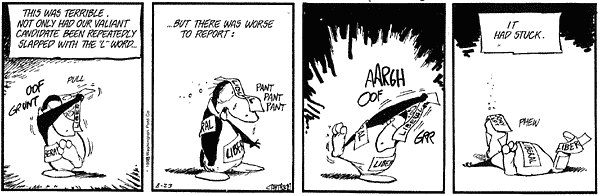
bloom-county-the-label-stuck

Somewhere along the path from conservatism to moderation I got labeled.

I got labeled with the “L” Word. No, not the “Lesbian” “L” Word which is actually kind of cool, but the other less socially acceptable one, the “Liberal” label.

I remember back in 1981 when I saw my first Lesbian couple walking together at California State University Northridge. I was sitting on the lawn outside of the office that I worked and they walked by. As a typical male I was enthralled by what I saw, but that enthrallment was short lived as when I walked back into the office I heard that my hero, President Ronald Reagan had been shot and that retired Army General, former Nixon aide and now Secretary of State Al Haig was now in charge of the country.

To tell the truth I don’t know how the transformation from Conservative to Moderate (read Liberal) happened. When I was in college I cheered the demise of Jimmy Carter. After college the same was true about Walter Mondale, Mike Dukakis. Al Gore and even John Kerry. I listened to Rush Limbaugh, Sean Hannity and Neil Boortz as much as I could. Not even 7 years ago I was defending “W” against what I thought were unfair assaults from the left. I enjoyed liberal bashing. It was fun and as the people that knew me back then could tell you I was quite good at it and to this day I regret it.

You see a funny thing happened between 2004 and now. I think it was a place called Iraq, where I began to question the unquestionable questions of conservative orthodoxy in a number of forums including both politics and religion. I became a moderate and a passionate one at that. Since “moderate” is a very misunderstood term let me explain. If you are a conservative it means that I am a liberal. Some liberals assume that I am a conservative but on the whole the word moderate is now associated as being liberal and I am okay with that because I believe in freedom, equity and fraternity for everyone, not just people that are like me or believe like me, especially religious types.

I actually think being a moderate is really a tricky thing. Back when I was in seminary during the pre-Fundamentalist takeover of Southwestern Baptist Seminary I remember hearing a big name Fundamentalist preacher say that “middle of the road moderates were only good to be run over.” One of my professors who would be a casualty of the takeover of the seminary said that for many in the Southern Baptist Convention of the time that “Liberal means anyone to the left of me.”

Now I do have to confess, unlike a lot of people when they get older and become more conservative I have become more “liberal” in that I am more accepting of people different than me. I was talking with a dear friend a while back who is proud of his Tea Party affiliation and he mentioned that when he was young that he was a liberal but now older that he was a conservative. I have no problem with that, it is a free county. My friend, who is still a friend despite political differences, maintains his beliefs, but gives me room to differ, something that I return to him. Both of us feel that friendship is more important, and I can count numerous other friends that I have the same kind of relationship with.

BuFor me it is a bit of a conundrum. I have friends who are way to the Left or to the Right of me who I respect and who I care for, we agree to disagree. The fact is that in reality I am a very pragmatic person and I would rather see people work towards compromise and cooperation so that the vast majority of people can prosper in freedom. So I choose to be friends with people far different from one another and who disagree with me. But we are still friends, my issue is not with people of good will, but with people who seek to stand as judge, jury and executioner of those that disagree with them, even former friends.

As far as what I believe…I am a Christian who believes in tolerance, acceptance and equity. I reject the militant triumphalist political version of the Christian faith that is the creed of the religious right, which by the way has nothing to do with any of the historic Creeds of the Christian Church. To put it in a Christian theological perspective I believe in the grace, love and mercy of the the Crucified God and reject the politically charged triumphalism of those who use my faith to oppress others who do not believe the way that they do. That being said I also reject the idea that religion and faith should be excluded from public discourse, only that there is an open exchange of ideas and not the imposition of any faith or lack thereof, on others using the police power of the state. If I want that I will move to Saudi Arabia or Afghanistan or any other country that uses its laws to enforce the majority religion, and suppress the rights of religious minorities or unbelievers or Communist China if I want to live under the tank treads of official state controlled atheism.

After I returned from Iraq I was for all intents and purposes an agnostic, a pretty difficult position to be a priest, but my sense of call and vocation kept me going even when I didn’t know if God still existed or even cared. When faith returned it was different, I believe but at the same time I doubt. This transformation in faith has made me more willing to question as well as accept things that I would not have before Iraq including the role of the church in politics, the treatment and rights of the LGBT community to equity, the rights of Moslems and other religious minorities and probably the cardinal sin of believing that women should be ordained to the priesthood and episcopate. Voicing those things back in 2010 got me thrown out of a church, so I know just how tolerant some of my Christian brothers and sisters can be. In fact there is a recent Pew survey which spelled out just how personal and vindictive the religious, political and cultural divide has become, having been turned on by people I thought to be friends, I know that well. I don’t like it but it is part of life now days in the new cultural-religious “ante-bellum” United States. I could go into other social issues that have a religious component but won’t right now, but I will say that I believe in a theology of liberation for all people. Again if that makes this “moderate” a “liberal” in the eyes of some so be it.

It was funny a couple of months ago I had a retired Navy Chaplain blast me here on this site for calling myself a “moderate.” He labeled me as a liberal. Obviously he had the same definition of moderation as the fundamentalists that said that a moderate was only good to be run over. But I won’t be run over and if that means that some people label me a liberal, so be it. I think there is honor in that, and I would rather be honorable to what I believe than sell out and become a modern Christian Pharisee intent on controlling the lives of others that do not believe like me.

However there are times that I feel that I am pissing into the wind when I watch those that we all have elected to office in Washington DC and our various State Houses behave, especially those of the more radical “conservative” bent, though I know some liberals who are have an equally invective edge. I am probably not alone in this feeling and do hope that the hard liners on both sides of the political spectrum can get their collective crap together before the plunge us into the abyss like the politicians of Weimar Germany did in the late 1920s and early 1930s. We all know how well that turned out.

1622612_10152232336042059_727365308_n

All that being said I am still a moderate, but in today’s social and political climate I am a distinctly liberal one, and for that I will not apologize. If that makes some angry or uncomfortable than I have done my job, as Finley Peter Dunne first remarked, it is my duty “to comfort the afflicted and afflict the comfortable.”

So until tomorrow.

Peace

Padre Steve+
6 Comments

Filed under christian life, civil rights, ethics, faith, philosophy, Political Commentary

Church, Faith, Tolerance and Reconcilliation

1622612_10152232336042059_727365308_n

“Sometimes I think it is my mission to bring faith to the faithless, and doubt to the faithful.” Paul Tillich

My friends, I write this because of something that happened to me a couple of days ago. It was an incident that upset me greatly because it ended up in the fracturing of a relationship by a friend who evidently could not tolerate where I was in my life as a priest and Christian. I discovered again the reality of what Dietrich Bonhoeffer wrote:

“Many people are looking for an ear that will listen. They do not find it among Christians, because these Christians are talking where they should be listening. But he who can no longer listen to his brother will soon be no longer listening to God, either; he will be doing nothing but prattle in the presence of God, too. This is the beginning of the death of the spiritual life, and in the end there will be nothing left but spiritual chatter and clerical condescension arrayed in pious words… never really speaking to others.”

My experience of the Church is profoundly influenced by my life in the nether world of the military culture. My world view is shaped by a blending of various Christian traditions, mutual support and collaboration among believers of often radically different points of view. Because of the love, care and mentoring of people from a blend of different traditions I came to know God and survived a tumultuous childhood with many moves.

As a historian I have been blessed to study church history from the early Church Fathers to the present. As I look to church history I find inspiration in many parts of the Christian tradition. In fact rather being threatened by them I have become appreciative of their distinctiveness. I think that there is a beauty in liturgy and stability in the councils and creeds of the Church. At the same time the prophetic voice of evangelical preaching shapes me, especially the message of freedom and tolerance embodied in the lives and sacrifice of men like John Leland, the American Baptist who helped pioneer the concept of Freedom of Religion established in the Constitution of the United States, of William Wilberforce who labored to end slavery in England and, Martin Luther King Jr. who led the Civil Rights movement.

Likewise that prophetic message of the faith is demonstrated in the ministry, writing and martyrdom of Dietrich Bonhoeffer and his contemporaries Martin Niemoller and Jesuit priest Father Rupert Meyer. All three resisted and preached against the evils of Nazism. In a more contemporary setting I am inspired by Bishop Desmond Tutu who helped topple apartheid in South Africa.

Women like Teresa of Avila and St Catherine show me that women have a legitimate place of ministry and leadership in the Church. I am convinced through my study of Church history, theology and a deep belief in the power of the Holy Spirit that women can and should serve as Priests and Bishops in the church.

My theology has shaped by the writings of Hans Kung, Yves Congar, Jurgen Moltmann, Andrew Greeley, and Henry Nouwen. I’ve been challenged by St Francis of Assissi, John Wesley and Martin Luther. I am especially inspired by Pope John XXIII whose vision brought about the Second Vatican Council and I am inspired by Pope Francis.

I pray that Christians can live in peace with one another and those who do not share our faith. I pray that we can find ways to overcome the often very legitimate hurts, grievances and divisions of our 2000 year history. At the same time I pray that we can repent from our own wrongs and work to heal the many wounds created by Christians who abused power, privilege and even those who oppressed others, waged war and killed in the name of Jesus.

I do not believe that neither triumphalism nor authoritarianism has a place in in a healthy understanding of the church and how we live. I am suspicious of any clergy who seek power in a church or political setting. I profoundly reject any argument that requires the subjection of one Church with its tradition to any other Church. In fact I think that the arrogance and intolerance of Christians to others is a large part of why people are leaving the church in droves and that the fastest growing “religious group” is the “nones” or those with no religious preference. Andrew Greeley said something that we should take to heart:

“People came into the Church in the Roman Empire because the Church was so good — Catholics were so good to one another, and they were so good to pagans, too. High-pressure evangelization strikes me as an attempt to deprive people of their freedom of choice.”

I grew up in and have lived my life in a very open and ecumenical environment. I have lost any trace denominational parochialism and competition that I might have had if I had become a pastor of a civilian parish instead of a chaplain. It is interesting that the pastor that first ordained me in the evangelical tradition and the bishop that ordained me as a priest both did so with the intent that I serve as a chaplain. Whether it was the recognition of a gifting for the work or the fact that they didn’t want me messing up their civilian operations by asking hard questions I will never know.

I believe that my environment and the men and women who have helped shape my life have been a stronger influence in the way I think about ecumenical relations and ministry than my actual theology or ecclesiology. Whether they were Catholics, Anglicans, Lutherans, Methodists, Presbyterians, Evangelicals or even those considered by many to be outside the faith including Jews, Moslems, Buddhists, Mormons and even complete non-believers all have contributed to my life and faith.

I have grown weary of refighting theological debates that have divided the church for a thousand years. Since what we know of theology including our Scriptures and Creeds are based on faith and not science I see no reason to continue to battle.

That doesn’t mean that I think we should put our brains in neutral but rather we must wrestle with how to integrate our faith with science, philosophy and reason, otherwise we will become irrelevant. In that sense I identify with Saint Anslem of Canterbury who wrote about a faith seeking understanding and Erasmus of Rotterdam who very well understood the importance of both faith and reason. In that sense I am very much at home with the Anglian triad of Scripture, Reason and Tradition when it comes to approaching faith.

I struggle with faith and belief. After Iraq I spent two years as a practical agnostic. As Andrew Greeley wrote: “Most priests, if they have any sense or any imagination, wonder if they truly believe all the things they preach. Like Jean-Claude they both believe and not believe at the same time.” Andrew Greeley “The Bishop and the Beggar Girl of St Germain”

I am an Old Catholic and believe that inter-communion does not require from either communion the acceptance of all doctrinal opinion, sacramental devotion, or liturgical practice characteristic of the other, but implies that each believes the other to hold all the essentials of the Christian faith. I like to think that I embody what the early Anglicans referred to as the via media and that somehow my life and ministry has been about building bridges at the intersections of faith with a wide diversity of people.

When I have tried to embrace traditionalism or choose to fight theological battles I have ended up tired, bitter and at enmity with other Christians. In a sense when I tried those paths I found that they didn’t work for me. I discovered that I was not being true to who God had created and guided my life, education and experience. I feel like T. E. Lawrence who wrote:

“The rare man who attains wisdom is, by the very clearness of his sight, a better guide in solving practical problems than those, more commonly the leaders of men, whose eyes are misted and minds warped by ambition for success….”

My favorite theological debates have been with other chaplains over pints of good beer in German Gasthausen or Irish pubs. Those were good times, we argued but we also laughed and always left as friends and brothers. I believe since we are human that none of us will ever fully comprehend all of God or his or her truth. I believe that the Holy Spirit, God’s gracious gift to her people will guide us into all Truth. For me my faith has become more about relationships and reconciliation than in being right.

As far as those who disagree with me that is their right, or your right if you disagree. I don’t expect agreement and I am okay with differences and even if I disagree with an individual or how another religious denominations polity, theology, beliefs or practices those are their rights. In fact I am sure that those that believe things that I don’t are at least as sincere as me and that those beliefs are important to them. I just ask that people don’t try to use them to force their faith or belief on others, be it in churches or by attempting to use the power of government to coerce others into their belief systems.

To my friend who broke contact with me when I refused to debate his argument that I should submit myself to his Church and tradition, the door is open for reconciliation.

Peace

Padre Steve+

2 Comments

Filed under christian life, faith, Religion

To Believe and Not to Believe, that is the Challenge

n671902058_1153804_6925

“Most priests, if they have any sense or any imagination, wonder if they truly believe all the things they preach. Like Jean-Claude they both believe and not believe at the same time.” Andrew Greeley “The Bishop and the Beggar Girl of St Germain”

When I returned from Iraq in 2008 I was a mess. I had gone to Iraq thinking that I had the answers to about anything and that I was invincible. I felt that with years of experience in the military and in trauma departments of major trauma centers that I was immune to the effects of war and trauma. Likewise I had spent years studying theology, pastoral care and ethics as well as military history, theory and practice. I had studied PTSD and Combat Stress and had worked with Marines that were dealing with it. If there was anyone who could go to Iraq and come back “normal” it had to be me.
Of course as anyone who knows me or reads this website regularly knows I came back from Iraq different. I collapsed in the midst of PTSD induced depression, anxiety and a loss of faith. For nearly two years I was a practical agnostic. What I had believed with absolute certitude before the experience of war was gone.

During that time, particularly when I was working in the ICU and Pediatric ICU at Naval Medical Center Portsmouth. I attempted to have enough faith to help others during their crisis, be they patients at the brink of death or families walking through that dark valley and our staff. It was difficult because at the time I did not have any faith to even believe that God existed.

It was during those dark days that the writings of Father Andrew Greeley, mainly his Bishop Blackie Ryan mysteries that provided me with one of the few places of spiritual solace and hope that I found. Baseball happened to be the other.
During those dark times when prayer seemed futile and the scriptures seemed dry and dead I found some measure of life and hope in the remarkable lives of the people that inhabited the pages of the Bishop Blackie Ryan novels. Through them I learned that doubt and faith could co-exist and that there was a mystery to faith in Jesus that defied the absolute doctrinal statements as well the as cultural, political and sociological prejudices that I had grown up with.

I did learn something else, something that makes many people uncomfortable and that took me a long time to accept. That was that doubt and faith could co-exist. As I read Greeley’s stories I began to see scripture in a new light. I discovered that the stories of the men and women that we venerate for their faith were more remarkable because of the doubt and unbelief that are documented in scripture. Some even disputed God and are still considered faithful. The Bible is full of these stories.

So when I hear of religious leaders who proclaim all that they say and allegedly believe as absolute truth I know that they are trying too hard. In essence they made their beliefs an idol that keeps them from facing the reality of the world and the reality of their own hearts. It such cases faith becomes fanaticism. It interjects a sense of self righteousness into all relationships and leads to the worst forms of pride, prejudice and hatred of anything that does not fit in their narrow understanding.

Eric Hoffer wrote: “A doctrine insulates the devout not only against the realities around them but also against their own selves. The fanatical believer is not conscious of his envy, malice, pettiness and dishonesty. There is a wall of words between his consciousness and his real self.”

It took losing my faith to rediscover it and life as I anointed a man in our emergency room in December 2009. I call that my Christmas Miracle. Faith returned to to me, much to my surprise and I believe again. But I also doubt, at least a couple of times a day. And for that I’m grateful. It keeps me humble and has broken down the wall that had insulated me. and I am alive again.

That also gives me a certain joy and appreciation in ministry. Greeley wrote in his last Bishop Blackie mystery:

“Every sacramental encounter is an evangelical occasion. A smile warm and happy is sufficient. If people return to the pews with a smile, it’s been a good day for them. If the priest smiles after the exchanges of grace, it may be the only good experience of the week.”  (The Archbishop in Andalusia p.77)

I guess that is how I approach ministry now, even outside the church or chapel. As a chaplain many of the people I serve may never darken the door of a church, they like me struggle with faith, belief and unbelief.

Greeley wrote that is was possible for a priest to lose their faith “no more often than a couple of times a day.” That describes me pretty well.

Peace

Padre Steve+

1 Comment

Filed under christian life, faith, ministry, PTSD

Faith and Doubt on a Friday During Lent

tom-clancy-look-2

William James wrote that “Faith means belief in something concerning which doubt is theoretically possible.”

Many religious people, be they Christians, Jews, Moslems or others equate their faith in what cannot be seen or proven to be a certainty. But faith, even as understood by someone like the Apostle Paul was something that was not provable in this life. In fact Paul is bold enough to proclaim that if Christians are not correct concerning their faith in the risen Christ that they are to be pitied among men.

Faith in something, even God is not proof. In fact faith can never be asserted to be fact until the final consummation. Dietrich Bonhoeffer in his classic Creation and Fall Temptation, Two Biblical Studies wisely noted that:

“Man no longer lives in the beginning–he has lost the beginning. Now he finds he is in the middle, knowing neither the end nor the beginning, and yet knowing that he is in the middle, coming from the beginning and going towards the end. He sees that his life is determined by these two facets, of which he knows only that he does not know them”

Bonhoeffer’s words show a wisdom often lacking in young theologians. No matter how firmly we believe the words of Scripture or the Creeds they are at their heart statements of faith, not fact. They may be true, and I believe them to be. That being said we cannot prove them  and simply making circular arguments about their truth does not make them true. Thus I always find that I am amazed when I see some Christians insist that what they believe is “absolute truth” even when they have no “proof” of its truth outside of their statements of faith. Such is the trap of circular logic. Bonhoeffer quite correctly noted that “A God who let us prove his existence would be an idol.”

I have learned to appreciate the struggle of faith. I believe, but I seek understanding. That being said I know that whatever I know, I only know in part, as Paul said I see “through a glass darkly,” but one day I shall see “face to face.”

Those that equate faith with certitude do so at their own peril, and often are willing to sacrifice others to ensure that their belief remains unquestioned.

The great American Jurist Oliver Wendell Holmes wrote:

“Certitude leads to violence. This is a proposition that has an easy application and a difficult one. The easy application is to ideologies, dogmatists, and bullies–people who think that their rightness justifies them in imposing on anyone who does not happen to subscribe to their particular ideology, dogma or notion of turf. If the conviction of rightness is powerful enough, resistance to it will be met, sooner or later by force. There are people like this in every sphere of life, and it is natural to feel that the world would be a better place without them!”

The fact is that there is nothing wrong with doubt. There is nothing wrong with struggle. In fact it is shown in the lives of those that we consider “saints” throughout both the Jewish and Christian scriptures.

Faith without doubt and faith without struggle is not faith, it is idolatry. Bonhoeffer expressed this well when he said “A God who let us prove his existence would be an idol.”

In fact absolute certitude masquerading as faith in the life of the faithful often leads to great violence and evil. One only has to look at what happened on September 11th 2001 to see the results of such violent certitude.

As for me I have faith, but at the same time I doubt. Sometimes doubts outweigh faith and at other times faith outweighs doubt. That being said I find comfort in the scriptures where Paul honestly and openly writes of his conflicts and doubts. Henri Nouwen had it right when he said:

“Theological formation is the gradual and often painful discovery of God’s incomprehensibility. You can be competent in many things, but you cannot be competent in God.”

That is the real fact of the matter. It is something that Christians more interested in truth rather than protecting their social position have believed for decades have died to proclaim.

None of us, no matter how learned we are, or how certain we believe, really know much about God. And that my friends is certain.

Peace

Padre Steve

Leave a comment

Filed under christian life, faith, Religion

The Continuing Journey: Reflections of 6 Years Dealing with PTSD Faith and Life

tom-clancy-look-2

“You wonder what I am doing? Well, so do I, in truth. Days seem to dawn, suns to shine, evenings to follow, and then I sleep. What I have done, what I am doing, what I am going to do, puzzle and bewilder me. Have you ever been a leaf and fallen from your tree in autumn and been really puzzled about it? That’s the feeling.” T. E. Lawrence, Letter 1935

It has been six full years since I descended into the hell of the abyss that is PTSD. Back in the late spring and early summer of 2008 just a few months after my return from what I still consider my best tour of duty in over 30 years of military service with US advisors and Iraq Army and Security forces in Al Anbar Province in 2007-2008 I was in a state of emotional and spiritual collapse.

I really couldn’t believe then what was happening to me or they way that it would end up shaping my life to the present day. In retrospect my return from Iraq marked a beginning of a personal hell that for a number of years seemed like that it would never end. It was painful, it was isolating and it marked a profound change in the way that I saw God, faith, politics and social justice. It changed me in ways that I never could have imagined when I got on a bus heading for Fort Jackson South Carolina following the July 4th holiday of 2007.

Those brave souls that have followed me on this website as well as those that are still my friends despite occasional disagreements and misunderstandings, those that may not understand me but still are my friends have seen this.

So six years later what is it like?

I still have trouble sleeping, not as much as I used to but enough to impact my life. I don’t take heavy doses of sleep meds anymore, just some Melatonin as well as a mild dosage of an anti-anxiety medication and anti-depressant. A far better combination than medications that made me feel like I was hung over without that benefit of sharing too many drinks with friends at the local watering hole.

As opposed to the years immediately following my time in Iraq I have to say that I am no longer self medicating with alcohol. I remember in 2009 going out for dinner, having a few beers, then going to a ball game and drinking a few more and coming home with Krispy Kreme donuts and drinking more beer on a regular basis and usually taking a couple of shots or Jaegermeister or glasses of Spanish Brandy just to get to sleep so I could go back to facing life and death situations the next day in our ICUs. I don’t need that anymore, even though sleep can be problematic and dreams and nightmares rivaling anything I can watch on my HD TV…

I still love to pony up to the bar and share a couple of pints with friends but I don’t need it to numb myself into feeling no pain. Talking with many other vets who have served in Iraq, Afghanistan or even Vietnam I know that I wasn’t alone in those dark days.

I have become a bit less hyper-vigilant though when I come home to Virginia Beach than I was just three years ago and most certainly five years ago in May of 2008. However, that being said I do notice that I am more on guard on the roads and that little things, sirens, emergency vehicles, loud noises and traffic still set me off more than when I lived in rural North Carolina while stationed at Camp LeJeune from 2010 until August of 2013.

I absolutely hate air travel. I don’t like the crowds, the stress of security or the constant delays, changes and overcrowding. Truthfully I felt more comfortable flying the skies of Iraq on Marine, Army and Air Force fixed and rotor wing aircraft and on occasion being shot at in Iraq’s Al Anbar Province than I do on any airline today in this country.

I have become exceptionally sensitive to tragedy, death and suffering. The loss of friends or major incidents where military personnel are killed in combat, training missions or just doing their job hits me hard. The worst times are when friends, or others that I know die by their own hand. When they are veterans who suffer from PTSD, TBI or Moral Injury it is like a dagger plunging into me.

Physical fitness matters more than it did before, even though I was in very good shape before and during my time in Iraq. But when I came home from that I was not only wounded in mind and spirit, but my body was beaten up. Chronic nagging injuries and chronic pain kept me from doing what I liked doing and what helped me keep my physical-spiritual and emotional balance. Those nagging injuries took a long time to heal, and they took some adjustments on my part which took me several years to adapt to and compensate in my physical regimen.  I can say now that I am in as good or better shape than I was before I left for Iraq in 2007. Maybe I’ll write a best selling book and do an exercise video like Jane Fonda…

Whereas in 2008 through 2010 and even until 2011 I was exceptionally sensitive to criticism to the changes that were occurring in my life including my move to the “left” both theologically and politically I have gotten to the point that I realize that it is more important to be honest and authentic as to who I am and what I believe. I have found that those that really matter to me don’t care so much about those things and that relationships maintained with people who don’t always agree with each other where all remain their personal integrity are far more rewarding than relationships that are first and foremost decided by allegiance to political or religious orthodoxy no matter what side of the spectrum it is from. I hate group think. Thus though I have to now consider me to be on the “liberal” side of the political and theological divide I still have to be considered a moderate simply because I refuse to make people my enemy simply because I disagree with them or they with me.

When I began this site in the spring of 2009 I named it Padre Steve’s World…Musings of a Passionate Moderate. I think I did that because it actually described me then, and now, even though I am pretty passionately liberal about some things and that doesn’t bother me in any way because it comes from my wrestling with God and faith and realizing that integrity matters more than about anything else. I have toyed with changing the title of the site but have decided against that because I am a moderate liberal committed to a Christian faith that speaks for the oppressed and is willing to confront those that would use faith, political or economic power to oppress the weak or those different from us.

Since I returned from Iraq in 2008 I discovered what it was to really question faith and God. To become for a couple of years a man who was for all practical purposes an agnostic praying that God still existed and cared. I discovered that in doing so that faith returned, different but more real than I had ever experienced in a life spent in the Christian faith and ministry.

My agnostic period gave me an immense empathy and appreciation for those who have lost faith, struggle with faith or reject any concept of God. I value reason as much, maybe if not more than faith now, not that reason is infallible or perfect, but it does allow me to evaluate my faith, and appreciate the amazing mysteries of the universe that our science and technology continue to reveal in ever more complex detail.

That brought change because my rediscovered faith brought me into conflict with people in the church denomination and faith community where I had been ordained as a priest. I was asked to leave and found a new home church and denomination that fit my life, faith experience and where I could live and minister in complete integrity. In the church that took me in during the fall of 2010 I can be faithful to the Gospel and care for the lost, the least and the lonely, especially those who have been abused by churches and ministries that have sold their soul to right wing political ideologues whose only concern is their political power and influence and would use churches and Christians to do their evil bidding. I guess that I learned that just because someone wraps the Bible in an American Flag, believes that Jesus brought us the Constitution and says that they “support the troops” it doesn’t necessarily mean that they care a whit about the Bible, the Flag, the Constitution or the Troops. I hope that isn’t too harsh….

Oh well, I feel that I am beginning to ramble so I will say good night and “God Bless,” no matter what God that you profess or for that matter don’t profess.

Peace

Padre Steve+

Leave a comment

Filed under faith, iraq,afghanistan, Military, PTSD

The Long Strange Trip: Six Years After Returning from Iraq

295_26912117058_5652_n

It is hard to believe because it seems like it was yesterday, but six Years ago tonight I got off a plane, home from Iraq. The final flight on a commercial aircraft going from Philadelphia to Norfolk was crowded, but the people on board were polite to us, both the flight crew and the passengers, but it was like I had returned to a different world. What I entered was the same as it always had been, but I was different.

Guy Sager, an Alsatian who served in the German Army in World War Two wrote at the end of his book The Forgotten Soldier:  

“In the train, rolling through the sunny French countryside, my head knocked against the wooden back of the seat. Other people, who seemed to belong to a different world, were laughing. I couldn’t laugh and couldn’t forget.” 

About a year after my return, actually on February 16th 2009 I began writing on this site. I began it in large part to express my inner angst and as a means to my own healing as well as to help others. The beginnings came out of my initial therapy with Dr Elmer Maggard, who I sometimes refer as “Elmer the Shrink.” Elmer asked me if I was willing to open up and share my story even though I was still very broken and vulnerable, feeling abandoned by God, the church and most clergy.

At the time I was a practical agnostic. My collapse from PTSD and the moral injuries that I had sustained in Iraq were severe, it was if God had abandoned me, and try as I might nothing worked. In the months before I began writing I had hit bottom. That was then.

The last five years of writing my journey home has been illuminating. As I look back at things that I wrote, surveyed my moods, emotions, intellectual and spiritual development since the beginning of Padre Steve’s World I am reminded of the words to the Grateful Dead song Truckin’ because my life, especially since Iraq has been “a long strange trip.” 

That may seem kind of flippant, but it is true. My journey has been strange and I could not have predicted it back when I got my orders to go to Iraq in May of 2007. I was a volunteer for the mission and what I experienced changed me forever.

I don’t know what the future holds. I was shaken when my Captain Tom Sitsch, my former Commodore at EOD Group Two committed suicide a month ago. I know far too many men and women who have died by their own hand due to the after effects of the trauma they sustained in Iraq Afghanistan, or even Vietnam. What I experience is not unique to me, and that comforts me.

I have been busy this week, between storm recovery, home restoration and catch up at work I have had little time to muse about what the years have been like. I still feel a sense of melancholy as I do every time this year. My difficulty sleeping, nightmares and night terrors still plague me, some nights are better than others but the insomnia that has plagued me since my time in country is still all too real. My anxiety and panic attacks, though diminished still remain.

Faith, which had disappeared has returned, but even that has changed. What I knew to be sure in 2007 is often at best doubt plagued in 2014. For me faith is still often a struggle. Thus I have great empathy for those who do not believe, those who have lost their faith or struggle with doubt, and I cannot condemn them. Sometimes this puts me at odds with other Christians who strongly believe, but who have no tolerance for differences of opinion regarding things which cannot be proven without reference to faith in things that we cannot see. I am okay with that. What I believe about God is more open and less doctrinaire than it was before I left for Iraq. I agree with the late Father Andrew Greeley who wrote:

“I don’t think Jesus was an exclusivist. He said, and we believe, that He is the unique representation of God in the world. But that doesn’t mean this is the only way God can work.”

I am thankful that I have had the chance in a number of venues to share my story. That is a gift that has been given to me and I am thankful for those who at various times have reached out to me, encouraged me and shared their stories of service, faith, struggle, doubt and loss.

In the past five years I walked with and have heard the stories of many people, veterans and their families, both in person and comments made on this site who like me still struggle, with PTSD and moral injury, as well as others who suffer from TBI and other physical injuries. They are comrades. Erich Maria Remarque wrote in his book  All Quiet on the Western Front:

“I am no longer a shuddering speck of existence, alone in the darkness;–I belong to them and they to me; we all share the same fear and the same life…I could bury my face in them, in these voices, these words that have saved me and will stand by me.”

In the next week or so I will share some more including my first article, written for my former church while I was still in Iraq around Christmas of 2007.

295_26912012058_78_n

Faith, doubt. War, peace. Madness, sanity. Isolation, community, loss and gain. So much still to learn, explore and experience despite everything that has happened. It has been a long strange trip and I expect that the long strange trip will continue. T. E. Lawrence wrote to a friend years after his war in the desert:

“You wonder what I am doing? Well, so do I, in truth. Days seem to dawn, suns to shine, evenings to follow, and then I sleep. What I have done, what I am doing, what I am going to do, puzzle and bewilder me. Have you ever been a leaf and fallen from your tree in autumn and been really puzzled about it? That’s the feeling.”

That is all for tonight as I have much to ponder as I sit with Judy. Our dogs Molly and Minnie passed out beside us, and I hope that tonight I will sleep.

Peace

Padre Steve+

6 Comments

Filed under christian life, faith, iraq,afghanistan, Military, PTSD

Padre Steve’s Christmas Journey of Healing

996759_10152169414832059_1833080489_n

“God weeps with us so that we may one day laugh with him.” Jürgen Moltmann

Christmas is a special time for me, it always has been but in spite of that there were times that I took the faith element for granted. I believed and my faith in God, for me the Christian God, Father, Son and Holy Spirit was unquestioned. I knew the Scriptures, the Creeds and the Councils and I felt that my faith in a sense was untouchable. I was sure of it, in fact almost cocksure or arrogant about it. That came out in published writings in a very conservative Catholic monthly, the New Oxford Review back in 2000-2001.

For me the elements of my faith were very much intellectual. I could see other points of view but if I disagreed with them enough I would engage them with the purpose of defeating them. Of course this usually went to theological methods, history and hermeneutics. As far as those that lost their faith it was something that I had difficulty comprehending. Not that I was unsympathetic or uncaring of them or their plight, but I didn’t see how it could happen to me.

But that was before Iraq. That was before PTSD, moral injury and my own crisis of faith when I returned from the Iraq War in 2008.  That changed me as war has changed so many others before. Guy Sager wrote of his return from war in his classic The Forgotten Soldier:

“In the train, rolling through the sunny French countryside, my head knocked against the wooden back of the seat. Other people, who seemed to belong to a different world, were laughing. I couldn’t laugh and couldn’t forget.” 

iraq christmas

My return instigated a crisis of faith, I felt like I still belonged in Iraq and home seemed like a foreign land.  In the crisis I was for all practical purposes I was an agnostic trying to believe and feeling abandoned by God and many of his people, especially clergy.  Commodore Tom Sitsch at EOD Group Two, a veteran of much combat asked me “where does a Chaplain go for help?” I told him “not to other Chaplains or clergy.”

That crisis etched a permanent scar in my soul which led to some fairly major changes in my life.  It forced me to enter what Saint John of the Cross called the “Dark Night of the Soul.”

I will not tell of how my great spiritual disciplines and intellect helped me get through the crisis, as they did not. I found it hard to pray or believe in anything for nearly two years as I struggled with abandonment. I felt that God, the Church and the Navy had abandoned me.  The only thing that kept me going was my profound sense of vocation as a Priest and Chaplain and commitment to others who were suffering.

I was losing my battle with PTSD during that time, depressed, anxious and despairing I threw myself into my work among the critically ill ICU patients and those that cared for them.  Christmas Eve of 2008 was spent in despair as I wandered through the darkness on a cold night after leaving Mass because I could not get through it.

Though I found a community and camaraderie among those that I worked with and tried to provide spiritual care,  my own condition grew worse.  I was so bad enough that my clinical duties had to be curtailed over my objections in September of 2009.

I still stood the overnight duty and filled in for others as needed, but for a number of months I had no clinical assignments.  That meant that others in our minimally staffed department had to fill in for me. I am sure that they resented that, especially because before this I often worked 80-90 hours a week mostly in our ICUs and the staff of the ICUs now expected that kind of intensive ministry and support.

But in my desperation I was greeted with a surprise. On one of the on call nights not long before Christmas I received a call to the ER to provide the last rites to an elderly retired Navy Medical Doctor.  The man was a saint, faithful to God, his Church and the community. For years he dedicated much of his practice to the poorest members of the community, delivering babies for women with no insurance and caring for prisoners in the Portsmouth City Jail.  He breathed his last as I prayed this prayed the prayer of commendation following the anointing and something strange happened. I felt the presence of God for the first time since Christmas of 2007 in Iraq. It is too this day hard to explain.

Something miraculous happened that night and by Christmas Eve I realized that something was happening to me. As I wrote in Padre Steve’s Christmas Miracle on Christmas Eve of 2009:

“Mid afternoon I was walking down the hall and I experienced a wave of emotion flood over me, and unlike the majority of emotions that I have felt in the past couple of years this was different.  It was a feeling of grace and I guess the presence of God.  I went up and talked with Elmer the shrink about what I was feeling and the experience was awesome, I was in tears as I shared, not the tears of sadness, but of grace.  I am beginning to re-experience the grace of God, something that has been so long absent that I did not expect it, at least right now.  I didn’t do anything differently; I certainly was not working extra hard to pray more, get more spiritual or pack my brain full of Bible verses.  I was too far gone to do those things.  It was all I could do many mornings just to get out of bed and come to work.”

Since that time I have continued to recover faith and belief. I cannot say that it is the same kind of faith that I had before Iraq. This was a different kind of faith.  It was faith born of the terrible emptiness and pain of abandonment and despair, a faith that is not content with easy answers and not afraid to ask questions.  It is a faith in Jesus Christ, the crucified one who’s image we see hanging from the crucifix and adorning icons of the Crucifixion. It is as Jürgen Moltmann wrote in The Crucified God:

“The Symbol of the Crucifix in church points to the God who was crucified not between two candles on an altar, but between two thieves in the place of the skull, where the outcasts belong, outside the gates of the city. It is a symbol which therefore leads out of the church and out of religious longing in to the fellowship of the oppressed and abandoned. On the other hand, it is a symbol which calls the oppressed and godless into the church and through the church into the fellowship of the crucified God”

My Philosophy of Religion Professor, Dr. Yandall Woodfin at Southwestern Baptist Theological Seminary told us in class that until we had “dealt with the reality of suffering and death we were not doing Christian theology.” At the time the words were offensive to me, but by the time I had graduated and also done a year of Clinical Pastoral Education they became a part of my experience. However that did not prepare me for the darkness that I lived in from February of 2008 until that Christmas Eve of 2009.  I would say that in addition to Dr Woodfin’s understanding of grappling with suffering and death that one has to add the abandonment of the outcast to the equation.

The “I Believe in God” of the Creed is no longer for me simply a theological proposition to defend, but rather an experience of God born out of pain, despair, anxiety, doubt, unbelief and abandonment. During my crisis I found almost no Christians willing to walk through the darkness with me, including clergy. The only clergy willing to were those who were walking the same path of the outcast with me, suffering from PTSD, TBI and other unseen wounds of war. It was if I was radioactive. Many people had “answers” for me, but none sought to understood my questions until my first  therapist Dr. Elmer Maggard asked me “how I was with the big guy?”

When I finally collapsed in the summer of 2008 and met with Dr. Maggard I made a conscious decision that I would not hide what I was going through.  I felt that if someone didn’t speak out that others like me wouldn’t seek help. In the nearly six years since I returned from Iraq I have encountered many people, men and women, current and former military personnel and families of veterans who came to me either in person or through this website. It led to me being interviewed in a newspaper and being featured on the Real Warriors website http://www.realwarriors.net , a program run by the Department of Defense to help reduce the stigma of getting help for PTSD which features the stories of military personnel suffering from it. My story can be found here: http://www.realwarriors.net/multimedia/profiles.php

I have had a number of military chaplains come to me also experiencing a  faith crisis. Most said that I was the first Chaplain or minister that they had met or who admitted that he struggled with faith and the existence of God.  For a minister to be open about such struggles is dangerous. When my faith returned and was different I was asked to leave my former denomination because I was now “too liberal.”

295_26912092058_3949_n

In each of those encounters with those suffering there was a glimmer of hope for me and I think for them.  It was as if for the first time we had people that we could be open with.  Co-workers and others said that I was “real.” I certainly do not boast of that because it was painful to be transparent with people while in the depths of doubt and despair while hoping that somehow God would touch them with some measure of grace when I found it hard to believe.  I guess it was the fact that I was willing to walk with them in their crisis and let them be honest even if it meant facing my own pain and doubt. I learned something about being what Henri Nouwen called a wounded healer.  Nouwen wrote:

“Nobody escapes being wounded. We all are wounded people, whether physically, emotionally, mentally, or spiritually. The main question is not “How can we hide our wounds?” so we don’t have to be embarrassed, but “How can we put our woundedness in the service of others?” When our wounds cease to be a source of shame, and become a source of healing, we have become wounded healers.”

I do still struggle with the continued effects of War and PTSD, but I am in a much better place. I also struggle with faith at times when I look at the actions of those who profess to believe but treat others with contempt. I can understand the quote from the Gospel “I believe, help my unbelief.”

379132_10150515338077059_671902058_10701625_1511457102_n

So today this wounded healer will celebrate a special Christmas at home. My wife and I will celebrate a Mass, enjoy a Christmas dinner with our dogs, Molly and Minnie. Depending on how she feels we will either go out to a movie or watch one at home.

I want to thank all of my readers, especially those who like or comment on these posts. You are appreciated, some are lengthly and you choose to take your time to read them and often share them. If you are walking the path of the outcast feel free to drop me a line here or on my Facebook page. My wish for you and for all is a Christmas of peace, reconciliation and love.

Peace and blessings,

Padre Steve+

16 Comments

Filed under faith, Military, ministry, Pastoral Care, PTSD, Religion, Tour in Iraq

Duty, Calling and Vocation

offerssword

“So you also, when you have done everything you were told to do, should say, ‘We are unworthy servants; we have only done our duty.’ Luke 17:10 

Today was one of those weird days. As I thought about the government shutdown and the political crisis that has enveloped our political system, as well as the very real domestic and foreign policy consequences of this asinine situation I was confronted with the scriptures for today from the lectionary.

I find it fascinating to find who timely the readings for the lectionary are, even though they have been set for years.

Today the Old Testament lesson was from Habakuk when in the first chapter the prophet cries to God about how bad things are and asks why God doesn’t do anything about it. The New Testament reading from Timothy was an encouragement from Paul to Timothy to remember his calling and vocation. The Gospel reading from Luke began with Jesus talking about faith but then discussing the duty and responsibility of the servants.

In light of the current asinine situation regarding our government which when you look at it logically makes no sense whatsoever the readings were pretty spot on. Habakuk complained to God about what a mess Israel was and was told by the Lord to hang in there and the the Lord had a plan. Paul wrote to Timothy in what obviously was a time of crisis in Timothy’s pastoral life and reminded Timothy about his calling. Likewise in the Gospel the real crux of the matter when well beyond the “faith” of the disciples but to the simple understanding that they were servants and the responsibility of servants was to do their duty.

Duty is something ingrained in me after 32 plus years of service in the military and over 22 years of ministry as a Army and Navy Chaplain. It is somewhat tied in with my sense of calling which was one of the few things that helped me hold in during the depths of my post-Iraq PTSD crash when I was for all intents and purposes an agnostic praying that God existed. I am glad for the deep rooted sense of duty, calling and vocation because otherwise I probably would be here today.

I have always liked the prayer of Ignatius of Loyola, founder of the Jesuits:

Teach us, good Lord,
To serve you as you deserve;
To give and not count the cost;
To fight and not heed the wounds;
To toil and not to seek for rest;
To labor and not to ask for any reward,
Except that of knowing that we do your will;
Through Jesus Christ our Lord. Amen.

Duty can be a hard thing, precisely because to do ones duty sometimes means that the situation will not be comfortable nor will the reward be great. Likewise there are times when doing one’s duty involves great sacrifice to do what is right. Now I am willing to fight for what I think is right, even if the costs are great.

Admiral Chester Nimitz wrote:

“God grant me the courage not to give up what I think is right, even though I think it is hopeless.” 

That is a prayer that I can only respond to with a hearty “amen.”

Peace

Padre Steve+

1 Comment

Filed under christian life, faith, Military

Writing My Way Home: Iraq, Faith PTSD and Life

295_26912012058_78_n

“Many people are looking for an ear that will listen. They do not find it among Christians, because these Christians are talking where they should be listening.But he who can no longer listen to his brother will soon be no longer listening to God, either; he will be doing nothing but prattle in the presence of God, too. This is the beginning of the death of the spiritual life, and in the end there will be nothing left but spiritual chatter and clerical condescension arrayed in pious words… never really speaking to others.” Dietrich Bonhoeffer

Since I returned from Iraq I have grown weary of Christians that have all the answers and are more interested in promoting their agenda than actually listening or caring for those wounded in spirit from various forms of trauma including war. I returned from Iraq and went through what amounted to a crisis in faith, belief and experienced what I felt to be abandonment by God and many Christians.

481801_10151367001287059_1003164983_n

As such I elected to travel down a path that has been one of paradox. I have benefited from this but the path has been filled with much difficulty and pain. I walked through the psychological, spiritual and physical effects of my time in Iraq as well as the moral injuries that I incurred.  Over the years I have seen the effects of these crisis on my life and relationships. It has become important to tell my story, in as sense as a Canadian Chaplain in our Pastoral Care residency said to “write my way home.”

After Iraq I began to write. I did so initially because it was therapeutic and helped me to begin to start sorting out what was going on with me. It also helped me, especially when I went public on this site about my experience to get outside of my normally severely introverted self. As I began to write regularly it became a part of my life as I struggled to deal with PTSD and the spiritual and emotional crises following my tour in Iraq.

I began to understand the importance of my stories, in fact all of our stories in the way that we understand reality what we believe to be true and what really is true about ourselves and the universe that we are a part.

I experienced this to some degree in my own pastoral care residency at Parkland Memorial Hospital in the 1990s. My supervisor challenged be to stop living in the past and begin to imagine a future that was not a prisoner of my past disappointments and failures. That was a watershed experience for me and I began to realize that I did not need to live my life in a constant repetition of the past. That realization did not always find a place in my life but in a gradual process I began to escape that past and begin to live in the moment with an eye to the future.

Iraq changed that to a large degree. What I experienced there and upon my return to the States shook many of my beliefs about the world, faith and life. The images of American Marines wounded by IED attacks, wounded children and destruction of vast areas of cities, towns and villages coupled with having HUMMVs and Helicopters that I traveled on shot at and having rockets fly over my head changed me.  That was magnified when I saw how the war was being covered by both the liberal and conservative media which bore little resemblance to my first hand observations.

Even worse was the feeling of being isolated and abandoned when I returned home.  I experienced a crisis in faith that left me a practical agnostic even as I desperately prayed for God to show up.  In fact my psychotherapist was the first person to even address my spiritual life after my return.

When Elmer Maggard asked me: “How are you and the big guy?” I could only say “I don’t know I don’t even know if he exists.”

For a priest and chaplain that was a harrowing admission. I had entered a world of darkness that I did not believe was possible. I would struggle for another year and a half until during Advent of 2009. It was then, after what I refer to as my “Christmas Miracle” that things began to change and I began to sense the presence of a loving God again.  My faith began to return but it was and is not the same as before I went to Iraq.  I still struggle at times, though not as much. I still question God, the Church and faith in general. I believe and often must pray “Lord help my unbelief.” My faith is still in the realm of Christian orthodoxy but more negotiable.

This might sound confusing so let me explain. I admit that I do not have the answers that I used to think that I had. The late great manager of the Baltimore Orioles, Earl Weaver once said “it’s what you learn after you know it all that counts.”

The fact is I know a whole lot less than I used to. This has made me more apt to actually listen to people when they tell their stories and when they ask questions that I can’t answer I say “I don’t know” or “I struggle with that too” people trust me with their faith struggles or even the existence of God.

dinner-w-bg-sabah

I refuse to pass judgment on someone’s faith journey, even if they question God’s existence because I have been there and it is not a comfortable place to live.  I am far more willing to walk with someone thorough that valley of doubt or unbelief because I lived in that valley for over a a long time and sometimes pay it a return visit.

I don’t like to attribute normal experiences in life to being “God’s will” or “an attack of the Devil.” I recognize that as human beings that we live in a fallen state and that sometimes things just happen. To put in in the vernacular “Shit Happens.”

That being said I believe that the real miracle is that God can give us the grace to go through the most difficult times even when we have no faith at all.  I think that the experience of Jesus on Good Friday and the testimony of many saintly people tells me that this is true. The miracle in my mind is not being “delivered” from crisis or unbelief but making it though the crisis and return to faith, even if that faith takes a different form.

For me the act of writing both about my experiences, writing about history, faith, ethics and even baseball has been therapeutic and forced me out of my comfort zone.  When I  began to tell my story my friend Elmer the Shrink asked me if I was really sure that I wanted to open up and become vulnerable.

I said that I thought that I needed to because people needed to know the reality of what many Iraq and Afghanistan veterans experience.  He told me that what I was doing was risky but let me make the call. Almost 1500 posts later, not all of course dealing with what I and other veterans have gone through I can say that it was the right decision.

295_26912097058_4309_n

My story is paradoxical. I am a man of faith, a Christian and Priest. I believe but I also question and doubt and sometimes still feel a twinge of agnosticism. I am much more prone to give the benefit of the doubt to people who struggle with life, faith and the existence of God. Andrew Greeley wrote that is was possible for a priest to lose their faith “no more often than a couple of times a day.” I figure that God is big enough to handle doubt and unbelief while still loving and caring for the person experiencing them, even those whose beliefs that may not fit the definition of Christian orthodoxy.

I am a passionate introvert in an extroverted world both in ministry and the military. I am an intuitive “out of the box” thinker and somewhat a rebel. Yet in spite of this I willingly volunteer to serve the church and the military. It is interesting because both institutions prize loyalty to the institution, obedience and staying within the lines of prescribed beliefs and traditions. I believe yet question.

I think that there is a healthy tension in this type of life. Though I fully subscribe to the Creeds, the first 7 Ecumenical Councils of the Church an Old Catholic understanding of the Christian faith tempered by some Anglican flavors, I am not a legalist when it comes to faith.

This also applies to the rest of life because I don’t think that faith should influence how we treat people, even in politics. I cannot allow any political ideology to hold my faith captive, nor can I cast aside the essence of the Christian faith even when I doubt. My political views could be described as a moderate progressive liberalism tempered with the demands of the Gospel, the top two commandments that Jesus talked about, the whole love God and love your neighbor thing.

I have discovered that for the most part I can comfortably live in this tension and actually believe that writing about it has been a big part of my recovery. The fact is that I think that it is okay to live life in balance and with a health appreciation of creative tension.

262_29132382058_5961_n

I continue to emerge from the darkness of my post Iraq experience and I know that I am still wounded. I still struggle but I now see this as a gift from God. My faith is not the same as it was and I am not satisfied with simplistic answers or the party lines of people that only care about their agenda especially when they decide that their agenda is God’s will, even if it has nothing to do with the Gospel. That may sound snarky but I really want to be an authentic Christian not some caricature that is more a picture of the American perversion of the faith than anything found in Scripture or the 2000 year history of the Church.

I believe but I struggle. I will listen to other points of view, including those of people that are not Christian. In fact when I was in Iraq I found that my Iraqi Muslim friends were much easier to dialogue with and have deep and respectful theological discussions with than many American Evangelicals. That was a watershed moment.  T. E. Lawrence wrote in Seven Pillars of Wisdom that “The Beduin could not look for God within him: he was too sure that he was within God.” After having been with the Bedouin I think that I understand.

This is the dialogue that has been going on in me since my return from Iraq. I know other Chaplains and other people of faith that have returned from Iraq or Afghanistan who have experienced similar feelings.

Unfortunately many do not have a safe place in their churches to heal and are afforded little time to do self care. I am concerned for our caregivers that care of veterans like me.  I wonder how many can be real in their faith community without having people run away from them as if they were radioactive, a feeling that many veterans and other trauma victims experience when they attempt to tell their story.

6095_128718117058_1466465_n

I just hope that I will be able to be there for others who are wounded and suffering as a result of what they experienced in war. T. E. Lawrence wrote: “The rare man who attains wisdom is, by the very clearness of his sight, a better guide in solving practical problems than those, more commonly the leaders of men, whose eyes are misted and minds warped by ambition for success….”

Maybe that is why I went through what I did in Iraq and after my return. If that is the case it is a good thing and I will continue to write.

That is all for tonight.  Blessings and peace my friends,

Padre Steve+

5 Comments

Filed under christian life, faith, iraq,afghanistan, Military, Pastoral Care, Tour in Iraq

Faith’s Journey: A Progressive Christian Navy Chaplain Looks at the Journey to Wholeness

400236_10151328400862059_541742014_n

June 27th 2013: After the events of this week including the Supreme Court decision declaring the Defense of Marriage Act unconstitutional I decided to re-publish an article that was one of the most important that I ever published. Not so much because of the what I think was so earth shattering regarding the content but because of what happened after its publication. At the point in time that I wrote it I was pushing the envelope with my former denomination, but figured that in light of all the controversies and schisms in that church at the time that whatever I wrote would not result in any problems. But I was wrong. I received a call the next day from my bishop telling me that I needed to find a new home because I was “too liberal.”

It was actually quite fascinating, I was able to gain a new church home which was much more progressive, welcoming and catholic, being of the Old Catholic tradition. For me that phone call was just a few months later deposed for attempting to create yet another schism in the church. I think it is even more interesting because some of my friends still in that church think that he used this article as a reason to get rid of me in order to keep me from exposing his scheme. I don’t know if that it the case or not, but my friends believe it to be a distinct possibility. That being said one of my long time priest friends revealed his plot to the other bishops and the bishop who forced me  was deposed. Irony is fascinating. Since that time my former church is regaining its footing and doing better and for my friends in it I am glad for even if I have differences in theology, faith or beliefs with people who I consider to be friends, they are still friends and I wish them well.  

So anyway, for those that are fairly new followers on this site here is the article that in a sense served as a declaration of independence and station on the road to wholeness and integrity. 

Peace, Padre Steve+

Faith Journeys: Why I am Still a Christian (Originally published 22 September 2010)

There are many times that I totally empathize with author Anne Rice in saying that she has left Christianity yet still has faith in Christ.  For Rice it was the lack of love shown by the institutional church for people that are marginalized and treated as if they were unredeemable by often well meaning Christians.

I know what it feels like to be marginalized after I came back from Iraq because many of my Christian friends seemed, at least in my view to be tied to the absolute hogwash that spews from talk radio hosts and allegedly “Christian” politicians.  I remember having some Christians question my patriotism and even my faith because I disagreed with them regarding certain aspects of the war, despite the fact that I had been on the ground in harm’s way serving with our advisors and Iraqis in Al Anbar province.  The fact that not a clergyman, civilian or military, took time to care for me when I was in a major PTSD meltdown and crisis of faith before I went to Naval Medical Center Portsmouth didn’t seem to matter because a political agenda was given primacy over the simple truths and hard demands of the Gospel.

Yesterday I wrote about Chaplains that experience a crisis of faith after coming home from a combat deployment.  For me there is nothing more symbolic of the lack of soul left in many Christians and Christian Churches in how they treat those that have served faithfully. Those Chaplains that have served  God, Church and Country and come back spiritually wondering what happened, not knowing what to believe and feeling abandoned by God and cast off by the Church and the military simply because we have a hard time with the so called “orthodoxy” of some Christians.

I went through a period after Iraq where feeling abandoned and isolated from those of a like faith that I was for all practical purposes an agnostic.  That was a really difficult time in my life and if you think that anything sucks try to be a Chaplain when you no longer know if God exists and the only person asking how you are doing with “the Big Guy” is your therapist. I can say without a doubt that it sucks like a Hoover and I know that I am not alone in my feelings.  I have met others whose experience is similar to mine but those that are struggling right now, caught between our faith and the feeling of being abandoned by God and his people because our experience of seeing the human suffering caused by war has shaken us.

Let’s talk about spiritual despair. Did you know that in the past couple of years that two Army Chaplains and one Navy Chaplain have committed suicide? These were men of faith who had served in peace and war at least one that had served at the Battle of Hue City as a Marine before becoming a Priest and Chaplain.  Another Army Chaplain that had served in Iraq as a minister of a conservative Charismatic and Evangelical Christian denomination became a Wiccan and was excoriated by Christians.  I don’t know his faith journey but I have to believe that part was his experience in Iraq and experience on his return. I don’t know about you but those are all signs of spiritual despair and feeling cut off from their faith community and even God, his or her self.

I am still a Christian. I believe in the God of Scripture, the Creeds and the Councils. At the same time that belief is not as rigid as it once was. I used to consider those that didn’t believe like I did in relation to Scripture, the Creeds and Councils not to be Christians.  I cannot say that now. I am much more to have the Grace and Mercy of God be my default position and let other things fall out where they may.  My practice of my faith has changed. When I came back from Iraq I attempted, as it were without success to keep my faith structure and practice the same as it was before I deployed to Iraq.  Within six months of Iraq I could no longer pray the Daily Office with any kind of faithfulness and by Lent 2009 give up the practice for Lent hoping to recover some authenticity to my faith. The authenticity has returned and after about a hear and a half I am seeking a way to reincorporate what had been a very important part of my daily practice of faith into my life without feeling like I am a phony in doing so.

I went through a period of absolute spiritual despair even leaving a Christmas Eve Mass in 2008 to walk home in the dark, alone, looking at the sky and asking God if he even existed.  A year later after my life had completely fallen apart I experienced what I call my “Christmas miracle” where I was called to our Emergency Room to provide the “last rites” to a retired Navy doctor and active Episcopalian when I was the duty Chaplain.  As I prayed the last prayer of commendation and removed my oil covered fingers from the man’s forehead he breathed his last. His wife told me that he was waiting to be anointed before he died.  The young doctor, a Psychology Resident doing his ER rotation who called me to the ER would die a couple of months later of natural causes in his living room not long after we had taken the “fat boy” program PT test together.

From that moment the paradigm shifted.  Faith began to return and I began to experience the presence of God again, not is the same was as before Iraq but one that was more relational, grace filled and informal.  I will likely begin praying the Daily Office again in the near future but I will approach it from a different point of view.  I will no longer use it simply to fulfill my priestly vows and obligations but rather as a way to re-experience and if need be re-imagine God.  Now before the heresy hunters think that I am re-imagining God is some unbiblical manner they are wrong. I want to re-imagine God as he has been revealed to his people both in Scripture, Tradition and in the life of his, or her people today.

moralssquad

How have I changed? I believe again. I am no longer an agnostic hoping and praying that God just might be there. My faith has become much more deeply rooted and grounded in the “Crucified God” and my faith in the “theology of the Cross.”  It is no longer connected to my politics and I refute any political ideology that attempts to use the Christian faith and the faith of well meaning Christians for purposes that Jesus himself would have condemned.  I don’t think Jesus was a big fan of his followers attempting to be the favorites of any political party or ideological system. In fact if I recall he really had pretty harsh words for his fellow Jews who were all wrapped around the axels with that kind of stuff. Jesus seems to befriend and hang around with those that are not connected to the religious, political or economic elites. In fact he seemed to reserve his harshest words for such people.  Jesus seemed to have a pretty good relationship with those marginalized and rejected by the religious folks of his day. He welcome sinners and tax collectors to his table and praised the faith of gentile Roman officers and stopped the super-religious folks from stoning an adulterous woman.

This is the Jesus that I follow and the Jesus that I believe is present in body, soul and spirit in the Eucharist.  I believe like Hans Kung and others that this table belongs to the baptized community of faith and not to an exclusive Priestly class who dictate who can come to the table.  It is not the exclusive property of any denomination or Church organization especially those that most loudly state this to be the case.

Now if saying this makes me a heretic then a heretic I will be. It is better to be a heretic in the eyes of Pharisees than to be one that denies justice to the persecuted people of God.  I guess that makes this moderate a liberal and to some an unbeliever.  Yet I believe in the God of Abraham, Isaac and Jacob. I believe in the Jesus that defied religious systems to offer the grace of God to the people that those systems rejected and the Jesus that was far more critical of “believers’ than those rejected as unbelievers.  I guess that is why I can accept women as ministers or even Priests, accept homosexuals as Christian brothers and sisters, and see Christ and the grace and love of God in people that are not “Christians” even the Muslims in Iraq that treated me with respect and even if they had an “Aryan” view of Jesus still showed a greater reverence for Jesus and the Blessed Virgin Mary than many that claim Jesus for themselves.

Why? You ask. Very simply I once was lost but now am found.  I thought that I knew it all before, now I know that I don’t know it all and that God is the God of surprises, just look in Scripture.  I doubt at times. I know that there are many answers that elude me and I cannot answer just by citing or using Scripture out of its historic, cultural and linguistic context.  I believe in the God that did not reject me when I didn’t know if he even existed.

Why am I still a Christian when I have so many problems with how many Christians practice the faith? Because I believe and not because will not I tow anyone’s party line be they liberals or conservatives. I believe in spite of my unbelief in a fellowship of those who as a result of war and trauma have trouble believing those that won’t race the cold realities of this life. I believe because many times it was those marginalized by others, especially those marginalized by the “faithful” showed me the love of God when the “faithful” for pure or impure motives, or even because they didn’t know what to do allowed me to sink into despair and isolation. So in the words of my favorite heretic Martin Luther I say “Here I stand, I can do no other. So help me God. Amen.”

Peace,

Padre Steve+

1 Comment

Filed under christian life, faith, Pastoral Care, philosophy, Religion