Tag Archives: germany

29 Years in the Military and still Going Strong

“It’s a mere moment in a man’s life between the All-Star Game and an old timer’s game.” Vin Scully

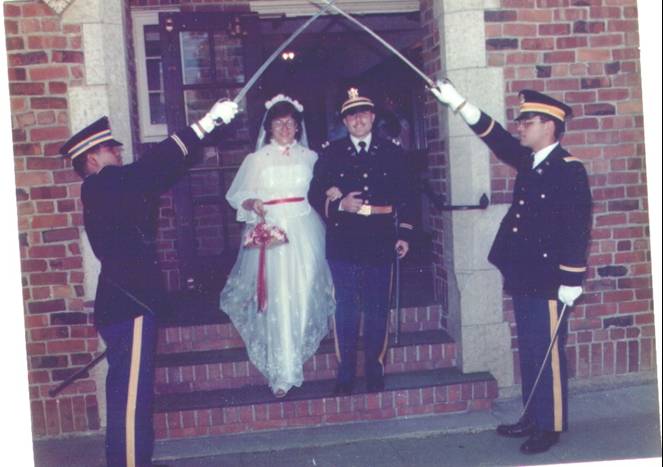
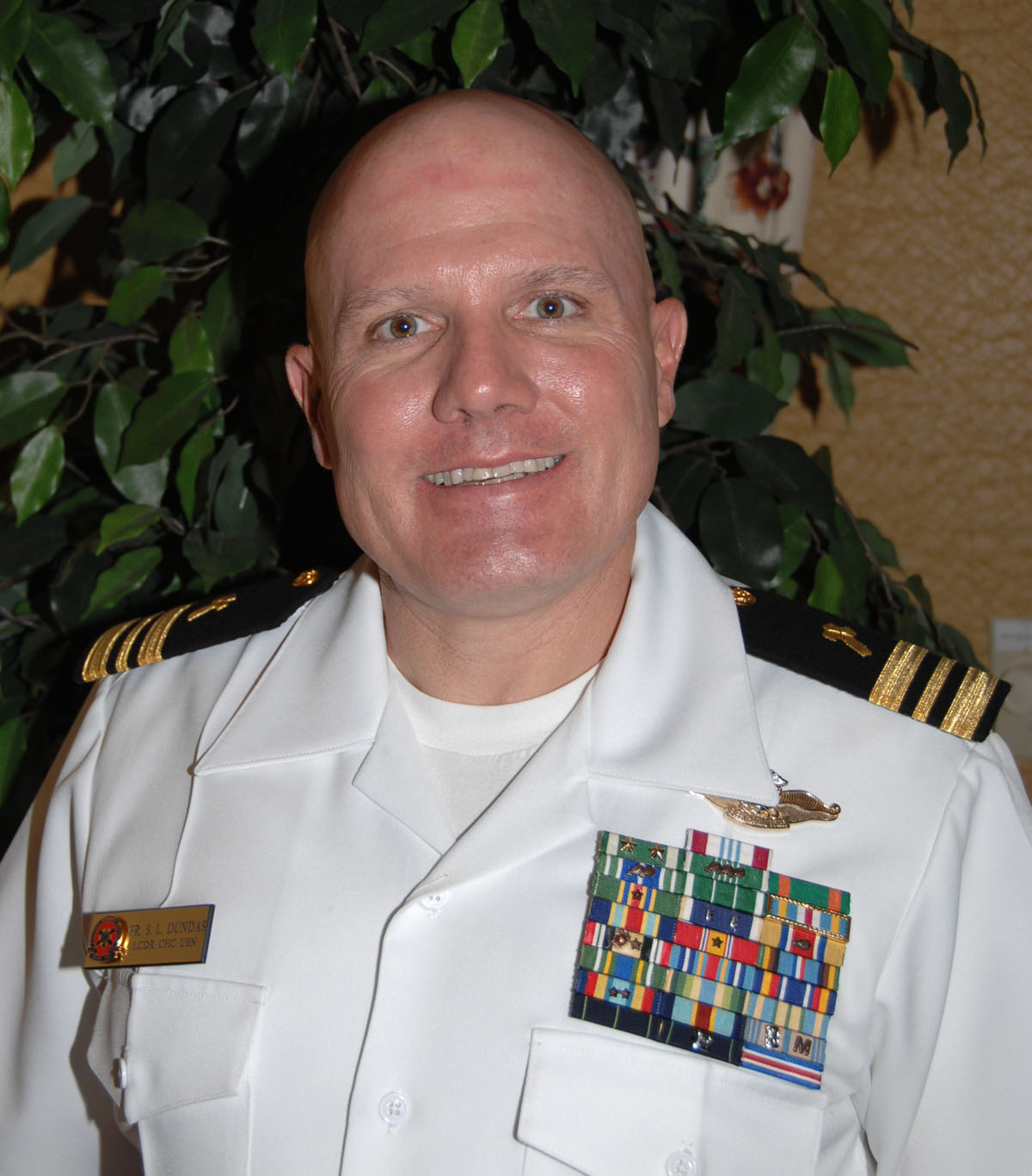
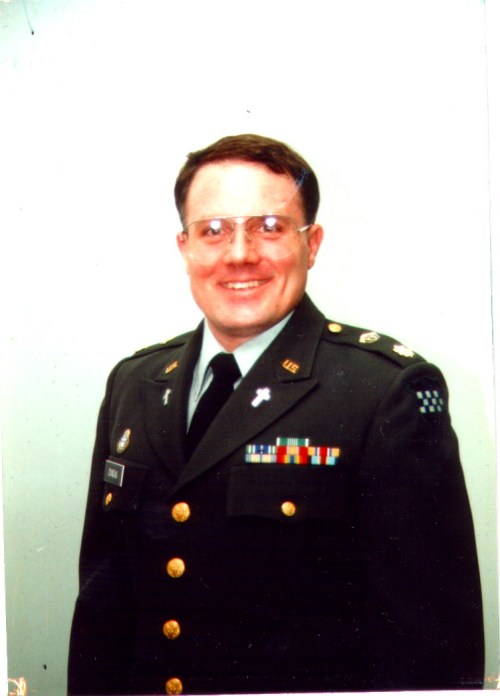
Padre Steve in 1982

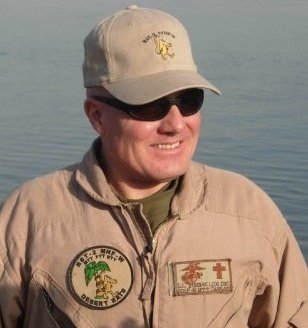
They say that “time flies when you’re having fun” and I cannot believe that I have been in the military now for 29 years. On August 25th 1981 a 21 year old college kid with long Southern California “surfer” hair walked into the California Army National Guard Armory on Van Nuys Boulevard to enlist in the National Guard after having just sworn into the Army ROTC program at UCLA.   Back then I enlisted in what was or is called the Simultaneous Membership Program or SMP program.  My initial military training came through the ROTC program as well as on the job training in the National Guard as a Field Artillery Forward Observer and Intelligence Specialist.

Like Cal Ripken Jr commenting about his career “So many good things have happened to me in the game of baseball. When I do allow myself a chance to think about it, it’s almost like a storybook career. You feel so blessed to have been able to compete this long.” I can say the same thing just substituting the words “military career” for “the game of baseball.”

On the day that I enlisted I met with Major Charles Armagost the S-1 of 3rd Battalion 144th Field Artillery and full time advisor for the battalion filled out my enlistment papers and raised my right hand. I still remember the day when I enlisted. It was a hot smoggy Los Angeles day where you could see the air.  I walked down the hall after I swore in to see the supply Sergeant who outfitted me with four sets of Olive Green fatigues and ordered me two sets of the brand new BDUs.  I was issued my TA-50 gear and taken to the motor pool where I was given cursory training on the M151A1 “Jeep” and issued a military drivers license.  The three weeks later I was driving one of those venerable machines to Fort Irwin on a Friday through Sunday drill with the advanced party. It was the beginning of a 29 year career spanning two services, the active and reserve components and now multiple trips to combat zones.

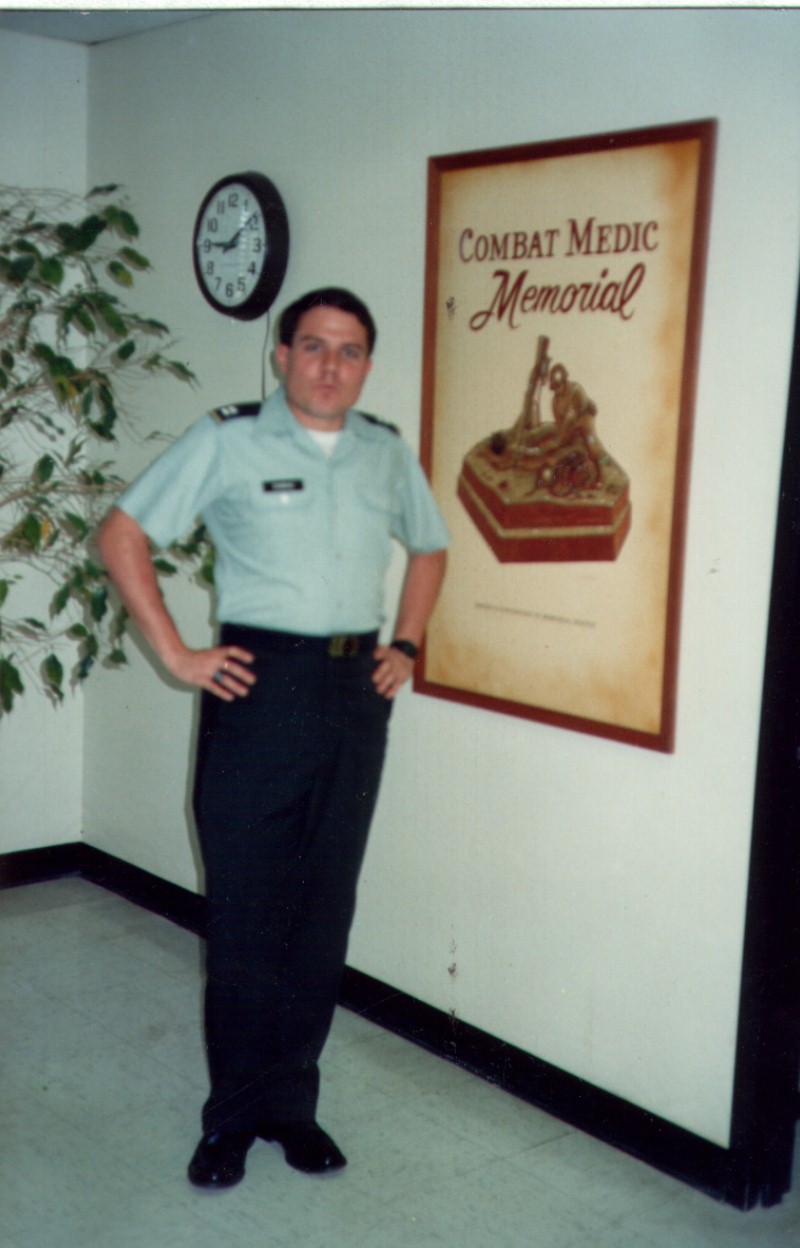
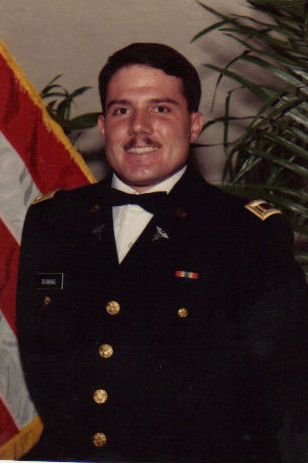
Army Captain 1987

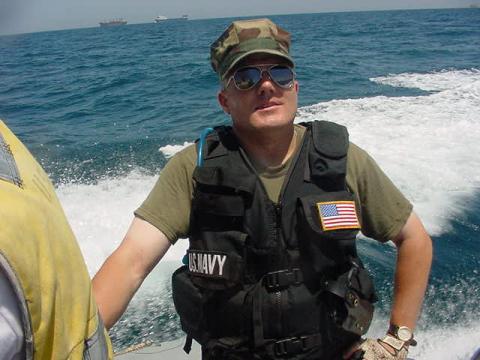
It has to quote Jerry Garcia of the Grateful Dead “a long strange trip” spanning the Army and the Navy, active and reserve components as well as two tours with the Marine Corps while serving in the Navy and the beat goes on with my selection for promotion to Commander and my Senate nomination to that grade on August 21st.  I have served on the Fulda Gap in the Cold War, been to what was then East Berlin driving the Helmstedt-Berlin corridor sharing the road with Soviet armored columns.  I supported the Bosnia Operation in 1996-97 and the Korean DMZ with the Marines in 2001. I served in Operation Enduring Freedom and Southern Watch in 2002 where I was on a boarding team, boarding 75 Iraqi and other country smuggling ships while serving aboard the USS Hue City.  That was followed by multiple trips in and out of theater with the Marine Security Forces from 2003-2006 as well as time on the Cuban fence line at Guantanamo Bay before serving in Iraq with our Marine and Army advisors and their Iraqi Army and Security forces.  I’ve served with Infantry, Armor, Combat Engineer, Artillery, Medical and Ordnance units, Security forces, support elements, bases and training centers, hospitals and ships.

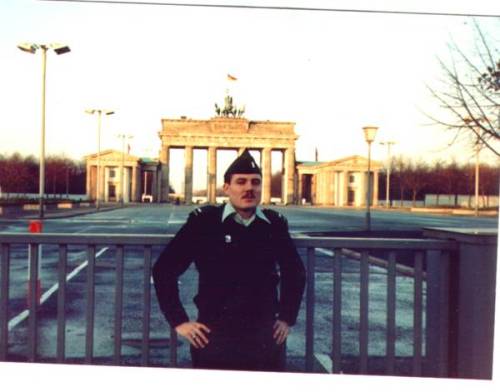
Berlin Wall November 1986

When I enlisted I thought that once I was commissioned that I would serve my entire career in the Army and retire as a Lieutenant Colonel. I did not anticipate becoming a Chaplain nor leaving the Army for the Navy. When I am officially promoted to Commander it will be the first rank since I was an Army First Lieutenant that I have not held twice.  When I first enlisted and had no ribbons I used to look at wonderment at the Korea and Vietnam veterans who had tons of ribbons and tell Judy that I wish I had what they had. Now that I am working on 9 rows of the things I cringe every time I have to remount ribbons and ribbons and my wallet screams in agony.  Judy is quick to remind me of my whininess back then and tell me that I asked for it.

She didn’t know what she was getting into

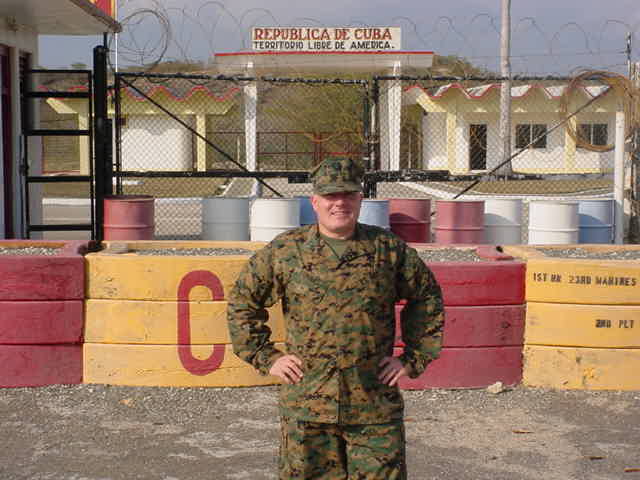
As an Army and Navy Officer I have served or done some kind of military duty in Germany, France, Great Britain, Greece, Italy, Croatia and Turkey, Spain, Malta, Korea, Japan, Jordan, Bahrain, Kuwait and Iraq.  I’ve done what I call the “Commie Trifecta” the Berlin Wall, Korean DMZ and the Cuban Fence Line. At the same time I have spent 16 of 27 wedding anniversaries away from home and lost count of birthdays and other important occasions that I missed while serving the country.

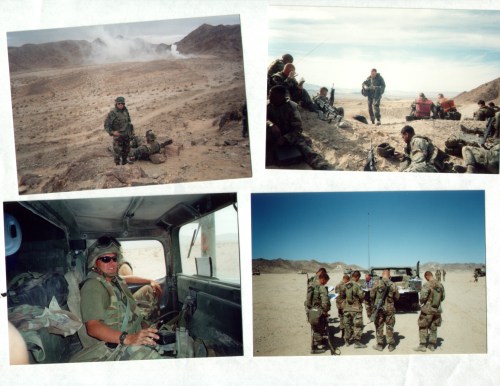
Guantanamo Bay Cuba 2004

I have served 5 different Presidents. In that time I have seen changes in the political, social and economic conditions of the country and the world that I could not have imagined at the time of my enlistment.  The Soviet Union had just invaded Afghanistan and the Iranian hostage crisis had just ended but within the Soviet Union had been defeated the Berlin Wall taken down and collapse of the Soviet Union.  Twenty years after I enlisted the people that defeated the Soviets were attacking us on our own soil.

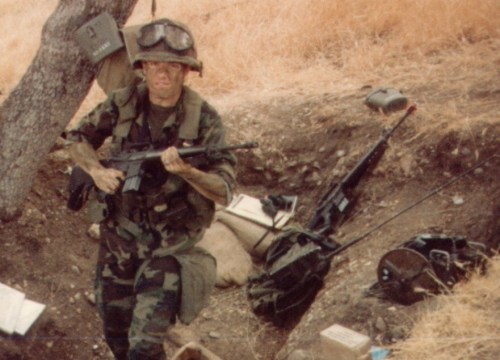
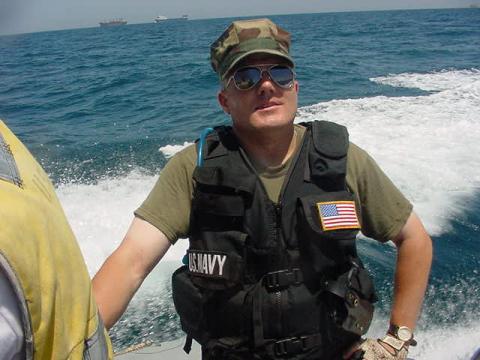
Boarding Party Arabian Gulf May 2002

I lived in Europe and went through the Chernobyl radiation cloud which is obviously the cause of my glowing personality.  While in Europe I ate enough beef to be labeled by the Red Cross as a potential carrier of Mad Cow disease. I worked on military personnel policies at the beginning of the AIDS epidemic and saw the beginning of Don’t Ask Don’t Tell policy.  I saw the Reagan build up and the post Cold War drawdown.  When I was a Company XO and Company Commander we had landlines and typewriters with carbon paper and did not get internet in my office until 1997.  It is hard to believe the changes even in the quantum leaps in computer and communication technology in the past few years where I can check e-mail on my Blackberry and work from almost anywhere with my laptop.

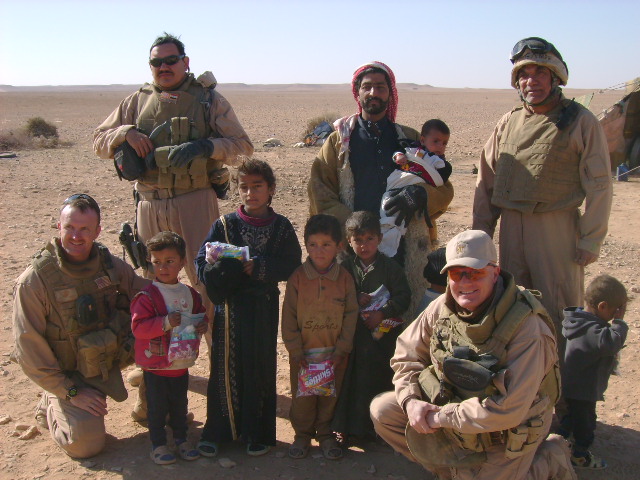
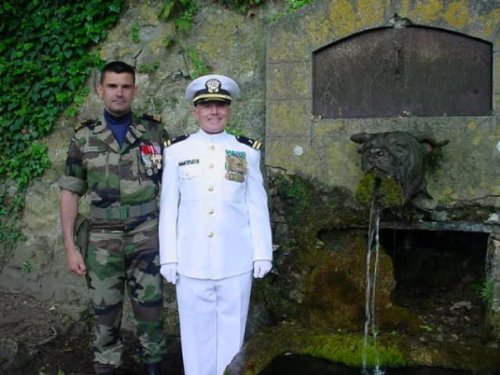
With Advisors and Bedouin on Iraqi-Syrian Border December 2007

Looking back here are some of the things that I have seen since I entered the military:

October 23rd 1983: Beirut Bombing: BLT 1/8 barracks and French 1st Parachute Regiment destroyed by suicide bombers 241 Americans and 58 French Paras killed.  I was at the Junior Officer Maintenance Course at Fort Knox watching CNN late at night when they broke the news.

December 12th 1985:  Arrow Air Charter Boeing 707 crashed in Gander Newfoundland killing 248 American Soldiers returning from Peacekeeping duty in Sinai Peninsula. Among the dead was Sergeant Charles Broncato who had been one of my Squad Leaders in 2nd Platoon 557th Medical Company Ambulance. I was then serving as the Company Commander.

January 28th 1986: The Space Shuttle Challenger blows up 73 seconds into flight killing 7 Astronauts.  I was in my office at the close of the day getting ready to adjudicate an Article 15 when my Charge-of Quarters SPC Lisa Dailey ran into my office and said “Lieutenant Dundas, the Space Shuttle just blew up!” My response was “Come on, Space Shuttles don’t blow up.”

February 15th 1988: The Soviet Union withdraws from Afghanistan. I was a National Guard Officer in Texas attending Seminary and thought this was a good thing.  Now I wish that they had done better and at least killed Osama Bin Laden, then a relatively minor commander.

December 21st 1988: Pan Am 103 downed by Libyan operatives over Lockerbie Scotland killing all 270 passengers and crew. The aircraft a Boeing 747 named the Maid of the Seas was the same aircraft that we had flown home from Germany on December 28th 1986.

October 17th 1989: the Loma Prieta Earthquake causes massive damage in San Francisco and Oakland. I was watching pregame activities of game 3 of the World Series between the A’s and Giants on television when it happened.

November 9th 1989: The Berlin Wall Fell. In November of 1986 we had been to East Berlin and like most Americans never thought that we would see this day.

August 2nd 1990: Iraq Invades Kuwait: At time few people believe it well end in war. I was deputy course leader for Army Chaplain Officer Basic Course, tell my classmates to get ready to go to war.

December 31st 1991: The Soviet Union is dissolved.

April 19th 1993: FBI and other Federal Law Enforcement personnel using Combat Engineering Vehicles from the 111th Engineer Battalion, the unit that I serve as a Chaplain assault the Branch Davidian compound outside Waco Texas. Davidian leader David Koresh and dozens of followers die in fire and shoot out.

June 17th 1994:  Police arrest O. J. Simpson after nationally televised low speed chase charging him with murder in the death of his wife Nicole and Ronald Goldman. NBC splits screen between NBA championship series game between Houston Rockets and New York Knicks and the chase. I watch in back of M577 Command Vehicle on 9 inch television in the field at Fort Hood.

August 12th 1994: Baseball strike cancels season, playoffs and Worlds Series.

April 19th 1995: Timothy McVeigh and Terry Nichols blow up Alfred P. Murrah Federal Building

January 26th 1998: Bill Clinton states that “I want you to listen to me. I’m going to say this again: I did not have sexual relations with that woman, Miss Lewinsky.”

December 31st 1999: The world awaits the end of life as we know it due to the Y2K flaw sthat supposedly causes computers to malfunction and bring calamity to the earth.

January 1st 2000:  People including me wake up from hangovers to find that computers still work.

September 11th 2001: Al Qaeda terrorists hijack four commercial airliners crashing two into the World Trade Center Towers in New York collapsing them and one into the Pentagon. A fourth is brought down by passengers before it can reach Washington DC and its target, the US Capital killing 2976 people and injuring another 6000+. I am at Camp LeJeune North Carolina and remained locked down on base the next 4 days.

March 19th 2003: US and Allies launch attack on Iraq known as Operation Iraqi Freedom to remove Saddam Hussein from power and disarm his stocks of weapons of mass destruction. I am assigned to USS Hue City and the ship is in dry dock. The rest is history.

I also saw a lot of baseball mostly from afar, Pete Rose’s epic hit, Cal Ripken’s consecutive games record, Nolan Ryan’s 5000th strike out and 7th no-hitter as well as all of the now steroid tainted home run records including Barry Bond’s 756th home run which I saw live in a chow hall in Baghdad.

Somehow it is all worth it. Judy has not divorced me although I have probably given her reason on more than one occasion to do so and I love what I do and the people that I get to serve. It really is amazing to look back and think about all the events that I have either witnessed or been a part of in the military as well as all of the great people that I have been associated with. Those friendships and relationships mean more than about anything to me and I am grateful to God and to Judy, my family and all of my friends who have helped me, sometimes in very dark times to go as far and as long as I have in both the Army and Navy.

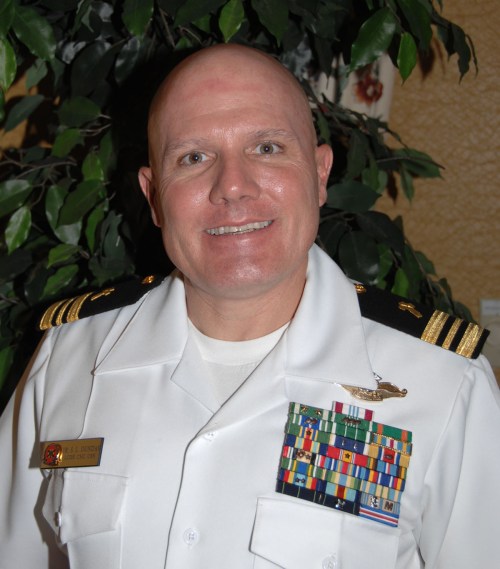
I was selected for promotion to Commander in June and confirmed by the Senate on August 23rd. I now am about to enter a new phase of life, military service and ministry as the supervisory Chaplain at Naval Hospital Camp LeJeune North Carolina.  Lord knows what the future hold, but whatever happens I feel that things will be fine.

I hope that whatever you do that you will experience good things and be able to look back in life and say “wow that was something else.” So here is to all of us and the long strange trips that we embark upon in life.  In the words of Lou Gehrig, “I am the luckiest man alive.”

Peace,

Padre Steve+

Leave a comment

Filed under Baseball, History, Military, Tour in Iraq, US Navy

Padre Steve Might be a Mad Cow Carrier and Can’t Give Blood…He’s “Mad” as Hell and isn’t going to take it anymore!

I am guilty yes guilty my friends.  I have about a one in a zillion chance of having the dreaded variant Creutzfeldt-Jakob Disease but if your believe those who promote conspiracy theories and unscientific assumptions I am probably something like Typhoid Mary just waiting to unleash death and destruction on millions of unsuspecting God fearing beef eating Americans by donating blood.  That is my alleged crime and while it is not a ‘crime’ in the truest sense of the word it might as well be as it ostracizes me and hundreds of thousands, maybe even millions of veterans and their dependants from a civic duty that many of us did before all the media hype that surrounded the decision to ban us from being able to give blood.  It is discriminatory, exclusionary and for that matter bad public policy.

Now my dear readers what is my crime and the punishment that has been inflicted on me?  I was in the military and lived in Europe in the 1980s and 1990s for a period of about four years. That my dear reader makes me ineligible to donate blood even if I am otherwise healthy and willing to give in time of need.  However the rule is rather arbitrary in nature. It specifies that living in most of Europe for 6 months or more if you are in the military is enough for a person to be a risk.  However the rules tolerate those who go on beef eating and haggis hogging binges for limited amounts of time while wearing kilts in Great Britain. It is an absurd standard to hold anyone to as the fact is simple, if you didn’t eat high risk cattle you have almost no chance of contracting or carrying the disease.

I readily admit that in that time in Europe I did eat beef. Mind you dear reader it was always well cooked and I certainly never ate Haggis.  However I am now and have been for many years treated as if I had some exotic and deadly plague like I was infected with HIV or Hepatitis B, diseases that are proven to be transmitted through contaminated blood products. I my friends am the poster child of what it is to be discriminated against based on special interest groups and media fear mongering.  That absurd fear mongering got our wonderful Food and Drug Administration and other government regulatory agencies to take draconian measures to stop something that in the scope of infectious disease is rather low on the threat scale.  I say that such action is not based on legitimate public health concerns but on a political agenda that uses fear to accomplish what it never could at the ballot box.

Now mind you Creutzfeldt-Jakob disease (CJD) or the variant Creutzfeldt-Jakob Disease (vCJD) or the real “Mad Cow” disease is no laughing matter but statistics underlying the incidence of the disease in the United States of vCJD show that if there is a threat it is very limited and that the chances of the Cubs winning the Worlds Series are better than getting this dread disease. Even statistics of a supposed “second wave” of vCJD in Great Britain estimate about 70 persons over a period of years during a “second wave” of vCJD might die, at worst case the number is 600.  In fact in Britain only one case of transmission of vCJD though blood products has been confirmed and if all people who had eaten beef lived in and eaten beef in Britain were barred from  donating blood the British would likely have to convert oil tankers to bring blood in from around the world. But they are not while people in the United States who lived in Europe, not even Great Britain are banned as a class from donating blood and the vast majority of these Americans are military members and their dependants.

I am a supporter of stringent policies on infectious diseases but if in Britain, the very epicenter of a disease that reared its ugly head in the early 1980s people can and do donate blood and the incidence of the disease is miniscule and is scientifically regarded to having more to do with genetics than eating beef.  Yet the Federal Government responding to fear mongering press reports and conspiracy theory maniacs have banned an entire class of people from donating the gift of life to those in need.  It is absurd and dishonest and plays into the hands of fear mongering power seeking special interests groups that claim the public good while discriminating against a whole class of people whose only crime was to serve their country.  Bill O’Reilly and Steven Colbert do you hear me?

Before this I was almost a religious blood donor I learned it from my dad who I think had his golden bucket from the Delta Blood Bank in Stockton. In fact he took me to donate for the first time and I continued because it was the right thing to do. I donated until I was branded with the scarlet letter of being a potential carrier of variant Creutzfeldt-Jakob Disease and have been refused ever since.  This is also true for hundreds of thousands and possibly millions of healthy military members, veterans and family members who ate a steak in Germany or some other western European country because we might have eaten a significant amount of “Bully” British Beef or perhaps a butt load of Scottish Haggis even though the chances of having these delicacies is significantly lower in good old Deutschland where people would rather eat Argentinean beef than beef from a country that they thought they should own by now and where the vast majority of the beef is well rather “brown-shirted” if you get my drift.  If the CDC or FDA has banned a whole class of patriot Americans from donating blood at least do it based on a preponderance of evidence and not speculation and paranoia.

In the United States we often run short of blood but we exclude by default one of the healthiest and giving groups of people in the world from giving. There are times in every major medical center that blood products run in short supply because of supply and demand.  Most donations centers have on hand no more than a 3 day supply for normal transfusion needs and if a major catastrophe involving vast numbers of traumatic injuries occurred, the supply would be gone in no time and people would die for the lack of blood.  Unfortunately in the world of potential mass casualties caused by terrorism or natural disaster this is a more likely occurrence than a mass outbreak of vCJD. Quite often there is more demand than supply and red blood cells have a short shelf life of 35-42 days at refrigerated temperatures and plasma can be frozen but has a shelf life of only about a year meaning that those stocks are also limited.

So rather than looking at statistics and solid data military members are banned from donating blood unless they choose to dishonor themselves by lying about it.  I have never done that as much as I wanted to give blood.  Heck we have an Armed Service Blood Center in our very hospital whose outreach director is one of my former Lieutenants from my days as a company commander in Germany.  I may be at times “mad” but my “madness” is both genetic as from a bit of PTSD, but my blood is a-okay high test 104 Octane B positive blood and I cannot donate when I want to because the debate is being driven by anti-beef eating, anti-military food Nazis who use this ‘cause’ to spread fear and increase their power relative to the rest of us.  Just take a look at their websites which are populated with hyperbole even more hyperbolous than what I spout.

I contend that I and hundreds of thousands of veterans and military members have been damaged by the zealotry of the “Mad Cow” fear mongers and their media accomplices which did its best to spread panic about this incredibly rare disease by showing infected cattle lurching around barnyards. Now it is true that this is a heinous disease but incredibly rare and for the most part has been controlled even in docile cows.

My argument is that there is a terrible need for blood products and a whole group of people are being discriminated against on the basis of media hype and pressure by special interest groups.  I know by saying this that it makes me a target and that once this post gets some hits that I will have one of these anti-beef eating, anti-military and national security ignoring bozos will post nasty things about me. So far as they don’t call me a Dodger fan I will be civil despite the fact that they won’t rest until none of us can give blood because we ate beef once in our lives.

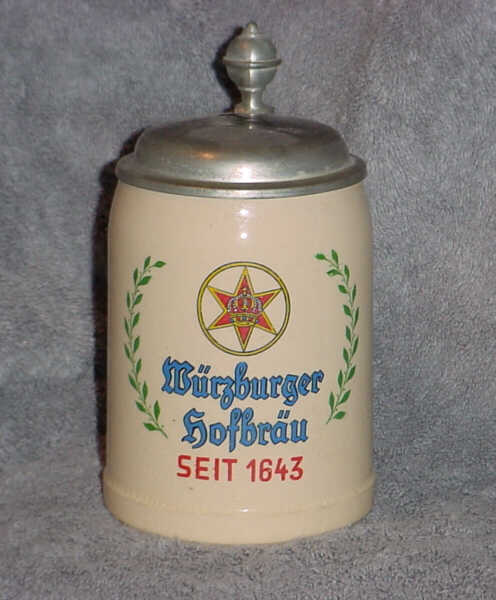
I wish that some bold law firm would take this up as a class action suit naming the FDA, CDC and every major television network that spread the fear which drives the decision to bar an entire group of healthy people from giving blood.  This may seem callous and insensitive but I say let’s stick it to these guys and let them see the shoe is on the other foot. Let’s kick their vegan asses back to the planet Vegan where they belong. It’s late tonight but tomorrow its cheeseburger time for Padre Steve, pass the condiments please and get my stein ready.

So until the next time I say peace and may the law be with us. Maybe there is a reason that some of my classmates in seminary said that I should have gone to law school.  Maybe that’s what I’ll do with my GI Bill when I retire go to law school pass the bar and be a Priest-Lawyer, but not a Canon Lawyer, no money in that is there? So let’s go out and win a billion dollars or so from these oppressors of individual liberty and the common good.

Anyway Peace Out my brothers and sisters, have a burger or steak tonight.

Love ya,

Padre Steve+

23 Comments

Filed under healthcare, laws and legislation, national security, Political Commentary

Eins, zwei, drei g’suffa! Padre Steve Muses on German Beer

Beer is proof that God loves us and wants us to be happy.
-Benjamin Franklin

Not all chemicals are bad. Without chemicals such as hydrogen and oxygen, for example, there would be no way to make water, a vital ingredient in beer.
-Dave Barry

From man’s sweat and God’s love, beer came into the world.

–Saint Arnold of Metz, The patron Saint of Brewers

I have lived in Germany a number of times and have a good number of German friends that I have served with either in the Army or the Navy that I am still in contact with.  I have a love of good beer and my taste tends to gravitate toward German Pilsners and Lagers or an occasional Dunkel or Schwartzbier. I do have a fondness for a number of Irish beers and when overseas like Kilkenny which is finally just available in the US in a few locations. Hopefully it will be more available in the coming year.  I also like an occasional English Ale such as Newcastle.  Call me a beer snob but I find most mass produced American beers pretty substandard but I do like Sam Adams and Yuengling lager as well as some beers by some smaller brewers.  I’m sorry but “light beer” scarcely qualifies as beer.  I have to agree with the folks at the Capital Brewery in Middleton Wisconsin which says “People who drink light ‘beer’ don’t like the taste of beer; they just like to pee alot.” Life is too short for bad beer as was known back in medieval times in Danzig Germany where the town council made an edict stating: “Whoever makes a poor beer is transferred to the dung-hill.”

Alan Young, Master Brewer at Gordon Biersch Virginia Beach

In the US I also like a number of the more German type micro brews, especially Gordon Biersch where I am a member of the Virginia Beach Stein Club.  I like Biersch a lot and since I know the master brewer Alan Young at the Virginia Beach location know that the beer is prepared to the German beer purity standards and that the hops used in the beer actually come from Bamberg Germany.  However, today is not so much about the Biersch beer, which I will write about in detail in the near future.

Today is a day where I talk about Germany and German beer.  When we first went to Germany in 1984 we lived in a tiny little town in the Saarland named Eckelhausen and I was assigned to the 557th Medical Company (Ambulance) which was based at Neubrücke, just over the Saarland and Rheinland-Pfalz state border.  These are little towns, Neubrücke is a few kilometers from Birkenfeld and Eckelhausen is in Kreis Sankt Wendel.

The nearest large city is Trier on the German-Luxembourg border. When we were stationed there the local beers severed at the local restaurants were primarily pilsners.  Some of those more local beers included Kirner Pils from the town of Kirn on the Nahe River, Barbarossa Braü from Kaiserslautern and Bitburger Pils from Bitburg. Bitburg has become much more than a local beer and can be found throughout Germany and around the world.

The 557th was moved to Wiesbaden in November of 1984 and this led us to other beers including Binding Bräuerei and their Römer Pils and Henninger Pils. Some of the beers from Hessen were very nice including Licher Pils from the town of Lich northeast of Frankfurt. This brewery also produces an “export” as well as a Weizen. It is advertised as the “number one beer in Hessen.”

Well we came back to the states just after Christmas of 1986 and suffered for years without a lot of German beer available in Texas and later West Virginia.  However, in 1996 I was mobilized from the Army Reserve to serve in Germany supporting Operation Joint Endeavor, the mission to help end the conflict between Serbia, Croatia and Bosnia-Herzegovina. I was stationed with the 417th Base Support Battalion in Kitzingen but had significant duties at the Würzburg Army Hospital and the 4th Battalion 3rd Air Defense Artillery.

I lived in Würzburg and commuted to Kitzingen and in my time in this area which is in the state of Bayern but historically is the capital of Franken.  Of course I always gravitate toward pilsners or lagers and in Würzburg I came across a very old and good beer in Würzburger Pils.  I also was able to have more access to other Bavarian beers including Bamberger Pils, St Georgen  Kellerbrau, Reichelbräu Pils , Spaten and Löwenbräu as well as beers from just outside the area to include Michaelsbräu of Babenhausen and Braugold which I had in Weimar.

I have travelled elsewhere in Germany I have encountered many other beers.  I do prefer the beers from the more southern and central parts of the country than those of the north.  Probably the most unique beer I had was not so much to the quality or taste was Wittenburger Luther Beer which I came home with a stein which reads “Zum Gedenken an den bedeutendsten Wittenburger Luther Bier “ein kannlein bir gegen den teufel ihndamit zu verachten” or “To commemorate the most important, Wittenburger Luther Beer, a mug of beer against the devil is to despise him.”

So the Germans have taught me well.  I only drink good beer and I think that it is something to be savored and not abused.  I like the way that the Germans do life, unlike others who revel being Puritans, the Germans have balance in life.  Unlike some of the lack of “fun-dementalists” that I have met and spend their time reveling in the misery of their condition I totally agree with Luther when he said:

“God does not forbid you to drink, as do the Turks; he permits you to drink wine and beer: he does not make a law of it. But do not make a pig of yourself; remain a human being. If you are a human being, then keep your human self-control.”

And since I am not as young as I used to be: “We old folks have to find our cushions and pillows in our tankards. Strong beer is the milk of the old.

Amen and peace,

Padre Steve+

1 Comment

Filed under beer, purely humorous

Stalingrad: Disaster on the Volga

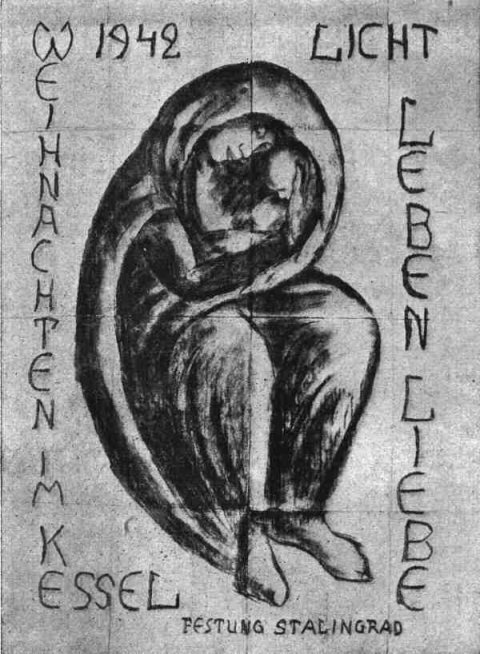
Madonna of Stalingrad: Drawn by a German Chaplain and physician the piece was taken out of the city by one of the last officers to get out. It is now displayed in the Kaiser Wilhelm Memorial Church in Berlin

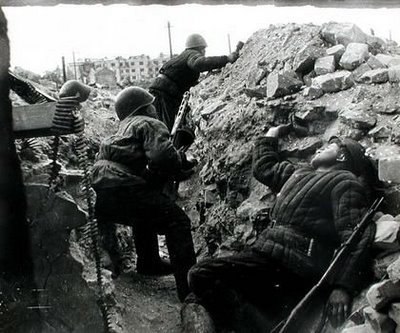
Sunday the 31st of January marks the surrender of the remnants of the German 6th Army to the Soviets at Stalingrad. The focus of this article is on how the Germans and Russians fought the Stalingrad campaign. In particular it is an analysis of the way the governments and military’s of both Nazi Germany and the Soviet Union planned and executed strategy during the course of the campaign adjusted to the situation and how the campaign ended. It is also a reminder of the price that ordinary soldiers can pay when a country commits them to war. I conclude with a potential modern application for the US and NATO in Afghanistan.

Stalingrad: Primary or Secondary Objective

The mistakes began early in the planning and conduct of the operation

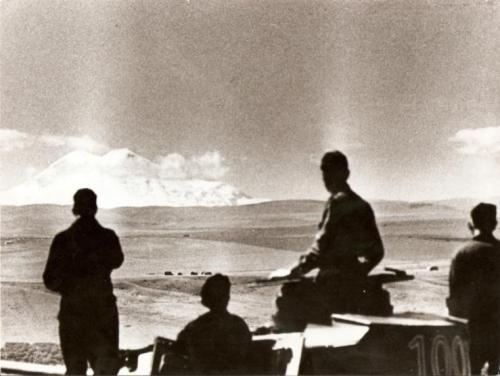
Following the Soviet winter offensive and the near disaster in front of Moscow the German High Command was faced with the strategic decision of what to do in the 1942 campaign.  Several options were considered and it was decided to seize the Caucasus oilfields and capture or neutralize the city of Stalingrad on the Volga.  However, the High Command was divided on the actual objective of the campaign.
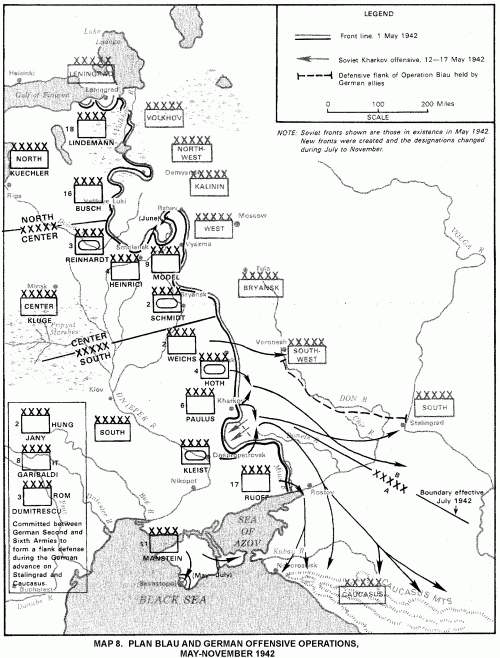
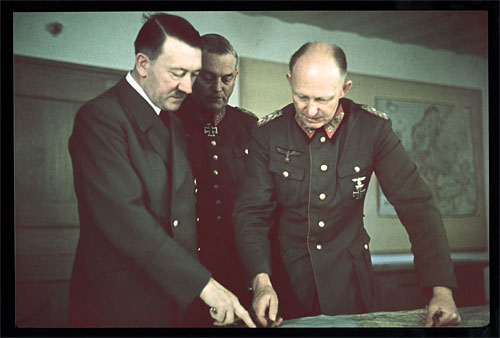
OKH under the guidance of General Halder assumed that Stalingrad was the objective and the advance into the Caucasus was a blocking effort.[i] Hitler and OKW planned to capture the Caucasus oil fields and capture or neutralize Stalingrad to secure the left flank.[ii] Both OKH and OKW considered Stalingrad significant but “German commanders initially regarded it as a weigh station en route to the Caucasus oil fields.”[iii] The conflict echoed in the ambiguity of Directive No. 41 which “included the ‘seizure of the oil region of the Caucasus’ in the preamble concerning the general aim of the campaign, yet made no mention of this in the main plan of operations.”[iv] At the planning conference held at Army Group South in early June “Hitler hardly mentioned Stalingrad. As far as his Generals were concerned it was little more than a name on the map. His obsession was with the oil fields of the Caucasus.”[v] Manstein noted that “Hitler’s strategic objectives were governed chiefly by the needs of his war economy….”[vi] Anthony Beevor notes that at this stage of planning “the only interest in Stalingrad was to eliminate the armaments factories there and secure a position on the Volga. The capture of the city was not considered necessary.”[vii] German planners “expected that the Soviets would again accept decisive battle to defend these regions.”[viii]

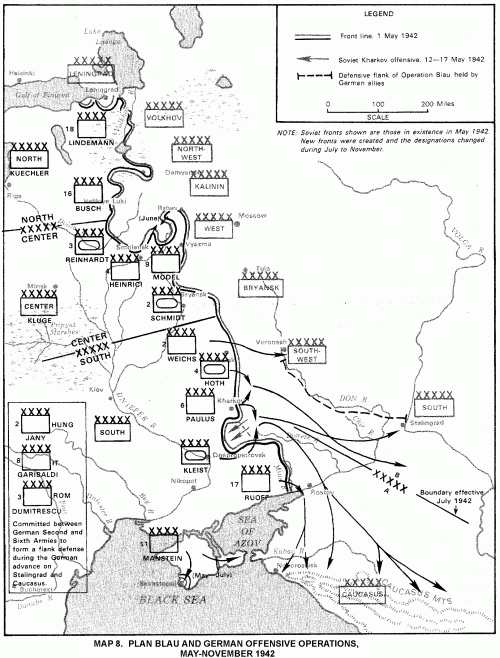
In Moscow Stalin and his Generals attempted to guess the direction of the impending German offensive.  “Stalin was convinced that Moscow remained the principle German objective…Most of the Red Army’s strategic reserves…were therefore held in the Moscow region.”[ix] To disrupt the German offensive and to attempt to recover Kharkov three offensives were launched by Red Army forces under the direction of Stavka. The largest of these on Kharkov was defeated between 12-22 May with the loss of most of the armor in southern Russia. This coupled with an equally disastrous defeat of Red Army forces in Crimea by Von Manstein’s 11th Army meant that the Red Army would face the Germans in a severely weakened condition.[x]

Operation Blau: Opening Moves and Divergent Objectives
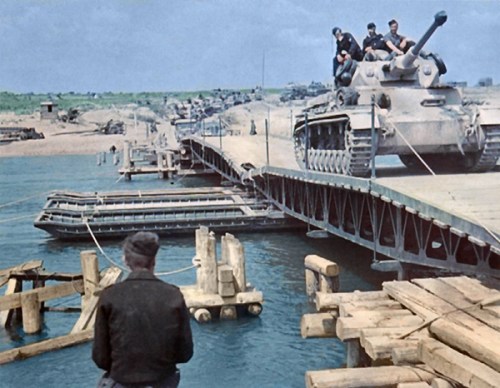
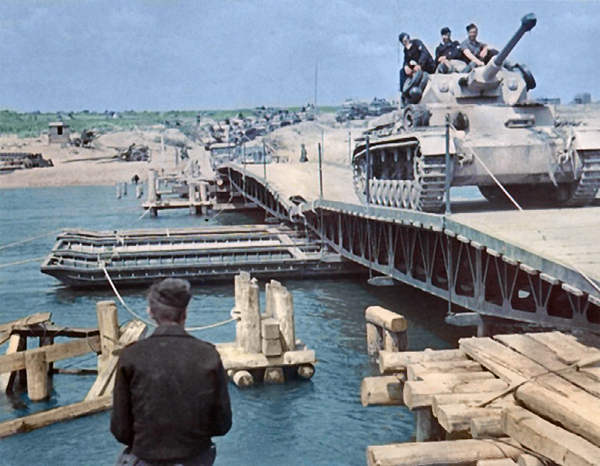
Panzers cross the Don

The German offensive began on 28 June under the command of Field Marshal von Bock. Bock’s command included two separate army groups, Army Group B under General Von Weichs with 2nd Army, 6th Army and 4th Panzer Army operated in the northern part of the operational area. Army Group A was to the south with 17th Army and 1st Panzer Army.[xi] Army Group B provided the main effort and quickly smashed through the defending Soviet armies and by the 20th Hitler believed that “the Russian is finished.”[xii] One reason for the German success in the south was that until July 7th Stalin believed that Moscow was still the primary objective.[xiii] Bock was prevented by Hitler from destroying Soviet formations left behind and was relieved of command by Hitler. He was replaced by Von Weichs which created a difficult command and control problem.  Manstein noted that this created a “grotesque chain of command on the German southern wing” with the result that Army Group A had “no commander of its own whatever” and Army Group B had “no few than seven armies under command including four allied ones.”[xiv]

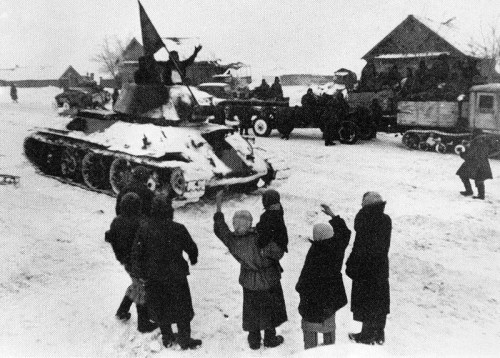
Destroyed Soviet T-34s

This decision proved fateful.  Hitler’s decided to redirect the advance of the 4th Panzer Army to support an early passage of the lower Don, diverting it from its drive on Stalingrad.  Additionally the army groups became independent of each other when Bock was relieved of command.  They were “assigned independent-and diverging-objectives” under the terms of Directive No.45.[xv] This combination of events would have a decisive impact on the campaign.  The decision prevented a quick seizure of Stalingrad by 4th Panzer Army followed by a hand over to 6th Army to establish the “block” as described by Directive No.41.  Kleist noted that he didn’t need 4th Panzer Army’s help to accomplish his objectives and that it could have “taken Stalingrad without a fight at the end of July….”[xvi]

Field Marshall Von Paulus

The result was damning. Air support and fuel needed by Army Group A was transferred to 6th Army, denuding Army Group A of the resources that it needed to conclude its conquest of the Caucasus.[xvii] At the same time it denied Army Group B of the Panzer Army that could seize Stalingrad when it was still possible to do so.  Beevor calls Hitler’s decision a disastrous compromise.[xviii] Halder believed the decision underestimated the enemy and was “both ludicrous and dangerous.”[xix]

Focus on Stalingrad
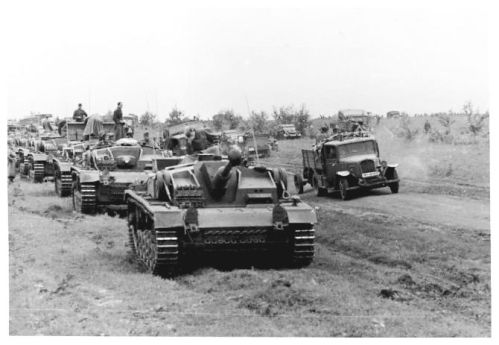
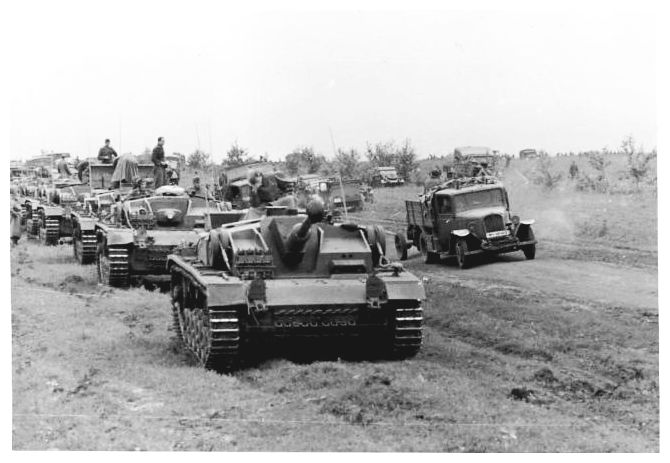
Sturmgeschutz Battalion Advancing toward Stalingrad

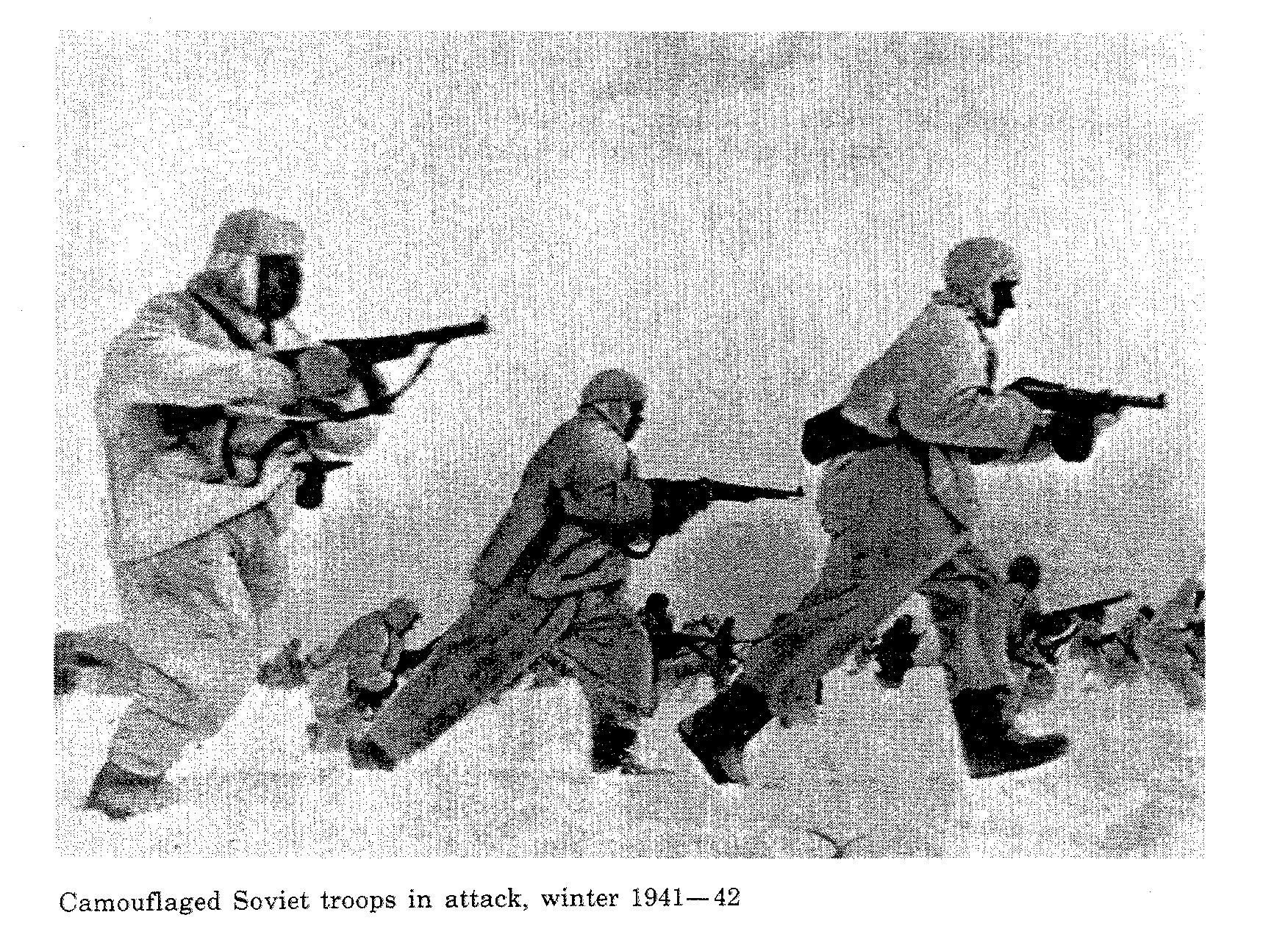
On July 22 as the Wehrmacht ran short on fuel and divisions to commit to the Caucasus, and 6th Army fought for control of Voronezh the Soviets created the Stalingrad Front. Stavka moved an NKVD Division to the city,[xx] and rapidly filled the new front with formations transferred from the Moscow Front.[xxi] Stalin issued Stavka Order 227, better known as “No Step Back” on 28 July. The order mandated that commanders and political officers who retreated would be assigned to Penal battalions[xxii] and armies were to form three to five special units of about 200 men each as a second line “to shoot any man who ran away.”[xxiii] Russian resistance west of the Don slowed the German advance. German commanders were astonished “at the profligacy of Russian commanders with their men’s lives.”[xxiv] Von Kleist compared the stubbornness of Russians in his area to those of the previous year and wrote that they were local troops “who fought more stubbornly because they were fighting to defend their homes.”[xxv] Additionally, Stalin changed commanders frequently in the “vain hope that a ruthless new leader could galvanize resistance and transform the situation.”[xxvi] General Chuikov brought the 64th Army into the Stalingrad Front in mid-July to hold the Germans west of the Don.[xxvii]
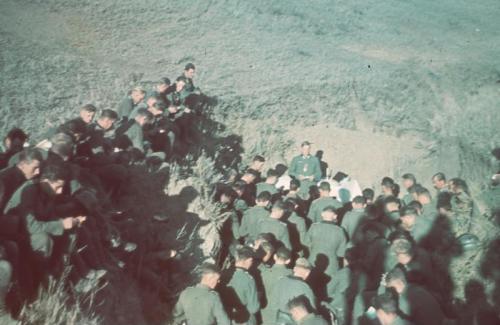
German Militarpfarrer (Chaplain) leading field service in August 1942

Further weakening the Germans OKW transferred key SS Panzer Divisions and the Grossdeutschland Division to France. Supporting Hungarian, Italian and Romanian allied armies which lacked motorization, modern armor or anti-tank units were unable to fulfill the gaps left by the loss of experienced German divisions and the expectations of Hitler.[xxviii] 6th Army was virtually immobilized for 10 days due to lack of supplies allowing the Russians to establish a defense on the Don Bend.[xxix] To the south the Germans were held up by lack of fuel and increased Soviet resistance including the introduction of a force of 800 bombers.[xxx] Glantz and House note that with the fall of Rostov on July 23rd “Hitler abruptly focused on the industrial and symbolic value of Stalingrad.”[xxxi] Undeterred by warnings from Halder that fresh Russian formations were massing east of the Volga and Quartermaster General, Wagner, who guaranteed that he could supply either the thrust to the Caucasus or Stalingrad but not both.[xxxii] Again frustrated by slow progress Hitler reverted to the original plan for 4th Panzer Army to assist 6th Army at Stalingrad, but the cost in time and fuel were significant to the operation and the question was whether “they could make up for Hitler’s changes in plan.”[xxxiii]

Strategic Implications

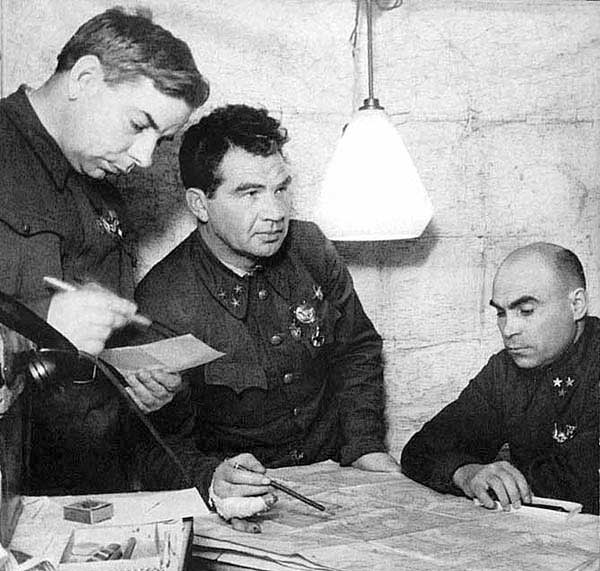
General Chuikov who directed the defense of Stalingrad during the battle

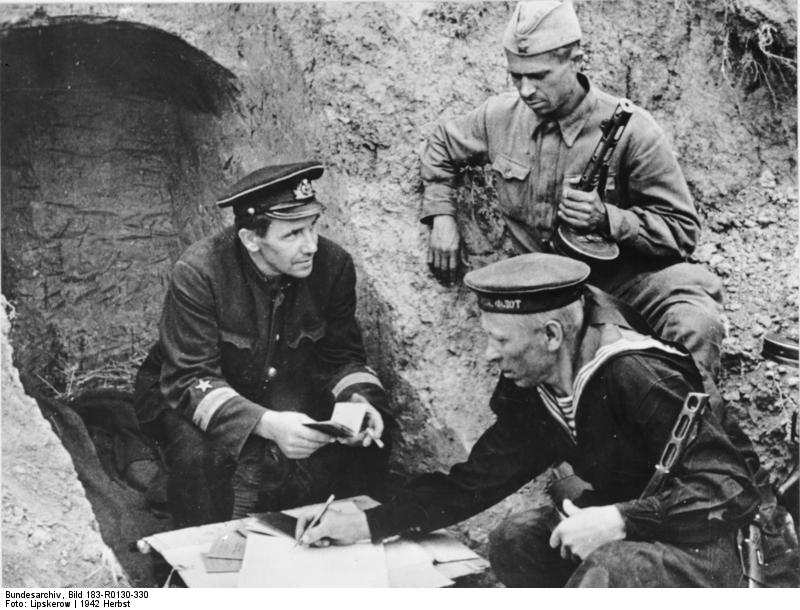
Soviet Naval Infantry and Political Officer

The changes in the German plan had distinct ramifications for both sides.  Von Mellenthin wrote that “the diversion of effort between the Caucasus and Stalingrad ruined our whole campaign.”[xxxiv] The Germans could not secure the Caucasus oil fields which Hitler considered vital to the German war effort.  They advanced deep into the region and captured the Maikop oil fields, though they were almost completely destroyed by the retreating Russians.[xxxv] Army Group A was halted by the Russians along the crests of the Caucasus on August 28th.[xxxvi] This left Hitler deeply “dissatisfied with the situation of Army Group A.”[xxxvii] Kleist and others attributed much of the failure to a lack of fuel[xxxviii] and Blumentritt noted that Mountain divisions that could have made the breakthrough were employed along the Black Sea coast in secondary operations.[xxxix]
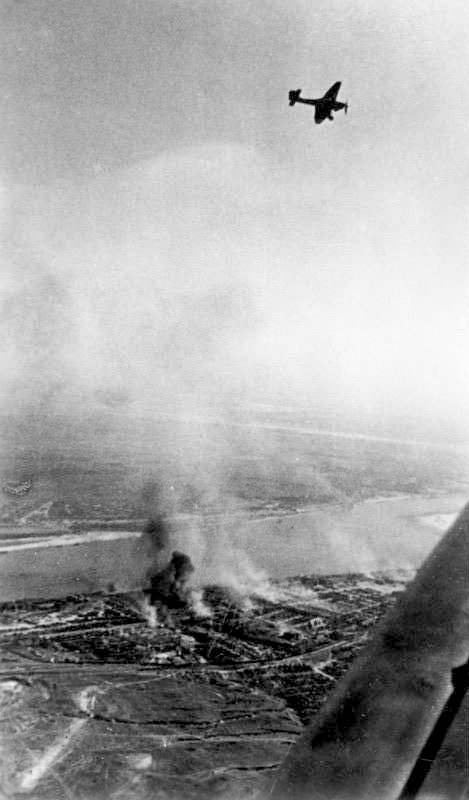
JU-87 Stuka over Stalingrad

Fuel and supply shortages delayed 6th Army’s advance while Hoth’s 4th Panzer Army was needlessly shuttled between Rostov and Stalingrad. By the time it resumed its advance the Russians “had sufficiently recovered to check its advance.”[xl] As 6th Army advanced the “protection of Army Group B’s ever-extending northern flank was taken over by the 3rd Rumanian, the 2nd Hungarian and the newly formed 8th Italian Army.”[xli] The allied armies were neither equipped for the Russian campaign nor well motivated.[xlii] The supply shortage in both army groups was not helped by a logistics bottleneck. All supplies came over a single Dnieper crossing, which Manstein noted, prevented swift movement of troops from one area to another.[xliii]

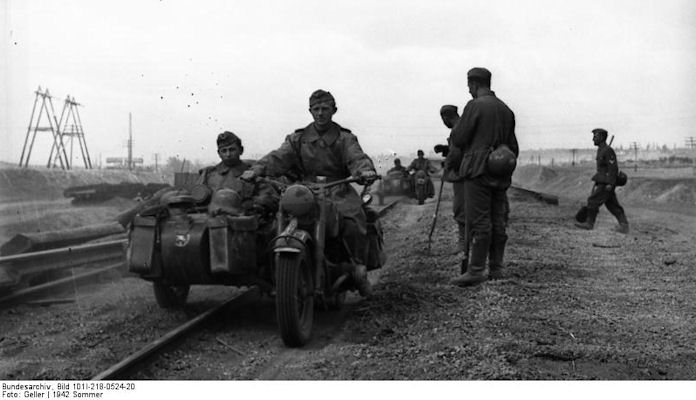
Reconnaissance Battalion of 24th Panzer Division near Stalingrad

Von Paulus’ 6th Army now attempted to rush Stalingrad between the 25th and 29th of July, while Hoth milled about on the lower Don.  However, Paulus’s piecemeal commitment of his divisions and failure to concentrate in the face of unexpectedly strong Soviet resistance caused the attacks to fail.  Paulus halted 6th Army on the Don so it could concentrate its forces and build its logistics base,[xliv] and to allow Hoth to come up from the south. This delay allowed the Russians to build up forces west of Stalingrad and reinforce the Stalingrad front and strengthen the defenses of the city,[xlv] and due to the distances involved it was easier for the Russians to reinforce the Stalingrad front.[xlvi] It also allowed the Russians to fill a number of key leadership positions with Generals who would skillfully fight the battle.[xlvii]
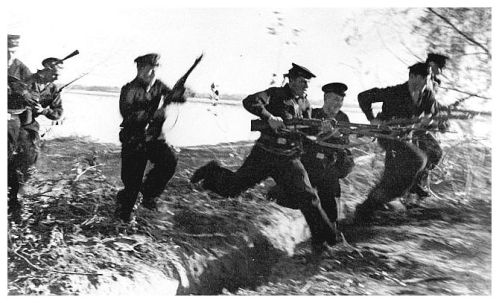
Russian Naval Infantry during early phase of battle

Hitler now focused on the capture of Stalingrad despite the fact that “as a city Stalingrad was of no strategic importance.”[xlviii] Strategically, its capture would cut Soviet supply lines to the Caucasus,[xlix] but this could be achieved without its capture. The checks in the south “began to give Stalingrad a moral importance-enhanced by its name-which came to outweigh its strategic value.”[l] To Hitler Stalingrad would gain “a mystic significance”[li] and along with Leningrad became “not only military but also psychological objectives.”[lii]

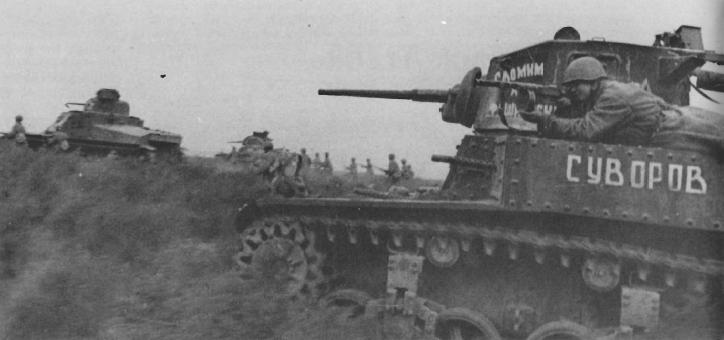
Red Army Armored troops using Lend-Lease American M3 Stuart and M3 Grant tanks

The Germans mounted a frontal assault with 6th Army and elements of 4th Panzer Army despite air reconnaissance that “the Russians are throwing forces from all directions at Stalingrad.[liii] Paulus as the senior General was in charge of the advance, with Hoth subordinated to him, but the attack had to wait until Hoth’s army could fight its way up from the south.[liv] Von Mellenthin comments rightly that “when Stalingrad was not taken on the first rush, it would have been better to mask it….”[lv] It is clear that the German advance had actually reached its culminating point with the failure of the advance into the Caucasus and Paulus’s initial setback on the Don, but it was not yet apparent to many involved.[lvi] The proper course of action would have been to halt and build up the front and create mobile reserve to parry any Russian offensive along northern flank while reinforcing success in the Caucasus. Manstein wrote that “by failing to take appropriate action after his offensive had petered out without achieving anything definite, he [Hitler] paved the way to the tragedy of Stalingrad!”[lvii]

Transfixed by Stalingrad
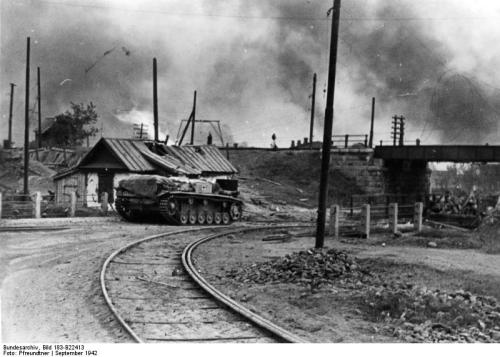
German Stug III at Stalingrad

On August 19th Paulus launched a concentric attack against the Russian 62nd and 64th Armies on the Don.  The attack ran into problems, especially in Hoth’s sector.[lviii] Yet, on the 22nd the 14th Panzer Corps “forced a very narrow breach in the Russian perimeter at Vertyachi and fought its way across the northern suburbs of Stalingrad,”[lix] and reached the Volga on the 23rd. That day 4th Air Fleet launched 1600 sorties against the city dropping over 1,000 tons of bombs.[lx] The breakthrough imperiled the Soviet position they had concentrated their strongest forces against Hoth.[lxi] The Germans held air superiority and continued heavy bombing attacks.  During the last days of August 6th Army “moved steadily forward into the suburbs of the city, setting the stage for battle.”[lxii] As the Soviets reacted to Paulus, Hoth achieved a breakthrough in the south which threatened the Russian position.  However 6th Army was unable to disengage its mobile forces to link up with the 4th Panzer Army and another opportunity had been missed.[lxiii]
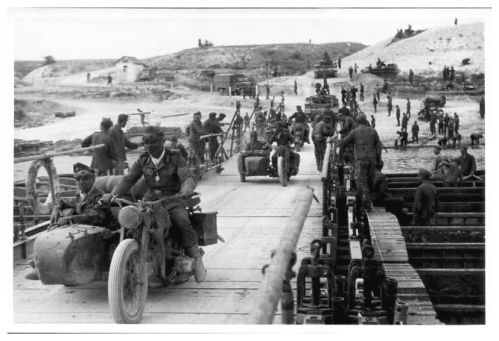
German unit crossing the Don

As 6th Army moved into the city Yeremenko ordered attacks against Hube’s 16th Panzer Division and Soviet resistance increased as more formations arrived the Germans suffered one of their heaviest casualty rates.”[lxiv] Though unsuccessful the counterattacks “managed to deflect Paulus’s reserves at the most critical moment.”[lxv] The Germans remained confident the first week of September as 6th Army and 4th Panzer Army linked up, but Yeremenko saved his forces by withdrawing and avoiding encirclement west of the city, retiring to an improvised line close to the city.[lxvi] On September 12th Chuikov was appointed to command 62nd Army in Stalingrad.  Chuikov understood that there “was only one way to hold on. They had to pay in lives. ‘Time is blood,’ as Chuikov put it later.”[lxvii] Stalin sent Nikita Khrushchev to the front “with orders to inspire the Armies and civilian population to fight to the end.”[lxviii] 13th Guards Rifle Division arrived on the 14th saved the Volga landings but it lost 30% casualties in its first 24 hours of combat.[lxix]
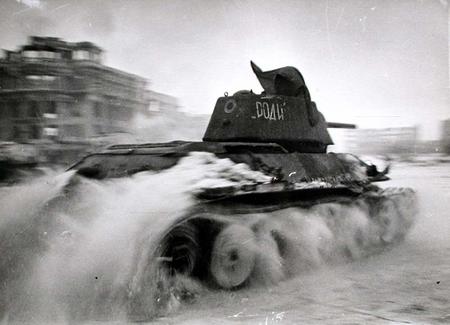
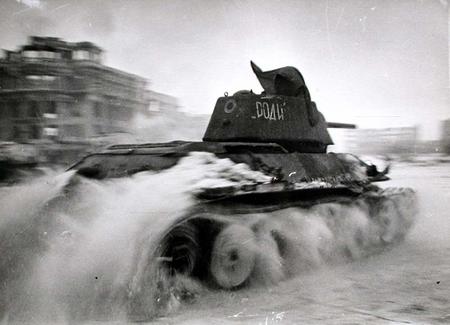
T-34 in Stalingrad

An NKVD regiment and other units held the strategically sited Mamaev Kurgan, keeping German guns from controlling the Volga.[lxx] The defenders fought house to house and block by block, Army and NKVD were reinforced by Naval Infantry.  Chuikov conducted the defense with a brutal ferocity, relieving senior commanders who showed a lack of fight and sending many officers to penal units.  Chuikov funneled massed German attacks into “breakwaters” where the panzers and infantry could be separated from each other causing heavy German casualties.[lxxi]
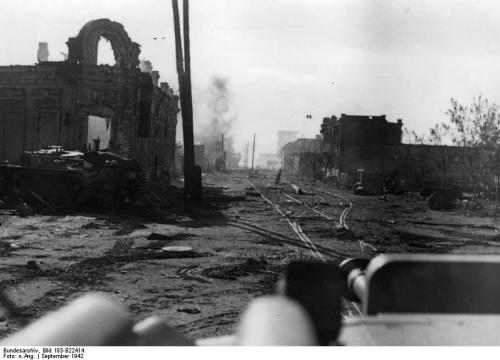
Street Fighting


Now the “city became a prestige item, its capture ‘urgently necessary for psychological reasons,’ as Hitler declared on October 2. A week later he declared that Communism must be ‘deprived of its shrine.’”[lxxii] The Germans did continue to gain ground, however slowly and at great cost, especially among their infantry, so much so that companies had to be combined.   Chuikov used his artillery to interdict the Germans from the far side of the Volga and the fight in the city was fought by assault squads with incredible ferocity and the close-quarter combat was dubbed “’Rattenkrieg’ by German soldiers.”[lxxiii] Paulus brought more units into the city and continued to slowly drive the Russians back against the river, by early October Chuikov wondered if he would be able to hold.[lxxiv] By early November Chuikov “was altogether holding only one-tenth of Stalingrad-a few factory buildings and a few miles of river bank.”[lxxv] Paulus expected “to capture the entire city by 10 November,”[lxxvi] despite the fact that many units were fought out. The 6th Army judged that 42% of the battalions of 51st Corps were fought out.[lxxvii] On 9 November Hitler declared “No power on earth will force us out of Stalingrad again!”[lxxviii]

Soviet Counteroffensive: Disaster on the Flanks

Soviet offensive on the flanks

Hungarian withdraw

Hungarian dead

On September 24th Hitler relieved Halder for persisting in explaining “what would happen when new Russian reserve armies attacked the over-extended flank that ran out to Stalingrad.”[lxxix] Many in the German side recognized the danger. Blumentritt said “The danger to the long-stretched flank of our advance developed gradually, but it became clear early enough for anyone to perceive it who was not willfully blind.”[lxxx] Warnings were also given by Rumanian Marshall Antonescu and the staff’s of Army Group B and 6th Army[lxxxi] but Hitler was transfixed on Stalingrad.  In doing so the Germans gave up the advantage of uncertainty and once their “aim became obvious…the Russian Command could commit its reserves with assurance.”[lxxxii]

Chuikov and his staff

In the midst of Stalin’s concern about Stalingrad Stavka planners never lost sight of their goal to resume large scale offensive operations and destroy at least one German Army Group.[lxxxiii] Unlike Hitler Stalin had begun to trust his Generals and Stavka under the direction of Marshal Vasilevsky produced a concept in September to cut off the “German spearhead at Stalingrad by attacking the weak Rumanian forces on its flanks.”[lxxxiv] At first Stalin “showed little enthusiasm” for the attack, fearing that Stalingrad might be lost, but on 13 September he gave his full backing to the proposal[lxxxv] which Zhukov, Vasilevsky and Vatutin developed into a plan involving two operations, Operation Uranus, to destroy the German and allied forces at Stalingrad, Operation Saturn to destroy all the German forces in the south and a supporting attack to fix German forces in the north, Operation Mars aimed at Army Group Center.[lxxxvi]

Soviet Katusha Rockets

To accomplish the destruction of 6th Army and part of 4th Panzer Army the Red Army employed over 60% of the “whole tank strength of the Red Army.”[lxxxvii] Strict secrecy combined with numerous acts of deception was used by the Red Army to disguise the operation.[lxxxviii] The plan involved an attack against 3rd Romanian Army on the northern flank by 5th Tank Army and two infantry armies with supporting units.[lxxxix] In the south against 4th Rumanian Army and weak element of 4th Panzer Army another force of over 160,000 men including 430 tanks were deployed.[xc] Despite warnings from his Intelligence Officer, Paulus did not expect a deep offensive into his flanks and rear and made no plans to prepare to face the threat.[xci] Other senior officers believed that the attack would take place against Army Group Center.[xcii] Warlimont notes that there was a “deceptive confidence in German Supreme Headquarters.”[xciii]

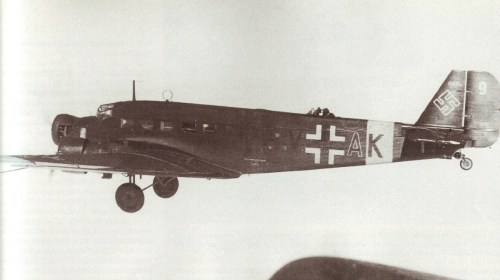
Luftwaffe JU-52s made many resupply runs into the pocket but suffered great losses

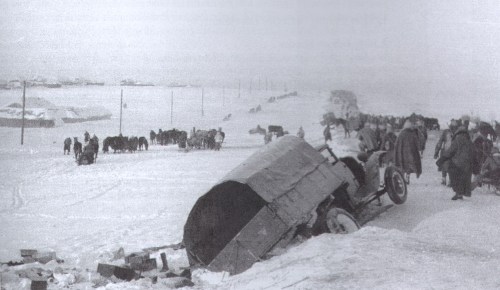
The storm broke on 19 November as Soviet forces attacked rapidly crushing Romanian armies in both sectors[xciv] linking up on the 23rd.[xcv] 48th Panzer Corps supporting the Romanians was weak and had few operational tanks.[xcvi] It attempted a counterattack but was “cut to pieces” in an encounter with 5th Tank Army.[xcvii] A promising attempt by 29th Motorized division against the flank of the southern Russian pincer was halted by the Army Group and the division was ordered to defensive positions south of Stalingrad.[xcviii] German airpower was neutralized by bad weather.[xcix] Paulus continued to do nothing as since the attacks were outside of his area of responsibility and waited for instructions.[c] As a result the 16th and 24th Panzer Divisions which could have assisted matters to the west remained “bogged down in street-fighting in Stalingrad.”[ci] Without support 6th Army units west of Stalingrad were forced back in horrific conditions.  By the 23rd 6th Army was cut off along with one corps of 4th Panzer Army and assorted Romanian units, over 330,000 men.  This now entrapped force that would require seven rifle armies and much staff attention to eliminate.[cii]

The Death of 6th Army

Paulus Surrenders

Hitler ordered Manstein to form Army Group Don to relieve Stalingrad. Hitler would not countenance a break out and wanted Manstein to break through and relieve 6th Army.[ciii] Hitler refused a request by Paulus on 23 November to move troops to prepare for a possible a break out attempt, assuring him that he would be relieved.[civ] Albert Speer notes that Zeitzler who replaced Halder insisted that the Sixth Army must break out to the west.”[cv] Hitler told Zeitzler that “We should under no circumstances give this up. We won’t get it back once it’s lost.”[cvi] Goering promised the Luftwaffe would be able to meet the re-supply needs of 6th Army by air, even though his Generals knew that it was impossible with the number of transport aircraft available.[cvii] Hitler took Goering at his word and exclaimed “Stalingrad can be held! It is foolish to go on talking any more about a breakout by Sixth Army…”[cviii] and a Führer decree was issued ordering that the front be held at all costs.[cix] Goerlitz states that “Hitler was incapable of conceiving that the 6th Army should do anything but fight where it stood.”[cx] Likewise Manstein had precious few troops with which to counterattack and had to protect the flank of Army Group A deep in the Caucasus. His army group was only corps strength and was spread across a 200 mile front.[cxi] Any relief attempt had to wait for more troops, especially Panzers.  Manstein too believed that the best chance for a breakout had passed and that it was a serious error for Paulus to put the request to withdraw through to Hitler rather than the Army Group or act on his own.[cxii] Many soldiers were optimistic that Hitler would get them out.[cxiii] Other generals like Guderian, Reichenau or Hoeppner might have acted, but Paulus was no rebel.[cxiv]

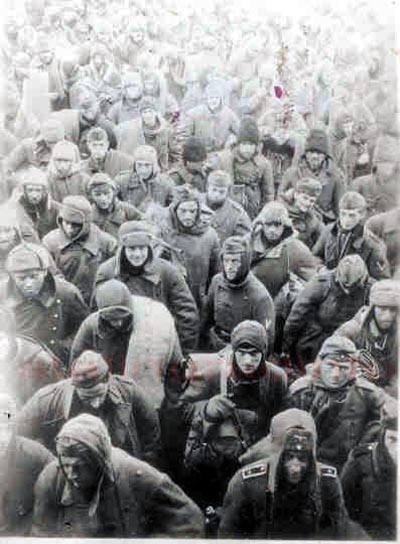
German POWs only 5000 of some 90,000 would see home again

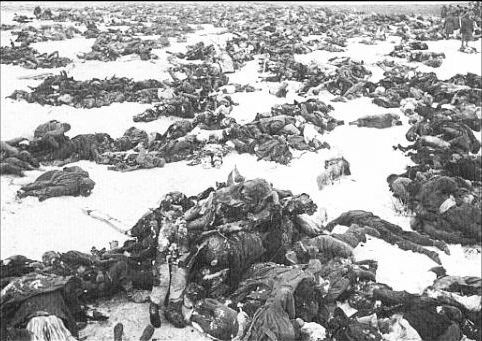
Operation Saturn began on 7 December destroying the Italian 8th Army and forcing the Germans to parry the threat.[cxv] A relief attempt by 57th Panzer Corps under Hoth on 12 December made some headway until a massive Soviet counterattack on 24 December drove it back.[cxvi] This attack was hampered by OKW’s refusal to allocate the 17th Panzer and 16th Motorized divisions to Manstein,[cxvii] and by 6th Army not attacking out to link with the relief force.[cxviii]By 6 January Paulus signaled OKW: Army starving and frozen, have no ammunition and cannot move tanks anymore.”[cxix] On 10 January the Soviets launched Operation Ring to eliminate the pocket and despite all odds German troops fought on. On the 16th Paulus requested that battle worthy units be allowed to break out, but the request was not replied to.[cxx] On the 22nd the last airfield had been overrun and on 31 January Paulus surrendered.[cxxi]

Analysis: What Went Wrong

Stalingrad had strangely drawn the attention of both sides, but the Russians never lost sight of their primary objectives during the campaign. The Germans on the other hand committed numerous unforced errors mostly caused by Hitler and or von Paulus. These mistakes began early in the planning and After the fall of Stalingrad as the Soviets attempted to follow up their success by attempted to cut off Army Group “A” Manstein was permitted to wage a mobile defense while Von Kleist managed to withdraw with few losses.[cxxii] The superior generalship of Manstein and Von Kleist prevented the wholesale destruction of German forces in southern Russia and Manstein’s counter offensive inflicted a severe defeat on the Soviets. However the German Army had been badly defeated.  The seeds of defeat were laid early, the failure to destroy bypassed Soviet formations in July, the diversion of 4th Panzer Army from Stalingrad, and the divergent objectives of trying to capture the Caucasus and Stalingrad at the same time.  This diluted both offensives ensuring that neither succeeded.  Likewise the failure to recognize the culminating point when it was reached and to adjust operations accordingly was disastrous for the Germans. The failure create a mobile reserve to meet possible Russian counter offensives, and the fixation on Stalingrad took the German focus off of the critical yet weakly held flanks. The hubris of Hitler and OKW to believe that the Russians were incapable of conducting major mobile operations even as Stavka commenced offensive operations on those flanks all contributed to the defeat.  Clark notes these facts but adds that the Germans “were simply attempting too much.”[cxxiii] Soviet numbers allowed them to wear down the Germans even in defeat.[cxxiv] At the same time Stalin gave his commanders a chance to revive the mobile doctrine of deep operations with mechanized and shock armies that he had discredited in the 1930s.[cxxv] All through the campaign Zhukov and other commanders maintained both their nerve even when it appeared that Stalingrad was all but lost. They never lost sight of their goal of destroying major German formations though they failed to entrap Army Group A with 6th Army.

A Modern Application

It is well and good to attempt to remain on the offensive.  The U.S. currently has forces spread thinly over two combat theaters with possibilities that other threats in the same region could flare up.  Like the Germans the U.S. is operating in areas, especially Afghanistan where overland supply lines are vulnerable and where weather can and does affect resupply operations by both ground and air.  The fact that the U.S. is operating with just barely enough forces in areas where others have met disaster calls for a circumspect look at what our enemy’s capabilities really are and not allowing ourselves to be surprised when they do things that have worked for them in the past against the Russians.  While it is unlikely that the U.S. and NATO would face a Stalingrad type situation in Afghanistan it is possible that isolated forces could be overrun as the Afghans reprise tactics used so successfully against the Soviets and as they begin to operate in larger units, concentrate them quickly and with more firepower to catch NATO forces when they are most vulnerable.  It is true that they will not mass large numbers of tanks and artillery as the Soviets did against the Germans, but the principle of speed, concentration at the critical point and surprise can inflict defeats, even small ones like the attack on the US outpost in Wanat that can turn public sentiment in the U.S. and Europe against further commitments and against the war and force the NATO governments as well as the U.S. to give up the effort.

Notes

[i] Clark, Alan. Barbarossa: The Russian-German Conflict: 1941-45. Perennial Books, An imprint of Harper Collins Publishers, New York, NY 1965. p.191

[ii] Ibid.

[iii] Glantz, David M. and House, Jonathan. When Titan’s Clashed: How the Red Army Stopped Hitler. The University Press of Kansas, Lawrence KS, 1995. p.111

[iv] Ibid. Clark. p.191

[v] Beevor, Anthony. Stalingrad: The Fateful Siege: 1942-1943. Penguin Books, New York NY 1998. p.69

[vi] Manstein, Erich von. Forward by B.H. Liddle Hart, Introduction by Martin Blumenson. Lost victories: The War Memoirs of Hitler’s Most Brilliant General. Zenith Press, St Paul MN 2004. First Published 1955 as Verlorene Siege, English Translation 1958 by Methuen Company. p.291 This opinion is not isolated, Beevor Quotes Paulus “If we don’t take Maikop and Gronzy…then I must put an end to the war.” (Beevor pp. 69-70)  Halder on the other hand believed that Hitler emphasized that the objective was “the River Volga at Stalingrad. (Clark. p.190)

[vii] Ibid. Beevor. p.70.

[viii] Ibid. Glantz and House. p.106

[ix] Ibid. p.105-106

[x] Ibid. Clark. p.203.  The offensive did impose a delay on the German offensive.

[xi] Ibid. Clark. p.191 Each group also contained allied armies.

[xii] Ibid. p.209.

[xiii] Ibid. Glantz and House. p.119

[xiv] Ibid. Manstein. p.292.

[xv] Ibid. Clark. p.209

[xvi] Ibid. Clark.  p.211

[xvii] Ibid. Glantz and House. p.120. There is a good discussion of the impact of this decision here as 6th Army’s advance was given priority for both air support and fuel.

[xviii] Ibid. Beevor. p.74

[xix] Warlimont, Walter. Inside Hitler’s Headquarters 1939-45. Translated by R.H. Berry, Presido Press, Novato CA, 1964. p.249

[xx] Ibid. Beevor. p.75 This was the 10th NKVD Division and it took control of all local militia, NKVD, and river traffic, and established armored trains and armor training schools.

[xxi] Ibid. Clark. p.212

[xxii] Ibid. Glantz and House. p.121

[xxiii] Ibid. Beevor. p.85

[xxiv] Ibid. p.89

[xxv] Liddell-Hart, B.H. The German Generals Talk. Quill Publishers, New York, NY 1979. Originally published by the author in 1948. p.202

[xxvi] Ibid. Beevor. p.88

[xxvii] Ibid. Beevor. p.90

[xxviii] Ibid. Beevor. p.81

[xxix] Ibid. Glantz and House. p.121

[xxx] Ibid. Liddell-Hart. p.202

[xxxi] Ibid. Glantz and House. p.120

[xxxii] Goerlitz, Walter. History of the German General Staff. Westview Press, Frederick A. Praeger Publisher, Boulder, CO. 1985 p.416

[xxxiii] Ibid. Beevor. pp.95-96.

[xxxiv] Von Mellenthin, F.W. Panzer Battles: A Study of the Employment of Armor in the Second World War. Translated H. Betzler, Edited by L.C.F. Turner. Oklahoma University Press 1956, Ballantine Books, New York, NY. 1971. p.193

[xxxv] Shirer, William L. The Rise and Fall of the Third Reich. A Touchstone Book published by Simon and Schuster, 1981, Copyright 1959 and 1960. p.914

[xxxvi] Ibid. Glantz and House. p.122

[xxxvii] Ibid. Warlimont. p.256

[xxxviii] Ibid. Liddell-Hart. p.203

[xxxix] Ibid. p.204

[xl] Ibid. Shirer. p.914

[xli] Ibid. Goerlitz. p.416

[xlii] Ibid. Goerlitz. p.416

[xliii] Ibid. Manstein. p.293

[xliv] Ibid. Clark. p.214

[xlv] Ibid. Beevor. pp.97-99. The mobilization included military, political, civilian and industrial elements.

[xlvi] Liddell-Hart, B.H. Strategy. A Signet Book, the New American Library, New York, NY. 1974, Originally Published by Faber and Faber Ltd., London. 1954 & 1967. p.250

[xlvii] Ibid. Beevor. p.99.  Two key commanders arrived during this time frame, Colonel General Andrei Yeremenko, who would command the Stalingrad Front  and General Chuikov commander of 64th Army who would conduct the defense of the city.

[xlviii] Carell, Paul Hitler Moves East: 1941-1943. Ballantine Books, New York, NY 1971, German Edition published 1963. p.581

[xlix] Ibid. Shirer.  p.909.

[l] Ibid. Liddell-Hart, Strategy. p.250

[li] Wheeler-Bennett, John W. The Nemesis of Power: The German Army in Politics 1918-1945. St. Martin’s Press, New York, NY 1954.  p.531

[lii] Ibid. Wheeler-Bennett. p.531

[liii] Ibid. Beevor. p.96

[liv] Ibid. Clark. p.216.

[lv] Ibid. Von Mellenthin. P.193

[lvi] See Von Mellinthin pp.193-194.  Von Mellinthin quotes Colonel Dinger, the Operations Officer of 3rd Motorized Division at Stalingrad until a few days before its fall. Dingler noted that the Germans on reaching Stalingrad “had reached the end of their power. Their offensive strength was inadequate to complete the victory, nor could they replace the losses they had suffered.” (p.193) He believed that the facts were sufficient “not only to justify a withdrawal, but compel a retreat.” (p.194)

[lvii] Ibid. Manstein. p.294

[lviii] Ibid. Clark. p.216

[lix] Ibid. Clark. p.217

[lx] Ibid. Beevor. p.107

[lxi] Ibid. Beevor. p.107

[lxii] Ibid. Glantz and House. p.122

[lxiii] Ibid. Carell. P.601

[lxiv] Ibid. Beevor. p.118

[lxv] Ibid. Beevor. p.118

[lxvi] Ibid. Carell. p.602

[lxvii] Ibid. Beevor. p.128

[lxviii] Ibid. Carell. p.603

[lxix] Ibid. Beevor. p.134

[lxx] Ibid. Beevor. pp.136-137

[lxxi] Ibid. Beevor. p.149

[lxxii] Fest, Joachim. Hitler. Translated by Richard and Clara Winston, Harcourt, Brace, Jovanovich Publishers, San Diego, New York, London. 1974. p.661

[lxxiii] Ibid. Beevor. pp. 149-150

[lxxiv] Ibid. Beevor. p.164

[lxxv] Ibid. Carell. p.618

[lxxvi] Ibid. Glantz and House. p.123

[lxxvii] Ibid. Beevor. p.218

[lxxviii] Ibid. Carell. p.623

[lxxix] Ibid. Goerlitz. p.418

[lxxx] Ibid. Liddell-Hart. The German Generals Talk. p.207

[lxxxi] Ibid. Manstein. p292

[lxxxii] Ibid. Liddell-Hart. History of the Second World War. p.258

[lxxxiii] Ibid. Glantz and House. p.129

[lxxxiv] Ibid. Glantz and House. p.130

[lxxxv] Ibid. Beevor. pp.221-222 Glantz and House say that Stalin gave his backing in mid-October but this seems less likely due to the amount of planning and movement of troops involved to begin the operation in November.

[lxxxvi] Ibid. Glantz and House. p.130

[lxxxvii] Ibid. Beevor. p.226

[lxxxviii] Ibid. Glantz and House. p.132

[lxxxix] Ibid. Glantz and House. p.130

[xc] Ibid. Beevor. p.227

[xci] Ibid. Beevor. p.228

[xcii] Ibid. Clark. p.235

[xciii] Ibid. Warlimont. p.274

[xciv] Ibid, Carell. p.627 3rd Rumanian Army lost 75,000 men in three days.

[xcv] Ibid. Clark.pp.247-248

[xcvi] The condition of the few German Panzer Divisions in position to support the flanks was very poor, the 22nd had suffered from a lack of fuel and maintenance and this many of its tanks were inoperative. Most of the armor strength of the 48th Panzer Corps was provided by a Rumanian armored division equipped with obsolete Czech 38t tanks provided by the Germans.

[xcvii] Ibid. Clark. pp.251-252. The designation of 2nd Guards Tank Army by Clark has to be wrong and it is the 5th Tank Army as 2nd Guards Tank was not involved in Operation Uranus.  Carell, Beevor and Glantz properly identify the unit.

[xcviii] Ibid. Carell. p.630

[xcix] Ibid. Beevor. p.244

[c] Ibid. Beevor. p.247

[ci] Ibid. Beevor. p.245

[cii] Ibid. Glantz and House. p.134

[ciii] Ibid. Glantz and House. p.134

[civ] Ibid. Clark. p.256

[cv] Speer, Albert. Inside the Third Reich. Collier Books, a Division of MacMillan Publishers, Inc. New York, NY 1970. p.248

[cvi] Heiber, Helmut and Glantz, David M. Editors. Hitler and His Generals: Military Conferences 1942-1945. Enigma Books, New York, NY 2002-2003.  Originally published as Hitlers Lagebsprechungen: Die Protokollfragmente seiner militärischen Konferenzen 1942-1945. Deutsche Verlags-Anstalt GmbH, Stuttgart, 1962. p.27

[cvii] Ibid. Glantz and House. p.135 Glantz and House note that the amount of aircraft estimated to successfully carry out the re-supply operation in the operational conditions was over 1,000.  The amount needed daily was over 600 tons of which the daily reached only 300 tons only one occasion.

[cviii] Ibid. Speer. p.249

[cix] Ibid. Carell. p.636

[cx] Ibid. Goerlitz. p.426

[cxi] Ibid. Clark. p.252

[cxii] Ibid. Manstein. p.303

[cxiii] Ibid. Beevor. p.276

[cxiv] Ibid. Carell. p.640

[cxv] Ibid. Glantz and House. p.140

[cxvi] Ibid. Glantz and House. p.140

[cxvii] Ibid. Clark. p.264

[cxviii] Ibid. Manstein. p.337

[cxix] Ibid. Beevor. p320

[cxx] Ibid. Beevor. p.365

[cxxi] Of the approximately 330,000 in the pocket about 91,000 surrendered, another 45,000 had been evacuated.  22 German divisions were destroyed.

[cxxii] Ibid. Liddell-Hart. The German Generals Talk. p.211

[cxxiii] Ibid. Clark. p.250

[cxxiv] Ibid. Glantz and House. p.124

[cxxv] Ibid. Beevor. p.221

Bibliography

Beevor, Anthony. Stalingrad: The Fateful Siege: 1942-1943. Penguin Books, New York NY 1998

Carell, Paul Hitler Moves East: 1941-1943. Ballantine Books, New York, NY 1971, German Edition published 1963.

Clark, Alan. Barbarossa: The Russian-German Conflict:1941-45. Perennial Books, An imprint of Harper Collins Publishers, New York, NY 1965.

Fest, Joachim. Hitler. Translated by Richard and Clara Winston, Harcourt, Brace, Jovanovich Publishers, San Diego, New York, London. 1974

Glantz, David M. and House, Jonathan. When Titan’s Clashed: How the Red Army Stopped Hitler. The University Press of Kansas, Lawrence KS, 1995.

Goerlitz, Walter. History of the German General Staff. Westview Press, Frederick A. Praeger Publisher, Boulder, CO. 1985

Heiber, Helmut and Glantz, David M. Editors. Hitler and His Generals: Military Conferences 1942-1945. Enigma Books, New York, NY 2002-2003.  Originally published as Hitlers Lagebsprechungen: Die Protokollfragmente seiner militärischen Konferenzen 1942-1945. Deutsche Verlags-Anstalt GmbH, Stuttgart, 1962.

Liddell-Hart, B.H. The German Generals Talk. Quill Publishers, New York, NY 1979. Originally Published by the author in 1948.

Liddell-Hart, B.H. Strategy. A Signet Book, the New American Library, New York, NY. 1974, Originally Published by Faber and Faber Ltd., London. 1954 & 1967

Manstein, Erich von. Forward by B.H. Liddle Hart, Introduction by Martin Blumenson. Lost victories: The War Memoirs of Hitler’s Most Brilliant General. Zenith Press, St Paul MN 2004. First Published 1955 as Verlorene Siege, English Translation 1958 by Methuen Company

Shirer, William L. The Rise and Fall of the Third Reich. A Touchstone Book published by Simon and Schuster, 1981, Copyright 1959 and 1960

Speer, Albert. Inside the Third Reich. Collier Books, a Division of MacMillan Publishers, Inc. New York, NY 1970.

Von Mellenthin, F.W. Panzer Battles: A Study of the Employment of Armor in the Second World War. Translated H. Betzler, Edited by L.C.F. Turner. Oklahoma University Press 1956, Ballantine Books, New York, NY. 1971.

Warlimont, Walter. Inside Hitler’s Headquarters 1939-45. Translated by R.H. Berry, Presido Press, Novato CA, 1964.

Wheeler-Bennett, John W. The Nemesis of Power: The German Army in Politics 1918-1945. St. Martin’s Press, New York, NY 1954

17 Comments

Filed under History, Military, world war two in europe

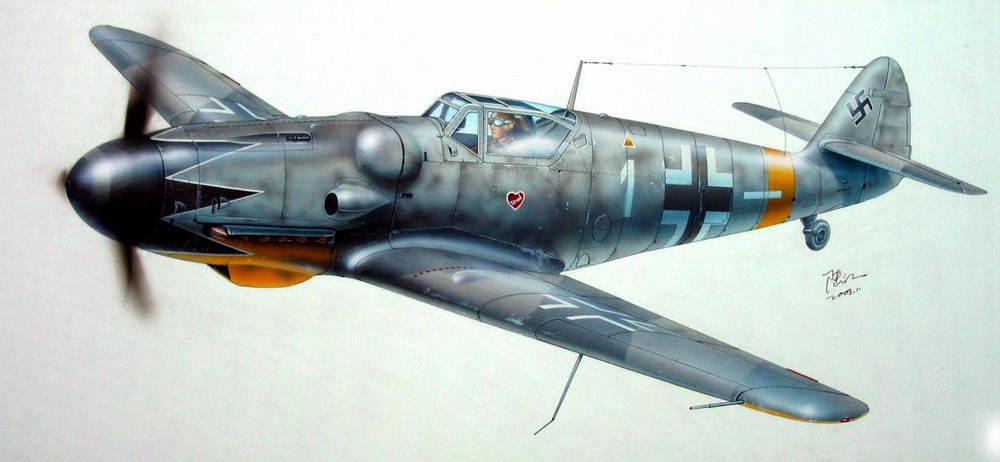
Padre Steve’s Favorite Fighter Aircraft Part One: The Messerschmitt 109 Introduction to a Legend

The Me-109-B2. The B Variant was first tested in Combat with the Condor Legion in the Spanish Civil War

This is a three part series on my favorite fighter aircraft of all-time, the Messerschmitt 109.

I have always had a penchant for fighter aircraft.  I can remember as a child the roar of jet aircraft including the Blue Angels over my house when my dad was stationed at NAS Whidbey Island Washington back from 1965-1969.  I remember the trips through the local hobby shop and my dad teaching me to build model aircraft.  One of the first models I got to build was a Messerschmitt 109 E which I think was produced by Aurora or Monogram models. Regardless I fell in love with the Me-109 when still in grade school and have never lost my love for that aircraft.

Me-109 of Stabs JG2 during the Battle of Britain

When I began to read I read books on military history as well as weapons systems, especially fighter aircraft.  There is something attractive, even sexy about a well designed fighter aircraft.  Who can forget the movies “The Blue Max,” the “Battle of Britain” or “Top Gun?”  There is something inherently exciting about fighter aircraft.  I don’t like flying as a passenger but have a feeling that if I were at the controls things would be different.  Maybe it is my need for some kind of control but whatever there is something, especially for guys that appeals to our “need for speed.”

Me-109F’s

The Me-109G in a number of variants was the most numerous of the series produced

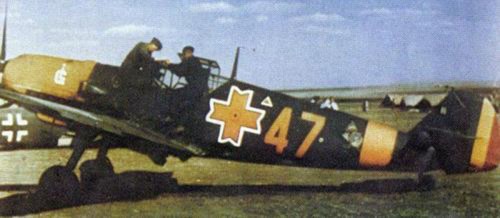
The Messerschmitt 109 which was designed in the mid 1930s became one of the premier and longest lived fighter aircraft in history with over 30,000 of all variants built during the Second World War and which was continued in production after the war by Spain and Czechoslovakia.  Developed for a civilian aircraft and light military transport the Bf-108 Taifun the Messerschmitt 109 cut its teeth with the Condor Legion in Spain and served in every European campaign used by the German Luftwaffe and allies such as Hungary, Romania, Croatia, Finland and Italy.  The 109 would continue in service after the war in Finland and Romania as well as Spain where a variant was built by Hispano-Aviacion HA-1109 and by Czechoslovakia as the Avia S-99, 199 and 299.  It would continue in service in Finland and Romania until the mid 1950s and in Spain until the mid 1960s.  In an Ironic twist the Czech variant was acquired by the fledgling Israeli Air Force and used in the Israeli war for Independence in 1948 where Israeli pilots flew the Czech built German fighter against Egyptian pilots flying the British Supermarine Spitfire.

Avia S-199 in Israeli Colors. In an ironic twist Israeli pilots would fly missions in the Czche variant of the 109 against Egyptians in British built Spitfires

The Me-109 was flown by many of the most decorated and successful aces of World War II including Erich Hartmann the highest scoring ace ever with 352 areal victories, Werner Molders and Adolf Galland.

Personally I like to build 1:72 scale me-109’s.  I probably have a hundred or so that I have stashed away in boxes in my stuff of almost all variants and many color and national markings.

These will be several short articles about the Messerschmitt 109 on this site in the next week or two, so aircraft aficionados enjoy.

Peace

Padre Steve+

5 Comments

Filed under aircraft, world war two in europe

Unequal Allies: Lessons from The German’s and Their Allies on the Eastern Front for Today

patton with french tankPatton with French Renault F1 Tank in WWI

One of the problems that any coalition of unequal partners as is the case in Afghanistan is the role of the lesser partners, their capabilities and limitations imposed on them by their own governments.  When NATO joined the US led effort in Afghanistan a number of NATO allies contributed troops to the effort.  The same was true of the “coalition of the willing” in Iraq.  While obviously the US appreciated and continues to appreciate the efforts of its allies in both theaters the unique problems associated with coalition warfare are often not appreciated until the strengths and weaknesses of each junior partner in the coalition are shown to include the effect of each nation’s choice of units sent, logistics capability and rules of engagement.  Thus when some Americans are critical of the contribution of some allies, or the limitations imposed by their governments they should remember that in the First World War the United States was dependant on France and Britain for the majority of the Artillery, all of the tanks and aircraft as well as instructors and training facilities for the rapidly recruited American Expeditionary Force.

RickenbackerUS Ace Eddie Rickenbacker with French Supplied Nieuport 28

Every nation works within its own national interests and domestic political situation as well as its military capabilities. Unfortunately many people do not look at history to see how a coalition of a major power allied with a number of minor powers each with their own limitations as well as motivations for entering the war execute that war after the initial plan is foiled.  This is something that has happened in Afghanistan after the initial success disappeared with the corrupt and ineffective Afghan government, the resurgent Taliban and the resiliency of Al Qaida in their bases in the remote border areas of Afghanistan and Pakistan.

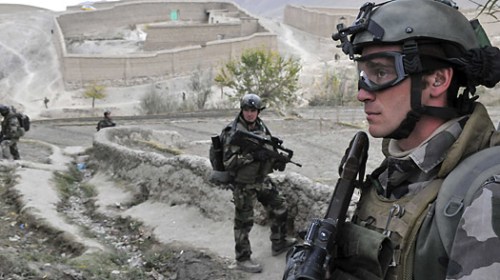
nato_france_a_0403French Troops in Afghanistan: The French, British and Canadians have the most Robust Rules of Engagement of Non US NATO Forces (Time Magazine Photo)

One of the best places to find such an example is the German relationship with their allies on the Eastern Front.  The question of the German dominated European Axis alliance in the Second World War is one of the more neglected subjects of World War Two II. In most accounts of the war, the relationship of the Germans to their coalition is minimal.  This includes the works of B.H. Liddell-Hart, Williamson Murray, Chester Wilmot and David M Glantz.   Italy usually receives some attention in the context of the campaign in North Africa and Mediterranean.  Hungary, Romania and Finland receive scant attention from anyone except as to how their armies were overrun during the Stalingrad campaign. Popular German memoirs provide little substantive help. Field Marshal Albert Kesselring’s memoirs and Erwin Rommel’s papers give some views of the Italian efforts in North Africa and the Mediterranean and Erich Manstein gives a limited amount of attention to the Italians, Finns, Hungarians and Rumanians in Russia.

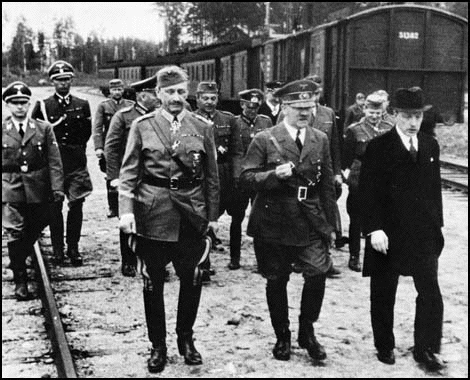
Finland-HitlerConflicting War Aims: Hitler with Finland’s Field Marshal Von Mannerheim

In his essay The Dysfunctional Coalition Robert Di Nardo examines the relationship of Germany to her allies on the Eastern Front where the Germans due to their own limitations were forced into a coalition war with weak allies of uncertain reliability. This is a subject that Di Nardo expanded on in his book Germany and the Axis Powers: from Coalition to Collapse (University of Kansas Press, 2005).  Di Nardo believes that there are important lessons to be learned from the failure of Germany and its coalition. Unfortunately we in the west are more often than not content to judge coalitions by the success of the Allies in the Second World War.  Di Nardo’s work on the subject is something that the United States must learn from as it works with coalitions whose members have significant military weaknesses often magnified by the domestic political climates in their own country. The situation, especially in Afghanistan places he United States in a similar position to Germany in relation to the current wars on terror and campaigns in Iraq and Afghanistan.

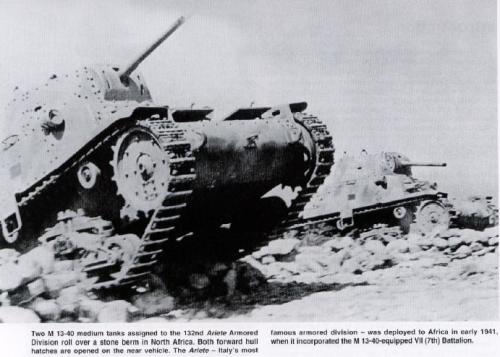
m 13-40 tankItalian M 13-40 tanks were the mainstays of Italian Armored Units, Slow, Undergunned and Poorly Armored they were No Match for Soviet T-34s

Di Nardo asserts “the way in which Germany conducted coalition warfare was reflective of the manner in which Hitler and the German military looked at the world, as well as the war in general.”  Germany often displayed a haughtiness toward its allies and even knowing their weaknesses was both unable and often unwilling to do much to strengthen them for the fight against the Soviet Union.  Di Nardo believes that the German attitudes were “a significant factor that contributed to the ultimate defeat of Nazi Germany.” (p.712)  In the essay Di Nardo notes the few successes of the coalition. In particular he looks at the German work with Rumanian air defense around the Ploesti oil refineries and the German-Finnish Winter Warfare School.  Apart from these instances he characterizes Axis coalition warfare on the eastern front as “poor” with “failures at every level.” (p.713)

italian troops stalino

Di Nardo analyzes the problems with language barriers, the wide differences of modernity of the armies and levels of technology and training of the coalition partners many of which are common to the war in Afghanistan. Germany’s failure to become the “arsenal of Fascism” which the United States became “the Arsenal of Democracy” for its allies hindered the Germans in their relationship to their poorly equipped allies.  Likewise, the lack of understanding of all the partners regarding the “relationship between national objectives, strategy and the morale of soldiers of officers and soldiers alike”(p.713) was a major obstacle.

finnish at gun

Di Nardo provides a good description of the German liaison detachments allotted to the coalition armies.  These teams functioned as advisors to their allies as well as liaisons between the German army and the allies. These teams dealt with language, tactical communications weaknesses and often displayed the generally haughty attitude that the Germans displayed to their partners. There is an excellent illustration of this in dealing with the failure of XLVIII Panzer Corps at Stalingrad when the German Liaison to the Romanian 1st Panzer Division was wounded.  At the operational and strategic levels Di Nardo describes the German policies and attitudes toward their allies as “imperialist.” (p.718)

He examines the wide gap in transportation capabilities of the various armies and the failure of the Germans to better provide for the needs of their partners in contrast to the United States assistance to her allies.   Germany provided obsolete captured Czech and French weapons and vehicles to her allies.  They refused to supply the Romanians and Hungary with the plans to build German tank and aircraft in Romanian and Hungarian industrial concerns capable of their manufacture. (pp.718-719) Di Nardo notes how this lack of modern equipment impacted the allies operations against the Red Army and their defeat at the hands of the Soviets.  Although Di Nardo alludes to how even elite German formations had substandard equipment he does not explain principle reason for this.   This was due to the fact that the Germans did not go to a “total war” footing in regard to industrial production until Albert Speer took over as Armaments Minister in 1943.

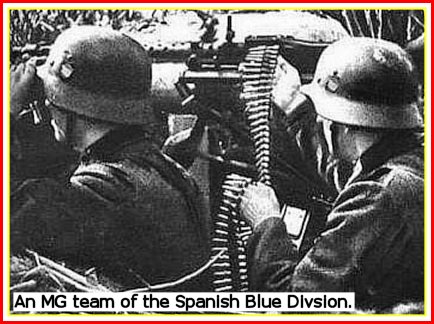
spanish blue divsion

The number of troops contributed by the German Allies was substantial. Hungary began Barbarossa with two corps, including its Mobile Corps and in 1942 supplied their 2nd Army which was composed of 1 Armored and 9 Infantry Divisions. 2nd Army was crushed by the Soviet offensive against Stalingrad. The Italians began with an expeditionary corps of 2 Semi-Motorized and 1 Light Infantry Divisions. In early 1943 they added 4 Infantry and 3 Alpine Divisions and a number of other smaller formations. This force became the 8th Army. It fought well during the advance toward Stalingrad but spread out over a wide front with little armored or air support was decimated by the Soviet offense against the city.  The remnants were no longer battle worthy and were evacuated to Italy.  Most of the Finnish Army was engaged in the war but after September 1939 made no major offensive contribution to the war. In 1944 following a major Soviet offensive which forced them to withdraw from the territory that they had captured in 1941 the Finnish government sued for peace. The Russians occupied a number of border provinces and islands and Finland was obliged to expel German Forces.  This resulted in the “Lapland War” between the Finns and the Germans with the Germans adopting a scorched earth policy as they withdrew from the country. The quality of the Finnish forces was generally higher than that of Germany’s other Allies.

romanian r35Obsolete French Built Romanian R-35 Light Tank

The Romanians contributed 19 divisions organized into 3 Armies to Barbarossa. They were limited by their equipment and logistics. The 3rd and 4th Romanian Armies were shattered at Stalingrad forcing a major reorganization as they continued the war.  In August 1944 with the Soviets pressing their border King Michael led a coup to overthrow the Fascist dictatorship of Antonescu. The Germans elected to fight and the Romanians changed sides and joined the Russian advance to the end of the war with their 1st Army taking part in the Prague offensive. Another contributor of troops was Franco’s Spain although it was a neutral country. Spain provided a division of volunteers which became the famous “Spanish Blue Division” or the 250th Infantry Division. It was outfitted as a German unit and received additional training from the Germans before it went into action. The division fought near Leningrad and was engaged in many tough fights.  A Spanish “Blue” Fighter squadron allotted to and equipped by the Luftwaffe also distinguished itself. In October 1943 Spain under allied pressure withdrew the division from the front although many soldiers volunteered to remain and fight on as smaller units attached to German formations. One volunteer company became part of the 11th SS Panzergrenadier Division Nordland at Berlin.  One thing that probably was a factor in the Spanish effectiveness as well as commitment to to German cause was their genuine loathing of the Soviets following the Spanish Civil War.

The final part of Di Nardo’s essay deals with the strategic goals and conflicts among the Axis coalition which were never worked out.  Examples of this include how the Finns never signed a formal alliance with Germany and how their national strategy did not allow them to deeper into the Soviet Union instead settling on recovering territory lost to the Soviets in 1939 with a few minor gains.  There was also the problem that the Romanians and Hungarians distrusted each other so much that they could not work together over their own territorial disputes.  The Italians joined the campaign late and their 8th Army participated in the German advance toward Stalingrad protecting the German flank.  While the Italians provided their own equipment including armor and aircraft they and their weapons were woefully suited for the war that they faced on the Eastern Front.  Di Nardo finishes his essay noting morale problems in the Hungarian, Italian and Romanian armies, the lack of understanding and general lack of motivation for the campaign.

Romanian_Me109-px800Romanian ME-109 E4, The Romanian Air Force Was One of the Axis Success Stories

This article is well sourced. Di Nardo uses histories, archival sources, operational orders and analysis by the various armies as well as interviews with participants. Of particular note is that he goes to sources of the coalition partners and not just German sources.  This allows him to be far more nuanced and detailed in his discussion as opposed to others who simply ignore the contributions of the Axis partners.  His footnotes provide added detail and provide and lend support to his arguments.

The importance of this essay is twofold.  First it provides a look at the relationship of German to her coalition partners on the Eastern Front.  This is important from a historic standpoint simply because it is such a neglected topic in most histories of the period and gives added depth to the reasons for Germany’s defeat.  One has to ask the “what if questions” in regard to had the Germans better treated, equipped and recognized their allies’ contributions to the war effort.

The second and probably more important for Afghanistan is that it provides lessons to any nation which has to engage in coalition warfare.  In particular it has lessons for the United States which has found itself as the senior and vastly superior partner in a war which has multiple coalition partners in several theaters of operations.  Each coalition partner has certain military strengths and weaknesses in relationship to the United States, national interests, geo-political and economic relationships with competitors to the United States and internal political realities which impact their cooperation in the war.  As such the United States cannot allow itself to be cast in the role of a haughty imperialistic senior partner as did Germany.  The US instead must cultivate an attitude of assistance, respect and trust among its partners to assure their full cooperation and assistance in relation to U.S. goals in the war. This is particularly important now was it appears that the Afghan war is reaching a point where the deteriorating situation on the ground could invite the early withdraw of allies and necessitate either the addition of more US troops or a strategic withdraw which would be for all intents and purposes a defeat for the US and NATO. The consequences would not be good and while the Taliban may be able to be contained they undoubtedly would invite Al Qaida back and provide them with a sanctuary just as Pakistan has stepped up its efforts on the border.

Leave a comment

Filed under History, iraq,afghanistan, world war two in europe

Stalingrad

Note: This post is another of my papers from my MA in History course that I have reworked some for this site.  The focus is on how the Germans and Russians fought the Stalingrad campaign. In  particular in the way the governments and military’s of both nations planned and executed strategy during the course of the campaign adjusted to the situation and how the campaign ended.  I conclude with a potential modern application for the US and NATO in Afghanistan.

Stalingrad: Primary or Secondary Objective

operation blau map

Following the Soviet winter offensive and the near disaster in front of Moscow the German High Command was faced with the strategic decision of what to do in the 1942 campaign.  Several options were considered and it was decided to seize the Caucasus oilfields and capture or neutralize the city of Stalingrad on the Volga.  However, the High Command was divided on the actual objective of the campaign.  OKH under the guidance of General Halder assumed that Stalingrad was the objective and the advance into the Caucasus was a blocking effort.[i] Hitler and OKW planned to capture the Caucasus oil fields and capture or neutralize Stalingrad to secure the left flank.[ii] Both OKH and OKW considered Stalingrad significant but “German commanders initially regarded it as a weigh station en route to the Caucasus oil fields.”[iii] The conflict echoed in the ambiguity of Directive No. 41 which “included the ‘seizure of the oil region of the Caucasus’ in the preamble concerning the general aim of the campaign, yet made no mention of this in the main plan of operations.”[iv] At the planning conference held at Army Group South in early June “Hitler hardly mentioned Stalingrad. As far as his Generals were concerned it was little more than a name on the map. His obsession was with the oil fields of the Caucasus.”[v] Manstein noted that “Hitler’s strategic objectives were governed chiefly by the needs of his war economy….”[vi] Anthony Beevor notes that at this stage of planning “the only interest in Stalingrad was to eliminate the armaments factories there and secure a position on the Volga. The capture of the city was not considered necessary.”[vii] German planners “expected that the Soviets would again accept decisive battle to defend these regions.”[viii]

Bild 169-0894Knocked Out T-34s

In Moscow Stalin and his Generals attempted to guess the direction of the impending German offensive.  “Stalin was convinced that Moscow remained the principle German objective…Most of the Red Army’s strategic reserves…were therefore held in the Moscow region.”[ix] To disrupt the German offensive and to attempt to recover Kharkov three offensives were launched by Red Army forces under the direction of Stavka. The largest of these on Kharkov was defeated between 12-22 May with the loss of most of the armor in southern Russia. This coupled with an equally disastrous defeat of Red Army forces in Crimea by Von Manstein’s 11th Army meant that the Red Army would face the Germans in a severely weakened condition.[x]

Operation Blau: Opening Moves and Divergent Objectives

The German offensive began on 28 June under the command of Field Marshal von Bock. Bock’s command included two separate army groups, Army Group B under General Von Weichs with 2nd Army, 6th Army and 4th Panzer Army operated in the northern part of the operational area. Army Group A was to the south with 17th Army and 1st Panzer Army.[xi] Army Group B provided the main effort and quickly smashed through the defending Soviet armies and by the 20th Hitler believed that “the Russian is finished.”[xii] One reason for the German success in the south was that until July 7th Stalin believed that Moscow was still the primary objective.[xiii] Bock was prevented by Hitler from destroying Soviet formations left behind and was relieved of command by Hitler. He was replaced by Von Weichs which created a difficult command and control problem.  Manstein noted that this created a “grotesque chain of command on the German southern wing” with the result that Army Group A had “no commander of its own whatever” and Army Group B had “no few than seven armies under command including four allied ones.”[xiv]

panzer ivfPanzer IV F

This decision proved fateful.  Hitler’s decided to redirect the advance of the 4th Panzer Army to support an early passage of the lower Don, diverting it from its drive on Stalingrad.  Additionally the army groups became independent of each other when Bock was relieved of command.  They were “assigned independent-and diverging-objectives” under the terms of Directive No.45.[xv] This combination of events would have a decisive impact on the campaign.  The decision prevented a quick seizure of Stalingrad by 4th Panzer Army followed by a hand over to 6th Army to establish the “block” as described by Directive No.41.  Kleist noted that he didn’t need 4th Panzer Army’s help to accomplish his objectives and that it could have “taken Stalingrad without a fight at the end of July….”[xvi]

The result was damning. Air support and fuel needed by Army Group A was transferred to 6th Army, denuding Army Group A of the resources that it needed to conclude its conquest of the Caucasus.[xvii] At the same time it denied Army Group B of the Panzer Army that could seize Stalingrad when it was still possible to do so.  Beevor calls Hitler’s decision a disastrous compromise.[xviii] Halder believed the decision underestimated the enemy and was “both ludicrous and dangerous.”[xix]

Focus on Stalingrad

On July 22 as the Wehrmacht ran short on fuel and divisions to commit to the Caucasus, and 6th Army fought for control of Voronezh the Soviets created the Stalingrad Front. Stavka moved an NKVD Division to the city,[xx] and rapidly filled the new front with formations transferred from the Moscow Front.[xxi] Stalin issued Stavka Order 227, better known as “No Step Back” on 28 July. The order mandated that commanders and political officers who retreated would be assigned to Penal battalions[xxii] and armies were to form three to five special units of about 200 men each as a second line “to shoot any man who ran away.”[xxiii] Russian resistance west of the Don slowed the German advance. German commanders were astonished “at the profligacy of Russian commanders with their men’s lives.”[xxiv] Von Kleist compared the stubbornness of Russians in his area to those of the previous year and wrote that they were local troops “who fought more stubbornly because they were fighting to defend their homes.”[xxv] Additionally, Stalin changed commanders frequently in the “vain hope that a ruthless new leader could galvanize resistance and transform the situation.”[xxvi] General Chuikov brought the 64th Army into the Stalingrad Front in mid-July to hold the Germans west of the Don.[xxvii]

Bild 116-168-618German Soldier in Stalingrad

Further weakening the Germans OKW transferred key SS Panzer Divisions and the Grossdeutschland Division to France. Supporting Hungarian, Italian and Romanian allied armies which lacked motorization, modern armor or anti-tank units were unable to fulfill the gaps left by the loss of experienced German divisions and the expectations of Hitler.[xxviii] 6th Army was virtually immobilized for 10 days due to lack of supplies allowing the Russians to establish a defense on the Don Bend.[xxix] To the south the Germans were held up by lack of fuel and increased Soviet resistance including the introduction of a force of 800 bombers.[xxx] Glantz and House note that with the fall of Rostov on July 23rd “Hitler abruptly focused on the industrial and symbolic value of Stalingrad.”[xxxi] Undeterred by warnings from Halder that fresh Russian formations were massing east of the Volga and Quartermaster General, Wagner, who guaranteed that he could supply either the thrust to the Caucasus or Stalingrad but not both.[xxxii] Again frustrated by slow progress Hitler reverted to the original plan for 4th Panzer Army to assist 6th Army at Stalingrad, but the cost in time and fuel were significant to the operation and the question was whether “they could make up for Hitler’s changes in plan.”[xxxiii]

Strategic Implications

soviet infantry attacking

The changes in the German plan had distinct ramifications for both sides.  Von Mellenthin wrote that “the diversion of effort between the Caucasus and Stalingrad ruined our whole campaign.”[xxxiv] The Germans could not secure the Caucasus oil fields which Hitler considered vital to the German war effort.  They advanced deep into the region and captured the Maikop oil fields, though they were almost completely destroyed by the retreating Russians.[xxxv] Army Group A was halted by the Russians along the crests of the Caucasus on August 28th.[xxxvi] This left Hitler deeply “dissatisfied with the situation of Army Group A.”[xxxvii] Kleist and others attributed much of the failure to a lack of fuel[xxxviii] and Blumentritt noted that Mountain divisions that could have made the breakthrough were employed along the Black Sea coast in secondary operations.[xxxix]

Fuel and supply shortages delayed 6th Army’s advance while Hoth’s 4th Panzer Army was needlessly shuttled between Rostov and Stalingrad. By the time it resumed its advance the Russians “had sufficiently recovered to check its advance.”[xl] As 6th Army advanced the “protection of Army Group B’s ever-extending northern flank was taken over by the 3rd Rumanian, the 2nd Hungarian and the newly formed 8th Italian Army.”[xli] The allied armies were neither equipped for the Russian campaign nor well motivated.[xlii] The supply shortage in both army groups was not helped by a logistics bottleneck. All supplies came over a single Dnieper crossing, which Manstein noted, prevented swift movement of troops from one area to another.[xliii]

Von Paulus’ 6th Army now attempted to rush Stalingrad between the 25th and 29th of July, while Hoth milled about on the lower Don.  However, Paulus’s piecemeal commitment of his divisions and failure to concentrate in the face of unexpectedly strong Soviet resistance caused the attacks to fail.  Paulus halted 6th Army on the Don so it could concentrate its forces and build its logistics base,[xliv] and to allow Hoth to come up from the south. This delay allowed the Russians to build up forces west of Stalingrad and reinforce the Stalingrad front and strengthen the defenses of the city,[xlv] and due to the distances involved it was easier for the Russians to reinforce the Stalingrad front.[xlvi] It also allowed the Russians to fill a number of key leadership positions with Generals who would skillfully fight the battle.[xlvii]

Kelbrus-739x556German Panzer Troops Look Upon the Caucasus Mountains

Hitler now focused on the capture of Stalingrad despite the fact that “as a city Stalingrad was of no strategic importance.”[xlviii] Strategically, its capture would cut Soviet supply lines to the Caucasus,[xlix] but this could be achieved without its capture. The checks in the south “began to give Stalingrad a moral importance-enhanced by its name-which came to outweigh its strategic value.”[l] To Hitler Stalingrad would gain “a mystic significance”[li] and along with Leningrad became “not only military but also psychological objectives.”[lii]

The Germans mounted a frontal assault with 6th Army and elements of 4th Panzer Army despite air reconnaissance that “the Russians are throwing forces from all directions at Stalingrad.[liii] Paulus as the senior General was in charge of the advance, with Hoth subordinated to him, but the attack had to wait until Hoth’s army could fight its way up from the south.[liv] Von Mellenthin comments rightly that “when Stalingrad was not taken on the first rush, it would have been better to mask it….”[lv] It is clear that the German advance had actually reached its culminating point with the failure of the advance into the Caucasus and Paulus’s initial setback on the Don, but it was not yet apparent to many involved.[lvi] The proper course of action would have been to halt and build up the front and create mobile reserve to parry any Russian offensive along northern flank while reinforcing success in the Caucasus. Manstein wrote that “by failing to take appropriate action after his offensive had petered out without achieving anything definite, he [Hitler] paved the way to the tragedy of Stalingrad!”[lvii]

Transfixed by Stalingrad

ju-52JU-52: Despite Tremendous Bravery of Luftwaffe Pilots Goering Failed to Keep Stalingrad Supplied

On August 19th Paulus launched a concentric attack against the Russian 62nd and 64th Armies on the Don.  The attack ran into problems, especially in Hoth’s sector.[lviii] Yet, on the 22nd the 14th Panzer Corps “forced a very narrow breach in the Russian perimeter at Vertyachi and fought its way across the northern suburbs of Stalingrad,”[lix] and reached the Volga on the 23rd. That day 4th Air Fleet launched 1600 sorties against the city dropping over 1,000 tons of bombs.[lx] The breakthrough imperiled the Soviet position they had concentrated their strongest forces against Hoth.[lxi] The Germans held air superiority and continued heavy bombing attacks.  During the last days of August 6th Army “moved steadily forward into the suburbs of the city, setting the stage for battle.”[lxii] As the Soviets reacted to Paulus, Hoth achieved a breakthrough in the south which threatened the Russian position.  However 6th Army was unable to disengage its mobile forces to link up with the 4th Panzer Army and another opportunity had been missed.[lxiii]

As 6th Army moved into the city Yeremenko ordered attacks against Hube’s 16th Panzer Division and Soviet resistance increased as more formations arrived the Germans suffered one of their heaviest casualty rates.”[lxiv] Though unsuccessful the counterattacks “managed to deflect Paulus’s reserves at the most critical moment.”[lxv] The Germans remained confident the first week of September as 6th Army and 4th Panzer Army linked up, but Yeremenko saved his forces by withdrawing and avoiding encirclement west of the city, retiring to an improvised line close to the city.[lxvi] On September 12th Chuikov was appointed to command 62nd Army in Stalingrad.  Chuikov understood that there “was only one way to hold on. They had to pay in lives. ‘Time is blood,’ as Chuikov put it later.”[lxvii] Stalin sent Nikita Khrushchev to the front “with orders to inspire the Armies and civilian population to fight to the end.”[lxviii] 13th Guards Rifle Division arrived on the 14th saved the Volga landings but it lost 30% casualties in its first 24 hours of combat.[lxix] An NKVD regiment and other units held the strategically sited Mamaev Kurgan, keeping German guns from controlling the Volga.[lxx] The defenders fought house to house and block by block, Army and NKVD were reinforced by Naval Infantry.  Chuikov conducted the defense with a brutal ferocity, relieving senior commanders who showed a lack of fight and sending many officers to penal units.  Chuikov funneled massed German attacks into “breakwaters” where the panzers and infantry could be separated from each other causing heavy German casualties.[lxxi]

Now the “city became a prestige item, its capture ‘urgently necessary for psychological reasons,’ as Hitler declared on October 2. A week later he declared that Communism must be ‘deprived of its shrine.’”[lxxii] The Germans did continue to gain ground, however slowly and at great cost, especially among their infantry, so much so that companies had to be combined.   Chuikov used his artillery to interdict the Germans from the far side of the Volga and the fight in the city was fought by assault squads with incredible ferocity and the close-quarter combat was dubbed “’Rattenkrieg’ by German soldiers.”[lxxiii] Paulus brought more units into the city and continued to slowly drive the Russians back against the river, by early October Chuikov wondered if he would be able to hold.[lxxiv] By early November Chuikov “was altogether holding only one-tenth of Stalingrad-a few factory buildings and a few miles of river bank.”[lxxv] Paulus expected “to capture the entire city by 10 November,”[lxxvi] despite the fact that many units were fought out. The 6th Army judged that 42% of the battalions of 51st Corps were fought out.[lxxvii] On 9 November Hitler declared “No power on earth will force us out of Stalingrad again!”[lxxviii]

Soviet Counteroffensive: Disaster on the Flanks
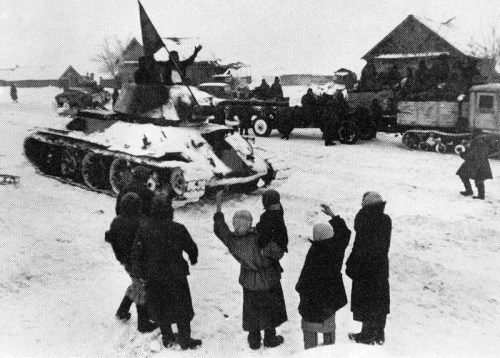
On September 24th Hitler relieved Halder for persisting in explaining “what would happen when new Russian reserve armies attacked the over-extended flank that ran out to Stalingrad.”[lxxix] Many in the German side recognized the danger. Blumentritt said “The danger to the long-stretched flank of our advance developed gradually, but it became clear early enough for anyone to perceive it who was not willfully blind.”[lxxx] Warnings were also given by Rumanian Marshall Antonescu and the staff’s of Army Group B and 6th Army[lxxxi] but Hitler was transfixed on Stalingrad.  In doing so the Germans gave up the advantage of uncertainty and once their “aim became obvious…the Russian Command could commit its reserves with assurance.”[lxxxii]

In the midst of Stalin’s concern about Stalingrad Stavka planners never lost sight of their goal to resume large scale offensive operations and destroy at least one German Army Group.[lxxxiii] Unlike Hitler Stalin had begun to trust his Generals and Stavka under the direction of Marshal Vasilevsky produced a concept in September to cut off the “German spearhead at Stalingrad by attacking the weak Rumanian forces on its flanks.”[lxxxiv] At first Stalin “showed little enthusiasm” for the attack, fearing that Stalingrad might be lost, but on 13 September he gave his full backing to the proposal[lxxxv] which Zhukov, Vasilevsky and Vatutin developed into a plan involving two operations, Operation Uranus, to destroy the German and allied forces at Stalingrad, Operation Saturn to destroy all the German forces in the south and a supporting attack to fix German forces in the north, Operation Mars aimed at Army Group Center.[lxxxvi]
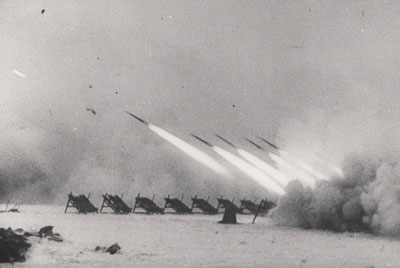
T34_Stalingrad-Offensive-px800Soviet Armor on teh Offensive

To accomplish the destruction of 6th Army and part of 4th Panzer Army the Red Army employed over 60% of the “whole tank strength of the Red Army.”[lxxxvii] Strict secrecy combined with numerous acts of deception was used by the Red Army to disguise the operation.[lxxxviii] The plan involved an attack against 3rd Rumanian Army on the northern flank by 5th Tank Army and two infantry armies with supporting units.[lxxxix] In the south against 4th Rumanian Army and weak element of 4th Panzer Army another force of over 160,000 men including 430 tanks were deployed.[xc] Despite warnings from his Intelligence Officer, Paulus did not expect a deep offensive into his flanks and rear and made no plans to prepare to face the threat.[xci] Other senior officers believed that the attack would take place against Army Group Center.[xcii] Warlimont notes that there was a “deceptive confidence in German Supreme Headquarters.”[xciii]

The storm broke on 19 November as Soviet forces attacked rapidly crushing Rumanian armies in both sectors[xciv] linking up on the 23rd.[xcv] 48th Panzer Corps supporting the Rumanians was weak and had few operational tanks.[xcvi] It attempted a counterattack but was “cut to pieces” in an encounter with 5th Tank Army.[xcvii] A promising attempt by 29th Motorized division against the flank of the southern Russian pincer was halted by the Army Group and the division was ordered to defensive positions south of Stalingrad.[xcviii] German airpower was neutralized by bad weather.[xcix] Paulus continued to do nothing as since the attacks were outside of his area of responsibility and waited for instructions.[c] As a result the 16th and 24th Panzer Divisions which could have assisted matters to the west remained “bogged down in street-fighting in Stalingrad.”[ci] Without support 6th Army units west of Stalingrad were forced back in horrific conditions.  By the 23rd 6th Army was cut off along with one corps of 4th Panzer Army and assorted Rumanian units, over 330,000 men.  This now entrapped force that would require seven rifle armies and much staff attention to eliminate.[cii]

The Death of 6th Army
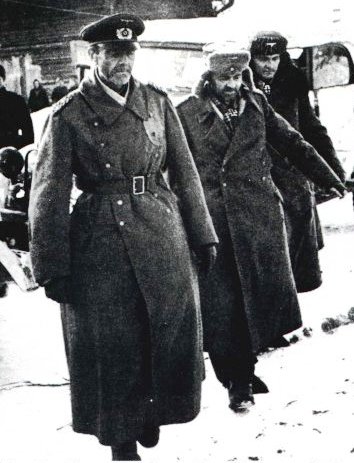
t-34 stalingradT-34 in Stalingrad

Hitler ordered Manstein to form Army Group Don to relieve Stalingrad. Hitler would not countenance a break out and wanted Manstein to break through and relieve 6th Army.[ciii] Hitler refused a request by Paulus on 23 November to move troops to prepare for a possible a break out attempt, assuring him that he would be relieved.[civ] Albert Speer notes that Zeitzler who replaced Halder insisted that the Sixth Army must break out to the west.”[cv] Hitler told Zeitzler that “We should under no circumstances give this up. We won’t get it back once it’s lost.”[cvi] Goering promised the Luftwaffe would be able to meet the re-supply needs of 6th Army by air, even though his Generals knew that it was impossible with the number of transport aircraft available.[cvii] Hitler took Goering at his word and exclaimed “Stalingrad can be held! It is foolish to go on talking any more about a breakout by Sixth Army…”[cviii] and a Führer decree was issued ordering that the front be held at all costs.[cix] Goerlitz states that “Hitler was incapable of conceiving that the 6th Army should do anything but fight where it stood.”[cx] Likewise Manstein had precious few troops with which to counterattack and had to protect the flank of Army Group A deep in the Caucasus. His army group was only corps strength and was spread across a 200 mile front.[cxi] Any relief attempt had to wait for more troops, especially Panzers.  Manstein too believed that the best chance for a breakout had passed and that it was a serious error for Paulus to put the request to withdraw through to Hitler rather than the Army Group or act on his own.[cxii] Many soldiers were optimistic that Hitler would get them out.[cxiii] Other generals like Guderian, Reichenau or Hoeppner might have acted, but Paulus was no rebel.[cxiv]
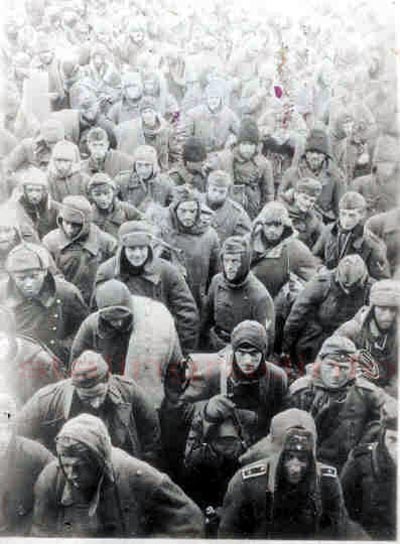
Madonna of StalingradThe Madonna of Stalingrad

Operation Saturn began on 7 December destroying the Italian 8th Army and forcing the Germans to parry the threat.[cxv] A relief attempt by 57th Panzer Corps under Hoth on 12 December made some headway until a massive Soviet counterattack on 24 December drove it back.[cxvi] This attack was hampered by OKW’s refusal to allocate the 17th Panzer and 16th Motorized divisions to Manstein,[cxvii] and by 6th Army not attacking out to link with the relief force.[cxviii]By 6 January Paulus signaled OKW: Army starving and frozen, have no ammunition and cannot move tanks anymore.”[cxix] On 10 January the Soviets launched Operation Ring to eliminate the pocket and despite all odds German troops fought on. On the 16th Paulus requested that battle worthy units be allowed to break out, but the request was not replied to.[cxx] On the 22nd the last airfield had been overrun and on 31 January Paulus surrendered.[cxxi]

pows stalingradPOWs: Only 5,000 of 90,000 POWs would return

Analysis: What Went Wrong

Stalingrad had strangely drawn the attention of both sides, but the Russians never lost sight of their primary objectives during the campaign. The Germans on the other hand committed numerous unforced errors mostly caused by Hitler or Paulus. After the fall of Stalingrad as the Soviets attempted to follow up their success by attempted to cut off Army Group “A” Manstein was permitted to wage a mobile defense while Von Kleist managed to withdraw with few losses.[cxxii] The superior generalship of Manstein and Von Kleist prevented the wholesale destruction of German forces in southern Russia and Manstein’s counter offensive inflicted a severe defeat on the Soviets. However the German Army had been badly defeated.  The seeds of defeat were laid early, the failure to destroy bypassed Soviet formations in July, the diversion of 4th Panzer Army from Stalingrad, and the divergent objectives of trying to capture the Caucasus and Stalingrad at the same time.  This diluted both offensives ensuring that neither succeeded.  Likewise the failure to recognize the culminating point when it was reached and to adjust operations accordingly was disastrous for the Germans. The failure create a mobile reserve to meet possible Russian counter offensives, and the fixation on Stalingrad took the German focus off of the critical yet weakly held flanks. The hubris of Hitler and OKW to believe that the Russians were incapable of conducting major mobile operations even as Stavka commenced offensive operations on those flanks all contributed to the defeat.  Clark notes these facts but adds that the Germans “were simply attempting too much.”[cxxiii] Soviet numbers allowed them to wear down the Germans even in defeat.[cxxiv] At the same time Stalin gave his commanders a chance to revive the mobile doctrine of deep operations with mechanized and shock armies that he had discredited in the 1930s.[cxxv] All through the campaign Zhukov and other commanders maintained both their nerve even when it appeared that Stalingrad was all but lost. They never lost sight of their goal of destroying major German formations though they failed to entrap Army Group A with 6th Army.

A Modern Application

It is well and good to attempt to remain on the offensive.  The U.S. currently has forces spread thinly over two combat theaters with possibilities that other threats in the same region could flare up.  Like the Germans the U.S. is operating in areas, especially Afghanistan where overland supply lines are vulnerable and where weather can and does affect resupply operations by both ground and air.  The fact that the U.S. is operating with just barely enough forces in areas where others have met disaster calls for a circumspect look at what our enemy’s capabilities really are and not allowing ourselves to be surprised when they do things that have worked for them in the past against the Russians.  While it is unlikely that the U.S. and NATO would face a Stalingrad type situation in Afghanistan it is possible that isolated forces could be overrun as the Afghans reprise tactics used so successfully against the Soviets and as they begin to operate in larger units, concentrate them quickly and with more firepower to catch NATO forces when they are most vulnerable.  It is true that they will not mass large numbers of tanks and artillery as the Soviets did against the Germans, but the principle of speed, concentration at the critical point and surprise can inflict defeats that will turn public sentiment in the U.S. and Europe against further commitments and against the war and force the NATO governments as well as the U.S. to give up the effort.


[i] Clark, Alan. Barbarossa: The Russian-German Conflict:1941-45. Perennial Books, An imprint of Harper Collins Publishers, New York, NY 1965. p.191

[ii] Ibid.

[iii] Glantz, David M. and House, Jonathan. When Titan’s Clashed: How the Red Army Stopped Hitler. The University Press of Kansas, Lawrence KS, 1995. p.111

[iv] Ibid. Clark. p.191

[v] Beevor, Anthony. Stalingrad: The Fateful Siege: 1942-1943. Penguin Books, New York NY 1998. p.69

[vi] Manstein, Erich von. Forward by B.H. Liddle Hart, Introduction by Martin Blumenson. Lost victories: The War Memoirs of Hitler’s Most Brilliant General. Zenith Press, St Paul MN 2004. First Published 1955 as Verlorene Siege, English Translation 1958 by Methuen Company. p.291 This opinion is not isolated, Beevor Quotes Paulus “If we don’t take Maikop and Gronzy…then I must put an end to the war.” (Beevor pp. 69-70)  Halder on the other hand believed that Hitler emphasized that the objective was “the River Volga at Stalingrad. (Clark. p.190)

[vii] Ibid. Beevor. p.70.

[viii] Ibid. Glantz and House. p.106

[ix] Ibid. p.105-106

[x] Ibid. Clark. p.203.  The offensive did impose a delay on the German offensive.

[xi] Ibid. Clark. p.191 Each group also contained allied armies.

[xii] Ibid. p.209.

[xiii] Ibid. Glantz and House. p.119

[xiv] Ibid. Manstein. p.292.

[xv] Ibid. Clark. p.209

[xvi] Ibid. Clark.  p.211

[xvii] Ibid. Glantz and House. p.120. There is a good discussion of the impact of this decision here as 6th Army’s advance was given priority for both air support and fuel.

[xviii] Ibid. Beevor. p.74

[xix] Warlimont, Walter. Inside Hitler’s Headquarters 1939-45. Translated by R.H. Berry, Presido Press, Novato CA, 1964. p.249

[xx] Ibid. Beevor. p.75 This was the 10th NKVD Division and it took control of all local militia, NKVD, and river traffic, and established armored trains and armor training schools.

[xxi] Ibid. Clark. p.212

[xxii] Ibid. Glantz and House. p.121

[xxiii] Ibid. Beevor. p.85

[xxiv] Ibid. p.89

[xxv] Liddell-Hart, B.H. The German Generals Talk. Quill Publishers, New York, NY 1979. Originally published by the author in 1948. p.202

[xxvi] Ibid. Beevor. p.88

[xxvii] Ibid. Beevor. p.90

[xxviii] Ibid. Beevor. p.81

[xxix] Ibid. Glantz and House. p.121

[xxx] Ibid. Liddell-Hart. p.202

[xxxi] Ibid. Glantz and House. p.120

[xxxii] Goerlitz, Walter. History of the German General Staff. Westview Press, Frederick A. Praeger Publisher, Boulder, CO. 1985 p.416

[xxxiii] Ibid. Beevor. pp.95-96.

[xxxiv] Von Mellenthin, F.W. Panzer Battles: A Study of the Employment of Armor in the Second World War. Translated H. Betzler, Edited by L.C.F. Turner. Oklahoma University Press 1956, Ballantine Books, New York, NY. 1971. p.193

[xxxv] Shirer, William L. The Rise and Fall of the Third Reich. A Touchstone Book published by Simon and Schuster, 1981, Copyright 1959 and 1960. p.914

[xxxvi] Ibid. Glantz and House. p.122

[xxxvii] Ibid. Warlimont. p.256

[xxxviii] Ibid. Liddell-Hart. p.203

[xxxix] Ibid. p.204

[xl] Ibid. Shirer. p.914

[xli] Ibid. Goerlitz. p.416

[xlii] Ibid. Goerlitz. p.416

[xliii] Ibid. Manstein. p.293

[xliv] Ibid. Clark. p.214

[xlv] Ibid. Beevor. pp.97-99. The mobilization included military, political, civilian and industrial elements.

[xlvi] Liddell-Hart, B.H. Strategy. A Signet Book, the New American Library, New York, NY. 1974, Originally Published by Faber and Faber Ltd., London. 1954 & 1967. p.250

[xlvii] Ibid. Beevor. p.99.  Two key commanders arrived during this time frame, Colonel General Andrei Yeremenko, who would command the Stalingrad Front  and General Chuikov commander of 64th Army who would conduct the defense of the city.

[xlviii] Carell, Paul Hitler Moves East: 1941-1943. Ballantine Books, New York, NY 1971, German Edition published 1963. p.581

[xlix] Ibid. Shirer.  p.909.

[l] Ibid. Liddell-Hart, Strategy. p.250

[li] Wheeler-Bennett, John W. The Nemesis of Power: The German Army in Politics 1918-1945. St. Martin’s Press, New York, NY 1954.  p.531

[lii] Ibid. Wheeler-Bennett. p.531

[liii] Ibid. Beevor. p.96

[liv] Ibid. Clark. p.216.

[lv] Ibid. Von Mellenthin. P.193

[lvi] See Von Mellinthin pp.193-194.  Von Mellinthin quotes Colonel Dinger, the Operations Officer of 3rd Motorized Division at Stalingrad until a few days before its fall. Dingler noted that the Germans on reaching Stalingrad “had reached the end of their power. Their offensive strength was inadequate to complete the victory, nor could they replace the losses they had suffered.” (p.193) He believed that the facts were sufficient “not only to justify a withdrawal, but compel a retreat.” (p.194)

[lvii] Ibid. Manstein. p.294

[lviii] Ibid. Clark. p.216

[lix] Ibid. Clark. p.217

[lx] Ibid. Beevor. p.107

[lxi] Ibid. Beevor. p.107

[lxii] Ibid. Glantz and House. p.122

[lxiii] Ibid. Carell. P.601

[lxiv] Ibid. Beevor. p.118

[lxv] Ibid. Beevor. p.118

[lxvi] Ibid. Carell. p.602

[lxvii] Ibid. Beevor. p.128

[lxviii] Ibid. Carell. p.603

[lxix] Ibid. Beevor. p.134

[lxx] Ibid. Beevor. pp.136-137

[lxxi] Ibid. Beevor. p.149

[lxxii] Fest, Joachim. Hitler. Translated by Richard and Clara Winston, Harcourt, Brace, Jovanovich Publishers, San Diego, New York, London. 1974. p.661

[lxxiii] Ibid. Beevor. pp. 149-150

[lxxiv] Ibid. Beevor. p.164

[lxxv] Ibid. Carell. p.618

[lxxvi] Ibid. Glantz and House. p.123

[lxxvii] Ibid. Beevor. p.218

[lxxviii] Ibid. Carell. p.623

[lxxix] Ibid. Goerlitz. p.418

[lxxx] Ibid. Liddell-Hart. The German Generals Talk. p.207

[lxxxi] Ibid. Manstein. p292

[lxxxii] Ibid. Liddell-Hart. History of the Second World War. p.258

[lxxxiii] Ibid. Glantz and House. p.129

[lxxxiv] Ibid. Glantz and House. p.130

[lxxxv] Ibid. Beevor. pp.221-222 Glantz and House say that Stalin gave his backing in mid-October but this seems less likely due to the amount of planning and movement of troops involved to begin the operation in November.

[lxxxvi] Ibid. Glantz and House. p.130

[lxxxvii] Ibid. Beevor. p.226

[lxxxviii] Ibid. Glantz and House. p.132

[lxxxix] Ibid. Glantz and House. p.130

[xc] Ibid. Beevor. p.227

[xci] Ibid. Beevor. p.228

[xcii] Ibid. Clark. p.235

[xciii] Ibid. Warlimont. p.274

[xciv] Ibid, Carell. p.627 3rd Rumanian Army lost 75,000 men in three days.

[xcv] Ibid. Clark.pp.247-248

[xcvi] The condition of the few German Panzer Divisions in position to support the flanks was very poor, the 22nd had suffered from a lack of fuel and maintenance and this many of its tanks were inoperative. Most of the armor strength of the 48th Panzer Corps was provided by a Rumanian armored division equipped with obsolete Czech 38t tanks provided by the Germans.

[xcvii] Ibid. Clark. pp.251-252. The designation of 2nd Guards Tank Army by Clark has to be wrong and it is the 5th Tank Army as 2nd Guards Tank was not involved in Operation Uranus.  Carell, Beevor and Glantz properly identify the unit.

[xcviii] Ibid. Carell. p.630

[xcix] Ibid. Beevor. p.244

[c] Ibid. Beevor. p.247

[ci] Ibid. Beevor. p.245

[cii] Ibid. Glantz and House. p.134

[ciii] Ibid. Glantz and House. p.134

[civ] Ibid. Clark. p.256

[cv] Speer, Albert. Inside the Third Reich. Collier Books, a Division of MacMillan Publishers, Inc. New York, NY 1970. p.248

[cvi] Heiber, Helmut and Glantz, David M. Editors. Hitler and His Generals: Military Conferences 1942-1945. Enigma Books, New York, NY 2002-2003.  Originally published as Hitlers Lagebsprechungen: Die Protokollfragmente seiner militärischen Konferenzen 1942-1945. Deutsche Verlags-Anstalt GmbH, Stuttgart, 1962. p.27

[cvii] Ibid. Glantz and House. p.135 Glantz and House note that the amount of aircraft estimated to successfully carry out the re-supply operation in the operational conditions was over 1,000.  The amount needed daily was over 600 tons of which the daily reached only 300 tons only one occasion.

[cviii] Ibid. Speer. p.249

[cix] Ibid. Carell. p.636

[cx] Ibid. Goerlitz. p.426

[cxi] Ibid. Clark. p.252

[cxii] Ibid. Manstein. p.303

[cxiii] Ibid. Beevor. p.276

[cxiv] Ibid. Carell. p.640

[cxv] Ibid. Glantz and House. p.140

[cxvi] Ibid. Glantz and House. p.140

[cxvii] Ibid. Clark. p.264

[cxviii] Ibid. Manstein. p.337

[cxix] Ibid. Beevor. p320

[cxx] Ibid. Beevor. p.365

[cxxi] Of the approximately 330,000 in the pocket about 91,000 surrendered, another 45,000 had been evacuated.  22 German divisions were destroyed.

[cxxii] Ibid. Liddell-Hart. The German Generals Talk. p.211

[cxxiii] Ibid. Clark. p.250

[cxxiv] Ibid. Glantz and House. p.124

[cxxiv] Ibid. Beevor. p.221

Bibliography

Beevor, Anthony. Stalingrad: The Fateful Siege: 1942-1943. Penguin Books, New York NY 1998

Carell, Paul Hitler Moves East: 1941-1943. Ballantine Books, New York, NY 1971, German Edition published 1963.

Clark, Alan. Barbarossa: The Russian-German Conflict:1941-45. Perennial Books, An imprint of Harper Collins Publishers, New York, NY 1965.

Fest, Joachim. Hitler. Translated by Richard and Clara Winston, Harcourt, Brace, Jovanovich Publishers, San Diego, New York, London. 1974

Glantz, David M. and House, Jonathan. When Titan’s Clashed: How the Red Army Stopped Hitler. The University Press of Kansas, Lawrence KS, 1995.

Goerlitz, Walter. History of the German General Staff. Westview Press, Frederick A. Praeger Publisher, Boulder, CO. 1985

Heiber, Helmut and Glantz, David M. Editors. Hitler and His Generals: Military Conferences 1942-1945. Enigma Books, New York, NY 2002-2003.  Originally published as Hitlers Lagebsprechungen: Die Protokollfragmente seiner militärischen Konferenzen 1942-1945. Deutsche Verlags-Anstalt GmbH, Stuttgart, 1962.

Liddell-Hart, B.H. The German Generals Talk. Quill Publishers, New York, NY 1979. Originally Published by the author in 1948.

Liddell-Hart, B.H. Strategy. A Signet Book, the New American Library, New York, NY. 1974, Originally Published by Faber and Faber Ltd., London. 1954 & 1967

Manstein, Erich von. Forward by B.H. Liddle Hart, Introduction by Martin Blumenson. Lost victories: The War Memoirs of Hitler’s Most Brilliant General. Zenith Press, St Paul MN 2004. First Published 1955 as Verlorene Siege, English Translation 1958 by Methuen Company

Shirer, William L. The Rise and Fall of the Third Reich. A Touchstone Book published by Simon and Schuster, 1981, Copyright 1959 and 1960

Speer, Albert. Inside the Third Reich. Collier Books, a Division of MacMillan Publishers, Inc. New York, NY 1970.

Von Mellenthin, F.W. Panzer Battles: A Study of the Employment of Armor in the Second World War. Translated H. Betzler, Edited by L.C.F. Turner. Oklahoma University Press 1956, Ballantine Books, New York, NY. 1971.

Warlimont, Walter. Inside Hitler’s Headquarters 1939-45. Translated by R.H. Berry, Presido Press, Novato CA, 1964.

Wheeler-Bennett, John W. The Nemesis of Power: The German Army in Politics 1918-1945. St. Martin’s Press, New York, NY 1954

Leave a comment

Filed under History, world war two in europe

Japan’s Self Defeating Attempts to Become Economically Self Sufficient in the 1930s

This is the first of a two part series that explores the similarities of the United States in 2009 to Japan of the early 1930s.  It explores the topic of economic self sufficiency or “autarky” and how nations can put the proverbial cart before the horse in terms of seeking ways to become self sufficient.  The Japanese chose the path of military conquest seeming to forget the fact that they were dependent on natural resources and manufactured equipment to wage such a war by the nations that they were attacking.

In the early 1930’s Japan’s desired to emulate the economic self-sufficiency of the United States or to achieve autarky controlling its own economic destiny by securing sufficient natural resources.  Japanese industrial and military leaders felt that such was needed for economic expansion as well as military preparation and expansion.  Key resources such as oil, specialized steels and alloys, iron ore, coking coal, machining tools and even cotton were not readily available in Japan proper.

Japans’ goal was unrealistic based on the differences of the two countries. In the early part of the 20th century the United States was self-sufficient in most critical natural resources and was a key supplier to the world of oil, iron, coal and grain.  Additionally most of the United States’ resources were contained within its borders or provided to it in trade with nations that needed what the United States had to offer in manufactured goods.  Japan did not have this.  As a nation it had few natural resources on the home islands and even suffered food shortages that resulted in famine at times.  It was dependant on other nations for basic natural resources to power its economy and to feed its population. As a result some of its political, economic and military leaders looked to achieve autarky through conquest.

Unfortunately for the Japanese they were surrounded by numerous powers that stood in their way.  To the north was Russia, which they vanquished in the 1905 war, but in doing so ended up nearly bankrupt, though they gained the Korean peninsula. However, the Japanese now faced the Soviet Union with its immense military on the Manchurian border and subterfuge in the politics of China by their support of Mao Tse Tung’s Red Chinese forces.  The Japanese were able to gain some possessions by participating on the Allied side in WWI at the expense of Germany and China, though they did not achieve all they wanted and felt cheated by the Allies at the Versailles peace conference. The first step was to invade Manchuria and seize its natural resources in 1931.  However to gain more than what they could garner in Manchuria the Japanese would have to do so at the expense of China and the Western Colonial powers, France, Britain, the Netherlands and United States. Japan’s quandary was how to achieve autarky without resorting to war with multiple enemies.

The Japanese faced a sort of “chicken or the egg scenario” as to what came first. In order to wage war Japan needed iron ore, coking coal and industrial salt from North China, oil from Borneo and Southeast Asia, cotton from America to make finished products for the American market. Likewise it needed special steels and alloys from the US to supply the war effort. The US was also the primary source of Japan for machine tools and other sophisticated industrial equipment needed for Japanese industry.  To go to war the Japanese required the imports of the very nations who stood in their way.

Yet to go to war entailed great risk, Japan did not have the resources, especially oil and metals with which to sustain their war effort without maintaining foreign trade with the very countries that they would have to engage in war.  All of these factors together made autarky in the style of the United States unreasonable through military means alone. It is likely that the Japanese could have achieved more by using more skillful diplomacy during the 1930s.  Had they built a mutually beneficial alliance with China, did more to exploit the natural resources of Manchuria and negotiated favorable trade deals with the United States they probably would have accomplished more than they did through using military force.  Some Japanese reformers attempted to make some of these reforms but were unsuccessful as the military particularly the Imperial Army, the government and industrial concerns became locked into the military option.

By contrast during its growth period the United States did not have to deal with significant military powers as it moved west across North America, only Native American Tribal groups.  The only power capable of stopping the United States was Great Britain.  While there were tensions between the United States and Great Britain along the Canadian border and Pacific Northwest during the 1850s, the United States never faced a significant external threat.  Thus the United States using very little military power gobbled up the continent and established its status as the Hegemon of the Western Hemisphere.  Japan could not do what it needed to do unless it negotiated with or conquered the powers that had significant military power to confront the Japanese and economic ability to strangle the Japanese economy.

This period should interest to any student of history, foreign policy and economics.  The study of the period of Japanese history needs to be considered by policy makers when considering war to obtain natural resources or critical supplies not indigenous to their country or for which they are dependent on potential hostile suppliers.  Like Japan in the 1930s the United States is not currently self sufficient in many natural resources especially oil and is dependent on other nations, especially China for critical items in its economy.  Having surrendered much of its industrial capacity and having failed to exploit alternatives to fossil based fuels, especially oil the United States faces a conundrum similar to the Japanese in the early 1930s.  The United States is militarily strong yet deeply politically divided and possibly unstable.  The United States is dependent on many nations, some who outwardly hostile to us for the very lifeblood of its economy.  Like the Japanese the military is singularly incapable of securing all of these resources and engaged in multiple wars that are tying up close to half our ground forces when one considers troops in theater and those unavailable because they slated to go or having just returned from combat deployments.  Additionally like the Japanese who were in the midst of the Great Depression the United States is going through what appears to be the worst economic times since that period.  Policy makers need to be careful when dealing with situations where economic factors are diminished and natural resources have to be imported to sustain the economy. Autarky is fine if you can do it but the United States has more in common economically with Japan of the 1930s than the we would like to admit.  Something to think about.

The second concluding section of this will be published in the next few days, the Deity Herself permitting…

Peace,

Steve+

5 Comments

Filed under History, Military

Padre Steve’s Highs and Lows of 28 Years Service

Ooops, this should have posted the 25th…all references in the post though it posted today are for the 25th.  The meltdown was the 24th, not my duty night.

Note: I think that I have pretty much recovered from last night’s mini-meltdown, though tired have has a good day working some stuff that is pretty cool that could be a positive thing for Navy and VA Chaplains.  I think success does help mitigate some of the effects of a meltdown.  If today had been crappy and I hadn’t had a good talk with Elmer the Shrink it might have continued.  Now with some sleep I could be cooking with gas even though my house is all electric.

On to the Post:

Soldier Once and YoungEnlisted in National Guard 1982

“So we’re all dogfaces, we’re all very, very different, but there is one thing that we all have in common: we were all stupid enough to enlist in the Army. We’re mutants. There’s something wrong with us, something very, very wrong with us. Something seriously wrong with us – we’re soldiers. But we’re American soldiers! We’ve been kicking ass for 200 years!” Bill Murray as John Winger in “Stripes” 1981

Well sports fans I am at the hospital tonight celebrating 28 years of service in the military. It really doesn’t seem like any more than 27 ½ but who’s counting right? And when I look back at the Army I joined I am reminded of Stripes.

I think that I have pretty much recovered from last night’s mini-meltdown, though tired have has a good day working some stuff that is pretty cool that could be a positive thing for Navy and VA Chaplains.  I think success does help mitigate some of the effects of a meltdown.  If today had been crappy and I hadn’t had a good talk with Elmer the Shrink it might have continued.  Now with some sleep I could be cooking with gas even though my house is all electric.

So 28 years ago today I went down and signed my name on the dotted line.  It was August 25th 1981 two months after the release of the movie Stripes and two months before I saw it with Judy at the $1 movie theater.  On that end of summer day I went down and signed my contract with the Army ROTC program at UCLA with the Chief Lord of Discipline himself, the Captain Bruce Lawson swearing me in.  He had just finished PT and though still in his PT clothes administered the Oath of Enlistment.  It was not much on ceremony but it was a start.  In fact most of my promotions in either the Army of the Navy have not come with much fanfare and I’m actually pretty okay with that so long as I get paid and get to do what I love doing which is being a Priest and getting to serve now as a Navy Chaplain.  So I followed with a trip down to the National Guard Armory on Victory Blvd in Van Nuys to enlist in the National Guard. Since I was not a scholarship student I was allowed to simultaneously enter the Guard.  So the 25th was kind of like a double header for me, I did the oath for the Guard later in the afternoon. It’s like Tommy Lasorda once said: “I love doubleheaders. That way I get to keep my uniform on longer.”

So I went in to Headquarters and Headquarters Battery and met the Company Commander, Captain J.J. Kramer, now a retired Colonel I believe and Major Charles Armagost, the Full Time Unit Administrator and Adjutant.  Wearing his green fatigues the good Major administered the Oath for the California National Guard, which differed from the Federal Oath in that it also included words about obeying the Governor of the State and the Laws of California etc…Following that I was walked down to the supply room where a rather rotund Sergeant began issuing me uniforms and field gear.  I got my first gift of US Military designer clothing and was told to report the Thursday after Labor Day for a “Battery Dark Night.”  So began my rather auspicious career.

I remember being in uniform in those early days without a single ribbon or medal to my name.  I’d look around and see all the guys who had served in Vietnam and some in Korea as well with all kinds of ribbons, medals, unit citations and qualification badges.  I would look at them and once I remarked to Judy that I wish that I would have a lot someday.  She accused me of whining, something that I feel is a mischaracterization of my attitude about not having anything and something that now with a full chest of ribbons, medals and qualification pins that she is not hesitant to remind me of and tell others about.

2LT Dundas 1983Look Mom One Ribbon

So what has transpired in 28 years?  Here are some of the highlights and a few lowlights of the of this adventure.

In 1981 it all began and things happened fast, within two weeks of enlisting I was driving an M-151A1 Jeep to Ft Irwin CA as part of battalion advance party and then spending the weekend learning to call in artillery fire. After going through hell and being destroyed and rebuilt by SFC Harry Ball, Drill Sergeant US Army like Richard Gere was in An Officer and a Gentleman I somehow got commissioned in part due to the forbearance of Major Lawson, the former Captain Lawson who has sworn me in.  Judy asks if I had my own “Puget Sound Deb” when she sees the movie with me that winter. However just prior to getting commissioned during my last annual training period at Camp Roberts I led team of Ersatz East German Kommando’s on raids against battalion rear area as the opposing forces.  I was almost run over in may M-151A1 by an M-548 Ammo Carrier during a strafing run coming down hills firing blanks from machine guns like the Rat Patrol and dropping Smoke and CS grenades in the vehicle’s path.  Later we captured the battery Operations Center during a firing mission. None of this made them happy but the Forward Observers and I had a blast.

After I got commissioned I attended the Medical Department Officer Basic Course at Ft Sam Houston TX and suffered for Jesus for 9 weeks in the Riverwalk Marriott hotel in downtown San Antonio. After this I spent 11 glorious weeks at Ft Knox Kentucky which by the way is in a “dry county” or at least it was back then  going through a 6 week course after being bumped by Saudi Arabian exchange officers.

557th comany command 1985Company Commander

From January 1984 through late December 1986 we were stationed with the 557th Medical Company Neubrucke and later Wiesbaden. Was a platoon leader and became company XO when our XO checked into a psych ward before Winter REFORGER. While in the field was promoted but o one realized that fact until we came out of the field in mid- February. In a late night hastily arranged ceremony which I had to drag Judy in from bed to see I was promoted and got my first real medal. In September I became a “relief pitcher” Company Commander when my new CO got fired. I was told “Lieutenant; clean up that Company.” After 7 months, and having to adjudicate close to 50 Article 15’s, and kicking a bunch of drug users out of the Army I was relieved by a Captain and I had my first and last Change of Command ceremony. Became a personnel officer at our group, pissed off the boss and had a miserable last couple months in Germany. However I completed my first row of ribbons made some really good lifelong German friends and learned to drive really fast and really good and developed a fine appreciation of good beer.

In 1987 I attended the Military Personnel Officer Course at Ft Benjamin Harrison which is in Indianapolis and continued on to Fort Sam Houston where I was assigned as the Adjutant for the Academy Brigade, Academy of Health Sciences.  I got promoted right after I got there and since Judy had not arrived I had the world’s best platoon sergeant, SFC Cynthia Carter help pin on my new Captain bars. Judy was quite happy that Cindy got to do this as she really liked her.  My Brigade Commander wondered what was up with that, but it was an honor to have her do the pinning. While there I worked on AIDS/HIV personnel policy and became “CINC AIDS” at the Academy. While there I collected my second Army Achievement Medal and an Army Commendation Medal.

Berlin WallBerlin Wall 1986

In 1988 I left Active Army to attend Seminary and was appointed as an Armor officer in Texas Army National Guard.  I was told by my boss LTC Jim Wigger that I was moving from the “frying pan into the fire as the chaplains were a cutthroat bunch” and that the “Medical Department was not even in the same league as the Chaplains.” When the Division Chaplain found out that a seminarian was getting ready to drive tanks he pitched a fit and had me enter the Chaplain Candidate program.  In seminary I attended  the Chaplain Officer Basic Course at Fort Monmouth NJ. As Deputy Course leader and Company “First Sergeant” pissed off lots of chaplains and seminarians. Thankfully I was backed up by LTC Rich Whaley who saved my ass for the first time and not the last time.  I met my friend Fr Jim Bowman who kept me from doing anything really stupid. In 1992 I graduated from seminary was ordained and become a chaplain and assigned to 111th Engineer Battalion in Abilene. That year I got thrown out of the Chaplain Officer Advanced Course when school changed a policy on Chaplain Candidates awaiting final approval to be chaplains to enter course. After Billy Martin style tantrum Rich Whaley saves my ass a second time.

In 1993 I went back to Chaplain Officer Advanced Course, made amends and did the appropriate penance.  Meet up with Fr Jim Bowman again. In the fall of 1994 finished the final phase of the Chaplain Officer Advance Course.  Happiness is Ft Monmouth in your rear view mirror. In the summer of 1984 I viewed the O.J. Chase live on miniature TV in M-577 Command Track with Lakers playoff game in split screen while at Fort Hood.

In January 1995 I moved to Huntington WV to take a job as a contract ER Chaplain.  I transferred from one former Confederate Unit to another going from the Texas to the Virginia Army National Guard.  In December I was promoted to Major and transferred to the Army Reserve and got rid of the 410 mile one way trip for a drill.

New MajorNew Major December 1995

In July of 1996 I got mobilized and sent to Germany to support Bosnia mission, lose job. While in Germany get to do a lot of cool stuff, got a bunch of medals and though the Chaplains there wanted me to be brought on regular active duty get told I am too senior to transfer to Regular Army. I actually think that the guy who made the decision remembered me from Chaplain School and did not want someone like me in “his” Chaplain Corps. Upon my return from Bosnia support the Reserves assigned to Ft Indiantown Gap PA as Installation Command Chaplain where in September 1998 I got to close down help close down the Federal side of things and transfer chapel and congregation to National Guard care. In October I returned to the reserves like a journeyman ball-player being sent back to AAA from the Majors. In December the Navy offered me a deal to play “in the show” on active duty and I took it, went from being an Army Reserve Major to Navy Lieutenant. My friend Father Fred Elkin was my first detailer and offered me a choice of East Coast or West Coast Marines when I asked for a ship.  We now serve together and get a good laugh about that now. It did turn out to be a good thing for me. One of the cool things about my time in the Navy has been since I have blown myself up enough in the Army and seen others do likewise that I know where the career “land mines” are and how not to step on them. This has been a great benefit to me.  It was like changing from one league to another in the middle of a baseball season.  The old stats don’t count for or against you when you start playing in the new league.

After Navy Chaplain School I was assigned to the 2nd Marine Division at Camp LeJuene NC. From then on my life has been going non-stop.  I was chaplain for 4 different battalions in the Division where Father John Kaul used me as a “relief pitcher” in situations where chaplains had either been fired for doing illegal or immoral things or replacing people who had to move on short notice orders. Did CAX at 29 Palms on multiple occasions and did a deployment to the Far East, Okinawa, Japan and Korea.  Collected more medals got my “old” version Fleet Marine Force Qualification. I was assigned to HQ BN 2nd MARDIV. 9-11 -01 attack happened. A couple of months later I reported to USS HUE CITY CG-66 in Mayport.

Dundas of the DesertDundas of the Desert 29 Palms 2000-2001

Not long after reporting went on the final work up exercises prior to deployment, deployed to the Horn of Africa, Northern Arabian Gulf, Gulf of Oman and Mediterranean.  Was an advisor for a boarding team in Northern Arabian Gulf and made 75 boardings of detained smugglers.  We almost got to see the Indians and Pakistanis get in a nuclear war, that was a bit sporty and we supported air operations in Afghanistan. After a period in the yards during following deployment as well as work with the great Marines who served in the Battle of Hue City I checked off the ship in October 2003, again collecting more medals and ribbons.

Boarding partyBoarding Party 2002

I went to Norfolk where I was assigned to the Marine Corps Security Force Battalion and my Commanding Officers, Colonel Mike Paulovich and Colonel Donald Rogers sent me about the world to care for our Marines.  Over that time I probably averaged 2 trips a month out of the area, many overseas to Japan, Hawaii, Spain, France, the United Kingdom and Bahrain, others to places far and wide in the Continental United States.  Colonel Paulovich and I probably worked more closely together than any commander that I have ever worked with and we went through many difficult times in that assignment. We are still friends to this day.  One of the cool things is the people that we work with. I was promoted to Lieutenant Commander in April 2006.  This meant that I had spent almost 16 years of my career wearing Captain or Lieutenant bars.  I again collected more ribbons and medals for the time with the Marines and was one of the first Navy Officers to get the Fleet Marine Force Officer Qualification pin while completing Marine Command and Staff College.

Belleau woodBelleau Wood France 2004

I then went to Navy EOD Group Two in Little Creek where I was the first chaplain assigned to EOD.  While there I got to go to Jordan to the Jordanian Army/UN Peace Operations Training Center and to Sicily.  I was snatched up to go to Iraq in July 2007 and served the most meaningful operational deployment of my career serving our Marine, Army, Navy, Air Force and Department of Justice and Homeland Security advisors to the Iraqi Army, Police and Border Forces in Al Anbar Province.  I came back from Iraq with a great case of PTSD, a gift that keeps on giving.  I checked out of EOD in September 2007 again with more medals and ribbons to my current assignment at Naval Medical Center Portsmouth where I get to do what I am passionate about as a Priest and Navy Chaplain serving in a teaching hospital.
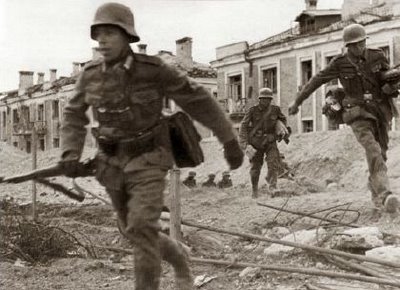
My Tom Clancy lookIraq 2008

Looking back it has been a long and strange trip and it is still an ongoing journey.  People ask me how I keep going even with the PTSD and it’s like Tommy Lasorda says “Guys ask me, don’t I get burned out? How can you get burned out doing something you love? I ask you, have you ever got tired of kissing a pretty girl?” Speaking of which now that I am on the way home after 31 or so hours at work I probably need to do with Judy when I see her.

Steve Summer Whites 2008July 2008, Grand Admiral of the Ottoman Navy?

Peace,  Steve+

1 Comment

Filed under Baseball, History, iraq,afghanistan, Loose thoughts and musings, Military, PTSD

Always on the Road…Memories of a Marriage Spent Apart Together

anniverary 200926 Years Together: At Murphy’s of DC

The 1980s super-group Journey had a song called Faithfully. It is to this day one of my favorite songs for though it is about the life a travelling musician the lyrics are quite fitting for a military family.

Highway run
Into the midnight sun
Wheels go round and round
You’re on my mind
Restless hearts
Sleep alone tonight
Sendin’ all my love
Along the wire

They say that the road
Ain’t no place to start a family
Right down the line
Its been you and me
And lovin’ a music man
Ain’t always what it’s supposed to be
Oh girl you stand by me
I’m forever yours…faithfully

Circus life
Under the big top world
We all need the clowns
To make us smile
Through space and time
Always another show
Wondering where I am
Lost without you

And being apart ain’t easy
On this love affair
Two strangers learn to fall in love again
I get the joy
Of rediscovering you
Oh girl, you stand by me
Im forever yours…faithfully

Oh, oh, oh, oh
Faithfully, Im still yours
Im forever yours
Ever yours…faithfully

If your read yesterday’s post you know that we have only spent 10 of 26 anniversaries together.  In those years we have often been apart.  In fact a mere 3 ½ weeks after we started dating I left on a 3 month tour with a Christian singing group called the Continental Singers and Orchestra.  Fort those that have heard me sing there is nothing to fear as I was the spotlight tech.  In this position I got to sing along without anyone having to hear me as I trained my Strong Trouperette III spotlight on the various soloists and while in Europe on the whole group.  This continued on multiple occasions after we were married during my military career, periods of 6-9 months were common, once a 15 month separation with a three week period together.  From May of 1996 until August 2003 we spent 43 out of 63 months apart.  This did not include the period of my hospital residency and civilian hospital chaplain jobs working many second shifts and overnights in addition to National Guard and Army Reserve exercises, training, official travel or schools.  Of course this put strain on both of us yet somehow we survived.

It is in the times like these that you find out what you as a couple are made of.  Both of us are somewhat independent spirits and though both natural introverts have strong personalities.  At the same time we both see the world through a somewhat warped prism and both have strong senses of irony which is strange because I take my clothes that need pressing to the cleaners.  I think a lot of what besides the grace of God, which the Deity Herself has seemed to has given both of us a lot of, many times in spite of me.

In the course of our marriage we have lived quite a few places and of course I have been to even more.  We were married in Stockton California, aka “Mudville” of Casey at the Bat fame or more recently the birthplace of the drive by shooting and 2500 square foot two story suburban marijuana farms and the highest home foreclosure rate in the country.  Stockton is a great place to be from and a nice place to visit family.  If the economy wasn’t so sucky and the crime rate so high it would be a really awesome place to live only a couple of hours from the San Francisco and the Northern California coast, the Sierra Nevada Mountains and Lake Tahoe, the California Wine country, Redwood Groves, Yosemite and many historic or natural venues.

That rabbit chase we first set up house in a little town called Eckelhausen Germany in the Saarland when my first unit the 557th Medical Company (Ambulance) was based at a little Kaserne called Neubrücke.  Eckelhausen and Neubrücke  were ideal small bases in West Germany during the Cold War.  We lived off base in a small town overlooking a resort lake called the Böstalsee.  The town was so small that it only had a small Postamt (Post office) and one Gästhaus. The people spoke a strong dialect of German that approximated Appalachian English.  Not long after settling there the unit was moved to Wiesbaden, the state capital of Hessen.  We got our first dog in Wiesbaden, the little Wire Haired Dachshund named Frieda, or sometimes “Dammitt Frieda” or simply “little shit.”  In Wiesbaden The Deity presumed to started meddling in my life and renewing a call to ministry that I knew that I had back before I went on tour with Continentals.  I successfully parried the Deity’s call until we moved to San Antonio Texas when I was the Adjutant of the Academy Brigade of the Academy of Health Sciences.  This was where the Deity really began to rain on my parade and Judy of course was affected as well.  She was supportive of the call to ministry and what we hoped would be the Army Chaplaincy, but really had not signed up for this.  She had in fact signed up to be the wife of a regular active duty officer who would spend 20 or so years in and retire at a comfortable pay grade.  Nope, the Deity had other plans.

Seminary as I hinted in other posts was hell for us.  We lost pretty much everything and it was only the grace of God and the people of God who saw some glimmer of hope in me that we made it through.  Now true, I worked my ass off in school and always at least one job plus the National Guard, often more than one job.  We saw what only can be described as miracles as we fought our way through seminary.  Those are enough themselves for another post.  We did seminary in Fort Worth Texas and lived there and in the Mid-Cities of Hurst-Euless-Bedford.  The entirety of seminary and my hospital residency was spent at the poverty line and we often didn’t know where the next meal, tank of gas or tuition payment would come from.  We then moved to Huntington West Virginia where I was a full time contract hospital Emergency Department Chaplain following my residency.  We thought that Huntington would be the final stop as it was the city and area that my family came from, I being the first born on the West Coast.  That changed in June 1996 when I was mobilized the support the Bosnia Operation.  When that happened my contract was terminated and another minister of the Pastoral Care Department’s Chief was hired.  After the 9 month deployment I went on very little notice for 6 months at Fort Indiantown Gap PA.  This morphed into a civilian position during the transition of the base from the Active Army to the Pennsylvania Army National Guard.  This position was a yearlong and I was able to move Judy up with me.  Following this it was back to unemployment and poverty in Huntington.

That changed in December 1998 when I was offered the chance to become a Navy Chaplain.  Now mind you back in our courtship Judy said that she would not marry me if I joined the Navy, so I did it without consulting her.  Now men this is not a smart move, if I had asked her nicely and explained things she probably would have signed off on it.  However, like an idiot I nearly blew the marriage apart by doing it my way.  I wanted to go back on active duty and the Army told me that I was too senior to go back on active duty.  It was like I declared free agency and was picked up by another team, like going from the American League to the National League.  It was nearly 8 months later that Judy finally relented and moved to Swansboro North Carolina with me.  I really don’t blame her, she had a life and friends in Huntington, in fact far more than me and to move was painful and what I did by not being gentlemanly and asking her was both unfair and stupid.  It is my biggest regret in our marriage. At the same time Judy rapidly adapted to the life of a Navy Chaplain on a Marine Corps base and even at a Chaplain wives meeting helped break into the chapel so that it could be set up for the meeting when a Religious Program Specialist did not show to open it up.  Never underestimate a Navy wife and her best friend and evil twin, though they might contest which one is actually the “evil” twin.

From Swansboro and Camp LeJeune we went to Mayport/Jacksonville Florida where I was chaplain of a guided missile cruiser.  I arrived just prior to deployment and Judy remained in North Carolina until I returned.  This was kind of funny because I was calling the US looking for an apartment from a port call in Croatia.  Making a call I found out that the place I wanted had already been rented.  I can’t remember my exact words when I got this news but be assured that they were a colorful metaphor.  I called Judy totally disappointed on to find it was she who had scored the apartment.  Our stay in Jacksonville was only about 13 months after the deployment ended when we moved to the Hampton Roads area.  It finally looks like we are in the place we will stay after the Navy.

Judy has been with me across country, and a lot of places in Europe to include Germany, the Netherlands, Belgium and Luxembourg, France, Spain and the UK. She made it to East Berlin as well as Guantanamo Bay Cuba.  We have met many people and seen many interesting things.  Likewise we have experienced the reality of God’s grace in our lives.

Ours has been strange journey to say the least, but every day I know that it is worth it.  Today we had or 26th wedding anniversary.  We drove to DC.  One of the cool things was that Judy is trying out a pair of new hearing aids, which she hopes that Tricare will purchase when the time comes due.  The hearing aids are remarkable.  For the first time in her life she can hear words in songs played on a radio or stereo.  She can hear conversations going on behind her without having to look and she has heard for the first tie sounds like the letter “S” a pen scratching on paper, rain dripping down a drain spout and the richness of her guitar.  It has been quite an emotional day for her.  She is continuing to notice the nuances of sound and every so often she is overcome with all that she has missed over the years.  One of the things that she is discovering as she hears the lyrics to songs for the first time without having to read them is that I am a hopeless romantic.  A lot of my CDs are compilations of my favorite songs, many of which were picked with Judy in mind.   It was quite an emotional ride for both of us as she really experienced what is that hearing people hear on a daily basis.

She is beginning to write about in on her blog, the Abbey Normal Abbess which is on my links menu.  We would both appreciate your prayers as Tricare eventually makes the decision as to whether she will get them.  Tonight we had dinner with Judy’s cousin Becky who works for the US Department of Fish and Game Law Enforcement at Murphy’s of DC.  While on the way there we heard that Michael Jackson had died quite unexpectedly not long after Farrah Fawcett had passed away from Cancer earlier in the day.  I guess that we will remember this anniversary.

Anyway, it has been a long day.  Judy has passed out a while ago and it is time for me to get some sleep.

Peace and blessings,

Steve+

Leave a comment

Filed under Loose thoughts and musings, marriage and relationships, Military