Tag Archives: gettysburg campaign

Preparing for Gettysburg after the Snow and Amid the Flood

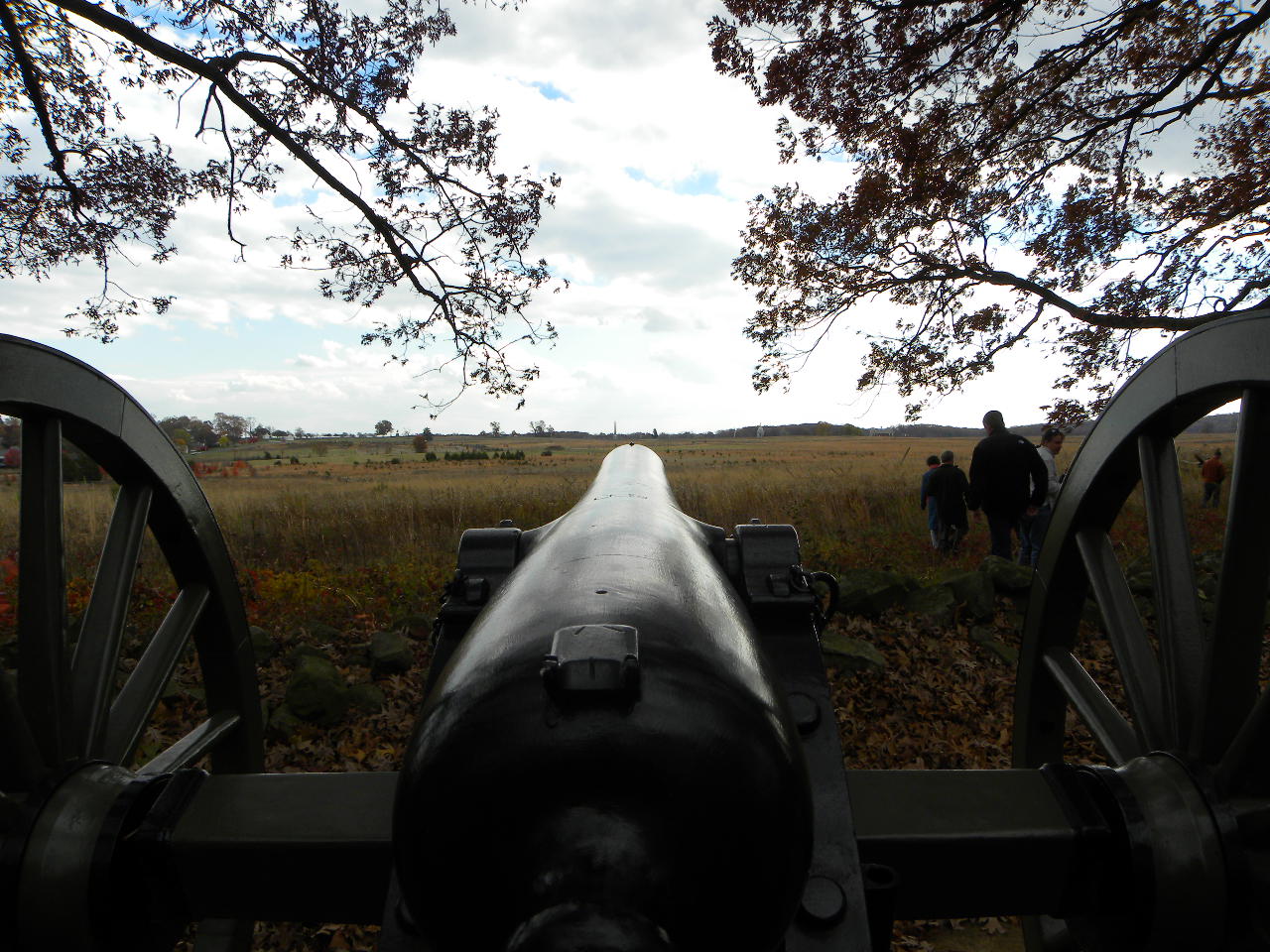
DSCN8783

Well, today has been spent catching up at work after several days off due to the snowstorm which paralyzed the Hampton Roads area last week. Unfortunately for us the storm was the least of the issues as our hot water heater blew out Friday night while we were asleep, leaving our downstairs area flooded. Thankfully tomorrow the people from SERVEPRO will begin to dewater the house and clean up the ungodly mess and stench. The construction company will come in tomorrow too to assess the damage and plan for what will have to be repaired or rebuilt, but I think that I’ve already told you this.

So back to what is going on. Today was a busy day catching up, getting ready for the Staff Ride to Gettysburg that I will be leading in early March, coordinating the assistance of our students and staff who will be volunteering to help at the Norfolk Emergency Shelter on Friday Night and Saturday morning. I have also been talking with my teaching team for our Ethics course.

So today has been busy and tomorrow will be all about trying to begin our damage recovery at our house.

In the mean time I will still be getting ready for the Gettysburg trip. It is an honer to be taking this duty from a man who has been doing it for 20 years, Dr Vardell Nesmith. Thankfully he will still be in the area and come the Spring or Summer may be able to lend his most considerable expertise to the trip as a Professor Emeritus.

Today was our first meeting for the trip which was more administrative in nature. We will have two more meetings before the actual trip, those will be to introduce the participating students to the Gettysburg Campaign and the opening events which began the campaign.

I am going to be spending a lot of time preparing for this and it is quite likely that some of my work will show up here. The obvious intent is to tie in lessons from this campaign to our curriculum of Joint Planning and Campaigning for our students who either serve in or are going to serve in Joint Staff or Command positions.  So my intent will to be to tie the lessons of the Gettysburg campaign to national military strategy, operational level planning and leadership at the operational level.

Of course that will entail things that I like and understand well. The issue in planning this event are more to the emphasis of what I will teach, what I will emphasize and the detail in which I will go in each class, and for the actual Staff Ride at Gettysburg. I will need to talk about weapons and tactics, that is for sure and actually the easiest part.

Of course I need to explain well how each side understood this campaign in relation to its own war aims, and how their respective planning and preparation, as well as the politics, the economic, diplomatic and informational factors that influenced the decisions of the leaders of both the Union and Confederacy during the summer campaign of 1863. The real focus I think needs to be on leadership, relationships and the decision making process, because I believe in all my heart that those are the things that win battles and wars.

Tonight I am musing of what emphasis to give each subject and in the background I have the movie Gods and Generals on.

Well I shall sign off for now. I do have a number of articles bouncing around my head and I must continue to muse… I must, I must.

Peace

Padre Steve+
Leave a comment

Filed under civil war, Loose thoughts and musings

Gettysburg at 150 Day One: Lee Blunders into Battle

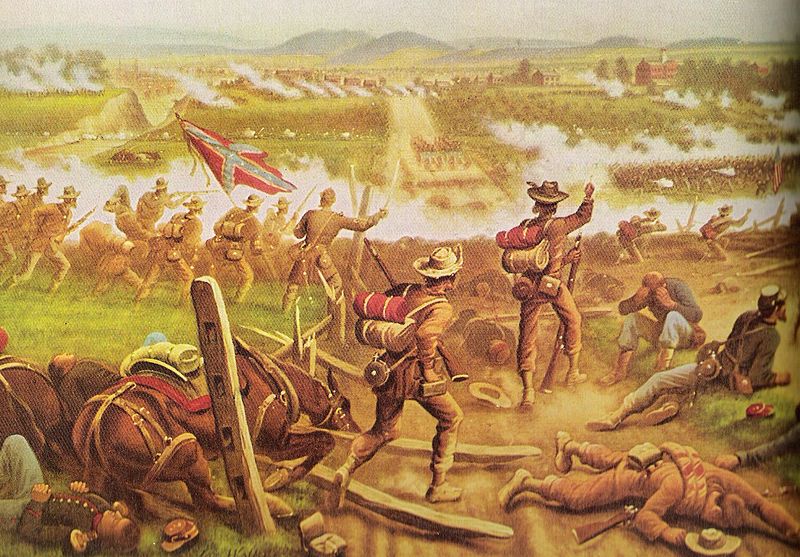
800px-First_day_at_gettysburg

Pender’s Brigade on Day One

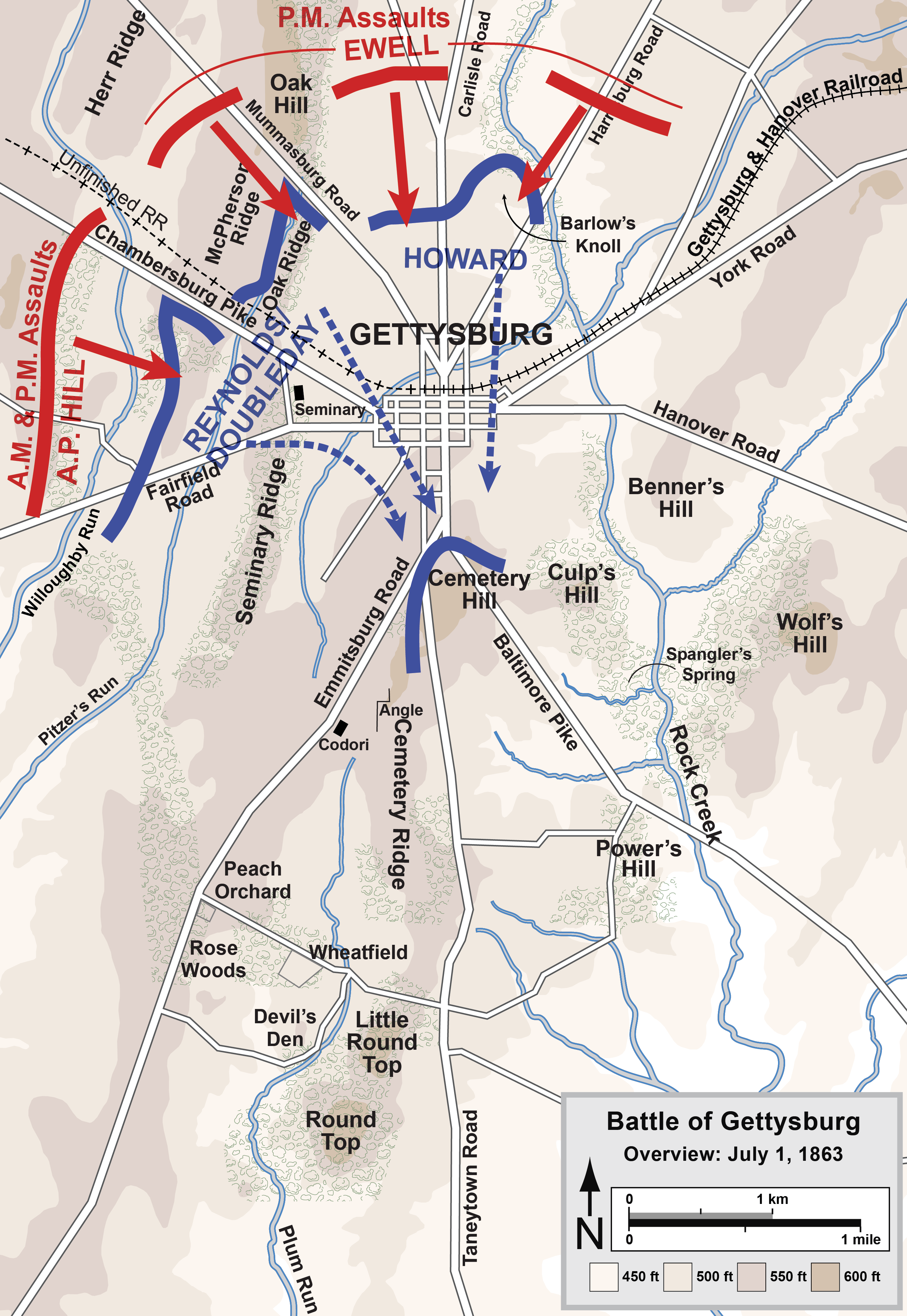
The Army of Northern Virginia commanded by Robert E Lee was now deep in Union territory and nearly blind to the location of the Federal Army of the Potomac. On the 30th advanced units of Dick Ewell’s Second Corps had gone nearly as far as Harrisburg while most of the Army was on the road around Chambersburg and Cashtown. Lee’s Cavalry Division under the command of J.E.B. Stuart was far away engaging Union Cavalry around Hanover and not in position to report on Union troop movements. General A.P. Hill sent Johnston Pettigrew’s Brigade of Harry Heth’s Division to Gettysburg on the 30th but Pettigrew observing the Federal cavalry of Buford’s 1st Cavalry Division take up positions on Seminary Ridge declined to engage and reported the Federal concentration to Hill.

As reports from the spy Harrison came to Lee and Longstreet Lee began to concentrate the Army around Cashtown. However the morning of July Hill ordered Harry Heth’s division to move on Gettysburg without the benefit of cavalry support or reconnaissance believing that the troops reported by Pettigrew could be nothing more than local militia. His leading brigades under Brigadier General James Archer and Joseph Davis took heavy casualties and soon Heth became embroiled in a fight with Buford’s cavalry and lead elements of the Federal 1st Corps under the command of Major General John Reynolds.

Gettysburg_Battle_Map_Day1

Gettysburg Day One (Map by Hal Jespersen, http://www.posix.com/Com)

Lee was surprised by the engagement and though he chastised Heth for getting involved committed his army to the attack. Reynolds was killed early in the engagement but the fight was bitter, the Iron Brigade exacted a fearful toll on Archer and Davis’s brigades. The attack by Hill’s 3rd Corps was helped immensely when elements of Ewell’s 2nd Corps arrived on the right flank of the Federal XI Corps, forcing the Federal troops to withdraw through Gettysburg and up to Cemetery Ridge. Ewell’s arrival was fortuitous because it tilted the balance to Lee, but the advantage was short lived.

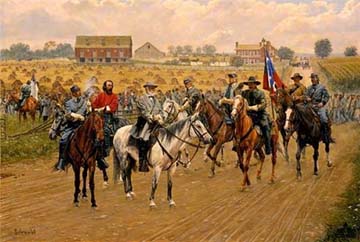
z_schmehl_leedeliberates

Lee Deliberates Heth’s Advance – Gettysburg by Bradley Schmehl

 Ewell failed to press the attack on Cemetery Ridge or Culp’s Hill while Federal forces were still disorganized, despite the repeated entreaties of Major General Isaac Trimble who was with him. The delay would be fatal to Lee’s intentions as Lee decided to give battle at Gettysburg, ignoring General Longstreet’s plea to disengage take up a favorable position between Gettysburg and Washington DC and force the Army of the Potomac to attack.

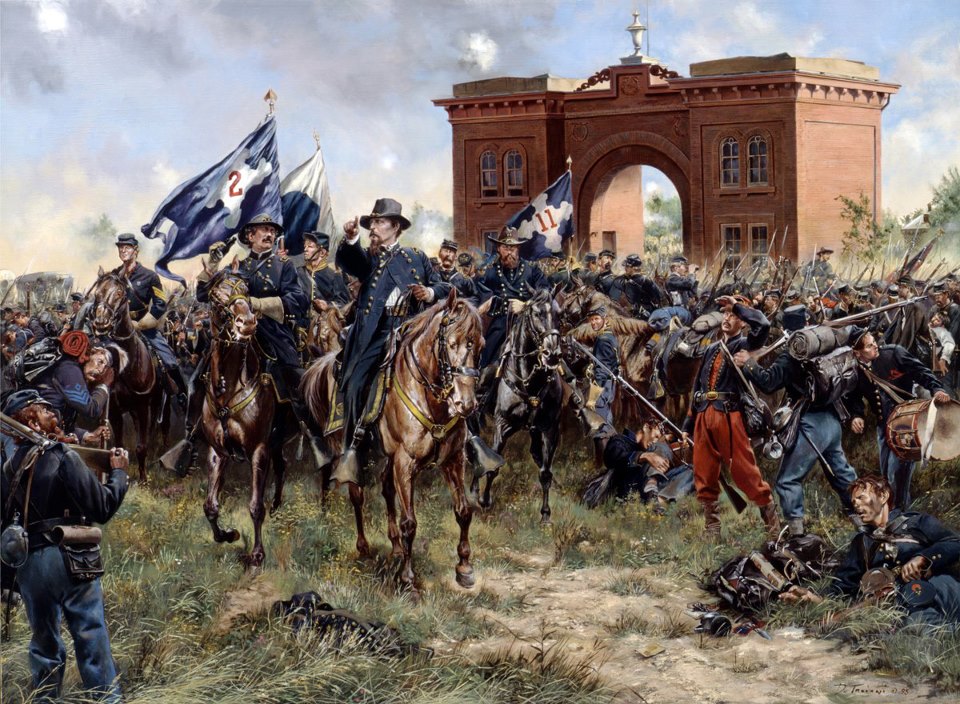
doncemeteryhilljuly1_zps512a40fa

Don Troiani’s Painting of Hancock taking Command on Cemetery Hill on Day One

The Army of Northern Virginia came very close to sweeping Federal forces from the field on July 1st in spite of Lee’s lack of planning and clear commanders intent. That much is clear. His orders to Ewell, to take the high ground “if practicable” we interpreted by Ewell in a manner that he determined not to be practicable, so the advanced Federal corps under the command of Major General Winfield Scott Hancock were able to regroup, dig in and be reinforced by the rest of the Army.

Whether Lee intended to engage the Army of the Potomac at Gettysburg so early in a campaign where his multiple and contradictory strategic aims and lack of clear commander’s intent to his subordinate commanders created confusion is debated. Much of the controversy comes from Lee’s own correspondence which indicates that he might have not fully understood his own intentions. Some correspondence indicates that Lee desired to avoid a general engagement as long as possible while other accounts indicate that he wanted an early and decisive engagement. The controversy was stoked after the war by Lee’s supporters, particular his aides Taylor and Marshal, and Longstreet’s supporters.

Isaac Trimble, traveling with Lee at the beginning of the invasion of Pennsylvania recored that Lee told him:

“We have again outmaneuvered the enemy, who even now does not know where we are or what our designs are. Our whole army will be in Pennsylvania day after tomorrow, leaving the enemy far behind and obliged to follow by forced marches. I hope with these advantages to accomplish some single result and to end the war, if Providence favors us.” (Glenn Tucker, High Tide at Gettysburg (Indianapolis: The Bobbs-Merrill Co.: 1958), p. 24.)

The vagueness of Lee’s instructions to his commanders, many of whom were occupying command positions under him for the first time and were unfamiliar with his command style led to confusion. Where Stonewall Jackson might have understood Lee’s intent, even where Lee issued vague or contradictory orders, many others including Hill and Ewell did not. Lee did not change his command style to accommodate his new commanders and that lack of flexibility on Lee’s part proved fatal to his aims in the campaign.

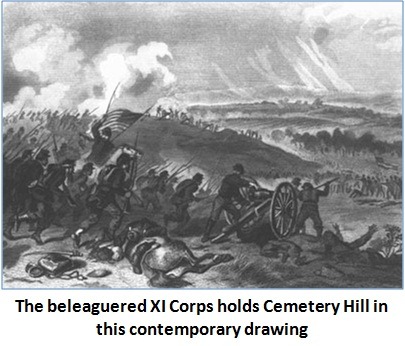
xi-corps-holds-cemetery-hill

The vagueness of Lee’s intent was demonstrated throughout the campaign and was made worse by the fog of war. Day one ended with a significant tactical victory for Lee’s army but without a decisive result which would be compounded into a strategic defeat by Lee’s subsequent decisions on the 2nd and 3rd of July.

Until tomorrow,

Peace

Padre Steve+

Leave a comment

Filed under civil war, History, Military