Tag Archives: good friday

Musings on Easter Night: Holy Week Happenings, Busted Brackets a Radical Pope and Opening Night

resurrection

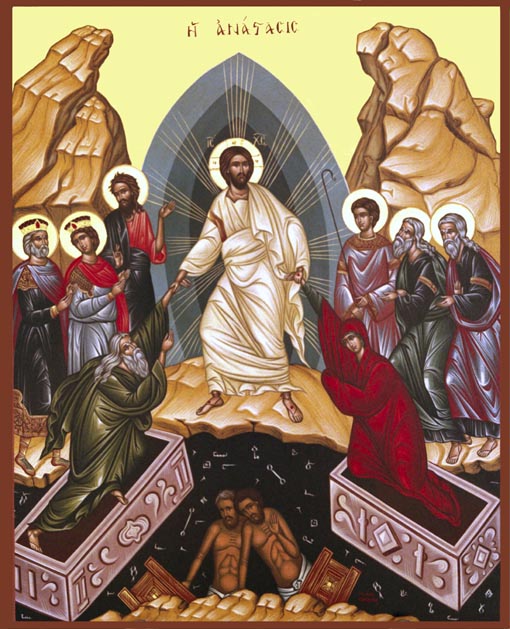
The liturgy proclaims “Alleluia! The Lord is Risen. He is risen indeed! Alleluia!” It is the triumph song of life conquering death in the Suffering, death and resurrection of Jesus the Christ.

This week I have done about all that I could to avoid political, legal and even religious controversies. Lord knows there are enough of those that i get involved in but I really wanted to focus more on Jesus, my wife Judy and our friends. So I have stayed away from becoming too deeply involved in the heated debates and topics of the past week limiting myself to skimming the news, reading as little commentary as possible and making almost no editorial comments of my own. That was hard but I digress…

IMG_0643-726257

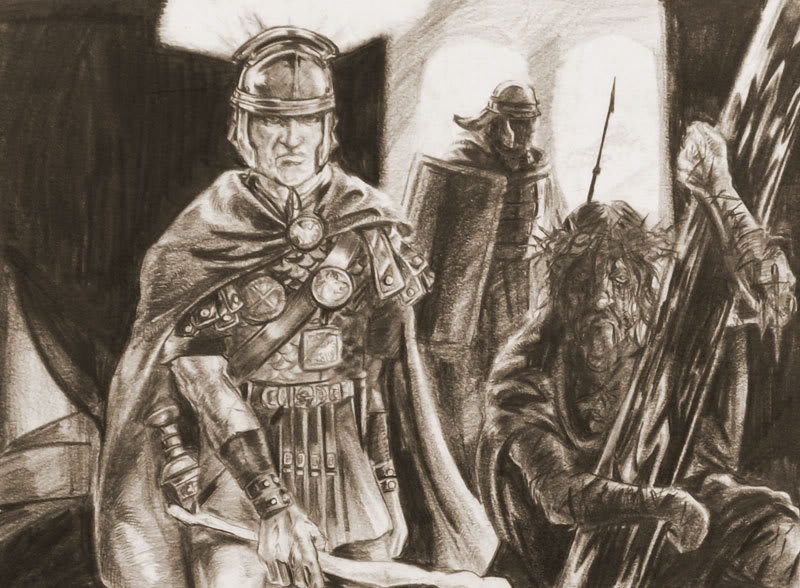
Instead I have spent most of my time reading to the Gospel accounts of the Passion narrative and historical accounts and descriptions of the time, culture and political conditions that Jesus was crucified in Jerusalem. I began Holy Week hoping to complete the first two parts of a historical fiction trilogy built around the Roman Centurion that tradition calls Longinus. According to tradition was the man who placed his spear in the side of Jesus and who exclaimed “surely this man was the son of God” as Jesus died on the cross. You can find the links to the first two parts of the Trilogy below.

Part One: A Centurion in Jerusalem 

A Centurion’s Sunday in Jerusalem: The Story of Longinus

The Story of Longinus the Centurion: A Meeting of Friends

The Story of Longinus the Centurion: A Visit to Death Row

Duplicity in Jerusalem: An Official Visit and 30 Pieces of Silver

Part Two: An Unenviable Mission

The Long Good Friday of Longinus the Centurion

The Morning After a Most Unsettling Crucifixion: The Story of Longinus the Centurion

New Troubles: A Missing Body an Empty Tomb and Sleeping Soldiers The Story of Longinus the Centurion

In fact I did not spend time in church this week. Usually i will spend large parts of Holy Week engaged in attending or performing different services, Masses or times of prayer. However, I have been on the road a lot the past couple of years. Judy and I have spent too much time apart. Apart from personal meditations and prayers on Holy Thursday and Good Friday the only thing that we did was to have me celebrate an Easter Sunday Eucharist together at home. We could have spent a lot of the limited time that I was home in church, and as much as I love the people at the small Episcopal parish that I attend when home I needed the time with Judy more. Being stationed over 200 miles from home for the past two and a half years does help help one realize what is important. Next year I will be in charge of a chapel and then I will be fully engaged in Holy Week activities, this year however, we needed to be together. Some might find fault in this but if they do they can pound sand, of course in Christian love.

The week was interesting because Wednesday was my birthday and Judy made arrangements to have friends go with us to a local German restaurant. I really enjoyed being with Judy and our friends and that time was well spent. Once again, something that I have come to be thankful for and to make sure that I spend time to do now is to make time for friends and family.

minute-maid-park-getty

Speaking of baseball I found it fitting and quite symbolic that Opening Night 2013 fell on Easter Sunday. If you ask me this should always be the case but it would involve having all of Christianity having to change their calendars to fit and that will not happen. If Pope Francis hailed from the Dominican Republic there might be a chance, but we need to wait to get a Pope from the Dominican Republic.

gty-164815601-4_3_r536_c534

Speaking of Pope Francis it appears that he is really starting to rattle some guided cages at the Vatican and among Church Traditionalists, and if you ask me not a moment too soon. He turned a lot of heads with his common touch over the first couple of weeks of his Papacy but it was his actions on Holy Thursday that set heads spinning a la Linda Blair in The Exorcist.

For the first time a Pope washed the feet of women, one of them being a Moslem. I do pray for this Pope and I worry about him because some of the most violent people are religious types. Some of the more traditional mindset don’t take change well. Some, even among Christians resort to violence when a church or religious leader is going outside what they believe is “orthodox” even if it has little to do with their actual orthodoxy.

Well now it is the time that I need to get ready for work in the morning. While I am doing this I will continue to watch the Texas Ranger’s play their new American League Central neighbors the Houston Astros.

Until tomorrow,

Peace, Happy Easter and Happy Opening Night after all “the only church that truly feeds the soul day in, day out, is the Church of Baseball.” 

Padre Steve+

Leave a comment

Filed under Baseball, christian life, faith, News and current events

The Long Good Friday of Longinus the Centurion

600px-Gustave_Doré_-_Crucifixion_of_Jesus

This is a re-do of my original “Long Good Friday of Longinus the Centurion., Since I first wrote that piece two years ago I have written a prequel, and like George Lucas feel the need to change and improve the original. Unlike Lucas who simply tweeked Star Wars I have chosen to spend my time completely re-writing the original in light of the prequel series dealing with the events leading up to Good Friday that I did this week. I don’t know about you but I like to imagine events as they might have actually happened. As an Iraq veteran who served with our advisors to the Iraqis I do understand the plight of soldiers from an occupying power serving far away from home where their presence is barely tolerated, much less welcomed. Since I have always felt a special affinity for the soldiers that have interactions with Jesus, who are treated very sympathetically by the writers of the Gospels as well as Luke in the Book of Acts.

The links to the first four chapters of this story are linked in below. I have not linked the three original articles in order to provide a better continuity and personal narrative for the characters in light of the Gospel accounts, non-Biblical accounts, church tradition and my own imagination.

Peace

Padre Steve+

A Centurion’s Sunday in Jerusalem: The Story of Longinus

The Story of Longinus the Centurion: A Meeting of Friends

The Story of Longinus the Centurion: A Visit to Death Row

Duplicity in Jerusalem: An Official Visit and 30 Pieces of Silver


Longinus had finally decided to try to get a bit of rest. After his rather morose meeting with Flavius and Decius he and Decius went back to check on the preparations for the executions scheduled for the next day. Quentin his Tesserarius had been working with the squad chosen to to conduct the actual crucifixions of the prisoners, Bar-Abbas the insurgent as well as the common criminals and murderers Dismas and Gestas who he had met in the hell hole of a jail in the dungeon of Fortress Antonia after Pilate had assigned him the task of conducting the executions.

Longinus was certain of his unit’s ability to carry out the mission, though he would have rather had a unit from Italy than his unit of Syrian and Samaritan troops. There was one positive aspect, his Samaritans and Syrians had no love for the Jews and would have no qualms whatsoever in disposing of the criminals.

He thought for a moment about the prisoners. That Bar-Abbas fellow, he would be glad that he or any other Roman would have to deal with him again once the crucifixion was over. As for the common criminals he felt that everyone would be better off with Gestus dead although he hoped that Pilate might take pity on the repentant thief named Dismas. However, despite his feelings he also knew that the law was the law and repentant or not that Dismas was guilty of the crimes and the sentence was just. As he had realized earlier in the day while talking with Flavius it was important not to become emotionally involved with the locals, especially prisoners. Maintaining an emotional distance ensured that he would not flinch in times when ice rather than blood needed to flow through one’s veins. He was proud that he could do this but envied the humanity that his comrade and friend Flavius still maintained in spite of everything.

He was just about to prepare for bed when a messenger from Pilate knocked on his door. It was late, too late and Longinus wondered just what was going on.

“Come.” He said, the weariness in his voice obvious in the way he answered.

The messenger, a relatively young Italian soldier assigned to Pilate’s bodyguard entered, came to attention and saluted.

Longinus looked at the young man, like him far from home and asked “what am I needed for now?”

“Centurion, the Governor has requested your presence” the soldier replied.

“May I ask what for?” A now increasingly irritated Longinus asked.

“Sir, I do not have the details but it is a pressing matter regarding the Jews and that Galilean preacher.” The young man was obviously uncomfortable in having to request a career officer like Longinus, a veteran of real battles and campaigns appear before Pilate for what was not much more than a religious dispute among an occupied people.

“Pressing matter?” Asked Longinus.

“Yes Centurion. I was told that it was urgent that you come to Governor Pilate now and alert your unit as at least some of your men may be needed if things get out of hand.”

“Can you please tell me just what is going on?” Longinus asked as he pulled his armored breastplate over his shoulders.

“I’m sorry Centurion, I have no more information. You are to report to the Governor within the half hour. The Governor wants your unit ready within the hour.” When he finished he came to attention, saluted and exited the room.

Longinus hated how leaders sent young men to be their messengers and would not give them all of the relevant information.

Longinus sat back down in his chair where he had been sitting and discussing the situation with Flavius and Decius. He wondered to himself what could be so pressing that Pilate needed him now.

After briefing Decius and Quentin, instructing them to wake the men and be ready for action Longinus took a squad and went to Pilate’s headquarters. When he arrived Pilate greeted him.

“Centurion, I hate to have bothered you at this hour in light of how busy you and your men will be in the morning but a situation has arisen.” Longinus looked around the room and then heard some commotion on the area called “the Pavement.”

“What is happening my Lord?”

“Longinus, these Jews have brought that Jesus fellow here and are accusing him of fomenting a rebellion against the Emperor.”

“A rebellion sir?”

“That is what they say Centurion. They claim that one of his closest associates had turned him in and after a trial of their own that they found him guilty of claiming to be a king and God that will overthrow the Emperor.” Pilate could not hide his discomfort.

carrycross

“Do you actually believe them sir? After all we had heard this morning that this Judas Iscariot fellow had betrayed him for 30 pieces of silver.”

“I know Centurion, I know.” Pilate looked at Longinus then back out at the crowd gathered outside in the dark. He was afraid and Longinus could sense that fear, fear that if he made the wrong move that a real rebellion could break out and that Pilate as the Governor would take the blame and bear the punishment and wrath of Caesar.

“Centurion, I tried to placate these people be questioning this Jesus fellow myself.” Pilate paused. “I must say that he is a rather unusual man and truthfully I could not find anything that under Roman law that I could find him guilty of doing. Not a thing Centurion, nothing but their leaders kept pressing me.” Pilate’s gaze seemed to be almost pleading with Longinus to help him escape this decision. Longinus knew at that moment that his day was about to get worse. Pilate continued “It seems to be a religious squabble of some kind so in order to deal with it and to try to keep us out of it I sent Jesus to Herod since Herod is the ruler of Galilee.”

“So Herod will certainly deal with the situation, will he not Governor?”

“Centurion, I thought that that corpulent bastard Herod would deal with it but I just got word that Herod too could find no crime. The Jewish leaders and of their Temple Police are supposedly bringing him back to me to render judgement. They are leaving it to me.”

“Judgement for what?”

“Sedition, treason, blasphemy, proclaiming himself a king.” Pilate paused, his face flushed. “My God I’m surprised that they haven’t accused the man of fathering the High Priest’s daughter.” The sarcasm and bitterness was evident in his voice.

“So what do you intend to do.”

“I intend to try to get us out of this with as little trouble or guilt as possible. When they return him to me I will ask a few more questions and set him free as is my prerogative, certainly they wouldn’t want to release a real murderer like Bar-Abbas back into society, I do give them more credit than to stoop that low.”

“I do hope that you are right governor, but from what I understand it seems that they are intent on ridding themselves of the fellow once and for all. I think that their leaders see the Galilean as more of a threat than a man like Bar-Abbas.”

Pilate said nothing and during the silence Longinus’s troops under the direction of Decius entered the perimeter of the court adding an additional security cordon as the crowd grew and got more boisterous. As they took up position the Temple Police and members of the High Priest’s entourage approached the court with the Galilean in custody. Quentin with four soldiers met them and took custody of the obviously tired and already abused man. They delivered Jesus to Pilate and stood back. Longinus watched as it happened. As he did so Flavius entered the room with his servant. The servant appeared unsteady and full of emotion when he saw the man who had healed him two years before. Flavius stood by his face not betraying any feelings except deep seated rage that was boiling as he saw this travesty of justice take place.

Pilate attempted every trick in the book to garner a way to save the life of the man standing before him. He asked him questions and Jesus clothed in a purple robe that Herod had mockingly placed upon him said nothing. Finally in desperation Pilate asked Jesus if he was a king. The answer both fascinated and terrified Pilate and caused him to wish that he had never come to the city. As he deliberated earlier and debated the members of the Sanhedrin his wife again urged him to “have nothing to do with that innocent man.”

But the answer of Jesus to the question of his kingship troubled Pilate. Had he thought the man insane he would have scourged him, declared him mad and been done with the affair. “My kingdom is not of this world, if it were my followers would be fighting to ensue that you did not hand me over to the Jewish leaders.” Jesus looked into Pilate’s eyes, the look sent a chill through Pilate’s soul and Pilate restated the question “so you are a king?”

Jesus replied solemnly “You say I am a king. I was born for this and it is why I came to this world, to testify to the truth. Everyone who belongs to the truth listens to me.”

Pilate appeared stunned and both Longinus and Flavius knew that he was beaten. They listened as Pilate asked “what is truth?” The question was one of a man who had long ago sold his soul to gain the world, it was the question of a deeply cynical man who had long determined that truth was only in the eye of the beholder and to be used as needed to acquire power. At the same time they could see a touch of genuineness in the question as Pilate, desperate for an answer that would enable him to please everyone and spare the life of the man before him wrestled with the question of truth for the first time in years.

They watched as Pilate attempted to bargain for the life of Jesus only to be shouted down by the increasingly riotous crowd who demanded that Bar-Abbas be released. Again attempting to assuage the mob he had Jesus scourged with a barbed whip. The soldier who did that brutal work was a Syrian, big and burley without a trace of feeling in his eyes or face. The servant of Flavius begged him to intervene but Flavius now knew that the things happening to Jesus could no longer be influenced by sentimentality and stories of the goodness of Jesus. He had seen this type of Justice before, and though he despised it, he earnestly hoped that it would be enough to deliver Jesus.

After the scourging, soldiers assigned to Longinus jammed a crown of thorns down on the blood covered Jesus and placed the purple cloak over him. Jesus’s body trembled. Pilate again approached the mob and tried to decline the odious responsibility thrust into his hands. The mob led by the Chief Priests and joined by man of their rivals, the Pharisees cried out for Jesus to be crucified.

They heard Pilate plead with Jesus, again noting that he had power over the life and death of Jesus to which Jesus replied that Pilate “had no power over him that had not been given by God.” Finally he pleaded with the Jews one more time to take Bar-Abbas for execution and to spare the Galilean. The leaders shouted him down again and cried out that Pilate would be a traitor to Caesar if he let a man who claimed to be a king live.

Defeated By the mob and by his own weakness of character Pilate asked for a ceremonial washing basin full of water. When it came in the hands of a court member he placed his hands in it and proclaimed “I am innocent of this man’s blood.” He then ordered the soldiers to take Jesus to be crucified even as the prisoners Dismas and Gestus were led from the dungeon for execution and a profoundly perplexed Bar-Abbas was released by the jailer.

Longinus looked at Flavius and whispered to him “wash my hands of his blood? My God, he knows that he is as guilty at them.” Flavius looked on and simply said “I know my friend, we all are.”

The detail of soldiers assigned to the crucifixion detail was commanded by Quentin, a man who had fought many battles and like Longinus and Flavius felt that these executions of helpless prisoners were unworthy of soldiers like himself. The soldiers of Flavius’s unit had responsibility for helping to clear a way down the narrow street called by the Romans Via Delarosa. The street of suffering. It was the street that all the condemned travelled to the hill of execution so fittingly called the place of the Skull. Longinus had seen others walk this path but in the past he had been able to shield his person from their suffering, but today was different.

Longinus’s own execution squad led by Quentin led Jesus and the others along, forcing them to carry their crosses. About halfway down the street Jesus collapsed under the weight if his cross and grabbed a bystander, a man from Cyrene to carry the cross while the soldiers prodded the bloody body of Jesus down the street and out of the city to the place of execution. People jeered at the condemned as they did at very execution as for most this was no different than any other crucifixion and most of those present knew little about any of the condemned men and even those that were familiar with Jesus probably did not recognize the bloody man stumbling down the street. Of course there were others present who did know Jesus and watched in horror as their friend, teacher and for one woman her son struggled to the execution site. Longinus wondered about his own elderly mother and thought of her as he saw the mother of Jesus. He quickly tried to chase her image from his mind, he needed to be strong and hard if he was to keep his objectivity and conduct the mission as distasteful as he found it.

When the macabre parade arrived at the hill, the prisoners were stripped, placed on the crosses and nailed to them. Their screams as Quentin hammered the large iron nails home through their already abused flesh echoed for all to hear. Thankfully Quentin knew what he was doing and this part of the execution process happened quickly. Then the crosses were raised, but just before this a messenger from Pilate arrived with the placards that denoted the charges. He handed them to Longinus who noted what was written on the one for Jesus. It said “The King of the Jews.”

The placards were placed and with a thud the crosses were placed in the holes on the hill. The suffering of the prisoners was great, the crowds jeered and mocked them while those that loved them stood at a distance. Soldiers stood guard to ensure that no one interfered with them in any way. There was a bit of banter between the real criminals one of whom, the unpleasant one named Gestus joined in the mocking of Jesus only to be put in his place by the other one named Dismas.

Longinus, Flavius, Decius and a few other officers watched as their soldiers from the crucifixion detail divided the paltry worldly possession of the men between themselves. The men argued over a one piece tunic worn by Jesus, Not wanting to destroy it they cast lots for it. A trooper from Tyre won the tunic. Longinus and Flavius looked at each other and realized how little most of their men earned and neither begrudged the men the few items that they gathered from the men being executed.

The skies which had began the day with bright sunshine now became dark and foreboding. Lightening appeared in the distance and occasionally Jesus would address his mother or one man, Flavius believed him to be a disciple who stood by the cross. Jesus even promised the Dismas character that “he would be with him in paradise” and told others, Longinus thought the soldiers but he wasn’t sure “forgive them they know not what they do.” As it approached the ninth hour Jesus cried out in Aramaic “my God, my God, why have you forsaken me!”

A cold rain began to fall.

Quentin approached him with a sponge on a pole which was soaked in a sour wine. It touched Jesus’s lips and Jesus said “Father into your hands I commit my spirit” and then “it is finished.”

With that last dying remark the head of Jesus fell to his chest and his body, bloody and mangled hung limp. As the men looked on the ground began to tremble and as the ground shook and the officers looked about amid the gloom and confusion as the onlookers took flight Longinus exclaimed “surely this man was the son of God.” Flavius looked at his fellow Centurion in astonishment. Longinus, the man who had closed his heart in a fortress was echoing what he had believed since Jesus had healed his servant, the young man who was more than a servant to him.

As the crowds dispersed Longinus received the message that the executions had to be concluded before the Jews began their Passover. With that he sent Quentin to break the legs of the prisoners to hasten their deaths. When Quentin reached Jesus he called for Longinus.
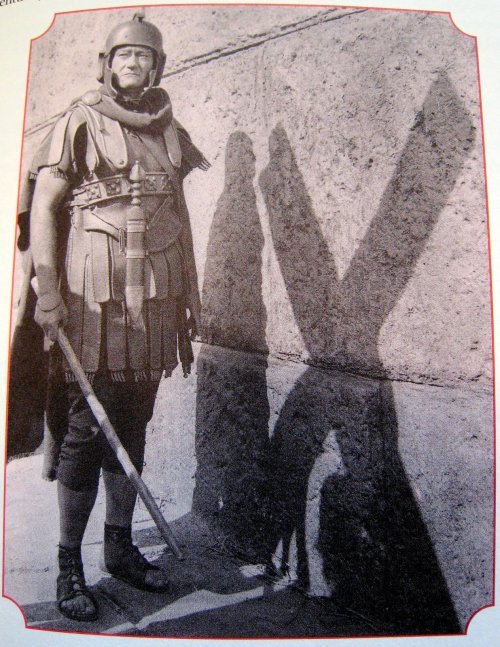
IMG_0643-726257

“Centurion, I believe that this man is already dead. Do you still want me to break his legs?”

Longinus looked at his subordinate and said “no I must do this myself.” He had a soldier bring him his lance, a ceremonial lance that denoted his seniority as the senior Centurion in the Legion. He looked at the lance and plunged it into the side of Jesus into his heart. Jesus did not move but from the wound blood mixed with what looked like water poured out of the wound and down his side.

“Quentin, he is dead, you may take him down.” Other soldiers pulled down the dead bodies of the thieves. As they did this a man approached Longinus and Flavius.

“Gentlemen. I am Joseph, I am a member of the Sanhedrin. I have come to take responsibility for the body of Jesus of Nazareth.”

Longinus replied in a businesslike manner “by whose authority?” He had a hard time believing that a member of the Sanhedrin would claim this body.

With that Joseph produced a letter from Pilate. Longinus looked the letter over and handed it back to Joseph without comment. Joseph then motioned to several men with him to take the body as Longinus, Flavius and the others looked on. Longinus thought to himself that it was good that a man of some means and influence would at least take the time to give this innocent man a decent burial.

As Quentin took charge of the clean up Longinus instructed Decius to prepare the troops to return to Fortress Antonia. Flavius instructed his optimo to do the same. The last thing that any of them wanted to be was on the streets when the Jews began their Passover, as always they decided that it was unwise to stir up any more animosity than was needed. Today w a near run thing with e demonstration outside Pilate’s headquarters and none of them wanted any more excitement this evening.

When the clean up was completed and the bodies removed Longinus and Flavius ordered their soldiers back to Fortress Antonia. When they arrived the Centurions went to Pilate to inform him that the mission was complete. Pilate was glad the ordeal was over but was obviously still disturbed by the events of the day. Longinus, now exhausted was glad to leave Pilate’s presence. He still loathed politicians and wondered if had Pilate been a soldier if he would have had the courage to tell the leaders of the Sanhedrin to “pound sand” and keep Jesus alive. But then he knew that had Pilate done something that only a diplomat could do, he kept the peace. Had he been in charge the man named Jesus might have lived but hundreds maybe even thousands of others might have died.

After he dismissed his soldiers he went to his room, doffed his gear and went to the tavern in the fortress. Flavius joined him about 15 minutes later. They sat at the table as the barkeeper brought them each an ale. They looked at each other and Flavius asked “What did you mean by surely this man was the son of God?”

Longinus shook his head. “My friend I do not really know.” He paused and took a drink from his cup. “Until today I simply figured that he was a good man, but after today, after what I witnessed I just don’t know.”

“If you ask me my friend I think that he must be a God, if not somehow connected to the greatest of Gods, the God of the Jews.”

“Perhaps Flavius you are right. All I know is that I can no longer see the world, the Empire or my life in the same light as I did just a week ago.”

Flavius nodded his understanding as Decius entered the tavern. The younger officer reported to his seniors. They acknowledged his entrance and Longinus asked the younger officer to sit with them.

“What do you know Decius?”

The younger officer spoke. “Sir, I do not know if you heard the latest about the man that betrayed Jesus.”

Longinus said sarcastically “did they elect him High Priest?”

The younger man caught the sarcasm and replied “if only that we’re the case. He was found dead, hanging from a tree in the Potter’s Field.”

Flavius answered “so the traitor couldn’t handle his own act of duplicity?”

Longinus replied, “evidently not.” He took a drink from his cup and motioned for the barkeep to get Decius an ale. The three men continued to drink silently and wondered what else could happen…

1 Comment

Filed under faith, History, Religion

Rejecting the “God” of Black Friday

Yes my friends it is that most holy of occasions in American life, the annual celebration of Black Friday where others sane an rational people allow themselves to unleash their animal passions on the floors of our greatest retailers and on the internet.  We have observed the high holy day of Black Friday where Americans of all races and religious persuasions observe a day of sacrifice to the God of consumerism often spending days in preparation carefully hoarding their treasures in hopes of scoring the best deals at the nation’s leading retailers.

Today I can say that I have not even spent a penny on this Black Friday, not even online. I just can’t get into the whole mass psychology marketed by the retailers.  The thought of waiting hours just beat other people to buy some gadget made by salve laborers in China or some other despotic country is frightening. When one realizes that the retailers that cater to our greed not only profit off of slave labor, but also pay their workers low wages, offer few if any benefits for working obscene and often unpredictable hours to maximize their profits one has to wonder about the morality of it all.

In the good news of the day, our local news reports that no one has yet been shot, knifed or trampled to death in any of our local retailers. However I can imagine that customer number 201 in line for the 200 available the $199 HDTVs Wal-Mart or other retailers with a limited numbers of Black Friday “door buster” specials is feeling homicidal or suicidal or possibly both about now.

But I hear that in some places the holiday has been celebrated with much more aplomb than our sleepy city.  I have read about shootings inside and outside of different retailers, incidents where shoppers had to be tasered by police, pepper sprayed by store security officers or even better pepper strayed each other. In one location a lady ran someone down in a mall parking lot, distracted driving appears to be the case. I guess she got a text from another retailer with an unannounced special across town. There is a case where a man kept people in line by pulling out a gun, at least someone is keeping order. I can only image how fun that was for them as they wrestled for all of those really “hot” deals.

I do think that this celebration says something about us now, while many people around the world would be willing to die for a decent meal or freedom of speech we are willing to harm our neighbors because they might be the fist to get the latest gadget for a few dollars less than us.  It seems perverted don’t you think? I can’t imagine Jesus or Thomas Jefferson approving such behavior but it is part and parcel of the culture that we are very much a part of and participate in and that means Tea Party and Occupy Wall Street types and everyone in between because whether we like to admit it we like our stuff and we want it for the best possible price, not that there is anything wrong with that…especially if you are a follower of Ayn Rand’s banal philosophy.

But when we let the urges for stuff overcome our common sense and any sense of decency, decorum or love of our neighbor then maybe we have lost our way.

I guess the fact that after Iraq I am claustrophobic and get panicky in big crowds in enclosed areas now makes me less inclined even to try to go to a major retailer today.  Maybe that makes it easy for me to say these things with relative impunity since the thought of going out in such crowds petrifies me. I certainly am not trying to be judgmental but when I see people doing harm to each other to obtain things that are more than luxuries for most of the world I think that we need to just step back and look at ourselves.

I mean really….We have massive long term unemployment, our country is financially and politically broken, we are facing a “Fiscal Cliff,”  we have troops at war in Afghanistan while the rest of the Middle East is about to go up in flames and bring us even more heartache. So with all that going on we have people fighting each other and some people actually doing physical harm to others for gadgets made in China or Third World countries by what amounts to slave labor.

Even worse we have people in all levels of corporate America that promote this culture and make their living off of the people that are committing crimes to get a deal.  I think that says something about us and that troubles me.  But then I guess I don’t have enough faith in the God of Black Friday.

But why should I have faith in that God? The “God” of Black Friday caters to the darkest nature of self-centered greed and mocks the God who on the real Black Friday, offered himself for the life of the world. The “God” of this Black Friday is the no-God of Ayn Rand and her disciples who despise the crucified God in thought, word and deed.

I wonder what Jesus would do if he stumbled into a Christian book store on Black Friday and found people fighting over a special on WWJD junk or the latest greatest “study Bible” featuring the notes of some prosperity preacher. I don’t think that he would be very happy.

Peace

Padre Steve+

1 Comment

Filed under economics and financial policy, faith, News and current events, philosophy, Religion

The Totality of Easter

“Easter is rightly understood only if the burden and strain of Good Friday are not forgotten.”  Hans Kung

The disciples of Jesus had abandoned him. It was a Roman Centurion that recognized at Jesus’ death It took a distant disciple, a man named Joseph of Arimathea to take responsibility for the body of Jesus as his close disciples fled the scene of his arrest, trial and crucifixion. It was women who first discovered his body missing and women who Jesus first revealed himself.

The disciples were traumatized. They had spent three years with Jesus and his death on Good Friday had to be shattering. They had lost their leader, teacher and friend. They were not exactly believing in the resurrection that first Easter and they met the initial reports with doubt. That is why Easter and the resurrection can only be rightly understood if we really appreciate the depths of despair felt by the disciples on that terrible Friday.

I think that is hard for most of us in the United States and Western Europe to comprehend. We are the product of 2000 years of Christendom.  We are the products of Imperial and triumphalist Christianity. Our understanding of persecution is minimal for the most part and we cannot comprehend the totality of the loss experienced by the disciples until we endure our own Good Friday experience of suffering, pain, loss and abandonment or as it is correctly understood as being Godforsaken.

Yet the disciples came to believe and proclaimed a message that put them at risk among their own people. That message would shake the world within a few generations. But the disciples really had no idea just how much things would change in such a short period of time. I’m sure that they could not imagine the Church being used as an instrument of partisan politics or for that matter dominating the politics of the Ancient Rome or the modern United States.  I’m sure that they could not imagine being political sycophants who gladly support those that oppress their brothers and sisters in less desirable nations or neighborhoods.

They understood the Gospel from the point of view of the downtrodden and powerless. The did not run multi-million dollar corporations or attempt to influence the affairs of the leaders of nations. That didn’t happen until after the persecution was over after Constantine.

The simplicity of the message of Jesus who so wonderfully summed up the Law into two commandments, love God and love your neighbor seems to be a quaint idea to our Western Imperial Church.  The message proclaimed by Jesus when he opened his public ministry (Luke 4:18-19) “The Spirit of the Lord is upon me, because he has anointed me to bring good news to the poor. He has sent me to proclaim release to the captives and recovery of sight to the blind, to let the oppressed go free, to proclaim the year of the Lord’s favor.”  seems hopelessly out of date for the Imperial Church, its pampered leaders and their rich and powerful benefactors.  It seems lost in the milieu of the cult of “Christian” celebrity, riches and political power which surrounds us.

German Pastor and Martyr Dietrich Bonhoeffer who saw the Church of his day fall into the cult of Hitler worship said:

“Christianity stands or falls with its revolutionary protest against violence, arbitrariness and pride of power and with its plea for the weak. Christians are doing too little to make these points clear rather than too much. Christendom adjusts itself far too easily to the worship of power. Christians should give more offense, shock the world far more, than they are doing now. Christian should take a stronger stand in favor of the weak rather than considering first the possible right of the strong.”

You see the message of Easter is not understood without Good Friday or the hopelessness experienced by the disciples that day, nor is it understood apart from the words and teaching of Jesus himself.

The Lord is Risen…

Peace

Padre Steve+

Leave a comment

Filed under christian life, faith, Religion

Good Friday Special: The Long Good Friday of Longinus the Centurion

Russian Orthodox Icon of Longinus the Cenurion

This is the first of a series of three Good Friday, Holy Saturday and Easter Sunday stories that I wrote last year and am doing again this year. It is what I image that the commander of the Roman Soldiers in charge of the crucifixion of Jesus must have been going through during that time. The Centurion according to Church tradition was named Longinus who later converted to the Christian faith and by some accounts died as a martyr. Much is legend but still the story of Longinus the Centurion appeals to me as someone who has served in the military for many years and been a company commander in the Army. I will post the other two installments on Saturday and Sunday.  

It was another ignominious day in the life of Longinus the Centurion. Posted to the troubled outpost of Judea he commanded a unit composed of locally recruited troops mostly Samaritans and some Syrians. How he wished that he commanded elite troops of the Italian Cohort or any of the European Legions stationed in nearby Syria.  Normally he and his men were posted to the Roman capital of Judea Caesarea on the Mediterranean coast of Judea, though his troops were not elite the location was not bad so far as amenities, especially for Judea.

However, today’s mission was another distasteful assignment away from Caesarea back to the always troublesome city of Jerusalem.  Since the Jewish Passover was coming and with it thousands of Jewish pilgrims from around the world were in the city and in there was always the potential for trouble. Longinus had heard around the headquarters that tensions in Jerusalem were increasing due to the presence of some itinerant preacher from up in Galilee which according to the agents and spies in the city allegedly had healed the sick, raised the dead and restored sight to the blind. Evidently he had even stirred things up on a previous visit by chasing money changers out of the Temple. Longinus had to admire that, this Jesus was pretty ballsy. Since the worldly and seasoned Longinus didn’t think much of religious zealots, Jewish or otherwise he could only chuckle when thinking of some bumpkin raising hell in the Temple and pissing off the religious elite.

He led his unit as part of the mixed Cohort which provided security for the Imperial Legate, Pontius Pilate. He remembered a previous mission where Pilate had posted the Imperial Standards with the Image of Caesar as God outside the Fortress Antonia very close to the Jewish Temple caused a riot and Pilate had the Standards returned to Caesarea under heavy escort the next day.  This time there was a rebel named Barabbas who had been causing no end of trouble and Pilate had sentenced him to death.  But then the Jewish High Council brought Pilate another case, the case of this itinerant preacher, Jesus of Nazareth. It seemed to Longinus and the other Centurions present that the case was a simple religious disagreement that the Romans should not get involved in. However Pilate took the case fearful of the threat to his job if he allowed another “king” to live.  Yet Pilate had found this Jesus innocent but caved to the pressure of the mob, even ignoring the pleas of his wife Claudia to spare the preacher.  Pilate was a typical politician and cut a deal which allowed King Herod, the Sanhedrin and himself to meet the demands of their various constituencies or in the case of Pilate his boss to end this Jesus of Nazareth problem once and for all.

On the day before the Passover one of the preacher’s own men turned him in to the Council for the paltry sum of 30 pieces of silver. That alone proved to Longinus that this Jesus was no threat to anyone. The Temple Police brought Jesus to the Sanhedrin which condemned him to death, but since they were not authorized by the Roman administration to carry out the death sentence they took the case to Pilate. Longinus saw Pilate use every trick that he could to make the decision the responsibility of someone else and if Longinus had been Pilate he would have told those religious types to pound sand and get the hell out of his headquarters, but he was a soldier not a politician with greater aspirations like the legate.

Instead Pilate complicated his life and those of his fellow Roman officers in charge of their local troops. One Centurion had the duty of supervision the torture of this Jesus. The troops were brutal, Samaritans and Syrians they hated the Jews and torturing a Jew for any offense was just too much fun, but for the Roman officers it was unseemly and lacked the honor of a true battle against other soldiers. After the brutal scourging with a barbed whip those soldiers placed a rough hewn “crown” of thorns on the unfortunate man’s head and robed him in purple to mock his claims to be a “king.” Longinus felt that the whole exercise was a cruel joke but the order had been given and by Roman law had to be carried out. After the scouring Pilate tried one last time to get out of killing this man offering to spare him for the life of Barabbas, a man who was a legitimate terrorist threat to the Empire’s interests in Judea. Instead the weak willed Pilate caved and spared the life of the terrorist for a man who couldn’t even control his own people. It was sad what was done in the name of the Emperor.

When final sentence was pronounced Longinus was assigned to the crucifixion detail.  Normally with such inflamed passions he would have assigned much of his unit to the task of the execution and related security measures. However it seemed that the usually surly population had little interest in stopping this execution of one of their own. With that in mind Longinus took just four soldiers with him to conduct the execution, security did not seem to be a problem. After a rather tumultuous parade through Jerusalem where the condemned man was heckled and abused they arrived at a hill just outside of the city called Golgotha, the place of the Skull. Longinus felt that the place was grotesque but it did work for the execution. Any visitor to the city would see the condemned man as well as two common thieves who were being executed at the same time.

His men performed the execution in the prescribed manner and he allowed the men to divide the condemned man’s clothing among them. For three hours the men along with a number of observers those that were obviously mourning the scene including a woman that appeared to be the itinerant preacher’s mother and a young man who he might be one of his followers. They were balanced out by a group of hecklers who mocked the condemned men, especially the preacher. Even one of the common thieves joined in the heckling. Yet in spite of this the preacher responded with grace and love to those who mocked him in his dying hours offering forgiveness to his men and promising eternal life to one of the condemned men who hung on either side of him.  The only real trouble came when some of the Council members noticed that the placard above the preacher said “The King of the Jews.” They immediately send men to Pilate to change the wording but Pilate finally told them to pack sand saying “I have written what I have written.” Longinus kept his silence when he heard this he and the other Centurions arrived back in Caesarea and had a chance to share drinks and a meal in a local pub.

It was an unusual day, the skies grew black as noon approached and the preacher made a number of chilling statements from his place on the cross the most poignant being where he cried out “my God my God why have you forsaken me?” That struck Longinus, this man was not really guilty of anything in Roman Law but was being killed and Longinus was part of the process.  A tear came to his eye when the preacher cried out “it is finished” and died.  Without thinking he called out to his men and to those remaining at the site “truly this man was the Son of God” drawing the ire of those cheering the execution and the bewilderment of those that appeared to be there to support this man. So when a runner came from Pilate came to order the deaths be speeded up to accommodate the religious traditions of the Jews he was relieved. His men broke the legs of the men on either side of the preacher but when they came to the limp body of the preacher they found that he was dead. Just to ensure that this was the case he had a soldier drive a spear into the side of the man. Blood and water flowed from the wound. The man was dead and the job was complete. Another Centurion came with a detail of soldiers to remove the bodies and to ensure the security of the preacher’s tomb, yet another concession to the religious people.

Longinus was glad that the day was done. He cast a glance at a number of women and one young man that remained. They obviously were his friends and the older women might have even been the preacher’s mother. He shook his head marched his troops back into the city and reported that the mission was complete when he reached Fortress Antonia.  He felt hollow inside and hoped beyond hope that time could be altered to allow him to save the many before it ever got to this point.

Arriving at Antonia he joined a number of fellow officers and as they chatted about the day he felt his anger and frustration rise. That preacher didn’t deserve to die and it was too bad that he could not be restored to life. But the Centurion in change of the Tomb Guard detail reported that the body had disappeared from the tomb. Longinus was tired. He hoped that it might be true. He asked the bartender for another drink and wondered just what was going on in this hellhole called Judea and he thought again “truly this man was the Son of God.”

Peace

Padre Steve+

Note: Longinus is the name attributed to the Centurion at the Cross during the crucifixion by early church tradition. Likewise this is true of Claudia the wife of Pilate. This story is simply my versions of what might have happened that fateful Friday when a Centurion named Longinus became an actor in a play that he could not imagine.

7 Comments

Filed under christian life, faith, Religion

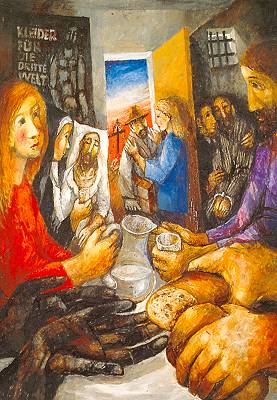
Holy Week and the Outcasts

Sieger Köder
“Barmherzigkeit”

“Let us not underestimate how hard it is to be compassionate. Compassion is hard because it requires the inner disposition to go with others to place where they are weak, vulnerable, lonely, and broken. But this is not our spontaneous response to suffering. What we desire most is to do away with suffering by fleeing from it or finding a quick cure for it.” Henri Nouwen

Holy Week is here and on my way home from work and a visit with my shrink I was doing some thinking about Christians that have suffered a crisis in faith or loss of faith. I meet them all the time and read their stories on blogs, books and social media.  Of course I run across more now because I have gone through such a crisis and have written about it and through that had my story publicized. As a result I am contacted by people who have suffered trauma, especially related to PTSD as well as those that care for such people.

For many of the people Holy Week and Easter can be particularly painful. Having known plenty of these people I can say that this phenomena is one of the more tragic aspects of the season.  People who at one time felt the presence of God in their life only sense emptiness and aloneness which sometimes becomes a feeling of hopelessness where even death appears more comforting than life in the present.

I say this because people suffering through this often go unnoticed or are ignored in church. Their loss could be that of a spouse or child, the loss of something else significant or the experience of trauma that devastates them but no matter the cause of the suffering many people discover that they are now outcasts in the place where they should be cared about more than anywhere else.

Likewise there are many pastors and priests who are either unaware of them, uncomfortable around them or irritated by them because they don’t respond like “normal” people do to the message of Easter.  I have found from my own experience returning from Iraq that Easter despite the message of resurrection and hope often triggers a despair of life itself when one no longer senses the presence of God and feels alone against the world, especially in church.

Years ago I believed that if someone was in the midst of a crisis in faith if they read the Bible more, prayed more and made sure that they were in church that things would work out.  I believed then that somehow with a bit of counseling, the right concept of God and involvement in church activities that God would “heal” them.  Call me a heretic but that line of thinking is nice for people experiencing a minor bump in their life but absolutely stupid advice for people who are severely traumatized or clinically depressed and suicidal who no longer perceive the presence of God in their lives.  For those abused by parents or clergy this is I think an even deeper wound one in which the very concept and understanding of God becomes skewed in the minds and hearts of the victims.

I cannot condemn those who have lost their faith or are wavering in their faith due to trauma, abuse or other psychological reason. The numbers of people have been victimized by family, teachers, clergy other authority figures or physical trauma related to accidents, near death experiences or combat is mind numbing. They are all over the place and many go unnoticed in the church.

Sometimes the damage wrought on people makes it nearly impossible for them to comprehend a God who both cares about them and who is safe to approach.  My experience came from Iraq and the trauma of my return and were absolutely frightening so much so that I left a Christmas Eve Mass in 2008 and walked through the dark wondering if God even existed.  My isolation from Christian community and sense of despair during that time showed me that such a loss of faith is not to be trifled with or papered over with the pretty wallpaper or neat sets of “principles” drawn up in the ivory theological towers by theologians and “pastors” who refuse to deal with the reality of the consequences of a fallen world and their impact on real people.

Those that I have talked to and read about who have suffered a crisis or loss of faith almost always mention to me is that that feel cut off and even abandoned by God.  It is not simply depression that they are dealing with but despair of life itself when death or just going to sleep is preferable to living. This overwhelming despair impacts almost all of life.  It is if they never are able to leave the “God forsakenness” of Good Friday and cannot climb out of the tomb.   For some the pain is so much that suicide becomes an option and the belief that their family, friends and loved ones would be better off without them. I have seen this too many times to count.

It is hard to reach out to people in this situation.  I have to admit in my case that it was only people who chose to remain with me and walk with me through the ordeal in spite of my frequent crashes, depression, anger and even rage that helped get me through the worst of this.  However I’m sure that my condition burned some people out.  There were some that would not walk with me as I first began to go down this road and the sad thing is that many were ministers and fellow chaplains.  In some ways I don’t blame them.  However it is telling that the first person that asked me about my spiritual life “or how I was with the Big Guy” was my first therapist.

The topic of a loss of faith or the reality of feeling God forsaken is had to deal with but is something that we need to face especially during Holy Week. The Cross necessitates this, Jesus was considered “God-Forsaken” and that is what is so perplexing about Good Friday.

Yet scripture plainly teaches that we are to “bear one another’s burdens, and in this way you will fulfill the law of Christ.”  As Dietrich Bonhoeffer said  We must learn to regard people less in light of what they do or omit to do, and more in the light of what they suffer.”  It is our willingness to be with people in their suffering that is one of the true marks of the Christian.  Being with someone in triumph is far easier than with those who suffer the absence of God.  It is presence and love not sermons that people who have lost their faith need as Bonhoeffer so eloquently said “Where God tears great gaps we should not try to fill them with human words.”

I do pray that as we walk with Jesus this Holy Week that we will not forget those who despair of live and feel as if they are “God-forsaken.”

Peace

Padre Steve+

2 Comments

Filed under christian life, faith, Pastoral Care, PTSD, Religion

Deadly Chatter: The Danger of Talking and not Listening

“Christians, especially ministers, so often think they must always contribute something when they are in the company of others, that this is the one service they have to render. They forget that listening can be a greater service than speaking.” Dietrich Bonhoeffer

I am a man of words sometimes many but mostly in writing but when I am in the company of others, unless I know them well or feel an exceptional need to add to a conversation I tend not to say much. In fact many times what I contribute is nothing more than something funny or witty to break tension or point out irony, speaking of which I need to do my Summer White uniform shirt in the next couple of days because we have an inspection next week but I digress.

Since I happen to be a minister I often get to experience the incessant droning and chatter of many Christians especially ministers who seem to believe that God would have them pounce on every opportunity to prattle on feeling that they must contribute something even if they have nothing to say.  Since I have on occasion been guilty of this myself I must always remember to take the Lincoln Log out of my eye before I go pointing out the Sequoia in someone else’s eye.  But we Christians and especially those of the ministerial type can really be a pain in the ass about this and I speak from experience on both the giving and receiving end of this proposition. What I fin amazing is for some ministers, especially the really popular ones on television or the mega-mart, I mean mega-church variety can take a small section of the Bible, usually the most insignificant ones like The Prayer of Jabez and turn them into a series of sermons each lasting nearly an hour complete with the DVD and the book, or series of books on the subject.

I remember a pastor of a mega-church that would begin sermon series on various topics and never complete them. He had one that was on “mission, vision and passion” which died somewhere around the eighth week of hour-long sermons into the mission section.  The sad thing is I can’t even remember what his primary Scriptural texts for this. Likewise I have endured many other sermon series to nowhere by various pastors or simply been held hostage by pastors that won’t shut up even when they know that they are beating a dead horse.  As for me I try to spend no more than 15 minutes on a sermon and usually shoot for about 12 minutes and focus on one thing either from the Gospel lesson or tying that lesson in with either the Old Testament or Epistle reading.  I just hope that in that time I don’t put anyone to sleep and that somehow by the miraculous work of the Holy Spirit that at least someone in the congregation takes a nugget from the message and that it is helpful.

Judy helped me in this when I was the Base Chaplain at Fort Indiantown Gap Pennsylvania.  The congregation had an unwritten rule that the service would begin promptly at 1100 and end promptly at 1200.  Judy and I know some American Sign Language since she went to California State University at Northridge because of her rather significant hearing loss and as any boyfriend who was passionately in love and lust would do I followed her.  As a result I became fairly well versed in sign language though I have lost most of that capability over time.  However she was good to let me know during a sermon how much time that I had before I had to be done and if I waxed too poetically she would let me know that I was boring something that I should have figured out by the sleeping members of the congregation.  But what the heck, none of them were sitting on a window ceil. No harm no foul.

I have found in the ministry of Priest and Chaplain that more often than not people don’t really want me to pontificate about everything that I know and would much rather that I take the time to listen to them. I actually try hard to notice the words as well as the inflection and the non-verbal aspects of communication when I spend time with people because it is all a part of listening.  I don’t always do it well and many times I have to catch myself before I interject a comment, idea or suggestion that might not be what the person needs at all in order to ensure the sanctity of the moment.  I know that when I am not doing well, which I spent the better part of the past three years not doing after my return from Iraq that the last thing that I want is someone who spouts “answers” and pushes their agenda without ever taking the time to care for or listen to what I am actually saying.  I think that I am not alone in this.

Bonhoeffer made this amazingly succinct comment about just what I am saying here and he does it far better than I could have done. “Many people are looking for an ear that will listen. They do not find it among Christians, because these Christians are talking where they should be listening.”  Therein lays the danger for both the person seeking someone that will listen to them as well as the one with all the answers.    The danger is that when we are in constant transmission mode we not only fail to listen or to really hear the other but also become deaf to the still small voice of God. Bonhoeffer noted this danger saying “he who can no longer listen to his brother will soon be no longer listening to God either; he will be doing nothing but prattle in the presence of God too.”  I figured due to the wisdom of my long-suffering wife Judy that God stopped taking theology lessons from me a long time ago, if indeed the Deity Herself ever took them from me. Of course back in my younger days I knew everything but since I have learned that I really know very little but I am definitely sure that I prattle in the presence of God as much as anyone else, and that is reality. Taking the time in the Daily Office and Scripture is something that I struggled with on my return from Iraq when I even struggled with the existence of God.  I am aware of this and I am trying to take some time every day to “be still and know.”

Unfortunately our media and information obsessed culture beats us senseless throwing more information, much of which is useless, deceptive or destructive in terms of content that it dulls our senses to the reality of others around us and keeps us from listening and seeing those who cry out for someone that will just take the time to listen even if they cannot “fix” the problem. You see in much of Christianity we suffer the same ailment of the culture around us in that we would rather “fix” someone than care for them. You see care takes loving nurture and patience especially the latter. Fixing is a “fire and forget” kind of thing, the kind of thing that “miracle workers” do for a living even if they are miracles faux no miracles at all. However the real act of care by a minister appropriately called “pastoral care” or the spiritual care of souls by a lay person takes time and involves a relationship and that requires listening when the answers are not apparent.  It is standing near the cross and not abandoning Jesus in the crisis something that nearing Good Friday we should remember with fear and trembling. I’m no fool when it comes to knowing my limitations especially when it comes to something like survival and I would have probably much more like Peter who went into hiding after denying Jesus than John on that day when the sky turned black.

You see to care involves love and as the Apostle Paul so aptly described love and what it is not in 1 Corinthians 13: “If I speak in the tongues of mortals and of angels, but do not have love, I am a noisy gong or a clanging cymbal. And if I have prophetic powers, and understand all mysteries and all knowledge, and if I have all faith, so as to remove mountains, but do not have love, I am nothing.”

Paul got it, even though he put a young man to sleep when preaching. The man fell out a window and died but thankfully the Holy Spirit wrought a miracle and raised the young man from the dead as he does so many weeks for so many of the faithful who suffer injury when passing out in the middle of a tedious sermon.  Maybe Paul wrote the epistle after that incident.

But simply to preach with no end is one thing but to fail to care or fail to really listen is worse.  Providing “answers” without understanding the question and to impatiently wait our opportunity to jump in and push our agenda no matter how noble or even “Biblical” it is is not faith nor is it Christian, insofar as Jesus would have understood it to be.

I remember an associate pastor of a mega-church that we attended in the late 1980s as I was getting ready to begin seminary. This pastor who was very charismatic and a wonderful preacher could not be bothered to care for or listen to the questions and struggles of a budding seminarian.  He would cross his arms and tap his foot to signal that his time was better spent doing anything other than listening to someone else. I had another senior pastor at a different mega-church who was one of my ordaining pastors back in my Evangelical Protestant days who told the congregation that someone asked him how sick that he would have to be for him to visit them in hospital he said “you don’t want to be that sick.” Of course he told the story during a sermon so the clear message was “if you are sick don’t expect a visit and don’t even bother calling me.”

Unfortunately this attitude has been all too common throughout the history of the Church and today it almost seems epidemic among pampered pastors who appear to be more intent on their personal gain than on caring for the flock that God has given them. Likewise it is all too common in church life. To  again quote from Bonhoeffer “This is the beginning of the death of the spiritual life, and in the end there is nothing left but spiritual chatter and clerical condescension arrayed in pious words. One who cannot listen long and patiently will presently be talking beside the point and be never really speaking to others, albeit he be not conscious of it. Anyone who thinks that his time is too valuable to spend keeping quiet will eventually have no time for God and his brother, but only for himself and for his own follies.”

This is a much bigger danger to Christians and the Christian faith than many if not most active clergy and laity alike across the denominational spectrum imagine.  The fact is if people don’t believe that we care about them and fail to show them the unconditional love that God shows us instead seeking to provide fixes that gel with our agenda then we will lose a generation. Perhaps we are already well on the way to this and it will be our fault.

Peace

Padre Steve+

1 Comment

Filed under christian life, faith, Pastoral Care, philosophy, Religion

An Easter People Living in a Good Friday World

Barbara Johnson wrote that Christians are an “Easter People Living in a Good Friday World.”

In the memorial acclamation which is part of many Eucharistic liturgies we proclaim “Christ has died, Christ is risen, Christ will come again” or possibly this variant “Dying you destroyed our death, rising you restored your life, Lord Jesus come in glory.  It has been part of the proclamation of the Gospels and various books of the New Testament and is the faith and prayer of those that call themselves Christians almost regardless of denomination from the very beginning.

Around the world many Christians understand this as they are persecuted for their faith sometimes to the point of death. The reality of Christians and others who are persecuted for their faith in many countries is quite unlike many American Christians who seem to believe that if someone disagrees with them they are being persecuted, despite enjoying tremendous political power and being the majority religion of the land.  Yet even in this country we live in a Good Friday world, maybe not like those that are dying for their faith but certainly in a place where suffering and violence abound, where innocent people are brutally murdered and where natural disasters bring destruction on the just and the unjust alike. In fact our country is experiencing a crisis of an order that it has not seen in many decades even while war, economic collapse and natural disasters and deep political division have left many people in deep despondency as well as in a very angry mood.

Our technology enables us to gather information and to receive news often faster than we can absorb it, thus when deluged by bad news it is easy to lose sight of the things that matter in life, especially relationships with those that we love as well as those that become part of our lives and of the Crucified God.

It is during Lent, Holy Week and in the Easter Triduum of Holy or Maundy Thursday, Good Friday and Easter that the reality of God participating in our world, the real world of pain, suffering, injustice and death becomes something that keeps us, or rather those who profess the Christian faith from simply becoming exponents of what Luther termed the “theology of glory.”  The Cross is that scandal or stumbling block that according to Jürgen Moltmann, the knowledge of which “brings a conflict of interest between God who has become man and man who wishes to become God.” It is the Cross which forces us to deal with the present realities even while we remain fixed upon the hope of Easter.

Unfortunately for many American Christians our focus tends to be less on the Crucified and Risen God than on our attempts to use the raw power of the political process and unsavory compromises with those that would co-opt and compromise the faithful for the advancement of their political, social and economic agendas.  This is nothing new; it has been an unfortunate and painful series of chapters in the history of the Christian Church since the time that Christianity became legal and the State religion during the reign of Constantine.  The sad truth is that in Western Christianity beginning with the Catholic Church and extending out to those that have been the theological heirs of Saint Augustine Catholic and Protestant alike have more often than not allowed their faith to be subordinated to their political, economic and social agendas and thereby becoming captive to things that are often antithetical to the Gospel.

Yet in the midst of this there is the constant call of the Gospel, that “God was reconciling the world to himself counting men’s sins not against them.”  Moltmann puts this paradox well when he says:

“When God becomes man in Jesus of Nazareth, he not only enters into the finitude of man, but in his death on the cross also enters into the situation of man’s godforsakenness. In Jesus he does not die the natural death of a finite being, but the violent death of the criminal on the cross, the death of complete abandonment by God. The suffering in the passion of Jesus is abandonment, rejection by God, his Father. God does not become a religion, so that man participates in him by corresponding religious thoughts and feelings. God does not become a law, so that man participates in him through obedience to a law. God does not become an ideal, so that man achieves community with him through constant striving. He humbles himself and takes upon himself the eternal death of the godless and the godforsaken, so that all the godless and the godforsaken can experience communion with him.” 

It is in this that Christians can fully be Easter People who live in a Good Friday world.  It is in living the paradox of Good Friday and Easter that we find just how God humbled himself for all people. In suffering the wrath of some incredibly religious people Jesus in the eloquent words of Paul the Apostle “though he was in the form of God, did not regard equality with God as something to be exploited, 7but emptied himself, taking the form of a slave, being born in human likeness. And being found in human form, he humbled himself and became obedient to the point of death— even death on a cross.” (Phil 4:7-8) and in that God, “who reconciled us to himself through Christ, and has given us the ministry of reconciliation; that is, in Christ God was reconciling the world to himself, not counting their trespasses against them, and entrusting the message of reconciliation to us.” (2 Cor 5:18-19)

Yes this is what it means to be an Easter people living in a Good Friday World.

Peace

Padre Steve+

2 Comments

Filed under christian life, faith, philosophy, Religion

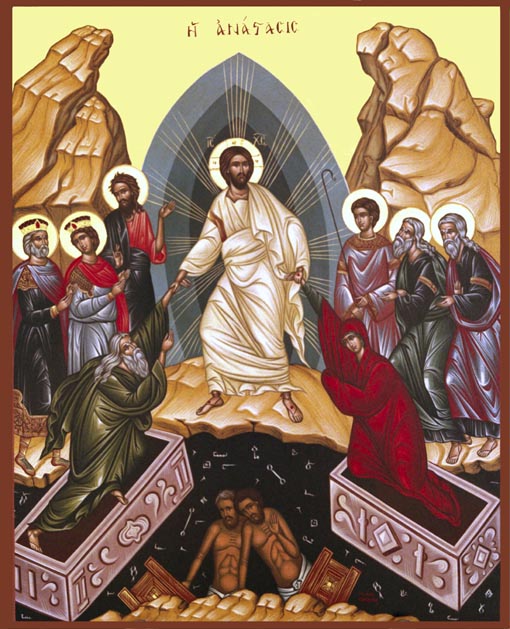
Alleluia Christ is Risen!

After the sabbath, as the first day of the week was dawning, Mary Magdalene and the other Mary went to see the tomb. And suddenly there was a great earthquake; for an angel of the Lord, descending from heaven, came and rolled back the stone and sat on it. His appearance was like lightning, and his clothing white as snow. For fear of him the guards shook and became like dead men. But the angel said to the women, “Do not be afraid; I know that you are looking for Jesus who was crucified. He is not here; for he has been raised, as he said. Come, see the place where he lay. Then go quickly and tell his disciples, `He has been raised from the dead, and indeed he is going ahead of you to Galilee; there you will see him.’ This is my message for you.” So they left the tomb quickly with fear and great joy, and ran to tell his disciples. Suddenly Jesus met them and said, “Greetings!” And they came to him, took hold of his feet, and worshiped him. Then Jesus said to them, “Do not be afraid; go and tell my brothers to go to Galilee; there they will see me.” Matthew 28:1-10

It is Easter at last and Christians around the world sing the triumphant message “alleluia Christ is risen, he is risen indeed!”  Just as the first disciples walked with Jesus we too have walked with Jesus through the penitential season of Lent beginning on Ash Wednesday where we remembered that “we are but dust and to dust we shall return.” With each thing that we abstained from or added to our spiritual discipline we in a small way were reminded that we are to “deny ourselves, take up our Cross and follow.”  In Holy week we experienced the nearly schizophrenic emotions of triumph and tragedy of Palm or Passion Sunday, the solemnity that comes on Holy or Maundy Thursday as we recall the institution of the Eucharist or the Lord’s Supper and the humility of Jesus as he takes on the mantle of a lowly servant and washes the feet of his disciples.  Leaving that we enter into the suffering of Jesus on Good Friday and see how even his friends betrayed or abandoned him with only a thief on an adjacent cross and the officer in charge of the crucifixion realizing just who was on that middle cross.  We wait overnight Friday and through Saturday in the uncomfortable middle between the crucifixion and resurrection that so often mirrors events in our own life where we sometimes experience what we feel to be forsaken by family, friends, church and sometimes even God.  Yet in the pre-dawn darkness of that first Easter morning we like the disciples awake to find that something has happened, that the stone is rolled away, the tomb is empty and Jesus is raised from the dead crushing sin death and hell.  We are greeted by Jesus who tells us not to be afraid but to go and tell others what has happened.  He greets us on the road to Emmaus and breaks bread with us even as we tell him about the tragedy of his death and then our eyes are opened.  Jesus is the victor and in his death burial and resurrection we have the forgiveness of sins.  The event is also eschatological in that it opens the door for him to return in glory and for him to be revealed in his people For the creation waits with eager longing for the revealing of the children of God;  “for the creation was subjected to futility, not of its own will but by the will of the one who subjected it, in hope that the creation itself will be set free from its bondage to decay and will obtain the freedom of the glory of the children of God.” Romans 8:20-21

Likewise it is in this series of inseparable events that Christ establishes our redemption by the forgiveness of sins “For while we were still weak, at the right time Christ died for the ungodly. Indeed, rarely will anyone die for a righteous person—though perhaps for a good person someone might actually dare to die. But God proves his love for us in that while we still were sinners Christ died for us.” Romans 5:6-8.

It is a universe changing event whereby Christ sets his people free and destroys the power of his enemies. Karl Barth wrote: “Look once again to Jesus Christ in his death upon the cross.  Look and try to understand that what he did and suffered he did and suffered for you, for me, for us all.  He carried our sin, our captivity and our suffering, and did not carry it in vain.  He carried it away.  He acted as the captain of us all.  He broke through the ranks of our enemies.  He has already won the battle, our battle.  All we have to do is to follow him, to be victorious with him.  Through him, in him we are saved.  Our sin no longer has any power over us.  Our prison door is open…when he, the Son of God, sets us free, we are truly free.” This is the redemption that the world awaits, not a redemption that is to be hoarded by believers but a redemption that extends beyond the present redemption for all people, especially those who believe and the people of God are to toil and struggle for this “For to this end we toil and struggle, because we have our hope set on the living God, who is the Savior of all people, especially of those who believe.” 1 Timothy 4:10

The Cross and Resurrection are to be a new and purifying wind in the world and the people of God are to be the vehicle for this wind empowered by the Holy Spirit of God.  It is not simply about mastering the art of dying as Socrates did but experiencing resurrection.  Christ did not merely die but he overcame the last enemy which is death itself. (1 Corinthians 15:26)  The power of this is not to be taken lightly in its possibilities for real change for as Dietrich Bonhoeffer wrote “If a few people really believed that and acted on it in their daily lives, a great deal would be changed. To live in the light of the Resurrection—that is what Easter means.”

While we live in the reality of the light of the Resurrection we simultaneously live under the shadow of the Cross of Christ as well as the cross that we are obliged by God to carry in our own lives. In the duality and unity of the Cross and Resurrection we have hope and in that hope we are not to be overwhelmed by events in the world that we cannot control.  Nor are we to be consumed by false “gospels” presented by various ideologues of the right and the left who may identify themselves as “Christian” but place their ideologies, social, political, national and economic over the Gospel itself.  Ideologues who quote scripture to buttress their arguments so that their ideology and the “Gospel” are one in the same much as Satan did during the temptation of Jesus to provide a veneer of Christianity to ideologies that are often opposed to the message of the Gospel. Such an idea is much like the message on German soldier’s belt buckles in the Second World War proclaimed “Gott Mit Uns” even as their nation made war on the world and executed an evil ideology of death upon the Jews and others unfortunate enough to be considered the enemies of the Nazi Party.

It is the ideologues who now endanger the Church and Gospel itself for many choose to remain inside the walls of the church and attempt to turn it into a tool of their ideology and in doing so these ideologues measure and evaluate “others only from the standpoint of whether they are supporters of this ideology, or whether they might become such, or whether they might at least be useful to it even without their consent, or whether they must be fought as its enemies. Its glory has already become for him the solution not only to the personal problem of his own life but to each and all of the problems of the world.” But the Cross and resurrection cry out “NO!” to such ideas even when they are drenched with so called “Biblical” support.

The Cross and the Resurrection bring us to life and promise that Christ who died and was raised will come again and in doing so will complete the redemption of the world for which he suffered and died. It is the real world for which God cares for enough to live suffer and die to save, as Dietrich Bonhoeffer so eloquently wrote “God loves human beings. God loves the world. Not an ideal human, but human beings as they are; not an ideal world, but the real world. What we find repulsive in their opposition to God, what we shrink back from with pain and hostility, namely, real human beings, the real world, this is for God the ground of unfathomable love.”

It is God’s unfathomable love that Easter proclaims as victorious and allows us will all people to cry out “Alleluia Christ is Risen! The Lord is Risen indeed!”

Peace and Happy Easter

Padre Steve+

1 Comment

Filed under christian life, faith, Religion

It is Finished

“28 After this, when Jesus knew that all was now finished, he said (in order to fulfill the scripture), “I am thirsty.” 29 A jar full of sour wine was standing there. So they put a sponge full of the wine on a branch of hyssop and held it to his mouth. 30 When Jesus had received the wine, he said, “It is finished.” Then he bowed his head and gave up his spirit.” John 19: 28-30 NRSV

 Good Friday, I wrote about it last night and published it very early this morning.  I just completed the Good Friday Liturgy at the hospital and am set to get an early start on the rest of the Easter Weekend.  I am not going to repeat last night’s article here, just something that struck me as I prepared for the service and read the Passion narrative from John’s Gospel.  The words It is finished” which come from the lips of Jesus as he dies convey a finality that sometimes we miss as we fast forward to Easter. Upon the Cross Jesus really did die and this can be very uncomfortable in fact a number of major religions reject the notion that God would condescend to become human and certain would never consent to death.  Such a stream of thought was even evidenced in Gnostic Christianity where God is “pure spirit” and the God of the Old Testament was corrupt being powerful enough o create humanity and wicked enough to do so as for the Gnostics the flesh was evil and the spirit good.  Likewise the Aryan Heresy invoked the notion of a Jesus who was not really God, more like a superman as God could not die.  The thought of the Aryans is still present in Islam as Mohammed the Prophet had exposure to Aryan Christianity and the image of Jesus in Islam is nearly identical to the Aryans.

 “It is finished.” They are haunting words and when one reads the words of Isaiah one gets the picture of something that if we passed by on the street that we would probably turn our heads away from to avoid the unpleasantness of the sight as “he had no form or majesty that we should look at him, nothing in his appearance that we should desire him. 3He was despised and rejected by others; a man of suffering and acquainted with infirmity; and as one from whom others hide their faces he was despised, and we held him of no account.”   

 The hymn When I Survey the Wondrous Cross is particularly vivid in painting the picture of the crucified Christ: “See, from his head, his hands, his feet, sorrow and love flow mingled down. Did e’er such love and sorrow meet, or thorns compose so rich a crown.”

 The fact that Jesus dies on the cross and dies rejected is a paramount truth of the Gospel and is necessary if we are to comprehend the Gospel, we do not get to the resurrection without the crucifixion and any attempt to do so especially by his people creates a false Gospel, a Gospel devoid of the forgiveness of sins and a Gospel where God knows not our sorrows.  It is the Gospel of Theism where God is not involved in the real world; untouched and unmoved by human suffering and even arbitrary and capricious in his dealings with humanity.   Dietrich Bonhoeffer wrote Jesus is a rejected Messiah. His rejection robs the passion of its halo of glory. It must be a passion without honor. Suffering and rejection sum up the whole cross of Jesus. To die on the cross means to die despised and rejected of men. Suffering and rejection are laid upon Jesus as a divine necessity, and every attempt to prevent it is the work of the devil, especially when it comes from his own disciples; for it is in fact an attempt to prevent Christ from being Christ.” 

 The fact that Jesus did not let the cup from him has implications for his disciples which again are not comfortable as they stand opposed to the “Gospel” of those who present the faith as one of respect, prosperity, earthy power and health.  It is not the “Gospel” of materialism where we remain in relationship with God only for the blessings but the Gospel of discipleship and suffering.  It is the cry My God, my God why have you forsaken me?” which Jesus utters as rejected by man and by God as Bonhoeffer said “It is not suffering per se but suffering-and-rejection, and not rejection for any cause of conviction of our own, but rejection for the sake of Christ. If our Christianity has ceased to be serious about discipleship, if we have watered down the gospel into emotional uplift which makes no costly demands and which fails to distinguish between natural and Christian existence, then we cannot help regarding the cross as an ordinary everyday calamity… We have then forgotten that the cross means rejection and shame as well as suffering.”

 Again, such a Gospel is not comfortable for the disciple the Gospel of the Cross whereby we come to know God is the Gospel which “bids a man to come and die.” This is not the kind of martyrdom sought by fanatics who seek to destroy their and presumably God’s enemies but a call that is unique to every disciple:

 “But each has a different share: some God deems worthy of the highest form of suffering, and given them the grace of martyrdom, while others He does not allow to be tempted above that they are able to bear…. The cross is laid on every Christian. The first Christ-suffering which every man must experience is the call to abandon the attachments of this world. … we surrender ourselves to Christ in union with His death—we give over our lives to death. … When Christ calls a man, He bids him come and die.…death in Jesus Christ, the death of the old man [or nature] at his call. Jesus’ summons to the rich young man was calling him to die, because only the man who is dead to his own will can follow Christ. In fact, every command of Jesus is a call to die, with all our affections and lusts. But we do not want to die…”

 There is a hymn that means much to me is “And Can it be” which personalizes the great mystery inherent in the Gospel.

And can it be that I should gain
an interest in the Savior’s blood!
Died he for me? who caused his pain!
For me? who him to death pursued?
Amazing love! How can it be
that thou, my God, shouldst die for me?
Amazing love! How can it be
that thou, my God, shouldst die for me?

’Tis mystery all: th’ Immortal dies!
Who can explore his strange design?
In vain the firstborn seraph tries
to sound the depths of love divine.
’Tis mercy all! Let earth adore;
let angel minds inquire no more.
’Tis mercy all! Let earth adore;
let angel minds inquire no more.

He left his Father’s throne above
(so free, so infinite his grace!),
emptied himself of all but love,
and bled for Adam’s helpless race.
’Tis mercy all, immense and free,
for O my God, it found out me!
’Tis mercy all, immense and free,
for O my God, it found out me!

 It is finished and with it we wait. Like the disciples we know not what tomorrow holds we live in a tension knowing Christ’s suffering and awaiting resurrection.  The Centurion Loginous at the Cross saw what no one else saw that day knew that “surely this was the Son of God” and like the disciples would lay down his duties to follow Christ.

 I pray that God will richly bless us this Good Friday with his peace which as he says passes all understanding.

 Peace

Padre Steve+

Leave a comment

Filed under christian life, faith, Religion