Tag Archives: good friday

Good Friday…Ecce Homo! Behold the Man

“God is nowhere greater than in his humiliation. God is nowhere more glorious than in his impotence. God is nowhere more divine than when he becomes man” Jürgen Moltmann Trinity and Kingdom


“So they took Jesus; 17and carrying the cross by himself, he went out to what is called The Place of the Skull, which in Hebrew* is called Golgotha. 18There they crucified him, and with him two others, one on either side, with Jesus between them.” John 19: 16b-18

4Surely he has borne our infirmities
and carried our diseases;
yet we accounted him stricken,
struck down by God, and afflicted.
5But he was wounded for our transgressions,
crushed for our iniquities;
upon him was the punishment that made us whole,
and by his bruises we are healed.
6All we like sheep have gone astray;
we have all turned to our own way,
and the Lord has laid on him
the iniquity of us all. Isaiah 53:4-6

“My God my God why have you forsaken me?”

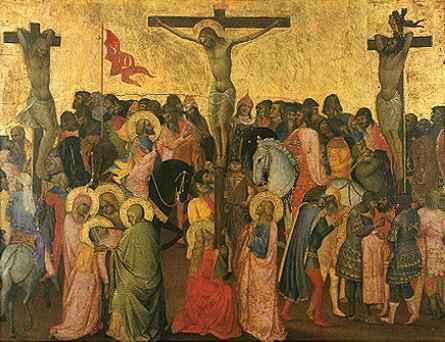
Today is Good Friday, the Altars are bare and we simply “Behold the Man.” The picture that we have today is paradoxical, it is the picture of a suffering man betrayed by a friend, abandoned by his closest followers and executed in a barbaric fashion under the orders of a man who washes his hands of his own responsibility.  It is a picture that is troubling because of its unpleasantness it is not the kind of picture of God that we want.  While we gladly acknowledge God’s grace and God forgiving our sins through Jesus we want to stay on this side of the resurrection. But like it or not we are confronted with questions about why do the innocent suffer and how could God do this to me or the one that I love.  Much of the problem is that we often buy in to a God untouched by human suffering a God who is arbitrary, unfeeling and cold no matter how much we try to convince ourselves that he cares.  A God incapable of suffering is a cold comfort when we or a loved one suffers. This is not the Christian God even if we try to baptize this “god” in our theology.  “In Christianity the cross is the test of everything that deserves to be called Christian” so writes Jürgen Moltmann in “The Crucified God.”

The Cross and the Passion of Christ is the center of how Christians come to understand God and if we attempt to regulate it to the background we do the message of the Gospel violence.  This is very apparent in the number of churches that do nothing to acknowledge the event on Good Friday even as they adorn their churches for the Easter celebration. It is as if the central event in God’s revelation to humanity and means by which he reconciles humanity to himself is a stepchild to the resurrection, but without the Cross there is no resurrection. It is also seen by some who find the symbol of the Crucifix offensive often derisively saying “Jesus isn’t on the Cross anymore, I worship the Risen Jesus.” While we worship the Risen Christ he also remains the Crucified God who in his human flesh bore the sins of the world. It is as Dietrich Bonhoeffer writes:

“The figure of the reconciler, of the God-man Jesus Christ, steps into the middle between God and the world, into the center of all that happens.  In this figure is disclosed the mystery of the world, just as the mystery of God is revealed in it.  No abyss of evil can remain hidden from him through whom the world is reconciled to God.  But the abyss of the love of God embraces even the most abysmal godlessness of the world.  In an incomprehensible reversal of all righteous and pious thought, God declares himself as guilty toward the world and thereby extinguishes the guilt of the world.  God treads the way of humble reconciliation and thereby sets the world free.  God wills to be guilty of our guilt; God takes on the punishment and suffering that guilt has brought on us.  God takes responsibility for godlessness, love for hate, the holy one for the sinner.  Now there is no more godlessness, hate, or sin that God has not taken upon himself, suffered, and atoned.  Now there is not longer any reality, any world, that is not reconciled with God and at peace.  God has done this in the beloved son, Jesus Christ.  Ecce homo!” –Dietrich Bonhoeffer, Ethics: Dietrich Bonhoeffer Works, Volume 6, edited by Clifford J. Green and translated by Reinhard Krauss, Charles C. West, and Douglas W. Scott (Minneapolis: Fortress, 2005), 83.

In addition to its salvific value the Cross of Christ is also relevant to all who suffer as “the deep meaning of the cross of Christ is that there is no suffering on earth that is not borne by God.” In the Cross God identifies himself with all of humanity especially those afflicted or persecuted.

Today we take the time to reflect and remember this event. Many people will have a day of fasting and accompany it with prayer or service.  My prayer is that in the midst of the various crises that we face in the country and the world that we will take the time as Christians to ponder the depth of God’s love and identification with his all people and the ramifications for how we treat others, even those that we view as our opponents or even enemies.  If God can condescend to love us while we were at enmity with him, just how can we fail to treat others with the same love? To again quote Bonhoeffer with whom I have walked this Lenten season:

“God loves human beings. God loves the world. Not an ideal human, but human beings as they are; not an ideal world, but the real world. What we find repulsive in their opposition to God, what we shrink back from with pain and hostility, namely, real human beings, the real world, this is for God the ground of unfathomable love.”

Ecce Homo! Behold the Man!

Peace

Padre Steve+

Leave a comment

Filed under christian life, faith, Religion

Holy or Maundy Thursday….Pausing to Reflect on Communion

Today is Holy or Maundy Thursday, a day where many Churches and Christians take the time within their theological traditions to reflect upon in their worship, the institution of the Eucharist or the Lord’s Supper.  Today for me is always special, though the past couple years I was not doing well do to PTSD and other stuff.  This year is different in the sense that I have began to recover that sense of mystery and awe that comes in this celebration.

I grew up in kind of an eclectic faith tradition as a Navy brat. My family was Methodist and I was baptized in my parents and grandparents home church, Southside Methodist Church in Huntington West Virginia.  However living on the West coast we went to Navy Chapels or local civilian churches of various denominations.  During my dad’s time in Vietnam it was a Roman Catholic Navy chaplain who showed us the love of God when many civilian churches made military families unwelcome.  I owe my vocation and faith to that man who took care of our Protestant family.  I remember attending the Holy Thursday Mass at the little Naval Communication station in 1971. There was a sense of mystery and holiness in that service that stayed with me.  When I was in high school I went to a Conservative Baptist church where communion was not observed in the same manner but the Pastor, Reverend Ron Lundy made it special. There was a sense of holiness and thankfulness that I have seldom seen in Evangelical churches since.

When I went to seminary I was attending a non-denominational evangelical/charismatic church.  It was a good church but little emphasis was placed on communion and apart from Easter Sunday no attention was paid to Holy Week. However as a seminary student at Southwestern Baptist Theological Seminary in 1988-1992 before the great purge of moderates I had a number of professors, but in particular my Church History professor Dr Doyle Young took the time to look at how the major traditions within the Christian faith viewed the Eucharist or Holy Communion.   I was acquainted with most in a fairly rudimentary manner Dr Young brought out the really important theological aspects of each in the context of how each view came about.  I always had a sort of Reformed or Presbyterian view of Holy Communion in that unlike most of my Baptist and Evangelical friends I really believed that there was a “spiritual” presence of Christ in communion as opposed to it being a symbolic memorial.  That changed as I was taught the Roman Catholic and Orthodox understandings of the Eucharist but was nailed down as we studied Martin Luther, his understanding of the Eucharist and the discussion between Luther and Ulrich Zwingli at the Marburg Colloquy.  It was Luther’s argument from Scripture “This is my Body, this is my Blood” with which he responded to every argument posed by Zwingli that convinced me of the reality of Jesus’ presence in the Eucharist in more than just a spiritual manner.  I could not ignore Scripture and that was the watershed in bringing me to an Anglican or Anglo-Catholic understanding of faith and the Eucharist.

My purpose here is not to argue for my theological view but rather to encourage Christians to take advantage of the communion that we have with Jesus and through him with the Father and the Spirit as well as the communion that we share with each other.  Though I may believe my understanding of the Eucharist fits best with Scripture and the earliest teaching of the Church I will not use this to attack those who have different viewpoints.  Instead regardless of the theological perspective I hope that my readers will be able to renew their faith tonight as we celebrate this holy evening where Jesus met with his disciples before he was betrayed a Luke the Evangelist wrote:

“When the hour came, he took his place at the table, and the apostles with him. 15He said to them, ‘I have eagerly desired to eat this Passover with you before I suffer; 16for I tell you, I will not eat it* until it is fulfilled in the kingdom of God.’ 17Then he took a cup, and after giving thanks he said, ‘Take this and divide it among yourselves; 18for I tell you that from now on I will not drink of the fruit of the vine until the kingdom of God comes.’ 19Then he took a loaf of bread, and when he had given thanks, he broke it and gave it to them, saying, ‘This is my body, which is given for you. Do this in remembrance of me.’ 20And he did the same with the cup after supper, saying, ‘This cup that is poured out for you is the new covenant in my blood.” Luke 22:14-20

And Paul to the Corinthians

“ For I received from the Lord what I also handed on to you, that the Lord Jesus on the night when he was betrayed took a loaf of bread, 24and when he had given thanks, he broke it and said, ‘This is my body that is for* you. Do this in remembrance of me.’ 25In the same way he took the cup also, after supper, saying, ‘This cup is the new covenant in my blood. Do this, as often as you drink it, in remembrance of me.’ 26For as often as you eat this bread and drink the cup, you proclaim the Lord’s death until he comes.” 1 Corinthians 11:23-26

And Saint John’s comments in the Gospel bearing his name:

“This is the bread that comes down from heaven, so that one may eat of it and not die. 51I am the living bread that came down from heaven. Whoever eats of this bread will live forever; and the bread that I will give for the life of the world is my flesh.” John 6:50-51

It is important that no matter whether we view this as a Sacrament or a symbolic memorial that we take this feast of God’s love for us seriously for he comes to us in Word, Sacrament in this moment where we take the time to spend with him and his people as we prepare to celebrate the “Mystery of Faith” “Christ has Died, Christ is Risen, Christ will come again.”

My prayer is that we all find God’s peace and life during this Easter Triduum of Holy Thursday, Good Friday and Easter Sunday as we walk with Jesus and his disciples through that tumultuous time.  Lent is ended, our seasonal penitence is done so let us take the time to pause remember and reflect of the remarkable depth of God’s love for us in that “while we were yet sinners Christ died for us.” As Martin Luther said “For here in the sacrament [Communion] you receive from Christ’s lips the forgiveness of sins, which contains and conveys God’s grace and Spirit with all his gifts, protection, defense, and power against death and the devil and all evils” (The Large Catechism — p. 98).

Another feature of Holy Thursday is the enactment by the clergy of Jesus washing his disciple’s feet. This is important in a world where power and fame is sought after over service to one another, even in churches.  The call of Christ is that we are to be servants of all.

In a world wracked by so much division including Christians who cannot agree on exactly what is going on when we come to the Altar or to the Communion table it is imperative that Christians even given their longstanding differences regarding this would be good to acknowledge their dependence upon God and one another.  If while acknowledging our differences we can at least share in the love and communion of God in Christ even if our individual churches will not share communion with one another. After all in the end it really is about the Lord and his relationship with his people and their relationship with each other and the world that he came to save.

Peace

Padre Steve+

1 Comment

Filed under christian life, faith, philosophy, Religion

One Week Warning: Lent Begins Next Wednesday

Contemplating Lent

I have never ever done the season of Lent well.  From Ash Wednesday through Good Friday I pray for it to end.  First I don’t look good in the liturgical color of the season, purple.  I actually prefer the green of Ordinary time or the Red of Pentecost.  However I do have a really cool “cope” (which is liturgical jargon for cape) and stole (liturgical scarf) in purple that I picked up at little religious goods store in Poland back in 1996. I thought it was a chasuble (liturgical poncho) but it is still pretty cool.  Unfortunately I have never had the occasion to wear it in a service despite the color which would not do me well.

However aesthetics aside Lent is my least favorite season of the Church year.  Now I am not adverse to it on principle as I do think that we all need to take stock of our relationship with God and humanity as well as the things that we mess up on a daily basis.  As someone whose spiritual life stays about at the Mendoza line I know that I have a lot that I need to improve in my life.  That is a given.  I would love to be a .300 spiritual hitter than a .215 spiritual hitter.  However I do work at trying to get better.  Lent is a season that reminds me of what a screw up I am, thus like anyone who doesn’t like to be reminded of their shortcomings for 40 days I find Lent a painful reminder of my imperfections.

So with that in mind and knowing that I am not the only person who is in my boat I have to provide some survival tips but those will wait.  Since many readers have little idea what Lent is about let me do some “splainin” as Ricky Ricardo would have said.

Lent is the season of spiritual preparation that leads up to Holy Week and Easter. It is a “penitential season” meaning a season where we examine our lives in relationship to God and the folks that we hang with, sometimes referred to as humanity and seek to receive God’s grace to make amends and to find ways to do better.  One of the ways that Christians have done is to give up certain foods or activities during the season. Others seek to add spiritual disciplines to their lives.

Lent begins on the Wednesday following “Fat Tuesday” which is called Ash Wednesday. On Ash Wednesday Christians have themselves marked with a cross from ashes on their forehead as a sign of the reality of their mortality and promise to use the season to return to God, make changes in their lives that will deepen their spiritual lives and their relationship with their neighbor. It’s the whole “which are the greatest commandments?” “Love God and love your neighbor” on steroids.  Unfortunately the whole relationship thing sometimes gets lost as folks get caught in the legalism and minutia or trying to figure out what to “give up” for Lent, which often is like a New Year’s resolution which almost invariably goes bad.  Lent then continues for 7 weeks but only 40 days are actually Lenten Lent as all the Sundays are “feast days” which mean that you can eat all the stuff that you don’t get to eat on Fridays or Wednesdays if your Church or Diocese is a bit stricter than others.  There are also three major Feast Days, Saint Matthias (Apostle), Saint Joseph and the Annunciation. There is also Saint Patrick’s Day which though not a major feast day is often locally observed and of it falls on a Wednesday or Friday is sometimes is allowed by the local Bishop to supersede the fast day.  Speaking of “Fast Days” these are days where the Christian gives up most food except for a couple of very small and simple meatless meals, though some are stricter in their observance of “Fast Days” and actually fast throughout the day, not that there is anything wrong with that.  Ash Wednesday and Good Friday are “Fast Days.” There are also days known as days of abstinence where the individual gives up certain foods or activities. Traditionally meat is given up on Fridays and depending on how strict your diocese is Wednesdays as well. Most people do fish on these days.  I will write more about this later in the week.

I have struggled with Lent for most of my life even as a Priest.  When I made my first confession I asked the Priest who heard it “if they deserved it was it still as sin?” Though that was not during Lent you get my drift.  I admit that I struggle with Lent but over the past few months I have had a rather remarkable spiritual and emotional start to recovering from my case of PTSD.  So as with most things I am not in dread of Lent this year. I will pick reasonable spiritual goals as well as things to abstain from during the season.

So with the warning given enjoy the next week.

Peace,

Padre Steve+

Leave a comment

Filed under Pastoral Care, philosophy, Religion

MLB League Championship Series so Far, I will wear Short Pants until the World Series is Over and Learning that I am a “Wounded Healer”

So far things appear to be working out the way that I thought that they would in the MLC League Championship Series between the Phillies and Dodgers. I predicted that the teams would split at Chavez Ravine and go back to Philly knotted.  The Phillies took game one and looked like they had game two in the bag with Pedro Martinez shutting the Dodgers out through seven giving up only two hits.  Then the Phillies problematic bullpen took over in the eighth and it went down from there with the Dodgers coming back to win.

The ALCS has been played at the new Yankee Stadium amid the din of a Nor’easter.  The Yankees took game one 4-1 as the Angels quite literally “froze” in the cold and damp weather.  Game two played in even worse conditions has been influenced by the weather and was a superb pitcher’s duel.  The game went into extra innings tied at two and though the Angels went ahead in the top of the 11th as the rain started coming down harder only to have Alex Rodriguez come up big again for the Yankees in the bottom of the 11th with a home run to tie the game.  The game went to the bottom of the 13th when with one out the Yankees scored on a throwing error to win the game 4-3.  It was an amazing game that I could not pull myself away from but will write more about later.

On another note, the weather here in Hampton Roads has been miserable as we also have had some of the residue of the Nor’easter with cold rain, fog and drizzle that has not let up.  Amid this positively crappy weather I am maintaining my vow to wear short pants as long as I can with the exceptions being my uniform and going to church.  This means that I am bundling up from the belt up while keeping my legs bare.  I have never done this before which means either I’m nuts or I’m nuts, but nonetheless I am in this until the World Series is over at the minimum.  Since with the exception of church, work and one social event where shorts were unacceptable I have not worn long pants since sometime in April.  Tonight I had a Norfolk Tides jacket and sweatshirt on.  We’ll see how this goes…

I have the duty this weekend and have been in and out of the hospital a number of times.  One of the visits called to mind just how much I am like the people I serve and what it means to have to ask the same questions about God, faith and what it is to be human and a Christian. What got me tonight was a gentleman struggling with his faith, much as I have after returning from Iraq and battling PTSD and other nagging injuries.  Having him ask the same questions that I have wrestled with and having him ask me directly what I thought.  I have learned that I don’t have to “fake it” and try to give the man some textbook answer of how he needed to believe more, read his Bible more, go to church more, pray more or harder.  Instead I was able to be honest that I have wrestled with the same question but somehow the words of the 23rd Psalm speak to me.  “Even though I walk through the valley of the shadow of death, I will fear no evil for you are with me.”  The Psalm is very reassuring for me as it is so honest.  Reality is that we do walk through the valley of the shadow of death.  In fact it is a difficult and pain filled world.  That I will fear no evil means that evil is in fact very real but in the middle of this there is an understanding that God is still with us.  It is an understanding that even when life is more like Good Friday than Easter, that God as far away as he may seem is still there.  Maybe that is actually the miracle that most people need, the miracle to know that no matter how bad things suck, and I do use the word “suck” because that is how it is sometimes, especially when there is no “miracle” to be had otherwise.  When I told the man that I had spent the past 18 months wrestling with those questions he opened up and we had a wonderful discussion and prayer.   I am totally okay with this somehow God uses me in my weakness more than when I had all the answers.

Tonight I discovered that  Bishop John Holloway, the medically retired former Ordinary of the Charismatic Episcopal Church Diocese of the Mid-South and one of the early leaders of the Church, his wife Elaine and two youngest children have to leave their home in Thomaston Georgia.  They moved there as a missionary bishop giving up pension and medical from the Methodist Church to follow God’s call into the CEC.  The home is being foreclosed on after the church, which has no pension or insurance plan in most dioceses for clergy and had provided a great deal of money to help pay off debts in the past has had to reduce the money they were providing by half and now according it the Holloways’ son Jared to nothing.  Their home is being foreclosed on and they have to be out by December 1st and if you want to read more go to his blog: http://jzholloway.wordpress.com/  If there is a question as to how the CEC currently handles finaces go to www.cechome.com where the budgets and expenses of every diocese are posted.  There had been great problems in the past in the finacial management of the CEC largely done by people no longer associated with the church, including some former bishops.  I think this is getting better under Archbishop Bates unfotunately the residue and distaste of that era is still out there.

I really don’t know what to think about that except that I did talk to a CEC Bishop about it and hear that there are other parts to the story.  That aside, when the CEC was formed and one of the things that drew me to it was that the CEC was to would be more personal and relational than churches where the bishops did not really know their clergy. I think that is still the ideal in the Church but what Jared is reporting and what I hear from Elaine on Facebook gives me some cause for concern because it deals with a bishop who can no longer function and is completely disabled. Additionally Elaine is a cancer survivor who has exeeded her life expectancy with the disease.  Obiviously things are not good for them and I have to trust that the situation will be resolved in a spirit of love and reconcilliation and that ultimately the Holloways will be taken care of by the church and God’s people.  I cannot say anything else because I do not know anything else, but to say how this grieves me as Bishop Holloway was and I’m sure, even in his greatly de-habilitated and totally dependent state is a gracious and giving man.  I always felt comfortable and safe around him.  He ordained my friend Father Stu King back in 2001.  Stu has left the CEC having been accepted into Seminary and in now working to become a Roman Catholic Priest.  I’m sure that Bishop John would approve and give his blessing.  Please keep the Holloways in your prayers. I have no idea if there is anything that can be done to help them, if there is Jared may know or one could contact the Mid South Diocese of the CEC.

I also found that a friend, the sister of our dear friend Dr Helen Linkey who taught at Marshall University who battled breast cancer for two years before succumbing to it in 2005 has found a lump in her breast. She is going in for a biopsy which is expected to find cancer. Maryellen occasionally comments on my website and her news was included in her comment to my post from last night at https://padresteve.wordpress.com/2009/10/16/war-remembrance-and-healing-a-chaplain-officer-and-historian-makes-his-way-home/

Please keep Maryellen in your prayers also. Anyway, it is time for me to try to get to sleep.

Peace,

Padre Steve+

Leave a comment

Filed under Baseball, healthcare, Pastoral Care, philosophy, PTSD

War, Remembrance and Healing: A Chaplain, Officer and Historian Makes His Way Home

The first version of this post was written in the spring of 2008 when I was doing a lot of soul searching and reflecting after Iraq. It was originally run in my church’s online news service.  I post it now with some updates that have been brought about by new ways that I am rediscovering God and because of the current situation in Afghanistan which has become worse in the past year. As I read news releases about casualties and attacks on NATO forces and Afghan civilians, especially those in small outposts or serving as advisers and trainers I am reminded of my time in Iraq.  Please don’t forget those who serve in Iraq and Afghanistan, or those who have served in prior wars. Especially keep in your prayers and help assist those who have returned injured in mind, body or spirit and those who made the supreme sacrifice.

874Leaving a Bedouin Camp 1 mile from Syria

I have been doing a lot of reflecting on ministry and history over the past since returning from Iraq. Since I’ve been back about a year and a half I can say that I have changed as a result of my service there.  Change can be scary but in my case it has been both necessary and probably good.  Ministry, theology and history have been part of my life for many years; they have taken on a new dimension after serving in Iraq. When I first wrote this piece not long after returning I was in pretty bad shape but in the months since I have been attempting to integrate my theological and academic disciplines with my military, life and faith experience since my return. I’m not done yet by any means, but things are getting better, not quite like Chief Inspector Dreyfus in The Pink Panther Strikes Again “Every day in every way I’m getting better and better…Kill Clouseau!” but a slowly getting better with some occasional bumps in the road.

One of the things that I have wrestled with is my faith, and returning from war changes a man.  Before I went to Iraq I thought that I had things pretty much together.  When I came home and fell apart it also affected my faith, doing little things became difficult and the effects were exaggerated by my isolation.  In a sense it was my Saint John of the Cross Dark night of the Soul experience.  I felt that God had abandoned me, people would come to me with their crisis of faith and I had to dig deep to stay with them, but in doing so I became acutely aware of the fact that I shared this with them. I couldn’t hide behind my collar or the cross on my uniform as the crisis was an interruption which drove me out of my comfort zone and forced me to deal with the world that the people I minister among deal with every day.
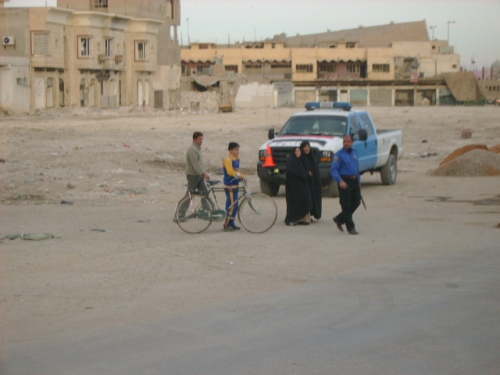
291Iraqi Police in Ramadi Escorting Civilians Across the War Zone of Route Michigan

There are those who believe that all forms of ministry are basically the same and that lessons learned are universally applicable and that somehow all ministries are proclamation oriented.  Unfortunately that is not the case and one of the places that this is true is the Military Chaplain ministry.  This mibnistry is much different than parish or para-church ministries and even different than other institutional ministries such as Police, Fire, Industrial or civilian health care chaplaincy.   It is different in that it is more incarnation versus proclamation. We not only minster to our people but we live among them.  We live the experience of those that we serve, especially in the uncertainly of war and deployments.  Chaplains live in a world where we are fully military officers and fully ministers of our own church or faith tradition. As a chaplain I never lose my calling of being a priest, but I am a priest in uniform, a military professional and go where our nations send me to serve the Sailors, Marines, Soldiers and Airmen who I live among be that overseas, or in the States.

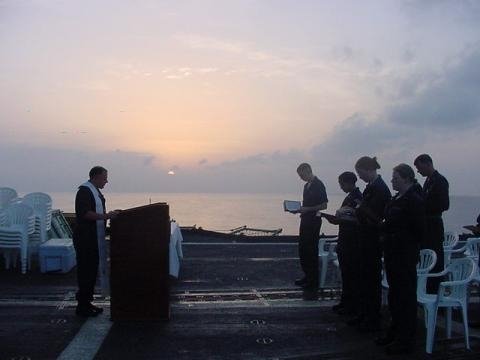
142Always a Priest Eucharist with Advisers in the Far West of Al Anbar

There is always a tension in the military chaplain ministry. This is  especially true when the wars that we are sent to are unpopular at home and seem to drag on without the benefit of a nice clear victory such as VE or VJ Day in World War II or the homecoming after Desert Shield and Desert Storm. There are those that oppose the military chaplaincy on theological or philosophic grounds, usually some manner of absolutist understanding of ministry, church-state relations or social justice considerations.  My purpose is here not to defend military chaplain institutions against such criticism but rather to share the world and tension that military chaplains live in when our nation is engaged in unpopular which some consider unjust or illegal wars.

training team baseIsolated Base Camp for Advisers in Afghanistan

A lot of people have no “ethical” or “moral” qualms about wars that are easy to pigeonhole as just wars, especially if we win quickly and easily.  It is my belief that when things go well and we have easy victories that it is easy for religious people, especially more conservative Christians to give the credit to the Lord for the “victory.”  Unfortunately such “Credit” is given without them ever understanding or sometimes even caring about the human cost of war.   Likewise it is easy for others to give the credit to superior strategy, weaponry or tactics to the point of denying the possibility that God’s involvement.  Conversely and maybe even perversely I have heard some say that God has blessed the use of weapons or tactics that violate principles of fighting a “just war” especially that of proportionality. Such is the case in almost every war and Americans since World War Two have loved the technology of war seeing it as a way to easy and “bloodless” victory. In such an environment ministry can take on an almost “cheer-leading” dimension. It is hard to get around it, because it is a heady experience to be on a winning Army in a popular cause but I do think that many chaplains have a less “cheerleading” approach than many in conservative churches. The challenge for chaplains in such an environment is to keep our ministry of reconciliation in focus. To do so we must care for the least, the lost and the lonely and never forget the victims of war, especially the innocent and the vanquished, as well as our own wounded, killed and their families.

237Iraqi Kids in Al Anbar Province, a couple of months before they could not venture outside because of insurgent attacks, children are never winners in war

We are now seeing the conflict in Iraq winding down and what until this year had been “the good war” in Afghanistan go bad and support for it decline.  Strategy is being debated as how to best “win” the war in Afghanistan even as the United States withdraws from Iraq. The task of chaplains in the current war, and similar wars fought by other nations is different and really doesn’t allow for them to indulge themselves in “cheerleading.” In fact chaplains can themselves through isolation, lack of experience and fear can become more reflective and less “cheerleader” oriented the longer the war goes on without sign of appreciable progress, much less victory.  They feel the onslaught of their soldiers doubts, fears as well as the loss of friends and the chapel congregation through being killed or wounded in action. This  can take a terrible toll even for the most resilient of chaplain. In these wars, sometimes called counter-insurgency operations, revolutionary wars, guerilla wars or peace keeping operations, there is no easily discernible victory. These types of wars can drag on and on, sometimes with no end in sight. Since they are fought by volunteers and professionals, much of the population acts as if there is no war since it does often not affect them, while others oppose the war, all of which can affect the chaplain.

dien_bien_phu paras landingFrench Paratroops Landing at Dien Bien Phu

Chaplains volunteer to go with and place themselves in harms way to care for God’s people in the combat zone or far away from home. While they do this there are supporters of war as well as detractors who have no earthly clue about war or life in the military other then what they see in the media or experienced in peacetime or the cold war. Some supporters often seem more interested in political points of victory for their particular political party than for the welfare of those that are sent to fight the wars. This has been the case in about every war fought by the US since World War II. It is not a new phenomenon. Only the cast members change with the particular war.

legion indo-chinaForeign Legion Troops in Indochina

In order to somehow make sense of going on we cannot simply think of what is politically expedient for either those who support or want to expand the war, or others who want it ended now, both of which have consequences many of which are bad.  I think that we have to look at history and not just to American history to find answers, not simply answers to how to win or end the war but answers to the consequences that either course of action posits. Thus I think that we can find parallels in other militaries. I think particularly of the French professional soldiers, the paratroops, Colonials (Marines) and Foreign Legion who bore the brunt of the fighting in Indo-China. These men, not all of who were French were placed in a difficult situation by their government and alienated from their own people. In particular I think of the Chaplains, all Catholic priests save one Protestant, at the Battle of Dien Bien Phu, the epic defeat of the French forces that sealed the end of their rule in Vietnam. The Chaplains there went in with the Legion and Paras. They endured all that their soldiers went through while ministering the Sacraments and helping to alleviate the suffering of the wounded and dying. Their service is mentioned in nearly every account of the battle. During the campaign which lasted 6 months from November 1953 to May 1954 these men observed most of the major feasts from Advent through the first few weeks of Easter with their soldiers in what one author called “Hell in a Very Small Place.”
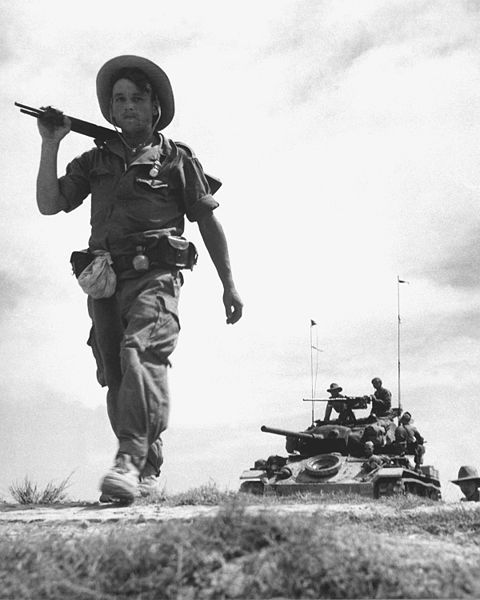
french troops indochinaFrench Troops on the March in Indochina

One author describes Easter 1954: “In all Christendom, in Hanoi Cathedral as in the churches of Europe the first hallelujahs were being sung. At Dienbeinphu, where the men went to confession and communion in little groups, Chaplain Trinquant, who was celebrating Mass in a shelter near the hospital, uttered that cry of liturgical joy with a heart steeped in sadness; it was not victory that was approaching but death.” A battalion commander went to another priest and told him “we are heading toward disaster.” (The Battle of Dienbeinphu, Jules Roy, Carroll and Graf Publishers, New York, 1984 p.239) This can be a terrible burden for the Padre who cares for such men.  Ministry in such places is truly an incarnational experience because there is no place to hide and the chaplain is as vulnerable as his flock.  It is the ministry that places us “in the valley of the shadow of death” where as the Psalmist says we are “to fear no evil for you are with us.” It is the ministry of Good Friday where to all appearances seems that God has abandoned the field and evil has won.

VIETNAM DIEN BIEN PHUFrench Surrender at Dien Bien Phu

Of course one can find examples in American military history such as Bataan, Corregidor, and certain battles of the Korean War to understand that our ministry can bear fruit even in tragic defeat. At Khe Sahn in our Vietnam War we almost experienced a defeat on the order of Dien Bien Phu. It was the tenacity of the Marines and tremendous air-support that kept our forces from being overrun.

legion algeriaLegionaries in Algeria, many French Troops Went from one War in Indochina to another in Algeria only to have the De Gaulle Government throw the Military Victory Away and Cause a Crisis

You probably wonder where I am going with this, back when I first drafted this year and a half ago I wondered too. But here is where I think I am going. We live in difficult of times at home and in Afghanistan.  It home we are mired in an economic crisis clouded by deep political division.  In Afghanistan we are engaged in a hard fight where units we are taking casualties and the mission is being debated.  Sometimes to those deployed and those who returned that their sacrifice is not fully appreciated by a nation absorbed with its own issues.  This of course is not universally true as there a people of all political viewpoints who care for the welfare and attempt to ensure that those who serve are not abandoned as those men who served in Vietnam.  I think that part of the feeling comes from the presentation of the war by the media which tends to focus only on the negative outcomes and not positive things that our soldiers accomplish. That can be discouraging to the men and women on the ground.  One of the most difficult things for me upon my return was to see the bitterness a division in the American people and political establishments and becoming quite depressed about it.   I stopped watching the perpetual news cycle and listening to talk radio.  The hatred, ignorance and crassness of it all was disheartening and I refuse to take any part in something that is so hate filled, power driven and unredemptive.
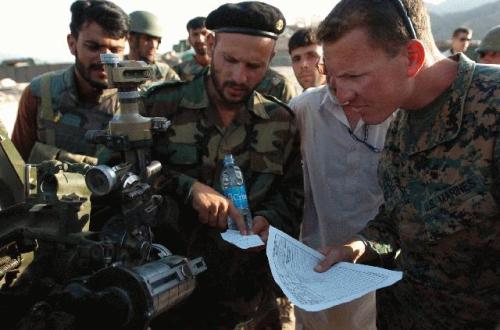
traiining team with afghan armyUSMC Training Team With Afghan Troops

For the French the events and sacrifices of their soldiers during Easter 1954 was page five news in a nation that was more focused on the coming summer. This is very similar to our circumstances today because it often seems that own people are more concerned about economic considerations and the latest in entertainment news than what is going on in Iraq or Afghanistan. The French soldiers in Indo-china were professionals and volunteers, much like our own troops today. Their institutional culture and experience of war was not truly appreciated by their own people.  Nor was it fully appreciated by their government which sent them into a war against an opponent that would sacrifice anything and take as many years as needed to secure their aim.  At the same time their own countrymen were unwilling to make the sacrifices needed to win and in fact had already given up their cause as lost. The sacrifice of French soldiers would be lost on their own people and their experience ignored by the United States when we sent major combat formations to Vietnam in the 1960s. In a way the French professional soldiers of that era have as well as British colonial troops before them have more in common with our force than the citizen soldier heroes of the “Greatest Generation.” Most of the “Greatest Generation” was citizen soldiers who did their service in an epic war and then went home to build a better country as civilians. We are now a professional military fighting unpopular wars and that makes our service just a bit different than those who went before us.  I related to the French troops who fought in Indochina and Algeria as well as our own Vietnam Vets than I do to others.  These is a kinship among us that goes beyond nationality, politics or age.

This is the world in which military chaplains’ minister.  It is a world of volunteers who serve with the highest ideals, men and women who enlist knowing that they will be deployed and quite likely end up in a combat zone. We go where we are sent, even when it is unpopular. It is here that we make our mark; it is here that we serve our Soldiers, Sailors, Marines and Airmen. Our duty is to bring God’s grace, mercy and reconciliation to men and women, and their families who may not see it anywhere else. It is a ministry of reconciliation by the means of incarnation. Many times those outside the military do not understand this. It is a different world full of contradictions and ambiguity.  Such situations even impact the families of those who serve.

When my dad was serving in Vietnam in 1972 I had a Sunday school teacher tell me that he was a “Baby Killer.” It was a Catholic Priest and Navy Chaplain who showed me and my family the love of God when others didn’t. As the country builds to the 2010 mid-term Congressional elections I anticipate that people from all parts of the political spectrum will offer criticism or support to our troops or the war in order to bolster their election chances which do not always coincide with what is in the best interest of the troops or the mission. Chaplains cannot be concerned about the politics nor even the policy as our duty is to be there as Priests, Ministers, Rabbis and Imams for those that we serve. We cannot afford to allow ourselves to be discouraged in caring for our men and women and their families because of all the strife in the body politic.  In addition we must continue on because most churches and other religious communities, even those supportive of our troops really don’t understand the nature of our service or the culture that we represent. We live in a culture where the military professional is in a distinct minority group upholding values of honor, courage, sacrifice and duty which may be foreign or archaic to many Americans, or for those countries with troops and chaplains in Afghanistan or Iraq. We are called to that ministry in victory and if it happens someday, defeat. In such circumstances we must always remain faithful to God as well as to those that we serve.

For those interested in the French campaign in Indo-China it has much to teach us. Good books on the subject include The Last Valley by Martin Windrow, Hell in a Very Small Place by Bernard Fall; The Battle of Dienbeinphu by Jules Roy; and The Battle of Dien Bien Phu- The Battle America Forgot by Howard Simpson. For a history of the whole campaign, read Street Without Joy by Bernard Fall. I always find Fall’s work poignant, he served as a member of the French Resistance in the Second World War and soldier later and then became a journalist covering the Nurnberg Trials and both the French and American wars in Vietnam and was killed by what was then known as a “booby-trap” while covering a platoon of U.S. Marines.

There is a picture that has become quite meaningful to me called the Madonna of Stalingrad. It was drawn by a German chaplain-physician named Kurt Reuber at Stalingrad at Christmas 1942 during that siege. He drew it for the wounded in his field aid station, for most of whom it would be their last Christmas. The priest would die in Soviet captivity and the picture was given to one of the last officers to be evacuated from the doomed garrison. It was drawn on the back of a Soviet map and now hangs in the Kaiser Wilhelm Memorial Church in Berlin where it is displayed with the Cross of Nails from Coventry Cathedral as a symbol of reconciliation. I have had it with me since before I went to Iraq. The words around it say: “Christmas in the Cauldron 1942, Fortress Stalingrad, Light, Life, Love.” I am always touched by it, and it is symbolic of God’s care even in the midst of the worst of war’s suffering and tragedy.

Madonna of StalingradMadonna of Stalingrad

So as you can see I have done a lot of reflecting over the past year and a half. It has been a spiritual journey, an intellectual and academic journey and a personal journey of slowly healing and recovery.  I have gone through some changes in the process which have not been easy, but certainly have deepened my faith even as I struggled and made me much more appreciative of life, love and peace.

I write in order to wrestle with what I have mentioned here, and I try to write something every night. I can full agree with Father Henri Nouwen in his book Beyond the Mirror as to the purpose that writing serves me in my journey.

“These many interruptions calling me ‘beyond’ compelled me to write. First of all, simply because writing seemed to be the only way for me not to lose heart to in the frightening and often devastating interruptions and to hold onto my innermost self while moving from known to unknown places. Writing helped me to remain somewhat focused amid the turmoil and discern the small guiding voice of God’s Spirit in the midst of the cacophony of distracting voices.  But there is a second motivation. Somehow I believed that writing was the one way tom let something of lasting value emerge from the pains and fears of my little, quickly passing life.  Each time life required me to take a new step into unknown spiritual territory, I felt a deep, inner urge to tell my story to others- perhaps as a need for companionship but maybe, too, out of an awareness that my deepest vocation is to be a witness of the glimpses of God I have been allowed to catch.”

pub2Slowly Getting Better

I am healing though it has been at times painful, but faith is returning and I can say that though it has not been easy it has been worth it.  I do hope that what little I do in my work and in my writing will be of help to those who struggle and those who recognize their own need for reconciliation, healing who need to hope again no matter who they are and what their circumstance.

Peace,

Padre Steve+

2 Comments

Filed under Loose thoughts and musings

Alleluia! Memories of Easter…Past and Present

easter-2002-on-hue-cityEaster aboard USS Hue City CG-66 off the Horn of Africa 2002

I find Easter to be an interesting time.  I tend to get reflective and while I do joyfully say “Alleluia! Christ is Risen!” I also tend to be somewhat subdued.  By nature I am reflective person, I like to watch, observe and think.  I am not into big Easter productions and extravaganzas. I prefer much more simple expressions of the Risen Lord.  I think that Jesus would go along with me on this as he spent that first Easter walking with friends, who failed to recognize him, and then breaking bread, he celebrated the first Eucharist after the Resurrection at Emmaus.

For me my most memorable Easters have been connected with my life in the military.  They have almost always been simple affairs, and most involving the liturgy somehow.  I think the first Easter that I remember was at Cubi Point Naval Air Station in the Philippines, it was seeing the Chaplains in their Summer White uniforms that still stands out to me today.  I remember a Easter Sunrise service at Naval Station Long Beach and looking in wonder at two “mothballed” carriers of World War II vintage, the USS Boxer and USS Princeton moored near the site of the service on the waterfront.  When my dad was in Vietnam and we had been made unwelcome in a civilian church, we attended Mass at the Quonset hut that served as the Chapel on the little Naval Communications station.  In my senior year of high school I made a cruise on Navy ships to and from Pearl Harbor Hawaii.  During the week at Pearl I made the trip to the Arizona Memorial on Easter Sunday.  For some reason that experience reverberated as loud as any church service I have ever attended.  When I was a young Army Officer running from God and hiding in the Chapel, the Deity Herself patently used the events of Holy Week to “rend my heart” so to speak.  I left the Good Friday Tenebrea service praying that Easter would come.  Our good Lutheran Chaplain, Lee Rittenbach had driven home the reality of Jesus’ death so well that I really started to understand what the disciples went through.  When Easter came I learned to say “Alleluia! Christ is Risen!”

After that I went through kind of a spiritual desert as far as Easter was concerned.  In seminary I was attending mega-churches which did nothing with Holy week, and made a big evangelical production of Easter, complete with overly loud and insipidly shallow “worship” music and laborious preaching.  I have to say that these big productions were more of an ordeal than a celebration for me.  During seminary we were going through sickness, financial disaster, loss of our home, cars and struggling to survive working multiple jobs while being a full time student.  How we got through seminary I will never understand, other than that the Deity herself provided for us through a lot of wonderful people.  The “happy talk” at church, the prosperity Gospel, focus on signs and wonders seemed to reflect almost a gnostic other worldly view of life that I did not see in the Scriptures.

Academically and from a theological point of view Easter began to rally take shape for me.  Reading the Church Fathers as well reading Dietrich Bonhoeffer’s The Cost of Discipleship, Emil Brunner’s The Scandal of Christianity, Alister McGrath’s The Mystery of the Cross, Hans Kung’s On Being a Christian and Jurgen Moltman’s The Crucified God brought me to greater understanding of the connectedness of Easter to the Incarnation and the Passion.  One of my professors, a kindly gentleman named Yandall Woodfin, made a comment in his Philosophy of Religion class:  “We do not do Christian Theology without coming to grips with the reality of suffering and death.”  That comment was at first offensive to me because my mega-church pastors all focused on the Resurrection.  Death to them seemed to be a bother. One pastor said in a sermon how he did not do visits to the sick.  When asked by someone how sick they had to be for him to see them, he stated “You don’t want to be that sick.”

However, what Dr. Woodfin said planted a seed in me.  This went from an academic question, to daily reality during my Clinical Pastoral Education Residency at Parkland hospital.  Doing various Holy Week services there, in the midst of the amazing amount of pain, suffering and death in that gargantuan Medical Center brought into focus and made real what Dr. Woodfin said.  At Parkland there was no avoiding death or suffering, and what Dr. Woodfin said was right.  We don’t begin to do Christian theology until we we deal with suffering and death.  Easter and the Resurrection don’t happen without the Incarnation and Passion of Jesus.  Easter disconnected from the reality of suffering and death is nothing more than a “happy thought” or escape that avoids the the great Mystery of Faith: Christ has died. Christ is Risen. Christ will come again.

After Parkland my understanding of Easter grew as I was immersed in the liturgy, began to observe the liturgical year, and occasionally “clandestinely” attend Anglican churches during Christmas and Easter. During this time Judy became Roman Catholic, something that accelerated what was already going on in me.  During my formation process and following my ordination to first the Deaconate and then the Priesthood, the understanding deepened as I saw how the Gospel in Word and Sacrament. As an Army Reserve chaplain serving on active duty I experienced the life of a parish pastor at a small base in central Pennsylvania.  There I saw how the how the liturgical year and life are so intimately connect.  In life and death, in sorrow and joy, in good times and bad, the Holy Spirit touched people.

Easter became even more part of my life when I became a Navy Chaplain and left the Army in the “rear view mirror.”  Here I began to see how wonderful Easter is when you do not have all the “smells and bells” “praise teams” or great music or facilities.  It goes back to simplicity.  On Easter Sunday 2001, I was on the USS Frederick, LST 1184 with my Marines going from Korea back to Okinawa.  It was on Frederick 23 years before that I had first felt the call to be a Navy Chaplain during the trip to Pearl Harbor.  In 2002 I was deployed on USS Hue City CG-66 at the beginning of Operation Enduring Freedom. Off the Horn of Africa we had both sunrise services as well as a morning Eucharist on our flight deck. While with the Marine Security Forces I spent an Easter celebrating Eucharist on the fence-line adjoining Communist Cuba.  I now have come back to critical care hospital ministry in my ICUs.  Here we live Good Friday every day.  For me Easter is not just a nice thing to observe, but a necessity in life.

This morning I attended the early Mass with Judy at Ascension Catholic Church.  I love the church, though it is a bit big and busy for me now after Iraq.  So I found me a corner near the choir where I could sit with my back against the wall, an emergency exit to my left, and where I could observe what was going on.  Yes I was having a PTSD moment, but I got through it with the help of the Deity herself and a little ant-anxiety medication.  But the really cool thing was seeing a man who was one of our patients on the ICU a couple of months back.  A man who almost died on us several times, and his wife.  We had grown close during that 2 1/2 weeks and he made it through.  He looked great this morning.  We all hugged and talked of how good God is before Mass, exchanged the Peace and then spent some time together after Mass. That was really cool.  What a way to celebrate Easter.

Life and death, pain and suffering, healing and resurrection.  Alleluia, Christ is Risen. The Lord is Risen indeed. Alleluia!

Peace, Steve+

Leave a comment

Filed under Loose thoughts and musings, Military, Religion

The Long Good Friday

Lent is over and today is Good Friday and I have the duty at the Medical Center that I work at.  Yesterday I celebrated a Maundy Thursday Liturgy here, and today we had our Good Friday service.  Since I am a Priest, but in a more Anglo-Catholic type church, I get to do the “Protestant” services.  Both Maundy Thursday and Good Friday were very meaningful to me this year.  It is the first time in a long time that I have had chapel responsibilities during Holy Week and good for me to be able to share in those sacramental acts. I make sure that like Bishop Blackie Ryan, that I look at the person receiving the sacrament and give them a smile.  It may be one of the few good things that happens to them during the day or week.

In my previous posts about surviving Lent I noted how that I was going to try to be happy.  I altered a few things to do this and found that instead of being an ordeal like past years that this Lent was not too bad.  In fact with the exception of stuff that was PTSD related this was a pretty good Lent.  I actually think that I had some spiritual growth.  Kind of way cool that the Deity Herself would give that grace to me this year.

Getting back to today, Good Friday.  For some people Good Friday is simply another day, even for those that observe it.  It comes and goes, just a speed bump on the way to Easter so we can all get happy.  But those for those who live in my world, that of the Intensive Care Unit and Pediatric Intensive Care Unit, Good Friday is a year round event.

How is that so?  Well since you asked, let me tell you.  Here we live in the constant shadow of life and death.  We have flesh and blood people who suffer.  People who find out suddenly that they have an illness that will kill them. They are people who face their own mortality in what often is a long and painful ordeal.  Sometimes they face this alone and even if they have friends and family present may still feel very much alone.  In fact, they may even feel God Forsaken.  The cry of Jesus uttered from the Cross can be their own.  “My God, my God, why have you forsaken me?”   For some this is an incredible burden, the pain which is not simple physical, but spiritual and emotional as well.   Here at our medical center, and thousands of others, we live at the intersection of life, death and eternal life.

Today has been a busy day already, multiple calls and visits with people going through various ordeals, both patients and staff. We have a number of people on our wards who may be with Jesus by Easter Sunday. Many I have gotten to know over multiple stays here.

There are those also who spend this Good Friday like Jesus’ mother, and the others gathered with her at the foot of the Cross. These are the families and friends who can do nothing more than watch and pray, comforting their loved one and each other.  There are those who patiently and lovingly care for people, the doctors, nurses, Corpsmen and technicians all hours of the day.  There are some who think that medical professionals have an easy life.  Some may, but those that I know do not.  They are in a combat zone without the bullets knowing that every day that they come in to work that there is a good possibility of dealing with death, and certainly with the pain and suffering of those who feel forsaken.

Among the crisis there was the homecoming of a number of our Corpsmen returning from Iraq. There are babies being born and people getting well.

At the same time there is joy.  There are those rays of hope where somehow beyond all expectation someone recovers. There are the patients who despite their suffering constantly look out for other patients and the staff.  They have overcome by reaching out to care for others, and they radiate joy.    There is also joy in seeing someone have a “good Christian death.”  You know, the kind like the movies, where the dying person knows it is there time, gathers the family and friends around and gives them his or her blessing, shares stories, laughter and tears at the same time and when everyone is done, the Priest says a prayer, maybe the person is anointed, the Our Father is said and the person passes to the next world.

Today in the Good Friday Liturgy I had a short homily.  And it focused on this understanding that God is with us.  That God who entered time and space in the Incarnation is with us in life and in death.  Good Friday is they way that God puts flesh to the words of the  23rd Psalm, “even though I walk though the valley of the shadow of death, I will fear no evil for you are with me.”  Jesus enduring this death, is not a God who is distant or uncaring.  He knows what it is to not only feel, but to be God Forsaken.  The Cross is that portal by which we know God, the portal by which we come to know the mystery of the Trinity, the place where a simple Roman Officer, a Centurion gets what almost no one else gets. “Surely, this is the Son of God.”

Here at the hospital I will walk the halls, and spend my time in my ICUs, watching and waiting throughout the night.  For many here, this Good Friday will not end tonight, but Easter will come.

Well I have eaten my pea soup and bread, taken my short break and time to get back out on the floor. Pray for all who labor tonight in hospitals, those who care for the sick and dying, those who deliver babies, those who maintain vigils in ICUs and await crisis in Emergency Rooms.

On Monday I’ll be doing the memorial service for a young 4th year medical student who was killed in a motorbike accident this week.  He was just weeks from graduating and entering our Surgical internship program.  He was a good officer and promising physician.  Pray for me a sinner.

Peace, Steve+

4 Comments

Filed under Religion

Holy Week Superstitions

Holy Week is a funny thing for me.  While I generally look forward to Easter, I always have a sense of foreboding.  I think this actually goes back to childhood.  Family members dying around the time, major events and crisis’s that unfold.  My dad was in Vietnam during Easter 1972 when the North Vietnamese launched their offensive.  So I guess that I’m somewhat superstitious. This week a dear friend lost her father to cancer.  My own parents are not in great shape. My dad lost 7 pounds this month and weighs under 120 pounds.  He is doing worse and worse.

I was talking with one of our attendings today who reminded one of the nurses what weekend was coming up.  She asked why, and he said, think about it, something bad almost always happens around Easter. I patently concurred with the good doctor. My experience in other hospitals always involved really tragic events. It seems that something tragic always happens, a mass murder, a series of tornadoes that wipe out whole towns, fires that kill families, Tsunamis and other events.  This week there has been a killer earthquake in Italy.  I am not alone in the way that I feel. Snopes.com even has a page devoted to Easter superstitions.

So with a twinge of anxiety I face this week.  I do look forward to what this week means. Maunday Thursday, Good Friday and Easter.  I will celebrate each, but at the same time I feel strange. I hope that this is just a bit of PTSD and nothing more.  May everyone experience the joy that Easter  should bring and I pray that no disasters overtake anyone this year. Peace, Steve+

Leave a comment

Filed under Loose thoughts and musings, PTSD, Religion