Tag Archives: historical ignorance

Integrity, Truthfulness, Purity, and Singleness of Purpose: Winfield Scott Hancock and what the United States Needs Today

hancock


Friends of Padre Steve’s World,

I visit Gettysburg a lot and I also write about it a lot. When I make those visits I am always humbled and learn something new. I only wish that most Americans and our leaders of both political parties as well as most media types and pundits could grasp what I experience on each visit to the “hallowed ground” of Gettysburg.

Quite honestly I do not think that the vast majority Americans regardless of their party affiliation or ideology  understand, appreciate or value in the slightest the sacrifices of the men who fought and in many cases died to preserve the Union at Gettysburg. Even among those who do I think that the object of their appreciation are the military aspects of the battle often taken in isolation, not the profound strategic dimensions of what this battle as well as the fall of Vicksburg in the west at the same time had on the war.

Nor do I think that they appreciate the massive political, ideological and social effects bought about by those Union victories in ending the war and how those effects redound to us today. This is especially true of the pundits, politicians and preachers, the “Trinity of Evil” as I call them whose shrill voices urge on divisions between our people; including some that call out for violence to maintain their groups social, economic or religious advantages over others. Quite a few even lament the fall of the South and the institution including the washed up rock and roll musician of the political right Ted Nugent who wrote in the Washington Times in July 2012: “I’m beginning to wonder if it would have been best had the South won the Civil War.” More recently when President Trump talked of the moral equivalence of the opposing sides at Charlottesville I was reminded of just how hateful and morally bankrupt such feelings are, I am sure that General Hancock would be appalled that an American President would make that kind of stand.

All of that concerns me as an American and a historian; because I realize how dangerous such historical ignorance and visceral propaganda is in the life of any nation. Thus when I go to Gettysburg, or for that matter any other battlefield of our American Civil War the sacrifices of those men and what they fought to maintain are again imprinted on my heart.

Abraham Lincoln eloquently noted about those soldiers who fought to turn back the Confederate tide at Gettysburg in his Gettysburg Address:

“But, in a larger sense, we can not dedicate — we can not consecrate — we can not hallow — this ground. The brave men, living and dead, who struggled here, have consecrated it, far above our poor power to add or detract. The world will little note, nor long remember what we say here, but it can never forget what they did here. It is for us the living, rather, to be dedicated here to the unfinished work which they who fought here have thus far so nobly advanced. It is rather for us to be here dedicated to the great task remaining before us — that from these honored dead we take increased devotion to that cause for which they gave the last full measure of devotion — that we here highly resolve that these dead shall not have died in vain — that this nation, under God, shall have a new birth of freedom — and that government of the people, by the people, for the people, shall not perish from the earth.”

While I am an idealist I am also a pragmatist. I respect the right of others, even those that disagree with things that I very much believe in and support. Like it or not the keystone of our governmental system is one of compromise. That being said having relatives that fought on both sides of the American Civil War that I am not a sectionalist. Nor am I a person that attempts to use the political system to ensure that others have to follow my religious beliefs or to enrich certain groups. The democracy that is part of our republic’s system of government is not a perfect system by any means. In fact as the great English Prime Minister Winston Churchill noted “democracy was the worst form of government except for all the others.”

Thus I appreciate military men who maintain their oath to the nation in times of great conflict not abandoning it to support causes that they know are wrong because the people of their state, or interest group seek to divide that Union. Winfield Scott Hancock was one of those kind of men, as was George Meade, and John Buford, all of whom played key roles in defeating the Confederates at Gettysburg.

Hancock, who earned the title “Hancock the Superb” was the commander of the Union Second Corps at Gettysburg. Upon the death of John Reynolds early on the first day of battle Hancock was appointed by George Meade as commander of the Federal Left Wing, in effect becoming Meade’s deputy commander for the rest of the battle. He was seriously wounded as Pickett’s Charge came to its bloody end at “the Angle” even as his dear friend Confederate General Lewis Armistead lay mortally wounded a few hundred yards away.

Hancock is an interesting character. He was from Pennsylvania but was a Democrat. He was not a Republican like Lincoln. Hancock was not a political ideologue but was since he was a Democrat he was suspect by leaders in the party establishments of both parties; Republicans for being a Democrat, and Democrats for serving under Lincoln. As such he never was given independent command of an Army but remained the beloved commander of the Union Second Corps.

As the nation split and friends went their separate ways Hancock gave some advice to his best friend, Lewis Armistead and their commander, Brigadier General Albert Sidney Johnston who were preparing to leave the Union in early 1861. In response to the states rights arguments of his friends he made himself clear. He fully believed in the principal of states rights, but he could not compromise his faithfulness to the Union. He told his friends as they departed company on their way to their destinies during the Civil War:

“I shall not fight upon the principle of state-rights, but for the Union, whole and undivided.” 

During the war Hancock served with distinction. At Gettysburg he was influential in determining the choice of the Union defense, in helping to repel the Rebel attacks on July 2nd 1863 and the final repulse of Pickett’s Charge where he was severely wounded and his friend Armistead died. After he recovered from his wounds he continued to lead Second Corps until the end of the war. Ulysses Grant wrote of him:

“Hancock stands the most conspicuous figure of all the general officers who did not exercise a separate command. He commanded a corps longer than any other one, and his name was never mentioned as having committed in battle a blunder for which he was responsible. He was a man of very conspicuous personal appearance…. His genial disposition made him friends, and his personal courage and his presence with his command in the thickest of the fight won for him the confidence of troops serving under him. No matter how hard the fight, the 2d corps always felt that their commander was looking after them.”

After the war Hancock supervised the execution of those convicted of the assassination of Abraham Lincoln. Following that duty he served in various postings in the occupied South and attempted to mitigate some of the actions of those bent on vengeance against African Americans as well as others who tried to exploit the defeated Confederates for political or economic gain. His balanced attempt at justice was not appreciated by many people in the North or the South.

In 1880 Hancock ran for President and lost a narrow election to James A. Garfield. After his unsuccessful campaign he returned to the Army and died at the age of 61 in 1886 at his headquarters from complications from diabetes.

In death was praised by political supporters and opponents alike. Former President Rutherford B. Hayes wrote:

“if when we make up our estimate of a public man, conspicuous both as a soldier and in civil life, we are to think first and chiefly of his manhood, his integrity, his purity, his singleness of purpose, and his unselfish devotion to duty, we can truthfully say of Hancock that he was through and through pure gold.” 

Another political opponent Republican General Francis A. Walker lamented not supporting Hancock in 1880 after the great corruption that engulfed the country during “Gilded Age” of the “Robber Barons” the 1880s. Walker wrote in 1893:

“Although I did not vote for General Hancock, I am strongly disposed to believe that one of the best things the nation has lost in recent years has been the example and the influence of that chivalric, stately, and splendid gentleman in the White House. Perhaps much which both parties now recognize as having been unfortunate and mischievous during the past thirteen years would have been avoided had General Hancock been elected.”
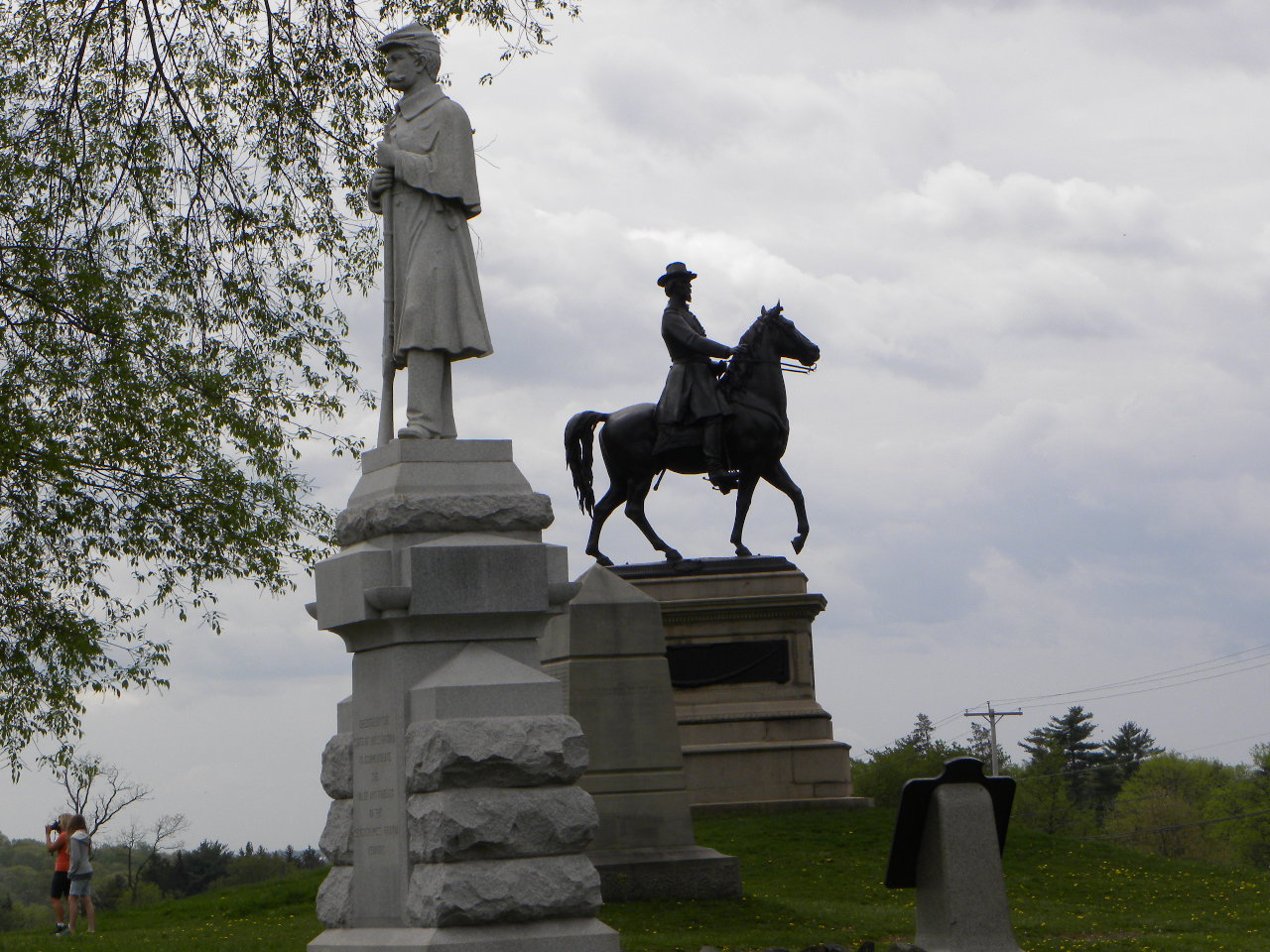
DSCN9741

I have stood by the monument to this fine man on East Cemetery Hill at Gettysburg many times. Each time I am struck by the bravery, courage and integrity of that remarkable man. Regardless of party affiliation I wish that we had more leaders like him today.

Peace

Padre Steve+
1 Comment

Filed under civil war, Gettysburg, History, Military, Political Commentary

The Misunderstanding of the Present and the Ignorance of the Past

Friends of Padre Steve’s World,

Since things are going to be busy I am going to post this short little article. I am amazed at the intellectual laziness of President Trump and much of his administration. As I have noted before I have never seen an administration more ignorant of history than this one. That stems from the top. Our President is not an intellectual by any means, but this could be excused if he was not intellectually lazy and apparently not interested in learning anything new that does not already fit into his rather limited world view. It is obvious based on his Twitter feed that he spends hours a day watching Fox News rather than consulting with key advisers, studying policy, and attempting to understand foreign affairs, or anything else related to the being the President. His quip during the run up to the healthcare debacle “Nobody knew healthcare could be so complicated,” sums up the man.

Besides his deep unrelenting narcissism, his paranoid and conspiracy filled worldview, his propensity to be untruthful even in small things, his lack of intellectual curiosity, his lack of interest in day to day policy, and his unwillingness to learn either from his mistakes or the mistakes of others is dangerous and unforgivable. As Benjamin Franklin said: “Being ignorant is not so much a shame, as being unwilling to learn.” Sadly our President has not shown a wiliness to learn.

French historian Marc Bloch, who died fighting for the resistance in Nazi occupied France noted that: “Misunderstanding of the present is the inevitable consequence of ignorance of the past…

This is nothing new, Isaac Asimov noted that “There is a cult of ignorance in the United States, and there has always been. The strain of anti-intellectualism has been a constant thread winding its way through our political and cultural life, nurtured by the false notion that democracy means that ‘my ignorance is just as good as your knowledge.” Despite the high bar set by our Founders, who were men of the Enlightenment who believed in reason and seeking truth for truth’s sake, we have a terrible record in our practice, and we are observing the dreadful results every day.

The understanding of the past and the ability to relate it to the present, or have advisors who can, is sine qua non, or an indispensable and essential part of being the President. History does not suffer fools gladly, and for nations, the price of willful ignorance by their leaders is always high, and often fatal.

With that I wish you a good day,

Peace

Padre Steve+

1 Comment

Filed under History, News and current events, philosophy, Political Commentary

“The Grave Dangers in Meeting Fanaticism with Ignorance…”

Friends of Padre Steve’s World,

Earlier in the week I discussed the moral implications of the President’s budget and talked about President Eisenhower’s Chance for Peace Speech of 1953. As I thought about it I began to ponder other things that President Eisenhower discussed that are still with us. One of those is the constant need for some people in government, in the media, and in the pulpit to find a scapegoat for the nation’s problems, both real, and imagined.

This is nothing new so as I watch the actions of some in the Trump Administration, and in the media today behaving in such a manner, it causes me pause and think. I am concerned with the way that American Muslims, and Americans of Arabic descent, even Christians, are being treated in response to real terrorist threats that are being perpetrated by some Islamic terrorist groups. Frankly, the heavy handed treatment of American citizens of the Islamic faith, or those who happen to be from, or who descent from Arab immigrants. I believe that the climate of suspicion and fear being promoted by people in the administration, members of Congress, and the media, especially the Right Wing media is something that hearkens back to a time not that long ago when other Americans were persecuted under a flood of allegations, many untrue and unfounded, by Senator Joseph McCarthy, and the House Committee on Un-American Activities (HUAC).

President Dwight D. Eisenhower wrote a letter on intellectual freedom to the President of the American Library Association in June of 1953. It was barely five months after he entered office, the Cold War was heating up, and anti-Communist politicians were advocating policies which were in effect anti-American. Senator Joseph McCarthy was conducting hearings which were akin to witch hunts to ferret out alleged Communist infiltrators and sympathizers in government, while the House Committee on Un-American Activities (HUAC) conducted investigations of media, entertainment, and academia blacklisting hundreds of people. McCarthy labeled many Democrats as well as the incoming Eisenhower administration as traitors for allegedly being soft on Communism, or even worse actively supporting the Communists.

Throughout his Presidency, Eisenhower never tired of speaking out for freedom of thought and expression. One of his first actions was in writing his letter on intellectual freedom. In the letter he opposed the kind of thinking that would meet real dangers with ignorance. He noted:

Our librarians serve the precious liberties of our nation: freedom of inquiry, freedom of the spoken and the written word, freedom of exchange of ideas.

Upon these clear principles, democracy depends for its very life, for they are the great sources of knowledge and enlightenment. And knowledge–full, unfettered knowledge of its own heritage, of freedom’s enemies, of the whole world of men and ideas–this knowledge is a free people’s surest strength.

The converse is just as surely true. A democracy smugly disdainful of new ideas would be a sick democracy. A democracy chronically fearful of new ideas would be a dying democracy.

For all these reasons, we must in these times be intelligently alert not only to the fanatic cunning of Communist conspiracy– but also to the grave dangers in meeting fanaticism with ignorance. For, in order to fight totalitarians who exploit the ways of freedom to serve their own ends, there are some zealots who-with more wrath than wisdom–would adopt a strangely unintelligent course. They would try to defend freedom by denying freedom’s friends the opportunity of studying Communism in its entirety–its plausibilities, its falsities, its weaknesses…

In the letter also noted something that I believe that we are in danger of today as the administration and Congress debate and implement measures that seem to target people because of their race or religion. Those are methods of totalitarians past and present. We have seen the results. President Eisenhower had just led the Allied forces in Europe against a regime that employed those methods, methods which brought about the deliberate, premeditates slaughter of millions of Jews, and others deemed to be either less than human, different, or potentially dangerous. Eisenhower wrote:

“But we know that freedom cannot be served by the devices of the tyrant. As it is an ancient truth that freedom cannot be legislated into existence, so it is no less obvious that freedom cannot be censored into existence. And any who act as if freedoms defenses are to be found in suppression and suspicion and fear confess a doctrine that is alien to America.”

It is something to think about any time that anyone, be they a political leader, a religious leader, an academic, a journalist, or entertainer suggests adopting the methods of totalitarians against real or imagined threats. Policies and actions born of ignorance, and implemented through arrogance which promotes suspicion, suppression and fear will destroy the United States more certainly than any external enemy. As Abraham Lincoln said, “America will never be destroyed from the outside. If we falter and lose our freedoms, it will be because we destroyed ourselves.” 

It is something to think about.

Have a great Day,

Peace

Padre Steve+

2 Comments

Filed under History, News and current events, Political Commentary

“Integrity, Purity Unselfish Devotion to Duty” Reflections on Winfield Scott Hancock after another Gettysburg Staff Ride

hancock

“I shall not fight upon the principle of state-rights, but for the Union, whole and undivided.” Winfield Scott Hancock

I am back home after leading another trip to Gettysburg with a new group of students.

I always come away from Gettysburg with a new appreciation of the sacrifice that was made there by so many Americans. I am always humbled and learn something new. I only wish that most Americans and our leaders of both political parties as well as most media types and pundits could grasp what I experience on each visit to this “hallowed ground.”

Quite honestly I do not think that the vast majority Americans understand, appreciate or value in the slightest the sacrifices of the men who fought and in many cases died to preserve the Union at Gettysburg. Even among those who do I think that the object of their appreciation are the military aspects of the battle often taken in isolation, not the profound strategic dimensions of what this battle as well as the fall of Vicksburg in the west at the same time had on the war.

Nor do they appreciate the massive political, ideological and social effects bought about by those Union victories in ending the war and how those effects redound to us today. This is especially true of the pundits, politicians and preachers, the “Trinity of Evil” as I call them whose shrill voices urge on divisions between our people; including some that call out for violence to maintain their groups social, economic or religious advantages over others. Quite a few even lament the fall of the South and the institution including the washed up rock and roll musician of the political right Ted Nugent who wrote in the Washington Times in July 2012: “I’m beginning to wonder if it would have been best had the South won the Civil War.” 

All of that concerns me as an American and a historian; because I realize how dangerous such historical ignorance and visceral propaganda is in the life of any nation. Thus when I go to Gettysburg, or for that matter any other battlefield of our American Civil War the sacrifices of those men and what they fought to maintain is again imprinted on my heart.

Abraham Lincoln eloquently noted about those soldiers who fought to turn back the Confederate tide at Gettysburg in his Gettysburg Address:

“But, in a larger sense, we can not dedicate — we can not consecrate — we can not hallow — this ground. The brave men, living and dead, who struggled here, have consecrated it, far above our poor power to add or detract. The world will little note, nor long remember what we say here, but it can never forget what they did here. It is for us the living, rather, to be dedicated here to the unfinished work which they who fought here have thus far so nobly advanced. It is rather for us to be here dedicated to the great task remaining before us — that from these honored dead we take increased devotion to that cause for which they gave the last full measure of devotion — that we here highly resolve that these dead shall not have died in vain — that this nation, under God, shall have a new birth of freedom — and that government of the people, by the people, for the people, shall not perish from the earth.”

While I am an idealist I am also a pragmatist. I respect the right of others, even those that disagree with things that I very much believe in and support. Like it or not the keystone of our governmental system is one of compromise. That being said having relatives that fought on both sides of the American Civil War that I am not a sectionalist. Nor am I a person that attempts to use the political system to ensure that others have to follow my religious beliefs or to enrich certain groups. The democracy that is part of our republic’s system of government is not a perfect system by any means. In fact as the great English Prime Minister Winston Churchill noted “democracy was the worst form of government except for all the others.”

Thus I appreciate military men who maintain their oath to the nation in times of great conflict not abandoning it to support causes that they know are wrong because the people of their state, or interest group seek to divide that Union. Winfield Scott Hancock was one of those kind of men, as was George Meade, and John Buford, all of whom played key roles in defeating the Confederates at Gettysburg.

Hancock, who earned the title “Hancock the Superb” was the commander of the Union II Corps at Gettysburg. Upon the death of John Reynolds early on the first day of battle Hancock was appointed by Meade as commander of the Federal Left Wing, in effect becoming Meade’s deputy commander for the rest of the battle. He was seriously wounded as Pickett’s Charge came to its bloody end at “the Angle” and his dear friend Confederate General Lewis Armistead lay mortally wounded a few hundred yards away.

Hancock is an interesting character. He was from Pennsylvania but was a Democrat. He was not a Republican like Lincoln. Hancock was not a political ideologue but was since he was a Democrat he was suspect by some in the party establishments of both parties and never was given independent command.

Hancock gave his advice to Armistead and others who were preparing to leave the Union in early 1861 including Armistead and his commanding officer Brigadier General Albert Sidney Johnston. He made himself clear:

“I shall not fight upon the principle of state-rights, but for the Union, whole and undivided.” 

During the war he served with distinction and Ulysses Grant wrote of him:

“Hancock stands the most conspicuous figure of all the general officers who did not exercise a separate command. He commanded a corps longer than any other one, and his name was never mentioned as having committed in battle a blunder for which he was responsible. He was a man of very conspicuous personal appearance…. His genial disposition made him friends, and his personal courage and his presence with his command in the thickest of the fight won for him the confidence of troops serving under him. No matter how hard the fight, the 2d corps always felt that their commander was looking after them.”

After the war he supervised the execution of those convicted of the assassination of Abraham Lincoln and in various postings in the occupied South attempted to mitigate some of the actions of those bent on vengeance and others who tried to exploit the defeated people of the south for political or economic gain.

Hancock ran for President and lost a narrow election in 1880 to James A. Garfield. After that he returned to the Army and died at the age of 61at his headquarters of complications from diabetes.

He was praised by political opponents. Former President Rutherford B. Hayes wrote:

“if when we make up our estimate of a public man, conspicuous both as a soldier and in civil life, we are to think first and chiefly of his manhood, his integrity, his purity, his singleness of purpose, and his unselfish devotion to duty, we can truthfully say of Hancock that he was through and through pure gold.” 

Another political opponent Republican General Francis A. Walker lamented not supporting Hancock in 1880 after the great corruption that engulfed the country during “Gilded Age” of the “Robber Barons” the 1880s. Walker wrote:

“Although I did not vote for General Hancock, I am strongly disposed to believe that one of the best things the nation has lost in recent years has been the example and the influence of that chivalric, stately, and splendid gentleman in the White House. Perhaps much which both parties now recognize as having been unfortunate and mischievous during the past thirteen years would have been avoided had General Hancock been elected.”

DSCN9741

As I stood at the statue that marks Hancock on Cemetery Hill this weekend I again was struck by the bravery, courage and integrity of that remarkable man.

Peace

Padre Steve+

1 Comment

Filed under civil war, History, Political Commentary