Tag Archives: History

“Read a Lot and Write a Lot” How I Avoid Misery 


Friends of Padre Steve’s World,

British historian Sir Max Hastings, whose book Catastrophe 1914, Europe Goes to War I am re-reading since I just completed another trip through Barbara Tuchman’s The Guns of August, once made the comment: “I would be miserable if I went to bed without having written 1,000 words about something.” I am much the same way and hopefully one day I might be one tenth as good, and as successful writer as him or Tuchman. 

I do most of my writing before I go to bed at night and usually set my articles to post at 6:30 in the morning. I have a hard time going to sleep without writing be it for this website or for one of the books that I am working on. I read voraciously whenever I get the chance sometimes going to a bar just to read a book while enjoying a good craft beer or Germanor Irish import. Likewise once I am done with whatever I am writing I go right back to reading, sometimes keeping whatever Papillon is sleeping with me from getting the sleep that they want. That’s what I will be doing tonight when I finish this article which you will be reading tomorrow when it posts. In a sense my writings are kind of like Schroedinger’s cat, they are written yet unwritten at the same time, but I digress…

Today while on vacation in Huntington, West Virginia, I have been doing a lot of my own reading, as well as keeping up with the latest news about the building crisis regarding North Korea’s nuclear weapons and missiles and President Trump’s unrelenting bellicose tweets and statements. Likewise today I’ve walked about seven and a half miles, much of it around the campus of Marshall University and walking my dogs around the neighborhood that we are staying. As I walk I tend to take in everything I see and because of my PTSD I am still somewhat hyper vigilant which causes me to be a bit more observant about my surroundings than a lot of other people. But I also muse about things going on in the world as well as things that I am writing or plan on writing about. I did a lot of today and over the past few days. The next couple of days won’t be as free because Judy has scheduled us for some social activities, but I will still find a way to in get my reading, writing, and walking. 

But going back to writing and reading I have to say that I don’t know what I would do if I couldn’t do either, I think I would be in some sort of hell if I couldn’t write every night or read. Doing these things helps me keep my perspective and to more fully appreciate the events of the day. Honestly, if I had not consciously immersed myself in history from the time that I was a child, including the many days that I cut 10th grade Geometry class to read the history reference books that I couldn’t check out of the school library I wouldn’t be who I am today. 

I like writing history because I become immersed in the people, the places, and the intricacies and complexity of the events. I like to incorporate the little known back stories of people help understand their actions at a given point. Likewise think that the lives of the individuals involved in the events I write about, both before, and after the event should they have lived through it, give my readers a more human connection to the events, as well as understanding of the people involved. I find that the stories of people allow readers to make those connections, maybe even inspiring in them a bit of sympathy for scoundrels or suspicion of supposed saints. 

I think that the character of people, good, bad, or wherever it falls on the spectrum, and their basic humanity; their strengths, weaknesses, contradictions, and their feet of clay, matter immensely and need to be part a of the story. I hate it when I read a history where a given character’s actions during a given event are examined in detail, but who they are as a person never comes through because the authors didn’t give their readers the courtesy of introducing them as people because they included little or no biographical details to make them interesting. Instead they become one dimensional caricatures of who they were in life, which in my view does them, the story, and the reader a grave injustice. So when I write I try to find interesting parts of a person’s life that is not directly related to the event to paint the picture. Walter Lord, who wrote prolific books on some of the key events of the Twentieth Century including books about the Titanic, Pearl Harbor, Midway, Dunkirk, the desegregation of the University of Mississippi, and many more noted something that I have taken to heart, I look for something that is highly unusual, involving ordinary people caught in extraordinary situations.”

That’s one reason I like the writings of both Tuchman and Hastings, they bring life to to the events they write about, they allow your imagination to run and to want discover more about the people and the events. The late Walter Lord, who I also mentioned was also excellent at doing that, and I think that is how I would like my writings be remembered. But in order to do that I have to read and write, as Stephen King said “If you want to be a writer, you must do two things above all others: read a lot and write a lot.” So back to Hastings’ Catastrophe 1914.

Until tomorrow,

Peace

Padre Steve+

1 Comment

Filed under History, Loose thoughts and musings, philosophy

Books: The Window to My Soul


Friends of Padre Steve’s World,

George R.R. Martin wrote in his book A Dance With Dragons:  “A reader lives a thousand lives before he dies, said Jojen. The man who never reads lives only one.”

I constantly read and because I try to imagine what I am reading so that in a way I live it. I have been to places that have never traveled to before and on entering them I know exactly where everything is and what happened there. I remember leading a group from my Army chapel in Wurzburg Germany to Wittenberg, where Martin Luther began the Protestant Reformation. As I lef d the group through the town a couple of people asked me how many times I had been there. I told them, “physically, never until today, but I have been here a thousand times before because of books. I saw Wittenberg in my minds eye before I ever saw the city.” They were surprised and both said that it seemed like I had been there many times. 

I have had the same thing happen other places that I have visited, and again, it is because I read, and as I read, I imagine and occasionally dream. 

I have a huge number of my books in my office most dealing with the history, especially the American Civil War and Reconstruction, the World Wars, and the insurgencies and counter-insurgency wars of the past seventy or so years. I have a lot of biographies, books on American history, military theory, sociology, philosophy, psychology related to war and PTSD, and a few theological works, though most of my theology books are at home because I don’t have room for them in the office. 

Coupled with mementos of my military career, other militaria, artwork, and baseball memorabilia the sight and smell can be both overwhelming and comforting at the same time. I hear that a lot from my visitors, including those who come in for counseling, consolation, or just to know someone cares. They tell my visitors volumes about me without them ever asking a question or me telling them, and occasionally someone will ask to borrow a book, and most of the time I will lend them the book, or if I have multiple copies even give it to them. 

In a sense my books are kind of a window to my soul, the topics, and even how I have them organized, and they are not for decoration. Many times while I am reflecting on a topic, a conversation, or something that I read in the news I peruse my books and pull one or more out to help me better understand it, or relate it to history. 

Likewise my memorabilia is there to remind me of all the people in my past who I have served with. I don’t have all my medals, honors, and diplomas up for everyone to see, instead I have pictures and collages, many signed by people who made a difference in my life. When I see the signatures and often all too kind words on them I am humbled, and in some cases a tear will come to my eye, but I digress…

I always try to read a decent amount everyday. I in the past couple of weeks I have finished reading a number of very good books dealing with different historical dramas. I read Stephen Sears’s Lincoln’s Lieutenants which deals with the high command of the Army of the Potomac during the American Civil War. Sears is a great historian and I really enjoyed the book even when I had a different evaluation of several of the men that he wrote about, but that is one of the fascinating things about history. Historians can evaluate the same literature and come to different conclusions about people or events. In my case with Sears it was with his evaluation of people, not his conclusions about different battles. 

I love complex characters, people who may be heroes and at the same time scoundrels. I like the contradictions and the feet of clay of people, because I am filled with my own, and truthfully saints are pretty boring. 

I also finished Mark Bowden’s new book about the Battle of Hue, Hue 1968: A Turning Point in America’s War in Vietnam. This was a fascinating read for me because I have read other book about the subject and know a decent number of men who fought in that battle. It too is well worth the read.  Before that I read James Robertson’s After the Civil War: The Heroes, Villans, Soldiers and Civilians Who Changed America. This is a good wavetop biographical history of many of the people whose lives were impacted by the war, and who through their heroism or cowardice on the battlefield or off, moral courage or failure, and contributions they made to science, literature, politics, social justice, industry, technology, military art and science were important in making the country that we know. As with Sears’s work I didn’t always agree with his conclusions about certain people, but it is worth the read for anyone desiring to know a bit about a wide range of characters. 

With this being the anniversary of the beginning of the First World War I have decided to re-read Barbara Tuchman’s The Guns of August and Max Hastings’ Catastrophe 1914: Europe Goes to War. I figure that both are good reads with which to reflect on what is happening in our world today, and wondering if world leaders will allow hubris, arrogance, greed, and pride to drag the world into another catastrophic war. Sadly the American President doesn’t read and doesn’t learn from history and for that matter his ignorance is very much a reflection of our culture. 

But books are important, far more important than anything that is shouted at you from the television. Barbara Tuchman wrote:

“Books are the carriers of civilization. Without books, history is silent, literature dumb, science crippled, thought and speculation at a standstill. Without books, the development of civilization would have been impossible. They are engines of change (as the poet said), windows on the world and lighthouses erected in the sea of time. They are companions, teachers, magicians, bankers of the treasures of the mind. Books are humanity in print.”

But anyway, I was late getting this out. So have a great day and a better tomorrow.
Peace

Padre Steve+

1 Comment

Filed under History, Loose thoughts and musings, philosophy

The Kaleidoscopic Combinations of the Pictured Present


Friends of Padre Steve’s World,

I am trying to place what is going on in the Trump White House, the country, and the world in some frame of reference for some time now. There are many historical parallels to draw from and make analogies, but like all analogies they tend to break down at some point, none are perfect, but some tend to resonate more than others. Mark Twain wrote“History never repeats itself, but the Kaleidoscopic combinations of the pictured present often seem to be constructed out of the broken fragments of antique legends.” 

In the Trump world I see fragments of the worlds of Richard Nixon, of Kaiser Wilhelm II, King Leopold of Belgium, Adolf Hitler, and Pierre Laval; of of the Robber Barons, the owners of the Titanic, and other leaders going back to antiquity. I have written about some of those parallels, even recently; however the past few days of turmoil have caused me to step back a bit as I try to find the right manner in which to write about them. 

Marcus Tillius Cicero wrote something that in the midst of the self-inflicted chaos of the Trump administration that we should try to heed right now. I wish that the President would stop for a brief moment to ponder before he does something incredibly rash that leads him and the nation to disaster. Cicero wrote: “To be ignorant of what occurred before you were born is to remain always a child. For what is the worth of human life, unless it is woven into the life of our ancestors by the records of history?”

So I am reading and researching and trying to make sense of the madness that we are all witnesses to, and if we do not speak out complicit in.  

Until tomorrow,

Peace 

Padre Steve+eee

Leave a comment

Filed under History, Loose thoughts and musings, Political Commentary

Trump and “Total Solutions” 


Friends of Padre Steve’s World,

On this day in 1941 it appeared to Hitler and his henchmen that the Wehrmacht would soon defeat Stalin’s Red Army and Complete Hitler’s conquest of the European continent. In the cold blooded calculations of the Nazis it was time to begin the planning to settle their accounts with the Jews. On that day, seventy-six years ago Herman Goering, acting on the orders of Adolf Hilter sent the following order to Reinhard Heydrich, the head of Himmler’s Sicherheitsdienst and the Reichssicherheitshauptamt or Reichs Security Main Office: 

Berlin, July 31st 1941

To: Gruppenfuhrer Heydrich

Supplementing the task assigned to you by the decree of January 24th 1939, to solve the Jewish problem by means of evacuation and emigration in the best possible way by according to present conditions, I hereby charge you to carry out preparations as regards organizational, financial, and material matters for a total solution (Gesamtlosung) of the Jewish question in all the territories of Europe under German occupation.

Where the competency of other organizations touches on this matter, the organizations are to collaborate. 

I charge you further to submit to me as soon as possible a general plan of the administrative material and financial measures necessary for the carrying out the desired final solution (Endlosung) of the Jewish question.”

Goering

That order set the stage for the completion of a program of mass killing that had already began as Heydrich’s Einsatzgruppen followed the Wehrmacht into the Soviet Union killing hundreds of thousands of Jews up close and personal. The order would eventually form the basis of the final solution which would be fully implemented as policy after the Wansee Conference of January 20th 1942 and Heydrich’s killing by Czech commandos not long afterward. During that time men who had previously unblemished records of service sacrificed their sacred honor to carry out Hitler’s decrees, while many more remained as silent witnesses of their evil deeds. 

The German program of genocide was replicated by Stalin against Jews and other non-Russians of the Societ Union, without the Nazi’s racial bloodlust. 

Timothy Snyder in his book Bloodlands: Europe Between Hitler and Stalin wrote something that we should be concerned with today as Donald Trump and Vladimir Putin each work to secure their greatness on the lives of others deemed to be their enemies: 

“Dead human beings provided retrospective arguments for the rectitude of policy. Hitler and Stalin thus shared a certain politics of tyranny: they brought about catastrophes, blamed the enemy of their choice, and then used the death of millions to make the case that their policies were necessary or desirable. Each of them had a transformative utopia, a group to be blamed when its realization proved impossible, and then a policy of mass murder that could be proclaimed as a kind of ersatz victory.”

So far only Putin has used a policy of mass murder to achieve his goals, but if actions follow words, then President Trump will not be far behind his Russian tutor in tyranny. The President has already named who he blames for his failures: liberals, Democrats, blacks, LGBTQ people, Mexican and other Hispanic immigrants, Muslims, women, the news media, educators, scientists, and more recently the former GOP mainstream headed by Senators John McCain, Susan Collins, Lisa, Murkowski, and his former chief of staff Reince Priebus. 

In the past few days I know of a number of politically liberal military officers, all junior chaplains, whose conservative chaplain superiors are threatening their careers and freedom to voice their faith online, simply because they and their churches stand against Trump’s latest attack on transgender military personnel. This, despite the fact that the Chairman of the Joint Chiefs has said that as of now there is no change in policy towards transgender personnel and the fact that chaplains may faithfully stand by and proclaim their churches or religions teachings, even if they conflict with the views of those in power. 

My question is simple: If the President continues threatening American citizens, will he finally decide that his opponents need to be liquidated to achieve his goals? In light of the President’s words and tirades against his opponents, which grow increasingly more violent on a daily basis, this is a fair, if still hypothetical question. But even so, since he, and many of his supporters openly speak of using violence against their opposition, and voice their admiration for Putin, Turkey’s Erdogin, and other dictators, it must be asked especially when a Fox News host, Jesse Watters, even said “A lot of people wish President Trump was a dictator…” 

A dictator? If I recall correctly our founders warned of us of this day as they debated the Constitution and Bill of Rights.

I just wonder, if the President were to give such orders, just who in his administration or among its allies will be the modern Goering and Heydrich? Who will be the men, or women, who given the chance would order, coordinate, and maybe even kill for the President to set the stage whatever final solution he is attempting to achieve. I wonder who will write the order after Trump tweets it, and who will sell their souls to execute it. Honestly, I don’t know who will eventually do that. All I know is that I take my lead from General Ludwig Beck who resigned his office rather than lead an invasion of Czechoslovakia in 1938 and who gave up his life in the attempt to overthrow Hitler in July of 1944: 

“It is a lack of character and insight, when a soldier in high command sees his duty and mission only in the context of his military orders without realizing that the highest responsibility is to the people of his country.” 

I do hope others will do the same if the President issues orders that are illegal, unconstitutional, or go against American values or international law. There was a time that I could not imagine that happening, but with every passing day of the Trump presidency I become less sure of that. 

Likewise, I wonder who will get the blame for the catastrophes unleashed by our President, but based on his past actions and current words, there is one person that will not accept any blame, and that is the President. He never has in done so in any private, public, or political venue. 

So in the midst of this I am reminded of the words of Dietrich Bonhoeffer, and I must ask the question he did: 

“We have been silent witnesses of evil deeds; we have been drenched by many storms; we have learnt the arts of equivocation and pretence; experience has made us suspicious of others and kept us from being truthful and open; intolerable conflicts have worn us down and even made us cynical. Are we still of any use? What we shall need is not geniuses, or cynics, or misanthropes, or clever tacticians, but plain, honest, and straightforward men. Will our inward power of resistance be strong enough, and our honesty with ourselves remorseless enough, for us to find our way back to simplicity and straightforwardness?”

So until tomorrow,

Peace

Padre Steve+ 

4 Comments

Filed under ethics, History, holocaust, laws and legislation, nazi germany, News and current events, Political Commentary, Religion

Troop Increases with No Plan: Afghanistan and Dien Bien Phu

Friends of Padre Steve’s World,

As always back from Gettysburg on Monday brought to my mind the terrible human cost of war and the consequences of poor choices in matters of strategic and operational military decision making.

Tuesday morning I left my house to read the headline of the Virginia Pilot which stated that a decision had been made to increase troop strength in Afghanistan yet again after over 15 years of war in which the United States and its allies have lost over 3500 troops killed in action and the United States alone over 17,000 wounded without destroying the ability of the Taliban to recover from military defeats, or to ensure that the government of Afghanistan and its military could survive without massive US and NATO support.

The numbers of this new “surge” are massively smaller than that of President Obama, 3000 as compared to 100,000, and even the number of troops committed to the Afghanistan surge of Obama were insufficient to force the Taliban to the negotiating table. Once the US and NATO troops were withdrawn the corrupt Afghan government and military forces were unable to keep the Taliban down even as elements of the Islamic State moved into Afghanistan.

The situation reminded me of what the French faced in Indochina in 1953, and the battle of Dien Bien Phu which sealed the doom of the French colonial efforts in Indochina, at a terrible human cost. I wonder if we will even learn anything from history, but at least the French had a plan, albeit a terribly flawed one in 1953 and early 1954 where since 2002 the United States has had no real plan in Afghanistan.

Dien Bien Phu was an epic battle in a tragic war and most people neither know or care what happened in the valley where a small border post named Dien Bien Phu became synonymous with forgotten sacrifice. This year fewer remembrances are taking place. Some are in Vietnam and others in France.
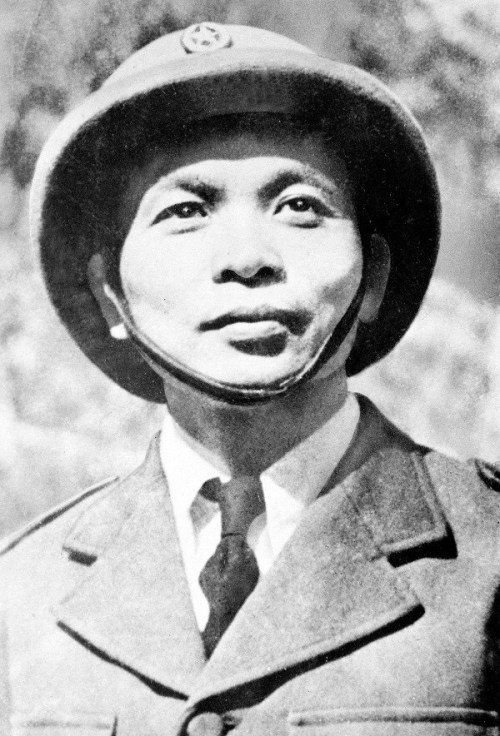

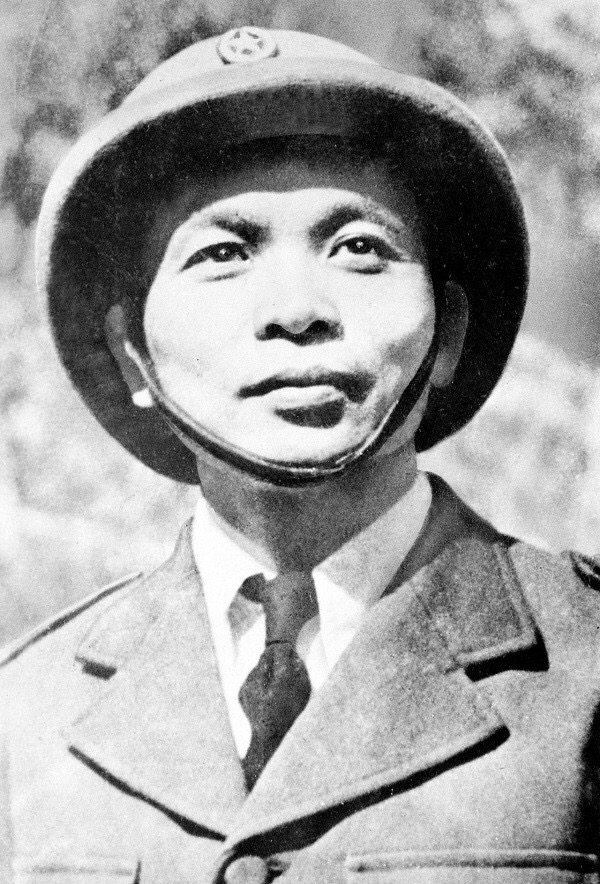
General Vo Nguyen Giap

On May 7th 2011 in Hanoi a small remembrance was held to mark the fall of Dien Bien Phu and honor the victor, 101 year old General Vo Nguyen Giap at his home. Until his death in 2013 at the age of 102. That 2011 ceremony was one of the few remembrances held anywhere marking that battle which was one of the watersheds of the 20th Century. A half a world away in Houston Texas a small group of French veterans, expatriates and historians laid a wreath at the Vietnam War Memorial.  In Paris an ever shrinking number of French survivors gather each year on May 7th at 1815 hours for a religious service at the Church of Saint Louis des Invalides to remember the dead and missing of the French Expeditionary Corps lost in Indochina. A small number of other small ceremonies have been in the following years.

This battle is nearly forgotten by time even though it and the war that it symbolized is probably the one that we need to learn from before Afghanistan becomes our Indochina.
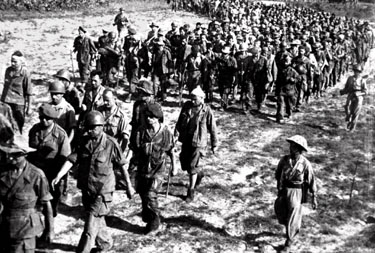
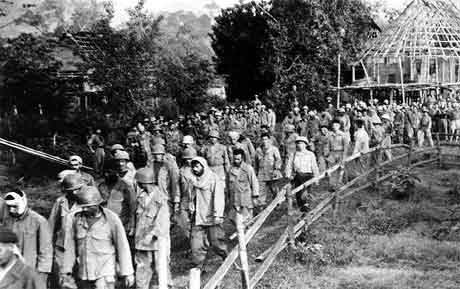
French Prisoners

On May 8th 1954 the French garrison of Dien Bien Phu surrendered to the Viet Minh.  It was the end of the ill-fated Operation Castor in which the French had planned to lure the Viet Minh Regulars into open battle and use superior firepower to decimate them.  The strategy which had been used on a smaller scale the previous year at Na Son.

The French had thought they had come up with a template for victory based on their battle at Na Son in how to engage and destroy the Viet Minh. The plan was called the “Air-land base.”  It involved having strong forces in a defensible position deep behind enemy lines supplied by air.  At Na Son the plan worked as the French were on high ground, had superior artillery and were blessed by General Giap using human wave assaults which made the Viet Minh troops fodder for the French defenders.  Even still Na Son was a near run thing for the French and had almost no effect on Viet Minh operations elsewhere while tying down a light division equivalent and a large portion of French air power.

Viet Minh Regulars

The French took away the wrong lesson from Na-Son and repeated it at Dien Bien Phu.  The French desired to use Dien Bien Phu as a base of operations against the Viet Minh.  Unfortunately the French chose badly. The elected to occupy a marshy valley surrounded by hills covered in dense jungle. They elected to go light on artillery and the air head was at the far end of the range of French aircraft, especially tactical air forces which were in short supply.  To make matters worse the General Navarre, commander of French forces in Indochina informed that the French government was going to begin peace talks and that he would receive no further reinforcements elected to continue the operation.

French Paras Drop into Dien Bien Phu

Likewise French logistics needs were greater than the French Air Force and American contractors could supply.  French positions at Dien Bien Phu were exposed to an an enemy who held the high ground and were not mutually supporting. The terrain was so poor that French units were incapable of any meaningful offensive operations against the Viet Minh. As such they could only dig in and wait for battle. Despite this many positions were not adequately fortified and the artillery was in exposed positions.
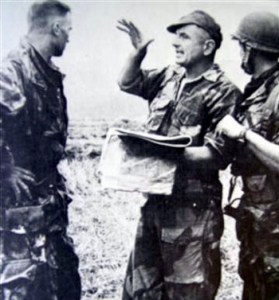
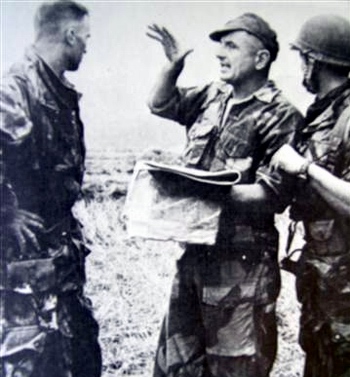
Major Marcel Bigeard 

The French garrison was a good quality military force composed of veteran units. It was comprised of Paras, Foreign Legion, Colonials (Marines), North Africans and Vietnamese troops. Ordinarily in a pitched battle it would have done well, but this was no ordinary battle and their Viet Minh opponents were equally combat hardened, well led and well supplied and fighting for their independence.

Many of the French officers including Lieutenant Colonel Langlais and Major Marcel Bigeard commander of the 6th Colonial Parachute Battalion were among the best leaders in the French Army. Others who served in Indochina including David Galula and Roger Trinquier would write books and develop counter-insurgency tactics which would help Americans in Iraq. Unfortunately the French High Command badly underestimated the capabilities and wherewithal of the Giap and his divisions.
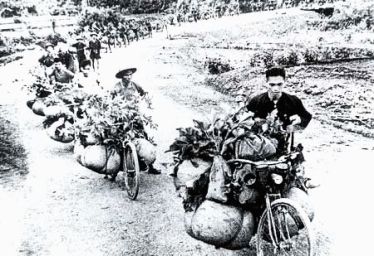
Viet Minh Supply Column

Giap rapidly concentrated his forces and built excellent logistics support.  He placed his artillery in well concealed and fortified positions which could use direct fire on French positions. Giap also had more and heavier artillery than the French believed him to have.  Additionally he brought in a large number of anti-aircraft batteries whose positions enabled the Viet Minh to take a heavy toll among French Aircraft.  Giap also did not throw his men away in human assaults.  Instead he used his Sappers (combat engineers) to build protective trenches leading up to the very wire of French defensive positions.  In time these trenches came to resemble a spider web.

Without belaboring this post the French fought hard as did the Viet Minh. One after one French positions were overwhelmed by accurate artillery and well planned attacks.  The French hoped for U.S. air intervention, even the possibility of using nuclear weapons against the Viet Minh. They were turned down by a US Government that had grown tired of a war in Korea.

French Wounded Awaiting Medivac from Dien Bien Phu 

Relief forces were unable to get through and the garrison died, despite the bravery of the Paratroops. Colonials and Legionaries. The French garrison was let down by their high command and their government and lost the battle due to inadequate logistics and air power. The survivors endured a brutal forced march of nearly 400 miles on foot to POW camps in which many died. Many soldiers who survived the hell of Dien Bien Phu were subjected to torture, including a practice that we call “water boarding.” General Georges Catroux who presided over the official inquiry into the debacle at Dien Bien Phu wrote in his memoirs: “It is obvious that there was, on the part of our commanding structure, an excess of confidence in the merit of our troops and in the superiority of our material means.”

Few French troops caved to the Viet Minh interrogations and torture but some would come away with the belief that one had to use such means to fight the revolutionaries.  Some French troops and their Algerian comrades would apply these lessons against each other within a year of their release. French soldiers and officers were shipped directly from Indochina to Algeria to wage another protracted counterinsurgency often against Algerians that they had served alongside in Indochina. The Algerian campaign proved to be even more brutal and it was lost politically before it even began.

The March to Captivity

The wars in Indochina and Algeria tore the heart out of the French Army. The defeats inflicted a terrible toll. In Indochina many French career soldiers felt that the government’s “lack of interest in the fate of both thousands of missing French prisoners and loyal North Vietnamese…as dishonorable.” Divisions arose between those who served and those who remained in France or Germany and created bitter enmity between soldiers. France would endure a military coup which involved many who had fought in Vietnam and Algeria. Having militarily won that war these men called The Centurions by Jean Lartenguy had been turned into liars by their government.  They were forced to abandon those who they had fought for and following the mutiny, tried, imprisoned, exiled or disgraced. Colonial troops who remained loyal to France were left without homes in their now “independent” nations. They saw Dien Bien Phu as the defining moment. “They responded with that terrible cry of pain which pretends to free a man from his sworn duty, and promises such chaos to come: ‘Nous sommes trahis!’-‘We are betrayed.’

The effects of the wars in French Indochina, Algeria and Vietnam on the French military establishment were long lasting and often tragic. The acceptance of torture as a means to an end sullied even the hardest French officers. Men like Galula and Marcel Bigeard refused to countenance it, while others like Paul Aussaresses never recanted.

One of the most heart rending parts of the Dien Bien Phu story for me is that of Easter 1954 which fell just prior to the end for the French:

“In all Christendom, in Hanoi Cathedral as in the churches of Europe the first hallelujahs were being sung. At Dienbeinphu, where the men went to confession and communion in little groups, Chaplain Trinquant, who was celebrating Mass in a shelter near the hospital, uttered that cry of liturgical joy with a heart steeped in sadness; it was not victory that was approaching but death.” A battalion commander went to another priest and told him “we are heading toward disaster.” (The Battle of Dienbeinphu, Jules Roy, Carroll and Graf Publishers, New York, 1984 p.239)

As a veteran of Iraq whose father served in Vietnam I feel an almost a spiritual link to our American and French brothers in arms who fought at Dien Bien Phu, the Street Without Joy, Algiers and places like Khe Sanh, Hue City, the Ia Drang and the Mekong. When it comes to this time of year I always have a sense of melancholy and dread as I think of the unlearned lessons and future sacrifices that we may be asked to make.

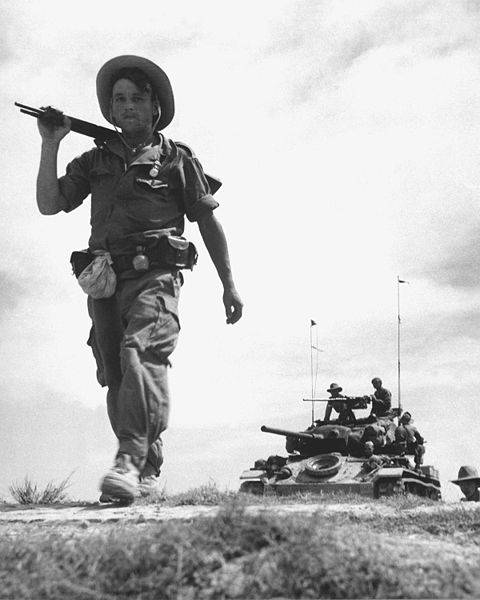
Legionaires on the Street Without Joy

The lessons of the French at Dien Bien Phu and in Indochina were not learned by the United States as it entered Vietnam, Iraq or Afghanistan. Nor were the lessons of Algeria. It was an arrogance for which we paid dearly and I do not think that many in our political, media and pundits or military have entirely learned or that we in the military have completely shaken ourselves. We lost 54,000 dead in Vietnam, nearly 4500 in Iraq and close to 3500 in Afghanistan, not counting vast numbers of wounded. There are those even as we have been at war for 15 years who advocate even more interventions in places that there is no good potential outcome, only variations on bad. How many more American Soldiers, Sailors, Marines and Airmen and our allies will need die without “victory” however badly we might try to define it?
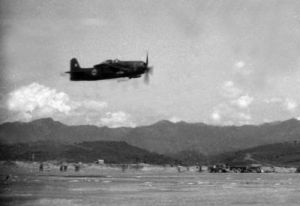
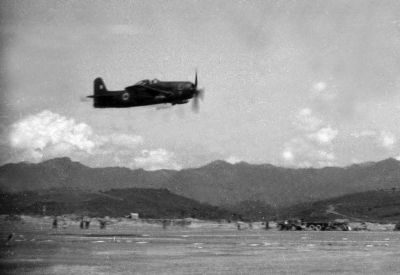
French Navy F-8 Bearcat at Dien Bien Phu

Like the French our troops who returned from Vietnam were forgotten.The U.S. Army left Vietnam and returned to a country deeply divided by the war. Vietnam veterans remained ostracized by the society until the 1980s. As Lieutenant General Harold Moore  who commanded the battalion at the Ia Drang immortalized in the film We Were Soldiers recounted “in our time battles were forgotten, our sacrifices were discounted, and both our sanity and suitability for life in polite American society were publicly questioned.”

For those interested in the French campaign in Indochina it has much to teach us. Good books on the subject include The Last Valley by Martin Windrow, Hell in a Very Small Place by Bernard Fall; The Battle of Dienbeinphu by Jules Roy; and The Battle of Dien Bien Phu- The Battle America Forgot by Howard Simpson. For a history of the whole campaign, read Street Without Joy by Bernard Fall. I always find Fall’s work poignant, he served as a member of the French Resistance in the Second World War and soldier later and then became a journalist covering the Nuremberg Trials and both the French and American wars in Vietnam and was killed by what was then known as a “booby-trap” while covering a platoon of U.S. Marines.

I do pray that we will learn the lessons before we enter yet another hell. But I don’t think it is possible for us to learn anymore, only send more young men and women to die in an already lost cause. As the late Edwin Starr sang in his song War, what is it good for? 

Peace, love and understanding. Tell me, is there no place for them today. They say we must fight to keep our freedom, But lord knows there’s got to be a better way. War, what is it good for? Absolutely nothing, say it again… 

Peace

Padre Steve+

3 Comments

Filed under afghanistan, Foreign Policy, History, Military, News and current events, War on Terrorism

Resisting Authortarianism: Part One


Friends of Padre Steve’s World,

Tonight, like last night I am posting another thought from B.H. Liddell-Hart’s book Why don’t We Learn from History? 

The book is worth the read for anyone, even though it is written by a military historian and theorist. Liddell-Hart had a keen understanding of the limitations of Democracy, but recognized the inherent evil of the totalitarian or authoritarian state, and such leaders. Thus, when we see a democratically elected leader rapidly move toward authoritarianism, attempting to silence political and press critics, accused the acting head of the Department of Justice of “betrayal,” and attacking the institutions of justice that oppose him, while praising foreign despots, we should be concerned for our liberty. 

Liddell-Hart wrote something very profound that we should all think about: 

What is of value in “England” and “America” and worth defending is its tradition of freedom, the guarantee of its vitality. Our civilization, like the Greek, has, for all its blundering way, taught the value of freedom, of criticism of authority, and of harmonising this with order. Anyone who urges a different system, for efficiency’s sake, is betraying the vital tradition.

He noted:

It is man’s power of thought which has generated the current of human progress through the ages. Thus the thinking man must be against authoritarianism in any form, because it shows its fear of thoughts which do not suit momentary authority.

The power of thought, the unending quest for truth, the questioning of authorities who claim absolute power, are all essential to maintaining human freedom. However, freedom cannot be defended if its defenders have either forgotten how to think critically, or never learned to at all. The latter should be concerning as for years the emphasis of education has been to train people for a job with specific but narrow skills, while critical thinking, based in reason, science, history, philosophy, literature, and the arts has taken a back seat. Giles Lauren who wrote the preface to the latest edition of Why don’t We Learn from History? wrote:

Education, no longer liberal, has largely become a question of training in a skill for gain rather than teaching us how to think so as to find our own way. ‘It is strange how people assume that no training is needed in the pursuit of truth.’ We must learn to test and judge the information that comes before us. After all: ‘Whoever habitually suppresses the truth … will produce a deformity from the womb of his thought.’

This my friends is not comfortable, and neither should it be. But the truth is that most people actually fear truth because it is uncomfortable. Liddell-Hart wrote:

We learn from history that in every age and every clime the majority of people have resented what seems in retrospect to have been purely matter-of-fact comment on their institutions. We learn too that nothing has aided the persistence of falsehood, and the evils resulting from it, more than the unwillingness of good people to admit the truth when it was disturbing to their comfortable assurance. Always the tendency continues to be shocked by natural comment and to hold certain things too “sacred” to think about.

I am watching people, many of them good people, decent people, even brilliant people either openly support the move toward authoritarianism, or remain silent, even when they recognize the truth. In such times it is important to seek the truth, and proclaim the truth, even if it unpopular, and unpleasant. This means that we also have to look inside ourselves, and be honest because we all have the capacity to believe the lie and not to recognize the distinction between fact and fiction. Hannah Arendt wrote in her book The Origins of Totalitarianism:

The ideal subject of totalitarian rule is not the convinced Nazi or the convinced Communist, but people for whom the distinction between fact and fiction ( i.e., the reality of experience) and the distinction between true and false ( i.e ., the standards of thought) no longer exist.

I will continue this tomorrow. Have a great night and sleep well.

Peace

Padre Steve+ 

Leave a comment

Filed under History, News and current events, Political Commentary

A Useful Nostrum Against Despair: History and Future

edward-vii-funeral

Friends of Padre Steve’s World,

In two days we will have a new President. While his supporters see great things in his Presidency, many others, not just in this country do not. We can try to deduce how President Trump will govern in a number of ways, but the best is through the lens of the past. I am a historian and I am not hopeful of what the future has in store for us, but given that I will not give in to despair. Barbara Tuchman whose books covered many of greatest eras of change and crisis in world history wrote these words:

“The story and study of the past, both recent and distant, will not reveal the future, but it flashes beacon lights along the way and it is a useful nostrum against despair.”

That being said given my study of history and my observations of our soon to be President I am not optimistic. Many people more learned and informed than I have written volumes about what they think will happen in the coming weeks and months. I have read a lot of those analysis and most give me cause for concern. My one hope is that the in spite of his past, including his recent statements, that President Trump will listen to men like soon to be Secretary of defense James Mattis, who alone among our leaders I believe can stand up to Trump’s most unreasonable and problematic actions in regard to NATO, Russia, and China. He actually may be the man who will save the nation from disaster if President Trump makes good on his promises and threats worldwide.

Of course I hope things never reach that point and that some modicum of sanity will possess the President as well as Congress. Likewise I hope that our institutions will be able to survive.

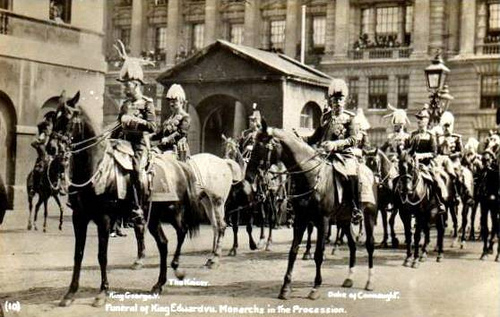
Even so I expect that when President Trump departs the Capital building for the White House that our world will be irrevocably changed. Tuchman wrote of the gathering of leaders at the death of King Edward VII in 1910 in words that I think could easily be modified to 2017 Washington DC.

“The muffled tongue of Big Ben tolled nine by the clock as the cortege left the palace, but on history’s clock it was sunset, and the sun of the old world was setting in a dying blaze of splendor never to be seen again.”

I believe that the world that we knew is never going to be the same. While I have no idea how our future will play out, I still look to the light of the past to keep from despair.

Until tomorrow,

Peace

Padre Steve+
1 Comment

Filed under History, News and current events, Political Commentary

How Despots Gain Power


Friends of Padre Steve’s World,

Today I am traveling back home after a wonderful visit with friends and family in Huntington, West Virginia. The visit was nice, I got a chance to do some serious reflection, especially as I walked about the city and along the Ohio River waterfront, visited the Museum of Art, and walked the entirety of its wonderful Ritter Park. 

I did some writing but spent more time in reading and reflection than anything. I kept up on some of the headlines but didn’t let myself get beaten down by the negativity and cynicism of our time.

Last night I read the short but poignant little but by the British military historian B.H. Liddell-Hart entitled Why Don’t We Learn from History. The book was written in not long before his death in 1970 and it is good quite good. It deals with a number of issues, including the conflict between history and propaganda, or when faith, especially religious faith as treated as historic or scientific fact; especially when propaganda or faith is preached as if it were history, if it were truth. But he also contrasted democracy and totalitarianism. 

Liddell-Hart was a realist, especially about democracy and totalitarianism. While he admitted the inefficiencies of democracy, he realized that it was far less dangerous than the “stupidity” of totalitarianism. In fact it was important for him to note just how this inefficient system was for freedom. He wrote:

What is of value in “England” and “America” and worth defending is its tradition of freedom, the guarantee of its vitality. Our civilization, like the Greek, has, for all its blundering way, taught the value of freedom, of criticism of authority, and of harmonising this with order. Anyone who urges a different system, for efficiency’s sake, is betraying the vital tradition.

There was was much to ponder in his book and I will probably write some more of my thoughts on it, but since I am going to be traveling I will quote what he said about self-made despotic rulers and how they come to power. When I read it I was struck by just how much Liddell-Hart in his description of a despot describes Republican Presidential nominee Donald Trump through the his campaign and especially his remarks on immigration hours after returning from a brief meeting with Mexican President Pena Nieto. 

We learn from history that self-made despotic rulers follow a standard pattern. In gaining power: They exploit, consciously or unconsciously, a state of popular dissatisfaction with the existing regime or of hostility between different sections of the people. They attack the existing regime violently and combine their appeal to discontent with unlimited promises (which, if successful, they fulfil only to a limited extent). They claim that they want absolute power for only a short time (but “find” subsequently that the time to relinquish it never comes). They excite popular sympathy by presenting the picture of a conspiracy against them and use this as a lever to gain a firmer hold at some crucial stage.

He wrote about how they behave in power as well, but for now I will close and let you my readers ponder his statement before I follow up with Liddell-Hart’s observations from history on how despots act once they achieve power. 

Peace,

Padre Steve+

Leave a comment

Filed under History, philosophy, Political Commentary

Nuremberg on Lake Erie


Friends of Padre Steve’s World

I have been watching bits and pieces of the Republican National Convention and try as I might as a man who spent thirty-two years as a faithful Republican to find anything redeeming in it, I couldn’t. In fact, it troubled me more that I ever imagined that it could. If I wasn’t a historian with a tremendous background in both the history of Imperial Germany, the Weimar Republic, and the Nazi Era; not to mention the American Civil War era, I probably would be less frightened. If I were not a historian I would probably just brush the words and actions that I have seen in Cleveland off as hyperbole with little real merit. But I cannot use ignorance as an excuse to ignore what I see, and try as I might I cannot get the images of the Nuremberg Nazi Party rallies out of my mind as I watch what is going on in Cleveland.

Though Trump won the delegate count by a slight plurality, dissenting delagates were brushed aside in procedural votes, any who oppose him in the GOP are now considered traitors and are scorned. Many prominent GOP leaders, including George W. Bush and George H.W. Bush are not attending this fiasco, nor is the last GOP Presidential nominee Mitt Romney. Likewise, some  18 GOP Senators and hundreds of other GOP leaders. Leading Republicans, including elected officials and pundits with pedigrees that go back to Buckley, Goldwater, and Reagan are leaving the party, and with good reason; but to Trump and his stalwarts they are all traitors. For those who don’t remember Hitler purged the Nazi Party of men who did not agree with him as well. 

The images shown at the convention hall were designed to appeal to the basist of human nature: hatred of the other, using faux patriotism, the image of military might, and the tales of martyrs. Coming from a man who has openly and notoriously mocked military personnel and veterans; a man who compared his time in a private military pre-school to be superior to actual military service; and a man who used every method imaginable to avoid the draft in Vietnam, the display was sickening. A man that openly mocks military personnel using them for his political and personal gain. 

The speeches thus far have been angry diatribes which demonized Democrats, especially Hillary Clinton using charges that have been continually refuted. Peaceful Black Lives Matter Demonstraters were vilified as being responsible for the recent assassinations of police officers, when the men who killed them wanted nothing to do with the BLM movement or working peacefully with authorities to deal with a very real problem. The answer of Trump and his supporters to these to all problems is to go back and echo the words of anti-immigrant Know Nothing movement of the 1840s and 1850s, or the answers of those who instituted Jim Crow, and those who passed the anti-Chinese laws of the 1880s-1940s.

But now these same xenophobic ideas are turned against Americans of color, or Americans of the Muslim faith; and let us not even talk about the radically anti-woman and anti-gay measures in the party platform. One speaker openly proclaimed that President Obama is a Muslim, repeating a lie as old as Obama’s nomination in 2008; a lie that Trump was one of the biggest publicists, and for which he has never apologize. Interestingly enough, the day the convention began, Iowa GOP Congressman Steve King, a long time Trump supporter, openly spoke of the superiority of the white race on live television. 

Listening to some of the speakers and reading their words I was reminded of the Nuremberg party rallies where Jews, Social Democrats, organized labor, and peoplewho were called subhuman, were the target of intensely violent rhetoric, which once the Nazis came to power was transformed into action. Like today the foreign policy blunders that led to a war  that broke the nation were not attributed to the imperialistic nationalists who helped bring about the disaster. Instead the fault for World War One was not blamed on the Kaiser and militarists, but those who were not responsible for bringing about the war, and who were saddled with dealing with the mess when those who caused it ran away from their responsibilities. Today Trump and his minions demonize President Obama and Hillary Clinton for the deaths of Ambassador Chris Stevens and four security contractors in a rapidly evolving crisis that only lasted 13 hours, but ignore any sort of inquiry or justice for the 4500 military deaths in the Iraq War; a war that was planned for over a year and justified by lies. Likewise, the lists of similarities in style and substance between Trump and the Nazi movement are too numerous to mention, and the similarities in the political climate between the late Weimar of 1930 to January of 1933 and today is frightening. Historian Richard Evans wrote in his book The Coming of the Third Reich: 

In the increasingly desperate situation of 1930, the Nazis managed to project an image of strong, decisive action, dynamism, energy and youth that wholly eluded the propaganda efforts of the other political parties, with the partial exception of the Communists. The cult of leadership which they created around Hitler could not be matched by comparable efforts by other parties to project their leaders as the Bismarcks of the future. All this was achieved through powerful, simple slogans and images, frenetic, manic activity, marches, rallies, demonstrations, speeches, posters, placards and the like, which underlined the Nazis’ claim to be far more than a political party: they were a movement, sweeping up the German people and carrying them unstoppably to a better future. What the Nazis did not offer, however, were concrete solutions to Germany’s problems, least of all in the area where they were most needed, in economy and society. More strikingly still, the public disorder which loomed so large in the minds of the respectable middle classes in 1930, and which the Nazis promised to end through the creation of a tough, authoritarian state, was to a considerable extent of their own making. Many people evidently failed to realize this, blaming the Communists instead, and seeing in the violence of the brown-uniformed Nazi stormtroopers on the streets a justified, or at least understandable reaction to the violence and aggression of the Red Front-Fighters’ League. 

Voters were not really looking for anything very concrete from the Nazi Party in 1930. They were, instead, protesting against the failure of the Weimar Republic. Many of them, too, particularly in rural areas, small towns, small workshops, culturally conservative families, older age groups, or the middle-class nationalist political milieu, may have been registering their alienation from the cultural and political modernity for which the Republic stood, despite the modern image which the Nazis projected in many respects. The vagueness of the Nazi programme, its symbolic mixture of old and new, its eclectic, often inconsistent character, to a large extent allowed people to read into it what they wanted to and edit out anything they might have found disturbing. Many middle-class voters coped with Nazi violence and thuggery on the streets by writing it off as the product of excessive youthful ardour and energy. But it was far more than that, as they were soon to discover for themselves.

Trump presents a vague program and changes his positions so often that it is a wonder how he can say them and keep a straight face. But the very real anger of the voters that he is channeling doesn’t demand answers, they don’t want anything concrete from him, with the possible exception of  a wall across the southern border with Mexico. But to many of Trump’s supporters today, like many Germans in 1932, a real program, real answers, and any kind of ideological consistently, economic philosophy, or understanding of foreign policy do not matter. 

But even worse from the perspective of a Christian is the fact that to many people, Trump’s hedonistic lifestyle, three divorces; his basic lack of concern and empathy for anyone other than himself; as well as his propensity to use people until they are of no use to him and throw them away; not to mention  his lack of business ethics, four corporate bankruptcies and his vainglorious narcissism which in former times would have lost  vote of conservative Christians, are now ignored. 

In fact a plethora of prominent leaders of the Religious Right, men like James Dobson and James Robison; men who Barry Goldwater despised, have come to embrace and support the Trump candidacy. The last poll I saw estimated that four of five people who call themselves evangelical or conservative Christians plan to vote for Trump, and mock his Deomcratic and Republican opponents. A “Christian” pastor used his benediction to do what never has been done at any major American political party’s convention. He called the other party and their candidate “the enemy,” and linked Trump’s vision to that of God. It was both blasphemous and anti-American all at once. 

The whole first day and today’s continued rancor is frightening to behold. Ronald Reagan would be rolling in his grave and Abraham Lincoln would condemn what we have seen in the same way that he condemned the Know Nothings in the 1850s. 

As a former Republican, as a man who worked for the Ford campaign before I could vote;  a man who voted for Ronald Reagan, Bob Dole, and both George H.W., and George W. Bush, this is not about partisan politics, but I am glad that I left the FOP when I did when I came home from Iraq in 2008. 

This is about telling the truth about a campaign that I could never have believed in a million years that would be occurring in our country.  That my friends scares the hell of me. While I don’t believe that Trump will win the election, the thought that he has taken control of the GOP and is in the process of destroying it, bothers me, as it should you, and frankly he doesn’t care. He has no loyalty to anyone other than himself, and all of us, including his most loyal followers are just stepping stones; just like the German people were to Hitler, and they followed him to hell. 

Anyway, that is enough for today. Nothing like spending hours in doctors and military pharmacy waiting rooms with screaming kids and GOP convention coverage to get the blood flowing. I can use a beer or four tonight. 

Have a great day,

Peace

padre+

2 Comments

Filed under ethics, History, leadership, News and current events, Political Commentary

Becoming What We Should Be


Friends of Padre Steve’s World,
Having completed, with the exception of editing and circulating some hard copies of the first volume of my Civil War text A Great War in a Revolutionary Age of Change, I have gone back to work on the second volume of my Civil War text “Mine Eyes Have Seen the Glory” Religious Ideology, Race, and Politics in the Civil War Era. Beginning yesterday I began to go through the approximately 160 pages of text, which had been the second chapter of my Gettysburg Staff Ride text, but like A Great War really needed to be split off and turned into its own separate book. 

Yesterday I went back to figure the natural chapter breaks and to begin some minor editing and creating a bibliography and working table of contents as I prepare to really dig in on it. The good thing is that I have continued to research this section even as I concentrated on work on A Great War and major chapter revisions to the book dealing with the campaign of 1863 and the Battle of Gettysburg. 

As I have done this I become more and more convinced that what I am writing about needs to be told. As I look at responses to the Black Lives Matter movement I am appalled by the willing historical ignorance of much of the country, including white America, which has erased from its collective memory the terrible injustices of slavery, the black codes, Jim Crow, segregation, and violence directed at African Americans over nearly three hundred year period before the Supreme Court stuck down the Jim Crow era segregation laws, and the Congress passed the 1964 Civil Rights Act, and 1965 Voting Rights Act, and less than three years later Dr. Martin Luther King Jr., the champion of peace protest and civil rights was gunned down and assassinated. 

But it is easy for some people to condemn the Black Rights Movement, it is called racist by some, and it is blamed for a host of issues that it is simply exposing and demanding action to solve. Some people respond to criticism of police with the saying that Blue Lives Matter, and I agree that they do, police officers do dangerous work, and with the proliferation of high powered weaponry in the hands of irresponsible and angry people, their lives are always in danger. But that is no reason not to say that Black Lives Matter is wrong in its intent. Some say that All Lives Matter, and I agree with that in principle, but I would challenge the people that flippantly say that in order to dismiss the validity of Black Lives Matter, while doing nothing to work for the rights of people different than themselves, that they need to put their money where their mouth is. 

In the 1850s and 1860s Abraham Lincoln struggled with this in a country that was becoming increasingly diverse due to massive immigration from Ireland and Germany, and in which Congress and the Courts were making decisions which would allow for the expansion of slavery and the definition of African Americans as a subordinate race without any citizenship rights. Lincoln was worried that America was becoming like a plow horse with blinders fastened to the sides of its eyes, capable of seeing only in one direction: ahead of it. He saw Americans as people increasingly interested only with their present and their future, the things still before them, but disinterested with their own historical past, the things already behind them. A condition that is not much different that what we see today. Maybe because I am a historian I am more sensitive to this, but it is concerning. 

Lincoln realized that people had forgotten the heart and soul of America, the secular scripture found in the preamble of the Declaration of Independence. “We hold these truths to be self-evident, that all men are created equal, that they are endowed by their Creator with certain unalienable Rights, that among these are Life, Liberty and the pursuit of Happiness,—That to secure these rights, Governments are instituted among Men…” He realized that for most people of his era the proposition that all men are created equal was in the process of dying. He knew that freedom without equality was no freedom at all, and beginning with the Emancipation Proclamation he began the first step to universalize that proposition. Les than a year later he gave a short speech of under three hundred words at Gettysburg in which he went back to the Declaration noting “Four score and seven years ago our fathers brought forth on this continent, a new nation, conceived in Liberty, and dedicated to the proposition that all men are created equal,” and he called on Americans to renew themselves to that proposition: “It is for us the living, rather, to be dedicated here to the unfinished work which they who fought here have thus far so nobly advanced. It is rather for us to be here dedicated to the great task remaining before us—that from these honored dead we take increased devotion to that cause for which they gave the last full measure of devotion—that we here highly resolve that these dead shall not have died in vain—that this nation, under God, shall have a new birth of freedom—and that government of the people, by the people, for the people, shall not perish from the earth.”

In a book that I just finished on the Gettysburg Address the author noted something that I find quite true. He said: “We should read the Preamble to the Declaration of Independence, and then, the Gettysburg Address. They are, together, our American scriptures. And we should read them aloud, the way they were meant to be. They are words which are most powerful when they are spoken. Their words remain fresh and alive, no matter how many times they are read. All we need to know about what American democracy should be, is found there, among the words of these two ancient manuscripts.”

Now I do not arrogantly claim that we as Americans exemplify those words, or that we even live up to them, but they are something that we need to keep in the forefront of our minds, and strive to achieve if we are to become a better nation. 

I was talking with one of our international officers at the staff college today who has been studying at the Naval War College for the past year before he came to us, and as we talke we agreed that what makes America great is not our military might, nor our economic power, but that proposition of Liberty, the proposition that is so radical that few countries include it in any of their political documents, that proposition, that all men are created equal. It was something that a number of my Korean officers noted at Gettysburg back in May. They all understood something that so many Americans have forgotten. 

So I will continue to read, research, and write, and I am excited about it, especially during this critical time in our nation’s history. I’m sure that in the coming month or two that you will see some of that work appear on this site as I work on Mine Eyes Have Seen the Glory. 

Until tomorrow I wish you peace,

Padre Steve+

Leave a comment

Filed under civil rights, civil war, Gettysburg, History, News and current events, Political Commentary