
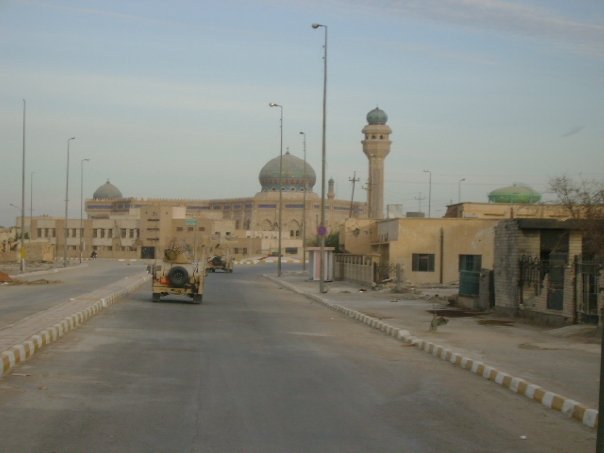
I have been writing much in recent days about the war that we are now in against the Islamic State, or ISIL. Today Secretary of defense Hegel and Chairman of the Joint Chiefs of Staff General Martin Dempsey briefed the Senate Armed Services Committee about the developing strategy to defeat ISIL. They both echoed what I have been writing, that this is not going to be a short and easy war. It was the kind of briefing that Secretary Rumsfeld, Paul Wolfowitz and others should have given Congress before launching the Iraq war in 2003.
Unlike Rumsfeld and others who plainly concocted a fairy tale about the character, length and cost of the war which they and their propagandists in the media deceived the American public into supporting that war, this was a briefing conducted by realists who did not paint beautiful picture of just how easy it will be to win this war, and how it really won’t be over until it’s over. Retired Marine Corps General James Mattis very wisely said: “No war is over until the enemy says it’s over. We may think it over, we may declare it over, but in fact, the enemy gets a vote.”
In fact the aftermath of that 2003 invasion opened a Pandora’s box of chaos, and opened the door to what T.E. Lawrence warned about in 1919: “A Wahabi-like Moslem edition of Bolshevism is possible, and would harm us almost as much in Mesopotamia as in Persia…” ISIL is exactly that, a fulfillment of Lawrence’s warning.
Unfortunately no one really likes realists, they rain on people’s ideological parades and no one likes to have their parade rained on. Both men recognize that after the past thirteen years of war, as well as the massive upheaval spawned in the region in large part because of it, and the many other crises that the American military and our NATO allies are having to confront, that American military and diplomatic options are less than optimal and as General Mattis said the enemy gets a vote. As Winston Churchill said:
“Never, never, never believe any war will be smooth and easy, or that anyone who embarks on the strange voyage can measure the tides and hurricanes he will encounter. The statesman who yields to war fever must realize that once the signal is given, he is no longer the master of policy but the slave of unforeseeable and uncontrollable events…. Always remember, however sure you are that you could easily win, that there would not be a war if the other man did not think he also had a chance.”
General Dempsey cautioned the Senators that this was not going to be a short or easy effort. He noted as any realist would : “It’s a generational problem, and we should expect that our enemies will adapt their tactics as we adjust our approach.”
They outlined a number of elements of the strategy to include the continued air campaign, coordination with the Iraqis, the advisory mission and the diplomatic efforts being made to build an alliance, as well as to build up “moderate” Syrian rebel forces that are functioning under some kind of “moderate” authority, whatever that is, and if there is such a thing in Syria I hope we find it.
The fact is there is nothing easy about any of these options, even the advisory piece is fraught with danger and the potential of being expanded into a ground combat operation. President Obama has promised not to enter into a ground war, but remember the enemy, as well as the other participants in war get a vote. General Dempsey acknowledged this when he told the committee: “If we reach the point where I believe our advisors should accompany Iraqi troops on attacks against specific ISIL targets, I’ll recommend that to the president.” Yes, the decision to commit troops in a ground combat role is ultimately that of the President as Commander in Chief, but the Congress and the American people need to be part of the decision making process and get a vote. If Congress fails to weigh in on this, and either vote for committing troops, or putting limitations on military action, they will have failed in one of their chief constitutional duties.
General Dempsey also noted the nature of the air campaign that is being conducted and which will be conducted in Syria, saying: “we will be prepared to strike ISIL targets in Syria that degrade ISIL’s capabilities. This won’t look like a ‘shock and awe’ campaign because that is simply not how ISIL is organized, but it will be a persistent and a sustainable campaign.” Part of this is due to ISIL as General Dempsey said, but also as he later noted the growing mismatch between policy ends and the means available to deal with them including the will of Congress to provide those means. Dempsey warned of the danger if the “will to provide means does not match the will to pursue ends,” a time bomb that the austerity minded Congress foisted on the nation through sequestration in 2012.
Dempsey was cautiously optimistic in his assessment:
“Given a coalition of capable, willing regional and international partners, I believe we can destroy ISIL in Iraq, restore the Iraq-Syria border and disrupt ISIL in Syria…ISIL will ultimately be defeated when their cloak of religious legitimacy is stripped away and the populations on which they have imposed themselves reject them. Our actions are intended to move in that direction.”
General Dempsey recognized that American military power alone cannot solve this situation and that ultimately if ISIL is to be defeated and destroyed, those people that they have conquered need to rise up and reject them. I think that is possible, but it may take years of suffering and oppression at the hands of ISIL for those people to rise up against them. The Sunni did it in Anbar in 2006-2009 to help turn around the Iraq campaign, but they did so on the basis that their rights would be respected and that they would have a real voice in the Shi’ite dominated Iraqi government. Instead they were tossed aside by the Maliki government making them far more apprehensive and unwilling to go all in on defeating ISIL as they did its predecessor. The Sunni attitude is much like that of the Arabs who rebelled against the Turks, of whom T. E. Lawrence wrote:
“The Arabs rebelled against the Turks during the war not because the Turk Government was notably bad, but because they wanted independence. They did not risk their lives in battle to change masters, to become British subjects or French citizens, but to win a show of their own.”
This is the reality and it is not pretty. Reality sucks, but as Mark Twain said
“Reality can be beaten with enough imagination.”
Peace
Padre Steve+



















 The Inglorius Padre Steve's World
The Misuse of Force: Shock and Awe Backfires in Ferguson
“When the gap between ideal and real becomes too wide, the system breaks down.” Barbara Tuchman
Not Iraq, not Syria or the Ukraine, but Ferguson Missouri, a suburb of St. Louis. The shooting of an unarmed black teenager, Michael Brown, by a white police officer was one of the most crass, unconscionable and violent over-reactions of a local government in the United States in years. When the peaceful protests began after the shooting Ferguson and St Louis County police deployed heavy weapons, armored vehicles and chemical weapons against the mainly peaceful protestors who simply sought answers and justice at yet another unjustified killing of a young black man by law enforcement.
The “shock and awe” displayed by the local police agencies had the opposite effect. Instead of defusing the crisis, it provoked violence, mainly from looters by also from young people fed up with police using tactics of fear and intimidation against citizens who have little opportunity. The economic and demographic inequities, including the de-facto segregation in Ferguson are stunning. Two thirds of the population is black and only one member of the city council and one member of the local school board are black. Likewise the police force in Ferguson is overwhelmingly white. It is almost like apartheid South Africa, but it is right here in the United States, and it’s not just a problem in Ferguson but in many other towns and cities in this nation.
After weeks of delay and after days of protests, demonstrations and riots, the Police Chief of Ferguson revealed the name of the officer who killed Brown. However, instead of discussing justice, or inviting an external investigation of the shooting the man took the time to praise and defend the officer and release surveillance video designed to demonize Brown in the eyes of the public. In fact there was no other reason to do it. It was designed to play in his narrative to smear a dead man, for the actions of his officer; and maybe, even more insidiously to possibly taint any jury pool that might have to sit in judgment on that officer. Now I believe in due process and that the officer is innocent until proven guilty, but the calculated actions of the Ferguson police chief were designed to convict a dead man who could not defend his own actions or reputation because his body had at been riddled by at least six bullets including two the to head. Now there may be mitigating circumstances that show that the officer felt that he was in danger, but still six bullets including two to the head.
No wonder instead of subsiding more protests, again mainly peaceful, but with some malicious actors as well have continued. One only has to look at what happened in Cairo’s Tahir Square at the beginning of the Arab Spring, or in Gaza to see why people risk their lives to face overwhelming militarized police forces or military forces deployed in such operations. There is a sense of inequity based on the proportionality of the forces used, and when that inequity becomes too great, revolutions occur.
Part of the problem is that police on every level have become extremely militarized. Local police departments only need to fill out a form to get the latest in surplus combat equipment from the military, thanks to policies enacted after the passage of the wonderfully Orwellian named Patriot Act. Once a department gets the new weaponry, why go back to the old way that police did things. In fact there is an almost a case of “penis envy” that local police departments have. If one department gets an armored MRAP or APC, then another, even if it has no legitimate use for one gets one. Instead of peacefully serving warrants by knocking on a door to confront a non-violent offender, it is time to deploy a platoon of tactical officers to do the same job.
Now I am not excusing looters, arsonists or other criminals that take advantage of unrest such as this to create havoc, and in fact many of the protestors attempted to keep businesses and other property safe from the criminals, even as they themselves were being targeted by the tear gas fired by police. Likewise the police arrested reporters and fired at other reporters covering the story. The reporters had every right to be there covering the protests and nothing in the Constitution excuses the behavior of police interfering with reporters conducting their business.
There is a quote from the most recent television adaptation of Battlestar Galactica where Commander Adama says something most relevant to this needless militarization of police power:
“There’s a reason you separate military and the police. One fights the enemies of the state, the other serves and protects the people. When the military becomes both, then the enemies of the state tend to become the people.”
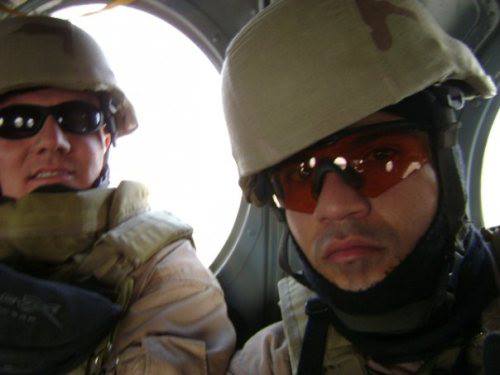
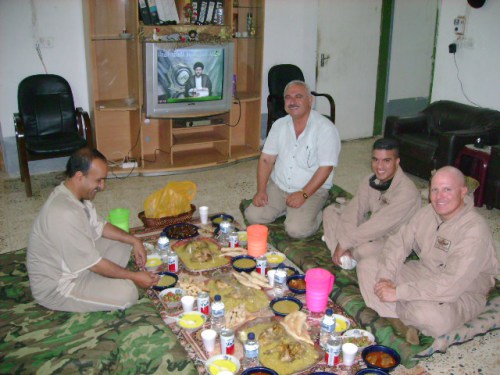
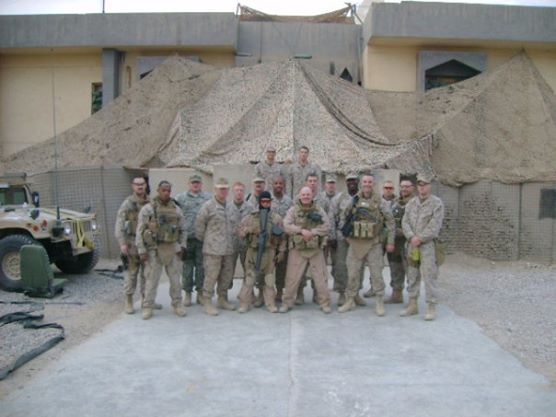
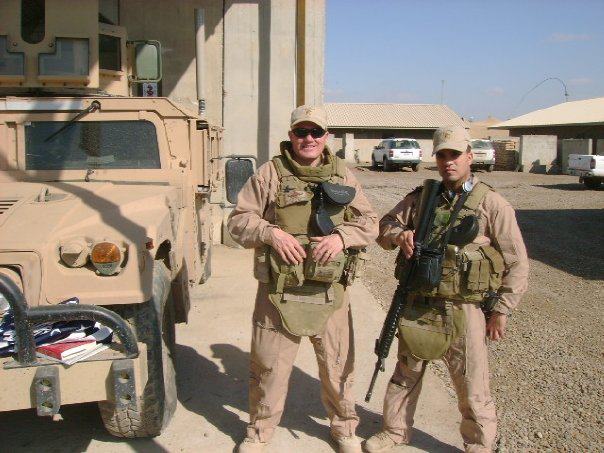
The fact is that anybody with the slightest understanding of history, sociology, economics or group psychology should know this. It’s not that hard to defuse these kinds of situations before they reach a crisis. It simply takes the courage of leaders to meet people where they are and address their concerns without resorting to deploying heavily armed militarized police forces before any violence occurs. As a career military man who has served with our advisers in Iraq, and who has been an adviser on a boarding team keeping the peace on detained Iraqi oil smugglers in 2002, in both cases unarmed and the latter not even having the body armor of the rest of my team, and having been in a number of potentially violent close quarters situations with emotions running high I can safely say that listening and working to de-escalate the situations worked, and that was with Iraqis, not Americans.
When I was going to seminary and was serving in the National Guard, I worked in poor and crime ridden neighborhoods, homeless shelters and inner city public hospitals. I have seen the inequity and the results in broken homes, lives and communities. Likewise, because we were pretty broke and poor in seminary and in the couple years after it we experienced what is now called “profiling.” We lived on the edge of a very affluent suburb between Dallas and Fort Worth, for several years we had a series of crappy hand me down used cars that we used to go to school, work and church. Because some of those cars were so crappy looking we are frequently followed by the police, and every couple of months one of us would be pulled over.
I remember watching through the peep hole on my front door when a tactical team raided my across the hall neighbor late one night in 1991 of 1992. I remember being awakened by the crash of the team breaking through the door, and seeing their guns drawn. It scared the crap out of me, and in fact it made me feel less safe and more vulnerable. What if they had raided my house by mistake, like so often happens, I might have been gunned down at the door. You see, we were poor, and obviously poor people should not be in affluent areas, they are bad for property values. But, we often didn’t know where the next pay check, tank of gas, tuition payment, money for medications or or even groceries were coming from.
I cannot imagine what it would be like to not just experience that for a few years, but to have to live that way with little or no hope of the situation ever getting better. But, that being said, I think I can understand the pent up frustration and rage of those who live their whole lives in such conditions, where they are because of their race, the kind of car they drive or the way that they dress, are accosted and interrogated by the police as a matter of course.
To borrow from the movie Cool Hand Luke: “What we’ve got here is a failure to communicate.” The problem is that it’s the police who are not listening and they are being joined by the cacophony of Right Wing politicians, pundits and preachers blaming everyone but themselves and the long term, economic and social policies that have brought this to a head. The scary think is how the pundits on Fox News, at Townhall.com, World Net Daily and other “conservative” and allegedly “Christian” websites and “news” sources incessantly blame the victims of police violence and intimidation, and lack of opportunity and hope rather than looking at the real problems.
Barbara Tuchman was absolutely right. “When the gap between ideal and real becomes too wide, the system breaks down.” We are seeing that in Ferguson and I dare say that if we as a nation do not take action to solve these problems that this is just the beginning, and we will have no one to blame but ourselves.
Peace
Padre Steve+
Share this:
4 Comments
Filed under civil rights, laws and legislation, leadership, Military, political commentary
Tagged as apartheid, barbara tuchman, cool hand luke, economic inequity, ferguson missouri, iraq, militarization of local police, MRAP, patriot act, police, segreagtion, st louis county, what we've got here is a failure to communicate