Tag Archives: jim crow laws

The Insidious and Orwellian “Religious Liberties Protection Act” of “Christian” Kansas

images-78

“There is no such thing as part freedom.” Nelson Mandela 

In their desire to protect the rights of conservative Evangelical and Catholic Christians the representatives of the State of Kansas enacted a new law. It really is an amazing law that enshrines discrimination against homosexuals based on religious preference. The law is targeted to allegedly protect people who do not want to serve homosexuals based on their religious beliefs. However, the law is so broadly written that it can be used against anyone for any reason by an individual, business or organization “if it would be contrary to the sincerely held religious beliefs of the individual or religious entity.”

It is legislation that is reminiscent of Jim Crow laws used against blacks, Nazi Germany’s Nuremberg Laws against the Jews of the 1930s, and the laws of Islamic nations that allow non-Moslems or more open minded Moslems to be prosecuted or even killed for anything that offends Islam.

140783_lg

Kansas Representative Charles Macheers

The language of the authors of the Bill is Orwellian. It is called The Religious Liberties Protection Act. The sponsor of the legislation State Representative Charles Macheers noted:

“Discrimination is horrible. It’s hurtful … It has no place in civilized society, and that’s precisely why we’re moving this bill. There have been times throughout history where people have been persecuted for their religious beliefs because they were unpopular. This bill provides a shield of protection for that.”

However, Macheers and his supporters seek to prevent discrimination by enshrining it as law. Unlike Bills in some other states, this Bill does not simply apply to private business or individuals, but it also empowers government employees to discriminate against people if it violates “their sincerely held religious beliefs.” It is a law that allows public employees, paid by taxpayers being free to discriminate.  (Read the Bill as enacted here: http://www.kslegislature.org/li/b2013_14/measures/documents/hb2453_01_0000.pdf)

What this does is to give anyone claiming a “sincerely held religious belief” in a private or public capacity to deny people basic civil rights and liberties. It is license to discriminate and it is something that James Madison warned us about:

Who does not see that the same authority which can establish Christianity, in exclusion of all other religions, may establish with the same ease any particular sect of Christians, in exclusion of all other sects?”
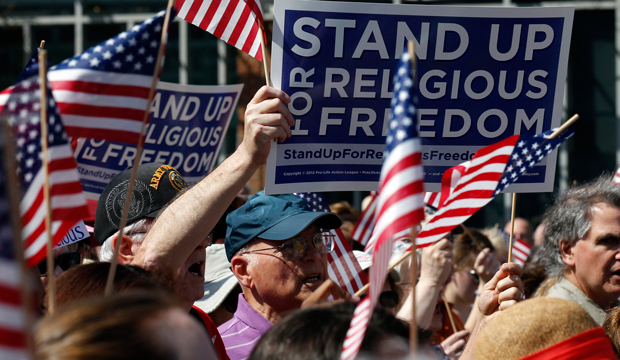
AP120323112975-620

The authors of this legislation and its supporters throughout the country don’t seem to get the fact that once you begin down this path that you set precedent. That precedent to discriminate against a person or group of people based on religious beliefs is dangers. The writers seem unconcerned about the ramifications of what would happen if this bill became law. In their hatred of homosexuality and homosexuals they forget that any law can which legalizes discrimination can be used against anyone, including those that enact it order to supposedly protect their religious liberty.

They also fail to understand the words of Thomas Jefferson who wrote:

“I know also, that laws and institutions must go hand in hand with the progress of the human mind. As that becomes more developed, more enlightened, as new discoveries are made, new truths disclosed, and manners and opinions change with the change of circumstances, institutions must advance also, and keep pace with the times. We might as well require a man to wear still the coat which fitted him when a boy, as civilized society to remain ever under the regimen of their barbarous ancestors.” 

I am a defender of religious liberty, but religious liberty needs to be for all, not just for some. Religious liberty is something that our founders understood, and they took great care to ensure that the rights of religious minorities and unbelievers were respected in our Constitution. Just as I do not want the government regulating religion, even religious views that I do not agree, I do not want religion to be used to deny the civil rights of others simply because those people are different from those that choose to use the law to discriminate. I wonder what those that support this law would do if in another state the same kind of law was passed to discriminate against their basic civil and human rights. I don’t think that they would like it very much.

My view is much like Andrew Sullivan. I may not agree with someone’s deeply held religious convictions, they may be intolerant and even hateful must be allowed the space to speak about them and even enter into the public discourse. I do not want to see religious people silenced. I may disagree with what some say and how they say it but they like everyone else need to have the space to speak their convictions. Allowing that space is what “true liberals do.” Sullivan notes that those who advance the agenda of Gay rights and equality “should be wary of being seen to trample on religious freedom and be defined as discriminators of another sort.”
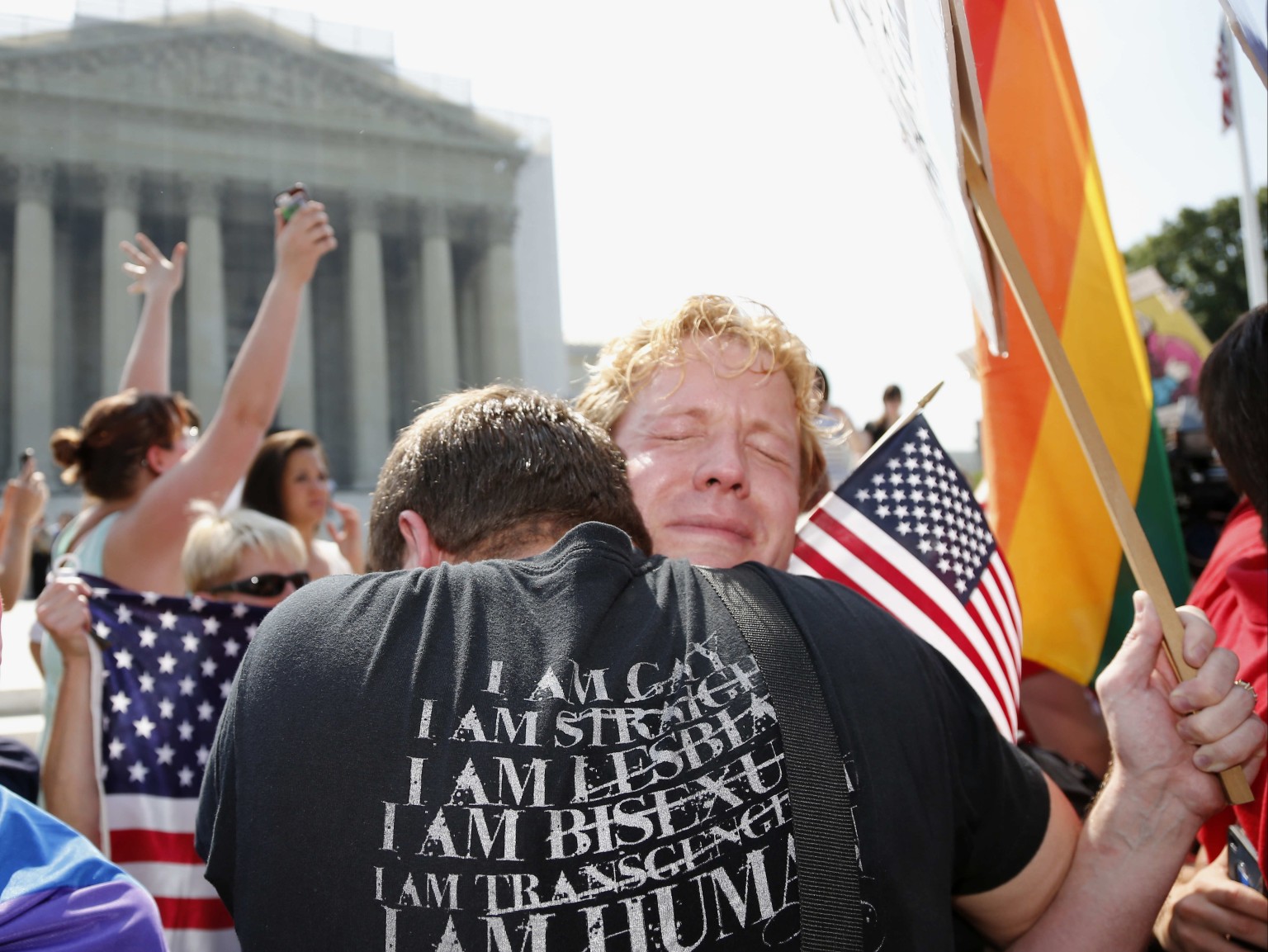
Michael Knaapen, John Becker

I agree with Sullivan on this, the fact is that Gays like so many others have been the target of state sanctioned religious discrimination throughout history. It is natural that the LGBT community, which has been so hated and discriminated against would want to push hard against those that use religion to attack, demean and marginalize them. But it is important remember that reconciliation and acceptance is a two way street. The actions of the late Nelson Mandela after the fall of Apartheid in South Africa should be a model. Mandela said: “For to be free is not merely to cast off one’s chains, but to live in a way that respects and enhances the freedom of others.”

Unfortunately in Kansas, many religious people, for reasons, some real but many imagined; feel the compelling need to use the power of the law to suppress LGBT people or others that they believe threaten them. In other places religious people attempt to use the police power of the government at the Federal, State and Local level to suppress anything or the activities of anyone they deem to be against God, or rather their interpretation of God.

Though I am not Gay I feel the sting of these laws because although my Church will allow me to marry a Gay couple I cannot in the state that I reside or many others. I know a number of Gay couples that have asked me if I could perform their marriages, but such will have to wait until we can find a time and a place where I can legally perform their nuptials. The sad thing is that in some places like Indiana there are legislators who in defending their religious freedom would criminalize an attempt by me or any other minister performing such an act if they could. Thankfully that amendment to the Indiana Constitution has been pushed back for at least two years.

Their belief compels them to use the law against homosexuals, non-Christian religious minorities, secularists and humanists and attempt to curtail the advances and discoveries of science, archeology and history. I believe that such attempts are short sighted and do violence to the religious beliefs that many espouse. Eric Hoffer wrote in his book The True Believer that “Faith in a holy cause is to a considerable extent a substitute for the lost faith in ourselves.”

The proposed law in Kansas, which looks as if may stall in the State Senate is an evil being enacted to supposedly support the good. Nothing good can come of it, if passed it will poison the hearts and minds of the very people it is supposedly written to protect. It will give them legal right to treat people who are different than them in a way that does not reflect the Gospel, and encourage the worst type of self-righteous behavior, and it will blow back in their face.

The attempt of the Kansas legislature to pass this Bill into law reminds me of something that Spencer Tracy’s character, Henry Drummond said in the film Inherit the Wind:

“I say that you cannot administer a wicked law impartially. You can only destroy, you can only punish. And I warn you, that a wicked law, like cholera, destroys every one it touches. Its upholders as well as its defiers.” 

This is a wicked law, and if it is made law it will do great harm to those that is directed against, those who the precedents in it may be used against in the future and those that think that will protect their. It is Orwellian and at its heart it is evil. If it is enacted into law it should be opposed at every opportunity by every person of good will, no matter what their faith, political ideology or sexual preference, because all people have the right to life, liberty and the pursuit of happiness.

Peace

Padre Steve+
1 Comment

Filed under faith, laws and legislation, News and current events

The Orangeburg Massacre and the Uncertain Memory of Justice Clarence Thomas

633060317174650000_Smith-Hammond-Middleton-1

Last February, Supreme Court Justice Clarence Thomas lamented the “race consciousness” and “sensitivity” as compared to growing up in Savannah Georgia in the 1960s.

If he were not in a position of nearly unlimited power and influence where he can through a legal opinion overturn established laws regarding voters rights, equal opportunity and discrimination it would be laughable. However, Justice Thomas seems to have missed so much of what was happening to African Americans and others during the Jim Crow Era, the campaigns for resistance in the “segregation forever” movement and the wanton violence used on African Americans who simply wanted the same rights that other Americans enjoyed.

How a man as educated and supposedly aware as Thomas supposedly is can make such an absurd statement is beyond me. In fact it is ludicrous and speaks volumes about how Thomas would willingly cover up the gross injustices that were perpetrated against African-Americans.

ScarredJustice

The brutality of those in power against those who demonstrated and campaigned for civil rights was widespread. If Thomas did not hear about it in his childhood it was more likely that it was because Blacks had no voice in local or state government, no support in the local media and those who spoke out were brutalized, their homes, churches or businesses burned or or bombed, and for their trouble many went to jail. It took extraordinarily courageous men and women to stand up to the tyranny perpetrated by politicians, police, businessmen, and even church leaders at the local and State level, which were often directly connected to the activities of the Ku Klux Klan in many parts of the South.

Thomas said that he was treated worse by the Northeastern Liberal Elites, than he was in his home town. That may be so, racial prejudice was not unique to the South, in fact some of the worst riots against desegregation occurred in Boston, not far from Thomas’ college Alma mater. In fact in some Northern cities racism and discrimination were as bad than in parts of the South.

Likewise there were incidents of violence in Watts California by the Los Angeles Police Department that helped trigger the Watts Riots. That being said, there can be no doubt that in terms of organized systemic discrimination, persecution, and violence, it was in the South where Blacks suffered the gravest injustice. The South was the unparalleled hotbed of resistance to change, and resistance to the simple desire of people to receive equal treatment under the law.

Today, even many whites remember some of those incidents; the burning of the Freedom Riders bus in Anniston Alabama, the baring of James Meredith from the University of Mississippi, the 16th Street Baptist Church Bombing in which four little girls going to Sunday School were murdered, the brutal attacks on protestors in that same city that sent Dr Martin Luther King to jail, the murder of Medgar Evers, the murder of the Mississippi Civil Rights Workers, Bloody Sunday on the Edmund Pettus Bridge in Selma Alabama, and the assassination of Martin Luther King Jr.

We all know about those, well at least some of us do. They all occurred early in my lifetime and certainly if Thomas didn’t know about them as a child, he most certainly knows about them now.But the good Justice willingly chooses to ignore and treat them if they never happened, to Thomas, those were the “good ole days.”

But such an attitude denies history. It is inexcusable for any man or woman, of any race holding such an important position as Thomas to have, that of a Supreme Court Justice to hold such ahistoric and racist views. For man like Thomas, who in his office helps to make and interpret law that affects the civil rights of all Americans it is unconscionable. But then, I do not believe that Thomas has a conscience.

orangespan

But for each of those incidents there were many more, some very bloody which have been forgotten. I was reminded of one of those last year  when a speaker talked about an incident that occurred at his alma mater, South Carolina State University in Orangeburg South Carolina, the Orangeburg Massacre. I think I had read about it once, but I had forgotten about it.

The massacre occurred on February 8th 1968 when students at the college began to protest for equal access to local businesses, especially at the only bowling alley in town, the All Star Lanes. The owner refused to allow Blacks to patronize his establishment. In the days leading up to the massacre students were beaten by police as they engaged in peaceful protests.

6a01053653b3c7970b0148c8716ecb970c-800wi

Protests continued on campus, hundreds of police and state troopers were dispatched as well as armored vehicles from the National Guard. On campus about 200 students milled around a dying bonfire.

020_orangeburg_massacre_wounded_jpg

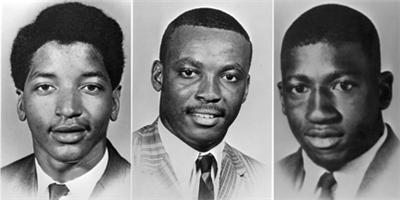
During a protest the local and state police opened fire on a crowed of students at a bonfire. Contrary to the claims of the police no student was armed, three students were killed, and twenty seven wounded. Many were shot in the back. The dead included a college Army ROTC Cadet named Henry Smith, another, a member of the college football team, Samuel Hammond who died reciting the 23rd Psalm with his mother at his side, and lastly the young Delano Middleton, a local high school student who had joined the protest.

022_ORANGEBURG_NATIONAL_GUARD

J. Edgar Hoover ordered agents to make false statements to Justice Department officials to cover for the State Troopers involved. When nine of the police officers went to trial for excessive use of force all were acquitted. But how could they be? Evidence was suppressed, false statements made and testimony of the victims discounted.

16768434_BG1

For years the subject was covered up, and disinformation spread by elected and police officials, including the governor who blamed the protest on outside “Black Power agitators” and who claimed that the protest took place off campus. Activist Cleveland Sellers was convicted of “inciting a riot” and spent seven months in jail. Twenty five years later he was pardoned. It was not until 2001 that a Governor, then Jim Hodges attended the school’s annual memorial and it was not until 2005 when then Governor Mark Sanford made a formal apology for the massacre.

6a01053653b3c7970b0147e26870b8970b-800wi

The massacre received almost no coverage in the national media and was forgotten. The energy of most Americans was focused on the Vietnam War, the Kent State Shootings and the assassination of Dr Martin Luther King Jr.

10p816

Justice Thomas may have historical amnesia, but history is history, even history that those in power desired to cover up.

5129b1bbb6c38.preview-620

History and justice, even belated justice matter because there are those in our country, not all in the South, who would like to roll back the protections that exist in law to protect African Americans and other minorities from institutional discrimination in matters of voters rights and equality. There are business owners who openly boast of their refusal to serve minorities, and are hailed by some for doing so.

I encourage my readers to explore this subject, the book, The Orangeburg Massacre by Jack Bass and Jack Nelson published by Mercer University Press, a number of websites as well as a video that I have provided a link to here http://www.democracynow.org/2008/4/3/1968_forty_years_later_a_look are good places to start.

Like Montgomery, Birmingham, Anniston, Memphis and Selma, Orangeburg though forgotten by most, still matters. Never forget and do not let it happen again.

Peace

Padre Steve+
2 Comments

Filed under civil rights, History, News and current events

Character Sacrifice, Service in the Face of Blatant Racism and the Dream that Cannot be Stopped: Brigadier General Benjamin O Davis Sr and Lieutenant General Benjamin O Davis Jr.

495px-Benjamin_o_davis

“I have a dream that my four little children will one day live in a nation where they will not be judged by the color of their skin, but by the content of their character.” Dr. Martin Luther King, Jr.

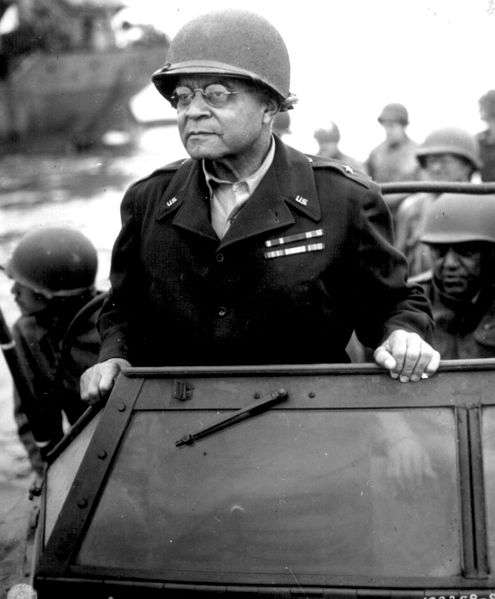
Last Friday, October 25th was the 73rd anniversary of the promotion of Colonel Benjamin O. Davis to the Rank of Brigadier General in the United States Army. In 1940 as the nation prepared for war many experienced officers were being promoted, some to Flag or General Officer rank. However, Colonel Davis was different, he was black.

Seldom do we take the time to remember that it really wasn’t that long ago that African Americans were for all practical purposes less than full citizens. Jim Crow laws, discrimination, segregation and impediments to voting were the norm in much of the country. Separate but equal was that mantra of racists in power. Blacks no matter how educated, how patriotic or how successful were discriminated against, held back and in far to many cases the target of hatred, violence and even murder. It was in such a climate that Benjamin O Davis served as an officer in the US Army.

While American History would not be the same without the life, work and prophetic ministry of Dr. Martin Luther King Jr. much of his hard fought success was brought about by men and women who served in the military, or for that matter played the game of baseball in an exemplary manner in an otherwise whiter than white bread world.

Dr. King was born in a time when most of the country was segregated when “separate by equal” was simply façade to cover the lie that in no way did African Americans have equal rights or privileges in the United States. Something some leaders attempt today through the use of voter purges that target Blacks, hispanics and other minorities. Sad to day that some things don’t change. Racists are still racists.

In 1922 Carrie Williams Clifford published the poem The Black Draftee from Georgia which alluded to to the lynching of Wilbur Little, a soldier and veteran of the First World War  who was lynched by a mob for wearing his uniform after being warned not to:

What though the hero-warrior was black?
His heart was white and loyal to the core;
And when to his loved Dixie he came back,
Maimed, in the duty done on foreign shore,
Where from the hell of war he never flinched,
Because he cried, “Democracy,” was lynched.

 Dr King was born less than 60 years after the secession of the Southern states from the Union and the beginning of the American Civil War. Though that blood conflict had freed the slaves it had not freed African Americans from prejudice, violence and discrimination.  When Dr. King began his ministry and was thrust upon the national stage as the strongest voice for equal rights and protections for blacks the discrimination and violence directed towards blacks was a very real and present reality in much of the United States.

Events_Buffalo_Soldier

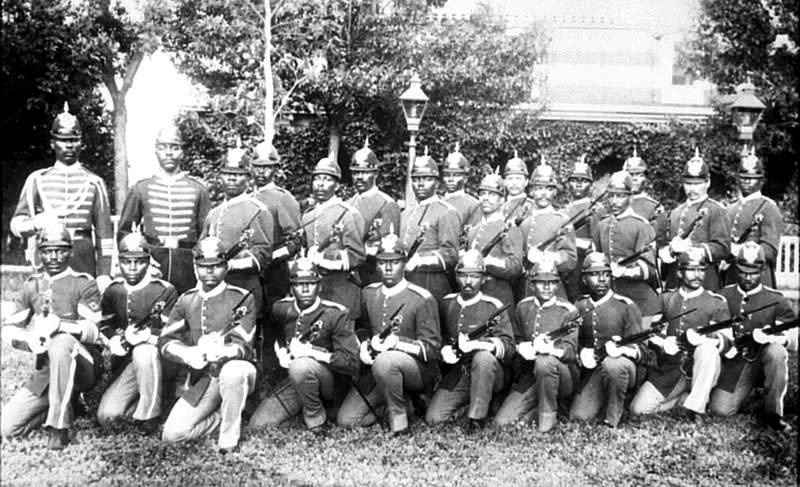
 Buffalo Soldiers in the 1880s 

However there were cracks beginning to appear in the great wall of segregation in the years preceding Dr. King’s ascent to leadership as the moral voice of the country in the matter of racial equality. In baseball Jackie Robinson became the first African American player in Major League Baseball opening a door for others who would become legends of the game as well as help white America begin its slow acceptance of blacks in sports and the workplace.

Likewise the contributions of a father and son Brigadier General Benjamin O. Davis Sr. and General Benjamin O. Davis Jr. were advancing the cause of blacks in the military which eventually led to the desegregation of the military in 1948.  The impact of these two men cannot be underestimated for they were trailblazers who by their lives, professionalism and character blazed a trail for African Americans in the military as well as society.

Benjamin O. Davis Sr. was a student at Howard University when the USS Maine exploded and sank in Havana Harbor.  He volunteered for service and was commissioned as a temporary 1st Lieutenant in the 8th United States Volunteer Infantry. He was mustered out of service in 1899 but enlisted as a private in the 9th United States Cavalry one of the original Buffalo Soldiers regiments.

9th_cavalry_camp_lawton_1

 Buffalo Soldiers in the Philippines 

He was initially the unit clerk of I troop of 3rd Squadron and was promoted to be the squadron Sergeant Major. He was commissioned while the unit was deployed to the Philippines counterinsurgency campaign and assigned to the 10th Cavalry.

Early in his career Davis was assigned in various positions including command, staff and instruction duties including as Professor of Military Science and Tactics in various ROTC programs.  He reached the rank of rank of temporary Lieutenant Colonel and Squadron Commander of 3rd and later 1st Squadron 9th Cavalry from 1917-1920 in the Philippines before reverting to the rank of Captain on his return as part of the post World War I reduction in force.

He continued to serve during the inter-war years and assumed command of the 369th Infantry Regiment New York National Guard in 1938. He was promoted to Brigadier General on 25 October 1940 becoming the first African American elevated to that rank in the United States Army and was assigned as Commander 4th Brigade 2nd Cavalry Division. He later served in various staff positions at the War Department and in France and was instrumental in the integration of the U.S. Military. He retired after 50 years service in 1948 in a public ceremony with President Harry S. Truman presiding. He was a member of the American Battle Monuments Commission from 1953-1961 and died in 1970.

davis-3

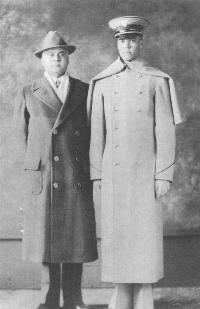
Colonel Davis with his son Cadet Benjamin O Davis Jr.

His son Benjamin O. Davis Jr. was appointed to West Point in 1932.  He graduated and was commissioned in 1936 graduating 35 out of 278, the fourth African American graduate of West Point. During his time at the Academy most of his classmates shunned him and he never had a roommate.  Despite this he maintained a dogged determination to succeed.  The Academy yearbook made this comment about him:

“The courage, tenacity, and intelligence with which he conquered a problem incomparably more difficult than plebe year won for him the sincere admiration of his classmates, and his single-minded determination to continue in his chosen career cannot fail to inspire respect wherever fortune may lead him.”

He was denied entrance to the Army Air Corps because of his race and assigned to the Infantry first to the all lack 24th Infantry Regiment at Ft Benning where he was not allowed in the Officers Club due to his race. Upon his commissioning the Regular Army had just 2 African American Line Officers, 2nd Lieutenant Davis and his father Colonel Davis. After completion of Infantry School he was assigned as an instructor of Military Science and Tactics and the Tuskegee Institute.

benjaminodavisjr02

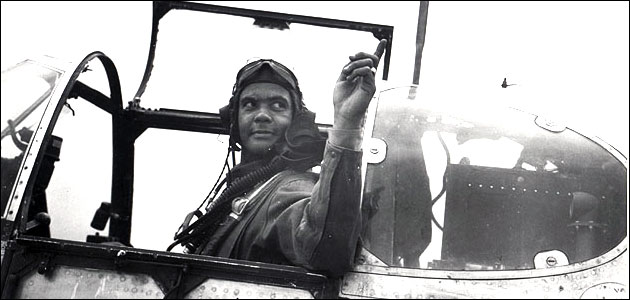
Benjamin O Davis Jr in WWII

In 1941 the Roosevelt Administration moved to create a black flying unit and Captain Davis was assigned to the first black class at the Tuskegee Army Air Field and in March 1942 one his wings as one of the first 5 African Americans to complete flight training.  In July 1942 the younger Davis was assigned as Commanding Officer of the 99th Pursuit Squadron which served in North Africa and Sicily flying Curtiss P-40 Warhawks.

He was recalled to the United States in September 1943 to command the 332nd Fighter Group. However some senior officers attempted to prevent other black squadrons from serving in combat alleging that the 99th had performed poorly in combat. Davis defended his squadron and General George Marshall ordered an inquiry which showed that the 99th was comparable to white squadrons in combat and during a 2 day period over the Anzio beachhead the pilots of the 99th shot down 12 German aircraft.

images-58

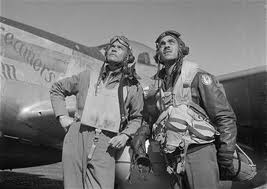
Colonel Benjamin O Davis Jr (left) with one of his Tuskegee Airmen

Davis took the 332nd to Italy where they transitioned to P-47 Thunderbolts and in July 1944 to the P-51 Mustang which were marked with a signature red tail. During the war, the units commanded by Davis flew more than 15,000 sorties, shot down 111 enemy planes, and destroyed or damaged 273 on the ground at a cost of 66 of their own planes. Their record against the Luftwaffe was outstanding and their protection of the bombers that they escorted was superb with very few bombers lost while escorted by them men that the Luftwaffe nicknamed the Schwarze Vogelmenschen and the Allies the Red-Tailed Angels or simply the Redtails. Davis led his Tuskegee Airmen to glory in the war and their performance in combat helped break the color barrier in the U.S. Military which was ended in 1948 when President Truman signed an executive order to end the segregation of the military. Colonel Davis helped draft the Air Force plan and the Air Force was the first of the services to fully desegregate.

250px-Benjamindavis-228x300

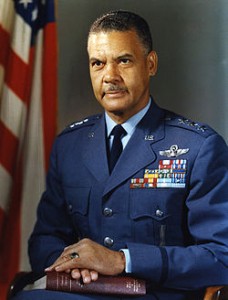
Lieutenant General Benjamin O Davis Jr

 Colonel Davis transitioned to jets and let the 51st Fighter Interceptor Wing against Chinese Communist MIGs in the Korean War.  He was promoted to Brigadier General in 1954 and served in numerous command and staff positions. He retired in 1970 with the rank of Lieutenant General and was advanced to General while retired by President Clinton in 1998.  He died in 2002 at the age of 89.

The legacy of Benjamin O. Davis Senior and Benjamin O. Davis Junior is a testament to their character, courage and devotion to the United States of America. They helped pioneer the way for officers such as General Colin Powell and helped change this country for the better.  During times when discrimination was legal they overcame obstacles that would have challenged lesser men.

Benjamin O. Davis Junior remarked “My own opinion was that blacks could best overcome racist attitudes through achievements, even though those achievements had to take place within the hateful environment of segregation.”

Such men epitomize the selfless service of so many other African Americans who served the country faithfully and “by the content of their character” triumphed over the evil of racism and helped make the United States a more perfect union. Today many African Americans as well as members of other minorities including racial minorities, women and gays serve with distinction in the military. What they do today is in many part a direct result of the courage, character and convictions of men like Benjamin O Davis Sr and Benjamin O Davis Jr.

Unfortunately the struggle for equality is never over and current generation will have to work just as hard to ensure that the freedoms won at so great a cost are not lost. General Colin Powell, the first Black man to serve as Chairman of the Joint Chiefs of Staff and Secretary of State commented in 1994:

“I stand here today as a direct descendant of those Buffalo Soldiers and of the Tuskegee Airmen and all the black men and women who have served the nation in uniform, I will never forget my debt to them. I didn’t just show up. I climbed on the backs of those who never had the kind of opportunity that I had.”

Peace

Padre Steve+
4 Comments

Filed under civil rights, History, Military, Political Commentary, world war two in europe

Doing the Gospel: “Beyond the Possible” by Cecil Williams and Janice Mirikitani A TLC Book Tour Review

l

Beyond the Possible, 50 Years of Creating Radical Change at a Community Called Glide, Cecil Williams and Janice Mirikitani Harper One Books, New  York 2013 

“You never know when the Spirit will knock at your door…” 

I seldom read books by American pastors of any denomination. I have gotten over the cult of celebrity associated with most of our most esteemed preachers. Likewise, when I read a story about a church, be it a local church or denomination I am generally filled with skepticism and wonder when I am going get hit on for a financial contribution or political favor. I guess that I have seen the light in regard to how many church leaders run their business. Or maybe I am just a bit cynical having spent many years in the Mega-Church world and worked for a nationally recognized and now very politically active “evangelist” about 20 years ago.

When I received the note from the good people at TLC Book Tours to do a review on this book I almost turned it down but then thought well “what the hell? If I think it’s bullshit I can rip it apart.”

However I cannot do that, even after reading it. I had remembered the name of Cecil Williams from growing up east of San Francisco in the 1970s. At the time I thought Williams a bit too radical and not “Christian” enough. Of course I knew little of him or of Glide only what I saw on television news reports, many of which were not always the most complimentary of him. Since I knew little of Glide that impression was what I had for many years. However, over the years I would occasionally see Pastor Williams on different interviews and was impressed with him and what I heard. I didn’t necessarily always agree but he was impressive, not the liberal monster I thought him to be.

Of course the book is a memoir of Williams and his wife Janice Mirikitani and how their lives intersected with a dying church in the heart of San Francisco’s Tenderloin district, a place ridden with drugs, crime and poverty. It was a place that most of the church members had departed from. It was a church, like so many that had seen better days. It was a church like the one that I was baptized in as a baby which as the neighborhood that it was located slid into poverty and change in ethnic composition saw the majority of its membership move away. Eventually, that Methodist church died and was closed. It was a fate that Glide Memorial Methodist Church was heading to when the last 35 members welcomed their new pastor, Cecil Williams in 1963. It was a moment of change. It was a moment when a fresh breeze blew through the church.

The book chronicles the stories of Williams, the son of a church janitor and his wife in Jim Crow San Angelo Texas and his early life under those laws. It tells of his struggles as a pioneer African American student at SMU’s Perkin’s Seminary and his part in the Civil Rights movement of the late 1950s and early 1960s, including time in a Birmingham jail.

It also tells the story of a young Japanese American woman, Janice Miritikani who with her family had endured the pain and humiliation of being incarcerated after the attack on Pearl Harbor simply because they were Japanese. It is her story as well, a story that was not only about the prejudice that she experienced the dehumanizing experience of rape and incest covered up by family and cultural pressures, the story of a woman who prayed for God’s presence and struggled as God remained silent.

It is a story of love, faith hope, purpose and the endless possibilities that exist when one sees that which is considered “beyond the possible.” It is a book that tells of struggle of a community which many people did not consider redeemable. It is the story of a church and of people, not just Williams and Miritikani but the people who in turbulent times launched a church that has become a bastion of living the Social Gospel, speaking prophetically to those in power and working for the benefit of the least, the lost and the lonely.

Glide, the community is a place of acceptance and love, a place which serves and empowers those without power, without a voice. Providing care to the homeless, the jobless, the needy, the HIV infected and those suffering from AIDS, those battling drug and alcohol abuse, those rejected for their lifestyles and a host of others. The Glide foundation, which Williams has headed since his “official” retirement from the church is one of the top philanthropic organizations in the nation.

Now there are some that would not agree with Williams and the message of Glide. It is a church that welcomes people of all walks of life and faith. It is a church with a door open to all, even those who would come to the church intentionally to cause trouble as did a number of White Supremacists attired in  White Power, Neo-Nazi and Neo-Confederate images, who ended up staying when their hate was met by love. It is a church where the rich and the poor worship together in a service called a “celebration.”

Glide is a strange animal. It is a by all definitions a politically and socially active Mega-Church with about 11,000 members. Those that know me well and read this site regularly know that I am not a fan of most Mega-Churches. To me most, regardless of their theological or political views seem to exist for themselves.  However, Glide is a place that thanks to Williams, Miritikani and those that over the past 50 years have sacrificed to build reaches out to redeem the community where it resides and does not exist for itself. It may not speak the same language as the contemporary Evangelical Mega-Churches but it is reaching those who quite often would be unwelcome in those churches. It is the embodiment of the love of God, an incarnation of the love of Jesus to those that would be, and were in fact the same kind of people that Jesus himself went to in his earthly ministry.

This book is inspirational to read for anyone who has a heart for those disenfranchised and uncared for by the church or the world. I found it hard to put down. The message “you never know when the Spirit will knock at your door” was real to me as I read this book during the Season of Lent. Indeed it is possible for God and the people of God to go Beyond the Possible.

tlc-tour-host

I highly recommend it to anyone and plan to visit Glide the next time that I go to San Francisco and hope that should I be involved in parish ministry after my Navy career is over that I can emulate the spirit and love that I saw described in this book.

Peace

Padre Steve+
3 Comments

Filed under christian life, faith, leadership, Pastoral Care, Religion

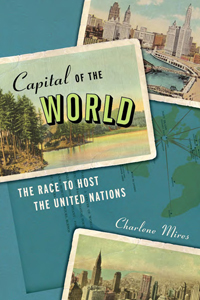
Capital of the World: The Race to Host the United Nations: A TLC Book Tour Review

Capital of the World200

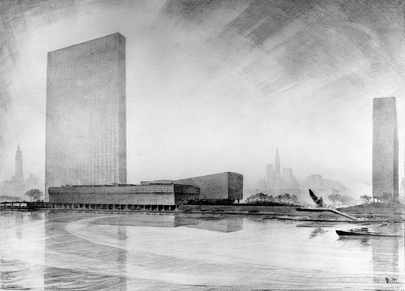
Professor Charlene Mires’ Capital of the World: The Race to Host the United Nations, NYU Press 4 March 2013 is the fascinating story of the competition by numerous cities in the United States to become the host of the United Nations.

Professor Mires’ account of the story of how the UN came to be located in New York City, over the objections of many members is highly informative, readable and enjoyable. It is about an America that once welcomed engagement with the world in the heady days following the Second World War before signs sponsored by the John Birth Society and others popped up across the country demanding “Get us out of the United Nations.”

Mires traces the stories of a number of major cities including San Francisco, Chicago, St Louis, New Orleans, Philadelphia and Detroit as well as the Rapid City South Dakota, Sault Ste. Marie Michigan, Niagara Falls New York, Stillwater Oklahoma and a host of other cities and towns that sought to host the UN.

36640

The story which includes the attempts of various individuals, politicians and civic groups to lobby the UN to become its headquarters and thus the storied “Capital of the World” is fascinating. Though the campaign to host the UN happened over 60 years ago and we know the history of its location in New York the back story to how it came to located there is worth the read. Professor Mires tells the story of how the United States became the chosen nation of the location of the UN based on the history of Europe and questions of the emerging Cold War.

1326

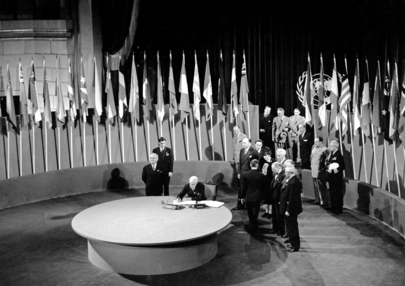
What I found interesting was how the members of the UN finally settled on New York, despite the fact that many did not wish the UN to be in the United States and if it was not to be in a major city. The story of how San Francisco, a city close to my heart which hosted the inaugural meeting of the UN in 1945 was cut out of the running when a UN committee decided that no locations in the western part of the United States would be considered. That decision, which was based more on European objections to the geographic location was difficult to read. I cannot think of a better city and thankfully the mistake was rectified by the late Gene Roddenberry in Star Trek when the United Federation of Planets located Starfleet Headquarters and Starfleet Academy in San Francisco.

0aaunitednation

That aside the story that Professor Mires paints of how the committee and the UN decided on New York is compelling. The process which included geographic, political and social concerns. Politically the influence of the American government should the location be too close to Washington DC prompted conferees to seek a location at least 300 miles from Washington. The real effects of Racism and Jim Crow laws eliminated all Southern cities and towns south of the Mason Dixon Line from the competition. Issues regarding crime, graft and corruption eliminated Philadelphia as well as other cities leading to the eventual selection of New York as the location for the nascent United Nations.

Overall I enjoyed the book. It was a quick, informative and enjoyable read. As a person who genuinely appreciates the work and promise of the UN, despite its shortcomings and failures I found it a story that caught my imagination and made me wonder the “what if” scenarios and what might have been if…

To me those are fascinating questions. What would have happened had the UN been located in San Francisco? Could it have led to the emergence of a stronger and move toward the Pacific Rim becoming the economic and political center of the world? Could the location of the UN in a place like Rapid City brought Middle America more global perspective and perhaps a larger population and economy? Could the selection of a Southern city led to a quicker end to Jim Crow and beginning of equal rights?

Those are questions for those that write alternative histories. They are speculation. Professor Mires work made me think of all of the possibilities that did not happen.

images-30

I recommend this book for those interested in the development of the United States in the late 1940s and early 1950s as well as those that like to have their eyes opened to possibilities that they never before had imagined. Perhaps in an alternate timeline San Francisco not only has the Giants, but the United Nations. I would like to visit that city.

tlc tour host

Peace

Padre Steve+

11 Comments

Filed under History

The Long and Slow Integration of the Major Leagues: A Reflection on Desegregation and Spring Training

robinson-dodgers

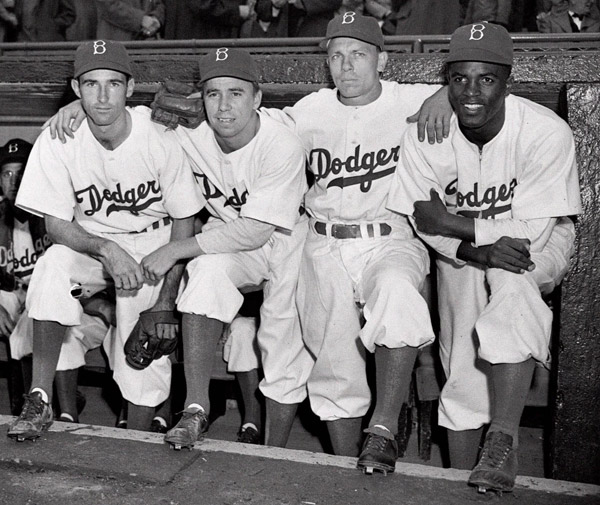
John Jorgensen, Pee Wee Reese, Ed Stanky and Jackie Robinson on opening day 1947

“Thomas Jefferson, when he wrote the Declaration, made proper provision for baseball when he declared that ‘all men are, and of right out to be, free and equal.’ That’s why they are at the ball game, banker and bricklayer, lawyer and common laborer.” – Baseball magazine (1921)

“Baseball should be taken seriously by the colored player — and in this effort of his great ability will open the avenue in the near future wherein he may walk hand in hand with the opposite race in the greatest of all American games — baseball.” Ossie Davis

robinson2-popup

Charles Thomas 

It was in 1903 when Branch Rickey, then a coach for the Ohio Wesleyan University baseball team had to console his star player, Charles Thomas when a hotel in South Bend Indiana refused him a room because he was black. Rickey found Thomas sobbing  rubbing his hands and repeating “Black skin. Black skin. If only I could make them white.” Rickey attempted to console his friend saying “Come on, Tommy, snap out of it, buck up! We’ll lick this one day, but we can’t if you feel sorry for yourself.”

Branch-Rickey

Thomas, encouraged by Rickey was remembered by one alumnus who saw a game that Thomas played in noted that “the only unpleasant feature of the game was the coarse slurs cast at Mr. Thomas, the catcher.” However, the writer noted something else about Thomas that caught his eye: “But through it all, he showed himself far more the gentleman than his insolent tormentors though their skin is white.”

Baseball like most of America was not a place for the Black man. Rickey, a devout Christian later remarked “I vowed that I would always do whatever I could to see that other Americans did not have to face the bitter humiliation that was heaped upon Charles Thomas.”

In April 1947 Branch Rickey, now the owner of the Brooklyn Dodgers had one African-American ballplayer at the Dodgers’ Spring Training site in Daytona Beach Florida. The South was still a hotbed of racial prejudice, Jim Crow was the law of the land and Blacks had no place in White Man’s baseball. That player was Jackie Robinson.

Jackie Robinson Shaking Branch Rickey's Hand

The Dodgers had been coming to Florida for years. Rickey moved the Dodgers from Jacksonville to Daytona Beach in 1947 after Jacksonville had refused to alter its segregation laws to allow an exhibition game between the Dodgers International League affiliate the Montreal Royals, for whom Robinson starred.

That was the year that Rickey signed Robinson to a minor league contract with the Royals.  When Rickey called up Robinson 6 days prior to the 1947 season, it was  Robinson broke the color barrier for the Dodgers and Major League Baseball. However it would take another 12 years before all Major League teams had a black player on their roster.

It is hard to imagine now that even after Jackie Robinson had broken the color barrier that other teams did not immediately sign black players. However Rickey and Robinson broke the color barrier a year before Harry Truman had integrated the Armed Forces and seven years before the Supreme Court ruled the segregation of public schools illegal. But how could that be a surprise? The country was still rampant with unbridled racism. Outside of a few Blacks in the military and baseball most African Americans had few rights. In the North racism regulated most blacks to ghettos, while in the South, Jim Crow laws and public lynchings of progressive or outspoken Blacks.

images-24

Larry Doby (above) and Satchel Paige signed by the Indians

pic1

The Cleveland Indians under their legendary owner Bill Veeck were not far behind the Dodgers in integrating their team. They signed Larry Doby on July 5th 1947. Doby would go on to the Hall of Fame and was a key player on the 1948 Indian team which won the 1948 World Series, the last that the storied franchise has won to this date.

Hank THOMPSON - LENNOX PEARSON BOHEMIA ARCHIVE

Hank Thompson and Roy Campanella

roy-campanella-ap2

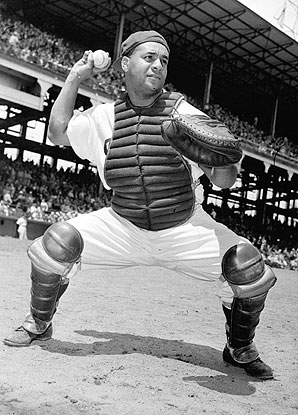
The St. Louis Browns signed Third Baseman Hank Thompson 12 days after the Indians signed Doby. But Thompson, Robinson and Doby would be the only Blacks to play in that inaugural season of integration. They would be joined by others in 1948 including the immortal catcher Roy Campanella who signed with the Dodgers and the venerable Negro League pitcher, Satchel Paige who was signed by the Indians.

monte_irvin

Monte Irvin (Above) and Willie Mays

WillieMays

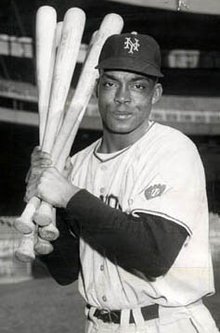
It was not until 1949 when the New York Giants became the next team to integrate. They brought up Monte Irvin and Hank Thompson who they had acquired from the Browns. In 1951 they would be joined by rookie Willie Mays to become the first all African-American outfield in the Major Leagues. Both Mays and Irvin would enter the Hall of Fame and both are still a key part of the Giants’ story. Despite their age have continued to be active in with the Giants and Major League Baseball.

images-25

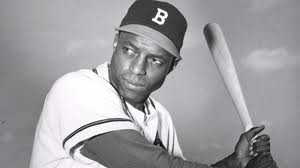
The Boston Braves were the next to desegregate calling up Samuel “the Jet” Jethroe to play Center Field. Jethroe was named the National League Rookie of the Year in 1950.

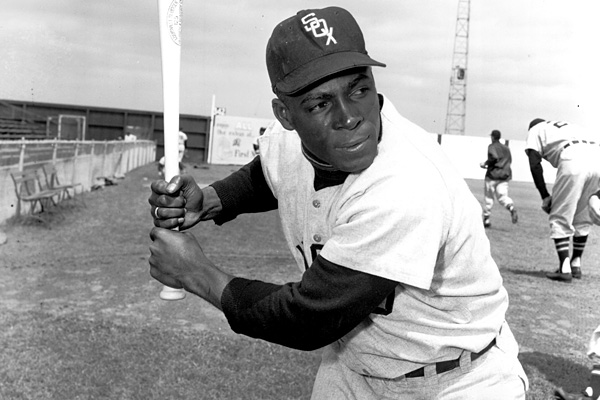
mlb_a_MinnieMinoso_cmg_600

Minnie Minoso

In 1951 the Chicago White Sox signed Cuban born Minnie Minoso who had played for Cleveland in 1949 and 1951 before signing with the White Sox. Minoso would be elected to 9 All-Star teams and win 3 Golden Gloves.

BANKS-ERNIE

Ernie Banks (above) and Bob Trice

Bob_Trice1953

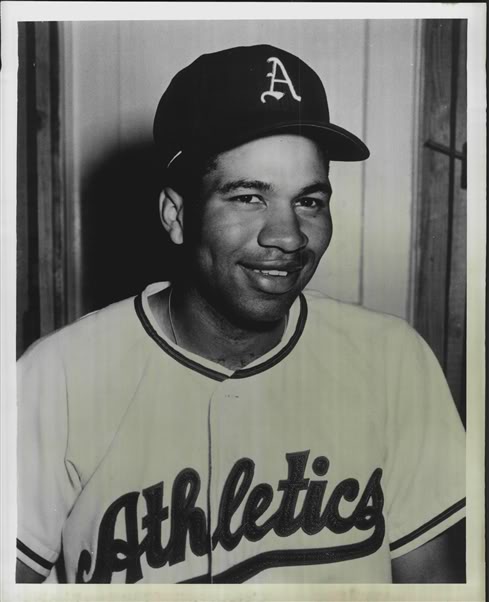
The Chicago Cubs and Philadelphia Athletics integrated at the end of the 1953 season. The Cubs signed Shortstop Ernie Banks who would go on to be a 14 time All-Star, 2 time National League MVP and be elected to the Hall of Fame in 1977 on the first ballot. The Athletics called up pitcher Bob Trice from their Ottawa Farm team where he had won 21 games. Trice only pitched in 27 Major League games over the course of three seasons with the Athletics.

6RI1

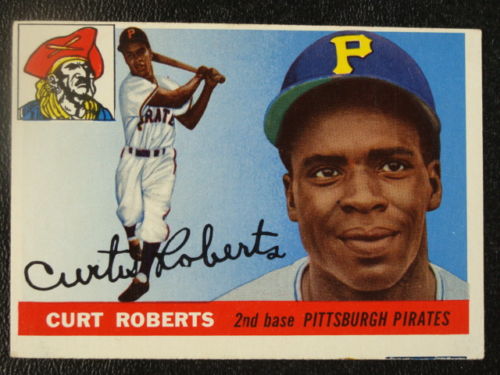
Curt Roberts

Four teams integrated in 1954. The Pittsburgh Pirates acquired Second Baseman Curt Roberts from Denver of the Western League as part of a minor league deal. He would play 171 games in the Majors.  He was sent to the Columbus Jets of the International League in 1956 and though he played in both the Athletics and Yankees farm systems but never again reached the Majors.

1954_alston_tom

Tom Alston

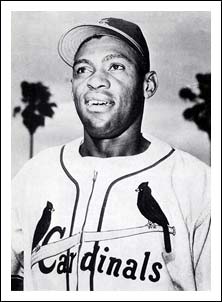
The St. Louis Cardinals, the team that had threatened to not play against the Dodgers and Jackie Robinson in 1947 traded for First Baseman Tom Alston of the Pacific Coast League San Diego Padres. Alston would only play in 91 Major League games with his career hindered by bouts with depression and anxiety.

100005

Nino Escalara (above) and Chuck Harmon

Chuck_Harmon

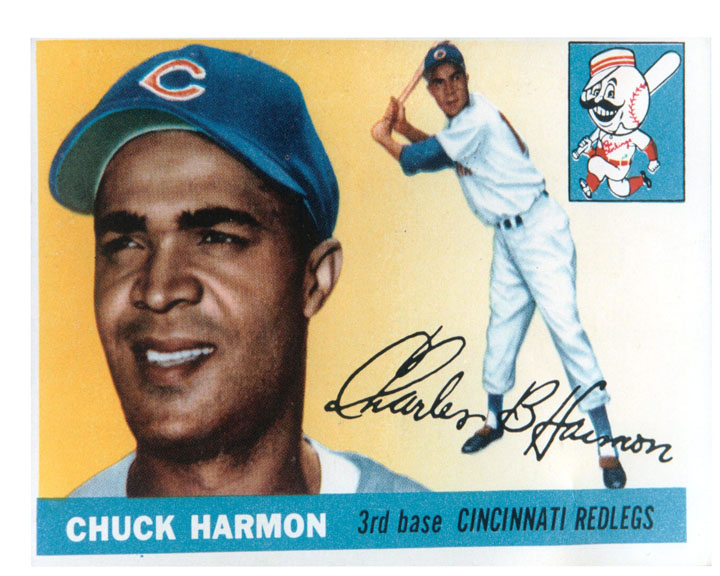
The Cincinnati Reds brought up Puerto Rican born First Baseman Nino Escalera and Third Baseman Chuck Harmon. Harmon had played in the Negro Leagues and had been a Professional Basketball player in the American Basketball League. Harmon who was almost 30 when called up played just 4 years in the Majors. Both he and Escalera would go on to be Major League scouts. Escalera is considered one of the best First Baseman from Puerto Rico and was elected to the Puerto Rican Baseball Hall of Fame. Harmon’s first game was recognized by the Reds in 2004 and a plaque hangs in his honor.

Carlos-Paula

The Washington Senators called up Cuban born Center Fielder Carlos Paula from their Charlotte Hornets’ farm team in September 1954. Paula played through the 1956 season with the Senators and his contract was sold to the Sacramento Salons of the Pacific Coast League. He hit .271 in 157 plate appearances with 9 home runs and 60 RBIs. He died at the age of 55 in Miami.

elston-howard

Elston Howard

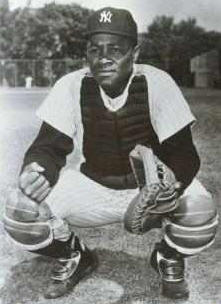
In April 1955 the New York Yankees finally integrated 8 years after the Dodgers and 6 years after the Giants. They signed Catcher/Left Fielder Elston Howard from their International League affiliate where he had been the League MVP in 1954. Howard would play 13 years in the Majors with the Yankees and later the Red Sox retiring in 1968. He would be a 12-time All Star and 6-time World Series Champion as a player and later as a coach for the Yankees. He died of heart disease in 1980.  His number #32 was retired by the Yankees in 1984.

58 kennedy, john f

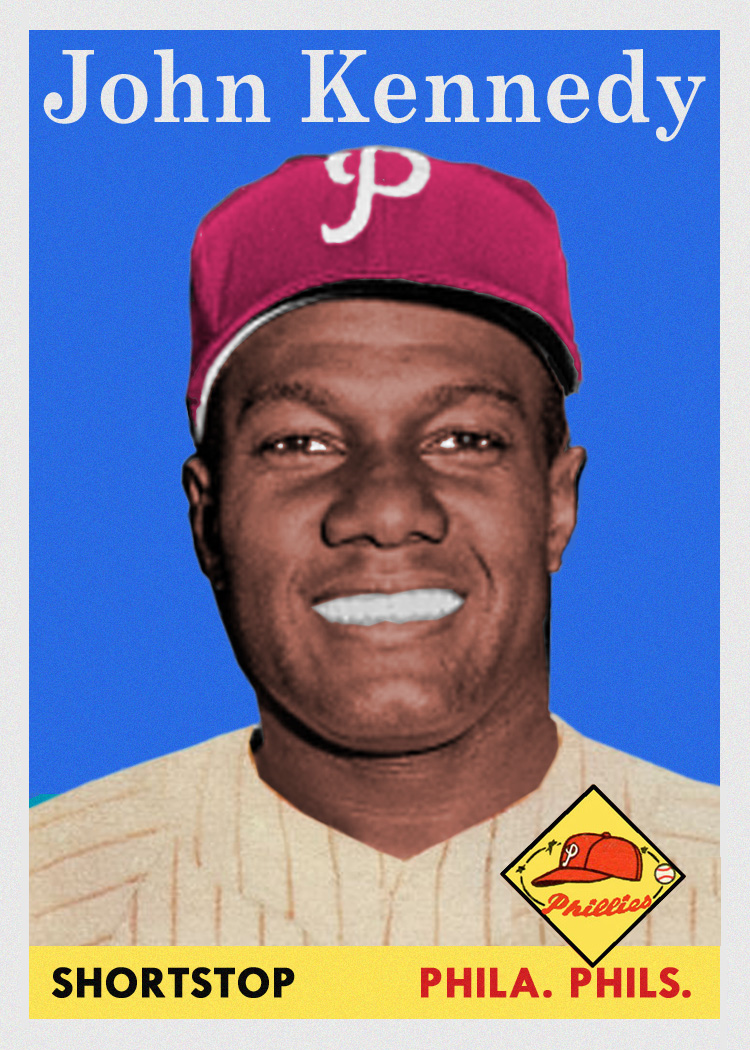
The Philadelphia Phillies purchased the contract of Shortstop John Kennedy from the Kansas City Monarchs of the Negro League at the end of the 1956 season. Kennedy played in just 5 games in April and May of 1957.

osvaldo4_195

Ozzie Virgil Sr.

In 1958 the Detroit Tigers obtained Dominican born Utility Player Ozzie Virgil Sr. who had played with the Giants in 1955 and 1956. Virgil would play 9 seasons in the Majors with the Giants, Tigers, Athletics and Pirates and retire from the Giants in 1969. He later coached for 19 years in the Majors with the Giants, Expos, Padres and Mariners.

Pumpsie_Green_1962_Topps

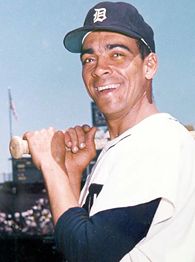
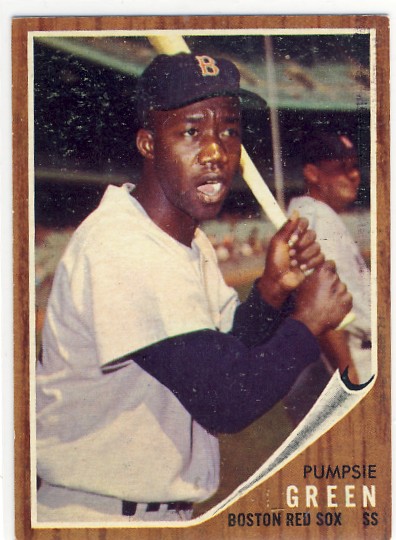
The last team to integrate was the Boston Red Sox who signed Infielder Pumpsie Green. Green made his debut on 21 July 1959 during his three years with the Red Sox was primarily used as a pinch runner. He played his final season with the New York Mets in 1963. He was honored by the Red Sox in 2009 on the 50th anniversary of breaking the Red Sox color barrier.

little-rock-stop-the-race-mixing

voter-registration-mississippi-1960-L-umRewg

luther-king

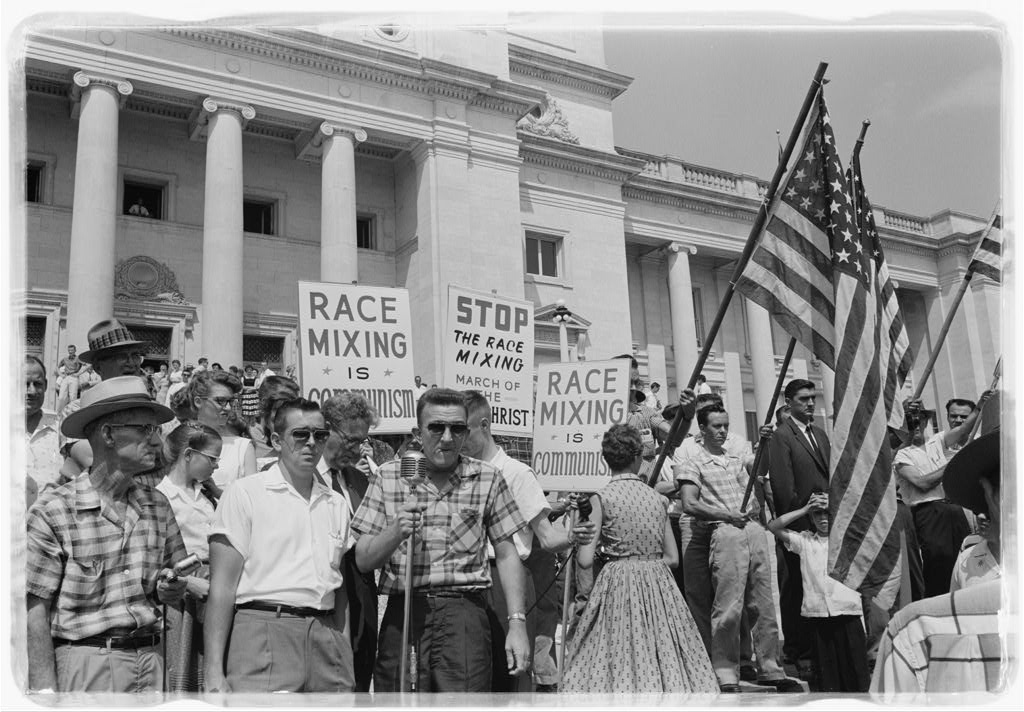
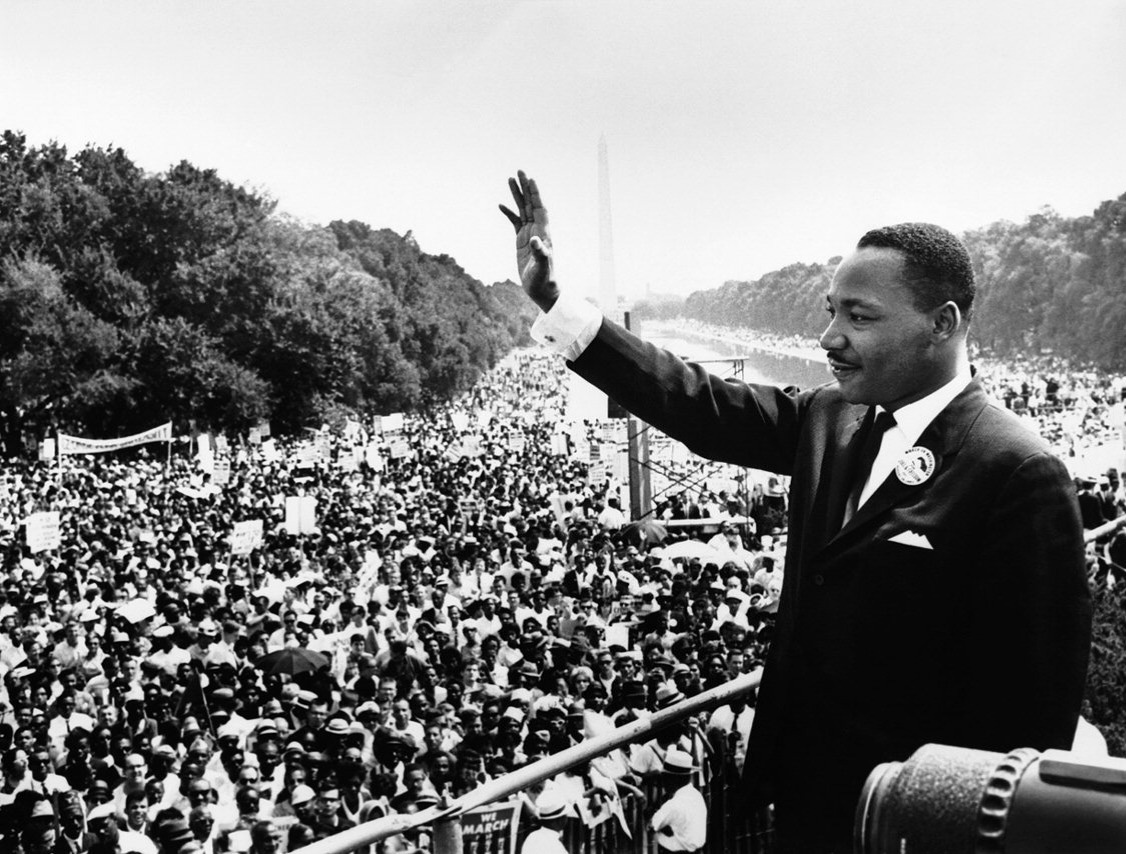
It took 12 years for all the teams of the Major Leagues to integrate, part of the long struggle of African Americans to achieve equality not just in baseball but in all areas of public life.  These men, few in number paved the way for African Americans in baseball and were part of the inspiration of the Civil Rights Movement itself.  They should be remembered by baseball fans, and all Americans everywhere for their sacrifices and sheer determination to overcome the obstacles and hatreds that they faced. It would not be until August of 1963 that Martin Luther King Jr. would give his I Have a Dream speech and 1964 that African Americans received equal voting rights.

robbyii

Spring training for the 2013 season has begun in Florida and Arizona, in what are called the Grapefruit and Cactus Leagues. It is hard to believe that only 66 years ago that only one team and one owner dared to break the color barrier that was, and often still is a part of American life. However in those 66 years despite opposition and lingering prejudice African Americans in baseball led the way in the Civil Rights Movement and are in large part responsible for many of the breakthroughs in race relations and the advancement of not only African Americans, but so many others. We can thank men like  Charles Thomas, Jackie Robinson and Branch Rickey for this and pray that we who remain, Black and White, Asian, and Latin American, as well as all others who make up our great nation will never relinquish the gains that have been won at such a great cost.

Peace

Padre Steve+
1 Comment

Filed under Baseball, History, laws and legislation, Political Commentary

The Message of Dr. Martin Luther King Jr. for 2011

“Darkness cannot drive out darkness; only light can do that. Hate cannot drive out hate; only love can do that.”  Dr. Martin Luther King Jr.

Today we worshipped at St. James Episcopal Church, Portsmouth Virginia where I attend when I am at home.  It had been a while since we attended with my assignment at Camp LeJeune and battles with weather and illness during the past month.  However today we made it and it was good as we remembered the life and message of Dr. Martin Luther King Jr.

St. James is the historic African American Episcopal Parish in Portsmouth. Many of the families in the parish trace their Episcopal Church roots back to the days before the Civil War and the years following. As such they were pioneers in the advancement of African Americans serving as educators, doctors and in the military when discrimination in the form of Jim Crow Laws, “separate but equal” schools, churches, hospitals, public restrooms, places in restaurants, public transportation and so many other things that we consider absolutely part of daily life today. Blacks were subject to legalized harassment, literacy tests in order to vote as well as lynching by those well intentioned upstanding members of such groups as the Ku Klux Klan.

The most of the members of St. James are more elderly and veterans of the Civil Rights movement and remember the times when they suffered while fighting for the rights that we so freely take for granted. The newer generation is mixed between their descendants as well as immigrants from Nigeria.  I fell in love with this parish when the pastor Fr John invited me back in 2009 when I was still struggling in the midst of PTSD and a crisis in faith and belief. I owe a lot to Fr. John and the dear people of St. James for the way that they welcomed us and helped in my journey to the rediscovery of faith.

Father Green who was called on short notice due to illness of our pastor’s wife had known Dr King and gave a remembrance of Dr. King’s early ministry going back to meeting him while they were seminary students. Father Green had us join together and link arms as a congregation around the sanctuary as we sang “We Shall Overcome.”

The marking of Dr. King’s birthday this year in the shadow of the deep division and hatred that the country is engulfed in caused me to think about the importance of Dr. King’s message, not only for the cause of Civil Rights for minorities and others who are discriminated against, but the larger message of peace and reconciliation.

Dr. King died by an assassin’s bullet, James Earl Ray, a man who had a history of crime as well as a long established prejudice against African Americans who was a volunteer for the campaign of segregationist Governor George Wallace’s presidential campaign.  The climate of the country in large part was one of prejudice and often hatred of what was represented by Dr. King. However the response of Dr. King to multiple death threats as well as incarceration for breaking laws which were rooted in the evil of segregation and discrimination was that of peace and reconciliation, love over hate which is of the essence of the Christian faith.

Dr King said something that is so applicable to our own deeply divided society where hatred is legitimatized by purveyors of hate.  In the wake of the shooting of Congresswoman Gabrielle Giffords last Saturday there was an epidemic of heated and often hateful rhetoric with conservatives and liberals alike seeking to label a madman as belonging to the other side it became readily apparent to me that unless we lay down the hate that we will destroy each other and the country. Dr. King said this in words that I cannot hope to match.

“Have we not come to such an impasse in the modern world that we must love our enemies – or else? The chain reaction of evil – hate begetting hate, wars producing more wars – must be broken, or else we shall be plunged into the dark abyss of annihilation.”

Peace

Padre Steve+


4 Comments

Filed under christian life, faith, History, laws and legislation, philosophy, Political Commentary

Jackie Robinson and Dr. Martin Luther King they Changed America

“He led America by example. He reminded our people of what was right and he reminded them of what was wrong. I think it can be safely said today that Jackie Robinson made the United States a better nation.” – American League President Gene Budig

“He knew he had to do well. He knew that the future of blacks in baseball depended on it. The pressure was enormous, overwhelming, and unbearable at times. I don’t know how he held up. I know I never could have.”Duke Snider

“Life is not a spectator sport. If you’re going to spend your whole life in the grandstand just watching what goes on, in my opinion you’re wasting your life.”  Jackie Robinson

“There’s not an American in this country free until every one of us is free.” Jackie Robinson

Today is a day that we rightfully remembered the life, message, martyrdom and legacy of Dr. Martin Luther King Jr. However as much as Dr. King matters, there were a long line of African American heroes who in their own way helped bring about racial equality in this country.  While many toiled in obscurity one, a baseball player named Jackie Robinson would forever alter the playing field of racial relations and how African Americans were perceived and received in the United States.  April 15th 2010 will be the 63rd anniversary of Jackie Robinson’s first game in the Major Leagues with the Brooklyn.  Robinson is not remembered with a National holiday but then again that takes noting away from this giant of American history. When Robinson stepped onto Ebbett’s Field in April 15th 1947 it was a watershed moment and while racial discrimination and prejudice remained they would be fighting a losing battle from that time on. Dr King in life and in death would be the one who drove the stake into the heart of the evil of racism and discrimination it was Jackie Robinson who helped place that stake above the heart of this evil.

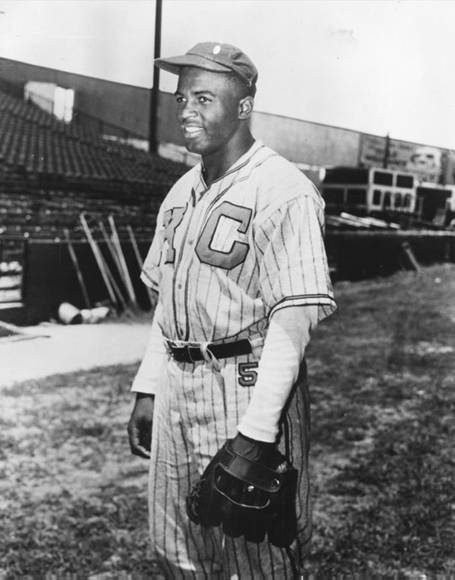
The Negro Leagues: Jackie in his Kansas City Monarch Uniform

We celebrate Dr King’s legacy today. However, without Jackie Robinson and the other African American baseball players who broke into the big leagues in the late 1940s and early 1950s it is conceivable that Dr, King would never have had the opportunity not only to be heard by African Americans, but to have his message heard and taken to heart by white America.

By the time Dr. King arrived on the scene much had already been done, and much due to Robinson and the owner of the Brooklyn Dodgers, Branch Rickey. Robinson’s first game with the Dodgers came a full year before President Truman integrated the military and a full seven years before the Supreme Court ruled school segregation unconstitutional.  It was not until 1964 that the Voters Rights act passed in Congress.  Jackie Robinson paved the way for a change in American society that has continued for 62 years since his debut at Ebbett’s Field on April 15th 1947.

Even before he stepped onto the field Jackie Robinson was a pioneer in equal rights where at UCLA he was the first student to letter in four varsity sports and in the Second World War where in an action that was a precursor to later civil rights battles the young Lieutenant Jackie Robinson was arrested and tried for not moving to the back of a bus at Fort Hood Texas.  He would be acquitted and given an honorable discharge before beginning his professional baseball career with the Kansas City Monarchs of the Negro League prior to Rickey signing him to a minor league contract with the Montreal Royals of the International League. Although he was met with scorn my many white baseball fans and some players and had to endure the ignominy of hostility from white fans and media, having to live in separate hotels and eat at separate restaurants Robinson developed a loyal fan base in Montreal and over a million people saw him play in his year in the International League.

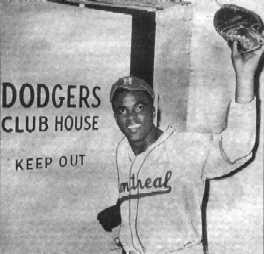
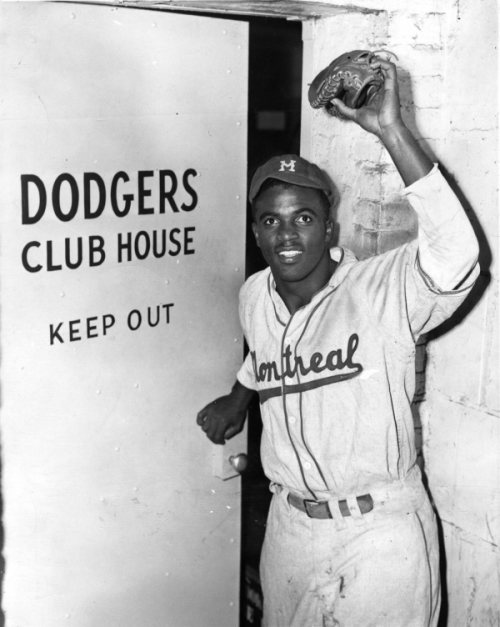
Jackie in his Montreal Royals Uniform outside the Dodger’s Clubhouse

When Branch Rickey talked with Robinson before the season he said: “Jackie (Robinson), we’ve got no army. There’s virtually nobody on our side. No owners, no umpires, very few newspapermen. And I’m afraid that many fans will be hostile. We’ll be in a tough position. We can win only if we can convince the world that I’m doing this because you’re a great ballplayer, a fine gentleman.”

John Jorgensen, Pee Wee Reese, Ed Stanky and Jackie Robinson on opening day 1947

Jackie’s feat was a watershed moment in the history of our country.  Blacks had struggled for years against Jim Crow laws, discrimination in voting rights, and even simple human decencies such as where they could use a rest room, what hotels they could stay in or what part of the bus that they could sit.  In baseball many white fans were upset that blacks would be coming to see Robinson in stadiums that they would not have been allowed in before.  Players from other teams heckled Robinson, he received hate mail, people sent made death threats, and he was spiked and spit on.  But Jackie Robinson kept his pledge to Dodgers owner Branch Rickey not to lash out at his tormentors, as Rickey told him that he needed a man “with enough guts not to strike back.” In doing so his on field performance and poise under pressure won him the National League Rookie of the Year honor in 1947.

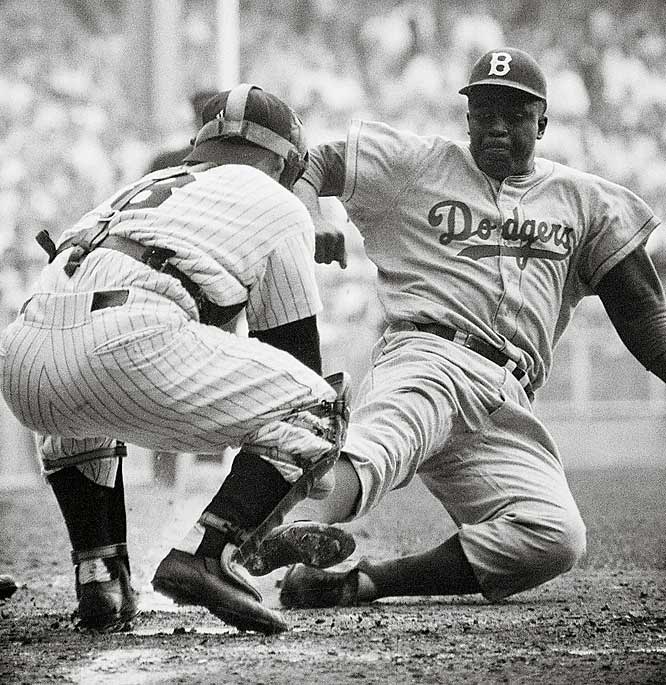
Jackie Stealing Home against the Yankees, the catcher is Yogi Berra

Jackie Robinson played the game with passion and even anger.  He took the advice of Hank Greenberg who as a Jew suffered continual racial epithets throughout his career “the best ways to combat slurs from the opposing dugout is to beat them on the field.” He would be honored as Rookie of the Year, was MVP, played in six World Series and six All Star Games.  He had a career .311 batting average, .409 on base percentage and a .474 Slugging percentage. He was elected to Baseball’s Hall of Fame in 1962. His teammate Pee Wee Reese would say: “Thinking about the things that happened, I don’t know any other ball player who could have done what he did. To be able to hit with everybody yelling at him. He had to block all that out, block out everything but this ball that is coming in at a hundred miles an hour. To do what he did has got to be the most tremendous thing I’ve ever seen in sports.”

Today Jackie Robinson’s feat is history, but it should not be forgotten.  He was a pioneer who made it possible for others to move forward.  He would be followed by players like Roy Campinella, Satchel Paige, Don Larson, Larry Dobie and Willie Mays.  His breakthrough had an effect not just on baseball but on society and helped make possible the later civil rights movement.  Dr. King would say of Jackie that he was “a legend and a symbol in his own time”, and that he “challenged the dark skies of intolerance and frustration.”  Historian Doris Kearns Godwin noted that Jackie’s “efforts were a monumental step in the civil-rights revolution in America” and that his “accomplishments allowed black and white Americans to be more respectful and open to one another and more appreciative of everyone’s abilities.” Time Magazine named him as one of the 100 most influential people of the 20th Century.

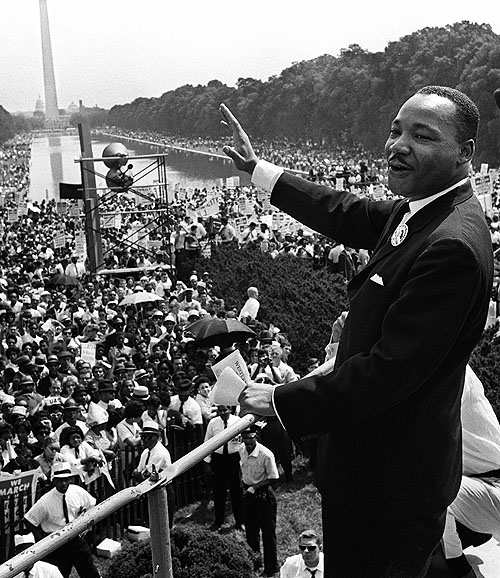
Dr Martin Luther King Jr “I have a dream”

We honor Dr King today and rightly so, but one can never forget those who paved the way so that we could all have the blessing of seeing Dr King’s dream come one step closer to fruition the dream that:

“one day this nation will rise up and live out the true meaning of its creed: ‘We hold these truths to be self-evident, that all men are created equal, that “children will one day live in a nation where they will not be judged by the color of their skin, but by the content of their character,” and that “one day on the red hills of Georgia the sons of former slaves and the sons of former slave owners will be able to sit down together at a table of brotherhood.”

Dr King would die by an assassin’s bullet in Memphis on the night of April 4th 1968 the day after finishing his final speech with these immortal remarks:

“And then I got to Memphis. And some began to say the threats, or talk about the threats that were out. What would happen to me from some of our sick white brothers? Well, I don’t know what will happen now. We’ve got some difficult days ahead. But it doesn’t matter with me now. Because I’ve been to the mountaintop. And I don’t mind. Like anybody, I would like to live a long life. Longevity has its place. But I’m not concerned about that now. I just want to do God’s will. And He’s allowed me to go up to the mountain. And I’ve looked over. And I’ve seen the Promised Land. I may not get there with you. But I want you to know tonight, that we, as a people, will get to the Promised Land. And I’m happy, tonight. I’m not worried about anything. I’m not fearing any man. Mine eyes have seen the glory of the coming of the Lord.”

Let us never forget Dr King nor those like Jackie Robinson who helped pave the way for Dr King.

Peace,

Padre Steve+

6 Comments

Filed under Baseball, History, Political Commentary

You Win a Few, You Lose a Few. Some Get Rained Out. But You Got to Dress for All of Them

“Ain’t no man can avoid being born average, but there ain’t no man got to be common.” Satchel Paige

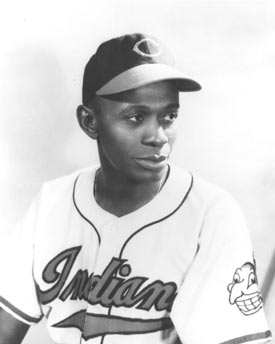
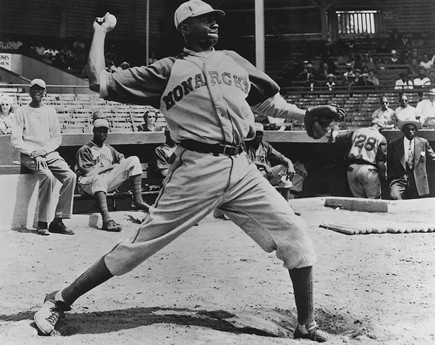
Paige_Satchel1942Satchel Paige on the Kansas City Monarchs

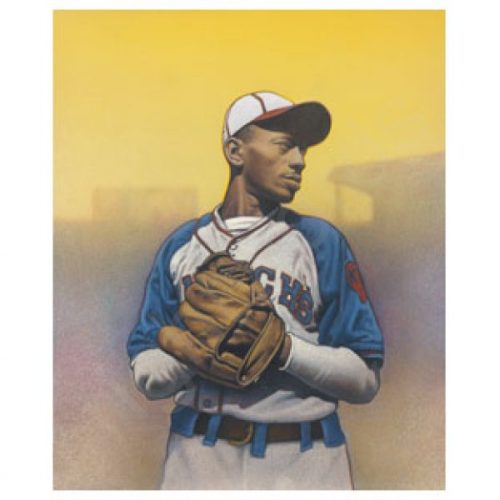
Negro League and Cleveland Indian’s Hall of Fame legend Satchel Paige was one of the most remarkable men who ever played the game of baseball.  He came along after Jackie Robinson and others had broken the color barrier having played 22 years in the Negro Leagues as well as in Mexico, the Dominican Republic and the Puerto Rican League, where in the winter of 1939 he went 19-3 with a 1.93 ERA. While with the Kansas City Monarchs Paige helped lead the team to four consecutive Negro League World Series titles from 1939-1942 and again in 1946.  During his time in the Negro Leagues played in numerous exhibition games against major league stars and future stars including Bob Feller and Joe DiMaggio who went 1-4 against Paige. During this time he would pitch in the summer with the Negro League team and winters in the various Winter Leagues.  It could be said that Satchel Paige not only played baseball but lived it.  In the Negro Leagues Paige often pitched twice a day, sometimes in two different cities.  Record keeping in these leagues was almost universally lax so the feats of men like Paige, Jackie Robinson, Cool Papa Bell and Buck O’Neil will never be fully appreciated by modern statistically absorbed fans.

When he was signed by Bill Veeck, the owner of the Cleveland Indians he was either 42 or 44 years old depending on what documents you use…talk about a birth certificate controversy.  Paige pitched 5 seasons in the Majors with Cleveland and the St. Louis Browns mainly in a relief role and pitched in the 1948 World Series and the 1953 All-Star Game after having been chosen for the 1952 game but not getting the chance play.  He was signed by the Kansas City Athletics for a one game contract in 1965.  He pitched his last game at the age of 59 or 61 on August 25th 1965 throwing three shutout innings against the Boston Red Sox, the only hit coming from Hall of Famer Carl Yastrzemski who doubled.  Paige set the next 7 batters down in order.  In between his years in the majors Paige continued to pitch in the minors.  He played his last game of organized baseball in 1966 for the Peninsula Pilots of the Carolina League in Hampton Virginia. The Pilots, now of the Independent Coastal Plain League, still play in Hampton’s War Memorial Stadium in which the legendary great pitched his last game.

Paige was recognized by many as perhaps the best pitcher to ever play the game.  Bob Feller called him “the best pitcher I ever saw.”  Ted Williams said “Satch (Paige) was the greatest pitcher in baseball.” Joe DiMaggio called him “The best and fastest pitcher I’ve ever faced” while Bill Veeck who brought Paige to the majors said he was “The best right hander baseball has ever known.”

The biggest thing in my mind about Paige was his love for the game and his determination to play as long as he could.  In the Negro Leagues he pretty much played year round for 22 years.  After his major league career was over he continued to play the game that he loved.  He did all of this in a segregated and “Jim Crow” America.  It was due primarily to Paige and others like him that black players got the chance to come to the Major Leagues.  Most expected that Paige would be the first black player called up but this honor went to Jackie Robinson.  In 1971 in his Hall of Fame acceptance speech he said “The only change is that baseball has turned Paige from a second class citizen to a second class immortal.”

I like Paige a lot.  I remember reading Bob Feller’s book in grade school and his comments about Paige, especially the time he switched a bar of soap for the ice cream in a an ice cream sandwich.  When Paige took a bit his false teeth came out with the sandwich.  Now that I am 49 years old I like him even more.  He took 22 years to get in the big leagues and didn’t quit and even after his major league career continued to play.  He endured Spartan living conditions on low pay in a segregated and often hostile America did not deter him.  Neither did his age, many men in their 40s would have quit before realizing their dream.  That is the lesson of Satchel Paige for me.  He was the oldest “rookie” ever to play Major League ball.  I kind of understand what Paige went through.  I started my Navy career after nearly a full Army career.  In fact I was within 2 ½ years of Reserve retirement when I got the chance to serve in the Navy in February 1989.

Satchel Paige was an example to me that if you have the heart and talent you can achieve your dream even if it takes a long time. My advice for people who still dream dreams is to be persistent and don’t give up.  Sometimes, not always, but sometimes by hanging in there, making the sacrifices to achieve the dream it comes true.  After a very difficult 5 years following leaving the Army to go to seminary which included long term sickness to Judy, losing almost everything that we owned, and having to work menial jobs for unappreciative people to get through seminary, Additionally there were times when I was sure that it was over, that my best efforts had failed, something would break my way and I would be able to continue.  It was remarkable.  While I give appropriate credit to God I do not fail to give credit to all the people that believed in me and wouldn’t let me fail.  The way that I figure is if you don’t try or you quit too soon you will always wonder if you could have made it.  There will always be doubt and often regret.  My Clinical Pastoral Education Supervisor, Dr. Steve Ivy at Parkland Memorial Hospital told me once, “Steve, you make your own future, stop living in the pain of the past.”  That was an “Wow I could have had a V-8 moment” for me.  It hasn’t always been easy, but it has been great.  His advice was on target.

Satchel once said: “Work like you don’t need the money. Love like you’ve never been hurt. Dance like nobody’s watching.”  The comment is way too true, but for me even more important is this: “You win a few, you lose a few. Some get rained out. But you got to dress for all of them.”

I think the Deity Herself would agree with both statements and I’m sure that Satchel is still pitching for the New Jerusalem Saints of the Pearly Gates League.

Peace, Steve+
satchel paige

2 Comments

Filed under Baseball, History, Loose thoughts and musings, philosophy, Religion

The Danger of Right Wing and Left Wing Extremism

“Let everyone regulate his conduct… by the golden rule of doing to others as in similar circumstances we would have them do to us, and the path of duty will be clear before him.”  William Wilberforce

The past two weeks have been a watershed in modern American History.  For the first time in memory we have had a series of ideological, political and religious murders committed by men who believed that their actions were justifiable homicide.  The first was the murder of a physician who had a fair amount of his practice devoted to abortions including late term abortions.  George Teller was killed by Scott Roeder a militant anti-government member of the Freemen and a fringe player in anti-abortion groups who was influenced by the militant anti-abortion group The Army of God which believes in justifiable homicide.  The murder was in Tiller’s church.  The clinic which Tiller operated is being shut down by his family.  Roeder believes it a victory but many in the pro-life movement are concerned that it will lead to crackdown on mainstream pro-lifers, and also that the closing of the Tiller clinic could lead to similar attacks by those emboldened by Roeder’s action.

The second killing was that of Army Pvt. William Long outside of a recruiting station in Little Rock.  The confessed murderer used an assault rifle to kill Pvt. Long and wound another soldier serving as home town recruiters prior to reporting to their unit following their initial entry training.  The suspects, an American convert to Islam named Abdul Hakim Mujahid Muhammad told The Associated Press on Tuesday that he didn’t consider the killing a murder because U.S. military action in the Middle East made the killing justified.  “I don’t think it was murder, because murder is when a person kills another person without justified reason.”  Mujahid Muhammad warned soldiers and their families in the US that they were also targets: “The battlefield is not just in Iraq and Afghanistan,” Muhammad says.  “A battlefield is anywhere we see you at.  And those people in the Army and those families of the people in the Army and the military and personnel all over the country, if you don’t want to die or get shot for this so called war on terrorism, war on Islam, then get out of the Army.  Get out of the Army and don’t walk, run.” This attack followed other attacks on recruiting stations including the bombing of the Armed Forces Recruiting station in Times Square last year.

The most recent attack occurred today as an 88 year old White Supremacist and Holocaust denier James Von Brunn walked into the Holocaust Memorial Museum killing a guard.  Von Brunn’s sites as well as other Neo-Nazi websites such as Stormfront prominently spew Von Brunn’s hatred toward minorities in the United States.   His book, “Kill The Best Gentiles,” embraces Adolf Hitler’s view that Jews concocted World War I as part of a scheme to stab Germany in the back — a myth the Nazis used to justify the Holocaust. He is called an “independent investigator by some and has issued statements on the citizenship controversy pushed by some on the far Right about President Obama’s eligibility to serve as President  and comments about the religion of then CENTCOM commander General Tommy Franks.

All three of these men evidently believe in justifiable homicide and are willing to kill for their ideological or religious beliefs.  What makes this sudden spike in assassination for ideological reasons significant is that the nation is polarized by the extreme Right and extreme Left which both see the world and their causes no matter what they are in black and white terms.  There is no intent by any extreme group to dialogue or find compromise with their opponents, even if such compromise would gain them at least part of what they want.  Instead, the rhetoric of the extremes has continued to increase and find airtime on supposedly “mainstream” media outlets both liberal and conservative.  This provides some manner of legitimacy to the extremist groups even as their more boisterous political and media supporters ratchet up the rhetoric.  This makes for an incredibly volatile situation which is fraught with danger for all as more and more people see violence, including justifiable homicide as a legitimate option to push their agenda.  In our country we cannot forget that John Brown, though right in his desire to end slavery engaged in tactics which helped push the country to civil war, a war that while freeing African-Americans from the yoke of slavery imposed a yoke nearly as heavy on them, know as Jim Crow laws that lasted until the Civil Rights movement of the 1960s, Dr. Martin Luther King and the Voting Rights Act of 1964.  Even still racism is still a reality for many blacks and other minorities.  Brown’s desire to end slavery may have been righteous but he destroyed the political center which could have ended it peacefully in time just as William Wilberforce and his allies in Parliament had done in England.

The perilous situation that exists now is that which erodes the center on which all depend on to hold.  Neither Left Wing or Right Wing extremists give a damn about the majority who are somewhere in between.  As a passionate moderate I see this as a dangerous trend.  In Germany of the late 1920s and early 1930s both the Communists and Nazis polarized the nation.  The more moderate Social Democrats, Catholic Center Party and other smaller middle of the road parties were marginalized as time went on.  Eventually the Nazis won that power struggle with dire consequences which extended far beyond Germany.  As the rhetoric rises and those who justify violence be it against people, institutions or property are emboldened to act it will further fracture the middle.  It is imperative that the Center to hold, as Edmund Burke said: “All it needs for evil to prosper is for people of goodwill to do nothing.”

These actions could well be harbingers of things to come.  What is even more concerning as they take place at a time of worldwide economic crisis when we have hundreds of thousands of troops deployed to war zones in Iraq and Afghanistan.  Additionally, North Korea rattling sabers and several critical nations, some with nuclear weapons on the brink of collapse, failure or civil war.  I pray that men and women of goodwill and courage arise in the center and passionately advocate not for a particular party or cause, but the good of all.  People of faith need to pray not for a particular political resolution favorable to them, but for God’s peace and healing in our country.

Peace, Steve+
3 Comments

Filed under History, Loose thoughts and musings, Political Commentary