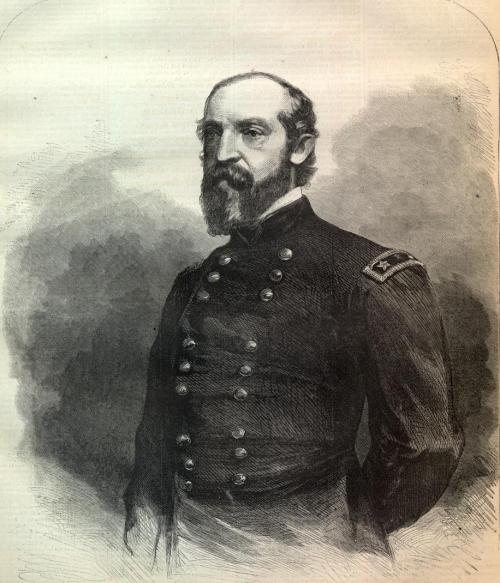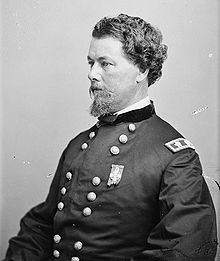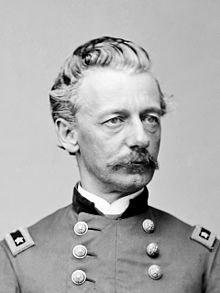
Tag Archives: john geary

Cemetery & Culp’s Hill Pt 3

Friends of Padre Steve’s World

I am traveling with my students to Gettysburg this weekend and happen to be posting my newest additions to my text, these dealing with the battles for Culp’s Hill and Cemetery Hill which occurred on the night of July 2nd and early morning of July 3rd 1863. I hope you enjoy.

Peace,

Padre Steve+

???????????????????

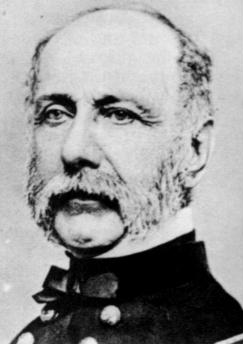
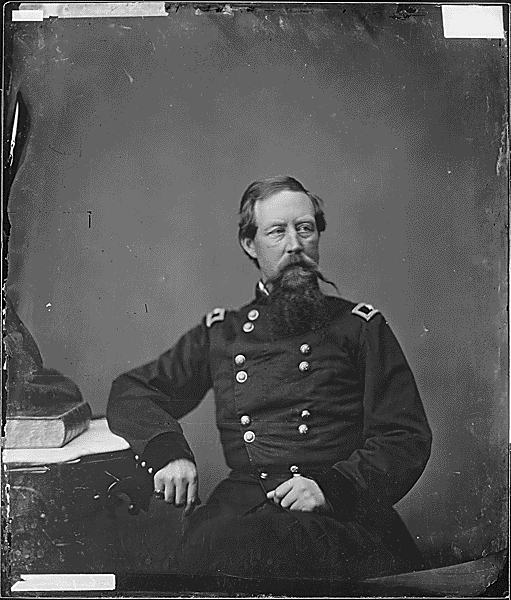
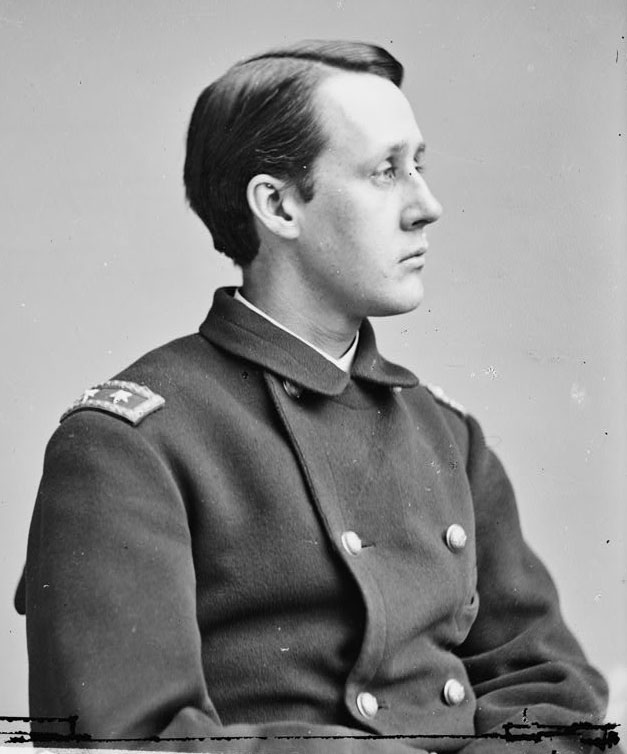
Brigadier General Alpheus William, U. S. Army

What happened next is one of the more complicated and confusing issues of the day. During the morning Meade had considered a spoiling attack against Ewell’s Second Corps using Twelfth Corps and other units on the Federal right. In order to facilitate this he allowed Henry Slocum to persist in believing that he was still an acting wing commander for the troops of Twelfth Corps in what was the Union right wing on the march up to Gettysburg, and the now cancelled Pipe Creek Circular. In the process, Slocum appointed Alpheus Williams of his First Division to head the corps. However, “Meade cancelled the attack but failed to explicitly rescind the entire order, expecting Slocum to return command of the Twelfth Corps by default. He did not. Instead, Slocum assumed that the attack had been cancelled that he still commanded the right wing.” [1] This led to a situation where Meade was unaware of who was actually commanding the corps, and created confusion about what the series of events that happened next. Without direct orders from Meade to relinquish command of the non-existent wing, Slocum chose “to cast himself in the more important role, leaving the tactical handling of the Twelfth Corps to Alpheus Williams.” [2]

In fairness “George Meade was so preoccupied with by his struggle to contain Hill’s and Longstreet’s efforts against his left flank,” [3] that he permitted this nearly catastrophic situation to develop. Longstreet’s attack on the Federal left, supported by the brigades of Rans Wright and Cadmus Wilcox forced Meade to pull troops from all along the Federal line. The Second Corps and Fifth Corps went in and as Longstreet’s attack progressed Meade ordered in reinforcements from John Sedgwick’s Sixth Corps and Slocum’s Twelfth Corps to reinforce his forces in the Peach Orchard, the Wheat Field and along the southern extension of Cemetery Ridge, “but the summons could not have come at a worse time for Slocum, who was growing convinced that Culp’s Hill was about to receive its own attack.” [4] The issue was how much of Twelfth Corps did Meade order Slocum to send to Cemetery Ridge?

Since a copy of Meade’s actual order does not exist we are left with accounts of the various commanders and staff officers. According to some accounts Meade directed Slocum to send “at least one division” to the threatened sector, an assertion also made by Meade’s son who served as his aide during the battle. Partisans of Meade and Slocum have argued about this since the battle, and historians tend to take the side of either general depending on how they interpret the numerous and often conflicting accounts of the evening.

Slocum clearly interpreted the order as a “request for his entire corps. He discussed the matter with Williams in his assumed role as commander of the Twelfth Corps. Both of them expected Meade to amend the order when made aware of the situation on Culp’s Hill.” [5] His actions support that assertion. After the war Slocum insisted that Meade had ordered his to “remove the entire 12th Corps from its position on the right, to one on the left.” [6] But Slocum did not immediately comply with Meade’s order to send the entire corps, if that indeed was what Meade had ordered. Williams later wrote that Slocum ordered him to “detach all I could spare – at least one division on Culp’s Hill.” [7] While Williams dispatched Ruger’s division to the south he retained Geary’s division on the hill.

Meanwhile, after consulting with Williams, Slocum sent an aide to Meade “to convey his opinion that at least a division should be kept on Culp’s Hill.” [8] The aide, Colonel Hiram Rodgers, returned with “Meade’s permission to keep one brigade rather than a division on the right.” [9] It was fortunate that Meade relented, and allowed Slocum to keep a brigade, but “Slocum’s appeal also demonstrates that Meade gave him no initiative, despite what some historians have alleged. Slocum tried to amend the order, Meade insisted. He clearly gave Slocum no choice in the matter.” [10] When John Geary got the order to take two brigades to the south he obeyed, leaving George Sears Greene to defend Culp’s Hill, “leaving some 1,400 men to hold a sector previous occupied by almost 10,000.” [11]

Greene was ordered by Slocum to “occupy the breastworks as thrown up by the corps.” [12] He immediately set to the task of having his brigade redeploy to meet the demands of the new situation. He had a difficult choice to make, he could extent the line to occupy as much of the fortifications that he could, which would leave the line perilously thin, or he could occupy a shorter section that would allow him to better concentrate his firepower. “Greene elected to do the latter. He filled the abandoned trenches for a distance of three regiments, kept to more back to cover his original position, and sent a fifth forward to stiffen the picket line…. Even to hold what he had selected, Greene had to take the risk of nearly doubling the front of each regiment.” [13]

While Greene adjusted his brigade to meet the new situation Geary marched his troops into deepening night following Ruger. However in another unexplainable mistake, he and his division lost their way in the dark and marched south, away from the battle and stopped halted near Rock Creek where it formed a line. Thus, two brigades of the division were out of the battle for four critical hours, leaving Greene and his brigade to make the best of the situation on Culp’s Hill. Blame can be assigned to Geary for not sending out messengers to find Slocum, and to Slocum for losing track of the division which had marched past his headquarters on Powers Hill as they moved south. Part of the reason for this might have been that Slocum assumed that Geary was operating under the orders of Williams who he had appointed to command the corps, and “some hours would pass before everyone realized that Geary had marched off the game board and needed to be recalled to Culp’s Hill.” [14] Thankfully for the Army of the Potomac the march cost nothing in a strategic or tactical sense, but it easily could have.  “Slocum referred to Geary’s march as “an unfortunate and unaccountable mistake…. And the historian of the 2d Massachusetts concluded that “it did not show much of a soldier’s instinct to take a road leading to the rear and follow it for two miles before halting.” [15]

Notes

[1] Ibid. Melton C. Sherman’s Forgotten General p.130

[2] Ibid. Trudeau Gettysburg: A Testing of Courage p.395

[3] Ibid. Trudeau Gettysburg: A Testing of Courage p.394

[4] Ibid. Guelzo Gettysburg: The Last Invasion p.347

[5] Ibid. Melton Sherman’s Forgotten General p.131

[6] Ibid. Pfanz Gettysburg: Cemetery Hill and Culp’s Hill p.194

[7] Ibid. Pfanz Gettysburg: Cemetery Hill and Culp’s Hill p.194

[8] Ibid. Trudeau Gettysburg: A Testing of Courage p.395

[9] Ibid. Greene “A Step All-Important and Essential Element of Victory” p.114

[10] Ibid. Melton Sherman’s Forgotten General p.133

[11] Ibid. Trudeau Gettysburg: A Testing of Courage p.395

[12] Greene, George Sears. The Breastworks at Culp’s Hill in Battles and Leaders of the Civil War Volume III, The Tide Shifts Edited by Robert Underwood Johnson and Clarence Clough Buel Castle, Secaucus NJ p.317

[13] Ibid. Trudeau Gettysburg: A Testing of Courage pp.395-396

[14] Ibid. Trudeau Gettysburg: A Testing of Courage p.399

[15] Ibid. Greene “A Step All-Important and Essential Element of Victory” p.120

Leave a comment

Filed under civil war, History, leadership, Military

Gettysburg: Cemetery & Culp’s Hill Pt 1

Friends of Padre Steve’s World

I am traveling with my students to Gettysburg this weekend and happen to be posting my newest additions to my text, these dealing with the battles for Culp’s Hill and Cemetery Hill which occurred on the night of July 2nd and early morning of July 3rd 1863. I hope you enjoy.

Peace,

Padre Steve+

culp's hill

On the night of July 1st 1863 Dick Ewell’s Second Corps of the Army of Northern Virginia and the Army of the Potomac on Cemetery and Culp’s Hill prepared for another day of battle. Despite a significant amount of success on July 1st, Lee’s Army had failed to drive the lead elements of the Army of the Potomac off of Cemetery Hill, which Oliver Howard had wisely placed Steinwehr’s division and his artillery, and which both he and Winfield Scott Hancock recognized had to be held if the Confederates were to be defeated. As the darkness fell over the battlefield that night more Federal troops in the form of Major General Henry Slocum’s Twelfth Corps began to take up positions on Cemetery Hill as well as Culp’s Hill alongside the battered brigades of Oliver Howard’s Eleventh Corps, and Abner Doubleday’s First Corps.

At first Slocum and many of his officers seemed to “have had much apprehension that the Confederates would attempt a head-on attack on Culp’s Hill…or troubled enough by the likelihood of rebel movements to give any orders to improve their hillside positions by digging trenches or chopping down enough trees to form rough protective walls.” [1] The three brigades of Geary’s division of the Twelfth Corps entered the line to the east of the remnants of Wadsworth’s Second division of First Corps along the northern and eastern face of Culp’s Hill.

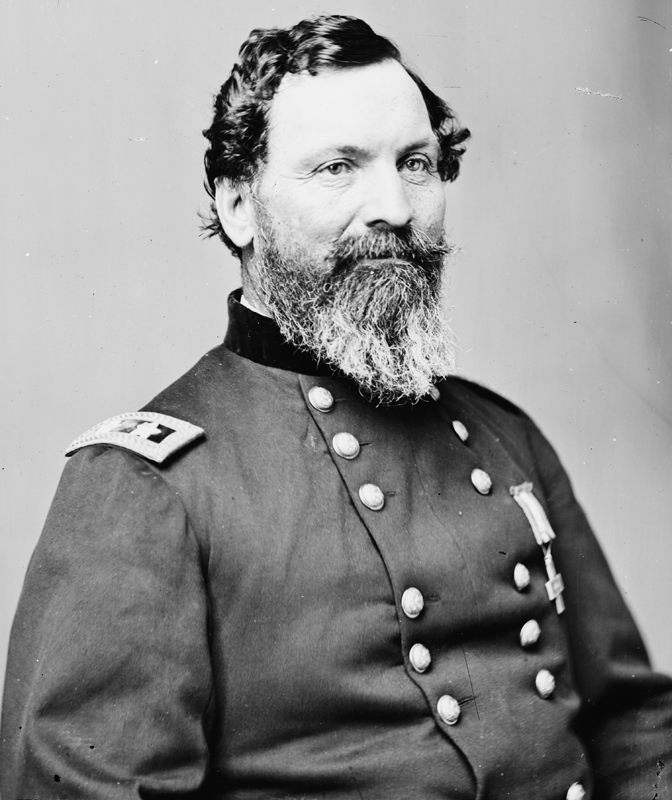
The commander of the Twelfth Corps was Major General Henry Slocum. Slocum was from upstate New York and entered West Point in 1848 at the age of twenty having already earned a teacher’s certificate at the age of seventeen. “Ability and activity had marked his whole life.” [2] One of his closest friends and roommate at West Point was Philip Sheridan who described the New Yorker as “a cadet whose education was more advanced than mine, and whose studious habits and willingness to aid others benefitted me greatly.” [3] Slocum graduated seventh in the class of 1852 which included George Crook who distinguished himself in the Civil War under the command of Sheridan, as well as Silas Casey, an engineer “whose later architectural achievements would include both the Washington Monument and the Library of Congress.” [4]

Slocum was commissioned in 1852 as a Brevet Second Lieutenant of Artillery and first served in Florida with the First Artillery, and then at Fort Moultrie in Charleston South Carolina. There he was promoted to First Lieutenant and began to study law. Slocum was an abolitionist but he was in favor of gradual abolition, and understood the mood of the South as the fires of disunion and secession over the issue of slavery smoldered. However, due to chronic illnesses that he and his wife suffered in the hot, humid, and fever-ridden climate of the Carolina Low Country, he resigned his commission and returned to New York in late 1856. There he passed the bar, went into the slat business and became relatively well off. He also became active in the Republican Party where he was elected to the State assembly in 1858. As an assemblyman he avoided the schemes that were pressed on him by other members, and maintained a well-earned reputation for honesty. During the time he also became very active in the New York State Militia where he served as a Colonel of Artillery. The governor refused Slocum’s request to raise artillery units instead desiring him to remain as his military adviser at Albany. This was not to Slocum’s liking and he earnestly sought command of an infantry regiment, which he finally obtained when he was appointed as commander of the newly raised 27th New York Volunteer Infantry Regiment.

“Slocum was above medium height, with long, wavy brown hair that he combed behind his ears, a heavy brown mustache and sparkling brown eyes…. He seemed especially disposed to order and discipline and was attentive to details that he sought to master.” [5] As a regimental commander known as a disciplinarian, but also a commander who cared for and defended his troops, making sure that they were adequately led, trained, fed, and billeted. Sadly, the training regimen was cut short and the unit thrown into action at the Battle of Bull run where Slocum was severely wounded in the leg attempting to rally it when it was caught in the flank by Wade Hampton’s South Carolinians. While the regiment’s performance was uneven, it performed about as well as most other Federal units at Bull Run, however, “Slocum’s own conduct was solid and presaged his battlefield demeanor for the rest of the war.” [6]

220px-Henry_Warner_Slocum

Major General Henry Slocum

After Bull Run Slocum earned rapid promotion for his performance. While he was recovering from his wound he was promoted to Brigadier General and made a brigade commander. When the Sixth Corps was formed in 1862 he was given command of its First Division. He “led that division with distinction in the maelstrom of Gaines Mill” [7] during McClellan’s mismanaged Peninsular Campaign. At the Battle of South Mountain during the Antietam Campaign, Slocum and his division distinguished themselves, in an attack that “routed the enemy and captured for battle flags.” [8]  Following that he was promoted to Major General and took command of Twelfth Corps when its commander, Joseph Mansfield was killed at Antietam. His rise had been rapid, nearly meteoric, even though his generalship style was described as similar to John Sedgewick: “competent, careful, cautious, and entirely without military imagination.” [9] He was now the second youngest officer in the army to attain that rank, despite having served just two years as a Lieutenant in the Regular Army, a few months as a Colonel of Volunteers and under two years as a General. He ranked second in the Army of the Potomac to Joe Hooker and was senior to every other corps commander including Reynolds and Meade. Like most volunteer officers he “probably had some political backing, but, if so, it was not particularly blatant according to the standards of the time.” [10]

He commanded Twelfth Corps at Chancellorsville where it was in the fighting and fought well suffering over 3,000 casualties. Slocum was highly critical of Hooker’s performance and was an early advocate for Meade assuming command of the Army of the Potomac. Slocum, who had no desire to command the army went to Lincoln himself to have Hooker removed.

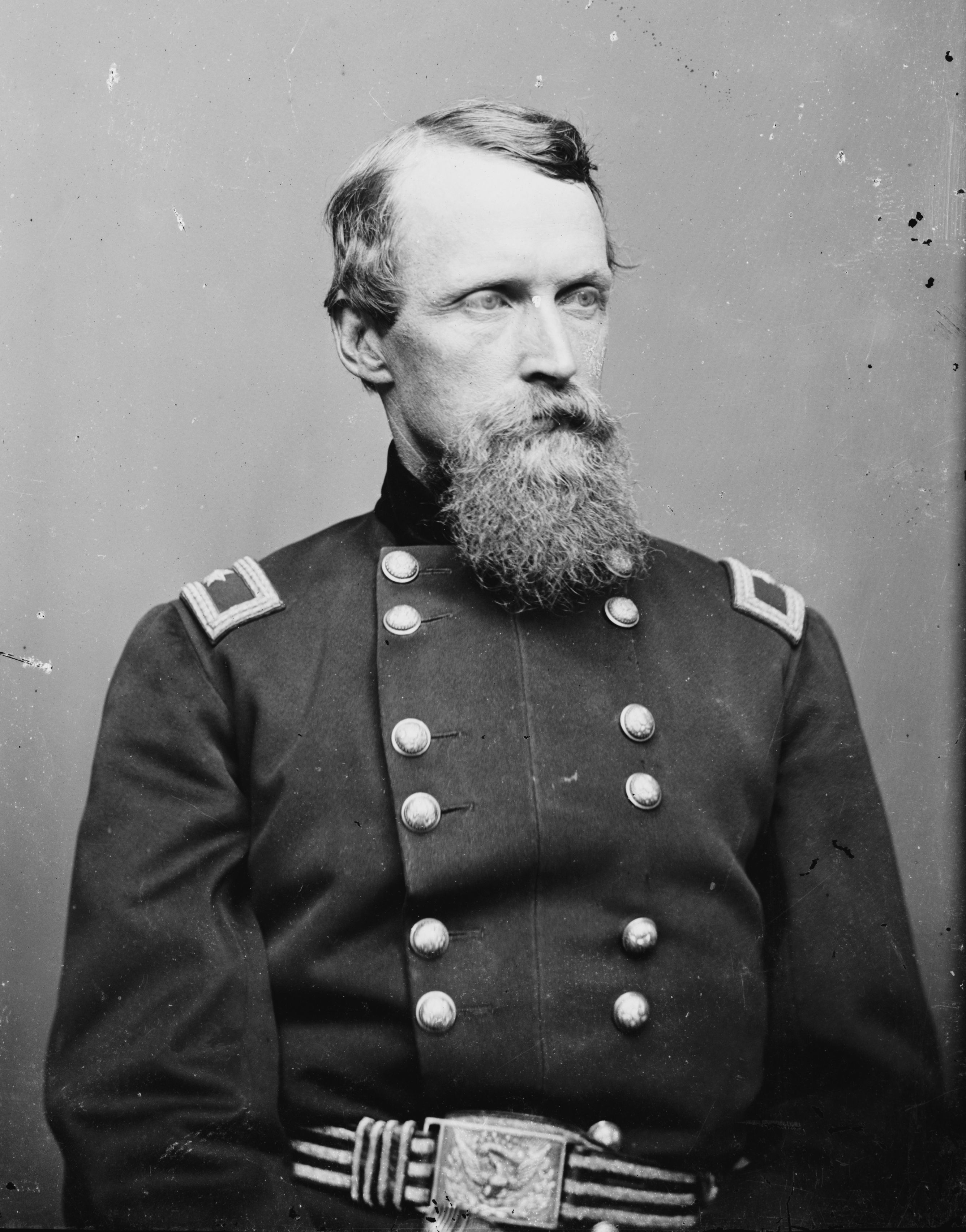
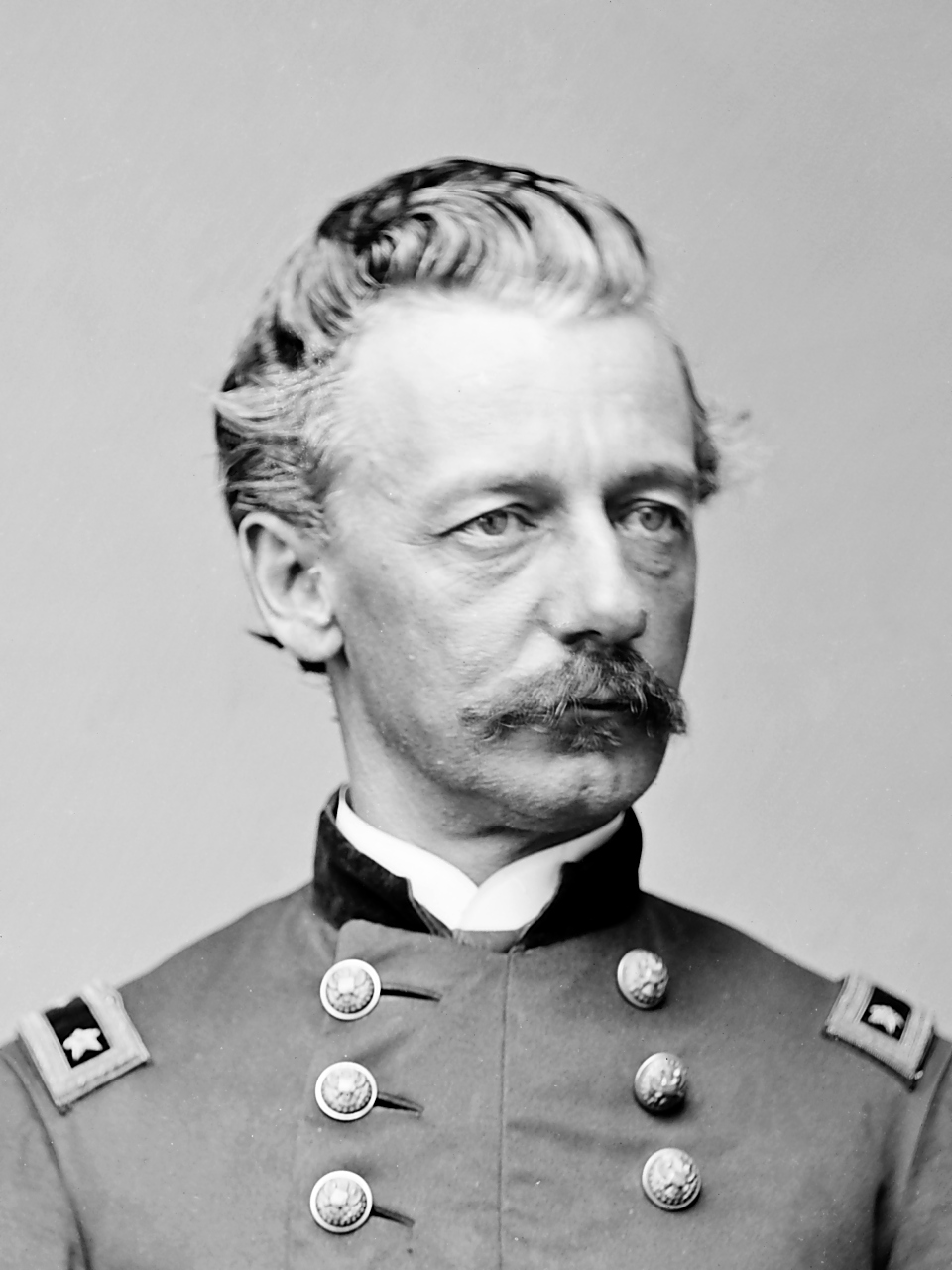
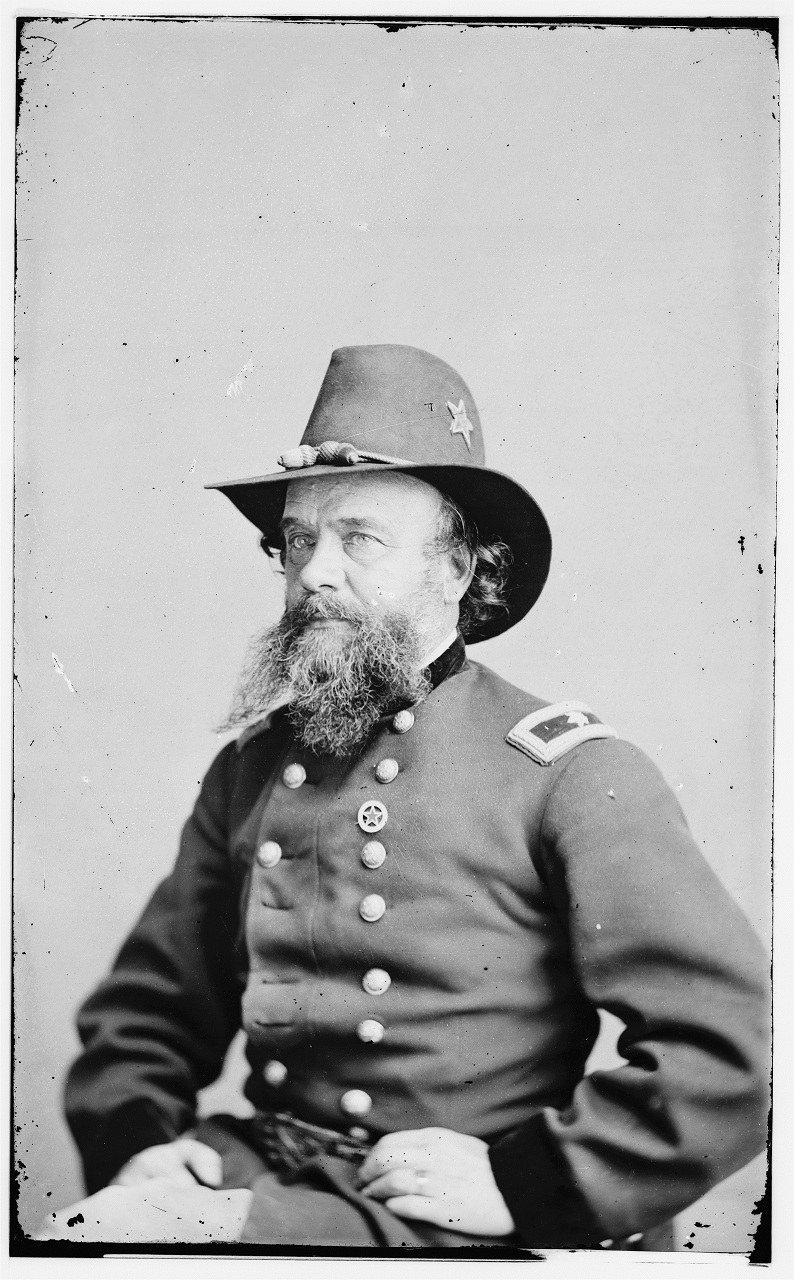
At Gettysburg Slocum was served by two solid division commanders, Brigadier General Alpheus Williams, who though a volunteer officer was considered one of the best division commanders in the army, and Brigadier General Joseph Geary. Joseph Geary was another battle hardened volunteer who had fought with the Pennsylvania volunteers in Mexico and was wounded five times in the assault on Chapultepec. “After this exploit, he was named the regiment’s colonel and returned home a war hero.” [11] He went to California in 1849 was elected as the first mayor of San Francisco. A strong anti-slavery man, Geary was appointed to the unenviable position of Governor of the Kansas Territory where he had vetoed the Lecompton Constitution, earning him the enmity of President James Buchanan.

220px-George_S._Greene

Brigadier General George Sears Greene, U.S. Army

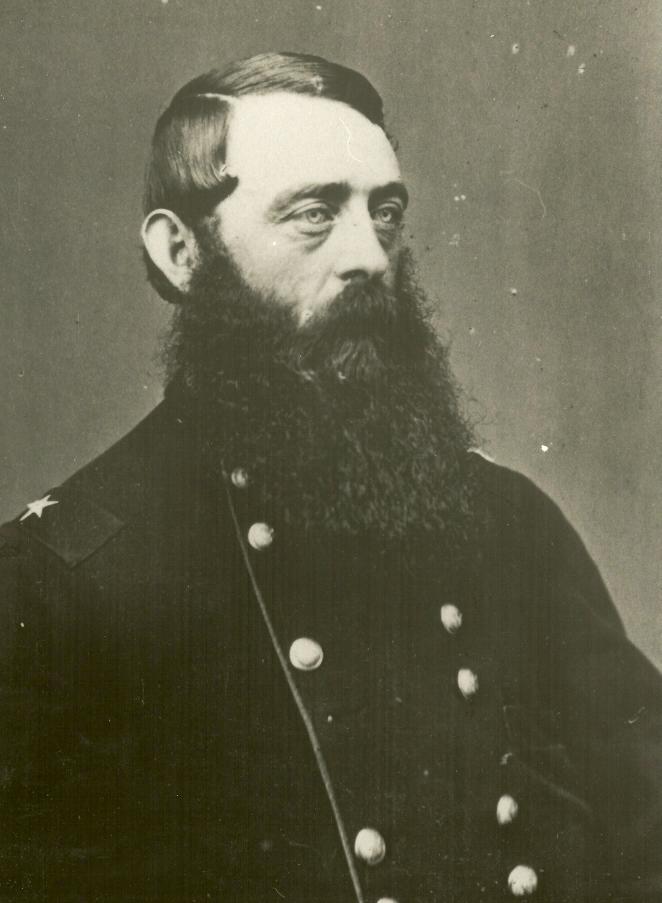
One of Geary’s brigades was commanded by Brigadier General George Sears Greene. Greene was “the oldest general in the army, though he was far from doddering or ineffectual. He was a hardy war-horse, a man who spent most of his time in the saddle, an officer who insisted on hard drilling and discipline in camp and hard fighting on the battlefield.” [12] He was “described as a strict disciplinarian and an officer with a rigid sense of justice,” [13] who did not win immediate affection from his troops, “but those under his command soon learned to appreciate his ability,” [14] his troops nicknaming him “pap” “pop” or “pappy.” Greene led his brigade up Culp’s Hill where it took a position next to the remnants of the Iron Brigade on the eastern face of the rugged edifice.

Greene was born in Warwick Rhode Island in 1801 and graduated from West Point second in a class of thirty five. He was commissioned as an artillery officer some six years before Robert E. Lee. He was a descendent of Revolutionary War General Nathaniel Greene.  His son Lieutenant Dana Greene United States Navy, was the Executive officer of the ironclad warship USS Monitor which fought the Confederate ironclad CSS Virginia at the Battle of Hampton Roads, the first battle between fully steam-powered armored warships in the history of the world. Dana Greene distinguished himself in the battle when he took command of the Monitor when its commander was wounded.

He had graduated second in his class at West Point in 1823, a full six years before Robert E. Lee, and after 13 years of garrison and instructor duty as an artillery officer, left the army in 1836 to enter civilian life as an engineer. After Greene left the army he spent most of his time overseeing the construction of railroads in the rapidly growing nation, as well as designing “sewage and water systems for Washington, Detroit, and several other cities. The Central Park reservoir in New York City was his handiwork, along with the enlarged High Bridge over the Harlem River.” [15]

Greene did not serve in the Mexican War and when the call came for volunteers in 1861 he waited to join up. In January 1862 he resigned from work on the Croatan Reservoir in New York City and was appointed to command the 60th New York Volunteer Infantry, a unit composed of men from the northern reaches of the state along the Saint Lawrence Seaway. Greene was promoted to Brigadier General in 1862 he commanded his brigade and served as an acting division commander at Antietam, where he was one of the few Federal General Officers not to fail the courage of his men in the heat of that bloody action. He commanded the division with skill, and audacity in the fierce fighting around the Dunker Church, the Cornfield and the Eastern Woods, which was “the one bright spot in the abruptly dismal Union picture.” [16] Despite his excellent performance he requited command of the Division to Geary, “who had returned to the army after being wounded at Cedar Mountain. Geary outranked Greene. (Geary’s appointment to brigadier general predated Greene’s by three days), and “Old Man Greene” went back to leading his brigade.” [17] During the battle of Chancellorsville he would again take acting command of the division when Geary was incapacitated during some of the heaviest fighting. During the fight where Twelfth Corps was attacked from multiple directions, Greene saved his brigade “by having them clear a 200-foot-wide space in front of their position and digging in with bayonets, tin cups, and canteen-halves.” [18] Following the battle he again returned to command his brigade of New Yorkers. By the time of Gettysburg the old general “was a seasoned veteran with enough battle experience at or above brigade level to allow his superiors to feel confident in his abilities.” [19]

As Greene’s brigade took their positions on Culp’s Hill, Greene had them do something that was not yet commonplace in either army. They began to construct field fortifications and breastworks. This occurred after he met Geary to discuss the defense of the hill. Geary told Greene that “he personally opposed building breastworks,” as “the men became less than stalwart in the open field. But he would leave the matter to his brigadiers.” [20] Greene replied and told Geary that “the saving of lives was more useful than such theories and that his men would build them if they had time to do so.” [21] With Geary’s blessing Greene ordered his troops to start building the types of fortifications that had helped save them at Chancellorsville.

Working through the night with the ample materials at hand they dug in, an officer wrote “Right and left the men felled the trees, and blocked them up into a close log fence. Piles of cordwood which lay near were appropriated. The sticks, set slanting on end against the outer face of the logs made excellent battening.” [22]  Likewise, “any pioneer details “which had spades and picks” set up a battening of earth over the felled logs.” [23] They linked their positions with each other such as the Iron Brigade on its left, as well as Brigadier General Thomas Kane’s brigade to Greene’s right, “which extended Greene’s line down the southeastern slope, its members imitated their comrades.” [24] The line of fortifications took advantage of the natural terrain which on its own made the ground good for the defense, but when fortified made it nearly impregnable to assault. Greene’s old regiment, the 60th New York, was particularly valuable as “it was largely composed of men accustomed to woodcraft, and they fell in to construct log breastworks with unaccustomed heartiness. All instinctively knew that a life-and-death struggle was impending, and that every help should be used.” [25] Since the Hill was actually two peaks connected by a lower “saddle” which fell at the juncture of his and Kane’s brigades, Greene felt it prudent to “take the additional precaution of having his men construct a short traverse at the lower end of their sector, providing an emergency line facing the saddle.” [26] By noon the fortifications were completed and the Federal troops rested and waited behind their creation for the coming attack. Greene described his position:

“Our position on the front were covered with a heavy growth of timber, free from undergrowth, with large ledges of rock projecting above the surface. These rocks and trees offered good cover for marksmen. The surface was very steep on our left, diminishing to a gentle slope on our right. The Second Brigade was on our right, thrown forward at a right angle to conform with the crest of the hill.” [27]

Notes

Greene’s decision to fortify the hill was emulated by the rest of the division as well as some of Wadsworth’s troops, and the Greene’s actions was fortuitous would have a profound effect on the coming struggle for Culp’s Hill.

[1] Guelzo, Allen C. Gettysburg: The Last Invasion Vintage Books a Division of Random House, New York 2013 p.345

[2] Tagg, Larry The Generals of Gettysburg: The Leaders of America’s Greatest Battle Da Capo Press Cambridge MA 1998 Amazon Kindle Edition p.143

[3] Melton, Brian C. Sherman’s Forgotten General: Henry W. Slocum University of Missouri Press, Columbia and London 2007 p.14

[4] Ibid. Melton Sherman’s Forgotten General p.15

[5] Pfanz, Harry W. Gettysburg: Cemetery Hill and Culp’s Hill University of North Carolina Press, Chapel Hill NC 1993 p.91

[6] Ibid. Melton Sherman’s Forgotten General p.51

[7] Ibid. Tagg The Generals of Gettysburg  p.143

[8] Ibid. Tagg The Generals of Gettysburg  p.144

[9] Sears, Stephen W. Gettysburg. Houghton Mifflin Co. Boston and New York 2003 p.38

[10] Ibid. Pfanz Gettysburg: Cemetery Hill and Culp’s Hill p.91

[11] Ibid. Tagg The Generals of Gettysburg  p.155

[12] Ibid. Tagg The Generals of Gettysburg  p.162

[13] Ibid. Pfanz Gettysburg: Cemetery Hill and Culp’s Hill p.211

[14] Ibid. Tagg The Generals of Gettysburg p.162

[15] Ibid. Tagg The Generals of Gettysburg p.162

[16] Sears, Stephen W. Landscape Turned Red: The Battle of Antietam Houghton-Mifflin Company, Boston and New York 1983 p.231

[17] Ibid. Tagg The Generals of Gettysburg p.162

[18] Ibid. Guelzo Gettysburg: The Last Invasion p.346

[19] Ibid. Tagg The Generals of Gettysburg p.162

[20] Ibid. Sears Gettysburg  p.325

[21] Ibid. Pfanz Gettysburg: Cemetery Hill and Culp’s Hill p.114

[22] Ibid. Sears Gettysburg  p.325

[23] Ibid. Guelzo Gettysburg: The Last Invasion p.346

[24] Trudeau, Noah Andre. Gettysburg: A Testing of Courage, Harper Collins Publishers, New York 2002 p.287

[25] Jones, Jesse H. The Breastworks at Culp’s Hill in Battles and Leaders of the Civil War Volume III, The Tide Shifts Edited by Robert Underwood Johnson and Clarence Clough Buel Castle, Secaucus NJ p.316

[26] Ibid. Trudeau Gettysburg: A Testing of Courage p.287

[27] Ibid. Pfanz Gettysburg: Cemetery Hill and Culp’s Hill p.116

Leave a comment

Filed under civil war, Gettysburg, History, leadership, Military

When Political Parties Implode: The Battle over the Lecompton Constitution and its Relevance Today

Friends of Padre Steve’s World

I have been watching the implosion of the Republican Party with some concern, not because I am a Republican or support that party, but because I am a historian and understand that the effects of these kinds of crack ups are not just bad for the party concerned, but often for the country, because they reveal deeper social and political issues. As I watch this I am reminded of the crisis and battle regarding the Lecompton Constitution in 1858. Since the article deals with this in some detail I will cut to the bottom line. In 1858 the Democratic Party held majorities in both houses of Congress and the Presidency. It had been aided by the collapse of the Whig Party and the new republican Party was still in its infancy. But extremists Democrats sought to push through a measure to bring Kansas into the Union as a Slave State, though the measure was rife with fraud. It split the Democratic Party and for a time destroyed it as a national party and helped bring about the Civil War. The battle over the Lecompton constitution is an epic event in our history. 

The issues today are not the same by any means, but the rhetoric and the intransigence of the most zealous ideologues is destroying the Republican Party in much the same way other ideologues destroyed the Democratic Party in 1858.  I admit that I could be wrong, but everything that I see happening is pointing to the implosion and possible breakup of the Republican Party. This may be good for Democrats in the short term, but seldom is it good for the country. But whatever your political views are, I do hope that you read this article and think about the implications of it, and of what is happening in our country today.

Peace

Padre Steve+

Stephen-Douglas-in-1858

Senator Stephen Douglas in 1858

Kansas was politically divided between two competing legislatures, each which claimed to be the voice of the people. The population of Kansas was heavily anti-slavery and many citizens felt disenfranchised by the official legislature, which was “a pro-slavery body elected by fraud in 1855.” [1] This body met in the city of Lecompton. In 1857 the Lecompton legislature sensed the opportunity to have Kansas admitted to the Union as a Slave State. It elected slavery supporters as members of a constitutional convention to draft a constitution which would be submitted to Congress for admission to the Union as a Slave State.

Free State partisans feared that that if they participated in the election that they would be “gerrymandered, and simply counted out by stuffed ballots,” and sat out the election. As a result it was “a quiet election, with many proslavery candidates unopposed and only 2,200 out of 9,000 registered voters going to the polls, a large majority of extreme proslavery men won election as delegates to the constitutional convention in September.” [2] But the result of the election was untenable, for “Two thousand voters in a territory with 24,000 eligible for the franchise had elected a body of delegates whom no one seriously regarded as representative of the majority opinion in Kansas.” [3]

The Lecompton legislature passed the proslavery constitution, but it was vetoed by the outgoing governor, John W. Geary. Geary accused “the pro-slavery legislature of attempting to stampede a rush to statehood on pro-slavery terms,” but his veto was overridden. The constitution had several provisions that most of the population found unacceptable. It protected owners of “the 200 slaves in Kansas, banned free blacks from the state, and prohibited any amendments to the constitution for seven years.” [4] The newly appointed governor of the territory, Robert J. Walker opposed the measure and denounced it “as a vile fraud, a bare counterfeit.” [5] Walker demanded a new, fair, referendum, which the newly elected president James Buchanan, also backed. In response many Southerners in Congress “threatened to secede unless the administration fired Walker and backed down on the referendum issue.” [6] The threat of secession by Southerners in support of the radical minority in Lecompton led to chaos in the Democratic Party which controlled the House, the Senate and held the Presidency.

james-buchanan

President James Buchanan

James Buchanan, who had rode into office on the votes of the South was now pressured by Southern legislators to change his position on the Lecompton Constitution. Buchannan’s cabinet, which was heavily Southern, and pro-slavery expansion also used its influence to pressure the president. In response to the pressure, Buchanan reversed his previous stance in regard to Kansas and endorsed the bill. This provoked a new outcry, this time from members of the Democratic Party. Many Northern Democrats were outraged by the reversal and the threats of secession. Most of the Northern Democrats were willing to accept and even defend slavery where it existed, but they were opposed to the expansion of slavery. They felt betrayed by their president’s actions and rose in opposition to the bill that would admit Kansas as a Slave State.

The formidable Stephen A. Douglas, the Little Giant who had so skillfully crafted the Compromise of 1850 using the principle of popular sovereignty, led these Democrats in their fight against Buchanan’s acceptance and endorsement of Lecompton. Douglas’s previous actions to support the rights of Slave States had made him a hero in much of the South and his stature in both the North and the South made him the front runner to win the Democratic nomination for the presidency in 1860.

But Douglas, who had worked so hard to build compromises that would hold the Union together could not countenance the actions and tactics of the Southern members of his party. Douglas was a political realist and not an ideologue. He was very sympathetic to slave holders and no supporter of emancipation, in fact Douglas was a racist, and was convinced “of the inferiority of the Negro, and he had a habit of stating it with brutal bluntness, “I do not believe that the Negro is any kin of mine at all…. I believe that this government of ours was founded, and wisely founded upon white basis. It was made by white men, for the benefit of white men and their posterity, to be executed and managed by white men.” [7] But despite his own beliefs Douglas understood the danger that the pro-slavery extremists supporting Lecompton were to the party, and he knew that if the bill was passed that it would destroy the unity of the Democratic Party and possibly the Union itself.

Douglas was outraged and when he saw the news that in the Washington Union that Buchanan had decided to support Lecompton he wrote:

“This left no doubt were the old bastard stood. “Can you believe his Goddamned arrogance?” I told a friend. “I run the Committee on Territories. He should have consulted me before approving the Lecompton fraud. He’ll pay for that. By God, sir, I made Mr. James Buchanan, and by God, sir, I’ll unmake him.” [8]

As such, the Little Giant threw caution to the wind and stormed to the White House “to confront Buchanan on the “trickery and juggling of the Lecompton constitution.” He warned the president of that his actions in support of the Lecompton party would “destroy the Democratic party in the North,” and we warned that “if Buchanan insisted on going through with it, Douglas swore to oppose him in Congress.” [9]

It was an epic confrontation. Douglas recalled, “The Lecompton constitution, I told Buchanan bluntly, was a blatant fraud on the people of Kansas and the process of democracy, I warned him not to recommend acceptance of it. With his head titled forward in that bizarre habit of his, he said that he intended to endorse the constitution and send it to Congress. “If you do,” I thundered, “I’ll denounce it the moment that it is read.” His face turned red with anger. “I’ll make Lecompton a party test,” he said. “I expect every democratic Senator to support it.” I will not, sir![10] Buchanan then cut Douglas off.

Angry and offended by Douglas Buchanan issued his own threat to Douglas saying, “I desire you to remember that no Democrat ever yet differed from an administration of his own choice without being crushed….Beware of the fate of Tallmadge and Rives,” two senators who had gone into political oblivion after crossing Andrew Jackson.” Douglas was undeterred and fought back, Douglas riposted: “Mr. President, I wish to remind you that General Jackson is dead, sir.” [11] It was an unprecedented action by a sitting Senator, to confront a President of one’s own party and threaten to oppose him in Congress was not done.

Following the confrontation with Buchanan Douglas was even more determined to defeat the Lecompton party. In righteous anger Douglas “took his political life into his own hands and assailed the Lecompton Constitution on the floor of the Senate as a mockery of the popular sovereignty principle.” [12] Buchanan’s allies in Congress fought back, and the two sides sometimes came into physical confrontation with each other in the chambers of Congress. When Buchanan’s supporters pushed for Lecompton’s approval and the admission of Kansas as a Slave State, Douglas fired back, warning “You do,” I said, “and it will lead directly to civil war!” I warned the anti-Lecompton Democrats of the North that the President intended to put the knife to the throat of every man who dared to think for himself on this question and carry out principles in good faith. “God forbid,” I said “that I ever surrender my right to differ from a President of the United States for my own choice. I am not a tool of any President!” [13]

Under Douglas the Northern Democrats joined with Republicans for the first time to defeat the admission of Kansas as a Slave State. Douglas recalled the battle:

“After the Christmas recess, the Administration unleashed its heavy horsemen: Davis, Slidell, Hunter, Toombs, and Hammond, all southerners. They damned me as a traitor and demanded that I be stripped of my chairmanship of the Committee on Territories and read out of the Democratic party. Let the fucking bastards threaten, proscribe, and do their worst, I told my followers; it would not cause any honest man to falter. If my course divided the Democratic party, it would not be my fault. We were engaged in a great struggle for principle, I said, and we would defy the Administration to the bitter end.” [14]

Southern members of Congress fought back and as the battle continued their acrimony towards Douglas grew and their rhetoric against the Little Giant became more heated. He was “at the head of the Black column…stained with the dishonor of treachery without parallel…patent double dealing…detestable heresies…filth of his defiant recreancy…a Dead Cock in the Pit…away with him to the tomb which he is digging for his political corpse.” [15]

But Douglas was undeterred by the threats to his career, he saw that he was in the right, and though he was in agreement with the philosophy of his opponents regarding slavery as an institution he realized that appeasing the South was not an option in regard to Lecompton. He wrote:

“My forces in the House fought a brilliant delaying action while I worked to win over wavering Democrats. When we introduced a substitute bill, Buchanan called a dozen congressmen to the White House and exhorted them not to forsake the administration. He was cursing and in tears. He had reason to be: on April first, a coalition of ninety-two Republicans, twenty-two anti-Lecompton Democrats, and six Know-Nothings sent Lecompton down to defeat by passing the substitute bill. This bill provided for a popular vote on the Lecompton constitution and for a new convention if the people rejected that document, as they surely would.” [16]

The substitute bill was passed by the Senate as well and sent back to Kansas for a popular vote. When the Lecompton Constitution was resubmitted to the people of Kansas, “to the hideous embarrassment of Buchanan, the voters of Kansas turned on August 30th and rejected Lecompton by a vote of 11,812 to 1,926.” [17] Douglas wroteThe agony is over,” cried one of my aides, “and thank God that the right has triumphed. Poor old Buck! Poor old Buck had just had his face rubbed in shit. By our “indomitable courage, “ as another aide put it, we’d whipped this “powerful and proscriptive” Administration and forced the Black Republicans to support a substitute measure which fully embodied the great principles of the Kansas-Nebraska Act.” [18]

Pro-slavery Southerners were outraged and Buchanan used every measure that he could to crush the anti-Lecompton Democrats, but he had lost “one of the most vicious struggles in the history of Congress, Southern Democrats had seriously damaged the patience of their Northern counterparts, and Buchannan loyalists in the North were unseated wholesale by upstart Republicans in the 1858 congressional elections.” [19] Buchanan’s Presidency was discredited, his party divided, its majority in congress lost, and the South moving closer to secession. Southerners considered Douglas a traitor and accused him of betraying them. “A South Carolinian lamented that “this defection of Douglas has done more than all else to shake my confidence in Northern men on the slavery issue, for I have long regarded him as one of our safest and most reliable friends.” [20]

The fight over Lecompton was a watershed. It served to illuminate how “minuscule minorities’ initial concerns ballooned into unmanageable majoritarian crises. The tiny fraction of Missouri slaveholders who lived near the Kansas border, comprising a tinier fraction of the South and a still tinier fraction of the Union, had demanded their chance to protect the southern hinterlands.” [21] The crisis that they provoked drew in the majority of Southern Democrats who came to their aid in Congress and provoked Northerners to condemn the Southern minority, which they believed was disenfranchising the majority in order to expand slavery to new territories.

The issue of Lecompton galvanized the political parties of the North and split the Democratic Party into Northern and Southern factions, dooming it as a national party for the foreseeable future. It was also the first time that a coalition Northern Democrats sided with anti-slavery forces. Through the efforts of “Republicans and anti-Lecompton Douglas Democrats, Congress had barely turned back a gigantic Slave Power Conspiracy to bend white men’s majoritarianism to slavemaster’s dictatorial needs, first in Kansas, then in Congress.” [22]

The political impact of the Lecompton crisis on the Democratic Party was an unmitigated disaster. The party suffered a major election defeat in the 1858 mid-term elections and lost its majorities, and in a sense fulfilling Lincoln’s words “became increasingly a house divided against itself.” [23] Douglas’s courageous opposition to Lecompton would be chief among the 1860 split in the Democratic Party, Southern Democrats turned with a vengeance on the man who had been their favorite in the 1856 democratic primary. This doomed his candidacy for President and ensured the election of Abraham Lincoln and the Republicans, a man that he had defeated for Senate in that critical summer of 1858.

Notes

[1] Ibid. Guelzo Fateful Lightening p.81

[2] Ibid. Potter The Impending Crisis p.300

[3] Ibid. Potter The Impending Crisis p.314

[4] Ibid. Guelzo Fateful Lightening p.115

[5] Ibid. McPherson The Battle Cry of Freedom p.165

[6] Ibid. McPherson The Battle Cry of Freedom p.164

[7] Ibid. Potter The Impending Crisis p.340

[8] Ibid, Oates The Approaching Fury p.208

[9] Ibid. McPherson The Battle Cry of Freedom p.166

[10] Ibid, Oates The Approaching Fury p.208

[11] Ibid. McPherson The Battle Cry of Freedom p.166

[12] Ibid. Guelzo Fateful Lightening p.115

[13] Ibid, Oates The Approaching Fury p.210

[14] Ibid, Oates The Approaching Fury pp.212-213

[15] Ibid. McPherson The Battle Cry of Freedom p.168

[16] Ibid, Oates The Approaching Fury pp.215-216

[17] Ibid. Guelzo Fateful Lightening p.116

[18] Ibid, Oates The Approaching Fury p.216

[19] Ibid. Guelzo Fateful Lightening p.116

[20] Ibid. McPherson The Battle Cry of Freedom p.167

[21] Ibid. Freehling, The Road to Disunion Volume II: Secessionists Triumphant 1854-1861 p.140

[22] Ibid. Freehling, The Road to Disunion Volume II: Secessionists Triumphant 1854-1861 p.142

[23] Fehrenbacher, Don E. Kansas, Republicanism, and the Crisis of the Union in The Civil War and Reconstruction Documents and Essays Third Edition edited by Michael Perman and Amy Murrell Taylor Wadsworth Cengage Learning Boston MA 2011 p.94

7 Comments

Filed under civil rights, civil war, History, laws and legislation, leadership, Political Commentary

Gettysburg: The Order of Battle

battle-of-gettysburg-war-is-hell-store

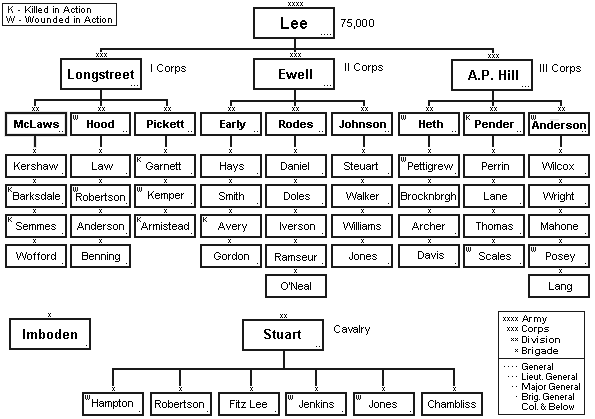
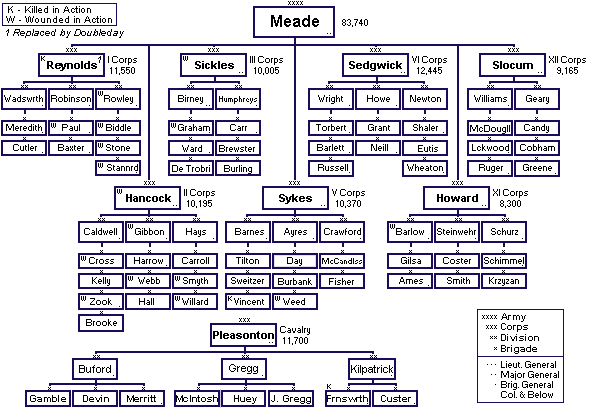
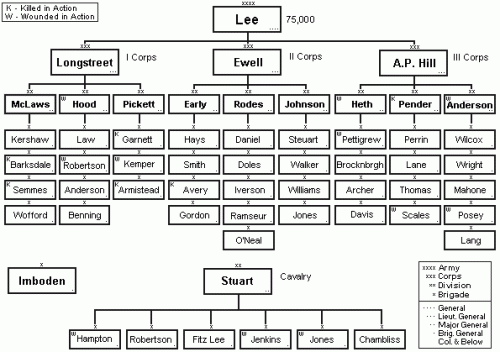
Note: This is a resource for those following my Gettysburg series and for my students that go with me on the Gettysburg Staff Ride. When the armies met at Gettysburg Lee’s Army of Norther Virginia had about 75,000-80,000 effectives, Meade’s Army of the Potomac had about 80,000-85,000 depending on the sources. This meant that they were relatively evenly matched in terms of manpower and that the battle came down to leadership, tactical decisions and strategic factors that were already in play by the time that the armies met at Gettysburg.

As a note of explanation the Confederate forces at the division and brigade level were named after their commander’s, or in some cases previous commanders. Confederate units were allocated to the Army from the various states, thus there is no Confederate “Regulars” as are shown in the Union order of battle. Union Corps were numbered as were the divisions and brigades in each corps. In some cases the brigades or divisions were referred to by the names of their commanders, but this was not consistent. Federal forces consisted of both Regular Army units as well as units allocated by the states. The reader can note the composition of each brigade in both the Union and Confederate armies to see from where the soldiers were recruited from.

So apart from that there is no story to tell tonight. Nothing in the way of commentary. This is simply a resource.
Have a great night.

Peace

Padre Steve+
confeorg

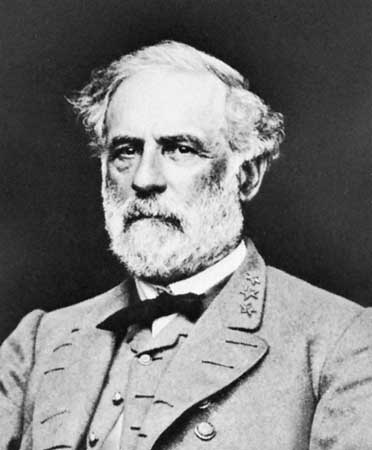
Army of Northern Virginia – General Robert Edward Lee, Commanding


ileerob001p1

General Staff: Chief of Staff and Inspector General: Col Robert H. Chilton; Chief of Artillery: BG William N. Pendleton; Medical Director: Dr. Lafayette Guild; Aide de Camp and Asst. Adjutant General: Maj Walter H. Taylor; Aide de Camp and Asst. Military Secretary: Maj Charles Marshall; Aide de Camp and Asst. Inspector General: Maj Charles S. Venable; Aide de Camp: Maj Thomas M. R. Talcott

General Headquarters
Escort: 39th Virginia Cavalry Battalion (companies A & C)
James_Longstreet

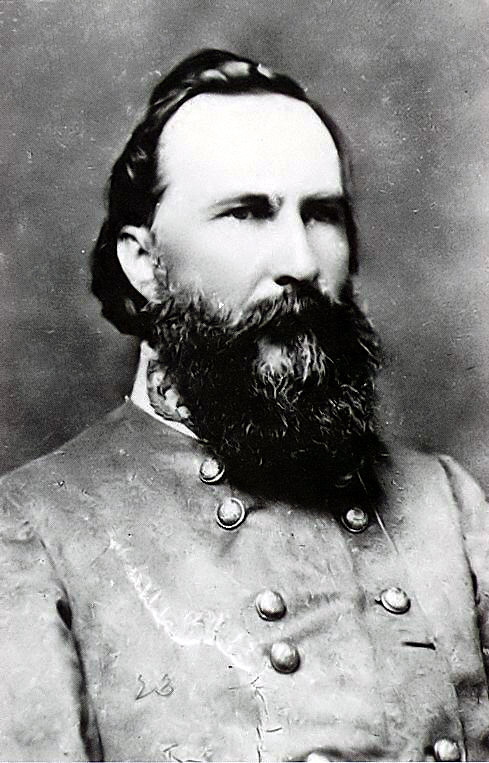
I Corps- Lt. Gen. James Longstreet, Commanding
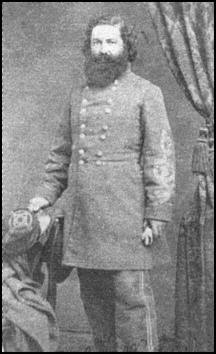
Lafayette_McLaws

McLaws’ Division- MG Lafayette McLaws

Kershaw’s Brigade-BG Joseph B. Kershaw
2nd South Carolina, 3rd South Carolina, 7th South Carolina, 8th South Carolina,  15th South Carolina; 3rd South Carolina Battalion
Barksdale’s Brigade- BG William Barksdale (mw); Col Benjamin G. Humphreys
13th Mississippi, 17th Mississippi, 18th Mississippi, 21st Mississippi
Semmes’ Brigade- BG Paul J. Semmes (mw); Col Goode Bryan
10th Georgia, 50th Georgia, 51st Georgia, 53rd Georgia
Wofford’s Brigade- BG William T. Wofford
16th Georgia, 18th Georgia, 24th Georgia, Cobb’s (Georgia) Legion, Phillips’ (Georgia) Legion, 3rd Georgia Sharpshooter Battalion
Cabell’s Artillery Battalion- Col Henry C. Cabell; Maj Samuel P. Hamilton
1st North Carolina Artillery, Battery A, Pulaski (Georgia) Artillery, 1st Richmond Howitzers, Troup (Georgia) Artillery
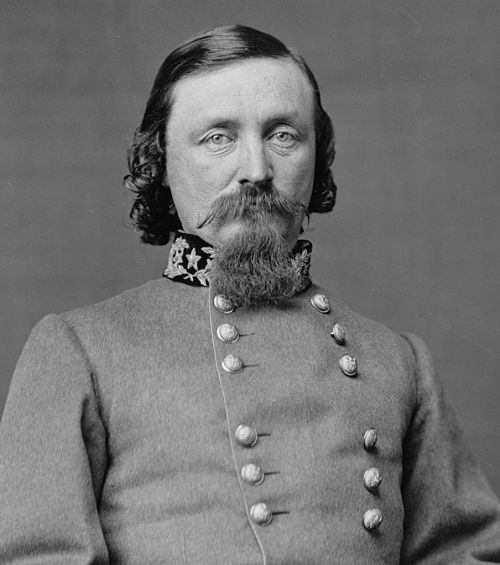
GeorgePickett

Pickett’s Division- MG George E. Pickett

Garnett’s Brigade- BG Richard B. Garnett (k); Maj Charles S. Peyton
8th Virginia, 18th Virginia, 19th Virginia, 28th Virginia, 56th Virginia
Kemper’s Brigade- BG James L. Kemper (w&c); Col Joseph Mayo, Jr
1st Virginia, 3rd Virginia, 7th Virginia, 11th Virginia, 24th Virginia
Armistead’s Brigade- BG Lewis A. Armistead (mw&c); Ltc William White (w); Maj Joseph R. Cabell; Col William R. Aylett
9th Virginia, 14th Virginia, 38th Virginia, 53rd Virginia, 57th Virginia
Dearing’s Artillery Battalion- Maj James Dearing; Maj John P. W. Read (w)
Fauquier (Virginia) Artillery, Hampden (Virginia) Artillery, Richmond Fayette (Virginia) Artillery, Blount’s (Virginia) Battery
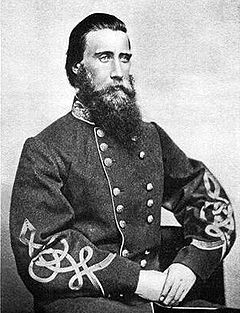
Lt._Gen._John_B._Hood

Hood’s Division- MG John Bell Hood (w); BG Evander M. Law

Law’s Brigade-BG Evander M. Law; Col James L. Sheffield
4th Alabama, 15th Alabama, 44th Alabama, 47th Alabama, 48th Alabama
Robertson’s Brigade- BG Jerome B. Robertson (w); Ltc Philip A. Work
3rd Arkansas, 1st Texas, 4th Texas, 5th Texas
Anderson’s Brigade- BG George T. Anderson (w); Ltc William Luffman (w)
7th Georgia, 8th Georgia, 9th Georgia,  11th Georgia,  59th Georgia
Benning’s Brigade- BG Henry L. Benning
2nd Georgia, 15th Georgia,  17th Georgia, 20th Georgia
Henry’s Artillery Battalion- Maj Mathias W. Henry; Maj John C. Haskell
Branch (North Carolina) Battery, Charleston German (South Carolina) Artillery, Palmetto (South Carolina) Light Artillery, Rowan North Carolina Artillery
Artillery Reserve- Col James B. Walton
Alexander’s Artillery Battalion- Col Edward P. Alexander (w)
Ashland (Virginia) Artillery, Bedford (Virginia) Artillery, Brooks (South Carolina) Artillery, Madison (Louisiana) Light Artillery, Richmond (Virginia) Battery, Bath (Virginia) Battery
Washington (Louisiana) Artillery Battalion- Maj Benjamin F. Eshleman
First Company, Second Company, Third Company, Fourth Company
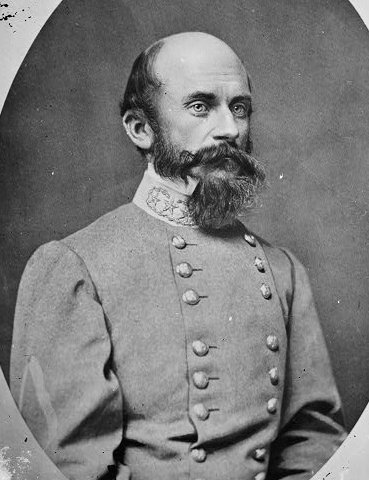
Richard-Ewell

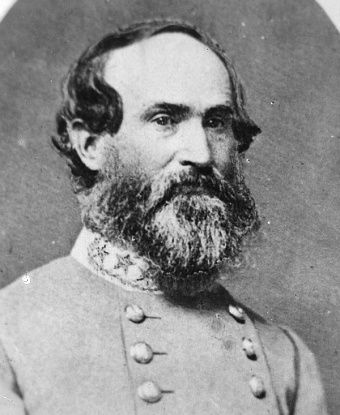
II Corps- Lt. Gen. Richard S. Ewell Commanding
??????????????????????????????????????????????????????????????????????????????????????????????

Early’s Division- MG Jubal A. Early
Hays’ Brigade- BG Harry T. Hays
5th Louisiana, 6th Louisiana, 7th Louisiana, 8th Louisiana, 9th Louisiana
Smith’s Brigade-BG William Smith
31st Virginia, 49th Virginia, 52nd Virginia
Hoke’s Brigade- Col Isaac E. Avery (mw); Col Archibald C. Godwin
6th North Carolina: Maj Samuel McD. Tate, 21st North Carolina: Col William W. Kirkland, Maj James Beall, 57th North Carolina: Col Archibald C. Godwin, Ltc Hamilton C. Jones
Gordon’s Brigade- BG John Brown Gordon
13th Georgia, 26th Georgia, 31st Georgia, 38th Georgia, 60th Georgia, 61st Georgia
Jones’ Artillery Battalion- Ltc Hilary P. Jones
Charlottesville (Virginia) Artillery, Courtney (Virginia) Artillery, Louisiana Guard Artillery, Staunton (Virginia) Artillery
Cavalry 35th Virginia Battalion: Ltc Elijah V. White
JohnsonE

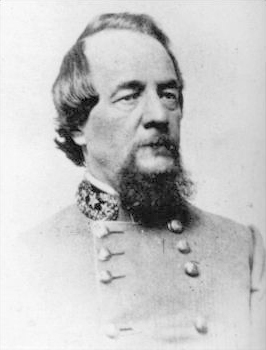
Johnson’s Division- MG Edward Johnson

Steuart’s Brigade- BG George H. Steuart
1st Maryland Battalion, 1st North Carolina, 3rd North Carolina, 10th Virginia, 23rd Virginia, 37th Virginia
Stonewall Brigade- BG James A. Walker
2nd Virginia, 4th Virginia, 5th Virginia, 27th Virginia, 33rd Virginia
Nicholls’ Brigade-Col Jesse M. Williams
1st Louisiana, 2nd Louisiana, 10th Louisiana, 14th Louisiana, 15th Louisiana
Jones’ Brigade- BG John M. Jones (w); Ltc Robert H. Dungan
21st Virginia, 25th Virginia, 42nd Virginia, 44th Virginia, 48th Virginia, 50th Virginia
Andrews’ Artillery Battalion- Maj Joseph W. Latimer (mw); Cpt Charles I. Raine
1st Maryland Battery, Alleghany (Virginia) Artillery, Chesapeake (Maryland) Artillery, Lee (Virginia) Battery
robert-rodes

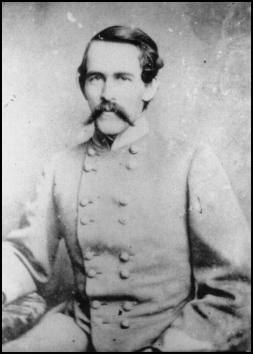
Rodes’ Division- MG Robert E. Rodes

Daniel’s Brigade-BG Junius Daniel
32nd North Carolina, 43rd North Carolina, 45th North Carolina, 53rd North Carolina, 2nd North Carolina Battalion
Doles’ Brigade-BG George P. Doles
4th Georgia, 12th Georgia, 21st Georgia, 44th Georgia
Iverson’s Brigade- BG Alfred Iverson, Jr.
5th North Carolina, 12th North Carolina, 20th North Carolina, 23rd North Carolina
Ramseur’s Brigade- BG Stephen D. Ramseur
2nd North Carolina, 4th North Carolina, 14th North Carolina, 30th North Carolina
Rodes’ (old) Brigade- Col Edward A. O’Neal
3rd Alabama, 5th Alabama, 6th Alabama, 12th Alabama, 26th Alabama
Carter’s Artillery Battalion-Ltc Thomas H. Carter
Jefferson Davis (Alabama) Artillery, King William (Virginia) Artillery, Morris (Virginia) Artillery, Orange (Virginia) Artillery

Artillery Reserve- Col J. Thompson Brown
First Virginia Artillery Battalion- Cpt Willis J. Dance
2nd Richmond (Virginia) Howitzers, 3rd Richmond (Virginia) Howitzers, Powhatan (Virginia) Artillery, Rockbridge (Virginia) Artillery, Salem (Virginia) Artillery
Nelson’s Artillery Battalion- Ltc William Nelson
Amherst (Virginia) Artillery, Fluvanna (Virginia) Artillery, Milledge’s Georgia Battery
general_a_p_hill

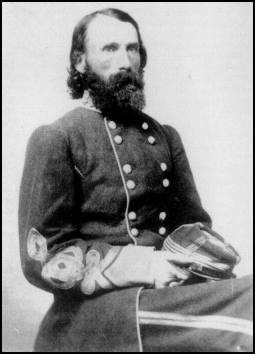
III Corps- Lt. Gen. Ambrose Powell Hill Commanding
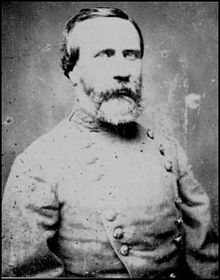
Richard_H._Anderson

Anderson’s Division- MG Richard H. Anderson
Wilcox’s Brigade- BG Cadmus M. Wilcox
8th Alabama, 9th Alabama, 10th Alabama, 11th Alabama, 14th Alabama
Mahone’s Brigade- BG William Mahone
6th Virginia, 12th Virginia, 16th Virginia, 41st Virginia, 61st Virginia
Wright’s Brigade-BG Ambrose R. Wright; Col William Gibson; BG Ambrose R. Wright
3rd Georgia, 22nd Georgia, 48th Georgia, 2nd Georgia Battalion
Perry’s Brigade- Col David Lang
2nd Florida, 5th Florida, 8th Florida
Posey’s Brigade- BG Carnot Posey (w); Col. Nathaniel Harris
12th Mississippi, 16th Mississippi, 19th Mississippi, 48th Mississippi
Cutt’s Artillery Battalion- Maj John Lane
Company A, Company B, Company C
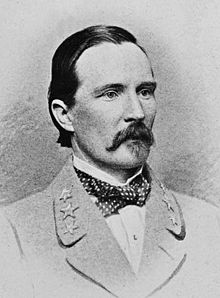
heth

Heth’s Division- MG Henry Heth (w); BG James J. Pettigrew (w)
Pettigrew’s Brigade-BG James J. Pettigrew; Col James K. Marshall (k); Maj John T. Jones (w)
11th North Carolina, 26th North Carolina, 47th North Carolina, 52nd North Carolina
Heth’s (old) Brigade- Col John M. Brockenbrough; Col Robert M. Mayo
40th Virginia, 47th Virginia, 55th Virginia, 22nd Virginia Battalion
Archer’s Brigade- BG James J. Archer (w&c); Col Birkett D. Fry (w&c); Ltc Samuel G. Shepard
13th Alabama, 5th Alabama Battalion, 1st Tennessee (Provisional Army), 7th Tennessee,  14th Tennessee
Davis’ Brigade- BG Joseph R. Davis (w)
2nd Mississippi, 11th Mississippi, 42nd Mississippi, 55th North Carolina
Garnett’s Artillery Battalion- Ltc John J. Garnett
Donaldsonville (Louisiana) Artillery, Huger (Virginia) Artillery, Lewis (Virginia) Artillery, Norfolk (Virginia) Blues Artillery
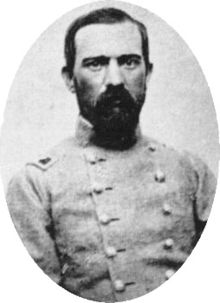
William_Dorsey_Pender

Pender’s Division-MG William D. Pender (mw); BG James H. Lane; MG Isaac R. Trimble (w&c); BG James H. Lane
McGowan’s Brigade-Col Abner M. Perrin
1st South Carolina (Provisional Army), 1st South Carolina Rifles, 12th South Carolina, 13th South Carolina, 14th South Carolina
Lane’s Brigade- BG James H. Lane; Col Clark M. Avery
7th North Carolina, 18th North Carolina, 28th North Carolina, 33rd North Carolina, 37th North Carolina
Thomas’ Brigade- BG Edward L. Thomas
14th Georgia, 35th Georgia, 45th Georgia, 49th Georgia
Scales’ Brigade- BG Alfred M. Scales (w); Ltc George T. Gordon; Col William L. J. Lowrance
13th North Carolina, 16th North Carolina, 22nd North Carolina, 34th North Carolina, 38th North Carolina
Poague’s Artillery Battalion- Maj William T. Poague
Albemarle (Virginia) Artillery, Charlotte (North Carolina) Artillery, Madison (Mississippi) Artillery, Brooke’s Virginia Battery
Artillery Reserve- Col Reuben L. Walker
McIntosh’s Artillery Battalion- Maj David G. McIntosh
Danville (Virginia) Artillery, Hardaway (Alabama) Artillery, 2nd Rockbridge (Virginia) Artillery, Johnson’s Virginia Battery
Pegram’s Artillery Battalion- Maj William R. J. Pegram; Cpt Ervin B. Brunson
Crenshaw (Virginia) Battery, Fredericksburg (Virginia) Artillery, Letcher (Virginia) Artillery, Pee Dee (South Carolina) Artillery, Purcell (Virginia) Artillery
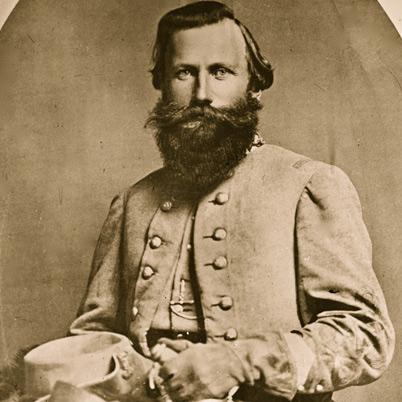
CWP015

Cavalry Division- Maj. Gen. James Ewell Brown Stuart
Hampton’s Brigade- BG Wade Hampton (w)
1st North Carolina, 1st South Carolina, 2nd South Carolina, Cobb’s (Georgia) Legion, Jeff Davis (Mississippi) Legion, Phillips (Georgia) Legion
Robertson’s Brigade (not present at Gettysburg) BG Beverly H. Robertson
4th North Carolina, 5th North Carolina
Fitzhugh Lee’s Brigade- BG Fitzhugh Lee
1st Maryland Battalion, 1st Virginia, 2nd Virginia, 3rd Virginia, 4th Virginia, 5th Virginia
Jenkins’ Brigade- BG Albert G. Jenkins (w); Col Milton J. Ferguson
14th Virginia, 16th Virginia, 17th Virginia, 34th Virginia Battn., 36th Virginia Battn., Jackson’s (Virginia) Battery
William H. F. (Rooney) Lee’s Brigade- Col John R. Chambliss, Jr.
2nd North Carolina Cavalry, 9th Virginia, 10th Virginia, 13th Virginia
Jones’ Brigade- BG William E. Jones
6th Virginia, 7th Virginia, 11th Virginia
Stuart’s Horse Artillery- Maj Robert F. Beckham
Breathed’s (Virginia) Battery, Chew’s (Virginia) Battery, Griffin’s (Maryland) Battery Hart’s (South Carolina) Battery, McGregor’s (Virginia) Battery, Moorman’s (Virginia) Battery
Imboden’s Command- BG John D. Imboden
18th Virginia, 62nd Virginia, McNeill’s Company (Virginia), Staunton (Virginia) Battery

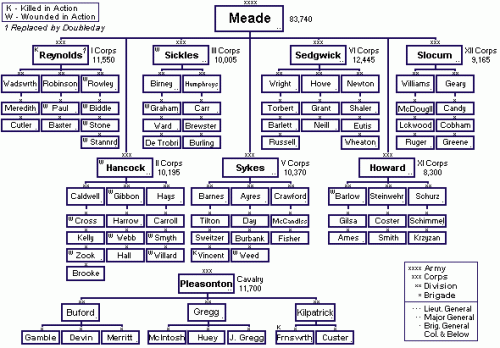
Union Order of Battle
unionorg

general-george-meade

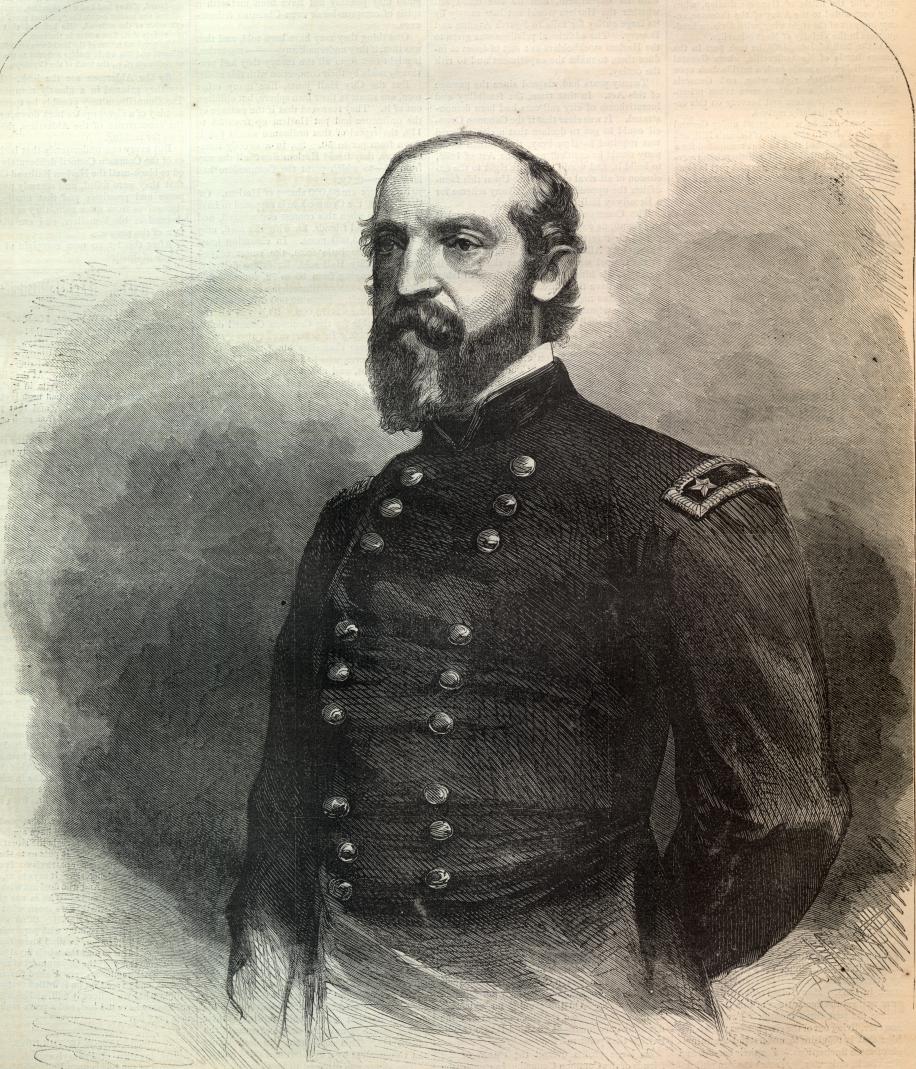
Army of the Potomac – Major General George Gordon Meade, Commanding


General Staff: Chief of Staff: Maj. Gen. Daniel Butterfield, Chief of Artillery: Brig. Gen. Henry J. Hunt, Medical Director: Maj Jonathan Letterman, Chief of Engineers: Brig. Gen. Gouverneur K. Warren, Bureau of Military Information: Col. George H. Sharpe
Command of the Provost Marshal General: Brig. Gen. Marsena R. Patrick
93rd New York: Col. John S. Crocker, 8th United States (8 companies): Capt. Edwin W. H. Read, 2nd Pennsylvania Cavalry: Col. R. Butler Price, 6th Pennsylvania Cavalry (Companies E&I): Capt. James Starr, Regular cavalry
Engineer Brigade: Brig. Gen. Henry W. Benham
15th New York (3 companies): Maj Walter L. Cassin, 50th New York: Col. William H. Pettes, U.S. Battalion: Capt. George H. Mendell
GenJFRenyolds

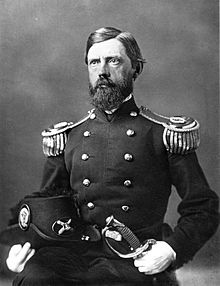
I Corps- Maj. Gen. John F. Reynolds (k)
JSWadsworthBGenleft

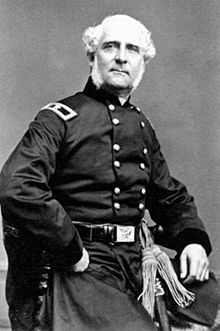
First Division- Brig. Gen. James S. Wadsworth
1st  Brigade (The Iron Brigade)-Brig. Gen. Solomon Meredith (w); Col.. William W. Robinson
19th Indiana, 24th Michigan, 2nd Wisconsin, 6th Wisconsin, 7th Wisconsin
2nd Brigade- Brig. Gen. Lysander Cutler
7th Indiana, 76th New York, 84th New York (14th Militia), 95th New York, 147th New York, 56th Pennsylvania (9 companies)
john_Cleveland_Robinson

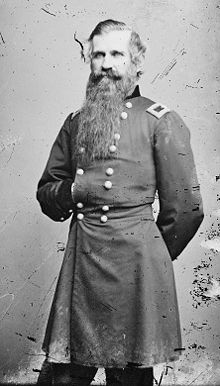
Second Division- Brig. Gen. John C. Robinson
1st Brigade- Brig. Gen. Gabriel R. Paul (w); Col. Samuel H. Leonard (w); Col. Adrian R. Root (w&c); Col. Richard Coulter (w); Col. Peter Lyle; Col. Richard Coulter
16th Maine, 13th Massachusetts, 94th New York, 104th New York, 107th Pennsylvania
2nd Brigade-Brig. Gen. Henry Baxter
12th Massachusetts, 83rd New York (9th Militia), 97th New York, 11th Pennsylvania, 88th Pennsylvania, 90th Pennsylvania
abner-doubleday

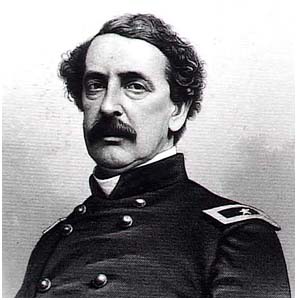
Third Division- Maj. Gen. Abner Doubleday; Brig. Gen. Thomas A. Rowley; Maj. Gen. Abner Doubleday
1st Brigade- Col. Chapman Biddle; Brig. Gen. Thomas A. Rowley; Col. Chapman Biddle
80th New York (20th Militia), 121st Pennsylvania, 142nd Pennsylvania, 151st Pennsylvania
2nd Brigade-Col. Roy Stone (w); Col. Langhorne Wister (w); Col. Edmund L. Dana
143rd Pennsylvania, 149th Pennsylvania, 150th Pennsylvania
3rd Brigade- Brig. Gen. George J. Stannard (w); Col. Francis V. Randall
13th Vermont, 14th Vermont, 16th Vermont
Artillery Brigade- Col. Charles S. Wainwright
Maine Light, 2nd Battery (B), Maine Light, 5th Battery (E), 1st New York Light, Batteries E&L, 1st Pennsylvania Light, Battery B, 4th United States, Battery B
HancockWinfield_teaser

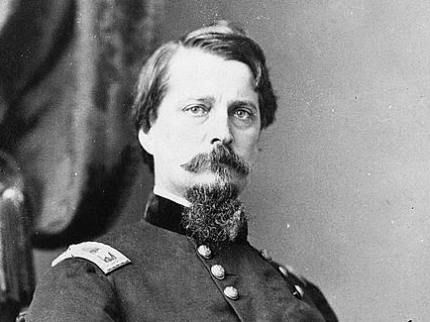
II Corps- Maj. Gen. Winfield S. Hancock (w); Brig. Gen. John Gibbon; Brig. Gen. William Hays
John_C._Caldwell

First Division- Brig. Gen.  John C. Caldwell
1st Brigade- Col. Edward E. Cross (mw); Col. H. Boyd McKeen
5th New Hampshire, 61st New York, 81st Pennsylvania , 148th Pennsylvania
2nd Brigade (The Irish Brigade) – Col. Patrick Kelly
28th Massachusetts, 63rd New York (2 companies),69th New York (2 companies), 88th New York (2 companies), 116th Pennsylvania (4 companies)
3rd Brigade-Brig. Gen. Samuel K. Zook (mw); Lt. Col.. Charles G. Freudenberg (w); Col. Richard P. Roberts (k); Lt. Col.. John Fraser
52nd New York, 57th New York, 66th New York, 140th Pennsylvania
4th Brigade- Col. John R. Brooke (w)
27th Connecticut (2 companies), 2nd Delaware, 64th New York, 53rd Pennsylvania, 145th Pennsylvania (7 companies)
john_Gibbon

Second Division- Brig. Gen. John Gibbon (w); Brig. Gen. William Harrow
1st Brigade- Brig. Gen. William Harrow; Col. Francis E. Heath
19th Maine, 15th Massachusetts, 1st Minnesota, 82nd New York (2nd Militia)
2nd Brigade- Brig. Gen. Alexander S. Webb (w)
69th Pennsylvania, 71st Pennsylvania, 72nd Pennsylvania, 106th Pennsylvania
3rd Brigade- Col. Norman J. Hall
19th Massachusetts, 20th Massachusetts, 7th Michigan, 42nd New York, 59th New York (4 companies)
Unattached: Massachusetts Sharpshooters, 1st Company
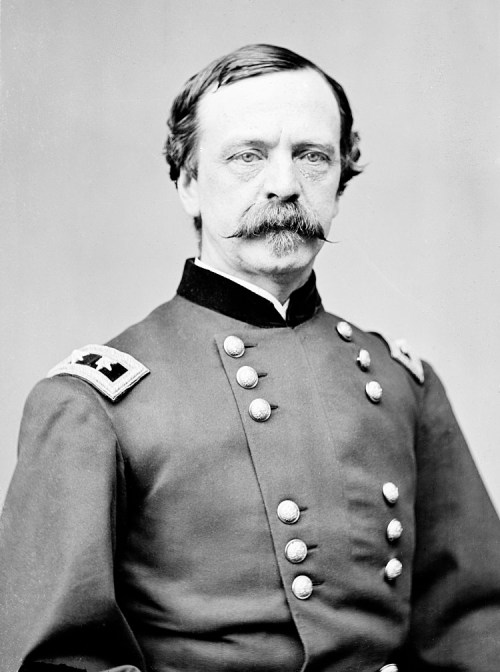
Daniel_Edgar_Sickles

III Corps- Maj. Gen. Daniel E. Sickles (w); Maj. Gen. David B. Birney
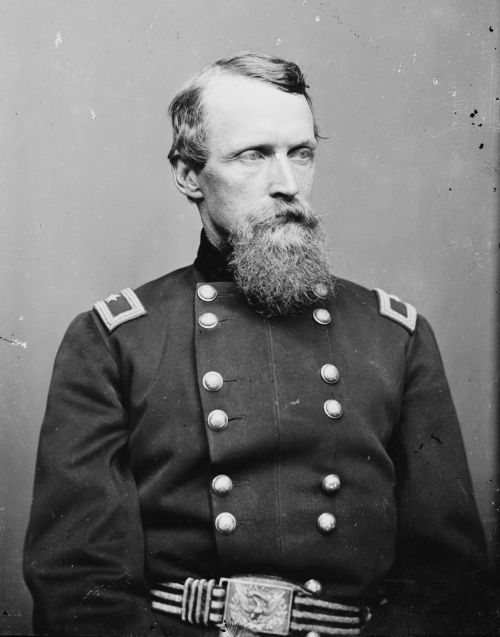
David_B._Birney_-_Brady-Handy

First Division- Maj. Gen. David B. Birney; Brig. Gen. J. H. Hobart Ward (w)
1st Brigade- Brig. Gen. Charles K. Graham (w&c); Col. Andrew H. Tippin; Col. Henry J. Madill
57th Pennsylvania (8 companies), 63rd Pennsylvania, 68th Pennsylvania, 105th Pennsylvania, 114th Pennsylvania, 141st Pennsylvania
2nd Brigade- Brig. Gen. J. H. Hobart Ward; Col. Hiram Berdan
20th Indiana, 3rd Maine, 4th Maine, 86th New York, 124th New York, 99th Pennsylvania, 1st United States Sharpshooters, 2nd United States Sharpshooters (8 companies)
3rd Brigade- Col. P. Régis de Trobriand
17th Maine, 3rd Michigan, 5th Michigan, 40th New York, 110th Pennsylvania (6 companies)
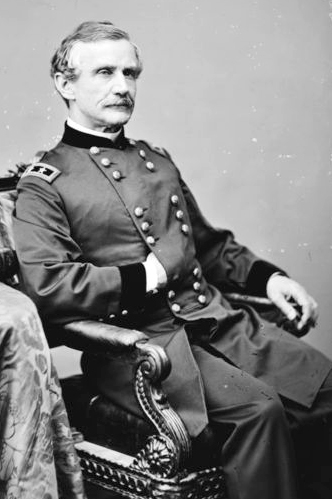
HumphreysA

Second Division- Brig. Gen. Andrew A. Humphreys
1st Brigade- Brig. Gen. Joseph B. Carr (w)
1st Massachusetts, 11th Massachusetts, 16th Massachusetts, 12th New Hampshire, 11th New Jersey,26th Pennsylvania
2nd Brigade-Col. William R. Brewster
70th New York, 71st New York, 72nd New York, 73rd New York, 74th New York, 120th New York
3rd Brigade-Col. George C. Burling
2nd New Hampshire, 5th New Jersey, 6th New Jersey, 7th New Jersey, 8th New Jersey,115th Pennsylvania
Artillery Brigade-Capt. George E. Randolph (w); Capt. A. Judson Clark
1st New Jersey Light, Battery B, 1st New York Light, Battery D, New York Light, 4th Battery, 1st Rhode Island Light, Battery E, 4th United States, Battery K
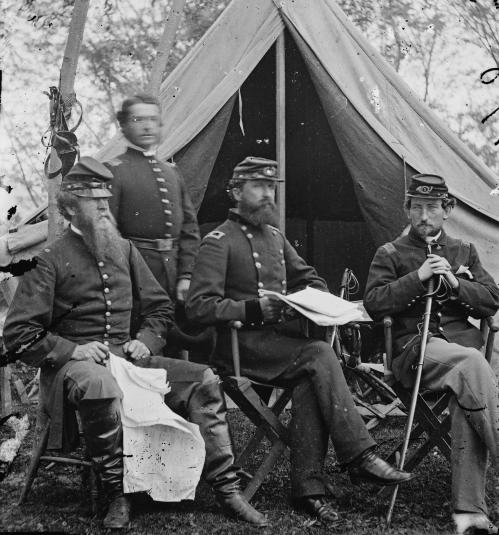
George_Sykes_and_staff_-_Brady-Handy

V Corps-Maj. Gen. George Sykes

James_Barnes

First Division- Brig. Gen. James Barnes (w)
1st Brigade-Col. William S. Tilton
18th Massachusetts, 22nd Massachusetts, 1st Michigan, 118th Pennsylvania
2nd Brigade-Col. Jacob B. Sweitzer
9th Massachusetts, 32nd Massachusetts, 4th Michigan, 62nd Pennsylvania
3rd Brigade-Col. Strong Vincent (mw); Col. James C. Rice
20th Maine, 16th Michigan, 44th New York, 83rd Pennsylvania
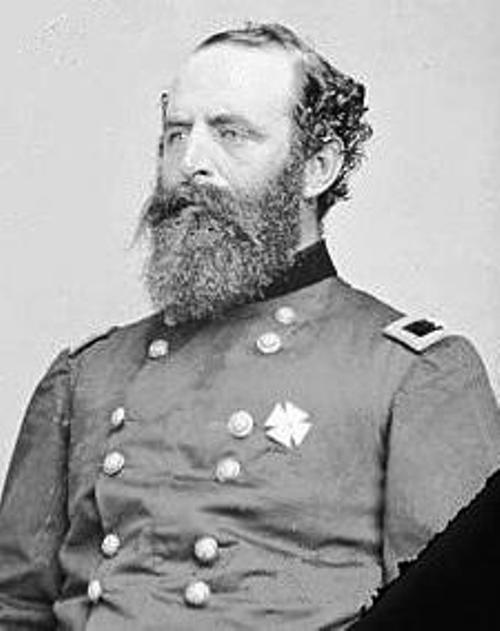
2.-Brig.-Gen.-Romeyn-B.-Ayres

Second Division-Brig. Gen. Romeyn B. Ayres
1st Brigade- Col. Hannibal Day
3rd United States (Cos. B, C, E, G, I and K), 4th United States (Cos. C, F, H and K), 6th United States (Cos. D, F, G, H and I), 12th United States (Cos. A, B, C, D and G, 1st Bn. and Cos. A, C and D, 2nd Bn.), 14th United States (Cos. A, B, D, E, F and G, 1st Bn. and Cos. F and G, 2nd Bn.)
2nd Brigade-Col. Sidney Burbank
2nd United States (Cos. B, C, F, H, I and K), 7th United States (Cos. A, B, E and I), 10th United States (Cos. D, G and H), 11th United States (Cos. B, C, D, E, F and G),17th United States (Cos. A, C, D, G and H, 1st Bn. and Cos. A and B, 2nd Bn.)
3rd Brigade-Brig. Gen. Stephen H. Weed (k); Col. Kenner Garrard
140th New York, 146th New York, 91st Pennsylvania, 155th Pennsylvania
Third Division-Brig. Gen. Samuel W. Crawford
1st Brigade-Col. William McCandless
1st Pennsylvania Reserves (9 companies), 2nd Pennsylvania Reserves, 6th Pennsylvania Reserves,13th Pennsylvania Reserves
2nd Brigade (not present—assigned to Washington defenses)
3rd Brigade-Col. Joseph W. Fisher
5th Pennsylvania Reserves, 9th Pennsylvania Reserves, 10th Pennsylvania Reserves, 11th Pennsylvania Reserves, 12th Pennsylvania Reserves (9 companies)
Artillery Brigade-Capt. Augustus P. Martin
Massachusetts Light, 3rd Battery, 1st New York Light, Battery C, 1st Ohio Light, Battery L, 5th United States, Battery D, 5th United States, Battery I
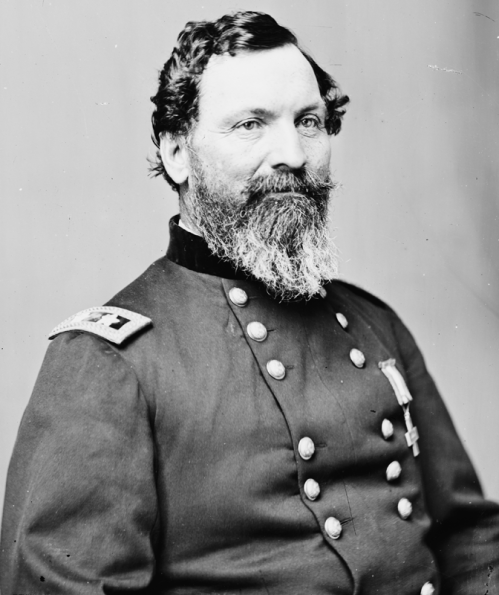
John_Sedgwick

VI Corps-Maj. Gen. John Sedgwick

HGWright

First Division-Brig. Gen. Horatio G. Wright
1st Brigade-Brig. Gen. Alfred T. A. Torbert
1st New Jersey, 2nd New Jersey, 3rd New Jersey, 15th New Jersey
2nd Brigade-Brig. Gen. Joseph J. Bartlett; Col. Emory Upton
5th Maine, 121st New York, 95th Pennsylvania, 96th Pennsylvania
3rd Brigade-Brig. Gen. David A. Russell
6th Maine, 49th Pennsylvania (4 companies), 119th Pennsylvania, 5th Wisconsin

Provost Guard: 4th New Jersey (3 companies): Capt. William R. Maxwell
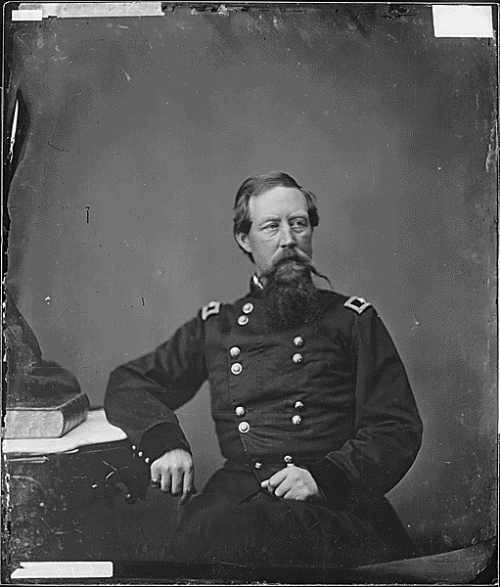
albion-howe-111-b-4713

Second Division- Brig. Gen. Albion P. Howe
2nd Brigade-Col. Lewis A. Grant
2nd Vermont, 3rd Vermont, 4th Vermont, 5th Vermont, 6th Vermont
3rd Brigade-Brig. Gen. Thomas H. Neill
7th Maine (6 companies), 33rd New York (detachment), 43rd New York, 49th New York, 77th New York, 61st Pennsylvania
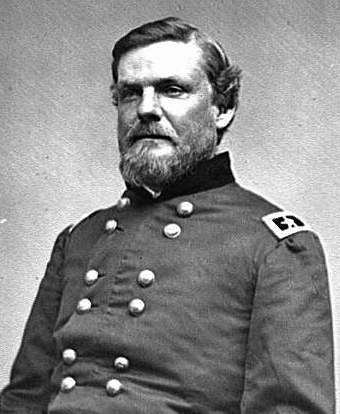
NewtonJohn

Third Division-Maj. Gen. John Newton; Brig. Gen. Frank Wheaton
1st Brigade-Brig. Gen. Alexander Shaler
65th New York, 67th New York, 122nd New York, 23rd Pennsylvania, 82nd Pennsylvania
2nd Brigade-Col. Henry L. Eustis
7th Massachusetts, 10th Massachusetts, 37th Massachusetts, 2nd Rhode Island.
3rd Brigade-Brig. Gen. Frank Wheaton; Col. David J. Nevin
62nd New York, 93rd Pennsylvania, 98th Pennsylvania,139th Pennsylvania
Artillery Brigade-Col. Charles H. Tompkins
Massachusetts Light, 1st Battery, New York Light, 1st Battery, New York Light, 3rd Battery, 1st Rhode Island Light, Battery C, 1st Rhode Island Light, Battery G, 2nd United States, Battery D, 2nd United States, Battery G, 5th United States, Battery F
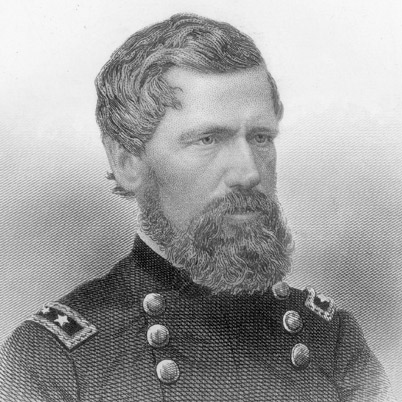
Oliver-Otis-Howard-9345101-1-402

XI Corps-Maj. Gen. Oliver O. Howard; Maj. Gen. Carl Schurz
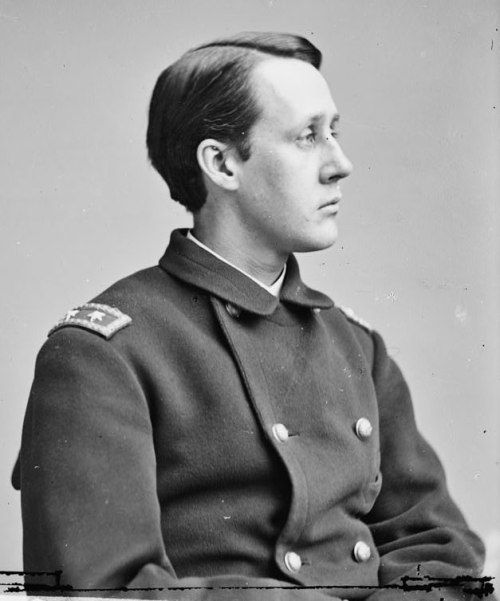
Francis_C._Barlow

First Division-Brig. Gen. Francis C. Barlow (w); Brig. Gen. Adelbert Ames
1st Brigade-Col. Leopold von Gilsa
1st New York (9 companies), 54th New York, 68th New York, 153rd Pennsylvania
2nd Brigade-Brig. Gen. Adelbert Ames; Col. Andrew L. Harris
17th Connecticut, 25th Ohio, 75th Ohio, 107th Ohio
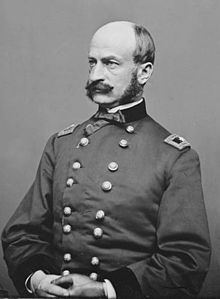
Adolph_von_Steinwehr

Second Division-Brig. Gen. Adolph von Steinwehr
1st Brigade-Col. Charles R. Coster
134th New York, 154th New York, 27th Pennsylvania, 73rd Pennsylvania
2nd Brigade  Col. Orland Smith
33rd Massachusetts, 136th New York, 55th Ohio, 73rd Ohio
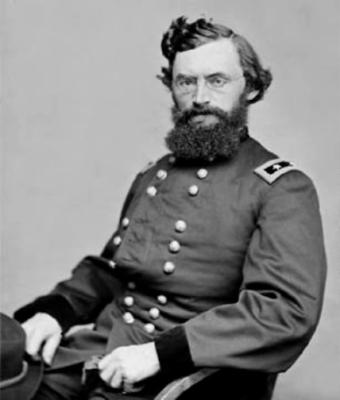
schurz

Third Division-Maj. Gen. Carl Schurz; Brig. Gen. Alexander Schimmelfennig; Maj. Gen. Carl Schurz
1st Brigade-Brig. Gen. Alexander Schimmelfennig; Col. George von Amsberg
82nd Illinois, 45th New York, 157th New York, 61st Ohio, 74th Pennsylvania
2nd Brigade-Col. Wladimir Krzyzanowski
58th New York, 19th New York, 82nd Ohio, 75th Pennsylvania, 26th Wisconsin
Artillery Brigade-Maj Thomas W. Osborn
1st New York Light, Battery I, New York Light, 13th Battery, 1st Ohio Light, Battery I, 1st Ohio Light, Battery K, 4th United States, Battery G
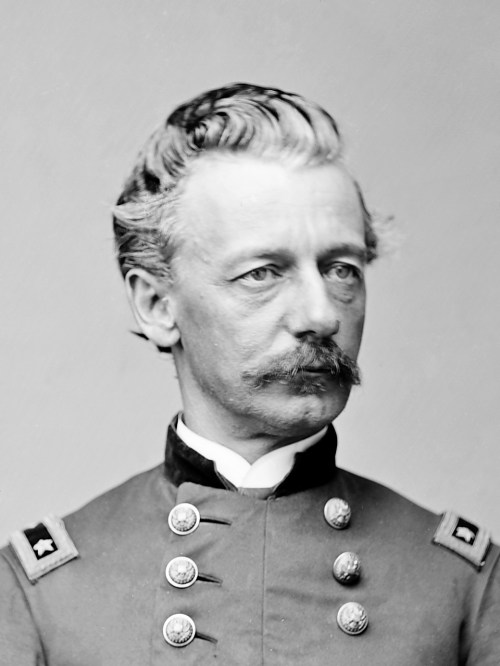
Henry_Warner_Slocum

XII Corps-Maj. Gen. Henry W. Slocum; Brig. Gen. Alpheus S. Williams
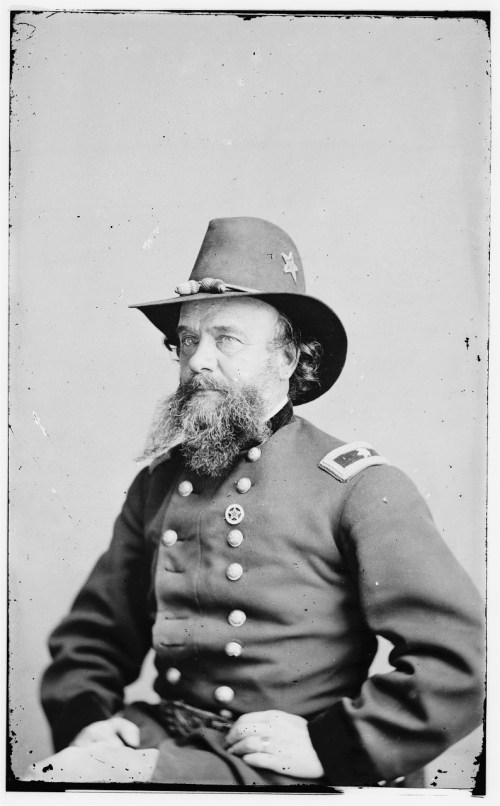
alpheus-williams1

First Division-Brig. Gen. Alpheus S. Williams; Brig. Gen. Thomas H. Ruger
1st Brigade-Col. Archibald L. McDougall
5th Connecticut, 20th Connecticut, 3rd Maryland, 123rd New York, 145th New York, 46th Pennsylvania
3rd Brigade-Brig. Gen. Thomas H. Ruger; Col. Silas Colgrove
27th Indiana, 2nd Massachusetts, 13th New Jersey, 107th New York, 3rd Wisconsin
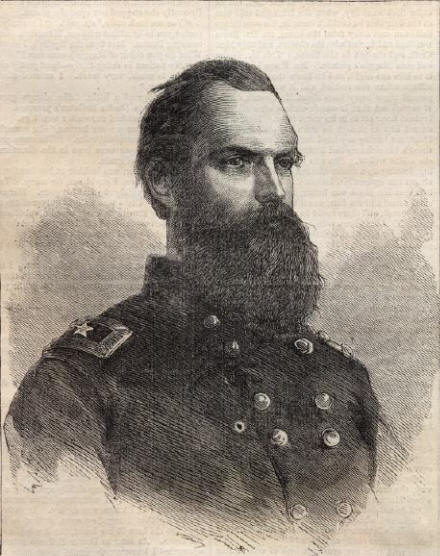
General-John-Geary

Second Division-Brig. Gen. John W. Geary
1st Brigade-Col. Charles Candy
5th Ohio, 7th Ohio, 29th Ohio, 66th Ohio, 28th Pennsylvania, 147th Pennsylvania (8 companies)
2nd Brigade-Col. George A. Cobham, Jr.; Brig. Gen. Thomas L. Kane
29th Pennsylvania, 109th Pennsylvania, 111th Pennsylvania
3rd Brigade-Brig. Gen. George S. Greene (w)
60th New York, 78th New York, 102nd New York, 137th New York, 149th New York
Lockwood’s Brigade-Brig. Gen. Henry H. Lockwood
1st Maryland, Potomac Home Brigade, 1st Maryland, Eastern Shore,150th New York
Artillery Brigade-Lt Edward D. Muhlenberg
1st New York Light, Battery M, Pennsylvania Light, Battery E,4th United States, Battery F  5th United States, Battery K
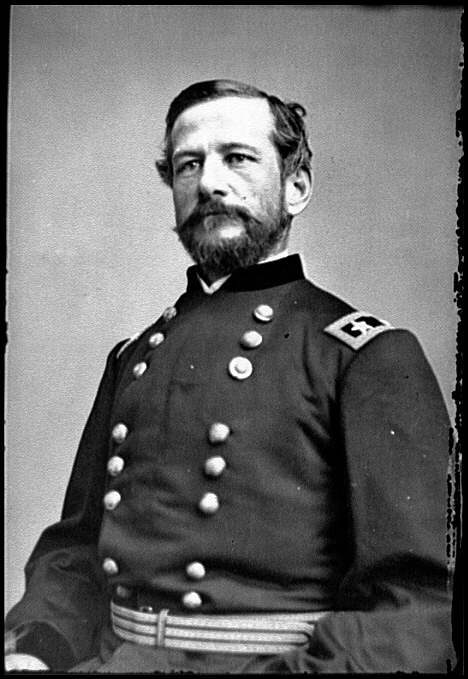
pleasonton

Cavalry Corps -Maj. Gen. Alfred Pleasonton
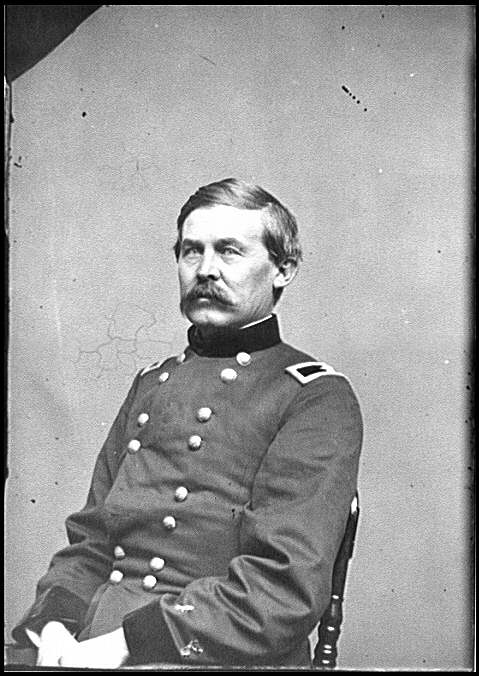
buford

First Division-Brig. Gen. John Buford
1st Brigade-Col. William Gamble
8th Illinois, 12th Illinois (4 cos.) & 3rd Indiana (6 cos.), 8th New York
2nd Brigade-Col. Thomas Devin
6th New York (6 companies), 9th New York, 17th Pennsylvania, 3rd West Virginia, Companies A and C
Reserve Brigade-Brig. Gen. Wesley Merritt
6th Pennsylvania, 1st United States, 2nd United States, 5th United States, 6th United States
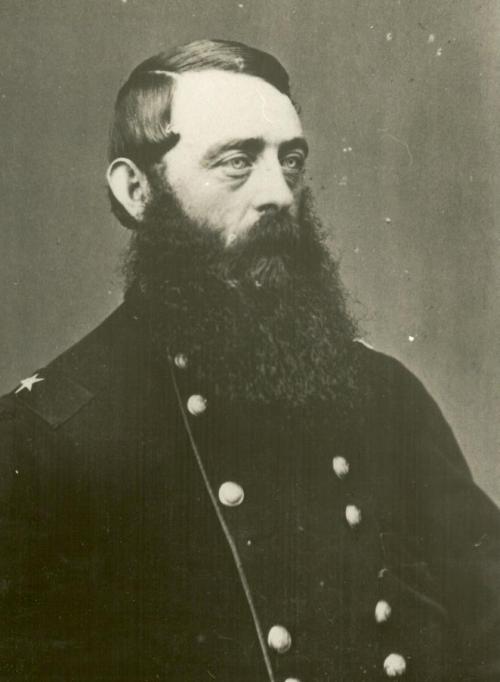
dmgregg

Second Division-Brig. Gen. David Gregg
1st Brigade-Col. John B. McIntosh
1st Maryland (11 companies), Purnell (Maryland) Legion, Company A, 1st Massachusetts, 1st New Jersey, 1st Pennsylvania, 3rd Pennsylvania, 3rd Pennsylvania Heavy Artillery, Section, Battery H
3rd Brigade-Col. John I. Gregg
1st Maine (10 companies), 10th New York, 4th Pennsylvania, 16th Pennsylvania
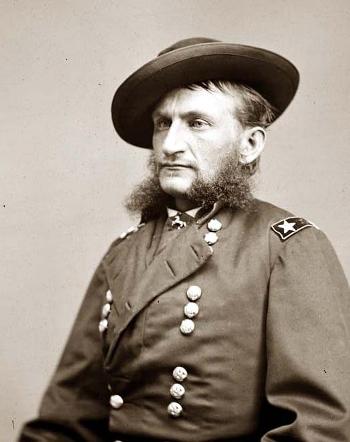
Kilpatrick-Judson(1)

Third Division-Brig. Gen. Judson Kilpatrick
1st Brigade-Brig. Gen. Elon J. Farnsworth (k); Col. Nathaniel P. Richmond
5th New York, 18th Pennsylvania, 1st Vermont, 1st West Virginia (10 companies)
2nd Brigade-Brig. Gen. George A. Custer
1st Michigan, 5th Michigan, 6th Michigan, 7th Michigan: (10 companies)
Horse Artillery
1st Brigade-Capt. James M. Robertson
9th Michigan Battery, 6th New York Battery,2nd United States, Batteries B and L, 2nd United States, Battery M, 4th United States, Battery E
2nd Brigade-Capt. John C. Tidball
1st United States, Batteries E and G, 1st United States, Battery K, 2nd United States, Battery A
Robert_O_Tyler

Artillery Reserve-Brig. Gen. Robert O. Tyler, Capt. James M. Robertson

1st Regular Brigade-Capt. Dunbar R. Ransom
1st United States, Battery H, 3rd United States, Batteries F and K, 4th United States, Battery C, 5th United States, Battery C
1st Volunteer Brigade-Lt. Col.. Freeman McGilvery
Massachusetts Light, 5th Battery (E), Massachusetts Light, 9th Battery, New York Light, 15th Battery, Pennsylvania Light, Batteries C and F
2nd Volunteer Brigade-Capt. Elijah D. Taft
1st Connecticut Heavy, Battery B, 1st Connecticut Heavy, Battery M, Connecticut Light, 2nd Battery. New York Light, 5th Battery
3rd Volunteer Brigade-Capt. James F. Huntington
New Hampshire Light, 1st Battery, 1st Ohio Light, Battery H, 1st Pennsylvania Light, Batteries F and G, West Virginia Light, Battery C
4th Volunteer Brigade-Capt. Robert H. Fitzhugh
Maine Light, 6th Battery, Maryland Light, Battery A, New Jersey Light, 1st Battery, 1st New York Light, Battery G, 1st New York Light, Battery K
Train Guard: 4th New Jersey Infantry (7 companies)

Leave a comment

Filed under civil war, History, Military