Tag Archives: lent

Alleluia Christ is Risen!

After the sabbath, as the first day of the week was dawning, Mary Magdalene and the other Mary went to see the tomb. And suddenly there was a great earthquake; for an angel of the Lord, descending from heaven, came and rolled back the stone and sat on it. His appearance was like lightning, and his clothing white as snow. For fear of him the guards shook and became like dead men. But the angel said to the women, “Do not be afraid; I know that you are looking for Jesus who was crucified. He is not here; for he has been raised, as he said. Come, see the place where he lay. Then go quickly and tell his disciples, `He has been raised from the dead, and indeed he is going ahead of you to Galilee; there you will see him.’ This is my message for you.” So they left the tomb quickly with fear and great joy, and ran to tell his disciples. Suddenly Jesus met them and said, “Greetings!” And they came to him, took hold of his feet, and worshiped him. Then Jesus said to them, “Do not be afraid; go and tell my brothers to go to Galilee; there they will see me.” Matthew 28:1-10

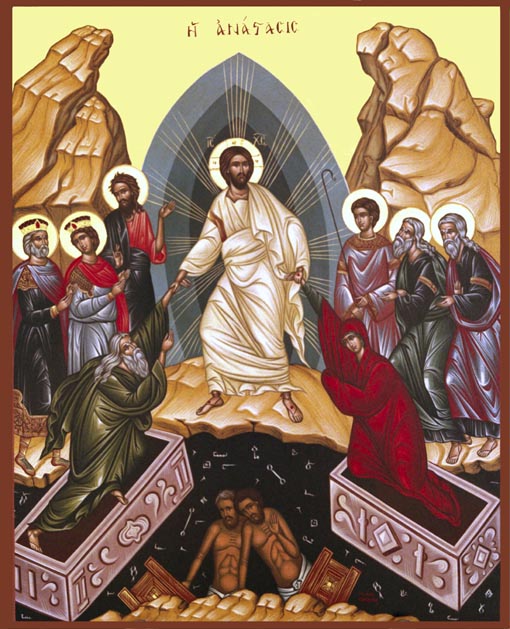
It is Easter at last and Christians around the world sing the triumphant message “alleluia Christ is risen, he is risen indeed!”  Just as the first disciples walked with Jesus we too have walked with Jesus through the penitential season of Lent beginning on Ash Wednesday where we remembered that “we are but dust and to dust we shall return.” With each thing that we abstained from or added to our spiritual discipline we in a small way were reminded that we are to “deny ourselves, take up our Cross and follow.”  In Holy week we experienced the nearly schizophrenic emotions of triumph and tragedy of Palm or Passion Sunday, the solemnity that comes on Holy or Maundy Thursday as we recall the institution of the Eucharist or the Lord’s Supper and the humility of Jesus as he takes on the mantle of a lowly servant and washes the feet of his disciples.  Leaving that we enter into the suffering of Jesus on Good Friday and see how even his friends betrayed or abandoned him with only a thief on an adjacent cross and the officer in charge of the crucifixion realizing just who was on that middle cross.  We wait overnight Friday and through Saturday in the uncomfortable middle between the crucifixion and resurrection that so often mirrors events in our own life where we sometimes experience what we feel to be forsaken by family, friends, church and sometimes even God.  Yet in the pre-dawn darkness of that first Easter morning we like the disciples awake to find that something has happened, that the stone is rolled away, the tomb is empty and Jesus is raised from the dead crushing sin death and hell.  We are greeted by Jesus who tells us not to be afraid but to go and tell others what has happened.  He greets us on the road to Emmaus and breaks bread with us even as we tell him about the tragedy of his death and then our eyes are opened.  Jesus is the victor and in his death burial and resurrection we have the forgiveness of sins.  The event is also eschatological in that it opens the door for him to return in glory and for him to be revealed in his people For the creation waits with eager longing for the revealing of the children of God;  “for the creation was subjected to futility, not of its own will but by the will of the one who subjected it, in hope that the creation itself will be set free from its bondage to decay and will obtain the freedom of the glory of the children of God.” Romans 8:20-21

Likewise it is in this series of inseparable events that Christ establishes our redemption by the forgiveness of sins “For while we were still weak, at the right time Christ died for the ungodly. Indeed, rarely will anyone die for a righteous person—though perhaps for a good person someone might actually dare to die. But God proves his love for us in that while we still were sinners Christ died for us.” Romans 5:6-8.

It is a universe changing event whereby Christ sets his people free and destroys the power of his enemies. Karl Barth wrote: “Look once again to Jesus Christ in his death upon the cross.  Look and try to understand that what he did and suffered he did and suffered for you, for me, for us all.  He carried our sin, our captivity and our suffering, and did not carry it in vain.  He carried it away.  He acted as the captain of us all.  He broke through the ranks of our enemies.  He has already won the battle, our battle.  All we have to do is to follow him, to be victorious with him.  Through him, in him we are saved.  Our sin no longer has any power over us.  Our prison door is open…when he, the Son of God, sets us free, we are truly free.” This is the redemption that the world awaits, not a redemption that is to be hoarded by believers but a redemption that extends beyond the present redemption for all people, especially those who believe and the people of God are to toil and struggle for this “For to this end we toil and struggle, because we have our hope set on the living God, who is the Savior of all people, especially of those who believe.” 1 Timothy 4:10

The Cross and Resurrection are to be a new and purifying wind in the world and the people of God are to be the vehicle for this wind empowered by the Holy Spirit of God.  It is not simply about mastering the art of dying as Socrates did but experiencing resurrection.  Christ did not merely die but he overcame the last enemy which is death itself. (1 Corinthians 15:26)  The power of this is not to be taken lightly in its possibilities for real change for as Dietrich Bonhoeffer wrote “If a few people really believed that and acted on it in their daily lives, a great deal would be changed. To live in the light of the Resurrection—that is what Easter means.”

While we live in the reality of the light of the Resurrection we simultaneously live under the shadow of the Cross of Christ as well as the cross that we are obliged by God to carry in our own lives. In the duality and unity of the Cross and Resurrection we have hope and in that hope we are not to be overwhelmed by events in the world that we cannot control.  Nor are we to be consumed by false “gospels” presented by various ideologues of the right and the left who may identify themselves as “Christian” but place their ideologies, social, political, national and economic over the Gospel itself.  Ideologues who quote scripture to buttress their arguments so that their ideology and the “Gospel” are one in the same much as Satan did during the temptation of Jesus to provide a veneer of Christianity to ideologies that are often opposed to the message of the Gospel. Such an idea is much like the message on German soldier’s belt buckles in the Second World War proclaimed “Gott Mit Uns” even as their nation made war on the world and executed an evil ideology of death upon the Jews and others unfortunate enough to be considered the enemies of the Nazi Party.

It is the ideologues who now endanger the Church and Gospel itself for many choose to remain inside the walls of the church and attempt to turn it into a tool of their ideology and in doing so these ideologues measure and evaluate “others only from the standpoint of whether they are supporters of this ideology, or whether they might become such, or whether they might at least be useful to it even without their consent, or whether they must be fought as its enemies. Its glory has already become for him the solution not only to the personal problem of his own life but to each and all of the problems of the world.” But the Cross and resurrection cry out “NO!” to such ideas even when they are drenched with so called “Biblical” support.

The Cross and the Resurrection bring us to life and promise that Christ who died and was raised will come again and in doing so will complete the redemption of the world for which he suffered and died. It is the real world for which God cares for enough to live suffer and die to save, as Dietrich Bonhoeffer so eloquently wrote “God loves human beings. God loves the world. Not an ideal human, but human beings as they are; not an ideal world, but the real world. What we find repulsive in their opposition to God, what we shrink back from with pain and hostility, namely, real human beings, the real world, this is for God the ground of unfathomable love.”

It is God’s unfathomable love that Easter proclaims as victorious and allows us will all people to cry out “Alleluia Christ is Risen! The Lord is Risen indeed!”

Peace and Happy Easter

Padre Steve+

1 Comment

Filed under christian life, faith, Religion

Lenten Joy

“Joy is the simplest form of gratitude.”  Karl Barth

“Gratitude changes the pangs of memory into a tranquil joy.” Dietrich Bonhoeffer

“Lord deliver us from gloomy saints” Teresa of Avila


Today is the last Friday in Lent and one to reflect on something often forgotten as we get lost in the “necessity” to give up things or do more in our spiritual life.  As one who never enjoyed the Lenten season because I got lost in the legalism of it.  I would become more focused on setting up things to do or to abstain from that were unreasonable and bound to fail no matter how hard I worked to make them work.  Often these were practices that I gleaned from medieval spirituality which focused on the penitential and ascetic aspects of the Christian life which in retrospect only made me more miserable during Lent.  Since I already know that I am a screw up and not very good at many spiritual practices the added “disciplines” were a continual reminder of how screwed up I really am.  This got worse after Iraq dealing with PTSD and all kinds of other issues to the point that last year I did an “un-Lent Lent” avoiding those things but not being very successful in doing better spiritually.

This Lent has been about recovering Joy.  Yes Lent is a penitential season and yes I do examine my conscious and seek to ensure that I go to confession or penitential service.  In fact the acuity of my awareness has gotten better making this less painful than it used to be.  Knowing that I have been able, even when knocked on my ass by a nasty Kidney stone for almost a month have been able to gain something from my Lenten journey, something very spiritual which drew me closer to God and others without a lot of additional religious activity.  For the first time in my life I can say that I have enjoyed Lent.

Part of recovering joy in life is regaining the ability to laugh again and not just with cynical and sarcastic wit.  Instead I have been able to laugh about life, the good and the bad.  As Karl Barth said “laughter is the closest thing to the grace of God.”

Laughter and joy have again become central in my life and I wonder how I lived during the darkest parts of the last two years when I despaired of life itself and wondered if God even existed.  Even with all the turmoil in the country and world, which I do take seriously if you are a regular reader, I have been able to live life, do theology, provide pastoral care and write and study history while living in the moment appreciating the grace and forgiveness of God and looking to the future with hope.  I know for some this may sound a bit daft, but I know that things are not great but I also know that somehow God and humanity continue to move forward in relationship to each other.

When I survey some to the pastors, teachers, and “theologians” in print and on the internet I wonder if they have forgotten the essence of life with God.  As the first question in the Westminster Catechism asks “what is the chief end of man?” The proper answer to this question is “to glorify God and enjoy him forever.” Even the disciples of John “I don’t know how to have fun” Calvin got this one right.

Karl Barth hits the nail on the head in dealing with joyless theologians and pastors.  When I was in seminary and since I have ordained I am amazed at the number of joyless people in ministry.  I know that some people get treated like crap by their churches but to remain in ministry while hating it and loathing people strikes me as just sort of self destructive.   Likewise the “theologian” who loathes the work that he has been called to do and the people that he is called to serve.  Barth notes:

“The theologian who has no joy in his work is not a theologian at all. Sulky faces, morose thoughts and boring ways of speaking are intolerable in this science. May God deliver us from what the Catholic Church reckons one of the seven sins of the monk—taedium [loathing]—in respect of the great spiritual truths with which theology has to do. But we must know, of course, that it is only God who can keep us from it.” Karl Barth, Church Dogmatics, II/1, p. 656.

To have joy in life and rediscover it in a season where even some of the most devout Christians what become immersed in tasks that are meant to bring them closer to God in fact serve to drive them away or become legalistic and unhappy seemingly incapable of knowing joy.  In “giving things up” they also give away the joy and peace of the Lord and the fellowship of his people. Joy should actually serve to remind us of, call us to and awaken us to desire.  C.S. Lewis talked a lot about joy and even wrote a book about it.  He noted in a letter that “All joy…emphasizes our pilgrim status; always reminds, beckons, awakens desire. Our best havings are wantings.”

Lent should not be a season where we take the fact that there are no “alleluias” and that many of the symbols of faith in our churches are covered as being a season of sorrow.  If we allow it to become that we miss the point entirely.  The joy that should we experience in life with God and the people that he loves, even in the most mundane and supposedly “unspiritual” undertakings of life is something to be savored.  Joy is part and parcel part of the Christian hope, and merely the hope of the Christian but the hope of humanity in the midst of a world dominated by politicians, pundits, preachers and a media machine that do nothing to inspire but rather play on people’s fears and seek to drive wedges between people who depend upon one another. The Christian faith is about a future grounded in hope and lived in fullness bathed in joy because of what God has done in Christ, instead of dwelling on death it is fixated on life.   As Jürgen Moltmann said “the origin of hope is birth, not death. The birth of a new life is an occasion for hope. The rebirth of lived life is an occasion for even greater hope. And when the dead are raised, they enter into the fulfilled hope of life. The setting for learning hope in life, therefore, is the possibility of starting anew and a new beginning, the true freedom.”


I have entered into a period where I am again experiencing joy in the simplicity and complexity of life lived with people that I have come to love and with whom I hope to share a great future.  With real joy a part of my life I can look to a great future as I turn 50.

Peace,

Padre Steve+

Leave a comment

Filed under christian life, faith, Religion

The Last Week of Lent: Mediation on Life, Love and Public Witness

Lent is drawing to a close and Sunday begins Holy week where the Church remembers the last week in the early life of Jesus the Christ.  While I will write about the various aspects of Holy week to include Passion or Palm Sunday, Holy or Maundy Thursday, Good Friday and Easter but tonight a short meditation on the final week of this Lenten season.

I have discussed how this Lent has been different than previous observances of Lent.  In the past I was constantly trying to observe certain spiritual disciplines to include fasting, abstinence and prayer in a formal and legalistic manner.  Last year as I was “melting down” in my spiritual, psychological and physical life facing an existential crisis where after my tour in Iraq, experience of forsakenness, disillusionment concerning the Church, political institutions and the media and doubt about the existence of God I attempted to change the way that I observed Lent.  For the most part that attempt was an abysmal failure, however out of it came an association with the Pastor and people of Saint James Episcopal Church in Portsmouth which has been a place where at least part of me began to experience community and healing again.

This Lenten season has been one filled with an experience of God’s grace and love as well as a connection to others that I have missed for a long time.  It has been a time of continued healing, self discovery in the light of God’s grace and change in the way that I do life.  Admittedly this has been a gradual process that began back during Advent but has become more a part of my life.  The rediscovery of God’s grace in Jesus and a life in community with others has been a key factor in this experience.  I certainly have not figured everything out, far be it, I am re-learning my faith and it has been a time of refreshment.  Part of this is the experience of Christ in Scripture and sacred Tradition, but also in reason.  As such it has been a time where I have been able to enunciate how my Christian faith addresses the trying times that we are living in often through the witness of men like Dietrich Bonhoeffer and Karl Barth.

One thing that Bonhoeffer said has a particular resonance in my life because it aptly describes how I feel.  In prison Bonhoeffer wrote: “I often ask myself why a ‘Christian instinct’ often draws me more to the religionless people than to the religious, by which I don’t in the least mean with any evangelizing intention, but, I might almost say, ‘in brotherhood’. While I’m often reluctant to mention God by name to religious people – because that name somehow seems to me here not to ring true, and I feel myself to be slightly dishonest (it’s particularly bad when others start to talk in religious jargon; I then dry up almost completely and feel awkward and uncomfortable) – to people with no religion I can on occasion mention him by name quite calmly and as a matter of course.” Dietrich Bonhoeffer – Letters and Papers from Prison

In fact I find it easier on many occasions to have free flowing, intellectual, spiritual discussions with people who have a faith far different than mine than I do with many people in my own denomination. I am making no judgment on them as I have been the one going through a fundamental change in the way that I do life, theology and relationships.

As this has occurred I have rediscovered just how much God loves and cares for real people, as Bonhoeffer wrote:

“God loves human beings. God loves the world. Not an ideal human, but human beings as they are; not an ideal world, but the real world. What we find repulsive in their opposition to God, what we shrink back from with pain and hostility, namely, real human beings, the real world, this is for God the ground of unfathomable love.”

As I interact more with those “outside” the church I often find deep faith and integrity which sometimes I find to be more “real” than some of the Christians that I know. I am not saying that somehow the non-Christian is superior to the Christian but that God has also made them in his image and as such they are not the enemies of God. As Paul the Apostle wrote “Therefore, if anyone is in Christ, he is a new creation; the old has passed away, behold, the new has come. All this is from God, who through Christ reconciled us to himself and gave us the ministry of reconciliation; that is, in Christ God was reconciling the world to himself, not counting their trespasses against them, and entrusting to us the message of reconciliation.  So we are ambassadors for Christ, God making his appeal through us. We beseech you on behalf of Christ, be reconciled to God.  For our sake he made him to be sin who knew no sin, so that in him we might become the righteousness of God.” 2nd Cor. 5:17-21 NRSV and “For to this end we toil and struggle, because we have our hope set on the living God, who is the Savior of all people, especially of those who believe.” 1 Tim. 4:10 NRSV

Likewise I also have found it harder to deal with people who spout religious jargon and throw out Bible verses without any sense of context, history and or concern for their hearers.  It seems to me that many parts of American Christianity have substituted cultural and political issues for the preaching of the Gospel of life.  I recently saw some posts by religious leaders on social networking sites, websites and media outlets that accused pro-life Democrats of “betraying their faith” by voting for the Health Care Bill.  Now I am not thrilled with the bill and have major concerns about it.  However, if I decide to accuse someone of “betraying their faith” I had better be sure that I am on solid ground and stick to what is in the Creed over a particular interpretation of any moral or social issue on which even Christians disagree. Saying this will win me no friends in certain parts of the Church but I wonder the utility of alienating people and in our condemnation of them ensure that they will turn off anything that we say about Jesus who despite what they (and we) do still loves humanity with an undying and passionate love that is demonstrated by his death on the Cross as Paul wrote “But God proves his love for us in that while we still were sinners Christ died for us.”   Romans 5:8 NRSV

In all of the turmoil that has embroiled the country I still find myself at peace because of what has happened to me over the past couple of years. Going to war and seeing the tragedy of a people engulfed in civil war has given me an appreciation of seeking peaceful dialogue with those that I have disagreement rather than attacking them at the center of their being.  I believe the Gospel lived authentically and not wrapped in the incestuous embrace of venomous and often hate filled political ideologies which seems to be increasingly the case in United States is far more powerful than that of a political movement of any kind.  The church surrenders its authority and legitimacy by allowing itself to be a party organ of any political party or ideology.  Unfortunately simply because political parties and movements pay lip service to certain “Christian” values many Christians and churches lose themselves and endorse power for power sake hoping that the party will implement their beliefs.  Unfortunately history proves that more often than not when their party returns to power it will again sell them short with no return for their support.  The unintended consequence is that people who need the Gospel identify it with the political ideology of the party that the church supported.  This was not the witness of the early church, the Apostles and those that followed them.

The mimicking of ideologues by Christians gives credence and support to violent people who under the cover of God have no problem with praying for the death of their opponents and in some cases taking the responsibility of that in their own hands.  Should bloodshed arise out of this latest partisan political struggle the religious leaders who urged violence and prayed for death will have blood on their hands.  Having been threatened with violence on this website by a supposedly “Christian” person I take a deeply personal interest in just how violent some Christians have become and with actions and violent threats against members of the House of Representatives I wonder what will happen when someone assassinates one of these men or women or a religious leader who dares to oppose them.

The alternative to this is to cry “NO!” to the calls for violence and judgment no matter from what side of the political or ideological spectrum that they emerge.  The alternative is to in thought word and deed demonstrate the truth of the Gospel in love even to those that we have strong disagreement on very important issues.

Anyway I must close for the night.

Peace

Padre Steve+

Leave a comment

Filed under christian life, History, philosophy, Political Commentary, Religion

Difficult Days: A Lenten Meditation

“As lousy as things are now, tomorrow they will be somebody’s good old days.” Gerald Barzan

The Good Old Days to Some…the Bad Old Days to Otehrs

The past few weeks being laid up dealing with Adolf the Kidney stone and his remove this week have been unusual for me.  I have been in pain and even now am dealing with the aftereffects of the procedure to remove Adolf I find that it has given me a pause during Lent that I seldom get.  The pause to look at life, mortality and what is and is not important. Now a Kidney stone is not normally a life threatening condition and was not in my case, but the condition has slowed me down from my normal hyperactive manner of doing things, even slowed down the pace of my writing.  It has not been fun but I have gained some spiritual grace that I think that I needed.  Tonight I am not feeling as well as I was this morning and hopefully this too will pass so I can get back to getting well.

It is difficult at times to be hopeful when all around there is bad news. We seem to be living the ancient Chinese curse that says “May you live in interesting times.” The times are certainly interesting with lots going on of historic significance that may years from now be remembered as one of those tumultuous times where the world changed before our eyes.  History of course is replete with such times, the rise and fall of ancient empires, the age of exploration, the Reformation, the French and American Revolutions, the Napoleonic era, the American Civil War, the Industrial Revolution, the First and Second World War with the Great Depression sandwich, the 1960’s, the post Cold War era and the post-911 era just for a start.  I could go back further in history for other epochal periods, but I think that the reason that today’s crisis seem so much more dire is that we are both the beneficiaries and the victims of the instantaneous communication revolution in which common people have real time access to events that are impacting their lives.  This causes many a great deal of anxiety both real and imagined, anxiety which usually finds expression in a desire for the good old days as well as seeks solace and security from those who feverishly exploit that anxiety.  It does not matter if the security comes from religion, political ideology and matters neither if it comes from the left or the right so long as the call resonates with them they will follow it.  They will faithfully follow even as the purveyors of the message drive up their worry and anxiety that they no longer can actually enjoy life or be thankful because they are so consumed with how “lousy” things are or “evil” their opponents are.

Fun and Games in the Good Old Days…

It is in times like these that one has to take a deep breath, look around at all that they have to be thankful for and just really examine of the nostalgia that they feel for “better times” is that or an escape from an unpleasant present and fear of the future if the other side wins.  The fact is that we have seen such times before and somehow made it through.  I hear from friends and relatives who lived through the Great Depression and World War II that those were good times in spite of everything happening, much of which is present today but somehow things are worse now.  Even I fall into the trap about somehow thinking that the times that I grew up in were somehow better than the present, this may be true for music but overall things were not that good for a lot of people but somehow we made it through them.  Lent is a time to step back from the brink, take stock and renew our life with God and our neighbor.

When I returned from Iraq back in February 2008 I soon discovered that the bombardment of bad news and über-partisan political battles took its toll on me.  I was neither as resilient as I thought that I was nor as consumed by the need to continue to ratchet up rhetoric on one side or the other as the more extreme elements on the right or left were doing.  PTSD or not I realized that the purveyors of the 24/7 bad news cycle were driving people with legitimate ideological differences to extremes that I had never seen, but which I recognized from history have a lot of precedent and can lead to making things even worse.  One only has to look at Weimar Germany to realize how things can go so very wrong when extremes on both sides of the ideological spectrums squeeze out those in the middle or chance at mutually beneficial solutions and that was in the days before type of information overload that is the bedrock of the political and ideological landscape of today.

I am not attacking those who get caught up in this but I do question the politicians, pundits, “news-networks” and talk show hosts who continue to ratchet up rhetoric to the point that many feel that the only alternative is some kind of “revolution.”  Again those that call for “radical change” or revolt against those who are in favor of that kind of change are both calling for revolution when revolutionary talk reaches a point where one side or the other does not see a way to resolve things in a civil manner then the those alternatives slip away and the only recourse is violence.  It is not the fault of one side or the other as those that stoke this talk are found on both sides of the American as well as other nations political and ideological spectrum testify to daily.  In the United States we also have a long history of apocalyptic thought which presents the lousy state of current events in any generation as something that will certainly bring the end of life as we know it or the return of the Lord, the Great Tribulation or whatever you chalk it up to. There are those on both the religious and secular side of the spectrum who have apocalyptic visions related to their world view.  For some reason we Americans do the apocalyptic quite well whether we believe in God or not.

I am not a radical, my temperament is such that I may have strong beliefs but realize that there are many other opinions out there than mine and that even if I do not agree with one side or the other on every issue it does not mean that I cannot find common ground.  I think this is part of the reason for the diversity of friends that I have from across the religious, political and ideological spectrum, we can agree to disagree and in the process still value one another and our opinions and remain friends who care about one another.

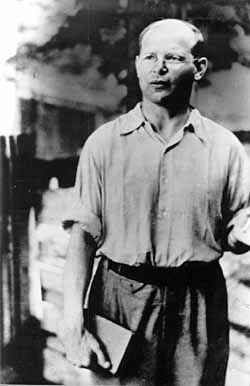
Dietrich Bonhoeffer in the Courtyard of the Tegel Strasse Prison

The thing that has been most on my mind this Lent has been the idea of being reconciled both to God and to one another.  Lent is a season of self examination, repentance and forgiveness.  The call to “be reconciled to one another” is a never ending command and applies across the variety and spectrum of life.  Lent reminds us that that “we are dust and to dust we shall return” but that we are also all made in the image of the God who created us, redeems us and sanctifies us who calls us to himself and reminds us that mercy triumphs over judgment and “not be conformed to this world, but be transformed by the renewing of your minds, so that you may discern what is the will of God—what is good and acceptable and perfect.” I am afraid that in times like these even the best intentioned of people can find themselves pulled into the orbit of those that in less stressful or trying times that they would never be involved with.  The German martyr Dietrich Bonhoeffer once wrote: “Our enemies are those who harbor hostility against us, not those against whom we cherish hostility… As a Christian I am called to treat my enemy as a brother and to meet hostility with love. My behavior is thus determined not by the way others treat me, but by the treatment I receive from Jesus.”

I know for some this message is lost and not because they are rejecting the message of the Gospel but because that have become so deeply involved in whatever cause they or their champions espouse that they have lost the ability at least temporarily to see the good that may rest in their opponents and their ideas.  As Bonhoeffer also wrote “Judging others makes us blind, whereas love is illuminating. By judging others, we blind ourselves to our own evil and to the grace which others are just as entitled to as ourselves.”  Now of course Bonhoeffer knew the evil that was the Nazis and eventually gave his life by supporting the German resistance to Hitler.  Loving our enemies does not absolve us from public responsibility but in ensuring that we do not ensnare ourselves in ideology that restricts our ability to love them as Christ has commanded.

I think in the past few years that I have gained a new perspective on life that has changed the way that I look at the world.  I know that things are not good right now and that there are a lot of things to be legitimately concerned about, but I know too that somehow our country as well as much of humanity have weathered worse and like Barzan said that for some these will be the good old days someday and that helps me to live in the present knowing that the future is not yet written and known only to God who in his grace condescends to love us and desires that we better love him and one another and not be conformed to any ideology that would prevent that.  I do pray that we will both see better days as well as be reconciled to God and to one another that is my Lenten prayer.

Peace,

Padre Steve+

1 Comment

Filed under History, philosophy, Political Commentary, Religion

Faith, Hope and Identity a Mid-Lent Meditation

“If it is hope that maintains and upholds faith and keeps it moving on, if it is hope that draws the believer into the life of love, then it will also be hope that is the mobilizing and driving force of faith’s thinking, of its knowledge of, and reflections on, human nature, history and society. Faith hopes in order to know what it believes. Hence all its knowledge will be an anticipatory, fragmentary knowledge forming a prelude to the promised future, and as such is committed to hope.” Jürgen Moltmann- Theology of Hope

When someone goes through a spiritual crisis or loss of faith it is a chilling time.  Even when you are trying to believe there is always a time that you really take stock of exactly what you believe and why.  Without regurgitating the crisis in my life and faith that came after my return from Iraq and near physical, emotional and spiritual collapse that came with my PTSD I wanted to just take a few paragraphs to meditate on the grace, mercy and love of God that is a central theme of the Gospel.

I have talked about the miracle that embraced me during the season of Advent and Christmas.  I call it my “Christmas miracle” because the year prior I had spent Christmas Eve walking in the dark and cold wondering if God even existed even as most of the Christian world was celebrating the Incarnation of Christ the Lord.  Since that time my faith has continued to be renewed and restored and with the exception of battling Adolf Von Grosse Schmertzen my very painful and very big Kidney Stone have come to feel like my old self for the first time since Iraq.

As I have entered Lent it has been a time of renewal.  Part of that renewal has been being able to believe again and as the Psalmist says, “be still and know that I am God.” This has been a refreshing time as I have continued to experience God’s grace as well as grown in my faith which is founded on the Anglican Triad of Scripture, Tradition and Reason.  That actually has helped me as I have experienced some measure of healing and recovery from what I experienced.

My time in Iraq was meaningful and I loved my Marines, Soldiers and other advisers as well as our Iraqi allies.  When I came back I felt alone and a lot of that came as my church had endured a series of scandals and splits and even before Iraq I had been thrashed by some of the people at the center of the storm who have all since left the church for other places that they can afflict.  Coming home to that was disillusioning, as isolation that I felt from many in the chaplain community.  I have found that my experience is not uncommon and that others have had similar experiences upon their return from Iraq.

For me this meant a period of almost two years where it seemed that God himself had disappeared from my life.  I struggled to even pray.  That is no longer the case, I seem to be on the rebound and God is real again.  So things have changed, I think that my faith has matured in some ways, I don’t need to go argue points of doctrine that saints, theologians and philosophers much smarter than me have legitimate disagreements about for centuries.  Nor do I need to push my views on people in my church or anywhere else as if I had the latest and last word from the Almighty.  I used to seek approval and want to have input on denominational theological or liturgical committees and I would write in the hope that my “brilliance” would be recognized and that my opinion would be sought after. When I write something now it is because I believe it and to stimulate interest and discussion and occasionally to answer or critique those who use faith as a weapon to bludgeon or intimidate those that they are against.  I do not expect to change anyone’s mind and since I have no position where I can enforce my beliefs on anyone else (nor would I want to thank you) my thoughts are simply that.  I hope that they edify and encourage and if someone has a “wow I could have had a V-8 moment” reading something that I write I’m okay with that.

Hans Kung once said: “Time and again we see leaders and members of religions incite aggression, fanaticism, hate, and xenophobia – even inspire and legitimate violent and bloody conflicts.” I guess to some this will sound “liberal” but I came back different from Iraq and I have seen too many people suffer from those that would use religion as a weapon to control others. In Iraq I had Iraqi officers; including Generals tell me that they did not trust their Islamic clergy Sunni or Shi’a because they by their words and actions had caused so much suffering during the insurgency that followed the US invasion of Iraq.  Unfortunately I am seeing the same kind of attitude that the Iraqi officers describe grow exponentially in this country, especially among the farthest right of the religious right. The use faith and religion to enforce their particular understanding of the Bible on people who are not Christians is troubling and something that our often very secular and not very Christian “Enlightenment” thinker founders understood. Some now declare anyone who doesn’t agree with them 100% as enemies not only of them, but of God and often over things that are not even Biblical like economics, gun control, taxes and a host of other conservative political issues. Now there are those on the far left that do the same thing but most do not use the Christian faith as justification for their intolerance of opposing views.  Somehow while I don’t think God sees things that way that the extremes see them I know that the Al Qaida Iraq, the Taliban and other groups think much in the same way.   However, such speech is protected and even if disagree with it would not support attempting to silence those who hold beliefs that I disagree with be they religious or political. Debate, dialogue and even disagreement on issues are important in both the Church and society in order that we don’t become a tyranny of the right or left, religious or secular.

As such my faith has grown in that I have no agenda other than to care for the people that God allows me to have contact with.  I’m certainly not perfect at this and at times my default setting of being an ass can re-emerge but I know that Christ is working in my life again.  I have emerged from what Saint John of the Cross called “the dark night of the soul.”  My faith is in God and in Christ crucified who in the words of St Paul who said “in Christ God was reconciling the world to himself, not counting their trespasses against them, and entrusting the message of reconciliation to us.” (2 Cor 5:19 NRSV) I like what Chrysostom says about this passage: “For had it been His pleasure to require an account of the things we had transgressed in, we should all have perished….” The fact that God has condescended to reach out to his creation in this manner is evidenced also in 1 John 2:1-2 where the Apostle writes: “My dear children, I write this to you so that you will not sin. But if anybody does sin, we have one who speaks to the Father in our defense—Jesus Christ, the Righteous One. 2He is the atoning sacrifice for our sins, and not only for ours but also for[the sins of the whole world.” For me this Lent is about reconciliation and the forgiveness of sins in an age where so many are drawing lines in the sand and preparing for war, be it religious, social or ideological.

So anyway, it has become more important to me after having gone to war and seeing its effects on people as well as having looked into the abyss of hopelessness to be an advocate for reconciliation, peace and hope for the future especially in my own country where the anger, division and even hatred between the political and religious right and the political, religious and secular left seems to rise to new heights every day.

My identity is not in a political leader, party or ideology, it is in Christ crucified. My optimism is based on him and the creation that he reconciles unto himself and I cannot give up hope or be silent about God’s love and reconciliation .  As Dietrich Bonhoeffer said: “The essence of optimism is that it takes no account of the present, but it is a source of inspiration, of vitality and hope where others have resigned; it enables a man to hold his head high, to claim the future for himself and not to abandon it to his enemy.”

Peace,

Padre Steve+

2 Comments

Filed under faith, philosophy, Religion

Ash Wednesday…Padre Steve’s Lenten Survival Tips to Make this a Happy Lent

“God, deliver me from gloomy saints.” – – Saint Teresa of Avila

 We’ll it is here, my least favorite season of the liturgical year.  As I have mentioned before I do not do well, at the same time it is something that I need to commit myself to observing for the sake of actually wanting a better spiritual life that is not simply a way to make me feel better about life but help me more fully to love and serve God my neighbor with an attitude of thanksgiving and joy.

 Those who know me know that such is not an easy task and that for me no matter how hard I have tried Lent has always been painful.  By the end of Lent I am thankful for Easter not simply because of the resurrection and the promise of redemption, but frankly because I was glad that Lent was over.  In my early days as a Priest I tried to out do others on Lent doing not just Friday but Wednesday as meatless. I have even tried doing opposite of what I was doing and hope that it would work. Last year in the midst of my spiritual crisis I tried to go extra-lean on Lent and that didn’t help either.  Perhaps that was due to my overall poor emotional, physical and spiritual condition as I was trying to climb out of the abyss of PTSD but still, Lent was not very productive for me no matter what I did.

 So this year I’m going to be a good Anglican and find the via media where I actually gain some spiritual benefit, give up something that I can actually succeed at giving up for Lent and add or increase some spiritual discipline that I can succeed at doing not just for Lent but in real life too.  I realize that I can’t overdo it or I will simply give up when something keeps me from doing it and the same time I need to do something not too difficult but not so easy as to be meaningless.  The goal is to have a meaningful Lent that actually does me some spiritual good while not becoming any more of a pain in the ass to the people around me that have to endure me. 

 Today was Ash Wednesday and I had the responsibility for conducting the Protestant service which for me comes straight out of the Book of Common Prayer.  The Gospel lesson from Matthew chapter 6 was Jesus telling folks how to fast not be idiots about it, in other words to “Steveicize” the language Jesus wants his followers to be able to and pray without drawing attention to ourselves and actually look happy about it.  I figure and I assume that Jesus figured out that there were too many gloomy religious people around and that the disciples needed to get a life before he sent them out into the world; of course just like me and maybe you too made plenty of mistakes and at times made a mess of things in their time with Jesus and even after.  The disciples who with the exception of Judas who got hung up on the details all became Apostles still all finished well and most got schwacked by the Romans or others displeased with their message. 

So with this in mind here are a few hints on how to get through Lent, not that I have been successful at doing this but figure that through my failures I might have a few insights in how to navigate the often treacherous season of Lent. 

First there are the spiritual disciplines, like starting simple, go to church, pray every day, even if it is something short and sweet.  If you are a superstar Christian you can go onward and upward using spiritual steroids to improve your performance but I’m not there yet, I just use spiritual steroids to help my soul heal faster.   As Saint Bernard of Clairvaux said:

 “Wherever…thou shalt be, pray secretly within thyself. If thou shalt be far from a house of prayer, give not thyself trouble to seek for one, for thou thyself art a sanctuary designed for prayer. If thou shalt be in bed, or in any other place, pray there; thy temple is there.”

 Now to what to give up:  Most of the time for Americans this involved food, particularly meat on Friday’s and sometimes other things.  I’ve heard of people giving up chocolate or certain delicacies but most of the time it is meatless Fridays and sometimes Wednesdays and there have been some that I have met who have gone on 40 days fasts during Lent.  I can get the meatless Fridays and I am going to give up something that I love that I don’t eat much of normally, like maybe once a week after successful weigh-ins, but really enjoy…I mean really enjoy, the Gordon Biersch Cheeseburger cooked medium rare with everything on it and Garlic Fries on the side. Since there is not a lot else for me to give up being on the Fat Boy program, that once a week treat will be a sacrifice. 

 Now since I tend not too eat most things that swim in their own toilet such as fish the whole deal of fish on Friday is something that I don’t observe…now I still go meatless but find alternative ways to do it. In the past I have done bean burritos, meatless salads, meatless pasta usually with a Marinara sauce, pizza with tomatoes, garlic, olives and mushrooms, or something simple like red or black beans and rice, vegetable soup, pea soup, black bean soup and other things like that.  This makes meatless doable.  One year though I had to suffer for Jesus on the USS Hue City as Friday was “surf and turf.” Since the turf was definitely out for Lent I had to make due with Alaskan King Crab or lobster tails.  That was difficult but I did survive.

 I think one of the things that I missed during previous Lenten seasons was the grace of God, somehow in trying to jump through all the Lenten hoops I became so fixated on the actions that I forgot to experience the love of God and the joy that comes with that.  This year will be all about that process and discovering the joy in life that has been coming back to me after my “Christmas miracle.”

 Martin Luther the German reformer wrote something very appropriate about how to approach Lent,a s well as the rest of the Christian life which I think is pretty profound as Lutehr sees the process of the Christian life:

 “‘Be ye transformed by the renewing of your mind (Rom. 12:2).’ In this way the Apostle describes (Christian) progress; for he addresses those who already are Christians. The Christian life does not mean to stand still, but to move from that which is good to that which is better. St. Bernard (of Clairvaux) rightly says: ‘As soon as you do not desire to become better, then you have ceased to be good.’ It does not help a tree to have green leaves and flowers if it does not bear fruit beside its flowers. For this reason – (for not bearing fruit) – many (nominal Christians) perish in their flowering. Man (the Christian) is always in the condition of nakedness, always in the state of becoming, always in the state of potentiality, always in the condition of activity. He is always a sinner, but also always repentant and so always righteous. We are in part sinners, and in part righteous, and so nothing else than penitents. No one is so good as that he could not become better; no one is so evil, as that he could not become worse.'” (Commentary on Romans, by Martin Luther, Translated by J. T. Mueller, Kregel Publications, Grand Rapid MI 49501, reprinted 1976, page 167-168.)

 On a side note one cool thing about this Lent is that it is happening about as early in the year as it can, thus it will not affect the baseball season as opening day at Harbor Park is the week following Easter.  So anyway with all of this in mind I bid you a blessed Lent and hope and pray that you will come to experience the love of God in a special way this year that impacts you and those around you. Pray for me a sinner.

Peace, Padre Steve+

2 Comments

Filed under faith, Pastoral Care, philosophy, PTSD, Religion

Giving Up Ideology for the Cross…Entering Into Lent

“If you board the wrong train, it is no use running along the corridor in the other direction.” Dietrich Bonhoeffer

Tomorrow is Ash Wednesday and for many it will be as any other day.  For others it will be a religious event that is done because we have always done it and it is a part of the liturgical life of the Church.  For others it will be a time of commitment to a cause, a belief or in some cases ideology to base their lives upon.

Lent is a penitential time, a time to take stock of our lives and in the Christian faith in which it has a important place a time where over a period of seven weeks we seek to again renew our faith in Christ, examine our lives in light of the Gospel and learn again how to experience the grace love and mercy of God in the simple words of Jesus to the woman at the well “Your sins have been forgiven, go and sin no more.”

While this is the crux of Lent for some it will be a time of misplaced activity, not activity centered on prayer, good works and renewing faith in the Crucified One but rather in transitory political, social and ideological agendas that often have little to do with the Gospel, but are rather activities where well meaning people have been seduced into the false promises of ideologues of various persuasions who have no real interest in the Gospel but political or economic power be they conservative or liberal, capitalist or socialist.  The seductiveness of these ideologies appeals to the passion and emotion of people who regardless of their political or religious persuasions become enamored with the ideology and then reinterpret life, faith and relationships to fit the ideology.  When this happens to Christians this can lead to twisting Scripture and Tradition to fit the ideology much as did the theologians, pastors and lay people in German churches in the late 1920s and 1930s.

When two powerful ideologies collide as did Communism and National Socialism in Germany, Socialism and Gaullism is France or contemporary Liberalism and Conservatism in the United States the conflict will spill out and over into Churches and other religious institutions.  Well meaning people will sublimate their faith beneath the ideology and political ethos that they most agree with.  The ideology overrides faith even as the religious institutions and individuals within them conform their faith not to Christ crucified but to ideologies which may have merit and benefit but ultimately, despite the protestations of tier loudest purveyors have little actually to do with the faith and which embraced in their totality are the antithesis of the faith and the enemies of Christ.  It matters not if the ideology is “liberal” or “conservative” because ultimately these ideologies even when defended by pastors, theologians and “baptized” with Scripture, and despite some qualities which may be complimentary to the Gospel are often set against the Gospel and seek to use the Church, Christians and others simply as pawns to sacrifice in their quest for total unadulterated political, social or economic power.

In our contemporary American culture the loudest and most prominent voices and those which have more influence on churches and individual Christians are the political ideologues of the right and the left who inhabit talk radio and the various cable television news networks.  It seems too often that well meaning Christians and others assume everything being spoken from media personalities and entertainers that they like and agree with is compatible with the faith.  However just because Rush Limbaugh, Sean Hannity, Michael Savage, Keith Olberman, Chris Matthews or any other commentator on the airwaves says, nor because our political party leaders and Presidential or Vice Presidential candidates echo our passions and feed our fears about the other party does not mean that what they say is Christian or compatible with the Christian faith and tradition even when those individuals claim the mantle of a “Christian” leader.  The adoption and blessing of the often perverted theological ideas of media personalities, talking heads and politicians by individual Christians, Church leaders and denominations can only result in their enslavement by the individuals and organizations to whit they give their blessing.  When this happens the ideologues will readily support social or policy goals of the religious groups but only to gain their vote.  This is proven by history and experience.  One only has to look at how German Christians of various traditions were seduced by the promises of Hitler and the Nazis during a time since November 1918 their society had been ripped apart by military defeat, economic humiliation, internal revolution and societal change which threatened the values that they held dear and in reactions to the Nazi promises sold themselves and their country to the devil. This type of thing has happened in other countries but is most glaringly seen in the transition from the Weimar Republic to the Nazi era.

Swiss-German theologian Karl Barth, a leader of the Confessing Church was an outspoken opponent of the Nazis lectured about how ideology can become its own idol and the purveyors of ideology can themselves make it an idol from which they cannot separate themselves and to which they become mouthpieces for as they bend their deeply held belief’s to the ideology.  The ideology itself becomes an absolute from which no deviation is allowed.  As Barth so poignantly stated:

“[Ideology] comes about as [one] thinks he can and should ascribe to the presuppositions and sketches he has achieved by his remarkable ability, not just a provisional and transitory but a permanent normativity, not just one that is relative but one that is absolute, not just one that is human but one that is quasi-divine.  His hypotheses become for him theses behind which he no longer ventures to go back with seeking, questioning, and researching.  He thinks that they can be thought and formulated definitively as thoughts that are not merely useful but instrinsically true and therefore binding.  His ideal becomes an idol.  He thinks that he knows only unshakable principles and among them a basic principle in relation to which he must coordinate and develop them as a whole, combining them all, and with them his perceptions and concepts, into a system, making of his ideas an ideology.  Here again the reins slip out of his hands.  This creature of his, the ideology, seems to be so wonderfully glorious and exerts on him such a fascination that he thinks he should move and think and act more and more within its framework and under its direction, since salvation can be achieved only through the works of its law.  This ideology becomes the object of his reflection, the backbone and norm of his disposition, the guiding star of his action.  All his calculations, exertions, and efforts are now predestined by it.  They roll towards its further confirmation and triumph like balls on a steep slope.  Man’s whole loyalty is loyalty to the line demanded by it.  He thinks that he possesses it, but in truth it already possesses him.  In relation to it he is no longer the free man who thought he had found it in its glory and should help to put it on the throne.  He now ventures to ask and answer only within its schema.  He must now orient himself to it.  He must represent it as its more or less authentic witness and go to work as its great or small priest and prophet. At root he no longer has anything of his own to say.  He can only mouth the piece dictated to him as intelligibly as he can, and perhaps like a mere parrot.  His own face threatens already to disappear behind the mask that he must wear as its representative.  He already measures and evaluates others only from the standpoint of whether they are supporters of this ideology, or whether they might become such, or whether they might at least be useful to it even without their consent, or whether they must be fought as its enemies. Its glory has already become for him the solution not only to the personal problem of his own life but to each and all of the problems of the world.” ~ Karl Barth, The Christian Life: Church Dogmatics IV/4, Lecture Fragments, 225.

Barth’s words which are the result of seeing good people surrender their faith to ideology should not be taken lightly as we enter into the Lenten season.  The season of Lent is a time to acknowledge our need for the grace and mercy of God and find forgiveness for ourselves while extending the same grace, love and mercy shown to us to our neighbor, even the neighbor who does not agree with the ideologues that we prefer.

Our challenge in a time of turmoil and conflict is not to be seduced by the shameless appeals of ideologues of all stripes but to return to faith in the God who comes to us, suffers for and with us and in himself provides the promise of redemption and the forgiveness of sins.

For me this Lent will involve a more premeditated effort to encounter Christ in all that I meet and rebuilt spiritual disciplines that suffered when I went through the crisis of faith that dominated my life for nearly two years.  I do pray that for those who elect to observe this season that it will not be a time of legalistic obedience under which we chafe but rather a time of returning to our first love and forsaking the idols of ideology that can so poison our life and relationships with those that we live and interact with on a daily basis.

Peace

Padre Steve+

Leave a comment

Filed under philosophy, Political Commentary, Religion

Padre Steve muses about Lenten Traditions and Spirituality…as Usual a Bit Differently than Others

Looks Like a Lot of Salad ahead for Padre Steve

As we know Lent is a time of penitence and fasting.  My little goof ball brain has wrestled with this ever since coming into a Catholic tradition back in the mid-1990s.  As someone who grew up pretty ecumenical and culturally Protestant it was a hard transition.  Getting to an Anglican and then more Anglo-Catholic theological viewpoint in seminary and the years following was easy.  “Head stuff” theology, Church History and other academic disciplines come very easy to me.  I live in that world and I love that world, even as a Chaplain in a major teaching medical center I find that I am deeply involved in academics, in this case health care ethics and the role of religion and spirituality in health care.

Developing spiritual disciplines have always been harder for me; however I have developed some over the years especially since I entered the Anglo-Catholic tradition.  I value the Daily Office and my spirituality centers around the Eucharist.  That being said I have struggled with the more aesthetic aspects of the spiritual life. I think that a major part of this is due to my early life in the Evangelical Protestant tradition.  These disciplines are not deeply imbedded in the evangelical tradition.  It is not that fasting is not found among Evangelicals, but it plays a different role and for most it is not a routine part of spiritual life for most.  In the churches I grew up in fasting or abstinence were both voluntary and for most not a part of church life.  There are exceptions to this. Some churches take on 40 days of fasting programs, but these are usually just another part of the churches program for a particular time and usually not continued on a regular basis.  So for me this did not come naturally and as a result I struggled with Lent and never looked forward to it.  I discussed this some in my previous essay.

Yet, fasting and abstinence can be very beneficial in developing spiritual disciplines, even for people like me.  I always try to ensure that I observe meatless Fridays and sometimes Wednesdays.  When I was deployed on USS Hue City during Operation Enduring Freedom I had to deal with Lent. Every Friday evening the ship typically served “Surf and Turf.”  Since the “turf” was off the menu for me I had to deal with the “surf.”  To be sure I am not a big fan of fish or seafood in general.  However in the evening the “surf” was either Alaskan king crab or lobster.  So for that Lenten observance I had to suffer for Jesus as I made due with these awful delicacies.

Now I have struggled and still struggle at Lent, especially when I focus or become obsessed about what I am giving up, versus trying to use this time as a means to develop and my own spiritual disciplines.  When I get focused on the “what’s” of Lent and not the purpose for it I fail miserably.  Lent is often for me like spiritual New Year’s resolutions. To be honest I’m still working on these disciplines, I figure I will be doing so the rest of my life as old habits die hard.

My own journey in learning to “survive” Lent is to let go.  If things impede and frustrate me then I need to let go of them and focus on what will actually build me up spiritually.  Last year I decided to reduce the amount of time I spent watching all the talking heads on TV news and listening to the incessant drumbeat of talk radio.  When I did this I noticed a radical shift, I was not long spun up about all the apocalyptic invective on both the right and the left.  I began to be able to relax and actually let God’s grace begin to work in me, especially because of what I went through coming back from Iraq.  It worked so well that I never went back. Now I watch religious programming like Sports Center, Around the Horn and Pardon the Interruption and listen to Mike and Mike in the Morning and The Tony Mercurio Show on my local ESPN station FM 94.1.  Another thing that helped me was reading Andrew Greeley’s “Bishop Blackie Ryan” mystery novels which I started doing in Iraq.  They are so full of the grace of God and numerous times have touched my very soul. It is now easier, for the most part for me to see people of all religious and political viewpoints as people who God loves and not enemies of me or the unnamed political party to which I may or may not belong.

This year Lent should be better than last when I was still battling the demons of PTSD and was trying to climb out of that hole.  That did not happen during Lent last year but began to happen during Advent and Christmas.  This year I expect to celebrate Lent beginning on Ash Wednesday when I will conduct the “Protestant” Ash Wednesday service at the Medical Center where I work and also celebrate the season with the good people of Saint James Episcopal Church who during Lent of last year embraced me and helped me reconnect with Christian community.

Of course on Fat Tuesday I will celebrate with my friends in the Stein Club at Gordon Biersch.  I will have to bring donuts for everyone that night to have with our beer.

Peace

Padre Steve+

6 Comments

Filed under philosophy, Religion

One Week Warning: Lent Begins Next Wednesday

Contemplating Lent

I have never ever done the season of Lent well.  From Ash Wednesday through Good Friday I pray for it to end.  First I don’t look good in the liturgical color of the season, purple.  I actually prefer the green of Ordinary time or the Red of Pentecost.  However I do have a really cool “cope” (which is liturgical jargon for cape) and stole (liturgical scarf) in purple that I picked up at little religious goods store in Poland back in 1996. I thought it was a chasuble (liturgical poncho) but it is still pretty cool.  Unfortunately I have never had the occasion to wear it in a service despite the color which would not do me well.

However aesthetics aside Lent is my least favorite season of the Church year.  Now I am not adverse to it on principle as I do think that we all need to take stock of our relationship with God and humanity as well as the things that we mess up on a daily basis.  As someone whose spiritual life stays about at the Mendoza line I know that I have a lot that I need to improve in my life.  That is a given.  I would love to be a .300 spiritual hitter than a .215 spiritual hitter.  However I do work at trying to get better.  Lent is a season that reminds me of what a screw up I am, thus like anyone who doesn’t like to be reminded of their shortcomings for 40 days I find Lent a painful reminder of my imperfections.

So with that in mind and knowing that I am not the only person who is in my boat I have to provide some survival tips but those will wait.  Since many readers have little idea what Lent is about let me do some “splainin” as Ricky Ricardo would have said.

Lent is the season of spiritual preparation that leads up to Holy Week and Easter. It is a “penitential season” meaning a season where we examine our lives in relationship to God and the folks that we hang with, sometimes referred to as humanity and seek to receive God’s grace to make amends and to find ways to do better.  One of the ways that Christians have done is to give up certain foods or activities during the season. Others seek to add spiritual disciplines to their lives.

Lent begins on the Wednesday following “Fat Tuesday” which is called Ash Wednesday. On Ash Wednesday Christians have themselves marked with a cross from ashes on their forehead as a sign of the reality of their mortality and promise to use the season to return to God, make changes in their lives that will deepen their spiritual lives and their relationship with their neighbor. It’s the whole “which are the greatest commandments?” “Love God and love your neighbor” on steroids.  Unfortunately the whole relationship thing sometimes gets lost as folks get caught in the legalism and minutia or trying to figure out what to “give up” for Lent, which often is like a New Year’s resolution which almost invariably goes bad.  Lent then continues for 7 weeks but only 40 days are actually Lenten Lent as all the Sundays are “feast days” which mean that you can eat all the stuff that you don’t get to eat on Fridays or Wednesdays if your Church or Diocese is a bit stricter than others.  There are also three major Feast Days, Saint Matthias (Apostle), Saint Joseph and the Annunciation. There is also Saint Patrick’s Day which though not a major feast day is often locally observed and of it falls on a Wednesday or Friday is sometimes is allowed by the local Bishop to supersede the fast day.  Speaking of “Fast Days” these are days where the Christian gives up most food except for a couple of very small and simple meatless meals, though some are stricter in their observance of “Fast Days” and actually fast throughout the day, not that there is anything wrong with that.  Ash Wednesday and Good Friday are “Fast Days.” There are also days known as days of abstinence where the individual gives up certain foods or activities. Traditionally meat is given up on Fridays and depending on how strict your diocese is Wednesdays as well. Most people do fish on these days.  I will write more about this later in the week.

I have struggled with Lent for most of my life even as a Priest.  When I made my first confession I asked the Priest who heard it “if they deserved it was it still as sin?” Though that was not during Lent you get my drift.  I admit that I struggle with Lent but over the past few months I have had a rather remarkable spiritual and emotional start to recovering from my case of PTSD.  So as with most things I am not in dread of Lent this year. I will pick reasonable spiritual goals as well as things to abstain from during the season.

So with the warning given enjoy the next week.

Peace,

Padre Steve+

Leave a comment

Filed under Pastoral Care, philosophy, Religion

Alleluia! Memories of Easter…Past and Present

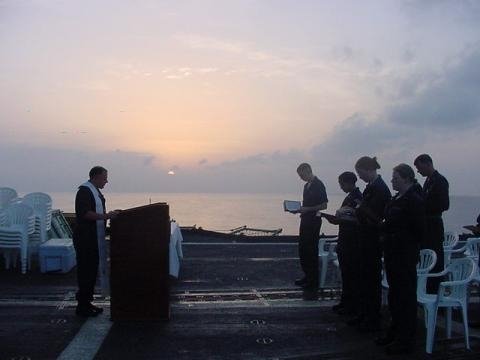
easter-2002-on-hue-cityEaster aboard USS Hue City CG-66 off the Horn of Africa 2002

I find Easter to be an interesting time.  I tend to get reflective and while I do joyfully say “Alleluia! Christ is Risen!” I also tend to be somewhat subdued.  By nature I am reflective person, I like to watch, observe and think.  I am not into big Easter productions and extravaganzas. I prefer much more simple expressions of the Risen Lord.  I think that Jesus would go along with me on this as he spent that first Easter walking with friends, who failed to recognize him, and then breaking bread, he celebrated the first Eucharist after the Resurrection at Emmaus.

For me my most memorable Easters have been connected with my life in the military.  They have almost always been simple affairs, and most involving the liturgy somehow.  I think the first Easter that I remember was at Cubi Point Naval Air Station in the Philippines, it was seeing the Chaplains in their Summer White uniforms that still stands out to me today.  I remember a Easter Sunrise service at Naval Station Long Beach and looking in wonder at two “mothballed” carriers of World War II vintage, the USS Boxer and USS Princeton moored near the site of the service on the waterfront.  When my dad was in Vietnam and we had been made unwelcome in a civilian church, we attended Mass at the Quonset hut that served as the Chapel on the little Naval Communications station.  In my senior year of high school I made a cruise on Navy ships to and from Pearl Harbor Hawaii.  During the week at Pearl I made the trip to the Arizona Memorial on Easter Sunday.  For some reason that experience reverberated as loud as any church service I have ever attended.  When I was a young Army Officer running from God and hiding in the Chapel, the Deity Herself patently used the events of Holy Week to “rend my heart” so to speak.  I left the Good Friday Tenebrea service praying that Easter would come.  Our good Lutheran Chaplain, Lee Rittenbach had driven home the reality of Jesus’ death so well that I really started to understand what the disciples went through.  When Easter came I learned to say “Alleluia! Christ is Risen!”

After that I went through kind of a spiritual desert as far as Easter was concerned.  In seminary I was attending mega-churches which did nothing with Holy week, and made a big evangelical production of Easter, complete with overly loud and insipidly shallow “worship” music and laborious preaching.  I have to say that these big productions were more of an ordeal than a celebration for me.  During seminary we were going through sickness, financial disaster, loss of our home, cars and struggling to survive working multiple jobs while being a full time student.  How we got through seminary I will never understand, other than that the Deity herself provided for us through a lot of wonderful people.  The “happy talk” at church, the prosperity Gospel, focus on signs and wonders seemed to reflect almost a gnostic other worldly view of life that I did not see in the Scriptures.

Academically and from a theological point of view Easter began to rally take shape for me.  Reading the Church Fathers as well reading Dietrich Bonhoeffer’s The Cost of Discipleship, Emil Brunner’s The Scandal of Christianity, Alister McGrath’s The Mystery of the Cross, Hans Kung’s On Being a Christian and Jurgen Moltman’s The Crucified God brought me to greater understanding of the connectedness of Easter to the Incarnation and the Passion.  One of my professors, a kindly gentleman named Yandall Woodfin, made a comment in his Philosophy of Religion class:  “We do not do Christian Theology without coming to grips with the reality of suffering and death.”  That comment was at first offensive to me because my mega-church pastors all focused on the Resurrection.  Death to them seemed to be a bother. One pastor said in a sermon how he did not do visits to the sick.  When asked by someone how sick they had to be for him to see them, he stated “You don’t want to be that sick.”

However, what Dr. Woodfin said planted a seed in me.  This went from an academic question, to daily reality during my Clinical Pastoral Education Residency at Parkland hospital.  Doing various Holy Week services there, in the midst of the amazing amount of pain, suffering and death in that gargantuan Medical Center brought into focus and made real what Dr. Woodfin said.  At Parkland there was no avoiding death or suffering, and what Dr. Woodfin said was right.  We don’t begin to do Christian theology until we we deal with suffering and death.  Easter and the Resurrection don’t happen without the Incarnation and Passion of Jesus.  Easter disconnected from the reality of suffering and death is nothing more than a “happy thought” or escape that avoids the the great Mystery of Faith: Christ has died. Christ is Risen. Christ will come again.

After Parkland my understanding of Easter grew as I was immersed in the liturgy, began to observe the liturgical year, and occasionally “clandestinely” attend Anglican churches during Christmas and Easter. During this time Judy became Roman Catholic, something that accelerated what was already going on in me.  During my formation process and following my ordination to first the Deaconate and then the Priesthood, the understanding deepened as I saw how the Gospel in Word and Sacrament. As an Army Reserve chaplain serving on active duty I experienced the life of a parish pastor at a small base in central Pennsylvania.  There I saw how the how the liturgical year and life are so intimately connect.  In life and death, in sorrow and joy, in good times and bad, the Holy Spirit touched people.

Easter became even more part of my life when I became a Navy Chaplain and left the Army in the “rear view mirror.”  Here I began to see how wonderful Easter is when you do not have all the “smells and bells” “praise teams” or great music or facilities.  It goes back to simplicity.  On Easter Sunday 2001, I was on the USS Frederick, LST 1184 with my Marines going from Korea back to Okinawa.  It was on Frederick 23 years before that I had first felt the call to be a Navy Chaplain during the trip to Pearl Harbor.  In 2002 I was deployed on USS Hue City CG-66 at the beginning of Operation Enduring Freedom. Off the Horn of Africa we had both sunrise services as well as a morning Eucharist on our flight deck. While with the Marine Security Forces I spent an Easter celebrating Eucharist on the fence-line adjoining Communist Cuba.  I now have come back to critical care hospital ministry in my ICUs.  Here we live Good Friday every day.  For me Easter is not just a nice thing to observe, but a necessity in life.

This morning I attended the early Mass with Judy at Ascension Catholic Church.  I love the church, though it is a bit big and busy for me now after Iraq.  So I found me a corner near the choir where I could sit with my back against the wall, an emergency exit to my left, and where I could observe what was going on.  Yes I was having a PTSD moment, but I got through it with the help of the Deity herself and a little ant-anxiety medication.  But the really cool thing was seeing a man who was one of our patients on the ICU a couple of months back.  A man who almost died on us several times, and his wife.  We had grown close during that 2 1/2 weeks and he made it through.  He looked great this morning.  We all hugged and talked of how good God is before Mass, exchanged the Peace and then spent some time together after Mass. That was really cool.  What a way to celebrate Easter.

Life and death, pain and suffering, healing and resurrection.  Alleluia, Christ is Risen. The Lord is Risen indeed. Alleluia!

Peace, Steve+

Leave a comment

Filed under Loose thoughts and musings, Military, Religion