Tag Archives: mark twain

The Kaleidoscopic Combinations of the Pictured Present


Friends of Padre Steve’s World,

I am trying to place what is going on in the Trump White House, the country, and the world in some frame of reference for some time now. There are many historical parallels to draw from and make analogies, but like all analogies they tend to break down at some point, none are perfect, but some tend to resonate more than others. Mark Twain wrote“History never repeats itself, but the Kaleidoscopic combinations of the pictured present often seem to be constructed out of the broken fragments of antique legends.” 

In the Trump world I see fragments of the worlds of Richard Nixon, of Kaiser Wilhelm II, King Leopold of Belgium, Adolf Hitler, and Pierre Laval; of of the Robber Barons, the owners of the Titanic, and other leaders going back to antiquity. I have written about some of those parallels, even recently; however the past few days of turmoil have caused me to step back a bit as I try to find the right manner in which to write about them. 

Marcus Tillius Cicero wrote something that in the midst of the self-inflicted chaos of the Trump administration that we should try to heed right now. I wish that the President would stop for a brief moment to ponder before he does something incredibly rash that leads him and the nation to disaster. Cicero wrote: “To be ignorant of what occurred before you were born is to remain always a child. For what is the worth of human life, unless it is woven into the life of our ancestors by the records of history?”

So I am reading and researching and trying to make sense of the madness that we are all witnesses to, and if we do not speak out complicit in.  

Until tomorrow,

Peace 

Padre Steve+eee

Leave a comment

Filed under History, Loose thoughts and musings, Political Commentary

If Christ was Here Today… 


Friends of Padre Steve’s World,

On this Sunday I want to impart a short thought. The great American humorist Mark Twain once noted “If Christ were here there is one thing he would not be—a Christian.” 

Last week I preached about separation of church and state at my chapel and pretty much said the same thing. One think I noted was that if I wasn’t already a Christian that nothing I see in American Christianity could ever convince me to become a Christian. 

The reality is that  people are fleeing the church in record numbers and non-believers don’t even want to darken the door and I don’t blame them. The illusion of packed out mega-churches betrays the reality that if things continue apace that within a generation the American church of all denominations will be as bad off as the state churches of Europe which are empty, and no amount of the craven lust for political power of those who call themselves “evangelical” or “conservative” Christians will change that, instead it will make it worse. 

Big name preachers rush to the side of a President who has measured them and found that by doing very little for them except say what they want to hear, that they will prostitute themselves to gain political power. George Truett, who served as Pastor of First Baptist Church of Dallas, and President of Southwestern Baptist Theological Seminary wrote something that should serve as a warning to such people: 

“Constantine, the Emperor, saw something in the religion of Christ’s people which awakened his interest, and now we see him uniting religion to the state and marching up the marble steps of the Emperor’s palace, with the church robed in purple. Thus and there was begun the most baneful misalliance that ever fettered and cursed a suffering world…. When … Constantine crowned the union of church and state, the church was stamped with the spirit of the Caesars…. The long blighting record of the medieval ages is simply the working out of that idea.”

But it seems we don’t learn and the Millenials, as well as others, particularly combat vets like me, have looked behind the purple curtain of the Church’ Oz and found that Jesus isn’t there. What comes to mind when most people are asked to describe the Church? Let’s check the polls of evangelical pollster George Barna which have been corroborated time after time by Pew, Gallup, and other polls. 

These polls find people are leaving Christian churches of all denominations in droves and that non-believers want nothing to do with the church. For most of these people it is not about God or Jesus, or even the Bible. It is due to the lack of love, care, compassion exhibited by Christians and the institutional corruption, lack of transparency, double standards and political machinations of churches over people that are not of their faith or under their institutional control. The surveys conducted by Christian pollsters like George Barna bear this out. When asked what words or phrases “best describe Christianity” the top response of 16-29 years olds was “anti-homosexual” while 91% of all non-Christians surveyed said this was the first word as it was for 80% of Christians in the survey. Here are those words that describe Christians. Personally I don’t like them but it is what it is.

Hypocritical: Christians live lives that don’t match their stated beliefs;

Antihomosexual: Christians show contempt for gays and lesbians – “hating the sin and the sinner” as one respondent put it

Insincere: Christians are concerned only with collecting converts

Sheltered: Christians are anti-intellectual, boring, and out of touch with reality.

Too political: Christians are primarily motivated by a right-wing political agenda

That is the future and honestly I think that it is too late to turn this around and it is not the fault of academics, liberals, homosexuals, scientists, educators, or the media. It is the fault of Christians who love power, position, and prosperity more than they love people; the same people that Jesus supposedly died and rose again to save. In fact many Christians spend so much of their time hating and preaching against people they have never even met that and allying themselves with the government to ensure that they can discriminate against LGBTQ people, women, Muslims, and a host of others solely based on their interpretation of cherry-picked Bible verses that no one listens to them anymore. 

The great American patriot, free thinker, and atheist Robert Ingersoll wrote something that goes to the heart of the matter: “Christians tell me that they love their enemies, and yet all I ask is—not that they love their enemies, not that they love their friends even, but that they treat those who differ from them, with simple fairness.” 

I cannot agree more with him. Ingersoll saw beyond that purple veils over a hundred years ago, and he asks a question that the purloined preachers of the American church have completely forgotten. If we want to attract people to Jesus we have to treat them with simple fairness and love, if we can’t do that then we forfeit all that we preach about Jesus and we shall be rightfully dmaned. 

So anyway, until tomorrow,

Peace,

Padre Steve+

3 Comments

Filed under civil rights, faith, Religion

Living an Adventure: The Importance of Travel


Friends of Padre Steve’s World

Mark Twain noted: “Travel is fatal to prejudice, bigotry, and narrow-mindedness, and many of our people need it sorely on these accounts. Broad, wholesome, charitable views of men and things cannot be acquired by vegetating in one little corner of the earth all one’s lifetime.”

I’ll be traveling this weekend, nothing really to write home about, just a quick trip to Houston for my denominational Chaplain training symposium. But that being said it gives me an opportunity to share a couple of thoughts about the importance of travel and getting out of one’s comfort zone. The fact is that two-thirds of Americans do not have a passport, and most have never ventured out of the country, many having seldom left the state or region that they are from.

I’m not one of them. I have visited much of Europe, Asia, and the Middle East, and lived as a child in the Philippines and as an adult in Europe. At an early age I was blessed to be a Navy brat and to live in a number of places and truthfully when my dad retired from the Navy I was upset because that adventure of moving and traveling was ending. Of course as an adult I have been in the military for nearly 36 years, and continued live that adventure and to satisfy my wanderlust. I really cannot imagine what it would be like not to travel and not to experience the world in its fullness.

Likewise, I can fully agree with Twain’s words, for as one travels, as one meets other people, and experiences different cultures it expands the mind and I think the heart as well. Like Hannah Arendt I find that living abroad is joyful and easy, she wrote: “Loving life is easy when you are abroad. Where no one knows you and you hold your life in your hands all alone, you are more master of yourself than at any other time.”

So until tomorrow,

Peace

Padre Steve+

2 Comments

Filed under Loose thoughts and musings, philosophy, Travel

The Importance of Joy and Laughter in a Terrifying World


Friends of Padre Steve’s World,

I often write about very serious subjects. Yesterday was no exception. I wrote about the importance of become tough and staying strong in a very unsafe world which promises to get more dangerous in the coming months, and I used the example of the young German student who led the non-violent opposition group to Hitler and the Nazis known as The White Rose.

The student was Sophie Scholl. She was an activist and a Christian and she refused to bury her head in the sand about Nazi atrocities inside and outside of Germany. She struggled with her faith, much as I do. In her diary she recorded these words, words which echo many things that I have written here on this site in regard to my struggle with faith after returning home from war:

“I’m still so remote from God that I don’t even sense his presence when I pray. Sometimes when I utter God’s name, in fact, I feel like sinking into a void. It isn’t a frightening or dizzying sensation, it’s nothing at all — and that’s far more terrible. But prayer is the only remedy for it, and however many devils scurry around inside me, I shall cling to the rope God has thrown me in Jesus Christ, even if my numb hands can no longer feel it.”

She was deadly serious and realized that what she was doing could get her killed, and it did. But even in the midst of the darkness that was the Third Reich, and despite her struggles she understood the importance of being able to find something to laugh at, something to bring joy to life, and she did not understand those who could not find joy, even in dark times. She noted:

“I pity people who can’t find laughter or at least some bit of amusement in the little doings of the day. I believe I could find something ridiculous even in the saddest moment, if necessary. It has nothing to do with being superficial. It’s a matter of joy in life.”

I agree with her words, and despite my continued struggles with faith, my continued struggle with PTSD, and my very real concern for what is going on in the country and what we will likely face over the next four years; I do find things that bring me joy. I find things to laugh at and laugh with, and friends who I can share that laughter. Sometimes I find the most ridiculous and funny things even when things are at their worst. I find that my little Papillon dogs keep me entertained, amused, and really make me laugh even when I am having a terrible day.

I think my friends that we must not allow circumstances to dictate whether or not that we can find joy in life. Yes there is a lot of tragedy and pain, not to mention things that we should be very concerned about, but even so we must never allow ourselves to become so beaten down that we become joyless souls who cannot laugh. The late Erma Bombeck noted “There is a thin line that separates laughter and pain, comedy and tragedy, humor and hurt.” It is up to us to find the humor as Mark Twain noted “The human race has only one really effective weapon and that is laughter.”

Have a great day and don’t forget to laugh.

Peace

Padre Steve+

3 Comments

Filed under History, News and current events, philosophy, Political Commentary

Happy Thanksgiving!

toss1

bloomcountythanksgivingpanels34

Friends of Padre Steve’s World,

Good morning and Happy Thanksgiving to all of you. I see that some of you are already in the kitchen working hard and let me tell you everything smells delicious. If I wasn’t already spending time at a friends house today I’d ask if I could come over, please save me some pie, and if you have any sweet potatoes left, save some for me. God how I love sweet potatoes.

Today is the one day a year that we set aside to be thankful, not that we shouldn’t at least try to be thankful the other 364 days of the year, but one out of 365 isn’t bad, well actually it is. we’d have to be thankful at least 73 days in order to be at the Mendoza Line, but  I digress…

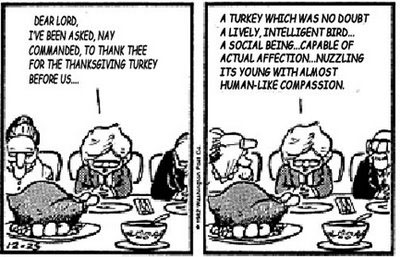
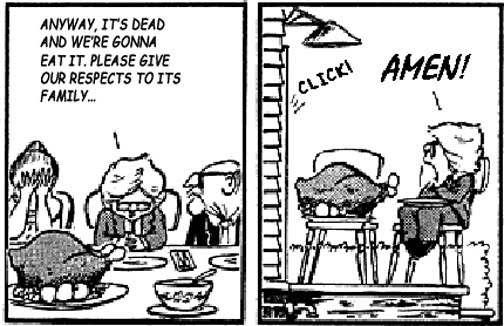
Many of us will pray and ask a a blessing on our gatherings, and like Milo Bloom I have taken literally the command to “pray for our food,” which is why despite being a Priest I am seldom asked to say grace at any gatherings. I never will forget the first time that I prayed for the Turkey and it’s surviving family members, it was a hoot. If looks could kill the daggers emanating from Judy’s eyes would have killed me dead. Since then I have continued my antics at the Thanksgiving table and I still love the look she gives me, and it makes my heart glad because in thirty-three years of marriage she hasn’t had me killed. That my friends is something to be thankful for.

Mark Twain I think correctly provided us with a short history of the holiday with these words:

“Thanksgiving Day, a function which originated in New England two or three centuries ago when those people recognized that they really had something to be thankful for — annually, not oftener — if they had succeeded in exterminating their neighbors, the Indians, during the previous twelve months instead of getting exterminated by their neighbors, the Indians. Thanksgiving Day became a habit, for the reason that in the course of time, as the years drifted on, it was perceived that the exterminating had ceased to be mutual and was all on the white man’s side, consequently on the Lord’s side; hence it was proper to thank the Lord for it and extend the usual annual compliments.”

So, with that in mind and the reality of what we may face in the coming years, I do want to thank you my loyal readers for staying with me over the past year. Likewise I wish you the all best today and in the coming year.

Peace,

Padre Steve+


1 Comment

Filed under culture, Just for fun, Loose thoughts and musings

“Though it Hurts Us…” Olive Branches and Forgiveness after a Toxic Election

olive-branch

Friend’s of Padre Steve’s World,

This is kind of an awkward post for me to write. Those who know me well know that I don’t back down from fights, I don’t suffer insults well, and have a vast capacity to harbor a grudge. So this is my attempt to scribble down my reflections on forgiveness which is something that I don’t do well.

In Homer’s Iliad Achilleus lamented the conflict with the Achaians, especially the hatred that it had spawned, he addressed those who had been his enemies and said: “Still, we will let all this be a thing of the past, though it hurts us, and beat down by constraint the anger that rises inside us. Now I am making an end of my anger. It does not become me, unrelentingly to rage on…”

I think that the ancient lament is particularly appropriate to our time. For decades the acrimony between Americans has been getting worse and worse and and most of us probably have some measure of personal guilt in what the last several election cycles have done to us. They have been corrosive to our society and to us as individuals, me included. I have been able to do some reflecting today because I was having work done to repair some to the flood damage from Hurricane Matthew and had some time alone as well as some quality time walking my Papillon dogs around the lake in our neighborhood.

I have lost too many friends during this election cycle, and seen some distance in other relationships with people who I love and respect. Some of this is my own fault, I became too consumed with the news cycle and too emotionally invested in what was going on. Most of the time I think I behaved well, but other times I did not. My temper grew short and my ability to brush off minor personal affronts, not to mention real attacks on my person, honor, and character grew shorter.

I have had to pull back some. I am spending less time on social media, less time looking at more partisan news sites, checking the veracity of anything I read and before forwarding it out to others, and being more circumspect in posting links to articles with which I might agree, but the tenor of which could drive further wedges between me and friends. To paraphrase Achilleus’s words about his anger, “It does not become me, unrelentingly to rage on…” 

There are a number of people that I will have to ask forgiveness of, and that will be hard because I am so bad at it. But harder will be forgiving others who have wounded me badly. I will work on that, initially it may be silently, until I reach the point that I can actually address them in person. Mark Twain wrote,“There isn’t time, so brief is life, for bickerings, apologies, heartburnings, callings to account. There is only time for loving, and but an instant, so to speak, for that.” 

That being said I have a difficult time forgiving those who have hurt me, but conversely I can admit when I have been a complete ass and pray that those I have offended are better at forgiveness than me.

In ancient Greece and Rome the olive branch was a symbol of peace, and the term to offer an olive branch now is to offer peace, and I will be doing that over the coming weeks and months. I see it as my personal attempt to help bind up the wounds of the nation. As the American Civil War was drawing to a close, Abraham Lincoln uttered these words in his Second Inaugural Address: “With malice toward none, with charity for all, with firmness in the right as God gives us to see the right, let us strive on to finish the work we are in, to bind up the nation’s wounds…”

That being said even in forgiveness there will still be pain, on occasion anger will still rise. Likewise I am sure that even in restored relationships some scars will remain, as will some of our more deep disagreements. But in spite of that it is better for to at least try forgive and love than remain in the acidic stew of hatred generated by this election. The olive branch is symbolic of peace and forgiveness as the olive tree takes years to mature and bear fruit, while war, societal conflict takes so little effort and leaves scars that last for generations.

So until tomorrow,

Peace

Padre Steve+


6 Comments

Filed under faith, philosophy

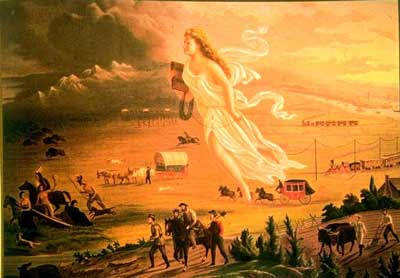
Manifest Destiny, American Exceptionalism and U.S. Foreign Policy

Manife4

Manifest Destiny

Friends of Padre Steve’s World,

Once again I return to the text that I am working on, Mine Eyes Have Seen the Glory: Race, Religion, and Ideology in the Civil War Era because however much we long to escape our history, it is still very much present. Have a great night.

Peace,

Padre Steve+

Manifest Destiny and American Exceptionalism

The foreign policy of the United States nearly always reflects to one degree or another a quasi-religious belief in the continued importance of the United States in spreading democracy around the world.

The United States was an anomaly among western nations in the early 1800s. During that time the percentage of people in Europe who were active churchgoers was shrinking and the number of skeptics rising as the industrial revolution, and advances in science, and the philosophies and theology of classic Liberalism permeated the elites of the continent. But in the United States, the situation was different. The Second Great Awakening helped shape and define the purpose of the nation, and by the “mid-nineteenth century, from North to South, was arguably Christendom’s most churchgoing nation, bristling with exceptionalist faith and millennial conviction.” [1] This was especially true of American Protestantism were “church attendance rose by a factor of ten over the period 1800 to 1860, comfortably outstripping population growth. Twice as many Protestants went to church at the end of this period as the beginning.” [2]

This exceptionalist faith kindled a belief in the nation’s Manifest Destiny in large part was an outgrowth of the Second Great Awakening which was particularly influential among the vast numbers of people moving into the new western territories. As people moved west, Evangelical religion came with them, often in the form of vast revival and camp meetings which would last weeks and which would be attended by tens of thousands. The first of these was at Cane Ridge Kentucky in 1801, organized by a Presbyterian others, including Baptists and Methodists joined in the preaching, and soon the revivals became a fixture of frontier life and particularly aided the growth of the Methodist and Baptists who were willing to “present the message as simply as possible, and to use preachers with little or no education,” [3] and which soon became the largest denominations in the United States. These meetings appealed to common people and emphasized emotion rather than reason. Even so the revivals “not only became the defining mark of American religion but also played a central role in the nation’s developing identity, independence, and democratic principles.” [4]

The West came to be viewed as a place where America might be reborn and “where Americans could start over again and the nation fulfill its destiny as a democratic, Protestant beacon to inspire peoples and nations. By conquering a continent with their people and ideals, Americans would conquer the world.” [5] The westward expansion satiated the need for territorial conquest and the missionary zeal to transform the country and the world in the image of Evangelical Christianity.

The man who coined the term “Manifest Destiny,” New York journalist John O’Sullivan a noted that “Manifest Destiny had ordained America to “establish on the earth the moral dignity and salvation of man,” to disseminate its principles, both religious and secular abroad,” [6] and New York Journalist Horace Greely issued the advice, “Go West, young man” which they did go, by the millions between 1800 and 1860.

But the movement also had a dark side. Americans poured westward first into the heartland of the Deep South and the Old Northwest, then across the Mississippi, fanning westward along the great rivers that formed the tributaries of the new territories. As they did so, the “population of the region west of the Appalachians grew nearly three times as fast as the original thirteen states” and “during that era a new state entered the Union on the average of three years.” [7]

The combination of nationalism fueled by Evangelical religion was combined with the idea from revolutionary times that America was a “model republic” that could redeem the people of the world from tyranny,” [8] as well an ascendant rational nationalism based on the superiority of the White Race. This, along with the belief that Catholicism was a threat to liberty was used as reason to conquer Mexico as well as to drive Native Americans from their ancestral homes. “By 1850 the white man’s diseases and wars had reduced the Indian population north of the Rio Grande to half of the estimated million who had lived there two centuries earlier. In the United States all but a few thousand Indians had been pushed west of the Mississippi.” [9] The radical racism used pseudo-scientific writings to “find biological evidence of white supremacy, “radical nationalism” cast Mexicans as an unassimilable “mixed “race “with considerable Indian and some black blood.” The War with Mexico “would not redeem them, but would hasten the day when they, like American Indians, would fade away.” [10]

Manifest Destiny and American Foreign Policy

Just as the deeply Evangelical Christian religious emphasis of Manifest Destiny helped shape American domestic policy during the movement west, it provided similar motivation and justification for America’s entry onto the world stage as a colonial power and world economic power. It undergirded United States foreign policy as the nation went from being a continental power to being an international power; claiming as Hawaii, and various former Spanish possessions in 1890s, and which would be seen again in the moralizing of Woodrow Wilson in the years leading up to America’s entry into World War One.

The belief in Manifest Destiny can still be seen in the pronouncements of American politicians, pundits, and preachers who believe that that this message is to be spread around the world. Manifest Destiny is an essential element of the idea of American Exceptionalism which often has been the justification for much recent American foreign policy, including the Freedom Agenda of former President George W. Bush. Bush referenced this during his 2003 State of the Union Address, “that freedom is the right of every person and the future of every nation. The liberty we prize is not America’s gift to the world, it is God’s gift to humanity.” [11] Bush frequently used language in his speeches in which biblical allusions were prominent in justifying the morality of his policy, and by doing this “Bush made himself a bridge between politics and religion for a large portion of his electorate, cementing their fidelity.” [12]

Throughout the Bush presidency the idea that God was directing him even meant that his faith undergirded the policy of the United States and led to a mismatch of policy ends and the means to accomplish them. Former Israeli Ambassador to the U.S. and historian Michael Oren wrote:

“Not inadvertently did Bush describe the struggle against Islamic terror as a “crusade to rid the world of evildoers.” Along with this religious zeal, however, the president espoused the secular fervor of the neoconservatives…who preached the Middle East’s redemption through democracy. The merging of the sacred and the civic missions in Bush’s mind placed him firmly in the Wilsonian tradition. But the same faith that deflected Wilson from entering hostilities in the Middle East spurred Bush in favor of war.” [13]

Policy makers and military leaders must realize that if they want to understand how culture and religious ideology drive others to conquer, subjugate and terrorize in the name of God, they first have to understand how our ancestors did the same thing. It is only when they do that that they can understand that this behavior and use of ideology for such ends is much more universal and easier to understand.

One can see the influence of Manifest Destiny abroad in a number of contexts. Many American Christians became missionaries to foreign lands, establishing churches, colleges, schools, and hospitals in their zeal to spread the Gospel. As missionaries spread across the globe, American policy makers ensured their protection through the presence of the United States Navy, and missionaries frequently called upon the United States Government for help and the naval strength of the United States during the period provided added fuel to their zeal. In 1842, Dabney Carr, the new American ambassador to the Ottoman Empire “declared his intention to protect the missionaries “to the full extent of [his] power,” if necessary “by calling on the whole of the American squadron in the Mediterranean to Beyrout.” [14] Such episodes would be repeated in the Middle East, Asia, the Pacific, and Central America over and over again until the 1920s.

The White Man’s Burden, Imperialism, Business, and Faith: Manifest Destiny and the Annexation of the Philippines

If one wants to see how the use of this compulsion to conquer in the name of God in American by a national leader one needs to go no farther than to examine the process whereby President McKinley, himself a veteran of the Civil War, decided to annex the Philippine in 1898 following the defeat of the Spanish. That war against the Filipinos that the United States had helped liberate from Spanish rule saw some of the most bloodthirsty tactics ever employed by the U.S. Army to fight the Filipino insurgents. The Filipino’s who had aided the United States in the war against Spain were now being subjugated by the American military for merely seeking an independence that they believed was their right. While the insurgency was suppressed in a violent manner and American rule was established, some Americans came to see the suppression of the Filipino’s as a stain on our national honor which of which Mark Twain wrote: “There must be two Americas: one that sets the captive free, and one that takes a once-captive’s new freedom away from him, and picks a quarrel with him with nothing to found it on; then kills him to get his land. . .” [15]

William McKinley was a cautious man, and after the United States had defeated the Spanish naval squadron at Manila Bay and wrestled with what to do with the Philippines. McKinley was a doubtless sincere believer, and according to his words, he sought counsel from God about whether he should make the decision to annex the Philippines or not. For him this was not a mere exercise, but a manifestation of his deep rooted faith which was based on Manifest Destiny. Troubled, he sought guidance, and he told a group of ministers who were vesting the White House:

“Before you go I would like to say a word about the Philippine business…. The truth is I didn’t want the Philippines, and when they came to us as a gift from the gods, I did not know what to do with them…. I sought counsel from all sides – Democrat as well as Republican – but got little help…. I walked the floor of the White House night after night until midnight; and I am not ashamed to tell you, gentlemen, that I went down on my knees and prayed Almighty God for guidance more than one night. And late one night it came to me this way – I don’t know how it was but it came….” [16]

He then went on to discuss what he supposedly heard from God, but reflected more of a calculated decision to annex the archipelago. He discussed what he believed would be an occupation of just a few islands and Manila, ruled out returning them to Spain as that would be “dishonorable,” ruled out turning them over to France or Germany because “that would be bad for business,” or allowing Filipino self-rule, as “they were unfit for self-government.” [17] The last was a reflection of the deep-rooted opinion of many Americans that the dark skinned Filipinos were “niggers.”

Barbara Tuchman described McKinley’s comments to the ministers:

“He went down on his knees, according to his own account, and “prayed to Almighty God for light and guidance.” He was accordingly guided to conclude “that there was nothing left to do for us but to take them all, and to educate the Filipinos. And uplift and civilize and Christianize them, by God’s grace to do the very best we could by them, as our fellowmen for whom Christ died.” [18]

But the result, regardless of whether McKinley heard the voice of God, or took the advice of advisers with imperialist, business, or religious views, he made the choice to annex the Philippines, believing it to be the only rational course of action, and something that he could not avoid. In a sense McKinley, of who Barbara Tuchman wrote “was a man made to be managed,” and who was considered spineless by Speaker of the House Thomas Reed who said “McKinley has no more backbone than a chocolate éclair.” [19] It appears that McKinley was more convinced by the arguments of those who desired to annex the Philippines for military reasons, a business community which saw the islands as a gateway to the markets of Asia, and by Protestant clergy, who saw “a possible enlargement of missionary opportunities.” [20] He rejected a proposal by Carl Schurz who urged McKinley to “turn over the Philippines as a mandate to a small power, such as Belgium or Holland, so the United States could remain “the great neutral power in the world.” [21]The combination of men who desired the United States to become an imperialist and naval power, business, and religion turned out to be more than McKinley could resist, as “the taste of empire was on the lips of politicians and business interests throughout the country. Racism, paternalism, and the talk of money mingled with the talk of destiny.” [22] Though there was much resistance to the annexation in congress and in the electorate, much of which was led by William Jennings Bryant, but which crumbled when Bryant with his eyes on the Presidency embraced imperialism.

The sense of righteousness and destiny was encouraged by magazine publisher S.S. McClure, who published a poem by Rudyard Kipling addressed to Americans debating the issue entitled The White Man’s Burden:

Take up the White Man’s burden–
Send forth the best ye breed–
Go bind your sons to exile
To serve your captives’ need;
To wait in heavy harness,
On fluttered folk and wild–
Your new-caught, sullen peoples,
Half-devil and half-child…

Take up the White Man’s burden–
The savage wars of peace–
Fill full the mouth of Famine
And bid the sickness cease…

Take up the White Man’s burden–
Ye dare not stoop to less–
Nor call too loud on Freedom
To
cloke your weariness;
By all ye cry or whisper,
By all ye leave or do,
The silent, sullen peoples
Shall weigh your gods and you…
[23]

McKinley’s decision and the passage of the peace treaty with Spain to acquire the Philippines sparked an insurrection led by Filipino revolutionary Emilio Aguinaldo who had been leading resistance to Spanish rule on the island of Luzon for several years prior to the American defeat of Spanish naval forces at the Battle of Manila Bay, and the subsequent occupation of Manila. The following war lasted nearly three years and was marked by numerous atrocities committed by American forces against often defenseless civilians and it would help to change the nature of the country. After American troops captured Manila, Walter Hines Page, the editor of the Atlantic Monthly believed that Americans would face greater challenges and difficulties in the coming years than they had known in previous years. He wrote:

“A change in our national policy may change our very character… and we are now playing with the great forces that may shape the future of the world – almost before we know it…. Before we knew the meaning of foreign possessions in a world ever growing more jealous, we have found ourselves the captors of islands in both great oceans; and from our home staying policy of yesterday we are brought face to face with world-wide forces in Asia as well as Europe, which seem to be working, by the opening of the Orient, for one of the greatest challenges in human history…. And to nobody has the change come more unexpectedly than ourselves. Has it come without our knowing the meaning of it?” [24]

Within the span of a few months, America had gone from a nation of shopkeepers to an imperial power, and most people did not realize the consequences of that shift. Manifest destiny and American Exceptionalism had triumphed and with it a new day dawned, where subsequent generations of leaders would invoke America’s mission to spread freedom and democracy around the world, as President George W. Bush said, “that freedom is the right of every person and the future of every nation. The liberty we prize is not America’s gift to the world, it is God’s gift to humanity.”

Notes

[1] Ibid. Phillips American Theocracy: The Peril and Politics of Radical Religion, Oil and Borrowed Money in the 21st Century p.143

[2] McGrath, Alister Christianity’s Dangerous Idea: The Protestant Revolution A History from the Sixteenth Century to the Twenty-First Harper Collins Publishers, New York 2007 p.164

[3] Gonzalez, Justo L. The History of Christianity Volume 2: The Reformation to the Present Day Harper and Row Publishers San Francisco 1985 p.246

[4] Ibid. McGrath Christianity’s Dangerous Idea: The Protestant Revolution A History from the Sixteenth Century to the Twenty-First p.164

[5] Goldfield, David America Aflame: How the Civil War Created a Nation Bloomsbury Press, New York, London New Delhi and Sidney 2011 p.5

[6] Ibid. Oren Power, Faith and Fantasy: America and the Middle East 1776 to the Present p130

[7] McPherson, James. The Battle Cry of Freedom: The Civil War Era Oxford University Press, Oxford and New York 1988 p.42

[8] Varon, Elizabeth R. Disunion! The Coming of the American Civil War 1789-1858 University of North Carolina Press, Chapel Hill NC 2008 p.183

[9] Ibid. McPherson The Battle Cry of Freedom: The Civil War Era p,45

[10] Ibid. Varon. Disunion! The Coming of the American Civil War 1789-1858 p.183

[11] Bush, George W. State of the Union Address Washington D.C. January 28th 2003 retrieved from Presidential Rhetoric.com http://www.presidentialrhetoric.com/speeches/01.28.03.html 10 June 2015

[12] Ibid. Phillips American Theocracy: The Peril and Politics of Radical Religion, Oil and Borrowed Money in the 21st Century p.252

[13] Oren, Michael Power, Faith and Fantasy: America and the Middle East 1776 to the Present W.W. Norton and Company, New York and London 2007 p.584

[14] Ibid. Oren Power, Faith and Fantasy: America and the Middle East 1776 to the Present p130

[15] Twain, Mark To the Person Sitting in Darkness February 1901 Retrieved from The World of 1898: The Spanish American War The Library of Congress http://www.loc.gov/rr/hispanic/1898/twain.html 12 December 2014

[16] Zinn, Howard A People’s History of the United States Harper Perennial, New York 1999 pp.312-313

[17] Ibid. Zinn A People’s History of the United States p.313

[18] Ibid. Tuchman Practicing History p.289

[19] Tuchman, Barbara The Proud Tower: A Portrait of the World Before the War, 1890-1914 Random House Trade Paperbacks Edition, New York 2008 originally published 1966 by McMillan Company. Amazon Kindle edition location 2807 of 10746

[20] Hofstadter, Richard The Paranoid Style in American Politics Vintage Books a Division of Random House, New York 1952 and 2008 p167

[21] Ibid. Tuchman The Proud Tower: A Portrait of the World Before the War, 1890-1914 location 3098 of 10746

[22] Ibid. Zinn A People’s History of the United States p.313

[23] Kipling, Rudyard “The White Man’s Burden: The United States and the Philippine Islands” 1899 retrieved from https://public.wsu.edu/~brians/world_civ/worldcivreader/world_civ_reader_2/kipling.html 6 August 2016

[24] Ibid. Hofstadter The Paranoid Style in American Politics pp.183-184

1 Comment

Filed under Foreign Policy, History, middle east

33 Years of Marriage: Finding that One Special Person You Want to Annoy the Rest of Your Life


Friends of Padre Steve’s World,

Mark Twain, a wise man if there ever was such, wrote “After all these years, I see that I was mistaken about Eve in the beginning; it is better to live outside the Garden with her than inside it without her.” Truthfully I think that he was absolutely correct.

Yesterday, Judy and I celebrated our thirty-third wedding anniversary with many friends at our local version of the Cheers bar, the Gordon Biersch brewery restaurant in Virginia Beach. It was a wonderful time and I cannot have imagined a better way to spend it than with the people who came out, as well as those who wanted to but were unable to attend.


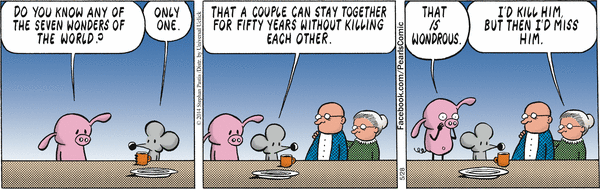
But it really is hard to imagine that we have been married thirty-three years, and that we have known each other for close to thirty-eight years. It is really amazing to think that this has been the case, I for one never really expected to fall in love but I did, in spite of my less than idealistic realism and the fact that I can be such a pain in the ass, as Judy can well attest. I think that the comedienne, Rita Rudner said it quite well, “I love being married. It’s so great to find that one special person you want to annoy for the rest of you life,”  or as I like to put it, live to love, love to annoy. Truthfully, I am surprised at times that Judy has not found reason to kill me off, in fact there are a number of times that I am sure that any jury would have ruled my murder justifiable homicide, but I digress…

pb140528

The fact is that in our thirty-three years of marriage we have weathered some incredibly difficult times that many good people in loving marriages do not survive. Marriage is a difficult thing, yes it is about love, but even more than that it it about friendship, and a commitment to make things work. Marriage is a bit like politics and diplomacy, it involves compromise and commitment in order to ensure that war does not break out. Love is certainly a part, and forgiveness, an absolute necessity, but it really does come down to friendship. As Mark Twain noted, “Love seems the swiftest, but it is the slowest of all growths. No man or woman really knows what perfect love is until they have been married a quarter of a century.” It took us nearly a third of a century, but in spite of all, I think that we have found it.

Have a great day,

Peace,

Padre Steve+

3 Comments

Filed under marriage and relationships

Explore, Dream, Discover: Thoughts on Living My Dream

uss gray 1978

April 1978, Navy Junior ROTC Cruise: I’m on the Right

Friends of Padre Steve’s World,

Yesterday I wrote about the Navy Birthday and I have been reflecting on life as so much of my life is connected to the Navy. It’s funny, for all the difficulties that I have experienced in life, the difficult times and even coming back a changed man from war, I am a very fortunate man, for I have been able to pursue my entire adult life my childhood dream of serving in the military, but even more specifically serving in the Navy.

I grew up in a Navy family, my brother and I were both born in Navy hospitals, and the first fourteen years of my life were spent following my dad around from duty station to duty station, up and down the West Coast and in the Philippines. I still recall the magical feeling of going to sea for the first time when I was about four years old on the USS John C. Breckenridge, a transport ship converted to carry military personnel and their families to and from the Far East. It was exhilarating and I never forgot it.

boston 2002

Boston 2002

As a kid I spent countless hours reading history and military history, but my favorite books were about all things navy. Biographies of the great naval leaders, not just Americans caused me to dream, as did books about naval battles, and the courage of the men who fought them. Then there were the books about ships, ship design and development that inspired me to build more models ships than I can count, and which cause me to still read up on the great ships of history, but also new developments in ship design and construction.

295_27076892058_2637_n-1

In high school I was in Navy Junior ROTC and was able to spend over 70 days at sea on six different ships, even sailing to Hawaii and back. I wanted to enlist but my parents suggested that I try college for a semester to see what I thought of it and it was a good thing that I did.

I went to college and I met Judy and toward the end of college ended up in the Army because I didn’t want to change my major in my senior year to enter Navy ROTC. Of course I need to mention that Judy said that she wouldn’t marry me if I joined the navy, but even in the Army my heart was all Navy. In fact when it was time for the Army-Navy Game I would wear by “Go Navy” button on the inside of my uniform shirt and flash it to get people going.

943043_10151694525692059_632653331_n

Iraq 2007

After 17 ½ years in the Army I was serving as a Major in the Army Reserve and because of my rank was unable to go back on active duty, unless I was mobilized to serve in war. I wanted to go back on active duty, I was still under forty years old, and without consulting Judy, in retrospect I should have done that as she would have supported my decision, but I’m a guy, and sometimes not very smart or sensitive.

meandjudyLCDR

Judy getting to help promote me to Lieutenant Commander 2006

Even so it was the right decision. One day I was an Army Reserve Major and the next day I was a Navy Lieutenant. My parents were proud, as was Judy but she was going to pay a price for my decision, years of separation due to deployments and the hardships that went along with them. Since entering the Navy I have served over six years with the Marines, five years in Navy Medicine, two years aboard ship, two years with Navy EOD and another couple of years in Joint assignments working with other military services. My current assignment is amazing, I get to teach, both military history and ethics to senior officers, some of whom will become Admirals and Generals. I can understand what Randy Pausch said in “The Last Lecture” “It’s a thrill to fulfill your own childhood dreams, but as you get older, you may find that enabling the dreams of others is even more fun.”

hue city boarding team

USS Hue City 2002

Mark Twain once wrote, “Twenty years from now you will be more disappointed by the things you didn’t do than by the ones you did. So throw off the bowlines. Sail away from the safe harbor. Catch the trade winds in your sails. Explore. Dream. Discover.” I am so fortunate. I got the second chance to fulfill my dream of serving in the Navy, and I still dream, I still want to discover, and as Denny Crane (William Shatner – Boston Legal) said to “live big.”

The past couple of years have been very trying, many challenges and much discouragement. Judy had a cancer scare and in the summer of 2014 I dropped into an emotional abyss that I wondered if I would ever emerge. But recently I have felt that spark again, and the spark that wants to ignite an inferno of creativity. T. E. Lawrence once wrote, “All men dream: but not equally. Those who dream by night in the dusty recesses of their minds wake up in the day to find it was vanity, but the dreamers of the day are dangerous men, for they may act their dreams with open eyes, to make it possible.”

boardingteam

To explore the unknown possibilities of existence…

I still have dreams, I still want to explore and I want to explore deeper things, the unknown possibilities of existence. To quote the character Q (John de Lancie) in the final episode of Star Trek the Next Generation, where he tells Captain Picard “That is the exploration that awaits you; not mapping stars and studying nebulae, but charting the unknown possibilities of existence.”

Have a great day and never let your dreams die.

Peace

Padre Steve+

2 Comments

Filed under Loose thoughts and musings, Military

The Gospel of Wealth & War

phillipine harvest

Friends of Padre Steve’s World

Since I am out of country I am pre-posting articles that will be released while I am away. This is a short bit from my the second chapter Civil War and Gettysburg text. The chapter as a whole deals with religion and ideology as chief contributing factors to the war, its conduct by both sides and the post-war myth of the Lost Cause. This section briefly looks at how the war and the earlier concept of Manifest Destiny brought about a new paradigm in which the message of earlier evangelicalism which focused on conversion, salvation and personal piety was transformed into a message of wealth and war. The transformation was lasting, and is something that American Christianity has never recovered from.

Peace

Padre Steve+

Secession and war was now on the horizon, and despite well-meaning efforts of some politicians on both sides to find a way around it, it would come. Religion had been at the heart of most of the ideological debates of the preceding quarter century and now it came to symbolize the causes of both sides. The belief in Manifest Destiny had led Americans to violate nearly every pronouncement of the founders and embark on a policy of imperialism, conquest, and even the extermination of millions in its name. As far as preventing conflict, Evangelical Protestants on both sides had not only failed to prevent the war; to the contrary those very Evangelical leaders were more than instrumental in bringing on the war as they:

“fueled the passions for a dramatic solution to transcendent moral questions. Evangelical religion did not prepare either side for the carnage, and its explanations seemed less relevant as the war continued. The Civil War destroyed the Old South civilization resting on slavery; it also discredited evangelical Protestantism as the ultimate arbiter of public policy.” [1]

When war came Evangelical Protestants on the opposing sides attempted to frame their cause in the light of their nearly identical theology, sometimes seeing it is a prelude to the return of Christ and the beginning of the millennium. An agent of the American Tract Society named Hollis Read was one, he proclaimed:

“A few more such strides, a few more such terrific struggles and travail-pains among the nations; a few more such convulsions and revolutions, that shall break to pieces and destroy what remains of the inveterate and time-honored systems and confederations of sin and Satan and the friends of freedom may then lift up their heads and rejoice, for their redemption draweth nigh. The Day of Vengeance Has Always Preceded And Been preparatory to the Year of the Redeemed.” [2]

Southerners too saw the coming war in similar triumphant theological ways. Some saw in the Confederacy the embodiment of Christ. Methodist minister William Seat of Texas wrote, “The One like the Son of Man has appeared in the rise of the Confederate States.” [3] He wrote that the South would take its place among the nations through it “liberty and pure Christianity would go abroad on earth.” He noted that soon the “peaceful millennial reign would dawn” and the stone from the mountain – the South – would be glorified: “Then the stone cut out from the shall become a great mountain and fill the earth. There shall be no more curse nor death nor sorrow nor crying. There shall be fullness of joy and pleasures forevermore. We solemnly believe that the great prophetic periods have closed: the mystery is finished and the vision of prophecy unsealed. The Final Kingdom has arisen, and the Divine Redeemer has come to reign.” [4]

As the war went on ministers and theologians saw their theological presuppositions dashed on the shoals of reality of William Tecumseh Sherman’s understanding, that “war is hell.” As the war went against the Confederacy, Southerner ministers had to re-frame the cause and the reasons for defeat, which most did not ascribe to slavery, but rather deficiencies in Southern character, and economic policy. In the North the faithful were shaken by the horrendous cost of the war. One of Charles Finney’s correspondents wrote in 1864, “So many are skeptical, doubtful, so many good people are cutting loose from creeds & forms….I am sometimes tempted to ask whether prayer can make any difference.” [5]

American Religion, especially Protestantism, which had served so much to bring about the war, instead became one of its most prominent casualties. American Protestantism shifted its emphasis; some ministers preached a gospel of wealth to align themselves and their congregants with the rising tide of the new rich. Russell Conwell, a former Union soldier in the war turned Baptist preacher, whose church later formed Temple University delivered his Acres of Diamonds sermon in which he proclaimed, “Money is power, money is force…. I say to you to get rich, and it is your duty to get rich.” [6] The sermon became popular throughout the country, and people did not tire of it.

350-prosperity-gospel

The theology of wealth was not political, it preached no moral crusades, it called for no sacrifice, it considered not justice, and it appealed to people’s basest instincts and left little room for sentiment. The poor, the newly free but oppressed African American and others were left behind. Walt Whitman was concerned that the churches encouraged people to pursue everything but the common good. He wrote, “genuine belief seems to have left us…. The spectacle is appalling. We live in an atmosphere of hypocrisy throughout…. A lot of churches, sects, ect., the most dismal phantasm I know, usurp the name of religion.” [7]

Southern Evangelicals retreated in into a skepticism and denial of human progress, for if that had been the case they would have triumphed over their Yankee oppressors. After the war Southern Evangelicals “expected little from the corrupted world and expected even less from the knowledge of corrupted men, especially men of science and power. The war brought to the South a theology, as well as a politics and economics, of diminished expectations.” [8]

Never again would Evangelical Christianity play as dominant role as it did in early part of the war, and “from the 1860s onward, American Protestantism was increasingly marked by the quiet erosion of faith, and religious experience became plagued more and more decaying faith, and in an increasing appeal to feeling and imagination over confessional reason or evangelical conversion.” [9] That trend continues to the present day as if nothing as happened in the meantime. Mark Twain wrote something about Conwell’s “Gospel of Money” which echoes to the critics of the contemporary “Prosperity Gospel”:

“What is the chief end of man? – to get rich. In what way? – dishonesty if we can; honestly if we must. Who is God, the one only and true? Money is God. Gold and Greenbacks and Stock – father, son, and the ghost of same – three persons in one, these are the true and only God, mighty and supreme.” [10]

Notes

[1] Ibid. Goldfield America Aflame p.360

[2] Ibid. Guelzo Fateful Lightening p.414

[3] Ibid. Daly When Slavery Was Called Freedom p.147

[4] Ibid. Daly When Slavery Was Called Freedom p.147-148

[5] Ibid. Guelzo Fateful Lightening p.416

[6] Ibid. Goldfield America Aflame p.456

[7] Ibid. Goldfield America Aflame pp.468-469

[8] Ibid. Daly When Slavery Was Called Freedom p.153

[9] Ibid. Guelzo Fateful Lightening p.416

[10] Ibid. Goldfield America Aflame p.457

2 Comments

Filed under faith, History, Religion