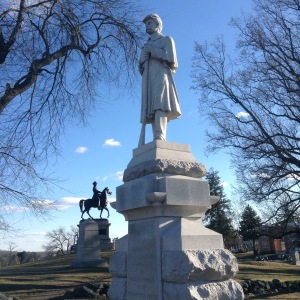
Tag Archives: memorial day

They Silently Gather Round Me: A Memorial Day Reflection

Friends of Padre Steve’s World,

After the end of the American Civil War, the poet Walt Whitman reflected on the human cost of it. Whitman wrote,

“Ashes of soldiers South or North, As I muse retrospective murmuring a chant in thought, The war resumes, again to my sense your shapes, And again the advance of the armies. Noiseless as mists and vapors, From their graves in the trenches ascending, From cemeteries all through Virginia and Tennessee, From every point of the compass out of the countless graves, In wafted clouds, in myriads large, or squads of twos or threes or single ones they come, And silently gather round me…”

Memorial Day is always an emotional time for me, especially since I returned from Iraq in 2008, and this weekend I have been thinking about the men and women that I knew who died in action or died after they left the service, some at their own hand, unable to bear the burdens and trauma that they suffered while at war. I was reminded of them again at the memorial service that we conducted for the sailors and soldiers from our base who have died in action since September 11th 2001. In an age where less than one percent of Americans serve in the military, I think that it is important that we take the time to remember and reflect on the human cost of wars.

I think of the battlefields that I have served on in Al Anbar Province, the one my father served on at An Loc, Vietnam, or the battlefields and the graveyards I have been to, Verdun, Waterloo, Arnhem, Normandy, Belleau Wood, Luxembourg, the Shuri Line, the Naktong River, Yorktown, Chancellorsville, Antietam, Stone’s River, Bentonville, Gettysburg, the wrecks of the USS Arizona and USS Utah at Pearl Harbor, and so many more, I think about the men and women who never returned. To me all of these places are hallowed ground, ground that none of us can hallow, the sacrifices of the men who gave their last full measure of devotion have done that better than we can ever do.

There are some songs that are haunting yet comfort me when I reflect on the terrible costs of war, even those wars that were truly just; and yes there are such wars, even if politicians and ideologues demanding revenge or vengeance manage to mangle the peace following them. Of course there are wars that are not just in any manner of speaking and in which the costs far outweigh any moral, legal, or ethical considerations, but I digress…

Joshua Lawrence Chamberlain, the hero of the Battle of Little Round Top at Gettysburg wrote something that talks about the importance and even the transcendence of the deeds of those who lost their lives in those wars fought and died to achieve.

In great deeds, something abides. On great fields, something stays. Forms change and pass; bodies disappear; but spirits linger, to consecrate ground for the vision-place of souls… generations that know us not and that we know not of, heart-drawn to see where and by whom great things were suffered and done for them, shall come to this deathless field, to ponder and dream; and lo! the shadow of a mighty presence shall wrap them in its bosom, and the power of the vision pass into their souls.”

Elton John wrote and performed this song, Oceans Away on the centenary of the First World War. It speaks of the men that never came home, and he related it to those who continue to go off to war today.

I hung out with the old folks

In the hope that I’d get wise

I was trying to bridge the gap

Between the great divide

Hung on every recollection

In the theater of their eyes

Picking up on this and that

In the few that still survive


Call em up

Dust em off

Let em shine

The ones who hold onto the ones, they had to leave behind

Those that flew, those that fell,

The ones that had to stay,

Beneath a little wooden cross


They bend like trees in winter

These shuffling old grey lions

Those snow-white stars still gather

Like the belt around Orion

Just to touch the faded lightning

Of their powerful design

Of a generation gathering

For maybe the last time

Oceans away

Where the green grass sways

And the cool wind blows

Across the shadow of their graves.

Shoulder to shoulder back in the day

Sleeping bones to rest in earth, oceans away

Call em up

Dust em off

Let em shine

The ones who hold onto the ones, they had to leave behind

Those that flew, those that fell,

The ones that had to stay,

Beneath a little wooden cross

Oceans away

Elton John “Oceans Away”

Likewise I find myself thinking about all those times alone overseas, and realize that many did not come home. The song I’m Dreaming of Home or Hymne des Fraternisés from the film Joyeux Noel which was adapted by French composer Philippe Rombi from the poem by Lori Barth I think speaks for all of us that served so far away, both those who returned and those who still remain oceans away.

I hear the mountain birds

The sound of rivers singing

A song I’ve often heard

It flows through me now

So clear and so loud

I stand where I am

And forever I’m dreaming of home

I feel so alone, I’m dreaming of home


It’s carried in the air

The breeze of early morning

I see the land so fair

My heart opens wide

There’s sadness inside

I stand where I am

And forever I’m dreaming of home

I feel so alone, I’m dreaming of home


This is no foreign sky

I see no foreign light

But far away am I

From some peaceful land

I’m longing to stand

A hand in my hand

… forever I’m dreaming of home

I feel so alone, I’m dreaming of home.

Please take the time to remember those who whose spirits still dream of home, oceans away.

Until tomorrow,

Peace,

Padre Steve+

1 Comment

Filed under civil war, History, Military, News and current events

The Offering We Bring: Memorial Day Weekend 2017


In his Memorial Day speech of 1884 Frederick Douglass spoke these words:

“Dark and sad will be the hour to this nation when it forgets to pay grateful homage to its greatest benefactors. The offering we bring to-day is due alike to the patriot soldiers dead and their noble comrades who still live; for, whether living or dead, whether in time or eternity, the loyal soldiers who imperiled all for country and freedom are one and inseparable.”

Memorial Day, at one time known as Decoration Day is one of our most sacred civil holidays that we celebrate in the United States, or at least it should be. It was a holiday born out of the shedding of the blood of 750,000 American soldiers, from the North and the South in the Civil War, a singular event that still echoes in our history and in some sense defines who we are. The sad thing is that many; if not most Americans it is simply another holiday, a chance maybe to get a three day weekend at the end of the school year and beginning of summer vacation. This is so because we and our government dominated by business interests and our own wallets for decades knowingly made the decision to sacrifice of the teaching of history and heritage at the altar of “education” that “produces jobs.”

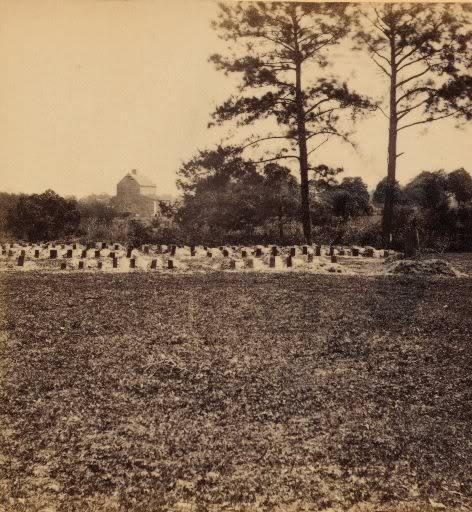
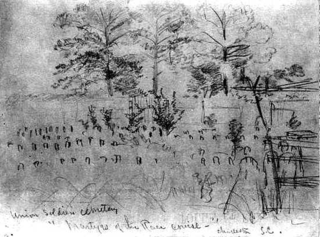
The Racecourse Cemetery

But the first observance of what we now know as Memorial Day is fascinating and it needs to be remembered. Frederick Douglass was absolutely right when he spoke the words that I began this article, and we need to remember the humble beginnings of this day which was first marked by recently freed slaves in Charleston South Carolina on May 1st 1865, barely two weeks after Abraham Lincoln was assassinated and three weeks after the surrender of Robert E. Lee and the Army of Northern Virginia at Appomattox Court House. Their commemoration was for the most part forgotten as Charleston sought to remove the vestiges of any Union sacrifice within the city limits in the 1880s.

The acrid smell of smoke of the last battles of the American Civil War was still lingering over many towns and cities in the South on May 1st 1865. Charleston South Carolina, the hotbed of secession was particularly hard hit during the war. In 1861 Cadets of the Citadel and South Carolina militia forces began the war with the bombardment of Fort Sumter. Union Forces laid siege to the city in late 1863, a siege which ended with the city’s surrender to Union forces on 18 February 1865. The day of the surrender was somewhat ironic. Charleston, the city most associated with the opening of the conflict surrendered to Union forces on the fourth anniversary of the inauguration of Jefferson Davis as President of the Confederacy. By the time of its surrender much of the city had been destroyed by Union siege artillery and naval forces.

Charleston had also been the home of three of the Confederacy’s brutal prisoner of war camps. One was located in the Charleston City Jail and the other at Castle Pinckney which had been one of the ante-bellum U.S. Army installations in the city. A third camp was erected on the site of the Washington Race Course and Jockey Club in 1864. This was an open air camp and Yale Historian David Blight wrote that “Union soldiers were kept in horrible conditions in the interior of the track; at least 257 died of exposure and disease and were hastily buried in a mass grave behind the grandstand.”

By the end of the war most of the white population of the city had left and most of those remaining were recently freed slaves. After their liberation and the city’s occupation by Federal forces, which included the famous 54th Massachusetts as well as the 20th, 35th and 104th US Colored Troops Regiments, about 28 these recently liberated Black men went to work and properly reinterred these 257 Union dead on the raceway building a high fence around it. They inscribed “Martyrs of the Race Course” on an arch above the cemetery entrance.

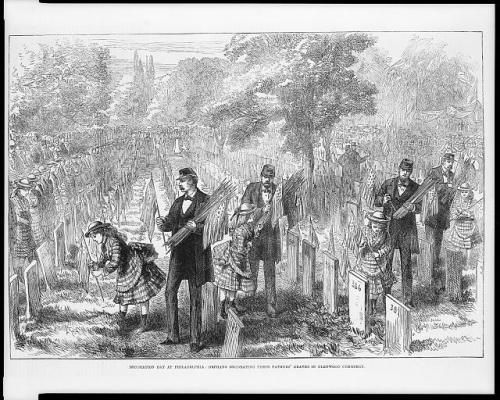
On May 1st over 10,000 Black Charlestonians gathered at the site to honor the fallen. Psalms, Scriptures and prayers were said, hymns were sung and many brought flowers. A parade of 2800 children covered the burial ground with flowers. They were followed by members of the Patriotic Association of Colored Men and the Mutual Aid Society. This society’s members provided relief supplies to Freedmen and provided aid to bury those Blacks who were too poor to afford burial. More citizens followed many laying flower bouquets on the graves. Children then led the singing of The Star Spangled Banner, America and Rally around the Flag. The Brigade composed of the 54th Massachusetts and the 35th and 104th Colored Regiments marched in honor of their fallen comrades. Following the formalities many remained behind for a picnic.

Other communities established their own Memorial Day observances in the years following the war, but the event in Charleston was the first. The first “Official” commemoration was on 30 May 1868 when Union General John Logan who headed the veteran’s organization called The Grand Army of the Republic appealed to communities to honor the dead by holding ceremonies and decorating the graves of the fallen.

In the South three different days served a similar purpose. In Virginia people commemorated the day on June 3rd, the birthday of Confederate President Jefferson Davis, the Carolinas marked the day on 10 May, the birthday of General Thomas “Stonewall” Jackson. In much of the Deep South the event was conducted April 26th, the anniversary of the surrender of General Joseph Johnson’s Army to General William Tecumseh Sherman. For many in the South, still attempting to come to grips with their defeat the day would become about “The Lost Cause” or “the defense of Liberty” or “States Rights” and the war was often referred to as the “War of Northern Aggression.”

The “Martyrs of the Racecourse” cemetery is no longer there. The site is now a park honoring the fascinatingly complex Confederate General and post-Reconstruction Governor of South Carolina Wade Hampton. An oval track remains in the park and is used to run or walk by the local population and cadets from the Citadel. Thankfully, at long last in 2010, one hundred and forty-five years after the dedication of that cemetery a marker was placed in that park commemorating the cemetery and the event that we now recognize as the first Memorial Day.

The Union dead who had been so beautifully honored by the Black population were moved to the National Cemetery at Beaufort South Carolina by the 1880s. Some state that the reason for this was that the cemetery had fallen into neglect, and this may be the case, but the event and their memory conveniently erased from memory of Charlestonians. I do not think that this would have happened had the people who had the bodies moved simply restored and maintained the cemetery. Had not historian David Blight found the documentation we probably still would not know of this touching act by former slaves who honored those that fought the battles, and gave their lives to win their freedom. Blight wrote in 2011 in the 1870s Charleston “had no place for the former slaves’ march on their masters’ racecourse.”

The African American population of Charleston understood the bonds of slavery and oppression. They understood the tyranny of prejudice in which they only counted as 3/5ths of a person. They understood and saw the suffering of those that were taken prisoner while attempting to liberate them from the tyranny of slavery. They stand as an example for us today.

But their suffering was not over. Within little more than a decade Blacks in the South would be subject to Jim Crow and again treated by many whites as something less than human. The struggle of they and their descendants against the tyranny of racial prejudice, discrimination and violence over the next 100 years would finally bear fruit in the Civil Rights movement, some of whose leaders, like the Reverend Doctor Martin Luther King Jr. would also become martyrs. Unfortunately that struggle is not over.

Frederick Douglass spoke to Union Veterans on Memorial Day 1878. His words, particularly in light of the war and the struggles of African Americans since and the understanding of what those who were enslaved understood liberation to be are most significant to our time. It was not merely a war based on sectionalism or even “States rights,” it was a war of ideas, a war of diametrically opposed ideologies. He said:

“But the sectional character of this war was merely accidental and its least significant feature. It was a war of ideas, a battle of principles and ideas which united one section and divided the other; a war between the old and new, slavery and freedom, barbarism and civilization; between a government based upon the broadest and grandest declaration of human rights the world ever heard or read, and another pretended government, based upon an open, bold and shocking denial of all rights, except the right of the strongest.”

Douglass’s words were powerful then and they resonate today as many of the same ideas that were the cause of the Civil War and were continued during Jim Crow are still alive. Unfortunately there are those in our society who labor daily to establish the “rights” of the strongest over the weak, the poor, the powerless and minorities of all kinds. Of course such actions, often wrapped in the flag, patriotism and buttressed with cherry picked quotes (many of which are fake, changed or taken out of context) from some of our founders are designed to re-establish the oligarchy of the power of the few, much like the men who owned the lives of the slaves and poor whites in the ante-bellum American South. Such actions do nothing but demean and trample the sacrifice of those who fought for freedom and the only remedy is to fight them with the full knowledge of truth.

I do hope that this weekend we will celebrate Memorial Day in a fitting manner. Let us honor those Americans who died that others might be free. Let us look back at what freedom actually means and not forget the sacrifices of those that gave, and still give their lives in the “last full measure of devotion to duty” that others might live. Take a moment today at noon to pause what you are doing and go silent for at least one minute, and remember.

Peace

Padre Steve+

2 Comments

Filed under civil rights, civil war, History, Military, News and current events

To Take Increased Devotion: A Solemn Memorial Service

740360-vb-jeb-bell-tolling-ceremony-d4fa4

Friends of Padre Steve’s World,

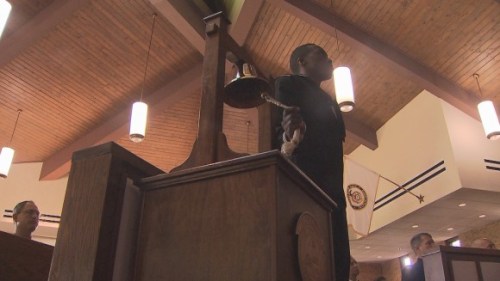
Yesterday at the base where I serve as command Chaplain we conducted a solemn memorial service for the ninety-four sailors and soldiers from our base that have died while serving at war since September 11th 2001. I knew some of them and their families from when I was assigned to EOD Group Two from 2006-2008. As each name was read, a picture of our fallen comrade was shown, a pause followed by the tolling of a bell. The steady cadence of the names, the silence, and the bell tolling continued for each of these men and women who died all too young serving in Iraq, Afghanistan, Somalia, the Horn of Africa, and other places during this war. Ninety-four names, ninety-four lives, ninety-four tolls of the bell.

http://wavy.com/2017/05/25/fallen-heroes-remembered-in-bell-tolling-at-little-creek-fort-story/

The majority of our fallen are SEALS, others in the Special Warfare Community, and EOD techs. As long as these wars continue young men and young women will continue to die and families will be left without husbands, wives, fathers, mothers, sisters, and brothers. The human cost of war cannot be minimized as we honor the fallen this Memorial Day. This is a day that we set aside to remember them, not the living. It is a day for us to remember their sacrifice and commit ourselves to as Abraham Lincoln so stated in his Gettysburg Address:

“It is rather for us to be here dedicated to the great task remaining before us—that from these honored dead we take increased devotion to that cause for which they gave the last full measure of devotion—that we here highly resolve that these dead shall not have died in vain—that this nation, under God, shall have a new birth of freedom— and that government of the people, by the people, for the people, shall not perish from the earth.”

Until tomorrow,

Peace

Padre Steve+

Leave a comment

Filed under History, Military, remembering friends, shipmates and veterans, US Navy, War on Terrorism

Remembering Those Who Helped Make Us Who We Are

Friends of Padre Steve’s World,

Historian David McCullough wrote something that I think is all too easy to forget in a world where many people, including our current President seem to think that everything is about them. McCullough wrote:

“We are all what we are, in large degree, because of others who have helped, coached, taught, counseled, who set a standard by example, who’ve taken an interest in our interests, opened doors, opened our minds, helped us see, who gave encouragement when we needed it, who reprimanded or prodded when we needed it, and at critical moments, inspired.”

When I look back at my own life I see the tremendous impact of how others, family, teachers, coaches, pastors, people who I have served alongside or under the command of in the military, as well as just simple people who knew me and cared enough to put an arm around my shoulder, offer an encouraging word, piece of wisdom, of maybe even a observation that wasn’t comfortable to hear, have helped make me what I am today. In fact there are so many of them that it would be almost impossible to list them all, and as we come up on Memorial Day next week I tend to become a bit melancholy thinking about those military personnel who impacted my life and mourning those who have passed on. I have written about many of them and probably will do so again over the coming months, not only the military people but the others, if for no other reason to ensure that they are not forgotten and to remember that everything in life doesn’t have to be about what is going on in the news cycle.

Even so it is humbling to know that if all of these people had not been part of my life that I would not be who I am today.

So anyway, if I can say anything to anyone today, try to remember the people who have helped you become what you are.

Peace

Padre Steve+

Leave a comment

Filed under Loose thoughts and musings, philosophy, remembering friends

Dreaming of Home… Oceans Away: A Post-Memorial Day Meditation

481801_10151367001287059_1003164983_n1

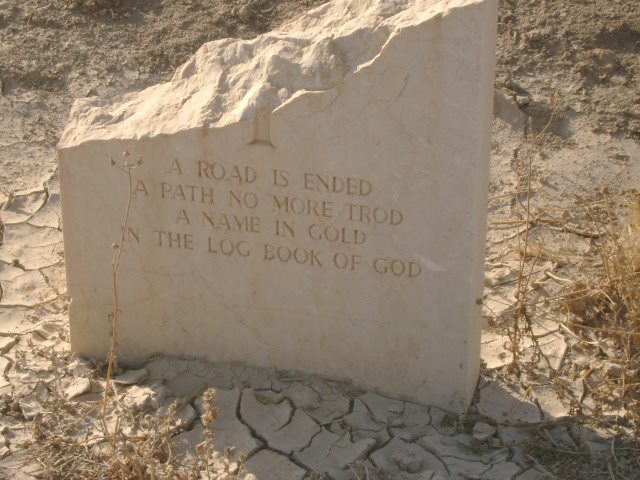
British Grave at Habbanyah, Al Anbar, Iraq

Friends of Padre Steve’s World,

Though it is now the day after Memorial Day I believe that this reflection is worth the read, as well as listening to the music that is part of it.

img_0600

After the end of the American Civil War, the poet Walt Whitman reflected on the human cost of it. Whitman wrote,

“Ashes of soldiers South or North, As I muse retrospective murmuring a chant in thought, The war resumes, again to my sense your shapes, And again the advance of the armies. Noiseless as mists and vapors, From their graves in the trenches ascending, From cemeteries all through Virginia and Tennessee, From every point of the compass out of the countless graves, In wafted clouds, in myriads large, or squads of twos or threes or single ones they come, And silently gather round me…”

I have been posting a number of articles about Memorial Day this weekend, all of which were edited versions of previous articles posted before the weekend began. As such I had time this weekend to reflect on the day, and the sacrifices of those who never returned home, many of who lay in graves on or near the battlefields that they fought and died on so far away from home.

Memorial Day is always an emotional time for me, especially since I returned from Iraq in 2008, and this weekend I have been thinking about the men and women that I knew who died in action or died after they left the service, some at their own hand, unable to bear the burdens and trauma that they suffered while at war. In an age where less than one percent of Americans serve in the military, I think that it is important that we take the time to remember and reflect on the human cost of wars.

imagesCA580JS0

I think of the battlefields that I have served on in Al Anbar Province, the one my father served on at An Loc, Vietnam, or the battlefields and the graveyards I have been to, Verdun, Waterloo, Arnhem, Normandy, Belleau Wood, Luxembourg, the Shuri Line, the Naktong River, Yorktown, Chancellorsville, Antietam, Stone’s River, Bentonville, Gettysburg, the wrecks of the USS Arizona and USS Utah at Pearl Harbor, and so many more, I think about the men and women who never returned. To me all of these places are hallowed ground, ground that none of us can hallow, the sacrifices of the men who gave their last full measure of devotion have done that better than we can ever do.

There are some songs that are haunting yet comfort me when I reflect on the terrible costs of war, even those wars that were truly just; and yes there are such wars, even if politicians and ideologues demanding revenge or vengeance manage to mangle the peace following them. Of course there are wars that are not just in any manner of speaking and in which the costs far outweigh any moral, legal, or ethical considerations, but I digress…

Joshua Lawrence Chamberlain, the hero of the Battle of Little Round Top at Gettysburg wrote something that talks about the importance and even the transcendence of the deeds of those who lost their lives in those wars fought and died to achieve.

In great deeds, something abides. On great fields, something stays. Forms change and pass; bodies disappear; but spirits linger, to consecrate ground for the vision-place of souls… generations that know us not and that we know not of, heart-drawn to see where and by whom great things were suffered and done for them, shall come to this deathless field, to ponder and dream; and lo! the shadow of a mighty presence shall wrap them in its bosom, and the power of the vision pass into their souls.”

Elton John wrote and performed this song, Oceans Away on the centenary of the First World War. It speaks of the men that never came home, and he related it to those who continue to go off to war today.

I hung out with the old folks

In the hope that I’d get wise

I was trying to bridge the gap

Between the great divide

Hung on every recollection

In the theater of their eyes

Picking up on this and that

In the few that still survive


Call em up

Dust em off

Let em shine

The ones who hold onto the ones, they had to leave behind

Those that flew, those that fell,

The ones that had to stay,

Beneath a little wooden cross


They bend like trees in winter

These shuffling old grey lions

Those snow-white stars still gather

Like the belt around Orion

Just to touch the faded lightning

Of their powerful design

Of a generation gathering

For maybe the last time

Oceans away

Where the green grass sways

And the cool wind blows

Across the shadow of their graves.

Shoulder to shoulder back in the day

Sleeping bones to rest in earth, oceans away

Call em up

Dust em off

Let em shine

The ones who hold onto the ones, they had to leave behind

Those that flew, those that fell,

The ones that had to stay,

Beneath a little wooden cross

Oceans away

Elton John “Oceans Away”


Likewise I find myself thinking about all those times alone overseas, and realize that many did not come home. The song I’m Dreaming of Home or Hymne des Fraternisés from the film Joyeux Noel which was adapted by French composer Philippe Rombi from the poem by Lori Barth I think speaks for all of us that served so far away, both those who returned and those who still remain oceans away.

I hear the mountain birds

The sound of rivers singing

A song I’ve often heard

It flows through me now

So clear and so loud

I stand where I am

And forever I’m dreaming of home

I feel so alone, I’m dreaming of home


It’s carried in the air

The breeze of early morning

I see the land so fair

My heart opens wide

There’s sadness inside

I stand where I am

And forever I’m dreaming of home

I feel so alone, I’m dreaming of home


This is no foreign sky

I see no foreign light

But far away am I

From some peaceful land

I’m longing to stand

A hand in my hand

… forever I’m dreaming of home

I feel so alone, I’m dreaming of home.

Please take the time to remember those who whose spirits still dream of home, oceans away.

Until tomorrow,

Peace,

Padre Steve+

Leave a comment

Filed under civil war, Gettysburg, History, iraq,afghanistan, Korean Conflicts, Military, News and current events, remembering friends

The Offering We Bring: Memorial Day

decoration-day1

“Dark and sad will be the hour to this nation when it forgets to pay grateful homage to its greatest benefactors. The offering we bring to-day is due alike to the patriot soldiers dead and their noble comrades who still live; for, whether living or dead, whether in time or eternity, the loyal soldiers who imperiled all for country and freedom are one and inseparable.” From Frederick Douglass’ Memorial Day Speech 1884

Memorial Day, at one time known as Decoration Day is one of our most sacred civil holidays that we celebrate in the United States, or at least it should be. It was a holiday born out of the shedding of the blood of about 600,000 American soldiers, from the North and the South in the Civil War, a singular event that still echoes in our history and in some sense defines who we are. The sad thing is that many; if not most Americans it is simply another holiday, a chance maybe to get a three day weekend at the end of the school year and beginning of summer vacation. This is so because we and our government dominated by business interests and our own wallets for decades knowingly made the decision to sacrifice of the teaching of history and heritage at the altar of “education” that “produces jobs.”

racecourse_t600

The Racecourse Cemetery

But the first observance of what we now know as Memorial Day is fascinating and it needs to be remembered. Frederick Douglass was absolutely right when he spoke the words that I began this article, and we need to remember the humble beginnings of this day which was first marked by recently freed slaves in Charleston South Carolina on May 1st 1865, barely two weeks after Abraham Lincoln was assassinated and three weeks after the surrender of Robert E. Lee and the Army of Northern Virginia at Appomattox Court House. Their commemoration was for the most part forgotten as Charleston sought to remove the vestiges of any Union sacrifice within the city limits in the 1880s.

The acrid smell of smoke of the last battles of the American Civil War was still lingering over many towns and cities in the South on May 1st 1865. Charleston South Carolina, the hotbed of secession was particularly hard hit during the war. In 1861 Cadets of the Citadel and South Carolina militia forces began the war with the bombardment of Fort Sumter. Union Forces laid siege to the city in late 1863, a siege which ended with the city’s surrender to Union forces on 18 February 1865. The day of the surrender was somewhat ironic. Charleston, the city most associated with the opening of the conflict surrendered to Union forces on the fourth anniversary of the inauguration of Jefferson Davis as President of the Confederacy. By the time of its surrender much of the city had been destroyed by Union siege artillery and naval forces.

Charleston had also been the home of three of the Prisoner of War Camps. One was located in the Charleston City Jail and the other at Castle Pinckney which had been one of the ante-bellum U.S. Army installations in the city. A third camp was erected on the site of the Washington Race Course and Jockey Club in 1864. This was an open air camp and Yale Historian David Blight wrote that “Union soldiers were kept in horrible conditions in the interior of the track; at least 257 died of exposure and disease and were hastily buried in a mass grave behind the grandstand.”

By the end of the war most of the white population of the city had left and most of those remaining were recently freed slaves. After their liberation and the city’s occupation by Federal forces, which included the famous 54th Massachusetts as well as the 20th, 35th and 104th US Colored Troops Regiments, about 28 these recently liberated Black men went to work and properly reinterred these 257 Union dead on the raceway building a high fence around it. They inscribed “Martyrs of the Race Course” on an arch above the cemetery entrance.

6a01b8d0781960970c01b7c7901048970b-320wi

On May 1st over 10,000 Black Charlestonians gathered at the site to honor the fallen. Psalms, Scriptures and prayers were said, hymns were sung and many brought flowers. A parade of 2800 children covered the burial ground with flowers. They were followed by members of the Patriotic Association of Colored Men and the Mutual Aid Society. This society’s members provided relief supplies to Freedmen and provided aid to bury those Blacks who were too poor to afford burial. More citizens followed many laying flower bouquets on the graves. Children then led the singing of The Star Spangled Banner, America and Rally around the Flag. The Brigade composed of the 54th Massachusetts and the 35th and 104th Colored Regiments marched in honor of their fallen comrades. Following the formalities many remained behind for a picnic.

Other communities established their own Memorial Day observances in the years following the war, but the event in Charleston was the first. The first “Official” commemoration was on 30 May 1868 when Union General John Logan who headed the veteran’s organization called The Grand Army of the Republic appealed to communities to honor the dead by holding ceremonies and decorating the graves of the fallen.

In the South three different days served a similar purpose. In Virginia people commemorated the day on June 3rd, the birthday of Confederate President Jefferson Davis, the Carolinas marked the day on 10 May, the birthday of General Thomas “Stonewall” Jackson. In much of the Deep South the event was conducted April 26th, the anniversary of the surrender of General Joseph Johnson’s Army to General William Tecumseh Sherman. For many in the South, still attempting to come to grips with their defeat the day would become about “The Lost Cause” or “the defense of Liberty” or “States Rights” and the war was often referred to as the “War of Northern Aggression.”

The “Martyrs of the Racecourse” cemetery is no longer there. The site is now a park honoring the fascinatingly complex Confederate General and post-Reconstruction Governor of South Carolina Wade Hampton. An oval track remains in the park and is used to run or walk by the local population and cadets from the Citadel. Thankfully, at long last in 2010, one hundred and forty-five years after the dedication of that cemetery a marker was placed in that park commemorating the cemetery and the event that we now recognize as the first Memorial Day.

First-Memorial-Day-honoring-257-Union-soldier-martyrs-10000-freedmen-march-led-by-3000-children-05011865

The Union dead who had been so beautifully honored by the Black population were moved to the National Cemetery at Beaufort South Carolina by the 1880s. Some state that the reason for this was that the cemetery had fallen into neglect, and this may be the case, but the event and their memory conveniently erased from memory of Charlestonians. I do not think that this would have happened had the people who had the bodies moved simply restored and maintained the cemetery. Had not historian David Blight found the documentation we probably still would not know of this touching act by former slaves who honored those that fought the battles, and gave their lives to win their freedom. Blight wrote in 2011 in the 1870s Charleston “had no place for the former slaves’ march on their masters’ racecourse.”

The African American population of Charleston understood the bonds of slavery and oppression. They understood the tyranny of prejudice in which they only counted as 3/5ths of a person. They understood and saw the suffering of those that were taken prisoner while attempting to liberate them from the tyranny of slavery. They stand as an example for us today.

But their suffering was not over. Within little more than a decade Blacks in the South would be subject to Jim Crow and again treated by many whites as something less than human. The struggle of they and their descendants against the tyranny of racial prejudice, discrimination and violence over the next 100 years would finally bear fruit in the Civil Rights movement, some of whose leaders, like the Reverend Doctor Martin Luther King Jr. would also become martyrs. Unfortunately that struggle is not over.

Frederick Douglass spoke to Union Veterans on Memorial Day 1878. His words, particularly in light of the war and the struggles of African Americans since and the understanding of what those who were enslaved understood liberation to be are most significant to our time. It was not merely a war based on sectionalism or even “States rights,” it was a war of ideas, a war of diametrically opposed ideologies. He said:

“But the sectional character of this war was merely accidental and its least significant feature. It was a war of ideas, a battle of principles and ideas which united one section and divided the other; a war between the old and new, slavery and freedom, barbarism and civilization; between a government based upon the broadest and grandest declaration of human rights the world ever heard or read, and another pretended government, based upon an open, bold and shocking denial of all rights, except the right of the strongest.”

Douglass’s words were powerful then and they resonate today as many of the same ideas that were the cause of the Civil War and were continued during Jim Crow are still alive. Unfortunately there are those in our society who labor daily to establish the “rights” of the strongest over the weak, the poor, the powerless and minorities of all kinds. Of course such actions, often wrapped in the flag, patriotism and buttressed with cherry picked quotes (many of which are fake, changed or taken out of context) from some of our founders are designed to re-establish the oligarchy of the power of the few, much like the men who owned the lives of the slaves and poor whites in the ante-bellum American South. Such actions do nothing but demean and trample the sacrifice of those who fought for freedom and the only remedy is to fight them with the full knowledge of truth.

american-flag

I do hope that today we will celebrate Memorial Day in a fitting manner. Let us honor those Americans who died that others might be free. Let us look back at what freedom actually means and not forget the sacrifices of those that gave, and still give their lives in the “last full measure of devotion to duty” that others might live. Take a moment today at noon to pause what you are doing and go silent for at least one minute, and remember.

Peace

Padre Steve+

Leave a comment

Filed under civil war, History, News and current events

The Unfinished Work of Memorial Day

img_0578

Friends of Padre Steve’s World,

This is Memorial Day Weekend, a weekend where we remember those who died in the service of our country. It is not a day to thank the living veterans, that day is Veteran’s Day. Nor is it the day to thank those men and women who currently wear the uniform and fight the wars of our country. This weekend I am reposting a number of articles from past years to remind my regular readers and those new to my writings about how important this remembrance is, not just to me, but to all of us. I do not say that lightly. Memorial Day is the offspring of the families of the American Civil War dead, when people who lost loved ones in the cause of liberty and the defense of the Union honored their loved ones.

No matter what your political views, ideology, or religious beliefs, please take time to remember the high human cost of freedom this weekend, especially on Monday when we observe Memorial Day.

Peace,

Padre Steve+

burford reynolds monuments

Abraham Lincoln said that “It is for us the living, rather, to be dedicated here to the unfinished work which they who fought here have thus far so nobly advanced…” Likewise, Joshua Chamberlain, the hero of Little Round Top at Gettysburg said, “Heroism is latent in every human soul – However humble or unknown, they (the veterans) have renounced what are accounted pleasures and cheerfully undertaken all the self-denials – privations, toils, dangers, sufferings, sicknesses, mutilations, life-” 

Sometimes it is best to remember that people that lived long before us have profound things to say about subjects that we often address in rather cheap and banal ways. It is easy to do this; in fact many people, especially ideologues and pundits simply quote the great men and women of history simply to buttress what they want to say in much the same manner that preachers from all sides of the theological spectrum will comb the Bible or the Church Fathers to find support for often decidedly un-Christian ideas. Of course unscrupulous preachers of other religions do the same with their sacred texts so it tends be a universal problem.

Of course we should know better than to do this but all of us do it to one degree or another. Even worse are those that will misquote people either to bolster their arguments or to tear down the person that they quote. It should not be that way on Memorial Day. The sacrifices of those that gave “the last full measure” in defense of their homeland, principles and those that they loved are too great to trivialize by using the sacrifices of the fallen to promote themselves as they prepare to launch political campaigns as was recently done by a prominent politician at an annual event which honors veterans in Washington DC.
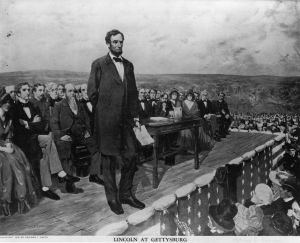
Gettysburg Address

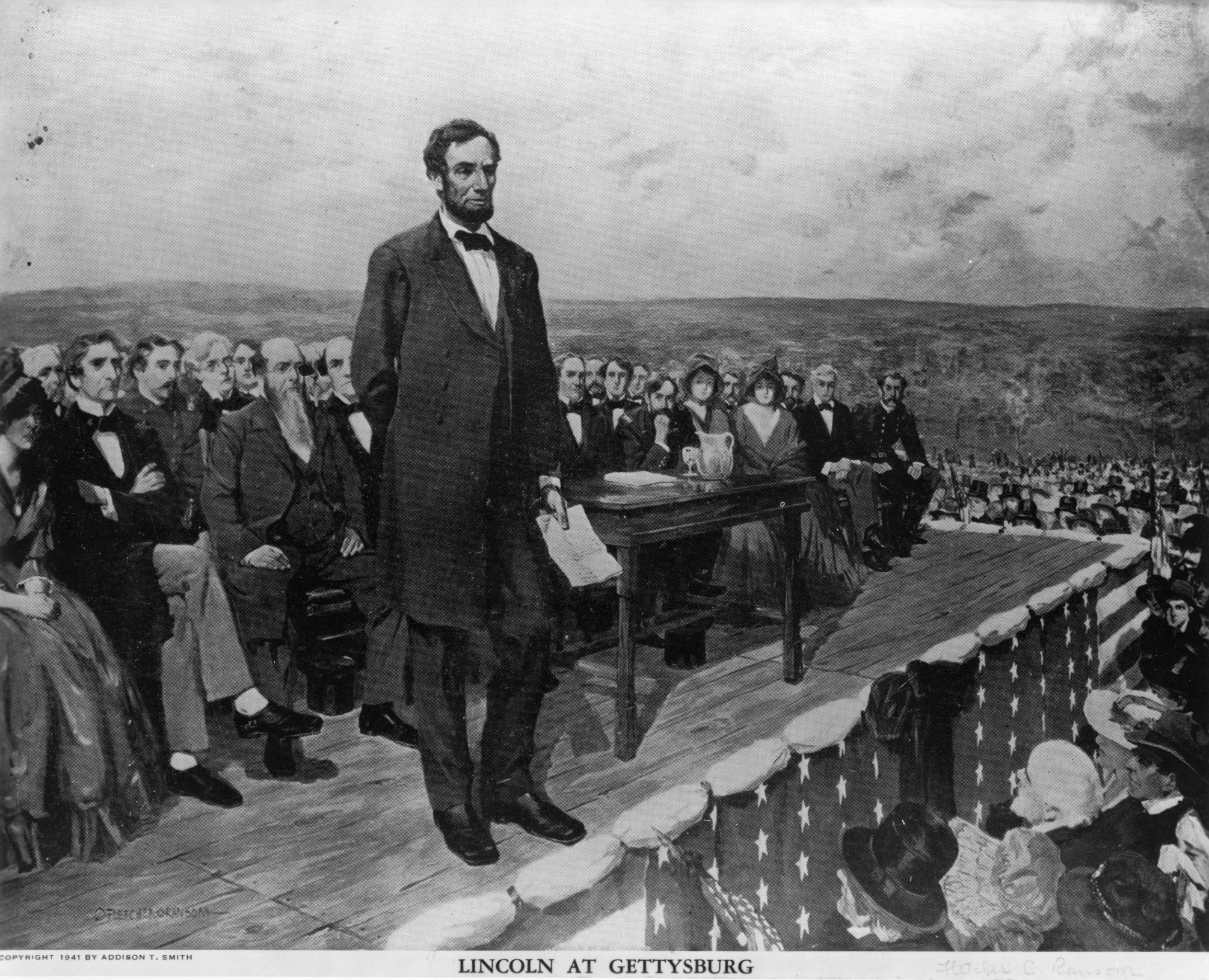
I think that Abraham Lincoln eulogized the fallen better than almost anyone in the history of our nation when he traveled to Gettysburg and gave a refreshingly short speech for a politician. Lincoln considered the speech a failure but history shows it to be one of the most remarkable ever made by any American public figure.

“Four score and seven years ago our fathers brought forth on this continent, a new nation, conceived in Liberty, and dedicated to the proposition that all men are created equal.

Now we are engaged in a great civil war, testing whether that nation, or any nation so conceived and so dedicated, can long endure. We are met on a great battlefield of that war. We have come to dedicate a portion of that field, as a final resting place for those who here gave their lives that that nation might live. It is altogether fitting and proper that we should do this.

But, in a larger sense, we cannot dedicate—we cannot consecrate—we cannot hallow—this ground. The brave men, living and dead, who struggled here, have consecrated it, far above our poor power to add or detract. The world will little note, nor long remember what we say here, but it can never forget what they did here. It is for us the living, rather, to be dedicated here to the unfinished work which they who fought here have thus far so nobly advanced. It is rather for us to be here dedicated to the great task remaining before us—that from these honored dead we take increased devotion to that cause for which they gave the last full measure of devotion—that we here highly resolve that these dead shall not have died in vain—that this nation, under God, shall have a new birth of freedom— and that government of the people, by the people, for the people, shall not perish from the earth.”
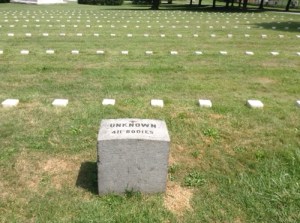
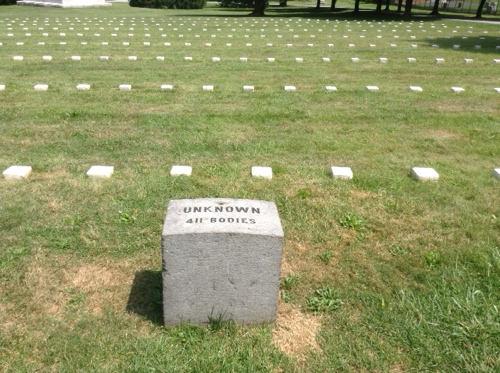
Gettysburg_Unknowns.JPG

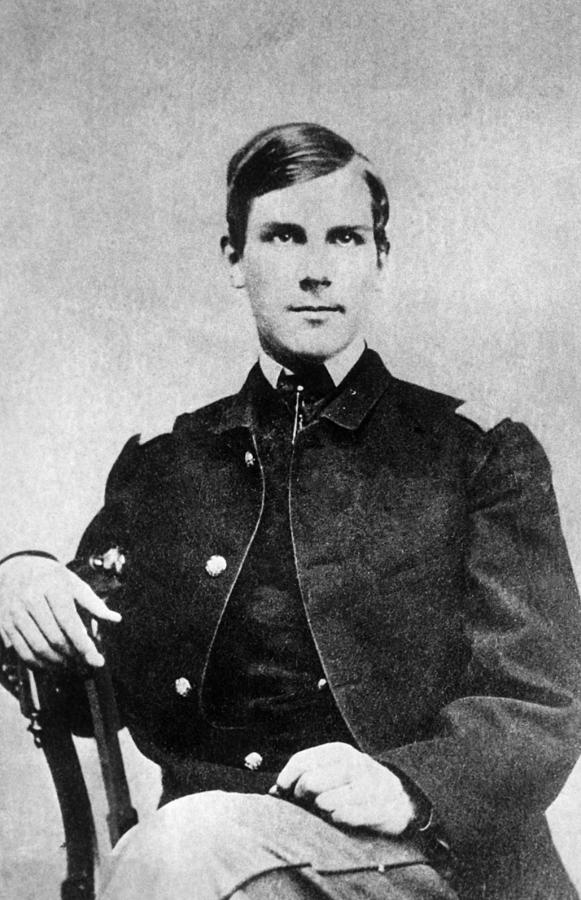
Supreme Court Justice Oliver Wendell Holmes gave a speech in 1884 twenty years after his service in the 20th Massachusetts Regiment in the Civil War. A veteran of Antietam and other major engagements he made these remarks in a speech so powerful that it was a key factor in Theodore Roosevelt’s decision to nominate him for the Court.

“Every year–in the full tide of spring, at the height of the symphony of flowers and love and life–there comes a pause, and through the silence we hear the lonely pipe of death. Year after year lovers wandering under the apple trees and through the clover and deep grass are surprised with sudden tears as they see black veiled figures stealing through the morning to a soldier’s grave. Year after year the comrades of the dead follow, with public honor, procession and commemorative flags and funeral march–honor and grief from us who stand almost alone, and have seen the best and noblest of our generation pass away…

But grief is not the end of all. I seem to hear the funeral march become a paean. I see beyond the forest the moving banners of a hidden column. Our dead brothers still live for us, and bid us think of life, not death–of life to which in their youth they lent the passion and joy of the spring. As I listen, the great chorus of life and joy begins again, and amid the awful orchestra of seen and unseen powers and destinies of good and evil our trumpets sound once more a note of daring, hope, and will.”
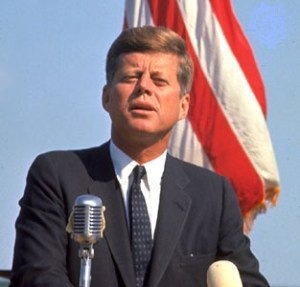
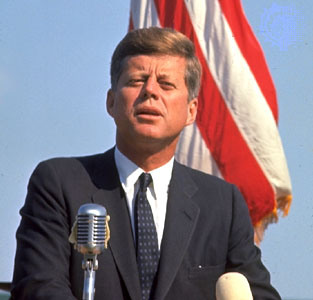
kennedy-john-f-flag

In his inaugural address President John F. Kennedy a combat veteran of the Solomons Campaign provided a message which though not directly related to Memorial Day certain echoed the themes of the sacrifices of our fallen but also call us to the highest ideals of our nation. As a Naval Officer in command of PT 109 his boat was rammed and sunk by a Japanese destroyer after which his leadership and courage was a deciding factor in the survival of most of his crew. Kennedy was a child of privilege but he volunteered for the arduous duty of service on the tiny PT Boats. The speech is considered one of the premier speeches by an American President.

“In your hands, my fellow citizens, more than mine, will rest the final success or failure of our course. Since this country was founded, each generation of Americans has been summoned to give testimony to its national loyalty. The graves of young Americans who answered the call to service surround the globe.

Now the trumpet summons us again — not as a call to bear arms, though arms we need — not as a call to battle, though embattled we are — but a call to bear the burden of a long twilight struggle, year in and year out, “rejoicing in hope; patient in tribulation,”² a struggle against the common enemies of man: tyranny, poverty, disease, and war itself….

In the long history of the world, only a few generations have been granted the role of defending freedom in its hour of maximum danger. I do not shrink from this responsibility — I welcome it. I do not believe that any of us would exchange places with any other people or any other generation. The energy, the faith, the devotion which we bring to this endeavor will light our country and all who serve it. And the glow from that fire can truly light the world.

And so, my fellow Americans, ask not what your country can do for you; ask what you can do for your country.

My fellow citizens of the world, ask not what America will do for you, but what together we can do for the freedom of man.

Finally, whether you are citizens of America or citizens of the world, ask of us here the same high standards of strength and sacrifice which we ask of you. With a good conscience our only sure reward, with history the final judge of our deeds, let us go forth to lead the land we love, asking His blessing and His help, but knowing that here on earth God’s work must truly be our own.”
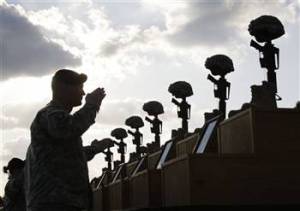
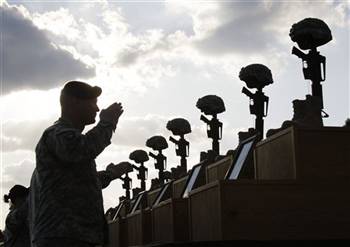
fort hood memorial

In 1984 President Ronald Reagan visited Omaha Beach in Normandy, the site of the bloodiest of the D-Day landings on June 6th 1944. Reagan was a master of rhetoric and understood the importance of his visit to this hallowed site at the apex of the Cold War. At that time it was unimaginable to most people that the Soviet Union would be no more barely 5 years hence and Reagan used the speech to link the sacrifices of those who fought and died at Normandy to those that served in his day. While his focus was on the sacrifice of America and its British, Canadian and French allies that landed on the beaches of Normandy he recognized the sacrifices of the Soviet Union which lost 20 million soldiers and civilians in the war against the Nazis. Reagan said of those who went ashore in Normandy:

“The men of Normandy had faith that what they were doing was right, faith that they fought for all humanity, faith that a just God would grant them mercy on this beachhead or on the next. It was the deep knowledge — and pray God we have not lost it — that there is a profound, moral difference between the use of force for liberation and the use of force for conquest. You were here to liberate, not to conquer, and so you and those others did not doubt your cause. And you were right not to doubt.

You all knew that some things are worth dying for. One’s country is worth dying for, and democracy is worth dying for, because it’s the most deeply honorable form of government ever devised by man. All of you loved liberty. All of you were willing to fight tyranny, and you knew the people of your countries were behind you….The men of Normandy had faith that what they were doing was right, faith that they fought for all humanity, faith that a just God would grant them mercy on this beachhead or on the next. It was the deep knowledge — and pray God we have not lost it — that there is a profound, moral difference between the use of force for liberation and the use of force for conquest. You were here to liberate, not to conquer, and so you and those others did not doubt your cause. And you were right not to doubt.

You all knew that some things are worth dying for. One’s country is worth dying for, and democracy is worth dying for, because it’s the most deeply honorable form of government ever devised by man. All of you loved liberty. All of you were willing to fight tyranny, and you knew the people of your countries were behind you.”

President Barak Obama made these remarks a few years ago to conclude his speech following the solemn duty that all Presidents have in laying a wreath at the Tomb of the Unknowns at Arlington National Cemetery. Obama who is vilified by his most extreme opponents, as was Reagan for that matter ended his speech with these comments in which he eloquently expressed what the nation must do for its military, veterans and those killed in action or missing as well as the highest example of the brotherhood that those of us who have served in harm’s way feel for our fellow Soldiers, Marines, Sailors, Airmen and Coast Guardsmen:

“Our nation owes a debt to its fallen heroes that we can never fully repay. But we can honor their sacrifice, and we must. We must honor it in our own lives by holding their memories close to our hearts, and heeding the example they set. And we must honor it as a nation by keeping our sacred trust with all who wear America’s uniform, and the families who love them; by never giving up the search for those who’ve gone missing under our country’s flag or are held as prisoners of war; by serving our patriots as well as they serve us — from the moment they enter the military, to the moment they leave it, to the moment they are laid to rest.”

That is how we can honor the sacrifice of those we’ve lost. That is our obligation to America’s guardians — guardians like Travis Manion. The son of a Marine, Travis aspired to follow in his father’s footsteps and was accepted by the USS [sic] Naval Academy. His roommate at the Academy was Brendan Looney, a star athlete and born leader from a military family, just like Travis. The two quickly became best friends — like brothers, Brendan said.

After graduation, they deployed — Travis to Iraq, and Brendan to Korea. On April 29, 2007, while fighting to rescue his fellow Marines from danger, Travis was killed by a sniper. Brendan did what he had to do — he kept going. He poured himself into his SEAL training, and dedicated it to the friend that he missed. He married the woman he loved. And, his tour in Korea behind him, he deployed to Afghanistan. On September 21st of last year, Brendan gave his own life, along with eight others, in a helicopter crash.

Heartbroken, yet filled with pride, the Manions and the Looneys knew only one way to honor their sons’ friendship — they moved Travis from his cemetery in Pennsylvania and buried them side by side here at Arlington. “Warriors for freedom,” reads the epitaph written by Travis’s father, “brothers forever.”

The friendship between 1st Lieutenant Travis Manion and Lieutenant Brendan Looney reflects the meaning of Memorial Day. Brotherhood. Sacrifice. Love of country. And it is my fervent prayer that we may honor the memory of the fallen by living out those ideals every day of our lives, in the military and beyond. May God bless the souls of the venerable warriors we’ve lost, and the country for which they died.

Sometimes our fallen are eulogized by the less notable and sometimes oft vilified people. One of these men was Robert Ingersoll, a politician, orator and lecturer as well as an agnostic in a time when that was not a popular belief. Ingersoll was the son of a Congregationalist minister who often preached for revivalist Charles Finney. Ingersoll was also a veteran of the Civil War where he raised and commanded the 11th Illinois Cavalry Regiment which fought at Shiloh. remarked:

“These heroes are dead. They died for liberty – they died for us. They are at rest. They sleep in the land they made free, under the flag they rendered stainless, under the solemn pines, the sad hemlocks, the tearful willows, and the embracing vines. They sleep beneath the shadows of the clouds, careless alike of sunshine or of storm, each in the windowless Place of Rest. Earth may run red with other wars – they are at peace. In the midst of battle, in the roar of conflict, they found the serenity of death. I have one sentiment for soldiers living and dead: cheers for the living; tears for the dead.”

As we look forward this Memorial Day let us remember those who have given the last full measure of duty for our nation, those who have served those that continue to serve and the friends and loved ones who cherish the lives and memories of each one. Let us remember as a nation, as fellow citizens and never let our own agendas, ambitions or even our baser instincts sully their memory. May we choose the higher calling of service to our country and each other as Americans, the ideals of which are woven in the lives and sacrifices of those that we honor today and as Lincoln said to finish “the great task remaining before us—that from these honored dead we take increased devotion to that cause for which they gave the last full measure of devotion—that we here highly resolve that these dead shall not have died in vain—that this nation, under God, shall have a new birth of freedom— and that government of the people, by the people, for the people, shall not perish from the earth.”


1 Comment

Filed under civil war, Gettysburg, History, Military, News and current events

Why We Keep Memorial Day

Friends of Padre Steve’s World,

This is Memorial Day Weekend, a weekend where we remember those who died in the service of our country. It is not a day to thank the living veterans, that day is Veteran’s Day. Nor is it the day to thank those men and women who currently wear the uniform and fight the wars of our country. This weekend I am reposting a number of articles from past years to remind my regular readers and those new to my writings about how important this remembrance is, not just to me, but to all of us. I do not say that lightly. Memorial Day is the offspring of the families of the American Civil War dead, when people who lost loved ones in the cause of liberty and the defense of the Union honored their loved ones.

No matter what your political views, ideology, or religious beliefs, please take time to remember the high human cost of freedom this weekend, especially on Monday when we observe Memorial Day.

Peace,

Padre Steve+

1-oliver-wendell-holmes-jr-1841-1935-everett

Oliver Wendell Holmes 

“even if those who come after us are to forget all that we hold dear, and the future is to teach and kindle its children in ways as yet unrevealed, it is enough for us that this day is dear and sacred…”

Nearly 20 years after the Civil War, Oliver Wendell Holmes Jr. then serving as Chief Justice of the Massachusetts Supreme Court spoke on Memorial Day 1884 in Keene New Hampshire at a gathering of veterans. He recalled an incident not long before where he had heard a young man ask “why people still kept up Memorial Day. The question was one that he pondered before his speech and that he attempted to find an answer, not to his fellow veterans who certainly understood their shared memories of war “but an answer which should command the assent of those who do not share our memories.”

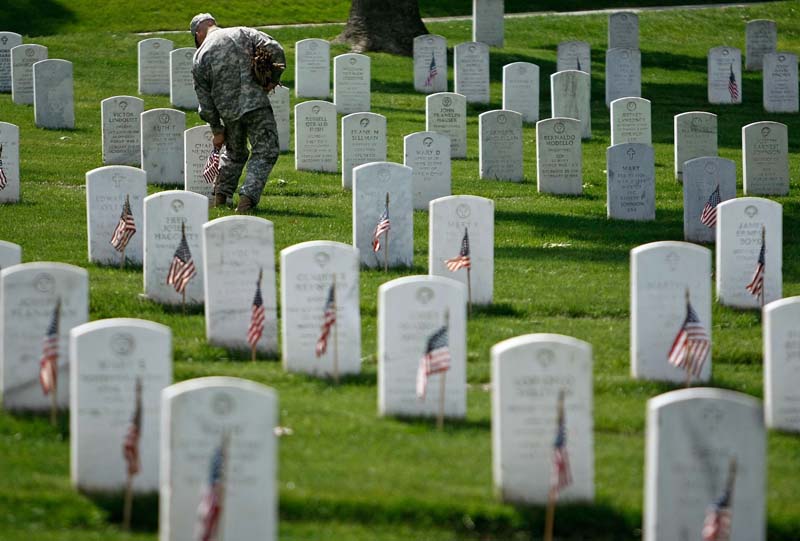
3rd Infantry Places American Flags At The Graves Of U.S. Soldiers

I think that having an answer for the question is as timely now as when Holmes first pondered it. Though his war was twenty years past and had torn the nation apart, there were still many men on both sides who had served in that terrible time and but even so many people were not only forgetting the war and the sacrifices made by so many but intent on becoming rich. Something that he would directly state in a Memorial Day address to the graduating class of Harvard University in 1895:

“The society for which many philanthropists, labor reformers, and men of fashion unite in longing is one in which they may be comfortable and may shine without much trouble or any danger. The unfortunately growing hatred of the poor for the rich seems to me to rest on the belief that money is the main thing (a belief in which the poor have been encouraged by the rich), more than on any other grievance. Most of my hearers would rather that their daughters or their sisters should marry a son of one of the great rich families than a regular army officer, were he as beautiful, brave, and gifted as Sir William Napier. I have heard the question asked whether our war was worth fighting, after all. There are many, poor and rich, who think that love of country is an old wife’s tale, to be replaced by interest in a labor union, or, under the name of cosmopolitanism, by a rootless self-seeking search for a place where the most enjoyment may be had at the least cost.”

However his message to his fellow veterans, mostly men from his own former regiment, the 20th Massachusetts was quite personal and something that they could find meaning in. Holmes understood war, he had seen much action and had been wounded at Ball’s Bluff, Antietam and Chancellorsville. He talked of the shared experience of war, something that those who have fought in our nation’s wars, as well as combat veteran soldiers in other countries can understand far more than people that have only known peace, even while their countrymen are at war.

Memorial Day Series

Holmes’s remembrances of the war and the comrades that he and those present had served with, those living and those dead is powerful. Many of us who have served in the wars that began on September 11th 2001 have lost friends in either Iraq or Afghanistan, and many more who are wounded or maimed in body, mind and spirit. Many survivors of wounds today would have died in previous wars.

Likewise his descriptions of the memories of war, triggered by “accidents” are real to those that have experienced war and combat.

“Accidents may call up the events of the war. You see a battery of guns go by at a trot, and for a moment you are back at White Oak Swamp, or Antietam, or on the Jerusalem Road. You hear a few shots fired in the distance, and for an instant your heart stops as you say to yourself, The skirmishers are at it, and listen for the long roll of fire from the main line. You meet an old comrade after many years of absence; he recalls the moment that you were nearly surrounded by the enemy, and again there comes up to you that swift and cunning thinking on which once hung life and freedom–Shall I stand the best chance if I try the pistol or the sabre on that man who means to stop me? Will he get his carbine free before I reach him, or can I kill him first?These and the thousand other events we have known are called up, I say, by accident, and, apart from accident, they lie forgotten.”

We all have our memories of our wars, those of us who remain, be we veterans of Iraq or Afghanistan, Somalia, Desert Storm, Lebanon, Vietnam, Korea or World War II. It is hard to believe that so few remain from World War II and Korea, and that even the Vietnam veterans are aging rapidly, most now in their 60s or 70s. In as much as the wars of the past decade have been fought by a tiny minority of American citizens fewer and fewer will understand the bond that we share through our memories of the living and the dead. We have been set apart by our experiences, even though the wars that we have fought differ in many ways.

481801_10151367001287059_1003164983_n-1.jpg

As such we should whenever possible take the time to meet and remember. That might be as groups of friends, unit associations or perhaps local chapters of Veterans organizations. We do this to remember but also to remind ourselves that we cannot live in the past alone, for the present likewise calls us to action, even after our service is complete.

Holmes put it well: “When we meet thus, when we do honor to the dead in terms that must sometimes embrace the living, we do not deceive ourselves. We attribute no special merit to a man for having served when all were serving. We know that, if the armies of our war did anything worth remembering, the credit belongs not mainly to the individuals who did it, but to average human nature. We also know very well that we cannot live in associations with the past alone, and we admit that, if we would be worthy of the past, we must find new fields for action or thought, and make for ourselves new careers.”

We remember the past, we remember our fallen and we remember the families who have lost loved ones in these wars as well as those whose lives have been changed and maybe even torn apart by the changes that war has wrought in their loved ones who returned different from war. In our service we have been set apart and as such as Holmes so well states we have the duty to “bear the report to those who will come after us.” His words carry forth to us today, we few we happy few as Shakespeare so eloquently wrote.

“nevertheless, the generation that carried on the war has been set apart by its experience. Through our great good fortune, in our youth our hearts were touched with fire. It was given to us to learn at the outset that life is a profound and passionate thing. While we are permitted to scorn nothing but indifference, and do not pretend to undervalue the worldly rewards of ambition, we have seen with our own eyes, beyond and above the gold fields, the snowy heights of honor, and it is for us to bear the report to those who come after us.”

I will remember my time in Iraq and those that I served alongside. I will also remember friends who served in other units who did not return as well as those Marines, Sailors and Soldiers that I see every day in our Naval Hospital suffering from the physical, psychological and spiritual wounds of war.

This weekend I will remember and on Monday, that sacred day that we set aside to remember the fallen I take some time at noon to join in that time of remembrance and pray that maybe someday war will be no more.

That is why I think that we should remember Memorial Day even if others forget.

Peace

Padre Steve+

Leave a comment

Filed under civil war, History, iraq,afghanistan, Military, News and current events, shipmates and veterans, vietnam, world war one, world war two in europe, world war two in the pacific

Memorial Day Weekend 2016: The Buddy Poppy

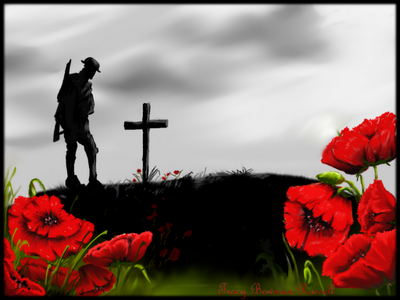
flanders_field

Friends of Padre Steve’s World

This is Memorial Day Weekend, a weekend where we remember those who died in the service of our country. It is not a day to thank the living veterans, that day is Veteran’s Day. Nor is it the day to thank those men and women who currently wear the uniform and fight the wars of our country. This weekend I am reposting a number of articles from past years to remind my regular readers and those new to my writings about how important this remembrance is, not just to me, but to all of us. I do not say that lightly. Memorial Day is the offspring of the families of the American Civil War dead, when people who lost loved ones in the cause of liberty and the defense of the Union honored their loved ones.

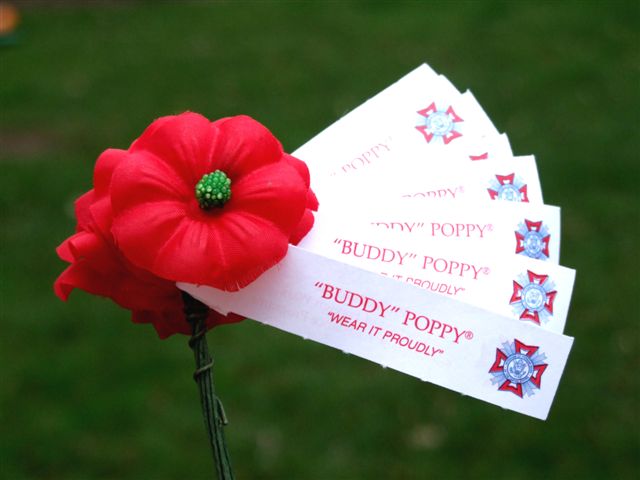
While the Buddy Poppy was something that came out of the First World War, and Armistice Day, which after the Second World War became Veteran’s Day. In time it has also become connected with the original Memorial Day. So today’s post is my first reflection of this weekend on the Buddy Poppy and Memorial Day.

No matter what your political views, ideology, or religious beliefs, please take time to remember the high human cost of freedom this weekend, especially on Monday when we observe Memorial Day.

Until tomorrow,

Peace,

Padre Steve+

1144221_orig

In Flanders Fields

John McCrae, 1915.

In Flanders fields the poppies blow

Between the crosses, row on row

That mark our place; and in the sky

The larks, still bravely singing, fly

Scarce heard amid the guns below.

We are the Dead. Short days ago

We lived, felt dawn, saw sunset glow,

Loved and were loved, and now we lie

In Flanders fields.

Take up our quarrel with the foe:

To you from failing hands we throw

The torch; be yours to hold it high.

If ye break faith with us who die

We shall not sleep, though poppies grow

In Flanders fields.

Besides the American Flag the Buddy Poppy is perhaps the most ubiquitous symbol of Memorial Day. This poppy as we know it came about when Mrs.VFW Moina Michael read McRea’s poem and inspired wrote this verse:

We cherish too, the Poppy red

That grows on fields where valor led,

It seems to signal to the skies

That blood of heroes never dies.

She then had the inspiration to begin wearing Red Poppies on Memorial Day and sold the poppies to friends and others with the money going to those in need. A French woman visiting the United States, a Madame Guerin discovered the new custom and took it back to France where she began to make artificial red poppies to sell with the proceeds going to the widows and orphans of the First World War. The custom spread to other countries and in 1921 the Franco-American Children’s League sold the poppies but disbanded in 1921. Madame Guerin approached the newly formed Veteran’s of Foreign Wars, the VFW in 1922 for assistance and in 1922 the VFW became the first American organization to sell poppies. Two years later the Buddy Poppy program began. The artificial poppies were made by disabled veterans who were paid for their work in order to provide them some form of income and distributed by other veterans across the country. Today the VFW continues to distribute the Buddy Poppies which are still produced by disabled Veterans at the nation’s Veteran’s Administration Hospitals.

I remember the first Buddy Poppy that I every received. It was just before Memorial Day 1970, before it became a 3 day weekend falling on the last Monday of May. We were living with my Grandparents in Huntington West Virginia as my dad sought suitable housing for us in Long Beach California while he was in the Navy.

Our initial move from the small town of Oak Harbor Washington, where my dad had been stationed at Naval Air Station Whidbey Island to Long Beach had not gone well. The first place we lived was in a dangerous neighborhood and with my dad traveling frequently to Naval Shipyards around the country to help commission new ships the stress on the family, especially my mother in dealing with that and two young boys was too much. Dad sent us back to Huntington where my Grandparents and numerous other relatives still lived for the duration of the school year as he sought better housing.

veterans-day-05-26-10-1

Memorial Day then was filled with visits to cemeteries to place flowers on the graves of departed relatives as well as flags on the graves of relatives who had served in the military. We made a number of stops that day at the Bowen and Dundas cemeteries as well as others where relatives were interred. Afterward we had a home cooked meal prepared by my maternal grandmother Christine and then made a trip on a city bus to my paternal grandmother Verdie.

Holidays, were much like that for us during that time that we lived in Huntington, until my dad came back and brought us back to Long Beach in June. Just before my dad arrived to take us back to Long Beach my mom, her cousin Valerie and I were shopping downtown, which at the time before I-64 took traffic around the town and led to a new mall and shopping complex being built just out of town, was a bustling place of commerce and activity. Major retailers all had their stores downtown, while the best movie theaters and restaurants were there as well.

We were coming out of the old SS Kresge store on Fourth Avenue and an elderly man wearing a VFW cap approached us and handed me a poppy. He had to be in his 70s so I presume that he was a Veteran of the First World War. He chatted briefly with my mom and Valerie and I am sure my mom gave him a bit of money for the poppy. I kept it for many years and it was eventually lost in one of our moves. But I will not forget it and any time I see a Veteran distributing them I make sure that I get one.

Babe-Ruth_MAIN

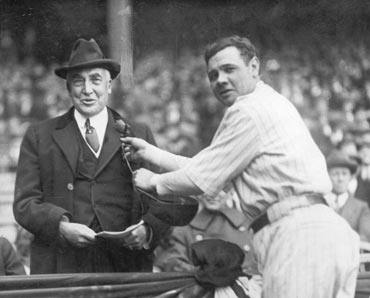
Babe Ruth and President Warren G Harding with the first official Buddy Poppy of 1923

For me the Buddy Poppy is a symbol of thanks for the sacrifices made by so many, those who did not come home from wars being killed or missing in action, as well as the wounded and the families of the dead and those that came home forever changed by their time in war. This year marks the 90th anniversary of it being the official flower of remembrance for those who died in our nation’s wars.

The poppy has even more significance for me now having served in Iraq. Seeing war’s devastation and knowing so many who have either been killed or wounded in the wars that we have engaged since September 11th 2001 has impacted me in ways that I could not have imagined before the war. Likewise having come back changed by my experience and having to deal with the affliction of severe PTSD I sense a camaraderie with those men who came home changed from war and in many cases returned to a country that did not understand them.

I will be observing the “Go Silent” moment at 12:01 Monday with the Iraq Afghanistan Veterans Association to honor those who have given the last full measure.

Peace

Padre Steve+

1 Comment

Filed under History, Military

The Memorial Day Order

memorial-day-traditions_1399868491

“It is rather for us to be here dedicated to the great task remaining before us — that from these honored dead we take increased devotion to that cause for which they gave the last full measure of devotion — that we here highly resolve that these dead shall not have died in vain — that this nation, under God, shall have a new birth of freedom — and that government of the people, by the people, for the people, shall not perish from the earth.” Abraham Lincoln the Gettysburg Address 
As we contemplate the importance of Memorial Day and remember the men and women who gave their lives for this country it is important to remember why we do this. Memorial Day grew out of local observances following the Civil War, a war that claimed the lives of over 620,000 American Soldiers from the Union and the Confederacy. New demographic studies by historians estimate the losses at closer to 750,000. Hundreds of thousands of other people had they lives shattered by the war, killed, wounded, maimed, crippled, shattered in mind and spirit, the country in many places devastated by war’s destruction. Using the 620,000 number that would have meant that 2.5% of the population of the country died in the war. People needed to make sense of the losses.

To put this in perspective, if the same number of Americans were to die today in a way the total would be over seven million people. Seven million my friends. War reached into every home in some way, and sadly or perhaps thankfully we have no concept of such losses today.

logan_engraving

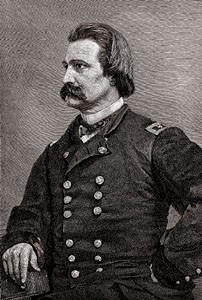
In 1868, Major General John Logan who had been an excellent corps commander during the war was serving as the Commander of the nation’s first true Veterans organization, the Grand Army of the Republic which gave those veterans a place of refuge in a country that was leaving them behind and forgetting their sacrifice in the name of westward expansion and a growing economy. Let’s face it, money has almost always been more important to Americans than the troops who sacrificed their lives for the nation, but I digress…

Anyway General Logan issued this order on May 5th 1868:

HEADQUARTERS GRAND ARMY OF THE REPUBLIC, General Orders No.11, WASHINGTON, D.C., May 5, 1868

I. The 30th day of May, 1868, is designated for the purpose of strewing with flowers or otherwise decorating the graves of comrades who died in defense of their country during the late rebellion, and whose bodies now lie in almost every city, village, and hamlet church-yard in the land. In this observance no form of ceremony is prescribed, but posts and comrades will in their own way arrange such fitting services and testimonials of respect as circumstances may permit.

We are organized, comrades, as our regulations tell us, for the purpose among other things, “of preserving and strengthening those kind and fraternal feelings which have bound together the soldiers, sailors, and marines who united to suppress the late rebellion.” What can aid more to assure this result than cherishing tenderly the memory of our heroic dead, who made their breasts a barricade between our country and its foes? Their soldier lives were the reveille of freedom to a race in chains, and their deaths the tattoo of rebellious tyranny in arms. We should guard their graves with sacred vigilance. All that the consecrated wealth and taste of the nation can add to their adornment and security is but a fitting tribute to the memory of her slain defenders. Let no wanton foot tread rudely on such hallowed grounds. Let pleasant paths invite the coming and going of reverent visitors and fond mourners. Let no vandalism of avarice or neglect, no ravages of time testify to the present or to the coming generations that we have forgotten as a people the cost of a free and undivided republic.

If our eyes grow dull, other hands slack, and other hearts cold in the solemn trust, ours shall keep it well as long as the light and warmth of life remain to us.

Let us, then, at the time appointed gather around their sacred remains and garland the passionless mounds above them with the choicest flowers of spring-time; let us raise above them the dear old flag they saved from dishonor; let us in this solemn presence renew our pledges to aid and assist those whom they have left among us a sacred charge upon a nation’s gratitude, the soldier’s and sailor’s widow and orphan.

II. It is the purpose of the Commander-in-Chief to inaugurate this observance with the hope that it will be kept up from year to year, while a survivor of the war remains to honor the memory of his departed comrades. He earnestly desires the public press to lend its friendly aid in bringing to the notice of comrades in all parts of the country in time for simultaneous compliance therewith.

III. Department commanders will use efforts to make this order effective.

By order of

JOHN A. LOGAN,
Commander-in-Chief

N.P. CHIPMAN,
Adjutant General

Official:
WM. T. COLLINS, A.A.G.

decoration-day1

General Logan’s order is remarkable in its frankness and the understanding of the war in the immediate context of its conclusion. In 1868 the day would be observed at 183 cemeteries in 27 States and the following year over 300 cemeteries. Michigan was the first state to make the day a holiday and by 1890 all states in the North had made it so. In the South there were similar observances but the meaning attributed to the events and the sacrifices of the Soldiers of both sides was interpreted quite differently. In the North the Veterans overwhelmingly saw themselves as the saviors of the Union and the liberators of the Slaves. In South it was about the sacrifices of Confederate soldiers in what became known as the “Lost Cause.” But in both regions and all states, the surviving Soldiers, family members and communities honored their dead.

1-oliver-wendell-holmes-jr-1841-1935-everett

In 1884 Oliver Wendell Holmes Jr. and Frederick Douglass both spoke about the meaning of the sacrifice made by so many.

Holmes, a veteran of the war who had been wounded at Antietam ended his Decoration Day 1884 speech:

“But grief is not the end of all…Our dead brothers still live for us, and bid us think of life, not death, — of life to which in their youth they lent the passion and glory of the spring. As I listen, the great chorus of life and joy begins again, and amid the awful orchestra of seen and unseen powers and destinies of good and evil our trumpets sound once more a note of daring, hope, and will.”

Douglass.JPG

Douglass, the former slave and abolitionist who lobbied Lincoln for emancipation and to give Blacks the chance to serve their country had two of his sons serve in the war spoke these wars:

“Dark and sad will be the hour to this nation when it forgets to pay grateful homage to its greatest benefactors. The offering we bring to-day is due alike to the patriot soldiers dead and their noble comrades who still live; for, whether living or dead, whether in time or eternity, the loyal soldiers who imperiled all for country and freedom are one and inseparable.”

It is important for the country not to forget those who served and the cost of those who have given the last full measure of devotion to duty and those who still carry the scars of war on their bodies and in their minds and spirits. I am one of the latter and I have known too many of the former.  Maybe that is why am so distrustful of those who advocate for war but have no skin in the game.

An Alsatian-German Soldier named Guy Sager wrote in his book The Forgotten Soldier: 

“Too many people learn about war with no inconvenience to themselves. They read about Verdun or Stalingrad without comprehension, sitting in a comfortable armchair, with their feet beside the fire, preparing to go about their business the next day, as usual…One should read about war standing up, late at night, when one is tired, as I am writing about it now, at dawn, while my asthma attack wears off. And even now, in my sleepless exhaustion, how gentle and easy peace seems!”

I agree with him and pray that those who direct the course of this nation will take the words of General Logan, Oliver Wendell Holmes Jr., Frederick Douglass and Guy Sager to heart before they embark on war, and when they remember those that have served.

May we never forget.

Peace

Padre Steve+


6 Comments

Filed under civil war, Gettysburg, History, iraq,afghanistan, Military, Political Commentary