Tag Archives: Military

“It’s the People Stupid” The Need for Professional Mariners 


Friends of Padre Steve’s World,

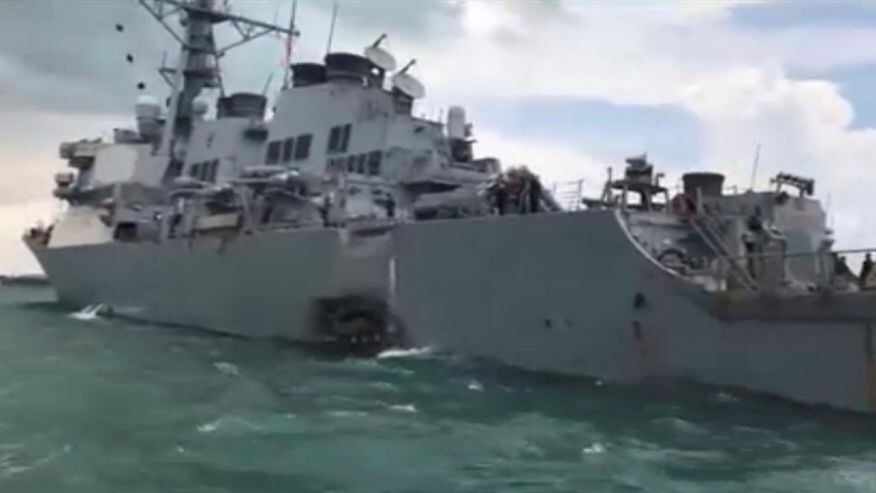
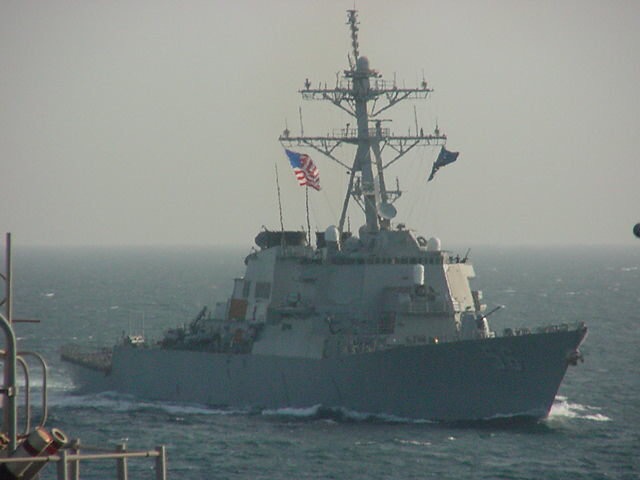
I’m holding off finishing the last part of my series Statues with Limitations until tomorrow. Of the past day I have been consumed with the collision of the USS John S. McCain with a tanker near Singapore that quite likely has claimed the lives of ten U.S. Navy sailors. It was the second fatal collision in less than three weeks involving some of the most technologically advanced warships in the world with merchant ships. The other was that of the USS Fitzgerald which was at fault in a collision with a container ship near Tokyo bay. 

Today I have been in contact with our regional casualty assistance coordinator and chaplains who are already or might be called to go to the home of a sailor’s next of kin to inform them that their sailor is dead. If you have never had to make such a notification you are lucky. They are not easy and they never get easier. Between the military and my time as hospital emergency and trauma department chaplain I have been involved in far too many of them, I lost count around the 350 point, I’ve probably been involved in close to 500 such notifications of all types. 

Frankly there are no words that can adequately convey how hard that news is on the loved ones of those who died, especially when their deaths were most likely preventable. Last week I read the preliminary report on what happened aboard Fitzgerald. It was damning and showed some systemic cultural issues that need to be fixed. I am sure that the Navy will fully investigate the incident involving McCain too, and the report will likely be just as damning. It is bad enough that the Commander of the Navy’s Seventh Fleet, to which Fitzgerald, McCain, and the cruiser Antietam which had a grounding incident near Yokosuka Japan, and the cruiser Lake Champlain which collided with a Korean fishing boat, was relieved of his command just before his scheduled retirement.

But the problem is bigger than simply relieving and replacing officers proved to be at fault in these incidents, the Navy is very good at that. The problem is that about 15 years ago the Navy shut down its Surface Warfare Officer School in Newport, Rhode Island as a cost cutting measure. Instead of going to a school after being commissioned from the Naval Academy, ROTC, or Officer Candidate School, to learn the basics of navigation, seamanship, damage control, engineering, and combats systems operations, these tasks were pushed onto the commanding officers of the ships the new officers were assigned. That began in 2002 and I remember discussing the detrimental effect this would have with fellow officers about the USS Hue City. Some 15 years later these are the officers who are becoming the commanding officers and executive officers of our ships. Most of them don’t spend enough time at sea to be truly professional mariners, and many of them spend years between sea assignments. As such they really don’t know their ships that well, the don’t know the sea that well, and as a result they have become addicted to technology at the expense of doing the basics like looking out the window and taking action to avoid collision. It comes down to in the words of my former Commanding Officer, Captain Rick Hoffman said about these incidents: 

“I am feeling a sense of increasing outrage. The more I write and get replies from so many great shipmates and long time friends, the more I feel a sense of urgency to see if we can’t take these tragedies to force a larger conversation about our SWO culture…or rather the demise of the culture. Help build a path forward that restores the professionalism and focus necessary to have a strong Surface Navy. Perhaps our ships are complex enough to look at the Royal Navy model. Professionals on the bridge, professionals manning the Combat Systems, professionals manning the engineering plant. Not this mongrel program that trains everyone up to the minimum level of competence just long enough to survive your tour and go ashore. Ten years later you go back to sea…in command. I guess I am just feeling frustrated.”

It is not a matter of technology being the answer, we have amazing technology, but as one former officer wrote “Technical solutions don’t solve cultural issues. We need to refocus on our capabilities as mariners.” Captain Hoffman noted: 

“I am pondering the value of sparking a larger discussion about our systemic challenges with basic maritime skills. We are ship drivers, we have technical skills but we are not mariners as a community. We don’t cherish the necessary focus on knowing and feeling the ship, the sea and the larger maritime environment. Just look out the window!!!! The CNO just called for industry to provide more solutions. THAT IS INSANE. It is the people, stupid. We have enough tools, we have forgotten how to use them. Eyeballs and brains. Engage the eyeballs and brains.”

The fact is that for more than a decade the men and women that officer our ships have been pulled many different directions, by various factors, many of our own doing. Quite a few were pulled off of ships at critical points in their career to serve in the sands of Iraq or the mountains of Afghanistan. Our Navy has stopped doing the basics of being professional mariners first so that they can get their ships safely from place to black and be ready to sail into harm’s way at a moment’s notice. 


As Captain Hoffman and so many other men who have commanded ships whose comments I have been reading have noted, the issue is cultural and it is a need to return to the basics. 

Until we do that we are going to keep getting sailors killed, and causing great damage to ships that cost billions of dollars in avoidable incidents. 

As for me, I hope that I don’t have to make another death notification, especially for a death that needn’t happen. 

Until tomorrow,

Peace

Padre Steve+ 

2 Comments

Filed under Military, national security, Navy Ships, News and current events, US Navy

Troop Increases with No Plan: Afghanistan and Dien Bien Phu

Friends of Padre Steve’s World,

As always back from Gettysburg on Monday brought to my mind the terrible human cost of war and the consequences of poor choices in matters of strategic and operational military decision making.

Tuesday morning I left my house to read the headline of the Virginia Pilot which stated that a decision had been made to increase troop strength in Afghanistan yet again after over 15 years of war in which the United States and its allies have lost over 3500 troops killed in action and the United States alone over 17,000 wounded without destroying the ability of the Taliban to recover from military defeats, or to ensure that the government of Afghanistan and its military could survive without massive US and NATO support.

The numbers of this new “surge” are massively smaller than that of President Obama, 3000 as compared to 100,000, and even the number of troops committed to the Afghanistan surge of Obama were insufficient to force the Taliban to the negotiating table. Once the US and NATO troops were withdrawn the corrupt Afghan government and military forces were unable to keep the Taliban down even as elements of the Islamic State moved into Afghanistan.

The situation reminded me of what the French faced in Indochina in 1953, and the battle of Dien Bien Phu which sealed the doom of the French colonial efforts in Indochina, at a terrible human cost. I wonder if we will even learn anything from history, but at least the French had a plan, albeit a terribly flawed one in 1953 and early 1954 where since 2002 the United States has had no real plan in Afghanistan.

Dien Bien Phu was an epic battle in a tragic war and most people neither know or care what happened in the valley where a small border post named Dien Bien Phu became synonymous with forgotten sacrifice. This year fewer remembrances are taking place. Some are in Vietnam and others in France.


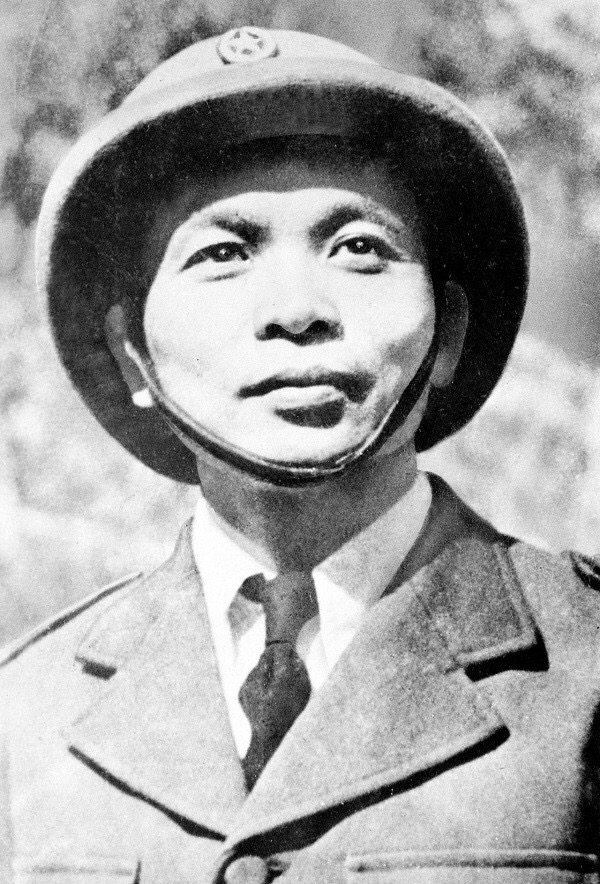
General Vo Nguyen Giap

On May 7th 2011 in Hanoi a small remembrance was held to mark the fall of Dien Bien Phu and honor the victor, 101 year old General Vo Nguyen Giap at his home. Until his death in 2013 at the age of 102. That 2011 ceremony was one of the few remembrances held anywhere marking that battle which was one of the watersheds of the 20th Century. A half a world away in Houston Texas a small group of French veterans, expatriates and historians laid a wreath at the Vietnam War Memorial.  In Paris an ever shrinking number of French survivors gather each year on May 7th at 1815 hours for a religious service at the Church of Saint Louis des Invalides to remember the dead and missing of the French Expeditionary Corps lost in Indochina. A small number of other small ceremonies have been in the following years.

This battle is nearly forgotten by time even though it and the war that it symbolized is probably the one that we need to learn from before Afghanistan becomes our Indochina.

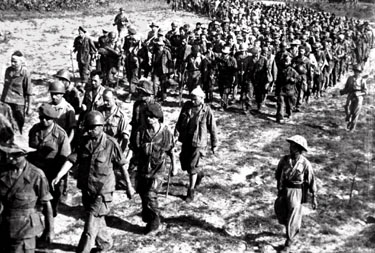
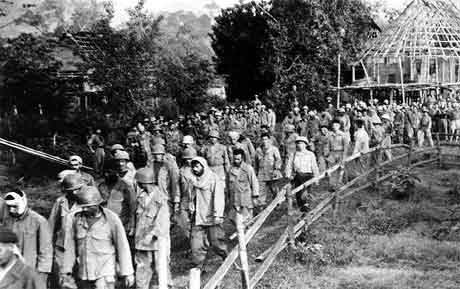
French Prisoners

On May 8th 1954 the French garrison of Dien Bien Phu surrendered to the Viet Minh.  It was the end of the ill-fated Operation Castor in which the French had planned to lure the Viet Minh Regulars into open battle and use superior firepower to decimate them.  The strategy which had been used on a smaller scale the previous year at Na Son.

The French had thought they had come up with a template for victory based on their battle at Na Son in how to engage and destroy the Viet Minh. The plan was called the “Air-land base.”  It involved having strong forces in a defensible position deep behind enemy lines supplied by air.  At Na Son the plan worked as the French were on high ground, had superior artillery and were blessed by General Giap using human wave assaults which made the Viet Minh troops fodder for the French defenders.  Even still Na Son was a near run thing for the French and had almost no effect on Viet Minh operations elsewhere while tying down a light division equivalent and a large portion of French air power.

Viet Minh Regulars

The French took away the wrong lesson from Na-Son and repeated it at Dien Bien Phu.  The French desired to use Dien Bien Phu as a base of operations against the Viet Minh.  Unfortunately the French chose badly. The elected to occupy a marshy valley surrounded by hills covered in dense jungle. They elected to go light on artillery and the air head was at the far end of the range of French aircraft, especially tactical air forces which were in short supply.  To make matters worse the General Navarre, commander of French forces in Indochina informed that the French government was going to begin peace talks and that he would receive no further reinforcements elected to continue the operation.

French Paras Drop into Dien Bien Phu

Likewise French logistics needs were greater than the French Air Force and American contractors could supply.  French positions at Dien Bien Phu were exposed to an an enemy who held the high ground and were not mutually supporting. The terrain was so poor that French units were incapable of any meaningful offensive operations against the Viet Minh. As such they could only dig in and wait for battle. Despite this many positions were not adequately fortified and the artillery was in exposed positions.

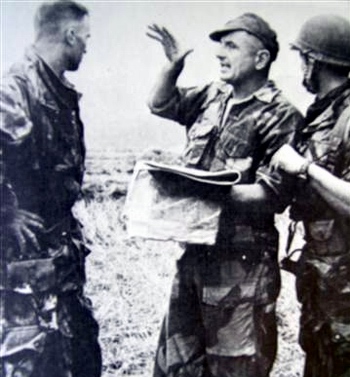
Major Marcel Bigeard 

The French garrison was a good quality military force composed of veteran units. It was comprised of Paras, Foreign Legion, Colonials (Marines), North Africans and Vietnamese troops. Ordinarily in a pitched battle it would have done well, but this was no ordinary battle and their Viet Minh opponents were equally combat hardened, well led and well supplied and fighting for their independence.

Many of the French officers including Lieutenant Colonel Langlais and Major Marcel Bigeard commander of the 6th Colonial Parachute Battalion were among the best leaders in the French Army. Others who served in Indochina including David Galula and Roger Trinquier would write books and develop counter-insurgency tactics which would help Americans in Iraq. Unfortunately the French High Command badly underestimated the capabilities and wherewithal of the Giap and his divisions.

Viet Minh Supply Column

Giap rapidly concentrated his forces and built excellent logistics support.  He placed his artillery in well concealed and fortified positions which could use direct fire on French positions. Giap also had more and heavier artillery than the French believed him to have.  Additionally he brought in a large number of anti-aircraft batteries whose positions enabled the Viet Minh to take a heavy toll among French Aircraft.  Giap also did not throw his men away in human assaults.  Instead he used his Sappers (combat engineers) to build protective trenches leading up to the very wire of French defensive positions.  In time these trenches came to resemble a spider web.

Without belaboring this post the French fought hard as did the Viet Minh. One after one French positions were overwhelmed by accurate artillery and well planned attacks.  The French hoped for U.S. air intervention, even the possibility of using nuclear weapons against the Viet Minh. They were turned down by a US Government that had grown tired of a war in Korea.

French Wounded Awaiting Medivac from Dien Bien Phu 

Relief forces were unable to get through and the garrison died, despite the bravery of the Paratroops. Colonials and Legionaries. The French garrison was let down by their high command and their government and lost the battle due to inadequate logistics and air power. The survivors endured a brutal forced march of nearly 400 miles on foot to POW camps in which many died. Many soldiers who survived the hell of Dien Bien Phu were subjected to torture, including a practice that we call “water boarding.” General Georges Catroux who presided over the official inquiry into the debacle at Dien Bien Phu wrote in his memoirs: “It is obvious that there was, on the part of our commanding structure, an excess of confidence in the merit of our troops and in the superiority of our material means.”

Few French troops caved to the Viet Minh interrogations and torture but some would come away with the belief that one had to use such means to fight the revolutionaries.  Some French troops and their Algerian comrades would apply these lessons against each other within a year of their release. French soldiers and officers were shipped directly from Indochina to Algeria to wage another protracted counterinsurgency often against Algerians that they had served alongside in Indochina. The Algerian campaign proved to be even more brutal and it was lost politically before it even began.

The March to Captivity

The wars in Indochina and Algeria tore the heart out of the French Army. The defeats inflicted a terrible toll. In Indochina many French career soldiers felt that the government’s “lack of interest in the fate of both thousands of missing French prisoners and loyal North Vietnamese…as dishonorable.” Divisions arose between those who served and those who remained in France or Germany and created bitter enmity between soldiers. France would endure a military coup which involved many who had fought in Vietnam and Algeria. Having militarily won that war these men called The Centurions by Jean Lartenguy had been turned into liars by their government.  They were forced to abandon those who they had fought for and following the mutiny, tried, imprisoned, exiled or disgraced. Colonial troops who remained loyal to France were left without homes in their now “independent” nations. They saw Dien Bien Phu as the defining moment. “They responded with that terrible cry of pain which pretends to free a man from his sworn duty, and promises such chaos to come: ‘Nous sommes trahis!’-‘We are betrayed.’

The effects of the wars in French Indochina, Algeria and Vietnam on the French military establishment were long lasting and often tragic. The acceptance of torture as a means to an end sullied even the hardest French officers. Men like Galula and Marcel Bigeard refused to countenance it, while others like Paul Aussaresses never recanted.

One of the most heart rending parts of the Dien Bien Phu story for me is that of Easter 1954 which fell just prior to the end for the French:

“In all Christendom, in Hanoi Cathedral as in the churches of Europe the first hallelujahs were being sung. At Dienbeinphu, where the men went to confession and communion in little groups, Chaplain Trinquant, who was celebrating Mass in a shelter near the hospital, uttered that cry of liturgical joy with a heart steeped in sadness; it was not victory that was approaching but death.” A battalion commander went to another priest and told him “we are heading toward disaster.” (The Battle of Dienbeinphu, Jules Roy, Carroll and Graf Publishers, New York, 1984 p.239)

As a veteran of Iraq whose father served in Vietnam I feel an almost a spiritual link to our American and French brothers in arms who fought at Dien Bien Phu, the Street Without Joy, Algiers and places like Khe Sanh, Hue City, the Ia Drang and the Mekong. When it comes to this time of year I always have a sense of melancholy and dread as I think of the unlearned lessons and future sacrifices that we may be asked to make.

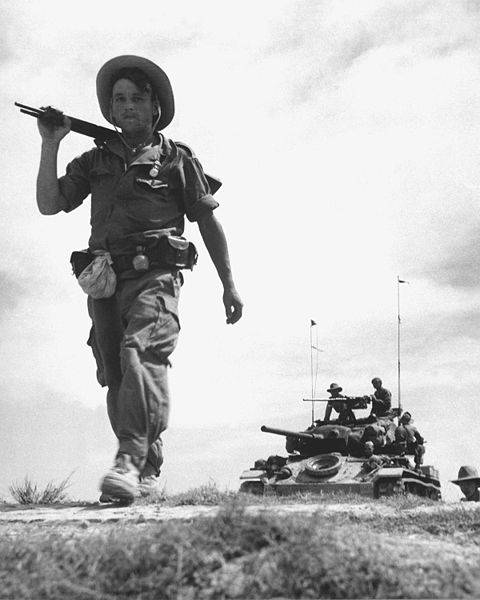
Legionaires on the Street Without Joy

The lessons of the French at Dien Bien Phu and in Indochina were not learned by the United States as it entered Vietnam, Iraq or Afghanistan. Nor were the lessons of Algeria. It was an arrogance for which we paid dearly and I do not think that many in our political, media and pundits or military have entirely learned or that we in the military have completely shaken ourselves. We lost 54,000 dead in Vietnam, nearly 4500 in Iraq and close to 3500 in Afghanistan, not counting vast numbers of wounded. There are those even as we have been at war for 15 years who advocate even more interventions in places that there is no good potential outcome, only variations on bad. How many more American Soldiers, Sailors, Marines and Airmen and our allies will need die without “victory” however badly we might try to define it?

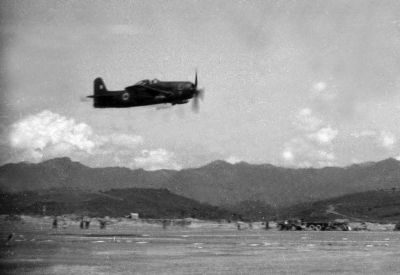
French Navy F-8 Bearcat at Dien Bien Phu

Like the French our troops who returned from Vietnam were forgotten.The U.S. Army left Vietnam and returned to a country deeply divided by the war. Vietnam veterans remained ostracized by the society until the 1980s. As Lieutenant General Harold Moore  who commanded the battalion at the Ia Drang immortalized in the film We Were Soldiers recounted “in our time battles were forgotten, our sacrifices were discounted, and both our sanity and suitability for life in polite American society were publicly questioned.”

For those interested in the French campaign in Indochina it has much to teach us. Good books on the subject include The Last Valley by Martin Windrow, Hell in a Very Small Place by Bernard Fall; The Battle of Dienbeinphu by Jules Roy; and The Battle of Dien Bien Phu- The Battle America Forgot by Howard Simpson. For a history of the whole campaign, read Street Without Joy by Bernard Fall. I always find Fall’s work poignant, he served as a member of the French Resistance in the Second World War and soldier later and then became a journalist covering the Nuremberg Trials and both the French and American wars in Vietnam and was killed by what was then known as a “booby-trap” while covering a platoon of U.S. Marines.

I do pray that we will learn the lessons before we enter yet another hell. But I don’t think it is possible for us to learn anymore, only send more young men and women to die in an already lost cause. As the late Edwin Starr sang in his song War, what is it good for? 

Peace, love and understanding. Tell me, is there no place for them today. They say we must fight to keep our freedom, But lord knows there’s got to be a better way. War, what is it good for? Absolutely nothing, say it again… 

Peace

Padre Steve+

3 Comments

Filed under afghanistan, Foreign Policy, History, Military, News and current events, War on Terrorism

Padre Steve’s World at Eight Years: I’m Still Standing

img_3414

Friends of Padre Steve’s World,

Tonight a short pause to reflect. I was reminded by my WordPress, the company that hosts my site that I began this blog eight years ago today.

The blog came out of a question my first shrink asked me as I was beginning to melt down with PTSD and TBI after my tour in Iraq which ended in February 2008. His question, “Well chaplain, what are you going to do with your your experience?” forced me to think, and get outside of myself.

iraq-2007

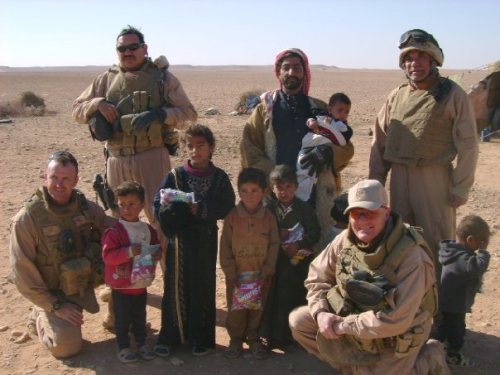
bedouin

I certainly wasn’t in great shape, in fact I was falling apart. Chronic insomnia, nightmares, night terrors, depression, anxiety, hyper-vigilance, fear of everyday activities, all took their and my doctors trying different combinations of medicines, each with their own side effects, even while I was undergoing different psychiatric and neurological test. I was a total wreck and often impossible to be around. I was always on edge and prone to anger. I threw myself into work in the ICU sixty to one hundred hours a week depending on my call schedule. That didn’t help, and I got worse. It would take years to see measurable improvement, and even then, with periodic crashes, often connected to the deaths of friends, including those who suffered from what I suffered.

In contemplating my therapist’s question I knew that I wanted to share what I was going through, even while I was in the middle of it. But there was a risk, and he pointed it out, and I had seen it before; anyone who opens up and talks of their brokenness when they themselves are supposed to be one of the “healers” often ends up ostracized by their community. Their fellow professionals frequently withdraw from them, old friends distance themselves, and sometimes their family lives fall apart. This happens to physicians, nurses, hospital corpsmen, mental health providers, law enforcement officers, as well as highly trained Special Forces, EOD, and other military professionals. It also happens to Chaplains. Henri Nouwen wrote: “But human withdrawal is a very painful and lonely process, because it forces us to face directly our own condition in all its beauty as well as misery.” That happened to me, and I am better for it.  In the depths of my struggle I found a strange solace in the words of T.E. Lawrence who toward the end of his life wrote a friend: “You wonder what I am doing? Well, so do I, in truth. Days seem to dawn, suns to shine, evenings to follow, and then I sleep. What I have done, what I am doing, what I am going to do, puzzle and bewilder me. Have you ever been a leaf and fallen from your tree in autumn and been really puzzled about it? That’s the feeling.”

So that’s how things began. I wrote about what was going on with me. That included my spiritual struggles, as well as writing about baseball which is as much a part of my spirituality as anything. As I continued to write I began to address social and political issues, and then on to my real love, writing history, which I completed my second Master’s degree in a year after I started this blog.

The latter which has been both educational, as well as therapeutic. In my reading, research, and writing, I discovered fellow travelers from history whose stories helped me find myself again, men with feet of clay, doubts, depression, often masked by triumph. My examples included T.E. Lawrence, Gouveneur Warren, Joshua Lawrence Chamberlain, Ulysses Grant, and William Tecumseh Sherman. I found a measure of comfort as well as solace in their lives, experience, and writings.

My historical writings been further motivated by being able to teach and lead the Gettysburg Staff Ride at the Staff College. That is unusual for a chaplain, but I am an unusual chaplain, as one of my fellow professors said, “You’re a historian masquerading as a chaplain, not that there is anything wrong with that.” 

So that’s how, some 2,862 posts, and three draft books, I got to this point. I still do suffer symptoms of PTSD but I have stabilized for the most part, much of it I attribute to a decent combination of meds, a renewed love and friendship with my wife, and my Papillon Izzy, who is a therapy dog in every sense of the word. Likewise there have been a few people who stood by me through thick and thin. I have expressed to them how much I appreciate them and because of them I really began to appreciate the words of William Tecumseh Sherman who noted: “Grant stood by me when I was crazy. I stood by him when he was drunk, now we stand together.” Since I have been both at times, I find that such camaraderie is more important than about anything else.

I appreciate all the people who subscribe to this blog, those who follow it through social media sites like Facebook and Twitter, and who take the time to comment, as well as to provide words of encouragement. For that I thank all of you.

Have a great night,

Peace

Padre Steve+


1 Comment

Filed under faith, mental health, Military, PTSD

The Bond

img_0602

Friends of Padre Steve’s World,

Today is going to be a busy and sad day as we gather with friends to remember the life of our friend Dave Shaw. I wrote about his unexpected loss over the weekend and as such, since I am not going to have time to write anything new I am going to reach back into the archives an re-post an article that I wrote back in June of 2011 about the bond that is shared by those who go to war. Dave served as a Navy Corpsman aboard various Navy ships, hospitals, and with the Marines. He retired as a Chief Petty Officer, as did my dad. He was a friend and brother, and, like so many others he will be missed.

Peace

Padre Steve+

This story shall the good man teach his son;
And Crispin Crispian shall ne’er go by,
From this day to the ending of the world,
But we in it shall be remembered-
We few, we happy few, we band of brothers;
For he to-day that sheds his blood with me
Shall be my brother; be he ne’er so vile,
This day shall gentle his condition;
And gentlemen in England now-a-bed
Shall think themselves accurs’d they were not here,
And hold their manhoods cheap whiles any speaks
That fought with us upon Saint Crispin’s day.

From the Speech of King Henry V at Agincourt in Shakespeare’s “Henry V” 1599

In the midst of the petty politics surrounding the Afghan War so so ponderously and pompously purveyed by politicians and pundits of all strains I feel the need to speak up for that small band of brothers that has served in these wars. They are to steal a phrase applied to a previous generation the “New Greatest Generation” something that I am loathe to apply to much of the population at large. You see the cost of these wars is finally beginning to sink in, at least the financial cost. I’m not so sure that the human cost factors in for most people because the tiny percentage of the population that serve in the wars. The fact is that the volunteer military is an insular community which for the most part is based on bases away from most of the population. We used to have big bases in or near major cities, the New York Naval Yard, the Presidio of San Francisco, Long Beach Naval Shipyard, Fort Devens Massachusetts near Boston, Fort Benjamin Harrison Indiana at Indianapolis. But after the Cold War they and hundreds of other bases were eliminated and with them a connection to the active duty military. That is not the fault of the people in the big cities it just happened that way, no the military with a few exceptions is based away from most of the population. As a result people may support the troops but most have no idea what they do, how they live and what they suffer.

In spite of that this new Greatest Generation’s accomplishments will largely go unheralded by history. Unlike the “Greatest Generation” of World War Two they will probably not receive the full honors and accolades due them. This brotherhood of war who have served in the current War on Terror, Iraq and Afghanistan campaigns have now been serving in a war that is now twice as long as the American involvement in World War Two. Many, like me have been in this since the beginning and many have made multiple deployments to the combat zones. And many of us, if not most of us would go again. I know that I would because part of me is still in Iraq; for me this war is still un-won and un-finished.

The battles, Fallujah, Ramadi, Haditha, Mosul, Baghdad, Tal Afar, Marjah, Kandahar, Anaconda, Wanat and thousands of other places significant and insignificant are vivid in the minds of those that were there. Unfortunately for most of their countrymen they might as well be on a different planet.

With no disrespect to the Greatest Generation of World War Two, all of the current Soldiers, Sailors, Marines, Airmen and Coast Guardsmen volunteered to serve in time of war. At any given time only about one half of one percent is in uniform. In the three years and ten months of the Second World War about 16.1 Million Americans served in the military, the vast majority being draftees. Likewise the current generation has fought the war alone. The vast bulk of the country has lived in peace untouched by any inconvenience to daily life such as gas and food rationing, requirements to work in war industries and the draft as were citizens in World War Two. In the Second World War Americans shared the burden which in large part has not occurred in this war. While many have pitched in to help and volunteered to help veterans and their families the vast majority of people in this country are untouched by the war, not that there is anything wrong with that. This is simply a comparison of the situation that those who served in World War Two and the present conflicts faced. So I have to say that our current “Greatest Generation” is only a small part of the generation, as the line in Henry V “we few, we happy few who fought together….”

These Soldiers, Sailors, Marines and Airmen from the United States as well as our Allies who serve alongside of us are my brothers and sisters. They too are volunteers and represent a miniscule portion of their countries population. I am friends with military personnel from the UK, Canada and Germany who have served in the various combat zones or at sea and met quite a few others from France, the Netherlands and Australia. Of course my Iraqi friends who I served with while with our advisers in Al Anbar province who are not only trying to bring peace and stability back to their country but have to worry about the possibility that their families become the target of terrorists.

There are a number of things that unite us in this relatively small brotherhood. However, I think that this brotherhood could also be extended to our brothers who fought in Vietnam, French, Vietnamese, Australian, South Korean and American, the French who served in Algeria and the Americans and others that served in Korea. All of these wars were unpopular. All had little support on the home front and often returning veterans found themselves isolated and their sacrifices ignored or disrespected. For those Americans who serve in the current wars I can say that at least to this point the public has been much more supportive than they were to our Vietnam brothers, many of who were even disrespected by World War Two vets who had fought in “a real war.” I cannot count the Gulf War in this list as it was hugely successful and the returning vets were hailed as conquering heroes with ticker tape parades.

Our shared brotherhood includes our scars, physical, psychological, neurological and spiritual. Those who served on the ground in Iraq and Afghanistan as well as those who served in Vietnam, French Indo-China and Algeria have a common shared experience. All fought people who didn’t or don’t like foreigners no matter how noble our intentions and who by the way have a long history of outlasting people that they believe to be invaders or occupiers. We have had to fight wars with no front lines, no major units arrayed against us, but rather asymmetrical threats propagated by creatively devious foes who use low tech easily available technology and a willingness to sacrifice themselves and others to force attempt to kill us. Thus we have cleverly designed and often quite powerful IEDs or Improvised Explosive Devices which can obliterate a HUMMV.

These threats create a situation where there is no front line and thus where every excursion outside of a FOB (Forward Operating Base) or COP (Coalition Outpost) is automatically a trip into a potential danger zone. Enemies can infiltrate bases posing as local nationals in either military uniform or as workers, rockets and mortars can be lobbed onto even the largest and most secure bases at any time and any vehicle driving by you on the road could be loaded with explosives and just waiting to blow you up while insurgents with automatic weapons and Anti-Tank Rocket Propelled Grenades (RPGs) have taken down helicopters. When you have taken fire on the road, in the air and had rockets whiz over your head you this becomes a reality that you never forget.

As a result we many men and women with physical wounds as well as wounds that have damaged the psyche or the soul. PTSD is very common either from a direct encounter or the continual wear and tear of being in a danger zone wondering if you were to get hit that day every day of a tour. I have lost count now of people that I know who have mild to severe symptoms of PTSD. Traumatic Brain injury is another condition men and women attacked by IEDs, mortars and rockets experience. Likewise there are the injuries that shatter the soul. These are the images of ruined buildings, burned out vehicles, wounded bodies, injured children, refugees and wars desolation that can leave a person’s faith in God, or ideals that he or she believes in weakened or even destroyed. There are the smells of smoke, death, diesel, garbage and sewage that when encountered far away from the combat zone send us back.

The wars have been costly in lives and treasure. The “up front” casualty numbers are below; they do not include those with PTSD or mild to moderate TBI. They also do not count those that have died later after their service in VA or other civilian care, those that did not report their injuries and those that have committed suicide.

Iraq KIA US 4463 UK 179 Other 139 Total 4781

Afghanistan KIA US 1637 UK 374 Other 537 Total 2548

US Wounded Iraq 32227 Afghanistan 11191

The financial cost: over 1.2 trillion dollars and counting.

As many idealistic and patriotic military personnel question God, their National Leadership and even themselves because of their experience in Iraq or Afghanistan. I cannot get the image of a refugee camp on the Iraqi Syrian border full of Palestinian refugees who have nowhere to go; they had been invited to Iraq under Saddam and have been sitting on the border trying to get home for years now. The Palestinian authority wants nothing to do with them. I cannot smell smoke or hear a helicopter or pass a freshly fertilized field without being reminded of Iraq.

These men and women are my brothers and sisters. I have seen quite a few of my colleagues at the Naval Medical Center and Naval Hospital deploy and deploy, the medical personnel don’t get much of a break. These are my friends and I do get concerned for them and pray earnestly for their safe return. I wish that I could go with them because I know them and have already walked with them through the dark valley of the shadow of death in the Medical Center ICU or the wards and clinics of the Naval Hospital. We already have a bond that will not be broken.

It is now four years since I was in the process of leaving for Iraq and three years since my PTSD crash. However, I still would do it again in a heartbeat. There is something about doing the job that you were both trained to do and called to do that makes it so. Likewise the bonds of friendship and brotherhood with those who you serve are greater than almost any known in the human experience. Shared danger, suffering and trauma bind soldiers together, even soldiers of different countries and sometimes with enemies. I remember the conversation that I had with an Iraqi Merchant Marine Captain on a ship that we had apprehended for smuggling oil violating the United Nations sanctions. The man was a bit older than me, in his early 60s. He had been educated in Britain and traveled to the US in the 1960s and 1970s. He had the same concerns as any husband and father for his family and had lost his livelihood after Saddam invaded Kuwait in 1990. He was a gentleman who provided for his crew and went out of his way to cooperate with us. In our last meeting he said to me: “Someday I hope that like the Americans, British and the German soldiers at the end of the Second World War can meet after the war is over, share a meal and a drink in a bar and be friends.” That is my hope as well.

In the final episode of the series Band of Brothers there is a scene where one of the American soldiers, Joseph Liebgott who came from a German Jewish family interprets the words of a German General to his men in the prisoner compound. The words sum up what the Americans had felt about themselves and likewise the bond that all soldiers who serve together in war have in common, if you have seen the episode you know how powerful it is, I ended up crying when I heard it the first time and cannot help but do so now that I have been to the badlands of Al Anbar Province.

“Men, it’s been a long war, it’s been a tough war. You’ve fought bravely, proudly for your country. You’re a special group. You’ve found in one another a bond that exists only in combat, among brothers. You’ve shared foxholes, held each other in dire moments. You’ve seen death and suffered together. I’m proud to have served with each and every one of you. You all deserve long and happy lives in peace.”

As do we.

Peace

Padre Steve+

1 Comment

Filed under iraq,afghanistan, Military, remembering friends, shipmates and veterans, US Navy

The Paths not Chosen


Friends of Padre Steve’s World,

After about a week of writing about politics, history, and the very disturbing candidacy of Donald Trump, I need to take a break, not that there isn’t a lot of politics, foreign policy, and other serious subjects I could write about. But honestly I need to take a break from that, at least for a few days, for my own sanity and to get ready for another trip to Gettysburg this weekend.

So today something a bit more introspective which I think is a good question for all of us who seek the truth and take the time to examine our lives in light of all that happens to us. 

In the series the X-Files, Agent Dana Scully played by Gillian Anderson made this observation: 

“Time passes in moments… moments which, rushing past, define the path of a life, just as surely as they lead towards its end. How rarely do we stop to examine that path, to see the reasons why all things happen, to consider whether the path we take in life is our own making, or simply one into which we drift with eyes closed. But what if we could stop, pause to take stock of each precious moment before it passes? Might we then see the endless forks in the road that have shaped a life? And, seeing those choices, choose another path?”

I actually think that it is a very good question and truthfully I wonder. I wonder what my life might have been had I, or others made different decisions. How would my life be different? Or would it? I don’t know, and frankly, I don’t really care.

One thing I do know is that whatever my alternate paths might have taken that I am happy. I have been able to fulfill many dreams and I do take the time to ponder all the forks in the road that have shaped my life. When I do I realize that the alternative possibilities are almost endless. Then when I think of the possibilities of alternate universes I wonder, not that there is anything wrong with that. But even so, I don’t think I would want to be on any other path, for since I was a child all that I could imagine ever being happy doing in life was serving my country in the military.  In early 1861, Ellen Boyle Ewing Sherman, the wife of William Tecumseh Sherman told Sherman “You will never be happy in this world unless you go in the army again.”  Ellen had never approved of Sherman’s previous service and in fact hated ever moment of it, but after six years of seeing her husband in civilian life, she knew that he had to return to the army. 

Twenty years ago I made a decision to volunteer to serve as a mobilized Army reservist during the Bosnia crisis. It was a decision that changed my life. I had left active duty in 1988 to attend seminary while remaining in the National Guard and the Reserves, and when I was mobilized I lost my civilian employment, and two and a half years later when I was offered the chance to go on active duty in the Navy, even though it meant a reduction in rank, I did it. 

When I think of all the things that transpired to get me when I am today I really am astounded, and for the life of me I don’t see how I could have chosen another path. It has been twenty years since I volunteered to support the Bosnia operation, and almost thirty-five years since I first enlisted in the army, and like Sherman, I cannot have imagined doing anything different. As for my wife Judy, she, like Ellen Sherman was with her husband has been long suffering in staying with me all these years, and I wouldn’t trade her for anyone. 

When I look at my life in total, there are many things that I might have wanted to change or do differently, but if I had, or for that matter,mad someone else made a different decision concerning my life, the tapestry that has been my life would be very different and I might not even recognize me if any of those paths had been chosen, by me, or by others. 

Agent Scully’s words got me thinking and pondering and that my friends is a good thing. 

So until the next fork in the road….

Peace

Padre Steve+

Leave a comment

Filed under Loose thoughts and musings, philosophy

Teaching at Gettysburg 


Friends of Padre Steve’s World

I spent last night eating, drinking, and teaching at Gettysburg in preparation for he Staff Ride which begins this morning. My audience is the senior staff of an U.S. Army recruiting battalion based out of Ohio. 

It was an interesting setting to teach, sitting on the patio with absolutely beautiful weather, enjoying good food and beer and then getting to teach. They are a different type of audience than the men and women that I teach at the Staff College, and with the exception of the battalion commander who is a graduate of our program, the officers are younger and junior to my students and we also have senior non-commissioned officers, the Command Sergeant Major and the First Sergeants. they are whoever, all very smart, articulate and represent the best of America. All have served in combat or in combat theaters, and all have met with the frustration of not achieving anything like victory. 

I find this very important, because the vast majority of military personnel, including officers attend the level of education that I get to teach at the staff college, and for me to be able to do this with such a group helps create an interest, not just in a particular battle, but the important link between national strategy, military strategy, and the operational art. One thing that I spent a good amount of time on last night in the prepetory lecture was just that. The biggest reason the the North won the Civil War and that the South lost was that in the North under Lincoln, that military operations were linked with the policy of the government after the Emancipation Proclamation; whereas in the South there never was a coherent national strategy, and even great operational level commanders like Robert E. Lee were unable to translate battlefield success into victory. 

As Clausewitz emphasized, war is an instrument of policy, and if it does not serve policy, or if policy makers fail to develop and enunciate a true national strategy, military efforts will ultimately fail. This has been a hallmark of post Col War American thinking. Ideology and buzzwords are not policy, nor are they strategy, and the military is only one component of national power, and unlike diplomacy, economic power, and information, it is a blunt instrument, and if military efforts cannot be translated into the political object and bring about a positive political effect, no amount of battlefield brilliance will bring about success. Policy makers and soldiers must remain in constant dialogue in order to ensure that the link between strategy and policy is strong. This was something that Lincoln, as well as his military subordinates Ulysses Grant and William Tecumseh Sherman learned, and practiced during the war, and it was something that Lincoln’s successor, Andrew Johnson failed to understand after the war, thus forieting all that had been won on the battlefields. Thus as English historian and military theorist Colon Gray notes that “war is about peace” and “more pointedly, that the making of peace is likely to be more difficult than the waging of war. It is a common, and somewhat understandable, error to assume that if one takes care of the fighting in an efficient manner, and the enemy is duly humbled, somehow that the subsequent peace will all but take care of itself.”  I guess that is one reason that I find the American Civil War and the subsequent Reconstruction period to be so pertinent today for but policy makers and military leaders. But I digress…

Even so this promises to be a great weekend, and even more interesting, I will be conducting the final part of which includes walking the ground of Pickett’s Charge, and spending time at the Soldier’s Cemetery where Abraham Lincoln delivered the Gettysburg Addess on Sunday, the 33rd anniversary of my being commissioned as an Army officer in 1983. Since then I have served in peace and war in both the Army and the Navy. In fact I have been in the Navy now almost as long as I served in the Army, almost 17 1/2 years. 

Anyway, I hope to post anther reflection tomorrow, though it may be later in the evening when I actually get it done. 

Until then, have a great day.

Peace,

Padre Steve+

Leave a comment

Filed under civil war, Gettysburg, leadership, Military

Friendship in Adversity


Friends of Padre Steve’s World,

Over the past few days I have written a couple of articles about friendship, life, living, and coming through dark times. I guess it is fitting to close the week with some thoughts in friendship. 

Having lived through good times and bad I find it encouraging to have had friends in many places who have been there for me, not just in the good times, but in the bad as well. As such I truly value those kinds of friends, as well as admire men who though successful, also knew the crucible of going through hard times and were there for each other. 

Being a career military officer, as well as the child of a Navy Chief Petty Officer, most of my life has revolved around the military. From my youngest days I think it was all I ever wanted to do, and beginning in grade school I started reading the biographies of famous military leaders, as well as history. As a result I learned early that many of the men that I admired the most were the ones who rose above adversity, who endured defeat as well as savored victory, and who quite often were very flawed people. As I have gotten older I have come to appreciate such people more and more. 

Two of my favorites are Ulysses S. Grant and William Tecumseh Sherman. Both struggled at times in their lives, and during the dark early days of the Civil War they became fast friends. The were people in the Army, the government and the media that attempted to destroy them as much as the Confederates that they fought on the battlefield. Theirs was a friendship that lasted to the end of their lives. 

Grant once noted: “The friend in my adversity I shall always cherish most. I can better trust those who helped relieve the gloom of my dark hours than those who a so willing to enjoy with me the sunshine of my prosperity.” I personally cannot help but to agree. It is easy to have people to want to be your friend when everything is going well, but it is the person who stands by you when all has gone to hell that you really appreciate. I think that Grant and Sherman both understood that simple truth. Sherman said of Grant after the war, “Grant stood by me when I was crazy. I stood by him when he was drunk. Now we stand together.” Having been both crazy and drunk at various times I can relate to that. 


So anyway, since we as a nation are terribly rent by political and other kinds of division, I hope that you will find in these words something to go back and find the people who were there for you in your most difficult times. Give them a call, a message and let them know what they mean to you. Don’t let anything get in the way of that, politics, religion, whatever. I plan on making a number of calls, if nothing else to touch bases with friends that I haven’t seen or talked to recently, and let them know what they mean to me. 

Have a great weekend. 

Peace, 

Padre Steve+

Leave a comment

Filed under History, Military, philosophy, remembering friends

Is it Really God or do I Make You Uncomfortable? PTSD, Mental Illness and Christians

IMG_1915

Christians can be among the most clueless people regarding how their language and theological prejudices negatively impact others and harm their own witness regarding their professed devotion and love of Jesus the Christ. Sadly much of what they spout is neither scriptural or has any roots in reason or church tradition. Instead it is a product of their own prejudice and uncomfortableness with those who express doubt that they have learned from very popular, yet extremely ignorant and often hateful political ideologues who masquerade as preachers in mega-churches, on television, radio or the internet.

There are many Christians, particularly conservative Evangelicals and Charismatics who are fine people, men and women of integrity who I can honestly say love God and try serve God and also to care for his people. That being said many of these same people in their attempts to help others; especially those dealing with PTSD, depression, anxiety, suicidal thoughts, substance abuse and faith crisis’s do more far damage and harm than good. This is because they are unaware of their prejudices that they learn in church and how wrong their preachers are about such subjects, but still presume that what they have learned trumps other people’s experience. Yes this is a generalization, but there is much truth in it.

Those who read this site regularly and know something about me know that I am a Navy Chaplain, a Priest in an Old Catholic denomination and have been in the military over 30 years including a tour in Iraq and one at sea for Operation Enduring Freedom. You also know that I am very transparent about my struggle with PTSD as well as faith following my return from Iraq in 2008. According to many I am now a “liberal” which for some is even worse than being an “unbeliever.”

Being transparent about this difficult because it involves risk and as a person who is extremely introverted to begin with I am a very private person and eschew risk. I can understand why people who struggle with different parts of themselves that are unpopular or stigmatized by people in “normal” society feel, especially in the church. However in 2009 in consultation with my first therapist I decided to in a sense “come out of the closet” in regards to PTSD, moral injury, depression, anxiety, suicidal thoughts and mental illness in general; as well as my struggle to dealing with faith and God. All of those things are fraught with danger in a military society where the stigma regarding all of these things is all too real and all to prevalent in the military. But I digress…

Stigma is difficult and I deal with it all the time. What I represent by being so transparent, especially to Christians who have an absolute need for certitude in their lives is a topic that they don’t want to face. PTSD and other mental illness is a subject that scares many people. For some religious people, not just Christians, it forces them to retreat into the certitude of a Fundamentalist theology that blames the victim rather than to face reality of the issue, and the uncomfortable truth that it could happen to them.

Of course when your theology is that of “Job’s comforters” the only way to deal with such subjects is to retreat to that certitude. Admitting the truth would be something that would shred their faith and maybe even destroy their belief structure, thus to keep that certitude the experiences and faith of others which are different must be dismissed, confronted or shown to be wrong so the offending individual can repent and turn back to God.

Last week I had an officer come up to me after a ceremony and begin to tell me that “God sent him to our school” and he was there “not to learn what we teach” regarding what he as a relatively senior and up and coming officer is there to learn, but “to do the Father’s business.” For those that don’t understand this him that business meant that he had to tell me that God didn’t send him here to learn what he was sent to learn but to bring me back to the right way of thinking and belief.

I have no doubt of the man’s sincerity, but sometimes sincere people scare the hell out of me. I understand why Eric Hoffer wrote these words about “true believers”:

“The impression somehow prevails that the true believer, particularly the religious individual, is a humble person. The truth is the surrendering and humbling of the self breed pride and arrogance. The true believer is apt to see himself as one of the chosen, the salt of the earth, the light of the world, a prince disguised in meekness, who is destined to inherit the earth and the kingdom of heaven too. He who is not of his faith is evil; he who will not listen will perish.”

It has been my experience that such people are more inclined to want to tell you what to do rather than listening. This man began to tell me about his “testimony” that though he “didn’t have PTSD that he had a right to have it” and that “God wanted to take my “garbage” from me…but I kept taking it back.”

It took me the night to sleep on it before I realized the full implications of this man’s words.

Though I have heard this kind of talk for decades growing up in evangelical and charismatic Christian circles what this man said to me stunned me. I don’t expect educated professionals to make those kind of comments. However, religious fundamentalism, be it Christian, Jewish, Moslem or whatever can make educated professionals as fanatical and even as bloodthirsty as unlearned oafs. Please note that many of the top leaders of the Islamic State are educated professionals with highly technical backgrounds. Being educated does not mean that you cannot allow your religion to turn you into a sociopathic killer.

Let me just share my thoughts on his words. First there was the comment that he “was not at our Staff College to learn what we taught” but rather “to do his Father’s will.” I am sorry, I cannot accept such logic from either a Christian or a military professional perspective. First from the Christian perspective we have multiple responsibilities in our lives, faith should inform us. At the same time if a person is a Christian but also an officer, he or she is also an agent of the state who has sworn an oath to the Constitution.

The more that I thought about this man’s words, that he wasn’t at our college to learn, but to “do his Father’s will” I got more angry. He said that he wants to talk to me about my stuff next week but I think that I will have to tell him that if he is not here to learn that he should resign his commission. If he is not learning and does not care to learn then it is a waste of the taxpayer money and an abuse of his office and I am going to tell him that, and I may even inform the senior officer of his service on our faculty of his comments. Of course I cannot divulge his name or anything about him, but maybe the senior officer of that service can fire “warning shot” across the bow of all of the students from his service. But that comment angered me, it was arrogant and if I have any Christian concept of our responsibilities to God as well as our responsibilities to the citizens of our country who employ us.

The second thing that bothered me was that he insinuated that “though he did not have PTSD that he had a right to have it.” First, if he does not have it he is lucky and should be thanking God and not judging others. Second, if he does not have it he doesn’t have any right to have it. That statement is arrogant and presumptive and it totally devalues and dehumanizes the suffering of the person who would rather not be dealing with it. It would like someone telling a person with cancer that “though they don’t have cancer that they have a right to it.” I’m sorry, that would be reprehensible, just as this man’s words were to me. No one who does not have a disease or illness does not have a right to it.

But that’s the difference for the fanatic. Mental illness is not the same as physical illness. I cannot imagine this man telling me what he said if I had an illness like cancer, but I could be wrong because I have heard Christians, especially charismatics and Pentecostals say similar things to those with cancer or other terminal illnesses. The attitude is hateful, arrogant and so against what Jesus would do in a similar situation based on the words of scripture.

The last thing was that the man told me that “I kept taking my garbage back from God.” That devalued my experience, my suffering and my struggle to still believe even when I couldn’t believe. The fact is that I have heard this metaphor so many times that it is not even funny. What the illustration says in so many words is that if we suffer and God does not grant relief or healing that it is our fault, and we are guilty of keeping our garbage, even though God wants it.

Sorry that is bullshit of the worst degree. That metaphor is not even in scripture and I cannot even recall any of the Church Fathers who made such a statement. If we believe in God at all, and have faith to believe that in spite of trails, tribulations and suffering that God still loves and cares for us, that God has not abandoned us even when we feel that he has abandoned us that to say what this man said is outright blaspheme.

As you can understand from what I have said here, I am angry about this on a number of levels. I hope that this officer comes to see me this week because while I will be pastoral to him and care for him, I will not mince words. Unless he cares about his commission and duties as an officer then he better be at the Staff College to learn If he is not he should resign his commission and become a missionary. He is wasting taxpayer money and pissing on his oath of office and I am going to tell him that.

Second, I am going to tell him that if he doesn’t have PTSD that he doesn’t know what the hell he is talking about and he has no “rights to it.” I am going to tell him that if he says those words to the people who serve under him who do have it that he is misusing his office. I know far too many soldiers, sailors, marines and airmen who suffer the very real effects of PTSD, who suffer the discrimination and stigma that comes with it to have some “Christian” senior officer tell them that their suffering is “their problem” because they “took their garbage back from God.”

The whole thing was offensive, and last night I had a terrible time sleeping and this morning woke up suffering a lot of anxiety. On the way home from a visit to the local Navy Exchange I told Judy that I felt anxious and couldn’t put my finger on the reason why. Now I know, I was really bothered by what this officer said and it was much more disturbing than I had initially thought, because it is more than about me.

Now here is the bigger issue for me. It is a societal and policy issue. Chaplains are in the military to facilitate the free exercise of religion for all those in the military. We are not to proselytize and are to either perform or provide for the religious rights of all assigned to the units that we serve. I do that, and have done it for over 22 years as a chaplain in the Army and the Navy, honoring and caring for the religious needs of people across the spectrum.

But here’s the deal, thanks to the Christian right there are a host of fanatical Christians, mostly lay people who serve as officers and NCOs who have no concern for the rights of others, even the Chaplains who are there to make sure that they get what they need. Instead they are there not to serve the country but on their own religious mission paid for by tax payers and this is being promoted by many leaders of the American Religious Right, including James Dobson, Franklin Graham, Mike Huckabee, Pat Robertson, Phyllis Schafly, the leaders of American Family Association and Family Research Council including Jerry Boykin, Tony Perkins and Bryan Fischer, not to mention the corporate leaders of the big and politically mega-churches.

Can you imagine if Moslems in the military were to say that they in the military to serve “Allah” first what the same Christians who say that they are in the military to “do the Father’s will” would say? They would be apoplectic and protest how Moslems were trying to use the military to take over the government. But isn’t that what they are trying to do? As retired Army Lieutenant General and religious right activist Jerry Boykin said: “The military is the most respected institution in America. So if you want to change the rest of society, you have to target the military.”

As the late Dr. D. James Kennedy said before his death: “As the vice-regents of God, we are to bring His truth and His will to bear on every sphere of our world and our society. We are to exercise godly dominion and influence over our neighborhoods, our schools, our government… our entertainment media, our news media, our scientific endeavors—in short, over every aspect and institution of human society.”

Personally I cannot see how this is different from the the statements and actions of those of militant Islamic leaders of Al Qaida and the Islamic State. But then my presence and my transparency must be a threat. I’m pretty sure that this officer when he comes to share his “testimony” will further attempt to devalue my faith and experience. In fact I believe that this man is not so much driven by God but rather by his own doubts, fears and uncertainty about his own faith which is threatened by my words. Truthfully I have seen this far too often. People who must have absolute certitude in their own life who are threatened by those that express doubts. I felt that almost immediately when this man told me these things.

The stage is set, but I don’t plan on becoming a notch in his Bible and I am going to tell him straight up I believe that his theology is flawed and that I believe him telling things like this to me, or anyone else suffering PTSD is an abuse of his office. I also will ask him if he is sure that this is God, or if it is not his own fears hat he is expressing; and finally I will tell him that if his purpose at this highly selective level of military education is not to learn what we are teaching in order to serve as an officer, that he should immediately submit his resignation and retire from the military.

Why will I do this? Because simply I care about my country and my faith more than I do my career. I’ve been in the military a long time, well over half of my life, and frankly encounters like this are getting old.

Pray for me a sinner, because I will need it.

Peace

Padre Steve+

5 Comments

Filed under christian life, faith, leadership, mental health, Military, PTSD

Home Behind Home Plate

I am finally home. Yesterday I went back to North Carolina in order to officially sign out of Naval Hospital Camp LeJeune. It was a nice visit. I spent yesterday evening with my friends at Rucker John’s and the Emerald Club and my friend Eddie was gracious enough to let me crash at his place.

This morning I headed over to the Naval Hospital officially signed out, picked up my FITREP and was able to visit a couple of friends who I will dearly miss, Duke Quarles who serves as a Pastoral Counselor and for the first two years of my tour was a great right hand man and sanity checker. I also was able to spend time with Command Master Chief Ed Moreno. There are a lot of Chaplains who are not as fortunate as I have been with some of the Senior Enlisted Leaders who I have had the honor of serving alongside.

Ed is a colleague and friend and we relied on each other. He and I turned out to be peas in a pod and he and our last Director of Mental Health Services Captain Suzy Ghurrani and Public Affairs Officer Raymond Applewhite helped make the last year of my time at the hospital a time of personal healing as well as service to others. Master Chief Hospital Corpsman Joe Burds was another leader who I will miss. he was not available this morning but I do stay in contact with him. As a Chaplain one needs people like them, especially if one has suffered trauma. Too many Chaplains isolate themselves and while they may deal with command issues with members of the command triad seldom develop the close personal relationships with other leaders that I was able to do and at this point in my life and career am comfortable enough to do.

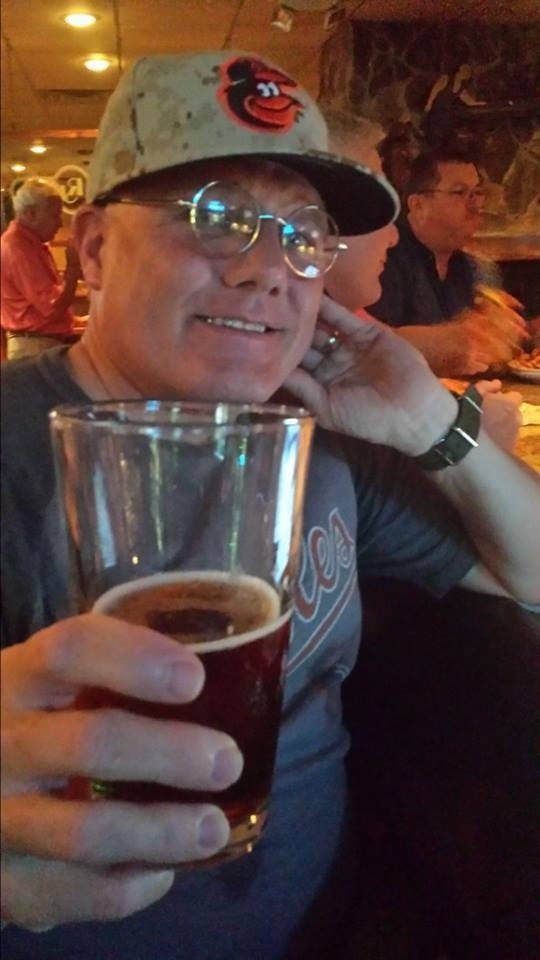
After doing what I needed I got underway and drove back home to Judy and our dogs Molly and Minnie. This evening I was able to go to Harbor Park in Norfolk to sit in my old section, 102 and hang out watching the game and taking pictures while visiting with my old friends at the ballpark. This is a place of peace and refuge to me. It was hard this year not having a local team in the LeJeune area. I missed my time with my friends in Kinston at Grainger Stadium since the Indians moved away.

Tonight I was able to visit with my friends Elliot, Chip, Art and Tom while watching the game. The Tides won the game 3-2 on a walk off single by Zealous Wheeler, Zach Britton pitched 7 strong innings in the win. It was the final part of knowing that I was really home. Next year I plan on having my season tickets again. Tomorrow begins more of the heavy lifting in the house. I’ll visit California to go to my 35th high school reunion and see my mom, brother and his family before checking in to the Joint Forces Staff College where I will be the Ethics faculty and chaplain.

So anyway, enough about me for the night.

Peace

Padre Steve+
Home is

20130822-235225.jpg

Leave a comment

Filed under Baseball, Military, norfolk tides

Moving Back in the Second Time and doing it Right

20130819-192946.jpg

I am enjoying a number of Gordon Biersch Czech Pilsners tonight as we complete yet another long day of my move back home.

Military moves are always an adventure. This is the first one where after being away from home three years I have had to move back in to my own home. Most of my stuff, except my dinning room table made it back undamaged. Since I don’t want to toss it out and have the military buy me a new one I need to have it repaired myself or go through the excruciating process of filing a claim and having someone repair it weeks from now.

I thought I had purged a lot of my stuff, and I had. But then when I started unpacking I found that just like The Price is Right there is indeed more. Today between what came off the truck and what was in closers I took a full load in my trusty Ford Escape to the local thrift store. A lot of it was stuff I have bought at a deep discount to sell on E-Bay but later realized that I wasn’t going to make enough to make it worth my time to sell. Thus the thrift shop gets the benefit of a lot of new sportswear and memorabilia to sell, while I get the tax write off.

Last night both Judy and I were exhausted and exasperated. The stress of moving, gutting the crap that has built up over the years and trying to make your home the way you wanted it to be 10 years ago is a real pain in the ass. I have been working hard to get things back in shape, and for those that think a spouse by themselves can read your mind and be able to do everything needed in your absence you are full of shit. A home is a team effort and since there is a “Me” in team I have had a big part in this team effort. Judy did a heck of a lot in my absence but a lot was more than she could do on account of the fact that either she needed me to be there to make a decision as to what to do with something or needed my gargantuan physical abilities to make it happen.

Yes and for those that do not already know this I am a physical beast despite my age and small stature. Ask my buddy and former body guard in Iraq Nelson “the Tyrant” Lebron.

This morning when the movers came Judy kept Molly and Minnie at bay while I worked with the movers to get my stuff in the house and unload it. Of course a fair amount of what I have is stuff for my former and future office so some things will have to wait to be unpacked. However, that being said there is still much work to do and lots of stuff to either be put away or gotten rid of before we are done.

I have also gotten rid of things that I kept for nothing more than sentimental reason. I do value sentiment but now I need to move on. If for nothing else the sake of my sanity. Thus I will spend a lot of time during the next week or so getting rid of things. The future demands it. Besides it would be a pain in the ass to try to take it with me.

Peace

Padre Steve+

Leave a comment

Filed under Military