Tag Archives: ministry

Reflections on Ministry as Navy Chaplain: The Guiding Principles of the Chaplain Corps

I have served as a chaplain in the Army and then the Navy since 1992. In fact I was appointed as a Chaplain in the Texas Army National Guard around late September of 1992 following my seminary graduation and after 11 years of service in the Army.

I grew up in a Navy family and I am grateful for that. We lived in many places and my parents ensured that church was a part of our life growing up. They had grown up as Methodists but because of our military lifestyle which involved frequent moves our church experience was much broader that people who grew up in the same town or the same faith tradition. I attended Sunday School, Vacation Bible School and church in a variety of churches. Methodist, Lutheran, Baptist, as well as Navy Chapels. I felt called to the Navy Chaplain ministry as early as my senior year in high school while on a Navy Junior ROTC cruise on the USS Frederick, LST-1184. That was deferred for about 20 years and twenty-three years after feeling that call I celebrated my first Eucharist underway on Easter Sunday 2001 aboard the Frederick, the very ship that I felt that call in 1978.

In my own pre-ministry life in college and the Army I was part of Conservative Baptist, United Presbyterian, PCA Presbyterian, charismatic churches and Army Chapels. I attended seminary in schools that were not of my denomination.

I was ordained in a non-denominational Evangelical Christian Church and my theological journey in a Southern Baptist Seminary led me in a Anglican and Catholic direction. That led in 1996 to my ordination first as a Deacon then Priest in the Charismatic Episcopal Church. Eventually after a faith crisis following my time in Iraq which I came home from with a severe case of PTSD I was for all practical purposes an Agnostic struggling to believe in God. It was a most difficult time but eventually faith returned. However that faith was more progressive on social and political issues and more inclusive of others and within months I told by my bishop that I was “too liberal” and needed to leave the church.  That was just over two years ago. It came just a couple of months after I had lost my father to Alzheimer’s Disease and was just about to transfer to a new duty station. I was fortunate to find a home with a church of the Old Catholic tradition, the Apostolic Catholic Orthodox Church. (http://apostoliccatholicorthodox.org ) That was a blessing because though a small denomination it held to the beliefs that helped make me a Priest and Chaplain.

Navy and Army Chaplains had significant influence in my life and most came from Christian denominations other than whatever I was in at various points in my life. As first an Army Chaplain in 1992 and now since 1999 a Navy Chaplain I have tried to embody that care and love that was shown to me, both to military personnel, their families, retirees and veterans as well as my fellow Chaplains.  Many of these men and women regardless of their denomination or theological views are often isolated from their own denominations and have to deal with all of the stresses of military life while taking on the burdens of those that they serve.

I find the Guiding Principles of the Chaplain Corps to be something that I think set the Navy Chaplaincy from other types of ministry. They expound upon the motto of Cooperation without Compromise that lies at the core of the Navy Chaplain ministry. They are something that even before I was a Navy Chaplain that I could say that I believed and wanted to embody in my military career as well as in ministry.

Navy Chaplains – Called To Serve

We are religious leaders and naval officers.

We are faithful to our calling as chaplains and strive to grow in our faith.

We have taken an oath to support and defend the Constitution of the United States, and will faithfully discharge our duties.

We respect the dignity of those we serve.

We seek to understand cultural and religious values that differ from our own.

We believe the right to exercise our faith is best protected when we protect the rights of all to worship or not worship as they choose.

We work together to meet religious needs.

We are called to serve our people, the Naval Service and each other.

We hold sacred the trust placed in us.

We Are Navy Chaplains

With that said I will sign off for the night.

Peace

Padre Steve+

1 Comment

Filed under christian life, Military, Religion

It’s what You learn after You know it All that Count’s: Padre Steve’s Advice for those contemplating the Ordained Ministry

Yesterday evening I had a dear friend of our call me to ask me about serving as a spiritual director as she began to seriously explore the call to the Episcopal Priesthood. As a Navy chaplain and Army Chaplain before that I have had many young men and some young women approach me about spiritual direction or advice as they contemplated preparing for the ordained ministry. These men and women have come from many Christian traditions as well as some from non-Christian religions. I consider this to be a privilege especially because almost all come from traditions different formerly Anglo-Catholic and now Old Catholic tradition.  Thus I feel honored to be able to participant in each of these individuals journey.

I do not take this responsibility lightly; the journey that these men and women are embarking is often fraught with risk and often painful.  Thus I really try to listen to their story listening carefully to their individual experience of God as well as how that experience relates to life, other people and their faith community.  The reason I do this is because I have had so many friends be chewed up and their ministries ruined by unscrupulous people and uncaring religious organizations while attempting to follow what they feel is God’s will for their life.

Since I believe in truth in advertising I make no bones about what I believe but also respect and hold holy what people bring to me. Thus I am careful to listen to them and be as helpful as possible without pushing them in any direction.  I have seen too many people manipulate others when they are in such a state and the results are seldom good. Since I know I don’t have all the answers that such decisions should not be entered into quickly and without the input of the person’s own faith community.  So I encourage them to work with their local church or faith community as well as denomination and work to help them make those contacts.

This is important because people that feel called to ministry can be vulnerable to many unscrupulous people regardless of their faith group.  There are some groups that will gladly ordain people for a substantial financial remittance and continued financial servitude. Of course such organizations will provide an “ordination” certificate or a “license” to preach many times without ever having met the individual.  Some groups have “seminaries” which issue “Divinity” degrees. Unfortunately many of these “church” schools are unaccredited degree mills.  Most provide no real theological training or preparation for the demands of ministry. The ordination certificate may provide some covering to the aspiring minister so they can perform weddings and have an IRS 501.3.c tax exemption.  Some might get to pastor a church under the umbrella of the “ordaining” organization.  However many times the degree is not worth the paper that it is printed on and the ordination is no more than a means to extract money from them.  Unfortunately I have lost count of the ministers that I have met who have had this kind of experience.

Even worse are the times that well meaning and sincere people end up being spiritual and sometimes physically or sexually abused by those in spiritual authority. This happens across the theological spectrum and is not simply isolated in the “fly by night” ministries that operate on a “for prophet” basis. Many men that trained for the Roman Catholic priesthood over the past half century have recounted many horrible experiences of abuse at the hands of their superiors in major and minor seminaries and sometimes even after ordination.  Many of these cases are recounted in excruciating detail in the media and in court cases.

Thus when a man or woman approaches me for advice or even spiritual direction I am careful to know the responsibility that they place in my hands and am careful to hold their trust as if it were a baseball bat personally autographed by Babe Ruth or Willie Mays.  Some people might say as if were a Faberge Egg or the Pink Panther Diamond, but I know what is really valuable.

My advice to those that come to me is always given with great caution. Since I have a great amount of experience serving with people of many faiths in addition to my own unique spiritual pilgrimage I value those that I have worked with and their faith, some have even helped save me from myself.  One in man in particular helped save my career when I was a young Army Chaplain.  Lieutenant Colonel Rich Whaley, a chaplain from the Church of Jesus Christ of Latter Day Saints saved my military career when I really lost control of my temper at the Army Chaplain School. I could list many more that helped me through good times and bad, seminary professors and chaplains almost all of which were of different denominations than me. They were men and sometimes women who cared about me who held my faith holy and who interceded for me sometimes with people and often to God.

As such I am careful to do the same for those that seek my counsel regardless of their beliefs.  I am fortunate. I have seen a number of these people go on to successful careers as military chaplains or in civilian ministry within their denominations.  I have also advised those that like me had grown beyond their denominational background or ha a progressive shift in their beliefs that cause them to feel that they must move to a new denomination. In those cases I am extra careful because I never want to even give the appearance of prostylizing, or for those unfamiliar with the term stealing sheep from someone else’s flock.

My advice to people seeking to enter the ministry, especially the chaplain ministry can be boiled down to these points.

* Take your time to discern the call. Many people rush into ministry only to find that it is not for them and in the process often end up hurt and disillusioned.

* Rely on trusted advisors that are willing to spend the time and walk with you during the discernment process. Don’t rely on pastors or others that promise to support you but in reality are too busy to take the time.

* Don’t rely on “cheerleaders” who simply tell you what you want to hear, and there are a lot of these people out there.

* Find people in your denomination that have experience in the type of ministry that you feel called that are not from you local church who can be objective.

* Seek out people from other traditions who have experience in the type of ministry that you want to enter. Often the latter provide more objective advice than those close to you and by getting to know them you can also get to know the kind of people that you will work with in your desired field of ministry, especially if you want to serve as a chaplain.

* Try to attend a resident seminary. I admit that it is possible to get a good academic theological or Biblical education in non-resident or online programs provided that they are rigorous and accredited by a real accrediting agency with actual standards. There are numerous “accrediting” organizations that are simply fraudulent and many “Bible Schools and Seminaries” claim such accreditation.

* Find a program that actually works with you and your faith group to provide spiritual formation.  In fact the formation aspect is often lacking in many well accredited resident seminaries but is most often absent in non-resident or online programs.

* Find a spiritual director that will walk with you through your education and formation. Some denominations will help you in this but many smaller churches are either unable or unwilling to do so, particularly those from the Evangelical tradition which focuses more on preaching.

* Make sure that your academic program is balanced between Bible, Theology, Church History Pastoral Care, and Homiletics.  Practical courses like evangelism and program management change with the wind and are often more about the marketing and packaging of a product. I had a friend in seminary who claimed that his Master of Divinity had a shelf life of 5 years. Of course if you focus on transitory method driven courses you will have a dated education because someone else will come up with something new a few years from now. If you focus on the balance that I talk about your education will never become dated. In fact it is those can be built upon where the others, well you’ll find those books in what you give to Salvation Army or Goodwill in a few years.

* Take the time to reflect on what you learn and what you experience.

* Finally do the basics. Study your faith, its scriptures, theology and traditions. Pray and maintain relationships with fellow students as others preparing for ministry.

And when all is said and done remember that “it’s what you learn after you know it all that counts.”

One more thing. you need to really love ministry and the people that you serve. If you are in it for money, fame or to make a name for yourself you will suffer shipwreck. If you don’t have love and joy nothing else I have said here will help you.

Peace

Padre Steve+

Leave a comment

Filed under christian life, faith, leadership, Pastoral Care, philosophy, Religion

A Quiet Alleluia: Padre Steve Celebrates Easter 2011

“Ministry means the ongoing attempt to put one’s own search for God, with all the moments of pain and joy, despair and hope, at the disposal of those who want to join this search but do not know how.”  — Henri J.M. Nouwen

Those readers and friends that have walked with me over the past two years on this site as well as those that walked with me before I ever put pen to my thoughts know how much I have struggled with God and faith since my return from Iraq. Easter has been difficult during that time as was Christmas.  My journey has been marked by many doubts. Today was different. Today we observed a quiet Easter out at the Island Hermitage marked by solitude and community.

The day was quiet and uneventful. I have been writing of late on the Easter story as told by Longinus the Centurion who Church tradition accords the honor of being the Centurion who remarked at the foot of the cross “truly this man was the son of God.”  The Centurions of the Bible have always been models for me as a Christian because they were career military men who served a far flung empire and at in least one part of their careers served in an unpopular occupation of a subjugated land with a proud and unbroken populace.  In their case it was Judea of the First Century and mine was Iraq. The story of Longinus as he is known to Church tradition is one that has fascinated me, a gentile officer of an occupying army discovers God at the scene of a brutal execution which he himself supervised. The story has helped me as I imagined what it must have been like for a Roman Centurion serving in a troubled land ruled by a cabal of corrupt politicians representing Rome, the family of Herod and the powerful institution of the Jewish Temple leadership composed of the High Priest, the ruling Sanhedrin and various religious parties. Likewise the lad featured an undying insurgency dedicated to overthrowing the Romans and what some considered the corrupt administration of the High Priest who they believed to be a collaborator with the Roman occupiers. These were the Zealots.  I was fascinated by the story and the story led me to a deeper appreciation of the Easter story.

We had contemplated going to Camp LeJeune to Mass at the Base Chapel. My friend Father Jose is a wonderful pastor and serves as the base Catholic Chaplain. While it would have been nice to see him celebrate the liturgy it meant that we would do so as strangers in a large community of faith.  Judy and I still both struggle with large gatherings especially where we know very few people and decided that we would celebrate Eucharist together. We were joined in this by my land lady Sharon.  It was a quiet but joyful expression of faith and community where each of us has at times suffered under sometimes cold and unfeeling Church institutions and leaders.

I used the story of Longinus as my homily telling the story in story form rather than as a theological treatise or sermon.  After the homily we confessed the faith of the Nicene Creed, prayed for the church and the world especially the outcast and persecuted and celebrated the Eucharist around my small pine dining room table, which is actually in my living room which doubles a my bedroom. The Island Hermitage is not a mansion.

Later in the day Judy and I would take our little dog Molly on a walk through a park not far from here. The park is a woodland and wetland area on the Bogue Sound side of the island. To walk in those peaceful woods hearing, seeing and listening to the sights and sounds of nature was wonderful. Molly especially loved it as she hunted for some of the deer that she had seen a few days before while walking near the hermitage.  Following that we drove the 2 ½ miles to lands end with Molly’s ears and fur flapping in the breeze as she stood on Judy’s lap with her head and shoulders hanging out the door.  The evening was also quiet as I finished the Easter installment of the Longinus story and Judy made a number of bracelets from her seemingly unending supply of bracelet stuff.

About an hour ago I took Molly on a walk to do her nightly constitutional and as we walked in the dark I looked up into the clear night sky to see thousands of stars.  In 2008 I walked home from church on Christmas Eve looking up into the cold winter night sky wondering if God even existed.  Tonight I looked at the sky and uttered a simple thank you for the resurrection. I know that I believe again. The belief that became real again in 2009 during my “Christmas Miracle” while on duty at the Naval Medical Center is now a quiet and real part of my life and ministry, especially to those who have lost their faith or struggle with faith. It is a quiet alleluia that is now a part of my life again. It is not the same as what I had before and certainly some critics including some in my old denomination have labeled me a liberal, a heretic and even an apostate mostly because I do not agree with their political agenda or narrow and often undemocratic understanding of the Gospel and its social ramifications.  I suppose that should bother me but it no longer does. My skin has become more resistant to such critics and while such criticism from people that I counted as friends still stings in general I am much more resilient to it, obviously the Holy Spirit’s work in the life of this miscreant priest.

Yet I remain a Christian and an Old Catholic and treasure the gift that God has given us in Christ.  The ministry that I have now is different but it is founded upon that faith that people like Longinus discovered that first Easter and I can only say “I believe alleluia!”

Peace

Padre Steve+

3 Comments

Filed under christian life, faith, Pastoral Care, Religion

Deadly Chatter: The Danger of Talking and not Listening

“Christians, especially ministers, so often think they must always contribute something when they are in the company of others, that this is the one service they have to render. They forget that listening can be a greater service than speaking.” Dietrich Bonhoeffer

I am a man of words sometimes many but mostly in writing but when I am in the company of others, unless I know them well or feel an exceptional need to add to a conversation I tend not to say much. In fact many times what I contribute is nothing more than something funny or witty to break tension or point out irony, speaking of which I need to do my Summer White uniform shirt in the next couple of days because we have an inspection next week but I digress.

Since I happen to be a minister I often get to experience the incessant droning and chatter of many Christians especially ministers who seem to believe that God would have them pounce on every opportunity to prattle on feeling that they must contribute something even if they have nothing to say.  Since I have on occasion been guilty of this myself I must always remember to take the Lincoln Log out of my eye before I go pointing out the Sequoia in someone else’s eye.  But we Christians and especially those of the ministerial type can really be a pain in the ass about this and I speak from experience on both the giving and receiving end of this proposition. What I fin amazing is for some ministers, especially the really popular ones on television or the mega-mart, I mean mega-church variety can take a small section of the Bible, usually the most insignificant ones like The Prayer of Jabez and turn them into a series of sermons each lasting nearly an hour complete with the DVD and the book, or series of books on the subject.

I remember a pastor of a mega-church that would begin sermon series on various topics and never complete them. He had one that was on “mission, vision and passion” which died somewhere around the eighth week of hour-long sermons into the mission section.  The sad thing is I can’t even remember what his primary Scriptural texts for this. Likewise I have endured many other sermon series to nowhere by various pastors or simply been held hostage by pastors that won’t shut up even when they know that they are beating a dead horse.  As for me I try to spend no more than 15 minutes on a sermon and usually shoot for about 12 minutes and focus on one thing either from the Gospel lesson or tying that lesson in with either the Old Testament or Epistle reading.  I just hope that in that time I don’t put anyone to sleep and that somehow by the miraculous work of the Holy Spirit that at least someone in the congregation takes a nugget from the message and that it is helpful.

Judy helped me in this when I was the Base Chaplain at Fort Indiantown Gap Pennsylvania.  The congregation had an unwritten rule that the service would begin promptly at 1100 and end promptly at 1200.  Judy and I know some American Sign Language since she went to California State University at Northridge because of her rather significant hearing loss and as any boyfriend who was passionately in love and lust would do I followed her.  As a result I became fairly well versed in sign language though I have lost most of that capability over time.  However she was good to let me know during a sermon how much time that I had before I had to be done and if I waxed too poetically she would let me know that I was boring something that I should have figured out by the sleeping members of the congregation.  But what the heck, none of them were sitting on a window ceil. No harm no foul.

I have found in the ministry of Priest and Chaplain that more often than not people don’t really want me to pontificate about everything that I know and would much rather that I take the time to listen to them. I actually try hard to notice the words as well as the inflection and the non-verbal aspects of communication when I spend time with people because it is all a part of listening.  I don’t always do it well and many times I have to catch myself before I interject a comment, idea or suggestion that might not be what the person needs at all in order to ensure the sanctity of the moment.  I know that when I am not doing well, which I spent the better part of the past three years not doing after my return from Iraq that the last thing that I want is someone who spouts “answers” and pushes their agenda without ever taking the time to care for or listen to what I am actually saying.  I think that I am not alone in this.

Bonhoeffer made this amazingly succinct comment about just what I am saying here and he does it far better than I could have done. “Many people are looking for an ear that will listen. They do not find it among Christians, because these Christians are talking where they should be listening.”  Therein lays the danger for both the person seeking someone that will listen to them as well as the one with all the answers.    The danger is that when we are in constant transmission mode we not only fail to listen or to really hear the other but also become deaf to the still small voice of God. Bonhoeffer noted this danger saying “he who can no longer listen to his brother will soon be no longer listening to God either; he will be doing nothing but prattle in the presence of God too.”  I figured due to the wisdom of my long-suffering wife Judy that God stopped taking theology lessons from me a long time ago, if indeed the Deity Herself ever took them from me. Of course back in my younger days I knew everything but since I have learned that I really know very little but I am definitely sure that I prattle in the presence of God as much as anyone else, and that is reality. Taking the time in the Daily Office and Scripture is something that I struggled with on my return from Iraq when I even struggled with the existence of God.  I am aware of this and I am trying to take some time every day to “be still and know.”

Unfortunately our media and information obsessed culture beats us senseless throwing more information, much of which is useless, deceptive or destructive in terms of content that it dulls our senses to the reality of others around us and keeps us from listening and seeing those who cry out for someone that will just take the time to listen even if they cannot “fix” the problem. You see in much of Christianity we suffer the same ailment of the culture around us in that we would rather “fix” someone than care for them. You see care takes loving nurture and patience especially the latter. Fixing is a “fire and forget” kind of thing, the kind of thing that “miracle workers” do for a living even if they are miracles faux no miracles at all. However the real act of care by a minister appropriately called “pastoral care” or the spiritual care of souls by a lay person takes time and involves a relationship and that requires listening when the answers are not apparent.  It is standing near the cross and not abandoning Jesus in the crisis something that nearing Good Friday we should remember with fear and trembling. I’m no fool when it comes to knowing my limitations especially when it comes to something like survival and I would have probably much more like Peter who went into hiding after denying Jesus than John on that day when the sky turned black.

You see to care involves love and as the Apostle Paul so aptly described love and what it is not in 1 Corinthians 13: “If I speak in the tongues of mortals and of angels, but do not have love, I am a noisy gong or a clanging cymbal. And if I have prophetic powers, and understand all mysteries and all knowledge, and if I have all faith, so as to remove mountains, but do not have love, I am nothing.”

Paul got it, even though he put a young man to sleep when preaching. The man fell out a window and died but thankfully the Holy Spirit wrought a miracle and raised the young man from the dead as he does so many weeks for so many of the faithful who suffer injury when passing out in the middle of a tedious sermon.  Maybe Paul wrote the epistle after that incident.

But simply to preach with no end is one thing but to fail to care or fail to really listen is worse.  Providing “answers” without understanding the question and to impatiently wait our opportunity to jump in and push our agenda no matter how noble or even “Biblical” it is is not faith nor is it Christian, insofar as Jesus would have understood it to be.

I remember an associate pastor of a mega-church that we attended in the late 1980s as I was getting ready to begin seminary. This pastor who was very charismatic and a wonderful preacher could not be bothered to care for or listen to the questions and struggles of a budding seminarian.  He would cross his arms and tap his foot to signal that his time was better spent doing anything other than listening to someone else. I had another senior pastor at a different mega-church who was one of my ordaining pastors back in my Evangelical Protestant days who told the congregation that someone asked him how sick that he would have to be for him to visit them in hospital he said “you don’t want to be that sick.” Of course he told the story during a sermon so the clear message was “if you are sick don’t expect a visit and don’t even bother calling me.”

Unfortunately this attitude has been all too common throughout the history of the Church and today it almost seems epidemic among pampered pastors who appear to be more intent on their personal gain than on caring for the flock that God has given them. Likewise it is all too common in church life. To  again quote from Bonhoeffer “This is the beginning of the death of the spiritual life, and in the end there is nothing left but spiritual chatter and clerical condescension arrayed in pious words. One who cannot listen long and patiently will presently be talking beside the point and be never really speaking to others, albeit he be not conscious of it. Anyone who thinks that his time is too valuable to spend keeping quiet will eventually have no time for God and his brother, but only for himself and for his own follies.”

This is a much bigger danger to Christians and the Christian faith than many if not most active clergy and laity alike across the denominational spectrum imagine.  The fact is if people don’t believe that we care about them and fail to show them the unconditional love that God shows us instead seeking to provide fixes that gel with our agenda then we will lose a generation. Perhaps we are already well on the way to this and it will be our fault.

Peace

Padre Steve+

1 Comment

Filed under christian life, faith, Pastoral Care, philosophy, Religion

War, Remembrance and Healing: A Chaplain, Officer and Historian Makes His Way Home

The first version of this post was written in the spring of 2008 when I was doing a lot of soul searching and reflecting after Iraq. It was originally run in my church’s online news service.  I post it now with some updates that have been brought about by new ways that I am rediscovering God and because of the current situation in Afghanistan which has become worse in the past year. As I read news releases about casualties and attacks on NATO forces and Afghan civilians, especially those in small outposts or serving as advisers and trainers I am reminded of my time in Iraq.  Please don’t forget those who serve in Iraq and Afghanistan, or those who have served in prior wars. Especially keep in your prayers and help assist those who have returned injured in mind, body or spirit and those who made the supreme sacrifice.

874Leaving a Bedouin Camp 1 mile from Syria

I have been doing a lot of reflecting on ministry and history over the past since returning from Iraq. Since I’ve been back about a year and a half I can say that I have changed as a result of my service there.  Change can be scary but in my case it has been both necessary and probably good.  Ministry, theology and history have been part of my life for many years; they have taken on a new dimension after serving in Iraq. When I first wrote this piece not long after returning I was in pretty bad shape but in the months since I have been attempting to integrate my theological and academic disciplines with my military, life and faith experience since my return. I’m not done yet by any means, but things are getting better, not quite like Chief Inspector Dreyfus in The Pink Panther Strikes Again “Every day in every way I’m getting better and better…Kill Clouseau!” but a slowly getting better with some occasional bumps in the road.

One of the things that I have wrestled with is my faith, and returning from war changes a man.  Before I went to Iraq I thought that I had things pretty much together.  When I came home and fell apart it also affected my faith, doing little things became difficult and the effects were exaggerated by my isolation.  In a sense it was my Saint John of the Cross Dark night of the Soul experience.  I felt that God had abandoned me, people would come to me with their crisis of faith and I had to dig deep to stay with them, but in doing so I became acutely aware of the fact that I shared this with them. I couldn’t hide behind my collar or the cross on my uniform as the crisis was an interruption which drove me out of my comfort zone and forced me to deal with the world that the people I minister among deal with every day.
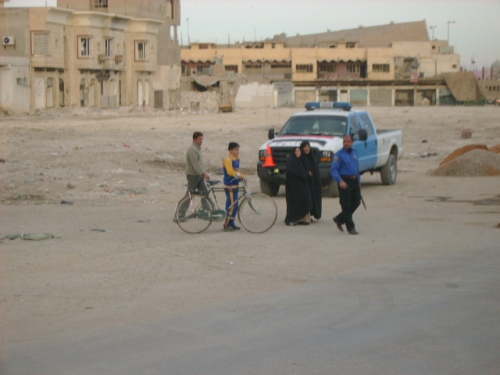
291Iraqi Police in Ramadi Escorting Civilians Across the War Zone of Route Michigan

There are those who believe that all forms of ministry are basically the same and that lessons learned are universally applicable and that somehow all ministries are proclamation oriented.  Unfortunately that is not the case and one of the places that this is true is the Military Chaplain ministry.  This mibnistry is much different than parish or para-church ministries and even different than other institutional ministries such as Police, Fire, Industrial or civilian health care chaplaincy.   It is different in that it is more incarnation versus proclamation. We not only minster to our people but we live among them.  We live the experience of those that we serve, especially in the uncertainly of war and deployments.  Chaplains live in a world where we are fully military officers and fully ministers of our own church or faith tradition. As a chaplain I never lose my calling of being a priest, but I am a priest in uniform, a military professional and go where our nations send me to serve the Sailors, Marines, Soldiers and Airmen who I live among be that overseas, or in the States.

142Always a Priest Eucharist with Advisers in the Far West of Al Anbar

There is always a tension in the military chaplain ministry. This is  especially true when the wars that we are sent to are unpopular at home and seem to drag on without the benefit of a nice clear victory such as VE or VJ Day in World War II or the homecoming after Desert Shield and Desert Storm. There are those that oppose the military chaplaincy on theological or philosophic grounds, usually some manner of absolutist understanding of ministry, church-state relations or social justice considerations.  My purpose is here not to defend military chaplain institutions against such criticism but rather to share the world and tension that military chaplains live in when our nation is engaged in unpopular which some consider unjust or illegal wars.

training team baseIsolated Base Camp for Advisers in Afghanistan

A lot of people have no “ethical” or “moral” qualms about wars that are easy to pigeonhole as just wars, especially if we win quickly and easily.  It is my belief that when things go well and we have easy victories that it is easy for religious people, especially more conservative Christians to give the credit to the Lord for the “victory.”  Unfortunately such “Credit” is given without them ever understanding or sometimes even caring about the human cost of war.   Likewise it is easy for others to give the credit to superior strategy, weaponry or tactics to the point of denying the possibility that God’s involvement.  Conversely and maybe even perversely I have heard some say that God has blessed the use of weapons or tactics that violate principles of fighting a “just war” especially that of proportionality. Such is the case in almost every war and Americans since World War Two have loved the technology of war seeing it as a way to easy and “bloodless” victory. In such an environment ministry can take on an almost “cheer-leading” dimension. It is hard to get around it, because it is a heady experience to be on a winning Army in a popular cause but I do think that many chaplains have a less “cheerleading” approach than many in conservative churches. The challenge for chaplains in such an environment is to keep our ministry of reconciliation in focus. To do so we must care for the least, the lost and the lonely and never forget the victims of war, especially the innocent and the vanquished, as well as our own wounded, killed and their families.

237Iraqi Kids in Al Anbar Province, a couple of months before they could not venture outside because of insurgent attacks, children are never winners in war

We are now seeing the conflict in Iraq winding down and what until this year had been “the good war” in Afghanistan go bad and support for it decline.  Strategy is being debated as how to best “win” the war in Afghanistan even as the United States withdraws from Iraq. The task of chaplains in the current war, and similar wars fought by other nations is different and really doesn’t allow for them to indulge themselves in “cheerleading.” In fact chaplains can themselves through isolation, lack of experience and fear can become more reflective and less “cheerleader” oriented the longer the war goes on without sign of appreciable progress, much less victory.  They feel the onslaught of their soldiers doubts, fears as well as the loss of friends and the chapel congregation through being killed or wounded in action. This  can take a terrible toll even for the most resilient of chaplain. In these wars, sometimes called counter-insurgency operations, revolutionary wars, guerilla wars or peace keeping operations, there is no easily discernible victory. These types of wars can drag on and on, sometimes with no end in sight. Since they are fought by volunteers and professionals, much of the population acts as if there is no war since it does often not affect them, while others oppose the war, all of which can affect the chaplain.

dien_bien_phu paras landingFrench Paratroops Landing at Dien Bien Phu

Chaplains volunteer to go with and place themselves in harms way to care for God’s people in the combat zone or far away from home. While they do this there are supporters of war as well as detractors who have no earthly clue about war or life in the military other then what they see in the media or experienced in peacetime or the cold war. Some supporters often seem more interested in political points of victory for their particular political party than for the welfare of those that are sent to fight the wars. This has been the case in about every war fought by the US since World War II. It is not a new phenomenon. Only the cast members change with the particular war.

legion indo-chinaForeign Legion Troops in Indochina

In order to somehow make sense of going on we cannot simply think of what is politically expedient for either those who support or want to expand the war, or others who want it ended now, both of which have consequences many of which are bad.  I think that we have to look at history and not just to American history to find answers, not simply answers to how to win or end the war but answers to the consequences that either course of action posits. Thus I think that we can find parallels in other militaries. I think particularly of the French professional soldiers, the paratroops, Colonials (Marines) and Foreign Legion who bore the brunt of the fighting in Indo-China. These men, not all of who were French were placed in a difficult situation by their government and alienated from their own people. In particular I think of the Chaplains, all Catholic priests save one Protestant, at the Battle of Dien Bien Phu, the epic defeat of the French forces that sealed the end of their rule in Vietnam. The Chaplains there went in with the Legion and Paras. They endured all that their soldiers went through while ministering the Sacraments and helping to alleviate the suffering of the wounded and dying. Their service is mentioned in nearly every account of the battle. During the campaign which lasted 6 months from November 1953 to May 1954 these men observed most of the major feasts from Advent through the first few weeks of Easter with their soldiers in what one author called “Hell in a Very Small Place.”
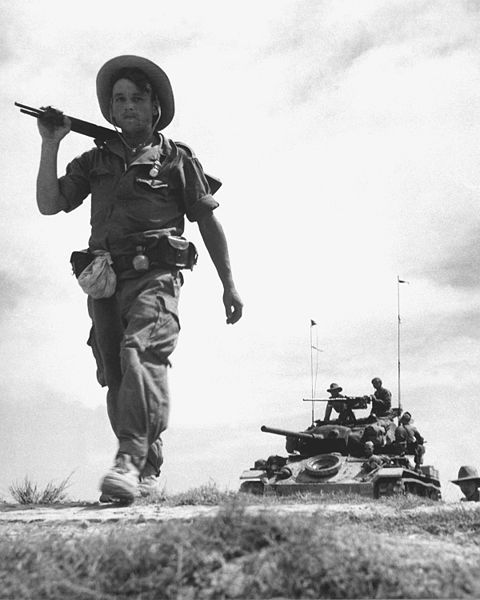
french troops indochinaFrench Troops on the March in Indochina

One author describes Easter 1954: “In all Christendom, in Hanoi Cathedral as in the churches of Europe the first hallelujahs were being sung. At Dienbeinphu, where the men went to confession and communion in little groups, Chaplain Trinquant, who was celebrating Mass in a shelter near the hospital, uttered that cry of liturgical joy with a heart steeped in sadness; it was not victory that was approaching but death.” A battalion commander went to another priest and told him “we are heading toward disaster.” (The Battle of Dienbeinphu, Jules Roy, Carroll and Graf Publishers, New York, 1984 p.239) This can be a terrible burden for the Padre who cares for such men.  Ministry in such places is truly an incarnational experience because there is no place to hide and the chaplain is as vulnerable as his flock.  It is the ministry that places us “in the valley of the shadow of death” where as the Psalmist says we are “to fear no evil for you are with us.” It is the ministry of Good Friday where to all appearances seems that God has abandoned the field and evil has won.

VIETNAM DIEN BIEN PHUFrench Surrender at Dien Bien Phu

Of course one can find examples in American military history such as Bataan, Corregidor, and certain battles of the Korean War to understand that our ministry can bear fruit even in tragic defeat. At Khe Sahn in our Vietnam War we almost experienced a defeat on the order of Dien Bien Phu. It was the tenacity of the Marines and tremendous air-support that kept our forces from being overrun.

legion algeriaLegionaries in Algeria, many French Troops Went from one War in Indochina to another in Algeria only to have the De Gaulle Government throw the Military Victory Away and Cause a Crisis

You probably wonder where I am going with this, back when I first drafted this year and a half ago I wondered too. But here is where I think I am going. We live in difficult of times at home and in Afghanistan.  It home we are mired in an economic crisis clouded by deep political division.  In Afghanistan we are engaged in a hard fight where units we are taking casualties and the mission is being debated.  Sometimes to those deployed and those who returned that their sacrifice is not fully appreciated by a nation absorbed with its own issues.  This of course is not universally true as there a people of all political viewpoints who care for the welfare and attempt to ensure that those who serve are not abandoned as those men who served in Vietnam.  I think that part of the feeling comes from the presentation of the war by the media which tends to focus only on the negative outcomes and not positive things that our soldiers accomplish. That can be discouraging to the men and women on the ground.  One of the most difficult things for me upon my return was to see the bitterness a division in the American people and political establishments and becoming quite depressed about it.   I stopped watching the perpetual news cycle and listening to talk radio.  The hatred, ignorance and crassness of it all was disheartening and I refuse to take any part in something that is so hate filled, power driven and unredemptive.
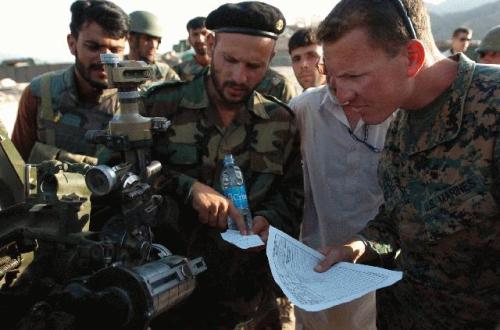
traiining team with afghan armyUSMC Training Team With Afghan Troops

For the French the events and sacrifices of their soldiers during Easter 1954 was page five news in a nation that was more focused on the coming summer. This is very similar to our circumstances today because it often seems that own people are more concerned about economic considerations and the latest in entertainment news than what is going on in Iraq or Afghanistan. The French soldiers in Indo-china were professionals and volunteers, much like our own troops today. Their institutional culture and experience of war was not truly appreciated by their own people.  Nor was it fully appreciated by their government which sent them into a war against an opponent that would sacrifice anything and take as many years as needed to secure their aim.  At the same time their own countrymen were unwilling to make the sacrifices needed to win and in fact had already given up their cause as lost. The sacrifice of French soldiers would be lost on their own people and their experience ignored by the United States when we sent major combat formations to Vietnam in the 1960s. In a way the French professional soldiers of that era have as well as British colonial troops before them have more in common with our force than the citizen soldier heroes of the “Greatest Generation.” Most of the “Greatest Generation” was citizen soldiers who did their service in an epic war and then went home to build a better country as civilians. We are now a professional military fighting unpopular wars and that makes our service just a bit different than those who went before us.  I related to the French troops who fought in Indochina and Algeria as well as our own Vietnam Vets than I do to others.  These is a kinship among us that goes beyond nationality, politics or age.

This is the world in which military chaplains’ minister.  It is a world of volunteers who serve with the highest ideals, men and women who enlist knowing that they will be deployed and quite likely end up in a combat zone. We go where we are sent, even when it is unpopular. It is here that we make our mark; it is here that we serve our Soldiers, Sailors, Marines and Airmen. Our duty is to bring God’s grace, mercy and reconciliation to men and women, and their families who may not see it anywhere else. It is a ministry of reconciliation by the means of incarnation. Many times those outside the military do not understand this. It is a different world full of contradictions and ambiguity.  Such situations even impact the families of those who serve.

When my dad was serving in Vietnam in 1972 I had a Sunday school teacher tell me that he was a “Baby Killer.” It was a Catholic Priest and Navy Chaplain who showed me and my family the love of God when others didn’t. As the country builds to the 2010 mid-term Congressional elections I anticipate that people from all parts of the political spectrum will offer criticism or support to our troops or the war in order to bolster their election chances which do not always coincide with what is in the best interest of the troops or the mission. Chaplains cannot be concerned about the politics nor even the policy as our duty is to be there as Priests, Ministers, Rabbis and Imams for those that we serve. We cannot afford to allow ourselves to be discouraged in caring for our men and women and their families because of all the strife in the body politic.  In addition we must continue on because most churches and other religious communities, even those supportive of our troops really don’t understand the nature of our service or the culture that we represent. We live in a culture where the military professional is in a distinct minority group upholding values of honor, courage, sacrifice and duty which may be foreign or archaic to many Americans, or for those countries with troops and chaplains in Afghanistan or Iraq. We are called to that ministry in victory and if it happens someday, defeat. In such circumstances we must always remain faithful to God as well as to those that we serve.

For those interested in the French campaign in Indo-China it has much to teach us. Good books on the subject include The Last Valley by Martin Windrow, Hell in a Very Small Place by Bernard Fall; The Battle of Dienbeinphu by Jules Roy; and The Battle of Dien Bien Phu- The Battle America Forgot by Howard Simpson. For a history of the whole campaign, read Street Without Joy by Bernard Fall. I always find Fall’s work poignant, he served as a member of the French Resistance in the Second World War and soldier later and then became a journalist covering the Nurnberg Trials and both the French and American wars in Vietnam and was killed by what was then known as a “booby-trap” while covering a platoon of U.S. Marines.

There is a picture that has become quite meaningful to me called the Madonna of Stalingrad. It was drawn by a German chaplain-physician named Kurt Reuber at Stalingrad at Christmas 1942 during that siege. He drew it for the wounded in his field aid station, for most of whom it would be their last Christmas. The priest would die in Soviet captivity and the picture was given to one of the last officers to be evacuated from the doomed garrison. It was drawn on the back of a Soviet map and now hangs in the Kaiser Wilhelm Memorial Church in Berlin where it is displayed with the Cross of Nails from Coventry Cathedral as a symbol of reconciliation. I have had it with me since before I went to Iraq. The words around it say: “Christmas in the Cauldron 1942, Fortress Stalingrad, Light, Life, Love.” I am always touched by it, and it is symbolic of God’s care even in the midst of the worst of war’s suffering and tragedy.

Madonna of StalingradMadonna of Stalingrad

So as you can see I have done a lot of reflecting over the past year and a half. It has been a spiritual journey, an intellectual and academic journey and a personal journey of slowly healing and recovery.  I have gone through some changes in the process which have not been easy, but certainly have deepened my faith even as I struggled and made me much more appreciative of life, love and peace.

I write in order to wrestle with what I have mentioned here, and I try to write something every night. I can full agree with Father Henri Nouwen in his book Beyond the Mirror as to the purpose that writing serves me in my journey.

“These many interruptions calling me ‘beyond’ compelled me to write. First of all, simply because writing seemed to be the only way for me not to lose heart to in the frightening and often devastating interruptions and to hold onto my innermost self while moving from known to unknown places. Writing helped me to remain somewhat focused amid the turmoil and discern the small guiding voice of God’s Spirit in the midst of the cacophony of distracting voices.  But there is a second motivation. Somehow I believed that writing was the one way tom let something of lasting value emerge from the pains and fears of my little, quickly passing life.  Each time life required me to take a new step into unknown spiritual territory, I felt a deep, inner urge to tell my story to others- perhaps as a need for companionship but maybe, too, out of an awareness that my deepest vocation is to be a witness of the glimpses of God I have been allowed to catch.”

pub2Slowly Getting Better

I am healing though it has been at times painful, but faith is returning and I can say that though it has not been easy it has been worth it.  I do hope that what little I do in my work and in my writing will be of help to those who struggle and those who recognize their own need for reconciliation, healing who need to hope again no matter who they are and what their circumstance.

Peace,

Padre Steve+

2 Comments

Filed under Loose thoughts and musings

Going to War: Ministry amid Training

Two years ago my group of Individual Augmentees was leaving Ft Jackson South Carolina on the way to Kuwait, which was our final training site before going on to our assignments in Iraq, Afghanistan, Kuwait and other locations in the CENTCOM Area of Operations.  In the two weeks prior to our departure  we received training in a number of areas, especially weapons which I was exempted from as a Chaplain, though I did fire the crew served weapons for the fun of it.  I wasn’t always a chaplain and have a hard time not enjoying a Mk 19 Automatic Grenade Launcher, M-240 series machine gun or the classic .50 caliber Machine Gun.  Since I used to call in 155mm Artillery fire these are little guns, but still fun to play with.  When you are chaplain and are exempted from actual training it does not mean that it is time to go to the Food Court at the Post Exchange to chow down on Pizza and Ice Cream.  Ministry abounds if you want to go hang out.  One of the fun things about hanging out with Navy guys unfamiliar with small arms is to watch them trying to clean them and get them past an Army armorer in an Arms Room.  To see the looks of shock as my fellow sailors brought back their M-16s and M-9s for more cleaning.  They had not yet learned the dirty little secret that a good armorer can find things dirty on a weapon that you didn’t even know existed.    It was at this point with me calmly pointing out tricks of the trade that a physician who I had gotten to know looked at me and said: “Chaplain, you were in the Army weren’t you?”  He looked at me as several others who had just had their weapons rejected stopped what they were doing and waited for my response.

I was kind; I acknowledged that indeed I had served in the Army and that I was not always a Chaplain.  I then looked at the physician and said “Give me the weapon.”  I took it from him, broke it down and gave a quick lecture on how to clean a weapon of the M-16 series.  The dirty secret on these things is that you almost never get your weapon through the inspector on the first try.  There are more places for carbon to hide on an M-16 than places you can find Waldo.  Thus a good inspector knowing that he has a bunch of novices coming through simply rejects every weapon.  I think that it builds character.  I showed those around me all the little places where carbon was hiding on this officer’s weapon and how to get it clean to pass inspection.  Knowing such things gives you additional “street cred” as a chaplain as you go off to war.  It shows that you care about what your guys have to do enough to teach them.  This is really vital when your Navy or Air force guys are training with the Army.  It opened doors to ministry with these men and women.  So if any of my deploying friends need some pointers on the care and feeding of an M-16 let me know.

Additionally, ministry seems to happen when you stay engaged with people.  I was blessed that two additional chaplains, Commander Kyle Fauntleroy and Command Dave Rodriguez who were heading off to manage the “Warrior Transition” program in Kuwait.  Together we figured out how best to care for our sailors including how we did services as well as counseling.  We had a pretty good amount of business.  It seems that life and tragedy happens even in training. We had a young hospital corpsman who was diagnosed with Leukemia during our first week there. Both the Navy chain of command and Army trainers expected us, in between and after training to make sure that she and her family were cared for.   Other sailors found out that their husbands, wives or significant others were cheating on them.  Still others were hurt in training accidents and could not deploy.  In every case one or more of us took care of the sailor in question.  It was a community of individuals that for a brief two weeks began to gel together despite the fact that when the training was completed we would go separate directions, some for more training at other bases and others directly to the Middle East.

Apart from the young woman with Leukemia the most notable thing that I got to do was baptize a young Navy Reserve Intelligence Officer who had been raised in the Episcopal Church but who’s parents had forgotten to have him baptized…oops.  The subject came up when he became engaged to a Catholic girl. He needed to prove that he was a baptized Christian, only problem when he went to his parish they could find no record.  So he inquired of his parents when he learned of the “oops we should have done that” situation.  I like to baptize people, they way we do it you don’t have to wear hip-waders or make up anything because it is all in the Prayer Book so it’s not that hard.   So I did it on our last Sunday morning with his fiancé present.  It was really cool.  The young officer had the bunk next to me in the barracks so we had gotten to know each other during conversations as we checked or put together equipment, packed gear, washed clothes or went to chow.  He was very smart and friends as well as unassuming.  When asked what he did in civilian life he simply said that he worked intelligence and foreign policy in DC.  I figured as most would infer that the young man was with the CIA or DIA or some other outfit.  We saw each other a couple of times as Nelson and I traveled about Al Anbar Province the last time in the Wal-Mart sized chow hall number three at Al Asad as we waited for a flight out west.  After I returned and was having my PTSD meltdown I found that the young man was then Senator Barak Obama’s senior National security adviser.  We had stayed in touch in the following months but finding out this was a surprise. We have remained in touch and he now serves as Chief of Staff for the National Security Council.  I think it’s cool that he is up there working with General Jones on the NSC.  He’s a good man who despite his high position remains active in the Naval Reserve.  He is doing well in his marriage and remains in contact with guys like me.  It makes me even more prayerful for him as he advises the NSC and President.   It was one of those moments when I knew that the Deity Herself had placed me in a person’s life that due to his office needs prayer more than we can imagine.

Ministry of all types continued to happen our entire time at Fort Jackson, we dealt with family deaths, birth notifications and medical emergencies.  We counseled, prayed and assisted sailors in need and looked out for each other.  Nelson was engaged not only receiving training but also giving it having run something like 400 convoys in Afghanistan.  He ended up as one of the honor graduates and won a leadership award from the Army staff.  It is really great to have an assistant of Nelson’s caliber when you go to war.  As we got ready to leave Ft Jackson my young friend went off for more specific training at another base with many of the other Intelligence Officers and specialists.   Nelson and I packed up our gear, stacked it and helped load trucks which would take us to our flight.

Leave a comment

Filed under iraq,afghanistan, leadership, Military, philosophy, Tour in Iraq