Tag Archives: navy

Selected for Promotion

I received great news today.  I got the call from work that I had been selected for promotion to the rank of Commander in the Navy Chaplain Corps.  I will be posting something about this tomorrow sometime and will also be catching up on my Tides and Orioles news, of which there has been a bunch of.  I had a long and demanding overnight on Monday dealing with number of different issues that kept me up late into the night.  I thank everyone that has been praying for me, encouraging me and caring for me over the years. To my friends that were selected as well I offer my congratulations and to those that did not get selected I offer my support and prayers.  I know many over the years that  have been outstanding officers that were not selected, many for reasons that I cannot fathom to this day and know the pain, isolation and stigma of those that did not get selected is difficult even for the most optimistic.  While I rejoice with those that rejoice I cannot forget those that have served faithfully and honorably that were not selected.

Anyway, tomorrow I shall start catching up. These is much work to be done at work before I take some leave beginning the end of the week. Tonight Judy and I went to Harbor Park where the Tides beat the Lehigh Valley Iron Pigs 9-2.  I have a lot of great pictures from this that will show up on this site when I get around to them.

Blessings my friends and peace<

Padre Steve+

4 Comments

Filed under Military, US Navy

FEP and Shipshape…the Kinder and Gentler Fat Boy Program

Well friends according to the Navy I am officially fat.  I think I mentioned this fact a couple of weeks ago.  So being criminally short and stocky and a bit heavier than I normally am I have been enrolled in the Fitness Enhancement Program or FEP which includes both physical fitness and diet and nutritional awareness.  Until I can get below my weight limit or body fat percentage I am sentenced to have my physical fitness monitored and signed off on by others, have weekly weigh-ins and go to a mandatory fitness and nutritional education program called ship shape.

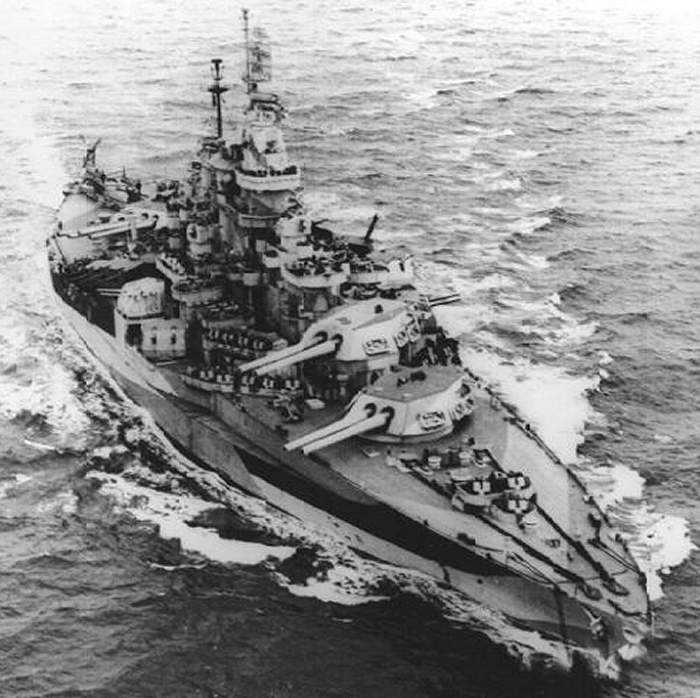
Now, before anyone thinks that I am whining it is my fault that I am in this situation.  When anyone gains 25 pounds in under six months, mainly due to stopping at Krispy Kreme Doughnuts and getting a dozen hot and fresh glazed on the way home from a ball game three or four times a week and devouring 3-6 of them washing them down with a beer.  You combine 1000 to 1500 calories at bedtime while working 60-75 hours a week and not doing any PT with PTSD and chronic insomnia and you, like me will get fat.  Such is not a recipe for success.  As a result I gained weight and could not take it off before the semi-annual weigh in.  The deceptive thing for me is that I have a barrel chest so the waist does not look as wide as someone my height with a wimpy little sunken chest.  I am kind of build like a pre-World War Two American Battleship.

This was the first time in 28 years in the military that I was officially on what back in the day was known as the “Fat Boy” program. I have always made weight and my scores on the Navy and the Marine Corps Physical Fitness tests have been very good, in fact damn good.  Until this fall I have consistently scored at the  Outstanding level for the Navy and Class One Marine PT.  After the debacle of the summer I was overweight and only scored an “Excellent Low” on my Navy PT test, which really wasn’t bad because I only did three workouts between April and November.  My “out of shape” is better than a lot of people who work their ass off to pass the PT test.  Just a couple of years ago I was running half-marathons. The fact that I blew it this time actually pisses me off and I don’t blame the Navy for it but myself.  I hate to lose and hate to fail anything.  It sucks like a Hoover.

Now I got myself into this mess and will get myself out of it before the next PT cycle.  However I have found that being on the program is somewhat like being a criminal.  Even though I did well on the PT test I have to make sure that my PT sessions are signed off on by certain people, like on a piece of paper that is turned in at the end of the week. In addition there is a weekly weigh-in and body fat measurement.  This week I both lost weight and body fat.  Good for me.  Not enough yet but by the time I am done with this Mickey Mouse program I am going to look like fricking Arnold.  My PT and diet and nutrition are back to what they were before Iraq.

Those on the program get to participate in other fun reindeer games.  First every month we get to do a mock PT test, complete with weigh-in and body fat measurement.  I did better than my last PT test and it was ironic that I did better than almost everyone and even finished second on the run portion of the test did 90 sit ups and was a bit low, only 42 push-ups when I normally do 70-80 of them.  Since I am a good 10-25 years older than most of the people on the program with me I think that is impressive.  However as a 49 and nearly 50 year old man I am treated like a child by the system.  I understand why this is the case because there are a good number of people who will try to skate by, but it isn’t any fun.  In  fact the fitness standards that I am held to now are actually higher than when I first entered the military as a 21 year old back in 1981.  This isn’t a game for old men but I am still in the game.

My diet is back on track, I am getting some really good and diverse PT including classes on bicycle spinning and body shaping led by a young woman who kicks ass, she drives hard and very demanding sessions and I like it.  I also am running again and feeling good with it.  My times and distance are not yet where I want them but they will get better, Lord willing and the creek don’t rise.

As if all of this is not bad enough if you are over the body fat you go into a mandatory 8 week, tow hour a week program called “shipshape.”  Now when one looks at ships and me one knows that I will never be a destroyer.  I am shipshape, but more like the USS West Virginia following her post-Pearl Harbor rebuild.  I am short, squat, a bit heavy, not as fast as I used to be, but still powerful and able to kick the ass of anyone that I would have to.

The USS West Virginia BB-48…Like Me was “Shipshape”

So, that is my rant.  I will kick this in the ass, lose the weight, lose the body fat and have myself up to the Outstanding level again in the next few months and hopefully well before the next PT/Weigh-in cycle.  I am back in the groove on this and hopefully will be able to help encourage and inspire my fellow sailors who are on the program either due to weight, body fat, or physical fitness test failure.

Anyway….I need to crash for the night so I can try to catch the early spinning class.

Peace,

Padre Steve+

9 Comments

Filed under Military

Veteran’s Day: Goodbye to 666 Lake of Fire Circle, a Golf Outing and Remembering the Veterans in my Life

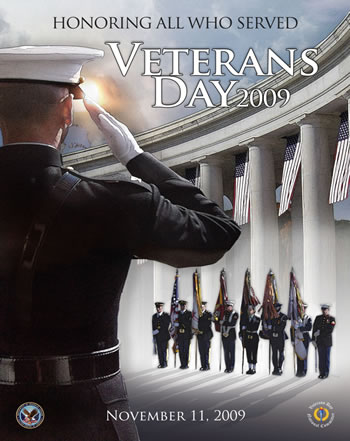
veteransday2009

Today was Veteran’s Day. Amid the solemnity of the day I am still in California where I came this week to try to help my mom with my dad’s affairs and to also see my dad who is definitely in the end stages of Alzheimer’s disease.  This has been the hardest trip home in my life.  I knew I had to come, although the Abbess was against it fearing for my emotional health and perhaps she was right.  Tonight I sit in a hotel room self medicating and trying to regain some sense of sanity.

Me and last last picDad and Me back in May…He Still knew Me then

The past few days have been hell.  My dad does not know me anymore; he has almost no response to anything and stares straight ahead.  The hardest part is when I realized that he didn’t know me.  So I asked if he had seen my mother who I had taken to visit him the day before and my brother.  He said that he had seen them, and even seen my mom the morning I asked him the question.  However she had not been there that day.  So I asked if “Steve had visited yesterday.”  He got agitated and said “I don’t know any Steve yesterday.”  Today was much the same, I asked if he knew who Steve was, and he said “yes” and I asked if he had seen him and he said “no he hasn’t been here.”  This whole trip he has probably spoken under 50 words in 4 visits.  There is nothing left. For all practical purposes he is dead in a body that won’t die.  If that was not bad enough my mother has not skipped any opportunity to attack and pick at me until I broke.  I begged her to lay off, told her that I was not up to fighting with her and tried to keep my cool but she wouldn’t let up.   I cannot deal with constant conflict and a mother who calls me “a weak, politically correct pansy.”  I’m a combat veteran and went to war unarmed into hostile territory with little groups of Americans far away from the big battalions with all the heavy weapons and the women called me a “weak, politically correct pansy.  She has put me down, belittled my education, vocation and career and insulted my wife for the last time. When I told her that “everything in her life that was wrong was somebody else’s fault and not hers” she agreed.  I knew it was over at that point. This may sound un-Christian but I will not go see her again.   Tomorrow I will see my dad for what it is worth, see my brother and his family and then early Friday I will get the hell out of Dodge.  She had offered to pay for my trip out but I can’t prostitute myself for that kind of abuse.    The next time I come back it will be for my father’s funeral.  I love my brother and his family.  He and his wife are saints.  I couldn’t live that near my mother without ending up in a psychotic state, something that I came perilously close to this week.  God bless Jeff, Mel and their kids.

Me and Jeff at mickey groveWith my Brother back in May

I went golfing with my brother and nephews today.  For much of the day I couldn’t hit water if I fell out of the damned boat.  My mind was so gooned up and upset by the events of the week I couldn’t concentrate worth a shit.  Even my well hit shots were mainly slicing to the right and I embarked on a tree killing expedition.  I hit 7 trees solidly, took down a couple of decent sized branches, grazed three other trees and nailed an outhouse.  However it was really good to be out with Jeff, Darren and Nate.  Nate can really hit the ball for an 8 year old; he has the potential to be a really good golfer.  Darren doesn’t really care and is out to have fun.  He enjoyed my sarcasm as I commented on my shots and helped keep track of the number of trees that I hit and I told him that I would see how many I could try to kill before the day was out.  By the end of the round I was hitting the ball a lot better and it was going more often than not where I wanted it to go, but the first 7 holes were hell.  It makes me think of Robin Williams’ golf routine. http://www.youtube.com/watch?v=xDQd49rEF_0

As I mentioned today was Veteran’s day.  After I got my hotel I went to a local Applebee’s where I had a sirloin steak and potatoes and a couple beers on their Veterans’ day salute.  I sat at the bar with a couple about 10 years older than me; he had served on a Navy Minesweeper in Vietnam.  They were nice; I think that is why I like sitting at the bar when I go out to eat, there is a sense of community that you don’t find a lot of other places.

As it is Veteran’s day I think I will take some time to remember some of the Veterans in my life who have helped my through my life and career.  This is taken from a post that I did around Memorial Day.

I’ve been in the military for almost 28 years now.  I enlisted in the National Guard while in college and entered Army ROTC back in 1981.  Since then it has been to quote Jerry Garcia “a long strange trip.”  My dad served twenty years in the Navy.  He retired in 1974 as a Chief Petty Officer and did time surrounded in the South Vietnamese city of An Loc when it was surrounded by the North Vietnamese for 80 days in 1972.  He didn’t talk about it much when he came back; in fact he came back different from the war.  He probably suffered from PTSD.  All the markers were there but we had no idea about it back then, after all he was in the Navy not the Army.

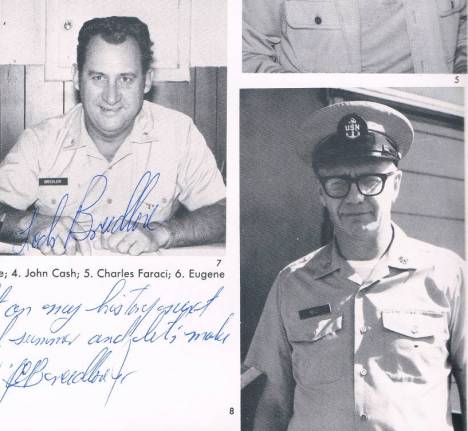
breedlove-ness2LCDR Breedlove and Chief Ness

My second view of war came from the Veterans of Vietnam that I served with in the National Guard and the Army.  Some of these men served as teachers and mentors.  LCDR Jim Breedlove and Senior Chief John Ness at the Edison High School Naval Junior ROTC program were the first who helped me along. They have both passed away in the past year and a half.  I will never forget them.  A post dedicated to them is on this blog. Colonel Edgar Morrison was my first battalion commander.  He was the most highly decorated member of the California National Guard at that time and had served multiple tours in Vietnam.  He encouraged me as a young specialist and officer cadet and showed a tremendous amount of care for his soldiers.  Staff Sergeant’s Buff Rambo and Mickey Yarro taught me the ropes as a forward observer and shared many of their Vietnam experiences. Buff had been a Marine dog handler on the DMZ and Mickey a Forward Observer.  Sergeant First Class Harry Zilkan was my training NCO at the UCLA Army ROTC program.  He was a Special Forces Medic with 7th Group in Vietnam.  He still had part of a VC bayonet embedded in his foot.  He received my first salute as a newly commissioned Second Lieutenant as well as a Silver Dollar.  I understand that after the Army he became a fire fighter.  He had a massive heart attack on the scene of a fire and died a few years later from it.  Sergeant Major John Butler was our senior enlisted at UCLA.  He served with the 173rd Airborne in Vietnam.  Sergeant First Class Harry Ball was my drill sergeant at the ROTC pre-commissioning camp at Fort Lewis Washington in 1982.  He was also Special Forces and a Ranger and served multiple tours in Vietnam.  He was quite influential in my life, tearing me apart and then building me back up.  He was my version of Drill Sergeant Foley in An Officer and a Gentleman. Like Zack Mayo played by Richard Gere in the movie I can only say: Drill Sergeant “I will never forget you.”

As I progressed through my Army career I encountered others of this generation who also impacted my life. First among them was First Sergeant Jim Koenig who had been a Ranger in the Mekong Delta.  I was the First Sergeant that I would measure all others by.  Once during a ARTEP we were aggressed and all of a sudden he was back in the Delta. This man cared so much for his young soldiers in the 557th Medical Company.   He did so much for them and I’m sure that those who served with him can attest to this as well as me. Jim had a brick on his desk so that when he got pissed he could chew on it.   He was great.  He played guitar for the troops and had a song called Jane Fonda, Jane Fonda You Communist Slut. It was a classic.  He retired after he was selected to be a Command Sergeant Major because he valued his wife and family more than the promotion.  It hurt him to do this, but he put them first. Colonel Donald Johnson was the commander of the 68th Medical Group when I got to Germany in January 1984.  Colonel “J” as well all called him was one of the best leaders I have seen in 28 years in the military.  He knew everything about everything and his knowledge forced us all to learn and be better officers and NCOs.  On an inspection visit you could always find him dressed in coveralls and underneath a truck verifying the maintenance done on it.  He served a number of Vietnam tours.  He died a few years back of Multiple Myeloma and is buried at Arlington.  Chaplain (LTC) Rich Whaley who had served as a company commander in Vietnam on more than one occasion saved my young ass at the Army Chaplain School.  He remains a friend and is the Endorsing Agent for the Church of Jesus Christ of Latter Day Saints. As a Mormon he was one of the most “Christian” men that I have ever met.  I know some Christians who might have a hard time with that, but Rich demonstrated every trait of a Christian who loved God and his neighbor.

MVC-023SMe with Major General Frank Smoker USAF (Ret) and Colonel Tom Allmon 2005

When I was the Installation Chaplain at Fort Indiantown Gap PA I was blessed to have some great veterans in my Chapel Parish.  Major General Frank Smoker flew 25 missions as a B-17 pilot over Germany during the height of the air war in Europe. He brought his wonderful wife Kate back from England with him.  Henry Boyd who I buried was one of the 101st Airborne soldiers epitomized in Band of Brothers. He had a piece of shrapnel lodged next to his heart from the Battle of the Bulge until the day he died. Scotty Jenkes was an Air Force pilot in Vietnam flying close air support. Colonel Ray Hawthorne served several tours both in artillery units and as an adviser in 1972.  CWO4 Charlie Kosko flew helicopters in Vietnam.  All these men made a deep impact on me and several contributed to my career in very tangible ways.

051Ray and his Crew from The Vietnam Veterans of America at Harbor Park

My life more recently has been impacted by others.  My friends of the veterans of the Battle of Hue City including General Peter Pace, Barney Barnes,  Tony “Limey Cartilage ” Sergeant Major Thomas and so many others have become close over the years, especially after I did my time in Iraq. They and all the Vietnam vets, including the guys from the Vietnam Veterans of America like Ray and John who man the beer stand behind the plate at Harbor Park all mean a lot to me.  My friends at Marine Security Forces Colonel Mike Paulovich and Sergeant Major Kim Davis mean more than almost any people in the world.  We traveled the globe together visiting our Marines.  Both of these men are heroes to me as well as friends.

boarding teamUSS HUE CITY Boarding Team 2002

Finally there are my friends and brothers that I have served with at sea on USS HUE CITY during Operation Enduring Freedom and the advisers on the ground in Al Anbar mean more than anything to me. Perhaps the most important is my RP, RP2 Nelson Lebron who helped keep me safe and accompanied me all over the battlefield.  Nelson who has done Iraq 3 times, Afghanistan, Lebanon and the Balkans is a hero.  The men and women of Navy EOD who I served with from 2006-2008 have paid dearly in combating IEDs and other explosive devices used against us in Iraq and Afghanistan are heroes too.  There is no routine mission for EOD technicians.

307With 1st Brigade 1st Iraqi Division Advisers in East Ramadi January 2008

I give thanks for all them men that I mention in this post, especially my dad. God bless all of you guys. Please honor the Veterans that you know not only on Memorial Day or Veterans’ Day but every day.   Honor also those who gave their lives in the defense of liberty in all of the wars of our nation. They have earned it.

Today as I write many of my friends serve in harm’s way.  I hope that my recovery, spiritually, emotionally and physically goes well enough that I can go back with them.  For now I need to recover. My boss is right about that, if this week is any indication I’m in no shape to go back to a combat zone, bit Lord willing I will be so I can be with those I care for and serve alongside.

Peace,

Padre Steve+

Post Script: I do pray that no one takes offense at my words regarding my dealings with my mother. If someone thinks that I am wrong, or out of line they can contact me privately.  However, I have to protect me now.  I can’t help her or save her so I’m done.

12 Comments

Filed under alzheimer's disease, golf, iraq,afghanistan, Military, PTSD

A Navy Brat Grows Up…Sort of

NJROTC USS Gray 1978Edison NJROTC on USS Gray FF-1054

I grew up in a Navy family. I was born in a Navy hospital, and my brother was baptized in a Navy Chapel. I went to 6 elementary schools in three states in 6 years. As a result I learned to adapt to change, make friends and at an early age, move on when we moved to our next duty station. I have to admit I rather enjoyed the life.  I think that Navy Brats and other military brats either love it or hate it.  I haven’t seen a lot of in-between reactions; those that love it seem to keep coming back for more.  That was me.

We grew up in the anti-military maelstrom of the 1960s and 1970s. A Sunday school teacher told me that my dad was a baby killer when he was in Vietnam.  It was a Roman Catholic Navy Chaplain that helped me keep some faith in God, and it is to him I owe my vocation as a priest and chaplain.

constitution-poster-lgThis Recruiting Poster was My Favorite

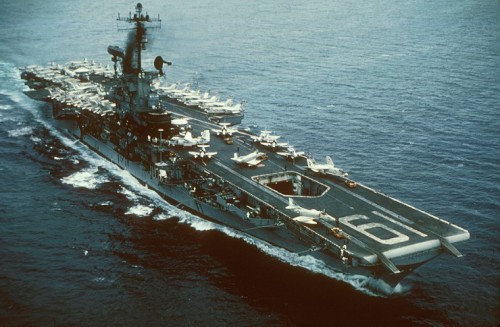
When Dad retired from the Navy I was not happy because I wasn’t ready for the adventure to end. I liked the new places, people and travel. Dad was really good about making sure that we got to experience something unique everywhere we went, from Corregidor in the Philippines, the outdoor life of the Puget Sound, Major League Baseball in California, and Hockey. Disneyland and Knott’s Berry Farm were regular attractions in Southern California. From Dad, presents from the Far East including a 10 speed bike and a pachinko machine for me.  When we visited dad at work in the squadrons or ships that he served on I was in awe.  The summer of 2008 I made a trip to Charleston South Carolina and went aboard the USS Yorktown (CV-10, CVS-11), a sister ship of dad’s last ship the USS Hancock (CV-19, CVA-19).  The trip came a few months after my return from Iraq and as I went aboard my mind was taken back to visits to the Hancock and the wonder I had waling up the brow and through the hangar deck as 11 to 14 year old.  After Yorktown I went to the USS Laffey a Allen M Sumner class destroyer.  On the Laffey there was a display of a DASH helicopter.  The DASH program was way ahead of its time; it was a drone anti-submarine helicopter that could be flown off of smaller ships with small flight decks such as the modernized WWII era destroyers.  My dad worked a number of years in that program.  It was a primitive rotary wing UAV.  It is amazing how memories come back when you see, touch and smell old ships.

hancockUSS Hancock CVA-19, my dad’s last ship

They were good times. We took trips across country by train to visit family in the days before Amtrak, riding every major route from the West Coast to Chicago, the Great Northern-Burlington Northern “Empire Builder,” the Western Pacific “Zephyr” Southern Pacific “Daylight”, Santa Fe “Super Chief” and “El Capitan.” As we were coming home from the Philippines on a Military Transport ship, the USS John C Breckenridge, we were allowed to explore the ship and for the first time I got a sense of the sea.  Something about that voyage caused me to love the sea and ships. Growing up we were allowed to take risks, we had the chance to succeed, but also to learn about life by occasionally failing.  When dad was deployed mom took on the burden of caring for us.  That was difficult for her, but she did well.  The Navy wife and mother actually is a harder job than the deployed sailor.

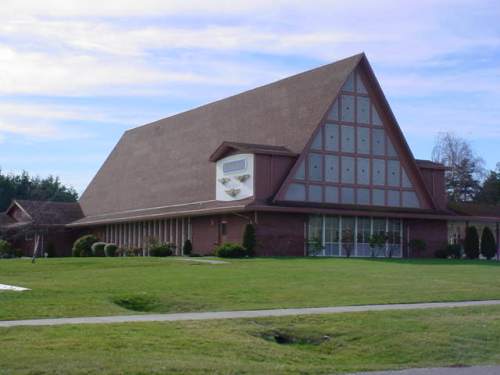
NAS ChapelChapel at Whidbey Island Naval Air Station where My Brother was Baptized

There is something about being a Navy “brat.” I have been blessed to see our best friends’ boys, Jack and Alex grow up. We’ve known them since they were 4 and 8, respectively and now they are 17 and 13, or something like that. They have great senses of humor and are great to be around. Like me, the life of being a Navy brat is all they know. My first memories of being a Navy brat begin with living in the Philippines. Their dad’s first Navy assignment was in Guantanamo Bay, Cuba. Jack may remember life before the Navy, but Alex is too young to remember anything but the Navy.

Deception Pass BridgeDecption Pass Bridge

My life has remained closely tied to the military. After dad retired I did three years of Navy Junior ROTC in High School getting to travel up and down the West Coast and to Hawaii aboard 6 different ships for about 70 days at sea. My parents hoped beyond hope that I would settle down, but I was not deterred. I joined the Army National Guard just prior to entering the UCLA Army ROTC program. I didn’t do the Navy because my fiancée, now my wife Judy, said that she would not marry me if I joined the Navy. Her oldest sister’s husband was on a ship during Viet Nam and was never home. Judy witnessed the pain and hardship her sister went through, and then a couple of decades later, her other sister married navy men while she herself was in the Navy.

Our Old House 186 Queets StOur Old House in Oak Harbor 37 years later

So I spent 17 and a half years in the active Army, National Guard and Reserves before finally getting the chance to come in the Navy in February 1999, as I turned in my gold Army Major’s oak leaf for the twin bars of a Navy Lieutenant. Judy wasn’t happy at first, because she had been looking forward to me retiring from the Army Reserve so we would no longer have so many separations. Judy was also less than thrilled because remembering her words about the Navy when we were dating, I didn’t consult her. I just signed on the dotted line. It took her a while to come to terms with this decision. I’ve also learned not to make major decisions without consulting her.  Oh well…It has all been good, she is the love of my life, and somehow she has survived 26 years of marriage with me.  Since I can be a bit of a pain in the ass this has been no easy feat for her.

My brother Jeff was born in 1966 too late for so of the adventurous tours, but not too late to see dad deployed or away from home a pretty good amount of his life.  I’m pretty sure that Jeff was pretty happy that dad retired.  As a little kid from the time he could remember anything dad was gone close to half of his life.  At the same time with dad away I grew to be pretty independent.  So when dad came back I was doing my own thing and my brother was growing into the time when he and dad would become close as I moved away.  Strange how that happens… he needed a place to be home and he has found it in the town that my dad retired from the Navy back in 1974.  I needed to explore and haven’t stopped exploring.  In a sense I love what I do so much that I am like a little kid about it.

FWU Crete 2002Underway on USS HUE CITY: The Navy Brat all Grown up but not

I now serve at Portsmouth Naval Medical Center. Often in the ICU I have patients who are about my parents’ age facing major health crises and sometimes end of life issues. Their kids are often my contemporaries. We have shared a similar life and cultural experience as Navy “Brats” of our era. It is interesting to compare what we have been through, the places we have been, what we have seen and done and how life was a Navy brat.  There is a kinship that I have with these families that transcends the here and now, something almost mystical that binds Navy families together. I have no idea when this grand adventure will end, but one thing is for sure, and for this I will always be grateful, to be a Navy Brat.

Peace, Steve+

Leave a comment

Filed under Loose thoughts and musings

The most dangerous assignment: 4 More Advisers Die In Afghanistan

training team baseIsolated Embedded Training Team Base

Once know and relatively unglamorous group of American military men have suffered multiple casualties in a single engagement.  These men belong to are small units that do not have a lot of organic firepower.  They usually operate in remote areas far from immediate assistance if they get in trouble.  When one of these units suffers casualties, especially where they lose 3-5 men in one engagement they might have lost 20-25% of their unit.

On September 8th a team of these men was ambushed while on foot going to an Afghan with Afghan soldiers to meet tribal leaders with the intent of establishing a government presence in a hostile area.  In the ambush four were killed, three U.S. Marines and one U.S. Navy Hospital Corpsman attached to them.  On Tuesday the 8th Gunnery Sgt. Edwin W. Johnson Jr., 31, of Columbus, Ga., 1st Lt. Michael E. Johnson, 25, of Virginia Beach, Va., Staff Sgt. Aaron M. Kenefick, 30, of Roswell, Ga. and Petty Officer 3rd Class James R. Layton, 22, of Riverbank, Calif., were while working as trainers to Afghan soldiers on a mission to search for weapons and then meet village elders under an agreement to establish government authority there.  They were killed in “a complex attack according to a U.S. Military spokesman.  According to McClatchy news service who had a reporter that accompanied the mission, insurgents had set up positions in the village and in the mountains on both sides and apparently attacked as the men neared the village. 1st LT Johnson was wounded and while being attended Navy Hospital Corpsman Third Class James R. Layton when they both came under attack.  Both were killed.  Another Marine told the McClatchy reporter that they’d found the wrappings of bandages and other medical gear strewn around Layton and Johnson.  Eight Afghan troops and police and the Marine commander’s Afghan interpreter also died in the ambush and the subsequent battle that raged from dawn until 2 p.m. around the remote hamlet of Ganjgal in eastern Kunar province, close to the Pakistan border.
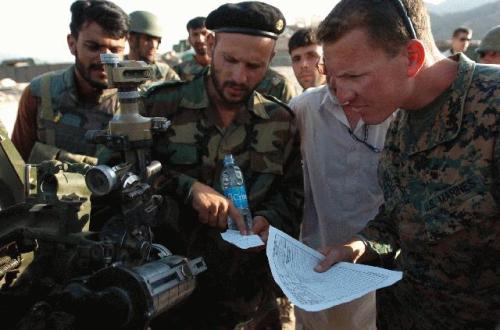
traiining team with afghan armyUSMC Advisers with Afghan Counterparts

The McClatchy reporter said: “We walked into a trap, a killing zone of relentless gunfire and rocket barrages from Afghan insurgents hidden in the mountainsides and in a fortress-like village where women and children were replenishing their ammunition.”  The reporter said that “U.S. commanders, citing new rules to avoid civilian casualties, rejected repeated calls to unleash artillery rounds at attackers dug into the slopes and tree lines — despite being told repeatedly that they weren’t near the village.”

The battle must have been intense.  I have been on foot patrols in areas crowded with Iraqis far away from significant support where if an insurgent group had attacked us we would have easily been overwhelmed. This is part of the world of the U.S. Military in the embedded training teams which work closely with Afghan and Iraqi soldiers.  I spent a lot of time with the advisers to Iraqi Army. Border and Port of Entry troops, Police and Highway Patrol spread across the entirety of Al Anbar Province.  These men and women are seldom thought of or mentioned by the press or even the military. . They come from all branches of the military and serve as advisers, trainers and mentors to these nations’ security forces.  The duty is dangerous.  The advisers, be they to the military, police, or civil administrations often work in the most isolated places in these countries and are stationed in small teams with the Iraqis and Afghans that they advise.  They are often far from the “big battalions” that have lots of firepower available and often operate out of larger and more secure bases with air support close at hand. Earlier in the year there were a number of incidents where advisers were killed by renegade soldiers or police, or by infiltrators posing as security personnel.  Two soldiers were working with an Iraqi unit in doing humanitarian work in a village when attacked and killed by someone who had infiltrated the Iraqi security forces.  . On March 27th Navy LT Florence Choe and LTJG Francis Toner IV were killed by an Afghan insurgent posing as an Afghan Army soldier. All of these events triggered anxiety in me as I remembered how many times I was incredibly exposed to danger conducting similar operations.

This incident was especially chilling as I read the reporter’s account of the ambush.  “Dashing from boulder to boulder, diving into trenches and ducking behind stone walls as the insurgents maneuvered to outflank us, we waited more than an hour for U.S. helicopters to arrive, despite earlier assurances that air cover would be five minutes away.”  According to the reporter Marine Maj. Kevin Williams” the commander of the team said: “We are pinned down. We are running low on ammo. We have no air. We’ve lost today, through his translator to his Afghan counterpart, responding to the latter’s repeated demands for helicopters.”  When I read this my mind flashed back to being in the middle of a massive crowd at the border crossing of Waleed on the Iraqi-Jordanian border.  There were about nine of us, of which only 8 were armed as I am not allowed by the U.S. interpretation of the law of war to carry a weapon.  There were thousands of Iraqis and others around us, very few border troops or port-of-entry police anywhere near us.  The port of entry had been the scene of numerous attempts to smuggle weapons, materials, and other supplies, drugs and to Iraq insurgents and Al Qaida.  Very few US troops were stationed there and many of these were dispatched off of the base at any given time.

The advisers are drawn from all services.  They are all Individual Augments that come from both the Active and Reserve components.  They do not deploy with their own units, which means that they go to war with people that they might have trained alongside getting ready for the mission, but otherwise have not served with.  When they come home they go back to their old assignments or new orders and are separated from the men and women that they served alongside for 7 to 15 months.  In other words they are isolated when they return home and go back to places where the majority of personnel, even those who have been “in country” have no earthly idea or appreciation of the conditions that they served in and dangers that they faced.  This happened to me when I returned and I went through an emotional collapse as the PTSD that I did not know I had kicked my ass.  Sights, smells, noises, crowds, airports and in fact almost everything but baseball diamonds caused me to melt down as they all brought the danger back to me. Don’t get me wrong, my tour in Iraq was the highlight of 27 plus years in the military, the part of which I am the most proud.

I have a special place for these men and women.  I served with them in Iraq’s Al Anbar Province as the first Navy Chaplain, and one of the first chaplains of any service to be assigned to cover these teams since Vietnam.  My assistant, RP2 Nelson Lebron and I deployed together from out unit.  I had prepared well.  I had been on the bubble to deploy for months.  My background in military history and past service with both the Army and Marines helped me. Likewise my military and civilian education helped me.  Shortly before we were notified of the deployment I went to the Jordanian Army Peace Operations Training Center course on Iraqi culture, religion and society.  I had served as a chaplain in the trauma department of one of the largest trauma centers in the country.  RP2 Lebron had deployed multiple times to Iraq, Beirut and Afghanistan where he was awarded the Defense Meritorious Service Medal (no small feat for an E-5).  He is also an incredibly gifted boxer, kick boxer and martial artist who has fought on Team USA and holds more title belts than I can count.  He most recently won the Arnold Schwarzenegger Classic. I had served with him before and he knew that his mission was to keep me safe.  I don’t want to sound arrogant, but the Chief of Staff of the Iraq Assistance Group said that we were “the best ministry team he had seen in 28 years in the Army.”

When we went to Al Anbar we were sent out with the Marines and Soldiers advising the 1st and 7th Iraqi Army Divisions, The Iraqi Police, Highway Patrol, the 2nd Border Forces Brigade and Port of Entry Police.  We operated in a area the size of the state of Oregon.  In some cases it would take us 2 days by air and convoy to reach isolated teams on the Syrian border.  When you travel by air in Iraq you are always at the mercy of the weather and aircraft availability. I had the rare privilege as a Lieutenant Commander to be able to arrange all of my own air transportation.  Most people, including people higher ranking than me had to depend on others to do this for them.  We worked with our advisers to get out to them.  We would be out 5-12 days at a time with anywhere from 4 to 7 days between missions.  In our 7 months we traveled over 4500 air miles and 1500 ground miles.  Almost all of our air travel was rotor wing. We flew in CH-46, CH-47 and MH-53s and the MV-22 Osprey.  Our convoys were usually not larger than 3 American HUMMVs and sometimes a few Iraqi vehicles.  Our biggest guns were .50 cal or M240B machine guns.
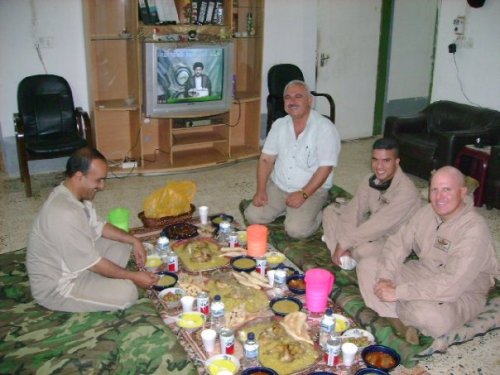
Dinner with Geneal SabahDinner with General Sabah in Ramadi

Many places we served were in places that had no large forces in position to help us if we got in trouble.  Even on the bases we were isolated.  Our teams were with the Iraqis in almost all cases.  We often ate in Iraqi chow halls and used Iraqi shower trailers.  Our advisers had us meeting their Iraqi counterparts.  We met and dined with Iraqi Generals, had ch’ai (tea) with small groups of Americans and Iraqis and got out with the Bedouins. We were in a number of particularly sensitive and dangerous situations with our advisers; one which I cannot go into great detail involved a senior advisor having to inform a new Iraqi Brigade Commander that a member of his staff was engaged in illegal activities and who had put out contracts to kill the American officer.  The bad Iraqi officer was confronted and relieved in a tense meeting where both Nelson and I were with that Colonel and two other advisors as they made the confrontation in the Iraq C.O.’s office, a confrontation that got quite heated until the Iraqi C.O. shut him up. At one point the cashiered officer appealed to the American “Imam” that he was a faithful Moslem, to whit the American Colonel and I asked him how a person who was living a good Moslem life could steal from his own countrymen and supply his county’s enemies with what they needed.
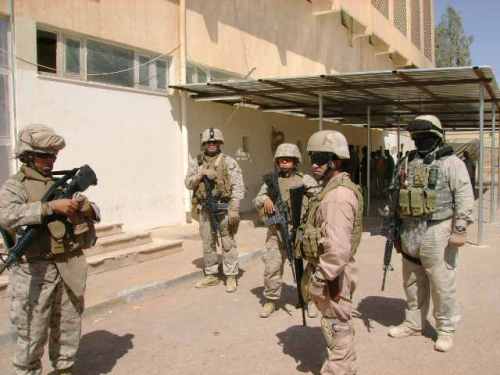
Waleed trip 006Team at Waleed on the “secure” side of the Port of Entry

It was an incredible, once in a lifetime tour serving with some of the greatest Americans and Iraqis around. Iraqi soldiers in with our convoys would ask me to bless their trucks with Holy Water like I was doing with the American trucks.  I came to admire many of the professional Iraqi officers that I came to know and pray for the people of Iraq, that God would grant them peace. They are wonderfully hospitable and gracious.  We were often treated to food and tea by Iraqi soldiers, and civilians.  After nearly 30 years of nearly continuous war, dictatorship and terrorism, they deserve peace and security.
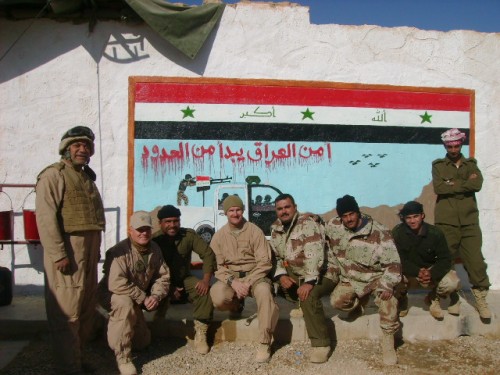
Me BTT CO and Iraqi LeadersAdvisers and Iraqi Border Troops near Syria

I had one Iraqi operations officer, a Sunni Muslim tell me that he wished that his Army had Christian priests because they would take care of his soldiers and had no political axe to grind. He said that the Army did not trust most Imams or Mullahs because they had compromised themselves during the civil war.  Another officer, a Shia Muslim came to me to thank me for being there to take care of our Marines.  He said that he, an Iraqi Shia Arab, hoped that if they had any problems from the Persians (Iranians), that we would help them.  These is little truth to what is floated that Iraqi and Iranian Shia like each other.  The memories of the past die hard in the Middle East.  When Persia ruled Iraq they treated the Arabs like dirt. Likewise the memories of the Iran-Iraq war are still alive.  Iraqi Arabs, Sunni, Shia and even Christian have little love for the “Persians.”  General Sabah of the 7th Division had us to his quarters for dinner. We had a wonderful and friendly discussion about similarities and differences in Christianity and Islam. We departed friends. The last time I saw him ws in the Ramadi heliport.  He saw me, ran up to me in from of his staff and Americans in the little terminal and gave me a bear hug, telling all that I was his friend. Another Iraqi General told me just before we left to come back as a tourist in 5 years because everything would be better.  I honestly think that he is right.  I hope to go back someday.  It would be a privilege to see my Iraqi friends again.
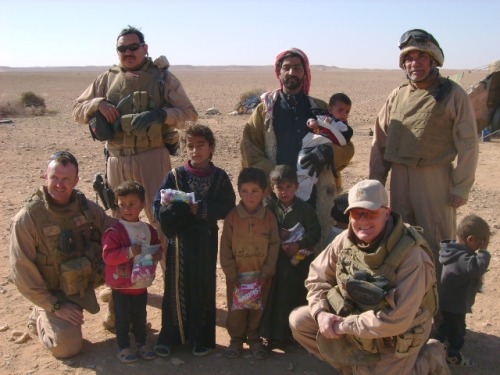
Me and BTT with Bedouin KidsWith a Bedouin Family

At the same time Afghanistan is a different animal. Iraq was not as easy of place for Al Qaida to work in and the Iraqis have a much more developed national identity which they trace back to the Babylonians and Chaldeans.  They also have adopted a lot of western ways.  Insurgents there once they had lost the confidence of the Iraqis lost traction.  In Afghanistan there is no real collective national identity and the form of Islam is much more severe than almost all Iraqi variants.  The Afghans insurgents have also due to the terrain; climate and inability of invaders to gain the confidence of the population have used the inability of invaders against them as they bring the population back under their control, sometimes quite peacefully.  The Taliban have secure bases on the Pakistani side of the border as did the North Vietnamese and they have the support of much of the population due to the unpopularity and corruption of the Afghan government.  The Taliban have begun to operate in larger better organized units and last year a battalion sized element attempted to overrun a small NATO base.  They did this with the Russians as well.  One troubling comment was reported about something overhead on the Taliban radio: “We will do to you what we did to the Russians,” the insurgent’s leader boasted over the radio, referring to the failure of Soviet troops to capture Ganjgal during the 1979-89 Soviet occupation.”  They also have outlasted or defeated a host of powerful empires.  The war in Afghanistan has much more in common with Vietnam than it does with Iraq. Counter Insurgency techniques learned in Iraq will be helpful but because of the terrain, climate and nature of the opposition will be tougher to execute and in order to have any chance of getting out of Afghanistan having accomplished the mission we will end of taking more casualties, especially in the teams of advisers.  Iraq was different, despite the problems and having to be rebuilt the Iraqi Army has a long history and tradition dating back to the Ottoman Empire, they led the way to westernizing Iraq and helping build an Iraqi identity, this is not the case in Afghanistan.  What happened to this team could easily happen to others and it looks to me like someone set them up to be hit, probably a Taliban sympathizer in the Afghan security forces or government. Afghanistan is much more treacherous than Iraq and in my view will be much more difficult.

What happened at Ganjgal is being investigated and in our area it is front page news as 1st Lt Johnson was from Virginia Beach.  The Taliban want to use events like this to break down the American home front and 8 years after the attacks of 9-11 2001 with that a fading memory they may well do this.  If they do Afghanistan will become Vietnam in the mountains.  We will be forced to withdraw and and the NATO alliance will be severely tested.  A defeat would have wide ranging consequences beginning in Afghanistan as it would fall back into the medieval world of Taliban rule, and would likely spread to Pakistan which which is already under severe strain.  This could threaten the Pakistani nuclear weapons.

Our advisers build bridges between peoples of different history and culture.  They are the unsung heroes of these wars and will likely never get credit for all that they have done.  Operating in isolation they are exposed to more danger that the average unit. They have my highest admiration and I hope that if you know one of these men or women that you will thank them.  I pray that they will all come home safe and be blessed with success.  I would certainly serve with them again at any time and in any place.

Please keep the families of the most recent casualties in your prayers. Peace, Steve+

1 Comment

Filed under iraq,afghanistan, Tour in Iraq

My Brotherhood of War

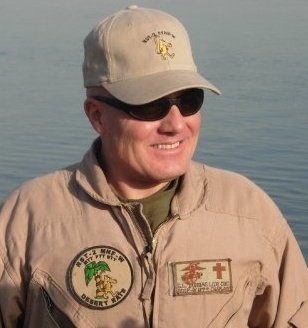
Dynamic DuoRP2 Nelson Lebron and Me- The RST-2 “Desert Rats”
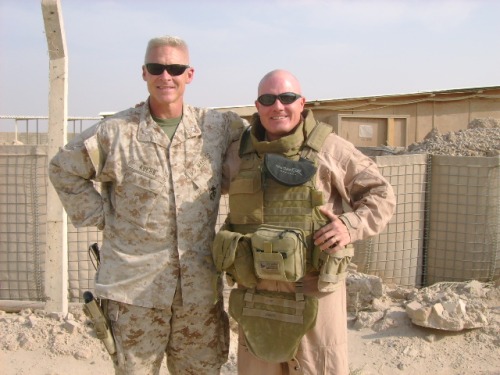
Back in the mid 80s shortly after I was commissioned as an Army Officer there was a series of historical novels by W.E.B. Griffin called the Brotherhood of War. The series traced the paths of several Army officers as well as family and friends beginning in World War II. I am not much of a reader of fiction, but this series, as well as Anton Meyer’s Once an Eagle well captured the unique culture of the career professional soldier through both war and peace.  They treated their subject respectfully while also dealing with the effect of this lifestyle on families as well as the soldiers, reading Once and Eagle I feel that connection with the fictional Sam Damon, the hero of the story and revulsion for the character of the self serving careerist Courtney Massengale.

I’ve been a military officer in both the Army and Navy now for almost 26 years with nearly 28 years total service. It is part of my heart, soul and being.  I was born for this, just as Babe Ruth, Willie Mays and Ted Williams were born to be baseball players.  I grew up in a Navy family as a Navy “Brat” living up and down the West Coast and the Philippines and all I can remember from the earliest age wanted to be in the Navy Officer and later Navy Chaplain.  My dreams came true.  The first 17 ½ years of my service was in the Army, something that that initially my retired Navy Chief Dad had problems with, however he made his peace with it and was proud that I served and proud of the fact that I had made Major.  However, in 1999 in order to return to active duty I resigned my Army Reserve commission as a Major and entered the Navy Chaplain Corps as a Lieutenant with no time in grade.  Outside of marrying my wife Judy, who somehow did not kill me when I did this, going in the Navy was the best thing that ever happened to me.

134LtCol David Kuehn and Me

Part of my time in the Army and Navy has been my time in the Chaplain Corps of each service.  I have been a chaplain for 17 years come September.  My best friends in the military are other chaplains, some from my own church and some from other communions.  The ones that I have the most connectedness to are those who have served in combat, especially those who served in Iraq, or ships in the war zone conducting various combat and maritime operations even when we were in different places.  In Iraq I was blessed to have Fr Jose Bautista-Rojas and Chaplain Pat McLaughlin supporting me at my base of operations.  There were others besides these men and many who were not chaplains. In Baghdad I had the staff of the Iraq Assistance Group Chief of Staff Colonel David Abramowitz and Chaplain Peter Dissmore and Captain Mike Langston at II MEF Forward.  Likewise I had Colonel Scott Cottrell and Colonel John Broadmeadow at 7th Iraqi Division Military Training Team, my friend LtCol David Kuehn at 3rd Brigade 1st Iraqi Division Military Training Team, LtCol Stephen Bien with the 2nd Border Brigade and a host of others about Al Anbar Province. As important if not more was my assistant RP2 Nelson Lebron, a true hero and friend.

chaplains and rp2 lebron at TQNelson, Fr Jose Bautista-Rojas, CDR Pat MCLaughlin and Me at TQ
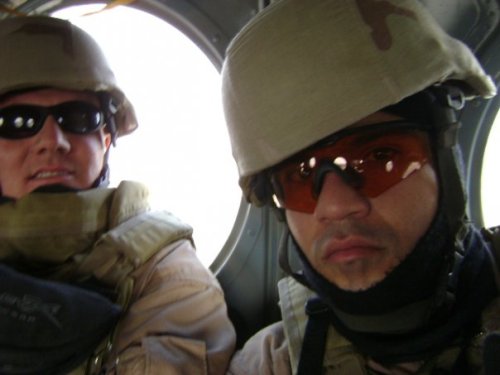
Back in March of this year I was with a number of chaplains from my church gathered for our annual conference.  Some of these men I have now known for at least 10 years, some more.  I’ve seen the young guys start to age and others retired from the service.  We have grown together; we at least in most cases have come to love each other as brothers and friends.   What has made this conference different from past gatherings is that all of us have had one or more combat deployments or are getting ready to go for the first time or back for another tour.

nelson and me flight homeNelson and Me in the Air Everywhere

We have shared our stories but now they are the stories of men who have all seen war.  In our careers we have all experienced success, as well as heartache.  Due to our duty we have been often isolated from the church and each other.  We all came back from the war changed in some way.   Some of this is due to health related issues stemming from our service and for others things that we have seen or experienced.  Of course each of us has had different types of experience in country, but nonetheless our experienced changed all of us in some way or another.  For me the events have been trying to make sense of the torrent of emotional, physical and spiritual distress that I have had to deal with.  While I have made a lot of progress in some areas, there are a lot of places where I’m still sorting through things as are a number of my friends.  I can say that I often feel alienated from my own church.  When I read things that some of our bishops write or say I know that I do not belong.   Based on my service in combat and to my country for almost 28 years  and 13 years as a faithful priest I have tried.  The fact that with the exception of some of my fellow military priests I have no relationships with anyone in my church,   I was at one time banned from publishing by a former bishop.  I was forbidden to have contact with the priests of a my old diocese when I was stationed in it by the same man.  The civilian diocese that I transferred  to has had nothing to do with me for the most part since I was transferred to Virginia and since I moved here no one has bothered to say a thing to me.   None of this was because I didn’t try and the thing is I don’t care anymore.  I just plan on caring for God’s people where I’m at and building relationships with people who bother to invest in my life here. I haven’t the spiritual or emotional energy to keep trying to make something happen with people who obviously don’t care about me and haven’t for years.

This year our gathering was marked by a lot less light heartedness.  There was a lot less bravado than years past, more reflection, less intense discussion of the theological issues that have divided the Christian Church for centuries.  I know for myself I don’t have the energy to spend battling people over things that the rest of Christendom hasn’t been able to settle on.  For me I’m okay with the Canon of Scripture, the Creeds and the first 7 Ecumenical Councils, though I have a great love of the Second Vatican Council.  If people want to fight the other fights they can go ahead without me how many pins you can stick in the head of an Angel.

As far as health concerns I know that at least two of us have confirmed real live PTSD, and one with a case of TBI.  Based on the way others act I’m sure that almost all have at least a combat stress injury, and maybe a couple more have PTSD.  One young Army Chaplain has an Iraq acquired constrictive bronchiolitis, or bronchiolitis obliterans which has no cure. This young man has won two Bronze Stars and now has the lung capacity of a 70 year old man.  At best he can hope that his lungs will not worsen and only age at a normal pace, which means in 10 years he has 80 year old lungs.  This young man is a Priest who I have mentored, coached and been a friend and colleague of since before he was ordained.  He is looking at something that will kill him; it is just a matter of when.  He is going through all of his medical boards now at Fort Hood and expects that in six to eight months that he will be medically retired.  It seems to me that a hero is being kicked to the curb by the Green Machine after laying himself on the line for his country.  He was treated by many people in the Army Medical system with suspicion and made to prove that he was sick at almost every point until a high ranking medical officer found out about his case and sent him to civilian specialist for evaluation.

While I was at our conference I had a major PTSD meltdown where I basically hid in my room of a day and a half, sneaking out at night to gather with just a couple of my friends by the pool for beer and Krispy Kreme Doughnuts.  Unfortunately we could only get the store bought ones because the hot and fresh glazed go great with a good pilsner or lager.

We have several Chaplains who have won Bronze Stars for their service in combat. I was awarded the Defense Meritorious Service Medal for what I did in Iraq.  I treasure that award because it cost me something to get, I still have a lot of Iraq with me and I always will.  Some day when all is said and done I want to see some of my Iraq military friends again and visit the country as part of a journey of discovering the ancient.

Some of my friends and I have experienced the indifference of the medical and administrative parts of the DOD and VA systems, including sometimes people in our own military service.  When I returned I found my personal and professional belongings crammed into a trailer with those of my assistant because the office space was needed and we were deployed.  There are things which I considered important that are still missing and likely never to be found.  I know that it was not intended to hurt because the space was needed because of major unit re-stationing. If I was the Commanding Officer I would have probably done the same thing and since I have had command I know that mission comes first. You try to take care of people but some things fall through the crack. That is simply part of life.

On the other hand some of my friends have had experiences where they felt the cold indifference of bureaucratic systems often staffed by personnel, military, DOD Civilians or contractors who act if the returning or injured vet is there so they can have a job. To be sure there are a lot of very caring people in our organizations, but these coldly indifferent people seem to show up all too frequently. This unlike what happened at my unit is intolerable.

What touched me about my unit was once it became clear that I was a PTSD casualty they did everything to try to get me help.  My first Commodore, now Rear Admiral Frank Morneau pulled me into his office to make sure that I was alright and that I was getting the help that I needed.  The man who replaced him Commodore Tom Sitsch asked me a question that was totally legitimate.  “Where does a Chaplain go for help?”  When I went to Portsmouth Naval Medical Center I was strongly supported by both my department head and his deputy.  I wish that everyone who came back like I did had the support of both line officers and Chaplains in their immediate chain of command.  It makes all the difference in the world.

The chaplains that I have served with in Iraq are part of my brotherhood, be they from my church or not. I believe that most of us who have gone to war have by and large matured. We saw death and destruction and were exposed to danger from enemies that could strike in the most unexpected moments in the most unexpected ways.  We have experienced sometimes difficult adjustments to life back home, a knowledge that we are different and that we are even more cognizant of our own obligation to care for God’s people.  Our brotherhood has deepened as a result of war, of that I am sure.  We are truly brothers.

Peace, Steve+

3 Comments

Filed under healthcare, iraq,afghanistan, Military, PTSD, Religion, Tour in Iraq

Revisiting the Demons of PTSD: Returning to Iraq in Virginia a Year and a Half Later

Today I am attending a conference on Caregiver Operational Stress Control.  This brought out my “demons” as I was faced with the stories of others who had been to the same places that I have been in Iraq, and experienced similar things that I experienced on my return.  This is a re-posting of something that I wrote in March at the very beginning of this blog.  At that time I had very few readers.

I am glad to be at this training today.  I needed to take a Xanax when I arrived because I don’t do well with these kind of events anymore.  The intial session and a video of Dr Heidi Kraft talking about her expereinces at Al Taqaduum where I was based out of.  I was scheduled for another meeting but I knew that I needed to be here.  So I asked my Department Head who was going to the meeting if I could stay and he allowed me to do so. God bless him.

I received a note from a new friend in another country’s military, a physician with multiple tours in Afghanistan.  He is dealing with many of the things that I discuss in this essay and had a bad day that took him back to Afghanistan.  I am sure that he is not alone as I deal with many people in my Medical Center who have similar experiences.  Yesterday I was walking down a hallway near our Operating Room and I saw a pretty good sized blood spill on the floor. I was surprised at my reaction as I kept seeing it in my mind the rest of the day and flashbacks to Iraq and the TQ Shock Surgery Trauma platoon where I was pulled into a couple of the last major mass casualty events where 10-15 Marines or soldiers came in at a time. I began to see those wounder Marines on the tables and can visibly see those Marines, their wounds, even tattoos… I hope this helps break the code of silence.  I wrote this on a particularly rough day and will repost some of those early essays as they are still very relevant.  Peace, Steve+

964Trying not to Show my Stress and Exhaustion after 2 weeks out while in between flights at Al Asad

The feeling of abandonment and aloneness, separation and disconnection run deep for those returning from unpopular wars in which the majority of the citizens take no part.  The effects are devastating.  It is estimated that at least 100,000 Vietnam veterans have taken their lives in the years after that war.  Last year the Army had its highest number of active duty suicides ever recorded, January and February of 2009 have been banner months for Army suicides.  Of course as I noted in my previous post these numbers don’t include reservists and Guardsmen who have left active duty or veterans dischaged from the service.  Neither do they include the host of service men and women who died from causes undetermined.

Many veterans attempted to return to “normal life” and family following the war. Many only to have marriages fall apart, continue or leave untreated alcohol and drug addictions acquired in country which often follow them back destroying lives, families and careers.  Most felt cast aside and abandoned by the goverment and society. Many got through and return to life with few visible effects, but the scars live on.  My dad would never talk about his experience in the city of An Loc in 1972 where he as a Navy Chief Petty Officer was among a small group of Americans operating an emergency airstrip in the city which was besieged by the North Vietnamese and Viet Cong for 80 days.  I do know that it affected him, he wasn’t the same when he returned, he was a lot more tense and had some problems initially with alcohol.  He never talked about his time there.

I have seen the effects of this in so many lives,  I remember a Vietnam vet who attempted to kill himself with a shotgun blast to the chin in Dallas during my hospital residency.  He forgot to factor in recoil and blew off his face without hitting his brain or any major arteries.  He survived…talk about having something to be depressed about later.  I have seen the tears as veterans rejected by the country during and after than war begin to seek community with their wartime brothers, men who had experienced the same trauma followed by rejection and abandonment by the people that sent them to Southeast Asia.  One only has to talk to veterans of the Ia Drang, Khe Sahn, Hue City, the Central Highlands and Mekong Delta or read their stories to know what they have gone through.  LTG Hal Moore and Joseph Galloway in We Were Soldiers Once..and Young and We are Soldiers Still have deeply penatrating and soul searching views of Vietnam as does Bing West in The Village. Bernard Fall does the same from a French perspective in Hell in a Very Small Place and Street Without Joy. Alistair Horne’s book A Savage War of Peace discusses and tells the story of many French soldiers in Algeria, who fought a war, won it militarily and had their government abandon them, bringing out a mutiny and coup atempt by French Soldiers who had fought in Indochina, were almost immediately back in action in Algeria with little thanks or notice from thier countrymen.  Abandonment is an ever present reality and “demon” for many of us who have served regardless of our nationality, French, Canadien or American who have fought in wars that have not engaged the bulk of our fellow citizens. Go to the Vietnam Veterans Memorial in Washington DC and tocuh it, trace the outline of a name, look upon the makeshift memorials and tokens of remembrance left by comrades who came home and understand the sorrow and the sacrifice.

Unfortunately we would like to think that this is something out of history that we have learned from and applied the lessons and in doing so no longer have an issue.  Unfortunately this is not the case.  There are many, depending on the study anywhere from8-20 percent of returning Iraq and Afghanistan veterans who suffer from some type of PTSD, Combat Stress reaction or other psychological malady incurred during their tour. Similar numbers are reported by the Israeli Armed Forces in from the 1973 War forward.   The British are seeing the same now as their veterans return from war.  Canadian Forces assigned to the UN command during the Rwanda genocide suffer horribly from PTSD. The mission commander, LTG Romeo Dalliare now a Senator in the Canadian Parliament is a leading spokesman for those who suffer from PTSD. His book Shake Hands with the Devil is a study of how military professionals were exposed to atrocities that they either were forbidden to stop or lacked the combat power to do so even if they wanted to.  These men and women tell their story in a video put out by Canadian Armed Forces.

105Convoy along Route Uranium

I am not going to rehash stories that I have recounted in my other posts dealing with PTSD here, but both I and many men and women that I know are scarred by the unseen wounds of this war.  We gladly recognize, and rightfully so, those who suffer physical wounds.  At the same time those who are dying inside are often ignored by their commands or if they come out are shunted into programs designed to “fix” them.  In other words make them ready for the next deployment.  I am not saying here that there is an intentional neglect of our service men and women who suffer from PTSD and other issues.  I do not think that is the case, but it is a fact of life. The military is shorthanded and stretched to the breaking point. Many Army Soldiers and US Marines have made 3-5 deployments since 2003. The Navy has sent over 50,000 sailors, not including those assigned with the Marines into “Individual Augmentation” billets in support of operations in Iraq, Afghanistan, the Horn of Africa and other fronts in this war.  The Navy personnel, as well as Air Force personnel who perform similar missions often do not have the luxury of going to war and coming home with a particular unit.  We serve often in isolation and incredibly disconnected from our commands, our service is often misunderstood.  Now there are efforts by the services and some commands to do things better to support our sailors, some of these at my own hospital.  However as an institution the military has not fully made the adjustment yet.

Many sailors feel abandoned by the country and sometimes, especially when deployed by the Navy itself.  I have debriefed hundreds of these men and women.  Almost all report anger and use terms such as being abandon, cut off and thrown away by the service and the country.  Those from all services who work in unusual joint billets such as advisers to local military and police forces in Afghanistan and Iraq feel a sense of kinship with each other, often feel a connection to the Iraqis and Afghans but are often not promoted or advanced at the same rate as others who have served in conventional forces in traditional jobs.  There was a film called Go tell the Spartans staring Burt Lancaster about Army advisers in the early stages of Vietnam.  If you see it and have been to Iraq with our advisers you can see some of the same dynamics at work.

At this point we are still engaged in Iraq and Afghanistan.  These wars divided the nation and the veterans, though better treated and appreciated by society than most of thier Vietnam counterparts have no memorial.  Words of thanks uttered by politicans and punits abound, our Vietnam era and other fellow veterans in their latter years come to the airports that we fly in and out of to say thank you, but our numbers are rising, the war rages on both in country and in our minds and lives are being lost long after soldiers have left the battlefield.

not a happy camperNot Doing Well on Leave about 5 months After my Return from Iraq

We have to do a better job of ensuring that those who sacrifice so much do not feel that they have been cut off and abandoned while they are in theater and especially when they return. When it is time we need a memorial on the Capitol Mall for those who served in these wars.  I don’t know when that will be, but I do hope to see it in my day.  Sure it’s only symbolic, but symbols can be healing too, just look at the black granite wall rising up from the ground and going back down into it, filled with the names of those who gave their lives and made the supreme sacrifice in Southeast Asia.  Simply known by most as “the Wall” it has become a place of healing and rememberance.  A place to say thank you, goodbye and amen.

Peace and blessings, Steve+

5 Comments

Filed under healthcare, iraq,afghanistan, Military, PTSD, Tour in Iraq, vietnam

Roster Moves: No Game, Series or Season in Baseball or Life Goes Without Them

046Norfolk Tides Manager Gary Allenson making a Slight Adjustment to the Outfield with 1 Out in the 9th Inning

Larry: Who’s this? Who are you?
Crash Davis: I’m the player to be named later.

From Bull Durham

Sometimes I feel like the player to be named later.  I am amazed at the changes on a baseball team’s roster during the course of a season.  At the same time being in the military for almost 28 years I have some understanding of them in daily life.  This season with the Norfolk Tides and my place of work at a Major Naval Medical Center has been a perfect example of how no roster survives intact.

Now this is nothing new, as long as there have been baseball teams and militaries there have been personnel changes.  In baseball as in the military there is constant moves of personnel as people are transferred, promoted, demoted, are injured or retire from either the service or the game.  Sometimes roster moves are part of a natural process as an organization decides how it wants to chart its future. Other times they are dictated by a need that occurs that has not been anticipated such as injuries, trades, transfers, retirements or personnel or budget constraints, either expected or unexpected.

In the Minor Leagues the Minor League affiliates exist to supply their Major League organization with young talent, player development, rehabilitation and depth to meet the demands of a long season.  It is similar in the military where support and training organizations exist to meet the needs of the operating forces.  This is true regardless of military branch of service.   When the Major League Team or the operating forces are stretched, experience losses or suffer setbacks it is common for them to draw upon the support and training organizations to fill the holes and meet the needs of the larger organization.

I have watched this close up in two worlds this year both where I work and where I watch the Tides play ball.  At work this has occurred where due to retirements and transfers our department has lost a lot of people who have not yet been replaced, creating a lot of pressure on those who remain, likewise we are tasked with more missions to support the operating forces.  The same is true of the rest of the Medical Center where many physicians, nurses, corpsmen and other sailors have been deployed to meet the demands of the expanding war in Afghanistan while still supporting other worldwide commitments and our own home town mission.  While this is going on other needs have come up in caring for returning warriors, wounded warriors and their families as well as the rest of the military community that depends on us for their primary and specialized medical care.  I have seen more colleagues and friends than I can count be deployed from what is supposedly a pretty safe “non-deploying” shore billet to support the operating forces, Navy, Marines and Joint or NATO.  I have watched the organization adapt to the call ups by moving people around as well as finding people to fill the void, even if they are only on contract.

Our Norfolk Tides began the season with a very solid roster and within two months the big club, the Baltimore Orioles had called up several pitchers as well as the heart of the batting order, Outfielder Nolan Reimold, Catcher Matt Wieters and Infielder Oscar Salazar.  Meanwhile the Tides lost several players to injuries which forced Manager Gary Allenson and the Orioles organization to fins personnel both within and outside of the organization to fill the gaps created by call ups to the big team and injuries.  To do this they brought up players from AA Bowie, moved players down from Baltimore and found and traded for players outside of the Orioles system.  At first the adjustment was difficult but now the new players and those who were left are coming together to keep the team, at least for now in first place in the International League South.   Yet with every move the organization has to decide how to best utilize the players that it has.  In the case of the Tides this comes down to Manager Gary Allenson and his coaches working together with the rest of the Orioles organization.

Even in the midst of a game there are roster changes, sometimes for pitchers, sometimes hitter and sometimes even for running or defense.  Some of the changes are for injuries, or situational based on statistics of what you have empirical evidence to show that one course of action is better than another.  Thus you have relief pitchers and pinch hitters or runners.  No at bat or even pitch is the same, which is like life, nothing remains the same so you must make the adjustments on every play.

At the personal level changes affects everyone in the organization even if their job in the organization does not change.  At the minimum the changes affect the dynamics of the work environment, the chemistry between teams and the concern for friends who have left the organization with whom we have invested significant amounts of time and emotional energy.  Thus when Oscar Salazar was called up by Baltimore it left a huge hole in the team because Salazar was not only a leading contributor on the field but his tremendously positive attitude off the field in energizing the team and working with younger players.  Individual losses while seemingly statistically insignificant can be magnified by the intangibles of what a person brings to the team.  Some who seem to have all the right stuff may not be missed, while others who maybe don’t have the same talent level as others might be more sorely missed.  Since a team depends on the efforts of everyone, especially in baseball where the game is both immensely individual and absolutely interdependent personnel changes must be weighed carefully in the overall mission of the team or organization.  The Tides are fortunate to be with Baltimore as the organization is not only scouting talent for the O’s but their Minor League affiliates.  I met a Baltimore Scout at a Tides game over the weekend who said they were out seeking hitters for Norfolk due to call ups to the O’s and injuries to members of the Tides.  The larger organization, though a work in progress recognizes that its future lies in its Minor League system.  Thus over the past couple of weeks they have picked up Michael Aubrey from the Cleveland organization and Victor Diaz, a former Tides Outfielder when they were in the Mets organization and who later played in New York, Texas and the Houston organization before playing with the Hanwha Eagles in South Korea before being signed by the Orioles and assisted to the Tides.  A good organization not only looks to the situation they are currently facing u to the future.  A bad organization does not plan for the future but only concentrates on the present.  In the case of the Tides we are prospering under Baltimore but suffered for almost 20 years under the Mets, who have continued to neglect and abuse their farm system, especially their AAA affiliates.  The fans in Buffalo despise the relationship.

On the personal level this also means that individuals can be moved around to meet the needs of the organization.  This does not always make players happy be they ball players or military personnel.  There have been times in my career that I did not like what was happening to me in the organization, not so in the Navy but definitely in hte first part of my Army career. Such unhappiness when left unchecked can lead to blow ups.  The movie Bull Durham has a great example where Crash Davis, played by Kevin Costner complains about his reassignment from an AAA team back to a single A team.

Crash Davis: You don’t want a ballplayer; you want a stable pony.
Skip: Nah.
Crash Davis: Well, my triple-A contract gets bought out so I can hold some flavor-of-the-month’s dick in the bus leagues, is that it? Well, f— this f—ing game!
[pause]
Crash Davis: I quit, all right? I f—ing quit.
[Crash exits the office and stands in the clubhouse for a minute before sticking his head back through the door]
Crash Davis: Who we play tomorrow?
Skip: Winston-Salem. Batting practice at 11:30.

I cannot say that in my Navy career I have ever felt like Crash Davis,  in fact I have even when doing a lot of “relief” work and been moved around sometimes faster than I wanted to be because I was needed to put out a fire. At the same time I have  always been dealt with well.  I have not been sent back down in the organization, but have been moved up or laterally to do different jobs, like I said often on short notice like the time when two different chaplains were fired and I went from one job to the next and ended up nine or ten weeks at 29 Palms prior to a 7 month deployment in two different battalions. Those were stressful, but not bad and the organization treated me well.  Some people don’t have that experience however and roster moves on short notice can be a source of consternation, anger and discord if not handled well by the team manager or the command.

However I did come into the Navy at a lower rank than I left the Army in 1999 just to get back in the show that was the cost of getting back in the game full time, something I am amazed that I got the chance to do and every grateful to the Navy, my Bishop and the Deity Herself.   In my current billet I love what I do and who I do it with, but the organization will be making some changes as we graduate our current residents, gain new residents, gain and lose other personnel and adjust to meet an ever changing and increasing mission.  While we do this we seek to set the standard of professional competency not only in the Navy but the civilian world.  For me this will involve changes, changes that on one level I resist, but on another level completely understand and agree with as the way to help the organization move forward.  Come September those changes will be made.  I can say that I don’t feel like Crash because this involves things that I have always wanted to do but unless I am adaptable will not be able to do, unless the Deity Herself creates a couple extra days to the week and makes every day a 32 hour day.  Thus I will adjust as will the rest of the organization as we collectively work together to ensure that we are taking care of those that God has given us.

So far as the story goes tonight, the one constant in the season is change, teamwork and adjustment to change. As Sparky Anderson once said “If a team is in a positive frame of mind, it will have a good attitude. If it has a good attitude, it will make a commitment to playing the game right. If it plays the game right, it will win—unless, of course, it doesn’t have enough talent to win, and no manager can make goose-liver pate out of goose feathers, so why worry?”  Thankfully, our leadership seems to be rising to the task and and we have the talent, so why worry?

Peace, Steve+

2 Comments

Filed under Baseball, leadership, Loose thoughts and musings, Military, philosophy

Going to War: A Bus Ride to the Carolina Countryside

This is part four in my “Going to War” series. Previous parts are noted here:

Part One:Going to War: Reflections on My Journey to Iraq and Back- Part One

Past Two: Going to War: Interlude July 4th 2007

Part Three: Going to War: Wills, Living Wills, Immunizations Gone Bad and Christmas in July

Part Four: Going to War: Last Night together and a Kiss Goodbye

Nelson and I staged our gear as we waited for the buses to arrive to take us to Fort Jackson South Carolina where we were to receive our training for the deployment.  As we talked other sailors arrived and gear was stacked in rows of sea bags just off of the sidewalk.  Nelson’s parents, brother and sister were on hand to see him off.  His brother is a First Class Petty Officer and his dad a former Vietnam era Marine Recon NCO who made several deployments “in the shit” as many Vietnam vets call tours in that combat zone.  They were really nice folks.  Over the years I had heard much about them.  They are close to each other and all are supportive of Nelson.

Nelson is a career amateur boxer; kick boxer, martial artist and more recently MMA fighter.  He is active in children’s martial arts instruction and has been on Team USA and fought internationally.  During his Afghanistan deployment before he and I hooked up again he helped coach the fledgling Afghan National Boxing Team.  His last major title was just this year when he won the Arnold Schwarzenegger Classic.  The guy has more titles than you can imagine, his title belt collect could fill a room.  However, he was raised by a boxer, his dad.  His dad taught him and coached him growing up and helped Nelson win multiple New York State Golden Gloves titles.  His dad is a congenial man and who was very friendly, speaking English with a heavy Puerto Rican accent.  Nelson’s mom speaks some English.  Nelson tells a great story of the only time he was knocked out in a fight.  This happened at the Fort Apache Gym in the Bronx after Nelson had gone picking on his little sister when Nellie was about seventeen.  Nelson’s dad found out, told him to put on his gloves and get in the ring.  Nelson proceeded to talk trash to his dad as he got ready to fight and the first round got quite a few hits in on his dad.  In between rounds according to Nelson’s account he told his dad to quit, that he was too old to be in the same ring with him.  Nelson said that his dad simply commented “I was just letting you taste the water.”  The second round began and Nelson was hit by a combination from his dad, which he says “rung his bell” and made him “see stars.”  He remembers trying to get up and not being able to while his dad was talking trash to him.  I cannot do the story justice but meeting Nelson’s family was a joy.

So we waited while the other sailors gathered, some individually and some with family.  Some stood alone as couples while others mingled with each other.  For most this was a new way to see their sailor deploy.  No pier side goodbyes, no banners, no manning the rails by the crew as the ship was nudged away from the pier by tugs.  When you have a “normal” deployment of a ship or something like a Marine battalion it is a big deal.  Media is there, sometimes there are speeches, but most of all there is the understanding that we are all in this together.  The families say goodbye to their Sailors, Marines or Soldiers who are going to war together and leaving some kind of familiar support system for the families.  This is not so when you deploy individually.  We may have been going off to train together, but few would stay together on the deployment.  Normally as a chaplain you are a known quantity to the people that you go to war with.  I was going to war with Nelson but we would not remain with any sailors who were going through this process with us.  I know that was the case for others who would serve in isolated posts, often without any other Navy personnel, mostly working with the Army in support roles, and specialized roles such as the Electronic Warfare Officers detailed to work on defeating IEDs and roadside bombs.  As others said their goodbyes and hugged each other I thought of Judy and knew that she was going to be down for some time but I felt that for once that she had an adequate support network.

I looked at our gear as opposed to the others.  Our gear was in different deployment bags, ours were large and rectangular and more of a coyote or sand color while most everyone else had traditional green sea bags, or what are known in the Army as “duffle bags.”  We had all of our personal protective equipment or the EOD/Special Warfare type while others would receive some variation of Army issue at Fort Jackson.  There are pros and cons to such a arrangement.  The pro is that we had great gear certainly some of the best in theater.  The con was that we had to lug the great gear everywhere we went going to and coming back from war.  This would get old, but the benefits do outweigh the advantages when you are actually in a combat zone.

Finally an officer came out and began calling role and giving us our signed “official” orders.  After we were accounted for we were told to load our gear on the buses that would take us to Fort Jackson. I think there were four or five of these chartered tour buses  which as it turned out would be the first of many tour buses, roll calls and gear loads in the coming months, especially as we entered and exited theater.  Nelson and I got on the same bus which was not full and took seats near the front.  I got a seat alone because I was the senior officer on the bus and a chaplain to boot. This was not because I asked for it or hogged the seat.  It is actually fairly typical in such a setting where young enlisted guys don’t want to sit next to an officer and some are afraid of chaplains because of experiences that they have had in civilian churches.  Some of the young folks have never darkened the door of a church and many of those that have been in church have been burned in relationships with pastors or really over the top religious people.  I have found in my career that until they get to know a Chaplain a lot of them will be very careful in how they approach a chaplain, even those with a vibrant faith.  Some are afraid that the chaplain might try to convert them or disapprove of the manner in which they live their lives. So as a chaplain I need to be cognizant of this fact and be friendly and caring without scaring them away.  Of course I did build relationships with a quite a number of these sailors during the next few weeks but on this bus I was still an unknown quantity to them.  Sitting alone however was good for me since I general despise bus travel regardless of the company I keep.  For some reason my height works against me, I can never get my feet comfortably on the ground on these new tour buses and I have a terrible time getting comfortable.  Since bus travel takes forever to get anywhere the discomfort is palpable.  Now I did a three month tour on buses in 1979 while touring as a spotlight tech for the Continental Singers and Orchestra across the US and in Europe.  Somehow the old Greyhound buses were more comfortable than the new tour buses.  Maybe I’m just nostalgic but they somehow fit people like me better than the fancy new buses.

When you travel by bus with a bunch of sailors, the majority of whom are at least 20 years younger than you, the experience can be entertaining to say the least.   Part of course is a generational thing.  I am from the 60’s 70’s and 80’s.  These guys and gals are from the 90’s and 2000’s.  Music is different, culture is different, and the internet, cell phones, i-phones and Blackberries have revolutionized communications and life.  The trip was a chance for me to observe a lot about these sailors just by watching.  Some had their portable i-pods and MP-3 players going, others spent time talking on cell phones, a few read or talked among themselves, but the sailors near me gravitated to the DVD movie which was 300 the comic book style account of the Spartan’s defense of Thermopylae against the Persians.  As the Spartans made their stand I could see the young sailors who were going to war taking inspiration from King Leonditis of Sparta.   Since we were going into a place where 50-100 Americans a month were being killed and many others wounded and maimed I could understand the need for inspiration along with entertainment.

The bus ride itself was a lot like what I imagine that Minor League teams take in the Carolinas like in the movie Bull Durham, the coaches and older players mixed in with a lot of young guys.  The older guys staying pretty quiet and to themselves and the young guys having fun, playing games and joking around with each other,  We made a couple of stops, one at some little Interstate town with a fair amount of gas stations and a few fast food places.  About half the folks went to the McDonalds where we pulled in while the rest ran down the street to the Burger King and Taco Bell.  Once everyone had their fill the buses pulled back out onto the interstate.  When we finally got near Columbia the buses got of the Interstate highway and onto some small two lane state highway.  We drove down this road about twenty to thirty minutes and pulled into what appeared to be a tiny out of the way base.  I wondered where the hell we were.  Fort Jackson is a fairly large training base where thousands of recruits are trained every year.  Where we were certainly was not the Fort Jackson that I had imagined.

Instead of the main post we were at the South Carolina National Guard training facility called Camp McCready.  It is here that the Naval Expeditionary Combat Command has a training center set up with the Army to train sailors in basic combat tasks.

Our welcome that first night was simple.  We formed up, checked in, got our linens for our standard issue military beds and were marched to dinner at the chow hall or in the Army vernacular the DFAC by our newest and bestest buddies, our Army Drill Sergeants.  In the chow hall or DFAC we were met by a civilian running the line.  I can’t remember his name but this guy was really nice and put the RED in “Redneck.”  He made jokes with everyone that came through the line, asked where people were from and what they did.  When he found out that I was a chaplain he began to ask me for a joke every meal thereafter.  As Nelson and I sat down for chow with a couple of other sailors we looked at each other.  He said: “Boss I don’t think some of these guys know what is coming.”  I said “I think that your right partner, hopefully they adjust and do well.”  The other sailors, both more senior petty officers nodded in agreement.

Going back to the barracks I met some of the other officers enjoying their first night at Camp McCready.  More sailors to fill out the class were due later coming in from San Diego.  I introduced myself to a number of the officers near me and when lights out was called lay down on the same type of bed that I had first encountered some twenty five years before at Camp Roberts California and Fort Lewis Washington.  I swear the sheets, blankets and pillowcases were of the same vintage.  Despite that I fell asleep fairly quickly.

Leave a comment

Filed under iraq,afghanistan, Military, Tour in Iraq

A Trip to the Home World, Tithing on the Speed Limit, a Tooth Joins the Ranks of the Undead and a Giant No Hitter

Yesterday we made a trip back to my family’s home world, also known as Huntington West Virginia. As far as home worlds go it is probably on no one’s top ten lists, probably ranking about as high as Qo’noS, the Klingon home world in terms of places that you would go to on holiday.  However it is my family’s ancestral home for the past 200 plus years since coming from Scotland, Ireland and France.  Now I was not born in West Virginia, though my parents were born there as were three of my four grandparents.  I was actually the first of my generation born outside of the state as my dad was still in the beginning stages of his Navy career and was stationed at Naval Air Station Alameda California and I was born at Oak Knoll Naval Hospital in California.  Even so Huntington was a place that served as a touchstone for our lives as my dad was transferred from one place to another on the west coast.  We would return almost every summer, usually travelling by train in the days before Amtrack.  Back then three of four grandparents as well as one set of great grandparents we still alive along with a butt-load of aunts, uncles and cousins.  In 4th grade we lived there while my dad found us suitable housing in Long Beach California after being transferred from Washington State. That was the year of three schools and four teachers for me, but I digress.

It was during that year that my great grandfather died and my grandfather was diagnosed with a golf ball sized yet benign brain tumor.  It was also the adjustment form the kinder and gentler west coast schools to a much stricter standard in Huntington.  I was also as we had come in from Long Beach I was nicknamed “City Slicker” and had to fight for my life.  A couple of school yard brawls later which I cannot say that I won but in which I gave good account of myself I was accepted so far as a “City Slicker” could be.  The thing was though that I had lived in a town of only about 8,000 inhabitants for 4 years prior to moving to Long beach for just over a month.  The kids in Huntington were far more “City Slicker” than little old me.  I had poor penmanship because in Kindergarten my teacher took the pencil out of my left hand and stuck it in my right hand.  This was of no comfort when my teacher whacked my hand with a steel ruler since my penmanship was so bad.  What good this did I have no idea except to maybe set me back two more years.  I don’t think I ever left the dining room table due to the amount of homework that she assigned.  During my time in Huntington we lived across from the old Fairfield Stadium where the Marshall University football team played.  I saw the team work out in the spring practices of 1970, the same team killed in the plane crash on 14 November of that year.  We returned to Long Beach that summer where when I started 5th grade I was known as “Kentucky Fried.”  Despite that I was happy to get back out west.  After my Clinical Pastoral Care Education Residency in Dallas I got my first full time hospital chaplain job at Cabell-Huntington Hospital which I held as a full time contractor until I was mobilized for the Bosnia mission in 1996.  During this time and while I was deployed Judy got to know my relatives better than me.  I went into the Navy in West Virginia and due to this we remain West Virginia residents for Tax and Voting purposes.  We came back to get our driver’s licenses renewed and see our dear friend Patty.

The visit this time has been pretty miserable for me as last night the tooth which was recently excavated for the second time as discovered to be cracked beyond repair decided to come back from the dead.  I didn’t get to sleep until about 0230 and woke up again at 0415 before getting back to sleep at 0600. The alarm rank at 0700 and after getting Judy up, we talked and I went back to bed where I slept until 1230.  It took 2 Ultram, 1 800 mg Motrin and a couple of beers with lunch to get the pain under control.  Tonight I will probably do the same and go to bed early.  In the morning I will have to call the Dental Department at the hospital to see what they want me to do.  We don’t travel back until Wednesday and I don’t know if I can take much more of this.  It seems to me that my tooth has taken a page from Dracula and joined the ranks of the undead.  This really sucks like a Hoover.

The trip here was long, we had the usual snarl on I-64  from Newport News until past Williamsburg, and thankfully the HRBT was not congested.  We picked up more slow traffic between Staunton and Lexington.  Now I am bothered by people who drive slower than the posted speed limit in the fast lane.  I trained on the Los Angeles Freeways and the German Autobahn.  My view is that the speed limit is a suggestion for the less skilled drivers and those who have trained on high speed roads should be exempt from it.  Now I am not a total scofflaw. I do not drive unsafely, weave in and out of traffic or fail to signal.  Likewise I know about how fast I can go without drawing the attention of the State Police.  Since radar detectors are illegal in Virginia one has to become very adept at this cat and mouse game and I am amazed at the number of people who get pulled over because they don’t understand the simple art of nuance.  In most states you can safely drive about 10 percent over the speed limit on the Interstate without getting ticketed.  This is a little different on the major travel holidays in Virginia where there is about a 5 mph tolerance.  I do this routinely and refer to it as “tithing” on the speed limit.  Of course there are times that I need to give more than my tithe and go a bit faster.  Our GPS “Lilith” has a conscious about such things and would alarm when I did this forcing me to silence her.

There was also cause for rejoicing as the first half of the baseball season came to an end.  The Norfolk Tides are tied for fist in the International League South, the San Francisco Giants have surprised everyone by playing great ball with solid pitching and now are in second place in the National League West and currently have the 3rd best record in the league behind the Evil Dodgers and one percentage point behind the East leading Phillies.  To really make things great Giants pitcher Jonathan Sanchez pitched a no-hitter against the San Diego Padres.  It was almost a perfect game save for a booted ground ball and error by Giants Third Baseman Juan Uribe with 1 out in the bottom of the 8th and Center Fielder Aaron Rowland saved the no-hitter with a leaping catch at the wall for the second out in the top of the ninth.  Both of these show that even when a pitcher pitches a no-hitter it is a team effort.  I had seen the next to last Giant no-hitter in person with my dad and brother back on August 24th 1975 when Ed Halicki shut down the New York Mets at Candlestick.  Not a bad way for the Giants to go into the All-Star break.

Anyway it is time to self medicate for the night and try to get some sleep.  Pray for me a sinner.

Peace, Steve

Leave a comment

Filed under Baseball, healthcare, Loose thoughts and musings, star trek, travel