Tag Archives: president ronald reagan

People Cannot Live in Freedom Unless Free People are Prepared to Die for It: D-Day at 73

img_0061

Friends of Padre Steve’s World,

I find the days around Memorial Day and the anniversaries of the Battle of Midway and the D-Day landings to be a time when I become quite reflective about what it means to be a career American military officer, combat veteran, and the son of a Navy Chief who was also a combat veteran. I am also an uncle to a young man who likely will be enlisting in the Army in the coming weeks.

When he spoke on Omaha Beach during the ceremony marking the 70th Anniversary of the D-Day landings President Barak Obama said:

“We are on this Earth for only a moment in time.  And fewer of us have parents and grandparents to tell us about what the veterans of D-Day did here 70 years ago.  As I was landing on Marine One, I told my staff, I don’t think there’s a time where I miss my grandfather more, where I’d be more happy to have him here, than this day.  So we have to tell their stories for them.  We have to do our best to uphold in our own lives the values that they were prepared to die for.  We have to honor those who carry forward that legacy, recognizing that people cannot live in freedom unless free people are prepared to die for it.”

All of my adult life I have striven to uphold those values that those men were prepared to die for, and for almost 36 years of Army and Navy service that I have been prepared to do so at a moment’s notice.

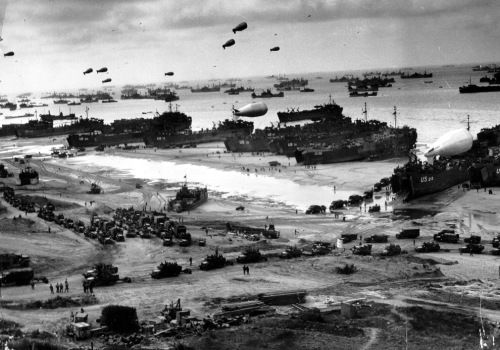
Seventy-three years ago the liberation of France began on the beaches of Normandy.  Soldiers from 6 Allied Infantry and 3 Airborne Divisions supported by an Armada of over 5000 ships and landing craft and several thousand aircraft braved weather, heavy seas and in places fierce German resistance to gain the foothold on beaches named Omaha, Utah, Gold, Sword and Juno.  Over the next seven weeks the Allied soldiers advanced yard by yard through the hedgerows and villages of Normandy against ferocious German resistance before they were able to break out of the lodgment area and begin the drive across France. In his D-Day message to his troops General Dwight Eisenhower reminded them that their mission was the elimination of Nazi tyranny over oppressed peoples of Europe, and security for ourselves in a free world.” There are still those in the world who subject their people to tyranny and attempt to destabilize and overthrow the governments of liberty loving peoples, likewise Eisenhower knew that security for ourselves meant close alliances with those who have our values and not isolating ourselves from the world.

The fighting was bloody, most American, British and Canadian infantry battalions and regiments suffered nearly 100% casualty rates in Normandy.  Replacements were fed in at a cyclic rate to make up the losses even as fresh divisions flowed ashore, but the losses were terrible.  By the time the landings took place, the British having been at war for nearly five years were bled out.  They had little left to replace their losses.  From Normandy on the British were losing combat power at a rate that they could not make up.

For the Americans there was another problem.  The US High command decided to limit the Army to 90 Divisions.  Many of these were committed to the Pacific and Mediterranean theaters.   Likewise, American Infantry units were generally made up of the lowest caliber of recruits, led often by the poorest officers; the best went to either the Air Corps or technical branches of the Army.

Now this is not to criticize veterans, but it is a factor in the campaign.  Most US Infantry Divisions with the exceptions of those previously blooded in North Africa and Sicily often performed badly in action.  Some, after being manhandled by the Germans had their leadership replaced and became excellent combat units.  However, every new division that arrived in France after D-Day always got the worst of their initial engagement against German forces.

While performance suffered there was another problem for the Americans.  With the limitation in number of divisions, they stopped building infantry divisions, upon whom the bulk of the campaign depended. Thus they had little in the way of trained infantry replacements to make up heavy losses in Normandy.  By late 1944 during the Battle of the Bulge the American infantry crisis was so bad that 30,000 Air Corps candidates were trained as infantry and soldiers support units such as Ant-Aircraft battalions were used to bolster infantry units.

Had the Germans been able to hold out and had they not been bled white by the Red Army on the Easter Front, had they not lost the nearly their entire Army Group Center in the Red Army offensive of 1944 it is conceivable that the British and American offensive in the West would have ground to a halt for lank of infantry in 1945.  In spite of this there was no lack of individual courage among the troops engaged; the courage and sacrifice of all who fought there should not be forgotten.

The human toll among the combatants both Allied and German, as well as the local populace was especially traumatic.  While the American, Canadian and British people are keen to remember the sacrifices made by our soldiers we often forget the toll among the French civilian population of Normandy as well as the German soldiers, mostly conscripts, sacrificed by the Nazi regime.  Normandy suffered more than any part of France during the liberation.  In the months leading up to D-Day Allied Air Forces unleashed hell on Normandy to attempt to lessen potential German resistance.  The Allied Naval bombardment added to the carnage ashore and once the campaign began the combined fires of both Allied and German forces devastated the region.  Whole cites such as Caen were destroyed by Allied Air forces and an estimated 30,000 French civilians were killed during the Normandy campaign, 3000 on D-Day alone.  I think it can be said that the blood of the civilians of Normandy was shed for the freedom of all of France.

The campaign in Normandy was one of the most viciously contested in western military history.  German forces, especially Paratroops of the 2nd, 3rd, 5th and 6th Fallschirmjager Divisions, German Army Panzer Divisions such as the 2nd, 21st, 116th and Panzer Lehr and those of the Waffen-SS, especially the 1st, 2nd and 12th SS Panzer Divisions held the line against ever increasing Allied forces.  As they sacrificed themselves Hitler refused to commit more forces to Normandy and insisted that his Army contest every meter of ground.  He forbade his commanders to withdraw to more defensible positions along the Seine.

Hitler’s decisions actually shortened the campaign.  Whatever the crimes of the Hitler Regime and Nazism, which were among the most heinous in history, one can never question the valor, courage and sacrifice of ordinary German soldiers.  For those Americans who lump all Germans who fought in World War II with the evil of the Nazi regime, please do not forget this fact:  There are those today, even in this country that make the same charge against Americans who have fought in Iraq and those at home and abroad who have labeled the US as an aggressor nation. As President Trump continues to go his own way to make the United States a pariah nation we have to be very aware of the costs of it and also remember that the Americans who went ashore on D-Day did so to help defeat a pariah nation that had flaunted every standard of justice in attempting to make Germany Great Again. When you judge others, know that the same standard will be applied to you someday and it is possible that our day may come sooner than we think. It is as Justice Robert Jackson who served as the Chief Prosecutor at the Nuremberg War Crimes Tribunal wrote:

“If certain acts of violation of treaties are crimes, they are crimes whether the United States does them or whether Germany does them, and we are not prepared to lay down a rule of criminal conduct against others which we would not be willing to have invoked against us.”

Normandy was a near run thing for the Allies.  First the weather almost delayed it by 2 to 4 weeks.  Had that happened the Germans might have been even better prepared to meet the invasion.  Likewise, the Red Army’s devastating offensive which annihilated Army Group Center in June kept the Germans from transferring additional forces from the Russian Front to Normandy.  On D-Day itself there were a number of times where Lady Luck, or maybe the Deity Herself, saved the Allies from disaster.

Any person who has seen Saving Private Ryan, The Longest Day or Band of Brothers knows a little bit about how close Overlord came to failure.  Allied Airborne units were dispersed throughout the region after they drooped.  Many units were not fully operational for more than a day as they sought to organize themselves and gather their troops.  At Omaha Beach the Americans had not counted on the presence of the first rate German 352nd Infantry Division.  This division, despite being pounded by naval and air forces almost cause General Bradley to withdraw from Omaha.  At Utah the soldiers of the 4th Infantry division escaped a similar mauling by landing on the wrong beach.  Had they landed at the planned beaches they would have ran into the same kind of resistance from well dug in German forces.  At Gold Juno and Sword British forces benefited from confusion in the German command which kept the 21st Panzer Division from descending on the British forces and quite possibly splitting the British zones.

The Allies benefited from the absence of Field Marshall Erwin Rommel, Commander of Army Group B who because of the ad weather assumed no invasion was possible and traveled to German to celebrate his wife’s birthday.  Finally, and perhaps most important they benefited by Hitler’s refusal to immediately commit forces, including his Panzer reserve to defeat the invasion at the beachhead.

For those who fought in Normandy and those civilians who lived through it the memories are still vivid. Many suffer the effects of PTSD, grief and other wounds, physical, emotional and spiritual.  When one is exposed to the danger and destruction of war, the smell of death, the sight of burned out cities, vehicles and the suffering of the wounded and dying, it makes for a lifetime of often painful memories.

For some of the German, British and American veterans, the struggle in Normandy has given way to long lasting friendships.  Many of those who fought against the Allied onslaught became fast friends after the war. Those who fought against each other were soon allies as part of NATO and soldiers of nations which were once bitter enemies serve together in harm’s way in Afghanistan.  The generation that fought at Normandy is rapidly passing away, their numbers ever dwindling they remain a witness to courage, sacrifice and reconciliation.

In the end it is reconciliation and healing that matters. Some scars of war never pass away; some memories are far too painful to release.  Yet we who serve often strive to reconcile.  In 2002 while deployed at sea for Operation Enduring Freedom I was an advisor to a boarding team from my ship.  It was our job to make sure that impounded ships which were breaking the UN embargo on Iraq were not in danger of sinking, and that their crews had food, water and medical care.  Since many of these ships remained at anchor for 2-4 weeks in the heat of the Arabian Gulf, this was important.

The delays imposed by UN rules sometimes meant that the sailors of these ships grew resentful.  It was my job to spend time with the Masters of these ships to keep things calm and work out any issues that arose.  On one of these ships I met an Iraqi merchant skipper.  The man was well traveled, educated in the U.K. in the 1960s and in his career a frequent visitor to the US. In 1990 he was the senior captain of the Kuwaiti shipping line.  Then Saddam Hussein invaded Kuwait.  As a result of this when Kuwait was liberated he lost his job.  His nation was an international pariah.  Since his life was the sea he took up the only job possible to support his family, what he knew best, captaining ships.  He was most apologetic for the trouble that he and others like him caused us.  We shared much during those visits.   One of his daughters was in medical school and other children in university.  He longed for the day when Iraq would be free.  On our last talk before his ship was released he remarked to me “I hope one day we will meet again.  Maybe someday like the American, British and German soldiers after the war, we can meet in a pub, share a drink and be friends.” 

I too pray for that, especially after my tour in Al Anbar five years after I encountered that Iraqi Merchant Captain.  Maybe someday we will. I thought of him almost every day that I was in Iraq. I only hope that he and his family have survived the war, the continuing violence in Iraq and are doing well. There is hardly a day that goes by that I do not think of this man or the Iraqis that I had the honor of serving alongside in Al Anbar in 2007 and 2008.

President Obama remarked in Normandy last week about the veterans of the 9-11 Generation of service members, of which I and so many others like me are part:

“And this generation — this 9/11 Generation of service members — they, too, felt something.  They answered some call; they said “I will go.”  They, too, chose to serve a cause that’s greater than self — many even after they knew they’d be sent into harm’s way.  And for more than a decade, they have endured tour after tour.”

The survivors of the D-Day landings and those on the other side of the hill are continuing to pass from the bonds of this earth and into eternity. We owe it to them and to the world to make what they sacrificed themselves to do into reality, battling tyranny and striving for peace and security.

Peace,

Padre Steve+

Leave a comment

Filed under History, Military, world war two in europe

Nuclear Giants and Ethical Infants: Do Dodging the Hard Alternatives

Friends of Padre Steve’s World,

General Omar Bradley once said: “Ours is a world of nuclear giants and ethical infants. We know more about war that we know about peace, more about killing that we know about living.”

As I hear President Trump rattling the saber in Asia and the Middle East, as I look at his incoherent and dangerous policy of “America First,” and his almost total disregard for the importance of diplomacy and soft power I began to think about the possibility of nuclear, chemical, or biological war. While the Sword of Damocles represented by the massive stocks of already existing nuclear, chemical, and biological weapons, has hung over our heads for decades, the current era seems more dangerous.

We have seen the persistent use of chemical weapons, including Sarin nerve agent in Syria by the regime of Bashir Al Assad, and the growing advancement of nuclear weapons technology, combined with bellicose rhetoric threatening the use of such weapons coming from North Korea’s leader, Kim Jong Un.

The problem is with both of these situations is that there are no easy or even good answers. The branches and sequels to any military action, the possibilities of a limited military action escalating into a regional or even worldwide conflict are all too real. It is in times like these that one wishes for cool heads and steady leadership, especially among the great powers. But I fear that that might not be the case today. The saber rattling, and the quest for regional dominance by Russia in Eastern Europe, and China in Asia are unnerving their neighbors, and becoming more dangerous with every passing year. But even more important is the dangerous attitude of the Russians in backing the Assad regime and the Chinese not doing much to control North Korea that are very concerning, not to mention the Trump administration’s lack of any coherent foreign policy or military strategy.

During the Cuban Missile Crisis of 1963 President John F. Kennedy and Soviet Premier Nikita Khrushchev were able to pull back from the brink of nuclear war. During the height of the Cold War President Ronald Reagan and Soviet Premier Mikhail Gorbachev were able to begin the process of reducing nuclear weapons and the numbers of intermediate range nuclear missiles.

I don’t know if President Trump, President Putin, or Chinese President Xi Jinping are able to curb their own sense of nationalism, nor the actors using or threatening to use these terrible weapons. There are hard choices to be made, but all too often leaders throughout history have shown a decided inability to make them. As Barbara Tuchman noted:  “One constant among the elements of 1914—as of any era—was the disposition of everyone on all sides not to prepare for the harder alternative, not to act upon what they suspected to be true.” 

It feels as if we are sliding into an abyss, I just hope that one or all of these leaders acts with a measure of prudence and wisdom to keep us from sliding in to it.

The President’s decision to remove Steve Bannon from the NSC was a good start, and hopefully men like General McMasters and Secretary of Defense Mattis prove to be men like George C. Marshall, Omar Bradley, and Dwight Eisenhower, men who understand the precious nature of peace and the tragedy of war.

Until tomorrow,

Peace

Padre Steve+

1 Comment

Filed under Foreign Policy, History, national security, Political Commentary

A Dark and Dystopian Recycled Campaign Speech: The Trump Inaugural Address

highlights_from_president_donald_trump___0_7097922_ver1-0_640_360

Friends of Padre Steve’s World,

I watched the inauguration ceremony of President Donald Trump with a number of my colleagues, all senior military officers today. I think that all of us left far from impressed and a bit worried about how President Trump will govern, and whether he will blunder us into a war with a country that can do us great harm, or leave us isolated from our allies and left as a isolated pariah nation.

The President’s inaugural address was underwhelming to be kind. But to be truthful it was not inspiring.  It was dark, and presented a dystopian view of the country and world that President Ronald Reagan, who took office in a far more dangerous time would reject. It was not Reagan’s cheerful “Morning in America” theme of hope in the midst of economic chaos and the challenge of an expanding and aggressive Soviet Union.

Conservative columnist George Will called it “the most dreadful inaugural address in history.” Instead Trump emphasized long established myths of chaos and despair to invoke fear and to promote himself as a messiah figure. I have read and studied the inaugural speeches of many Presidents and have never seen something as dreadful as this. It was a curious blend of darkness, isolationism, militarism, and personal egoism masked in an anti-establishment populism with a bit of “Gott mit Uns” theocracy thrown in.  In fact when President Trump talked about the security of the nation being in the hands of law enforcement and the military, he also threw in “most importantly we will be protected by God” I made the comment to my colleagues, “we’ll see about that.” That drew a curious look and I made the comment that “as a historian the whole “Gott mit Uns” thing has bothered me for a long time.” My colleagues nodded in agreement.

Personally I think that anyone who claims that “we will be protected by God” when they support polices and lifestyles that are best exemplified by the “seven deadly sins” is committing blasphemy, and that goes for the preachers on the podium who echoed the President’s message. President Trump talked of unity in the sense of nationalism and patriotism, but he never mentioned justice or equality. He talked of the future and relegated the past, our great American past, to insignificant nothingness. There was no mention of past presidents, national events, or triumphs in the face of terrible challenges. It was all about him and a people united to him, now, and a yet to be written future in which America would again be strong, wealthy, proud, and yes, even great again. I hate to admit it but the end of the speech almost reminded me of the words “ein Reich, ein Volk, ein Fuhrer.” But I digress…

When I was out at the brewery restaurant I frequent a man who I had never met before got upset about a headline on CNBC which called Trump “the great disrupter.” His comment was “he’s only saying what he campaigned on.” Since he was talking to me, I said, “well that was what he promised in the campaign” and the man got more belligerent so I simply ignored him and was relieved when someone I knew sat between us.  The friend who sat between us and I we were able to talk about the the inauguration in a civil manner even though our times our opinions diverged. I stuck to facts and remained dispassionate whenever we disagreed, and it was good.

I could go on about what I thought of the inaugural address, but I heard exactly what I anticipated President Trump said today, it was a recycled campaign speech like I heard in person when he came to Virginia Beach in October.

But what really bothered me almost as much was the actions of a minority of protesters who went on a rampage of violence and vandalism not far from the inauguration parade. I don’t know who they were. They can claim to be progressives, but such actions show that claim to be a lie. They are disruptive anarchists who if they were in power would be as or more destructive that President Trump will ever be. Their actions endanger the lives and freedom of every peaceful and non-violent protester who marched today, and who will march in the future, as every time they do this they confirm Trump’s dark description of America. 

My comments of yesterday about how to deal with the Trump Presidency before the inaugural address remain my views today: Truth, non-violence, activism, and civility. If you didn’t read that post you need to.

I am worried, but at the same time I will not give up hope. There are still too many good people who will fight for justice, and who will not be taken in by propaganda and vitriol, and they are not all liberals or progressives. They include men like George Will, my friend, and at least some of my military colleagues.

So anyway. I’m going to be doing some work around the house today and will probably have to go out and replace my twenty-year old dryer and maybe my washer too.

So until the next time, have a great  day. 

Peace,

Padre Steve+

4 Comments

Filed under News and current events, Political Commentary

Freedom is Never more than a Generation from Extinction: The Fragility of Democracy in Authoritarian Times

antimedia-trump-supporters

Friends of Padre Steve’s World,

I have had a wonderful Christmas holiday with my wife Judy, our dogs, and friends. I have spent little time on social media and I am being very judicious in what I post, share, or tweet. Social media is a good thing, but over the past year I have found that it can also be a very dangerous and hateful place, full of the fallacies of ignorant ideologues. I have gotten to the point where I do not even look at any news sites after nine or ten at night. Instead I have been doing a lot of reading because I believe that true knowledge has nothing to do with dealing with an informational overload of hundreds of stories of often dubious veracity every day, as well as the propaganda that is knowingly published as if it were either real news or truth.

Sadly the purveyors of such material, including confidants of the President-Elect, and the hacks of the Right Wing like Rush Limbaugh, and rabid conspiracy theorists like Alex Jones are now ceaselessly working to destroy any confidence in reputable and conscientious journalists. They are using a tactic that was at the forefront of Nazi propaganda efforts: destroying the confidence of people in their nation’s institutions, which they wish to either destroy or use for their own purposes, and demonize the free press, which the Nazis called the Lugenpresse or the Lying Press, a term which has been frequently invoked by Trump supporters at his rallies before and after the election. During the campaign the President-Elect himself has all too often invoked the same specter to demonize the press as a whole or individual journalists without using the actual term.

Over the past month and a half I have read Timothy Snyder’s book Bloodlands: Europe Between Hitler and Stalin, Richard Evans’ Third Reich at War, William Shirer’s The Rise and Fall of the Third Reich, and I am currently reading Shirer’s Berlin Diary, and George Orwell’s 1984. Shirer’s Rise and Fall is a book that I read decades ago. All are helpful in understanding how despots and authoritarians come to power and how they destroy the institutions of democracy, including the press and free speech.

As such I am limiting my media intake to media that I trust, and that excludes every American cable news network. Before I post, tweet, or share any article I read it and check it out, and even then I don’t share everything. I am using what I am going to term media triage and just because I happen to agree with something doesn’t mean that I have to share it.

Today I read an interview with Gary Kasparov, the Russian Chess champion and champion of liberal democracy who now lives in the United States, in exile after having fled Vladimir Putin’s Russia where he was jailed for his beliefs several times.  http://www.slate.com/articles/news_and_politics/politics/2016/12/garry_kasparov_on_why_vladimir_putin_hates_chess.html

Kasparov was asked by the interviewer:

As a Russian pro-democracy leader: You live in exile now in the United States, you were thrown in jail more than once. What’s your advice to us, as pro-democracy Americans faced with real threats to civil liberties and democratic rights in this country?

The great chess master replied:

“First of all, people here should understand that nothing is for granted. There were many warnings in the past, you know, but every time, Americans and Europeans—they believe that it’s like bad weather. It comes and goes. But the danger is real. I always want to quote Ronald Reagan, who said, “Freedom is never more than one generation away from extinction.” Now, probably, it’s not even one generation. Things can happen very quickly, because there’s so much power that comes in the hands of people who have very little affection for the values that make up the core of liberal democracy and the free world.” 

We live in a day where the virtues of the Enlightenment are not only taken for granted but despised by authoritarians and ordinary people alike. There are many reasons for this, some quite valid and others spurious, but they have taken their toll around the world, and we fail to understand just how fragile democracy, classic liberal values, and freedom itself for granted. British historian Niall Ferguson wrote:“So much of liberalism in its classical sense is taken for granted in the west today and even disrespected. We take freedom for granted, and because of this we don’t understand how incredibly vulnerable it is.”  

I am still hoping, maybe in vain, that our democratic institutions will survive. Kasparov remains hopeful and noted in the interview: “But I still think that America has a huge potential to recover from this crisis, and let’s not forget that a majority of Americans did not vote for Donald Trump.” I think we do as well, but do fear that events may prove Kasparov and my hope wrong. Majorities often don’t matter to authoritarians, a trait which the President-Elect has reveled in throughout his campaign and in his post-campaign events, but I take what he says and does seriously, as we all should.

That’s all for tonight, as I have plenty more to write on this and related topics, so have a great day.

Peace

Padre Steve+

1 Comment

Filed under History, News and current events, philosophy, Political Commentary

Dan Sickles the Incredible Scoundrel and Patriot Part One

Friends of Padre Steve’s World,

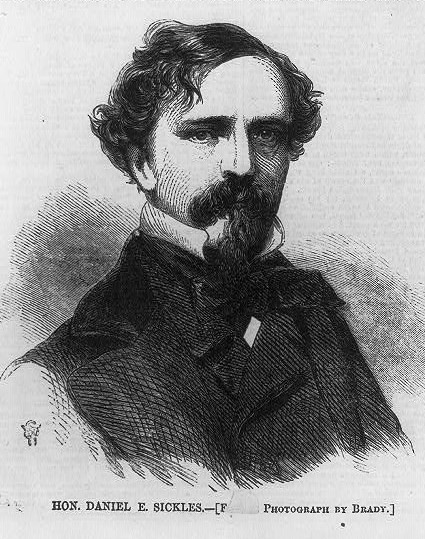
I am taking a break over this Thanksgiving weekend and am re-posting some articles from my Gettysburg text dealing with a man that I consider one of the most fascinating , salacious, scandalous, heroic, and incredible figures ever to grace and disgrace American history, Congressman, and Civil War General Daniel E. Sickles.

I hope that you enjoy,

Peace

Padre Steve+

6517740_orig


George Meade had made his dispositions on July 2nd 1863 with care, but there was one notable problem, the commander of III Corps, Major General Dan Sickles did not like the position assigned to his corps on the south end of Cemetery Ridge. But before discussing that it is worth chasing the rabbit so to speak and spend some time on the life of a man referred to by one by one biographer as an American Scoundrel and another as Sickles the Incredible. The interesting thing is that lie most complex characters in history that Dan Sickles was both and, “he might have had more faults than virtues, but everything about him was perfectly genuine.” [1] That is one of the reason that he is so fascinating.

Sickles was certainly a scoundrel and at the same time incredible, charming yet terribly vain and often insincere. “He was quick-witted, willful, brash, and ambitious, with pliable moral principles.” [2] But he was also incredibly brilliant, far sighted, patriotic, and civic minded. He was a political general, “flamboyant, impulsive, and brave, some would wonder about his discipline and military judgement.” [3] His notoriety and unpopularity among the West Point trained professional officers in the Army of the Potomac, as well as his tactical decision to move his corps on the afternoon of July 2nd 1863, and his subsequent political machinations ensured that he would be the only corps commander of that army not commemorated with a monument at Gettysburg.

Dan Sickles was one of the most colorful, controversial, and perhaps the most scandalous officer ever to command a corps in the history of the United States Army. While he lacked professional training he had done a fair amount of study of the military arts in his spare time, and he “made up for his lack of military training by acting on the battlefield with reckless courage, and was much admired for it by his men.” [4]

After having served as a brigade and division commander Sickles was promoted to corps command. “Sickles owed his elevation to corps command to the patronage of his friend Joseph Hooker…. And while man of the West Point officer….regarded Sickles military acumen with the greatest skepticism, many in the volunteer ranks were of a different mind. “Sickles is a great favorite in this corps,” asserted Private John Haley of the 17th Maine. “The men worship him. He is every inch a soldier and looking like a game cock. No one questions his bravery or patriotism.” [5] General Alpheus Williams who commanded a division in the Union Twelfth Corps despised Sickles, and after Chancellorsville Williams wrote “A Sickles’ would beat Napoleon in winning glory not earned,,, He is a hero without a heroic deed! Literally made by scribblers.” [6] Likewise, Sickles, the political general was no favorite of George Gordon Meade.

On July 2nd 1863 Sickles would be responsible for an act that threw George Meade’s defensive plan into chaos, and according to most historians and analysts nearly lost the battle, however, there are some who defend his actions and give him credit for upsetting Lee’s plan of attack. However, the truth lays somewhat in the middle as both observations are correct. Sickles’ decision created a massive controversy in the months following the battle as public hearings in Congress, where Sickles, a former congressman from New York had many friends, as well as enemies, sought a political advantage from a near military disaster.

Sickles was a mercurial, vain and scandal plagued man who “wore notoriety like a cloak” and “whether he was drinking, fighting, wenching or plotting, he was always operating with the throttle wide open.” [7]Sickles was born in New York to George and Susan Marsh Sickles in late 1819, though a number of sources, including Sickles himself cite dates ranging from 1819 through 1825. “There is little reliable information about Sickles’ early days,” [8] and he did not talk much about them, especially after the war, when Gettysburg and the Civil War became his main subjects of conversation. His father, a sixth generation American whose family were early Dutch settlers in Manhattan became wealthy through real estate speculation, “and he passed on to his son a pride in being a congenital Knickerbocker,” charming, witty, and clever, in whom “hardheadedness and impulsiveness were combined.” [9]

The young Sickles was an impetuous child and his father’s wealth ensured that Dan Sickles had “the finest of tutors…. And an unceasing bankroll of funding for lascivious escapades.” [10] To get their son special tutoring to prepare him for college, his parents “arranged for him to live in the scholarly house of the Da Pont family…. It was a household like few others in that hardheaded, mercantile city, at a time when New York had little of the Italian character it would later take on.” [11]The home was a place of learning, culture, and unusual relationships. The head of the house was Lorenzo L. Da Pont, a Professor at Columbia, as well as a practicing attorney. Also living in the home was Da Pont’s father, the ninety-year-old Professor Lorenzo Da Pont, who “had been the librettist for three of Mozart’s operas” [12] and “held the chair of Italian and Columbia University” [13] Additionally, the elder Da Pont’s “adopted daughter Maria and her husband, Antonio Bagioli, a successful composer and music teacher” [14] lived under the same roof.

Maria was only about twenty-years-old when Sickles moved in. By this time she and Bagioli already had a child of their own, a three year old daughter named Teresa, which Sickles would eventually marry. While the elder Da Pont claimed Maria as an adopted daughter, it was “widely believed that she was his “natural child” … from an American liaison conducted when he was near the age of seventy.” [15] This spawned rumors, even at the time of Gettysburg that the young Sickles “and his future mother-in-law had a sexual affair.” [16]

Whether the liaison with Maria Bagioli occurred is a matter of innuendo and conjecture, but it would not be out of character for Sickles, who, to put it mildly, had a wild proclivity for the opposite sex. As a young man he frequented brothels, and as his social and political status increased, he moved from the brothels frequented by the middle class to those which catered to the more socially well to do. One of his affairs was with the a prostitute named Fanny White, a woman who was smart, pretty, and upwardly mobile who ran her own bordello. His affair with Fanny was well publicized, but did not prevent him from being elected to the state legislature in 1847. She and Sickles would continue their relationship for years with her asking nothing more than expensive gifts, and there are inklings that Fanny help to fund Sickles’ early political campaigns. There is also speculation that in 1854 following his marriage, that Fanny spent time with him in London while he was working with James Buchanan and that that he “may have brought Fanny to one of the Queens’s receptions and introducing the prostitute to Her Majesty.” [17] But Fanny eventually moved on to a man older and richer than Sickles. Eventually she retired from her business and married another New York lawyer but died of complications of tuberculosis and possibly syphilis in 1860. Her property at the time of her death was conservatively “estimated at $50,000 to $100,000”[18] a considerable fortune for a woman of her day and age.

While he lived with the Da Pont family, Sickles gained an appreciation for foreign languages, as well as theater and opera. The elder Professor Da Pont was a major part of his academic life and quite possibly in the development of Sickles liberal education and his rather libertine morality. Lorenzo had been a Catholic Priest and theologian in Italy, but like his young American admirer had quite the attraction for women, and was a connoisseur of erotic literature and poetry. His activities resulted in him being expelled from his teaching position in the seminary, after which he became fast friends with a man whose name is synonymous with smooth talking, suave, amorous men, Giacomo Casanova, and in Europe “his affairs with women had been almost as notorious as those of his good friend.” [19] Certainly the elder Lorenzo’s tales “of Casanova, the fabled prince of Priapus, did nothing to quell Dan’s adolescent sexual appetite.” [20]

Noted Civil War and Gettysburg historian Allen Guelzo describes the Sickles in even less flattering terms, “Sickles was from the beginning, a spoiled brat, and he matured from there into a suave, charming, pathological liar, not unlike certain characters in Mozart operas.”[21]

Following the deaths of both the elder and younger Professor Da Pont, Sickles was stricken with grief. At the funeral of the younger Professor Da Pont Sickles “raved and tore up and down the graveyard shrieking,” [22] forcing other mourners to take him away by force. Soon after, Sickles left New York University and began to work in the law office of the very formidable New York lawyer and former U.S. Attorney General, Benjamin F. Butler.

While he was studying for the bar under Butler, he was joined by his father who would also become an attorney. It was under the influence of his father, who was now a wealthy Wall Street investor, and the Democrats of Tammany Hall that the incredibly talented Sickles was groomed for political leadership. Tammany was a rough and tumble world of hardnosed politics, backroom deals, corruption and graft.

He passed the bar in 1843 and soon was making a name for himself in the legal world, and in politics, despite his well-known questionable ethics and morality. His political career began in 1844 when “he wrote a campaign paper for James Polk and became involved in the Tammany Hall political machine.” [23] The ever ambitious Sickles “clambered up the city’s Democratic party ladder, on the way collecting allies and enemies with utter disregard for the consequences, attending the typically unruly Tammany meetings armed with bowie knife and pistol.” [24]

Like many of his fellow New York Democrats he was a proponent of “Manifest Destiny, and the right of the United States to acquire and hold Texas, New Mexico, California, perhaps the isthmus of Central American, and certainly Cuba.” [25] He was also a political ally of many states rights Southern Democrats and “largely opposed anti-slavery legislation.” [26] This was in large part due to the commercial interests of New York, which between banking and commercial shipping interests profited from the South’s slave economy.

He was elected to the New York State legislature in 1847 and his political star continued to rise even as his personal reputation sank among many of his peers. An attorney who knew him described Sickles as “one of the bigger bubbles in the scum of the profession, swollen, and windy, and puffed out with fetid gas.” [27] Sickles rivals any American politician, before or since in his ability to rise even as the slime ran down his body, the term “Teflon” applied to politicians like Presidents Ronald Reagan and Bill Clinton comes to mind when one studies Sickles’ career. New York lawyer and diarist George Templeton Strong wrote, “One might as well try to spoil a rotten egg as to damage Dan’s career.” [28]

But there was no denying that Sickles was a brilliant lawyer, politician, and debater. One observed that Sickles was “a lawyer by intuition – careful in reaching his conclusions, but quick and bold in pushing them.” [29]New York Governor “William Marcy grudgingly said that as a debater Sickles excelled any man of his years, and the astute Henry Raymond declared that as a parliamentary leader he was unsurpassed.” [30] Soon Sickles was a delegate to the 1848 Democratic Convention where he helped nominate Franklin Pierce for his unsuccessful run at the democratic nomination. The convention enabled Sickles to enter the world of national politics making friends with many influential politicians and financiers, including Pierce, the Van Burens, and James Buchanan. On his return to New York he received an appointed as a Major in the New York Militia.

Even as Sickles rose in the tumultuous world of American law and politics, and chased Fanny White he became enamored with the now teenage daughter of Antonio and Maria Bagioli, Miss Teresa Bagioli who though only fifteen was beautiful, wise beyond her years, fluent in French and Italian, devoted to the arts, and entirely besotted by Dan Sickles. Both the parents of Sickles and Teresa opposed the relationship, but both were madly in love, and Teresa was as headstrong as Dan regarding the relationship. Though such a relationship would be considered completely scandalous today, such marriages were not uncommon then, though they were certainly less common in the upper society of New York. Sickles “was enchanted by her” and “courted her with the sensibility of being a friend of her parents and he must have suspected that he loved her with a fated and exclusive love.” [31] When she was just sixteen Teresa quit school and married the thirty-three year-old assemblyman in a civil ceremony officiated by New York Mayor Ambrose Kingsland on September 27th1852. Six months later, the two were married in the Catholic Church by Archbishop John Hughes, in a “gala and largely attended affair.” [32] Just three months after the church wedding their daughter, Laura, was born. Though there can be no doubt that Sickles loved Teresa, and she him, it did not stop him from other extramarital affairs, nor did it take much away from his political machinations at Tammany Hall.

Following the 1852 Democratic convention where he again supported Franklin Pierce, Sickles hard fighting and influence at in the Wigwam of was rewarded with political plum prize of being appointed “corporation counsel of New York City, a post that paid a flattering salary with extra emoluments and also left room for profitable legal work on the side.” [33] His political and social acumen were again demonstrated as he convinced the state legislature, through personal force of will, to enable the New York City Corporation “to go ahead with creating a great central park,”[34] a park that we now know today as Central Park. He also helped push forward a proposal to create New York’s first mass transportation system, that of horse drawn omnibuses.

Later in the year Sickles was appointed as secretary of the American legation to the Court of St. James n London, headed by former Secretary of State James Buchanan. The position paid a pittance of what Sickles was earning in New York, but he realized that the serving overseas in such a position could not but help him on the national political stage. Though Buchanan and Pierce wanted Sickles, the new Secretary of State, the former New York Governor William Marcy refused to sign Sickles’ commission for the post. Eventually, Pierce prevailed and Sickles got the job.

As their baby, Laura, was still very young and sea travel still quite hazardous, Teresa remained at home, and joined her husband in London the following year. However, when she arrived in London, the teenage wife of Dan Sickles charmed Americans and Britons alike. Aided by her multilingual gifts, which “were rare among American diplomats’ wives,” [35] she became a great success and the unmarried Buchanan appointed her as hostess for the legation. She rapidly became a celebrity due to her stunning beauty and charm, and like he had Fanny, Sickles had Teresa introduced to the Queen. Her celebrity status evoked different responses from those that observed her. “One contemporary described Teresa as an Italian beauty, warm, openhearted, and unselfish. Another described her as being “… without shame or brain and [having] a lust for men.” [36] That “lust for men” coupled with the neglect of her husband may well have been the catalyst for the scandal which overwhelmed them in Dan’s congressional career.

It was during his service in London with Buchanan that Sickles became embroiled in one of the most embarrassing diplomatic incidents in American history. The proponents of Manifest Destiny and American expansion had long desired to take Cuba from Spain through diplomacy, or if needed force. Following a failed attempt by American “Filibusters” to seize the island in 1852 which ended in the execution of fifty Americans, including the son of U.S. Attorney General John Crittenden by Spanish authorities, and in 1854 President Franklin Pierce authorized Buchanan to attempt to negotiate the acquisition of Cuba.

Pierce authorized Buchanan to meet with James Mason, the United States Ambassador to France and Pierre Soule, the United States Ambassador to Spain secretly in order to draft “a statement on the future of Cuba and the proposed role of the United States.” [37] Soule dominated the meeting and the statement, which was in large part drafted by Dan Sickles, was highly inflammatory. Despite this the statement was released to the press in defiance of the order to maintain the strictest secrecy and it resulted in a diplomatic disaster for the Pierce Administration.

The document was prepared by Soule and Sickles and endorsed by Buchanan and Mason was known as the Ostend Manifesto, and it “was one of the most truly American, and at the same time most undiplomatic, documents every devised.” [38] The manifesto prepared by Soule and Sickles proclaimed that “Cuba is as necessary to the North American Republic as any of its present members, and that it belongs naturally to the great family of states of which the Union is the Providential Nursery.” [39] The authors of the manifesto also threatened Spain should the Spanish fail to accede to American demands. The authors declared that if the United States “decided its sovereignty depended on acquiring Cuba, and if Spain would not pass on sovereignty in the island to the United States by peaceful means, including sale, then, “by every law, human and Divine, we shall be justified in wresting it from Spain.” [40]

The Ostend Manifesto “sent shivers through the chancelleries of Europe, provoked hurried conversations between the heads of the French and British admiralties.” [41] European diplomats and leaders reacted harshly to the statement and Secretary of State William Marcy who had previously supported the ideas in the document immediately distance himself and official American policy from it and the authors. Marcy then “forced Soule’s resignation by repudiating the whole thing, but the damage was done.” For months the Pierce administration was on the defensive, and was condemned “as the advocate of a policy of “shame and dishonor,” the supporter of a “buccaneering document,” a “highwayman’s plea.” American diplomacy, said the London Times, was given to “the habitual pursuit of dishonorable object by clandestine means.”[42] The incident ended official and unofficial attempts by Americans to obtain Cuba by legal or extralegal means until the Spanish American War in 1898.

To be continued…

Notes

[1] Catton, Bruce The Army of the Potomac: Glory Road Doubleday and Company, Garden City New York, 1952 p.151

[2] Wert, Jeffry D. The Sword of Lincoln: The Army of the Potomac Simon and Schuster, New York and London 2005 p.222

[3] Ibid. Coddington The Gettysburg Campaign a Study in Command p.45

[4] Sears, Stephen W. Chancellorsville Houghton Mifflin Co. Boston and New York 1996 p.65

[5] Ibid. Trudeau Gettysburg a Testing of Courage p.110

[6] Ibid. Sears Gettysburg p.35

[7] Ibid. Catton The Army of the Potomac: Glory Road pp.150-151

[8] Hessler, James A. Sickles at Gettysburg Savas Beatie New York and El Dorado Hills CA, 2009, 2010 p.1

[9] Keneally, Thomas American Scoundrel: The Life of the Notorious Civil War General Dan Sickles Anchor Books, a Division of Random House, New York 2003 p.7

[10] Ibid. Guelzo, Gettysburg The Last Invasion p.243

[11] Ibid. Keneally American Scoundrel p.3

[12] Ibid. Hessler Sickles at Gettysburg p.2

[13] Ibid. Keneally American Scoundrel p.3

[14] Ibid. Hessler Sickles at Gettysburg p.3

[15] Ibid. Keneally American Scoundrel p.4

[16] Ibid. Hessler Sickles at Gettysburg p.3

[17] Ibid. Hessler Sickles at Gettysburg p.6

[18] Ibid. Keneally American Scoundrel p.215

[19] Swanberg, W.A. Sickles the Incredible copyright by the author 1958 and 1984 Stan Clark Military Books, Gettysburg PA 1991 p.79

[20] Ibid. Swanberg Sickles the Incredible p.80

[21] Ibid. Guelzo, Gettysburg The Last Invasion p.243

[22] Ibid. Swanberg Sickles the Incredible p.81

[23] Ibid. Hessler Sickles at Gettysburg p.4

[24] Sears, Stephen W. Controversies and Commanders Mariner Books, Houghton-Mifflin Company, Boston and New York 1999 p.198

[25] Ibid. Keneally American Scoundrel p.12

[26] Ibid. Swanberg Sickles the Incredible p.82

[27] Ibid. Wert The Sword of Lincoln p.222

[28] Ibid. Hessler Sickles at Gettysburg p.4

[29] Ibid. Swanberg Sickles the Incredible p.84

[30] Ibid. Swanberg Sickles the Incredible p.84

[31] Ibid. Keneally American Scoundrel p.21

[32] Wilson Robert and Clair, Carl They Also Served: Wives of Civil War Generals Xlibris Corporation 2006 p.98

[33] Ibid. Swanberg Sickles the Incredible p.88

[34] Ibid. Keneally American Scoundrel p.21

[35] Ibid. Keneally American Scoundrel p.39

[36] Ibid. Wilson and Clair They Also Served p.98

[37] Ibid. Keneally American Scoundrel p.44

[38] Pinchon, Edgcumb Dan Sickles: Hero of Gettysburg and “Yankee King of Spain” Doubleday, Doran and Company Inc. Garden City NY 1945 p.48

[39] Ibid. Potter The Impending Crisis p.190

[40] Ibid. Keneally American Scoundrel p.45

[41] Ibid. Pinchon Dan Sickles p.48

[42] Potter, David M. The Impending Crisis: America before the Civil War 1848-1861 completed and edited by Don E. Fehrenbacher Harper Collins Publishers, New York 1976 p.193

Leave a comment

Filed under civil war, ethics, History, leadership

Incredible Scoundrel: Dan Sickles Pt.1

6517740_orig

Friends of Padre Steve’s World

I am a historian as well as a chaplain and priest. I do a lot of work with the Battle of Gettysburg and much of my work involves biography as I believe that the one constant in history is people. Technology and many other things may change, but people and human nature are constant, for good and for bad, and frankly I find people fascinating. In fact from the point of view of history and biography, sinners are much more interesting to write about than saints, but I digress…

One of the most fascinating people of the Battle of Gettysburg is Union Major General Daniel E. Sickles, a man who was one of the most fascinating, salacious, scandalous, and incredible figures ever to grace and disgrace American history. 

This is the first of a three part series taken from my Gettysburg and Civil War text. I hope that you enjoy.

Peace,

Padre Steve+

George Meade had made his dispositions on July 2nd 1863 with care, but there was one notable problem, the commander of III Corps, Major General Dan Sickles did not like the position assigned to his corps on the south end of Cemetery Ridge. But before discussing that it is worth chasing the rabbit so to speak and spend some time on the life of a man referred to by one by one biographer as an American Scoundrel and another as Sickles the Incredible. The interesting thing is that lie most complex characters in history that Dan Sickles was both and, “he might have had more faults than virtues, but everything about him was perfectly genuine.” [1] That is one of the reason that he is so fascinating.

Sickles was certainly a scoundrel and at the same time incredible, charming yet terribly vain and often insincere. “He was quick-witted, willful, brash, and ambitious, with pliable moral principles.” [2] But he was also incredibly brilliant, far sighted, patriotic, and civic minded. He was a political general, “flamboyant, impulsive, and brave, some would wonder about his discipline and military judgement.” [3] His notoriety and unpopularity among the West Point trained professional officers in the Army of the Potomac, as well as his tactical decision to move his corps on the afternoon of July 2nd 1863, and his subsequent political machinations ensured that he would be the only corps commander of that army not commemorated with a monument at Gettysburg.

Dan Sickles was one of the most colorful, controversial, and perhaps the most scandalous officer ever to command a corps in the history of the United States Army. While he lacked professional training he had done a fair amount of study of the military arts in his spare time, and he “made up for his lack of military training by acting on the battlefield with reckless courage, and was much admired for it by his men.” [4]

After having served as a brigade and division commander Sickles was promoted to corps command. “Sickles owed his elevation to corps command to the patronage of his friend Joseph Hooker…. And while man of the West Point officer….regarded Sickles military acumen with the greatest skepticism, many in the volunteer ranks were of a different mind. “Sickles is a great favorite in this corps,” asserted Private John Haley of the 17th Maine. “The men worship him. He is every inch a soldier and looking like a game cock. No one questions his bravery or patriotism.” [5] General Alpheus Williams who commanded a division in the Union Twelfth Corps despised Sickles, and after Chancellorsville Williams wrote “A Sickles’ would beat Napoleon in winning glory not earned,,, He is a hero without a heroic deed! Literally made by scribblers.” [6] Likewise, Sickles, the political general was no favorite of George Gordon Meade.

On July 2nd 1863 Sickles would be responsible for an act that threw George Meade’s defensive plan into chaos, and according to most historians and analysts nearly lost the battle, however, there are some who defend his actions and give him credit for upsetting Lee’s plan of attack. However, the truth lays somewhat in the middle as both observations are correct. Sickles’ decision created a massive controversy in the months following the battle as public hearings in Congress, where Sickles, a former congressman from New York had many friends, as well as enemies, sought a political advantage from a near military disaster.

Sickles was a mercurial, vain and scandal plagued man who “wore notoriety like a cloak” and “whether he was drinking, fighting, wenching or plotting, he was always operating with the throttle wide open.” [7] Sickles was born in New York to George and Susan Marsh Sickles in late 1819, though a number of sources, including Sickles himself cite dates ranging from 1819 through 1825. “There is little reliable information about Sickles’ early days,” [8] and he did not talk much about them, especially after the war, when Gettysburg and the Civil War became his main subjects of conversation. His father, a sixth generation American whose family were early Dutch settlers in Manhattan became wealthy through real estate speculation, “and he passed on to his son a pride in being a congenital Knickerbocker,” charming, witty, and clever, in whom “hardheadedness and impulsiveness were combined.” [9]

The young Sickles was an impetuous child and his father’s wealth ensured that Dan Sickles had “the finest of tutors…. And an unceasing bankroll of funding for lascivious escapades.” [10] To get their son special tutoring to prepare him for college, his parents “arranged for him to live in the scholarly house of the Da Pont family…. It was a household like few others in that hardheaded, mercantile city, at a time when New York had little of the Italian character it would later take on.” [11] The home was a place of learning, culture, and unusual relationships. The head of the house was Lorenzo L. Da Pont, a Professor at Columbia, as well as a practicing attorney. Also living in the home was Da Pont’s father, the ninety-year-old Professor Lorenzo Da Pont, who “had been the librettist for three of Mozart’s operas” [12] and “held the chair of Italian and Columbia University” [13] Additionally, the elder Da Pont’s “adopted daughter Maria and her husband, Antonio Bagioli, a successful composer and music teacher” [14] lived under the same roof.

Maria was only about twenty-years-old when Sickles moved in. By this time she and Bagioli already had a child of their own, a three year old daughter named Teresa, which Sickles would eventually marry. While the elder Da Pont claimed Maria as an adopted daughter, it was “widely believed that she was his “natural child” … from an American liaison conducted when he was near the age of seventy.” [15] This spawned rumors, even at the time of Gettysburg that the young Sickles “and his future mother-in-law had a sexual affair.” [16]

Whether the liaison with Maria Bagioli occurred is a matter of innuendo and conjecture, but it would not be out of character for Sickles, who, to put it mildly, had a wild proclivity for the opposite sex. As a young man he frequented brothels, and as his social and political status increased, he moved from the brothels frequented by the middle class to those which catered to the more socially well to do. One of his affairs was with the a prostitute named Fanny White, a woman who was smart, pretty, and upwardly mobile who ran her own bordello. His affair with Fanny was well publicized, but did not prevent him from being elected to the state legislature in 1847. She and Sickles would continue their relationship for years with her asking nothing more than expensive gifts, and there are inklings that Fanny help to fund Sickles’ early political campaigns. There is also speculation that in 1854 following his marriage, that Fanny spent time with him in London while he was working with James Buchanan and that that he “may have brought Fanny to one of the Queens’s receptions and introducing the prostitute to Her Majesty.” [17] But Fanny eventually moved on to a man older and richer than Sickles. Eventually she retired from her business and married another New York lawyer but died of complications of tuberculosis and possibly syphilis in 1860. Her property at the time of her death was conservatively “estimated at $50,000 to $100,000” [18] a considerable fortune for a woman of her day and age.

While he lived with the Da Pont family, Sickles gained an appreciation for foreign languages, as well as theater and opera. The elder Professor Da Pont was a major part of his academic life and quite possibly in the development of Sickles liberal education and his rather libertine morality. Lorenzo had been a Catholic Priest and theologian in Italy, but like his young American admirer had quite the attraction for women, and was a connoisseur of erotic literature and poetry. His activities resulted in him being expelled from his teaching position in the seminary, after which he became fast friends with a man whose name is synonymous with smooth talking, suave, amorous men, Giacomo Casanova, and in Europe “his affairs with women had been almost as notorious as those of his good friend.” [19] Certainly the elder Lorenzo’s tales “of Casanova, the fabled prince of Priapus, did nothing to quell Dan’s adolescent sexual appetite.” [20]

Noted Civil War and Gettysburg historian Allen Guelzo describes the Sickles in even less flattering terms, “Sickles was from the beginning, a spoiled brat, and he matured from there into a suave, charming, pathological liar, not unlike certain characters in Mozart operas.” [21]

Following the deaths of both the elder and younger Professor Da Pont, Sickles was stricken with grief. At the funeral of the younger Professor Da Pont Sickles “raved and tore up and down the graveyard shrieking,” [22] forcing other mourners to take him away by force. Soon after, Sickles left New York University and began to work in the law office of the very formidable New York lawyer and former U.S. Attorney General, Benjamin F. Butler.

While he was studying for the bar under Butler, he was joined by his father who would also become an attorney. It was under the influence of his father, who was now a wealthy Wall Street investor, and the Democrats of Tammany Hall that the incredibly talented Sickles was groomed for political leadership. Tammany was a rough and tumble world of hardnosed politics, backroom deals, corruption and graft.

He passed the bar in 1843 and soon was making a name for himself in the legal world, and in politics, despite his well-known questionable ethics and morality. His political career began in 1844 when “he wrote a campaign paper for James Polk and became involved in the Tammany Hall political machine.” [23] The ever ambitious Sickles “clambered up the city’s Democratic party ladder, on the way collecting allies and enemies with utter disregard for the consequences, attending the typically unruly Tammany meetings armed with bowie knife and pistol.” [24]

Like many of his fellow New York Democrats he was a proponent of “Manifest Destiny, and the right of the United States to acquire and hold Texas, New Mexico, California, perhaps the isthmus of Central American, and certainly Cuba.” [25] He was also a political ally of many states rights Southern Democrats and “largely opposed anti-slavery legislation.” [26] This was in large part due to the commercial interests of New York, which between banking and commercial shipping interests profited from the South’s slave economy.

He was elected to the New York State legislature in 1847 and his political star continued to rise even as his personal reputation sank among many of his peers. An attorney who knew him described Sickles as “one of the bigger bubbles in the scum of the profession, swollen, and windy, and puffed out with fetid gas.” [27] Sickles rivals any American politician, before or since in his ability to rise even as the slime ran down his body, the term “Teflon” applied to politicians like Presidents Ronald Reagan and Bill Clinton comes to mind when one studies Sickles’ career. New York lawyer and diarist George Templeton Strong wrote, “One might as well try to spoil a rotten egg as to damage Dan’s career.” [28]

But there was no denying that Sickles was a brilliant lawyer, politician, and debater. One observed that Sickles was “a lawyer by intuition – careful in reaching his conclusions, but quick and bold in pushing them.” [29] New York Governor “William Marcy grudgingly said that as a debater Sickles excelled any man of his years, and the astute Henry Raymond declared that as a parliamentary leader he was unsurpassed.” [30] Soon Sickles was a delegate to the 1848 Democratic Convention where he helped nominate Franklin Pierce for his unsuccessful run at the democratic nomination. The convention enabled Sickles to enter the world of national politics making friends with many influential politicians and financiers, including Pierce, the Van Burens, and James Buchanan. On his return to New York he received an appointed as a Major in the New York Militia.

Even as Sickles rose in the tumultuous world of American law and politics, and chased Fanny White he became enamored with the now teenage daughter of Antonio and Maria Bagioli, Miss Teresa Bagioli who though only fifteen was beautiful, wise beyond her years, fluent in French and Italian, devoted to the arts, and entirely besotted by Dan Sickles. Both the parents of Sickles and Teresa opposed the relationship, but both were madly in love, and Teresa was as headstrong as Dan regarding the relationship. Though such a relationship would be considered completely scandalous today, such marriages were not uncommon then, though they were certainly less common in the upper society of New York. Sickles “was enchanted by her” and “courted her with the sensibility of being a friend of her parents and he must have suspected that he loved her with a fated and exclusive love.” [31] When she was just sixteen Teresa quit school and married the thirty-three year-old assemblyman in a civil ceremony officiated by New York Mayor Ambrose Kingsland on September 27th 1852. Six months later, the two were married in the Catholic Church by Archbishop John Hughes, in a “gala and largely attended affair.” [32] Just three months after the church wedding their daughter, Laura, was born. Though there can be no doubt that Sickles loved Teresa, and she him, it did not stop him from other extramarital affairs, nor did it take much away from his political machinations at Tammany Hall.

Following the 1852 Democratic convention where he again supported Franklin Pierce, Sickles hard fighting and influence at in the Wigwam of was rewarded with political plum prize of being appointed “corporation counsel of New York City, a post that paid a flattering salary with extra emoluments and also left room for profitable legal work on the side.” [33] His political and social acumen were again demonstrated as he convinced the state legislature, through personal force of will, to enable the New York City Corporation “to go ahead with creating a great central park,” [34] a park that we now know today as Central Park. He also helped push forward a proposal to create New York’s first mass transportation system, that of horse drawn omnibuses.

Later in the year Sickles was appointed as secretary of the American legation to the Court of St. James n London, headed by former Secretary of State James Buchanan. The position paid a pittance of what Sickles was earning in New York, but he realized that the serving overseas in such a position could not but help him on the national political stage. Though Buchanan and Pierce wanted Sickles, the new Secretary of State, the former New York Governor William Marcy refused to sign Sickles’ commission for the post. Eventually, Pierce prevailed and Sickles got the job.

As their baby, Laura, was still very young and sea travel still quite hazardous, Teresa remained at home, and joined her husband in London the following year. However, when she arrived in London, the teenage wife of Dan Sickles charmed Americans and Britons alike. Aided by her multilingual gifts, which “were rare among American diplomats’ wives,” [35] she became a great success and the unmarried Buchanan appointed her as hostess for the legation. She rapidly became a celebrity due to her stunning beauty and charm, and like he had Fanny, Sickles had Teresa introduced to the Queen. Her celebrity status evoked different responses from those that observed her. “One contemporary described Teresa as an Italian beauty, warm, openhearted, and unselfish. Another described her as being “… without shame or brain and [having] a lust for men.” [36] That “lust for men” coupled with the neglect of her husband may well have been the catalyst for the scandal which overwhelmed them in Dan’s congressional career.

It was during his service in London with Buchanan that Sickles became embroiled in one of the most embarrassing diplomatic incidents in American history. The proponents of Manifest Destiny and American expansion had long desired to take Cuba from Spain through diplomacy, or if needed force. Following a failed attempt by American “Filibusters” to seize the island in 1852 which ended in the execution of fifty Americans, including the son of U.S. Attorney General John Crittenden by Spanish authorities, and in 1854 President Franklin Pierce authorized Buchanan to attempt to negotiate the acquisition of Cuba.

Pierce authorized Buchanan to meet with James Mason, the United States Ambassador to France and Pierre Soule, the United States Ambassador to Spain secretly in order to draft “a statement on the future of Cuba and the proposed role of the United States.” [37] Soule dominated the meeting and the statement, which was in large part drafted by Dan Sickles, was highly inflammatory. Despite this the statement was released to the press in defiance of the order to maintain the strictest secrecy and it resulted in a diplomatic disaster for the Pierce Administration.

The document was prepared by Soule and Sickles and endorsed by Buchanan and Mason was known as the Ostend Manifesto, and it “was one of the most truly American, and at the same time most undiplomatic, documents every devised.” [38] The manifesto prepared by Soule and Sickles proclaimed that “Cuba is as necessary to the North American Republic as any of its present members, and that it belongs naturally to the great family of states of which the Union is the Providential Nursery.” [39] The authors of the manifesto also threatened Spain should the Spanish fail to accede to American demands. The authors declared that if the United States “decided its sovereignty depended on acquiring Cuba, and if Spain would not pass on sovereignty in the island to the United States by peaceful means, including sale, then, “by every law, human and Divine, we shall be justified in wresting it from Spain.” [40]

The Ostend Manifesto “sent shivers through the chancelleries of Europe, provoked hurried conversations between the heads of the French and British admiralties.” [41] European diplomats and leaders reacted harshly to the statement and Secretary of State William Marcy who had previously supported the ideas in the document immediately distance himself and official American policy from it and the authors. Marcy then “forced Soule’s resignation by repudiating the whole thing, but the damage was done.” For months the Pierce administration was on the defensive, and was condemned “as the advocate of a policy of “shame and dishonor,” the supporter of a “buccaneering document,” a “highwayman’s plea.” American diplomacy, said the London Times, was given to “the habitual pursuit of dishonorable object by clandestine means.” [42] The incident ended official and unofficial attempts by Americans to obtain Cuba by legal or extralegal means until the Spanish American War in 1898.

Too be continued…

Notes

[1] Catton, Bruce The Army of the Potomac: Glory Road Doubleday and Company, Garden City New York, 1952 p.151

[2] Wert, Jeffry D. The Sword of Lincoln: The Army of the Potomac Simon and Schuster, New York and London 2005 p.222

[3] Ibid. Coddington The Gettysburg Campaign a Study in Command p.45

[4] Sears, Stephen W. Chancellorsville Houghton Mifflin Co. Boston and New York 1996 p.65

[5] Ibid. Trudeau Gettysburg a Testing of Courage p.110

[6] Ibid. Sears Gettysburg p.35

[7] Ibid. Catton The Army of the Potomac: Glory Road pp.150-151

[8] Hessler, James A. Sickles at Gettysburg Savas Beatie New York and El Dorado Hills CA, 2009, 2010 p.1

[9] Keneally, Thomas American Scoundrel: The Life of the Notorious Civil War General Dan Sickles Anchor Books, a Division of Random House, New York 2003 p.7

[10] Ibid. Guelzo, Gettysburg The Last Invasion p.243

[11] Ibid. Keneally American Scoundrel p.3

[12] Ibid. Hessler Sickles at Gettysburg p.2

[13] Ibid. Keneally American Scoundrel p.3

[14] Ibid. Hessler Sickles at Gettysburg p.3

[15] Ibid. Keneally American Scoundrel p.4

[16] Ibid. Hessler Sickles at Gettysburg p.3

[17] Ibid. Hessler Sickles at Gettysburg p.6

[18] Ibid. Keneally American Scoundrel p.215

[19] Swanberg, W.A. Sickles the Incredible copyright by the author 1958 and 1984 Stan Clark Military Books, Gettysburg PA 1991 p.79

[20] Ibid. Swanberg Sickles the Incredible p.80

[21] Ibid. Guelzo, Gettysburg The Last Invasion p.243

[22] Ibid. Swanberg Sickles the Incredible p.81

[23] Ibid. Hessler Sickles at Gettysburg p.4

[24] Sears, Stephen W. Controversies and Commanders Mariner Books, Houghton-Mifflin Company, Boston and New York 1999 p.198

[25] Ibid. Keneally American Scoundrel p.12

[26] Ibid. Swanberg Sickles the Incredible p.82

[27] Ibid. Wert The Sword of Lincoln p.222

[28] Ibid. Hessler Sickles at Gettysburg p.4

[29] Ibid. Swanberg Sickles the Incredible p.84

[30] Ibid. Swanberg Sickles the Incredible p.84

[31] Ibid. Keneally American Scoundrel p.21

[32] Wilson Robert and Clair, Carl They Also Served: Wives of Civil War Generals Xlibris Corporation 2006 p.98

[33] Ibid. Swanberg Sickles the Incredible p.88

[34] Ibid. Keneally American Scoundrel p.21

[35] Ibid. Keneally American Scoundrel p.39

[36] Ibid. Wilson and Clair They Also Served p.98

[37] Ibid. Keneally American Scoundrel p.44

[38] Pinchon, Edgcumb Dan Sickles: Hero of Gettysburg and “Yankee King of Spain” Doubleday, Doran and Company Inc. Garden City NY 1945 p.48

[39] Ibid. Potter The Impending Crisis p.190

[40] Ibid. Keneally American Scoundrel p.45

[41] Ibid. Pinchon Dan Sickles p.48

[42] Potter, David M. The Impending Crisis: America before the Civil War 1848-1861 completed and edited by Don E. Fehrenbacher Harper Collins Publishers, New York 1976 p.193

2 Comments

Filed under civil war, ethics, History

Separate Ideology & Religion from Sworn Duty: The Legacy of Dr. C. Everett Koop

c-everett-koop-1db591308d7eb474

“At the beginning of the AIDS epidemic many Americans had little sympathy for people with AIDS…. The feeling was that somehow people from certain groups ‘deserved’ their illness. Let us put those feelings behind us. We are fighting a disease, not a people.” C. Everett Koop, Surgeon General 1986

Friends of Padre Steve’s World,

I have mentioned that I have been reflecting on many things over the past few weeks and months. Of course if you follow my writings you know what I think about public officials who refuse to do their duty to follow the law and protect the rights of other citizens, even of those that they happen to disapprove. This came to a head recently with the case of the anti-marriage equity county clerk, Kim Davis. I am not going to revisit her case as I have been worn out by it and have no need to waste any more time on her.

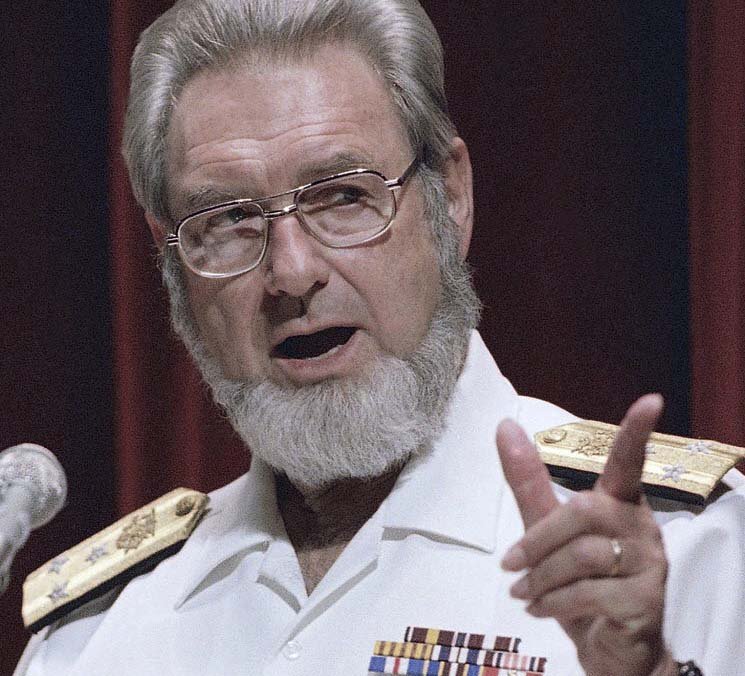
That being said I can point out the case of a public official, a conservative, pro-life, Evangelical Christian who served as Surgeon General under President Reagan, Dr. C. Everett Koop. In an era of extreme intolerance and hatred for those infected with HIV, Dr. Koop became one of the leading proponents of compassionate and responsible care for victims of HIV/AIDS, most of whom were homosexual men. He met opposition within the administration, where despite his impressive credentials he was marginalized and was vilified by conservative Christians.

Dr. James Dobson and Dr. D. James Kennedy, early leaders of the political religious right were particularly vindictive. These unscrupulous leaders helped spread much disinformation about HIV from the a book published by a charlatan named Gene Antonio who wrote what was then a popular book called “The AIDS Cover Up,” They claimed that AIDS could be spread by kissing, mosquito bites or even by touching surfaces that had been touched by those infected. These men were bolstered by their allies in the Reagan White House, Secretary of education Bill Bennett and his assistant Gary Bauer who were the official administration spokesmen regarding AIDS.

They marginalized the Surgeon General; Dr. C. Everett Koop who noted in the early days of the epidemic was “completely cut off from AIDS” by Bennett and others in the Reagan Administration. They were so wrong that Koop, who was by no means a liberal took them to task on their hateful, dishonest and un-Christian proclamations. Koop told a journalist:

“the Christian activity in reference to AIDS of both D. James Kennedy and Jim Dobson is reprehensible. The first time that Kennedy ever made a statement about AIDS, I saw it on television. It was so terrible, so homophobic, so pure Antonio that I wrote him a letter.”

Koop said of Dobson, who he had worked with earlier on HIV/AIDS: “I don’t know what happened to him. He changed his mind, and last August in his paper he attacked me for two pages as leading people down the garden path. But again his arguments were full of holes. I just cannot believe the poor scholarship of so many Christians.”

Despite the opposition and attacks on his character by leaders of the Christian Right, Dr. Koop was undeterred and had no problem taking on these men and women. Some of these supposedly Christian leaders still are with us and spout the same hatred for homosexuals that they did in the 1980s. Dr. Koop realized that many of his fellow Christians really didn’t care about people, and believed that HIV was God’s judgment against people that they already despised and had in their theology condemned to Hell. He also realized that many of these leaders would resort to poor scholarship and even inflammatory statements to influence public opinion.

For doing so Dr. Koop was condemned by fanatical extremists like Phyllis Schlafly who said that Koop’s recommendations in his report about preventing AIDS looked “like it was edited by the Gay Task Force” and Schlafly, ever the loving, honest and ethical Christian that she is accused Koop of advocating that third-graders learn the rules of “safe sodomy.”

Koop replied in a very courageous manner to Schlafly, who in my view is one of the most loathsome people to ever unite religion and politics: “I’m not surgeon general to make Phyllis Schlafly happy. I’m surgeon general to save lives.”

Dr. Koop understood the oath that he took as a physician and the oath that he took when he became Surgeon General; sadly Mrs. Davis and many in the Christian Right will never understand that. In 1988 Dr. Koop said something that most people in positions of any public responsibility, be they public health officials, medical professionals, politicians or even the most partisan political preachers should abide: “I separate ideology, religion and other things from my sworn duty as a health officer in this country.”

Dr. Koop’s words should be heeded by any Christian in public office, but sadly, those who do will be treated with the same scorn and hatred as Dobson, Kennedy, Bauer, and Schlafly heaped on him.

I can understand Dr. Koop’s plight. I have been set upon by some of the disciples of Bauer, Dobson, Schlafly, Kennedy and others for simply defending people’s rights under the Constitution and obeying the oath of office that I took in 1981 and have continued to affirm since. Sadly, the truth is that many so-called Christians will attempt to destroy the lives, reputation and careers of other Christians who do not tow their ideological line, and sadly this has become much worse than it was in the 1980s.

I will write more about this but for now I will wish you a good day.

Peace

Padre Steve+

1 Comment

Filed under christian life, civil rights, ethics, faith, healthcare, History, laws and legislation, leadership, LGBT issues, News and current events, Political Commentary

Inheriting the Wind: Iowa & the GOP 2015

4476555

I wonder about the people now leading the Republican Party, especially the Christian Right and the politicians that fall all over themselves to ingratiate themselves to get their vote. I wonder if they have any clue as to the long term damage that they are doing to that party, their faith or to the country.

I should know something about this, because for most of my adult life I was a Republican, and at times subscribed to some of the same beliefs as the current leaders of the Religious Right that dominate my former party. To watch the events of this weekend, like so many others of the past couple of decades before, was mind-numbing.

313-1qRzQm.AuSt.55

Mike Huckabee. the Trinity of Evil Incarnate: Preacher, Pundit and Politician 

The establishment GOP wants the votes of the Christian Right and the Tea Party, however, despite that they really don’t want them running the party. The establishment wants to have it both ways. They want to look like the boring conservatives of the pre-Reagan and Gingrich eras but they need to capture the votes of a base that is anything but that. That is why I find the potential candidacies of Jeb Bush and Mitt Romney so amusing. Neither man can meet the ideological and religious litmus tests of the people who helped the GOP capture both the House and Senate and neither stands a bat’s chance in hell at winning the nomination, or if they do to secure the support of the base. In order to do that they would have to deny who they are, the true descendants of the less than ideological Republican Party of men like Dwight Eisenhower, Richard Nixon, Nelson Rockefeller and Gerald Ford. Men whose relatively moderate beliefs were swept away by the so called Reagan Revolution and Gingrich takeover of 1994.

Barry Goldwater - Preachers

But Barry Goldwater warned us about them. Goldwater said back in 1981:

“Mark my word, if and when these preachers get control of the [Republican] party, and they’re sure trying to do so, it’s going to be a terrible damn problem. Frankly, these people frighten me. Politics and governing demand compromise. But these Christians believe they are acting in the name of God, so they can’t and won’t compromise. I know, I’ve tried to deal with them.”

The situation reminds me of the movie Inherit the Wind, the fictional portrayal of the Scopes Monkey Trial. In the movie one of the most stalwart critics of evolution, the former Presidential Candidate and Preacher Matthew Brady played by Frederic March, who has helped lead the city where the trial is being held into an anti-secular fervor.  At the beginning of the trial he encourages the townspeople to attend a “prayer meeting.” The meeting becomes quite heated as the town’s preacher, Reverend Brown, played by Claude Akins, who has launched into a full assault on all that oppose Brady, and therefore God.

11124_4

Reverend Brown works himself into a frenzy, condemn the accused and all that would defend him, including his very own daughter:

“Oh, Lord of the tempest and the thunder, strike down this sinner, as thou did thine enemies of old in the days of the Pharaohs! Let him know the terror of thy sword! Let his soul, for all eternity, writhe in anguish and damnation!”

His daughter, who is engaged to the accused cries out: “No! No, Pa! Don’t pray to destroy Bert!”

Then the reverend utters words which remind me so much of what I heard in Iowa this weekend:

“Lord, we call down the same curse on those who ask grace for this sinner—though they be blood of my blood, and flesh of my flesh!”

Brady, not seeing just how he has brought this about stops the good Reverend Brown and tells him:

“it is possible to be overzealous, to destroy that which you hope to save — so that nothing is left but emptiness.” He then quotes from the book of Proverbs: “Remember the wisdom of Solomon in the book of Proverbs. “He that troubleth his own house shall inherit the wind.”

To me this seems to be analogous to the current dilemma faced by the Republican Party. It has helped create, sustain and institutionalize a monster, and now seeing the danger doesn’t know what to do about it, and cannot admit its culpability in for it. Goldwater realized this in the earliest days of the movement which has consumed the Republican Party. The preachers have taken control and they will damn all who do not agree with them to destruction, even those of their own party.

The have been overzealous, and will continue to be so because like Matthew Brady they cannot acknowledge that their zeal may be misdirected and malevolent.

Like Reverend Brown, they are consumed by their hatred for a a non-believer, and they are willing to destroy the people closest to them to do so. I know this is true, because when I expressed doubt and did not tow the party line of my former church I was thrown out. Sadly, most of the men that I had previously counted as my closest friends abandoned or even condemned me.

vlcsnap-2010-06-30-01h19m56s22

My situation reminds me of a another exchange in the film between Brady and his opponent, Henry Drummond played by Spencer Tracy. Brady said: “Why is it, my old friend, that you’ve moved so far away from me?” 

To which Drummond replied: “All motion is relative, Matt. Maybe it’s you who’ve moved away by standing still.”

In standing still and condemning all who differ from their beliefs on any point, the preachers who now, in conduction with their business benefactors will indeed inherit the wind.

Ten years ago I could not have imagined this, but when I read the transcripts of many of the speakers fighting for the GOP leadership in Iowa this weekend it was yet another epiphany, in a series of epiphanies since I served in Iraq. The Iowa conference was a gathering of true believers, appealing to true believers. It was the proverbial self-licking ice cream cone with Mike Huckabee, Sarah Palin, Ted Cruz, Steve King, Ben Carson, Scott Walker, Rick Perry and the ever imbecilic Donald Trump leading the way. The Iowa meeting was more like the prayer meeting in Inherit the Wind than anything remotely connected with a normal American political meeting regardless of the party. Self congratulatory in denial the meeting was profound for its vapid rancor.

As far as me, watching this and all the other shenanigans of the Christian Right, I am sorry that I didn’t see it coming sooner. It took me until 2008 to realize that I really had not moved, but that the GOP moved, and continues to move away from me.

That is the scary part. Barry Goldwater was all too right in his analysis of those who have taken over the GOP. It is hard to believe that the only Republican bold enough to speak out against this takeover before it happened was the original “true conservative” of the GOP, a man whose 1964 campaign for President opened the door for their takeover of the party. Unlike those who attempted to claim his mantle including Ronald Reagan, Barry Goldwater really understood the danger of the genie that he let out of the bottle.

The irony is truly profound.

Peace

Padre Steve+

6 Comments

Filed under movies, News and current events, Political Commentary

And the Band Still Plays On: Religion, Politics, HIV and Ebola

262210_5_

‘“At the beginning of the AIDS epidemic many Americans had little sympathy for people with AIDS…The feeling was that somehow people from certain groups ‘deserved’ their illness. Let us put those feelings behind us. We are fighting a disease, not a people.”C. Everett Koop, Surgeon General 1986

I met someone with AIDS for the first time, at least knowingly for the first time in the summer of 1987 while serving as a Medical Service Corps personnel officer at the Academy of Health Sciences, Fort Sam Houston Texas. I was the Adjutant for the Academy Brigade, which is the unit that all medical training courses fell under for administrative and command and control issues. My job normally was consisted of basic personnel administration, working with commanders and legal officers when court-martial proceedings were needed, appointing investigating officers for different purposes, reviewing line of duty investigations and running duty rosters. It was nothing to write home about.

But that summer, after years of ignoring the issue the Reagan administration, which had made light of the disease and refused to do anything about it following the initial clinical diagnosis of it in 1981, belatedly, directed the Defense Department to start testing servicemen and women for the disease and to develop personnel policies for infected personnel.

Since it was considered by most in the mainstream to be a “gay” disease the Reagan administration treated it with distain, during some of the White House press conferences, Press Secretary Larry Speakes mocked and laughed about it to reporters who asked questions about it.

On October 15th 1982 this exchange took place: in the White House Briefing Room.

Q: Larry, does the President have any reaction to the announcement—the Centers for Disease Control in Atlanta, that AIDS is now an epidemic and have over 600 cases?

MR. SPEAKES: What’s AIDS?

Q: Over a third of them have died. It’s known as “gay plague.” (Laughter.) No, it is. I mean it’s a pretty serious thing that one in every three people that get this have died. And I wondered if the President is aware of it?

MR. SPEAKES: I don’t have it. Do you? (Laughter.)

Q: No, I don’t. MR. SPEAKES: You didn’t answer my question.

Q: Well, I just wondered, does the President—

MR. SPEAKES: How do you know? (Laughter.)

Q: In other words, the White House looks on this as a great joke? MR. SPEAKES: No, I don’t know anything about it, Lester.

Q: Does the President, does anybody in the White House know about this epidemic, Larry?

MR. SPEAKES: I don’t think so. I don’t think there’s been any—

Q: Nobody knows? MR. SPEAKES: There has been no personal experience here, Lester. Q: No, I mean, I thought you were keeping—

MR. SPEAKES: I checked thoroughly with Dr. Ruge this morning and he’s had no—(laughter)—no patients suffering from AIDS or whatever it is.

Q: The President doesn’t have gay plague, is that what you’re saying or what?

MR. SPEAKES: No, I didn’t say that.

Q: Didn’t say that?

MR. SPEAKES: I thought I heard you on the State Department over there. Why didn’t you stay there? (Laughter.)

Q: Because I love you, Larry, that’s why. (Laughter.)

MR. SPEAKES: Oh, I see. Just don’t put it in those terms, Lester. (Laughter.)

Q: Oh, I retract that.

MR. SPEAKES: I hope so.

Q: It’s too late.

Read more: http://www.alan.com/2014/10/18/that-time-the-reagan-white-house-press-briefing-erupted-with-laughter-over-aids-13-times/#ixzz3GcMPItu7

The late Congressman from San Francisco, Phil Burton told those seeking government help in diagnosing and treating the new disease that:

“I’ll introduce a bill. But if all the angels came dancing down to earth like the Rockettes, even they couldn’t get a dime out of this administration for anything with the name “gay” on it.”

I seriously doubt had Reagan’s friend, Rock Hudson, a closeted homosexual who was a cinematic idol in his day had not died of AIDS in October of 1985 if the administration would have even acted then. Their intentional disregard and negligence was criminal. But they finally did act, and the military acted to begin testing for the disease and to develop personnel policies for infected service members.

Back then no one wanted to deal with AIDS or the people infected by it. This was especially true in much of the military. Since I was the junior Medical Service personnel officer at the Academy of Health Sciences I was told that I would coordinate all services to those infected and work with those appointed by the Army Surgeon General’s office to develop appropriate personnel policies. People in the office joked that I was “CINC AIDS.” That was not a compliment.

When a soldier was diagnosed then they were given a form by their physician stating that they would let any partners know that they were HIV positive and that if they had sex they would only have protected sex. These were a host of other restrictions given in that medical “counseling” and all of these were reinforced as each soldier was then given an order by their commander to the same effect. The difference was that what the doctor gave was “counseling” and what the commander gave was an order, which if disobeyed could result in punishment under the Uniform Code of Military Justice.

10399639_55558982058_3465_n


The Author in 1987 shortly after becoming “CINC AIDS” at the Academy of Health Sciences 

Following this they were sent to me to discuss assignment limitations and career options. When people saw a soldier sitting outside my door, they pretty much knew what the person was there to see me for, as my job became more and more about dealing with those infected with HIV. As I took the job I read everything that I could and discussed the matter with physicians dealing with the disease.

Despite that in the beginning it was a scary experience. I attended a local mega-church and much of what I heard, read and listened to on Christian radio was full of paranoia, conspiracy theories and an attitude that could only be explained as an almost joyful gloating that the “homosexuals” were being judged by God. Not only that since HIV was determined to come from Africa, there was a tremendous amount of “old South” racism interspersed with their theological pronouncements.

Dr. James Dobson and Dr. D. James Kennedy, early leaders of the political religious right were particularly vindictive. These unscrupulous leaders helped spread much disinformation about HIV from the a book published by a charlatan named Gene Antonio who wrote what was then a popular book called “The AIDS Cover Up,” They claimed that AIDS could be spread by kissing, mosquito bites or even by touching surfaces that had been touched by those infected. These men were bolstered by their allies in the Reagan White House, Secretary of education Bill Bennett and his assistant Gary Bauer who were the official administration spokesmen regarding AIDS.

They marginalized the Surgeon General, Dr C. Everett Koop who noted in the early days of the epidemic was “completely cut off from AIDS” by Bennett and others in the Reagan Administration. They were so wrong that Koop, who was by no means a liberal took them to task on their hateful, dishonest and un-Christian proclamations. Koop told a journalist:

“the Christian activity in reference to AIDS of both D. James Kennedy and Jim Dobson is reprehensible. The first time that Kennedy ever made a statement about AIDS, I saw it on television. It was so terrible, so homophobic, so pure Antonio that I wrote him a letter.”

Koop said of Dobson, who he had worked with earlier on HIV/AIDS: “I don’t know what happened to him. He changed his mind, and last August in his paper he attacked me for two pages as leading people down the garden path. But again his arguments were full of holes. I just cannot believe the poor scholarship of so many Christians.”

But that was the world that part of me lived in. The other world was one of logic and reason, informed by human compassion, so unlike what I was being fed by church leaders and the “Christian” media that I immersed myself.

The sad truth of the matter is then, as today, that far too many Christians, especially influential leaders intentionally and malevolently spread lies to bolster their position. For them it is far easier to profit from demonizing people than it is to work with people they hate, to find solutions that help everyone. In my view many of these supposedly “Christian” leaders, apart from their fashionable clothes, are no different than the Nazis who blamed the Jews, Socialists and homosexuals for every ill in society; or the Japanese leaders who organized the Kamikaze Corps to send true believers to their deaths in a hopeless cause simply to maintain their power.

There is no love, there is no care and there is no empathy in any of them. As Army psychologist Captain Gustave Gilbert noted at Nuremberg “evil is the absence of empathy.”

When you do not know or have never have met someone being demonized by religious people it is easy to surround yourself in comfortable theology. However, when a family member, friend or colleague becomes one of those being demonized it tends to blow up your comfortable theology unless you are a sociopath.

I never will forget the day in the late summer of 1987 when an officer came to my office. He was the first person who I had ever met who was HIV positive. He was a medical professional, an Army Captain who had been selected for promotion to Major. He was married, had children and was a “born-again Christian.” He had contracted HIV when dealing with a combative drunk patient, who was HIV positive. The patient smashed glass, cutting himself severely and started bleeding. The shattered glass cut this officer as he tried to intervene and subdue the man. The officer was infected by the man’s infected blood, which entered him through his own wounds. Though he attempted to disinfect himself by normal protocols he became infected. I was looking at a man, just a few years older than me. A man who loved God, loved his family, who had did all the right things but had become HIV positive.

Even now I can see and hear this man, his face is etched deep into my memory, struggling to fit what happened to him into the message of God’s judgment that his fellow Christians and church members said was the cause of his disease. As I talked to him I realized that what I was being told by men who I was listening to every day on the way to work, as well as what I was reading by “Christian” authors and what I was hearing in church was a lie.

My worldview was forever changed that day. I realized that this man had done nothing wrong, in fact he was trying to do his job as a medical professional to keep a patient from further harm. I was able to help him get into a Master’s degree program in Healthcare Administration since he was no longer allowed to serve in a clinical environment. I have no idea what happened to him after I left the active duty Army to attend seminary in late 1988, but I presume since the mortality rate for HIV/AIDS was so high back then that he probably died years ago. I would hope that by some miracle that this man was fortunate and like NBA great Ervin “Magic” Johnson has not only survived but continues to do well. But I know that the odds were not in his favor.

When he left my office we shook hands, something that my fellow Christians said that I needed to avoid. Not only did I shake his hand, but I gave him a hug and I did not wash my hands or disinfect myself. I figured that God wanted me to get HIV from caring for and accepting someone infected with it than it didn’t matter.

Since that time I have worked with, cared for and ministered to more victims of HIV/AIDS, their families and their friends than I can count. Many of them have made significant impressions on me, my life, and my faith. Without them my life would not be as rich as it has been. I continued to deal with case after case and it is interesting to read he citation from my end of tour award for my time as the Adjutant of the Academy Brigade. It is almost all about AIDS.

So we fast forward to 2014. I’m still in the military, only now I am not a Medical Service Corps Officer in the Army but a Navy Chaplain. I have spent about eight years in the critical care environment of major medical center ERs, trauma departments and ICUs. I have a rather unique perspective having experience with AIDS and other highly infectious diseases, as well as the ethics of treatment.

Since I was previously qualified as a Nuclear, Chemical and Biological Defense officer when I served in the Army in the 1980s, I understand the importance of, as well as the limitations of personal protective equipment and decontamination procedures. Of course because I know a good number of physicians who specialize in critical care, infectious diseases and pandemics and try to remain current in regard to such diseases, their causes, and the vectors by which they spread.

Thus I realize when I see and hear the Trinity of Evil; the politicians, pundits and preachers who make their living promoting fear, panic and hatred to keep their jobs and obscene profits coming in are at work in demonizing President Obama, the CDC and NIH and poor Africans in Liberia, Ghana and other countries. Like the HIV/AIDS crisis of the 1980s, the same cast of disingenuous, unscrupulous and dishonest preachers, pundits and politicians are at work today as we wrestle with the Ebola crisis, which is neither an epidemic nor a judgment from God.

Sadly, these people are not limited to their own religious networks to spread their lies, propaganda and hate. They have the full buy in from a major cable news network and countless political “news” services, “think tanks” and Political Action Committees; who are their fellow travelers in their quest to demonize those that they hate and dominate society.

The Ebola crisis has provided these same people, this Trinity of Evil, and their followers; with the avenue to create havoc without taking any personal or corporate responsibility to demonize people, to hinder rational and reasonable solutions to meet the crisis and to ensure the political destruction of the Black man in the White House who they hate with a hatred beyond comprehension.

Their words and actions, often clothed in the language of faith may seem to some as a demonstration of righteousness; only now they are even more closely linked to political and economic entities that simply want more power and profit and use them to achieve their malevolent purposes.

The sad thing is that while the leaders of the “Religious Right” benefit from this deal, their followers do not. In fact should Ebola ever reach epidemic or pandemic status in the United States because of their actions which have helped to hinder the government’s response to it; they don’t have to worry, they have good healthcare coverage which is paid for by their followers; and little threat of exposure. On the other hand their followers will have to fend for themselves, paying exceptionally high insurance rates if they can even afford it all the while the people that they support fight to ensure that they do not have affordable, or reliable access to health care.

The sad thing is that Ebola, as bad is it is, is a hard disease to catch, unless you happen to get blasted by a load of the massively infected vomit or bodily fluids of someone in the final stages of it. In fact Ebola is a lot harder to catch many forms of the Bird or Swine Flu, which are airborne viruses and highly contagious. History has shown that both are far more deadly in terms of numbers killed than either Ebola or AIDS have ever been.

Sadly, the same people who fought against treating HIV/AIDS and Ebola are the same people who mock public health experts and agencies when they warn of potential Influenza epidemics or pandemics, and fight against reasonable vaccination and prevention programs and education.

The actions of these religious and political leaders and their media supporters are unethical, irresponsible and at odds with measure of human compassion. It is like they have a death wish for the planet. But truthfully I have to say that it does not look to me that they seem to care so long as they reap a political and economic benefit from it.

Dr Koop was condemned by fanatical extremists like Phyllis Schlafly who said that Koop’s recommendations in his report about preventing AIDS looked “like it was edited by the Gay Task Force” and Schlafly, ever the loving, honest and ethical Christian that she is accused Koop of advocating that third-graders learn the rules of “safe sodomy.”

Koop replied in a very courageous manner to Schlafly, who in my view is one of the most loathsome people to ever unite religion and politics: “I’m not surgeon general to make Phyllis Schlafly happy. I’m surgeon general to save lives.”

In 1988 Dr Koop said something that most people in positions of any public responsibility, be they public health officials, medical professionals, politicians or even loathsome preacher should abide:

“I separate ideology, religion and other things from my sworn duty as a health officer in this country.”

But then as it did in the 1980s, the band continues to play on… and those that unite religion and their hatred of others continue to do everything that they can to ensure that people die as they lie. As for me, I am glad that finally saw the truth about these people and I thank people like that HIV positive Army officer who walked into my office in 1987 who humanized that terrible virus, and for helping me see the light.

Peace

Padre Steve+

Leave a comment

Filed under christian life, ethics, healthcare, History, Political Commentary, Religion

Thoughts on the Bowe Bergdahl Controversy

bergdahl-300x270Sgt Bowe Bergdahl as a Private First Class

The case of Sergeant Bowe Bergdahl troubles me on a number of levels. Over the past few weeks, I like the majority of Americans have been subjected to the incessant media blitz regarding Bergdahl. As someone who has served in combat in very isolated areas of Iraq I have conflicting opinions. One is about his actions that led to him being held captive by the Taliban. The fact is that no matter what the reason he left his base he put himself and his comrades in danger. The second is that we don’t know all the facts and his return is being used by the very people who pressed hardest for it as a political issue. Finally, I am concerned for the safety of Bergdahl and his family which in the course of the mostly right wing media blitz attacks probably are in some kind of danger, especially due to the vehemence that the campaign has been waged.

While I am glad that have him back and that he is safe I am of two minds on what needs to happen.

First Bergdahl needs all the medical and psychological care he can get and once he is deemed fit to question about the incident and his captivity then that needs to happen.

Second a new 15-6 investigation needs to be started by the Army. Should that investigation provide evidence that Bergdahl deserted or collaborated with the enemy or committed treason, Court Martial proceedings should be initiated, beginning with the Article 32 hearing, the equivalent of a Grand Jury determine there is sufficient merit to bring him to trial than a trial should take place and if convicted Bergdahl should be sentenced accordingly. If there is a conviction then if need be the judge and jury should take into account whatever happened to Bergdahl at the hands of the Taliban during sentencing.

Since I have given many sentences during Article 15 hearings as a company commander, assisted in the investigation of criminal cases as a personnel officer, sent soldiers to General Court Martial proceedings and testified for both the prosecution and defense in different court-martial and administrative hearings I do have some sense of justice. I am not blind.

All of that being said, my career military opinion being taken into consideration, the fact is, no matter what has been presented in the media, we don’t know the whole story. Please know I am not defending Bergdahl here, but there is something called due process, which he is not getting in the media, especially the politically motivated vultures at Foc News.

This is unfortunate and is a terrible example of “yellow journalism.” Marcus Luttrell, the “Lone Survivor” of the SEALS says that Bergdahl no matter what the outcome is “branded for life.” Luttrell is no “bleeding heart.” He knows life and death and combat, and he lost friends fighting the Taliban.

The initial 15-6 investigation was never completed because the investigating officer did not have access to Bergdahl. As far of the men from his unit who blame Bergdahl for every death that their unit experienced after his disappearance, that is understandable. It is a reasonable reaction of men who feel that they and their comrades may have been betrayed. It is something that has occurred throughout military history as soldiers seek to find an answer to battlefield misfortune and the loss of friends. One only has to look at the “Lost Cause” in the historical myth of the American South and the Civil War to see that even normal, rational and decent people can assign blame to others for defeat or the loss of friends.

This issue is important for we do know that the unit took casualties after Bergdahl disappeared, but it doesn’t look like any died actually looking for him, in fact some were killed inside their combat outposts. It does not appear that there is a direct connection between Bergdahl’s disappearance and the loss of six other American soldiers. The province where this happned was one of the most hotly contested areas of Afghanistan, when the Taliban, including the Haqqani network poured fighters into the area even before Bergdahl and his unit arrived at their combat outpost. However, that being said, if I lost friends after a soldier disappeared I might want to find a causal link between the situations.

Unfortunately, for years Congress, especially the Republicans castigating Obama now hammered him to do “all he could to secure the release of Bergdahl.” I guarantee that if President Bush, or a President McCain or Romney secured the release with the same process there would be no backlash right now. Any of them would be hailed as heroes who secured the life of an American soldier by the partisans attack President Obama.

As far the “released” Taliban, they in custody in Qatar and you can bet that the CIA is monitoring every breath they take. They were not set free, they are in Qatari custody and the government of Qatar does not want to screw this up. They want to increase their international status and influence outside of the oil markets. However, despite claims the claims of some that these five men are “the worst of the worst” the fact is they only killed Americans after we invaded their country and toppled the government and military that they were a part. Yes, they were bad guys, even potential war criminals when it came to killing Shi’ite Afghans, but they were not Al Qaeda, and President Bush released over 500 like them before he left office.The proper course wold have been to send those of killing their own people to the International Criminal Court in the Hague, and treat those accused of purely military crimes against Americans as Prisoners of War, especially those who were acting in  official capacities in the military of Afghanistan.

Retired Marine Corps General Mattis, and former Commander of the US Central Command said that the exchange of those Taliban for Bergdahl was actually beneficial to the United States forces in Afghanistan. Mattis told the Military Times http://www.militarytimes.com/article/20140609/NEWS/306090040/Mattis-Bergdahl-release-makes-Taliban-vulnerable  that: “We no longer have that concern that they have this pawn they can then play against us,…. So there‘s also a military vulnerability that the Haqqanis now face, that Taliban now faces because they no longer hold one of our U.S. soldiers in captivity. So, there’s also a freedom to operate against them that perhaps we didn’t fully enjoy so long as they held Bowe as a prisoner.” 

Mattis is absolutely right. We no longer have to worry about the Taliban using him for propaganda purposes, or staging a public execution of him to try to embarrass us. Likewise we no longer have to endanger others trying to find him and this gives us room to more forcefully response against them as we depart the country.

As far as Bergdahl’s situation, the Army needs to conduct a new investigation, if it appears that he did desert or collaborate with the enemy he should be put on trial and if found guilty be appropriately punished.

But from my perspective there are a lot of other big questions, including what was going on in his unit in the weeks before he disappeared, which from a leadership perspective are really troubling to me as a military professional. His unit was troubled, it had a bad reputation and some of what are alleged against its members is that some members might have engaged in war crimes against Afghan civilians. I suspect that some of Bergdahl’s accusers could be covering up their own incompetence and possible crimes and using him as a scapegoat, and even if Bergdahl is guilty of what they accuse him of that behavior is inexcusable.

To add to his accusers conundrum is that all of those that have come forward to condemn Bergdahl have done so on behest of Republican political operatives, including former Bush administration staffers. Ironically, one of Bergdahl’s most forceful accusers was discharged from the army with an “Other Than Honorable” discharge. That says something about his potential creditability.

The late Michael Hastings wrote in a 2010 report in the Rolling Stone about that unit. Hastings’ article is insightful because it shows the extent of the problems going one and provides reasons why Bergdahl might have left his post. That article is linked here: http://www.rollingstone.com/…/americas-last-prisoner-of…  Now I do not believe that anything excuses desertion in war, but what if there were other extenuating factors? If his accusers are to be believed, as some say that Bergdahl to be showing indications of mental instability or possible indications that he was about to defect they should have either taken action to get him treatment or to ensure that he could not do so. They did not do this. To me their allegations are factors that good leaders would have noticed and taken precautions to prevent. Believe me, had any competent leader been in charge of that platoon this wouldn’t have happened.

Again none of what I say here excuses desertion or collaboration with the enemy. If Bergdahl did either and is convicted them he should spend as much time in prison as convicted criminal and retired Lieutenant Colonel Oliver North did for his actions of lying to Congress and being involved in a weapons exchange with the government of Iran for the release of American hostages in Lebanon. North wrote of President Reagan’s knowledge of that crime saying: “Ronald Reagan knew of and approved a great deal of what went on with both the Iranian initiative and private efforts on behalf of the contras and he received regular, detailed briefings on both…I have no doubt that he was told about the use of residuals for the Contras, and that he approved it. Enthusiastically.”

Since North has been one of Bergdahl and President Obama’s most viscous attackers, that would be just. But wait… North didn’t spend a day in jail because his conviction was overturned with the help of those “Anti-American Commies” from the ACLU. Mind you this was not because he wasn’t guilty, but because jury members might have been influenced by North’s televised but immunized and highly incriminating testimony before Congress. Another person raising hell is Senator John McCain, who along with the other US POWs in Vietnam was exchanged for Viet Cong and North Vietnamese POWs at the end of that war. Likewise, after his release McCain was accused of aiding the enemy, including some of the same people that now attack Bergdahl.  That too is ironic.

I love the irony and I am disgusted by the actions of those that seek to destroy Bergdahl before the facts are fully known and before he has a chance to defend himself. But then maybe due process of law is only applicable if you are a “conservative” accused of treason and aiding and supporting avowed enemies.

But all this being said, there is much more to know. So before we go destroying the life of an American soldier who was held for 5 years by the Taliban, as well as his family, let us get the facts right and not use them as a political bludgeon against the President for purely political reasons. Please don’t tell me that Obama broke the law because he didn’t give warning to Congress regarding the release into the custody of Qatar of the Taliban prisoners who were exchanged for Bergdahl, that was done in 2012.

All of this troubles me, and it should trouble any person that cares about due process of law and the rights of the accused in court. What has been happening in the media, particularly on Fox News in relation to Bergdahl is nothing short of scandalous and politics at its very worst. The precedent being set is terrible and those “conservatives” that attack Bergdahl and Obama should realize that what they do sets precedent and probably will be used against them and their heroes in the future.

I want justice, including for the men who might have died because Bergdahl went missing. If he actually deserted, committed treason and collaborated with the enemy he needs to be punished. But that has to happen through the process of law and not through character assassination and political posturing in the media.

The proper course right now is to get the facts straight, ensure that Bergdahl gets whatever assistance that he needs to recover, stop the political posturing and seek true justice. If we cannot do that we have disgraced ourselves as a people and as a nation far more than a guilty Bowe Bergdahl ever could.

Of course what I say will make very few happy, but it is a proper response because it weighs the best knowledge of the facts, with the actions of Bergdahl and responsibility for the lives lost. It is something that I believe is important, the qualities of truth, justice and mercy. Unfortunately, that message will probably go unheeded.

Peace

Padre Steve+

2 Comments

Filed under iraq,afghanistan, News and current events, Political Commentary