Tag Archives: Royal Navy

The Battle Fleet that Never Was: The USS Washington, the South Dakota Class and the Lexington Class Battle Cruisers

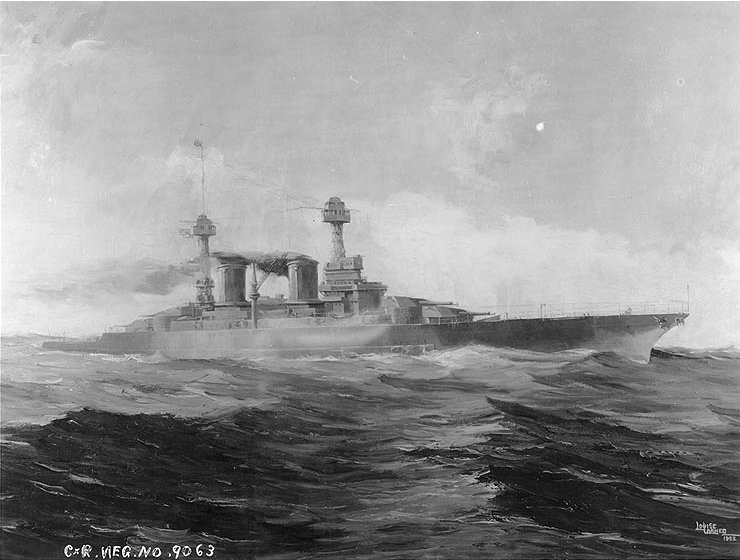
Artist depiction of the Lexington as Battle Cruiser

Note: This is the first of a series of articles on what might have happened if the Washington Naval Treaty had not been signed. This article is a look at the American fleet that never was, the following articles will be in the alternative history genre looking at a war breaking out in the Pacific in 1937.

Historians almost always muse on what might have been.  One of the most significant events of the years following the First World War was the Washington Naval Conference and Treaty. The treaty called by the President Harding and conducted under the auspices of the League of Nations was the first international disarmament conference and attended by none nations having interests in the Pacific. The major players in the conference from the naval power perspective were the British, Americans, Japanese, French and Italians.  Each nation had an agenda for the conference, for the United States it was to break the Anglo-Japanese naval accord and to limit the Japanese naval build up.  The British, exhausted and financially reeling from the effects of the First World War had a number of goals.  Though they had the largest navy and the most Dreadnaught type battleships and battle cruisers of any Navy many of its ships were obsolete or worn out from wartime service.  They had little capital to put into new ship construction, especially considering the vast resources of the United States which was already well into a vast naval buildup including ships that would be among the largest and most heavily armed in the world.  It was in the interest of Britain to limit the both the number, tonnage and armament of these ships.
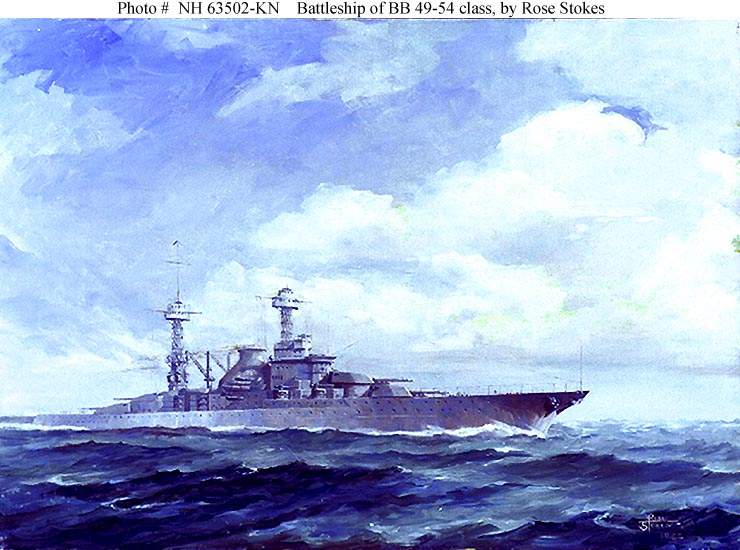
Artist impression of South Dakota Class

The treaty which was ratified in 1922 limited the United States and Great Britain to a maximum of 525,000 tons in their battle ship fleets and 125,000 tons in aircraft carriers.  The Japanese agreed to a limit of 315,000 tons and the French and Italians 175,000 tons each.  Tonnage for battleships was limited to a maximum of 35,000 tons with a limitation on guns size to 16 inches.  Since the bulk of the ships planned or being built by the US and Japan exceeded those limits they would be effected more than the British whose post war shipbuilding program had not begun in earnest. For the US this had a dramatic effect on its planned fleet, which if built would have become the dominant Navy of the 1920s and 1930s.  It is fascinating to think what might have happened if the treaty had not been signed and what the battle fleets of the various nations would have looked like in 1941 had war not come sooner.
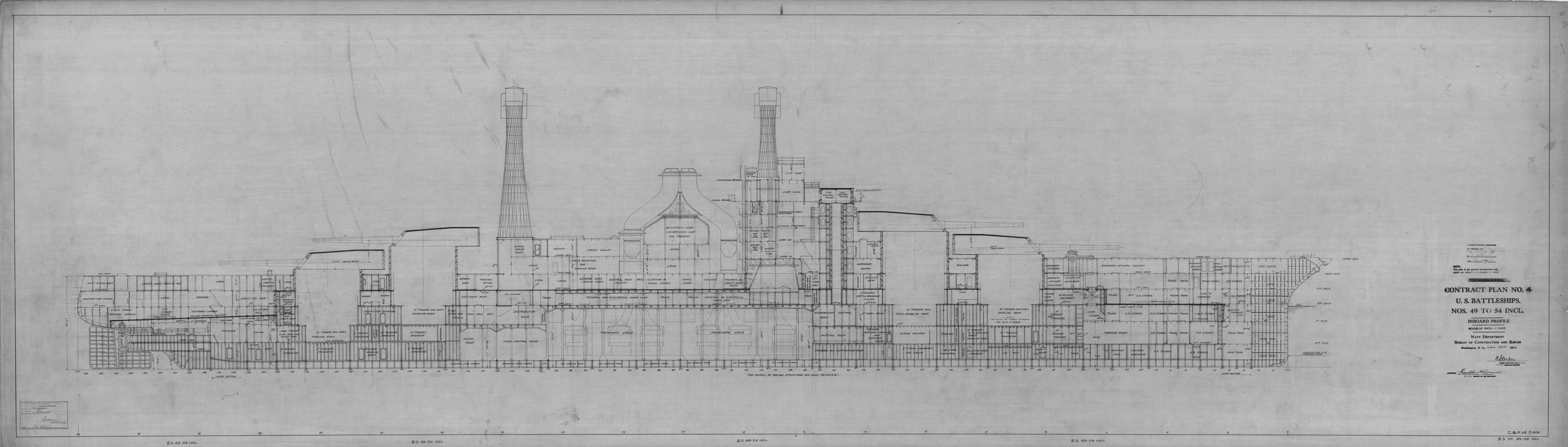
Plans for South Dakota Class

The American Navy went to war in 1941 with 18 battleships, the most modern of which were the new North Carolina and Washington and the rest averaging over 20 years old in 1941. The most modern of these ships were the Colorado class composed of the Colorado, Maryland and West Virginia each mounting eight 16”/50 guns.  The fourth ship of the class the Washington was sunk as a gunnery target when 75% complete under the terms of the Washington Naval Treaty.
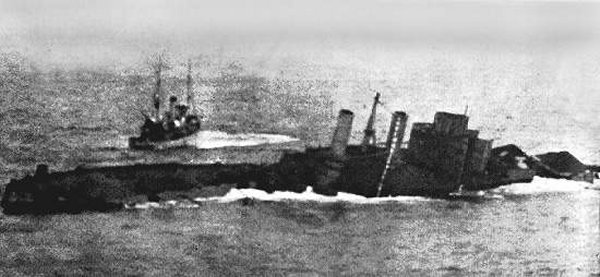
The incomplete USS Washington sinking

However it was a battle force that could have been much larger and far more capable, a force that may not been regulated to convoy escort duties and shore bombardment but instead may have taken on the Imperial Navy on the high seas in battleship combat not seen since Jutland.  Yet this was not to be, the great fleet of super-battleships was never built and only two hulls completed the Lexington and Saratoga which instead of being completed as battle cruisers were completed as aircraft carriers.
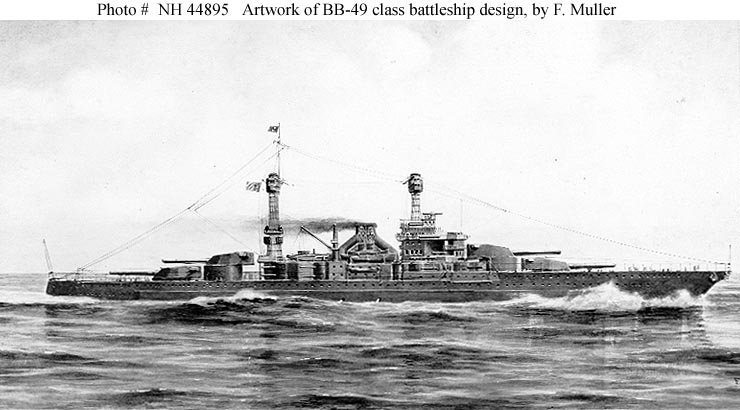
Artist impression of South Dakota Class

The Americans had set out to build the largest, most modern and powerful battleships and battle cruisers afloat.  The Navy had already produced the Colorado class super-dreadnaughts which were equal to or superior to any battleships of their era.  The Navy planned for a class of six battle cruisers which would be superior to any similar ship afloat, the Lexington class and a class of six battleships, the South Dakota class mounting twelve 16”/50 guns in triple turrets.
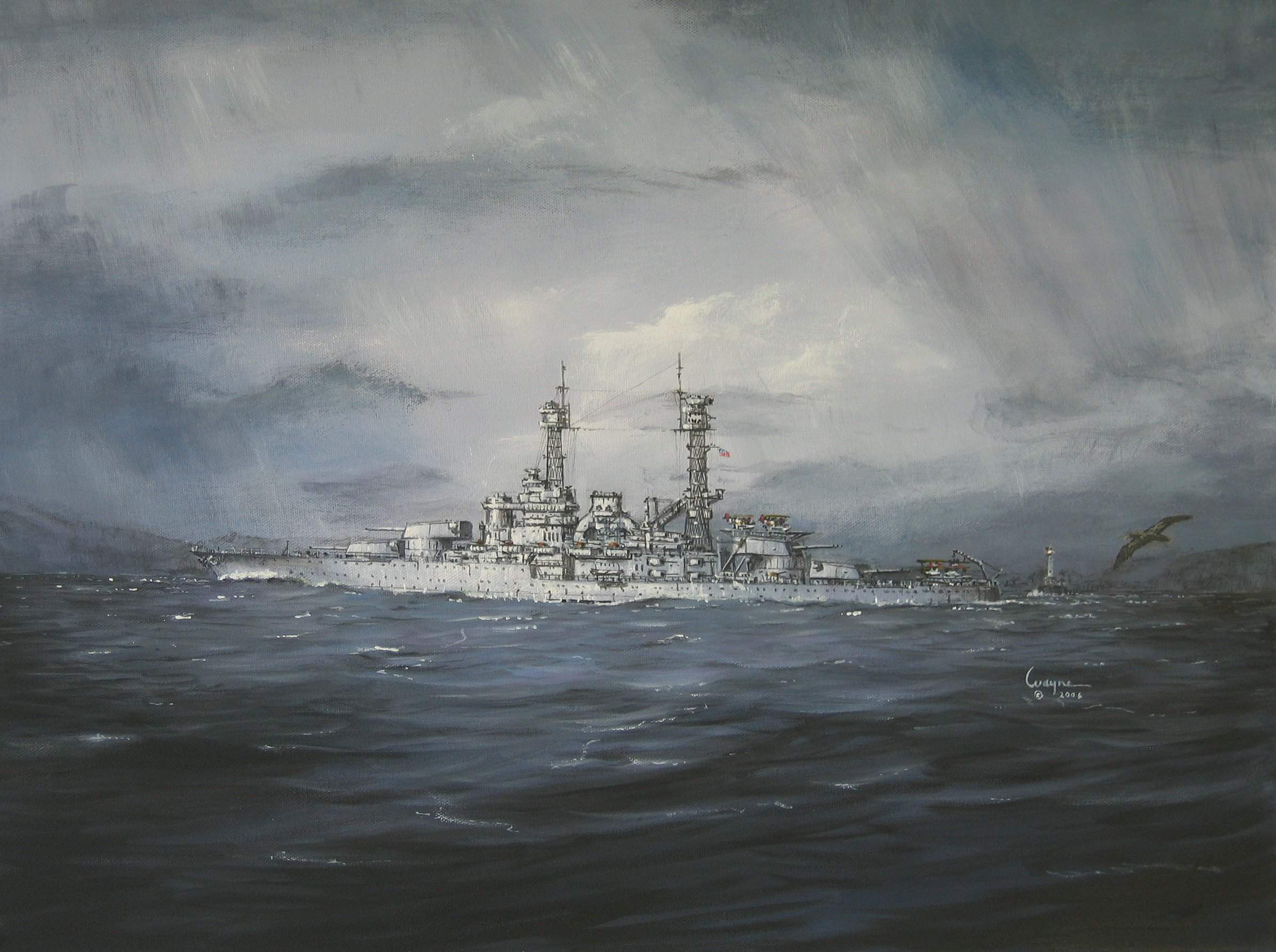
Artist impression of South Dakota Class as they might have appeared in 1938

The two classes were leviathans and to counter them the British made plans for a four ship 48,000 ton class of battleships, the N3 project mounting nine 18” guns and a class of battle cruisers mounting nine 16” guns.  The ships of both classes were designed with their main battery mounted forward in order to save weight on armor.  Both classes were canceled with the signing of the treaty and none were laid down.  It is suggested by some that the G3 battle cruiser design was a ploy to get the United States to agree to the cancellation of its capital ship projects. The guns planned for the G3 class were mounted on the Nelson class battleships which complied with treaty limits.  Although powerful ships they suffered from engineering problems which often reduced their speed from what was designed.  Along with the HMS Hood, the sole ship completed of the four ship Admiral class the Nelson and Rodney were the most modern battleships in the Royal Navy until the King George V class entered service in 1941.  The Japanese planned for eight battleships and eight battle cruisers centered on the two existing Nagato class battleships and 4 Kongo class battle cruisers to be joined by the two ship 40,000 ton Tosa class battleships, the Tosa and the Kaga, of which Kaga was completed as an aircraft carrier. They were to be joined by the 4 improved Tosa class or Kii class fast battleships of 42,000 which were ordered but never laid down.  These were to be joined by the four ship Amagi class battle cruiser class.  Amagi was destroyed during the Tokyo earthquake of 1922 and scrapped and Akagi completed as an aircraft carrier.  All of the planned Japanese ships were to mount ten 16” guns in five twin turrets.
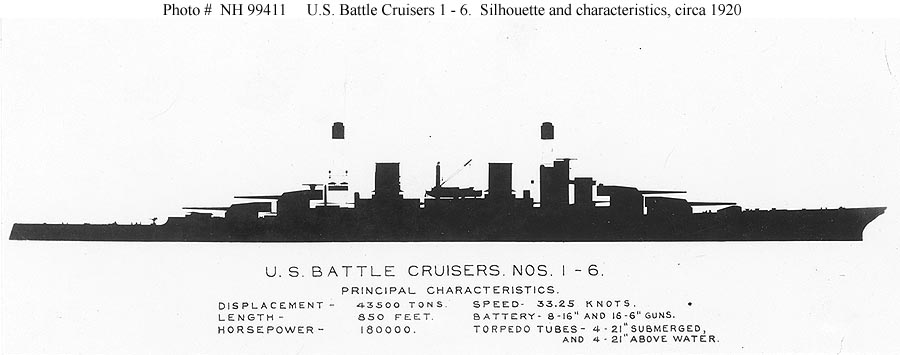
Lexington Class final design drawing

The American ships were to be powerful and based on main battery, protection and speed they would have acquitted themselves well had they been built.  The Japanese ships would have had a speed advantage over the South Dakota’s but this would have been offset by the gun power and protection of the latter.  The American Lexington class would have been faster than any of their competitors.

South Dakota Class Design Specifications
Displacement: 43,200 tons normal
Dimensions: 684 x 106 x 33 feet/208.5 x 32.3 x 10.1 meters
Propulsion: Turbo-electric, 12 285 boilers, 4 shafts, 50,000 shp, 23 knots
Crew: 1191
Armor: 8-13.5 inch belt, 3.5 inch deck, 4.5-13.5 inch barbettes, 5-18 inch turrets, 8-16 inch CT
Aviation: none
Armament: 4 triple 16″/50cal, 16 6″/53cal, 8 3″/50cal AA, 2 21 inch torpedo tubes (submerged)

The six ships in the Class, South Dakota, Indiana, Montana, North Carolina, Iowa and Massachusetts were all scrapped in accordance with the treaty when partially complete, the North Carolina being in the most advanced stage of construction, 37.8% when construction was halted.

Lexington class Battle Cruiser Design Specifications

Displacement 43,500 Tons, Dimensions, 874′ (oa) x 105′ 5″ x 31′ (max).
Armament 8 x 16″/50 16 x 6″/53 4 x 3″8 x 21″ torpedo tubes
Machinery, 180,000 SHP; G.E. Geared Turbines with Electric Drive, 4 screws
Speed, 35 Knots, Crew 1500

The ships with the exception of the Lexington and Saratoga were scrapped incomplete.  All were to be named after famous warships or battles, and the Constellation, Constitution, Ranger and the United States were to be named after some of the most illustrious ships ever to serve in the US Navy.

If all of the ships, including the Washington of the Colorado class been completed the US Navy would have had eight battleships and six battle cruisers mounting 16 inch guns to compliment the nine battleships of the Nevada, Pennsylvania, New Mexico and California classes which all mounted 14 inch batteries.  The fleet would have been superior to either the Royal Navy or the Imperial Japanese Navy even with the ships planned by those navies.  Economically the United States was the only nation in the world capable of sustaining a naval arms race of this magnitude, the British economy and political will would have been unable to sustain it and the limited industrial capacity and dependence on the United States for raw materials and machine tools needed to construct their ships would have limited their ability to produce such a fleet. Without the conversion of the Lexington, Saratoga and their Japanese counterparts the Akagi and Kaga into aircraft carriers the development of the carrier would likely have gone slower and that type of ship may not have risen to the prominence that they gained during the Second World War.

8 Comments

Filed under History, Military, Navy Ships

Lessons in Coalition Warfare: Admiral Ernest King and the British Pacific Fleet

The genesis and strategy of British Royal Navy’s participation in the Pacific in 1945 is a little studied aspect of the Pacific campaign.  Prior to 1945 the participation of the Royal Navy in the Pacific ended at the Battle of the Java Sea.  After that the Royal Navy operated in the Indian Ocean in support of British operations in Burma and against German surface raiders. Michael Coles in “Ernest King and the British Pacific Fleet: The Conference at Quebec, 1944 (Octagon) published in The Journal of Military History January 2001, 65, 1 Research Library pp. 105-129 provides a good analysis of the Allied decision to allow the Royal Navy a role in the Pacific and the objections of Admiral Ernest King to the proposal.

The renewal of the Royal Navy’s Pacific role began at the 1944 Octagon Conference where the Allied Joint Staff made the decision to bring the Royal Navy back to the Pacific. Admiral Ernest King was the only dissenter in the question of Royal Navy operations in the Pacific.  The strategic aspects of this decision are seldom addressed by most who chronicle the Pacific war.[i] William Kimball in “Forged in War: Roosevelt Churchill and the Second World War” never mentions the naval strategy discussed at the Octagon conference. Samuel Elliott Morison in “The Two-Ocean War” described the decision for the Royal Navy to enter the Pacific as “important” and outlines King’s opposition to it without addressing strategic considerations.[ii] John Costello in “The Pacific War” described how Churchill insisted on the Royal Navy being committed to operations against Japan and how Roosevelt’s agreed to “to avoid a bitter clash.”[iii] Likewise Williamson Murray and Allen R. Millett in “War to Be Won” note that one of the goals of Octagon was “to determine the level and nature of British in the air-naval war in the Pacific.” However they do so as do the others without addressing the naval strategy.[iv] Max Hastings mentions Octagon in “Retribution: The Battle for Japan, 1944-1945” again without specific reference to naval strategy.  However later in the book later discusses the Royal Navy’s limitations in ships, manning, logistics and operational art as it entered the Pacific campaign.[v] Other writers chronicle British operations in the Pacific but usually focus in the gallantry and determination of the Royal Navy and not its weaknesses.[vi]

Coles’ article is invaluable to understand the decision in relation to the political, military and economic considerations which influenced both King’s opposition to the deployment and the performance of the British fleet in the Pacific.  Coles analyzes tensions between King and the other participants at Octagon. He judges King to be more realistic and informed regarding Royal Navy capabilities and more importantly its limitations than British leaders especially Churchill.[vii]

King was surprised at Roosevelt’s decision to accept Churchill’s offer of the Royal Navy without prior discussion by the Combined Chiefs of Staff.  Coles notes that King may have kept silent at subsequent meetings of the Combined Chiefs, because he either assumed that his positions were logical and apparent to all or that he believed that Churchill was lying about his navy’s capabilities. Of course it was politically impossible for King to suggest such.[viii]

King’s realism on the subject was a directly related to the political tensions between American and British visions for the outcome of the Pacific war, and the pressing strategic considerations necessitated by Japanese offensives in Burma and China. The British goal of re-establishing colonial rule in Southeast Asia was a major bone of contention.  Many Americans believed that the British goals were “aimed primarily at the resurgence of British political and economic ascendancy in South East Asia and restoration of British prestige.”[ix] Yet the US wanted to defeat Japan’s formidable Army in Asia without the sacrifice of large numbers of American troops or material which necessitated British participation.[x] The introduction of large numbers of American troops on the Asian continent was impossible due to the lineation of the US Army to 90 divisions, most of which were engaged in Europe.  Likewise US domestic issues regarding war production and the Navy’s share of it in relations to changing wartime conditions was a major concern for King.  King and the Navy argued for high naval production while others including George Marshall were beginning to question it, especially if the British could provide “make substantial Naval forces available in the Pacific.”[xi]

American Lend Lease aid to Britain was another issue.  Roosevelt calculated that the US needed Britain to be active in post-war Europe, this required significant post war aid. Roosevelt viewed “vigorous participation” by the Royal Navy as a means to gain congressional support in spite of the fact that Britain could no longer play a global military role without US support.[xii] One of the problems faced in the Pacific was how British mandated modifications to weapons systems supplied by the United States caused problems in production and caused shortages in key weapons systems, especially naval aircraft.  Coles’ notes how King had problems with this and wondered if supplying the Royal Navy’s Pacific operations “represented the most effective use of American industrial capacity.[xiii] However King did not chose to argue this point at the conference, once again demurring to President Roosevelt.

The most compelling factor discussed by Coles was the operational and logistic problems related to the deployment, supply and operation of the Royal Navy. There were a number of problems that the Royal Navy faced as it deployed to the Pacific.  First among them was the fact that the Royal Navy was in large part short-legged and cold water Navy.  Its ships were designed mainly for service in the Atlantic and Mediterranean and ill-suited for the Pacific. The Royal Navy did not have the operational experience of the Americans in regard to Fast Carrier Task Forces, especially coordination of refueling and resupply operations or coordination of air group operations.  Admiral Philip Vian insisted that “Before joining the Americans…we needed to be adept at using a great many more aircraft at a time, and for longer periods.”[xiv] Max Hastings’ noted that the Royal Navy was “overstretched and war weary”[xv] and Coles goes to great lengths to illustrate British weakness while analyzing tensions in the British-American relationship particularly the shift in the relationship as the Americans took the leading role.

King had the foresight to recognize that the British contribution would be more of a liability than help.[xvi] The principal Royal Navy purpose in the Pacific was political, not military and Coles asks if it helped or hindered “the achievement of the respective nations’ policy objectives.” Coles does not believe that it helped; that in fact the Royal Navy would not have been able to continue had the war continued.  He quoted a British liaison officer who wrote that the Royal Navy would have “been unable to continue operations because of lack of logistic support.”[xvii] Coles calls the Royal Navy’s effort in the Pacific an “expensive instrument of failed policy” and that Admiral King seemed to have recognized this better than others, arguing that King’s opinions were not based on simple personal prejudice.[xviii]

Coles uses an excellent mix of primary and secondary sources including diaries, operational reports, histories and journal articles from American and British sources to document his work providing ample references throughout his article. His work is important in recognizing the importance strategy plays in making political decisions in coalition warfare.  Likewise he places value on individuals such as King who are able to recognize the strategic aims and limitations in coalition warfare by various partners.

Though the Royal Navy’s participation in the Pacific War was a relatively insignificant in terms of its overall role in the war it provides lessons for our time. Coalition warfare requires that members of the coalition be able to function our time we can see a similar situation where many of the NATO forces in Afghanistan are dependent on the US for most of their operational and logistic support. It also requires that the members of the coalition have a firm grip on the overall strategy and understand the capabilities and limitations of each.  In Afghanistan the United States faces a situation where it needs capable alliance partners.  It does not have the force capacity to go it alone and political support for additional troops has weakened in congress and in the public.  It is a somewhat similar situation to the Second World War where the United States needed significant British participation in the Asian ground war to ensure that the United States would not have to make major commitments to on the Asian mainland.  Likewise it was needed to get congressional support for post war aid to Britain.  Likewise George Marshall and others wondered if the British could provide significant naval support which would alleviate the need for high naval production which they questioned.  Strategy and the desired end state must be central to how coalitions fight wars.


[i] See Spector, Ronald H. Eagle Against the Sun: The American War With Japan. The Free Press and Division of MacMillan, Inc. New York, NY 1985. Spector nowhere mentions the British Navy in his history of the campaign  and in his short reference to Octagon he does not mention the debate over the Royal Navy’s inclusion in the campaign. p.419

[ii] Morison, Samuel Eliot. The Two Ocean War: A Short History of the United States Navy in the Second World War. An Atlantic Monthly Press Book, Boston MA 1963. pp. Morrison does also mention some of the specific actions of Royal Navy in the Pacific. Pp.423-424.

[iii] Costello, John. The Pacific War: 1941-1945 Quill Publishers, New York, NY 1981. p.495.

[iv] Murray, Williamson and Millett, Allan R. A War to Be Won: Fighting the Second World War.  The Belknap Press of Harvard University, Cambridge, MA. 2000. pp.484-485.

[v] Hastings, Max. Retribution: The Battle for Japan, 1944-1945. Alfred A Knopf, New York, NY 2008. Originally published in Great Britain as Nemesis: The Battle for Japan, 1944-45, Harper Press, London, 2007.  p.112-113 and 400-402.

[vi] “Ernest King and the British Pacific Fleet: The Conference at Quebec, 1944 (Octagon). By Michael  Coles.  Published in The Journal of Military History January 2001, 65, 1 Research Library. p.127

[vii] Ibid. pp.111-112

[viii] Ibid. p.111

[ix] Ibid. p.113

[x] Ibid. p.114

[xi] Ibid. p.117

[xii] Ibid. p.118

[xiii] Ibid. p.120 Coles describes several instances where the “Anglicized” systems delayed deliveries and lengthened transportation to operational British units.  Modifications included flight helmets, radios and aircraft modifications. He also discusses how ineffectively the British used the large number of Escort Carriers provided by the US.

[xiv] Ibid. p.123

[xv] Hastings. p.400

[xvi] Coles. p.127. This is something that Morison does with utmost deference to the British.

[xvii] Ibid. p.128

[xviii] Ibid. p.129

8 Comments

Filed under Foreign Policy, History, iraq,afghanistan, world war two in the pacific

The Treaty Cruisers: A Warship Review

Note: Since childhood I have loved naval history and the study of various types of warship design throughout history. My favorite period is really from the Spanish-American War through the mid 1970’s.  I find the leaps in Naval design and architecture, weapons and fire control systems and the diversity of the types of ships built absolutely fascinating.  Not only initial designs but the various modifications and modernizations of various ships or classes of ships went through during their service careers. The cruisers of the inter-war period were some of the most ascetically pleasing warships to ever grace the high seas. They were well proportioned, and graceful while still looking every part the warship.  This is something that many ships in our modern era lack, despite the fact that their armament despite limited gun power is formidable. With VLS launchers and Harpoon Missile tubes they pack a punch, but unlike the old cruisers, their offensive teeth are hidden. I had the privilege of serving aboard the USS HUE CITY CG-66 which is about the same size and displacement of the Chester Class

I think I actually began reading Naval history back in 2nd or 3rd grade, and it was not uncommon for me to spend hours at the public library going through reference stacks to read old issues of “Jane’s Fighting Ships” and the main collection to check out every book on Naval Warfare and warships that I could find. One of the most interesting types of ship to me was the Heavy Cruisers built under the restrictions of the Washington Naval Treaty. The treaty had several major provisions but today I only deal with the restrictions on Heavy Cruisers, the response of treaty nations to the limitations and the combat summary of each class.  This is all pretty much out of the deep recesses of my sometimes dark mind and tonight I didn’t have to crack a book to write this.  It’s thanks to having one of those phonographic memories that just keeps going around and around. This is another one of the things that I am passionate about.  Anchor’s Away! Peace, Steve+

atago

IJN Atago

The Washington Naval Conference of 1921-1922 set a number of limits on warship construction and fleet composition.  One of the ship types limited by the treaties was cruisers, notably heavy cruisers.  These ships, descended from the Armored Cruisers developed by the navies of the great powers prior to the First World War were considered a major part of each of the navies of the signatory nations.  The armored cruisers had 8-10 inch guns and a relatively substantial armored belt.  The type was not particularly successful as with few exceptions they were used in fleet actions where they were under-gunned and under-armored.  They were most successfully used in overseas service against raiders or commerce.  The most famous of the type were the German Scharnhorst and Gneisenau of the German Far East Squadron.  Smaller and faster than a battleship, the type had developed by the 1920s into a ship that could be used for fleet screening and scouting as well as showing the flag in foreign waters where many were found.  The Washington treaty did not limit numbers of these ships as it did Battleships and Aircraft Carriers, but it did place maximums on the gun size and displacement of individual ships.   A heavy cruiser could be armed with 8 inch guns and were limited to 10,000 tons displacement.  Of course this led to compromises in the designs of the ships which frequently gave up protection for speed.

uss pensacolaUSS Pensacola

The Americans were the leaders in the development of the treaty cruisers.  The Japanese only built one class of cruiser, the Kako class which complied with the terms of the treaty.  They mounted 6- 8” guns and displaced about 8,600 tons.  They were fast but because of their light displacement were top-heavy.  Subsequent classes, the Nachi and Atago classes violated the tonnage limits by as much as 4,000 tons while the Japanese reported them as 10,000 tons. They were armed with 10-8”guns in five turrets, had good protection and also mounted 12 24” “Long Lance” torpedo tubes.  Two subsequent cruisers of the Kumano and Tone classes were built in the 1930s. The Kumano class of about 13,000 tons were initially classed as “light cruisers” mounting 15- 6” guns prior to being re-armed with 10-8” guns.  The Tone’s mounted 8- 8”guns in 4 turrets all mounted forward leaving the entire aft section for use as a seaplane launching area; the Tone class carried 8 float planes for fleet scouting.

hms exeterHMS Exeter

The British treaty cruisers abided by the limits included the York and Exeter, of the same displacement and armament as the Kako class except they were slower, a common feature of British ships which were generally slower than their American and Japanese counterparts.  The later County class ships were armed with 8- 8” guns and were distinctive looking having three funnels. The County class included such famous ships as the Norfolk, Suffolk and Dorsetshire which played critical roles in the chase and sinking of the German Battleship Bismarck. Australia had two Counties, the Australia and Canberra which did most of their service in the Pacific. The Counties were armed with 8- 8” guns and were distinctive with their three funnels.  They were slower than their Japanese or American counterparts.

uss houstonUSS Houston with President Roosevelt Aboard

The first American treaty cruisers the Pensacola and Salt Lake City of about 9,500 tons with an unusual arrangement of 10- 8” guns mounted in 4 turrets.  However it was the Chester class which was the quintessential U.S. Treaty Cruiser design.  These ships, and the later Astoria class, also displaced 9,500-10,000 tons and mounted 9- 8” guns in three turrets.  A further “treaty” cruiser was Wichita, converted from a St. Louis class light cruiser. All were fast but were lacking in armored protection and none mounted the torpedoes found in Japanese or British ships.  Some of the more notable ships in the U.S. treaty classes included the Houston which served as the Flagship of the Asiatic Fleet which was sunk at the Battle of the Java Sea. The Augusta which took Franklin D Roosevelt to Argentia for the signing of the Atlantic Charter in 1941; The San Francisco which helped stop the Japanese fleet in a point blank encounter in the Naval Battle of Guadalcanal and Indianapolis which with just weeks left in the war having completed the secret mission to deliver the Atomic bomb was sunk by a Japanese submarine.

PrinzEugen-2Prinz Eugen

The Germans did not build true “heavy cruisers” until the late 1930’s and their ships, the Hipper, Blucher and Prinz Eugen mounted 8- 8” guns and displaced about 19,000 tons.  The German “Pocket Battleships” Deutschland, Graf Spee and Admiral Scheer, mounted 6-11” guns on a hull of about 11,000 tons (officially 10,000) in compliance with the Treaty of Versailles restrictions on German battleships.  They were designed to outgun and be more heavily armored than the heavy cruisers and be faster than battleships, much more in the Armored Cruiser tradition.  During the war the German Navy reclassified them as Heavy Cruisers. None of these ships were built under the treaty limits for cruisers.

hms suffolkHMS Suffolk

These ships saw distinguished service throughout the war.  The British ships remained their only heavy cruiser design throughout the war. The ships took part in the sinking of the Graf Spee and Bismarck. They also suffered heavily; York was sunk at Crete and Exeter in the Java Sea. Cumberland and Dorsetshire were sunk by Admiral Nagumo’s carriers which had attacked Pearl Harbor, in the Indian Ocean. Canberra was sunk at the Battle of Savo Island off Guadalcanal.  Some of the British Ships remained in service until the 1950s and all eventually we paid off and sent to the breakers.

The Japanese ships were involved in almost every major action of the Pacific war.  Fast, heavily armed and manned by well trained crews they dominated almost every surface action of the early war in the Pacific.  The were key at the Battle of Java Sea and Savo Island where they annihilated Allied or American cruiser and destroyer squadrons. In action so often they were destroyed leaving only two marginally operational at the end of the war. Three of the four Kako class were lost in the Solomon’s.  They were all involved at Savo Island, and the last survivor, Aoba was lost at in harbor to U.S. air strikes at Yokosuka at the close of the war.  The Nachi class saw considerable service and were the workhorses of the Japanese cruiser force. They were the principle executioners of the ABDA fleet in the Java Sea battles and continued their service until late 1944 and the end of the war. Nachi and Ashigara were sunk in the aftermath of Leyte Gulf while Haguro fought the last surface action of a major Japanese combatant in a surface action of the war against a British force in 1945 and was sunk. and Myoko survived the war in a damaged condition being surrendered in Singapore.  The Chokai class also served throughout the war and three of the four were lost at Leyte Gulf. The Atago and Maya were lost to the U.S. Submarines Darter and Dace, Chokai in the action at Samar to combined U.S. destroyer and air attacks from TAFFY-3. Takao survived the war in a damaged condition having been torpedoed at Leyte Gulf but making port.  Of the later cruisers Mikuma was sunk at Midway and Mogami survived almost unimaginable damage in that battle.  Mogami was sunk by the resurrected Pearl Harbor Battleships at the Battle of Surigo Strait while Kumano and Suzaya were lost off Samar.  Chikuma and Tone also served in many battles, it was Tone’s float plane which was delayed in launching and discovered the U.S. carriers at Midway too late. Chikuma too was lost at Samar; Tone was sunk at anchor at Yokosuka in 1945.  Leyte Gulf in a sense could be described as the “Death Ride” of the Japanese Cruiser force.

The U.S. cruisers fought valiantly in nearly every engagement of the Pacific war and a few in the Atlantic.  Houston was immortalized by her actions with ABDA in the Java Sea against hopeless odds.  Astoria, Vincennes and Quincy were sunk in the Savo Island debacle.  Northampton and Chicago lost also in later actions in the Solomon’s.  San Francisco and Portland fought toe to toe with the Japanese Battleships Hiei and Kirishima in the epic Naval Battle of Guadalcanal, inflicting so much damage on Hiei that she was later sunk by American Aircraft the following day.  Indianapolis met an unlikely fate at the close of the war being sunk by a Japanese submarine after returning from a secret mission delivering the Atomic bomb.  A series of unfortunate events led to her loss not being noted with the result that most of the survivors of the sinking being lost to the elements and shark attacks while waiting days for rescue.   Others survived horrific damage from “Long Lance” torpedoes and Kamikaze attacks.  Following the war the Pensacola’s were expended as targets and the remaining ships placed in “mothballs” until the late 1950s when all were scrapped.  Some artifacts of San Francisco including her mast are at “Land’s End” park in that city.

uss san franciscoUSS San Fransisco Returning After the  Naval Battle of Guadalcanal

Of all the navies involved only the United States Navy and German Kriegsmarine built or attempted to build new classes of heavy cruisers during the war.  The US Navy brought out the Baltimore Class which was highly successful and built upon lessons learned from the Treaty Cruisers and the follow on Oregon City class which incorporated design improvements based on experience with the Baltimore Class.  Some of these ships would be converted into the first US Guided Missile Cruisers. The later Des Moines Class the largest class of all gun cruisers ever built with fully automated 8″ gun systems.  Of these ships only Salem survives in Quincy MA as a museum ship, sadly the Des Moines which had been slated to become a Museum ship in Milwaukee was scrapped in 2007 .

No treaty cruiser survives today.  Their service, heroic, unceasing and tireless service is remembered only by their surviving crews and a few naval historians and buffs.  The epic damage control actions of the San Francisco are still taught at the Naval Surface Warfare School.  They have passed into history, of those sunk some have been rediscovered, the Ballard expedition discovered and photographed the wrecks of Astoria and Quincy and their Australian consort Canberra in the waters of “Iron Bottom Sound” off Guadalcanal.  The German “Prinz Eugen” though not a treaty cruiser survived the war and was expended as a target in the Atomic bomb tests.  Her wreck lies capsized and submerged at Bikini Atoll.  An attempt to salvage her by a German group was abandoned and one of her screws was brought back and placed on display near Kiel, Germany.

Though all had design drawbacks due to the treaties, the American and British ships performed magnificently and without their service, especially in the early days of the war history today might be different.  Here’s to gallant ships and steadfast crews. May they never be forgotten.

Peace,

Steve+

13 Comments

Filed under Loose thoughts and musings

The Dining Out

Tonight was a lot of fun.  I went to our 2009 Naval Medical Center Intern Class Dining Out. Now for those that do not know what a dining out is I must take some time to in the words of Ricky Riccardo, to “‘splain it to you.”

Dining outs, and their counter part the Dining in go back to the times of the Roman Legions, when the officers of the Legion would get together to honor to honor individuals or units.  In these events they would recall campaigns and battles, shared hardships and parade the booty from their campaigns.   Transplanted to Northern Europe the Viking and later the people of Britain. The Viking War Lords gave a new shape to these feasts.  Of course the Vikings, like the Klingons were quite the people for a hearty celebration of victory.  They ensured that the feast was something special. “These celebrations saw all clan members present with the exception of the lookout, or watch. Feats of strength and skill were performed to entertain the members and guests. The leader took his place at the head of the board, with all others to his right and left in descending order of rank.”  Transplanted to England the tradition further developed with the various councils of knights such as the Knights of the Round Table and the lesser known Knights of the somewhat Oblong Table with One Short Leg.

For those who are clergy and somewhat put off by such displays, we too have a hand in this.  The monastics of Europe had these types of events.  The clergy of course, being the learned educators of the day spread the custom to universities.  Professional British officers who graduated from these universities carried the tradition to their units where they became more developed.   Thus to all the officers who find these functions a waste of time or money, you can blame your chaplain.  He or she may not have any idea about this, but hey, you can call them out.

The tradition grew in Royal Navy and Royal Marines and was transplanted to the American Colonists.  These traditions continued to grow and prosper until Secretary of the Navy Josephus Daniels, a strict prohibitionist who definitely could not spell or even comprehend the concept of martial camaraderie and fun banned alcohol from US Navy ships in 1914.  The following World War, Great Depression and the Second World War contributed to its dormancy in the Navy.  The Marines kept the tradition of the Mess Night alive and by the 1950’s the tradition also began to return to the Navy.  The Air Force adopted the Tradition from the Royal Air Force while the Army had such events from the beginnings of their Service in the Continental Army.

The Dining In is something shared among the members of the Mess themselves.  The Dining Out can include spouses or other civilian and military guests from outside the Mess.  The two are very similar in most regards including an opening invocation by the unit chaplain, in our case tonight yours truly.  It is followed by other events such as the National Anthem, the parading of the beef, the testing of the beef by “Mr Vice,” the formal dinner, toasts and remarks of the guest speaker.  During the event there are certain infractions that can cause a member of the Mess to be fined or to have to partake of “the Grog.”  The Grog, depending on where you have a Mess Night can be quite an experience.  The Grog has its roots in the mixture of watered down rum and added citrus (to fight scurvy) aboard ships of the Royal Navy.  The daily ration of rum, or Grog was perhaps one of the few pleasurable moments for sailors and Marines on warships of the 18th and 19th centuries.   When I came in the Army in the early 1980s the grog was quite the witches brew, usually a nearly undrinkable concoction of whatever alcoholic beverages Mr Vice might decide to mix together.  I do think the grog has become a bit tamer over the years, but it still can have a good effect on the violator of one of the rules of the Mess.

Tonight’s event was as I said the Dining Out for our Intern Class.  They will be graduating in about two months, some will remain with us for residencies or go elsewhere in the Navy for their residency, or go for three years to be a Flight Surgeon, Diving Medical Officer, or General Medical Officer in the Fleet or with the Marines.  I have gotten to know a lot of these young men and women through my contact with them on the ICU or Pediatric ICU during good times and bad times.  I love being around them. They work hard.  Interns at our medical center spend about 79.5 hours a week in house, I’m sure some do more because they need to do research and study all the time they are there.  Some will end up in Iraq or Afghanistan in the next few months, they all are to be commended on their work in this year.

Tonight was a really good night.  I even missed a home game at Harbor Park to be at this event, but it was worth it. Unfortunately the Tides dropped their first game at home this year after 9 consecutive wins, losing 4-1 to Durham. Norfolk left 7 runners in scoring position.

Now my day in trying to get ready for the Dining Out got sporty as far as my uniform went.  In fact things reached Ludicrous Speed this afternoon as I tried to get ready for the event.  As a Lieutenant Commander I have to wear the Mess Dress Uniform.  A formal, black tie uniform complete with cummerbund, miniature medals, bow tie and jacket. It is a very sharp looking uniform, but it has a lot of moving parts.  I had to re-do my medals as I have picked up a few since the last time I wore the uniform before I went to Iraq.  I now do this myself and discovered during the process that I was missing a medal and a couple of devices to affix to a medal as well as some hardware to put things together.  After two trips to the uniform shop at Naval Amphibious Base Little Creek I thought I was ready.  I was wrong.  I mounted my medals and got them on my uniform.  So far so good.  Then I discovered with under two hours until showtime that I was missing the gold, studs to my formal white shirt.  They were in my office sitting on my desk.  I had a choice to make.  Do I go to my office at the medical center and take my chances with the traffic and the bridge tunnel, which oh by the way is closed east bound for re-paving, or do I make a third trip to Little Creek?  I opted for the latter figuring that I could get dressed in the dressing room of the uniform shop after I got the studs.  The ladies at the store, who now had become used to me showing up every other hour were gracious.  I bought the studs and started to get dressed.  Then I discovered that I did not have shirt stays to keep my shirt from riding up. Putting on my cargo shorts and Birkenstocks which did not go well with the black socks which I had just put on, I wore my formal pleated shirt with the aforementioned items and bought the shirt stays.  I was now absolutely sure that this would be it.  I got my uniform on and put on my jacket.  To my astonishment and disbelief I noticed that my button and chain set which are used to fasten the jacket were missing.  Yet another trip to into the store and to the cash register before I could safely pack my stuff and race across the town to get to the Spirit of Norfolk on which the Dining Out was to be held. I felt like an idiot, something that I am not in the habit of feeling as I made each trip to the cash register at the Uniform Shop, I’m sure that the ladies got a kick out of my antics.  I could almost see such a thing happening to George Costanza on Seinfeld.  Serenity Now!

Peace, Steve+

2 Comments

Filed under History, Military