Tag Archives: saddam hussein

August 2007: My Beginnings in Iraq

I have had a lot of opportunity to reflect today.  I woke up about 0430 in pain from my broken leg.  I was in enough pain to warrant a Vicodin which was the second that I had had since going to bed.  It knocked me out and after making a call to my staff to let them know that I was out of action I woke up aboutnoonto the sound of a MH-53E flying over my place toward the Marine Auxiliary Airfield a few miles from my place.  Vicodin makes my leg feel better but pretty much puts me out of action.

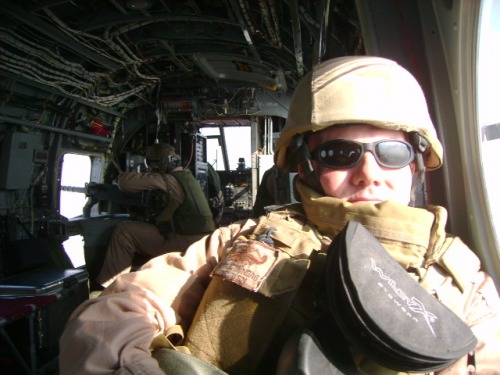
The memories invoked by the sound of the helicopter caused my period of reflection.  I haven’t written about my time in Iraqin a long time.  The memories of my time in Iraqstill evoke intense emotions which sometimes lead me into a depressed funk and can be brought on by many things.  However since I am doing better than the last time that I attempted to write them down I figure that I might as well start over and attempt to complete what I began in 2009.  Today marks the 4th anniversary of my arrival in Fallujah, the next to last stop before we arrived at Taqaddum and began our operations supporting the Marine and Army advisors in Al Anbar Province.

I arrived in Iraq with my assistant, RP1 Nelson Lebron.  We had detached from EOD Group Two in early July and after stops for processing and training in Norfolk, Fort Jackson South Carolina and Kuwait we arrived in Iraq on the 5th of August.  Our first stop was at the headquarters of the Iraq Assistance Group atCampVictory inBaghdad.  We remained there several days getting briefings on our mission and awaiting a flight to Fallujah.  Our last night at Camp Victory was an interesting night where for the first time I was in the line of fire of a hostile rocket which whooshed over my head to explode harmlessly about a kilometer away.
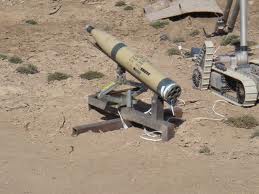
107mm Rocket on improvised launcher

We had a very late flight, about 0200.  Since you normally need to manifest for a flight two hours prior it means that you back up at least a hour before the manifest time.  This particular evening there was not much cooling going on and there was little illumination which meant in most places it was very dark. Especially in troop the billeting areas.  We dragged our gear to the entrance to the billeting area.  Nelson went back to his tent and I plopped my ass down on my bags.  About 2300 I heard and felt a rush over my head.  It was a rocket, probably a 107 mm rocket which is one of the most popular indirect fire weapon used by the insurgents or possibly a 122 mm rocket.  Both are former Soviet systems produced in Iran and supplied to insurgents in Iraq and Afghanistan as well as to Hezbollah in Lebanon.  They are not very accurate but still the fact that a rocket had buzzed me was disconcerting.  A few seconds later I heard an explosion.  I later heard the rocket had continued on and hit an uninhabited area of the camp.  Soon after it went over my head a very young looking soldier came running up to me in his PT gear with an M-16 at the ready.  He shouted “Sir, what was that?”  The young man appeared to be a bit scared to I simply quipped “Only a rocket son didn’t hit us.”  He seemed to relax just a bit and I said “You okay son?” the good thing about being as old as I am that you can get away with calling the young guys “son” because in most cases they I’m old enough to be their father.  I stay in game too much longer and the new kids could be grandchildren.  This young soldier said, “Well sir I’m on the quick reaction force and that sounded close.” In the background to the east machine gun and small arms fire could be heard.  A pair of gunships buzzed us going the general direction of the gunfire.Baghdadwas definitely not a violence free school zone.  I replied to the young soldier. “Son, if I were you I’d report to where you need to go, better grab your helmet and flak.”  The young man looked at me in the dark, assuming I was a Marine officer since I was in myMarineDesertdigital cammies, saluted and said “Yes sir” to which I replied “be safe soldier and God bless, keep up the good work.”  Once again he thanked me and hurried off into the night.

A few minutes later, Nelson who has been in some pretty sporty situations in Afghanistan including once where he took out a knife wielding assailant at a checkpoint in Kabul with his fists, came up to me.  “Hey Chaps, did you hear that rocket? Sounded like a 107.”  I said to him, “Shit brother, it felt like it went right over my head. “  He responded quickly “Boss I think we’re in a war here.”  And I said “sounds like it partner, definitely sounds like it.”  Then he said “Chaps, you wouldn’t believe what I just saw.”  I said “Really, what?”  And he told me the story. “I was over looking for our boy when I needed to go to the head, so I opened one of the port-a johns and when I opened it saw this guy and girl having sex in it, like they didn’t have the door closed and you know how nasty those things are.”  I said “Partner you’ve got to be kidding me” and Nelson said “Chaps I wouldn’t do that to you, those people looked at me like I was stupid when I opened the door and I just said excuse me and closed the door. That place stank sir; I don’t know how they were doing it in there.”  I replied “Partner, I guess after a year of more here some folks will take whatever they can get.” “But, you’d think that they would find some dark spot rather that a port-a-john,” replied a thoroughly disgusted Nelson.  As I laughed at the misfortune of my little buddy, bodyguard and protector I simply said “There’s no accounting for taste my friend, no accounting for taste.”

We sat on our gear and waited, and waited.  The time when we should have been picked up went by and after about 15 minutes of chatter about not being picked up on time, Nelson said. “Boss you want e to go find our ride?”  I responded that I wanted him to as it was so dark that he might not know where to find us. A few vehicles had come and gone but none were our assigned wheels.  Finally after about 45 minutes our ride showed up, Nelson had found him on the other side of the compound in his truck listening to AFN radio.  He had come to the wrong side of the billeting area and was chastising me for not being there.  I said, “Sergeant, I said to meet us over here and I’ll be damned f we have to lug our gear a couple hundred yards to make you happy.”  I paused as he started to interrupt and then cut him off “Sergeant, don’t go there, you’re talking to a field grade officer who wasn’t always a chaplain, you went to the wrong place and you didn’t take the initiative to try to find us. We had to find you so don’t push your luck.”  He replied, almost dejectedly, “Yes sir” and I said, “consider this matter ended, get us to the airfield, we have a flight to catch.”  Nelson and I piled our gear into the back of the truck, got in and rode the airfield.
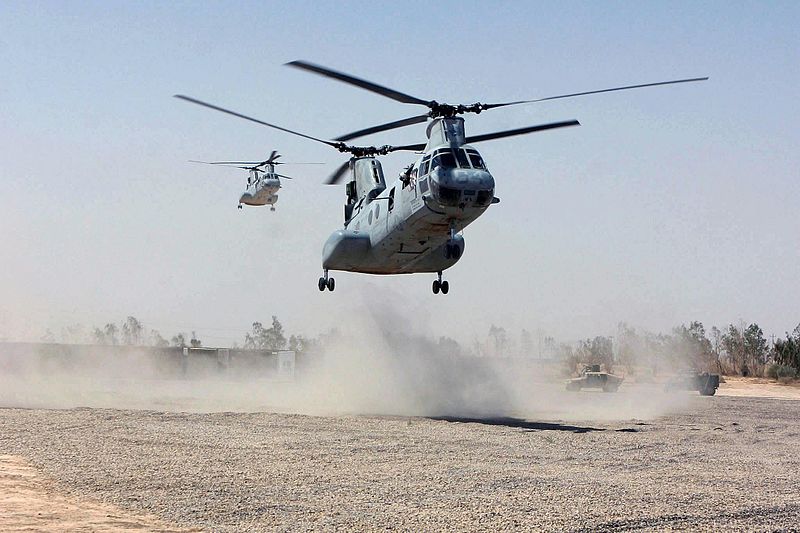
CH-46’s landing

In 2007 the Camp Liberty airfield, which deals exclusively in rotor wing aircraft, was one of the busiest heliports in the world.  Hundreds of flights went through it every day.  They were primarily Army, but a fair amount of Marine aircraft pass through as well.  We were flying Marine air tonight.  When we got to the heliport our chauffer had a difficult time finding a place to park.  Eventually we sort of double parked and Nelson and I and Nelson and I unloaded our gear with a bit of help from our chastened chauffer got up to the manifest desk where we were greeted by a civilian. He took our names and our mission number and then took out a marking pen and wrote it on the back of our hands.  I found that that at each place this was the primary way to identify who was getting off where or if you should even be on the aircraft. I found a seat and then because I couldn’t get comfortable walked outside for a while.  Nelson on the other hand, ground his gear, threw himself upon it pulled his cover over his eyes and took a power nap. He can sleep almost anywhere.

With about 10 minutes to go I woke up Nelson, and I find it amazing how he can wake back up the way he does.  When I take a nap I am useless for about 30 minutes after I wake up as my body tries to figure out what time it is. We both took turns guarding our gear as the other hit the head, once again a darkened port-a-john that stank to low hell.  When done we staged our gear near the lineup point.  Our mission was called and we lined up with about 30 others, a mixture of Marines, Sailors, contractors and a few soldiers.  We geared up, securing helmets, flaks, our packs as well as our massive EOD issue sea-bags.  Nelson helped me with mine as we got ready to walk, once was over my back and the second strapped across my chest, actually going from my chin to just above my knees.  Many of our fellow passengers had very little gear, and one fairly large contractor offered to help me with my gear.  I took him up on it about half of the 100 yards to where our bird had landed.

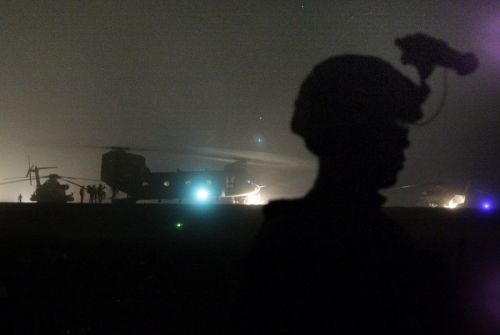
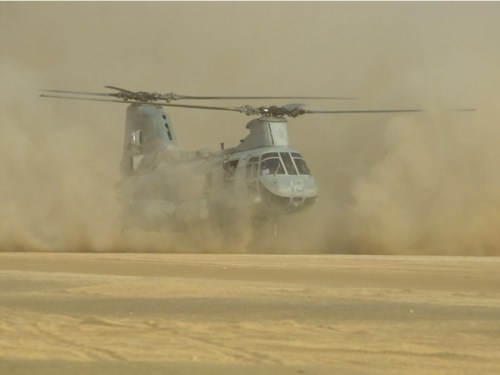
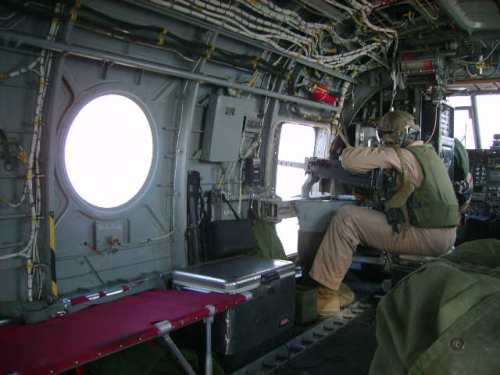
Watching our aircraft come in, a flight of 2 Marine CH-46s which date back toVietnamservice I was amazed at how surreal they looked coming in out of the night, their haze gray fuselages almost having a ghostly appearance as they set down.  Of course we had the bird that was farthest from the line up point and I was really glad for the help of this generous contractor.  As we loaded our bags onto the aircraft, stacking it in the center of the deck with everyone else’s gear, we each took one of the jump seats along the side and strapped ourselves in.  Sweat was pouring off of me and I felt totally winded, no amount of running, pull ups, pushups and crunches had prepared me to lug our heavy and ungainly gear around.  The dimly lit troop compartment was hot and I looked around the aircraft.  I noted the machine gunners in the front doors and the crewman in the back who took a seat with a 240 series machine gun mounted on a swivel.  It reminded me of the films I saw of the inside of World War Two B-17s, except that the flight suits were different.  The crew gave the let the pilots know that we were ready, and I wondered what we were heading into.  Nelson got my attention and gave me a “thumbs up” and I returned it as the lights went out that our flight lifted off.
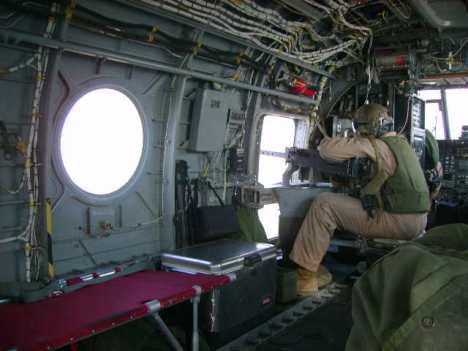
Banking around to the left the 46 gained altitude and flew back across the camp as it did so I got my first view of Iraq after dark.  As we flew into the city ofBaghdadthere were lights and sometimes lit streets. In a few places I could see the flashing lights of emergency vehicles.  We soon began to descend into the city surrounded by tall buildings, mainly hotels and government buildings and I knew that we were in the “Green Zone.” We sat down on a small landing pad, the dim lights came back on and a couple of passengers got out of our bird which a couple of more boarded the flight. The scene fromCampLibertywas repeated and gear was off and on loaded, passengers boarded and debarked from the flight and the lights went off and the bird lifted off.  Gunners took their positions and chatted on their headsets obviously scanning for threats and assessing what was going on, or they could have been talking about the new video game one of them had bought at the exchange.

Banking left we gained altitude heading east, with Baghdad fading into the night the lights of the communities along the Euphrates came into view as we flew on toward Fallujah.  For me it was a fascinating experience, surreal and a bit of anxiety making but interesting as I thought of the history of the ancient civilizations who had settled here. As a historian I thought about the Assyrians, Babylonians and Persians and the fact that the faith of the Christian Church through Abraham and later the people ofIsraelbegan inIraqwith Abraham’s obedience to the Lord in theLandofUrof the Chaldees.

The flight only took about 16-18 minutes and we flew into Fallujah.  The bird sat down on a large tarmac and the crew motioned us to get up grab our gear and get off of the aircraft.  I was praying desperately that it would not be a long walk to the terminal from the helicopter pad.  As we hauled our gear off the 46 to get to the terminal I was about tapped out.  The 46 had landed about 100 yards from the terminal where our ride waited.  It might as well have been 100 miles.  I loaded one bag on my back and commenced to drag the other.  Nelson was ahead of me and realized that his old Padre was not doing well.  I was about halfway to the terminal when Nelson showed up with a Marine on a John Deere Gator. My gear was loaded aboard the Gator; I gave a hearty thank you to Nelson, the Marine and to the Deity Herself as I dragged my sorry ass to the terminal.

The Fallujah terminal like most terminals at heliports in Iraqwas a plywood building constructed by the Seabees.  It was well lit inside, had air conditioning which I sucked up and a large refrigerator with bottled water stashed in it.  Once inside I took off my helmet as we checked in at the desk.  By now it was about 0245, I had been up since 0530 the previous day, done PT a Camp Victory, had a rocket fly directly above me and dragged 200 pounds of gear more places than I wanted to in 100 degree heat and I was a spent round.  War is a young man’s game and even though I am in good shape for someone my age, the key is that I am in good shape for someone my age, not a young guy.  Sweating profusely I found a liter bottle of water and downed it.  About that time a large African American 1st Class Petty Officer came in the door.  RP1 Donnie Roland was the LPO of the II MEF Forward Chaplain’s office and worked for Mike Langston.

Donnie, who is now retired from the Navy, is a guy that you definitely want on your side.  He hooked us up.  Normally personnel in a transient status in Fallujah are housed in tents with cots in varying degrees of disrepair.  Donnie got us rooms in the VIP quarters, nicknamed by the Marines the “Ramadan Inn.”  The place had once been the haunt of Uday and Qusay Hussein, Saddaam’s sons.  It had a pond in the center of the court yard and was reputedly a place where they would entertain senior members of the Ba’ath Party amid scenes of debauchery.  We were given a small room that had a desk and two small Iraqi beds, both of which had thin concave mattresses which had little support but were a definite step up from a cot.  Sheets, pillows and a blanket were included.  Our gear took up the majority of the room but it didn’t matter.  After a shower I crashed hard.  The bed might have been from a 5 star hotel; all that mattered at 0330 was that I could get to sleep.  RP1 Roland told us that Chaplain Langston said that we should get some sleep and come in when we could.  With outgoing artillery fire going off in the background I laid my worn out body down on the waiting mattress, I thought about the day and it came to me that the rocket that had went over my head could have killed me and a chill went down my tired spine.  Another salvo of artillery lashed out at the enemy, and my mind drifted back to the present.  I was now in Fallujah.  One more stop on the way to my war, Nelson was already asleep; I am amazed at his ability to go from 0-60 and 60-0 so fast.  More artillery fire boomed and as a former forward observer I found outgoing artillery fire to be comforting, amid it’s lullaby I went to sleep.

Peace

Padre Steve
1 Comment

Filed under Loose thoughts and musings

Living in the Bizzaro Post Osama Bin Laden World: Another Denny Crane Moment for Padre Steve

Note to readers: Another of my Denny Crane moments which seem to be coming more likely, must be the Mad Cow

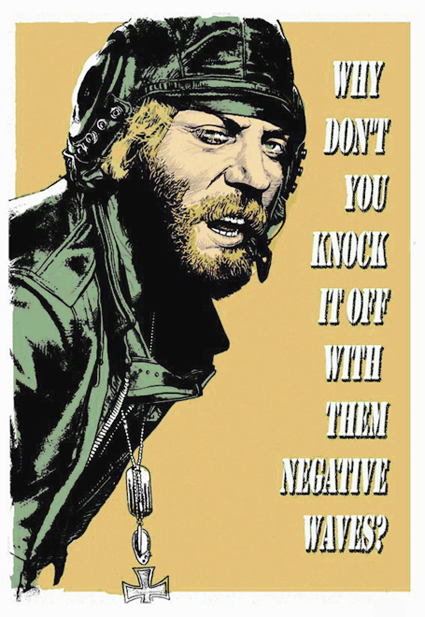
“Why don’t you knock it off with them negative waves? Why don’t you dig how beautiful it is out here? Why don’t you say something righteous and hopeful for a change?” Oddball -Kelly’s Heroes

I love that quote and everyone in this country needs to see the truth of it.

I think that I have stepped into the Bizzaro World.  For the first time in a nearly ten year old war we get a real victory. Will killed the SOB who started it by killing thousands of our people. We do it the old fashioned mano on mano, look him in the eyes way and had Navy SEALS double tap him. We minimize the collateral damage by not plastering the place with bombs killing lots of other people. The President and the National Security team kept the plan a secret for months with no leaks that could have jeopardized Bin Laden’s elimination.  Likewise the uncompromised raid secured major intelligence bonanza including laptops, hard drives, cell phones and documents that probably have more raw and up to date intelligence from the source than we ever have had which likely lead to major victories against Bin Laden’s fellow Al Qaeda leaders and their organization, finances and maybe even their contacts with other nations intelligence services.  Such information will make it a far easier task to take the Al Qaeda organization apart at the seams. This is a victory that combined with pro-democracy revolutions across the Arab World could very well make the Middle East and the world a far safer place. There are dangers out there but this is something to celebrate so why can’t we be happy? I know that some people are but as a nation we are not a happy bunch.

We have been through two terribly long was that have cost of thousands of dead and tens of thousands wounded.  The military aspects of the wars alone have cost the nation well over a trillion dollars not counting the other economic costs. The 9-11 attacks created a massive wound on the American psyche which has been aggravated by our losses in the wars and the failure to kill or capture Bin Laden. We have given up a significant number of civil liberties in the name of security.  The collective impact of these events compounded by the embarrassment of Abu Ghraib and the “Afghanistan “Kill Team” episodes the escapades of contractors like Blackwater and Kellogg Brown and Root- Halliburton have stained our conscience. Coupled with our massive economic problems and poisoned political climate these wars and losses have beaten us down.

Rather than be happy that we finally got one in the “win column” we have become so used to losing that we have forgotten that it is okay to win once in a while.  Instead of thanking God that Osama Bin Laden is bottom feeder food in the Arabian Sea and is now rehearsing for the 2011 South Park “Christmas Time in Hell” musical joining Saddam Hussein and Hitler as they use their asbestos water skis on the Lake of Fire we are all glum or pissed off. Some are wringing their hands because Bin Laden was unarmed and didn’t have a lot of security around him and that in the heat of the moment the SEALS double tapped his sorry ass.  What the hell? Did they want a firefight that would have gotten a bunch of SEALS killed? Was it fair that he was unarmed but reaching for a gun when we capped his ass? But then was it fair to the 3000 people killed in the Twin Towers when Bin Laden directed the attack on those unarmed people?

Then there are people questioning the legality of the action. Sorry Bin Laden was a man that never stopped plotting the deaths of innocent people to the end of his days. While it might have been interesting to put him on trial you can be assured that some would have provided millions if not billions of dollars for his defense and that the proceedings would have dragged on at least a decade and that his allies would have gained inspiration from his incarceration just as they will his death.  Those who question the fact that a SEAL shot him when he was unarmed does not understand the inherent danger in the action and split second decision making that went into that courageous man’s decision to kill Bin Laden.  Legally Bin Laden as a terrorist was accorded no protections under the Geneva Conventions.

Then there are the Christian objectors, those on the left that say he should have been captured and put on trial.  Some Evangelicals that really don’t care that he was killed but don’t think that Christians should be happy about it or rejoice in his death.  But I remember some of these same people smugly saying that the 9-11 attacks were “God’s judgment on the United States.”  I’m sorry but many supposedly conservative Christians are schizophrenic on being pro life. Kill the unborn it’s murder. Kill a man convicted in a state court in the United States on the basis of circumstantial evidence is okay, especially if you are from Texas where I think it’s popularity is slightly below football and NASCAR.  Have a terrorist kill 3000 of your countrymen, well God must be pissed at us but kill the man responsible for those deaths and be happy he’s dead?  Nope can’t do that we should be sad that he died without knowing the Lord. Yes it is a sad that anyone would die without knowing the Lord but this man had no desire to convert to Christianity or anything else. He was convinced of his rightness and he made no move to surrender to U.S. or Saudi authorities for nearly 20 years and still didn’t in his final moments.  He made his bed beneath the sea.  I personally think this is simply people that need to be morally superior to others spouting their opinions rather than people that are inconsistent in their application of their faith and ethics to a wide variety of issues.

Now the politicians are making political hay over this.  Some Liberals are pissed that Obama actually had the balls to order the strike.  Some Conservatives are pissed that Obama succeeded in doing something that Bush couldn’t do and that he didn’t give Bush any credit. But it serves me well that Bush never gave Clinton any credit for keeping the pressure on Saddam Hussein and keeping him from really building up his forces after the Gulf War using no-fly zones, the UN oil embargo/blockade of Iraq and selective military strikes to keep Saddam in check.  So this is all politics as usual and once again it is detrimental to the county and makes light of the sacrifices of all that have fallen in these wars and the bravery of the SEALS that killed Bin Laden.

This really is a Bizzaro world.  When Hitler died this country got happy and that happiness spanned the political, philosophical and religious divides in the country. We celebrated Hitler’s death and the destruction of his murderous regime.  Back then we actually understood the importance of such events and didn’t wring our hands and shed faux tears when evil men perished.  But now after nearly 10 years of war and thousands of causalities we get the perfidious bastard that started this and our collective jock straps and panties are in a wad. I don’t get it. The reason that we went to war is dead and we have information that probably will decimate what is left of his network and we can’t be happy.  This is bizarre and I wish that people would stop with all the negative waves.

Peace

Padre Steve+

8 Comments

Filed under faith, Foreign Policy, History, iraq,afghanistan, middle east, Military, national security, philosophy, Political Commentary

Adjusting Strategy to Reality

Taliban Fighters

“The core goal of the U.S. strategy in the Afghanistan and Pakistan theater remains to disrupt, dismantle, and eventually defeat al-Qa’ida in the region and to prevent its return to either country…” US Strategy in Afghanistan for 2011

“The aim of war should be the defeat of the enemy.  But what constitutes defeat?  The conquest of his whole territory is not always necessary, and total occupation of his territory may not be enough.” Carl Von Clausewitz

Strategic goals cannot remain fixed on geographic objectives which have lost their strategic importance because it is no longer the enemy’s center of gravity. On September 11th 2011 the Taliban ruled Afghanistan which harbored Osama Bin Laden’s Al Qaeda terrorist organization became the central front in the new “War on Terrorism.”  For about a year Afghanistan remained the central focus of United States efforts against Al Qaeda until President Bush and his administration changed the primary effort to the invasion of Iraq and the overthrow of the Saddam Hussein regime.

The effect of switching the American strategic focus from Afghanistan where we were making headway despite the limited resources provided to Iraq was a mistake of epic proportions that only became evident when Iraq did not go the way that the Bush administration led by Vice President Dick Cheney. Secretary of Defense Donald Rumsfeld and Paul Bremer the head of the Coalition Provision Authority planned.  Instead of a quick withdraw a series of mistakes and miscalculations turned the majority of the Iraqi people who had welcomed US Forces with open arms against us and an insurgency which claimed over 4000 American military personnel deaths and over 30,000 wounded became our primary focus.  We are still trying to figure out how to end our involvement in that country hoping that Iraq will not sink into another civil war.

Contrary to expectations Iraq became a front which consumed U.S. Forces and limited strategic flexibility in other regions of the world including Afghanistan.  In that country the indigenous Taliban which had been driven from power in 2001 began a gradual and deliberate return to political and military viability which was finally noticed by the United States in 2008 and 2009.  The Taliban were supported by the Pakistani Taliban, elements of the Bin Laden organization and in many cases duplicitous elements within the Pakistani military and intelligence services which were using the situation to support their own strategic goals of gaining influence in Afghanistan while strengthening their position against their perceived mortal enemy India.  Throughout the war the Pakistanis acted in their own interest while placating American demands to do more against the Taliban and Al Qaeda operating in Pakistan proper.

The Obama administration attempted to regain the initiative with a “surge” of 30,000 additional troops which raised the overall commitment of the United States to a force of over 100,000 troops assisted by NATO Allies and the corrupt, ill-trained and often Taliban Afghan Army and Police.  The surge was controversial and marked with controversy was the US Commander General Stanley McCrystal was relieved of command after an article in the Rolling Stone magazine which made it appear that he held the Obama administration in contempt. Since McCrystal recently returned to the Administration in a civilian capacity one wonders if the administration discovered that the article was meant to discredit McCrystal. McCrystal was relieved by his superior CENTCOM Commander General David Petreaus who had helped devise the strategy which in conjunction with the Anbar Awakening turned the tide against Al Qaeda and indigenous Iraqi insurgents in 2007-2008.  It achieved some success but even the United States recognizes that whatever success has been wrought is fragile and could easily be erased.

Unfortunately while the United States and its Allies continue to reinforce the campaign in Afghanistan their efforts are often undercut by the corrupt and duplicitous regime of Mohammed Karzai as well as our supposed Pakistani allies.  The Karzai regime hunkered down in Kabul has little influence outside the Presidential Palace except in its dealing in the Opium trade which helps finance the Taliban. The Pakistanis have over the 10 year duration of the war failed to maintain the security on their side of the border and often have clandestinely supported the Taliban and according to some may have given sanctuary to Al Qaeda.  The most recent setback came today when the Pakistani Chief of the General Staff General Ashfaq Parvez Kayani and Chief of Intelligence Ahmed Shuja Pasha issued a demand for the US to stop Predator Drone strikes in the border regions, cut Special Forces and CIA Staff and give the Pakistani Intelligence Service, the ISI visibility on CIA operations.  This has been long in the works but came to a head with the arrest of a CIA contractor under the suspicion of murdering two Pakistanis.  The incident created quite a rift in US and Pakistani relations in part brought about by internal Pakistani politics.  Of course the ISI has long been a source of aid to the Taliban so the United States has good reason not to trust the ISI with information that could endanger American lives.

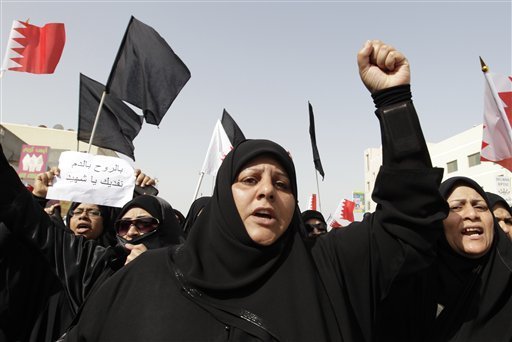
Protests in Bahrain: The Arabian Peninsula as the new Center of Gravity

The fact is without full Pakistani cooperation and substantial Afghani political reform to end corruption and provide real security to Afghani people there is no way to set conditions for a US withdraw that would leave Afghanistan a less dangerous place for its own people and for US and Western security interests. After all no one wants another 9-11 attack.  The US plans to begin withdrawing forces this year but the mission has been extended to at least 2014 at a cost of 119.4 billion dollars per year at the estimated 2011 rate and has increased exponentially since the US involvement began in 2001. The cost of the Afghanistan war in human, material and economic terms has imperiled other strategic priorities and limits the flexibility of the United States in other more vital regions.

Afghanistan is now an expensive sideshow in a larger war where the strategic center of gravity has shifted decisively to the Arabian Peninsula, North Africa and the Eastern Mediterranean where Al Qaeda seeks to use democratic revolts against autocratic despots to further its own ends. The key countries are Yemen, Saudi Arabia, Bahrain and Egypt with Lebanon, Syria, Jordan and the Israeli-Palestinian conflict boiling over.  While all of these crises grow on what seem to be a daily basis the United States and its Allies are mired in Afghanistan reinforcing failure.  Our troops on the ground have not lost a battle but like our brothers in Vietnam could “lose” the war.

This is the point where political and military leaders have to count the cost of the operation and weigh them against our actual strategic interests. The fact is if we withdrew the bulk of our ground combat forces and shifted to a lower footprint special operations and CIA campaign with a goal of ensuring that Al Qaeda cannot operate in Afghanistan with impunity as they did before 9-11 that we would likely be no worse off than we are now and have a greater amount of strategic flexibility to deal with other crises, political, military and humanitarian around the world.

The real crux of the issue is that Afghanistan is much like Stalingrad to the Germans in 1942. It has become a psychological more than a military campaign. We have invested so much in it that we do not believe that we can withdraw even though a scaled back presence would do much to improve our overall strategic situation.  Hitler denuded more important areas to attempt to capture Stalingrad and lost everything. Yes Al Qaeda used Afghanistan as its base to attack us in 2001 but they have moved on and Al Qaeda in Yemen and the Arabian Peninsula is a far greater strategic danger simply because of the oil supplies and strategic waterways in the area.

We simply need to look at all components of national strategy and decide where to concentrate.  Sometimes a strategic withdraw is necessary and actually vital to recover the initiative and set the stage for long term success. In Afghanistan this is not an admission of defeat but rather an acknowledgement that the central focus of the war and our strategic interests are elsewhere.  Our enemies would love to have us continue the campaign in Afghanistan in its current form, they know that our commitment drains our military, imperils our overall strategy and bleeds us dry economically all the while providing propaganda grist for them in their war against us.

However despite the cost the political situation in the United States keeps President Obama invested in Afghanistan. If he withdraws his opponents will say that he lost the war. Unfortunately the war in Afghanistan was ceded to the Taliban in 2003 when we decided that Iraq was more important. Now we reap the terrible consequences of that decision.  Now we have to decide how to make something positive out of this unenviable strategic position. But as Napoleon Bonaparte said “In order to govern, the question is not to follow out a more or less valid theory but to build with whatever materials are at hand. The inevitable must be accepted and turned to advantage.”

Peace

Padre Steve+


2 Comments

Filed under Loose thoughts and musings

Padre Steve’s Primer on the Muddle East

“When you are up to your arse in alligators it is hard to remember that your mission is to drain the swamp.” Old British Colonial Saying

During the dark days of World War Two when Field Marshal Erwin Rommel was making fools of a series of British commanders in North Africa people including senior British military and government leaders sometimes referred to the theater of operations as “the Muddle East.” Some things never seem to change. The Muddle East today is quite frankly speaking in a real muddled state if there ever was one with world leaders and regional leaders muddling about as if they were the New York Mets.

A large part of the muddle goes back to the fall of the Ottoman Empire at the close of the First World War when the victorious Allied Powers redrew the map of the Middle East and made alliances with various local tribal sheiks who many times were crowned king over other tribes who didn’t necessarily want them as king. This along with heavy handed European military actions such as the British using poison gas dropped from aircraft in Iraq and a real lack of effort to better the lives of the newly “liberated” peoples of the region was just the start. Add to the cesspool a bunch of oil presided over by major oil companies, the anti-colonial movements that flourished in the years after World War Two when the French, British and Italians had to divest themselves of their Middle Eastern holdings. The French had to fight a real war in Algeria but finally withdrew leaving Algeria’s new rulers to goof up the country and oppress their people for decades to come.  In the coming years many of these newly independent nations found that life still sucked so in a number of countries military officers overthrew the despised monarchs promising reforms but oppressing their people while blaming all their problems on the Israelis.  They got their asses kicked by the Israelis in a series of wars which did a number of things that made the Middle East Muddle even worse.

First it ensured that Palestinian Arabs ended up under Israeli rule and were used with great aplomb by the Middle Eastern despots to prop up support for their regimes while doing nothing to help the Palestinians other than to put them in camps in Lebanon.  Even when the Egyptians made a peace deal with Israel most of the Arab World ostracized them.  Then in 1979 the Shah of Iran was sent packing by a bunch of Mullahs and in 1981 Saddam Hussein’s Iraq attacked Iran in one of the bloodier wars of the late 20th Century which finally ended in 1988. Of course the United States was pissed at the Mullahs so Saddam became our favorite Arab despot for a while.  Add to the mix the Soviet Union and the United States arming their favorite Arab dictators who were given carte blanche to continue oppressing their people so long as it didn’t interfere with their support of either party or the oil supply. Finally the Soviets went Tango Uniform in 1989 not long after being forced out of Afghanistan by the U.S. supplied, Pakistani supported and Saudi Arabian fundamentalist financed Mujahedeen.

With the Soviets Tango Uniform and the Warsaw Pact nations trying to get into NATO the United States was now the uncontested Numero Uno country in the world Saddam presumed upon his late supporters and invaded Kuwait, albeit after thinking that the U.S. Ambassador to Iraq said that we wouldn’t mind. Well he was wrong we did mind and got a lot of countries from NATO and including a bunch of Arab countries like Egypt, Syria and Saudi Arabia to get on board on a mission to get Saddam’s troops out of Kuwait. It was a kick ass mission and since the United Nations didn’t authorize removing Saddam and because President George H.W. Bush was smart enough to not to drive on Baghdad to kick him out preferring the depot we knew to a quagmire despite Saddam’s crimes against his own people who thought we would help them.  So we stationed ground and air forces around the Gulf to keep Saddam and Iran in check and even put them in Saudi Arabia which a large number of radicals such as Osama Bin Laden equated to letting the Devil play in Allah’s Holy Sandbox.  So Osama went and set up a base with the Medieval bunch of Pashtun known as the Taliban in Afghanistan stirred up a bunch of shit killing Americans and blowing up stuff including the World Trade Center in 1993, the Khobar Towers barracks complex in 1996, the USS Cole in 2000 and then 2001 another attack on the World Trade Center which took down the towers with hijacked aircraft and also struck the Pentagon triggered an American response against Bin Laden and his Taliban hosts.  The United States then invaded in Iraq in 2003 and succeeded in taking out Saddam but also succeeded in alienating a good many Iraqis who greeted us with open arms because we goofed up the occupation and pissed a lot of them off by dissolving the Army, Police and Civil Service and letting thugs and opportunists take over. Unfortunately since we didn’t go in with enough troops to secure all the Iraqi bases, their weapons depots and actually take control of surrendering Iraqi units these newly unemployed and dishonored people launched an insurgency bolstered by Al Qaeda and other foreign fighters even as Sunni and Shi’a Moslems began to settle scores with each other. Insurgency and civil war, two great tastes that go great together, but what the heck right?

Of course it took years to get control of the situation on the ground and thankfully the United States forces in Iraq were helped when the Sunni Moslems in Al Anbar Province realized that these foreign fighters were a worse enemy than the United States and switched sides. This turned the tables in Iraq and the insurgency was brought under control and an elected government managed to start to get their stuff together and allow us to begin withdrawing from Iraq. Of course the focus on Iraq gave the Taliban a chance to regroup as the Afghani Government proved itself corrupt, incompetent and not to give a shit about the Afghani people. So the Taliban who had been hated made a comeback and made our lives much harder so that now almost 10 years into the fight we are having a really hard time.  Well enough about us there was plenty more going on in the Muddle East besides the Iraq and Afghanistan wars.

Let’s see….there was the law of unintended consequences in that by taking Saddam Down and weakening Iraq we took away Iran’s natural enemy and the key to the balance of power in the region. Iran was strengthened and began a nuclear program that everyone with half a brain knows in intended for military use and expanded its influence in Lebanon where the Iranian backed Hezbollah took power last year.  Now Hezbollah which actually has an experienced military force and probably owns 40,000 or so rockets and missiles a good number of which can hit deep in Israel seems to be ready for war especially because they fought the Israelis to a stalemate in 2008, the first time an Arab military ever did that.

Then was the effect that the wars in those countries made things harder for us in many other friendly Arab nations.  Of course there is the problem of a nuclear armed Pakistan which is about as stable as a Japanese nuclear reactor after getting hit by a tsunami and plays both sides of the street in the war on terror.  The Palestinians and Israelis continued their love affair and since Fatah which ran Palestinian Authority was so corrupt and gooned up a more militant group, Hamas took power in the Gaza strip. Hamas is a pretty bloodthirsty lot too but not the same level of threat as Hezbollah to the Israelis.  Of course the Israelis have done little to help the situation by their often heavy handed treatment of Palestinians and Israeli Arabs.

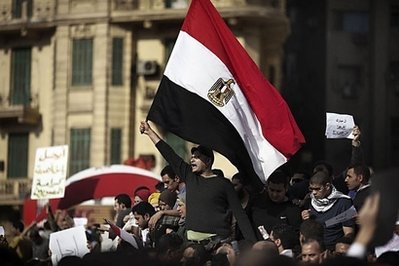
The witches’ cauldron of the Muddle East is getting even more muddled on a daily basis as young Arabs throughout the Muddle East are rising up against their despotic rulers and it doesn’t seem that any are safe, those allied with the United States and the West as well as those that have been a thorn in the side of the United States and the West. It just seems that despots and tyrants are no longer in vogue. The uprisings began in Iran after a disputed election where reformers were cheated of power and the revolt crushed by the Revolutionary Guard and other thugs of the Iranian regime. But then in December 2010 the people of Tunisia rose up and overthrew their President for Life Ben Ali in a peaceful uprising followed shortly after by the Egyptians who tossed out long term President and U.S. ally Hosni Mubarak.

This brought about spontaneous uprisings all over the Middle East with Libya and the long time pain in the ass Muammar Gaddafi being the current center of the action. However Yemen and Bahrain both are in trouble, Algeria, Jordan and Syria have or are experiencing demonstrations which look to be revolts in the making and even Saudi Arabia is trying to head off a potential popular uprising.

Yes my friends this is a mess and almost everybody that is anybody in the military and economic power houses of the world doesn’t have their handprints all over at least some part of this mess. All of these own some of the blame for what is going on, both the rulers of the nations in the region as well as world powers who all try to influence the nations and peoples for their own diplomatic, intelligence, military or economic gain. Almost no one is unsoiled by their involvement in the Muddle East over the past 90 years or so and so in a way all of world powers, as well as the despots who ran these countries are to blame.

The region is more volatile than at any time in recent history and events there could easily ignite a regional war with worldwide implications.  That is why the region has been called the Muddle East for decades.  We all hope and pray for the best and that somehow all of this will bring about a peaceful and democratic “Arab Spring” but there are better than even odds that things get way worse before they get better. There are just too many wild cards in this deck and the swamp is full of hungry alligators.

May God help us all and bring about peaceful change, or as my Iraqi friends simply say “Inshallah, God willing.”

Peace

Padre Steve+

4 Comments

Filed under Foreign Policy, History, middle east, national security

“Victory” and Reality: Never think that War will be Easy

“No one starts a war-or rather, no one in his senses ought to do so-without first being clear in his mind what he intends to achieve by that war and how he intends to conduct it.” – Karl von Clausewitz

I was talking with a friend recently and the subject came to the support of a certain church for the war in Iraq back in 2003.  My friend, who is very thoughtful, spiritual and circumspect made the comment that “they were even against the war” when we discussed the merits of this particular church.  I thought for a second and said “after the past nine years of war was that wrong?” He paused a moment and said “I see your point.” I think that in the early months and years of this war, where we quickly deposed the Taliban in Afghanistan and Saddam Hussein in Iraq that we made unfounded assumptions about our “successes” with the end result that we have had to fight a much more protracted, bloody and costly series of wars than we had ever imagined. Like so many nations who entered into wars believing that they would have easy victories achieved at a cheap price in blood and treasure we have discovered once again that the serpent of the fog and friction of war coupled with hasty or politically expedient decisions has come to cause us great pain as a nation and after nine years a foreboding sense that we might not win in Afghanistan.

Like most Americans after the attacks of 9-11-2001 on the World Trade Center and the Pentagon I was all in favor of going after those that attacked this country wherever they were to bring those that planned these vile attacks to justice.  Within a month the United States had driven the Taliban out of power in Afghanistan and put the leaders of Al Qaida on the run.  By 2002 the US Government had began making a case against Iraq, one of a trio of nations identified as the “Axis of Evil.”  In 2003 we went to war with Iraq after failing to convince many allies of the necessity of the attack. When the “shock and awe” campaign was launched, Iraq forces defeated, Baghdad captured and Saddam Hussein driven from power there was a heady feeling of success.  Even those opposed to the invasion were amazed at the speed of and apparent ease of the conquest as pictures of cheering Iraqis filled the screen as the statues of Saddam came down.  In May President Bush landed on the USS Abraham Lincoln to proclaim “mission accomplished.” “We support the troops” ribbons and bumper stickers were the rage, victory has many friends and some churches even ascribed the victory to God.  But as the muse would say to the returning Roman conquerors, “victory is fleeting.”

We thought that we had achieved a “revolution in warfare” in the two campaigns but within months the tide had shifted in Iraq as in a colossal mistake of epic proportions a decision was made either in Washington DC or by the head of the Coalition Provisional Authority Ambassador Paul Bremer. A decision was made to disband the Iraqi Military, Police and Civil Service offices without having enough troops in place to police Iraq or civilians including NGOs and the UN available to fill the civil service gaps.  This was in direct contravention to years of CENTCOM plans. To make matters worse we had gone in so light that we had not disarmed or demobilized the Iraqi forces, thus we sent the people who could best help us restore Iraq to working order home. We sent them home and as anyone that knows Arab culture can tell you we dishonored them and created enemies out of potential friends while placing corrupt opportunists in power.  It was if we were making things up as we went rather than thinking things through and the result was a disaster.  By the end of 2004 a full-fledged insurgency had broken out an insurgency that would cost thousands of Americans and Iraqis their lives with tens of thousands of others wounded.  It was not until late 2007 and 2008 that the tides turned in Iraq as Iraqi Sunnis realized that Al Qaida backed insurgents were more of a threat to them than the American forces were.

Over the course of the war the thrill of the early days was forgotten as American Soldiers and Marines engaged a resourceful enemy that was willing to fight us in ways that we had neither expected nor planned.  War loses its luster when the thrill of victory is gone.  With the transition of the mission in Iraq and a renewed focus on Afghanistan where the Taliban had come back with a vengeance we are now moving toward being at war for 10 years.  We have fought the war with a military force that is well under 1% of the US population.  The military has fought well. We have not been defeated in open combat despite losing many troops to IEDs and ambushes; though in Afghanistan there have been a couple of near run events where small bases were nearly overrun by Taliban forces. We should remember General Hans Guderian, the creator of the Blitzkrieg and his words about the German campaign in Russia after the Battle of Kursk in 1943: “We have severely underestimated the Russians, the extent of the country and the treachery of the climate. This is the revenge of reality.” General Heinz Guderian

Nine plus years after 9-11 most of the American public as well as the political class of both parties have soured on the wars even while others seek war with Iran and maybe North Korea. I wonder about the wisdom of taking on even more enemies when the military is stretched to the breaking point and the nation is heading into bankruptcy.

But such things are not new from a historic point of view, if only we would look to history. Back in 1940 after their victories in France and the Low Countries the Germans felt as if they were invincible. By 1941 their troops were bailing out the Italians in North Africa and the Balkans while engaging the British in the air above Great Britain and in the seas around it. That did not stop Hitler from attacking the Soviet Union where as in France and the Balkans the German Army enjoyed amazing success until winter arrived and the Soviets counter-attacked.  Thereafter the German Army would not enjoy the same success and millions of German Soldiers; not to mention at least 20 million Soviet citizens and Red Army Soldiers died. Eventually the Wehrmacht was shattered, defeated and Europe devastated.

I am not saying that this will happen to the US, but it can.  We need to learn from history and look at how good people were enticed by the aphrodisiac of the “victory disease” that accompanied supposedly easy victories.  If one looks at Germany many officers, soldiers and civilians drank the aphrodisiac of victory and had their faith in Germany, their leaders and their cause destroyed as the war turned against them and they experienced defeat even while many times getting the best of their enemies on the battlefield.  Honorable men that had served their country well were either cashiered by the Nazi government and many killed by that instrument of evil because they voiced opposition to the regime.  Initially many had been lured into the trap of easy victory.

Back in 2001 and into 2003 I was like many of those men who served in the German military.  I was excited about the apparent easy victories in both Afghanistan and Iraq.   But like some German officers of that day who realized as the campaign in Russia was going badly into the fall of 1941 by late 2003 I began to sense that something was going terrible wrong in Iraq.  I think it was the moment that I heard that we had disbanded the Iraqi Army, Security forces and Civil Service as I started my course of study with the Marine Command and Staff College program held at the Joint Forces Staff College.  The experience of serving with thoughtful Marines in my unit and my fellow students; Marine, Navy, Coast Guard and Allied officers at the school helped me see the danger that was developing in our campaigns.  By the time I arrived in Iraq in the summer of 2007 the tide was beginning to turn but I saw the devastation of the country, ministered to wounded Marines and Soldiers and seen the affect of the war on Iraqis.  My duties with our advisors and their Iraqi counterparts were enlightening as I travelled about Al Anbar Province.

In the end I think that the Iraqis despite everything will do okay. I believe that most are tired of war and will not succumb again to sectarian violence on a large scale. I do not think that they have an easy road ahead but I believe the words of Brigadier General Ali as I left him for the final time: “You come back to Iraq in five years, as tourist, it will be better then.” I am not so optimistic about Afghanistan or Pakistan and I do not think we have yet seen the worst in those countries, but at least despite all of our mistakes Iraq most likely will do well.

The experience of war coupled with my study of history and military theory at the Command and Staff College as well as in my studies from my Master’s degree in Military History changed my perspective. I still serve faithfully and hope and pray for a conclusion to the wars that leaves us in better shape and brings peace to the lands that we have shed the blood of our Soldiers, Sailors, Marines, Airmen and other Federal intelligence, diplomatic and police agencies and treasure in.  I pray for my friends serving in harm’s way and those preparing to deploy and I pray for the safety of my Iraqi military friends and their families.

I am not a defeatist should someone level that charge at me.  I agree with Ralph Peters who made this comment: “We will not be beaten. But we may be shamed and embarrassed on a needlessly long road to victory.” However, I wonder if this country has the will to win and to make the sacrifices to do so and not just shovel them off on those that serve and have served throughout this war, a war which appears to have no end and which may expand to other countries.

Like the Germans we are engaged in a multi-front and multi-theater war but we have been trying to do so upon the backs of less than one percent of the population. This allows the rest of the country to live under the illusion of peace and prosperity with the bitter losses and memories of 9-11 fade into a yearly remembrance called “Patriot Day” by politicians of all stripes who often mouth empty words to eulogize the victims and thank the troops and then move on to their next fundraiser.  By doing this we have worn out the force without the full support of the nation which is absolutely necessary for the successful prosecution of a war, especially a long drawn out war such as we have now.  Unfortunately most Americans have little patience and while we mythologize a lot about World War Two one has to remember that there was a strong lobby that desired to end the war in 1944 even if victory had not been achieved.

We have a military now composed of many battle hardened and deployment weary soldiers who live in a world that the bulk of the nation does not understand nor really wants to understand.  We have seen the cost of the war multiply to the point that it has drained the ability of the military to prepare for other wars and modernize itself.  What happens if God forbid we are forced into a war with Iran or North Korea?  With what will we fight those wars?

When the Allies were cracking the German front in Normandy and the Red Army was decimating Army Group Center in the East, Field Marshall Gerd Von Rundstedt was asked what needed to be done by a General at Hitler’s military headquarters. The old Prussian warhorse simply said “make peace you idiot.” He was fired shortly thereafter. We certainly have not reached that point but should anything else break out while we are still engaged in Afghanistan and maintain a large number of troops in Iraq that could change.

One always needs to be careful when getting into “easy” and “quick” wars as more often than not they are neither easy nor quick.

Peace

Padre Steve+

Leave a comment

Filed under Foreign Policy, History, iraq,afghanistan, Military, national security

29 Years in the Military and still Going Strong

“It’s a mere moment in a man’s life between the All-Star Game and an old timer’s game.” Vin Scully

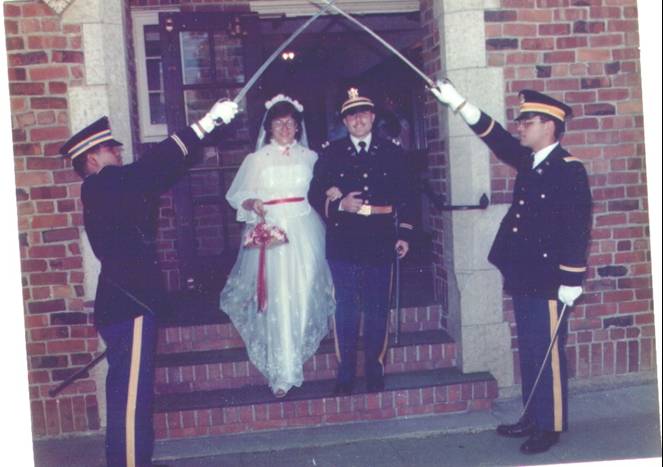
Padre Steve in 1982

They say that “time flies when you’re having fun” and I cannot believe that I have been in the military now for 29 years. On August 25th 1981 a 21 year old college kid with long Southern California “surfer” hair walked into the California Army National Guard Armory on Van Nuys Boulevard to enlist in the National Guard after having just sworn into the Army ROTC program at UCLA.   Back then I enlisted in what was or is called the Simultaneous Membership Program or SMP program.  My initial military training came through the ROTC program as well as on the job training in the National Guard as a Field Artillery Forward Observer and Intelligence Specialist.

Like Cal Ripken Jr commenting about his career “So many good things have happened to me in the game of baseball. When I do allow myself a chance to think about it, it’s almost like a storybook career. You feel so blessed to have been able to compete this long.” I can say the same thing just substituting the words “military career” for “the game of baseball.”

On the day that I enlisted I met with Major Charles Armagost the S-1 of 3rd Battalion 144th Field Artillery and full time advisor for the battalion filled out my enlistment papers and raised my right hand. I still remember the day when I enlisted. It was a hot smoggy Los Angeles day where you could see the air.  I walked down the hall after I swore in to see the supply Sergeant who outfitted me with four sets of Olive Green fatigues and ordered me two sets of the brand new BDUs.  I was issued my TA-50 gear and taken to the motor pool where I was given cursory training on the M151A1 “Jeep” and issued a military drivers license.  The three weeks later I was driving one of those venerable machines to Fort Irwin on a Friday through Sunday drill with the advanced party. It was the beginning of a 29 year career spanning two services, the active and reserve components and now multiple trips to combat zones.

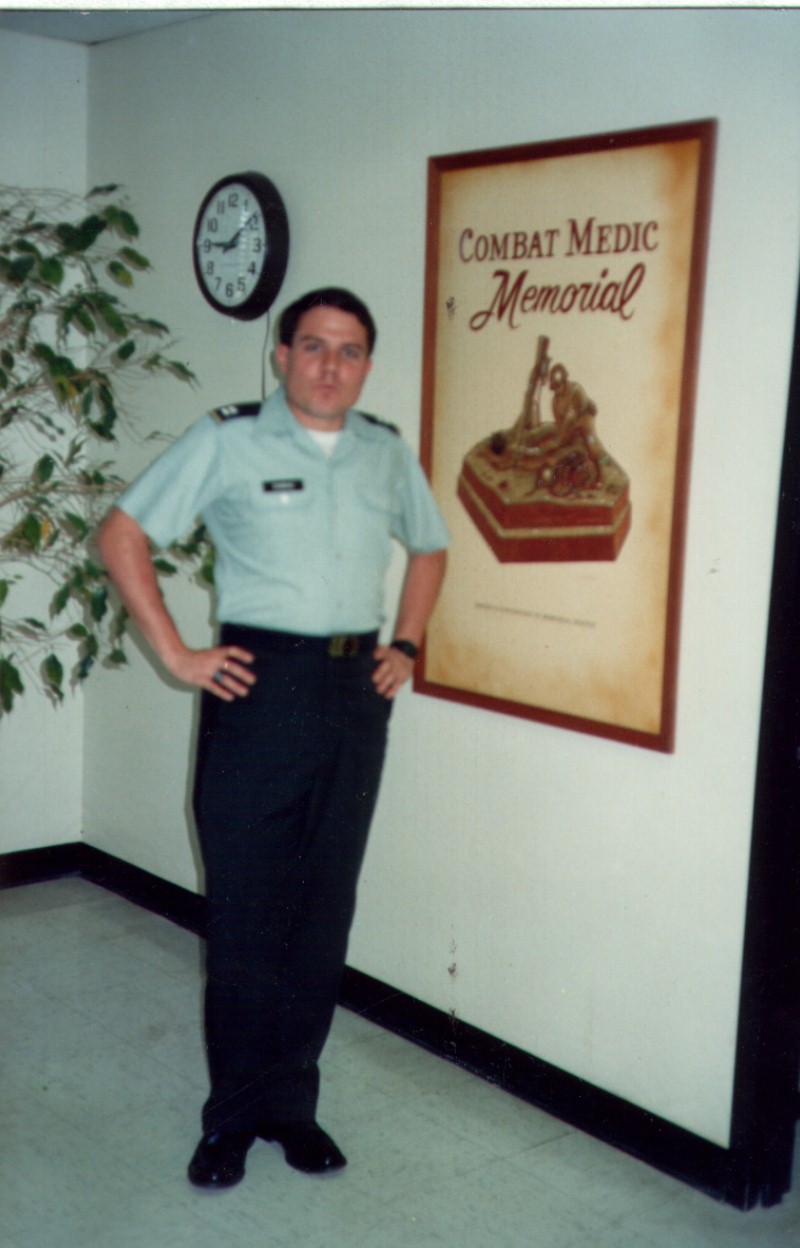
Army Captain 1987

It has to quote Jerry Garcia of the Grateful Dead “a long strange trip” spanning the Army and the Navy, active and reserve components as well as two tours with the Marine Corps while serving in the Navy and the beat goes on with my selection for promotion to Commander and my Senate nomination to that grade on August 21st.  I have served on the Fulda Gap in the Cold War, been to what was then East Berlin driving the Helmstedt-Berlin corridor sharing the road with Soviet armored columns.  I supported the Bosnia Operation in 1996-97 and the Korean DMZ with the Marines in 2001. I served in Operation Enduring Freedom and Southern Watch in 2002 where I was on a boarding team, boarding 75 Iraqi and other country smuggling ships while serving aboard the USS Hue City.  That was followed by multiple trips in and out of theater with the Marine Security Forces from 2003-2006 as well as time on the Cuban fence line at Guantanamo Bay before serving in Iraq with our Marine and Army advisors and their Iraqi Army and Security forces.  I’ve served with Infantry, Armor, Combat Engineer, Artillery, Medical and Ordnance units, Security forces, support elements, bases and training centers, hospitals and ships.

Berlin Wall November 1986

When I enlisted I thought that once I was commissioned that I would serve my entire career in the Army and retire as a Lieutenant Colonel. I did not anticipate becoming a Chaplain nor leaving the Army for the Navy. When I am officially promoted to Commander it will be the first rank since I was an Army First Lieutenant that I have not held twice.  When I first enlisted and had no ribbons I used to look at wonderment at the Korea and Vietnam veterans who had tons of ribbons and tell Judy that I wish I had what they had. Now that I am working on 9 rows of the things I cringe every time I have to remount ribbons and ribbons and my wallet screams in agony.  Judy is quick to remind me of my whininess back then and tell me that I asked for it.

She didn’t know what she was getting into

As an Army and Navy Officer I have served or done some kind of military duty in Germany, France, Great Britain, Greece, Italy, Croatia and Turkey, Spain, Malta, Korea, Japan, Jordan, Bahrain, Kuwait and Iraq.  I’ve done what I call the “Commie Trifecta” the Berlin Wall, Korean DMZ and the Cuban Fence Line. At the same time I have spent 16 of 27 wedding anniversaries away from home and lost count of birthdays and other important occasions that I missed while serving the country.

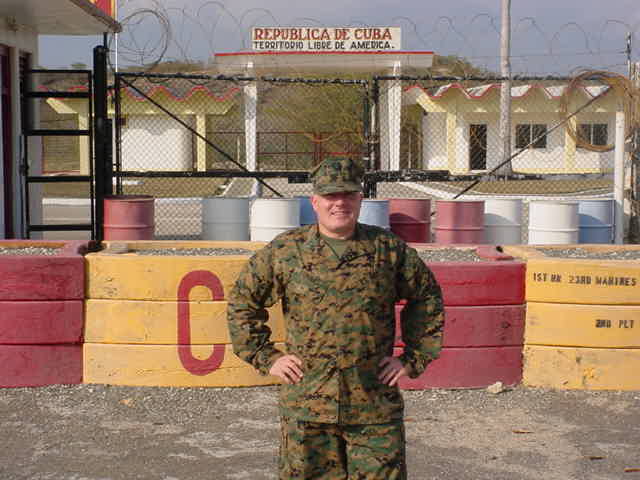
Guantanamo Bay Cuba 2004

I have served 5 different Presidents. In that time I have seen changes in the political, social and economic conditions of the country and the world that I could not have imagined at the time of my enlistment.  The Soviet Union had just invaded Afghanistan and the Iranian hostage crisis had just ended but within the Soviet Union had been defeated the Berlin Wall taken down and collapse of the Soviet Union.  Twenty years after I enlisted the people that defeated the Soviets were attacking us on our own soil.

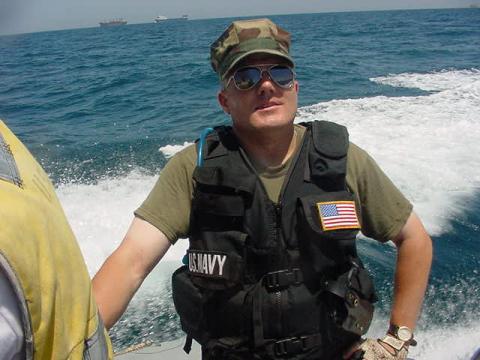
Boarding Party Arabian Gulf May 2002

I lived in Europe and went through the Chernobyl radiation cloud which is obviously the cause of my glowing personality.  While in Europe I ate enough beef to be labeled by the Red Cross as a potential carrier of Mad Cow disease. I worked on military personnel policies at the beginning of the AIDS epidemic and saw the beginning of Don’t Ask Don’t Tell policy.  I saw the Reagan build up and the post Cold War drawdown.  When I was a Company XO and Company Commander we had landlines and typewriters with carbon paper and did not get internet in my office until 1997.  It is hard to believe the changes even in the quantum leaps in computer and communication technology in the past few years where I can check e-mail on my Blackberry and work from almost anywhere with my laptop.

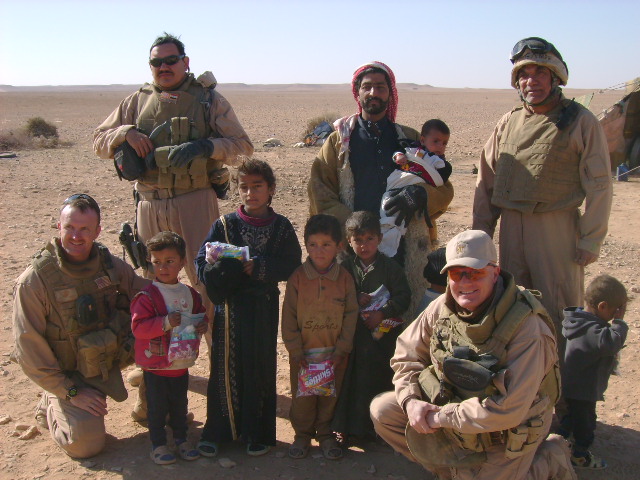
With Advisors and Bedouin on Iraqi-Syrian Border December 2007

Looking back here are some of the things that I have seen since I entered the military:

October 23rd 1983: Beirut Bombing: BLT 1/8 barracks and French 1st Parachute Regiment destroyed by suicide bombers 241 Americans and 58 French Paras killed.  I was at the Junior Officer Maintenance Course at Fort Knox watching CNN late at night when they broke the news.

December 12th 1985:  Arrow Air Charter Boeing 707 crashed in Gander Newfoundland killing 248 American Soldiers returning from Peacekeeping duty in Sinai Peninsula. Among the dead was Sergeant Charles Broncato who had been one of my Squad Leaders in 2nd Platoon 557th Medical Company Ambulance. I was then serving as the Company Commander.

January 28th 1986: The Space Shuttle Challenger blows up 73 seconds into flight killing 7 Astronauts.  I was in my office at the close of the day getting ready to adjudicate an Article 15 when my Charge-of Quarters SPC Lisa Dailey ran into my office and said “Lieutenant Dundas, the Space Shuttle just blew up!” My response was “Come on, Space Shuttles don’t blow up.”

February 15th 1988: The Soviet Union withdraws from Afghanistan. I was a National Guard Officer in Texas attending Seminary and thought this was a good thing.  Now I wish that they had done better and at least killed Osama Bin Laden, then a relatively minor commander.

December 21st 1988: Pan Am 103 downed by Libyan operatives over Lockerbie Scotland killing all 270 passengers and crew. The aircraft a Boeing 747 named the Maid of the Seas was the same aircraft that we had flown home from Germany on December 28th 1986.

October 17th 1989: the Loma Prieta Earthquake causes massive damage in San Francisco and Oakland. I was watching pregame activities of game 3 of the World Series between the A’s and Giants on television when it happened.

November 9th 1989: The Berlin Wall Fell. In November of 1986 we had been to East Berlin and like most Americans never thought that we would see this day.

August 2nd 1990: Iraq Invades Kuwait: At time few people believe it well end in war. I was deputy course leader for Army Chaplain Officer Basic Course, tell my classmates to get ready to go to war.

December 31st 1991: The Soviet Union is dissolved.

April 19th 1993: FBI and other Federal Law Enforcement personnel using Combat Engineering Vehicles from the 111th Engineer Battalion, the unit that I serve as a Chaplain assault the Branch Davidian compound outside Waco Texas. Davidian leader David Koresh and dozens of followers die in fire and shoot out.

June 17th 1994:  Police arrest O. J. Simpson after nationally televised low speed chase charging him with murder in the death of his wife Nicole and Ronald Goldman. NBC splits screen between NBA championship series game between Houston Rockets and New York Knicks and the chase. I watch in back of M577 Command Vehicle on 9 inch television in the field at Fort Hood.

August 12th 1994: Baseball strike cancels season, playoffs and Worlds Series.

April 19th 1995: Timothy McVeigh and Terry Nichols blow up Alfred P. Murrah Federal Building

January 26th 1998: Bill Clinton states that “I want you to listen to me. I’m going to say this again: I did not have sexual relations with that woman, Miss Lewinsky.”

December 31st 1999: The world awaits the end of life as we know it due to the Y2K flaw sthat supposedly causes computers to malfunction and bring calamity to the earth.

January 1st 2000:  People including me wake up from hangovers to find that computers still work.

September 11th 2001: Al Qaeda terrorists hijack four commercial airliners crashing two into the World Trade Center Towers in New York collapsing them and one into the Pentagon. A fourth is brought down by passengers before it can reach Washington DC and its target, the US Capital killing 2976 people and injuring another 6000+. I am at Camp LeJeune North Carolina and remained locked down on base the next 4 days.

March 19th 2003: US and Allies launch attack on Iraq known as Operation Iraqi Freedom to remove Saddam Hussein from power and disarm his stocks of weapons of mass destruction. I am assigned to USS Hue City and the ship is in dry dock. The rest is history.

I also saw a lot of baseball mostly from afar, Pete Rose’s epic hit, Cal Ripken’s consecutive games record, Nolan Ryan’s 5000th strike out and 7th no-hitter as well as all of the now steroid tainted home run records including Barry Bond’s 756th home run which I saw live in a chow hall in Baghdad.

Somehow it is all worth it. Judy has not divorced me although I have probably given her reason on more than one occasion to do so and I love what I do and the people that I get to serve. It really is amazing to look back and think about all the events that I have either witnessed or been a part of in the military as well as all of the great people that I have been associated with. Those friendships and relationships mean more than about anything to me and I am grateful to God and to Judy, my family and all of my friends who have helped me, sometimes in very dark times to go as far and as long as I have in both the Army and Navy.

I was selected for promotion to Commander in June and confirmed by the Senate on August 23rd. I now am about to enter a new phase of life, military service and ministry as the supervisory Chaplain at Naval Hospital Camp LeJeune North Carolina.  Lord knows what the future hold, but whatever happens I feel that things will be fine.

I hope that whatever you do that you will experience good things and be able to look back in life and say “wow that was something else.” So here is to all of us and the long strange trips that we embark upon in life.  In the words of Lou Gehrig, “I am the luckiest man alive.”

Peace,

Padre Steve+

Leave a comment

Filed under Baseball, History, Military, Tour in Iraq, US Navy

The Anomaly of Operation Desert Storm and Its Consequences Today

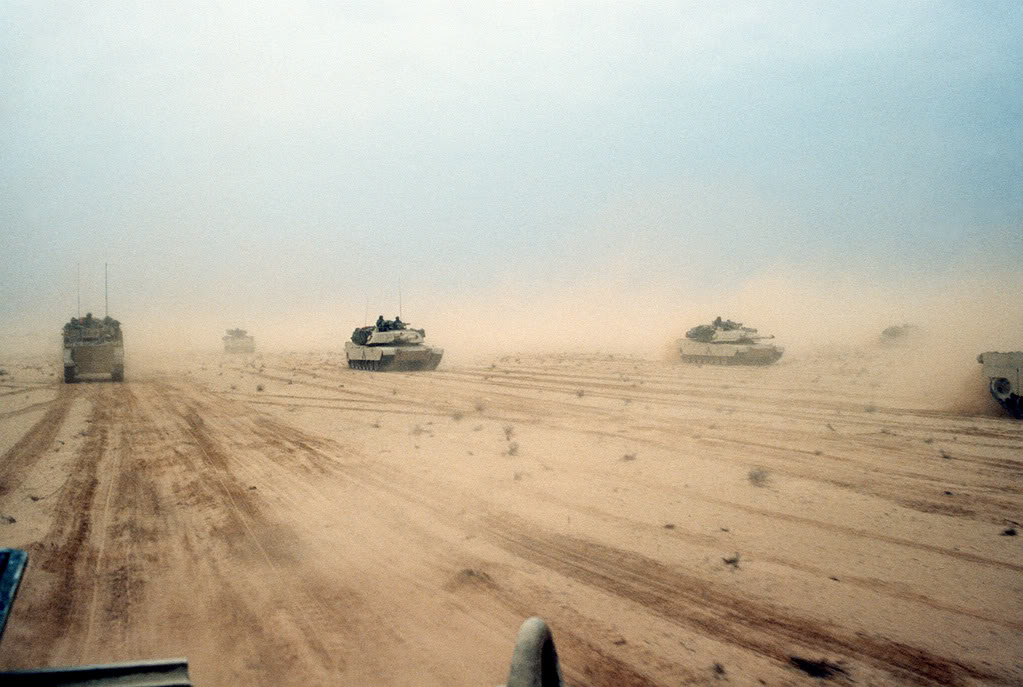
Armor Advancing During Operation Desert Storm

There are few occasions in history where an army is given exactly the scenario to which its organization, training and doctrine coalesce against an opponent that uses the template of organization and training that it has been designed to defeat.  Operation Desert Storm, the liberation of Kuwait by the United States and its coalition from Saddam Hussein’s Iraqi Army and Republican Guard was such a war. The operation was built up in the popular media to the extent that it created a false image of the cost of war and belief that wars can be won “one the cheap” because of superior technology and organization.  That belief was shattered during the Iraq insurgency which began in earnest following the occupation of Iraq following the defeat of Saddam in 2003 by a significantly smaller US force than was used to liberate Kuwait twelve years before.

Architects of Desert Storm

The superior performance of the Army in the Gulf War did not turn out to be the template of how future wars would be fought.  In the following years the US military has become embroiled in conflicts where opponents use inexpensive and often crude off the shelf technology to counter conventional US superiority in firepower and organization.

During the First Gulf War the Army was aided in that the doctrine that it developed to fight a war in Europe against the Warsaw Pact, the Airland Battle was “perhaps best suited to armored warfare in the open desert.”[i] Of course during Desert Storm this was exactly the setting that the Army would be called on to fight.  Unlike Vietnam where the Army attempted to fight an unconventional war with conventional tactics the Army had the chance to fight exactly the battle that it had trained for, against an enemy trained in the tactics and using the equipment of its former Soviet adversary.

The Army enjoyed the advantages of having “reached a high level of training and technological proficiency”[ii] against the Soviet threat. The fact that the Soviet Union and Warsaw Pact had melted down unexpectedly in 1989 and 1990 and removed any conventional threat in Europe which allowed the Army to concentrate massive amount of forces including the VII Corps from Germany to the Middle East was nothing short of incredible.  Additionally the Army had the advantages of superior weaponry and the fortuitous timing of the war before the effects of the post-Cold War drawdown were realized.

For the Army the “1980s were a golden age of military thought and debate,”[iii] and the Airland Battle concept “was greeted with enthusiasm throughout the Army.” Terms such as initiative, agility, synchronization and depth….soon became part of every officer’s vernacular.”[iv] Colonel Harry Summers who had written a critical history of the Vietnam War noted that FM 100-5, the Army’s primary manual of operations, was the “operational blueprint for Operation Desert Storm.”[v] That blueprint had a well trained and disciplined force schooled in the conduct of the Airland Battle concept enunciated in FM-100-5. David Halberstam noted that Operation Desert Storm was fought by a “professional army-a very professional army.”[vi] Seldom in the history of warfare was any army trained and equipped to fight the exact battle for which it found itself.

The Highway of Death

The foundation of doctrine, training, technology and organization laid in the 1980s was solid.  The Army was not only effective in the Gulf War, it was overwhelming.  This is not to say that the Army did not encounter problems.  It did, some which against a better trained and equipped force might have negatively impacts its operations. However the problems encountered did not keep it from dominating the battlefield.

The US rapidly deployed a blocking force of paratroops and Marines following the Iraqi invasion of Kuwait at the end of August.  While few in number they served as a deterrent that Saddam did not test. There was great concern that had Saddam pushed into Saudi Arabia when forces were small and lightly equipped that he might have succeeded in capturing the northeaster Saudi oil fields and production facilities.  The military leadership continually reinforced these forces first to a substantial defensive force and then with the addition of more forces a significant offensive force.  Thus when the decision was made to liberate Kuwait under the United Nations resolution the forces were there and ready.

When the war began advances in Joint warfare and C3 was evident in the effectiveness of the operations.[vii] Particular successes included the movement of VII and XVIII Airborne Corps into the desert to outflank the Iraqis in Kuwait[viii] and every actual engagement between Iraqi and American forces.  Of note was the performance of Major General Barry McCafferey’s 24th Mechanized Division,[ix] and the 2nd Armored Cavalry Regiment at 73 Easting against the Republican Guard’s Talwahkana Division.[x] Likewise the action of 2nd Brigade 1st Armored Division against the Guard’s Adnan Division at Madinah Ridge[xi] displayed the effectiveness and lethality of the Airland Battle and joint warfare concepts developed in the 1980s.

There were weaknesses and these included various aspects of command and control and fratricide[xii] brought about by the fast pace of operations and the fog of war. Likewise conflicts between General Schwartzkopf and some of his Army commanders, notably Generals Franks[xiii] and Yeosock hindered operations.  This occurred most notably in the failure to destroy the Republican Guard prior to the cessation of hostilities. This was partially was due to political considerations and faulty intelligence but was operational decision of Schwartzkopf to halt McCafferty’s  24th Mechanized Division before it could finish off Republican Guard units facing it or letting Franks complete his double encirclement of the Guard or encircle the key southern Iraqi city of  Basrah.[xiv]

The New Face of War Somalia

Iraq

Rwanda Genocide

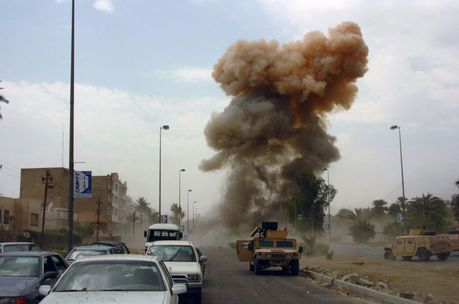
Deadly Large Shaped Charge IED

Afghanistan: Brits in Action Against Taliban Fighters

Despite the successes of Operation Desert Storm the planners failed to anticipate the end state of what would happen when hostilities had ceased.  The conditions of the cessation of hostilities were the chief contention of many against the end to the ground war at the 100 hour point. Some argue that the early end of hostilities allowed the victory to be less than it could have been.  Some even today argue that the offensive should have gone forward with the goal of overthrowing Saddam, however despite its success the Army was not prepared for an occupation nor would have the coalition supporting the US have survived an invasion and occupation of Iraq.  The actual mistakes were not in the stopping of the war, but rather the faulty conditions of the cease fire which enabled Saddam to recover the internal control of Iraq and put down attempts to revolt especially around Basra in the Shia south.  Rick Atkinson in his book Crusade notes that there were “errors would be made in establishing conditions of the ceasefire…but stopping the war was no mistake.”[xv]

While the debate about Operation Desert Storm still persists nearly 20 years after the fact the more important lesson was not learned.  That lesson was that Operation Desert Storm was not the new face of war, but rather an anomaly.  It was a war that was the swan song of the Cold War where the doctrine, technology, organization and trained to and practiced were inflicted on a less well trained and equipped version of the force that they were designed to defeat, forces which were badly deployed and already isolated by airpower even prior to the ground war. Once the ground war started the Iraqi forces in Kuwait and southern Iraq had little chance against the massive US and coalition force arrayed against it short of preemptively using the chemical and biological weapons of which Iraq had an ample supply.  It did not employ these weapons for a number of reasons, but without them Iraqi forces exposed in the open desert with no air support and cut off from much of their supply by constant air attacks were easily defeated.

In the past 20 years the United States and the west have only once been able to reprise the type of war displayed during Operation Desert Storm.  That was in the initial 2003 invasion of Iraq.  While the forces deployed were successful in defeating the Iraqi military and overthrowing Saddam Hussein they were insufficient to secure the country especially after the decision to disestablish all Iraqi police and military forces which might have assisted US forces in securing the country.  Perhaps planners forgot that German military police, police and civil servants were employed by the western allies in the period immediately after the war even during the period of “de-Nazification.”

Instead of a litany of Desert Storm like scenarios US forces as well as those of NATO and UN allies have had to deal with terrorism, insurgencies, revolutionary wars, tribal wars of genocide and wars waged by religious extremists. Despite more than a decade in dealing with these types of war, many in the military and political establishment as well as the media and public opinion believed that Desert Storm was the model for future wars. As such after the brief period of euphoria which occurred after the initial phase of Operation Iraqi Freedom the grim reality of war has stared Americans and others in the west in the face.  While the military has performed well, it has had to adjust and learn lessons about war that it wanted to avoid during and after Vietnam.  Those were the lessons of counterinsurgency, unglamorous and unexciting they were the lessons buried after Vietnam which were ignored until it was nearly too late in Iraq and possibly now too late in Afghanistan.  Desert Storm was an anomaly and one does not base the future of war on the swan song of the last war.


[i] Atkinson, Rick. Crusade: The Untold Story of the Persian Gulf War, Houghton Mifflin Company, Boston and New York 1993. p.253

[ii] Gordon, Michael R. and Trainor, Bernard E. The Generals’ War, Back Bay Books, Little Brown and Company, Boston and New York 1995. p.467

[iii] Peters, Ralph. Fighting for the Future: Will America Triumph. Stackpole Books, Mechanicsburg , PA p.xi

[iv] Ibid. Atkinson.

[v] Summers Harry G. On Strategy II: A Critical Analysis of the Gulf War, Dell Publishing a Division of Bantam Doubleday Dell Publishing Group, New York NY 1992. p.159

[vi] Halberstam, David. War in a Time of Peace: Bush, Clinton and the Generals, A Touchstone Book published by Simon and Schuster, New York 2001. p.153.  Gordon and Trainor note that the “never in the history of the Republic has a more competent and more professional military been fielded.

[vii] See Summers pp. 243-245.  Summers is very complimentary of the advances in the Joint aspects of command and control that impacted the campaign.  He notes several points at the strategic and operational levels which are complimentary of individuals including comparing General Colin Powell to General George Marshall. Gordon and Trainor writing a few years later are more critical of the “jointness” of the Americans including valid criticism of the air campaign, fire support coordination, and differences in doctrine between Marines and Army and the way the VII Corps and XVIII Corps operated based on the way that they trained and organized. Pp.471-473

[viii] Atkinson pp.309-310.  Atkinson discusses the fact that American commanders involved had seldom maneuvered units of battalion or brigade size prior to this operation.

[ix] The 24th made a great advance to the Euphrates but as Atkinson notes that it had “encountered no enemy resistance at all.” p.406

[x] See Atkinson pp. 441-448

[xi] See Atkinson pp.466-467.  In a 40minute fight the M1A1s destroyed 60 T-72s and dozens of APCs at a cost of one American KIA.  Atkinson notes that this battle like the action at 73 Easting “was waged with tactical acumen and devastating firepower….”

[xii] Ibid Atkinson pp.315-316.  Atkinson notes that there were 28 incidents with 35 killed and 72 wounded.

[xiii] Ibid. pp.405-407.  Schwartzkopf felt that Franks was not aggressive enough and that VII Corps was “sluggish” and “ceding the initiative to the Republican Guard.”  Schwatzkopf even threatened Yeosock that he would fire Franks.

[xiv] Ibid. Atkinson p.476

[xv] Ibid. p.477

Bibliography

Atkinson, Rick. Crusade: The Untold Story of the Persian Gulf War, Houghton Mifflin Company, Boston and New York 1993

Gordon, Michael R. and Trainor, Bernard E. The Generals’ War, Back Bay Books, Little Brown and Company, Boston and New York 1995

Halberstam, David. War in a Time of Peace: Bush, Clinton and the Generals, A Touchstone Book published by Simon and Schuster, New York 2001

Ralph. Fighting for the Future: Will America Triumph. Stackpole Books, Mechanicsburg , PA

Summers Harry G. On Strategy II: A Critical Analysis of the Gulf War, Dell Publishing a Division of Bantam Doubleday Dell Publishing Group, New York NY 1992.

8 Comments

Filed under Foreign Policy, History, iraq,afghanistan, Military, national security

Going to War: It was Just a Rocket and a Night Flight to Fallujah

helos at nightTypical LZ at Night

That evening Nelson and I said farewell to our new friends at Iraq Assistance Group, went and got chow at the large Camp Victory chow hall.  What is interesting on some of the larger bases is just how well fed the troops are.  Of course there are those who are better fed than others who could use the “wide load” convoy signs hanging off of their asses.  The main chow hall at Victory has a number of serving lines and drink, salad and dessert islands.  It has the main serving line, a fast food short order line, a Mongolian BBQ line as well as variations of Giros, Indian food, pizza bar and of course soft serve as well as Baskin and Robbins Ice Cream.  Breakfast is another “feeder” with almost everything imaginable to eat.  I am not a big breakfast eater by and large so for me black coffee, hot or cold cereal and fruit was a normal breakfast.  After dinner we went and finished our packing and waited for our ride to take us to the Camp Liberty airfield.  Had I been stationed at Camp Victory I would have probably outgrown my uniforms as I look at food wrong and can add a pound.

We had a very late flight, about 0200.  Since you normally need to manifest for a flight two hours prior it means that you back up at least a hour before the manifest time.  This particular evening there was not much cooling going on and there was little illumination which meant in most places it was very dark. Especially in troop the billeting areas.  We dragged our gear to the entrance to the billeting area.  Nelson went back to his tent and I plopped my ass down on my bags.  About 2300 I heard and felt a rush over my head.  It was a rocket, probably a 107 mm rocket which is one of the most popular indirect fire weapon used by the insurgents or possibly a 122 mm rocket.  Both are former Soviet systems and not very accurate but still the fact that a rocket has buzzed me was disconcerting.  A few seconds later I heard an explosion.  I later heard the rocket had continued on and hit an uninhabited area of the camp.  Soon after it went over my head a very young looking soldier came running up to me in his PT gear with an M-16 at the ready.  He shouted “Sir, what was that?”  The young man appeared to be a bit scared to I simply quipped “Only a rocket son didn’t hit us.”  He seemed to relax just a bit and I said “You okay son?” the good thing about being as old as I am that you can get away with calling the young guys “son” because in most cases they I’m old enough to be their father.  I stay in game too much longer and the new kids could be grandchildren.  This young soldier said, “Well sir I’m on the quick reaction force and that sounded close.” In the background to the east machine gun and small arms fire could be heard.  A pair of gunships buzzed us going the general direction of the gunfire. Baghdad was definitely not a violence free school zone.  I replied to the young soldier. “Son, if I were you I’d report to where you need to go, better grab your helmet and flak.”  The young man looked at me in the dark, assuming I was a Marine officer since I was in my Marine Desert digital cammies, saluted and said “Yes sir” to which I replied “be safe soldier and God bless, keep up the good work.”  Once again he thanked me and hurried off into the night.

AIR_CH-46_Brownout_Landing_lgCH-46 Landing

A few minutes later, Nelson who has been in some pretty sporty situations in Afghanistan including once where he took out a knife wielding assailant at a checkpoint in Kabul with his fists, came up to me.  “Hey Chaps, did you hear that rocket? Sounded like a 107.”  I said to him, “Shit brother, it felt like it went right over my head. “  He responded quickly “Boss I think we’re in a war here.”  And I said “sounds like it partner, definitely sounds like it.”  Then he said “Chaps, you wouldn’t believe what I just saw.”  I said “Really, what?”  And he told me the story. “I was over looking for our boy when I needed to go to the head, so I opened one of the port-a johns and when I opened it saw this guy and girl having sex in it, like they didn’t have the door closed and you know how nasty those things are.”  I said “Partner you’ve got to be kidding me” and Nelson said “Chaps I wouldn’t do that to you, those people looked at me like I was stupid when I opened the door and I just said excuse me and closed the door. That place stank sir; I don’t know how they were doing it in there.”  I replied “Partner, I guess after a year of more here some folks will take whatever they can get.” “But, you’d think that they would find some dark spot rather that a port-a-john,” replied a thoroughly disgusted Nelson.  As I laughed at the misfortune of my little buddy, bodyguard and protector I simply said “There’s no accounting for taste my friend, no accounting for taste.”

We sat on our gear and waited, and waited.  The time when we should have been picked up went by and after about 15 minutes of chatter about not being picked up on time, Nelson said. “Boss you want e to go find our ride?”  I responded that I wanted him to as it was so dark that he might not know where to find us. A few vehicles had come and gone but none were our assigned wheels.  Finally after about 45 minutes our ride showed up, Nelson had found him on the other side of the compound in his truck listening to AFN radio.  He had come to the wrong side of the billeting area and was chastising me for not being there.  I said, “Sergeant, I said to meet us over here and I’ll be damned f we have to lug our gear a couple hundred yards to make you happy.”  I paused as he started to interrupt and then cut him off “Sergeant, don’t go there, you’re talking to a field grade officer who wasn’t always a chaplain, you went to the wrong place and you didn’t take the initiative to try to find us. We had to find you so don’t push your luck.”  He replied, almost dejectedly, “Yes sir” and I said, “consider this matter ended, get us to the airfield, we have a flight to catch.”  Nelson and I piled our gear into the back of the truck, got in and rode the airfield.

The Camp Liberty airfield, which deals exclusively in rotor wing aircraft, is one of the busiest heliports in the world.  Hundreds of flights go through it every day.  They are primarily Army, but a fair amount of Marine aircraft pass through as well.  We were flying Marine air tonight.  When we got to the heliport our chauffer had a difficult time finding a place to park.  Eventually we sort of double parked and Nelson and I and Nelson and I unloaded our gear with a bit of help from our chastened chauffer got up to the manifest desk where we were greeted by a civilian. He took our names and our mission number and then took out a marking pen and wrote it on the back of our hands.  I found that that at each place this was the primary way to identify who was getting off where or if you should even be on the aircraft. I found a seat and then because I couldn’t get comfortable walked outside for a while.  Nelson on the other hand, ground his gear, threw himself upon it pulled his cover over his eyes and took a power nap. He can sleep almost anywhere.

With about 10 minutes to go I woke up Nelson, and I find it amazing how he can wake back up the way he does.  When I take a nap I am useless for about 30 minutes after I wake up as my body tries to figure out what time it is. We both took turns guarding our gear as the other hit the head, once again a darkened port-a-john that stank to low hell.  When done we staged our gear near the lineup point.  Our mission was called and we lined up with about 30 others, a mixture of Marines, Sailors, contractors and a few soldiers.  We geared up, securing helmets, flaks, our packs as well as our massive EOD issue sea-bags.  Nelson helped me with mine as we got ready to walk, once was over my back and the second strapped across my chest, actually going from my chin to just above my knees.  Many of our fellow passengers had very little gear, and one fairly large contractor offered to help me with my gear.  I took him up on it about half of the 100 yards to where our bird had landed.

Watching our aircraft come in, a flight of 2 Marine CH-46s which date back to Vietnam service I was amazed at how surreal they looked coming in out of the night, their haze gray fuselages almost having a ghostly appearance as they set down.  Of course we had the bird that was farthest from the line up point and I was really glad for the help of this generous contractor.  As we loaded our bags onto the aircraft, stacking it in the center of the deck with everyone else’s gear, we each took one of the jump seats along the side and strapped ourselves in.  Sweat was pouring off of me and I felt totally winded, no amount of running, pull ups, pushups and crunches had prepared me to lug our heavy and ungainly gear around.  The dimly lit troop compartment was hot and I looked around the aircraft.  I noted the machine gunners in the front doors and the crewman in the back who took a seat with a 240 series machine gun mounted on a swivel.  It reminded me of the films I saw of the inside of World War Two B-17s, except that the flight suits were different.  The crew gave the let the pilots know that we were ready, and I wondered what we were heading into.  Nelson got my attention and gave me a “thumbs up” and I returned it as the lights went out that our flight lifted off.

1002CH-46 Door Gunner

Banking around to the left the 46 gained altitude and flew back across the camp as it did so I got my first view of Iraq after dark.  As we flew into the city of Baghdad there were lights and sometimes lit streets. In a few places I could see the flashing lights of emergency vehicles.  We soon began to descend into the city surrounded by tall buildings, mainly hotels and government buildings and I knew that we were in the “Green Zone.” We sat down on a small landing pad, the dim lights came back on and a couple of passengers got out of our bird which a couple of more boarded the flight. The scene from Camp Liberty was repeated and gear was off and on loaded, passengers boarded and debarked from the flight and the lights went off and the bird lifted off.  Gunners took their positions and chatted on their headsets obviously scanning for threats and assessing what was going on, or they could have been talking about the new video game one of them had bought at the exchange.

Banking left we gained altitude heading east, with Baghdad fading into the night the lights of the communities along the Euphrates came into view as we flew on toward Fallujah.  For me it was a fascinating experience, surreal and a bit of anxiety making but interesting as I thought of the history of the ancient civilizations who had settled here, the Assyrians, Babylonians and Persians and the fact that the faith of the Christian Church through Abraham and later the people of Israel began here with Abraham’s obedience to the Lord.

The flight only took about 16-18 minutes and we flew into Fallujah.  The bird sat down on a large tarmac and the crew motioned us to get up grab our gear and get off of the aircraft.  I was praying desperately that it would not be a long walk to the terminal from the helicopter pad.  As we hauled our gear off the 46 to get to the terminal I was about tapped out.  The 46 had landed about 100 yards from the terminal where our ride waited.  It might as well have been 100 miles.  I loaded one bag on my back and commenced to drag the other.  Nelson was ahead of me and realized that his old Padre was not doing well.  I was about halfway to the terminal when Nelson showed up with a Marine on a John Deere Gator. My gear was loaded aboard the Gator; I gave a hearty thank you to Nelson, the Marine and to the Deity Herself as I dragged my sorry ass to the terminal.

The Fallujah terminal like most terminals at heliports in Iraq was a plywood building constructed by the Seabees.  It was well lit inside, had air conditioning which I sucked up and a large refrigerator with bottled water stashed in it.  Once inside I took off my helmet as we checked in at the desk.  By now it was about 0245, I had been up since 0530 the previous day, done PT a Camp Victory, had a rocket fly directly above me and dragged 200 pounds of gear more places than I wanted to in 100 degree heat and I was a spent round.  War is a young man’s game and even though I am in good shape for someone my age, the key is that I am in good shape for someone my age, not a young guy.  Sweating profusely I found a liter bottle of water and downed it.  About that time a large African American 1st Class Petty Officer came in the door.  RP1 Donnie Roland was the LPO of the II MEF Forward Chaplain’s office and worked for Mike Langston.   Donnie, who is now a Chief is a guy that you definitely want on your side.  He hooked us up.  Normally personnel in a transient status in Fallujah are housed in tents with cots in varying degrees of disrepair.  Donnie got us rooms in the VIP quarters, nicknamed by the Marines the “Ramadan Inn.”  The place had once been the haunt of Uday and Qusay Hussein, Saddaam’s sons.  It had a pond in the center of the court yard and was reputedly a place where they would entertain senior members of the Ba’ath Party amid scenes of debauchery.  We were given a small room that had a desk and two small Iraqi beds, both of which had thin concave mattresses which had little support but were a definite step up from a cot.  Sheets, pillows and a blanket were included.  Our gear took up the majority of the room but it didn’t matter.  After a shower I crashed hard.  The bed might have been from a 5 star hotel, all that mattered at 0330 was that I could get to sleep.  RP1 Roland told us that Chaplain Langston said that we should get some sleep and come in when we could.  With outgoing artillery fire going off in the background I laid my worn out body down on the waiting mattress, I thought about the day and it came to me that the rocket that had went over my head could have killed me and a chill went down my tired spine.  Another salvo of artillery lashed out at the enemy, and my mind drifted back to the present.  I was now in Fallujah.  One more stop on the way to my war, Nelson was already asleep, I am amazed at his ability to go from 0-60 and 60-0 so fast.  More artillery fire boomed and as a former forward observer I found outgoing artillery fire to be comforting, amid it’s lullaby I went to sleep.

Leave a comment

Filed under History, iraq,afghanistan, Military, Tour in Iraq

D-Day- Courage, Sacrifice and Luck, the Costs of War and Reconciliation

d-day-openerOmaha Beach from a Landing Craft

“Long after our time on this Earth has passed, one word will still bring forth the pride and awe of men and women who will never meet the heroes who sit before us: D-Day.” President Barack Obama at Normandy 2009

“Friends and veterans, what we cannot forget — what we must not forget — is that D-Day was a time and a place where the bravery and selflessness of a few was able to change the course of an entire century,” President Barack Obama at Normandy 2009

“The men of Normandy had faith that what they were doing was right, faith that they fought for all humanity, faith that a just God would grant them mercy on this beachhead, or on the next. It was the deep knowledge — and pray God we have not lost it — that there is a profound moral difference between the use of force for liberation and the use of force for conquest.” President Ronald Reagan at Normandy 1982

Here, in this place where the West held together, let us make a vow to our dead. Let us show them by our actions that we understand what they died for. Let our actions say to them the words for which Matthew Ridgway listened: “I will not fail thee nor forsake thee.” President Ronald Reagan at Normandy 1982

Sixty-five years ago today the liberation of France began on the beaches of Normandy.  Soldiers from 6 Allied Infantry and 3 Airborne Divisions supported by an Armada of over 5000 ships and landing craft and several thousand aircraft braved weather, heavy seas and in places fierce German resistance to gain the foothold on beaches named Omaha, Utah, Gold, Sword and Juno.  Over the next seven weeks the Allied soldiers advanced yard by yard through the hedgerows and villages of Normandy against ferocious German resistance before they were able to break out of the lodgment area and begin the drive across France.  The fighting was bloody, most American, British and Canadian infantry battalions and regiments suffered nearly 100% casualty rates in Normandy.  Replacements were fed in at a cyclic rate to make up the losses even as fresh divisions flowed ashore, but the losses were terrible.  By the time the landings took place, the British having been at war for nearly five years were bled out.  They had little left to replace their losses.  From Normandy on the British were losing combat power at a rate that they could not make up.  For the Americans there was another problem.  The US High command decided to limit the Army to 90 Divisions.  Many of these were committed to the Pacific and Mediterranean theaters.   Likewise, American Infantry units were generally made up of the lowest caliber of recruits, led often by the poorest officers.  Now this is not to criticize veterans, but it is a factor in the campaign.  US Infantry Divisions with the exceptions of those previously blooded in North Africa and Sicily often performed badly in action.  Some, after being manhandled by the Germans had leadership replaced and became excellent combat units.  However, every new division that arrived in France after D-Day always got the worst of their initial engagement against German forces.  While performance suffered there was another problem for the Americans.  With the limitation in number of divisions, they stopped building infantry divisions, upon whom the bulk of the campaign depended and had little in the way of trained infantry replacements to make up heavy losses in Normandy.  By late 1944 during the Battle of the Bulge the American infantry crisis was so bad that 30,000 Air Corps candidates were trained as infantry and soldiers support units such as Ant-Aircraft battalions were used to bolster infantry units.  Had the Germans been able to hold out it is conceivable that the British and Americans would have ground to a halt for lank of infantry in 1945.  In spite of this there was no lack of individual courage among the troops engaged; the courage and sacrifice of all who fought there should not be forgotten.

dday37Soldiers Moving off of Utah

The human toll among the combatants both Allied and German, as well as the local populace was especially traumatic.  While the American, Canadian and British people are keen to remember the sacrifices made by our soldiers we often forget the toll among the French civilian population of Normandy as well as the German soldiers, mostly conscripts, sacrificed by the Nazi regime.  Normandy suffered more than any part of France during the liberation.  In the months leading up to D-Day Allied Air Forces unleashed hell on Normandy to attempt to lessen potential German resistance.  The Allied Naval bombardment added to the carnage ashore and once the campaign began the combined fires of both Allied and German forces devastated the region.  Whole cites such as Caen were destroyed by Allied Air forces and an estimated 30,000 French civilians were killed, 3000 on D-Day alone.  I think it can be said that the blood of the civilians of Normandy was shed for the freedom of all of France.

caen_ruinsThe Ruins of Caen-July 1944

The campaign in Normandy was one of the most viciously contested in western military history.  German forces, especially Paratroops of the 2nd, 3rd, 5th and 6th Fallschirmjager Divisions, German Army Panzer Divisions such as the 2nd, 21st, 116th and Panzer Lehr and those of the Waffen-SS, especially the 1st, 2nd and 12th SS Panzer Divisions held the line against ever increasing Allied forces.  As they sacrificed themselves Hitler refused to commit more forces to Normandy and insisted that his Army contest every meter of ground.  He forbade his commanders to withdraw to more defensible positions along the Seine.   His decisions actually shortened the campaign.  Whatever the crimes of the Hitler Regime and Nazism, which were among the most heinous in history, one can never question the valor, courage and sacrifice of ordinary German soldiers.  For those Americans who lump all Germans who fought in World War II with the evil of the Nazi regime, please do not forget this on fact.  There are those today, even in this country that makes the same charge against Americans who have fought in Iraq and those at home and abroad who have labeled the US as an aggressor nation.  When you judge others, know that the same standard will be applied to you someday.

tiger2falaise16hhGerman Tiger Tank at Falaise

Normandy was a near run thing for the Allies.  First the weather almost delayed it by 2 to 4 weeks.  Had that happened the Germans might have been even better prepared to meet the invasion.  Likewise, the Red Army’s devastating offensive which annihilated Army Group Center in June kept the Germans from transferring additional forces from the Russian Front to Normandy.  On D-Day itself there were a number of times where Lady Luck, or maybe the Deity Herself, saved the Allies from disaster.  Any person who has seen Saving Private Ryan, The Longest Day or Band of Brothers knows a little bit about how close Overlord came to failure.  Allied Airborne units were dispersed throughout the region after they drooped.  Many units were not fully operational for more than a day as they sought to organize themselves and gather their troops.  At Omaha Beach the Americans had not counted on the presence of the first rate German 352nd Infantry Division.  This division, despite being pounded by naval and air forces almost cause General Bradley to withdraw from Omaha.  At Utah the soldiers of the 4th Infantry division escaped a similar mauling by landing on the wrong beach.  Had they landed at the planned beaches they would have ran into the same kind of resistance from well dug in German forces.  At Gold Juno and Sword British forces benefitted from confusion in the German command which kept the 21st Panzer Division from descending on the British forces and quite possibly splitting the British zones.  The Allies benefitted from the absence of Field Marshall Erwin Rommel, Commander of Army Group B who because of the ad weather assumed no invasion was possible and travelled to German to celebrate his wife’s birthday.  Finally, and perhaps most important they benefitted by Hitler’s refusal to immediately commit forces, including his Panzer reserve to defeat the invasion at the beach head.

Bild 101I-587-2253-15German Paratroops or Falsschirmjaeger in Normandy
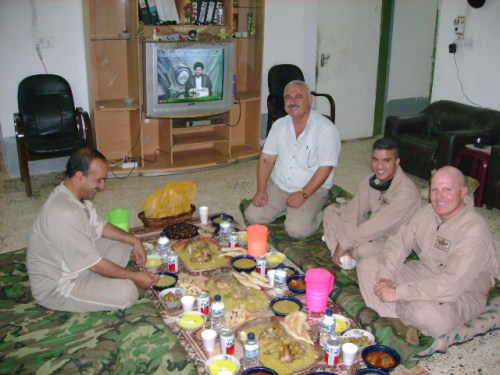
For those who fought in Normandy and those civilians who lived through it the memories are still vivid. Many suffer the effects of PTSD, grief and other wounds, physical, emotional and spiritual.  When one is exposed to the danger and destruction of war, the smell of death, the sight of burned out cities, vehicles and the suffering of the wounded and dying, it makes for a lifetime of often painful memories.

For some of the German, British and American veterans, the struggle in Normandy has given way to long lasting friendships.  Those who fought against each other were soon allies as part of NATO and soldiers of nations which were once bitter enemies serve together in harm’s way in Afghanistan.  The generation that fought at Normandy is rapidly passing away, their numbers ever dwindling they remain a witness to courage, sacrifice and reconciliation.

In the end it is reconciliation and healing that matters. Some scars of war never pass away; some memories are far too painful to release.  Yet we strive to reconcile.  In 2002 while deployed at sea for Operation Enduring Freedom I was an advisor to a boarding team from my ship.  It was our job to make sure that impounded ships which were breaking the UN embargo on Iraq were not in danger of sinking, and that their crews had food, water and medical care.  Since many of these ships remained at anchor for 2- weeks in the heat of the Arabian Gulf, this was important.  The delays imposed by UN rules sometimes meant that the sailors of these ships grew resentful.  It was my job to spend time with the Master’s of these ships to keep things calm and work out any issues that arose.  On one of these ships I met an Iraqi merchant skipper.  The man was well travelled, educated in the U.K. in the 1960s and in his career a frequent visitor to the US. In 1990 he was the senior captain of the Kuwaiti shipping line.  Then Saddam Hussein invaded Kuwait.  As a result of this when Kuwait was liberated he lost his job.  His nation was an international pariah.  Since his life was the sea he took up the only job possible to support his family, what he knew best, captaining ships.  He was most apologetic for the trouble that he and others like him caused us.  We shared much during those visits.   One of his daughters was in medical school and other children in university.  He longed for the day when Iraq would be free.  On our last talk before his ship was released he remarked to me “I hope one day we will meet again.  Maybe someday like the American, British and German soldiers after the war, we can meet in a pub, share a drink and be friends.”  I too pray for that.  Maybe someday we will.  I only hope that he and his family have survived the war and are doing well.

Dinner w BG SabahBeginnings of Reconciliation: Old Enemies, New Friends General Sabah and Me, Ramadi 2007

God bless all those who fought at Normandy and give your peace to all who have served since then. Be with our troops as they serve in Iraq and Afghanistan. Heal the wounds of war and bring your peace to the nations. Amen

Peace, Steve+

3 Comments

Filed under Foreign Policy, History, iraq,afghanistan, Military, PTSD, world war two in europe