Tag Archives: segregation

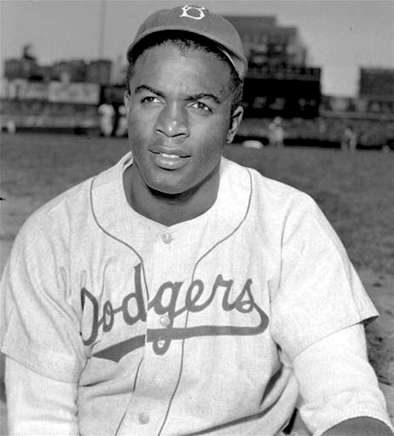
A Watershed Moment: Jackie Robinson and Civil Rights in America

jackierobinsonlg

“He led America by example. He reminded our people of what was right and he reminded them of what was wrong. I think it can be safely said today that Jackie Robinson made the United States a better nation.” – American League President Gene Budig

April 15th 2014 was the 67th anniversary of Jackie Robinson’s first game in the Major Leagues with the Brooklyn Dodgers.  Jim Crow was very alive and well when Jackie stepped onto the field that day and no matter how much we want to distance ourselves from those days there are still some in this country who want to go back to that kind of society. Robinson’s first game with the Dodgers came a full year before President Truman integrated the military, a move which infuriated many in the South.  Likewise it occurred a full seven years before the Supreme Court ruled school segregation unconstitutional in the Brown vs Board of Education decision.  It came a full 17 years before Congress passed the Voters Rights.

When Jackie Robinson stepped onto the field it was a watershed moment in Civil Rights for African Americans and paved the way for a change in American society that has continued since his Major League debut. Blacks had struggled for years against Jim Crow laws, discrimination in voting rights and even simple human decencies like where they could use a rest room, sit on a bus or what hotel they could stay in.

In baseball many white fans were upset that blacks were allowed to see Robinson in stadiums that they would not have been allowed in before.  Players from other teams heckled Robinson, he received hate mail, people sent made death threats, he was spiked and spit on.  But Jackie Robinson kept his pledge to Dodgers owner Branch Rickey not to lash out at his tormentors, as Rickey told him that he needed a man “with enough guts not to strike back.”

Jackie Robinson played the game with passion and even anger.  He took the advice of Hank Greenberg who as a Jew suffered continual racial epithets throughout his career “the best ways to combat slurs from the opposing dugout is to beat them on the field.” He would be honored as Rookie of the Year in 1947. He was a MVP and played in six World Series and six All Star Games.  He had a career .311 batting average, .409 on base percentage and .474 Slugging percentage. He was elected to Baseball’s Hall of Fame in 1962.

Today Jackie Robinson’s feat is history, but it should not be forgotten.  He was a pioneer who made it possible for others to move forward.  He would be followed by players like Roy Campinella, Satchel Paige, Don Larson, Larry Dobie and   Willie Mays.  His breakthrough had an effect not just on baseball but on society.

Jackie Robinson would have an effect on my life.  In 1975 the Stockton Unified School District voted to desegregate.  I was in the 9th grade and preparing for high school.  As the school board wrestled with the decision anger boiled throughout the town, especially in the more affluent areas.  Vicious letters were sent to the school board and to the Stockton Record by parents as well as other opponents of the move.  Threats of violence and predictions failure were commonplace.  In the summer of 1975 those who went out for the football team, both the sophomore and varsity squads began to practice.  Black, White, Mexican and Asian, we bonded as a team, the Edison Vikings.  By the time the first buses pulled up to the bus stops throughout town on the first day of school, the sense of foreboding ended.  Students of all races discovered common interests and goals.  New friends became guests in each others homes, and all of us became “Soul Vikes.”

30 years later the Class of 1978, the first class to be desegregated from start to finish graduated from Edison held a reunion.  Our class always had a special feel about it.  Looking back we too were pioneers, like Jackie Robinson we were far ahead of our time.  When I look at my friends on Facebook from Edison I see the same faces that I played ball, rode the bus and went to class with.   Things have changed.  Even 30 years ago none of us imagined a African American President, we believed in each other and we saw potential, but I don’t think that anyone believed that we would see this in our day.
robinson200-ffbfd794408772ed56c5418c8f637c6b552e5c70-s6-c30

I think that Jackie Robinson prepared the way for other pioneers of Civil Rights including Dr. Martin Luther King.  Today, 67 years later Jackie Robinson looms large not only in baseball, but for the impact of his life and actions on America.

His number “42” is now retired from baseball. The last player to wear it was Mariano Rivera of the Yankees. Rivera had been granted an exemption to wear it until he retired. At least the last Major League ball player to honor the number was a class act who will certainly be in the Hall of Fame.

Robinson said something that still resonates with me: “Life is not a spectator sport. If you’re going to spend your whole life in the grandstand just watching what goes on, in my opinion you’re wasting your life.” It is something that I take into account every day of my life.

So here’s to you Jackie Robinson.  Thank you and God bless.

Peace,

Padre Steve+

Leave a comment

Filed under Baseball, civil rights, History

Vice Admiral Samuel Gravely Jr: Pioneer of Integration and Civil Rights in the U.S. Navy

gravely

“I was sure that I could not afford to fail. I thought that would affect other members of my race if I failed anywhere along the line. I was always conscious of that, particularly in midshipman school and any other schools I went to…I tried to set a record of perfect conduct ashore and at sea.” Vice Admiral Samuel Gravely

Things have changed much since 1942 when following the attack on Pearl Harbor a young black college student from Richmond Virginia enlisted in the Navy. Samuel Gravely Jr. was the son of a postal worker and Pullman porter while his mother worked as a domestic servant for white families in Richmond. His mother died unexpectedly when he was 15 in 1937 and he remained to help care for his siblings as his father continued to work. Balancing the care of his family with his education he enrolled in Virginia Union College, a Baptist school in Richmond.

gravely_young

Fireman Apprentice Samuel Gravely Jr

It is hard to imagine for most of us now to comprehend the world that the young Gravely grew up in. Segregation was the norm. Blacks in the south and many other locations faced personal as well as intrenched institutional racism. Violence against blacks was quite common and the Ku Klux Klan was strong.

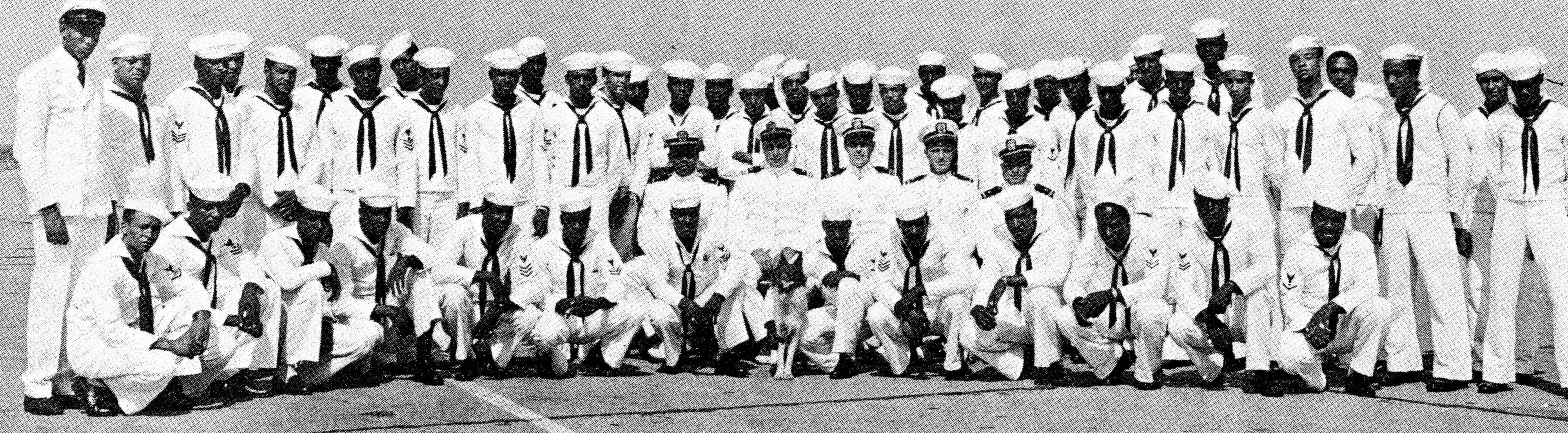
The military was still segregated and a great gulf existed between white military personnel and blacks. Though the selective service law of 1940 called for the conscription of people regardless of race, creed or color the services enjoyed much latitude in determining how minorities could serve. The Secretary of the Navy at the time, Frank Knox resisted integration. Knox determined that African Americans would remain segregated and serve only as Mess Stewards to “prevent undermining and disruptive conditions in the Navy.” Knox told President Roosevelt in the presence of black leaders that “because men live in such intimacy aboard ship that we simply can’t enlist Negroes above the rank of messman. “

That sentiment was strong in both the Navy and the Marines the leaders of which resisted attempts to broaden the ability for African Americans to serve and urged that blacks serve in the Army, not the Naval Service.  Marine Corps Commandant Major General Thomas Holcomb agreed with this stance. He commented:

“If we are defeated we must not close our eyes to the fact that once in they [Negroes] will be strengthened in their effort to force themselves into every activity we have. If they are not satisfied to be messmen. they will not be satisfied to go into the constriction or labor battalions. Don’t forger the colleges are turning out a large number of well educated Negroes. I don’t know how long we will be able to keep them out of the V-7 class. I think not very long.”

But Roosevelt was not deterred and by April 1942 changes were announced to allow African Americans to serve in other capacities. Even so African Americans selected for ratings other than messman were to be segregated and commanded by White Officers and Petty Officers.

USS_PC-1264_officers_and_crew

images-18

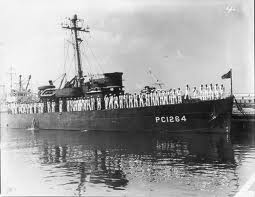
The USS PC-1264 and its crew, Gravely is the lone black officer

Gravely enlisted in the Navy under these conditions. Serving as a Fireman Apprentice after receiving training as a Motor Machinist in San Diego he worked in menial jobs. In 1943 Gravely was one of only three sailors in his unit to be selected for the V-12 officer training program. He was the only black to make the cut. He was commissioned as an Ensign on December 14th 1944 and assigned to train black recruits at Great Lakes though the vast majority of his class went to sea. The was mainly due to the policy set forth by the General Board in 1942 that prescribed:

“(a) the white man will not accept the negro in a position of authority over him; (b) the white man considers that he is of a superior race and will not admit the negro as an equal; and (c) the white man refuses to admit the negro to intimate family relationships leading to marriage. These concepts may not be truly democratic, but it is doubtful if the most ardent lovers of democracy will dispute them, particularly in regard to inter-marriage.”

Despite this by 1945 the Navy was beginning to change. Gravely was chosen to serve on one of two ships assigned to the “experiment” of seeing how blacks in general ratings could serve at sea. The USS Mason (DE 539) and the USS PC-1264 were assigned black crews with majority white officers, except that Gravely was assigned to PC-1264. Though his commander was pleased with his service Gravely, who had been denied admittance to Officer Clubs and many other “white only” facilities resigned from the Navy in 1946. He believed that the inherent discrimination of the Navy left him no place for advancement. He returned to complete his bachelors degree at Virginia Union.

In 1949, following President Truman’s integration of the military Gravely was asked by the Navy to return to active duty. But the end of the old order was foreshadowed by a Navy pamphlet published in 1944 entitled The Guide to the Command of Negro Personnel. That publication included the statement that ”The Navy accepts no theories of racial differences in inborn ability, but expects that every man wearing its uniform be trained and used in accordance with his maximum individual capacity determined on the basis of individual performance.”

images-17

300px-USS_Taussig_(DD-746)_port_side_1965

cg29

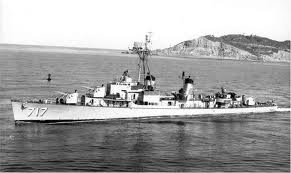
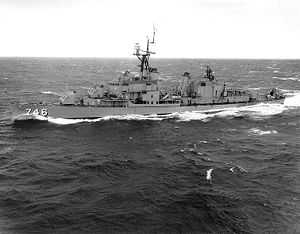
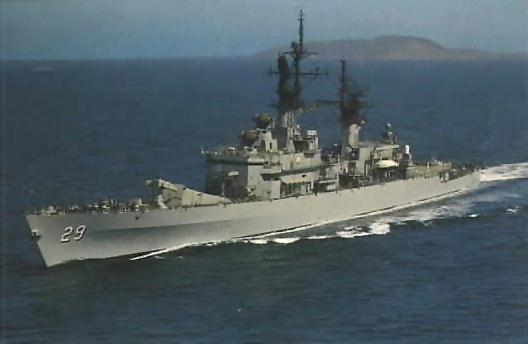
Gravely’s commands (top to bottom) USS Theodore E Chandler, USS Taussig and USS Jouett

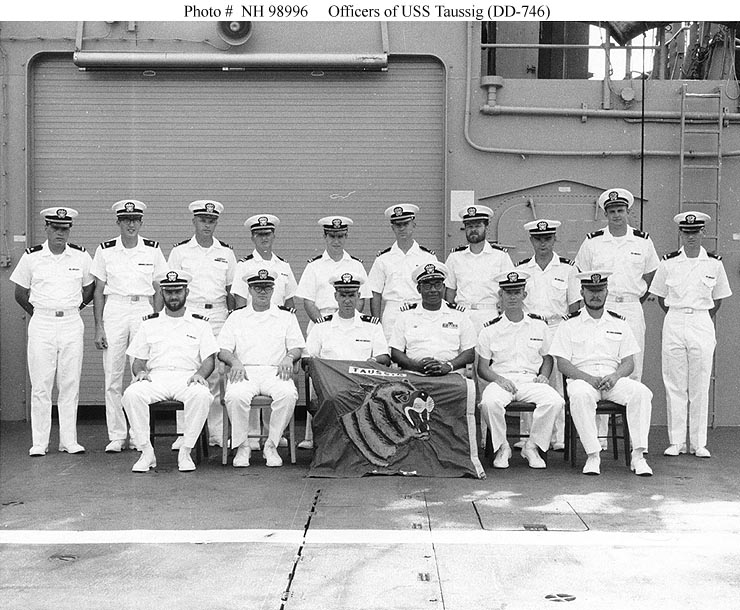
Gravely accepted the offer to return to active duty and never looked back. He worked hard for respect and used his natural talents, personality and size to command respect. He was a man who would blaze the way for other African Americans, and later women and most recently gays to go on to greater things. Gravely would go on to command three ships. He was the first African American Naval Officer to command a Navy warship, the USS Theodore E Chandler (DD 717), the first to command a Navy ship in combat, the USS Taussig (DD 746) and the first to command a major warship, the USS Jouett (CG 29). Promoted to flag rank he eventually became the first to command a Fleet when he took command of 3rd Fleet. He retired in 1980 and passed away in 2004.

h98996

Commander Gravely and his officers on USS Taussig

Gravely gave his parents and conditions of his upbringing much credit for his success. He believed that those conditions which forced him to “capitalize on his strong points, build his weak areas and sustain the positive self-esteem and self-worth that his parents instilled in him as a young child.”

He was a great leader. LCDR Desiree Linson who interviewed him for her Air Command and Staff College project noted that Gravely like many other great military leaders before him learned to manage the image that he presented, be a caretaker for his people, what we would now call a mentor. He said “[If I was CNO] my responsibility would be to make sure enlisted men and families were taken care of. I would do everything in my power to make sure.”

His pursuit of excellence, self confidence and mastery of professional skills empowered him in an institution where he was still an anomaly and where racism still existed. He believed in effective communication, especially verbal communication and in building teams and in being a good follower, listening, learning and proactively anticipating the needs of his superiors. Gravely was also a believer in personal morality and self discipline and preparedness. He said:

“I did everything I could think of to prepare myself. If the opportunity came, I would be prepared for it. [The question would not be] “Why didn’t you prepare for this opportunity.” I would be prepared for whatever opportunity that came. If it came, fine. If it did not, fine, but I would be prepared if it did come.”

USS_Gravely

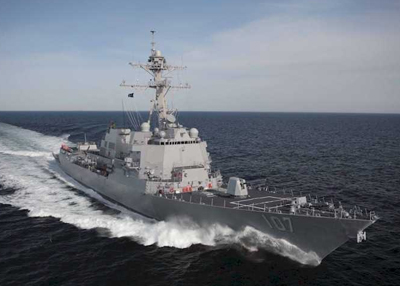
The USS Gravely

Vice Admiral Gravely blazed a trail for those that followed him and set an example for all Naval Officers to follow. He did it under conditions that most of us could not imagine. I am proud to serve in the Navy that he helped to make.  His vision, service and memory are carried on in this navy and in the ship that bears his name, the USS Gravely DDG-107.

Peace

Padre Steve+

3 Comments

Filed under History, laws and legislation, leadership, Military, Navy Ships, US Navy

The Message of Dr. Martin Luther King Jr. for 2011

“Darkness cannot drive out darkness; only light can do that. Hate cannot drive out hate; only love can do that.”  Dr. Martin Luther King Jr.

Today we worshipped at St. James Episcopal Church, Portsmouth Virginia where I attend when I am at home.  It had been a while since we attended with my assignment at Camp LeJeune and battles with weather and illness during the past month.  However today we made it and it was good as we remembered the life and message of Dr. Martin Luther King Jr.

St. James is the historic African American Episcopal Parish in Portsmouth. Many of the families in the parish trace their Episcopal Church roots back to the days before the Civil War and the years following. As such they were pioneers in the advancement of African Americans serving as educators, doctors and in the military when discrimination in the form of Jim Crow Laws, “separate but equal” schools, churches, hospitals, public restrooms, places in restaurants, public transportation and so many other things that we consider absolutely part of daily life today. Blacks were subject to legalized harassment, literacy tests in order to vote as well as lynching by those well intentioned upstanding members of such groups as the Ku Klux Klan.

The most of the members of St. James are more elderly and veterans of the Civil Rights movement and remember the times when they suffered while fighting for the rights that we so freely take for granted. The newer generation is mixed between their descendants as well as immigrants from Nigeria.  I fell in love with this parish when the pastor Fr John invited me back in 2009 when I was still struggling in the midst of PTSD and a crisis in faith and belief. I owe a lot to Fr. John and the dear people of St. James for the way that they welcomed us and helped in my journey to the rediscovery of faith.

Father Green who was called on short notice due to illness of our pastor’s wife had known Dr King and gave a remembrance of Dr. King’s early ministry going back to meeting him while they were seminary students. Father Green had us join together and link arms as a congregation around the sanctuary as we sang “We Shall Overcome.”

The marking of Dr. King’s birthday this year in the shadow of the deep division and hatred that the country is engulfed in caused me to think about the importance of Dr. King’s message, not only for the cause of Civil Rights for minorities and others who are discriminated against, but the larger message of peace and reconciliation.

Dr. King died by an assassin’s bullet, James Earl Ray, a man who had a history of crime as well as a long established prejudice against African Americans who was a volunteer for the campaign of segregationist Governor George Wallace’s presidential campaign.  The climate of the country in large part was one of prejudice and often hatred of what was represented by Dr. King. However the response of Dr. King to multiple death threats as well as incarceration for breaking laws which were rooted in the evil of segregation and discrimination was that of peace and reconciliation, love over hate which is of the essence of the Christian faith.

Dr King said something that is so applicable to our own deeply divided society where hatred is legitimatized by purveyors of hate.  In the wake of the shooting of Congresswoman Gabrielle Giffords last Saturday there was an epidemic of heated and often hateful rhetoric with conservatives and liberals alike seeking to label a madman as belonging to the other side it became readily apparent to me that unless we lay down the hate that we will destroy each other and the country. Dr. King said this in words that I cannot hope to match.

“Have we not come to such an impasse in the modern world that we must love our enemies – or else? The chain reaction of evil – hate begetting hate, wars producing more wars – must be broken, or else we shall be plunged into the dark abyss of annihilation.”

Peace

Padre Steve+


4 Comments

Filed under christian life, faith, History, laws and legislation, philosophy, Political Commentary

You Win a Few, You Lose a Few. Some Get Rained Out. But You Got to Dress for All of Them

“Ain’t no man can avoid being born average, but there ain’t no man got to be common.” Satchel Paige

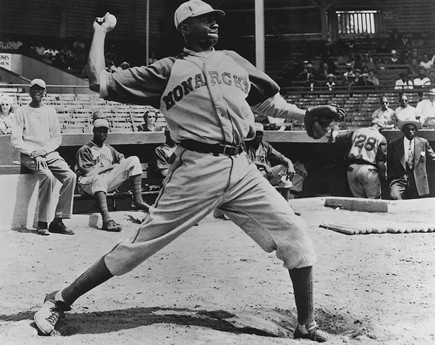
Paige_Satchel1942Satchel Paige on the Kansas City Monarchs
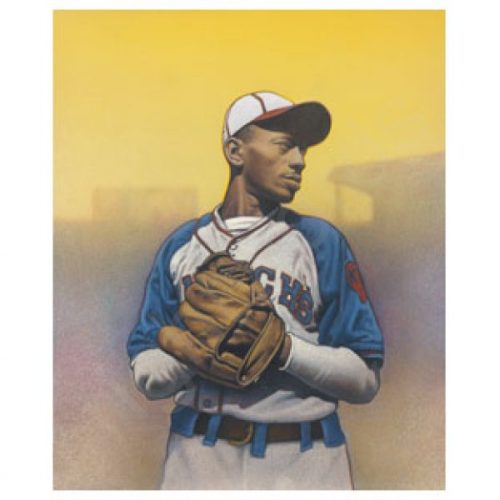

Negro League and Cleveland Indian’s Hall of Fame legend Satchel Paige was one of the most remarkable men who ever played the game of baseball.  He came along after Jackie Robinson and others had broken the color barrier having played 22 years in the Negro Leagues as well as in Mexico, the Dominican Republic and the Puerto Rican League, where in the winter of 1939 he went 19-3 with a 1.93 ERA. While with the Kansas City Monarchs Paige helped lead the team to four consecutive Negro League World Series titles from 1939-1942 and again in 1946.  During his time in the Negro Leagues played in numerous exhibition games against major league stars and future stars including Bob Feller and Joe DiMaggio who went 1-4 against Paige. During this time he would pitch in the summer with the Negro League team and winters in the various Winter Leagues.  It could be said that Satchel Paige not only played baseball but lived it.  In the Negro Leagues Paige often pitched twice a day, sometimes in two different cities.  Record keeping in these leagues was almost universally lax so the feats of men like Paige, Jackie Robinson, Cool Papa Bell and Buck O’Neil will never be fully appreciated by modern statistically absorbed fans.

When he was signed by Bill Veeck, the owner of the Cleveland Indians he was either 42 or 44 years old depending on what documents you use…talk about a birth certificate controversy.  Paige pitched 5 seasons in the Majors with Cleveland and the St. Louis Browns mainly in a relief role and pitched in the 1948 World Series and the 1953 All-Star Game after having been chosen for the 1952 game but not getting the chance play.  He was signed by the Kansas City Athletics for a one game contract in 1965.  He pitched his last game at the age of 59 or 61 on August 25th 1965 throwing three shutout innings against the Boston Red Sox, the only hit coming from Hall of Famer Carl Yastrzemski who doubled.  Paige set the next 7 batters down in order.  In between his years in the majors Paige continued to pitch in the minors.  He played his last game of organized baseball in 1966 for the Peninsula Pilots of the Carolina League in Hampton Virginia. The Pilots, now of the Independent Coastal Plain League, still play in Hampton’s War Memorial Stadium in which the legendary great pitched his last game.

Paige was recognized by many as perhaps the best pitcher to ever play the game.  Bob Feller called him “the best pitcher I ever saw.”  Ted Williams said “Satch (Paige) was the greatest pitcher in baseball.” Joe DiMaggio called him “The best and fastest pitcher I’ve ever faced” while Bill Veeck who brought Paige to the majors said he was “The best right hander baseball has ever known.”

The biggest thing in my mind about Paige was his love for the game and his determination to play as long as he could.  In the Negro Leagues he pretty much played year round for 22 years.  After his major league career was over he continued to play the game that he loved.  He did all of this in a segregated and “Jim Crow” America.  It was due primarily to Paige and others like him that black players got the chance to come to the Major Leagues.  Most expected that Paige would be the first black player called up but this honor went to Jackie Robinson.  In 1971 in his Hall of Fame acceptance speech he said “The only change is that baseball has turned Paige from a second class citizen to a second class immortal.”

I like Paige a lot.  I remember reading Bob Feller’s book in grade school and his comments about Paige, especially the time he switched a bar of soap for the ice cream in a an ice cream sandwich.  When Paige took a bit his false teeth came out with the sandwich.  Now that I am 49 years old I like him even more.  He took 22 years to get in the big leagues and didn’t quit and even after his major league career continued to play.  He endured Spartan living conditions on low pay in a segregated and often hostile America did not deter him.  Neither did his age, many men in their 40s would have quit before realizing their dream.  That is the lesson of Satchel Paige for me.  He was the oldest “rookie” ever to play Major League ball.  I kind of understand what Paige went through.  I started my Navy career after nearly a full Army career.  In fact I was within 2 ½ years of Reserve retirement when I got the chance to serve in the Navy in February 1989.

Satchel Paige was an example to me that if you have the heart and talent you can achieve your dream even if it takes a long time. My advice for people who still dream dreams is to be persistent and don’t give up.  Sometimes, not always, but sometimes by hanging in there, making the sacrifices to achieve the dream it comes true.  After a very difficult 5 years following leaving the Army to go to seminary which included long term sickness to Judy, losing almost everything that we owned, and having to work menial jobs for unappreciative people to get through seminary, Additionally there were times when I was sure that it was over, that my best efforts had failed, something would break my way and I would be able to continue.  It was remarkable.  While I give appropriate credit to God I do not fail to give credit to all the people that believed in me and wouldn’t let me fail.  The way that I figure is if you don’t try or you quit too soon you will always wonder if you could have made it.  There will always be doubt and often regret.  My Clinical Pastoral Education Supervisor, Dr. Steve Ivy at Parkland Memorial Hospital told me once, “Steve, you make your own future, stop living in the pain of the past.”  That was an “Wow I could have had a V-8 moment” for me.  It hasn’t always been easy, but it has been great.  His advice was on target.

Satchel once said: “Work like you don’t need the money. Love like you’ve never been hurt. Dance like nobody’s watching.”  The comment is way too true, but for me even more important is this: “You win a few, you lose a few. Some get rained out. But you got to dress for all of them.”

I think the Deity Herself would agree with both statements and I’m sure that Satchel is still pitching for the New Jerusalem Saints of the Pearly Gates League.

Peace, Steve+

satchel paige

2 Comments

Filed under Baseball, History, Loose thoughts and musings, philosophy, Religion