Tag Archives: t e lawrence

That War Would Cease: The Christmas Truce of 1914

joyeux_noel3

“Tonight, these men were drawn to that altar like it was a fire in the middle of winter. Even those who aren’t devout came to warm themselves.” Chaplain Palmer Joyeux Noël

12010440-mmmain

The war was supposed to be over by Christmas, or so the planners had said. Instead after a series of massive battles that produced unprecedented number of casualties the war settled into a stalemate. As the sides exhausted themselves in a series of meeting engagements throwing the flower of their idealistic youth into the great maw of the front to be torn apart by massed artillery and machine gun fire the planners sought new ways to find military victory.

In December 1914 with neither side having the ability to force the issue and casualties already running over a million dead and wounded the armies dug in. Massive trench networks were constructed in the mud of France and Belgium as the artillery continued its impersonal work of destroying men, machines and the homeland of millions of civilians.
From Clipboard

Despite the stalemate the high commands of the various nations continued to through their troops into meaningless attacks to gain a few yards of their opponent’s trench networks. The attackers always suffered the worst as they went “over the top” and were cut down by well sited machine guns and networks of defensive redoubts.

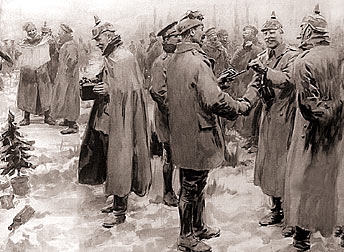
As Christmas neared individual parties of British and German troops began to fraternize exchanging gifts and attempting despite the wishes of their commanders to maintain an attitude of live and let live. On Christmas Eve German troops began to decorate their trenches with Christmas trees and lights, carols were sung and Christmas greetings exchanged as the local truces became widespread and soldiers met in no man’s land to talk and give each other gifts of cigarettes, alcohol, food and souvenirs.  In some places the sides helped each other collect and bury their dead and some Chaplains even led Christmas services in which men of both sides worshipped.

football-truce

The truce would not last as the high commands of each side issued strict orders against them and within days had moved the units that they believed most “infected” by the Christmas spirit to other locations and replaced them with units inculcated with the message of the inhumanity of their enemy. Such messages often included the religious understanding of this being a “holy war” against enemies of God and humanity. It is funny that though Moslems are frequently demonized for committing Jihad that Christians have a terrible record when it comes to finding theological reasons to kill those that they believe, even other Christians to be the enemy.

Christmas Day December 1914 World War One

joyeux-noel-2

http://www.youtube.com/watch?v=7-MGfNsgB3A

joyeux-noel-3

This really wasn’t surprising, after all for in the years leading up to the war many school children, especially in France and Germany had been propagandized. Churches and ministers cooperated in the carnage. In the movie Joyeux Noel the British Padre who had cooperated in the Christmas truce is relieved by his Bishop and sent home. The Bishop then preaches to the newly arrived soldiers, those replacing the men who had found peace for a moment. The sermon is not a work of fiction, it is actually part of a sermon that actually was given in Westminster Abbey in 1915. It was a sentiment that fit the mood of the high command who sought to minimize the danger of peace without victory. It was a sermon, the likes of which were preached by ministers, preachers, priests and bishops throughout that terrible war. It is a sermon that many preachers, Christian, Jewish, Islamic and Hindu even today mimic with terrible consequences.

http://www.youtube.com/watch?v=fMPxjUE40iw

“Christ our Lord said, “Think not that I come to bring peace on earth. I come not to bring peace, but a sword.” The Gospel according to St. Matthew. Well, my brethren, the sword of the Lord is in your hands. You are the very defenders of civilization itself. The forces of good against the forces of evil. For this war is indeed a crusade! A holy war to save the freedom of the world. In truth I tell you: the Germans do not act like us, neither do they think like us, for they are not, like us, children of God. Are those who shell cities populated only by civilians the children of God? Are those who advanced armed hiding behind women and children the children of God? With God’s help, you must kill the Germans, good or bad, young or old. Kill every one of them so that it won’t have to be done again.”

Unfortunately I have met and heard men preach the same message against those they hate, a message that twists the words of Jesus in a diabolical way to justify the worst acts of nations and peoples. In the year 2013 wars rage around the world. Some are conducted by well organized professional militaries but many by militias, paramilitary and terrorists groups. In some cases the brutality and inhumanity exhibited makes the industrialized carnage of the First World War seem sane. Even now preachers of various religions, including Christians, Moslems and Jews advocate the harshest treatment of the enemies of their peoples all in “the name of God.”
295_26912097058_4309_n

n671902058_1153798_5336

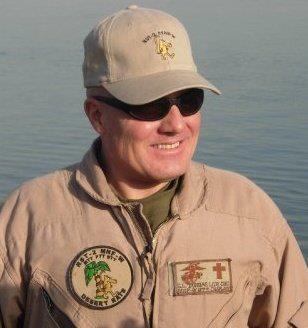
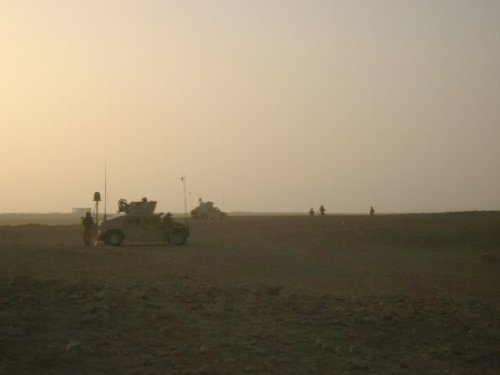
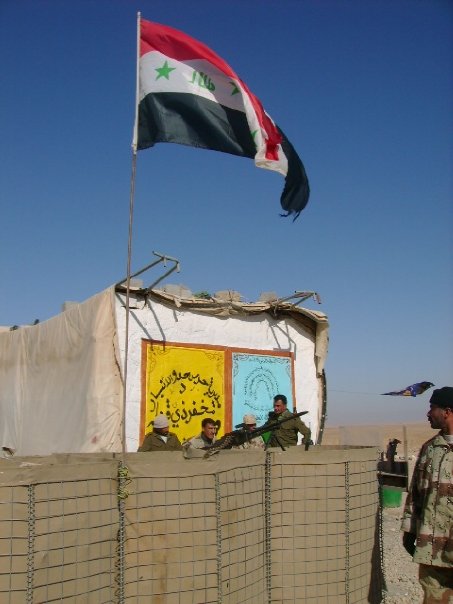
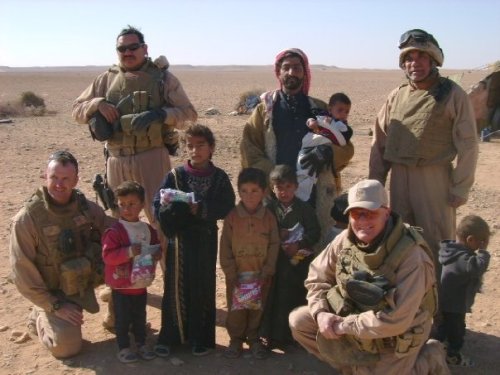
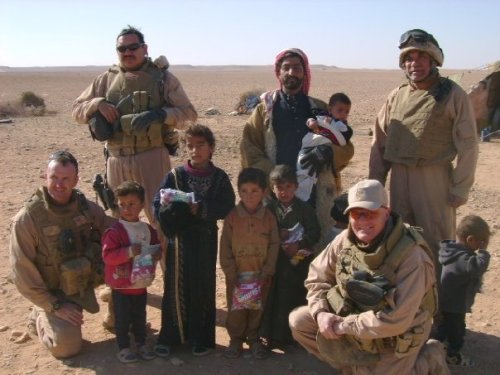
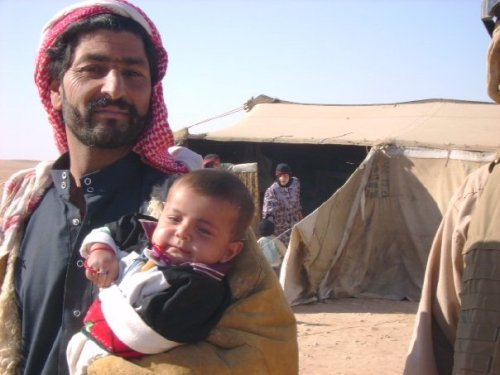
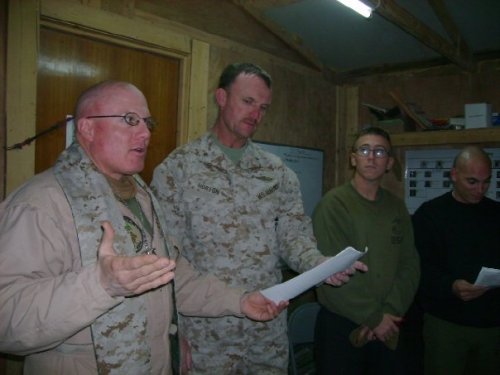
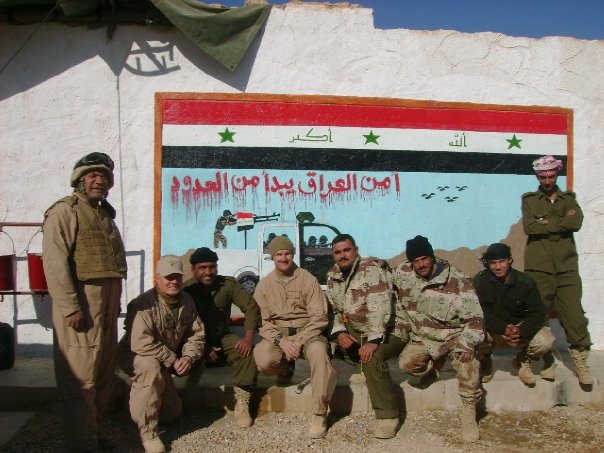
Six years ago I was traveling up and down the western border of Iraq with Syria. I was visiting our Marines that were advising the Iraqi Army and Border Forces, conducting Christmas services for them and also visiting Iraqi soldiers as well as civilians. In a couple of instances Iraqi and Jordanian Christians working as interpreters came to the Eucharist services, for one it had been years since he had received the Body and Blood of Christ in the Holy Communion. While out and about visiting Iraqis we were hosted by Iraqi troops and well as Bedouin tribesmen and their families. The warmth and hospitality and faith of these wonderful people was amazing.  T.E. Lawrence wrote that the Bedouin could not look for God within him: he was too sure that he was within God.” 
n671902058_1153804_6925

I think that for me that Christmas week was the one that will remain with me more than any and despite being in a war zone, it for me was a time of peace on earth and good will toward men.

Maybe someday we will begin to understand.

Peace

Padre Steve+
6 Comments

Filed under christian life, faith, film, History, iraq,afghanistan, Religion, Tour in Iraq

Arab Spring Fever: The Revolution Begins Anew in Egypt as Syria Begins to Melt Down

bouazizi

Tunisian Demonstrators

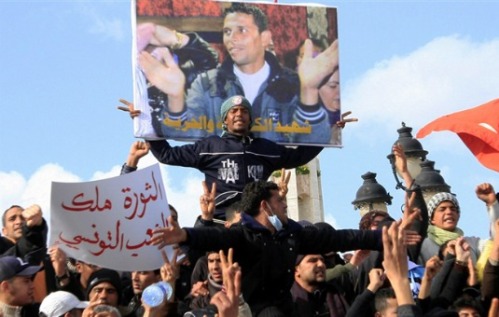
It began in such an innocuous manner. A Tunisian street vendor named Tarek al-Tayeb Mohamed Bouazizi set fire to himself due to what he viewed as harassment and humiliation by a local government official who confiscated his goods when he could not afford to pay bribes to the police. He died a few weeks later. That act set in motion widespread protests that led to the overthrow of long time Tunisian dictator Zine El Abidine Ben Ali ten days later.

The events in Tunisia sparked revolts throughout the Arab World, including the largest and most influential of the Arab States, Egypt and Syria. The situation in Egypt ended in the overthrow of President Hosni Mubarak and free elections where Islamists gained a majority in Parliament and the election of Moslem Brotherhood leader Mohamed Mursi as President. The situation in Syria led to minor reforms before the government of Bashir Al Asad began a series of repressive and violent crackdowns against protestors. This led to a armed revolt that has only continued to gain ground and achieve a modicum of international recognition.

2012-12-07T183045Z_340924292_GM1E8C71U0S01_RTRMADP_3_EGYPT-POLITICS

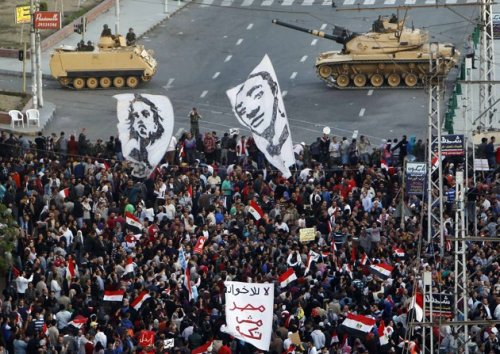
Egyptian Demonstrators calling for the Ouster of President Mursi

It appears that Egyptian President Mursi and the Islamic Brotherhood may have bit off a bit more than they could chew when they hurriedly wrote a new draft constitution that maximized their power and limited freedoms of non-Islamists including Coptic Christians, Democrats and secularists. Mursi compounded his mistake by issuing an edict that gave him practically unlimited power. The backlash from the Egyptian judiciary, journalists and opposition parties has been dramatic. Protests on the order of the original demonstrations against the Mubarak regime have engulfed Egypt, Mursi has  annulled his decree that granted him those powers and the opposition is calling for his overthrow. The Egyptian military has again become a player in the unfolding drama.

Free Syrian Army soldiers in Idlib

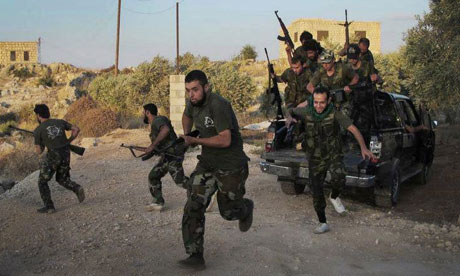
Free Syrian Army Soldiers in Action

In Syria the opposition is nearing complete control of many areas of the country and Bashir Al Asad’s regime is believed by many to be on its last legs, only the endgame remains to be played out. Some believe that Syria’s regime may be willing to use chemical weapons, particularly Sarin nerve gas agents against the opposition. The leaders of Western nations, especially the United States have announced that the use of such weapons would be unacceptable.

There are continued demonstrations, protests and political actions ongoing in several countries including US Allies Jordan, Kuwait and Bahrain.

Throughout the Arab World the Arab Spring has had marked repercussions. The long term dictators of Yemen and Libya were both overthrow, with Yemen’s case Ali Abdullah Saleh was able to negotiate his exit from power, while in Libya the regime of Muammar Ghadaffi was overthrown in a bloody manner following a protracted civil war. Ghadaffi himself was brutally murdered following his capture.

The Arab has also has had effects on the foreign policy of nations, particularly the United States, Russia and the European Union and others around the world who have stood to gain by maintaining the status quo in the region, playing off the interests of their Arab “friends” for their own benefit. The fact is that most countries or alliances with military, economic and political, diplomatic and intelligence interests are still trying to make sense of the new Middle East and how it will impact their interests.

The problem is that most people outside the region have little understanding of it or how different the culture, history and social considerations of each part of the Arab world is different than others. We like to take about the “Arab Street” or the “Moslem world” but the fact is that neither the Arab Street or the Moslem world is monolithic and what is the case in one country is not necessarily true in other countries.

054

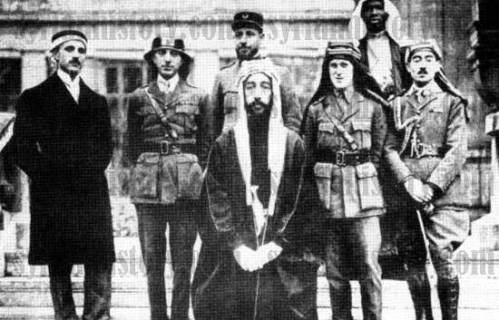
T.E. Lawrence with members of Arab delegation at Versailles

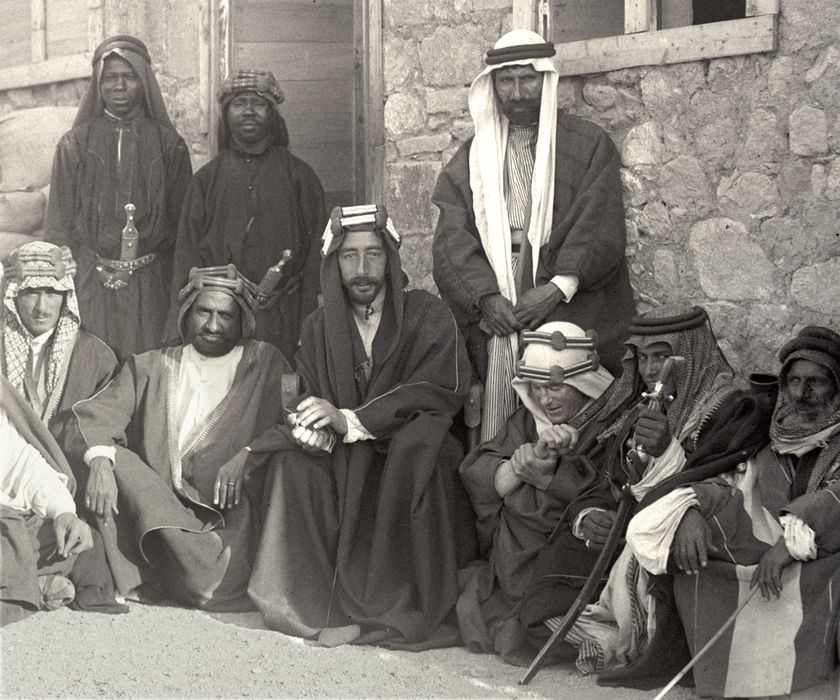
What we know as countries in many cases are nothing more than disparate Arab peoples of different, Tribal affiliations, cultural traditions, history as well as Islamic and Christian factions. There is no generic Arab country or people and in many Arab countries there is internal conflict based on tribal, ethnic or religious lines. This was something that T.E. Lawrence noted in his works and something that we in our desire to shape events to our liking, need to remember.

britishbaghdad1917www

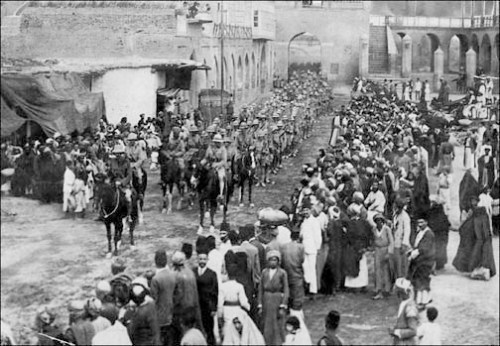
British Troops Enter Baghdad in 1920

During and after the First World War, European powers, particularly the English and French, but also the Italians used their military, economic and diplomatic power to divide the Arab World, recently free of Ottoman-Turk domination through the Sykes-Picot agreement, agreements made at Versailles and San Remo. In doing so they prevented a natural development of Arab freedom and helped poison relations between the Arabs and the West for generations and in the case of Saudi Arabia led to the domination of the Wahhabi house of Saud.

The Arab world is a mosaic of different peoples, cultures, traditions and histories. As the Arab Spring continues to unfold it is very important that we, who are not Arabs understand the various tensions at play and make vague assumptions about them or what the Arab Spring portends in Egypt or elsewhere.

Yes, we have important interests in the region. However as chaotic as it may seem the Arab Spring is a natural outgrowth of a region and its peoples finding themselves after centuries of foreign domination, be it that of the Roman, the Byzantine, the Turk, the Persian, or various countries of Europe and even the United States. It is important that it play out with as little foreign interference as possible. The lesson from history is that the last century of Western domination, imperialism and interference in Arab affairs have not helped and that these events will have to play themselves out, and that may take at least a generation.

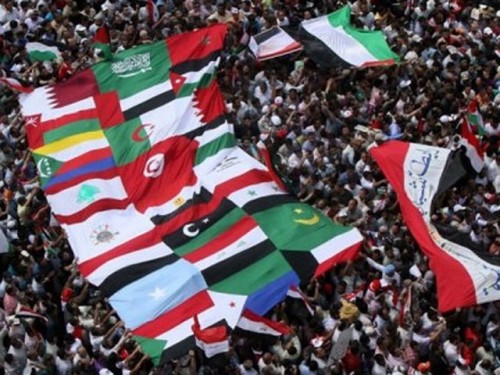
arabspring-640x480

Whether we like it or not, what is happening now, despite the violence, strife and chaos is a necessary part of their story. How can we not understand? How many centuries of ethnic, cultural, religious and political war and strife have the nations of Europe and America endured to come to some semblance of working peacefully together?

The Arab Spring will be with us for a while because Arabs, regardless of their nationality, tribe or religious sect must determine their fate.

Peace

Padre Steve+
2 Comments

Filed under Foreign Policy, History, middle east, News and current events

The Paths Taken and Not: The Tapestry of Life, Authenticity and Wisdom Passed Down

n671902058_2044112_2975

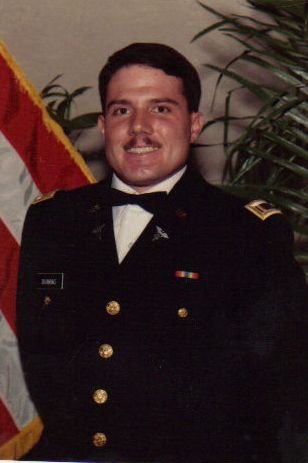
Nearly 32 years ago I was getting ready to embark on a military career. It was  the fall of 1980 and I was a junior at California State University Northridge. Within the year I was beginning my first furtive steps in my career by enlisting in the California National Guard and enrolling in the Army ROTC program at UCLA.

It was an interesting time. My imagination of the military back in the days of the Cold War was quite orthodox and founded on what a “normal” Army career should look like. I would get commissioned, serve as a platoon leader, company executive officer, battalion staff officer and company commander. I would attend the appropriate military schools, the officer basic course, the advanced course, specialized courses and Command and General Staff College and then hopefully be promoted to the field grade ranks and after serving 20-30 years would retire as a Major, Lieutenant Colonel or maybe even a Colonel.

If that had been the case I would have had a very different life than I have today. Certainly a good life, but not what I have today. I would be me, but a different me. I would have probably played everything safe and been the perfect servant of the institution while ensuring my own success.

Instead the tapestry of my life and choices have produced something different than I could have ever imagined 32 years ago. Those choices have resulted in successes and failures, blessings and great difficulties as well as trials that honestly I would never want to go through again. However all of those things have helped make me what and who I am today.

I look back at the people in my life who have influenced me at different points, as well as critical junctures where I made decisions I see a tapestry that I could never have thought possible, a tapestry much richer and diverse than I could have thought of back then. It has not been without pain but it has been worth it.

One of the things that I discovered early was that as hard as I tried to fit the mould of the Army, I was a non-comformistby nature.  I thought outside of the box and that in attempting to fit in I was not happy. I had one rater  in his evaluation of me offer the criticism that thought too much of my abilities that “lent me to criticism.” That may have been true to some extent, and my rather blunt and outspoken opinions to criticize higher ranking officers and to take liberties with orders got me in trouble at times.

However I did survive some of my more stupid escapades such as telling my Medical Group Commander that he had embarrassed our command as a very junior Army 1st Lieutenant and in another case banned the two local CID investigators from running amok on a fishing expedition in my barracks without probable cause or a warrant for their investigation. They never returned with probable cause or a warrant. Another time I told the the senior personnel officer in the command I was stationed as a Captain that he could take his spies out of my command, as well as getting thrown out of the Army Chaplain Officer Advanced Course in 1992. It would take too long to explain the details of these incidents here but assuredly they were the fault of a young, opinionated and outside the box thinking officer who dared to voice his opinion to men who were institutional careerists, they were not bad people, just people conformed to and servants of institutional norms. That being said my troubles were troubles brought on me by my own actions because I did not understand what the institution, any institution can do to otherwise well meaning and honorable people.

Despite some black eyes I did make Major in the Army Reserve and finally to get back on active duty reduced in rank to enter the Navy back in 1999. The good thing was that I learned from my experiences and have been able to use them to learn, survive and succeed in my Navy-Marine Corps career.

In the process there were men and women who at various times in my life and career passed along wisdom, not just advice, not just knowledge, but wisdom. It is to them that I owe my successes. Without their sage advice, authentic leadership and honesty I would have certainly crashed and burned a long time ago, a prisoner of my own limited insight and unlimited ambition.

400236_10151328400862059_541742014_n

But more than succeeding in my career I have learned that it is okay to be me, to be authentic and to be honest about who I am and what I do. My goal now as a relatively senior chaplain is to care for, mentor and allow those men and women who work directly for me to succeed, even as well as those that I serve.  It is no longer about my career. I am on the backside of my career regardless of my next assignment or even if I get promoted to Captain in the Navy several years from now when I am eligible. But promotion is not an end to itself, if I have learned anything it is that many times promotion to a higher office can be a prison that some men never escape.

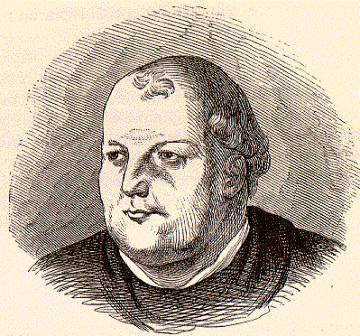
The fact is that I have far fewer years left to serve than I have served to this point. Thus it is far more important to do right for the people that I serve and help them take lessons that I have learned into their futures and if they remain in the military pass them along to others as they become authentic leaders. Johann_von_Staupitz

Johann Von Staupitz

My study of history and more practically in my case military history and to some extent church history and theory shows me quite those who don’t achieve the highest levels of command or institutional power often have a greater influence in the long term than those who do. Without Johann von Stauptiz it is doubtful if the young Martin Luther would have began to study the Bible and hence bring about the Protestant Reformation.

clausewitz2

Carl Von Clausewitz

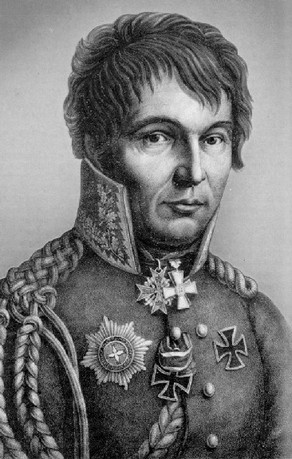
As the foremost interpreter of Napoleon, a relatively unknown Prussian General Staff Officer, Carl von Clausewitz had a greater impact on warfare and military theory than did Napoleon himself. There are many other examples of such individuals in history, men and women, many times of far lesser estate than Clausewitz or Staupitz who have by their wisdom helped those that eventually held power or influence in thinking outside the bounds of tradition to accomplish things that were not possible to their teachers.

Wisdom comes slowly to most of us, especially people like me. The problematic thing is that is, for the most part wisdom is a commodity that is not highly treasured in a society built upon expediency and crass materialism. It is certainly not something the most men and women that seek power are gifted with, despite their intellectual gifts and often well earned knowledge. But learned knowledge and raw intelligence are different than wisdom. Knowledge and intelligence are quite wonderful but ungoverned by wisdom the ambition that they breed is often the undoing of those that rely on them as well as their physical, economic or even military power.

The key thing is that wisdom, experience and learning was passed along to men and women who, God willing, will be serving long after I retire from the Navy. Today I was approached by one of our wounded warriors stationed at our hospital because of his injuries. He engaged me in a conversation and he said that he would like to spend some time with me, to listen to some of my stories about my life in the military and experience. Evidently a couple of his young friends have told him a bit about me. That meant a lot to me, just as the times that young people have come to me not because of my position, or rank, but because they see me as a real person, approachable and available.  The nice thing for me is that there are many times that I learn from them, for many times it is young people that can see the greatest problems and offer ideas and solutions that elude older and more experienced people in every walk of life.

liddellhart

B. H. Liddell-Hart

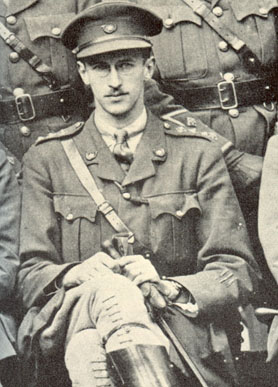
I recently read B.H. Liddell-Hart’s biography of T.E. Lawrence, perhaps one of the most gifted military commanders, philosophers and men of the 20th Century. Lawrence and to some extent Liddell-Hart understood something about wisdom that most of their contemporaries and even students miss. Liddell-Hart himself, though a medically retired as a Captain due to wounds suffered in World War One was one of the more influential thinkers of his day. His works had a profound impact on the most successful commanders of the Second World War. He understood that the key to wisdom is self understanding and a recognition of their own knowledge as well as limitations. Liddell-Hart wrote of Lawrence, wisdom and humanity in 1937:

“A study of history, past and in the making, seems to suggest that most of mankind’s troubles are man-made, and arise from the compound effect of decisions taken without knowledge, ambitions uncontrolled by wisdom and judgements that lack understanding.  Their ceaseless repetition is the grimmest jest that destiny plays on the human race. Men are helped to authority by their knowledge continually make decisions on questions beyond their knowledge. Ambition to maintain their authority forbids them from admitting the limits of their knowledge and calling upon the knowledge that is available in other men. Ambition to extend the bounds of their authority leads them to a frustration of others opportunity and interference with others’ liberty that, with monotonous persistency, injures themselves or their successors on the rebound.  

The fate of mankind in all ages has ben the plaything of petty personal ambitions. The blend of wisdom with knowledge would restrain men from contributing to this endless cycle of folly, but understanding can guide them toward progress.” B.H. Liddell-Hart “Lawrence of Arabia” DeCapo Press, Reprint, originally published as “The Man Behind the Legend” Halcyon House 1937 

410w

T. E. Lawrence

It is my hope that no matter what my next assignment is and no matter how long I have left in the military as well as in life that I will be able to be one of those wise old sages who helps the next generations do things that were impossible for my generation, to succeed where we failed and who like Staupitz, Clausewitz, Liddell-Hart and Lawrence inspired others to greatness far beyond their own.

I am coming up for orders soon, order that will take me to my next assignment. I have spent the past two years as a geographic bachelor, apart from my wife, by the time I leave this assignment it will be close to three years. I have been assured that my next assignment will be in the area where our home is, however I do not know what it will be. I know what I want to do but do not know if it is possible based on the needs of the Navy. However, that being said I do know enough that no matter where I am assigned the mission is the same, as well as the pay. That mission is to care for, guide and assist those that work for me as well as those that I have the honor of serving, or possibly simply be the wise old sage.

I think I like that idea.

Peace

Padre Steve+
1 Comment

Filed under faith, History, philosophy, Religion

A Place of Peace: Where My Iraq Meets the Atlantic

35923_10151361668782059_785733223_n

Where Iraq Meets the Atlantic

I have talked about things bring me peace amidst the struggles of life in recent days and in one post I briefly mentioned that while running on the beach in Emerald Isle it was the place where in that moment “Iraq met the Atlantic.”

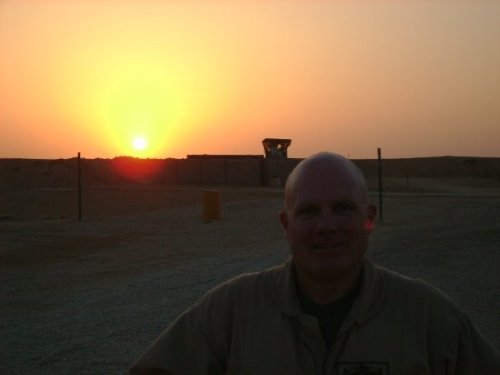
It has been nearly 5 years since I left Iraq in February of 2008 but there are times that it feels like I have never left and times when I would like to be back there. I have always loved the ocean and the desert. For some reason the vast expanses of barren desert and the untamed ocean draw me to them like nothing else.

262_29132267058_9181_n

I have struggled with a lot over the past 5 years. However as I mentioned recently it seems that things are coming together in ways that I have never could have fathomed even a few months ago. On Wednesday I needed to take a day off to reflect and gather my thoughts after a particularly cathartic sequence of events. One of the things that I did that day was to rest, but then to run along the beach where I live.

198177_10151361204842059_1890411795_n

I mentioned to a couple of people that it was like Iraq met the Atlantic and they didn’t understand, until I showed the pictures. I guess though that the juxtaposition of the Western Desert of Iraq, sometimes known as the Syrian Desert and the Atlantic Ocean would seem strange to most people, unless they have experienced both in their stark beauty.

270107_10151361199622059_1286921284_n

I ran about seven and a half miles Wednesday along the beach and it was breathtaking. The deep blue skies and seas met with the desert tan of the sands of the beach. There were few people out that day so the beach was nearly deserted and I was alone with nature and God. It has been many years since I felt that depth of peace in my soul that I felt on Wednesday.

262_29132262058_8844_n

I really can’t explain it and most people will probably never understand and I have learned that such a lack of understanding is okay. There is a big part of me that is still in the Iraqi desert and will always be there. There in the land of Abraham, amid the barren deserts, the rich valley of the Euphrates river valley, the battered cities and town of war torn Al Anbar Province many of my hopes and dreams still live. When I ran along the beach that day it was like I had returned, but instead of being traumatic it was peaceful.

262_29132227058_6903_n

I pray for the people of Iraq, especially those in Al Anbar Province and the Iraqi military. I pray that they will know peace and that their country, so long victimized by tyrants, devastated by war and torn by terrorism and civil-religious strife will be a place of blessing.

295_26912097058_4309_n

As T.E. Lawrence wrote about 85 years ago: “We were fond together because of the sweep of open places, the taste of wide winds, the sunlight, and the hopes in which we worked. The morning freshness of the world-to-be intoxicated us. We were wrought up with ideas inexpressible and vaporous, but to be fought for. We lived many lives in those whirling campaigns, never sparing ourselves: yet when we achieved and the new world dawned, the old men came out again and took our victory to remake in the likeness of the former world they knew. Youth could win, but had not learned to keep, and was pitiably weak against age. We stammered that we had worked for a new heaven and a new earth, and they thanked us kindly and made their peace.” 

262_29132307058_1522_n

Peace

Padre Steve+
 

3 Comments

Filed under History, iraq,afghanistan, Tour in Iraq

Epiphanies: PTSD, Life, Leadership, Lawrence of Arabia and the Gospel

I have been going through a process lately in preparation for some treatment of my chronic insomnia, nightmares and other PTSD symptoms which has caused me to have to be very deliberate and reflective in examining the various parts of the often tattered tapestry of my life.

Part of this has involved my experiences in military, religious and civilian institutional settings and how those experiences have helped shaped me as a Priest as well as a Naval Officer. Today was one of those days where a convergence of thoughts came together in a number of encounters juxtaposed with some reading of B.H. Liddell Hart’s book about T.E. Lawrence, Lawrence of Arabia.

While I was waiting for my doctor late this afternoon I was reading the book on my Kindle and as he came into the waiting room I had just finished marking this passage.

“The rare man who attains wisdom is, by the very clearness of his sight, a better guide in solving practical problems than those, more commonly the leaders of men, whose eyes are misted and minds warped by ambition for success….”

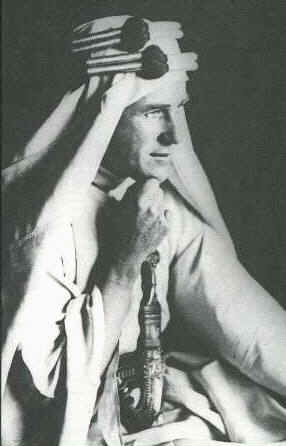
Somehow this little passage in a book that I am about halfway through reading and which I have already made numerous other annotations really struck me as profound. It encapsulated close to 20 years of experience as a military chaplain and over 30 years in the military as well as civilian professional work, and it struck me especially in regard to my experiences both in Iraq and after my return. Before, during and after my time in Iraq I had come to see Lawrence as a kindred spirit, someone that thought outside the box and went to places that no one else wanted to go. My job in Iraq to me to those places that few Americans and almost no other chaplains went or had the chance to experience with Iraqi Arabs and the Bedouin.

Those that read my posts regularly know that the impetus for my writing came about during my time in Iraq around Christmas of 2007 in the western Iraqi Al Anbar Province while on the Syrian border. At that time I wrote a short article for my former denomination’s website and a little more than a year after my return to the United States  I began this site I modified that article and published it here under the title of God in the Empty Places. It was a catharsis for me because I going though a tremendously ark period of my life where I had for all practical purposes become an Agnostic struggling to believe in God again. It was published a couple of months after I walked out of a church on Christmas Eve 2008 and walked an hour home in the dark and cold of that night.

During the interregnum of returning from Iraq and now I experienced a number of additional traumatic life events, both personal and professional. Following my assignment to my current post where I supervise a number of chaplains, pastoral counselors and support personnel I made it my goal in life not to let things that happened to me at the hands of some senior chaplains happen to others, especially those struggling with life, health, spiritual or emotional issues.

I have been asked by a number of people in the past couple of weeks, how in light of things that could leave me embittered and cynical could I embody grace to others. I admit that I still hurt and have issues of anger and some bitterness towards some people who I thought used me and betrayed me both in my old denomination as well as some senior chaplains. That is a given, though I try to live in a state of forgiveness toward them there are times that I do get upset the things that happened during that time. It is something that I deal with and I don’t always do well. I have my bad moments in which that grace doesn’t come out well,  but my path to healing has involved a conscious effort to see the good in people and to embody something different than I experienced.

A couple of people made the comment as we discussed these experiences as well as their own that “you do the Gospel it by living it.” I think that is what Jesus did, he taught yes and he did miracles, but the biggest miracles were those that he did when he rocked the religious-political establishment of his day by hanging out and caring for the people it despised. In fact Jesus surmised the entire law in two commandments, love God with all your heart and love your neighbor as yourself. The prophet Malachi noted what God required “to do justice, and to love kindness, and to walk humbly with your God.”

Those two passages have been tremendously important as faith returned after what I refer to as Padre Steve’s Christmas Miracle faith began to return in a way that I never expected.

So the past few weeks have served as an epiphany to me about wisdom can evade leaders whose “eyes are misted and minds warped by ambition for success…” My eyes are opening in more ways to the bigness of God, the grace of God, the love of God and the mercy of God. My ambition is simply to care for the people that God allows me to care for and show that grace, love and mercy to those who some would attempt to destroy because they themselves have become prisoners of the institutions and their offices and ambitions.  I have resolved in daily life to do all I can to avoid becoming a prisoner of my office or ambitions and simply to be real. One of the senior leaders of the hospital that I work noted that he saw me as not just as the senior chaplain but a “real person.” I can live with that.

Well that is enough for tonight.

Peace

Padre Steve+
1 Comment

Filed under faith, History, iraq,afghanistan, Tour in Iraq

Why the Libyans were able to Overthrow Gaddafi and what We can learn from It: A Lesson from the work of T E Lawrence

T E Lawrence

“Do not try to do too much with your own hands. Better the Arabs do it tolerably than that you do it perfectly. It is their war, and you are to help them, not to win it for them. Actually, also, under the very odd conditions of Arabia, your practical work will not be as good as, perhaps, you think it is.” T. E. Lawrence

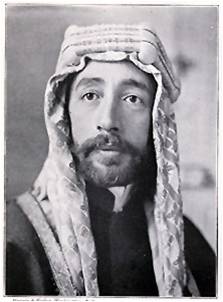
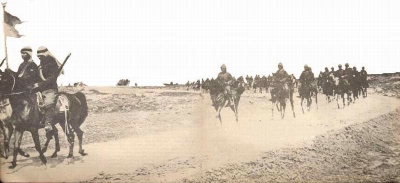
Lawrence with Arab fighters at Aqaba and Emir Faisal Hussein (below)

The Libyan revolution succeeded in overthrowing Moammar Gaddafi and his 42 year tyranny because the West did not turn it into an American or NATO war. By limiting involvement to airpower, coastal interdiction and tiny numbers of advisers the United States and NATO avoided the costly trap of putting large numbers of troops on the ground.  Such action would have been counterproductive in Libya and in the Arab world. While the action certainly would have ridded the world of Gaddafi and his regime much more quickly it would have emasculated the Libyans who had taken up arms against Gaddafi by turning it into our war, a war which would have been seen by many Libyans and Arabs as just more Western Imperialism.  Critics can always find fault in any military operation but for once in the Post Cold War era the United States and NATO knew their limitations and that the revolution had to be the work of the Libyans themselves.

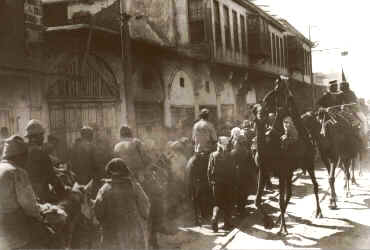
Lawrence and Hussein’s troops pass Ottoman prisoners at Damascus in 1918

T E Lawrence understood the Arab mind more than most westerners ever will.  Living with and helping lead the Arab tribes that revolted against the Ottoman Empireduring the First World War he learned the culture as well as came to understand the strengths and weaknesses of the Arab tribes.  One thing that can be said is that most Americans like many of Lawrence’s counterparts in the British political leadership, military and diplomatic services is that far too few have taken the time to either understand or respect the Arabs. When I was in Iraq the senior Iraqi Officers that I met were amazed and impressed that I knew their history and culture because so few people did. When I mentioned their victory at Al Kut Amara, or their capture of the Al Faw peninsula at the end of the Iran-Iraq war they beamed with pride.

Ottoman troops in Mesopotamia 

One of the things that Lawrence understood was the profound sense of personal pride and honor which imbued the Bedouin.  He understood that the various Bedouin tribes had no love for the Ottoman Turks who treated them with distain.  He also understood that they needed to be the ones that defeated the Turks.

The campaign waged by Lawrence and the Bedouin confounded the Turks. Working with Emir Faisal the son of Sherif  Hussein of Mecca he convinced his force of Arab irregulars not to make a direct assault on the city of Medina which was heavily garrisoned by the Turks.  Instead he expanded the battlefield by exploiting the natural weakness of the Turks, the need for constant supply via the Hejaz Railway.  In doing so he tied up large numbers of Ottoman troops that could have been used against the forces of General Allenby that were waging a conventional campaign and which was very successful in defeating the Ottomans.

While Lawrence was a part of a much larger effort his work in helping the Arab revolt was of great importance to the success of the British efforts against the Ottomans.  Unfortunately the good will that Lawrence and others like him built did not last. The British and French governments did not respect treaties that supported Arab independence and instead dividing the region between them under the terms of the 1916 Sykes-Picot Agreement. They left an isolated and abandoned Hashamite kingdom in the Hejaz which was conquered by the Saudis to whom the British had shifted their support.

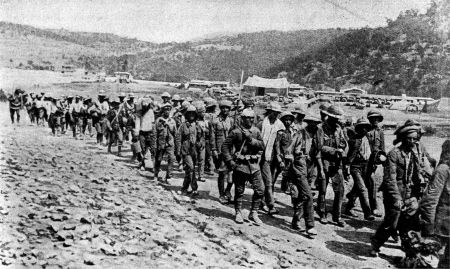
British prisoners at Kut al Amara

A few hundred miles away the British did not take advantage of indigenous Arab resentment of the Ottomans in Mesopotamia.  The British invaded Mesopotamiain 1914 expecting to defeat the Turks easily.  However the British did precious little to enlist the support or help the Iraqi Arabs.  The campaign was long and included the worst defeat of a British Army during the war at the Siege of Kut Al Amara in 1916 at the hands of a largely Iraqi Ottoman 6th Army.  Some 30,000 British and Indian soldiers were killed or died of disease and 13,000 captured many who did not survive captivity.  After the war Lawrence remarked “The people of England have been led in Mesopotamia into a trap from which it will be hard to escape with dignity and honor. They have been tricked into it by a steady withholding of information.”

Faisal would go on to be elected as the new Kingdom of Syria by the Syrian National Congress in March of 1920 but kicked out by the French who enforced the Mandate of Syria in July.  In 1922 after the British brutally suppressed an Iraqi independence movement they appointed Faisal as the King of Iraq. When the British “gave” the Iraqis their independence in 1932 Faisal was the head of state.  He died in 1933 and the British maintained a tight grip on the country and put down another Iraqi nationalist revolt led by the Army in 1941.  The British would remain in Iraq until 1958 when a military coup which is known as the “14 July Revolution” overthrew the government and killed king Faisal II.

Libya Rebels

In Libya there was great temptation and political pressure for the United States to begin an early air campaign without significant support in the international community.  Some say that this caused more casualties and suffering for the Libyans, but it helped in the long run because Libyans saw it as their war to win even when NATO began its air campaign against Gaddafi.  The air campaign was a great help to the newly proclaimed National Transitional Council in Benghazi and probably saved them from being defeated but it was the courage of Libyans on the ground who sacrificed themselves against a better armed and trained force to retake the country.

The revolt restored the pride of an oppressed people, something that could not have taken place had the campaign been led by the United States and NATO with boots on the ground.  People forget that in 2003 the majority of Iraqis welcomed US forces as liberators.  This lasted until Paul Bremer unilaterally dissolved Iraqi military, police and civil servants that were actively helping us, turning them into enemies overnight.  The liberated Iraqis felt betrayed and dishonored by the United States just as they had been by the British following the First World War.  Bremer did this without ensuring that the Iraqi Army weapons depots were secure thereby providing Sunni and Shia insurgents with vast amounts of weapons.  These weapons were turned against American and coalition soldiers and even the UN and NGOs which were just beginning to helpIraqrebuild.  The result of Bremer’s was a protracted insurgency and civil which cost us nearly 4500 soldiers killed and over 32000 wounded and hundreds of thousands of Iraqis killed, wounded or displaced.  If one wants an answer as to why the Iraqis rose up against the United States occupation in late 2003 they need to look no farther than this. The Iraqis only want to be independent and saw the Bremer’s actions in the lens of their history with the British.

The author with Iraqi General Sabah Ramadi 2007

The decision of President Obama, French President Sarkozy and British Prime Minister Cameron to work through the UN and NATO was the correct one. It enabled the Libyans to overthrow Gaddafi and it kept our military involvement to a minimum.  While it cannot be a template for all future military operations in the Arab world as every Arab country is different it does have lessons for us. Libya was a perfect place to use this method. It had a population that wanted Gaddafi gone and were willing to die trying to overthrow him.  It had no huge urban population centers teaming with uneducated and poverty stricken people with little hope.  It has substantial oil wealth and an oil infrastructure which unlike Iraq was not destroyed during the war or in bad repair due to years of sanctions. It also enjoyed a key geographic location which made NATO air intervention much easier than almost anywhere in the Middle East because we did not need bases in Libya or its neighbors to run the operation. It was conducted from Europe and platforms at sea.   This is not possible in most other Arab countries. The task would be much more difficult if the target was Syria.

Now is the time to help the Libyans in rebuilding their country and letting them continue to regain their pride by letting them do as much as possible.  They won’t do it the way we would but that is okay. They will make mistakes but given time the people that shed their blood together to rid themselves of Gaddafi can work together to build a free country.  Those that go to Libya to assist the Libyans need to keep this in mind if they really want to see a strong, robust and successful Libyan democracy take hold.  Let’s also make sure that the good feelings that the Libyans have for us now remain by simply treating them as we would like to be treated.  Simply put we have to stop treating them as vassal states that we only value for their natural resources while we disrespect their people, history and culture.

As for the future it would be a wise investment to ensure that diplomatic, military and NGO personnel be trained and educated to understand and appreciate the Arabs and other cultures that are different than ours in the West.  The West has much to overcome in its relationship with the Arabs most of which is self inflicted. But we can try to start again.

Peace

Padre Steve+

3 Comments

Filed under Foreign Policy, History, middle east, Military