Tag Archives: wade hampton

Racism & the Failure of Reconstruction

this-is-a-white-mans-government


Friends of Padre Steve’s World

Some events and attitudes are timeless, one of these is racism. Being white myself, I know that many whites are loath to admit that the scourge of racism still exists, but it does and it runs deep in our history. The more that I work on my Civil War and Gettysburg text, which now appears will morph into at least two and maybe three books when I am done, I find terribly distressing parallels to attitudes and actions of some which mirror the attitudes and actions of our ancestors, Northern and Southern following the Civil War. When the shooting stopped and the South was vanquished, many Southerners continued the war by other means and Northerners, divided after the death of Abraham Lincoln failed to achieve the most important political goal, after the restoration of the Union, that of true freedom for African Americans. Sadly, for some that war is still not over, as was evidenced in the aftermath of the Emanuel A.M.E. Massacre just two weeks ago. Likewise the burnings of six predominantly black churches across the South raises the specter of the racial violence that targeted blacks for a century after the Civil War.

This is another section of my text. I do hope that it challenges you as much as writing it challenged me.

Peace

Padre Steve+


When the war ended the Confederacy was beaten and most people in the South would have agreed to anything that the North presented regarding peace and return to the Union. In a sense Reconstruction was “what the war was about.” [1] Richard Henry Dana, the declared that “a war is over when its purpose is secured. It is a fatal mistake to hold that this war is over because the fighting has ceased. This war is not over…” [2] As Dana, and Clausewitz understood so well that war is a continuation of policy and politics by other means, and the failure of the North to fully grasp this fact led to over a century of subjugation of emancipated African Americans and has fueled a continual racial divide in the United States that is still felt today. Defeated on the battlefield Southerners soon turned to political, psychological and violent means to reverse their losses.

Frederick Douglass understood that simple emancipation was not enough, and that the “war and its outcome demanded racial equality.” [3] Despite the that efforts of many in the North this would not happen during Reconstruction and Douglass knew that the failure to accomplish this would be disastrous, “Whether the tremendous war so heroically fought…shall pass into history a miserable failure…or whether on the other hand, we shall, as the rightful reward of victory over treason have a solid nation, entirely delivered from all contradictions and social antagonisms, must be determined one way or another.” [4]

There was a problem with implementing Reconstruction; when John Wilkes Booth assassinated Abraham Lincoln, the political leaders of the North could not agree on how to do this. The new President, Andrew Johnson was probably the worst possible leader to lead the country in the aftermath of war for all practical purposes Johnson was a Democrat who believed in white supremacy, he had been brought onto the ticket for his efforts to keep Kentucky in the Union and to support Unionist elements in Tennessee. While his selection helped Lincoln in parts of the North and the Border States it was a disaster for the post-war era. Johnson’s approach to reconstruction was very simply to “impose minimal demands on the South. He required only minor concessions from the former Confederates before allowing them to resume their political rights and retain their land. As for freedmen, he seemed to think that the needed no further protection beyond the fact of their emancipation.” [5]

Johnson was “a lonely stubborn man with few confidants, who seemed to develop his policies without consulting anyone, then stuck to them inflexibly in the face of any and all criticism. He lacked Lincoln’s ability to conciliate his foes and his capacity for growth, which was best illustrated by Lincoln’s evolving attitude to black suffrage during the Civil War.” [6] In the months after his unexpected accession to the presidency Johnson demonstrated that he had no understanding of Lincoln’s political goals for the South and the desires of the Republican dominated Congress.

By the summer of 1865 Johnson was already demonstrating “that his sympathies were with the Southern white population and that he believed that their interests should be cared for even at the expense of freedmen.” [7] Johnson’s approach to reconstruction was very simply to “impose minimal demands on the South. He required only minor concessions from the former Confederates before allowing them to resume their political rights and retain their land. As for freedmen, he seemed to think that the needed no further protection beyond the fact of their emancipation.” [8] Johnson gave individual pardons to more than thirteen thousand “high-ranking Confederate civil and military officers and wealthy Southerners.” [9] While doing this he minimized political influence the Southern Unionists who had not supported the Confederacy and ensured that freed slaves were excluded from the political process. He issued a number of orders “appointing interim provisional governors and urging the writing of new state constitutions based upon the voter qualifications in force at the time of secession in 1861 – which meant, in large but invisible letters, no blacks.” [10]

When Frederick Douglass led a delegation of blacks to meet with Johnson in February 1865 Johnson preached that it was impossible to give political freedom to blacks. When Douglass attempted to object Johnson became angry and told Douglass “I do not like to be arraigned by some who can get up handsomely-rounded periods and rhetoric, and talk about abstract ideas of liberty, who never periled life, liberty, or property.” [11] When Douglass took his objections to Johnson’s harangue to a Washington newspaper, Johnson railed against Douglass “I know that d—–d Douglass…he’s just like any other nigger & would sooner cut a white man’s throat than not.” [12]

White Southerners including the newly pardoned Confederates enacted black codes that “codified explicit second-class citizenship for freedpeople.” [13] The legislature of Mississippi refused to ratify the Thirteenth Amendment, and did not do so until 1995. One Southerner noted that “Johnson “held up before us the hope of a ‘white man’s government,’ and this led us to set aside negro suffrage…. It was natural that we should yield to our old prejudices.” [14] Former Confederates, including Alexander Stephens the former Vice President of the Confederacy were elected to high office, Stephens to the United States Senate and the aggrieved Republicans in Congress in turn refused to admit the former Confederates. Many Union veterans were incensed by Johnson’s actions, one New York artilleryman noted “I would not pardon the rebels, especially the leaders, until they should kneel in the dust of humiliation and show their deeds that they sincerely repent.” [15] He was not alone, many Northern Veterans who formed the integrated Grand Army of the Republic veterans maintained a patent disregard, if not hatred of what the old South stood for and felt that their efforts in the war had been betrayed by the government.

Johnson’s restoration of property to the former white owners drove tens of thousands of blacks off lands that they had been farming, or left them as laborers for their former slave masters. Johnson countermanded General William Tecumseh Sherman and Secretary of War Edwin Stanton’s Field Order 15 to “divide abandoned and confiscated lands on the Sea Islands and in a portion of the Low Country coast south of Charleston into forty-acre plots for each black family.” [16] As such many freed blacks were now at the mercy of their former white owners for any hope of economic sustenance. Johnson stridently to frustrate the efforts of the Freedmen’s Bureau headed by Major General Oliver Howard to help freed blacks to become landowners. Johnson vetoed the Civil Rights bill but Congress overrode his veto. Eventually the battled between Johnson and Congress resulted in Johnson’s impeachment and narrow acquittal by one vote in the Senate in 1868.

The various black codes enacted throughout the South:

“passed labor laws that bound blacks to employers almost as tightly as slavery once bound them to their masters. Other codes established patterns of racial segregation that had been impossible under slavery, barred African Americans from serving on juries or offering testimony in court against whites, made “vagrancy,” “insulting gestures,” and “mischief” offenses by blacks punishable by fines or imprisonment, forbade black-white intermarriage, ad banned ownership by blacks of “fire-arms of any kind, or any ammunition, dirk or bowie-knife.” [17]

Likewise within weeks of the end of the violence against blacks began to break out in different parts of the South and it continued to spread as Johnson and Congress battled each other in regard to Reconstruction policy. “In Memphis, Tennessee, in May of 1866, whites on a rampage of murder killed forty-six Negroes, most of them veterans of the Union army, as well as two white sympathizers. Five Negro women were raped. Ninety homes, twelve schools and four churches were burned. In New Orleans in the summer of 1866, another riot against blacks killed thirty-five Negroes and three whites.” [18]

This alienated him from the Republican majority who passed legislation over Johnson’s veto to give black men the right to vote and hold office, and to overturn the white only elections which had propelled so many ex-Confederates into political power. Over Johnson’s opposition congress took power over Reconstruction and “Constitutional amendments were passed, the laws for racial equality were passed, and the black man began to vote and to hold office.” [19] Congress passed measures in 1867 that mandated that the new constitutions written in the South provide for “universal suffrage and for the temporary political disqualification of many ex-Confederates.” [20]   These measures helped elect bi-racial legislatures in the South which for the first time enacted a series of progressive reforms including the creation of public schools. They also ratified the Thirteenth and the Fourteenth Amendments, but these governments, composed of Southern Unionists, Northern Republicans and newly freed blacks were “elicited scorn from the former Confederates and from the South’s political class in general.” [21] Seen as an alien presence by most Southerners the Republican governments in the South faced political and was as violent opposition.

The Fourteenth Amendment was of particular importance for it overturned the Dred Scott decision which denied citizenship to blacks. Johnson opposed the amendment and worked against its passage by campaigning for men who would oppose it in the 1866 elections. His efforts earned him the opposition of former supporters including the influential New York Herald declared that Johnson “forgets that we have passed through a fiery ordeal of a mighty revolution, and the pre-existing order of things is gone and can return no more.” [22]

When passed by Congress the amendment was a watershed which would set Constitutional precedent for future laws to give women the right to votes, end Jim Crow laws, enact the Voting Rights Act of 1965, and most recently to give homosexuals the right to marry. Section one of the amendment read:

“All persons born or naturalized in the United States, and subject to the jurisdiction thereof, are citizens of the United States and of the state wherein they reside. No state shall make or enforce any law which shall abridge the privileges or immunities of citizens of the United States; nor shall any state deprive any person of life, liberty, or property, without due process of law; nor deny to any person within its jurisdiction the equal protection of the laws.” [23]

But these measures provoked even more violence from enraged Southerners who formed a variety of violent racist organizations which turned the violence from sporadic attacks to what amounted to a full-fledged insurgency against the new state governments and African Americans. Organizations like the Ku Klux Klan which engaged in terroristic violence to heavily armed “social clubs” which operated under the aegis of the state Democratic Party leadership in most Southern states. Allegedly organized for self-defense against state militia units composed of freed blacks they named themselves “White Leagues (Louisiana), White Liners or Rifle Clubs (Mississippi), or Red Shirts (South Carolina). They were, in fact, paramilitary organizations that functioned as armed auxiliaries of the Democratic Party in southern states in their drive to “redeem” the South from “black and tan Negro-Carpetbag rule.” [24] These men, mostly Confederate veterans “rode roughshod over the South, terrorizing newly freed slaves, their carpetbagger allies, and anyone who dared to imagine a biracial democracy as the war’s change.” [25] This unrequited violence and hatred set the stage for the continued persecution, murder and violence against blacks and those who supported their efforts to achieve equality in the South for the next century.

Throughout his term in office Johnson appealed to arguments used throughout later American history by “critics of civil rights legislation and affirmative action. He appealed to fiscal conservatism, raised the specter of an immense federal bureaucracy trampling on citizens’ rights, and insisted that self-help, not government handouts, was the path to individual advancement.” [26] While many of his Republican opponents supported these measures, many moderate Republicans could not abandon their support of or and ties to big corporations, and

Ulysses S. Grant succeeded Johnson as President in 1869 but his efforts at Reconstruction were met mostly by failure as well as a weariness on the part of many Northerners to continue to invest any more effort into it. Slowly even proponents of Reconstruction began to retreat from it and Southerners, knowing that they were winning the political battle continued their pressure. Both politically and through the use of terror to demoralize and drive from power anyone who supported it. By 1870 every former Confederate state had been readmitted to the Union, in a sense fulfilling a part Lincoln’s war policy, but at the same time denying what the war was waged for.

Congressman Thaddeus Stevens, one of the most effective leaders of the Radical Republicans died in 1868 in despair that the rights of blacks were being rolled back even as legislation was passed supporting them. The old firebrand asked “to be buried in a segregated cemetery for African American paupers so that “I might illustrate in death the principles which I advocated through a long life, Equality of man before his creator.” [27] Others including Senator Ben Wade, were not returned to office while others including Edwin Stanton, Salmon Chase and Charles Summer all died during Grant’s administration.

While Grant attempted to smash the Ku Klux Klan by military means his administration, heavily made up of economic conservative Republicans who had little interest in the rights of African Americans gave little other support to those fighting for equal rights for blacks. In the end Southern intransigence wore out the political will of Northerners to carry on, even the strongest supporters of equality.

By “1870 Radical Republicanism as a coherent political movement was rapitdl6y disintegrating” [28] and during the early 1870s many of the antislavery activists had left the Republican party either to death or defection, many “no longer felt at home in a party that catered to big business and lacked the resolve to protect black rights.” [29]

In 1872, some former radical Republicans revolted against Grant and the corruption in the Republican Party. Calling themselves “Liberal Republicans” they supported the candidacy of Horace Greeley uniting with Democrats to call for an end to Reconstruction. For many this was not so much because they no longer supported the rights of African Americans, but because for them, like so many, “economic concerns now trumped race relations…. Henry Adams, who shared the views of his father, Charles Francis Adams, remarked that “the day is at hand when corporations far greater than [the] Erie [Railroad]…will ultimately succeed in directing the government itself.” [30] The numbers of Federal troops in the South continued to be reduced to the point where they could offer little or no support to state militia.

Violence now became a means to further politics in the South and carried out in broad daylight and “intended to demoralize black voters and fatally undermine the Republican Party…. They paraded at regular intervals through African American sections of small towns in the rural black majority areas, intimidating the residents and inciting racial confrontations.” [31] These armed bands were highly successful, if they were successful in provoking a racial incident they would then fan out throughout the area to find blacks in order to beat up and kill, hundreds of blacks were killed by them. During the elections of 1876 the White Liners, Red Shirts and others would be seen in threatening positions near Republican rallies and on Election Day swarmed the polls to keep blacks and Republicans out, even seizing ballot boxes. The strategy employed was to use “Lawless and utterly undemocratic means…to secure the desired outcome, which was to win a lawful, democratic election.” [32]

The elected governor of Mississippi, Republican General Adelbert Ames, who was one of the most able and honest of all the Northerners to hold elected office in the South wrote in 1875 about the power of the paramilitary groups, “The “white liners” have gained their point – they have, by killing and wounding, so intimidated the poor Negroes that they can in all human probability prevail over them at the election. I shall try at once to get troops form the general government. Of course it will be a difficult thing to do.” [33] Ames did not get his troops. Grant’s Attorney general wrote “The whole public are tired out with these autumnal outbreaks in the South…and the great majority are now ready to condemn any interference on the part of the government….Preserve the peace by the forces in your own state….” [34] Ames, who had been a strong proponent of emancipation and black suffrage understood that he was being abandoned and in order to prevent more bloodshed gave up the fight. He negotiated a deal with Democrats which resulted in blacks being forced form the polls and the Democrats returning to power in the state.

The White League in Louisiana was particularly brutal and on Easter Sunday massacred blacks in Colfax Louisiana killing at least seventy-one and possibly as many as three-hundred blacks, killing many as they tried to surrender. Another White League detachment southwest of Shreveport “forced six white Republicans to resign their office on pain of death – and then brutally murdered them after they had resigned.” [35]

Reconstruction was officially ended in 1877 by newly elected President Rutherford B. Hayes and all Federal troops assigned to enforce it were withdrawn. Despite this, some people in the South attempted to fight for the rights of African Americans, including men like former Confederate Generals James Longstreet, William Mahone and Wade Hampton. Hampton was elected as the first post-Reconstruction governor of South Carolina in and campaigned against the black codes, and during his term in office even appointed African Americans to political offices in the state and maintained a regiment of African American state militia in Charleston against strident opposition.

While Hampton remained a white supremacist he also was committed to the upholding the law and “promoting the political rights to which freedmen were entitled to under law, and he consistently strove to protect those rights.” [36] This made him anathema to many South Carolina politicians, including Benjamine Tillman who as governor during the 1890s dismantled policies that Hampton had introduced to allow blacks to political patronage appointments. Once he did that Tillman set out to deprive South Carolina’s blacks of almost ever basic civil right, and in 1895 he led “a successful effort to rewrite the South Carolina constitution in such a way as to virtually disenfranchise every black resident of the state.” [37] Longstreet, who had become a Republican was wounded while leading Louisiana militia in an unsuccessful fight against White Leaguers in New Orleans on September 14th 1873.

The legislation which helped provide blacks with some measure of freedom was rolled back after Reconstruction ended. In 1883 “the Civil Rights Act of 1875, outlawing discrimination against Negroes using public facilities, was nullified by the Supreme Court, which said: “individual invasion of individual rights is not the subject-matter of the amendment.” The Fourteenth Amendment, it said, was aimed at state action only. No state shall…” [38]

The actions of the court and alliances between Northern corporations and Southern landowners led to even more discrimination and disenfranchisement for blacks, “From the 1880s onward, the post-Reconstruction white governments grew unwilling to rely just on intimidation at the ballot box and themselves in power, and turned instead to systematic legal disenfranchisement” [39] which furthered the black codes into what we now call the era of Jim Crow.

In 1896 the black codes were upheld by the Supreme Court in the case of Plessy v. Ferguson. That ruling established the “separate but equal” doctrine and ushered in an era of de jure segregation in almost all arenas of life including education, transportation, entertainment and health care. The limited social equity and privileges enjoyed by blacks, not only in the South, but in the entire nation were erased by the stroke of the judicial pen. The justices ruled on the concept that only people’s political rights were protected by the Constitution and that in the social arena that African-Americans could not interact with whites and assumed their racial inferiority.

Associate Justice John Harlan, a former slaveholder who had dissented in Court’s decision to overturn the Civil Rights Act of 1875 insisted “our Constitution is color blind” [40] and wrote in dissent:

“The destinies of two races, in this country are indissolubly linked together, and the interests of both require that the common government of all should not permit the seeds of race hate to be planted under the sanction of law. What can more certainly arouse race hate, what more certainly create and perpetuate a feeling of distrust between these races, than state enactments, which, in fact, proceed on the ground that colored citizens are so inferior and degraded that they cannot be allowed to sit in public coaches occupied by white citizens? That, as all will admit, is the real meaning of such legislation as was enacted in Louisiana.” [41]

These court decisions and legislation strengthened racism and discrimination against blacks, “effectively excluding blacks from public places, from the right to votes, from good public education, and so forth.” [42] The Plessy ruling was followed by “state laws mandating racial segregation in every aspect of life, from schools to hospitals, waiting rooms to toilets, drinking fountains to cemeteries…segregation was part of a complex system of white domination, in which each component – disenfranchisement, unequal economic status, inferior education – reinforced the others.” [43] Violence was used with great effect and between 1880 and 1968 approximately 3,500 people were murdered or lynched throughout the South. The “separate but equal” measures of the Jim Crow era took nearly a century to reverse, and “only began to disappear with Brown v. Board of Education in 1954 and the Civil Rights and Voting Rights Acts of 1964 and 1965.” [44]

The example of Reconstruction’s failure shows that in order to secure peace that military victory must be accompanied by the political will to ensure that the avowed goals of that victory are secured after the war in ensuring a just peace. Southerners may have lost the shooting war, but they did not accept the peace and resorted to all means to reverse their military defeat through political, social, economic and judicial means and “justice was sacrificed for the unjust peace ushered in by “redemption” of the South, a peace marred by Jim Crow, poverty and lynching.” [45] Most Northern leaders failed to appreciate this until far too late, and hindered by President Johnson’s opposition failed to win the peace in the South. They failed to appreciate that even after the shooting is often that “there is a need for further threats, and indeed action, because postwar disorder and even chaos will have to be address, and victorious allies are always likely to squabble over the spoils of victory” [46] as certain was the case in the divided Republican Party of the Reconstruction era.


Notes

[1] Perman, Michael and Murrell Taylor, Amy editors The Civil War and Reconstruction Documents and Essays Third Edition Wadsworth Cengage Learning Boston MA 2011 p.323

[2] Ibid. McPherson The War that Forged a Nation p. 175

[3] Ibid. Goldfield America Aflame p.407

[4] Ibid. Goldfield America Aflame p.407

[5] Ibid. Perman and Taylor The Civil War and Reconstruction Documents and Essays Third Edition p.323

[6] Foner, Eric Forever Free: The Story of Emancipation and Reconstruction Vintage Books a Division of Random House, New York 2005 p.108

[7] Carpenter, John A. Sword and Olive Branch: Oliver Otis Howard Fordham University Press, New York 1999 p.109


[8] Ibid. Perman and Taylor The Civil War and Reconstruction Documents and Essays Third Edition p.323

[9] Ibid. McPherson The War that Forged a Nation p. 177

[10] Ibid. Guelzo Fateful Lightening p.490

[11] Ibid. Guelzo Fateful Lightening p.494

[12] Ibid. Guelzo Fateful Lightening p.494

[13] Ibid. McPherson The War that Forged a Nation p. 177

[14] Ibid. Guelzo Fateful Lightening p.491

[15] Jordan, Brian Matthew. Marching Home: Union Veterans and Their Unending Civil War Liveright Publishing Corporation a Division of W.W. Norton and Company Inc. New York and London 2014 p.119

[16] Ibid. Goldfield America Aflame p.411

[17] Ibid. Guelzo Fateful Lightening p.491

[18] Ibid. Zinn The Other Civil War p.55

[19] Ibid. Zinn The Other Civil War p.54

[20] Ibid. McPherson The War that Forged a Nation p. 178

[21] Perman, Michael Illegitimacy and Insurgency in the Reconstructed South in The Civil War and Reconstruction Documents and Essays Third Edition edited by Michael Perman and Amy Murrell Taylor Wadsworth Cengage Learning Boston MA 2011 p.451

[22] Ibid. Foner Forever Free p.121

[23] _____________ The 14th Amendment to the U.S. Constitution retrieved from https://www.law.cornell.edu/constitution/amendmentxiv 29 June 2015

[24] Ibid. McPherson The War that Forged a Nation p. 178

[25] Ibid. Jordan Marching Home p.118

[26] Ibid. Foner Forever Free p.116

[27] Ibid. Guelzo Fateful Lightening p.504

[28] Ibid. Foner Forever Free p.170

[29] Ibid. Egnal Clash of Extremes p.337

[30] Ibid. Egnal Clash of Extremes p.337

[31] Ibid. Perman Illegitimacy and Insurgency in the Reconstructed South pp.459-460

[32] Ibid. Perman Illegitimacy and Insurgency in the Reconstructed South p.461

[33] Ames, Adelbert Governor Adelbert Ames deplores Violence in Mississippi, September 1875 in The Civil War and Reconstruction Documents and Essays Third Edition edited by Michael Perman and Amy Murrell Taylor Wadsworth Cengage Learning Boston MA 2011 p.434

[34] Ibid. McPherson The War that Forged a Nation p. 190

[35] Ibid. McPherson The War that Forged a Nation p. 185

[36] Longacre, Edward G. Gentleman and Soldier: The Extraordinary Life of General Wade Hampton Rutledge Hill Press, Nashville TN 2003 p.265

[37] Ibid. Longacre Gentleman and Soldier p.274

[38] Ibid. Zinn The Other Civil War p.57

[39] Ibid. Guelzo Fateful Lightening p.526

[40] Ibid. Zinn The Other Civil War p.58

[41] LaMorte, Michael W. School Law: Cases and Concepts 9th Edition 2008 Allyn and Bacon Inc. 2008 p.300

[42] Gonzalez, Justo L. The History of Christianity Volume 2: The Reformation to the Present Day Harper and Row Publishers San Francisco 1985 p.252

[43] Ibid. Foner Forever Free p.208

[44] Ibid. Huntington Who are We? p.54

[45] Ibid. McPherson The War that Forged a Nation p. 191

[46] Ibid. Gray Fighting Talk p.14
 

2 Comments

Filed under civil rights, civil war, History, laws and legislation, News and current events, Political Commentary

Vanity Seeking a Legacy: JEB Stuart at Gettysburg

Friends of Padre Steve’s World

Back to my work on the Gettysburg text. I have done a lot of edits and work on this chapter. There is a little bit more to do including an edit from my wife Judy before it goes into the text and I start working on the edits for the next chapter. 

Anyway, yet another crazy weather day in Hampton Roads. Yesterday 73 degrees, today rain with sleet and snow later with temperatures tomorrow barely above freezing. I can’t wait for real spring, and by the way I’m issuing a Fat Wahhh on the Groundhog. Not a Fatwah, but a Fat Wahhh, because I’m short stocky and whining. 

Peace

Padre Steve+

While the embattled Hooker slowly pursued Lee with the Army of the Potomac another drama of major significance was unfolding. The developing drama was of Robert E. Lee’s own making and it was beginning to engulf his army’s operations as leave him blind to the intents and movements of the Federal Army, and it is related to the concept of Commander’s Intent.

The concept “Commander’s Intent” is actually quite old and something that even not using today’s terminology that the commanders of the Civil War, especially those educated at West Point would have understood.

While the older understanding enunciated by Frederick the Great, Napoleon, Jomini, Clausewitz and Dennis Hart Mahan would be couched in different language the concept itself was similar. The modern understanding of the concept is found in numerous doctrinal publications of the U.S. Military and the most concise definition in found in Joint Publication 3-0:

“A clear and concise expression of the purpose of the operation and the desired military end state that supports mission command, provides focus to the staff, and helps subordinate and supporting commanders act to achieve the commander’s desired results without further orders, even when the operation does not unfold as planned” [1]

The drama engulfing Lee’s headquarters was the first of a number of operational mistakes committed by Lee, and dealt with his singular inability to get his commanders to understand his intent. The necessity of subordinate commanders understanding the intent of their superior is essential to the success of any military operation. During the Gettysburg campaign, Robert E. Lee failed miserably at this.

The first instance of this lack of clarity and vagueness in regard to Lee’s orders to his subordinates involved Major General J.E.B. Stuart, who commanded Lee’s cavalry division and the results of this would help doom Lee’s campaign in Pennsylvania.

Lee and Stuart

To understand how this happened we need to start with the character of J.E.B. Stuart and his relationship with Robert E. Lee. Without understanding these men it is impossible for us to understand how such a disastrous series of events and miscommunications could occur in an army which was so used to victory.

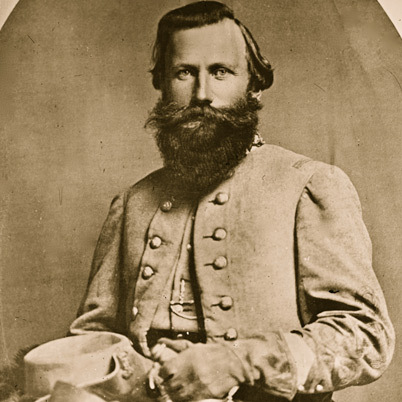
Before Brandy Station J.E.B. Stuart was at pinnacle of his fame and celebrity. Only thirty-two years old Stuart had gained an amount of fame, and the romantic aura of a chivalrous, bold and daring commander, something akin the gallant knights of an early era. One of his biographers, Burke Davis, whose work about Stuart is at times closer to hagiography than to history called Stuart “The Last Cavalier.” 

If People magazine had been published in 1863, Stuart would have certainly made the cover.

One of Stuart’s officers wrote after the war “There were few men produced by the war whose character was so mixed with gold and dross as Stuart… He could be “brave as his sword,” but “frivolous to the point of ridicule.” [2] Though faithfully married he was a flirt who women swooned over when they met him. “He possessed a zest for life and a flamboyance of style that made him the embodiment of a knight errant, a cavalier warrior from an evocative past.” [3] This is not to say that Stuart was not a gifted offer, leader or commander. Even before the war he was regarded as “a young officer of great promise, a natural horseman with a reputation for dash and bravery gained in countless clashes with Indians throughout the West, and for steady competence in the pro- and antislavery warfare of Kansas.” [4]

In the early part of the war he proved to be a dependable cavalry officer who supplied Stonewall Jackson, James Longstreet, Joseph Johnston and Robert E. Lee with reliable information regarding the composition, movements and intention of their opponents, and who in battle usually bested his Federal opponents.

However, it was his ride around McClellan during the Seven Days that established Stuart as a Confederate hero.

There had been little good news for Confederates during the previous months, but “there was an air of romantic adventure to Stuart’s exploit which touched every Southerner who read it.” [5] Newspapers published accounts which lauded Stuart’s exploit. The Richmond Examiner called it “one of the most brilliant affairs of the war, bold in its inception and the most brilliant in its execution.” [6] A correspondent from the Charleston Mercury wrote “It is a question of whether the annals of warfare furnish so daring a deed.” [7] The result of the ride was fame for Stuart and a new respect for the Confederate cavalry within the Army of Northern Virginia. “Stuart had become the hero of his troopers and one of the idols of the public.” [8]

The fact that Stuart succeeded in large part due to the inability of the Federal Cavalry commander, General Phillip St. George Cooke, Stuart’s father-in-law, to grasp what was happening or respond in an effectual manner did not dim the luster of the accomplishment. One of Stuart’s officers wrote that the newspapers “were filled with accounts of the expedition, none accurate, and most of them marvelous.” [9] The success and adulation that Stuart received in the Confederate press only cemented in Stuart’s mind that such raids would garner him fame and advance his career.

Stuart was not only adept at using the media to advance himself, but he also used his relationships and cultivated those in power to get ahead. He was a friend of the Lee’s before the war, and Robert E. Lee treated Stuart as if he were a son. He had the good fortune to staying with the Lee’s at Arlington and be at the War Department when John Brown seized Harper’s Ferry, where he had won Lee’s admiration. When Joseph Johnston commanded the army Stuart ingratiated himself to him and used flattery to gain favor saying “Johnston is in capacity head and shoulders above every general in the Southern Confederacy.” [10] At the same time he wrote about Lee’s lack of success in Western Virginia “With profound personal regard for General Lee, he has disappointed me as a General.” [11]

When Johnston was wounded Lee was appointed to command the army and Stuart quickly reconnected with Lee and following the success of his ride around McClellan’s army became Lee’s favorite cavalryman. Following the Seven Days battles when the Cavalry was expanded Lee nominated Stuart to command the division and ensured his promotion to Major General. Stuart responded in kind by recommending Lee’s nephew, Fitzhugh Lee to command a brigade in the division. As the division grew Stuart, knowing Lee’s preference for Virginians in the senior ranks of army leadership appointed “Virginians to command four of his division’s five brigades.” [12] These included Fitzhugh Lee as well as Lee’s son Rooney.

Following the Battle of Antietam Stuart made another spectacular ride around McClellan in Maryland and Pennsylvania, an escapade which helped Lincoln in his decision to relieve that ineffective army commander. Apart from the effect on Northern morale the raid accomplished little of military value, including not achieving its primary objective, the destruction of the B & O railway bridge across the Conococheague River. Porter Alexander wrote that “the raid risked a great deal in proportion to the results it accomplished. It might have easily happened easily happened that the whole command might have been captured.” [13]

At Chancellorsville, after Jackson was mortally wounded and A.P. Hill wounded he took command of Second Corps, and led it well enough that some thought that after Jackson’s death that he should be appointed to command the corps.

Despite his brilliance on the battlefield, Stuart had little capacity for self-reflection and was terribly insecure. “Like many people who rise rapidly from obscurity to prominence, Stuart was insecure in his success.” [14]  During a second raid at the end of the Seven Days his actions helped ensure the escape of the Federal Army, something that fellow commanders and staff officers noticed and which he would not admit. In this action, as well as others, Stuart was “known to take risks with his own life and the lives of his men, sometimes during ill-conceived operations of debatable strategic value.” [15]

Likewise Stuart regarded the Battle of Brandy Station as “the greatest triumph I ever had.” [16] Stuart could not understand how the media or fellow officers could see things differently than him. Brandy Station should have given Stuart ample evidence to reevaluate his performance, but he could not. Instead of working to improve his performance, he insisted “that a poor performance had been just perfect. He seemed more concerned with image than substance because he confused the two.” [17]

A Cavalier Seeks to Redeem His Legacy

After the surprise at Brandy Station Stuart, was unhappy. His pride had been wounded by all of the criticism heaped on him by the Confederate press and well as by politicians and officers of the Army of Northern Virginia. Stuart now found out what many others who have who sought the media spotlight; that the press can rapidly turn from being a friend and promoter, to being strident critic. He expressed his anger to his wife Flora in a number of letters. In one saying “The newspapers are false in every statement except as to the victory….The papers ought to apologize.” [18]

The temptation here would to assume that all that motivated Stuart was the desire to redeem himself, to make up for what happened at Brandy Station. This is at least partially true. However, there was something bigger, and that was Stuart’s need that the myth that he had created around himself, the persona he had taken on, was unsullied. Since the war began he had known nothing but success and celebrity. His unbridled success had not taught him how to deal with failure.

One of more recent biographers, Emory Thomas wrote that Stuart “feared failure perhaps more than anything else in life and certainly more than death. He dealt with failure not by dealing with it, by denying it.” [19] As such his actions are much more than seeking to make up for defeat, but an attempt to build a legacy.

The attacks in the newspapers which had previously fawned over his exploits certainly wounded Stuart. But not all papers had completely lost faith in Stuart, nor doubted that he would redeem himself against the hated Yankee cavalry. The Richmond Whig “concluded an editorial defense of the Beau Sabreur, “We shall be surprised if the gallant Stuart does not, before many days, make the enemy repent sorely the temerity that led them to undertake as bold and insulting feat [as the advance on Brandy]. [20]

The troopers of Stuart’s division screened the right flank of the army as it moved north. The mission of his brigades was to defend the gaps in the Blue Ridge, and to keep Pleasanton’s cavalry from interdicting the march, or discovering the location of Lee’s infantry corps. In this effort Stuart was successful, but not happy.

Between June 17th and June 21st Stuart’s troopers fought a series of engagements at Ashby’s Gap, Middleburg and Upperville. While Stuart’s troopers had held off Pleasanton the “running combats were taking a toll on the Southern mounted arm, however. Stuart had already suffered several hundred casualties defending gaps and passes.” [21] The Confederates also noted the improvements in the Federal cavalry during these battles. Captain William Blackford, who served as an engineer on Stuart’s staff noted:

“the improvement of enemy cavalry was enormous, mainly in the heavy fire from long range carbines, and horse artillery that was a match for Stuart’s own These cavalrymen fought as if they had been taken from infantry regiments, for they knew how to fight with horses left behind.” [22]

Unlike the rest of the army which was now marching into Pennsylvania and Maryland, Stuart’s Cavalry Division had little cause to rejoice. They had been surprised at Brandy Station and Stuart had been humiliated in the Southern press. “Stuart read, raged, and doubtlessly resolved that the Whig’s prediction should be fulfilled. First must come opportunity.” [23]

It would take nearly two weeks before Stuart got his chance as the Federal cavalry under Pleasanton gave him no opportunity to redeem himself during the clashes along the Blue Ridge.

While Pleasanton’s troopers never broke through Stuart’s screen, they had pressed him hard and this had a major effect on Stuart’s division, which was “really fought out during those two weeks from June 9 until the misty morning of June 22….Not only had Stuart’s cavalry been pressed on the defensive as never before, but also they had not been able to gain a spot of information about the enemy.” [24]

In effect, these actions had not only screened Lee’s army from Hooker, but what went unnoticed by Confederate commanders was that “this succession of fights screened the Army of the Potomac as well” leaving Stuart “somewhat in the dark as to the location and intent of the Federal infantry.” [25] This would have exceptionally dire consequences for Lee as Stuart was no longer supplying him with the thing he needed most, information on the location and intentions of the Army of the Potomac.

On the other hand the Federal cavalry, through its interrogations of prisoners and conversations with civilians had now learned that the “main body of the rebel infantry is in the Shenandoah Valley.” [26] Additionally at Ashby’s Gap, some of John Buford’s troopers had gotten past the Confederates and “peering into the valley beyond, they gazed upon a Confederate infantry encampment – tangible evidence at last of Lee’s progress toward Maryland and Pennsylvania.” [27]

Pleasanton’s troopers, under able commanders like John Buford had proved that the days of “easy Confederate cavalry triumphs were gone,” [28] and Stuart “smarting over the cuts to his ego, refused to read the portents.” [29]

The emotional state of Stuart in the wake of Brandy station had much to do with this condition, but where others, including his media critics could see the improvements in the Federal Cavalry arm, Stuart seemed to live with a fair amount of denial regarding the capabilities of his foe. Stuart still not believe that the Union Cavalry arm had reached a point in the war where they could take on his troopers and be successful, despite the mounting evidence.

Stuart had been fighting defensively the entire campaign beginning with the surprise at Brandy Station, but desperately wanted to go on the offensive. As his troops battled Pleasanton’s aggressive and well led troopers at Aldie, Middleburg and Upperville, Stuart formulated a plan to go on the offensive himself, which he submitted to Lee. Stuart reasoned now that “all the infantry were west of the Blue Ridge…that it would be possible to leave one or two brigades of cavalry to defend the gaps and with the remaining three to descend on the enemy and harass Hooker in any advance into Pennsylvania.” [30]

Conditional, Contradictory and Vague: Lee’s Order to Stuart

On the morning of the 22nd of June Stuart noticed that the Federal cavalry which had engaged him at Upperville the previous day was no longer present. This led Stuart to propose an operation to Lee. It was an operation that Stuart hoped would restore his glory, for he had to protect his legend at any cost, and he was extremely sensitive about what people thought, wrote and said about him. “he had cultivated his public image and in turn the poems, songs, and praise seemed to confirm his vision of himself. How could the newspapers and gossips be son wrong?” [31] As such when he found an opportunity he took it. In his after action report he said:


“I submitted to the commanding general the plan of leaving a brigade or so in my present front, passing through Hopewell or some other gap in the Bull Run Mountains, attain the enemy’s rear, passing between his main body and Washington, and cross into Md., joining our army north of the Potomac. The commanding general wrote authorizing this move, if I thought it practicable….” [32]

Lee’s reply via the order that Stuart received from Lee was the first of a series of vague, poorly written and contradictory orders by Lee that were to plague the campaign. It was an order that gave Stuart exactly what needed to embark on an expedition to regain his luster.

The order “offered his cavalry commander wide latitude to select his route in accord with circumstances.” [33] Lee’s order left “the decision to Stuart” [34] as to how he would execute it. It was also an order that gave Stuart the idea “that something better than the drudgery of a march along our flank might be open to him, and that one of General Stuart’s activity and gallantry should not be expected to fail to seek it.” [35]

It was an order that Stuart seized upon to regain his reputation.

Unlike Lee’s two new infantry corps commanders, Ewell and Hill, Stuart was very familiar with Robert E. Lee’s method of command, and Lee had “so much faith in Stuart’s judgment and ability to make the right moves that after indicating his wishes he gave him considerable latitude in carrying them out. His orders were more suggestions than commands….” [36] However well that may have worked for Lee in the past with Jackson and Stuart, at this time it failed Lee.

Lee’s orders to Stuart were conditional in nature, in other words they were operative as long as the conditions allowed. Since they were conditional orders, Lee needed to clearly address “the conditions upon which they are based.” [37] This Lee did not do and it was a critical oversight. His order to Stuart read:


“I judge the efforts of the enemy yesterday were to arrest our progress and ascertain our whereabouts. Perhaps he is satisfied. Do you know where he is and what he is doing? I fear he will steal a march on us and get across the Potomac before we are aware. If you find that he is moving northward and that two brigades can guard the Blue Ridge and take care of your rear, you can move with the other three into Maryland and take position on General Ewell’s right, place yourself in communication with him, guard his flank, keep him informed of the enemy’s movements and collect all the supplies you can….” [38]

Longstreet, who Stuart was cooperating with on the northward march, added his own comments to Lee’s instruction which even further clouded the order:
General Lee has enclosed this letter for you, to be forwarded to you, provided you can be spared from my front, and provided I think that you can move across the Potomac without disclosing our plans. He speaks of your leaving via the Hopewell Gap and passing by the rear of the enemy. If you can get through by that route I think that you will be less likely to indicate what our plans are than if you should be passing to our rear. I forward the letter of instructions with these suggestions. Please advise me of the condition of affairs before you leave, and order General Hampton, whom I suppose will leave here in command, to report to me at Millwood, either by letter or in person, as may be most agreeable to him.” [39] 

Stung by the criticism of his conduct of the Battle of Brandy Station in the Southern press and frustrated by Pleasanton’s constant thrusts Stuart, “who always interpreted cavalry orders to their outer limits” [40] did just that and interpreted them in a manner that appealed to his need to redeem his now tarnished reputation. Stuart believed that he would repeat his triumph of the previous year when he rode around the Army of the Potomac.

For Stuart this was a chance to regain the limelight and add to his luster. Stuart “summed up his interpretation of his orders when he said later: …it was deemed practicable to move entirely in the enemy’s rear, intercepting his communications with his base (Washington), and, inflicting damage upon his rear, to rejoin the army in Pennsylvania in time to participate in its actual conflicts.” [41]

Stuart was already planning his offensive which he believed would restore his glory. Days before Stuart had sent Major John Mosby with a small detachment of troopers to reconnoiter behind the Union lines. Mosby reported the location of all the infantry corps of the Army of the Potomac. Mosby reported to Stuart on June 23rd that the Federal corps of the Army of the Potomac were stationary and “were so widely separated…that a column of cavalry could easily get between them.” [42]

Mosby’s report painted a glowing picture of how an operation using the Hopewell Gap could create havoc in the Federal rear and cause panic in Washington as he could “severe communications between Hooker and Pleasanton, destroy a “large portion” of Hooker’s transportation, and take some of the pressure off Lee by creating a diversion for the Union cavalry.” [43]

The purported inactivity of the Federal army reported by Mosby was exactly the news Stuart wanted to hear, and he asked Lee for permission to plunge into the Federal rear. In his after action report Stuart wrote:

“I submitted to the commanding general the plan of leaving a brigade or so in my present front, and passing through Hopewell, or some other gap in Bull Run Mountain, attaining the enemy’s rear, and passing between his main body and Washington, to cross into Maryland and joining our army north of the Potomac.” [44]

Lee concurred and noted that “Upon the suggestion of the former officer (General Stuart) that he could damage the enemy and delay his passage of the river by getting to his rear, he was authorized to do so.” [45]

In his after action report of the campaign Lee wrote:


“General Stuart was left to guard the passes of the mountains and observe the movements of the enemy, whom he was instructed to impede and harass as much as possible, should he attempt to cross the Potomac. In that event, General Stuart was directed to move into Maryland, crossing the Potomac east or west of the Blue Ridge, as, in his judgment, should be best, and take position on the right of our column as it advanced.” [46]

That night, during a heavy rainstorm Stuart’s chief of staff Major McClellan received Lee’s reply, written by Colonel Charles Marshall, to his superior’s request which he immediately delivered to Stuart. It is this final order which forms the basis of the great controversy of Stuart’s actions during the campaign. Lee’s order stated:
“If General Hooker’s army remains inactive, you can leave two brigades to watch him, and withdraw with three others, but should he not appear to be moving northward, I think you had better withdraw this side of the mountains tomorrow night, cross as Shepherdstown next day, and move over to Frederickstown.

You will, however, be able to judge whether you can pass around their army without hindrance, doing them all the damage you can, and cross the river east of the mountains. In either case, after crossing the river, you must move on and feel the right of Ewell’s troops, collecting information, provisions, etc.” [47]

The order continued with a further paragraph which Stuart seems not to have fully conveyed to the commanders of the brigades being left behind to screen the army:


“Give instructions to the commander of the brigades left behind, to watch the flank and rear of the army, and (in the evidence of the enemy leaving their front) retire from the mountains west of the Shenandoah, leaving sufficient pickets to guard the passes, and bringing everything clear along the Valley, closing upon the rear of the army.” [48]

Finally, Marshall provided an additional admonishment to Stuart “I think the sooner you cross into Maryland, after to-morrow, the better.” [49] However, the orders or suggestions that Lee and Longstreet gave Stuart “are so badly worded that it is difficult to make sense of them.” [50] In them, Stuart was directed maintain contact with Ewell, screen the Blue Ridge gaps, collect information, “raiding around the rear of Hooker’s forces” [51] damaging the enemy, and collecting supplies.

Lee should have “established that Stuart’s most important task was to guard Ewell’s right and report on the direction of Hooker’s advance once Lee crossed the Potomac.” [52]

This he did not do.

Lee’s lack of clarity and vagueness allowed to Stuart interpret the order in the manner that benefited his need to redeem his reputation. The order could easily be interpreted as getting Stuart and his men into Pennsylvania as quickly as possible to guard Ewell’s flank and discern the intentions of the enemy, which in hindsight and according to his aids appears to have been Lee’s intent. But as written, they could easily ben interpreted as permission to conduct a raid to “roam in the enemy’s rear for an unpredictable period of time, raising havoc with his communications, supplies, and isolated commands” and then “seek out Ewell’s corps and use it as a place of refuge from an aroused enemy.” [53]

Porter Alexander was quite critical of Lee’s decision and wrote after the war:
“In view of the issues at stake, and of the fact that he had been deprived of two promised brigades (Corse’s and Jenkins’s), it was unwise even to contemplate sending three brigades of cavalry on such distant service. When one compares the small beneficial results of raids, even when successful, with the risks here involved, it is hard to understand how Lee could have given his consent.” [54]

Stuart, as he was want to do, used “the freedom that he had long enjoyed in implementing Lee’s orders” [55] to carry out his plan. Now smarting from the Brandy Station criticism, Stuart “interpreted them as a sanction for another White House raid….” [56] While it is certain that Lee meant to give Stuart permission for a “joyride around the entire Army of the Potomac or even just the three Federal corps which formed the westernmost wing of Hooker’s pell-mell rush to the Potomac” [57] he had given his knight errant just enough permission to do exactly that, exactly what he wanted to do in the first place.

Had Lee’s orders been clear there is no doubt that Stuart would have obeyed,

The fact is that different standards apply to each of those courses of action, and thus, the orders must be clear. Without such clarity it becomes easy for subordinates to interpret them in a far different way from which they were intended by the issuing commander, with far reaching effects. By giving Stuart the latitude to go around the Federal army Lee had undercut his own preference that Stuart cross into Maryland via Shepherdstown and Frederick on June 24th. Lee had provided Stuart an opportunity for something that “Longstreet half-apologetically called “something better than the drudgery of a march around our flank.” [58] It was a critical mistake, which was then further compounded by Stuart and the movement of the Army of the Potomac.

Porter Alexander compared Stuart’s Ride to Joe Hooker’s use of his cavalry corps at Chancellorsville noting: “I think that Joe Hooker’s defeat was due to the absence of his cavalry on just such a useless raid as this. We ought to have recognized Hooker’s error & avoided repeating it….We took unnecessary risk, which was bad war, & the only bad war too, I think, in all our tactics.” [59] However, in retrospect it does not appear that Lee, Longstreet or Stuart recognized the problems this risk would entail, or just how much it resembled Hooker’s use of his cavalry corps at Chancellorsville.


Historians have long wondered why Lee was not more explicit in his orders to Stuart and why Stuart conducted an operation that left Lee blind and had no obvious advantages, except to allow Stuart to recover his tarnished reputation. Stephen Sears noted in his book Gettysburg that: “The very concept of Stuart’s expedition was fueled by overconfidence and misjudgment at the highest command level.” [60]

In a sense the decision harkens back to the hubris of Lee and others about the superiority of his army, and Lee’s well known distain for the Federal army’s leadership and soldiers. This hubris is even more profound when one considers the fact that as early as June 23rd Lee knew “that the Federals were laying a pontoon bridge at Edward’s Ferry, indicative of a crossing.” [61]

Stuart’s Ride

“Stuart had decided to do what he wanted to do – a march between Hooker’s army and Washington and mix raiding with riding en route to Ewell in Pennsylvania.” [62] In organizing his movement, Stuart decided to take his three best brigades with him, and leave the brigades of “Grumble” Jones and Beverly Robertson to defend gaps and screen the rear of the army. The choice was unfortunate; Jones was considered the “best outpost officer in his command,” [63] but Robertson, though known to be unpredictable was placed in command because he was “senior to the dependable Jones.” [64] The choice ridded Stuart of Robertson, who he did not trust in battle and Jones “whose antipathy for Stuart at least equaled Stuart’s for him.” [65] Stuart instructed Robertson to “observe and harass the Federals as long as they remained in Virginia.” [66]

On the surface to Stuart it appeared the right choice, Robertson “showed neither the initiative or enterprise of a cavalry officer in the Army of Northern Virginia, Robertson could only be used for routine work, such as guarding the mountain passes.” [67]

The intent was that Robertson would screen the army and follow it into Maryland, in fact Stuart gave Robertson “explicit instructions” [68] to do so, but Stuart’s order also contained a statement which Robertson used to justify his actions years later. Stuart instructed Robertson, who could be expected to obey orders:
“After the enemy has moved beyond your reach, leave sufficient pickets in the mountains and withdraw to the west side of the Shenandoah and place a strong and reliable picket to watch the enemy at Harper’s Ferry….

As long as the enemy remains in your front, in force, unless directed otherwise ordered by General R.E. Lee, Lieutenant-General Longstreet, or myself, hold the gaps with a line of pickets reaching across the Shenandoah by Charlestown to the Potomac.

Avail yourselves of every means in your power to increase the efficiency of your command and keep it up to the highest number possible. Particular attention will be paid to the shoeing of horses, and to marching off the turnpikes….” [69]

Robertson, interpreted the order that he was to go to the western side of the Shenandoah and avoid using the turnpikes, which he noted “the only road by which the orders (which particularly specified the avoidance of “turnpikes” on the difficulty and delay of shoeing horses) could be complied with, carried my command to Martinsburg….” [70]

Thus, “the two brigades would remain fixed, as if planted there, in an inanition of command which immobilized the men for whom Lee in Pennsylvania was anxiously watching.” [71] Longstreet had requested the industrious and dependable Hampton to command the remaining cavalry, but Stuart disregarded his counsel and took Hampton with him, after all, he was J.E.B. Stuart, the finest cavalryman on the American continent.

Stuart set off with his three best brigades, those of Wade Hampton, Fitzhugh Lee, and Rooney Lee. Since Lee had been wounded at Brandy Station, his brigade was now under the command of Colonel John R. Chambliss, another former West Pointer retired from the old army. Almost immediately after setting off Stuart and his brigades encountered a situation that should have immediately stopped movement to the Federal rear and instead move west of the Blue Ridge.

Moving through Glasscock’s Gap they “bumped unexpectedly into “an immense wagon train,” which happened to be the tail end of Winfield Hancock’s 2nd Corps, blocking the road in exactly the fashion Lee had described as a hindrance.” [72] In light of his encounter with the Army of the Potomac, it “was now clearly impossible for Stuart to follow the route originally intended.” [73] Stuart was now faced with a critical choice, either withdraw and follow the army, or attempt to continue his raid.

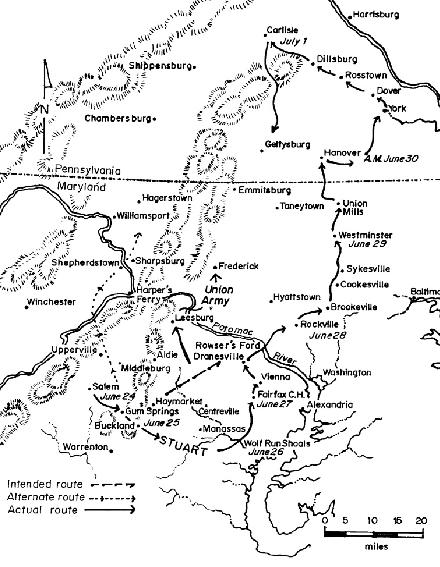
Instead of going back when he had the chance Stuart elected to continue with his “plan to go around the Federal army. It was a crucial decision, for he still could have turned back without losing any more time.” [74] Stuart consulted with “no ranking subordinate or staff member” [75] as he made his decision. On June 25th Stuart’s brigades had to spend a day grazing their horses since they had brought no grain with him, which delayed their advance north and east. This placed him a day behind schedule. Though he made better time on the 26th, advancing twenty-five miles he had to again stop to graze his horses at the Occoquan River. It had “taken forty-eight hours to march thirty-five miles.” [76]

The Price of 125 Wagons

Stuart continued on past the outskirts of Washington on June 27th and was again delayed when attempting to cross the Potomac at Rowser’s Ford by the “water level two feet higher than normal.” [77] He then encountered a large Federal wagon train not far from Washington capturing over 100 wagons and 600 mules. Stuart reveled in that feat and boasted that “he had taken more than one hundred and twenty-five best United States model wagons and splendid teams and gay caparisons,” containing “foodstuffs, oats, hay…bacon, ham, crackers and bread” but his progress was slowed by his enormous wagon train of captured supplies…” [78] He and briefly wondered “whether it might be worth “our entering Washington City” [79] before determining that the effort might be too costly because of the fortifications and proliferation of artillery.

At Fairfax Courthouse Stuart sent a message to Lee, which was never received by Lee, but which did arrive in Richmond on July 1st. It was a dispatch that was late, and even factually incorrect for the bulk of the Army of the Potomac was in Maryland advancing toward Lee in Pennsylvania. His report stated:

“General: – I took possession of Fairfax C.H. this morning at nine o’clock, together with large quantity of stores. The bulk of Hooker’s army has gone toward Lee’sburg, except the garrison at Alexandria and Washington, which has retreated to its fortifications.” [80]

On June 28th, Stuart received word that Hooker and the Army of the Potomac was across the Potomac. It was a major surprise to him, and by now Stuart “knew nothing of Lee’s position,[81] and instead of abandoning the wagon train, he sacrificed the speed and mobility that he needed to support Lee in order to keep it. Douglas Southall Freeman wrote that the “wagon train was Jeb Stuart’s stumbling block.” [82]

Of course it was Lee’s order for Stuart to collect all the supplies that he could justified Stuart’s course of action. Now, Stuart “far from guarding Ewell’s right, he was now moving away from Ewell, with no idea where Hooker’s army might be and no communication with Lee, who frequently inquiring of his aides, “Can you tell me where General Stuart is?” [83] But “ignorant of his chief’s distress, Jeb was not concerned, apparently, over the encumbrance of his wagon train.” [84] Stuart’s chief of staff Henry McClellan wrote after the war that “the capture of the train of wagons was a misfortune. The time occupied in securing it was insignificant; but the delay caused to the subsequent march was serious at a time when minutes counted almost as hours.” [85]

On the wrong side of the federal army, encumbered by the captured wagon train, “Stuart would have to make a half circle of more than fifty miles around Gettysburg before arriving there about noon on the second day of battle with most of his troopers, his artillery, and his wagon train lumbering far behind him.” [86]

On June 30th his men were engaged by Judson Kilpatrick’s Federal near cavalry division near Hanover, and “his men never fought more poorly…and General Stuart and his staff were nearly captured.” [87] As Stuart’s brigades slowly advanced  through Northern Virginia and Maryland the strain was becoming evident. The units had “covered more than one hundred miles since leaving Salem. Horses broke down and were abandoned, with their riders scouring the countryside for replacements. With each successive mile, the problem worsened.” [88]

As Stuart and his men plodded their way around the Army of the Potomac, encumbered by their booty they had to constantly fight off the Federal cavalry units of Judson Kilpatrick who had been dispatched to follow and harass him.

By now, Robert E. Lee was becoming more anxious by the hour. He had no contact with Stuart for nearly five days and he knew little about the locations or intentions of the enemy army. On the 27th at Chambersburg Lee was disquieted and asked various staff members “Can you tell me where General Stuart is?” Have you any news of the enemy’s movements?” [89]

On the morning of July 1st with his army now engaged in battle, “Stuart was practically lost, and had to guess which direction he should go to find Lee’s army.” [90] Lee enquired of Major Campbell Brown of Ewell’s Second Corps staff if Ewell “had heard anything” from Stuart. Brown, who had come to deliver a message from Ewell to Lee noted that Lee’s question was asked “with a particular searching almost quelous impatience.” [91] Lee told Brown that “Gen’l Stuart had not complied with his instructions” but instead had “gone off clear around” the Federal army, because “I see by a (Balto or N.Y.?) paper that he is near Washington.” [92] As Brown left he thought that Lee was “really uneasy & irritated by Stuart’s conduct & had no objection to his [Brown’s] hearing it.” [93]


Return of the Knight Errant

By the time Stuart’s troopers arrived in Gettysburg, “the expedition had occupied eight days, and had traversed in that time about 250 miles.” [94] Meanwhile, Lee had been exceedingly impatient. Stuart’s once proud outfit was “exhausted and too late to be of any service.” [95] The three brigades involved had lost very few men in combat, according to Porter Alexander only eighty-nine men were killed or wounded, [96] however “hundreds, if not thousands, of Stuart’s men had abandoned ranks during the ride, had their mounts break down, or were physically unable to perform their duties.” [97]

Stuart’s arrival at Gettysburg was not a moment of triumph by any means, but was a humiliating experience. Instead of reporting to his commander with information that Lee needed, it was Lee who informed him of the position of his own army and the Army of the Potomac. Lee’s words to his much beloved subordinate were painful. He asked him “General Stuart, where have you been?” [98] Stuart seemed to wilt at his mentor’s words, and attempted to put the best face forward, and told Lee “I have brought you 125 wagons and their teams, General.” This did not mollify Lee, who replied “Yes, General, but they are an impediment to me now.” [99]

Stuart’s raid was disastrous for Lee. He was blind and had no idea where the Federal army was until told by Longstreet’s scout Harrison on June 28th. One historian noted that the ride was “an act of folly- ill-planned, badly conducted, and (until the very end) executed with an almost total disregard for anything for any interest other than the self-promotion of J.E.B. Stuart.” [100] A staff member at Stuart’s headquarters wrote after the war:

“Raiding was Stuart’s hobby…and one which he rode with never failing persistence….What a glorious opportunity was now offered for the indulgence of his love!…What a tempting prize lay within his reach….Here was an undertaking which…would eclipse in brilliance and real importance any exploit of the war.” [101]

Stuart’s actions were heavily criticized by many in the army. Moxey Sorrell who served on Longstreet’s staff described the raid “a useless, showy parade almost under the guns of the Washington forts, and his horse, laurel wreathed, bore the gay rider on amid songs and stories.” [102] Likewise, Lee’s Chief of Staff Colonel Charles Marshall “urged the commanding general to court-martial Stuart” [103]

Lee was gracious to the extreme in his discussion of Stuart’s actions in his after action report. He made but one inference to Staurt without naming him’ but it was damning: “The movements of the army preceding the battle of Gettysburg had been much embarrassed by the absence of the cavalry.” [104] Walter Taylor of Lee’s staff wrote that the report was a “simple statement of facts: a striking illustration of his tendency to always suppress all consideration of self and spare the reputations and feelings of others.” [105]

In his after action report, which was by far the longest of any confederate commander, Stuart admitted to no mistakes. In it he showed a “self-righteous attitude” and showed a “tendency to complain of the failure of others.” [106] and in a manner blamed Lee and the remaining cavalry commanders for the loss, insisting that “he had left Lee with plenty of cavalry and remarked that “properly handled, such a command should have done everything requisite….” [107] There is some truth in this, but at the same time it is a foil which Stuart used to deflect criticism from himself. He blamed Jubal Early and his infantry for not finding him in Pennsylvania, when such responsibility by the doctrine of the day lay with the cavalry and not the infantry and Hill and Longstreet for not conforming their advance to his timetable.

Edward Coddington described Stuart’s report as “a strange document, more of an apology than a report, in which he tried to prove the virtues of his adventure.” [108] It was unfortunate and when Wade Hampton saw the report he wrote to Thomas Munford “Lately I saw for the first time Stuart’s report of the Gettysburg campaign and I never read a more erroneous – to call it no harsher name – one than it was.” [109]

Basically, in Stuart’s fantasy world, the world where his reputation mattered more than truth “Had Lee “properly handled” the cavalry Stuart left with him; had Early’s infantry found the cavalry column; had Hill and Longstreet acted in accord with Stuart’s after the fact assumptions – then all would have been well.” [110]

But despite Stuart’s hearty exaggerations in his after action report and the claims of his post war apologists, John Mosby and Henry McClellan, the raid had little effect on the army of the Potomac. The losses of wagons were rapidly made up by the massive Union war industry, of his prisoners, the majority of who he had to parole, close to half were teamsters and not trained combat soldiers. Though he had destroyed some rail lines, he never severed the ones that Meade used between his army and Washington D.C.

In sum, Stuart’s  gambit to redeem his reputation and build upon his legacywas a major part of Lee’s failure at Gettysburg. It certainly not the only one, Lee, Hill, Ewell, Longstreet and even Jefferson Davis made terrible decisions that contributed to the defeat. But that being said, in terms of the scope of the single decision of a commander which impacted  the campaign, this one is perhaps the only one which is indefensible by any standard of interpretation.

To this point a number of issues important to those involved in planning campaigns became clear: Deception, commander’s intent and unity of command. Lee successfully used deception to prevent the Federals from discerning his purposes. That was counteracted by his lack of clarity in communicating his intent to Stuart, and Stuart’s, Stuart’s own vague orders to Robertson, and the careless disregard by Stuart of any other consideration but his own reputation and vanity.

Notes

[1] ___________. Joint Publication 3-0 Joint Operations Chairman of the Joint Chiefs of Staff, Washington DC August 2011


[2] Guelzo, Allen C. Gettysburg: The Last Invasion Vintage Books a Division of Random House, New York 2013 p.53

[3] Wert, Jeffry D. General James Longstreet The Confederacy’s Most Controversial Soldier, A Touchstone Book, Simon and Schuster, New York and London 1993 p.85

[4] Korda, Michael.

Clouds of Glory: The Life and Legend of Robert E. Lee Harper Collins Publishers, New York 2014 p.xxv


[5] Sears, Stephen W. To the Gates of Richmond: The Peninsula Campaign Houghton Mifflin Company, Boston and New York, 1992 p.173


[6] Wert, Jeffry D. A Glorious Army: Robert E. Lee’s Triumph 1862-1863 Simon and Schuster, New York and London 2011 p.26
[7] Ibid. Sears. To the Gates of Richmond p.173


[8] Freeman, Douglas Southall, Lee’s Lieutenant’s a Study in Command, One volume abridgement by Stephen W Sears, Scribner, New York 1998 p.158


[9] Ibid. Sears. To the Gates of Richmond p.173


[10] Ibid. Guelzo, Gettysburg: The Last Invasion p.53
[11] Davis, Burke J.E.B. Stuart: The Last Cavalier Random House, New York 1957 p.94


[12] Ibid. Guelzo, Gettysburg: The Last Invasion p.53


[13] Alexander, Edward Porter Military Memoirs of a Confederate: A Critical Narrative 1907 republished 2013 by Pickle Partners Publishing, Amazon Kindle Edition location 5633


[14] Thomas, Emory M. Bold Dragoon: The Life of J.E.B. Stuart University of Oklahoma Press, Norman OK 1986 and 1999 p.232


[15] Longacre, Edward G. Gentleman and Soldier: The Extraordinary Life of General Wade Hampton Rutledge Hill Press, Nashville TN 2003 p.82


[16] Ibid. Wert Cavalryman of the Lost Cause p.252


[17] Ibid. Thomas, Emory M. Bold Dragoon p.231
[18] Ibid. Wert Cavalryman of the Lost Cause p.252


[19] Ibid. Thomas Bold Dragoon p.256


[20] Ibid. Freeman Lee’s Lieutenant’s p.552


[21] Petruzzi, J. David and Stanley, Steven The Gettysburg Campaign in Numbers and Losses: Synopses, Orders of Battle, Strengths, Casualties and Maps, June 9 – July 1, 1863 Savas Beatie LLC, El Dorado Hills CA 2012 p.41
[22] Ibid. Davis, Burke J.E.B. Stuart: The Last Cavalier pp.319-320
[23] Ibid. Freeman Lee’s Lieutenant’s p.552


[24] Dowdy, Clifford. Lee and His Men at Gettysburg: The Death of a Nation Skyhorse Publishing, New York 1986, originally published as Death of a Nation Knopf, New York 1958 p.57
[25] Catton, Bruce The Army of the Potomac: Glory Road Doubleday and Company, Garden City New York, 1952 p.253


[26] Ibid. Wert A Glorious Army p.224


[27] Longacre, Edward G. John Buford: A Military Biography Da Capo Press, Perseus Book Group, Cambridge MA p.175


[28] Ibid. Freeman Lee’s Lieutenant’s p.553


[29] Ibid. Dowdy Lee and His Men at Gettysburg p.57
[30] Ibid. Freeman Lee’s Lieutenants p.553


[31] Ibid. Thomas Bold Dragoon p.233


[32] Ibid. Alexander Military Memoirs of a Confederate location 7210


[33] Ibid. Thomas Bold Dragoon p.240


[34] Fuller, J.F.C. Grant and Lee: A Study in Personality and Generalship, Indiana University Press, Bloomington IN 1957 p.195
[35]   McClellan, Henry Brainerd The Life and Campaigns of Major General J.E.B. Stuart Commander of the Cavalry of the Army of Northern Virginia 1885. Digital edition copyright 2011 Strait Gate Publications, Charlotte NC Location 6131
[36] Coddington, Edwin B. The Gettysburg Campaign: A Study in Command, A Touchstone Book, Simon and Schuster New York, 1968 p.108


[37] Ibid. Coddington The Gettysburg Campaign p.108


[38] Ibid. Davis J.E.B. Stuart: The Last Cavalier p.321


[39] Oates, William C. and Haskell, Frank A. Gettysburg: The Confederate and Union Views of the Most Decisive Battle of the War in One Volume Bantam Books edition, New York 1992, originally published in 1905 p.61
[40] Pryor, Elizabeth Brown. Reading the Man: A Portrait of Robert E. Lee Through His Private Letters Penguin Books, New York and London 2007 p.332


[41] Ibid. Freeman Lee’s Lieutenants p.555


[42] Ibid. Coddington The Gettysburg Campaign p.109


[43] Ibid. Coddington The Gettysburg Campaign p.109


[44] Ibid. McClellan The Life and Campaigns of Major General J.E.B. Stuart Location 6087


[45] Ibid. McClellan The Life and Campaigns of Major General J.E.B. Stuart location 6106


[46] Lee, Robert E. Reports of Robert E Lee, C.S. Army, Commanding Army of Northern Virginia Campaign Report Dated January 20th 1864. Amazon Kindle Edition location 285


[47] Ibid. Davis J.E.B. Stuart: The Last Cavalier p.324


[48] Ibid. Wert Cavalryman of the Lost Cause p.259


[49] Ibid. Wert Cavalryman of the Lost Cause p.259


[50] Fuller, J.F.C. Decisive Battles of the U.S.A. 1776-1918 University of Nebraska Press, Lincoln 2007 copyright 1942 The Royal Society for the Prevention of Cruelty to Animals p.226


[51] Ibid Korda Clouds of Glory p.540


[52] Ibid. Korda Clouds of Glory p.540


[53] Ibid. Coddington The Gettysburg Campaign p.110


[54] Ibid. Alexander Military Memoirs of a Confederate location7223 of 12968


[55] Taylor, John M. Duty Faithfully Performed: Robert E Lee and His Critics Brassey’s, Dulles VA 1999 p.136


[56] Ibid. Fuller Decisive Battles of the U.S.A.p.226. Note: The White House Raid was Stuart’s ride around McClellan’s army during the Seven Days.


[57] Ibid. Guelzo, Gettysburg: The Last Invasion p.96
[58] Ibid. Guelzo, Gettysburg: The Last Invasion p.96
[59] Alexander, Edward Porter. Fighting for the Confederacy: The Personal Recollections of General Edward Porter Alexander edited by Gary Gallagher University of North Carolina Press, Chapel Hill 1989 p.228


[60] Sears, Stephen W. Gettysburg, Mariner Books, Houghton Mifflin Company, Boston and New York, 2003 p.106
[61] Ibid. Wert A Glorious Army p.226


[62] Ibid. Thomas Bold Dragoon p.241


[63] Ibid. Davis J.E.B. Stuart: The Last Cavalier p.324


[64] Ibid. Dowdy Lee and His Men at Gettysburg p.63
[65] Ibid. Dowdy Lee and His Men at Gettysburg p.63
[66] Ibid. Thomas Bold Dragoon p.241
[67] Ibid. Coddington The Gettysburg Campaign p.112


[68] Ibid. Coddington The Gettysburg Campaign p.112


[69] Robertson, Beverly The Confederate Cavalry in the Gettysburg Campaign in Battles and Leaders of the Civil War Volume III, The Tide Shifts. Edited by Robert Underwood Johnson and Clarence Clough Buel Castle, Secaucus NJ p.253


[70] Ibid, Robertson The Confederate Cavalry in the Gettysburg Campaign p.253


[71] Ibid. Dowdy Lee and His Men at Gettysburg p.63
[72] Ibid. Guelzo Gettysburg: The Last Invasion p.96


[73] Ibid. Wert Cavalryman of the Lost Cause p.265


[74] Ibid. Coddington The Gettysburg Campaign p.112


[75] Ibid. Wert Cavalryman of the Lost Cause p.266


[76] Ibid. Davis J.E.B. Stuart: The Last Cavalier p.325


[77] Ibid. Coddington The Gettysburg Campaign p.112


[78] Ibid Korda Clouds of Glory p.541


[79] Ibid. Guelzo Gettysburg: The Last Invasion p.98
[80] Ibid. Wert Cavalryman of the Lost Cause p.272


[81] Ibid. Davis J.E.B. Stuart: The Last Cavalier p.325


[82] Ibid. Freeman Lee’s Lieutenants p.558


[83] Ibid Korda Clouds of Glory p.541


[84] Ibid. Freeman Lee’s Lieutenants p.558


[85] Ibid. McClellan The Life and Campaigns of Major General J.E.B. Stuart location 6267 of 12283


[86] Ibid Korda Clouds of Glory p.541


[87] Ibid. Dowdy Lee and His Men at Gettysburg p.73
[88] Ibid. Wert Cavalryman of the Lost Cause p.272


[89] Ibid. Wert Cavalryman of the Lost Cause p.273


[90] Ibid. Alexander Military Memoirs of a Confederate location7248 of 12968


[91] Ibid. Wert Cavalryman of the Lost Cause p.281


[92] Ibid. Coddington The Gettysburg Campaign p.98
[93] Ibid. Wert Cavalryman of the Lost Cause p.281


[94] Ibid. Alexander Military Memoirs of a Confederate location7223 of 12968


[95] Ibid. Fuller Decisive Battles of the U.S.A. 1776-1918 p.227


[96] Ibid. Alexander Military Memoirs of a Confederate location 7261 of 12968


[97] Ibid. Wert Cavalryman of the Lost Cause p.285


[98] Ibid. Davis J.E.B. Stuart: The Last Cavalier p.334


[99] Ibid. Davis J.E.B. Stuart: The Last Cavalier p.334


[100] Ibid. Guelzo Gettysburg: The Last Invasion p.98
[101] Ibid. Wert Cavalryman of the Lost Cause p.268


[102] Sorrell, Moxey G. Recollections of a Confederate Staff Officer [Illustrated Edition] originally published 1905, Pickle Partners Publishing 2013, Amazon Kindle version location 2585 of 5692


[103] Ibid. Thomas Bold Dragoon p.252
[104] Lee, Robert E. Reports of Robert E Lee, C.S. Army, Commanding Army of Northern Virginia Campaign Report Dated January 20th 1864. Amazon Kindle Edition, location 624 of 743


[105] Taylor, Walter. General Lee: His campaigns in Virginia 1861-1865 With Personal Reminiscences University of Nebraska Press, Lincoln Nebraska and London, 1994 previously published 1906 p.185


[106] Ibid. Coddington The Gettysburg Campaign p.202


[107] Ibid. Thomas Bold Dragoon p.254


[108] Ibid. Coddington The Gettysburg Campaign p.202


[109] Ibid. Thomas Bold Dragoon p.253


[110] Ibid. Thomas Bold Dragoon p.255

Leave a comment

Filed under civil war, Gettysburg, History, Military

“Can You Tell Me Where General Stuart Is?” JEB Stuart’s Ride

CWP015

While the embattled Hooker slowly pursued Lee with the Army of the Potomac drama of major significance to the battle Robert E. Lee’s own making was beginning to engulf his operations and leave him blind to the movements of the Federal Army. It was the first of a number of mistakes that would characterize his campaign almost all dealing with his singular inability to get his commanders to understand his intent. The necessity of subordinate commanders understanding the intent of their superior is essential to the success of any military operation and Lee failed miserably at this during the Gettysburg campaign.

After the surprise at Brandy Station Stuart’s troopers screened the right flank of the army as it moved north, defending the gaps in the Blue Ridge to keep Pleasanton’s cavalry from interdicting the march or discovering the location of Lee’s infantry corps. In this he was successful. Between June 17th and June 21st his troopers fought a series of engagements at Ashby’s Gap, Middleburg and Upperville. While Stuart’s troopers had held off Pleasanton the “running combats were taking a toll on the Southern mounted arm, however. Stuart had already suffered several hundred casualties defending gaps and passes.” [1] The Confederates also noted the improvements in the Federal cavalry during these battles. Captain William Blackford, who served as an engineer on Stuart’s staff noted:

“the improvement of enemy cavalry was enormous, mainly in the heavy fire from long range carbines, and horse artillery that was a match for Stuart’s own These cavalrymen fought as if they had been taken from infantry regiments, for they knew how to fight with horses left behind.” [2]

Unlike the rest of the army which was now marching into Pennsylvania and Maryland, Stuart’s Cavalry Division had little cause to rejoice. They had been surprised at Brandy Station and Stuart had been humiliated in the Southern press. The Federal cavalry under Pleasanton gave him no opportunity to redeem himself. While Pleasanton’s troopers never broke through Stuart’s screen, they had pressed him hard, and his division was “really fought out during those two weeks from June 9 until the misty morning of June 22….Not only had Stuart’s cavalry been pressed on the defensive as never before, but also they had not been able to gain a spot of information about the enemy.” [3] Pleasanton’s troopers and proven that the days of “easy Confederate cavalry triumphs were gone,” [4] and Stuart “smarting over the cuts to his ego, refused to read the portents.” [5]

Stuart had been fighting defensively the entire campaign, but desperately wanted to go on the offensive. As his troops battled at Aldie, Middleburg and Upperville, Stuart formulated a plan which he submitted to Lee. Stuart reasoned now that “all the infantry were west of the Blue Ridge…that it would be possible to leave one or two brigades of cavalry to defend the gaps and with the remaining three to descend on the enemy and harass Hooker in any advance into Pennsylvania.” [6]

On the morning of the 22nd of June Stuart noticed that the Federal cavalry which had engaged him at Upperville the previous day was no longer present. That morning he also received an order from Lee that was the first of a series of vague, poorly written and contradictory orders that was to plague the campaign. Unlike his new infantry corps commanders, Ewell and Hill, Stuart was very familiar with Robert E. Lee’s method of command, and Lee had “so much faith in Stuart’s judgment and ability to make the right moves that after indicating his wishes he gave him considerable latitude in carrying them out. His orders were more suggestions than commands….” [7] However well that may have worked for Lee in the past with Jackson and Stuart, the nature of Lee’s orders to Stuart, being conditional, needed to clearly address “the conditions upon which they are based.” [8] This Lee did not do. His order read:

“I judge the efforts of the enemy yesterday were to arrest our progress and ascertain our whereabouts. Perhaps he is satisfied. Do you know where he is and what he is doing? I fear he will steal a march on us and get across the Potomac before we are aware. If you find that he is moving northward and that two brigades can guard the Blue Ridge and take care of your rear, you can move with the other three into Maryland and take position on General Ewell’s right, place yourself in communication with him, guard his flank, keep him informed of the enemy’s movements and collect all the supplies you can….” [9]

Longstreet, who Stuart was cooperating with on the northward march, added his own comments to Lee’s instruction which even further clouded the order:

General Lee has enclosed this letter for you, to be forwarded to you, provided you can be spared from my front, and provided I think that you can move across the Potomac without disclosing our plans. He speaks of your leaving via the Hopewell Gap and passing by the rear of the enemy. If you can get through by that route I think that you will be less likely to indicate what our plans are than if you should be passing to our rear. I forward the letter of instructions with these suggestions. Please advise me of the condition of affairs before you leave, and order General Hampton, whom I suppose will leave here in command, to report to me at Millwood, either by letter or in person, as may be most agreeable to him.” [10]  

stuartsridemap

Stuart was already planning his offensive which he believed would restore his glory. He had sent Major John Mosby with a small detachment of troops to reconnoiter behind the Union lines. Mosby reported the location of all the infantry corps of the Army of the Potomac. Mosby reported to Stuart on June 23rd that the Federal corps were stationary and “were so widely separated…that a column of cavalry could easily get between them.” [11] It was news that Stuart was delighted to hear. Mosby painted a glowing picture of how an operation using the Hopewell Gap could create havoc in the Federal rear and cause panic in Washington as he could “severe communications between Hooker and Pleasanton, destroy a “large portion” of Hooker’s transportation, and take some of the pressure off Lee by creating a diversion for the Union cavalry.” [12]

The inactivity of the Federal army reported by Mosby was exactly the news Stuart wanted to hear, and he asked Lee for permission to plunge into the Federal rear, and in his after action report wrote:

“I submitted to the commanding general the plan of leaving a brigade or so in my present front, and passing through Hopewell, or some other gap in Bull Run Mountain, attaining the enemy’s rear, and passing between his main body and Washington, to cross into Maryland and joining our army north of the Potomac.” [13]

Lee noted that “Upon the suggestion of the former officer (General Stuart) that he could damage the enemy and delay his passage of the river by getting to his rear, he was authorized to do so.” [14] In his after action report of the campaign Lee wrote:

“General Stuart was left to guard the passes of the mountains and observe the movements of the enemy, whom he was instructed to impede and harass as much as possible, should he attempt to cross the Potomac. In that event, General Stuart was directed to move into Maryland, crossing the Potomac east or west of the Blue Ridge, as, in his judgment, should be best, and take position on the right of our column as it advanced.” [15]

That night, during a heavy rainstorm Stuart’s chief of staff Major McClellan received Lee’s reply to his superior’s request which he immediately delivered to Stuart. Lee’s stated:

“If General Hooker’s army remains inactive, you can leave two brigades to watch him, and withdraw with three others, but should he not appear to be moving northward, I think you had better withdraw this side of the mountains tomorrow night, cross as  Shepherdstown next day, and move over to Frederickstown.

You will, however, be able to judge whether you can pass around their army without hindrance, doing them all the damage you can, and cross the river east of the mountains. In either case, after crossing the river, you must move on and feel the right of Ewell’s troops, collecting information, provisions, etc.” [16]

However, the orders or suggestions that Lee and Longstreet gave Stuart “are so badly worded that it is difficult to make sense of them.” [17]  Lee should have “established that Stuart’s most important task was to guard Ewell’s right and report on the direction of Hooker’s advance once Lee crossed the Potomac.” [18] This he did not do. Instead, Stuart was directed maintain contact with Ewell, screen the Blue Ridge gaps, collecting information, “raiding around the rear of Hooker’s forces” [19] damaging the enemy and collecting supplies.

Lee’s lack of clarity and vagueness allowed to Stuart interpret the order in a manner that benefited him. The order could easily be interpreted as getting Stuart and his men into Pennsylvania as quickly as possible to guard Ewell’s flank and discern the intentions of the enemy, which in hindsight appears to be Lee’s intent, or as permission to conduct a raid “roam in the enemy’s rear for an unpredictable period of time, raising havoc with his communications, supplies, and isolated commands” and then “seek out Ewell’s corps and use it as a place of refuge from an aroused enemy.” [20]

The fact is that different standards apply to each of those courses of action and orders must be clear, otherwise subordinates may interpret them in a far different manner, with far reaching effects, than the commander issuing them intended. But, by giving Stuart the latitude to go around the Federal army Lee had undercut his own preference that Stuart cross into Maryland via Shepherdstown and Frederick on June 24th. Lee had provided Stuart an opportunity for something that “Longstreet half-apologetically called “something better than the drudgery of a march around our flank.” [21] It was a critical mistake, which was then further compounded by Stuart and the movement of the Army of the Potomac.

Stung by the criticism of his conduct of the Battle of Brandy Station in the Southern press and frustrated by Pleasanton’s constant thrusts Stuart interpreted the orders in the manner that appealed to Stuart’s sense of glory. He would repeat his triumph of the previous year when he rode around the Army of the Potomac. For Stuart this was a chance to regain the limelight and add to his luster. Stuart “summed up his interpretation of his orders when he said later: …it was deemed practicable to move entirely in the enemy’s rear, intercepting his communications with his base (Washington), and, inflicting damage upon his rear, to rejoin the army in Pennsylvania in time to participate in its actual conflicts.” [22]

Historians have long wondered why Lee was not more explicit in his orders to Stuart and why Stuart conducted an operation that left Lee blind and had no obvious advantages, except to allow Stuart to recover his tarnished reputation. Stephen Sears noted in his book Gettysburg that: “The very concept of Stuart’s expedition was fueled by overconfidence and misjudgment at the highest command level.” [23] In a sense the decision harkens back to the hubris of Lee and others about the superiority of his army, and Lee’s distain for the Federal army.

In organizing his movement, decided to take his three best brigades with him, and leave the brigades of “Grumble” Jones and Beverly Robertson to defend gaps and screen the rear of the army. The choice was unfortunate; Robertson was unpredictable and was “senior to the dependable Jones” [24] who was considered the “best outpost officer in his command.” [25] The choice ridded Stuart of Robertson, who he did not trust in battle and Jones “whose antipathy for Stuart at least equaled Stuart’s for him.” [26] The intent was that Robertson would screen the army and follow it into Maryland, in fact Stuart gave Robertson “explicit instructions” [27] to do so, but instead “the two brigades would remain fixed, as if planted there, in an inanition of command which immobilized the men for whom Lee in Pennsylvania was anxiously watching.” [28] Longstreet had requested the industrious and dependable Hampton command the remain cavalry, but Stuart disregarded his counsel

Stuart set off with his three best brigades, Wade Hampton’s, Fitzhugh Lee’s, and Rooney Lee’s now, with Lee wounded was under the command of Colonel John R. Chambliss, another former West Pointer retired from the old army. Almost immediately after setting off Stuart and his brigades encountered a situation that should have immediately stopped movement to the Federal rear and instead move west of the Blue Ridge. Moving through Glasscock’s Gap they “bumped unexpectedly into “an immense wagon train,” which happened to be the tail end of Winfield Hancock’s 2nd Corps, blocking the road in exactly the fashion Lee had described as a hindrance.” [29] Instead of going back when he had the chance Stuart elected to continue with his “plan to go around the Federal army. It was a crucial decision, for he still could have turned back without losing any more time.” [30] Stuart had to spend a day grazing his horses since he had no grain with him, delaying his advance north and east, placing him a day behind schedule and though he made better time on the 26th, advancing twenty-five miles he had to again stop to graze his horses at the Occoquan River. It had “taken forty-eight hours to march thirty-five miles.” [31]

Stuart continued on past the outskirts of Washington on June 27th and was again delayed when attempting to cross the Potomac at Rowser’s Ford by the “water level two feet higher than normal.” [32] He then encountered a large Federal wagon train not far from Washington capturing over 100 wagons and 600 mules. He reveled in that feat and boasted that “he had taken more than one hundred and twenty-five best United States model wagons and splendid teams and gay caparisons,” containing “foodstuffs, oats, hay…bacon, ham, crackers and bread” but his progress was slowed by his enormous wagon train of captured supplies…” [33] He and briefly wondered “whether it might be worth “our entering Washington City” [34] before determining that the effort might be too costly.

On June 28th, Stuart received word that Hooker was across the Potomac and by now Stuart “knew nothing of Lee’s position,[35] and instead of abandoning the wagon train he sacrificed speed and mobility to keep it. Now, “far from guarding Ewell’s right, he was now moving away from Ewell, with no idea where Hooker’s army might be and no communication with Lee, who frequently inquiring of his aides, “Can you tell me where General Stuart is?” [36]

On the wrong side of the federal army, encumbered by the captured wagon train, “Stuart would have to make a half circle of more than fifty miles around Gettysburg before arriving there about noon on the second day of battle with most of his troopers, his artillery, and his wagon train lumbering far behind him.” [37] On June 30th his men were engaged by Judson Kilpatrick’s Federal near cavalry division near Hanover, and “his men never fought more poorly…and General Stuart and his staff were nearly captured.” [38] By the time Stuart’s troopers arrived in Gettysburg, the once proud outfit was “exhausted and too late to be of any service.” [39] His arrival at Gettysburg was not a moment of triumph, but was humiliating. Instead of reporting to his commander with information that Lee needed, it was Lee who informed him of the position of his own army and the Army of the Potomac. Lee’s words to his much beloved subordinate were painful. He asked him “General Stuart, where have you been?” [40] Stuart seemed to wilt at his mentor’s words, and attempted to put the best face forward, and told Lee “I have brought you 125 wagons and their teams, General,” to which Lee replied “Yes, General, but they are an impediment to me now.” [41]

Stuart’s raid was disastrous for Lee. He was blind and had no idea where the Federal army was until told by Longstreet’s scout Harrison on June 28th. It was “an act of folly- ill-planned, badly conducted, and (until the very end) executed with an almost total disregard for anything for any interest other than the self-promotion of J.E.B. Stuart.” [42]

To this point a number of issues important to those involved in planning campaigns became clear: Deception, commander’s intent and unity of command. Lee successfully used deception to prevent the Federals from discerning his purposes. That was counteracted by his lack of clarity in communicating his intent to Stuart, and Stuart’s careless disregard of any other consideration but his own reputation and vanity.

[1] Petruzzi, J. David and Stanley, Steven The Gettysburg Campaign in Numbers and Losses: Synopses, Orders of Battle, Strengths, Casualties and Maps, June 9 – July 1, 1863 Savas Beatie LLC, El Dorado Hills CA 2012 p.41

[2] Davis, Burke J.E.B. Stuart: The Last Cavalier Random House, New York 1957 pp.319-320

[3] Dowdy, Clifford. Lee and His Men at Gettysburg: The Death of a Nation Skyhorse Publishing, New York 1986, originally published as Death of a Nation Knopf, New York 1958 p.57

[4] Freeman, Douglas Southall, Lee’s Lieutenant’s a Study in Command, One volume abridgement by Stephen W Sears, Scribner, New York 1998 p.553

[5] Ibid. Dowdy Lee and His Men at Gettysburg p.57

[6] Ibid. Freeman Lee’s Lieutenants p.553

[7] Coddington, Edwin B. The Gettysburg Campaign: A Study in Command, A Touchstone Book, Simon and Schuster New York, 1968 p.108

[8] Ibid. Coddington The Gettysburg Campaign p.108

[9] Ibid. Davis J.E.B. Stuart: The Last Cavalier p.321

[10] Oates, Willam C. and Haskell, Frank A. Gettysburg: The Confederate and Union Views of the Most Decisive Battle of the War in One Volume Bantam Books edition, New York 1992, originally published in 1905 p.61

[11] Ibid. Coddington The Gettysburg Campaign p.109

[12] Ibid. Coddington The Gettysburg Campaign p.109

[13] McClellan, Henry Brainerd The Life and Campaigns of Major General J.E.B. Stuart Commander of the Cavalry of the Army of Northern Virginia 1885. Digital edition copyright 2011 Strait Gate Publications, Charlotte NC Location 6087

[14] Ibid. McClellan The Life and Campaigns of Major General J.E.B. Stuart location 6106

[15] Lee, Robert E. Reports of Robert E Lee, C.S. Army, Commanding Army of Northern Virginia Campaign Report Dated January 20th 1864. Amazon Kindle Edition location 285

[16] Ibid. Davis J.E.B. Stuart: The Last Cavalier p.324

[17] Fuller, J.F.C. Decisive Battles of the U.S.A. 1776-1918 University of Nebraska Press, Lincoln 2007 copyright 1942 The Royal Society for the Prevention of Cruelty to Animals p.226

[18] Korda, Michael. Clouds of Glory: The Life and Legend of Robert E. Lee Harper Collins Publishers, New York 2014 p.540

[19] Ibid Korda Clouds of Glory p.540

[20] Ibid. Coddington The Gettysburg Campaign p.110

[21] Guelzo, Allen C. Gettysburg: The Last Invasion Vintage Books a Division of Random House, New York 2013 p.96

[22] Ibid. Freeman Lee’s Lieutenants p.555

[23] Sears, Stephen W. Gettysburg, Mariner Books, Houghton Mifflin Company, Boston and New York, 2003 p.106

[24] Ibid. Dowdy Lee and His Men at Gettysburg p.63

[25] Ibid. Davis J.E.B. Stuart: The Last Cavalier p.324

[26] Ibid. Dowdy Lee and His Men at Gettysburg p.63

[27] Ibid. Coddington The Gettysburg Campaign p.112

[28] Ibid. Dowdy Lee and His Men at Gettysburg p.63

[29] Ibid. Guelzo Gettysburg: The Last Invasion p.96

[30] Ibid. Coddington The Gettysburg Campaign p.112

[31] Ibid. Davis J.E.B. Stuart: The Last Cavalier p.325

[32] Ibid. Coddington The Gettysburg Campaign p.112

[33] Ibid Korda Clouds of Glory p.541

[34] Ibid. Guelzo Gettysburg: The Last Invasion p.98

[35] Ibid. Davis J.E.B. Stuart: The Last Cavalier p.325

[36] Ibid Korda Clouds of Glory p.541

[37] Ibid Korda Clouds of Glory p.541

[38] Ibid. Dowdy Lee and His Men at Gettysburg p.73

[39] Ibid. Fuller Decisive Battles of the U.S.A. 1776-1918 p.227

[40] Ibid. Davis J.E.B. Stuart: The Last Cavalier p.334

[41] Ibid. Davis J.E.B. Stuart: The Last Cavalier p.334

[42] Ibid. Guelzo Gettysburg: The Last Invasion p.98

2 Comments

Filed under civil war, History, leadership, Military