Tag Archives: world war ii

Christmas at the Front 1776-2010

Note: I wrote most of this on Christmas but didn’t finish it until a bit after 1AM on the 26th.

Today as on so many Christmas Days in days gone by military personnel serve on the front lines in wars far away from home and sometimes not far from their homes. Today American and NATO troops engage a resourceful and determined enemy in Afghanistan. To the west Americans support our Iraqi allies in their continued battle to end terrorism in that country while in many corners of the globe others stand watch on land, at sea and in the air. Unfortunately wars continue and until the end of time as we know it there will likely be war without end.

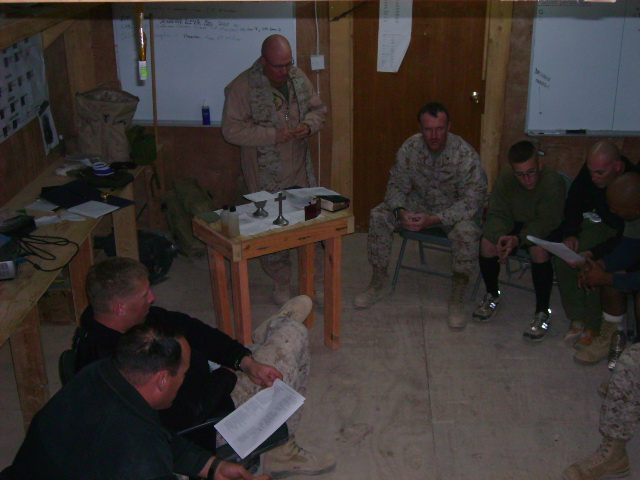
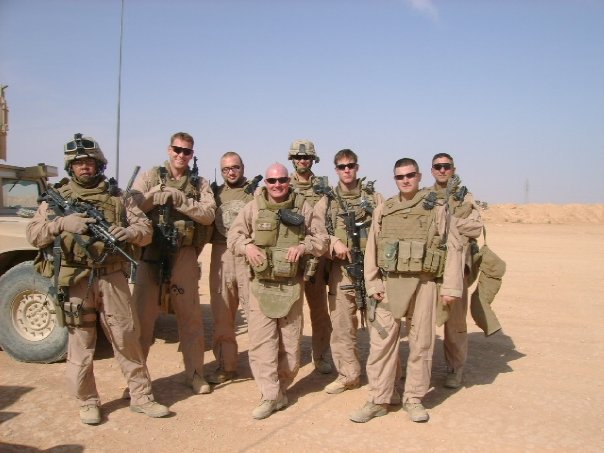
I have done my time in Iraq at Christmas on the Syrian-Iraqi Border with our Marine advisors and their Iraqis.  Since returning home have thought often of those that remain in harm’s way as well as those soldiers, sailors, Marines and airmen, American and from other nations that have spent Christmas on the front lines. Some of these events are absolutely serious while others display some of the “light” moments that occur even in the most terrible of manmade tragedies.

In American history we can look back to 1776, of course we could go back further but 1776 just sounds better. On Christmas of 1776 George Washington took his Continental Army across the Delaware to attack the British garrison at Trenton. Actually it was a bunch of hung over Hessians who after Christmas dinner on the 24th failed to post a guard but it was an American victory. In 1777 Washington and his Army had a rather miserable Christmas at Valley Forge where they spent the winter freezing their asses off and getting drilled into a proper military force by Baron Von Steuben.

While not a battle in the true sense of the word the Cadets at West Point wrote their own Christmas legend in the Eggnog Riot of 1826 when the Cadets in a bit of holiday revelry had a bit too much Eggnog and a fair amount of Whiskey and behaved in a manner frowned upon by the Academy administration. Needless to say that many of the Cadets spent the Christmas chapel services in a hung over state with a fair number eventually being tossed from the Academy for their trouble.

In 1837 the U.S. Army was defeated at the Battle of Lake Okeechobee by the Seminole Nation, not a Merry Christmas at all.  In 1862 the Army of the Potomac and Army of Northern Virginia faced each other across the Rappahannock River after the Battle of Fredericksburg while to the south in Hilton Head South Carolina 40,000 people watched Union troops play baseball some uttering the cry of many later baseball fans “Damn Yankees.” In 1864 the Army of the Potomac and Army of Northern Virginia faced each other again in the miserable trenches of Petersburg while General William Tecumseh Sherman enjoyed Christmas in Savannah Georgia after cutting a swath of destruction from Atlanta to the sea. He presents the city to Lincoln who simply says “nice, but I really wanted Richmond.”

Napoleon had something to celebrate on December 25th 1801 after surviving an assassination attempt on Christmas Eve and 1809 he was celebrating his divorce from Empress Josephine which had occurred on the 21st.

Meanwhile in Europe the 1914 “Christmas Truce” began between British and German troops and threatened to undo all the hard work of those that made the First World War possible.  Thereafter the High Commands of both sides ensured that such frivolity never happened again.

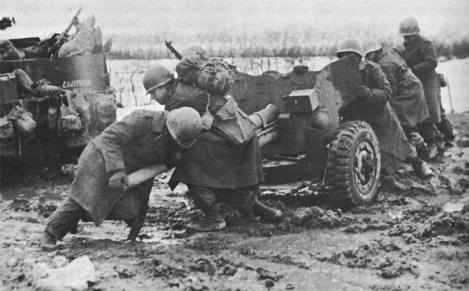
U.S. Soldiers and Anti-Tank Gun at the Battle of the Bulge

World War II brought much suffering in 1941 after Pearl Harbor the Japanese forced the surrender of Hong Kong and its British garrison while two days later the Soviets launched their counterattack at Moscow against Hitler’s Wehrmacht and the British were retaking Benghazi from the Afrika Corps.  A year later the Americans were clearing Guadalcanal of the Japanese and the Red Army was engaged in a climactic battle against the encircled German 6th Army at Stalingrad. At Stalingrad a German Physician named Kurt Reuber who is also a Lutheran minister draws “The Madonna of Stalingrad.”

The drawing which was taken out of Stalingrad by one of the last German officers to be evacuated now hangs in the Kaiser Wilhelm Memorial Church in Berlin. Reuber would draw another in 1943 while in a Soviet POW camp in which he would die in less than a month after that Christmas. Reuber wrote:

“I wondered for a long while what I should paint, and in the end I decided on a Madonna, or mother and child. I have turned my hole in the frozen mud into a studio. The space is too small for me to be able to see the picture properly, so I climb on to a stool and look down at it from above, to get the perspective right. Everything is repeatedly knocked over, and my pencils vanish into the mud. There is nothing to lean my big picture of the Madonna against, except a sloping, home-made table past which I can just manage to squeeze. There are no proper materials and I have used a Russian map for paper. But I wish I could tell you how absorbed I have been painting my Madonna, and how much it means to me.”
“The picture looks like this: the mother’s head and the child’s lean toward each other, and a large cloak enfolds them both. It is intended to symbolize ‘security’ and ‘mother love.’ I remembered the words of St.John: light, life, and love. What more can I add? I wanted to suggest these three things in the homely and common vision of a mother with her child and the security that they represent.”

In 1943 the Marines were battling the Japanese at New Britain while the Red Army was involved in its winter offensive against the Wehrmacht. In 1944 the Russians were advancing in Hungary, the Americans were engaged in a desperate battle with the Germans in the Ardennes with the German 2nd Panzer Division running out of gas 4 miles from the Meuse River and were destroyed by the American 2nd Armored Division. In the Pacific McArthur’s forces were battling the Japanese in the Philippines.

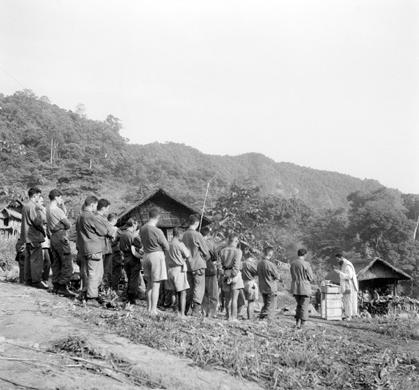
French Chaplain and Soldiers in Indochina

In the years following the Second World War Christmas was celebrated even while armies continued to engage in combat to the death. Christmas of 1950 was celebrated in Korea as the last American forces were withdrawn from the North following the Chinese intervention which the 1st Marine Division chewed up numerous Red Chinese divisions while fighting its way out of the Chosin Reservoir.  In the following years a stalemate along the front brought no end to the war and In French Indo-China the French garrison of Dien Bien Phu celebrated Christmas in primitive fashion unaware that General Giap was already marshalling his forces to cut them off and then destroy them shortly after Easter of 1954.   In 1964 the U.S. commits to the war in Vietnam and for the next 9 years American Soldiers, Marines, Sailors and Airmen will battle the North Vietnamese and Viet Cong with Marines fighting the North at Khe Sanh during Christmas of 1967.

Christmas on the Syrian Border with USMC Advisors

In the years after Vietnam American troops would spend Christmas in the Desert of Saudi Arabia preparing for Operation Desert Storm in 1990, in Somalia the following year and in the Balkans. After September 11th 2001 U.S. Forces spent their first of at least 10 Christmas’s in Afghanistan and in 2003 begin the first for at least 8 Christmas’s in Iraq.

Today Americans serve around the world far away from home fighting the war against Al Qaeda and its confederates and some will die even on this most Holy of Days while for others it will be their last Christmas.

Please keep them and all who serve now as well as those that served in the past, those that remain and those that have died in your prayers.

Peace

Padre Steve+


1 Comment

Filed under faith, History, Military

Forgotten on the Far Side of Ford Island: USS Utah, USS Detroit, USS Raleigh and USS Tangier

USS Utah BB-31 in 1920s

When you visit Pearl Harbor most eyes are drawn to the USS Missouri and the USS Arizona Memorial on Battleship Row.  On the mooring quays the names of the Battleships California, Oklahoma, Maryland, West Virginia, Tennessee and Arizona mark the places where the proud Battle Force of the U.S. Pacific fleet was moored on the fateful morning of December 7th 1941.  Movies such as Tora! Tora! Tora!, In Harm’s Way and Pearl Harbor have recorded the attack in varying degrees of accuracy for audiences worldwide in the 1960s, 1970s and 2000s. All record the attack on Battleship row and the attacks on the Army Air Corps at Hickam Field but all overlook the former battleship moored on the west side of Ford Island, the two elderly light cruisers and the Seaplane Tender moored nearby.

USS Utah AG-16 in 1935

Of course these ships hold little interest to most people, they were elderly, Utah had been converted to a gunnery training ship years before and the Omaha Class light cruisers Raleigh and Detroit were obsolescent and after Pearl Harbor would serve in the backwaters of the Pacific war.  The Tangier a new Seaplane Tender occupied the berth aft of Utah.


The USS Utah AG-16, ex-BB-31 was one of the early U.S. Navy Dreadnought battleships of the Florida Class. Utah was 521 feet long, displaced 21,825 tons and mounted 10 12” guns making her comparable to British Dreadnoughts of the Neptune and Colossus class and slightly inferior to the German Helgoland class.  Utah was commissioned on 31 August 1911 and served at the Vera Cruz incident where a Naval “battalion” of 17 officers and 371 her prevented the delivery of arms from Germany to Mexican dictator Victoriano Huerta.  The in the clash with Huerta’s forces the sailors distinguished themselves earning 7 Congressional Medals of Honor.

Utah served as part of the U.S. Battle Squadron sent to operate with the Royal Navy operating out of Ireland conducting convoy protection missions and preparing to engage the German High Seas Fleet if called upon.  Utah served from 1919-1931 as a battleship conducting training and goodwill missions to Europe and South America before being converted to a gunnery training and target ship (AG16) in 1931 per the stipulations of the Washington Naval Conference. In 1941 she was modernized and equipped with weapons being installed on modern destroyers before resuming training duties with the fleet at Pearl Harbor.

On the morning of December 7th Utah was moored on the West side of Ford Island and at colors the ship was struck by a torpedo forward and began to heal to port. With the flooding causing the list to increase the senior officer on the ship, LCDR Isquith the Chief Engineer ordered Utah abandoned and while most of the crew was able to escape some were trapped below including Chief Water Tender Peter Tomich who remained below to ensure that the boilers were secured and his sailors safely out of the boiler rooms.  Tomich was awarded the Congressional Medal of Honor for his sacrifice.  By 0812 the mooring cables had snapped and Utah lay on her beam sinking into the harbor her war over.  6 Officers and 58 crewmen died the majority trapped in the ship.  The ship would be partially righted to clear an adjacent berth in 1944.

The Raleigh and Detroit were Omaha Class Light Cruisers 555 feet long, displacing 7050 tons and mounting 12 6” guns and 10 21” torpedo tubes and were capable of 3 knots. This made them more heavily armed than the contemporary Japanese Nagara Class or the British C, D  or E Class light cruisers and larger than all but the two ship E Class. However by the beginning of the war they were inferior to all newly constructed ships.

USS Raleigh CL-7 fighting to stay afloat

The cruiser Raleigh took a torpedo that caused her to list so sharply that it was feared she would capsize, however the heroic efforts of her crew and service force craft and sailors kept her afloat and allowed her to fight another day. Most of her war would be fought in the Aleutians and following the war she would be decommissioned and scrapped.

USS Detroit CL-8 1945, final configuration

Detroit was able to get underway during the attack and avoid damage to join other ships which had escaped to form an ad hoc task group to find the Japanese strike force.  She would also serve in the Aleutians through 1944 when she became flagship of the Replenishment Group servicing the U.S. Carrier Task Forces of the 3rd and the 5th Fleets. She would be present in Tokyo Bay for the signing of the peace treaty ending the war. She too would be decommissioned and scrapped shortly after the war.

Tangier would serve in many parts of the Pacific as a mobile base for PBY Catalina’s which conducted reconnaissance, anti-submarine and search and rescue operations in support of the fleet for the duration of the war. She was decommissioned in 1947 and sold for scrap in 1961.

USS Utah Memorial (Google Earth)

Today a monument is located on Ford Island near the rusting hulk of the Utah. It replaced a bronze plaque which had been placed on the wreck in the late 1940s. The Memorial was officially dedicated on Memorial Day 1972.  The monument is not listed on most tourist brochures and the memorial attracts few visitors. I was able to visit the memorial in 1978 while on a Navy Junior ROTC Cadet Cruise to Pearl Harbor and back.  The official USS Utah association website is linked here: http://ussutah.org/ and the Historical Naval Ships Association webpage on Utah is here: http://hnsa.org/ships/utah.htm and the Naval History and Heritage Webpage is here: http://www.history.navy.mil/photos/sh-usn/usnsh-u/bb31-y.htm

The Raleigh, Detroit and Tangier have no memorials.  Despite the anonymity of these ships and the men who served on them they all played a role in the war and they should not be forgotten.

Peace

Padre Steve+


33 Comments

Filed under History, Military, Navy Ships, world war two in the pacific

The Dangerous Ignorance of the Wiki-Leakers

The Zimmerman Telegram: Just One Cable with consequences still being felt today

“A prince must imitate the fox and the lion, for the lion cannot protect himself from traps, and the fox cannot defend himself from wolves. One must therefore be a fox to recognize traps, and a lion to frighten wolves. Those that wish to be only lions do not understand this. Therefore, a prudent ruler ought not to keep faith when by so doing it would be against his interest, and when the reasons which made him bind himself no longer exist. If men were all good, this precept would not be a good one; but as they are bad, and would not observe their faith with you, so you are not bound to keep faith with them.” Niccolo Machiavelli

In 1917 the British leaked a telegram from the German Foreign Minister to the President of Mexico. By 1916 the Germans were doing all that they could to keep the United States out of the war while the British looked for ways to assist the Americans into the war. The cat and mouse campaign continued until the Germans being starved by the British blockade realized that they had to resume unrestricted submarine warfare against Britain knowing that such a resumption might well provide the United States a reason to enter the war. The Germans approached the Mexican government with the offer of an alliance and the promise of the restoration of lands lost to the United States.  The Mexican government rejected the offer because as much as they desired the restoration of land that they believed to be rightfully theirs that the Germans could not deliver.  The British knew this but waited and when the moment was right released the decrypted cable to the American Press which much as it had done against the Spanish in 1898 provided the grist for the Congress to declare war in April 1917.  The involvement of the United States in that war made the United States a player on the world stage and was the catalyst for our involvement in  the Second World War and all that has followed.  Just one cable changed history.

Julian Assange, his companions and supporters are some of the most incredibly naïve people in the world.  I do not doubt for one minute that most of them are convinced of the innate righteousness that some ascribe to whistleblowers.  You see there are times that whistleblowers are absolutely necessary.  Unfortunately most self proclaimed “whistleblowers” lack the nuance to know what should be leaked and what shouldn’t, what matters and what doesn’t and the immense dangers inherent in revealing information that potentially could lead to the targeted death of innocents or even inciting whole populations to war.

Diplomacy is a most delicate Machiavellian art.  Diplomats representing the interests of the governments work in a world where there is little that is “black and white” but rather a world of murky grays where truth is mixed with deception, blunt honesty and candor with lies and subterfuge.  It is an art filled with nuance where the slightest misstep could and often has triggered wars of cataclysmic proportions. It is a world where diplomats, military attaches and even dare I say spies work to gain their nations advantages and if they do their job well such advantages are secured without war.

To do this the diplomatic corps of various nations, even nations that are each other’s mortal enemy understand that it is possible to smile, share a drink and converse as colleagues even while seeking an advantage. That advantage might be information regarding trade agreements, military alliances, or countless other subjects.  Diplomacy is a person playing chess game with one hand and a poker game with the other at the same time.  It is a dark world that most people are ignorant of and as Barbara Tuchman said: “Diplomacy means all the wicked devices of the Old World, spheres of influence, balances of power, secret treaties, triple alliances, and, during the interim period, appeasement of Fascism” and Randolph Bourne noted “Diplomacy is a disguised war, in which states seek to gain by barter and intrigue, by the cleverness of arts, the objectives which they would have to gain more clumsily by means of war.”

Diplomacy is truly a Machiavellian enterprise that is not for the faint of heart and good diplomats understand what Machiavelli said “And to be sure, sometimes you need to conceal a fact with words, do it in such a way that it does not become known, or, if it does become known, that you have a ready and quick defense.” Diplomats understand the hard truth that the ally of today may very well be the enemy of tomorrow and that it is unwise to have allies that you are ignorant about. Sun Tzu put it well “One who is not acquainted with the designs of his neighbors should not enter into alliances with them.”

Our Founding Fathers were not fond of alliances and warned against them, unfortunately that horse left the barn years and years ago and like our European ancestors we are now dependant on alliances, even with very unseemly characters nations because for better or worse they suit our security or economic geopolitical needs.  That is the way it is. We are unable to turn back the clock to more genial time.

Thus diplomats and their work matter and what they say and do in public and in secret needs to be guarded because the consequences of “transparency” are often worse than the maintaining of secrets. The latest documents leaked by Assange and Wiki Leaks have nothing to do with revealing anything that is the reason for whistle blowing which by definition is aimed at exposing wrongdoing or illegal activity by an organization or individuals with the hope of stopping it. In some cases Wiki Leaks has done this but the latest round of leaks appear to be more about embarrassing governments and leaders around the world with no real positive gain for society or for that matter world peace. Instead they have endangered many by exposing secrets that might result in brutal civil wars, regional wars or assist terrorist groups to destabilize democracies and kill innocents.  One of the documents listed all sites deemed by the United States vital to its national security as well as those of other nations practically giving terrorists a roadmap to kill and destabilize and even increase the economic crisis engulfing much of the world.  Since many are soft targets terrorists could and likely will use the information in ways that can be unimaginably bad.

When finally confronted by governments around the world Assange threatens to release 100,000 uncensored documents that they refer to as an “insurance policy” against being silenced. The documents are in the hands of thousands of Wiki Leaks supporter who only need the key to unlock them and spill the data with very unpredictable consequences depending on what is in the files. Who knows what if they were leaked to trap Assange and his followers?

Regardless the release of these most recent documents has exposed people in many nations, mostly innocents to grave danger all it seems to feed Assange’s massive ego.  Having had to deal with a decent number of his supporters recently I know that the general attributes of his followers are arrogance, self righteousness and naiveté which when combined together are really dangerous. However they don’t seem to care as I read a post by one of Assange’s followers someone named “sunnydee” who wrote on the “Above Top Secret” website: “Hope you’ll keep us posted. And hope that someone has the guts to open it. It’s best to know the truth, no matter how ugly.” This just shows the naïve and seemingly uncomprehending mentality of many of his supporters. I could be wrong but it doesn’t seem like Assange or his followers care about the lives that could be lost and the devastation that could ensue either due to war, terrorism or greater economic calamity.  Such actions do not promote democracy or open societies they destroy them.

It seems that unless something changes quickly that Assange and his followers could ignite a spark that engulfs whole regions of the world in war and open the door wider for terrorists to destabilize weak governments around the world.  Diplomats are smarter than a lot of people give them credit for and the diplomatic cables needed to be protected and Assange has opened Pandora’s Box.

This is a dangerous gambit that nothing good can come from. God help us.

Peace

Padre Steve+


2 Comments

Filed under Foreign Policy, History, national security

Wings of Gold: U. S. Navy Carrier Aircraft 1935-1941

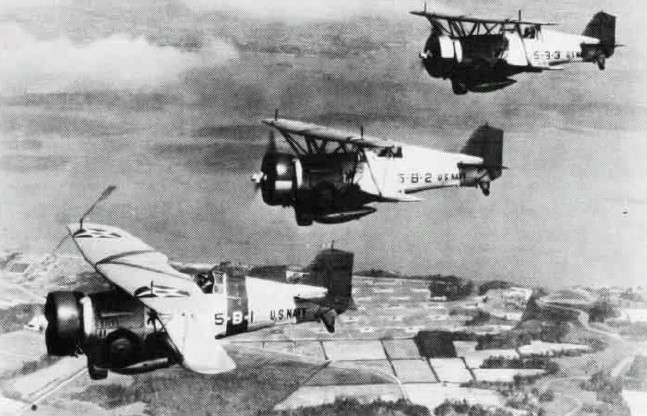
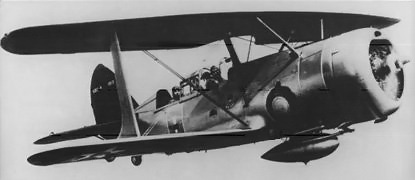
Curtiss BF2C Goshawks (US Navy Photo)

As the United States Navy built up its Carrier Force in the mid to late 1930s it continued to develop aircraft specifically designed to operate from aircraft carriers.  It continued its development of fighter, dive bomber and torpedo bomber aircraft.  In 1935 the Navy was operating the Grumman FF-1 biplane fighter which it had began using in 1933 and the Curtiss F11C and BF2C Goshawk. The Curtiss aircraft were built in fighter and bomber variants and while initial aircraft had an open cockpit and fixed landing gear later aircraft had an enclosed cockpit and retractable landing gear. They had top speed of 157 miles an hour and due to limited success and were retired from service by 1939.  The Goshawk was operated against the Japanese by Nationalist China and also served in a number of air forces including Thailand where they were used against the French and Japanese.

Grumman FF-1 (US Navy Photo)

The Grumman FF-1 was a two-seater that had a enclosed cockpit with retractable landing gear and a top speed of 201 miles an hour.  The FF-1 was faster than any naval aircraft of its era, a follow-on variant designated the SF-1 followed and 120 aircraft were built. Most of the operational aircraft served aboard the USS Lexington CV-2 in a fighter and scouting role. The FF-1 and SF-1 were withdrawn from first line service and placed with the reserve as well as being used in aviation training commands. The aircraft was manufactured under license by the Canadian Car and Foundry Company and served in the Canadian Air Force until 1942 as the Goblin and 40 of the Canadian aircraft were used by the Spanish Republican forces in the Spanish Civil War.

Grumman F2F-1 (US Navy Photo)

The FF-1/SF-1 was followed by the Grumman F2F a single-seat model with improved speed and maneuverability over is predecessors.  54 F2F’s were ordered in 1934 with the production models being delivered between April and August 1935.  The aircraft were armed with 2 .30 machine guns mounted above the cowl and had a top speed of 231 miles an hour and maximum range of 985 miles.  The aircraft would remain in service until they were replaced in 1939 with the Grumman F3F. However they remained in service as utility and training aircraft until retired from service toward the end of 1940.

Grumman F3F (US Navy Photo)

The Grumman F3F followed the F2F with 157 production models. It was more aerodynamic and had a more powerful engine that the F2F which enabled it to achieve a top speed of 264 miles an hour.  It was operated by seven Navy and Marine Corps Squadrons and entered service in 1936 and would serve aboard carriers until replaced in late 1941. It continued with 117 aircraft being stationed at naval air stations and used for training until 1943.

F2A Brewster Buffalo (U.S. Navy Photo)

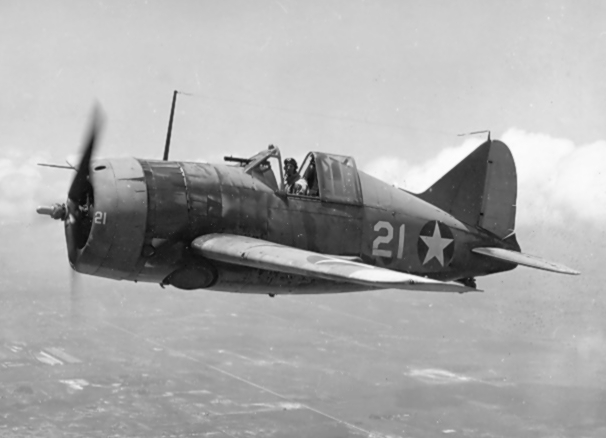
The first monoplane fighter developed and placed in service by the Navy was the F2A Brewster Buffalo. The Buffalo served with Navy and Marine Corps squadrons and was purchased by Great Britain for service in the Royal Australian and Royal New Zealand Air Forces which received 202 Buffalos. They would also serve with the Royal Navy. The Royal Netherlands Air Force received 144 most of which served in the East Indies. The final nation to receive the Buffalo was Finland which received 44 aircraft.  Buffalo was underpowered and the addition of armor and added fuel capacity further diminished the speed and performance of the aircraft.  The Navy placed its Buffalo’s in advanced training squadrons in early 1942 and one of the two Marine Corps squadrons (VMF-221) operated it at the Battle of Midway where they endured fearful losses at the hands of Japanese Zero fighters.

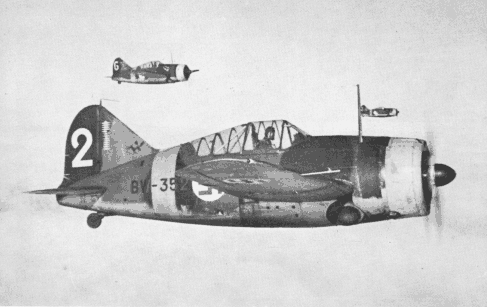
Brewster Buffalo 239s of the Finnish Air Force

Despite the lack of success in U. S. service the Buffalo performed in a heroic manner for the Finns destroying over 500 Soviet and German aircraft and producing 36 Buffalo Aces.  The highest scorer was Captain Hans W. Wind with 39 of 75 victories flying a Buffalo.  British Commonwealth and Dutch aircraft did not fare as well as the Finns as the tropical climate degraded the aircraft considerably.

Martin T4M over Lexington or Saratoga (US Navy Photo)

The Navy also developed aircraft for bombing missions as well as that could launch aerial torpedoes. The first aircraft built were dual purpose in that they could be used in level bombing and torpedo missions. In 1935 the primary aircraft of this type was the Martin T4M which had entered service in 1928 and replaced the Douglas DT and Martin T4M aircraft.  The T4M was a biplane with a crew of three that had a maximum speed of 114 miles an hour (I have driven much fast than this on the German Autobahn but I digress) and it could carry a torpedo or bombs.  155 were purchased by the Navy and the Marine Corps between 1928 and 1931.  They were operated from the Lexington and Saratoga until 1938 as no replacement aircraft offered enough improvements for the Navy to purchase and were instrumental in the development and demonstration of the capabilities of naval air power.  They were finally replaced by the Douglas TBD Devastator.

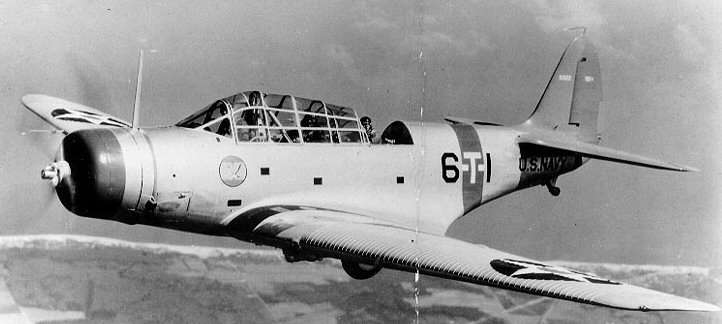
TBD Devastator (US Navy Photo)

The TBD which first flew in 1935 entered service in 1937 and at the time was possibly the most modern naval aircraft in the world and was a revolutionary aircraft. It was the first monoplane widely used on carriers and was first all-metal naval aircraft.  It was the first naval aircraft with a totally enclosed cockpit, the first with hydraulic powered folding wings.  The TBD had crew of three and had a maximum speed of 206 miles an hour and carried a torpedo or up to 1500 pounds of bombs (3 x 500) or a 1000 pound bomb.  129 were built and served in all pre-war torpedo bombing squadrons based aboard the Lexington, Saratoga, Ranger, Yorktown, Enterprise and Hornet with a limited number embarked aboard Wasp.  The Devastator saw extensive service prior to the war which pushed many airframes to the end of their useful service life and by 1940 only about 100 were operational.  They were still in service in 1942 as their replacement the TBF Avenger was not ready for service.  They performed adequately against minor opposition at Coral Sea and in strikes against the Marshalls but the squadrons embarked on Yorktown (VT3), Enterprise (VT-6) and Hornet (VT-8) were annihilated at Midway with only 6 of 41 surviving their uncoordinated attacks against the Japanese Carrier Strike Force.  They were too slow, had poor maneuverability, insufficient armor and defensive armament.  Only a few were able to launch their torpedoes as the Japanese Combat Air Patrol tore through them. Their sacrifice was not in vain as the Dive Bombers arrived facing no opposition and sank three of the four Japanese carriers getting the fourth later in the day. After Midway the remaining aircraft were withdrawn from active service in the Pacific. The Ranger’s VT-4 operated them until September 1942and Wasp’s VT-7 operated them in the Atlantic until she was transferred to the Pacific in July 1942.   By 1944 all remaining aircraft had been scrapped.

Vought SBU Corsair

In the mid 1930s the Navy began to develop Scout and Dive Bombers for use in carrier scouting (VS) and bombing (VT) squadrons.  The first of these aircraft types were biplanes.  The Grumman SF-1 was used in a scouting and bombing role and was joined by the Vought SBU Corsair in 1935 and by 1937 both were being replaced by the Curtiss SBC Helldiver, a biplane with a 234 mile an hour maximum speed, retractable landing gear, enclosed cockpit which could carry a 1000 bomb.

Curtis SBC Helldiver

However the era of the biplane was drawing to a close and the Helldiver would be relegated to training squadrons based in Florida.  Although they had a brief service career they were instrumental in develop dive bombing tactics at which the U.S. Navy excelled and which were copied by the German Luftwaffe with the Junkers JU-87 Stuka and the Japanese with the Aichi 99 Val naval dive bomber.  50 aircraft were transferred to the French and served aboard the carrier Bearn but due to the French surrender in June of 1940 saw no action and spent the war rotting in Martinique.

Vought SB2U Vindicator

The Helldiver’s were joined by the first monoplane dive bomber in U.S. service the Vought SBU2 Vindicator in 1937. The Vindicator was used by the Navy and the Marine Corps serving aboard the Lexington, Saratoga, Ranger and Wasp. They would remain in service until September 1942. The Marine aircraft equipped two squadrons VMSB 131 and VMSB-241, VMSB 241 suffered heavy casualties at Midway as the aircraft were underpowered and were limited to glide bombing missions.  After they were taken out of the operational squadrons the Vindicator served as a training aircraft until retired in 1945.   A French Naval Air Squadron was equipped with the Vindicator but they served ashore against the German invasion.  Most were lost to enemy action.  The Douglas SBD Dauntless was introduced in 1940 and 1941 but I will cover that aircraft in the World War II aircraft article that will follow this in a week or two.

These aircraft helped pave the way to aircraft that would be the mainstays of the Navy in the Second World War, aircraft with names such as Dauntless, Helldiver, Avenger, Hellcat and Corsair.  Naval aviation earned its “wings of gold” in these early years wings that continue to shine in the 21st Century.

Peace

Padre Steve+

9 Comments

Filed under aircraft, Military, US Navy, world war two in the pacific

The War to End All Wars….and a Peace to end all Peace

It was the War to end all war

On the 11th hour of the 11th day of the 11th month the guns fell silent across Western Europe and the war which had killed 16 million soldiers, sailors and civilians and wounded another 21 million more came to an end. It had begun as a conflict in the Balkans which rapidly drew in all of Europe’s major powers.  The central focus of the war was the Western Front where the armies of Germany battled those of Britain, France, Belgium and later the United States.  Battles with names such as the Marne, Passchendaele, the Somme, Verdun, Ypres, Chateau Thierry, Belleau Wood, Vimy Ridge, Cambrai, the Aisne, represented the pinnacle of killing as soldiers battled in the mud of massive trench systems and Generals sacrificing thousands of men in a day for the gain of a few hundred yards of territory throwing them against mountains of barbed wire, landmines, well emplaced machine gun nests and mortars. Massed batteries of artillery tore men to shreds leaving many men so pulverized that they would ever be identified.  Poison gas both choking agents and the long lasting mustard gas added to the hell that was the war in the West.

During the war the war Imperial Russia had fallen to a Communist revolt and surrendered, the Austro-Hungarian Empire fell in October of 1918 and even the Allies had faced near calamity on the home front. In 1917 the French Army mutinied after years of futility with only Marshal Petain the hero of Verdun able to quell it.

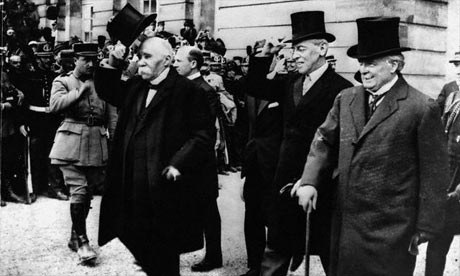
The men who drafted the Peace to end all Peace: Clemenceau, Wilson, Lloyd George

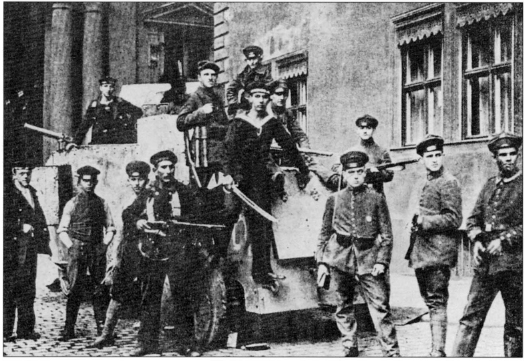
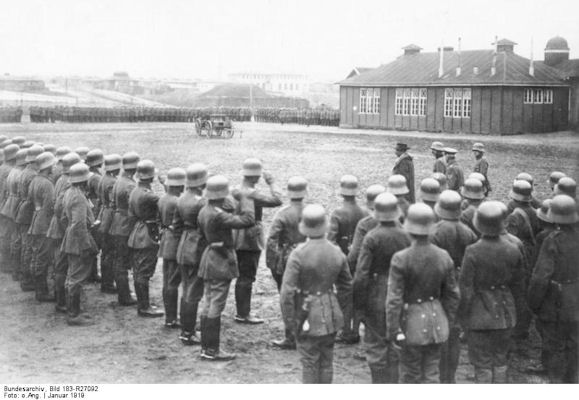
Kaiser Wilhelm II had abdicated his throne on November 9th amid a revolution at home which tore the country apart.  The new German Government accepted an armistice in the belief that the Allies would honor President Woodrow Wilson’s 14 Points.  Instead they were subjected to humiliation and starvation as the Allies refused to end their blockade of Germany until the Peace Treaty was signed. Hundreds of thousands more Germans died as a result of starvation and disease as their cities were wracked by violence as order collapsed.  It was the Socialist government which had inherited the country that had to fight the Communists in the streets allying themselves with the Army High Command to form Freikorps from units and individual soldiers under commanders willing to fight.

Soviet style revolution in Germany 1918-1919

In France at the Palace of Versailles the Allies led by the British and French brushed aside Wilson’s attempt at a just peace and placed draconian sanctions on the new German Republic which had no choice but to accept the surrender terms dictated by the Treaty of Versailles. The Army was to be reduced to 100,000 men with no heavy weapons, the Navy to a token force of obsolete ships, the air force disbanded.  Massive war reparations were imposed which were impossible for the Germans to fulfill and which were only paid off this year.  The final ignominy was the fact that the Germans were forced to bear the sole responsibility for the war. The German economy collapsed in the aftermath, France occupied key German industrial areas in the Saar and Ruhr and the nation fell into more disorder as the Deutschmark lost all of its value as hyperinflation made the money worthless.

Freikorps helped restore order when the Army dissolved

Eventually order returned to Germany with a brief period of relative prosperity which lasted until the world-wide Great Depression which through Germany back into chaos. Government after government was formed and dissolved and the last Chancellors of the Republic were forced to rule under the emergency conditions of Article 48 of the Weimar Constitution.  Eventually extremists on the left and the right brought further chaos as the eventually leading President Hindenburg to appoint the Leader of the National Socialist German Workers Party (Nationalsozialistische Deutsche Arbeiterpartei) or NSDAP as Chancellor.  We know the rest of the story. A World War that killed far more than the first 22-25 million military and 62-78 million civilians, a war of extermination on the Eastern Front, the Holocaust, and fearful weapons which ushered in the Atomic and Nuclear age.  Europe was shattered, Britain’s wealth drained and empire unsustainable, France divided and impoverished and other nations in political or economic crisis with the Soviets controlling Eastern Europe behind an Iron Curtain.

Cold War

In Europe and Asia a “Cold War” between the Soviet Communists and the West took the place of the previous war.  The United States would fight wars in Korea and Vietnam while the Soviets would rule with an iron fist in Eastern Europe and at the height of the Cold War invaded Afghanistan.  The wars in Vietnam and Afghanistan caused crisis in both the United States and the Soviet Union and Afghanistan helped mark the end of Soviet power and the end of the Soviet Union.

Around the world colonial empires fell through either revolts of colonized people or the abdication of empire by nations exhausted and economically broken by war. The many of the newly free “nations” were artificial and as a result experienced their own civil, tribal and religious conflicts the effects of which are still felt.  The end of the Cold war brought more change and for a time there was a period of American superiority but wars engulfed the Middle East as Iraq attacked its neighbors and was defeated in the Gulf War.  However the effects of that war were felt as Moslem extremists took power in Afghanistan and others including the Yemeni born Saudi Osama Bin Laden began a campaign of terror to drive the United States out of the Middle East that culminated in the attacks of September 11th 2001 and now the war that seems to have no end.

And it was the War to end all war and a peace that ended all hope of peace….God help us as it is unlikely that this war will end anytime soon for us or our allies even if we withdraw from Afghanistan.  Our enemies are too beholden to their ideology to stop their attacks until they win or are destroyed, the war will continue and God only knows how many soldiers and civilians will die in the coming years over 90 years after the War to end all War ended and the Peace to end all Peace began.

Peace

Padre Steve+


1 Comment

Filed under Foreign Policy, History, iraq,afghanistan, Military, national security, Political Commentary, world war two in europe

Veterans Day 2010: Counting the Cost of War

“It is well that war is so terrible, or we should get too fond of it.” General Robert E. Lee

Veterans Day had become a rather somber occasion for me over the past decade and since returning from Iraq in 2008 has taken on added personal significance.  I have noticed that I have become much more reflective about the sacrifices made by our military and the terrible coasts of war on our Soldiers, Marines, Sailors, Airmen and their families in this age of the all volunteer military.  The military which has about 2,225,000 members including the Reserves and National Guard is just 0.7% of the total population, the lowest percentage of military personnel compared to total population during any war in our history.  As a result this force has borne the brunt of a war that no politicians or bureaucrats figured would last half as long as it has.  As a result the “few” have been asked to do more for longer than and military that this nation has ever fielded during a war.

Thus for me Veterans Day has become a rather somber and reflective occasion as I ponder all the sacrifices made by our military and their families. In Afghanistan the U.S. Military has lost 1378 killed and our allies another 825.  In Iraq 4427 U.S. Military personnel have died along with 318 allied soldiers, not including the Iraqi military losses.  For each of the killed there are about 8 more wounded a total of over 38,000 wounded.  Of course the wounded numbers do not include 170,000+ cases of hearing damage; 130,000+ cases of mild traumatic brain injuries; and 200,000+ cases of serious mental health problems, over 30,000 serious disease cases, including a disfiguring, parasitic disease called Leishmaniasis, which results from bites of sand flies; thousands of cases of respiratory disease linked to exposure to toxic burn pit smoke and hundreds of suicides.  Then there are the injuries related to road and aviation accidents not in direct combat.  In my recent assignments in Iraq and Naval Medical facilities I have seen the human cost of the war.  I have friends who suffer as the result of Traumatic Brain Injury, PTSD and Pulmonary diseases as well as those that have been wounded as the result enemy action.  I have a dear friend with a rare and irreversible pulmonary condition from two tours in Iraq. He is 41 his lungs are those of a 70 year old man.  My best friend, a senior Naval Officer is still suffering from the effects of TBI and PTSD incurred while serving with the Marines in Al Anbar Province.

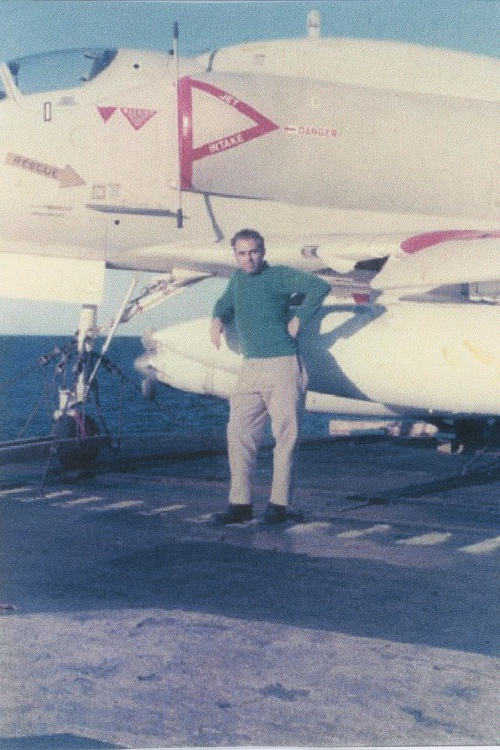
My Dad Aviation Storekeeper Chief Carl Dundas aboard USS Hancock CVA-19 off Vietnam circa 1971-72

A year ago on Veterans Day I was at with my parents in Stockton California to visit my mom and my dad who was then in a nursing facility due to the ravages of Alzheimer’s disease.  It was a terrible visit conflict with my mother due to witches’ brew of my PTSD and grief for my dad and my mother’s struggles with my dad’s condition and her own physical condition.  I visited my dad every day when in two and unfortunately he did not know who I was, Alzheimer’s had robbed him of everything that made him my dad.  He died on June 23rd of this year a day after I found out that I had been selected for promotion to Commander.  My dad was a retired Navy Chief Petty Officer who served in Vietnam on a beach detachment manning an emergency airfield in the besieged city of An Loc in 1972.  He never talked about that tour or what happened there except to tell me that he saw the Communists executing civilians in the city from his observation point.  He came home a changed man.  Thankfully he is now out of his suffering and our family is beginning to find its way back from the abyss of his illness.

I have served for over 29 years in the Army and the Navy and have witnessed many things and been blessed to have my life enriched by many veterans.  Unfortunately many of these brave men have since passed away, some having lived many years and others that have died far too young as a result of service connected injuries.

With advisors to the 3rd Bn, 3rd Brigade 7th Iraq Division COP South 2008

In my current work I see many young men that wear the Purple Heart for being wounded in combat. I see those that need assistance to walk, amputees, men with obvious scars from burns and others suffering blindness from their injuries. Our hospital’s Medical Board sees 40-60 Marines and Sailors a day, quite a few of whom that will be medically retired due to their injuries.  There are also those that have died by their own hand suffering from psychological and spiritual injuries too deep to fathom, we had one of our own Corpsman suicide last week.

The cost of war is terrible, as General William Tecumseh Sherman so eloquently put it: “War is Hell.”

Despite this our brave men and women that serve in all branches of the military as well as those that have gone before us in the 235 year history of our military have shouldered the load, for most of that history depending on volunteers who often served in obscurity often derided by their fellow Americans who believed that the military was a place to go if you could not be successful in the civilian world. The pay was low, the duty arduous and benefits few. In the Civil War, the World Wars and up until 1974 the professionals were augmented by draftees who outnumbered the professionals by a huge margin.  Since 1974 the force has been an all volunteer force.

Health and Comfort Board Team USS Hue City, Northern Arabian Gulf May 2002

Regardless of whether our Veterans were draftees or volunteers they have served this country well and on the whole to use the current Navy description are “A Global Force for Good.” The countries liberated from oppressors and helped in humanitarian operations by American Soldiers, Sailors, Marines and Airmen are many and varied.  They have represented the spectrum of our society and represent the best the country has to offer.  Unfortunately they have not always been honored by some of their our countrymen and women and sometimes the children and grandchildren of the peoples that they liberated from Nazi, Fascist or Communist oppressors who often use the wrongdoing of a few military personnel or the decisions or actions of American politicians or businessmen to label American military personnel as criminals.

Unfortunately since the military is such a small part of our population and concentrated in a few large bases it is invisible to most Americans as they live their daily lives. Often in isolated from the bulk of America such as Killeen Texas home of the U.S. III Corps and Jacksonville North Carolina the home of the 2nd Marine Expeditionary Force and Second Marine Division are quintessential military towns but neither are near major population centers and thus the sacrifice of these Soldiers, Marines and Sailors goes unnoticed by most of the nation.  In a sense the human cost of the war falls inordinately upon these military communities where there are few strangers.

In spite of this the current men and women of the American Military train, deploy, fight and return every day as they have since the 9-11-2001 attacks, many if not most have made multiple combat tours.  I have been pleased to see more support of the military in the media, especially sports media and leagues.  Many businesses are taking time to offer things of value to servicemen and women and those businesses should be commended and patronized.  I was touched by many stories that I saw about our veterans on ESPN over the past few days.  http://www.espnmediazone3.com/us/2010/11/espn%E2%80%99s-weeklong-salute-to-veterans-day/

Many of our Reserve component personnel give up civilian employment and chances for promotion to serve in the military, particularly when they are mobilized for service. When they return home most return to towns and cities that have little of the support afforded to active duty members when they return.  I pray that our political leaders in the future will exercise discernment and wisdom before committing us to another war. Otto Von Bismarck said: “Anyone who has ever looked into the glazed eyes of a soldier dying on the battlefield will think hard before starting a war.” Unfortunately the current members of the House, Senate and Executive branch have little connection to the military as very few have served and I wonder if any really comprehend this maxim.  In the 111th Congress 120 members had some form of military service.  The number of veterans in the 111th Congress reflects the trend of a steady decline in the number of Members who have served in the military. For example, there were 298 veterans (240 Representatives, 58 Senators) in the 96th Congress (1979-1981); and 398 veterans (329Representatives, 69 Senators) in the 91st Congress (1969-1971).  Those who have served a full military career are far fewer; the number of congressmen with military careers will remain relatively constant for the 112th Congress. In the Senate there will be one (as compared with two in 2006 and one in 2008) and in the House there will be eight (as compared with four in 2006 and six in 2008).  Some of these Congressional Veterans have been vilified by some broadcasters and pundits of the extreme right wing media most of whom who have never served in the military.  On the positive side nine members of the new Congress will have served in the current wars which hopefully will help promote the sacrifice of our current Veterans and help with programs that will help returning Veterans.

I have seen the cost of war up close and personal in Iraq and back here in the States. I suffer some the afflictions described as a result of my service and see the young men and women many of whom were not yet born when I enlisted in the Army, or when I was commissioned as an Army Officer, when I was a Company Commander or when I was a senior Captain in the Army. These young men and women are heroes.

Please take a moment to thank a Veteran.  If you have time volunteers are always welcome at organizations such as the USO and American Red Cross working with our troops, join or support organizations which promote the causes of Veterans including the Iraq Afghanistan Veteran’s Association www.iava.org the Veterans of Foreign Wars http://www.vfw.org/, American Legion http://www.legion.org/ , Marine Corps League http://www.mcleague.org/, the Fleet Reserve Association http://www.fra.org/, the Association of the U.S. Army http://www.ausa.org and the Disabled American Veterans http://www.dav.org/. There are also many charitable organizations that provide assistance to Veterans and their families’ one of the best being the Fisher House Foundation http://www.fisherhouse.org/ which provides comfortable and free lodging to the families of wounded, injured or sick military personnel on bases adjacent to military hospitals. I found these ten ways that you can help on Yahoo.com:

1. At 11 a.m., observe a moment of silence for those who’ve fought and died while in service to the country

2. Display an American flag

3. Attend a Veterans Day parade

4. Thank a vet for his/her service

5. Send a letter to troops through the U.S. Department of Defense Website

6. Work in a homeless shelter or soup kitchen

7. Visit a veteran’s grave or pick up trash at a veterans cemetery

8. Visit with the family of a veteran who’s serving overseas

9. Visit with a wounded vet at a local VA facility

10. Donate to the USO, the American Legion, Veterans of Foreign Wars USA or other organizations that honor and assist vets

Keep us all in your prayers and please when Veterans Day is past do not forget those of us that serve and our families, especially those men and women serving in harm’s way.  To my friends and comrades I echo the words of the German commander to his troops in captivity at the end of the Band of Brother’s mini-series:

“Men, it’s been a long war, it’s been a tough war. You’ve fought bravely, proudly for your country. You’re a special group. You’ve found in one another a bond that exists only in combat, among brothers. You’ve shared foxholes, held each other in dire moments. You’ve seen death and suffered together. I’m proud to have served with each and every one of you. You all deserve long and happy lives in peace.”

Peace

Padre Steve+

3 Comments

Filed under iraq,afghanistan, Military, PTSD, shipmates and veterans

“Victory” and Reality: Never think that War will be Easy

“No one starts a war-or rather, no one in his senses ought to do so-without first being clear in his mind what he intends to achieve by that war and how he intends to conduct it.” – Karl von Clausewitz

I was talking with a friend recently and the subject came to the support of a certain church for the war in Iraq back in 2003.  My friend, who is very thoughtful, spiritual and circumspect made the comment that “they were even against the war” when we discussed the merits of this particular church.  I thought for a second and said “after the past nine years of war was that wrong?” He paused a moment and said “I see your point.” I think that in the early months and years of this war, where we quickly deposed the Taliban in Afghanistan and Saddam Hussein in Iraq that we made unfounded assumptions about our “successes” with the end result that we have had to fight a much more protracted, bloody and costly series of wars than we had ever imagined. Like so many nations who entered into wars believing that they would have easy victories achieved at a cheap price in blood and treasure we have discovered once again that the serpent of the fog and friction of war coupled with hasty or politically expedient decisions has come to cause us great pain as a nation and after nine years a foreboding sense that we might not win in Afghanistan.

Like most Americans after the attacks of 9-11-2001 on the World Trade Center and the Pentagon I was all in favor of going after those that attacked this country wherever they were to bring those that planned these vile attacks to justice.  Within a month the United States had driven the Taliban out of power in Afghanistan and put the leaders of Al Qaida on the run.  By 2002 the US Government had began making a case against Iraq, one of a trio of nations identified as the “Axis of Evil.”  In 2003 we went to war with Iraq after failing to convince many allies of the necessity of the attack. When the “shock and awe” campaign was launched, Iraq forces defeated, Baghdad captured and Saddam Hussein driven from power there was a heady feeling of success.  Even those opposed to the invasion were amazed at the speed of and apparent ease of the conquest as pictures of cheering Iraqis filled the screen as the statues of Saddam came down.  In May President Bush landed on the USS Abraham Lincoln to proclaim “mission accomplished.” “We support the troops” ribbons and bumper stickers were the rage, victory has many friends and some churches even ascribed the victory to God.  But as the muse would say to the returning Roman conquerors, “victory is fleeting.”

We thought that we had achieved a “revolution in warfare” in the two campaigns but within months the tide had shifted in Iraq as in a colossal mistake of epic proportions a decision was made either in Washington DC or by the head of the Coalition Provisional Authority Ambassador Paul Bremer. A decision was made to disband the Iraqi Military, Police and Civil Service offices without having enough troops in place to police Iraq or civilians including NGOs and the UN available to fill the civil service gaps.  This was in direct contravention to years of CENTCOM plans. To make matters worse we had gone in so light that we had not disarmed or demobilized the Iraqi forces, thus we sent the people who could best help us restore Iraq to working order home. We sent them home and as anyone that knows Arab culture can tell you we dishonored them and created enemies out of potential friends while placing corrupt opportunists in power.  It was if we were making things up as we went rather than thinking things through and the result was a disaster.  By the end of 2004 a full-fledged insurgency had broken out an insurgency that would cost thousands of Americans and Iraqis their lives with tens of thousands of others wounded.  It was not until late 2007 and 2008 that the tides turned in Iraq as Iraqi Sunnis realized that Al Qaida backed insurgents were more of a threat to them than the American forces were.

Over the course of the war the thrill of the early days was forgotten as American Soldiers and Marines engaged a resourceful enemy that was willing to fight us in ways that we had neither expected nor planned.  War loses its luster when the thrill of victory is gone.  With the transition of the mission in Iraq and a renewed focus on Afghanistan where the Taliban had come back with a vengeance we are now moving toward being at war for 10 years.  We have fought the war with a military force that is well under 1% of the US population.  The military has fought well. We have not been defeated in open combat despite losing many troops to IEDs and ambushes; though in Afghanistan there have been a couple of near run events where small bases were nearly overrun by Taliban forces. We should remember General Hans Guderian, the creator of the Blitzkrieg and his words about the German campaign in Russia after the Battle of Kursk in 1943: “We have severely underestimated the Russians, the extent of the country and the treachery of the climate. This is the revenge of reality.” General Heinz Guderian

Nine plus years after 9-11 most of the American public as well as the political class of both parties have soured on the wars even while others seek war with Iran and maybe North Korea. I wonder about the wisdom of taking on even more enemies when the military is stretched to the breaking point and the nation is heading into bankruptcy.

But such things are not new from a historic point of view, if only we would look to history. Back in 1940 after their victories in France and the Low Countries the Germans felt as if they were invincible. By 1941 their troops were bailing out the Italians in North Africa and the Balkans while engaging the British in the air above Great Britain and in the seas around it. That did not stop Hitler from attacking the Soviet Union where as in France and the Balkans the German Army enjoyed amazing success until winter arrived and the Soviets counter-attacked.  Thereafter the German Army would not enjoy the same success and millions of German Soldiers; not to mention at least 20 million Soviet citizens and Red Army Soldiers died. Eventually the Wehrmacht was shattered, defeated and Europe devastated.

I am not saying that this will happen to the US, but it can.  We need to learn from history and look at how good people were enticed by the aphrodisiac of the “victory disease” that accompanied supposedly easy victories.  If one looks at Germany many officers, soldiers and civilians drank the aphrodisiac of victory and had their faith in Germany, their leaders and their cause destroyed as the war turned against them and they experienced defeat even while many times getting the best of their enemies on the battlefield.  Honorable men that had served their country well were either cashiered by the Nazi government and many killed by that instrument of evil because they voiced opposition to the regime.  Initially many had been lured into the trap of easy victory.

Back in 2001 and into 2003 I was like many of those men who served in the German military.  I was excited about the apparent easy victories in both Afghanistan and Iraq.   But like some German officers of that day who realized as the campaign in Russia was going badly into the fall of 1941 by late 2003 I began to sense that something was going terrible wrong in Iraq.  I think it was the moment that I heard that we had disbanded the Iraqi Army, Security forces and Civil Service as I started my course of study with the Marine Command and Staff College program held at the Joint Forces Staff College.  The experience of serving with thoughtful Marines in my unit and my fellow students; Marine, Navy, Coast Guard and Allied officers at the school helped me see the danger that was developing in our campaigns.  By the time I arrived in Iraq in the summer of 2007 the tide was beginning to turn but I saw the devastation of the country, ministered to wounded Marines and Soldiers and seen the affect of the war on Iraqis.  My duties with our advisors and their Iraqi counterparts were enlightening as I travelled about Al Anbar Province.

In the end I think that the Iraqis despite everything will do okay. I believe that most are tired of war and will not succumb again to sectarian violence on a large scale. I do not think that they have an easy road ahead but I believe the words of Brigadier General Ali as I left him for the final time: “You come back to Iraq in five years, as tourist, it will be better then.” I am not so optimistic about Afghanistan or Pakistan and I do not think we have yet seen the worst in those countries, but at least despite all of our mistakes Iraq most likely will do well.

The experience of war coupled with my study of history and military theory at the Command and Staff College as well as in my studies from my Master’s degree in Military History changed my perspective. I still serve faithfully and hope and pray for a conclusion to the wars that leaves us in better shape and brings peace to the lands that we have shed the blood of our Soldiers, Sailors, Marines, Airmen and other Federal intelligence, diplomatic and police agencies and treasure in.  I pray for my friends serving in harm’s way and those preparing to deploy and I pray for the safety of my Iraqi military friends and their families.

I am not a defeatist should someone level that charge at me.  I agree with Ralph Peters who made this comment: “We will not be beaten. But we may be shamed and embarrassed on a needlessly long road to victory.” However, I wonder if this country has the will to win and to make the sacrifices to do so and not just shovel them off on those that serve and have served throughout this war, a war which appears to have no end and which may expand to other countries.

Like the Germans we are engaged in a multi-front and multi-theater war but we have been trying to do so upon the backs of less than one percent of the population. This allows the rest of the country to live under the illusion of peace and prosperity with the bitter losses and memories of 9-11 fade into a yearly remembrance called “Patriot Day” by politicians of all stripes who often mouth empty words to eulogize the victims and thank the troops and then move on to their next fundraiser.  By doing this we have worn out the force without the full support of the nation which is absolutely necessary for the successful prosecution of a war, especially a long drawn out war such as we have now.  Unfortunately most Americans have little patience and while we mythologize a lot about World War Two one has to remember that there was a strong lobby that desired to end the war in 1944 even if victory had not been achieved.

We have a military now composed of many battle hardened and deployment weary soldiers who live in a world that the bulk of the nation does not understand nor really wants to understand.  We have seen the cost of the war multiply to the point that it has drained the ability of the military to prepare for other wars and modernize itself.  What happens if God forbid we are forced into a war with Iran or North Korea?  With what will we fight those wars?

When the Allies were cracking the German front in Normandy and the Red Army was decimating Army Group Center in the East, Field Marshall Gerd Von Rundstedt was asked what needed to be done by a General at Hitler’s military headquarters. The old Prussian warhorse simply said “make peace you idiot.” He was fired shortly thereafter. We certainly have not reached that point but should anything else break out while we are still engaged in Afghanistan and maintain a large number of troops in Iraq that could change.

One always needs to be careful when getting into “easy” and “quick” wars as more often than not they are neither easy nor quick.

Peace

Padre Steve+

Leave a comment

Filed under Foreign Policy, History, iraq,afghanistan, Military, national security

The Breakout from Normandy

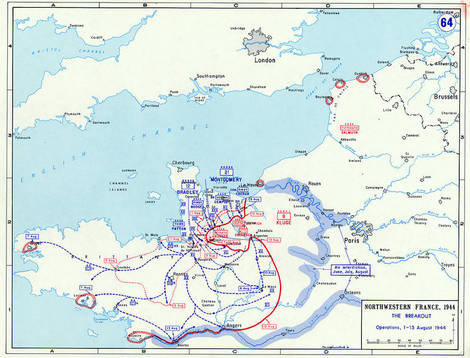
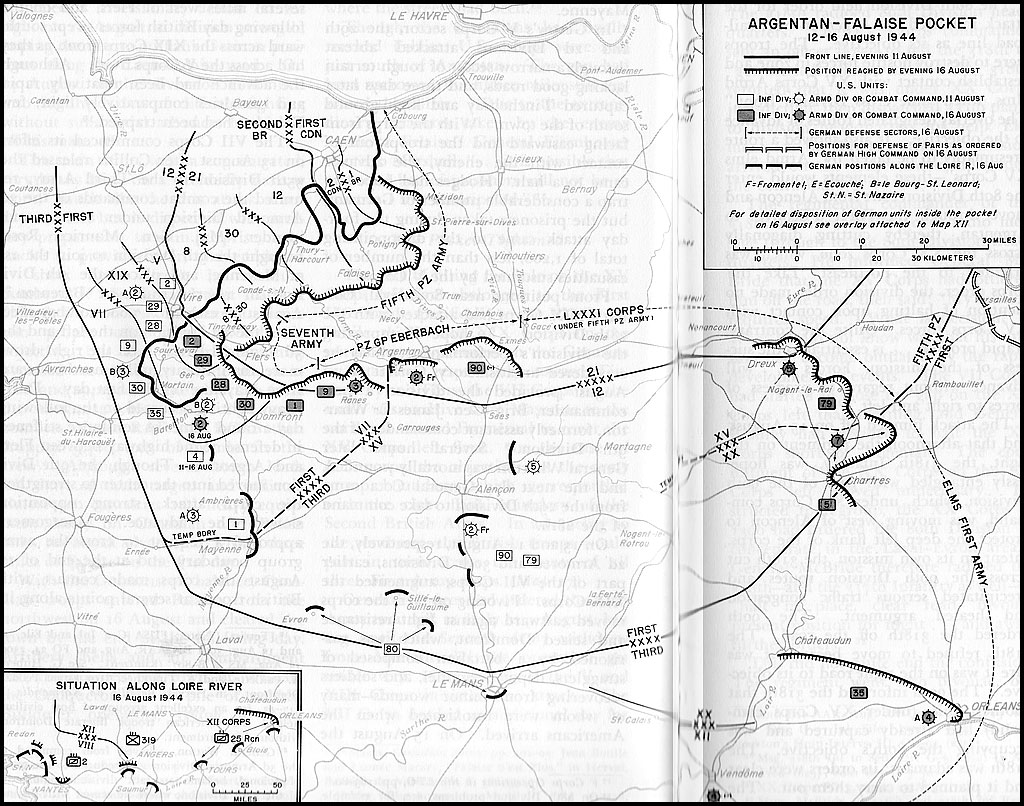
Map of Normandy Breakout

The breakout from Normandy by Bradley’s 12th Army Group at St Lo opened a realm of possibilities for the Allies to defeat the German Army in detail and end the war.  Unfortunately for the Allies the manner that they would exploit their success achieved during Operation COBRA led to their failure to completely destroy the German Army in the west in the late summer of 1944 would ultimately prolong the war.

The Allied and German problem in August 1944 was the sudden change in the nature of the campaign from a nearly static war of attrition in the Norman hedgerows to a campaign of maneuver.  This change brought about a number of opportunities for the Allies to envelope large portions of the German Army in western France as well as in Belgium and southern Holland. Max Hastings notes that the campaign became more of a “commander’s battle” in which it was “the decisions of the generals that determined the manner in which events unfolded in August, their successes and failures which brought about the position that was achieved by September.”[i] This was a major change as Hastings correctly notes in that prior to the breakout success in the hedgerows had been determined on “the ability of British, American and Canadian units to seize ground from their German opponents on the next ridge, the next hedge, beyond the next road.” [ii] In the hedgerows there was not much room for higher level commanders to influence the battle but once the breakout occurred the decisions made by commanders on both sides had greater influence in the following operations. This would become important as the weaknesses in the quality of allied generalship would begin to show, along with logistics management issues and the failure of the Allied High Command to recognize the resiliency of German forces and the resourcefulness of German leaders in their ability to cope with disaster and recover from it.  These were key elements in the campaign that kept the Allies from ending the war by Christmas.[iii]

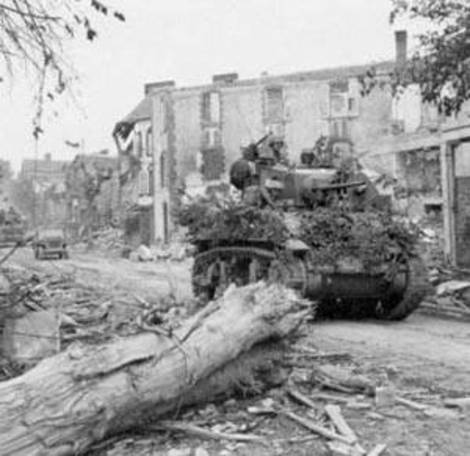
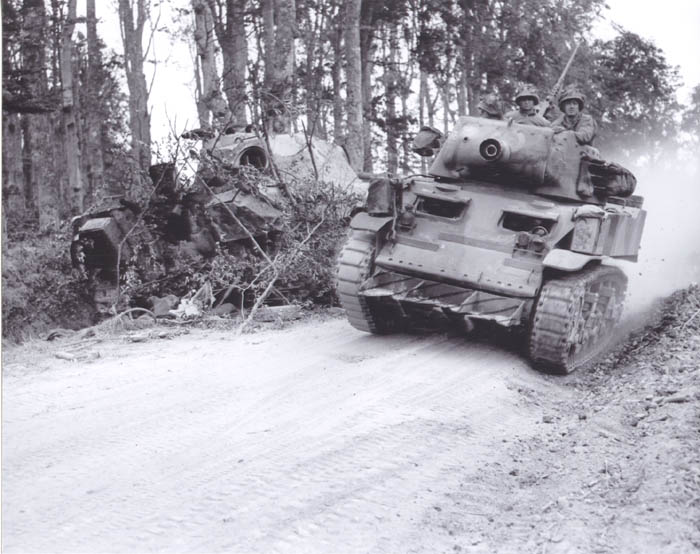
US M5 Light Tank advancing through Coutances

Early in the campaign it was decided that Bradley’s forces needed to capture the Brittany ports, particularly Brest to alleviate shortages of supplies which all still were being delivered across the beaches.  However, the implications of this decision were strategically short sighted and deprived the Allies of a decisive victory in France.  As Third Army exploited the break out from Normandy into the French interior the preponderance of its forces went west which deprived the Americans of the better part of two army corps as well as the logistical assets needed to trap the major part of the German Army in Normandy.  The campaign in Brittany would prove a diversion which did nothing to help the Allied cause.  The divisions committed, casualties taken and supplies expended in an attempt to capture ports that the Germans destroyed before the Americans could capture them. Russell Weigley points this out as a major mistake by Bradley which did little to help the Allied logistical problems and diverted much needed troops away from the focal point of the action in Normandy.[iv] Max Hastings criticized Bradley’s lack of imagination in the initial stages of the breakout by adhering to the original Overlord plan.[v] This is seconded by Patton’s biographer Carlo D’Este.[vi]

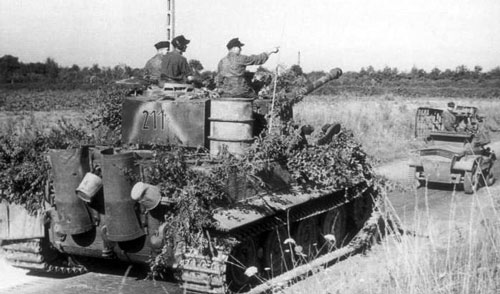
Tiger Tank in Normandy

Patton’s 3rd Army’s weakened eastern push coupled with the continued pressure of the British Army Group toward Falaise put the Germans in a strategic dilemma. With the gate open at Avranches they could attempt to restore the front in Normandy by pinching off the advance or withdraw to the Seine or even further as no “defensive position short of the permanent fortifications of the West Wall on Germany’s frontier offered so many defensive strengths as the Normandy line the Americans had just breached and turned.”[vii] The choice advocated by some senior German commanders was an orderly withdraw to the Seine which would have removed the danger of being enveloped in Normandy as well as make the Allies attack across a major water obstacle defended by still formidable formations.

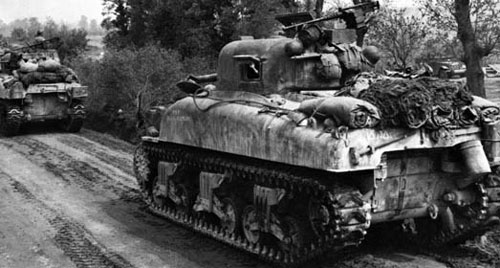
5th Armored Division Shermans near Argentan

With limited options the Hitler decided on a course of no withdraw and ordered his commanders to marshal their panzer divisions seal the breach and ensnare the allies in the hedgerows.[viii] Hitler and Field Marshal von Kluge disagreed in regard to the offensive which Kluge saw as a limited offensive but which Hitler believed gave the Germans a chance to cut off the American forces in Brittany and possibly even more.  Hitler believed that “once the coast had been reached at Avranches a beginning should be made with rolling up the entire Allied position in Normandy!”[ix] General Eugen Meindl of II Parachute Corps was blunt in his assessment of the attack. Paul Carrel in his book “Invasion! They’re Coming” quotes Meindl speaking with Von Kluge’s son a first lieutenant serving at the front:

“Kindly convey to your father exactly what I’m going to say to you. The time has come when Normandy can no longer be held. It cannot be held because the troops are exhausted. This is the fault mainly of orders to hold out in hopeless positions, but we are still being ordered to hold out even now. The enemy will break through to the west and outflank us. If your father knew what is was to operate against an enemy with downright fabulous command of the air, then he would know that our only hope of doing something useful is by attacking at night. Tomorrow’s tank attack is going to be a failure…and all that’s left for the grenadiers to do is lie down and sacrifice their lives. It’s heartbreaking to have to stand by and watch!”

Grenadiers of the 12th SS Panzer Division “Hitler Jugend”

The German attack, Operation Lüttich was led by XLVII Panzer Corps assisted by elements of 1st SS Panzer Division.  Despite warnings from ULTRA the panzers achieved tactical surprise on the front of the 30th US Division at Mortain on the night of 6-7 August advancing without the customary preparatory artillery bombardment.[x] The Germans initially made progress against the 30th Division which had recently taken over positions at Mortain. However the Americans of the 2nd Battalion 120th Infantry “Old Hickory” Regiment held onto key high ground which enabled them to call artillery fire and air strikes on the German forces attacking toward Avranches which included the elite 2nd, 116th, 2nd SS, and part of the 1st SS Panzer Divisions along with a kampfgruppe cobbled together from the remnants of Panzer Lehr and four battered infantry divisions.[xi] The Americans quickly reinforced 30th Division with elements of 2nd Armored Division, 35th Infantry Division and the veteran 4th Infantry Division to hold the line against the weakened German Panzer divisions.  Bradley and other American commanders viewed Lüttich as “an opportunity, not a threat”[xii] which could enable the Allies to entrap the vast majority of German forces in France.  Bradley was “not merely confident of withstanding them, but expected to destroy them.”[xiii] Bradley attempted to lure more Germans into the potential trap hoping that the Germans would press their attacks around Mortain.[xiv]

On the German side the ground commanders were furious at the failure of the Luftwaffe to shield them from Allied air attacks which devastated the Panzers.  The Luftwaffe and promised that 300 fighters would support the attack to provide protection from Allied close air support.  However the Luftwaffe squadrons were engaged by British and American fighters and so badly mauled that no Luftwaffe units made a appearance over Mortain.[xv] Thus despite their initial success which had promise of cutting off the advancing American spearheads the German Panzers were turned back by the Americans who did not even halt their eastward movement which further imperiled the German forces in Normandy.

With the German Panzer divisions ensnared at Mortain, the 3rd Army drove east while the Canadian army attacked towards Falaise. Bradley suggested that the Allies attempt a short envelopment of German forces at Falaise in which over 100,000 German troops would be trapped between the Patton’s troops advancing north and the Canadians.  The Canadians opened their TOTALIZE offensive from Caen to Falaise on August 8th but as was the case in every part of the campaign against determined German resistance as the XV Corps of 3rd Army advanced east.  Bradley’s plan ended the deep envelopment by XV Corps of 3rd Army designed to entrap the Germans against the Seine crossings, an operation that might promise “still surer results.”[xvi] Bradley told Treasury Henry Morgenthau that he had “an opportunity that comes to a commander not more than once in a century. We’re about to destroy and entire hostile army.”[xvii] Hastings noted that “had the Germans “behaved rationally, recognized the threat of envelopment to their entire front and begun a full-scale retreat east, then Bradley could indeed been accused of losing his armies a great prize.”[xviii]

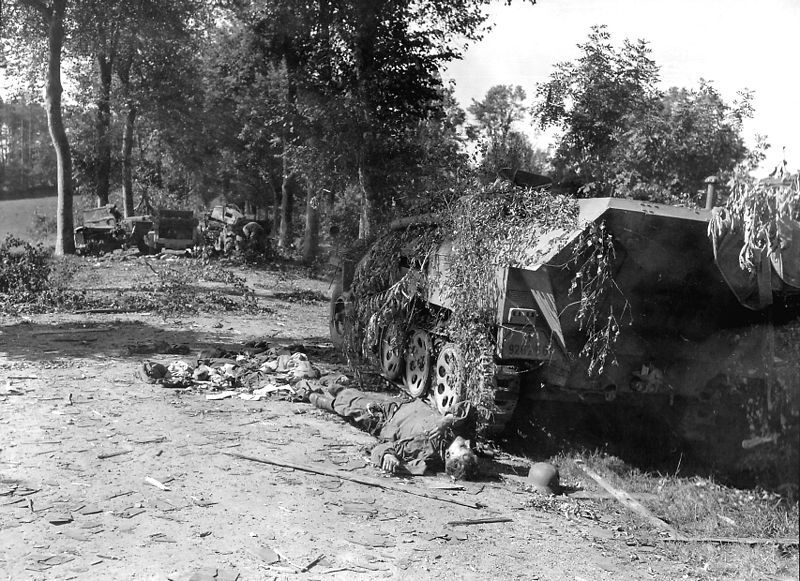
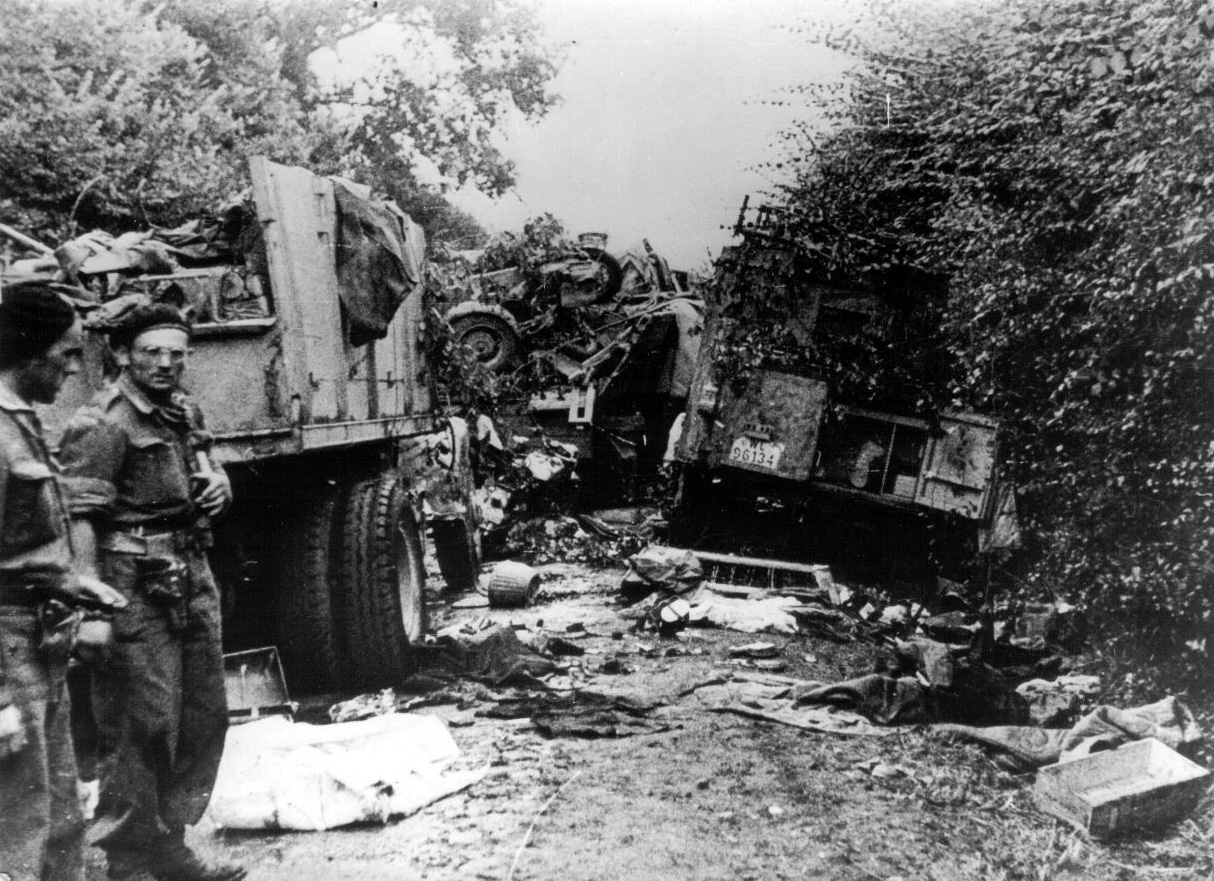
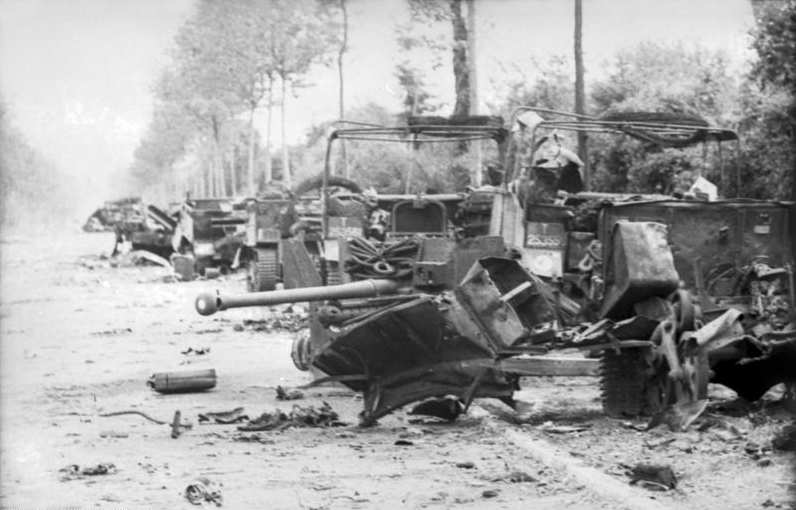
Wrecked German vehicles near Mortain

The decision by Bradley to turn the better part of 3rd Army west into Brittany had deprived him of forces that could have better accomplished mission of entrapping the Germans.  General Wood of 4th Armored Division to his dying day “remained embittered over the lost opportunity”[xix] when his division was turned back into Brittany rather than being allowed to move east toward the Seine.   Weigley points out an even deeper flaw regarding the Brittany decision.  This was that that the OVERLORD planners “had not thought anything resembling the Avranches breakout and pursuit without pause to the Seine likely… stating that it is among the worst forms of generalship that takes counsel of its fears. Yet that was exactly the condition of OVERLORD logistical planning.”[xx] Weigley’s point is well taken, the Allies had not planned for success nor had they anticipated in the OVERLORD planning the full range of possibilities that might open to them once a breakout had occurred.

12th SS Panzer Division Machine Gun team

The Allies did have a chance to destroy the German 7th Army.  The LXVII Panzer Corps and II SS Panzer Corps as well as the remnants of II Parachute Corps and other formations battered in Normandy were attempting to withdraw to the east from Mortain. The remnants of I SS Panzer Corps led by 12 SS Panzer Division and Army Panzer divisions such as the 21st Panzer Division offered determined resistance to the Canadians who were attacking toward Falaise.  To the south only scattered Kampfgruppen of divisions shattered in Normandy opposed Patton’s forces at Argentan. The Germans were aided by a fortuitous decision of the commander of the 2nd French Armored Division to move a combat command along a road needed by the American 5th Armored Division delaying it and allowing the Germans to send a battalion into the Argentan which could have “fallen easily a few hours before.”[xxi] The Allies were bedeviled by several other failures which prevented the short double envelopment from occurring and allowing the remnants of 7th Army to escape to fight again despite grievous losses in men, material, and especially armored fighting vehicles, artillery and motor transport.

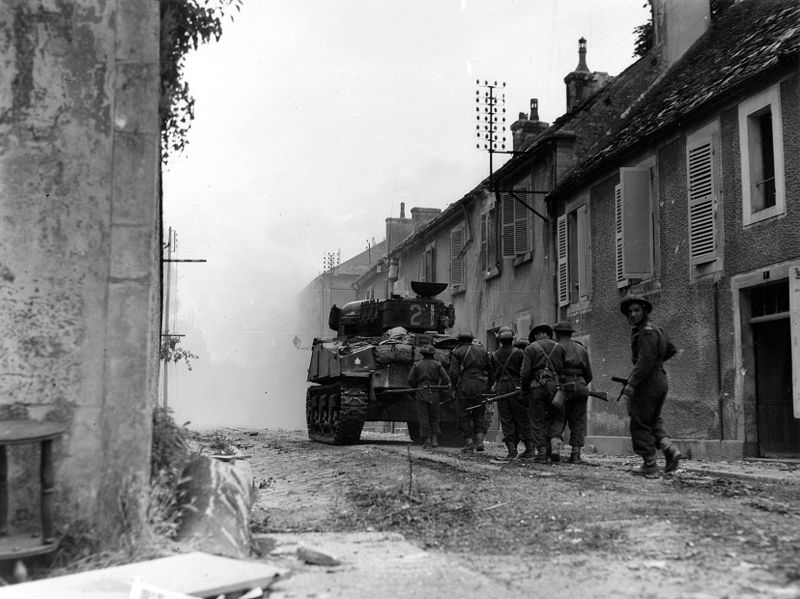
Canadians advance in Falaise

The first of these was the Canadian failure to push the Germans out of Falaise despite overwhelming material and air superiority.  The Canadian offensive Operation TOTALIZE was planned by the best of the Canadian generals, General Simonds. Unfortunately Simonds was not in command of the operation.  Totalize was a promising attack but bogged down halfway to Falaise due to a quick counterattack by 12th SS Panzer kampfgruppen, as well as a misguided bombing attack on the attacking forces by Allied air units, and the inexperience of the attacking units.  The Canadian 4th Armored Division and Polish 1st Armored Divisions paused to eliminate strong points rather than bypass them which allowed the Germans to reform their lines.[xxii] The second failure was that of Montgomery who refused to adjust army group boundaries with Americans and instead ordered the Canadians “renew their drive promptly and vigorously.”[xxiii] This refusal held the Americans advance at Argentan while the Canadians battered themselves against far stronger German opposition.  However, General Crerar of Canadian 1st Army was as bad of Army commander as could be found.  Weigley somewhat sarcastically points out that Crerar spent five days “doing what really battlewise generalship could do by regrouping and making diversionary attacks.”[xxiv] It took over 48 hours for Crerar to launch a determined attack to close the gap despite the weakness of German forces. Even a personal phone call by Montgomery to Crerar urging him to “close the gap between First Canadian Army and 3rd U.S. Army” did nothing to move the Canadian general and Crerar’s dawdling allowed many Germans to escape from Normandy to fight again.[xxv] Despite the vice that had closed around them the Germans successfully withdrew experienced battle groups of elite Wermacht and SS Panzer Divisions as well as the Paratroopers of II Parachute Corps to fight again.  General Meindl himself led a battle group of Falschirmjaeger from his Corps during their breakout through the Allied lines.  Despite the loss of 40,000 soldiers in the Falaise Pocket the Germans had saved a substantial part of their Army.

US Infantry advancing near Argentan

General Kurt Meyer of 12th SS Panzer Division faulted the Canadian leadership with a failure to use imaginative planning, and noted that “none of the Canadian attacks showed the genius of a great commander.”[xxvi] American units which Patton had cautiously advanced north of Argentan towards Falaise were recalled after Bradley was unable to convince Montgomery to alter the army-group boundary in light of the new circumstances.[xxvii] Patton recounted that he believed that his units could have “easily entered Falaise and closed the gap” and that the “halt was a great mistake.”[xxviii]

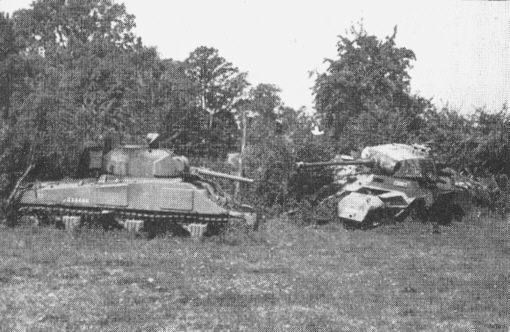
Knocked out Sherman of the Polish Armored Division next to a knocked out Panther

Weigley blames Bradley as much for the halt order as much as Montgomery for “discouraging whatever might have been done to rectify the blunder- even discouraging on August 13th a call from the Supreme Commander to Montgomery about the inter-allied boundary.”[xxix] Thus through a series of Allied mistakes particularly by senior commanders the first opportunity to envelop the Germans passed into history as a great yet incomplete victory.  A victory which though impressive allowed experienced German forces to escape to fight again. As the Germans escaped from Falaise the Allies began a pursuit in conjunction with landings in the south of France that would take them to the borders of Germany.

Polish Soldiers at the Corridor of Death


[i] Hastings, Max. Overlord: D-Day and the Battle for Normandy Vintage Books, New York, 1984 p.280

[ii] Ibid.

[iii] Hastings, Max. Armageddon: The Battle for Germany 1944-1945 Alfred a Knopf, New York, 2004 p.37.  Hastings comments that “British planners threw away it had learned since 1939 about the speed of reaction of Hitler’s army, its brilliance at improvisation, its dogged skill in defense, its readiness always to punish allied mistakes.”

[iv] Weigley, Russell F. Eisenhower’s Lieutenants: The Campaign of France and Germany, 1944-1945, Indiana University Press, Bloomington IN, 1981pp.184-186

[v] Ibid. Hastings. Overlord pp.282-283

[vi] D’Este,  Carlo. Patton: A Genius for War. Harper Collins Publishers New York, 1995 pp.632-633

[vii] Ibid.  p.195

[viii] Ibid. Also

[ix] Warlimont, Walter. Inside Hitler’s Headquarters 1939-45 Presidio Press, Novato CA 1964 pp.449-450.

[x] Ibid pp.195-196. Weigley notes that Montgomery and most other Allied commanders  had been optimistic in not anticipating the German counter attack despite the ULTRA warnings, while Bradley and Patton were cautious in making troop deployments.

[xi] Michael Reynolds in Steel Inferno: The 1st SS Panzer Corps in Normandy notes that the Americans inflicted “astonishing casualties on the northern thrusts of 2nd SS Panzer and remained undefeated when the Germans withdrew 4 days later.”  Reynolds, Michael Steel Inferno: The 1st SS Panzer Corps in Normandy Dell Publishing, New York, 1997 p.264

[xii] Ibid. Hastings Overlord p.283

[xiii] Ibid.

[xiv] Ibid. Weigley p.199.

[xv] Carrell, Paul. Invasion! They’re Coming!” Trans. E. Osers, Originally published as Sie Kommen! Gerhard Stalling Verlag 1960, Bantam Books New York, 1964, 5th Printing June 1984. p. 249

[xvi] Ibid. Weigley p. 199

[xvii] Ibid. p.200

[xviii] Ibid. Hastings. Overlord. pp.282-283

[xix] Ibid. D’Este. p.631

[xx] Ibid. Weigley. p.286  He also points out that the Brittany diversion could have been “worse had it not been for Montgomery’s influence”  p.288

[xxi] Ibid. p. 202

[xxii] Ibid. p.204

[xxiii] Ibid.

[xxiv] Ibid.

[xxv] Reynolds, Michael Steel Inferno: 1st SS Panzer Corps in Normandy Dell Publishing New York, 1997. p.320.

[xxvi] Meyer, Kurt Grenadiers trans. By  Michael Mende and Robert J.  Edwards, J.J. Fedorowicz Publishing, Inc. Winnipeg Manitoba, Canada 2001 p.290.

[xxvii] Ibid. Hastings Overlord pp.288-289.

[xxviii] Patton, George S. War As I Knew It Bantam Books NY  published 1980, originally published by Houghton Mifflin Company 1947. pp.101-102

[xxix] Ibid. Weigley p.209  Weigley quotes Major Hansen, Bradley’s aide in stating that the Falaise halt orde was “the only decision he has ever questioned.”

Leave a comment

Filed under Loose thoughts and musings

D-Day and After: Battling Through the Bocage

US 155mm Howitzer in Normandy. The American artillery was considered the best branch of the American combat arms by the German commanders

It took nearly a week for the American V and VII Corps on Omaha Beach and Utah Beach to link up with each other and secure their beachheads against fierce German resistance.    Elements of the 29th Division and the 90th Division pushed inland from OMAHA to expand the beachhead toward UTAH. Opposed by the 352nd Division, elements of the 91st Airlanding Division and other non-divisional units the American divisions took heavy casualties.  The fighting revealed the inexperience of the American infantry formations and the uneven quality of their leadership as they tackled the Germans in the labyrinth of the Bocage country. However by June13th the link up was solid enabling the Americans to conduct the follow up operations needed to expand the beachhead, secure Cherbourg and clear the Cotentin.
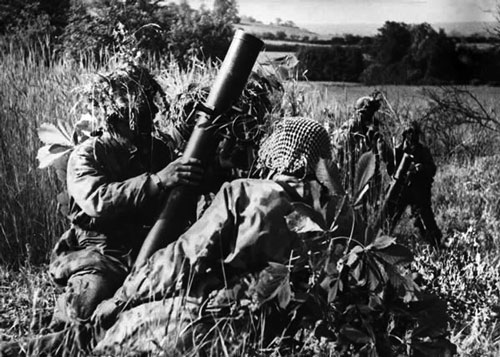
German Falschirmjaeger with 81mm mortar. This simple weapon was one of the most lethal in the German arsenal and accounted for a large number of Allied infantry casualties

The lack of success of the 90th Division, led the VII Corps commander General “Lightening Joe” Collins to relieve the division commander and two of his regimental commanders.   This was a portent of things to come with other American units as they took heavy casualties despite having a vast superiority in firepower over the Germans.[i] As the two corps pushed into the “Bocage” they were followed by a massive build up of troops and equipment delivered to the beaches and to the artificial “Mulberry” harbors.  Despite their numeric superiority, air supremacy and available Naval gunfire support and facing few units of high quality save the 352nd, 91st and the 6th Parachute Regiment, the Americans made painfully slow progress as they expanded the beachhead.[ii]
Poor training and leadership caused many US infantry casualties and many GIs to be captured. Here a Falschirmjaeger accepts a cigarette from a GI of the 29th Infantry Division

Once the beachheads had been consolidated the Americans turned their attention toward Cherbourg. This was the major Naval Port at the far northwest tip of the Cotentin and considered vital to the resupply of the Allied forces as they pushed into the heart of France.  D-Day planners counted on the swift capture of Cherbourg and rehabilitation to serve as a supply port for the Allied forces to lessen the dependency on the artificial Mulberry harbors. The first task was to isolate Cherbourg and to do this the 9th Division drove south from the beaches to the coast near Barneville.  The corps captured Barnville on the 18th of June cutting off the German forces covering the approaches to Cherbourg.[iii] This put the Germans in a bind as the 7th Army “had to split its forces in the peninsula in order to hold the fortress a little longer and thus to gain time for the establishment of the southern front on the Cotentin peninsula.[iv]
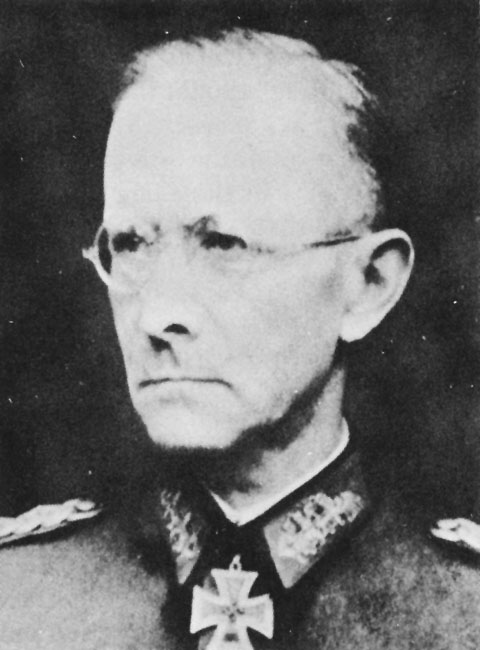
General Erich Marcks a one legged veteran of the Eastern Front led a spirited defense until he was killed in action

The German forces arrayed before Cherbourg waged a desperate defense centered on the 243rd Infantry Division and other assorted battle groups of LXXXIV Corps. During the fighting the LXXXIV Corps commander General Marcks was killed in action on 12 June.[v] This was a tough loss for the Germans as Marcks was a resourceful planner and resolute leader and considered one of the best German commanders in Normandy.

Once Cherbourg was cut off from German support Collins and the U.S. VII Corps composed of the 9th, 4th and 79th Divisions pushed up the peninsula capturing Cherbourg on June 29th.  Bradley pushed hard for the capture of the port as the Mulberries had been ravaged by a severe Channel storm greatly diminishing the over the beach logistics support. Cherbourg’s port was thoroughly demolished by German engineers and would not be fully operational for months. The loss of the Mulberries and delay in Cherbourg’s availability meant that few supplies were landed on the beaches.  This would “hinder the escape from the constricting land of the hedgerows into which the Americans had come in search of a port” [vi] and was a setback to allied planning.
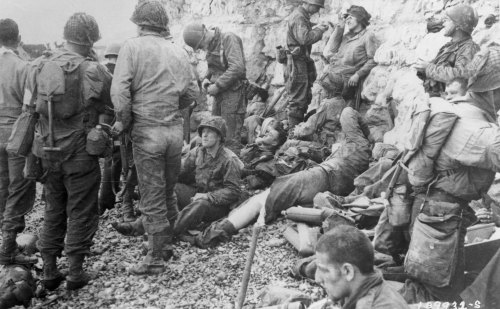
US 1st Infantry Division soldiers pause during operations in Normandy

To the east of VII Corps the V Corps under Major General Leonard Gerow made a cautious advance by phase lines toward Caumont, St Lo and Carentan.  The deliberate advance by the Corps toward a line weakly held by the Reconnaissance battalion of the 17th SS Panzer Grenadier Division was directed by Bradley who did not want to divert attention from the effort against Cherbourg.  A more aggressive commander might have tried to push further to expand the beachhead but caution was a hallmark of the American campaign in Normandy up to Operation COBRA.  After capturing Caumont V Corps halted and continued aggressive patrolling to deceive the Germans while digging in.[vii] Bradley’s decision to err on the side of caution had an effect on the broader campaign in Normandy.   Had Bradley directed a strong push against the weak German line it could have led to an opportunity to envelope the German line west of Caen. The opportunity lost through caution helped lead to the bloody and controversial campaign to capture Caen.[viii] Throughout the campaign in the Bocage American units were badly handled by their commanders, especially at lower levels and the experience and initiative shown by German battle groups and small unit leaders constantly stymied to American advance.
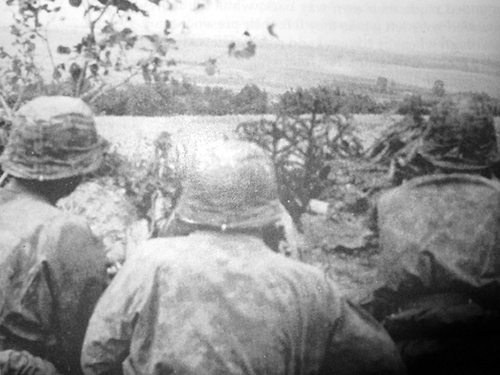
German Panzergrenadiers on Hill 112 awaiting a British attack beyond Caen

The Americans were not alone in their struggle against the Germans. Field Marshal Bernard Law Montgomery had ambitious plans to break out of Normandy by capturing Caen on D-Day and driving toward Falaise and Argentan.  The British failed to capture Caen and their plans were frustrated by the rapid reinforcement of the sector by the Germans.   The 21st Panzer, Panzer Lehr, and the 12th SS Panzer Divisions skillfully defended the area taking a fearful toll on the British and Canadians arrayed against Caen.
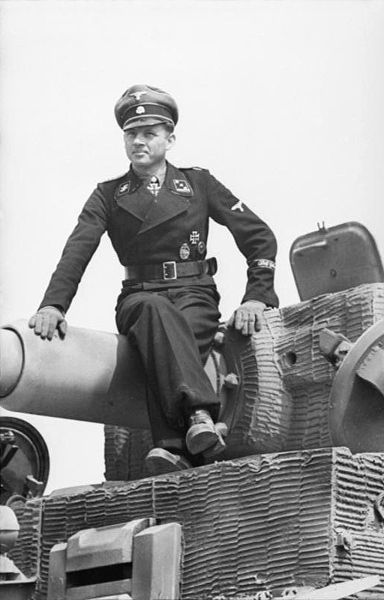
Captain Michael Wittmann of the 101st SchwererPanzer Battalion (Heavy Tank Battalion) in Normandy

A flanking maneuver at Villers-Bocage was frustrated by a few Tiger tanks of SS Heavy Tank Battalion under the command of Captain Michael Wittmann that destroyed 14 tanks and 15 personnel carriers of the British 7th Armoured Divsion along with 2 anti-tank guns within the space of 15 minutes. [ix]
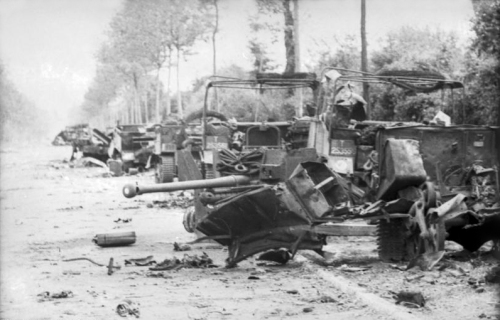
Vehicles Destroyed by Wittmann’s detachment at Villers-Bocage

Likewise a series of disastrous attacks toward Caen (EPSOM, CHARNWOOD and GOODWOOD) which were strongly supported by air strikes and naval gunfire were mauled by German forces and only finally succeeded in taking the unfortunate city of Caen on July 18th.
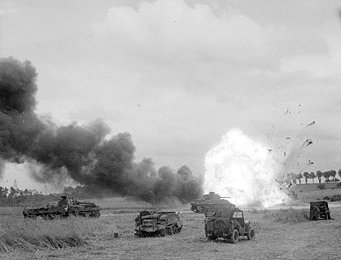
British Ammo Carrier goes up in flames after being hit by German fire during Operation Epsom

However the British failed to take the heights beyond the town[x] which led to more attacks against crack well dug in German forces.  In the campaign to take Caen and the hills beyond it the British took heavy casualties in tanks and infantry which seriously strained their ability to conduct high intensity combat operations in the future.[xi] The one benefit, which Montgomery would claim after the war as his original plan was that German forces were fixed before Caen and ground down so they could not be used against Bradley’s breakout in the west at St Lo.[xii]
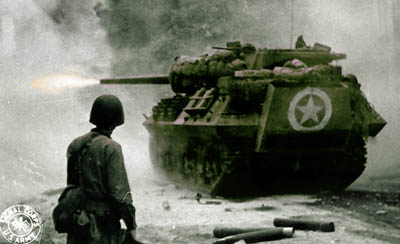
US M-10 Tank Destroyer firing at German positions in Normandy

The Caumont gap no longer “yawned invitingly in front of V Corps;”[xiii] as the Germans had reinforced the sector while the Americans dug in, yet now Bradley wished to push forward rapidly to achieve a breakthrough in the American sector.[xiv] Facing the most difficult terrain in France amid the Bocage and swamps that limited avenues of approach to the American divisions committed to the offensive.  The Americans now faced their old foe the 352nd division as well various elements of elite II Parachute Corps, the 17th SS Panzer Grenadier and Panzer Lehr Divisions.
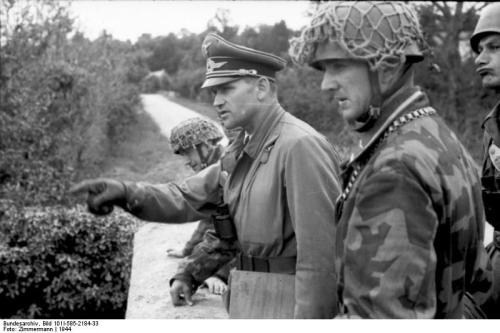
German Falschirmjaeger in Normandy

American tanks and infantry made slow progress and incurred high losses as they fought the Germans yard by yard in the Bocage.  The Americans incurred high numbers of casualties and in the VIII Corps sector alone the attack “consumed twelve days and 10,000 casualties to cross eleven kilometers of the Bocage…the achievements of the VII and XIX Corps were no better than comparable.[xv] Such losses incurred so early during the campaign would have far reaching effects when the Americans reached the Alsace-Lorraine and the German border.
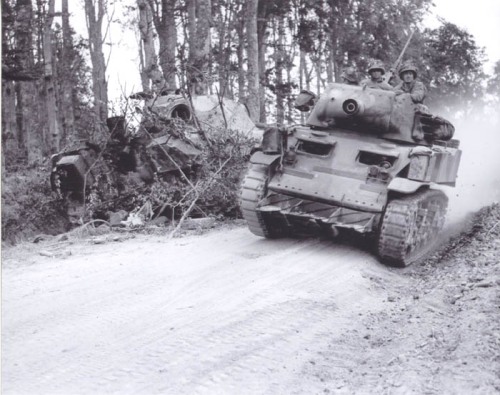
M-8 Gun carrier of a reconnaissance battalion advancing in Normandy

In order to break out of the Bocage the town of St Lo had to be captured.  It lay at a vital road juncture and its capture would help open the way into the French interior, thus St. Lo was key to Bradley’s breakout efforts.  His First Army had to capture it and the roads leading of it to launch Operation COBRA along the coast.  The task of capturing St. Lo was assigned to Gerow’s V Corps and Charles “Cowboy Pete” Corlett’s XIX Corps.  They faced opposition from the tough paratroops of the German 3rd Falschirmjaeger (Parachute) Division of II Parachute Corps commanded by General Eugen Meindl a tough veteran paratrooper and resourceful commander who had been shot through the chest at Crete.
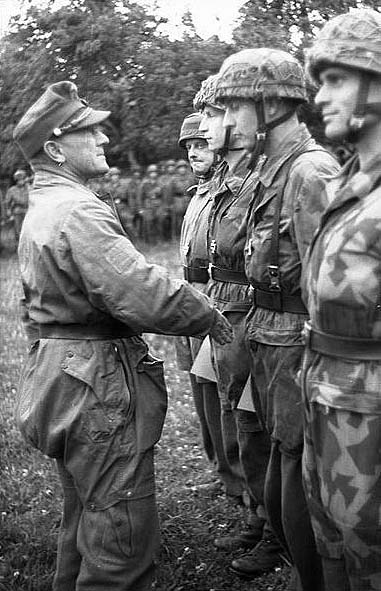
General Eugen Meindl of II Falschirmjaeger Corps decorating troops. In contrast to many Allied commanders many senior German officers like Meindl led following the doctrine of “Auftragstaktik” from the front sharing the hardships and dangers of their soldiers

The 2nd, 29th, 30th and 83rd Divisions of XIX Corps fought a tough battle advancing eleven kilometers against the German defenders again taking high numbers of casualties especially among the infantry.  However they were successful and secured St. Lo on 18 July.[xvi]
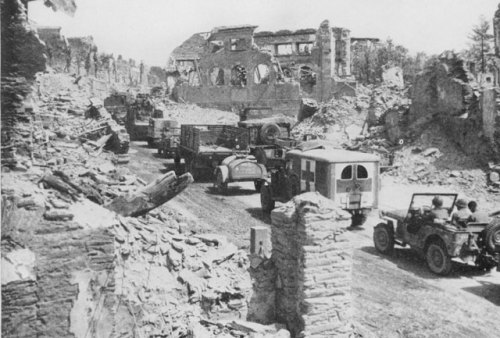
US Vehicles advancing through the shattered city of St Lo

With St Lo in their possession the Americans had finally cleared the hedgerows of the Bocage and now looked at the open country of the French interior.  St Lo epitomized the struggle that the American Army had to overcome in the Bocage.
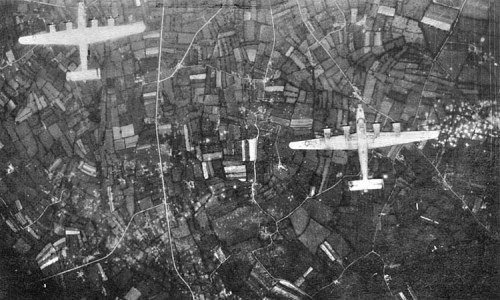
B-24’s Bombing St Lo on July 25th an attack that went awry killing many US soldiers near the front

Americans faced hard fighting against heavily outnumbered but superiorly led German troops that occupied excellent defensive country that inflicted heavy casualties on the Americans for every yard of ground given up. The Germans for all of their disadvantages exacted a terrible price in American blood between D-Day and the capture of St Lo despite the Allied control of the skies and the numerical superiority of the American Army.[xvii]
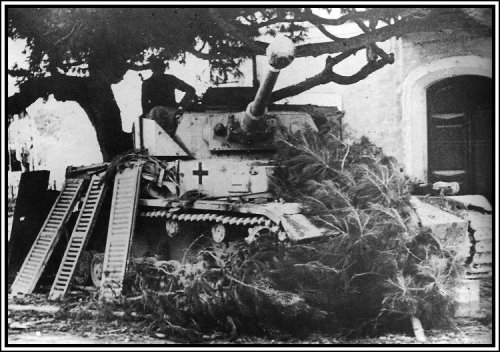
A Panzer IV camouflaged in a Normandy town

With the Bocage behind him Bradley desired to push the Germans hard and moved from a cautious to bold strategy to break the German line.  COBRA was his plan to break out of Normandy.  Bradley ably assisted by Collins realized that the better terrain, road networks past St Lo favored a decisive breakout.  American preparations for the attack included a technical advance that allowed tanks to plow through hedgerows, the “Rhino” device fashioned by American troops which was installed on three of every five First Army Tanks participating in the operation.[xviii] The Rhino device allowed the American Tanks to cut through the thick earthen hedgerows instead of being forced to climb them and expose their unprotected bellies to German anti-tank weapons or limit their movement to the constricted road net.
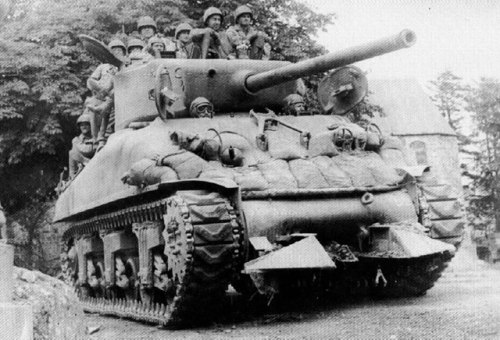
Sherman Tank equipped with the Rhinoceros device

As the Americans prepared the Germans continued to conduct a spirited active defense but were hampered by a lack of reinforcements.  As it happened they did not receive reinforcements in anywhere close to the numbers needed as the German Replacement Army was hoarding vast numbers of troops in Germany in anticipation of the plot to assassinate Hitler of which several high ranking members of the Replacement Army were leading conspirators. The Germans at the front were being starved of replacement divisions even as the Allies continued to build up their own forces in Normandy.
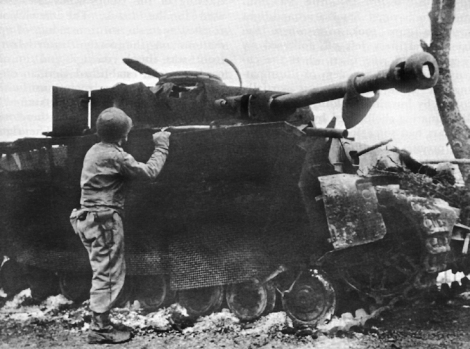
GI inspecting a knocked out Panzer IV

VII Corps was designated to lead the attack which was to begin on July 24th. American planning, reflecting more experience against the Germans was more advanced than in past operations.  Collins and Bradley planned for exploitation operations once the breakthrough had been made as part of the overall operational plan.  The aircraft of the 8th and 9th Air Forces were designated to conduct a massive air bombardment that would precede the attack. Division, Corps and additional artillery battalions were allotted to pulverize German positions to assist in the breakthrough.   A mistake by the heavy bombers in the 24th resulted in the heavy casualties to forward units which led to a postponement of the attack until the 25th of July.[xix]
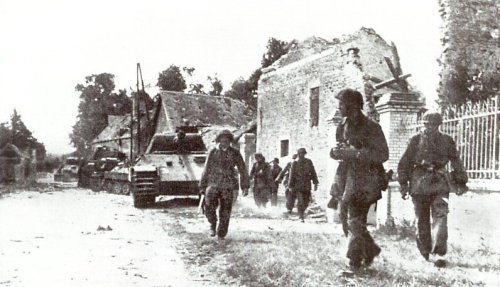
German Panzers and Panzer Grenadiers advancing in Normandy

The attack commenced on the 25th and yet another mistake by the bombers led to more American casualties[xx] and the dead included Lieutenant General Leslie McNair.  McNair was the Commander of Army Ground Forces, a position from which he directed the organization and training of American ground forces.
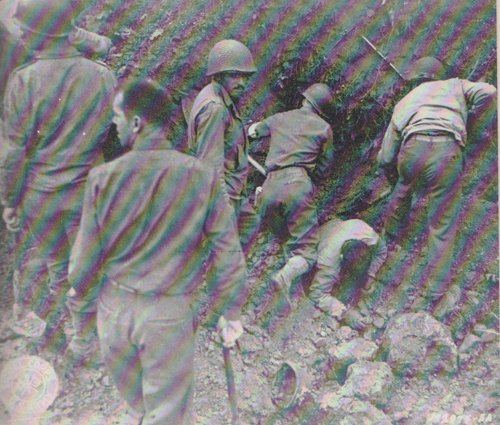
Men of Co D 117th Infantry being dug out after being bomber by “friendly” US Bombers at St Lo

Many of McNair’s decisions were responsible for the lack of adequate training received by American soldiers as individuals and units which had a direct correlation to the less than stellar performance of many American divisions in the European campaign. However the effect of the bombardment on the German forces was profound as men, equipment and fortifications were blasted by a barrage that the Germans had not yet encountered on the western front.  VII Corps units pressed forward against the determined resistance of Panzer Lehr survivors and the remnants of units that had fought the Americans since the invasion began.  Although it was a “slow go” on the 25th Bradley and his commanders were already planning for and beginning to execute the breakout before the Germans could move up reinforcements.  The 26th of June brought renewed attacks accompanied by massive air strikes.
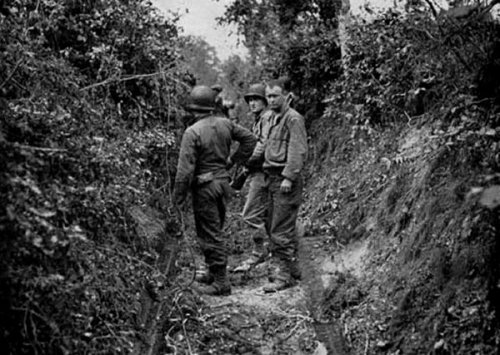
Infantry of the 30th Infantry Division

While not much progress was made on the 26th, the Americans discovered on the 27th that the German forces were retreating.  The capture of Marigny allowed VIII Corps to begin exploitation operations down the coastal highway to Coutances and for the first time since the invasion the campaign entered a phase of maneuver warfare where the mechanization and motorization of US Army forces gave them an advantage that they did not have in the Bocage.
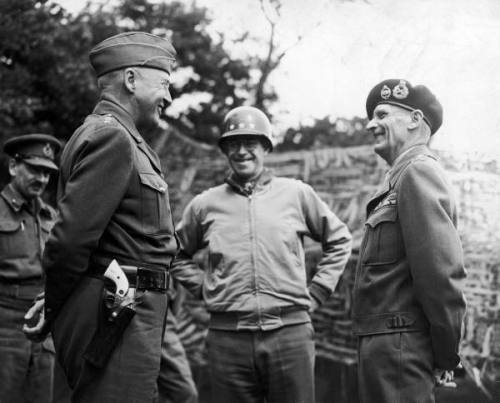
General George S Patton, Omar Bradley and Field Marshal Bernard Law Montgomery in Normandy, in Patton the Allies found a senior officer that understood the importance of strategic maneuver

On the 27th General George S Patton was authorized to take immediate command of VIII Corps a precursor to the activation of his 3rd Army.  COBRA ripped a hole in the German line and inflicted such heavy casualties on the already depleted German 7th Army that it could do little to stop the American push despite heroic performances by many units which were operating at 50% or below of their authorized strength.[xxi] As the American forces pushed forward they reinforced their left flank absorbing the local German counterattacks which were hampered by the Allied close air support.  As the breakthrough was exploited the command of the forces leading it shifted to Patton and the 3rd Army.
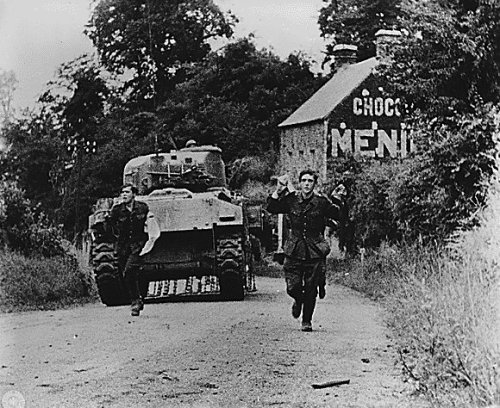
German prisoners being escorted to the rear past a Sherman

By the 28th VIII Corps led by the 4th and 6th Armored Divisions had reached Avranches and established bridgeheads over the See River with additional bridges being captured intact on the 30th.[xxii] The capture of Avranches allowed the Americans to begin exploitation operations into Brittany and east toward the Seine. Weigley notes that for the first time in the campaign that in Patton the Americans finally had a commander who understood strategic maneuver and would use it to great effect.[xxiii]

The American campaign in Normandy cost the U.S. Army a great deal. It revealed weaknesses in the infantry, the inferiority of the M4 Sherman tank to most German types, problems in tank-infantry cooperation and also deficiencies in leadership at senior, mid-grade and junior levels.  Numerous officers were relieved including Division and Regimental commanders.  Nonetheless during the campaign the Americans grew in their ability to coordinate air and ground forces and adapt to the conditions imposed on them by their placement in the Cotentin.  The deficiencies in training and leadership would continue to show up in later battles but the American Army learned its trade even impressing some of the German commanders on the ground in Normandy.[xxiv]


[i] Ibid. p.99 Both Weigley and Hastings make note of the failure of both the Americans and British to train their troops to fight in the bocage once they had left the beaches.

[ii] Ibid. Hastings. pp.152-153

[iii] Ibid. Weigley p.101

[iv] Isby, David C., Ed. “Fighting in Normandy: The German Army from D-Day to Villers-Bocage.” Greenhill Books, London,  2001.  p.143

[v] Ibid. Hastings p.173 Allied fighter bombers exacted a fearful toll among German commanders. The Commanders of the 243rd and 77th Divisions fighting in the Cotentin were also killed by air attacks on the 17th and 18th.   Further east facing the British the commander of the 12th SS Panzer Division, Fritz Witt on the 17th.

[vi] Ibid. Weigley. p.108

[vii] Ibid. p.111-112.

[viii] Ibid.

[ix] The efforts of the 51st Highland Division and 7th Armored Division were turned aside by the Germans in the area and were dramatized by the destruction of  a British armored battalion by SS Captain Michael Wittman and his platoon of Tiger tanks.  See Hastings pp.131-135.

[x] The British 8th Corps under General O’Connor lost 270 tanks and 1,500 men on 18 July attempting to crack the German gun line on the ridge beyond Caen. Weigley, pp.145-146.

[xi] Hastings comments about the critical British manpower shortage and the pressures on Montgomery to not take heavy casualties that could not be replaced. Overlord. pp.241-242.

[xii] Ibid. Weigley pp.116-120

[xiii] Ibid. p.122

[xiv] Ibid. p121 Bradley told Eisenhower “when we hit the enemy this time we will hit him with such power that we can keep going and cause a major disaster.”

[xv] Ibid. 134

[xvi] Ibid. Weigley. pp. 138-143.  Weigley notes of 40,000 U.S. casualties in Normandy up to the capture of St. Lo that 90% were concentrated among the infantry.

[xvii] Weigley quotes the 329th Regiment, 83rd Division historian “We won the battle of Normandy, [but] considering the high price in American lives we lost. P.143. This is actually a provocative statement that reflects America’s aversion to massive casualties in any war.

[xviii] Ibid. p.149

[xix] Ibid. p. 152

[xx] Ibid. pp. 152-153.  Among the casualties were the command group of the 9th Division’s 3rd Battalion 47th Infantry and General Leslie McNair who had come to observe the assault.

[xxi] Ibid. pp.161-169. Weigley notes the advances in U.S. tactical air support, the employment of massive numbers of U.S. divisions against the depleted German LXXXIV Corps, and the advantage that the “Rhino” device gave to American tanks by giving them the ability to maneuver off the roads for the first time.

[xxii] Ibid. pp.172-173.

[xxiii] Ibid. p.172

[xxiv] Ibid. Isby, David C. “Fighting in Normandy,” p.184, an officer of the 352nd Division referred to the American soldier “was to prove himself a in this terrain an agile and superior fighter.”

Bibliography

Carell, Paul. “Invasion: They’re Coming!” Translated from the German by E. Osers, Bantam, New York 1964.

Hastings, Max. Overlord: D-Day and the Battle for Normandy Vintage Books, New York, 1984

Isby, David C. Ed. “The German Army at D-Day: Fighting the Invasion.” Greenhill Books, London 2004

Isby, David C., Ed. “Fighting in Normandy: The German Army from D-Day to Villers-Bocage.” Greenhill Books, London, 2001.

Ryan, Cornelius, “The Longest Day” Popular Library Edition, New York 1959

Tsouras, Peter. “Disaster at D-Day: The Germans Defeat the Allies, June 1944,” Greenhill Books, London 1994.

Von Luck, Hans.  “Panzer Commander“ Dell Publishing, New York, 1989

Warlimont, Walter. “Inside Hitler’s Headquarters: 1939-1945.” Translated from theGerman by R.H. Barry. Presidio Press, Novao CA, English Edition Copyright 1964 Wiedenfeld and Nicholson Ltd. Warlimont, Walter. “Inside Hitler’s Headquarters: 1939-1945.” Translated from theGerman by R.H. Barry. Presidio Press, Novao CA, English Edition Copyright 1964 Wiedenfeld and Nicholson Ltd.

Weigley, Russell F. Eisenhower’s Lieutenants: The Campaign of France and Germany, 1944-1945, Indiana University Press, Bloomington IN, 1981

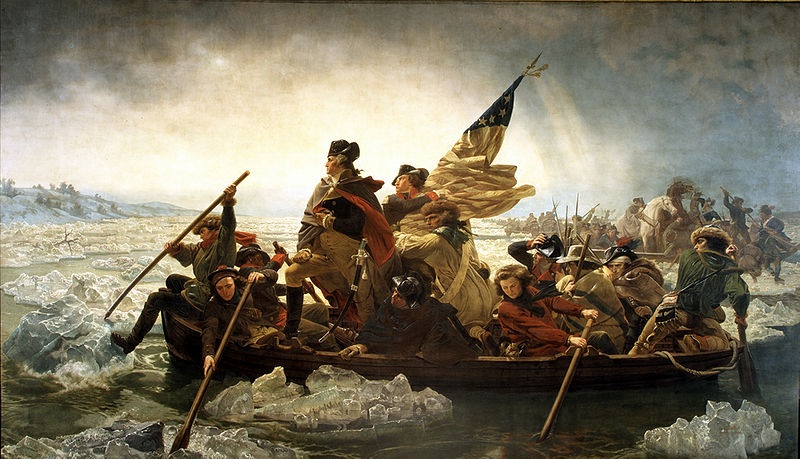
3 Comments

Filed under History, Military, world war two in europe

Five Minutes that Changed History: The Battle of Midway 1022-1027 hours June 4th 1942

Instruments of Death SBD Dauntless Dive Bombers at Midway

Six months after Pearl Harbor the United States Navy met the Imperial Japanese Navy in battle on the seas and in the airspace around Midway Island. It was a battle between a fleet that had known nothing but victory in the months after Pearl Harbor, sweeping across the Pacific and the Indian Oceans and decimating Allied Naval forces that stood in their way, the HMS Prince of Wales and HMS Repulse off of Singapore, a force of Royal Navy cruisers and the Aircraft Carrier HMS Hermes in the Indian Ocean, the bulk of the US Asiatic Fleet in the waters around the Philippines and the Dutch East Indies culminating in the Battle of the Java Sea where the bulk of the American, British, Dutch and Australian naval forces engaged were annihilated.  In only one place had a Japanese Naval task force been prevented from its goal and that was at the Battle of the Coral Sea where Task Force 11 and Task Force 17 centered on the Carriers USS Lexington and USS Yorktown prevented a Japanese invasion force from taking Port Moresby sinking the light carrier Shoho, damaging the modern carrier Shokaku and decimating the air groups of the Japanese task force.

In May US Navy code breakers discovered the next move of the Imperial Navy an attack on Midway Island and the Aleutian islands.   Since the occupation of Midway by Japanese forces would give them an operational base less than 1000 miles from Pearl Harbor Admiral Chester Nimitz committed the bulk of his naval power, the carriers USS Enterprise CV-6, USS Yorktown CV-5 and USS Hornet CV-8 and their 8 escorting cruisers and 15 destroyers, a total of 26 ships with 233 aircraft embarked to defend Midway along with a force of 5 cruisers and 4 destroyers to cover the Aleutians.  Midway had a mixed Marine, Navy and Army air group of 115 aircraft which included many obsolete aircraft, 32 PBY Catalina Flying Boats, of which the 83 fighters, dive bombers, torpedo planes and Army Air Force bombers piloted by a host of inexperienced pilots.

The Japanese Flagship Akagi

The Japanese sent a force of 7 battleships, 7 carriers including the elite First Carrier Striking Group composed of the Pearl Harbor attackers Akagi, Kaga, Soryu and Hiryu and their highly trained and combat experienced air groups composed of 273 aircraft along with 14 cruisers and 39 destroyers assigned to take Midway and destroy the US Navy when it came out to fight as well as a force of 4 battleships, 12 destroyers assigned screen to the Aleutian invasion force which was accompanied by 2 carriers 6 cruisers and 10 destroyers.   The other carriers embarked a further 114 aircraft.  A factor which aided the Americans was the distance between the Japanese Task forces which were scattered over thousands of square miles of the Northern Pacific Ocean from which they could not rapidly come to the assistance of any other group.

With the foreknowledge provided by the code breakers the US forces hurried to an intercept position northeast of Midway eluding the Japanese submarine scout line which the Japanese Commander Admiral Yamamoto presumed would find them when they sailed to respond to the Japanese attack on Midway.  Task Force 16 with the Enterprise and Hornet sailed first under the command of Rear Admiral Raymond A Spruance and Task Force 17 under Rear Admiral Frank “Jack” Fletcher with the Yorktown which had been miraculously brought into fighting condition after suffering heavy damage at Coral Sea. Fletcher assumed overall command by virtue of seniority and Admiral Nimitz instructed his commanders to apply the principle of calculated risk when engaging the Japanese as the loss of the US carriers would place the entire Pacific at the mercy of the Japanese Navy.

On June 3rd a PBY Catalina discovered the Japanese invasion force and US long range bombers launched attacks against it causing no damage.  The morning of the 4th the Americans adjusted their search patterns in and the Japanese came into range of Midway and commenced their first strike against the island.  In response land based aircraft from Midway attacked the Japanese carrier force taking heavy casualties and failing to damage the Japanese task force.  The American Carrier task forces launched their strike groups at the Japanese fleet leaving enough aircraft behind of the Combat Air Patrol and Anti-submarine patrol.  As the Americans winged toward the Japanese fleet the Japanese were in confused.  A scouting report by an aircraft that had been delayed at launch discovered US ships but did not identify a carrier until later into the patrol.  This was the Yorktown and TF 17. The Japanese attempted to recover their strike aircraft and prepare for a second strike on the island and then on discovery of the carrier embarked on the task of unloading ground attack ordnance in favor of aerial torpedoes and armor piercing bombs.  The hard working Japanese aircrew did not have time to stow the ordnance removed from the aircraft but by 1020 they had the Japanese strike group ready to launch against the US carriers.

AM6-2 Zeros Mauled the US Torpedo Bombers

As the Japanese crews worked the Japanese carriers were engaged in fending off attacks by the US torpedo bomber squadrons, VT-6 from Enterprise, VT-8 from Hornet and VT-3 from Yorktown.  The Japanese Combat Air Patrol ripped into the slow, cumbersome and under armed TBD Devastators as they came in low to launch their torpedoes.  Torpedo Eight from Hornet under the command of LCDR John C Waldron pressed the attack hard but all 15 of the Devastators were shot down.  Only Ensign George Gay’s aircraft was able to launch its torpedo before being shot down and Gay would be the sole survivor of the squadron.

Hopelessly obsolete 40 of 44  TBD Devastators were lost in action

Torpedo 6 under the command of LCDR Eugene Lindsey suffered heavy casualties losing 10 of 14 aircraft with Lindsey being one of the casualties.  The last group of Devastators to attack was Torpedo 3 under the command of LCDR Lem Massey from the Yorktown.  These aircraft were also decimated and Massey killed but they had drawn the Japanese Combat Air Patrol down to the deck leaving the task force exposed to the Dive Bombers of the Enterprise and Yorktown.

TBD Devastator attacking Akagi

There had been confusion among the Americans as to the exact location of the Japanese Carriers, the Bombing 8 and Scouting 8 of Hornet did not find the carriers and had to return for lack of fuel with a number of bombers and their fighter escort having to ditch inn the ocean and wait for rescue.  The Enterprise group under LCDR Wade McClusky was perilously low on fuel when the wake of a Japanese destroyer was spotted.  McClusky followed it to the Japanese Task Force.  The Yorktown’s group under LCDR Max Leslie arrived about the same time.  The found the skies empty of Japanese aircraft. Aboard the Japanese ships there was a sense of exhilaration as each succeeding group of attackers was brought down and with their own aircraft ready to launch and deal a fatal blow to the American carrier wondered how big their victory would be.

At 1020 the first Zero of the Japanese attack group began rolling down the flight deck of the flagship Akagi, aboard Kaga aircraft were warming up as they were on the Soryu.  The unsuspecting Japanese were finally alerted when lookouts screamed “helldivers.” Wade McClusky’s aircraft lined up over the Akagi and Kaga pushing into their dives at 1022. There was a bit of confusion when the bulk of Scouting 6 joined the attack of Bombing 6 on the Kaga.  The unprepared carrier was struck by four 1000 pound bombs which exploded on her flight deck and hangar deck igniting the fully fueled and armed aircraft of her strike group and the ordnance littered about the hangar deck.  Massive fires and explosions wracked the ship and in minutes the proud ship was reduced to an infernal hell with fires burning uncontrollably. She was abandoned and would sink at 1925 taking 800 of her crew with her.     LT Dick Best of Scouting 6 peeled off from the attack on Kaga and shifted to the Japanese flagship Akagi. On board Akagi were two of Japans legendary pilots CDR Mitsuo Fuchida leader of and CDR Minoru Genda the architect of the Pearl Harbor attack and subsequent string of Japanese victories.  Both officers were on the sick list and had come up from sick bay to watch as the fleet was attacked.  Seeing Kaga burst into flames they stood mesmerized until Akagi’s lookouts screamed out the warning “helldivers” at 1026.  Best’s aircraft hit with deadly precision landing tow of their bombs on Akagi’s flight deck creating havoc among the loaded aircraft and starting fires and igniting secondary explosions which turned the ship into a witch’s cauldron.  By 1046 Admiral Nagumo and his staff were forced to transfer the flag to the cruiser Nagara as Akagi’s crew tried to bring the flames under control. They would do so into the night until nothing more could be done and abandoned ship at 2000.  Admiral Yamamoto ordered her scuttled and at 0500 on June 5th the pride of the Japanese carrier force was scuttled.

Scouting 6 gets the Akagi

VB-3 under LCDR Max Leslie from the Yorktown stuck the Soryu with 17 aircraft, only 13 of which had bombs due to an electronic arming device malfunction on 4 of the aircraft including the squadron leader Leslie.  Despite this they dove on the Soryu at 1025 hitting that ship with 3 and maybe as many as 5 bombs. Soryu like her companions burst into flames as the ready aircraft and ordnance exploded about her deck. She was ordered abandoned at 1055 and would sink at 1915 taking 718 of her crew with her.

The remaining Japanese flattop the Hiryu attained the same fate later in the day after engaging in an epic duel with the Yorktown which her aircraft heavily damaged.

It was quite miraculous what happened at Midway in those five pivotal minutes.  Authors have entitled books about Midway Incredible Victory and Miracle at Midway and the titles reflect the essence of the battle.  A distinctly smaller force defeated a vastly superior fleet in terms of experience, training and equipment and when it appeared that the Japanese Fleet would advance to victory in a span of less than 5 minutes turn what looked like certain defeat into one of the most incredible and even miraculous victories in the history of Naval warfare.  In those 5 minutes history was changed in a breathtaking way.  While the war would drag on and the Japanese still inflict painful losses and defeats on the US Navy in the waters around Guadalcanal the tide had turned and the Japanese lost the initiative in the Pacific never to regain it.   The Japanese government hid the defeat from the Japanese people instead proclaiming a great victory while the American government could not fully publicize the information that led to the ability of the US Navy to be at the right place at the right time and defeat the Imperial Navy.

When one looks at implications of the victory it did a number of things. First it changed the course of the war in the Pacific probably shortening it by a great deal.  Secondly it established the aircraft carrier and the fast carrier task force as the dominant force in naval warfare which some would argue it still remains.  Finally those five minutes ushered in an era of US Navy dominance of the high seas which at least as of yet has not ended as the successors to the Enterprise, Hornet and Yorktown ply the oceans of the world and the descendants of those valiant carrier air groups ensure air superiority over battlefields around the world.
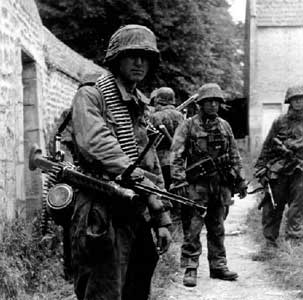
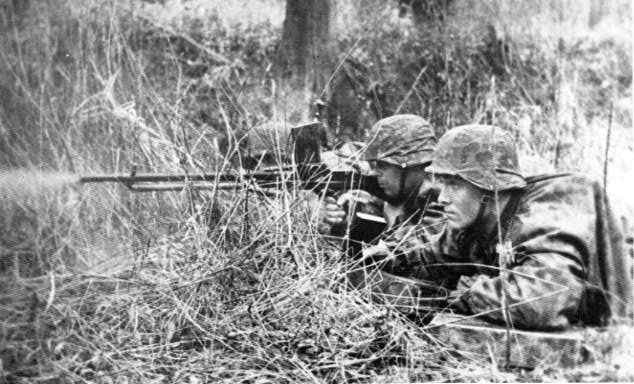
Peace

Padre Steve+

7 Comments

Filed under History, Military, US Navy, world war two in the pacific